
Fargo City Zoning Code
ARTICLE 20
09 - DEVELOPMENT REVIEW PROCEDURES
§20-0901.- General
The requirements of this section apply to all applications under this Land Development Code.
A.
Authority to File Applications
An application for development review or approval under this Land Development Code
must be filed by the person having legal authority to take action in accordance with
the approval sought. Unless otherwise expressly stated, that person is presumed to
be the record owner, purchaser under a sale from the record owner, or the duly authorized
agent of the record owner in the absence of satisfactory proof to the contrary. City
officials are authorized to require proof of legal authority to take the action sought.
The Board of City Commissioners, Planning Commission, Board of Adjustment and City
department heads may initiate any action under this Land Development Code with or
without an application from the property owner.
B.
Form of Application
Applications required under this Article must be submitted on forms and in such numbers
as required by the official responsible for accepting the application.
C.
Filing Fees
Applications must be accompanied by the non-refundable fee established by Board of
City Commissioners. Fees shall not be required with applications initiated by the
Board of City Commissioners, Planning Commission, Board of Adjustment or City department
heads.
D.
Complete Applications
Applications that do not include required information or that are not accompanied
by required fees will be returned to the applicant as incomplete, and no further processing
of the application will occur until the deficiencies are corrected. Applications will
be reviewed for completeness within five (5) days of filing. If the official determines
that the application is complete, the application will be processed. If the official
determines that the application is incomplete, the application will be returned to
the applicant along with an explanation of the application's deficiencies.
E.
Establishment of Processing Cycles
Officials responsible for accepting applications, after consulting with review and
decision-making bodies, may promulgate processing cycles for applications. Processing
cycles may establish:
1.
Deadlines for receipt of complete applications;
2.
Dates of regular meetings;
3.
The scheduling of staff reviews and staff reports on complete applications;
4.
All required steps in the application process (including public hearings, and reviews by other agencies); and
5.
Required time-frames for action by review and decision-making bodies.
F.
Notices
All notices required under this Land Development Code must:
(1)
indicate the time and place of all scheduled public hearings;
(2)
describe the property involved in the application by street address, legal description or map;
(3)
describe the nature, scope and purpose of the proposal; and
(4)
indicate the location and source of additional information on the proposal.
1.
Written Notice
Unless otherwise expressly stated, when the provisions of this Land Development Code
require that written notice be provided, the official responsible for accepting the
application shall provide written notice by first class mail to all owners of the
subject property and all property owners within three hundred (300) feet of the subject
property. The notice shall be deposited in the U.S. mail at least fifteen (15) days
before the first scheduled public hearing. Ownership information shall be obtained
from the Cass County Assessor's Office.
2.
Published Notice
When the provisions of this Land Development Code require that notice be published
in the newspaper, the official responsible for accepting the application shall ensure
that notice is published in a newspaper of general circulation within the City at
least once each week for 2 successive weeks preceding the date of the first scheduled
public hearing.
3.
Constructive Notice
Minor technical deviations from specified notice requirements shall not be deemed
to impair notice where there is actual notice. When required written notices have
been properly addressed and deposited in the mail, failure of a party to receive such
notice shall not invalidate any subsequent action. In all cases, however, the requirements
for the timing of the notice and for specifying the time, date and place of a hearing
and the general location of the subject property shall be strictly construed. If questions
arise at the hearing regarding the adequacy of notice, the body hearing the matter
shall make a finding regarding whether there was compliance with the notice requirements
of this article.
G.
Neighborhood Associations
Established neighborhood associations may request that written notice be mailed to
a designated representative and city planning staff shall send to said designated
representative a copy of any legally required written notice; however, failure on
the part of said planning staff or the city to send such notice shall not invalidate
any proceedings nor shall it constitute grounds for delay of any proceedings, said
notification to the representative of the neighborhood association being a courtesy
and not a legal requirement.
H.
Action by Review and Decision-Making Bodies
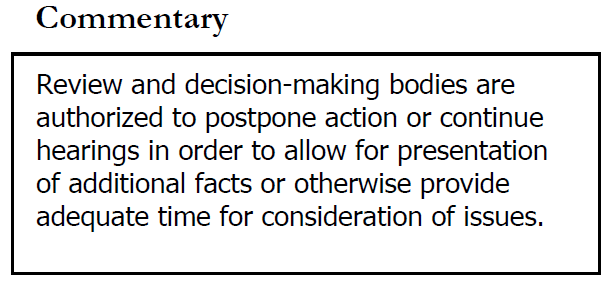
Review and decision-making bodies may take any action on an application that is consistent with the notice given, including, but not limited to, approving the application, approving the application with conditions or denying the application. Review bodies may recommend and decision-making bodies may impose conditions on the application or allow amendments to the application if the effect of the conditions or amendments is to allow a less intensive use or zoning district than indicated in the application, to reduce the impact of the development or to reduce the amount of land area included in the application. Decision-making bodies may not approve an application for a greater density of development, a more intensive use, a more intensive zoning district, reduced setbacks, more dwelling units, greater height, more access points or fewer improvements than indicated in the notice.
I.
Inaction By Review and Decision-Making Bodies
1.
Review Bodies
When a review body fails to take action on an application, the application will be
forwarded to the decision-making body with no recommendation.
2.
Decision-Making Bodies
When a decision-making body fails to take action on an application within a required
time-frame, that inaction will be deemed a denial of the application.
J.
Continuation of Public Hearings
A public hearing for which proper notice was given may be continued to a later date
without again complying with the notice requirements, provided that the continuance
is set for a date and time certain and announced at the original public hearing.
K.
Compliance with North Dakota Century Code
The development review procedures of this Article are intended to implement the procedural
requirements of the North Dakota Century Code. In the event of conflict between the
procedures of this article and those required by the Century Code, the North Dakota
Century Code shall control.
■ BOA = Board of Adjustment ■ PC = Planning Commission
■ BCC = Board of City Commissioners ■ HPC = Historic Preservation Commission
[1] HPC is involved only on H-O District application, pursuant to § 20-0305.
[2] Appeals are not required to go to Planning Commission and Board of City Commissioners. Board of City Commissioners acts as appellate body only if the Planning Commission's decision is appealed.
[3] Review, Decision Making and Appeals process is different depending on nature of request. See § 20-0912.
Source: 2985 (1999), 4486 (2005), 4592 (2007), 4881 (2013), 5179 (2018).
§20-0902. - Burden of Proof or Persuasion
The burden of demonstrating that an application complies with applicable review and approval criteria is on the applicant. The burden is not on the City or other parties to show that the criteria have not been met.
Source: 2985 (1999).
§20-0903. - Date of Decision; Time Period for Appeals
A.
For all matters requiring a public hearing, the date of the decision shall be the date on which the decision-making body votes to take final action on the matter. For matters that do not require a public hearing, the date of the decision shall be the date indicated on the notice that is mailed to the applicant by the City Planner or Zoning Administrator.
B.
Appeals of final decisions made pursuant to the procedures of this article must be filed within ten (10) days of the date of the decision.
Source: 2985 (1999).
§20-0904. - LDC Text Amendments
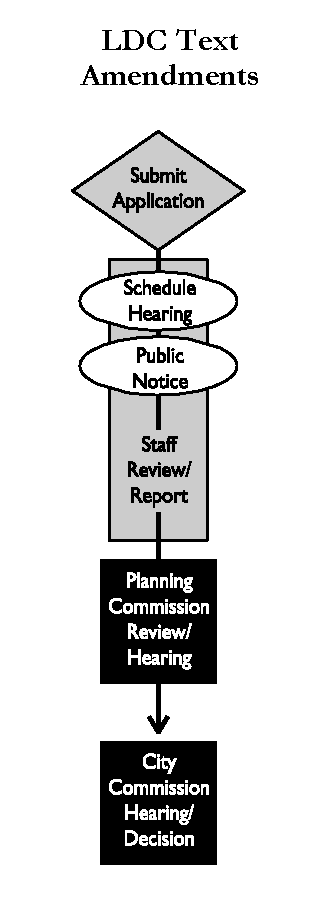
This section sets out the required review and approval procedures for Land Development Code text amendments.
A.
Application
A complete application for a Land Development Code text amendment must be submitted
to the Planning Department in a form established by the City Planner, along with a
nonrefundable fee that has been established by the Board of City Commissioners. No
application will be processed until the application is complete and the required fee
has been paid.
B.
City Planner Review and Recommendation
The City Planner must review each proposed Land Development Code text amendment and
provide a report to the Planning Commission describing the purpose and effect of the
amendment.
C.
Planning Commission Review
The Planning Commission must hold a public hearing on the proposed Land Development
Code text amendment and, at the close of the public hearing, make a recommendation
to the Board of City Commissioners.
D.
Board of City Commissioners Action
The Board of City Commissioners must hold a public hearing on the proposed Land Development
Code text amendment. At the close of the public hearing, the Board of City Commissioners
shall act to approve or deny the Land Development Code text amendment.
E.
Review Criteria
The Planning Commission and Board of City Commissioners shall consider the following
criteria in reviewing Land Development Code text amendments. Proposed text amendments
that satisfy all of the criteria may be approved.
1.
The amendment must be consistent with the purpose of this Land Development Code;
2.
The amendment must not adversely affect the public health, safety, or general welfare; and
3.
The amendment is necessary because of changed or changing social values, new planning concepts or other social or economic conditions in the areas affected.
F.
Notice of Public Hearings
Notice of the Planning Commission and Board of City Commissioners' public hearings
on Land Development Code text amendments shall be published in accordance with Sec.
20-0901-F.
G.
Notice of Amendment Adoption
Within thirty (30) days after the Board of City Commissioners approves a Land Development
Code text amendment, the City Planner shall ensure that notice of the approved amendment
is published in accordance with Sec. 20-0901-F.
§20-0905. - Growth Plans
A.
Applicability
Effective April 1, 2000, an approved Growth Plan is a prerequisite for the approval
of a Zoning Map Amendment or Subdivision Plat in portions of the City that have been
annexed to the City after February 17, 1998, in Sections 33 and 34 of Reed Township
(T140N, R49W), and in the extraterritorial jurisdiction of the City. This section
sets out the required review and approval process for Growth Plans. The requirement
of an approved Growth Plan shall not take effect until July 1, 2000, provided, however,
that as to proposals for zoning map amendments for areas currently zoned Agricultural
(AG) in which an approved Growth Plan is not in place, the Planning Commission shall
be provided with the following:
1.
The opportunity for preliminary review to occur prior to a public hearing;
2.
The Planning Department shall provide analysis of the compatibility of the proposed development with existing development, the Comprehensive Policy Plan, physical features of the land and infrastructure availability; and
3.
The written notice requirements of 20-0901 shall be extended to landowners within five hundred (500) feet of the subject property.
4.
The requirements of subparagraphs 1 through 3, above, shall not apply to development applications submitted prior to March 23, 1999.
B.
Plan Definition
As used in this section a Growth Plan, or Plan, shall be deemed to be a land use map
and street plan.
C.
Application
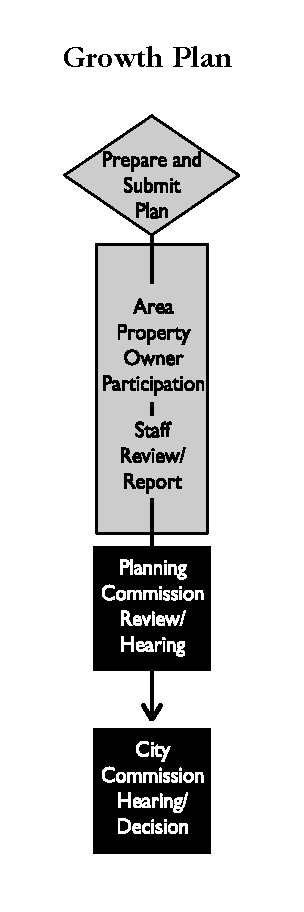
A complete Growth Plan application must be submitted to the City Planner in a form
established by the City Planner, along with a nonrefundable fee that has been established
by the Board of City Commissioners. No application will be processed until the application
is complete and the required fee has been paid.
D.
Preparation of Growth Plan
The City Planner shall prepare the proposed Growth Plan.
E.
Plan Review
After preparing the Growth Plan, the City Planner shall schedule a meeting for the
purpose of allowing area residents and property owners in the area to review and comment
on the proposed Growth Plan. Notice of meeting shall be published in accordance with
Section 20-0901-F.
F.
Planning Commission Review
The Planning Commission shall hold a public hearing on the proposed Growth Plan and,
at the close of the public hearing, make a recommendation to the Board of City Commissioners.
G.
Board of City Commissioners Action
The Board of City Commissioners shall hold a public hearing on the proposed Growth
Plan. At the close of the public hearing, the Board of City Commissioners shall act
to approve, approve with modifications or deny the Growth Plan.
H.
Approval Criteria
In acting on Growth Plans, the Planning Commission and Board of City Commissioners
shall consider whether the Growth Plan is consistent with and serves to implement
adopted plans and policies of the City.
I.
Notice of Public Hearings
Notice of the Planning Commission and Board of City Commissioners' public hearings
shall be published in accordance with Section 20-0901-F.
J.
Amendments to Growth Plans
Growth Plans may be amended, in part or in total, in the same manner as set forth
in this section.
Source: 2997 (1999), 4024 (2000).
§20-0906. - Zoning Map Amendments
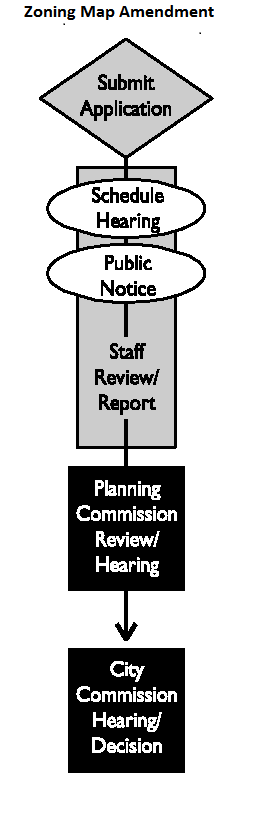
This section sets out the required review and approval procedures for amendments to the official zoning map (zoning changes).
A.
Growth Plan Prerequisite
No zoning map amendment application will be accepted for land that is not covered
by an approved Growth Plan. If the subject property is not included in an approved
Growth Plan, a Growth Plan must be submitted for review and approval before or concurrently
with the zoning map amendment application. This provision shall not be interpreted
as requiring an approved Growth Plan prior to initial zoning of land brought into
the City's Extra-Territorial Zoning Jurisdiction (See also Sec. 20-0108). The requirement of an approved Growth Plan shall not take effect until April 1,
2000, provided, however, that as to proposals for zoning map amendments for areas
currently zoned Agricultural (AG) in which an approved Growth Plan is not in place,
the Planning Commission shall be provided with the following:
1.
The opportunity for preliminary review to occur prior to a public hearing;
2.
The Planning Department shall provide analysis of the compatibility of the proposed development with existing development, the Comprehensive Policy Plan, physical features of the land and infrastructure availability; and
3.
The written notice requirements of Sec. 20-0901 shall be extended to landowners within 500 feet of the subject property.
4.
The requirements of subparagraphs 1 through 3, above, shall not apply to development applications submitted prior to March 23, 1999.
B.
Application
A complete application for a zoning map amendment must be submitted by the applicant
or the applicant's agent to the City Planner. The application shall be in a form established
by the City Planner, and be accompanied by a nonrefundable fee that has been established
by the Board of City Commissioners. No application will be processed until the application
is complete and the required fee has been paid.
C.
City Planner Review and Recommendation
The City Planner must review each proposed zoning map amendment and provide a report
to the Planning Commission describing the purpose and effect of the amendment.
D.
Planning Commission Review
The Planning Commission must hold a public hearing on the proposed zoning map amendment
and, at the close of the public hearing, make a recommendation to the Board of City
Commissioners.
E.
Board of City Commissioners Action
The Board of City Commissioners must hold a public hearing on the proposed zoning
map amendment. At the close of the public hearing, the Board of City Commissioners
shall act to approve or deny the zoning map amendment.
F.
Review Criteria
The Planning Commission and Board of City Commissioners shall consider the following
criteria in their review of zoning map amendment requests. Proposed zoning map amendments
that satisfy all of the criteria may be approved.
1.
The requested zoning change is justified by a change in conditions since the previous zoning classification was established or by an error in the zoning map;
2.
The City and other agencies will be able to provide necessary public services, facilities, and programs to serve the development allowed by the new zoning classification at the time the property is developed;
3.
The approval will not adversely affect the condition or value of property in the vicinity; and
4.
The proposed amendment is consistent with the purpose of this Land Development Code, the applicable Growth Plan and other adopted policies of the City.
G.
Protest Petitions
1.
Definition of "Valid" Protest Petition
In order to be deemed "valid," a protest petition must be signed by the owners of
twenty percent (20%) or more: (a) of the area of the lots included in the area proposed
to be changed, or (b) of the area adjacent and extending three hundred (300) feet
from the land area proposed to be changed, excluding the width of streets. "Valid"
protest petitions must contain the signature and address of each protesting property
owner, and the location of property owned by each protestor shall be shown on a map
attached to the written petition.
2.
Super-Majority Vote Required
If a valid protest petition is submitted to City Planner before the scheduled public
hearing of the Board of City Commissioners, approval of a zoning map amendment shall
require a favorable vote of ¾ of all the members of the Board of City Commissioners.
H.
Notice of Public Hearings
1.
Written Notice
The City Planner shall provide written notice of the Planning Commission public hearing
in accordance with Sec. 20-0901-F.
2.
Published Notice
Notice of the Planning Commission and Board of City Commissioners' public hearings
shall be published in accordance with Sec. 20-0901-F.
I.
Limit on Successive Applications
If the Board of City Commissioners denies an application for a zoning map amendment,
an application for the same zoning district on any portion of the subject tract may
not be refiled by the original applicant for three months from the date of the Board
of City Commissioners' public hearing on the proposed amendment.
Source: 2985 (1999), 2997 (1999), 4024 (2000), 4168 (2001).
§20-0907. - Subdivision
A.
General
1.
Applicability
Subdivision of land shall be required before any of the following activities occur:
a.
The division of land (for any purpose) into two (2) or more parcels; or
b.
Development that involves the construction of any public improvements that are to be dedicated to the City.
2.
Exemptions
The "Applicability" provision of Sec. 20-0907-A notwithstanding, the following shall
be exempt from the subdivision procedures of this section.
a.
Boundary Line Adjustments
An adjustment in the boundary between adjoining lots if the adjustment does not create
a substandard lot, exceed the maximum density allowed by the underlying zoning district
or necessitate new roadway construction or right-of-way dedication. In such cases,
a Boundary Line Adjustment survey must be submitted to the Zoning Administrator for
review and approval, based on whether the reconfigured lots comply with the standards
of this Land Development Code. Upon approval, the Boundary Line Adjustment survey
shall be recorded with County Register of Deeds. A Boundary Line Adjustment shall
not be required when two (2) or more lots are combined into a single lot whose boundaries
coincide with lot lines shown on the recorded plat of the subdivision.
b.
Tax Lots
The division of ownership interests solely for the purpose of assigning tax liability
among multiple owners (tax lots), provided that a tax lot survey must be submitted
to the City Assessor, who shall inform the applicant of the effect of the tax lot
division and record the tax lot survey with the County Register of Deeds.
c.
Rail Rights-of-Way, Drainage Easements and Utilities
Land used for street or railroad right-of-way, a drainage easement or other public
utilities subject to local, state or federal regulations, where no new street, right-of-way
or easement is involved, or for a cemetery.
d.
Agricultural
The division of a parcel or tract of land when the smallest parcel created is greater
than ten (10) acres and the land is to be used solely for agriculture and living unit
purposes.
3.
Proper Designation
Notwithstanding the references in this section to subdivisions, minor subdivisions
and major subdivisions, the subdivided land shall be considered an "addition" if the
land is within the corporate limits of the City and shall be considered a "subdivision"
if the land is outside the corporate limits of the City and the same shall be reflected
in the proper name for the subdivision. A failure to properly identify the subdivision
as either an "addition" or "subdivision" shall not invalidate a subdivision which
was otherwise approved in accordance with the Land Development Code.
Source: 4039 (2000)
B.
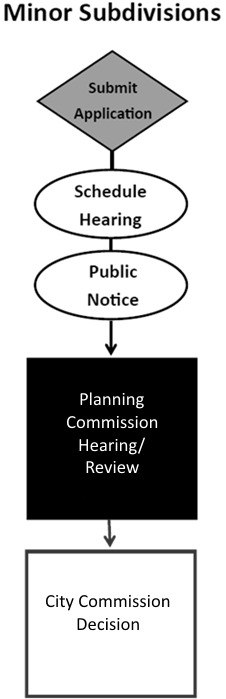
Minor Subdivisions
The expedited review and approval procedures of this subsection apply only to "Minor
Subdivisions."
1.
Application
A complete application for Minor Subdivision Plat approval must be submitted to the
City Planner in a form established by the City Planner, along with a nonrefundable
fee that has been established by the Board of City Commissioners. No application will
be processed until the application is complete and the required fee has been paid.
2.
Review and Report—City Planner
The City Planner shall prepare a staff report that reviews the application in light
of the Comprehensive Plan, the zoning standards of Article 20-06 and all other applicable requirements of this Land Development Code.
3.
Review and Recommendation—Planning Commission
The Planning Commission shall hold a public hearing on the Minor Subdivision application
and, after the close of the public hearing, shall recommend approval or denial of
the application, based on whether it complies with the adopted Area Plan, the standards
of Article 20-06 and all other applicable requirements of this Land Development Code.
4.
Review and Action - Board of City Commissioners
After receiving the recommendation of the Planning commission, the Board of City Commissioners
shall act to approve or deny the application. A public hearing beore the City Commission
is not required. A Minor Subdivision Plat shall not be approved unless it is located
in a zoning district that allows the proposed development (uses and density/dimensional
standards) and complies with the adopted Area Plan, the standards of Article 20-06 and all other applicable requirements of this Land Development Code.
5.
Notices
Notices of the Planning Commission public hearings on Minor Subdivisin Plat applications
shall be published in accordance with Sec. 20-0901-F.
6.
Recordation
After approval of a Final Plat, the City Planner shall be responsible for recording
the Final Plat with the County Recorder.
C.
Major Subdivisions
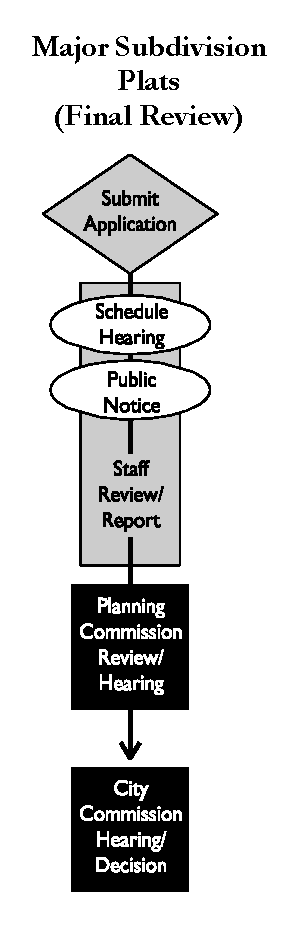
The procedures of this subsection apply to all "Major Subdivisions."
1.
Growth Plan and Zoning Prerequisite
No Major Subdivision plat application will be accepted for land that is not consistent
with an approved Growth Plan or zoned to accommodate the proposed development. If
the subject property is not consistent with an approved Growth Plan, a new or revised
Growth Plan must be submitted for review and approval before or concurrently with
the major plat application. The requirement of an approved Growth Plan shall not take
effect until July 1, 2000.
2.
Preapplication Meeting
Before submitting a plat for a proposed Major Subdivision, the applicant shall confer
with the City Planner to discuss the proposal and applicable regulations. The purpose
of the Preapplication Meeting is for the applicant to become familiar with applicable
subdivision procedures and standards. The City Planner may waive the preapplication
meeting requirement.
3.
Preliminary Review
a.
Application
A complete application for preliminary review of major subdivision plats must be submitted
to the City Planner in a form established by the City Planner, along with a nonrefundable
fee that has been established by the Board of City Commissioners. No application will
be processed until the application is complete and the required fee has been paid.
b.
Review and Report - City Planner
The City Planner shall prepare a staff report that reviews the application in light
of the applicable Area Plan, the Comprehensive Plan, the standards of Article 20-06 and all other applicable requirements of this Land Development Code.
c.
Review By Planning Commission
The Planning Commission shall review the plat application to determine if it complies
with the adopted Area Plan, the standards of Article 20-06 and all other applicable requirements of this Land Development Code. After making
its determination, the Planning Commission shall schedule a public hearing date for
review of the finalized plat documents. After the preliminary review, the applicant
may proceed with the preparation of Construction Plans and submit the required plat
documents for review and approval.
4.
Final Review and Action
a.
Prerequisites for Planning Commission Hearing
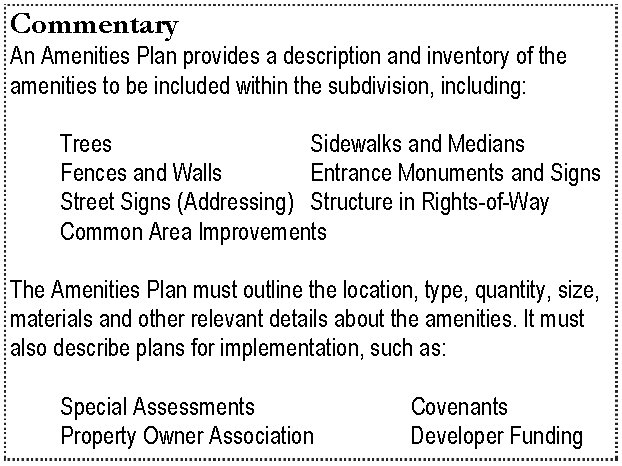
The Planning Commission shall not hold a public hearing on a proposed Major Subdivision Plat until all of the following documents and information have been submitted to the City Planner in a form established by the City Planner:
(1)
A complete Amenities Plan;
(2)
A Clear Title Opinion;
(3)
A Departmental Review Checklist; and
(4)
Mylar Plat Document signed by the applicant, property owner and land surveyor.
b.
Review and Report—City Planner.
The City Planner shall prepare a staff report that reviews the application in light
of the approved Preliminary Plat, the applicable Area Plan, the Comprehensive Plan,
the standards of Article 20-06 and all other applicable requirements of this Land Development Code.
c.
Review and Recommendation—Planning Commission.
The Planning Commission shall hold a public hearing on the Major Subdivision Plat
and, after the close of the public hearing, recommend approval or denial of the application,
based on whether it complies with the adopted Area Plan, the standards of Article 20-06 and all other applicable requirements of this Land Development Code.
d.
Review and Action—Board of City Commissioners.
The Board of City Commissioners shall hold a public hearing on the Major Subdivision
Plat and, after the close of the public hearing, act to approve or deny the application.
A Major Subdivision Plat shall not be approved unless it is located in a zoning district
that allows the proposed development (uses and density/dimensional standards) and
complies with the adopted Area Plan, the standards of Article 20-06 and all other applicable requirements of this Land Development Code.
e.
Notices.
Notice of the Planning Commission and Board of City Commissioners' public hearings
on Major Subdivision Plat applications shall be published in accordance with Sec.
20-0901-F.
f.
Public Improvements.
In taking action on Final Plat applications, the Board of City Commissioners shall
specify the terms for securing installation of public improvements to serve the subdivision.
In doing so, the Board of Commissioners may:
(1)
Require that the developer install required subdivision improvements in accordance with the approved Final Plat and all other applicable public facility design standards, including the subdivision and improvement and design standards of Article 20-06;
(2)
Require that the developer post a financial guarantee for the improvements, in accordance with applicable law; or
(3)
Agree that the City will install public facilities and improvements and then assess the costs of those improvements against the benefited properties.
5.
Recordation
After approval of a Final Plat, the City Planner shall be responsible for recording
the Final Plat with the County Register of Deeds.
D.
Subdivision Waivers
1.
Application Filing
Subdivision Waiver requests shall be submitted to the City Planner in a form established
by the City Planner at the time that the subdivision plat application is submitted.
At a minimum, the Subdivision Waiver request shall include: (1) a description of the
subdivision design or improvement standards to be waived or modified, and (2) the
reasons and justifications for the requested Subdivision Waiver.
2.
Staff Recommendation
Upon receipt of a Subdivision Waiver application, the City Planner shall distribute
copies of the application to all affected departments and agencies. Reviewing departments
and agencies shall have ten (10) days to review the request and submit a recommendation
to the City Planner. The staff recommendation shall state the reasons for the recommendation
and any suggested conditions of approval. Upon receipt of the staff recommendation,
the City Planner shall prepare a report and recommendation for presentation to the
Planning Commission.
3.
Approval Criteria
The Subdivision Waiver request shall be considered by the Planning Commission and
Board of City Commissioners during their review of the subject subdivision. In recommending
action and in acting upon the Subdivision Waiver request, the Planning Commission
and Board of City Commissioners shall be bound by all of the following criteria:
a.
A Subdivision Waiver must not be detrimental to the public safety, health or welfare, or injurious to other property or improvements in the area in which the property is located;
b.
The Subdivision Waiver must represent the least deviation from this Land Development Code that will mitigate the hardship or practical difficulty that exists on the subject property; and
c.
The Subdivision Waiver shall not have the effect of waiving any provisions of this development code other than the Subdivision Design and Improvement Standards of Article 20-06.
Source: 2985 (1999), 2997 (1999), 4024 (2000), 4592 (2007), 5179 (2018).
§20-0908. - Planned Unit Developments
A.
Description and Overview
1.
General Description
A "planned unit development" (PUD) is a type of overlay zoning district and a type
of development plan. PUD zoning districts are inextricably linked to PUD plans in
that no rights of development apply to a PUD zoning designation other than those of
the approved PUD plan.
2.
Overview of Procedure
PUDs shall be processed in three stages: Master Land Use Plan; Rezoning to PUD district
and Final Plan. Master Land Use Plans and Rezonings may be processed concurrently,
provided that no rezoning to the PUD district may occur until approval of a PUD Master
Land Use Plan.
a.
The PUD Master Land Use Plan application is reviewed with respect to such issues as density, including the number, type, and location of dwelling units and other uses; impacts on surrounding areas; and the adequacy of facilities and services. The result of this review is the establishment of the basic parameters for development of the PUD. PUD Master Land Use Plan approval establishes the maximum development "envelope" with regard to density, lot sizes, overall scale, open space, environmental protection, and other land development and service provision issues.
b.
After approval of a PUD Master Land Use Plan, a PUD zoning map amendment may be approved, or a PUD zoning map amendment may be processed concurrently with the PUD Master Land Use Plan.
c.
The PUD Final Plan is the document upon which building permits and other applicable approvals are issued. The PUD Final Plan review stage is the point at which developers bring forward detailed plans for carrying out the type of project conceptually approved during PUD Concept Plan review. The applicant must submit the detailed and technical information necessary to demonstrate that all applicable standards, requirements, and conditions have been met.
B.
PUD Master Land Use Plan
A PUD Master Land Use Plan is a generalized land use plan for the entire area proposed
to be included within a PUD. The purpose of a PUD Master Land Use Plan is to allow
early review of a proposed PUD before substantial technical planning work has been
undertaken.
1.
Preapplication Conference
Before submitting a PUD Master Land Use Plan, the applicant shall confer with the
City Planner and other officials designated by the City Planner. The purpose of this
preapplication conference is to discuss the proposal and the applicable development
review and approval procedures.
2.
Application
A complete application for PUD Master Land Use Plan approval shall be submitted to
the City Planner in a form established by the City Planner along with a nonrefundable
fee that has been established by the Board of City Commissioners. No application shall
be processed until the application is complete and the required fee has been paid.
3.
Review and Report—City Planner
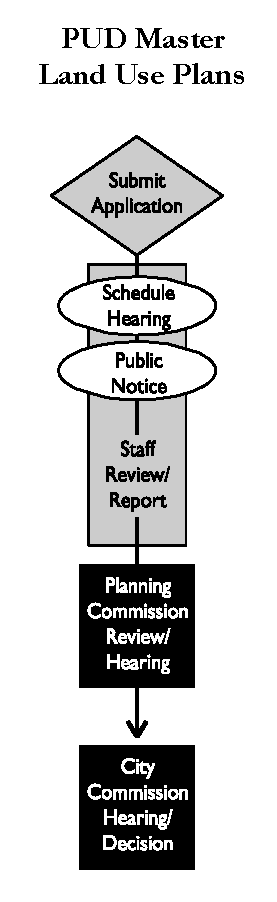
The City Planner shall prepare a staff report that reviews the PUD Master Land Use
Plan application in light of the PUD zoning standards of Sec. 20-0302 and all other applicable development standards and planning policies. The City Planner
shall provide a copy of the report to the Planning Commission and the applicant.
4.
Review and Recommendation—Planning Commission
The Planning Commission shall hold a public hearing on the PUD Master Land Use. At
the close of the public hearing, the Planning Commission shall recommend approval
or denial of the PUD Master Land Use Plan application and transmit a written summary
of its action and proceedings to the Board of City Commissioners.
5.
Review and Action—Board of City Commissioners
After the close of the Planning Commission public hearing, the Board of City Commissioners
shall hold a public hearing on the PUD Master Land Use Plan application. After the
close of the hearing, the Board of City Commissioners shall act to approve, approve
with conditions or deny the proposed PUD Master Land Use Plan. If the Board of City
Commissioners acts to approve the PUD Master Land Use Plan, it shall establish required
time-frames for development of the entire PUD and its individual phases, if any.
6.
Notice of Public Hearings
a.
Written Notice
The City Planner shall provide written notice of the Planning Commission public hearing
in accordance with Sec. 20-0901-F.
b.
Newspaper Notice
Notice of the Planning Commission and Board of City Commissioners' public hearing
on PUD Master Land Use Plans shall be published in accordance with Sec. 20-0901-F.
7.
PUD Master Land Use Plan Review Criteria
Applications for PUD Master Land Use Plan approval shall be approved if the following
criteria are met:
a.
The plan represents an improvement over what could have been accomplished through strict application of otherwise applicable base zoning district standards, based on the purpose and intent of this Land Development Code;
b.
The PUD Master Land Use Plan complies with the PUD standards of Sec. 20-0302;
c.
The City and other agencies will be able to provide necessary public services, facilities, and programs to serve the development proposed, at the time the property is developed;
d.
The development is consistent with and implements the planning goals and objectives contained in the Area Plan, the Comprehensive Plan and other adopted policy documents; and
e.
The PUD Master Land Use Plan is consistent with sound planning practice and the development will promote the general welfare of the community.
8.
Effect of PUD Master Land Use Plan Approval
Approval of a PUD Master Land Use Plan shall constitute acceptance of the overall
general planning concepts for the proposed PUD development and is a prerequisite for
the filing of a PUD Final Plan and approval of a PUD zoning classification.
9.
Lapse of PUD Master Land Use Plan Approval
An approved PUD Master Land Use Plan shall lapse and be of no further force and effect
if a PUD Final Plan for the PUD (or a phase of the PUD) has not been approved within
2 years of the date of approval of the PUD Master Land Use Plan. In the event of such
lapse, the PUD zoning classification shall be of no effect, and the property shall
be developed solely in accordance with the underlying zoning classification. In the
event of lapse of approval pursuant to this section, the Planning Commission shall
initiate action to remove the land from the PUD overlay zoning district and may initiate
action to rezone the property to its former base zoning district classification.
C.
PUD Zoning Map Amendment
After approval of a PUD Master Land Use Plan, or concurrently with the processing
of a PUD Master Land Use Plan, a zoning map amendment request for PUD zoning may be
reviewed and approved. PUD zoning requests shall be processed in accordance with the
zoning map amendment procedures of Sec. 20-0906.
D.
PUD Final Plan
1.
Application
After approval of a PUD zoning classification and before lapse of a PUD Master Land
Use Plan, a complete application for PUD Final Plan approval must be submitted to
the City Planner in a form established by the City Planner along with a non-refundable
fee that has been established by the Board of City Commissioners. No application shall
be processed until the application is complete and the required fee has been paid.
A PUD Final Plan application may include the entire area covered in the PUD Master
Land Use Plan or it may include one or more phases of the approved PUD Master Land
Use Plan.
2.
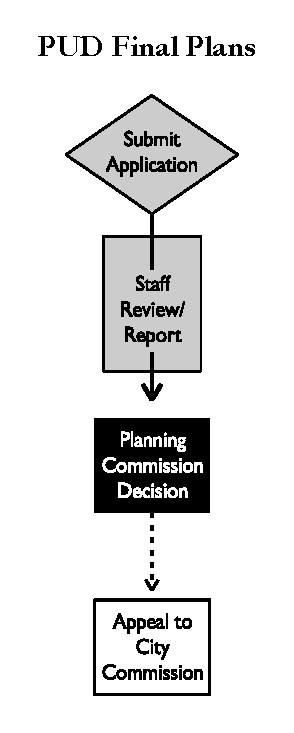
Review and Report—City Planner
The City Planner shall prepare a staff report that reviews the PUD Final Plan application
in light of the approved PUD Master Land Use Plan and all other applicable development
standards and planning policies.
3.
Review and Action—Planning Commission
The Planning Commission shall consider the PUD Final Plan application and act to approve
or deny the PUD Final Plan application.
4.
PUD Final Plan Review Criteria
A PUD Final Plan shall be approved by the Planning Commission if it is determined
by the Planning Commission to be in substantial compliance with the approved PUD Master
Land Use Plan. The PUD Final Plan shall be deemed to be in substantial compliance
with the PUD Master Land Use Plan so long as, when compared with the PUD Master Land
Use Plan, it does not result in:
a.
An increase in project density or intensity, including the number of housing units per acre or the amount of nonresidential floor area per acre;
b.
A change in the mix of housing types or the amount of land area devoted to nonresidential uses;
c.
A reduction in the amount of open space;
d.
Any change to the vehicular system that results in a significant change in the amount or location of streets, common parking areas, and access to the PUD;
e.
Any change within fifty (50) feet of any SR or MR zoning district;
f.
Any change determined by the Planning Commission to represent an increase in development intensity; or
g.
A substantial change in the layout of buildings.
5.
Effect of Approval; Lapse of Approval
Approval of a PUD Final Plan shall confer upon the applicant the right to develop
the subject property in accordance with the approved PUD Final Plan. The right to
develop in accordance with an approved PUD Final Plan shall lapse and be of no further
effect if all development shown on the PUD Final Plan is not complete within the time-frame
established by the Board of City Commissioners during review of the Master Land Use
Plan. In the event of such lapse of approval, the PUD Final Plan and PUD zoning classification
shall be of no effect, and the property shall be developed solely in accordance with
the underlying zoning classification. In the event of lapse of approval pursuant to
this subsection, the Planning Commission shall initiate action to remove the land
from the PUD overlay zoning district.
6.
Appeal of Planning Commission Decision
a.
Appeals to Board of City Commissioners; Timing
Appeals from the action of the Planning Commission on an application for PUD Final
Plan approval may be taken to the Board of City Commissioners by filing an appeal
with the City Planner.
b.
Right to Appeal
The following persons and entities shall have standing to appeal the action of the
Planning Commission on an application for a PUD Final Plan approval:
(1)
The applicant;
(2)
The Planning Commission or any member of the Planning Commission;
(3)
The Board of City Commissioners or any member of the Board of City Commissioners;
(4)
Any person who received mailed notice of the public hearing;
(5)
Any person that the Board of City Commissioners determines to be actually or potentially aggrieved by the appealed action; and
(6)
Any person given the right of appeal by law.
c.
Action on Appeal
The Board of City Commissioners shall consider the appealed PUD Final Plan decision
as a new matter in a public hearing and, at the close of the public hearing, act to
approve or deny the original application for PUD Final Plan approval. The procedure
and required notice shall be the same as required of the original action before the
Planning Commission.
Source: 2985 (1999).
§20-0909. - Conditional Use Permits.
This section sets out the required review and approval procedures for Conditional Use Permits.
A.
Application.
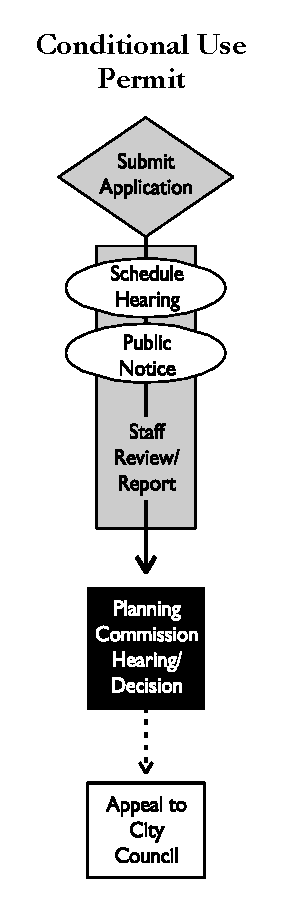
A complete application for a Conditional Use Permit shall be submitted to the City
Planner in a form established by the City Planner, along with a nonrefundable fee
that has been established by the Board of City Commissioners. No application will
be processed until the application is complete and the required fee has been paid.
B.
Review and Recommendation—City Planner.
The City Planner must review each proposed Conditional Use Permit and prepare a report
that reviews the application in light of the Comprehensive Plan, the Area Plan, the
general requirements of this Land Development Code and the applicable review criteria
set forth in this section.
C.
Review and Action—Planning Commission.
The Planning Commission must hold a public hearing on the proposed Conditional Use
Permit and, at the close of the public hearing, act to approve or deny the Conditional
Use Permit request. In acting on Conditional Use Permit requests, the Planning Commission
shall be authorized to impose such conditions, safeguards or restrictions upon the
premises benefited by the conditional use as may be necessary to reduce or minimize
any potentially injurious effect upon other property in the area, or to carry out
the general purpose and intent of this Land Development Code, so long as the condition,
safeguard or restriction relates to a situation created or aggravated by the proposed
use.
D.
Review and Approval Criteria.
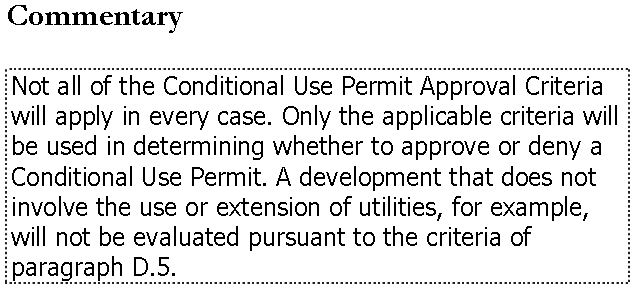
In reviewing any application for a Conditional Use Permit, the Planning Commission shall identify and evaluate all factors relevant to the applicaton. A Conditional Use Permit may not be approved unless the Planning Commission finda that all of the following criteria, as applicable, have been satisfied:
1.
The proposed conditional use complies with all applicable provisions of this Land Development Code and will conform to the general intent and purpose of this Land Development Code;
2.
The proposed conditional use at the specified location will contribute to and promote the welfare or convenience of the public;
3.
The proposed conditional use will not cause substantial injury to the value of other property in the neighborhood in which it is to be located;
4.
The location and size of the conditional use, the nature and intensity of the operation involved in or conducted in connection with it, and the location of the site with respect to streets giving access to it are such that the conditional use will not dominate the immediate neighborhood so as to prevent development and use of neighboring property in accordance with the applicable zoning district regulations. In determining whether the conditional use will dominate the immediate neighborhood, consideration shall be given to:
a.
The location, nature and height of buildings, structures, walls, and fences on the site; and
b.
The nature and extent of proposed landscaping and buffering on the site.
5.
Adequate utility, drainage, and other such necessary facilities and services have been or will be provided at the time of development; and
6.
Adequate access roads or entrance and exit drives will be provided and be so designed to prevent traffic hazards and to minimize traffic congestion in public streets.
E.
Notice of Public Hearings
1.
Written Notice
The City Planner shall provide written notice of the Planning Commission public hearing
in accordance with Sec. 20-0901-F.
2.
Newspaper Notice
Notice of the Planning Commission's public hearing on Conditional Use Permits shall
be published in accordance with Sec. 20-0901-F.
F.
Appeal of Planning Commission Decision
1.
Appeals to Board of City Commissioners; Timing
Appeals from the action of the Planning Commission on an application for Conditional
Use Permit approval may be taken to the Board of City Commissioners by filing an appeal
with the City Planner.
2.
Right to Appeal
The following persons and entities shall have standing to appeal the action of the
Planning Commission on an application for a Conditional Use Permit approval:
a.
The applicant;
b.
The Planning Commission or any member of the Planning Commission;
c.
The Board of City Commissioners or any member of the Board of City Commissioners;
d.
Any person who received mailed notice of the public hearing;
e.
Any person that the Board of City Commissioners determines to be actually or potentially aggrieved by the appealed action; and
f.
Any person given the right of appeal by law.
3.
Action on Appeal
The Board of City Commissioners shall consider the appealed Conditional Use decision
as a new matter in a public hearing and, at the close of the public hearing, act to
approve or deny the original application for Conditional Use Permit approval. The
procedure and required notice shall be the same as required of the original action
before the Planning Commission.
G.
Limit on Successive Applications
If the Board of City Commissioners denies an application for a Conditional Use Permit,
an application for the same use on any portion of the subject tract may not be refiled
by the original applicant for three months from the date of the Board of City Commissioners'
public hearing.
H.
Amendments
The procedure for amending a Conditional Use Permit shall be the same as required
for the original approval.
Source: 2985 (1999), 4168 (2001).
§20-0910. - Site Plan Review
A.
Applicability
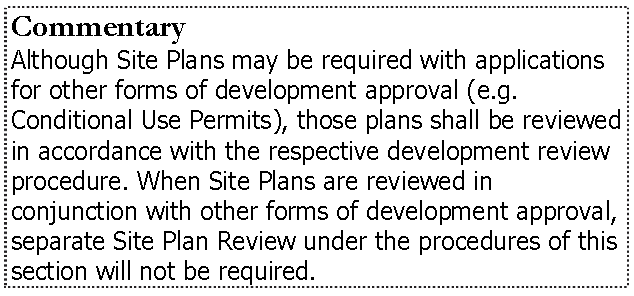
The Site Plan review procedures of this section shall apply to:
1.
Any development that is subject to the Residential Protection Standards of Sec. 20-0704 if it will result in the addition of more than fifty thousand (50,000) square feet of gross floor area, whether through new construction or building enlargement;
2.
Any development involving the addition of more than one hundred thousand (100,000) square feet of gross floor area, whether through new construction or building enlargement;
3.
Any development involving the addition of more than two hundred fifty (250) off-street parking spaces;
4.
Any development on a site with an area of two hundred thousand (200,000) square feet or more;
5.
Any development involving more than one principal building on a single site if the total floor area of all of the buildings on the site exceeds fifty thousand (50,000) square feet;
6.
Any development in a DMU zoning district;
7.
Any development in a UMU zoning district; and
8.
Any other use or development expressly requiring Site Plan Review by other provisions of this Land Development Code.
B.
Application
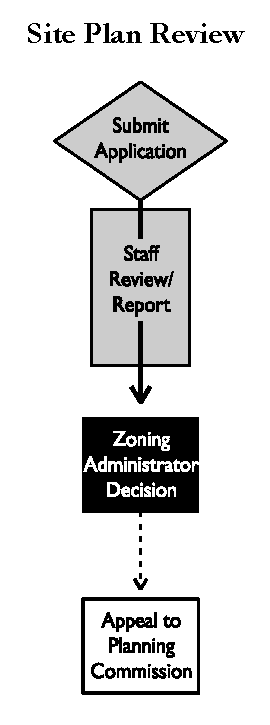
A complete application for Site Plan Review shall be submitted to the Zoning Administrator
in a form established by the Zoning Administrator, along with a nonrefundable fee
that has been established by the Board of City Commissioners. No application will
be processed until the application is complete and the required fee has been paid.
C.
Review and Action—Zoning Administrator
The Zoning Administrator must review each Site Plan application in light of the applicable
review criteria set forth in this section and act to approve or deny the Site Plan
application.
D.
Review and Approval Criteria
A Site Plan application may not be approved unless the Zoning Administrator finds
that the proposed project complies with all applicable provisions of this Land Development
Code and with all adopted plans and policy documents of the City. The Zoning Administrator
may grant approval with conditions only to the extent that such conditions specify
the actions necessary to bring the application into complete compliance with this
Land Development Code and adopted plans and policy documents.
E.
Appeal of Zoning Administrator's Decision
1.
Appeals to Planning Commission; Timing
Appeals from the action of the Zoning Administrator on an application for Site Plan
approval may be taken to the Planning Commission by filing an appeal with the Zoning
Administrator.
2.
Appeals to Board of City Commissioners; Timing
Appeals from the action of the Planning Commission on an application for Site Plan
approval may be taken to the Board of City Commissioners by filing an appeal with
the Zoning Administrator.
3.
Right to Appeal
The following persons and entities shall have standing to appeal the action of the
Zoning Administrator or Planning Commission on an application for Site Plan approval:
a.
The applicant;
b.
The Planning Commission or any member of the Planning Commission;
c.
The Board of City Commissioners or any member of the Board of City Commissioners;
d.
Any person that the Planning Commission or Board of City Commissioners determines to be actually or potentially aggrieved by the appealed action; and
e.
Any person given the right of appeal by law.
4.
Action on Appeal
The Planning Commission or Board of City Commissioners shall consider the appealed
Site Plan decision as a new matter without a requirement for a public hearing. After
considering the matter, the Planning Commission or Board of City Commissioners shall
act to approve or deny the original application. The procedure shall be the same as
required of the original action before the Zoning Administrator.
F.
Amendments
The procedure for amending a Site Plan application shall be the same as required for
the original approval.
G.
Expiration and Lapse of Approval
Property owners shall have 12 months from the date of approval of a Site Plan to secure
a Building Permit to carry out the proposed improvements. If a Building Permit has
not been obtained within 12 months of the date of Site Plan approval, the approved
Site Plan shall lapse and be of no further effect.
Source: 2985 (1999), 4695 (2009).
§20-0911. - Institutional Master Plans
A.
Applicability
Institutional Master Plans (or site plan review) may be used to satisfy the Project
Review requirements of the P/I zoning district (See Sec. 20-0304-D).
B.
Applications
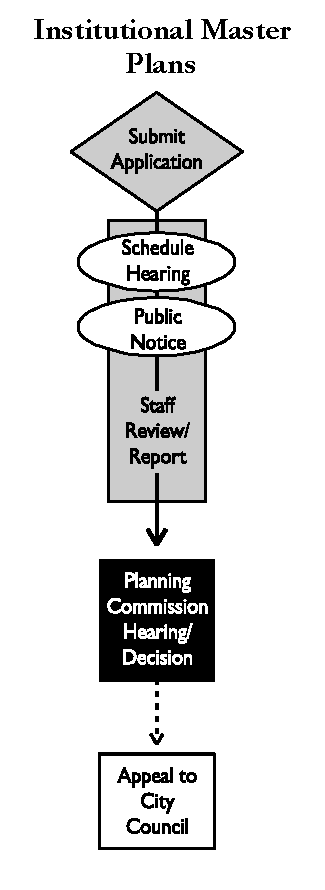
A complete application for Institutional Master Plan approval shall be submitted to
the City Planner in a form established by the City Planner, along with a non-refundable
fee that has been established by the Board of City Commissioners. No application will
be processed until the application is complete and the required fee has been paid.
C.
Review and Recommendation—City Planner
The City Planner must review each proposed Institutional Master Plan and prepare a
report that reviews the application in light of the Comprehensive Plan, any applicable
Area Plan, the general requirements of this Land Development Code and the applicable
review criteria set forth in this section.
D.
Review and Action—Planning Commission
The Planning Commission must hold a public hearing on the proposed Institutional Master
Plan and, at the close of the public hearing, act to approve or deny the Institutional
Master Plan request. In acting on Institutional Master Plan requests, the Planning
Commission shall be authorized to impose such conditions, safeguards or restrictions
as may be necessary to reduce or minimize any potentially injurious effect upon other
property in the area, or to carry out the general purpose and intent of this Land
Development Code, so long as the condition, safeguard or restriction relates to a
situation created or aggravated by the proposed use.
E.
Review and Approval Criteria
In reviewing any application for a Institutional Master Plan, the Planning Commission
shall identify and evaluate all factors relevant to the application. An Institutional
Master Plan may not be approved unless the Planning Commission finds that all of the
following criteria have been satisfied:
1.
The plan complies with all applicable provisions of this Land Development Code and will conform to the general intent and purpose of this Land Development Code;
2.
The plan is consistent with all adopted plans and policies of the City; and
3.
The proposed plan will not cause substantial injury to the value of other property in the neighborhood in which it is to be located.
F.
Notice of Public Hearings
1.
Written Notice
The City Planner shall provide written notice of the Planning Commission public hearing
in accordance with Sec. 20-0901-F.
2.
Newspaper Notice
Notice of the Planning Commission's public hearing on Institutional Master Plans shall
be published in accordance with Sec. 20-0901-F.
G.
Appeal of Planning Commission Decision
1.
Appeals to Board of City Commissioners; Timing
Appeals from the action of the Planning Commission on an application for Institutional
Master Plan approval may be taken to the Board of City Commissioners by filing an
appeal with the City Planner.
2.
Right to Appeal
The following persons and entities shall have standing to appeal the action of the
Planning Commission on an application for an Institutional Master Plan approval:
a.
The applicant;
b.
The Planning Commission or any member of the Planning Commission;
c.
The Board of City Commissioners or any member of the Board of City Commissioners;
d.
Any person who received mailed notice of the public hearing;
e.
Any other person that the Board of City Commissioners determines to be actually or potentially aggrieved by the appealed action; and
f.
Any person given the right of appeal by law.
3.
Action on Appeal
The Board of City Commissioners shall consider the appealed decision as a new matter
in a public hearing and, at the close of the public hearing, act to approve or deny
the original application for Institutional Master Plan approval. The procedure and
required notice shall be the same as required of the original action before the Planning
Commission.
H.
Amendments
The procedure for amending an Institutional Master Plan shall be the same as required
for the original approval.
I.
Effect of Approval
Once approved, building permits may be issued for development within the P/I district
if the proposed development is consistent with the approved Institutional Master Plan.
An Institutional Master Plan shall remain in effect for a period of ten (10) years,
unless the Planning Commission establishes a shorter time period as part of its approval
of the Institutional Master Plan.
J.
Application Submittal Requirements
1.
Institutional Master Planning Area
An Institutional Master Plan must include the lot upon which subject development is
to be located, all commonly owned land within one thousand (1,000) feet and a detailed
description of land uses within two hundred (200) feet of the lot to be occupied by
the proposed development, regardless of ownership.
2.
Planning Requirements
An Institutional Master Plan must, at a minimum, include all of the information required
with a Conditional Use Permit application plus the following, unless the Planning
Commission determines that such information is not necessary to evaluate the proposed
Institutional Master Plan its impacts on surrounding neighborhoods.
a.
Planning Horizon
The Institutional Master Plan must cover a period of at least ten (10) years, commencing
from the date of submission of the Institutional Master Plan.
b.
Existing Property and Uses
The Institutional Master Plan must include a description of land, buildings, and other
structures that occupy land areas included in the Institutional Master Plan, as of
the date of submission of the Institutional Master Plan. The following information
must be included:
(1)
Illustrative site plans showing the footprints of each building and structure, together with roads, sidewalks, parking, landscape features and other significant site improvements;
(2)
Land and building uses;
(3)
Gross floor area in square feet;
(4)
Building height in stories and feet; and
(5)
A description of off-street parking and loading areas and facilities, including a description of the approximate number of parking spaces in each area or facility.
c.
Needs of the Institution
The Institutional Master Plan must include a summary and projection of current and
future plans for the following facilities:
(1)
Academic;
(2)
Service;
(3)
Research;
(4)
Office;
(5)
Housing;
(6)
Patient care;
(7)
Public assembly;
(8)
Parking; and
(9)
Other facilities related to the use.
d.
Development Envelope
The Institutional Master Plan must include a description of the amount and type of
development proposed to take place over the horizon of the Institutional Master Plan.
This description must include the following information:
(1)
Gross floor area;
(2)
Average daily and peak-hour traffic;
(3)
Building heights;
(4)
Setbacks; and
(5)
Total open space.
e.
Neighborhood Protection Strategy.
The Institutional Master Plan must identify standards and programs that will be put
in place to ensure that the quality of the surrounding neighborhoods is maintained
or enhanced.
Source: 2985 (1999).
§20-0912. - Certificates of Appropriateness
A.
Applicability
The procedures of this section shall apply to all work requiring a Certificate of
Appropriateness in the H-O district.
B.
Application
A complete application for a Certificate of Appropriateness shall be submitted to
the City Planner in a form established by the City Planner, along with a nonrefundable
fee that has been established by the Board of City Commissioners. No application will
be processed until the application is complete and the required fee has been paid.
C.
Review and Recommendation
1.
Review by City Planner
All Certificate of Appropriateness applications involving exterior renovation of a
structure shall be reviewed by the City Planner in light of the applicable review
criteria set forth in this section. The City Planner may approve or deny the application
for a Certificate of Appropriateness based on the standards imposed by this section.
If the City Planner finds that the proposed renovation is inconsistent with the relevant
special regulations and standards as described in § 20-0305.C., the City Planner shall
refer the application to the Historic Preservation Commission for review. The applicant
has the right to appeal the City Planner's decision to the Historic Preservation Commission.
2.
Review by Historic Preservation Commission
The Historic Preservation Commission must review each Certificate of Appropriateness
application that involves the creation of a mural, or the demolition or new construction
of a structure, in light of the applicable review criteria set forth in this section
and act to approve or deny the Certificate of Appropriateness application.
D.
Review and Approval Criteria
A Certificate of Appropriateness application shall be reviewed in accordance with
the Special Development Standards that are established for each designated H-O District
in Section 20-0305, the standards of this Land Development Code and the U.S. Secretary of the Interior's
Standards for the Treatment of Historic Properties.
E.
Exception to Special Development Standards
1.
Appeals to Board of City Commissioners; Timing
Appeals from the action of the Historic Preservation Commission on a Certificate of
Appropriateness application may be taken to the Board of City Commissioners by filing
an appeal with the City Planner.
2.
Right to Appeal
The following persons and entities shall have standing to appeal decisions on a Certificate
or Appropriateness:
a.
The applicant;
b.
The Historic Preservation Commission or any member of the Historic Preservation Commission;
c.
The Board of City Commissioners or any member of the Board of City Commissioners;
d.
Any person that the Historic Preservation Commission or Board of City Commissioners determines to be actually or potentially aggrieved by the appealed action; and
e.
Any person given the right of appeal by law.
3.
Action on Appeal
The Board of City Commissioners shall consider the appealed decision as a new matter
without a requirement for a public hearing. After considering the matter, the Board
of City Commissioners shall act to approve or deny the original application. The procedure
shall be the same as required of the original action before the Historic Preservation
Commission.
F.
Expiration and Lapse of Approval
Property owners shall have twleve (12) months from the date of approval of a Certificate
of Appropriateness to secure a Building Permit or Demolition Permit to carry out the
proposed work. If a Building Permit or Demolition Permit has not been obtained within
twelve (12) months of the date of approval, the approved Certificate of Appropriateness
shall lapse and be of no further effect.
Source: 2985 (1999), 4486 (2005).
§20-0913. - Building Permits
Building Permits shall be required in accordance with applicable provisions of the Municipal Code (See Sec. 21-01). This section sets out the required review and approval procedures for Building Permits.
A.
Application Submittal
A complete application for a Building Permit shall be submitted to the Building Official
in a form established by the Building Official along with a non-refundable fee that
has been established by the Board of City Commissioners. No Building Permit application
shall be processed until the application is complete, all applicable development approvals
have been secured and the required fee has been paid. Building Permits may be issued
only for development on Legal Lots provided, however, that as to lots outside the
corporate City limits and within the area where the City has exercised its extraterritorial
zoning jurisdiction, the Zoning Administrator is authorized to waive the requirement
that the lot be shown on a Subdivision plat that has been recorded in the office of
the County Register of Deeds when the Zoning Administrator is satisfied that roadway
access and driveway issues as identified in Sec. 20-0702 and subdivision design and improvement issues as identified in Sec. 20-0611 can be properly addressed without a platting or subdivision approval process.
B.
Review and Action—Building Official
The Building Official shall be responsible for conducting reviews to determine if
intended uses, buildings or structures comply with all applicable regulations and
standards, including the building code. The Building Official shall not issue a building
permit unless the plans, specifications and intended use of such building or structures
or part thereof conform in all respects to the provisions of this Land Development
Code and the building code.
Source: 4039 (2000).
§20-0914. - Variances
This section sets out the required review and approval procedures for variances.
A.
Types of Variances Allowed
The Board of Adjustment is authorized to grant variances from the zoning district
dimensional standards and off-street parking and loading standards of this Land Development
Code that will not be contrary to the public interest or the spirit of this Land Development
Code, where, owing to special conditions, a literal enforcement of the provisions
of this Land Development Code would result in unnecessary physical (not economic)
hardship to the property owner.
B.
Application Submittal
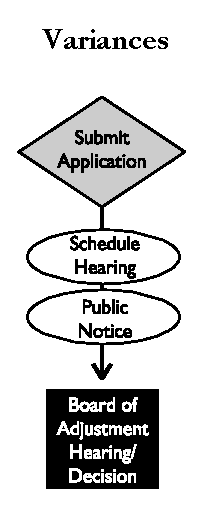
A complete application for a variance shall be submitted to the Zoning Administrator
in a form established by the Zoning Administrator, along with a nonrefundable fee
that has been established by the Board of City Commissioners. No application shall
be processed until the application is complete and the required fee has been paid.
C.
Review and Action—Board of Adjustment
The Board of Adjustment shall hold a public hearing on the variance request, and,
at the close of the public hearing act to approve, approve with conditions or deny
the application based on the review criteria set out in this section. A concurring
vote of at least four members of the Board of Adjustment shall be required to approve
any variance request.
D.
Notice of Public Hearings
1.
Written Notice
The Zoning Administrator shall provide written notice of the Board of Adjustment public
hearing in accordance with Sec. 20-0901-F.
2.
Newspaper Notice
Notice of the Board of Adjustment's public hearing on Variance requests shall be published
in accordance with Sec. 20-0901-F.
E.
Review Criteria; Findings of Fact
1.
Criteria for Approval
A variance may be granted by the Board of Adjustment upon an affirmative finding that
all of the following conditions exist.
a.
The requested variance arises from conditions that are unique to the subject property, that are not ordinarily found in the same zoning district and that are not a result of the owner's intentional action;
b.
The granting of the permit for the variance will not adversely affect the rights of adjacent property owners or residents;
c.
The strict application of the applicable standards will constitute an unnecessary physical hardship (not economic hardship) because the property cannot be used for an otherwise allowed use without coming into conflict with applicable site development standards;
d.
The variance desired will not adversely affect the public health, safety or general welfare; and
e.
The variance is the minimum variance that will overcome the hardship.
2.
Findings of Fact
The Board of Adjustment shall make a determination on each approval criterion and
enter its findings in the official record. Findings of fact shall be based on evidence
presented at the public hearing on the variance request.
F.
Use Variances Prohibited
The Board of Adjustment may not grant use variances, which are variances that have
the effect of allowing a use type that is not allowed by the Use Table of Sec. 20-0401.
G.
Conditions of Approval
In granting a variance, the Board of Adjustment may impose such conditions, safeguards
and restrictions upon the premises benefited by the variance as may be necessary to
reduce or minimize any potentially injurious effect of the variance upon other property
in the area.
H.
Expiration and Lapse of Approval
Property owners shall have twelve (12) months from the date of approval of a Variance
to secure a Building Permit to carry out the proposed improvements. If a Building
Permit has not been obtained within twelve (12) months of the date of Variance approval,
the approved Variance shall lapse and be of no further effect.
I.
Appeal of Board of Adjustment Decisions
1.
Appeals to Board of City Commissioners; Timing
Appeals from the action of the Board of Adjustment on an application for a Variance
may be taken to the Board of City Commissioners by filing an appeal with the Zoning
Administrator.
2.
Right to Appeal
The following persons and entities shall have standing to appeal the action of the
Board of Adjustment on an application for a Variance:
a.
The applicant;
b.
The Board of City Commissioners or any member of the Board of City Commissioners;
c.
Any person who received mailed notice of the public hearing;
d.
Any other person that the Board of City Commissioners determines to be actually or potentially aggrieved by the appealed action; and
e.
Any person given the right of appeal by law.
3.
Action on Appeal
The Board of City Commissioners shall consider the appealed decision as a new matter
in a public hearing and, at the close of the public hearing, act to approve or deny
the original application for a Variance. The procedure and required notice shall be
the same as required of the original action before the Board of Adjustment. A favorable
vote of ¾ of all the members of the Board of City Commissioners shall be required
to approve any variance request.
J.
Limit on Successive Applications
If the Board of Adjustment denies an application for a variance, an application for
the same variance may not be re-filed for three (3) months from the date of the Board
of Adjustment's public hearing on the proposed variance.
Source: 2985 (1999), 4168 (2001), 5179 (2018).
§20-0915. - Written Interpretations
This section sets out the required review and approval procedures for Written Interpretations of the provisions of this Land Development Code.
A.
Application Submittal
A complete application for a Written Interpretation shall be submitted to the Zoning
Administrator in a form established by the Zoning Administrator along with a non-refundable
fee that has been established by the Board of City Commissioners. No application shall
be processed until the application is complete and the required fee has been paid.
B.
Review and Action—Zoning Administrator
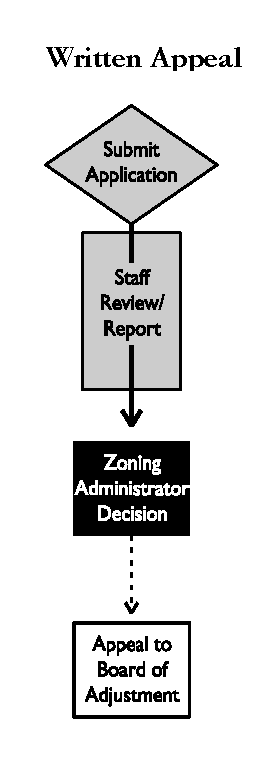
Within twenty (20) days after a complete application for a Written Interpretation
has been submitted, the Zoning Administrator shall: (1) review and evaluate the request
in light of the text of this Land Development Code, the Official Zoning Maps, the
Comprehensive Plan and any other relevant documents; (2) consult with other staff;
and (3) render a Written Interpretation.
C.
Form
The interpretation shall be provided to the applicant in writing and shall be filed
in the official record of interpretations.
D.
Official Record of Interpretations
The Zoning Administrator shall maintain an official record of interpretations. The
record of interpretations shall be available for public inspection in the Planning
Department offices during normal business hours.
E.
Appeal of Interpretation
Appeals of the Zoning Administrator's Written Interpretation may be taken to the Board
of Adjustment, in accordance with the procedures of Sec. 20-0916. Appeals of Written Interpretations shall be filed with the Zoning Administrator.
Source: 2985 (1999).
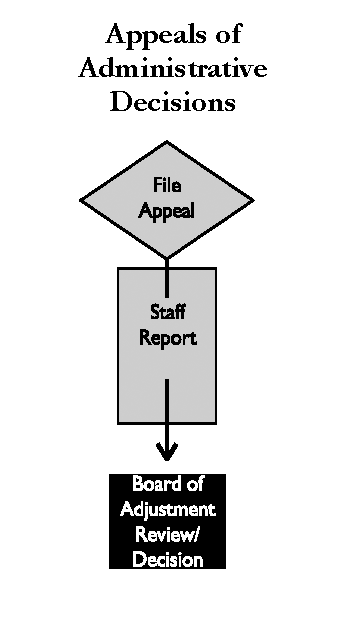
§20-0916. - Appeals of Administrative Decisions
This section sets out the required review and approval procedures for Appeals of Administrative Decisions.
A.
Applicability
The Board of Adjustment shall be authorized to hear and decide appeals where it is
alleged there is an error in any order, requirement, decision or determination made
by an administrative official of the City in the administration or enforcement of
this Land Development Code.
B.
Right to Appeal
Appeals of Administrative Decisions may be filed by any person aggrieved or by any
officer, department, board or agency affected by any decision of the administrative
officer.
C.
Application Submittal
Applications for Appeals of Administrative Decisions shall be submitted to the Zoning
Administrator in a form established by the Zoning Administrator along with a nonrefundable
fee that has been established by the Board of City Commissioners. No application shall
be processed until the application is complete and the required fee has been paid.
D.
Time of Filing Appeal
Appeals of Administrative Decisions shall be filed with the Zoning Administrator.
E.
Effect of Filing
The filing of a complete application for appeal stays all proceedings in furtherance
of the action appealed, unless the official whose decision is being appealed certifies
to the Board of Adjustment, after the appeal is filed, that, because of facts stated
in the certification, a stay would cause immediate peril to life or property. In such
case, proceedings shall not be stayed other than by a restraining order which may
be granted by the Board of Adjustment, or by a court of record.
F.
Transmittal of Papers
The Zoning Administrator or the official whose decision is being appealed shall transmit
to the Board of Adjustment all papers constituting the record upon which the action
appealed is taken.
G.
Review and Action—Board of Adjustment
Appeals of Administrative Decisions shall be taken to the Board of Adjustment. The
Board of Adjustment shall grant to the administrative official's decision a presumption
of correctness, placing the burden of persuasion of error on the appellant. In exercising
the appeal power, the Board of Adjustment shall have all the powers of the official
from whom the appeal is taken, and the Board of Adjustment may reverse or affirm wholly
or partly or may modify the decision being appealed. If the Board of Adjustment determines
that it is necessary to obtain additional evidence in order to resolve the matter,
it shall remand the appeal to the official from whom the appeal is taken, with directions
to obtain such evidence and to reconsider the decision in light of such evidence.
A concurring vote of four members of the Board of Adjustment shall be necessary to
reverse any order, requirement, decision, or determination of an administrative official.
H.
Review Criteria; Findings of Fact
An appeal shall be sustained only if the Board of Adjustment finds that the administrative
official erred. Every decision of the Board of Adjustment shall be accompanied by
written findings of fact specifying the reason for the decision. These findings shall
be filed in the office of the Board of Adjustment within fifteen (15) days after the
date of the final action.
I.
Appeal of Board of Adjustment Decisions
1.
Appeals to Board of City Commissioners; Timing
Appeals from the action of the Board of Adjustment may be taken to the Board of City
Commissioners by filing an appeal with the Zoning Administrator.
2.
Right to Appeal
The following persons and entities shall have standing to appeal the action of the
Board of Adjustment:
a.
The applicant;
b.
The Board of Adjustment or any member of the Board of Adjustment;
c.
The Board of City Commissioners or any member of the Board of City Commissioners;
d.
Any person who received mailed notice of the public hearing;
e.
Any other person that the Board of City Commissioners determines to be actually or potentially aggrieved by the appealed action; and
f.
Any person given the right of appeal by law.
3.
Action on Appeal
The Board of City Commissioners shall consider the appealed decision as a new matter
in a public hearing and, at the close of the public hearing, act to approve or deny
the original application. The procedure and required notice shall be the same as required
of the original action before the Board of Adjustment.
Source: 2985 (1999), 4592 (2007).

