
Faribault City Zoning Code
CHAPTER 9
- SIGNS
Sec. 9-10. - Purpose.
This chapter is established to allow effective signage appropriate to the planned character of each zoning district, to promote an attractive environment by minimizing visual clutter and confusion, to minimize adverse effects on nearby property, and to protect the public health, safety, and welfare.
(Ord. No. 99-20, § 1, 11-23-99)
Sec. 9-20. - Scope of regulations.
The sign regulations set forth in this chapter shall apply to all structures and all land uses, except as otherwise provided in this ordinance. All signs allowed by this chapter shall be limited to on-premise signs, except where otherwise specifically noted.
(Ord. No. 99-20, § 1, 11-23-99)
Sec. 9-30. - Exemptions.
The following signs shall be exempt from the regulations of this chapter, provided, however, that the general sign regulations established in Section 9-70 are met:
(1)
Real estate signs, not exceeding thirty-two (32) square feet in area for commercial, industrial, and multi-family residential properties and twelve (12) square feet in area for single and two-family residential properties, advertising only the sale, rental, or lease of the premises upon which said signs are located, provided that:
(a)
Only one (1) such sign is displayed per street frontage.
(b)
The maximum height shall not exceed eight (8) feet for commercial, industrial, and multi-family residential properties and four (4) feet for single and two-family residential properties.
(c)
The sign is set back at least ten (10) feet from the curb or edge of pavement.
(d)
The sign shall be removed within seven (7) days after the completion of the advertised sale or lease.
(2)
Residential and professional nameplates, not to exceed three (3) square feet in area, indicating the name of the occupant or occupants and the name of a permitted business or home occupation.
(3)
Agricultural product signs advertising seasonal produce, located on property within the Open-Space/Agricultural District, provided that:
(a)
Only one (1) such sign is displayed per street frontage.
(b)
The maximum size shall be thirty-two (32) square feet in area and eight (8) feet in height.
(c)
Signs shall be removed at the end of the produce season.
(4)
Garage sale signs, not to exceed four (4) square feet in area, provided that:
(a)
One (1) on-site sign and three (3) off-premise signs, with permission of the property owner, shall be allowed.
(b)
No such sign shall be placed within the public right-of-way or located on any other public property.
(c)
All such signs shall be removed within one (1) day following the sale.
(5)
Construction or development signs, not to exceed sixty-four (64) square feet in area or eight (8) feet in height denoting the architect, engineer, or contractor for a project under construction, excluding any work being done at a single or two (2) family residential lot, provided that only one such sign shall be permitted per street frontage. Such signs shall be removed within ten (10) days after completion of the project.
(6)
Construction signs for work being conducted at a single or two-family residential lot, not to exceed fifteen (15) square feet in area or seven (7) feet in height, denoting the architect, engineer, or contractor for a project under construction, provided that only one (1) such sign shall be allowed per lot. Such signs shall be removed within ten (10) days after completion of the project.
(7)
Governmental signs, including but not limited to, traffic control and other regulatory purpose signs, street signs, informational signs, danger signs, and railroad crossing signs.
(8)
Official public notices or signs required by local, state, or federal regulations.
(9)
Memorial signs or tablets, names of buildings and date of erection, when cut into any masonry surface or when constructed of bronze or other incombustible material.
(10)
Interior signs.
(11)
Window signs, provided that no more than fifty (50) percent of an individual window is covered with signs or painting.
(12)
Official government flags, emblems, or temporary displays of a patriotic, religious, charitable, or other civic character may be displayed provided that such signs are not placed in the public right-of-way and are non-illuminated.
(13)
Informational signs, not exceeding six (6) square feet in area or five (5) feet in height, if freestanding, displayed strictly for the direction, safety, or convenience of the public, including signs which identify restrooms, parking area entrances or exits, freight entrances, addresses, or similar information. Informational signs that have a business logo over twenty-five (25) percent of the total sign area shall be considered part of the overall sign area calculation for the property.
(14)
Political campaign signs in accordance with Minnesota Statute 211B.045, provided that no such sign be located within one hundred (100) feet from any polling site or be placed within the public right-of-way.
(Ord. No. 99-20, § 1, 11-23-99; Ord. No. 2007-10, § 2, 11-13-07; Ord. No. 2009-10, § 2, 8-11-09)
Sec. 9-40. - Permits.
(A)
Permit required. It shall be unlawful for any person to erect, build, construct, attach, hang, place, suspend, affix, structurally alter, or relocate any sign within the city, without first obtaining a permit from the Zoning Administrator and making payment of a fee in the amount established by City Council resolution.
(B)
Application for sign permit. An application for a sign permit shall be filed with the Zoning Administrator on an approved form and shall be accompanied by such information as may be required to ensure compliance with the provisions of this chapter, including but not limited to, the following:
(1)
A drawing showing the proposed location of the sign for which the permit is being requested and the location of all existing signage on the premises.
(2)
A drawing indicating the size, color, content, and materials of the sign, as well as the method of construction and attachment to the building or to the ground.
(3)
Engineering data showing the structure is designed to accommodate dead load and wind pressure, in any direction, in the amount required within this chapter, when specifically requested by the Zoning Administrator.
(C)
Issuance and duration of permit. Upon the filing of a completed application for a sign permit, the Zoning Administrator shall examine all accompanying drawings and supplemental data to determine compliance with the requirements of this chapter. Upon approval, the sign permit shall remain valid for a period of one hundred twenty (120) days. If no work is commenced within such time period, a new permit shall be required even if no changes have been made to the original sign plan.
(D)
Permit revocable at any time. All rights and privileges acquired under the provisions of this chapter are mere licenses revocable for cause at any time by the Zoning Administrator. If a permit is revoked or canceled, the applicant shall not be entitled to a refund of required permit fees.
(Ord. No. 99-20, § 1, 11-23-99)
Sec. 9-50. - Insurance requirements.
Every person regularly engaged in the business of erecting advertising and business signs in the city shall file a certificate of insurance with the Zoning Administrator before any sign permits are issued. This certificate shall verify a liability insurance policy issued by an insurance company authorized to do business in the State of Minnesota.
(Ord. No. 99-20, § 1, 11-23-99)
Sec. 9-60. - Removal of certain signs.
Any business sign in the city which no longer advertises or identifies a bona fide business conducted or product sold on the premises shall be removed by the property owner within ninety (90) days from the date of vacancy. Any business that has not removed the sign within ninety (90) days shall be notified by the zoning administrator in writing and given thirty (30) days to comply. Additionally, support posts and frames that no longer contain signage must be removed by the property owner within twenty-four (24) months after written notification from the zoning administrator, provided the structure is in good condition. Upon failure to comply with the notice within the specified time period, the zoning administrator is authorized to cause removal of such sign and support structures, and assign any expenses incidental to the removal of the same to the property owner.
(Ord. No. 99-20, § 1, 11-23-99; Ord. No. 2009-10, § 2, 8-11-09)
Sec. 9-65. - Sign enforcement.
Enforcement of the regulations and sign standards herein, shall conform to Article 12, Chapter 2 of the Faribault Unified Development Ordinance.
(Ord. No. 2009-10, § 2, 8-11-09)
Sec. 9-70. - General sign standards.
(A)
Unsafe and unlawful signs. If the zoning administrator shall find that any sign regulated under this chapter is unsafe or insecure, or has been constructed or erected in violation of the provisions of this chapter, a written notice shall be given to the property owner. In the event the property owner fails to remove or alter the sign so as to comply with the standards set forth in this chapter within thirty (30) days after such notice, the sign in violation may be removed by the zoning administrator, with costs assigned to the property owner. The zoning administrator shall refuse to issue a permit under this chapter for any sign that would pose an immediate peril to persons or property.
(B)
Construction requirements. All signs shall be constructed and maintained in accordance with the applicable provisions of the Uniform Building and Electrical Codes. Permanent freestanding signs shall have self-supporting structures erected on and permanently attached to a concrete foundation. Wall signs shall be placed on walls that are designed and constructed with sufficient strength to support such signage.
(C)
Mounting of signs. All signs shall be securely mounted or displayed in one of the following manners:
(1)
Flat against a building or wall.
(2)
Back-to-back in pairs or otherwise arranged in such a manner that the back of the signs will be screened from public view.
(3)
Otherwise mounted so that the backs of all signs showing to public view, including all parts of the sign structure, shall be painted a dark or neutral color.
(D)
Maintenance and repair. All signs shall be kept in good repair and free from peeling paint, rust damaged or rotted supports, framework or other material, broken or missing faces or missing letters.
(E)
Intensity of light. No sign shall be either directly or indirectly illuminated in such a manner as to affect adversely the use and enjoyment of nearby property or to obscure the vision of motorists. All signs shall be subject to the standards for lighting and glare, as specified in Section 6-340.
(F)
Safety obstructions. No sign in the city shall be placed or installed that obstructs access to fire escapes or required windows, doors, exits or standpipes. Additionally, no sign shall be placed within the twenty-five (25) foot sight distance triangle required at all intersections including driveways and alleys.
(G)
Sign design standards. All signs shall adhere to the following design standards:
(1)
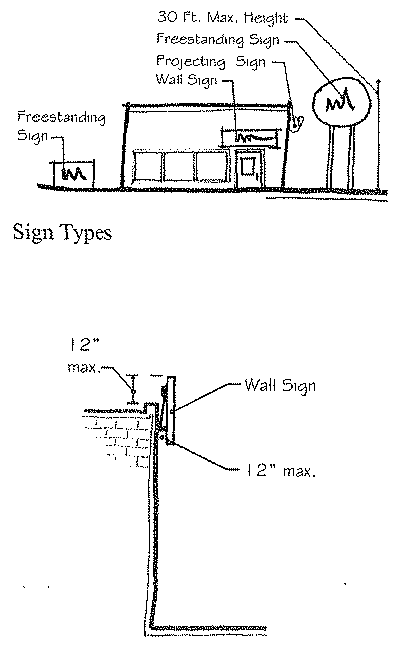
The size and location of wall signs shall be reviewed in terms of their relationship to the building entry, height of sign fascia, size of wall where the sign is to be installed, the signs relationship to other signs on the building and visibility from the street, sidewalk or parking lot.
(2)
On multi-tenant-properties and in unified developments wall signs shall be evaluated for compatibility with the comprehensive sign plan, the building fascia and neighboring signs in terms of size, color lighting, style and quality.
(3)
The depth of wall signs on multi-tenant buildings shall be consistent.
(4)
Freestanding signs shall be of a style, material and design compatible with the primary building.
(5)
The base or support elements of freestanding signs shall be constructed of similar building materials as the principal structure. Landscaping shall be required at the base to enhance such signs.
(6)
Freestanding signs shall be sited so that they integrate with the location of street trees and other site landscaping, and to minimize obscuring the view of adjacent freestanding signs.
(H)
Sign bonus. All buildings within commercial and/or industrial districts may be allowed a sign bonus as outlined below. In cases where a sign bonus is requested, a comprehensive sign plan shall be required prior to issuing of a sign permit.
(1)
An increase of up to ten (10) percent in the total allowable sign area on a wall may be allowed through a sign area transfer. A transfer shall only be permitted if the sign area of one of the remaining walls is reduced by twenty (20) percent. A maximum of two (2) sign area transfers shall be allowed per building.
(2)
An off-premise sign may be allowed within a unified commercial or industrial development provided that the total allowable sign area and number of freestanding signs for all properties within the development is not exceeded.
(3)
In addition to the allowable freestanding signs, properties that have over one-thousand (1,000) lineal feet of street frontage on a single street shall be allowed an additional freestanding sign to be used within that additional one thousand (1,000) lineal feet of street frontage.
(I)
Comprehensive sign plan.
(1)
Buildings with multiple tenants, properties with multiple buildings, and unified developments with multiple lots shall be required to submit a comprehensive sign plan.
(2)
A comprehensive sign plan shall be of sufficient detail to allow determination that all signs within the development will meet the requirements of this ordinance.
(3)
No sign permit shall be issued for an individual sign except upon determination that such sign is consistent with the comprehensive sign plan for the development and the provisions of this ordinance.
(Ord. No. 99-20, § 1, 11-23-99; Ord. No. 2009-10, § 2, 8-11-09)
Sec. 9-80. - Computations.
(A)
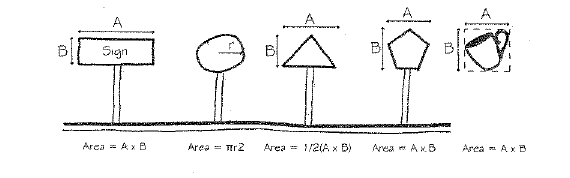
Computation of sign face area. The area of a sign face shall be based on the outer dimensions of the sign elements. Where the sign is not in the shape of a rectangle, square, triangle, or circle, the sign face area shall be determined by calculating the area of an imaginary rectangle drawn around the sign.
(B)
Back-to-back signs. When the faces of a back-to-back sign are parallel or within thirty-five (35) degrees of parallel, the sign face area shall be determined on the basis of only one (1) side of such sign. If the sign faces are not within thirty-five (35) degrees of parallel, the sign face area shall be determined on the basis of the sum of the areas of each sign face.
(C)
Multiple-framed signs. For freestanding and projecting signs that contain multiple frames on a single structure and oriented in the same direction, the sign face area shall be determined on the basis of the sum of the areas of each cabinet.
(D)
Awnings and canopies. When signs are incorporated into awnings or canopies, the sign area shall be determined by computing the area of an imaginary rectangle drawn around the sign.
(E)
Computation of sign height. The height of a sign shall be computed as the distance from the base of the sign at normal grade to the top of the highest attached component of the sign. Normal grade shall be construed to be the lower of the existing grade prior to construction or the newly established grade after construction, exclusive of any filling, berming, mounding, or excavating solely for the purpose of locating the sign.
(Ord. No. 99-20, § 1, 11-23-99; Ord. No. 2009-10, § 2, 8-11-09)
Sec. 9-90. - Prohibited signs.
The following signs shall be prohibited in all zoning districts, except as otherwise specified in this chapter:
(1)
Signs which resemble or which interfere to any degree with the effectiveness of a traffic-control device, sign, or signal; which obstruct or interfere with a motorist's view of approaching, merging, or intersecting traffic for a distance not to exceed five hundred (500) feet; or which has distracting flashing or moving lights so designed or lighted as to create a traffic hazard.
(2)
Signs placed or maintained on natural features, fences, or utility poles.
(3)
Portable or changeable copy signs, except where specifically allowed elsewhere in this ordinance.
(4)
Flashing signs or lights that intermittently go on and off, including any sign located within a building and readily visible from the outside. Electronic message boards, in accordance with the standards set forth in subsection 9-120(2)(d) and subsection 9-130(5) of this ordinance, shall be exempt from this section.
(5)
A sign, excluding those located wholly within a building, which moves or creates the illusion of movement in any manner.
(6)
Roof signs.
(7)
Audible signs.
(8)
Signs painted directly on the surface of a building.
(9)
Any sign which contains information, whether written or graphic, that is obscene in nature.
(10)
All signs not expressly permitted or exempted under this chapter.
(11)
Expired business signs as described in section 9-60.
(12)
Signage that is temporarily attached or affixed to trucks, semi-trucks or tractors or automobiles that are parked stationary for more than forty-eight (48) hours.
(Ord. No. 99-20, § 1, 11-23-99; Ord. No. 2004-24, § 2, 10-12-04; Ord. No. 2007-10, § 2, 11-13-07; Ord. No. 2009-10, § 2, 8-11-09)
Sec. 9-100. - Purpose.
For the purpose of this chapter, signs are regulated according to the zoning district in which the property where the sign is to be located exists. No sign shall be erected unless it is permitted in the district or specifically exempted elsewhere in this chapter.
(Ord. No. 99-20, § 1, 11-23-99; Ord. No. 2004-24, § 2, 10-12-04)
Sec. 9-110. - Open Space-Agricultural District and Transitional Urban Development District.
In the Open Space-Agricultural and Transitional Urban Development District, only the following signs shall be permitted:
(1)
Any sign exempted under Section 9-30.
(2)
A permanent business identification sign indicating the name and type of business conducted on the premises, provided that:
(a)
One (1) freestanding sign shall be allowed per street frontage, with the maximum size not to exceed fifty (50) square feet in area or twelve (12) feet in height.
(b)
One (1) wall-mounted sign may be placed on the principal building, not to exceed ten (10) percent of the signable area up to a maximum of one hundred twenty (120) square feet.
(c)
An electronic message board, in conjunction with an identification sign for a public recreation use shall be allowed, provided that the overall size requirements are satisfied and that all of the following standards are met:
1.
Electronic message board displays shall not move or change except to transition from one (1) message to another or from one (1) message segment to another by using one (1)of the following transition modes, as defined in Chapter 1 of this ordinance:
a)
Fade mode
b)
Dissolve mode
c)
Scroll mode
2.
The sign shall be a minimum distance of fifty (50) feet radially from a residential use.
3.
The electronic message board shall not exceed 50 percent of the allowable sign area of 50 square feet per face.
4.
If the sign is within two hundred (200) feet of a residential use and is visible from a residential use, the sign shall not be illuminated between 11:00 p.m. and 5:00 a.m.
5.
An electronic message board shall not be permitted to transition using the travel mode, as defined in Chapter 1 of this ordinance.
6.
Modes which cause the message to flash or appear to flash are prohibited
7.
The sign may only be used to promote activities, products, or services pertaining to the subject property; time and temperature; or other public service oriented messages.
8.
Dimmer control. Electronic message board signs shall have an automatic dimmer control such as a photocell or other ambient light sensing mechanism that automatically adjusts the sign's brightness in direct correlation with the natural ambient light conditions.
9.
Light sensor required. All electronic message board signs that are directly illuminated shall include a sensor or other devise that automatically determines ambient illumination and is programmed to automatically dim according to ambient light conditions or that can be adjusted to comply with the foot-candle requirements set out below without human assistance.
10.
The sign shall not exceed a maximum illumination of five thousand (5,000) nits (candelas per square meter) during daylight hours; and a maximum of five hundred (500) nits (candelas per square meter) from dusk to dawn as measured at the sign's face at maximum brightness and at no time exceed 0.3 footcandles above natural ambient light conditions. Such measurements shall be taken using a footcandle (Lux) meter at a preset distance depending on the sign area, measured as follows in the table below.
(3)
Safety. Electronic message centers and digital billboards shall:
(a)
Include systems and monitoring to either turn the display off or show "full black" on the display and contain a default mechanism that freezes the sign in one (1) position at the maximum illumination in the event of malfunction; and
(b)
Be designed so if a catastrophic power surge occurs, the sign will go dark or it will have maximum brightness limitations in place; and
(c)
Automatically adjust the intensity of its display according to natural ambient light conditions.
(4)
Temporary signs as provided for under Section 9-190.
(Ord. No. 99-20, § 1, 11-23-99; Ord. No. 2006-19, § 1, 8-8-06; Ord. No. 2007-10, § 2, 11-13-07; Ord. No. 2019-9, § 1, 6-25-19)
Sec. 9-120. - Residential districts.
In any residential district, only the following signs shall be permitted:
(1)
Any sign exempted under Section 9-30.
(2)
Signs, on parcels with a lot area of 20,000 square feet or more, identifying a church, school, hospital, other institution, or offices in a R-2, R-3, or R-4 district provided that:
(a)
One freestanding sign shall be allowed per street frontage, with a maximum size not to exceed fifty (50) square feet in area and eight (8) feet in height per face.
(b)
One wall-mounted sign may be placed on the principal building, not to exceed ten (10) percent of the signable area up to a maximum of one hundred twenty (120) square feet.
(c)
Such sign shall be solely for the purpose of displaying the name of the institution or association and its activities or services.
(d)
A bulletin board, in conjunction with an identification sign shall be allowed, provided that the overall size requirements are satisfied. A bulletin board may be an electronic message board provided, however, that all of the following standards are met:
(1)
Electronic message board displays shall not move or change except to transition from one (1) message to another or from one (1) message segment to another by using one (1) of the following transition modes, as defined in Chapter 1 of this ordinance:
a)
Fade mode.
b)
Dissolve mode.
c)
Scroll mode.
(2)
The sign shall be a minimum distance of fifty (50) feet radially from a residential use.
(3)
The electronic message board shall not exceed fifty (50) percent of the allowable sign area of fifty (50) square feet per face.
(4)
If the sign is within two hundred (200) feet of a residential use and is visible from a residential use, the sign shall not be illuminated between 10:00 p.m. and 6:00 a.m.
(5)
An electronic message board shall not be permitted to transition using the travel mode, as defined in Chapter 1 of this ordinance.
(6)
Modes which cause the message to flash or appear to flash are prohibited
(7)
The sign may only be used to promote activities, products, or services pertaining to the subject property; time and temperature; or other public service oriented messages.
(8)
Dimmer control. Electronic message board signs shall have an automatic dimmer control such as a photocell or other ambient light sensing mechanism that automatically adjusts the sign's brightness in direct correlation with the natural ambient light conditions.
(9)
Light sensor required. All electronic message board signs that are directly illuminated shall include a sensor or other devise that automatically determines ambient illumination and is programmed to automatically dim according to ambient light conditions or that can be adjusted to comply with the foot-candle requirements set out below without human assistance.
(10)
The sign shall not exceed a maximum illumination of five thousand (5,000) nits (candelas per square meter) during daylight hours; and a maximum of five hundred (500) nits (candelas per square meter) from dusk to dawn as measured at the sign's face at maximum brightness and at no time exceed 0.3 footcandles above natural ambient light conditions. Such measurements shall be taken using a footcandle (Lux) meter at a preset distance depending on the sign area, measured as follows in the table below.
(e)
Such signs shall be set back at least ten (10) feet from any property line.
(f)
Landscaping shall be provided around the base of the monument sign.
(3)
Signs, on parcels with a lot area less than 20,000 square feet, identifying a church, school, hospital, other institution, or offices in a R-2, R-3, or R-4 district provided that:
(a)
One freestanding monument sign shall be allowed per lot, with a maximum size not to exceed thirty-two (32) square feet in area and six (6) feet in height.
(b)
One wall-mounted sign may be placed up on the principal building, not to exceed ten (10) percent of the signable area up to a maximum of fifty (50) square feet.
(c)
Such sign shall be solely for the purpose of displaying the name of the institution or association and its activities or services.
(d)
Such signs shall be set back at least ten (10) feet from any property line.
(e)
Landscaping shall be provided around the base of the monument sign.
(4)
Residential identification signs for a multi-family development, provided that:
(a)
One freestanding sign shall be allowed per street frontage, with a maximum size not to exceed fifty (50) square feet in area and eight (8) feet in height.
(b)
One wall-mounted sign may be placed on the principal building, not to exceed ten (10) percent of the signable area up to a maximum of one hundred twenty (120) square feet.
(c)
The sign shall indicate only the name and address of the building or property management agency.
(5)
Subdivision identification signs, provided that:
(a)
One freestanding sign shall be allowed at each major street entrance to the subdivision, with a maximum size not to exceed thirty-two (32) square feet in area and five (5) feet in height.
(b)
The sign shall be architecturally designed to be a permanent part of a residential neighborhood.
(c)
The sign shall indicate the name of the development only.
(6)
Safety. Electronic message centers and digital billboards shall:
(a)
Include systems and monitoring to either turn the display off or show "full black" on the display and contain a default mechanism that freezes the sign in one (1) position at the maximum illumination in the event of malfunction; and
(b)
Be designed so if a catastrophic power surge occurs, the sign will go dark or it will have maximum brightness limitations in place; and
(c)
Automatically adjust the intensity of its display according to natural ambient light conditions.
(7)
Temporary signs as provided for under Section 9-190.
(Ord. No. 99-20, § 1, 11-23-99; Ord. No. 2003-032, § 2, 11-25-03; Ord. No. 2007-10, § 2, 11-13-07; Ord. No. 2019-9, § 2, 6-25-19)
Sec. 9-130. - Commercial Districts.
In any commercial district, excluding the Downtown Sign District, only the following signs shall be permitted:
(1)
All signs permitted within residential districts, as specified in Section 9-120.
(2)
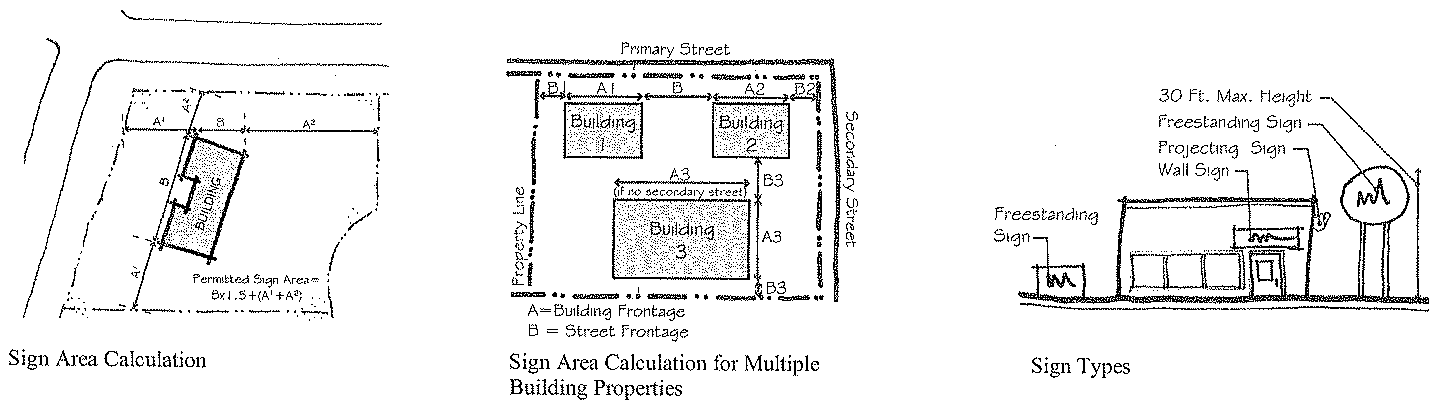
Freestanding signs, wall signs, canopy signs, awning signs, projecting signs, and hanging signs.
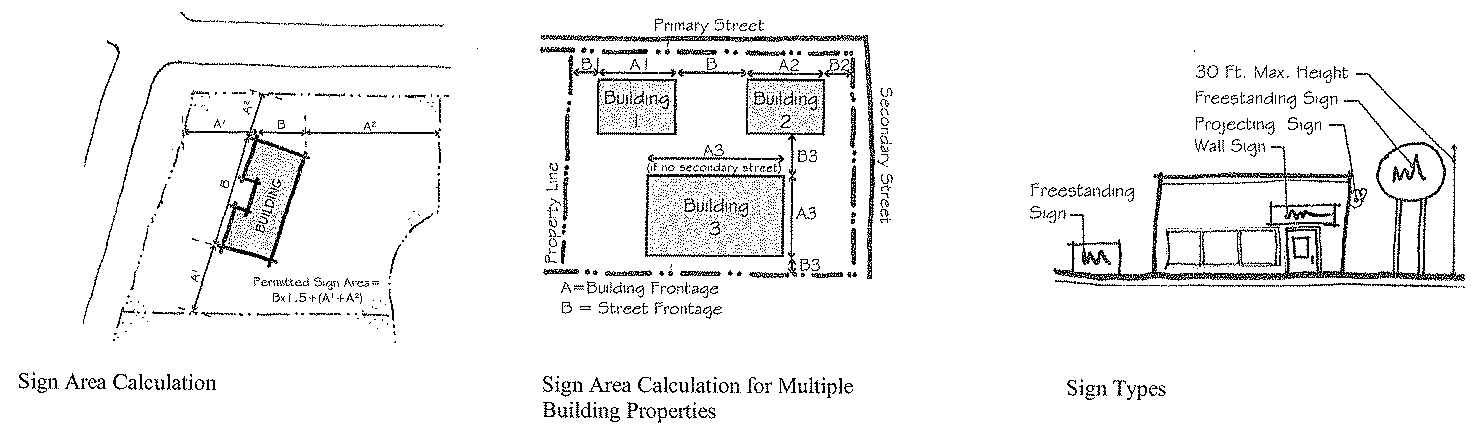
The overall area of all signs shall not exceed one and one-half (1½) square feet of signage for each lineal foot of building frontage plus one additional square foot of signage for each lineal foot of street frontage.
a.
No sign shall be located within a public easement area or within the public right-of-way.
b.
All signs shall adhere to the following standards:
1.
Wall signs.
i.
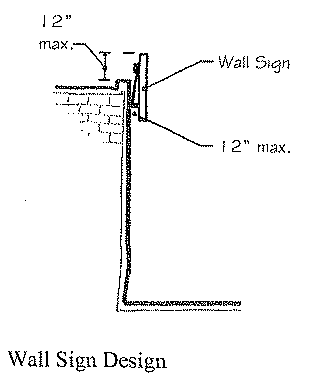
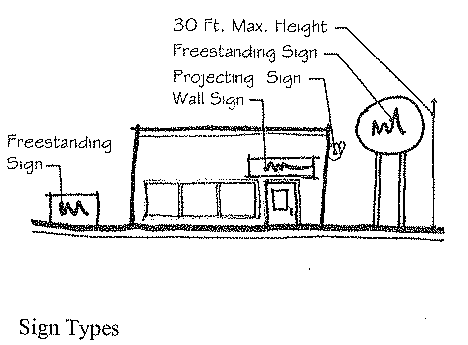
Wall signs shall not project more than twelve (12) inches from the wall or parapet to which it is attached.
ii.
Wall sign calculations shall not exceed ten (10) percent of the wall area as determined by the height and width of each wall. (Height × width = wall area). Wall signs may be allowed a sign area bonus transfer as provided in Section 9-70(H)(1).
iii.
Wall signs shall not extend more than twelve (12) inches above the parapet line of the building.
2.
Freestanding Signs. One freestanding sign shall be allowed per street frontage, except as provided is Section 9-70(H). All freestanding signs shall be located a minimum of five (5) feet from a property line.
i.
Where a pylon sign element is twenty (20) feet above the natural grade or higher, the sign element may encroach up to four (4) feet into the required setback.
ii.
Freestanding signs shall not exceed thirty feet (30) in height. The sign elements shall not exceed one hundred twenty (120) square feet in total.
iii.
For freestanding signs located within the Interstate Highway Oriented Business Area, the height shall not exceed fifty-five (55) feet and the area of the sign element shall not exceed three hundred and fifty (350) square feet.
iv.
A multi-tenant freestanding sign shall not exceed three hundred and fifty square feet (350) of sign elements.
3.
Awning signs.
i.
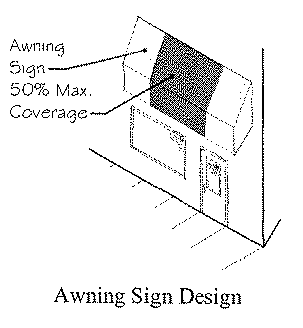
Awning signs shall not project more than four (4) feet from the wall to which it is attached.
ii.
Awning signs shall not exceed fifty (50) percent of the awning surface.
iii.
Awning signs shall be eight (8) feet above the minimum ground floor elevation of a building. Awning signs shall not exceed a height of fifteen (15) feet.
4.
Projecting signs.
i.
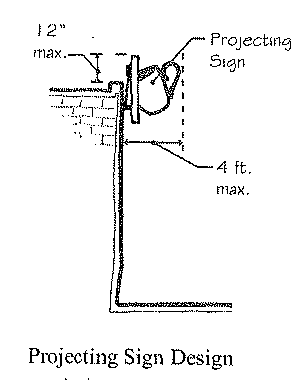
Projecting signs, including the support structure, shall not extend more than four (4) feet from the vertical surface to which it is attached.
ii.
Projecting signs shall not exceed twelve (12) square feet in surface area per face.
iii.
Projecting signs shall be a minimum of eight (8) feet above the ground floor elevation.
iv.
Projecting signs shall not exceed a height of fifteen (15) feet above the ground floor elevation.
v.
Projecting signs shall be securely fastened.
5.
Hanging signs.
i.
Hanging signs shall not exceed twelve (12) square feet in surface area per face.
ii.
Hanging signs shall be a minimum of eight (8) feet above the ground floor elevation.
iii.
Hanging signs shall not exceed a height of fifteen (15) feet above the ground floor elevation.
iv.
Hanging signs shall be securely fastened.
6.
Canopy signs.
i.
Canopy signs shall be permitted on all four (4) sides of a canopy structure. A continuous sign band shall be permitted for all canopies. Sign bands shall be no more than two and one-half (2½) feet in height.
(3)
Temporary signs as provided for under Section 9-190.
(4)
Electronic message boards, provided, however, that all of the following standards are met:
(a)
Electronic message board displays shall not move or change except to transition from one (1) message to another or from one (1) message segment to another by using one (1) of the following transition modes:
1)
Fade mode
2)
Dissolve mode
3)
Scroll mode
(b)
The sign shall be a minimum distance of fifty (50) feet radially from a residential district or use.
(c)
The sign shall not exceed fifty (50) percent of the allowable sign area or exceed sixty (60) square feet per face, whichever is less.
(d)
If the sign is within two hundred (200) feet of a residential district and is visible from a residential use, the sign shall not be illuminated between 11:00 p.m. and 5:00 a.m.
(e)
An electronic message board shall not be permitted to transition using travel mode, as defined in Chapter 1 of this ordinance.
(f)
Modes which cause the message to flash or appear to flash are prohibited.
(g)
The sign may only be used to promote activities, products, or services pertaining to the subject property; time and temperature; or other public service oriented messages.
(h)
Dimmer control. Electronic message board signs shall have an automatic dimmer control such as a photocell or other ambient light sensing mechanism that automatically adjusts the sign's brightness in direct correlation with the natural ambient light conditions.
(i)
Light sensor required. All electronic message board signs that are directly illuminated shall include a sensor or other devise that automatically determines ambient illumination and is programmed to automatically dim according to ambient light conditions or that can be adjusted to comply with the foot-candle requirements set out below without human assistance.
(j)
The sign shall not exceed a maximum illumination of five thousand (5,000) nits (candelas per square meter) during daylight hours; and a maximum of five hundred (500) nits (candelas per square meter) from dusk to dawn as measured at the sign's face at maximum brightness and at no time exceed 0.3 footcandles above natural ambient light conditions. Such measurements shall be taken using a footcandle (Lux) meter at a preset distance depending on the sign area, measured as follows in the table below.
(5)
Safety. Electronic message centers and digital billboards shall:
(a)
Include systems and monitoring to either turn the display off or show "full black" on the display and contain a default mechanism that freezes the sign in one (1) position at the maximum illumination in the event of malfunction; and
(b)
Be designed so if a catastrophic power surge occurs, the sign will go dark or it will have maximum brightness limitations in place; and
(c)
Automatically adjust the intensity of its display according to natural ambient light conditions.
(Ord. No. 99-20, § 1, 11-23-99; Ord. No. 2004-24, § 2, 10-12-04; Ord. No. 2007-10, § 2, 11-13-07; Ord. No. 2009-10, § 2, 8-11-09; Ord. No. 2019-9, § 3, 6-25-19)
Sec. 9-140. - Industrial Districts.
In any industrial district only the following signs shall be permitted:
(1)
All signs permitted within residential districts, as specified in Section 9-120.
(2)
Freestanding signs, including monument and pylon signs, wall signs, canopy signs, awning signs or projecting and hanging signs.
a.
The overall area of all signs shall not exceed one and one-half (1½) square feet of signage for each lineal foot of building frontage plus one additional square foot of signage shall be permitted for each lineal foot of street frontage.
b.
No sign shall be located within an easement area or within the public right-of-way.
c.
All signs shall adhere to the following standards:
1.
Wall signs.
i.
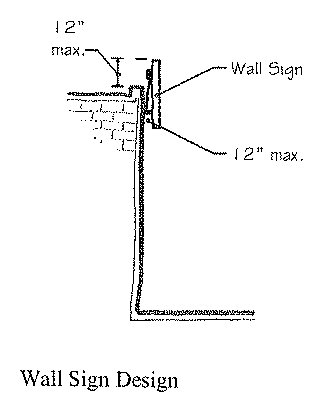
Wall signs shall not project more than twelve (12) inches from the wall or parapet to which it is attached.
ii.
Wall sign calculations shall not exceed ten (10) percent of the wall area as determined by the height and width of each wall. (Height × width = wall area). Wall signs may be allowed a sign area bonus transfer as provided in Section 9-70(H)(1).
iii.
Wall signs shall extend more than twelve (12) inches above the parapet line of the building.
2.
Freestanding signs. One freestanding sign shall be allowed per street frontage, except as provided is Section 9-70(H). All freestanding signs shall be located a minimum of five (5) feet from a property line.
i.
Where a pylon sign element is twenty (20) feet above the natural grade or higher, the sign element may encroach up to four (4) feet into the required setback.
ii.
The sign element shall be a minimum of ten (10) feet in height above the finished grade. Pylon signs shall not exceed thirty feet (30) in height. The sign elements shall not exceed one hundred twenty (120) square feet in total.
iii.
For pylon signs located within the Interstate Highway Oriented Business Area, the height shall not exceed fifty-five (55) feet and the area of the sign element shall not exceed three hundred and fifty (350) square feet.
iv.
A multi-tenant pylon sign may not exceed three hundred and fifty square feet (350) of sign elements.
3.
Awning signs.
i.
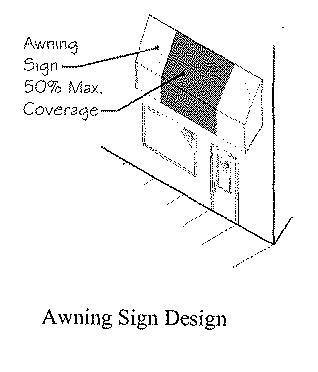
Awning signs shall not project more than four (4) feet from the wall to which it is attached.
ii.
Awning signs shall not exceed fifty (50) percent of the awning surface.
iii.
Awning signs shall be eight (8) feet above the minimum ground floor elevation of a building. Awning signs shall not exceed a height of fifteen (15) feet.
4.
Canopy signs.
i.
Canopy signs shall be permitted on all four (4) sides of a canopy structure. A continuous sign band shall be permitted for all canopies. Sign bands shall be no more than two and one-half (2½) feet in height.
(3)
Temporary signs as provided for under Section 9-190.
(4)
Electronic message boards, provided, however, that all of the following standards are met:
(a)
Electronic message board displays shall not move or change except to transition from one (1) message to another or from one (1) message segment to another by using one (1) of the following transition modes:
1)
Fade mode.
2)
Dissolve mode.
3)
Scroll mode.
(b)
The sign shall be a minimum distance of fifty (50) feet radially from a residential district or use.
(c)
The sign shall not exceed fifty (50) percent of the allowable sign area or exceed one hundred (100) square feet per face, whichever is less.
(d)
If the sign is within two hundred (200) feet of a residential district and is visible from a residential use, the sign shall not be illuminated between 11:00 p.m. and 5:00 a.m.
(e)
An electronic message board shall not be permitted to transition using travel mode, as defined in Chapter 1 of this ordinance.
(f)
Modes which cause the message to flash or appear to flash are prohibited.
(g)
The sign may only be used to promote activities, products, or services pertaining to the subject property; time and temperature; or other public service oriented messages.
(h)
Dimmer control. Electronic message board signs shall have an automatic dimmer control such as a photocell or other ambient light sensing mechanism that automatically adjusts the sign's brightness in direct correlation with the natural ambient light conditions.
(i)
Light sensor required. All electronic message board signs that are directly illuminated shall include a sensor or other devise that automatically determines ambient illumination and is programmed to automatically dim according to ambient light conditions or that can be adjusted to comply with the foot-candle requirements set out below without human assistance.
(j)
The sign shall not exceed a maximum illumination of five thousand (5,000) nits (candelas per square meter) during daylight hours; and a maximum of five hundred (500) nits (candelas per square meter) from dusk to dawn as measured at the sign's face at maximum brightness and at no time exceed 0.3 footcandles above natural ambient light conditions. Such measurements shall be taken using a footcandle (Lux) meter at a preset distance depending on the sign area, measured as follows in the table below.
(5)
Safety. Electronic message centers and digital billboards shall:
(a)
Include systems and monitoring to either turn the display off or show "full black" on the display and contain a default mechanism that freezes the sign in one (1) position at the maximum illumination in the event of malfunction; and
(b)
Be designed so if a catastrophic power surge occurs, the sign will go dark or it will have maximum brightness limitations in place; and
(c)
Automatically adjust the intensity of its display according to natural ambient light conditions.
(Ord. No. 99-20, § 1, 11-23-99; Ord. No. 2009-10, § 2, 8-11-09; Ord. No. 2019-9, § 3, 6-25-19)
Sec. 9-150. - Downtown Sign District.
(A)
Established. The Downtown Sign District is established in an effort to protect the unique architectural character and historic value of the city's downtown by placing additional regulations on signs to be placed within the district. Signage shall be designed to enhance and complement the historic character of buildings within the district.
(B)
District boundaries. The provisions of this section shall apply to those properties identified on the Downtown Sign District Map, incorporated herein by reference.
(C)
Sign Standards: Prior to issuance of a permit for a new sign, the replacement of an existing sign, or the re-facing or repainting of an existing sign or sign area within the Downtown Sign District, the applicant shall complete a sign permit application. Signs within the Downtown Sign District shall be subject to the following guidelines:
(1)
Size, building frontages of forty-four (44) feet or less. Buildings or portions thereof under separate management or control shall not have exterior signs on the premises with a surface area exceeding two (2) square feet per lineal foot of building frontage or eighty-eight (88) square feet, whichever is less, for each frontage. The surface area of all such signs shall not exceed, in the aggregate, eighty-eight (88) square feet on any single building frontage. Building frontage shall be calculated only on the public street to which said building is addressed or has direct access.
(2)
Size, building frontages of over forty-four (44) feet. Buildings or portions thereof under separate management or control shall not have exterior signs on the premises with a surface area exceeding two (2) square feet per lineal foot of building frontage or one hundred twenty-five (125) square feet, whichever is less, for each frontage. The surface area of all such signs shall not exceed, in the aggregate, one hundred twenty-five (125) square feet on any single building frontage. Building frontage shall be calculated only on the Public Street to which said building is addressed or has direct access.
(3)
Number. Buildings or portions thereof under separate management or control are allowed not more than two (2) signs except as provided for a multiple-occupancy building, as provided in Subsection 9-150(C)(6).
(4)
Projection. Buildings or portions thereof under separate management or control are allowed one (1) projecting sign per each adjacent public right-of-way, subject to the following requirements:
(a)
Each sign shall not exceed seven and one-half (7.5) square feet in surface area per face.
(b)
Projecting signs may not extend more than four (4) feet from the wall including supporting structure.
(c)
The maximum height above the ground floor elevation of the building shall be twelve (12) feet.
(d)
The minimum height above the ground floor elevation of the building shall be eight (8) feet.
(e)
The style of the projecting sign shall be compatible with the architectural style of the building period.
(f)
Signs shall be securely fastened to the building, avoiding damage to the structure, including the stone or brick.
(5)
Window signs. No sign shall be permanently affixed to a window surface, except that the name, monogram, logo, address, hours of operation, and telephone number of the person or firm occupying the premises may be allowed. Such signs shall be included in the total allowable sign area for the building, as determined in Subsections 9-150(C)(1) and (2). Any window display that is temporarily affixed upon a window surface that indicates a product or service provided on the premises may be permitted, subject to the provisions of Subsection 9-30(11) and Section 9-190.
(6)
Joint identification signs. In a multiple-occupancy building, each tenant may have one (1) wall or window business sign, provided that the total surface area shall not exceed that allowed under Subsections 9-150(C)(1) and (2). In addition, the building owner may provide a sign directory, not to exceed 15 square feet, listing the building name and the name of the businesses within the building. A signage plan for the entire building shall be submitted and approved.
(7)
Freestanding, pylon signs. Freestanding or pylon signs shall be permitted, as one (1) of the two (2) permitted signs provided that the area of the sign is no greater than one-third (1/3) of the total allowable square footage for signage on the property, up to a maximum of seventy-five (75) square feet.
(8)
Sign Shape, Lettering and Borders. Signs shall be compatible with the architectural details of the building such as stone arches, glass transom panels, decorative brick or tile work. Edges of signs shall include a raised or recessed border that sets the sign apart from the building surface or hanging space. Individual raised or recessed letters set onto the sign area surface are required except as provided in paragraphs (a) and (b) of this subsection. Lettering styles shall be legible. Each sign shall contain no more than two (2) lettering styles, and the lettering shall occupy no more than sixty (60) percent of the total sign area.
(a)
Certain signs need not have raised or recessed lettering or a raised or recessed border when the sign is cut out in the shape of the business logo, or other ornate shape (not simply a rectangle, square, oval or circle) and the sign is designed to complement the building architecture. Such signs may be permitted with a painted border and painted lettering. A suitable alternative to paint may be approved for lettering or borders in accordance with paragraph (10) below. The sign shall be raised to create separation from the building wall by no less than one (1) inch but not to exceed six (6) inches to set the sign apart from the building surface.
(b)
Signs comprised of individually cut out letters and cut out logos set apart from the building surface shall not be required to have a border around the outer extent of the sign area.
(9)
Colors. Sign colors shall coordinate with the building facade to which the sign is attached. No more than three (3) colors, excluding shades and gradients, shall be used for sign letters. Fluorescent colors are prohibited.
(10)
Materials. All signs shall be constructed of wood, metal, stone, glass, masonry, or tile; or material with a similar appearance to the materials as listed herein.
(11)
Placement. Signs shall be placed so they do not destroy or obscure architectural details such as stone arches, glass transom panels, or decorative brick or tile work. No sign shall completely cover design elements.
(12)
Illumination. External illumination of signs is permitted by incandescent or fluorescent light, but shall emit continuous white light that prevents direct light from shining onto the ground or street while in operation. The use of internally lit signs, such as but not limited to backlit plastic, is not permitted. Neon signs shall be prohibited, except upon proof of historic accuracy and appropriateness.
(13)
Sidewalk Signs. A-Frame or Sandwich Board signs are permitted subject to the provisions of Section 9-190 of this ordinance.
(14)
Historic building signs. Existing permanent historic nameplates or letters located on buildings shall be reviewed and approved by the Heritage Preservation Commission when changed or painted. Such signs are not subject to the sign area requirements of this chapter, and shall not be included in the calculation of total sign area for the property.
(15)
Awning signs. Signage placed on an awning or wall-mounted canopy is allowed, provided it does not extend more than four (4) feet above or one (1) foot below such structure, and is a minimum of (8) feet above the ground floor elevation of the building. Awning signage shall be counted as a part of the aggregate sign area allowed per frontage. Awning signage need not include raised or recessed lettering or borders.
(Ord. No. 99-20, § 1, 11-23-99; Ord. No. 2006-12, § 1, 6-27-06; Ord. No. 2020-14, § 10-13-20)
Sec. 9-160. - Billboards permitted.
(A)
In general. Freestanding billboards are permitted subject to the requirements of this section. In no case shall a billboard sign be placed on the roof or wall of a building structure.
(B)
Location. Billboard signs shall be permitted only on parcels zoned "C-2," "C-3," "I-1," "I-2," or "I-P" which are adjacent to the right-of-way of Interstate 35, Highway 21, Highway 48, and Highway 60 West of Highway 21.
(C)
Maximum size and height. Billboard sign structures shall not contain more than two (2) signs per face, nor shall the sum of such sign or signs exceed a length of fifty-five (55) feet or a surface area of seven hundred fifty (750) square feet. A billboard sign structure shall not exceed thirty (30) feet in height. An interstate highway oriented billboard sign structure shall not exceed fifty-five (55) feet in height.
(D)
Setback requirements. Billboard sign structures must maintain a twenty-five (25) foot minimum front setback off the property line. Where an adjacent building structure within the same block has a front setback different than those required, the minimum front setback shall be the average of the required setback and the actual setback of the adjacent structure. Billboard sign structures shall not be set back from the interstate right-of-way more than one hundred (100) feet as measured from the portion of the sign furthest from the right-of-way.
(E)
Distance from other uses and from other similar structures. No billboard sign structure shall be permitted within one hundred (100) feet of an adjoining residential district boundary line or any public park, school, library, church, or government building. All billboard sign structures located adjacent to Interstate 35 shall be spaced at least seven hundred fifty (750) feet from any other billboard sign structure. Billboard sign structures in all other permitted locations shall be located at least two thousand (2000) feet from any other billboard sign structure.
(F)
Billboard construction and maintenance. Billboard support structures shall be steel monopole or I-beam construction and shall be painted in earth tones, such as rust, brown, or gray, unless constructed of a material designed to be unpainted and to oxidize naturally. Billboards shall be maintained in good, upright condition and sign faces shall be kept free of sagging, peeling, or torn copy.
(G)
Landscaping. The area around the base of billboards in all areas shall be landscaped and maintained in a neat and orderly fashion, including regular mowing as needed. An applicant for a sign permit for a billboard shall submit a landscape plan with the application which will identify the kinds of vegetation, masonry, or other material to be installed around the base and how the area will be maintained.
(H)
State statutes. All billboard sign structures shall also be subject to the provisions of the "Minnesota Outdoor Advertising Control Act," which appears in Chapter 173, Minnesota Statutes.
(I)
Digital billboards. The City of Faribault recognizes that digital billboards are a cost-effective means for providing information to the public. The city sees merit in allowing new technologies so that messages of all kinds can be quickly and easily updated. The city also sees advantages in being able to provide public service messages through digital billboard technology for the greater good of the City of Faribault as a whole and its visitors. By placing certain requirements and restrictions on digital billboards to minimize potential driver distraction and the impacts to nearby residential properties, these signs can serve a greater public purpose. Digital billboards shall be subject to the following standards:
(1)
Digital billboards shall be subject to all other billboard provisions as stated in this article.
(2)
A sign permit shall be required prior to installation of a digital billboard face on any or new existing billboard sign structure.
(3)
Digital billboards shall not be permitted on nonconforming sign structures.
(4)
Not more than one (1) digital or static sign face or message facing in the same direction shall be allowed.
(5)
The digital billboard screen shall not be divided to show more than one (1) message displayed concurrently.
(6)
A digital billboard shall be located a minimum of two thousand (2,000) feet from any other digital billboard oriented in the same general direction of travel.
(7)
A digital billboard shall be located a minimum of three hundred (300) feet from the center of a signalized intersection and a minimum of five hundred (500) feet from the center of an unsignalized intersection. The city, at its sole discretion, may require additional setbacks from an intersection based on site conditions.
(8)
Digital billboards shall be designed and equipped to freeze the device in one (1) position. The sign owner shall immediately stop the digital display when notified by the city that it is not in compliance with this ordinance.
(9)
In conjunction with the sign permit application, the applicant shall provide written certification from the sign manufacturer that the sign is equipped with a dimmer control that automatically adjusts to day/night brightness levels.
(10)
The digital billboard shall not exceed a maximum illumination of five thousand (5,000) nits during daylight hours and five hundred (500) nits between dusk to dawn as measured at the sign's face at maximum brightness. The city, at its sole discretion, may require lower illumination levels based on site conditions through the conditional use permit process.
(11)
In conjunction with the sign permit application, the applicant shall provide written certification from the sign manufacturer that the brightness levels have been preset to a maximum illumination of five thousand (5,000) nits during daylight hours and five hundred (500) nits between dusk to dawn as measured at the sign's face at maximum brightness.
(12)
Modes which cause the sign to flash or appear to flash are prohibited. Movement, motion, or the appearance or movement or motion is prohibited.
(Ord. No. 99-20, § 1, 11-23-99; Ord. No. 2007-05, § 1, 4-10-07; Ord. No. 2008-25, § 2, 2-24-09)
Sec. 9-170. - Nonconforming billboards.
Signs which existed prior to September 1, 1997, and which were constructed in compliance with the terms of any prior ordinance, or signs which were constructed in compliance with the regulations of some other public entity but became nonconforming upon the annexation of the sign location into the city are designated as legal nonconforming signs and shall be regulated as follows:
(1)
A nonconforming sign or part thereof may be continued, including through repair, replacement, restoration, maintenance, or improvement, but not including expansion unless:
(a)
The nonconforming sign is discontinued for a period of more than one (1) year, regardless of any intent to resume or not to abandon such use; or
(b)
The nonconforming sign is destroyed by fire or other peril to the extent of greater than fifty (50) percent of its market value, and no building permit has been applied for within one hundred eighty (180) days of when the sign is damaged.
(4)
No such sign shall be moved in whole or in part to any other location where it would remain nonconforming. Any sign that must be removed shall be done so within sixty (60) days of the date of receipt of notice from the zoning administrator. Any sign requiring change, repair, or maintenance to become conforming must be restored within one hundred eighty (180) days from the date of notice.
(Ord. No. 99-20, § 1, 11-23-99; Ord. No. 2008-25, § 2, 2-24-09)
Sec. 9-180. - Billboard credit.
The City Planner shall maintain a Current Billboard Inventory Map and Database, which shall be an integral component of the City's Official Zoning Map. This map and database shall be amended upon relocation, removal, or construction of any billboard structure within the City of Faribault and shall represent the total number of billboard credits available within the City of Faribault. The City Council may increase the number of billboard credits through the Zoning Amendment process set forth in the Unified Development Ordinance. In lieu of the City Council increasing the number of billboard credits, any person wishing to erect a new billboard for which there is no available billboard credit must first completely remove a billboard sign of equal or greater size and its supporting structure to receive a billboard credit as follows:
(1)
Evidence of the removal of a legal nonconforming billboard must be furnished to the satisfaction of the City Planner, who will issue a certificate indicating approval of a billboard credit.
(2)
Any billboard credit certificate issued by the City Planner shall remain in effect for two (2) years from the date of issuance. If a replacement billboard conforming to the requirements of this chapter is not installed within such time period, an additional billboard credit must be obtained.
(3)
If a billboard has been removed as a result of public purchase or condemnation of the billboard initiated by the city, then the billboard owner will be entitled to either financial compensation or a billboard credit, but not both alternatives. Where the city is not otherwise legally obligated to pay financial compensation, the city retains the right to designate whether the billboard owner will receive financial compensation or a billboard credit. If however a billboard is removed by a public entity other than the city, the sign owner will not be entitled to a billboard credit. Nothing herein shall be construed to require compensation for any rights for which the law does not otherwise require compensation.
(4)
Billboard credits may be transferred between parties through legal means.
(Ord. No. 99-20, § 1, 11-23-99; Ord. No. 2007-05, § 1, 4-10-07; Ord. No. 2015-03, § 1, 2-24-15)
Editor's note— Ord. No. 2015-03, § 1, adopted Feb. 24, 2015, changed the title of § 9-180 from "Sign credit required for new billboards" to read as herein set out.
Sec. 9-190. - Temporary signs.
(A)
In general. No permits are required for display of temporary signage that is in compliance with the standards specified below. However, it is not the intent of this section to allow the display of temporary signage as a means to circumvent the sign regulations for the zoning district in which the property is located.
(B)
Permitted temporary signs. Temporary signs shall be allowed in excess of and in addition to the sign limitations within each zoning district, as outlined in this chapter, regardless of the status of conformity of all other permanent on-premise signs, provided that:
(1)
The sign is displayed on-premises, is well maintained, and is secured in a manner to prevent being blown uncontrollably by the wind.
(2)
The sign is displayed for a special event or promotion and shall not be in place for more than a total of sixty (60) calendar days. Only one type of temporary sign is displayed per zoning lot or property under separate management or control at any give time.
(3)
Banner signs must be attached to the principal building, and at no time shall the total area of all temporary banner signs displayed per zoning lot exceed one hundred (100) square feet, except within the Downtown Sign District.
(4)
Exterior banner signs shall be prohibited in the Downtown Sign District.
(5)
A-frame or sandwich board signs may be displayed during business hours only, provided that only one such sign is displayed at a time. Such sign is limited to eight (8) square feet per side and shall not interfere with either pedestrian or vehicular traffic circulation or create a potential traffic hazard.
(C)
Temporary sign permit required. A temporary sign permit shall be obtained from the Zoning Administrator for the display of any temporary signage that is not specifically permitted under Section 9-190. The Zoning Administrator shall have the authority to place conditions on any temporary sign permit approval to ensure that the intent of this ordinance is satisfied.
(Ord. No. 99-20, § 1, 11-23-99; Ord. No. 2006-12, § 2, 6-27-06)
Sec. 9-200. - Sign variances.
(A)
In general. A sign variance shall be required to allow display or installation of any signage that does not comply with the regulations set forth in this chapter. In no case, however, shall a variance be granted to allow a sign expressly prohibited in Section 9-90.
(B)
Application for sign variance. An application for a sign variance shall be filed with the Zoning Administrator on an approved form and shall be accompanied by the required fee, as established by City Council resolution, and the following:
(1)
A drawing showing the proposed location of the sign and the location of all existing signage on the premises.
(2)
A drawing indicating the size, color, content, and materials of the sign, as well as the method of construction and attachment to the building or to the ground.
(3)
Engineering data showing the structure is designed to accommodate dead load and wind pressure, in any direction, in the amount required within this chapter, when specifically requested by the Zoning Administrator.
(Ord. No. 99-20, § 1, 11-23-99)
Sec. 9-210. - Hearing on application for sign variance.
The Planning Commission shall hold a public hearing on each valid and complete application for a sign variance as provided in Section 2-100. After the close of the hearing on a proposed variance, the Planning Commission shall make findings, pursuant to Section 9-230, and shall submit the same together with its recommendations to the City Council.
(Ord. No. 99-20, § 1, 11-23-99)
Sec. 9-220. - Action by City Council on variances.
The City Council shall make the final decision regarding all applications for a variance from the sign regulations established by this ordinance. Approval shall require a majority vote of the City Council.
(Ord. No. 99-20, § 1, 11-23-99)
Sec. 9-230. - Required findings for sign variance.
(A)
Prerequisites for approval. The Planning Commission and City Council shall not vary the regulations of this ordinance unless it makes each of the following findings based upon the evidence presented to it in each specific case. The Planning Commission and City Council may impose such conditions upon the premises benefited by a variance as may be necessary to comply with the standards established by this ordinance or to reduce or minimize the effect of the variance upon other properties in the neighborhood and to better carry out the intent of the variance. The conditions must be directly related to and must bear a rough proportionality to the impact created by the variance:
(1)
That the strict application of this ordinance would result in practical difficulties inconsistent with the general purpose and intent of this ordinance. Economic conditions alone do not constitute practical difficulties.
(2)
That the alleged difficulty is caused by the ordinance and has not been created by any persons presently having an interest in the parcel of land.
(3)
That the variance is requested to overcome unique circumstances that apply to the property which do not apply to other properties in the same zone or vicinity that prevent the property owner from displaying a sign as intended by this ordinance.
(4)
That the variance does not alter the essential character of the neighborhood.
(5)
That the variance is in harmony with the general purposes and intent of the City's ordinances.
(B)
Historical variation. The City Council may vary the regulations of this ordinance to further historic preservation or re-establishment of historic signage when the following above conditions are shown to exist and the variance will allow signage that is consistent with the historic character of a property or building, based on architectural style or a documented historic use.
(Ord. No. 99-20, § 1, 11-23-99; Ord. No. 2011-17, § 2, 10-25-11)
Sec. 9-240. - Variance conditions and guarantees.
The City Council may impose such conditions on any proposed sign variance and require such guarantees as it deems reasonable and necessary to protect the public interest and to ensure compliance with the standards and purposes of this ordinance.
(Ord. No. 99-20, § 1, 11-23-99)
Sec. 9-250. - Expiration of variance.
If a sign for which a variance has been approved is not installed within one (1) year of the date of approval, such variance shall be considered void unless a petition for a time extension has been granted by the City Council. Such extension request shall be submitted in writing at least thirty (30) days prior to expiration of the variance and shall state facts showing a good faith effort to complete work permitted under the original approval.
(Ord. No. 99-20, § 1, 11-23-99)

