
Fenton City Zoning Code
ARTICLE XX
ACCESS MANAGEMENT AND DRIVEWAY STANDARDS
Sec. 36-20.01.- Statement of purpose.
The purpose of this article is to provide access standards which will facilitate through traffic operations, ensure public safety along roadways, and protect the public investment in the street system; while providing property owners with reasonable, though not always direct, access. The standards are specifically designed for streets whose primary function is the movement of through traffic, as opposed to local streets whose primary function is access to adjacent properties.
(Ord. No. 622, § 20.01, 6-28-04)
Sec. 36-20.02. - Application of standards.
a.
The standards of this Article shall be applied to the following major traffic routes (arterials) identified in the City of Fenton Master Plan:
1.
Leroy Street
2.
North Road
3.
Silver Lake Road
4.
Adelaide
5.
Main Street
6.
South Holly Road
7.
Owen Road
8.
West Shiawassee Avenue
9.
Silver Boulevard
10.
South Long Lake Road
11.
State Street
b.
The access standards contained herein shall be required in addition to, and where permissible shall supersede, the requirements of the Genesee County Road Commission (GCRC) and the Michigan Department of Transportation (MDOT).
c.
The standards contained in this article shall apply to all uses, except permitted single-family and two-family dwelling units.
d.
For expansion and/or redevelopment of existing sites where the planning commission determines that compliance with all the standards of this article is unreasonable, the standards shall be applied to the maximum extent possible. In such situations, suitable alternatives which substantially achieve the purpose of this article may be accepted by the planning commission, provided that the applicant demonstrates all of the following apply:
1.
Size of the parcel is insufficient to meet the dimensional standards.
2.
The spacing of existing, adjacent driveways or environmental constraints prohibit adherence to the access standards at a reasonable cost.
3.
The use will generate less than 500 total vehicle trips per day or less than 75 total vehicle trips in the peak hour of travel on the adjacent street, based on the most recent rates developed by the Institute of Transportation Engineers (ITE).
4.
There are no other reasonable means of access.
(Ord. No. 622, § 20.02, 6-28-04)
Sec. 36-20.03. - Number of driveways.
a.
Access to a parcel shall consist of either a single two-way driveway or a pair of one-way driveways wherein one driveway is designed and appropriately signed to accommodate ingress movements and the other egress movements.
b.
Where parcel frontage is insufficient to provide a driveway meeting the minimum driveway width and radii, a shared driveway or other means of access may be required.
c.
Where parcels of at least two acres in area, have frontage along two streets, access should be provided only along the street with the lower average daily traffic volume, unless the planning commission determines this would negatively affect traffic operations or surrounding land uses.
d.
Where the property has continuous frontage of over three hundred (300) feet and the applicant can demonstrate, using the Institute of Transportation Engineers Manual Trip Generation [Trip Generation Manual] or another accepted reference, that a second access is warranted, the planning commission may allow an additional access point. Where possible, this access should be spaced accordingly to the standards contained herein, located on a side street, shared with an adjacent property, and/or be constructed to restrict one or both left turn movements.
e.
Where the property has continuous frontage of over 600 feet, a maximum of three driveways may be allowed, with at least one such driveway being constructed and signed for right-turns-in, right-turns-out only.
(Ord. No. 622, § 20.03, 6-28-04)
Sec. 36-20.04. - Shared access—Joint driveways, frontage roads, parking lot connections and rear service drives.
a.
Shared use of access between two or more property owners should be encouraged through use of driveways constructed along property lines, connecting parking lots and construction on-site of frontage roads and rear service drives; particularly within one-quarter mile of major intersections, for sites having frontage on two or more streets, where frontage dimensions are less than 300 feet, at locations with sight distance problems, and/or along roadway segments experiencing congestion or accidents. In such cases, shared access of some type may be the only access design allowed.
b.
In cases where a site is adjacent to an existing frontage road, parking lot of a compatible use, or rear service drive, a connection to the adjacent facility may be required by the planning commission.
c.
In cases where a site is adjacent to undeveloped property, the site should be designed to accommodate a future frontage road, parking lot connection or rear service drive.
d.
The applicant shall provide the city with letters of agreement or access easements from all affected property owners.
(Ord. No. 622, § 20.04, 6-28-04)
Sec. 36-20.05. - Adequate sight distance.
a.
Requirements for minimum intersection or corner sight distance for driveways shall be in accordance with the American Association of State Highway and Transportation Officials (AASHTO) guidelines defined in chapter 9 of A Policy on Geometric Design of Highways and Streets. 1994.
b.
The planning commission may adjust driveway location where there is inadequate sight distance.
(Ord. No. 622, § 20.05, 6-28-04; Ord. No. 643, § 2, 1-14-08)
Sec. 36-20.06. - Driveway spacing from intersections and U.S. 23 ramps.
a.
Driveway spacing from intersections shall be measured from the centerline of the driveway to the extended edge of the intersecting street's right-of-way line.
b.
In order to preserve intersection operations and safety, the minimum distance between a driveway and an intersecting street right-of-way shall be based on the following:
1.
For locations in the vicinity of intersections experiencing congestion (peak hour operations below level of service "C" for one or more movements) and/or a significant number of traffic accidents (five or more annually), the planning commission may require that access be constructed along the property line furthest from the intersection.
2.
For locations within 200 feet of any signalized or four-way stop intersection, driveways shall be spaced a minimum of 150 feet from the intersection. Where this spacing cannot be provided, driveways designed for "right-turn in, right-turn out only" movements may be allowed, with a minimum spacing of 75 feet from the intersecting street right-of-way.
3.
For locations not addressed by paragraph 2. above, not including single-family parcels, driveways shall be spaced 100 feet from the intersection.
4.
Driveways shall be spaced a minimum of three hundred (300) feet from the centerline of the U.S. 23 on and off ramps.
(Ord. No. 622, § 20.06, 6-28-04)
Sec. 36-20.07. - Driveway spacing from other driveways.
a.
Driveway spacing from other driveways shall be measured from the centerline of each driveway at the point where it crosses the street right-of-way line.
b.
Minimum driveway spacing from other driveways along the same side of the street shall be determined based on posted speed limits along the parcel for each particular frontage, as follows:
c.
Driveways shall be directly aligned with those across the street or, where offset, the minimum driveway spacing from driveways across the street shall be a minimum of 150 feet, as determined by the planning commission, excluding when one or both driveways are designed and signed for right-turn-in, right-turn-out only.
(Ord. No. 622, § 20.07, 6-28-04)
Sec. 36-20.08. - Driveway design, channelized driveways, deceleration lanes and tapers, bypass lanes.
a.
Standards. Driveways shall be designed to the standards of the Genesee County Road Commission, except where stricter standards are included herein or by the City Driveway Construction Standards.
b.
Driveway width and radii.
1.
The typical driveway design shall include one ingress and one egress lane, with a combined maximum throat width of 30 feet, measured from face to face of curb.
2.
Wherever the planning commission determines that traffic volumes or conditions may cause significant delays for traffic exiting left, two exit lanes may be required.
3.
For one-way paired driveway systems, each driveway shall be 16 feet wide, measured perpendicularly.
4.
In areas with pedestrian traffic, the exit and enter lanes may be separated by a median with a maximum width of ten feet.
5.
Driveways shall be designed with 25 foot radii; 30 foot radii where daily semi truck traffic is expected.
c.
Driveway storage. Driveway storage shall be determined by the planning commission based on traffic volumes and conditions. A minimum of 40 feet of driveway storage shall be provided for less intense developments and a minimum of 120 feet of driveway storage shall be required for larger developments. Driveway storage shall be measured from the right-of-way line.
d.
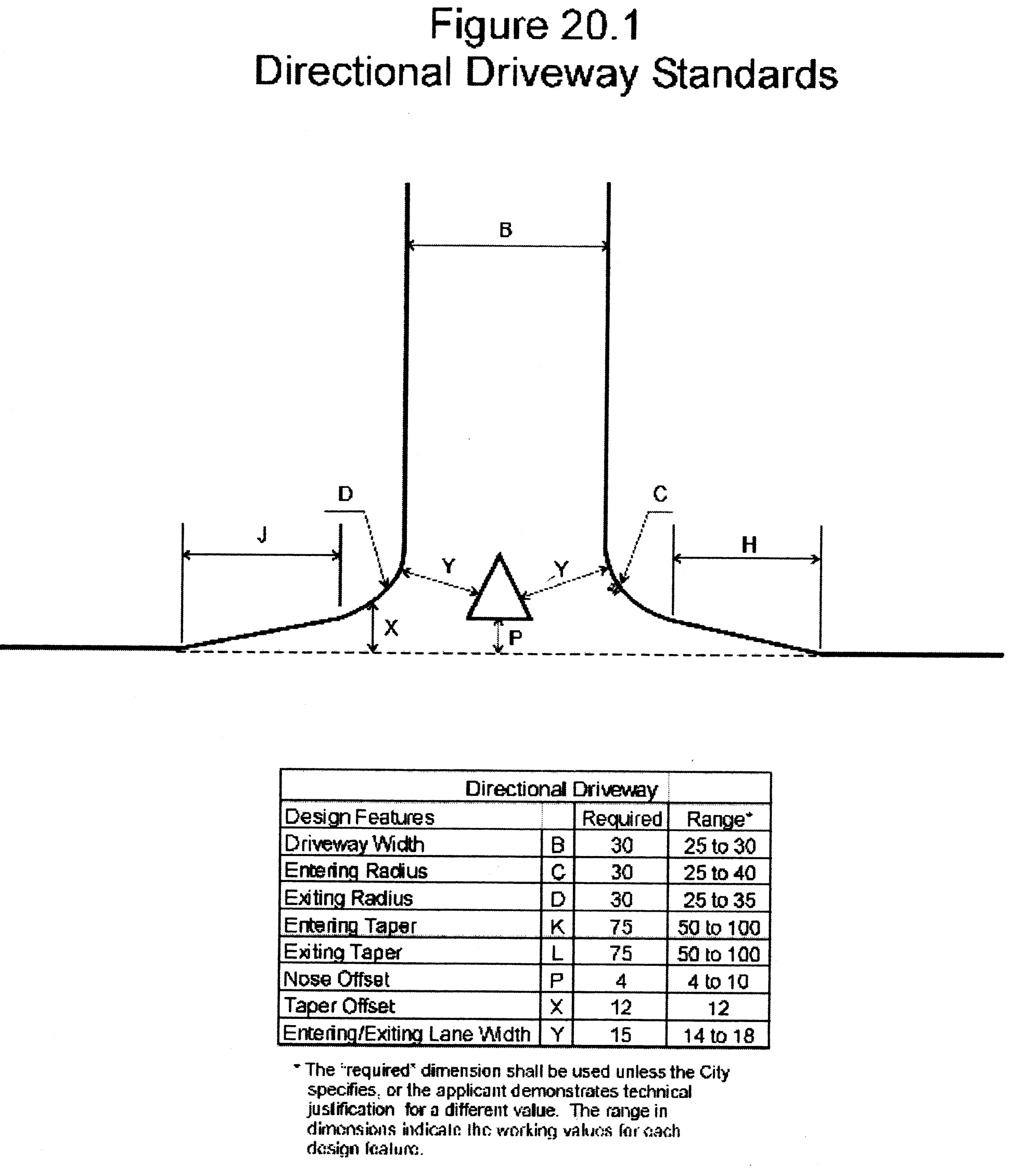
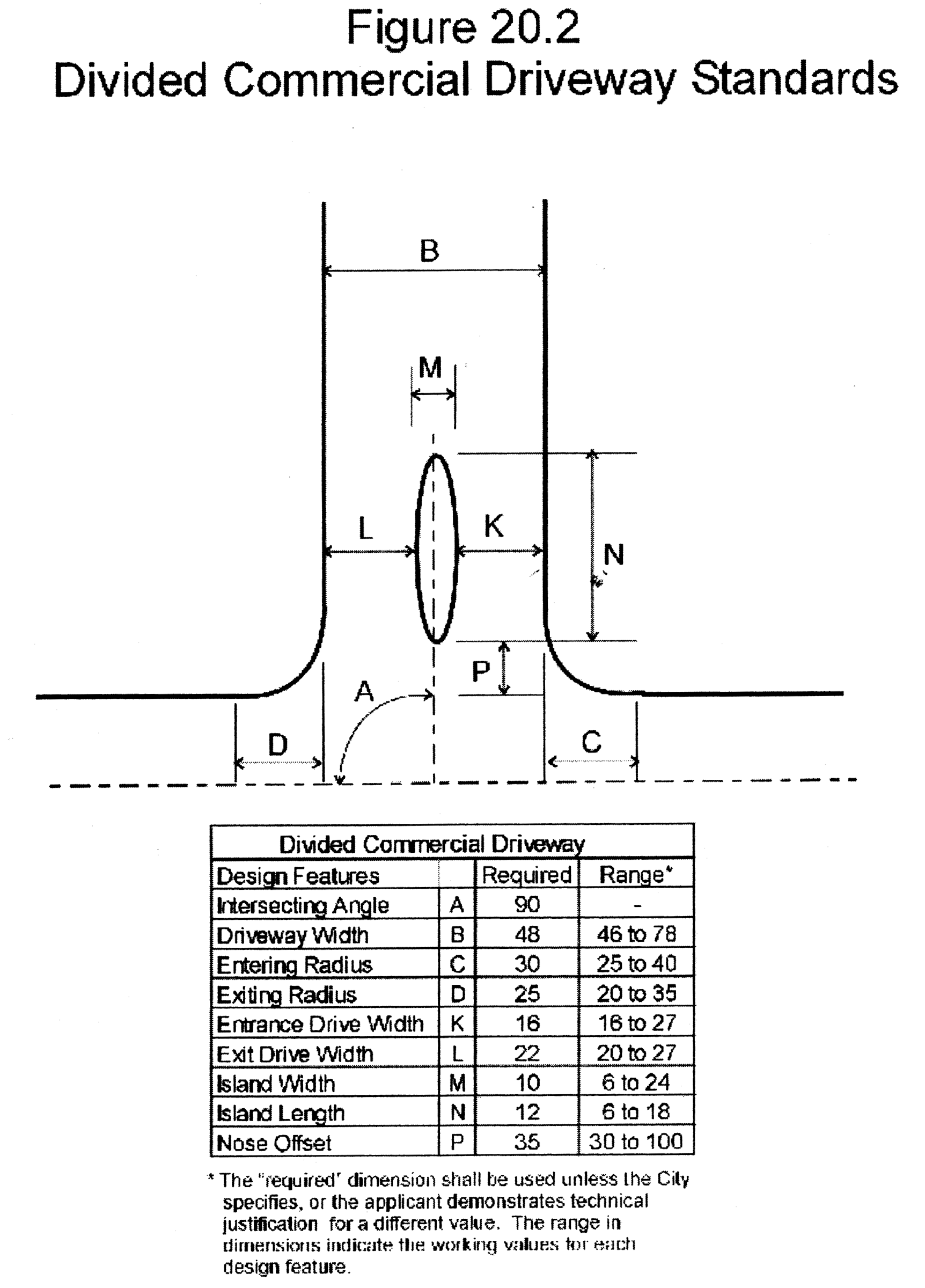
Directional driveways, divided driveways, and deceleration tapers and/or by-pass lanes. Directional driveways, divided driveways, and deceleration tapers and/or by-pass lanes may be required by the planning commission where they are necessary to reduce congestion and accident potential for vehicles accessing the proposed use or site. Right-turn tapers shall be a minimum of 75 feet in length and at least 11 feet wide. Design of direction and divided driveways shall be in accordance with the designs in Figures 20.1 Directional Driveway Standards and 20.2 Divided Commercial Driveway Standards.
(Ord. No. 622, § 20.08, 6-28-04)
Sec. 36-20.09. - Design of frontage roads, rear service drives and parking lot connections.
Frontage roads, rear service drives and drives connecting two or more parking lots shall be constructed in accordance with Figure 20.3 Frontage Roads, Service Drives and Parking Lot Connections and the following requirements:
a.
Pavement width shall be a maximum of 30 feet, measured face of curb to face of curb; intersection approaches may be widened to 39 feet for a left turn lane.
b.
Frontage road access to public streets shall be spaced according to the standards of section 36-20.06, Driveway spacing from intersections and U.S. 23 ramps and section 36-20.07, Driveway spacing from other driveways.
c.
Frontage roads shall have a minimum setback of 30 feet between the outer edge of pavement and the right-of-way line, with a minimum 60 feet of uninterrupted queuing (stacking) space at the intersections.
d.
Parking along or which backs into a frontage road shall be prohibited.
e.
For properties which are currently developed or adjacent to developed uses, and the standards of paragraphs a. through d. above are determined by the planning commission to be too restrictive, frontage roads can be defined through parking lots by a raised curb and/or painted islands, as shown, provided that at least every third island at the end of the parking row is a raised curbed island.
(Ord. No. 622, § 20.09, 6-28-04)

