
Fenton City Zoning Code
ARTICLE XXVIII
DEFINITIONS
Sec. 36-28.01.- Construction of language.
The following rules of construction apply to the text of this chapter:
a.
The particular shall control the general.
b.
In case of any difference of meaning or implication between the text of this chapter and any caption or illustration, the text shall control.
c.
The word "shall" is always mandatory and not discretionary. The word "may" is permissive, with the decision made by the planning commission, city council, or zoning board of appeals, as indicated.
d.
Words used in the present tense shall include the future; and words used in the singular number shall include the plural, and the plural the singular, unless the context clearly indicates the contrary.
e.
The words "used" or "occupied" include the words "intended", "designed", or "arranged to be used or occupied"; the word "building" includes the word "structure" and any part thereof; the word "dwelling" includes the word "residence"; the word "lot" includes the words "plot" or "parcel."
f.
The word "person" includes an individual, a corporation, a partnership, an incorporated or unincorporated association, or any other entity recognizable as a "person" under the laws of Michigan.
g.
Unless the context clearly indicates the contrary, where a regulation involves two or more items, conditions, provisions, or events connected by the conjunction "and", "or", "either...or", the conjunction shall be interpreted as follows:
1.
"And" indicates that all the connected items, conditions, provisions, or events shall apply.
2.
"Or" indicates that the connected items, conditions, provisions, or events may apply singly or in any combination (i.e., "or" also means "and/or").
3.
"Either ... or" indicates that the connected items, conditions, provisions or events shall apply singly but not in combination.
h.
The terms "abutting" or "adjacent to" include property along the lot lines of the subject site including those in another community, but do not include lands separated by a public street right-of-way.
i.
The term "this zoning ordinance" or "this chapter" includes the City of Fenton Zoning Ordinance and any amendments thereto.
j.
Terms not herein defined shall have the meaning customarily assigned to them.
(Ord. No. 622, § 28.01, 6-28-04)
Sec. 36-28.02. - Definitions A-B.
The following words, terms and phrases, when used in this chapter, shall have the meanings ascribed to them in this section, except where the context clearly indicates a different meaning:
Access management (access control): A technique to improve traffic operations along a major roadway and decrease the potential for accidents through the control of driveway locations and design; consideration of the relationship of traffic activity for properties adjacent to, and across from, one another; and the promotion of alternatives to direct access.
Access to property, reasonable: A property owner's legal right, incident to property ownership, to access a public road right-of-way. Reasonable access to property may be indirect or certain vehicle turning movements prohibited for improved safety and traffic operations.
Accessory building, structure, or use A building, structure, or use which is clearly incidental to, customarily found in connection with, devoted exclusively to, subordinate to, and located on the same lot as the principal use to which it is related.
Adequate lateral support: The control of soil movement on a site as determined by accepted engineering standards.
Adult day-care facility: A facility other than a private residence which provides care for more than six adults for less than 24 hours a day.
Adult care facility, state-licensed: Any structure constructed for residential purposes that is licensed by the State of Michigan pursuant to Public Act 218 of 1979. These acts provide for the following types of residential structures:
a.
Adult foster care small group home. A facility with the approved capacity to receive 12 or fewer adults who are provided supervision, personal care, and protection in addition to room and board, for 24 hours a day, five or more days a week, and for two or more consecutive weeks for compensation.
b.
Adult foster care large group home. A facility with approved capacity to receive at least 13 but not more than 20 adults to be provided supervision, personal care, and protection in addition to room and board, for 24 hours a day, five or more days a week, and for two or more consecutive weeks for compensation.
c.
Adult foster care family home. A private residence with the approved capacity to receive six or fewer adults to be provided with foster care for 24 hours a day for five or more days a week and for two or more consecutive weeks. The adult foster care family home licensee must be a member of the household and an occupant of the residence.
d.
Congregate facility. Residence for more than 20 adults.
Alley: Any dedicated public way affording a secondary means of access to abutting property, and not intended for general traffic circulation.
Alteration: Any change, addition or modification in construction or type of occupancy, any change in the structural members of a building, such as walls or partitions, columns, beams or girders, the consummated act of which may be referred to herein as "altered" or "reconstructed."
Animal, domesticated: An animal that is commonly considered capable of being trained or is capable of adapting to living in a human environment and being of use to human beings, and which is not likely to bite without provocation, nor cause death, maiming or illness to human beings, including by way of example: bird (caged), fish, turtle, rodent (bred, such as a gerbil, rabbit, hamster or guinea pig), cat (domesticated), lizard (non-poisonous), and dog. Wild, vicious, or exotic animals shall not be considered domesticated.
Animal, exotic: Any animal of a species not indigenous to the State of Michigan and not a domesticated animal, including any hybrid animal that is part exotic animal.
Animal, non-domesticated (wild): Any living member of the animal kingdom, including those born or raised in captivity, except the following: human beings, domestic dogs (excluding hybrids with wolves, coyotes, or jackals), domestic cats (excluding hybrids with ocelots or margays), farm animals, rodents, any hybrid animal that is part wild, and captive-bred species of common cage birds.
Animal, vicious: Any animal that attacks, bites, or injures human beings or domesticated animals without adequate provocation, or which because of temperament, conditioning, or training, has a known propensity to attack, bite, or injure human beings or domesticated animals.
Antennae, reception: See "Reception antennae."
Aquifer: A geologic formation, group of formations or part of a formation capable of storing and yielding a significant amount of groundwater to wells or springs.
Arcade, game or video: The use of a building or a portion of a building for the location, operation, and placement of five or more mechanical amusement devices. Mechanical amusement devices shall mean any device, apparatus, mechanical equipment or machine operated as amusement for required compensation. The term does not include vending machines used to dispense foodstuffs, toys, or other products for use and consumption.
Architectural feature, significant: Any building, structure, or portion thereof, that is sufficiently distinctive or unusual in design or construction as to warrant the preservation and minimal alteration of its original form.
Arterial street: A street defined in the master plan or city's Act 51 Plan as "major traffic routes" and/or as an arterial or major street by the Michigan Department of Transportation where the movement of through traffic is the primary function, with service to adjacent land uses a secondary function.
As-built plans: Construction plans in accordance with all approved field changes.
Auto (Automobile): Any motorized vehicle intended to be driven on roads or trails, such as cars, trucks, vans, and motorcycles.
Automobile gasoline station: An establishment which includes buildings and premises for the primary purpose of retail sales of gasoline. An automobile gasoline service station may also include an area devoted to sales of automotive items and convenience goods (mini-mart) primarily sold to patrons purchasing gasoline. An establishment which provides vehicle maintenance or repair is not included within this definition.
Automobile or vehicle dealership: A building or premises used primarily for the sale of new and used automobiles and other motor vehicles such as motorcycles, boats, and recreational vehicles. Such a dealership may include outdoor display and accessory indoor maintenance and repair.
Automobile repair establishment (major repair): An automotive repair establishment which may conduct, in addition to activities defined below as "minor repairs," one or more of the following: general repair, engine rebuilding, rebuilding or reconditioning of motor vehicles, collision service, such as body, frame, or fender straightening and repair; overall painting and undercoating of automobiles, major overhauling of engine requiring removal of cylinder-head or crank case pan, recapping or retreading of tires, steam cleaning and similar activities.
Automobile service establishments (routine maintenance and minor repair): A building or premises used primarily to provide general maintenance on automobiles such as oil changes and lubrication; servicing and repair of spark plugs, batteries, pumps, belts, hoses, air filters, windshield wipers and distributors; replacement of mufflers and exhaust systems, brakes and shock absorbers; radiator cleaning and flushing; sale and installation of automobile accessories such as tires, radios and air conditioners; wheel alignment, balancing and undercoating; but excluding tire recapping or grooving or any major mechanical repairs, collision work, or painting. An automobile maintenance/service establishment may also sell gasoline, but is distinct from an automobile gasoline station.
Automobile wash: Any building or structure or portion thereof containing facilities for washing motor vehicles using production line methods with a conveyor, blower, steam cleaning device or other mechanical washing devices; and shall also include coin and attendant operated drive-through, automatic self-serve, track mounted units and similar high volume washing establishments, but shall not include hand washing operations.
Base flood: A flood event having a one percent chance of being equaled or exceeded in any one given year.
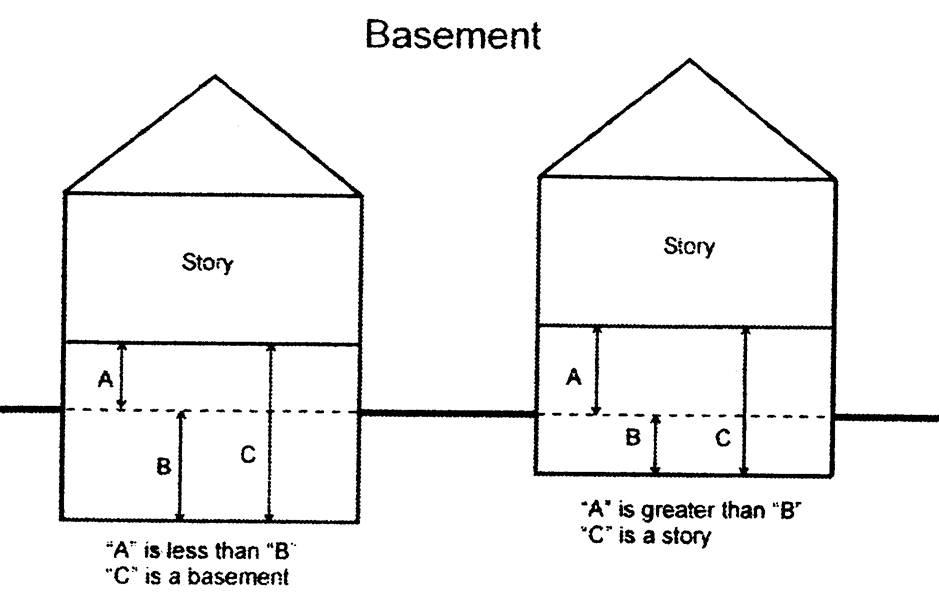
Basement: The portion of a building which is partly or wholly below grade but so located that the vertical distance from the average grade to the floor is greater than the vertical distance from the average grade to the ceiling. A basement shall not be counted as a story.
Bed and breakfast inn: Any dwelling in which overnight accommodations are provided or offered for transient guests for compensation. A bed and breakfast is distinguished from a motel in that a bed and breakfast establishment shall have only one set of kitchen facilities and be architecturally consistent with surrounding homes.
Berm: A mound of earth graded, shaped and improved with landscaping in such a fashion as to be used for visual and/or audible screening purposes.
Block: The property abutting one side of a street and lying between the two nearest intersecting streets, or between the nearest such street and railroad right-of-way, unsubdivided acreage, lake, river or live stream; or between any of the foregoing and any other barrier to the continuity of development.
Boarding, lodging or rooming houses: Dwellings with rooms rented or leased to persons outside of the immediate family. Such dwellings shall have only one set of kitchen facilities.
Boat dock: A structure built over or floating upon the water and used as a landing place for watercraft.
Boat slip: A space extending from a dock or shoreline designed for the mooring of a single watercraft.
Brewpub: A restaurant or drinking establishment which includes the brewing of beer as an accessory use only. Sale of such beer shall be on the premises only.
Buffer zone: A strip of land often required between certain zoning districts reserved for plant material, berms, walls, or fencing singularly or in combination to serve as a visual and noise barrier.
Building: Any structure, either temporary or permanent, having a roof and walls, and intended for the shelter or enclosure of persons, animals, chattels or property of any kind. A building shall include tents, mobile homes, manufactured housing, storage sheds, garages, greenhouses, pole barns, semi-trailers, vehicles situated on a parcel and used for the purposes of a building and similar structures. A building shall not include such structures as signs, fences, smokestacks, canopies, or overhangs but shall include structures such as storage tanks, produce silos, coal bunkers, oil cracking towers, or similar structures.
Building official/zoning administrator: An individual appointed by the city manager delegated to administer the city building code and city zoning ordinance.
Building department: The department charged with enforcing this chapter. The term "building department" shall also include "planner", "planning consultant", "engineer", "engineering consultant", "building administrator" "building official", "building inspector", "building and zoning administrator" or "zoning administrator".
Building envelope: The ground area of a lot which is defined by the minimum setback and spacing requirements within which construction of a principal building and any attached accessory structures (such as a garage) is permitted by this chapter. For condominium developments, the building envelope shall be illustrated on a site plan.
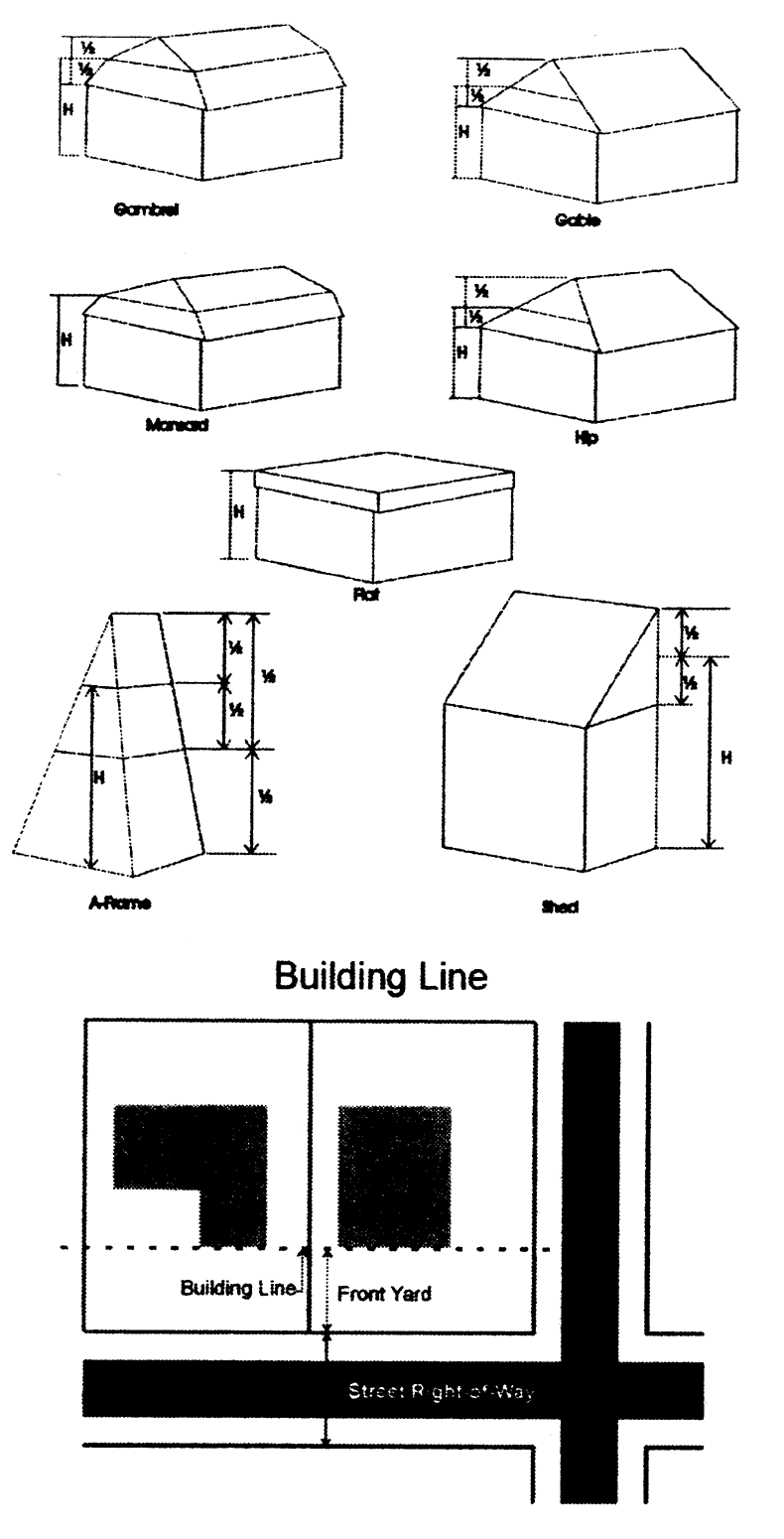
Building height: The vertical distance measured from the finished grade to the highest point of the roof surface for flat roofs; to the deck line of mansard roofs; and to the average height between eaves and ridge for gable, hip and gambrel roofs. Where a building is located on sloping terrain, the height shall be measured from the average grade.
Building line: A horizontal line generally parallel to a front, rear, or side lot line which is located at the point of the foundation of a principal building nearest to the front, rear, or side lot line.
Building permit: An authorization, issued by the building official/zoning administrator, to move, erect or alter a structure within the city.
Building, principal: A building in which is conducted the principal uses of the lot on which such building is located.
Business service establishment: A business which provides business type services to patrons including but not limited to copy centers, postal centers, data centers and computer repair establishments.
(Ord. No. 643, § 2, 1-14-08)
Editor's note— Ord. No. 643, § 2, adopted Jan. 14, 2008, amended § 36-28.02 in its entirety and created §§ 36-28.03—36-28.13. The former § 36-28.02 derived from Ord. No. 622, § 28.02, adopted Jan. 26, 2004 and Ord. No. 631, § 1.3, adopted Dec. 12, 2005.
Sec. 36-28.03. - Definitions C-D.
Caliper: The diameter of a trunk measured as follows:
a.
Existing trees are measured at four and one-half (4.5) feet above the average surrounding grade; and,
b.
Trees which are to be planted shall be measured 12 inches above the average surrounding grade if the tree caliper is more than four inches, or if the tree caliper is less than four inches, it shall be measured at six inches above the average surrounding grade.
Canopy tree: A deciduous tree whose mature height and branch structure provide foliage primarily on the upper half of the tree. The purposes of a canopy tree are to provide shade to adjacent ground areas and to enhance aesthetics.
Caretaker (living quarters): An independent residential dwelling unit or living area designed for and occupied by no more than two persons, where at least one is employed to provide services or to look after goods, buildings, or property on the parcel on which the living quarters are located.
Carport: A shelter for vehicles consisting of a roof extended from a wall of a building or a partially open structure consisting of a roof and possibly walls. Carports shall comply with all yard requirements applicable to private garages.
Cemetery: Land used or intended to be used for burial of the human dead and dedicated for such purposes. Cemeteries include accessory columbaria and mausoleums, but exclude crematories.
Certificate of zoning compliance: A document signed by the building official/zoning administrator as a condition precedent to the commencement of a use or the construction/reconstruction of a structure or building which acknowledges that such use, structure or building complies with the provisions of this chapter.
Child care organization: A facility for the care of children under 18 years of age, as licensed and regulated by the state under Act No. 116 of the Public Acts of 1973 and the associated rules promulgated by the state department of social services. Such care organizations are classified below:
a.
Child care center or day-care center. A facility other than a private home, receiving more than six preschool or school age children for group day-care for periods of less than 24 hours a day, and where the parents or guardians are not immediately available to the child. It includes a facility which provides care for not less than two consecutive weeks, regardless of the number of hours of care per day.
The facility is generally described as a child care center, day-care center, day nursery, preschool, nursery school, parent cooperative preschool, play group, or drop-in center. "child care center" or "day-care center" does not include a Sunday school conducted by a religious institution or a facility operated by a religious organization where children are cared for during short periods of time while persons responsible for such children are attending religious services.
b.
Child caring institution. A child care facility which is organized for the purpose of receiving minor children for care, maintenance, and supervision, usually on a 24 hour basis, in a building maintained for that propose, and operates throughout the year. It includes a maternity home for the care of unmarried mothers who are minors, an agency group home, and institutions for mentally retarded or emotionally disturbed minor children. It does not include hospitals, nursing homes, boarding schools, or an adult foster care facility in which a child has been placed.
c.
Foster family home. A private home in which at least one but not more than four minor children, who are not related to an adult member of the household by blood, marriage, or adoption, are given care and supervision for 24 hours a day, for four or more days a week, for two or more consecutive weeks, unattended by a parent or legal guardian.
d.
Foster family group home. A private home in which more than four but less than seven children, who are not related to an adult member of the household by blood, marriage, or adoption, are provided care for 24 hours a day, for four or more days a week, for two or more consecutive weeks, unattended by a parent or legal guardian.
e.
Family day-care home. A private home in which one but less than seven minor children are received for care and supervision for periods of less than 24 hours a day, unattended by a parent or legal guardian, except children related to an adult member of the family by blood, marriage, or adoption. It includes a home that gives care to an unrelated child for more than four weeks during a calendar year.
f.
Group day-care home. A private home in which more than six but not more than 12 children are given care and supervision for periods of less than 24 hours a day unattended by a parent or legal guardian except children related to an adult member of the family by blood, marriage, or adoption. It includes a home that gives care to an unrelated child for more than four weeks during a calendar year.
Church or temple: A building, the primary use of which is regular assembly of persons for religious worship or services, together with accessory uses.
City attorney: The duly licensed person or firm employed by the city council and representing the city in legal matters.
City council: The City of Fenton City Council.
City engineer: The duly licensed person or firm employed by the city council and representing the city in engineering matters such as drainage, grading, paving, storm water management and control, utilities, and other related site engineering and civil engineering issues.
City planner: The person or firm employed by the city council and representing the city in planning, zoning and development related matters.
Clerk: The Clerk of the City of Fenton.
Clinic, medical or dental: An establishment where human patients who are not lodged overnight are admitted for examination and treatment by a group of physicians, dentists, or similar professionals. A medical clinic may incorporate customary laboratories and pharmacies incidental to or necessary for its operation or to the service of its patients, but may not include facilities for overnight patient care or major surgery.
Club or fraternal organization: An organization of persons for special purposes or for the promulgation of sports, arts, science, agriculture, literature, politics, or similar activities, but not operated for profit or to espouse beliefs or further activity that is not in conformance with the constitution of the United States or any laws or ordinances. The facilities owned or used by such organization may be referred to as a "club" in this chapter.
Co-location: Location by two or more wireless communication providers of wireless communication facilities on a common structure, tower, or building, to reduce the overall number of structures required to support wireless communication antennas within the city.
Commercial use: An occupation, employment, or enterprise that is carried on for profit by the owner, lessee, or licensee for more than 7 days during a calendar year.
Commercial vehicle: Any vehicle bearing or required to bear commercial license plates and which falls into one or more of the categories listed below:
a.
Truck tractor.
b.
Semi-trailer, which shall include flat beds, stake beds, roll-off containers, tanker bodies, dump bodies and full or partial box-type enclosures.
c.
Vehicles of a type that are commonly used for the delivery of ice cream, milk, bread, fruit or similar vending supply or delivery trucks. This category shall include vehicles of a similar nature which are also of a type commonly used by electrical, plumbing, heating and cooling, and other construction oriented contractors.
d.
Tow trucks.
e.
Commercial hauling trucks.
f.
Vehicle repair service trucks.
g.
Snow plowing trucks.
h.
Any other vehicle with a commercial license plate having a gross vehicle weight in excess of 10,000 pounds or a total length in excess of 22 feet.
Common elements: The portions of the condominium project other than the condominium units are defined as follows:
a.
General common elements means and includes:
1.
The land in the condominium project.
2.
The foundations, main walls, roofs, halls, lobbies, stairways entrances, exits, or communication ways.
3.
The basements, flat roofs, yards and gardens, except as otherwise provided or stipulated;
4.
The premises for the use of janitors or persons in charge of the condominium project, including lodging, except as otherwise provided or stipulated.
5.
The compartments or installations of central services such as heating, power, light, gas, cold and hot water, refrigeration, air-conditioning, reservoirs, water tanks, and pumps and the like.
6.
The elevators, incinerators and, in general, all devices or installations existing for common use.
7.
All other elements of the condominium project owned in common and intended for common use or necessary to the existence, upkeep and safety of the project.
b.
Limited common elements means and includes those common elements which are reserved in the master deed for the exclusive uses of less than all of the co-owners.
Common land: A parcel or parcels of land with the improvements thereon, the use, maintenance and enjoyment of which are intended to be shared by the owners and/or occupants of individual building units in a subdivision or a planned unit development.
Common open space: An unoccupied area within a planned unit development which is reserved primarily for the leisure and recreational use of all the planned unit development residents, owners and occupants, and generally owned and maintained in common by them, often through a homeowners association.
Condominium: A system of separate ownership of individual units and/or multi-unit projects according to Public Act 59 of 1978, as amended. In addition to the interest acquired in a particular unit, each unit owner is also a tenant in common in the underlying fee and in the spaces and building parts used in common by all the unit owners.
Condominium Act: Michigan Act 59 of 1978, as amended.
Condominium, consolidating master deed: The final amended master deed for a contractible condominium project, an expandable condominium project, or a condominium project containing convertible land or convertible space, which final amended master deed fully describes the condominium project as completed. See also "Condominium, master deed."
Condominium, contractible: A condominium project from which any portion of the submitted land or building may be withdrawn pursuant to express provisions in the condominium documents and in accordance with the Fenton Code of Ordinances and the Condominium Act, Act 59 of the Public Acts of 1978, as amended.
Condominium, conversion: A condominium project containing condominium units, some or all of which were occupied before the establishment of the condominium project.
Condominium, convertible area: A unit or a portion of the condominium referred to in the condominium documents within which additional condominium units or general or limited common elements may be created pursuant to express provisions in the condominium documents and in accordance with the Fenton Code of Ordinances and the Condominium Act.
Condominium, expandable: A condominium project to which additional land may be added pursuant to express provision in the condominium documents and in accordance with the Fenton Code of Ordinances and the Condominium Act.
Condominium, general common element: The common elements other than the limited common elements. See also "Common elements."
Condominium, limited common element: A portion of the common elements reserved in the master deed for the exclusive use of less than all of the co-owners. See also "Common elements."
Condominium, master deed: The condominium document recording the condominium project as approved by the zoning administrator to which is attached as exhibits and incorporated by reference the approved bylaws for the project and the approved condominium subdivision plan for the project. See also "Condominium, consolidating master deed."
Condominium, project: The equivalent to "subdivision," as used in this chapter and the subdivision regulations.
Condominium project, mobile home: A condominium project in which mobile or manufactured homes are intended to be located upon separate sites which constitute individual condominium units.
Condominium setbacks: Setbacks shall be measured as follows:
a.
Front yard setback. The distance between the public street right-of-way or private road easement line and the foundation of the unit site. Where there is no public right-of-way or access easement, the front yard setback required in the district shall be measured from 15 feet from the nearest pavement edge to the foundation of the unit.
b.
Side yard setback. The distance between the side of a condominium building unit and the side unit (lot) line. Where no unit (lot) lines are provided, the distance between the closest points of two units shall be double the side yard setback required in the zoning district.
c.
Rear yard setback. The perimeter shall be the distance between the limit of the development and the rear of the unit; within the development, rear yard setbacks shall be measured as the distance between the rear building line and the rear site (lot) line, or where lot lines are not defined, the space between the rear building lines of two buildings shall be double the rear yard setback required in the zoning district.
Condominium, site condominium project: A condominium project designed to function in a similar manner, or as an alternative to, a platted subdivision. A residential site condominium project shall be considered equivalent to a platted subdivision for purposes of regulation of this chapter.
Condominium subdivision plan: The site, survey and utility plans, and sections as appropriate showing the existing and proposed structures and improvements including the location thereof on the land. The condominium subdivision plan shall show the size, location, area, vertical boundaries, and volume for each unit comprised of enclosed air space. A number shall be assigned to each condominium unit. The condominium subdivision plan shall include the nature, location, and approximate size of common elements and any other information required by section 66 of Michigan Public Act 59 of 1978, as amended.
Condominium unit: That portion of the condominium project designed and intended for separate ownership as described in the master deed, regardless of whether it is intended for residential, office, industrial, business, recreational, use as a time-share unit, or any other type of use.
Condominium unit site: The area designating the perimeter within which the condominium unit must be built. After construction of the condominium unit, the balance of the condominium unit site shall become a limited common element. The term "condominium unit site" shall be equivalent to the term "lot," for purposes of determining compliance of a site condominium subdivision with provisions of this chapter pertaining to minimum lot size, minimum lot width, maximum lot coverage and maximum floor area ratio.
Contractor yard: A site on which a building or construction contractor stores equipment, tools, vehicles, building materials, and other appurtenances used in or associate with building or construction. A contractor's yard may include outdoor storage, or a combination of both.
Convalescent home or nursing home: A nursing care facility, including a county medical care facility, but excluding a hospital or a facility created by Act No. 152 of the Public Acts of 1985, as amended, being sections 36.1 to 36.12 of the Michigan Compiled Laws, which provides organized nursing care and medical treatment to seven or more unrelated individuals suffering or recovering from illness, injury, or infirmity. See also "Housing for the elderly".
Convenience store or mini-mart: A one-story retail store that is designed and primarily stocked to sell food, beverages, and other household supplies to customers who purchase only a relatively few items (in contrast to a "supermarket"). Convenience stores are designed to attract greater volumes of stop-and-go traffic.
Convenience store with gasoline sales: An establishment that retails convenience food items which occupy 50 square feet or greater of the sales area in conjunction with gasoline sales.
County drain commission: The Genesee County Drain Commission.
County health department:; The Genesee County Health Department.
County road commission: The Genesee County Road Commission.
Court: An open space bounded on two or more sides by a building or buildings.
Cul-de-sac: A dead-end public or private street, generally short in distance, which terminates in a circular or semicircular section of street which allows for vehicle turnaround.
Curb cut: The entrance to or exit from a property provided for vehicular traffic to or from a public or private thoroughfare.
Dangerous or hazardous materials: Any substances or materials that, by reason of their toxic, caustic, corrosive, abrasive, explosive or otherwise injurious properties, may be detrimental or deleterious to the environment or the health of any person handling or otherwise coming into contact with such material or substance.
Day-care center: See "Child care organization."
Deceleration lane: An added roadway lane that permits vehicles to slow down and leave the main vehicle stream before turning.
Deck: A platform, commonly constructed of wood, which is typically attached to a house and which used for outdoor leisure activities.
Dedication: The intentional appropriation of land by the owner to public use.
Density: The number of dwelling units situated on or to be developed per net or gross acre of land. For purposes of calculating maximum density, only 25 percent of the acreage determined to be wetlands protected by the Goemaere-Anderson Wetland Protection Act, PA 203 of 1979, shall be calculated toward the total site acreage. All open bodies of water, land within the 100-year floodplain elevation, public rights-of-way and areas within overhead utility line easements are excluded from this calculation. Actual density shall also be determined by compliance with all setbacks, parking, open space and other site design requirements.
Detention basin or facility: A manmade or natural water collector facility designed to collect surface water in order to impede its flow and to release the water gradually at a rate not greater than that prior to the development of the property, onto natural or manmade outlets.
Development: Any manmade change to improved or unimproved real estate, including, but not limited to, buildings or other structures, mining, dredging, filling, grading, paving, excavation, or drilling operations. A development may include a site plan, a plot (building) plan, a condominium plan, a plat or a manufactured housing community.
Diameter at breast height (dbh): The diameter measured at a height of four and one-half feet above the natural grade.
District, zoning: An area of land for which there are uniform regulations governing the use of buildings and premises, density of development, yard requirements and height regulations, and other appropriate regulations.
Dockominium: A condominium project established according to Public Act 59 of 1978, as amended, for the purpose of dividing ownership of boat wells and related structures, where individual boat wells are considered condominium units intended for separate ownership and use, and various common elements are included such as piers, wharfs, and shore facilities.
Drainageways and streams: Existing permanent or intermittent watercourses.
Drive-in: A business establishment so developed that its retail or service character is dependent on providing a driveway approach or parking spaces for motor vehicles so as to serve patrons while in the motor vehicle rather than within a building or structure, including customer communication facilities for banks or other uses. A drive-in restaurant is distinct from a drive-through restaurant in that the majority of drive-in patrons consume food and beverages while in the vehicle and parked on the premises.
Drive-through window facilities: A business establishment in which all or at least ten percent of the business consists of providing goods and services from a drive-through window to patrons in motor vehicles.
Dumpster or waste receptacle: Any accessory exterior container used for the temporary storage of rubbish, pending collection, having the capacity of at least one cubic yard. Recycling stations and exterior compactors shall be considered to be dumpsters or waste receptacles.
Dwelling unit: A building, or enclosed portion thereof, designed for occupancy by one family for residential purposes and having independent living, eating, sleeping, cooking, and sanitary facilities. A dwelling unit shall include both manufactured units (mobile homes and modular homes) and site built units.
Dwelling unit, attached: A dwelling unit attached to one or more dwelling units by common major structural elements.
Dwelling unit, detached: A dwelling unit which is not attached to any other dwelling unit by any means.
Dwelling unit, efficiency apartment: A dwelling unit of not more than one room in addition to a kitchen and a bathroom.
Dwelling unit, manufactured: A dwelling unit which is substantially built, constructed, assembled, and finished off the premises upon which it is intended to be located.
Dwelling unit, multiple-family: A building designed exclusively for, and containing three (3) or more dwelling units.
Dwelling unit, single-family: A detached building designed exclusively for, and containing one dwelling unit only.
Dwelling unit, site built: A dwelling unit which is substantially built, constructed, assembled, and finished on the premises which are intended to serve as its final location. Site built dwelling units include dwelling units constructed of precut materials and panelized wall, roof and floor sections when such sections require substantial assembly and finishing on the premises which are intended to serve as its final location.
Dwelling unit, two-family or duplex: A detached building designed exclusively for and containing two dwelling units only.
(Ord. No. 643, § 2, 1-14-08)
Sec. 36-28.04. - Definitions E-F.
Easement: A right-of-way granted, but not dedicated, for limited use of private land for private, public or quasi-public purpose, such as for franchised utilities, a conservation easement or an access easement for a private road or service drive, and within which no permanent structures may be erected.
Enclosed, locked facility: A closet, room, locker or other area fully enclosed on all sides equipped with locks or other security devices that permit access only to the medical marihuana patient or medical marihuana caregiver responsible for the medical marihuana contained therein as required by the Medical Marihuana Act, Initiated Law 1 of 2008, MCL 333.26421 et seq. Such must be built and maintained in a manner consistent with applicable building and property maintenance codes.
Endangered species habitat: An area where a plant or animal listed as an endangered species by state or federal agencies naturally grows or lives, or identified habitat sites designated on the Michigan Natural Features Inventory.
Entertainment facilities: An establishment which provides for activities such as but not limited to: bowling alleys, billiard and pool halls, game and video arcades, and tag games. This definition does not include those uses defined in section 36-14.08a., Special land use specific requirements.
Environmental contamination: The presence or release of a hazardous substance or other substance in a quantity that is or may become injurious to the environment or to the public health, safety, or welfare.
Erected: Built, constructed, altered, reconstructed, moved upon, or any physical operations on the premises which are required for the construction. Excavation, fill, drainage and the like shall be considered a part of erection.
Essential public services: The erection, construction, alteration or maintenance by the public utilities or municipal department of underground, surface or overhead gas, electrical, cable television, steam, fuel or water transmission or distribution systems, collection, communication, supply or disposal systems, including poles, wires, mains, drains, sewers, pipes, conduits, transformers, splice boxes, cables, fire alarm and police call boxes, traffic signals, hydrants and similar accessories in connection therewith, but not including buildings or storage yards, which are necessary for the furnishing of adequate service by such utilities or municipal departments for the general health safety or welfare. Essential services shall not include cellular telephone towers, commercial reception towers, air quality monitoring stations, school bus parking yards, sales or business offices, or commercial buildings or activities. Radio and television towers and cellular phone antennas are defined under "wireless communication facilities."
Essential public service building: A building or structure principal to an essential public service, such as a drop-off stations for residential recyclables, vehicle garages, telephone exchange buildings, electricity transformer stations or substations, gas regulator stations.
Essential public service building storage yard: An outdoor storage area used as a principal or accessory use for an essential public service.
Excavation: Any breaking of ground, except common household gardening and ground care.
Facade: The exterior wall of a building exposed to public view.
Family: Family means either of the following:
a.
A domestic family which is one or more persons living together and related by the bonds of blood, marriage or adoption, together with caretaker of the principal occupants and not more than one additional unrelated person, with all of such individuals being domiciled together as a single, domestic housekeeping unit in a dwelling, or
b.
The functional equivalent of the domestic family which is persons living together in a dwelling unit whose relationship is of a permanent and distinct character with a demonstrable and recognizable bond which render the persons a cohesive unit. All persons must be cooking and otherwise operating as a single housekeeping unit.
c.
This definition shall not include any society, club, fraternity, sorority, association, lodge, coterie, organization or group where the common living arrangement and/or the basis for the establishment of the functional equivalency of the domestic family is likely or contemplated to exist for a limited or temporary duration.
d.
There shall be a rebuttable presumption enforceable by the building official/zoning administrator in the first instance that the number of persons who may reside as a functional equivalent family shall be limited to six. Such presumption may be rebutted by application for a special land use based upon the applicable standards in this chapter.
Family day-care home: See "Child care organization."
Family foster care home See "Adult foster care facility or "Child care organization."
Farm: All of the contiguous neighboring or associated land operated as a single unit on which bona fide farming with acceptable farming practices is carried on directly by the owner-operator, manager or tenant farmer, by his own labor or with the assistance of members of his household or hired employees; provided, however, that land to be considered a farm hereunder shall include a continuous parcel of five acres or more in area; provided further, farms may be considered as including establishments operated as bona fide greenhouses, nurseries, orchards, chicken hatcheries, poultry farms and apiaries; but establishments keeping or operating fur-bearing animals, public or private stables, commercial kennels, stone quarries or gravel or sand pits, shall not be considered farms hereunder unless combined with bona fide farm operations on the same continuous tract of land of not less than 20 acres. No farms shall be operated as piggeries, or for the disposal of garbage, public sewage, or rubbish, or as rendering plants, or for the slaughtering of animals except animals raised on the premises or maintained on the premises for at least one year for the consumption by persons residing on the premises. Under no circumstances shall wild, vicious or exotic animals be considered farm animals or products.
Farm building: Any structure or building other than a dwelling used or built on a farm.
Fence: An accessory structure constructed of wood, masonry, stone, wire, metal or any other material or combination of materials approved by the building department, intended for use as a barrier to property ingress or egress, a screen from objectionable vista, noise, and/or for decorative use.
Filling: The depositing or dumping of any matter onto, or into, the ground, except common household gardening and ground care.
Filling station: Bulk storage tanks of flammable and combustible liquids, compressed gases or liquefied petroleum gas (LP gas) for business use, retail use, wholesale, or wholesale distribution.
Financial services: Establishments such as banks, savings and loan institutions, credit unions, brokerage houses, and similar establishments.
Fitness center or health club: A facility which provides indoor exercise facilities, such as exercise machines and weight-lifting equipment, usually in a structured physical activity program supervised by professional physical fitness instructors or specialists in sports medicine. As defined herein, "personal fitness center" shall not include spectator seating for sports events. A personal fitness center may or may not be enclosed within a gym.
Flood or flooding: A general and temporary condition of partial or complete inundation of normally dry land areas from the overflow of inland waters or the unusual and rapid accumulation or runoff of surface waters from any source.
Flood hazard area: Land which on the basis of available floodplain information is subject to a one percent or greater chance of flooding in any given year.
Flood insurance rate map (FIRM): An official map of a community, on which the Federal Insurance Administration has delineated both the areas of special flood hazards and the risk premium zones applicable to the community.
Flood insurance study: The official report provided by the Federal Insurance Administration. The report contains flood profiles, the water surface elevation of the base flood, and may include a flood hazard boundary-floodway map.
Floodplain: Land at a specified elevation subject to periodic flooding that have been defined by the Federal Emergency Management Agency (FEMA) as flood hazard areas (i.e., lands within the 100-year flood boundary) in the flood insurance study for the City of Fenton.
Floodway: The channel of a river or other watercourse and the adjacent land areas which must be reserved in order to discharge the base flood.
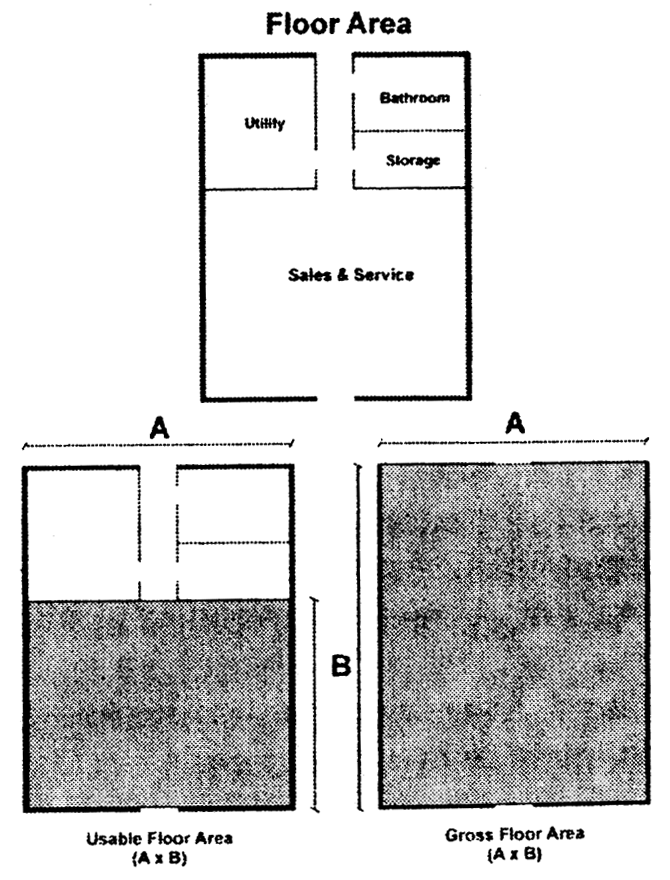
Floor area, gross or total: The sum of all gross horizontal areas of all floors of a building or buildings, measured from the outside dimensions of the outside face of the outside wall. Unenclosed porches, courtyards, or patios shall not be considered as part of the gross area except where they are utilized for commercial purposes such as the outdoor sale of merchandise.
Floor area, residential: For the purpose of computing the minimum allowable floor area in a residential dwelling unit, the sum of the horizontal areas of each story of the building shall be measured from the exterior faces of the exterior walls or from the centerline of walls separating two (dwellings. The floor area measurement excludes areas of basements, unfinished attics, attached garages, breezeways, and enclosed and unenclosed porches.
Floor area, useable: For the purposes of computing parking requirements, the useable floor area shall be considered as that area to be used for the sale of merchandise or services, or for use to serve patrons, clients, or customers. Such floor area which is used or intended to be used principally for the storage or processing of merchandise, hallways, stairways, and elevator shafts, or for utilities for sanitary facilities, shall be excluded from this computation of useable floor area. Useable floor area shall be measured from the interior faces of the exterior walls, and total useable floor area for a building shall include the sum of the useable floor area for all floors.
Foster family home and foster family group home: See "Child care organization" or "adult foster care facility".
Frontage: The linear dimension measured along the public street right-of-way line or along the private road access easement.
Frontage road: A public or private drive which generally parallels a public street between the right-of-way and the front building setback line. Frontage roads can be one-way or bidirectional in design. The frontage road provides specific access points to private properties while maintaining separation between the arterial street and adjacent land uses. A road which allows parking or is used as a maneuvering aisle within a parking area is generally not considered a frontage road.
Funeral home or mortuary establishment: An establishment where the dead are prepared for burial or cremation and where wakes or funerals may be held. A funeral home or mortuary establishment shall not include crematoria.
(Ord. No. 643, § 2, 1-14-08; Ord. No. 687, § 3, 1-26-15)
Sec. 36-28.05. - Definitions G-H.
Garage, private or public: An accessory building or portion of a principal building designed or use solely for the storage of motor vehicles, boats, and similar vehicles owned and used by the occupants of the building to which it is accessory.
Garden center: An establishment with retail sales of trees, fruits, vegetables, shrubbery, plants, seeds, topsoil, humus, fertilizer, trellises, lawn furniture, playground equipment and other home garden supplies and equipment.
Glare: The effect produced at the lot line by brightness sufficient to cause annoyance, discomfort, or loss in visual performance and visibility.
Golf course: A public or private open area of fairways, greens and rough and may include a clubhouse and related accessory uses provided that all structures and activities shall be an integral part of the intended main recreational land use. Further, all clubhouses, restaurants, pro-shop facilities, etc., shall be secondary in nature to the golf course and may not be continued if the principal golf course activity shall cease or become the minor activity of the facility.
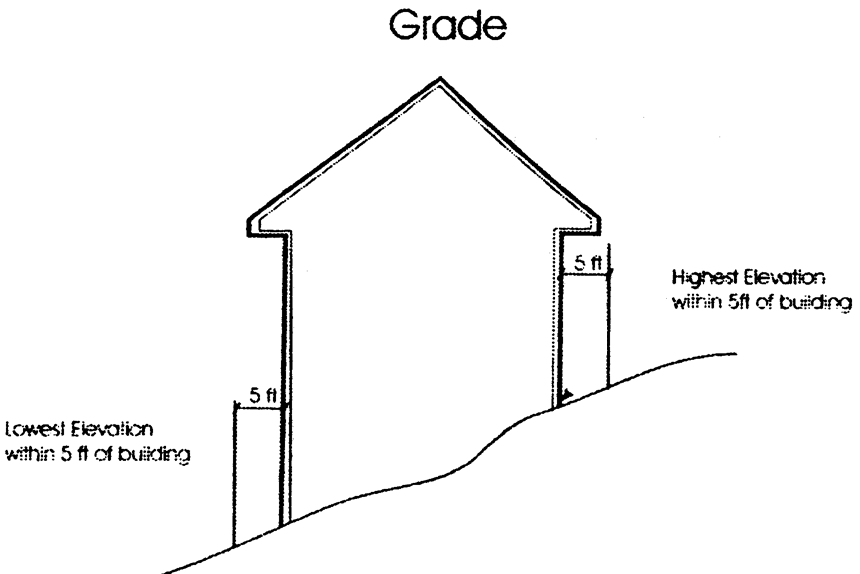
Grade, average: The arithmetic average of the lowest and highest grade elevations in an area within five feet of the foundation line of a building or structure.
Grade, finished: The lowest point of elevation between the exterior wall of the structure and a line five feet from the exterior wall of the structure.
Grade, natural: The elevation of the ground surface in its natural state, before construction begins.
Greenbelt: A landscaped area between the property line and the front yard building or parking setback line, this area also includes a front yard parking lot setback area.
Group day-care home: See "Child care organization" or "Adult foster care Facility."
Group foster care home: See "Child care organization" or "Adult foster care facility."
Hard surface: For a single-family home, hard-surface consists of MDOT 22A or 23A gravel, brick, asphalt or concrete meeting the construction specifications of the City of Fenton.
Harmful increase: An unnaturally high stage on a river, stream, or lake which causes, or may cause damage to property, threat to life, personal injury, or damage to land or water resources.
Hazardous substance: A chemical or other material that is or may become injurious to the public health, safety, or welfare, or to the environment. The term "hazardous substance" includes, but is not limited to, any of the following:
a.
Hazardous substances as defined in the Comprehensive Environmental Response, Compensation, and Liability Act of 1980, Public Law 96.510, 94 State. 2767.
b.
Hazardous waste as defined in part 111 of the State of Michigan Natural Resources and Environmental Protection Act, 1994 Public Act 451, as amended.
c.
Regulated substance as defined in part 213 of the State of Michigan Natural Resources and Environmental Protection Act, 1994 Public Act 451, as amended.
d.
Hazardous substance as defined in part 201 of the State of Michigan Natural Resources and Environmental Protection Act, 1994 Public Act 451, as amended.
e.
Used oil.
f.
Animal waste or byproducts, or carcasses.
Hazardous uses and materials: Any uses which involve the storage, sale, manufacture, or processing of materials which are dangerous, combustible and/or produce either poisonous fumes or explosions in the event of fire. These uses include all high hazard uses listed in section 306 of the Basic Building Code/1990 edition, as amended or updated, prepared by the Building Officials & Code Administrators International, Inc.
Hazardous or toxic waste: Waste or a combination of waste and other discarded material (including, but not limited to, solid, liquid, semisolid, or contained gaseous material) which because of its quantity, concentration, or physical, chemical, or infectious characteristics may cause or significantly contribute to the following if improperly treated, stored, transported, disposed of, or otherwise managed: an increase in mortality, or an increase in serious irreversible illness, or serious incapacitating but reversible illness, or substantial present or potential hazard to human health or the environment.
Health care facility: A facility or institution, public or private, principally engaged in providing services for health maintenance, diagnosis and treatment of human disease, pain, injury, deformity, or physical condition including, but not limited to, public health center, diagnostic center, treatment center, rehabilitation center, extended care facility, tuberculosis hospital, out-patient clinic, dispensary, home health care agency, and bioanalytical laboratory or central services facility serving one or more such institutions, but excluding religious or other institutions that do not provide medical services.
Historical feature, significant: Any site or structure which is located in a designated local historic district or listed in the state or national register of historic places.
Home occupation: An occupation for gain or support conducted within a residence solely by members of a family residing on the premises and conducted entirely within the dwelling; provided that no article is sold or offered for sale except such as may be produced by members of the immediate family residing on the premises.
Hotel: A series of attached, semidetached, or detached rental units which provide lodging on a temporary basis, and are offered to the public for compensation. The term "hotel" shall include tourists cabins and homes, motor courts, and motels. A hotel shall not be considered or construed to be a multiple-family dwelling.
(Ord. No. 643, § 2, 1-14-08)
Sec. 36-28.06. - Definitions I-J.
Incinerator facilities: A facility that uses thermal combustion processes to destroy or alter the character or composition of medical waste, sludge, soil or municipal solid waste, not including animal or human remains.
Impact assessment: An assessment of the ecological, social, economic, and physical impacts of a project on and surrounding the development site.
Impervious surface: A manmade material which covers the surface of land and substantially reduces the infiltration of storm water to a rate of five percent or less. Impervious surface shall include pavement, buildings, and structures.
Industrial, heavy: The basic processing and manufacturing of materials or products predominately from extracted or raw materials, or a use engaged in storage of, or manufacturing processes using flammable or explosive materials, or storage or manufacturing processes that potentially involve hazardous or commonly recognized offensive conditions.
Industrial, light: The manufacture, predominately from previously prepared materials, of finished products or parts, including processing, fabrication, assembly, treatment, packaging, incidental storage, sales, and distribution of such products, but excluding basic industrial processing.
Industrial park: A planned, coordinated development of a tract of land with two or more separate industrial buildings. Such development is planned, designed, constructed, and managed on an integrated and coordinated basis with special attention given to on-site vehicular circulation, parking, utility needs, building design and orientation, and open space.
Junk: Any motor vehicles, machinery, appliances, products or merchandise with parts missing, or other scrap materials that are damaged, deteriorated, or are in a condition which prevents their use for the purpose for which the product was manufactured.
Junkyard: See "Salvage yard."
(Ord. No. 643, § 2, 1-14-08)
Sec. 36-28.07. - Definitions K-L.
Kennel, commercial: Any lot or premises on which more than three dogs (but not including wild, vicious or exotic animals), four months of age or older, are kept, either permanently or temporarily, for the purposes of breeding, boarding, training, sale, protection, hobby, pets or transfer.
Laboratory: An establishment devoted to research and experimental studies, including testing and analyzing, but not including manufacturing of any nature.
Landfill: A tract of land that is used to collect and dispose of "solid waste" as defined and regulated in Michigan Public Act 641 of 1979, as amended.
Livestock: Horses, cattle, sheep, goats, and other domestic animals normally kept or raised on a farm. Wild, vicious or exotic animals shall not be considered livestock.
Loading space: An off-street space on the same lot with a building, or group of buildings, for the temporary parking of a commercial vehicle while loading and unloading merchandise or materials.
Lodging house: See "Boarding house."
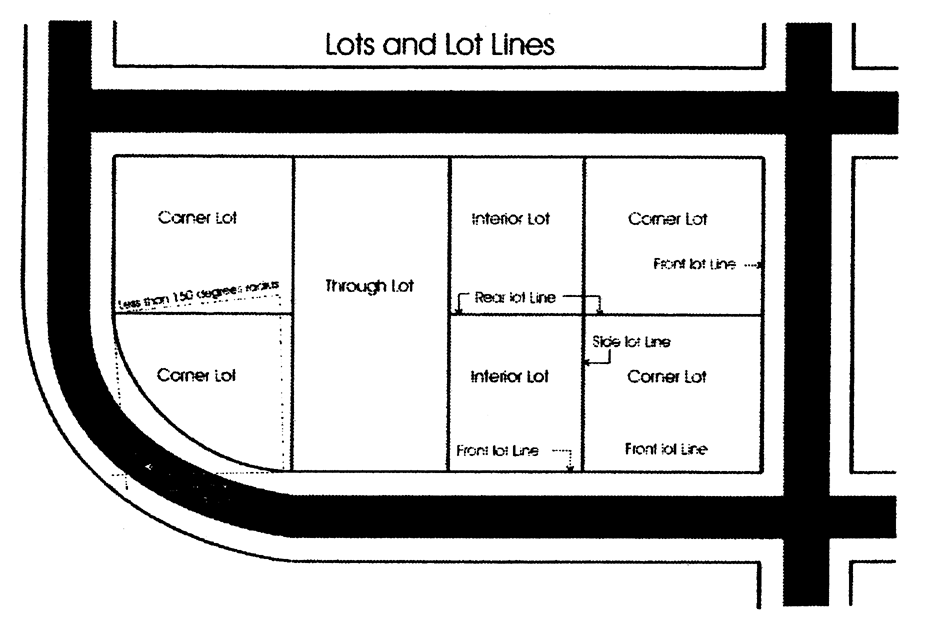
Lot: A parcel of land occupied, or intended to be occupied, by a main building or a group of such buildings and accessory buildings, or utilized for the principal use and uses accessory thereto, together with such yards and open spaces as are required under the provisions of this chapter. A lot may or may not be specifically designated as such on public records. For purposes of meeting the dimensional standards of this chapter, a lot does not include public rights-of-way or private road easements, but does include access easements for a service drive. A lot may be a single lot of record, a portion of a lot of record, a combination of contiguous lots of record, contiguous portions of lots of record, a parcel of land described by metes and bounds or a condominium lot. Note: A separate definition is provided for site condominiums.
Lot area, gross: The area contained within the lot lines or property boundary including street right-of-way if so included.
Lot area, net: The total area of a horizontal plane within the lot lines of a lot, exclusive of any public street rights-of-way or private road easements, or the area of any lake. The lot area shall be used in determining compliance with minimum lot area standards. See definition for "Density."
Lot area, net buildable: The net lot area less areas devoted to floodplains or surface water bodies; water bodies being defined as areas greater than five acres in size (either before or after project implementation) which are periodically or permanently covered with water.
Lot, corner: Any lot having at least two contiguous sides abutting upon one or more streets, provided that the interior angle at the intersection of such two sides is less than 135 degrees. A lot abutting a curved street(s) shall be a corner lot if the arc has a radius less than 150 feet.
Lot, coverage: The part or percent of a lot occupied by buildings and accessory buildings.
Lot, depth: The horizontal distance between the front and rear lot lines, measured along the midpoint between side lot lines.
Lot, flag: A lot which is located behind other parcels or lots fronting on a public road, but which has a narrow extension to provide access to the public road.
Lot frontage: The length of the front lot line.
Lot, interior: A lot other than a corner lot which, with the exception of a "through lot," has only one lot line fronting on a street.
Lot line: A line bounding a lot, parcel, or general common element if there is no limited common element, which separates the lot, parcel, or general common element if there is no limited common element, from another lot, parcel, general common element if there is no limited common element, existing street right-of-way, approved private road easement, or ordinary high water mark.
Lot line, front: The lot line which separates the lot from the existing street right-of-way or approved private road easement that provides access to the lot.
Lot line, rear: The lot line opposite and most distant from the front lot line. In the case of a triangular or otherwise irregularly shaped lot or parcel, it means an imaginary line ten feet in length entirely within the lot or parcel, parallel to and at a maximum distance from the front lot line.
Lot line, side: Any lot line other than a front or rear lot line.
Lot, nonconforming: A lot of record which does not meet the dimensional requirements of this chapter.
Lot of record: A tract of land which is part of a subdivision shown on a plat or map which has been recorded in the Office of the Register of Deeds for Genesee County, Michigan; or a tract of land described by metes and bounds which is the subject of a deed or land contract which is likewise recorded in the office of the register of deeds. When two lots in a recorded plat have been combined into a single building site, said lots shall be deemed a single lot of record for the purposes of this chapter.
Lot, through (also called a double frontage lot): An interior lot having frontage on two more or less parallel streets. In the case of a row of double frontage lots, all yards of said lots adjacent to streets shall be considered frontage, and front yard setbacks shall be provided as required.
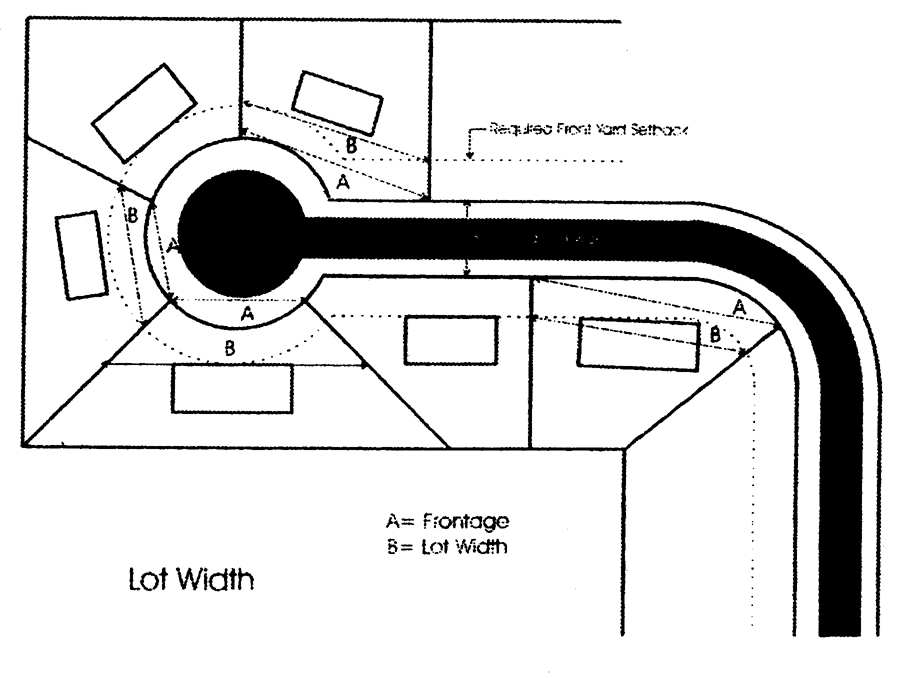
Lot width: The horizontal distance between side lot lines measured parallel to the front lot line at the minimum required front setback line.
Lot, zoning: A single tract of land, located within a single block, which, at the time of filing for a building permit, is designated by its owner or developer as a tract to be used, developed, or built upon as a unit, under single ownership or control. A zoning lot shall satisfy this chapter with respect to area, size, dimensions, and frontage as required in the district in which the zoning lot is located. A zoning lot, therefore, may not coincide with a lot of record as filed with the county register of deeds, but may include one or more lots of record, or portions thereof.
(Ord. No. 643, § 2, 1-14-08)
Sec. 36-28.08. - Definitions M-N.
Manufactured housing: A dwelling unit which is designed for long-term residential use and is wholly or substantially constructed at an off-site location. Manufactured housing includes mobile homes and modular housing units.
Manufactured housing or mobile home park: A parcel or tract of land under the control of a person, group or firm upon which three or more mobile homes are located on a continual non-recreational basis and which is offered to the public for that purpose regardless of whether a charge is made, together with any building, structure, enclosure, street, equipment or facility used or intended for use incident to the occupancy of a mobile home and which is not intended for use as a temporary trailer park.
Marihuana: That term as defined in Section 7106 of the Public Health Code, 1978 PA 368, MCL 333.7106.
Marina: A public or private facility that is owned or operated by a person, extends into or over an inland lake or stream, and offers service to the public or members of the marina for docking, loading, or other servicing of recreational watercraft.
Master deed and consolidating master deed: See "Condominium, master deed."
Master plan: The City of Fenton Master Plan including graphic and written proposals indicating the general location for streets, parks, schools, public buildings and all physical development of the municipality, and includes any unit or part of such plan, and any amendment to such plan or parts thereof, as adopted by the City of Fenton Planning Commission.
Medical marihuana:
a.
Marihuana that is acquired, possessed (externally or internally), cultivated, manufactured, used, delivered, transferred, or transported to treat or alleviate a medical marihuana patient's debilitating medical condition or symptoms associated with the debilitating medical condition; or
b.
Paraphernalia related to the administration of marihuana to treat or alleviate a medical marihuana patient's debilitating medical condition or symptoms associated with the debilitating medical condition.
Medical marihuana caregiver: A person who is
a.
At least 21 years old;
b.
Who has agreed to assist with a medical marihuana patient's medical use of marihuana;
c.
Who has never been convicted of a felony involving illegal drugs; and
d.
Otherwise meets all requirements for primary caregivers under the Medical Marihuana Act, Initiated Law 1 of 2008, MCL 333.26421 et seq., and the rules promulgated therefore by the Department of Community Health, R 333.101 et seq., including, but not limited to possession of a valid, unexpired registry identification card.
Medical marihuana growing facility or facility: A location from where one medical marihuana caregiver may distribute, cultivate, grow or otherwise make available medical marihuana to medical marihuana patients.
Medical marihuana patient: A person who has satisfied all requirements as set forth in the Michigan Medical Marihuana Act, Initiated Law 1 of 2008, MCL 333.26421 et seq.
Mezzanine: An intermediate floor in any story occupying not to exceed one-third of the floor area of such story.
Microbrewery or microbrewer: A brewery that produces beer and ale for on-site consumption and retail and wholesale distribution. A microbrewery may be permitted as an accessory use to a restaurant or a bar, tavern or lounge. See "Restaurant" and "Bar, tavern, lounge."
Mini- or self-storage warehouse or facility: A building or group of buildings in a controlled-access and fenced compound that contains varying sizes of individual, compartmentalized, and controlled-access stalls or lockers for the storage of customer's goods or wares.
Mobile home: A structure, transportable in one or more sections, which is built on a chassis and designed to be used with or without a permanent foundation as a dwelling when connected to the required utilities, and includes the plumbing, heating, air-conditioning, and electrical systems contained in the structure. A mobile home shall not include modular homes, motor homes, or travel trailers.
Modular home: A dwelling which consists of prefabricated units transported to the site on a removable undercarriage or flat-bed and assembled for permanent location on the lot.
Motel: A series of attached, semi-detached, or detached rental units containing a bedroom, bathroom and closet space which provide for overnight lodging and are offered to the public for compensation and cater primarily to the public traveling by motor vehicle. A motel may include a restaurant or cocktail lounge, public banquet halls, ballrooms or meeting rooms.
Natural features: Features including soils, wetlands, floodplain, water bodies, topography, vegetative cover, and geological formations.
Nonconforming building or structure: A building or portion thereof, existing at the effective date of this chapter, as amended, and that does not conform to the provisions of this chapter in the district in which it is located.
Nonconforming lot: A lot lawfully existing at the effective date of this chapter, or amendments thereto, that does not conform to the dimensional standards for the district in which it is located.
Nonconforming use: A use which lawfully occupied a building or land at the effective date of this chapter, as amended, and that does not conform to the use regulations of the district in which it is located.
Nuisance factors: An offensive, annoying, unpleasant, or obnoxious thing or practice, a cause or source of annoyance, especially a continuing or repeating invasion of any physical characteristics of activity or use across a property line which can be perceived by or affects a human being, or the generation of an excessive or concentrated movement of people or things, such as, but not limited to: noise, dust, smoke, odor, glare, fumes, flashes, vibration, shock waves, heat, electronic or atomic radiation, objectionable effluent, noise of congregation of people and traffic.
Nursery: A space, building or structure, or combination thereof, for the storage of live trees, shrubs or plants offered for wholesale or retail sale on the premises including products used for gardening or landscaping. The definition of nursery within the meaning of this chapter does not include any space, building or structure used for the sale of fruits, vegetables or Christmas trees.
(Ord. No. 643, § 2, 1-14-08; Ord. No. 687, § 3, 1-26-15)
Sec. 36-28.09. - Definitions O-P.
Obscuring screen: A visual barrier between adjacent areas or uses. The screen may consist of structures, such as a wall or fence, or living plant material.
Occupancy, change of: A discontinuance of an existing use and the substitution of a use of a similar or different kind or class, or the expansion of a use.
Occupied: Used in any manner at the time in question.
Office: A building or portion of a building wherein services are performed involving predominantly administrative, professional, or clerical operations.
Offset: The distance between the centerlines of driveways or streets across the street from one another.
Off-street parking lot: A facility providing vehicular parking spaces along with adequate drives and aisles, for maneuvering, so as to provide access for entrance and exit for the parking of more than two vehicles.
Open front store or restaurant window: A business establishment so developed that service to the patron may be extended beyond the walls of the structure, not requiring the patron to enter the structure, such as ice cream and yogurt restaurants serving to patrons through a walk-up window. The term "open front store" shall not include automobile repair establishments or automobile service stations. See also "Restaurant."
Open space: An area that is intended to provide light and air, and is designed for either environmental, scenic, or recreational purposes. Open space may include, lawns, decorative planting, walkways, gazebos, active and passive recreation areas, playgrounds, fountains, swimming pools, woodlands, wetlands and water courses. Open space shall not be deemed to include driveways, parking lots or other surfaces designed or intended for vehicular travel, but may include a recreational clubhouse or recreation center.
Ordinary high water mark: The line between upland and bottomland which persists through successive changes in water levels below which the presence and action of the water is so common or recurrent that the character of the land is marked distinctly from the upland and is apparent in the soil itself, the configuration of the surface soil, and the vegetation.
Outdoor display, sales, or storage: Outdoor display, sales, or storage that is accessory to a permitted commercial use or a business operated substantially outside of any building, including: retail sales of garden supplies and equipment (including but not limited to, trees, shrubbery, plants, flowers, seed, topsoil, trellises, and lawn furniture); sale of building and lumber supplies; automobiles, recreational vehicles, boats, mobile homes, garages, swimming pools, playground equipment, mowing equipment, farm implements, construction equipment and similar materials or equipment; rental and leasing establishments; and year-round flea markets farmer's markets, roadside stands, and auctions.
Parapet wall: An extension of a building wall above the roof which may serve to screen roof-mounted mechanical equipment.
Parcel or tract: A continuous area of acreage of land which can be described as provided for in the Michigan Land Division Act.
Parking lot, off-street: A facility providing vehicular parking spaces, along with adequate drives and aisles for maneuvering to provide access for entrance and exit for the parking of more than three vehicles.
Parking space: An area of definite length and width, said area shall be exclusive of drives, aisles or entrances giving access thereto, and which is accessible for the parking of permitted vehicles.
Pawnshop: Any business that loans money on deposit of personal property or deals in the purchase or possession of personal property on condition of selling the same back again to the pledger or depositor, or loads or advances money on personal property by taking chattel mortgage security thereon, and takes or receives such personal property.
Performance guarantee: A financial guarantee to ensure that all improvements, facilities, or work required by this chapter will be completed in compliance with the ordinance, regulations and the approved plans and specifications of a development.
Person: Any individual, partnership, corporation, trust, firm, joint stock corporation, association or other organization; any governmental body including federal, state, county or local agencies.
Personal services establishment: A business providing personal services to patrons including but not limited to: small electronics and appliance repair shops; shoe repair; dressmakers and tailors; hair styling, piercing, and tanning salons; licensed massage and tattoo parlors; travel agencies; and decorating and upholstery shops.
Pet: A domesticated dog, cat, bird, gerbil, hamster, guinea pig, turtle, fish, rabbit, or other similar animal that is commonly available and customarily kept for pleasure or companionship.
Pet boarding facility: A facility for the daily observation and care of dogs, cats, or other household pets, but not including farm animals or livestock, which may provide ancillary services such as grooming and training, adoption and rescue, but not breeding. The facility may be operated for profit and may offer overnight stays but does not include the long-term raising of animals more commonly associated with a kennel.
Petitioner, applicant or developer: A person, as defined herein, who may hold any recorded or unrecorded ownership or leasehold interest in land. This definition shall be construed to include any agent of the person.
Planned unit development: A form of land development comprehensively planned as a single development which permits flexibility in building, siting, useable open spaces, and the preservation of significant natural features. A PUD may contain a mix of housing types and nonresidential uses.
Planning commission: The City of Fenton Planning Commission, as duly created under Act 285 of the Public Acts of 1931, as amended.
Plat: A map or chart of a subdivision of land which has been approved with the Michigan Land Division Act, Michigan Public Act 288 of 1967, as amended.
Pool or billiard hall: An establishment wherein the substantial or significant portion of all useable floor area is devoted to the use of pool or billiard tables. See "Recreation facility (indoor)".
Ponds and lakes: Natural or artificial impoundments that retain water year round.
Primary containment facility: A tank, pit, container, pipe, or vessel for first containment of a hazardous substance.
Principal building or structure: A building or structure in which is conducted the primary use of the lot upon which it is situated.
Principal use: The primary use to which the premises are devoted and the purpose for which the premises exist.
Public and quasi-public institutional buildings, structures, and uses: Buildings, structures, and uses of governmental agencies and nonprofit organizations including, but not limited to, office buildings, police stations, fire stations, municipal parking lots, post offices, libraries, museums, and community centers.
Public park: Any developed land intended for active recreational pursuits, within the jurisdiction and control of a governmental agency.
Public open space: Any primarily undeveloped land, intended for passive recreational pursuits, within the jurisdiction and control of a governmental agency.
Public utility: Any person, firm or corporation, municipal department, board or commission duly authorized to furnish and furnishing under federal, state or municipal regulations to the public: gas, steam, electricity, sewage disposal, public water, telephone lines, cable television services, communication, telegraph, and construction and maintenance of streets.
(Ord. No. 643, § 2, 1-14-08; Ord. No. 686, 6-10-13)
Sec. 36-28.10. - Definitions Q-R.
Reception antenna: An exterior apparatus capable of receiving communications for radio or television purposes including satellite dishes and other satellite reception antennae but excluding facilities considered to be essential public services or those preempted from city regulation by applicable state, Federal Communication Commission (FCC), or federal laws or regulations.
Recognizable and substantial benefit: A clear benefit, both to the ultimate users of the property in question and to the community, which would reasonably be expected to accrue, taking into consideration the reasonably foreseeable detriments of the proposed development and uses(s). Such benefits may include: long-term protection or preservation of natural resources and natural features, historical features, or architectural features; and elimination of or reduction in the degree of nonconformity of a nonconforming use or structure.
Recreational equipment and vehicles: Portable structures, machines or devices, self propelled or towable by another vehicle, capable of moving upon the highways without special movement permits; primarily designed, constructed or modified to provide temporary living quarters or for recreational camping, or travel use and such trailers and other devices as shall be primarily intended for such transporting of all such structures, machines, or devices. Motorcycles, bicycles, minibikes and such vehicles as jeeps, four-wheel drives and pickup trucks with attached cabs which do not exceed the roofline of the vehicle are specifically excluded from the provisions of this chapter. This does not include a temporary building, structure or use, permitted to exist during periods of construction of the principal building, structure or use. Recreational equipment and vehicles include but are not limited to:
a.
Travel trailer. A portable vehicle on a chassis, which is designed to be used as a temporary dwelling during travel, recreational, and vacation uses, and which may be identified as a "travel trailer" or a "fifth wheel" by the manufacturer. Travel trailers generally include self-contained sanitary, water, and electrical facilities. On an industry-wide basis, this type of recreational vehicle is classified as a non-motorized recreational vehicle.
b.
Pickup camper. A structure designed to be mounted on a pickup or truck chassis with sufficient equipment to render it suitable for use as a temporary dwelling during the process of travel, recreational, and vacation uses. On an industry-wide basis, this type of recreational vehicle is classified as a non-motorized recreational vehicle.
c.
Motor home. A recreational vehicle intended for temporary human habitation, sleeping, and/or eating, mounted upon a chassis with wheels and capable of being moved from place to place under its own power. Motor homes generally contain sanitary, water, and electrical facilities. On an industry-wide basis, this type of recreational vehicle is classified as either a class A or class B recreational vehicle. A class A or bus type recreational vehicle has the luggage compartment below the living quarter. The class C recreational vehicle is a van with the bed over the cab and is much larger than a passenger van due to the bed over the cab.
d.
Van/Camper. A recreational vehicle intended for temporary human habitation, sleeping and/or eating. This class of recreational vehicles includes conversion vans and camper vans which may contain refrigerator as well as water and electrical facilities. This class closely resembles passenger vans, but some models may be taller to allow for extra head room. On an industry-wide basis, this type of recreational vehicle is classified as a class B recreational vehicle.
e.
Folding tent trailer. A folding structure, mounted on wheels and designed for travel and vacation use.
f.
Boats and boat trailers. Boats, floats, rafts, canoes, plus the normal equipment to transport them on the highway.
g.
[Other recreational equipment.] Other recreational equipment includes snowmobiles, jet skis, all terrain or special terrain vehicles, utility trailers, plus the normal equipment used to transport them on the highway.
Recreation facility (indoor): An establishment which provides indoor exercise facilities and/or indoor court and field sports facilities, and which may include spectator seating in conjunction with the sports facilities such as skating rinks, swimming pools, indoor golf facilities and bowling alleys. Auditoriums and stadiums are not included.
Recreation facility (outdoor): A publicly or privately owned facility designed and equipped for the conduct of sports activities and other customary recreational activities outside of an enclosed building such as, but not limited to tennis courts, swimming pools, archery ranges, golf courses, miniature golf courses, golf driving ranges, skating rinks, baseball fields, batting cages, soccer fields, and campgrounds.
Recreational vehicle park: A campground designed to accommodate those recreational vehicles which are used as a temporary dwelling and are not parked more than six consecutive months in any one recreational vehicle park.
Recycling center: A building in which used material is separated and processed prior to shipment to for use in the manufacturing of new products. A recycling center is distinct from a junkyard or a salvage yard.
Refuse collection station: Any exterior space which is not a principal use for containers, structures, or other receptacle intended for temporary storage of solid waste materials.
Restaurant: Any establishment whose principal business is the sale of food and beverages to the customer in a ready-to-consume state, and whose method of operation is characteristic of a carry-out, drive-in, drive-through, fast food, standard restaurant, or bar/lounge, or combination thereof, as defined below:
a.
Restaurant, carry-out: A business establishment whose method of operation involves sale of food, beverages, and/or frozen desserts in disposable or edible containers or wrappers in a ready-to-consume state for consumption primarily off the premises.
b.
Delicatessen: A restaurant typically offering both carry-out and seating of sandwiches and other foods and beverages. A delicatessen also typically offers meats, cheese and prepared foods on a retail basis.
c.
Restaurant, drive-in: A business establishment whose method of operation involves delivery of prepared food so as to allow its consumption in a motor vehicle or elsewhere on the premises, but outside of an enclosed building. A drive-in restaurant may also have interior seating.
d.
Restaurant, drive-through. A business establishment whose method of operation involves the delivery of the prepared food to the customer in a motor vehicle, typically through a drive-through window, for consumption off the premises.
e.
Restaurant, fast-food. A business establishment whose method of operation involves minimum waiting for delivery of ready-to-consume food to the customer at a counter or cafeteria line for consumption at the counter where it is served, or at tables, booths, or stands inside the structure or out, or for consumption off the premises, but not in a motor vehicle at the site.
f.
Restaurant, open front window. See "Open front store or restaurant."
g.
Restaurant, standard. A business establishment whose method of operation involves either the delivery of prepared food by waiters and waitresses to customers seated at tables within a completely enclosed building or the prepared food is acquired by customers at a cafeteria line and is subsequently consumed by the customers at tables within a completely enclosed building.
h.
Bar/lounge/tavern. A type of restaurant which is operated primarily for the dispensing of alcoholic beverages, although the sale of prepared food or snacks may also be permitted. If a bar or lounge is part of a larger dining facility, it shall be defined as that part of the structure so designated or operated. The hours of operation may extend beyond 11:00 p.m.; thereby differentiating it from a standard restaurant. A brewpub or microbrewery that operates beyond 11:00 p.m. is considered a bar, tavern or lounge.
Retail businesses with adult novelty items: An establishment having less than ten percent of all usable interior, retail, wholesale, or warehouse space dedicated to the distribution, display, or storage of books, magazines, and other periodicals and/or photographs, drawings, slides, films, video tapes, recording tapes, and/or novelty items, including adult novelty items as defined in section 14-08(dd)(2), which are distinguished or characterized by their emphasis on matters depicting, describing, or relating to specified sexual activities or specified anatomical areas as defined and regulated under section 36-14.08.a. Adult entertainment regulated uses. If an establishment has ten percent or more of all usable interior, retail, wholesale, or warehouse space dedicated as provided above, such use is subject to the regulations in section 36-14.08a.
Retail store: Any building or structure in which goods, wares, or merchandise are sold to the consumer for direct consumption and not for resale.
Retention basin: A pond, pool, or basin used for the permanent storage of storm water runoff.
Right-of-way: A street, alley or other thoroughfare or easement intended to be occupied by a street, crosswalk, railroad, electric transmission line, oil or gas pipeline, water main, sanitary or storm sewer main, shade trees, or other facility or use, permanently established for passage of persons or vehicles and under the legal authority of the agency having jurisdiction over the right-of-way.
Riparian: Relating to or living or located on the bank of a natural watercourse, such as a river or lake.
(Ord. No. 643, § 2, 1-14-08; Ord. No. 661, 9-12-11)
Sec. 36-28.11. - Definitions S-T.
Salvage: Material to be used for further use, recycling, or sale.
Salvage yard or junk yard: Any principal or accessory use where salvage or its component parts are bought and sold, exchanged, stored, baled, packed, disassembled, separated, or handled, including but not limited to: scrap iron and other metals, paper, rags, rubber tires and bottles. A "salvage yard" includes automobile wrecking yards and includes any area of more than 200 square feet for storage, keeping or abandonment of junk, but does not include uses established entirely within enclosed buildings. The term "salvage yard" does not include drop-off stations for residential recyclables.
Satellite dish antenna: A device incorporating a reflective surface that is solid, open mesh, or bar configured; is in the shape of a shallow dish, parabola, cone or horn. Such a device shall be used to transmit and/or receive television, radio, or other electromagnetic communication signals between terrestrially and/or extra terrestrially based sources. This definition includes, but is not limited to, what are commonly referred to as satellite earth stations, TVRO's (television reception only satellite antennas), and satellite microwave antennas.
Screening: The method by which a view of one site from an adjacent site is shielded, concealed, or hidden. Screening techniques include fences, walls, hedges, berms, or other features.
Secondary containment facility: A second tank, catch basin, pit, or vessel that limits and contains a liquid or hazardous substance leaking or leaching from a primary containment area. Containment systems shall be constructed of materials of sufficient thickness, density and composition to prevent future environmental contamination of land, ground water or surface water.
Senior housing: Housing constructed for the exclusive use of an individual 55 years of age or older, or for a couple where at least one of the individuals is over the age of 55. Housing for the elderly may include the types of facilities listed below.
a.
Senior apartments (independent care). Multiple-family dwelling units where occupancy is restricted to persons 55 years of age or older.
b.
Congregate care facilities or assisted living housing. A semi-independent, assisted living, housing facility containing congregate kitchen, dining, and living areas, but with separate sleeping rooms. Such facilities typically provide special support services, such as transportation and limited medical care.
c.
Dependent housing facilities. Facilities such as convalescent homes and nursing homes which are designed for older persons who need a wide range of health and support services, including personal nursing care.
Service drive: A drive which generally parallels the public right-of-way but runs along the back of a land use which fronts on the public street. A service drive may provide access to properties on both sides, and vary in width and design.
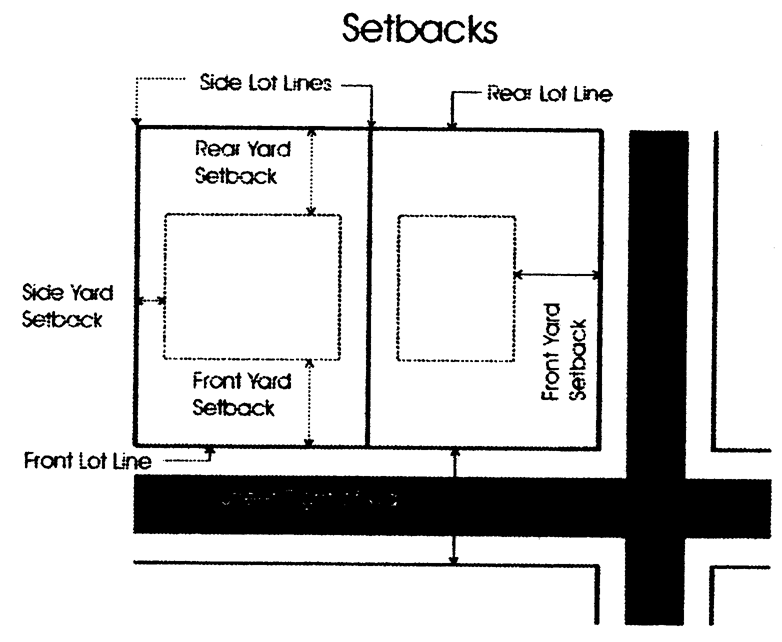
Setback, parking lot: The minimum horizontal distance between the street right-of-way or property line and the near edge of a parking lot, excluding necessary and/or approved driveways, frontage roads and landscaping areas. This setback shall remain as open space as defined herein, unless otherwise provided for in this chapter.
Setback, required: The required minimum horizontal distance between a front, rear, or side lot line and a building line, for the purpose of defining limits within which no building or structure, or any part thereof, shall be erected or permanently maintained. Separate definitions for condominium projects are listed under "condominium, setbacks."
Sewer: A public sanitary sewage disposal system approved by the Michigan Department of Public Health.
Shopping center: A grouping of two or more business establishments developed in accordance to an overall plan and designed and built as an interrelated project. Buildings constructed on outlots shall not be considered part of the shopping center unless access and parking easements are provided. See also "Supercenter" and "Supermarket".
Shoreline: The edge of a body of water measured at the ordinary high water mark.
Significant natural, historical, and architectural features: Significant architectural features, drainageways and streams, endangered species habitat, floodplains, hedgerows, significant historical features, landmark trees, ponds and lakes, steep slopes, wetlands, and woodlots.
Sight distance: The length of roadway visible to the driver. Generally related to the distance or time (perception/reaction time) sufficient for the driver to execute a maneuver (turn from driveway or side street, stop or pass) without striking another vehicle or object in the roadway. Required sight distance shall be based on the standards of the Genesee County Road Commission.
Sign: See Definitions in Article XXII, Signs.
Site condominium: See "Condominium, site condominium project."
Site plan: A scaled drawing(s) illustrating existing conditions and containing the elements required herein as applicable to the proposed development to ensure compliance with zoning provisions.
Special land use: A use of land for an activity which, under usual circumstances, could be detrimental to other land uses permitted within the same district but which may be permitted because of circumstances unique to the location of the particular use and which use can be conditionally permitted without jeopardy to uses permitted within such district. A special land use requires that a special land use approval be obtained.
Stable, private: A stable for the keeping of horses for the use of the residents of the principal use and shall not include the keeping of horses for others, or for commercial boarding, and with a capacity for not more than two horses; provided, however, that the capacity of a private stable may be increased if the lot whereon such stable is located contains at least one acre of land for each additional horse stabled thereon.
Stable, public or commercial: A stable other than a private stable, with a capacity for more than two animals, and carried on within an unplatted tract of land of not less than 40 acres for the purposes of rearing and housing horses, mules, ponies or for riding and training academies.
State-licensed adult and child residential care facility: See "Adult care facility" or "Child care organization."
Steep slopes: Slopes with a grade of 12 percent or more.
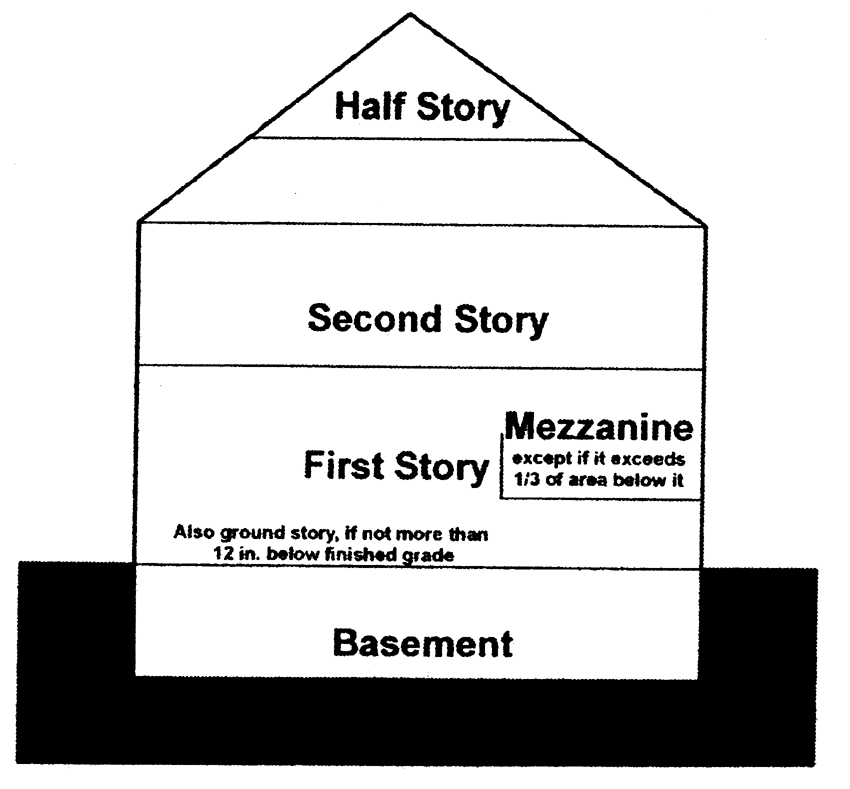
Story: That part of a building, except a mezzanine as defined herein, included between the surface of one floor and the surface of the next floor, or if there is no floor above, then the ceiling next above. A story thus defined shall not be counted as a story when more than 50 percent, by cubic content, is below the height level of the adjoining ground. A basement shall not be counted as a story.
Street: Any public or private thoroughfare or right-of-way, other than a public or private alley, dedicated to or designed for travel and access to any land, lot or parcel, whether designated as a road, avenue, highway, boulevard, drive, lane, place, court, or any similar designation. Various types of streets are defined below.
a.
Arterial street or roadway. A street or roadway which carries high volumes of traffic at relatively high speeds, and serves as an avenue for circulation of traffic onto, out of, or around the Fenton area. An arterial roadway may also be defined as a major thoroughfare, major arterial or minor arterial roadway. Since the primary function of the regional arterial roadway is to provide mobility, access to adjacent land uses may be controlled to optimize capacity along the roadway. Arterial roadways are listed in the City Master Plan.
b.
Collector street. A street or road whose principal function is to carry traffic between minor and local roads and arterial roadways but may also provide direct access to abutting properties. Collector streets are classified in the city master plan.
c.
Cul-de-sac. A street or road that terminates in a vehicular turnaround.
d.
Expressways. Limited access interregional arterial routes, including U.S. 23, designed exclusively for unrestricted movement, have not [no] private access, and intersect only with selected arterial roadways or major streets by means of interchanges engineered for free-flowing movement.
e.
Highways. Streets and roadways which are under the jurisdiction of the Michigan Department of Transportation. Highways may also be classified as expressways or arterial roadways.
f.
Local or minor street. A street or road whose principal function is to provide access to abutting properties and is designed to be used or is used to connect minor and local roads with collector or arterial roadways. Local streets are designed for low volumes and speeds of 25 mph or less, with numerous curb cuts and on-street parking permitted.
g.
Private road. Any road or thoroughfare for vehicular traffic which is to be privately owned and maintained and has not been accepted for maintenance by the city, Genesee County, the State of Michigan or the federal government, but which meets the requirements of this chapter or has been approved as a private road by the city under any prior ordinance.
h.
Public street. Any road or portion of a road which has been dedicated to and accepted for maintenance by the city, Genesee County, State of Michigan, or the federal government.
Structure: Anything constructed or erected, the use of which requires location on the ground or attachment to something having location on the ground.
Structural addition: Any alteration that changes the location of the exterior walls or area of a building.
Subdivision: A subdivision as defined in the City of Fenton Subdivision Control Ordinance.
Subdivision plat: The division of a tract of land for the purpose of sale or building development, in accordance with the Subdivision Control Act, Michigan Public Act 288 of 1967, as amended.
Substantial improvement: Any repair, reconstruction, or improvement of a structure, the cost of which equals or exceeds 50 cent of the market value of the structure either, (1) before the improvement or repair is started, or (2) if the structure has been damaged and is being restored, before the damage occurred. For the purposes of this definition, "substantial improvement" is considered to occur when the first alteration of any wall, ceiling, floor, or other structural part of the building commences, whether or not that alteration affects the external dimensions of the structure. The term does not, however, include either (1) any project for improvement of a structure to comply with existing state or local health, sanitary, or safety code specifications which are solely necessary to assure safe living conditions, or (2) any alteration of a structure listed on the national register of historic places or the state inventory of historic places.
Supercenter: A retail establishment selling supermarket items as well as those items typically found in a department or discount store.
Supermarket: A retail establishment selling groceries, dry goods, frozen foods and similar items typically within a building of over 5,000 square feet.
Swimming pool: Any permanent, non-portable structure or container located either above or below grade designed to allow holding of water to a depth of greater than 24 inches, intended for swimming, bathing or relaxation. The definition of swimming pool includes spa, hot tubs and similar devices. A swimming pool shall be considered an accessory structure for purposes of computing lot coverage.
Temporary building, structure, or use for construction: A building, structure or use permitted to exist for a specified period during periods of construction or renovations on the principal building, structure or use.
Temporary uses and seasonal events: Seasonal outdoor events intended for a limited duration within any zoning district. Such a temporary use shall not be interpreted to be a continuance of a nonconforming use. Temporary uses and seasonal sales events may include carnivals, circuses, farmers market, art fairs, craft shows, sidewalk sales, antique sales, Christmas tree sales, flower sales, flea markets and similar events, and may also include temporary residential uses.
Theater: An enclosed building used for presenting performances or motion pictures which are observed by paying patrons from seats situated within the building. ("Theater" is distinct from adult theater defined separately under adult regulated uses).
Therapeutic massage: The application of various techniques to the muscular structure and soft tissues of the human body performed by a massage practitioner. A massage practitioner must satisfy two or more of the following requirements:
a.
The person is a member of the current professional level in the American Massage Therapy Association (AMTA), Associated Bodywork and Massage Professionals (ABMP), International Myomassethics Federation (IMF) or other recognized massage association with equivalent professional membership standards consisting of at least 500 hours of training including: theory, practice and techniques of massage (minimum 300 hours); human anatomy and physiology (minimum 100 hours); and professionalism (minimum 100 hours). Instruction in this area shall include training in contraindications, benefits, ethics and legalities of massage, building and marketing a practice and other electives as appropriate.
b.
The person is a graduate of a school of massage licensed by the State of Michigan or holder of a current license from another state which requires, at a minimum, the training set forth in paragraph a. above.
c.
The person has completed a massage training program at a community college, college, university or technical school located in the United States, where such program requires at a minimum, the training set forth in a. above.
d.
The person has passed the National Certification Exam for Massage and Bobywork [Bodywork] Practitioners.
Topographical map: A map showing existing physical characteristics, with contour lines at sufficient intervals to permit determination of proposed grades and drainage.
Townhouse: A residential structure or group of structures, each of which contains four or more attached single-family dwelling units with individual rear yards and or front yards designed as an integral part of each single-family dwelling unit.
Traffic impact study: The analysis of the potential traffic impacts generated by a proposed project. This type of study and level of analysis will vary dependent upon the type and size of the project.
a.
Rezoning traffic impact study. A traffic impact study which contrasts typical uses permitted under the current and requested zoning or land use classification. This study usually includes a trip generation analysis and a summary of potential impacts on the street system.
b.
Traffic impact assessment. A traffic impact study for land uses which are not expected to have a significant impact on the overall transportation system but will have traffic impacts near the site. This type of study focuses on the expected impacts of a development at site access points and adjacent driveways.
c.
Traffic impact statement. A traffic impact study which evaluates the expected impacts at site access points and intersections in the vicinity.
d.
Regional traffic impact study. A comprehensive traffic impact study for land uses expected to have a significant long term impact on the street system. Such a study evaluates the impacts over a long period and may involve analyses of alternate routes. This type of study is typically prepared using a computer model which simulates traffic patterns.
Truck terminal: A structure to which goods, except raw or unprocessed agricultural products, natural minerals, or other natural resources, are delivered for immediate distribution to other parts of the city, for delivery to other intrastate or interstate destinations, or for distribution involving transfer to other modes of transportation.
(Ord. No. 643, § 2, 1-14-08)
Sec. 36-28.12. - Definitions U-V.
Underground storage tank system: A tank or combination of tanks, including underground pipes connected to the tank or tanks, which is, was, or may have been used to contain an accumulation of hazardous substances, as defined in part 213 of the State of Michigan Natural Resources and Environmental Protection Act, 1994 Public Act 451, as amended.
Urgent care center or emergency medical station: A facility offering immediate or emergency health care treatment and can be considered either a principal or accessory use.
Usable marihuana: Dried leaves and flowers of the marihuana plant, and any mixture or preparation thereof. The seeds, stalks, and roots of a marihuana plant are not considered usable marihuana.
Use: The purpose for which land or a building is arranged, designed or intended, or for which land or a building is or may be occupied.
Used oil: Any oil that had been refined from crude oil, used, and as a result of such use contaminated by physical or chemical impurities.
Variance: A relaxation or modification of the requirements of this chapter as authorized by the ZBA under the provisions of this chapter and Act 207 of the Public Acts of 1921, as amended.
Veterinary clinic, office or hospital: A facility which provides diagnosis, treatment, surgery and other veterinary care for domestic animals, horses and livestock provided that all activities are conducted within a completely enclosed building.
(Ord. No. 643, § 2, 1-14-08; Ord. No. 687, § 3, 1-26-15)
Sec. 36-28.13. - Definitions W-Z.
Wall: A structure constructed of masonry or brick of definite height and location to serve as an obscuring screen in carrying out the requirements of this chapter.
Warehouse: A building used primarily for storage of goods and materials.
Well: A permanent or temporary opening in the surface of the earth for the purpose of removing fresh water, testing water quality, measuring water characteristics, liquid recharge, waste disposal, or dewatering purposes during construction, as defined in the Michigan Water Well Construction and Pump Installation Code, part 127, Act 368 of the Public Acts of 1978, as amended, and the rules promulgated pursuant thereto.
Wellhead protection area (WHPA): The area around and upgradient from the public water supply wells delineated by the ten-year travel time contour capture boundary.
Wellhead protection overlay zone: The area outlined on the wellhead protection overlay zone map.
Wetland: Land characterized by the presence of water at a frequency and duration sufficient to support, and that under normal circumstances does support, wetland vegetation or aquatic life and is commonly referred to as a bog, swamp, or marsh. Locations of wetlands are generally shown on the natural features map of the master plan.
Wetland, regulated: Certain wetlands regulated by the Michigan Department of Environmental Quality (MDEQ) under the provisions of Act 203 of the Public Acts of 1979, as amended, and generally defined as land characterized by the presence of water at a frequency and duration sufficient to support, and that under normal circumstances does support wetland vegetation or aquatic life and is commonly referred to as a bog, swamp, or marsh and which is any of the following:
a.
Contiguous to an inland lake or pond, or a river or stream.
b.
Not contiguous to an inland lake, pond, river or stream, and more than five acres in size;
c.
Not contiguous to an inland lake or pond, or a river or stream; and five acres or less in size if the MDEQ determines that protection of the area is essential to the preservation of the natural resources of the state from pollution, impairment, or destruction and the department has so notified the property owner.
Wholesale sales: The sale of goods generally in large quantities and primarily to customers engaged in the business of reselling the goods.
Wireless communication facilities: All structures and accessory facilities relating to the use of the radio frequency spectrum for the purpose of transmitting or receiving radio signals. This may include, but shall not be limited to, radio towers, television towers, telephone devices, personal communication transmission equipment and exchanges, microwave relay towers, telephone transmission equipment building and commercial mobile radio service facilities. This definition does not include "reception antenna" for an individual lot as otherwise defined and regulated in this chapter.
Woodlot: An area of one-fourth acre or more containing eight or more trees per one-fourth acre, such trees having a four-inch or greater diameter at a four-foot height.
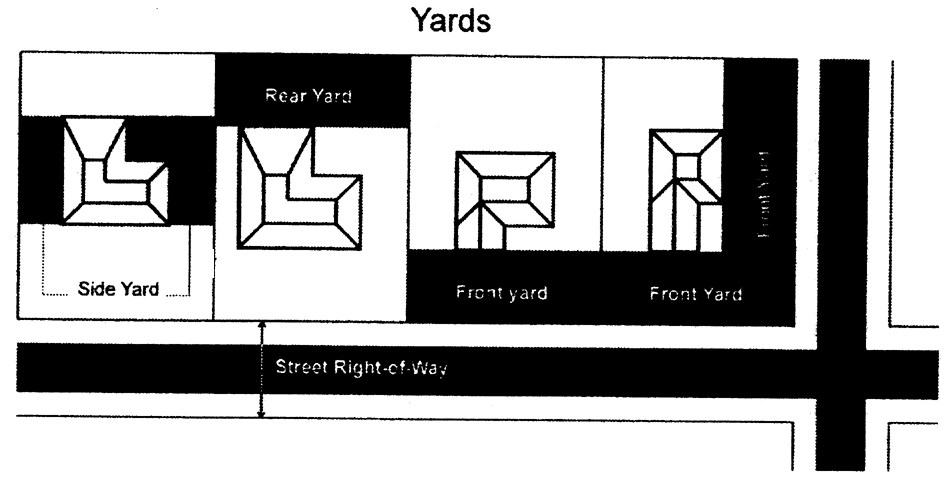
Yard, front: A required front yard is an open space extending the full width of the lot, the uniform depth of which is the minimum prescribed horizontal setback distance measured at right angles to the front lot line and is unoccupied space between the front lot line and the nearest line of the principal building, excepting steps and unenclosed porches.
Yard, rear: A required rear yard is an open area extending across the full width of the lot, the uniform depth of which is the minimum prescribed horizontal setback distance measured at right angles to the rear lot line, describing an unoccupied space between the rear lot line and the nearest line of the principal building.
Yard, required: A required open space on the same lot with a principal building, unoccupied and unobstructed by any building or structure or portion thereof from the ground upward, except as otherwise provided in this chapter.
Yard, side: A required side yard is an open unoccupied area between a principal building and the side lot lines, extending from the front yard area to the rear yard area. The width of the required side yard shall be measured from the center of the nearest wall of the building or structure to the nearest point of the side lot line.
Zero lot line: The location of a building on a lot in such a manner that one or more of the buildings sides rests directly on the lot line.
Zoning Act: The Michigan Zoning Enabling Act, Public Act 110 of 2006.
Zoning board of appeals (ZBA): The City of Fenton Zoning Board of Appeals created under the Michigan Zoning Enabling Act, Public Act 110 of 2006, as amended.
Zoning district: A portion of the incorporated area of the municipality within which certain regulations and requirements or various combinations thereof apply under the provisions of this chapter.
(Ord. No. 643, § 2, 1-14-08)

