
Fillmore City Zoning Code
ARTICLE II
ZONING DISTRICTS
6.04.0401 - Purpose.
1.
The purpose of this section is to achieve the following:
A.
Preserve neighborhood areas for residential living with rural, low, medium, medium/high and high dwelling unit densities, consistent with the general plan and appropriate standards of public health, safety, welfare, and aesthetics;
B.
Ensure adequate light, air, privacy and open space for each dwelling;
C.
Minimize traffic congestion and avoid the overloading of public services and utilities;
D.
Protect residential neighborhoods from excessive illumination, noise, odor, smoke unsightliness and other objectionable;
E.
Facilitate the provision/enhancement of public improvements in line with anticipated residential construction, and service requirements;
F.
Ensure that residential areas are developed and redeveloped to be healthful, safe and attractive neighborhoods, served by adequate open space and appropriate community facilities;
G.
Create opportunities for "rural" estate-type residential development in outlying portions of the city to maintain orderly development and preserve agricultural resources/pursuits;
H.
Create opportunities for hillside residential development in a safe and attractive manner which preserves the natural beauty of the hillsides;
I.
Designate/preserve land to accommodate housing units which meet the diverse economic needs of the city's residents (i.e., very low, low and moderate income, senior citizen, etc.), situating development in a manner that will retain the scale, character and historic significance of existing residential neighborhoods; and
J.
Promote enhanced urban design in residential projects which ensures that new development is architecturally and functionally compatible, preserves the long- quality, ensures long-term energy and water efficiency, increases security and results in uniquely identifiable neighborhoods, through the application of development standards/guidelines.
2.
The purpose of the individual residential zoning districts is as follows:
A.
RPD (Residential Planned Development) Rural (1.0) Zone. This zone is intended to provide for a "rural" neighborhood with detached single-family dwellings at a density range of zero to 1.0 units per net acre as well as the maintenance of agricultural pursuits. Manufactured homes on permanent foundations are also permitted. Additional land uses (i.e., churches, day care centers, schools, etc.) may be allowed when compatible to and in harmony with, and serving the needs of, a rural residential neighborhood.
B.
RPD (Residential Planned Development) Low (7.0) Zone. This zone is intended to provide for low density neighborhoods with detached single-family dwellings with private yards at a density range of 1.1 to 7.0 units per net acre as well as the maintenance of "limited" agricultural pursuits. Manufactured homes on permanent foundations are also permitted. Additional land uses (i.e., churches, day care centers, schools, etc.) may be allowed when compatible to and in harmony with, and serving the needs of, a low density residential neighborhood.
C.
RPD (Residential Planned Development) Medium (11.0) Zone. This zone is intended to provide for medium density neighborhoods with detached single-family dwellings with private yards, two-family detached and attached residential dwellings (i.e., condominiums, townhomes, a two-family structure, etc.), multi-family attached residential dwellings and mobile home parks/subdivisions at a density range of 7.1 to 11.0 units per net acre. Manufactured homes on permanent foundations are also permitted. Additional land uses (i.e., churches, day care centers, schools, etc.) may be allowed when compatible to and in harmony with, and serving the needs of, a medium density residential neighborhood.
D.
RPD (Residential Planned Development) Medium/High (15.0) Zone. This zone is intended to provide for medium/high density neighborhoods with two-family detached and attached residential dwellings (i.e., condominiums, townhomes, two-family structures, etc.) and multifamily attached residential dwellings (i.e., apartments, condominiums, etc.) at a density range of 11.1 to 15.0 units per net acre. Additional land uses (i.e., churches, day care centers, schools, etc.) may be allowed when compatible to and in harmony with, and serving the needs of, a medium/high density residential neighborhood.
E.
RPD (Residential Planned Development) High (15.1) Zone. This zone allows detached single-family homes, and high-density neighborhoods with attached multi-family residential dwellings (i.e., apartments, condominiums, townhomes, two-family structures, etc.) at a density range of at least 15.1 units per net acre. Additional land uses (i.e., churches, day care centers, schools, etc.) may be allowed when compatible to and in harmony with, and serving the needs of, a high-density residential neighborhood.
G.
HO (Housing Overlay Zone) (20.1-24.0): Housing Overlay zone permits residential uses on specified vacant and underutilized sites to promote multifamily residential development (i.e., apartments, condominiums, townhouses, multi-family dwellings, duplexes) while maintaining the underlying zones at a density range a minimum of 20.1—24.0 units per net acre. Additional land uses (i.e., churches, day care centers, schools, etc.) may be allowed when compatible to and in harmony with, and serving the needs of, a high-density residential neighborhood.
(Ord. No. 18-895, § 2, 12-11-2018; Ord. No. 25-981, § 5, 6-10-2025; Ord. No. 25-987, § 4, 9-2-2025)
6.04.0405 - Permitted uses.
Any structure/use designated as "Permitted" (P) by the following list shall comply with the provisions of this ordinance. Any permitted use which will occupy an existing structure (with no structural alteration/enlargement) shall comply with the operational standards contained in this section as well as Article III (General Regulations). Additionally, any permitted use which will occupy an existing structure that is to be altered, enlarged, or requires construction or installation (i.e., manufactured housing) of a structure(s) shall require the approval of a development permit in compliance with Section 6.04.66.
6.04.0410 - Permitted, Development Permitted and Conditionally Permitted Uses.
The following list represents those uses in the residential zoning districts which are Permitted (P), subject to a Development Permit (D) or a Conditional Use Permit (C):
Other similar uses which the director finds to fit within the purpose/intent of the specific residential zoning district in compliance with subsection 6.04.0225(3).
(Ord. No. 16-862, § 6, 6-14-2016; Ord. No. 18-895, §§ 3, 4, 12-11-2018; Ord. No. 18-896, § 5, 12-11-2018; Ord. No. 19-902, § 2, 3-26-2019; Ord. No. 20-928, § 4, 7-14-2020; Ord. No. 20-930, § 2, 7-14-2020; Ord. No. 24-972, § 3, 6-11-2024; Ord. No. 25-981, § 6, 6-10-2025)
6.04.0415 - Zoning district development standards.
1.
General Standards. The standards contained in Table II-1 (Zoning District Development Standards) relating to density, lot area and configuration, structure setbacks, structural parcel coverage and height, accessory structure height, distance between structures and common/private open space apply to all residential zoning districts, and shall be determined to be the minimum requirements, unless stated as maximum by this ordinance. All setbacks shall be measured from the applicable property line.
Any variation from these standards shall require the approval of a Development Permit in compliance with Section 6.04.66 and consistency with any adopted guidelines for the subject neighborhood or a Minor Variance/Variance in compliance with Sections 6.04.60 or 6.04.64.
TABLE II-1
ZONING DISTRICT DEVELOPMENT STANDARDS
1 May be reduced to a 5,000 square foot minimum lot area with a 50-foot minimum lot width only if access to the parcel is provided by an alley.
2 Subject to Section 6.04.26 (Hillside Development Standards).
3 May be reduced to 5 feet with Fire Department approval, but shall be 10 feet if adjacent to a 2-story structure.
4 Five additional feet of setbacks for the third floor shall be measured from the second-floor exterior wall plate.
5 When 2 walls face each other and neither has a window opening, they shall be separated by at least 15 feet. If one or more of the walls has a window opening, they shall be separated by at least 20 feet plus 5 feet for each story of each structure in excess of one-story.
2.
Zone Specific Standards. In addition to the general development requirements contained in Article III (General Regulations), the following table identifies specific standards which apply to individual residential zoning districts:
RESIDENTIAL ZONES SPECIFIC DEVELOPMENT STANDARDS*
*Key: "Y" applies and "N" does not apply in the zoning district
A.
Accessory Structures. Accessory structures in residential zoning districts shall be compatible with the materials and architecture of the main dwelling(s) on the property. Accessory structures may only be constructed on a parcel containing a main dwelling unit. The setbacks in Table II-2 shall apply.
Any variation from these setbacks shall require the approval of a development permit in compliance with Section 6.04.66 and consistency with the adopted "guidelines" for the subject neighborhood or a minor variance/variance in compliance with Sections 6.04.60 or 6.04.64.
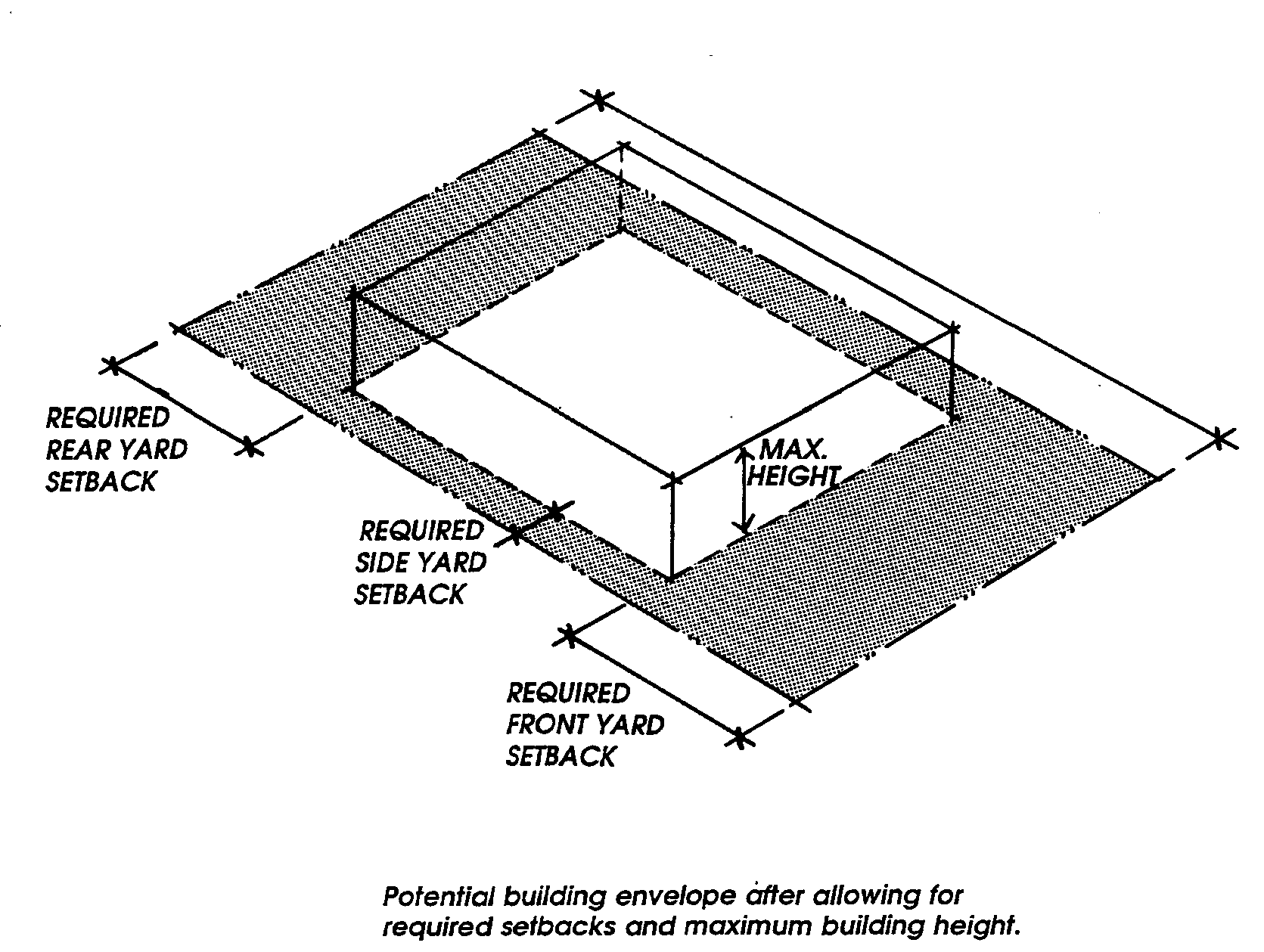
TABLE II-2
ACCESSORY STRUCTURES
B.
Additional Height (Story) Allowances. When complying with standard setback requirements in the RPD-M/H zoning district, the maximum structure height shall not exceed thirty-five feet or two stories, whichever is less. This standard may be increased by the review authority as part of a Development Permit application up to a maximum of fifty feet or three stories, whichever is less, subject to the following:
(1)
A visual analysis relating structural proportions, massing, height and setback shall be conducted to preserve and enhance the scenic viewshed and minimize the structure's effect on adjacent residents and their privacy;
(2)
The need, and appropriateness of additional stories shall be demonstrated; and
(3)
Architectural compatibility and harmony with surrounding development, land use designations and zoning shall be demonstrated.
As a condition of approval, the Review Authority may require setbacks greater than the minimum setbacks for the RPD-M/H zoning district stated in Table II-2.
C.
Child Day Care Facility Development Standards.
1.
Definitions. For purposes of the Fillmore Zoning Ordinance, the following definitions shall apply:
a.
"Child day care center" means any child day care facility other than a family day care home, and includes infant centers, preschools, extended day care facilities and school age child care centers.
b.
"Child day care facility" means a facility which provides non-medical care to children under eighteen years of age in need of personal services, supervision, or assistance essential for sustaining the activities of daily living or for the protection of the individual on less than a twenty-four-hour basis. Child day care facility includes day care centers, employer-sponsored child care centers, and small and large family day care homes.
c.
"Large family day care home" means a single-family residence which regularly provides, care protection, and supervision for seven to fourteen children in the provider's own residence including children under the age of ten years who reside at the single-family residence, for period of less than twenty-four hours a day. A large family day care home may provide care for more than twelve children and up to and including fourteen children provided the requirements of California Health and Safety Code Section 1597.465 are met.
d.
"Small family day care home" means a single-family residence which regularly provides care, protection, and supervision of a maximum of eight children in the provider's own residence, including children under the age of ten years who reside at the single family residence, for periods of less than twenty-four hours a day. A small family day care home may only provide care for more than six children and up to eight children without an additional adult attendant, provided the requirements of California Health and Safety Code Section 1597.44 are met.
2.
Small Family Day Care Homes.
a.
The use of a single-family residence as a small family day care home shall be considered a residential use of property.
b.
A business license shall be required for the privilege of operating a small family day care home.
c.
Use of a single-family dwelling for purposes of a small family day care home shall not constitute a change of occupancy for purposes of any of the state building and codes adopted by references in section 5.01.010 of the Fillmore Municipal Code.
d.
A small family day care home shall contain a fire extinguisher and smoke detector device that meet standards established by the state fire marshal and one or more functioning carbon monoxide detectors that meet the requirements of state law.
e.
Small family day care homes shall comply with all city development standards applicable to other single-family residences in the same zone, including building heights, setback, or lot dimensions.
f.
Small family day care homes shall have a valid and unexpired state license to operate.
3.
Large Family Day Care Homes.
a.
The use of a single-family residence as a large family day care home shall be considered a residential use of property and therefore shall not alter either the residential character of the appearance of the residence or the neighborhood in which the residence is located. Large family day care homes are allowed within a detached single-family dwelling in all residential zones that permit detached single-family dwellings subject to a state license and compliance with all the requirements of this section.
b.
A business license shall be required for the privilege of operating a large family day care home.
c.
Use of a single-family dwelling for purposes of a large family day care home shall not constitute a change of occupancy for purposes of any of the state building and codes adopted by references in section 5.01.010 of the Fillmore Municipal Code.
d.
A large family day care home shall contain a fire extinguisher and smoke detector device that meet standards established by the state fire marshal and one or more functioning carbon monoxide detectors that meet the requirements of state law.
e.
Large family day care homes shall comply with all city development standards applicable to other single-family residences in the same zone, including building heights, setback, or lot dimensions.
f.
Large family day care homes shall have a valid and unexpired state license to operate.
4.
Child Day Care Centers.
a.
In residential zones, child day care centers are permitted for six or fewer children (small facility), and the approval of a conditional use permit is required for a facility of seven or more children (large facility) in compliance with section 6.04.70 of this code. In commercial zones, day care centers shall be allowed as described in the table located at section 6.04.0610 of this code. In manufacturing/industrial zones, day care centers shall be allowed as described in the table located at section 6.04.0810 of this code. In business park districts, day care centers shall be allowed as described in the table located at section 6.04.1202 of this code.
b.
Standards and requirements. Day care centers in all zones shall be developed/operated in the following manner:
i.
The facility shall conform to all property development standards of the zoning district in which it is located.
ii.
The facility shall be provided with indoor play areas in compliance with state requirements. Separate and clearly defined play and activity areas shall be provided for each age group (i.e. infant, toddler, preschool, and school-age children).
iii.
An outdoor play area of no less than seventy-five square feet per child, but in no case less than four hundred fifty square feet in area exclusive of the required front yard setback, shall be provided. The outdoor play area shall be located in the rear yard. Stationary play equipment shall not be located in required front and side yards.
iv.
A six-foot high solid decorative fence or wall shall be constructed on all property lines, except in the front yard or within a traffic safety sight area. In the front yard, the fence or wall shall be a maximum of thirty-six inches in height. Materials, textures, colors, and design of the fence or wall shall be compatible with on-site development and adjacent properties and shall be subject to the approval of the director. All fences or walls shall provide for safety with controlled points of entry.
5.
On-site landscaping shall be consistent with that in the surrounding neighborhood and shall be installed and maintained, in compliance with section 6.04.28 (landscaping standards). Landscaping shall be provided to reduce noise effects on surrounding properties (i.e., trees shall be planted along the property lines, closely spaced and subject to the approval of the director).
6.
All on-site lighting shall be energy efficient, stationary, directed away from adjacent properties and public rights-of-way, and of an intensity compatible with the surrounding neighborhood.
7.
All on-site signs shall comply with the provisions of section 6.04.38 (sign standards).
8.
All off-street parking shall comply with the provisions of section 6.04.34 (off-street parking standards) and shall provide on-site vehicle turnaround or separate entrance and exit points where feasible, and adequate passenger loading spaces.
9.
The facility shall contain a fire extinguisher and smoke detector devices and comply with all standards established by the fire department.
10.
A facility within any residential zoning district may only operate up to fourteen hours per day between the hours of 6:00 a.m. and 8:00 p.m.
11.
Outdoor activities may only be conducted between the hours of 7:00 a.m. and 7:00 p.m.
12.
All facilities shall be state licensed and shall be operated in compliance with all applicable local, county and state health and safety regulations.
D.
Common Useable Open Space. All multi-family residential developments with five or more dwelling units in the RPD-M, M/H, M/H2, H, and HO zoning districts shall incorporate common useable open space for passive and active recreational purposes within the project's design. The minimum area dedicated for this purpose shall be thirty percent of the net parcel area or two hundred square feet for each unit, whichever is greater, or as otherwise specified in Table II-1 (Sec. 6.04.0415.1). Useable open space shall not include rights-of-way, vehicle parking areas, areas between any structures less than twenty feet apart for private outdoor useable space or setback areas. (Setback areas may be credited, by the director, as useable open space, up to a maximum of fifty percent, when the setback is a minimum of twenty feet wide and contiguous for a minimum distance of forty running feet.)
Additionally, all multi-family residential developments shall provide indoor/outdoor recreational amenities within the common open space which may include, but are not limited to, the following:
(1)
Barbecue/picnic area;
(2)
Recreation building;
(3)
Swimming pool; and/or
(4)
Tot lot with play equipment.
The specific type/size/location of the amenities shall be subject to the approval of the director. The DIRECTOR shall have the authority to adjust/average the minimum standards for private/common open space when doing so would result in an improved design and an enhanced overall provision of private/common useable open space.
E.
Congregate Housing Development Standards. Standards governing congregate housing facilities are outlined in Section 6.04.22.
F.
Conservation/Preservation Area Guidelines.
(1)
The conservation/preservation area guidelines are intended to implement general plan policies related to the preservation of residential historic resources within the area bounded by Central Avenue, Fourth Street, Mountain View Street and Main Street.
(2)
The conservation/preservation area guidelines will be utilized during the city's development/design review process as criteria against which to review residential projects requiring discretionary approval within the conservation/preservation area. Additionally, the guidelines are intended to provide a clear understanding of the city's goals for preserving the historic character of the area. In instances where proposed improvement does not require discretionary approval (i.e. painting or re-siding) an advisory review from the director may be requested. Advisory review is provided to assist property owners in making improvements that are consistent with the spirit of the guidelines.
(3)
The conservation/preservation area guidelines are available at the department and include information/guidance in the following areas:
(a)
Preservation and rehabilitation of existing structures;
(b)
Additions to existing structures; and
(c)
New infill structures.
G.
Density Bonus. Provisions governing density bonus/affordable housing are outlined in Section 6.04.0417.
H.
Garage/Yard Sales. Garage/yard sales are permitted in all RPD zoning districts in compliance with Chapter 7.10 of the Municipal Code.
I.
Hillside Development Standards. Standards governing "hillside development" are outlined in Section 6.04.26.
J.
Keeping of Domestic Animals/Household Pets. The keeping of domestic animals/pets for household enjoyment only is permitted in all RPD zoning districts subject to the following standards:
(1)
No more than three dogs or three cats or a combination that does not exceed three dogs and cats may be permitted only if properly maintained on the premises within/outside a dwelling;
(2)
Other domestic animals/household pets (i.e., birds [not including poultry], fish, rodents, etc.) may be permitted only if properly maintained on the premises within/outside a dwelling. The director may allow other domestic animals/household pets not previously listed; and
(3)
A young animal(s) born to a permitted animal kept within/outside of the dwelling may be kept until the young animal is weaned from its mother (eight weeks for dogs or cats).
K.
Minimum Dwelling Size Standards. The following minimum dwelling areas are computed by calculating the living area as measured on the outside of walls and excludes basements, carports, exterior courtyards/patios, garages and porches:
The minimum area requirements for single-family detached homes: .....1,200 sq. ft.
The minimum area requirements for single-family attached homes: .....1,000 sq. ft.
The minimum area requirements for multi-family dwellings are as follows:
1 Bedroom .....750 sq. ft.
2 Bedrooms .....900 sq. ft.
3 Bedrooms .....1,000 sq. ft.
"Efficiency apartment units" (400—700 square feet), as defined in Section 6.04.96, are allowable only in areas designated in the general plan for "medium," "medium/high" or "high" residential development. These apartment units shall be allowed only in cases where a fractional/partial additional unit (i.e., 1.5 to 1.9 units allowed on property in compliance with the required "lot area per dwelling unit") would otherwise not be allowed.
L.
Minimum Room Size Standards. Minimum room size standards are as follows:
M.
Mobile Home and Manufactured Housing Development Standards. Mobile or manufactured homes used as single-family dwellings are subject to the approval of a development permit and shall be installed/maintained in the following manner:
(1)
Mobile or manufactured homes may be used as a single-family residence if the home is certified under the National Mobile Home Construction and Safety Act of 1974;
(2)
Mobile or manufactured homes shall be installed on and secured to an approved permanent foundation in compliance with this ordinance, the city building code and the Health and Safety Code (Section 18551); and
(3)
The following development standards shall govern the installation and assembly of mobile and manufactured homes. The director may modify any of the following standards during the development permit process upon finding(s) that to do so would enhance architectural compatibility and the protection of health and safety:
(a)
All homes shall have a minimum eave projection of eighteen inches on at least two opposite sides, with at least twelve inches on any one side;
(b)
All roofs shall have a minimum pitch of 1:4 and shall be constructed of non-reflective/non-metallic roofing material;
(c)
All exterior siding shall be non-reflective/ non-metallic and shall be installed from the ground up to the roof; and
(d)
All homes shall have a minimum width (across the narrowest portion) of fifteen feet.
The provisions of this subsection do not apply to the installation and assembly of mobile and manufactured homes in mobile home parks.
N.
Mobile Home Park/Subdivision Development Standards. The design of individual lots and other areas within mobile home parks and the permitting of individual mobile homes within the parks is regulated by the California Department of Housing and Community Development, and is not subject to the provisions of this subsection. However, the city has full authority to adopt reasonable standards regulating other characteristics of mobile home parks as well as all aspects of mobile home subdivisions.
Mobile home parks/subdivisions are allowable only in the RPD-M zoning district subject to a development permit and shall be constructed in the following manner:
(1)
The minimum site area for new mobile home parks/ subdivisions shall be ten acres;
(2)
No more than one mobile home may be located on an individual lot/space:
(3)
Individual mobile home lots shall have the following minimum site areas/widths:
(a)
Single-wide coaches: 2,400 sq. ft./35 ft.;
(b)
Double-wide coaches: 3,000 sq. ft./45 ft.; and
(c)
Triple-wide coaches: 3,600 sq. ft./55 ft.
(4)
Individual mobile homes shall be set back a minimum of twenty feet from the nearest public right-of-way;
(5)
Minimum individual mobile home lot setbacks shall be measured from the edge of internal streets and space lines as follows:
(a)
Front—Ten feet.
(b)
Side—Five feet.
(c)
Rear—Ten feet.
(6)
Maximum mobile home lot coverage (mobile home and any accessory structure) shall be seventy-five percent;
(7)
Each mobile home shall be equipped with skirting, or provided with a support pad which is recessed to give the appearance of the mobile home being located on-grade;
(8)
All on-site utilities shall be installed underground;
(9)
All private internal streets within the park/subdivision shall be appropriately paved with a minimum width of thirty-six feet or in compliance with the Ventura County Standards, whichever is greater;
(10)
The mobile home park/subdivision shall be provided with off-street parking in compliance with Section 6.04.34 (Off-street parking standards);
(11)
Mobile home parks/subdivisions should contain commercial uses for the convenience of the residents (i.e., food/drink vending machines, laundry room, etc.) provided that these uses shall be located within an enclosed structure in the interior of the park/subdivision and shall not occupy more than five hundred square feet;
(12)
Each mobile home lot shall contain adequate space to accommodate an enclosed storage facility with a minimum of one hundred twenty square feet;
(13)
All exterior boundaries of the mobile home park/subdivision shall appear similar to conventional residential developments and shall be screened by a decorative fence (with open grill work) or masonry wall six feet in height, with a minimum six-foot wide landscaped area provided along the inside of the perimeter fence or wall subject to the approval of the director;
(14)
Common open space shall be landscaped in compliance with Section 6.04.28 (Landscaping standards);
(15)
A common recreation area shall be provided in the park/subdivision for use by all residents and their invited guests. The area shall provide for a minimum aggregate area of fifty square feet of recreational space for each mobile home space; and
(16)
All mobile home parks/subdivisions shall provide recreational amenities within the site which may include, but are not limited to, the following:
(a)
Clubhouse;
(b)
Court game facilities (i.e., basketball, tennis, etc.);
(c)
Day care facilities;
(d)
Picnic shelter/barbecue area;
(e)
Spa;
(f)
Swimming pool; and/or
(g)
Tot lot with play equipment.
The type of amenities shall be approved by the director and provided in compliance with the following schedule:
O.
Perimeter Walls/Fences. Any structure/use, other than a single- or two-family dwelling, in a residential zoning district shall require the installation of perimeter screening in the form of walls and/or fences, which shall be constructed in the following manner:
(1)
The wall/fence shall be six feet in height, measured from the finished grade of the higher of the two adjoining parcels;
(2)
The wall/fence shall be installed along the perimeter of the parcel except for those portions fronting a public right(s)-of-way. Walls/fences located within the front yard setback shall not exceed a height of thirty-six inches;
(3)
The wall/fence shall be architecturally treated on both sides; and
(4)
The design and construction materials of the wall/fence shall be subject to the approval of the director.
P.
Rear Unit Access. Every developed residential parcel containing two or more residential units shall include a ten-foot wide improved pedestrian passageway to the rear unit(s). The passageway shall contain a paved walkway and shall be properly landscaped, maintained and vertically unobstructed overhead.
Q.
Recreational Vehicle Storage Facilities.
(1)
A single recreational vehicle may only be stored on a lot occupied by a single-family detached residence consistent with the requirements of this section.
(2)
Recreational vehicle storage facilities shall be encouraged on an individual lot basis as follows:
(a)
Increase one side yard to twelve feet in width to provide access to a storage space in the rear or side yard; or
(b)
Provide a "pass-thru" garage to the rear yard, while maintaining the required side yards.
(3)
Recreational vehicles shall not be used as living area or for temporary guest accommodations unless temporarily permitted pursuant to Section 14.56.020, recreational vehicle and trailer parking.
(4)
Recreational vehicle storage shall be behind the front yard setback line and rear yard gate. The access driveway to the storage area shall be paved treads only or grasscreted, subject to the approval of the director.
R.
Accessory Dwelling Units and Junior Accessory Dwelling Units.
1.
Purpose. This section provides for accessory dwelling units and junior accessory dwelling units on residential or mixed-use lots developed or proposed to be developed with single-family and multifamily dwellings in accordance with state law, including, but not limited to, Government Code section 66310 et seq.
2.
Applicability. The provisions of this subsection (R) apply to all lots that are occupied with a single-family dwelling unit or multifamily dwelling units and allow for residential or mixed use. Accessory dwelling units shall be permitted on any lot (unless otherwise prohibited in this subsection (R) where single-family dwelling units or multifamily dwelling units are permitted. Accessory dwelling units do not exceed the allowable density for the lot upon which the accessory dwelling unit is located, and will be considered a residential use that is consistent with the existing general plan and zoning designation for the lot.
3.
Accessory Dwelling Units on a Single-Family Dwelling Lot. An accessory dwelling unit located on a lot zoned for single-family use that is either attached or detached from the primary structure shall comply with the following development standards:
a.
The lot on which an accessory dwelling unit is located must be one in which residential uses are permitted and contain an existing or proposed single-family dwelling.
b.
The accessory dwelling unit must be located on the same lot as the proposed or existing primary dwelling and either:
(i)
Attached to; or
(ii)
Located within the proposed or existing primary dwelling, including attached garages, storage areas or similar uses; or
(iii)
An accessory structure; or
(iv)
Detached from the proposed or existing primary dwelling.
c.
No more than one accessory dwelling unit shall be permitted on any single-family parcel.
d.
The total floor area of an attached accessory dwelling unit shall not exceed either:
(i)
Fifty percent of the proposed or existing primary dwelling floor; or
(ii)
Eight hundred fifty square feet or one thousand square feet for an accessory dwelling unit that provides more than one bedroom.
e.
The total floor area for a detached accessory dwelling unit shall not exceed eight hundred fifty square feet or one thousand square feet for an accessory dwelling unit that provides more than one bedroom.
f.
Accessory dwelling units shall comply, without limitation, with all applicable building and safety codes as adopted by title 5 of the Fillmore Municipal Code.
g.
No passageway shall be required in conjunction with the construction of an accessory dwelling unit.
h.
No setback shall be required for an existing living area or accessory structure or a structure constructed in the same location and to the same dimensions as an existing structure that is converted to an accessory dwelling unit or to a portion of an accessory dwelling unit. However, a setback of four feet from the side and rear lot lines shall be required for an accessory dwelling unit that is not converted from an existing structure or any new structure constructed in the same location and to the same dimensions as an existing structure.
i.
The accessory dwelling unit shall comply with the lot coverage and open space requirements of the zone in which the parcel is located, except that application of this standard shall not preclude the construction of an accessory dwelling unit that has four-foot side and rear yard setbacks and at least eight hundred square feet, in compliance with all other local design, development and historic standards other than minimum lot size.
j.
An application to create an accessory dwelling unit is not required to correct legal nonconforming zoning conditions, building code violations, or unpermitted structures that do not present a threat to public health and safety and are not affected by the construction of the accessory dwelling unit. This includes corrections to the primary dwelling unit, unless the correction is necessary to protect health and safety. If a threat to health and safety is present, corrections to those conditions shall be included in the plans.
k.
Accessory dwelling units shall not be required to provide fire sprinklers if they are not required for the primary residence and may employ alternative methods for fire protection.
l.
Plans and construction shall include installing underground all service utility lines to the nearest existing suitable pole off-site, including, but not limited to, lines for electrical energy, telecommunications, and fiber-optic cables.
m.
The accessory dwelling unit shall be designed such that it matches with the design of the primary dwelling unit in terms of exterior treatment, landscaping, and architecture, including, but not limited to, roofing pitch, roofing materials, and paint color.
n.
The accessory dwelling unit shall comply with the following height requirements:
i.
A height of sixteen (16) feet or less for a detached accessory dwelling unit on a lot with an existing or proposed single-family or multifamily dwelling unit.
ii.
A height of eighteen (18) feet or less for a detached accessory dwelling unit on a lot with an existing or proposed single-family or multifamily dwelling unit that is within one-half of one mile walking distance of a major transit stop or a high-quality transit corridor, as those terms are defined in Section 21155 of the California Public Resources Code. An additional two (2) feet of height is allowed for any accessory dwelling unit with a roof pitch that aligns with the roof pitch of the primary dwelling unit.
iii.
A height of eighteen (18) feet for a detached accessory dwelling unit on a lot with an existing or proposed multifamily, multistory dwelling.
iv.
A height of twenty-five (25) feet or the height limitation in the City's zoning ordinance that applies to the primary dwelling unit, whichever is lower, for an accessory dwelling unit that is attached to a primary dwelling. This clause does not allow an accessory dwelling unit to exceed two (2) stories.
o.
Parking requirements for accessory dwelling units shall be one parking space per accessory dwelling unit. These parking spaces may be provided as tandem parking, including on a driveway or in setback areas, excluding the non-driveway front yard setback. No parking shall be required for an accessory dwelling unit in any of the following circumstances:
(i)
The accessory dwelling unit is located within one-half mile walking distance of public transit.
(ii)
The accessory dwelling unit is located within an architecturally and historically significant historic district.
(iii)
The accessory dwelling unit is part of the proposed or existing primary residence or an accessory structure.
(iv)
On-street parking permits are required but not offered to the occupant of the accessory dwelling unit.
(v)
There is a car share vehicle located within one block of the accessory dwelling unit.
(vi)
When a garage, carport, covered parking structure, or uncovered parking space is demolished in conjunction with the construction of an accessory dwelling unit or converted to an accessory dwelling unit, the city will not require that those off-street parking spaces be replaced.
p.
Other than as set forth in subsection (m)(vi) above, nothing in this section shall prohibit the City from enforcing the parking requirements for the existing single-family residence or multifamily residence on the same parcel as the accessory dwelling unit(s), in a manner consistent with state law.
q.
The site layout and landscaping for the accessory dwelling unit shall be designed pursuant to Section 6.04.2815 and constructed such that:
(i)
Walkways shall be provided with a minimum of four (4) feet width along their entire length, to provide connections within the site and to the entrances of the dwelling units.
(ii)
Walkways shall be constructed of firm, stable, and slip-resistant materials, such as poured-in-place concrete (including stamped concrete), permeable paving, decomposed granite, or concrete pavers.
(iii)
No exposed soil shall remain after construction, and the disturbed ground surfaces of the property shall be treated with landscaping, such as groundcover, shrubs, and/or trees. Landscape plants shall be irrigated. Decorative stones, mulch, and hardscapes may be incorporated. Landscape material shall be consistent with fire clearance criteria as determined by the City Fire Department.
r.
Pursuant to Government Code section 66314(a), and because the water and sewer services systems serving "North Fillmore", including the area within the North Fillmore Specific Plan Area, is over capacity, accessory dwelling units (other than accessory dwelling units located entirely within the existing space of the primary residence or an existing structure) shall not be permitted north of Old Telegraph Road, and west of A street.
s.
Before permit issuance, the city shall be provided with a copy of the recorded deed restriction, which shall run with the land, using the city's form, memorializing the following:
(i)
The accessory dwelling unit shall not be sold or owned separately from the primary residence, unless the accessory dwelling unit satisfies the requirements of Government Code section 66341;
(ii)
Neither the primary residence nor the accessory dwelling unit on the property may be rented for a period of less than thirty days; and
(iii)
The accessory dwelling unit may not exceed the size and attributes described in the deed restriction.
4.
Junior Accessory Dwelling Units—Single-Family Lots. One (1) junior accessory dwelling unit on residential lot zoned for single-family residences with a single-family residence built, or proposed to be built, is allowed. Junior accessory dwelling units located on a lot zoned for single-family use shall comply with the following development standards:
a.
A junior accessory dwelling unit shall not exceed five hundred square feet, and must be constructed within the existing walls of the primary dwelling unit.
b.
A junior accessory dwelling unit shall include a separate exterior entrance from the main entrance to the proposed or existing single-family residence. If a junior accessory dwelling unit does not include a separate bathroom, the junior accessory dwelling unit shall include a separate entrance from the main entrance to the structure, with an interior entry to the main living area.
c.
A junior accessory dwelling unit shall include at least an efficiency kitchen which shall include all of the following:
(i)
A cooking facility with appliances; and
(ii)
A food preparation counter and storage cabinets that are of reasonable size in relation to the size of the junior accessory dwelling unit.
d.
A junior accessory dwelling unit may share sanitation facilities with the existing primary dwelling.
e.
A junior accessory dwelling unit shall require owner-occupancy in either the single-family residence in which the junior accessory dwelling unit will be permitted or in the newly created junior accessory dwelling unit unless the owner is another governmental agency, land trust, or housing organization.
f.
Before permit issuance, the city shall be provided with a copy of the recorded deed restriction, which shall run with the land, and which shall be on file with using the city's form, to memorialize the:
(i)
Restrictions on the size and attributes of the junior accessory unit;
(ii)
Prohibition on the sale of the junior accessory dwelling unit separate from the sale of the primary residence;
(iii)
If the junior accessory dwelling unit is rented, the unit shall not be rented for a period of less than thirty (30) consecutive days;
(iv)
Requirement that either the junior accessory dwelling unit or primary residence be owner occupied unless the owner is a governmental agency, land trust, or housing corporation; and
(v)
Including a statement that the deed restriction may be enforced against future purchasers.
g.
A junior accessory dwelling unit shall include sufficient side and rear yard setbacks for fire safety.
h.
A junior accessory dwelling unit shall comply with all applicable building and safety codes, including, but not limited to, those described in title 5 of the Fillmore Municipal Code.
i.
A junior accessory dwelling unit will be allowed on the same lot with a new or existing accessory dwelling unit, provided the following criteria are met:
(i)
The accessory dwelling unit is fully detached and the junior accessory dwelling unit is within the proposed space of a single-family dwelling or existing space of a single-family dwelling; and
(ii)
The accessory dwelling unit does not exceed a total floor area of eight hundred square feet and meets the height requirements for a detached accessory dwelling unit.
j.
No additional parking shall be required for construction of a junior accessory dwelling unit.
5.
Additional accessory dwelling unit categories.
a.
Notwithstanding sections (1) to (4) above, the city will ministerially approve an application for a building permit within a residential or mixed-use zone to create any of the following:
(i)
One accessory dwelling unit and junior accessory dwelling unit per lot with a proposed or existing single-family dwelling if all of the following apply:
(1)
The accessory dwelling unit or junior accessory dwelling unit is within the proposed space of a single-family dwelling or existing space of a single-family dwelling or accessory structure and not more than one hundred fifty square feet beyond the same physical dimensions of the existing accessory structure. An expansion beyond the physical dimensions of the existing accessory structure shall be limited to accommodating ingress and egress.
(2)
The space has exterior access separate from the proposed or existing single-family dwelling.
(3)
The side and rear setbacks are sufficient for fire and safety.
(4)
The junior accessory dwelling unit complies with the requirements of section 4 above.
(ii)
One detached, new construction, accessory dwelling unit with minimum four-foot side and rear yard setbacks on a lot with a proposed or existing single-family dwelling. The accessory dwelling unit may be combined with a junior accessory dwelling unit described above in subsection 5(a)(i) when the following conditions on the accessory dwelling unit are met:
(1)
A total floor area limitation of eight hundred square feet.
(2)
A height limitation as described above in subsection 3(l), as applicable.
(iii)
Multiple accessory dwelling units within the portions of existing multifamily dwelling structures that are not used as livable space, including, but not limited to, storage rooms, boiler rooms, passageways, attics, basements, or garages, if each unit complies with state building standards for dwellings. The city will allow at least one accessory dwelling unit and up to twenty-five percent of the existing number of multifamily dwelling units.
(iv)
Multiple accessory dwelling units, not to exceed the number specified in (1) or (2) below, as applicable, that are located on a lot that has an existing or proposed multifamily dwelling, but are detached from that multifamily dwelling and are subject to the height limitations as described above in subsection 3(l) and four-foot rear yard and side setbacks.
(1)
On a lot with an existing multifamily dwelling, not more than eight detached accessory dwelling units. However, the number of accessory dwelling units allowable pursuant to this clause shall not exceed the number of existing units on the lot.
(2)
On a lot with a proposed multifamily dwelling, not more than two detached accessory dwelling units.
b.
The following requirements shall apply to accessory dwelling units and junior accessory dwelling units created pursuant to this section 5:
(i)
The city will not require, as a condition for ministerial approval of a permit application for the creation of an accessory dwelling unit or a junior accessory dwelling unit, the correction of nonconforming zoning conditions.
(ii)
The installation of fire sprinklers shall not be required in an accessory dwelling unit if sprinklers are not required for the primary residence. The construction of an accessory dwelling unit shall not trigger a requirement for fire sprinklers to be installed in the existing multifamily dwelling.
(iii)
Rental of an accessory dwelling unit or junior accessory dwelling unit created pursuant to this section 5 shall be for a term longer than thirty consecutive days.
(iv)
As part of the application for a permit to create an accessory dwelling unit connected to an onsite wastewater treatment system, a percolation test shall have been completed within the five years preceding the application, or, if the percolation test has been recertified, within the ten years preceding the application.
6.
Permit Requirements. Accessory dwelling units and junior accessory dwelling units will be permitted ministerially, subject to compliance with this subsection (R), within sixty days of a complete application if there is an existing single-family or multifamily dwelling on the lot. If the permit application to create an accessory dwelling unit or a junior accessory dwelling unit is submitted with a permit application to create a new single-family dwelling on the lot, the city may delay acting on the permit application for the accessory dwelling unit or the junior accessory dwelling unit until it acts on the permit application to create the new single-family dwelling or multifamily dwelling, but in such event the application to create the accessory dwelling unit or junior accessory dwelling unit will be considered without discretionary review or hearing.
7.
Fees.
a.
Fees may be charged for the construction of accessory dwelling units in accordance with state law, including Government Code section 66000 et seq. and section 66012 et seq.
b.
An accessory dwelling unit will not be considered to be a new residential use for purposes of calculating connection fees or capacity charges for utilities, including water and sewer service, unless the accessory dwelling unit was constructed with a new single-family dwelling.
c.
No impact fees will be imposed upon the development of an accessory dwelling unit less than seven hundred fifty square feet. Any impact fees charged for an accessory dwelling unit of seven hundred fifty square feet or more shall be charged proportionately in relation to the square footage of the primary dwelling unit. "Impact fee" does not include any connection fee or capacity charge charged by the city.
d.
For an accessory dwelling unit described in subsection 5(a)(i), the city will not require the installation of a new or separate utility connection directly between the accessory dwelling unit and the utility or impose a related connection fee or capacity charge, unless the accessory dwelling unit was constructed with a new single-family home.
e.
For an accessory dwelling unit that is not described in section 5(a)(i), new or separate utility connections directly between the accessory dwelling unit and the utility are required. Consistent with Government Code section 66013, the connection may be subject to a connection fee or capacity charge that is proportionate to the burden of the proposed accessory dwelling unit, based upon either its square feet or the number of its drainage fixture unit (DFU) values, as defined in the Uniform Plumbing Code adopted and published by the International Association of Plumbing and Mechanical Officials, upon the water or sewer system. This fee or charge will not exceed the reasonable cost of providing this service.
8.
No accessory dwelling unit or junior accessory dwelling unit shall be permitted on any lot that is located in a very high fire hazard severity zone as designated by the City of Fillmore Fire Department consistent with the very high fire hazard severity zone mapping generated by the California Department of Forestry and Fire Protection.
9.
Definitions. As used in this subsection (R) only, the following terms are defined as follows:
"Accessory dwelling unit" means an attached or a detached residential dwelling unit which provides complete independent living facilities for one or more persons and is located on a lot with a proposed or existing primary residence. It shall also include permanent provisions for living, sleeping, eating, cooking, and sanitation on the same parcel as the single-family or multifamily dwelling is or will be situated. An accessory dwelling unit also includes the following:
• An efficiency unit, as defined in Section 17958.1 of the Health and Safety Code.
• A manufactured home, as defined in Section 18007 of the Health and Safety Code.
"Existing structure" for the purposes of defining an allowable space that can be converted to an accessory dwelling unit means within the four walls and roofline of any structure existing on or after the effective date of this section that can be made safely habitable under local building codes at the determination of the building official regardless of any non-compliance with zoning standards.
"Junior accessory dwelling unit" means a residential dwelling unit that is no more than five hundred square feet in size and contained entirely within a single-family residence. A junior accessory dwelling unit may include separate sanitation facilities, or may share sanitation facilities with the existing structure.
"Livable space" means a space in a dwelling intended for human habitation, including living, sleeping, eating, cooking, or sanitation.
"Living area" means the interior habitable area of a dwelling unit including basements and attics but does not include a garage or any accessory structure.
"Passageway" means a pathway that is unobstructed clear to the sky and extends from a street to one entrance of the accessory dwelling unit.
"Proposed dwelling" means a dwelling that is the subject of a permit application and that meets the requirements for permitting.
"Public transit" shall have the same meaning as in Section 66313 of the Government Code.
"Tandem parking" means that two or more automobiles are parked on a driveway or in any other location on a lot, lined up behind one another.
S.
Trash/Recyclable Storage. Standards governing trash/recyclable storage enclosures are outlined in Section 6.04.1805(23).
T.
Zero Lot Line/Small Lot Residential Development Standards. Zero lot line/small lot residential projects are allowable in the RPD-M, M/H, M/H2, H, and HO zoning districts, subject to the approval of a development permit, and shall be developed in the following manner:
(1)
The parent parcel shall be a minimum of seven hundred square feet (two lots of three thousand five hundred square feet each);
(2)
The development shall comply with all of the applicable property development standards of the RPD-M, M/H, M/H2, H, and HO zoning districts respectively;
(3)
Alleys should be provided in order to accommodate vehicular access to individual units as well as to provide for trash collection and other public/private services. Alleys shall not be used for storage or parking;
(4)
A parcel abutting a public alley should be designed to gain vehicular access from the alley;
(5)
Each parcel shall front on a public street and shall have an average width of forty-five feet (each lot shall have a minimum width of forty feet, while averaging forty-five feet). However, each parcel fronting on both a public street and a public alley shall be permitted to have a minimum width of forty feet on the public street and a minimum of thirty-five feet on the public alley, provided that the access for all required off-street parking is to be only from the public alley;
(6)
All detached structures (i.e., dwellings, garages, etc.) shall be set back a minimum of five feet from the rear alley (public right-of-way) property line and five feet from the side/street right-of-way property line;
(7)
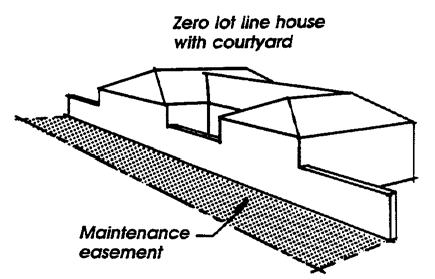
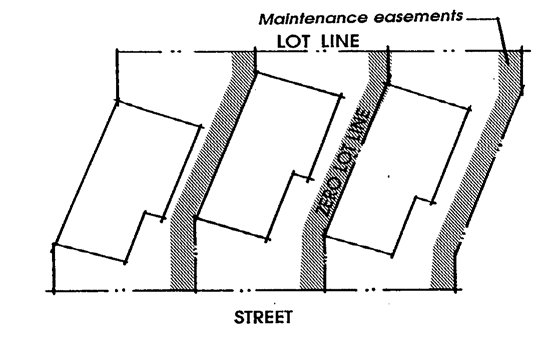
The zero lot line development provides for the placement of a detached single-family dwelling on one interior side yard with a zero-foot required setback while maintaining a minimum ten-foot setback on the other side. To accomplish this, the parcel adjacent to the zero side yard shall be held under the same ownership at the time of initial development and shall provide for either a zero setback or a minimum setback of ten feet. The opposite side yard (from the zero setback side) shall be perpetually maintained free of any obstructions, other than a required solid decorative masonry garden wall which shall be architecturally treated on both sides and be subject to the approval of the director. The masonry wall shall intersect with the rear property lines; (See diagrams below)
(8)
The zero side yard shall not be located adjacent to any private or public rights-of-way;
(9)
No portion of any structure or architectural element shall be permitted to project over any property line;
(10)
Exposure protection between adjoining structures shall be in compliance with the requirements/ specifications of the city building code and fire department;
(11)
The walls of the structure located on the zero lot line shall be constructed with low maintenance solid decorative masonry or masonry veneer;
(12)
The walls of the structure located on the zero lot line shall have no windows, doors, air conditioning units, or any other type of openings. Atriums/courts may be permitted on the zero lot line side when they are enclosed by three walls of the structure and a solid wall, a minimum of eight feet in height, is provided on the zero lot line. The eight-foot high wall shall be constructed of the same material as the exterior walls of the structure and be subject to the approval of the director;
(13)
Parking shall be provided and maintained in compliance with Section 6.04.34 (Off-Street Parking Standards). Tandem parking may be permitted in required garage structures only on parcels with alley access;
(14)
Landscaping shall be installed and maintained in compliance with Section 6.04.28 (Landscaping standards);
(15)
Each dwelling shall have a minimum of one hundred fifty square feet of private useable outdoor open space, with no dimension less than ten feet; and
(16)
In order to provide for maintenance and repair of structure(s) located on the zero lot line, a perpetual five-foot wide wall/maintenance easement shall be provided on the parcel adjacent to the zero lot property line which, with the exception of walls and/or fences, shall be kept clear of structures. This easement shall be shown on the parcel/tract map and incorporated into each deed transferring title to the subject property. The roof(s) of the structure(s) shall be designed to ensure that water runoff from the dwelling located on the common lot line is limited to the easement area.
U.
Farmworker Congregate Housing Development Standards (new section per Ord. 03-774 Adopted January 13, 2004). Standards governing Farmworker Congregate Housing are outlined in Section 6.04.23.
V.
Group Homes and Residential Care Facilities.
1.
Group homes and residential care facilities serving six or fewer clients shall only be subject to those restrictions that apply to single family dwellings in the same zone.
2.
Group homes serving seven or more clients shall be subject to the following restrictions:
a.
Landscaping and Maintenance. The applicant must provide adequate exterior maintenance to the facility and surrounding yard and setback areas. This shall include a plan demonstrating provisions for regular yard and landscape irrigation and maintenance and other items of routine maintenance.
b.
Parking. Sufficient parking on-site shall be provided. The applicant shall develop and implement a parking plan indicating the maximum number of vehicles proposed to be parked on and off the site, projected needs for parking at the site, and how the projected needs are proposed to be met.
3.
Residential care facilities serving seven or more clients shall be subject to the following restrictions:
a.
Location. Minimum distance requirements shall be consistent with the requirements of state law, if any.
b.
Landscaping and Maintenance. The applicant must provide adequate exterior maintenance to the facility and surrounding yard and setback areas. This shall include a plan demonstrating provisions for regular yard and landscape irrigation and maintenance and other items of routine maintenance.
c.
Parking. Sufficient parking on-site shall be provided. The applicant shall develop and implement a parking plan indicating the maximum number of vehicles proposed to be parked on and off the site, projected needs for parking at the site, and how the projected needs are proposed to be met.
W.
Transitional and Supportive Housing Development Standards. Transitional and supportive housing are considered a permitted use in all residential zones and are allowed in the public facilities zoned properties subject to a minor conditional use permit. Transitional housing and supportive housing shall be considered a residential use of property, and shall be subject to those restrictions and development standards that apply to other residential dwellings of the same type in the same zone.
(Ord. No. 17-877, § 1, 10-10-2017; Ord. No. 17-880, §§ 1, 2, 10-10-2017; Ord. No. 17-882, § 3, 12-12-2017; Ord. No. 18-895, §§ 5—7, 12-11-2018; Ord. No. 18-896, §§ 7—10, 12-11-2018; Ord. No. 19-902, § 4, 3-26-2019; Ord. No. 20-930, §§ 3, 4, 7-14-2020; Ord. No. 22-937, § 2, 3-22-2022; Ord. No. 24-972, § 5, 6-11-2024; Ord. No. 25-984, § 2, 10-26-2025; Ord. No. 25-987, § 6, 9-2-2025; Ord. No. 25-981, §§ 7—10, 6-10-2025)
6.04.0416 - Condominium Conversions (new section per Ord. 03-775 adopted January 13, 2004).
A.
Introduction. Residential condominium projects, residential condominium conversion projects, and conversions of rental mobile home parks to condominium ownership provide for individual ownership of separate dwelling units which are usually in close proximity to one another. A typical characteristic of such projects is a substantial common area which is managed and maintained by the individual owners of dwelling units through a homeowners' association and covenants, conditions and restrictions (CC&Rs). This type of ownership, which mixes individual ownership and ownership in common, among other things, can magnify the impact upon the public health, safety, welfare, convenience and economic well-being of the larger community if conditions of poor land use and site planning, mismanagement, neglect and blight are allowed to occur. The regulations in this chapter are intended to minimize such impacts while providing opportunities for first-time buyers, senior citizens, and lower income households to purchase their own homes.
B.
Applicability. The provisions of this chapter shall apply to all proposed residential condominium conversions.
C.
Development Permit Required. All residential condominium conversion projects shall require a development permit as provided in Section 6.04.0410.
D.
Regulations. All residential condominium conversion projects, including conversion of rental mobile home parks to ownership status (i.e., individual ownership of underlying, lots or other shared ownership of lots or common facilities) shall require a development permit as provided in Section 6.04.0410. The term "conversion of a mobile home park to ownership status" shall mean and include, by way of example but without limitation, any and all ownership changes by which an existing traditional mobile home park, wherein tenants own their individual units but rent spaces or lots within the park, is changed to a situation wherein tenants own, individually or in common, their individual underlying lots or spaces or common facilities within the park.
E.
Application Requirements. In addition to such other application requirements as may be established, no application for a development permit for a residential condominium conversion project, or for conversion of a rental mobile home park to condominium-type ownership, shall be deemed complete and acceptable for processing unless the application includes the following:
1.
A certified list of the names and addresses of all tenants residing in the project proposed to be converted, complete as of the time the application is filed.
2.
A list of each tenant known to have children eighteen years of age or younger residing in the project.
3.
A list of each tenant residing within the project known to be sixty-two years of age or older.
4.
Current rents for each unit.
5.
Approximate proposed price for which each unit would be sold.
6.
The pro forma budget proposed to be submitted to the state department of real estate or a similar estimate of projected annual operating expenses for the project after conversion and proposed level of maintenance fees or assessments to be borne by the individual unit owners.
7.
A property report prepared by a state-licensed civil engineer, architect or other qualified person approved by the building official. The report shall describe, in detail, the condition and the useful life of the roof, foundations, mechanical, electrical, plumbing, energy conservation, and structural elements of all existing permanent buildings on the property.
8.
A structural pest report for all existing permanent buildings on the property, prepared by a state licensed pest control operator.
9.
An acoustical report for all existing permanent residential buildings on the property which indicates the type of construction of existing walls and ceilings and noise attenuation characteristics of such construction. The test data shall include a sampling of at least ten percent of the dwelling units involved, but in no case fewer than two dwelling units. The reports shall include recommended methods of compliance with the insulation standards of the California Administrative Code Title 24, Part 2, Chapter 2035, and shall be prepared by a person experienced in the field of acoustical engineering.
10.
The location and nature of all existing onsite fire protection equipment, including but not limited to fire hydrants, stand pipes, fire sprinkler systems, and fire extinguishers shall be indicated on the plans submitted.
11.
A condominium map showing proposed property lines and common areas.
F.
Notice to Tenants. All tenants residing in the project proposed to be converted shall be notified of the proposed conversion by the applicant in accordance with the requirements of the Subdivision Map Act. In addition, written notice shall be mailed by the city to all tenants residing in the project proposed to be converted not less than ten days prior to the hearing n the development permit. Such notice shall specify the following:
1.
The date, time, place and purpose of the hearing.
2.
That should the development permit be approved, tenants may be required to vacate the premises.
3.
That should the development permit be approve, the property owner shall be required to give all tenants a minimum of one hundred eighty days' notice to vacate; and that such notice shall not restrict the exercise of lawful remedies pertaining to, but not limited to, tenants' defaults in the payment of rents or the defacing or destruction of all or part of the rented premises.
G.
Required Findings.
1.
In addition to those findings required for development permits, and prior to approving any residential condominium conversion project, other than conversions of rental mobile home parks to ownership status, the decision-making authority must make either all of the findings in paragraph (a) of this subsection or all of the findings in paragraph (b) of this subsection as follows:
(a)
That the proposed conversion will not adversely affect supply and availability of rental housing with the city or within a specific area in the city. This finding must be based upon a determination that:
(1)
The current vacancy rate for rental units within the city or within the specific area of the proposed conversion is not less than five percent, as determined by the most recent planning division survey or other reliable vacancy rate data acceptable to the city; and
(2)
If the project proposed to be converted is designed for families with children, or includes three and/or four bedroom units, the vacancy rates for these types of units within the city or within the specific area of the proposed conversion is not less than five percent, as determined by the most recent planning division survey or other reliable vacancy rate data acceptable to the city.
(b)
That mitigating circumstances exist which justify approval of the conversion when the applicable vacancy rate is lower than five percent. In addition to the other mitigating circumstances that must be found, this determination must also be based on at least one of the following two findings:
(1)
That new rental units will be constructed by the applicant which will replace those to be converted. The number of replacement units shall equal or exceed the number of units proposed to be converted. Replacement units shall be completed and occupancy permits issued prior to recordation of the final map for the conversion; or
(2)
That the conversion will help other city housing goals by providing a substantial percentage of its units at prices affordable to low and moderate income households in a manner consistent with the adopted housing element, and provision of such housing opportunities outweighs any loss of rental units.
2.
In addition to those findings required by subsection 1. of this section, and prior to approving conversion of a rental mobile home park to ownership status, the decision-making authority must also find that the proposed mobile home park conversion will not adversely affect the supply and availability of rental mobile home spaces in the city, or within a specified area in the city.
H.
Permit Approval.
1.
Unless otherwise provided in the development permit, all such permits authorizing residential condominium conversion projects, except for conversions of rental mobile home parks to ownership status, shall be subject to all of the following conditions, which shall be in addition to such other conditions deemed necessary or desirable by the decision-making authority.
(a)
The applicant shall provide relocation assistance equal to two times the monthly rent to any tenant household living in any unit at any time prior to tentative map approval, provided such tenant is not otherwise in default of the rental agreement. If the tenant elects to purchase a unit, such relocation assistance shall be applied to the cost of the unit. The applicant shall provide evidence that such assistance has been made as a condition of approval of the tentative map.
(b)
The applicant shall offer a lifetime lease to households in which the head of household or spouse is sixty-two years of age or older at the time of the final map approval. Reasonable annual rent increases shall be allowed, but shall not exceed the increase in the housing component of the Los Angeles-Long Beach Area Consumer Price Index, or any successor index designed to determine general increases in housing costs, for the preceding twelve-month period. Provisions setting forth this limitation on rent increases shall be incorporated into such lease. The applicant shall provide evidence that such offer has been made to all eligible tenants prior to filing for approval of the final subdivision map.
(c)
The applicant shall enter into leases, in a form approved by the city, within thirty days after final approval of the sale of units by the State of California with all tenants to whom offers of leases have been required who desire to remain as tenants pursuant to such lease.
(d)
The applicant shall provide alternate housing to tenant households at no additional cost to the tenant where substantial remodeling or rehabilitation occurs during conversion, and the unit being remodeled or rehabilitated is not habitable. The final determination of habitability shall be made by the building official.
(e)
The applicant shall submit to the building official for review and approval a complete set of plans and specifications detailing the necessary repair and upgrading required by the property report inspection report, pest report and acoustical report for any new construction.
(f)
The applicant shall submit to the building official for review and approval a construction phasing plan providing for safe pedestrian access, lighting and site conditions for those buildings and areas which will be occupied and used during the construction or repair. A work schedule indicating hours of construction activity, type of equipment to be used along with any proposed noise control, and a list of units which will be uninhabitable during construction, shall also be submitted to the building official.
(g)
The applicant shall request and receive inspection of individual dwelling units from the city's division of building and safety. Such notice of request for inspection shall be given in a timely and efficient manner. The division of building and safety shall identify any existing substandard conditions and notify the applicant of action required to rectify such substandard conditions.
(h)
The applicant shall submit a statement, signed by a person experienced in the field of acoustical engineering, certifying that the converted units conform to the noise insulation standards of California Administrative Code Title 24, Part 2, Chapter 2035 or any amendments thereto.
(i)
The applicant shall provide a reasonable degree of onsite fire protect ion as determined by the fire chief. Such protection shall include, but shall not be limited to, water supply, fire hydrant location, stand pipes and smoke detectors.
(j)
The applicant shall submit, prior to filing for approval of the final subdivision map, verification of compliance with the Fillmore Building Code, relating to smoke detector requirements.
2.
Unless otherwise stated in the development permit, all such permits allowing conversions of rental mobile home parks to condominium-type ownership shall be subject to all of the following conditions, which shall be in addition to such other conditions deemed necessary by the planning commission or city council.
(a)
The applicant shall provide relocation assistance in an amount equal to the actual cost of moving up to a maximum of seven hundred fifty dollars, adjusted annually equal to the greater of 1) the annual January-to-January increase in the Consumer Price Index ("CPI") for the Los Angeles-long Beach area as per the United States Department of Bureau of Labor Statistics, or 2) in accordance with State of California law relating to mobile home parks. In addition, utility connection fees shall be paid by the developer in an amount equal to the actual costs up to a maximum of one hundred dollars. If the tenant elects to purchase a lot, such relocation assistance shall be applied to the cost of the lot. The city council may, by separate resolution, periodically adjust the maximum amount set forth in this subsection to reflect increases in costs.
(b)
The applicant shall offer a lifetime lease to households in which the head of household or spouse is sixty-two years of age or older at the time of the final approval. Reasonable annual rent increases shall be permitted but shall not exceed the increase in the housing component of the Los Angeles- Long Beach Area Consumer Price Index, or any successor index designed to determine general increases in housing costs, for the preceding 12-month period provided further that should any rent stabilization laws be in effect, rental increases shall be no greater than the lesser of the amount permitted under the Consumer Price Index method or the rent stabilization law. Provisions setting forth this limitation on rent increases shall be incorporated into the lease. The applicant shall provide evidence that such offer has been made to all eligible tenants prior to filing for approval of the final subdivision map.
(c)
The applicant shall enter into leases in a form approved by the city, within thirty days after final approval of the sale of units by the State of California with all tenants to whom offers of leases have been required who desire to remain as tenants pursuant to such lease.
(d)
The applicant shall provide a reasonable degree of onsite fire protection, as determined by the fire chief. Such protection will include, but not be limited to, water supply, fire hydrant location, stand pipes and smoke detectors.
(e)
The applicant shall submit, prior to filing for approval of the final subdivision map, verification of compliance with the Fillmore Building code, relating to smoke detector requirements.
I.
Notice of Approval. Written notices shall be mailed by the city at applicant's expense to all tenant residing in the project within ten days after the approval of any development permit allowing a residential condominium conversion project including conversion of a rental mobile home park to condominium-type ownership. Such notice shall state all of the conditions of approval of the development permit.
J.
Denial of Conversion. It shall be against the public policy set forth in this chapter to attempt to evade its provisions by coercing the waiver of any rights or privileges created or protected herein.
1.
Coercion. The planning commission and city council may deny any proposed conversion where there is substantial or creditable evidence that tenants have been coerced to publicly support or approve a proposed conversion, or to refrain from publicly opposing it, or to forego any assistance to which they may be entitled.
2.
Waiver of Rights. Any provision of a lease or rental agreement which purports directly or indirectly to waive or require waiver of a tenant's rights under this chapter or which requires prior consent to the conversion of the apartment building, apartment complex, or mobile home park to condominium ownership shall be null, void, and unenforceable.
6.04.0417 - Density, intensity and density bonus provisions.
A.
Purpose. This Section 6.04.0417 ("section") is being enacted:
1.
To provide incentives for the production of housing for very low income, low income, moderate income and senior citizen households;
2.
To provide incentives for the creation of rental housing serving lower and moderate income households;
3.
To provide incentives for the construction of child care facilities serving very low, lower and moderate income households; and
4.
To implement California Government Code Sections 65915, 65915.5, and 65917, as required by subsection 65915(a). In enacting this section, the city also intends to implement the goals, objectives, and policies of the city's general plan housing element to encourage the construction of affordable housing in the city. It is also the city's intent to encourage the development of rental housing to serve an economically diverse community. Accordingly, the city desires to provide a density bonus upon the request of an applicant when the applicant is not otherwise required to include affordable or senior citizen restricted units in a project.
B.
Definitions. For purposes of this section, the following definitions shall apply. Unless specifically defined below, words or phrases shall be interpreted as to give this section its most reasonable interpretation.
"Affordable housing cost" bears the meaning as defined in Health and Safety Code Section 50052.5.
"Affordable ownership costs" means average annual housing costs, including mortgage payments, property taxes, homeowners' insurance, and homeowners' association dues, if any, which do not exceed the following:
1.
Very low income households: Fifty percent of area median income, adjusted for assumed household size based on unit size, multiplied by thirty percent.
2.
Lower income households: Seventy percent of area median income, adjusted for assumed household size based on unit size, multiplied by thirty percent.
3.
Moderate income households: One hundred ten percent of area median income, adjusted for assumed household size based on unit size, multiplied by thirty-five percent.
On an annual basis, the city shall make available copies of the U.S. Department of Housing and Urban Development household income limits applicable to owner-occupied affordable units subject to this section and may determine an inflation factor to establish the affordable ownership cost limits applicable to an affordable unit.
"Affordable rent" bears the same meaning as defined in Health and Safety Code Section 50053.
"Affordable units" are dwelling units which are affordable to very low, lower, or moderate income households as defined by this section or by any federal or state housing program and are subject to rental, sale, or resale provisions to maintain affordability.
"Applicant" means a developer or applicant for a density bonus who seeks and agrees to construct a qualified housing development on or after the effective date of the ordinance codified in this section pursuant to California Government Code Section 65915(b).
"Area median income" means area median income for Los Angeles County as published by the state of California pursuant to California Code of Regulations, Title 25, Section 6932, or a successor provision.
"Assumed household size based on unit size" means a household of one person in a studio apartment, two persons in a one bedroom unit, three persons in a two-bedroom unit, and one additional person for each additional bedroom thereafter.
"Child care facility" means a child day care facility other than a family day care home including, but not limited to, infant centers, preschools, extended day care facilities, and school age child care centers.
"City" means the City of Fillmore, California, including the city's successor agency and/or the city's housing authority acting on behalf of the city.
"Common interest development" means any of the following: a community apartment project, a condominium project, a planned development, or a stock cooperative.
"Density bonus" means a density increase over the otherwise allowable zoning maximum gross residential density on a site as of the date of application by the applicant to the city, granted pursuant to this section, or, if elected by the applicant, a lesser percentage of density increase, including, but not limited to, no increase in density.
"Density bonus housing agreement" means an agreement governing affordable and density bonus units as a condition of granting any density bonus, as further described in subsection "O" of this section.
"Density bonus units" mean residential units granted pursuant to this section which exceed the otherwise allowable zoning maximum residential density for a housing development.
"Development standard" means any site or construction condition including, but not limited to, a height limitation, a setback requirement, a floor area ratio, an on-site open-space requirement, or a parking ratio that applies to a housing development pursuant to any ordinance, general plan element, specific plan, or other local condition, law, policy, or regulation. A "site and construction condition" is a development condition or law that provides a specification for the physical development of a site and buildings on the site in a housing development.
"First approval" means the first of the following approvals to occur with respect to a housing development: Specific plan, development agreement, planned development permit, tentative map, minor land division, use permit, design permit, building permit, or any other development entitlement permit listed in the City of Fillmore Zoning Ordinance.
"Household income" means the combined adjusted gross household income for all adult persons living in a residential unit as calculated for the purpose of the Section 8 program under the United States Housing Act of 1937, as amended, or its successor provision.
"Housing development" means one or more groups of projects for residential units in the planned development of the city, including mixed-use developments. "Housing development" also includes a subdivision or common interest development, as defined in California Civil Code Section 4100, approved by the city and consisting of residential units or unimproved residential lots and either a project to substantially rehabilitate and convert an existing commercial building to residential use or the substantial rehabilitation of an existing multifamily dwelling, as defined in Government Code Section 65863.4(d), where the result of the rehabilitation would be a net increase in available residential units. For the purpose of calculating a density bonus, the residential units shall be on contiguous sites that are the subject of one development application, but do not have to be based upon individual subdivision maps or parcels. For purposes of this section, "housing development" does not include projects for less than five dwelling units.
"Incentives and concessions" are regulatory concessions as listed in subsection "J" of this section.
"Lower income household" shall have the same meaning as provided in California Health and Safety Code Section 50079.5.
"Major transit stop" bears the meaning as defined in Public Resources Code Section 21155(b).
"Market-rate unit" means a dwelling unit which is not an affordable unit or an inclusionary unit.
"Maximum residential density" means the maximum number of dwelling units permitted by the City of Fillmore Zoning Ordinance and land use element of the general plan or, if a range of density is permitted, means the maximum allowable density for the specific zoning range and land use element of the general plan applicable to the project. Where the density allowed under the City of Fillmore Zoning Ordinance is inconsistent with the density allowed under the land use element of the general plan, the general plan density shall prevail. The maximum allowable density is based on the date an application for a housing development is deemed complete. This definition is used to calculate a density bonus pursuant to this section.
"Moderate income household" shall have the same meaning as provided in California Health and Safety Code Section 50093.
"Replace" and "replacement" in the context of subsection D means either of the following:
1.
If any dwelling units described in subsection D.1 are occupied on the date of application, the proposed housing development shall provide at least the same number of units of equivalent size to be made available at affordable rent or affordable housing cost to, and occupied by, persons and families in the same or lower income category as those households in occupancy. If the income category of the household in occupancy is not known, it shall be rebuttably presumed that lower income renter households occupied these units in the same proportion of lower income renter households to all renter households within the jurisdiction, as determined by the most recently available data from the United States Department of Housing and Urban Development's Comprehensive Housing Affordability Strategy database. For unoccupied dwelling units described in subsection D.1 in a development with occupied units, the proposed housing development shall provide units of equivalent size to be made available at affordable rent or affordable housing cost to, and occupied by, persons and families in the same or lower income category as the last household in occupancy. If the income category of the last household in occupancy is not known, it shall be rebuttably presumed that lower income renter households occupied these units in the same proportion of lower income renter households to all renter households within the jurisdiction, as determined by the most recently available data from the United States Department of Housing and Urban Development's Comprehensive Housing Affordability Strategy database. All replacement calculations resulting in fractional units shall be rounded up to the next whole number; or
2.
If all dwelling units described in subsection D.1 have been vacated or demolished within the five-year period preceding the application, the proposed housing development shall provide at least the same number of units of equivalent size as existed at the highpoint of those units in the five-year period preceding the application to be made available at affordable rent or affordable housing cost to, and occupied by, persons and families in the same or lower income category as those persons and families in occupancy at that time, if known. If the incomes of the persons and families in occupancy at the highpoint is not known, it shall be rebuttably presumed that low-income and very low income renter households occupied these units in the same proportion of low-income and very low income renter households to all renter households within the jurisdiction, as determined by the most recently available data from the United States Department of Housing and Urban Development's Comprehensive Housing Affordability Strategy database. All replacement calculations resulting in fractional units shall be rounded up to the next whole number.
For purposes of this definition, "equivalent size" means that the replacement units contain at least the same total number of bedrooms as the units being replaced.
"Senior citizen housing development" means senior citizen housing as defined in Section 51.3 (a housing development developed, substantially rehabilitated, or substantially renovated for senior citizens that has at least thirty-five dwelling units) and California Civil Code Section 51.12, or a mobile home park that limits residency based on age requirements for housing for older persons pursuant to Civil Code Section 798.76 or 799.5.
"Specific adverse impact" means a significant, quantifiable, direct, and unavoidable impact, based on objective, identified written public health or safety standards, policies, or conditions as they existed on the date that the application for the housing development was deemed complete. Mere inconsistency with the City of Fillmore Zoning Ordinance or the General Plan land use designation shall not constitute a specific, adverse impact upon the public health or safety.
"Very low income household" shall have the same meaning as provided in California Health and Safety Code Section 50105.
C.
Density Bonuses for Affordable, Senior Citizen and Transitional Housing.
1.
Density Bonuses for Very Low Income, Lower Income, Senior Citizen and Transitional Housing. Upon written request to the city, an applicant for a housing development is eligible for one density bonus of twenty percent over the maximum residential density (except in the case of senior citizen housing, as provided below), provided that the applicant agrees to construct the housing development in accordance with one of the following criteria:
i.
Five percent of the total dwelling units, excluding any units permitted by the density bonus, are provided at affordable rent or ownership costs to very low income households; or
ii.
Ten percent of the total dwelling units, excluding any units permitted by the density bonus, are provided at affordable rent or ownership costs to lower income households; or
iii.
Senior citizen housing developments. For senior citizen housing developments, the density bonus shall be twenty percent of the number of senior housing units provided.
iv.
Foster, veteran and homeless housing. For developments providing ten percent of the total dwelling units, excluding any units permitted by the density bonus, for transitional foster youth, as defined in California Education Code Section 66025.9, disabled veterans, as defined in Government Code Section 18541, or homeless persons, as defined in the federal McKinney-Vento Homeless Assistance Act (42 U.S.C. Sec. 11301 et seq.) the density bonus shall be twenty percent of the number of the transitional units giving rise to a density bonus.
2.
Moderate Income Housing. Upon written request to the city, an applicant for a housing development is eligible for one density bonus of five percent over the maximum residential density if the applicant agrees to construct the housing development in accordance with all of the following criteria:
i.
At least ten percent of the total dwelling units, excluding any units permitted by the density bonus, are provided at affordable ownership costs to moderate income households; and
ii.
The housing development is a common interest project as defined by California Civil Code Section 1351; and
iii.
All of the dwelling units in the housing development are offered for sale to the public.
3.
Higher Density Bonus for Greater Contribution of Affordable Units. Upon written request to the City, an applicant for a housing development that is eligible for a density bonus based upon the contribution of affordable units, may receive a higher amount of density bonus if the percentage of very low, lower, and moderate income housing units exceeds the base percentage established in subparagraphs i or ii of this subsection, as follows:
i.
Very Low Income Units—For each one percent increase above five percent in affordable units for very low income households, the density bonus shall be increased by two and one-half percent up to a maximum of thirty-five percent, as follows:
ii.
Lower Income Units—For each one percent increase above ten percent in affordable units for lower income households, the density bonus shall be increased by one and one-half percent up to a maximum of thirty-five percent, as follows:
iii.
Moderate Income Ownership Units—For each one percent increase above ten percent in affordable units offered for sale to moderate income households, the density bonus shall be increased by one percent up to a maximum of thirty-five percent, as follows:
4.
Continued Affordability. Affordable units that qualified a housing development for a density bonus shall remain affordable as follows:
i.
Very low income and lower income rental dwelling units shall remain at an affordable rent to the designated income group for a minimum of fifty-five years, or for a longer period of time if required by any construction or mortgage financing assistance program, mortgage insurance program, or rental subsidy program applicable to the dwelling units.
a.
The foster care, veteran and homeless units described in subsection C.1, subparagraph 4, shall be subject to a recorded affordability restriction of fifty-five years and shall be provided at the same affordability level as very low income units.
b.
Replacement units per subsection D of this Section that are rental dwelling units shall be subject to a recorded affordability restriction for at least fifty-five years.
c.
Replacement units per subsection D of this section that are for-sale units, shall be subject to the following subparagraph C.4, subparagraph ii. hereof.
ii.
An applicant shall agree to, and the city shall ensure, that the initial occupant of all for-sale units that qualified the applicant for the award of the density bonus in a common interest development, are persons and families of very low, low, or moderate income and that the units are offered at an affordable housing cost. The city shall enforce an equity-sharing agreement, unless it is in conflict with the requirements of another public funding source or law. The following shall apply to the equity-sharing agreement:
a.
Upon resale, the seller of the unit shall retain the value of any improvements, the down payment, and the seller's proportionate share of appreciation. The city shall recapture any initial subsidy and its proportionate share of appreciation, which shall then be used within three years for any of the purposes that promote homeownership as described in California Health and Safety Code Section 33334.2(e) that promote homeownership.
b.
For purposes of this subsection, the city's initial subsidy shall be equal to the fair market value of the home at the time of initial sale minus the initial sale price to the moderate-income household, plus the amount of any downpayment assistance or mortgage assistance. If upon resale the market value is lower than the initial market value, then the value at the time of the resale shall be used as the initial market value.
c.
For purposes of this subsection, the city's proportionate share of appreciation shall be equal to the ratio of the initial subsidy to the fair market value of the home at the time of initial sale.
iii.
The resale price of any owner-occupied affordable unit shall not exceed the affordable ownership costs with the following exceptions: (a) customary closing costs and costs of sale; or (b) costs of real estate commissions paid by the seller if a licensed real estate salesperson is employed; or (c) consideration of permanent capital improvements installed by the seller.
iv.
These provisions for continued affordability shall be a provision of the density bonus housing agreement required by subsection O hereof.
5.
Specification of Basis for Density Bonus. Each applicant who requests a density bonus pursuant to this section, shall elect whether the bonus will be awarded on the basis of subparagraph C.1(i), C.1(ii), C.1(iii), C.1(iv) or subsection C.2 of this section. Each housing development is entitled to only one density bonus, which may be selected based on the percentage of either very low income affordable housing units, lower income affordable housing units or moderate income affordable housing units, or the development's status as a senior citizen housing development. Density bonuses from more than one of these categories may not be combined.
D.
Density Bonuses and Replacement Affordable Housing Requirements.
1.
An applicant shall be ineligible for a density bonus or any other incentives or concessions under this section if the housing development is proposed on any property that includes a parcel or parcels on which rental dwelling units are, or if the dwelling units have been vacated or demolished in the five-year period preceding the application have been, subject to a recorded covenant, ordinance, or law that restricts rents to affordable rent levels; subject to any other form of rent or price control through a public entity's valid exercise of its police power; or occupied by lower or very low income households, unless the proposed housing development replaces those units, and either of the following applies:
i.
The proposed housing development (inclusive of the units replaced pursuant to this section) contains affordable units at, at least, the percentages set forth in subsection C.1 of this section; or
ii.
Each unit in the development (exclusive of a manager's unit or units) is affordable to, and occupied by, either a lower or very low income household.
iii.
Nothing in this section shall apply to an applicant seeking a density bonus for a proposed housing development if the application was submitted to, or processed by, a city before January 1, 2015.
2.
If all pre-existing dwelling units described in subsection D.1 of this section have been vacated or demolished within the five-year period preceding the application, the proposed housing development shall replace at least the same number of units of equivalent size as existed at the highpoint of those units in the five-year period preceding the application to be made available at affordable rent or affordable housing cost to, and occupied by, persons and families in the same or lower income category as those persons and families in occupancy at that time, if known. If the incomes of the persons and families in occupancy at the highpoint is not known, it shall be rebuttably presumed that low-income and very low income renter households occupied these units in the same proportion of low-income and very low income renter households to all renter households within the jurisdiction, as determined by the most recently available data from the United States Department of Housing and Urban Development's Comprehensive Housing Affordability Strategy database. All replacement calculations resulting in fractional units shall be rounded up to the next whole number.
E.
Additional Density Bonus for Donations of Land.
1.
Upon written request, when an applicant for a tentative map, subdivision map, parcel map, or other residential development approval qualified for a density bonus pursuant to subsection C of this section also donates land to the city in accordance with this section, the applicant shall be entitled to an additional density bonus. Applicants donating land to the city shall be eligible for an additional fifteen percent density bonus at the site of the housing development if the donated land is suitable for the construction of very low income units equaling at least ten percent of the market-rate units being constructed for the project. The density bonus provided pursuant to this section shall be in addition to any density bonus granted pursuant to subsection C, up to a maximum combined density bonus of thirty-five percent.
2.
To qualify for the additional density bonus described in subsection E.1 of this section, the donation of land must meet all of the following criteria:
i.
The tentative map, subdivision map, parcel map, or other residential development must otherwise be subject to a density bonus pursuant to subsection C of this section; and
ii.
The land must be transferred no later than the date of the approval of the final subdivision map, parcel map, or housing development application; and
iii.
The developable acreage and zoning classification of the land being transferred must be sufficient to permit construction of dwelling units affordable to very low income households in an amount not less than ten percent of the total number of market rate dwelling units in the proposed development (i.e., the proposed development before the addition of any density bonus); and
iv.
The donated land is at least one acre in size or is large enough to permit development of at least forty units, has the appropriate general plan land use designation, has the appropriate zoning and development standards for affordable housing and, at the time of project approval is, or at the time of construction will be, served by adequate public facilities and infrastructure; and
v.
No later than the date of approval of the final map, parcel map, or other development application for the housing development, the donated land must have all of the applicable permits and approvals (other than building permits) necessary for the development of the very low income housing units on the donated land, except that the city may subject the proposed housing development to subsequent design review to the extent authorized by California Government Code Section 65583.2 subsection (i) if the design is not reviewed by the city prior to the time of transfer; and
vi.
The donated land is subject to a deed restriction ensuring continued affordability of the very low income units consistent with subsection C.4 of this section, which deed restriction shall be recorded upon the donated property at the time of its transfer; and
vii.
The land will be transferred to the city or to a housing developer approved by the city. The city reserves the right to require the applicant to identify a developer and to require that the land be transferred to that developer; and
viii.
The land is within the boundary of the proposed housing development or within one-quarter mile of the boundary of the proposed housing development; and
ix.
No later than the date of approval of the final map, parcel map, or other development application for the housing development, a proposed source of funding for the construction of the very low income units shall be identified.
3.
Additional Density Bonus Based on Greater Suitability of Land for Very Low Income Housing. For each one percent increase above the minimum ten percent in the number of very low income housing units that can be accommodated on the donated land, the maximum density bonus shall be increased by one percent, up to a maximum of thirty-five percent, as follows:
F.
Density Bonus and Incentives for Condominium Conversions.
1.
An applicant for a conversion of existing rental apartments to condominiums is eligible for either a density bonus or other incentives of equivalent financial value, at the option of the city, if the applicant agrees to provide:
i.
At least thirty-three percent of the total units of the proposed condominium project to persons and families of low or moderate income as defined in Health and Safety Code Section 50093; or
ii
At least fifteen percent of the total units of the proposed condominium project to lower income households as defined in Health and Safety Code Section 50079.5; and
iii.
The applicant agrees to pay for the reasonably necessary administrative costs incurred by the city pursuant to this subsection.
2.
Condominium conversions qualified under subsection F.1 may receive one of the following, at the City's option:
i.
A flat density bonus of twenty-five percent to be provided within the existing structure or structures proposed for conversion, excepting that a condominium conversion is ineligible for this bonus if the apartments to be converted originally received a density bonus or incentives pursuant to any other provisions of this section or pursuant to California Government Code Section 65915. Qualified applicants may choose to implement a lower density bonus.
ii.
Incentives of equivalent financial value in the form of a reduction or waiver of requirements or fees which the city might otherwise apply as conditions of conversion approval. "Other incentives of equivalent financial value" shall not be construed to require the city to provide cash transfer payments or other monetary compensation to the condominium conversion project or its applicant.
3.
The city reserves the right to place such reasonable conditions on the granting of a density bonus or other incentives of equivalent financial value pursuant to this section as it finds appropriate, including, but not limited to, conditions which assure continued affordability of units to subsequent purchasers who are persons and families of low and moderate income or lower income households.
4.
Condominium conversions are eligible only for the granting of a density bonus or incentive of equivalent value pursuant to this subsection F, which bonus or incentive may not be granted in addition to, or combined with, any other incentives, concessions, density bonuses or waivers and reductions of development standards pursuant other sections of this section. Nothing in this subsection F shall be construed to require the city to approve a proposal to convert rental apartments into condominiums.
5.
An applicant for approval to convert apartments to a condominium project may submit to the city a preliminary proposal pursuant to this section prior to the submittal of any formal requests for subdivision map approvals. The city shall, within ninety days of receipt of a written proposal, notify the applicant in writing of the manner in which it will comply with this section. The procedures for processing an application pursuant to this section shall be those established pursuant to article IV of the City of Fillmore Zoning Ordinance.
6.
An applicant shall be ineligible for a density bonus or any other incentives or concessions under this section if the condominium project is proposed on any property that includes a parcel or parcels on which rental dwelling units are or, if the dwelling units have been vacated or demolished in the five-year period preceding the application, have been subject to a recorded covenant, ordinance, or law that restricts rents to levels affordable to persons and families of lower or very low income; subject to any other form of rent or price control through a public entity's valid exercise of its police power; or occupied by lower or very low income households, unless the proposed condominium project replaces those units, and either of the following applies:
i.
The proposed condominium project, inclusive of the units replaced, contains affordable units at the percentages set forth in subsection F.1 of this section.
ii.
Each unit in the development, exclusive of a manager's unit or units, is affordable to, and occupied by, either a lower or very low income household.
iii.
This subsection F.6 does not apply to an applicant seeking a density bonus for a proposed housing development if their application was submitted to, or processed by, the city before January 1, 2015.
G.
Density Bonus and Concessions/Incentives for Child Care Facilities.
1.
A housing development that is eligible for a density bonus pursuant to subsection C that includes a child care facility qualified under this section is also eligible for either of the following, at the option of the city, if requested in writing by the applicant:
i.
An additional density bonus that is an amount of square feet of residential space that is equal to or greater than the amount of square feet in the child care facility; or
ii.
An additional concession or incentive that contributes significantly to the economic feasibility of the construction of the child care facility.
2.
A child care facility will only qualify the housing development for an additional density bonus or incentive or concession if it is:
i.
Located on the premises of, as part of, or adjacent to the housing development; and
ii.
The housing development is eligible for a density bonus pursuant to subsection C. As a condition of approving the additional density bonus for the housing development, the child care facility must meet all of the following criteria:
a.
The child care facility shall be used exclusively for child care for a period of time that is as long as or longer than the period of time during which the affordable units are required to remain affordable as stated in deed restrictions and pursuant to subsection C.4 of this section; and
b.
Of the children who attend the child care facility, the percentage of children of very low income households, lower income households, or moderate income households shall be equal to or greater than the percentage of dwelling units in that housing development that are proposed to be affordable to very low income households, lower income households, or moderate income households pursuant to subsection C.
3.
Notwithstanding any requirement of this subsection G, the city shall not be required to provide a density bonus or concession or incentive for a child care facility if it makes a written finding, based upon substantial evidence, that the community already has adequate child care facilities.
H.
Commercial Housing; Agreement for Partnered Housing to Contribute Affordable Housing. When an applicant for approval of a commercial development has entered into an agreement for partnered housing described in Health and Safety Code Section 65915.7 to contribute affordable housing through a joint project or two separate projects encompassing affordable housing, the city shall grant to the commercial developer such development bonuses as prescribed in in Health and Safety Code Section 65915.7. This subsection H shall remain in effect only until January 1, 2022, and as of that date is repealed.
I.
General Provisions Governing Density Bonus Calculations.
1.
For the purposes of any provisions in this section, an applicant may elect to accept a lesser percentage of density bonus than that to which the housing development is eligible.
2.
When calculating the number of permitted density bonus units, any calculations resulting in fractional units shall be rounded up to the next larger whole number.
3.
For the purpose of calculating a density bonus, the dwelling units shall be on contiguous sites that are the subject of one development application, but do not have to be based upon individual subdivision maps or parcels. The density bonus shall be permitted in geographic areas of the housing development other than the areas where the affordable units are located.
4.
For the purposes of this section, the term "total units" or "total dwelling units" in a housing development does not include those units added by any density bonus.
5.
Regardless of the number or extent of affordable units, senior housing, land dedication, child care facilities or other qualifications for a density bonus provided in any single housing development, no housing development may be entitled to a total density bonus of more than thirty-five percent.
Notes:
(1) Maximum of 25% bonus for condominium conversions, or an incentive of equal value, at the city's option.
J.
Incentives and Concessions.
1.
Definition of a Qualified Concession or Incentive. An applicant for a density bonus pursuant to subsection C of this section may also submit to the city a written proposal for specific incentives or concessions as provided in this section. The applicant may also request a meeting with the city manager or designee to discuss such proposal. For purposes of this section, concessions and incentives include any of the following:
i.
Reductions in site development standards or modifications of zoning requirements or architectural design requirements that exceed the minimum building standards approved by the California Building Standards Commission as provided in Part 2.5 (commencing with Section 18901) of Division 13 of the California Health and Safety Code. These include, without limitation, a reduction in setback and square footage requirements and in the ratio of vehicular parking spaces that would otherwise be required. In order to qualify as a "concession or incentive," the city must be able to find, based on substantial evidence, that the requested reductions in site development standards result in identifiable and actual cost reductions to provide for affordable housing costs or for rents for the targeted units to be set as specified in subsection C.4 of this section; or
ii.
Approval of mixed use zoning in conjunction with the housing development if commercial, office, industrial, or other land uses will reduce the cost of the housing development and if the commercial, office, industrial or other land uses are compatible with the housing development and the existing or planned development in the area where the proposed housing development will be located; or
iii.
Other regulatory incentives or concessions proposed by the applicant or the city, so long as the city can find, based on substantial evidence, that such proposals result in identifiable and actual cost reductions to provide for affordable housing costs or for rents for the targeted units to be set as specified in subsection C.4 of this section.
2.
Findings to Deny Concession or Incentive. The City shall grant the concession or incentive requested by the applicant unless the city makes a written finding, based upon substantial evidence, of any of the following:
i.
The concession or incentive does not result in identifiable and actual cost reductions to provide for affordable housing costs or for affordable rents for the targeted units to be set as specified in subsection C.4 of this section; or
ii.
The concession or incentive would have a specific adverse impact upon public health and safety or the physical environment or on any real property that is listed in the California Register of Historical Resources and for which there is no feasible method to satisfactorily mitigate or avoid the specific adverse impact without rendering the development unaffordable to low-income and moderate-income households; or
iii.
The concession or incentive would be contrary to state or federal law.
3.
Number of Concessions or Incentives. If all other provisions of this subsection J are satisfied, an applicant will be eligible for the following number of incentives and concessions:
i.
One incentive or concession for housing developments where at least five percent of the total units are for very low income households, at least ten percent of the total units are for lower income households, or at least ten percent of the total units in a common interest development are sold to moderate income households;
ii.
Two incentives or concessions for housing developments where at least ten percent of the total units are for very low income households, at least twenty percent of the total units are for lower income households, or at least twenty percent of the total units in a common interest development are sold to moderate income households; or
iii.
Three incentives or concessions for housing developments where at least fifteen percent of the total units are for very low income households, at least thirty percent of the total units are for lower income households, or at least thirty percent of the total units in a common interest development are sold to moderate income households.
;adv=1;Notes:
(1) An incentive or concession may be requested only if an application is also made for a density bonus.
(2) Incentives or concessions may be selected from only one category (very low, lower, or moderate).
(3) No incentives or concessions are available for land donation.
4.
This subsection J does not limit or require the provision of direct financial incentives for the housing development, including the provision of publicly owned land, by the city or the waiver of fees or dedication requirements. Nor does any provision of this subsection require the city to grant an incentive or concession found to have a specific adverse impact.
5.
The granting of a concession or incentive shall not require, or be interpreted, in and of itself, to require a general plan amendment, local coastal plan amendment, zoning change, study, or other discretionary approval. For purposes of this section, "study" does not include reasonable documentation to establish eligibility for the concession or incentive or to demonstrate that the proposal meets the definition of an "incentive or concession." Except as provided in subsections J.3 and K.1, the granting of a density bonus shall not require or be interpreted to require the waiver of a local ordinance or provisions of a local ordinance unrelated to development standards.
K.
Waivers and Modifications of Development Standards.
1.
Applicants granted a density bonus pursuant to subsection C of this section may, by written proposal, seek a waiver, modification or reduction of development standards that would otherwise have the effect of physically precluding the construction of the housing development at the densities or with the concessions or incentives permitted pursuant to this section. The applicant may also request a meeting with the city to discuss such request for waivers and modifications.
2.
To obtain a waiver or modification of development standards, the applicant shall show that the development standards will have the effect of physically precluding the construction of a housing development meeting the criteria of subsection C.1 and C.2 of this section at the densities or with the concessions or incentives permitted by this section.
3.
A proposal for the waiver or reduction of development standards pursuant to this section shall neither reduce nor increase the number of incentives or concessions to which the applicant is entitled pursuant to subsection J.
4.
The city may deny a request for any waiver, modification or reduction of development standards if the wavier, modification or reduction would have a specific adverse impact and there be no feasible method to satisfactorily mitigate or avoid the specific adverse impact.
L.
Parking incentives.
1.
Except as provided in subsections L.2 and L.3 hereinbelow, upon the written request of the applicant for a housing development meeting the criteria for a density bonus under subsection C, the city shall not require a vehicular parking ratio that exceeds the following:
i.
Zero to one-bedroom units: One on-site parking space.
ii.
Two to three-bedroom units: Two on-site parking spaces.
iii.
Four and more bedroom units: Two and one-half parking spaces.
2.
Notwithstanding subsection L.1 above, if a development includes the maximum percentage of low-income or very low income units provided for in subsections C.1 and C.2 of this section, and is located within one-half mile of a major transit stop and there is unobstructed access to the major transit stop from the development, then, upon the request of the developer, the city shall not impose a vehicular parking ratio that exceeds one-half spaces per bedroom. For purposes of this subsection L, a development shall have unobstructed access to a major transit stop if a resident is able to access the major transit stop without encountering natural or constructed impediments.
3.
Notwithstanding subsection L.1 above, if a development consists solely of rental units, exclusive of manager units, with an affordable housing cost to lower income families, then, upon the request of the developer, the city shall not impose a vehicular parking ratio that exceeds the following ratios:
i.
If the development is located within one-half mile of a major transit stop, and there is unobstructed access to the major transit stop from the development, the ratio shall not exceed one-half space per unit.
ii.
If the development is a for-rent housing development for individuals who are sixty-two years of age or older that complies with Civil Code Sections 51.2 and 51.3, the ratio shall not exceed one-half space per unit. The development shall have either paratransit service or unobstructed access, within one-half mile, to fixed bus route service that operates at least eight times per day.
iii.
If the development is a special needs housing development, as defined in Health and Safety Code Section 51312, the ratio shall not exceed three-tenths space per unit. The development shall have either paratransit service or unobstructed access, within one-half mile, to fixed bus route service that operates at least eight times per day.
4.
Notwithstanding subsections L.2 and L.3 above, if the city or an independent consultant has conducted an area-wide or jurisdiction-wide parking study in the last seven years prior to any density bonus application, then the city may impose a higher vehicular parking ratio not to exceed the ratio described in subsection L.1, based upon substantial evidence found in the parking study, that includes, but is not limited to, an analysis of parking availability, differing levels of transit access, walkability access to transit services, the potential for shared parking, the effect of parking requirements on the cost of market-rate and subsidized developments, and the lower rates of car ownership for low-income and very low income individuals, including seniors and special needs individuals. The city shall bear the costs of any such study. The city shall make findings, based on the parking study completed in conformity with this paragraph, supporting the need for the higher parking ratio.
5.
Guest parking and handicapped parking shall be included within the maximum number of spaces that may be required. If the total number of parking spaces required for a housing development is other than a whole number, the number shall be rounded up to the next whole number. For purposes of this section, a housing development may provide on-site parking through tandem parking or uncovered parking, but not through on-street parking. This section shall apply to a development that meets the requirements of subsection C of this section, but only at the request of the applicant.
M.
Standards for Density Bonus Housing Developments.
1.
Affordable units qualifying a housing development for a density bonus shall be reasonably dispersed throughout the housing development and compatible with the design of market-rate units in terms of appearance, materials, and finished quality. The applicant may reduce the interior amenities and square footage of inclusionary units, provided all units conform to all other requirements of the City of Fillmore Zoning Ordinance.
2.
For developments with multiple market-rate units containing differing numbers of bedrooms, affordable units qualifying a housing development for a density bonus shall be representative of the market-rate unit mix.
3.
All building permits for affordable units qualifying a housing development for a density bonus shall be issued concurrently with, or prior to, issuance of building permits for the market rate units, and the affordable units shall be constructed concurrently with, or prior to, construction of the market rate units. Occupancy permits and final inspections for affordable units qualifying a housing development for a density bonus shall be approved concurrently with, or prior to, approval of occupancy permits and final inspections for the market rate units.
N.
Application Requirements.
1.
A written application for a density bonus, incentive, concession, waiver, or modification pursuant to this section shall be submitted with the first application for approval of a housing development and processed concurrently with all other applications required for the housing development. The application shall be submitted on the form prescribed by article IV of the City of Fillmore Zoning Ordinance and shall additionally include at least the following information:
i.
Site plan showing total number of units, number and location of affordable units, and number and location of proposed density bonus units. The site plan shall describe the size, in square footage, of all affordable units and density bonus units.
ii.
A marketing plan that describes how the applicant will inform the public, and those within the appropriate income groups, of the availability of affordable units.
iii.
The location, structure (attached, semi-attached, or detached), proposed tenure (for sale or rental), and size of the proposed market-rate units, any commercial space, density bonus units, and/or affordable units.
iv.
Level of affordability proposed for each affordable housing unit and proposals for ensuring affordability.
v.
Description of any requested incentives, concessions, waivers or modifications of development standards, or modified parking standards. The application shall include evidence that the requested incentives and concessions are required for the provision of affordable housing costs and/or affordable rents, as well as evidence relating to any other factual findings required under subsection(s) J, K and/or L of this section, as applicable.
vi.
If a density bonus or concession is requested in connection with a land donation, the application shall show the location of the land to be dedicated and provide evidence that each of the findings included in subsection E can be made.
vii.
If a density bonus or concession/incentive is requested for a child care facility, the application shall show the location and square footage of the child care facilities and provide evidence that each of the findings included subsection G can be made.
viii.
For phased projects, a phasing plan that provides for the timely development of the number of affordable units proportionate to each proposed phase of development.
ix.
Any other information reasonably requested by the planning commission to assist with evaluation of the application, excepting that neither the city nor any body thereof may condition the submission, review, or approval of an application pursuant to this section on the preparation of an additional report or study that is not otherwise required by state law or the terms of this section.
2.
An application for a density bonus, incentive or concession pursuant to this section shall be considered by and acted upon by the approval body with authority to approve the housing development and subject to the same administrative appeal procedure, if any, as more particularly described in article IV of the City of Fillmore Zoning Ordinance. The city shall notify the applicant for a density bonus whether the application is complete in a manner consistent with Government Code Section 65943. The application shall be processed in the same timeframes as applicable to the underlying development approval. In accordance with state law, neither the granting of a concession, incentive, waiver, or modification nor the granting of a density bonus shall be interpreted, in and of itself, to require a general plan amendment, zoning change, variance, or other discretionary approval. Provisions of the City of Fillmore Zoning Ordinance governing standards of design review and/or special use permits that are more restrictive than, or contrary to, the provisions of this section shall be inapplicable to an application for density bonus.
3.
For housing developments requesting a waiver, modification or reduction of a development standard, an application pursuant to this subsection N shall be heard in conjunction with the application for density bonus. A public hearing shall be held by the planning commission and the commission shall issue a written determination. Pursuant to Government Code Section 65915, the planning commission shall approve the requested waiver/modification or reduction of development standards, unless one of the following conditions applies:
i.
The development standards subject to the waiver/modification do not have the effect of physically precluding the construction of the housing development at the densities or with the concessions or incentives permitted pursuant to this section.
ii.
The waiver/modification will have a specific adverse impact.
4.
The decision of the city planning commission may be appealed to the city council in accordance with section 6.04.80. Notice of any city determination pursuant to this subsection shall be provided to the same extent as required for the underlying development approval.
O.
Density Bonus and Housing Agreements.
1.
In General. As a condition to approval of any density bonus pursuant to this section, the applicant shall agree to enter into a density bonus housing agreement with the city, which agreement shall be binding upon the applicant and all successors in interest. The form of the density bonus housing agreement will vary, depending on the manner in which the provisions of this section are satisfied for a particular development. The agreement shall be recorded as a restriction on the parcel or parcels on which the affordable units and the density bonus units will be constructed. The approval and recordation of the agreement shall take place prior to final map approval, or, where a map is not being processed, prior to issuance of building permits for such parcels or units. The agreement must include, at minimum, all of the information required for the initial application as set forth in subsection N.1 above.
2.
Density Bonus Housing Agreements for Ownership Units. In the case of housing developments consisting of ownership units, the density bonus housing agreement must provide the following additional conditions governing the sale and use of affordable units:
i.
In accordance with the requirements of Government Code Section 65915, affordable units shall be sold initially only to very low income households, lower income households, or moderate income households in a common interest development, at an affordable ownership cost as defined by this section.
ii.
Affordable units shall be owner-occupied by very low income, lower income households, or moderate income households within a common interest development.
iii.
Any conditions as necessary or directed by the city council for the subordination or prioritization of liens or mortgages upon the parcel underlying the owner-occupied affordable unit(s).
iv.
The purchaser of each affordable unit shall execute a deed instrument approved by the city, which instrument shall restrict the sale of the affordable unit in accordance with this section. Such instrument shall be recorded against the parcel containing the affordable unit and shall contain such provisions as the city may require to ensure continued compliance with this section and with Government Code Section 65915. The instrument or agreement shall provide for equity-sharing as set forth in Government Code Section 65915. The deed restrictions required for affordable units shall specify that the title to the subject property shall only be transferred with prior written approval by the city.
v.
Any additional obligations relevant to the compliance with this section.
3.
Density Bonus Housing Agreements for Rental Units. In the case of housing developments consisting of rental units, the density bonus housing agreement must provide the following additional conditions governing the use of affordable units during the affordability restriction period:
i.
Specific property management procedures for qualifying and documenting tenant income eligibility, establishing affordable rent and maintaining affordable units for qualified tenants.
ii.
Provisions requiring owners or managers of the housing development to verify household incomes for all tenants in affordable units and maintain books and records to demonstrate compliance with this section.
iii.
Provisions requiring owners or managers of the housing development to submit an annual report to the city, which includes the name(s), address, and income of each household occupying affordable units, and which identifies the bedroom size and monthly rent or cost of each affordable unit.
iv.
Provisions describing the amount of, and timing for payment of, administrative fees to be paid to the city for the on-going compliance monitoring of the provisions of this section pursuant to section 6.04.78.
v.
Any conditions as necessary or directed by the city council (or other such governing body in the case of the redevelopment agency or housing authority) for the subordination or prioritization of liens or mortgages upon the parcel underlying the tenant-occupied affordable units.
vi.
The property owner of each for-rent housing development containing affordable units shall execute a deed instrument approved by the city, which instrument shall restrict the leasing of the affordable unit in accordance with this section during the applicable affordability restriction period. Such instrument shall be recorded against the parcel containing the affordable units and shall include the provisions of this section and shall provide, at a minimum, each of the following provisions:
(a)
The affordable units shall be leased to and occupied by eligible households;
(b)
The affordable units shall be leased at rent levels affordable to eligible households for the full duration of the affordability period;
(c)
Subleasing of affordable units shall not be permitted without the express written consent of the city; and
(d)
Title to the subject property shall only be transferred with prior written approval by the city.
vii.
Any additional obligations relevant to the compliance with this section.
P.
Administrative Fee. An administrative fee shall be charged to the applicant for city review of all materials submitted in accordance with this section and for on-going enforcement of the provisions of this section. The fee amount shall be established by city council resolution. Fees will be charged for staff time and materials associated with the following activities: development review process, agreement drafting, project marketing and lease-up, and estimated city-incurred costs of monitoring long-term compliance of the affordable units.
Q.
Violations of Affordable Housing Requirements. In the event it is determined that rents in excess of those allowed by operation of this section have been charged to a tenant residing in a rental affordable unit, the city may take the appropriate legal action to recover, and the rental unit owner shall be obligated to pay to the tenant (or to the city in the event the tenant cannot be located), any excess rent charges.
In the event it is determined that a sales price in excess of that allowed by operation of this section has been charged to a household purchasing an owner-occupied affordable unit, the city may take the appropriate legal action to recover, and the affordable unit seller shall be obligated to pay to the purchaser (or to the city in the event the purchaser cannot be located), any excess sales costs.
Nothing in this subsection Q limits or waives any other remedies the city may have available to it in law or equity.
R.
Other Density Calculations; General Plan Consistency. The density/intensity limitations established in the land use element of the general plan apply to all parcels, respectively, except as otherwise specifically provided in this section.
S.
Effects of State Law. This section implements the laws for density bonuses and other incentive and concessions available to qualified applicants under Government Code Sections 65915 through 65918. In the event these Government Code sections are amended, those amended provisions shall be incorporated into this section as if fully set forth herein. Should any inconsistencies exist between the amended state law and the provisions set forth in this section, the amended state law shall prevail. This section does not supersede or in any way alter or lessen the effect or application of the California Coastal Act of 1976 (Division 20 (commencing with Section 30000) of the Public Resources Code).
(Ord. No. 17-882, § 4, 12-12-2017)
6.04.0418 - Multi-family dwelling objective design standards.
Multi-family dwellings located in residential zoning districts (RPD-M, RPD-M/H, RPD-M/H2, RPD-H, HO) shall comply with the standards set forth in this Section. These standards do not apply to the CBD or CH Zone Districts. These standards supplement the standards in Section 6.04.0415.
A.
Building Placement and Orientation.
1.
Buildings and building entrances shall be connected to one another, parking areas, waste and recycling areas, bicycle parking areas, and their immediate surroundings through a network of pedestrian pathways, promenades, courtyards, plazas, or other similar elements to promote walkability and create inviting, accessible spaces. The walkways shall also connect to the public sidewalks.
2.
Building primary front-facing façades shall be oriented towards the abutting public street right-of-way, street frontage.
3.
Buildings along the interior property lines shall reduce direct views into any adjacent residential building by offsetting or staggering windows and upper story balconies and decks by at least seventy-five percent so there is no direct line of sight into the existing residential building's windows, balconies, or decks.
4.
A street-facing primary entrance for individual units and shared entries for attached units shall feature a porch, covered entry, or recessed entry clearly visible from the street that gives the entrance visual prominence. Entrances shall be connected to the adjacent sidewalk with a pedestrian walkway.
5.
A minimum of sixty percent of the common usable open space shall be open to the sky and free of permanent solid-roofed weather protection structures. Trellises are allowed and can be calculated as part of the area considered open to the sky.
6.
Three-story multi-family developments with a northerly lot line abutting a residential zone lot must include a shadow plan demonstrating that project-related structures cause no more than three hours of shade between 9:00 a.m. and 3:00 p.m. (between November 1 and April 14), and no more than four hours of shade between the hours of 9:00 a.m. and 5:00 p.m. between April 15 and October 31, on over twenty percent of the residential property to the north.
B.
Access and Parking.
1.
On-site parking areas shall be located at the rear and non-street facing side of the building. Parking may be provided through individual unit garages, common garages, carport, or subterranean common garages.
2.
Primary entry to garages, parking lots, and loading areas shall be from the alleys or side streets, if available, that the buildings do not front on. If not available, the primary street should provide access.
3.
Private streets, internal drives, and alleys shall include traffic calming such as speed tables, intersection bulb outs (where feasible without impeding emergency access), and highly visible crosswalks.
3.
The parking development standards in Fillmore Municipal Code Section 6.04.34 et seq. shall apply. Parking ratios may be reduced if a development qualifies pursuant to State Density Bonus Law.
4.
Public street parking shall not be counted toward meeting the development parking requirements.
5.
Single-family homes in the RMH2 zone are permitted to have public street facing garages.
6.
On-site conveniently anchored bicycle parking for at least one bicycle for every three residential units shall be provided.
C.
Building Form, Massing, and Articulation.
1.
The maximum building length shall not be more than one hundred fifty feet.
2.
Building façades on the front, sides, and rear elevations must incorporate horizontal articulation with wall plane depth offsets. Exterior walls shall not run in a continuous horizontal plan for more than thirty feet without a minimum thirty inches variation in depth. Upper-story setbacks, and projections such as stoops, porches, bays, overhangs, fireplaces, and trellises count towards this requirement. Changes in primary colors may also be incorporated to emphasize the offsets.
3.
Blank walls (facades without doors or windows) shall not be more than twenty feet in length along sidewalks, pedestrian walks, or publicly accessible or common outdoor space areas, without incorporating articulating features.
4.
The first story shall be distinguished from the upper stories by using two or more architectural forms, fenestration, or details on the front elevation (e.g., arches, awnings, balconies, columns, cornices, lintels, moldings, trellises) that are not also used in the same pattern on the upper stories.
5.
Buildings greater than two stories shall be designed to differentiate the base, middle, and top of the building. Each of these elements shall be distinguished from one another using variations in massing and roof-lines. Common area decks are encouraged to be created within the articulated space.
6.
The third story shall be setback a minimum of five feet from the wall plane of the second story, creating a step back to be used for emergency ladder access to top of the second story floor and to the roof top of the third floor across internal building sides and building rear. The setback area may be constructed as decks toward meeting the private outdoor space.
7.
Building facades shall include at least three articulating features and elements, included in the following list, to create openings, reveals, shadow lines, articulation of edges and surface breaks.
i.
Pilasters.
ii.
Eave treatments.
iii.
Alcoves.
iv.
Sconces and decorative lighting.
v.
Wall fountains.
vi.
Decorative tiles.
vii.
Transoms.
viii.
Columns.
ix.
Overhangs.
x.
Projected canopies.
xi.
Detailed bulkhead treatment.
xii.
Cornices and moldings.
xiii.
Balcones.
xiv.
Decorative grillwork and wrought iron.
xv.
Archways.
xvi.
Shade structures.
xvii.
Variations in fenestration sizes or patterns.
xviii.
Trellises and arbors.
8.
Garages.
i.
Garage doors shall be recessed into the exterior wall surround a minimum of six inches to accentuate shadow patterns and relief.
ii.
Garages shall not face the primary street unless there is no other driveway access available onsite.
iii.
One car garages are permitted for multi-family units with a minimum interior dimension of ten feet by twenty feet.
iv.
Garage doors must be consistent with the architectural style of the building must include a projecting feature above the garage door.
9.
Roofline variation shall occur at least every twenty-five feet using one or more of the following techniques:
i.
Changes to the pitch of the roof.
ii.
Tower features.
iii.
Incorporation of multiple gables, hips, or dormers.
iv.
Variations in heights of at least eighteen inches, and creating layered effect.
v.
Using combination of roof styles (e.g., gables, hips, flat, etc.).
vi.
Incorporation of architectural features such as cupolas, turrets, exposed rafters, or other roof ornaments.
vii.
Use of parapets or stepped roof sections.
viii.
Use of different roofing materials and colors.
D.
Building and Unit Entrances.
1.
Shared building entrances (such as for lobbies or community room amenities) and individual residential unit entrances shall incorporate architectural treatments (e.g., feature window details, towers, decorative veneer or siding, porches, stoops) and/or changes in roof line or wall planes, and weather protection of at least twenty-four square feet.
2.
Shared building entrances shall provide a minimum of forty-eight square feet of decorative and accent paving that contrast in color and texture from the adjacent pedestrian walkway paving.
3.
Shared building entries on the primary street (front) facing façade shall have a minimum width of twenty percent of the width of the street-facing façade and shall incorporate at least one pedestrian walkway entrance directly from the public sidewalk or right-of-way.
4.
For developments with multiple separate buildings, buildings not located adjacent to a street shall have shared building and residential unit entrances oriented to face parking areas, internal pedestrian walkways, or common recreational space areas such as landscaped courtyards, plazas, or paseos.
5.
Individual ground-floor unit entrances located on the ground floor shall include one or more of the following: porch, stoop, patio, terrace, forecourt, and courtyard.
6.
Individual entrances shall have either a projected sheltering element or be recessed from the main facade; the projection or recess shall have a minimum depth of twenty-four inches.
7.
Exterior entrances to individual units on upper floors using stairwells are permitted. Stairwells shall provide access to no more than two units at the same landing or multiple units if entries are accessed from an upper terrace, forecourt, or courtyard. To avoid a "motel-style" appearance linear access corridos shall not be permitted.
E.
Site Amenities.
1.
In addition to the requirements for building façade articulation described in subsection C.7. above, sites shall provide amenities among the list below based on the size of the development, with one amenity for sites between ten thousand square feet and twenty thousand square feet, two amenities for sites between twenty thousand square feet and thirty thousand square feet, three amenities for sites between thirty thousand square feet and an acre, and four amenities for sites greater than one acre.
i.
Trellises.
ii.
Arbors.
iii.
Benches.
iv.
Tables and chairs.
v.
Planters.
vi.
Fountains.
vii.
Sculptures.
viii.
Murals.
ix.
Community gardens.
x.
Art.
2.
Common usable open spaces shall be provided at a ratio of two hundred square feet per residential unit. Common usable open space shall be provided in the form of at least one or a combination of: play areas with play equipment, community center, courtyards, gathering and picnic spaces, rooftop lounges, multi-use paths/trails, pocket parks, athletic/recreational courts or gyms; pools and spas; and community gardens. These spaces shall include landscaping, furniture, enhanced pavement or tiles, decorative pavers, seat walls, and decorative lighting.
F.
Corner Treatments.
1.
Multi-family buildings located on corner lots of two public streets that include either Santa Clara Street or Ventura Steet shall include one or more of the design strategies at one corner as listed below:
i.
Use a distinctive architectural feature, such as a tower, parapet, or rooftop structure, that is taller or shorter than the rest of the roof.
ii.
Recess the corners of the building, creating depth and shadow.
iii.
Extend a portion of the building outward compared to the rest of the façade provided the building does not extend into a required setback or the public right-of-way.
iv.
Use unique building materials and fenestration for the façade at the corner. This could include a different color, texture, and patterns that sets the corner apart from the rest of the building.
G.
Building Materials and Colors.
1.
For developments with multiple buildings, the colors and materials of exterior walls, doors, and accents such as window trim shall vary for each building.
2.
On buildings greater than fifty feet in length, multiple primary colors or finishes that fall in the category of earth tones, muted shades, or colors that blend with the natural landscape shall be used that coincide with the offsets described in subsection B.2. above, the Building Form, Massing, and Articulation.
3.
At least one accent color shall be used to highlight architectural features such as doors, window frames, or trim for every building. No more than two accent colors shall be used on buildings less than fifty feet in length.
4.
Facade cladding shall be included to further define the aesthetics, style, texture, color and character of the building and highlight building features. Primary facade materials shall include stone, wood, composite stone or wood, tile, masonry, fiber cement, plaster, stucco. Any masonry (e.g., brick) cladding must appear as full real masonry units.
5.
Changes in material shall occur at inside corners of intersecting walls or architectural features that break up the wall planes.
6.
Two or more accent materials must also be used, consisting of glass, tile, brick, stone, concrete, or plaster, which differ from the primary exterior siding material.
7.
Vinyl siding, untreated plywood, or reflective and mirrored glass are not permitted.
8.
Asphalt roof shingles shall be high definitional and multi-dimensional with natural shadow effects with the appearance of authentic wood shake or slate. Color and patterns must reflect the architectural style of the building.
H.
Windows.
1.
Windows shall be recessed by a minimum of two inches from the plane of the surrounding exterior wall or shall have a trim or windowsill at least two and a half inches in depth.
2.
Windows within forty feet of public right-of-way or common recreational spaces shall feature enhanced window treatments, such as decorative lintels, trim, shutters, awnings, and/or trellises.
3.
Exterior window shutters shall match the size and shape of adjacent window openings.
4.
Windows shall not be placed closer than eighteen inches to the outside corner(s) of the building, except for wrapping corner windows that extend to the two sides or for tower features.
I.
Private Outdoor Living Space.
1.
Private outdoor living space shall be provided for each residential unit. Ground floor only units shall consist of the following features: porches, courtyards, or patios. Upper story units shall consist of decks or balconies. For multi-story units the total outdoor living space may be achieved through a combination of ground floor and upper story features.
2.
Upper story balcony and deck balustrades shall be constructed of wood, wrought iron, stone, or stucco. Wrought iron shall have a minimum cross-sectional dimension of one-half inch.
3.
The guardrails on balconies and decks shall not exceed the minimum height required by the Building Code, and the design of the guardrail shall be at least fifty percent transparent or see through (consisting of open spaces with bars, balusters, railings, or similar).
4.
Balconies shall have a finished underside that is compatible with the materiality of the rest of the building and that provide architectural articulation when viewed from below. Acceptable methodologies include boxing out the framing with sheathing and stucco, applying decorative tiles to appropriate substrate, affixing corbels, tongue and groove boards, or exposing exterior treated framing.
J.
Lighting.
1.
Exterior building and standalone lights shall be oriented and shielded downward to illuminate the sidewalks, parking areas, open space gathering areas, and roadways, with minimal scattered light, and programmed with dusk to dawn lighting.
2.
Accent lighting of buildings and landscaping is required. Wall scones shall be included at least every twenty-five feet on all exterior sides of a building and shall be symmetrically placed, flanking doorways, within porches, and decks
3.
Exterior building light fixtures for decorative and local lighting shall use refractors, louvers, patterned, or translucent glass to obscure the view of the lamp.
4.
Pedestrian pathways, elevator lobbies, parking areas, stairwells, and other common areas shall have a minimum illumination level of 0.2 foot-candles at the walking surface to illuminate any level or walking condition changes, using bollards, wall scones, or overhead lighting.
5.
Exterior lighting shall utilize energy-efficient LED bulbs with a color temperature of two thousand seven hundred to three thousand kelvin.
6.
All luminaires in residential parking areas shall have a maximum height of sixteen feet, except on streets or driveways where taller fixtures may be permitted.
7.
Overhead walkway lighting shall have a maximum height of twelve feet from the finished ground surface below.
8.
Exterior lighting fixture design style shall be consistent with the building architectural theme, with a defined style, such as farmhouse, modern, Spanish, Mediterranean, craftsman, Tuscan, etc.
K.
Site Landscaping and Hardscaping.
1.
Landscaping and irrigation plans must be prepared by a licensed landscape architect and plans must be stamped and signed and include the license number of the professional.
2.
Landscaping shall comply with Fillmore Municipal Code Sections 6.04.2820 - Landscape development standards, 6.04.2821 - Model Water Efficient Landscape Ordinance adopted by reference, and 6.04.2845 - Maintenance of landscaping.
3.
Setback areas shall be completely dedicated to landscaping and pedestrian areas and circulation, except for the minimum necessary driving aisles.
4.
A landscape buffer of a minimum of five feet shall be located adjacent to all ground-level residential spaces to provide additional privacy and security for residents.
5.
Pedestrian walkways shall be a minimum five feet wide and be flanked by a minimum eighteen-inch-wide landscaped strip on either side and a shade tree planted a minimum of every twenty-five feet.
6.
Decorative pavers or other differential paving strategies shall be incorporated to define boundaries and way-finding.
7.
Entry driveways connecting public streets to the interior of the site shall use enhanced paving treatment with patterned and/or colored pavers, brick, or decorative colored and scored concrete, a minimum of twelve feet deep, and spanning the width of the driveway, and the entrance shall be flanked by landscaping on either side.
8.
No less than twenty percent of the total parking area, walking, or patio surfaces shall be permeable.
9.
Alley-ways with garage access shall contain a strip of decorative pavers or scored concrete along the perimeter a minimum forty-eight-inches wide, along the frontage of garages. The strips are to delineate a pedestrian path and location for placement of individual unit trash cans on scheduled trash pick-up days.
10.
The following standards also apply (in addition to Fillmore Municipal Code Section 6.04.2820):
i.
A minimum twenty percent of the outdoor common open space area shall be planted.
ii.
A minimum of one twenty-four-inch box tree for every two hundred fifty square feet of outdoor common open space area shall be planted within the outdoor common open space area. At least fifty percent shall be shading trees.
iii.
A minimum of one seat per two hundred square feet of outdoor common open space shall be provided. Benches at least forty-eight linear inches in length may be calculated as two seats.
iv.
Vegetation (i.e., bushes, shrubs, flowers) shall be maintained at a height of no more than three feet when located adjacent to pedestrian pathways and building facades and placed in such a manner that does not obstruct lighting.
v.
Plant materials selected in the palette shall be consistent with the architectural style of the building and shall be adaptable to the climate and soil conditions, using native and drought tolerant species where consistent with the design and Section 6.04.2821 for water efficiency. Quercus Agrifolia (California live oak) trees are encouraged.
L.
Trash Enclosures.
1.
Size and location relative to the residential unit shall comply with Section 6.04.1805, Subsection 23.
2.
Trash and recycling areas shall be located to the rear or non-street facing side of the building(s) and outside the view from any public right-of-way.
3.
Trash and recycling areas shall be located within a building, incorporated into the exterior building design, within a common garage, or located within a detached enclosure designed according to the city trash enclosure standard details, which includes a roof to prevent rainfall from entering.
4.
Trash and recycling receptacles shall be easily accessible for collection without obstructing drive aisles, driveways, loading areas, or conflicting with parking.
5.
Trash enclosures must be separated from adjacent parking stalls and internal driveways by a landscaped planter area that is at least five feet wide.
6.
Each trash enclosure shall have a separate pedestrian access point to ensure convenient use without disrupting vehicle flow.
7.
Trash enclosures shall be constructed with materials and colors that match the architecture style and materials of the main buildings.
M.
Mechanical Equipment.
1.
Exterior wall-mounted equipment, utility meters, and backflows shall be fully concealed and not visible from the public right-of-way.
2.
Exterior wall-mounted equipment shall not face public streets and must instead face rear parking areas or internal driveways, or side setbacks not facing a public street.
3.
Utility conduits shall be integrated within the building's walls, and meters shall only be visible to the extent required for utility readings and shall be painted to match the building wall.
4.
Freestanding building service equipment, ground-level building service equipment, or roof-mounted equipment shall be screened from public view. Screening enclosures such as cabinets/closets/"doghouses", parapets, or fences shall also match the building's architectural design. Hedges consistent with the landscape design may also be used.
5.
Freestanding building service equipment, ground-level building service equipment, or roof-mounted equipment shall be located behind building elements or walls to serve as noise barriers.
6.
Storage areas or mechanical equipment shall not be located within three feet of windows unless they are properly screened or enclosed.
N.
Site Fences and Walls.
1.
Site fences and walls shall be constructed out of decorative steel or wrought iron, masonry, stone, cast in-place concrete, or gabion walls. Chain-link shall not be used.
2.
Masonry walls shall be brick, slump stone or textured or "split-face" concrete masonry units (CMU). Smooth face CMU (such as "precision" CMU) shall not be used unless finished consistent with an exterior building wall material.
3.
All walls and fences shall be consistent with the architectural style, materials, and color of the primary structures. Where fences and walls of different materials or finishes intersect, an architectural transition or break (such as a pier, post, column or pilaster) shall be provided.
4.
Site walls shall have articulated plans with a five-foot deep by six-foot long landscape recession for every fifty feet in length of continuous wall.
(Ord. No. 25-981, § 11, 6-10-2025)
6.04.0420 - Applicable regulations.
All uses shall be subject to the applicable regulations of this ordinance, including provisions located in the following sections:
1. Section 6.04.70 Conditional use permits.
2. Section 6.04.66 Development permits.
3. Section 6.04.54 Home occupation permits.
4. Section 6.04.28 Landscaping standards.
5. Section 6.04.68 Minor conditional use permits.
6. Section 6.04.60 Minor modifications.
7. Section 6.04.62 Minor variances.
8. Section 6.04.32 Off-street loading standards.
9. Section 6.04.34 Off-street parking standards
10. Section 6.04.38 Sign standards.
11. Section 6.04.58 Temporary use permits.
12. Section 6.04.64 Variances.
6.04.0601 - Purpose.
1.
The purpose of this section is to achieve the following:
A.
Provide appropriate commercial areas for retail and service establishments, neighborhood convenience and office uses required by residents of the city in a manner consistent with the general plan;
B.
Provide adequate space to meet the needs of commercial development, including off-street parking and loading;
C.
Minimize traffic/parking congestion and avoid the overloading of utilities;
D.
Protect commercial areas from excessive illumination, noise, odor, smoke, unsightliness, and other objectionable influences;
E.
Promote high standards of site planning, architecture and landscape design through the application of development standards for commercial projects within the city;
F.
Provide employment opportunities for existing and future residents of the city and those of adjacent communities;
G.
Provide for commercial land uses (i.e., new car dealerships) which serve the needs of and attract a community-wide/regional/tourist-oriented population, in addition to local residents;
H.
Provide for the development of congregate housing facilities in the downtown area to assist in addressing the needs of senior citizens and low income individuals; and
I.
Ensure compatibility with adjacent land uses.
2.
The purpose of the individual commercial zoning districts is as follows:
A.
CN (Commercial Neighborhood) Zone. This zoning district is intended to provide for neighborhood retail and service-oriented business activities serving a localized need under development standards which ensure compatibility and harmony with adjoining residential neighborhoods.
B.
CBD (Central Business District) Zone. The Central Business District Zone implements the downtown specific plan which interprets the general plan for this area of the city. The downtown specific plan has been adopted to support and augment the standards for this zoning district.
This zoning district is intended to be used primarily as a retail business center with a special emphasis on tourism, due to the unique qualities present in the CBD, that set it apart from all other commercial areas in the city. In this zone, commercial establishments are to be located to serve the residents of the city, as well as visitors to the area. The priority of this zone is the establishment and support of street-level retail commercial uses that will help ensure a lively pedestrian-oriented commercial district.
C.
CO (Commercial Office) Zone. This zoning district is generally intended to provide for administrative/professional office, financial and limited retail activities (limited retail on Sespe Avenue only) serving a community-wide need under development standards which ensure compatibility and harmony with adjoining residential neighborhoods.
The CO zoning district along both sides of Sespe Avenue, west of Central Avenue (Sespe Avenue area) would allow limited retail activities and generally appear as a typical professional office district, while the CO zoning district along both sides of Central Avenue from Kensington Drive to First Street (North Central Avenue Area) would retain a residential character. The North Central Avenue Area would only allow professional office uses, residential uses (in compliance with the RPD-L development standards) or both professional office and residential uses on the same parcel while retaining a residential appearance, character and scale. The development standards will vary between the areas to ensure that the North Central Avenue Area will retain a residential appearance (i.e., off-street parking areas would be prohibited in the front and street side yards, new construction would have a residential appearance, signs would be limited, etc. [refer to Subsection 6.04.0615(3.E) "CO" Standards]).
D.
CH (Commercial Highway) Zone. This zoning district is intended to provide for professional office, retail, service- and tourist-oriented business activities located on/adjacent to State Highway 126, serving a community-wide/regional need under development standards which ensure compatibility and harmony with adjoining neighborhoods.
6.04.0605 - Permitted uses.
Any use designated as "Permitted" (P) by the following list shall comply with the provisions of this ordinance. Any permitted use which will occupy an existing structure (with no exterior structural alteration/enlargement) shall comply with the operational standards contained in this section for each zone (not business type). Additionally, any permitted use which will occupy an existing structure that is to be altered, enlarged, or requires construction of a new structure(s) shall require the approval of a development permit in compliance with section 6.04.66 and shall comply with the operational standards contained in Article III (general regulations).
(Ord. No. 18-897, § 3, 12-11-2018)
6.04.0610 - Permitted, Development Permitted and Conditionally Permitted Uses.
The following list represents those primary uses in the commercial zoning districts which are Permitted (P), subject to a Development Permit (D) or a Conditional Use Permit (C):
1 All uses in the CBD are subject to the CBD development standards in Subsection 6.04.0615(3.D).
2 Use/activity not allowed in the front ⅓ of the ground floor for structures fronting on streets in the "core area," as identified by Figure 1.6 on page 1:7 of the Downtown Specific Plan, in compliance with the CBD Development Standards in Subsection 6.04.0615(3.D).
3 Refer to Subsection 6.04.0615(3.E) (CO Development Standards).
4 Allowable use only on properties fronting on Sespe Avenue or Orchard Street.
(Ord. No. 18-892, § 4, 8-14-2018; Ord. No. 18-896, § 6, 12-11-2018; Ord. No. 19-901, § 3, 3-26-2019)
6.04.0615 - Zoning District Development Standards.
1.
General Standards.
A.
The following standards are minimum unless stated as maximum by this ordinance. All setbacks shall be measured from the property line.
Any variation from these standards shall require the approval of a development permit in compliance with Section 6.04.66 and consistency with any adopted guidelines for the subject neighborhood/zoning district or a minor variance/variance in compliance with Sections 6.04.60 or 6.04.64.
Zoning District Development Standards
;ad=1p; 1 See CBD Development Standards for special requirements and exemptions. Shall also meet minimum standards of the Uniform Building Code.
2 The standards outlined in this chart under the CO zoning district are for the Sespe Avenue CO District. For property in the North Central Avenue CO District, the Sespe Avenue CO District standards shall apply, with the following exceptions:
3 Only required when adjoining a residential zoning district/use.
B.
Commercial Zone Standards. The following general standards shall apply to all commercial activities except as otherwise provided for in this Ordinance:
(1)
All uses shall generally be conducted within a completely enclosed structure. Limited outside uses (i.e., patio dining areas, garden sales and other uses deemed acceptable) may be approved with a development permit. In addition, limited outdoor displays or sales of merchandise shall be permitted in compliance with the following standards:
(a)
The outdoor display/sale of merchandise shall be limited to 6 times per year for periods not exceeding two consecutive days each;
(b)
No display shall be placed in a manner that will effect normal pedestrian or vehicular traffic flow; and
(c)
When an outdoor display occupies space on a public sidewalk, only the area immediately in front of the responsible business may be used, and the sidewalk shall be kept clear for a minimum width of four feet.
(2)
There shall generally be no visible storage of motor vehicles, trailers, airplanes, boats, or their composite parts; tents; equipment; or building materials on any portion of a parcel. The storage of rubbish, garbage, or junk is prohibited on any portion of a parcel. No storage shall occur on any vacant parcel. Building materials for use on the same premises may be stored on the parcel during the time that a valid building permit is in effect for construction;
(3)
All residential development (i.e., congregate housing and multi-family units) shall comply with the general, specific, and property development standards contained in Section 6.04.04 (Residential zones);
(4)
All roof-mounted air conditioning or heating equipment, vents or ducts shall not be visible from any abutting parcel, or any public rights-of-way. This shall be accomplished through the extension of the main structure or roof or screened in a manner which is architecturally integrated with the main structure; and
(5)
The exterior elevations of all structures shall be architecturally treated to ensure compatibility with all neighboring structures and the established character of the city.
2.
Zone Specific Standards (Revised February 18, 2004 per Ord 03-774). In addition to the general development requirements contained in Article III (General Regulations), the following table identifies specific standards which apply to individual commercial zoning districts:
SPECIFIC STANDARDS*
*Key: "Y" applies and "N" does not apply in the zoning district
3.
Land Use District Specific Standards. In addition to the general development requirements contained in Article III (General Regulations) the following standards shall apply to specific commercial land use activities:
A.
Alcohol Beverage Control "ABC" License (Revised per Ord. 97-720). A business or establishment requiring the issuance of an "ABC" license is subject to the approval of a conditional use permit, and shall comply with the following standards, in addition to any conditions imposed by the commission:
(1)
The structure subject to the "ABC" license shall not be occupied by an adult entertainment business.
(2)
The conditional use permit application shall be reviewed by the police department prior to commission approval.
(3)
The structure subject to the "ABC" license shall not have more than five percent of the retail floor area of the structure utilized for the sale of alcoholic beverages.
(4)
In addition to the above conditions, a business or establishment within the CBD zoning district requiring the issuance of an "ABC" license, the structure subject to the "ABC" license shall not be:
(a)
Located within one thousand feet of another structure/use with a valid "ABC" license (except a restaurant);
(b)
Located within five hundred feet of any public park, religious institution or school within the city (except a restaurant); or
(c)
Located within two hundred feet of any property designated for residential use or used for residential purposes, including mixed use residential developments (except a restaurant); and
(5)
The distance between any structure subject to an "ABC" license and another structure with an "ABC" license, public park, religious institution or school or any property designated for residential use or used for residential purposes shall be measured in a straight line, without regard to intervening structures, from the closest property line of another structure with an "ABC" license, public park, religious institution or school or any property designated for residential use or used for residential purposes.
B.
Automobile Sales. Automobile sales dealerships (including all light/medium duty licensed motor vehicles, new and/or used) are permitted in the CH zoning district, and subject to the approval of a conditional use permit in the CBD zoning district. All automobile sales uses shall conform with the purpose/intent of this ordinance, shall enhance and promote the image of the city, and shall be developed/operated in the following manner:
(1)
The minimum site area for a new dealership shall be fifteen thousand square feet;
(2)
All vehicles stored (not for display) outdoors shall be screened from public view with a combination of landscaping, trellises and walls as appropriate;
(3)
All parts, accessories, etc., shall be stored within a fully enclosed structure;
(4)
Service and associated car storage areas shall be completely screened from public view;
(5)
All on-site lighting shall be energy efficient, stationary and directed away from adjoining properties and public rights-of-way;
(6)
All landscaping shall be installed and permanently maintained in compliance with Section 6.04.28 (Landscaping standards);
(7)
All on-site signs shall comply with the provisions of Section 6.04.38 (Sign standards);
(8)
All loading and unloading of vehicles shall occur on-site where feasible and not in adjoining public rights-of-way;
(9)
All vehicles associated with the business shall be displayed, parked or stored on-site on paved surfaces only and not in adjoining streets or alleys;
(10)
An adequate on-site queuing area for service customers shall be provided. Required parking spaces may not be counted as queuing spaces;
(11)
No vehicle repair or service work shall occur outside of a fully enclosed structure. Service bays with individual access from the exterior of the structure shall not directly face or front on a public right-of-way; and
(12)
Off-street parking requirements shall be established during project review to adequately accommodate all on-site uses including showroom, office, parts and service areas, as well as employee and customer parking.
C.
Automotive Service Centers/Automotive Repair Specialty Shops. Automotive (light/medium duty licensed motor vehicle) parts, repair and service centers/facilities are allowable in the CH zoning district, subject to the approval of a conditional use permit (major) or development permit (minor) and in the CBD zoning district are subject to the approval of a conditional use permit (major and minor). Automotive service and repair facilities shall be developed/operated in the following manner:
(1)
The site shall be entirely paved, except for structures and landscaping, so that vehicles are not parked in a dirt or otherwise not fully improved area;
(2)
All stored (for more than five consecutive days), damaged or wrecked vehicles shall be completely screened so as not to be visible from adjoining properties or public rights-of-way;
(3)
Service access shall be located at the rear or side of structure(s) and as far as possible from adjoining residential uses;
(4)
Repair/service activities and vehicle loading and unloading shall only occur on-site and not in adjoining streets or alleys;
(5)
Service bays with individual access from the exterior of the structure shall not directly face or front on a public right-of-way;
(6)
All repair/service activities and operations shall be conducted entirely within an enclosed structure. Outdoor hoists shall be prohibited;
(7)
All repair facilities shall maintain closed windows when performing body and fender work, hammering, sanding or other noise-generating activity. Exterior noise shall be in compliance with Subsection 6.04.1805(14) (Noise attenuation);
(8)
All on-site lighting shall be energy efficient, stationary and directed away from adjoining properties and public rights-of-way;
(9)
All landscaping shall be installed and permanently maintained in compliance with Section 6.04.28 (Landscaping standards);
(10)
All on-site signs shall comply with the provisions of Section 6.04.38 (Sign standards);
(11)
All on-site parking shall comply with the provisions of Section 6.04.34 (Off-street parking standards). A specific parking plan shall be developed as part of the permit review process;
(12)
No work shall be performed on vehicles between the hours of 8:00 p.m. and 7:00 a.m. Monday through Saturday; or until 8:00 a.m. on Sundays;
(13)
The premises shall be kept in a neat and orderly condition at all times;
(14)
All discarded automotive parts or equipment or permanently disabled, junked or dismantled vehicles shall be removed from the premises in a timely manner; and
(15)
All hazardous materials resulting from the repair/service operation shall be properly stored and removed from the premises in a timely manner. Storage, use and removal of toxic substances, solid waste pollution, and flammable liquids, particularly gasoline, paints, solvents and thinners, shall conform to all applicable local, state, and federal regulations.
D.
"CBD" Standards. The following specific standards shall apply within the CBD zoning district in addition to the general regulations in Article III (i.e., general standards, parking, loading, noise, signs, etc.):
(1)
Setback encroachments. The following projections into required setback areas shall be permitted subject to the approval of an encroachment permit:
(a)
Special architectural features may project up to three feet beyond the property or right-of-way line and shall be twelve feet above the highest point of publicly owned ground over which they project. No feature shall project into an adjoining privately owned parcel, or obstruct a vehicle access route or parking area;
(b)
Awnings may project up to eight feet beyond the property or right-of-way line and shall be eight feet above the highest point of ground over which they project. An encroachment permit is not required for awnings that project less than three feet over the property or right-of-way line; and
(c)
Projecting signs may project over the property line or right-of-way line.
(2)
Build-to-line requirement.
(a)
First floors of structures shall be built to and parallel with the front property line or right-of-way line. This requirement shall apply to all new development or additions of twenty-five percent or more of gross floor area to an existing structure.
(b)
Second floors of all structures shall be built to and parallel with the front property line except that up to fifty percent of the second floor frontage may be setback.
(3)
Exceptions to Build-to-Line Requirements.
(a)
The corner portion of the structure situated on a street corner is exempt from the build-to-line requirement. The corner portion to be setback shall not exceed fifty percent of the structure frontage.
(b)
The first floor may be setback to accommodate an arcade or colonnade which shall be constructed to the property line.
(c)
Additions to existing structures that add less than twenty-five percent of new gross floor area to the structure shall not be required to meet the build-to-line requirement.
(d)
Special architectural features (i.e., windows, entryways, towers, balconies, decks and terraces) shall not be required to meet the build-to-line requirement.
(e)
Civic buildings (i.e., owned/leased by a governmental agency) may be setback from the front property line or right-of-way line provided the setback area is landscaped, enclosed with a decorative wall or provides a public space which contains a public improvement (i.e., fountain, sculpture, seating or plaza).
(f)
Additions of twenty-five percent or more of the existing gross floor area of structures with historic character and value as determined by the Director shall not be required to meet the build-to-line requirement.
(g)
If an addition of twenty-five percent or more is to be added to an existing structure with an associated on-site parking lot in the front yard, the build-to-line requirement may be waived by the director if the parking lot is screened by a decorative fence or wall along the front property or right-of-way.
(h)
Window facing a public street right-of-way shall have merchandise visible to passing pedestrians.
(i)
No structure shall exceed forty-eight feet in height of habitable space. This limit provides for appropriate fire protection for the top or, maximum, third story (Revised per Ord. 02-765 Adopted June 11, 2002).
(4)
Alley Setback. Vehicular garages that face an alley shall be setback from the alley a minimum of five feet and a maximum of eighteen feet.
(5)
Structure Heights.
(a)
Single story structures shall have a minimum height of sixteen feet.
(b)
The first story of a two-story structure shall have a minimum height of sixteen feet when measured from the lowest elevation of the first floor to the lowest elevation of the second floor.
(c)
Exceptions to the structural height maximum regulations are as follows:
1)
Pitched roofs may exceed the maximum structural height by eight feet; and
2)
Architectural features (i.e., towers, flagpoles, turrets or ornamental portions of parapet walls) may exceed the maximum structure height by four feet for one-story structures and by eight feet for two-story structures.
(6)
Public Space Provisions. An area equal to at least two percent of the total gross floor area of new commercial structures over five thousand square feet shall be provided for passive public space (i.e., garden, plaza, sculpture display, rooftop sitting or eating area).
(7)
Standards For Mixed Uses (Revised per Ord. 02-765 Adopted June 11, 2002).
(a)
Mixed Use - Developments which contain both commercial and residential uses shall comply with the following provisions:
1)
Single-family, two-family, multi-family and congregate dwelling units are allowed;
2)
Useable common outdoor space shall be provided for all structures containing four or more units. A minimum of one hundred square feet of common area shall be provided per unit;
3)
A private outdoor balcony, deck or patio shall be provided for each unit and shall have a minimum of eighty square feet, not less than 6 feet in any dimension;
4)
Residential uses may be located on the ground floor behind retail space; and
5)
The maximum residential density in a mixed use project shall be fifty dwelling units per acre unless a bonus density is granted.
(b)
Single-family, two-family or multi-family units which comply with the provisions of this section and the Downtown Specific Plan are allowed in the area bounded by Main Street, the extension of Saratoga Street, Santa Clara Avenue and Mountain View Street.
(c)
Multi-family residential units shall not exceed a density of fifty dwelling units per acre unless a bonus density is granted.
(8)
Standards For Outdoor Dining Facilities. Outdoor dining facilities in the public right-of-way shall comply with the following provisions:
(a)
Approval of a temporary use permit in compliance with Section 6.04.58 is required to operate. The permit shall be limited to one year. A maximum of ten permits shall be allotted each year on a first come, first served basis;
(b)
Outdoor dining areas located within a public right-of-way shall be associated with an established restaurant/deli or food market use;
(c)
If located on public parking spaces, the dining area shall occupy no more than four parking spaces which shall be located adjacent to the associated facility. Where the dining area encroaches into the sidewalk, a minimum four-foot wide path shall be maintained;
(d)
The maximum number of seats to be provided shall be consistent with the fire department occupancy standard for a similar sized area for an indoor restaurant;
(e)
Outdoor dining may occur only between the hours of 7:00 a.m. and midnight. The parking spaces affected shall be open for public use at all other hours;
(f)
Moveable tables, chairs and trash cans shall be provided for each dining area. Umbrellas, canopies and moveable potted plants may be used in the outdoor dining area;
(g)
Each dining area shall be separated from adjoining parking spaces and vehicle travel lanes by a continuous, removable barrier (i.e., wooden planter boxes or canvas decorative fencing). The barrier shall be no less than eighteen inches high and no greater than forty inches high;
(h)
No food preparation or service facilities shall be located in the outdoor dining area;
(i)
The public right-of-way where outdoor dining areas are located shall be cleaned of all trash, spills and debris at the end of each day; and
(j)
Proof of the availability of adequate storage area for the outdoor dining equipment shall be provided prior to the issuance of the temporary use permit.
(9)
Standards For Miscellaneous Uses.
(a)
Interior design shops shall provide retail sales and display of housewares on the premises in a prominent location accessible and visible to the public.
(b)
Handicraft-type businesses (i.e., saddlery, stained glass, sculpture) shall provide retail sales and crafting on the premises in a prominent location accessible and visible to the public.
(c)
Nightclubs, bars and cocktail lounges, including dance floors are allowed provided that residential use is not located on the same floor or the floor immediately above.
(d)
Thrift stores or sale of second-hand goods are allowed provided that only one use of this type may be located on each side of a city block.
E.
"CO" Standards. All parcels fronting on both sides of Central Avenue from Kensington Drive to First Street "NCAA" (North Central Avenue Area) shall comply with the following standards:
(1)
All construction/development (except civic or public structures) shall maintain a residential appearance, character and scale;
(2)
Residential land uses are allowable in compliance with the RPD-L development standards;
(3)
Individual land uses (i.e., residential or professional office uses) or mixed land uses (i.e., residential and professional office uses) are allowable in compliance with their respective development standards;
(4)
Drive-thru facilities are not allowable; and
(5)
Off-street parking may only be situated at the rear of the structure, with access from an alley if available, and not in front or street side yards.
F.
Congregate Housing Facilities Standards. Standards governing Congregate Housing facilities are outlined in Section 6.04.22.
G.
Convenience Stores. The retail sales of groceries, staples and sundry items within structures of less than five thousand square feet of gross floor area is permitted in the CBD zoning district and is subject to the approval of a Conditional Use Permit in the CN and CH zoning districts. All convenience stores shall be developed/operated in the following manner:
(1)
The minimum site area for a new convenience store in the CN and CBD zoning districts shall be seven thousand square feet and in the CH zoning district it shall be ten thousand square feet;
(2)
The site shall have direct frontage along a major or secondary street. In the CH zoning district the site shall not have direct access on a local residential street;
(3)
One access drive may be permitted for each street frontage. The design and location of the access drive(s) shall be subject to the approval of the director;
(4)
No new convenience store shall be located less than one thousand feet from an existing or previously approved convenience store, or an existing elementary, junior high school, or high school, as measured from one property line to another;
(5)
All on-site lighting shall be energy efficient, stationary and directed away from adjoining properties and public rights-of-way;
(6)
All landscaping shall be installed and permanently maintained in compliance with Section 6.04.28 (Landscaping standards);
(7)
All on-site signs shall comply with the provisions of Section 6.04.38 (Sign standards);
(8)
All on-site parking shall comply with the provisions of Section 6.04.34 (Off-street parking standards). A specific parking plan shall be developed as part of the permit review process;
(9)
The premises shall be kept in a neat and orderly condition at all times;
(10)
If on-site dispensing of automotive fuels is provided, the design, location and operation of these facilities shall be consistent with the provisions of Subsection 6.04.0615(3.K) (Service station standards). Additionally, the cashier location shall provide direct visual access to the pump islands and the vehicles parked adjacent to the islands;
(11)
A bicycle rack designed to accommodate a minimum of four bicycles shall be installed in a convenient location, visible from the inside of the store;
(12)
Each convenience store shall provide at least one public, disabled-accessible restroom located within the store;
(13)
Public pay telephones, if provided on-site, shall not be set up for incoming calls. Public telephones shall be featured with "call out" service only; and
(14)
A convenience store located adjacent to any residential zoning district/use shall have an eight-foot high decorative masonry wall along all property lines adjacent to the district(s). The design of the wall and its construction materials shall be subject to the approval of the Director.
H.
Density Bonus. Provisions governing density bonus/affordable housing are outlined in Section 6.04.0417.
I.
Drive-Thru Establishments. New drive-thru establishments may only be permitted in the CH zoning district, are subject to the approval of a conditional use permit, and shall be developed/operated in the following manner:
(1)
Pedestrian walkways should not intersect the drive-thru drive aisles, but where they do, they shall have clear visibility, and they shall be emphasized by enhanced paving and marking/striping;
(2)
Drive-thru aisles shall have a minimum ten-foot interior radius at curves and a minimum twelve-foot width. Each drive-thru entrance/exit shall be at least two hundred feet from an intersection of public rights-of-way. Also, each entrance to an aisle and the direction of flow shall be clearly designated by signs/pavement marking(s) or raised curbs;
(3)
Each drive-thru aisle shall provide sufficient stacking area behind the ATMs, menu board(s), etc. to accommodate a minimum of six vehicles or one hundred eighty feet, whichever is greater;
(4)
Access to a drive-thru aisle(s) shall be separated by at least twenty-five feet from any other driveways (i.e., access driveways to parking lots, alleys, etc.);
(5)
The provision of drive-thru service facilities shall not justify a reduction in the number of required off-street parking spaces;
(6)
Drive-thru aisles shall be constructed with (PCC) concrete;
(7)
All service areas, restrooms and ground-mounted and roof-mounted mechanical equipment shall be screened from public view;
(8)
The drive-thru facility may only be an accessory use to an allowed primary land use. The minimum interior floor area for the primary land use (i.e., cleaners, drive-thru restaurant, etc.) shall be one thousand seven hundred fifty square feet;
(9)
Landscaping shall screen drive-thru or drive-in aisles from public rights-of-way and shall be used to minimize the visual effect of menu boards and/or directional signs;
(10)
Menu boards shall not exceed twenty-four square feet in area, with a maximum height of six feet, and shall face away from public rights-of-way. Outdoor speakers shall be located at least 50 feet from any residential zoning district/use;
(11)
Drive-thru facilities within an integrated shopping center shall have an architectural style consistent with the theme established in the center. The architecture of any drive-thru facility shall provide compatibility with surrounding uses in terms of form, materials, color, scale, etc.; and
(12)
An eight-foot high solid decorative masonry wall shall be constructed on each property line that is adjacent to a residential zoning district/use. The design of the wall and its construction materials shall be subject to the approval of the director.
J.
Recycling Facilities. Standards governing recycling facilities are outlined in Section 6.04.36.
K.
Service Station Standards. Service stations may only be allowed in the CH zoning district, are subject to the approval of a conditional use permit and shall be located/ developed/operated in the following manner:
(1)
New service stations shall be permitted only at the intersections of major and secondary arterials, and their intersections with State Highway 126. A maximum of two service stations shall be permitted at each intersection (Revised per CC Ord. 98-736).
(2)
The minimum site area for new service stations shall be fifteen thousand square feet, with a minimum street frontage of one hundred feet;
(3)
All repair/service activities and operations shall be conducted entirely within an enclosed structure, except as follows:
(a)
The dispensing of petroleum products, water and air from pump islands;
(b)
The provision of emergency service of a minor nature; and
(c)
The sale of items via vending machines which shall be placed next to the main structure in a designated area not to exceed thirty-two square feet, and which shall be screened from public view.
(4)
Pump islands shall be located/set back a minimum of twenty feet from a street property line; however, a canopy or roof structure over a pump island may encroach up to ten feet within this distance. Additionally, the cashier location shall provide direct visual access to the pump islands and the vehicles parked adjacent to the islands;
(5)
There shall be no more than two vehicular access points to any one street;
(6)
There shall be a minimum distance of thirty feet between curb cuts along a street frontage;
(7)
No driveway may be located closer than fifty feet to the end of a curb corner nor closer than twenty feet to a common property line;
(8)
The width of a driveway may not exceed thirty feet, measured at the back of the apron;
(9)
On-site parking shall be provided in compliance) with Section 6.04.34 (Off-street parking standards);
(10)
Outside storage of motor vehicles is prohibited;
(11)
No vehicles may be parked on sidewalks, parkways, driveways or alleys;
(12)
No vehicle may be parked on the premises for the purpose of offering same for sale;
(13)
All light sources, including canopy, perimeter, and flood shall be energy efficient, stationary and shielded or recessed within the roof canopy to ensure that all light is directed away from adjacent properties and public rights-of-way. Lighting shall not be of a high intensity so as to cause a traffic hazard or adversely affect adjoining properties. No luminaries shall be higher than fifteen feet above finished grade;
(14)
Landscaping shall comprise a minimum of fifteen percent of the service station site area, exclusive of required setbacks, and shall be provided and permanently maintained in compliance with the following provisions, as well as those outlined in Section 6.04.28 (Landscaping standards):
(a)
A minimum five-foot wide (inside dimension) and six-inch high curbed planter area shall be provided along interior property lines, except for openings to facilitate vehicular circulation to adjacent properties. Where adjacent to a periphery wall, trees planted not more than 16 feet apart shall be included in the planter areas;
(b)
An on-site planter area of not less than two hundred square feet shall be provided at the corner of two intersecting streets. Landscaping shall not exceed a height of thirty-six inches at this location;
(c)
A minimum of fifty square feet of planter area shall be located along each portion of the main structure fronting on a public right-of-way; and
(d)
Additional landscaping may be required by the Director to further screen the service station from adjacent properties.
(15)
All on-site signs shall comply with the provisions of Section 6.04.38 (Sign standards);
(16)
Openings of service bays shall not face public rights-of-way and shall be designed to minimize the visual intrusion onto adjoining properties;
(17)
No used or discarded automotive parts or equipment, or disabled, junked or wrecked vehicles may be located in any open area outside of the main structure;
(18)
Where an existing service station adjoins property in a residential zoning district/use, an eight-foot high decorative masonry wall shall be constructed along the common property line at the time the station requires a permit for on-site improvement/modification. Materials, textures, colors and design of the wall shall be compatible with on-site development and adjoining properties and shall be subject to the approval of the Director. When the wall reaches the established front yard setback line of a residentially zoned parcel abutting or directly across an alley from the service station, it shall decrease to a maximum height of 36 inches;
(19)
Restroom entrances otherwise visible from adjacent properties or public rights-of-way shall be concealed from view by planters or decorative screening;
(20)
Noise from bells, loudspeakers or tools shall be in compliance with Subsection 6.04.1805(14) (Noise attenuation) and shall not be audible from residentially zoned/occupied parcels between the hours of seven p.m. and seven a.m. on weekdays and Saturdays, and before ten a.m. and after seven p.m. on Sundays, in compliance with Subsection 6.04.1805(14) (Noise attenuation);
(21)
All parking, loading, circulation aisles, and pump island areas shall be constructed with (PCC) concrete; and
(22)
Service stations may receive used motor oil for subsequent recycling and removal, subject to approval by the fire department.
L.
Service Station Conversions. A structure originally constructed as a service station and which is proposed for conversion to another allowable use shall require approval of a development permit and upgrading/remodeling which may include, but is not limited to, the removal of all gasoline appurtenances (i.e., underground tanks), canopies, pump islands and overhead doors, additional landscaping provisions as required by Section 6.04.28 (Landscaping standards), additional street improvements or modification of existing improvements to conform to access provisions, and exterior remodeling.
M.
Shopping Centers. Shopping Centers (small scale, up to fifteen thousand square feet, multi-tenant centers) may only be allowed in the CH zoning district, are subject to the approval of a conditional use permit and shall be developed/operated in the following manner:
(1)
All development and operational standards outlined in Subsection 6.04.0615(3.G) (Convenience stores), (except for item numbers 4 and 12) shall apply to shopping centers;
(2)
The development shall provide internal continuity, uniformity, and compatibility relating to architectural design, vehicular and pedestrian access, and on-site provisions for landscaping, loading, parking, and signs; and
(3)
To the extent feasible, the on-site vehicular circulation system shall provide continuity with adjacent and similar commercial developments.
N.
Farmworker Congregate Housing Facilities Standards (Revised per Ord. Ord. 03-774). Standards governing Congregate Hosing facilities are outlined in Section 6.04.23
O.
Emergency Shelters. Emergency shelters are a permitted use in the commercial neighborhood, central business district, commercial office and commercial highways zones, and in the public facilities zone, subject to the approval of a minor conditional use permit. Notwithstanding any other provision of the Fillmore Municipal Code, for those zones where emergency shelters are designated as a permitted use, no discretionary permit shall be required for an emergency shelter. All emergency shelters shall meet the following development standards:
1.
Maximum number of beds. The cumulative total number of beds allowed within each emergency shelter shall be no more than twelve.
2.
Parking. There shall be provided one parking space per employee and one parking space for every four beds (or fraction thereof).
3.
Intake areas. Waiting and client intake areas shall have a minimum interior area of one hundred fifty square feet and must be screen from public view.
4.
Security lighting. External lighting shall be provided for security purposes. The lighting shall be stationary, directed away from adjacent properties and public rights-of-way, and of an intensity compatible with the neighborhood.
5.
Proximity to other shelters. An emergency shelter may not be located within three hundred feet of another emergency shelter.
6.
Written management plan. Each facility operator or applicant shall provide at the time of application a detailed written management plan to be submitted and updated annually and shall include, at minimum, plans to address the following: i) number of staff and volunteers per shift, ii) minimum staff training and qualifications, iii) security, iv) neighborhood communication, v) client intake procedures, vi) loitering control, vii) referral services, viii) outdoor storage, ix) refuse control, and x) facility maintenance. The written management plan is subject to approval by the city.
7.
Service limitations. Services shall be limited to overnight accommodation and meals for residents only.
8.
Length of stay. The maximum length of stay shall be six months.
9.
Hours of operation. Admittance shall be between the hours of seven a.m. and ten p.m.
10.
On-site management. On-site management shall be provided and an on-site manager shall be present during operating hours. The on-site management agency or organization must have experience in management and/or providing social services.
11.
On-site security. Twenty-four-hour security services shall be required. Security shall be provided by a minimum of one security guard on site with a valid CA guard card issued by the CA Department of Consumer Affairs - Bureau of Security and Investigations.
(Ord. No. 17-882, § 2, 12-12-2017; Ord. No. 18-896, §§ 11, 12, 12-11-2018; Ord. No. 19-901, § 4, 3-26-2019; Ord. No. 26-992, § 3, 3-24-2026)
6.04.0620 - Applicable regulations.
All uses shall be subject to the applicable provisions of this Ordinance, including the procedures outlined in the following sections:
1. Section 6.04.70 Conditional use permits.
2. Section 6.04.66 Development permits.
3. Section 6.04.28 Landscaping standards.
4. Section 6.04.68 Minor conditional use permits.
5. Section 6.04.60 Minor modifications.
6. Section 6.04.62 Minor variances.
7. Section 6.04.32 Off-street loading standards.
8. Section 6.04.34 Off-street parking standards.
9. Section 6.04.38 Sign standards.
10. Section 6.04.58 Temporary use permits.
11. Section 6.04.64 Variances.
(Ord. No. 18-896, § 6, 12-11-2018)
6.04.0801 - Purpose.
The purpose of the MPD zoning district is to provide for service commercial, business and manufacturing/industrial land uses, while achieving the following:
1.
Provide major employment concentrations generally served by highways, arterial streets/roadways and rail in a manner consistent with the general plan;
2.
Provide adequate space to meet the needs of manufacturing/industrial development, including off-street parking and loading;
3.
Minimize traffic congestion and avoid the overloading of utilities;
4.
Protect adjoining areas from excessive illumination, noise, odor, smoke, unsightliness and other objectionable influences; and
5.
Promote high standards of site planning, architecture and landscaping through the application of development standards/guidelines for manufacturing/industrial developments within the city.
6.04.0805 - Permitted uses.
Any use designated as "permitted" by the following list shall comply with the provisions of this ordinance. Any permitted use which will occupy an existing structure (with no structural alteration/enlargement) shall comply with the operational standards contained in this section as well as Article III (General Regulations). Additionally, any permitted use which will occupy an existing structure that is to be altered, enlarged, or requires construction of a new structure(s) shall require the approval of a development permit in compliance with Section 6.04.66.
6.04.0810 - Permitted, development permitted and conditionally permitted uses.
The following list represents those primary land uses in the manufacturing/industrial zoning district which are permitted (P), subject to a development permit (D) or a conditional use permit (C):
*These land use activities shall not be allowable within five hundred feet of a residential zoning district/use and/or not directly visible from a residential zoning district/use.
Other similar uses which the director finds to fit within the purpose/intent of the zone, in compliance with subsection 6.04.0225(3).
(Ord. No. 20-928, § 5, 7-14-2020; Ord. No. 24-972, §§ 5—8, 6-11-2024)
6.04.0815 - General standards.
1.
The following development standards are minimum unless stated as maximum by the ordinance from which this section was derived. All setbacks shall be measured from the property line.
Any variation from these standards shall require the approval of a development permit in compliance with Section 6.04.66 and consistency with any adopted guidelines for the subject zoning district or a minor variance/variance in compliance with Sections 6.04.60 or 6.04.64.
ZONING DISTRICT DEVELOPMENT STANDARDS
1 For structures located across a street or alley from a "RPD" zoning district/use, each one foot increase in structure height over a height of fifteen feet shall be accompanied by a one foot increase in the required minimum front yard setback.
2 Shall meet the minimum standards of the Uniform Building Code. Where the rear yard abuts a "RPD" zoning district/use, a minimum rear yard of twenty feet shall be maintained.
3 Shall meet the minimum standards of the Uniform Building Code. Where any parcel abuts a "RPD" zoning district/use, a minimum side yard of twenty feet shall be maintained.
4 For structures located across a street or alley from a "RPD" zoning district/use, each one foot increase in structure height over a height of fifteen5 feet shall be accompanied by a one foot increase in the required minimum side yard (street side) setback.
5 Shall meet the minimum standards of the Uniform Building Code.
6 The maximum structure height along the "A" Street corridor shall be thirty-five feet.
2.
The following additional standards/guidelines shall apply to all manufacturing/industrial development within the MPD zoning district:
A.
All manufacturing/industrial developments shall comply with any adopted guidelines;
B.
Retail sales and service incidental to a principally permitted land use are allowable provided that the following standards are met:
(1)
The operations are contained within the main structure which houses the primary land use;
(2)
Retail sales represent less than twenty-five percent of the gross floor area;
(3)
No retail sales or display of merchandise occur(s) outside the structure(s); and
(4)
All products offered for retail sale on the site are manufactured, warehoused, or assembled on the premises.
C.
Outside storage shall be confined to the rear of the principal structure(s) or the rear one-half of the site, whichever is the more restrictive, and screened from public view from any adjoining properties and public rights-of-way by appropriate walls, fencing and landscaping, subject to the approval of the director. Hours of operation within the outdoor storage areas (for product and materials-related activities) shall not exceed 7:00 a.m. to 7:00 p.m. when adjoining residential neighborhood(s) to minimize noise impacts; and
D.
Landscaping shall be installed and maintained within all required setback areas in compliance with Section 6.04.28 (Landscaping standards).
3.
Land Use District Specific Standards. In addition to the general development requirements contained in Article III (General Regulations) the following standards shall apply to specific industrial land use activities:
Self-storage. Self-storage facilities are allowable in the MPD zoning district, subject to the approval of a conditional use permit and shall be developed/operated in the following manner:
A.
The maximum site area for a self-storage facility shall be eighty-five thousand square feet;
B.
The site shall have a minimum front yard of twenty feet which shall be landscaped and permanently maintained in compliance with Section 6.04.28 (Landscaping standards);
C.
Any site adjacent to a residential zoning district shall maintain a twenty-five-foot-deep landscaped yard along that portion of the site adjacent to the residential zoning district. A twenty-foot-deep landscaped yard shall be maintained along that portion of the site across the street or within one hundred feet of a residential zoning district(s). All landscaping shall be installed and permanently maintained in compliance with Section 6.04.28 (Landscaping standards);
D.
Vehicular ingress/egress shall be limited to one drive-way for each portion of the site fronting on a public right-of-way;
E.
The site shall be entirely paved, except for structures and landscaped areas. The paving shall consist of concrete, asphalt, or asphaltic concrete. Continuous concrete curbing and perimeter walls shall serve to prevent any vehicle from extending beyond the property lines;
F.
All on-site lighting shall be energy efficient, stationary and directed away from adjoining properties and public rights-of-way;
G.
All on-site signs shall comply with the provisions of Section 6.04.38 (Sign standards);
H.
All exterior structure walls within ten feet of a property line adjacent to a public right-of-way shall be stucco or decorative masonry block and shall be subject to the approval of the director;
I.
Any portion of the storage structure(s) providing access doorways to individual storage spaces, facing and generally parallel to an adjacent property line, shall be setback a minimum of thirty-five feet from the adjacent property line;
J.
The site shall be completely enclosed with a six-foot high solid decorative masonry wall or an eight-foot high solid decorative masonry wall if the site is adjacent to a sensitive use (such as playgrounds, hotels, child care facilities, residential or school uses) with a minimum four feet wide landscaping area along the outside perimeter, except for points of ingress and egress (including emergency fire access) which shall be properly gated. The gates must be decorative wrought iron or steel. The gate(s) shall be maintained in good working order and shall remain closed except when in use. The design of the wall, fence, landscaping and gate(s) shall be subject to the approval of the director;
K.
No business activity shall be conducted other than the rental of storage spaces for inactive storage use. Additionally, no miscellaneous/garage sales or repair of motor/recreational vehicles, machines or equipment shall be permitted to occur on the premises;
L.
All storage shall be located within a fully enclosed structure(s). Motor vehicles (i.e., autos, recreational vehicles, trucks, etc.) may be unenclosed. For purposes of this subsection L, unenclosed means motor vehicles could be in designated stalls, and walls or a roof are not required; however, the vehicles must be inside of the perimeter walls of the overall facility. Motor vehicles are considered accessory to self-storage and may be stored on the premises only when accessory to self-storage structures and properly situated in one location that does not exceed more than 50 percent of the site, and must be fenced and screened to the satisfaction of the director. Cargo containers are not considered fully enclosed structures for purposes of this Code, as cargo containers are considered outdoor storage and are prohibited;
M.
No flammable or otherwise hazardous materials shall be stored on-site;
N.
One manager's dwelling unit may be provided within the development. No more than two adults (without children) shall be permitted to occupy the manager's unit. The occupancy of the manager's unit shall be contingent upon the continual operation of the storage facility; the use shall immediately cease if the storage facility ceases its operation. No person may occupy the manager's unit who has been convicted of a burglary or theft. A clearance from the police department shall be obtained for any individual who occupies the manager's unit;
O.
Aisle widths shall be a minimum of twenty-five feet for one-way drives and thirty-five feet for two-way drives as measured between the structures to provide unobstructed and safe circulation. The director may reduce the required widths for aisles that do not directly serve any storage spaces;
P.
The owner/manager shall be responsible for the removal of graffiti within seventy-two hours of its application;
Q.
Exterior structure walls and screen walls and fences shall be constructed, treated and maintained in compliance with Subsections 6.04.1805(6) and 6.04.1805(7) and Municipal Code Chapter 15.25 (Graffiti).
R.
The entire site shall be permanently maintained in a clean manner free of trash and debris or materials stored out-of-doors; and
S.
Storage facilities located adjacent to a residential zoning district(s) shall have their hours of operation limited to no more than 7:00 a.m. to 9:00 p.m., Monday through Saturday, and 9:00 a.m. to 8:00 p.m. on Sundays.
T.
Self-storage facilities are prohibited within 500 feet of the centerline of State Route 126 (Major Thoroughfare) and no self-storage facility may be located within a 1,000-foot radius of another self-storage facility as measured from the property line.
U.
There shall not be individual entrances to storage units accessible from the exterior of the building. Access to self-storage units shall be from enclosed interior corridors only.
V.
360-degree building architecture is required, and must include the following:
Single uninterrupted wall panes shall be softened with the use of staggering vertical walls a minimum of six inches, roof overhangs designed for solar shading, and deep reveals at construction joints.
i.
Colors and materials. Contrasting colors, patterns, textures and finished shall be used to add variety and interest to structures. Muted earth tone colors (such as off-white, ochre, sienna, umber, beige, tan, brown, or other similar subdued colors) are required for primary building surfaces. Richer color accents may be used on limited architectural elements, such as, covered entries, window awnings and solar shading elements, and fascia elements. Exterior buildings must incorporate at least two and no more than four building materials combinations, such as masonry, brick, concrete, or wood.
ii.
Roofs. A variety of roof shapes and forms shall be utilized to add character and diversity. Appearance of roofs shall be improved with the use of steeper roof slopes and integrated fascia, darker colors, concealed fasteners, and other treatments.
iii.
Windows and doors. Window configurations shall be compatible with the design of the building. Recessed openings shall be used to provide contrast by varying patterns of shades, sunlight, and depth.
iv.
Mechanical equipment. Mechanical equipment shall be located on the rooftop screened with parapet walls, mechanical recesses, or other means.
W.
Screening of parking areas. Parking areas shall be screened from the public right-of-way. Screening may include decorative walls, landscaped berms, shrubs, trees, and other landscaping or other screening methods as deemed appropriate by the Community Development Director.
(Ord. No. 24-972, § 9, 6-11-2024)
6.04.0820 - Applicable regulations.
All uses shall be subject to the applicable provisions of the ordinance from which this section was derived, including the procedures outlined in the following Sections:
1. Section 6.04.70 Conditional use permits.
2. Section 6.04.66 Development permits.
3. Section 6.04.28 Landscaping standards
4. Section 6.04.68 Minor Conditional use permits.
5. Section 6.04.60 Minor modifications.
6. Section 6.04.62 Minor variances.
7. Section 6.04.32 Off-street loading standards.
8. Section 6.04.34 Off-street parking standards.
9. Section 6.04.38 Sign standards.
10. Section 6.04.58 Temporary use permits.
11. Section 6.04.64 variances.
6.04.1001 - PURPOSE.
1.
The purpose of this section is to achieve the following:
A.
Management, preservation, protection, and wise utilization of the natural/environmental resources of the city for the long-range health, safety and general welfare of the city's residents;
B.
Maintain a sense of natural openness around the urban environment in order to enhance the physical, emotional and mental well-being of the city's residents; and
C.
Provide for the continuation and expansion of existing public facilities.
2.
The purpose and allowable uses for each of the individual special purpose zoning districts are as follows:
A.
O-S (Open Space) Zone.
(1)
The purpose of this zoning district is to provide for the following:
(a)
Management, preservation and protection of natural resources, including suitable sites for the continuation of agricultural operations;
(b)
Preserve and establish buffers between rural and urban uses;
(c)
Preserve and maintain all worthwhile natural habitat areas as well as visual and compatible-use recreational resources;
(d)
Provide for public and private recreational land use activities necessary to meet both active and passive recreational needs of all segments of the city; and
(e)
Protection of existing public outdoor recreation.
(2)
The following land uses may be allowed subject to the approval of a development permit:
(a)
Active recreational/open space land use activities, including:
1)
Agriculture (including the accommodation for an open air stand for the sale of produce only grown on the subject parcel as well as all activities/uses typically associated with a bona fide agricultural operation);
2)
Animal breeding, pasturing or ranching;
3)
Commercial stables;
4)
Fish hatcheries;
5)
Guest ranches;
6)
Indoor and outdoor athletic/spectator/sports facilities;
7)
Interpretive centers;
8)
Movie sets/locations;
9)
Non-vehicular recreational areas;
10)
Overnight accommodations for recreational vehicles (minimum parcel size of ten acres);
11)
Parks;
12)
Pistol, rifle and skeet ranges; and
13)
Recreational clubs.
(b)
Passive recreational/open space land use activities, including:
1)
Cellular, radio and television towers and related facilities;
2)
Cemeteries;
3)
Designated cultural heritage sites and historical monuments;
4)
Fishing, hiking and hunting;
5)
Nature preserves;
6)
Open space areas (i.e., river and stream beds):
7)
Outdoor theaters (without structures); and
8)
Water spreading grounds.
(3)
The following intensive land uses may be allowed subject to the approval of a conditional use permit:
(a)
Agricultural contractor's plants and storage yards;
(b)
Agricultural warehouses;
(c)
Campgrounds and recreational vehicle parks;
(d)
Dairies (without on-site retail sales);
(e)
Feed lots;
(f)
Golf courses/driving ranges (with/without clubhouses and restaurants within the clubhouse);
(g)
Hemp storage;
(h)
Oil exploration/extraction;
(i)
Sand and gravel quarries;
(j)
Soil amendment activities; and
(k)
Unimproved private airstrips/heliports.
B.
P-F (Public Facilities) Zone.
(1)
The purpose of this zoning district is to provide for a wide range of public and quasi-public land use activities serving the residents of the city.
(2)
The following land uses may be allowed subject to the approval of a Development Permit:
(a)
Art galleries/museums;
(b)
Cultural/recreational activities;
(c)
Governmental offices/facilities;
(d)
Hospitals;
(e)
Libraries;
(f)
Parks;
(g)
Police and fire stations;
(h)
Production/distribution of water;
(i)
Public schools;
(j)
Public utility facilities; and
(k)
Sanitary landfills.
(3)
The following land uses may be allowed subject to the approval of a Minor Conditional Use Permit:
(a)
Emergency shelters;
(b)
Supporting housing;
(c)
Transitional housing.
(Ord. No. 18-896, § 13, 12-11-2018; Ord. No. 20-928, § 6, 7-14-2020)
6.04.1005 - General standards.
1.
Any structure located in a special purpose zoning district shall be:
A.
Compatible to and in harmony with surrounding development and zoning designation(s);
B.
Designed to ensure that all exterior structural elevations are architecturally treated to provide compatibility with all neighboring structures and the established character of the city;
C.
Designed to ensure that all required roof-mounted air conditioning or heating equipment, including vents and ducts, shall not be visible from any abutting parcel or public rights-of-way. This shall be accomplished through the extension of the main structure or roof or screened in a manner which is architecturally integrated with the main structure(s) subject to the approval of the director; and
D.
Landscaped in a manner which compliments both the immediate setting and surrounding areas in compliance with Section 6.04.28 (Landscaping Standards).
2.
Any structure located in the O-S (Open Space) zoning district shall be:
A.
Clearly incidental to the primary use;
B.
Sited in a manner which is sensitive to the existing natural resources and physical constraints of the land;
C.
Subject to demonstrating need and appropriateness;
D.
Subject to demonstrating the need for exterior lighting, and if justified shall be appropriately located, energy efficient, directed, and shielded from surrounding parcels and public rights-of-way; and
E.
Subject to a visual analysis relating structural proportions, height, massing, and setbacks to preserve and enhance the scenic character of the area.
6.04.1010 - Land use district specific standards.
In addition to the general development requirements contained in Article III (General Regulations) the following standards shall apply to specific recreational/open space land use activities:
1.
Commercial Stables. Commercial stables may be allowed, subject to the approval of a development permit, and shall be developed in the following manner:
A.
All parcels shall have a minimum of twenty thousand square feet of land area for the commercial keeping of horses. The director may approve the commercial keeping of one horse on parcels less than twenty thousand square feet, but no less than fifteen thousand square feet, upon the applicant obtaining written permission of all adjoining property owners and meeting all other requirements contained in this subsection;
B.
The following acreage and numbers of horses are the maximum allowable:
C.
No horse shall be kept closer than thirty-five feet to a dwelling located on adjacent property;
D.
All horses shall be provided with adequate fenced enclosures, to contain them within the boundaries of the stable property, subject to the approval of the director; and
E.
An application for the keeping of horses shall contain a detailed description outlining the proposed method(s) of controlling dust, insects, odors, sanitation, and other considerations required by the director.
2.
Golf Courses and Related Facilities. Golf course developments may be allowed, subject to the approval of a Conditional Use Permit, and shall be developed in the following manner:
A.
State-of-the-art water conservation techniques shall be incorporated into the design and irrigation of the golf course;
B.
Treated effluent shall be used for irrigation where available;
C.
Perimeter walls or fences shall provide a viewshed window design along all public rights-of-way, incorporating a mix of walls and wrought-iron fencing or equivalent treatment subject to the approval of the director;
D.
Single-loaded fairways shall be a minimum average of three hundred feet wide; double-loaded (side-by-side) fairways shall be a minimum average of six hundred feet wide; and
E.
All accessory facilities, including, but not limited to, club houses, maintenance buildings, and half-way houses shall be designed and located to ensure compatibility and harmony with the golf course setting.
6.04.1015 - Applicable regulations.
All uses shall be subject to the applicable provisions of this Ordinance, including the procedures outlined in the following Sections:
1. Section 6.04.70 Conditional use permits.
2. Section 6.04.66 Development permits.
3. Section 6.04.28 Landscaping standards.
4. Section 6.04.68 Minor conditional use permits.
5. Section 6.04.60 Minor modifications.
6. Section 6.04.62 Minor variances.
7. Section 6.04.32 Off-street loading standards.
8. Section 6.04.34 Off-street parking standards.
9. Section 6.04.38 Sign standards.
10. Section 6.04.58 Temporary use permits.
11. Section 6.04.64 Variances.
6.04.1201 - Purpose.
1.
The purpose of this section is to achieve the following:
A.
The intent of the Business Park District is to provide an area in the community within which office, commercial and industrial firms can locate with an assurance of a high permanent level of design quality, extensive site amenities, open space and environmental protection. The restrictions and conditions applied to this district shall be designed to promote the development of park like atmosphere which will be conducive to the construction of buildings and parking lots which are pleasing in appearance and which harmonize with the surrounding built and natural environments.
B.
In addition, these regulations are designed to promote flexibility in building design, to promote efficient use of land, to provide both active and passive open space, and to insure a quality of construction commensurate with the community's appearance standards as set forth herein and as are from time to time established by the city.
C.
When the planning commission and city council determine that it is in the city's best interest, established standards for building heights and area regulations may be varied to promote design flexibility and the community standards as provided.
D.
The granting of approval under this category establishes an approved site plan and appropriate supporting documents as the sole use or uses and site arrangement allowed under within the Business Park District.
E.
The Business Park District consists of two zones to allow for a combination of light and medium industrial uses together with certain retail/commercial uses as follows.
2.
The purpose and allowable uses for each of the business park zoning districts are as follows:
A.
BP-1 (Business Park-1) Zone.
(1)
This zone within the Business Park District is intended to provide for a variety of campus-like retail and commercial uses and light industrial uses, intended to establish the area as a focus of future employment in the city, as well as to enhance the highway commercial corridor along Highway 126.
B.
BP-2 (Business Park-2) Zone.
(1)
This zone within the Business Park District is intended to provide for a variety of light and medium industrial uses and certain retail/commercial uses, which support or are incidental to the industrial uses intended to establish the area as a focus of future employment in the city, as well as to complement the adjacent BP-1 zone.
6.04.1202 - Permitted uses.
Any use designated as "permitted" (P) by the following list shall comply with the provisions of this ordinance. Any "permitted" use which will occupy and existing structure (with no structural alteration/enlargement) shall comply with the operational and development standards contained in the business park development standards in Subsection 6.04.1215 of this ordinance.
6.04.1203 - Permitted, development permitted and conditionally permitted uses. (Revised per Ord. 08-805 adopted March 11, 2008)
The following list represents those primary uses in the Business Park districts which are either: Permitted (P), or subject to a development permit (D), or subject to a conditional use permit (C), or not permitted (NP): No use shall be deemed a "permitted" (P) use unless such use compiles with all of the provisions of this chapter, including the operational standards contained in Section 6.04.1218 (Performance standards) as well as Article III (General Regulation).
An allowed land use that has been granted a land use permit, or is exempt from land use permit requirements, may still be required to obtain other city permits or approvals before construction is commenced and/or the land use is otherwise established and put into operation. Nothing in this Section shall eliminate the need to obtain, as applicable, a building permit, discretionary permit and/or business license. No such building permit, discretionary permit or business license shall be issued for any use that is not a "permitted" (P) use, or otherwise authorized pursuant to this section.
(Ord. No. 20-928, §§ 7, 8, 7-14-2020; Ord. No. 22-939, § 2, 6-14-2022; Ord. No. 24-968, §§ 3, 4, 4-23-2024; Ord. No. 25-976, § 3, 3-25-2025)
6.04.1205 - Conditions of use.
All uses in this district shall be subject to site plan review and approval by the planning commission and the city council. The standards for review of such development plans and the uses they propose to contain shall be as follows:
1.
Will have a minimal adverse impact on the location, size, design, operating characteristics and property values of existing and future primary uses on neighboring properties.
2.
Will not inhibit the consolidation of adjoining parcels of land in this district.
3.
Is compatible in appearance, size, and scale of operation with existing and future uses in this district.
4.
Is compatible with the city's general plan.
5.
Will not create offensive odor, dust, smoke, fumes, noise, glare, heat, vibrations or traffic which is compatible with the primary uses allowed in this district.
6.
Will provide vehicular and pedestrian access, circulation, parking and loading areas which are compatible with the other uses of this district and will not be detrimental to the surrounding traffic flow, pedestrian safety and accessibility of emergency vehicles.
7.
Will enhance the open space, recreational facilities or aesthetic features of this district.
8.
At the specific location, will contribute to and promote the community welfare or convenience.
6.04.1206 - Accessory uses.
The following uses shall be allowed as accessory uses in the "BP" District subject to site plan review and approval by the community development director.
1.
Uses and structures customarily accessory and incidental to a permitted or conditional primary use.
2.
Temporary buildings, including construction trailers, for uses incidental to construction activity, which buildings shall be removed upon completion of construction activity.
3.
Bus shelters, mass transit facilities and street furniture.
4.
Solar collection apparatus.
5.
Antennas, including satellite dish antennas.
6.
Day care centers.
7.
Indoor and outdoor recreational facilities such as, but not limited to, swimming pools, saunas, game and craft rooms, exercise and dance studios, community meeting rooms, playgrounds pavilions, shelters, tennis and other play courts, bike and walking trails, pedestrian plazas and courts and art work.
8.
Parking and landing facilities and areas provided in conjunction with a primary use.
9.
Signage, subject to the provisions of Section 6.04.38 of the City of Fillmore Zoning Ordinance.
10.
Fencing.
11.
Parking, subject to the provisions of Section 6.04.34 of the City of Fillmore Zoning Ordinance.
(Ord. No. 18-895, § 12, 12-11-2018)
6.04.1210. - Dimensional standards.
A.
Minimum Lot Area. No minimum lot area is established for this district; however, lot dimensions shall be sufficient to meet the other requirements of this section.
B.
Minimum setbacks for building structures are as follows (revised per Ord. 08-805, adopted March 11, 2008):
1.
Ventura Street—Front Yard. Twenty-foot minimum and shall be landscaped. Provided, however, a twelve-foot deceleration lane shall be permitted within the required twenty-foot landscaping setback area.
2.
Ventura Street—Side Yard. Fifteen-foot minimum and shall be landscaped.
3.
Ventura Street—Rear Yard. Fifteen-foot minimum and shall be landscaped. The fifteen-foot landscaped area may be used to meet National Pollutant Discharge Elimination System (NPDES) permit requirements.
4.
Interior Street—Front Yard. Fifteen-foot minimum and shall be landscaped. The fifteen-foot landscaped area may be used to meet National Pollutant Discharge Elimination System (NPDES) permit requirements.
5.
Interior Street—Side Yard. Fifteen-foot minimum on one side and shall be landscaped, no side yard setback on the other side and fifteen feet from and internal access road or private street.
6.
Interior Street—Rear Yard. There shall be no rear yard setback where the parcel does not abut a street. Where a parcel does abut a street there shall be a landscaped fifteen-foot rear yard setback.
7.
Interior Property Side Yard—Not abutting a street. Zero-foot side yard subject to compliance with fire safety compliance as set forth in the 2007 California Building Code and/or any local amendments thereto.
C.
Minimum setbacks for parking lots are as follows:
1.
Ventura Street—Front Yard. Twenty feet.
2.
Ventura Street—Side Yard. Ten feet.
3.
Ventura Street—Rear Yard. Ten feet.
D.
When a site abuts a residential zoning district, structures and parking lots in the Business Park district shall be set back a minimum of twenty feet and for each one foot increase in structure height over a height of fifteen feet shall be accompanied by a one foot increase in the required minimum set back. A landscaped buffer or screen shall be provided between residential areas and business park district areas.
E.
Internal Building Setbacks. Within a development of single ownership with multiple buildings, buildings shall be set back from other buildings at a minimum of twenty feet on one side, no setback on the other side and fifteen feet from an internal access road or private road.
F.
Building Height. Forty-five-foot maximum.
G.
Corner Visibility. No sight-obscuring structures or plantings exceeding thirty inches in height shall be located within a twenty-foot radius of the lot corner nearest the intersection of two streets or a street and a private driveway. Trees may be located within this Twenty-foot radius so long as they are maintained to allow at least ten feet of visual clearance below the lowest hanging branch.
H.
Exception to Dimensional Standards. The requirements of this section may be modified by the planning commission. When such modifications are consistent with the purposes set forth in this chapter and with the general plan, minor modifications to approved site plans may be made by the community development director. Minor modifications shall consist of slight changes to the alignment of buildings, structures, parking facilities, lot lines and street alignments.
6.04.1215 - Development standards.
All development within the Business Park District is subject to the review procedures and applicable requirements of Section 6.04.50 (Administration). In addition, the following standards, requirements and objectives shall also apply to all development in this district:
1.
Master Plan. Development shall comply with the intent of the Design Guidelines of the Fillmore Business Park Master Plan adopted by the Fillmore City Council. While the intent of the design guidelines must be met, the guidelines allow for flexibility in the design of an industrial, office and/or retail project. A project may not be required to meet all design guidelines or provisions that may be required by area or master plans which have been adopted by the Fillmore City Council.
2.
Innovation. Developers are encouraged to propose innovative land use plans and building designs which promote the purpose and intent of this chapter.
3.
Building Siting and Design.
a.
The design and siting and of buildings shall complement the natural terrain to the greatest extent possible.
b.
Open, landscaped front yards shall be required.
c.
All exterior surfaces of a building shall be designed with compatible material.
d.
Durable, and attractive materials such as textured concrete, stone, brick, finishing wood and glass are encouraged. Large exterior wall surface should be designed with change-of-planes, ribbing, fluting, texturing, band or other techniques to add visual interest. Use of decorative concrete block masonry and prefabricated metal panels may be permitted when used in combination with other permitted exterior materials. Buildings which are entirely covered with prefabricated metal siding or non-decorative concrete masonry block on any exterior wall or use only the combination of pre-fabricated metal siding and concrete block masonry shall be prohibited.
e.
Natural, non-primary or muted colors are encouraged. Primary colors shall be limited to accent colors only.
f.
(1)
All roof top equipment must be screened from view from any street, parking lot or other building within the district.
(2)
All mechanical equipment shall be screened or colored to blend in with the field color of the building.
(3)
Roof top equipment may be permitted without screening if it is of a low profile design, in a location on the roof which is not visible from adjoining properties, and is of a color which blends in with the building color.
g.
All exterior building materials, finishes and colors shall be coordinated to achieve a continuity of design. All exterior doors and grills and building trim shall be painted consistent with the color scheme of the building.
h.
Vents, louvers, coping, flashing, tanks, stacks and all similar sheet metal items shall be painted consistent with the color scheme of the building.
i.
Antennas, aerials and other radio wave transmitting and receiving equipment shall be located to the rear or "hidden" side of the building.
j.
Fencing shall be permitted as follows:
(1)
No fence shall be permitted in front yards.
(2)
Unless otherwise approved by the Planning Commission, fences shall not exceed eight (8) feet in height.
(3)
Fences shall be designed to be consistent in style and color with the principal structure. Chain-link type fencing is permitted if it has been pre-finished in an approved color. Black, brown or green are recommended for this type of fencing, however, alternative colors may be approved if they are found to be compatible with adjoining structures. Corrugated fencing material is prohibited.
k.
Outdoor storage and refuse collection. All outdoor storage and/or refuse collection areas and containers shall be fully screened from street and adjacent properties and shall not be permitted in any front yard. Landscaping of these areas is required.
l.
Sidewalks and bikeways shall be provided along all collector and arterial streets in accordance with the Business Park Master Plan.
m.
Utility lines shall be located underground.
n.
Lighting systems for all exterior areas shall be required to uses high pressure sodium bulbs and fixtures. Lighting standards shall not exceed thirty feet in height. Lighting fixtures shall direct light toward the ground and prevent glaring of light onto adjoining properties and streets.
o.
Building foundations shall not be exposed by more than (12) inches.
4.
Landscaping. A landscaping plan must be submitted and approved by the planning commission prior to approval of the final site plan. Landscaping plans shall be to the following standards:
a.
All yards and open spaces surrounding buildings, parking lots, access drives and streets shall be landscaped with trees and shrubs and shall be maintained by the property owner.
b.
Trees in front yards shall be planted at a ratio of at least one (1) two and one-half caliper (measured at least six inches above ground line) shade tree for every forty feet of street frontage. Clustering of trees and shrubs is encouraged, as opposed to even spacing of trees.
c.
Parking lots shall be landscaped with at least one (1) two and one-half caliper shade tree for every fifteen (15) parking spaces. These shall be planted in a landscaped planting area with dimensions of at least ten feet by ten feet. The spacing of these trees shall be determined during the site plan review process and shall be arranged to maximize the amount of shaded areas within parking lots.
d.
Building foundations shall be landscaped at a ratio of a least one (1) shrub or tree for every ten feet of exterior wall. Clustering of these plantings is also encouraged.
e.
Each site shall be required to install a permanent irrigation system for all required landscaping installations.
5.
Ingress and Egress Standards.
a.
Driveway openings along local streets shall be limited to one per one hundred feet of street frontage.
b.
Driveways shall be located a least one hundred fifty feet from intersections of collector or arterial streets and at least one hundred feet from the intersection of two local or minor streets.
c.
The angle of driveway intersection with the street and the slope of such intersections shall be based on criteria established by the city engineer.
d.
Common access drives for adjacent businesses and lots is encouraged.
6.04.1218 - Environmental standards.
All developments shall:
1.
Not emit any smoke, dust, glare, noise, gases or other matter in such quantities as to be readily detectable at any point beyond the perimeter of the site.
2.
Not include the storage or maintenance of water or materials which attract or aid in the propagation of insects or rodents or create a health hazard.
3.
Provide or contract for the suppression, containment and cleanup of hazardous materials acceptable to the local fire department.
6.04.1220 - Off-street parking and loading regulations.
Off-street loading and parking shall be in accordance with Sections 6.04.32 and 6.04.34 of the City of Fillmore Zoning Ordinance.
6.04.1224 - Applicable regulations.
All uses shall be subject to the applicable provisions of this ordinance, including the procedures outlined in the following Sections:
1.
Section 6.04.0225(3) Similar Uses Permitted.
2.
Section 6.04.32 Off-street loading standards.
3.
Section 6.04.34 Off-street parking standards.
4.
Section 6.04.38 Sign standards.

