
Fillmore City Zoning Code
ARTICLE IV
- Administration
6.04.5001 - Introduction.
The purpose/intent of this article is to outline procedures together with various land use permit options, in addition to providing for amendments to the general plan, the zoning map and this ordinance.
Table IV-1 (Threshold of Review) identifies the full range of land use permit options and applicable review authority.
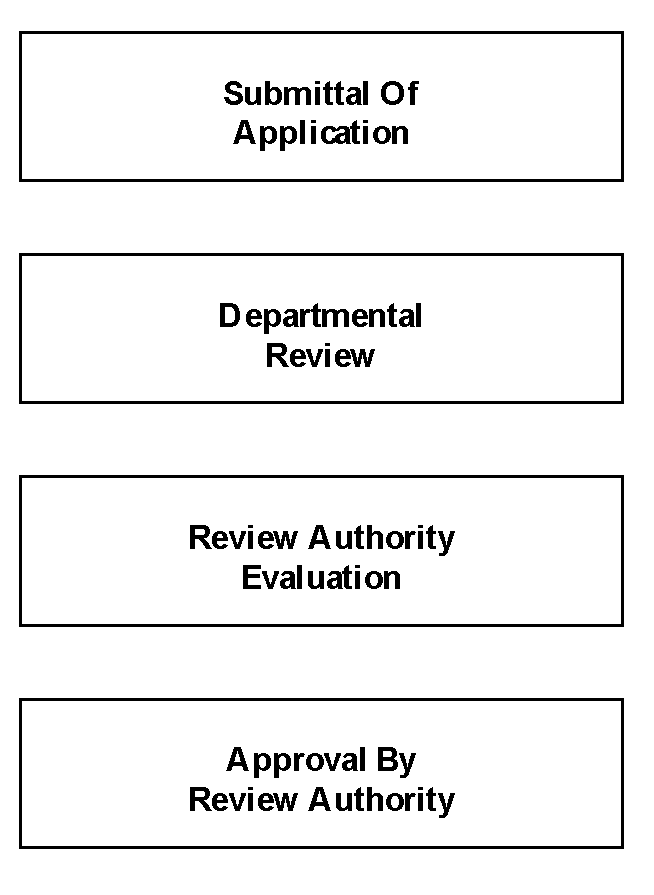
TABLE IV-1
THRESHOLD OF REVIEW
1 The director may refer any entitlement application to the commission for final determination.
2 Subject to design review procedures (Subsection 6.04.6620) when alteration/construction is involved.
3 Commission recommends to council for final determination.
4 Following approval by the council, the final map shall be filed with the department.
6.04.5005 - Multiple permit applications.
An applicant for a development project, which requires the filing of more than one land use permit application, shall file all related permits concurrently, unless waived by the director, and submit appropriate processing deposits/fees in compliance with Section 6.04.78 (Applications and fees).
Permit processing and environmental/design review shall be concurrent and the final decision on the project shall be made by the highest level of review authority, in compliance with Table IV-1 (Threshold of Review). For example, a project requiring a development permit (i.e., 4 dwelling units) and tentative parcel map shall be determined by the commission, while a project requiring a development permit, tentative tract map, and general plan amendment shall ultimately be determined by the council.
6.04.5010 - Pre-application conference.
A prospective applicant is encouraged to request a pre-application conference with the department prior to submittal of a single land use permit application. This conference is required for development projects involving multiple permit applications.
This conference should take place prior to any substantial investment (i.e., land acquisition, site, engineering and construction plans, etc.) in the preparation of the proposed development project application. During the conference, the department representative(s) shall inform the applicant of applicable general plan policies, plans, and requirements as they apply to the proposed development project, review the appropriate procedures outlined in this ordinance, and examine possible alternatives or modifications relating to the proposed project. Preliminary evaluation of environmental issues shall be addressed and potential technical studies relating to future environmental review should be identified.
Neither pre-application review nor the provision of available information and/or pertinent policies shall be construed as a recommendation for approval/disapproval by the department representative(s). A fee may be imposed for the pre-application conference in compliance with the city's "Schedule of Fees".
6.04.5201 - Purpose.
To ensure that any initiation or re-establishment of a legally permitted use within a legally established (or a legal nonconforming) structure shall comply with all applicable provisions of the Municipal Code.
6.04.5205 - Application.
No vacant, altered, repaired or hereafter erected structure shall be occupied, or no change in use of land or structure(s) shall be inaugurated until an occupancy clearance has been issued by the department. An application for the clearance shall be filed with the department in compliance with Section 6.04.78 (Applications and fees).
6.04.5210 - Applicability.
1.
A clearance for a structure which is to be remodeled or erected shall be filed at least fourteen days prior to the intended occupancy;
2.
A clearance for the use of vacant non-residential land or structure(s) shall be filed at least fourteen days prior to the intended use inauguration;
3.
A clearance for a change of ownership of an existing non-residential structure/use shall be filed prior to reuse/reopening under the new ownership;
4.
In order to provide for an expeditious permit review/reconstruction process, which may only be available following the occurrence of a bona fide emergency (i.e., natural disaster, civil disobedience, etc.), as determined by the council, an "Emergency Building Permit/Occupancy Clearance" may be issued by the appropriate departments with adequate deposits/security required by subsection "5"; and
5.
A temporary occupancy clearance may be issued by the department permitting almost "immediate" use of the structure(s), subject to the conditions imposed on the use, provided that a deposit/security is filed with the department prior to the issuance of the temporary clearance. The deposit/security shall guarantee the faithful performance and completion of all terms, conditions and performance standards imposed on the intended use. The form of the deposit/security shall be subject to the approval of the director. The deposit/security shall be processed for return to the depositor within ten days following a determination by the Director that all of the terms, conditions and performance standards have been met and permanent occupancy granted.
6.04.5215 - Applicable regulations.
All applications shall be subject to the applicable provisions of this ordinance, including the procedures outlined in the following sections:
1.
Section 6.04.78 Applications and fees.
2.
Section 6.04.80 Hearings and appeals.
6.04.5401 - Purpose.
To allow for the conduct of home occupations which are incidental to and compatible with surrounding residential uses. A home occupation represents a legal commercial enterprise conducted by an occupant of the dwelling.
6.04.5405 - Application.
The conduct of a home occupation requires the approval of the director who may establish conditions to further the purpose/intent of this section. An application for a home occupation permit shall be filed with the Department in compliance with Section 6.04.78 (Applications and fees).
6.04.5410 - Operating standards.
Home occupations shall comply with all of the following operating standards:
1.
The home occupation shall not alter the appearance of the residence;
2.
No home occupation shall be initiated until a current business license is obtained in compliance with Chapter 7.04 of the Municipal Code;
3.
No displays, sale or distribution of merchandise on the premises, or advertising signs on or off the premises;
4.
No signs other than the address and name of the resident;
5.
No advertising which identifies the home occupation by street address;
6.
The home occupation shall be confined completely to one room located within the residence. No portion of any carport or other accessory structure shall be used for home occupation purposes, with the exception that garage area in excess of Ordinance requirements may be used for this purpose;
7.
Only one vehicle no larger than a one ton truck may be used by the occupant directly or indirectly in connection with a home occupation;
8.
No encroachments into any required parking, setback or open space areas. No home occupation activities may occur out-of-doors;
9.
No use of mechanical equipment unless determined to be similar to a normal household or hobby use;
10.
Activities conducted and equipment or material used shall not change the fire safety or occupancy classifications of the premises. Utility consumption shall not exceed typical residential usage;
11.
No use shall create or cause dust, electrical interference, fumes, gas, glare, light, noise, odor, smoke, toxic/hazardous materials or vibration that can or may be considered a hazard/nuisance;
12.
Only the occupants of the residence may be engaged in the home occupation;
13.
No use of commercial vehicles, larger than 2-ton capacity, for delivery of materials to or from the premises;
14.
No creation of pedestrian or vehicular traffic or parking demand in excess of that customarily associated with the zoning district in which it is .....located;
15.
A home occupation permit shall not be transferable;
16.
No more than two home occupations in any dwelling unit;
17.
For rental property, the property owner's written authorization for the proposed use shall be obtained and submitted with the application for a home occupation permit;
18.
Any special condition(s) established by the director and made part of the record of the home occupation permit, as deemed necessary to carry out the purpose/intent of this section; and
19.
All pre-existing home occupations shall conform with all applicable ordinance requirements upon renewal of the annual city business license.
6.04.5415 - Prohibited home occupations.
The following list presents example commercial uses that are not incidental to or compatible with residential activities, are suitable only in non-residential zones and are therefore prohibited:
1.
Adult business;
2.
Businesses which entail the harboring, training, breeding, raising, or grooming of dogs, cats, or other animals on the premises;
3.
Carpentry and cabinet making;
4.
Dance club/night club;
5.
Fortune telling (psychic);
6.
Massage parlor;
7.
Medical and dental offices, clinics, and laboratories;
8.
Mini-storage;
9.
Plant nursery;
10.
Vehicle repair (body or mechanical), upholstery, automobile detailing (i.e., washing, waxing, etc.) and painting. (This does not prohibit "mobile" minor repair or detailing at the customer's location);
11.
Welding and machining; and
12.
Any other use determined by the director not to be incidental to or compatible with residential activities.
6.04.5420 - Permit expiration.
Home occupation permits are valid for one year only. Permit holders shall apply for and receive a renewal prior to expiration if they wish to continue the home occupation. Director approval may only be granted upon demonstration of satisfactory compliance with the above listed standards.
6.04.5425 - Revocation.
The director may revoke or modify a home occupation permit in compliance with Section 6.04.84 (Revocations).
6.04.5430 - Applicable regulations.
All applications shall be subject to the applicable provisions of this ordinance, including the procedures outlined in the following sections:
1.
Section 6.04.78 Applications and fees.
2.
Section 6.04.80 Hearings and appeals.
3.
Section 6.04.84 Revocations.
6.04.5601 - Purpose.
To ensure that any structures moved into, within or out of the city shall comply with all applicable provisions of the Municipal Code.
6.04.5605 - Application.
No structure(s) shall be moved into, within or out of the city until a structure relocation permit has been issued by the department. An application for the permit shall be filed with the department in compliance with Section 6.04.78 (Applications and fees).
6.04.5610 - Director's action.
The director may approve and/or modify a structure relocation permit, with or without conditions, only if all of the following findings are made:
1.
The condition of the structure is not considered to be dangerous or hazardous and any desired/needed repair would be justifiable;
2.
The structure would be compatible with its proposed surroundings; and
3.
The structure relocation Permit is in full compliance with Chapter 5.05 of the Municipal Code.
6.04.5615 - Applicable regulations.
All applications shall be subject to the applicable provisions of this ordinance, including the procedures outlined in the following sections:
1.
Section 6.04.78 Applications and fees.
2.
Section 6.04.80 Hearings and appeals.
6.04.58 - Temporary use permits—Pop-up businesses.
Editor's note— Sec. 3 of Ord. No. 19-920, adopted Nov. 12, 2019, amended §§ 6.04.58—6.04.5835, in their entirety to read as herein set out. Former §§ 6.04.58—6.04.5835, pertained to similar subject matter, and derived from Ord. No. 18-891, adopted July 10, 2018.
6.04.5801 - Purpose.
To allow commercial uses to obtain a permit to temporarily operate as a "pop-up" business in the city.
(Ord. No. 19-920, § 3, 11-12-2019)
6.04.5805 - Pop-up businesses; special requirements for pop-up businesses.
"Pop-up" businesses may be temporarily permitted pursuant to a temporary use permit in accordance with the requirements of this section.
1.
Zoning. "Pop-up" businesses shall only be allowed in the commercial highway, central business district, commercial neighborhood, manufacturing/industrial and business park zones of the city.
2.
Permissible Uses. Any use which is considered a permitted use or a use allowed pursuant to a development permit, as designated by a "P" or "D" respectively in the land use matrix for the zones in which a "pop-up" business is allowed, may be allowed as a "pop-up business" under this section.
3.
Limitation on Duration. A temporary use permit for a "pop-up" business uses under this section may be issued for up to forty-five days and renewed once, for a total operating period not to exceed ninety days, with no extensions. However, if the business submits a business license application for a permanent license before expiration of the last day of its permitted operation of the pop up business, the business will be allowed to continue operating, up to one hundred twenty additional days, if the business continues to pursue the permanent business license diligently, as determined in the sole discretion of the community development director. A temporary use permit for the same use may not be issued more than once per calendar year.
4.
Compliance with Building and Fire Code Requirements. The "pop-up" business shall meet the most current requirements of the California Building Code and Fire Code requirements, as those codes are adopted and amended through Fillmore Municipal Code Chapter 5.04. For "pop-up" businesses located within a building or structure, the building or structure must meet current California Building Code and Fire Code requirements. The "pop-up" business must have an approved certificate of occupancy or temporary certificate of occupancy.
5.
Uses Not Permitted as a "pop-up" Business. The following uses and activities may not be permitted as or associated with a "pop-up" business under this subsection:
(a)
The storage of hazardous materials; or
(b)
The inclusion of a portable toilet to serve the "pop-up" business, whether located inside or outside of the business.
(Ord. No. 19-920, § 3, 11-12-2019)
6.04.5810 - Application.
A temporary use permit for a pop-up business may be approved, modified, conditioned, or disapproved by the director. Decisions of the director may be appealed to the commission pursuant to section 6.04.80 (hearings and appeals). A permit application shall be filed in compliance with section 6.04.78 (application and fees).
(Ord. No. 19-920, § 3, 11-12-2019)
6.04.5815 - Findings.
The director shall review each application for compliance with the findings required in section 6.04.6630 (development permits). Compliance with such criteria is required for the director to approve or conditionally approve a pop-up business.
(Ord. No. 19-920, § 3, 11-12-2019)
6.04.5820 - Conditions of approval.
In approving an application for a pop-up business, the director shall impose conditions which are deemed essential to ensure that the use will be in full compliance with the findings required by section 6.04.6630 (development permits). These conditions may address any pertinent factors affecting the operation of the pop-up business, and may include, but are not limited to, the following:
1.
Provision for adequate temporary pedestrian and vehicular circulation, parking facilities (including vehicular ingress and egress) and public transportation, if applicable.
2.
Regulation of nuisance factors including, but not limited to, prevention of glare or direct illumination on adjacent parcels, dirt, dust, gases, heat, noise, odors, smoke, trash and vibration.
3.
Regulation of temporary structures and facilities, including placement, height and size, location of equipment and open spaces, including buffer areas and other yards.
4.
Provision for sanitary and medical facilities, as appropriate.
5.
Provision for solid, hazardous and toxic waste collection, recycling and/or disposal.
6.
Provision for police/security and safety measures, as appropriate.
7.
Regulation of signs.
8.
Regulation of operating hours and days.
9.
Submission of a performance bond or other security measures, satisfactory to the director, to ensure that any temporary facilities or structures used will be removed from the site within a reasonable time following the event and that the property will be restored to its former condition.
10.
A requirement that the approval of the requested temporary use permit for "pop-up" business is contingent upon compliance with applicable provisions of the Municipal Code and successful approval of any/all required permits from any other department or governing agency.
11.
A requirement that the applicant sign an agreement in a form approved by the city attorney agreeing to indemnify, defend and hold harmless the City of Fillmore and its officers, employees and agents from any and all claims, demands, and causes of action in any way relating to or arising out of or in connection with the issuance of the permit including as a result of any activities undertaken or improvements constructed as part of the permit or because of the permit and releasing the City of Fillmore from all such claims, demands, and causes of action.
12.
Any other conditions which will ensure the operation of the proposed "pop-up" business in an orderly and efficient manner and in full compliance with the purpose/intent of this section.
(Ord. No. 19-920, § 3, 11-12-2019)
6.04.5825 - Condition of site following temporary use.
Each site occupied by a pop-up business shall be cleaned of debris, litter, or any other evidence of the temporary use upon completion or removal of the use, and shall continue to be used in compliance with this ordinance.
(Ord. No. 19-920, § 3, 11-12-2019)
6.04.5830 - Revocation.
A.
Every temporary use permit for "pop-up" business is subject to the city's right to revoke the same for any of the causes mentioned in this section. Any temporary use permit may be revoked by the planning and community development director for any of the following causes:
1.
Any fraud, misrepresentation, or false statement contained in the application;
2.
Any violation of this chapter or any ordinance of the city or any statute, law or regulation;
3.
Any violation of one or more of the conditions;
4.
That the authorized improvement/use is detrimental to the public health, safety or welfare or constitutes a nuisance.
B.
Whenever the planning and community development director has determined to revoke a permit pursuant to this section, the director shall suspend the permit, after giving written notice to the permit holder of not less than two business days, in person or by registered mail, postage prepaid, and addressed to the permit holder at the address specified in the permit application, of the suspension and proposed revocation, stating with specificity the reason therefor. However, the two-day notice shall not be required if the director determines there is a need to protect the public health, safety or welfare, in which event the permit may be suspended immediately.
C.
The permit holder may file with the city manager, within ten days of the date of the notice of suspension and proposed revocation, a written request for a hearing, which request shall have the effect of staying the suspension until the city manager has rendered his or her decision, except in instances where the suspension is necessary to protect the public health, safety or welfare. The city manager shall hold a hearing within ten days after the filing of such hearing request.
D.
At the hearing, the city manager shall hear all relevant evidence, shall consider the merits of the proposed revocation, including any actions which have been taken to cure the alleged violation, and shall tender a decision thereon within one business day after the hearing. The decision shall be communicated in writing to the permit holder within two business days thereafter, and shall state with specificity the reasons therefor. The city manager decision shall be final.
(Ord. No. 19-920, § 3, 11-12-2019)
6.04.5835 - Applicable regulations.
All applications shall be subject to the applicable provisions of this ordinance, including the procedures outlined in the following sections:
1.
Section 6.04.78, Applications and fees.
2.
Section 6.04.80, Hearings and appeals.
(Ord. No. 19-920, § 3, 11-12-2019)
6.04.6001 - Purpose.
To specify the method where minor modifications may be made to previously approved land use entitlements/permits, while ensuring that no additional adverse effects or substantial expansion of structure(s) (not to exceed ten percent or five thousand square feet) or use(s) will occur.
6.04.6005 - Application.
The minor modification of a "permit" requires the approval of the director, who may establish additional conditions to further the purpose/intent of this section. An application for the minor modification shall be filed with the department in compliance with section 6.04.78 (applications and fees). Any modification request which exceeds the prescribed limitations outlined in this section shall require the filing of a new/modified application and a subsequent hearing by the appropriate review authority.
6.04.6010 - Applicability.
The director may grant a minor modification to a "permit", up to a maximum of ten percent or five thousand square feet, whichever is less, of the following standards, which would not result in a reduction from any minimum standard outlined in this ordinance:
1.
On-site circulation and parking, loading and landscaping;
2.
Placement, size and/or height of walls, fences and structures;
3.
Reconfiguration of architectural features and/or modification of finished colors, that do not alter or compromise the previously approved design; and
4.
A reduction/expansion in density/intensity of a development project.
6.04.6015 - Applicable Regulations.
All applications shall be subject to the applicable provisions of this ordinance, including the procedures outlined in the following sections:
1.
Section 6.04.78, Applications and fees.
2.
Section 6.04.80, Hearings and appeals.
6.04.6201 - Purpose.
To ensure that minor variances are only granted when, because of special circumstances applicable to the property, the strict application of this ordinance denies the property of privileges enjoyed by other property located nearby and in an identical zoning district and conditions are applied which will ensure that the minor variance shall not constitute a granting of special privilege(s) inconsistent with the limitations upon other property in the vicinity and zoning district in which the property is located.
6.04.6205 - Application.
An application for a minor variance shall be filed in compliance with Section 6.04.78 (Applications and fees).
6.04.6210 - Applicability.
The director may grant a minor variance, up to a maximum of twenty-five percent of the standards being modified, for only the following:
1.
Distance between structures;
2.
Parcel dimensions (not area);
3.
Setbacks;
4.
Structure height;
5.
On-site parking, loading, lighting, and landscaping; or
6.
Signs.
Any minor variance request which exceeds the prescribed limitations outlined in this section shall require the filing of a variance application in compliance with Section 6.04.64.
6.04.6215 - Review.
Each application shall be analyzed to ensure that it is consistent with the purpose/intent of this section and the city's CEQA Guidelines. To ensure effective implementation of general plan policies relating to design, each application shall be reviewed in compliance with Subsection 6.04.6620 (Design review procedures) prior to determination by the director. Additionally, any application which may involve grading shall require the submittal of preliminary grading plans for review and recommendation by the city engineer and approval by the director.
6.04.6220 - Hearings and notice.
Upon receipt in proper form of a minor variance application and compliance with the city's CEQA Guidelines, a public hearing shall be set and notice of the hearing given in compliance with Section 6.04.80 (Hearings and appeals).
6.04.6225 - Findings.
Following a public hearing, the director shall record the decision in writing and shall recite the findings upon which the decision is based, in compliance with state law (Government Code Section 65906 or as this section may be amended/replaced from time to time). The director may approve and/or modify an application in whole or in part, with conditions, only if all of the following findings are made:
1.
That there are special circumstances applicable to the property, including location, shape, size, surroundings or topography so that the strict application of this ordinance denies the property of privileges enjoyed by other property in the vicinity and under identical zoning district classification;
2.
That granting the minor variance is necessary for the preservation and enjoyment of a substantial property right possessed by other property in the same vicinity and zoning district and unavailable to the property for which the minor variance is sought;
3.
That granting the minor variance will not be detrimental to the public health, safety, or welfare, or injurious to the property or improvements in the vicinity and zoning district in which the property is located;
4.
That granting the minor variance does not constitute a special privilege inconsistent with the limitations upon other property in the vicinity and zoning district in which the property is located;
5.
That granting the minor variance does not result in an adjustment which would exceed twenty-five percent of the standard(s) being varied, or allow a use or activity which is not otherwise expressly authorized by the regulations governing the subject parcel; and
6.
That granting the minor variance will not be inconsistent with the general plan.
6.04.6230 - Precedents.
Each application is reviewed on a case-by-case basis and the granting of a prior minor variance is not admissible evidence for the granting of a new minor variance.
6.05.6235 - Burden of proof.
The burden of proof to establish the evidence in support of the findings, as required by Subsection 6.04.6225, is the responsibility of the applicant.
6.04.6240 - Minor variance expiration.
A minor variance shall be exercised within one year from the date of approval, or the minor variance shall become null and void. If the application for the minor variance also involves the approval of a tentative map, the minor variance shall be exercised prior to the expiration of the companion tentative map, or the minor variance shall become null and void. A variance shall be deemed to have been exercised if actual use has occurred or a building permit has been issued and the use has been diligently pursued in accordance with all requirements and laws. Notice of expiration need not be provided by the city.
(Ord. No. 21-932, § 2, 7-13-2021)
6.04.6242 - Minor variance abandonment.
A property owner may request to voluntarily abandon and extinguish the rights and obligations under a minor variance when all use or necessity for which said minor variance had been issued has permanently ceased. The request to abandon a minor variance shall be made by filing a written request with the community development department, signed by all property owners of record. Upon receipt of such request, the community development director may, without a public hearing, declare the minor variance to be abandoned, null and void, and record notice thereof in the official records of the county recorder.
Upon abandonment of the minor variance, the property shall thereafter be subject to all applicable rules and regulations set forth in the code, and all other local, state or federal laws.
(Ord. No. 21-932, § 3, 7-13-2021)
6.04.6245 - Time extension.
The director may, upon an application being filed at least one day prior to expiration and for good cause, grant one time extension not to exceed six months. Prior to granting the extension, the director shall ensure that the minor variance complies with all current ordinance provisions.
6.04.6250 - Use of property before final decision.
No permit shall be issued for any use involved in an application for a minor variance until, and unless, the same shall have become final, in compliance with Subsection 6.04.8035 (Effective date).
6.04.6255 - Revocation.
The director may revoke or modify a minor variance in compliance with Section 6.04.84 (Revocations).
6.04.6260 - Performance guarantee.
The applicant/owner may be required to provide adequate performance security in compliance with Subsection 6.04.5210(5) for the faithful performance of any/all conditions of approval imposed by the director.
6.04.6265 - Applicable regulations.
All applications shall be subject to the applicable provisions of this ordinance, including the procedures outlined in the following sections:
1.
Section 6.78 Applications and fees.
2.
Section 6.80 Hearings and appeals.
3.
Section 6.84 Revocations.
6.04.6401 - Purpose.
To ensure that variances are only granted when, because of special or unique circumstances applicable to the property, including location, shape, size, surroundings or topography, the strict application of this ordinance denies the property of privileges enjoyed by other property located nearby and in an identical zoning district and conditions are applied which will ensure that the variance shall not constitute a granting of special privilege(s) inconsistent with the limitations upon other property in the vicinity and zoning district in which the property is located.
Further, to ensure that the power to grant variances does not extend to use regulations, flexibility in use regulations is provided in Section 6.04.78 (Conditional use permits).
6.04.6405 - Application.
An application for a variance shall be filed in compliance with Section 6.04.78 (Applications and fees).
6.04.6410 - Applicability.
The commission may grant a variance from the requirements of this ordinance for only the following:
1.
Permit the modification of the dimensional standards for:
A.
Distance between structures;
B.
Parcel area (size);
C.
Parcel coverage;
D.
Parcel dimensions;
E.
Setbacks; or
F.
Structure height.
2.
Permit the modification of sign regulations (other than prohibited signs); and
3.
Permit the modification of the number and dimensions of parking areas, loading spaces, landscaping or lighting requirements.
6.04.6415 - Review.
Each application shall be analyzed to ensure that it is consistent with the purpose/intent of this section and the city's CEQA Guidelines. To ensure effective implementation of general plan policies relating to design, each application shall be reviewed in compliance with Subsection 6.04.6620 (Design review procedures) prior to determination by the commission. Additionally, any application which may involve grading shall require the submittal of preliminary grading plans for review and recommendation by the city engineer and approval by the commission.
6.04.6420 - Hearings and notice.
Upon receipt in proper form of a variance application and compliance with the city's CEQA Guidelines, a public hearing shall be set and notice of the hearing given in compliance with Section 6.04.80 (Hearings and appeals).
6.04.6425 - Findings.
Following a public hearing, the commission shall record the decision in writing and shall recite the findings upon which the decision is based, in compliance with state law (Government Code Section 65906 or as this section may be amended/replaced from time to time). The commission may approve and/or modify an application in whole or in part, with conditions, only if all of the following findings are made:
1.
That there are special circumstances applicable to the property, including location, shape, size, surroundings or topography so that the strict application of this ordinance denies the property of privileges enjoyed by other property in the vicinity and under identical zoning district classification;
2.
That granting the variance is necessary for the preservation and enjoyment of a substantial property right possessed by other property in the same vicinity and zoning district and unavailable to the property for which the variance is sought;
3.
That granting the variance will not be detrimental to the public health, safety, or welfare, or injurious to the property or improvements in the vicinity and zoning district in which the property is located;
4.
That granting the variance does not constitute a special privilege inconsistent with the limitations upon other property in the vicinity and zoning district in which the property is located;
5.
That granting the variance does not allow a use or activity which is not otherwise expressly authorized by the regulations governing the subject parcel; and
6.
That granting the variance will not be inconsistent with the general plan.
6.04.6430 - Precedents.
Each application is reviewed on a case-by-case basis and the granting of a prior variance is not admissible evidence for the granting of a new variance.
6.04.6435 - Burden of proof.
The burden of proof to establish the evidence in support of the findings, as required by Subsection 6.04.6425, is the responsibility of the applicant.
6.04.6440 - Variance expiration.
A variance shall be exercised within one year from the date of approval, or the variance shall become null and void. If the application for the variance also involves the approval of a tentative map, the variance shall be exercised prior to the expiration of the companion tentative map, or the variance shall become null and void. A variance shall be deemed to have been exercised if actual use has occurred or a building permit has been issued and the use has been diligently pursued in accordance with all requirements and laws. Notice of expiration need not be provided by the city.
(Ord. No. 21-932, § 4, 7-13-2021)
6.04.6442 - Variance abandonment.
A property owner may request to voluntarily abandon and extinguish the rights and obligations under a variance when all use or necessity for which said variance had been issued has permanently ceased. The request to abandon a variance shall be made by filing a written request with the community development department, signed by all property owners of record and notarized. Upon receipt of such request, the community development director may, without a public hearing, declare the variance to be abandoned, null and void, and record notice thereof in the official records of the county recorder.
Upon abandonment of the variance, the property shall thereafter be subject to all applicable rules and regulations set forth in the code, and all other local, state or federal laws.
(Ord. No. 21-932, § 5, 7-13-2021)
6.04.6445 - Time extension.
The commission may, upon an application being filed at least one day prior to expiration and for good cause, grant one time extension not to exceed six months. Prior to granting the extension, the commission shall ensure that the variance complies with all current ordinance provisions.
6.04.6450 - Use of property before final decision.
No permit shall be issued for any use involved in an application for a Variance until, and unless, the same shall have become final, in compliance with Subsection 6.04.8035 (Effective date).
6.04.6455 - Revocation.
The commission may revoke or modify a Variance in compliance with Section 6.04.84 (Revocations).
6.04.6460 - Performance guarantee.
The applicant/owner may be required to provide adequate performance security in compliance with Subsection 6.04.5210(5) for the faithful performance of any/all conditions of approval imposed by the commission.
6.04.6465 - Applicable regulations.
All applications shall be subject to the applicable provisions of this ordinance, including the procedures outlined in the following sections:
1.
Section 6.04.78 Applications and fees.
2.
Section 6.04.80 Hearings and appeals.
3.
Section 6.04.84 Revocations.
6.04.6601 - Purpose.
To afford maximum flexibility in site planning/property development while protecting the integrity and character of the city and ensuring consistency with the general plan. At the time of application submittal, a review of the configuration, design, location and effect of the proposed use shall be conducted by comparing the use to established development/site standards. This review shall determine whether the permit should be approved by weighing the public need for, and the benefit(s) to be derived from, the proposed use against the potential negative effects it may cause.
6.04.6605 - Application.
An application for a development permit shall be filed in compliance with Section 6.04.78 (Applications and fees).
6.04.6610 - Applicability.
A development permit shall be required for all applicable structures and uses permitted by this ordinance; however, none shall be required for alterations to an existing single-family residence or a new commercial use locating in an existing commercial structure where no exterior alterations will be occurring. Specifically, a permit shall be required under the following circumstances:
1.
For a new structure or use listed as subject to a "Development Permit" (D) in the applicable zoning district;
2.
For the enlargement, expansion or exterior alteration of an existing structure for which a development permit has not been issued, excluding an existing single-family residence;
3.
For the movement and/or relocation of any structure, including factory-built and manufactured housing;
4.
For the expansion of a legal nonconforming structure for which a development permit has not been issued (the structural dimensions [i.e., setbacks, height, parcel coverage, etc.] related to the expansion shall comply with the provisions of this ordinance); and
5.
For the rebuilding/ replacement of a destroyed/ demolished legal nonconforming structure for which a development permit has not been issued (the original structure, or portion thereof, may be rebuilt to its former "building envelope" [i.e., setbacks, height, parcel coverage, etc.] if granted a development permit).
(Ord. No. 18-897, § 5, 12-11-2018)
6.04.6615 - Review.
Each application shall be analyzed to ensure that it is consistent with the purpose/intent of this section and the city's CEQA Guidelines. To ensure effective implementation of general plan policies relating to design, each application shall be reviewed in compliance with Subsection 6.04.6620 (Design review procedures) prior to determination by the review authority. Additionally, any application which may involve grading shall require the submittal of preliminary grading plans for review and recommendation by the city engineer and approval by the review authority.
6.04.6620 - Design review procedures.
The review of projects for architectural and site plan design is an integral part of the development approval process. Each development permit application (including all associated plans and elevations) shall be reviewed to ensure that the application is consistent with: the purpose/intent of this section; all applicable development standards/regulations of this ordinance; and any adopted design guidelines/policies that may apply. In addition, applications for minor modifications, minor variances, variances, minor conditional use permits and conditional use permits are also subject to design review whenever any physical alteration/construction is proposed.
1.
Department Action. Design review is initiated when the department receives a complete application package including all required attachments, plans, specifications, elevations, sample materials, etc. as specified in the application form and any additional information required by the director in order to conduct a thorough review of the proposed project.
Upon receipt of a complete application Department staff shall conduct a review of the location, design, site plan configuration and effect of the proposed development by comparing the project plans to established development standards/regulations and design guidelines/policies. In general, development proposals will be reviewed considering criteria including, but not limited to, the following:
A.
Compliance with this section and all other applicable city ordinances;
B.
Desirable site layout and design;
C.
Compatibility with neighboring property/development;
D.
Efficiency and safety of public access and parking;
E.
Appropriate open space and use of water efficient landscaping;
F.
Consistency with the general plan; and
G.
Consistency with adopted design guidelines and design review policies.
2.
Reference to design guidelines/policies. In reviewing development/improvements subject to design review, the director shall refer to any design guidelines/policies that have been adopted by the council/commission in order to provide guidance to applicants seeking to comply with the requirements of this section. The council/commission may amend the design guidelines/policies whenever it deems it appropriate in order to carry out the purpose/intent of this section. Copies of any adopted design guidelines/ policies shall be available to the public at the department.
The adopted design guidelines are to be used by property owners, developers, architects, landscape architects, and designers in the planning and design of projects in the city. The design guidelines communicate the desired qualities and characteristics of development, and are intended to promote quality design that is compatible with the surrounding neighborhood and implement the general plan. The design guidelines/policies are used by city staff, the commission, and the council as adopted criteria for the review of development proposals subject to design review.
3.
Department Recommendation. Following completion of its review of a proposed project, department staff shall provide a written statement of findings/recommendations to the Review authority for its consideration simultaneously with a development permit, minor modification, minor variance, variance, minor conditional use permit or conditional use permit. Department staff may recommend approval, approval with conditions, or disapproval of a project. The report containing findings, recommendations and conditions, shall also be forwarded to the applicant prior to consideration by the review authority.
Where the findings/recommendations of the staff may substantially alter a proposed development, the applicant may be requested to submit revised plans at the discretion of the director.
4.
Preliminary design concept review. The director may require that a project applicant submit design concept plans for preliminary design review prior to submittal of a formal application for a project deemed significant by the director. The purpose of the preliminary consultation is to advise the project applicant of applicable design guidelines, design review policies, and other specific design criteria that may affect the design of the project.
6.04.6625 - Hearings and notice.
Upon receipt in proper form of a development permit application and compliance with the city's CEQA Guidelines, a hearing shall be set and notice of the hearing given in compliance with Section 6.04.80 (Hearings and appeals) for all applications subject to commission review. Where the director is the review authority, no notice or public hearing is required.
6.04.6630 - Findings.
Following a hearing, if required, the review authority, as outlined in Table IV-1, shall record the decision in writing and shall recite the findings upon which the decision is based. The review authority may approve and/or modify a development permit in whole or in part, and shall impose specific development conditions. These conditions shall relate to both on- and off-site improvements that are necessary to accommodate flexibility in site planning/property development, mitigate project-related adverse effects, and to carry out the purpose/intent and requirements of the respective zoning district. The review authority may approve a development permit, only if all of the following findings are made:
1.
The proposed development is one permitted within the subject zoning district and complies with the applicable provisions of this Ordinance and any applicable design guidelines; (per CC Ord 98-734)
2.
The proposed development is consistent with the general plan;
3.
The proposed development would be harmonious and compatible with existing and future developments within the zoning district and general area, as well as with the land uses presently on the subject property;
4.
The approval of the development permit for the proposed project is in compliance with the requirements of the California Environmental Quality Act (CEQA);
5.
The subject site is physically suitable for the type and density/intensity of use being proposed;
6.
There are adequate provisions for public access, water, sanitation, and public utilities and services to ensure that the proposed development would not be detrimental to public health and safety; and
7.
The design, location, size, and operating characteristics of the proposed development would not be detrimental to the public interest, health, safety, convenience, or welfare of the city.
(Ord. No. 19-903, § 3, 3-26-2019)
6.04.6635 - Development permit expiration.
A development permit shall be exercised within the date specified by the review authority. If a development permit is not exercised within the date specified by the review authority, then it shall become null and void. If no date is specified within which the development permit must be exercised, then within one year of development permit approval, the permit shall be exercised or it shall become null and void. An approved development permit shall be deemed to have been exercised if the approved use has commenced or a building permit has been issued and construction has been diligently pursued in accordance with all requirements and laws. Notice of permit expiration need not be provided by the city. If the application for the development permit also involves the approval of a tentative map, the phasing shall be consistent with the tentative map and the permit shall be exercised prior to the expiration of the companion tentative map.
Upon expiration of a development permit, an applicant must apply for a new development permit in order to proceed with the development.
(Ord. No. 21-932, § 6, 7-13-2021)
6.04.6640 - Use of property before final decision.
No permit shall be issued for any use involved in an application for a development permit until, and unless, the same shall have become final, in compliance with Subsection 6.04.8035 (Effective date).
6.04.6645 - Modification/amendment of development permit.
An approved development permit may be modified in compliance with Section 6.04.78 (Applications and fees). Minor modifications to an approved permit may be approved by the director, in compliance with Section 6.04.60 (Minor modifications).
6.04.6650 - Time extension.
The review authority may, upon an application being filed at least one day prior to expiration and for good cause, grant one time extension not to exceed one year. Prior to granting the extension, the review authority shall ensure that the development permit complies with all current ordinance provisions.
6.04.6655 - Revocation.
The review authority may revoke or modify a development permit in compliance with Section 6.04.84 (Revocations).
6.04.6660 - Performance guarantee.
The development project's applicant/owner may be required to provide adequate performance security in compliance with Subsection 6.04.5210(5) for the faithful performance of any/all conditions of approval imposed by the review authority.
6.04.6665 - Applicable regulations.
All applications shall be subject to the applicable provisions of this ordinance, including the procedures outlined in the following sections:
1.
Section 6.04.78 Applications and fees.
2.
Section 6.04.80 Hearings and appeals.
3.
Section 6.04.84 Revocations.
6.04.6801 - Purpose.
To allow for activities/uses requiring a minor conditional use permit and which are so unique that their effect on the surrounding environment cannot be determined prior to being proposed for a particular location.
6.04.6805 - Application.
An application for a minor conditional use permit shall be filed in compliance with Section 6.04.78 (Applications and fees).
6.04.6810 - Applicability. (Revised May 28, 1996 per Ord. 96-715)
The following land use activities may be allowable subject to the approval of a minor conditional use permit:
1.
A temporary real estate office may be established within the area of an approved development project solely for the first sale of homes. An application for a temporary real estate office may be approved for a maximum time period of two years from the date of approval;
2.
A temporary on- and off-site contractors' construction yard (i.e., containers, trailers, offices, etc.) only in conjunction with an approved development project (good only for the length of construction of the project);
3.
A mobile home as a temporary residence of the property owner when a valid permit for a new single-family dwelling is in force. The permit may be approved for up to one year, or upon expiration of the Building Permit, whichever first occurs;
4.
Enclosed temporary storage (unrelated to a construction project) (i.e., cargo container, sea-train, etc.) may be approved for a maximum time period of six consecutive months from the date of approval;
5.
A temporary office (manufactured/mobile units) may be approved, for a maximum time period of two years from the date of approval, as an accessory use or as the first phase of a development project;
6.
Open-air produce stands, only in conjunction with an on-site/on-going agricultural operation;
7.
Outdoor sale of merchandise by a "not-for-profit" charitable organization; and
8.
"Legalization" of illegal nonconforming structures and uses in compliance with Section 6.04.30 (Nonconforming structures and uses).
9.
Any land use that requires a Conditional Use Permit to be approved by the Planning Commission, if the Director determines through Section 6.04.82 (Interpretations) that:
A.
The use is consistent with the general plan.
B.
The use is consistent with the zone.
C.
The use is significantly less in scope than the use that would require planning commission review and approval.
D.
The use is exempt from CEQA.
E.
The use does not involve the construction of any new buildings.
F.
The use complies with all applicable conditions on the subject property.
6.04.6815 - Review.
Each application shall be analyzed to ensure that it is consistent with the purpose/intent of this section and the city's CEQA Guidelines. To ensure effective implementation of general plan policies relating to design, each application shall be reviewed in compliance with Subsection 6.04.6620 (Design review procedures) prior to determination by the director.
6.04.6820 - Hearings and notice.
Upon receipt in proper form of a minor conditional use permit application and compliance with the city's CEQA Guidelines, a public hearing shall be set and notice of the hearing given in compliance with Section 6.04.80 (Hearings and appeals).
6.04.6825 - Findings.
Following a hearing, the Director shall record the decision in writing and shall recite the findings upon which the decision is based. The Director may approve and/or modify a minor conditional use permit application in whole or in part, with conditions, only if all of the following findings are made:
1.
The proposed use is conditionally permitted within, and would not impair the integrity and character of, the subject zoning district and complies with the purpose/intent of this ordinance;
2.
The proposed use is consistent with the intent of the general plan;
3.
The approval of the minor conditional use permit for the proposed use is in compliance with the requirements of the California Environmental Quality Act (CEQA);
4.
The design, location, size and operating characteristics of the proposed use are compatible with the existing and future land uses and will not create significant noise, traffic or other conditions or situations that may be objectionable or detrimental to other permitted uses operating nearby or adverse to the public interest, health, safety, convenience or welfare of the city;
5.
The subject site is physically suitable for the type and density/intensity of use being proposed; and
6.
There are adequate provisions for public access, water, sanitation, and public utilities and services to ensure that the proposed use would not be detrimental to public health and safety.
6.04.6830 - Use of property before final decision.
No permit shall be issued for any use involved in an application for a minor conditional use permit until, and unless, the same shall have become final, in compliance with Subsection 6.04.8035 (Effective date).
6.04.6835 - Minor conditional use permit expiration.
A minor conditional use permit involving remodeling/construction shall be exercised within one year from the date of approval or the permit shall become null and void. An approved minor conditional use permit shall be deemed to have been exercised if the approved use has commenced or a building permit has been issued and construction has been diligently pursued in accordance with all requirements and laws. Notice of permit expiration need not be provided by the city. If the application for the minor conditional use permit also involves the approval of a tentative map, the minor conditional use permit shall be exercised prior to the expiration of the companion tentative map.
Upon expiration of a minor conditional use permit, an applicant, or applicant's successor, must apply for a new minor conditional use permit in order to proceed with the use.
(Ord. No. 21-932, § 7, 7-13-2021)
6.04.6837 - Minor conditional use permit abandonment.
A property owner may request to voluntarily abandon and extinguish the rights and obligations under a minor conditional use permit when all uses for which said permit had been issued have permanently ceased. The request to abandon a minor conditional use permit shall be made by filing a written request with the community development department, signed by all property owners of record and notarized. Upon receipt of such request, the community development director may, without a public hearing, declare the minor conditional use permit to be abandoned, null and void, and record notice thereof in the official records of the county recorder.
Upon abandonment of the minor conditional use permit, the subject permitted use shall thereafter be subject to all applicable rules and regulations set forth in the code, and all other local, state or federal laws. Abandonment shall not be available if the minor conditional use permit governs any other uses on the property. In this case, a minor conditional use permit modification shall be required so that the review authority may determine which provisions and conditions of the permit are no longer applicable and may be eliminated from the permit.
(Ord. No. 21-932, § 8, 7-13-2021)
6.04.6840 - Time extension.
The director may, upon an application being filed at least one day prior to expiration and for good cause, grant one time extension not to exceed six months. Prior to granting the extension, the director shall ensure that the minor conditional use permit complies with all current ordinance provisions.
6.04.6845 - Revocation.
The director may revoke or modify a minor conditional use permit in compliance with Section 6.04.84 (Revocations).
6.04.6850 - Minor conditional use permit to run with the land.
A minor conditional use permit granted in compliance with the provisions of this section shall continue to be valid upon a change of ownership of the site, business, service, use or structure which was the subject of the permit application. The new owner/operator shall file for, and receive approval of, an occupancy clearance, and agree, in writing, to all applicable conditions and operating standards prior to reuse/reopening under the new ownership.
6.04.6855 - Minor conditional use permit time limit of operation.
A minor conditional use permit granted in compliance with the provisions of this section may be conditioned to impose a specified time limit in which to operate. The director may, upon an application being filed thirty days prior to expiration and for good cause, grant appropriate time extensions not to exceed two years at a time. In granting subsequent time extensions, the director may amend existing conditions or impose new conditions to ensure that the subject use continues to operate in compliance with the purpose/intent of this section and the general plan.
6.04.6860 - Applicable regulations.
All applications shall be subject to the applicable provisions of this ordinance, including the procedures outlined in the following sections:
1.
Section 6.04.78 Applications and fees.
2.
Section 6.04.80 Hearings and appeals.
3.
Section 6.04.84 Revocations.
6.04.7001 - Purpose.
To allow for activities/uses requiring a conditional use permit and which are so unique that their effect on the surrounding environment cannot be determined prior to being proposed for a particular location. At the time of application, a review of the configuration, design, location and potential effect of the proposed activity/use shall be conducted by comparing it to established development/site standards. This review shall determine whether the proposed use should be permitted by weighing the public need for and the benefit(s) to be derived from the proposed use, against the potential negative effects it may cause.
6.04.7005 - Application.
An application for a conditional use permit shall be filed in compliance with Section 6.04.78 (Applications and fees).
6.04.7010 - Review.
Each application shall be analyzed to ensure that it is consistent with the purpose/intent of this section and the city's CEQA Guidelines. To ensure effective implementation of general plan policies relating to design, each application shall be reviewed in compliance with Subsection 6.04.6620 (Design review procedures) prior to determination by the commission. Additionally, any application which may involve grading shall require the submittal of preliminary grading plans for review and recommendation by the city engineer, and approval by the commission.
6.04.7015 - Hearings and notice.
Upon receipt in proper form of a conditional use permit application and compliance with the city's CEQA Guidelines, a public hearing shall be set and notice of the hearing given in compliance with Section 6.04.80 (Hearings and appeals).
6.04.7020 - Findings.
Following a hearing, the commission shall record the decision in writing and shall recite the findings upon which the decision is based. The commission may approve and/or modify a conditional use permit application in whole or in part, with conditions, only if all of the following findings are made:
1.
The proposed use is conditionally permitted within, and would not impair the integrity and character of, the subject zoning district and complies with all of the applicable provisions of this ordinance;
2.
The proposed use is consistent with the general plan;
3.
The approval of the conditional use permit for the proposed use is in compliance with the requirements of the California Environmental Quality Act (CEQA);
4.
The design, location, size, and operating characteristics of the proposed use are compatible with the existing and future land uses within the general area in which the proposed use is to be located and will not create significant noise, traffic or other conditions or situations that may be objectionable or detrimental to other permitted uses in the vicinity or adverse to the public interest, health, safety, convenience, or welfare of the city;
5.
The subject site is physically suitable for the type and density/intensity of use being proposed; and
6.
There are adequate provisions for public access, water, sanitation, and public utilities and services to ensure that the proposed use would not be detrimental to public health and safety.
(Ord. No. 19-903, § 4, 3-26-2019)
6.04.7025 - Use of property before final decision.
No permit shall be issued for any use involved in an application for a conditional use permit until, and unless, the same shall have become final, in compliance with Section 6.04.8035 (Effective date).
6.04.7030 - Conditional use permit expiration.
A conditional use permit shall be exercised within the date specified by the planning commission or city council or the permit shall become null and void. If no date is specified, then the conditional use permit shall be exercised within one year from the date of approval or the permit shall become null and void. An approved conditional use permit shall be deemed to have been exercised if the approved use has commenced or a building permit has been issued and construction has been diligently pursued in accordance with all requirements and laws. Notice of permit expiration need not be provided by the city. If the application for the conditional use permit also involves the approval of a tentative map, the phasing shall be consistent with the tentative map and the permit shall be exercised prior to the expiration of the companion tentative map.
Upon expiration of a conditional use permit and any time extension, an applicant, or applicant's successor, must apply for a new conditional use permit in order to proceed with the development.
(Ord. No. 21-932, § 9, 7-13-2021)
6.04.7032 - Conditional use permit abandonment.
A property owner may request to voluntarily abandon and extinguish the rights and obligations under a conditional use permit when all uses for which said permit had been issued have permanently ceased. The request to abandon a conditional use permit shall be made by filing a written request with the community development department, signed by all property owners of record and notarized. Upon receipt of such request, the community development director may, without a public hearing, declare the conditional use permit to be abandoned, null and void, and record notice thereof in the official records of the county recorder.
Upon abandonment of the conditional use permit, the subject permitted use shall thereafter be subject to all applicable rules and regulations set forth in the code, and all other local, state or federal laws. Abandonment shall not be available if the conditional use permit governs any other uses on the property. In this case, a conditional use permit modification shall be required so that the review authority may determine which provisions and conditions of the permit are no longer applicable and may be eliminated from the permit.
(Ord. No. 21-932, § 10, 7-13-2021)
6.04.7035 - Modification/amendment of conditional use permit.
An approved conditional use permit may be modified in compliance with Section 6.04.78 (Applications and fees). Minor modifications to an approved permit may be approved by the director, in compliance with Section 6.04.60 (Minor modifications).
6.04.7040 - Time extension.
The commission may, upon an application being filed at least one day prior to expiration and for good cause, grant one time extension not to exceed one year. Prior to granting the extension, the commission shall ensure that the conditional use permit complies with all current ordinance provisions.
6.04.7045 - Revocation.
The commission may revoke or modify a conditional use permit in compliance with Section 6.04.84 (Revocations).
6.04.7050 - Conditional use permit to run with the land.
A conditional use permit granted in compliance with the provisions of this section shall continue to be valid upon a change of ownership of the site, business, service, use or structure which was the subject of the permit application. The new owner/operator shall file for, and receive approval of, an occupancy clearance, and agree, in writing, to all applicable conditions and operating standards prior to reuse/reopening under the new ownership.
6.04.7055 - Conditional use permit time limit of operation.
A conditional use permit granted in compliance with the provisions of this section may be conditioned to impose a specified time limit in which to operate. The commission may, upon an application being filed thirty days prior to expiration and for good cause, grant appropriate time extensions not to exceed ten years at a time. In granting subsequent time extensions, the commission may amend existing conditions or impose new conditions to ensure that the subject use continues to operate in compliance with the purpose/intent of this section and the general plan.
6.04.7060 - Periodic review.
The applicant/owner may be required to provide appropriate funds to reimburse the city for the periodic review of the permit to ensure proper compliance with this ordinance and any developmental/operational conditions imposed by the commission.
6.04.7065 - Performance guarantee.
The applicant/owner may be required to provide adequate performance security in compliance with Subsection 6.04.5210(5) for the faithful performance of any/all conditions of approval imposed by the commission.
6.04.7070 - Applicable regulations.
All applications shall be subject to the applicable provisions of this ordinance, including the procedures outlined in the following sections:
1.
Section 6.04.78 Applications and fees.
2.
Section 6.04.80 Hearings and appeals.
3.
Section 6.04.84 Revocations.
6.04.7201 - Purpose.
To establish uniform procedures for the adoption and implementation of specific plans, for the coordination of future development within the city in compliance with state law (Government Code Section 65450 et seq. or as this section may be amended/replaced from time to time), in addition to amending the general plan whenever required by public necessity and general welfare.
6.04.7205 - Pre-submittal application and conference.
A pre-submittal application and fee are required prior to the filing of a formal application. A pre-submittal conference with the department is required prior to the filing of the formal application.
6.04.7210 - Content of specific plan application.
A specific plan application shall include a text and a diagram(s) which contain all of the provisions outlined in state law (Government Code Sections 65451 and 65452), in addition to all data and related exhibits required by the department.
6.04.7215 - Adoption/amendment/repeal of specific plans.
A specific plan shall be prepared, adopted, and amended in the same manner as the general plan, except that a specific plan may be adopted by resolution or by ordinance and may be amended as often as deemed necessary by the council. A specific plan may be repealed in the same manner as it is required to be amended.
6.04.7220 - Reserved.
Editor's note— Ord. No. 18-894, § 3, adopted Dec. 11, 2018, deleted § 6.04.7220, which pertained to general plan amendment screening, and derived from the original codification.
6.04.7225 - Hearings and notice.
Upon receipt in proper form of a specific plan or general plan amendment application, or upon initiation by the director, commission, or council, and following department review and compliance with the city's CEQA Guidelines, public hearings shall be set before the commission and council. Notice of the hearings shall be given in compliance with Section 6.04.80 (Hearings and appeals).
An applicant for a general plan amendment which requires one or more additional land use applications, shall file all related permit applications concurrently with the amendment request in compliance with Subsection 6.04.5005.
6.04.7230 - Commission action.
The commission shall make a written recommendation to the council on the proposed specific plan or general plan amendment whether to approve, approve in modified form or disapprove based upon the findings outlined in Subsection 6.04.7240 (Findings).
6.04.7235 - Council action.
Upon receipt of the commission's recommendation, the council may approve, approve in modified form or disapprove the proposed specific plan or general plan amendment based upon the findings outlined in Subsection 6.04.7240 (Findings).
6.04.7240 - Findings.
A specific plan or general plan amendment may be approved only if all of the following findings are made:
1.
The proposed plan/amendment is internally consistent with the general plan;
2.
The proposed plan/amendment would not be detrimental to the public interest, health, safety, convenience or welfare of the city;
3.
The subject property is physically suitable for the requested zoning designation(s) and the anticipated land use development(s); and
4.
The proposed plan/amendment ensures development of desirable character which will be harmonious with existing and proposed development in the surrounding neighborhood.
6.04.7245 - Specific plan consistency.
No public works project, parcel or tentative map or other land use entitlement may be approved, adopted or amended within an area covered by a specific plan, unless found consistent with the adopted specific plan.
6.04.7250 - Limitation on amendments.
No mandatory element of the general plan may be amended more than 4 times during any calendar year in compliance with state law (Government Code Sections 65350, 65354.5 and 65358).
6.04.7255 - Applicable regulations.
All applications shall be subject to the applicable provisions of this ordinance, including the procedures outlined in the following sections:
1.
Section 6.04.78 Applications and fees.
2.
Section 6.04.80 Hearings and appeals.
6.04.7401 - Purpose.
To allow for the amendment of the official zoning map/ordinance whenever required by public necessity and general welfare.
6.04.7405 - Hearings and notice.
Upon receipt in proper form of a zoning map/ordinance amendment application, or upon initiation by the director, commission or council, and following department review and compliance with the city's CEQA Guidelines, public hearings shall be set before the commission and council. Notice of the hearings shall be given in compliance with Section 6.04.80 (Hearings and appeals).
6.04.7410 - Commission action on amendments.
The commission shall make a written recommendation to the council on the proposed amendment whether to approve, approve in modified form or disapprove, based upon the findings outlined in Subsection 6.04.7420 (Findings).
6.04.7415 - Council action on amendments.
Upon receipt of the commission's recommendation, the council may approve, approve in modified form or disapprove the proposed amendment based upon the findings outlined in Subsection 6.04.7420 (Findings).
6.04.7420 - Findings.
An amendment to the official zoning map/ordinance may be approved in compliance with state law (Government Code Section 65800 et. seq., Chapter 4 [Zoning Regulations]) only if all of the following findings are made, as applicable to the type of amendment:
1.
Findings for All Amendments.
A.
The proposed amendment is consistent with the general plan; and
B.
The proposed amendment would not be detrimental to the public interest, health, safety, convenience or welfare of the city.
2.
Map amendments only. The subject parcel(s) is physically suitable (including, but not limited to access, provision of utilities, compatibility with adjoining land uses and absence of physical constraints) for the requested zoning designation(s) and anticipated land use development(s).
3.
Ordinance Amendments Only. The proposed amendment is internally consistent with this Ordinance.
6.04.7425 - Applicable regulations.
All applications shall be subject to the applicable provisions of this ordinance, including the procedures outlined in the following sections:
1.
Section 6.04.78 Applications and fees.
2.
Section 6.04.80 Hearings and appeals.
6.04.7601 - Purpose.
To allow for the approval of development agreements.
1.
This section outlines the procedures and requirements for the review and consideration of development agreements upon application by, or on behalf of property owners or other persons having a legal or equitable interest in the property proposed to be subject to the agreement. It is intended that the provisions of this section shall be fully consistent, and in full compliance, with the provisions of state law (Government Code Article 2.5 of Chapter 4 of Division 1 of Title 7, commencing with Section 65864 or as this section may be amended/replaced from time to time), and shall be so construed.
2.
In construing the provisions of any development agreement entered into in compliance with this section, those provisions shall be read to fully effectuate, and to be consistent with, the language of this section, state law (Government Code Article 2.5, cited above), and the agreement itself. Should any apparent discrepancies between the meaning of these documents arise, reference shall be made to the following documents, and in the following order:
A.
The plain terms of the development agreement itself;
B.
The provisions of this section; and
C.
The provisions of state law (Government Code Article 2.5, cited above).
6.04.7605 - Application.
1.
An entity having a legal or equitable interest in real property may request and apply through the director to enter into a development agreement provided the following:
A.
The development agreement, if approved, would be in the best interests of the city;
B.
The status of the applicant, having a legal or equitable interest in the subject real property, is established to the satisfaction of the director;
C.
The application is made on forms approved, and contains all information required, by the director; and
D.
The application is accompanied by all lawfully required documents, materials and information.
2.
The director is empowered to receive, review, process and prepare, together with recommendations for commission and council consideration, all applications for development agreements. The director may call upon all other departments of the city for timely assistance in complying with this section. If the city's redevelopment agency is involved with the property subject to the development agreement, that agency shall be responsible for the processing, review and approval of the agreement; and
3.
Processing fees, as established by resolution of the council, shall be collected for any application for a development agreement made in compliance with this section. Additionally, appropriate fees shall be established and collected for periodic reviews conducted by the department in compliance with Subsection 6.04.7630.
6.04.7610 - Public hearings.
1.
The director, upon finding the application for a development agreement complete and in compliance with the city's CEQA Guidelines, shall set the application, together with recommendations, for a public hearing before the commission in compliance with Section 6.04.80 (Hearings and Appeals). Following conclusion of the public hearing, the commission shall make a written recommendation to the council/redevelopment agency that it approve, conditionally approve, or disapprove the application;
2.
Upon receipt of the commission's recommendation, the city clerk shall set the application and written report of the commission for a public hearing before the council/redevelopment agency in compliance with Section 6.04.80 (Hearings and appeals). Following conclusion of the public hearing, the council/redevelopment agency shall approve, conditionally approve or disapprove the application;
3.
Notice of the hearings outlined in Subsections 1 and 2 above shall be given in the form of a notice of intention to consider approval of a development agreement in compliance with state law (Government Code Section 65867);
4.
Should the council/redevelopment agency approve or conditionally approve the application, it shall, as a part of its action of approval, direct the preparation of a development agreement embodying the terms and conditions of the application as approved or conditionally approved by it, as well as an ordinance authorizing execution of the development agreement by the city manager/redevelopment agency director;
5.
The ordinance shall contain findings, and the facts supporting them, that the development agreement is consistent with the general plan, any applicable specific plan and this ordinance, and that it will promote the public interest and welfare of the city; and
6.
The ordinance may be subjected to referendum in the manner provided by state law (Government Code Section 65867.5).
6.04.7615 - Content of development agreement.
1.
Mandatory contents. A development agreement shall contain the following provisions in compliance with state law (Government Code Section 65865.2):
A.
Specify the duration of the agreement;
B.
Specify the permitted uses for the subject property;
C.
Specify the density/intensity of the permitted uses;
D.
Describe the maximum height and size of proposed structures by clearly identifying and referring to the documents and exhibits approved;
E.
Describe the provisions, if any, for reservation or dedication of land for public purposes;
F.
Describe the provisions, if any, for the protection from either a future growth control ordinance or a future increase in development and/or effect fees;
G.
Provide for a tiered amendment review procedure that may incorporate the following:
(1)
Director approval for minor modifications;
(2)
Commission approval for major modifications; and
(3)
Approval of major amendments by the council/redevelopment agency.
H.
Provide for the possibility of subsequent discovery of health and safety issues like a "compelling public necessity" (i.e., a new environmental health hazard is discovered), which would necessitate a reconsideration/amendment of the previously approved development agreement.
2.
Permissive Contents. A development agreement entered into in compliance with this section may include the following provisions:
A.
Conditions, terms, restrictions, and requirements for subsequent discretionary actions, provided that the conditions, terms, restrictions, and requirements for subsequent discretionary actions shall not prevent development of the land for the uses and to the density/intensity of development specified in the agreement;
B.
Provisions which require that construction shall be commenced within a specified time and that the project, or any single phase, be completed within a specified time;
C.
Terms and conditions relating to applicant financing of necessary public improvements and facilities, including, but not limited to, applicant participation in benefit assessment proceedings; and
D.
Any other terms, conditions and requirements as the council/redevelopment agency may deem necessary and proper, including, but not limited to, requirement(s) for ensuring, to the satisfaction of the city, performance of all provisions of the agreement in a timely manner by the applicant/contracting party.
6.04.7620 - Execution and recordation.
1.
The city shall not execute any development agreement until on or after the date upon which the ordinance approving the agreement, enacted in compliance with Subsection 6.04.7610, becomes effective; and
2.
A development agreement shall be recorded in the office of the county recorder no later than ten days after it is executed.
6.04.7625 - Environmental review.
The approval or conditional approval of a development agreement in compliance with this Section shall be deemed a discretionary act for purposes of the California Environmental Quality Act (CEQA).
6.04.7630 - Periodic review.
1.
Every development agreement, approved and executed in compliance with this section, shall be subject to periodic city review during the full term of the agreement. (The review schedule shall be specified in the agreement.) Appropriate fees to cover the city's cost(s) to conduct the periodic reviews shall be collected from the applicant/contracting party in compliance with Subsection 6.04.7605;
2.
The purpose of the periodic reviews shall be to determine whether the applicant/contracting party or its successor-in-interest has complied in good faith with the terms or conditions of the development agreement. The burden of proof shall be on the applicant/contracting party or its successor to demonstrate compliance, to the full satisfaction of, and in a manner prescribed by, the city; and
3.
If, as a result of periodic review in compliance with this subsection, the council/redevelopment agency finds and determines, on the basis of substantial evidence, that the applicant/contracting party or its successor-in-interest has not complied in good faith with the terms or conditions of the development agreement, the council/redevelopment agency may order, after a noticed public hearing in compliance with Subsection 6.04.7610, that the agreement be terminated or modified.
6.04.7635 - Effect of development agreement.
Unless otherwise provided by the development agreement the rules, regulations and official policies governing permitted uses of the land, density, design, improvement and construction standards and specifications, applicable to development of the property subject to a development agreement, are the rules, regulations, and official policies in force at the time of execution of the agreement.
Unless specifically provided by the development agreement, the agreement does not prevent the city, in subsequent actions applicable to the property, from applying new rules, regulations and policies which do not conflict with those rules, regulations and policies applicable to the property under the development agreement, nor does a development agreement prevent the city from conditionally approving or disapproving any subsequent development project application on the basis of existing or new rules, regulations and policies.
6.04.7640 - Approved development agreements.
Development agreements approved by the council/redevelopment agency shall be on file with the city clerk.
6.04.7645 - Applicable regulations.
All applications shall be subject to the applicable provisions of this ordinance, including the procedures outlined in the following Sections:
1.
Section 6.04.78 Applications and fees.
2.
Section 6.04.80 Hearings and appeals.
6.04.7801 - Purpose.
To prescribe the procedures and requirements for filing of applications for permits, amendments, and approvals.
6.04.7805 - Filing.
Application for permits, permit modifications, amendments, and all other matters pertaining to this ordinance shall be filed with the department on a city application form, together with all fees, plans, maps and any other information required by the department. The application may only be made by the owner(s) or lessee(s) of property, or their agent(s), or person(s) who have contracted to purchase property contingent upon their ability to acquire the necessary permits under this ordinance, or their agent(s).
6.04.7810 - Fees.
The council shall, by resolution, establish a "Schedule of Fees" for permits, amendments and other matters pertaining to this ordinance. The "Schedule of Fees" may be changed or modified only by resolution of the council. Review shall not commence on any application until all applicable fees/deposits have been paid in full or a "fee agreement" is approved by the city manager. The city is not required to continue processing any application unless additionally required fees/deposits (i.e., additionally required "real cost" deposits) are paid in full. Failure to pay the applicable fees/deposits is grounds for disapproval of the application.
6.04.8001 - Purpose.
To specify procedures for hearings before the council, commission, and director and appeals of any requirement, decision or determination made by the commission or director.
6.04.8005 - Application processing.
Applications shall be noticed, processed and reviewed in compliance with state law (Government Code Sections 65090, 65091, 65094 and 66451.3 and Public Resources Code 21000 et. seq.).
6.04.8010 - Director's investigation/written report.
The director shall investigate all of the pertinent facts relating to the application in order to provide the written information necessary for action in compliance with the purpose/intent of this ordinance and the general plan. The director shall provide the written report, containing a recommendation and the required findings, to the commission.
6.04.8015 - Hearing procedure.
Hearings shall be held at the date, time and place for which notice has been given in compliance with this section. The summary minutes shall be prepared and made part of the permanent case file. Any hearing may be continued provided that prior to the adjournment or recess of the hearing, a clear public announcement is made specifying the date, time and place to which the hearing will be continued.
6.04.8020 - Notice of decision—Director.
The director shall announce and record the decision at the conclusion of the scheduled public hearing, if one is required. The decision shall contain applicable findings and any conditions of approval imposed by the director. Following the hearing, a notice of the decision and any conditions of approval shall be mailed to the applicant at the address shown upon the application. Included within this mailing, shall be a city prepared letter for the applicant to sign, acknowledging that the applicant is in full concurrence/understanding with the final conditions of approval. The decision of the director shall be final unless appealed to the commission.
6.04.8025 - Notice of decision—Commission.
The commission shall announce and record its decision at the conclusion of the scheduled public hearing. The decision shall contain the action of the commission, including all findings, conditions of approval, and reporting/monitoring requirements deemed necessary to mitigate any effects and protect the health, safety and welfare of the city.
Following the commission hearing, a notice of the decision and any conditions of approval shall be mailed to the applicant at the address shown upon the application. Included within this mailing, shall be a city-prepared letter for the applicant to sign, acknowledging that the applicant is in full concurrence/understanding with the final conditions of approval. The decision of the commission shall be final unless appealed to the council.
The commission shall have final decision-making authority over or make recommedations to the city council as designated is section 6.04.5001, table IV-1, of the zoning ordinance of the City of Fillmore.
(Ord. No. 19-904, § 2, 3-26-2019)
6.04.8030 - Notice of decision—Council.
The council shall announce and record its decision at the conclusion of the scheduled public hearing. The decision shall contain the findings of the council and any conditions of approval and reporting/monitoring requirements deemed necessary to mitigate any effects and protect the health, safety and welfare of the city.
Following the council hearing, a notice of the decision and any conditions of approval shall be mailed to the applicant at the address shown upon the application. Included within this mailing, shall be a city-prepared letter for the applicant to sign, acknowledging that the applicant is in full concurrence/understanding with the final conditions of approval.
The decision of the council shall be final, unless subjected to further legal action in compliance with state law.
6.04.8035 - Effective date.
Minor variances, variances, development permits, minor conditional use permits and conditional use permits shall become effective fifteen days following the final date of action (i.e., approval) by the appropriate review authority. Specific plans (including amendments and repeals), general plan amendments, zoning map amendments, zoning ordinance amendments, and development agreements shall become effective thirty days following the final date of action (i.e., adoption) by the council in compliance with state law. The letter of approval shall constitute the permit, and the resolution/ordinance shall constitute the amendment. Ordinances require first and second readings by the council and shall become effective thirty days following the second reading.
6.04.8040 - Appeal of action.
Any determination or action taken by the director may only be appealed to the commission. Similarly, any action taken by the commission, to approve or disapprove an application, may only be appealed to the council.
6.04.8045 - Filing of appeals.
All appeals shall be submitted in writing on a city application form, and shall specifically state the pertinent facts of the case and the basis of the appeal. An appeal of a director action shall be filed with the department within fifteen days following the final date of action for which an appeal is made. An appeal of a commission decision shall be filed in the office of the city clerk within fifteen days following the final date of action for which an appeal is made. Appeals shall be accompanied by a filing fee in compliance with section 6.04.78 (Applications and fees).
6.04.8050 - Notice of appeal hearings.
Notice of an appeal hearing shall conform to the manner in which the original notice was given. The appellant shall be responsible for all noticing materials which were required in the original application.
6.04.8055 - Appeal hearings.
The hearing for the appeal shall allow the introduction of all pertinent information, including the reintroduction of the information on the record from the original hearing(s). If a continuance of the appeal hearing is desired, the continuance shall be mutually agreed to by the original applicant, the appellant and the city. The review authority shall announce and record its decision at the conclusion of the scheduled public hearing. The decision shall contain the findings, any conditions of approval and reporting/monitoring requirements deemed necessary to mitigate any effects and protect the health, safety and welfare of the city.
Following the hearing, a notice of the decision and any conditions of approval shall be mailed to the applicant at the address shown upon the application. Included within this mailing, shall be a city-prepared letter for the applicant to sign, acknowledging that the applicant is in full concurrence/understanding with the final conditions of approval.
6.04.8060 - Effective date of appealed actions.
An action of the director appealed to the commission shall not become final unless and until upheld by the commission. An action of the commission appealed to the council shall not become final unless and until upheld by the council.
6.04.8065 - Reapplication.
When an application for a permit or amendment is disapproved, no application for the same or substantially same permit or amendment shall be filed in whole, or in part, for the ensuing twelve months except as otherwise specified at the time of disapproval. The director shall determine whether the new application is for a permit or amendment which is the same or substantially the same as a previously disapproved permit or amendment. No decision of the director shall be effective until a period of fifteen days has elapsed following the written notice of decision.
6.04.8070 - Reconsideration.
If more complete or additional facts or information, which may affect the original action taken on an application by a review authority are presented, the review authority may reconsider the action taken, if a request for reconsideration is filed by the applicant, with the department, within fifteen days following the final date of action. If a public hearing was required in the original review process, another public notice, in compliance with Subsection 6.04.8005, shall be given prior to the reconsideration by the review authority, and all costs associated with the reconsideration shall be paid by the applicant.
6.04.8201 - Purpose.
To ensure the consistent interpretation and application of the provisions of this ordinance and the general plan.
6.04.8205 - Procedure.
A written request for an interpretation of the provisions of this ordinance or the general plan may be filed, together with all required fees, with the department in compliance with Section 6.04.78 (Applications and fees). The request shall state the ordinance/general plan provision(s) in question, and provide any information to assist in its review. The decision of the director may be appealed to the commission. The decision of the commission may be appealed to the council.
6.04.8210 - Applicable regulations.
All applications shall be subject to the applicable provisions of this ordinance, including the procedures outlined in the following sections:
1.
Section 6.04.78 Applications and fees.
2.
Section 6.04.80 Hearings and appeals.
6.04.8401 - Purpose.
To outline requirements for securing revocation or modification of previously approved permits and variances.
6.04.8405 - Procedure.
The review authority may hold a public hearing to revoke or modify any permit or variance granted in compliance with the provisions of this ordinance. Fifteen days prior to the hearing, notice shall be delivered in writing to the applicant and/or owner of the property for which the permit or variance was granted. Notice shall be deemed delivered two days after being mailed, first class postage paid, to the owner as shown on the current tax rolls of the County of Ventura, and/or the project applicant. Where revocation procedures are identified for a specific type of permit in this code (e.g. temporary use permit/"pop-up" business), then the specified revocation procedures for that permit shall control rather than the procedures in this section.
1.
A permit may be revoked or modified by the review authority if any one of the following findings can be made:
A.
That circumstances have changed so that one or more of the findings outlined in Sections 6.04.54, 6.04.58, 6.04.68 and 6.04.70 can no longer be made;
B.
That the permit was obtained by misrepresentation or fraud;
C.
That the authorized improvement/use had ceased or was suspended for six or more months;
D.
That one or more of the conditions of the permit have not been met;
E.
That the authorized improvement/use is in violation of any statute, ordinance, law or regulation;
F.
That the authorized improvement/use is detrimental to the public health, safety or welfare or constitutes a nuisance;
G.
That the permit or variance has not been timely exercised;
H.
That following issuance of a building permit, construction work has not commenced within one year, or following commencement of construction work, work is discontinued for a period of one year or more; or
I.
That if a project is to build in pre-approved phases, and a building permit for the construction of a subsequent phase has not been issued within one year from the previous phase's date of construction commencement, unless otherwise specified in the permit.
2.
A variance (including a minor variance) may be revoked or modified by the review authority if any one of the following findings can be made, in addition to those outlined in subsection (1) above:
A.
That circumstances have changed so that one or more of the findings outlined in Sections 6.04.62 or 6.04.64 can no longer be made, and the grantee has not substantially exercised the rights granted by the variance; or
B.
That one or more of the conditions of the variance have not been met, and the grantee has not substantially exercised the rights granted by the variance.
(Ord. No. 21-932, § 11, 7-13-2021)
6.04.8601 - Purpose.
To ensure that enforcement of the provisions of this ordinance and any entitlements granted by the city shall be diligently pursued in order to provide for their effective administration, to secure compliance with any conditions of approval, to promote the city's planning efforts and for the protection of the public health, safety, and welfare of the city.
6.04.8605 - Responsibility.
The Director shall be responsible for enforcing the provisions of this ordinance and any conditions imposed on permits (i.e., development permits) granted by the city and permitted under this ordinance. Any structure or use which is established, operated, erected, moved, altered, enlarged, or maintained, contrary to the provisions of this ordinance, is hereby declared to be unlawful and a public nuisance and shall be subject to the remedies and penalties specified in Chapter 1.08 of the Municipal Code, and/or revocation procedures outlined in the following sections of this ordinance:
1.
Section 6.04.70 Conditional use permits.
2.
Section 6.04.66 Development permits.
3.
Section 6.04.54 Home occupation permits.
4.
Section 6.04.68 Minor conditional use permits.
5.
Section 6.04.62 Minor variances.
6.
Section 6.04.58 Temporary use permits.
7.
Section 6.04.64 Variances.
Any permit, certificate or license issued in conflict with this ordinance shall be null and void.
6.04.8610 - Violations.
Any person, partnership, organization, firm or corporation, whether as principal, agent, employee, tenant or otherwise, violating any provision of this Ordinance or any condition imposed on an entitlement, development permit, map or license, or violating or failing to comply with any order made hereunder, shall be guilty of a misdemeanor in compliance with Chapter 1.08 of the Municipal Code. Any violation of this section shall also constitute a public nuisance which may be abated in compliance with the procedures outlined in Chapter 1.08 of the Municipal Code. Any construction in violation of this ordinance or any condition(s) imposed on a permit or license, shall be subject to the issuance of a "Stop Work Order." Any violation of an officially issued stop work order shall constitute a misdemeanor.
6.04.8615 - Remedies are cumulative.
All remedies outlined in this ordinance for the handling of violations or enforcement of the provisions of this ordinance shall be cumulative and not exclusive of any other applicable provisions of city, county, state or federal law. Should a person be found guilty and convicted of a misdemeanor or infraction for the violation of any provision of this ordinance, the conviction shall not prevent the city from pursuing any other available remedies to correct the violation(s).
6.04.8620 - Inspection.
Every property owner or applicant seeking a permit, occupancy clearance, Variance or any other action in compliance with this ordinance shall permit the city official handling the application access to any premises or property which is the subject of the application, and the city official shall make the inspections thereof as deemed necessary from time to time throughout the application process. If the permit or other action in compliance with this ordinance is approved, the owner or applicant shall permit appropriate city officials access to the premises in order to determine continued compliance with the approved permit and/or any conditions imposed by the review authority.
6.04.8625 - Enforcement fees/fines.
The city may impose fees on an owner/licensee/permittee to cover the full costs incurred by the city for the monitoring and enforcement of the requirements of this ordinance as well as those conditions and mitigation measures imposed on an approved license/permit. Additionally, the city shall have the authority to impose appropriate fines on any person, firm, corporation, etc. in compliance with Subsection 6.04.8610 and Chapter 1.08 of the Municipal Code, violating any provision(s) of this Ordinance or any condition imposed on an entitlement, development or permit. The fees/fines shall be adopted by council resolution and included in the city's "Schedule of Fees".

