
Fillmore City Zoning Code
ARTICLE III
- General Regulations
6.04.16 - Marijuana dispensaries and cultivation. [3]
Editor's note— Ord. No. 17-873, § 4, adopted Feb. 14, 2017, amended former Section 6.04.16 in its entirety which pertained to similar subject matter. See the Code Comparative Table and Disposition List at the back of this volume for a listing of ordinances that have amended this section.
6.04.1601 - Purpose and intent.
A.
The purpose and intent of this section is to prohibit marijuana dispensaries and distribution facilities from operating in the city; to prohibit all cultivation of marijuana within the except for the indoor personal cultivation of marijuana within the city authorized by Section 6.04.1620; and to establish reasonable regulations for the indoor personal cultivation of marijuana; to protect the public health and welfare by:
1.
Protecting citizens from the secondary impacts and effects associated with marijuana and related activities, including but not limited to, sales of marijuana to minors, drug sales, robbery, burglaries, assaults, and other violent crimes, and fraud in obtaining or using medical marijuana identification cards.
2.
Decreasing demands on police and other valuable and scarce city administrative, financial, or personnel resources.
B.
This section is not intended to conflict with federal or state law. It is the intention of the city council that this section be interpreted to be compatible with federal and state enactments and in furtherance of the public purposes which those enactments encompass.
C.
This section is intended, consistent with the requirements of state law, to allow for a delivery-only medicinal cannabis retailer (Type 9 retail licenses from the state's Department of Cannabis Control), which may be conditionally permitted in the BP zone as authorized under section 6.04.1203 and subject to the requirements of this section 6.04.16.
(Ord. No. 17-873, § 4, 2-14-2017; Ord. No. 17-883, § 3, 12-12-2017; Ord. No. 25-976, § 4, 3-25-2025)
6.04.1605 - Definitions.
A.
"Accessory structure" means a structure which is incidental or subordinate to the principal structure on the same site, or the use of which is incidental or subordinate to the use of the principal structure of the site, which shall not exceed one hundred twenty square feet.
B.
"Applicant" means a person applying for a personal marijuana cultivation permit pursuant to this chapter.
C.
"Director" means the community development director of the City of Fillmore.
D.
"Marijuana" has the same definition as provided for in Business & Professions Code Section 19300.5(f) for the term "cannabis," and as may be amended, defined as "all parts of the plant Cannabis sativa Linnaeus, Cannabis indica, or Cannabis ruderalis, whether growing or not; the seeds thereof; the resin, whether crude or purified, extracted from any part of the plant; and every compound, manufacture, salt, derivative, mixture, or preparation of the plant, its seeds, or resin. "Cannabis" also means the separated resin, whether crude or purified, obtained from marijuana. "Cannabis" also means marijuana as defined by Section 11018 of the Health and Safety Code as enacted by Chapter 1407 of the Statutes of 1972. "Cannabis" does not include the mature stalks of the plant, fiber produced from the stalks, oil or cake made from the seeds of the plant, any other compound, manufacture, salt, derivative, mixture, or preparation of the mature stalks (except the resin extracted therefrom), fiber, oil, or cake, or the sterilized seed of the plant which is incapable of germination.
E.
"Marijuana cultivation" means the growing, planting, harvesting, drying, curing, grading, trimming, processing or storing of one or more marijuana plants or any part thereof, whether for medical, personal, or any other purpose.
F.
"Marijuana cultivation site" means the private residence or accessory structure to that residence at which marijuana cultivation is occurring under the provisions of this chapter sits, or the property on which the private residence or accessory structure to that residence at which an applicant for a personal marijuana cultivation permit proposes to conduct marijuana cultivation.
G.
"Marijuana dispensary" or "marijuana dispensaries" means any for profit or not-for-profit cooperative, collective, facility, operator, establishment, provider, association or similar entity that cultivates, distributes, dispenses, stores, exchanges, processes, delivers, makes available, transmits and/or gives away marijuana in the city for any purpose, whether for medical, personal, or any other use, including a mobile marijuana dispensary as defined in Chapter 7.40.
H.
"Marijuana distribution" means procurement, sale, and transport of marijuana and marijuana products between entities licensed under state of California law.
I.
"Marijuana manufacturing" means to compound, blend, extract, infuse, or otherwise make or prepare a marijuana product, and includes a person that conducts the production, preparation, propagation, or compounding of marijuana or marijuana products either directly or indirectly or by extraction methods, or independently by means of chemical synthesis, or by a combination of extraction and chemical synthesis at a fixed location that packages or repackages marijuana or marijuana products or labels or relabels its container.
J.
"Marijuana testing laboratory" means a laboratory, facility, or entity in the state, that offers or performs tests of marijuana or marijuana products, including the equipment provided by such laboratory, facility, or entity.
K.
"Medicinal cannabis", "medicinal cannabis business", and "medicinal cannabis patient" shall each have the same meaning for those terms as set forth in Business and Professions Code section 26321.
L.
"Permit" means a personal marijuana cultivation permit described in this section.
M.
"Person" includes any individual, firm, co-partnership, joint venture, association, corporation, limited liability company, estate, trust, business trust, receiver, syndicate, or any other group or combination acting as a unit, and the plural as well as the singular.
N.
"Primary caregiver" shall have the meaning set forth in Health and Safety Code sections 11362.5(e) and 11362.7(d).
O.
"Private residence" means a house, an apartment unit, a mobile home, or similar dwelling.
(Ord. No. 17-873, § 4, 2-14-2017; Ord. No. 17-883, §§ 6—8, 12-12-2017; Ord. No. 25-976, §§ 5, 6, 3-25-2025)
6.04.1610 - Marijuana dispensaries prohibited.
Marijuana dispensary is not a permitted use and is prohibited in all zones throughout the city. No permit or any other applicable license or entitlement for use, nor any business license, shall be approved or issued for the establishment, maintenance or operation of a marijuana dispensary within the city. This section explicitly prohibits any marijuana dispensaries in the city that may be authorized under a license issued by the State of California.
(Ord. No. 17-873, § 4, 2-14-2017; Ord. No. 17-883, § 4, 12-12-2017)
6.04.1611 - Additional prohibited marijuana uses.
A.
Mobile marijuana dispensaries and marijuana delivery are prohibited in the city, pursuant to Chapter 7.40 of this code (Mobile marijuana dispensaries and delivery—Prohibited).
B.
Marijuana Manufacturing Prohibited.
1.
Marijuana manufacturing is not a permitted use and is prohibited in all zones throughout the city. No permit or any other applicable license or entitlement for use, nor any business license, shall be approved or issued for marijuana manufacturing within the city.
2.
The establishment, maintenance, or operation of a marijuana manufacturing use within the city is declared to be a public nuisance and may be abated by the city either pursuant to the Fillmore Municipal Code or any other available remedies, including, but not limited to, declaratory relief and civil injunctions.
3.
This section explicitly prohibits any marijuana manufacturing in the city that may be authorized under a license issued by the State of California.
C.
Marijuana Testing Laboratory Prohibited.
1.
Marijuana testing laboratory is not a permitted use and is prohibited in all zones throughout the city. No permit or any other applicable license or entitlement for use, nor any business license, shall be approved or issued for marijuana testing within the city.
2.
Marijuana testing within the city is declared to be a public nuisance and may be abated by the city either pursuant to the Fillmore Municipal Code or any other available remedies, including, but not limited to, declaratory relief and civil injunctions.
3.
This section explicitly prohibits any marijuana testing in the city that may be authorized under a license issued by the State of California.
D.
Marijuana Distribution Prohibited.
1.
Marijuana distribution is not a permitted use and is prohibited in all zones throughout the city. No permit or any other applicable license or entitlement for use, nor any business license, shall be approved or issued for marijuana distribution within the city.
2.
Marijuana distribution within the city is declared to be a public nuisance and may be abated by the city either pursuant to the Fillmore Municipal Code or any other available remedies, including, but not limited to, declaratory relief and civil injunctions.
3.
This section explicitly prohibits any marijuana distribution in the city that may be authorized under a license issued by the State of California in the city.
(Ord. No. 17-883, § 5, 12-12-2017)
6.04.1615 - Marijuana cultivation prohibited.
A.
Marijuana cultivation is not a permitted use and is prohibited in all zones throughout the city. No permit or any other applicable license or entitlement for use, nor any business license, shall be approved or issued for marijuana cultivation within the city. This section explicitly prohibits any marijuana cultivation in the city that may be authorized under a license issued by the state of California.
B.
This section does not apply to the indoor cultivation of six or fewer marijuana plants inside a private residence or accessory structure to such a private residence, for personal use, as authorized under Health & Safety Code Sections 11362.1(a)(3) and 11362.2, as amended, provided that the provisions of this chapter are otherwise complied with.
(Ord. No. 17-873, § 4, 2-14-2017; Ord. No. 17-883, § 6, 12-12-2017)
6.04.1620 - Indoor personal cultivation of marijuana; permit required.
A.
Permit Required. Prior to engaging in the cultivation of marijuana within the city, any person qualified under Health & Safety Code Sections 11362.1 and 11362.2, as amended, to engage in personal marijuana cultivation, shall first obtain a permit from the city pursuant to this section.
B.
Cultivation Plan. An applicant shall submit a completed cultivation plan form to the director and proof of payment of the permit fee, in an amount to be set from time to time by resolution of the city council. The cultivation plan shall include a diagram of the area to be used for cultivation at the marijuana cultivation site, and an itemized list of measures taken to comply with the provisions of this chapter, including but not limited to odor control, security, electrical, and building and safety provisions, as well as any equipment that will be used for marijuana cultivation. Within thirty calendar days of receiving a complete cultivation plan, the director shall approve the cultivation plan upon finding that the cultivation plan and the proposed indoor personal marijuana cultivation meets the requirements of this chapter, or return the cultivation plan to the applicant with a written description of the reasons for rejecting the cultivation plan.
C.
Applications. Within ninety (90) calendar days after receiving approval of the cultivation plan from the director an applicant shall submit a complete application, in a current form developed by the director, along with sufficient proof of the following:
1.
The approved cultivation plan.
2.
That the code enforcement department of the city has inspected the marijuana cultivation site and determined that the private residence or accessory structure, including but not limited to the area dedicated to marijuana cultivation, is in compliance with the provisions of Title 5 of the Fillmore Municipal Code, this chapter, and any other requirement of the Fillmore Municipal Code. This shall include inspection of the equipment, including any artificial lighting and/or ventilation systems, and other materials the applicant proposes to use for the marijuana cultivation.
D.
Application approval. Upon receipt of the application described in Subsection C, above, the director shall issue, within thirty calendar days of receiving a completed application, a permit upon making the following findings:
1.
The applicant meets all the requirements of this section, including but not limited to those described in Section 16.04,1625, as well as any other applicable requirements of the Fillmore Municipal Code and any regulations promulgated under section 16.04.1625(C) of this section.
2.
The applicant for the permit and the marijuana cultivation site are in compliance with state law, including but not limited to, Health & Safety Code sections 11362.2 and 11362.3, as amended.
E.
Permits Not Transferable. Permits issued pursuant to this section are non-transferable and are specific to the permit-holder and the private residence or accessory structure for which they are issued.
F.
Permit Renewal. Permits issued under this section shall automatically expire one year after the date of issuance. A permit holder must obtain a new permit and comply with the provisions of this chapter annually, including undergoing the inspections listed in Subsection C of this section annually. The permit holder shall also pay the permit renewal fee annually in an amount to be set by resolution of the city council. However, an applicant for permit renewal shall not be required to submit a new cultivation plan annually, provided the marijuana cultivation site follows the original cultivation plan and the permit holder is not engaged in additional or expanded marijuana cultivation. Renewal applications must be received at least thirty days prior to the expiration of an existing permit, but not earlier than ninety days prior to such expiration. Renewal inspections must occur no earlier than sixty days prior to the submission of the renewal application.
G.
Permit Revocation. Permits issued under this section may be revoked by the director upon making any of the following findings:
1.
The permit was issued in error or the application included incorrect application.
2.
The marijuana cultivated at the cultivation site has been sold or used for any commercial use, or any other use or activity prohibited by Health & Safety Code sections 11362.1, 11362.2 and 11362.3, as amended.
3.
Any violation of state law pertaining to the cultivation of marijuana has occurred at the marijuana cultivation site.
4.
Violation of any of the provisions of this section, including, but not limited to, Section 6.04.1625, or any of the provisions of Chapter 7.40, has occurred at the marijuana cultivation site.
5.
The marijuana cultivation site has become a public nuisance or has been operated in a manner constituting a public nuisance.
6.
The permit holder has engaged in any activity for which the personal marijuana cultivation permit could have been denied originally.
7.
Any reasons for which the permit could have been denied originally.
H.
Appeals. Any decision of the director under this chapter may be appealed to the city manager or his or her designee. Any such appeal must be in writing, stating the grounds therefore, and be filed within fifteen days of the date of the decision being appealed. The city manager, or his or her designee, shall provide, in writing, the reasons for his or her decision within thirty days of receiving the written appeal.
(Ord. No. 17-873, § 4, 2-14-2017; Ord. No. 17-883, § 10, 12-12-2017)
6.04.1625 - Indoor personal cultivation of marijuana; regulations and standards.
A.
Visibility and Odor; Other Security Regulations.
1.
Visibility. All marijuana cultivation authorized by this section shall be conducted inside a private residence or accessory structure and in an area not visible from any neighboring property or any public right of way.
2.
Odor. The odor resulting from all marijuana cultivation shall not be detectable by unaided human senses from any neighboring property or any public right-of-way.
3.
Locks and Alarm. Any private residence or accessory structure utilized for marijuana cultivation pursuant to this section shall be secured with locks to prevent unauthorized entry and/or theft, and shall also have a working security system which consists of a standard audible residential alarm.
4.
Secure Cultivation Area. The area within the private residence or accessory structure, including but not limited to a separate room, area, or space, shall be secured in a manner that prevents persons under the age of twenty-one from accessing such cultivation area.
B.
Building and Health and Safety Standards.
1.
Electricity Use. The collective draw from all electrical appliances at the marijuana cultivation site shall not exceed the maximum rating of the approved electrical panel for the primary legal residence at the marijuana cultivation site. The maximum rating shall be as established in the manufacturer specifications for the approved electrical panel.
2.
Lighting. Any lighting system used for marijuana cultivation shall not exceed one thousand two hundred watts and shall be shielded so as to completely confine light and glare to the interior of the residence or accessary structure.
3.
Humidity and Mold. Marijuana cultivation shall not create a humidity or mold problem within the private residence or accessory structure in violation of the building code, as adopted by the City, or the City's health and safety regulations, including but not limited to the property maintenance standards of the Fillmore Municipal Code.
4.
Code Compliance. The private residence or accessory structure used for marijuana cultivation shall at all times be in full compliance with the city building code, electrical code, mechanical code, plumbing code, fire code, and any other requirement found in Title 5 of the Fillmore Municipal Code.
C.
The city council may, by resolution, adopt additional regulations to further the purposes of this section. The city council may also delegate, by resolution, authority to adopt such regulations to the city manager.
6.04.1630 - Penalties.
A.
Any violation of this chapter or non-compliance with any of the requirements of this chapter or applicable provisions of Chapter 6.04 (Zoning) or the Fillmore Municipal Code shall be subject to any enforcement remedies available under the law and the Fillmore Municipal Code. In addition, the city may enforce a violation of this chapter by means of civil enforcement through a restraining order, a preliminary or permanent injunction or by any other means authorized by law. Notwithstanding any other provision of this code, no conduct which is protected from criminal liability pursuant to state law, including Health and Safety Code Sections 11362.1, 11362.2, 11362.5, or 11362.9 as these sections may be amended from time to time, shall be made criminal by this chapter. Each and every day such a violation exists shall constitute a separate and distinct violation of this chapter."
B.
The violation of Sections 6.04.1610, 6.04.1615, 6.04.1620, or 6.04.025 shall constitute a misdemeanor and shall be punishable by a fine not to exceed one thousand dollars or by imprisonment for a period not to exceed six months, or by both such fine and imprisonment. Each and every day such a violation exists shall constitute a separate and distinct violation of this section.
(Ord. No. 17-873, § 4, 2-14-2017; Ord. No. 17-883, § 11, 12-12-2017)
6.04.1635 - Nuisance.
Any marijuana dispensary operated, conducted, or maintained contrary to the provisions of this section shall be, and the same is hereby declared, to be unlawful and a public nuisance, and the city attorney may, in addition to or in lieu of prosecuting a criminal action hereunder, commence an action or actions, proceeding or proceedings, for the abatement, removal and enjoinment thereof, in the manner provided by law. Any marijuana cultivation operated, conducted, or maintained contrary to the provisions of this section shall be, and the same is hereby declared, to be unlawful and a public nuisance, and the city attorney may, in addition to or in lieu of prosecuting a criminal action hereunder, commence an action or actions, proceeding or proceedings, for the abatement, removal and enjoinment thereof, in the manner provided by law.
(Ord. No. 17-873, § 4, 2-14-2017)
6.04.1640 - Interpretation.
No provision of this section shall be deemed, whether directly or indirectly, to authorize any act which is otherwise prohibited by any law of the State of California or the United States, or to require any act which is otherwise prohibited by any law of the State of California or the United States. No provision of this section is intended to or shall be interpreted to, either directly or indirectly, prohibit any act or acts which are prohibited by any law of the State of California or the United States.
(Ord. No. 17-873, § 4, 2-14-2017)
6.04.1645 - Validity and severability.
If any section, subsection, sentence, clause, phrase, provision or portion of this section, or the application thereof to any person or circumstances, is for any reason held to be invalid or unconstitutional by the decision of any court of competent jurisdiction, such decision shall not affect the validity of the remaining portions or provisions of this section or their applicability to distinguishable situations or circumstances. In enacting this section, it is the desire of the city council to regulate validly to the full measure of its legal authority and in the public interest, and to that end, the city council hereby declares that it would have adopted this section and each section, subsection, sentence, clause, phrase, provision or portion thereof, irrespective of the fact that any one or more sections, subsections, sentences, clauses, phrases or portions thereof might be declared invalid or unconstitutional in whole or in part, as applied to any particular situation or circumstances, and to this end the provisions of this chapter are intended to be severable.
(Ord. No. 17-873, § 4, 2-14-2017)
6.04.1650 - Medicinal cannabis deliveries as required by state law.
The delivery of cannabis to any person within the city limits is prohibited, except where required pursuant to state law for deliveries of medicinal cannabis to medicinal cannabis patients or their primary caregivers only. All businesses delivering medicinal cannabis within city limits must:
1.
Be a licensed medicinal cannabis business and meet all state law requirements.
2.
Maintain a valid city business license.
3.
Conduct all deliveries using unmarked vehicle(s).
4.
Deliver only to a private residence.
(Ord. No. 25-976, § 7, 3-25-2025)
6.04.1655 - Non-storefront, delivery only medicinal cannabis retailer.
A.
A conditional use permit issued pursuant to Section 6.04.1203 for a non-storefront delivery only medicinal cannabis retailer must include, as conditions of approval, the operational standards set forth in this section below.
B.
No medicinal cannabis retailer shall be located within 600 feet of any public park, religious institution, child day care facility, school, another medicinal cannabis retailer, hemp storage facility, or hemp manufacturing and testing facility. The 600-foot separation distance shall be measured in a straight line, without regard to intervening structures, from the closest wall of an existing or proposed medicinal cannabis retailer and boundary or wall of any public park, religious institution, child day care facility, school, another medicinal cannabis retailer, hemp storge facility, or hemp manufacturing and testing facility.
C.
Operations plan required. An applicant for a medicinal cannabis retailer conditional use permit shall be required, prior to conditional use permit approval, to submit to the police chief an operations plan that implements the operations standards set forth in this section. The operations plan shall be revised to include additional operational security measures the police chief finds reasonably necessary to protect public health and safety, when considering the location and size of the proposed non-storefront, delivery only medicinal cannabis retailer.
D.
Operations standards.
1.
To operate, non-storefront, delivery only medicinal cannabis retailer must obtain and maintain both licensure from the California Department of Consumer Affairs and a city business license.
2.
It is unlawful for alcohol or tobacco to be sold.
3.
All operations and storage must be within enclosed buildings. It is unlawful for medicinal cannabis or medicinal cannabis products to be publicly visible from the exterior of the property.
4.
Each medicinal cannabis retailer must provide the city manager, or designee, with the name and telephone number of an on-site employee or owner to whom emergency notice can be provided. The telephone number provided must be capable of accepting recorded voice messages in the event the contact person does not answer.
5.
Uniformed security personnel must be employed by the medicinal cannabis retailer to monitor all entrances and exits during all hours of operation. Every security guard employed by or provided by the retailer must be currently licensed by the California Bureau of Security and Investigative Services and in possession of a valid "guard card." The number of such security personnel must be set forth in the operations plan.
6.
Odor control devices and techniques must be incorporated to ensure that odors from medicinal cannabis and medicinal cannabis products are not detectable outside of the building or in any tenant space or area adjacent to the building.
7.
All law enforcement personnel seeking admission to the premises for the purpose of ascertaining compliance with the standards and regulations of this Code must be given unrestricted access to all areas of the premises at all times during hours of operation. Consent to such unrestricted access must be acknowledged by the permittee and included within the operations plan.
8.
The premises must have a professionally installed, maintained, and monitored alarm system as approved through the operations plan.
9.
All food products, food storage facilities, food-related utensils, equipment and materials must be approved, used, managed and handled in accordance with the provisions of the California Retail Food Code (Health and Safety Code Section 113700, et seq.). All food products must be protected from contamination at all times, and all food handlers must be clean, in good health, and free from communicable diseases. The Ventura County Department of Public Health may inspect the retailer at any time during business hours to ensure compliance with state and local laws. Copies of any Ventura County Department of Public Health correction notices must be submitted to the city manager within 24 hours of receipt of such notices.
10.
No delivery driver may carry more than $200.00 in cash while engaged in the service of delivering medicinal cannabis or medicinal cannabis products.
11.
On-site customer sales are prohibited.
12.
A video surveillance system must be included and maintained for the life of the operation. At a minimum, the system shall include exterior cameras that cover front and rear entrances, and parking and loading areas used by the business visitors, employees, or delivery services. Interior cameras must be provided and, at a minimum, must cover the front and rear entrance and exits. The video surveillance system shall have the ability to be viewed remotely by the police department and must store video footage for a minimum of 30 days.
(Ord. No. 25-976, § 8, 3-25-2025)
6.04.1801 - Purpose.
The following provisions are intended to ensure that new or modified uses and development will produce an urban environment of stable, desirable character which is harmonious with existing and future development, and protects the use and enjoyment of neighboring properties, consistent with the general plan.
6.04.1805 - General standards.
All new or modified structures, including the enlargement, expansion or alteration of the exterior of an existing structure, shall conform with all of the following standards prior to construction, unless specifically exempted. All existing and new uses shall comply with the following operational standards (i.e., dust and dirt, fumes, glare, etc.) as determined applicable by the director:
1.
Access
2.
Antennae
3.
Design Considerations
4.
Dust and Dirt
5.
Environmental Assessment
6.
Exterior Structure Walls
7.
Fences, Walls, Hedges and Corner Obstructions
8.
Fire Protection
9.
Fumes, Vapor and Gases
10.
Glare and Heat
11.
Hazardous Material
12.
Height Determination
13.
Lighting
14.
Noise Attenuation
15.
Odor
16.
Projections into Setbacks
17.
Radioactivity
18.
Screening
19.
Security Doors/Gates
20.
Solar Energy
21.
Storage
22.
Toxic Substances
23.
Trash/Recyclable Materials
24.
Undergrounding of Utilities
25.
Vibration
These standards apply to more than one zoning district, and therefore, are combined in this section. Also, these standards shall be considered in conjunction with the standards located in the specific zoning district sections.
1.
Access. Every structure or use shall have frontage upon a public street or permanent means of access to a public street by way of a public or private easement (with a minimum width of twelve feet for access serving only one residential unit and twenty feet for access serving two or more units), or recorded reciprocal access agreement. The minimum width for a commercial or manufacturing/industrial use shall be twenty feet.
2.
Antennae Development Standards. This subsection shall govern the location, construction, installation, maintenance and operation of satellite (residential and non-residential), cellular and amateur radio antennae. Normal/typical television antennae or satellite dishes with a maximum diameter of eighteen inches are not regulated by this subsection.
A.
General Standards. All satellite antennae, including portable units and dish antennae, shall be designed, installed, treated, operated and maintained in the following manner:
(1)
Plans for an antenna shall be submitted with an application for a building permit, which shall include a site plan and elevation drawings indicating the height, diameter, color, setbacks, foundation details, landscaping, and method of screening. The plans shall be subject to the approval of the director;
(2)
Generally, no antennae shall be placed or permitted to remain above the roof of any structure or installed anywhere on the ground, so as to be visible from neighboring properties or public rights-of-way;
(3)
No antennae shall be located within any required front or street side yard setbacks in any zoning district. In addition, no portion of an antenna shall extend beyond the property lines;
(4)
The antennae and supporting structure shall be painted a single, neutral, non-glossy color (i.e., earthen tones [off-white, creme, beige, green]) in order to blend with the adjacent improvements on site and, to the extent possible, to be compatible with the appearance and character of the surrounding neighborhood;
(5)
All electrical and antennae wiring shall be placed underground whenever possible; and
(6)
All antennae, appurtenances, landscaping and screening shall be maintained in good condition and in compliance with all of the requirements of this Subsection.
B.
Residential Zoning District Standards. In any residential zoning district, all satellite antennae shall be subject to the following standards:
(1)
Only ground-mounted antennae shall be permitted and the antennae shall be located in the rear of the parcel. This provision may be modified by the director if strict compliance would result in no/poor satellite reception. However, the maximum diameter of a non-ground-mounted antenna shall be three feet;
(2)
The location and height of the antenna shall comply with all requirements of the underlying zoning district for accessory structures;
(3)
Only one antenna may be permitted on any parcel;
(4)
The antenna shall be separated from adjacent properties by at least a six-foot high solid wall or fence or by natural plants or trees of equal minimum height and planted to provide maximum screening, subject to approval of the director;
(5)
The diameter of the ground-mounted antennae shall not exceed ten feet;
(6)
The antennae shall be sited to ensure compatibility with surrounding development and not adversely effect the neighborhood; and
(7)
The antenna shall be used for private, noncommercial, purposes only.
C.
Non-Residential Zoning District Standards. In any non-residential zoning district, satellite antennae may be roof or ground-mounted. These antennae shall be subject to the following standards:
(1)
If roof-mounted, the antennae shall be screened from ground view by a parapet or other type of appropriate screening. The minimum height and design of the parapet, wall, or screening shall be subject to approval of the director;
(2)
If ground-mounted, the antennae shall not be located between a structure and a front parcel line and shall be screened from public view and adjacent properties by at least a six-foot high solid wall or fence or by natural plants or trees of equal minimum height and planted to provide maximum screening subject to approval of the director;
(3)
The location and height of the antenna shall comply with all requirements of the underlying zoning district. The height provision may be modified by the director if strict compliance would result in no/poor satellite reception and a site specific visual analysis would support a taller installation;
(4)
If the subject parcel abuts a residential zoning district/use, all antennae shall be placed a minimum of fifteen feet from any property line abutting the residential district/use; and
(5)
The diameter of the ground-mounted antennae shall not exceed twelve feet.
D.
Cellular Radiotelephone Communication Facilities. All cellular radiotelephone communication facilities shall be designed, constructed, installed, treated, operated and maintained in the following manner:
(1)
A cellular radiotelephone communication facility is the equipment, including towers and antennae, necessary to accommodate a cellular communications system as defined by the Federal Communications Commission (FCC) and which is regulated by the State Public Utilities Commission (PUC);
(2)
Plans for the facility shall be submitted with an application for a development permit, which shall include a site plan and elevation drawings indicating the height, diameter, color, setbacks, foundation details and landscaping. The plans shall be subject to the approval of the director;
(3)
All city agencies, special districts and utility providers shall be encouraged to permit co-location of cellular equipment on appropriate existing structures/towers subject to reasonable engineering requirements;
(4)
No equipment shall be located within any required front or street side yard setbacks in any zoning district. In addition, no portion of the equipment shall extend beyond the property lines;
(5)
The maximum height of ground-mounted equipment (antennae/tower) shall not exceed thirty-five feet in a residential zoning district and sixty-five feet in a non-residential zoning district. This provision may be modified by the director if strict compliance would result in no/poor service.
(6)
The maximum height of the equipment (antennae/ tower) located on the roof of a structure shall not exceed 25 feet or the setback from the nearest roof edge, whichever is less. This provision may be modified by the director if strict compliance would result in no/poor service.
(7)
The maximum height of the equipment (antennae without a tower) located on the structure's facade shall not exceed ten feet above the height of the structure or the height of the structure plus the horizontal distance from the antennae to the edge of the roof, whichever is less. This provision may be modified by the director if strict compliance would result in no/poor service.
(8)
If the subject parcel abuts a residential zoning district/use, all equipment shall be placed a minimum of twenty-five feet from any parcel line abutting the residential district/use, and properly screened subject to the approval of the director;
(9)
Identification signs, including emergency phone numbers of the cellular service provider, shall be posted at all equipment/tower sites;
(10)
Landscaping, fencing and other improvements required by the director shall be installed prior to the issuance of an occupancy clearance;
(11)
The equipment and supporting structure shall be painted a single, neutral, non-glossy color (i.e., earthen tones [off-white, cream, beige, green]) in order to blend with the adjacent improvements on site and, to the extent possible, to be compatible with the appearance and character of the surrounding neighborhood;
(12)
All electrical and equipment wiring shall be placed underground whenever possible;
(13)
All equipment, appurtenances and landscaping shall be maintained in good condition and in compliance with all of the requirements of this subsection; and
(14)
All unused/obsolete equipment/towers shall be removed from the site within six months after their need/operation has ceased.
E.
Amateur Radio Antennae Standards. Single pole/tower amateur radio antennae shall be installed in the following manner:
(1)
The maximum height shall not exceed 35 feet in a residential zoning district and 50 feet in a non-residential zoning district measured from the finished grade of the parcel. This provision may be modified by the Director if strict compliance would result in no/poor reception and a site specific visual analysis would support a taller installation;
(2)
The boom or any component shall not exceed thirty feet in length; and
(3)
The antennae may be roof or ground-mounted.
F.
Effects of Development on Antenna Reception. The city shall not be held liable if subsequent development impairs antenna reception.
G.
Variances from Standards. Antennae not complying with the requirements of this subsection may be authorized only in compliance with the granting of a variance, in compliance with Section 6.04.64. Any variance so granted is revocable for failure by the applicant or property owner to comply with the conditions imposed, as well as the other findings outlined in Subsection 6.04.6425. A variance may be issued for an antenna only if it meets the following findings/standards, in addition to those outlined in Subsection 6.04.6425:
(1)
Locating the antenna in conformance with the specifications of this subsection would obstruct the antenna's reception window (i.e., the area within the direct line between the satellite antenna and those orbiting communication satellites carrying available programming, other cellular facilities within the same cell/grid, etc.) or otherwise excessively interfere with the reception, and the obstruction or interference involves factors beyond the applicant's control; or, the cost of meeting the specifications of this subsection is excessive, as determined by the director, given the cost of the proposed antenna;
(2)
The variance application includes a certification that the proposed installation is in compliance with applicable building code regulations. Furthermore, the application shall contain written documentation of this compliance, including load distributions within the support structure and certified by a registered engineer; and
(3)
If it is proposed that the antenna will be located on the roof, where possible, the antenna shall be located on the rear portion of the roof with appropriate screening consistent with the architectural character/style and materials of the structure.
3.
Design considerations. The following standards are in addition to the specific development standards contained in the individual zoning district sections:
A.
The proposed development shall be of a quality and character which is consistent with any adopted design guidelines and policies including, but not limited to, bulk, colors, compatibility, height, materials, roof pitch, scale and the preservation of privacy;
B.
The project design shall improve community appearance by avoiding excessive variety and monotonous repetition;
C.
Proposed signs and landscaping shall be integral design elements which do not overwhelm or dominate the project;
D.
Lighting shall be energy efficient, stationary, shielded and directed away from all adjacent properties and public rights-of-way;
E.
Mechanical equipment, storage, trash areas, and utilities shall be located out of public view or architecturally screened to the satisfaction of the director;
F.
Site access, parking, loading and drive aisles shall be designed in a safe and efficient manner;
G.
The proposed project shall be designed to protect sensitive land uses by promoting a harmonious and compatible transition in terms of scale/character between areas of different land uses/zoning districts;
H.
All structure elevations shall be architecturally treated/enhanced appropriate to the structure's use;
I.
Accessory structures shall be architecturally compatible with both the primary (on-site) and adjacent/surrounding structures;
J.
Both sides of all perimeter walls or fences shall be architecturally treated;
K.
Nearly vertical roofs (A-frames) and piecemeal mansard roofs (used only on a portion of the structure perimeter) are prohibited. Mansard roofs shall wrap around the entire structure perimeter whenever a freestanding structure is proposed;
L.
Additions/alterations to existing structures shall be substantially the same in appearance (or an improvement, if determined necessary by the director) as the original, to the greatest extent possible, especially use of exterior color, materials and roof line(s); and
M.
Except for single-family dwellings, no portion of a parcel shall be unimproved at the time of occupancy. All unpaved areas shall be graded, planted and properly maintained at all times in compliance with Section 6.04.28 (Landscaping standards).
4.
Dust and dirt. All land use activities (i.e., construction, grading gardening and operation) shall be conducted so as to create as little dust or dirt emission beyond any boundary line of the parcel as possible. To ensure that this occurs, appropriate grading procedures shall include, but are not limited to, the following:
A.
Schedule all grading activities to ensure that repeated grading will not be required, and that implementation of the desired land use (i.e., construction, paving or planting) will occur as soon as possible after grading;
B.
Do not perform any grading activities when the wind speed exceeds twenty-five miles per hour;
C.
Disturb as little native vegetation as possible;
D.
Water graded areas as often as necessary or hydro seed and install a temporary irrigation system, subject to the approval of the director;
E.
Revegetate graded areas as soon as possible to minimize dust and erosion; and
F.
Construct appropriate walls or fences to permanently contain the dust and dirt within the parcel, subject to the approval of the Director.
5.
Environmental resources/constraints. All development proposals shall be evaluated in compliance with the California Environmental Quality Act (CEQA).
6.
Exterior Structure Walls. The following standards shall apply to all exterior structure wall construction:
A.
Since structure walls tend to be the main architectural and visual feature in any major development, restraint shall be exercised in the number of permissible finish materials. The harmony of materials and particularly color treatment is essential to achieve unity in the project;
B.
The following elements are deemed unacceptable in any development and shall be prohibited:
(1)
Nonanodized and unpainted aluminum finished window frames, unless it can be demonstrated, to the satisfaction of the Review Authority, that these elements are consistent with the structure's overall design character, as well as the character of the surrounding area;
(2)
Metal Grilles and Facades. However, grilles and facades of unique design and in keeping with the general decor of the development and neighborhood may be allowed subject to the approval of the review authority; and
(3)
Aluminum or other metal panels, or reflective "mirror" type glass windows/panels, unless it can be demonstrated, to the satisfaction of the review authority, that these elements are consistent with the structure's overall design character, as well as the character of the surrounding area, and do not adversely affect the pedestrian/vehicular environment.
C.
Exterior walls shall be constructed, treated and maintained in compliance with Municipal Code Chapter 15.25 (Graffiti).
7.
Fences, Walls, Hedges and Corner Obstructions. The following standards shall apply to the installation of all fences, walls and hedges:
A.
On a corner parcel, no fence, wall, hedge, sign or other structure, shrubbery, mounds of earth, or other visual obstruction over thirty-six inches in height above the nearest street curb elevation shall be erected, placed, planted, or allowed to grow within a traffic safety-sight area.
This provision shall not apply to public utility poles; trees trimmed (to the trunk) to a line at least six feet above the elevation of the intersection; saplings or plant species of open growth habits and not planted in the form of a hedge, which are so planted and trimmed as to leave, at all seasons, a clear and unobstructed crossview; supporting members of appurtenances to permanent structures existing on the date that this ordinance becomes effective; and official warning signs or signals;
B.
A maximum six-foot (or eight-foot when required by the director) high fence, wall, or hedge may be located anywhere on a parcel except in a traffic safety-sight area, required front setback or street-side setback. The maximum height in these locations shall be thirty-six inches or as required by other provisions of this ordinance;
C.
When there is a difference in the ground level between two adjoining parcels, the height of any fence/wall constructed along the common property line shall be determined by using the finished grade of the highest contiguous parcel;
D.
Perimeter fences/walls shall have articulated planes by providing at a minimum for every one hundred feet of continuous wall a five-foot deep by six-foot long landscaped recession. The design may include an appropriate mix of materials and finish subject to the approval of the director;
E.
The provisions of this subsection shall not apply to a fence/wall required by any law or regulation of the city, state, or any agency thereof;
F.
The use of barbed wire, electrified fence, or razor wire fence in conjunction with any fence, wall, or hedge, or by itself is allowable only in the MPD zoning district, subject to the approval of the director and is prohibited within any other zoning district, unless required by any law or regulation of the city, state, or any agency thereof;
G.
Chain link fencing is permitted only in the RPD, MPD and P-F zoning districts as follows:
(1)
Generally, the chain link fencing may only be located along the side property line, behind the front yard setback, and along the rear property line when planted with vegetation of sufficient density and height to screen the fence from adjacent parcels and public areas. Additionally, chain link fencing with neutral colored wooden slats may be used for outdoor storage areas if the fence would not be readily visible from any public rights-of-way;
(2)
In the RPD zoning districts chain link fencing may be allowable within the front yard setback, to a maximum height of four feet, subject to the approval of the director;
(3)
In the MPD and P-F zoning districts the chain link fence design/construction is subject to the approval of the director; and
(4)
Chain link fencing may be used in conjunction with swimming pools and tennis courts, private and commercial, and where it is required by any law or regulation of the city, state, or any agency thereof.
H.
Six-foot high (eight-foot high when required/approved by the director) fencing/walls are required to be installed adjacent to individual dwellings when adjoining public parks, open spaces and/or major rights-of-way. The permanent fencing/walls are to be provided by the applicant prior to the completion of construction, and the design/construction shall be subject to the approval of the director; and
I.
Fences and walls shall be constructed, treated and maintained in compliance with Municipal Code Chapter 15.25 (Graffiti).
8.
Fire Protection. All structures and uses shall meet the requirements of the fire department.
9.
Fumes, Vapor, Gases, and Other Forms of Air Pollution. If any existing or proposed use produces emissions which can cause damage to human health, animals, vegetation or other forms of property in quantities that can or may be readily detectable at any point along or outside the boundary lines of the subject parcel, the use responsible shall have the source of the contaminant properly controlled in order to prevent, to the maximum extent feasible, the issuance, continuance or recurrence of any emission detectable beyond the boundary lines of the subject parcel. All emissions shall be in compliance with the Ventura County Air Pollution Control District, the Ventura County Environmental Health Department and Regional Water Quality Control Board permits/regulations.
10.
Glare and heat. Any existing or proposed use that emits glare or heat which constitutes or may be considered a nuisance/hazard on any adjacent property (i.e., arc welders, acetylene torches, furnaces or similar equipment) shall incorporate a shield or control all sources of glare or heat in order to prevent the issuance, continuance or recurrence of the nuisance/hazard.
11.
Hazardous Materials. The following standards are intended to ensure that the use, handling, storage and transportation of hazardous substances comply with all applicable state laws (Government Code Section 65850.2 and Health and Safety Code Section 25505, et. seq.). It is not the intent of these provisions to impose additional restrictions on the management of hazardous wastes, which would be contrary to state law, but only to require reporting of information to the city that shall be provided to other public agencies.
For the purposes of this subsection, "hazardous substances" shall include all substances on the comprehensive master list of hazardous substances compiled and maintained by the California Department of Health Services.
A.
A conditional use permit shall be required for any new commercial, industrial, institutional or accessory use, or major addition (over twenty-five percent) to an existing use, that involves the manufacture, storage, handling, or processing of hazardous substances in sufficient quantities that would require permits as hazardous chemicals under the Uniform Fire Code, with the following exceptions:
(1)
Underground storage of bulk flammable and combustible liquids; and
(2)
Hazardous substances in container sizes of 10 gallons or less that are stored or maintained for the purpose of retail or wholesale sales.
B.
All businesses required by state law (Health and Safety Code, Chapter 6.95) to prepare hazardous materials release response plans shall submit copies of these plans, including any revisions, to the Director at the same time these plans are submitted to the fire department which is responsible for administering these provisions;
C.
Underground storage of hazardous substances shall comply with all applicable requirements of state law (Health and Safety Code, Chapter 6.7; and Section 79.113(a) of the Uniform Fire Code.) Any business that uses underground storage tanks shall comply with the following notification procedures:
(1)
Notify the fire department of any unauthorized release of hazardous substances immediately after the release has been detected and the steps taken to control the release; and
(2)
Notify the fire department and the director of any proposed abandoning, closing or ceasing operation of an underground storage tank and the actions to be taken to dispose of any hazardous substances.
D.
Above-ground storage tanks for any flammable liquids shall be allowed only at refinery or bulk storage plant locations, subject to the approval of the fire department; and
E.
All structures subject to the provisions of this ordinance as well as all newly created parcels shall be designed to accommodate a setback of at least one hundred feet from any existing natural gas or petroleum pipeline. This setback may be reduced, only if the Director can make one or more of the following findings:
(1)
The structure would be protected from the radiant heat of an explosion by berming or other physical barriers;
(2)
A one hundred-foot setback would be impractical or unnecessary because of existing topography, streets, parcel lines or easements; or
(3)
A hazardous liquid containment system or other mitigating facility shall be constructed, and the city engineer finds that a leak would accumulate within the reduced setback area. The design of the system shall be subject to the approval of the city engineer.
For the purpose of this subsection, a pipeline is defined as follows:
(1)
A pipe with a nominal diameter of six inches or more, that is used to transport hazardous liquid, but does not include a pipe used to transport or store hazardous liquid within a refinery, storage or manufacturing facility; or
(2)
A pipe with a nominal diameter of six inches or more operated at a pressure of more than two hundred seventy-five pounds for each square inch that carries gas.
A subdivider of a development within five hundred feet of a pipeline shall notify a new/potential owner at the time of purchase and at the close of escrow of the location, size and type of pipeline.
12.
Height Determination (Structures). All structures shall meet the following standards relating to height:
A.
The structure's height shall not exceed the standard for the zoning district in which it is located. The structure height shall be determined from the "finished grade" of the parcel (at a point within five feet of the exterior wall[s] of the structure) to the highest ridgeline of the structure, excluding architectural features not exceeding a height of three feet, including towers, spires, chimneys, machinery, penthouses, scenery lofts, cupolas, water tanks, radio aerials, television antennas and similar architectural and utility structures;
B.
Final pad elevations shall be reviewed and approved by the director based on the following criteria:
(1)
Flood control;
(2)
Site drainage;
(3)
View shed protection from both public and private property;
(4)
Protection of privacy of surrounding parcels including consideration of the location of balconies, decks, doors and windows;
(5)
Structure setback in relationship to structure height and property lines;
(6)
Sightline and structure envelope analysis;
(7)
Sewer line grade and location;
(8)
Necessary slopes and retaining walls; and
(9)
General visual relationship between site and surrounding areas.
C.
Perimeter fences/walls, shall not exceed six feet (or eight feet when required by the director) in height in compliance with Subsection 6.04.1805(7).
D.
Architectural walls integral to the structure design, and attached to the structure, may exceed six feet in height, subject to the approval of the director; and
E.
Free-standing, ground mounted flag poles may not exceed thirty-five feet in height.
13.
Lighting. Exterior lighting shall be energy-efficient and shielded or recessed so that direct glare and reflections are confined, to the maximum extent feasible, within the boundaries of the parcel, and shall be directed downward and away from adjoining properties and public rights-of-way. No lighting shall blink, flash, or be of unusually high intensity or brightness. All lighting fixtures shall be appropriate in scale, intensity, and height to the use they are serving. Security lighting shall be provided at all entrances/exits except in the RPD R&L zoning districts.
14.
Noise Attenuation. Certain noise levels are detrimental to the health and safety of individuals and are considered a public nuisance. The city strongly discourages unnecessary, excessive, or annoying noises from all sources.
A.
Excessive Noise Prohibited. It shall be unlawful for any person to willfully make or continue, or willfully cause to be made or continued, any loud, unnecessary, or unusual noise which disturbs the peace or quiet of any neighborhood or district or constitutes a public nuisance.
B.
Exterior Noise Standards. Each developer/operator shall be responsible for the attenuation/mitigation of noise produced by the use or operation. The following noise levels (identified as mitigation measures in the 1989 General Plan EIR [page 2-20]) are the maximums permitted in the city.
*As measured at the property line of the noise source.
Wherever appropriate, consultation with a noise specialist to identify appropriate mitigation measures (i.e., insulation of structure walls, proper equipment footings/base, etc.) may be required by the Director. Additionally, the Department may require specific information and/or a complete noise study to assess a potential noise-producing activity.
Any noise measurement made in compliance with this subsection shall be made with a sound level meter using the "A" weighted network (scale). Calibration of the measurement equipment, utilizing an acoustic calibrator, shall be performed immediately prior to recording any noise data.
C.
General Regulations.
(1)
Loading and Unloading. No person shall cause the loading, unloading, opening, closing, or other handling of boxes, crates, containers, building materials, garbage cans, or similar objects between the hours of 10:00 p.m. and 7:00 a.m. in a manner which would cause a noise disturbance to a residential zoning district.
(2)
Vehicle Repairs and Testing. No person shall cause or permit the repairing, rebuilding, modifying, or testing of any motor vehicle, motorcycle, motorboat, or other motorized vehicle in a manner as to cause a noise disturbance between the hours of 8:00 p.m. and 7:00 a.m. within or adjacent to any residential zoning district.
(3)
Parking and landscape areas. Parking and landscape area activities, (i.e., mechanical sweeping, mechanical grass cutting, mechanical blowing, etc.) shall not effect residential uses. No parking area or landscape maintenance shall occur between the hours of 8:00 p.m. and 7:00 a.m. which would cause a noise disturbance to a residential zoning district.
D.
Residential Design Requirements.
(1)
Whenever a residential project is proposed on a site where the existing exterior ambient noise level exceeds sixty-five dBA, features shall be incorporated into the design of the structure(s) that will produce interior noise levels below forty-five dBA CNEL.
(2)
All residential developments shall incorporate the following noise mitigation measures whenever appropriate:
(a)
Increase the distance between the noise source and receiver;
(b)
Locate land uses not sensitive to noise (i.e., parking lots, garages, maintenance facilities, utility areas, etc.) between the noise source and the receiver;
(c)
Locate bedrooms on the side of the structure away from major public rights-of-way; and
(d)
Create quiet outdoor spaces in multi-family projects by creating a U-shaped development that faces away from the public right-of-way.
(3)
The minimum acceptable surface weight for a noise barrier is four pounds for each sq. ft. (equivalent to ¾-inch plywood). The barrier shall be of a continuous material that is resistant to sound, and may include the following:
(a)
Masonry block;
(b)
Precast concrete; or
(c)
Earth berm or a combination of earth berm with concrete block.
(4)
Noise barriers shall interrupt the line-of-sight between the noise source and the receiver.
E.
Exceptions To Provisions. The following activities shall be exempted from the provisions of this subsection:
(1)
Activities conducted on the grounds of any public or private school, or public park/playground;
(2)
Outdoor gatherings, public dances and shows, provided the events are conducted in compliance with a permit issued by the city;
(3)
Any mechanical device, apparatus or equipment used, related to or connected with emergency machinery, vehicle or work;
(4)
Noise sources associated with construction, repair, remodeling, or grading of any real property, provided the activities do not take place between the hours of 8:00 p.m. and 7:00 a.m. on weekdays, including Saturday, or at any time on Sunday or a major state or federal holiday;
(5)
Noise sources associated with the maintenance of real property, provided the activities do not take place between 8:00 p.m. and 7:00 a.m. on weekdays, including Saturdays, or earlier than 9:00 a.m. on Sundays and state or federal holidays; and
(6)
Any activity that has been preempted by local, regional, state or federal law.
15.
Odor. Any existing or proposed use producing odors or noxious matter in quantities that can or may become a public nuisance/hazard shall have the source of the contaminant controlled in order to prevent the issuance, continuance or recurrence of any emission detectable beyond the boundary lines of the subject parcel.
16.
Projections/Construction/Equipment. Standards governing allowable projections into permitted setbacks are outlined in subsection 6.04.0415(2.A).
17.
Radioactivity or Electric Disturbance. Any existing or proposed use that can or may generate any electrical disturbances or produce any radioactive emanations that can or may be considered a nuisance/hazard shall shield or control the source of the electrical/radioactive emanations in order to prevent the issuance, continuance or recurrence of any hazardous or disturbing emanations.
18.
Screening. Wherever a parcel zoned for commercial or industrial purposes abuts a residential zoning district/use, there shall be erected along the property line abutting the residential zoning district/use a 6 foot high (eight-foot high when required/approved by the director) solid decorative masonry wall. The wall shall be architecturally treated on both sides, subject to the approval of the director.
Any equipment, whether on the roof, side of structure, or ground, shall be properly screened from public view. The method of screening shall be architecturally compatible in terms of colors, materials, shape, and size. The screening design/construction shall be subject to the approval of the director and shall blend with the design of the structure and include appropriately installed/maintained landscaping when on the ground.
19.
Security Doors/Gates.
A.
This subsection applies only to commercial and industrial zoning districts/uses and not to residential zoning districts/uses. For the purpose of this Subsection, the following definitions shall apply:
(1)
Accordion Doors/Gates. Security doors/gates used for protection/separation purposes which fold out in a manner similar to an accordion. This type of security door/gate is also known as a "scissor gate";
(2)
Roll-Up Doors/Gates. Security doors/gates used for protection/ separation purposes which roll up into the ceiling or a hood enclosure; and
(3)
Grille Roll-Up Doors/Gates. Security doors/gates used for protection/separation purposes which meet the definition of a roll-up door/gate with the exception that it is composed of horizontal tubes running the full width of the door/gate connected with vertical links to form a mesh. This type of roll-up door/gate shall be a maximum of 20 percent solid.
B.
Security doors/gates shall be permitted only on the interior of the structure or tenant space, except as follows:
(1)
Garage roll-up doors/gates shall be permitted on the exterior of the structure only when in conjunction with a vehicle service/repair facility. These doors/gates shall be permitted on the repair bays only; and
(2)
Loading roll-up doors/gates shall be permitted on the rear of a structure only. The director may permit the doors/gates on the front or side if vehicular access is available only on the front or side respectively.
C.
Any security door/gate which is legally or illegally in existence on the effective date of this subsection, and which does not conform to these provisions, shall be removed or modified to conform to these provisions within two years of the effective date of this subsection; and
D.
All permitted roll-up doors/gates shall be installed so that the hood enclosure is either integrated into the structure or hidden from view from all adjoining public rights-of-way.
20.
Solar Energy Development Standards. Passive heating and cooling opportunities should be incorporated in all developments in the following manner:
A.
All future structures should be oriented to maximize solar access opportunities;
B.
Lot sizes/configurations should be designed to maximize the number of structures oriented so that the south wall and roof area face within forty-five degrees of due south, while permitting the structures to receive cooling benefits from prevailing breezes and existing and proposed shading;
C.
Any pool or spa facilities owned and maintained by a homeowner's association shall be equipped with a solar cover and solar water heating system;
D.
Roof-mounted solar collectors shall be placed in the least conspicuous location without reducing the operating efficiency of the collectors. Wall-mounted and ground-mounted collectors shall be screened from public view, to the maximum extent feasible;
E.
Roof-mounted collectors shall be installed at the same angle or as close as possible to the pitch of the roof;
F.
Appurtenant equipment, particularly plumbing and related fixtures, shall be installed in the attic whenever possible or screened from public view, to the maximum extent feasible;
G.
Exterior surfaces of the collectors and related equipment shall have a matte finish and shall be color-coordinated to harmonize with roof materials and other dominate colors of the structure; and
H.
No structures (building, wall, fence, etc.) should be constructed or vegetation placed or permitted to grow, so as to obstruct solar access on an adjoining parcel.
21.
Storage.
A.
There shall be no visible storage of motor vehicles (parked at the same location for a period exceeding forty-eight continuous hours), trailers, airplanes, boats, or their composite parts; loose rubbish, garbage, junk, or their receptacles; tents; or building or manufacturing materials on any portion of a parcel, with the exception of recreational vehicles in compliance with Subsection 6.04.3440(5) storage shall occur on any vacant parcel;
B.
No vehicles may be stored or displayed for sale on any vacant parcel or at any vacant or operational non-residential location, except by an employee during normal working hours or as part of a permitted used vehicle sales operation; and
C.
Building materials for use on the same premises may be stored on the parcel only during the time that a valid Building Permit is in effect for construction.
22.
Toxic Substances And Wastes. No use may operate that utilizes toxic substances or produces toxic waste without the approval of a conditional use permit, in compliance with Section 6.04.70. Prior to consideration of an application for a conditional use permit, the operator shall prepare a toxic substance and waste management plan which will provide for the safe use and disposal of these substances. This plan shall be approved with conditions by the review authority as part of the permit review process.
23.
Trash/Recyclable Materials Storage. The following provisions establish standards for the construction/operation of trash and recyclable material storage areas in compliance with the California Solid Waste Reuse and Recycling Access Act (Public Resources Code Sections 42900 through 42911).
"Recyclable material," also referred to as "recyclables" is reusable material including, but not limited to, glass, metals, paper and plastic which are intended for reuse, remanufacture or reconstitution for the purpose of using the altered form. Recyclable material does not include refuse or hazardous waste or hazardous waste materials. "Trash" is the remaining solid waste.
The department shall not issue any ministerial/discretionary permit for new construction/remodeling unless the permit is in compliance with this subsection. The applicant shall provide a complete set of plans illustrating compliance with the following standards:
A.
Residential Structures. Multi-family residential developments (with 5 or more dwelling units) within all residential zoning districts shall provide trash and recyclable material storage areas as follows:
(1)
Internal Storage Requirements. Each dwelling unit shall include an area with a minimum of six cubic feet designed for the internal storage of trash and recyclable material. A minimum of three cubic feet shall be provided for the storage of trash and a minimum of 3 cubic feet shall be provided for the storage of recyclable material; and
(2)
Exterior Storage Requirements. The following are minimum exterior trash and recyclable material storage area requirements. These requirements apply to each individual structure.
TRASH AND RECYCLABLE MATERIALS STORAGE REQUIREMENTS
RESIDENTIAL STRUCTURES
B.
Non-Residential Structures/Uses. Non-residential structures/uses within all zoning districts shall provide exterior trash and recyclable storage areas. The following are minimum exterior storage area requirements. These requirements apply to each individual structure.
TRASH AND RECYCLABLE MATERIALS STORAGE REQUIREMENTS
NON-RESIDENTIAL STRUCTURES
C.
Exterior trash and recyclable material storage shall be adjacent/combined with one another and may only be located on the outside of a structure, or in a designated interior court/yard area with appropriate access, or in rear yards and interior side yards. Exterior storage area(s) shall not be located in any required front yard, street side yard, any required parking/landscaped/open space areas or any area(s) required by the Municipal Code to be maintained as unencumbered;
D.
The storage area(s) shall be accessible to residents and employees. Each storage area within a multi-family residential development shall be no greater than two hundred fifty feet from each dwelling unit;
E.
Driveways/aisles shall provide unobstructed access for collection vehicles and personnel and provide at least the minimum clearance required by the collection methods and vehicles utilized by the designated collector/hauler. In all cases where a parcel is served by an alley, all exterior storage area(s) shall be directly accessible to the alley;
F.
The storage area(s), and the individual bins/containers provided within, shall be adequate in capacity, number and distribution to serve the anticipated demand;
G.
The design/construction of the storage area(s) shall:
(1)
Be compatible with the surrounding structures and land uses;
(2)
Be properly secured to prevent access by unauthorized persons;
(3)
Contain a concrete pad within the fenced/walled area(s) and a concrete apron which facilitates the handling of the individual bins/containers; and
(4)
Protect the areas and the individual bins/containers provided within from adverse environmental conditions which might render the collected materials unmarketable.
H.
Dimensions of the storage area(s) shall accommodate containers consistent with the current methods of collection. The storage area(s) shall be appropriately located and screened from view on at least three sides by a solid wall six feet in height and on the fourth side by a solid, reinforced gate not less than six feet in height. The gate shall be maintained in good working order and shall remain closed except when in use. The design of the wall and gate shall be architecturally compatible with the surrounding structures and subject to the approval of the director;
I.
A sign clearly identifying each exterior trash and recyclable material storage area and the acceptable material(s) is required. Each sign shall not exceed one square foot in area and shall be posted on the exterior of the storage area, adjacent to all access points; and
J.
Trash receptacles for single-family homes should be stored within the enclosed garage or behind a fence or dense landscaping.
24.
Undergrounding of Utilities. Utilities shall be placed underground in compliance with Chapter 5.12 of the Municipal Code. In the event an above ground electrical transformer is located outdoors on any site, it shall be screened from view with a solid wall and/or landscaping and not located in any sidewalk area. If it cannot be screened to the satisfaction of the director, it shall be located in an underground vault. The city manager may waive any portion of this subsection if topographical, soil, or similar physical or economic conditions make the undergrounding unreasonable/impractical.
25.
Vibration. Any existing or proposed use generating mechanical vibrations that can or may be considered a nuisance/hazard on any adjacent parcel shall have the source of the vibration muffled or controlled in order to prevent the issuance, continuance or recurrence of the disturbing vibrations.
(Ord. No. 18-897, § 4, 12-11-2018)
6.04.1810 - Applicable regulations.
All uses shall be subject to the applicable provisions of this ordinance, including the procedures outlined in the following sections:
1.
Section 6.04.70 Conditional use permits.
2.
Section 6.04.66 Development permits.
3.
Section 6.04.28 Landscaping standards.
4.
Section 6.04.68 Minor conditional use permits.
5.
Section 6.04.60 Minor modifications.
6.
Section 6.04.62 Minor variances.
7.
Section 6.04.32 Off-street loading standards.
8.
Section 6.04.34 Off-street parking standards.
9.
Section 6.04.38 Sign standards.
10.
Section 6.04.58 Temporary use permits.
11.
Section 6.04.64 Variances.
6.04.2001 - Purpose.
To establish standards for the development/operation of bed and breakfast establishments.
6.04.2005 - Applicability.
Bed and breakfast (B&B) establishments are permitted in the CBD zoning district and are allowable in the RPD, CBD, CO and CH zoning districts subject to the approval of a conditional use permit. B&B establishments shall be developed/operated in the following manner:
1.
The parcel upon which the B&B establishment is to be developed/operated shall conform to all standards of the RPD, CBD, CO and CH zoning districts, respectively;
2.
In the RPD zoning districts, the B&B shall be an incidental/secondary use of a primary dwelling unit for business purposes. The intent of these provisions is to ensure that compatibility between the B&B and adjacent residential zoning districts/uses is maintained/enhanced;
3.
In the RPD zoning districts, the B&B shall not be located within three hundred feet of another B&B so as to preclude the proliferation/concentration of B&B's in a single neighborhood;
4.
In the RPD zoning districts, the exterior appearance of the structure housing the B&B shall not be altered from its original single-family character;
5.
In the RPD zoning districts, the owner/lessee of the structure housing the B&B shall operate the establishment and reside on site;
6.
Service shall be limited to the rental of bedrooms. Meal service shall be limited to the provision of meals for registered guests;
7.
In the RPD-L zoning district, a maximum of five bedrooms shall be made available for rent. A B&B having more than five bedrooms available for rent may be approved by the commission if the structure housing the B&B is designated a historical landmark;
8.
There shall be no additional food preparation areas for the guests;
9.
No receptions, private parties or activities, for which a fee is paid or which is allowable as a condition of room rental, shall be permitted;
10.
Each guest shall register upon arrival, stating their date of occupancy, name, current residence address and the license plate number of the vehicle that is being used by the guest. The registration form shall be kept by the owner/operator for a period of two years and shall be made available for examination by appropriate city representatives upon one day's notice;
11.
A current city business license shall be maintained/displayed in compliance with Chapter 7.04 of the Municipal Code;
12.
All B&B's shall be subject to the city's transient occupancy tax in compliance with Chapter 3.12 of the Municipal Code;
13.
Off-street parking shall be provided at a ratio of one space for each bedroom available for rent in addition to the parking required for the primary dwelling unit. This parking shall not be located within the required front setback;
14.
Signs shall be limited to one on-site sign not to exceed four sq. ft. in area and shall be installed/maintained in compliance with Section 6.04.38 (Sign standards). In the event of alley access to a guest parking area, a second sign, not to exceed two sq. ft. in area, may be approved by the director in order to identify the parking area; and
15.
The B&B shall meet all of the requirements of the fire department.
6.04.2010 - Applicable regulations.
All uses shall be subject to the applicable provisions of this ordinance, including the procedures outlined in the following sections:
1.
Section 6.04.70 Conditional use permits.
2.
Section 6.04.66 Development permits.
3.
Section 6.04.54 Home occupation permits.
4.
Section 6.04.28 Landscaping standards.
5.
Section 6.04.68 Minor conditional use permits.
6.
Section 6.04.60 Minor modifications.
7.
Section 6.04.62 Minor variances.
8.
Section 6.04.32 Off-street loading standards.
9.
Section 6.04.34 Off-street parking standards.
10.
Section 6.04.38 Sign standards.
11.
Section 6.04.58 Temporary use permits.
12.
Section 6.04.64 Variances.
6.04.2101 - Purpose.
1.
The purpose of this section is to establish appropriate standards for private short-term vacation rentals of single-family dwellings as an alternative to the hotel, motel and bed and breakfast accommodations currently existing in the city; to minimize the negative secondary effects of short-term vacation rental uses on surrounding residential neighborhoods; and, to retain the character of the neighborhoods in which any short-term vacation rental use occurs. This section is not intended to regulate hotels, motels, and bed and breakfast establishments.
2.
This section is not intended to provide any owner with the right or privilege to violate any private conditions, covenants and restrictions applicable to the owner's property that may prohibit use of such residential property for short-term vacation rental purposes.
(Ord. No. 16-862, § 7, 6-14-2016)
6.04.2105 - Definitions.
For the purpose of this section, the following definitions shall apply:
1.
"Occupant." Any transient who rents for occupancy a short-term vacation rental for any form of payment for a period of less than thirty days.
2.
"Owner." Any person who owns the property on which the short-term vacation rental is located.
3.
"Short-term vacation rental." A residential structure that is rented for occupancy for dwelling, lodging, or sleeping purposes for any form of payment to a transient for a period of less than thirty days. The full residential structure, or a portion of it, can be rented to a transient in a short-term vacation rental use. This classification includes both hosted rentals (the owner, is present in the dwelling unit that is being used as a short-term vacation rental) and non-hosted rentals (the owner is not present in the dwelling unit that is being used as a short-term rental). A residential structure meeting the definition of a short-term vacation rental shall be considered a commercial establishment for purposes of the definition of a "Hotel" as that term is used in Section 3.12.015 of the Municipal Code.
4.
"Transient." See Section 3.12.040 of the Municipal Code, which defines this term to mean "Any person who exercises occupancy or is entitled to occupancy by reason of concession, permit, right of access, license or other agreement for a period of thirty consecutive calendar days or less, counting portions of calendar days as full days. Any such person so occupying space in a hotel shall be deemed to be a transient until the period of thirty days has expired unless there is an agreement in writing between the operator and the occupant providing for a longer period of occupancy.
(Ord. No. 16-862, § 7, 6-14-2016)
6.04.2110 - Conditional use permit required.
The owner must obtain a conditional use permit from the city before listing for rent or renting any short-term vacation rental unit. Only a owner as defined in this section shall be eligible to apply for a short-term vacation rental conditional use permit.
(Ord. No. 16-862, § 7, 6-14-2016)
6.04.2115 - Operational standards.
Short-term vacation rental uses shall be located, developed, and operated in compliance with the following standards:
1.
Type of Residence. A short-term vacation rental must be located and operated in a single-unit dwelling within a residential zone in the city. Short-term vacation rental uses shall be permitted in no more than one single-unit dwelling per lot.
2.
Eligibility. Only an owner of the dwelling unit is eligible to operate a short-term vacation rental use. The owner shall use reasonably prudent business practices to ensure that the short-term vacation rental unit is used in a manner that complies with all applicable laws, rules and regulations pertaining to the use and occupancy of the subject dwelling unit.
3.
Transient occupancy limits.
A.
Hosted Rentals. If the owner is onsite during the short-term vacation rental, the number of transient occupants must be limited to two or fewer.
B.
Non-hosted Rentals. If the owner is offsite during the short-term vacation rental, the number of transient occupants must be limited to two persons/bedroom, plus two additional persons.
4.
Limit on Duration. The maximum number of days that a short-term vacation rental may be occupied by any one transient is thirty consecutive days.
5.
Appearance, Visibility and Location. A short-term vacation rental shall not change the residential character of the outside appearance of the residence, either by the use of colors, materials, lighting, or any advertising mechanism.
6.
On-site Parking Required. For hosted rentals where the owner is onsite during the short-term vacation rental, a minimum of one on-site parking space shall be provided for each guest room. The parking spaces required for hosted rentals shall be in addition to the on-site parking required of the existing residential unit. All parking associated with a short-term vacation rental shall be located entirely on-site and may be located within the existing driveway. For non-hosted rentals, where the owner is offsite during the short-term vacation rental, parking shall be provided as required of the existing residential unit.
7.
Noise. Occupants of the short-term vacation rental unit shall comply with the noise standards and regulations of Municipal Code section 6.04.1805(14).
8.
Occupant Notification. The owner shall provide each occupant of the short-term vacation rental with the following information prior to occupancy of the unit and shall post such information in a prominent location within the unit:
A.
Name of owner with twenty-four-hour availability;
B.
The telephone number and email address of the owner;
C.
The maximum number of overnight occupants permitted pursuant to this section; and
D.
Trash pick-up day and applicable rules and regulations pertaining to leaving or storing trash on the exterior of the property.
(Ord. No. 16-862, § 7, 6-14-2016)
6.04.2120 - Standard conditions and requirements.
Short-term vacation rental uses shall be subject to the following standard conditions and requirements:
l.
General Responsibility of Owner. The owner shall use reasonably prudent business practices to ensure that the occupants and guests of the short-term vacation rental unit do not create unreasonable noise or disturbances, engage in disorderly conduct, or violate any applicable law, rule or regulation pertaining to the use and occupancy of the short-term vacation rental unit.
2.
Availability of Renter/Owner. While a short-term vacation rental unit is rented, the owner shall be available twenty-four hours per day, seven days per week for the purpose of responding within a timely manner to complaints regarding the condition, operation, or conduct of occupants of the short-term vacation rental unit or their guests. The owner shall keep on file with the city the his or her name, telephone number, and email address. This information shall also be posted in a conspicuous location within the rental dwelling.
3.
Complaint Response Requirement. The owner shall, upon notification that any occupant or guest of the short-term vacation rental has created unreasonable noise or disturbances, engaged in disorderly conduct, or committed violations of any applicable law, rule or regulation pertaining to the use and occupancy of the subject short-term vacation rental, promptly respond by halting or preventing a recurrence of such conduct by the responsible person, occupants, or guests. Failure of the owner to respond to calls or complaints regarding the condition, operation, or conduct of occupants or guests of the short-term vacation rental within a timely manner shall be subject to all administrative, legal and equitable remedies available to the city, including revocation of the short-term vacation rental conditional use permit.
4.
Trash. Trash and refuse shall not be left stored within public view, except in proper containers for the purpose of collection by the city's authorized waste hauler on scheduled trash collection days.
5.
CUP Posting Requirement. The owner shall post a copy of the short-term vacation rental conditional use permit in a conspicuous place within the short-term vacation rental unit.
6.
Acknowledgement by Occupant. Prior to occupancy of a short-term vacation rental unit, the owner shall require the occupant to execute a formal acknowledgment that he or she is legally responsible for compliance with all applicable laws, rules and regulations pertaining to the use and occupancy of the short-term vacation rental unit by all occupants of the short-term rental and their guests. This information shall be maintained by the owner for a period of three years and be made readily available upon request of any officer of the city responsible for the enforcement of any provision of the Municipal Code or any other applicable law, rule or regulation pertaining to the use and occupancy of the short term rental.
7.
Compliance with Building Codes. All short-term vacation rentals must comply with all applicable building laws, including, but not limited to, providing working smoke detectors, carbon monoxide detectors, contain working heating, and otherwise satisfy all applicable requirements of the California Building Standards Code. An inspection to verify compliance with applicable building laws must be conducted prior to issuance of a business license.
8.
Commercial Activity Prohibited. Any commercial activity or use beyond a permitted short-term vacation rental is prohibited.
9.
Advertising. All advertising, whether print or digital, for a short-term vacation rental shall include the number of the conditional use permit granted for the use.
10.
Business License Required. Prior to the operation of a short-vacation term rental, the owner shall obtain a business license from the city in accordance with Chapter 7.04 of the Municipal Code.
11.
Applicable Taxes. Short-term vacation rentals shall be subject to the city's transient occupancy taxes in accordance with Chapter 3.12 of the Municipal Code. The permit holder shall collect and remit all applicable city taxes, including but not limited to transient occupancy taxes.
12.
Consistency with Other Agreements. A short-term vacation rental use must be permitted by applicable home owners association ("HOA") bylaws; covenants, conditions and restrictions (CC&Rs), and rental agreements. For dwelling units located within an HOA, the owner must provide proof to the city that HOA approval has been obtained for the short-term vacation rental use.
13.
No Transferability. Short-term vacation rental conditional use permits are personal to the owner and shall not run with the land. Permission to operate a short-term vacation rental use shall be limited to the owner to whom the city issued the conditional use permit.
14.
Additional Conditions. The planning commission shall have the authority to impose additional conditions on the use of any given short-term vacation rental to ensure that any potential secondary effects unique to the short-term vacation rental unit are avoided or adequately mitigated.
15.
Planning Commission Discretion. The standard conditions set forth herein may be modified by the Planning Commission, upon request of the owner and showing of good cause for granting such request, based on site-specific circumstances for the purpose of allowing reasonable accommodation of a short-term vacation rental.
(Ord. No. 16-862, § 7, 6-14-2016)
6.04.2125 - Penalties.
An owner violating the provisions of this section shall be guilty of an infraction and subject to the penalties, specified in Section 1.08.025 and of the Municipal Code as well as the administrative remedies authorized in Chapter 1.09 of the Municipal Code.
(Ord. No. 16-862, § 7, 6-14-2016)
6.04.2201 - Purpose.
To establish locational/developmental/operational standards for congregate housing facilities.
6.04.2205 - Applicability.
Congregate housing developments, allowable only in the RPD and CBD zoning districts, are subject to the approval of a conditional use permit and shall be located/developed/operated in the following manner:
1.
The parcel upon which the congregate housing facility is to be established shall conform to all standards of the RPD and CBD zoning districts, as applicable;
2.
The congregate care housing facility shall conform with all local, regional, state, and federal requirements;
3.
The number of residential dwelling units shall not exceed a maximum density of fifteen units for each net acre;
4.
A "density bonus" may be utilized if the development proposal can be found consistent with the applicable provisions of Subsection 6.04.0415(2.6) (Density Bonus);
5.
The minimum floor area for each residential unit shall be as follows:
6.
The main entrance to the facility, common areas and all living units shall provide disabled access in compliance with applicable state and federal law;
7.
Indoor common areas and living units shall be provided with all necessary safety equipment (i.e., safety bars, etc.), as well as emergency signal/intercom systems, subject to the approval of the director;
8.
Adequate internal and external lighting shall be provided for security purposes. The external lighting shall be stationary, directed away from adjacent properties and public rights-of-way, and of an intensity compatible with the surrounding neighborhood;
9.
Common entertainment, recreational and social activity area(s) of a number, size and scale consistent with the number of living units shall be provided;
10.
Common laundry facilities of sufficient number and accessibility, consistent with the number of living units shall be provided;
11.
The development may provide one or more of the following specific common facilities for the exclusive use of the residents:
A.
Beauty and barber shop;
B.
Central cooking and dining room(s);
C.
Exercise room(s); and
D.
Small scale drug store and/or medical facility (not exceeding eight hundred fifty sq. ft.).
12.
Off-street parking shall be provided in the following manner:
A.
Standards relating to off-street parking, number of spaces required, disabled parking, access, surfacing, striping, lighting, landscaping, shading, dimensional requirements, etc. shall be in compliance with the standards outlined in Section 6.04.34 (Off-street parking standards); and
B.
Adequate and suitably striped or marked paved areas for shuttle parking. Shaded waiting areas shall be provided adjacent to the shuttle stops.
13.
A bus turnout and shelter along the street frontage shall be provided;
14.
Private dial-a-ride transportation shuttles should be provided for congregate housing facilities with a minimum of fifty dwelling units; exact number and schedule to be determined by the review authority; and
15.
The entire project shall be designed to provide maximum security for residents, guests, and employees.
6.04.2210 - Applicable regulations.
All uses shall be subject to the applicable provisions of this ordinance, including the procedures outlined in the following sections:
1.
Section 6.04.70 Conditional use permits.
2.
Section 6.04.66 Development permits.
3.
Section 6.04.28 Landscaping standards.
4.
Section 6.04.68 Minor conditional use permits.
5.
Section 6.04.60 Minor modifications.
6.
Section 6.04.62 Minor variances.
7.
Section 6.04.32 Off-street loading standards.
8.
Section 6.04.34 Off-street parking standards.
9.
Section 6.04.38 Sign standards.
10.
Section 6.04.58 Temporary use permits.
11.
Section 6.04.64 Variances.
6.04.2301 - Purpose.
To establish locational/developmental/operational/affordability standards for farmworker congregate housing.
6.04.2305 - Applicability.
Farmworker congregate housing developments, allowable only in the RPD and CBD zoning districts, are subject to the approval of a conditional use permit and shall be located/developed/operated in the following manner:
1.
The parcel upon which the farmworker congregate housing facility is to be established shall conform to all standards of the RPD and CBD zoning districts, as applicable 1 ; [4]
2.
The farmworker congregate housing facility shall conform with all applicable local, regional, state, and federal requirements;
3.
The number of kitchen facilities to be permitted with each farmworker housing facility within the RPD and CBD zoning districts shall determine the residential density for that facility and shall not exceed the maximum residential unit density of the zoning district;
4.
The minimum floor area for each living unit shall not be less than that required by the current Uniform Building Code adopted by the City of Fillmore;
5.
The main entrance to the facility, common areas and all living units shall provide disabled access in compliance with applicable state and federal law;
6.
Adequate internal and external lighting shall be provided for security purposes, the external lighting shall be stationary, directed away from adjacent properties and public rights-of-way, and of intensity compatible with the surrounding neighborhood;
7.
Common entertainment, recreational and social activity area(s) of a number, size and scale consistent with the number of living units may be provided;
8.
Common laundry facilities of sufficient number and accessibility, consistent with the number of living units shall be provided;
9.
The development may provide one or more of the following specific common facilities for the exclusive use of the residents:
A.
Beauty and barber shop;
B.
Central cooking and dining room(s);
C.
Exercise room(s); and
D.
Small scale drug store and/or medical facility (not exceeding eight hundred fifty sq. ft.)
11.
Off-street parking shall be provided in the following manner:
A.
Standards relating to off-street parking, number of spaces required, disabled parking, access, surfacing, striping, lighting, landscaping, shading, dimensional requirements, etc. shall be in compliance with the standards outlined in Section 6.04.34 (Off-street parking standards for congregate facilities); and
B.
Adequate and suitably striped or marked paved areas for shuttle parking. Shaded waiting areas shall be provided adjacent to the shuttle stops.
12.
A bus turnout and shelter along the street frontage shall be provided;
13.
Private dial-a-ride transportation shuttles should be provided for farmworker congregate housing facilities with a minimum of fifty dwelling units; exact number and schedule to be determined by the review authority; and
14.
The entire project shall be designed to provide maximum security for residents, guests, and employees.
15.
Prior to the issuance of a building permit for any living unit within a farmworker congregate housing facility, the applicant shall enter into a written agreement with the city, subject to city council approval, to guarantee for thirty years the continued use and availability of the living units to farmworkers. The terms and conditions of the agreement shall run with the land, shall be binding upon the successor(s) in interest of the applicant, shall contain a covenant stating that the applicant or the successor(s) in interest shall not sell, rent, lease, sublet, assign, or otherwise transfer any interests without the written approval of the city confirming that the sales price of the units is consistent with the limits established by the State Department of Housing and Community Development for Farmworkers, and shall be recorded in the Office of the Ventura County Recorder.
1 All uses in the CBD are subject to the CBD development standards in Subsection 6.04.0615(3.D).
6.04.2306 - Agricultural employment criteria.
In a farmworker congregate housing complex, living units shall only be rented to, and shall only be occupied by, persons who are principally employed in Agricultural employment as defined in Section 6.04.9610 of the City of Fillmore Zoning Ordinance. A qualified farmworker who has been renting a living unit in a farmworker congregate housing complex and who subsequently retires or becomes disabled, may continue to reside in the living unit. Members of the farmworker's household, if any, may also occupy said unit.
6.04.2307 - Annual verification of agricultural employment.
The owner of the property, or his/her designated agent, must submit all City-required verification fees and an annual verification report by May 15th of each year to the city manager or his/her designee, in a form acceptable to the city manager, that all living units are being rented to and occupied by persons who meet the agricultural employment criteria established in Section 6.0402306.
6.04.2308 - Enforcement of agricultural employment criteria.
The provisions of Section 6.04.2306 and 6.04.2307 shall be enforced through the conditions of approval of the conditional use permit and any other entitlements required for a farmworker congregate housing complex, and through any necessary contractual agreements and/or deed restrictions implementing such conditions of approval. Violations of Sections 6.04.2306 or 6.04.2307 shall be administered in accordance with Section 6.04.86.
6.04.2310 - Applicable regulations.
All uses shall be subject to the applicable provisions of this ordinance, including the procedures outlined in the following sections:
1.
Section 6.04.70 Conditional use permits.
2.
Section 6.04.66 Development permits.
3.
Section 6.04.28 Landscaping standards.
4.
Section 6.04.68 Minor conditional use permits.
5.
Section 6.04.60 Minor modifications.
6.
Section 6.04.62 Minor variances.
7.
Section 6.04.32 Off-street loading standards.
8.
Section 6.04.34 Off-street parking standards.
9.
Section 6.04.38 Sign standards.
10.
Section 6.04.58 Temporary use permits.
11.
Section 6.04.64 Variances.
6.04.2401 - Purpose.
To establish uniform standards in order to regulate the location, design, operation and maintenance of hazardous waste facilities and to protect the health, quality of life and the environment of the city, based upon the following policies:
1.
Prioritize hazardous waste management strategies as follows:
A.
Source reduction (first);
B.
On-site recycling (second);
C.
Off-site recycling (third);
D.
On-site treatment (fourth);
E.
Off-site treatment (fifth); and
F.
Disposal (sixth).
2.
Public participation shall be the highest priority during the process of siting hazardous waste facility projects;
3.
The city, other local, Regional, State and Federal agencies shall cooperate with each other to efficiently regulate the management of hazardous materials and waste;
4.
Transportation of hazardous waste shall be minimized and regulated to the maximum extent feasible, in order to avoid environmentally sensitive areas and populated, congested and dangerous routes, especially within the city limits; and
5.
Strict enforcement of provisions governing the discharge of hazardous wastes into the city sewer system.
6.04.2405 - Definitions.
As applied to this section, the terms: "hazardous waste," "hazardous waste facility" or "facility storage," "hazardous waste facility project," and "specified hazardous waste facility project," are defined by State law (Health and Safety Code Sections 25117, 25117.1, 25199.1 [b], 25199.1 [n], respectively).
6.04.2410 - Applicability.
All hazardous waste facilities are limited to the MPD zoning district, and shall require the approval of a conditional use permit, in compliance with Section 6.04.70, in addition to complying with state law (Health and Safety Code Section 25199 et. seq.)
6.04.2415 - Standards and locational criteria.
In addition to standards outlined in the Municipal Code and state law, the following shall apply:
1.
Proximity to Populations. For a residual repository, as defined by state law (Health and Safety Code), the distance from the active portion of the facility to one or more residences shall be a minimum of 2,000 feet. Treatment and storage facilities, as defined by state law (Heath and Safety Code), shall comply with all development standards (i.e., setbacks, height, etc.) for the MPD zoning district, unless a greater distance is justified, based upon the findings of a risk assessment;
2.
Proximity to Immobile Populations. A risk assessment shall be prepared by the operator, and reviewed by the department as part of the permit process, which details the maximum credible accident resulting from the facility operations and its effect on all immobile populations within the city. The extent of the study shall appropriately address the quantity and types of wastes that could be received at the facility. Additionally, the study shall provide an estimate of the distance over which the effects of a spill or emergency situation would carry, and a variety of options and related procedures for significantly reducing identified risks;
3.
Capability of Emergency Services. All facilities shall be located in areas where city fire units are able to immediately respond to hazardous materials accidents and where emergency response times have been demonstrated to equal or exceed those established by the fire department. In addition, hazardous materials accident response services at the facility may be required, based upon the type of wastes handled or location of the facility;
4.
Proximity to Active or Potentially Active Faults. All facilities shall maintain a minimum setback of two hundred feet from a known or recently active earthquake fault;
5.
Slope Stability and Subsidence/Liquefaction. Residual repositories are prohibited in areas of potential rapid geological change (i.e., slope stability, subsidence/liquefaction). All other facilities shall avoid locating in areas of potential rapid geologic change unless containment structures are designed, constructed, and permanently maintained to preclude failure;
6.
Aqueducts and Reservoirs. Facilities shall only locate in areas with no threat to the contamination of drinking water sources contained in aqueducts and reservoirs;
7.
Discharge of Treated Effluent. acilities generating treated wastewater shall have access to adequate sewer capacity in order to accommodate projected waste water discharge. If sewers are not available, the site shall be evaluated for potential sewer connection;
8.
Proximity to Supply Wells and Well Fields. A residual repository shall be located away from the cone of depression created by the test pumping of a well or well field for a minimum of ninety days. Location is preferred where the saturated zone predominantly discharges to non-potable water without any intermediate withdrawals for public water supply. All other hazardous waste facilities shall locate outside the defined cone of depression;
9.
Depth of Groundwater. Residual repositories and facilities with subsurface storage and/or treatment are prohibited in areas where the highest anticipated elevation of underlying groundwater is five feet, or less from the lowest surface point of the facility. An engineered alternative may be allowed if approved by the city engineer. At all facilities, the foundation of all containment structures shall be capable of withstanding hydraulic pressure gradients to prevent failure as a result of settlement, compression, or uplift, as certified by a California registered civil engineering geologist;
10.
Groundwater Monitoring. Operators of proposed/existing residual repositories and facilities with subsurface storage and/or treatment shall develop a program that successfully complies with the California Regional Water Quality Control Board permit requirements for groundwater monitoring;
11.
Major Aquifer Recharge Area. Residual repositories are prohibited within any area known to be, or suspected of, supplying principal recharge to a regional aquifer;
12.
Soil Permeability. Soil permeability requirements for disposal and subsurface treatment and storage facilities shall conform to the current federal, state or water resources control board standards. All other surface facilities shall contain engineered structural design features consistent with other similar types of industrial facilities, including spill containment and monitoring systems;
13.
Existing Groundwater Quality. Residual repositories are permitted only where the uppermost waterbearing zone or aquifer is presently mineralized (by natural or human-induced conditions) to the extent that future potential beneficial use is not feasible;
14.
non-attainment Area. If locating in a non-attainment area, all facilities emitting air contaminants in excess of established limits shall be subject to pre-construction review under new source review requirements, and shall obtain permits to construct and operate from the Ventura County Air Pollution Control District;
15.
Prevention of Significant Deterioration (PSD) Area. All facilities classified as major stationary sources under the PSD regulations, shall be subject to pre-construction review and implementation of best available control technology;
16.
Proximity to Habitats of Threatened and Endangered Species. All facilities are prohibited in habitats of threatened or endangered species, unless the applicant can demonstrate, to the satisfaction of the commission, that the subject habitat will not be disturbed and the survival of the species will not be threatened;
17.
Recreation, Cultural, or Aesthetic Areas. All facilities are prohibited in areas of recreation, cultural, or aesthetic value, as determined by the commission;
18.
Areas of Potential Mineral Deposits. Residual repositories shall not be located on or near parcels classified as containing mineral deposits of significance by California's Mineral Land Class Maps and Reports;
19.
Proximity to Areas of Waste Generation. Subject to other requirements contained in this section, all facilities shall be located in areas best suited for providing services to the hazardous waste generators within the city. Facilities which intend to primarily serve generators outside the city shall demonstrate, to the satisfaction of the commission, why the facility cannot be located closer to the sources of hazardous waste to be serviced;
20.
Proximity to Natural Gas/Petroleum Pipeline. All facilities shall maintain a minimum setback of two hundred feet from a natural gas/petroleum pipeline;
21.
Distance from Major Transportation Routes. Distance traveled by trucks to/from the facility on arterial, collector, and local city streets shall be at a minimum. Facility operators shall be required to pay user fees to ensure proper street construction and maintenance necessary to accommodate anticipated increased traffic generated by a facility;
22.
Structures Fronting on Minor Routes. All facilities shall be located to minimize the use of arterial, collector, and local city streets by trucks that connect a facility to a State highway or freeway, particularly any city street used primarily by occupants of non-industrial structures (i.e., residences, schools, etc.). The permit review process shall include an evaluation of the "population at risk" based upon Federal Highway Administration guidelines for applying criteria to designate routes for transporting hazardous materials. The population at risk factor should not exceed that for existing facilities and sites in which lower factors are preferred;
23.
Capacity vs. Average Daily Traffic Of Access Roads. The changes projected by a proposed facility in the ratio of route capacity to annual daily traffic shall be negligible;
24.
Changes in Employment/Real Property Values. The project applicant shall fund an independent study of anticipated changes and facility effect on employment/real property values if the proposed facility is located within the city. The project applicant and the Director shall agree beforehand upon the scope of the study, and how it will be conducted; and
25.
Direct Revenue to The City. The city shall investigate and impose appropriate taxes, fees, and other compensation options related to a proposed facility.
6.04.2420 - Safety and security.
The owner/operator shall take all necessary steps to provide for the following on-going safety/security measures:
1.
The owner/operator shall prevent the unauthorized entry of persons or animals by providing continual twenty-four-hour surveillance to control entry onto the facility;
2.
Perimeter fencing shall be constructed of a material and at a height specified by the commission; and
3.
Consistent with Section 6.04.38, signs with the legend "DANGER HAZARDOUS WASTE AREA-UNAUTHORIZED PERSONNEL KEEP OUT," shall be posted at each entrance to the facility, and at other locations, as specified by the Director. The legend shall be written in both English and Spanish, and shall be legible from a distance of at least twenty-five feet.
6.04.2425 - Monitoring.
The owner/operator shall cooperate with the city in complying with all of the following on-going monitoring measures:
1.
In compliance with Section 6.04.86, the city shall be authorized to enforce all ordinances and conditions related to the facility, including entry onto the subject property to ensure compliance;
2.
The owner/operator shall report quarterly to the director, the amount, type, and disposition of all wastes processed by the facility. The report shall include clear copies of all manifests showing the exact location (coordinates and elevation) of quantities and types of materials placed in repositories or otherwise stored or disposed on-site;
3.
The owner/operator shall immediately distribute copies of all compliance reports as to facility operations, and copies of all inspection reports made by other local, regional, state or federal agencies to the director; and
4.
The emergency response plan, as required by Subsection 6.04.2430(7) shall be updated annually, signed by all facility management personnel, and distributed to all local emergency response agencies, as defined by the director.
6.04.2430 - General conditions.
In addition to the standards and locational criteria contained in Section 6.04.2415, the following conditions and standards should be imposed by the commission:
1.
No hazardous waste facility shall be approved if, by itself or in combination with other similar facilities, it may manage a volume or type of hazardous waste in excess of that generated within the city, unless satisfactory compensation is provided to the city, or as provided by a joint powers agreement;
2.
Any proposed modifications to the types and/or quantities of hazardous wastes managed by an approved facility, shall require the filing/approval of an application to amend the original permit, in compliance with Section 6.04.70 (Conditional use permits);
3.
A proposed hazardous waste facility shall have a Contingency Plan approved by the State Department of Health Services, prior to approval by the commission. The contingency plan shall be maintained at the facility, with clear copies provided to all appropriate city, county, regional and state agencies, as determined by the director;
4.
The owner/operator of a proposed hazardous waste facility shall, prior to approval by the commission, submit a written closure plan approved by the State Department of Health Services. All subsequent revisions to an approved closure plan shall be submitted to the director for review and approval;
5.
Prior to issuance of an occupancy clearance, the owner/operator shall document that all financial responsibility requirements imposed by the State Department of Health Services and any other state or federal agency have been met;
6.
The owner/operator shall agree to indemnify, defend, and render the city harmless against all claims, actions, or liabilities relating to permit approval, and the subsequent development/operation of the facility;
7.
The owner/operator shall prepare and submit an emergency response plan and annual preparedness report to the director. The plan/report shall be initialed by each person at the facility who has emergency response assignments;
8.
No hazardous waste facility permit shall be approved if it significantly reduces incentives for waste minimization by hazardous waste generators;
9.
The owner/operator shall submit an annual air, soil and groundwater monitoring report to the director;
10.
Any storage, treatment, disposal or transportation of "extremely hazardous waste" by, or on behalf of, the owner/operator, as defined by State law (Health and Safety Code Section 25115), shall be reported to the director;
11.
The owner/operator shall be responsible for all costs of responding to a release of hazardous wastes and for compliance with the provisions of this section; and
12.
The city may employ any and all methods permitted by law to enforce the provisions of this Section, and related requirements of the Municipal Code.
6.04.2435 - Duration of permit approval.
In addition to the provisions of Section 6.04.70 (Conditional use permits), an approved permit for a hazardous waste facility shall not exceed a maximum operating time limit of ten years, with the provision for renewal, and upon initiation of construction, completion of the facility shall be diligently pursued.
6.04.2440 - Applicable regulations.
All uses shall be subject to the applicable provisions of this ordinance, including the procedures outlined in the following sections:
1.
Section 6.04.70 Conditional use permits.
2.
Section 6.04.66 Development permits.
3.
Section 6.04.28 Landscaping standards.
4.
Section 6.04.68 Minor conditional use permits.
5.
Section 6.04.60 Minor modifications.
6.
Section 6.04.62 Minor variances.
7.
Section 6.04.32 Off-street loading standards.
8.
Section 6.04.34 Off-street parking standards.
9.
Section 6.04.38 Sign standards.
10.
Section 6.04.58 Temporary use permits.
11.
Section 6.04.64 Variances.
6.04.2601.- Purpose.
To regulate the intensity and distribution of both public and private development in harmony with the topographic, geological, and hydrological conditions of the city's hillside areas to ensure protection from landslides, erosion, fire, and water pollution. It is also the purpose of this Section to establish measures to protect the natural and scenic resources of the hillside areas, provide a variety of low density housing opportunities, and to ensure access to the hillsides for future development.
6.04.2605 - Specific objectives.
In order to achieve the purpose of this section the following objectives are established:
1.
Create opportunities for hillside residential development that are balanced with concerns for safety, geologic hazards, slope stability, drainage patterns, existing vegetation, fire, and the natural beauty of the hillside;
2.
Minimize the alteration of landforms by excessive grading and protect natural landforms (i.e., canyons, knolls, rock outcrops, and ridgelines) to the greatest extent possible;
3.
Restrict development in areas with unsafe soil conditions and geologically hazardous areas;
4.
Preserve and protect views to and from hillside areas and maintain a sense of natural openness whenever feasible;
5.
Avoid unwarranted high public maintenance costs for public infrastructure;
6.
Permit a variety of housing types, padding techniques, parcel sizes, and structure setbacks in order to create flexibility in overall site design; and
7.
Ensure proper fire safety standards.
6.04.2610 - Applicability.
The standards contained in this section apply to all subdivisions, uses, and structures within the foothill area.
The foothill area is defined as that area of fifteen percent or greater slope as shown on the general plan land use map on file at the department.
6.04.2615 - Development permit required.
A development permit, in compliance with the requirements of Section 6.04.66, shall be required for all development within the foothill area.
A development permit shall not be approved if it is inconsistent with the purpose and specific objectives of this section.
6.04.2620 - Required plans/reports.
An application for a development permit shall include the following documents as determined by the director:
1.
A topographic map of the project site and land and structures within one hundred feet of the project boundaries. Sections or elevations may be required where necessary to indicate those residences which may be affected in terms of view obstruction. The map shall be drawn to a scale of not less than one inch equals one hundred feet with a maximum contour interval of ten feet;
2.
A site plan of the proposed project, including representations of property lines and recorded and proposed easements and public rights-of-way. Existing structures within one hundred feet of the site shall also be shown;
3.
Colored maps of existing and final slope, based on the following slope categories: 0—15%; 16—20%; 21—25%; 26+% shall be shown using contrasting colors;
4.
A soils engineering report including data regarding the nature, distribution and strengths of existing soils, recommendations for grading procedures, design criteria for identified corrective measures, and recommendations regarding existing conditions and proposed grading. The report shall be prepared by a registered soils engineer;
5.
A geology report including the surface and subsurface geology of the site, degree of seismic hazard, recommendations regarding the effect of geologic conditions on the proposed development, and recommended design criteria to mitigate any identified geologic hazards. The report shall be prepared by a registered geologist experienced in the practice of engineering geology;
6.
A hydrology report which shall include areas of possible inundation, downstream effects, natural drainage courses, effect of hydrologic conditions on the proposed development, recommendations regarding the adequacy of facilities proposed for the site, and design criteria to mitigate identified hydrologic hazards. The report shall be prepared by a registered civil engineer experienced in hydrology and hydrologic investigation;
7.
A preliminary landscaping plan showing disposition of existing trees and the type and extent of proposed landscaping; and
8.
Other information or application materials as may be deemed necessary by the director.
6.04.2625 - Development standards.
1.
Density. The maximum number of parcels created by a subdivision or parcel map within the hillside area shall be determined in compliance with the following formula:
The average slope of the land to be divided/developed within the hillside area shall be determined in compliance with the following formula:
S = .00229 IL
A
Where:
.00229 is the conversion factor for square feet;
I = contour interval in feet;
L = combined length of contour lines within the land to be divided;
A = area of the land to be divided in gross acres.
If any portion of the land to be divided has an average natural slope greater than twenty-five percent, the director shall assign up to one unit for each five acres to that portion for the purpose of determining the maximum number of parcels which may be permitted. The number so determined shall be added to the number permissible on the remaining portions of the site to obtain the total number of parcels permitted.
Where the number of parcels computes to a fraction more than a whole number, the number shall be reduced to the next lower whole number.
The computation of the maximum number of parcels is intended solely to establish an absolute maximum. A lesser number of parcels/units may prove to be the maximum permitted based upon compliance with other hillside development and grading requirements.
2.
Minimum Parcel size. The minimum parcel size shall be six thousand square feet. No minimum parcel widths, and depths are specified.
3.
Setbacks. Front, side, and rear setbacks shall be determined during the Development Permit review process based upon the precise development plan and any environmental studies.
4.
Setbacks Between Structures and Toes/Tops of Slopes.
A.
On terraced lots having a difference in vertical elevation of three feet or more, the required side yard shall be measured from the toe or top of slope to any structure, whichever is nearer.
B.
On terraced lots having a difference in vertical elevation of six feet or more, the minimum distance of the rear yard from the toe or top of the slope, whichever is nearer, to any main structure shall be not less than fifteen feet. Greater setbacks may be required by the review authority when elevation changes greater than six feet are proposed.
5.
Structure Height. The height of any structures in the foothill area shall not exceed thirty-five feet or two stories at any point above the finished grade or natural grade, whichever is less. However, lesser heights may be required where prominent views to or from the hillsides may be affected.
6.
Open Space. All parcels shall provide permanent, non-buildable open space as follows:
7.
Grading and Drainage.
A.
Grading shall be designed to:
(1)
Minimize cut and fill, and scarring of the hillsides in compliance with the city's grading ordinance and as specified by the city engineer;
(2)
Conserve natural topographic features and appearances by means of land form grading to blend graded slopes and benches with natural topography; and
(3)
Retain major natural topographic features (i.e., canyons, knolls, ridgelines, and prominent landmarks.)
B.
Grading plans shall identify which slopes are to be landform graded and which are to be conventionally graded. "Landform Grading" shall mean a contour grading method which creates artificial slopes with curves and varying slope ratios in the horizontal plane designed to simulate the appearance of surrounding natural terrain.
C.
All graded areas shall be protected from wind and water erosion through acceptable slope stabilization methods (i.e., planting, walls, or netting). Interim erosion control plans shall be required, certified by the project engineer, and reviewed and approved by the city engineer.
D.
Slopes created by grading shall not exceed fifty percent or 2:1, without a soils report and stabilization study indicating a greater permissible slope and shall not exceed thirty feet in height between terraces or benches. The review authority may permit slopes exceeding these dimensions where the slopes will result in a natural appearance and subject to approval of the city engineer.
8.
Design Requirements. Within the hillside area the following design requirements/guidelines shall be implemented to the greatest extent feasible:
A.
The project should be designed to fit the hillside rather than altering the hillside to fit the project. Development patterns which form visually protruding horizontal bands or steeply cut slopes for roads shall be avoided;
B.
Cluster development is encouraged as a means of preserving the natural appearance of the hillside and maximizing the amount of open space. Under this concept, dwelling units are grouped in the more level portions of the site, while steeper areas are preserved in a natural state;
C.
Site design should utilize varying setbacks, structure heights, innovative building techniques, and retaining walls to blend structures into the terrain;
D.
Lot lines shall be placed at the top of slope areas to help ensure that the slope will not be neglected by the up-hill owner;
E.
Standard prepared pads which result in grading outside the actual structure footprint and driveway area are discouraged;
F.
Structures should be sited in a manner that will:
(1)
Fit into the contour of the hillside and relate to the form of the terrain;
(2)
Retain outward views from each unit;
(3)
Preserve vistas from public places; and
(4)
Preserve visually significant rock outcroppings, natural hydrology, native plant materials, and areas of visual significance.
G.
All spaces between the habitable portion of the structure and the finished grade below shall be completely enclosed by architectural materials that are compatible with the overall design of the structure and rated as one-hour fire resistant by the Uniform Building Code;
H.
Streets should follow the natural contours of the hillside to minimize cut and fill to the maximum extent possible. Streets may be split into 2 one-way streets in steeper areas to minimize grading and blend with the terrain. Cul-de-sacs or loop roads are encouraged where necessary to fit the terrain subject to the approval of the city engineer and fire department;
I.
Open space may be preserved by reducing the width of street improvements, reducing sidewalk widths, using common driveways and clustering units subject to the approval of the city engineer and fire department;
J.
The site shall be replanted with self-sufficient trees, shrubs and groundcover that are compatible with existing surrounding vegetation in compliance with Section 6.04.28 (Landscaping standards); and
K.
Transitional slopes shall be planted to enhance the blending between manufactured and natural slopes.
6.04.2630 - Applicable regulations.
All uses shall be subject to the applicable provisions of this Ordinance, including the procedures outlined in the following Sections:
1.
Section 6.04.70 Conditional use permits.
2.
Section 6.04.66 Development permits.
3.
Section 6.04.28 Landscaping standards.
4.
Section 6.04.68 Minor conditional use permits.
5.
Section 6.04.60 Minor modifications.
6.
Section 6.04.62 Minor variances.
7.
Section 6.04.32 Off-street loading standards.
8.
Section 6.04.34 Off-street parking standards.
9.
Section 6.04.38 Sign standards.
10.
Section 6.04.58 Temporary use permits.
11.
Section 6.04.64 Variances.
6.04.2801 - Purpose.
To establish landscaping standards that are intended to:
1.
Enhance the aesthetic appearance of all development throughout the city by providing standards related to the quality, quantity and functional aspects of landscaping;
2.
Increase compatibility between abutting land uses and public rights-of-way by providing landscape screening and buffers;
3.
Decrease the use of water for landscaping purposes by requiring the efficient use of irrigation, appropriate plant materials, and regular maintenance of landscaped areas; and
4.
Protect public health, safety, and welfare by minimizing the effect of physical and visual pollution, controlling soil erosion, screening incompatible land uses, preserving the integrity of neighborhoods, and enhancing pedestrian and vehicular traffic and safety.
6.04.2805 - Applicability.
All projects that require the installation of landscaping in compliance with the development standards of this ordinance shall provide and maintain landscaping in compliance with the provisions of this section.
6.04.2810 - Definitions.
For the purposes of this section, the following definitions shall apply:
1.
"Anti-drain valve or check valve." A valve located under a sprinkler head to hold water in the system so it minimizes drainage from the lower elevation sprinkler heads.
2.
"Application rate." The depth of water applied to a given area, usually measured in inches for each hour.
3.
"Establishment period." The first year after installing the plant in the landscape.
4.
"Hydrozone." A portion of the landscaped area having plants with similar water needs that are served by a valve or set of valves with the same schedule. A hydrazone may be irrigated or non-irrigated. For example, a naturalized area planted with native vegetation that will not need supplemental irrigation once established is a non-irrigated hydrazone.
5.
"Infiltration rate." The rate of water entry into the soil expressed as a depth of water for each unit of time (inches for each hour).
6.
"Plant factor." A factor that when multiplied by reference evapotranspiration, estimates the amount of water used by plants. For purposes of this Ordinance, the average plant factor of low water using plants ranges from 0 to 0.3, for average water using plants the range is 0.4 to 0.6, and for high water using plants the range is 0.7 to 1.0.
6.04.2815 - Submittal of plans.
1.
Concept plans.
A.
A concept landscaping plan shall be submitted as part of a development permit application, in compliance with Section 6.04.78 (Applications and fees).
B.
The concept landscaping plan shall meet the purpose/intent of this Section by exhibiting a generalized design layout which adequately demonstrates the proposed landscaping program in terms of location, size/scale, function, theme and similar attributes. The concept plan shall provide the review authority with a clear understanding of the landscaping program prior to the preparation of a detailed, comprehensive landscaping plan.
C.
The concept landscaping plan shall address the functional aspects of landscaping (i.e., drainage, microclimate/ appropriate planting, erosion control, fire clearance zones, screening, wind barriers, provisions for shade, sound absorption, dust abatement and glare reduction).
2.
Detailed Landscape Plans.
A.
Detailed landscape plans shall be prepared only after approval of the permit application by the review authority. Submittal of detailed plans shall be concurrent with any required grading plan(s) and other documents or reports.
B.
Landscaping plans for projects larger than twenty thousand square feet in total site area shall be prepared by a licensed landscape architect registered to practice in the State of California.
C.
Landscaping plans shall emphasize the use of drought-tolerant plant materials whenever/wherever possible.
D.
A fully dimensioned comprehensive landscape/irrigation plan shall include, but not be limited to, the following:
(1)
List of plants (common and Latin);
(2)
Size of plants;
(3)
Location of plants;
(4)
Irrigation plan;
(5)
Hardscape;
(6)
Water elements;
(7)
Property lines;
(8)
Existing and proposed structures;
(9)
Adjacent streets & sidewalks;
(10)
Calculation of total landscaped area as percentage of total site area; and
(11)
Any other information as required by the director.
6.04.2820 - Landscape development standards.
1.
All setbacks, parkways, and non-work/storage areas that are visible from a public street or from a parking lot available to the public shall be landscaped. Areas proposed for development in another phase shall be temporarily treated to control dust and soil erosion if the phase will not begin construction within six months of completion of the previous phase.
2.
Trees shall be planted throughout the project in areas of public view, predominantly adjacent to and along structures and street frontages at a rate of at least one tree for each thirty linear feet of structure wall and/or street frontage.
3.
Landscape areas shall be a minimum of four feet wide (excluding curbs). Narrower landscape areas may be permitted, but shall not be counted toward meeting minimum coverage requirements.
4.
Trees and shrubs shall be planted so that at maturity they do not interfere with utility service lines, street lighting, traffic safety sight areas, on-site signs, and basic property rights of adjacent property owners, particularly the right of solar access.
5.
Trees planted near public curbs and sidewalks shall have a limited root structure and shall be installed so as to prevent physical damage to public improvements. A root barrier system shall be used.
6.
Landscape areas shall have plant material selected and plant methods used that are suitable for the soil and climatic conditions of the site. The use of water-efficient, drought-tolerant plants shall be emphasized in compliance with Subsection 6.04.2825.
7.
Sizes of the plant materials shall conform to the following minimum mix:
Trees*
50%, 24-inch box; and
50%, 15-gallon
Shrubs
60%, 5-gallon; and
40%, 1-gallon
Groundcover
100%, coverage within one year
*Certain species of trees exhibit preferred growth habits when planted from five-gallon containers. The director may approve up to forty percent of the fifteen-gallon trees to be replaced with five-gallon trees (twenty percent of total trees maximum) if the appropriate species are provided.
8.
Mature specimen trees in thirty-six-inch and forty-eight-inch boxes shall be provided in sufficient quantity, subject to the approval of the Director, to provide variety and emphasis at entrances and focal areas within the project.
9.
Concrete mow strips are required to separate all turf areas from other landscaped areas.
10.
Appropriate shrubbery and creeping vines are required along all walls and fences adjoining public rights-of-way.
11.
When inorganic groundcover is used, other than artificial turf, it shall be in combination with live plants and shall be limited to an accent feature.(Per CC Ord. 855 January 26, 2016)
12.
Non-irrigated hydromulch seeds are acceptable for natural or undisturbed slopes. Hydromulch seeds should be applied following the first measurable rainfall in the fall of the year or a temporary irrigation method shall be provided to ensure germination and minimum growth. If the natural rainfall fails to provide adequate moisture for germination, supplemental irrigation, and replanting may be required.
13.
An organic mulch at least two inches deep is an acceptable alternative to groundcover between shrubs and on non-slope areas. Whenever feasible, the origin of this mulch material shall be recycled yard trimmings and other organic wastes of local origin.
14.
All single-family residential developments shall be provided with trees, shrubs, groundcover, and automatic irrigation systems of a type and quality generally compatible with single-family homes in the front yard and that portion of the side yards visible from public rights-of-way. The director may waive this requirement for affordable projects.
6.04.2821 - Model Water Efficient Landscape Ordinance adopted by reference.
1.
The purpose of this section is to ensure the design, installation and maintenance of landscapes in the city meet the requirements of the State of California's Model Water Efficient Landscape Ordinance (MWELO).
2.
The city adopts by reference the State of California's Model Water Efficient Landscape Ordinance, which is found at Sections 490—495 of Chapter 2.7, Division 2, Title 23, of the California Code of Regulations, as it may be amended from time to time. A copy of the MWELO will be maintained in the community development department and will be made available for public inspection during regular business hours.
3.
Applicability. The MWELO applies to the following landscape projects:
A.
New landscape projects with an aggregate landscape area equal to or greater than five hundred square feet, requiring a building or landscape permit, plan check or design review; and
B.
Rehabilitated landscape projects with an aggregate landscaped area equal to or greater than two thousand five hundred square feet, requiring a building or landscape permit, plan check or design review.
C.
For purposes of this section, aggregate landscape area does not include footprints of buildings or structures, sidewalks, driveways, parking lots, decks, patios, gravel or stone walks, other pervious or nonpervious hardscapes, and other nonirrigated areas designated for nondevelopment (e.g. open spaces and existing native vegetation).
4.
Exemptions. The following projects or landscapes are exempt from or subject to limited review pursuant to the MWELO:
A.
Projects involving new construction of an aggregate landscape area of less than two thousand five hundred square feet that comply with the prescriptive measures found in Appendix D of MWELO are exempt from the performance requirements of the MWELO.
B.
Existing landscapes, including existing cemeteries, must comply only with Sections 493, 493.1 and 493.2 of the MWELO.
C.
New and rehabilitated cemeteries must comply only with Sections 492.4, 492.11 and 492.12 of the MWELO.
D.
For any lot or parcel within a project that has (a) an aggregate landscape area less than two thousand five hundred square feet; and (b) sufficient treated or untreated graywater or stored rainwater captured on site to meet the lot's or parcel's landscape water requirement, the lot or parcel must comply only with Appendix D, Section 5 of the MWELO.
E.
Registered local, state, or federal historical sites are exempt from the MWELO.
F.
Ecological restoration projects or mined-land reclamation projects that do not require a permanent irrigation system are exempt from the MWELO.
G.
Existing plant collections, as part of botanical gardens or arboretums open to the public, are exempt from the MWELO.
5.
In the event of a conflict between the requirements of Section 6.04.28 and the MWELO, the requirements of the MWELO shall control.
6.
Violations of the water waste prevention standards, defined in Section 492.5 of the State MWELO, are subject to the following penalties:
A.
Violation and Notice of Correction. It is unlawful for any person, firm, partnership, association, or corporation subject to the requirements of this section to fail to comply with the outdoor water efficiency requirements of this section. The city manager or his or her designee has the authority to conduct such inquiries, audits or surveys to ensure compliance with the requirements of this section. Whenever he or she determines that a violation of this section has occurred, he or she may serve a notice of correction on the owner(s) of the property on which the violation is situated. The owner(s) of record shall have ninety days to take corrective action.
B.
Administrative Enforcement. In addition to any other remedy provided by the Municipal Code, any provision of this section may be enforced by the administrative procedures set forth in Chapter 1.09.
7.
The city manager is authorized to develop guidelines as necessary to comply with the MWELO.
(Ord. No. 21-933, § 2, 11-9-2021)
6.04.2823 - Artificial turf.
Artificial turf is allowed to fulfill required front yard setback landscaping requirements for residential zoned properties subject to the following standards:
1.
Synthetic turf shall be of a type known as cut pile infill and shall be composed of polypropylene, polyethylene, or a blend of polypropylene and polyethylene fibers stitched onto a polypropylene or polyurethane meshed or hole-punched backing. Hole punched backings shall have holes spaced in a uniform grid pattern with spacing not to exceed four inches by six inches on center.
2.
The color of the synthetic turf must replicate real live grass commonly recognized as mowed lawn grass, and be installed as a single unified color, all other colors are prohibited.
3.
The synthetic turf must-have a minimum blade length (pile height) of one and one-quarter inches.
4.
The use of indoor/outdoor carpeting, and/or synthetic shrubs, flowers, trees and vines instead of synthetic turf and/or live plant material is prohibited.
5.
The product must have at least an eight-year no-fade warranty and be fire resistant.
6.
The turf area shall have a crushed stone subbase (such as decomposed granite) added to establish a foundation and facilitate drainage for the turf. The stone subbase shall be a minimum of three inches in depth and be compacted to ensure proper drainage. There must be a solid barrier buffer, such as a concrete mow strip, bender board, or similar material, between the synthetic turf and live plant material or soil.
7.
A permeable geotextile (weed barrier) must be provided to prohibit the growth of weeds. This barrier may either be incorporated into the synthetic turf or be installed as a separate layer.
8.
The synthetic turf must be placed in patterns that emulate real grass. Seams must be glued and stapled to minimize tears. The synthetic turf must be securely fastened to the ground.
9.
Infill medium shall be required unless the particular type of synthetic turf installed is designed specifically for use without infill. For synthetic turf requiring infill, manufacturer- approved infill mixtures shall be used. Infill must be brushed into the fibers of the synthetic turf to ensure that the turf will remain in place and upright. Infill medium must not consist of ground rubber.
10.
Synthetic turf must be installed and maintained to effectively simulate the appearance of a well-maintained, natural turf lawn. Synthetic turf must be maintained in a green, fadeless condition, free of weeds, stains, debris, tears, holes, depressions, ruts, odors, and looseness at edges and seams.
11.
Damaged or worn areas in synthetic turf surface must be repaired, or removed and replaced, in a prompt manner that results in the consistent appearance with the existing synthetic turf. Synthetic turf must be removed and replaced once it is unable to be maintained as required.
12.
Parking prohibited. Vehicle parking on synthetic turf is prohibited. (Per CC Ord. 855 January 26, 2016)
6.04.2825 - Water conservation.
1.
The use of water-efficient, drought tolerant, and native plant material is strongly encouraged. Invasive plants or "escaped exotics" shall be avoided adjacent to native areas and areas that drain to native areas.
2.
Plants with similar water requirements shall be grouped together into hydrozones. Plant locations shall consider slope and sun exposure.
3.
The maximum allowable turf area shall be twenty percent of the total area landscaped except for detached single-family projects.
4.
Turf shall not be planted in any area where slope gradient exceeds 4%.
5.
To the extent feasible turf shall be combined into a single area to prevent waste and inefficient watering practice.
6.
Turf shall not be used in parking islands, roadway medians, or along foundations of structures.
7.
Only drought tolerant turfs shall be utilized, except in specialized applications, as approved by the Review Authority.
8.
Plants in non-turf areas shall be water-efficient and drought resistant. A list of appropriate plants is available from the department.
9.
A maximum of ten percent of the landscaped area (in addition to turfed area) is allowed to be non-drought tolerant species with a plant factor of one-half or more (use plant value as guide) but shall be grouped together according to water needs and appropriately located with respect to slope and sun exposure.
10.
All decorative water features shall have recirculating water systems.
6.04.2830 - Irrigation system requirements.
All landscaped areas shall be watered by an approved automatic irrigation system. Only efficient, water conserving, state-of-the-art irrigation systems shall be used.
1.
Landscape materials that have different watering needs (hydrozones) shall be irrigated by separate control valves and circuits (examples: full sun/shade, level areas/sloped areas, shrubs/lawn, street trees, etc.).
2.
Anti-drain (check) valves shall be installed at strategic points to prevent low-spot drainage, runoff and subsequent erosion from low elevation sprinkler heads.
3.
Sprinkler heads shall be selected for proper area coverage, precipitation rate, operating pressure, adjustment capability and ease of maintenance. Heads or emitters shall have matched precipitation rates within ten percent for each control valve circuit. Above ground risers are not allowed next to sidewalks, driveways or curbs and are discouraged anywhere accessible to people. In areas less than six feet wide, drip emitters and bubblers shall be used.
4.
All irrigation systems shall be designed to avoid runoff, low head drainage, overspray or other similar conditions where water flows onto adjacent property, non-irrigated areas, walks, roadways or structures.
5.
Soil types and the percolation rates shall be considered when designing the irrigation system. The water application rate shall attempt to match the infiltration rate of the soil. Repeat cycles shall be utilized in an effort to avoid runoff.
6.
Rain sensing override devices are required on all irrigation systems for projects over one acre in size.
7.
Plastic (PVC) mainline piping requires placement not less than eighteen-inch below final grade, with lateral lines requiring twelve-inch depth or UVR (Ultra Violet Resistant) above ground pipe. Galvanized lines shall drip or be above ground. Other piping shall be considered for drip or temporary irrigation. Reclaimed water systems shall follow current city, county and state standards for depth and separation.
8.
Automatic sprinkler program controllers are required for each different irrigation need of the landscape. Controllers shall be capable of controlling the operating time for each circuit, the starting time and daily schedule of operation. Each controller shall be able to accommodate multiple schedules and contain fourteen-day minimum clocks; percentage switches; repeat cycles; the ability to schedule by day of the week; and rain sensing override devices.
9.
Separate landscape water meters shall be installed for all projects except for detached single-family homes or any project with a landscaped area of less than five thousand square feet.
10.
Quick couplers or hose bibs are required one hundred feet apart throughout the project.
6.04.2835 - Use of reclaimed water.
All projects shall install reclaimed water irrigation systems if reclaimed water is available and if installation is determined to be feasible by the city engineer. If reclaimed water is not currently available, large scale projects (i.e., golf courses) shall be evaluated for reclaimed water irrigation system installation. Consultation with the public works department regarding the feasibility of using reclaimed water shall be required of the applicant and a written statement detailing the consultation shall be provided to the director as part of the landscape package.
6.04.2840 - Street trees.
On all new construction the director may require the planting of parkway/street trees, of a variety from the city's master tree list. Street trees shall be installed in compliance with the following standards:
1.
Minimum spacing requirements:
A.
Spacing between trees will be determined by the director during project review; and
B.
Spacing between trees and various circulation and utility items shall be as follows:
(1)
Thirty-five feet from street intersections;
(2)
Fifteen feet from street light and utility poles; and
(3)
Ten feet from driveways, sewers, and waterlines.
2.
Street tree species shall be selected in compliance with the following standards/criteria:
A.
New street tree plantings in older areas of the city shall reflect, to the extent feasible, the existing species along the street, and every effort should be made to match or effectively blend with existing plant materials;
B.
Street trees for a particular street shall generally require a uniform tree variety within a specified area in order to ensure ease of maintenance and maintain general aesthetic appearance;
C.
Trees that typically grow taller than twenty feet in height and that do not lend themselves to top trimming shall not be considered under utility wires; and
D.
Trees shall be standard single trunk, not multi-trunked, except for a limited number of specimen trees.
3.
A minimum size of twenty-four-inch box with a minimum two-inch trunk diameter shall be required for each street tree. Each tree shall be eight to twelve feet tall with a minimum four-foot wide head at the time of planting;
4.
Street trees shall not obstruct the vision of motorists or pedestrians;
5.
Where parkways exist between the sidewalk and curb, street trees shall use tree wells with root barriers to mitigate against uprooting of sidewalks and curbs;
6.
Where the parkway is located behind the sidewalk, street trees shall be planted five feet behind the sidewalk measured from the outer edge of the sidewalk to mitigate sidewalk and curb damage;
7.
All trees shall be free of insects, disease, mechanical injuries and other objectional features at the time of planting;
8.
Any person/firm contracting to plant street trees shall post a performance bond guaranteeing the faithful performance of all irrigation and tree maintenance for a one-year period. The bond shall be an amount equal to the cost of the planting, irrigation, and maintenance as determined by the city engineer; and
9.
No street tree shall be removed without the approval of the city engineer.
6.04.2845 - Maintenance of landscaping.
1.
Landscape maintenance shall consist of regular watering, mowing, pruning, fertilizing, clearing of debris and weeds, the removal and replacement of dead plants and the repair and replacement of irrigation systems.
2.
Prior to the issuance of an occupancy clearance, the project proponent shall file, with the department, a maintenance agreement and easement subject to the approval of the city attorney. The agreement and easement shall ensure that if the landowner, or subsequent owner(s), fails to maintain the required/installed site improvements, the city will be able to file an appropriate lien(s) against the property in order to accomplish the required maintenance.
6.04.2850 - Water-efficient model home requirements (Per CC Ord. 98-734).
Whenever a new home is built, the homebuyer(s) shall be provided with information about water efficient landscaping by the developer.
6.04.2855 - Preservation of existing trees.
Where a site contains existing trees with trunks four inches in diameter or greater measured four feet above grade, consideration shall be given to preserving the tree(s) in compliance with the following:
1.
A tree report of all existing trees on the site shall be prepared by a licensed landscape architect, arborist, or horticulturalist. The report shall describe the existing trees by species and size, determine their health status, and assign each tree a dollar value. Trees in a healthy condition shall be protected and preserved. If the applicant wishes to remove a tree that has been recommended for preservation, the city may require the applicant to:
A.
Replace the tree, per its assigned dollar value, in another location;
B.
Relocate the tree to another location on the site; or
C.
Contribute the assigned dollar value of the tree to be removed to other specific landscaping improvements on the site as approved by the director.
2.
Trees to be preserved shall be protected during construction operations by the use of barricades or fencing large enough to include everything inside the outer edge or dripline of the tree and conspicuous enough to be seen easily by operators of trucks and heavy equipment. Alternatively, these may be boxed and moved until grading/construction is complete;
3.
No grade changes shall be made around existing trees without approval of the director. Retaining walls shall be used when changing existing grades around specimen trees;
4.
Tree roots shall be protected and preserved where possible. Tunneling shall be used to avoid damaging roots where construction in the immediate area is necessary. No trenching of roots within twenty feet of the trunk shall be performed without the approval of the director; and
5.
Trees shall be protected from chemical poisoning, run-off from petroleum products, lime and mortar, fertilizers, pesticides, and soil sterilants. The washing of equipment designed to apply these materials shall be prohibited within the dripline of trees to be preserved.
6.04.2860 - Applicable regulations.
All uses shall be subject to the applicable provisions of this ordinance, including the procedures outlined in the following sections:
1.
Section 6.04.70 Conditional use permits.
2.
Section 6.04.66 Development permits.
3.
Section 6.04.68 Minor conditional use permits.
4.
Section 6.04.60 Minor modifications.
5.
Section 6.04.62 Minor variances.
6.
Section 6.04.32 Off-street loading standards.
7.
Section 6.04.34 Off-street parking standards.
8.
Section 6.04.38 Sign standards.
9.
Section 6.04.58 Temporary use permits.
10.
Section 6.04.64 Variances.
6.04.3001 - Purpose.
To provide for the administration and orderly termination of legal nonconforming structures and uses in order to promote the public health, safety and general welfare and to bring these structures and uses into conformity with the goals, policies and objectives of the general plan.
It is understood that nonconformities should be eliminated over time. Accordingly, nonconformities may be properly maintained, but generally not enhanced/expanded. Further, nonconformities which substantially and adversely affect the orderly development and taxable value of other property in the zoning district should be eliminated through amortization. In these cases, the adoption of a reasonable amortization program permits the owner to realize an investment, thereby minimizing loss, while at the same time ensuring the public that the zoning district in which the nonconformity exists will eventually benefit from a substantial uniformity of permitted uses.
It is hereby declared that nonconforming structures and uses within the city are detrimental to both orderly and creative development and the general welfare of the citizens, and should therefore be eliminated as rapidly as possible without unduly infringing upon the constitutional rights of the affected property owners.
6.04.3005 - Land use permitted.
No property in the city shall be used for any purposes except those permitted in the zoning district in which the property has been classified.
6.04.3010 - Restriction on improvements of nonconformities.
Nonconformities may be continued subject to the following conditions/provisions:
1.
No nonconforming use may be reestablished after having been abandoned or discontinued for a period of ninety consecutive days or a total of six nonconsecutive months. This discontinuance shall cause the use to be deemed to have ceased and the use shall not be reinstated or further continued unless specifically permitted by the Commission after a hearing in compliance with this section;
The discontinuance or abandonment of the active and continuous occupation/operation of the nonconforming use, or a part or portion thereof, for these periods, is construed/considered to be an abandonment of the nonconforming use, regardless of any reservation of an intent not to abandon or of an intent to resume active operations. If abandonment is evidenced by the actual removal of structures, machinery, furniture, equipment or other components of the nonconforming use, or where there are no business receipts/records (including a city business license, where applicable) available to provide evidence that the use is in continual operation, the abandonment shall be considered/construed to be completed within a period of less than ninety days and all rights to reestablish or continue the nonconforming use shall terminate;
If a nonconforming use is converted to a conforming use, no nonconforming use may be resumed. No nonconforming use may be established or replaced by another nonconforming use, except as provided in Subsection 6.04.3075;
2.
No nonconforming structure may be added to, structurally altered or enlarged in any manner, except as provided in subsection 6;
3.
No nonconforming use occupying a conforming/nonconforming structure or portion thereof or occupying any parcel shall be enlarged or extended into any other portion of the structure or parcel;
4.
A nonconforming use of a portion of a nonconforming non-residential center/complex may be replaced by another similar nonconforming use subject to the approval of a minor conditional use permit only if the Director can make all of the following findings, in addition to those outlined in Section 6.04.68 (Minor conditional use permits):
A.
That the nonconforming use is similar to the uses originally permitted in the center/complex;
B.
That the nonconforming use will not adversely affect or be materially detrimental to adjoining parcels/ developments; and
C.
That the use of the entire center/complex has not been vacant or discontinued for a period of ninety consecutive days or a total of 6 nonconsecutive months.
5.
Any nonconformity which does not conform to the conditions outlined in this subsection shall be immediately abated, subject to the notice and hearing procedures described in Subsections 6.04.3020 and 6.04.3035; and
6.
Where a structure is nonconforming only by reason of inadequate setbacks, yard size or open space, structural additions, alterations or enlargements of the existing structure(s) shall be permitted, provided the additions, alterations or enlargements comply with all current ordinance provisions/standards relating to the structure's "building envelope" (i.e., setbacks, yards, heights and open space requirements) for the parcel or site. The director may approve a development permit, in compliance with Section 6.04.66, which would allow the new construction (i.e., additions, alterations or enlargements) to be built in compliance with the previous/existing setbacks. In no case shall an addition, alteration or enlargement of a nonconforming structure extend the original termination date, if any, of a nonconformity without an exception/extension granted by the commission.
6.04.3015 - Termination of nonconformance.
1.
Commencing with the service of notice described in Subsection 6.04.3020 the following nonconformities (structures/uses) shall be discontinued or brought into conformity with this ordinance. (Single-family residential structures shall be exempt from amortization.) The following amortization schedule shall apply:
A.
Where the property is unimproved, one year;
B.
Where the property is unimproved except for structures of a type for which the city building code does not require a building permit, two years;
C.
Accessory structures, three years;
D.
A nonconforming use conducted in a structure designed to serve a use permitted in the zoning district, ten years;
E.
Type I & II structures (fire resistive), fifty years;
F.
Type III or Type IV structures (heavy timber construction and ordinary masonry), forty years;
G.
Type V structures (light incombustible frame and wood frame), thirty years;
H.
All legal nonconforming signs existing on parcels within the city on the effective date of this ordinance shall be removed or brought into conformance in compliance with Subsection 6.04.3845 (Abatement of nonconforming signs); and
1.
Any nonconforming structure or use which is not specifically enumerated, five years.
2.
Owners of property which are in receipt of an official city notice regarding the property's nonconformity prior to the adoption of this ordinance shall conform with the standards for abatement in effect at the time of original notice; and
3.
Any use which does not comply with this subsection shall be deemed a public nuisance and shall be abated accordingly, unless an exception/extension is granted by the commission.
6.04.3020 - Notice.
1.
Upon determination that the provisions of this section apply to a given parcel of land, the Director shall send a notice by certified mail, return receipt requested, to the owner as shown on the current tax assessor's rolls/records, shall cause the property to be posted with a similar notice, and shall publish the notice at least once in a newspaper of general circulation;
2.
The notice provided for in this subsection shall state the following:
A.
That the property in question is a nonconformity;
B.
The date of abatement established in Subsection 6.04.3015; and
C.
That the date of abatement may be appealed to the commission within thirty days of the date indicated on the notice; and
3.
The city has no legal obligation to notify subsequent owners of the affected parcels of land.
6.04.3025 - Appeal.
The owner of any parcel upon which a nonconforming structure or use is being maintained may appeal the length and/or the classification of the amortization period described in the notice provided in compliance with Subsection 6.04.3020 by submitting an appeal, on a form provided by the director and accompanied by any required fee in compliance with Section 6.04.78 (Applications and fees), within thirty days of the date indicated on the notice.
6.04.3030 - Use of hearing officer.
The council may appoint a hearing officer to conduct the hearing described in Subsection 6.04.3035 and appoint the commission to conduct the appeal described in Subsection 6.04.3045. If the council appoints the commission to hear appeals, there shall be no right of further appeal to the council.
6.04.3035 - Hearing.
1.
Within 60 days after receipt of an appeal, the commission shall hold a public hearing to determine whether the nonconformity should be abated as indicated in the notice, or whether a time extension should be granted as provided in Subsection 6.04.3055;
2.
Notice of the hearing shall be provided in the same manner as the notice of abatement. In addition, notice shall be provided by mail to the owners and tenants of all abutting parcels;
3.
The commission shall receive written and oral testimony at the hearing relating to the term of abatement. During the hearing, the owner shall be permitted to call witnesses and be represented by counsel;
4.
At the close of the hearing, the commission shall determine whether the nonconformity should be abated, and whether the owner of the parcel can amortize the investment in the term for abatement provided in Subsection 6.04.3015, and if not, what term for abatement should be provided as specified in Subsection 6.04.3025. The burden of proof shall be upon the owner to demonstrate, by a preponderance of the evidence, that the owner is entitled to a longer abatement period than provided for in Subsection 6.04.3015;
5.
In the case of a nonconforming use, the commission shall also determine whether the structure including the nonconforming use can economically be used in its present condition or can successfully be modified for a purpose permitted by the zoning district in which it is located; and
6.
The commission may require reasonable modifications or alterations to any nonconformity to improve the nonconformity's appearance or compliance with this ordinance, Municipal Code, or state law, except that any modification or alteration which would extend the useful life of the nonconformity is expressly prohibited, unless provided by Subsection 6.04.3065.
6.04.3040 - Decision and order.
The decision of the commission and the findings in support thereof, shall be in the form of a written order and shall be served upon the property owner personally or by certified mail, return receipt requested, within 10 days after the decision is rendered. The order shall be binding upon the owner, and the owner's successors, heirs and assignees.
6.04.3045 - Right of further appeal.
1.
Any interested person may appeal the decision of the commission to the council within ten days of service of the order upon the owner. The appeal hearing shall be noticed in the same manner as the original hearing before the commission;
2.
The appeal shall be accompanied by any documents, information and fee the director deems necessary to adequately explain and to provide proper notification for the appeal. The appeal shall outline specifically and in detail the grounds for the appeal. The council may refuse to consider issues not raised in the written appeal of the commission's decision;
3.
When an appeal has been accepted, the director shall forward to the council all documents and information on file pertinent to the appeal, together with the minutes or official action of the commission, and a report on the basis of the decision and the appropriateness of the appeal;
4.
The council shall consider the appeal at a public hearing, including all information and evidence submitted with the original application, and any additional information and evidence the appellant may submit which the council finds to be pertinent; and
5.
The action of the council shall be to sustain, disapprove, conditionally sustain, or refer the appeal back to the commission with direction(s), all in compliance with the same requirements and procedures that were applicable to the commission.
6.04.3050 - Recordation of order.
At the conclusion of all hearings, notice of the decision and order of the commission, or the council in the case of an appeal, shall be recorded in the office of the county recorder.
6.04.3055 - Extension of time.
1.
The commission may grant an extension of the time for abatement of a nonconformity where it finds that an unreasonable hardship would otherwise be imposed on the property owner; and
2.
The commission shall base its decision as to the length of the permitted amortization period on any competent evidence presented, including, but not limited to, the following:
A.
The nature of the use;
B.
The amount of the owner's investment in improvements;
C.
The convertibility of improvements to permitted uses;
D.
The character of the neighborhood;
E.
The detriment, if any, caused to the neighborhood by continuance of the nonconforming use;
F.
The amount of time needed to amortize the investment; and
G.
The depreciation schedule attached to the owner's latest federal income tax return.
6.04.3060 - Conditional use permit.
Any owner of a nonconforming use resulting only from the inclusion of Section 6.04.70 in this ordinance, pertaining to the requirement for a conditional use permit, shall apply for a conditional use permit within one year of receiving a notice from the director. The notice shall state that the owner has one year to apply for the permit, and that if the owner does not apply, or if the permit is disapproved, an amortization period will be established in compliance with this section.
6.04.3065 - Maintenance, repairs and alterations of nonconforming structures.
1.
Ordinary maintenance, repairs and alterations may be made to a nonconforming structure, provided that no structural alteration shall be made if the expense for the alteration exceeds fifty percent of the replacement cost of the structure at the time the building is proposed. Single-family residential structures shall be exempt from the provisions of this subsection.
Existing single-family residential structures in the CH zone are allowed to be rebuilt or expanded provided the property owner enter into an agreement with the city to restrict the residential unit for either a low or very low income family as set forth in Health and Safety Code §§ 5093 and 50105. Additionally, existing single-family residential units may deviate from the City of Fillmore Zoning District Standards (6.04.0415) in regards to setbacks, parking, lot coverage, and lot size, pursuant to a conditional use permit (CUP) approved by the planning commission. Single-family residential structures in the CH zone are allowed to be rebuilt or expanded provided that the following requirements are satisfied:
A.
The single-family residential structure was legally established prior to the adoption of this ordinance (11/25/03).
B.
Lot width is less than or equal to fifty feet.
C.
Lot size is less than or equal to seven thousand five hundred sq. ft.
D.
The single-family residential structure is not within the one hundred twenty-eight-foot right-of-way required for the widening of Highway 126.
2.
Any nonconforming structure partially destroyed may be restored provided restoration is started within ninety days of the date of partial destruction and diligently pursued to completion. Whenever a nonconforming structure is damaged in excess of fifty percent of its replacement cost at the time of damage, the repair or reconstruction of the structure shall conform with all of the current provisions/standards of the zoning district in which it is located and it shall be treated as a new structure and any nonconformity shall be eliminated in compliance with Subsection 6.04.3015;
Rebuilding/reconstruction required to reinforce non-reinforced masonry structures shall be permitted without replacement cost limitations, provided the retrofitting is limited exclusively to compliance with earthquake safety standards;
3.
Where any part of a nonconforming structure is acquired for public use, the remainder of the structure may be repaired, reconstructed, or remodeled, with the same or similar materials used in the existing structure;
4.
Disagreements with the interpretation of the provisions of this subsection shall be heard and resolved by the commission, subject to appeal to the council. The burden of proof shall be on the owner to demonstrate that the cost of repairs is less than fifty percent of the replacement cost of the structure; and
5.
Nothing in this subsection shall be construed to excuse any owner, occupant or contractor from rebuilding or repairing any damaged structure in compliance with the requirements of the city building code, or any other health or safety requirements imposed by local, regional, state, or federal law or regulation in effect at the time of the repair or rebuilding.
(Ord. No. 18-892, § 3, 8-14-2018)
6.04.3070 - Expansion of nonconforming use.
An existing legal nonconforming use may be minimally expanded subject to the granting of a minor conditional use permit in compliance with section 6.04.68. Approval of the minimal expansion shall not extend the termination date established for the original nonconforming use. The permit may be approved only if the director can make all of the following findings in addition to those listed in subsection 6.04.6825;
1.
That the expansion is minimal as determined by the director;
2.
That the expansion will not adversely affect or be materially detrimental to adjoining properties;
3.
That there is a need for relief of overcrowded conditions or for modernization in order to properly operate the use; and
4.
That the use is existing and has not been discontinued for a period of ninety consecutive days.
6.04.3075 - Substitution of a nonconforming use.
A legal nonconforming use may be replaced by another nonconforming use subject to the granting of a minor conditional use permit in compliance with Section 6.04.68, provided that the substitute use is no more detrimental to the public welfare and to the property of persons located nearby than is the original nonconforming use. The change of use shall not extend the termination date established for the original nonconforming use.
6.04.3080 - Public nuisance.
Any nonconformity continuing beyond the date for abatement as established by this section or as extended by the commission or council is a public nuisance.
6.04.3085 - Termination—Violation of laws.
Any one of the following violations of this ordinance shall immediately terminate the right to operate a nonconformity, except as otherwise provided in this section:
1.
Changing a nonconforming use to a use not permitted in the zoning district;
2.
Addition to a nonconforming use of another use not permitted in the zoning district; or
3.
Increasing or enlarging the area, space or volume occupied by or devoted to a nonconformity.
6.04.3090 - Illegal nonconforming structures and uses.
Nothing contained in this section shall be construed or implied to allow the continuation of illegal nonconforming structures and uses. Illegal structures and uses shall be removed immediately unless a minor conditional use permit, in compliance with Section 6.04.68, is approved by the director which provides for the legalization of an illegal nonconforming structure or use. In order to approve this legalization, the director shall make all of the following findings and impose the following provisions/standards, in addition to those outlined in Section 6.04.68 (Minor conditional use permits):
1.
The illegal structure/use shall have been constructed or initiated operation prior to 1952. If not constructed or initiated before 1952, the structure/use shall remain illegal and shall be removed immediately;
2.
The illegal structure/use shall meet the purpose/intent of Section 6.04.68 (Minor conditional use permits);
3.
The illegal structure/use shall comply with all building/ health/safety codes; and
4.
If damaged in excess of fifty percent of its replacement cost at the time of damage, the illegal structure/use "legalized" in compliance with the provisions of this subsection, shall be treated as all other legal nonconforming structures/uses.
6.04.3095 - Applicable regulations.
All uses shall be subject to the applicable provisions of this ordinance, including the procedures outlined in the following sections:
1.
Section 6.04.70 Conditional use permits.
2.
Section 6.04.66 Development permits.
3.
Section 6.04.28 Landscaping standards.
4.
Section 6.04.68 Minor conditional use permits.
5.
Section 6.04.60 Minor modifications.
6.
Section 6.04.62 Minor variances.
7.
Section 6.04.32 Off-street loading standards.
8.
Section 6.04.34 Off-street parking standards.
9.
Section 6.04.38 Sign standards.
10.
Section 6.04.58 Temporary use permits.
11.
Section 6.04.64 Variances.
6.04.3201 - Purpose.
To achieve the following:
1.
Provide on-site loading facilities in proportion to the needs of the associated use;
2.
Provide increased traffic safety while reducing congestion and hazards;
3.
Provide accessible, attractive, secure and well-maintained loading and delivery facilities; and
4.
Protect adjacent parcels and surrounding neighborhoods from the effects of noise and traffic generated from the anticipated land use.
6.04.3205 - Applicability.
Every use which requires the delivery or loading of goods and supplies shall have permanently maintained off-street loading areas in compliance with the provisions of this section.
6.04.3210 - Number of loading spaces required.
Off-street loading spaces shall be provided in compliance with the following minimum standards:
1.
Commercial, industrial, institutional, hospital, hotel, senior housing, and schools, other than office uses:
2.
Office uses:
3. Requirements for uses not specifically listed shall be determined by the director based upon the requirements for comparable uses and upon the particular characteristics of the proposed use.
6.04.3215 - Development standards.
Off-street loading spaces shall be provided in compliance with the following standards:
1.
Dimensions. Loading spaces shall be not less than twelve feet in width, twenty feet in length, with fourteen feet of vertical clearance. This is a minimum requirement and larger/longer spaces may be required by the review authority based on the nature of the use and the types of deliveries to be made.
2.
Access.
A.
Loading spaces shall have adequate ingress and egress so that trucks do not back in from or out onto a public right-of-way.
B.
Access to loading spaces shall be provided so that the maneuvering, loading, or unloading of vehicles does not interfere with the orderly movement of traffic and pedestrians on the site or any street.
C.
Exemptions from the above requirements may be granted by the director if the dimensions of the property prevent an adequate turnaround area cannot be provided; the loading area is accessible to a minor street; and the entrance to the loading area is at least one hundred feet from an intersection.
3.
Lighting. Loading spaces shall have lighting capable of providing adequate illumination for security and safety. Lighting fixtures shall be energy-efficient and in scale with the height and use of the structure(s). Any illumination, including security lighting, shall be directed away from adjoining residential uses and public rights-of-way.
4.
Location. Loading spaces shall be located and designed as follows:
A.
Adjacent to, or as close as possible to, the main structure, and limited to the rear ⅔ of the parcel;
B.
Situated to ensure that the loading facility is not visible from any major public right-of-way; and
C.
Situated to ensure that all loading and unloading takes place on-site, and not within other on-site parking and circulation areas.
5.
Screening.
A.
Loading spaces abutting residentially zoned/used parcels shall have a six-foot high decorative masonry wall, approved by the director, to properly screen the loading area(s). All wall treatments shall occur on both sides.
B.
Visibility of delivery and service areas from public streets and adjacent properties shall be minimized. Screening shall be accomplished by structure configuration where possible. Where necessary, screening shall be achieved through the use of architecturally integrated walls in combination with appropriate landscaping.
6.
Striping. Loading spaces shall be striped and shall identify the spaces for "loading only". The striping shall be permanently maintained in a clear and visible manner at all times.
7.
Loading ramps and truck wells. All plans involving ramps (or wells) shall be accompanied by a profile drawing showing the ramp, ramp transitions, and overhead and adjacent wall clearances.
6.04.3220 - Applicable regulations.
All uses shall be subject to the applicable provisions of this ordinance, including the procedures outlined in the following sections:
1.
Section 6.04.70 Conditional use permits.
2.
Section 6.04.66 Development permits.
3.
Section 6.04.28 Landscaping standards.
4.
Section 6.04.68 Minor conditional use permits.
5.
Section 6.04.60 Minor modifications.
6.
Section 6.04.62 Minor variances.
7.
Section 6.04.34 Off-street parking standards.
8.
Section 6.04.38 Sign standards.
9.
Section 6.04.58 Temporary use permits.
10.
Section 6.04.64 Variances.
6.04.3401 - Purpose.
To achieve the following:
1.
To provide an adequate amount of convenient off-street parking in order to lesson congestion on the public streets;
2.
To provide accessible, attractive, secure, properly lighted, and well-maintained and screened off-street parking facilities;
3.
To ensure that off-street parking facilities are designed in a manner that will ensure efficiency and safety, and reduce adverse effects on surrounding properties;
4.
To ensure the maneuverability of emergency vehicles; and
5.
To provide parking facilities in proportion to the needs generated by varying types of land use activities.
6.04.3405 - Applicability.
Every use hereafter inaugurated (including a change of use), and every structure hereafter erected or altered, shall have permanently maintained off-street parking areas in compliance with the provisions of this section.
The requirements of this Section are minimum standards. A developer/builder may find it necessary to exceed the minimum requirements to ensure adequate parking facilities and for a successful development.
6.04.3410 - General regulations.
1.
Off-street parking and parking lot improvements shall be provided subject to the provisions of this section for:
A.
Any new structure constructed;
B.
Any new use established or change of use;
C.
Any increase in intensity of use by twenty-five percent or more, or expansion of structures or area by twenty-five percent or more, beyond that existing at the time of the adoption of this section;
D.
Following any discontinuance of a use for six or more consecutive months and prior to obtaining occupancy clearance; and
E.
Following destruction or demolition of fifty percent or more of an existing structure(s) and prior to obtaining occupancy clearance.
2.
Exceptions to the above requirements are as follows:
A.
In the CBD zoning district, a change of use in a structure of historical importance, as determined by the director, shall be exempt from providing additional parking as may be required by this section;
B.
In the CBD zoning district, where a residential use in a mixed use project occupies up to fifty percent of the gross floor area of the project, the residential parking requirement may be reduced up to fifty percent subject to approval of the review authority. The review authority may waive the requirement for covered parking as long as at least one space can be designated for the sole use of each residential unit; and
C.
An existing single family residence that has less than the required number of off-street parking spaces may be enlarged without providing additional parking spaces if either of the following apply:
(1)
The addition is less than three hundred square feet gross; or
(2)
The addition, when combined with the square footage of the existing structure (excluding any garage space) equals less than one thousand three square feet gross.
3.
All off-street parking spaces and areas required by this section shall be designed and maintained to be fully usable for the duration of the use requiring the parking.
4.
Required parking areas shall be used exclusively for vehicle parking in conjunction with a permitted use and shall not be reduced or encroached upon in any manner. Except that, required parking areas for approved seasonal or intermittent uses may be used for other activities when not required for the primary use, if specifically approved by the director.
5.
Temporary use of off-street parking spaces for non-parking purposes will not violate this ordinance if the use is less than thirty days and is specifically approved by the director.
6.
Parking facilities constructed or substantially reconstructed subsequent to the effective date of this section, whether or not required, shall conform to the design standards outlined in this Section.
7.
No existing use of land or structures shall be deemed to be nonconforming solely because of the lack of off-street parking spaces or parking lot improvements required by this section; provided that facilities being used for off-street parking as of the date of adoption of this section shall not be reduced in number to less than that required by the provisions of this section.
8.
If more than one use is located on a site, including multiple uses under single ownership, the number of off-street parking spaces to be provided shall be equal to the sum of the requirements prescribed for each use.
9.
Requirements for uses not specifically listed herein shall be determined by the director based upon the requirements for comparable uses and upon the particular characteristics of the use.
10.
Fractional space requirements shall be rounded up to the next whole space.
11.
Off-street parking facilities required by this section for any use shall not be considered as providing parking spaces for any other use except where the use of a joint parking facility is approved by the review authority in compliance with the provisions of Subsection 6.04.3445, (Joint use of parking facilities).
12.
The use of parking facilities shall be without monetary charge when the parking is required in compliance with this section except when monetary charges have been established by an approved transportation demand management program in compliance with Section 6.04.40.
13.
In multi-use parking facilities, required parking spaces shall not be reserved for a specific business or person, unless the spaces are in excess of the minimum number required.
6.04.3415 - Number of parking spaces required.
The following minimum number of parking spaces shall be provided for each use (where "sf." refers to square foot and "gfa." refers to gross floor area):
(Ord. No. 16-862, § 8, 6-14-2016; Ord. No. 18-895, § 11, 12-11-2018; Ord. No. 19-902, § 5, 3-26-2019)
6.04.3420 - Handicapped parking requirements.
Handicapped parking requirements are established by the state and are contained in California Administrative Code Title 24, Part 2, Chapter 2-71, Section 2-7102. Any change in the state's handicapped parking requirements shall preempt the affected requirements in this subsection.
1.
Handicapped parking spaces shall be designed in a manner consistent with the Uniform Building Code, as illustrated below.
2.
When less than five parking spaces are provided, one space shall be fourteen feet wide and striped to provide a nine-foot parking area and an adjacent five-foot loading and unloading area. However, there is no requirement that the space be reserved exclusively or identified for handicapped use only.
3.
Handicapped parking spaces required by this subsection shall count toward fulfilling off-street parking requirements.
6.04.3425 - Motorcycle parking requirements.
Developments with thirty or more parking spaces shall provide at least one designated parking area for use by motorcycles subject to approval by the review authority as to size and location.
6.04.3430 - Bicycle parking requirements.
All commercial, industrial, and office uses shall provide adequate lockable facilities for bicycle parking at a location convenient to the facility for which they are designated. The number and location of spaces that are provided shall be determined by the review authority.
6.04.3432 - Electric vehicle charging systems.
1.
Purpose and Intent. The purpose of this section is to promote and encourage the use of electric vehicles by creating an expedited, streamlined permitting process for electric vehicle charging stations while promoting public health and safety and preventing specific adverse impacts in the installation and use of such charging stations. This section is also intended to comply with California Government Code Section 65850.7 and 65850.71.
2.
Definitions. The following words and terms as used in this section shall have the meanings hereinafter respectively set forth:
A.
"Building official" shall mean the building official for the City of Fillmore or the person designated by the building official as the person responsible for administering the provisions of this chapter.
B.
"Electronic submittal" as may be amended from time to time means the utilization of one or more of the following:
1.
Electronic mail or email.
2.
The internet.
3.
Facsimile.
C.
"Electric vehicle charging station" or "charging station" means any level of electric vehicle supply equipment station that is designed and built-in compliance with Article 625 of the California Electrical Code, as it reads on the effective date of this chapter, and delivers electricity from a source outside an electric vehicle into a plug-in electric vehicle. Electric vehicle charging stations and electric vehicle charging supply equipment shall refer to equipment including, but not be limited to, the following: conductors including ungrounded, grounded, and equipment grounding conductors, electric vehicle connectors, attachment plugs, and all other fittings, devices, power outlets, or apparatus installed specifically for the purpose of transferring energy between the premises wiring and the electric vehicle.
D.
A "feasible method to satisfactorily mitigate or avoid the specific, adverse impact" includes, but is not limited to, any cost-effective method, condition, or mitigation imposed by a city, county, or city and county on another similarly situated application in a prior successful application for a permit.
E.
"Specific, adverse impact" means a significant, quantifiable, direct, and unavoidable impact, based on objective, identified, and written public health or safety standards, policies, or conditions as they existed on the date the application was deemed complete.
3.
Expedited Electric Vehicle Charging Station Permitting. Electric vehicle charging stations which qualify for expedited permit processing, pursuant to Government Code Section 65850.7, shall be subject to the procedures set forth in this section.
4.
Expedited Review Process. Consistent with Government Code Section 65850.7, the building official shall implement an expedited permit review process for electric vehicle charging stations, and adopt a checklist of all requirements with which electric vehicle charging stations shall comply with in order to be eligible for expedited review. The city's adopted checklist will be published on the city's publicly accessible website.
5.
Application Processing.
A.
Prior to submitting an application for processing, the applicant shall verify that the installation of an electric vehicle charging station in the proposed location will not have specific, adverse impact to public health and safety and building occupants. Verification by the applicant includes but is not limited to: electrical system capacity and loads; electrical system wiring, bonding and overcurrent protection; building infrastructure affected by charging station equipment and associated conduits; areas of charging station equipment and vehicle parking.
B.
Upon payment of any required fee for processing, an application that satisfies the information requirements in the city's adopted checklist shall be deemed complete and be promptly processed. Upon confirmation by the building official that the permit application and supporting documents meets the requirements of the city's adopted checklist, is consistent with all applicable laws, and has passed technical review, the building official shall, consistent with Government Code Section 65850.7, approve the application and issue all necessary permits. Such approval does not authorize an applicant to energize or utilize the electric vehicle charging station until approval is granted by the city (or deemed approved) and the utility provider. If the building official determines that the application is incomplete, the building official shall issue a written correction notice to the applicant, detailing all deficiencies in the application and any additional information required to be eligible for expedited permit issuance.
C.
Consistent with Government Code Section 65850.7, the building official shall allow for electronic submittal of permit applications covered by this chapter 6.04.3432 and associated supporting documentations. In accepting such permit applications, the building official shall also accept electronic signatures on all forms, applications, and other documentation in lieu of a wet signature by any applicant.
D.
(1)
As of January 1, 2023, an application to install an electric vehicle charging station submitted to the building official shall be deemed complete if, after the applicable time period described in paragraph (2) has elapsed, both of the following are true:
(a)
The building official has not deemed the application complete, consistent with the checklist created by the city pursuant to subsection (B) above.
(b)
The building official has not issued a written correction notice detailing all deficiencies in the application and identifying any additional information explicitly necessary for the building official to complete a review limited to whether the electric vehicle charging station meets all health and safety requirements of local, state, and federal law, consistent with subdivisions (b) and (g) of Section 65850.7.
(2)
For purposes of paragraph (1), "applicable time period means" either of the following:
(a)
Five business days after submission of the application to the city if the application is for at least one, but not more than twenty-five electric vehicle charging stations at a single site.
(b)
Ten business days after submission of the application to the city if the application is for more than twenty-five electric vehicle charging stations at a single site.
E.
(1)
As of January 1, 2023, an application to install an electric vehicle charging station shall be deemed approved if the applicable time period described in paragraph (2) has elapsed and all of the following are true:
(a)
The building official has not administratively approved the application pursuant to subdivision (b) of Section 65850.7.
(b)
The building official has not made a finding, based on substantial evidence, that the electric vehicle charging station could have a specific adverse impact upon the public health or safety or required the applicant to apply for a use permit pursuant to subdivision (b) of Section 65850.7.
(c)
The building official has not denied the permit pursuant to subdivision (c) of Section 65850.7.
(d)
An appeal has not been made to the planning commission pursuant to Section 6.04.3432(7).
(2)
For purposes of paragraph (1), "applicable time period means" either of the following:
(a)
Twenty business days after the application was deemed complete, if the application is for at least one, but not more than twenty-five electric vehicle charging stations at a single site.
(b)
Forty business days after the application was deemed complete, if the application is for more than twenty-five electric vehicle charging stations at a single site.
F.
In connection with an application processed pursuant to subsections (D) or (E) above, if an electric vehicle charging station and any associated equipment interfere with, reduce, eliminate, or in any way impact the required parking spaces for existing uses, the city shall reduce the number of required parking spaces for the existing uses by the amount necessary to accommodate the electric vehicle charging station and any associated equipment.
6.
Technical Review.
A.
All electric vehicle charging stations shall be subject to the following standards:
1.
An electric vehicle charging station shall meet all applicable safety and performance standards established by the California Electrical Code, the Society of Automotive Engineers, the National Electrical Manufacturers Association, and accredited testing laboratories such as Underwriters Laboratories and, where applicable, rules of the Public Utilities Commission regarding safety and reliability. Electric vehicle charging station systems and equipment shall also conform to all applicable provisions and requirements of the City of Fillmore Building Code.
2.
The installation of electric vehicle charging station systems and equipment shall be in accordance with the city's adopted electric vehicle charging station checklist established by the department of community development.
3.
All electric vehicle charging stations shall be installed only after approval by the building official and only after issuance of the necessary building permit and any and all other permits required by the city relating to the plumbing, electrical, and mechanical characteristics of the system.
4.
Upon installation of an electric vehicle charging station, the applicant shall be responsible for obtaining authorization and approval to connect the electric vehicle charging station to the local utility provider's electricity grid. In the event the city owns or operates an electric utility into which connection is proposed by the applicant, the application shall demonstrate compliance with the city's utility interconnection policies prior to approval.
B.
This section does not supersede the building official's authority to address higher priority life-safety situations. If the building official makes a written finding based on substantial evidence that the electric vehicle charging station could have a specific, adverse impact upon the public health or safety, as defined in this chapter, and there is no feasible method to satisfactorily mitigate or avoid the specific, adverse impact, the application shall be denied and the city may require the applicant to apply for a use permit. The determination of the building official may be appealed to the planning commission consistent with the requirements of Section 6.04.3432(7).
C.
Consistent with Government Code Section 65850.7, the building official shall not condition the approval for any electric vehicle charging station permit on the approval of such a system by an association, as that term is defined by Civil Code Section 4080.
7.
Appeal to the Planning Commission. Any determination by the building official authorized pursuant to this section shall be final and effective unless appealed to the planning commission by any interested party within fifteen days following issuance of such determination. Notice of such appeal must be filed in the office of the director of community development together with any required fees, and shall be accompanied by a written statement setting forth the reasons why further review is appropriate.
The planning commission shall conduct the appeal at a public meeting.
Following the presentation of the appeal, the planning commission shall consider the matter and may affirm, reverse, or modify the determination of the building official provided that any reversal or modification shall be accompanied by a written statement setting forth the reason for the planning commission action.
8.
Precedent Over Other Requirements. This section shall take precedence over any inconsistent requirement of the Fillmore Municipal Code, to the extent of such inconsistency and no further.
(Ord. No. 22-942, § 1, 8-9-2022)
6.04.3435 - Development standards.
Off-street parking areas shall be provided in the following manner:
1.
Access.
A.
All parking areas shall provide suitable maneuvering room so that all vehicles may enter an abutting street in a forward direction. The Director may approve exceptions for residential projects.
B.
All access driveways shall provide an on-site vehicle stacking distance of twenty feet to the first parking space or circulation aisle.
C.
A minimum unobstructed clearance height of seven feet six inches shall be maintained above all areas accessible to vehicles.
2.
Dimensional Requirements.
A.
Minimum parking dimensions shall be as indicated in the Table III-1.
B.
For parallel spaces, the minimum width shall be nine feet, and the minimum length shall be twenty feet. There shall be a space of at least four feet between each two parallel spaces.
TABLE III-1
PARKING AREA DIMENSIONS
A - Angle of Parking
B - Curb Length per Car
C - Stall Depth
D - Back Up or Driveway Width
D 1 - Driveway Widths Leading to Parking Areas to Be per Subsection 46.04.35
E - Total Width Single Bay Abutting Walls or Other Obstructions (C+D)
F - Total Width Double Bay Abutting Walls or Other Obstructions (2C+D)
G - Stall Depth to Center Line of Abutting Parking Bays (C-H)
H - Total Width of Abutting Parking Bays (2G)
C.
Compact parking spaces may be provided up to a maximum of fifteen of the total required off-street parking spaces in compliance with the following:
(1)
Parking Stall Dimensions.
Length—Seventeen feet
Width—Eight feet six inches.
(2)
Each compact space shall be clearly marked "COMPACT"; and
(3)
The parking space length shall be at least eighteen for parallel spaces.
3.
Drainage. All required off-street parking areas shall be designed so that surface water will not drain over any sidewalk or adjacent parcels.
4.
Driveways.
A.
Driveways providing access to off-street parking spaces for non-residential uses shall be a minimum width of fifteen feet for a one-way driveway and twenty-five feet for a two-way driveway. The maximum driveway width shall be determined during the site plan review process based upon necessary truck ingress/egress requirements. A substantial landscaped center median should be provided at the entry drive, if possible (Revised per Ord. 08-805 Adopted 3/11/08)
B.
Each entrance and exit to a parking lot shall be constructed and maintained so that any vehicle entering or leaving the parking lot shall be clearly visible at a distance of not less than ten feet by any person approaching the driveway on a pedestrian walk or foot path.
C.
Exits from parking lots shall be clearly posted with "STOP" signs.
D.
Appropriate directional signs shall be maintained where needed and as required by the director.
5.
Landscaping. The following landscaping standards shall be observed for all parking facilities containing ten or more spaces:
A.
A minimum of three percent of the total off-street parking area shall be landscaped. The parking area shall be computed by adding all areas used for access drives, aisles, stalls, and maneuvering within that portion of the site that is devoted to parking and circulation;
B.
In the CBD zoning district, a minimum of fifteen percent of the parking area shall be landscaped with at least one twenty-four-inch box tree provided for each eight parking spaces. A landscaping strip shall be provided every eight parking spaces in a row and at the end of each aisle of parking. This strip shall be a minimum of four feet in width;
C.
Where parking areas abut a public right-of-way, a landscaped planting strip shall be established between the public right-of-way and parking area(s) in order to effectively screen the parking area in compliance with the requirements for screening in this subsection. The width of the landscaped strip shall be as required by the development standards for front setbacks in the various zoning districts. Where no setback is required the planting strip shall be a minimum of five feet;
D.
Each parking facility shall provide a perimeter landscaped strip at least four feet wide (inside dimension) where the facility adjoins a side or rear property line. The perimeter landscaped strip may include any landscaped yard or landscaped area otherwise required;
E.
Any planting within a traffic safety sight area of a driveway shall not exceed thirty-six inches in height;
F.
All landscaped areas shall be a minimum of four feet in width;
G.
All landscaped areas shall be bordered by a concrete curb that is at least six inches high and six inches wide. Concrete mow strips at least six inches deep and four inches wide shall be required to separate turf areas from shrub areas;
H.
Parked vehicles may overhang landscaped areas in front and side yard setback areas adjacent to public rights-of-way; and
I.
Landscaping shall be installed and maintained in compliance with Section 6.04.28 (Landscaping standards).
6.
Lighting.
A.
Parking areas shall have lighting capable of providing adequate illumination for security and safety. The minimum requirement is one foot candle, maintained across the surface of the parking area. A parking area lighting study with manufacture's performance specifications may be required by the director.
B.
Lighting fixtures shall be energy-efficient and standards shall be in scale with the height and use of the on-site structure(s).
C.
Any illumination, including security lighting, shall be directed away from adjoining properties and public rights-of-way.
7.
Location of Required Parking Spaces.
A.
All parking spaces required for residential uses shall be located on the same parcel they are required to serve.
B.
All parking spaces required for multi-family residential developments shall be located within one hundred feet from the dwelling unit they are intended to serve. No parking space for a multi-family use shall be located within any required yard setback adjacent to a public right-of-way.
C.
Required parking spaces for non-residential uses shall be located within three hundred feet of the public entrance of the use they are required to serve, as measured along the line of travel a pedestrian would normally use. Off-site parking facilities that are not located on the same site as the use they serve shall be secured by ownership or by a lease agreement which shall be approved by the director and city attorney.
8.
Maintenance. All required parking facilities shall be permanently maintained, free of litter and debris, and may be posted for "parking purposes" only.
9.
Screening.
A.
Commercial, industrial, and public parking facilities abutting residentially zoned/used parcels shall have a six-foot high, solid, architecturally treated, masonry wall to screen the parking area(s). All wall treatments shall occur on both sides unless waived by the director.
B.
Parking areas adjacent to public rights-of-way shall provide a thirty-inch to thirty-six-inch high landscaped screen across the entire parking frontage except for driveways. Landscape screening may include a combination of low hedge row plantings, landscaped berms, or low decorative masonry walls subject to the approval of the director.
10.
Striping and Marking.
A.
All parking stalls shall be painted with a single four-inch wide continuous line.
B.
All aisles, entrances and exits shall be clearly marked with directional arrows painted on the parking surface.
C.
All motorcycle parking areas shall be individually labeled with the word "motorcycles" painted on the parking surface of each area.
D.
All handicapped parking stalls shall be individually labeled and signed in compliance with Uniform Building Code and California Vehicle Code standards.
11.
Paving. All parking areas, maneuvering areas, turnaround areas, and any other driveway used for access shall be paved with:
A.
Concrete surfacing to a minimum thickness of seven inches, including expansion joints as necessary;
B.
Asphalt type surfacing compacted to a minimum thickness of two inches, laid over a base of crushed rock, gravel or similar material, compacted to a minimum thickness of four inches; or
C.
The director may approve alternate materials and specifications of greater or lesser standards and may require supporting evidence by a soil engineer.
12.
Wheel Stop/Curbing. Continuous concrete curbing at least six inches high and six inches wide shall be provided for all parking spaces located adjacent to walls, fences, property lines and structures. All parking lots shall have continuous curbing at least six inches high and six inches wide around all parking areas and aisle planters. Wheel stops shall not be used in lieu of curbing.
6.04.3440 - Parking/access design standards for residential uses.
The following standards shall apply to all residential uses:
1.
Driveways.
A.
Driveways for single-family dwellings which provide access to garages and carports having a setback greater than twenty-four feet from the street property line shall have a minimum width of ten feet and a maximum width of twelve feet at the property line except as provided below under Subsection 2, (Driveway Expansions).
B.
Driveways for single-family dwellings which provide access to garages or carports having a setback less than twenty-four feet from the street property line shall not exceed the total width of the garage door or carport opening plus two feet at the property line, except as provided below under Subsection 2, (Driveway Expansions).
C.
Driveways for multi-family projects shall not exceed a maximum width of twenty feet at the street property line.
D.
When a garage, carport, or parking area is perpendicular (ninety degrees) to the driveway, a minimum twenty-four-foot deep unobstructed back-out area shall be provided.
2.
Driveway Expansions.
A.
For any single-family use in a residential zoning district, paved expansion areas immediately adjacent to the required access driveway may be used for the parking of operable automobiles. Paved areas shall not exceed a maximum width of six feet measured toward the nearest property line and a maximum width of two feet on the opposite side measured from the required driveway.
B.
The maximum total width of the expanded driveway shall not exceed twenty feet or thirty-five percent of the parcel width, whichever is less.
C.
All unpaved portions of the front yard area shall be improved and maintained with appropriate landscaping.
3.
Residential Garages/Carports. A minimum unobstructed inside dimension of twenty feet by twenty feet shall be maintained for a two-car garage or carport. A minimum unobstructed inside dimension of thirty feet by twenty feet shall be maintained for a three-car garage or carport. The minimum unobstructed ceiling height shall be seven feet six inches.
4.
Screening. All carports and parking areas in multi-family zoning districts shall be screened from view from the public street by landscaping or a combination of decorative masonry walls and landscaping. Walls shall not be located in setback areas and shall incorporate landscaping on the street side to screen flat wall surfaces subject tot he approval of the director.
5.
Parking Location.
A.
Automobiles (excluding recreational vehicles) shall not be parked within the front fifty percent of the parcel or between the street property line and the front of the residential unit except on a legal driveway, or in a garage or carport.
B.
Recreational vehicles may only be stored within the side or rear yard behind the front line of the residential unit or, in the case of a corner parcel, behind the front or side line facing each street.
C.
Recreational vehicles that are visible from a public right-of-way shall be screened to a height of six feet in a manner approved by the director.
D.
Recreational vehicles may be temporarily parked on driveways in front of residences for not more than twenty-four continuous hours for the purpose of loading and unloading.
6.
Tandem Parking.
A.
Tandem parking may be used to satisfy parking requirements in residential zoning districts only for mobile home parks, and large family day care centers/homes.
B.
Two parking spaces in tandem shall not have a dimension less than ten feet by thirty-four feet.
6.04.3445 - Joint use of parking facilities.
Owners or lessees of property in commercial or industrial zoning districts may provide parking facilities for their joint use in compliance with the provisions of this subsection.
1.
Joint Use with Parking Reduction.
A.
Parking facilities for adjoining uses which are reasonably close and whose peak hours of operation are substantially different may be provided jointly or may reduce the total number of parking spaces required subject to:
(1)
Approval of the review authority; and
(2)
Satisfaction of the following conditions:
(a)
Sufficient evidence shall be submitted demonstrating that no substantial conflict in the principal hours or periods of peak demands of the uses for which the joint use is proposed will exist. A parking study prepared by a qualified traffic engineering firm may be required as evidence to support conclusions;
(b)
The parking facilities designated for joint use shall be reasonably close to the uses served;
(c)
In computing the number of parking spaces required, the unit of measurement which combines the greatest number of parking spaces shall be used; and
(d)
A written agreement, approved by the city attorney may be required to be executed by all parties concerned and filed in the office of the county recorder. The agreement shall be a covenant running with the land or other enforceable restriction and shall ensure the continued availability of the number of spaces designated for joint use at the periods of time indicated.
B.
In granting parking reductions for joint use of parking facilities, the review authority shall make one or more of the following findings:
(1)
The information presented justifies the requested parking reduction based upon the presence of two or more adjacent land uses which, because of their different operating hours or different peak parking characteristics, will allow joint use of the same parking facilities;
(2)
The traffic engineering report indicated that there are public transportation facilities and/or pedestrian circulation opportunities which justify the requested reduction of parking facilities; or
(3)
The traffic engineering report finds that because of the clustering of different land uses, because of a reduced number of parking spaces can serve multiple trip purposes to the area being considered.
2.
Joint Use Without Parking Reduction. If two or more adjoining uses are under common ownership, or separate ownership and the respective owners have acquired recordable easements for reciprocal access, the uses may jointly provide the required off-street parking. The total number of required parking spaces shall not be less than the sum of the requirements for the individual uses computed separately.
6.04.3450 - Applicable regulations.
All uses shall be subject to the applicable provisions of this ordinance, including the procedures outlined in the following sections:
1.
Section 6.04.70 Conditional use permits.
2.
Section 6.04.66 Development permits.
3.
Section 6.04.28 Landscaping standards.
4.
Section 6.04.68 Minor conditional use permits.
5.
Section 6.04.60 Minor modifications.
6.
Section 6.04.62 Minor variances.
7.
Section 6.04.32 Off-Street loading standards.
8.
Section 6.04.38 Sign standards.
9.
Section 6.04.58 Temporary use permits.
10.
Section 6.04.64 ariances.
6.04.3601 - Purpose.
To establish standards and procedures for the siting and operation of various types and sizes of commercial recycling facilities.
6.04.3605 - Applicability.
Any owner/operator of a recycling facility intending to operate within the city shall comply with all of the following provisions/standards:
1.
Recycling facilities are subject to permit review and are allowable only in the CN, CBD, CH and MPD zoning districts in compliance with the following schedule:
For the purpose of this Section, the following definitions shall apply:
A.
"Collection facility." A center for the acceptance by donation, redemption or purchase of recyclable materials from the general public, which may include the following:
(1)
Reverse vending machine(s);
(2)
Small collection facilities which occupy an area of less than three hundred fifty sq. ft. and may include:
(a)
A mobile unit;
(b)
Bulk reverse vending machines or a grouping of reverse vending machines occupying more than fifty sq. ft.; and
(c)
Kiosk-type units which may include permanent structures.
(3)
Large collection facilities which may occupy an area of more than three hundred fifty sq. ft. and may include permanent structures.
B.
"Mobile recycling unit." An automobile, truck, trailer or van, licensed by the Department of Motor Vehicles which is used for the collection of recyclable materials, including bins, boxes, or containers transported by trucks, vans or trailers, and used for the collection of recyclable materials;
C.
"Convenience zone." An area within a one-half mile radius of a supermarket;
D.
"Supermarket." A full-service, self-service retail store with gross annual sales of two million dollars or more, and which sells a line of dry grocery, canned goods, or non-food items and some perishable items;
E.
"Processing facility." A structure or enclosed space used for the collection and processing of recyclable materials to prepare for either efficient shipment or to an end-user's specifications by means of baling, briquetting, cleaning, compacting, crushing, flattening, grinding, mechanical sorting, remanufacturing or shredding. Processing facilities include the following:
(1)
A light processing facility occupies an area of under forty-five thousand sq. ft. of collection, processing and storage area, and averages two outbound truck shipments each day. Light processing facilities are limited to baling, briquetting, compacting, crushing, grinding, shredding and sorting of source separated recyclable materials sufficient to qualify as a certified processing facility. A light processing facility shall not bale, compact or shred ferrous metals other than food and beverage containers; and
(2)
A heavy processing facility is any processing facility other than a light processing facility.
F.
"Recycling facility." A center for the collection and/or processing of recyclable materials. A certified recycling facility or certified processor is certified by the California Department of Conservation as meeting the requirements of State law (California Beverage Container Recycling and Litter Reduction Act of 1986). A recycling facility does not include storage containers located on a residential, commercial or industrial designated parcel used solely for the recycling of material generated on the parcel;
G.
"Recycling or recyclable material." Reusable domestic containers including but not limited to glass, metals, paper and plastic which are intended for reconstitution, remanufacture, reuse or for the purpose of using in altered form. Recyclable material does not include hazardous materials or trash/refuse; and
H.
"Reverse vending machine." An automated mechanical device which accepts at least one or more types of empty beverage containers including, but not limited to, aluminum cans, glass and plastic bottles, and issues a cash refund or a redeemable credit slip with a value not less than the container's redemption value as determined by state law. A reverse vending machine may sort and process containers mechanically, provided that the entire process is enclosed within the machine. In order to accept and temporarily store all container types in a proportion commensurate with their relative redemption rates, and to meet the requirements of certification as a recycling facility, multiple grouping of reverse vending machines may be necessary.
A bulk reverse vending machine is a reverse vending machine that is larger than fifty sq. ft., is designed to accept more than one container at a time and will pay by weight instead of by container.
2.
All recycling facilities shall comply with the following standards:
A.
Reverse vending machine(s) shall not require additional parking spaces for recycling customers, and may be located only in the CN, CBD, CH and MPD zoning districts subject to the approval of a development permit and the following standards:
(1)
Shall be installed as an accessory use to a commercial or industrial use which is in full compliance with all applicable provisions of this ordinance and the Municipal Code;
(2)
Shall be located within close proximity to the entrance of the commercial or industrial structure and shall not obstruct pedestrian or vehicular circulation;
(3)
Shall not occupy parking spaces required by the primary use;
(4)
Shall occupy no more than fifty sq. ft. of space for each installation, including any protective enclosure, and shall be no more than eight feet in height;
(5)
Shall be constructed and maintained with durable waterproof and rustproof material;
(6)
Shall be clearly marked to identify the type of material to be deposited, operating instructions, and the identity and phone number of the operator or responsible person to call if the machine is inoperative;
(7)
Shall have a maximum sign area of four sq. ft. for each machine, exclusive of operating instructions;
(8)
Shall be maintained in a clean, sanitary, and litter-free condition on a daily basis;
(9)
Shall be illuminated to ensure comfortable and safe operation if there are operating hours between dusk and dawn; and
(10)
Shall maintain adequate refuse containers on-site for the disposal of non-hazardous waste.
B.
Small collection facilities located within the CN, CBD, CH and MPD zoning districts shall be subject to the approval of a Development Permit and the following standards:
(1)
Shall be installed as an accessory use to an existing commercial or industrial use which is in full compliance with all applicable provisions of this ordinance and the Municipal Code;
(2)
Shall be no larger than three hundred fifty sq. ft. and occupy no more than three parking spaces not including space that will be periodically needed for removal of materials or exchange of containers;
(3)
Shall be set back at least feet feet from any public right-of-way, and not obstruct pedestrian or vehicular circulation;
(4)
Shall accept only glass, metal, plastic containers, papers and reusable items;
(5)
Shall use no power-driven processing equipment except for reverse vending machines;
(6)
Shall use containers that are constructed and maintained with durable waterproof and rustproof material, covered when site is not attended, secured from unauthorized entry or removal of material, and shall be of a capacity sufficient to accommodate materials collected and the collection schedule;
(7)
Shall store all recyclable material in the mobile unit vehicle and shall ensure that materials are not left outside of the unit when attendant is not present;
(8)
Shall ensure that the site is maintained clean, sanitary and free of litter and any other undesirable materials, and shall be cleaned of loose debris on a daily basis;
(9)
Noise levels shall be in compliance with Subsection 6.04.1805(14) (Noise Attenuation);
(10)
Shall not be located within thirty feet of any residential zoning district/use;
(11)
Collection containers, site fencing and signs shall be of a color and design so as to be both compatible and harmonious with the surrounding uses and neighborhood;
(12)
Containers shall be clearly marked to identify the type of material which may be deposited; the facility shall be clearly marked to identify the name and telephone number of the facility operator and the hours of operation and display a notice stating that no material shall be left outside the recycling enclosure;
(13)
Signs may be provided as follows:
(a)
Recycling facilities may have identification signs with a maximum area of fifteen percent for each side of a structure or sixteen sq. ft., whichever is greater. In the case of a wheeled facility, the side will be measured from the ground to the top of the container;
(b)
Signs shall be consistent with the character of their location; and
(c)
Directional signs, consistent with Section 6.04.38 (Sign standards), bearing no advertising message may be installed with the approval of the director if found necessary to facilitate traffic circulation or if the facility is not visible from the public right-of-way.
(14)
The facility shall not impair the landscaping required by Section 6.04.28 (Landscaping standards) for any concurrent use allowed by this ordinance;
(15)
No additional parking space shall be required for customers of a small collection facility located in the established parking lot of the primary use. One space shall be provided for the attendant, if needed;
(16)
Mobile recycling units shall have an area clearly marked to prohibit other vehicular parking during hours when the mobile unit is scheduled to be present;
(17)
Occupation of parking spaces by the facility and by the attendant shall not reduce available parking spaces below the minimum number required for the primary use unless a parking study shows that existing parking capacity is not already fully utilized during the time the recycling facility will be on the site;
(18)
Small collection facilities located within five hundred feet of an RPD zoning district shall not operate between the hours of 10:00 p.m. and 7:00 a.m.;
(19)
Small collection facilities may be subject to landscaping and/or screening as determined by the director;
(20)
Shall maintain adequate refuse containers on-site for the disposal of non-hazardous waste; and
(21)
The permit shall be reviewed at the end of one year and again thereafter, as determined by the director.
C.
A large collection facility, which is larger than three hundred fifty sq. ft. or on a separate parcel not accessory to a "primary" use, and which shall have a permanent structure, is allowed only in the CH and MPD zoning districts, subject to the approval of a conditional use permit and the following standards:
(1)
The facility shall not be located adjacent to any residential zoning district/use;
(2)
The facility shall be screened from all public rights-of-way, within an enclosed structure;
(3)
Structure setbacks and landscape requirements shall comply with those provided for the CH and MPD zoning districts;
(4)
All exterior storage of material shall be in sturdy containers or enclosures which are covered, secured, and maintained in good condition at all times. Storage containers for flammable materials shall be constructed of nonflammable materials. Outdoor storage shall be screened by a minimum 6 foot high, solid decorative masonry wall. No storage, excluding truck trailers, shall be visible above the height of the required wall;
(5)
The site shall be maintained clean, sanitary and free of litter and any other undesirable materials. Loose debris shall be collected on a daily basis and the site shall be secured from unauthorized entry and removal of materials when attendants are not present;
(6)
Space shall be provided on-site for six vehicles to circulate and to deposit recyclable materials;
(7)
Four parking spaces for employees plus one parking space for each commercial vehicle operated by the recycling facility shall be provided on-site;
(8)
Noise levels shall be in compliance with Subsection 6.04.1805(14) (Noise Attenuation);
(9)
If the facility is located within five hundred feet of any residential zoning district/use, it shall not be in operation between the hours of 7:00 p.m. and 7:00 a.m.;
(10)
Any containers provided for "after hours" donation of recyclable materials shall be permanently located at least fifty feet from any residential zoning district/use, constructed of sturdy, rustproof materials, with sufficient capacity to accommodate materials collected;
(11)
Donation areas shall be kept free of litter and any other undesirable material and the containers shall be clearly marked to identify the type of material that may be deposited. The facility shall display a notice stating that no material shall be left outside the recycling containers;
(12)
Signs shall be installed in compliance with Section 6.04.38 (Sign standards). Additionally, the facility shall be clearly marked with the name and phone number of the facility operator and the hours of operation;
(13)
No dust, fumes, odor, smoke or vibration above ambient levels shall be detectable from adjacent parcels; and
(14)
Shall maintain adequate refuse containers on-site for the disposal of non-hazardous waste.
D.
Light and heavy processing facilities shall be allowed only in the MPD zoning district subject to the approval of a conditional use permit and the following standards:
(1)
The facility shall not be located adjacent to any residential zoning district/use;
(2)
Processors shall only operate within a completely enclosed structure;
(3)
Power-driven processing shall be permitted provided all noise levels are in compliance with Subsection 6.04.1805(14) (Noise Attenuation). Light processing facilities are limited to baling, briquetting, crushing, compacting, grinding, shredding and sorting of source-separated recyclable materials and repairing of reusable materials;
(4)
A light processing facility shall be no larger than forty-five thousand sq. ft., shall have no more than an average of two outbound truck shipments of material each day and shall not bale, compact or shred ferrous metals other than food and beverage containers. A heavy processor may exceed forty-five thousand sq. ft. and two outbound truck shipments each day, and may perform those functions not allowed at light processing facilities;
(5)
Structure setbacks and landscape requirements shall be in compliance with the MPD zoning district;
(6)
All exterior storage of material shall be in sturdy containers or enclosures which are covered, secured and maintained in good condition at all times. Storage containers for flammable materials shall be constructed of nonflammable material. Outdoor storage shall be screened by a solid decorative masonry wall, with a maximum height of eight feet, subject to the approval of the Director. No storage, excluding truck trailers, shall be visible above the height of the required wall;
(7)
The site shall be maintained clean, sanitary and free of litter and any other undesirable materials. Loose debris shall be collected on a daily basis and the site shall be secured from unauthorized entry and removal of materials when attendants are not present;
(8)
Space shall be provided on-site for the anticipated peak load of customers to circulate, park and deposit recyclable materials. If the facility is open to the public, an on-site parking area shall be provided for a minimum of 10 customers at any one time;
(9)
One employee parking space shall be provided on-site for each commercial vehicle operated by the processing center;
(10)
Noise levels shall be in compliance with Subsection 6.04.1805(14) (Noise Attenuation);
(11)
If the facility is located within five hundred feet of any residential zoning district/use, it shall not be in operation between the hours of 7:00 p.m. and 7:00 a.m. The facility shall be administered by on-site personnel during normal business hours;
(12)
Any containers provided for "after hours" donation of recyclable materials shall be permanently located at least one hundred feet from any residential zoning district/use, constructed of sturdy, rustproof materials, with sufficient capacity to accommodate materials collected;
(13)
Donation areas shall be kept free of litter and any other undesirable material and the containers shall be clearly marked to identify the type of material that may be deposited. The facility shall display a notice stating that no material shall be left outside the recycling containers;
(14)
Signs shall be installed in compliance with Section 6.04.38 (Sign standards). Additionally, the facility shall be clearly marked with the name and phone number of the facility operator and the hours of operation;
(15)
No dust, fumes, odor, smoke or vibration above ambient levels shall be detectable from adjacent parcels; and
(16)
Shall maintain adequate refuse containers on-site for the disposal of non-hazardous waste.
E.
Any permit issued in compliance with this section (except for small collection facilities in compliance with Subsection 6.04.3605[21]) shall have a maximum term of three years. Prior to permit renewal, the City shall take into consideration the permittee's history of compliance with the established conditions of approval, as well as the provisions of this section and the Municipal Code.
6.04.3610 - Applicable regulations.
All uses shall be subject to the applicable provisions of this ordinance, including the procedures outlined in the following sections:
1.
Section 6.04.70 Conditional use permits.
2.
Section 6.04.66 Development permits.
3.
Section 6.04.28 Landscaping standards.
4.
Section 6.04.68 Minor conditional use permits.
5.
Section 6.04.60 Minor modifications.
6.
Section 6.04.62 Minor variances.
7.
Section 6.04.32 Off-street loading standards.
8.
Section 6.04.34 Off-street parking standards.
9.
Section 6.04.38 Sign standards.
10.
Section 6.04.58 Temporary permits.
11.
Section 6.04.64 Variances.
6.04.3801 - Purpose.
To achieve the following:
1.
Provide minimum standards to protect the general public health, safety, welfare, and aesthetics of the city;
2.
Implement the general plan by ensuring that signs erected within the city are compatible with their surroundings;
3.
Maintain the attractiveness and orderliness of the city's appearance by regulating the number, location, type, height, illumination and maintenance of signs; and
4.
Protect business sites from loss of prominence resulting from excessive signs on nearby sites.
6.04.3805 - Applicability.
No signs shall be erected, moved, altered, repaired, or maintained within the city except in compliance with the provisions of this section.
6.04.3810 - Definitions.
For the purpose of this section, unless otherwise apparent from the context, the following definitions shall apply.
"Abandoned sign." Any sign which was lawfully erected, but whose use has ceased or whose supporting structure has been abandoned by the owner thereof for a period of six months or more.
"A-frame sign. A free standing sign usually hinged at the top, or attached in a similar manner, and widening at the bottom to form a shape similar to the letter "A". These signs are usually designed to be portable, hence they are not considered permanent signs.
"Animated or moving sign." Any sign which uses movement, lighting, or special materials to depict action or create a special effect to imitate movement.
"Alteration." Any change of copy, sign face, color, size, shape, illumination, position, location, construction or supporting structure of any sign.
"Area of a sign." See "Sign area".
"Awning, canopy, or marquee sign." A non-electric sign that is painted on, or attached to an awning, canopy or marquee.
"Banner, flag, or pennant." Any cloth, bunting, plastic, paper, or similar material used for advertising purposes attached to or pinned onto any structure, staff, pole, line, framing, or vehicle, including captive balloons and inflatable signs but not including official flags of the United States, the State of California, and other states of the nation, counties, municipalities, official flags of foreign nations and nationally or internationally recognized organizations.
"Billboard or off-site sign." A sign structure advertising an establishment, merchandise, service or entertainment, which is not sold, produced, manufactured or furnished at the property on which the sign is located.
"Building frontage." That building elevation which fronts on a public street, alley, parking lot or pedestrian arcade.
"Business frontage." The portion of a structure occupied by an individual/tenant which fronts on a public street, alley, parking lot or pedestrian arcade.
"Building identification sign." Sign which identifies the name and address of a multi-tenant structure and contains no further advertisement or names of individual businesses.
"Business identification sign." Sign which serves to identify only the name, address and lawful use of the premises upon which it is located and depicts no other advertisements or product identification.
"Cabinet sign (can sign)." A sign which contains all the text and/or logo symbols within a single enclosed cabinet and may or may not be illuminated.
"Changeable copy sign." A sign designed to allow the changing of copy through manual, mechanical, or electrical means including time and temperature displays.
"Channel letters." Three dimensional individually cut letters or figures, illuminated or unilluminated, affixed to a building or sign structure.
"Civic event sign/banner." A temporary sign, other than a commercial sign, posted to advertise a civic event sponsored by a public agency, school, church, civic-fraternal organization or similar noncommercial organization.
"Contractor or construction sign." A sign which states the name of the developer and contractor(s) working on the site and any related engineering, architectural or financial firms involved with the project.
"Directional sign." Signs limited to directional messages, principally to direct pedestrian or vehicular traffic (i.e., "one way," "entrance," or "exit").
"Directory sign." A sign for listing the tenants and their suite numbers in a multiple tenant building or center.
"Dominant building frontage." The principle frontage of a structure where the main entrance is located or which faces the street on which its address is located.
"Eave line." The bottom of the roof eave.
"Electronic reader board sign." See "Changeable copy sign."
"Flashing sign." A sign that contains an intermittent or sequential interruption of the light source.
"Freestanding sign (pole sign)." A sign which is supported by one or more uprights, braces, poles, or other similar structural components that is not attached to a structure.
"Future tenant identification sign." A temporary sign which identifies the names of future businesses that will occupy a site or structure.
"Grand opening." A promotional activity used by newly established businesses, within three months after occupancy, to inform the public of their location and services available to the community. "Grand opening" does not mean an annual or occasional promotion of retail sales by a business.
"Height of sign." For freestanding signs, the greatest vertical distance measured from the top of the nearest curb to the highest element of the sign. For wall signs, the distance from the finished ground surface directly below the sign to the highest element of the sign.
"Holiday decoration sign." Temporary signs, in the nature of decorations, clearly incidental to and customarily associated with nationally recognized holidays.
"Illegal sign." A sign which includes any of the following: a sign erected without first complying with all ordinances and regulations in effect at the time of its construction/erection or use; a sign that was legally erected, but whose use has ceased, is not maintained, not used to identify or advertise an ongoing business for a period of not less than 6 months, or the structure upon which the display is placed has been abandoned by its owner; a sign that was legally erected which later became nonconforming as a result of the adoption of an ordinance, the amortization period for the display provided by the ordinance rending the display nonconforming has expired, and conformance has not been accomplished; a sign which is a danger to the public or is unsafe; a sign which is a traffic hazard not created by relocation of streets or highways or by acts of the city; or a sign that pertains to a specific event and five days have elapsed since the termination of the event.
"Institutional sign." A sign identifying the premises of a church, school, hospital, rest home or similar institutional facility.
"Monument sign (ground sign)." An independent structure supported on the ground having a solid base as opposed to being supported by poles or open braces.
"Multi-tenant site/center." A commercial or industrial development consisting of three or more separate businesses that share either the same parcel or structure and use common access and parking facilities.
"Nonconforming sign." Sign which was legally constructed/installed under regulations in effect prior to the effective date of this section or subsequent revisions, but which is now in conflict with the provisions of this section.
"Permanent sign." A sign constructed of durable materials and intended to exist for the duration of time that the use or occupant is located on the premises.
"Projecting sign." Sign other than a wall sign that is suspended from or supported by a structure and projecting outward.
"Portable sign." A sign that is not permanently affixed to a structure or the ground.
"Promotional sign." A sign erected on a temporary basis to promote the sale of new products, new management, new hours of operation, a new service or to promote a special sale.
"Property/parcel frontage." The front or frontage is that side of a parcel or development site abutting on a public street.
"Real estate sign." An on-site sign pertaining to the sale, rent, or lease of the premises.
"Roofline." On a sloping roof, the highest ridge line. On a flat roof, the top of the parapet.
"Roof sign." A sign constructed upon or over a roof, or placed so as to extend above the visible roof-line or parapet.
"Sign." Any structure, housing, device, figure, statuary, painting, display, message placard, or other contrivance, or any part thereof, situated outdoors or indoors, which is designed, constructed, created, intended, or used to advertise, or to provide data or information in the nature of advertising, to direct or attract attention to an object, person, institution, organization, business, product, service, event or location by any means, including words, letters, figures, designs, symbols, fixtures, colors, illumination or projected images.
"Sign area." The entire area within a perimeter defined by a continuous line composed of right angles which enclose the extreme limits of lettering, logo, trademark or other graphic representation, together with any decorative trim forming an integral part of the display used to differentiate it from the background against which it is placed.
"Sign structure." Any structure which supports any sign.
"Special event banner." A temporary sign or banner that is intended to inform the public of a unique happening, action, purpose or occasion (i.e., grand opening or community event).
"Subordinate building frontage." Any frontage other than the dominant frontage.
"Temporary sign." Any sign intended to be displayed for a limited period of time, constructed of non-permanent materials (cloth, plastic fabric, canvas, paper, wood and similar materials) and capable of being viewed from any public right-of-way, parking area or neighboring property.
"Under-canopy sign." Any sign attached to the underside of a projecting canopy protruding over a private or public sidewalk or right-of-way.
"Vehicle sign." A sign which is attached to or painted on a vehicle which is parked or used in a manner designed to attract attention to a product sold or business located in the vicinity.
"Wall sign." A sign which is attached to the exterior wall of a structure with the display surface of the sign approximately parallel to the structure wall.
"Window sign." Any sign posted, painted, placed, or affixed in or on any window exposed to public view. Any interior sign which faces any window exposed to public view and is located within 3 feet of the window.
6.04.3815 - Sign permits.
1.
Sign Permits Required. To ensure compliance with the regulations contained in this section, a sign permit shall be required in order to erect, move, alter, change copy on or reconstruct any sign, outdoor advertising, or advertising structure except for signs exempt from permits listed in Subsection 6.04.3820.
2.
Application Requirements. The following information is required for submittal of a sign permit application:
A.
A completed application form and fee; and
B.
Plans, to scale, to include the following:
(1)
Sign details indicating sign area, dimensions, colors, materials, letter style, proposed copy, letter size and method of illumination;
(2)
Site plan indicating the location of all existing and proposed signs with sign area and dimensions for the entire project site;
(3)
Structure elevation(s) with proposed signs depicted and dimensioned;
(4)
The method of attachment for wall signs, and a foundation plan, sign support and method of attachment for freestanding and monument signs;
(5)
The type and method of illumination (interior/ exterior), intensity in lumens and watts, and electrical installation and insulation devices, where applicable;
(6)
Freestanding and monument sign applications shall include landscape plans and architectural materials descriptions, as well as indicate any traffic safety sight areas to ensure safe view of motorists and pedestrians; and
(7)
Other information as the director considers appropriate to determine compliance with the provisions of this section.
3.
Approval of Sign Permits. A sign permit application shall be reviewed and approved by the director provided that the proposed sign is consistent with the purpose/intent and provisions of this section and the provisions of any approved sign program as required by Subsection 6.04.3825. In addition, review of the permit shall include consideration of size, shape, color, material, illumination, location, text and illustrations, and other elements of design as outlined in any of the City's adopted design guidelines.
If the proposed sign complies with all applicable regulations of this ordinance and any applicable design guidelines, a sign permit shall be issued. If the proposed sign(s) can be brought into compliance by modifications, the permit shall be issued subject to conditions requiring the modifications. Otherwise, the application shall be disapproved.
4.
Revocation of sign permits. The director shall have the authority to revoke a sign permit which has been granted in compliance with the provisions of this section if it is found that any sign has been erected, altered, reconstructed or is being maintained in a manner which is inconsistent with the circumstances of the sign approval.
6.04.3820 - Exemptions from sign permits.
Sign permits (including temporary sign permits) shall not be required for the following types of signs:
1.
Signs with No Size Limitations.
A.
Interior signs completely within a structure, not intended to be read from outside the structure.
B.
Official flags of the United States, the State of California, and other states of the Nation, counties, or municipalities. Flag pole location shall be approved by the director.
C.
Direction, warning or safety information signs required or authorized by law or by city, county, state or federal authority including public utility signs.
D.
Political signs.
E.
Holiday decorations to celebrate nationally recognized holidays and local celebrations, provided the decorations may be displayed for no more than sixty days and shall contain no commercial advertising messages.
2.
Signs Limited by Maximum Areas. he following signs are exempt from the requirements of sign permits subject to the following limitations:
A.
One window sign for each business entrance not exceeding two square feet and limited to business identification, hours of operation, address and emergency information;
B.
Vehicle oriented safety and directional signs solely for the purpose of guiding traffic, parking and loading on private property, and not bearing advertising materials or directions to businesses. Maximum sign area shall be four square feet. Maximum height shall be four feet;
C.
Tenant name plate limited to one name plate for each occupied unit/business not to exceed one square foot;
D.
Incidental signs for auto-related uses, motels, and hotels that show notices of services provided or required by law, trade affiliations, credit cards accepted and the like provided the signs are attached to an otherwise approved freestanding sign or structure. Total area of all signs or notices shall not exceed two square feet; and
E.
Menu signs/chalkboards not exceeding 3 square feet when associated with a restaurant use in the CBD zoning district. One sign for each business entrance.
3.
Temporary Promotional Signs. Temporary advertising/promotional signs painted on a window or constructed of paper, cloth, or similar disposable materials and affixed on a window, wall, or structure surface are exempt from the requirements of sign permits subject to the following limitations. Signs exceeding these limitations require the approval of a temporary sign permit in compliance with subsection 6.04.3830.
A.
The aggregate of all signs in windows shall not cover more than twenty-five percent of the total window area;
B.
No sign shall be larger than twenty square feet;
C.
No sign shall be displayed for more than twenty-one days in a ninety-day period;
D.
Signs attached to the exterior of a structure shall have rigid frames on at least two sides; and
E.
Temporary signs shall not be attached to awnings or to the exterior of windows or doors except painted-on signs.
4.
Real Estate Signs. Real estate signs for the sale, rental or lease of property and structures are exempt from the requirements of sign permits subject to the following limitations:
A.
Single-family dwellings offered for sale, rent, or lease, one sign for each street frontage not exceeding six square feet each and seven feet in height. (Refer to Subsection 6.04.3830(4.A) for signs related to the sale of new homes in a subdivision);
B.
Apartment units offered for rent or lease, one unlighted sign for each street frontage not to exceed twelve square feet and seven feet in height;
C.
Commercial, office, and industrial properties less than five acres offered for sale, rent or lease, one sign for each street frontage not exceeding fifty square feet in area and eight feet in height. Signs shall not interfere with traffic safety sight areas; and
D.
Commercial centers, office structures, and industrial subdivisions over five acres offered for sale, rent or lease, two signs for each street frontage not to exceed one hundred square feet total for each street frontage and eight feet in height. Signs shall not interfere with traffic safety sight areas.
5.
Construction Signs. Construction signs providing the names of the architect, engineer, and contractors working on the site, are exempt from the requirements of sign permits subject to the following limitations:
A.
For residential projects with five dwelling units or more, and commercial and industrial projects, one sign for each street frontage not to exceed fifty square feet each. Maximum height shall be eight feet. Signs shall be removed following issuance of the occupancy clearance;
B.
For all other projects, one sign not to exceed sixteen square feet. Maximum height shall be six feet. Signs shall be removed following issuance of the occupancy clearance; and
C.
Signs shall not interfere with traffic safety sight areas.
6.
Future Tenant Signs. Future tenant identification signs that provide information regarding the future use of a commercial or industrial property are exempt from the requirements of sign permits subject to the following limitations:
A.
One sign for each street frontage except where a project has in excess of six hundred lineal feet of street frontage, one additional sign is permitted;
B.
Signs shall be limited to a maximum area of fifty square feet and eight feet in height;
C.
Signs shall be removed following issuance of the occupancy clearance; and
D.
Signs shall not interfere with traffic safety sight areas.
6.04.3825 - Planned sign program.
1.
Sign Program Required. In order to ensure that all signs within multi-tenant developments are in harmony with other on-site signs, structures and surrounding developments, a planned sign program shall be submitted for approval by the review authority.
A planned sign program shall be required when any of the following circumstances exist:
A.
Multi-tenant developments of three or more separate tenants that share either the same parcel or structure and use common access and parking facilities;
B.
Whenever five or more signs are proposed for a development;
C.
Whenever wall signs are proposed on structures over two stories in height; or
D.
Whenever a sign is proposed that incorporates the use of changeable copy.
2.
Intent of the Sign Program. The intent of a planned sign program is to integrate signs with structure and site design into a unified architectural statement. Also, to provide a means of flexible application of the sign regulations so as to encourage maximum incentive and latitude in the design and display of signs in order to achieve, not circumvent, the intent of this section. This may be achieved by:
A.
Incorporating sign colors that are compatible with structure color. In general, limit the number of primary colors on any sign to no more than 2 with a secondary color used for accent or shadow detail;
B.
Using the same type of cabinet supports or method of mounting for signs of the same type; by using the same type of construction material for components (i.e., sign copy, cabinets and supports); or by using dissimilar signing that is determined by the review authority to be compatible;
C.
Using the same form of illumination for all signs, or by using varied forms of illumination that have been determined by the review authority to be compatible;
D.
Permitting an increase in the number of signs and types of signs normally allowed provided that the design and placement of the signs provides a visual enhancement to the project and that the total allowable sign area is not increased; and
E.
Ensuring that the sign program accommodates future sign modifications that may be required because of changes in tenants.
3.
Application Requirements. The following information is required for submittal of a planned sign program:
A.
A completed sign permit application form and fee;
B.
Plans, to scale, to include the following:
1.
Sign details indicating sign area, dimensions, colors, materials, letter style, proposed copy letter height and method of attachment and illumination;
2.
Site plan indicating the location of all existing and proposed signs with sign area dimensions; and
3.
Structure elevation(s) with sign location depicted and dimensioned.
C.
Any supplemental information as required by the director.
4.
Approval of Planned Sign Programs. A planned sign program shall be approved in compliance with the requirements and procedures of Subsection 6.04.3815 (Sign permits).
5.
Revisions to Planned Sign Programs.
A.
A revision to a planned sign program may be approved by the director if it is determined that the revision is minor in nature and that the intent of the original approval, and any conditions attached thereto, are not affected.
B.
For any revisions which are determined to be significant by the Director because they are counter to the intent of the original approval, a new sign permit application shall be filed and approved.
6.04.3830 - Permits for temporary signs.
1.
Temporary Sign Permit Required. To ensure compliance with the regulations outlined in this section, a temporary sign permit shall be required in order to erect and maintain any temporary sign, banner, poster, balloon, flag or similar device.
2.
Application Requirements. The following information is required for submittal of a temporary sign permit application:
A.
A completed application form and fee;
B.
Plans indicating the sign type, area, dimensions, proposed copy, colors, materials, method of attachment and method of illumination, if any;
C.
Site plan (where appropriate) indicating the location and height of the proposed sign on the subject property; and
D.
Other pertinent information as required by the director.
3.
Approval. Temporary sign permits shall be reviewed by the director. The director may approve, conditionally approve or disapprove applications for temporary sign permits based on compliance with the regulations of this section. Each permit shall be approved for a specific period of time with possible extensions of time periods upon written request/justification.
4.
Signs Requiring a Temporary Sign Permit. The following types of signs shall require the approval of a temporary sign permit. In addition, a temporary sign permit shall also be required for any temporary sign listed in Subsection 6.04.3820 (Exemptions from sign permits), if the proposed sign exceeds any of the standards provided in that subsection.
A.
Subdivision Identification/Directional Signs. A temporary sign permit is required prior to the placement of off-site and on-site subdivision identification/directional signs. Signs shall comply with the following standards:
(1)
Signs may contain only the name of the subdivision, name of the developer and/or agent, an identification emblem, sales price, and directional message;
(2)
No more than three off-site signs may be located within the City limits for each subdivision;
(3)
No more than three on-site signs may be located within the project;
(4)
The total area of each sign shall not exceed one hundred square feet;
(5)
The height of each sign shall not exceed five feet;
(6)
Signs shall not be illuminated;
(7)
Signs may be displayed during the two years following date of recordation of the final map, or until one hundred percent of the units have been sold, whichever occurs first. Small apartment complexes (twenty-nine units or less) may display directional signs during construction and for a period of one year following the issuance of the occupancy clearance; and
(8)
Apartment and group housing complexes of thirty units or more shall be considered within the definition of a subdivision for the purpose of this subsection.
B.
Special Event Banners, Balloons, Flags, and Pennants. A temporary sign permit is required before any special event banner, poster, balloon, flag or pennant may be displayed. Signs shall comply with the following standards:
(1)
A business or a multi-tenant center may be granted a permit to display a special event banner, balloons or flags up to four times each year for a maximum of twenty-one days for each period; or up to two times each year for a maximum of forty-two days each period;
(2)
A civic organization may be granted a permit to display a civic event sign/banner two times for each year for a maximum of thirty days each period;
(3)
In the case where the use is temporary, in compliance with Section 6.04.58 (Temporary use permits) signs may be approved as part of the temporary use permit;
(4)
Banners shall have rigid frames on at least two sides;
(5)
Balloons shall not exceed two feet in length on the long axis;
(6)
Flags shall not exceed more than one for each fifty feet of street frontage, or one for each light pole on the subject property; and
(7)
Pennants shall not be permitted, except antenna pennants on vehicles in vehicle sales lots.
7.
Exceptions. Temporary signs that are exempt from temporary sign permits are listed in Subsection 6.04.3820 (Exemptions From Sign Permits).
6.04.3835 - Abatement of Illegal and Abandoned Signs.
1.
Public Nuisance. Every illegal, abandoned, and improperly maintained sign shall be deemed to be a public nuisance and may be subject to procedures outlined in Chapter 1.08 of the Municipal Code for the abatement of public nuisances.
2.
Authority to Abate. The director is authorized to abate all illegal, abandoned, and improperly maintained signs in compliance with the procedures of the Municipal Code for the abatement of public nuisances.
3.
Illegal Signs in the Public Right-of-Way. Illegal signs displayed within the public right-of-way or upon public property may be removed by the director without notice or hearing. Signs shall be retained by the city for a period of not less than thirty days. Thereafter, any unclaimed signs may be discarded.
4.
Recovery of Costs. Should the city be required to remove any illegal or abandoned sign in compliance with this subsection, the reasonable cost of the removal may be assessed against the owner of the sign(s). The cost of removal shall be determined by resolution of the council.
6.04.3840 - Nonconforming signs.
1.
A legal nonconforming sign may be allowed continued use through its amortization period, except that the sign shall not be:
A.
Structurally altered so as to extend its useful life;
B.
Expanded, moved, or relocated;
C.
Re-established after a business has been abandoned for six months or more; or
D.
Re-established after damage or destruction of more than fifty percent of its value, and the destruction is other than facial copy replacement and the sign cannot be repaired within thirty days of the date of its destruction, as determined by the director.
2.
Existing legal nonconforming signs shall not prevent the installation of new conforming signs provided that the aggregate area of all signs does not exceed the maximum number or size permitted by this ordinance.
6.04.3845 - Amortization of Nonconforming Signs.
Any sign that is nonconforming with the requirements of this ordinance, either by a variance previously granted or by conformance to the sign regulations in effect at the time the initial approval was granted, shall either be removed or brought into conformance within ten years from the effective date of this ordinance.
6.04.3850 - Prohibited signs.
The following signs are inconsistent with the purpose/intent of establishing this section and are therefore prohibited throughout the city:
1.
Any sign not in compliance with the provisions of this ordinance;
2.
Abandoned signs and sign structures;
3.
Animated, moving, flashing, blinking, reflecting, and similar signs, except signs in the CBD zoning district that are determined through design review to be in character with the architectural design established for the area;
4.
Banner signs for the sale, rental, or lease of property;
5.
Cabinet/can signs with plastic/plexiglass faces within the CBD zoning district except "scribed can signs" in which the can is not square or rectangular and the outer contour of the sign follows the sign text or logo(s);
6.
Bench signs, except at approved bus passenger loading areas;
7.
Chalkboards or blackboards, except for restaurants in the CBD zoning district;
8.
Changeable copy signs either electronically or manually controlled, except as approved for a religious facility, movie theater, time/temperature display, gasoline pricing sign, or digital sign within the city's commercial highway zoning district subject to the standards provided for in Section 6.04.3893; (Per City Council Ordinance No. 854)
9.
Inflatable signs;
10.
Light bulb strings, except in the CBD zoning district and for temporary uses (i.e., Christmas tree lots, carnivals, and similar uses) subject to approval of a temporary use permit;
11.
Off-site signs, except those specifically permitted by the provisions of this section;
12.
Painted signs on fences or roofs, except in the CBD zoning district;
13.
Pole signs in the CBD zoning district;
14.
Portable signs or A-frame signs;
15.
Roof signs extending above the roof eave or parapet line of a structure except in the area bounded by Main, Mountain View, Santa Clara and the extension of Fillmore Street;
16.
Signs on public property, except for traffic regulatory, informational signs or signs required by a governmental agency;
17.
Signs emitting audible sounds, odors, or visible matter;
18.
Signs erected in a manner that any portion of its surface or supports interfere in any way with the free use of any fire escape, exit, or standpipe or obstructs any door, stairway or window above the first story; and
19.
Vehicle signs when parked or stored on property or public streets to identify a nearby business or promote a product available nearby.
6.04.3855 - General provisions for all signs.
1.
Maintenance of Signs. All signs including temporary signs, shall be maintained in good repair and functioning properly at all times. All repairs shall be equal or better in quality of materials and design as the original sign.
The director shall have the authority for determining the maintenance status of all signs. Signs which are not properly maintained are deemed to be a public nuisance, and shall be abated in compliance with Subsection 6.04.3835.
2.
Measurement of Sign Area.
A.
All Signs Except Awning Signs.
(1)
The surface area of a sign shall be calculated by enclosing the extreme limits of any writing, logo, or emblem, together with any frame, background area, trim or other material forming an integral part of the background of the sign or used to differentiate the sign from the backdrop or surface against which it is placed, within a single continuous perimeter composed of squares or rectangles.
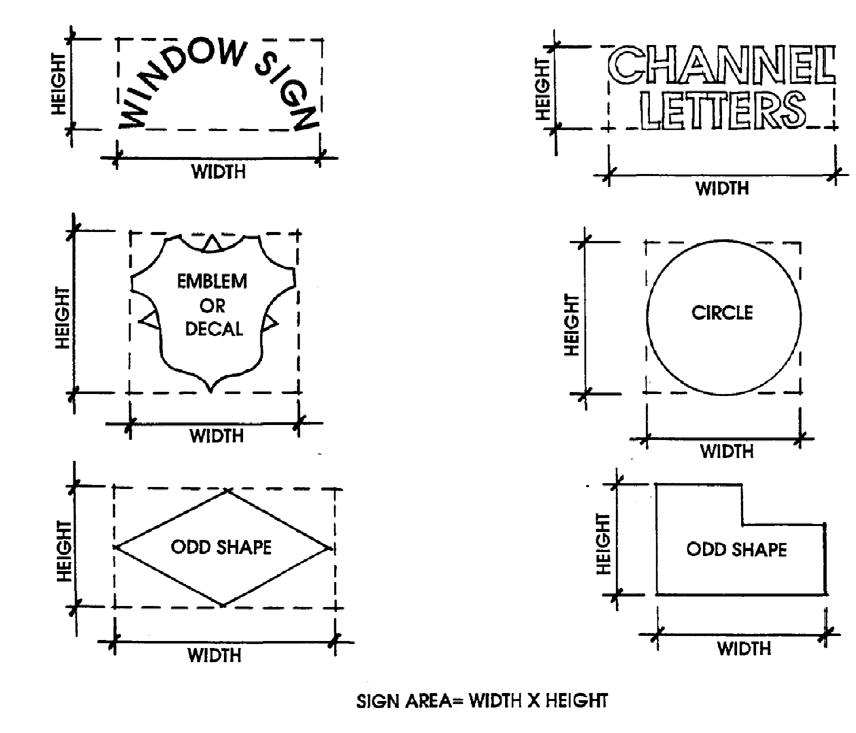
(2)
Supporting framework or bracing that is clearly incidental to the display itself shall not be computed as sign area.
(3)
If the sign consists of more than one section or module, all of the area, including the area between the sections or modules, shall be included in the computation of sign area.
(4)
Double-faced freestanding and monument signs with (back-to-back) surfaces shall be regarded as a single sign only if the distance between each parallel sign face does not exceed two feet.
(5)
Where a sign consists of one or more three-dimensional objects (i.e., balls, cubes, clusters of objects, sculpture or statue-like trademarks) the sign area is the smallest rectangle within which the object(s) can be enclosed.
B.
Awning or Canopy Signs.
(1)
The surface area of a canopy or awning sign shall be calculated by enclosing the extreme limits of any writing, logo, representation, emblem, border or other display within a single continuous perimeter composed of squares or rectangles.
(2)
If more than one surface of the awning or canopy is utilized for signs or if an under-canopy sign is attached to the main canopy, the aggregate sign area shall be calculated by totaling the sign area on each surface.
6.04.3860 - Address numbers required.
All non-residential structures shall have address numbers a minimum of six inches in height and of a contrasting color. For multi-family, commercial, institutional, and industrial uses address numbers shall be illuminated. For multi-tenant structures/projects, each individual tenant space shall also be addressed, and a site plan directory should be provided.
6.04.3865 - illumination of signs.
All sign illumination shall be either from the interior of a sign, behind individually cut letters (back lighting), or a shielded indirect lighting source. Care shall be taken in the design and placement of all signs to ensure that no lighting source creates negative effects on surrounding properties or public rights-of-way.
6.04.3870 - Use of exposed neon tubing.
The use of neon (exposed gaseous light tubing) shall be allowed in commercial zoning districts only. Any use of neon requires the approval of a sign permit in compliance with Subsection 6.04.3815. In addition, the following requirements shall apply:
1.
Neon signs and linear tubing shall be UL (Underwriters Laboratories) listed with a maximum twenty amps for each circuit;
2.
Neon manufacturer shall be registered with Underwriters Laboratories;
3.
Neon tubing shall not exceed one-half-inch in diameter;
4.
Neon lighting adjacent to residential uses shall not exceed on one-half foot candle measured at the commercial property line;
5.
Neon tubing shall not be combined with any reflective materials (i.e., mirrors, polished metal, highly glazed tiles or other similar materials);
6.
When used as an architectural element, neon tubing shall be used only to reinforce specific architectural elements of the structure and shall be concealed from view through the use of parapets, cornices, ledges or similar devices; and
7.
Neon signs, together with other permitted window signs, shall not occupy more than twenty-five percent of the total window area.
6.04.3875 - Wall signs.
1.
Wall signs shall be located only on structure frontages, except directional signs.
2.
Wall signs shall not project from the surface upon which they are attached more that required for construction purposes.
3.
Wall signs shall not project above the eaveline of a structure, or a sill of a second story window.
4.
Wall signs shall be placed within the center eighty percent of a structure frontage. Signs which are placed outside this area shall be subject to a twenty-five-percent reduction in total allowable sign area.
6.04.3880 - Projecting signs.
1.
All projecting signs shall be double-faced.
2.
Projecting signs shall be located only on structure frontages, except directional signs.
3.
Only projecting signs that are proposed to be attached to structure frontages located within one foot of a property line abutting a public street may be considered for possible encroachment into a public right-of-way.
4.
Projecting signs may project over public spaces, public sidewalks, or structure lines as far as, but not beyond, the line marked "A" indicated in Exhibit III-1 provided in this Section.
5.
Signs that project over a public right-of-way shall require the approval of an encroachment permit.
6.
No signs shall project above the eaveline of a structure with a sloping roof or above the parapet on a flat roof.
7.
The maximum thickness of a projecting sign shall not exceed that required for construction purposes.
8.
All signs shall have a minimum vertical clearance of eight feet from the ground to the bottom of the sign or sign structure.
6.04.3885 - Signs on awnings.
1.
Signs on awnings are limited to the valance area only.
2.
The maximum letter height for awning signs shall be 5 inches.
6.04.3890 - Freestanding and monument signs.
1.
Signs are permitted only for property frontages adjoining a public street.
2.
There shall be a minimum of seventy-five feet between any two freestanding signs on adjoining sites whenever possible in order to ensure adequate visibility for all signs.
3.
Signs are subject to all required setbacks and shall not project over any public rights-of-way.
4.
Signs shall identify only the center's name and up to two major tenants; or three major tenants and no center name.
5.
Landscaping shall be provided at the base of the supporting structure equal to twice the area of one face of the sign (i.e., thirty sq. ft. sign area = sixty sq. ft. landscaped area).
6.
The height of freestanding signs shall be measured from the lowest finished grade at the bottom of the sign.
6.04.3891 - Portable sidewalk signs. (per Ord. 98-726 adopted 3/10/98)
1.
Signs are permitted in the central business district, commercial highway zone and commercial neighborhood zone only.
2.
Signs located in the commercial highway zone shall be located on private property.
3.
Portable sidewalk signs shall not be permitted in the street.
4.
Each business is permitted one portable sidewalk sign.
5.
Signs in the COD, CH and CN zones shall be located directly in front of the business.
6.
Maximum sign width is twenty-four inches.
7.
Maximum sign height is four feet.
8.
Signs shall receive a sign permit from the planning director.
9.
Signs in COD, CH and CN zones shall be located on sidewalks adjacent to the curb or promenade and provide for not less than a five-foot wide access between the sign and the business to allow for pedestrian movement.
10.
Signs shall be removed daily by the business operator at the close of business hours from the public right-of-way and relocated within the subject business.
11.
Signs shall comply with the Downtown Specific Plan, Central Business District Core Sign Guideline 1.C, Figurative Signs as determined by the community development director.
12.
Signs shall be maintained in good condition.
13.
The community development director has the authority to deviate from the portable sign standards in the interest of safety as it relates to size, location and stability.
14.
Portable sidewalk signs must be designed and constructed to prevent tripping hazards and constructed to prevent wind from blowing over the sign.
15.
A-frame signs are not permitted. But, A-frame signs are permitted on a temporary basis at fifteen-day periods for non-businesses to announce special events or noticing.
16.
Signs shall not have any moving parts or electrical illumination.
17.
Failure to comply with the above conditions as determined by the community development director and after five—day notice to comply will result in removal of sign and revocation of sign permit.
6.04.3892 - Off-site tourist signs. (per Ord. 98-728)
1.
Tourist attractions as defined in Section 6.04.9610 are permitted off-site signs.
2.
No more than one off-site sign per tourist attraction may be located along Ventura Street within the city for each direction of travel. Each sign may be double-faced.
3.
Sign designs shall comply with the Ventura Street Design Guidelines as determined by the community development director.
4.
Off-site signs shall display the Heritage Valley logo as directed from the community development director.
5.
The owner of the subject property must approve, in writing, the sign location.
6.
A permit is required.
7.
Signs shall be maintained.
8.
Tourist cluster businesses, i.e., restaurants antique store etc., are permitted no more than one-sign per cluster for each direction of travel along Ventura Street.
9.
Developed properties along Ventura Street may permit one tourist attraction off-site sign per the following requirements:
A.
Off-site sign shall be a monument sign.
B.
Freestanding signs are not permitted.
C.
The maximum area of each sign shall not exceed twenty-five square feet per sign face.
D.
The height of the sign shall not exceed six feet if there is no front setback from the property line.
E.
The height of the sign shall not exceed eight feet if there is more than a fifteen-foot setback from the property line.
10.
Undeveloped properties along Ventura Street may permit one tourist attraction off-sire sign per the following requirements:
A.
Freestanding signs are permitted.
B.
The maximum area of freestanding signs shall not exceed one hundred square feet per sign face.
C.
Freestanding signs shall not exceed twenty-five square feet in height.
D.
Monument signs shall not exceed twenty-five square feet per sign face and shall not exceed eight feet in height.
6.04.3893 - Digital signs. (per CC Ord. No. 854)
On-premises digital signs shall be permitted in the commercial highway zoning district in accordance with the provisions of this section.
1.
Properties are limited to one digital sign for those properties with three hundred fifty linear feet in width of frontage along Hwy 126. Those properties along Ventura Street that comply with requirements for both freestanding signs and digital signs are required to combine both freestanding and digital sign onto a single structure rather than two separate structures.
2.
Only the permitted on-premises business is permitted to advertise on the digital sign. No digital sign shall be used for off-site advertisement.
3.
General Development Standards. The construction of a digital on-premises sign may be permitted by the planning commission subject to any conditions which may be impose, pursuant to this section and chapter and as permissible by law. The planning commission may, in granting a development permit, impose conditions relating to building codes, zoning requirements, health and safety codes, and other development requirements which satisfy the purpose and spirit of this title.
4.
Violation of, or noncompliance with, any of the conditions imposed on the development permit shall constitute grounds for revocation of the permit by the planning commission.
5.
Digital signs shall be oriented away from properties zoned residential. Light intensity shall not exceed a brightness level of 0.3 foot candles above ambient light measured at the property line of the nearest residential property.
A.
Measurement of Distance. For purposes of this section, all distances shall be measured in a straight line, without regard to intervening structures, from the nearest point of the digital sign to the nearest property line of any land use, land use district, or zone.
6.
Digital sign screen display shall not exceed one hundred square feet.
7.
The following limitations shall apply to all digital on-premises sign displays:
A.
No sign shall display animated messages, including flashing, blinking, fading, rolling, shading, dissolving, or any other effect that gives the appearance of movement.
B.
The digital screen shall be in color video only. No black and white screen images are permitted.
C.
No sign shall include any audio.
D.
Signs shall display static images only and shall not change more than once every five seconds.
E.
Transitions from one static image to the next shall appear instantaneous, without the appearance of animation.
F.
Each sign shall come equipped with automatic dimming technology which automatically adjusts the sign's brightness based on actual ambient light conditions. Measurement shall be taken at least thirty minutes past sunset, using a foot candle meter to record the ambient light reading for the area. This is done while the message center is off or displaying all black copy. No sign shall exceed a brightness level of 0.3 foot candles above ambient light. The reading shall be taken with the meter aimed directly at the message center at the appropriate pre-set distance. The measuring distance shall be calculated with the following formula:
G.
Digital on-premises signs shall be programmed to go dark in the event of a malfunction. A maintenance program shall be submitted with the Development Permit application in order to address malfunctioning or broken signs.
H.
Digital signs shall be dark from 11:00 p.m. to 7:00 a.m. every day.
8.
Digital signs are subject to all required setbacks and shall not project over any public rights-of-way.
9.
Installation of a digital sign on an existing freestanding sign shall require a full structural and aesthetic upgrade of the existing freestanding sign.
10.
Landscaping shall be provided at the base of the supporting structure of the sign equal to twice the area of one face of the sign. (For example, thirty square feet sign area = sixty square feet required landscaping area.)
11.
Digital sign structure height requirements shall be the same as those for freestanding signs provided in Section 6.04.3890.
12.
Digital signs are subject to any design guidelines adopted for the commercial highway designation.
13.
Digital signs shall be subject to federal and state laws and requirements pertaining to the placement of digital signs adjacent to Hwy 126. (Per City Council Ordinance No. 854)
6.04.3895 - Sign regulations by zoning district.
Table III-2 identifies the numbers and sizes of signs permitted in each zoning district.
EXHIBIT III-1
ALLOWABLE CLEARANCE AND PROJECTION OF PROJECTING SIGNS
(RESERVED)
TABLE III-2
SIGN REGULATIONS BY ZONING DISTRICTL
6.04.3899 - Applicable regulations.
All uses shall be subject to the applicable provisions of this ordinance, including the procedures outlined in the following sections:
1.
Section 6.04.70 Conditional use permits.
2.
Section 6.04.66 Development permits.
3.
Section 6.04.54 Home occupation permits.
4.
Section 6.04.28 Landscaping standards.
5.
Section 6.04.68 Minor conditional use permits.
6.
Section 6.04.60 Minor modifications.
7.
Section 6.04.62 Minor variances.
8.
Section 6.04.32 Off-street loading standards.
9.
Section 6.04.34 Off-street parking standards.
10.
Section 6.04.58 Temporary use permits.
11.
Section 6.04.64 Variances.
6.04.3901 - Purpose.
1.
The purpose of this section is to permit and encourage original mural artwork on a content-neutral basis within the city, subject to certain terms and conditions. This section is also intended to allow for the creation of a program for city funding to assist in the creation of art murals. Art murals comprise a unique medium of artistic expression which serves the public interest; art murals have purposes distinct from signs and confer different benefits. Such purposes and benefits include: improved aesthetics; avenues for original artistic expression; public access to original works of art; community participation in the creation of original works of art; community building through the presence of and identification with original works of art; and a reduction in the incidence of graffiti and other crime. Art murals can increase community identity and foster a sense of place and enclosure if they are located at heights and scales visible to pedestrians, are retained for longer periods of time and include a process for community discussion.
2.
Additionally, the art mural requirements in this section promote public safety and welfare by regulating such displays in keeping with the following objectives:
A.
That the design, construction, installation, repair and maintenance of such displays will not interfere with traffic safety or otherwise endanger public safety.
B.
That the regulations will provide reasonable protection to the visual environment by controlling the size, height, spacing and location of such displays.
C.
That the public will enjoy the aesthetic benefits of being able to view such art displays in numbers and sizes that are reasonably and appropriately regulated without having to endure visual blight and traffic safety impacts that would be caused by such displays that are not reasonably and appropriately regulated.
D.
That consideration will be given to equalizing the opportunity for artistic messages to be displayed.
E.
To impose permit requirements and regulations for art murals.
(Ord. No. 18-889, § 3, 5-22-2018)
6.04.3905 - Definitions.
"Art mural." An original, one-of-a-kind, hand-painted or hand-tiled work of visual art on the exterior wall of a building. Art mural does not include murals containing any electrical or mechanical components or changing image murals.
"Public art mural." An art mural that is either: i) located on publicly owned property or on a public right-of-way, ii) funded wholly or partially using city funds, or iii) donated to the city.
(Ord. No. 18-889, § 3, 5-22-2018)
6.04.3910 - Distinction from signs.
An art mural that conforms to the requirements of this section shall not be considered a sign and is therefore not subject to the requirements of the Fillmore Zoning Ordinance that regulates signs. Any supposed art mural that does not conform to the requirements of this section shall be considered a sign and subject to the provisions of the Fillmore Zoning Ordinance, including section 6.04.38, that regulates signs.
(Ord. No. 18-889, § 3, 5-22-2018)
6.04.3915 - Public art mural program.
1.
The city council may adopt a public art mural program which shall identify the program application procedures, program requirements and criteria for evaluating funding requests. Property owners participating in the public art mural program, if adopted by the city council, shall be required to provide a signed and notarized art easement form that must be recorded with Ventura County.
2.
Public art murals shall be subject to the requirements of this section 6.04.39, as well as the requirements of the public art mural program adopted by the city council.
(Ord. No. 18-889, § 3, 5-22-2018)
6.04.3920 - Art mural permit required.
It shall be unlawful for any person, firm, or corporation to authorize, erect, construct, maintain, move, alter, change, place, suspend, or attach any art mural within the city without first obtaining the necessary permit.
(Ord. No. 18-889, § 3, 5-22-2018)
6.04.3925 - Art mural permit application and review procedures.
1.
Authority to Adopt Administrative Rules. The city manager is authorized to adopt art mural ordinance administrative rules implementing this section. The city manager is further authorized to specify art mural permit application requirements and art mural review procedures consistent with the requirements of this section.
2.
Application Requirements. An application for an art mural permit, which shall include a maintenance plan, shall be submitted to the community development department to be assessed for compliance with the requirements of this section. An application for an art mural permit shall be submitted with applicable application fees, as established by resolution of the city council. The planning and community development director shall have the authority to determine whether or not an application for an art mural permit meets all of the applicable permit application requirements.
3.
Community Development Review. Upon a determination by the planning and community development director that an application for an art mural permit is complete and meets all applicable art mural requirements under this section, then the art mural permit application shall be forwarded to the art commission for review.
4.
Art Commission Review; Determination Appealable to City Council. Prior to any action by the art commission, the city shall send notice of such application to all property owners within three hundred feet of the location of the mural at least thirty days prior to the art commission consideration of the art mural. The costs of such notice shall be paid for by the art mural permit applicant as part of the applicable application fees. The art commission shall have final approval authority on an art mural permit application, provided that any person may appeal the art commission's determination to the city council for final review.
5.
Covenant. The art commission shall require as a condition of approval that the applicant be required to record a covenant with the office of the county recorder prior to art mural installation. The covenant shall require that the art mural comply at all times with all provisions this section and any administrative rules adopted by the city manager implementing this section. The covenant shall remain in force for as long as the art mural exists.
(Ord. No. 18-889, § 3, 5-22-2018)
6.04.3930 - Art mural requirements.
Art murals shall meet the requirements of this section below. An art mural satisfying these requirements and complying with applicable city permit application and review procedures will be issued an art mural permit following review by the art commission. The decision of the art commission shall be subject to appeal to the city council.
1.
The art mural shall remain in place, without alteration, for a minimum period of five years.
A.
"Alteration" includes any change to a permitted art mural, including, but not limited to, any change to the image(s), materials, colors, or size of the permitted art mural. "Alteration" does not include naturally occurring changes to the art mural caused by exposure to the elements or the passage of time.
B.
Minor changes to the permitted mural that result from the maintenance or repair of the art mural shall not constitute an "alteration." Such minor changes may include slight unintended deviations from the original image, colors, or materials that occur when the permitted mural is repaired due to the passage of time or as a result of vandalism.
C.
An art mural may be removed within the first five years of the date of registration under the following circumstances:
i.
The property on which the art mural is located is sold and the new owner desires to remove the art mural in its entirety and terminate the covenant; or
ii.
The structure or property is substantially remodeled or altered in a way that precludes continuance of the art mural; or
iii.
The property undergoes a change of use authorized by the planning commission; or
iv.
The owner of an art mural may request permission from the city manager to remove an art mural prior to the expiration of the five-year period, which the city manager may grant upon making a finding that the continued maintenance of the mural is not feasible.
2.
No part of an art mural shall exceed the height of the structure to which it is tiled, painted, or affixed.
3.
No part of an art mural shall extend more than six inches from the plane of the wall upon which it is tiled or painted.
4.
No art mural may consist of, or contain, electrical or mechanical components or changing images which are defined as moving structural elements, flashing or sequential lights, lighting elements, or other automated methods that result in movement, the appearance of movement, or change of mural image or message, not including static illumination turned off and back on not more than once every twenty-four hours.
5.
No art mural shall obstruct the exterior surface of any building opening, including, but not limited to, windows, doors, and vents.
6.
No art mural shall structurally alter a building, including but not limited to architectural changes or addition of structural posts, beams, or structural membranes. Additionally, no art mural installation shall involve removal of the veneer exterior materials of the building.
7.
No art mural shall be placed on residential building containing fewer than five residential dwelling units.
8.
No art mural shall be placed on a lot located other than in the residential medium high, residential high, commercial office, commercial neighborhood, commercial highway, central business district, manufacturing/industrial, business park 1, or public facilities zones.
9.
No art mural shall be arranged and illuminated in a manner that will produce a light intensity of greater than three foot candles above ambient lighting, as measured at the property line of a the nearest residentially zoned property.
(Ord. No. 18-889, § 3, 5-22-2018)
6.04.3935 - Art mural maintenance.
1.
The maintenance and/or its costs for the art mural is the responsibility of the property owner.
2.
The art mural must be properly maintained to ensure that it is maintained in good condition, that material failure is corrected and that graffiti and other types of vandalism are removed promptly. Graffiti coating is required.
3.
Failure to maintain the art mural as provided herein is declared to be a public nuisance, and may be summarily abated or repaired by the city. The city may pursue additional remedies to obtain compliance with this section.
4.
In addition to other remedies provided by law, in the event the property owner fails to maintain the art mural, upon reasonable notice, the city may perform all necessary repairs or maintenance to an art mural, and all costs incurred by the city shall be billed to the property. should the property owner fail to pay the city for said costs, the costs may become a lien against the property.
(Ord. No. 18-889, § 3, 5-22-2018)
6.04.3940 - Prohibited art murals.
The following art murals shall be prohibited:
1.
Art murals on residential buildings with fewer than five dwelling units.
2.
Art murals on county, state or federally-designated historic or conservation landmarks.
3.
Art murals for which compensation is given or received to the property owner or tenant for the display of the art mural or for the right to place the art mural on another's property or which are off site commercial messages. The applicant shall certify in the permit application that no compensation will be given or received by the property owner or tenant for the display of the art mural or the right to place the art mural on the property and that the mural will not include off site commercial messages.
4.
Art murals which would result in a property becoming out of compliance with the provisions of the Fillmore Zoning Ordinance or land use conditions of approval for the development on which the art mural is to be located.
5.
Unprotected Speech. Any message or image which is outside the protection of the First Amendment to the U.S. Constitution and/or the corollary provisions of the California Constitution, such as material meeting the legal definition of obscenity, is prohibited.
(Ord. No. 18-889, § 3, 5-22-2018)
6.04.4001 - Purpose.
To achieve the following:
1.
Mitigate the effects that new and expanding land uses may have on traffic congestion and air quality within the city and surrounding region;
2.
Promote transportation demand management strategies that encourage employers to utilize both the existing and planned transportation infrastructure in an efficient manner through a variety of trip reduction techniques;
3.
Specify responsibilities of applicants proposing non-residential development within the city to consider transportation demand management strategies which incorporate design standards and other strategies that reduce single-occupant vehicle trips;
4.
Require the implementation of strategies that reduce transportation demand through the city's permit review process;
5.
Support development of facilities that promote the use of alternative, energy-conserving transportation modes; and
6.
Implement state law (Government Code Section 65088, Congestion Management).
6.04.4005 - Definitions.
For the purposes of this section, the following definitions shall apply:
1.
"Alternative transportation modes." Any mode of travel that serves as an alternative to a single occupant vehicle, including all forms of ridesharing (i.e., carpooling, vanpooling), public transit, bicycling, walking, etc.
2.
"Applicable development." Any development project that is determined to meet or exceed the project size threshold criteria contained in this section.
3.
"Buspool." A vehicle carrying sixteen or more passengers commuting on a regular basis to and from work with a fixed route, according to a fixed schedule.
4.
"Carpool." Two to six persons traveling together in a single vehicle.
5.
"Development." The construction or addition of new structure square footage. All calculations shall be based on gross square footage.
6.
"Employee parking area." The portion of total required parking at a development used by on-site employees.
7.
"Preferential parking." Parking spaces designated or assigned, through use of a sign or painted space markings for carpool and vanpool vehicles carrying commute passengers on a regular basis that are provided in a location more convenient to a place of employment than parking spaces provided for single occupant vehicles.
8.
"Property owner." The legal owner of a parcel(s) subject to the provisions of this section, ultimately responsible for complying with the provisions of this section.
9.
"Ridesharing." The cooperative effort of two or more people traveling together for the purpose of getting to work. Utilization of carpools, vanpools, buspools, taxipools, trains and bus and rail transit are all examples of ridesharing.
10.
"Telecommuting." A work arrangement for performing work electronically, where employees work at a location other than the primary work location (i.e., at home or in a subordinate office).
11.
"Teleconferencing." Telephone or video multi-access link for group communication.
12.
"Teleservices." Automatic information services (i.e., automatic teller machines, telephone information services, telephone banking/transactions, computer mail, computer modem, facsimile).
13.
"Tenant." The lessee of facility space at an applicable development project.
14.
"Transportation demand management." The implementation of programs, policies, or permit approvals designed to encourage changes in individual travel behavior, including emphasis on alternative travel modes to single occupant vehicle use (i.e., carpools, vanpools and public transit, reduction or elimination of vehicle trips, shifts in peak hour vehicle commuting, etc.).
15.
"Trip reduction." Reduction of the number of work related trips taken during peak-hours in single occupant vehicles.
16.
"Vanpool." A vehicle occupied by seven or more persons commuting together to and from work on a regular basis.
6.04.4010 - Applicability.
Any new or expanded non-residential project, or change of use whose total employment exceeds, or will exceed, the thresholds provided in Subsection 6.04.4015 shall provide, as a minimum, all applicable transportation demand management and trip reduction measures in compliance with this section.
6.04.4015 - Transportation demand management program requirements.
All applicable projects subject to this section shall prepare and implement a transportation demand management (TDM) program which will encourage increased ridesharing and the use of alternative transportation modes. A TDM program shall include all of the requirements of this subsection and may include the optional requirements provided in Subsection 6.04.4020.
1.
Projects with Fifty Employees and More. All non-residential projects/uses with fifty employees and more shall provide a bulletin board, display case, or kiosk displaying transportation information located where the greatest number of employees are likely to see it. Information displayed shall include, but is not limited to, the following:
A.
Current maps, routes and schedules for public transit routes serving the site;
B.
Telephone numbers for referrals on transportation information including numbers for the regional ridesharing agency and local transit operators;
C.
Ridesharing promotional material supplied by commuter-oriented organizations;
D.
Bicycle route and facility information, including regional/local, bicycle maps and bicycle safety information; and
E.
A listing of facilities available for carpoolers, vanpoolers, bicyclists, transit riders and pedestrians at the site.
2.
Projects with One Hundred Employees and More. All non-residential projects/uses with one hundred employees and more shall provide all of the measures outlined above in addition to the following:
A.
Carpool/Vanpool Preferential Parking. Parking spaces shall be designated/reserved for carpool/vanpool vehicles in compliance with the table below. The spaces shall be marked "Carpool Only." Carpool spaces shall be used only by carpool vehicles in which at least two of the persons are employees or tenants of the project. Carpool spaces shall be located near the structure's employee entrance(s) or other preferential locations within the employee parking areas as approved by the Director.
A statement that preferential carpool/vanpool spaces for employees are available and a description of the method for obtaining the spaces shall be included on the required transportation information board.
B.
Bicycle Parking. Bicycle racks or other secure bicycle parking shall be provided for use by employees and tenants, located in a secure location in close proximity to employee entrances. The minimum number of bicycle parking spaces to be provided shall be five spaces for each 100 employees or fraction thereof. This requirement is in addition to bicycle parking requirements for the public as provided in Section 6.04.34 (Off-street parking standards).
C.
Pedestrian Access. Sidewalks and other paved pathways shall be provided on-site to connect off-site pedestrian and bicycle circulation systems, for both existing and proposed development.
D.
Commuter Matching Service. Commuter matching services shall be provided to all employees, on an annual basis, and all new employees upon hiring.
3.
Projects with one hundred fifty Employees and More. All non-residential projects/uses with 150 employees and more shall provide all of the measures outlined in 1 and 2 above in addition to the following:
A.
Carpool/Vanpool Loading Zones. A safe and convenient zone in which carpool/vanpool vehicles may deliver or board their passengers shall be provided near employee entrances.
B.
Transit Waiting Shelters. Bus pullouts, bus pads, and bus shelters may be required by the review authority for projects located along high traffic volume streets and established or proposed bus routes.
The city will consult with local bus service providers in determining appropriate improvements. Structure entrances shall be designed to provide safe and efficient access to nearby transit stations/stops.
C.
Joint Access and Shared Parking. For applicable projects, as determined by the review authority, joint access and shared parking across multiple parcels may be required to implement the intent of this section.
6.04.4020 - Miscellaneous optional measures.
The following measures may be incorporated into a project in order to further implement the intent of this section. Larger projects (one hundred fifty plus employees) shall provide these measures to the extent feasible and practical.
1.
Shower and locker facilities provided on-site for use by employees/tenants who commute to the site by bicycle/walking;
2.
On-site daycare facilities;
3.
On-site lunch room/cafeteria facilities; and
4.
Telecommunication facilities (teleconferencing, teleservices, or telecommuting) to be available for exchange or shared use.
6.04.4025 - Monitoring.
1.
All facilities required in compliance with this section shall be included in the building plans and submitted to the department for review.
2.
Prior to the issuance of an occupancy clearance by the department, all requirements of this section shall be in place at the site.
6.04.4030 - Applicable regulations.
All uses shall be subject to the applicable provisions of this ordinance, including the procedures outlined in the following sections:
1.
Section 6.04.70 Conditional use permits.
2.
Section 6.04.66 Development permits.
3.
Section 6.04.28 Landscaping standards.
4.
Section 6.04.68 Minor conditional use permits.
5.
Section 6.04.60 Minor modifications.
6.
Section 6.04.62 Minor variances.
7.
Section 6.04.32 Off-street loading standards.
8.
Section 6.04.34 Off-street parking standards.
9.
Section 6.04.38 Sign standards.
10.
Section 6.04.58 Temporary use permits.
11.
Section 6.04.64 Variances.
6.04.4101 - Purpose and intent.
The regulations for, and prohibitions on, specific types of hemp operations are enacted to preserve the public health, safety, and welfare of the residents and visitors of the City of Fillmore, while allowing and regulating hemp activities in a responsible manner consistent with the 2018 Farm Bill and all applicable federal and state laws. It is the intent of this chapter to prohibit the cultivation of hemp and to require all persons storing, manufacturing, and testing hemp to register and obtain a permit to operate within the City of Fillmore. The chapter is not intended to permit activities that are illegal under federal, state or local law. This chapter is not intended to conflict with federal or state law. The provisions of this chapter are in addition to any other permits, licenses or approvals required to conduct hemp activities within the county.
(Ord. No. 20-928, § 3, 7-14-2020)
6.04.4105 - Definitions.
As used in this chapter, the following words and phrases shall have the following meanings:
A.
"Cultivation" has the same meaning as that set forth in Food and Agricultural Code Section 81000, which at the time of the adoption of this code is any activity involving the planting, growing, harvesting, drying, curing, grading, or trimming of hemp including activities carried out by seed breeders or by established agricultural research institutions for educational purposes.
B.
"Director" shall mean the city's director of community development or his/her designee.
C.
"Established agricultural research institution" has the same meaning as in Section 81000 of the Food and Agriculture Code.
D.
"Hemp" or "Industrial hemp" has the same meaning as that set forth in Health and Safety Code Section 11018.5, which at the time of the adoption of this code is:
1.
A crop that is limited to types of the plant Cannabis sativa L. having no more than 0.03 percent tetrahydrocannabinol (THC) contained in the dried flowering tops, whether growing or not;
2.
The seeds of the plant;
3.
The resin extracted from any part of the plant; and
4.
Every compound, manufacture, salt, derivative, mixture, or preparation of the plant, its seeds or resin produced therefrom.
E.
"Low-odor varieties" means a list, maintained by the state agricultural commissioner, of certified hemp varieties found to be low in odor.
F.
"Person" means any individual, firm, partnership, joint venture, association, corporation, limited liability company, estate, trust, activity, trust, receiver, syndicate, or any other group or combination acting as a unit.
G.
"Seed breeder" has the same meaning as in Section 81000 of the Food and Agriculture Code.
H.
"Sensitive site" means any:
1.
Property within any residential zone in the city, or
2.
A school (K-12).
I.
"Site" means the premises and actual physical location of a hemp operation as well as its accessory structures and parking areas.
(Ord. No. 20-928, § 3, 7-14-2020)
6.04.4110 - Hemp cultivation prohibited.
The cultivation of industrial hemp within the city is prohibited. The cultivation of industrial hemp is a prohibited use under title 6 of the Fillmore Municipal Code and no building permit, business regulatory permit, zoning clearance, or other entitlement may be issued for the purposes of authorizing such use.
(Ord. No. 20-928, § 3, 7-14-2020)
6.04.4115 - Registration of hemp storage, manufacturing, and testing uses and permit required.
A.
No person shall store, manufacture, or test hemp in the city without first registering and obtaining a permit to use hemp as provided by this chapter. A permit issued under this chapter does not grant any interest in real property, create any interest of value, and is nontransferable.
B.
Prior to the storage, manufacturing or testing of industrial hemp in the city, the following requirements shall be met:
1.
The applicant must complete the city's hemp use application and demonstrate that it meets the standards established in the city's hemp use application including providing all information required in Food and Agricultural Code Section 81003(a).
2.
The applicant must be the owner of the land upon which the hemp is proposed to be stored, manufactured, or tested or provide a written consent form signed by the owner.
3.
The applicant or any entity in which the applicant has an interest may not already hold a city-issued hemp use permit as each person may only be issued one hemp use permit.
4.
The land upon which the hemp is to be used must be located one of the following:
a.
In the O-S (Open Space) zone district;
b.
In a business park master plan (BP-1 or BP-2) zone districts; or
c.
On a parcel which is a minimum of four acres in size and is currently used for productive agricultural purposes. Manufacturing or testing uses must be located in M (industrial) or BP (business park) zone districts.
5.
The greenhouse in which hemp will be manufactured, stored, or tested and any storage container for hemp must have a minimum set back from all sensitive sites of seventy-five feet.
6.
The applicant shall pay the state registration and county fees including those set forth in Title 3 of the California Code of Regulations Section 4900 and all applicable city fees.
7.
The applicant must register and receive a permit from the state and county, if applicable, to manufacture or test hemp.
C.
Hemp may only be stored, tested, or used in manufacturing at an approved site and all hemp storage, testing, and manufacturing must comply with the requirements of this chapter.
(Ord. No. 20-928, § 3, 7-14-2020)
6.04.4120 - Terms and conditions of hemp use permits.
Permit holders must comply with the following terms and conditions:
A.
On site processing of hemp other than in connection with manufacturing is prohibited.
B.
To allow the city to ensure the maintenance of the public health, safety, and welfare, a permit holder must allow monitoring and inspection of the interior of all structures in which hemp is stored, manufactured, or tested by the director and members of the Ventura County Sheriffs Department at any time without an appointment. The permit holder is responsible for the actual inspection costs including, but not limited to, the costs of staff time for monitoring and inspection activities.
C.
Strict adherence to each and every requirement of this chapter, as well as any requirements including administrative regulations, adopted by the city pursuant to the authority of this chapter and adherence to all applicable county and state laws.
D.
The permit holder must maintain a current and valid state and/or county permit and registration, if required. Revocation, suspension or expiration of the state and/or county permit or registration shall automatically invalidate the equivalent city hemp use permit.
E.
Hemp manufacturing, storage, and testing shall be conducted in accordance with state, county, and local laws related to land conversion, grading, electricity, water usage, water quality, woodland and riparian habitat protection, agricultural discharges, and similar matters.
F.
Each permit issued pursuant to this chapter shall expire in one year unless the permittee substantially commences the use as determined by the director.
(Ord. No. 20-928, § 3, 7-14-2020)
6.04.4125 - Hemp uses general operating standards and restrictions.
A hemp use shall operate in conformance with the minimum standards set forth below. These standards are deemed to be part of the conditions on the permit for a hemp use to ensure that its operation is in compliance with all applicable laws including this code and to mitigate any potential adverse impacts of the hemp use on the public health, safety or welfare. Additional minimum operating standards may be adopted from time to time either by resolution or ordinance from the city council or by adoption of a policy by the city manager. Any regulations issued by the city manager shall be published on the city's website and a copy will be on file with the city clerk's office.
A.
Indoor Only. A hemp use (storage, testing and manufacturing) may only occur in an odor-controlled building that is ten thousand square feet or less. Plastic or plastic tarp greenhouses are not permitted. Manufacturing and testing shall only be undertaken in a building. No hemp shall be visible from the public right-of-way or the unsecured areas surrounding the buildings on the site, or the site's main entrance and lobby.
B.
Delivery Restrictions.
1.
Deliveries by semitruck to a hemp use site are prohibited. Deliveries may only occur by half ton truck or smaller vehicles.
C.
Security.
1.
All hemp use areas shall be secured by a lock and accessible only to employees of the permittee. The entire perimeter of the site must be fenced at least six feet tall with locked entrances.
2.
Motion sensor lights must be installed and maintained around the perimeter of each building on the site.
3.
All hemp at the site shall be kept in a secured manner at all times to deter theft and unauthorized access.
4.
A security camera system must be installed covering the entire perimeter of the facility. The system must have the ability to be viewed remotely by the police department and the operator must retain video footage for a minimum of thirty days.
5.
Recordings made by security cameras required pursuant to this chapter shall be made immediately available to the director within twenty-four hours of a verbal request; no search warrant or subpoena shall be needed to obtain and view the recorded materials.
D.
Odor Mitigation. All hemp uses must occur completely indoors and each structure in which hemp is grown or stored must have a carbon air filtration treatment system that prevents hemp odors from escaping off-site.
E.
Pollen Control. Hemp plants producing pollen may only be grown by a registered seed breeder.
F.
Lighting. Sufficient lighting must be used in all areas where hemp is stored, and where equipment or utensils are cleaned, so that at all times the items and activities in these areas are fully visible to both security cameras covering the areas as well as the naked eye. In addition, blackout curtains must be used to prevent light pollution from other lighting sources.
G.
Buffer. A hemp use may not be established or maintained within:
1.
One hundred feet of a residential use or residential zone.
2.
Two hundred fifty feet of an educational facility.
H.
Inspections.
1.
Unscheduled. The director and the sheriff's department shall have the right to enter all areas of the hemp uses from time to time, unannounced, to undertake reasonable inspections to observe and enforce compliance with this chapter and all laws of the city, county, state and federal government. No employee shall refuse, impede, obstruct or interfere with an inspection conducted pursuant to the authorizations provided by this section.
2.
Scheduled. Each permittee shall ensure that the director and sheriffs department conduct an inspection of the site at least once every six months.
I.
Nuisance. The permittee shall take all reasonable steps to discourage and correct conditions that constitute a nuisance on site including in parking areas, sidewalks, alleys and areas surrounding the premises and adjacent properties if the conditions are related to the hemp operation.
J.
Water. The water supply used on the site shall be sufficient for the operations intended, shall comply with all state regulations, and shall be derived from a source that is a regulated water system.
K.
Restricted Access. The site shall be closed to the general public and no one shall be allowed on the hemp use site, except for employees, or persons with a bona fide business or regulatory purpose for being on the site.
L.
City Permit and State License. No person shall engage in a hemp use without having both a current and valid city hemp use permit as well as a current and valid state and/or county permit.
M.
State and Federal Standards. All state and federal requirements and regulations that govern the operation of a hemp use shall apply as minimum requirements and regulations for hemp uses within the city in addition to the requirements and regulations of this code.
(Ord. No. 20-928, § 3, 7-14-2020)
6.04.4130 - Administration of hemp use permits.
Further rules, regulations, policies, procedures and standards for the administration and implementation of this chapter may be adopted from time to time either by resolution or ordinance from the city council or by the city manager (upon authorization by resolution from the city council).
(Ord. No. 20-928, § 3, 7-14-2020)
6.04.4140 - Suspension and revocation of hemp use permit.
A.
The city manager is authorized to suspend and/or revoke a hemp use permit issued pursuant to this chapter upon the determination through written findings of a failure to comply with any provision of this chapter, any permit condition, any applicable policy adopted by the city, or suspension or revocation of a state permit or lapse in registration.
B.
Prior to suspension or revocation of a hemp permit, the permittee shall be provided with a written notice which details the violation(s). The permittee shall have seven days to cure the violation to the satisfaction of the city manager. The seven-day cure period may be extended by the city manager for reasonable cause.
C.
Conditions (if any) of suspension or revocation are at the discretion of the city manager and may include, but are not limited to, a prohibition on all owners, operators, managers and employees of the suspended or revoked hemp operation from operating within the city for a period of time set forth in writing and/or a requirement (when operations may resume, if at all, pursuant to the director's determination) for the holder of the suspended or revoked permit to resubmit an application for a hemp permit pursuant to the requirements of this chapter.
(Ord. No. 20-928, § 3, 7-14-2020)
6.04.4150 - Manufacturing and testing of hemp regulations.
The manufacturing and testing of products made from hemp is authorized within the M (industrial) or BP (business park) zone districts zoning districts and at least one hundred feet from a residential use and two hundred fifty feet from a school. A conditional use permit is required prior to engaging in the manufacturing of hemp products and shall not be approved by the city until the County of Ventura's Agricultural Commissioner issues the applicant a registration under Division 24 of the California Food and Agriculture Code. Each conditional use permit authorized pursuant to this section will be subject to the following:
A.
Inspections. Inspections shall be undertaken as specified in section 6.04.4125(H).
B.
Odor Mitigation.
1.
All industrial hemp manufacturing must occur completely indoors and each structure in which hemp manufacturing will occur must have a carbon air filtration treatment system that prevents hemp odors from escaping off-site. Odor control devices and techniques must be incorporated in all industrial hemp manufacturing facilities to ensure that odor generated inside is not detected outside of the facility, anywhere on an adjacent property or public rights-of-way, on or about the exterior or interior common area walkways, hallways, breezeways, foyers, lobby areas, or any other areas available for use by common tenants or the visiting public, or within any other unit located inside the same building as the industrial hemp business.
2.
To determine the existence of a violation of this section, the city may measure for hemp odor at the industrial hemp business with an approved field olfactometer device, including, but not limited to, a Nasal Ranger Field Olfactometer® or Scentometer®, according to the manufacturer's specifications and operating instructions. The threshold of detection (dilutions to threshold or D/T) will be determined in a sample of the ambient air after it is diluted with three equally sized samples of odor-free air. Two samples or observations will be taken not less than fifteen minutes apart within a one-hour period. The two samples will be taken at the building site of the industrial hemp business. If the threshold of detection is four or greater, the industrial hemp business owner and/or the property owner will be issued a notice to abate public nuisance.
C.
Security.
1.
All areas in which hemp is being utilized shall be secured by a lock and accessible only to employees of the permittee.
2.
The entire perimeter of the site must be fenced at least six feet tall with locked entrances.
3.
Motion sensor lights must be installed and maintained around the perimeter of the building in which manufacturing or testing is occurring.
4.
Each building with a manufacturing or testing area shall have adequate storage space for hemp. The storage areas shall be secured by a lock and accessible only to employees of the permittee.
5.
All hemp on the site must be kept in a secured manner at all times to deter theft and unauthorized access.
6.
A security surveillance camera system must be installed covering the entire perimeter of the facility. The system must have the ability to be viewed remotely by the police department and each operator must retain video footage for a minimum of thirty days.
7.
Recordings made by security cameras required pursuant to this chapter shall be made immediately available to the director within twenty-four hours of a verbal request; no search warrant or subpoena shall be needed to obtain and view the recorded materials.
D.
City Permit and State License. No person shall engage in hemp manufacturing or testing without having both a current and valid city conditional use permit as well as a current and valid state and/or county permit, if required.
E.
State and Federal Standards. All state and federal requirements and regulations that govern the operation of a hemp manufacturing or testing operation, if any, shall apply as minimum requirements.
(Ord. No. 20-928, § 3, 7-14-2020)
6.04.4160 - Limitation on city liability.
To the fullest extent permitted by law, the City of Fillmore shall not assume any liability whatsoever with respect to having registered and issued a permit relating to hemp pursuant to this chapter or otherwise approving the operation of any hemp storage, manufacturing, or testing.
(Ord. No. 20-928, § 3, 7-14-2020)
6.04.4170 - Hemp violations and penalties; public nuisance.
A.
Any violation of sections 6.04.4110, 6.04.4115, 6.04.4120, 6.04.4125, or 6.04.4150 is punishable as a misdemeanor or an infraction, at the discretion of the city attorney, pursuant to section 1.08.025 of this code, except for as preempted by state law; and, any violation of the provisions of this chapter is subject to administrative citation, at the discretion of the city, pursuant to chapter 1.09 of this code.
B.
Any hemp operation that is conducted in violation of any provision of this chapter is hereby declared to constitute a public nuisance and, as such, may be abated or enjoined from further operation, in accordance with the procedures set forth in chapter 1.08 of this code. All costs to abate such public nuisance, including attorneys' fees and court costs, shall be paid by the person causing the nuisance, including the hemp use permittee and the property owner where the nuisance is occurring. Failure to timely abate the public nuisance may result in the revocation of the conditional use permit.
(Ord. No. 20-928, § 3, 7-14-2020)
6.04.4180 - Violation and enforcement.
A.
Any person who violates any provision of this chapter shall be guilty of a separate offense for each and every day during any portion of which any such person commits, continues, permits, or causes a violation thereof, and shall be penalized pursuant to this chapter and/or the provisions of this code.
B.
Any person who violates, causes, continues or permits another to violate the provisions of this chapter commits a misdemeanor and may be punished in accordance with chapter 1.08 or 1.09 of this code. The city may also pursue all applicable civil and administrative remedies, including, but not limited to, injunctive relief and administrative citations.
C.
Each and every violation of the provisions of this chapter is hereby deemed unlawful and a public nuisance which may be abated by the city pursuant to this code.
D.
The administrative citation penalty for all violations of this chapter, within a rolling twelve-month period, shall be as follows: One thousand dollars per violation.
(Ord. No. 20-928, § 3, 7-14-2020)
6.04.4201 - Scope.
The requirements set forth in section 6.04.42 apply to any new construction or conversion of residential ownership housing units, residential rental housing units, and mixed use development with a residential component.
(Ord. No. 19-921, § 3, 1-14-2020)
6.04.4205 - Definitions.
"Affordable housing agreement" means an agreement between a developer or applicant and the city guaranteeing the affordability of ownership or rental dwelling units in accordance with the provisions of section 6.04.42.
"Affordable housing cost" shall mean housing cost that does not exceed the limits for extremely low, very low, low and moderate-income households established in Health and Safety Code section 50052.5, as it may be amended from time to time. The term applies to for-sale units.
"Affordable rent" shall have the same meaning as in Health and Safety Code section 50053, as it may be amended from time to time. The term applies to rental units.
"Affordable unit" means an ownership or rental dwelling unit that is affordable to households with extremely low, very low, low or moderate income levels.
"Applicant" or "developer" means the owner or subdivider with a controlling proprietary interest in the proposed residential development project, or the person or organization making application hereunder.
"Approval authority" means the body or individual(s) with authority to issue final approval of a project pursuant to Table IV of section 6.04.5001 of this code.
"Area median income" or "AMI" means the annual median income for Ventura County, adjusted for household size, as published periodically in the California Code of Regulations, Title 25, Section 6932, or its successor provision.
"City affordable housing fund" means a fund or account designated by the city to maintain and account for all monies received from in-lieu fees and any other fees associated with the provision of affordable housing. The purpose of the fund is to assist in providing housing that is affordable to extremely low, very low, low and moderate income households and cover administrative costs of the affordable housing programs run by the city.
"Complete application" means an application for a residential, nonresidential or mixed use development that has been determined to be complete by the community development department and includes a written description of how the development will comply with the provisions of section 6.04.42.
"Development agreement" means an agreement enacted by legislation between the city and an applicant pursuant to Government Code sections 65864 through 65869.5.
"Extremely low income households" means households whose income does not exceed the extremely low income limits applicable to Ventura County, as published and periodically updated by the state department of housing and community development pursuant to Health and Safety Code section 50106.
"In-lieu fee" means a fee paid by an applicant, owner or developer into the city affordable housing fund in lieu of providing on-site or off-site affordable housing as otherwise required by section 6.04.42.
"Low income household" means households whose income does not exceed the low income limits applicable to Ventura County, as published and periodically updated by the state department of housing and community development pursuant to Health and Safety Code section 50079.5.
"Market-rate unit" means a housing unit or the legal lot for such unit offered on the open market at the prevailing market rate for purchase or rental.
"Moderate income households" means households whose income does not exceed the moderate income limits applicable to Ventura County, as published and periodically updated by the state department of housing and community development.
"Residential ownership project" means any residential project that includes the creation of residential dwelling units that may be sold individually. A residential ownership project also includes condominium conversions.
"Residential rental project" means any residential project or property under common ownership and control that creates one or more net new dwelling units that cannot be lawfully sold individually.
"Very low income households" means households whose income does not exceed the very low income limits applicable to Ventura County, as published and periodically updated by the state department of housing and community development pursuant to Health and Safety Code section 50105.
(Ord. No. 19-921, § 3, 1-14-2020)
6.04.4210 - Application.
An application for a residential development project shall include a written affordable housing plan describing how the project will comply with the provisions of section 6.04.42. The affordable housing plan shall be processed concurrently with all other applications required for the project. The approving authority shall consider the affordable housing plan when acting upon the project. The approving authority shall impose conditions of approval to carry out the purposes of this section.
(Ord. No. 19-921, § 3, 1-14-2020)
6.04.4215 - General requirements for affordable units.
A.
Affordable units shall be reasonably dispersed throughout the project, and shall contain, on average, the same number of bedrooms and shall be comparable to the design of the market-rate units in terms of appearance, materials and finished quality of the market-rate units in the project. There shall not be significant identifiable differences between affordable and market-rate dwelling units which are visible from the exterior of the dwelling units and the size and design of the dwelling units shall be reasonably consistent with the market-rate units in the development. Affordable units shall have the same access to project amenities and recreational facilities as market-rate units.
B.
Affordable units shall be constructed within a similar timeline as the construction of market-rate units. No building permit shall be issued for any market-rate unit unless a proportional number of building permits have been issued for affordable units and no certificates of occupancy or final inspections shall be issued for any market-rate units unless a proportional number of certificates of occupancy or final inspections have been issued for affordable units.
C.
All affordable rental units shall be sold or rented only to qualified extremely low, very low, or low income households and all affordable ownership units shall be sold only to qualified extremely low, very low, or low income households pursuant to procedures and guidelines established by the city.
D.
Ownership affordable units shall be maintained as affordable housing for a period not less than forty-five years. Rental affordable units shall be maintained as affordable housing for a period not less fifty-five years.
E.
Any household that occupies an affordable unit must occupy that unit as its principal residence.
F.
No household may begin occupancy of an affordable unit until the income level of the household has been verified and determined to be eligible to occupy that unit by the city.
(Ord. No. 19-921, § 3, 1-14-2020)
6.04.4220 - Affordable housing in-lieu fees.
A.
The city shall adopt, by resolution, affordable housing in lieu-fee levels. Unless otherwise modified by the city council, the in-lieu fees will automatically adjust for inflation annually, using the Engineering News-Record McGraw-Hill Construction Weekly Building Cost Index for Los Angeles. If this index ceases to exist, the community development director shall substitute another construction cost index, which in his/her judgment is as nearly equivalent to the original index as possible. The automatic fee adjustment, as modified by the city council, will occur when the city conducts its annual update of the municipal fee schedule.
B.
The applicant shall pay in-lieu fees prior to building permit issuance for the project. Applicable fees will be determined at time of payment.
C.
All payment of in-lieu fees made to the city under section 6.04.42 shall be deposited into the city affordable housing fund.
(Ord. No. 19-921, § 3, 1-14-2020)
6.04.4225 - Exemptions.
A.
Additions, remodeling or construction of a single residential unit or duplex unit on an existing lot of record, including accessory dwelling units, shall be exempt from the provisions of section 6.04.42.
B.
The requirements of section 6.04.42 shall not apply to any residential ownership or rental projects of four units or fewer.
(Ord. No. 19-921, § 3, 1-14-2020)
6.04.4230 - Affordable housing requirements—Residential ownership projects.
The provisions of this section apply to all residential ownership projects, including the residential ownership portion of any mixed use project, except for any residential ownership project exempt under section 6.04.4225.
A.
Residential ownership projects of twenty or more units must provide at least fifteen percent of the units at affordable housing costs as follows:
1.
At least five percent of the units shall be dedicated to extremely low or very low income households.
2.
At least ten percent the units shall be dedicated to low income households.
B.
Residential ownership projects of fewer than twenty units, and more than four units, must provide units at affordable housing costs as follows:
C.
For purposes of calculating the ratio of affordable housing units to be provided pursuant to subsection (A) of this section, the first affordable unit provided shall be dedicated to an extremely low or very low income household. In aggregate, a minimum of one out of every three affordable units required shall be dedicated to an extremely low or very low income household.
D.
Where the calculation of affordable housing requirements described in subsection (A) of this section would result in a fraction of a unit, the applicant shall either pay an in-lieu fee to the city affordable housing fund for that fraction of a unit or the development shall provide an additional unit to satisfy the requirement.
E.
Calculation of the number of affordable units required by this section shall be based on the number of dwelling units in the residential project.
F.
The amount of the in-lieu fee will be calculated using the fee schedule established by resolution of the city council.
G.
The sales prices for the affordable units shall be determined by the city, based on the number of bedrooms in the unit and income category of the buyer, consistent with the affordable housing costs defined in Health and Safety Code section 50052.5, as it may be amended from time to time.
H.
The approval authority may authorize a developer to utilize an alternate means of compliance with subsection (A) of this section, in part or in whole, by payment of an in-lieu fee, dedication of land for affordable housing, the development of affordable units at an off-site location, or some combination thereof.
1.
For payment of an in-lieu fee, the fee paid shall be for each affordable unit and any fraction thereof required pursuant to subsection (A).
2.
For a dedication of land, the fair market value of the land must be found by the approval authority to be at least equivalent to the value that would be produced by applying the city's current in-lieu fee to the applicant's affordable housing obligation. This alternative shall be memorialized through a development agreement.
3.
For the provision of units off site, the developer must commit to constructing the units within a time frame comparable to what the city would achieve through providing the affordable housing units on-site. In addition, the developer must construct a greater number of affordable units than would be required under subsection (A) of this section, or at least an equal number of units with a greater degree of affordability. This alternative shall be memorialized through a development agreement.
(Ord. No. 19-921, § 3, 1-14-2020)
6.04.4235 - Affordable housing requirements—Residential rental projects.
The provisions of this section apply to all residential rental projects, including the residential rental portion of any mixed use project, except for any resident rental project exempt under section 6.04.4225.
A.
Residential rental projects of twenty or more units must provide a total of at least fifteen percent of the units at affordable rental prices as follows:
1.
At least five percent of the units shall be dedicated to extremely low or very low income households.
2.
At least ten percent the units shall be dedicated to low income households.
B.
Residential rental projects of fewer than twenty units, and more than four units, must provide units at affordable rent as follows:
C.
For purposes of calculating the ratio of affordable housing units to be provided pursuant to subsection (A) of this section, the first affordable unit provided shall be dedicated to an extremely low or very low income household. In aggregate, a minimum of one out of every three affordable units required shall be dedicated to an extremely low or very low income household.
D.
Where the calculation of affordable housing requirements described in subsection (a) of this section results in a fractional unit, the applicant shall either pay an in-lieu fee to the city affordable housing fund or the development shall provide an additional unit to satisfy the requirement.
E.
Calculation of the number of affordable units required by this section shall be based on the number of dwelling units in the residential project.
F.
The amount of the in-lieu fee will be calculated using the fee schedule established by resolution of the city council.
G.
The rental prices for affordable units provided pursuant to this section shall be determined by the city consistent with the affordable rent defined in Health and Safety Code section 50053, as it may be amended from time to time.
H.
The approval authority may authorize a developer to utilize an alternate means of compliance with subsection (A) of this section, in part or in whole, by payment of an in-lieu fee, dedication of land for affordable housing, the development of affordable units at an off-site location, or some combination thereof.
1.
For payment of an in-lieu fee, the fee paid shall be for each affordable unit and any fraction thereof required pursuant to subsection (a).
2.
For a dedication of land, the value of the land must be found by the approval authority to be at least equivalent to the value that would be produced by applying the city's current in-lieu fee to the applicant's affordable housing obligation. This alternative shall be memorialized through a development agreement.
3.
For the provision of units off site, the developer must commit to constructing the units within a time frame comparable to what the city would achieve through providing the affordable housing units on-site. In addition, the developer must construct a greater number of affordable units than would be required under subsection (A) of this section, or at least an equal number of units with a greater degree of affordability. This alternative shall be memorialized through a development agreement.
(Ord. No. 19-921, § 3, 1-14-2020)
6.04.4240 - Affordable housing fund.
The city shall designate a fund or account to maintain and account for all monies received from housing in-lieu fees and any other fees associated with the provision of affordable housing pursuant to section 6.04.42. The purpose of the fund is to assist in providing housing that is affordable to extremely low, very low, low and moderate income households and cover administrative costs of the affordable housing programs administered by the city.
(Ord. No. 19-921, § 3, 1-14-2020)
6.04.4245 - Application and review procedures.
A.
Upon receiving a complete application, the community development director shall determine the conditions necessary to comply with the requirements for provision of affordable housing units, payment of in-lieu fee, or land dedication as set forth in section 6.04.42 and said conditions shall be proposed to the approval authority as conditions of approval for the project.
B.
At the time of project approval, the approval authority shall consider the recommendation of the community development director and make a final determination as to the affordable housing requirement to be fulfilled by the applicant, owner or developer.
C.
The applicant, owner, or developer shall be required, as a condition of project approval, to enter into an affordable housing agreement with the city to ensure the requirements of section 6.04.42 are satisfied.
D.
The requirements of section 6.04.42 are minimum requirements. The city may require additional affordable units or additional measures to further affordable housing to the extent it has authority to do so without respect to section 6.04.42.
E.
The city manager is authorized to adopt guidelines and/or procedures for implementing section 6.04.42.
(Ord. No. 19-921, § 3, 1-14-2020)
6.04.4250 - Enforcement.
A.
The provisions of section 6.04.42 shall apply to all applicants proposing or constructing a residential development project governed by section 6.04.42. No approval shall be issued for residential development project unless in compliance with the terms of this section 6.04.42.
B.
Violations of sections 6.04.4215, 6.04.4230 and 6.04.4235 shall be a misdemeanor. Additionally, it shall be a misdemeanor for any person(s) or entity to sell or rent an affordable unit under this section 6.04.42 at a price or rent exceeding the maximum allowed under this section or to a household not qualified under this section.
C.
The city attorney and city staff shall be authorized to enforce the provisions of section 6.04.42 and all agreements pertaining to and resale limitations placed on affordable units by civil action and any other proceeding or method permitted by law.
D.
The city may revoke, deny or suspend any permit or development approval for a residential development project which has failed to comply with section 6.04.42.
E.
Failure of any city official or employee to impose the requirements of section 6.04.42 shall not relieve any applicant or owner from the requirements of section 6.04.42.
F.
The city shall be entitled to recover all its costs, including reasonable attorney's fees incurred in enforcing section 6.04.42.
(Ord. No. 19-921, § 3, 1-14-2020)

