
Flagler Beach City Zoning Code
Sec. 2.05.00
Supplementary Lot Regulations.
Sec. 2.05.02. Maximum coverage.
Land coverage by principal and accessory building[s] or structures on each zone lot shall not be greater than is permitted in the district as set forth within Schedule Two, Article Four where such principal and accessory buildings are located.
Sec. 2.05.03. Yard regulations.
Except as provided in Section 2.05.05 for accessory structures, every part of a required yard must be left as open space, unobstructed except for the ordinary projection of open porches, balconies, steps, sills, belt courses, cornices, and other ornamental features projecting not more than four (4) inches from the building wall, except for eaves.
Sec. 2.05.07. Structures over water.
No structures shall be erected or constructed beyond the established bulkhead of bulkhead line of any lake or over the waters of any body of water, except docks.
Section 2.05.09. Providing of easements for drainage purposes.
- Where a parcel of property traversed by a watercourse, drainageway, canal or stream, there shall be provided a stormwater easement or drainage right-of-way conforming substantially with the lines of such watercourse and such further width or construction, or both, as will be adequate for the purpose. Parallel streets or parkways may be required in connection therewith where necessary for service or maintenance.
- Easements may be required for drainage purposes, such size and location as may be determined by the appropriate city official.
Section 2.05.01.2 Lot width.
The minimum lot width of any lot shall be measured along the minimum building setback line as required for the district in which it is located.
Section 2.05.01.3 Lot depth.
The minimum lot depth of any lot shall be measured by a straight line from the midpoint of the front line and perpendicular thereto to its intersection with the rear lot line.
Section 2.05.01.4 Intersection visibility.
On a corner lot, nothing shall be erected, placed, planted, or allowed to grow in such a manner as materially to impede vision between a height of two and one-half (2½) feet and ten (10) feet above the centerline grades of the intersecting streets in the area bounded by the street lines of such corners and a line joining points along said street lines fifty (50) feet from the point of the intersection.
Section 2.05.01.5 Required area or space cannot be reduced.
The area or dimension of any lot, yard, parking area or other space shall not be reduced to less than the minimum required by this ordinance, except as provided in this ordinance, and, if already less than the minimum required by this ordinance, said area or dimension may be continued but shall not be further reduced.
Section 2.05.03.1 Side yards.
- Side yard width may be varied—Where the side wall of a building is not parallel with the side lot line or is broken or otherwise irregular, the side yard may be varied. In such case, the minimum width of the side yard shall not be less than the otherwise required minimum width.
- Corner lot—On a corner lot, the minimum side yard setback shall be fifteen (15) feet; provided, however, the minimum setback for a side yard in which a garage, carport or like structure is to be installed shall be twenty (20) feet.
- Prior to the final inspection of any new construction, each owner or contractor shall fill or grade the lot or property on which the building or facility is constructed to drain to the front if there is an existing swale. Drainage to the sides or rear is not permitted except where a viable drainage system exists to accommodate runoff. The method of filling or grading to provide drainage shall not cause any ponding of water along the adjoining property.
No filling or grading subsequent to the final inspection will be permitted which could result in interference with the drainage. This ordinance will not apply to those lots where fill has altered the natural flow of the runoff.
Section 2.05.03.2 Transition yard requirement.
- Front yard—Where a residential (SRF, LDR, MDR) district abuts GC district, there shall be provided in the nonresidential district for a distance of fifty (50) feet from the district boundary along the same street a front yard at least equal in depth to that required in the residential district.
- Side or rear yard—Where the side or rear yard in a residential (SFR, LDR, MDR) district abuts a side or rear yard in a nonresidential district, there shall be provided in the nonresidential district along such abutting line or lines a side or rear yard at least equal in depth to that required in the residential district.
Section 2.05.03.3 Single-family and duplex front yard porch setback exception.
- With exception of the Ocean Shore Blvd. corridor, first story open covered porches may be decreased as described herein.
Section 2.05.04.01 Residential uses.
- Generally. All fences and all walls shall be constructed in compliance with applicable building codes and in accordance with the dimensional and use regulations in this section.
- Prohibited fences and walls.
- (a) Slatting of plastic or other material cannot be inserted into chain link fencing.
- (b) No barbed wire, razor wire or similar material shall be allowed in residential districts.
- (c) No building permit shall be issued for any fence or wall when determined by the building, planning and zoning department that such fence or wall would obstruct visibility, would impede fire protection, or would seriously inhibit the free flow of light and air.
- Location and height.
- Location: All fences and all walls shall be located so that all portions of the structures, above or below grade, are inside the property line.
- Front yard—No fence, hedge, wall, or retaining wall located within the required front yard shall exceed four (4) feet in height.
- Side yard—No fence, wall, except a retaining wall shall exceed six (6) feet in height from the required front yard to the rear property line.
- Rear yard—No fence, wall, except a retaining wall shall exceed six (6) feet in height along the rear perimeter lot line.
- Subdivisions—Entry features and appurtenances shall not exceed eight (8) feet in height without approval of the city commission.
- Height: Shall be measured in the following manner:
- Even grade—Height shall be measured from the existing natural grade to the highest point of the fence line.
- Uneven grade—In the event of an uneven natural grade along a property line, overall height shall be measured from the average of the natural contours of the adjoining and subject property to the highest point of the fence line.
- Masonry wall—In the case of a masonry wall, measurement is to include the column and cap.
- Location: All fences and all walls shall be located so that all portions of the structures, above or below grade, are inside the property line.
- Materials and construction:
- The following materials shall be acceptable for the construction of fences and walls:
- Wood which has been chemically pressure-treated to resist rot and termites.
- Non-corrosive metal, defined herein, as resisting gradual wearing away, usually by chemical action or vinyl clad galvanized wire fabric, a minimum 11 gauge, mounted on non-corrosive posts.
- Poly vinyl chloride (PVC) fabrication.
- Concrete or masonry.
- Fences or walls having a side with exposed or irregular structural components and a more finished, uniform and aesthetically attractive side shall be constructed so that the more finished, uniform and aesthetically attractive side faces outward from the fenced property toward the adjoining property.
- Fences, walls or retaining walls, shall be erected in a manner to assure a consistent height profile, unless the fence or wall is otherwise architecturally designed.
- All fences or walls are to be constructed straight and plumb.
- All fences shall be maintained in their original upright condition.
- Missing boards and, pickets or posts shall be replaced in a timely manner with material of the same type and quality.
- Obstruction of vision at intersections. No walls or fences shall be permitted on corner lots within fifty (50) feet of intersecting street rights-of-way if such fence will obstruct traffic visibility (see Section 2.05.01.4, Intersection visibility).
- Retaining walls. May be constructed of concrete, solid concrete block or solid decorative block. Solid concrete block shall, at minimum, be stuccoed and/or comprised of a decorative finish on the visible perimeter side and have a cap block. Whenever a fence is placed on top of a retaining wall, the height of the fence and the retaining wall together shall not exceed four (4) feet in a front yard as measured from the average natural grade. A fence, when proposed to be placed on top of a retaining wall that exceeds six (6) feet in height along a side or rear property line, shall require a variance and the approval of the city commission.
- Retaining walls may be erected on a vacant lot zoned single-family for the purpose of stabilizing erosion or the intrusion of runoff on adjacent properties, but under no circumstance shall a retaining wall be constructed higher than the existing natural horizontal plane of the subject property.
- The following materials shall be acceptable for the construction of fences and walls:
Section 2.05.04.02 Commercial uses and industrial uses.
- Generally. All walls and fences located within the required yard areas for commercial and industrial uses shall conform to the following regulations, except where special regulations are set forth. All such structures must be placed on a parcel of land on which there is an existing principal building. No fences, walls or hedges may be located within the intersection visibility triangle (see Section 2.05.01.4 Intersection visibility; corner lot).
- Location and height.
- Front and street side (corner) yards. Garden walls, walls, fences or hedges may be located in the front and corner yards. They must be set back five (5) feet from the property line for the purpose of landscape beautification and may not exceed six (6) feet in height.
- Tourist Commercial Zone - Fence and wall height shall be limited to four (4) feet in the required yard area and not require a minimum setback.
- Side and rear yards. Maximum of six (6) feet in height except where special requirements exist.
- Front and street side (corner) yards. Garden walls, walls, fences or hedges may be located in the front and corner yards. They must be set back five (5) feet from the property line for the purpose of landscape beautification and may not exceed six (6) feet in height.
- Materials and construction.
- The construction of walls and fences may be of one of several types, the selection of which shall be approved by the Planning and Architectural Review Board for new construction and the appropriate designated city official for existing developed properties, as follows.
- Concrete block walls (see Required Screening—4c), vinyl clad chain link, PVC, non-corrosive metal, (defined herein as resisting gradual wearing away, usually by chemical action), picket fences constructed in accordance with this code.
- Substantial wood fences of approved, durable materials, which have been chemically pressure treated to resist rot and termites and incorporate architectural design features to enhance appearance, quality and design. All fences or walls are to be installed straight and plumb.
- Two (2) feet of barbed wire material may be placed on a fence at least six (6) feet in height only under the following conditions:
- Construction site where there is an active building permit.
- Utility sites.
- Location of essential public services as determined by the city manager.
- Installation of barbed wire shall be evidence that the property owner has expressly assumed all risks associated with the material.
- Required screening. Where any nonresidential use directly abuts a residential zone or residentially-developed site or where said nonresidential use is within twenty-five (25) feet of a residential zone or residentially-developed site, or where a nonresidential use within a multi-family residential use in the same or different residential zone, it shall be screened from the adjoining residential zone or use in the following manner:
- A solid decorative concrete block wall, or decorative concrete wall at least six (6) feet but not more than eight (8) feet in height.
- Located completely within the limits of the nonresidential property so as to provide ample area for maintenance and repair on the residential side.
- Equal architectural treatment on both sides with the final product, if painted, finished the same color as the principal building on the site.
(Ord. No. 2005-04, § 3, 5-12-05)
Section 2.05.05.1 Unattached accessory structures in SFR, LDR, MDR districts.
Accessory structures, which are not attached to a principal structure, may be erected in accordance with the following requirements.
- Height. Accessory structures may not exceed fifteen (15) feet in height (See Section 2.05.06. — Height regulations.) or occupy more than thirty (30) percent of a required rear yard.
- Front yard. No closer to the street than the front yard setback required for a principal structure in the district in which such accessory structure may be located.
- Side yard. No closer than five (5) feet of side lot lines.
- Rear yard. No closer than five (5) feet unless the rear yard is adjacent to a public right-of-way wherein the minimum setback shall be the distance required to assure that all components of the accessory structure, inclusive of roof overhangs are within the property line, in which case the minimum setback shall be zero (0) feet.
Section 2.05.05.1.2 Garages/carports.
Section 2.05.05.2 Attached accessorystructures in SFR, LDR, MDR districts.
- When an accessory structure is attached to the principal structure, it shall comply in all respects with the yard requirements of this ordinance applicable to the principal structure. A reduced side yard setback of five (5) feet is established for the following accessory structures:
- Decks;
- Swimming pools;
- Pool decks;
- Screen pool enclosures
- Gazebos; and
- Porches
However, accessory structures shall not be allowed within visibility triangles, as detailed in section 2.05.01.4.
- No structures shall be allowed in the required yards except as follows:
- Structures or portions of structures, completely under the ground surfaces and not visible from above the ground surface.
- Utility facilities extending three (3) feet or less aboveground.
- Chimneys and bay windows shall be allowed to encroach twenty-four (24) inches in the required yards.
- Generators, air-conditioning/heating and ventilation components, and private swimming pool pumps/heaters are allowed in the required side and rear yard area.
Section 2.05.05.3 Accessory structures in districts not listed in subsection 2.05.05.2.
Accessory structures shall comply with front and side yard requirements for the principal structure to which they are accessory and shall not be closer to any rear property line than ten (10) feet.
(Ord. No. 2014-05, § 2, 3-28-14; Ord. No. 2018-10, § 2, 8-9-18)
Section 2.05.06.1 Building height.
Roof height shall not exceed thirty-five (35) feet above the finished grade as described herein.
Section 2.05.06.2 Building height measurement.
Measured as the vertical distance from the finished grade at the center of the front of the building to:
1. The highest point of the roof surface for a flat roof.
2. To the deck line of a mansard roof.
3. To the mean height level between eaves and ridge for gable, hip and gambrel roofs.
Finished grade, for the purpose of measuring building height, is hereby defined as the greater of:
(a) The average natural grade along the front of the building.
(b) The minimum required finished floor elevation, if in a flood zone; or
(c) The highest allowable grade, defined as the average grade of adjacent developed lots or the minimum grade necessary to provide positive drainage.
Section 2.05.06.3 Maximum number of stories.
No building shall be permitted to have more than three (3) stories. See Section 6.02.04 for height restrictions in Palma Vista and Venice Park Subdivisions.
Section 2.05.06.4 General application.
No building or structure shall have an aggregate height of a greater number of feet, than is permitted in the district in which such building or structure is located except as noted in Section 2.05.06.5.
Section 2.05.06.5 Permitted exception to height regulations.
With the exception of residential uses, chimneys, cooling towers, elevators, bulkheads, fire towers, gas tanks, steeples, water towers, ornamental towers or spires, communications, radio or television towers or necessary mechanical appurtenances, may be erected as to their height in accordance with existing or hereafter adopted ordinances of the city, provided no tower other than a church spire, tower of public building or commercial communications tower shall exceed the height regulations by more than forty (40) percent.
No tower shall be used as a place of habitation or for tenant purposes.
No sign, nameplate, display or advertising device of any kind whatsoever shall be inscribed upon or attached to any chimney, tower, tank or other structure which extends above the height limitations, except for city-owned structures.
Section 2.05.06.6 Verification of building height.
Building height verification, if required, shall be provided prior to roof framing inspection.
(Ord. No. 2005-14, § 2, 6-23-05)
Section 2.05.07.1 Bulkheads.
- Approval. All bulkheads or retaining walls in the location designed thereof are to be approved by the appropriate federal and state regulatory and permitting agencies.
- Location. All vertical or retaining-type bulkheads shall be constructed with the seaward side of the bulkhead inside and within one (1) foot of the property line, or where the property is bounded by the water (riparian rights) along the bulkhead line established by the city, if any, or by adjacent existing bulkheads.
- Offset adjacent bulkheads. In those instances wherein the adjacent bulkheads are not in alignment, the construction or reconstruction of the intermediate bulkhead shall connect and align to the adjacent bulkheads in a straight horizontal line.
- Obstruction. Bulkheads constructed of native rock, rubble, sack sand cement, or other approved materials shall be placed in such a manner that they will not slip into or in any way obstruct the waterway or present any other hazard to the waterway or to persons on or near the property. Bulkhead construction as described in this section may be placed on existing banks provided it does not encroach upon the waterway.
Section 2.05.07.2 [Docks and similar structures.]
A. Docks and similar structures. No structures shall be built on or over water except docks and the regulation of said docks, piers, wharves and mooring piles or piers of any nature shall be applicable to all applicable regulations of the state and all local ordinances pertaining to the same. Docks shall be constructed, expanded and maintained in a manner which will protect the natural resources and the public health, safety and welfare.
(1) Permit required.
(a) No piers, docks, boathouses, or other similar structures extending into any surface water body shall be built until plans and specifications have been submitted to and approved by the chief building official and a permit for such construction issued.
(b) Any structures proposed in or within twenty-five (25) feet of a regulated wetland system must be consistent with the criteria of Section 4.00.00. Wetlands
(c) No permit shall be required for the nonstructural replacement of existing walkway or terminal platform boards or maintenance or repair of existing boatlifts.
(2) General standards.
(a) No more than one (1) dock shall be permitted for each single-family residence on a non-oceanfront waterfront lot.
(b) All submerged lands shall be considered as single use lands and shall be managed primarily for the maintenance of essentially natural conditions, propagation of fish and wildlife, and traditional recreational uses such as fishing, boating, and swimming. Compatible secondary purposes and uses which will not detract from or interfere with the primary purpose may be allowed.
(c) Activities which will result in adverse impacts to submerged lands and associated resources including wetlands shall not be approved unless there is no reasonable alternative and adequate mitigation is proposed.
(d) Proposed development activities shall be designed and maintained consistent with the Tomoka Marsh Aquatic Preserve Management Plan and rules and the outstanding state water requirements, as applicable.
(e) Any landscaping or vegetation that is disturbed during the construction process shall be restored to approximate its original condition within sixty (60) days of final approval of the structure.
(f) To the maximum extent practical, the proposed development activity shall address existing erosion problems and stabilization of the shoreline through the establishment of appropriate native wetland vegetation in littoral areas.
(g) Docks extending into any water body shall not be permanently enclosed.
(h) During construction, turbidity must be controlled on site to prevent reduction in water quality.
(3) Setback, dimensions and general requirements.
(a) If the length of the shoreline is less than ninety (90) feet, a minimum ten-foot setback from the riparian lines of adjacent owners is required for all structures, including mooring poles.
(b) If the length of the shoreline is ninety (90) feet or more, a minimum twenty-five-foot setback from the riparian lines of adjacent owners is required for all structures, including mooring poles.
(c) Setbacks from other activities, channels and structures shall be required to ensure safety, facilitate enforcement abilities and ensure resource management.
(d) Maximum dock widths for saltwater canals.
| Waterbody Width | Maximum Width: Dock /Boatlift /Boat Slip See Note 1. |
|---|---|
| Less than 100 feet | 12 feet See Note 2 See Note 3. |
| 100 feet or greater | 16 feet |
Note 1. Width defined herein as the dimension extending outward from bulkhead or shoreline. Note 2. Except Venice Park Subdivision which is limited to ten (10) feet/Boat slips 12 feet. Note 3. For purposes of this section, a non-conforming dock, boat lift or boat slip that is destroyed by a natural event or collapses may be reconstructed to its former limits upon verification. | |
(4) Water depths requirements. Docking facilities shall have adequate water depths to accommodate the proposed boat use consistent with permit conditions of appropriate state and federal agencies.
(5) Dimensional requirements. The following criteria shall apply in review and approval of all docks.
(a) Covered boat slip.
(i) The area of any covered boat slip shall not exceed five hundred (500) square feet.
(ii) The roof overhang of any covered boat slip shall not exceed two (2) feet beyond the footprint of the lift and the boat stored at the lift.
(iii) The roof of any covered boat slip, at its highest point, shall not exceed eighteen (18) feet above the water level at mean high tide.
(b) Terminal platform.
(i) The area of any terminal platform shall not exceed one hundred eighty (180) square feet.
(ii) The roof overhang of any terminal platform shall not exceed two (2) feet beyond the footprint of the terminal platform.
(iii) The roof of any terminal platform, at its highest point, shall not exceed eighteen (18) feet above the water level at mean high tide.
(c) Roof deck.
(i) The area of any roof deck shall not exceed five hundred (500) square feet.
(ii) The overhang of any roof deck shall not exceed two (2) feet beyond the footprint of the covered boat slip and/or the terminal platform.
(iii) The railing of any roof deck, at its highest point, shall not exceed eighteen (18) feet above the water level at mean high tide. All railing must be constructed with posts no closer than four (4) feet apart.
(d) Access walkway.
(i) The main access pier or catwalk shall be considered a walkway and shall not exceed six (6) feet in width. Catwalks and finger docks extending off the main access walkway shall not exceed three (3) feet in width.
(ii) The square footage limitations established herein are exclusive of the area of the main access walkway providing ingress or egress from the dock.
(6) Single pilings. Single pilings or "dolphins" are prohibited, except for installation alongside a seawall or bulkhead.
(7) Vessels shall be docked/moored parallel to the property line/seawall. Docks/moorings perpendicular to the property line are prohibited.
(8) Floating docks.
a. Floating docks shall not exceed a length of twenty (20) feet as measured parallel to the canal frontage.
b. Floating docks may be used in conjunction with permanent docking structures but must meet the criteria established herein.
(9) Boatlifts within canal areas.
a. All boatlifts, inclusive of all components, shall be mounted or installed within the twelve (12) feet or sixteen (16) feet dimension allowed for structures in the waterbody.
b. Boatlifts on waterfront lots with unusual conditions are not allowed unless granted an administrative waiver by the Land Use Administrator. The location of easements, culvert pipes, and navigability are unusual conditions that may be considered.
(10) Cantilever safety walk extensions. Cantilever safety walk extensions may be approved by the Land Use Administrator based upon the following criteria:
a. The length of a cantilever safety walk extension shall be the minimum necessary to access the watercraft.
b. Cantilever safety walk extensions shall not extend more than:
i. Twelve (12) inches beyond a 12-foot wide boat slip, boat lift and pilings.
ii. Sixteen (16) inches beyond a 16-foot wide boat slip/ boat lift and pilings.
(11) Vegetative disturbance. If five (5) percent or more of the floor area of a dock is proposed to be located over beds of native submerged aquatic vegetation consisting of any of the following listed species, the structure shall be located so as to minimize any disturbance to such vegetation in compliance with state and federal guidelines: widgeon grass (Ruppia maritina); eel grass (Zostera marina); manatee grass (Cymodocea filiformis or Syringadium filiformis); sea grass (Halophila spp.); shoal grass (Halodule wrightii); and eel grass (Vallisneria spp.).
(Ord. No. 2013-23, § 2, 1-9-14; Ord. No. 2018-9, § 2, 8-9-18)
Section 2.05.08.1.
- All single-family dwelling units, including townhouse units, shall have a minimum of nine hundred (900) square feet of livable enclosed floor space, exclusive of open porches and garages;
- Those single-family residential dwelling units located in an area zoned Single-Family Residential-2 shall have a minimum of one thousand one hundred (1,100) square feet of livable enclosed floor space, exclusive of open porches and garages;
- Those single-family dwelling units located in areas zoned Single-Family Residential-3 shall have a minimum of one thousand three hundred fifty (1,350) square feet of livable enclosed floor space, exclusive of open porches and garages;
- Those single-family dwelling units located in areas zoned Residential-4 shall have a minimum of one thousand six hundred (1,600) square feet of livable enclosed floor space, exclusive of open porches and garages.
Section 2.05.08.2.
All dwelling units in multifamily residential buildings shall have a minimum of five hundred fifty (550) square feet of livable enclosed floor space, except that efficiency apartments defined as apartments consisting of one (1) main room including kitchen facilities, and a bath room shall contain not less than two hundred (200) square feet of livable enclosed floor space, the above floor space being exclusive of open porches and garages.
Illustration 45
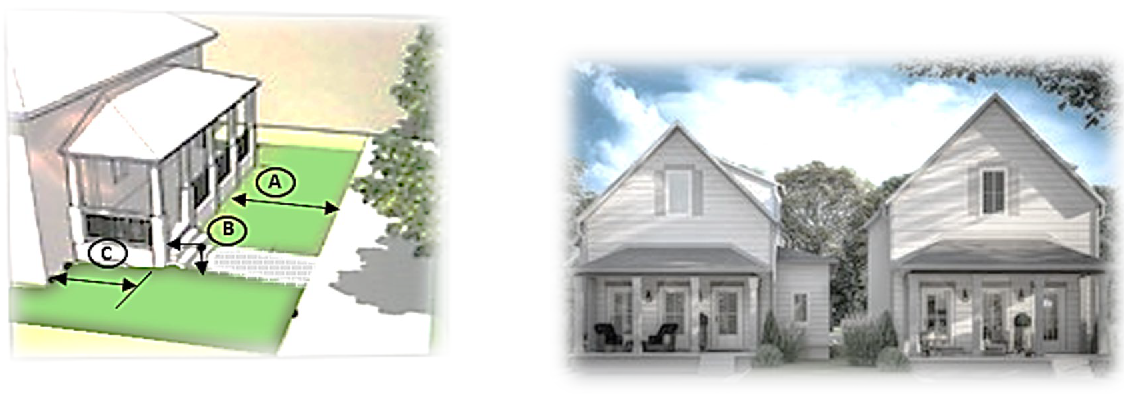 |
Setback Dimensions: A - 15 ft. minimum. B - Minimum to porch landing. C - 8 ft. minimum. |
(Ord. No. 2022-09, § 5, 7-28-22; Ord. No. 2023-08, § 4, 1-11-24)

