
Flagler Beach City Zoning Code
Sec. 2.06.00
Supplementary use regulations.
Sec. 2.06.01. Special exception uses.
Special exception uses, as enumerated in Schedule One hereof, shall be permitted only upon authorization of the city commission after review by the planning and architectural review board. In recommending approval or denial of the use, the reviewing boards shall provide findings and recommendations on whether the requirements of Section 2.06.01 (1. through 7.) (and where applicable Section 2.07.00) of this ordinance are met as well as other comments such board feel will assist the city commission in the determination of whether to grant the use.
1. That the use is a permitted special use as set forth in Schedule One hereof.
2. That the use is so designed, located and proposed to be operated that the public health, safety, welfare and convenience will be protected.
3. That the use will not cause substantial injury to the value of other property in the neighborhood where it is to be located.
4. That the use will be compatible with adjoining development and the proposed character of the district where it is to be located.
5. That the adequate landscaping and screening is provided as required herein, or otherwise required.
6. That adequate off-street parking and loading is provided and ingress and egress is so designed as to cause minimum interference with traffic on abutting streets.
7. That the use conforms with all applicable regulations governing the district where located.
(Ord. No. 2009-14, § 2, 9-24-09)
Sec. 2.06.04. Marijuana and cannabis.
Non-medical marijuana sales and cannabis farms shall be prohibited uses in all zoning districts of the city. Medical marijuana treatment center dispensaries are a permitted use in the highway commercial zoning district.
(Ord. No. 2014-12, § 1, 5-22-14; Ord. No. 2017-09, § 1, 10-26-2017)
Editor's note(s)—Ord. No. 2014-12, § 1, adopted May 22, 2014, set out provisions for use herein as § 2.06.04. Prior to the adoption of those provisions § 2.06.06 was repealed by Ord. No. 2010-15, § 3, adopted November 18, 2010. The former § 2.06.04 pertained to signs and was derived from Ord. No. 2004-32, § 1, adopted October 8, 2004. See §§ 7.00.00—7.13.04 for provisions relating to signs.
Sec. 2.06.05. Provisions to multi-family and commercial uses on State Highway A1A which abut Central Avenue.
For commercial uses in the TC or MDR districts along A1A which continue through to Central Avenue and face or abut residential districts, the following provisions shall apply:
Sec. 2.06.09. Tree and vegetation removal; tree protection.
(1) Intent. It is the intent of this ordinance to implement regulations designed to encourage the preservation of shade trees and native vegetation on properties within the city. Trees are known to play important environmental roles in decreasing air and noise pollution, as well as in conserving soil and minimizing flooding. They are also known as important energy conservation assets in providing natural cooling to business and homesites. Trees and vegetation provide integral value and stability to both business and residential neighborhoods in the city. Thus, the preservation of trees and native vegetation is done in the public interest in order that these trees, as natural public assets, can continue to contribute to the character and quality of life in Flagler Beach.
(2) Definitions. For the purposes of this section, certain terms or words used herein shall be interpreted as follows: (note, except where specifically defined in this section the terms and definitions otherwise used herein shall be as defined in the city zoning regulations).
A. Tree. Any self-supporting woody plant of a species which normally grows to an overall height of a minimum of fifteen (15) feet in the city, and having a trunk diameter of six (6) inches or more measured two (2) feet above grade, including but not limited to Southern Red Cedar, Live Oak, Water Oak, Southern Magnolia, Redbay, Palm or Pine.
B. Person, applicant, subdivider and developer. An individual, partnership, corporation, association or other legal entity, being the owner or authorized agent of the owner of the lot, parcel or tract for which a permit is required, including the city and shall include the plural as well as the singular.
C. Remove or removal. Includes the actual removal and effective removal through damaging.
D. Unimproved lot. Any lot or tract which does not contain a structure that is usable for a residence or business.
E. Lot. Any lot, tract or other parcel of land within the city.
F. Buildable area. That portion of a site on which a structure or improvements, including driveways and parking lots, are planned to be erected.
G. Yard area. An open space on the same lot with a building, said space being unoccupied and unobstructed from the ground upward, with the exception of trees and other natural vegetation.
H. Dripline. A vertical line running through the outermost portion of the tree crown extending to the ground.
I. Native vegetation. That vegetation other than trees, grasses and weeds existing on the lot or tract, in its natural condition prior to any construction or clearing activities.
J. Canopy Tree. A tree that when mature provide a dense overhead canopy that provides shade.
K. Accent Tree. A tree that provides the primary function of decoration that does provide a dense overhead canopy.
L. Specimen Tree. Any of the following tree species, including any subspecies: Ash, Blackcherry, Cherry Laurel, Bald Cypress, Pond Cypress, Elm, Hickory, Holly, Magnolia, Maple, Oak, Eastern Redbud, Red Cedar, Sweetgum, American Sycamore, Black Tupelo, Swamp Tupelo, Yellow Poplar.
(3) Application for tree and vegetation removal permit.
A. No tree or native vegetation shall be removed from an unimproved lot or from a yard area of an improved lot except upon the issuance of a tree and vegetation removal permit. Applications for tree and vegetation removal permits shall include a written statement of the reasons and necessity for removal and a plan delineating the general location and type of trees or vegetation to be removed. The city manager or designee shall require the applicant to mark harmlessly for identification those trees sought to be removed.
B. A fee of twenty-five dollars ($25.00) for each lot, tract or parcel affected shall accompany the application for tree and vegetation removal permit.
C. Prior to the development or improvement of any unimproved lot or expansion of or addition to any existing building or structure into an existing yard area, involving the removal of trees or vegetation from such lot, the applicant shall include with the application for tree and vegetation removal permit a site plan drawn to scale containing the following items:
(i) Location of proposed structures, drives, parking areas, utility lines and other physical improvements, if any;
(ii) General location of all living trees and native vegetation to be removed; clusters of trees and native vegetation to be removed may be delineated by showing boundary of cluster rather than individual trees;
(iii) Proposed grade changes of more than twelve (12) inches outside of the buildable area which may adversely effect any such trees with proposals of how to preserve and retain the trees and vegetation in a manner or form as prescribed by the city manager or designee. (Note: The applicant shall be held responsible for the accuracy of the site plan, whether prepared personally or through an agent or employee.)
(4) Eligibility for tree removal. If a tree meets any of the following criteria, a tree removal permit shall be issued:
A. The tree is located in a buildable area, street or parking area where a structure or improvement is to be placed, or within the area necessary to provide utility service to the lot and there is no reasonable alternative placement for the structure or improvement;
B. The tree is within five (5) feet of a proposed structure or improvement such that it restricts actual construction or proposed use of the structure or improvement, except if such tree sought to be removed is within the building setback line and the intended structure or improvement can be built as designed in a location that does not require removal of such tree, then the city manager or designee shall have the power to require relocation of the proposed structure in order to preserve such trees within the setback line;
C. The tree is severely diseased, injured, and in danger of falling or is severely diseased, injured and too close to existing or proposed structures so as to endanger such structures or interfere with utility services; the city may require the owner to provide a report prepared by a certified arborist to confirm the necessity for removal;
D. Where removal is necessary to permit better growth and balance for those trees remaining; the city may require the owner to provide a report prepared by a certified arborist to confirm the necessity for removal;
E. It is in the welfare of the general public that the tree be removed for a reason other than set forth above.
(5) Procedure for permitting tree removal.
A. Upon receipt of a completed application for tree removal, the city manager or designee shall review said application. The review procedure shall determine the adequacy and accuracy of content and determine whether the application meets the requirements of Section 2.06.09.4.
B. Following approval of the application, the city manager or designee shall issue the appropriate permits and indicate compliance with the provisions herein.
C. Upon the issuance of a permit under this section, a copy of said permit shall be prominently displayed on the site prior to the removal, relocation or replacement of any trees. Tree removal permits shall be included with all other permit cards and shall be displayed alongside them on the site.
D. No final certificate of occupancy shall be issued nor electrical power connection authorization given until any relocation or replacement of trees required by the permit has been completed and final tree inspection approval has been given by the city manager or designee. Trees relocated from one (1) portion of the site to another which do not survive transplantation for at least one (1) year shall be replaced by the owner of the site with a suitable replacement tree described in Section 2.06.09.11.
(6) Procedure for permitting vegetation removal.
A. Upon the receipt of a completed application for removal of vegetation, the city manager or designee shall review said application. The review procedure shall determine the adequacy and accuracy of content.
B. The city manager or designee shall consider the following factors when considering an application:
i. Existing vegetative coverage on the site and in the immediate surrounding area.
ii. Quality, type, size (DBH) and condition of vegetation to be removed on the entire site.
iii. Feasibility of relocating the particular vegetation sought to be removed.
iv. Topography and drainage of a site.
v. The type, size and condition of the replacement vegetation.
vi. The nature of the current and intended use of the property.
C. Following approval of the application, the city manager or designee shall issue the appropriate permits and indicate compliance with the provisions herein.
D. Upon the issuance of a permit under this section, a copy of said permit shall be prominently displayed on the site prior to the removal, relocation or replacement of any vegetation. Vegetation removal permits shall be included with all other permit cards and shall be displayed alongside them on the site.
E. Any applicant granted a permit for vegetation removal shall be required to relocate vegetation which would otherwise be destroyed to another location upon the site, or to replace vegetation which will be destroyed with suitable replacements elsewhere within this site. In determining suitability of replacements, the city shall consider the mass of vegetation proposed to be removed compared to the intended mature mass of the vegetation or trees to be planted.
F. Any clearing plan shall include removal of all existing Brazilian Pepper foliage.
(7) Exemptions. The following species of trees and vegetation shall be exempt from the provisions of this section and no permit or fees shall be required for the removal, cutting down, or destruction of these species:
A. Melaleuca quinquenervia (Cajaput or Paperbark).
B. Melaleuca leucadendra (Punk).
C. Casuarina (SPP) (Australian Pine), (Brazilian Oak).
D. Schinus terebinthinfolius (Brazilian Pepper).
E. Araucaria excelsa (Norfolk Island Pine).
F. Eucalyptus (all varieties except Eucalyptus Cinerea).
G. Bischofia javanica (Bishopwood, Bischofia).
H. Ricinus cummunis (Castorbean).
I. Metopium toxiferum (Poison Wood).
J. Melaiceae azedarach (Chinaberry).
K. Enterolobium (SPP) (Eartree).
L. Cinnamomum Camphora (Camphor Tree).
M. Cupaniopsis anacardioides (Carrottwood Tree).
N. Sapium sebiferum (Chinese Tallow).
O. Broussonetia papyrifera (Paper Mulberry).
P. Datura brugmansia (Angel's Trumpet).
Q. Datura metaloides (Devil's Trumpet).
R. Solandra nitida (Chalice Vine).
S. Trees or vegetation located in state-licensed and governmental plant or tree nurseries or botanical gardens in which the trees or vegetation are planted and growing for the sale or intended sale to the general public in the ordinary course of business or for some public purpose and which are sold.
T. Trees and vegetation which are required to be removed by law, including trees and vegetation required to be removed pursuant to Chapter 9 of the Code of Ordinances.
U. Trees and vegetation which, due to natural circumstances, are in danger of falling, are too close to existing structures so as to endanger such structures, create unsafe vision clearance or constitute a safety hazard. The property owner shall be responsible for maintaining evidence that the trees or vegetation removed satisfy the criteria of this exemption and shall provide such evidence to the City upon request.
(8) Tree and vegetation preservation during development and construction:
A. During construction, protective barriers shall be placed as necessary to prevent the destruction or damaging of trees and vegetation. This requirement shall be imposed by the city if the proximity of construction activity jeopardizes the survival of a tree or vegetation.
B. Protective barriers shall consist of posts or pipes linked together by fencing, rope or chains at a sufficient distance outward from the tree to insure its safety and survival, and in any event placed so the requirements of the preceding paragraph are met.
C. Those trees or vegetation to be removed and for which a permit to remove has been obtained shall be clearly marked. It shall be the responsibility of the developer and applicant to insure that any tree or vegetation not permitted for removal and so marked be protected from the actions of any contractors or subcontractors.
D. It shall be unlawful for any person to, or cause to, place material, machinery or temporary soil deposits within five (5) feet of any tree(s) or vegetation protected by this section as described above, or to fail to erect barriers necessary to protect such tree(s), or to attach other than protective wires, braces or other similar, noninjurious materials to such tree(s) or vegetation. While generally no structure or impervious paving shall be located within the drip line of a tree, the city manager or designee in order to prevent a tree from being required to be removed, may require the tree to be trimmed to reduce the drip line or may permit minor variances within the drip line prohibitions contained herein.
(9) Whenever any electric, water, telephone or other public utility firm or corporation wishes to extend, maintain or relocate service such that any tree or vegetation will be removed, it shall make application for a permit to do so. Any public utility wishing to prune trees or clear vegetation on a right-of-way, shall notify the building department in writing in advance of the approximate time, place and area these pruning or clearing activities will take place. The city manager or designee shall inspect these activities as necessary and shall have the authority to regulate or halt such pruning or clearing when these actions are deemed detrimental to the survival of the trees or vegetation beyond that needed to insure continued utility service. Those public utility entities which have adopted internal tree or vegetation protection rules and regulations may file a copy of the same with the city manger or designee and so long as such rules and regulations meet or exceed the protections afforded by this ordinance and the utility continues to abide by the same then the city manager or designee may grant an exemption to such utility from the terms of this section. In any event the city manager or designee shall monitor such utility from time to time to see that its internal rules are being complied with and if not may remove any exemption granted pursuant to this section. To the extent any fee sought to be imposed hereby will be offset by a reduction in the city's entitlement to franchise or utility tax funds or fees such tree removal permit fee shall be waived. There will be no fee charged for such onsite inspections by the city manager or designee as he may deem necessary pursuant to this section.
(10) Whenever the city finds it necessary to prune trees or vegetation that originate on private property but extend into the right-of-way, the city shall notify the private property owner prior to undertaking the pruning.
(11) Tree replacement requirements and schedule.
A. Specimen trees lawfully removed from properties other than single family residential lots pursuant to subsection (5) shall be replaced by the property owner with specimen trees of similar size as the one (1) removed. If it is not possible to replace the tree(s) with those of the exact size as the one(s) destroyed, the following replacement requirements shall apply:
(i) A canopy tree must be replaced by a canopy tree.
(ii) An accent tree may be replaced with an accent or canopy tree.
(iii) Replacement trees may be no less than six (6) feet high.
B. All trees, except for exempt species, unlawfully removed from any property without a permit shall be replaced by the property owner with trees of the similar size as the one (1) removed. If it is not possible to replace the trees with those of the exact size as the ones destroyed, the following replacement requirements shall apply:
(i) A canopy tree must replaced by a canopy tree.
(ii) An accent tree may be replaced with an accent or canopy tree
(iii) Each unlawfully removed tree must be replaced with containerized (not field grown) trees of a cumulative trunk diameter equal to or greater than the sum in inches of each inch of the diameter at breast height of the tree removed and no tree may be used as a replacement tree that has less than six (6) inch caliper measured two (2) feet above grade when feasible.
(iv) Replacement trees may be no less than six (6) feet high.
C. In the event it is impossible or impractical to replace trees as provided in subsections (11)A. or B., a fee in lieu of tree replacement shall be placed in a fund for a tree bank and shall be assessed in accordance with the following schedule:
(i) Individual single-family residential lots (when replacement required by subsection (11)B.):
a. Six (6) inch to less than ten (10) inch DBH, twenty-five dollars ($25.00) per inch removed.
b. Ten (10) inch to less than twenty (20) inch DBH, fifty dollars ($50.00) per inch removed.
c. Twenty (20) inch to less than thirty (30) inch DBH, seventy-five dollars ($75.00) per inch removed.
d. Thirty (30) inch and greater DBH, one hundred dollars ($100.00) per inch removed.
(ii) All other developments:
a. Six (6) inch to less than eight (8) inch DBH, fifty dollars ($50.00) per inch removed.
b. Eight (8) inch to less that fifteen (15) inch DBH, one hundred dollars ($100.00) per inch removed.
c. Sixteen (16) inch to less than twenty-four (24) inch DBH, one hundred twenty-five dollars ($125.00) per inch removed.
d. Twenty-five (25) inch and greater DBH, one hundred fifty ($150.00) per inch removed.
(12) Any person required to obtain a permit and who is adversely affected by a decision of any city official or employee in the enforcement or interpretation of this article, may appeal such decision to the planning and architectural review board, which, by a majority vote, may affirm, reverse, or modify the adverse decision, (the planning and architectural review board shall have the authority to grant minor variances of no more than twenty (20) percent of any building setback line where such variance will preserve a tree which otherwise may be required to be removed in the absence of such variance) and any decision of the planning and architectural review board may be appealed to the city commission, who may consider the entire matter de novo, and by a majority vote, may fix anew the condition for removal of trees or vegetation, or may affirm, reverse or modify any decision made by any city official or city board prior thereto. Notice of appeal shall be made in writing to the city clerk within thirty (30) days of the decision being appealed from. Any decision of the city commission is subject to review as provided by law.
(13) After-the-fact permits and penalties for unauthorized removal.
A. Any person who shall remove any tree or vegetation from a lot without first having applied for and received a permit therefor as required by this section, shall within thirty (30) days after notice by the city manager or designee, apply for and obtain an after-the-fact permit. The fee for each permit shall be five hundred dollars ($500.00) to off-set the cost to the city of investigation and enforcement of the city's ordinances relating to tree and vegetation removal plus the appropriate fee in lieu of replacement provided in section 2.06.09.11. Failure to obtain a permit within thirty (30) days after service of notice, unless stayed as hereafter provided, shall constitute a continuing violation of this ordinance and shall subject the violator to a fine of up to two hundred fifty dollars ($250.00) for each a day the violation continues, to be levied by the local code enforcement board or special magistrate as authorized by general law. The determination by the city manager or designee that a tree or vegetation has been removed without a permit may be appealed to the planning and architectural review board within thirty (30) days after service of the notice.
B. Notice of the requirement to obtain an after-the-fact permit shall be given by the city manager or designee to the owner of the property upon which the removed tree or vegetation was located by hand delivery or by certified mail addressed to the owner at the address as shown by such tax rolls. In the event that removal of the tree or vegetation shall appear to have been done in conjunction with the construction of an improvement for which a building permit has been issued, such notice may be given by certified mail to the owner as shown by the building permit or notice of commencement.
C. An appeal taken within thirty (30) days of the service of the notice given by the city manager or designee shall stay the requirements of obtaining an after-the-fact permit until there has been a final determination by the planning and architectural review board. The planning and architectural review board shall only have authority to determine if the after-the-fact permit is required pursuant to the provisions of this section. In the event the planning and architectural review board shall determine that a permit is required, it may, upon a showing of good cause and/or hardship, make a recommendation to the city commission that the fee for the after-the- fact permit be reduced.
D. The issuance of an after-the-fact permit, as herein required, shall not relieve the owner of the property upon which a removed tree shall have been located from the requirement of replacement required under this section.
(Ord. No. 2009-13, § 10, 8-6-09; Ord. No. 2009-14, § 2, 9-24-09; Ord. No. 2012-05, § 2, 4-12-12; Ord. No. 2013-04, § 2, 5-23-13)
Sec. 2.06.10. Central business district exclusion.
The following described amended area shall be known as the central business district for the provision of off-street parking spaces, and shall be exempt from furnishing parking facilities, as required by this ordinance. This exemption is made because of the traditional exclusion from providing parking in central business districts and the existing development within the district. Property owners, however, are encouraged to provide off-street parking space whenever possible.
A line commencing from the middle of Flagler Avenue at SR 100 going south to the centerline of South 5th Street then east on the centerline of South 5th Street, past South Central Avenue, then going south across the block to the point of the General Commercial Zoning, ending at the center line of South 10th Street, eastward to SR A1A and commencing from the middle of Flagler Avenue at SR 100 going north to the center line of North 3rd Street, then east to the point of the Commercial Zoning, then going north, ending at the centerline of North 10th Street, then east to SR A1A, according to the plat thereof recorded in Public Records of Flagler County, Florida.
(a) The foregoing exclusion shall not apply to existing parking spaces. Property or business owners within the district cannot remove any existing parking spaces. Property and business owners in the district may temporarily block off parking spaces in conjunction with special events.
(b) The foregoing exclusion shall not apply to any new construction within the Central Business District.
Sec. 2.06.11. Mini-warehouses.
(1) In addition to the requirements described in this section, mini-warehouses shall not be permitted adjacent to any residential zoning district or when separated from a residential zoning district by a public right-of-way or private street.
(2) In addition to the requirements of Section 2.06.06 Site plan review, Supplementary Use Regulations, a plan of development shall be submitted to the planning and zoning director or employee so designated, indicating location of buildings, lot area, pervious and impervious lot coverage, number of storage units, type and size of signs, height of buildings, parking layout with points of ingress and egress, location and type of lighting being proposed and location and type of visual screening and landscaping being proposed.
(3) Storage buildings shall be subdivided by permanent partitions into spaces containing not more than three hundred (300) square feet each.
(4) The minimum lot size shall not be less than two (2) acres. Mini-warehouses located on sites exceeding two (2) acres shall be considered a special exception use regardless of its permitted use within the General Commercial zoning district (cross reference Section 2.06.01Special exception uses, Supplementary Use Regulations).
(5) Residential quarters for a manager or caretaker may be included within the mini-warehouse development.
(6) If the facilities are lighted, lighting shall be designed and installed so as to prevent glare or excessive light on adjacent property. No source of illumination shall be allowed if such source of illumination would be visible from a residentially zoned district to the extent that it interfered with the residential use of that area.
(7) All mini-warehouse facilities shall be designed with inward facing storage access in order to improve compatibility with adjacent uses. Individual storage buildings shall be arranged such that adjacent land uses will be visually and physically protected from noise and sight disturbances.
(8) To further ensure that adjacent land uses be visually and physically separated, a minimum landscaped buffer area shall be installed within the required front, side and rear yard setback. Landscaping within the buffer area/yard setbacks shall be consistent with Section 5.04.00, Landscaping.
Minimum yard setback requirements:
(i) Front yard: 25 feet
(ii) Side and rear: 10 feet
(9) Perimeter landscaping adjacent to streets: All vehicular use areas which are not entirely screened by an intervening building from any abutting dedicated public street, to the extent such areas are not so screened, shall contain the following:
(i) A landscaped area of not less than twenty (20) square feet for each linear foot of vehicular use area street frontage;
(ii) No less than one (1) tree, of four-inch caliper or greater, located within twenty-five (25) feet of the street right-of-way, for each twenty-five (25) linear feet, or fraction thereof, of vehicular use area street frontage.
(10) Off-street parking: Two (2) parking spaces for the manager or caretaker unit (if provided) and a minimum of five (5) spaces located adjacent or in close proximity to the manager's unit or office for customer parking. Additional parking equivalent to one (1) space per three hundred fifty (350) square feet of office space, or portion thereof, above the threshold required, shall be provided.
(11) Aisle width: All units shall front on a private drive having a minimum width of twenty-four (24) feet between storage structures to allow unobstructed two-way vehicular circulation and loading/unloading of personal property storage.
(12) Height: The height of all structures shall not exceed the height provided in Section 2.04.02.9 in Schedule Two; Lot, Yard, and Bulk Regulation.
(13) In order to promote compatibility among adjacent land uses and incorporate mini-warehouses/personal property storage areas within the community, the following design standards shall apply to mini-warehouses and shall be subject to approval by the planning and architectural review board:
a) The design of proposed mini-warehouses shall include facades to camouflage internal storage structures. This may include arranging the storage buildings in a manner to screen the internal structures and/or constructing facades on all storage structures as provided for in subsection (b) below.
b) The facade design may include murals of a compatible nature, false fronts constructed of varying material that include varying the roofline to disguise duct work, etc as well as any other method deemed acceptable by the planning and architectural review board.
c) Finished material selections may include, but are not limited to, stucco, coquina, and other similar material types.
(14) Prohibited storage materials: Flammable or explosive materials, flammable or combustible liquids, material or matter which creates noxious dust, odor or fumes, hazardous waste (per DOT HM 181; Federal register 12.21.90), propane tanks, singularly, or in conjunction with RV's and the like.
(15) Prohibited facilities: No water, sanitary facilities, electricity (other than humidity control), with exception of lighting fixtures shall be provided in individual storage spaces and shall not include or be adaptable to provide electric service outlets.
(16) Prohibited uses: Outdoor parking and/or storage of vehicles (excepting on-site manager vehicle(s), recreational vehicles, campers, boats and the like.
(Ord. No. 2004-28, § 3, 9-23-04)
Sec. 2.06.12. Rental units.
(1) Applicability. This section shall be applicable to the rental of all dwelling units within the City of Flagler Beach, but shall not apply to hotels, motels, resorts, long-term rentals, or bed and breakfast inns as defined in F.S. § 509.242. This section shall not be taken to authorize the establishment or operation of resort dwellings.
(2) Resort dwellings and resort condominiums not permitted uses within single-family residential districts, low density residential, medium density residential and planned unit development districts.
(a) It is not a permitted use for an owner to operate a resort dwelling or resort condominium in a single-family residential, low density residential, medium density residential or planned unit development zoning district.
(b) Owners of a single-family dwelling or condominium located within a single-family residential, low density residential, medium density residential or planned unit development zoning district that establish such dwelling or condominium has been operated as a resort dwelling or resort condominium during the period between January 1, 2006 and the effective date of Ordinance 2008-08 shall be allowed to continue such use in a manner consistent with the provisions of Appendix A, Article II, Section 2.06.08.5, of this Code. The city shall accept as evidence of use of a single-family dwelling or condominium as a resort dwelling or resort condominium that the owner filed a proper application with the State of Florida pursuant to F.S. ch. 509, or filed a proper application form for a local business tax receipt with the City of Flagler Beach for operation of the property as a resort dwelling or resort condominium prior to the effective date of Ordinance 2008-08. For purposes of this section, use of a resort dwelling or resort condominium as a long-term rental shall not constitute an abandonment of the nonconforming use provided that all licenses and permits required to operate the rental property as a resort dwelling or resort condominium (including any license required by the State of Florida, a local business tax receipt and a resort dwelling/resort condominium rental permit) are kept current and up to date during the period in which the rental property is used as a long-term rental.
(3) Local business tax receipt required. After the effective date of Ordinance 2008-08, all owners who operate a resort dwelling or resort condominium shall obtain a local business tax receipt as provided in Chapter 18, Taxation, prior to entering any new rental agreement for the resort dwelling or resort condominium.
(4) Rental permit required.
(a) All owners who operate a resort dwelling or resort condominium shall obtain a resort dwelling/resort condominium rental permit from the City of Flagler Beach.
(b) A resort dwelling/resort condominium rental permit shall apply from October 1 of each year and shall expire on September 30 of the succeeding year.
(c) The city commission may, by resolution, adopt an application fee to be paid upon application for a resort dwelling/resort condominium rental permit.
(d) At the time of applying for a resort dwelling/resort condominium rental permit, the owner of the resort dwelling or resort condominium shall provide in writing to the city the name, local street address and local phone number of a local contact or representative who is available twenty-four (24) hours a day, seven (7) days a week for emergency contact. Within ten (10) days of any change to the name, local address or local phone number of the local contact or representative, the owner shall notify the city in writing of such change and provide updated information. The name and local phone number of the local representative shall also be posted at the property for emergency contact.
(e) At the time an initial application for a resort dwelling/resort condominium rental permit is submitted to the city, the city shall schedule an inspection of the rental property by the fire marshal or his designee. The city shall also provide the owner with a resort dwelling compliance regulations worksheet. Within thirty (30) days prior to the date a resort dwelling/resort condominium rental permit expires, each owner shall perform an annual self-inspection of the rental property and complete the compliance regulations worksheet. The completed compliance worksheet shall be provided to the city upon application for a renewal of the resort dwelling/resort condominium rental permit.
(f) Upon application for a resort dwelling/resort condominium rental permit, the city shall provide the owner with a notice of minimum applicable standards. The notice shall include information regarding property standards and city codes applicable to all residential and commercial structures within the City of Flagler Beach. At a minimum, the notice of minimum applicable standards shall include a description of all ordinances, regulations and requirements regarding housing, development standards, noise, parking, dune protection, turtle nesting season, littering and trash collection. The owner shall sign the notice of minimum applicable standards, acknowledging receipt of the notice and certifying that the owner shall comply with all requirements mandated by this section and the Code of Ordinances. A copy of the notice minimum applicable standards signed by the owner of the rental property shall be submitted to the city prior to the issuance of a resort dwelling/resort condominium rental permit.
(5) Restrictions and regulations applicable to resort dwellings and resort condominiums.
(a) No resort dwelling or resort condominium shall be rented for a period of fewer than seven (7) days.
(b) The total number of guests in any resort dwelling or resort condominium shall be limited to two (2) people per bedroom with an additional allowance for up to two (2) people per sleeper sofa not to exceed a total of four (4) additional people.
(c) The notice of minimum applicable standards provided by the City of Flagler Beach shall be maintained within the rental property at all times.
(d) A copy of the most recent compliance worksheet shall be maintained in the rental property at all times.
(e) The property owner shall ensure that any notification provided by the City of Flagler Beach and its staff to the local representative designated by the owner pursuant to this section is promptly responded to.
(f) Upon written request by the city's code enforcement department based on any complaint received by the code enforcement department, the property owner shall schedule and allow inspection of the rental property by the city's code enforcement officer.
(6) Penalties. Failure to obtain or maintain a local business tax receipt, failure to obtain or maintain a resort dwelling/resort condominium rental permit or failure to maintain a property in compliance with all code requirements, including the provisions of this section, shall subject the violator to enforcement proceedings and penalties in accordance with city code and Florida Statutes.
(7) Denial of resort dwelling/resort condominium rental permit. In addition to the enforcement proceedings and penalties provided by this Code, failure to comply with the provisions of this section shall be considered just cause for denial of the issuance of a resort dwelling/resort condominium rental permit for the subject property in accordance with the procedure set forth in this section. Prior to the denial, the city manager or his designee shall issue a denial notifying the applicant of the city's intent to deny. The notice shall be sent certified mail, return receipt requested, to the last known address for the applicant. Within ten (10) calendar days from the date of mailing of said notice, the resort dwelling/resort condominium rental permit shall be automatically denied, unless the applicant files with the city manager or his designee a written statement setting forth the grounds for an appeal. Upon the filing of such written statement, the city manager or his designee shall schedule and conduct a hearing before the special magistrate or code enforcement board within thirty (30) days from the date the written statement was filed. The applicant shall be given notice of the hearing by certified mail, return receipt requested, and shall have the opportunity to present evidence, cross examine witnesses and be represented by counsel. The city shall have the burden of proof by clear and convincing evidence presented at the hearing. Within ten (10) calendar days of the hearing, the city manager or his designee shall send by certified mail, return receipt requested, the written decision of the special magistrate or code enforcement board to the applicant. The written decision of the special magistrate or code enforcement board shall contain a short and plain statement of the facts considered and the conclusions at which were arrived. The decision shall become final within thirty (30) days of the date the city manager or his designee mails the written decision of the special magistrate or code enforcement board to the applicant unless the applicant files a petition for writ of certiorari in the Circuit Court for Flagler County. The filing of a pleading seeking judicial review shall automatically stay the denial until judicial review has been exhausted unless the city obtains injunctive relief. Any applicant who has had a resort dwelling/resort condominium rental permit denied under this section or other city codes shall not be eligible to submit a renewal application in the city relating to the same property.
(Ord. No. 2008-08, § 5, 10-16-08; Ord. No. 2009-13, § 10, 8-6-09; Ord. No. 2011-13, § 1, 8-25-11)
Section 2.06.02.1 Off-street parking.
In all districts and in connection with every use, with the exception of those zoning districts within the Downtown Mixed-Use District and the Downtown A1A Retail Corridor as defined and regulated by Section 2.01.02.7.1 Downtown Design Guidelines, there shall be provided, at the time any building is constructed or any existing building is moved, altered, added to or enlarged or reconstructed, or if there is a change in the category of use listed in the schedule of off-street requirements which requires issuance of a new business tax receipt and/or certificate of occupancy, off-street parking space in accordance with the requirements as set forth herein. (Note: Any nonconforming use may replace an existing nonconforming use if the parking requirements under the schedule are less for the new nonconforming use.)
(1) Size and access—An off-street parking space shall consist of a parking space having minimum dimensions of ten (10) feet in width by twenty (20) feet in length for the parking of each automobile, exclusive of access drives or aisles thereto. Minimum width for the maneuvering of an automobile into a parking space shall be in conformance with the illustrative chart as set forth in Attachment One of this ordinance. The parking plan must be so arranged that each automobile may be placed and removed from the property without the necessity of moving any other automobile to complete the maneuver.
Street or sidewalk areas may not be used for off-street parking purposes as herein defined. Individual ingress and egress drives extending across the public sidewalks and curbs and connecting the off-street parking spaces to the public street areas shall not exceed a maximum of twelve (12) feet for a one-way drive and twenty-four (24) feet for a two-way drive. The number and placement of such drives is to be subject to the approval of the planning and architectural review board before being installed.
(2) Number of parking spaces required—There shall be provided at the time of the erection of any structure or at the time any structure is enlarged or increased in capacity by adding dwelling units, guest rooms, floor area or seats, or at the time any use or occupancy of an existing building is changed to a use or occupancy which increases the requirements for off-street parking, minimum off-street
parking facilities with adequate provisions for ingress and egress, in accordance with paragraph (1) of this section and the schedule of off-street parking requirements.
(3) Location of parking spaces—Parking spaces for all uses or structures which are provided as required parking in conformance with the schedule of off-street parking and other applicable provisions shall be located within two hundred (200) feet and have the same zoning district, as the principal use or structure they are intended to serve.
Section 2.06.02.2 Off-street loading.
Section 2.06.02.3 Service stations.
(Ord. No. 2007-06, § 1, 3-8-07; Ord. No. 2007-29, § 1, 9-27-07; Ord. No. 2009-14, § 2, 9-24-09; Ord. No. 2009-17, § 7, 10-8-09; Ord. No. 2018-03, § 2, 2-22-18)
Editor's note(s)—Ord. No. 2018-03, § 2, adopted February 22, 2018, amended the title of § 2.06.02 to read as set out herein. Previously § 2.06.02 was titled "Automotive services."
Section 2.06.03.1 Drive-in eating and drinking places.
(1) Such businesses, where persons are served in automobiles, shall not be closer than one hundred (100) feet to a residential district and shall provide ingress and egress so as to minimize traffic congestion. The number and location of curb cuts shall be subject to the review and approval of the planning and architectural review board as set forth in Section 2.06.02.1.
(2) "Take out" or "pick up" windows of retail or wholesale establishments shall not be located on a building facade that faces a public right-of-way, unless they are designed in such a manner as to be an aesthetic asset to the building and neighborhood.
Section 2.06.03.2 Mechanical or self-service automobile washing establishments.
In addition to meeting the minimum yard and lot coverage requirements, these establishments shall be subject to the following regulations:
a. Such establishments shall not be closer than one hundred (100) feet from a residential district.
b. Such establishments shall be located on a public street having a pavement width of not less than thirty (30) feet and shall provide ingress and egress so as to minimize traffic congestion.
c. Such mechanical establishments, in addition to meeting the standard off-street parking requirements as set forth in Section 2.06.02.1 shall provide at least five (5) off-street automobile waiting spaces on the lot in the moving lane to the automobile washing building entrance so as to eliminate the waiting of automobiles in a public street. For self-service facilities two auto waiting spaces shall be provided for each working stall.
Section 2.06.03.3 Farmer's markets.
(1) A city local business tax receipt is required for vendors provided; however, the vendors who already possess a city business tax receipt for a business selling merchandise or wares at a different location within the city may sell the same type of merchandise or wares sold at said location at a city licensed farmer's market without obtaining an additional business license tax receipt from the city.
(2) Farmers' markets shall only be allowed on lots of at least ten thousand (10,000) square feet.
(3) Products and services promoted or offered for sale at a farmer's market shall be limited to those classes of products described in the definition of farmer's market in Section 2.02.00.
(4) Products promoted or offered for sale at a farmer's market shall only be promoted or offered for sale from portable stands, tables or open bed trailers not attached to vehicles. Products shall not be promoted or offered for sale from food trucks.
(5) No tables or stands used in the promotion or selling of products at a farmer's market shall be allowed to remain on the property overnight.
(6) A farmer's market may not be operated on the same property more than three (3) days in any calendar week. For purposes of this section a calendar week shall be defined as a seven (7) day period beginning on Monday and ending on Sunday.
(Ord. No. 2015-07, § 1, 8-27-15)
Section 2.06.05.1 Buffer zone.
Within the rear yard setback, a fifteen-foot buffer zone shall be provided. Such buffer zone shall be treated with adequate fencing material and landscaping to block glare from the uses, including lights of automobiles, from reaching the residential areas. In addition, landscaping shall be provided and maintained which will enhance the character of the residential areas.
Section 2.06.05.2 Automotive access.
In no case shall automotive access to such lots be provided from Central Avenue. All automotive access for guests, residents or customers shall be provided from state road A1A.
Section 2.06.05.3 Service vehicle access.
All service access, including that for trash removal, shall be provided from A1A and such service or loading and unloading areas shall not be provided in the rear yard setback area.
Section 2.06.05.4 Reserved.
Section 2.06.05.5 [Commercial/multi-family uses on A1A/SR 100].
For commercial or multi-family land uses fronting on A1A or S.R. 100, the following provision shall apply:
Section 2.06.05.6 Site plan review.
All commercial and multi-family development defined in Section 2.06.05 shall meet the requirements of Section 2.06.06.
Section 2.06.06.01. Multi-family and nonresidential architectural and site design principles.
A. Purpose and intent. The purpose of this chapter is to create and maintain a positive community image and identity by requiring architectural treatments that enhance the visual appearance and character of the community. It is intended to supplement development regulations with specific design requirements that result in quality architecture, which emphasize pedestrian scale and recognize local character.
B. Applicability. The requirements of this section apply to the following forms of development:
1. New construction.
a. Newly constructed residential development except single-family detached or duplex dwellings;
b. Newly constructed nonresidential development; and
c. Newly constructed mixed-use development.
2. Expansion, additions, or modifications of existing development. Any combination of repair, reconstruction, rehabilitation, addition or improvement of:
a. Existing nonresidential or multi-family structures taking place during a one-year period, the cumulative cost of which equals or exceeds fifty (50) percent of the structure value as listed in the Flagler County Property Appraiser tax records before the improvement or repair is started.
b. For each building or structure, the one-year period begins on the date of the first physical improvement or repair of the building or structure after the effective date of this ordinance.
C. Exemptions.
1. The following forms of development are exempted from these standards:
a. Single-family detached dwellings (except manufactured homes);
b. Townhouses; and
c. Duplex dwellings.
2. Development located in the Downtown Mixed Use Overlay District and Community Redevelopment Area shall comply with the applicable design standards of the adopted Downtown Design Guidelines. In cases where the standards conflict, standards of section 2.06.06.01 shall control.
Section 2.06.06.02. General requirements.
The following architectural design requirements shall apply to all new development and construction, redevelopment, and alterations to existing structures within the city.
Alterations shall include any change, addition, or modification including, but not limited to, repainting, that affects any of the elements governed by these architectural design criteria.
Section 2.06.06.03. Architectural styles.
The city has identified several recognized architectural styles for the design of buildings within the city. One (1) of the following styles shall be used in the design of a nonresidential building. Applicable styles include Classic Revival, Key West Caribbean, St. Augustine/Anglo Caribbean, Florida Vernacular, Spanish Mission, and Mediterranean.
Section 2.06.06.04. Accessory structures.
The roof, exterior walls, and exterior colors of accessory structures, excluding prefabricated sheds, shall be compatible with the design of the principal structure.
Section 2.06.06.05. Building design.
Applicability: All multifamily and nonresidential uses not within the boundary of the Downtown Mixed-Use Overlay District and Community Redevelopment Area shall comply with the following building design criteria:
A. Maximum building length.
1. Barrier Island—With the exception of hotels, the maximum length of a single building or any group of attached structures shall not exceed one hundred fifty (150) feet.
2. Mainland—With the exception of a shopping center, bowling alley or industrial building or similar uses, the maximum length of a single building or any group of attached structures shall not exceed two hundred (200) feet.
B. Building volume. The building volume (overall length, width, and depth included between the surface of the outer walls measured from the level of the lowest story to the roof of the building) of multi-family and non-residential buildings shall be divided into smaller segments to avoid a massive appearance and to enhance exposure to air and vistas.
In addition to the massing techniques provided below, facades shall not extend for more than one hundred (100) horizontal feet without a major volume shift or a substantial break in volume.
C. Building architecture. Enhancements are required and shall be achieved using the following principals:
1. Building massing.Massing represents the two-dimensional shape or three-dimensional volume of a building. Attention to massing is especially important for large buildings whose bulk can be out of scale with their surroundings; or whose walls or roof lines may be uninterrupted, excessively long, or high, or monotonous. Multifamily and nonresidential developments shall provide building massing and articulation as follows:
i. Massing requirements. Building massing shall be implemented by use of techniques that reduce the appearance of high building density or bulk. At least one (1) massing treatment, in addition to the articulation requirement, shall be included for each fifty (50) linear feet of wall that exceeds 50 feet in length.
ii. Massing techniques. The use of the following building features, when more than three (3) feet in depth or height, shall qualify as techniques that improve building massing. Other massing techniques may be used, as approved by the city manager or designee:
a. Balconies.
b. Building wall offsets.
c. Colonnades.
d. Cupolas.
e. Towers.
f. Pavilions.
g. Arcades.
h. Porticos.
i. Projections and recessed sections.
j. Clock or bell towers.
k. Variations in the height of the roof line.
l. Verandas.
m. Overhangs.
D. Exterior articulation. Articulation refers to the separation of a structure and surface to break large uninteresting or oppressive mass into proportionate spaces in relation to human size components. Articulation of exterior walls is required to add interest and a distinctive sense of place to a building. The following features qualify as techniques of building articulation:
1. Articulation requirements. All facades shall include, in addition to the massing requirement, at least one (1) articulation from the list below on each facade. Facades extending for more than fifty (50) horizontal or vertical feet shall provide at least two (2) exterior treatments.
2. Prohibited articulation techniques. Professional scoring or etching of a stucco wall to give the appearance of shutters, doors, or windows shall be prohibited.
3. Articulation techniques. The use of the following elements shall qualify as articulation techniques:
a. Base course or plinth course.
b. Portals.
c. Windows.
d. Transoms.
e. Show cases.
f. Bay windows and oriels.
g. Lintels.
h. String courses and moldings.
i. Fascia.
j. Cornice.
k. Piers.
l. Arches.
m. Bays.
n. Balconies.
o. Brackets.
p. Wings.
q. Porches.
r. Stoops.
E. Fenestration.
1. Windowless exterior walls that face a public right-of-way are prohibited.
2. For multistory commercial uses, fifty (50) percent of the wall facade on the first-floor story shall have windows. The windows shall be placed between three (3) feet and seven (7) feet from the ground.
3. For office and multifamily uses, fifteen (15) percent of the wall façade per story shall have windows.
4. Windows shall be in harmony with and proportionate to the rest of the structure.
5. The use of darkly tinted or reflective glass on the first floor of commercial structures is prohibited. Reflective glass will be defined as having a visible light reflectance rating of fifteen (15) percent or greater and darkly tinted glass windows include glass with a visible light transmittance rating of thirty-five (35) or less.
6. Uses such as movie theaters, bowling alleys, skating rinks, industrial facilities, warehouses, and similar uses are exempt from the fenestration requirements. The building façades shall provide additional architectural elements in lieu of windows at the same percentages of subsection E.2.
F. Awnings and canopies.
1. When used, awnings and canopies shall be placed at the top of window or doorway openings.
2. No awning shall extend more than the width of the sidewalk or eight (8) feet, whichever is less.
3. Awnings must be self-supporting from the wall.
4. No supports shall rest on or interfere with the use of pedestrian walkways.
5. In no case shall any awning extend beyond the street curb or interfere with street trees or public utilities.
G. Roofs. The following types of roofs are permitted:
1. Pitched roofs.
a. A pitched roof shall have a minimum slope of four-to-twelve (4:12) (four (4) inch vertical rise for every twelve (12) inch horizontal run). Dormers and similar architectural elements are excepted from this requirement.
b. Pitched roofs shall be enhanced by the addition of dormers, belvederes, chimneys, cupolas, clock towers and similar elements. Enhancements shall be consistent with the main elements of the building.
2. Mansard style roof. False mansards are prohibited.
3. Flat roofs. Buildings that have a flat roof shall be hidden from public view by a parapet and decorated in a manner that is compatible with the building design theme.
a. Parapet. The highest point of a parapet shall not at any point exceed fifteen (15) percent of the height of the supporting wall.
b. Canopy roofs. Canopy roofs for gas stations, drive-through restaurants, and banks are exempt from the pitched roof requirements.
4. Soffits. The maximum depth of overhangs shall be as follows:
a. Barrier island—Eighteen (18) inches.
b. Mainland—Twenty-four (24) inches.
H. Building entrances.
1. Entrance placement. The main building entrance shall face the public right-of-way unless it is determined by the City Manager or designee that such configuration is not practicable. When parking is located on the side or rear of the building, the placement of a suitably large building entrance that faces the parking area shall complement, but not displace the main building entrance.
2. Entrance articulation. Main building entrances shall be articulated in a manner consistent with the architectural style of the building. All buildings shall have a minimum of one (1) of the following architectural treatments, separate from the massing and articulation requirements, for each main building entrance: lintels, pediments, pilasters, columns, porticos, porches, overhangs, railings, balustrades, and features consistent with the building style.
I. Stairways. Stairways shall be incorporated inside the building where possible to minimize visual impact. External stairways, when necessary, shall be recessed into the building, sided using the same siding materials as the building itself, or otherwise incorporated into the building architecture. Stairways that are simply hung from the building's exterior are not permitted.
J. Light fixtures. Light fixtures attached to the exterior of a building shall be architecturally compatible with the style, materials, colors, and details of the building.
K. Mechanical equipment screening.
1. Generally. The screening of mechanical equipment for multi-family residential and all nonresidential land uses is required at the time of new installation or replacement, whether installed on the ground, walls, or roof.
a. The screening of mechanical equipment is required at the time of new installation or replacement, whether installed on the ground, walls, or roof.
b. Mechanical equipment (e.g., air conditioning, heating, ventilation ducts and exhaust vents, swimming pool and spa pumps and filters, transformers and generators, and similar equipment, excluding solar collector panels) shall be screened from public view and adjacent residential zones.
c. Screening devices shall be permanently maintained.
2. Roof-mounted mechanical equipment.
a. Building parapets or other architectural elements in a structure's architecture style shall screen roof-mounted equipment.
b. For existing structures with no parapets or low parapet heights, mechanical equipment shall be surrounded on all sides by an opaque screen wall that is as tall as the highest point of the equipment. The wall shall be architecturally consistent with the structure and match the existing structure's paint, finish, and trim cap detail.
c. Roof-mounted mechanical equipment shall be set back at least fifteen (15) feet from all roof edges that are parallel to street lot lines.
d. Roof-mounted mechanical equipment and screening shall be subject to the height limit exceptions in section 2.05.06.5, permitted exception to height regulations.
3. Ground-mounted and wall-mounted equipment.
a. Ground-mounted and wall-mounted equipment shall not be located between the face of the building and the public-right-of-way.
b. Screening devices shall be as high as the highest point of the equipment being screened.
c. Screening shall be architecturally compatible with the facility in design style, materials, and colors. The screening design shall include landscaping for equipment at ground level and may include view-obscuring ornamental block, wood and earth berms, and similar design features if consistent with overall design concept.
d. Utility meters shall be screened from view from public rights-of-way.
e. Electrical transformers in a required front or street side setback area shall be screened from view.
f. Water backflow prevention devices shall not be located in the front setback area and shall be screened from view.
Section 2.06.06.06. Site planning design principles.
A. Purpose: Site planning and project design shall address the potential impacts on existing and planned adjacent uses. Project designs shall apply best practices as it relates to traffic planning, services (e.g. sanitation) and deliveries (if applicable), access, parking, circulation, traffic and pedestrian safety, light and glare, noise, odors, and security.
B. Building arrangement/orientation.
1. Arrange buildings to provide functional public and private open spaces.
2. Provide adequate walkways and pedestrian orientation in allocation of space, building size and placement.
3. Encourage appropriate on-site amenities to serve residents and guests.
4. Provide active common open spaces that encourage gatherings.
5. Multifamily buildings, where applicable, should be oriented to the adjacent public street and create visual interest by providing large windows, balconies, etc.
6. Building ends should contain windows and active spaces for security and visual interest.
7. Develop buildings that face on alleys to enhance livability, visual quality, and safety of the alley.
8. Develop setbacks based on context relative to urban or suburban locations.
9. Where appropriate develop variations on setbacks and positioning of structures.
C. Distance between buildings. The front or rear of any building shall be no closer than thirty (30) feet to the front or rear of any other building. The side of any building shall be no closer than ten (10) feet to the side, front or rear of any other building.
D. Distance between buildings and driveways. No driveway or parking lot should be closer than ten (10) feet to the front of any building or less than five (5) feet to the side or rear of any building. In the case of an enclosed garage or carport provided as a portion of the main structure, distance requirements for driveways providing access to these accommodations shall not apply.
E. Recreation space. There shall be provided on the site of a multi-family development an area or other areas, either enclosed or unenclosed, devoted to the joint recreational use of the residents thereof. Such recreation space shall consist of not less than two hundred (200) square feet of space per dwelling unit. Each such recreation space shall be developed with passive and active recreation facilities. There shall be provided on the site of a hotel or motel development an area or areas devoted to the joint recreational use of the guests thereof.
F. Off-street parking spaces. There shall be provided on the site of such development an area or areas devoted to the storage of automobiles. The number and their provision shall be provided for as required by section 2.06.02.1.
G. Service, utility, display, and storage areas.
i. Loading areas or docks, outdoor storage, waste disposal, mechanical equipment, satellite dishes, truck parking, and other service support equipment shall be located behind the building line and shall be fully screened from the view of adjacent properties by walls made of masonry, brick, or durable fabricated materials.
ii. Utility boxes must be totally screened from view of principal streets, as well as pedestrian areas and walkways. Backflow preventers shall be landscaped.
iii. Areas for outdoor storage, trash collection, and loading shall be incorporated into the primary building design, and construction materials for these areas shall be of comparable quality and appearance as that of the primary building.
iv. Shopping cart storage shall be located inside the building. Cart corrals, if used by patrons shall be screened by a solid landscaping hedge or wall consistent with the building architecture and materials.
Section 2.06.06.07. Multifamily and non-residential buildings supplemental standards.
A. Corporate trademark design. Exceptions to the requirements contained within this chapter shall not be made for corporate franchises.
B. Common open space.
1. In all developments with more than twenty (20) units, a minimum area of fifteen (15) percent of the total site area (inclusive of required setback areas) shall be designated, and permanently reserved, as usable common open space. The site area is defined as the lot or parcel on which the development is planned, after subtracting the required dedication of street right-of-way and other land for public purposes (e.g., public park). Sensitive lands and historic buildings or landmarks open to the public can be counted toward meeting the common open space requirements.
2. The development shall designate, within the common open space, a minimum of two hundred fifty (250) square feet of active recreation area (e.g., children's play areas, play fields, swim pool, sports courts, etc.) for every twenty (20) units or increments thereof. For example, a fifty (50) unit development shall provide a minimum of five hundred (500) square feet for active recreation. Indoor or covered recreation space may be counted toward this requirement but should not exceed thirty (30) percent of the required common space area.
C. Private open space. Usable private outdoor space such as patios, balconies, porches, roof gardens, or small yards shall be provided in all newly constructed multifamily developments. Private open space shall comply with the following standards:
1. All upper floor dwelling units shall have balconies or porches measuring at least thirty-six (36) square feet with no dimension less than four (4) feet.
2. All private open space shall have direct access from the dwelling unit by way of a door;
3. Any excess private open space (above what is required) may be counted toward fulfilling the common open space requirement;
4. Building masses and screening such as low hedges, fences, walls, arbors, or trellises shall be used to help delineate private outdoor spaces. The screening element must be a minimum of three (3) feet in height.
D. Vehicular circulation. Multifamily developments shall provide vehicular circulation in accordance with the following standards:
1. To provide for traffic safety and to minimize the impacts on the public circulation system, where possible, driveways or private streets shall connect to local or collector streets rather than directly onto arterial streets.
2. Multifamily developments four (4) acres or larger shall be developed as a series of complete blocks bounded by a connecting network of public streets with sidewalks and street trees to break the development into numerous smaller blocks. The average block size within a multifamily development shall be a maximum of two (2) acres in size. City standards for public local residential streets regarding pavement width, sidewalks, and street trees shall apply to all internal streets.
E. Parking. Multifamily developments shall provide parking designed in accordance with the following standards:
1. Off-street vehicle parking spaces and bicycle parking shall be provided as specified section 2.06.02.1, off-street parking. SCHEDULE OF OFF-STREET PARKING REQUIREMENTS.
2. Parking lots shall be placed to the side or rear of buildings where possible.
3. Parking lot landscaping shall be provided as specified in subsection 2.06.02.1(6); and
4. Parking lots shall be connected to all building entrances by means of internal pedestrian walkways.
F. Trash receptacles. Trash receptacles shall be screened on all sides with a hedge or solid fence or wall of not less than six (6) feet in height. No trash receptacle shall be in any front yard setback, or within twenty-five (25) feet of property lines abutting other residential zones.
G. Utilities. All utilities on the development site shall be placed underground. Ground-mounted equipment such as transformers, utility pads, cable television and telephone boxes, cell tower equipment boxes, and similar utility services shall be placed underground whenever practicable. Where undergrounding of ground-mounted equipment is not feasible, equipment shall be screened from view with a hedge or solid fence or wall a minimum of four (4) feet in height and must be sited to comply with the site vision clearance standards.
H. Pedestrian circulation. To ensure safe, direct, and convenient pedestrian circulation, all multifamily developments shall contain a system of pathways designed based on the standards below:
1. The pathway system shall extend throughout the development site, and connect to all future phases of development, adjacent public parks and commercial uses, and the public sidewalk system; within the development shall provide safe, reasonably direct connections between dwelling units and parking areas, recreational facilities, storage areas, and common areas;
2. Where pathways are parallel and adjacent to a driveway or street (public or private), they shall be raised six (6) inches and curbed or separated from the driveway/street by a minimum five (5) foot strip with bollards, a landscape berm, or other physical barrier;
3. Pedestrian pathways shall be separated a minimum of six (6) feet from all building facades with residential living areas on the ground floor, except at building entrances;
4. Where pathways cross a parking area, driveway, or street ("crosswalk"), they shall be clearly marked with contrasting paving materials, humps/raised crossings, or painted striping; and
5. Pathway surface shall be concrete, asphalt, brick/masonry pavers, or other durable firm surface, at least five (5) feet wide, and shall conform to federal Americans with Disabilities Act (ADA) requirements.
(Ord. No. 2009-14, § 2, 9-24-09; Ord. No. 2013-11, § 2, 10-24-13; Ord. No. 2013-21, § 2, 1-9-14; Ord. No. 2022-03, § 2, 2-10-22)
Editor's note(s)—Ord. No. 2013-11, § 2, adopted October 24, 2013, amended § 2.06.06 to read as set out herein. Previously § 2.06.06 was titled site plan review.
Sec. 2.06.07.1 Purpose and intent.
These guidelines are adopted to address the qualitative considerations of townhome and duplex development, particularly as it relates to the downtown area and barrier island. The guidelines are adopted to allow for flexible and creative site planning and creative infill lot design, the intent of which is to design townhome and duplex units in a manner that is attentive to physical characteristics aesthetics, functionality, compatibility and safety and welfare with respect to vehicular access and circulation.
This section is designed to allow the grouping of separately owned one-family dwelling units into a duplex or a group of townhomes in a manner to advance:
i. Efficient, economical, and aesthetically pleasing use of land,
ii. Continued well maintained grounds and structures,
iii. Health, welfare, and safety concerns, and conveniences within the surrounding neighborhood,
iv. Equitable area of open space and architectural variety, and
v. Enable ownership by fee simple or condominium ownership.
For purposes of this section a duplex or a townhouse may be either one (1), two (2) or three (3) stories. A townhome grouping may be designed with a combination of different stories. The maximum building height shall be in accordance with the requirements of the LDC.
Sec. 2.06.07.2 Applicability and conflicts.
A. Applicability. The provisions of this section shall apply to all development meeting one (1) or more of the following thresholds:
1. All new construction requiring building permits; and/or
2. Redevelopment, additions, or alterations to a building, excluding interior-only improvements, which total twenty-five (25) percent or more of the gross square footage (GSF) of the existing building(s) or site.
B. Conflicts. If any provisions of these regulations are determined to conflict with any other city regulation, these regulations prevail except where otherwise specified or regulated by a special district or other overlay zoning district.
The following general set of standards shall be used by the Planning and Architectural Review Board in reviewing plans for such development.
Sec. 2.06.07.3 General requirements.
(a) Development of a duplex or two (2) or more townhome units, shall be allowed only when the site area is compliant with the density caps as set forth within the Comprehensive Plan and consistent with the applicable zoning district unless otherwise determined to be a vested development in accordance with the terms of this chapter. The following unit density area standards are established to maintain consistency with the adopted comprehensive plan, as follows:
1. High density residential development: Maximum density shall not exceed twenty (20) units per acre or fraction thereof. Dwelling unit density per square feet is established at one unit per one thousand eighty-five (1,085).
2. Medium density residential development: Maximum density shall not exceed eighteen (18) units per acre or fraction thereof. Dwelling unit density per square feet is established at one unit per two thousand four hundred and twenty (2,420).
(b) Development of townhomes and duplexes or conversion to townhomes and duplexes where permitted, shall be allowed only in compliance with Florida Building Codes related to adequate firewall separation between units and from a common property line. Further, development of townhomes, or conversion to townhomes, shall be allowed only when in accordance with this section as well as applicable provisions of Part I, Chapter 177, Florida Statutes.
Sec. 2.06.07.4 Development standards.
Intent: To promote development that is well-suited architecturally, demonstrates compatibility with surrounding land uses, provides shared open space amenities, and pedestrian oriented.
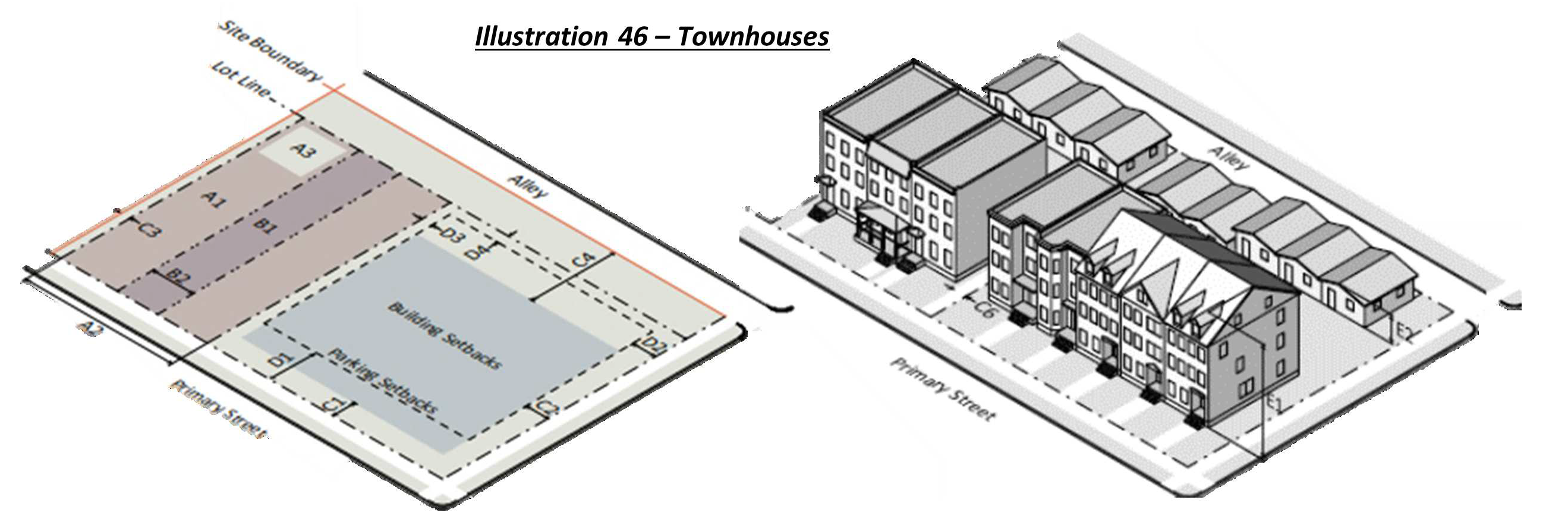
| DUPLEX AND TOWNHOME DEVELOPMENT STANDARD SCHEDULE | |
|---|---|
| A. Site Dimensions | |
| A1 Net site area/two (2) unit min. | 6,000 sf1 |
| A2 Width (min.) | 50 ft. |
| A3 Outdoor amenity area (min.) | 10%2 |
| B. Lot Dimensions | |
| B1 Length | n/a3 |
| B2 Width (min.) | 16' |
| C. Principal Building/Structure Setbacks | |
| C1 Front - (min.) | 20'4 |
| C2 Side - Corner lot - street side (min.) | 10' |
| C3 Side - Interior side lot line (min.) | 10% Lot width5 |
| C4 Rear - From rear site boundary line (min.) | 15' |
| C5 Rear - From alley (min.) | 10' or 25'6 |
| C6 Internal building separation (min.) | 10'7 |
| D. Parking Setbacks | |
| D1 Front - From property line (min.) | 20' |
| D2 From side street (min.) | 20' |
| D3 From side lot line (min.) | Per Florida Building Code |
| D4 From rear lot line (min.) | 5' |
| D5 From alley, garage only (min. depending upon garage orientation) | 5' or 15' |
| E. Height | |
| E1 Principal building (max.) | 35' |
| E2 Accessory structure (max.) (Detached) | 15' |
| FOOTNOTES: | |
| 1. One (1) unit per 2,420 sf. | |
| 2. Applies to infill lots only. | |
| 3. Size of the unit(s) working in concert with required minimum setbacks. Establishes the "townhouse lot" area within the parcel. | |
| 4. To habitable space. 10' to open porch or courtyard. | |
| 5. Infill lots. | |
| 6. 10' to habitable space; 25' with garage or parking off alley. | |
| 7. Or in accord with Florida Building code. | |
Sec. 2.06.07.5 Parking requirements.
Sec. 2.06.07.6 Common open space.
Sec. 2.06.07.7 Site design.
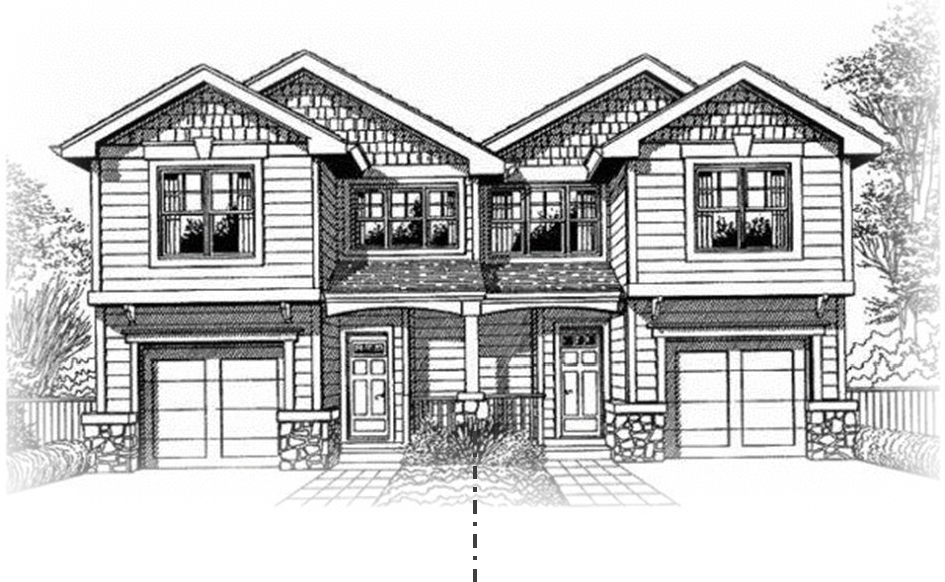
B. Townhome development - Site configuration shall not be limited to any one (1) form of the following principles: Rather, best practices development standards that best serve the locale and are consistent with the vison of the Flagler Beach charrette, and Downtown Master Plan should be considered.
1. Alley-loaded. A development with a single row of dwellings that front on a street and are served by an alley in the rear. See Figure: ALLEY-LOADED AND AUTO COURTS.
2. Auto Court. A development with two (2) rows of dwellings grouped around an auto court. One (1) row fronts on the street, the other on the auto court. See Figure: ALLEY-LOADED AND AUTO COURTS.
3. Front loaded. A development with a single row of dwellings the front of which faces the street.
Figure: ALLEY-LOADED, AUTO COURT and FRONT LOADED CONFIGURATIONS.
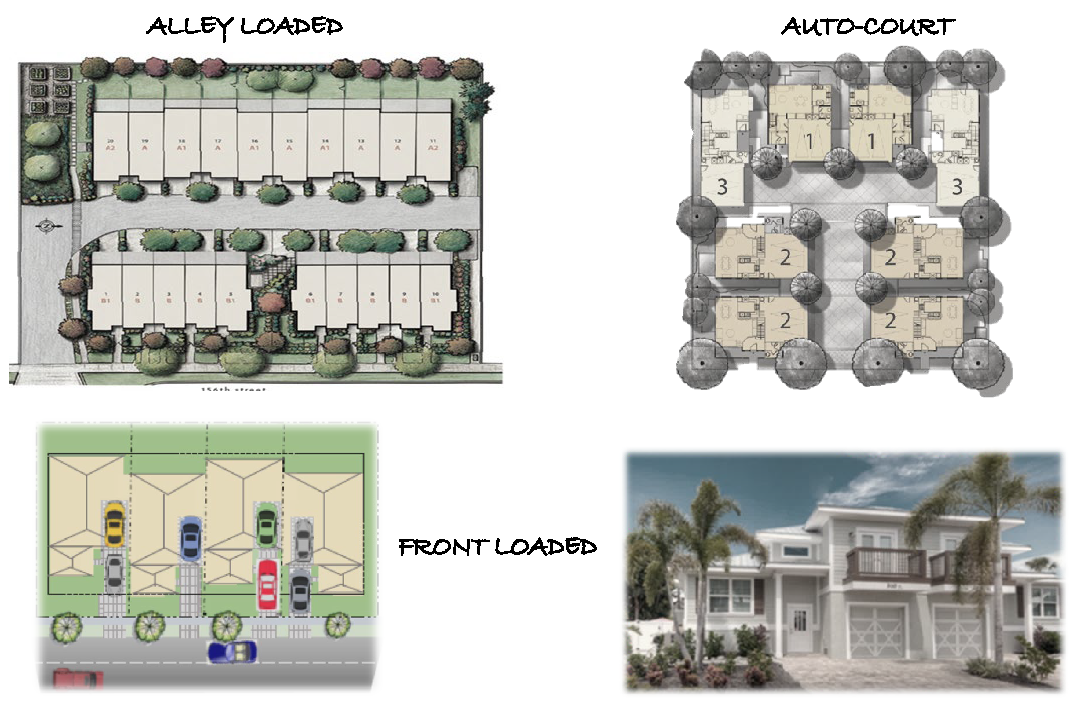
2.06.07.8 Building composition.
Intent: To create a "street facade" which enhances the streetscape and the overall pedestrian experience.
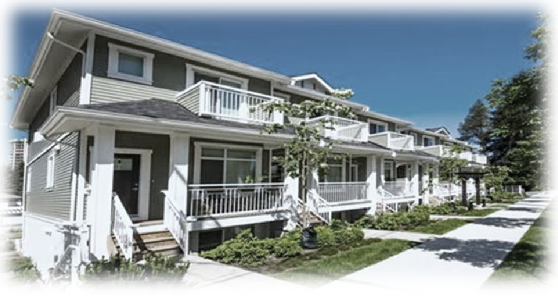
2.06.07.9 Building orientation and design.
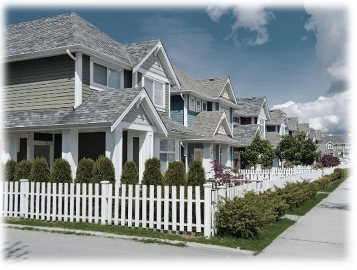
2.06.07.10 Building group length.
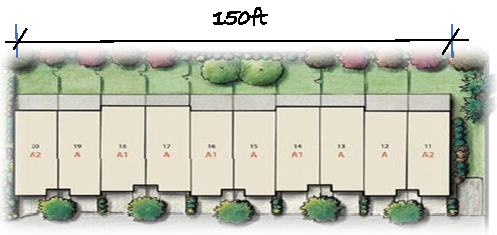
b. Architectural Character - Building Group(s).
Architectural design of a townhome group shall have variations and articulation of the front elevation, side elevation facing a street and rear elevation facing a street or common space. Not more than two adjacent townhomes front elevation shall be in the same plane for an individual story. In addition, a minimum of three (3) of the following architectural treatments shall be incorporated into the townhome group elevations:
Set-back of two (2) feet.
Front Yard setback of a minimum of two (2) feet.
Projected bay windows or boxed window.
Front porches.
Balcony.
Dormers.
Roof Style.
Color.
Material.
Front Door and Garage Door Style.
Townhome groups shall be designed to create an appearance of individuality with the use of one of the following:
1) Change of body color per individual townhome.
2) Change of materials.
3) Change of front door and garage door color.
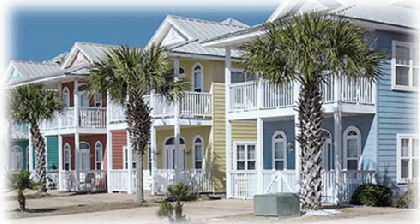
c. Infill townhome unit design.
1. Individual townhome or groups shall have a presence on the street, vehicle access and or common space.
2. Townhome groups shall be designed to create an appearance of individuality with the use of one of the following elements:
i. Change of body color per individual townhome.
ii. Change of materials.
iii. Change of front door and garage door color.
3. No solid wall or fencing over three (3) feet in height shall be permitted. Front yard wall or fence design shall be in character and enhance the architecture of the building.
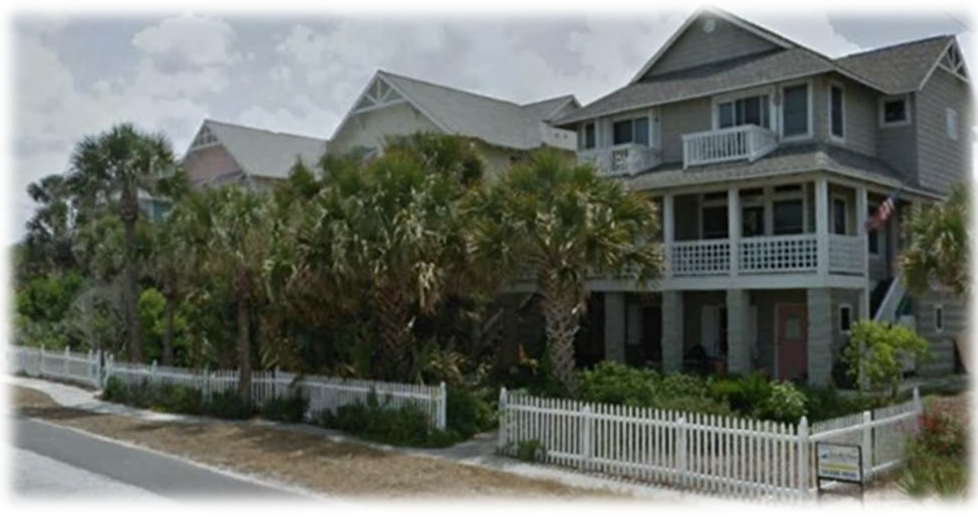
2.06.07.11 Vehicular access, circulation and auto courts.
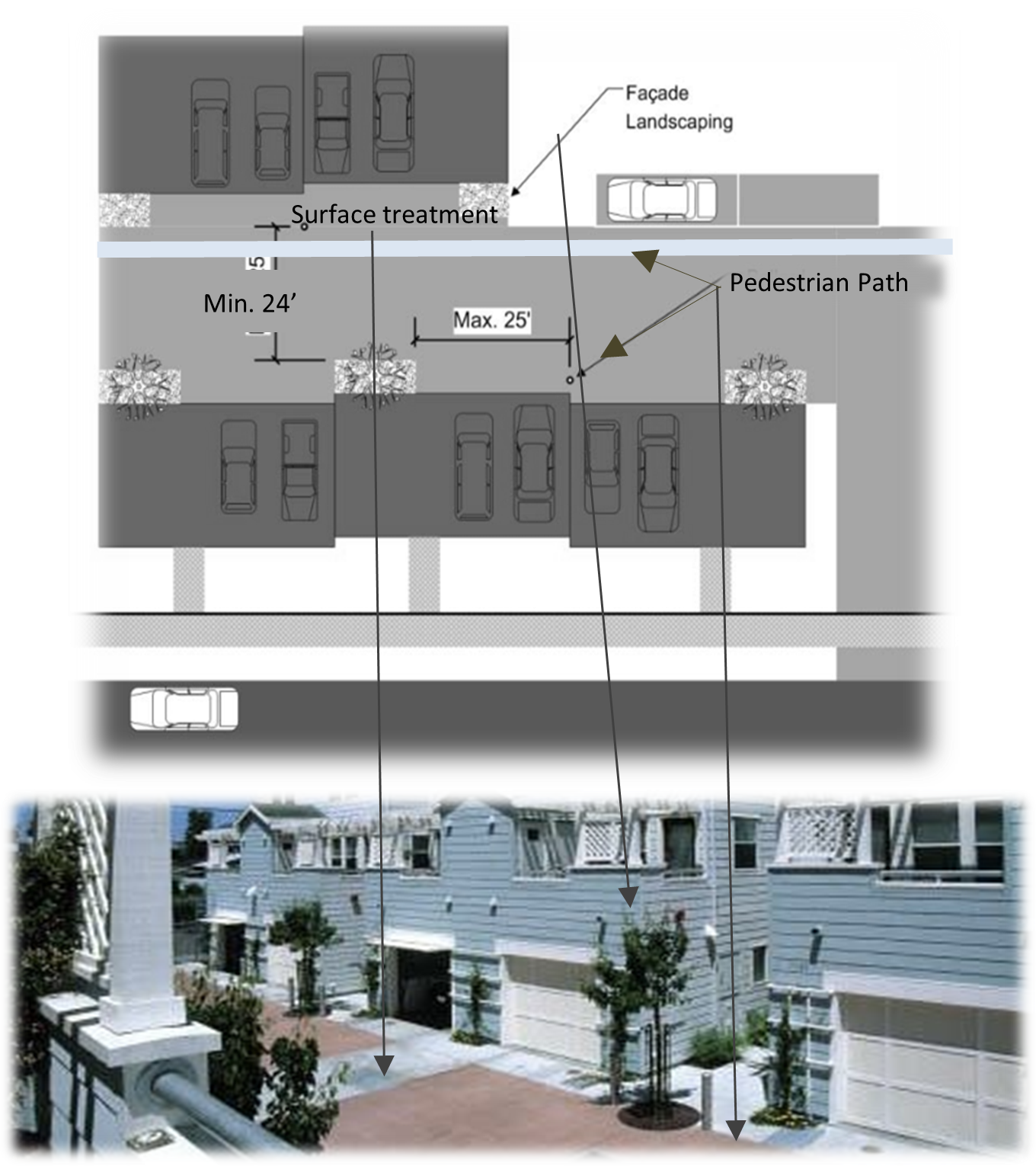
2.06.07.12 Garage design.
2.06.07.13 Pedestrian access and circulation.
2.06.07.14 Service and Utility Areas.
2.06.07.15. Storage space.
2.06.07.16 Homeowners association.
(Ord. No. 2022-09, § 5, 7-28-22)
Section 2.06.08.1 Conversions.
Conversions shall be permitted in all residential districts except in the SFR and LDR districts in accordance with the following provisions:
(1) There shall not be more than the maximum number of dwelling units than are permitted in the respective district.
(2) Such conversions may be permitted on lots of not less than the minimum required for the district where situated.
(3) Off-street parking shall be provided in an amount of not less than two (2) for each dwelling unit.
(4) Any conversion from rental to condominium or time share ownership of any dwelling unit of a multi-family dwelling shall come before the planning and architectural review board for review. Such review shall include findings that the use conforms with all applicable land use regulations of the city, including all parking requirements. The planning and architectural review board shall forward its findings and recommendations to the city commission for final approval.
Section 2.06.08.2 Home occupations.
Home businesses shall be governed by Chapter 18, Article II, Business Tax.
Section 2.06.08.3 Outdoor storage areas.
Such uses shall not be located within one hundred (100) feet from the nearest residential district and the operation thereof shall be governed by the following provisions and any other conditions as may be required by the planning and architectural review board to protect the public health, safety, comfort, convenience and general welfare, and especially with regard to abutting properties and the occupants thereof.
(1) Inflammable and explosive liquids—No highly inflammable or explosive liquids, solids or gases shall be stored in bulk above ground. Tanks or drums of fuel directly connecting with heating devices or appliances located on the same premises as the tanks or drums of fuel are excluded from this provision.
(2) Fencing and setbacks—All outdoor storage facilities shall be enclosed by a fence or wall adequate to conceal such facilities and the contents thereof from adjacent property or a public street. Such walls and fences shall be not less than ten (10) feet away from any property line, and shall be a distance of not less than twenty-five (25) feet from any public street.
(3) Deposit of wastes—No materials or wastes shall be deposited on any premises in such form or manner that they may be transferred off such premises by natural causes or forces.
(4) Other hazardous materials—All materials or wastes which might cause fumes or dust or which constitute a fire hazard or which may be edible by or otherwise be attractive to rodents or insects shall be stored outdoors only in closed containers.
Section 2.06.08.4.1 Temporary structures, utility trailers, and recreational vehicles.
No temporary structure, utility trailer or recreational vehicle shall project into the yard or encroach into easements, parking areas, or other required areas except as hereinafter provided.
(1) Unless temporary structures are prohibited in any district or subdivision, temporary structures may be constructed in a rear yard provided that all such structures, collectively, do not occupy more than thirty (30) percent of the required rear yard and provided it is not located within the rear yard setback.
(2) Recreational vehicles and utility trailers shall have current license tags or validation stickers, if required by state law, and shall be in good working order. For purposes of this section, "good working order" shall mean that the body, tires, windows, and bumpers are maintained in accordance with generally accepted standards and that the recreational vehicle or utility trailer is functional, usable and in such a state as it may be used without further repair or alteration for the purpose for which is was intended.
(3) To protect and promote the public health, safety and welfare, to provide light, safety from fire, safety from other damages and to protect property owners from certain general nuisances associated with unregulated parking, storage, or maintenance of utility trailers and recreational vehicles, the parking, storage, and maintenance of utility trailers and recreational vehicles shall be allowed on private property subject to the following:
a. No utility trailer or recreational vehicle shall be occupied as temporary living quarters while such utility trailer or recreational vehicle is parked or stored within a residentially zoned district in the city except as otherwise provided in the Code of Ordinances. No utility trailer or recreational vehicle parked or stored in the city shall have its wheels removed for a period greater than seventy-two (72) consecutive hours, except for repair or maintenance. No recreational vehicle parked or stored in the city shall run a generator or be connected to water, electric or sewer hookups for any purpose other than maintenance and testing purposes. A rebuttable presumption shall exist that a generator was run for purposes other than maintenance and testing if such generator is run for more than fifteen (15) minutes in any twenty-four-hour period. A rebuttable presumption shall exist that a recreational vehicle was connected to water, electric or sewage utilities for purposes other repair or maintenance if such connections exist for more than twenty-four (24) consecutive hours.
b. No utility trailer or recreational vehicle shall be parked in such a way that it encroaches onto a street, sidewalk or other right-of-way or in any location which visually obstructs vehicle egress from nearby properties or the view or vision of vehicular traffic.
c. Notwithstanding any other provision herein, utility trailers and recreational vehicles more than forty (40) feet in overall length may not be parked or stored on residential parcels unless stored in fully enclosed garages or stored entirely within carports.
d. A utility trailer or recreational vehicle parked or stored at a residence on residential property must be owned by the owner or tenant of the parcel of property upon which the utility trailer or recreational vehicle is parked or stored.
e. No more than one (1) recreational vehicle and one (1) utility trailer shall be parked outside of a fully enclosed garage at any one time.
f. A utility trailer or recreational vehicle may be kept:
(i) in a fully enclosed garage or stored entirely within a carport;
(ii) in a rear yard so long as the recreational vehicle does not occupy more than thirty (30) percent of the rear yard and is not located within the rear yard setback;
(iii) in any portion of the residence driveway located entirely behind the line extending from the forward-most portion of the principal residential structure to each side lot line; or
(iv) in a side yard not fronting any street.
g. Utility trailers and recreational vehicles may be temporarily parked in any portion of the residence driveway forward of the line extending from the forward-most portion of the principal residential structure to each side lot line for the purpose of loading, unloading, minor repairs, or general maintenance. However, such temporary parking shall not occur continuously for more than seventy-two (72) hours in any consecutive seven-day period.
h. When parking pads have been issued permits by the city prior to the effective date of this Ordinance [October 13, 2011] and as of the effective date of this Ordinance [October 13, 2011] such pads are being used for parking and storage of recreational vehicles but are not in compliance with this section, parking and storage of such recreational vehicles on the parking pads are hereby grandfathered in and not subject to Section 2.06.08.5 regarding nonconforming uses.
i. No utility trailer parked or stored outside of a fully enclosed garage shall have visible commercial markings identifying any business or commercial enterprise in which the trailer is used.
j. The contents of any utility trailer parked or stored outside of a fully enclosed garage shall be shielded from the elements and public view either by the structural components of the utility trailer or by an appropriately sized tarpaulin cover that is free of holes, rips, tears and excessive fading.
k. No utility trailers or recreational vehicles may be parked or stored on unoccupied or undeveloped lots.
l. Owners of utility trailers or recreational vehicles parked or stored in violation of this section prior to the effective date of this Ordinance [October 13, 2011] shall have ninety (90) days to come into compliance with this section.
(4) In an effort to assist property owners to comply with the regulations of this section, the following procedures shall be followed by the city for first-time violations of this section.
a. Upon documenting a first-time violation of this section, the code enforcement officer shall, prior to issuing a notice of violation, inform the subject property owner of the violation and make a written offer to the owner of the subject property offering the assistance of the city in providing assessment of compliance options. The compliance assistance agreement shall be in a form approved by the city. The subject property owner shall have three (3) business days to accept the city's compliance assistance agreement. If the subject property owner refuses the compliance assistance agreement or fails to respond within three (3) business days from the date the compliance assistance offer was made, the code enforcement officer shall proceed to issue a notice of violation.
b. If the subject property owner accepts the city's offer of compliance assistance, the code enforcement officer shall schedule an inspection of the subject property by the code enforcement officer for the purpose of evaluating the most efficient method of bringing the property into compliance with this section.
c. Within three (3) business days from the date of the compliance inspection performed pursuant to paragraph b. the code enforcement officer shall notify the subject property owner of the code enforcement's determination as to the most efficient method of bringing the subject property into compliance.
d. The owner of the subject property shall be allowed twenty-one (21) days from the date of the notice of the compliance methods described in paragraph c. to bring the subject property into compliance by any means the subject property owner chooses. If at the end of said twenty-one-day period, the subject property remains in violation, the code enforcement officer shall proceed to issue a notice of violation.
e. Failure by the city to meet any of the time deadlines provided herein shall not prevent the code enforcement board or special magistrate from making a finding that the property is in violation of this section at a duly noticed hearing. In the event that the city is shown to have failed to undertake or complete any action required by this section, the code enforcement board or special magistrate shall include in the time allowed for cure of the violation additional time for the subject property owner to avail himself or herself of the compliance assistance detailed herein.
(Ord. No. 2004-37, § 3, 1-27-05; Ord. No. 2006-12, § 1, 4-13-06; Ord. No. 2007-06, § 1, 3-8-07; Ord. No. 2009-14, § 2, 9-24-09; Ord. No. 2011-01, § 3, 10-13-11)
Section 2.06.08.4.2 Special provisions for portable storage units.
(a) Portable storage units may be located in single-family and two-family zoning districts. Portable storage units may be allowed in other multi-family districts only upon the applicant demonstrating, to the satisfaction of the appropriate designated city official, that the specific location/complex has sufficient space to place a portable storage unit and continue to provide adequate parking, public safety access and comply with all health, safety and welfare concerns.
(b) Prior to commencing business in the city, the portable storage company must obtain an annual permit from the city outlining the obligations and requirements prior to conducting business in the city. In addition, the portable storage company must provide a cash deposit in an amount established by resolution to ensure the timely removal of the portable units and compliance with this ordinance.
(c) The total square footage for portable storage units on any site shall not exceed one hundred thirty (130) square feet in area.
(d) Portable storage units in single-family and two-family zoning districts shall be placed only in the driveway and be set back a minimum of ten (10) feet from the front property line.
(e) No portable storage unit shall remain at a site in excess of seven (7) consecutive days in single-family, two-family and multi-family zoning districts. No portable storage units shall be placed at any one (1) location in excess of fourteen (14) days in a calendar year for single-family and two-family zoning districts. Notwithstanding the time limitations as stated above, all portable storage units shall be removed immediately upon the issuance of a hurricane warning by a recognized governmental agency. The removal of the storage units during a hurricane warning is the responsibility of the provider/owner of the unit.
(f) In the event of a natural disaster, as determined by the appropriate designated city official, damages sustained by fire or other personal property loss, storage units may be retained beyond the time constraint limitations described herein not to exceed thirty (30) days from the date of permit issuance and may be extended, under extraordinary circumstances, for a period of time to be determined by the appropriate designated city official.
(g) It shall be unlawful for any person to place or permit the placement of a portable storage unit on property which he or she owns, rents, occupies, or controls without first obtaining a site permit and approval from the appropriate designated city official.
(h) The exterior of the storage unit shall have a weatherproof clear pouch which must display the site permit.
(i) The owner, operator and/or renter of the portable storage unit shall be responsible to ensure that the portable storage unit is in good condition, free from evidence of deterioration, weathering, discoloration, rust, ripping, tearing or other holes or breaks. When not in use, the portable storage unit shall be kept locked. The owner and operator of any site on which a portable storage unit is placed shall also be responsible that no hazardous substances are stored or kept within the portable storage units.
(j) Violations of any part of this section are subject to fines as described in Chapter 2 Article IV, Division 2 Section 2-78, Administrative Fines of the Code of Ordinances of the City of Flagler Beach.
(Ord. No. 2004-37, § 3, 1-27-05; Ord. No. 2006-12, §§ 1, 2, 4-13-06; Ord. No. 2006-20, § 1, 6-22-06)
Section 2.06.08.5 Nonconforming uses and nonconforming structures.
(1) Continuation of use—A use, building or structure, lawfully in existence at the effective date of this Land Development Code, which shall be made nonconforming at the passage of this ordinance or any applicable amendment thereto, may be continued except as otherwise provided in this article.
(2) Regulation of nonconforming uses:
(a) No nonconforming use shall be enlarged or increased, nor extended to occupy a greater area of land than was occupied at the effective date of any amendment of the Land Development Code;
(b) Normal maintenance, repair and incidental alteration of a structure containing a nonconforming use is permitted, provided it does not extend the area or volume of space occupied by the nonconforming use. A building or other structure containing residential nonconforming uses may be altered in any way to improve interior livability, provided, however, that no structural alterations shall be made which would increase the number of dwelling units;
(c) No nonconforming use shall be moved in whole or in part to any portion of the lot or parcel other than that occupied by such use at the effective date of any amendment of the Land Development Code;
(d) A nonconforming use not used for a period of twelve (12) months or the change of use to a more restricted or conforming use for any period of time shall be considered an abandonment thereof and such nonconforming use shall not thereafter be revived;
(e) When any structure containing a nonconforming use is destroyed by any means to an extent greater than seventy-five (75) percent of the structure's assessed value the structure shall not rebuilt unless the use is converted to a conforming use.
(3) Regulation of nonconforming structures:
(a) No nonconforming structure shall be enlarged, increased or expanded in a way that increases the structure's nonconformity;
(b) When any nonconforming structure is destroyed by any means to an extent greater than seventy-five (75) percent of the structure's assessed value the structure shall not be rebuilt unless rebuilt in full compliance with all provisions of this Land Development Code;
(c) Normal maintenance, repair and incidental alteration of a nonconforming structure is permitted, provided such maintenance, repair and incidental alteration does not enlarge, increase or expand the structure's nonconformity. A nonconforming residential structure may be altered in any way to improve interior livability, provided, however, that no structural alterations shall be made which would increase the number of dwelling units.
Section 2.06.08.6 Liveaboard vessels in marinas.
(a) Liveaboard vessels are permitted only in marinas which have received a special exception for liveaboard vessel use pursuant to Section 2.06.01 and this section.
(b) In addition to the criteria for grant of a special exception provided in Section 2.06.01, an applicant has the burden of satisfying all of the following minimum criteria by competent substantial evidence:
1) The owner of the marina has the ability to, and shall, come into compliance with all of the requirements set forth herein.
2) The number of liveaboard vessels requested is no more than the equivalent of ten density units per acre, calculated by the following formula; provided, however, that no more than fifty (50) percent of the wet boat slips shall be designated for liveaboard vessels.
Formula for calculating maximum density for liveaboard vessels:
Number of linear feet of shoreline of the upland property multiplied by the length of the longest dock on upland property, divided by 43,560 (number of square feet in an acre). The quotient is equivalent to acreage. No more than ten liveaboard vessels per equivalent acre shall be granted.
Example: 1,000 linear feet of shoreline x 150-foot dock = 150,000
150,000 divided by 43,560 = 3.4 equivalent acres.
Maximum number of liveaboard vessels allowed: 34*
*Provided, however, that, if 34 is more than fifty (50) percent of the wet slips, the maximum liveaboard vessels shall be fifty (50) percent of the total number of wet slips.
3) Local infrastructure has adequate capacity to support the proposed number of liveaboard vessels.
4) Parking for the proposed number of liveaboard vessels shall be calculated in the same way as parking for medium density residential, and the adjacent upland property owned by the applicant must have adequate parking capacity for such liveaboard vessels, in addition to having parking capacity for other uses of the marina.
5) Applicant must have a permit from the State for the number of liveaboard vessels for which a special exception is sought.
(c) Once the applicant has met this burden, the burden shifts to any opposing party to demonstrate by competent, substantial evidence that the special exception does not meet the minimum criteria or is adverse to the public interest. After consideration of a special exception application for liveaboard vessels at a marina, the city commission may approve, approve with modifications, approve with conditions, or deny the application based on the consideration contained in Section 2.06.01 and herein.
(d) A special exception granted pursuant this section may be subject to review at any time and may be revoked after notice to the owner and any lessee at a public hearing by the city commission. The city commission may revoke the special exception permit upon a finding that there have been material violations of any of the criteria set forth in this section or material violations of any conditions of approval, or that the conduct of the owner and any lessee constitutes a public nuisance. The city may institute legal or equitable proceedings to revoke the special exception permit. No applicant who has had a special exception permit revoked shall be allowed to apply for another special exception permit for two (2) years after the revocation date.
Section 2.06.08.7 Minimum requirements for marinas permitting vessels used for habitation.
The owner of any marina shall not permit any vessel which is used for habitation to be tied or docked at such marina unless all of the following conditions are met:
1. The requirements of all applicable laws, codes, and regulations, such as those governing parking, public health, public safety, sanitation, including marine sanitation, and the environment are met.
2. Marinas at which vessels used for habitation are docked shall provide an American National Standards Institute approved flammables cabinet of sufficient size for the storage of flammable materials.
3. Any marina which allows vessels used for habitation to dock at the facility and which exist on the date this section is enacted shall come into compliance with this section within twelve (12) months from the date of enactment of this Ordinance.
4. On shore restroom facilities are available at the marina, which facilities shall comply with all applicable zoning and code regulations. If compliance with this regulation would require the relocation of an existing exterior wall of a principal building, it shall be waived by the city only if the property owner can demonstrate that the proposed restroom facility is no larger than necessary to meet Florida Building Code requirements and the requirements of this section and complies with the zoning regulations to the greatest extent possible as determined by the city.
Section 2.06.08.8. Floating structures.
Except as otherwise provided by federal or state law, houseboats which are not self-propelled (cannot be moved under their own power), floating structures, and barges may not be tied or docked in any zoning district in the city.
Section 2.06.08.9. Bottle clubs.
Bottle clubs as defined in Section 2.02.00 are prohibited in all zoning districts of the city.
(Ord. No. 2009-17, § 5, 10-8-09; Ord. No. 2014-17, § 2, 1-8-15)
Section 2.06.10.1 Central Business District Exemption Area.
(a) The following described area shall be known as the Central Business District Parking Exemption Area:
A line commencing from the westerly right-of-way boundary of South Flagler Avenue at SR 100 going south to the centerline of South 5th Street then east on the centerline of South 5th Street, past South Central Avenue, then going south across the block to the point of the General Commercial Zoning, ending at the center line of South 10th Street, eastward to SR A1A and commencing from the middle of Flagler Avenue at SR 100 going north to the center line of North 3rd Street, then east to the point of the Commercial Zoning, then going north, ending at the centerline of North 10th Street, then east to SR A1A, according to the plat thereof recorded in Public Records of Flagler County, Florida.
Section 2.06.10.2 New Construction Parking Exemption Zone.
The following described area located within the Central Business District Parking Exemption Area shall be known as the New Construction Parking Exemption Zone:
Section 2.06.10.3 Downtown Core On-Street Parking Pool.
(a) The City shall establish a Downtown Core On-Street Parking Pool and establish and maintain a calculation of available on-street public parking spaces within the designated New Construction Parking Exemption Zone per the exemptions provided in Section 2.06.10.2 to ensure and track the availability of on-street parking facilities.
(b) As of the effective date of this Ordinance, the City estimates that two hundred thirty-three (233) on-street public parking spaces within the New Construction Parking Exemption Zone are available for application toward the exemptions provided in Section 2.06.10.2.
i. Parking Pool space availability - Shall be restricted to the zone in which the proposed new construction is located.
a. North Zone - 55 spaces
b. South Zone - 178 spaces
(c) Upon any property qualifying for either exemption provided in Section 2.06.10.2 the number of on-site parking spaces which would otherwise be required by these Land Development Regulations but for such exemption shall be removed from the Central business district exemption area On-Street Parking Pool.
(d) In the event that the use or development upon any property which has claimed an exemption pursuant to Section 2.06.10.2 is changed in a manner to decrease the number of parking spaces required from the Central Business District On-Street Parking Pool, that number of off-site parking spaces shall be returned to the Pool.
(e) In the event that the number of parking spaces remaining in the Central Business District On-Street Parking Pool are inadequate to satisfy the number of on-street spaces needed for a proposed alteration of a property, said property shall not be eligible for the exemptions provided by Section 2.06.10.2.
(Ord. No. 2018-03, § 3, 2-22-2018)
SCHEDULE OF OFF-STREET PARKING REQUIREMENTS* CITY OF FLAGLER BEACH
| 1. | Single and two-family dwellings and townhouses | Two per dwelling unit |
|---|---|---|
| 2. | Multi-family dwellings | Two per dwelling unit |
| 3. | Churches or other places of worship | One per six permanent seats in the main auditorium |
| 4. | Private clubs | One per three hundred sq. ft. of total floor area or portion thereof |
| 5. | General business, commercial and personal service | One per three hundred fifty sq. ft. of establishments or office buildings total [floor] area or portion thereof |
| 6. | Hotels, motels and motor inns | One per bedroom or sleeping unit plus one per each five units or portion thereof |
| 7. | Libraries and museums | One per five hundred sq. ft. |
| 8. | Medical or dental offices or clinics | Eight for each doctor or dentist |
| 9. | Restaurants, nightclubs or other eating places | One per one hundred fifty sq. ft. total floor area or one per three fixed seats or as established by the standards of the Florida Building Code whichever is greater. Where the restaurant abuts the Intracoastal Waterway, boat slips may be counted for seating. One boat slip per three seats. When counting boat slips for seating as provided herein, such boat slips must be transient in nature and cannot have electrical or water hookups. Boat slips can only represent an additional 25% of land parking. |
| 10. | Theatres, auditoriums | One per each four seats |
| 11. | Schools (public or private) | |
| Grades 1—6 | One per fourteen students | |
| Grades 7—9 | One per nine students | |
| Grades 10—12 | One per three students | |
| 12. | Industrial | One per six hundred sq. ft. of total floor space or portion thereof |
| 13. | Hospitals | 1.5 per bed |
| 14. | Tennis, hand-ball, and racquetball facilities | Two spaces/court plus required parking for additional uses on the site |
| 15. | Health club | One space/one hundred fifty square feet of gross floor area |
| 16. | Driving range (golf) | One space/tee plus required parking for any other uses on the site |
| 17. | Golf course (regulation) | Six spaces/hole plus required parking for any other uses on the site |
| 18. | Boat slips | One space per boat slip, except charter boats. |
| 19. | Charter boats* | One space per six permanent seats on the boat, plus one space for the captain/skipper |
| *Note 1. Charter boats are permitted in marinas. Prior to the date when a charter boat begins operation, the owner shall submit a parking plan to the city. | ||
*Properties within the Downtown Mixed-Use District and the Downtown A1A Retail Corridor are also regulated by Section 2.01.02.7.1 Downtown Design Guidelines, which may differ from this schedule and take precedence.
(4) Collective provisions—Two (2) or more owners or operators of buildings or uses of the same type of zoning classification requiring off-street parking facilities may take collective provision for such facilities, provided that the total of such parking spaces when combined or used together shall not be less than the sum of the requirements computed separately and provided that the combined facility is compatible with the zoning uses being served.
(5) Interpretation—The planning and architectural review board shall interpret the minimum required number of off-street parking spaces for any use not listed in the schedule of off-street parking requirements.
(6) Landscaping—All parking areas shall be properly screened, landscaped, and lighted in accordance with Section 5.04.00, Landscaping/Trees.
Ten (10) percent minimum of the gross parking area is to be devoted to living landscaping, which includes grass, ground cover, plants, shrubs and trees. The gross parking area is to be measured from the edge of the parking and/or driveway paving and sidewalks, extended [extending] five (5) feet in all directions, but is not to include any area enclosed by the building or covered by a building overhang.
Such landscaping shall be maintained (i.e., watered, fertilized, pruned, etc.) and periodically replaced if necessary.
(7) Perimeter screening—All parking lots and vehicular use areas shall be screened from all abutting properties and/or rights-of-way with a wall, fence, hedge or other durable landscape barrier. Any living barrier shall be established in a two-foot minimum wide planting strip. This living barrier shall be at least thirty (30) inches high at the time of planting and shall attain a minimum height of three (3) feet one (1) year after planting. A non-living barrier shall be a minimum of three (3) feet high at time of installation. In addition, one (1) tree in each forty (40) linear feet or fraction thereof shall be provided in the perimeter landscape planting area. Trees referred to in this section shall be of a species common to North Central Florida and having an average mature spread of crown of greater than fifteen (15) feet and having trunk(s) which can be maintained in a clean condition over five (5) feet of clear wood. Trees having an average mature spread of crown less than fifteen (15) feet may be substituted by grouping the same so as to create the equivalent of a fifteen-foot crown of spread. Trees species shall be a minimum of eight (8) feet overall height immediately after planting. Hedges, where installed, shall be planted and maintained so as to form a continuous, unbroken, solid, visual screen thirty-six (36) inches high within a maximum of one (1) year after time of planting. The remainder of the required landscaped areas shall be landscaped with grass, ground cover, or other approved landscape treatment excluding paving. All property other than the required landscaped strip lying between the right-of-way and off-street parking area or other vehicular use area shall be landscaped with at least grass or other ground cover.
This shall include the off-property swale between the actual pavement of a public street or alley and the right-of-way/property line. Appropriate provisions of this section may be waived in the following situation:
Where a proposed parking area or other vehicular use area abuts an existing hedge, wall or other durable landscape barrier it may be used to satisfy the landscape barrier requirements of the subsection provided that said existing barrier meets all applicable standards of this ordinance and protection against vehicular encroachment is provided for hedges.
(8) Interior landscaping—Interior areas of parking lots shall contain planter islands located so as to best relieve the expanse of paving. A maximum of twelve (12) parking spaces in a row will be permitted without a planter island.
Interior areas of vehicular use areas shall contain planter islands located so as to best relieve the expanse of pavement. This section may be modified under the following circumstances:
(a) When a strict application of this section will seriously limit the function of an area the required landscaping may be relocated with the approval of the planning and architectural review board.
(b) In an industrial project the planning and architectural review board may lower the overall landscape area from ten (10) percent to five (5) percent of the gross parking area. This reduction would apply only to the interior requirements. Perimeter minimums will not change.
(9) Planter islands shall be a minimum of fifty (50) square feet in area and shall contain at least one (1) tree having a minimum clear trunk of five (5) feet and a minimum overall height of eight (8) feet. The remainder shall be landscaped with shrubs, lawn, ground cover or other approved material not to exceed three (3) feet.
In instances where healthy plant material exists on a site prior to its development, the above-mentioned standards may be adjusted to allow credit for such plant material, if, in the opinion of the planning and architectural review board, such an adjustment is in keeping with and will preserve the intent of this ordinance.
(10) Lighting—All parking lots and vehicular use areas shall be well lighted.
Lighting is to be designed not only from the standpoint of safety and resistance to vandalism, but for visual effect. It should avoid any annoyance to the neighbors from brightness or glare. Low lights of a modest scale can be used along with feature lighting emphasizing plants, trees, barriers, entrances and exits. The fixtures are to be selected not only for their functional value but for their aesthetic qualities. They are to be considered furniture of the parking lot visible both day and night.
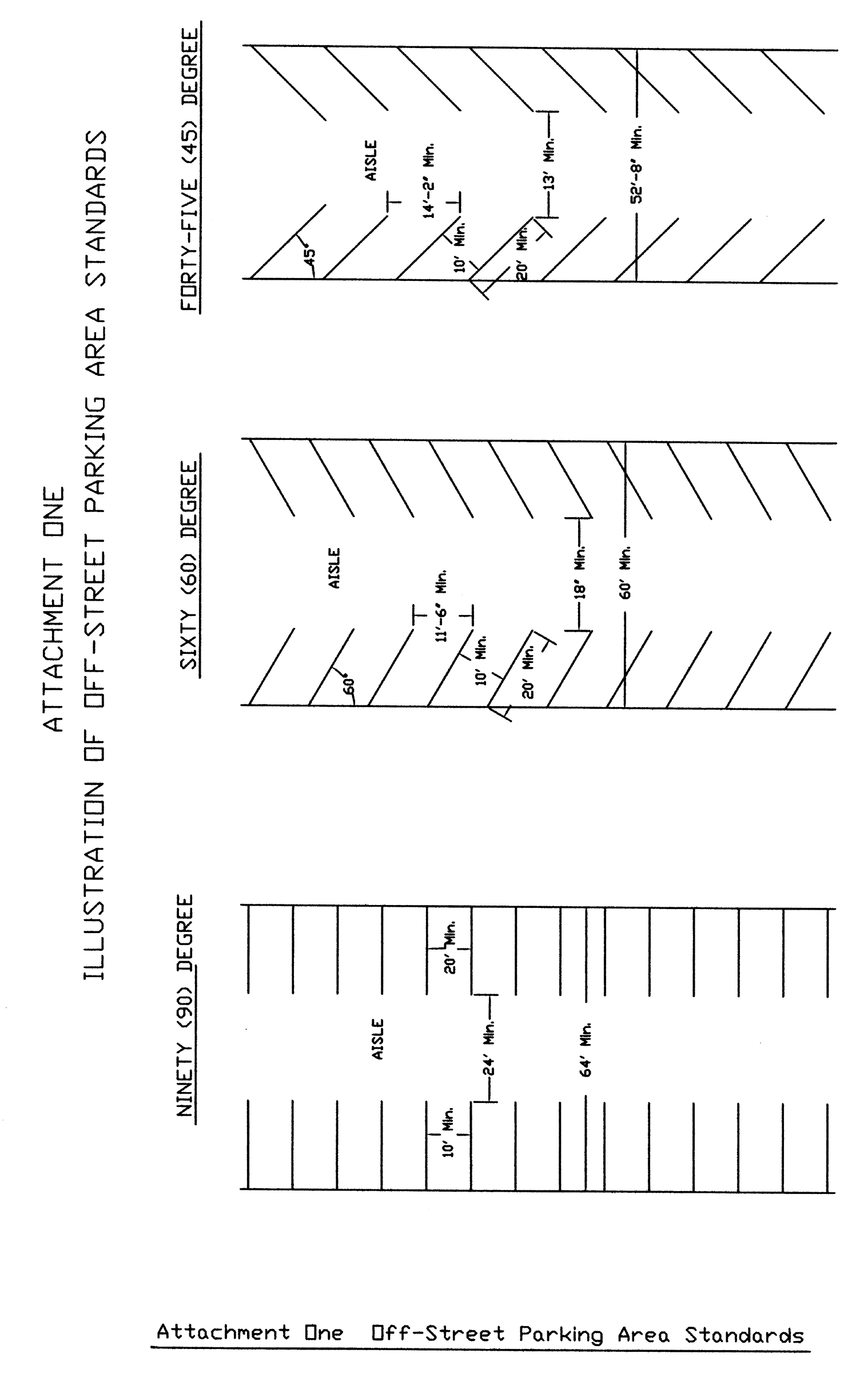
Section 2.06.05.5.a Clustering of commercial activities.
Where possible, to avoid strip commercial development, commercial activities shall be clustered so as to utilize shared parking and access road facilities.
Section 2.06.05.5.b Integration of multi-family land uses of ten (10) or more units with commercial land uses.
Where practical, subject multi-family land uses adjacent to commercial land use shall provide an access road between the multi-family development and the commercial parking area so as to promote internal circulation between land uses.
North Zone
A line commencing from the middle of N. Flagler Avenue at SR 100, then north to North 2nd Street, then east to Central Avenue to the point of the General Commercial Zoning District, then north to N. 3rd St., then east to the point of the General Commercial Zoning, then north to N. 4th St. then east ending at A1A, then south to SR100, then west ending at the centerline of N. Flagler Ave.
South Zone
A line commencing from the westerly right-of-way line South Flagler Avenue at SR 100 going south to the centerline of South 5th Street then east on the centerline of South 5th Street past Central Avenue, to the point of the General Commercial Zoning, then south to S. 10th St., then east to A1A, then north to SR100, then west ending at the westerly line of South Flagler Ave.
(a) Non-residential properties located within the Central Business District Parking Exemption Area but not located within the New Construction Parking Exemption Zone shall be exempt from requirements that would require creation of new on-site parking facilities otherwise required by these Land Development Regulations when any proposed alteration of the property does not involve new construction, as defined in Section 2.02.00 of these Land Development Regulations, and when all conditions and restrictions provided in paragraph (e) herein are satisfied.
(b) Non-residential properties located within the Central Business District Parking Exemption Area and also within the New Construction Parking Exemption Zone shall be exempt from requirements that would require creation of new on-site parking facilities otherwise required by these Land Development Regulations when any alteration of the property, including new construction, as defined in Section 2.02.00 of these Land Development Regulations, is proposed and when all conditions and restrictions provided in paragraph (d) herein are satisfied. Downtown Core Parking Zone
(c) Off Site Parking Lease (Existing business) - A business engaged in a lease and located within the New Construction Parking Exemption Zone shall be eligible to participate in the On-Street Parking Pool should the agreement be terminated solely when initiated by the owner of the property utilized for the associated business' parking.
(d) The exemption provided herein from on-site parking requirements shall not apply to existing on-site parking facilities and shall only be applicable when:
(i) Available on-street parking spaces exist within the Central Business District On-Street Parking Pool as calculated pursuant to Section 2.06.10.3 herein;
(ii) Existing on-site parking spaces on the property proposed for alteration are retained;
(iii) Any proposed development includes additional on-site parking spaces to the greatest extent possible.
(iv) Mixed Use Buildings - All required residential parking spaces shall be provided on-site unless otherwise provided for in Appendix "A" Land Development Regulations.

