
Fort Myers Beach City Zoning Code
ARTICLE II
ZONING PROCEDURES
Sec. 34-51. - Notice of public hearings required.
No public hearing required by this chapter shall be held by local planning agency or town council until notice of the public hearing has been provided in accordance with the requirements set forth in this article.
Sec. 34-52. - Communications with public officials.
(a)
Definitions. The following terms and phrases, when used in this section, shall have these meanings:
Ex parte communication means any direct or indirect communication in any form, whether written, verbal or graphic, with the town council or local planning agency, by any person outside of a public hearing and not on the record, concerning substantive issues in any proposed or pending quasi-judicial action relating to appeals, variances, rezonings, special exceptions or any other quasi-judicial action assigned by statute, ordinance or administrative code.
Legislative action means the formulation of a general rule or policy, such as enacting a comprehensive plan or a comprehensive rezoning of multiple properties.
Public official means an elected or appointed member of a town board or commission that recommends or takes quasi-judicial actions, specifically including all members of the town council and the local planning agency. Members of the town staff are not public officials under this definition unless they also serve on a board or commission that recommends or takes quasi-judicial actions.
Quasi-judicial action means the application by the local planning agency or town council of a previously adopted general rule or policy that will have an impact on a limited number of persons or property owners, such as individual appeals, variances, rezonings and special exceptions.
Unrestricted communication means any communication by the public with public officials which are specifically allowed and encouraged, for instance, communications regarding the town budget or the general welfare of the community; or legislative actions such as proposed ordinances or general changes to the Fort Myers Beach Comprehensive Plan.
(b)
Any person not otherwise prohibited by statute, charter provision, or ordinance may discuss with any local public official the merits of any matter on which action may be taken by any board or commission on which the public official is a member.
(1)
Except for quasi-judicial actions (such as appeals, variances, rezonings, and special exceptions), the town encourages unrestricted communications between all public officials and town residents, visitors, businesspeople, and property owners.
(2)
When discussions on pending quasi-judicial actions (such as administrative appeals, variances, rezonings, and special exceptions) take place prior to an advertised public hearing, the following procedures, which mirror those in F.S. § 286.0115(1), shall remove any presumption of prejudice arising from such ex parte communications with public officials:
a.
The substance of any ex parte communication with a public official which relates to quasi-judicial action pending before the official is not presumed prejudicial to the action if the subject of the communication and the identity of the person, group, or entity with whom the communication took place is disclosed and made a part of the record before final action on the matter.
b.
A public official may read a written communication from any person. However, a written communication that relates to quasi-judicial action pending before a public official shall not be presumed prejudicial to the action, and such written communication shall be made a part of the record before final action on the matter.
c.
Public officials may conduct investigations and site visits and may receive expert opinions regarding quasi-judicial action pending before them. Such activities shall not be presumed prejudicial to the action if the existence of the investigation, site visit, or expert opinion is made a part of the record before final action on the matter.
d.
Disclosure made pursuant to subsections a., b., and c. must be made before or during the public meeting at which a vote is taken on such matters, so that persons who have opinions contrary to those expressed in the ex parte communication are given a reasonable opportunity to refute or respond to the communication. This subsection does not subject public officials to the Code of Ethics for Public Officers and Employees (F.S. ch. 112, pt. III) for not complying with this subsection.
Sec. 34-53. - Fees and charges.
(a)
The schedule of fees and charges for matters pertaining to this chapter shall be posted in the office where permits applications are filed. The charges listed may be changed by resolution of the town council. In the absence of a resolution by the town council, the director shall charge fees that are comparable to the fees charged by the board of county commissioners for similar applications.
(b)
No permit shall be issued and no inspection, public notice, or other action relative to a zoning matter shall be instituted until after such fees and charges have been paid.
Sec. 34-81. - Appointment of local planning agency.
The town council shall appoint the members of the local planning agency.
Sec. 34-82. - Initiation of zoning actions.
The town council or the town manager may initiate rezonings, special exceptions, variances, developments of regional impact, land development code amendments, formal interpretations of this code and the Fort Myers Beach Comprehensive Plan, and other actions as may be specified in this code. See division 4 of this article for specific application requirements.
Sec. 34-83. - Land use ordinance amendments or adoption.
(a)
Function. The town council shall hold public hearings on all proposed land use ordinance amendments or adoptions.
(b)
Considerations. When deciding whether to adopt a proposed land use ordinance or amendment, the town council shall consider the Fort Myers Beach Comprehensive Plan and the recommendation of the local planning agency.
(c)
Decisions and authority. The decision of the town council on any proposed land use ordinance amendment or adoption is final.
(d)
Appeals. Appeals of any decision concerning land use ordinance amendments or adoption shall be taken in accordance with applicable state law.
Sec. 34-84. - General procedures for actions on specific zoning applications.
(a)
Function. The town council shall hold public hearings (see §§ 34-231 through 34-265 of this chapter) on the following applications: rezonings, appeals from administrative actions, variances, special exceptions, and developments of regional impact.
(b)
Prior hearings. Public hearings before the town council shall be held after the local planning agency has held its hearing on these applications and rendered its formal recommendation to the town council, except for appeals of administrative actions, applications for interpretations of this code, and certain interpretations of the comprehensive plan, which shall require only a single public hearing before the town council.
(c)
Decisions and authority.
(1)
In exercising its authority, the town council shall consider the recommendation of the local planning agency where applicable, but may, in conformity with the provisions of this chapter, reverse, affirm, or modify the recommendation, or remand the recommendation to afford due process.
(2)
The town council shall not approve any zoning action other than that published in the newspaper unless such change is more restrictive than the proposed zoning published.
(3)
The town council has the authority to attach special conditions to any approval of a request for a special exception, development of regional impact, planned development rezoning, or variance within their purview, deemed necessary for the protection of the health, safety, comfort, convenience, or welfare of the general public. Such special conditions must be reasonably related to the action requested.
(4)
The decision of the town council on any matter listed in this section is final. If a decision of approval is not obtained, or if a tie vote results from a motion to grant a request or from a motion to deny a request, then the matter being considered shall be deemed to have been denied, unless a majority of the members present and voting agree by motion, before the next agenda item is called, to take some other action in lieu of denial. Such other action may be moved or seconded by any member, regardless of his vote on any earlier motion.
(d)
Denials.
(1)
Denial with prejudice.
a.
Except when specifically stated otherwise, a denial by the town council is a denial with prejudice.
b.
If an application is denied with prejudice, no similar application for rezoning, special exception, or variance covering the same property, or portion of the property, shall be resubmitted or initiated for a period of 12 months from the date of denial. However, this shall not preclude the application for a different rezoning, special exception, or variance which in the opinion of the director is substantially different from the request originally denied.
(2)
Denial without prejudice.
a.
When the town council denies without prejudice any application, it is an indication that, although the specifically requested action is denied, the town council is willing to consider the same request after modifications have been made, or an application for other action, without the applicant having to wait 12 months before applying for consideration of the modified request or other action.
b.
Any resubmitted application shall clearly state the modifications which have been made to the original request or other changes made in the application.
(e)
Rehearings. Any rehearings of decisions under this section shall be in accordance with § 34-93 of this chapter.
(f)
Special magistrate. Final decisions under this section may be the subject of a request for relief under F.S. §§ 70.51 or 70.001 (see §§ 34-94 and 34-95 of this chapter).
(g)
Judicial review. Judicial review of final decisions under this section shall be in accordance with section 34-96 of this chapter.
Sec. 34-85. - Rezonings.
(a)
Function. The town council shall hear and decide all applications for changes in zoning district boundaries.
(b)
Considerations. In reaching its decision, the town council shall consider the following, whenever applicable:
(1)
Whether there exists an error or ambiguity which must be corrected.
(2)
Whether there exist changed or changing conditions which make approval of the request appropriate.
(3)
The impact of a proposed change on the intent of this chapter.
(4)
The testimony of any applicant.
(5)
The recommendation of staff and of the local planning agency.
(6)
The testimony of the public.
(7)
Whether the request is consistent with the goals, objectives, policies, and intent, and with the densities, intensities, and general uses as set forth in the Fort Myers Beach Comprehensive Plan.
(8)
Whether the request meets or exceeds all performance and locational standards set forth for the proposed use.
(9)
Whether urban services are, or will be, available and adequate to serve a proposed land use change.
(10)
Whether the request will protect, conserve, or preserve environmentally critical areas and natural resources.
(11)
Whether the request will be compatible with existing or planned uses and not cause damage, hazard, nuisance, or other detriment to persons or property.
(12)
Whether the location of the request places an undue burden upon existing transportation or other services and facilities and will be served by streets with the capacity to carry traffic generated by the development.
(13)
For planned development rezonings, see § 34-216 for additional considerations.
(c)
Findings. Before granting any rezoning, the town council shall find that the requested zoning district complies with:
(1)
The Fort Myers Beach Comprehensive Plan.
(2)
This chapter.
(3)
Any other applicable town ordinances or codes.
(4)
For planned development rezonings, see § 34-216 of this chapter for additional findings.
(d)
Authority.
(1)
When rezoning land to conventional zoning districts or redevelopment districts (see §§ 34-612(1) and (2) of this chapter), the town council shall not impose any special conditions or requirements beyond those contained in this code, except as authorized by subsections 34-87(d)(2) of this chapter related to variances and 34-88(d)(2) of this chapter related to special exceptions.
(2)
In reaching decisions on planned development rezonings (see § 34-612(3) of this chapter), the town council shall proceed in accordance with § 34-216 of this chapter and shall have the authority to adopt a master concept plan, establish permitted uses, attach special conditions, and grant deviations from this code in accordance with §§ 34-932 and 34-933 of this chapter.
Sec. 34-86. - Appeals from administrative action.
(a)
Function. The town council will hear and decide appeals where it is alleged there is an error in any order, requirement, decision, interpretation, determination, or action of any administrative official charged with the administration and enforcement of the provisions of this code, or any other ordinance or portion of this code which provides for similar review; provided, however, that:
(1)
No appeal to the town council shall lie from any act by such administrative official pursuant to:
a.
An order, resolution, or directive of the town council directing him to perform such act; or
b.
Any ordinance or other regulation or provision in this code which provides a different appellate procedure.
(2)
The appeal to the town council shall be in writing on forms provided by the director, and shall be duly filed within 30 calendar days, but not thereafter, after such act or decision by the administrative official. The appeal shall specify the grounds for the appeal.
(3)
No appeal shall be considered by the town council where it appears to be a circumvention of an established or required procedure. Specifically, in no case may an appeal be heard when the town council determines that the case should more appropriately be heard on a request for a variance.
(4)
Appeals from administrative action do not require a public hearing before the local planning agency.
(b)
Considerations.
(1)
In reaching its decision, the town council shall consider the following criteria, as well as any other issues which are pertinent and reasonable:
a.
Whether the appeal is of a nature properly brought for decision, or whether there is an established procedure for handling the request other than through the appeal process (i.e., a variance or special exception, etc.).
b.
The intent of the ordinance which is being applied or interpreted.
c.
The effect the ruling will have when applied generally to this code.
(2)
Staff recommendations, the testimony of the appellant, and testimony of the general public shall also be considered.
(c)
Authority. In exercising its authority, the town council may reverse, affirm, or modify any decision or action of any administrative official charged with the administration or enforcement of this chapter.
Sec. 34-87. - Variances.
(a)
Function. The town council shall hear and decide all requests for variances from the terms of the regulations or restrictions of this code (except for administrative setback variances as provided in § 34-268 of this chapter) and such other ordinances which assign this responsibility to the town council, except that no use variance or procedural variance as defined in this chapter shall be heard or considered.
(b)
Considerations. In reaching its decision, the town council shall consider the following criteria, recommendations and testimony:
(1)
Whether the facts support the five required findings in subsection (c) below;
(2)
Staff recommendations and local planning agency recommendations;
(3)
Testimony from the applicant; and
(4)
Testimony from the public.
(c)
Findings. Before granting any variance, the town council must find that all of the following exist:
(1)
That there are exceptional or extraordinary conditions or circumstances that are inherent to the property in question, or that the request is for a de minimis variance under circumstances or conditions where rigid compliance is not essential to protect public policy;
(2)
That the conditions justifying the variance are not the result of actions of the applicant taken after the adoption of the regulation in question;
(3)
That the variance granted is the minimum variance that will relieve the applicant of an unreasonable burden caused by the application of the regulation in question to his property;
(4)
That the granting of the variance will not be injurious to the neighborhood or otherwise detrimental to the public welfare; and
(5)
That the conditions or circumstances on the specific piece of property for which the variance is sought are not of so general or recurrent a nature as to make it more reasonable and practical to amend the regulation in question.
(d)
Authority.
(1)
The town council has the authority to grant or deny, or modify, any request for a variance from the regulations or restrictions of this code; provided, however, that no use variance as defined in this chapter, or any variance from definitions or procedures set forth in any ordinance, shall be granted.
(2)
In reaching its decision, the town council has the authority to attach special conditions necessary for the protection of the health, safety, comfort, convenience, and welfare of the general public. Such special conditions shall be reasonably related to the variance requested.
(e)
Existing buildings. Setback, height, and similar variances granted to accommodate an existing building will expire when the building is removed. Redevelopment of the site must then comply with the setback and height regulations in effect at the time of redevelopment.
Sec. 34-88. - Special exceptions.
(a)
Function. The town council shall hear and decide all applications for special exceptions permitted by the district use regulations.
(b)
Considerations. In reaching its decision, the town council shall consider the following, whenever applicable:
(1)
Whether there exist changed or changing conditions which make approval of the request appropriate.
(2)
The testimony of any applicant.
(3)
The recommendation of staff and of the local planning agency.
(4)
The testimony of the public.
(5)
Whether the request is consistent with the goals, objectives, policies and intent of the Fort Myers Beach Comprehensive Plan.
(6)
Whether the request meets or exceeds all performance and locational standards set forth for the proposed use.
(7)
Whether the request will protect, conserve, or preserve environmentally critical areas and natural resources.
(8)
Whether the request will be compatible with existing or planned uses and not cause damage, hazard, nuisance, or other detriment to persons or property.
(9)
Whether a requested use will be in compliance with applicable general zoning provisions and supplemental regulations pertaining to the use set forth in this chapter.
(c)
Findings. Before granting any special exceptions, the town council must find that the applicant has demonstrated that the requested special exception complies with the standards in this section and with:
(1)
The Fort Myers Beach Comprehensive Plan;
(2)
This chapter; and
(3)
Any other applicable town ordinances or codes.
(d)
Authority.
(1)
The town council shall grant the special exception unless it finds that granting the special exception is contrary to the public interest and the health, safety, comfort, convenience, and welfare of the citizens of the town, or that the request is in conflict with the criteria in this section.
(2)
In reaching its decision, the town council has the authority to attach special conditions necessary for the protection of the health, safety, comfort, convenience, or welfare of the general public. Such special conditions shall be reasonably related to the special exception requested.
Sec. 34-89. - Developments of regional impact.
The town council shall hold public hearings on all applications for developments of regional impact, in accordance with the requirements of F.S. ch. 380. If a proposed development of regional impact also requires a rezoning and/or a comprehensive plan amendment, the public hearings shall be held simultaneously provided that all advertising requirements for the individual applications can be met.
Sec. 34-90. - Land Development Code interpretations.
The town council may hear and decide applications for interpretations of this code as provided in § 34-265 herein. Such applications shall not require a public hearing or recommendation from the local planning agency. Applications for such interpretations must be accompanied by the submittals described in §§ 34-202(a)(4)—(9) of this chapter; the director may waive any submittals that are not applicable to the type of interpretation being requested.
Sec. 34-91. - Comprehensive plan interpretations.
The town council will hear and decide applications for interpretations of the Fort Myers Beach Comprehensive Plan as permitted by ch. 15 of that plan. The following types of applications will be accepted:
(1)
Equitable estoppel. In circumstances where development expectations conflict with the comprehensive plan but judicially defined principles of equitable estoppel may override the otherwise valid limitations imposed by the plan, such expectations may be recognized by the town through a resolution of the town council. Such applications shall not require a public hearing or recommendation from the local planning agency.
(2)
Appeals of administrative interpretations. Persons or entities whose interests are directly affected by the comprehensive plan have the right to certain administrative interpretations of the plan as described in ch. 15 of the plan. That section specifies the following procedures for appealing an administrative interpretation:
a.
An administrative interpretation may be appealed to the town council by filing a written request within 15 days after the administrative interpretation has issued in writing. In reviewing such an appeal, the town council shall consider only information submitted in the administrative interpretation process and shall review only whether the proper standards set forth in the comprehensive plan have been applied to the facts presented. No additional evidence shall be considered by the town council.
b.
The town council shall conduct such appellate review at a public meeting to be held within 30 days after the date of the written request for appeal. The town council may adopt the administrative interpretation being appealed, or may overrule it, with a written decisions to be rendered by the town clerk in writing within 30 days after the date of the hearing.
(3)
Legislative interpretations. In order to apply the plan consistently and fairly, it will be necessary from time to time to interpret provisions in the plan in a manner which insures that the legislative intent of the town council which adopted the plan be understood and applied by subsequent councils, town employees, private property owners, and all other persons whose rights or work are affected by the plan. When the plan is interpreted, it should be done in accordance with generally accepted rules of statutory construction, based upon sound legal advice, and compiled in writing in a document which can be a companion to the plan itself.
a.
Requests. Requests for legislative interpretations may be made by any town council member, the town manager, the local planning agency, or any applicant for a type of development regulated by the plan.
b.
Local planning agency. Upon receiving a request and written recommendations from the town manager, the local planning agency shall review the same and forward them to the town council with its comments and recommendations.
c.
Town council. Upon receiving the recommendations of the local planning agency, the town council shall render a final decision as to the correct interpretation to be applied. This interpretation shall be that which is adopted by absolute majority of the town council, and, upon being reduced to a resolution drafted in response to the council majority, it shall be signed by the mayor and recorded in the town's official records. The town clerk shall be responsible for maintaining copies of all such resolutions in a single document which shall be appropriately indexed and provided to all persons upon request. The document shall be updated regularly and the latest version thereof furnished to all persons requesting copies of the plan itself.
d.
Legal effect of legislative interpretations. Any provision of the plan specifically construed in accordance with the foregoing procedures may not be re-interpreted or modified except by a formal amendment of the plan itself. Once formally adopted in accordance with these procedures, the interpretation shall have the force of local law and all persons shall be placed on constructive notice of it. Any development orders issued in reliance on legislative interpretations of this plan are subject to challenge under the provisions of F.S. § 163.3215.
Sec. 34-92. - Comprehensive plan amendments.
(a)
Amendments to any part of the Fort Myers Beach Comprehensive Plan may be proposed by private parties. All amendments requested during a calendar year will be considered simultaneously with any public amendment proposals put forth by the town council or local planning agency.
(b)
Private applications for amendments must be received at town hall by the last business day of the calendar year. Amendment proposals do not need to include all of the information required by § 34-201 of this chapter, but must be sufficient to identify the parties making the request and the exact nature of the request, and must provide adequate supporting material in support of the request.
(c)
Proposals to amend the Future Land Use Map must meet Comprehensive Plan Policy 4-C-10.
Sec. 34-93. - Rehearing of decisions.
(a)
Timely filing. Any person who may be aggrieved by any decision of the town council made pursuant to an application for rezoning, development of regional impact, administrative appeal, special exception, or variance may file a written request for a public rehearing before the town council to modify or rescind its decision. The request must be filed with the director within 15 calendar days after the decision. For purposes of computing the 15-day period, the date of the decision is the date of the public hearing at which the town council made such decision by oral motion.
(b)
Written request and response. All requests for a public rehearing shall state with particularity the new evidence or the points of law or fact which the aggrieved person argues the town council has overlooked or misunderstood, and must include all documentation offered to support the request for a rehearing. In addition, if the request is filed by one other than the original applicant, the director shall notify the applicant of the filing of the request for a rehearing and the applicant shall be allowed 15 days to submit an independent written analysis.
(c)
No oral testimony. The town council shall decide whether to grant or deny the request for a rehearing based exclusively upon the written request, supporting documentation, any response, and the director's and/or town manager's written analysis thereof. The deliberations of the town council with respect to the question of whether to grant a rehearing do not constitute a public hearing, and no oral testimony shall be allowed or considered by the town council in the course of these deliberations.
(d)
Judicial review. The pursuit of a request for rehearing is not required in order to exhaust administrative remedies as a condition precedent to seeking judicial review in the circuit court. The proper filing of a request for rehearing will not toll the 30-day time limit to file an action seeking judicial review of final decisions. No judicial review is available to review the town council's decision to deny a rehearing request.
(e)
A request for rehearing is not an administrative appeal as that term is used in F.S. § 70.51. Filing a request for rehearing will not toll the time for filing a request for relief under F.S. § 70.51.
(f)
Filing of a request for rehearing will not toll the time for seeking relief under F.S. § 163.3215.
Sec. 34-94. - Special magistrate proceedings under the Florida Land Use and Environmental Dispute Resolution Act (F.S. § 70.51).
(a)
Special magistrate proceedings. Special magistrate proceedings may be requested by landowners who believe that action on a development order or enforcement of this code is unreasonable or unfairly burdens the use of their property. Special magistrate proceedings are a non-judicial approach to resolving land use disputes and will be conducted in accordance with state law and any administrative codes designated for that purpose.
(b)
Implementation of special magistrate recommendation. If the town council elects to adopt the recommendation of any duly-appointed special magistrate, the landowner will not be required to duplicate processes in which the owner previously has participated in to effectuate the recommendation.
(c)
Modification of special magistrate recommendation. The town council may elect to modify a special magistrate's recommendation and implement it by development agreement, where applicable, or by other method in the ordinary course and consistent with the town's rules and procedures, so long as it does not require the duplication of processes in which the owner has participated in to effectuate the council's will.
(d)
Waiver of procedural requirements. In order to implement the recommendation of a special magistrate, or a modification of that recommendation, the town council has the authority to waive any or all procedural requirements contained in town ordinances or administrative codes and to directly exercise all authority otherwise delegated to the local planning agency, the town manager or designees, or any other part of town government.
Sec. 34-95. - Proceedings under the Bert J. Harris, Jr., Private Property Rights Protection Act (F.S. § 70.001).
(a)
Offers of settlement. Within 180 days of the filing of a notice of intent to file a claim under this Act, the town may offer to resolve the claim by way of a settlement offer that includes an adjustment of the initial government action. Settlement offers may entail:
(1)
An increase or modification to density, intensity, or use of the owner's property, so long as the density, intensity, and use remain consistent with Fort Myers Beach Comprehensive Plan.
(2)
The transfer of development rights;
(3)
Land swaps or exchanges;
(4)
Compensation and purchase of the property or property interest; or
(5)
Issuance of a development permit or order.
(b)
The parties to a dispute arising under the Bert J. Harris, Jr., Private Property Rights Protection Act may craft settlements that exceed the town's statutory or ordinance authority provided the parties jointly file a judicial action for court approval of the settlement.
(c)
In order to implement a settlement offer, the town council has the authority to waive any or all procedural requirements contained in town ordinances or administrative codes and to directly exercise all authority otherwise delegated to the local planning agency, the town manager or designees, or any other part of town government.
Sec. 34-96. - Final decision; judicial review.
(a)
Any final zoning decision of the town council on a specific application may be reviewed by the circuit court unless otherwise provided in this article. This review may only be obtained through filing a petition for writ of certiorari pursuant to the Florida Rules of Appellate Procedure. Any such petition must be filed within 30 calendar days after the decision has been rendered. For the purposes of computing the 30-day period, the date that the decision has been rendered is the date of the public hearing at which the town council made such decision by oral motion.
(b)
The person making application to the town council for a final decision entitled to judicial review is a necessary and indispensable party to any action seeking judicial review of that final decision.
(c)
This section is not intended to preclude actions pursuant to F.S. § 70.51 (see § 34-94 of this chapter), or actions pursuant to F.S. § 163.3215 that challenge consistency of any final zoning decision on a specific application with the Fort Myers Beach Comprehensive Plan.
Sec. 34-111. - Agency established.
The Town of Fort Myers Beach Local Planning Agency (LPA) is hereby established.
Sec. 34-112. - Purpose and scope.
The broad objectives of town planning and the creation of the local planning agency are to further the welfare of the citizens of the town by helping to promote a better, more helpful, convenient, efficient, healthful, safe, and attractive community environment and to insure that the unique and natural characteristics of the island are preserved.
Sec. 34-113. - Composition, appointment and compensation of members.
(a)
The local planning agency shall consist of up to seven members appointed by the town council. No members of the local planning agency shall be salaried officials of the town. Membership on the local planning agency shall not affect a person's eligibility for membership on any other advisory committee for the Town of Fort Myers Beach during his/her term of office. One spouse per household will be eligible for membership on the local planning agency during any given term of office. No current member of town council shall be eligible to serve on the local planning agency. Except for inclusion of members required under Florida law, all members must be registered voters within the territorial boundaries of the Town of Fort Myers Beach at the time of application for membership on the local planning agency and during the period of service on the local planning agency. All applicants must apply on or before October 1 of the appointment year. Each application must include a short biography and short explanation as to why the applicant wishes to serve on the local planning agency.
(b)
The members of the local planning agency shall serve without compensation but may be reimbursed for expenses as are necessary to conduct the work of the agency from funds appropriated by the town council.
(c)
In addition to the up to seven voting members, the local planning agency shall also include as a nonvoting member a representative of the Lee County School District, as designated by the Lee County School Board, to attend and participate in those meetings at which the local planning agency considers comprehensive plan amendments and rezonings that would, if approved, increase residential density on the property that is the subject of the application (see F.S. 163.3174(1), 2002).
(d)
All appointed members of the local planning agency must file an annual financial disclosure as required by the Florida Commission on Ethics.
(Ord. No. 24-17, § 2, 10-28-2024)
Sec. 34-114. - Members' terms and vacancies.
(a)
The term of office of a member of the local planning agency shall be staggered in increments of two years or until a successor has been appointed and has qualified, except that the respective terms of the members first appointed under Ordinance No. 08-11 shall be up to four members for a one-year term and three members for a two-year term. If otherwise qualified, a member may be repeatedly appointed for an additional term by Town Council without a limitation in number of terms served.
(b)
Appointments shall be made annually at the first available meeting of the council in November. The term of any member which would otherwise expire in April, 2008, will be extended to the first available town council meeting in November, 2008, or until such member's successor has been appointed, whichever is sooner. The term of any member which would otherwise expire in April, 2009, will be extended to the first available town council meeting in November, 2009, or until their successor has been appointed, whichever is sooner. Vacancies in the local planning agency shall, within 60 days, be filled by the council for the remainder of the term created by such vacancy.
Sec. 34-115. - Forfeiture of office.
A local planning agency member shall forfeit office if the member:
(1)
Lacks at any time during the term of office any qualification for the office prescribed by town ordinance or state law; or
(2)
Violates any standard of conduct or code of ethics established by law for public officials; or
(3)
Is absent from three regular local planning agency meetings per year without being excused by the local planning agency.
Sec. 34-116. - Election and duties of officers.
(a)
The local planning agency shall elect a chairperson and a vice-chairperson each year at the first meeting of the newly appointed members.
(b)
It shall be the duty of the chairperson to preside over all meetings of the local planning agency. In the absence of the chairperson, the vice-chairperson may preside.
Sec. 34-117. - Clerk.
The town manager or designee shall be the clerk of the local planning agency. It shall be the duty of the clerk to keep a record of all proceedings of the local planning agency, transmit its recommendations when directed by the chairperson, maintain an updated complete file of all its proceedings at town hall, and perform such other duties as are usually performed by the clerk of a deliberative body.
Sec. 34-118. - Rules and procedures.
The local planning agency shall meet at least eight times per year and shall meet no less often than bi-monthly or more frequently at regular intervals to be determined by it, and at such other times as the chairperson or as it may determine. It may adopt rules for the transaction of its business. The rules may be amended from time to time, but only upon notice to all members that said proposed amendments shall be acted upon at a specified meeting. A majority vote of the local planning agency shall be required for the approval of the proposed amendment. It shall keep a properly indexed record of its resolutions, transactions, findings, and determinations, which record shall be a public record. All meetings of the local planning agency shall be public meetings.
Sec. 34-119. - Employment of staff and experts.
The local planning agency may, subject to the approval of the town council and within the financial limitations set by appropriations made or other funds available, recommend the town manager employ such experts, consultants, technicians and staff as may be deemed necessary to carry out the functions of the local planning agency. Such technical assistance to the local planning agency shall be under the day-to-day supervision of the town manager.
Sec. 34-120. - Specific functions, powers and duties as to comprehensive planning and land development regulations.
The functions, powers and duties of the local planning agency as to comprehensive planning and adoption of land development regulations shall be to:
(1)
Acquire and maintain such information and materials as are necessary to an understanding of past trends, present conditions, and forces at work to cause changes in these conditions, and provide data for estimates of future conditions. Such information and material may include maps and photographs of manmade and natural physical features, statistics on trends and present and future estimated conditions with respect to population, property values, economic base, land uses, municipal services, various parameters of environmental quality, and such other information as is important or likely to be important in determining the amount, direction and kind of development to be expected in the town and its various parts and the necessary regulation thereof to insure that the unique and natural characteristics of the island be preserved.
(2)
Prepare principles and policies for guiding land uses and development in the town in order to preserve the unique and natural characteristics of the island, to overcome the island's present handicaps, and to prevent or minimize future problems.
(3)
Make or cause to be made any necessary special studies on the location, condition, and adequacy of specific facilities in the town or portion thereof. These may include, but are not limited to, studies on housing, commercial facilities, utilities, traffic, transportation, parking, and emergency evacuation.
(4)
Review proposed land development codes and amendments thereto, and make recommendations to the town council as to their consistency with the comprehensive plan.
(5)
Recommend to the town council annually whether the proposed capital improvements program is consistent with the comprehensive plan.
(6)
Make administrative interpretations of the comprehensive plan when such interpretations are referred to the local planning agency by its legal counsel, in accordance with the ch. 15 of the comprehensive plan and § 34-124(3) of this chapter.
(7)
Request legislative interpretations of the comprehensive plan in accordance with ch. 15 of that plan, when deemed appropriate by the local planning agency.
(8)
Make recommendations to the town council on legislative interpretations that have been requested in accordance with ch. 15 of the comprehensive plan.
(9)
Recommend action to the town council on any amendments that are proposed to the comprehensive plan.
(10)
Monitor and oversee the effectiveness and status of the comprehensive plan and recommend to the town council such changes in the comprehensive plan as may from time to time be required, including preparation of the periodic evaluation and appraisal reports required by F.S. § 163.3191.
(11)
Conduct such public hearings as may be needed for updating the comprehensive plan and such additional public hearings as are specified by law.
(12)
Aid town officials charged with the direction of projects or improvements embraced within the comprehensive plan and generally promote the realization of the comprehensive plan.
(13)
Cooperate with municipal, county and regional planning commissions and other agencies or groups to further the local planning program and to assure harmonious and integrated planning for the area.
(14)
Perform any other duties which lawfully may be assigned to it by the town council.
Sec. 34-121. - Functions, powers and duties as to zoning matters.
The functions, powers and duties of the local planning agency as to zoning matters shall be to:
(1)
Prepare recommendations for changes to the boundaries of the various zoning districts, or to the regulations applicable thereto, to the town council.
(2)
Make recommendations on the following to the town council:
a.
Applications for rezonings including planned developments.
b.
Applications for developments of regional impact and Florida Quality Developments approval, which may or may not include a request for rezoning.
c.
Special exceptions.
d.
Variances from this code and any town ordinance which specifies that variances from such ordinance can only be granted by the town council.
e.
Extensions of master concept plans for planned developments (see § 34-220(4) of this chapter).
f.
Any other applications that require action by the local planning agency pursuant to this code.
(3)
Authority.
a.
The local planning agency shall serve in an advisory capacity to the town council with respect to zoning matters as set forth in subsections (1) and (2) of this section, and in such capacity may not make final determinations.
b.
The local planning agency shall not recommend the approval of a rezoning, and the town council shall not approve a rezoning, other than the change published in the newspaper pursuant to § 34-236(b) of this chapter, unless such change is more restrictive and permitted within the land use classification as set forth in the Fort Myers Beach Comprehensive Plan.
c.
In reaching its recommendations, the local planning agency shall have the authority to recommend special conditions to be attached to any request for a planned development, special exception or variance.
Sec. 34-122. - Functions, powers and duties as to historic preservation.
The powers and duties of the local planning agency regarding historic preservation shall include performing all functions assigned to the historic preservation board as set forth in ch. 22, article II, division 2 of this LDC.
Sec. 34-123. - Cooperation with the local planning agency.
Each officer and employee of the town is hereby directed to give all reasonable aid, cooperation, and information to the local planning agency or to the authorized assistants of such agency when so requested.
Sec. 34-124. - Legal counsel to the local planning agency.
The local planning agency have its own legal counsel, whose duties shall include:
(1)
Advising the local planning agency as to its legal responsibilities and options during the conduct of its business.
(2)
Preparing resolutions reflecting actions of the local planning agency.
(3)
Issuing administrative interpretations of the Fort Myers Beach Comprehensive Plan or referring requests for such interpretations to the local planning agency (see § 34-120(6) of this chapter) when applications are submitted to the town clerk in accordance with chapter 15 of the comprehensive plan.
Sec. 34-231. - Definitions.
For purposes of this division only, certain terms are defined as follows:
Continuance means an action initiated by the applicant, staff, local planning agency, or the town council to postpone, to a later time or date, a public hearing after the notice of the public hearing has been submitted to the newspaper for publication as required in § 34-236 of this chapter.
Deferral means an action initiated by the applicant or staff to postpone, to a later time or date, a public hearing prior to the notice of the public hearing being submitted to the newspaper for publication.
Sec. 34-232. - Required hearings.
(a)
Amendment or adoption of land use ordinances.
(1)
Any proposed amendment to this chapter or to any land use ordinance, or adoption of any new land use ordinance, shall be enacted pursuant to the requirements set forth in F.S. § 166.041.
(2)
Prior to a final required hearing by the town council, the local planning agency shall review the amendment at a public hearing.
(b)
Owner-initiated requests. Owner-initiated requests for special exceptions, and developments of regional impact require one public hearing before the local planning agency and one public hearing before the town council.
(c)
Owner-initiated requests. Owner-initiated requests for rezonings and development agreements require one public hearing before the local planning agency and two public hearings before the town council.
(d)
[Owner-initiated requests.] Owner-initiated requests for variances, or required reviews to extend or to provide evidence of satisfaction of conditions contained in prior land use approvals, that are:
(1)
Approved by a unanimous vote of the local planning agency members who are eligible to vote, and
(2)
Not subject to a request for an additional public hearing before the town council made by any member of the public that is received by the town clerk within ten business days after the date of the local planning agency decision, excluding holidays, only require one public hearing before the local planning agency, and the local planning agency decision is final agency action.
If the decision by the local planning agency is not unanimous or if there is a timely request made for an additional public hearing before the town council by a member of the public, the owner-initiated request for variances or required reviews to extend or to provide evidence of satisfaction of conditions contained in prior land use approvals, shall require an additional public hearing before the town council.
(e)
Town-initiated requests. Town-initiated requests for rezonings, variances, special exceptions, and developments of regional impact require one public hearing before the local planning agency and:
(1)
Applications covering less than ten abutting acres of land will require a single public hearing before the town council.
(2)
Applications covering more than ten abutting acres of land will require two public hearings before the town council in accordance with F.S. § 166.041.
(Ord. No. 24-06, § 2, 5-6-2024)
Sec. 34-233. - Preliminary review and notice certification.
(a)
Staff review. The director will produce a written (staff) report summarizing each application and making a formal recommendation to the local planning agency and town council to be available about seven days before the public hearing.
(b)
LPA review. No application required under the provisions of this chapter to be reviewed by the local planning agency prior to review by the town council shall be heard for final consideration by the town council prior to receiving a substantive recommendation of the local planning agency. As used in this subsection, a motion to continue a matter by the local planning agency shall not be considered a substantive recommendation.
Sec. 34-234. - Public participation.
(a)
Participation at public hearings. At a public hearing before the local planning agency or town council, all persons shall be heard. However, the local planning agency and town council shall have the right to refuse to hear testimony which is irrelevant, repetitive, defamatory, or spurious, and may establish reasonable time limits on testimony.
(b)
Participation prior to public hearings. When any person discusses a matter that is the subject of a pending quasi-judicial hearing with a member of the local planning agency or the town council, such member shall disclose the discussion at the public hearing in accordance with § 34-52(b)(2) of this chapter.
Sec. 34-235. - Deferral or continuance of public hearing.
The following procedures and regulations for deferring or continuing a public hearing apply for the local planning agency and town council:
(1)
Deferral. A scheduled but not yet advertised public hearing may be deferred by the director or by the applicant as follows:
a.
Town-initiated deferral. The director may defer a scheduled public hearing prior to advertising, if additional or corrected information is required to permit staff to properly or adequately review a requested application, provided that notice is mailed to the applicant, or his authorized representative, stating the reason for the deferral and what additional information is required to complete staff review.
b.
Applicant-initiated deferral. An applicant may request a deferral of the public hearing if the request is in writing and received by the director prior to submitting notice of the hearing to the newspaper for publication.
c.
Fee. There shall be no additional fee for either a town-initiated or applicant-initiated deferral. However, the applicant must obtain corrected zoning notice posters and post the signs on-site.
(2)
Continuance. A scheduled, advertised public hearing may be continued by the town or by the applicant as follows:
a.
Town-initiated continuance.
1.
The local planning agency or town council, upon staff request or upon its own initiative, may continue a public hearing when it is necessary to require additional information, public testimony, or time to render an appropriate recommendation.
2.
The hearing shall be continued to a date certain, and the local planning agency or town council shall continue its consideration on the hearing matter on that date certain. Any hearing not continued to a date certain is deemed to be denied without prejudice.
3.
There shall be no limitations on the number of town-initiated continuances.
4.
The town shall bear all renotification costs of any town-initiated continuance.
b.
Applicant-initiated continuance.
1.
The applicant, or his duly authorized agent, shall submit the request in writing to, and the request shall be received by, the town manager at least one day prior to the advertised hearing date, or the applicant or his duly authorized agent shall appear before the local planning agency or town council at the beginning of its scheduled agenda and orally request the continuance.
2.
The local planning agency or town council may either deny or grant the request for continuance.
(i)
If the request for continuance is denied, the hearing shall proceed in accordance with the published agenda.
(ii)
If the request for continuance is approved, the local planning agency or town council may set a date certain for hearing the application. Any hearing not continued to a date certain is deemed to be denied without prejudice.
3.
The applicant shall be entitled to one continuance before the local planning agency and one continuance before the town council as a matter of right. Each body shall have the authority to grant additional continuances upon a showing of good cause.
4.
A fee, in accordance with a fee schedule, shall be charged for any applicant-initiated continuance to cover the costs of renotification. The applicant must bear all renotification costs of an applicant-initiated continuance.
c.
Unknown hearing dates. Continuances may also be granted to unknown dates at the discretion of the local planning agency or town council. Such continuances shall be rescheduled by the director and shall be re-advertised in the same manner as the originally scheduled hearing. If such a continuance was requested by an applicant, the director may charge the applicant for additional costs of renotification.
Sec. 34-236. - Notices.
(a)
Minimum required information. A notice of public hearing under this chapter shall contain the following minimum required information:
(1)
Action proposed.
a.
Rezoning and developments of regional impact. All required notices shall indicate the existing zoning of the property, the proposed zoning, and the general location of the property by reference to common street names and addresses, with sufficient clarity so as to advise the public, but need not describe the proposed plans or details thereof, or the specific legal description of the property.
b.
Special exceptions and variances. All required notices shall indicate the existing zoning of the property; the proposed use by special exception, or the requirement from which the variance is being requested and the actual degree of variance being requested; and the location of the property by reference to common street names and addresses, with sufficient clarity so as to advise the public, but need not describe the proposed plans or details thereof or the specific legal description of the property.
c.
Appeals. The notice shall summarize the decision or action upon which the appeal is based with sufficient clarity so as to advise the public of the subject matter.
(2)
Time and place of hearing. The notice shall specify the date, time and place that the public hearing will be held by the local planning agency or the town council.
(3)
Public availability of information. The notice shall indicate where copies of the proposed amendment may be obtained or reviewed, or where the application for public hearing may be reviewed.
(4)
Location of record of notice. A copy of such notice shall be kept available for public inspection during the regular business hours at Town Hall and at the director's office.
(b)
Method of providing notice. Notices of hearings before the local planning agency and the town council shall be provided in accordance with applicable statutes and subsection (a) of this section.
(c)
Mailed notices. The list and map of surrounding property owners required by §§ 34-202(a)(6) and (a)(7) of this chapter is for the purpose of mailing notice to property owners within 500 feet of the property described. The notice is a courtesy only and is not jurisdictional. Accordingly, the failure to mail or to timely mail such notice, or failure of any affected property owners to receive mailed notice, will not constitute a defect in notice or bar the public hearing as scheduled.
Sec. 34-265. - Requests for interpretation of this code.
Where a question arises as to the meaning or intent of a section or subsection of this code, a written request stating the area of concern and the explicit interpretation requested shall be submitted on forms provided by the director.
(1)
The director may render decisions of an administrative nature, such as but not limited to:
a.
Proper zoning classification for a use not specifically addressed; and
b.
Procedures to follow in unusual circumstances.
(2)
Interpretations which, in the opinion of the director, involve policy or legislative intent issues shall be placed on the agenda of the town council for its consideration (see § 34-90 of this chapter).
Sec. 34-266. - Enforcement.
The director is authorized to pursue any one or combination of the enforcement mechanisms provided in this code (for example, § 1-5, or article V of ch. 2 of this LDC) for any violation of this chapter.
Sec. 34-267. - Forced relocation of businesses.
(a)
The director is authorized to permit proposed uses that are not permitted on a subject parcel for a period of not more than 180 days under the following circumstances:
(1)
The property owner, contract purchaser, or other authorized person has filed an application for a rezoning or a special exception for the subject parcel that would, if approved, make the requested use a permitted use;
(2)
The requested rezoning or special exception, in the opinion of the director, is clearly compatible with the neighboring uses and zoning and is consistent with the Fort Myers Beach Comprehensive Plan;
(3)
The proposed use of the property is a business that is being relocated due to the town's economic development or redevelopment efforts or as the result of threatened or ongoing condemnation proceedings;
(4)
No new principal structures are to be constructed on the subject property; and
(5)
The applicant agrees in writing that the proposed use will cease within 180 days of the date of the administrative approval unless the town council has rendered a final decision approving the requested rezoning or special exception. Upon execution, the agreement shall be recorded in the public records of the county.
(b)
Decisions by the director pursuant to this section are discretionary and may not be appealed pursuant to § 34-86 of this chapter.
(c)
The director may extend the effective date of the approval up to an additional 90 days upon good cause shown.
(d)
No approval issued pursuant to this section shall excuse any property owner from compliance with any town regulation except the list of permitted uses in the zoning district in question.
Sec. 34-268. - Administrative setback variances.
(a)
Upon written request using a form prepared by the director, the director is authorized to modify the setbacks in §§ 34-638, 34-1174—34-1176, and 34-1744 of this chapter under the following circumstances:
(1)
Street, rear, side, or waterbody setbacks may be modified to permit the remodeling of or additions to existing structures that are nonconforming with regard to a specific setback so long as the remodeling or addition will not result in:
a.
A further diminution of the setback. The director may approve bay windows, chimneys, and similar architectural features that may encroach further into the setback provided the encroachment does not protrude beyond the existing overhang of the building.
(2)
Street, rear, side, or waterbody setbacks may be modified to permit the construction of a handicapped access appurtenant to any existing structure.
(3)
Street, rear, side, or waterbody setbacks may be modified to allow the replacement of stairs or decking that provides access into an existing dwelling unit.
(4)
Street, rear, side, or waterbody setbacks may be modified to legitimize minor errors, not exceeding one foot, in setbacks at the time of construction.
(5)
Street, rear, or side setbacks may be modified for a residential lot with an unusual shape or orientation where, for instance, side and rear setbacks should be reversed.
(6)
Buildings or structures that are not in compliance with current setback regulations and which can be proven to have been permitted may also be reviewed by the director for consideration under this section.
(7)
Requirements for large satellite dishes may be modified as provided in § 34-1175(a)(6) of this chapter.
(8)
Nonconforming lots that receive an affirmative minimum use determination (see § 34-3274) may qualify for an administrative setback variance.
(b)
The director, prior to approving the modifications, must make the following findings of fact:
(1)
There are no apparent deleterious effects upon the adjoining property owners;
(2)
The modifications will not have an adverse impact on the public health, safety and welfare including safe access to the subject property or properties which utilize a common access easement;
(3)
For administrative setback variances on nonconforming lots, found in § 34-268(a)(8), the modifications will be the minimum required to allow a home with a footprint of the same square footage as was previously legally constructed on that property and one story in height, above flood elevation, with no enclosure below base flood elevation;
(4)
Modified setbacks may not be less than five feet except in instances where homes share a common wall, such as a duplex or townhome; and
(5)
Modified setbacks may not be encroached by mechanical equipment or structures.
(c)
Decisions by the director pursuant to this section are discretionary and may not be appealed in accordance with § 34-86 of this chapter.
(Ord. No. 21-04, § 2, 6-7-2021; Ord. No. 23-03, § 2(Exh. B), 2-21-2023; Ord. No. 23-14, § 2(Exh. A), 10-16-2023)
Sec. 34-269. - Parallelogram lot setbacks.
(a)
For parallelogram lots, created prior to January 2023, front and rear setbacks shall be measured as depicted in Figure 34-0 and described in subsection 34-269(a)(1).
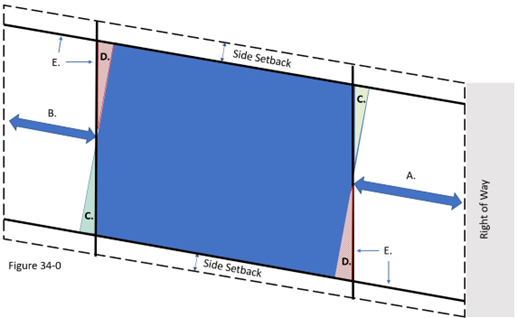
A.
Front setback distance from midpoint of front lot line to midpoint of setback line
B.
Rear setback distance from midpoint of rear lot line to midpoint of setback line
C.
Encroachment area
D.
Compensation area
E.
Standard building setback lines
(1)
The front setback shall be measured from the midpoint of the front lot line to the midpoint of the parallel front setback line. The rear setback shall be measured from the midpoint of the rear lot line to the midpoint of the parallel rear setback line. Principal structures may encroach into the front or rear setback on either side of the midpoint by no more than eight feet but must offset that encroachment on the other side of the midpoint by a compensating area equivalent to the encroachment.
(Ord. No. 23-08, § 2(Exh. A), 6-5-2023)
Sec. 34-201. - General procedure for applications requiring public hearing.
(a)
Initiation of application. An application for a rezoning, development of regional impact, special exception, appeal from administrative action, or variance may be initiated by:
(1)
A landowner, or his authorized representative, for his own property; provided, however, that:
a.
Except as provided in subsections (a)(1)b. and c. of this section, where there is more than one owner, either legal or equitable, then all such owners must jointly initiate the application or petition.
1.
This does not mean that both a husband and wife must initiate the application on private real property which is owned by them.
2.
Where the property is subject to a land trust agreement, the trustee may initiate the application.
3.
Where the fee owner is a corporation, any duly authorized corporate official may initiate the application.
4.
Where the fee owner is a partnership, the general partner may initiate the application.
5.
Where the fee owner is an association, the association or its governing body may appoint an agent to initiate the application on behalf of the association.
b.
Where the property is a condominium or a timeshare condominium, as defined and regulated in F.S. chs. 718 and 721, respectively, an application or petition may be initiated by both the condominium association and no less than 75 percent of the total number of condominium unit owners, or by both the owners' association and no less than 75 percent of timeshare condominium unit owners.
1.
For purposes of this subsection, each individually owned condominium unit within the condominium complex and each individually owned timeshare unit as defined by F.S. ch. 721 counts as one unit, regardless of the number of individuals who jointly own the unit.
2.
In order to verify ownership, the applicants shall furnish the town, as part of their application, a complete list of all unit owners, identified by unit number and timeshare period, as applicable, along with proof that all unit owners who did not join in the application were given actual written notice thereof by the applicants, who shall verify the list and fact of notice by sworn affidavit.
3.
So as to protect the legal rights of nonparticipating unit owners, the application shall be accompanied by a letter of opinion from a licensed Florida attorney, who shall attest that he has examined the declaration of condominium, the bylaws of the condominium association, and all other relevant legal documents or timeshare documents, as applicable, and concluded that the act of applying or petitioning to the town violates none of the provisions therein, or any federal or state law regulating condominiums or timeshare plans, or the rights of any of the nonparticipating unit owners, as derived from such documents and laws, and that approval of the requested act by the town would violate no such rights.
c.
Where the property is a subdivision, an application or petition may be initiated by no less than 75 percent of the total number of lot or parcel owners and the homeowners' association, if applicable.
1.
For purposes of this subsection, a subdivision is an area of property defined by a specific boundary in which lot divisions have been established on a plat that has been recorded in either a plat book or official records book whereby legal descriptions are referred to by lot or parcel number. This term may include any unit or phase of the subdivision and not the entire subdivision.
2.
In order to verify ownership, the applicants shall furnish the town, as part of their application, a complete list of all lot owners, identified by lot number, along with proof that all lot owners who did not join in the application were given actual written notice thereof by the applicants, who shall verify the list and fact of notice by sworn affidavit.
(2)
The town, which for purposes of this section shall mean the town council or town manager.
(b)
Application submittal and official receipt procedure. The application procedure and requirements in this section apply to all applications for rezoning, special exceptions, appeals from administrative action and variances.
(1)
All properties within a single application must be abutting. The director may, at his discretion, allow a single application to cover non-abutting properties where it is in the public interest due to the size or scope and nature of the request, and there is a rational continuity to the properties in question.
(2)
No application shall be accepted unless it is presented on the official forms provided by the director, or on computer-generated forms containing the same information.
a.
Forms shall include but not be limited to, disclosure forms for corporations, trusts, and partnerships, and disclosure of information regarding contract purchases and their percentages of interest.
b.
Disclosure shall not be required of any entity whose interests are solely equity interests which are regularly traded on an established securities market in the United States or another country.
c.
Disclosure forms shall be provided by the director. Such completed disclosure forms shall be included in the materials distributed to the local planning agency and the town council.
d.
Subsections (b)(2)a. through c. of this section shall not apply to town-initiated rezonings.
(3)
Before an application may be accepted, it must fully comply with all information requirements enumerated in §§ 34-202 and 34-203 of this chapter, as applicable, unless specifically stated otherwise in this chapter.
(4)
The applicant shall ensure that an application is accurate and complete. Any additional expenses necessitated because of inaccurate or incomplete information shall be borne by the applicant.
(5)
Upon receipt of the completed application form, all required documents, and the filing fee, the director will begin reviewing the application for completeness, or, in the case of planned development applications, begin reviewing the application for sufficiency pursuant to § 34-213 of this chapter.
Sec. 34-202. - General submittal requirements for applications requiring public hearing.
(a)
All applications. Every request for actions requiring a public hearing under this chapter shall include the following. However, upon written request using a form prepared by the director, the director may modify the submittal requirements contained in this section where it can be clearly demonstrated that the submission will have no bearing on the review and processing of the application. The request for a waiver or modification must be submitted to the director prior to submitting the application. A copy of the request and the director's written response must accompany the application and will become a part of the permanent file.
(1)
Legal description. A legal description of the property. The application shall include a copy of the plat or plats, if any, and the correct STRAP number(s). If the application includes multiple abutting parcels or consists of other than one or more undivided platted lots, the legal description must specifically describe the perimeter boundary of the total property, by metes and bounds with accurate bearings and distances for every line, but need not describe each individual parcel. However, the application must provide the STRAP number for every parcel. The director has the right to reject any legal description which is not sufficiently detailed to locate the property on official maps.
(2)
Boundary survey or certified sketch of description. A certified sketch of description, unless the subject property consists of one or more undivided platted lots in a subdivision recorded in the official Lee County Plat Books. The director may require a boundary survey where there is a question regarding the accuracy of the legal description of the property or a question regarding the location of structure(s) or easement(s) that may be relevant to the review of the application. All certified sketches and boundary surveys must meet the minimum technical standards for land surveying in the state, as set out in ch. 61G 17-6, F.A.C. The perimeter boundary must be clearly marked with a heavy line and must include the entire area that is the subject of the application.
(3)
Confirmation of ownership. If at any time during the review process the director concludes there is a question regarding ownership of the property, the director may require submittal of a title insurance policy, attorney's opinion of title, or ownership and encumbrance report.
(4)
Area location map. A map, at a suitable scale, drawn on an 8½-inch by 11-inch sheet of paper, that depicts the property described in the legal description in relation to the surrounding neighborhood. The map shall be sufficiently referenced to streets, waterways, and other physical boundaries so as to be clearly identifiable to the general public.
(5)
Property owners list. A complete list of all owners of the property subject to this request and their mailing addresses. If multiple parcels are involved, a map showing the owners' interest must be provided. The applicant is responsible for the accuracy of the list and map. For town-initiated actions only, names and addresses shall be deemed to be those appearing on the latest tax rolls of the county.
(6)
Surrounding property owners list. A complete list, and two sets of mailing labels, of all property owners, and their mailing addresses, for all property within 500 feet of the perimeter of the subject parcel or the portion thereof that is the subject of the request. This list shall also include the owners of all individual condominium units within the 500-foot perimeter, plus the managing entity of any timeshare properties. For the purpose of this subsection, names and addresses of property owners, condominium owners, and timeshare managers will be deemed to be those appearing on the latest tax rolls of the county at the time of application. The applicant shall be responsible for the accuracy of such list. In the event that more than six months lapses between the time of application and the date of mailing courtesy notices for the scheduled public hearing, the director may require the applicant to submit a new list and mailing labels.
(7)
Surrounding property owners map. The application shall include a zoning map or other similar map displaying all of the parcels of property within 500 feet of the perimeter of the subject parcel or the portion thereof that is subject of the request, referenced by number or other symbol to the names on the surrounding property owners list. The applicant shall be responsible for the accuracy of the map.
(8)
Additional material. Additional material, depending on the specific type of action requested, may be required as set forth in §§ 34-202(b) and 34-203 of this chapter.
(9)
Filing fee. All fees, in accordance with the fee schedule (see § 34-53 of this chapter), shall be paid at the time the application is submitted.
(b)
Additional submittal requirements for owner-initiated applications. In addition to the submittal requirements set forth in subsection (a) of this section, every application initiated by a property owner involving a change in the zoning district boundaries, or a request for special exception, appeal from administrative action, or variance, for his own property, shall include the following:
(1)
Evidence of authority.
a.
Ownership interests. The names of all persons or entities having an ownership interest in the property, including the names of all stockholders and trust beneficiaries (see §§ 34-201(b)(2)a. through c. of this chapter).
b.
Applicant's statement. Notwithstanding the requirements of § 34-201(a)(1)a. of this chapter, the applicant for any action requiring a public hearing must sign a statement, under oath, that he is the owner or the authorized representative of the owner(s) of the property and that he has full authority to secure the approval(s) requested and to impose covenants and restrictions on the referenced property as a result of the action approved by the town in accordance with this code. This must also include a statement that the property owner will not transfer, convey. sell, or subdivide the subject parcel unencumbered by the covenants and restrictions imposed by the approved action.
c.
Agent authorization. The applicant may authorize agents to assist in the preparation and presentation of the application. The town will presume that any agent authorized by the applicant has the authority to bind the property with respect to conditions.
(2)
Property restrictions. The application shall include a copy of the deed restrictions or other types of covenants and restrictions on the subject parcel, along with a statement as to how the restrictions may affect the requested action. If there are no restrictions on the property, the applicant must indicate so on the application form.
(3)
Boundary sketch. The boundary sketch shall include the location of existing structures on the property.
(4)
Confirmation of ownership. If at any time during the review process the director concludes there is a question regarding ownership of the property, the director may require submittal of a title insurance policy, attorney's opinion of title, or ownership and encumbrance report.
(5)
Sketch of proposed building. All applications for planned development zoning, variances, appeals from administrative action (where relevant), and special exceptions must be accompanied by a sketch or sketches that indicate the physical character of the proposed building(s), and in the case of variances, the difference between the proposal and the configuration that would be allowed without the variance.
Sec. 34-203. - Additional requirements for certain applications requiring public hearing.
(a)
Developments of regional impact. Developments of regional impact shall comply with the information submittal and procedural requirements of F.S. ch. 380, as administered through the Southwest Florida Regional Planning Council. If the development of regional impact requires specific zoning actions (i.e., rezoning), the procedures and requirements of § 34-202 of this chapter and this section of this chapter shall be met. Additionally, even if the development of regional impact does not require specific zoning action, the applicant must submit a traffic impact statement, as described in § 34-212(6) of this chapter and detailed in § 10-286 of this LDC. Thresholds for developments of regional impact can be found in F.A.C. ch. 28-24.
(b)
Planned developments. Planned development rezonings must comply with the additional submittal requirements in § 34-212 of this chapter. Additional procedural requirements are set forth in §§ 34-211—34-220 of this chapter.
(c)
Rezonings. Requests for rezonings shall, in addition to the requirements of § 34-202 of this chapter, include a statement of the basis or reason for the rezoning. Such statement is to be directed, at a minimum, to the guidelines for decision-making embodied in § 34-85(b) of this chapter. This statement may be utilized by the town council and staff in establishing a factual basis for the granting or denial of the rezoning.
(d)
Special exceptions. Applications for a special exception shall, in addition to the requirements of § 34-202 of this chapter, include the following:
(1)
A statement as to how the property qualifies for the special exception requested, and what impact granting the request would have on surrounding properties. Such statement shall be directed, at a minimum, to the guidelines for decision-making embodied in § 34-88 of this chapter. This statement may be utilized by the town council in establishing a factual basis for granting or denial of the special exception.
(2)
A site development plan detailing the proposed use, including, where applicable, the following:
a.
The location and current use of all existing structures on the site, as well as those on adjacent properties within 100 feet of the perimeter boundaries of the site.
b.
All proposed structures and uses to be developed on the site.
c.
Proposed fencing and screening, if any.
d.
Any other reasonable information which may be required by the director which is commensurate with the intent and purpose of this chapter.
(3)
On-premises consumption of alcoholic beverages. If the request is for a consumption-on-premises permit:
a.
The site plan must include a detailed parking plan.
b.
A written statement describing the type of state liquor license to be acquired, e.g., 2 COP, SRX, 11C, etc., and the anticipated hours of operation for the business, must be submitted.
(e)
Variances. Applications for a variance from the terms of this chapter shall, in addition to the requirements of § 34-202 of this chapter, include the following:
(1)
A document describing:
a.
The section number and the particular regulation of this code from which relief (variance) is requested;
b.
The reason why the variance is needed;
c.
What effect, if any, granting of the variance would have on adjacent properties;
d.
The nature of the hardship which is used to justify the request for relief; and
e.
A statement as to how the property qualifies for the variance, directed, at a minimum, to the guidelines for decision-making embodied in § 34-87 of this chapter.
(2)
A site plan describing:
a.
All existing and proposed structures on the site;
b.
All existing structures within 100 feet of the perimeter boundary of the site; and
c.
The proposed variance from the adopted standards.
(3)
Any other reasonable information which may be required by the director which is commensurate with the intent and purpose of this code.
(f)
Use or procedural variances. Use and procedural variances are not legally permissible, and no application for a use variance nor a procedural variance will be processed. The director will notify the applicant when a more appropriate procedure, e.g., rezoning or special exception, is required.
(g)
Modifications to submittal requirements. Upon written request, on a form prepared by the director, the director may modify the submittal requirements contained in this section or in other portions of this code where modifications are specifically authorized, where it can be clearly demonstrated by the applicant that the submission will have no bearing on the review and processing of the application. The request and the director's written response must accompany the application submitted and will become a part of the permanent file. The decision of the director is discretionary and may not be appealed.
Sec. 34-211. - Generally.
(a)
Planned development zoning districts are described in §§ 34-612(3) and 34-931-990 of this chapter.
(b)
The application and procedure requirements described in this division are a supplement to the general requirements for rezoning applications found in this article.
(c)
The applicant may initiate the planned development process by requesting an optional preapplication conference. In this request, the applicant shall provide a description of the property in question, the location of the property, the existing use, special features, and the use proposed. Through this meeting, the applicant may avail himself of staff in order to be oriented to the planned development process, to determine what application materials are required, and to be advised of the impacts of the Fort Myers Beach Comprehensive Plan, surrounding development and zoning, and other public policy on the development proposal.
Sec. 34-212. - Application for a planned development.
An applicant for a planned development shall provide the following information, supplemented, where necessary, with written material, maps, plans or diagrams. Wherever this section calls for the exact or specific location of anything on a map or plan, its location shall be indicated by dimensions from an acceptable reference point, survey marker or monument.
(1)
General application. A general application for public hearing in accordance with the requirements set forth in §§ 34-201, 34-202 and 34-203 of this chapter.
(2)
Filing fee. The filing fee (see § 34-53 of this chapter).
(3)
Evidence of unified control. The same documentation evidencing unified control as is required by ch. 10 of this LDC for development orders.
(4)
Master concept plan. A clearly legible master concept plan, to be no less than 24 inches by 36 inches in size and at an appropriate scale to adequately show the proposed development in detail, including the following information:
a.
The general size, configuration and location of each development phase, and a description of the phasing of construction, unless the development is to be constructed in a single phase;
b.
The maximum height of any proposed buildings or structures, using this code's means of measuring height (see § 34-631 of this chapter);
c.
Proposed principal and accessory land uses, identifying such uses by citing the same uses allowed by a specific zoning district, or by citing the enumerated uses of one or more use groups or sub-groups as found in Tables 34-1 and 34-2 of this article.
d.
The number of units proposed for each use, in terms of dwelling units by type, hotel or motel guest units, gross square feet of types of commercial uses, and maximum floor area ratios (see § 34-633 of this chapter);
e.
The minimum width and composition of any proposed buffers along the perimeter of the subject property. References to types of buffers as described in ch. 10 of this LDC are acceptable;
f.
The location of any environmentally sensitive land and water, based upon standard environmental data and verified by a field inspection by town staff. An engineering survey is not required until the plan has been incorporated into an application for a development order;
g.
The exact location of all points of vehicular ingress and egress from existing easements or rights-of-way into the development;
h.
Access and facilities for public transit, where applicable;
i.
The general location of stormwater management areas;
j.
The specific location of any requested deviations, including sample detail drawings that illustrate the effect of the proposed deviation;
k.
The exact location of existing rights-of-way and easements, whether or not those easements are recorded; and
l.
Proposed dedications, if any, including public beach access, boat ramps, park or recreation areas, open space, or other easements.
(5)
Architectural elevations. The master concept plan shall be accompanied by architectural elevations or a three-dimensional rendering that show, at a minimum, all building facades adjoining public streets. These drawings may substitute for the sketches required by § 34-202(b)(5) of this chapter. If any aspects of a proposed commercial or mixed-use building do not comply with the commercial design standards in §§ 34-991—34-1010 of this chapter, the applicant may request one or more deviations from those standards in accordance with § 34-932(b) of this chapter.
(6)
Traffic impact statement. A traffic impact statement in the same format and to the same degree of detail required for development orders (see § 10-286 of this LDC), unless waived by the director in accordance with § 34-202(a) of this chapter.
Sec. 34-213. - Sufficiency and completeness.
No hearing will be scheduled for any application for a planned development until the application has been found sufficient.
(1)
All applications for planned developments will be deemed sufficient unless a letter advising the applicant of insufficiencies has been mailed within 15 working days of the payment of the application fee. All amended applications will be deemed sufficient unless a subsequent letter advising the applicant of any insufficiencies has been mailed within 15 working days of the resubmittal. The contents of insufficiency letters will be limited to brief explanations of the manner in which insufficient applications do not comply with the formal requirements in this section.
(2)
Subsequent to notification that the application has been found to be insufficient, the applicant has 60 days to submit supplemental or corrected documents, unless a longer time is agreed to in writing by the director and the applicant prior to the expiration of the 60 days. If the supplement or corrections are not submitted within the 60 days (or other time period agreed to) the application will be deemed withdrawn.
(3)
Once an application has been found sufficient, any new information submitted by the applicant, or any changes made to information submitted by the applicant, may, at the discretion of the director, be grounds for a deferral or continuance of the public hearing, depending on the advertised status of the hearing.
(4)
In those instances where a proposed planned development is identified by the director as a possible development of regional impact, the applicant shall be notified that the application will be deemed sufficient only when accompanied by either a binding letter of interpretation from the state department of community affairs or a complete and sufficient ADA.
Sec. 34-214. - Application for an amendment.
(a)
Applications for amendments to an approved master concept plan or its attendant documentation, including a time extension, will require as much information as is needed to describe the changes requested, to specify the incremental change in impacts expected from the amendment, and to detail the changes in surrounding land uses, if any, that have occurred since the original application was made.
(b)
In addition, the application and master concept plan must update the entire planned development:
(1)
Precise locations of newly constructed buildings must be shown.
(2)
All deviations previously approved or now requested must be clearly indicated.
(3)
If the land development code has changed since the previous approval, the proposed amendment must be based on the current regulations (for example, the proposed uses and deviations must reflect the terminology and regulations in the current code).
(4)
The intent is to have resolutions that amend a planned development be current and complete and not require references to a previous resolution on the same property.
(c)
Some amendments can be approved administratively as provided in § 34-219 of this chapter; the remainder shall proceed through the public hearing process described in § 34-216 of this chapter.
Sec. 34-215. - Documentation of unified control.
(a)
Any applicant for a rezoning or master concept plan confirmation under the planned development regulations as provided in this article shall submit documentation demonstrating unified control over the subject property.
(b)
If the initial applicant conveys all or part of the subject property to a subsequent purchaser, the conveyance is subject to the original documentation demonstrating unified control unless amended documentation is filed with the director. This amended documentation must be filed within 60 days of closing in a form acceptable to the town attorney. This requirement shall not apply to individual homesites or units of a residential development or to any development wherein the obligation to enforce the regulations and conditions or covenants and restrictions is delegated to property owners or a condominium association or cooperative.
Sec. 34-216. - Public hearings.
(a)
Hearing before the local planning agency. After an application is complete, the application will be scheduled for a public hearing before the local planning agency.
(1)
At the public hearing the local planning agency will consider the application in accordance with article II of this chapter.
(2)
The recommendation made to the town council must be supported by the guidelines set forth in § 34-85 of this chapter. In addition, the findings must address whether the following criteria can be satisfied:
a.
The proposed use or mix of uses is appropriate at the subject location;
b.
Sufficient safeguards to the public interest are provided by the recommended special conditions to the concept plan or by other applicable regulations;
c.
All recommended special conditions are reasonably related to the impacts on the public's interest created by or expected from the proposed development;
d.
The proposed use meets all specific requirements of the comprehensive plan that are relevant to the requested planned development, such as the following:
1.
Policies 4-B-4 and 4-C-3 on commercial uses in the "mixed residential" category.
2.
Policies 4-B-5 and 4-C-3 on commercial rezonings in the "boulevard" category.
3.
Policy 4-C-4 on building heights taller than the standard height limit.
4.
Policy 4-C-8 on density transfers.
5.
Policy 4-E-1 on pre-disaster buildback.
6.
Policy 7-J-2 on traffic impact analyses and potential design improvements that could offset traffic impacts.
(3)
If the local planning agency determines that a proposed condition is insufficient, it may recommend an alternate condition for consideration by the town council.
(4)
If the application includes a schedule of deviations pursuant to §§ 34-212(3) and 34-932(b) of this chapter, the local planning agency's recommendation must approve, approve with modification, or reject each requested deviation based upon a finding that:
a.
Each item enhances the achievement of the objectives of the planned development; and
b.
The general intent of this chapter to protect the public health, safety and welfare will be preserved and promoted; and
c.
Each deviation operates to the benefit, or at least not to the detriment, of the public interest; and
d.
Each deviation is consistent with the Fort Myers Beach Comprehensive Plan.
If the local planning agency concludes that the application omits necessary deviations, it may include the necessary deviations in its recommendation without an additional hearing.
(b)
Hearing before the town council.
(1)
After the local planning agency's hearing, an application for a planned development, together with all attendant information, staff reports, and the local planning agency's minutes and resolution of recommendation, shall be forwarded to the town council, which shall consider the application in public hearing per article II of this chapter. After reviewing all information, including staff reports and local planning agency recommendations, the town council may either:
a.
Continue further consideration until additional information is provided by applicant or the director or until the applicant makes changes in the application, subject to re-review by the director and the local planning agency as required; or
b.
Formally approve, approve with modification, or deny the application.
Should the town council deny without prejudice, it may remand the proposal to the director with directions to bring the application back to the local planning agency once the application is amended. If new or additional information, not previously provided to either the director or the local planning agency, is supplied by the applicant after the local planning agency hearing, the town council may remand the application to the local planning agency for rehearing.
(2)
The decision of the town council shall be supported by a formal finding, that, in addition to the appropriate guidelines set forth in article II of this chapter, the criteria set forth in subsection (a)(2) of this section have or have not been satisfied.
(3)
In addition to adopting a master concept plan for the planned development, the town council may adopt such special conditions as are necessary to address unique aspects of the subject property in the interest of protecting the public health, safety and welfare. Should any recommended special condition be found to be insufficient, the town council may substitute its own language for such special condition in the final resolution.
(4)
Should a schedule of deviations from other provisions of this chapter (see §§ 34-212(6) and 34-932(b) of this chapter) be a part of the planned development application, the town council may approve, approve with modification, or reject the entire schedule or specific items based upon their finding that for each item:
a.
Each item enhances the achievement of the objectives of the planned development; and
b.
The general intent of this chapter to protect the public health, safety and welfare will be preserved and promoted; and
c.
Each deviation operates to the benefit, or at least not to the detriment, of the public interest; and
d.
Each deviation is consistent with the Fort Myers Beach Comprehensive Plan.
(5)
If the town council denies or modifies any requested use(s), deviations(s), or other information shown on the master concept plan, a revised master concept plan must be submitted to the director reflecting the substance of the approved resolution prior to execution of the resolution. Legible copies of the revised master concept plan must be provided in two sizes, 24 inches by 36 inches and 11 inches by 17 inches in size.
(6)
No development orders may be issued until the approved resolution has been signed by proper town officials.
Sec. 34-217. - Effect of planned development zoning.
(a)
Compliance with applicable regulations. After the adoption of the master concept plan and the conditions and auxiliary documentation that govern it, any and all development and subsequent use of land, water, and structures within any planned development shall be in compliance with the following, in order of precedence:
(1)
The Fort Myers Beach Comprehensive Plan.
(2)
This subdivision of the Land Development Code.
(3)
The master concept plan and attendant conditions and auxiliary documentation.
(4)
Any applicable town development regulations in force at the time of submission of the application for a development order.
(5)
The general provisions of this chapter, unless otherwise excepted by an approved schedule of deviations.
(b)
Applicability of development regulations. The master concept plan (see § 34-212(4) of this chapter) is conceptual only, and development pursuant to the master concept plan is subject to all development regulations established to protect health, safety and welfare in force at the time of submission of the application for a development order, except where deviations have been formally granted in accordance with § 34-932(b) of this chapter.
(c)
The terms and conditions of the planned development zoning approval (other than the master concept plan as set forth in § 34-220 of this chapter) run with the land and remain effective in perpetuity or until a new zoning action is approved by the town council. All developments must remain in compliance with the terms and conditions of the zoning approval.
(d)
If the town discovers noncompliance with the regulations or the master concept plan and its attachments, the town may withhold any permit, certificate, or license to construct, occupy, or use any part of the planned development. This will not be construed to injure the rights of tenants of previously completed and properly occupied phases.
Sec. 34-218. - Binding nature of approval of master concept plan.
All terms, conditions, safeguards, and stipulations made at the time of the approval of a master concept plan shall be binding upon the applicant or any successor in title or interest to all or part of the planned development. Departure from the approved plans or failure to comply with any requirement, condition, or safeguard shall constitute a violation of this chapter.
Sec. 34-219. - Administrative amendments to approved master concept plan.
(a)
Amendments to an approved master concept plan or its attendant documentation may be requested at any time during the development of or useful life of a planned development.
(b)
Amendments that may be approved by the director include, in general, any change which does not increase height, density, or intensity (i.e., number of dwelling units, hotel units, or floor area), decrease buffers or open space, or add additional land uses. The director shall not approve any change which results in a reduction of total open space, buffering, landscaping, and preservation areas or which adversely impacts on surrounding land uses.
(1)
This authority is granted to the director to eliminate unnecessary processing delays for proposed changes that are:
a.
Substantially similar to the prior approval; and
b.
In conformance with all town regulations and plans.
(2)
Decisions by the director pursuant to this subsection may be appealed only as follows:
a.
Appeals will not be considered for any of the following requests:
1.
An increase in height, density, or intensity (i.e., number of dwelling units, guest units, or floor area); or
2.
An additional land use; or
3.
A variance or deviation from this code; or
4.
A substantial change from previously approved architectural drawings or master concept plan.
b.
The appeal must be filed and processed in accordance with § 34-86 of this chapter. In addition, the appellant must provide a list and map of surrounding property owners and one set of mailing labels in accordance with §§ 34-202(6) and (7) of this chapter, and shall pay a fee established in accordance with the provisions of § 34-53 of this chapter.
c.
The director shall provide notice of the public hearing where this appeal will be considered using the procedures in § 34-236 of this chapter.
d.
Upon considering an appeal, the town council may uphold or repeal the director's decision, or may modify that decision by removing, adding, or modifying any conditions of approval.
(c)
All other requests for amendments to a master concept plan or its auxiliary documentation shall be treated procedurally as an amendment to the planned development, with application information specified by § 34-214 of this chapter and public hearings in accordance with § 34-216 of this chapter.
Sec. 34-220. - Duration of rights conferred by adopted master concept plan.
Master concept plans are subject to the following:
(1)
An approved master concept plan and its attendant documentation shall be deemed to be vacated unless the property owner obtains a development order for the first phase of the project within three years of the date of the original approval by the town council, consisting of no less than 20 percent of the lots, dwelling units, square footage, or other applicable measurements of intensity for the development in question unless a lesser percentage is approved by the town council.
(2)
Timeframes for approval of subsequent portions of the development may be governed by a phasing plan, which shall be included in the resolution rezoning the subject parcel. Phases may be defined by geographical areas, units of intensity, or any other units of measurement deemed appropriate by the town council. In the absence of a specific phasing plan in the resolution, subsequent phases must proceed as follows:
a.
Within five years of the date of approval by the town council, the first phase must have been completed and a development order must have been obtained for the second phase, consisting of 50 percent of the project.
b.
Within eight years of the date of approval by the town council, the second phase must have been completed and a development order must have been obtained for the entire project.
(3)
Any phase for which a development order has not been obtained or for which development has not been completed by the time specified in the resolution shall be deemed vacated, along with all subsequent phases.
(4)
When any portion of a master concept plan is vacated pursuant to subsection (1), the vacated area will remain zoned planned development, but no additional development can occur or be approved until a new master concept plan is approved or the original master concept plan is extended, or until the property is rezoned by the town council.
(5)
Extensions of master concept plans may be granted as follows:
a.
An approved master concept plan for a phase of or an entire planned development which has been or may be vacated due to a failure to proceed on the applicant's part may be extended by the town council for a period of no more than two years from the date of the extension based on the following findings of fact:
1.
The master concept plan is consistent with this code and the current Fort Myers Beach Comprehensive Plan, including, but not limited to, density, intensity, and concurrency requirements;
2.
The development shown by the master concept plan has not become incompatible with existing and proposed uses in the surrounding area as the result of development approvals issued after the original approval of the master concept plan; and
3.
The development shown by the master concept plan will not, by itself or in conjunction with other development, place an unreasonable burden on essential public facilities.
b.
An application for an extension may be filed at any time up to one year after the vacation of the master concept plan and must consist of the following:
1.
A completed application form provided by the director;
2.
The approved master concept plan;
3.
The applicable zoning resolution;
4.
A written statement describing how the criteria listed in subsection (4)a. above have been met; and
5.
A fee, in accordance with an adopted administrative code.
c.
No more than two extensions may be granted for any development or phase thereof.
(6)
Phasing plans may be amended in accordance with § 34-214 of this chapter.

