
Fort Myers Beach City Zoning Code
ARTICLE IV
- SUPPLEMENTAL REGULATIONS
DIVISION 21. - MARINE FACILITIES AND LIVE-ABOARD VESSELS[24]
Cross reference— Marine facilities and structures generally, app. A, ch. 26; marine sanitation, app. A, § 26-111 et seq.
DIVISION 41. - RESERVED[25]
Editor's note— Ord. No. 15-12, § 2, adopted Jan. 19, 2016, deleted div. 41, § 34-3151 entitled "Water-Oriented Rentals."
Sec. 34-1169.- Purpose and applicability of article.
The purpose of this article is to provide rules and regulations which supplement, modify, or further explain rules and regulations found elsewhere in this chapter, and, unless specifically noted to the contrary, the provisions of this article apply to all zoning districts.
Sec. 34-1170. - Purpose of supplemental regulations.
(a)
Regulations over and above those imposed by other sections of this chapter are necessary for certain uses which, because of their uniqueness or potential for substantial impact on surrounding land uses, warrant minimum standards which cannot properly be addressed in general provisions or property development regulations set forth in specific districts. The purpose of the supplemental regulations set forth in this article is to set forth the detailed regulations, including but not limited to the bulk, layout, yard size, and lot area, that apply to these uses.
(b)
The supplemental regulations set out in this article shall apply to the specified use regardless of whether it is a use permitted by right, special exception, planned development rezoning, or temporary use permit, as specified in the district use regulations in division 2 of article III of this chapter.
Sec. 34-1171.- Applicability of division.
This division provides minimum regulations for those accessory uses, buildings, and structures customarily incidental and subordinate to the principal use or building, which are not specifically regulated elsewhere in this code.
Sec. 34-1172. - Definitions.
For purposes of this division only, certain words or terms shall mean the following:
Accessory use means a use of a structure or premises which is customarily incidental and subordinate to the principal use of the structure or premises.
Commercial accessory use means the use of a structure or premises that is customarily incidental and subordinate to the principal use of a commercial structure or premises. See Use, principal. Typical commercial accessory uses are: parking lots, accessory; storage, indoor; and telephone booth or pay telephone station. Various divisions of article IV of this chapter describe permitted commercial accessory uses. Uses that are listed separately on Table 34-1 of this code, such as drive-throughs and automobile fuel pumps, are not commercial accessory uses and are permitted only in zoning districts where they are explicitly identified in Tables 34-1 and 34-2.
Open-mesh screen means meshed wire or cloth fabric to prevent insects from entering the facility, including the structural members framing the screening material.
Residential accessory use means the use of a structure or premises that is customarily incidental and subordinate to the principal use of a residential structure. See Use, principal. Typical residential accessory uses are: carports and garages; decks, gazebos, patios, and screen enclosures; dock, personal (§ 34-1863); fences and walls (division 17 in article IV); garage sales or yard sales (§ 34-2); recreation facilities, personal; seawalls (ch. 26); storage sheds; and, rental of beach furniture when accessory to a multifamily residential building located adjacent to the Gulf of Mexico containing more than 50 dwelling units.
Resort accessory use means the use of a structure or premises that is customarily incidental and subordinate to a resort. See Use, principal. Typical resort accessory uses are: amusement devices (§§ 34-2141—34-2145 and 34-3042 of this chapter); golf courses; parasailing operations office (ch. 27 of this LDC); personal watercraft operations office (ch. 27 of this LDC); and rental of beach furniture (ch. 14 of this LDC).
Roofed means any structure or building with a roof which is intended to be impervious to weather.
(Ord. No. 15-12, § 2, 1-19-2016)
Sec. 34-1173. - Development regulations.
(a)
Unless specifically indicated to the contrary, accessory uses and related buildings and structures that are customarily recognized as clearly incidental and subordinate to the principal use of the property are permitted by right when located on the same lot or parcel and in the same zoning category as the principal use, provided that:
(1)
Uses that are listed separately on Table 34-1 of this code, such as drive-throughs and automobile fuel pumps, are not accessory uses and are permitted only in zoning districts where they are explicitly identified in Tables 34-1 and 34-2 of this chapter. However, this limitation does not apply to uses that are explicitly listed in the definitions of residential, commercial, or resort accessory uses.
(2)
All uses, buildings and structures must comply with all applicable development regulations and building codes.
(3)
Accessory buildings or structures may be built concurrently with a principal building or structure but, except as provided herein, no accessory use, building or structure shall be commenced, erected, placed, or moved onto a lot or parcel prior to the principal use, building or structure. Exceptions are as follows:
a.
Fences or walls when in compliance with division 17 of this article.
b.
Seawalls or retaining walls (see § 26-43(a) of this LDC).
c.
Docks accessory to residential uses (see § 26-43(a) of this LDC). Only permitted if the lot meets the minimum lot size and dimensions required for a principal use.
(b)
Attachment to principal building. Authorized accessory buildings or structures may be erected as part of the principal building or may be connected to it by a roofed porch, patio or breezeway, or similar structure, or they may be completely detached, provided that:
(1)
Any accessory building or structure which is structurally a part of the principal building shall comply in all respects with the regulations for a principal building.
(2)
Any accessory building or structure not structurally made a part of the principal building shall comply with the location requirements set forth in § 34-1174, below.
Sec. 34-1174. - Location and setbacks generally.
(a)
Permitted locations. Except as may be provided elsewhere in this chapter, all accessory uses, buildings and structures must be located on the same premises and must have the same zoning district or zoning classification as the principal use (see also § 34-616(b) of this chapter). For purposes of this section, a zoning classification contains the following groups of zoning districts:
(1)
Residential districts - RS, RC, RM, and Santos - described in article III of this chapter; and
(2)
Commercial districts - CR, CM, CO, and CB - described in article III of this chapter.
(b)
Setback from streets. No accessory use, building or structure shall be located closer to a street right-of-way line or street easement than the principal building, except for:
(1)
Fences and walls as provided for in division 17 of this article;
(2)
Signs, where permitted by ch. 30 of this LDC and placed in accordance with §§ 30-93 and 30-153 of this LDC;
(3)
Outdoor display of merchandise, subject to the provisions of division 36 of this article;
(4)
Garbage enclosures as provided for in § 6-11 of this LDC;
(5)
A single flagpole on a lot;
(6)
Swimming pools, tennis courts, shuffleboard courts, and other similar recreation facilities that are accessory to a multiple-family development, or a hotel/motel, provided that they are part of a planned development or a site plan approved in accordance with ch. 10 of this LDC and provided they comply with the minimum setbacks for streets;
(7)
As provided for in the exceptions to setbacks in § 34-638(d) of this chapter; or
(8)
On through lots, accessory uses, buildings, and structures may be placed closer to the street opposite the street that provides principal vehicular access than the principal building as long as the minimum setbacks for streets as set forth in § 34-638 of this chapter are maintained.
(c)
Setback from bodies of water. No building or structure (except marine structures, which are subject to the setback requirements as set forth in ch. 26, article II of this LDC) may be located closer to a bay, canal, or other body of water than the minimum setbacks required in § 34-638(d)(3) of this chapter.
(d)
Setbacks from side and rear property lines. Unless the side or rear property line abuts a body of water (see § 34-638(d) of this chapter), the following setbacks shall apply:
(1)
Residential accessory buildings and structures. Except as provided in §§ 34-1175 and 34-1176 below, all accessory residential buildings and structures shall be set back a minimum of:
a.
Five feet from any rear property line that does not have access to an alley.
b.
Zero feet from any rear property line that is served by an alley.
c.
For non-waterfront lots, five feet from any side property line.
d.
For waterfront lots, the same distance as is required from any side property line for principal buildings in that zoning district (see § 34-638 of this chapter).
(2)
Commercial and resort accessory buildings and structures. All accessory buildings and structures for a principal commercial or resort use shall be set back:
a.
In accordance with the side and rear setback requirements for a principal building in that zoning district or the minimum buffering requirements as set forth in ch. 10 of this LDC, whichever is greater, when abutting any district other than commercial or resort.
b.
When abutting another commercial or resort zoning district:
1.
Rear setbacks are not required.
2.
For non-waterfront lots, side setbacks are not required.
3.
For waterfront lots, the same distance as is required from any side property line for principal buildings in that zoning district (see § 34-638 of this chapter).
(e)
Administrative setback variances. Under certain limited circumstances, administrative variances can be granted to minimum setbacks as provided in § 34-268 of this chapter.
(f)
Prohibited locations. Nothing contained in this chapter shall be construed as permitting placement of any accessory building or structure within a utility or other easement prohibiting such building or structure, or closer to adjacent property than permitted by the minimum buffer requirements set forth in ch. 10 of this LDC, or closer to any other building than permitted by the town building code.
(g)
Fences. Fences are subject to the setback requirements in division 17 of this article.
Sec. 34-1175. - Satellite dishes and amateur radio antenna/towers.
(a)
Satellite dishes. The following restrictions apply to satellite dishes that are installed as accessory structures if the dishes exceed two meters (78.74 inches) in diameter in zoning districts that allow retail/open or lodging/open land use sub-groups (see Table 34-2) or if the dishes exceed one meter (39.97 inches) in diameter in all other zoning districts.
(1)
Setbacks. Satellite dishes must meet the minimum requirements for accessory structures in §§ 34-1174(b)—(d), above.
(2)
Allowable size. No satellite dish may exceed ten feet in diameter.
(3)
Location and placement.
a.
Except as provided below, satellite dishes may not be mounted on a roof or on any other building surface.
b.
Exception. Satellite dishes may be mounted on buildings that exceed 35 feet in height (as measured in accordance with § 34-631(b) of this chapter), provided the satellite dish is not visible at ground level from any abutting right-of-way, street easement, or any property under separate ownership and zoned or used for residential purposes.
(4)
Height. Ground-mounted satellite dishes may not exceed ten feet in height.
(5)
Landscaping. Ground-mounted satellite dishes exceeding two meters (78.74 inches) in diameter must include a landscaped buffer of at least three feet in width between the facility and any right-of-way or ingress/egress or access easement. The buffer must be at least four feet in height at installation and be maintained at a minimum of five feet in height within one year after time of planting.
(6)
Administrative variances. The director may modify requirements of this subsection (a) where an applicant can demonstrate in writing that full compliance with these provisions will materially limit transmission or reception with the proposed satellite dish. See § 34-268 of this chapter. The director may not modify any requirement to a greater extent than is required to ensure that transmission or reception is not materially limited.
(b)
Amateur radio antenna/towers.
(1)
Amateur radio antenna/towers up to 50 feet in height are permitted in all zoning districts provided that antenna/tower supports and peripheral anchors are located entirely within the boundaries of the property and in the rear or side yard.
(2)
Amateur radio antenna/towers over 50 feet in height may be permitted by special exception in any zoning district.
Sec. 34-1176. - Swimming pools, tennis courts, porches, decks and similar recreation facilities.
(a)
Applicability. The regulations set out in this section apply to all swimming pools, tennis courts, shuffleboard courts, porches, decks and other similar recreation facilities which are accessory to a permitted use, and which are not specifically regulated elsewhere in this chapter.
(b)
Location and setbacks.
(1)
Personal, private and limited facilities.
a.
Nonroofed facilities. All swimming pools, tennis courts, decks, and other similar nonroofed accessory facilities, at grade, shall comply with the following setback requirements:
1.
Street setbacks as set forth in §§ 34-1174(b) and 34-638 of this chapter.
2.
Water setbacks as set forth in § 34-638(d)(3) of this chapter.
3.
Rear lot line setback as set forth in § 34-1174(d) of this chapter.
4.
Side lot line setbacks as set forth in § 34-1174(d) of this chapter.
b.
Open-mesh screen enclosures. Swimming pools, patios, decks and other similar recreation facilities may be enclosed with an open-mesh screen enclosure provided that the enclosure complies with the setback requirements set forth in § 34-1174 of this chapter, and provided further that:
1.
At least three sides of the enclosure are open-mesh screening from a height of 3½ feet above grade to the top of the enclosure.
2.
Enclosures with any two or more sides enclosed by opaque material shall be required to comply with all setbacks required for a principal building. It shall be the responsibility of the applicant to increase all required setbacks sufficient to provide maintenance access around the pool whenever the pool is proposed to be enclosed with open-mesh screening or fencing. A minimum increase in setbacks of three feet is recommended.
c.
Roofed open-mesh enclosures. Open-mesh screen enclosures may be covered by a solid roof (impervious to weather) provided that:
1.
If structurally part of the principal building, the enclosure shall comply with all setback requirements for the principal building.
2.
Except when in compliance with the setback requirements for principal buildings, a solid roof over a screen enclosure shall be constructed as a flat roof with the pitch no greater than the minimum required for rain runoff.
d.
Swimming pools, swimming pool decks, and decks above grade. Swimming pools, swimming pool decks, and decks may be constructed to a maximum height not to exceed either the constructed or proposed finished floor elevation for the principle structure, with a maximum of four feet of stem wall exposure or four feet above grade, with the rear setback of five feet. Swimming pools and decks which exceed the maximum heights permitted herein shall conform to the rear and side setbacks of the principle structure.
(2)
Commercial and public facilities. All pools, tennis courts, and other similar recreation facilities owned or operated as a commercial or public establishment shall comply with the setback regulations for the zoning district in which located.
(c)
Fencing.
(1)
In-ground swimming pools, hot tubs and spas. Every swimming pool, hot tub, spa, or similar facility shall be enclosed by a fence, wall, screen enclosure or other structure, not less than four feet in height, constructed or installed so as to prevent unauthorized access to the pool by persons not residing on the property. For purposes of this subsection, the height of the structure shall be measured from the ground level outside of the area so enclosed. The enclosure may be permitted to contain gates, provided they are self-closing and self-latching.
(2)
Above ground swimming pools, hot tubs and spas. Above ground pools, hot tubs, spas, and similar facilities shall fulfill either the enclosure requirements for in-ground pools or shall be so constructed that the lowest entry point (other than a ladder or ramp) is a minimum of four feet above ground level. A ladder or ramp providing access shall be constructed or installed so as to prevent unauthorized use.
(3)
Exception. A spa, hot tub, or other similar facility which has a solid cover (not a floating blanket) which prevents access to the facility when not in use shall be permitted in lieu of fencing or enclosure requirements.
(4)
Tennis courts. Fences used to enclose tennis courts shall not exceed 12 feet in height above the playing surface.
(d)
Lighting. Lighting used to illuminate a swimming pool, tennis court, or other recreation facility shall be directed away from adjacent properties and streets, and shall shine only on the subject site and be shielded from the beach.
(e)
Commercial use. No swimming pool, tennis court, or other recreation facility permitted as a residential accessory use shall be operated as a business.
(Ord. No. 19-11, § 2, 9-23-2019)
Sec. 34-1177. - Accessory apartments not requiring owner-occupancy on the premises.
(a)
Applicability. This section sets forth the requirements for accessory apartments on larger lots, when subordinate to a single-family detached dwelling unit, with no requirement that the property owner live on the premises. If a property owner lives on the premises, an existing accessory apartment that does not meet the requirements of this section may be legal under the provisions of § 34-1178 below. The requirements of this section apply to accessory apartments whether they are listed as a permitted use or a use by special exception.
(b)
Definition. For purposes of this section, the term "accessory apartment" means a dwelling unit, with or without cooking facilities, constructed subordinate to a single-family dwelling unit that could be made available for rent or lease.
(c)
Off-street parking. In addition to the requirements of § 34-2020(d)(1) of this chapter, one additional space shall be required for the accessory apartment.
(d)
Maximum floor area; use; floodplain regulations.
(1)
Attached apartments. If the accessory apartment is constructed as part of the principal building, the maximum floor area of the accessory apartment shall not exceed 50 percent of the floor area of the main dwelling unit.
(2)
Detached apartments. If the accessory apartment is not constructed as part of the main dwelling unit, the maximum floor area shall be 850 square feet or 50 percent of the floor area of the main dwelling unit, whichever is less.
(3)
Use. The accessory apartment shall be limited to one family, as defined in this chapter.
(4)
Floodplain and other regulations. Nothing in this section shall be construed to waive the floodplain regulations in ch. 6, article IV of this LDC, or other regulations in this code, except as explicitly set forth.
(e)
Minimum lot size. An accessory apartment may be permitted on a lawfully existing lot which conforms to the minimum lot size of the district in which it is located. However, in no case shall the lot area be less than 6,000 square feet.
(f)
Appearance. The entrance to the accessory apartment, when constructed as part of the principal residence, should be designed in such a manner as to retain the appearance of a single-family residence.
(g)
Density. An accessory apartment, for the purposes of this section, is termed a dwelling unit and the resulting density must comply with the Fort Myers Beach Comprehensive Plan.
Sec. 34-1178. - Accessory apartments in owner-occupied homes.
(a)
Purpose. The purpose of this section is to recognize and legalize certain existing accessory apartments where the immediate presence of a property owner is presumed to mitigate any negative effects that might result from the use or rental of such apartments.
(b)
Applicability. This section sets forth special requirements for a single accessory apartment in an owner-occupied home. Nothing in this section authorizes or legalizes any construction that is not allowed by the flood-hazard regulations found in §§ 6-401 through 6-475 of this code.
(c)
Definition. For purposes of this section, the term "accessory apartment" means a single living unit no larger than 850 square feet, with or without cooking facilities, that was in existence as of December 15, 1997. For such an accessory apartment to remain lawful under this section, the property owner or an immediate family member must be in residence on the premises, or on an immediately adjoining lot, during any period when the apartment is not vacant.
(d)
Density. An accessory apartment that meets the requirements of this section is a living unit but not a dwelling unit as defined by the Fort Myers Beach Comprehensive Plan and is not counted in residential density computations (see § 34-632(5)b. of this chapter).
Sec. 34-1179. - Trucks and commercial vehicles in residentially zoned districts.
Except for daytime deliveries or service calls, the following types of trucks or commercial vehicles may not be parked or stored on any lot in a conventional or redevelopment zoning district. Planned development zoning districts may allow the parking of these trucks if explicitly permitted by its zoning resolution:
(1)
A tractor-trailer or semi-trailer truck; or
(2)
A truck with two or more rear axles; or
(3)
A truck with a gross vehicle weight rating (GVWR) in excess of 12,000 pounds; or
(4)
Any truck and trailer combination resulting in a combined gross vehicle weight rating (GVWR) in excess of 12,000 pounds.
Sec. 34-1180. - Garages.
(a)
Garage door sizes shall be limited to one or two-car doors.
(b)
No more than three consecutive stalls (three singles or one single and one double) shall be grouped together. Additional doors require a minimum eight-foot wide architectural element, feature, or access, to break up the façade between door groupings.
(Ord. No. 21-01, § 2(Exh. A), 3-15-2021)
Sec. 34-1201.- Applicability of division.
This division shall apply to all sexually-oriented businesses (as defined in the Fort Myers Beach Sexually Oriented Businesses Regulation Ordinance, Ord. No. 96-04).
Sec. 34-1202. - Definitions.
Sexually-oriented business means a sexually-oriented business as defined in the Fort Myers Beach Sexually Oriented Businesses Regulation Ordinance, Ord. No. 96-04.
Sec. 34-1203. - Purpose of division.
The purpose of this division is to provide reasonable regulations to alleviate the adverse effects of sexually-oriented businesses on adjacent and nearby uses of land.
Sec. 34-1204. - Prohibited locations.
No use of land for purposes governed by this division shall be located closer than 1,000 feet, measured on a straight line, from:
(1)
The closest wall of any building containing a similar use; or
(2)
Any district which allows residential uses; or
(3)
Any hotel, motel, restaurant, school (noncommercial), day care center (child), park, playground, place of worship, religious facility, public recreation facility, or cultural facility.
Sec. 34-1231.- Use of engine-propelled aircraft.
(a)
No person shall take off or land any aircraft that is propelled by an engine within the limits of the Town of Fort Myers Beach unless the aircraft is registered with the Federal Aviation Administration or an aircraft owned by a governmental agency.
(b)
In accordance with FAA requirements, no aircraft, as defined in subsection (a), shall fly over the land of the Town of Fort Myers Beach.
Sec. 34-1261.- Definitions.
For purposes of this division and when referred to elsewhere in this chapter, certain terms or phrases shall have the following meaning:
Alcoholic beverage means distilled spirits and all beverages, other than medicine, intended for human consumption and containing one-half of one percent or more alcohol by volume.
Beach means an area of sand along the Gulf of Mexico that extends landward from the mean low-water line to the place where there is a marked change in material or physiographic form, or to the line of permanent vegetation, usually the effective limit of storm waves.
Beer, wine and liquor have the same meanings as provided in F.S. chs. 563, 564 and 565, respectively.
EC (Environmentally Critical) zoning district when used in this division, EC zoning district only refers to beach areas located in the "Recreation" category on the FLU map.
Erosion control line means the line established by the board of trustees of the internal improvement trust fund prior to the commencement of a beach erosion control project in accordance with the provisions of F.S. §§ 161.141—161.211. Pursuant to F.S. § 161.191, title to all lands seaward of the erosion control line shall be deemed to be vested in the state by right of its sovereignty, and title to all lands landward of the erosion control line shall be vested in the riparian upland owners whose lands either abut the erosion control line or would have abutted the line if it had been located directly on the line of mean high water on the date the board of trustees' survey was recorded.
Full-course meals means items on a menu at a restaurant which include soups and salads, main dishes with side orders, and desserts.
Kitchen, commercial means a facility used for the preparation of food which is sold to the public and that is subject to state and local health department inspections.
Licensed premises means the geographic area approved by either administrative approval, special exception, or other approval, for the retail sale, service and consumption on-site of alcoholic beverages.
Liquor license means a license issued by the state for the retail sale, service, and consumption of liquor.
Mean high water line means the intersection of the tidal plane of mean high water with the shore. Mean high water is the average height of high waters over a 19-year period [see F.S. §§ 177.27(14), (15)].
Park, only when used in this division, means a park facility which is owned, leased, or operated by a governmental agency. It does not include beach access strips.
Public beach means any beach which is below mean high water lines; is owned by the town or county; has arisen upon it a right of customary use by the public; has arisen upon it a public easement, prescriptive or otherwise; or is the fore shore of tidal navigable waters, that is the land between the high water mark and the low water mark, and is owned by the state.
Sale of, only when used in this division, includes the term "or service."
Sunset means the daily disappearance of the sun below the horizon to the west, due to the Earth's rotation.
(Ord. No. 12-03, § 2(Exh. A), 9-4-2012)
Sec. 34-1262. - Compliance with applicable regulations.
No structure, building, establishment, or premises shall be occupied, used, or maintained for the purpose of the retail sale, service, or consumption of alcoholic beverages except in conformity with all applicable town regulations, including this chapter, and with the applicable state regulations.
Sec. 34-1263. - Sale for off-premises consumption.
(a)
Where permitted. The sale of alcoholic beverages for consumption off the premises shall be allowed in any zoning district where retail stores are a permitted use, provided that package stores must meet the additional regulations set forth in subsection (d) of this section.
(b)
Sealed containers only. Only alcoholic beverages in original factory-sealed containers shall be permitted to be sold for off-premises consumption.
(c)
State liquor laws. Any establishment engaged in the sale of alcoholic beverages for consumption off-site shall be required to comply with all applicable state liquor laws.
(d)
Location of package stores. No package store or other establishment primarily engaged in the retail sale of liquor for consumption off-site shall be permitted closer than 500 feet to any place of worship, religious facility, school (noncommercial), day care center (child), park, or dwelling unit, or 500 feet from any other establishment primarily engaged in the sale of alcoholic beverages.
(1)
For purposes of this subsection, the distance shall be measured in a straight line from any public entrance or exit of the establishment to the nearest property line of the place of worship, religious facility, school (noncommercial), day care center (child), park, or dwelling unit, or any public entrance or exit of any other establishment primarily engaged in the sale of alcoholic beverages.
(2)
Where an establishment for the sale of alcoholic beverages is located in conformity with the provisions of this subsection, and a place of worship, religious facility, school (noncommercial), day care center (child), park, or dwelling unit is subsequently established in the proximity of such existing establishment, then the separation requirements shall not apply.
(3)
Notwithstanding subsection (d)(1) of this section, where a package store is located in a multiple-occupancy complex which is 25,000 square feet or greater in size, or in a retail sales establishment wherein the sale of alcoholic beverages for consumption off-site is clearly incidental to other retail sales commodities, such as in a grocery store, supermarket, or drugstore, the separation requirements from any dwelling unit shall not apply.
(4)
In any planned development zoning district where the applicant is contemplating the sale of alcoholic beverages for consumption off the premises in an establishment which cannot meet the distance requirements set forth in subsection (d) of this section, the applicant shall request a deviation from the requirements of subsection (d).
Sec. 34-1264. - Sale or service for on-premises consumption.
(a)
Approval required. The sale or service of alcoholic beverages for consumption on the premises shall not be permitted until such location has been approved by the town as follows:
(1)
Administrative approval. The director may administratively approve the sale or service of alcoholic beverages for consumption on the premises when in conjunction with the following uses if the proposed use satisfies the requirements set forth in this division. When circumstances so warrant the director may determine that administrative approval is not the appropriate action and that the applicant must instead apply for approval as a special exception. Such circumstances may include the previous denial of a similar use at that location, the record of public opposition to a similar use at that location, and similar circumstances. When the director has approved a request for consumption on the premises at a location where the actual building has not been constructed, the director shall not approve another request for consumption on the premises which could potentially violate the distance requirements. If the first building is completed within less than one year, and it can be shown the second use would not violate the prescribed distance requirements, the director may approve the second location subject to all other requirements contained in this division.
a.
Bars or cocktail lounges located in commercial zoning districts which permit bars or cocktail lounges, provided the standards set forth in subsections (b)(1) and (3) of this section are met;
b.
Charter, party fishing boat, or cruise ship, provided the standards of section (b)(3) are met. The COP approval is specific to the charter, party fishing boat, or cruise ship operating from a specific location and does not run with the land nor is it transferable.
c.
Clubs and membership organizations located in commercial zoning districts, where permitted, provided the standards set forth in subsections (b)(2)d. and (b)(3) of this section are met;
d.
Cocktail lounges in golf course clubs, provided the standards set forth in subsections (b)(2)c. and (b)(3) of this section are met;
e.
Hotels/motels, provided the standards set forth in subsections (b)(2)b. and (b)(3) of this section are met; and
f.
Restaurants, provided the standards set forth in subsections (b)(2)a. and (b)(3) of this section are met.
(2)
Special exception.
a.
A special exception for consumption on the premises shall be required for:
1.
Any establishment not covered by subsection (a)(1) of this section; or
2.
Any establishment which provides outdoor seating areas for its patrons consuming alcoholic beverages, except that a restaurant may have outdoor seating approved administratively provided the outdoor seating area is not within 500 feet of a place of worship, religious facility, school (noncommercial), day care center (child), park, or dwelling unit under separate ownership.
b.
The burden of proof that the grant of the special exception will not have an adverse effect on surrounding properties lies with the applicant.
c.
A single special exception for consumption on the premises for a multiple-occupancy complex in a conventional zoning district shall be sufficient to permit consumption on the premises in every restaurant which exists or may be established within the multiple-occupancy complex.
(3)
Planned developments.
a.
No administrative approval is necessary where an individual establishment or other facility proposing consumption on the premises is explicitly designated on the master concept plan and is included on the approved schedule of uses.
b.
If consumption on the premises is shown as a permitted use on the approved schedule of uses for a multiple-occupancy complex, no administrative approval for consumption on the premises shall be required for restaurants within the multiple-occupancy complex.
c.
Consumption on the premises for other uses within planned developments require administrative approval or a special exception.
(b)
Location; parking.
(1)
Prohibited locations.
a.
Except as may be exempted in subsections (a)(1) or (b)(2) of this section, no establishment for the sale or service of alcoholic beverages for consumption on the premises shall be located within 500 feet of:
1.
A place of worship, religious facility, school (noncommercial), day care center (child), or park;
2.
A dwelling unit under separate ownership, except when approved as part of a planned development; or
3.
Another establishment primarily engaged in the sale of alcoholic beverages for consumption on the premises, excluding those uses listed under subsection (b)(2) of this section.
Distance shall be measured from any public entrance or exit of the establishment in a straight line to the nearest property line of the place of worship, religious facility, school (noncommercial), day care center (child), dwelling unit, or park, or to the closest public entrance or exit of any other establishment primarily engaged in the sale of alcoholic beverages.
b.
Where an establishment for the sale of alcoholic beverages is located in conformity with the provisions of this subsection, and a place of worship, religious facility, school (noncommercial), day care center (child), park or dwelling unit is subsequently established in the proximity of such existing establishment, then the separation requirements shall not apply.
(2)
Exceptions to location standards. Exceptions to location standards are as follows:
a.
Restaurants, provided:
1.
The restaurant is in full compliance with state requirements;
2.
The restaurant serves cooked, full-course meals, prepared daily on the premises;
3.
Only a service bar is used and the sale or service of alcoholic beverages is only to patrons ordering meals, or, if the restaurant contains a cocktail lounge for patrons waiting to be seated at dining tables, the lounge shall be located so that there is no indication from the outside of the structure that the cocktail lounge is within the building; and
4.
The other requirements of subsection (k) of this section shall be met.
b.
Hotels/motels:
1.
The hotel/motel contains at least 100 guest rooms under the same roof and that bars or cocktail lounges are located within the hotel or motel and under the same roof; and
2.
The exterior of the building must not have storefronts or give the appearance of commercial or mercantile activity visible from the street.
If the use contains windows visible from the street, the windows shall be of fixed, obscure glass. Access to the cocktail lounge or bar must be through the lobby. Additional entrances are not permitted unless the additional entrance or door opens into an enclosed courtyard or patio The additional entrance may not be visible from the street. A fire door or exit shall be permitted, provided that the door or exit is equipped with panic type hardware and is maintained in a locked position except in an emergency.
c.
Golf course clubhouses, provided that:
1.
The golf course consists of at least nine holes a clubhouse, locker rooms, and attendant golf facilities, and comprises in all at least 35 acres of land.
2.
Failure of such club to maintain the golf course, clubhouse, and golf facilities shall automatically terminate the privilege of the cocktail lounge and sale of beer from the refreshment stands.
d.
Membership organizations, provided that:
1.
Such club or organization conforms to all the requirements of F.S. ch. 561 and other applicable state laws; and
2.
There are no signs or other indications visible from the exterior of the clubhouse, building, or structure that alcoholic beverages are served.
(3)
Parking. Restaurants providing alcoholic beverages for consumption on the premises must comply with the parking requirements set forth in § 34-2020(d)(2) of this chapter. Any bar or cocktail lounge must provide parking in accordance with § 34-2020(d)(2) of this chapter. All other uses must meet the parking requirements of the principal use.
(c)
Procedure for approval.
(1)
Administrative approval.
a.
Application. An applicant for a consumption on the premises permit shall submit the following information on a form provided by the town:
1.
The name, address and telephone number of the applicant.
2.
The name, address and telephone number of the owner of the premises, if not the applicant.
3.
A notarized authorization from the property owner to apply for the permit.
4.
Location by STRAP and street address.
5.
Type of state liquor license being requested.
6.
A site plan, drawn to scale, showing:
(i)
The property in question, including all buildings on the property and adjacent property;
(ii)
Entrances to and exits from the building to be used by the public;
(iii)
A parking plan, including entrances and exits;
(iv)
The floor area of the building and proposed seating capacity. If a restaurant is proposing a bar or lounge for patrons waiting to be seated in the restaurant, the floor area and seating area of the lounge shall be shown in addition to the restaurant seating area.
7.
A town map marked to indicate all of the property within 500 feet of the building to be used for consumption on the premises.
8.
An notarized affidavit executed by the applicant indicating that no place of worship, religious facilities, day care centers (child), noncommercial schools, dwelling units or parks are located within 500 feet of the building to be used.
b.
Findings by director. Prior to permit approval, the director shall conclude that all applicable standards have been met. In addition, the director shall make the following findings of fact:
1.
There will be no apparent deleterious effect upon surrounding properties and the immediate neighborhood as represented by property owners within 500 feet of the premises.
2.
The premises are suitable in regard to their location, site characteristics, and intended purpose. Lighting must be shuttered and shielded from surrounding properties.
(2)
Special exception.
a.
Applications for special exceptions shall be submitted on forms supplied by the town and shall contain the same information as required for administrative approval.
b.
Advertisements and public hearings shall be conducted in accordance with the requirements set forth in article II of this chapter.
(d)
Temporary one-day permit.
(1)
Intent; applicability. It is the intent of this subsection to require that nonprofit and for-profit organizations and establishments in the town obtain a one-day temporary alcoholic beverage permit for the sale of alcoholic beverages at the specific location where an event is held. This subsection will pertain to but not necessarily be limited to the following uses:
a.
Grand openings or open houses at residential or commercial developments;
b.
Special outdoor holiday or celebration events at bars and restaurants;
c.
Weddings and other special occasions at clubhouses;
d.
Political rallies or events;
e.
Block parties; and
f.
Carnivals.
(2)
Only 12 temporary alcoholic beverage permits may be issued per year to a specific location. If more than 12 permits are sought per year for a specific location, then the location must obtain a permanent alcoholic beverage special exception. If the event for which the temporary alcoholic beverage permit is sought continues for longer than one day, the applicant may petition the director for an extended permit. A temporary alcoholic beverage permit may not be issued for more than three days.
(3)
Procedure for approval.
a.
Any owner, lessee, or tenant seeking approval for consumption on the premises for a temporary alcoholic beverage permit, must submit a written request to the director. The written request must include:
1.
The name and address of the applicant;
2.
A general description of the exact site where alcoholic beverages are to be sold and consumed;
3.
The type of alcoholic beverages to be sold and consumed; and
4.
A fee in accordance with the adopted fee schedule.
b.
The director will make a final decision within ten working days. The decision will be in the form of approval, approval with conditions or denial. The director may forward the request to other appropriate agencies for comment.
c.
The town council will review all requests for temporary alcoholic beverage permits where an event will run longer than three days. Under no circumstances will a temporary alcoholic beverage permit be issued for more than ten days.
(e)
Expiration of approval. After the following time periods, the administrative or special exception approval of a location for the sale and consumption of alcoholic beverages on the premises granted in accordance with this section shall expire, and become null and void:
(1)
In the case of an existing structure, the approval shall expire six months from the date of approval unless, within that period of time, operation of the alcoholic beverage establishment has commenced. For purposes of this subsection, the term "operation" shall be defined as the sale of alcoholic beverages in the normal course of business.
(2)
In the case of a new structure, the approval shall expire one year from the date of approval unless, within that period of time, operation of the alcoholic beverage establishment has commenced. The director may grant one extension of up to six months if construction is substantially complete.
(f)
Transfer of permit. Alcoholic beverage permits, as noted in subsection (i) of this section, issued by virtue of this section are a privilege running with the land. Sale of the real property shall automatically vest the purchaser with all rights and obligations originally granted to or imposed on the applicant. Such privilege may not be separated from the fee simple interest in the realty.
(g)
Expansion of area designated for permit. The area designated for an alcoholic beverage permit cannot be expanded without filing a new application for an alcoholic beverage permit in accordance with the requirements contained in this chapter. The new application must cover both the existing designated area as well as the proposed expanded area. All areas approved must be under the same alcoholic beverage permit and subject to uniform rules and regulations.
(1)
Regulations applicable to expansion into EC zoning district. A lawfully permitted establishment may expand the area where service of alcoholic beverages is permitted into an adjacent EC zoning district, subject to the following conditions and subject to the procedures established in § 34-1264(g)(2):
a.
Area of expansion. The beach ecosystem is dynamic in nature and the physical characteristics of the EC zoning district are subject to change. Since the public has a right of access to the public beach area, pedestrian access to the shoreline must be a paramount consideration when determining the area where COP is permitted, understanding that the shoreline's location can vary greatly during extreme weather and tidal events, as well as due to erosion of the beach. The town manager shall therefore have the authority to temporarily enforce reductions in the area of expansion for the licensed premises into the EC zoning district when necessary to protect natural systems from the encroachment permitted by this section.
b.
Defined area. The area of expansion of a COP licensed premises extending seaward into the EC zoning district, shall be limited to no more than 33 percent of the land area between the landward EC zoning district boundary and the mean high water line (up to a maximum of 100 feet); provided, however, that the erosion control line shall be used in place of the mean high water line in those areas where the beach has been nourished and provided further that at least 50 feet remains for the public's right of passage along the beach. The side setbacks for the area of COP expansion shall be the same as the principal structure side yard setback in the adjacent upland zoning district. In instances where an existing licensed establishment has an existing deck and/or building that is seaward of the EC zoning line, the measurement of the allowable area of expansion shall commence from the most seaward point of the rear deck or building. Dominion and control of the area of the licensed premises that extends into the EC zoning district shall be established by rope and post. Required dune plantings may either be relocated to the area of the beach that is immediately seaward of the area of COP expansion, or the area of COP expansion may be shifted seaward to accommodate the existing required dune planting area. The rope and post shall extend from the rear of the upland licensed premises in the adjacent zoning district and shall define the area in the EC zoning district where COP is permitted. Specific requirements for the rope and post method of dominion and control are established in subsection 34-1264(g)(1)b.4, below.
1.
Standard conditions of approval. The following requirements shall be applicable to all premises that are approved for COP in the EC zoning district. Violation of any of the following provisions may be grounds for revocation in accordance with § 34-1264(i):
(i)
The area of expansion of licensed premises in the EC zoning district must be under the same ownership as the principal upland licensed premises (as licensed by the State of Florida Division of Alcoholic Beverages and Tobacco) and the upland licensed premises must be located immediately adjacent to and contiguous with the EC zoning district.
(ii)
Patrons of the permitted establishments may not bring any alcoholic beverages or coolers into the licensed premises in the EC zoning district, nor may they consume any alcohol that has not been purchased from the permitted establishment.
(iii)
Alcohol served in the EC zoning district may not be dispensed in glass or aluminum containers of any type.
(iv)
The permit holder shall be responsible for ensuring that the licensed premises in the EC zoning district is free of litter and debris. Refuse containers that meet the requirements of § 34-1264(g)(1)b.4(iv) must be provided.
(v)
Hours of service and consumption for the area of the licensed premises that is located in the EC zoning district shall be limited to between the hours of 11:00 a.m. and one hour after sunset or 9:00 p.m., whichever is earlier, except for any additional hours that may have been granted by a special events permit. Hours granted by a previously granted special exception shall prevail.
(vi)
Entertainment within the area of the licensed premises that is located in the EC zoning district may only be accomplished by special exception or special events permit, unless previously granted by special exception.
(vii)
Applicant shall maintain a valid certificate of insurance that covers the area of the licensed premises that is located in the EC zoning district.
(viii)
The maximum area of expansion for the first 100 linear feet (or portion thereof) of property fronting the Gulf shall be 2,500 square feet. An additional ten square feet may be added to the area of expansion for each additional foot of frontage on the Gulf.
(ix)
The property shall comply with all sea turtle protection requirements contained in chapter 14 of the Land Development Code.
2.
All conditions applicable to the upland area, as previously approved, shall likewise apply within the expanded area. In the event of any conflict with conditions for the expanded area of licensed premises in the EC zoning district established herein, the provisions herein shall prevail within the expanded area.
3.
No additional parking shall be required for the area of expansion in the EC zoning district.
4.
Rope and post requirements:
(i)
The permit holder shall establish dominion and control of the area of expansion in the EC zoning district with rope and post.
(ii)
Rope and post shall have the same side yard setback as the principal structure in the adjacent upland zoning district. New dune vegetation may be planted on the outer side of the rope and post.
(iii)
A maximum of one six-foot wide pedestrian access opening is allowed per 100 feet of the rope and post along the side parallel to the waterline.
(iv)
The permit holder must provide refuse containers at each pedestrian access point onto the beach to ensure that no outside alcoholic beverage containers are brought onto the licensed premises, and that no alcoholic beverage cups are taken off of the licensed premises onto the beach.
(v)
Each access point in the rope and post to the beach shall contain a sign, at each entrance, stating on both sides, "NO ALCOHOL ALLOWED BEYOND THIS POINT." The sign shall have maximum dimensions of two feet by one foot.
(2)
Procedure for approval of COP in the EC zoning district. The following procedures are applicable to premises seeking expansion of COP into the EC zoning district:
a.
Administrative approval: An establishment that has been approved for COP in the Downtown zoning district prior to September 4, 2012 may expand the area where COP is permitted into an adjacent EC zoning district by administrative approval, subject to all conditions contained in § 34-1264(g)(1). Existing establishments with prior approval for COP in the EC zoning district must come into compliance with the conditions set forth in § 34-1264(g)(1) through the administrative approval process prior to (March 4, 2013) or such use will become non-conforming and any future expansion will require special exception approval. The DCD director, in his/her sole discretion, may require any administrative approval application to undergo special exception approval.
b.
Special exception:
1.
Any establishment in the Downtown zoning district that has not been approved for COP prior to (September 4, 2012) may seek approval for expansion of COP into the EC zoning district, provided it is requested at the time the COP in the Downtown zoning district is sought and provided further that all conditions identified in § 34-1264(g)(1) are met.
2.
No establishments located outside the Downtown zoning district shall be approved for COP in EC unless such establishment was approved for COP prior to September 4, 2012.
c.
Commercial planned development:
1.
No establishments located outside the Downtown zoning district shall be approved for COP in EC unless such establishment was approved for COP prior to September 4, 2012.
2.
Existing establishments located outside the Downtown zoning district with COP permitted in EC through either CPD zoning or a special permit previously approved by Lee County will be considered nonconforming and may only expand the area for COP by bringing their property into compliance with current regulations by incorporating the conditions of § 34-1264(g)(1) through the administrative approval process.
(h)
Nonconforming establishments.
(1)
Expansion. A legally existing establishment engaged in the sale or service of alcoholic beverages which is made nonconforming by reason of new regulations contained in this chapter shall not be expanded without a special exception. The term "expansion," as used in this subsection, shall include the enlargement of space for such use and uses incidental thereto, the expansion of a beer and wine bar to include intoxicating liquor, as that term is defined by the Florida Statutes, and the expansion of a bar use to a nightclub use. Nothing in this subsection may be construed as an attempt to modify any prohibition or diminish any requirement of the state.
(2)
Abandonment. An establishment engaged in the sale or service of alcoholic beverages may thereafter become a nonconforming use due to a change in regulations, as provided in division 3 of article V of this chapter. Nonconforming uses may continue until there is an abandonment of the permitted location for a continuous nine-month period. For purposes of this subsection, the term "abandonment" shall mean failure to use the location for consumption on the premises purposes as authorized by the special exception, administrative approval, or other approval. Once a nonconforming use is abandoned, it cannot be reestablished unless it conforms to the requirements of this chapter and new permits are issued.
(i)
Revocation of permit or approval.
(1)
The town council has the authority to revoke an alcoholic beverage special exception, administrative approval, or other approval upon any of the following grounds:
a.
A determination that an application for special exception or administrative approval contains knowingly false or misleading information.
b.
Violation by the permit holder of any provision of this chapter, or violation of any state statute which results in the revocation of the permit holder's state alcoholic beverage license by the state alcoholic beverage license board or any successor regulatory authority.
c.
Repeated violation of any town ordinance at the location within the 12-month period preceding the revocation hearing.
d.
Failure to renew a state liquor license, or written declaration of abandonment by the tenant and owner of the premises if under lease, or by the owner himself if not under lease.
e.
Abandonment of the premises. An establishment which continually maintains (renews) its state liquor license, even though it has suspended active business with the public, shall not be deemed to have been abandoned for purposes of this subsection.
f.
Violation by the permit holder of any condition imposed upon the issuance of the special exception or administrative approval.
g.
Violation of any of the minimum standards of the special exception.
(2)
Prior to revoking an administrative approval, special exception, or other approval for alcoholic beverages, the town council shall conduct a public hearing at which the permit holder may appear and present evidence and testimony concerning the proposed revocation. At the hearing, the town council may revoke the permit if a violation described in this subsection is established by a preponderance of the evidence. The permit holder shall be notified of the grounds upon which revocation is sought prior to any hearing, and shall be given notice of the time and place of the hearing in the same manner as set forth in article II of this chapter.
(3)
When an alcoholic beverage permit is revoked in accordance with the terms of this subsection, the town may not consider a petition requesting an alcoholic beverage permit on the property for a period of 12 months from the date of final action on the revocation.
(4)
Upon written demand of the town council, any owner or operator of an establishment with a COP license, must make, under oath, a statement itemizing the percentage of gross receipts that are from the sale of alcoholic beverages. Failure to comply with such demand within 60 days of the date of demand shall be grounds for revocation of the special exception, administrative approval, or other approval.
(j)
Appeals. All appeals of decisions by the director shall be in accordance with procedures set forth in § 34-86 of this chapter for appeals of administrative decisions.
(k)
Alcoholic beverages in restaurants. The sale of alcoholic beverages for on-premises consumption in restaurants (see subsection (b)(2) of this section) must conform to the following regulations:
(1)
The sale of alcoholic beverages must be incidental to the sale of food, and restaurants permitted to serve alcohol shall provide that food service facilities will remain open serving appropriate food items on the menu at all times coincident with the sale of alcoholic beverages.
(2)
The sale of alcoholic beverages shall be permitted only when it accounts for no more than 49 percent of the combined gross sales attributable to the sale of food and all beverages during any continuous 12-month period.
(3)
Restaurants selling alcoholic beverages shall keep separate books and records reflecting the gross sales of food and nonalcoholic beverages and the gross sales of alcoholic beverages for each month. The failure to keep the books and records required herein shall be a violation of this code.
(4)
The town manager or designee may, during normal working hours, request to inspect and audit the books and records of the business from which alcoholic beverages sales are made wholly for the purpose of verifying that the gross sales of alcoholic beverages are no more than 49 percent of the gross sales of food and all beverages during any continuous 12-month period. Refusal of an owner or operator of such business to allow said inspection shall be a violation of this code. Should the audit reveal that this requirement is not being met, the town manager shall initiate enforcement proceedings for a violation of this code.
(5)
For any restaurant which has been selling alcoholic beverages for less than 12 months, the provisions of this section shall be interpreted and applied with respect to said lesser period of time.
(6)
These regulations may be enforced through the normal code enforcement procedures of this code (for example, § 1-5, or article V of ch. 2 of this LDC). In addition to these procedures, violations of these regulations may be restricted by injunction initiated by the Town of Fort Myers Beach, by any citizen thereof, or by any person affected by the violation of such regulations.
(Ord. No. 12-03, § 2(Exh. A), 9-4-2012)
Sec. 34-1291.- Keeping of animals.
The keeping, raising, or breeding of any livestock, including poultry, usually and customarily considered as farm animals, and the keeping, raising, or breeding of reptiles, marine life, or animals not indigenous to the state, shall not be permitted. This shall not be interpreted as applying to pet stores or hobbyists keeping aquariums or domestic tropical birds in their own homes.
Sec. 34-1321.- Permitted activities.
(a)
Kennels, animal clinics, and boarding facilities are limited to the raising, breeding, treating, boarding, training, grooming, and sale of domestic animals.
(b)
Kennels, animal clinics, and boarding facilities are permitted in any zoning district where Offices, general or medical are a permitted use.
Sec. 34-1322. - Enclosure of facilities.
All animal clinics, animal kennels, and boarding facilities shall be completely enclosed within an air conditioned, soundproof building and shall have no outdoor cages, pens, runs, or exercise facilities.
Sec. 34-1351.- Automobile repair.
(a)
All services performed by an automobile repair establishment, including repair, painting, and body work activities, shall be performed within a completely enclosed building.
(b)
Whenever an automotive repair establishment is within 75 feet of a residential use, all refuse and vehicle parts shall be stored within a completely enclosed area.
(c)
New or expanded automobile repair establishments can be permitted only through approval of a suitable planned development zoning district (see § 34-620(d) of this chapter) or as a special exception where allowed by Tables 34-1 and 34-2 in § 34-622 of this chapter.
Sec. 34-1352. - Display, sale or storage facilities for vehicles.
(a)
Applicability. This section applies to all establishments engaged in the outdoor display, sale, or storage of motor vehicles, recreational vehicles, trailers, construction equipment, and similar vehicles and equipment.
(b)
New or expanded uses. New or expanded establishments can be permitted only through approval of a suitable planned development zoning district (see § 34-620(d) of this chapter).
(c)
Setbacks.
(1)
All buildings and structures shall comply with the setback requirements for the zoning district in which the use is located.
(2)
All items covered by this section which are displayed or offered for sale shall be set back a minimum of ten feet from any property line, unless ch. 10 of this LDC sets forth a different setback, in which case the greater setback will apply.
(d)
Display and parking areas.
(1)
No parking space or loading zone required by the parking regulations set forth in this chapter shall be used for the display of merchandise.
(2)
Areas used for display may be grass or other surface, provided it is maintained in a sightly, dustfree manner.
(e)
Storage areas. Areas used for the commercial storage of motor vehicles, trailers, recreational vehicles, and construction equipment which is not being displayed for sale or rent shall be enclosed (see division 36 of this article), unless storage, open is permitted through approval of a suitable planned development zoning district (see § 34-620(d) of this chapter).
(f)
Lighting. Artificial lighting used to illuminate the premises shall be directed away from adjacent properties and streets, shining only on the subject site.
Sec. 34-1353. - Automobile rental.
New or expanded establishments renting automobiles or trucks must obtain a special exception for automobile rental in accordance with division 2 of article III of this chapter.
Sec. 34-1381.- Purpose of division.
The purpose of this division is to set forth standards and criteria for the safe and efficient development of transit terminals whereby they may be permitted by special exception in accordance with Tables 34-1 and 34-2 of this chapter. A central transit terminal is encouraged by Policy 7-D-1 of the Fort Myers Beach Comprehensive Plan to connect local trolleys and taxis with an airport shuttle service.
Sec. 34-1382. - Site plan.
All applications for a transit terminal shall include a site plan, drawn to scale, indicating. but not limited to following:
(1)
The location of the bus stalls.
(2)
Commuter parking, if provided.
(3)
Taxi waiting stalls.
(4)
Circulation pattern of the buses including ingress and egress points.
(5)
The location of any building housing the transit terminal and the area designated for a waiting area, to include the storage and handling of luggage and parcels.
Sec. 34-1383. - Access.
The site plan shall be designed so that the location of ingress and egress points and turning radii are adequate for the anticipated vehicles.
Sec. 34-1384. - Parking.
(a)
Parking. The parking for a transit terminal where the loading and unloading of passengers, luggage, or parcels may occur shall meet the following minimum requirements:
(1)
Parking spaces shall be required for all buses using the site. A minimum of one bus parking space shall be required for each bus carrier using the facility. If arrival and departure times run concurrently, then additional parking must be provided to ensure that each bus has a separate parking space;
(2)
The parking spaces for each bus stall shall be designated by signage and pavement markings; and
(3)
For every 12 daily scheduled bus arrivals and departures, or a portion thereof, at locations where passengers may disembark, one parking space for taxicabs and one parking space for commuters shall be required.
(b) On-street parking. In some instances, it may be appropriate for a transit terminal to have the buses parked within an adjacent road right-of-way. In all such instances, the location of the bus turnout, proximity to the transit terminal, and how the bus will enter and exit the turnout must be shown on the site plan.
Sec. 34-1411.- Assisted living facilities.
(a)
Location. Assisted living facilities (ALF's) may be located in zoning districts as specified in Tables 34-1 and 34-2 in § 34-622 of this chapter, but they are subject to the maximum density for the land use category applicable to the subject property, with density calculated in accordance with §§ 34-1415 of this chapter.
(b)
Design. An assisted living facility must be designed so as to appear as, and be compatible with, adjacent residential buildings.
(c)
Parking. For parking requirements, see § 34-2020(d)(1) of this chapter.
Sec. 34-1414. - Continuing care facilities.
(a)
Generally. Continuing care facilities (CCF's) may only be located in a CPD or RPD district, if enumerated on the master concept plan.
Continuing care facilities shall be subject to the maximum density for the land use category applicable to the subject property, with density calculated in accordance with § 34-1415, below.
(b)
Design; required facilities.
(1)
A continuing care facility shall provide housing for older persons pursuant to title VII U.S.C.
(2)
A continuing care facility must provide full common dining facilities on the site. Individual units may be equipped with kitchens, but an average of at least one meal a day must be provided by the continuing care facility for all residents.
(3)
A continuing care facility must incorporate one or more resident services on the site, such as banking facilities, barbershops, or beauty shops, pharmacies, and laundry or dry cleaning.
(4)
A continuing care facility must provide a shuttle bus service or similar transportation service for residents.
(c)
Parking. For parking requirements, see § 34-2020(d)(1) et seq. of this chapter.
Sec. 34-1415. - Density equivalents.
(a)
Where assisted living facilities (ALF), continuing care facilities (CCF), or other "group quarters" are provided in living units, each of which has its own cooking facilities, density equivalents will be calculated on a 1:1 ratio.
(b)
Except as may be specifically set forth elsewhere in this chapter, where assisted living facilities, continuing care facilities, or other "group quarters" are provided in living units or other facilities wherein each unit does not have individual cooking facilities and where meals are served at a central dining facility or are brought to the occupants from a central kitchen, density equivalents will be calculated at the ratio of four people being equivalent to one dwelling unit.
(c)
Independent living units within a licensed continuing care facility will be calculated on the basis of two independent living units being equivalent to one residential dwelling unit.
Sec. 34-1441.- Purpose and intent.
(a)
The purpose of this division is to regulate commercial antennas, the structures on which they are located, and communication towers. Wireless telephone service providers are also affected by F.S. 365.172.
(b)
Cellular telephones and other personal communications services rely on a network of antennas. Due to its location, Fort Myers Beach can be served partially by nearby antennas on the mainland and partially by antennas placed on tall buildings within the town. Only rarely, if ever, will a free-standing communications tower be needed to support any type of commercial antenna. These regulations are designed to facilitate the location of commercial antennas on tall buildings and also to provide a procedure for approving a new communication tower where it can be demonstrated conclusively that one is required.
(c)
Amateur radio antenna/towers and satellite dishes are not regulated by this division; see § 34-1175 of this chapter.
Sec. 34-1442. - Definitions.
For purposes of this division, certain terms are defined as follows:
Alternative support structure means any manmade structure, except communication towers, including, but not limited to, buildings, power poles, light poles, clock towers, bell towers, steeples, water towers, and other similar structures suitable for the attachment of commercial antennas.
Commercial antenna means an exterior apparatus used for transmitting and/or receiving radio-frequency signals for the convenience of users not employed or residing on the premises.
Communication tower means a tower structure that is designed and constructed primarily to elevate one or more commercial antennas for communications purposes, whether such tower is mounted on the ground or on another structure.
Old tower means a communication tower that existed or was granted a special exception prior to March 3, 2003.
New tower means a communication tower that requires approval under this section.
Sec. 34-1443. - Commercial antennas mounted on alternative support structures.
(a)
Zoning districts. Commercial antennas on alternative support structures may be approved in all zoning districts, except that no commercial antenna may be permitted on a single-family or two-family home or its accessory building or structure.
(b)
Administrative approval required. The town manager may issue administrative approval for commercial antennas to be mounted on alternative support structures when they comply with the standards in subsection (c) of this section and the remainder of this code. The town manager's decision may be appealed in accordance with § 34-86 of this chapter.
(c)
Standards. Commercial antennas mounted on alternative support structures must meet the following standards:
(1)
Neither the antenna, its supporting structure, or any ancillary structure may extend more than ten feet above the highest existing point of the roof; and
(2)
The antenna and related structures including equipment rooms shall be concealed from view or designed and maintained to blend into the surrounding environment.
a.
Concealment may be accomplished using parapet walls or existing mechanical facilities, or through the use of screening devices such as lattice enclosures.
b.
Blending may be accomplished through the physical arrangement of antenna elements and through painting or coating of surfaces to match the primary structure in a way that makes them visually unobtrusive.
(3)
The antenna and related structures must be insured against damage to persons and property. A certificate of insurance must be provided to the town manager annually.
(d)
Nonconformities. The installation of a commercial antenna on a nonconforming building or a building containing a nonconforming use will not be deemed to constitute the expansion of the nonconformity.
Sec. 34-1444. - Commercial antennas mounted on communication towers.
(a)
Required zoning approvals. New communication towers suitable for commercial antennas may be approved by special exception, as provided in division 2 of article III of this chapter, subject to the additional requirements of this division. Special exception applications for communication towers must also include the same documentation for antenna-supporting structures required by Lee County through its land development code.
(b)
Required sharing of communication towers. The owner/operator of any proposed new communication tower must enter into an agreement (shared-use plan agreement) with the town or county requiring the owner/operator of the proposed tower to honor all reasonably and technically feasible requests for shared use of the tower for additional commercial antennas.
(1)
New towers must be designed to withstand a wind load of at least 120 mph (TIA/EIA Standard 222-F) and must accommodate three additional carriers with a minimum wind loading of 160 square feet factored area including the mounting bracket.
(2)
Once a shared-use plan for a tower is approved, additional antennas may be added to that tower in accordance with the approved shared-use plan without additional special exception approval.
(c)
Development standards for communication towers. The owner/operator of any new communication tower must also obtain a development order and comply with the specific application requirements and development standards for antenna-supporting structures required by Lee County through its land development code.
Sec. 34-1551.- Drug paraphernalia defined.
The term "drug paraphernalia" means all equipment, products, and materials of any kind which are used, intended for use, or designed for use in planting, propagating, cultivating, growing, harvesting, manufacturing, compounding, converting, producing, processing, preparing, testing, analyzing, packaging, repackaging, storing, containing, concealing, transporting, injecting, ingesting, inhaling, or otherwise introducing into the human body a controlled substance in violation of state law. Drug paraphernalia includes, but is not limited to:
(1)
Kits used, intended for use, or designed for use in the planting, propagating, cultivating, growing, or harvesting of any species of plant which is a controlled substance or from which a controlled substance can be derived.
(2)
Kits used, intended for use, or designed for use in manufacturing, compounding, converting, producing, processing, or preparing controlled substances.
(3)
Isomerization devices used, intended for use, or designed for use in increasing the potency of any species of plant which is a controlled substance.
(4)
Testing equipment used, intended for use, or designed for use in identifying, or in analyzing the strength, effectiveness, or purity of, controlled substances.
(5)
Scales and balances used, intended for use, or designed for use in weighing or measuring controlled substances.
(6)
Diluents and adulterants, such as quinine hydrochloride, mannitol, mannite, dextrose, and lactose, used, intended for use, or designed for use in cutting controlled substances.
(7)
Separation gins and sifters used, intended for use, or designed for use in removing twigs and seeds from, or in otherwise cleaning or refining, cannabis.
(8)
Blenders, bowls, containers, spoons, and mixing devices used, intended for use, or designed for use in compounding controlled substances.
(9)
Capsules, balloons, envelopes, and other containers used, intended for use, or designed for use in packaging small quantities of controlled substances.
(10)
Containers and other objects used, intended for use, or designed for use in storing, concealing, or transporting controlled substances.
(11)
Hypodermic syringes, needles, and other objects used, intended for use, or designed for use in parenterally injecting controlled substances into the human body.
(12)
Objects used, intended for use, or designed for use in ingesting, inhaling, or otherwise introducing cannabis, cocaine, hashish, hashish oil, or nitrous oxide into the human body, such as:
a.
Metal, wooden, acrylic, glass, stone, plastic, or ceramic pipes, with or without screens, permanent screens, hashish heads, or punctured metal bowls.
b.
Water pipes.
c.
Carburetion tubes and devices.
d.
Smoking and carburetion masks.
e.
Roach clips, meaning objects used to hold burning material, such as a cannabis cigarette, that has become too small or too short to be held in the hand.
f.
Miniature cocaine spoons and cocaine vials.
g.
Chamber pipes.
h.
Carburetor pipes.
i.
Electric pipes.
j.
Air-driven pipes.
k.
Chillums.
l.
Bongs.
m.
Ice pipes or chillers.
n.
A cartridge or canister, which means a small metal device used to contain nitrous oxide.
o.
A charger, sometimes referred to as a "cracker," which means a small metal or plastic device that contains an interior pin that may be used to expel nitrous oxide from a cartridge or container.
p.
A charging bottle, which means a device that may be used to expel nitrous oxide from a cartridge or canister.
q.
A whip-it, which means a device that may be used to expel nitrous oxide.
Sec. 34-1552. - Determination of paraphernalia.
In determining whether an object is drug paraphernalia, the special magistrate, court, jury, or other enforcing authority shall consider, in addition to all other logically relevant factors, the following:
(1)
Statements by an owner or by anyone in control of the object concerning its use.
(2)
The proximity of the object, in time and space, to a direct violation of state law.
(3)
The proximity of the object to controlled substances.
(4)
The existence of any residue of controlled substances on the object.
(5)
Direct or circumstantial evidence of the intent of an owner, or of anyone in control of the object, to deliver it to persons who he or she knows, or should reasonably know, intend to use the object to facilitate a violation of state law. The innocence of an owner, or of anyone in control of the object, as to a direct violation of this code or state law shall not prevent a finding that the object is intended for use, or designed for use, as drug paraphernalia.
(6)
Instructions, oral or written, provided with the object concerning its use.
(7)
Descriptive materials accompanying the object which explain or depict its use.
(8)
Any advertising concerning its use.
(9)
The manner in which the object is displayed for sale.
(10)
Whether the owner, or anyone in control of the object, is a legitimate supplier of like or related items to the community, such as a licensed distributor of or dealer in tobacco products.
(11)
Direct or circumstantial evidence of the ratio of sales of the object or objects to the total sales of the business enterprise.
(12)
The existence and scope of legitimate uses for the object in the community.
(13)
Expert testimony concerning its use.
Sec. 34-1553. - Manufacture and delivery of drug paraphernalia.
No land or structure shall be used or permitted to be used, and no structure shall hereafter be erected, constructed, moved, altered, or maintained in any zoning district, for the purpose of delivering, possessing with intent to deliver, or manufacturing with intent to deliver drug paraphernalia, knowing, or under circumstances where one reasonably should know, that it will be used:
(1)
To plant, propagate, cultivate, grow, harvest, manufacture, compound, convert, produce, process, prepare, test, analyze, pack, repack, store, contain, or conceal a controlled substance in violation of state law; or
(2)
To inject, ingest, inhale, or otherwise introduce into the human body a controlled substance in violation of state law.
Sec. 34-1554. - Medical marijuana treatment center dispensing facilities.
(a)
Prohibition. Medical marijuana treatment center dispensing facilities are prohibited and shall not be located within the boundaries of the city. The town shall not accept, process or approve any request or application for a development order, building permit or other approval associated with a proposed medical marijuana treatment center dispensing facility.
(b)
Definition. For the purposes of this section, the term "medical marijuana treatment center dispensing facility" means any facility where medical marijuana or any product derived therefrom is dispensed at retail.
(c)
Interpretation. This section and the terms used herein shall be interpreted in accordance with F.S. § 381.986 and Ch. 64-4 of the Florida Administrative Code. The intent of this section is to ban medical marijuana treatment center dispensing facilities from being located within the boundaries of the town as authorized by F.S. § 381.986(11).
(Ord. No. 17-15, § 2, 12-18-2017)
Sec. 34-1571.- Purpose of division; areas of concern.
Several of the goals, objectives, and policies set forth in the Fort Myers Beach Comprehensive Plan address development as it relates to the preservation, protection, enhancement, and restoration of the natural resources of the town.
(1)
Coastal resources including:
a.
Marine: Gulf of Mexico.
b.
Estuarine: Coastal bays, coastal lagoons, coastal tributaries, forested saltwater wetlands, nonforested saltwater wetlands and sea grass beds.
c.
Terrestrial: Beaches, dunes, coastal ridge, overwash plain, and zones of archaeological sensitivity (see ch. 22 of this LDC).
(2)
Other natural resources including:
a.
Wetlands as defined in this code.
b.
Areas which provide critical habitat of rare and endangered plant and animal species listed in the publication Official Lists of Endangered and Potentially Endangered Fauna and Flora in Florida, as periodically updated.
c.
Areas of rare and unique upland habitats as indicated in Lee County's 1988 Coastal Study, including but not limited to the following:
1.
Sand scrub (320).
2.
Coastal scrub (322).
3.
Those pine flatwoods (411) which can be categorized as mature due to the absence of severe impacts caused by logging, drainage, and exotic infestation.
4.
Slash pine/midstory oak (412).
5.
Tropical hardwood (426).
6.
Live oak hammock (427).
7.
Cabbage palm hammock (428).
The numbered references are to the Florida Land Use Cover and Forms Classification System (FLUCFCS), level III (FDOT, 1985).
Sec. 34-1572. - Applicability of division.
All areas proposed for development or rezoning which are designated as wetlands on the future land use map, or which come under the criteria set forth in § 34-1571 above, shall be subject to the general as well as the specific regulations set forth in this division.
Sec. 34-1573. - Environmental assessment report.
When environmentally sensitive ecosystems occur, as identified by the town, county, the U.S. Army Corps of Engineers, the state department of environmental protection, the South Florida Water Management District or other applicable regulatory agency, the developer or applicant shall prepare an environmental assessment that examines the existing conditions, addresses the environmental impacts, and proposes means and mechanisms to protect, conserve, or preserve the environmental and natural resources of these ecosystems.
Sec. 34-1574. - Compliance with applicable regulations; new roads, development, or expansion of existing facilities.
(a)
Any use permitted or permissible in environmentally sensitive areas shall be subject to all applicable state and federal regulations as well as applicable town regulations.
(b)
Except in instances of overriding public interest, new roads, private land development, or the expansion of existing facilities within wetlands or on the sandy beaches that are designated in the Recreation category in the Fort Myers Beach Comprehensive Plan shall be prohibited.
Sec. 34-1575. - Coastal zones.
(a)
Development, other than minor structures as defined in § 34-2 of this LDC, is prohibited seaward of the 1978 Coastal Construction Control Line. This line has been incorporated into the future land use map of the Fort Myers Beach Comprehensive Plan as the landward boundary of the beachfront recreation category (see also Policy 5-D-1.v), and as the landward boundary of the EC zoning district (see § 34-652 of this chapter). Regulations for development and activities in the EC zoning district (seaward of the 1978 Coastal Construction Control Line) are found in § 6-366 and § 34-652 of this LDC.
(b)
No vehicular traffic from developments will be allowed to cross over directly on dune ridges or beach escarpments.
(c)
No development will be permitted which alters the dune system, except for narrow pathways as permitted by § 34-652(d)(10) of this LDC and excavations for the installation of pilings necessary for the construction of elevated structures as permitted by the state department of environmental protection.
(d)
Only dune vegetation may be planted in the EC zoning district. Dune vegetation means plant species typically growing on the dune as defined by the Florida Natural Areas Inventory. Characteristic species include sea oats, railroad vines, bitter panicum and beach elder.
(Ord. No. 20-02, § 2, 2-18-2020)
Sec. 34-1577. - Wetlands.
(a)
Any development in or around wetlands shall be designed to protect the values and functions of the wetlands as set forth in ch. 14, article IV of this LDC.
(b)
No wetland shall be drained, filled, or excavated unless and except as part of an approved restoration or mitigation program.
Sec. 34-1611.- Purpose of division.
The purpose of this division is to set forth the development regulations for uses defined in § 34-2 of this chapter as essential services, essential service equipment, and essential service buildings.
Sec. 34-1612. - Where permitted.
(a)
All essential services, as defined in § 34-2 of this chapter, are permitted by right as shown in Table 34-1 when necessary for the day-to-day operation of the service, subject to the requirements set forth in this division.
(b)
New or expanded essential service equipment, as defined in § 34-2 of this chapter, is permitted by right as shown in Table 34-1 when necessary for the day-to-day operation of the service, subject to the requirements set forth in this division.
(c)
New or expanded essential service buildings, as defined in § 34-2 of this chapter, are permitted by special exception as shown in Table 34-1 if the building(s) are sited, constructed, and maintained to appear as a conventional building that would be permitted in the site's zoning district. All other new or expanded essential service buildings can be permitted only through approval of a suitable planned development zoning district (see § 34-620(d) of this chapter).
Sec. 34-1614. - Height of structures in visibility triangle.
No portion of any building or structure regulated by this division which exceeds two feet in height shall be permitted within the visibility triangle set forth in § 34-3131 of this chapter, pertaining to vehicle visibility.
Sec. 34-1615. - Maximum number of structures per residential block.
Not more than one structure or group of structures which collectively exceed 150 cubic feet in volume shall be permitted on the same side of a street within any residential block, unless a minimum separation of four lot widths is observed between the structures.
Sec. 34-1616. - Screening and buffering.
(a)
Structures or equipment (excluding transmission poles) exceeding three feet in height, or which individually or collectively on the same parcel exceed 27 cubic feet in volume, must be of neutral, non-glare color or finish so as to make them as visually unobtrusive as possible.
(b)
Structures or equipment (excluding transmission poles) exceeding three feet in height, or which individually or collectively on the same parcel exceed 80 cubic feet in volume, must be of neutral, non-glare color or finish and be shielded on all sides by shrubs at least three feet high at time of planting consistent with the requirements of § 10-420 of this LDC.
Sec. 34-1617. - Exemptions from property development regulations.
Essential services or essential service equipment shall be exempt from the property development regulations which set forth minimum lot size, area, dimensions, and setbacks, except that above-ground essential services or essential service equipment may not be placed closer than three feet to any sidewalk or bike path or to the right-of-way of Estero Boulevard.
Sec. 34-1651.- Required approvals.
No manmade water detention or retention bodies shall be commenced prior to receiving approval in accordance with the provisions of ch. 10 of this LDC. A certificate to dig shall be obtained prior to receiving approval to excavate properties located within Level 1 or Level 2 zones of archaeological sensitivity pursuant to ch. 22 of this LDC.
Sec. 34-1741.- Applicability of division.
This division shall apply to all fences, walls, and entrance gates which are not specifically exempted in this division. This division shall not apply to seawalls (see ch. 26 of this LDC for regulations on seawalls). Hedges, herein defined as an opaque line of like vegetation that function as a boundary, shall also comply as specified within these regulations.
(Ord. No. 19-16, § 2, 2-18-2020)
Sec. 34-1742. - Design and construction of fences and walls.
(a)
Building permits required. All fences and walls that are over 25 inches in height shall comply with established building permit procedures.
(b)
Design. All fences and walls on each property must have reasonably uniform or complementary materials and design. Figure 34-28 shows several recommended designs for fences and walls.
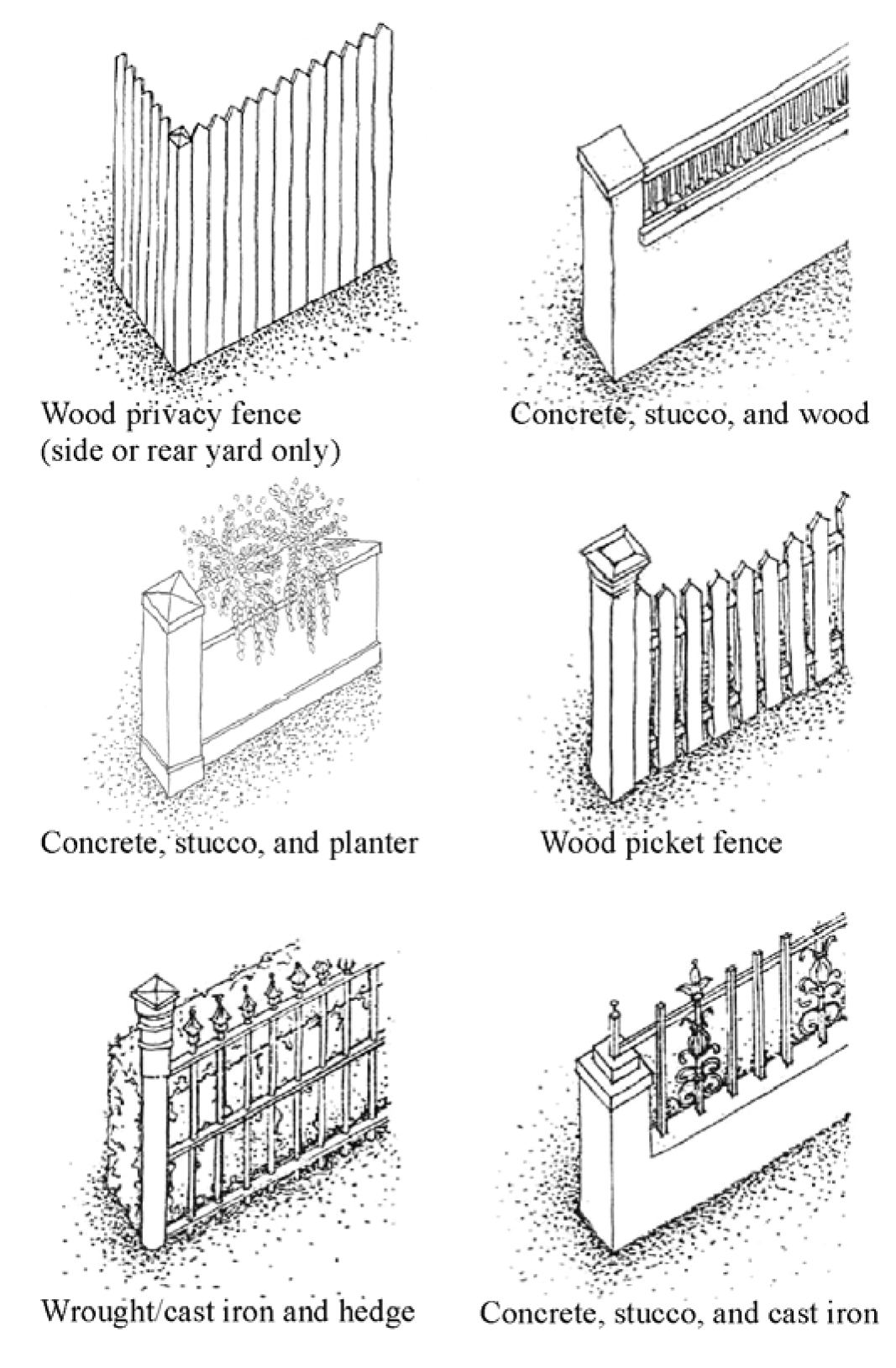
Figure 34-28
(c)
Materials. Fences and walls must be constructed of traditional building materials including brick, stone, stucco over concrete block, finished concrete, metal, vinyl, wood (natural, stained, or painted), and composite products manufactured specifically for fences and walls. Non-traditional fence materials such as tires, mufflers, hubcaps are prohibited. Chain link and other wire fences are not permitted in front yards (the area between a street right-of-way or easement and the minimum required street setback or build-to line). Chain link and wire fences with slats or fabric installed may not be used as permanent screening materials but may be appropriate for temporary construction fencing.
(d)
Finished sides. Fences and walls must be constructed to present a finished side to adjoining lots and any abutting rights-of-way. Where there is an existing fence, wall, or continuous landscape hedge on the adjoining parcel, the director may waive this provision administratively.
(e)
Maintenance. After construction, fences and walls must be maintained with all original components and they must remain substantially vertical to serve their functions and aesthetic purposes. Structural integrity must not be compromised to the point that the fence would present a danger of flight or destruction during high winds.
(f)
Dangerous fences. No barbed wire, spire tips, sharp objects, or electrically charged fences shall be erected except that a fence 72 inches high with three strands of barbed wire on top of the fence with six-inch spacing between the strands of barbed wire may be required or approved by the director around structures or equipment of potential hazard to residents or passersby not otherwise protected.
(Ord. No. 19-16, § 2, 2-18-2020)
Sec. 34-1744. - Location and height of fences, hedges and walls.
(a)
Setbacks. Except as may be specifically permitted or required by other sections of this chapter or chapter 10 of this LDC, no fence or wall, excluding seawalls, shall be erected, placed, or maintained:
(1)
Within any street right-of-way or street easement, or within eight feet of the edge of pavement and travel lane of a road or closer than three feet to any sidewalk, bike path or to the right-of-way of Estero Boulevard.
(2)
Closer to the Gulf of Mexico than permitted by ch. 6, article III of this LDC.
(3)
Closer than five feet to the mean high-water line along natural waterbodies, including canals created from sovereign lands, except where the canal that is seawalled. Where the canal is contained by a seawall, the fence may be built immediately landward or on top of the seawall. Where the seawall is part of a pool barrier, the fence may extend beyond the seawall (perpendicular to the seawall) by a maximum of three feet.
(b)
Height. The maximum height for fences and walls, measured from the existing elevation of the abutting property, is illustrated in Figure 34-29 and described as follows:
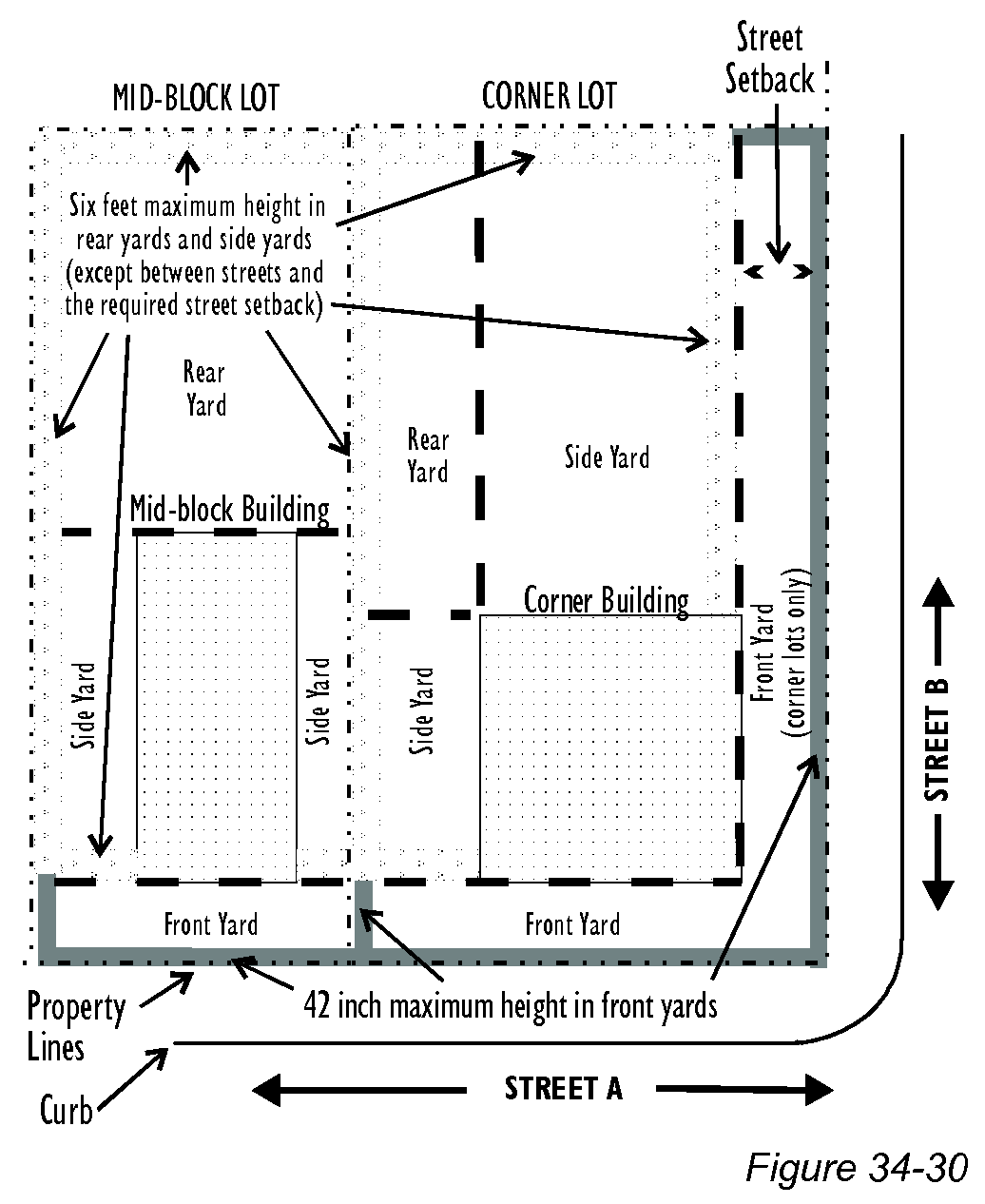
(1)
Front yards. Any fence or wall located in a front yard (between a street right-of-way or easement and the minimum required street setback or build-to line) shall not exceed 48 inches in height, except as provided in subsection (b)(4) below. This division does not excuse any fence wall from compliance with any lesser height required to meet vehicle visibility requirements (see § 34-3131 of this chapter) at traffic access points.
(2)
Side and rear yards. Any fence or wall located in a side or rear yard shall not exceed six feet in height.
a.
For purposes of this requirement, the side yard does not include any portion of the lot between a street and the minimum required street setback or build-to line.
b.
Where a side or rear yard slopes downward from the street, a fence may be up to seven feet above the elevation of the abutting property to avoid unnecessary variations in the height of a fence.
(3)
Near waterbodies. Within 25 feet of a body of water, those portions of a fence, wall, or hedge that exceed 48 inches in height cannot be more than 25 percent opaque (as viewed from perpendicular to the fence).
(4)
Exceptions:
a.
Architectural features. Fences and walls may include occasional architectural features such as columns, posts, gates, and arbors at a height not exceeding 84 inches. All such features must be visually compatible with the fence or wall design.
b.
Administrative setback variances. Under certain limited circumstances, administrative variances can be granted to minimum setbacks as provided in § 34-268 of this chapter.
c.
Enclosure of high-voltage transformers. See § 34-1748 of this chapter.
d.
Screening of refuse containers. On sites where the location and configuration of existing structures and vehicle use areas prevent the placement of refuse containers outside the front yard, fences and/or walls erected for the sole purpose of providing reasonable screening of refuse containers located in a front yard may exceed 48 inches in height, but must not exceed six feet in height.
(c)
Hedges shall be regulated in the following ways:
(1)
Hedges in front and side yards shall not be limited in height, however the following setbacks shall apply:
a.
A continuous hedge located along Estero Boulevard shall be maintained a minimum of three feet from any sidewalk or bike path and shall not overhang the right-of-way.
b.
A continuous hedge located along any street other than Estero Boulevard shall be maintained a minimum of six feet from the paved edge of the right-of-way and shall not overhang the right-of-way.
(2)
Hedges in the 25-foot waterbody setback shall be subject to the height and opacity requirements found in § 34-1744(3).
(Ord. No. 19-16, § 2, 2-18-2020)
Sec. 34-1745. - Buffer for commercial uses.
Sec. 34-1747. - Construction in easements.
Nothing in this division shall be construed so as to permit the construction or placing of any construction within a public or private easement which prohibits such construction or placement.
Sec. 34-1748. - Enclosure of high-voltage transformers and other utility equipment.
All substation high-voltage transformers and any other utility structures or equipment of potential hazard to residents or passersby not otherwise protected shall be completely enclosed by a fence not less than eight feet in height. On top of the fence shall be three strands of barbed wire with a six-inch spacing in between each strand. However, chain link and other non-decorative wire fences may not be used in front yards (the area between a street right-of-way or easement and the minimum required street setback or build-to line).
Sec. 34-1749. - Entrance gates.
(a)
Entrance gates are not permitted on public or private streets. Decorative entrance features that do not restrict access may be placed along public or private streets provided permission is granted by the town and others entity with authority over the right-of-way or easement.
(b)
Entrance gates may be placed on private property that is not subject to any access easements in order to control access.
(1)
Multi-unit properties with entrance gates must provide a minimum stacking distance of 40 feet from the right-of-way.
(2)
Single and two unit properties with entrance gates on Estero Boulevard and within 100 feet of Estero Boulevard must provide a minimum stacking distance of 20 feet from the right-of-way.
(c)
Access for emergency vehicles must be provided to any existing entrance gates on private streets.
(1)
Any security gate or similar device that is not manned 24 hours per day must be equipped with an override mechanism acceptable to the local emergency services agencies or an override switch installed in a glass-covered box for the use of emergency vehicles.
(2)
If an emergency necessitates the breaking of an entrance gate, the cost of repairing the gate and the emergency vehicle if applicable, will be the responsibility of the owner or operator of the gate.
(Ord. No. 19-16, § 2, 2-18-2020)
Sec. 34-1771.- Intent of division.
It is the intent of this division to allow the operation of:
(1)
Home occupations, by right, in all districts permitting dwelling units, but to regulate them so that the average neighbor, under normal circumstances, will not be disturbed or inconvenienced by them; and
(2)
Live/work and work/live dwelling units, by right or by special exception as specified in Tables 34-1 and 34-2 in § 34-622 of this chapter, but to regulate them so that their mixed-use character is compatible with their neighborhood and is maintained over time.
Sec. 34-1772. - Home occupations.
(a)
Any use of a residence for a home occupation as defined by this chapter shall be clearly incidental and subordinate to its use for residential purposes by its occupants and thus is considered to be a residential accessory use and is permitted in accordance with the regulations in this section in all zoning districts except EC.
(b)
Such use shall be conducted entirely within the dwelling unit or customary accessory building.
(c)
No employees or contractors other than members of the household residing in the dwelling shall be permitted to work at the residence, but may be employed to work elsewhere provided that the employees do not regularly come to the residence for equipment, vehicles, or supplies. Under special conditions, such as a handicapped person or retiree needing clerical assistance, the director may grant administrative approval to allow one employee who is not a resident of the home to work at the residence.
(d)
There shall be no exterior indication that the dwelling is being used for any purpose other than a residence, except that one nonilluminated nameplate, not exceeding one square foot (144 square inches) in area, may be attached to the building on or next to the entrance.
(e)
No commodities, stores, or display of products on the premises shall be visible from the street or surrounding residential area, and no outdoor display or storage of materials, goods, supplies, or equipment used in the home occupation shall be permitted on the premises. Vehicles and trailers for use by the business may not be parked or stored on the premises unless completely enclosed within a building.
(f)
No equipment shall be used which creates noise, vibration, glare, fumes, or odors outside the dwelling unit that are objectionable to the normal senses.
(g)
A home occupation shall not generate greater volumes of traffic than would otherwise be expected by normal residential uses, and a home occupation shall not attract more than an average of ten total visits per week from customers, clients, and suppliers.
Sec. 34-1773. - Live/work dwelling units.
(a)
A live/work dwelling unit is defined by this chapter as a single dwelling unit in a detached building, or in a multifamily or mixed-use building, that also accommodates limited commercial uses within the dwelling unit.
(b)
The predominate use of a live/work unit is residential, and commercial activity is a secondary use. The quiet enjoyment expectations of residential neighbors takes precedence over the work needs of a live/work unit.
(c)
Commercial uses in live/work units must be conducted entirely within the unit or customary residential accessory building.
(d)
Up to two employees or contractors other than members of the immediate family residing in the dwelling may work in a live/work unit.
(e)
Ground signs and pole signs are not permitted. Signage for live/work units is limited to up to four square feet of nonilluminated nameplates or blade signs that are attached to the building on or next to the entrance.
(f)
No commodities, stores, or display of products on the premises shall be visible from the street or surrounding residential area, and no outdoor display or storage of materials, goods, supplies, or equipment used in the live/work unit shall be permitted on the premises.
(g)
Required parking spaces shall be in accordance with the residential parking standards in § 34-2020 of this chapter, plus one space per employee.
(h)
No equipment shall be used which creates noise, vibration, glare, fumes, or odors outside the dwelling unit that are objectionable to the normal senses.
(i)
Commercial uses in live/work units are limited to office, general or medical as defined by this chapter (see § 34-2 of this chapter). However, due to the residential nature of live/work units, visits from customers, clients, and suppliers shall average no more than a total of 30 visits per week.
Sec. 34-1774. - Work/live dwelling units.
(a)
A work/live dwelling unit is defined by this chapter as a single dwelling unit in a detached building, or in a multifamily, mixed-use, or commercial building, where the predominate use of the unit is commercial.
(b)
Because the predominate use of a work/live unit is commercial, customary commercial impacts may take precedence over the quiet enjoyment expectations of residential neighbors.
(c)
Commercial uses in work/live units must be conducted entirely within the unit or customary accessory building.
(d)
Signs shall be in accordance with the standards for business signs in ch. 30 of this LDC.
(e)
Required parking spaces shall be in accordance with the commercial parking standards in § 34-2020 of this chapter, plus two spaces for the dwelling unit.
(f)
Commercial uses in work/live units are limited to office, general or medical; personal services; restaurant; and retail store, small, as defined by this chapter (see § 34-2 of this chapter).
Sec. 34-1801.- Definitions and general requirements.
(a)
The following definitions from § 34-2 of this chapter are repeated here for convenience:
(1)
Bed-and-breakfast inn means a public lodging establishment with nine or fewer guest units that serves breakfast to overnight guests. A bed-and-breakfast inn may be located in a single building or in a cluster of separate buildings.
(2)
Guest unit means a room or group of rooms in a hotel/motel or bed-and-breakfast inn that are designed to be used as temporary accommodations for one or more people traveling together. All guest units provide for sleeping and sanitation, although sanitation may be provided through shared bathrooms. Guest units may be equipped with partial or full kitchens.
(3)
Hotel/motel means a building, or group of buildings on the same premises and under single control, which are kept, used, maintained, or advertised as, or held out to the public to be, a place where sleeping accommodations are supplied for pay to transient guests for periods of one day or longer.
(4)
Lock-off accommodations means a single guest unit or living unit designed in such a manner that at least one room and a bathroom can be physically locked off from the main unit and occupied as a separate unit. Each portion may have a separate outside entry or share a common foyer with separate lockable interior doors, or may share a lockable door or doors separating the two units.
(b)
Hotels/motels and bed-and-breakfast inns must:
(1)
Be licensed as transient public lodging establishments with the Florida Department of Business and Professional Regulation; and
(2)
Pay the levied tourist development tax promulgated by the county and the state sales tax; and
(3)
Provide and staff a front desk during regular business hours to arrange for the rental of guest units; and
(4)
Guest units may not be occupied by the same guest for more than 60 days in any year. "Guest" includes the guest's children and parents. "Year" means the period beginning October 1 and ending September 30 of each successive year.
Hotels/motels and bed-and-breakfast inns which do not meet these requirements will be subject to enforcement action (see § 34-266 of this chapter). Proposed developments that will not meet these requirements will not be approved as hotels/motels or bed-and-breakfast inns; if approved instead as multiple-family buildings, they will be subject to the density limitations and property development regulations for multiple-family buildings.
(c)
Guest units in new hotels/motels and bed-and-breakfast inns may be sold as timeshare units or as hotel condominiums provided that they meet all requirements of this code for hotels/motels or bed-and-breakfast inns.
(d)
Guest units in existing hotels/motels and bed-and-breakfast inns that are being parcelized to timeshare units or hotel condominiums do not need to comply with the special parcelization requirements of § 34-636 of this chapter.
Sec. 34-1802. - Size of guest units.
(a)
Method of measurement. For purposes of this division, the size of a guest unit is the actual square footage within each guest unit including balconies and private patios, but not including common facilities such as corridors, stairways, shared bathrooms, or other common spaces including utility areas or parking spaces.
(b)
Hotels/motels. Individual guest units in a hotel/motel must be at least 180 square feet in size, except as provided in § 34-1803(b)(2), below.
(c)
Bed-and-breakfast inns. Individual guest units in a bed-and-breakfast inn must be at least 120 square feet in size.
Sec. 34-1803. - Allowable intensity.
(a)
Hotels/motels. When a hotel/motel is permitted on a property, guest units can be substituted for the dwelling units that would be allowed on that property (see § 34-632 of this chapter regarding density). The maximum number of guest units can be computed by multiplying the maximum number of dwelling units by the appropriate equivalency factors:
(1)
The following table indicates the equivalency factors that apply to properties in various land-use categories in the Fort Myers Beach Comprehensive Plan:
(2)
Guests units exceeding these equivalency factors or exceeding 1,000 square feet each may be allowed under exceptional circumstances as described in the comprehensive plan if approved as a deviation through a planned development rezoning. Before approving such a deviation, the town council must find that:
a.
All other aspects of the development (height, traffic, intensity of use, etc.) are compatible with the surrounding area;
b.
The proposal clearly exceeds all standards of the Fort Myers Beach Comprehensive Plan; and
c.
In no case can equivalency factor increases exceed the maximum intensities allowed by the Fort Myers Beach Comprehensive Plan.
(3)
Where lock-off accommodations are provided, each keyed room will be counted as a separate guest unit.
(b)
Hotels on Old San Carlos Boulevard. The 1999 Old San Carlos Boulevard - Crescent Street Master Plan encourages mixed-use buildings with second and third floors over shops on Old San Carlos Boulevard. To help implement this plan, an alternate method is provided by comprehensive plan Policy 4-C-6 for computing maximum hotel intensities for properties between Fifth to First Streets that lie within 200 feet east and west of the centerline of Old San Carlos Boulevard. In this situation and location only:
(1)
Guest units may be substituted for otherwise allowable office space without using the equivalency factors in subsection (a) of this section, provided that all other requirements of this code are met including minimum parking requirements and maximum floor-area-ratios.
(2)
These guest units must contain at least 250 square feet each.
(3)
The standard height limit at this location is three stories. Under no circumstances may a deviation be granted that would allow these guest units in any building taller than four stories. (The ground level is counted as the first story.)
(c)
Bed-and-breakfast inns. The intensity of bed-and-breakfast inns shall be calculated in the same manner as for hotel/motels, except that inns with three or fewer guest rooms per building are exempt from the requirement to use equivalency factors to measure their intensity.
Sec. 34-1804. - Parking.
(a)
Hotels/motels. The minimum requirement for off-street parking is 1.2 parking spaces for guest units up to 450 square feet and 1.5 spaces for each larger guest unit. Ancillary uses located in separate buildings and available to nonguests must provide parking spaces in accordance with the requirements of division 26 of this article.
(b)
Bed-and-breakfast inns. The minimum requirement for off-street parking is one parking space for each guest room plus one space for the owners' quarters.
Sec. 34-1805. - Additional regulations for bed-and-breakfast inns.
(a)
Whenever guests are present, the owner or operator must live on the premises or on abutting property, or if the inn is in a cluster of separate buildings the owner or operator must live in one of the buildings.
(b)
The maximum continuous length of stay for guests is 90 days.
(c)
Each guest unit must be accessed by a common corridor or outside door rather than through another guest unit or dwelling unit.
(d)
Food service is limited to breakfast and/or snacks and may be served only to overnight guests.
(e)
A single non-illuminated identification sign up to four square feet in area may be mounted onto each building.
Sec. 34-1806. - Replacing a nonconforming hotel/motel.
(a)
A nonconforming hotel/motel can be replaced with a new building in one of the following manners:
(1)
In full conformance with all current provisions of this code as they apply to a new hotel/motel on vacant land; or
(2)
In the same manner as provided for enlargements to the various types of nonconforming buildings as provided in § 34-3234 of this chapter; or
(3)
As provided in the pre-disaster buildback regulations found in § 34-3237 of this chapter or the post-disaster buildback regulations found in § 34-3238 of this chapter.
(b)
If a nonconforming hotel/motel is being replaced by a multiple-family building, the existing number of guest units cannot be used as the basis for rebuilding more dwelling units than are permitted on undeveloped land by the Fort Myers Beach Comprehensive Plan. The equivalency factors in § 34-1803 of this chapter are not applicable to replacement of an existing hotel/motel with a new multiple-family building.
Sec. 34-1807. - Conversions of existing buildings.
(a)
Any hotel or motel proposing to parcelize its guest units to timeshare units or to a hotel condominium does not need to comply with the special parcelization requirements of § 34-636 of this chapter.
(b)
Any hotel or motel proposing to convert its guest units to dwelling units, or any residential building proposing to convert its dwelling units to hotel/motel guest units, will be required to comply with density limitations of the Fort Myers Beach Comprehensive Plan, all applicable parking regulations, and all other regulations of this code including equivalency factors that affect the allowable number of hotel/motel guest units.
Sec. 34-1831.- Purpose and applicability of division.
(a)
Purpose. The purposes of this division are:
(1)
To curtail and reverse the degradation of the night-time visual environment by minimizing light pollution, glare, and light trespass through regulation of the form and use of outdoor lighting; and
(2)
To conserve energy and resources while maintaining night-time safety, utility, security and productivity.
(b)
Applicability. All new luminaires, regardless of whether a development order is required, must comply with the provisions and standards of this division.
(c)
Exemptions. The following are generally exempt from the provisions of this division:
(1)
Emergency lighting required for public safety and hazard warning luminaires required by federal or state regulatory agencies;
(2)
Outdoor light fixtures producing light directly by the combustion of fossil fuels such as kerosene and natural or bottled gas;
(3)
Low wattage holiday decorative lighting fixtures (comprised by incandescent bulbs of less than eight watts each or other lamps of output less than 100 lumens each) used for holiday decoration; and
(4)
Lighting for public roads except as provided in § 14-77 of this LDC.
Sec. 34-1832. - Definitions.
The following words, terms and phrases, when used in this division, shall have the following meanings, unless the context clearly indicates a different meaning:
Back-lighted means a surface that is at least partially transparent and is artificially illuminated from behind.
Direct light means light emitted directly from the lamp, off the reflector or reflector diffuser, or through the refractor or diffuser lens, of a luminaire.
Footcandle means the quantify of light striking a surface, measured in lumens per square foot.
Full cutoff means that a light fixture in its installed position does not emit any light, either directly or by reflection or diffusion, above a horizontal plane running through the lowest light-emitting part of the fixture. Additionally, the fixture in its installed position does not emit more than ten percent of its total light output in the zone between:
(1)
The horizontal plane through the lowest light-emitting part of the fixture, and
(2)
Ten degrees below the horizontal plane (80 degrees above the vertical plane).
Lumen means a unit of light emission. For example, incandescent light bulbs with outputs of 60, 75, and 100 watts emit approximately 840, 1170, and 1690 lumens respectively.
Luminaire means a complete unit for producing artificial light, commonly referred to as a lighting fixture.
Mercury vapor means a high-intensity discharge light source that is filled with mercury gas under pressure and which emits a blue/white light.
Non-essential lighting means lighting that is not necessary for an intended purpose after the purpose has been served. For example, lighting for a business sign, architectural accent lighting. and parking lot lighting may be considered essential during business or activity hours, but is considered non-essential once the activity or business day has concluded.
Shielded means that an outdoor light fixture that is fully and permanently blocked by a physical device or by its integral design from discharging light in specific directions.
Sec. 34-1833. - Technical standards for lighting.
(a)
Generally. This section contains minimum and maximum standards that apply whenever outdoor lighting is provided.
(1)
In addition to the standards and criteria in this section, there are standards for artificial lighting near sea turtle nesting habitat in ch. 14, article II of this code.
(2)
When specific standards are not addressed in these sources, the standards of the Illuminating Engineering Society of North America (IESNA) will apply.
(b)
Specific standards.
(1)
Illuminance. The following table indicates minimum and maximum illumination levels. These levels are specified for general use categories and are measured in footcandles on the task surface (for example, the lighted parking lot or walkway) with a light meter held parallel to the ground, facing up, unless otherwise specifically stated.
(2)
Lamp standards. Lamp types and colors must be in harmony with the adjacent community, any special circumstances existing on the site, and with surrounding installations. Lamp types must be consistent with the task and setting and should not create a mix of colors unless otherwise specifically approved by the director for a cause shown. Specifically, mercury vapor lamps are prohibited. Lighting of outdoor recreational facilities (public or private) such as athletic fields and tennis courts is exempt from the lamp type standards provided that all other applicable provisions are met.
(3)
Luminaire (fixture) standards. Fully shielded, full cutoff luminaires with recessed bulbs and flat lenses are the only permitted fixtures for outdoor lighting, with the following exceptions:
a.
Luminaires that have a maximum output of 260 lumens per fixture (the approximate output of one 20-watt incandescent bulb), regardless of number of bulbs, may be left unshielded provided the fixture has an opaque top to keep light from shining directly up.
b.
Luminaires that have a maximum output of 1,000 lumens per fixture (the approximate output of one 60-watt incandescent bulb), regardless of number of bulbs, may be partially shielded, provided the bulb is not visible, and the fixture has an opaque top to keep light from shining directly up.
c.
Sensor-activated lighting may be unshielded provided that:
1.
The light is located in such a manner as to prevent direct glare and lighting into properties of others or into a public right-of-way; and
2.
The light is set to only go on when activated and to go off within five minutes after activation has ceased; and
3.
The light must not be triggered by activity off the property.
d.
Flood or spot luminaires with a lamp or lamps rated at 900 lumens or less may be used except that no spot or flood luminaire may be aimed, directed, or focused such as to cause direct light from the luminaire to be directed toward residential buildings on adjacent or nearby land, or to create glare perceptible to persons operating motor vehicles on public ways, or directed skyward, or directed towards the shoreline areas.
1.
The luminaire must be redirected or aimed so that illumination is directed to the designated areas and its light output controlled as necessary to eliminate such conditions.
2.
Illumination resulting from such lighting must be considered as contributing to the illumination levels specified herein.
e.
All externally illuminated signs must be lighted by shielded fixtures mounted at the top of the sign and aimed downward. Illumination resulting from sign lighting must be considered as contributing to the illumination levels specified herein.
f.
Fixtures used to accent architectural features, materials, colors, style of buildings, landscaping, or art must be located, aimed, and shielded so that light is directed only on those features. Such fixtures must be aimed or shielded to minimize light spill onto adjacent properties or into the night sky in conformance with illumination and luminaire standards.
g.
All non-essential exterior commercial lighting must be turned off after business hours.
(4)
Luminaire mount standards. The following standards apply to luminaire mountings:
a.
Freestanding luminaires. Light poles must be placed on the interior of the site. When light poles are proposed to be placed on the perimeter of the site, specific consideration should be addressed to compliance with the illumination standards at the property line and off the property onto adjacent residential property. The maximum height of light poles for parking lots and vehicular use areas may not exceed 15 feet measured from the ground level directly below the luminaire to the bottom of the lamp itself (see additional restrictions in ch. 14 of this LDC for luminaires near sea turtle nesting habitat). Light poles located within 50 feet of a residentially zoned property or use may not exceed 12 feet. Poles used to illuminate pedestrian walkways may not exceed 12 feet. Lighting of outdoor recreational facilities (public or private) such as athletic fields and tennis courts is exempt from the mounting height standards provided that all other applicable provisions are met.
b.
Building-mounted luminaires. These luminaires may only be attached to the building walls and the top of the fixture may not exceed the height of the parapet for flat-roofed buildings or the lowest point on the nearest sloped roof.
c.
Canopy lighting. Luminaires mounted on the underside of a canopy must be fully shielded full cutoff fixtures. As an alternative (or supplement) to canopy ceiling lights, indirect lighting may be used where the light is beamed upward and then reflected down from the underside of the canopy. When this method is used, light fixtures must be shielded so that direct illumination is focused exclusively on the underside of the canopy. No part of the canopy may be back-lighted. Lights may not be mounted on the top or sides (fascias) of the canopy. The sides (fascias) of the canopy may not be illuminated in any manner.
d.
Trees and landscaping. To avoid conflicts, locations of all light poles and fixtures must be coordinated with the locations of all trees and landscaping whether existing or shown on the landscaping plan. Vegetation screens may not be employed to serve as the means for controlling glare. Glare control must be achieved through the use of such means as cutoff fixtures, shields, and baffles, and appropriate application of fixture mounting height, wattage, aiming angle, and fixture placement.
Sec. 34-1834. - Permits for lighting.
(a)
Development order and building permit criteria. The applicant for any development order or building permit involving outdoor lighting fixtures, must submit as part of the application evidence that the proposed work will comply with the outdoor lighting standards of this code. Specifically the submission must include the following:
(1)
Plans indicating the location on the premises and the type of illuminating devices, fixtures, lamps, supports, reflectors, and other devices.
(2)
A detailed description of the illuminating devices, fixtures, lamps, supports, reflectors, and other devices. The description must include manufacturer's catalogue cuts and drawings, including pictures, sections, and proposed wattages for each fixture.
(3)
All applications for development orders or building permits, except for single-family and two-family building permits, must provide photometric data, such as that furnished by the manufacturer of the proposed illuminating devices, showing the angle of cutoff and other characteristics of the light emissions including references to the standards contained herein.
(4)
All applications for development orders or building permits, except for single-family and two-family building permits, must provide photometrics in initial footcandles output for all proposed and existing fixtures on-site shown on a 20-foot by 20-foot grid on an appropriately scaled plan. On-site lighting to be included in the calculations must include, but is not limited to, lighting for parking lot, canopies, and building-mounted and recessed lighting along the building facades and overhangs. The photometric plan must include a table showing the average, minimum, and maximum footcandles of illumination on the site and within 50 feet of the site and the calculations deriving the averages. Evidence must be provided demonstrating that the proposed lighting plan will comply with the requirements of this code. The use of a light loss factor (LLF) is not permitted in these photometrics. This photometric plan must be coordinated with the landscape plan to identify the location of trees and other landscaping features with respect to the lighting devices. Rejection or acceptance of the photometric plan will be based on this code.
(b)
Compliance.
(1)
Prior to the final inspection for a certificate of compliance pursuant to § 10-183 of this LDC, site-verified footcandle readings must be provided demonstrating that the outdoor lighting, as installed, conforms with the proposed photometrics and the letter of substantial compliance provided by a registered professional engineer must include a certification that the outdoor lighting is in compliance with this code.
(2)
If any outdoor light fixture or the type of light source therein is changed after the permit or development order has been issued, a change request or development order amendment must be submitted for approval together with adequate information to assure compliance with this code. This request or amendment must be approved prior to the installation of the proposed change.
(3)
Outdoor lighting must be maintained in compliance with this code.
(c)
Existing outdoor lighting. Light pole height requirements do not apply to existing light poles. Existing light fixtures must be brought into compliance with this code by January 1, 2010. Any fixtures replaced after the date of the adoption of this code must be replaced with fixtures that comply with the standards established herein. Illuminance levels specified in this code apply to all outdoor lighting.
Sec. 34-1861.- Boats, floating structures, floating equipment and live-aboards.
(a)
No boat, floating structure, or other floating equipment shall be moored to mangroves except for emergency purposes.
(b)
No person shall discharge or permit or control or command to discharge any raw sewage, garbage, trash, or other waste materials into the waters of the town.
(c)
No boats, floating structures, or other floating equipment designed to accommodate one or more living units, or designed or used for retail sales, shall be permitted to anchor, moor, tie up, or otherwise be attached to any wharf, pier, or other structure emanating from real property or to real property itself within the town except in conformity with the regulations contained in this chapter and all other applicable town ordinances.
(d)
Except as provided in this subsection, no person shall live aboard any vessel under his command or control, which is moored to real property or to any dock, pier, seawall, or other structure attached to real property in the town. The provisions of this subsection shall not apply to:
(1)
Live-aboard vessels equipped with a discharge device that is listed by the United States Coast Guard as an approved marine sanitation device, and occupied by a licensed captain and his immediate family;
(2)
Commercial vessels, such as commercial fishing boats, tugs, barges, salvage vessels, passenger vessels, or cargo vessels, when used in commerce and navigation;
(3)
The mooring of any vessel necessitated by an emergency;
(4)
Live-aboard vessels at a marina which is properly zoned for marina uses (see § 26-116 of this LDC); or
(5)
Live-aboard vessels lawfully occupying a berth in a public mooring field managed by the town, provided the vessel is in compliance with all regulations.
The exceptions granted by subsections (d)(1) and (2) of this section are not intended to apply to personal fishing boats used for recreation or to fishermen with marine products licenses.
Sec. 34-1863. - Construction and maintenance of docks, seawalls, and other structures designed for use on or adjacent to waterways.
Construction, placement, erection and maintenance of docks, mooring piles, seawalls, watercraft landing facilities, and other structures designed for use on or adjacent to waterways shall be in compliance with established building permit procedures and with ch. 26, article II of this LDC. See also division 2 of this article regarding accessory uses, buildings and structures.
Sec. 34-1921.- Mobile home subdivisions.
(a)
New or expanded mobile home subdivisions are not allowed in the Town of Fort Myers Beach.
(b)
A mobile home cannot be substantially improved or placed on any lot in any subdivision except:
(1)
To replace an existing mobile home, provided that:
a.
A mobile home is in lawful existence on that lot and the lot has not been vacant for more than nine months;
b.
The replacement or substantially improved mobile home is elevated so that its lowest floor is at or above the base food elevation, in accordance with § 6-472(2)a. of this LDC; and
c.
The move-on permit requirements of § 34-1923 of this chapter are met; or
(2)
On a temporary basis in accordance with § 34-3046 of this chapter.
Sec. 34-1922. - Mobile home parks.
(a)
New or expanded mobile home parks are not allowed in the Town of Fort Myers Beach.
(b)
A mobile home cannot be substantially improved or placed in any existing mobile home park except in some parts of the Village zoning district in accordance with the regulations set forth in subdivision III of division 5 of article III of this chapter, and in accordance with the elevation requirements of § 6-472(2)b. of this LDC, and the move-on permit requirements of § 34-1923, below.
Sec. 34-1923. - Move-on permit requirements.
(a)
This section applies to mobile homes, and also to park trailers as that term is defined in § 34-694 of this chapter, in those zoning districts where either are permitted.
(b)
No mobile home shall be relocated or moved onto any property without first obtaining a move-on permit from the director.
(c)
All mobile homes shall be tied down in accordance with local, state and federal regulations, including § 6-471(2) of this code and F.S. § 320.8325.
(d)
All mobile homes shall have removable skirting around the entire perimeter.
(1)
Skirting shall be of a durable material such as decorative block, concrete block, fiberglass, aluminum or vegetation. Junk doors or other scrap material is prohibited.
(2)
Skirting shall be maintained at all times by the resident.
Sec. 34-1951.- Building relocation permit.
(a)
Compliance with applicable regulations. When a building is moved to any location within the town, the building or part thereof shall be made to conform to applicable provisions of the Florida Building Code and to all the provisions of this chapter within 90 days of the date of issuance of the moving permit.
(b)
Contents of application. Any person desiring to relocate or move a building must first file with the director a written application on an official form. The application must include the following information furnished by the applicant and must be accompanied by the required application fee:
(1)
The present use of the building.
(2)
The proposed use of the building.
(3)
The building's present location and proposed new location by STRAP number, as well as by street numbers.
(4)
Certified survey of the proposed site with ground elevations, flood zone, and required elevation.
(5)
Plot plan showing lot dimensions, setbacks, location of existing structures, and location of building drawn to scale no more than one-half-inch equals one inch and no less than one inch equals 50 feet. The plot plan should depict the roof overhang as well as the foundation.
(6)
Construction details, drawn to a scale of no larger than one-half-inch equals one foot and no smaller than one-eighth-inch equals one foot, including the following:
a.
Foundation layout with connection details.
b.
Floor plan, existing and proposed.
c.
Mechanical plans, including air conditioning, electric system, and plumbing plans.
d.
Elevations, front, side and rear.
e.
Flood elevations for the proposed new location shall be shown on the foundation layout and elevations.
(7)
Current termite inspection by licensed pest controller.
(8)
Photographs showing all sides of the building and the site where the building is proposed to be located.
(9)
Proof of notice to all owners of property abutting or across the street from the site where the building is proposed to be located.
(10)
A detailed written statement describing all proposed exterior alterations to the building after it is relocated. At a minimum, these details shall include methods and materials, and construction details as appropriate, regarding:
a.
The height and method of elevating the building above grade;
b.
Any proposed enclosure of space below the lowest habitable floor;
c.
Any changes to exterior doors, windows, siding, awnings and shutters;
d.
Any porches or decks to be built, modified or eliminated; and
e.
Any changes to the roof other than routine maintenance or replacement with similar materials.
(c)
Criteria for suitability of building to proposed site. The town manager shall determine whether the building to be relocated is suitable for its proposed site under one of the following categories:
(1)
Historic buildings. For buildings that, after relocation, would be eligible for historic designation pursuant to §§ 22-204(a)—(d) of this LDC:
a.
Is the proposed use of the building permitted by the zoning district?
b.
Has the property owner consented to historic designation of the site after the building is relocated?
c.
Has the property owner proposed improvements that restore the building while retaining its essential historic characteristics, consistent with the criteria in §§ 22-101—22-103 of this LDC?
(2)
Other buildings. For all other buildings:
a.
Is the proposed use of the building permitted by the zoning district and similar to existing uses in the neighborhood?
b.
Is the building reasonably compatible with the neighborhood when considering factors such as its size, age, and condition? If not, has the property owner proposed sufficient renovations or improvements to the building to achieve compatibility?
The town manager may place reasonable conditions on suitability decisions to bring applications up to these criteria or to ensure the performance of proposed improvements or renovations. Suitability decisions pursuant to this subsection are administrative decisions which may be appealed in accordance with § 34-86 of this chapter.
(d)
Inspection of building. The director will have the building inspected to determine:
(1)
If the building can be brought into compliance in all respects with this chapter and other town regulations pertaining to the area to which the building is to be moved.
(2)
If the building is structurally sound and either complies with applicable portions of the Florida Building Code and other codes adopted by the town or can be brought into compliance with such codes.
(e)
Rejection of application. The director must reject any application if:
(1)
The building fails to meet the suitability criteria in subsection (c) above, as determined by the town manager, or the inspection criteria in subsection (d) of this section;
(2)
In the opinion of the director, the moving of any building will cause serious injury to persons or property;
(3)
The building to be moved has deteriorated due to fire or other element to more than 50 percent of its market value, as that term is defined in § 6-405 of this LDC; or
(4)
The moving of the building will violate any of the requirements of the Florida Building Code, this code or other applicable town regulations.
Except for decisions as to the Florida Building Code, such decisions are administrative decisions which may be appealed in accordance with § 34-86 of this chapter.
(f)
Approval of building relocation permit.
(1)
Upon approval of the application for building relocation, a licensed building relocation contractor representing the applicant must:
a.
Apply for and receive all required permits from the departments of transportation of the county or state, if county or state roads will be used during the relocation;
b.
Pay the required fees and obtain the building relocation permit and appropriate sub-permits.
(2)
Any building being moved for which a permit was granted may not remain in or on the streets for more than 24 hours unless an extension of an additional 24 hours is approved by the town manager.
Sec. 34-1981.- Applicability of division.
(a)
The off-street loading requirements of this division shall apply to commercial, and other nonresidential uses.
(b)
Establishments are encouraged to schedule deliveries before or after their normal business hours. Deliveries that are made during normal hours may not obstruct parking aisles or parking entrances.
Sec. 34-1982. - Access.
(a)
Street access to off-street loading areas shall observe the same provisions as set forth for parking lots in § 34-2013 of this chapter.
(b)
Except as provided in § 34-1987 of this chapter, off-street loading areas shall be spatially or physically separated from parking areas and pedestrian walkways.
Sec. 34-1983. - Lighting, maintenance and drainage.
Sec. 34-1984. - Other use of loading areas.
Except as provided in § 34-2019 of this chapter, off-street loading areas shall not be utilized for the sale, repair, dismantling, or servicing of any vehicles or equipment, except on an emergency or temporary basis.
Sec. 34-1985. - Screening.
When any off-street loading area is located adjacent to a residential use or zoning district, and is not otherwise entirely visually screened from it at ground level, there shall be provided a continuous visual screen along the lot line abutting the residential use in accordance with division 17 of this article or ch. 10 of this LDC, whichever is the most restrictive.
Sec. 34-1986. - Loading area required; loading plan; location of loading area.
(a)
All commercial and other nonresidential uses on sites larger than one acre shall be provided with an off-street loading area for receiving and shipment of commodities.
(b)
A plan for off-street loading areas shall be provided as part of the site plan submitted in accordance with the regulations and procedures set forth in ch. 10 of this LDC, or, if the development is exempt from ch. 10, then a plan shall be submitted at time of application for a building permit and be reviewed by the director for consistency with this division and this chapter.
(c)
The location of all off-street loading areas shall embody the following provisions:
(1)
The required loading area shall be provided on the same lot or parcel it serves or within 300 feet of that parcel.
(2)
The surfaced portions of all loading areas, excluding driveways, shall observe a 20-foot setback from all right-of-way lines and a ten-foot setback from all property under separate ownership or control.
(3)
Loading spaces shall be so located as not to obstruct or otherwise hinder or endanger the movement of vehicles and pedestrians.
(4)
Off-street loading areas shall not be placed between the principal building and a street right-of-way line.
Sec. 34-1987. - Number of spaces.
(a)
Establishments which normally receive or ship commodities via small panel trucks or vans shall not be required to provide off-street loading areas and may utilize the parking area, provided:
(1)
Deliveries normally are received before or after normal hours open to the public.
(2)
No delivery truck remains in the parking lot for more than four hours.
(3)
Deliveries do not interfere with normal pedestrian or vehicle movements.
(b)
Establishments which receive or ship goods via large semitrailer or full trailer trucks shall provide a minimum of one loading space for the first 10,000 square feet of floor area, plus one space for each additional 20,000 square feet of floor area or major fraction thereof.
Sec. 34-2011.- Types of parking facilities.
Parking facilities in the Town of Fort Myers Beach take a variety of forms, generally classified as follows:
(1)
Single-purpose parking lots. Single-purpose parking lots are designed to serve individual businesses, multiple-family buildings, mixed-use buildings, and multiple-occupancy complexes. Single-purpose parking lots are usually located on the same parcel as the use(s) they serve and may include parking spaces under a building or in a parking garage.
a.
Most single-purpose parking lots are considered by this code to be accessory uses of land (§ 34-1171 of this chapter) and thus can be built to serve any permitted principal use on the same parcel of land.
b.
Some single-purpose parking lots serve two or more non-abutting parcels, as provided in § 34-2018 of this chapter for joint-use parking lots.
c.
Surplus spaces in some single-purpose parking lots may be rented to the general public during peak periods, as provided in subsection 34-2019(a) of this chapter.
(2)
Shared parking lots. Shared parking lots are open to the public, generally for a fee, regardless of the destination of the person parking there. Shared parking lots may be operated as a private business or by a governmental entity, and may include a surface parking lot and/or a parking garage.
a.
Permanent shared parking lots are considered a principal use of a parcel of land and may be approved in certain zoning districts only by special exception or through the planned development zoning district procedures.
b.
Parking garages that operate in whole or part as shared parking lots are also considered a principal use of land and may be approved only through the planned development zoning district procedures (see §§ 34-620(d) and 34-676(e) of this chapter).
(3)
On-street parking. Governmental entities sometimes provide on-street parking spaces, usually with parking meters, that are available for use by the public regardless of their destination. On-street parking is closely related to the functioning of the adjoining street and is provided as a public works project rather than being regulated as a land development activity by this code.
(Ord. No. 15-11, § 1, 1-4-2016)
Sec. 34-2012. - Definitions.
For purpose of this division only, certain words or phrases are defined as follows:
Employees means the regular working staff, paid, volunteer, or otherwise, at maximum strength and in full-time equivalent numbers, necessary to operate, maintain, or service a given facility or use under normal levels of service.
High turnover applies to parking lots where vehicles are parked for relatively short periods of time ranging from a few minutes to several hours. Customer parking for retail stores, restaurants, bars, offices, or similar establishments is considered to be high turnover.
Low turnover applies to parking where vehicles are parked for relatively long periods of time, such as employee parking during the day, uses such as beach parking or marina parking where customers typically leave their cars for periods of several hours or more, and overnight parking in residential developments.
Parking aisle means an accessway within a parking lot that provides direct access to individual parking spaces.
Parking lot means an area of land designed, used, or intended for parking five or more vehicles.
Parking lot entrance means the accessway which provides ingress or egress from a street right-of-way or easement to a parking lot.
Parking space means an area of land designed or intended for parking one vehicle. Some parking spaces are designated as disabled spaces.
Sec. 34-2013. - Access.
(a)
Each parking lot must have a distinct parking lot entrance. Such entrance must meet the requirements of ch. 10 of this LDC, as well as the following:
(1)
Minimum width at the property line for one-way entrances is ten feet.
(2)
Minimum width at the property line for two-way entrances is 20 feet.
(3)
Maximum width at the property line is 25 feet.
The director may determine that traffic volumes, truck traffic, or other special circumstances warrant other requirements.
(b)
Parking lot entrances must not exceed a six percent grade for 20 feet into any lot or parcel. A parking lot entrance must not enter a street right-of-way or easement at an angle of less than 90 degrees unless a lesser angle is approved by the director.
Sec. 34-2014. - Parking plan.
A parking plan is required for all uses, except single-family and two-family dwelling units, and must be submitted for review and approval in accordance with ch. 10 of this LDC. Developments that are not required to be approved in accordance with chapter 10 must submit plans to the director prior to issuance of a building permit. The plan must accurately designate the required parking spaces, parking aisles, and parking lot entrance, as well as the relation of any off-street parking facilities to the uses or structures such facilities are designed to serve.
Sec. 34-2015. - Location and design.
The location and design of all parking lots must comply with the following provisions:
(1)
Location. Parking spaces that are required to support specific land uses (see § 34-2020 of this chapter) must be provided on the same premises and within the same zoning district as the use they serve, except in the Downtown zoning district as provided in § 34-676(a) of this chapter. Joint-use parking lots are regulated by § 34-2018 of this chapter.
(2)
Design. In addition to the requirements set forth in this division, all parking lots must be designed in accordance with the buffer, landscaping, drainage, and other requirements of this code.
(3)
Lighting. If the parking lot is to be used at night, adequate lighting must be provided for the driveways, ingress, and egress points, and parking areas of all commercial and industrial uses. Such lighting must be so arranged and directed as to eliminate glare on any other use, and must comply with applicable sea turtle lighting restrictions in ch. 14 of this LDC.
(4)
Stacking. All individual parking spaces must be accessible from a parking aisle intended to provide access to the space. Stacking of vehicles (one behind the other) may be permitted only where each dwelling unit has a specific garage or driveway appurtenant to it and in valet parking facilities wherein parking is performed only by employees of the facility.
(5)
Exiting. All parking lots must be provided with sufficient maneuvering room so as to allow an exiting vehicle to leave the parking lot in a forward motion, except where approved by the director under the following conditions:
a.
The right-of-way is a local street and:
1.
There is insufficient room on the parcel for vehicles to turn and exit in a forward direction; and
2.
The number of parking spaces backing out are no more than the minimum required by this division to serve existing buildings; or
b.
The parking spaces are in the "pedestrian commercial" category of the comprehensive plan and do not unduly interfere with critical congested road segments or the normal usage of existing or proposed sidewalks.
(6)
End spaces. Parking lots utilizing 90 degrees parking with dead-end aisles must provide a turning bay for those spaces at the end of the aisle.
(7)
Pedestrian system. In any parking lot where more than one tier of parking spaces is to be developed, walkways must be provided which accommodate safe and convenient pedestrian movement.
Sec. 34-2016. - Dimensional requirements; delineation of parking spaces.
In addition to satisfying all other provisions of this division, the arrangement and spacing of off-street parking lots must conform to the following requirements:
(1)
Minimum dimensions. Minimum aisle widths and parking space dimensions shall be as follows:
(2)
Effect of minimum dimensions on size of parking lots. The following table illustrates the effect of the minimum aisle and parking space dimensions on the size of parking lots, keyed to the dimensions indicated in Figure 34-31:
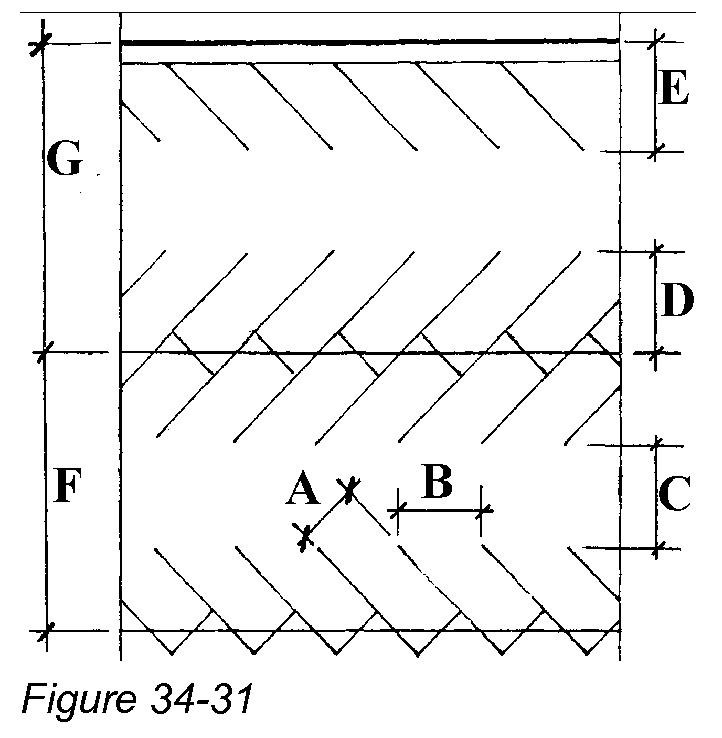
(3)
Disabled space dimensions. Individual disabled parking space dimensions must be 12 feet by 18 feet. Parking access aisles must be no less than five feet wide and must be part of an accessible route to the building or facility entrance. These dimensions do not guarantee compliance with the Americans with Disabilities Act (ADA) of 1990.
(4)
Delineation of spaces.
a.
Paved parking lots.
1.
Parking spaces must be delineated by all-weather painted lines, not less than four inches in width, centered on the dividing line between spaces.
2.
Parking spaces for the disabled must be prominently outlined with blue paint, and must be repainted when necessary to be clearly distinguishable as a parking space designated for persons who have disabilities and must be posted with a permanent above-grade sign bearing the international symbol of accessibility and the caption "PARKING BY DISABLED PERMIT ONLY." Signs erected after October 1, 1996 must indicate the penalty for illegal use of these spaces.
b.
Unpaved parking lots.
1.
Perimeter parking spaces in unpaved parking lots must be delineated by placing a parking block three feet from the end of the parking space and centered between the sides of the space.
2.
If a perimeter space abuts a structure, the space may be indicated on the structure, in which case parking blocks are not required.
3.
Parking spaces for the disabled must be clearly distinguishable as a parking space designated for persons who have disabilities and must be posted with a permanent above-grade sign bearing the international symbol of accessibility and the caption "PARKING BY DISABLED PERMIT ONLY." Signs erected after October 1, 1996 must indicate the penalty for illegal use of these spaces. Parking spaces for the disabled must comply with all other applicable requirements of state law and the Florida Building Code.
Sec. 34-2017. - Parking lot surfaces.
(a)
High turnover parking lots. Except as provided in this section, all high turnover parking lot aisles and parking spaces must be a paved surface, except for the open space beyond parking blocks. The term "paved" means and includes asphalt, concrete, brick, paving blocks, porous (pervious) asphalt or concrete, and other similar treatments. Clean (washed) angular gravel (such as FDOT #57 stone) may also be used if stabilized as provided in subsection (b)(1) of this section.
(1)
Any parking spaces that may be permitted, seaward of the 1978 coastal construction control line shall be stabilized with best management practices approved by the director.
(2)
All disabled parking spaces, including disabled parking spaces seaward of the coastal construction control line, must comply with applicable requirements of state law and the Florida Building Code.
(b)
Low turnover parking lots. Due to the low volume of vehicle turnover in this type lot, alternative unpaved surfaces may parking lot can provide some or all of the required parking spaces for two or more unrelated busin also be permitted provided that the areas are adequately drained and continuously maintained in a dust-free manner.
(1)
Alternative surfaces may include stabilized surfaces of grass or clean (washed) angular gravel over a well-drained base, or other similar porous materials. Stabilization may be accomplished by turfblocks (concrete or plastic) or proprietary cellular or modular porous paving systems installed in accordance with manufacturers' specifications.
(2)
Crushed limerock that has not been washed or otherwise processed to remove fine particles will be permitted as a surface material only when designed, placed, and maintained in a manner that will:
a.
Prevent the flow of sediment-laden runoff from the lot; and
b.
Keep the surface dust-free at all times.
(3)
The use of unimproved surfaces such as sand or dirt as approved parking shall be prohibited.
(4)
Disabled spaces must comply with applicable requirements of state law and the Florida Building Code.
(c)
Reduced surfacing standards.
(1)
The director is authorized to permit portions of high turnover parking lots (including parking lot aisles), to meet the surfacing standards for low turnover parking lots (subsection (b), above) when the reduced surfacing standard will be used in those portions of the parking lot expected to receive the lightest usage, such as overflow or employee parking areas.
(2)
This subsection must not be construed inconsistently with the Americans with Disabilities Act (ADA) of 1990.
(d)
Reservation of spaces for future use. When a use or activity is required by this chapter to provide more than ten high turnover parking spaces, the director may approve leaving up to 25 percent of the required spaces as landscaped areas reserved for future use, provided that:
(1)
The applicant clearly shows the reserved parking spaces on the site plan;
(2)
The reserved parking areas must not be counted towards the minimum open space or landscaping or buffering requirements of this chapter or chapter 10 of this LDC;
(3)
All drainage facilities shall be calculated and built as though the reserved parking areas were impervious surfaces; and
(4)
The reserved parking areas must not be used for any purpose other than landscaped open space or temporary overflow parking during special holiday seasons or sales.
Should the property owner decide to pave the reserved area for parking, he must submit the original site plan or development order approval to the director, who is authorized to approve the paving provided that such paving does not include any new entrances onto a public street. If the parking areas does involve new entrances, then a limited review development order is required.
Sec. 34-2018. - Joint use of parking lots.
(a)
A single-purpose parking lot can provide some or all of the required parking spaces for two or more unrelated businesses, provided that such joint-use parking lot:
(1)
Is built on a parcel where a commercial parking lot is permitted; and
(2)
Is placed on the parcel so as not to violate any applicable build-to lines or block visibility of vehicles (see § 34-3131 of this chapter); and
(3)
Is built to the same standards as a single-purpose parking lot; and
(4)
Is located within 750 feet of each business.
(b)
The peak parking demands of the different uses must occur at different times. The director may require an applicant to provide a technical analysis of the timing and magnitude of the proposed parking demands.
(c)
Applications for joint-use parking lots must include:
(1)
A notarized statement from all property owners involved indicating the use of each property and forecasting that the peak level of activities of each separate building or use which create a demand for parking will occur at different times.
(2)
A draft joint-use parking agreement, acceptable to the town, that:
a.
Specifically identifies the designated spaces that are subject to the agreement;
b.
Includes a statement indicating that the parties understand that these designated spaces cannot be counted to support any use other than those identified in the agreement;
c.
Identifies the current property uses, property owners, and the entity responsible for maintenance of the parking area;
d.
Includes a backup plan to provide sufficient parking if the joint-use parking agreement is violated by either party.
(3)
Upon approval of the agreement by the town, the agreement(s) must be recorded in the Lee County public records at the applicant's expense.
(4)
A certified copy of the recorded joint-use parking agreement must be provided to the town before any joint-use of parking spaces may commence.
Sec. 34-2019. - Other use of parking lots.
(a)
Parking spaces that are not in daily use and are located in parking lots having ten or more parking spaces and meeting the other requirements of this division may be rented to the general public during peak periods.
(b)
The following structures and uses may be approved in parking lots by the director, provided that a site plan is submitted showing that the structure will not reduce the parking spaces required for the principal use, or create a traffic or pedestrian hazard:
(1)
Charitable or other similar drop-off collection stations.
(2)
Aluminum can or other similar receiving machines or facilities.
(3)
Photo pickup stations.
(4)
Telephone booths and pay telephone stations.
(5)
Automatic teller machines (ATMs).
(6)
Other similar uses that do not unreasonably interfere with the normal functioning of the parking lot.
(c)
Except as provided in this section and for ancillary temporary uses as provided in § 34-3048 of this chapter, required parking areas must not be utilized for the sale, display, or storage of merchandise, or for repair, dismantling, or servicing of any vehicles or equipment. This subsection does not prohibit a residential property owner from the occasional servicing of his own noncommercial vehicle or conducting normal residential accessory uses.
Sec. 34-2020. - Required parking spaces.
(a)
New developments. New residential and nonresidential uses must provide off-street parking spaces in single-purpose parking lots in accordance with the standards specified in this section, as modified by certain reductions as provided in the Downtown and Santini zoning districts (see division 5 of article III of this chapter).
(b)
Existing developments. Existing buildings and uses may be modernized, altered, or repaired without providing additional parking spaces, if there is no increase in total floor area or capacity.
(1)
Existing buildings or uses enlarged in terms of floor area must provide additional parking spaces for the enlarged floor area in accordance with the standards specified in this section.
(2)
When the use of a building is changed to a different use that is required to have more parking than exists, the additional parking must be provided in accordance with the standards specified in this section.
(c)
Bicycle parking. Commercial, multiple-family, and mixed-use buildings may eliminate one required parking space by providing and maintaining a bicycle rack able to hold four bicycles.
(d)
Minimum parking standards.
(1)
Residential uses.
a.
Dwelling units with individual driveways: The minimum requirement is 2.0 spaces for each dwelling unit. Stacking of vehicles in the driveway is permitted.
b.
Dwelling units with common parking lots: Minimum requirements are as follows:
1.
Studio or efficiency: 1.0 spaces per unit.
2.
One bedroom: 1.25 spaces per unit.
3.
Two bedrooms: 1.25 spaces per unit.
4.
Three or more bedrooms: 1.5 spaces per unit.
5.
Live/work units: 2.0 spaces per unit. Stacking of vehicles is not permitted except as provided in § 34-2015(5) of this chapter.
c.
Timeshare units: Parking requirements are the same as for multiple-family buildings. If lock-off accommodations are provided, 0.5 extra spaces per lock-off unit are required.
d.
Living units without kitchens: Living units that do not contain customary cooking facilities within the individual units but instead have a central kitchen for food preparation and where meals are served in a central dining area or individual rooms must provide one parking space per four residents or four beds (whichever is greater), plus ten percent.
e.
Group quarters, excluding living units subject to subsection (d)(1)d. of this section. The minimum requirement is one parking space per bedroom or one space per two beds, whichever is greater.
(2)
Commercial uses.
a.
Bars and cocktail lounges. The minimum requirement is 15 spaces per 1,000 square feet of total floor area. If outdoor seating is provided, an additional one space per four outdoor seats or 75 square feet of outdoor seating area (whichever is greater) must be provided. See also subsection (2)h. of this section, pertaining to restaurants, and subsection (4) of this section.
b.
Bed-and-breakfast inns. The minimum requirement is one parking space for each guest room plus one space for the owners' quarters.
c.
Car washes. The minimum requirement is two spaces per car wash stall or space, plus drive-through facilities (see subsection (2)d. of this section). Each individual car wash stall or space may count as one of the required two parking spaces per stall.
d.
Drive-through facilities. Where permitted, any commercial establishment providing drive-through service windows or stalls must provide separate vehicle stacking for those uses. For the purpose of this section, a stacking unit is defined as 18 feet in length and nine feet in width. The total number of stacking units required is based on the type of business, as follows:
1.
Banks and financial establishments: Stacking lanes to accommodate three cars per window.
2.
Car washes: Stacking to accommodate one (1) car per service stall or three cars, whichever is greater.
3.
Restaurants: New or expanded drive-through facilities are not permitted for restaurants (see § 34-620(g) of this chapter). For existing drive-through facilities that are being lawfully reconfigured, stacking lanes to accommodate six cars per service lane, with a minimum of four spaces preceding the menu board.
4.
Other: Stacking for two cars.
e.
Hotels and motels. The minimum requirement is 1.2 parking spaces for each guest unit up to 450 square feet and 1.5 spaces for each larger guest unit.
f.
Offices. This category includes offices of all types not specifically listed elsewhere, including banks and medical facilities. The minimum requirement is two spaces per 1,000 square feet of total floor area. See also subsection (2)d. of this section pertaining to vehicle stacking for drive-through facilities.
g.
Personal services. The minimum requirement is five spaces per 1,000 square feet.
h.
Restaurants. With the exceptions noted below, the minimum parking requirements for restaurants is eight spaces per 1,000 square feet of total floor area plus any outdoor seating area.
1.
Accessory restaurant. When a restaurant is located within the same building as the principal use, and is clearly provided primarily for the employees and customers of the principal use, no additional parking spaces are required.
2.
Bars and cocktail lounges. If the restaurant contains a cocktail lounge or bar, the minimum requirement is eight spaces per 1,000 square feet of total floor area plus five additional spaces per 1,000 square feet of floor area used for the bar or cocktail lounge. If outdoor seating is provided, parking must also be provided for the area used for outdoor seating at these same rates.
i.
Retail stores, freestanding. This subsection applies to individual retail or business establishments. Any retail establishment proposing drive-through facilities must also meet the requirements of subsection (2)d. of this section.
1.
Convenience food and beverage stores. The minimum requirement is four spaces per 1,000 square feet of total floor area. If more than 20 percent of the total floor area or 600 square feet, whichever is less, is used for the preparation and/or sale of food or beverages in a ready-to-consume state, parking required for this area is the same as a restaurant. One parking space per four pumps will be credited against the required parking.
2.
Other retail or business establishments. The minimum parking requirement is three spaces for each 1,000 square feet of total floor area. Required parking for areas within the principal building that are used only for dead storage and are not available to the public is two spaces per 1,000 square feet.
j.
Warehousing (mini-warehouses). The minimum requirement is one space per 25 storage units, with a minimum of three spaces.
k.
Wholesale establishments. The minimum requirement is one space per company vehicle plus one space per 1,000 square feet of total floor area.
(3)
Miscellaneous uses.
a.
Educational institutions.
1.
Public schools. Parking must be provided in compliance with state law.
2.
Private or parochial schools and day care centers. The minimum requirement is one space per employee plus one space for each 40 students.
b.
Marinas and other water-oriented uses. Minimum requirements are as follows:
1.
Boat slips: One space per two slips.
2.
Dry storage: One space per six unit stalls.
3.
Charter or party fishing boat services: One space per three people based on maximum passenger capacity of the boats using the dock or loading facility.
4.
Cruise ships: One space per three people based on the maximum passenger and crew capacity of the ship.
5.
Water taxis: Dedicated parking spaces are not required at stopping points for water taxis or water shuttles.
6.
Other uses: Other uses including accessory or ancillary marina uses such as restaurants, bars, or lounges, boat sales, etc. must be calculated separately in compliance with this division.
c.
Museums, art galleries, libraries, and other similar uses not covered elsewhere: The minimum requirement is one parking space for each 500 square feet of total floor area.
d.
Places of worship and religious facilities. Refer to division 27 of this article.
e.
Recreation facilities, indoor. The minimum requirement is one parking space for each 150 square feet of total floor area.
f.
Theaters, auditoriums, meeting halls, and other similar places of public assembly, not covered elsewhere. The minimum requirement is one parking space for each four seats plus one space per employee.
g.
Carnivals, fairs, and amusement attractions and devices. The minimum requirement is five parking spaces provided for each permanent amusement device.
(4)
Combined uses. The number of parking spaces required for combined uses is the total of the spaces required for each separate use established by this schedule. Exceptions are as follows:
a.
Joint use of parking lots. As provided in § 34-2018 of this chapter.
b.
Multiple-occupancy complexes. This subsection applies to multiple-occupancy complexes where five or more individual business establishments are located and that all share a common parking area. Specifically excluded from this subsection are theaters and hotels. Minimum requirements are as follows:
1.
If the complex contains less than 25 percent of its gross floor area as restaurants, bars, and cocktail lounges, two spaces per 1,000 square feet.
2.
If the complex contains 25 percent to 50 percent of its gross floor area as restaurants, bars, and cocktail lounges, four spaces per 1,000 square feet.
3.
If the complex contains 50 percent to 75 percent of its gross floor area as restaurants, bars, and cocktail lounges, six spaces per 1,000 square feet.
4.
If the complex contains over 75 percent of its gross floor area as restaurants, bars, and cocktail lounges, eight spaces per 1,000 square feet.
(5)
Uses not specifically listed. Uses not specifically mentioned in this chapter must provide the same number of off-street parking spaces as for the most similar use.
Sec. 34-2022. - Reserved.
Editor's note— Ord. No. 15-11, § 1, adopted Jan. 4, 2016, deleted § 34-2022 entitled "Seasonal parking lots."
Sec. 34-2031.- Performance standards, environmental quality.
All uses and activities permitted by right, special exception, or temporary use permit in any zoning district, including planned development districts, shall be constructed, maintained and operated so as to:
(1)
Comply with all local, state and federal air, and noise, and water pollution standards; and
(2)
Not adversely impact water quality.
Sec. 34-2032. - Performance standards, creation of nuisance.
All uses and activities permitted by right, special exception, or temporary use permit in any zoning district, including planned development districts, shall be constructed, maintained, and operated so as to:
(1)
Not be injurious or offensive and thereby constitute a nuisance to the owners and occupants of adjacent premises, nearby residents, or to the community, by reason of the emission or creation of noise, vibration, smoke, dust, or other particulate matter, toxic or noxious waste materials, odors, fire or explosive hazard, light pollution or glare; and
(2)
Not cause light from a point source of light to be directed, reflected, or refracted beyond the boundary of the parcel or lot, onto adjacent or nearby residentially zoned or used property or onto any public right-of-way, and thereby constitute a nuisance to owners or occupants of adjacent premises, nearby residents, or to the community; and
(3)
Ensure all point sources of light and all other devices for producing artificial light are shielded, filtered, or directed in such a manner as to not cause light trespass; minimum standards are provided in division 20 of this article.
Sec. 34-2051.- Property development regulations.
Places of worship and religious facilities shall adhere to the dimensional regulations of their zoning district (see Table 34-3 of this chapter).
Sec. 34-2052. - Parking.
(a)
Places of worship. Parking for places of worship shall be provided at the ratio of one parking space for each three seats within the sanctuary or main assembly hall, whichever is greater. Where benches, pews or other similar seating arrangements are used, each 24 lineal inches shall be counted as one seat.
(b)
Religious facilities. Parking for religious facilities shall be the same as for places of worship, with additional parking for ancillary facilities as required in division 26 of this article; provided that, where the ancillary facilities will not be used at the same time, parking shall be based upon the peak anticipated attendance at any one time, for all facilities.
(c)
Parking on grass. Up to 75 percent of the parking spaces required for the sanctuary or main assembly hall of a place of worship may be provided as parking on grass, provided the regulations set forth in the relevant sections of division 26 of this article, are met.
Sec. 34-2053. - Expansion of existing place of worship.
Expansion of existing places of worship and religious facilities, lawfully existing as of August 1, 1986, by right or by special exception, is hereby declared a legal use. Additions, renovations, or other expansion of the main place of assembly may be permitted upon application for and approval of a building permit in accordance with all applicable town regulations.
Sec. 34-2054. - Living quarters.
Dwelling units and living units that provide living quarters within a religious facility must comply with the density restrictions found in § 34-632 of this chapter.
Sec. 34-2111.- Applicability of regulations to membership organizations.
The listing in this code of membership organizations is not meant to limit or abridge the rights of assembly. Such organizations are not prohibited from meeting in various traditional and appropriate places. For example, a service club's weekly meeting at a restaurant in a district not otherwise allowing a membership organization shall not constitute a zoning violation. However, where such an organization is the principal user of real property for meetings, entertainment, and food and beverage service, such a meeting place, hall, or clubhouse shall be permitted only where this use is explicitly enumerated.
Sec. 34-2141.- Applicability.
(a)
The regulations set forth in this division for recreation facilities are in addition to any other applicable regulations. In the case of conflict, the most restrictive regulations shall apply.
(b)
This chapter defines five types of recreation facilities (see § 34-2 of this chapter):
(1)
Recreation facilities, commercial, which are permitted by special exception in certain zoning districts.
(2)
Recreation facilities, personal, which are considered to be residential accessory uses.
(3)
Recreation facilities, private on-site, which are permitted by right in certain zoning districts.
(4)
Recreation facilities, private off-site, which are permitted by special exception in certain zoning districts.
(5)
Recreation facilities, public, which are permitted by right in certain zoning districts.
(c)
This chapter also defines park, neighborhood and park, community or regional (see § 34-2 of this chapter), both of which are permitted by right in certain zoning districts.
Sec. 34-2142. - Minimum lot area and setbacks.
(a)
All recreation facilities, whether a principal use or accessory use, shall be located on property meeting the minimum lot size and dimensions of the zoning district in which located as well as any additional area, width, or depth required to permit full compliance with all setbacks, groundcover, open space, buffering, drainage, and parking requirements as set forth in this chapter or ch. 10 of this LDC, whichever is most applicable.
(b)
Minimum setbacks for uses subject to this division are as set forth in the property development regulations of the zoning district in which located.
(c)
Additional setback requirements for specific uses are as follows:
(1)
Recreation facilities, commercial. Amusement devices, water slides, miniature golf, and other commercial recreation facilities shall be located not less than 50 feet or a distance equal to the height of the structure or device, whichever is greater, from any property under separate ownership, provided further that such setback shall be 100 feet from any adjacent property with residential zoning or any existing residential use.
(2)
Recreation halls. Recreation halls and ancillary facilities and membership organizations shall be located at least 40 feet from any residential dwelling and situated in a manner so as to encourage pedestrian and bicycle traffic.
(3)
Other facilities. Other facilities are specifically regulated elsewhere in this code, such as swimming pools and tennis courts in division 2 of this article.
Sec. 34-2143. - Accessory uses.
(a)
Accessory uses, buildings, or structures for recreation facilities which are customarily incidental to the principal use may be permitted. Such uses include but are not limited to restroom facilities, maintenance sheds, refreshment stands (with no alcoholic beverages unless approved in accordance with division 5 of this article), pro shops (where applicable), and administrative offices.
(b)
Food and beverage service is permitted in any recreation hall; provided, however, no alcoholic beverages shall be distributed or consumed on the premises except in compliance with division 5 of this article.
Sec. 34-2144. - Lighting.
Artificial lighting used to illuminate the premises of recreation facilities shall be directed away from adjacent properties and streets.
Sec. 34-2145. - Sound systems.
Sound systems shall meet the requirements of the town's Noise Control Ordinance, Ordinance No. 96-24, as may be amended from time to time.
Sec. 34-2351.- Recreational vehicle subdivisions.
(a)
New or expanded recreational vehicle subdivisions are not allowed in the Town of Fort Myers Beach.
(b)
A recreational vehicle cannot be substantially improved or placed on any lot in any subdivision except:
(1)
For parking of a single recreational vehicle for purposes of dead storage; or
(2)
On a temporary basis in accordance with § 34-3046 of this chapter.
Sec. 34-2352. - Recreational vehicle parks.
(a)
New or expanded recreational vehicle parks are not allowed in the Town of Fort Myers Beach.
(b)
A recreational vehicle cannot be substantially improved or placed in any existing recreational vehicle park except in the Village zoning district in accordance with the regulations set forth in subdivision III of division 5 of article III of this chapter, and in accordance with the requirements of § 6-472(3) of this LDC.
Sec. 34-2381.- All schools.
(a)
All schools, whether run by government, religious, or non-profit agencies or operated as businesses, may be located only in the following categories on the future land use map in accordance with Policy 4-B-14 of the comprehensive plan:
(1)
Mixed residential;
(2)
Boulevard;
(3)
Pedestrian commercial; or
(4)
Recreation (but never seaward of the 1978 coastal construction control line).
(b)
The maximum intensity of new or expanded schools shall not exceed a floor area ratio of 0.50 (see § 34-633 of this chapter).
Sec. 34-2382. - Noncommercial schools.
(a)
Public schools. All schools constructed by the district school board on land owned by the district school board are permitted by right in any zoning district, provided the site complies with § 34-2381(a) of this chapter.
(b)
Other noncommercial schools. Other noncommercial schools are permitted by right in accordance with the district use regulations in, provided the site complies with § 34-2381(a) of this chapter.
Sec. 34-2383. - Schools operated as businesses.
Schools that are operated as private businesses are permitted wherever this code allows Offices, general and medical (see division 2 of article III of this chapter), provided the site complies with § 34-2381(a) of this chapter.
Sec. 34-2391.- Restrictions on weekly rentals in certain zoning districts.
Table 34-2 restricts the rental of any permitted dwelling unit in certain zoning districts to a single-family during any one-month period, with a minimum stay of one week, or less for condominiums (see the "restricted" sub-group of the "lodging" use group in Table 34-1). The following exceptions apply to this restriction:
(1)
This restriction on weekly rentals does not apply to:
a.
Any land between Estero Boulevard and the Gulf of Mexico.
b.
Any land directly adjoining the bay side of Estero Boulevard.
c.
Any dwelling unit that is recognized by the Town of Fort Myers Beach as having had pre-existing weekly rentals as of January 1, 2003, when registered in accordance with § 34-2392, below.
d.
Condominiums of six or more residential units, may rent for a period of three days or more, provided such duration is authorized by the declaration of condominium, bylaws, and rules and regulations of the condominium where the unit is located, such rentals were allowed on or before March 3, 2003, and the condominium association notifies the town in writing prior to January 31, 2020, that short-term rentals are allowed.
(2)
Dwellings units on property that qualifies for any of these exceptions may be rented to a single-family for periods of one week or longer, without the once-per-month maximum that would otherwise have applied.
(Ord. No. 19-15, § 2, 11-18-2019)
Sec. 34-2392. - Registry of certain pre-existing weekly rentals.
(a)
Dwelling units in certain zoning districts are not permitted to be rented to more than a single-family during any one-month period due to restrictions found in Tables 34-1 and 34-2 of this chapter. The owner of any such dwelling unit that was being lawfully used for weekly rentals during the 12-month period prior to January 1, 2003, may apply for registration under this section to continue weekly rentals.
(1)
Upon verification by the town and placement of such dwelling units on a registry of pre-existing weekly rentals, the owners of registered dwelling units may continue to rent those units to a single-family for periods of one week or longer, without the once-per-month maximum that would otherwise have applied.
(2)
This right shall run with the land and shall not be affected by the transfer of the property to subsequent owners.
(3)
If weekly rentals of a particular dwelling unit are terminated for any reason for any 12-month period, weekly rentals may not thereafter be reinstated in that dwelling unit.
(4)
Dwelling units on land that is not affected by the restrictions in Tables 34-1 and 34-2 of this chapter limiting rentals to no more than a single-family during any one-month period should not be submitted for registration. Such units will not be placed on the registry of pre-existing weekly rentals.
(b)
Applications for annual registration of lawful pre-existing weekly rental units shall be submitted to the town manager by June 1, 2003. Each application must include:
(1)
Name of the applicant, if different than the property owner, and the applicant's mailing address and telephone number.
(2)
Name of current property owner (and previous owner, if property has been transferred since January 1, 2003).
(3)
Street address and STRAP number of parcel.
(4)
Number of rental dwelling units at that address that are part of the application.
(5)
Evidence of lawful pre-existing weekly rental use of each dwelling unit in the application as of January 1, 2003. Such evidence may include:
a.
Evidence that each dwelling unit was licensed by the State of Florida as a "resort dwelling" or as a public lodging establishment, in accordance with F.S. § 509.241.
b.
Evidence of regular payment of Lee County's three percent tourist development tax on rentals of each dwelling unit.
c.
Evidence of regular payment of Florida's six percent sales tax on rentals of each dwelling unit.
d.
Signed rental contracts or income tax returns.
(6)
A local telephone number with a contact that is available 24 hours a day.
(7)
Payment of an application fee established by the town.
(8)
Notarized signatures of the property owner (and the applicant, if different than the property owner) attesting to the truth and accuracy of all information submitted with the application and consenting to inspection of the premises at reasonable hours to determine compliance with town and fire codes.
(c)
The town manager will evaluate each application and notify applicants in writing within 60 days whether each dwelling unit is being registered with the town as a pre-existing weekly rental unit or whether the dwelling unit does not qualify for such registration. Reasons for disqualification will be stated in the written notice. All applications and written responses are public records and will be available for inspection at Town Hall.
(d)
Decisions by the town manager pursuant to this subsection may be appealed to the town council by the applicant or adjoining property owner in accordance with § 34-86 of this chapter. In addition to the criteria in this subsection, the town council may consider evidence submitted by the appellant alleging equitable considerations for registration of a dwelling unit despite noncompliance with a particular requirement of this division. The town council shall consider the advice of the town attorney when evaluating allegations for equitable relief.
(e)
Registrants must supplement their application within 30 days if they change the local telephone number for the contact that must be available 24 hours a day.
(f)
Beginning on June 1, 2004 and every year thereafter, renewal applications are due for all registered weekly rental units.
(1)
The renewal application shall be the same as the original application except that evidence of subsections (b)(5)a., (b)(5)b., and (b)(5)c. of this section shall be mandatory for every renewal period.
(2)
Registrants who continue weekly rentals after failing to complete a renewal application and obtaining registration for another year will be in violation of this code.
Sec. 34-2393. - Code of conduct for short-term rentals.
(a)
The town hereby establishes a code of conduct that applies to operators and guests of all short-term rental units, including those on the registry of pre-existing weekly rentals and also those rentals between one week and one month that are permitted by right in accordance with Table 34-2. The code of conduct is as follows:
(1)
Maximum occupancy: Occupancy of each short-term rental unit must be consistent with the definition of "family" that is found in § 34-2 of this code, which defines a family as one or more persons occupying a dwelling unit and living as a single, nonprofit housekeeping unit, provided that a group of five or more adults who are not related by blood, marriage, or adoption shall not be deemed to constitute a family.
(2)
Refuse collection: Refuse containers shall not be moved to the street more than 24 hours prior to scheduled curbside collections nor remain there more than 24 hours after scheduled collections, as required by § 6-11 of the Fort Myers Beach land development code. In addition, if a property owner or property manager is unable to comply with this requirement around the weekly pick-up day, arrangements for additional refuse collection must be secured by the operator.
(3)
Quiet hours: Between the hours of 10:00 p.m. and 7:00 a.m., all guests shall observe quiet hours. This means all outdoor activity, including swimming, shall be kept to a reasonable noise level that is non-intrusive and respectful of neighbors. Town of Fort Myers Beach Ordinance No. 96-24 sets limits on noise levels during quiet hours and these levels must be obeyed by all guests.
(4)
Mandatory evacuations: All guests staying in short-term rental units must comply with mandatory evacuations due to hurricanes and tropical storms, as required by state and local laws.
(b)
Operators are required to provide guests with the town's code of conduct for short-term rentals.
(1)
The town shall provide operators with a printed version of the code of conduct and a standardized agreement for compliance.
(2)
The operator shall provide guests of short-term rental units with the code of conduct and obtain the signature of guests on the agreement indicating that they are aware of and intend to comply with the code of conduct.
(3)
The code of conduct shall also be posted at the primary entrance/exit to each short-term rental unit.
(c)
Operators must provide the town with a current local telephone number of a contact for each short-term rental unit. This telephone number must be answered 24 hours a day to respond to complaints. These telephone numbers are public records and will be available at town hall during regular business hours.
Sec. 34-2394. - Enforcement and penalties.
(a)
The director is authorized to pursue any one or combination of the enforcement mechanisms provided in this code (for example, § 1-5, or article V of ch. 2 of this LDC) for any violation of this division.
(b)
Persons who may be charged with a violation of this division include property owners, operators, rental agents, guests, and any other person using the structure where the violation has been committed.
(c)
For properties on the registry of pre-existing weekly rentals (see § 34-2392 of this chapter), the following additional requirements shall apply:
(1)
Violations of F.S. ch. 509 shall also be considered to be violations of this division as follows:
a.
Failure to maintain licensure or any other provisions of F.S. ch. 509.
b.
Failure to eject guests who indulge in any conduct which disturbs the peace and comfort, as provided by F.S. § 509.141.
(2)
Repeated violations of this division on a registered property shall lead to cumulative penalties. These penalties shall accrue as follows whenever a violation results in a fine being imposed on or paid or whenever a finding of violation is made by a judge or code enforcement special magistrate:
a.
First violation: $250.00 fine.
b.
Second violation: $500.00 fine.
c.
Third violation: Six-month suspension of registration under § 34-2392 of this chapter.
d.
Fourth violation: Two-year suspension of registration under § 34-2392 of this chapter.
After any period of three years during which there were no fines imposed or paid and no formal findings of violations of this division, the next violation shall be deemed to be the first violation for purposes of this section.
Sec. 34-2411.- Location and construction.
All signs shall be located, erected, and constructed in accordance with ch. 30 of this chapter, except where this chapter provides more explicit regulations for a specific use.
Sec. 34-2441.- Reserved.
Editor's note— Ord. No. 20-17, § 6, adopted Jan. 19, 2021, repealed § 34-2441 entitled "Special events defined."
Sec. 34-2442. - Permits for special events.
(a)
The Town of Fort Myers has established a permitting process for special events through Ordinances Nos. 98-01 and 00-16 and any future amendments.
(b)
No person, corporation, partnership, or other entity shall advertise or sell or furnish tickets for a special event within the boundaries of the town, and no such event shall be conducted or maintained, unless and until that person or entity has obtained a permit from the town to conduct such event.
(c)
Special events on the beach shall also comply with § 14-11 of this code.
Sec. 34-3001.- Applicability of division.
(a)
Except as provided in this section, the regulations set forth in this division shall apply to all outdoor display of merchandise which is offered for sale or rent, and to all storage facilities as defined in this division.
(b)
The provisions of the division do not apply to garage or yard sales by residents of dwelling units on their own property in accordance with this code (see § 34-2 of this chapter) or to the mooring or docking of watercraft.
Sec. 34-3002. - Mobile vendors and transient merchants.
(a)
Mobile vendors includes a person who sells food or other product or service to the public from a mobile dispensing vehicle which is self-propelled or otherwise readily moveable from place to place either operated from a base facility or not operated from a base facility.
(b)
No mobile vendor shall be permitted to make sales from a vehicle while stopped on the right-of-way or other public property within the limits of the Town of Fort Myers Beach, except in accordance with § 34-3004, below.
(c)
Mobile vendors and transient merchants must comply with all provisions of Ordinance No. 96-14, the Fort Myers Beach Transient Merchant Regulation Ordinance, and with all subsequent amendments.
Sec. 34-3004. - Outdoor display of merchandise for sale or rent.
(a)
Outdoor sales includes all sales or display of merchandise, food, and beverages between the outer wall of stores and public rights-of-way or, where permitted, on public rights-of-way, but does not include merchandise visible through windows or sold to customers using pass-through windows. Merchandise sold or displayed outdoors must not be placed closer than three feet to any sidewalk or bike path or to any right-of-way.
(b)
This code allows outdoor display and sales of merchandise only as follows:
(1)
In farmers' markets or other special events authorized by the town;
(2)
Beach furniture (in accordance with LDC § 14-5);
(3)
Bicycles, motorbikes, and motorcycles (by dealers or rental agencies in zoning districts where they are permitted);
(4)
Boats (by boat dealers in zoning districts where they are permitted);
(5)
Personal watercraft (in accordance with § 27-49 of this LDC);
(6)
Lawn and garden ornaments (by retail stores in zoning districts where they are permitted), provided the merchandise collectively does not exceed a height of four feet and a width (parallel to the right-of-way) of eight feet;
(7)
On private property in the Downtown zoning district (in accordance with § 34-678(e) of this chapter); and
(8)
On public property in parts of the Downtown zoning district (in accordance with § 34-678(f) of this chapter).
(c)
Artificial lighting used to illuminate premises subject to this division shall be directed away from adjacent properties and streets, shining only on the subject site.
(d)
The outdoor display and sales of merchandise, food, and beverages is prohibited within the town limits, except in accordance with this section.
(Ord. No. 15-12, § 2, 1-19-2016)
Sec. 34-3005. - Storage facilities.
(a)
Indoor storage.
(1)
Permitted districts. Except for warehouses and mini-warehouses, indoor storage is permitted within any zoning district when accessory to the permitted principal use of the property. Warehouses and mini-warehouses are permitted only in zoning districts for which it is specifically stated that such uses are permitted.
(2)
Setbacks. All buildings used for indoor storage which are located on the same lot as the principal building shall comply with the setback requirements for accessory buildings. Buildings used for indoor storage which are not on the same lot as the principal building, but are on the same premises, shall meet the setbacks set forth in the district regulations for principal buildings.
(b)
Open storage.
(1)
Fencing and screening. All commercial outdoor storage shall be shielded behind a continuous visual screening at least eight feet in height when visible from a residential use or residential zoning district, and six feet in height when visible from any street right-of-way or street easement.
(2)
Storage area. Storage areas do not need to be paved. Grass or other groundcover may be used provided it is kept in a sightly and dust-free manner.
(c)
Use of vehicles, truck trailers, or shipping containers for storage. Vehicles, truck trailers, shipping containers, and other similar structures may not be used to store goods, produce, or other commodities except in conjunction with an active building permit or development order (see § 34-3044 of this chapter) or unless approved on a temporary basis in accordance with § 34-3041 of this chapter.
(d)
Bulk storage of flammable liquids.
(1)
Firewalls or dikes required. Whenever above ground tanks for storage of gasoline, gas, oil, or other flammable liquids are located on any land where such use is permitted, such tanks shall be surrounded by an unpierced firewall or dike of such height and dimensions as to contain the maximum capacity of the tanks. All storage tanks and adjacent structures shall meet the requirements of the board of fire underwriters.
(2)
Exceptions. Storage tanks containing liquified petroleum, commonly known as bottled gas, are specifically excluded from the provisions of this subsection.
Sec. 34-3061.- Permit for tall structures.
(a)
Any construction or alteration of a greater height than 125 feet above mean sea level shall require a tall structures permit. An applicant is required to obtain a tall structures permit prior to the issuance of any further development orders or permits.
(b)
Applications for a tall structures permit shall include the height and location of derricks, draglines, cranes, and other boom-equipped machinery, if such machinery is to be used during construction.
(1)
Applicants intending to use derricks, draglines, cranes, and other boom-equipped machinery for such construction, reconstruction, or alteration as is consistent with the provisions of this division shall, when the machine operating height exceeds the height limitations imposed by this division, require a tall structures permit.
(2)
Upon obtaining this permit through the procedures outlined in this section, the applicant shall mark, or mark and light, the machine to reflect conformity with the Federal Aviation Administration's or the county port authority's standards for marking and lighting obstructions, whichever is more restrictive, and shall be required in such cases to inform the county port authority, through this tall structures permit process, of the location, height, and time of operation for such construction equipment use prior to the issuance of any construction permit to the applicant.
(c)
The permitting procedures for a tall structures permit are outlined as follows. If a tall structures permit application is deemed necessary by the director, the following procedures shall apply:
(1)
The director shall give a written notice to the applicant that a tall structures permit is required and that no further permits or development orders can be issued until a tall structures permit is obtained.
(2)
The applicant shall then submit a completed tall structures permit application to the Lee County Port Authority, 16000 Chamberlin Parkway, Ft. Myers, Florida 33913. The county port authority shall review the application, and the following procedures will apply:
a.
If the county port authority determines that the proposed construction or alteration represented in the application does not violate the provisions of Federal Aviation Regulations, part 77, or the provisions of this division or any other application of federal or state rules and regulations or does not adversely affect the airspace surrounding any county airport, the port authority shall indicate such determination on the tall structures permit application. The signed tall structures permit application will then be returned to the applicant. The applicant shall present the tall structures permit application to the administrative director in order that a tall structures permit may be issued. If the signed tall structures permit application is accompanied with stipulations of compliance as determined by the county port authority, it is the responsibility of the administrative director to ensure that these stipulations are adequately addressed prior to the issuance of a tall structures permit.
b.
If the county port authority determines that the proposed construction or alteration violates the notification criteria of Federal Aviation Regulations, part 77, or otherwise violates any provisions of this division or any other applicable federal or state rules or regulations, the county port authority will notify the applicant in writing that the proposed construction or alteration may adversely affect the airspace surrounding county airports and require that a notice of proposed construction or alteration be filed with the Federal Aviation Administration for review through the submittal of Federal Aviation Administration Form 7460-1 as required by Federal Aviation Regulations, part 77. The county port authority shall suspend the tall structures permit application process until Federal Aviation Administration findings of aeronautical effect are received and reviewed.
c.
It is the responsibility of the applicant to forward the Federal Aviation Administration's findings of aeronautical effect, along with a copy of the completed original Federal Aviation Administration Form 7460-1, to the county port authority in order to continue the tall structures permit process.
d.
The tall structures permit application shall not be issued if the proposed construction or alteration is found to violate the provisions of this division or any other applicable federal or state rules or regulations. No tall structures permit will be issued if all Federal Aviation Administration and county port authority comments are not addressed to the satisfaction of the county port authority. The applicant shall be forwarded a written notice if the tall structures permit is denied, from the county port authority. This written notice shall specify the reason for objections and suggestions for compliance under this division and all other applicable federal or state rules and regulations.
e.
After reviewing the Federal Aviation Administration's comments pertaining to the Federal Aviation Administration Form 7460-1, if the county port authority determines that the proposed construction or alteration does not adversely affect any other requirements pertaining to county airports, the port authority shall return to the applicant the signed tall structures permit application. The applicant shall present a copy of the tall structures permit application, along with all port authority comments and stipulations, to the director in order that a tall structures permit may be issued. If the signed tall structures permit application is accompanied with stipulations of compliance, it is the responsibility of the director to ensure that these stipulations are adequately addressed prior to the issuance of a tall structures permit.
(d)
If the director determines that all procedures and application approvals are in compliance with the provisions outlined in this section, then a tall structures permit will be issued to the applicant.
(1)
No tall structures permit shall be issued prior to obtaining a determination of acceptability and compliance from the county port authority.
(2)
Temporary or conditional tall structures permits pending completion of the Federal Aviation Administration's or the county port authority's review shall not be issued.
Sec. 34-3066.- Purpose of division.
This division regulates the placement of tattoo studios and body-piercing salons. The purpose is to avoid the proliferation or concentration of such establishments in the Town of Fort Myers Beach.
Sec. 34-3067. - Definitions.
Body-piercing means for commercial purposes the act of penetrating the skin to make, generally permanent in nature, a hole, mark, or scar. "Body piercing" does not include the use of a mechanized, presterilized ear-piercing system that penetrates the outer perimeter or lobe of the ear or both.
Body-piercing salon means any temporary or permanent place, structure, or business that is licensed under the provisions of F.S. § 381.0075 to perform body piercing.
Establishment means a body-piercing salon or tattoo studio as defined in this division, but does not include the practice of any state-licensed physician or osteopath who may attempt to cover up existing tattoos.
Tattooing means the placement of indelible pigment, inks, or scarification beneath the skin by use of needles for the purpose of adornment or art. "Tattooing" includes the practice of permanent makeup and micropigmentation.
Tattooing means the placement of indelible pigment, inks, or scarification beneath the skin by use of needles for the purpose of adornment or art. For the purposes of this division, "tattooing" does not include the practice of permanent makeup and micropigmentation when such procedures are performed as incidental services in a medical office or in a personal services establishment such as a hair or nail salon.
Tattoo studio means any temporary or permanent place, structure, or business used for the practice of tattooing.
Sec. 34-3068. - Minimum spacing required for new or relocated establishments.
No new or relocated tattoo studio or body-piercing salon shall be placed within 2,000 feet of any lawfully existing establishment as defined in § 34-3067, above. This distance shall be measured from any public entrance or exit of the new or relocated establishment in a straight line to the nearest property line of the existing establishment.
Sec. 34-3069. - Destruction by natural disaster.
If a building containing a lawfully existing establishment as defined in § 34-3067 of this chapter is damaged or destroyed by a natural disaster, including fire, tropical storm, or hurricane, the establishment may be relocated within 1,000 feet of its original location on land that is properly zoned for this use, without regard for the 2,000-foot limitation in § 34-3068, above.
Sec. 34-3101.- Compliance with applicable regulations.
No building, structure, land, or water shall hereafter be used or occupied, and no building, structure or part thereof shall hereafter be erected, constructed, reconstructed, located, moved, or structurally altered, and no land shall be cleared, graded, excavated, or filled, or otherwise altered, except in conformity with the regulations specified in this chapter for the district in which it is located, the Fort Myers Beach Comprehensive Plan and all other applicable town ordinances.
Sec. 34-3103. - Permit for moving building.
No building or part of any building shall be relocated or moved through or across any sidewalk, street, alley, or highway within the town unless a permit has first been obtained from the director in accordance with the procedures and application requirements for building relocation as set forth in § 34-1951 of this chapter. Buildings or structures that have been designated as historic resources pursuant to ch. 22 of this LDC shall also obtain a certificate of appropriateness as provided in § 22-105 of this LDC.
Sec. 34-3131.- Vehicle visibility at intersections.
(a)
Corner lots; driveways on Estero Boulevard. On all corner lots as defined in this chapter, no obstruction shall be planted or erected which materially obstructs traffic visibility within the visibility triangle as shown in Figure 34-32. This requirement also applies to all driveways entering onto Estero Boulevard. No structures (except along Old San Carlos Boulevard) or plantings shall be permitted between two feet and six feet above the average grade of each street within this triangular space.
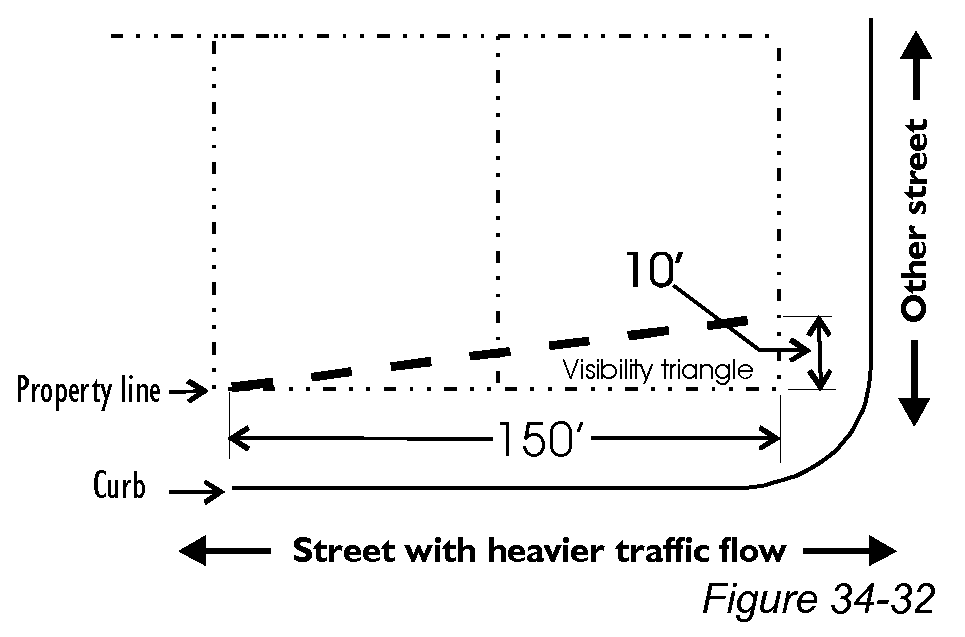
(b)
All other driveways and parking lot entrances. At all other intersections of driveways or parking lot entrances with a street right-of-way or easement, no obstruction shall be planted or erected which materially obstructs the driver's view of approaching traffic or pedestrians within a visibility triangle as shown in Figure 34-33 on both sides of the driveway. No structures (except along Old San Carlos Boulevard) or plantings shall be permitted between two feet and six feet above the average grade of each street within this triangular space.
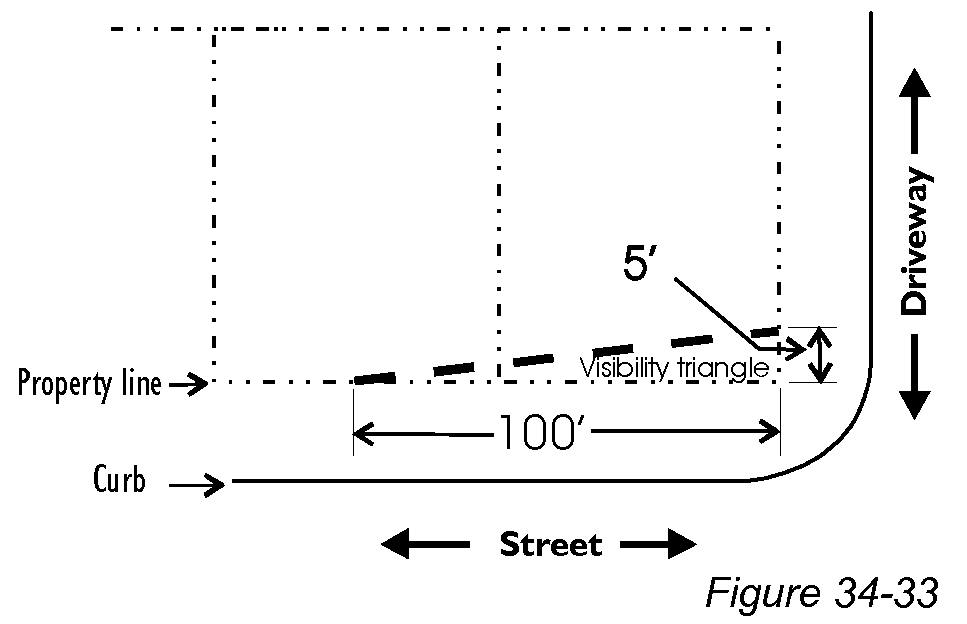
(c)
Trees and shrubs. Where plantings are restricted between two feet and six feet in height, this restriction shall require the property owner to prune shrubs that extend above two feet and tree limbs that hang below six feet. The restriction on plantings shall not apply to the trunks of trees.
Sec. 34-3021. - Subordinate uses.
(a)
Purpose. The purpose of this section is to provide for certain commercial uses provided such uses are clearly subordinate to permitted principal uses of cultural facilities; hotels/motels; multiple-family buildings; park, community or regional; or resorts.
(b)
Permitted uses; restrictions.
(1)
The uses listed in subsection (b)(2) of this section shall be permitted when clearly subordinate to the principal use, subject to the following requirements:
a.
The subordinate use shall be totally within the building(s) housing the principal use;
b.
The subordinate use shall not occupy more than ten percent of the total floor area of the principal use; and
c.
Public access to the subordinate use shall not be evident from any abutting street.
(2)
Uses permitted are:
a.
Personal services.
b.
Retail store, small.
c.
Restaurant.
Sec. 34-3041. - Generally.
(a)
Purpose. The purpose of this subdivision is to specify regulations applicable to certain temporary uses which, because of their impact on surrounding land uses, require a temporary use permit.
(b)
Permit required. No temporary use shall be established until a temporary use permit has been obtained from the director in accordance with the requirements of this chapter. A temporary use permit must be obtained for the following uses in compliance with these requirements:
(1)
Christmas tree sales lots for up to 45 days prior to the holiday;
(2)
Holiday, seasonal or annual sales lots for up to 30 days;
(3)
Temporary promotional activities involving the sale and promotion of goods and services available at a business on the premises, subject to the following:
a.
Activities that obstruct private parking or are held on the adjacent public sidewalk may be held for up to three consecutive days up to three times per calendar year.
b.
Activities that do not obstruct parking and are held on private property may be held for up to ten consecutive days up to three times per calendar year.
c.
Outdoor display of merchandise, not associated with a temporary promotional activity shall be in compliance with LDC § 34-678 Outdoor display and sales of merchandise and food.
(4)
Reserved.
(5)
Construction projects which require storage, parking areas, construction trailers, site screening and/or any other temporary activities during construction of the project and which terminate upon completion of the project.
(6)
Temporary wireless communications facilities, as are necessary to meet demand, for up to six months.
(7)
One-day permits for consumption of alcohol on-premises associated with a temporary event.
(8)
Other similar uses of a temporary nature.
(c)
Lighting. No permanent or temporary lighting shall be installed without an electrical permit and inspection.
(d)
Time limit.
(1)
All temporary uses shall be confined to the dates specified by the director, on the temporary use permit; provided, however, that:
a.
If no time period is specified on the temporary use permit, then the temporary use permit will expire and the use must be abated within 30 days from the date of issuance.
(2)
A temporary use permit may not be renewed or reissued to the same applicant or on the same premises for a similar use more than three times per year.
(e)
Hours of operation. Hours of operation shall be confined to those specified in the permit.
(f)
Cleanup. The site shall be cleared of all debris at the end of the temporary use and all temporary structures shall be removed within 48 hours after termination of the use. A cash bond of a minimum of $25.00 and not to exceed $5,000.00 or a signed contract with a disposal firm may be required as a part of the application for a temporary use permit to ensure that the premises will be cleared of all debris during and after the event.
(g)
Signs. A sign permit may be required for any proposed signs.
(h)
In lieu of. Any proposed use, which exceeds the criteria or regulations of this code subdivision, may apply for a special event permit.
(Ord. No. 20-17, § 7, 1-19-2021)
Sec. 34-3042. - Reserved.
Editor's note— Ord. No. 20-17, § 8, adopted Jan. 19, 2021, repealed § 34-3042 entitled "Carnivals, fairs, circuses and amusement devices."
Sec. 34-3043. - Reserved.
Editor's note— Ord. No. 20-17, § 8, adopted Jan. 19, 2021, repealed § 34-3043 entitled "Christmas tree sales."
Sec. 34-3044. - Reserved.
Editor's note— Ord. No. 20-17, § 8, adopted Jan. 19, 2021, repealed § 34-3044 entitled "Temporary contractor's office and equipment storage shed."
Sec. 34-3045. - Reserved.
Editor's note— Ord. No. 20-17, § 8, adopted Jan. 19, 2021, repealed § 34-3045 entitled "Alcoholic beverages."
Sec. 34-3046. - Reserved.
Editor's note— Ord. No. 20-17, § 8, adopted Jan. 19, 2021, repealed § 34-3046 entitled "Temporary use of mobile home."
Sec. 34-3047. - Reserved.
Editor's note— Ord. No. 20-17, § 8, adopted Jan. 19, 2021, repealed § 34-3047 entitled "Temporary telephone distribution equipment."
Sec. 34-3048. - Reserved.
Editor's note— Ord. No. 20-17, § 8, adopted Jan. 19, 2021, repealed § 34-3048 entitled "Ancillary temporary uses in parking lots."
Sec. 34-3049. - Reserved.
Editor's note— Ord. No. 15-11, § 1, adopted Jan. 4, 2016, deleted § 34-3049 entitled "Seasonal parking lots."
Sec. 34-3050. - Temporary use permits.
(a)
Applicability. Any person desiring to conduct any of the temporary uses described in this subdivision shall be required to submit an application for a temporary use permit.
(b)
Initiation of application. An application for a temporary use permit may be initiated by the town or any individual authorized in accordance with § 34-201(a) of this chapter.
(c)
Submission of application.
(1)
No application shall be accepted unless it is presented on the official forms provided by the director.
(2)
Before an application may be accepted, it must fully comply with all information requirements enumerated in the application form as well as the requirements set forth in subsection (d) of this section.
(3)
The applicant shall ensure that an application is accurate and complete. Any additional expenses necessitated because of any inaccurate or incomplete information submitted shall be borne by the applicant.
(d)
Additional required information. In addition to the application information, the applicant shall submit satisfactory evidence of the following:
(1)
Evidence shall be submitted that adequate sanitary facilities meeting the approval of the county health department are provided.
(2)
Evidence shall be submitted that sounds emanating from the temporary use shall not adversely affect any surrounding property.
(3)
Evidence shall be submitted that all requirements as to providing sufficient parking and loading space are assured.
(4)
When deemed necessary, a bond shall be posted, in addition to an agreement with a responsible person sufficient to guarantee that the ground area used during the conduct of the activity is restored to a condition acceptable to the director.
(5)
All applications for temporary use permits, excluding those for the temporary use of mobile homes following a natural disaster (see § 34-3046 of this chapter), shall provide public liability and property damage insurance. This requirement may be waived by the town council.
(6)
Evidence shall be submitted that, where applicable, the applicant for a proposed use has complied with town ordinances pertaining to special events, including Ordinances Nos. 98-1, 00-16, and any later amendments (see also division 34 of this article).
(7)
Evidence shall be submitted that the law enforcement and fire agencies who will be coordinating traffic control or emergency services have been advised of the plans for a temporary use and that they are satisfied with all aspects under their jurisdiction.
(e)
Inspection following expiration of permit; refund of bonds. Upon expiration of the temporary use permit, the director shall inspect the premises to ensure that the grounds have been cleared of all signs and debris resulting from the temporary use and shall inspect the public right-of-way for damages caused by the temporary use. Within 45 days after a satisfactory inspection report is filed, the director shall process a refund of the bonds. An unsatisfactory inspection report shall be sufficient grounds for the town to retain all or part of the bonds posted to cover the costs which the town would incur for cleanup or repairs.
Sec. 34-3051. - Mobile tourist information centers.
(a)
Defined. Removable tourist information centers are located in a removable vehicle, either self-propelled or otherwise readily moveable from place to place and without plumbing facilities. Removable tourist information centers are intended to promote community businesses and organizations and are therefore limited to providing information without the sale or distribution of any product or service; provided, however, that such centers are permitted to sell tickets, and or assist in the procurement of reservations for local attractions, businesses and events, with preference to areas in the Town of Fort Myers Beach. Removable tourist information centers may not collect food or clothing or accept other donations.
(b)
Type of approval.
(1)
By town council.
a.
Length of permit. A permit to operate a removable tourist information center may be issued for a maximum of one year, and may be renewed annually. No more than two removable tourist information centers may be operating at one time.
b.
Location. Removable tourist information centers may be located in:
1.
Existing parking lots on property zoned commercial. The removable tourist information center must be ancillary to the principal use and the required number of parking spaces for the principal use must be maintained.
2.
If additionally promoting information, education, and reservations for town-owned facilities, activities, and events, then one removable tourist information center may be authorized by town council to be located on town-owned property at the Times Square public plaza; however, in no case shall more than two removable tourist information centers, including the one located in Times Square, may be operating at one time.
c.
Permit requirements. In addition to the requirements found in § 34-3050, organizations must provide a photograph of the removable tourist information center and its dimensions and corresponding locations where the removable tourist information center will be operating, daily hours of operation for a minimum of five days per week, and a site plan of the parking lot, drawn to scale with the location of existing parking spaces and the removable tourist information center. Each removable tourist information center is permitted one 24-square-foot identification sign, mounted on the removable tourist information center, which should be shown in the required photograph. All signage and other variance requests for a removable tourist information center must be approved by town council.
d.
Review of permit. The director will approve or deny the application, in part or whole, based on the removable tourist information center's compatibility with surrounding uses. The removable tourist information center must be maintained in good condition, consistent with the photograph submitted with the application.
e.
Emergency evacuation. Removable tourist information centers must be removed from the town or placed within an approved off-site storage area within 48 hours of the issuance of a hurricane watch for the town by the National Hurricane Center.
(Ord. No. 13-08, § 2(Exh. A), 11-4-2013; Ord. No. 17-17, § I, 11-20-2017)
Sec. 34-3055. - Reserved.
Editor's note— Ord. No. 20-17, § 8, adopted Jan. 19, 2021, repealed § 34-3055 entitled "Special events."

