
Fort Myers Beach City Zoning Code
ARTICLE V
- NONCONFORMITIES26
Cross reference— Nonconforming marine structures, app. A, § 26-48; nonconforming structures on the beach, app. A, § 27-51(c)(6); nonconforming beach rental licenses, app. A, §§ 27-53, 27-55; nonconforming signs, app. A, § 30-56; nonconforming establishments serving alcoholic beverages, app. A, § 34-1264(h); replacing a nonconforming hotel/motel, app. A, § 34-1806.
Sec. 34-3201. - Purpose of article.
The regulations of this code and various amendments thereto have caused or will cause some buildings, uses, or lots to no longer conform with one or more provisions of this code.
(1)
It is the purpose of this article to set forth the rules and regulations regarding those nonconforming buildings, uses, or lots which were created by the adoption of this code or amendments thereto.
(2)
Nothing contained in this article is intended to preclude the enforcement of federal, state, and other local regulations that may be applicable.
Sec. 34-3202. - Three types of nonconformities defined.
(a)
Three types of nonconformities. There are three distinct types of nonconformities recognized by this article, with a separate division devoted to each. In situations where there is more than one type of nonconformity, for example a nonconforming use in a nonconforming building, all relevant divisions shall apply.
(b)
Nonconforming building. For purposes of this article, the term "nonconforming building" means a building or structure, or portion thereof, which was lawful prior to the adoption of any ordinance from which this code is derived, or the adoption of any revision or amendment to this code, or the adoption or amendment to the comprehensive plan, but which fails, by reason of such adoption, revision, or amendment, to conform to specific requirements where the building or structure is located due to its size, dimension, location on the lot, number of dwelling units or guest units, building type, or compliance with floodplain regulations. See division 2 of this article for regulations on nonconforming buildings.
(c)
Nonconforming use. For purposes of this article, the term "nonconforming use" means a use or activity which was lawful prior to the adoption of any ordinance from which this code is derived, or the adoption of any revision or amendment to this code, or the adoption or amendment to the comprehensive plan, but which fails, by reason of such adoption, revision, or amendment, to conform to the use requirements where the property is located. See division 3 of this article for regulations on nonconforming uses.
(d)
Nonconforming lot. For purposes of this article, the term "nonconforming lot" means a lot of which the area, dimension, or location was "lawful" (see definition in § 34-2 of this chapter) prior to the adoption of any ordinance from which this code is derived, or prior to the adoption of any revision or amendment to this code, and which fails by reason of such adoption, revision, amendment, or rezoning to conform to the requirements where the lot is located. However, a lot which no longer conforms due to the adoption or revision of any comprehensive plan can only be developed in accordance with § 34-3274 of this chapter. See division 4 of this article for regulations on nonconforming lots.
Sec. 34-3203. - Illegal buildings, uses and lots.
If a building, use, or lot was not lawful when created and cannot be lawfully modified to comply with this code, it shall not be considered nonconforming but shall be deemed an illegal building, use, or lot and thus not afforded the protection provided by this article to nonconforming buildings, uses or lots.
(1)
Illegal buildings or uses must be lawfully modified to comply with this code or must be removed in accordance with § 34-1(c) of this chapter.
(2)
Illegal lots must be lawfully combined with adjoining land so as to conform with this code, or must remain vacant but still be maintained in accordance with the property maintenance code in division 1, article I, ch. 6 of this code and other town regulations.
Sec. 34-3204. - Amortization.
Notwithstanding the general provisions of this article, other portions of this code may require that specific types of nonconforming buildings and uses must be modified into conformance with this code, or be eliminated, by a specific date. Such dates are established to allow owners a reasonable period to amortize the value of the nonconforming building or use.
Sec. 34-3206. - Nonconformities created by public acquisition.
Public acquisition of a portion of a lot might cause the remainder to become nonconforming as to area, width, depth, setbacks, floor area ratio, or required parking.
(1)
To minimize the adverse effects of such acquisition, previous lawful buildings, structures, or lots that might be rendered nonconforming as to compliance with a specific requirement of this code shall be deemed conforming with that requirement rather than nonconforming.
(2)
This applies whether the acquisition occurred by eminent domain, purchase, or a publicly accepted donation of land or easements.
Sec. 34-3231. - Nonconforming buildings defined.
For purposes of this division, the term "nonconforming building" means a building or structure, or portion thereof, which was lawful prior to the adoption of any ordinance from which this code is derived, or the adoption of any revision or amendment to this code, or the adoption or amendment to the comprehensive plan, but which fails, by reason of such adoption, revision, or amendment, to conform to specific requirements where the building or structure is located due to its size, dimension, location on the lot, number of dwelling units or guest units, building type, or compliance with floodplain regulations.
Sec. 34-3232. - Continued use of a nonconforming building.
The occupancy of a nonconforming building may be continued so long as it remains otherwise lawful. However, if the specific use of a nonconforming building is itself nonconforming, then that use is also subject to the provisions of division 3 of this article.
Sec. 34-3233. - Repairing a nonconforming building.
(a)
Internal repairs, reconstruction, and renewal may be made to nonconforming buildings in accordance with this section.
(1)
A nonconforming building may be altered to decrease its nonconformity.
(2)
Awnings and canopies may be attached to nonconforming buildings as provided in § 34-638(d)(1)d of this chapter.
(3)
Commercial antennas may be installed on nonconforming buildings in accordance with § 34-1443(d) of this chapter.
(4)
Permits may be issued for reroofing and roof repairs for any existing mobile home or recreational vehicle, regardless of lot size.
(b)
Internal repairs, reconstruction, and renewal of certain nonconforming buildings are limited in scope because the town desires for these buildings to be reconstructed in compliance with this code.
(1)
The limitations in this subsection apply only to buildings that are nonconforming:
a.
Due to density or intensity (see § 34-3234(b)(3) of this chapter); or
b.
Due to floodplain regulations (see § 34-3234(b)(4) of this chapter); or
c.
Due to building type (see § 34-3234(b)(5) of this chapter).
(2)
For such nonconforming buildings, the director shall determine whether the repairs, reconstruction, or renewal, alone or in conjunction with other permitted improvements or enlargements, are major enough to be considered a "substantial improvement," as that term is defined in § 6-405 of this LDC. See § 34-3234(b)(1) below, for details.
Sec. 34-3234. - Enlarging a nonconforming building.
(a)
The following types of nonconforming buildings may be physically enlarged, either laterally or vertically, so long as they remain otherwise lawful and the enlargement is in accordance with the regulations in this subsection:
(1)
If nonconforming due to setbacks. A nonconforming building which is lawful in all respects with the exception of a setback requirement or build-to line (see § 34-662 of this chapter) may be enlarged, provided that:
a.
The enlargement is otherwise permitted; and
b.
The enlargement itself, including any enlargement which increases the height or volume of the structure, complies with all the setback requirements and fully complies with any applicable build-to lines.
c.
Also see § 34-268 of this chapter regarding certain administrative setback variances that may be available for nonconforming buildings.
(2)
If nonconforming due to lot area. A nonconforming building which is lawful in all respects with the exception of lot area requirements may be enlarged, provided that:
a.
The enlargement is otherwise permitted;
b.
All other property development requirements such as setbacks, height, floor area ratio, density, intensity, parking, and open space are met.
(3)
If nonconforming due to height. A nonconforming building which is lawful in all respects with the exception of height restrictions may be enlarged, provided that:
a.
The enlargement is otherwise permitted; and
b.
The enlargement itself complies with current height and setback requirements.
(4)
If nonconforming due to floor area ratio. A nonconforming building which is lawful in all respects with the exception of floor-area-ratio shall not be enlarged.
(b)
Certain other types of nonconforming buildings have special limitations on the extent to which they may be repaired and physically enlarged because the town desires for these buildings to be reconstructed in compliance with this code.
(1)
The combined cost of enlargements and any repairs to such nonconforming buildings or structures shall be reviewed by the director to determine whether they are major enough to be considered a "substantial improvement," as that term is defined in § 6-405 of this LDC.
a.
If the improvements do not constitute a "substantial improvement," their value shall be recorded with the director for the purpose of establishing the extent of allowable future repairs, enlargements, or replacements, using the same methodology as for improvements in the floodplain (article IV of ch. 6 of this LDC).
b.
If the improvements constitute a "substantial improvement," they will be approved only if they result in the building fully complying with all regulations for new buildings on vacant land, except as provided in the buildback regulations found in §§ 34-3237 and 34-3238 of this chapter.
(2)
These special limitations on "substantial improvements" apply to the following types of nonconforming buildings, in addition to the specific limitations provided below for each type.
(3)
If nonconforming due to density or intensity. A building, or a group of buildings or structures, may be nonconforming because there are more residential dwelling units, or more guest units, or a greater floor-area-ratio, than currently permitted by this chapter or by the Fort Myers Beach Comprehensive Plan. Substantial improvements to such buildings may not physically enlarge them, either laterally or vertically, and they may not be replaced, except under one of the following three circumstances:
a.
If the enlargement or replacement complies entirely with this code and the comprehensive plan as they apply to new buildings on vacant land, including the current density limits on dwelling units and guest units, current height limits, and current caps on floor-area-ratio; or
b.
If the replacement has been approved by the town council in accordance with the pre-disaster buildback regulations, as described in § 34-3237 of this chapter; or
c.
If the building is damaged or destroyed by a natural disaster and its replacement meets all requirements of the post-disaster buildback regulations, as described in § 34-3238 of this chapter.
(4)
If nonconforming due to floodplain regulations. A nonconforming building whose lowest floor does not meet the base flood elevation requirements for new buildings can only be expanded in accordance with the standards in § 6-472 of this LDC.
(5)
If nonconforming due to building type. Certain buildings are nonconforming due to fundamental design and construction differences between them and new buildings that are permitted in the same zoning district.
a.
Building type described. Examples include recreational vehicles or mobile homes in zoning districts that do not permit them; automobile service stations or drive-through facilities in pedestrian-oriented commercial districts, and storefront buildings in residential districts. However, buildings that might be considered nonconforming solely due to technical changes in the building codes (which are described in article II of ch. 6 of this LDC) are not classified as nonconforming buildings for the purposes of this article and may be expanded if they are otherwise in conformance with all requirements for their location.
b.
Mobile homes outside mobile home parks. See § 34-1921 of this chapter.
c.
Mobile homes in mobile home parks. See §§ 34-694 and 34-1922 of this chapter.
d.
Other nonconforming building types. Other buildings that are nonconforming due to building type cannot be "substantially improved" as described in § 6-405 of this LDC unless they are altered to eliminate this type of nonconformity.
Sec. 34-3235. - Moving a nonconforming building.
(a)
Should a nonconforming building be moved on-site for any reason, for any distance whatever, it shall not be moved unless the relocation decreases the nonconformity.
(b)
A nonconforming building that is being moved off-site shall only be placed on its new site in full conformance with this code.
(c)
See §§ 34-1951 and 34-3103 of this chapter regarding permits for moving buildings.
Sec. 34-3236. - Replacing a nonconforming building.
Nonconforming buildings can be replaced in one of the following manners:
(1)
In full conformance with all current provisions of this code as they apply to new buildings on vacant land; or
(2)
In the same manner as provided for enlargements to the various types of nonconforming buildings as provided in § 34-3234 of this chapter; or
(3)
As provided by the buildback regulations found in §§ 34-3237 and 34-3238 of this chapter.
Sec. 34-3237. - Pre-disaster buildback.
Owners of buildings or groups of buildings that exceed the density, intensity, or height limits for new buildings may seek permission from the town council to voluntarily replace those buildings at up to the existing lawful density or intensity and up to the existing height in accordance with Policy 4-E-1 of the Fort Myers Beach Comprehensive Plan, as follows:
(1)
The replacement building must meet the floodplain regulations for new buildings, as provided in article IV of ch. 6 of this LDC.
(2)
The replacement building must meet the coastal construction requirements that apply to new structures, as provided in article III of ch. 6 of this LDC and in state regulations. Due to these requirements, habitable major structures and most minor structures must be rebuilt landward of the 1978 coastal construction control line.
(3)
The replacement building must comply with all current building, life safety, and accessibility codes.
(4)
The replacement building cannot exceed the lawful density and intensity of the existing building:
a.
As measured for residential buildings in § 34-3238(2)d. of this chapter.;
b.
As measured for hotel/motels in § 34-3238(2)e. of this chapter.; or
c.
As measured for all other buildings by the gross square footage.
(5)
Each specific pre-disaster buildback proposal must be proposed to the town council through the planned development rezoning process (see division 6 of article III of this chapter), along with any proposed deviations from this code.
(6)
The town council will approve, modify, or deny each such request based on its opinion of the degree of conformance of the specific proposal with the Fort Myers Beach Comprehensive Plan, specifically including the plan's land-use and community design policies, pedestrian orientation, and natural resource criteria.
(7)
If the lowest floor of the rebuilt building must be elevated higher than the existing building to comply with current floodplain or coastal regulations, then the total height of the rebuilt building can be increased by the same amount. However, any pre-disaster buildback request for additional height beyond that increment must comply with Policy 4-C-4 of the comprehensive plan in the same manner as that policy would apply to an entirely new building on vacant land.
Sec. 34-3238. - Post-disaster buildback.
Owners of buildings or groups of buildings that exceed the density, intensity, or height limits for new buildings and that are damaged or destroyed by a disaster, including fire, tropical storms, floods, and hurricanes, shall be permitted to replace those buildings at up to their pre-disaster lawful density, intensity, and/or height in accordance with Policy 4-D-1 of the Fort Myers Beach Comprehensive Plan.
(1)
Less than 50 percent damage. If the cost to repair the damaged building is less than 50 percent of the building's value and the repair is thus not a "substantial improvement" as that term is defined in § 6-405 of this LDC, then the following rules shall apply:
a.
The repairs may be made without bringing the building into full compliance with the requirements of this code for building size, dimension, location on the lot, number of dwelling units or guest units, building type, or compliance with floodplain regulations.
b.
The repairs may not physically enlarge the building either laterally or vertically, with the following potential exception:
1.
During the repair process, owners may wish to elevate lawfully existing dwelling units or guest units that do not comply with the floodplain regulations in ch. 6, art. IV of this Land Development Code.
2.
To encourage this elevation, the director may administratively modify setbacks, open space, buffer, or height requirements to the minimum extent that would accommodate rebuilding the units in conformance with ch. 6 of this LDC up to their existing interior square footage, as computed in accordance with subsections (2)d.1. or e.1 of this section.
3.
However, if the combined cost to repair the damage and elevate the units exceeds 50 percent of the building's value, then all provisions of subsection (2) of this section will apply.
c.
All repairs must comply with all current building, life safety, and accessibility codes.
(2)
More than 50 percent damage. If the cost to repair or rebuild the damaged building is more than 50 percent of the building's value and is thus a "substantial improvement" as that term is defined in § 6-405 of this LDC, then the following rules shall apply:
a.
The building must meet the floodplain regulations for new buildings, as provided in article IV of ch. 6 of this LDC.
b.
The building must meet the coastal construction requirements that apply to new structures and portions thereof, as provided in article III of ch. 6 of this LDC and in state regulations. Due to these requirements, habitable major structures and most minor structures that are damaged by more than 50 percent must be rebuilt landward of the 1978 Coastal Construction Control Line.
c.
The building must comply with all current building, life safety, and accessibility codes.
d.
A property owner wishing to exceed the square footage limitations contained within the post-disaster buildback regulations, may be eligible to request additional square footage through a commercial planned development or a residential planned development.
e.
Residential buildings. A rebuilt residential building may exceed the density limits for new buildings on vacant land but cannot exceed the legally documented number of dwelling units in the building immediately before the natural disaster.
1.
The total interior square footage above base flood elevation of the reconstructed building may not exceed the square footage of the total under roof square footage of the previous structure. The square footage under roof means the area within the perimeter of the roof, multiplied by the number of stories that existed prior to the disaster, including stories below flood elevation (see Figure 34-35).
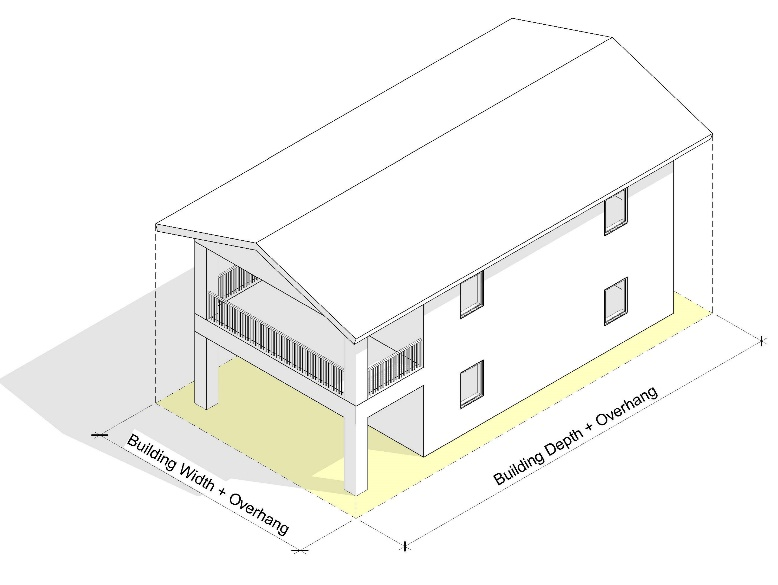 | Figure 34-35 illustrates the area that is counted toward the total under roof square footage, as referenced in § 34-3238.d.1. above. |
2.
At the owner's option, this same square footage can be used for fewer but larger dwelling units.
3.
Also at the owner's option, the number of dwelling units and the square footage of the new building may be determined by this code's current regulations for new buildings on the same site instead of using either the pre-disaster or post-disaster buildback regulations.
4.
The number of bedrooms may not exceed the legally documented number of bedrooms in the dwelling unit immediately before the natural disaster. The number of full bathrooms may only be increased to equal the number of bedrooms in the structure.
(a)
A property owner may request an increase in the number of bedrooms and bathrooms, through the special exception process.
5.
Once additional square footage is added to the structure for post-disaster buildback, no additional below flood elevation square footage may be added for future disaster rebuilds.
f.
Hotels/motels. A rebuilt hotel/motel may exceed the equivalency factor multiplier limits for new hotel/motel buildings, but cannot exceed the documented square footage within the building footprint immediately before the natural disaster.
1.
The total interior square footage above base flood elevation of the reconstructed building may not exceed the square footage of the total under roof square footage of the previous structure. The square footage under roof means the area within the perimeter of the roof, multiplied by the number of stories that existed prior to the disaster, including stories below flood elevation.
(a)
A property owner may request up to 30 square feet of additional space per room, through the special exception process.
2.
If the additional square footage gained does not provide adequate space to meet building or ADA codes, additional space may be allocated for that purpose, with designs illustrating the square footage needed.
3.
The owner may choose to reduce the number of rooms or increase the number of rooms but may not create more guest unit space than defined in subsection 34-3238(2)e.1.
4.
This section may not be used to increase the number of guest units in a hotel that previously had 49 rooms or less to more than 49 rooms.
g.
All buildings. The new building must comply with all other zoning and development regulations except where compliance with such regulations would preclude reconstruction otherwise intended by Policy 4-D-1 of the comprehensive plan. Specifically:
1.
If the lowest floor of the rebuilt building must be elevated higher than the damaged or destroyed building to comply with current floodplain or coastal regulations, then the total height of the rebuilt building can be increased by the same amount.
2.
If a rebuilt building must be set back further from any property lines due to current requirements of this code, then the volume of the building so reduced can be rebuilt elsewhere on the site, including one or more extra stories on the building if in the opinion of the director there is no other suitable location to replace the volume.
3.
If current open space, parking, landscaping or buffer regulations cannot be met, those requirements may be reduced through a written determination by the director.
(Ord. No. 23-18, § 2(Exh. A), 12-18-2023)
Sec. 34-3241. - Nonconforming uses generally.
(a)
For purposes of this division, the term "nonconforming use" means a use or activity which was lawful prior to the adoption of any ordinance from which this code is derived, or the adoption of any revision or amendment to this code, or the adoption or amendment to the comprehensive plan, but which fails, by reason of such adoption, revision, or amendment, to conform to the use requirements where the property is located.
(b)
A residential use may not conform because it contains one or more dwelling units more than are permitted under current regulations. If the extra dwelling unit(s) were fully lawful at the time they were created, for the purposes of this article they shall be deemed a nonconforming building rather than a nonconforming use. The regulations governing nonconforming buildings are found in division 2 of this article; see especially § 34-3234(b)(3) of this chapter for restrictions on expanding buildings that are nonconforming due to density or intensity.
(c)
A nonconforming use of a building, land, or building and land in combination may be continued subject to the limitations found in this division. If the nonconforming use is located in a nonconforming building, the additional requirements of division 2 of this article shall also apply to the building.
Sec. 34-3242. - Enlarging a nonconforming use.
(a)
No such nonconforming use shall be extended or enlarged:
(1)
By having any buildings or structures replaced or expanded in physical size; or
(2)
By any increase in land or water area devoted to the nonconforming use; or
(3)
By any increase in the size or number or vehicles and boats, or increase in the capacity of services such as parking lots that would expand the operation of the nonconforming use.
(b)
No additional structures shall be erected in connection with a nonconforming use.
(c)
Nonconforming establishments that sell, serve, or allow the consumption of alcoholic beverages are further limited by § 34-1264(h) of this chapter.
(d)
The installation of a commercial antenna on a building containing a nonconforming use will not be deemed to constitute an expansion of the nonconforming use (see § 34-1443(d) of this chapter).
Sec. 34-3243. - Replacing a nonconforming use.
No nonconforming use shall be replaced by another use not specifically permitted where the nonconforming use is located.
Sec. 34-3244. - Discontinuing a nonconforming use.
When a nonconforming use is discontinued or abandoned for nine consecutive months, the use shall not thereafter be carried out or reestablished except in conformance with all current regulations.
Sec. 34-3245. - Repairing a building containing a nonconforming use.
Only ordinary repairs and maintenance, including repairs of roof covering, walls, fixtures, wiring, or plumbing, shall be permitted on any building or structure devoted to a nonconforming use. In no case shall such repairs include structural alterations.
Sec. 34-3246. - Nonconforming uses approved by special exception or permit.
Uses approved by special exception or other permits which were issued or granted by the town council or board of county commissioners before the effective date of any ordinance from which this code is derived, and which are no longer permitted in the zoning district where located, shall be considered to be nonconforming uses and subject to the provisions of this article if the actual use was in operation within two years after its approval by special exception or other permit and has not thereafter been discontinued or abandoned for any nine consecutive months.
Sec. 34-3271. - Definition of nonconforming lot.
(a)
Lot means a parcel of land that has been created from a larger parcel and whose precise dimensions and location were identified through public notice (see § 34-3272, below).
(b)
"Nonconforming lot" means a lot of which the area, dimension, or location was "lawful" (see definition in § 34-2 of this LDC) prior to the adoption of any ordinance from which this code is derived, or prior to the adoption of any revision or amendment to this code, or prior to being rezoned, and which fails by reason of such adoption, revision, amendment, or rezoning to conform to the requirements where the lot is located. However, a lot which no longer conforms due to the adoption or revision of any comprehensive plan can only be developed in accordance with § 34-3274 of this chapter.
(c)
See § 34-3234(a)(2) of this chapter for the situation where a nonconforming building with a conforming use exists on a lot whose lot area is smaller than required by its zoning district.
Sec. 34-3272. - Determining when a lot was created.
For the purpose of this division, a lot is deemed to have been "created" on such date that one of the following conditions occur, provided the configuration of the lot was not later altered:
(1)
Individual deed. The date that a deed for the lot containing its full legal description was lawfully recorded in the official record books in the office of the clerk of the circuit court of the county.
(2)
Subdivision plat. The date that a subdivision plat has been lawfully recorded in the plat books in the office of the clerk of the circuit court of the county, if the individual lot is clearly identified as a part of that subdivision.
Sec. 34-3273. - General requirements for residential uses on nonconforming lots.
Nonconforming lots may be developed subject to the following provisions:
(1)
All other regulations of this chapter shall be met, except as modified by this division.
(2)
A residential building may be placed on a single nonconforming lot provided the lot receives an affirmative minimum use determination per section 34-3274.
(3)
Any development on nonconforming lots must comply with all density restrictions of the Fort Myers Beach Comprehensive Plan.
a.
Density computations shall be in accordance with § 34-632 of this chapter.
b.
If density computations do not allow even one dwelling unit on a nonconforming lot, one single-family residence may still be permitted if a minimum-use determination is obtained in accordance with § 34-3274, below.
(4)
No division of any nonconforming lot may be permitted which creates a lot with width, depth, or area below the minimum requirements stated in this chapter, except for combinations and redivisions in accordance with § 34-3275 of this chapter.
(5)
The burden of proof for demonstrating that a lot is a nonconforming lot in accordance with this division, and lawfully existed at the specified date, shall be with the owner.
(6)
The remaining lot after condemnation shall be treated in accordance with § 34-3206 of this chapter.
(7)
A nonconforming lot, which previously had or currently has a residence constructed on it, and receives an affirmative minimum use determination per section 34-3274 may request an administrative setback variance in accordance with section 34-268.
(Ord. No. 21-04, § 2, 6-7-2021; Ord. No. 23-03, § 2(Exh. A), 2-21-2023)
Sec. 34-3274. - Minimum use determinations.
(a)
A single-family residence may be constructed on a nonconforming lot which does not comply with the density requirements of the Fort Myers Beach Comprehensive Plan, provided the owner receives a favorable administrative interpretation of the single-family residence provision (also known as a minimum use determination) in accordance with ch. 15 of the Fort Myers Beach Comprehensive Plan, and the criteria included in subsection 34-3274(b). Density created through this process may not be transferred to any other property.
(b)
To qualify for a minimum use determination, the following additional requirements must be met:
(1)
Minimum lot requirements:
a.
The property is a legally platted, recorded lot; and
b.
The property has access to a developed, public right-of-way by an approved access easement; and
c.
The property has access to and will be connected to utilities; and
d.
The lot is located within a future land use and zoning district that permits construction of a single-family residence.
(2)
Unplatted lot (a lot that is described in metes and bounds only and does not exist as part of a recorded subdivision) requirements:
a.
The owner of any unplatted lot must provide evidence of the lots existence prior to town incorporation, (January 1, 1996), and the lot's current legal description must match the lot's legal description prior to incorporation;
b.
The property has access to a developed, public right-of-way by an approved access easement; and
c.
The property has access to and will be connected to utilities.
(c)
Lots qualifying for a minimum use determination may not place the home, accessory structures, or driveways on any land in the "wetlands" or "recreation" category on the future land use map of the comprehensive plan.
(d)
The rights granted by a minimum use determination run with the lot and are available to any subsequent owner if the lot is transferred in its entirety.
(e)
Applications for a minimum use determination shall be filed with the town clerk in accordance with ch. 15 of the comprehensive plan. Complete applications will be reviewed by the legal counsel for the local planning agency (see § 34-124(3) of this chapter) and may be referred to the local planning agency for a decision (see § 34-120(6) of this chapter).
(Ord. No. 20-01, § 2, 2-18-2020; Ord. No. 23-03, § 2(Exh. A), 2-21-2023)
Sec. 34-3275. - Combining nonconforming lots.
(a)
Abutting nonconforming lots may be combined and redivided to create larger dimension lots as long as such recombination includes all parts of all lots, allowable density is not increased, and all setback requirements are met. Under these conditions the new lots do not need to meet this code's dimensional requirements for new lots.
(b)
If two or more abutting nonconforming lots each qualify for the right to construct a single-family residence, and if the lots or parcels are located in a zoning district that permits two-family dwellings, the property owner may combine the lots to build a single two-family building in lieu of constructing two single-family residences.
Sec. 34-3276. - Replacing a mobile home on a nonconforming lot.
A mobile home may be replaced on a nonconforming lot only if allowed by the zoning district regulations and only in accordance with § 34-3234(b)(5) of this chapter.
Sec. 34-3277. - Commercial use on a nonconforming lot.
(a)
A commercial use of land may be commenced on a single nonconforming lot lawfully existing on February 4, 1978, subject to the specific limitations and regulations set forth in this section, provided that the lot is zoned for such use. However, the lot must be appropriately located and adequate in size and dimension to accommodate the use contemplated and all spatial requirements, i.e., proposed structures, setbacks, parking, access, surface water management facilities, and, where required, buffers, in addition to these specific requirements:
(1)
Lots created prior to 1962. If the nonconforming lot was lawfully created prior to June 1962, it must be at least 4,000 square feet in area and have a minimum width of 40 feet and a minimum depth of 75 feet. Minimum setbacks for structures are as follows:
a.
Street setbacks, build-to lines, and waterbody setbacks shall be as set forth in the regulations for the applicable zoning district.
b.
Side setbacks shall be 20 percent of lot width, or 15 feet, whichever is less.
c.
Rear setbacks shall be one-half of the lot depth less the street setback, or five feet, whichever is greater, but not more than 25 feet.
(2)
Lots created 1962—1978. If the nonconforming lot was created between June 1962 and January 5, 1978, and was lawfully existing on February 4, 1978, it must be at least 7,500 square feet in area and have a minimum width of 75 feet and a minimum depth of 100 feet. Minimum setbacks for structures are as follows:
a.
Street setbacks, build-to lines, and waterbody setbacks shall be as set forth in the regulations for the applicable zoning district.
b.
Side setbacks shall be 15 feet.
c.
Rear setbacks shall be one-half the lot depth less the street setback, or five feet, whichever is greater, but not more than 25 feet.
(b)
Nothing in this division shall be construed to prohibit the rezoning of nonconforming lots into commercial districts where the public interest is served by such a rezoning.

