
Frederick City Zoning Code
Sec. 405
DIMENSIONAL AND DENSITY REGULATIONS
Purpose: This section establishes minimum standards for the height, number of stories, and size of buildings and other structures; the percentage of a lot that may be occupied; the size of yards, courts, and other open spaces; the density of population; and the location and use of buildings, signs, structures and land pursuant to Section 4-104 of the Land Use Article of the Annotated Code of Maryland.
(a)
Generally. No building permit or zoning certificate shall be issued unless the proposed development conforms to the design regulations prescribed within the applicable zoning district. The design regulations for each district are included in Table 405-1 below. Specific rules of interpretation and exceptions to the zoning district design regulations are as set forth below and in the Lot and Block regulations (Section 606).
Table 405-1 Dimensional Regulations
(*) end units only
(**) at least one side
Rules for Interpretation of Table 405-1:
Generally. Refer to Appendix A for definitions. A dash ("—") indicates that the requirement does not apply within the particular zoning district.
Column (A): Refers to the applicable Zoning District.
Column (B): The minimum lot size is the size of a lot measured within the lot lines and expressed in terms of square feet.
Column (C): The maximum density requirements (Column (C)) are expressed in dwelling units per gross acre.
Column (D): The frontage of a parcel of land is that distance where a property line is common with a street right-of-way line. Where a lot fronts on two or more streets, minimum street frontage width requirements shall be considered met if the frontage along any one of such streets meets the minimum street frontage width requirements.
Column (E): Building height is expressed in feet. See subsection (f) of this section for rules of measurement for residential structures.
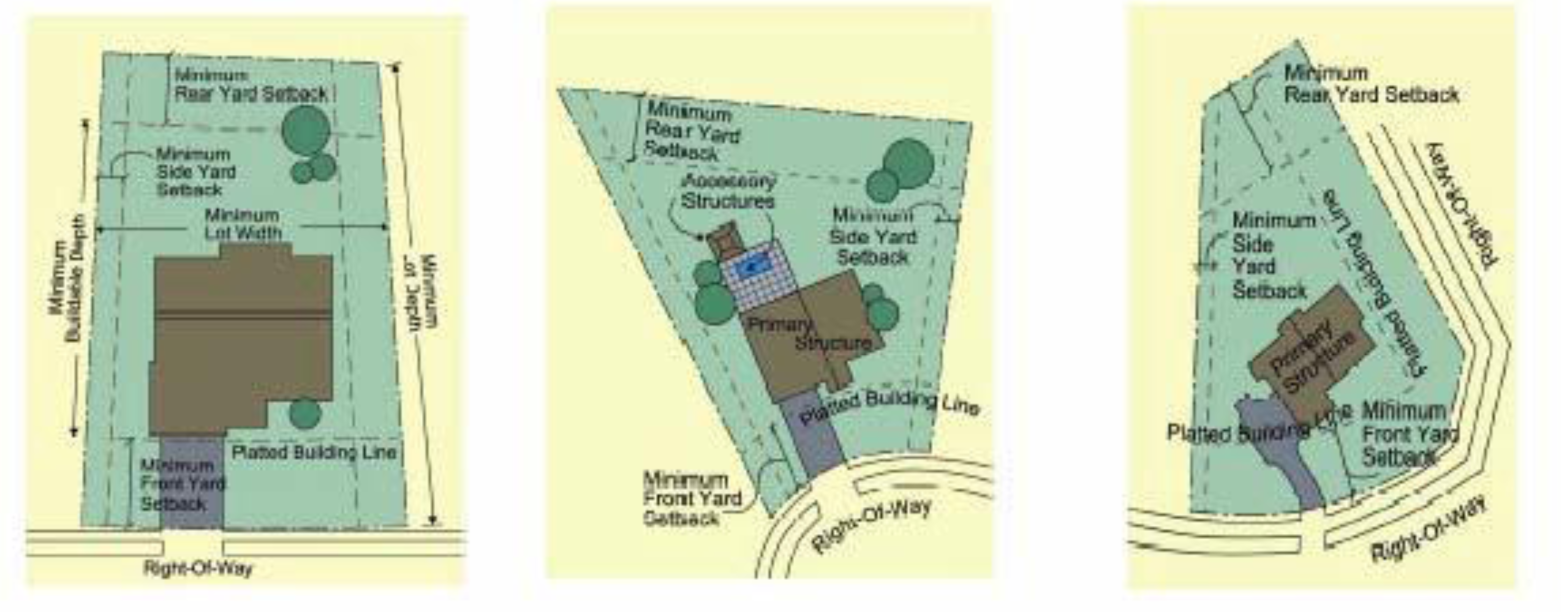
Columns (F): The street setback refers to the distance from the street right-of-way line to the nearest enclosed portion of the principal building or group of buildings. A street lot line or front lot line means any lot line that abuts a street.
Column (G): The interior setback is the horizontal distance extending from the side property line to the nearest enclosed portion of the principal building or group of buildings. The side property line is any lot line other than a front lot line or a rear lot line as defined for Columns (F) or (H).
Column (H): The rear setback is a line extending from the rear lot line to the nearest enclosed portion of the principal building or group of buildings. The rear lot line is the lot line that is opposite and most parallel to the front lot line. If the rear lot line is less than ten feet long or the lot comes to a point at the rear, the rear lot line is assumed to be a line not less than ten feet long, which lies wholly within the lot and is parallel to the front lot line. The rear lot line is parallel to the chord of the arc of the lot's front lot line.
Column (I): The impervious surface ratio establishes the maximum amount of new impervious surface on a lot, including building footprints and paved parking areas, by multiplying the gross land area of the lot by the ratio established in Column (I).
(b)
Structures Permitted Above Height Limit.
(1)
The building height limitations of this Code shall not apply to the following elements, subject to subsections (2) through (4), below:
Table 405-2 Permitted Height Encroachments
Rules of Interpretation for Table 405-2: A check mark (✓) in Column B means that the element or feature is permitted in any district or any use, subject to the requirements below. A check mark (✓) in Column C means that the element or feature is permitted in any commercial or industrial district.
(2)
In commercial or industrial zoning districts:
A.
The Zoning Administrator may approve a height encroachment for a feature not expressly listed in Table 405-2 if he finds that the manufacturing process or use requires a greater height.
B.
No structure shall exceed 150 feet in total height above ground.
C.
All such structures above the heights otherwise permitted in the district shall not occupy more than 25 percent of the area of the lot, and shall be located at least 25 feet in all parts from every lot line other than a street lot line.
(3)
The building height limitations of this Code shall not apply to churches, schools, institutional buildings, or public utility buildings and structures, if:
A.
The building or structure is located at least 600 feet from any Residential, DR, PB, or DB-O district; and
B.
For each three feet by which the height of such building or structure exceeds the maximum height otherwise permitted in the district, its side and rear yards, where required, shall be increased in width or depth by an additional foot over the minimum side and rear yards required for the highest building otherwise permitted in the district; and
C.
Where not otherwise required, a side yard on each side and a rear yard shall be provided equal in width or depth to one foot for each three feet of such excess height.
(4)
The building height limitation of this Code for buildings or structures in the M1 and M2 districts may be modified by the Planning Commission provided the following conditions are met:
A.
The building or structure is located at least 600 feet from any Residential, DR, PB, or DB-O district; and
B.
For each three feet by which the height of such building or structure exceeds the maximum height otherwise permitted in the district, its side and rear yards, where required, shall be increased in width or depth by an additional foot over the minimum side and rear yards required for the highest building otherwise permitted in the district; and
C.
Where not otherwise required, a side yard on each side and a rear yard shall be provided equal in width or depth to one foot for each three feet of such excess height.
(5)
Within the Historic District Overlay (HDO) or the Carroll Creek Overlay (CCO), no height encroachment listed in subsections (1)—(4) is permitted unless it is approved by the Reviewing Authority. A copy of the approved HDC Level I Plan shall be submitted to the Planning Commission for review at the time of submittal of the site plan.
(6)
In the R16 and R20 districts, building heights exceeding the maximum prescribed by Table 405-1 are authorized as a conditional use if three additional feet of side yard setback is provided for each story in excess of three.
(c)
Modification to Front and Interior yard setbacks.Section 606(j) of the LMC provides for modification of front and interior yard requirements in primarily developed portions of the City.
(d)
Density Bonus for MPDUs.
(1)
In General. As an incentive to developers to construct more than the minimum required number of MPDUs, a development project that is subject to the requirements of Chapter 19 of the City Code may deviate from the density regulations set forth in this article, as described in this subsection (e).
(2)
Euclidean Zoning Districts. For a development project located in any of the zoning districts established in Table 401-1 of this LMC, the maximum density set forth in Table 405-1, Column (C) may be exceeded with a corresponding increase in the MPDU requirement as set forth in subsection (e)(7) of this section.
(3)
Planned Neighborhood Developments. For a PND project, the maximum density calculated pursuant to Section 410(f)(3) of this LMC may be exceeded with a corresponding increase in the MPDU requirement as set forth in subsection (e)(7) of this section.
(4)
Traditional Neighborhood Developments. For a TND project, the maximum density for multiple-family or detached dwellings set forth in Table 411-1, Column (E) may be exceeded with a corresponding increase in the MPDU requirement as set forth in subsection (e)(7) of this section.
(5)
Mixed Use Districts. For a MU-1 or MU-2 project, the maximum density for residential uses set forth in Table 417-1, Column (E) may be exceeded with a corresponding increase in the MPDU requirement as set forth in subsection (e)(7) of this section.
(6)
Mixed Use Employment Center. For a MXE project, the maximum density for multiple-family dwelling units set forth in Section 418(d) may be exceeded with a corresponding increase in the MPDU requirement as set forth in subsection (e)(7) of this section.
(7)
Density Bonus.
Table 405-3 Density Bonuses
(e)
Building Height in Residential Districts.
(1)
In any residential district a lot of record may not be graded prior to construction for the sole purpose of increasing the average finished grade from which the height is measured.
(2)
In the R4 and R6 districts, the maximum building height of a structure;
(A)
with a flat roof is 35 feet as measured to the highest point of the roof: and
(B)
with a pitched roof is 35 feet as measured at the midpoint between the eaves and the highest point of the roof, not to exceed 40 feet at its highest point.
(f)
Building Envelope. Except as otherwise provided in this LMC. No part of any structure may project beyond the building envelope defined by the minimum street and interior setbacks and the maximum building heights applicable to the zoning district in which the structure is located.
(Supp. No. 1, Ord. No. G-05-13, § 4, 9-15-05; Supp. No. 5, Ord. No. G-07-22, § 5, 10-18-07; Supp. No. 2, Ord. No. G-05-17, § 2, 12-19-05; Supp. No. 1, Ord. No. G-05-13, § 5, 9-15-05; Supp. No. 8, Ord. No. G-08-21, § 3, 12-18-09; Ord. No. G-12-25, § 1, 10-18-12; Ord. No. G-18-17, § I, 9-6-18; Ord. No. G-19-31, § III, 10-17-19; Ord. No. G-22-11, § I, 9-15-22)

