
Fresno City Zoning Code
PART III
- REGULATIONS APPLYING TO SOME OR ALL DISTRICTS
SEC. 15-2001.- PURPOSE.
The purpose of this article is to prescribe development and site regulations that apply, except where specifically stated, to development in all districts. These standards shall be used in conjunction with the standards for each zoning district located in Part II, Base and Overlay District Regulations. In any case of conflict, the more strict regulation shall govern.
(Added Ord. 2015-39, § 1, eff. 1-9-16).
SEC. 15-2002. - SETBACKS FROM LANDSCAPE EASEMENTS.
A.
Where an approved tentative tract map or tentative parcel map requires a landscaped area, easement, and/or trail abutting a Major Street or any other area where determined appropriate by the Review Authority, and where access rights have been relinquished, a wall per Section 15-2008-C, Screening Wall Standards, shall be placed at the rear of the required landscape area.
B.
Setback Requirements. For purposes of setbacks, the distance for all structures, pools, fences, etc. shall be measured as follows:
1.
RS Districts: The setback shall be measured from the rear of the required landscape setback/easement.
2.
All Other Districts.
a.
Landscape Easements With a Trail. The setback shall be measured from the back of the walkway or sidewalk, but in no instance shall any structure, pool, fence, etc. be constructed within the easement.
b.
Landscape Easements Without a Trail. The setback shall be measured from the rear of the required landscape setback/easement.
(Added Ord. 2015-39, § 1, eff. 1-9-16; Am. Ord. 2018-25, § 18, eff. 6-11-18).
SEC. 15-2003. - TRAILS.
A.
Whenever a trail is identified on an operative plan, the trail shall be constructed per City standards. Access to trails shall be provided per Section 15-4109-B, Trails and Natural Features.
B.
When there is a demonstrated need, landscaping with appropriate adequate physical and visual barriers (e.g., masonry walls, wrought-iron, or tube steel fencing) shall be provided to screen path and trail rights-of-ways and separate paths and trails from mining operations, drainage facilities, and similar locations.
C.
Path and Trail Crossings. To the extent feasible, vehicle crossings shall be limited to two per 660 feet.
(Added Ord. 2015-39, § 1, eff. 1-9-16).
SEC. 15-2004. - ACCESSORY BUILDINGS AND STRUCTURES.
A.
Applicability. These provisions apply to:
1.
All new structures over seven feet in height, including, but not limited to, garages, carports, porte-cocheres, sheds, workshops, gazebos, greenhouses, cabanas, trellises, play structures, aviaries, covered patios, etc. which collectively shall be referred to as Accessory Structures, that are attached or detached from and accessory to the main building on the site.
2.
Decks and patios that are 30 inches above the ground elevation, excluding above-ground pools.
B.
Relation to Other Structures.
1.
A detached accessory building may be constructed on a lot on which there is a permitted main building to which the accessory building is related.
2.
Should the ownership of two contiguous and immediately adjoining residential lots be the same and one lot contains a single-unit home, an accessory building (with the exception of required parking) and/or pool, may be permitted on the adjoining vacant lot subject to compliance with all property development standards. The owner shall sign a covenant, which will at a minimum require that any improvements, such as pools, storage sheds, etc., be removed should either parcel be sold separately.
3.
An accessory building may be constructed prior to a permitted main building and used for not more than one year in connection with the construction of the main building. The owner shall sign a covenant, which will at a minimum, require that the accessory structure be removed should the main building not be constructed.
C.
Residential Districts.
1.
For habitable accessory structures, including Second/Accessory Dwelling Units (ADUs), refer to Section 15-2754. For outdoor kitchens see 15-2753, Second and Outdoor Kitchens.
2.
An Accessory Structure may have plumbing for a washer, dryer, and/or utility sink.
3.
An Accessory Structure may contain a toilet, shower, and sink. Bathtubs and stoves are not permitted.
4.
Existing accessory structures that do not comply with the strict application of the required setbacks of the underlying zone district, may install a toilet, shower, sink, and plumbing for a washer, dryer, or utility sink, subject to compliance with the adopted Building Code. This exception does not allow for a reduction in required parking spaces, parking space dimensions, building regulations, or any other adopted standards.
D.
Setbacks. Accessory Structures shall comply with the standards below.
1.
All Districts.
a.
Front and Street-Side Yards. Accessory Structures may not be located within required front yard or street-side setback areas.
b.
Alleys. Accessory Structures shall be set back a minimum of five feet from an alley if the Accessory Structure utilizes the alley for vehicle access.
2.
Single-Unit Districts.
a.
Front Yards. Not permitted, unless on a Double Frontage Lot (e.g., Through Lot). In the case of the latter, both street frontages shall be treated as Front Yards.
b.
Interior-Side and Rear Yards. Accessory Structures shall be set back from interior side and rear property lines as follows:
i.
If the Accessory Structure is located closer than six feet from the main building, the Accessory Structure shall comply with the setbacks of the applicable Base and Overlay District.
ii.
If the Accessory Structure is located six feet away or farther from the main building, it may be located on the interior or rear property line. Said structure shall comply with the Building Code.
3.
Multi-Unit Districts.
a.
Front Yards.
i.
Accessory Structures shall be located to the rear of main buildings.
ii.
Detached garages and/or carports shall be located away from adjacent public roadways, to the rear, or shall be perpendicular to adjacent roadways to the greatest extent feasible.
b.
Interior-Side and Rear Yards. Accessory Structures shall be set back from interior side and rear property lines as follows:
i.
If Adjacent to Single-Unit Districts. Accessory Structures, including garages and covered parking spaces, shall be set back per the underlying district or operative plan, whichever is greater.
ii.
All Other Districts. Five feet.
4.
Non-Residential Districts. Accessory Structures shall comply with the setbacks per the underlying district or operative plan, whichever is greater.
E.
Height. Accessory Structures are subject to the height limitations specific to the zoning district in which they are located except as provided below in Residential Districts.
1.
Residential Districts.
a.
Parcels 10,000 Square Feet and Less. Accessory Structures shall be no greater than 12 feet high measured from the ground level to the finished height of the structure.
b.
Parcels Greater than 10,000 Square Feet. Accessory Structures located a minimum of 10 feet from all property lines may be up to 16 feet high.
2.
Additional Height. The Director may allow additional height not to exceed the height of the main building provided the Accessory Structure is designed, in terms of materials and architectural styles, to match the main building. The setbacks described above shall still be applicable.
F.
Tree Houses and Play Structures.
1.
When exceeding twelve feet in height, as measured from the ground level to the top of the structure, the structure must be set back to a distance equal or greater than its height.
2.
When exceeding 120 square feet, a building permit is required.
3.
If the structure overlooks a neighboring residential rear yard, landscaped screening shall be provided. This requirement may be waived with the written agreement of the affected neighbor(s) at the time the structure is constructed.
(Added Ord. 2015-39, § 1, eff. 1-9-16; Am. Ord. 2017-33, § 10, eff. 7-30-17; Am. Ord. 2018-66, §§ 13, 14, eff. 1-18-19; Am. Ord. 2025-024, § 31, eff. 7-27-25).
SEC. 15-2005. - POOLS AND SPAS.
A.
Swimming pools, including slides and decorative features, Jacuzzis, and spas shall not be located in the front or street-side yards, and shall be set back a minimum of five feet from interior side and rear property lines.
B.
All equipment shall comply with all applicable noise standards. If needed, equipment shall be baffled and/or enclosed to reduce noise to acceptable levels.
(Added Ord. 2015-39, § 1, eff. 1-9-16; Am. Ord. 2017-33, § 11, eff. 7-30-17).
SEC. 15-2006. - FENCES, WALLS, AND HEDGES.
Fences, walls, dense hedges, and similar structures, collectively referred to as "fences" for purposes of this section, shall comply with the following standards.
A.
Applicability. The standards of this section apply to:
1.
New fences, hedges, or walls;
2.
New development;
3.
Building additions to existing buildings that expand the existing floor area by at least 20 percent, or 2,500 square feet, whichever is less, not including Single-Unit Dwellings or Duplexes. The addition and/or expansion shall be cumulative from the date of adoption of this Code;
4.
A new building on a developed site when the new building is more than 300 square feet. The 300 square feet shall be cumulative from the date of adoption of this Code;
5.
The demolition and reconstruction of a site;
6.
A request for a Discretionary Permit;
7.
Change from one category of use classification to another (i.e., changing from a Commercial Use Classification to a Residential Use Classification as identified in the Use Regulation table of the Base District; or,
8.
Condominium Conversions.
9.
Exceptions. The standards of this section do not apply to fences that are part of a designated historic site.
B.
Fence and Height Locations for All Districts.
1.
Other Regulations. Fences shall comply with the setback requirements below, unless a greater setback is required by an operative plan, an adopted policy, or a condition of project approval.
2.
Subdivision Approval Conditions. In certain circumstances, such as at the rear of landscape easements, fence locations are identified as part of the subdivision approval process. In such cases and in the potential case of conflict with this section, the map conditions of approval shall govern.
3.
Street-Facing References. Street-facing includes all roadways, including highways.
4.
Parking Lot Entrances. Fence and gate locations may need to provide greater setbacks than those listed in this section to allow for vehicle stacking. This includes fencing that limits access to parking lots.
C.
Fence Height and Locations for Single-Unit Homes.
1.
Front Yards.
a.
Wrought Iron or Tubular Steel. A fence up to four feet in height may be installed within any required front yard setback. Fences must be open a minimum of 80 percent (e.g., no more than 20 percent opaque) to allow for the passage of light and air.
b.
All Other Materials. A fence up to three feet in height may be placed within any required front yard setback.
i.
Exception. Front yard fences on parcels within the Pinedale Neighborhood Plan area may be up to four feet in height in the front yard, regardless of material, however fences shall comply with Section 15-2018, Intersection Visibility.
2.
Side-Street Yards. Fences up to six feet in height may be installed within any required street-side yard setback.
3.
Other Yards. Fences up to six feet in height may be installed. Fences, regardless of location on the site, shall not exceed six feet in height.
4.
Through Lots. Both street frontages shall be considered Front Yards.
5.
Setbacks. Unless a greater setback is required in another section of this Code, fences shall be set back 12 inches from the back of adjacent sidewalks, or from the curb or shoulder if there is no sidewalk. Fences may be placed on interior side and rear property lines.
6.
Right-of-Way. In no circumstance may any fence be placed in the public right-of-way unless specified elsewhere in this Code.
D.
Fence Height and Locations for Multi-Unit Districts.
1.
Front Yards.
a.
Where a lot is on the same block frontage with parcels that are zoned for Single-Unit uses, fencing shall comply with fencing standards of the Single-Unit District in Subsection 15-2006-C.
b.
If the block does not contain Single-Unit zoned lots:
i.
Wrought Iron or Tubular Steel: A fence up to four feet in height may be installed within any required front yard setback. Fences must be open a minimum of 80 percent (e.g., no more than 20 percent opaque) to allow for the passage of light and air.
ii.
All Other Materials. The fence may be placed within any required front yard setback if the fence does not exceed three feet in height.
(1)
Exception. Fences on parcels within the Pinedale Neighborhood Plan may be up to four feet in height, regardless of material, however fences shall comply with Section 15-2018, Intersection Visibility.
2.
Street-Side Yards.
a.
Lots with a Street-Side Yard of 125 Feet or Less in Length. Fencing up to six feet in height may be placed within any street-side yard.
b.
Lots with Street-Side Yards Greater than 125 Feet in Length. Fencing up to six feet in height may be placed per the main building setback of the underlying district minus five feet.
3.
Reserved.
4.
Through Lots. All street frontages shall be considered Front Yards.
5.
Private Patios, Yards, Etc. Fencing for private patios, yards, etc. in multi-unit developments shall comply with the fencing requirements of this section.
6.
Other Yards. Fences up to six feet in height may be installed on property lines. Fences, regardless of location on the site, shall not exceed six feet in height.
7.
Setbacks. Unless a greater setback is required in another section of this Code, fences shall be set back 12 inches from the back of adjacent sidewalks, or from the curb or shoulder if there is no sidewalk. Fences may be placed on interior side and rear property lines.
8.
Right-of-Way. In no circumstance may any fence be placed in the public right-of-way unless specified elsewhere in this Code.
E.
Fence Requirements for DT, MX, and CMS Districts. In Downtown and other pedestrian-oriented areas it is of critical importance to create an attractive, active, and comfortable pedestrian environment. It is equally important to secure property and to keep unauthorized people out of private areas. This subsection has been structured to balance these two needs by allowing the entire perimeter of a block or property to be secured by a combination of buildings and fences, while not allowing for suburban-style fenced complexes. Buildings should visually dominate private frontage, with taller fencing filling in the gaps along the street and securing sides and rears of properties as put forth below.
1.
Identifying the Front Yard Line. For the purposes of this subsection only, the Front Yard will be considered to be the area between the Front Yard Line and the back of the sidewalk. The Front Yard Line shall be identified as follows:
a.
For sites which abut two or more streets, the Front Yard Line for each street frontage shall be measured individually.
b.
The Front Yard shall be the entire area between the back of the sidewalk and a straight parallel line which is located 12 inches behind the façade of the primary building and which extends along the entire frontage (the "front yard line").
c.
For complex or highly articulated buildings the front yard line shall be measured from the furthest point back on the street-facing façade of the building, at the discretion of the Review Authority.
d.
When there is more than one building along a lot's frontage (as determined by the Review Authority), the front yard line shall be measured from the façade of the building (excluding accessory buildings) along the frontage which is set back the greatest distance.
e.
Front yard fence standards shall apply to all fences within the Front Yard, including those which are parallel or perpendicular to the street and including those which enclose porches, patios, and other such spaces.
f.
A frontage shall not have a Front Yard Line, and all fences on that frontage shall be considered Interior/Rear Yard Fences, if the following circumstances apply:
i.
The building sits directly at the back of the sidewalk, and no other building exists on that frontage of the lot.
ii.
The site is occupied by a legal non-conforming parking lot without a building on site.
iii.
The site is occupied by legal non-conforming buildings which are set back more than 50 feet.
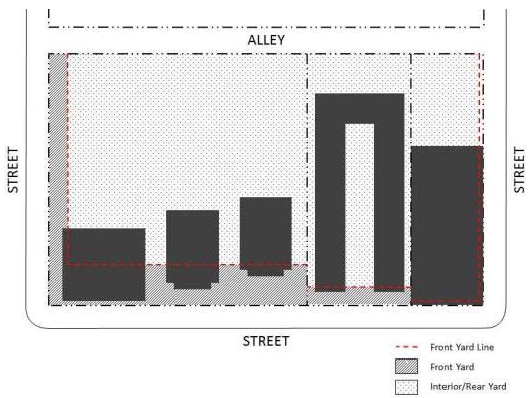
FIGURE 15-2006-E.1: IDENTIFYING THE FRONT YARD LINE
2.
Front Yard.
a.
Minimum Setback. All fences shall be set back no less than 12 inches from the back of the sidewalk and may not be located in the public right-of-way. No setback is required from side and rear property lines.
b.
Maximum Height. Three feet.
c.
Transparency. Fences must be open a minimum of 80 percent (e.g., no more than 20 percent opaque) to allow for the passage of light and air.
d.
Materials.
i.
Front yard fence materials shall consist only of wood, tubular steel, wrought iron, or other decorative metal. Brick, stone, or stucco piers may be used in combination with these materials. New chain link front yard fences are prohibited.
ii.
Retaining walls shall be designed consistent with the architectural style of the main building. Retaining walls shall consist only of decorative concrete, masonry, stone, or brick. Timber may be permitted unless it is in conflict with the Building Code or applicable Public Works standards.
iii.
Veneer or synthetic materials simulating the actual, natural material (e.g., brick or stone veneer in place of actual brick or stone) shall only be allowed upon demonstrating to the Review Authority that the substitute material:
(1)
Adequately simulates the natural material; and
(2)
Is organized visually to simulate actual construction using the natural material (e.g., organization of brick rows, larger stones at the bottom and smaller stones toward the top).
3.
Interior and Rear Yards.
a.
Minimum Setback. All fences shall be set back no less than 12 inches from the back of the sidewalk and may not be located in the public right-of-way. No setback is required from side and rear property lines.
b.
Maximum Height. Six feet.
c.
Transparency. No requirement. Fences and walls may be up to 100 percent opaque.
d.
Materials.
i.
Interior and side yard fence and wall materials shall consist only of wood, tubular steel, wrought iron, other decorative metal, brick, stone, stucco, concrete block. Chain link may be used when it is not visible from a public street as determined by the Review Authority.
ii.
Interior and side yard fences and walls shall be designed to be consistent with the architectural style of the main building when they are visible from a public street as determined by the Review Authority.
iii.
When visible from a public street, veneer or synthetic materials simulating the actual, natural material (e.g., brick or stone veneer in place of actual brick or stone) shall only be allowed upon demonstrating to the Review Authority that the substitute material:
(1)
Adequately simulates the natural material; and
(2)
Is organized visually to simulate actual construction using the natural material (e.g., organization of brick rows, larger stones at the bottom and smaller stones toward the top).
4.
Through Lots. All street frontages shall be considered Front Yards.
5.
Private Patios, Yards, Etc.
a.
Facing Front Yard or Common Open Space. Fences, walls, or hedges enclosing private patios, yards, or porches that face the Front Yard or the Common Open Space are subject to the requirements of section 15-2006.E.2 above.
b.
Interior Yard and Rear Yards. Fences and walls up to six feet in height may enclose private patios or yards.
F.
Fence Height and Locations for All Other Uses and Districts.
1.
Front Yard.
a.
Wrought Iron or Tubular Steel. A fence up to four feet in height may be installed within any required front yard setback. Fences must be open a minimum of 80 percent (e.g., no more than 20 percent opaque) to allow for the passage of light and air.
b.
All Other Materials. All other fences within any required front yard setback are permitted up to three feet in height and shall comply with the main building setback, minus five feet.
2.
Street-Side Yard.
a.
Wrought Iron or Tubular Steel. A fence up to four feet in height may be installed within any required front yard setback. Fences must be open a minimum of 80 percent (e.g., no more than 20 percent opaque) to allow for the passage of light and air.
b.
All Other Materials. All other fences within any required street side yard setback are permitted up to three feet in height and shall comply with the main building setback, minus five feet.
3.
Reserved.
4.
Through Lots. Both street frontages shall be considered Front Yards.
5.
Other Yards. Outside of the required front yard and street-side yards, the maximum height for fences is seven feet (regardless of location on the site) unless the fence is part of Outdoor Storage per Section 15-2013, Outdoor Service Yards and Storage.
6.
Bollards. Bollards, up to three feet in height may be placed at the rear of required landscape areas.
7.
Setbacks. Unless a greater setback is required in another section of this Code, fences shall be set back 12 inches from the back of adjacent sidewalks, or from the curb or shoulder if there is no sidewalk. Fences may be placed on interior side and rear property lines.
8.
Right-of-Way. In no circumstance may any fence be placed in the public right-of-way unless specified elsewhere in this Code.
G.
Temporary Fencing. For Temporary or Seasonal uses, including Community Gardens, Urban Agricultural, Farming, temporary sales, etc., fencing setbacks shall comply with main building setbacks of the underlying zone district.
H.
Construction Fencing. Refer to Section 15-2009, Security Fencing.
I.
Vacant Parcels. Fencing shall be setback a minimum of five feet from the front property line however traffic sight areas shall be respected. Upon development of the site, all fencing shall comply with the provisions of this Code.
J.
Fence and Retaining Wall Combinations. Where a fence is located on top of a retaining wall, and a six-foot maximum fence height is normally applicable, the Director may allow a combined height of fence and retaining wall up to a maximum of seven feet.
K.
Natural Grade Differences. Where there is a natural grade difference between two adjacent parcels, or a parcel and a street, the Director may allow a deviation of the fence height based on the slope and may measure the overall fence height from the higher parcel. In no case shall the retaining wall and fence combination exceed seven feet from the lower side unless a deviation is granted.
L.
Decorative Features.
1.
Columns and gates may exceed the maximum height requirements by four inches.
2.
On through and corner lots, the exposed (e.g., rough) side of the fence shall face into the subject parcel, rather than the street. The finished side of the fence shall be oriented towards the street.
3.
Fences, greater than 125 feet in length in Residential Districts and/or along Major Streets, shall incorporate decorative pilasters with decorative caps spaced no more than 30 feet apart. This shall not apply to industrial districts, unless the industrial district is located on the same side of the street as existing, planned, or zoned residences.
4.
Decorative caps, not to exceed four inches, may be added to the columns of walls.
5.
A wrought iron decorative entry gate, located outside of required street yard setbacks may be allowed up to seven feet in height in Residential Districts and eight feet in Non-Residential Districts with Director approval.
M.
Additional Materials Standards.
1.
Limitation on Chain-Link Fencing. Chain-link fencing is not permitted in:
a.
Single-Unit Districts. Along a Major Street, unless it is three feet or less in height.
b.
Multi-Unit Districts and Mixed-Use Districts.
i.
Along a Major Street.
ii.
Local Streets. Along street-facing yards in developments that contain six or more units.
(1)
Exception. A fence that is three feet or less in height and located within the Pinedale Neighborhood Plan.
c.
Office and Commercial Districts. Along Major Street-facing yards, or when the parcel shares a street that also serves a Residential District.
d.
Industrial Districts. When abutting a residential use or when located across a Local Street from a residential use.
2.
Limitation on Concrete/Masonry Block. Plain concrete block shall not be the primary material along Major Streets or other situations when block walls are required as part of project approval, such as at the rear of landscape easements. Concrete block or precast concrete walls shall be split face or finished with stucco, and capped with a decorative cap, or other decorative material as may be approved by the Director. Other materials may be approved by the Director should the design provide for an enhanced appearance. For continuity, walls should incorporate similar styles, colors, etc., when located on the same side of the street.
3.
Limitation on Wire Mesh Fencing. Wire mesh fencing shall be permitted in the following circumstances:
a.
Commercial Districts, O Districts, BP Districts, and RBP districts when not visible from a public street.
b.
Industrial Districts.
4.
Permitted Materials. The following materials shall be permitted in all districts, except when a district has a more restrictive list of permitted materials:
a.
Materials specifically permitted elsewhere in this Section;
b.
Wood pickets;
c.
Split rail wood;
d.
Wrought iron and tubular steel;
e.
Brick and stone;
f.
Stucco;
g.
Shade cloth when used in combination with permitted fencing such as chain link, wrought iron, or tubular steel, provided it consists of materials specifically manufactured for such a purpose; and
h.
Privacy slats when in combination with chain link fencing (when chain link is allowed) provided it consists of materials specifically manufactured for such a purpose.
5.
Prohibited Materials. The following materials shall not be permitted to be used as a fence material in any district:
a.
Plywood, oriented strand board, pressboard, and similar wood products;
b.
Chicken wire or similar wire products;
c.
Corrugated metal or corrugated plastic;
d.
Piping (including metal, PVC, and other materials);
e.
Hazardous fencing shall only be allowed as put forth in Section 15-2009, and when allowed shall not consist of improved materials, such as broken glass or nails.
f.
Improvised materials, including but not limited to wood scraps, doors, garage doors, refrigerator doors, and mattresses;
g.
Improvised screening materials, including but not limited to blankets and tarps; and
h.
Any material not listed unless approved by the specifically Review Authority.
6.
Fence Construction.
a.
All fences must be built with a professional and durable appearance and must be maintained in good condition.
b.
Permitted materials may be combined (for example, brick columns combined with wrought iron panels), but combinations shall not be haphazard or random in appearance.
N.
Residential Recreational Fencing.
1.
Fencing located around tennis, basketball, or volleyball courts, and similar areas up to 14 feet in height may be allowed outside of required setback areas.
2.
For residential batting cages, fencing is permitted up to 14 feet in height, located outside of required setback areas.
3.
For other requirements, refer to Section 15-2749, Private Recreational Facilities.
4.
Lighting of recreational areas shall comply with Section 15-2015, Outdoor Lighting and Illumination.
O.
Commercial Recreational Fencing. Refer to Sections 15-2708 Arcades, Video Games, and Family Entertainment Centers and 15-2749, Private Recreational Sports Facilities.
P.
Intersection and Driveway Visibility. Notwithstanding other provisions of this section, fences, walls, hedges, and related structures must comply with Section 15-2018, Intersection Visibility.
Q.
Exceptions.
1.
Walls used to mitigate noise may exceed the standards above, per Section 15-2506, Noise.
(Added Ord. 2015-39, § 1, eff. 1-9-16; Am. Ord. 2016-32, § 17, eff. 10-21-16; Am. Ord. 2016-43, §§ 6, 7, eff. 12-9-16; Am. Ord. 2017-33, § 12, eff. 7-30-17; Am. Ord. 2018-66, § 15, eff. 1-18-19; Am. Ord. 2025-024, §§ 32—34, eff. 7-27-25).
SEC. 15-2007. - WALLS FOR NOISE ATTENUATION (NOISE BARRIERS).
New development, proximate to transportation corridors or other mobile noise sources in the public right-of-way shall mitigate noise to acceptable levels. See Section 15-2506, Noise.
(Added Ord. 2015-39, § 1, eff. 1-9-16).
SEC. 15-2008. - SCREENING BETWEEN DIFFERING LAND USES.
A.
Applicability. The standards of this section apply to:
1.
New fences, hedges, or walls;
2.
The demolition and reconstruction of a site;
3.
New development;
4.
A new building on a developed site when the new building is more than 300 square feet. The 300 square feet shall be cumulative from the date of adoption of this Code;
5.
Building additions to existing buildings that expand the existing floor area by at least 20 percent, or 2,500 square feet, whichever is less, not including Single Unit Dwellings or Duplexes. The addition and/or expansion shall be cumulative from the date of adoption of this Code;
6.
A request for a Discretionary Permit;
7.
Change from one category of use classification to another (i.e., changing from a Commercial Use Classification to a Residential Use Classification as identified in the Use Regulation table of the Base District); or,
8.
Condominium Conversions.
9.
Exceptions. The standards of this section do not apply to fences that are part of a designated historic site.
B.
Common Property Lines. A six-foot-high screen wall shall be provided on the interior lot lines where any non-residential use abuts a residential district and where multi-unit development of four or more units abuts a single-unit residential district. Walls shall step down to three feet in height along interior property lines within front yards.
1.
Alleys. Where residential and non-residential uses are separated by an alley, a screen wall is not required, unless required to screen outdoor storage of material.
C.
Screening Wall Standards.
1.
Location. Screening walls shall follow the lot line of the lot to be screened, or shall be so arranged within the boundaries of the lot so as to substantially hide from adjoining lots the building, facility, or activity required to be screened.
2.
Materials. Walls shall be of stucco, decorative block, decorative concrete panel, or other substantially equivalent material as approved by the Director. Chain-link or double-faced wood fencing does not fulfill the screening wall requirement.
3.
Berms. Topography, berming, and other alternative methods of mitigating the nuisance of noise and light might be considered at time of project review. An earth berm may be used in combination with the above types of screening walls, but not more than one-third of the required height of such screening may be provided by the berm.
4.
Maintenance. Screening walls shall be maintained in good repair, including painting, if required, and shall be kept free of litter or advertising.
5.
Graffiti. Graffiti on a screen wall shall be removed within 48 hours.
6.
Timing. If a non-residential use develops adjacent to an existing residential development the wall shall be constructed with the new development. Where a six-foot-high wood fence already exists, the masonry wall footing, when constructed, shall comply with City standards.
7.
Pedestrian Access. Pedestrian access, or breaks in screening walls, shall be provided from commercial to residential land uses in strategic locations to allow for connectivity. Locations shall be determined and negotiated at the time of approval, unless otherwise stated in this Code.
D.
Screening for All Uses Adjacent to Outdoor Sports Facilities. See Section 15-2749, Private Recreational Sports Facilities.
(Added Ord. 2015-39, § 1, eff. 1-9-16; Am. Ord. 2018-66, § 16, eff. 1-18-19; Am. Ord. 2025-024, § 35, eff. 7-27-25).
SEC. 15-2009. - SECURITY FENCING.
A.
Where Permitted. The use of barbed wire, razor wire, ultra-barrier, and other hazardous fencing is prohibited with the exception of barbed wire and razor wire in the situations listed below.
1.
Where such fencing is required by any law or regulation of the City, the State of California, the federal government, or other public agency.
2.
Livestock. Where used to contain livestock, the maximum height of a fence shall be five feet, measured from the natural grade of the site to the highest strand of barbed wire or razor wire.
3.
Commercial Districts. Where not visible from any street, highway, public open space, recreation area, or Residential District, barbed wire or razor wire may be up to 18 inches in height on top of permitted fencing provided the barbed wire or razor wire is located at the top portion of a fence which is at least six feet in height.
4.
Industrial Districts. Barbed wire or razor wire may be up to 18 inches in height on top of permitted fencing provided it is located at the top portion of a fence which is at least six feet in height. Barbed wire is permitted unless it abuts a Residential District, is located within 100 feet of a Residential District, or is located within 100 feet of a park or other public open space, where it is prohibited.
5.
Specific Uses. Razor wire is permitted within cemetery, commercial, or industrial uses where the use shares a property line with a freeway or railroad; in such instance razor wire may only be located on the shared property line.
B.
Construction Sites. Nothing in this Development Code shall be deemed to prohibit the erection of temporary fencing around construction sites in compliance with the Building Code and other applicable provisions of the Fresno Municipal Code.
C.
Location Restrictions—Razor Wire. Notwithstanding any other provision of this section, razor wire shall be prohibited within 1,000 feet of any sensitive use such as Residential Districts, public or private schools, daycares, churches, and public parks, except where permitted for the keeping of livestock or as temporary fencing around construction sites in compliance with the Building Code and other applicable provisions of the Fresno Municipal Code.
D.
Fencing Encroachments. All fencing within the public right-of-way requires an encroachment permit from the City Engineer and shall be subject to all requirements of this section, in addition to those of the Public Works Department. Security fencing shall not extend over into any abutting property.
E.
Maintenance. All walls and fences shall be maintained in a safe, neat, and orderly condition at all times, and shall be kept free of all litter, graffiti, and signs or postings not authorized by Article 26, Signs. Where hedges are used as screening, trimming, or pruning shall be employed as necessary to maintain the maximum allowed height.
F.
Permit. Property owner(s) shall apply for a permit with the City prior to installation.
G.
City Indemnification. Prior to the installation of security fencing, the fence owner shall obtain a permit and execute an agreement to defend, hold harmless, and indemnify the City against all claims related to the fencing.
(Added Ord. 2015-39, § 1, eff. 1-9-16; Am. Ord. 2017-57, § 1, eff. 11-25-17; Am. Ord. 2018-66, § 17, eff. 1-18-19; Am. Ord. 2024-014, § 1, eff. 7-11-24).
SEC. 15-2010. - ELECTRIFIED FENCES.
Electrified fences shall comply with the following regulations. The requirements contained in Section 15-2009 do not apply to Electrified Fencing allowed pursuant to this Section.
A.
Permitted Locations.
1.
In all non-residential zones in which Security Fencing is permitted including all Mixed-Use Districts, all Commercial Districts, all Employment Districts, the Public and Institutional (PI) District, and all Downtown Districts with the exception of the Downtown Core (DTC).
2.
Electric fences shall not encroach into the public right-of-way.
B.
Compliance with State and Federal Regulations.
1.
Electrified fencing shall comply with the California Civil Code Section 835 and the California Building Code, as amended from time to time.
2.
Only allowed to be installed with a permit issued under the requirements of applicable building and electrical codes, and only allowed to be activated after an approved final inspection of the installation.
3.
Fire access, warning signs, electrical connections, etc., shall comply with the Building Code and Fire regulations.
C.
Electricity.
1.
Shall conform to the California Civil Code Section 835 and shall only be powered by a commercial storage battery not to exceed 12 volts of direct current (DC) or another approved 12 volt DC or lower voltage-power source.
2.
The electric charge produced by the fence upon contact shall not exceed energizer characteristics set forth in paragraph 22.108 and depicted in Figure 102 of International Electrotechnical Commission (IEC) Standard No. 60335-2-76.
3.
Non-low voltage electrical components (e.g., controllers, transformers) of the electric fencing system shall be approved and listed by an Occupational Safety and Health Act (OSHA) Nationally Recognized Testing laboratory (NRTL).
D.
Perimeter Fence or Wall. No electric fence shall be installed or used unless it is completely surrounded by a nonelectrical fence or wall that is a minimum five feet in height. Should a non-electrical fence not exist, one shall be installed prior to the electric fence being operational. When abutting an existing residential use, the protective barrier shall consist of a solid material (i.e., wooden fence, block wall, an approved mesh material, or equivalent material).
E.
Setbacks. Non-electrical fencing behind which electric fencing is installed shall comply with setbacks of the underlying zone district unless the non-electrical fence is legally non-conforming.
F.
Height. Shall have a maximum height of ten feet regardless of location on the property.
G.
Warning Signs. Shall be clearly identified with warning signs that read: "Warning-Electric Fence" at intervals of not less than 30 feet.
H.
Permit. Property owner(s) shall apply for a permit with the City prior to installation.
I.
City Indemnification. Prior to the installation of electric fencing, the fence owner shall obtain a permit and execute an agreement to defend, hold harmless, and indemnify the City against all claims related to the fencing.
J.
Emergency Access.
1.
An electrical disconnect device secured with a Police/Fire X-1 keyway or other approved means for emergency access by Police and Fire Departments shall be provided at a location approved by the Fire Department.
2.
The disconnect device shall include an LED pilot light to indicate the status of power to the electric fence.
3.
The emergency access disconnect device shall be located outside the primary drive gate entrance of the property and shall not be obscured in any manner from the street/private driveway access. The details and location of the disconnect device shall be shown on the site plan.
4.
Approved signs stating the identification of such switches/controls in addition to informational instructions as to how to disable the electrical system shall be installed to the satisfaction of the Fire Marshal.
5.
In the event that access by the City of Fresno Fire Department and/or Police Department is required due to an emergency or urgent circumstances and the emergency access disconnect device is absent or non-functional and no authorized property personnel is present to disable the electric fence. City of Fresno Fire or Police personnel shall be authorized to disable the electric fence in order to gain access to the property. All applicants issued building permits to install or use an electric fence as provided in this chapter agree to waive any and all claims for damages to the electric fence against the City of Fresno and/or its personnel under such circumstances.
(Added Ord. 2015-39, § 1, eff. 1-9-16; Am. Ord. 2017-33, § 13, eff. 7-30-17; Am. Ord. 2017-57, § 2, eff. 11-25-17; Am. Ord. 2018-66, §§ 18—20, eff. 1-18-19; Am. Ord. 2022-028, § 1, eff. 11-19-2022).
SEC. 15-2011. - SCREENING OF MECHANICAL AND ELECTRICAL EQUIPMENT.
A.
Applicability. The standards of this section apply to:
1.
New development;
2.
New equipment that is added to serve existing buildings; or,
3.
Condominium Conversions.
4.
Exceptions. Existing equipment that serves existing buildings; and Industrial Districts.
B.
Equipment. All exterior mechanical and electrical equipment shall be screened or incorporated into the design of buildings so as not to be visible from major streets, highways, passenger railways, or abutting Residential Districts.
C.
Residential Districts. Equipment to be screened includes, but is not limited to, all roof-mounted equipment, air conditioners, heaters, utility meters, cable equipment, telephone entry boxes, backflow preventions, irrigation control valves, electrical transformers, pull boxes, and all ducting for air conditioning, heating, and blower systems. Screening materials shall be consistent with the exterior colors and materials of the building. Above grade equipment by Public Utility providers may be permitted within easements.
D.
Roof Access Ladders and Fire Sprinkler Risers. Roof access ladders shall be screened from Major Streets. Fire sprinkler risers should be designed for interior installation whenever possible where an exterior location would be visible from a Major Street. Where site conditions dictate an exterior location for the sprinkler riser, a three foot clear space shall be provided between the screening materials and the riser. The alarm bell and fire department connection shall be installed so that they are visible from the street.
(Added Ord. 2015-39, § 1, eff. 1-9-16).
SEC. 15-2012. - HEIGHTS AND HEIGHT EXCEPTIONS.
A.
Applicability. The standards of this section apply to:
1.
New development or structures; or
2.
New equipment that is added to serve existing buildings.
B.
General Standards. The structures listed in the following table may exceed the maximum permitted building height for the district in which they are located, subject to the limitations stated in the table and further provided that no portion of a structure in excess of the building height limit may be used for sleeping quarters or advertising and all heights shall comply with any operative Airport Plan.
C.
Building height shall be measured as put forth in Section 15-305, Measuring Height.
(Added Ord. 2015-39, § 1, eff. 1-9-16; Am. Ord. 2025-024, § 36, eff. 7-27-25).
SEC. 15-2013. - OUTDOOR SERVICE YARDS AND STORAGE.
A.
Applicability.
1.
Outdoor service yards and the open storage of goods, materials, machines, equipment, and vehicles or parts outside of a building for more than 72 hours must conform to the standards of this section. This applies to goods to be sold or goods being stored that are pending transport to other locales.
2.
Exceptions. Except as may be permitted by Table 15-2013-B, the regulations of this section do not apply to:
a.
Agricultural and residential uses;
b.
Temporary storage of construction materials reasonably required for construction work on the premises pursuant to a valid building permit or grading permit; or
c.
Outdoor sales or uses that by their very nature provide outdoor storage, such as auto, trailer, and boat dealers, and equipment rental.
B.
Permitted Locations. Table 15-2013-B states the districts where outdoor storage and service yards are permitted and prohibited.
C.
Surfacing. Outdoor storage areas shall be surfaced as determined by the Public Works Director. In making a determination, the Public Works Director shall take into consideration:
1.
The zone district of the site.
2.
If the site will be used to store equipment that is used daily and common drive-aisles will be paved and/or treated to mitigate potential dust from vehicles.
3.
Surrounding sensitive uses such as residential uses, schools (K-12), day cares, hospitals, or elderly care facilities.
4.
If the proposed surfacing is appropriate to the type of product stored.
5.
If the proposed surfacing will conform to all applicable federal and State air and water quality standards.
6.
If the surface will comply with adopted regulations of the San Joaquin Valley Air Pollution Control District.
D.
Screening.
1.
Outdoor storage areas and service yards shall be screened so as not to be visible from Major Streets or at-grade highways; Residential Districts; public schools, or public parks.
2.
Screening walls and fences shall be architecturally compatible with the main structure on the site.
3.
Earth berms or plant material may serve to satisfy screening requirements as alternative materials.
4.
No screening wall or fence shall be located within a required setback or landscape area.
5.
No stored goods may exceed the height of the screening wall or fence by more than one foot.
6.
Service yards may have screen walls up to 15 feet in height and must be attached to the main building and shall be of the same quality and appearance as those used on the building itself. Service yards shall be considered part of the main structure for property development standards and shall be clearly incidental to the primary use. Outdoor storage shall not be the primary use on the property.
(Added Ord. 2015-39, § 1, eff. 1-9-16).
SEC. 15-2014. - PROJECTIONS/ENCROACHMENTS INTO REQUIRED YARDS.
Building projections may extend into, and other encroachments may be located in, required yards according to the standards of Table 15-2014 and are subject to all applicable requirements of the Building Code. The "Limitations" column states any other limitations that apply to such structures when they project into required yards. For standards for measurement of required yards and setbacks, refer to Section 15-313, Determining Setbacks and Yards.
(Added Ord. 2015-39, § 1, eff. 1-9-16).
SEC. 15-2015. - OUTDOOR LIGHTING AND ILLUMINATION.
A.
Applicability. The standards of this section apply to on-site lighting under the following circumstances:
1.
New lights;
2.
The demolition and reconstruction of a site;
3.
New development;
4.
Building additions to existing buildings that expand the existing floor area by at least 20 percent, or 2,500 square feet, whichever is less, not including Single-Unit Dwellings or Duplexes. The addition and/or expansion shall be cumulative from the date of adoption of this Code;
5.
The addition of residential units;
6.
A request for a Discretionary Permit;
7.
Change from one category of use classification to another (i.e., changing from a Commercial Use Classification to a Residential Use Classification as identified in the Use Regulation table of the Base District); or,
8.
Condominium Conversions.
B.
Control and Illumination of Outdoor Artificial Light.
1.
Purpose. This subsection is intended to minimize outdoor artificial light that may have a detrimental effect on the environment, astronomical research, amateur astronomy, and enjoyment of the night sky. These provisions are also intended to reduce the unnecessary illumination of adjacent properties and the use of energy.
2.
General Standards.
a.
Single-Unit Districts. Each new home shall provide at a minimum, lighting proximate to the main entrance, the garage/carport, and alley, if present.
b.
Multiple-Unit Residential Buildings. Aisles, passageways, recesses, etc., related to and within the building complex shall be illuminated with an intensity of at least 0.25 foot-candles at the ground level during the hours of darkness. Lighting devices shall be protected by weather and vandal-resistant covers.
c.
Pedestrian-Oriented Lighting. In Multi-Unit, Mixed-Use, and Commercial Districts, exterior lighting with an intensity of at least 0.25 foot-candles at the ground level shall be provided for a secure nighttime pedestrian environment by reinforcing entrances, public sidewalks and open areas with a safe level of illumination.
d.
Non-Residential Buildings. All exterior doors, during the hours of darkness, shall be illuminated with a minimum of 0.5 foot-candle of light.
e.
Trails/Paseos. As determined by the Public Works Director.
f.
Parking Lots and Garages. All parking lots and garages shall be illuminated with a minimum of 0.5 foot-candle of light.
3.
Maximum Height. Lighting fixtures shall not exceed the maximum heights specified in the following table.
4.
Exemptions. The following types of lighting fixtures are exempt from the requirements of this section:
a.
Public and Private Street Lighting.
b.
Parks/Athletic Field Lights. Athletic field lights used within a school campus or public or private park.
c.
Public Safety and Security Lighting. Safety and security lighting as required by State and federal regulations, including, but not limited to, airports, radio towers, antennas, etc.
d.
Construction and Emergency Lighting. All construction or emergency lighting fixtures provided they are temporary and are discontinued immediately upon completion of the construction work or abatement of the emergency.
5.
Prohibited Lighting. The following types of exterior lighting are prohibited:
a.
Drop-down lenses;
b.
Mercury vapor lights; and,
c.
Searchlights, laser lights, or any other lighting that flashes, blinks, alternates, or moves.
6.
Fixture Types. All lighting fixtures shall be shielded so as not to produce obtrusive glare onto the public right-of-way or adjoining properties. All luminaries shall meet the most recently adopted criteria of the Illuminating Engineering Society of North America (IESNA) for "Cut Off" or "Full Cut Off" luminaries.
7.
Glare. No use shall be operated such that significant, direct glare, incidental to the operation of the use is visible beyond the boundaries of the property where the use is located.
8.
Light Trespass. Lights shall be placed to deflect light away from adjacent properties and public streets, and to prevent adverse interference with the normal operation or enjoyment of surrounding properties.
a.
Direct or sky-reflected glare from floodlights shall not be directed into any other property or street.
b.
No light or combination of lights, or activity shall cast light exceeding one foot candle onto a public street, with the illumination level measured at the centerline of the street.
c.
No light, combination of lights, or activity shall cast light exceeding 0.5 foot candle onto a residentially zoned property, or any property containing residential uses.
9.
Alternate Materials and Methods of Installation. Designs, materials, or methods of installation not specifically prescribed by this section may be approved by the Director, provided that the proposed design, material, or method provides approximate equivalence to the specific requirements of this section or is otherwise satisfactory and complies with the intent of these provisions.
(Added Ord. 2015-39, § 1, eff. 1-9-16; Am. Ord. 2016-32, § 18, eff. 10-21-16; Am. Ord. 2018-66, §§ 21, 22, eff. 1-18-19; Am. Ord. 2025-024, § 37, eff. 7-27-25).
SEC. 15-2016. - TRASH AND REFUSE COLLECTION AREAS.
A.
Applicability. The standards of this section apply to:
1.
New collection areas;
2.
New development;
3.
The demolition and reconstruction of a site;
4.
Building additions to existing buildings that expand the existing floor area by at least 20 percent, or 2,500 square feet, whichever is less, not including Single-Unit Dwellings or Duplexes. The addition and/or expansion shall be cumulative from the date of adoption of this Code;
5.
The addition of residential unit(s) that result in five or more dwelling units.
6.
A request for a Discretionary Permit;
7.
Change from one category of use classification to another (i.e., changing from a Commercial Use Classification to a Residential Use Classification as identified in the Use Regulation table of the Base District); or,
8.
Condominium Conversions.
B.
Requirements.
1.
Single-Unit Residential. As required per Chapter 6, Municipal Services and Utilities, of the Fresno Municipal Code.
2.
Multi-Unit Residential. Enclosures for solid waste and recycling containers are required when:
a.
Five or more dwelling units are proposed; and,
b.
There should be a minimum of one solid waste and recycling enclosure per 30 units.
3.
Non-Residential Districts. As required per Chapter 6, Municipal Services and Utilities, of the Fresno Municipal Code.
4.
Uses That Produce Grease. Uses, such as restaurants, that produce grease shall provide a "grease barrel" enclosure or alternative as approved by the Public Utilities Director.
C.
Location.
1.
Solid waste and recycling storage areas shall not be located within any required setback or any landscaped areas except where a rear yard abuts an alley. Where a rear yard abuts an alley, the solid waste and recycling storage area may be located within the required rear yard setback however the gates may not swing open into the alley.
2.
In non-residential developments that abut a Residential District, enclosures shall be located as far as possible from the residential district as feasible and be proximate to the non-residential development. Enclosure gates shall not open into drive aisles and shall not block the visibility of pedestrians and drivers. Refer to Section 15-2018, Intersection Visibility.
3.
Solid waste and recycling areas shall be consolidated to minimize the number of collection sites and located so as to reasonably equalize the distance from the building spaces they serve.
4.
Solid waste and recycling storage areas shall be accessible to haulers. Storage areas shall be located so that the trucks and equipment used by the solid waste and recycling collector(s) have sufficient maneuvering areas and, if feasible, so that the collection equipment can avoid backing. Project applicants are responsible for procuring current equipment size and turning radius from the City or its contracted solid waste and recycling collector(s).
D.
Materials, Construction, and Design.
1.
Enclosure Material. Enclosures shall be constructed per City standards.
2.
Gate Material. Gate material shall be solid, heavy-gauge metal or a heavy-gauge metal frame with a covering of a view-obscuring material.
3.
Access to Enclosure. Each solid waste and recycling enclosure shall be designed to allow walk-in access without having to open the main enclosure gate, to the extent feasible.
4.
Enclosure Pad/Bumpers. Enclosures shall be constructed per City standards.
5.
Protection for Enclosures. Concrete curbs or equivalent shall protect enclosures from adjacent vehicle parking and travel ways.
6.
Stormwater Pollution Prevention. Enclosure pads must be designed to prevent contamination of the stormwater system. Measures that may be taken to achieve this include, but are not limited to, using roofs to divert stormwater away from the enclosures, creating grade breaks to properly direct stormwater away while keeping any water that may be in the enclosure from spilling out, and connecting a drain in the enclosure to the sewer system to collect contaminated water in cases of spillage, washing, etc.
7.
Landscaping. When visible from a Major Street or a Local Street that serves residential neighborhoods, the perimeter of enclosures, excluding gates, shall be planted, with drought-resistant landscaping, including a combination of shrubs and/or climbing evergreen vines. This subsection does not apply to Industrial Districts.
8.
IH District Exception. In the IH District, as an alternative to an enclosure, a concrete curb may be provided to minimize bins from rolling about a parking area. Alternative enclosures may not be visible from any street, residential district, and/or school.
(Added Ord. 2015-39, § 1, eff. 1-9-16; Am. Ord. 2018-66, §§ 23, 24, eff. 1-18-19; Am. Ord. 2025-024, § 38, eff. 7-27-25).
SEC. 15-2017. - UNDERGROUND UTILITIES.
A.
Applicability. The standards of this section apply to all of the following:
1.
New development;
2.
The demolition and reconstruction of a site;
3.
Any other time deemed appropriate by the Public Works Director.
B.
Standards. All electrical, telephone, cable television, and similar distribution lines providing direct service to a development site shall be installed underground within the site. This requirement may be waived or deferred by the Public Works Director or the City Engineer upon a determination that the installation is infeasible or premature.
(Added Ord. 2015-39, § 1, eff. 1-9-16).
SEC. 15-2018. - INTERSECTION VISIBILITY.
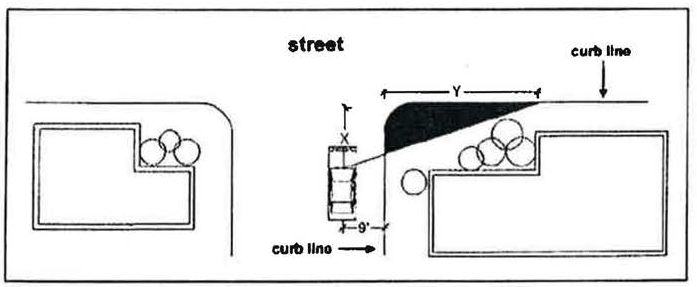
FIGURE 15-2018: INTERSECTION VISIBILITY
A.
Street Intersections.
1.
Vegetation and structures may not exceed a height of three feet within the triangular sight-distance area formed by the intersecting curb lines (or edge of pavement when no curbs exist) and a line joining points on these curb lines at the locations and distances identified in Figure 15-2018 and Table 15-2018-A.
2.
Trees that are located within this sight distance triangle shall have a clearance of eight feet high minimum between the lowest portion of the canopy and the sidewalk and street.
3.
Applies to all structures, including flag poles and signs.
B.
Driveways and Alleys. Visibility of a driveway crossing a street lot line shall not be blocked above a height of three feet by vegetation or structures for a depth of 12 feet as viewed from the edge of the right-of-way on either side of the driveway at a distance of 12 feet. Street trees shall be pruned at least seven feet above the established grade of the curb so as not to obstruct clear view by motor vehicle drivers are permitted.
C.
Commercial Districts, Refuse Collection Areas, and Drive-Through Lanes. Vegetation (with the exception of trees) and structures may not exceed a height of three feet within the triangular sight-distance area formed by the intersecting drive aisles and a line joining points on these aisles at a distance of 10 feet along both lines from their intersection. Trees located within this sight distance shall have a minimum clearance of seven feet high between the lowest portion of the canopy and the pavement and shall not be capable of growing to a width that would obstruct the sight area.
D.
Vehicle/Pedestrian Conflicts. Whenever it is reasonable to expect potential conflicts between vehicles exiting drive-aisles, drive-throughs, etc., and a pedestrian path that traverses said aisle, a visibility triangle per Subsection C above shall be provided.
E.
Exempt Structures and Plantings. The regulations of this section do not apply to existing buildings or new buildings in compliance with Base District setbacks; fire hydrants; public utility poles; saplings or plant species of open growth habits and not planted in the form of a hedge that are so planted and trimmed as to leave at all seasons a clear and unobstructed cross view; official warning signs or signals at places where the contour of the ground is such that there can be no cross visibility at the intersection.
(Added Ord. 2015-39, § 1, eff. 1-9-16; Am. Ord. 2016-32, § 19, eff. 10-21-16; Am. Ord. 2017-33, §§ 14, 15, eff. 7-30-17).
SEC. 15-2019. - DEVELOPMENT ON SUBSTANDARD LOTS.
Any lot or parcel of land that was legally created may be used as a building site even when consisting of less area, width, or depth than that required by the regulations for the district in which it is located. No substandard lot shall be further reduced in area, width, or depth, unless required as part of a public improvement. A substandard lot shall be subject to the same yard and density requirements as a standard lot, however the Director may reduce the side and rear yard requirements at a ratio equivalent with the non-conformity.
(Added Ord. 2015-39, § 1, eff. 1-9-16).
SEC. 15-2020. - LOTS WITH MULTIPLE ZONE DISTRICTS (SPLIT ZONING).
A.
Generally. Where a contiguous lot is divided by a zoning district boundary, the regulations applicable to each district shall be applied to the area within the district, and no use, other than parking serving a principal use on the site, shall be located in a district in which it is not a permitted or conditionally permitted use.
B.
Access. All access to parking serving a use must be from a street abutting that portion of the lot where the use is allowed. Pedestrian or vehicular access from a street to a non-residential use shall not traverse a Residential District in which the non-residential use is not permitted or conditionally permitted.
C.
Accessory Facilities. Landscaping, fences, screening or retaining walls, and open space may be located on the lot without regard for zone boundaries.
D.
Refuse Collection Areas. Shall be located on the parcel that permits the primary use.
E.
Minimum Lot Area, Width, and Frontage. The minimum lot area, width, and frontage requirements of the zone that covers the greatest portion of the lot area shall apply to the entire lot. If the lot area is divided equally between two or more zones, the requirements of the district with greater minimum lot area, width, or frontage shall apply to the entire lot.
F.
Exceptions. If more than 75 percent of a lot is located in one zoning district, modifications to the provisions of this section may be granted through Review Authority approval of a Planned Development Permit.
(Added Ord. 2015-39, § 1, eff. 1-9-16; Am. Ord. 2018-25, § 19, eff. 6-11-18).
SEC. 15-2101.- PURPOSE.
The purpose of the Transit-Oriented Development (TOD) Height and Density Bonus is to provide flexibility for projects which promote walkability, livability, and transit ridership near stations for Bus Rapid Transit and other enhanced transit service.
(Added Ord. 2015-39, § 1, eff. 1-9-16).
SEC. 15-2102. - APPLICABILITY.
At its discretion, the Review Authority, when granting a Development Permit, may allow a project to exceed the maximum height and/or the maximum residential density of the Base District if all three of the following criteria are met:
A.
The project site is located entirely within an MX District or a CMS District.
B.
The project site is located within 500 feet of an existing or planned Bus Rapid Transit station or a station for a similar enhanced transit service as determined by the Review Authority or is located within ½ mile of the Manchester Transit Center.
C.
The project will provide one of the following public benefits:
1.
A Public Plaza per Section 15-1104-E.1.c; or
2.
Qualifying public art at the discretion of the Review Authority; or
3.
Ninety percent or greater frontage coverage along the street which features the Bus Rapid Transit route or other enhanced transit route.
(Added Ord. 2015-39, § 1, eff. 1-9-16; Am. Ord. 2016-32, § 20, eff. 10-21-16; Am. Ord. 2017-33, § 16, eff. 7-30-17).
SEC. 15-2103. - MAXIMUM PERMITTED BONUSES.
Height and Density bonuses granted by the Review Authority may not exceed the following:
A.
Height. The bonus height may exceed that of the Base District by no more than 25 percent. Portions of buildings in excess of the maximum height of the Base District may not be located within 100 feet of an RS District.
B.
Residential Density. The bonus density may exceed that of the Base District by no more than 100 percent.
C.
Combination with Affordable Housing Density Bonus. A TOD Height and Density Bonus may be used in combination with an Affordable Housing Density Bonus.
(Added Ord. 2015-39, § 1, eff. 1-9-16).
SEC. 15-2104. - REQUIRED FINDINGS.
A decision to grant a bonus shall be based on making all of the following findings:
A.
The architectural design of the project is of exceptional quality and will add to the beauty and pedestrian comfort of the transit corridor;
B.
Granting the bonus shall not cause more housing to be located within the corridor or corridor segment than was identified in the General Plan Master Environmental Impact Report or other applicable environmental review;
C.
Granting the bonus shall not cause the capacity of the infrastructure which serves the site to be exceeded; and
D.
Granting the bonus will not be detrimental to the health or safety of the public or the occupants of the property.
(Added Ord. 2015-39, § 1, eff. 1-9-16).
SEC. 15-2201.- PURPOSE.
The purposes of the affordable housing regulations are to:
A.
Lessen the shortage of housing affordable to moderate, low, and very low income households in the city as partial compliance with California Government Code (Government Code) Section 65583(c);
B.
Allow for density bonuses and additional incentives, consistent with Government Code Section 65915, for housing affordable to moderate, low, and very low income households, for seniors and disabled persons, and for development that includes a childcare facility;
C.
Implement the policies of the Housing Element to expand the provision of housing for lower and moderate income households, elderly residents and others with special housing needs; and
D.
Establish requirements for resale and rental controls to ensure that units remain affordable for at least 30 years or such other term as required by the City, consistent with State law.
E.
Nothing in this Article shall be construed as a provision for inclusionary zoning where an applicant is required to provide housing affordable to moderate, low, and very low income households as a condition of approval for a residential development. Furthermore, the Council shall not adopt a provision for inclusionary zoning, as described above, unless and until the Fresno General Plan adopted in December 2014 is updated and superseded by a new General Plan.
(Added Ord. 2015-39, § 1, eff. 1-9-16).
SEC. 15-2202. - OTHER REGULATIONS AND ADOPTED PLANS.
A.
State Law Governs. The provisions of this section shall be governed by the requirements of Government Code Section 65915. Where conflict may occur between the provisions of this section and State law, the State law shall govern.
B.
Effect of Granting a Density Bonus. The granting of a density bonus shall not, in and of itself, require a General Plan amendment, zoning change, or other discretionary approval.
C.
Land Use Compatibility. When located within the Airport Influence Area (AIA) of any of the operative airport plans (i.e., Sierra Skypark Land Use Policy Plan, Fresno-Chandler Downtown Airport Land Use Compatibility Plan, Fresno Yosemite International Airport Land Use Compatibility Plan) applications for a density bonus project and/or an incentive as authorized by this section shall be subject to the provisions of the adopted land use compatibility policies for residential development established by each plan for noise, airspace protection, safety, and nuisance.
(Added Ord. 2015-39, § 1, eff. 1-9-16).
SEC. 15-2203. - APPLICABILITY.
The bonuses under this article are applicable to the following projects:
A.
General residential projects of five or more units.
B.
Senior housing projects of more than 35 units.
(Added Ord. 2015-39, § 1, eff. 1-9-16).
SEC. 15-2204. - DENSITY BONUSES.
Pursuant to Government Code Section 65915, the City shall grant a density bonus over the otherwise allowable maximum residential density permitted by this Ordinance, the General Plan, or operative plans, and one or more additional concessions or incentives, consistent with Government Code Section 65915 and this section, if the applicant applies for and proposes to construct any one of the following:
A.
Very Low Income Units.
1.
A density bonus of 20 percent if five percent of the total units of a housing development are affordable to very low income households, as defined in Health and Safety Code Section 50105.
2.
For each additional one percent increase above five percent in the proportion of units affordable to very low income households, the density bonus shall be increased by 2.5 percent, not to exceed the maximum density bonus as put forth in Subsection H.
B.
Lower Income Units.
1.
A density bonus of 20 percent if 10 percent of the total units of a housing development are affordable to lower income households, as defined in Health and Safety Code Section 50079.5.
2.
For each additional one percent increase above 10 percent units affordable to lower income households, the density bonus shall be increased by 1.5 percent, not to exceed the maximum density bonus as put forth in Subsection H.
C.
Senior Citizen Housing Development. A density bonus of 20 percent if a housing development qualifies as a Senior Citizen Housing Development, as defined in Civil Code Section 51.3.
D.
Moderate Income Units in Condominium and Planned Use Developments.
1.
A density bonus of five percent if 10 percent of the total dwelling units in a condominium project, as defined in Subdivision (f), or in a Planned Development as defined in Subdivision (k) of Section 1351 of the Civil Code, are affordable to persons and families of moderate income, as defined in Section 50093 of the Health and Safety Code.
2.
For each additional one percent increase above 10 percent units affordable to moderate income households, the density bonus shall be increased by one percent, not to exceed the maximum density bonus as put forth in Subsection H.
E.
Conversion of Apartments to Condominiums.
1.
A density bonus of 25 percent if at least 33 percent of the total units of the proposed condominium project are affordable to persons of low or moderate income as defined in Health and Safety Code Section 50093, or if 15 percent of the total units of the condominium project are affordable to lower income households as defined by Health and Safety Code Section 50079.5.
2.
Apartments that have already been granted a density bonus are ineligible for a density bonus under this section.
F.
State Childcare Facility Density Bonus. When an applicant proposes to construct a housing development that conforms to the requirements of the State Density Bonus Law and includes a childcare facility other than a family day care home that will be located on the premises of, as part of, or adjacent to, the project, the City shall grant one of the following:
1.
Additional Density Bonus. A density bonus of additional residential units equal in gross square footage to the amount of square footage of the childcare facility.
2.
Additional Concession or Incentive. An additional concession or incentive that contributes significantly to the economic feasibility of the construction of the childcare facility.
3.
Length of Operation. The childcare facility remains in operation for a period of time that is as long as, or longer than the length of time during which the affordable housing units must remain affordable.
G.
Land Donation.
1.
Basic Requirements. When an applicant for a residential development such as a subdivision map or special permit donates land to the City in accordance with this subsection, a density bonus of 15 percent shall be granted if at least 10 percent of the units are for very low income households. For each additional one percent increase above 10 percent units affordable to very low income households, the density bonus shall be increased by one percent, up to a maximum of 35 percent of the maximum allowable residential density for the site.
a.
This density bonus shall be in addition to any increase in density allowed by this section, the combination of which shall not exceed 35 percent, unless approved with good cause by the Director pursuant to this section.
2.
Additional Requirements. The density bonus for donation of land may be granted if all of the following conditions are met:
a.
The applicant donates and transfers the land to the City or to a housing developer approved by the City. The transfer shall be complete (deed recorded) prior to the recordation of a subdivision map or approval of a Special Permit.
b.
The transferred land is at least one acre in size or of sufficient size to permit the development of at least 40 dwelling units.
c.
The land has the appropriate General Plan designation and zoning for the development at the density described in paragraph (3) of subdivision (c) of Government Code Section 65583.2.
d.
Is or will be served by adequate public facilities and infrastructure; and has all permits and approvals, other than building permits, necessary for the development of the very low income housing units on the transferred land, not later than the date of approval of the final subdivision map, parcel map or Special Permit, except that the local government may subject the proposed development to subsequent design review if its design is not reviewed by the City prior to the time of transfer.
e.
The transferred land and the affordable units shall be subject to a deed restriction ensuring continued affordability of the units consistent with this section recorded at time of transfer.
f.
The transferred land shall be within the boundary of the proposed development or within one-quarter mile of the subject site, if acceptable to the Director.
H.
Maximum Density Bonus.
1.
Mixed-Use Districts. No maximum.
2.
Other Districts. A density bonus over 35 percent may be approved at the discretion of the Review Authority.
I.
Calculation of Density Bonus Units. When calculating the number of permitted density bonus units, all fractional units shall be rounded to the next higher whole number. The applicant who requests a density bonus for a project that meets two or more of the eligibility requirements shall specify whether the bonus shall be awarded on the basis of Subsections A-F of this section. The density bonus shall not be included when determining the number of target units to be provided in a development project.
1.
Optional Density Bonus. The City may grant a proportionally lower density bonus and/or provide concessions and/or incentives set forth in Section 15-2205, Affordable Housing Concessions and Incentives, if an applicant agrees to construct a development containing less than the percentage of housing for lower or very low income households than provided in this section.
(Added Ord. 2015-39, § 1, eff. 1-9-16).
SEC. 15-2205. - AFFORDABLE HOUSING CONCESSIONS AND INCENTIVES.
A.
Number of Incentives or Concessions. Pursuant to Government Code Section 65915, an applicant is entitled to receive incentives and/or concessions as follows. The applicant who requests incentives or concessions for a mixed-income project shall specify whether the incentives or concessions shall be awarded on the basis of one or more of the points below.
1.
One incentive or concession for projects that include:
a.
At least 10 percent of the total units for lower income households;
b.
At least five percent for very low income households; or
c.
At least 10 percent for persons and families of moderate income in a condominium or planned development;
2.
One incentive or concession for senior citizen housing developments; or
3.
Two incentives or concessions for projects that include;
a.
At least 20 percent of the total units for lower income households;
b.
At least 10 percent for very low income households; or
c.
At least 20 percent for persons and families of moderate income in a condominium or planned development; or
4.
Three incentives or concessions for projects that include:
a.
At least 30 percent of the total units for lower income households;
b.
At least 15 percent for very low income households; or
c.
At least 30 percent for persons and families of moderate income in a condominium or planned development.
B.
Proposal of Incentives and Findings. An applicant may propose specific incentives or concessions pursuant to this section and State law. In addition to any increase in density to which an applicant is entitled, the City shall grant one or more incentives and/or concessions that an applicant requests, up to the maximum number of incentives and concessions required pursuant to Subsection 15-2205-A unless the City makes a written finding that either:
1.
The concession or incentive is not necessary in order to provide the proposed targeted units, or
2.
The concession or incentive would have a specific adverse impact that cannot be feasibly mitigated on public health and safety or the physical environment or any property that is listed in the California Register of Historical Resources.
The applicant may propose and the City may approve additional incentives and concessions for an eligible project that provides targeted units that meet two or more of the eligibility requirements based on a written finding that the additional incentives or concessions are necessary in order to make the project economically feasible.
C.
Types of Affordable Housing Incentives. Affordable housing incentives may consist of any combination of the items listed below:
1.
Modification of Development Standards. Up to 20 percent in modification of site development standards or zoning code requirements, including, but not limited to:
a.
Reduced minimum lot sizes and/or dimensions.
b.
Reduced minimum building setbacks and building separation requirements, excluding back up treatment for off-street parking spaces.
c.
Reduced minimum outdoor and/or private usable open space requirements.
d.
Increased maximum lot coverage.
e.
Increased maximum building height.
2.
Reduced Parking. Upon the applicant's request, the following maximum parking standards, inclusive of handicapped and guest parking, shall apply to the entire project. Further reductions in required parking may be requested as one of the incentives allowed under Subsection 15-2205-A.
a.
Standard Reduction.
i.
.5 on-site space for studio units;
ii.
.75 on-site space for one or two bedroom units;
iii.
One on-site space for three or more bedrooms; and
iv.
Guest parking shall be provided per the underlying district.
b.
Transit-Serviced Developments. When a development is located within one-half mile of a major transit stop and there is unobstructed access to the stop, the following maximum parking ratios apply. For Senior and Special Needs Housing, the development shall have either paratransit service or unobstructed access, within one-half mile, to fixed bus route service that operates at least eight times per day. For purposes of this subsection, "unobstructed access" means that a resident is able to access the stop without encountering natural or constructed impediments.
i.
Mixed Income Developments. If the project dedicates 20 percent of the total units for lower income households and 11 percent of the total units for very low income households, then the maximum required parking ratio shall be .5 spaces per bedroom.
ii.
One-Hundred Percent Affordable Developments. For projects that consist solely of rental units, exclusive of a manager's unit or units, with an affordable housing cost to lower income families, the maximum parking ratios shall be as follows.
(1)
Senior Housing. If the development is a for-rent housing development for individuals who are 62 years of age or older that complies with Sections 51.2 and 51.3 of the Civil Code, the ratio shall not exceed .5 spaces per unit.
(2)
Special Needs Housing. If the development is a special needs housing development, as defined in Section 51312 of the Health and Safety Code, the ratio shall not exceed 0.3 spaces per unit.
(3)
All Other Housing. .5 spaces per unit.
3.
Mixed-Use Zoning. Approval of mixed-use zoning in conjunction with the housing project if commercial, office, industrial, or other land uses will reduce the cost of the housing development and such uses are compatible with the housing project and the surrounding area.
4.
Other Incentives. Other regulatory incentives or concessions proposed by the developer or the City that result in identifiable cost reductions or avoidance.
(Added Ord. 2015-39, § 1, eff. 1-9-16).
SEC. 15-2206. - APPLICATION REQUIREMENTS.
An application shall be submitted by an applicant and shall contain the information as outlined by the Director.
(Added Ord. 2015-39, § 1, eff. 1-9-16).
SEC. 15-2207. - AFFORDABLE HOUSING STANDARDS.
A.
Duration of Affordability. All affordable housing units shall be kept affordable for a minimum period of 30 years or a longer period as required by the financing assistance or subsidy program or the City, consistent with State law.
B.
Timing of Availability. Affordable housing units shall be constructed concurrently with, and made available for qualified occupants at the same time as the market-rate housing units within the same project unless both the City and the developer agree to an alternative schedule for development.
C.
Design. The mix and type of affordable units shall be proportionate to those of the project as a whole (with the exception that premium units—e.g., penthouses, top floor view units—shall not be required to be affordable units), and shall be comparable with the design of the base level market rate units prior to purchaser-funded upgrades in terms of appearance, materials, and finished quality.
D.
Parking. Parking designated for affordable units shall be provided in an equitable manner as that provided for the market rate units.
E.
Location. Wherever feasible, affordable units shall be dispersed throughout the development.
(Added Ord. 2015-39, § 1, eff. 1-9-16).
SEC. 15-2208. - REGULATORY AGREEMENT.
The City shall enter into a recorded agreement in the form of a covenant with property owner, and take other appropriate steps necessary to assure that the required moderate, low and/or very low income ownership units are provided and that the units remain affordable to moderate, low, or very low income households for the required period. This agreement shall include, but is not limited to, the following:
A.
Number of Units. The total number of units approved for the projects, including the number of affordable housing units.
B.
Target Units. The location, unit sizes (in square feet) and number of bedrooms of the affordable housing units.
C.
Household Income Group. A description of the household income groups to be accommodated by the project and a calculation of the Affordable Sales Price.
D.
Certification Procedures. The party responsible for certifying sales prices or annual rental rates, and the process that will be used for certification.
E.
Schedule. A schedule for the completion and occupancy of the affordable housing units.
F.
Required Term of Affordability. Duration of affordability of the housing units. Provisions should also cover resale control and deed restrictions on targeted housing units that are binding on property upon sale or transfer.
G.
Expiration of Agreement. Provisions covering the expiration of the agreement, including notice prior to conversion to market-rate units and right of first refusal option for the City and/or the distribution of accrued equity for for-sale units.
H.
Remedies for Breach. A description of the remedies for breach of the Agreement by either party.
I.
Other Provisions. Other provisions to ensure implementation and compliance with this article.
J.
Condominium and Planned Developments. In the case of condominium and planned developments, the Regulatory Agreement shall provide for the following conditions governing the initial resale and use of affordable housing units:
1.
Target units shall, upon initial sale, be sold to eligible Very Low, Lower, or Moderate Income Households at an Affordable Sales Price and Housing Cost, or to Qualified Residents as defined by this Ordinance.
2.
Target units shall be initially owner-occupied by eligible Very Low or Lower Income Households.
3.
Upon resale, the seller of a target unit shall retain the value of any improvements, the down payment, and the seller's proportionate share of appreciation. The City shall recapture its proportionate share of appreciation, which shall be used to promote home ownership opportunities as provided for in Health and Safety Code Section 33334.2. The City's proportionate share shall be equal to the percentage by which the initial sale price to the targeted household was less than the fair market value of the dwelling unit at the time of initial sale.
K.
Rental Housing Developments. In the case of rental housing developments, the Regulatory Agreement shall provide for the following conditions governing the use of Target Units during the use restriction period:
1.
The rules and procedures for qualifying tenants, establishing affordable rent rates, filling vacancies, and maintaining Target Units for qualified tenants.
2.
Provisions requiring owners to verify tenant incomes and maintain books and records to demonstrate compliance with this article.
3.
Provisions requiring owners to submit an annual report to the City, which includes the name, address, and income of each person occupying Target Units, and which identifies the bedroom size and monthly rent or cost of each Target Unit.
L.
Recordation of Agreement. The agreement shall be recorded with the Fresno County Recorder's Office and shall run with the property. The agreement shall conform to the provisions of Government Code Sections 65864 to 65869.
(Added Ord. 2015-39, § 1, eff. 1-9-16).
SEC. 15-2209. - ENFORCEMENT.
A.
The provisions of this article shall apply to all agents, successors, and assignees of an applicant for development of the site. No building permit or occupancy permit shall be issued, nor any development approval granted, which does not meet the requirements of this article.
B.
In addition to, or in lieu of, the provisions of 15-2208-A the City shall institute injunction, mandamus, or any other appropriate legal actions or proceedings for the enforcement of this article.
C.
Any person, firm, or corporation, whether as principal, agent, employee or otherwise, violating or causing the violation of any of the provisions of this article, shall be guilty of a misdemeanor, and upon conviction thereof shall be punishable for each offense by a fine of not more than $500.00, or by imprisonment in the County Jail for a term not exceeding six months, or by both fine and imprisonment. Such person, firm, or corporation shall be deemed to be guilty of a separate offense for each and every day during any portion of which any violation of this article is commenced, continued, or permitted by such person, firm, or corporation, and shall be punishable as provided herein.
(Added Ord. 2015-39, § 1, eff. 1-9-16).
SEC. 15-2210. - DEFINITIONS.
Whenever the following terms are used in this article, they shall have the meaning established by this section:
A.
Additional Incentive(s). Regulatory concessions as specified in California Code Sections 65915(k) to include, but not be limited to, the reduction of site development standards or Zoning Ordinance requirements, approval of mixed-use zoning in conjunction with the housing project, or any other regulatory incentive which would result in identifiable cost reductions that are offered in addition to a density bonus.
B.
Affordable Housing. Housing units that are affordable to families with very low, low, or moderate incomes.
C.
Affordable Housing Agreement A legally binding agreement between a developer and the City to ensure that the requirements of this section are satisfied. The agreement establishes, among other things, the number of required inclusionary or affordable housing units, the unit sizes, location, affordability tenure, terms, and conditions of affordability and unit production schedule.
D.
Affordable Unit, For Rent. A unit for which the total monthly rent plus utilities does not exceed the following:
1.
Moderate Income Households. 30 percent of 110 percent of the Fresno County median income.
2.
Lower Income Households. 30 percent of 60 percent of the Fresno County median income.
3.
Very Low Income Households. 30 percent of 50 percent of the Fresno County median income.
E.
Affordable Unit, For Sale. A unit for which the total monthly payment including interest, taxes, insurance, and utilities does not exceed the following:
1.
Moderate Income Households. 35 percent of 110 percent of the Fresno County median income.
2.
Lower Income Households. 30 percent of 70 percent of the Fresno County median income.
3.
Very Low Income Households. 30 percent of 50 percent of the Fresno County median income.
F.
Conversion. The change of status of a dwelling unit from a purchased unit to a rental unit or vice versa.
G.
Density Bonus. A minimum increase in the number of dwelling units authorized for a particular parcel of land over the otherwise maximum residential density.
H.
Density Bonus Dwelling Units. Those residential units granted pursuant to the provisions of this article which are above the maximum allowable residential density of the project site.
I.
Financial Assistance. Assistance to include, but not be limited to, the subsidization of fees, infrastructure, land costs, or construction costs, the use of redevelopment set-aside funds, community development block grant (CDBG) funds, or the provision of other direct financial aid in the form of cash transfer payments or other monetary compensation, by the City of Fresno.
J.
Housing Costs. Defined in accordance with Section 50052.5 of the California Health and Safety Code and shall generally mean the monthly mortgage principal and interest, property taxes and assessments, homeowners insurance, homeowner association fees where applicable, an allowance for utilities and property maintenance and repairs, for ownership dwelling units; and the monthly rent, and allowance for utilities, fees, or service charges charged to all tenants, for rental dwelling units.
K.
Income Eligibility. The gross annual household income, considering the household size and number of dependents, income of all wage earners, elderly or disabled family members and all other sources of household income. For self-employed households, net annual household income shall be used in determining income eligibility.
L.
In-Lieu Incentives. Incentives offered by the City, which are of equivalent financial value based upon the land cost per dwelling unit(s), that are offered in-lieu of density bonus and additional incentives.
M.
Income. Any monetary benefits that qualify as income in accordance with the criteria and procedures used by the City of Fresno.
N.
Income Levels. For purposes of determining income levels of households under this article, the City shall use the Fresno County income limits in Title 25, Section 6932 of the California Code of Regulations or other income limits adopted by the City Council if the State Department of Housing and Community Development fails to provide timely updates of the income limits in the California Code of Regulations.
O.
Lower-Income Household. Low-income household whose gross income does not exceed 80 percent of the area median income for Fresno County as determined annually by the U.S. Department of Housing and Urban Development.
P.
Major Transit Stop. A site containing an existing rail transit station or the intersection of two or more major bus routes with a frequency of service interval of 15 minutes or less during the morning and afternoon peak commute periods. This definition shall additionally include all major transit stops designated in the applicable regional transportation plan. (California Public Resources Code § 21155 and § 21064.3).
Q.
Market-Rate Unit. A dwelling unit where the rental rate or sales price is not restricted either by this article or by requirements imposed through other local, State, or federal affordable housing programs.
R.
Maximum Allowable Residential Density. The maximum residential density allowed under this Ordinance and the General Plan, or if a range of density is permitted, the maximum allowable density for the specific zoning range and General Plan applicable to the project.
S.
Median Income. The median income earned by a household or family, adjusted by size, as published by U.S. Department of Housing and Urban Development.
T.
Moderate-Income Household. A household whose gross income is more than 80 percent but does not exceed 120 percent of the median income for Fresno County as determined annually by the U.S. Department of Housing and Urban Development.
U.
Offsets. Concessions or assistance to include, but not be limited to, direct financial assistance, density increases, standards modifications or any other financial, land use, or regulatory concession which would result in an identifiable cost reduction enabling the provision of affordable housing.
V.
Operating Agent. A nonprofit organization, for-profit corporation, County or City agency chosen by the City to carry out some or all of the administrative provisions of this article.
W.
Project. A housing development at one location including all dwelling units for which permits have been applied for or approved within a 12 month period.
X.
Qualifying Resident. Persons 62 years of age or older, or 55 years of age or older in a residential development developed, substantially rehabilitated, or substantially renovated for senior citizens that has at least 35 dwelling units, and as defined in Section 51.3 of the California Civil Code.
Y.
Senior Citizen Housing Development. A residential development consisting of at least 35 dwelling units which is developed for, or substantially rehabilitated or renovated for persons 55 year of age or older.
Z.
Target Dwelling Unit. A dwelling unit that will be offered for rent or sale exclusively to and which shall be affordable to the designated income group or qualified resident, as required by this article.
AA.
Very Low Income Household. A household whose gross income does not exceed 50 percent of the area median income for Fresno County as determined annually by the U.S. Department of Housing and Urban Development.
(Added Ord. 2015-39, § 1, eff. 1-9-16).
SEC. 15-2301.- PURPOSE.
The purpose of this article is to achieve the following:
A.
Enhance the appearance and function of all development by providing standards relating to the quality, quantity, and design of landscaping;
B.
Protect public health, safety, and welfare by minimizing the impact of all forms of physical and visual pollution, controlling soil erosion, screening incompatible land uses, preserving the integrity of existing residential neighborhoods, and enhancing pedestrian and vehicle traffic and safety;
C.
Preserve, protect, manage, maintain, and enhance the city's community forest to promote scenic beauty, provide habitat, maintain and increase property values, counteract air pollutants, minimize heat island effect, provide shade, store carbon, decrease wind velocities, attract investment, promote active living, foster wellbeing, reduce soil erosion and ground water contamination;
D.
Promote energy conservation in buildings by providing shade from the sun in summer, allowing the sun rays to shine through in winter and providing shelter from the cold wind in winter; and
E.
Encourage water conservation through the use of native and water-wise, climate-appropriate plants, efficient design, and water-conserving irrigation design and practices.
(Added Ord. 2015-39, § 1, eff. 1-9-16).
SEC. 15-2302. - STATE CODES.
In addition to the provisions of this article, more requirements may apply to landscape plans at time of plan review submittal for building, landscaping and/or plumbing permits as stipulated in the California Green Building Standards Code (CalGreen), the California Model Water Efficient Landscape Ordinance (MWELO), and the California Plumbing Code (CPC). Where there is potential conflict between CalGreen, MWELO, and the CPC as adopted and amended in Chapter 11 and this article, CalGreen, MWELO, and the CPC shall prevail.
(Added Ord. 2015-39, § 1, eff. 1-9-16).
SEC. 15-2303. - APPLICABILITY.
The standards of this article apply to the following:
A.
New construction projects with landscapes;
B.
Additions (other than to Single-Unit Dwellings or Duplexes) to an existing building that expands the existing floor area by either 20 percent or more or 2,500 square feet or more, whichever is less. The floor area increases to the existing building shall be cumulative from the date of adoption of this Code;
C.
A new building with a floor area of 300 square feet or more on a developed site. The 300 square feet shall be cumulative from the date of adoption of this Code;
D.
The demolition and reconstruction of a site;
E.
A first time installed landscape or a re-landscaping project where the new or modified landscape area is equal to or greater than 500 square feet; or
F.
Change from one category of use classification to another (i.e., changing from a Commercial Use Classification to a Residential Use Classification as identified in the Use Regulation table of the Base District); or,
G.
Exceptions. The standards of this Section do not apply to landscaping that is part of a registered historic site, plant collections as part of botanical gardens and arboretums open to the public, or ecological restoration projects that do not require a permanent irrigation system, or mined-land reclamation projects that do not require a permanent irrigation system.
(Added Ord. 2015-39, § 1, eff. 1-9-16; Am. Ord. 2018-66, § 25, eff. 1-18-19; Am. Ord. 2025-024, § 39, eff. 7-27-25).
SEC. 15-2304. - LANDSCAPE PLANS.
A landscape plan shall be submitted with the permit application whenever landscaping per Section 15-2303 applies.
A.
Information Required. Landscape plans shall be drawn to scale and shall, at a minimum, include the following:
1.
Proposed plant locations, species, sizes, and plant factor. Plants with similar water needs shall be grouped together into hydrozones on the landscape plan. The plant factor according to the California Department of Water Resources study, Water Use Classification of Landscape Species (WUCOLS), shall be identified for all landscaped areas on a site. All water features shall be identified as high water use and temporarily irrigated areas shall be identified as low water use.
2.
Proposed landscape features (mounds, stepping stones, benches, sculptures, decorative stones, or other ornamental features) locations, dimensions, and materials.
3.
Proposed water features (fountains, pools and ponds) and paved surfaces locations, dimensions, and materials.
4.
Proposed landscape structures (sheds, trellises, arbors, gazebos, fire pits, fireplaces, built-in barbeques, decks, retaining walls, and seat walls) locations, dimensions, and materials.
5.
Location of any existing trees over six inches in diameter, as measured 48 inches above natural grade, and whether each such tree is proposed for retention or removal.
6.
Identification of areas of preservation or incorporation of existing native vegetation.
7.
Identification of areas not intended for a specific use, including areas planned for future phases of a phased development, shown landscaped or left in a natural state.
8.
Any additional proposed landscape elements and measures to facilitate plant growth or control erosion.
B.
Authorized to Design a Landscape. Landscaping for commercial projects and institutional projects equal to or greater than one acre in size, industrial projects equal to or greater than 2.5 acres in size, and residential projects consisting of more than five units shall be prepared by a California registered landscape architect. For all other projects the various professionals, practitioners, and unlicensed persons may offer landscape design services within the scope and limitations that pertain to each as follows:
1.
Landscape Architect. Must hold a professional license to practice landscape architecture. May perform professional services for the purpose of landscape preservation, development and enhancement, such as consultation, investigation, reconnaissance, research, planning, design, preparation of drawings, construction documents and specifications, and responsible construction observation (Business and Professions Code, Section 5615).
2.
Architect. Must hold a professional license to practice architecture. May offer, perform, or be in responsible control of professional services which require the skills of an architect in the planning of sites (Business and Professions Code, Sections 5500.1 and 5641.3).
3.
Professional Engineers. Must hold professional registration to practice engineering. May perform professional services as defined under Business and Professions Code, Section 5615, as long as the work is incidental to an engineering project (Business and Professions Code, Sections 5615, 5641.3 and 6701 et seq.).
4.
Landscape Contractors. Must hold a C-27 landscaping contractor's license. May design systems and facilities for work to be performed and supervised by that contractor (Business and Professions Code, Sections 5641.4 and 7027.5 and California Code of Regulations, Title 16, Division 8, Section 832.27).
5.
Nurserypersons. Must hold a license to sell nursery stock. May prepare planting plans or drawings as an adjunct to merchandizing nursery stock and related products (Business and Professions Code, Section 5641.2 and Food and Agricultural Code, Section 6721 et seq.).
6.
Landscape/Garden Designers including Master Gardeners, etc. May prepare plans, drawings, and specifications for the selection, placement, or use of plants for single-unit dwellings; may prepare drawings for the conceptual design and placement of tangible objects and landscape features; may not prepare construction documents, details, or specifications for tangible landscape objects or landscape features; and may not prepare grading and drainage plans for the alteration of sites.
7.
Personal Property Owners (Homeowner). May prepare plans, drawings or specifications for any one- or two-unit dwelling property owned by that person.
8.
Golf Course Architect. May engage in the practice of, or offer to practice as, a golf course architect. May perform professional services such as consultation, investigation, reconnaissance, research, design, preparation of drawings and specifications, and responsible supervision, where the dominant purpose of such service is the design of a golf course, in accordance with accepted professional standards of public health and safety.
9.
Irrigation Consultants. May engage in the practice of, or offer to practice as, an irrigation consultant. May perform consultation, investigation, reconnaissance, research, design, preparation of drawings and specifications, and responsible supervision, where the dominant purpose of such service is the design of landscape irrigation, in accordance with accepted professional standards of public health and safety.
The applicable statutes which govern the above unlicensed categories are Business and Professions Code, Sections 5641, 5641.1, 5641.5 and 5641.6 (10-02, Amended, 02/02/2010).
(Added Ord. 2015-39, § 1, eff. 1-9-16; Am. Ord. 2025-024, § 40, eff. 7-27-25).
SEC. 15-2305. - AREAS TO BE LANDSCAPED.
The following areas shall be landscaped and may count toward the total area of site landscaping required by the zoning district regulations.
A.
Parking Areas. Parking areas shall be landscaped in compliance with Article 24, Parking and Loading.
B.
Required Setbacks.
1.
All Districts. For permitted paved areas, refer to the underlying Base District.
2.
Residential Uses that are Single-Unit Dwellings, Duplexes, and Triplexes. All required front and street-facing side yards, except for areas used for exit and entry shall be landscaped. If a solid fence is provided on a street side yard property line, the street side yard is not required to be landscaped.
3.
Residential Uses with Four or More Dwelling Units and Mixed-Use. All required setbacks, except for areas used for exit and entry, shall be landscaped.
4.
Non-Residential Uses. All required setbacks, except for areas used for exit and entry, shall be landscaped. If an Industrial District abuts another Industrial District, side and rear yards are not required to be landscaped. However should an Industrial District abut any other district or a street, it shall be landscaped. Where adjacent to residential, non-residential uses may require a larger setback under Residential Transition Standards and landscaping shall be provided as prescribed in Table 15-2305-C.1.
C.
Lot Perimeters. Landscape buffers shall be installed and maintained alongside and rear lot lines between differing land uses, in accordance with the sections of this article and the following standards:
1.
Required Landscape Buffers. Table 15-2305-C-1, Required Landscape Buffers, shows when a buffer treatment is required, and of what type, based on the proposed use and the adjoining district. Only the proposed use is required to provide the buffer yard. The type of buffer yard required refers to buffer yard-type designations (Type 1 or Type 2) as shown in Table 15-2305-C-2, Buffer Yard Requirements. A dashed line, "-", means that a buffer yard is not necessary unless required by another section of this Code.
2.
Buffer Yard Types. Table 15-2305-C-2, Buffer Yard Requirements, describes the minimum width and plant materials, and wall requirements for each type of buffer yard. The listed number of trees and shrubs are required for each 100 linear feet of buffer yard. Natural areas with native vegetation or alternative planting materials which achieve equivalent buffering effects may be approved by the Review Authority. For wall requirements, refer to Section 15-2008, Screening Between Differing Land Uses.
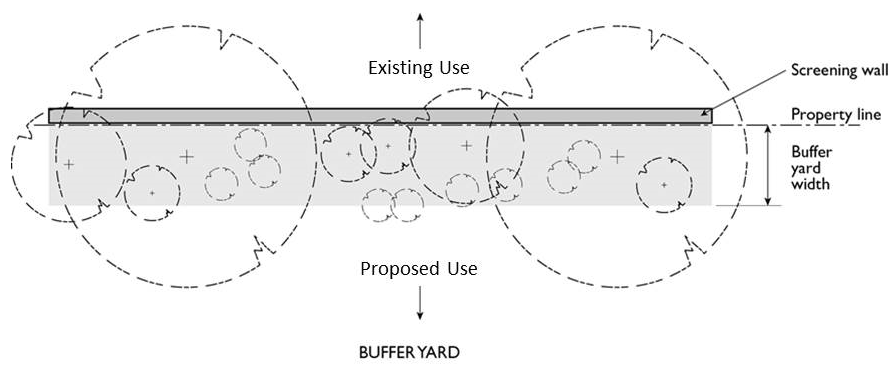
FIGURE 15-2305-C-2: BUFFER YARD REQUIREMENTS
3.
Patio Allowance. An employee or dining patio is allowed within the buffer yard for up to 50 percent of the depth of the required buffer yard.
D.
Landscape Setback. All areas between site perimeter walls/fencing and lot lines facing a street shall be landscaped. Landscaping shall be installed and maintained in accordance with the sections of this article and the following standards:
1.
Planting areas more than 10 feet in width shall be planted with medium and large trees and medium and large shrubs to span the entire length.
2.
Planting areas 10 feet or less in width shall at the very least be planted with small trees and small to medium size shrubs to span the entire length.
3.
Vines may be included for areas adjacent to concrete or masonry walls.
4.
The landscape design shall provide total wall/fence screening from top to bottom for the entire length within five years.
5.
Trees shall be planted so the canopies could touch for the entire length within fifteen years.
E.
Building Perimeters.
1.
All portions of a building that face a public street shall have one or more landscape planters installed along a minimum of 20 percent of that building face. This standard does not apply where a building is located within three feet of a public sidewalk, in which case the building perimeter shall be paved and treated in a manner similar to the adjacent sidewalk.
2.
The minimum width of the planter shall be three feet. Planters may be raised or at grade and may include potted plants.
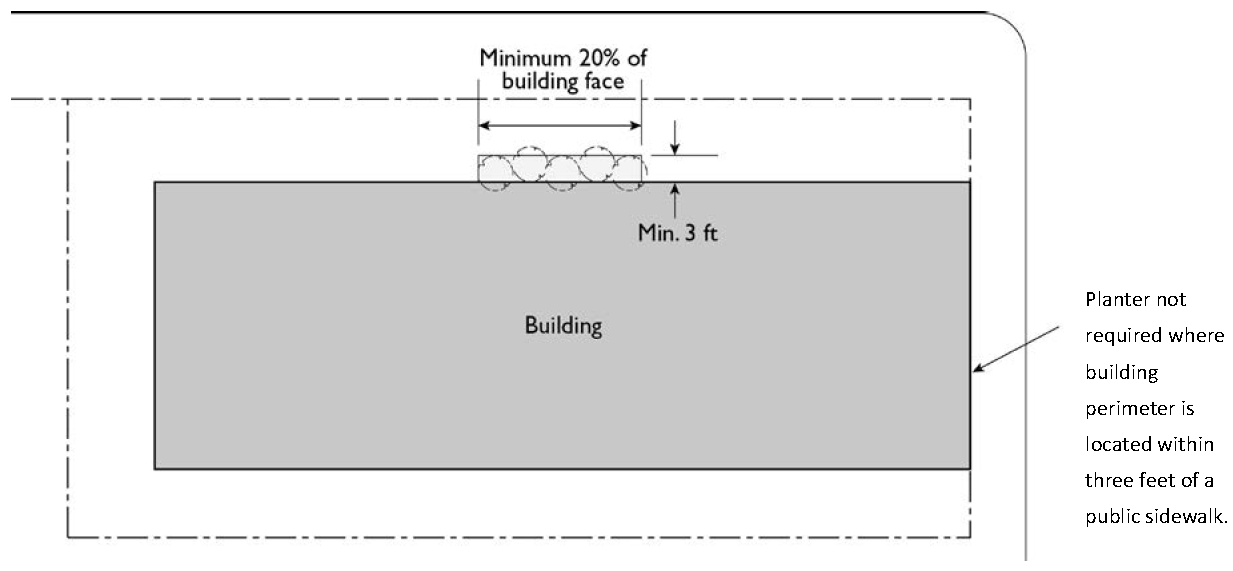
FIGURE 15-2305-E: BUILDING PERIMETERS
F.
Unused Areas. All areas of a project site not intended for a specific use, including areas planned for future phases of a phased development, shall be maintained clear and free of refuse, debris, or other accumulated matter.
G.
Public Property. Refer to Chapter 13, Article 3, Street Trees and Parkways for street tree, parkway (park strip), and median island requirements in public property.
(Added Ord. 2015-39, § 1, eff. 1-9-16; Am. Ord. 2016-32, § 21, eff. 10-21-16; Am. Ord. 2017-33, § 17, eff. 7-30-17; Am. Ord. 2018-66, § 26, eff. 1-18-19; Am. Ord. 2025-024, §§ 41, 42, eff. 7-27-25).
SEC. 15-2306. - LANDSCAPE DESIGN STANDARDS.
The following design standards are to be used by decision-makers in evaluating whether landscape plans conform to the requirements of this Section:
A.
Composition. The quality of a landscape design is dependent not only on the quantity and selection of plant materials but also on how that material is arranged. Landscape materials must be arranged in a manner as to provide the following qualities and characteristics:
1.
Texture. Landscape designs must provide a textured appearance through the use of a variety of plant material rather than a single species, by contrasting large leaf textures with medium and small leaf textures, and with a variety of plant heights. Spacing of key landscaping components, such as trees and shrubs, shall be consistent with the overall design approach of the landscape plan. Formal landscape designs benefit from a uniform spacing of plants, whereas varied spacing and clustering of trees is more compatible with a naturalistic design.
2.
Color. Landscape designs shall include a variety of plants to provide contrasting color to other plants in the design. Designs are encouraged to include flowering plants and especially a mix of plants that display colorful flowers throughout the year.
3.
Form. Landscape designs will consider the complete three-dimensional form of the landscaping, not simply the form of individual elements. The interrelationship of all landscape elements shall be considered so that the final design presents a coherent whole.
B.
Buffering and Screening. Natural landscape materials (trees, shrubs, and hedges) must be used alone or with walls and/or berms to screen or buffer differing land uses, prevent graffiti, provide transition between adjacent lots, and screen the view of parking, storage, service areas, refuse collection facilities and enclosures, utility enclosures, drive-throughs, utility pipes and boxes visible from a public street, alley, or pedestrian space or walkway. Plant material must be mature enough at the time of planting and appropriately located to provide an effective buffer or screen within five years of planting.
C.
Water-Wise Landscaping. Landscape designs shall feature plant species such as drought-tolerant and climate adaptive plants that thrive in the San Joaquin Valley region to take advantage of the adaptability of regionally appropriate plants to local environmental conditions and to conserve energy and water.
D.
Continuity and Connection. Landscaping must be designed within the context of the surrounding area, provided that the adjacent landscaping is consistent with the landscape design standards of this section. Where the adjacent property landscaping meets the landscape design standards of this section, plant materials shall blend well with adjacent properties, particularly where property edges meet, to create a seamless and natural landscape. Exceptions can be made when seeking to create a transition between uses or zoning districts.
1.
Buffers for Natural Areas. When located adjacent to an area of high ecological value, the proposed development shall incorporate natural features that will provide continuity and connection to the natural area and serve as an appropriate buffer space.
E.
Enhancing Architecture. Landscape designs shall be compatible with the architectural character and features of the buildings on site. Major landscape elements must be designed to complement exterior elevations and roof lines of the buildings through texture, color, and form.
(Added Ord. 2015-39, § 1, eff. 1-9-16).
SEC. 15-2307. - GENERAL LANDSCAPING STANDARDS.
A.
Materials.
1.
General.
a.
Landscaping may consist of a combination of turf, groundcovers, shrubs, vines, trees, incidental features such as stepping stones, benches, fountains, sculptures, decorative stones, and other ornamental features placed within a landscaped setting.
b.
Plant materials shall be selected from among those species and varieties known to thrive in the Fresno climate.
c.
Paved (e.g., concrete, stone and masonry) surfaces, gravel (e.g., decomposed granite) surfaces, and rocks may not exceed 35 percent of the area required to be landscaped.
d.
Recirculating water shall be used for decorative water features.
e.
Areas dedicated to edible plants are considered landscaped areas and count toward required landscaping.
2.
Non-Plant Materials. Non-plant materials such cinder, bark, and similar materials may not be used to meet the minimum planting area required by this section.
3.
Synthetic Lawns. Synthetic lawns may be considered as turf, and shall cover no more than 75 percent of the required landscape area.
4.
Mulch. A minimum three-inch layer of mulch shall be applied on all exposed soil surfaces of planting areas except in turf areas, creeping or rooting ground covers or other special planting situations where mulch is not recommended. Stabilizing mulching products shall be used on slopes. Mulch must be confined to areas underneath shrubs and trees and is not a substitute for ground cover plants.
5.
Size and Spacing. Plant materials shall be grouped in hydrozones in accordance with their respective water, cultural (soil, climate, sun, and light), and maintenance needs. Plants shall be of the following size and spacing at the time of installation:
a.
Ground Covers. Ground cover plants must be at least of a four-inch pot size and spaced to provide full coverage within the time frame specified for the species planted.
b.
Shrubs. Spacing of shrubs shall be according to local conditions; the species, cultivars, or varieties used; and their mature height, spread, and form. When planted to serve as a hedge or screen, shrubs shall be spaced at 75 percent of their mature length.
i.
Small Shrub. A small shrub shall have a mature height of three to less than five feet and shall be planted at minimum from one-gallon containers.
ii.
Medium Shrub. A medium shrub shall have a mature height of between five and eight feet and shall be planted at minimum from five-gallon containers.
iii.
Large Shrub. A large shrub shall have a mature height of greater than eight feet and shall be planted at minimum from five-gallon containers.
c.
Trees. All trees shall be a minimum of 15 gallons in size. Spacing of trees shall be according to local conditions; the species, cultivars, or varieties used; and their mature height, spread, and form. Newly planted trees shall be supported with stakes or guy wires.
i.
Small Tree. A small tree shall have a mature height of less than 25 feet and be at least one inch in diameter at six inches above ground level. Small trees, generally, shall be planted 25 feet apart.
ii.
Medium Tree. A medium tree shall have a mature height of between 25 and 45 feet and be at least 1¼ inch in diameter at six inches above ground level. Medium trees, generally, shall be planted 35 feet apart.
iii.
Large Tree. A large tree shall have a mature height of greater than 45 feet and be at least 1½ inch in diameter at six inches above ground level. Large trees, generally, shall be planted 45 feet apart.
6.
Landscaping Mound. Landscaping mounds shall be constructed on slopes not to exceed 4:1. The toe of the mound shall be set back from buildings and property boundaries as far as necessary for safety of the adjacent properties and to prevent damage resulting from water runoff or erosion of the slope. In no case shall the toe of the mound be within five feet of any building or one foot of the street right-of-way.
B.
Dimension of Landscaped Areas. Landscaped areas shall have a minimum horizontal dimension of four and one-half feet to count towards required landscaping.
C.
Prescribed Heights. The prescribed heights of landscaping shall indicate the height to be attained within fifteen years after planting.
D.
Drivers' Visibility. Trees and shrubs shall be planted and maintained so that at maturity they do not interfere with traffic safety sight areas, or public safety. Notwithstanding other provisions of this section, landscaping must comply with Section 15-2018, Intersection Visibility and Chapter 13, Article 2, Sections 13-227, Obstruction to Visibility at Intersections and 13-228, Intersection Visibility, Investigation, and Enforcement.
(Added Ord. 2015-39, § 1, eff. 1-9-16).
SEC. 15-2308. - TREES.
A.
Trees. Trees shall be provided as follows:
1.
Residential Single-Unit Districts. A minimum of two trees per lot and if part of a Planned Development then trees may be provided in common areas in addition to the two provided on each residential lot.
a.
One of the required trees must be oriented to the street.
b.
One of the required trees must be a passive solar-oriented tree (Deciduous) or a wind buffer-oriented tree (Evergreen).
2.
Multi-Unit Residential and Mixed-Use Districts. A minimum of one tree per unit.
3.
Commercial, Office, Business Park, and Regional Business Park Districts. A minimum of one tree for every 2,000 square feet of lot coverage.
4.
Industrial Districts. A minimum of one tree for every 10,000 square feet of lot coverage (Trees required in other sections of this code, such as parking lot trees or street trees, shall count toward the satisfaction of this requirement).
5.
Planned Development Districts. For requirements in single-unit residential development see Residential Single-Unit Districts, for multi-unit and mixed-use development see Residential Multi-Unit and Mixed-Use Districts, and for commercial and employment development see Commercial and Employment Districts above.
6.
Trees planted near public curbs or sidewalks shall be installed in a manner that minimizes physical damage to the curbs, gutters, sidewalks, and other public improvements.
B.
Heritage Tree Designations.
1.
Applications. Applications for designation of a heritage tree on private or public property may be initiated by any person subject to the property owners' written consent. The applicant requesting heritage tree designation shall submit an application in compliance with instructions provided by the Director and shall include the following:
a.
Assessor's parcel number of the site;
b.
Description detailing the proposed heritage tree's special aesthetic, cultural, or historic value of community interest; and
c.
Photographs of the tree(s).
2.
Review. The Director shall conduct a review of the proposed heritage tree, based upon information or documentation they may require from the applicant, staff, or other available sources. A tree may be designated as a heritage tree upon a finding that it is unique and important to the community due to any of the following factors:
a.
It is an outstanding specimen of a desirable species;
b.
It is one of significant age and/or girth in the city; or
c.
It has agricultural, cultural, economic, educational, historical, indigenous, or social heritage significance in the city.
3.
Hearing. The Planning Commission shall hold a public hearing on any proposed designation within 30 days after the application is deemed complete and shall render a decision to approve, deny, or continue the hearing for more information.
4.
Posting and Notice. Hearings for heritage tree designation shall be subject to public hearing notice procedures specified in Section 15-5007, Public Notice. In addition, the Department shall post to the site or tree under consideration at least ten calendar days before the hearing date with a sign identifying the nature of the application and the date, time, and place of the hearing.
5.
Recordation of Heritage Tree Designation. If the heritage tree designation is approved, the City shall record the designation with the County Recorder's Office and a copy shall be provided to the property owner and the DARM Department. A listing of designated heritage trees and their locations shall be listed on the historic resources inventory and maintained by the Department.
C.
Protected Trees. The following apply to Protected Trees:
1.
No Protected Tree shall be removed, pruned, or otherwise materially altered without a Tree Removal Permit except as provided in this section. Trimming of a Protected Tree is allowed without such a permit.
2.
Protected Trees are as follows:
a.
Heritage Trees.
b.
Multi-Trunk Trees. Any multi-trunk tree which has at least one trunk 12 inches or greater in diameter or 38 inches or greater in circumference, measured four feet above the adjacent grade, except for developed single-unit residential properties.
c.
Any Tree 12 Inches or Greater in Diameter. Any tree which measures 12 inches or greater in diameter or 38 inches or greater in circumference, measured four feet above the adjacent grade, except for developed single-unit residential properties.
d.
Parkway Trees and Any Trees Located on Public Property.
e.
Condition of Approval. Any tree required to be planted or retained as a condition of approval of a development application or a Building Permit.
f.
Trees Required by a Development Permit. Trees required or memorialized under a Development Permit.
3.
The following trees may be removed without approval of a Tree Removal Permit:
a.
Emergencies. Trees may pose an immediate threat to persons or property during an emergency or are determined to constitute an emergency upon order of the Director, the Public Utilities Director, the Public Works Director, or any member of the Police or Fire Departments.
b.
Public Nuisance. Any tree in a condition to constitute a public nuisance as determined the Building Official, the Director, the Fire Chief, the Public Utilities Director, or the Public Works Director.
c.
Public Utilities. Trees that undermine or impact the safe operation of public utilities.
d.
Fruit Trees. Any fruit tree.
e.
Eucalyptus Trees. All trees of the genus Myrtaceae.
f.
Developed Single-Unit Residential. Any tree located on developed single-unit residential property, except as specified in Subsection 15-2308-C.2.
4.
Chemicals or other construction materials shall not be stored within the drip line of Protected Trees.
5.
Signs, wires, or similar devices shall not be attached to Protected Trees.
6.
If the proposed development, including any site work for the development, will encroach upon the drip line of a Protected Tree, then the following apply:
a.
Special measures shall be utilized as approved by the review authority, to allow the roots to obtain oxygen, water, and nutrients as needed.
b.
Any excavation cutting, filling, or compaction of the existing ground surface within the protected perimeter, if authorized at all by the review authority, shall be minimized and subject to such conditions as may be imposed by the review authority.
c.
No significant change in existing ground level shall be made within the drip line of a Protected Tree.
d.
No burning or use of equipment with an open flame shall occur near or within the protected perimeter.
7.
Underground trenching for utilities shall avoid major support and absorbing tree roots of Protected Trees. If avoidance is impractical, tunnels shall be made below the roots. Trenches shall be consolidated to service as many utilities as possible. Trenching within the drip line of Protected Trees shall be avoided to the greatest extent possible and shall only be done under the at-site directions of a certified arborist.
8.
No concrete or asphalt paving shall be placed over the root zones of oaks.
9.
No compaction of the soil within the root zone of Protected Trees shall occur.
10.
All trees, protected or otherwise, to be removed shall include the removal of the stump or be cut to at least six inches below the ground, and soil shall be replaced and the area leveled. If the area where the tree is removed is to be paved, the tree shall be cut or stump removed to at least eight inches below the ground.
D.
Tree Removal Permit/Application Requirements.
1.
Application Information.
a.
Applications for a tree removal permit shall be available from and filed with the DARM Department and shall contain the following:
i.
A written explanation of why the tree(s) should be removed;
ii.
A tree survey plan indicating the number, location(s), variety or species, and size(s) (measured four feet above grade) of the tree(s) to be removed is required for all properties except developed single-unit residential;
iii.
Photograph(s) of the tree(s);
iv.
Arborist report;
v.
Signature of the property owner and homeowners association (when applicable) and proof of a vote of the homeowners association;
vi.
Replanting plan (see Table 15-2308-E-4, Replacement Trees);
vii.
Other information deemed necessary by the Director to evaluate the tree removal request; and
viii.
Permit fee, if applicable.
b.
The Director may modify or waive the requirements of this section if deemed appropriate (e.g., arborist reports for properties in RS Districts).
E.
Determination on Permit Application.
1.
General Criteria. The review authority shall issue a Tree Removal Permit if any of the following general criteria is met:
a.
Diseased or Danger of Falling. The tree(s) is irreparably diseased or presents a danger of falling that cannot be controlled or remedied through reasonable preservation and/or preventative procedures and practices so that the public health or safety requires its removal.
b.
Potential Damage. The tree(s) can potentially cause substantial damage to existing or proposed main structure(s) (e.g., dwellings, other main structures, or public infrastructure) or interfere with utility services and cannot be controlled or remedied through reasonable relocation or modification of the structure or utility services.
c.
Economic Enjoyment and Hardship. The retention of the tree(s) restricts the economic enjoyment of the property or creates an unusual hardship for the property owner by severely limiting the use of the property in a manner not typically experienced by owners of similarly zoned and situated properties, and the applicant has demonstrated to the satisfaction of the Review Authority that there are no reasonable alternatives to preserve the tree(s). A minor reduction of the potential number of residential units or structural size due to tree location does not represent a severe limit of the economic enjoyment of the property.
2.
Additional Recommendations. The applicable review authority may refer the application to another department or the Planning Commission for a report and recommendation.
3.
Inspections and Permit Availability. City staff shall have the authority to conduct on-site inspections of all trees proposed for removal. If a tree removal permit is approved, the permit shall be on site at all times before and during the removal of a tree and/or shall be made available to any City official at the site, upon request.
4.
Action. Based on the criteria identified in this section, the Review Authority shall approve, conditionally approve, or deny the application. Conditions of approval may include any of the following:
a.
Revisions to development plans to accommodate existing trees;
b.
Payment of an in-lieu fee.
i.
Payment of a fee shall be based on the fair market value of the number of trees required by Table 15-2308-E-4 for the same or equivalent species, delivered and installed, as determined by the Director.
ii.
The fees will be used to purchase trees that will be planted within the public right-of-way or on other public property as directed by the Public Works Department. Where feasible, trees will be planted in the vicinity in which the tree(s) was removed.
iii.
Payment of the in-lieu fee shall be made before the issuance of the Tree Removal Permit.
c.
Replacement trees of a species and size planted at locations designated by the Review Authority in compliance with Table 15-2308-E-4; or
d.
A combination of replacement trees and in-lieu fees that in total provide for the number of replacement trees required by this article.
5.
Expiration. If no action on an approved tree removal permit is taken within a period of one year from the date of approval, the permit shall be considered void.
F.
Review Authority and Permit Process.
1.
Tree Removal Requests Filed Independent of Development Applications.
a.
Director's Review. The Director shall be the Review Authority for tree removal requests, except for heritage trees, filed independent of a development application. The Director shall render a decision within ten business days from the date a tree removal application is filed and deemed complete. The Director may refer any application to another department, committee, board, or commission of the City for a report and recommendation, and may require the applicant to provide an arborist's report.
b.
Posting and Notice. The decision of the Director shall be mailed to the applicant and to all owners of record located within a three-hundred-foot radius of the subject property on the same day the decision is made. In addition, the site or tree shall be posted with a sign by the Department for at least ten calendar days indicating the decision of the Director, and specifying the appeal period and the method of appeal.
2.
Tree Removal Requests Filed with a Development Application.
a.
Review Authority. The Review Authority for tree removal requests filed in conjunction with a development application shall be the same review authority as established for the accompanying development application.
b.
Public Hearing. If a public hearing is normally required by this Development Code, the tree removal request shall be considered concurrently, in compliance with Section 15-5007, Public Notice.
c.
Posting. The DARM Department shall also post to the site or tree under consideration a sign indicating the proposed removal and the date, time, and place of the hearing at least ten calendar days before the hearing date.
3.
Heritage Tree Removal Requests. Notwithstanding any other provision of this section, the following provisions shall apply to requests for the removal of heritage trees.
a.
Requests Filed Independent of Development Applications. The Planning Commission shall be the Review Authority for all tree removal requests for heritage trees filed independent of a development application.
b.
Requests Filed in Conjunction with a Development Application. The Review Authority for heritage tree removal requests filed in conjunction with a development application shall be the same review authority as established for the accompanying development application. Before the hearing by the Review Authority, requests to remove heritage trees filed in conjunction with a development application shall be referred to the Protected Tree Advisory Committee who shall make a recommendation to the review authority.
c.
Public Hearing. A public hearing by the review authority shall be required for all heritage tree removal requests in compliance with Section 15-5007, Public Notice.
d.
Posting. The Department shall post to the site or tree under consideration a sign indicating the proposed removal and the date, time, and place of the hearing at least ten calendar days before the hearing date.
4.
Final Decision/Timing of Tree Removal. No tree for which a Tree Removal Permit is required shall be removed until all conditions of the permit have been satisfied and the decision has become final. In addition, tree(s) approved for removal in conjunction with a development application shall not be removed before the issuance of a Building Permit or unless all of the conditions of approval of the development application are satisfied.
5.
Concurrent Filing. All tree removal requests associated with a development application shall be filed concurrently.
G.
Appeals.
1.
Appeals. Any person aggrieved by a decision of the Review Authority as specified in Section 15-2308-B through F may appeal the decision in compliance with Section 15-5017, Appeals.
2.
Decisions on Appeals. No decision made in compliance with Section 15-2308-B through F shall be final until all appeal rights have expired. All appeal hearings shall be public hearings subject to Section 15-5017, Appeals.
3.
Posting and Notice. In addition to the public hearing procedures specified in Section 15-5007, Public Notice, the site or tree under consideration shall also be posted with a sign at least ten calendar days before the hearing date of the appeal. The sign shall state the nature of the appeal under consideration by the appeal body, and the date, time, and place of the hearing.
Notes:
1.
Minimum size and greater—measured four feet above grade adjacent to trunk.
2.
Appeals shall be filed in writing with the City Clerk within 10 days from the decision of the permit.
3.
Developed single-unit residential property in RS Districts or Planned Development.
4.
Fruit trees, defined as any tree that has the characteristics of being edible fruit, common to commercial production varieties including stone fruits (e.g., prunes, peaches etc.), citrus (e.g., lemons, oranges), nut varieties (e.g., almonds), English walnut (except for California Black Walnut), Peppers (Schinus), and Olives (Oleaceae), etc. A "fruit tree" shall mean any tree that bears a fruit or nut not produced primarily as seed (e.g., oaks, pines, etc.).
5.
Any variety of eucalyptus tree.
6.
Includes any development application that requires Planning Commission or Council Approval, except development applications not involving addition of new single-unit dwellings in RS Districts or Planned Development Single-Unit developments (e.g., fence exception or Conditional Use Permit).
H.
Delegation of Functions. The Director may delegate any or all of the administrative duties authorized by this section to one or more Department or City staff members.
I.
Violation. In addition to the provisions of Article 63, Enforcement, any person who removes or causes to be removed any Protected Tree in violation of this article shall be required to:
1.
Apply for and obtain a Tree Removal Permit and pay a double application fee.
2.
Be responsible for property restoration which shall include:
a.
Replacing the tree(s) removed with tree(s) of reasonably equivalent value and largest size feasible to the tree(s) removed per Table 15-2308-E-4;
b.
The number, size, and location of replacement trees shall be determined by the Director after receipt of a report and recommendation by a licensed arborist;
c.
Paying the fees of the licensed arborist, including any fees for the valuation under Subsection 15-2308-E.4.
3.
Pay a civil penalty to the City, with the funds placed in the City's tree planting fund, in the amount of $2,500 or the actual monetary value of the tree(s), as determined by a licensed arborist, whichever is less. The arborist shall use the then-current issue of the "Guide for Plant Appraisal" published by the International Society of Arboriculture. Said funds from the tree planting fund shall be allocated for the planting of new trees or shall be directed to a non-profit organization that specializes in the preservation and/or planting of trees in the city.
(Added Ord. 2015-39, § 1, eff. 1-9-16; Am. Ord. 2025-024, § 43, eff. 7-27-25).
SEC. 15-2309. - IRRIGATION SPECIFICATIONS.
A.
General. New landscaping shall have an automatic irrigation system designed to provide adequate and efficient coverage of all plant material.
B.
Systems. Irrigation systems shall comply with the requirements of the California Green Building Standards Code and/or the California Model Water Efficient Landscape Ordinance and/or the California Plumbing Code as may be amended.
C.
Plans. No plans are required to be submitted as part of this article, but may be required otherwise elsewhere in the Code.
(Added Ord. 2015-39, § 1, eff. 1-9-16).
SEC. 15-2310. - INSTALLATION AND COMPLETION.
A.
Consistency with Approved Plans. All landscaping shall be installed consistent with approved plans and specifications, in a manner designed to encourage and maintain healthy plant growth.
B.
Timing of Installation. Required landscaping shall be installed prior to the issuance of a Certificate of Occupancy for the project.
C.
Exception: Assurance of Landscaping Completion. The Director may permit the required landscaping to be installed within 120 days after the issuance of a Certificate of Occupancy in special circumstances related to weather conditions or plant availability. A surety in the amount equal to 150 percent of the estimated cost of landscaping, including materials and labor, as well as an agreement that the required landscaping will be installed within 120 days, must be filed with the City to assure completion of landscaping installation within such time. The surety may take the form of cash deposit, irrevocable letter of credit or bond; and together with the agreement, would provide for payment to the City of any costs incurred in contracting for completion of the required landscaping.
(Added Ord. 2015-39, § 1, eff. 1-9-16).
SEC. 15-2311. - MAINTENANCE.
A.
General. All planting and other landscape elements required by this article shall be permanently maintained in good growing condition. Such maintenance shall include, where appropriate, pruning, mowing, weeding, cleaning, fertilizing, and regular watering. Once planted, healthy, thriving trees and shrubs may not be removed without replacement by similar or better plantings providing a similar impact or function on the site. Plantings which show signs of damage or injury shall be replaced with other plant materials to insure continued compliance with applicable landscaping requirements.
1.
Non-Single-Unit Districts. Trees may not be trimmed or pruned to reduce the natural height and crown.
B.
Unoccupied. All landscaping shall be provided and maintained prior to occupancy of the main building or open use other than agriculture.
C.
Public Safety. Property owners and occupants of lots fronting on any portion of a street shall maintain private trees and landscaping in such condition that the trees or landscaping will not interfere with the public safety and convenience in the use of streets or sidewalks. Such owners and occupants shall maintain such trees so that there is an eight-foot pedestrian clearance from the top of the sidewalk or pathway, and a thirteen-foot vehicular clearance from the top of the curb or the top of the pavement. Street trees and parkways shall be protected and preserved according to Chapter 13, Article 3, Section 305, Tree Preservation.
D.
Retention Basins. Retention basins shall be maintained free of debris and trash, and all planting shall be maintained in good growing condition. Such maintenance shall include, where appropriate, pruning, mowing, weeding, cleaning, fertilizing, and regular watering.
(Added Ord. 2015-39, § 1, eff. 1-9-16; Am. Ord. 2025-024, § 44, eff. 7-27-25).
SEC. 15-2401.- PURPOSE.
The specific purposes of the parking and loading regulations are to:
A.
Minimize design impacts that can result from parking lots, driveways, and drive aisles within parking lots;
B.
Offer flexible means of minimizing the amount of area devoted to vehicle parking by allowing reductions in the number of required spaces in transit-served locations, shared parking facilities, and other situations expected to have lower vehicle parking demand;
C.
Require that parking areas are designed to reduce potential environmental impacts, including minimizing stormwater runoff and the heat island effect;
D.
Ensure that parking is provided for new land uses and alterations to existing uses, to avoid the negative impacts associated with spillover parking into adjacent neighborhoods;
E.
Ensure that adequate off-street bicycle parking facilities are provided and promote parking lot designs that offer safe and attractive pedestrian routes;
F.
Establish standards and regulations of any specific use occurring outdoors or within an existing, newly constructed, or relocated building to provide well-designed, on-site parking areas; and,
G.
Provide loading and delivery facilities in proportion to the needs of allowed uses.
(Added Ord. 2015-39, § 1, eff. 1-9-16).
SEC. 15-2402. - APPLICABILITY.
The requirements of this article apply to the establishment, alteration, expansion, or change in any use or structure, as provided in this section.
A.
New Buildings and Land Uses. Parking shall be provided according to the provisions of this article.
B.
Building Expansions. Should a building be expanded, parking shall be provided according to the provisions of this article.
C.
Use Expansions. Should a use expand without necessarily expanding a building, such as an auto dealership, parking shall be provided according to the provisions of this article.
D.
Change in Use.
1.
When a change in use from one category of use classification to another (i.e., changing from a Commercial Use Classification to a Residential Use Classification as identified in the Use Regulation table of the Base District) creates an increase of 10 percent or more in the number of required on-site parking or loading spaces, on-site parking and loading shall be provided according to the provisions of this article. The number of existing stalls shall be maintained, and additional stalls shall be required only for such addition, enlargement, or change in use. The change in use that creates an increase of 10 percent or more shall be cumulative from the date of adoption of this Code.
2.
If the number of existing parking spaces is greater than the requirements for such use, the number of spaces in excess of the prescribed minimum may be counted toward meeting the parking requirements for the addition, enlargement, or change in use.
E.
Reconstruction of Non-Residential Buildings. Should a building be damaged and/or demolished due to an Act of Nature, a building may be reconstructed and may provide the same number of stalls provided that there is no increase in building floor area.
F.
Alterations that Increase the Number of Dwelling Units. The creation of additional dwelling units through the alteration of an existing building or construction of an additional structure or structures requires the provision of on-site parking to serve the new dwelling units. If the number of existing parking spaces is greater than the requirements for the existing units, the number of spaces in excess of the prescribed minimum may be counted toward meeting the parking requirements for the new dwelling units.
G.
Non-Conforming Parking or Loading. An existing use of land or structure shall not be deemed to be non-conforming solely because of a lack of on-site parking and/or loading facilities required by this article, provided that facilities used for on-site parking and/or loading as of the date of adoption of this Code are not reduced in number to less than what this article requires.
(Added Ord. 2015-39, § 1, eff. 1-9-16; Am. Ord. 2018-66, § 27, eff. 1-18-19).
SEC. 15-2403. - GENERAL PROVISIONS.
A.
Timing of Parking Requirements. On-site parking facilities required by this article shall be constructed or installed prior to the issuance of a Certificate of Occupancy for the uses that they serve.
B.
Existing Parking and Loading to be Maintained. No existing parking or loading serving any use may be reduced in amount or changed in design, location, or maintenance below the requirements for such use, unless equivalent substitute facilities are provided.
C.
Advertising on Vehicles. Vehicles shall not be parked solely for the purpose of advertising. Advertising shall comply with Article 26, Signs.
D.
Maintenance. Parking lots and pedestrian areas, including landscaped areas, driveways, and loading areas, shall be maintained free of refuse, debris, or other accumulated matter and shall be kept in good repair at all times.
E.
Vehicles for Sale. Vehicle sales may occur under the following parameters. All areas shall be paved.
1.
On lots approved for vehicle sales per Section 15-2709, Automobile and Motorcycle Retail Sales and Leasing.
2.
Companies may sell excess vehicles on their property. No more than one excess vehicle may be sold on the lot at a time.
3.
Personal vehicles parked for the purpose of being sold so long as it is for non-commercial purposes.
F.
Temporary Parking Lots. For Temporary Parking Lots, refer to Section 15-2760-B, Temporary Uses Requiring a Temporary Use Permit.
(Added Ord. 2015-39, § 1, eff. 1-9-16).
SEC. 15-2404. - BUFFER DISTRICT.
A.
Off-street parking of the following specified classes of vehicles shall be permitted in the Buffer District:
1.
Trucks of 1½ ton or more capacity;
2.
Trucks of 1¼ ton or more capacity with trailer attached;
3.
Buses;
4.
Trailers, if screened; and
5.
Any two-axle or three-axle truck tractor.
B.
Pavement. The parcel shall provide a 100 feet shake-off area prior to reaching the street to minimize dirt, mud, etc. from being carried onto street.
C.
Vehicles described above shall be limited to non-commercial uses however the resident of the property may store their own vehicles on-site. Space may not be leased to commercial haulers.
(Added Ord. 2015-39, § 1, eff. 1-9-16).
SEC. 15-2405. - RECREATIONAL VEHICLES, BOATS, TRAILERS, AND PORTABLE STORAGE.
Recreational vehicles, fifth wheel trailers, boats, trailers, etc., collectively referred to as Recreation Vehicles in this section, may be permitted per the provisions below.
A.
Habitation. Recreational Vehicles may not be used for sleeping or habitation, unless permitted per Subsections E, F, and G below.
B.
Single-Unit Districts.
1.
Parking and Screening. Recreational Vehicles shall be parked on a non-permeable surface in a fenced area, or in the rear yard or side yard, screened by a wall or solid fence not less than five feet in height.
2.
Location. Recreational Vehicles shall not project beyond the front limits of the home.
3.
Exceptions. A Recreational Vehicle may be parked in the driveway for purposes of loading and unloading for up to 72 hours in any month and shall not encroach into the public right-of-way. For purposes of this article, parking for up to 72 hours includes being parked in the front yard, the driveway, and/or the street.
4.
Commercial rated vehicles not commonly found in residential areas are prohibited.
C.
Multi-Unit Residential Districts.
1.
Recreational vehicles may not be parked and/or stored in multi-unit districts, unless stored in a fully enclosed garage with a non-permeable surface.
2.
Trailers used for loading and unloading, may be parked temporarily and strictly for moving purposes and shall not encroach into the public right-of-way or landscape area.
3.
Construction-related trailers shall be removed upon completion of the construction or repairs.
D.
Moving Trailers/Portable Storage/ISO Containers in Residential and Mixed-Use Districts.
1.
Portable storage units may be parked on a driveway in single-unit districts, or a parking space in multi-unit and mixed-use districts for the purposes of loading and unloading.
2.
Units may not be on a site for more than 96 hours in any month.
3.
Units shall not encroach into the public right-of-way (i.e., sidewalk), nor be placed on the street or front lawn, unless the lot does not have a driveway, then it may be placed in the front yard.
E.
Recreational Vehicles at Fraternal and/or Service Organizations. Overnight parking may be permitted at Fraternal or Service Organizations for their members. Areas used for this purpose shall be screened from the public right-of-way with a six-foot block wall, hedge, or building. Areas used for this purpose shall be located outside of required yard, and/or landscape areas. No individual Recreational Vehicle may park for more than 48 hours in any month on a site and shall not encroach into the public right-of-way. Outdoor camping is not permitted. Areas used for this purpose are not required to be paved.
F.
Recreational Vehicles in Commercial Districts. Overnight parking may be permitted in Commercial Districts. No individual Recreational Vehicle may park for more than 12 hours in any month on a site and shall not encroach into the public right-of-way. Areas used for this purpose shall be located outside of required yard, and/or landscape areas. Outdoor camping is not permitted. Areas shall be paved.
G.
Recreational Vehicles at Hospitals. Hospitals may provide Recreational Vehicle parking areas for visitors, provided that the hospital provides utility connection areas. A Recreational Vehicle may park so long as an acquaintance is under medical care of the hospital. Areas shall be paved.
(Added Ord. 2015-39, § 1, eff. 1-9-16; Am. Ord. 2025-024, § 45, eff. 7-27-25).
SEC. 15-2406. - INOPERABLE VEHICLES.
A.
Residential Districts. Inoperable vehicles in residential districts shall not be visible from the public right-of-way. Inoperable vehicles may be stored on non-permeable surfaces in residential garages, or rear or side yards. Inoperable vehicles shall be limited to one per lot.
B.
Non-Residential Districts. In non-residential districts inoperable vehicles shall be screened from public streets. If staging for repair, vehicles may only be visible for up to eight hours prior to being moved into the repair garage. Inoperable vehicles may not be stored in public view overnight unless the vehicle was transported to the site after business hours.
(Added Ord. 2015-39, § 1, eff. 1-9-16).
SEC. 15-2407. - REQUIRED PARKING FOR DOWNTOWN DISTRICTS.
A.
The required number of on-site parking spaces are stated in Table 15-2407, Required Parking for Downtown Districts. The parking requirement for any use not listed in Table 15-2407 shall be the same as required for the land use in other districts as stated in Table 15-2409, Required Parking, Other Districts.
(Added Ord. 2016-43, § 8, eff. 12-9-16).
SEC. 15-2408. - REQUIRED PARKING FOR MIXED-USE DISTRICTS AND CMS DISTRICT.
The required numbers of on-site parking spaces are stated in Table 15-2408, Required Parking for Mixed-Use Districts and CMS District. The parking requirement for any use not listed in Table 15-2408 shall be the same as required for the land use in other districts as stated in Table 15-2409, Required Parking, Other Districts.
(Added Ord. 2015-39, § 1, eff. 1-9-16).
SEC. 15-2409. - REQUIRED PARKING, OTHER DISTRICTS.
The required numbers of on-site parking spaces are stated in Table 15-2409, Required On-Site Parking Spaces, Other Districts. The parking requirement for any use not listed in Table 15-2409 shall be determined by the Director based upon the requirements for the most similar comparable use, the particular characteristics of the proposed use, and any other relevant data regarding parking demand.
(Added Ord. 2015-39, § 1, eff. 1-9-16; Am. Ord. 2018-66, § 28, eff. 1-18-19; Am. Ord. 2025-024, § 46, eff. 7-27-25).
SEC. 15-2411. - CALCULATION OF REQUIRED SPACES.
The number of required parking spaces shall be calculated according to the following rules:
A.
Fractions. If the calculation of required parking or loading spaces results in the requirement of a fractional space, such fraction, if the fraction is less than one-half, it shall result in no additional spaces; if one-half or greater, it shall be considered one additional space.
B.
Floor Area. Where an on-site parking or loading requirement is stated as a ratio of parking spaces to floor area, the floor area is assumed to be gross floor area, unless otherwise stated.
C.
Employees. Where an on-site parking or loading requirement is stated as a ratio of parking spaces to employees, the number of employees shall be based on the largest shift that occurs in a typical week.
D.
Bedrooms. Where an on-site parking requirement is stated as a ratio of parking spaces to bedrooms, any rooms having the potential of being a bedroom or meeting the standards of the California Building Code as a sleeping room shall be counted as a bedroom. Offices or other rooms that have the ability of being converted into bedrooms shall be considered bedrooms for parking purposes.
E.
Students or Clients. Where a parking or loading requirement is stated as a ratio of parking spaces to students (including children in day care), the number is assumed to be the number of students or clients at the State-certified capacity or at Building Code Occupancy where no State-certification is required.
F.
Seats. Where parking requirements are stated as a ratio of parking spaces to seats, each 24 inches of bench-type seating at maximum seating capacity is counted as one seat.
G.
Sites with Multiple Uses. If more than one use is located on a site, the number of required on-site parking spaces and loading spaces shall be equal to the sum of the requirements calculated separately for each use unless a reduction is approved pursuant to Section 15-2413, Parking Reductions.
H.
Queuing Area. The number of parking spaces required by Tables 15-2408 and 15-2409 does not include queuing space that may be required for vehicles and customers waiting in vehicles for service pump stations, drive-throughs, auto service bays, or similar uses.
I.
Gas Stations. Parking spaces providing for fueling stations shall not count towards meeting parking standards per Tables 15-2408 and 15-2409.
(Added Ord. 2015-39, § 1, eff. 1-9-16).
SEC. 15-2412. - PARKING EXCEPTIONS.
A.
Buildings Constructed Prior to February 13, 1954. The parking area or space requirements imposed by the provisions of this Code shall not apply upon a Change of Occupancy, as defined by the Building Code, or the building code in affect at the time of the permit, for any building or structure which was constructed prior to February 13, 1954.
B.
30-Year-Old or Older Buildings. The parking area or space requirements imposed by the provisions of this Code shall not apply upon a change of use for any building or structure which is older than 30 years old, provided:
1.
The parking area or space is not reduced; and
2.
The new use does not involve:
a.
Convenience Stores that are 3,000 square feet or less with off-site alcohol sales;
b.
Schools (K-12; private or public);
c.
Drive-through restaurants;
d.
Banquet Halls and Religious Assembly Facilities with direct access to local street(s); or
e.
Auto-related uses.
C.
Building Expansions. Buildings constructed prior to Subsections A and B above may be expanded. Parking for the expanded area shall be provided per Tables 15-2408 and 15-2409. Buildings constructed prior to this date may not be altered when it would result in additional dwelling units without providing parking for the additional dwellings.
D.
Small Commercial Uses. The following commercial uses are not required to provide on-site parking when they contain less than 1,000 square feet of floor area: Retail Sales (except off-site alcohol sales), Personal Services, Eating and Drinking Establishments, Food and Beverage Retail Sales, Offices: Walk-in Clientele, and Banks and Financial Institutions. However, when two or more such establishments are located on a single lot or a shopping center, their floor areas shall be aggregated with all other establishments located on the lot in order to determine required parking.
E.
Streamlined Development as defined in Section 65913.4 of the California Government Code shall not be required to provide on-site parking.
(Added Ord. 2015-39, § 1, eff. 1-9-16; Am. Ord. 2018-25, § 20, eff. 6-11-18; Am. Ord. 2018-66, § 29, eff. 1-18-19).
SEC. 15-2413. - PARKING REDUCTIONS.
The number of on-site parking spaces required by Sections 15-2408 and 15-2409, may be reduced as follows:
A.
Affordable Housing Developments. See 15-2205, Affordable Housing Concessions and Incentives.
B.
Transit Accessibility. For any land use except residential single-unit, duplex, and triplex development, if any portion of the lot is located within ¼ mile of a transit stop with a 15 minute or more frequent service during the hours of 7 a.m. to 9 a.m. and 5 p.m. and 7 p.m., the number of required parking spaces may be reduced by 30 percent of the normally required number of spaces.
C.
Shared Parking. Where a shared parking facility serving more than one use will be provided, the total number of required parking spaces may be reduced up to 50 percent at the discretion of the Review Authority, if all of the following findings are made:
1.
The peak hours of uses will not overlap or coincide to the degree that peak demand for parking spaces from all uses will be greater than the total supply of spaces;
2.
The adequacy of proposed shared parking provided will equal or exceed the level that can be expected if parking for each use were provided separately;
3.
A parking demand study prepared by an independent traffic engineering professional approved by the City supports the proposed reduction; and,
4.
When a shared parking facility serves more than one property, a parking agreement shall be prepared consistent with the provisions of Section 15-2414-D, Off-Site Parking Facilities for Non-Residential Uses.
D.
Other Parking Reductions. Required parking for any use may be reduced up to 20 percent through Review Authority approval of a Planned Development Permit, however the 20 percent reduction may not be made in addition to any reductions for A) Shared Parking, or B) Transit Accessibility.
1.
Criteria for Approval. The Review Authority may only approve a Planned Development Permit for reduced parking if it finds that:
a.
The site is fully developed and it would be infeasible or impractical to provide additional parking;
b.
Special conditions—including, but not limited to, the nature of the proposed operation; proximity to frequent transit service; transportation characteristics of persons residing, working, or visiting the site;
c.
The use will adequately be served by the proposed on-site parking; and
d.
Parking demand generated by the project will not exceed the capacity of or have a detrimental impact on the supply of on-street parking in the surrounding area.
2.
Parking Demand Study. In order to evaluate a proposed project's compliance with the above criteria, a parking demand study shall be prepared by an independent traffic engineering professional approved by the City that substantiates the basis for granting a reduced number of spaces and includes any of the following information:
a.
Total square footage of all uses within existing and proposed development and the square footage devoted to each type of use.
b.
A survey of existing accessibility via a defined pedestrian path (i.e., sidewalk) to on-street parking within 350 feet of the project site.
c.
Parking requirements for the net change in square footage and/or change in use, based on the requirements of Sections 15-2408 and 15-2409.
d.
Estimated net change in parking demand between existing and proposed development, using any available existing parking generation studies from the Institute for Transportation Engineers (ITE) or other sources. If appropriate parking demand studies are not available, the City may require the applicant to conduct a parking demand survey of a development similar to the proposed project.
e.
Comparison of proposed parking supply with parking requirements and net change in parking demand.
f.
A shared parking analysis, as appropriate.
g.
A description of possible Transportation Demand Management measures, such as preferential carpool spaces; telecommuting or staggered work shifts; provision of transit passes or other transit incentives for residents, employees, and/or students; incorporation of spaces for car share vehicles, bicycles, or other measures that could result in reduced parking demand.
h.
Other information as required by the City.
(Added Ord. 2015-39, § 1, eff. 1-9-16; Am. Ord. 2018-25, § 21, eff. 6-11-18).
SEC. 15-2414. - LOCATION OF REQUIRED PARKING.
A.
Located on Same Parcel. Required parking shall be located on the same parcel as the uses served, unless otherwise provided by this article.
B.
Front and Street-Side Setbacks. No parking spaces shall be located within the front and street side setback areas. In single-unit districts it is appropriate to park vehicles on driveways, however this parking shall not count towards meeting the required parking.
C.
Residential Districts.
1.
Single-Unit Dwellings, Duplexes, Triplexes, and Second Units. Required parking for a Single-Unit Dwelling, Duplex, Triplexes, or Second Units shall be located on the same lot as the dwelling(s) served. Parking shall not be located within required setbacks with the exception of the rear yard. Tandem parking may be permitted if authorized by this article.
2.
Other Residential Uses. Required parking for residential uses other than Single-Unit Dwellings, Duplexes, and Triplexes shall be on the same lot as the dwelling or use they serve or in an off-site facility as provided in Subsection D. Parking shall not be located within a required front or street-facing side yard.
D.
Off-Site Parking Facilities for Non-Residential Uses. Parking facilities for uses other than residential uses (not including mixed-use projects), may be provided off-site with approval of a Conditional Use Permit if:
1.
The off-street parking is proposed in a district that permits the proposed use that the parking is serving. A parcel may not house parking for a use that is not permitted on the site;
2.
The parking site is located within 400 feet of the use;
3.
The site is along an improved pedestrian route that connects to the principal entrance containing the use(s) for which the parking is required;
4.
On the same side of the street, across an alley, or across a local street; and
5.
There is a written agreement between the landowner(s) and the City in the form of a covenant guaranteeing among the landowner(s) for access to and use of the parking facility and that the spaces will be maintained and reserved for the uses served for as long as such uses are in operation.
(Added Ord. 2015-39, § 1, eff. 1-9-16; Am. Ord. 2025-024, § 47, eff. 7-27-25).
SEC. 15-2415. - PARKING AVAILABILITY.
A.
Accessible Parking. Where parking is provided for the public as clients, guests, or employees, it shall include parking accessible to persons with disabilities in accordance with the standards in Chapter 71, Site Development Requirements for Handicapped Accessibility of Title 24 of the California Code of Regulations.
B.
Parking to be Unrestricted.
1.
Parking required by this article shall be available to the public without charge. A fee for parking may only be charged for spaces that exceed the minimum requirements of this article.
2.
Residential Parking. Where this article requires communal parking areas in residential areas, said parking spaces shall not be restricted to individual units.
C.
Access to Adjacent Sites. Applicants are encouraged to provide shared vehicle and pedestrian access between adjacent properties for convenience, safety, and efficient circulation. A joint access covenant shall be required.
(Added Ord. 2015-39, § 1, eff. 1-9-16).
SEC. 15-2416. - PARKING AREA DEVELOPMENT STANDARDS.
All parking areas except those used exclusively for Stacked Parking, shall be designed and developed consistent with the following standards.
A.
Automated Parking Garages. Permitted in any district.
B.
Electric Vehicle (EV) Parking.
1.
Residential Districts. Per the California Building Code.
2.
Office and Commercial Districts.
a.
For Parking Lots with Less than 250 Spaces. Refer to the California Building Code.
b.
For Parking Lots with 250 Spaces or More. Per the California Building Code or the following, whichever shall provide the greater amount of EV spaces.
i.
There shall be one vehicle charging station for every 250 spaces.
ii.
At least one space shall be 15 feet in width.
iii.
Signage shall clearly state that spaces are to be used for actively charging vehicles only.
C.
Motorcycle Parking. Motorcycle parking may substitute for up to five percent of required automobile parking. Each motorcycle space must be at least four feet wide and seven feet deep.
D.
Tandem Parking. Tandem parking may be permitted to satisfy the off-street parking requirement in accordance with the following:
1.
No more than two vehicles shall be placed one behind the other;
2.
Both spaces shall be assigned to a single dwelling unit;
3.
Both spaces shall be assigned as employee only parking for a non-residential establishment. Tandem parking under this scenario shall be for the same establishment;
4.
Tandem parking to meet required parking for a multi-unit development shall be located within an enclosed structure or a parking structure and the number of tandem parking spaces shall not exceed 50 percent of the total number of spaces;
5.
Tandem parking shall not be used to satisfy the parking requirement for guest parking; and,
6.
Tandem parking to meet required parking for non-residential uses may be used for employee parking and the number of tandem parking spaces shall not exceed 25 percent of the total number of spaces.
E.
Stacked Parking. Stacked or valet parking is allowed for non-residential uses if an attendant is present to move vehicles. If stacked parking managed by an attendant is used for required parking spaces, the property owner shall enter into an agreement in the form of a covenant with the City ensuring that an attendant will always be present when the lot is in operation. Stacked parking shall not account for more than 50 percent of the required parking.
(Added Ord. 2015-39, § 1, eff. 1-9-16; Am. Ord. 2025-024, § 48, eff. 7-27-25).
SEC. 15-2417. - DRIVEWAYS.
Driveways providing site access shall be from an improved street, alley, or other public and/or private right-of-way, and shall be designed, constructed, and properly maintained per the standards below.
A.
Number of Driveways.
1.
Access to Major Streets shall be spaced to provide for reasonable access to properties while maximizing traffic safety and traffic flow. Emphasis should be placed on maximizing on-site reciprocal access and minimizing the number of street access points.
2.
Access spacing and control requirements shall be determined by the City Engineer.
B.
Distance from Street Corners. As determined by the City Engineer.
C.
Driveway Widths and Lengths.
1.
All Driveways. If designated as a Fire Lane, the minimum width shall be 20 feet, unless a greater width is required by the Fire Chief.
2.
Residential Driveway Width. As determined by the City Engineer and the Fire Chief.
3.
Residential Driveway Length. Driveways providing direct access from a public street to a garage or carport shall be at least 18 feet in depth.
4.
Commercial and Industrial Driveway Width. As determined by the City Engineer and the Fire Chief.
(Added Ord. 2015-39, § 1, eff. 1-9-16).
SEC. 15-2418. - PARKING ACCESS.
A.
Whenever possible, new Commercial and Office development shall provide shared vehicle and pedestrian access to adjacent non-residential properties for convenience, safety, and efficient circulation. A joint access agreement in the form of a covenant shall be recorded ensuring that access will be maintained. The following exceptions shall apply:
1.
If either site is developed and there is no feasible location to gain access, the Director may waive this condition, however the removal of excess parking may not be considered a barrier to gaining access.
2.
Shared access shall not be required for development in areas with a highly interconnected street grid, short blocks (less than 500 feet on average), and a complete sidewalk network.
B.
Forward Entry. Parking lots shall be provided with suitable maneuvering room so that all vehicles therein may enter an abutting street in a forward direction.
C.
Distance from Driveways on Local Streets. Parking spaces shall not be located within 20 feet of an access driveway, measured from the property line.
D.
Distance from Driveways on Major Streets. Parking spaces and drive aisles shall be configured in such a way as to promote smooth flow of traffic onto the site from adjacent streets. The length of driveways or "throat length" shall be designed to prevent vehicles from backing into the flow of traffic on the public street or causing unsafe conflicts with on-site circulation. Entrance designs shall be subject to approval by the City Engineer.
E.
Commercial Developments that Exceed 10 Acres. Drive entrances to centers that are 10 acres or larger shall generally provide a driveway length of 100 feet prior to the first parking stall.
F.
Alleys. For Non-Residential access, parking spaces shall provide a backup area of 27 feet. For Residential Districts, refer to Section 15-2004, Accessory Buildings and Structures.
G.
Size of Parking Spaces and Maneuvering Aisles. Parking spaces and maneuvering aisles shall meet the minimum dimensions as may be established by the Public Works Director.
H.
Parking Spaces Abutting a Wall or Fence. Each parking space adjoining a wall, fence, column, or other obstruction higher than 0.5 feet shall be increased by one foot on each obstructed side. At the discretion of the Review Authority, the increased width may not be required if the obstruction is located within the front 4.5 feet of the stall, leaving the remainder of the stall unobstructed, and the obstruction is a column with a width of 6 inches or less.
I.
Minimum Dimensions for Residential Garages and Carports. Garages and carports serving residential uses shall be constructed to meet the following minimum inside dimensions.
1.
A single car garage or carport shall have a minimum inside dimension of 10 feet in width by 20 feet in length.
2.
A two-car garage or carport shall have a minimum inside dimension of 20 feet in width by 20 feet in length.
3.
A garage or carport containing three or more spaces shall have a minimum inside dimension of nine feet in width by 19 feet in length per space.
4.
The vertical clearance for garage or carport parking spaces shall not be less than seven feet six inches.
5.
Stairs may encroach in the parking area of a garage provided that the front end of the average automobile can fit under the stair projection. The bottom of the stairwell (including exterior finish) should be a minimum of five feet above the garage floor.
6.
For the purpose of determining the existing number of garage spaces for an existing dwelling unit the following dimensions shall apply:
a.
An existing garage with minimum interior dimensions of 8.5 feet in width and 18 feet in length shall qualify as one existing enclosed parking space.
b.
An existing garage with minimum interior dimensions of 17 feet in width and 18 feet in length shall qualify as two existing enclosed parking spaces.
c.
If the minimum interior dimensions of an existing garage parking space exceed the minimum dimensions in this subsection, the existing enclosed space dimensions shall be maintained.
(Added Ord. 2015-39, § 1, eff. 1-9-16; Am. Ord. 2018-66, § 30, eff. 1-18-19).
SEC. 15-2419. - PARKING LOT SURFACE STANDARDS.
A.
Parking Lot Striping. All parking stalls shall be clearly outlined with striping, and all aisles, approach lanes, and turning areas shall be clearly marked with directional arrows and lines as necessary to provide for safe traffic movement.
B.
Wheel Stops. Concrete bumper guards or wheel stops shall be provided for all unenclosed parking spaces on a site with four or more unenclosed parking spaces. A six-inch-high concrete curb surrounding a landscape area may be used as a wheel stop, provided that the overhang will not damage or interfere with plant growth or its irrigation. A concrete sidewalk may be used as a wheel stop if the overhang will not reduce the minimum required walkway width.
C.
Surfacing. All parking areas shall be graded, paved, and improved and all sites shall be properly drained and subject to the approval of the City Engineer. No unpaved area shall be used for parking unless used as Temporary Parking per Section 15-2760.
1.
Cross-Grades. Cross-grades shall be designed for slower stormwater flow and to direct stormwater toward landscaping, bio-retention areas, or other water collection/treatment areas.
2.
Landscaping Alternative. Up to three feet of the front of a parking space as measured from a line parallel to the direction of the bumper of a vehicle using the space may be landscaped with ground cover plants instead of paving.
3.
Permeable Paving. Permeable paving may be used in all overflow parking areas and emergency access-only drives if approved by the Public Works Director.
4.
Turf Grids/Grassy Pavers. Turf grids/grassy pavers may be installed in areas of low traffic or infrequent use, such as emergency vehicles lanes, if approved by the Fire Department and the Public Works Director.
D.
Perimeter Curbing. A six-inch-wide and six-inch-high concrete curb shall be provided along the outer edge of the parking facility pavement, except where said pavement abuts a fence or wall. Curbs separating landscaped areas from parking areas shall be designed to allow stormwater runoff to pass through to the extent feasible.
(Added Ord. 2015-39, § 1, eff. 1-9-16; Am. Ord. 2018-66, §§ 31—33, eff. 1-18-19).
SEC. 15-2420. - PARKING AREA LIGHTING.
Parking areas designed to accommodate four or more vehicles shall be provided with light over the parking surface as follows:
A.
Lighting design shall be coordinated with the landscape plan to ensure that vegetation growth will not substantially impair the intended illumination.
B.
Parking lot lighting shall, to the maximum extent feasible, be designed and installed so that light and glare is not directed onto residential use areas or adjacent public rights-of-way, consistent with Article 25, Performance Standards. Such parking lot illumination shall be no less than 0.5 foot-candles.
C.
Carport lighting shall be integrated into carport structures, and there shall have no bare light bulbs.
(Added Ord. 2015-39, § 1, eff. 1-9-16; Am. Ord. 2018-66, § 34, eff. 1-18-19).
SEC. 15-2421. - PARKING LOT LANDSCAPING AND SHADING.
A.
Heat Island Reduction. A heat island is the increase in ambient temperature that occurs over large paved areas compared to natural landscape. In order to reduce ambient surface temperatures in parking areas, 50 percent of areas not landscaped shall be shaded, of light colored materials with a Solar Reflectance Index (SRI) of at least 29, or a combination of shading and light colored materials as follows:
1.
Permitted Types of Shading. Shade may be provided by solar shade structures, trees, or other equivalent mechanism.
2.
Shading Tree Standards. Trees provided to satisfy the requirements of this section shall meet the following standards:
a.
Shading Tree Distribution. Trees provided to satisfy the requirements of this section shall be distributed relatively evenly throughout the parking area.
b.
Species. Trees provided to satisfy the requirements of this section shall be selected from a list maintained by the City and shall be of a species which can reasonably be expected to provide the required amount of shading within 15 years.
c.
Size. Trees provided to satisfy the requirements of this section shall trees shall be a minimum 15-gallon size with a one-inch diameter as measured 48 inches above natural grade.
3.
Exception: This requirement shall not apply to RS Districts and truck loading and truck parking areas within Employment Districts.
B.
Landscaping. Landscaping of parking areas shall be provided and maintained according to the general standards of Article 23, Landscape, as well as the standards of this subsection.
1.
Clearance from Vehicles. All required landscaped areas shall be designed so that plant materials, at maturity, are protected from vehicle damage by providing a minimum two-foot clearance of low-growing plants where a vehicle overhang is permitted, or by wheel stops set a minimum of two feet from the back of the curb.
2.
Planters. All required parking lot landscaping shall be within planters bounded by a concrete curb at least six inches wide and six inches high. Curbs separating landscaped areas from parking areas shall be designed to allow storm-water runoff to pass through.
C.
Perimeter Parking Lot Landscaping. The following shall apply to Multi-Unit, Mixed-Use, Office, Business Park, Regional Business Park, and Commercial developments.
1.
Layout. Landscaped areas shall be well-distributed throughout the parking lot area. A minimum of 10 percent of any parking lot area shall be landscaped. For the purpose of calculating required parking lot landscaping, parking lot areas are deemed to include parking and loading spaces as well as aisles, vehicle entry and exit areas, and any adjacent paved areas. Parking lot area does not include enclosed vehicle storage areas. Parking lot landscaping may be provided in any combination of:
a.
Landscaped planting strips between parking areas and adjacent buildings or internal pedestrian walkways;
b.
On-site landscaping at the parking lot perimeter.
2.
Adjacent to Streets. Parking areas adjoining a public street shall be designed to provide a landscaped planting strip equivalent to the required setback for the subject zoning district.
a.
Landscaping shall be designed and maintained to screen cars from view from the street to a height of between 24 and 36 inches.
b.
Screening materials may include a combination of plant materials, earth berms, solid masonry walls, raised planters, or other screening devices that meet the intent of this requirement.
c.
Trees shall be provided at a rate of at least one for every 20 lineal feet of landscaped area. A lower ratio of tree planting may be approved by the Director when larger species of trees are used.
d.
Plant materials, signs, or structures within a traffic safety sight area of a driveway shall not exceed 36 inches in height.
3.
Adjacent to Other Uses. Refer to the underlying Zone District and Section 15-2305-C, Lot Perimeters, landscape buffer requirements.
4.
End of Row Islands. A landscaped island at least six feet in all interior dimensions and containing at least one 15-gallon-size tree shall be provided at each end of each interior row of parking stalls and dispersed throughout the parking lot.
5.
Planters Required. Trees shall be in planters located throughout the parking area. Planters shall have a minimum interior dimension of five feet and be of sufficient size to accommodate tree growth.
6.
Landscaped Buffer. When four or more parking spaces are provided, a landscaped area at least five feet wide shall be provided between any surface parking area and any property line for the length of the parking area, unless a different dimension is specified in the base district standards applicable to a site or in Section 15-2305-C, Lot Perimeters, landscape buffer requirements.
7.
Large Projects (100 Stalls or More). Large projects shall provide a concentration of landscape elements at main entrances, including specimen trees (e.g., 24 inch, 36 inch and 48 inch box), flowering plants, enhanced paving, and project identification.
(Added Ord. 2015-39, § 1, eff. 1-9-16; Am. Ord. 2018-66, § 35, eff. 1-18-19; Am. Ord. 2025-024, § 49, eff. 7-27-25).
SEC. 15-2422. - RESERVED.
Editor's note— Am. Ord. 2018-66, § 36, effective January 18, 2019, amended the Code by repealing former § 15-2422 in its entirety. Former § 15-2422 pertained to parking lot trees, and derived from Ord. 2015-39, effective January 9, 2016.
SEC. 15-2423. - CIRCULATION AND SAFETY.
A.
Visibility and Clearance. Landscaping in planters at the end of parking aisles shall be maintained as to not impair the sight line of drivers and pedestrian cross-traffic. Mature trees shall have a foliage clearance maintained at eight feet from the surface of the parking area. Other plant materials located in the interior of a parking lot shall not exceed 30 inches in height. See also Section 15-2018, Intersection Visibility.
B.
Parking lots shall be designed so that sanitation, emergency, and other public service vehicles can provide service without backing unreasonable distances or making other dangerous or hazardous turning movements, as determined by the Review Authority.
C.
Separate vehicular and pedestrian circulation systems shall be provided where possible and where the following occurs:
1.
Multi-unit residential developments of five or more units must provide pedestrian access that is separate and distinct from driveways.
2.
Parking areas for commercial and mixed-use developments that provide 25 or more parking spaces must have distinct and dedicated pedestrian access from the commercial use to parking areas and public sidewalks, according to the following standards:
a.
Connection to Public Sidewalk. An on-site walkway shall connect the main building entry to a public sidewalk on each street frontage. Such walkway shall be the shortest practical distance between the main building entry and sidewalk, generally no more than 125 percent of the straight-line distance.
b.
Materials and Width. Walkways shall provide at least five feet of unobstructed width and be hard-surfaced.
c.
Identification. Pedestrian walkways shall be clearly differentiated from driveways, parking aisles, and parking and loading spaces through the use of elevation changes, a different paving material, or similar method.
d.
Separation. Where a pedestrian walkway is parallel and adjacent to an auto travel lane, it must be raised or be of a different material, and separated from the auto travel lane by a raised curb at least four inches high, bollards, or other physical barrier.
(Added Ord. 2015-39, § 1, eff. 1-9-16).
SEC. 15-2424. - RESERVED.
Editor's note— Am. Ord. 2018-66, § 37, effective January 18, 2019, amended the Code by repealing former § 15-2424 in its entirety. Former § 15-2424 pertained to solar panels on carports, and derived from Ord. 2015-39, effective January 9, 2016.
SEC. 15-2425. - PARKING GARAGES.
A.
Step-Back Provisions. A parking garage that does not incorporate ground-floor non-residential or residential use or is not otherwise screened or concealed at street frontages on the ground level, must provide a landscaped area at least 15 feet wide between the parking garage and public street and shall set back an additional two feet for every story above two. If there is another building between the parking garage and the public street, this subsection shall not apply.
B.
Rooftop Planting. Uncovered parking on the top level of a parking structure shall have rooftop planters with a minimum dimension of 24 inches around the perimeter of the top floor which is visible from a public street. Shrubs shall be visible.
(Added Ord. 2015-39, § 1, eff. 1-9-16).
SEC. 15-2426. - ALTERNATIVE PARKING AREA DESIGNS.
Where an applicant can demonstrate to the satisfaction of the Director that variations in the dimensions otherwise required by this section are warranted in order to achieve to environmental design and green building objectives, including, but not limited to, achieving certification under the LEED™ Green Building Rating System, an alternative parking area design may be approved.
(Added Ord. 2015-39, § 1, eff. 1-9-16).
SEC. 15-2427. - PARKING IN-LIEU FEE.
If a parking assessment district is established, a fee may be paid to the City in-lieu of providing required parking within the district. The assessment district would determine fees, timing, fund appropriations, etc.
(Added Ord. 2015-39, § 1, eff. 1-9-16).
SEC. 15-2428. - SHOPPING CART COLLECTION AREAS.
When there are businesses that utilize shopping carts, including grocery and home improvement stores, shopping cart storage areas shall be provided throughout the parking lots. Stores that do not allow shopping carts to be taken out of the store are excepted. Shopping cart collection areas shall comply with the following:
A.
Collection areas shall consist of a corral surrounded by a six inch concrete curb to prevent carts from straying into pedestrian and automobile paths;
B.
Highly visible signage shall be provided to mark a collection area's location; and
C.
Collection areas shall be distributed throughout the parking lot.
D.
Additional outdoor collection areas shall be provided proximate to the store and shall be screened with a four foot wall.
(Added Ord. 2015-39, § 1, eff. 1-9-16).
SEC. 15-2429. - BICYCLE PARKING.
A.
Short-Term Bicycle Parking. Short-term bicycle parking shall be provided in order to serve shoppers, customers, messengers, guests, and other visitors to a site who generally stay for two hours or less.
1.
Requirement Thresholds. Short-term parking shall be provided when any of the following occur:
a.
New development;
b.
The demolition and reconstruction of a site;
c.
A new building on a developed site when the new building is more than 300 square feet. The 300 square feet shall be cumulative from the date of adoption of this Code;
d.
Building additions to existing buildings that expand the existing habitable floor area by at least 20 percent, or 2,500 square feet, whichever is less, not including Single-Unit Dwellings or Duplexes. The addition and/or expansion shall be cumulative from the date of adoption of this Code;
e.
There is an addition of 10 vehicle parking stalls or more;
f.
A Discretionary Permit is required;
g.
There is a change from one category of use classification to another (i.e., changing from a Commercial Use Classification to a Residential Use Classification as identified in the Use Regulation table of the Base District); or,
h.
If required per California Green Building Standards Code, as may be amended.
2.
Number of Spaces Required. Refer to Table 15-2429-D.
3.
Location.
a.
Short-term bicycle parking shall be located outside of the public right-of-way and walkways and as close to the primary entrance as vehicle parking, excepting Accessible Parking stalls, or within 35 feet of a main entrance to the building it serves, whichever is closer.
b.
Existing Shopping Centers/Multiple Tenants. In centers with multiple tenants, where bicycle parking becomes required because of a discretionary permit request or a change in use, the number of stalls shall be determined by the need of the subject tenant space. Parking shall be conspicuously located and shall be visible from the tenant space.
c.
New Shopping Centers/Multiple Tenants. In centers with multiple tenants, bicycle parking shall be distributed throughout the center. Parking shall be conspicuously located and shall be visible from tenant spaces. While bicycle parking cannot always be within 35 feet of all tenants, it shall be located as to minimize the distance to tenant spaces to the greatest extent feasible. Satellite pads shall provide separate bicycle parking if necessary.
d.
Mixed-Use Districts or Buildings Built Proximate to the Front Property Line. Bicycle parking may be located within the public right-of-way with approval from the Public Works Department, provided an unobstructed sidewalk width clearance of six feet is maintained for pedestrians.
4.
Vehicle Parking Reduction. In an existing development a bicycle parking corral may replace existing vehicle parking stalls. Should a bicycle corral cause a reduction in the number of vehicle parking spaces to less than what is prescribed in this Code, an exemption (i.e., Variance or Deviation) for the reduced vehicle parking shall not be required. This reduction shall not exceed three vehicle parking stalls for centers less than 10 acres in area, and six for centers greater than 10 acres.
5.
Anchoring and Security.
a.
For each parking space required, a stationary, securely anchored rack shall be provided. Racks shall be either an inverted "U", a bike hitch, a swerve rack, or per the City's qualified product list, maintained by DARM. Racks may serve multiple bicycle parking spaces.
6.
Size and Accessibility.
a.
Each bicycle parking space shall be a minimum of 30 inches in width and eight feet in length and shall be accessible without moving another bicycle.
b.
At least 30 inches of clearance shall be provided between bicycle parking spaces and adjacent walls, poles, landscaping, street furniture, drive aisles, and pedestrian ways and at least five feet from vehicle parking spaces to allow for the maneuvering of bikes.
c.
Overhead clearance shall be a minimum of seven feet.
d.
Multiple Rows. A minimum five foot aisle between each row of bicycle parking shall be provided for bicycle maneuvering beside or between each row, when multiple rows are proposed.
B.
Long-Term Bicycle Parking. Long-term bicycle parking shall be provided in order to serve employees, students, residents, commuters, and others who generally stay at a site for longer than two hours.
1.
Requirement Thresholds. Long-Term Bicycle Parking shall be provided when required by the California Green Building Standards Code, as may be amended.
2.
Number of Spaces Required. Refer to Table 15-2429-D.
3.
Location.
a.
Long-term bicycle parking must be located on the same lot as the use it serves, unless an alternative agreement is approved to the satisfaction of the Director. The signed statement shall be in the form of a covenant prepared by the City, and shall be recorded with the County Recorder.
b.
In parking garages, long-term bicycle parking shall be proximate to the entrance of the garage.
4.
Covered Stalls. Covered stalls shall be:
a.
Inside buildings, in a bike room or clearly designated area;
b.
Under roof overhangs or awnings;
c.
In bicycle lockers; or
d.
Within or under other structures.
5.
Anchoring and Security. Long-term bicycle parking must be in:
a.
A permanently anchored rack or stand inside a building. Racks shall be either an inverted "U", a bike hitch, a swerve rack, or per the City's qualified product list. Racks may serve multiple bicycle parking spaces;
b.
An enclosed permanently anchored bicycle locker; or
c.
A fenced, covered, locked, or guarded bicycle storage area or room.
6.
Size and Accessibility.
a.
Each bicycle parking space shall be a minimum of 30 inches in width and six feet in length and shall be accessible without moving another bicycle.
b.
At least 30 inches of clearance shall be provided between bicycle parking spaces and adjacent walls, poles, landscaping, street furniture, drive aisles, and pedestrian ways and at least five feet from vehicle parking spaces.
7.
Vehicle Parking Reduction. Should an applicant seek to install bicycle lockers for an existing development, they may reduce vehicle parking to less than the prescribed number in this Code in order to accommodate them. In such an instance, an exemption (i.e., Variance or Deviation) for the reduced vehicle parking shall not be required.
C.
Showers and Changing Rooms. In the O District, showers and changing room(s) for employees that engage in active modes of transportation are required per the following standards.
1.
Requirement Thresholds. New office development greater than 20,000 square feet. The 20,000 square foot minimum applies to single buildings.
2.
Number of Showers Required. Refer to Table 15-2429-C-2.
D.
Number of Spaces Required. The following table identifies the number of short-term and long-term bicycle parking stalls required per use.
(Added Ord. 2015-39, § 1, eff. 1-9-16; Am. Ord. 2018-66, §§ 38, 39, eff. 1-18-19; Am. Ord. 2025-024, §§ 50, 51, eff. 7-27-25).
SEC. 15-2430. - ON-SITE LOADING.
A.
Applicability. Loading spaces are required when a building is to be occupied by a manufacturing establishment, storage facility, warehouse facility, retail store, eating and drinking, wholesale store, market, hotel, hospital, mortuary, laundry, dry-cleaning establishment, or other use similarly requiring the receipt or distribution by vehicles or trucks of material or merchandise per Table 15-2430-A when any of the following are met:
1.
Every new building;
2.
When a building is enlarged by 20 percent or more or 2,500 square feet, whichever is less. This standard shall be cumulative from the date of adoption of this Code;
3.
There is a change from one category of use classification to another (i.e., changing from a Commercial Use Classification to a Residential Use Classification as identified in the Use Regulation table of the Base District.)
4.
Exemption. This section does not apply to Downtown Districts.
B.
Multi-Tenant Buildings. The square footage of the entire building shall be used in determining spaces for multi-tenant buildings. A common loading area may be required, if each tenant space is not provided a loading area. Drive-in, roll-up doors for multi-tenant industrial projects may be substituted for required loading areas.
C.
Reduction in Number of Loading Spaces Required. The loading space requirement may be waived if the Director finds that the applicant has satisfactorily demonstrated that due to the nature of the proposed use, such loading space will not be needed.
D.
Additional Loading Spaces Required. The required number of loading spaces may be increased to ensure that trucks will not be loaded, unloaded, or stored on public streets. Such requirement shall be based on the anticipated frequency of truck pickups and deliveries and of the truck storage requirements of the use for which the on-site loading spaces are required.
E.
Location.
1.
All required loading berths shall be located on the same site as the use served.
2.
No loading berth for vehicles over two-ton capacity shall be closer than 50 feet to any property in a Residential District unless completely enclosed by building walls, or a uniformly solid fence or wall, or any combination thereof, not less than 10 feet in height.
3.
No permitted or required loading berth shall be located within 25 feet of the nearest point of any street intersection.
F.
Access. When the lot upon which the loading spaces are located abuts any alley, such loading space shall adjoin or have access from said alley.
G.
Dimensions. Loading spaces shall be not less than 12 feet in width, 40 feet in length, with a 14 foot vertical clearance.
H.
Lighting. Loading areas shall have lighting capable of providing adequate illumination for security and safety. Lighting standards shall be energy efficient and in scale with the height and use of adjacent uses in compliance with Section 15-2508, Lighting and Glare.
I.
Driveways for Ingress and Egress and Maneuvering Areas. Each on-site loading space required by this section shall be provided with driveways for ingress and egress and maneuvering space of the same type and meeting the same criteria required for on-site parking spaces. Truck-maneuvering areas shall not encroach into required parking areas, travelways, or street rights-of-way. This requirement may be modified if the Director finds that sufficient space is provided so that truck-maneuvering areas will not interfere with traffic and pedestrian circulation.
J.
Loading Bays. The following apply to commercial and office districts, or any non-residential district that abuts a residential district.
1.
Loading bays and roll-up doors shall be painted to blend with the exterior structure walls and generally located on the rear of the structure.
2.
Areas for loading and unloading shall be designed to avoid potential adverse noise, visual, air quality, and illumination impacts on neighboring residences. These areas shall be concealed from view of the public and adjoining land uses. Concealment and screening may be accomplished by use of any of the following, subject to the review and approval:
a.
Design the structures to enclose the loading and unloading service areas thereby providing for their concealment; or
b.
A perimeter eight foot high solid grout walls for depressed loading areas, 12 feet for at-grade loading areas, to be architecturally coordinated with the main structures and on-site landscaping. Additional heights may be required to mitigate noise.
3.
Loading bays shall have signage requiring drivers to limit idling to five minutes or less.
4.
When it is not possible or desirable to locate the loading/unloading facilities at the rear of the structures, the loading docks and loading doors shall be located on the side of the structures and shall be screened from the public street rights-of-way by a suitable combination of walls and landscaped berms.
(Added Ord. 2015-39, § 1, eff. 1-9-16; Am. Ord. 2018-66, § 40, eff. 1-18-19).
SEC. 15-2501.- PURPOSE.
The purpose of this article is to:
A.
Establish permissible limits and allow objective measurement of nuisances, hazards, and objectionable conditions;
B.
Ensure that all uses will provide necessary control measures to protect the community from nuisances, hazards, and objectionable conditions;
C.
Protect industry from arbitrary exclusion from areas of the city; and
(Added Ord. 2015-39, § 1, eff. 1-9-16).
SEC. 15-2502. - APPLICABILITY.
The minimum requirements in this article apply to land uses in all zoning districts, unless otherwise specified.
(Added Ord. 2015-39, § 1, eff. 1-9-16).
SEC. 15-2503. - GENERAL STANDARD.
Land or buildings shall not be used or occupied in a manner creating any dangerous, injurious, or noxious conditions, chemical fires, explosive, blight, or other hazards that could adversely affect the surrounding area.
(Added Ord. 2015-39, § 1, eff. 1-9-16).
SEC. 15-2504. - LOCATION OF MEASUREMENT FOR DETERMINING COMPLIANCE.
Measurements necessary for determining compliance with the standards of this article shall be taken at the property line of the establishment or use that is the source of a potentially objectionable condition, hazard, or nuisance.
(Added Ord. 2015-39, § 1, eff. 1-9-16).
SEC. 15-2505. - MAINTENANCE.
Sites and facilities shall be maintained free of refuse, debris, or other accumulated matter and shall be kept in good repair at all times.
A.
Fences, Hedges, and Walls. Collectively referred to as fences, shall be maintained in good repair, including painting, if required, and shall be kept free of litter or advertising. Where hedges are used as screening, trimming or pruning shall be employed as necessary to maintain the maximum allowed height. Fences shall be maintained and shall stand upright and shall not lean.
B.
Signs. Every sign displayed within the city, including exempt signs, shall be maintained in good physical condition and shall comply with adopted regulations. All defective or broken parts shall be replaced. Exposed surfaces shall be kept clean, in good repair, and painted where paint is required.
C.
Landscaping/Yards. All planting and other landscape elements shall be permanently maintained in good growing condition. Such maintenance shall include, where appropriate, pruning, mowing, weeding, cleaning, fertilizing, and regular watering. Wherever necessary, plantings shall be replaced with other plant materials to insure continued compliance with applicable landscaping requirements. Yards shall be maintained free of refuse, debris, rubbish, or other accumulated matter and/or materials, and shall be maintained clean. Grass shall not exceed six inches in height.
D.
Trees. Trees shall be maintained by property owners to be free from physical damage or injury arising from lack of water, chemical damage, accidents, vandalism, insects, and disease. Any tree showing such damage shall be replaced with another tree.
E.
Parking Lots. Parking lots, including landscaped areas, driveways, and loading areas, shall be maintained free of refuse, debris, or other accumulated matter and shall be kept in good repair at all times.
(Added Ord. 2015-39, § 1, eff. 1-9-16).
SEC. 15-2506. - NOISE.
The provisions of this section apply to noise sources resulting from and relating to new development or the expansion of a use or activity. Should there be a conflict between this section and any rule or regulation set forth in an airport plan, the airport plan shall govern. Exceptions to this section are listed in Subsection G. Noise-Related Definitions are located in Section 15-6802. All projects are subject to FMC Chapter 10, Article 1, Noise Regulations.
A.
Acoustic Study.
1.
An acoustic study shall be required for any proposed project which could create or be subject to noise exposure in excess of the standards set by Tables 15-2506-B and 15-2506-C. Noise attenuation measures determined from the results of the acoustic study shall be applied in order to meet said standards.
2.
An acoustic study shall also be required when a project proposes to be located in an area where existing and/or future transportation-related noise exposure levels are identified as requiring study in Table 15-2506-C.
3.
Any required acoustic study shall be paid for by the project applicant and shall be prepared by a qualified acoustical consultant as determined by, and managed under the supervision of, the Review Authority.
B.
Transportation Noise Standards. The standards listed in Table 15-2506-B represent maximum allowable noise exposure from transportation-related (vehicles and trains) noise sources.
C.
Land Use Compatibility for New Development Proposed near Transportation Noise Sources. Table 15-2506-C establishes the range of acceptable and unacceptable transportation noise exposure levels in order to determine whether a project is allowed to be sited near a transportation noise source and if noise attenuation measures would be required.
1.
A: Satisfactory. The project may be permitted without requiring noise attenuation.
2.
B: Analysis Required. The project is required to provide an analysis that details noise reduction measures that shall be integrated into the project design in order to reduce noise exposure to a conforming level.
3.
C: Acoustic Study Required. The project is required to perform an acoustic study (see Subsection A of this section) and incorporate the resulting noise attenuation measures to reduce noise exposure to a conforming level.
4.
D: Not Allowed. The project shall not be permitted.
5.
E: Restricted. Only the specified project types shall be permitted.
D.
Stationary Noise Standards.
1.
New or expanded development of noise-sensitive uses shall not be permitted if noise levels, due to existing stationary noise sources, would exceed the standards of Table 15-2506-D. Such projects shall be permitted with the incorporation of noise attenuation measures stipulated in an acoustic study per Subsection A to reduce the noise exposure to compliant levels.
2.
New or expanded development of major noise-generating stationary uses shall not be permitted if noise levels impinging on existing adjacent noise-sensitive uses would exceed the standards of Table 15-2506-D. Such projects shall be permitted with the incorporation of noise attenuation measures stipulated in an acoustic study per Subsection A to reduce the noise exposure to compliant levels.
3.
The Director shall determine uses that qualify as "noise-sensitive."
4.
When ambient noise levels exceed or equal the levels in this table, mitigation shall only be required to limit noise to the ambient plus five dB.
E.
Best Available Technology. New noise sources shall use the best available control technology to minimize noise emissions.
F.
Noise Attenuation Measures. Any project subjected to an acoustic study may be required, as a condition of approval, to incorporate noise attenuation measures deemed necessary to ensure that noise standards are not exceeded.
1.
Noise attenuation measures identified in an acoustic study shall be incorporated into the project to reduce noise impacts to satisfactory levels.
2.
Emphasis shall be placed upon site planning and project design measures.
3.
Operation-related measures may be incorporated, such as regulating the hours of operation, deliveries, etc.
4.
The use of noise barriers (i.e., walls) shall be considered only after all feasible design-related and operation-related noise measures have been incorporated into the project.
G.
Noise Barriers. When noise attenuation measures require the construction of a noise barrier to reduce overall noise levels, it shall comply with the following standards:
1.
The noise barrier shall be a masonry block or concrete wall. The Review Authority may approve new wall materials that become available in the future for use as an alternative to a masonry block or concrete wall based on its proven comparable properties for durability, sound, light, and glare attenuation.
2.
Topography, berming, and other alternative methods of mitigating the nuisance of noise and light might be considered and required at time of project review.
3.
The additional standards represented in Table 15-2506-G shall apply for noise barriers that are used to mitigate noise from vehicles and trains.
H.
Exemptions. The following are exempted from conformance to the noise standards of this section.
1.
Noise-Sensitive Sites Adjacent to Elevated Noise-Generating Land Uses. In instances where noise-generating land uses are elevated 12 feet or more (i.e., elevated State Routes) from the natural grade of a noise-sensitive site, and the Review Authority determines that a masonry wall would not mitigate outdoor noise to acceptable levels, a wall may be waived, however the interior of the noise-sensitive use shall not exceed the indoor space standards in Table 15-2506-B.
2.
Emergencies. The emission of sound for the purpose of alerting persons to the existence of an emergency, or the emission of sound in the performance of emergency work.
3.
Warning Devices. Warning devices necessary for the protection of the public safety, such as police, fire, and ambulance sirens.
4.
Special Events. Occasional outdoor gatherings, public dances, shows, and sporting and entertainment events, provided that such events are conducted pursuant to a permit or license issued by the City.
5.
Municipal Solid Waste Collection. Collection of solid waste, vegetative waste, and recyclable materials by the City or under contract with the City.
6.
Public Works Construction Projects, Maintenance, and Repair. Street, utility, and similar construction projects undertaken by or under contract to the City, or the State of California or a public utility regulated by the California Public Utilities Commission, as well as maintenance and repair operations conducted by such parties, including street sweeping, debris and litter removal, removal of downed wires, restoring electrical service, repairing traffic signals, unplugging sewers, vacuuming catch basins, repairing of damaged poles, removal of abandoned vehicles, repairing of water hydrants and mains, gas lines, oil lines, sewers, storm drains, roads, and sidewalks.
7.
Schools. School bells and school-sanctioned outdoor activities such as pep rallies, sports games, and band practice.
8.
Religious Assembly Facilities and Other Similar Organizations. Unamplified bells, chimes, or other similar devices used by religious assembly facilities and other houses of religious worship, as such devices are played between the time period of 7 a.m. and 10 p.m. and the playing period does not exceed five minutes in any one hour.
9.
Agricultural. Noise resulting from Crop Cultivation.
10.
Public Utility Facilities. Facilities including, but not limited to, 60-cycle electric power transformers and related equipment, sewer lift stations, municipal wells, and pumping.
(Added Ord. 2015-39, § 1, eff. 1-9-16).
SEC. 15-2507. - VIBRATION.
No vibration shall be produced that is transmitted through the ground and is discernible without the aid of instruments by a reasonable person at the lot lines of the site. Vibrations from temporary construction, demolition, and vehicles that enter and leave the subject parcel (e.g., construction equipment, trains, trucks, etc.) are exempt from this standard.
(Added Ord. 2015-39, § 1, eff. 1-9-16).
SEC. 15-2508. - LIGHTING AND GLARE.
Activities, processes, and uses shall be operated in compliance with the following provisions:
A.
Mechanical or Chemical Processes. Light or glare from mechanical or chemical processes, high-temperatures processes such as combustion or welding, or from reflective materials on buildings or used or stored on a site, shall be shielded or modified to prevent emission of adverse light or glare onto other properties.
B.
Lighting. Lights shall be placed to deflect light away from adjacent properties and public streets, and to prevent adverse interference with the normal operation or enjoyment of surrounding properties. Direct or sky-reflected glare from floodlights shall not be directed into any other property or street. Except for public street lights and stadium lights, no light, combination of lights, or activity shall cast light onto a residentially zoned property, or any property containing residential uses, exceeding one-half foot-candle.
C.
Glare.
1.
No use shall be operated such that significant, direct glare, incidental to the operation of the use is visible beyond the boundaries of the lot where the use is located.
2.
Windows shall not cause glare that may disrupt adjoining properties, traffic on adjacent streets, etc.
3.
Glare or heat reflected from building materials shall be mitigated so as to not disrupt surrounding properties.
(Added Ord. 2015-39, § 1, eff. 1-9-16).
SEC. 15-2509. - SHADOW CASTING.
A.
When a structure will exceed 50 feet in height, the developer must submit an analysis of the shadows that the structure will cast on planned or existing residential property.
1.
The shadow analysis should demonstrate the maximum extent of the shadows cast by a building through at least the four quarters of the year, between one hour after sunrise and one hour before sunset.
2.
If the analysis indicates that the project shadow does not reach or significantly impact any residential properties, no further review of the project shadow will be required. However, if there is indication that the shadow would significantly impact residential properties, alternative designs or other mitigation measures shall be presented.
(Added Ord. 2015-39, § 1, eff. 1-9-16).
SEC. 15-2510. - ODORS.
No use, process, or activity shall produce objectionable odors that are perceptible without instruments by a reasonable person at the lot lines of a site. Odors from temporary construction, demolition, and vehicles that enter and leave the subject parcel (e.g., construction equipment, trains, vehicle emissions, trucks, etc.) are exempt from this standard.
(Added Ord. 2015-39, § 1, eff. 1-9-16).
SEC. 15-2511. - HEAT AND HUMIDITY.
Uses, activities, and processes shall not produce any emissions of heat or humidity that cause distress, physical discomfort, or injury to a person of reasonable sensitivity or interfere with ability to perform work tasks or conduct other customary activities. In no case shall heat emitted by a use cause a temperature to noticeably increase on another property.
(Added Ord. 2015-39, § 1, eff. 1-9-16).
SEC. 15-2512. - AIR CONTAMINANTS.
Uses, activities, and processes shall not operate in a manner that emit dust, fumes, smoke, or particulate matter adverse to the public health, safety, or general welfare of the community or detrimental to surrounding properties or improvements.
A.
Compliance. Sources of air pollution shall comply with rules identified by the Environmental Protection Agency (Code of Federal Regulations, Title 40), the California Air Resources Board, and the San Joaquin Valley Air Pollution Control District (SJVAPCD).
B.
SJVAPCD Permits. Applicants shall be responsible for obtaining permits from the SJVAPCD.
(Added Ord. 2015-39, § 1, eff. 1-9-16).
SEC. 15-2513. - LIQUID OR SOLID WASTE.
A.
Discharges to Water or Sewers. Liquids and solids of any kind shall not be discharged, whether directly or indirectly, into a public or private body of water, sewage system, watercourse, or into the ground, except in compliance with applicable regulations of the California Regional Water Quality Control Board (California Administrative Code, Title 23, Chapter 3 and California Water Code, Division) and as may be permitted by the City.
B.
Solid Wastes. Solid wastes shall be handled and stored so as to prevent nuisances, health, safety, and fire hazards; and to facilitate recycling. Any solid wastes that would be conducive to the breeding of rodents and/or insects may only be stored outside in closed containers.
(Added Ord. 2015-39, § 1, eff. 1-9-16).
SEC. 15-2514. - FIRE AND EXPLOSIVE HAZARDS.
A.
All activities, processes and uses involving the use of, or storage of flammable and explosive materials shall be provided with adequate safety devices against the hazard of fire and explosion in accordance with the Fire Code. Fire-fighting and fire suppression equipment and devices standard in industry shall be approved by the Fire Department. All incineration is prohibited with the exception of those substances such as, but not limited to, chemicals, insecticides, hospital materials and waste products, required by law to be disposed of by burning, and those instances wherein the Fire Department deems it a practical necessity.
B.
The use, handling, storage and transportation of hazardous and extremely hazardous materials shall comply with the provisions of the California Hazardous Materials Regulations and the California Fire and Building Code, as well as the laws and regulations of the California Department of Toxic Substances Control and the County Environmental Health Agency. Activities, processes, and uses shall not generate or emit any fissionable or radioactive materials into the atmosphere, a sewage system or onto the ground.
C.
The use, handling, transportation, and storage of hazardous and extremely hazardous materials shall comply with the laws and regulations of Occupational Safety and Health Administration (OSHA), United States Department of Transportation (US DOT) and Environmental Protection Agency (EPA). Also add a requirement for compliance with all applicable federal and State laws, including, but not limited to, the Hazardous Materials Transportation Act of 1975, as may be amended.
(Added Ord. 2015-39, § 1, eff. 1-9-16).
SEC. 15-2515. - ELECTROMAGNETIC INTERFERENCE.
No use, activity, or process shall cause electromagnetic interference with normal radio and television reception in any Residential District, or with the function of other electronic equipment beyond the lot line of the site in which it is situated. All uses, activities, and processes shall comply with applicable Federal Communications Commission regulations. This restriction shall not apply to activities related to amateur radio within the meaning of Title 47 of the Code of Federal Regulations, Part 97, et seq.
(Added Ord. 2015-39, § 1, eff. 1-9-16).
SEC. 15-2516. - RADIOACTIVITY.
No radiation of any kind shall be emitted that is dangerous to humans or other animals. This restriction shall not apply to radiation emitted in the course and scope of medical uses subject to the requirements of the Health and Safety Code (Sections 114840 through 114896).
(Added Ord. 2015-39, § 1, eff. 1-9-16).
SEC. 15-2601.- PURPOSE.
The purpose of this article is to regulate signs as an information system that expresses the character and environment of Fresno and implements the General Plan, consistent with State and federal law. These regulations recognize the importance of business activity to the economic vitality of the city as well as the need to protect the visual environment. Specifically, these regulations are intended to:
A.
Provide adequate opportunity for the exercise of the free speech rights, while balancing that opportunity with other community and public interests;
B.
Provide minimum standards to safeguard life, health, property, public welfare, and traffic safety by controlling the design, quality of materials, construction, illumination, size, location, and maintenance of signs and sign structures;
C.
Preserve and enhance the visual attractiveness of the city, for residents, businesses, and visitors;
D.
Protect and enhance property values and community appearance by encouraging signs that are compatible with the architectural style, character, and scale of the building to which they relate and with adjacent buildings and businesses;
E.
Restrict signs that may create visual clutter or a nuisance to nearby properties, violate privacy, or create hazards or unreasonable distractions for pedestrians and drivers;
F.
Ensure that commercial signs are accessory or auxiliary to a principal business or establishment on or near the same premises, rather than functioning as general advertising for hire; and
G.
Prohibit signs that may cause traffic or pedestrian safety hazards or interfere with ingress and egress.
(Added Ord. 2015-39, § 1, eff. 1-9-16).
SEC. 15-2602. - APPLICABILITY.
This article regulates all signs on public and private property, except where expressly stated otherwise. No sign shall be erected or maintained anywhere in the city except in conformity with this article.
(Added Ord. 2015-39, § 1, eff. 1-9-16).
SEC. 15-2603. - PERMITS REQUIRED.
Permits shall be required as follows, unless otherwise stated.
A.
Building Permit Required. No person shall erect, alter, repair, or relocate any sign without first obtaining any required building permit for such work from the Building Official. No permit shall be issued until the Building Department determines that such work is in accordance with the building or electrical codes of the City. Except as otherwise provided, permits required by this article will be issued pursuant to the same terms and according to the same fee schedule as all other building permits.
B.
Zone Clearance Required. Subject to Article 51, Zone Clearance, the Planning Division will review applications for building permits for signs and determine if the proposed signs are consistent with the requirements contained in this article.
C.
Encroachment Permit. Signs that project over a public street or sidewalk shall be subject to an Encroachment Permit approval by the Public Works Department pursuant to the provisions of Chapter 13 of the Municipal Code.
D.
Master Sign Program. A Master Sign Program is required for signage proposals as specified in Section 15-2612, Master Sign Program (MSP).
(Added Ord. 2015-39, § 1, eff. 1-9-16).
SEC. 15-2604. - EXEMPT SIGNS.
The following signs are exempt from the permit requirements of this article and do not count toward the total sign area limit for a site, provided that they conform to applicable standards:
A.
Address Signs and Name Plates. Each residence and establishment may post one address sign and one name plate, with display faces per Article 62, Street Names & Addressing.
B.
Barber Poles. Barber poles less than 18 inches in height.
C.
City Property/Bus Stop Signs. Signs placed by the City on property or public right-of-way held by the City, subject to any applicable environmental review pursuant to CEQA.
D.
Equipment Signs. Signs incorporated into permitted displays, machinery, or equipment by a manufacturer, distributor, or vendor and identifying or advertising only the product or service dispensed by the machine or equipment, such as signs customarily fixed to automated teller machines (ATMs) and gasoline pumps.
E.
Holiday Decorations.
F.
Interior Graphics or Signage. Visual communicative devices that are located entirely within a building or other enclosed structure and are not visible from the exterior thereof, or located on the inside of a building and at least three feet from the window.
G.
Official Notices. Official and legal notices used by any court, public body, person, or officer in the performance of a public duty; any legal or official notices posted by a utility or other quasi-public agency; temporary or permanent signs erected and maintained by or required by the City, State, or federal government, or government transportation or transit agencies, for the purpose of providing official governmental information to the general public, including, but not limited to: traffic direction, city entrance, or for designation of direction to any school, hospital, historical site, or public service, property, or facility; public hearing or meeting notices; seismic warning signs; or other signs required or authorized by law.
H.
Public Carrier Graphics. Graphic images mounted on carrier vehicles such as buses, taxicabs, and limousines that legally pass through the city.
I.
Operational Window Signs. Window signs limited to the hours of operation, address, occupancy, and emergency information, subject to the following standards:
1.
Limitations on Placement. Operational window signs shall not be mounted or placed on windows higher than the second story.
2.
Maximum Area. The maximum area of exempt window signage shall not exceed three square feet in area.
(Added Ord. 2015-39, § 1, eff. 1-9-16).
SEC. 15-2605. - PROHIBITED SIGNS.
Unless expressly allowed by another subsection of this article or other applicable law, the following sign types, locations, and materials are prohibited:
A.
Animated Signs. Animated, flashing, blinking, reflecting, revolving, or other similar signs, or signs with visibly moving or rotating parts or visible mechanical movement of any kind, rolling or running letters or message.
B.
Outdoor Advertising Signs. Billboards and any other off-premises outdoor advertising signs which convey a commercial message as their primary purpose. This provision, however, does not prohibit agreements to relocate presently existing, legal billboards, pursuant to Business and Professions Code Section 5412. The new billboards which replace existing billboards may be located on City-owned property and may feature electronic copy, at the discretion of the City Manager. Replacement billboards shall comply with all applicable federal, State, and local regulations. This exception shall only apply to the City of Fresno.
C.
Signs Blocking Doors or Windows. Signs shall not be located or installed on any door, window, or fire escape in a manner that will prevent free ingress or egress.
D.
Signs on Standpipes or Fire Escapes. No sign shall be attached to any standpipe or fire escape, except those required by other codes.
E.
Snipe Signs. All off-site signs, tacked, nailed, posted, pasted, glued, or otherwise attached to trees, poles, stakes, fences, trailers, temporary construction barriers, or other supporting structures.
F.
Signs in the Public Rights-of-Way. Unless otherwise noted, no sign shall be affixed within median strips or islands, on sidewalks, trees, retaining walls, bridges, benches, traffic signals, public fences, poles or utility equipment, street lighting, utility poles, traffic signs, or traffic sign posts, supporting structures, anchor wires, or guy wires. This provision, however, does not prohibit subdivision monument signs, which shall be permitted at the discretion of the City Engineer.
G.
Signs That Produce Noise or Emissions. Signs that produce noise or sounds that can be heard at the property line, excluding voice units at menu boards, and signs that emit visible smoke, vapor, particles, or odors.
H.
Signs Creating a Traffic Hazard or Affecting Pedestrian Safety. Signs placed or located in such a manner as to constitute a safety hazard or to impede the public use of the public right-of-way.
1.
Exits and Entrances. No sign shall be placed, mounted, erected, or installed in any manner that obstructs the use of any door, window, or fire escape.
2.
Sidewalks. No sign shall be mounted or displayed in such a manner that it blocks or impedes the normal pedestrian use of public sidewalks.
3.
Intersections. No sign shall be erected or maintained at or near any street intersection that will obstruct the free and clear vision of drivers and pedestrians. Other than traffic control signals, no sign shall be installed in the visibility triangle at intersections pursuant to Section 15-2018, Intersection Visibility.
(Added Ord. 2015-39, § 1, eff. 1-9-16; Am. Ord. 2017-33, § 19, eff. 7-30-17).
SEC. 15-2606. - RULES FOR SIGN MEASUREMENT.
A.
Calculation of Sign Area. The area of an individual sign shall be calculated as follows.
1.
Single-Faced Signs. Sign area shall include the entire area within a single continuous perimeter composed of squares or rectangles (consisting of horizontal and vertical lines and no more than 12 corners) that enclose the extreme limits of all sign elements, including, but not limited to, sign structures or borders, written copy, logos, symbols, illustrations, and color. Supporting structures such as sign bases and columns are not included in the sign area provided that they contain no lettering or graphics except for addresses or required tags. The calculation of sign area for various types of single-faced signs is illustrated in Figure 15-2606-A.1.

FIGURE 15-2606-A.1: MEASURING SIGN AREA
2.
Double-Faced Signs. Where two faces of a double-faced sign are parallel, or less than an interior angle of 45 degrees or less from one another, the sign area shall be computed as the area of one face. Where the two faces are not equal in size, the larger sign face shall be used. Where two faces of a double-faced sign are located more than 45 degrees from one another, both sign faces shall be counted toward sign area.
3.
Multi-Faced Signs. On a three-faced sign, where at least one interior angle is 45 degrees or less, the area of two faces (the largest and smallest face) shall be summed to determine sign area. In all other situations involving a sign with three or more sides, sign area shall be calculated as the sum of all faces.
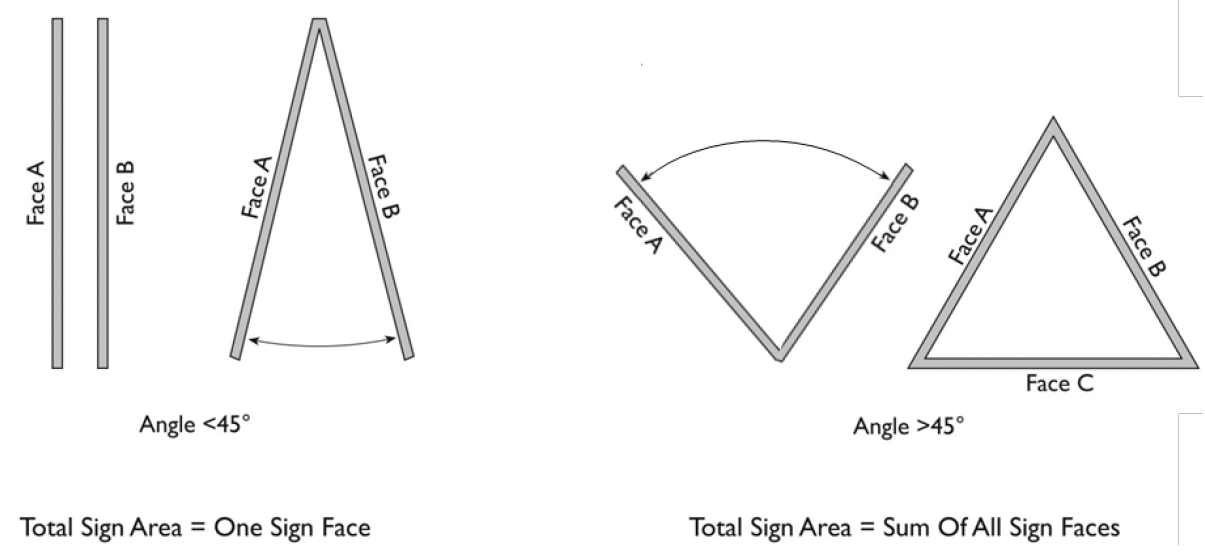
FIGURE 15-2606-A.3: DOUBLE AND MULTI-FACED SIGNS
4.
Three-Dimensional Signs. Signs that consist of, or have attached to them, one or more three-dimensional objects (i.e., balls, cubes, clusters of objects, sculpture, or statue-like trademarks), shall have a sign area of the sum of two adjacent sides of the smallest cuboid that will encompass the sign.
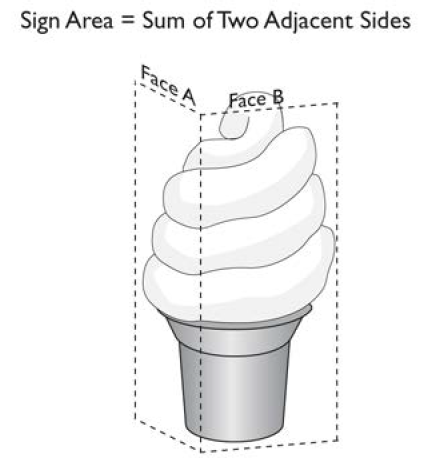
FIGURE 15-2606-A.4: THREE DIMENSIONAL SIGNS
B.
Measuring Sign Height. The height of a sign is the vertical distance measured from the ground level directly beneath the sign to the highest point at the top of the sign
C.
Measuring Sign Clearance. Sign clearance shall be measured as the smallest vertical distance between finished grade and the lowest point of the sign, including any framework or other embellishments.
D.
Building Frontage. Building frontage is the building facade that directly abuts a public street, private street, parking lot driveway, or parking spaces. For buildings with two or more frontages, the length of the wall and allowable sign area shall be calculated separately for each building frontage.
(Added Ord. 2015-39, § 1, eff. 1-9-16).
SEC. 15-2607. - GENERAL STANDARDS.
A.
Identification Decal. Every sign for which a permit is issued shall be plainly marked with the corresponding permit number issued for the sign. Tags may be displayed on signs or at the base of a structure in a visible location. Tags for freestanding or monument signs must be located on the structure between one and three feet above grade.
B.
Visibility Triangles. No sign, permanent or temporary, flag, flagpole, etc. may be erected within the visibility triangle per Section 15-2018, Intersection Visibility.
C.
Residential and Non-Residential Interface. Signs and flags on commercial and industrial zoned property shall be set back a minimum distance of 45 feet from a residential district.
D.
Materials and Mounting Required.
1.
Materials. Signs shall be made of sturdy, durable materials. Paper, cardboard, and other materials subject to rapid deterioration may only be used for temporary signs.
2.
Mounting Required. All permanent signs shall be firmly anchored, shall comply with all requirements for public safety, and shall satisfy all applicable safety codes and all other applicable governmental enactments, rules, regulations, or policies.
E.
Message Substitution. A non-commercial message of any type may be substituted, in whole or in part, for any duly permitted commercial message, and any on-site commercial message may be substituted, in whole or in part, for any other on-site commercial message.
1.
No Additional Approval. Such substitution of message may be made without any additional approval, permitting, registration or notice to the City.
2.
Limitations. This message substitution provision does not: 1) create a right to increase the total amount of signage on a parcel, lot, or land use; 2) affect the requirement that a sign structure or mounting device be properly permitted; 3) allow a change in the physical structure of a sign or its mounting device; or 4) authorize the substitution of an off-site commercial message in place of an on-site commercial message or in place of a non-commercial message.
F.
Changeable Copy. Non-electronic changeable copy shall cover no more than 20 percent of the total sign area, except for the following uses which are allowed up to 75 percent of the maximum sign area to be changeable copy: all public and semi-public uses, indoor theaters, and fuel price signs. Copy shall not be changed more than once every 24 hours.
G.
Illumination. The illumination of signs shall be designed, installed, and maintained to avoid negative impacts on surrounding right-of-ways and properties. The following standards shall apply to all illuminated signs:
1.
Shielding Required. To the extent feasible, and at the discretion of the Review Authority, light sources shall be concealed or shielded to prevent or minimize light spillage, glare, momentary blindness, or other annoyance, disability, or discomfort to persons within the view of such light sources.
2.
Colored Lights. Colored lights shall not be used at a location or in a manner so as to be confused or construed as traffic control devices.
3.
Light Sources Adjacent to Residential Areas. Illuminated signs located adjacent to any residential area shall be controlled by a rheostat or other acceptable method to reduce glare that will create a nuisance for residential buildings in a direct line of sight to the sign.
H.
Concealed Electrical Systems. External conduits, boxes, and other connections related to the function of a sign and associated lighting shall not be exposed. A switch disconnecting each circuit shall be placed in plain sight and near the inspection opening.
(Added Ord. 2015-39, § 1, eff. 1-9-16).
SEC. 15-2608. - PERMITTED SIGN TYPES BY DISTRICT.
The following table establishes the types of signs allowed by district.
(Added Ord. 2015-39, § 1, eff. 1-9-16; Am. Ord. 2016-43, § 9, eff. 12-9-16; Am. Ord. 2017-33, § 20, eff. 7-30-17).
SEC. 15-2609. - SIGNAGE ALLOWANCES FOR SPECIFIC USES.
This section establishes signage allowances for specific uses. These signs are allowed in addition to the signs allowed by Zoning District in Section 15-2608, Standards for Signs by District and in Section 15-2609, Total Maximum Sign Area.
A.
Agricultural Operations. Signs for agricultural operations conducted on parcels 20 acres or more in size may be erected subject to the following standards:
1.
Maximum Number of Signs. One sign per street frontage.
2.
Location. Shall be setback back a minimum of five feet from the public right-of-way.
3.
Maximum Sign Area per Sign. 100 square feet in area.
4.
Maximum Sign Height. 20 feet.
B.
Public and Semi-Public Uses. Signs for Public and Semi-Public Uses may be erected subject to the following standards:
1.
Maximum Number of Signs. One freestanding sign per street frontage plus one wall sign per building.
2.
Maximum Sign Area per Signs. Freestanding signs shall not be more than 32 square feet in area. Wall signs shall not exceed 10 percent of the wall area.
3.
Height Limit, Freestanding Signs. Five feet when located within a required front or street-side setback, eight feet otherwise.
4.
Illumination. Signs may be internally illuminated.
C.
Residential Subdivisions. Permanent entrance signs for residential areas with more than 10 residential parcels shall be permitted for the purpose of identifying a development subject to the following standards:
1.
Maximum Number of Signs. Two signs per entrance from a public street plus one sign per street frontage with no entrance from a public street.
2.
Maximum Sign Area per Sign. 32 square feet. In the case of a CUP, this area can be increased at the discretion of the Review Authority.
3.
Height Limit. Eight feet when located within a required front or street side setback, 10 feet otherwise. In the case of a subdivision with a CUP, this height can be increased at the discretion of the Review Authority."
4.
Illumination. Signs shall not be internally illuminated.
D.
Menu Display Boards.
1.
Menu displays, not exceeding two square feet in area mounted on a wall or in a window near the main entrance of establishments serving food to customers who eat on the premises. For free standing menu display boards, refer to Section 15-2728, Drive-In and Drive-Through Facilities.
E.
Service Stations.
1.
Signs on service station canopies are not to exceed 50 square feet on each side.
2.
Freestanding or monument signs may provide electronic fuel prices. A freestanding and/or monument sign that is to be converted to an electronic fuel price sign shall comply with the size requirements and setbacks required by the Development Code.
3.
Fuel prices shall be static and shall not be blinking, flashing, continuously changing colors, etc.
4.
Prices shall not change more than once in a 24 hour period.
5.
Only one electronic fuel price sign is permitted per site. The use of one electronic fuel price sign on a site shall not require a Master Sign Program.
6.
Electronic numbers shall not exceed 24 inches in height.
F.
Theaters.
1.
Developments containing theaters are allowed one additional pole or monument sign with changeable copy. The maximum height is 20 feet and the maximum size is 80 square feet.
2.
Theatres may provide additional walls signs. Said signs shall not exceed 200 square feet. Show times may be displayed electronically.
G.
Outdoor Scoreboards. Outdoor scoreboards are allowed in public or private athletic complexes. Size and location shall consider safety and sensitivity to nearby uses (e.g., residential).
H.
Multi-Unit Residential, excluding MX, CMS, and DT Districts. Permanent entrance signs for multi-unit residential complexes areas of 1 acre or more in size shall be permitted for the purpose of identifying a development subject to the following standards:
1.
Maximum Number of Signs. Two signs per entrance from a public street plus one sign per street frontage with no entrance from a public street.
2.
Maximum Sign Area per Sign. 32 square feet. In the case of a CUP, this area can be increased at the discretion of the Review Authority.
3.
Height Limit. Eight feet when located within a required front or street side setback, 10 feet otherwise.
4.
Illumination. Signs shall not be internally illuminated.
(Added Ord. 2015-39, § 1, eff. 1-9-16; Am. Ord. 2016-32, § 22, eff. 10-21-16; Am. Ord. 2017-33, § 22, eff. 7-30-17; Am. Ord. 2018-66, §§ 41, 42, eff. 1-18-19; Am. Ord. 2025-024, § 52, eff. 7-27-25).
SEC. 15-2610. - STANDARDS FOR SPECIFIC SIGN TYPES.
This section establishes location and other general standards for specific sign types that apply to all areas where such signs are permitted. Additional standards applicable to these signs in specific zoning districts or associated with specific uses are located in Sections 15-2608, Standards for Signs by District, and 15-2609, Signage Allowances for Specific Uses.
A.
Awning and Canopy Signs. Signs painted or printed on awnings, mounted to canopies, or similar features or structures are subject to the following standards:
1.
Location. Awnings/canopies that display signage shall be located on the ground floor of buildings.
2.
Maximum Sign Area Per Sign. 10 square feet or 25 percent of the surface area of the awning, whichever is less. Signs mounted to canopies shall be no taller than 24 inches.
3.
Minimum Sign Clearance. Eight feet.
4.
Illumination. Internal illumination of awnings is prohibited.
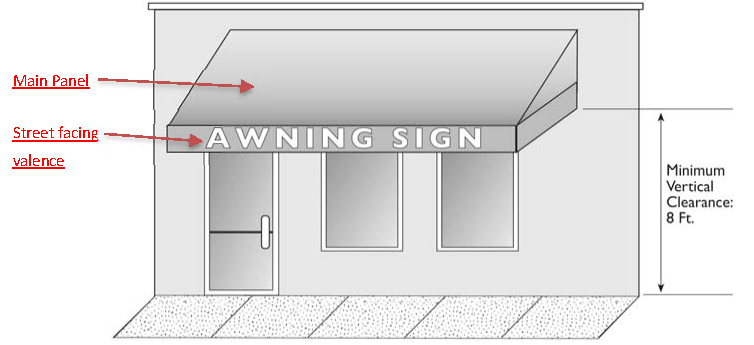
FIGURE 15-2610-A: AWNING SIGN
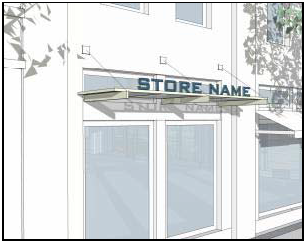
FIGURE 15-2610-B: CANOPY SIGN
B.
Pole Signs. Pole signs are subject to the following standards:
1.
Maximum Number. One per 600 feet of street frontage.
2.
Maximum Sign Area per Sign. The sign area shall not exceed 80 square feet. In cases in which a pole sign of more than 20 feet in height is permitted per the table in subsection B-4 below, the maximum sign area shall be determined at the discretion of the Review Authority.
3.
Minimum Separation. Pole signs shall have a minimum separation of 75 feet from any other pole sign.
4.
Required Setback. Signs shall be setback back a minimum of ten feet from the property line. No pole sign is permitted within 660 feet of the nearest edge of any travel lane of Freeway 41, Freeway 180, Freeway 168, or any future freeway which may be opened to public travel, if any said sign is visible from any part of such travel lane.
5.
Maximum Height. Maximum height of pole signs shall be based on the gross floor area of the habitable, enclosed, non-residential structures on the subject parcel and the classification of the adjacent or nearest street as follows:
6.
Minimum Sign Clearance. Eight feet.
7.
Landscaping Required. All pole signs shall require landscaping at the base equivalent to two times the area of the sign copy.
8.
Lighting. Lighting systems shall not exceed 100 foot Lamberts (FT-L) when adjacent to streets which have an average light intensity of less than 2.0 horizontal foot candles. When adjacent to streets with a greater average light intensity, systems shall not exceed 500 FT-L.
C.
Monument Signs. Monument signs are subject to the following standards:
1.
Maximum Number. One per 600 feet of street frontage.
2.
Maximum Sign Area per Sign.
a.
RMX, CR, CG, CH, and RBP districts: 60 square feet.
b.
Other permitted districts: 32 square feet.
3.
Minimum Separation. Monument signs shall have a minimum separation of 50 feet from any other monument sign.
4.
Required Setback.
a.
Five feet from the property line.
b.
No monument sign is permitted within 660 feet of the nearest edge of any travel lane of Freeway 41 or any future freeway which may be opened to public travel, if any said sign is visible from any part of such travel lane.
5.
Height Limit. Eight feet.
a.
Exception. When permitted within a Downtown (DT) District: five feet.
6.
Lighting. Lighting systems shall not exceed 100 foot Lamberts (FT-L) when adjacent to streets which have an average light intensity of less than 2.0 horizontal foot candles. When adjacent to streets with a greater average light intensity, systems shall not exceed 500 FT-L.
D.
Projecting Signs. Signs under canopies or covers in conjunction with pedestrian walkways, or signs projecting from buildings are allowed, subject to the following additional standards:
1.
Maximum Number. One per or tenant space per frontage.
2.
Maximum Sign Area Per Sign.
a.
Projecting Signs.
i.
DT Districts: 150 square feet.
ii.
MX and CMS Districts: 50 square feet.
iii.
All Other Districts: 12 square feet.
b.
Under Canopy or Awning Signs. Eight square feet.
3.
Height Limit.
a.
DT, MX, and CMS Districts: 10 feet above roof.
b.
All Other Districts: 12 feet above finished grade.
4.
Minimum Sign Clearance. Eight feet.
5.
Projection Allowed. A projecting sign cannot extend more than four feet from the building to which it is attached and shall be designed and located so as to cause no harm to street trees.
6.
Illumination. Within DT, MX, and CMS Districts. If illuminated, Projecting Signs may be only illuminated by one of the following methods:
a.
External Illumination. Externally illuminated with decorative lamps mounted in a manner that does not block the view of the sign from the street or sidewalk.
b.
Exposed Neon. Individual letters may be internally illuminated with exposed neon tubes or a similar light source, but shall not have a translucent panel, lens, or face.
c.
Halo. The illumination of a sign by projecting light behind an opaque letter or emblem which results in the appearance of ring of light around the unilluminated letter or emblem.
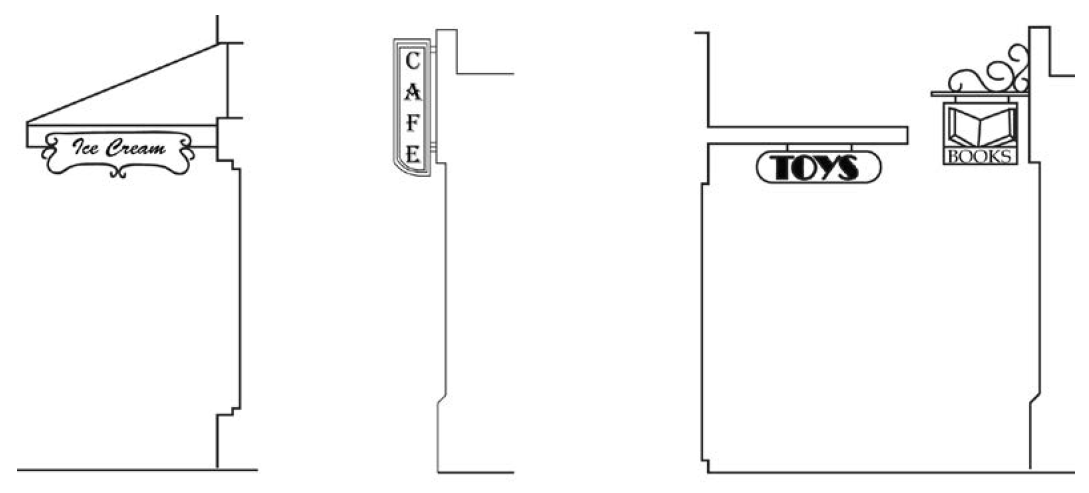
FIGURE 15-2610-D: PROJECTING SIGNS
E.
Wall Signs. Wall signs are subject to the following standards:
1.
Maximum Number. One per building frontage or tenant space plus one building identification sign per building frontage located on the uppermost story of a building with four or more stories.
2.
Maximum Sign Area Per Sign. 10 percent of the wall area.
3.
Height Limit. The top of Wall Signs shall be no higher than the following:
a.
Downtown Districts. Wall Signs shall not be located closer than 12 inches to the eve or parapet.
b.
Other Districts, Buildings Which Include Residential Uses. 20 feet or the height of the wall of the building to which the sign is attached, whichever is lower. Building identification signs located on the uppermost story of a building shall be no higher than the wall of the building to which the sign is attached.
c.
Other Districts, Buildings Which Do Not Include Residential Uses. The height of the wall of the building to which the sign is attached.
4.
Projection Allowed. Wall signs shall not extend more than 12 inches beyond the face of the wall to which they are attached.
5.
Placement.
a.
No wall sign may cover, wholly or partially, any wall opening.
b.
Wall signs shall not occupy more than 80 percent of any architectural element that they occupy (frieze, pilaster, etc.).
c.
Buildings within Downtown Districts. Wall Signs shall not be located closer than 24 inches from openings or the edge of the building façade.
6.
Orientation. Unless a different orientation is specifically authorized, each wall-mounted sign shall be placed flat against the wall of the building.
7.
Illumination within DT and CMS Districts. If illuminated, Wall Signs may be only illuminated by one of the following methods:
a.
External Illumination. Externally illuminated with decorative lamps mounted in a manner that does not block the view of the sign from the street or sidewalk.
b.
Exposed Neon. Individual letters may be internally illuminated with exposed neon tubes or a similar light source, but shall not have a translucent panel, lens, or face.
c.
Halo. The illumination of a sign by projecting light behind an opaque letter or emblem which results in the appearance of ring of light around the unilluminated letter or emblem.
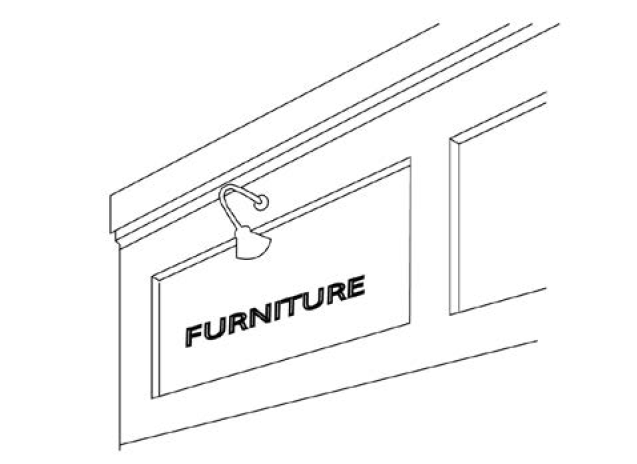
FIGURE 15-2610-E: WALL SIGN
F.
Window Signs. Window signs are subject to the following standards:
1.
Maximum Number. One per window.
2.
Location. Ground floor window area.
3.
Window Transparency. A minimum 75 percent of the window shall be transparent and free of signage features. Signage inside the building is not allowed within three feet of the window.
G.
Roof Signs. Roof signs are subject to the following standards:
1.
Maximum Number. One per building.
2.
Maximum Sign Area Per Sign.
a.
Buildings Less than Five Stories in Height. 300 square feet.
b.
Buildings Five Stories in Height or Taller. 500 square feet.
3.
Maximum Height.
a.
Buildings Less than Five Stories in Height. 10 feet.
b.
Buildings Five Stories in Height or Taller. 20 feet.
4.
Projection Allowed. Roof signs shall not project beyond the face of the building.
5.
Placement. No roof sign may cover, wholly or partially, any wall opening.
6.
Illumination. If illuminated, Roof Signs may be only illuminated by one of the following methods:
a.
External Illumination. Externally illuminated with concealed flood lighting.
b.
Exposed Neon. Individual letters may be internally illuminated with exposed neon tubes or a similar light source, but shall not have a translucent panel, lens, or face.
c.
Halo. The illumination of a sign by projecting light behind an opaque letter or emblem which results in the appearance of ring of light around the unilluminated letter or emblem.
(Added Ord. 2015-39, § 1, eff. 1-9-16; Am. Ord. 2016-32, § 23, eff. 10-21-16; Am. Ord. 2016-43, §§ 10—12, eff. 12-9-16; Am. Ord. 2017-33, § 21, eff. 7-30-17; Am. Ord. 2018-25, §§ 22—24, eff. 6-11-18).
SEC. 15-2611. - OTHER SIGNS.
A.
Sidewalk Signs. Sidewalks signs shall comply with the standards below. A permit is not required.
1.
Quantity. A maximum of one sidewalk sign per business is allowed.
2.
Locations.
a.
Sidewalk signs shall be located away from important paths of pedestrian travel. A five foot wide travel path shall be maintained for through pedestrian traffic, for travel from crosswalks to the primary path of through pedestrian traffic, and for travel into and out of the establishment.
b.
Sidewalk signs shall not be located less than 18 inches from a curb.
c.
Sidewalk signs shall not be located in front of another commercial establishment.
d.
Sidewalk signs shall not be located more than 50 feet from the establishment for which it is advertising.
3.
Design:
a.
Sidewalk signs shall have no more than two sides.
b.
The height of sidewalk signs shall be no less than 18 inches and no more than 36 inches.
c.
The width of sidewalk signs shall be no less than 18 inches and no more than 24 inches.
d.
Sidewalk signs shall not be illuminated except by ambient sources.
B.
Banners, Streamers, Moving Signs, and Inflatables. Banners, streamers, moving signs, and inflatables (including air dancers, balloons, and similar objects) are allowed subject to Temporary Use Permit approval for establishments within Non-Residential Districts, subject to the following standards. Signs of this type do not count towards total maximum sign area.
1.
Maximum Number. A maximum of one type of sign is allowed per Major Street frontage.
2.
Maximum Height. If a banner is on a freestanding pole, the pole height shall not exceed 20 feet; all other signs shall not be located above the roofline.
3.
Maximum Size. The maximum total sign area is 60 square feet.
4.
Minimum Separation. Air-inflated signs shall have a minimum separation of one-half mile from other air-inflated signs on abutting parcels or adjacent to a Buffer or Residential Zoning District. Air inflated signs shall not exceed 20 feet in height.
5.
Duration. No sign per this section shall be displayed for more than 30 days, and a period of 30 days must lapse before displaying another sign. Signs shall not be displayed for more than 60 total days during a calendar year.
6.
Removal. Signs shall be removed within 24 hours of completion of the event.
C.
Temporary Subdivision Signs.
1.
On-Site. Temporary real estate signs advertising real property which has been subdivided for purposes of sale or lease shall be permitted, subject to the following conditions:
a.
Maximum Number. Four per site.
b.
Maximum Total Sign Area. 320 square feet plus 20 square feet for every 20 acres over 60 acres of site area.
c.
Maximum Sign Area per Sign. 80 square feet for sites 20 acres or less in size. 160 square feet for sites more than 20 acres in size.
d.
Height Limit. 16 feet.
e.
Duration. The sign shall remain only as long as some portion of the property advertised for sale remains unsold, or for a period of two years, whichever period is shorter. The two year period shall begin on a date determined by the Director. The Director may extend this period, but not it shall not exceed one year.
2.
Off-Site. Temporary real estate signs directing prospective purchasers to a subdivision having lots or houses for sale may be erected and maintained on private property, with the owner's permission, provided said signs do not adversely affect the use or appearance of existing buildings or landscaping and do not create hazardous traffic conditions.
a.
Maximum Number. Four per subdivision.
b.
Maximum Sign Area Per Sign. 32 square feet.
c.
Required Setback. Five feet from the property line.
d.
Location. Within one mile of the exterior boundary of the subdivision.
e.
Height Limit. 12 feet.
f.
Duration. The sign shall remain only as long as some portion of the property advertised for sale remains unsold, or for a period of two years, whichever period is shorter. The two year period shall begin on a date determined by the Director. The Director may provide a one-time extension, but the extended period shall not exceed one year.
3.
Subdivision Flags. Any residential subdivision with lots for sale may display decorative flags pursuant to the following conditions:
a.
Number and Spacing.
i.
One flag every 60 linear feet of subdivision property along a major street (freeway, expressway, arterial, collector).
ii.
One flag every 30 linear feet of subdivision property within 660 feet of the main subdivision entrance.
iii.
One flag every 20 linear feet of the main entryway into the subdivision.
iv.
Two flags for each model home lot. These model home flags are allowed in addition to the number of flags determined by the above linear footage measurements.
b.
Height Limit. The maximum height of a flag pole shall be 20 feet.
c.
Maximum Sign Area per Sign. The maximum area of a flag shall be 24 square feet. No single dimension shall exceed eight feet.
d.
Duration. All pole structures and flags must be removed no later than five days after sales activity in the subdivision ceases.
e.
Building Permit Required. Residential subdivision flagpoles shall not be installed without issuance of a building permit, and must conform to the above listed regulations.
f.
Standard Subdivisions. The number, location, height, and size of flags for a standard subdivision shall be determined through Development Permit approval.
g.
Planned Unit Developments. The number, location, height, and size of flags for a subdivision created as a Planned Unit Development (PUD) shall be determined through the processing of a Conditional Use Permit for the PUD.
D.
Real Estate Signs. Real estate signs are subject to the regulations below. A permit is not required. Real estate signs advertising real property for sale after being subdivided shall not be subject to this subsection, but shall be subject to Section 15-2612-C.
1.
On-Site Real Estate Signs. On-premises signs conveying information about the sale, rental, or lease of the lot, premises, dwelling, or structure on which they are located, provided that they comply with the following standards:
a.
No more than one real estate sign per lot in residential districts, or one real estate sign per street frontage per lot in non-residential districts, is displayed at any one time;
b.
The sign or signs do not exceed an aggregate area of six square feet in residential districts or 32 square feet in non-residential districts;
c.
Wall signs shall not be higher than seven feet above grade in residential districts or fifteen feet in non-residential districts. Freestanding signs shall not exceed six feet in height in residential districts or eight feet in height in non-residential districts.
d.
The sign or signs are not illuminated; and
e.
The sign or signs are removed within 15 days after the sale, lease, or rental of the property has been completed.
2.
Directional Signs for Open Houses. Up to three off-site signs directing the public to "open house" events for the viewing of lots, premises, dwellings, or structures that are for sale, lease, or rent, are permitted on public or private land, provided that they comply with the following standards:
a.
No sign or signs shall exceed six square feet in area, or three feet in height from finished grade.
b.
The sign or signs may not be placed more than 12 hours before the start or remain more than 12 hours after the conclusion of the open house event.
c.
Signs shall not inhibit circulation nor be within the visibility triangle per Section 15-2018, Intersection Visibility.
E.
Signs Associated with Projects Under Construction. Signs located on project sites that are under construction are subject to compliance with the regulations below. A permit is not required.
1.
One sign per street frontage except for projects having an excess of 500 lineal feet of street frontage, one additional sign may be allowed.
2.
Signs shall be limited to a maximum of 80 square feet in area and 10 feet in height.
3.
Signs shall be removed before occupancy of the site.
F.
Flags. Free standing flagpoles or decorative flags on light posts may be installed in accordance with the following standards:
1.
Location. Flagpoles shall not be located within any required front yard, street side or side yard setbacks. Flagpoles shall be located outside of the visibility triangle. Refer to Section 15-2018, Intersection Visibility.
2.
Maximum Flagpole Height. The pole height shall not exceed 25 feet.
3.
Maximum Size. The maximum total flag area is 24 square feet.
4.
Decorative Flags. Flags may be for non-commercial purposes. Permitted flags include, but are not limited to, countries, counties, cities, etc., or decorative flags that do not contain a commercial message.
G.
Yard Signs. Yard signs, which are typified by an impermanent nature; are usually constructed from lightweight materials (ex.: corrugated plastic); are typically located in a street-facing setback and supported by poles, stakes, or wire frames; are permitted subject to the following standards. A permit is not required.
1.
In Residential Districts.
a.
Maximum Size. Signs shall not exceed six square feet in area.
b.
Maximum Height/Width. Signs (including support structure) shall not exceed three feet in height or width.
2.
All Other Districts.
a.
Maximum Size. Signs shall not exceed 32 square feet in area.
b.
Maximum Height/Width. Signs (including support structure) shall not exceed eight feet in height or width.
3.
Timing. Yard Signs relating to an event are permitted within 90 days before the event and up to 10 days after the event.
4.
Location. Signs shall not be attached to any utility pole and such sign, or portion thereof, is not placed in any public right-of-way or on any property owned by the City. Such signs may be placed on private property with the permission of the property owner or may be attached to an existing sign on private property with the permission of the sign owner or lessee.
5.
Shall Not Obstruct. Such signs shall not be erected in such a manner that they will, or reasonably may be expected to, interfere with, obstruct, confuse, or mislead traffic.
6.
Maintenance. Signs not erected or maintained in accordance with the provisions of this subsection shall be the responsibility of the owner of the property upon which the sign is located, shall be deemed a public nuisance, and may be abated by such property owner, the candidate or person advocating the vote described on the sign (if applicable), or the Director. The cost of removal incurred by the Director shall be assessed against the property owner and/or, if applicable, the candidate and/or the person advocating the vote described on the sign.
(Added Ord. 2015-39, § 1, eff. 1-9-16; Am. Ord. 2016-32, § 24, eff. 10-21-16).
SEC. 15-2612. - MASTER SIGN PROGRAM (MSP).
A.
Projects Requiring a Master Sign Program. A Master Sign Program is required for the following types of projects:
1.
Multi-Unit Residential. Developments of 50 or more units.
2.
Non-Residential or Mixed-Use Projects. All new non-residential or mixed-use projects of five or more separate non-residential tenants.
3.
Multiple Signs. Proposals for 10 or more signs on the same building or site with two or more separate tenants.
4.
Planned Development Permit. Any project using the Planned Development provisions of this Code.
5.
Pole Signs. Proposals to erect a pole sign.
6.
Electronic Signs. Signs with electronic copy.
7.
Roof Signs. Proposals to erect a roof sign.
8.
Alternative Designs. Projects which seek flexibility for sign designs which are of a high quality and which contribute to the attractiveness and economic viability of their surroundings, but which do not meet the standards for their location.
9.
Exceptions. Projects within Downtown Districts for sign types described in items 1, 2, 3, 6, and 7 above shall not require a Master Sign Program.
B.
Required Submittals. An application of approval of a Master Sign Program shall contain the following information:
1.
A site plan showing the location of buildings, parking lots, driveways, and landscaped areas;
2.
Computation of the maximum area for individual signs, the height of signs, and the number of freestanding signs allowed;
3.
An accurate indication on the site plan of the proposed location of each proposed sign and existing sign which is to remain;
4.
Color schemes, lettering, and graphic styles (if tenants are not known, generic styles may be presented);
5.
Lighting and sign construction materials; and
6.
Sign dimensions (if tenants are not known, generic dimensions may be presented).
C.
Review Authority. A Master Sign Program shall be reviewed and acted upon by the Development Director. In the case of projects that require other approvals from the Planning Commission or City Council, the decision-making authority for the other approval shall be the decision-making authority for the Master Sign Program.
D.
Required Findings. A Master Sign Program may be approved only if the following findings are made:
1.
The proposed signs are compatible in style and character with any building to which the signs are to be attached, any surrounding structures, and any adjoining signage on the site;
2.
Future tenants will be provided with adequate opportunities to construct, erect, or maintain a sign for identification; and
3.
Directional signage and building addressing is adequate for pedestrian and vehicular circulation and emergency vehicle access.
4.
Light and glare will not negatively affect nearby residential uses.
5.
Additional findings for Alternative Designs which do not conform to some or all of the applicable sign standards:
a.
The sign design and materials are of equal or greater quality than existing signs in the surrounding area and the standard requirements for signs on the site;
b.
The sign design and materials of are equal or greater quality than that which is required by the applicable sign standards;
c.
The location of the sign would not be unnecessarily distracting to motorists and would not cause inconvenience to pedestrians;
d.
The design of the proposed sign(s) would contribute positively to the attractiveness of the area;
e.
The alternative design would not be incompatible with nearby residential uses;
f.
The alternative design would enhance the economic viability of its surroundings.
E.
Conditions. Reasonable conditions of approval may be imposed by the Review Authority to achieve the purposes of this section and ensure compatibility with adjacent land uses and signage.
F.
Post-Approval Procedures. After approval of a Master Sign Program, no signs shall be erected, placed, painted, or maintained, except in conformance with such program, and such program may be enforced in the same way as any provision in this section.
1.
Lease Agreements. The Master Sign Program and all conditions of approval shall be attached to the lease agreements for all leasable space within a project.
2.
Individual Signs. Any sign that conforms to an approved Master Sign Program may be approved by the Director; however, approval of a Master Sign Program does not waive the permit requirements for individual signs.
3.
Amendments. The Director may approve minor amendments to a Master Sign Program that are in substantial conformance with the original approval. All other amendments, including amendments to conditions of approval shall be processed as a new application.
G.
Public Notice. Public Notice shall be provided 10 days prior to the date of action pursuant to Section 15-5007.
H.
Appeals. Master Sign Program decisions are subject to the appeal provisions of Section 15-5017, Appeals.
I.
Modifications. Master Sign Programs may only be modified as provided for in Article 50.
(Added Ord. 2015-39, § 1, eff. 1-9-16; Am. Ord. 2017-33, §§ 23, 24, eff. 7-30-17; Am. Ord. 2018-25, § 25, eff. 6-11-18; Am. Ord. 2018-66, § 43, eff. 1-18-19; Am. Ord. 2025-024, § 53, eff. 7-27-25).
SEC. 15-2613. - HISTORIC SIGNS.
A.
Designation. The Council may designate historic signs following a duly-noticed public hearing and a recommendation from the Historic Preservation Commission.
B.
Criteria. Historic signs must meet defined criteria, including, but not limited to, the fact that the sign is 50 or more years old and has significance to the Fresno community because it is associated with a significant historical event or it is associated with a historic business.
C.
Allowances for Historic Signs.
1.
Structural Improvements. Historic signs may have structural improvements completed in order to extend the life of the sign.
2.
Damage Repairs. If the sign is damaged, it may be repaired and replaced with the original sign area and original height, even if the sign does not conform to the standards of this article.
(Added Ord. 2015-39, § 1, eff. 1-9-16).
SEC. 15-2614. - ELECTRONIC COPY.
Electronic copy is subject to approval of a Master Sign Program and the following standards:
A.
Display Duration. Copy display is limited to a minimum duration of eight seconds and shall have an unlighted interval between copy displays of one second or more.
B.
Light Intensity. The intensity of the sign lighting shall not exceed 100 foot Lamberts (FT-L) when adjacent to streets which have an average light intensity of less than 2.0 horizontal footcandles and shall not exceed 500 FT-L when adjacent to streets which have an average light intensity of 2.0 horizontal footcandles or greater. No change of lighting intensity may occur during a display or between displays except to respond to a change in ambient lighting conditions.
C.
The use of one electronic fuel price sign on a site shall not require a Master Sign Program.
(Added Ord. 2015-39, § 1, eff. 1-9-16; Am. Ord. 2018-66, § 44, eff. 1-18-19).
SEC. 15-2615. - NON-CONFORMING SIGNS.
All permanent signs which were erected and in existence prior to the effective date of this section or prior to annexation to the city, and which were at the time of such erection or establishment in compliance with all applicable statues and ordinances, are non-conforming signs and subject to the provisions of Article 4, Non-Conforming Uses, Structures, Site Features, and Lots, and the following:
A.
Continuance and Maintenance. Non-conforming signs that were legal when first installed, and which have not been modified so as to become illegal, may be continued, except as otherwise provided for in this subsection.
1.
Routine maintenance and repairs may be performed on signs that are non-conforming.
2.
A sign that did not conform to law existing at the time of its erection shall be deemed an illegal sign and shall not be a non-conforming sign. The passage of time shall not cure illegality from the outset.
B.
Alterations and Additions to Non-Conforming Signs. No non-conforming sign shall be moved, altered, or enlarged unless required by law or unless the moving, alteration or enlargement will result in the elimination of the nonconformity.
C.
Restoration of a Damaged Sign. Whenever a non-conforming sign is destroyed by fire or other calamity to the extent of 50 percent or less, the sign may be restored to display the pre-existing sign area and the non-conforming use of the sign may be resumed, provided that restoration is started within one year and diligently pursued to completion and the height of the restored sign conforms to the standards of this article.
1.
Whenever a non-conforming sign is destroyed by fire or other calamity to a greater extent than 50 percent, or is voluntarily razed or shall be required by law to be razed, the sign shall not be restored except in full conformity with this article.
D.
Signs Rendered Non-Conforming by Annexation. Any sign that becomes non-conforming subsequent to the effective date of this Code by reason of annexation to the city of the territory upon which the sign is located, shall be subject to the provisions of this article.
(Added Ord. 2015-39, § 1, eff. 1-9-16).
SEC. 15-2616. - MAINTENANCE OF SIGNS.
All signs and associated supporting structures shall be maintained in good condition, without rips, tears, and similar damage.
A.
Deteriorated Signs. Any sign or sign structure that is sagging, leaning, fallen, decayed, broken, deteriorated, or in an otherwise dilapidated condition shall be promptly repaired, to the satisfaction of the City, or removed.
B.
Graffiti. Graffiti on a sign shall be removed within 48 hours of notice of its placement on such sign.
C.
Maintenance Standards. All parts, portions, units, and materials composing a sign, together with the frame, background, surface, support, or enclosure shall be maintained in a safe condition, painted, and adequately protected from weathering with all braces, bolts, and structural parts, supporting frames, and fastenings reasonably free from deterioration, rot, rust, and loosening so that they do not create a hazard to persons, or property or constitute a nuisance.
D.
Summary Removal of Hazards. Whenever any sign, by virtue of its physical nature and condition, poses an immediate and serious threat to the public safety, it may be removed by City personnel, or have its physical deficiency cured, to the extent necessary to protect the public safety. The cost of such removal or repair shall be assessed against the sign owner.
(Added Ord. 2015-39, § 1, eff. 1-9-16).
SEC. 15-2617. - REMOVAL OF SIGNS.
A.
Signs That Have Been Abandoned. An on-site sign that identifies a business, lessor, or owner whose use of the premises has ceased for a period of not less than 60 days shall be removed by the owner or lessee of the premises upon which the sign is located. Any sign and, if applicable, its supporting structure (e.g., pole) not removed within the required period shall constitute a nuisance and shall be removed.
B.
Demolition or Clearance of the Site. Should a site be cleared, signs, including poles, foundations, etc., shall be removed. This includes sites that are cleared for redevelopment.
C.
Non-Conforming Sign Removal. See Section 15-2615, Non-Conforming Signs.
(Added Ord. 2015-39, § 1, eff. 1-9-16).
SEC. 15-2701.- PURPOSE.
The purpose of this article is to establish standards for specific uses and activities that are permitted or conditionally permitted in some or all districts. These provisions are supplemental standards and requirements to minimize the impacts of these uses and activities on surrounding properties and to protect the health, safety, and welfare of their occupants and of the general public.
(Added Ord. 2015-39, § 1, eff. 1-9-16).
SEC. 15-2702. - APPLICABILITY.
A.
Each land use and activity covered by this article shall comply with the requirements of the section applicable to the specific use or activity.
B.
The uses that are subject to the standards in this article are allowed only when authorized by the base district regulations, except where this article establishes a different planning permit requirement for a specific use.
C.
When there is a conflict between the provisions of this article and a Conditional Use Permit which was granted prior to the effective date of this Code, the Conditional Use Permit shall prevail.
D.
Existing Specific Uses and Activities. Unless otherwise noted, the following shall apply:
1.
Land uses and activities covered by this article which were in place prior to the adoption of this Code which are not considered to be Non-Conforming uses under section 15-402 shall be subject to all operational standards, including, but not limited to, hours of operation, litter and graffiti removal, product restrictions, and similar regulations within two years of the effective date of this Code, unless otherwise specified.
2.
Legal Non-Conforming uses shall be subject to all operational standards, including, but not limited to, hours of operation, litter and graffiti removal, product restrictions, and similar regulations. Legal Non-Conforming uses shall not be subject to requirements of this article which affect permanent physical improvements which existed on the site prior to the adoption of this Code.
E.
Permit Required. Specific Uses and Activities which are required by this Article to make physical improvements to a structure or site shall be subject to a Development Permit as put forth in Article 52.
(Added Ord. 2015-39, § 1, eff. 1-9-16; Am. Ord. 2018-66, § 45, eff. 1-18-19).
SEC. 15-2703. - ACCESSORY USES.
An accessory use shall be incidental, related, appropriate, and clearly subordinate to the principal use or building to which it relates; under the same regulations applied to the principal use in any zoning district; and where the accessory use does not alter the principal use. These regulations are found in the use regulations tables in Part II, Base and Overlay Districts, and may be subject to specific standards found in this article or within each district, as specified in the tables. Accessory uses and structures are also subject to the development and site regulations found in Article 20, General Site Regulations.
(Added Ord. 2015-39, § 1, eff. 1-9-16).
SEC. 15-2704. - ABANDONED SERVICE STATIONS AND CARWASHES.
A.
Abandonment. Any service station and/or carwash shall, in the case of abandonment or non-operation of the primary use, be declared a Public Nuisance and shall be dismantled and the site cleared within 12 months subsequent to the close of the last business day or whenever the facility stops selling fuel, whichever occurs first.
1.
Exception. Any service stations or carwashes certified on the Local Official Register of Historic Resources.
B.
Conversions of Service Stations. A Discretionary Permit authorizing the conversion of a service station to any other use shall be subject to the following:
1.
Ancillary equipment, not including the main building, including all pumps, pump islands, fuel pump canopies, signs, insignias, trademarks, their supporting structures, mountings, foundations, and gas price signs, and all other above-ground improvements which are uniquely associated with service station and/or carwash operations shall be dismantled and removed from the site to a waste disposal or recycling facility permitted for receipt of such debris.
2.
Pumps and pipes related to the delivery and disposal of petroleum products shall be removed.
3.
Aboveground and underground apparatus need to be removed in accordance with directives of all regulatory agencies.
4.
The converted service station and/or carwash site shall be resurfaced and landscaped in a manner appropriate to the proposed use.
C.
Site Clearance. Should the site be cleared, all equipment per Subsection B above, including signs shall be removed.
(Added Ord. 2015-39, § 1, eff. 1-9-16).
SEC. 15-2705. - ADULT-ORIENTED BUSINESSES.
A.
Purpose. Certain types of Adult-Oriented Businesses possess characteristics that may be determined to be objectionable, and, when concentrated, may be found to have a deleterious effect upon adjacent areas. Therefore, special regulation of these uses is necessary to ensure that these adverse effects will not contribute to the blighting or downgrading of the surrounding neighborhood nor create an adverse effect on minors.
B.
Public Nudity. Refer to Section 9-2602 of the Municipal Code.
C.
Criteria for Granting a Conditional Use Permit. Where an Adult-Oriented Business is conditionally permitted by the zoning district regulations, the Planning Commission, or City Council upon appeal, shall approve a Conditional Use Permit only if it finds that the proposed facility or use complies with the regulations specified in this section. Reasonable conditions may be imposed, such as limitation on hours of operation, exterior lighting, display materials, and other similar conditions, as may be necessary to protect the public health, safety, and welfare.
D.
Standards. Adult-Oriented Businesses shall comply with all applicable State and federal laws in addition to the following development and operational standards.
1.
Location. Adult-Oriented Businesses shall be located the following minimum distances:
a.
From any Residential District or existing residence: 1,000 feet.
b.
From any educational institution, including, but not limited to, public or private schools, nursery schools or child-care nurseries, religious and/or cultural institution or, private or public park: 1,000 feet.
c.
From another Adult-Oriented Business: 1,000 feet. This minimum separation requirement shall not apply to businesses forced to relocate due to a public taking of property for a public infrastructure project.
2.
Hours of Operation. Hours of operation of the business shall be limited to the time period between 8 a.m. and 10 p.m. on Sunday, Monday, Tuesday, Wednesday and Thursday, and from 8 a.m.to 11 p.m. on Friday and Saturday.
3.
Display. No Adult-Oriented Business shall display or exhibit any material in a manner which exposes to the public view photographs or illustrations of specified sexual activities or naked adults in poses which emphasize or direct the viewer's attention to the subject's genitals. Adult newsracks are subject to this limitation.
4.
Security Program. An on-site security program shall be prepared and implemented as follows:
a.
Exterior Lighting. All off-street parking areas and building entries serving an adult business shall be illuminated during all hours of operation with a minimum maintained horizontal illumination of one foot-candle of light on the parking surface and/or walkway.
b.
Interior Lighting. All interior portions of the adult business, except those devoted to mini-motion or motion pictures, shall be illuminated during all hours of operation with a lighting system that provides a minimum maintained horizontal illumination of not less than two foot-candles of light on the floor surface.
c.
Security Guards. Security guards for adult businesses may be required if it is determined by the Fresno Police Department that their presence is necessary in order to prevent any unlawful conduct from occurring on the premises.
E.
Site Conditions.
1.
Façade. For existing buildings, pictures of the building(s) must be provided to the City upon submittal of a Conditional Use Permit application. The exterior of the building(s) may be required to be repainted and repaired if needed.
2.
Landscaping. The site shall comply with all landscaping requirements in place at the time of application.
3.
Litter. The exterior, including all signs and accessory buildings and structures, shall be maintained free of litter at all times. The owner or operator shall provide for daily removal of trash, litter, and debris from premises and on all abutting sidewalks within 20 feet of the premises.
4.
Graffiti. The owner or operator shall remove graffiti within 48 hours.
5.
Pay Telephones. Pay phones shall comply with Section 15-2746, Pay Phones.
F.
Definitions. Unless otherwise specifically provided, the terms used in this section shall have the following meanings:
1.
Specified Sexual Activities. Specified sexual activities means:
a.
Actual or simulated sexual intercourse, oral copulation, anal intercourse, oral anal copulation, bestiality, direct physical stimulation of unclothed genitals, flagellation or torture in the context of sexual relationship, or the use of excretory functions in the context of a sexual relationship, and any of the following depicted sexually oriented acts or conduct: analingus, buggery, coprophagy, coprophilia, cunnilingus, fellatio, necrophilia, pederasty, pedophilia, piquerism, sapphism or zooerasty;
b.
Clearly depicted human genitals in a state of sexual stimulation, arousal, or tumescence;
c.
Use of human or animal masturbation, sodomy, oral copulation, coitus, or ejaculation;
d.
Fondling or touching of nude human genitals, pubic region, buttocks, or female breast;
e.
Masochism, erotic or sexually oriented torture, beating, or infliction of pain;
f.
Erotic or lewd touching, fondling, or other contact with an animal by a human being;
g.
Human excretion, urination, menstruation, vaginal, or anal irrigation in the context of a sexual relationship;
h.
Any combination of the above items a through g.
2.
Specified Anatomical Areas. Specified anatomical areas means less than completely and opaquely covered:
a.
Mature human genitals,
b.
Mature human buttock,
c.
Mature human female breast below a point immediately above the top of the areola;
d.
Human male genitals in a discernibly turgid state, even if completely and opaquely covered.
3.
Exposes to Public View. Exposes to the view of persons outside the building in which such adult entertainment facility is located.
G.
Adult-Oriented Business Types. Adult-Oriented Businesses include, but are not limited to the following types of businesses.
1.
Adult Newsrack. Any coin-operated machine or device that dispenses material substantially devoted to the depiction of "specified sexual activities" or "specified anatomical areas."
2.
Adult Bookstore. Any building, or portion thereof, where space devoted to adult materials composes 25 percent or more or 500 square feet, whichever is less, of any one or more of the following:
a.
Wall space;
b.
Any display area other than wall space (e.g., tables, racks, and/or any other display areas or structures) or stock in trade (inventories not on display, but on site).
3.
Adult Entertainment Facility. An adult newsrack, adult bookstore, adult motion picture theater, adult hotel or motel, adult motion picture arcade, cabaret, model studio, sexual encounter center, or any other sex business, or any combination of two or more of such uses.
4.
Adult Motion Picture Arcade. Any place to which the public is permitted or invited wherein coin- or slug-operated or electronically, electrically, or mechanically controlled still or motion picture machines, projectors, or other image-producing devices are maintained to show images where the images so displayed are distinguished or characterized by an emphasis on depicting or describing "specified sexual activities" or "specified anatomical areas."
5.
Adult Motion Picture Theater. A building or portion thereof, or area, whether open or enclosed, used for presenting material in the form of motion picture film, videotape, or other means which is substantially devoted to the depiction of "specified sexual activities" or "specified anatomical areas" for observation by persons therein.
6.
Adult Novelty Store. A building, or portion thereof, in which 25 percent or more of the display area for devices, instruments, or paraphernalia is used for the distribution, sale, offer for sale and/or rental or offer for rental of any device, instrument, or paraphernalia evidently designed or marketed for sexual stimulation of human genital organs or for sadomasochistic use or abuse of themselves or others. Such devices, instruments, or paraphernalia include, but are not limited to, phallic-shaped vibrators, dildos, muzzles, whips, chains, bather restraints, racks, non-medical enema kits, body-piercing implements (excluding earrings or other decorative jewelry) or other evident tools of sadomasochistic abuse.
7.
Adult Video Store. A building, or portion thereof, in which 25 percent or more of any one or more of the following: Wall space or any display area other than wall space (e.g., tables, racks, and/or any other display areas or structures) or stock in trade (inventories not on display but on site) or gross revenues or advertising and other promotion of video, video cassettes, slides, tapes, films, compact discs, Blu-ray, etc., motion pictures in which 25 percent or more of the description, display time, or depiction is devoted to the presentation of "specified sexual activities" or "specified anatomical areas" as defined in this article.
8.
Cabaret. A nightclub, theater, or other establishment which features live performances by topless and/or bottomless dancers, "go-go" dancers, exotic dancers, strippers or similar entertainers, where such performances are distinguished or characterized by an emphasis on "specified sexual activities" or "specified anatomical areas."
9.
Model Studio. Any business where, for any form of consideration or gratuity, figure models who display "specified anatomical areas" are provided to be observed, sketched, drawn, painted, sculptured, photographed, or similarly depicted by persons paying such consideration or gratuity. This does not include accredited educational institutions which may employ models in fine art courses.
10.
Sexual Encounter Center. Any business, agency, or person who, for any form of consideration or gratuity, provides a place where two or more persons, not all members of the same family, may congregate, assemble, or associate for the purpose of engaging in "specified sexual activities" or exposing "specified anatomical areas."
11.
Other Sex Business. Any other business or establishment which offers its patrons goods, services, or entertainment, or any combination thereof, characterized by an emphasis on matter depicting, describing, or relating to "specified sexual activities" or "specified anatomical areas," including such types of business known as adult dance studios, men's social clubs, and music studios which meet such definition.
(Added Ord. 2015-39, § 1, eff. 1-9-16).
SEC. 15-2706. - ALCOHOL SALES—THE RESPONSIBLE NEIGHBORHOOD MARKET ACT.
A.
Regulations for On-Site Consumption. Refer to Section 15-2751, Restaurants with Alcohol Sales, Bars, Nightclubs, and Lounges for standards.
B.
Regulations for Wholesalers. Operators who hold a Type 17 ABC license for the purpose of selling beer and wine to retailers or a Type 18 ABC license for the purpose of selling distilled spirits to retailers, who meet the definition of a "wholesaler" within the meaning of California Business and Professions code section 23021, and who are located within the City of Fresno are subject to the following restrictions:
1.
Wholesalers shall not supply establishments (as defined below) with any items that would violate this section of the Fresno Municipal Code.
C.
Purpose. The following regulations, known as "The Responsible Neighborhood Market Act," are for establishments that sell alcoholic beverages for off-site consumption not otherwise exempt under Section 15-2706.D.2 (henceforth "establishment"). These establishments possess certain characteristics that have the potential to cause deleterious effects and nuisances on surrounding neighborhoods and businesses, especially when such establishments are concentrated near one another. In order to ensure that establishments operate in a manner that is mutually beneficial to surrounding uses and to also provide mechanisms to prevent and correct any associated problems, the following special regulations are provided.
D.
Applicability.
1.
New or Expanded Use. Any proposed new establishment or any existing establishment that requests to modify their alcohol or business license type(s), reinstate their alcohol or business license(s) after an expiration or revocation, extend their hours of alcohol sales, or expand their floor area for retail sales of alcohol, shall obtain a Conditional Use Permit issued in compliance with the standards of this section. An existing establishment that expands their floor area for non-alcohol related retail sales is allowed to retain the conditions on their existing Conditional Use Permit in relation to alcohol requirements. Should an establishment not comply with the strict application of the regulations provided for in this section, said improvements shall be made prior to commencing the sale of alcoholic beverages. Violation of these standards at any time may result in the revocation of a Conditional Use Permit.
2.
Exemptions. This section does not apply to the following:
a.
Establishments that serve alcohol for on-site consumption, where an off-site sales component is incidental to the main use and as permitted through an establishment's ABC Conditional Use Permit License Type.
b.
Temporary uses issued a Temporary License by the California Department of Alcoholic Beverage Control and established in compliance with all City laws and ordinances.
3.
Conditional Use Permit. Conditional Use Permits issued pursuant to this section shall also be subject to the following:
a.
ABC Conditional Use Permit:
i.
Establishments seeking to sell alcoholic beverages for off-site consumption, whether as a new or expanded use, shall obtain a Conditional Use Permit for alcohol sales.
E.
Modifications to Existing Establishments. A modification to an existing establishment shall not be approved when a condition exists that has caused or resulted in repeated activities that are harmful to the health, peace, or safety of persons residing or working in the surrounding area.
F.
Location Restrictions for New Establishments. The following location restrictions apply to new establishments, unless the establishment can be found qualified for exception by the Review Authority. These location restrictions shall apply to existing establishments that must obtain a CUP pursuant to this ordinance due to proposed expansion or improvement of an existing use that is currently operating pursuant to a CUP issued prior to the effective date of this ordinance unless the proposed expansion or improvement is only with respect to a necessary repair, or bringing the existing establishment into compliance with current building codes, including but not limited to the California Building Code, the California Fire Code, and the California Electrical Code, as may be amended and any local amendments thereto.
1.
Near Sensitive Uses. The establishment shall not be located within 1,000 feet of the following:
a.
A public park, playground, recreational area including a trail that is immediately adjacent to a public park, or youth facility, including a nursery school, preschool, or day care facility;
b.
A public or private State-licensed or accredited school; or
c.
An alcohol or other drug abuse recovery or treatment facility.
2.
Near Other Alcoholic Beverage Establishments. The establishment shall not be located within 1,000 feet of an existing establishment, nor may it lead to a grouping of more than four establishments within a 1,000 foot radius. Notwithstanding this requirement, an establishment shall not be located within 500 feet of an existing establishment when an establishment is located in a Census Tract that is not oversaturated with off-sale licenses.
3.
Within High Crime Areas. The establishment shall not be located in an area of high crime, as defined by the California Business and Professions Code 23958.4(a)(1) et seq., and as determined by the Department of Alcoholic Beverage Control.
4.
Within High Concentration Areas. The establishment shall not be located in an area of high concentration, as defined by the California Business and Professions Code 23958.4(a)(3) et seq., and as determined by the Department of Alcoholic Beverage Control.
5.
Citywide Ratio. No establishment shall be granted a Conditional Use Permit under this Section if the number of sites selling alcohol for off-site consumption will exceed one license per 2,500 residents. This ratio requirement shall not apply to: (1) existing establishments that must obtain a CUP pursuant to this ordinance due to proposed expansion or improvement of an existing use that is currently operating pursuant to a CUP issued prior to the effective date of this ordinance; (2) new establishments that utilize the Cancel and Transfer provisions stated in Section S., below: or (3) an existing establishment that is in good standing which has a change in the ABC License holder, specifically partner franchisees.
6.
Exceptions. A new establishment may be excepted from location restrictions if the Review Authority determines all of the following:
a.
The proposed use is not located within an area in which the Chief of Police has determined, based upon quantifiable information, that the proposed use: (a) would be detrimental to the public health, safety, or welfare of persons located in the area; or (b) would increase the severity of existing law enforcement or public nuisance problems in the area.
b.
The proposed off-premises sale of alcoholic beverages is incidental and appurtenant to a larger retail use and provides for a more complete and convenient shopping experience.
c.
The proposed outlet for the off-premises sale of alcoholic beverages would act as a public convenience or necessity to an underserved portion of the community and/or enhance the vitality of an existing commercial area without presenting a significant adverse impact on public health or safety.
d.
The primary use of the establishment, based on information provided by the applicant, has been determined by the Review Authority to meet the definition of a General Market including a supermarket, neighborhood grocery store or a Healthy Food Grocer.
7.
Existing establishment relocation exception. An existing establishment that relocates and holds a Conditional Use Permit pursuant to this ordinance may be excepted from the location restrictions if the proposed relocation is located: (a) across the street and within a 1/4 mile radius of the current location; (b) within the same Council District: (c) within the same Census Tract: (d) not within 500 feet of a nursery school, preschool, a public or private State-licensed or accredited school or daycare facility; and (e) not in an area of high crime, as defined by the California Business and Professions Code 23958.4(a)(1) et seq., and as determined by the Department of Alcoholic Beverage Control. The original location will be required to forfeit its existing alcohol entitlements for the original location. Written notice shall be provided to all property owners within a 1,500-foot radius of the subject property for the proposed relocation.
8.
Full-Service Grocery Store exception. New establishments may be excepted from the location restrictions if the primary use of the establishment, based on information provided by the applicant, that has been determined by the Review Authority to meet the definition of a Full-Service Grocery Store, including a supermarket, neighborhood grocery store or a Healthy Food Grocer as defined in the Fresno Municipal Code.
G.
Landscaping.
1.
New Buildings. Landscaping shall be provided per the underlying District.
2.
Existing Buildings. Perimeter landscaping and Parking Lot Shading shall be provided per the underlying district. The Review Authority, at their discretion, may make exceptions to the prescribed standards, however in no case shall the reduction result in a net reduction of 35 percent or greater in the amount of landscaping provided. Landscaping may also be aggregated to minimize the impact on existing parking areas.
H.
Lighting. The exterior of the premise, including adjacent public sidewalks and all parking lots under the control of the establishment, shall be illuminated during all hours of darkness during which the premises are open for business in a manner so that persons standing in those areas at night are identifiable by law enforcement personnel. However, required illumination shall be placed and/or shielded in a way that minimizes interference with the neighboring residences.
I.
Litter and Graffiti.
1.
Trash and recycling receptacles shall be provided by public entrances and exits from the building.
2.
The owner or operator shall provide for daily removal of trash, litter, and debris from premises and on all abutting sidewalks within 20 feet of the premises.
3.
The owner or operator shall remove graffiti within 48 hours.
J.
Pay Phones and Vending Machines. External pay phones and snack vending machines are prohibited.
K.
Video Surveillance.
1.
Establishments must equip a fully functional color digital video camera system.
2.
The system must continuously record, store, and be capable of playing back images and be fully functional at all times, including during any hours the business is closed. The system must be maintained in a secured location inside of the business.
3.
The system shall have the correct date and time stamped onto the image at all times.
4.
The camera storage capacity should be for at least two weeks (14 calendar days). Such cameras must be capable of producing a retrievable and identifiable image than can be made a permanent record and that can be enlarged through projection or other means.
5.
If utilizing a digital video recorder, it must be capable of storing at least 14 days of real-time activities.
6.
The system shall be capable of producing a CD or digital playback feature and may be provided to an authorized representative of the Fresno Police Department within 24 hours of the initial request relating to a criminal investigation only.
7.
The interior of the business must have at least one camera placed to focus on each cash register transaction to include the clerk as well as the customer waiting area.
8.
There shall be four exterior cameras placed so as to record activities in the primary customer parking areas of their business. These cameras should be of sufficient quality to be able to identify persons and or vehicles utilizing the business parking lot.
9.
All interior cameras shall record in color.
10.
All exterior cameras shall record in color and have automatic low light switching capabilities to black and white. Exterior cameras should be in weatherproof enclosures and located in a manner that will prevent or reduce the possibility of vandalism.
L.
Signage.
1.
The provisions specified under Article 26, Signs and this subsection shall apply. Where conflict may occur between the provisions of Article 26 and this subsection, the more restrictive provisions shall govern.
2.
The following copy is required to be prominently posted in a readily visible manner on an interior wall or fixture and not on windows:
a.
"California State Law Prohibits the Sale of Alcoholic Beverages to Persons Under 21 Years of Age."
b.
"No Loitering is Allowed On or In Front of These Premises."
c.
"No Open Alcoholic Beverage Containers are Allowed on These Premises."
3.
No more than 5 percent of the square footage of each window and clear door that is visible to the public from a public thoroughfare, sidewalk, or parking lot of an off-sale alcohol retail outlet shall bear advertising, signs, or other obstructions of any sort.
a.
The area covered by signs or advertising includes all clear areas within signs or advertising, such as the clear area within neon signs.
b.
Signage, advertising, or other obstructions inside or outside the establishment that are not physically attached to the windows or doors, but are visible from a public thoroughfare, sidewalk, or parking lot in the same manner as if they were physically attached is included in the 5 percent limitation.
c.
Any signage required by law shall not count towards the 5 percent limitation, but shall nonetheless follow rules related to visual obstruction.
4.
Advertising and signage on windows and clear doors shall be placed and maintained in a manner that ensures that law enforcement personnel have a clear and unobstructed view of the interior of the outlets, including the area in which the cash registers are maintained, from exterior public sidewalks, parking lots, or entrance to the outlets.
5.
Any establishment located within 250 feet of a sensitive use, as listed in Subsection E.1, shall not advertise alcohol sales in a manner visible from the outside of the establishment, such as from a public thoroughfare, sidewalk, or parking lot.
6.
Displays of alcoholic beverages, freestanding advertising structures of any kind such as cardboard floor stands, or other free-standing signs shall be prohibited within 10 feet of consumer entrance points, shall not be visible from the exterior of the establishment, and shall be prohibited on the exterior of the establishment.
M.
Loitering and Other Nuisance Activities. The operation of the establishment shall not result in repeated nuisance activities on the property, which may include, but are not limited to, repeated disturbances of the peace, illegal drug activity, public drunkenness, drinking in public, alcoholic beverage and tobacco sales to minors, harassment of passerby, gambling, prostitution, sale of stolen goods, public urination, theft, assaults, batteries, acts of vandalism, loitering, excessive littering, graffiti, illegal parking, excessive loud noises (especially in the late night or early morning hours), traffic violations, curfew violations, lewd conduct, or other violations of City, State, or federal laws, especially when contributing to a proportionally high rate of police reports and arrests to the area. This section shall not apply to operators where offenses are the result of third party conduct beyond the operators' control.
N.
Training. The owners and all employees of the establishment who are involved in the sale of alcoholic beverages must complete approved course(s) in training of liquor sales and handling within sixty days after approval of the Conditional Use Permit becomes final, or for employees hired after the approval of the Conditional Use Permit, within sixty days from the date of hire. To satisfy this requirement, a certified program must meet the standards of the California Coordinating Council on Responsible Beverage Service (CCC/RBS) or other certifying or licensing body designated by the State of California.
O.
Compliance with Laws. The establishment must remain in compliance with all local, State, and federal laws, regulations, and orders, as well as all conditions of approval imposed on the use. This includes compliance with annual City business license fees. In the event of non-compliance, the operator shall be given written notice by the City and an opportunity to cure. Article 63 of Chapter 15, regarding Enforcement of the Citywide Development Code shall also apply in relation to compliance issues, in addition to the annual inspection requirements listed within Section R, below.
P.
Posting of Conditions. A copy of all conditions of approval and training requirements shall either be posted in a conspicuous and unobstructed place near the entrance, cashier counter, or customer service area of the establishment or posted in an employee area and provided upon request (e.g., via flyer or brochure) to patrons and enforcement officials.
Q.
Prohibited Products. The sale or distribution of one or more of the following shall be prohibited.
1.
Wine in containers of less than 750 milliliters.
2.
Single containers of beer, malt liquor, wine coolers, and similar alcoholic beverages not in original factory packages of three-packs or greater, subject to the following exception:
a.
Craft beer which is originally packaged in a single 22 oz. bottle.
3.
Distilled spirits in containers of less than 375 milliliters.
4.
Paper or plastic cups in quantities less than their usual and customary packaging.
R.
Additional Requirements.
1.
The Director may require the applicant to submit additional information, of such type and in such form as the Director may specify, as the Director may deem relevant to the application, including, but not limited to, an operational statement, floor plans, architectural renderings, and technical studies, as appropriate.
2.
The Director may refer the application to other City departments to determine whether the establishment's location will comply with building, health, zoning, and fire ordinances or other applicable ordinances or laws. City departments may conduct an inspection of the premises to determine compliance with the ordinances and other laws they administer, and may subsequently prepare reports summarizing their inspections and recommend whether to approve or deny the application based on their inspections.
3.
Additional and/or security measures such as reduced hours of operation, security guards, door monitors, and burglar alarm systems may be required if harm, nuisance, or related problems are demonstrated to occur as a result of business practices or operations. This will be determined on a case-by-case basis upon review by the Police Department.
4.
Establishments shall not acquire an ABC license for use that has been temporarily surrendered by another establishment in any jurisdiction, or is from an establishment located outside the City of Fresno or a County island within the City of Fresno. Establishments must comply with the Cancel and Transfer provisions, set forth below, which require an establishment to acquire active ABC licenses from overconcentrated areas in the City of Fresno.
5.
Establishments shall be subject to annual inspection to ensure compliance with this Section and any additional conditions of the Conditional Use Permit. If an annual inspection results in a finding that an operator is not in compliance with this section or the specific conditions of the CUP, that finding may be used as a basis for revoking the CUP. An establishment that is subject to a revocation proceeding will be referred to the Responsible Neighborhood Market Act Committee for review and prior to the start of the revocation process.
a.
If an operator is determined to be out of compliance with this section or the specific conditions of the CUP, that operator shall be subject to administrative fines set forth in the Master Fee Schedule as may be amended; the fine structure shall consist of progressively higher fines for violations occurring within twelve months of a prior violation, and upon the fourth violation being upheld within a three year period of the first violation, the CUP for the business shall be subject to revocation.
b.
If an establishment operating under an existing ABC license is purchased by a unassociated and unrelated new operator seeking to continue operation of the establishment, and the new operator is not subject to administrative fines as set forth above at any other establishment in the City, the City Manager, with concurrence of the City Attorney, may waive any administrative fines imposed upon the existing establishment upon transfer to the new operator, if the new operator agrees to and obtains a new CUP.
S.
Cancel and Transfer.
1.
New establishments shall transfer and cancel ABC licenses in good standing as set forth in Table 15-2706 below, from within a Council District identified as having an overconcentration of ABC licenses for off-sale use, as determined by the Director following review of data prepared by the California Department of Alcoholic Beverage Control. The ABC license will be submitted to the Alcoholic Beverage Control for permanent cancellation. A canceled ABC license cannot be reactivated or reinstated.
TABLE 15-2706: CANCEL AND TRANSFER RATIO
2.
Each ABC license that is canceled also includes surrender of the alcohol-sales portion of all related Conditional Use Permits and waiver of any legal non-conforming use rights related to the sale of alcohol for off-site consumption.
3.
Exemptions.
a.
The Cancel and Transfer requirements shall not apply when an establishment is required to relocate as the result of a taking by eminent domain and a license transfer to a new establishment site is necessary due to such taking.
b.
Existing establishments that seek to expand their floor area or extend their operating hours.
c.
Existing establishments that seek to relocate if the proposed relocation meets the requirements of Section 15-2706.F.7.
d.
Establishments with the primary use, based on information provided by the applicant, that has been determined by the Review Authority to meet the definition of a Full-Service Grocery Store, including a supermarket, neighborhood grocery store or a Healthy Food Grocer as defined in the Fresno Municipal Code.
(Added Ord. 2015-39, § 1, eff. 1-9-16; Am. Ord. 2020-045, § 1, eff. 11-15-20; Am. Ord. 2021-050, § 1, 1-17-22; Am. Ord. 2024-015, § 1, eff. 7-11-24).
SEC. 15-2707. - ANIMAL KEEPING.
Animal keeping is allowed as an accessory use to a primary residential use. Animals may be kept in compliance with the following standards. Enforcement of this section is the duty of the Poundmaster (FMC 10-302). Other regulations related to animals are located under FMC 10-200 et seq. and FMC-300 et seq.
A.
Pre-Existing Uses. Any legally established non-conforming animal keeping use shall be allowed to continue however animals may not be replaced after they are removed from the home and/or are deceased.
B.
Lots of 36,000 Square Feet or Less in Residential Districts. Household Pets are permitted subject to the following.
1.
Permitted Household Pets. Household Pets such as domestic dogs, cats, birds, etc., that are ordinarily permitted inside of a dwelling and kept only for the company and pleasure provided to the occupants shall be permitted. Owners must ensure that the keeping of permitted animals shall not create a health or nuisance problem.
a.
Cats or Dogs. At no time shall the number of cats or dogs exceed a total of four animals in any combination over the age of four months.
b.
Aviaries (Raising for Non-Commercial Purposes). Not to exceed 24 animals.
c.
Falcons. Permitted with a valid falconry license issued by the California Department of Fish and Game.
d.
Small Household Pets (Domesticated Rodents Such as Hamsters and Cavy, Nonpoisonous Amphibians, Nonpoisonous Reptiles Such as Turtles). Any combination not to exceed 10.
e.
Fish. Unlimited (for non-commercial purposes).
2.
Prohibited Pets. Household Pets shall not include horses, miniature horses (except as a guide animal), cows, goats, sheep or other equine, bovine, ovine or ruminant animals, pigs, chickens, ducks, geese, turkeys, game birds, or fowl that normally constitute an agricultural use.
a.
Fish Farms. Not permitted.
b.
Bee Keeping. Not permitted.
C.
Lots Greater than 36,000 Square Feet in Residential Districts. In addition to Household Pets, the following are permitted:
1.
Permitted Pets. The keeping of horses, cows, goats, sheep or other equine, bovine, ovine or ruminant animals is permitted, as are those identified in Subsection B above.
a.
Cats or Dogs. At no time shall the number of cats or dogs exceed a total of six animals in any combination, over the age of four months.
b.
Aviaries (Including Aviaries for Commercial Purposes). Not to exceed 75 animals.
c.
Large Animals. Up to two animals per acre; however their immature off-spring less than one year of age is also permitted. Pigs are not permitted.
d.
Chickens, Ducks, Geese, Turkeys, Game Birds, or Fowl. Total number shall not exceed 12 birds per gross acre.
2.
Fish Farms. Not permitted.
3.
Bee Keeping. Not permitted.
4.
Setbacks. All animals other than household pets shall be housed or penned at a minimum distance of 40 feet from property lines and 50 feet from neighboring residences (e.g., residential structure). All areas and structures used in conjunction with the keeping of animals other than household pets shall be maintained and cleaned so as not to present a public hazard or nuisance.
D.
Buffer Districts.
1.
Household and Other Pets. As permitted pursuant to Subsections B and C based on lot size.
2.
Large Animals. For parcels greater than one acre, Large Animals shall not exceed two animals per acre; however their immature off-spring less than one year of age is also permitted. Pigs are not permitted.
3.
Bee Keeping. Limited to Apis Mellifera and a maximum ratio of one hive per two acres. A fresh water source must be provided within 20 feet of all hives and a sustaining food source must be provided on the property. Each hive must be located at least 50 feet from property lines. Beehives shall be properly maintained according to apiary standards administered by the Fresno County Agricultural Commissioner. Discovery of aggressive or "Africanized" beehives shall cause the immediately removal of the hives by the operator/owner.
E.
Annexation Overlay Districts. See Section 15-1606.
F.
Residential in Non-Residential Districts. Household pets are permitted pursuant to Subsection B.
G.
No wild animals, roosters, endangered, exotic, or protected animals are allowed to be kept or raised within the city, except within an accredited zoological park.
H.
The offspring of any permitted animal may be kept until weaned.
(Added Ord. 2015-39, § 1, eff. 1-9-16; Am. Ord. 2016-32, § 25, eff. 10-21-16).
SEC. 15-2708. - ARCADES, VIDEO GAMES, AND FAMILY ENTERTAINMENT CENTERS.
A.
Video Games and Amusement Devices.
1.
Twelve or Less Amusement Devices/Rides. Any commercial establishment may have up to 12 amusement devices/rides, including skilled or non-skilled games (e.g., electronic video games, pinball machines, pinball, target games, air hockey, foosball, ping pong, darts, shooting games (with nonlethal projectiles), bowling games, shuffleboard, movie machines, etc.) for the enjoyment of patrons.
2.
Thirteen or More Amusement Devices/Rides. If 13 or more, skilled or non-skilled devices are provided, the use shall be classified as a Video Game Arcade, unless the amusement devices are part of a Family Entertainment Center (refer to Subsection C).
3.
Employee Presence. An establishment with video games, amusement devices/rides, regardless of the number, shall have an employee present during all hours of operation.
4.
Amusement Device Permit. See Chapter 9, Article 5, Amusement Devices for permit requirements.
B.
Family Entertainment Restaurants.
1.
Food Sales. Food sales shall be the primary use on the site.
2.
Number of Devices. Per Subsection A above, there shall be no more than 12 amusement devices, rides and/or attractions, or combination thereof.
3.
Children's Indoor Play Areas. May be permitted in any district in conjunction with a bona fide restaurant. Activities commonly include skilled and non-skilled games, including children's play stations, video games, pinball, and air hockey.
4.
Children's Outdoor Play Areas.
a.
Restaurants of 750 Square Feet or Less. Restaurants may have up to 500 square feet dedicated to playgrounds/children's equipment.
b.
Restaurants Greater than 750 Square Feet. Should the outdoor area exceed 500 square feet, it shall be considered a Family Entertainment Center for permit purposes.
5.
Outdoor Dining. For Outdoor Dining, refer to Section 15-2744, Outdoor Dining and Patio Areas.
6.
Nightclub/Dancing. Permitted in accordance with Section 15-2751, Restaurants with Alcohol Sales, Bars, Nightclubs, and Lounges.
7.
Parking. Parking shall be determined per Article 24, Parking and Loading.
C.
Family Entertainment Centers.
1.
Food. Family Entertainment Centers may, but are not required to serve food.
2.
Activities and Attractions. Attractions typically include, but are not limited to, water slides, wake boarding facilities, amusement rides, bumper cars and boats, go-karts, miniature golf, trampolines, bounce houses, rock climbing, video arcades, laser tag, paintball, airsoft, batting cages, skate ramps, miniature basketball, miniature bowling, etc. Additional attractions may be appropriate, as determined by the Director.
a.
Projectiles. For activities using projectiles (e.g., batting cages, paintball, airsoft, or similar activities), fences, nets, or walls shall be provided that are capable of stopping all projectiles fired and/or hit by containing or redirecting the projectile to the backstop.
b.
Noise. Any activities that generate noise shall comply with all applicable noise standards. Outdoor activities that generate noise (e.g., batting cages, paintball, amusement rides, and go-karts), shall cease at 10 p.m., unless separated by 400 feet or greater from a Residential District.
3.
Fencing for Outdoor Activities. Fencing for outdoor activities shall be reviewed on a case-by-case basis. Consideration shall be given to streets, homes, etc. Should a fence be proposed, it shall comply with setbacks of the underlying zone district, however materials and height shall be determined on a case-by-case basis.
4.
Nightclub/Dancing. Permitted in accordance with Section 15-2751, Restaurants with Alcohol Sales, Bars, Nightclubs, and Lounges.
5.
Parking. Parking shall be determined per Article 24, Parking and Loading.
(Added Ord. 2015-39, § 1, eff. 1-9-16).
SEC. 15-2709. - AUTOMOBILE AND MOTORCYCLE RETAIL SALES AND LEASING.
Automobile, Recreational Vehicle, Boat and/or Motorcycle Retail Sales and Leasing establishments (collectively referred to as Dealerships in this section), shall be located, developed, and operated in compliance with following standards.
A.
Existing Dealerships. Existing Dealerships may continue to operate and may change ownership if either of the following apply:
1.
Existing Dealerships Established by Development Permit/Site Plan Review or Prior to December 14, 2001. An existing Dealership may continue to operate and change ownership if the site has had a continuous business license to operate as a Dealership and any of the following apply:
a.
There is an approved entitlement for the site for use as a Dealership and all conditions have been met;
b.
The owner or applicant provides evidence satisfactory to the Director that the site is in compliance with an approved entitlement for a Dealership; or
c.
There is evidence, to the satisfaction of the Director, that the site was established as a Dealership prior to December 14, 2001 and that the site has been continuously used as such.
d.
In addition to a, b, and c above, the site has not been used for any use other than a Dealership.
2.
Existing Dealerships Established After December 14, 2001. An existing Dealership may continue to operate and change ownership if the following conditions are met:
a.
There is an approved Conditional Use Permit or Development Permit/Site Plan Review for the site for use as a Dealership and all conditions have been met;
b.
The site has not been vacant for longer than one year;
c.
The site has not been used for any use other than a Dealership;
d.
The site has had a business license to operate as a Dealership within one year; and
e.
The owner or applicant provides evidence satisfactory to the Director that the site is in compliance with an approved entitlement for a Dealership.
B.
New Dealerships. New Dealerships shall comply with the following conditions:
1.
Outdoor Dealership Minimum Parcel Size. One-half acre (21,780 square feet). Should multiple uses exist on a site, a minimum 21,780 square feet shall be dedicated for the sole use as a Dealership.
2.
Display Areas. Products may only be displayed in approved areas.
3.
Landscaping and Screening.
a.
A screen wall of seven feet in height shall be provided along all property lines adjacent to a residential use or district. For Screening Wall standards, refer to Section 15-2008-C.
b.
A landscaped planter with a minimum inside width of 10 feet and enclosed within a six-inch-high curb shall be provided along the front and street side property lines, except for vehicular circulation openings, unless a greater landscape setback is required by the underlying zone district or operative plan. Vehicles may not be displayed in required landscaped areas.
c.
Additional screening and landscaping, as determined by the Director may be required where necessary to prevent visual impacts on adjacent properties.
4.
Lighting. Lighting of the facility shall be oriented away, and shielded from neighboring residential properties. In addition, the lighting shall not be excessively intense so as to impact neighboring properties nor passing traffic on adjacent streets.
5.
Signs. On-site signs advertising the business shall strictly adhere to the requirements of the Fresno Municipal Code and adopted plans and policies. Any non-conforming sign must be removed or made to conform prior to operation of the facility.
6.
Parking. Refer to Article 24, Parking and Loading.
7.
Access. Unused or blocked drive approaches shall be removed in accordance with Public Works Standards. Blocked drive approaches include, but are not limited to, those blocked by non-operable fences or those that lead into a display area that would restrict vehicles from entering the site.
8.
Operational Conditions.
a.
Vehicles for sale shall not be displayed outside of the display area as designated by the approved permit.
b.
There shall be no test driving of vehicles into residential neighborhoods.
c.
There shall be no off-site sales conducted by any dealership.
d.
Vehicles being worked on or awaiting service or pick-up shall be stored within an enclosed building or in a parking lot on the property that is screened. Unattended vehicles may not be parked or stored on the sidewalk adjoining the property, in the street, or in any portion of the public right-of-way within the city.
e.
Automotive servicing or repair is permitted as an accessory use for automobile/vehicle dealers that offer maintenance and servicing of the type of vehicles sold on site. All auto repairs shall occur within an enclosed building.
9.
Indoor Dealerships. Dealerships that display vehicles solely indoors shall be approved via a Zone Clearance, and the applicant shall submit a notarized letter stating that vehicles shall be indoors during all hours. Indoor Dealerships are subject to the following minimum parcel sizes.
a.
MX Districts. Shall be a minimum of 5,000 square feet in area.
b.
All Other Districts Where Allowed. No minimum.
(Added Ord. 2015-39, § 1, eff. 1-9-16).
SEC. 15-2710. - AUTOMOBILE/VEHICLE SERVICE AND REPAIR, MAJOR AND MINOR.
A.
Applicability. This section applies to all automobile/vehicle service and repair uses which include, but are not limited to:
1.
Engine service and repair;
2.
Tire service and repair;
3.
Wheel alignment;
4.
Brake service and repair;
5.
Cooling/heating system service and repair;
6.
Radiator, muffler, and transmission service and repair;
7.
Body and fender repair;
8.
Emissions testing, service, and repair;
9.
Window tinting and repair;
10.
Radio, video, and alarm service and repair;
11.
Preventative maintenance (such as lube, oil, and filter change; fan belt and windshield wiper replacement; etc.); and
12.
Any other uses, including auto dealerships and service stations that perform auto services as an accessory activity.
B.
Design.
1.
Service bay openings shall be designed to minimize the visual intrusion on surrounding streets and properties. Bay doors shall be screened from public right-of-way to the greatest degree feasible. On corner lots fronting two or more streets with different classifications in the General Plan, bay doors shall face the street with the highest classification, unless the bay doors are screened from both streets.
2.
Designs shall incorporate landscaping and half screen walls to screen vehicles while allowing eye level visibility into the site.
C.
Work Areas. All work shall be conducted within an enclosed building except: pumping motor vehicle fluids, checking and supplementing fluids, and mechanical inspection and adjustments not involving any disassembly.
D.
Vehicle Storage. Vehicles being worked on or awaiting service or pick-up shall be stored within an enclosed building or in a parking lot on the property that is adequately screened, with an earth berm or Screen Wall, or combination thereof or a building. Screen Walls shall be located on property lines with the exception of yards along streets, where the Screen Wall shall be located at outside of required setbacks. Unattended vehicles may not be parked or stored on the sidewalk adjoining the property, in the street, or in any portion of the public right-of-way within the city. Screen Walls are not required when the site is located in an Industrial District that abuts a local street (Major Streets are required to have a Screen Wall). For Screening Wall standards, refer to Section 15-2008-C.
E.
Equipment, Product, and Vehicle Parts Storage. Exterior storage, including tires, shall not be visible from Major Streets or residential districts.
F.
Water Runoff. Water runoff shall be property treated as determined by the Department of Public Utilities and the Fresno Metropolitan Flood Control District.
G.
Spray/Paint Booths. Spray Booths shall be screened from Major Streets and shall be separated a minimum of 100 feet from Residential Districts, Parks, public or private Schools (K-12), and Daycare Centers. Evidence, in the form of the letter, shall be submitted to the City prepared by the San Joaquin Valley Air Pollution Control District that the proposed paint booth complies with adopted standards.
H.
Litter. The premises shall be kept clean and in an orderly condition at all times.
I.
Inoperable Vehicles and Junked Parts. No used or discarded automotive parts or equipment or permanently disabled, junked, or wrecked vehicles may be stored outside a building, unless screened.
(Added Ord. 2015-39, § 1, eff. 1-9-16).
SEC. 15-2711. - AUTOMOBILE/VEHICLE WASHING.
A carwash facility shall undergo a design review of architecture, style, and appearance to ensure similarity and compatibility with surrounding residential, commercial, and industrial development. Facilities are subject to the following standards:
A.
Attendant. An attendant shall be present during all hours of operation for all carwashes. A store clerk that also accepts payment for a carwash may constitute as an attendant.
B.
Design.
1.
Buildings shall incorporate similar design features as the main building. Should a main building not exist, and a carwash be the primary building, it shall comply with the design standards of the underlying district.
2.
Significant architectural or landscape features shall be provided at the corner of intersecting streets to enhance the streetscape.
3.
No building or structure shall be located within 30 feet of any public street or within 20 feet of any property line of a residential use or residential district. Customer waiting areas and/or carwash offices may be excepted should the Review Authority determine that they will not disrupt the residential area.
4.
Noise-generating uses, such as auto service bays, car wash openings, vacuum stations, outdoor loading areas, garbage storage, and stacking lanes, shall be located away from sensitive uses such as residential areas, daycares, and schools.
5.
All canopies/shade structures shall be made of permanent material.
6.
Buildings and equipment shall be painted in similar color tones to those found in the surrounding neighborhood.
C.
Landscaping.
1.
There shall be a 20 foot landscape setback along all streets.
2.
There shall be a 15 foot landscape setback along Residential Districts.
3.
Building setbacks shall comply with the underlying district, or the operative plan, whichever is greater.
4.
Vehicle lanes for car wash openings shall be screened from public streets to a height of 30 inches. Screening devices shall consist of walls and/or berms with supplemental plant materials to screen vehicles while allowing eye-level visibility into the site.
D.
Washing Facilities.
1.
Building openings for vehicle access shall be designed to minimize the visual intrusion on surrounding streets and properties.
2.
Service bay and/or drive-through openings shall be designed to minimize the visual intrusion on surrounding streets and properties.
3.
Lighting shall be designed to be low-profile, indirect or diffused, create a pleasing appearance, and avoid adverse impacts on surrounding uses.
4.
Shall comply with all regulations pertaining to water conservation and/or run-off.
E.
Self-Service. Self-service car washes are not permitted, unless in conjunction with an automatic and/or a hand car wash where an attendant washes the vehicle. Self-service bays shall not exceed 50 percent of the overall number of bays.
F.
Hours of Operation. Washing facilities are limited to 7 a.m. to 11 p.m. When abutting or adjacent to a Residential District, the hours of operation are limited to 8 a.m. to 9 p.m., seven days a week.
G.
Litter. Trash and recycling receptacles shall be available. The premises shall be kept in an orderly condition at all times. Litter shall be collected daily.
H.
Noise. All vacuuming, amplified music, intercoms, or similar noise-generating equipment shall be reduced according to all applicable noise standards.
I.
Temporary Fundraising Carwashes. Refer to Section 15-2760, Temporary Uses.
(Added Ord. 2015-39, § 1, eff. 1-9-16).
SEC. 15-2712. - BANQUET HALL.
Banquet Halls or event facilities, collectively referred to as Banquet Halls, may operate in conjunction with hotels or as standalone facilities. Banquet Hall activities include, but are not limited to, formal dinners, receptions, reunions, business meetings, benefits, and club meetings. Dancing may be provided in conjunction with said events. Should a Banquet Hall or event facility offer admission to the general public for the primary purpose of dancing, concerts, or similar activities, it shall be considered a Nightclub and shall comply with Section 15-2751, Restaurants with Alcohol Sales, Bars, Nightclubs, and Lounges.
(Added Ord. 2015-39, § 1, eff. 1-9-16).
SEC. 15-2713. - BED AND BREAKFAST LODGING.
Bed and breakfast establishments shall be located, developed, and operated in compliance with the following standards:
A.
Type of Residence. Bed and breakfast establishments must be located, developed, and operated within a single-unit dwelling.
B.
Number of Rooms. No more than two rooms may be rented. Additional rooms may be rented only with approval of a Discretionary Permit.
C.
Appearance. In all Residential Districts, the exterior appearance of a structure housing a bed and breakfast establishment shall not be altered from its single-unit character.
D.
Limitation on Services Provided. Provisions for meals and rental of bedrooms shall be limited to registered guests. Separate or additional kitchens for guests are prohibited.
E.
Parking. Refer to Article 24, Parking and Loading.
(Added Ord. 2015-39, § 1, eff. 1-9-16; Am. Ord. 2025-024, § 54, eff. 7-27-25).
SEC. 15-2714. - BODY PREPARATION AND FUNERAL SERVICES.
Body preparation, including embalming and cremations, and body viewing may be permitted subject to the regulations below and those established by the State of California Department of Consumer Affairs, Cemetery and Funeral Bureau. The following also applies to pets.
A.
Body Viewing/Visitation.
1.
Traditional Facilities. Body viewing, including funeral and chapel services, may be permitted in Community and Religious Assembly, Cemeteries, Funeral Parlors and Internment Services.
2.
Non-Traditional Facilities. Occasional funeral/chapel services may be held at Banquet Halls, Cultural Institutions, stadiums, or similar facilities, however the use shall be clearly incidental to the primary use. "Occasional," for this subsection, shall be defined as no more than twice per month.
B.
Body Preparation. Body preparation, including the embalming of the body, may be permitted in Funeral Parlors and Internment Services.
C.
Body Cremation. In addition to the permit requirements of this Code, a permit is also required from the San Joaquin Valley Air Pollution Control District.
D.
Home Death Care. A person may prepare a body for disposition in their home per the State of California Department of Consumer Affairs, Cemetery and Funeral Bureau. Funeral services may not be held in homes.
(Added Ord. 2015-39, § 1, eff. 1-9-16).
SEC. 15-2715. - CHECK CASHING BUSINESSES, PAYDAY LENDERS, AND SIMILAR FINANCIAL SERVICES.
This section pertains to check cashing businesses, payday lenders (also known as Deferred Deposit Originators), auto-title lenders, consumer loan financers, and similar financial services, hereafter referred to as Check Cashers. This section and the regulations herein do not apply to State and federally chartered banks, savings associations, credit unions, or industrial loan companies.
A.
Applicability. The standards of this section apply to new establishments and existing establishments where there is a 20 percent or greater expansion in serviceable floor area. For the purposes of this section, an establishment is considered new when no previous Check Casher existed at that location for a period of 90 days or greater.
B.
Discontinuance and Termination. Any Check Casher, whether existing or subsequently granted under this section, that voluntarily discontinues active operation for more than 90 consecutive days; does not maintain a valid City business license for more than 90 consecutive days; or ceases to be licensed by the State of California or the Department of Justice, shall be considered a termination of the use and all privileges and rights held therein.
1.
Notification of Termination. The Director shall notify the licensee of the termination of the use and shall inform the licensee of their right to appeal the decision. The process used in Section 15-5016, Revocation of Permits, shall apply. For existing establishments that originally did not need a special permit to lawfully operate, the same revocation process shall apply except that it shall be for a revocation of rights for use as a Check Casher instead of a revocation of rights granted under a special permit.
C.
Compliance.
1.
Check Cashers shall be subject to and shall comply with all of the restrictions and conditions set forth in this section, in addition to those restrictions and conditions that may be imposed on a Check Casher under or pursuant to other provisions of the Fresno Municipal Code or any other applicable federal, State, or local laws regulations, or policies.
2.
Check Cashers shall hold, maintain, and be in compliance with all applicable valid licenses and permits issued by the State of California and the Department of Justice.
3.
Check Cashers shall hold, maintain and be in compliance with a Business License issued pursuant to Section 7-1001 through 7-1301 of the Fresno Municipal Code.
D.
A copy of all applicable licenses and permits shall be provided at the time of application submittal.
E.
Location. In addition to the Use Regulations as put forth for the base and overlay districts, locations in which Check Cashers are permitted shall also be subject to the following restrictions:
1.
May not be located within a Census Tract where, according to the latest available Census data, half of all households have a median household income of less than 80 percent of the county's median household income.
2.
May not be located within 1,320 feet of any parcel on which an existing Check Casher is located or on which a conditional use permit for a Check Casher has been approved and the permit remains valid.
3.
May not be located within 500 feet of the following:
a.
A Residential District.
b.
A State or federally chartered bank, savings association, credit union, or industrial loan company.
c.
Schools, public or private.
d.
Off-site alcohol sales (excluding stores 10,000 square feet or greater).
e.
Existing or planned Bus Rapid Transit station.
F.
Lighting. Exterior lighting of the premises shall be provided at a level sufficient to recognize the features of persons at any point on the property.
G.
Litter and Graffiti.
1.
The owner or operator shall provide for daily removal of trash, litter, and debris from premises and on all abutting sidewalks within 20 feet of the premises.
2.
The owner or operator shall remove graffiti within 48 hours.
H.
Pay Phones and Vending Machines. External pay phones and vending machines are permitted if located within 10 feet of the main entrance. Pay Phones shall comply with Section 15-2746, Pay Phones.
I.
Video Surveillance. Check Cashers must equip a fully functional color digital video camera system.
1.
The system must continuously record, store, be capable of playing back images and be fully functional at all times, including during any hours the business is closed. The system must be maintained in a secured location inside of the business.
2.
The system shall have the correct date and time stamped onto the image at all times.
3.
The camera storage capacity should be for at least two weeks (14 calendar days). Such cameras must be capable of producing a retrievable and identifiable image than can be made a permanent record and that can be enlarged through projection or other means.
4.
If utilizing a digital video recorder, it must be capable of storing at least 14 days of real-time activities.
5.
The system shall be capable of producing a CD or digital playback feature and may be provided to an authorized representative of the Fresno Police Department within 24 hours of the initial request relating to a criminal investigation only.
6.
The interior of the business must have at least one camera placed to focus on each cash register transaction to include the clerk as well as the customer waiting area.
7.
There shall be four exterior cameras placed so as to record activities in the primary customer parking areas of their business. These cameras should be of sufficient quality to be able to identify persons and or vehicles utilizing the business parking lot.
8.
All interior cameras shall record in color.
9.
All exterior cameras shall record in color and have automatic low light switching capabilities to black and white. Exterior cameras should be in weatherproof enclosures and located in a manner that will prevent or reduce the possibility of vandalism.
J.
Signage.
1.
All advertising and signage on windows and clear doors shall be placed and maintained in a manner that ensures that law enforcement personnel have a clear and unobstructed view of the interior of the outlets, including counter/cashier area, from exterior public sidewalks, parking lots, or entrance to the outlets.
(Added Ord. 2015-39, § 1, eff. 1-9-16).
SEC. 15-2716. - CROP CULTIVATION.
A.
Applicability. This section applies to all crop cultivation activities, inclusive of plant nurseries. It does not apply to community gardens, edible landscaping on residential property, or Nurseries and Garden Centers.
B.
Agricultural Labor Housing. Regarding Agricultural Labor Housing, in the event of a conflict between this Code and California Health and Safety Code section 17021.6, relating to agricultural land use designations for employee housing, the Health and Safety Code shall prevail.
C.
Grading. Grading is required for site clearance and leveling prior to commencement of any activity.
D.
Ag Conservation. Any Agricultural Land Conservation ("Williamson Act") Contract that was in force prior to (re)establishment of agricultural uses on land designated for single-unit residential uses shall be permitted to continue in effect under the terms of Resolution No. 2006-130 and any successor Resolution or Ordinance enacted by the City.
1.
No new application for an Agricultural Land Conservation Contract shall be approved for land designated for urban uses, as the agricultural use will forthwith be considered as incidental or transitional to the planned urban use.
E.
Street Rights-of-Way. Plantings of trees and vines, buildings, and water wells shall not be installed on portions of a property planned for right-of-way for Major Streets.
F.
Storage Tanks. Private storage tanks for fuel shall be installed and maintained pursuant to the appropriate permits and required approvals from the County Environmental Health and the Fire Department. Tanks shall be located at least 20 feet from property lines and are subject to additional setback requirements at the discretion of regulatory agencies.
G.
Water Management.
1.
Irrigation tailwater and stormwater runoff shall be managed on-site by means of grading, vegetated swales, and on-site detention facilities so as to prevent drainage to abutting property and to prevent silt and contaminants from entering the municipal stormwater management system, irrigation canals, and natural watercourses.
2.
For sites greater than one acre, a grading permit shall be obtained that identifies tailwater and stormwater management features.
3.
On-site water detention facilities shall conform to City standards for construction and management to prevent breeding of mosquitoes.
4.
Irrigated cropland shall be managed in compliance with California Water Code Section 13260, pertaining to the Irrigated Lands Program, pursuant to regulations of the California Water Boards.
H.
Water Usage. Use of water for irrigation for crop cultivation.
1.
When feasible and permissible, surface water supplies and/or recycled water shall be used for irrigation. When irrigation district surface water supplies allocated to a property have been assigned to the City of Fresno as part of the annexation process, the City Water Division must approve in writing any subsequent re-direction of those irrigation district surface water allocation to growing crops on the property. When growing activity ceases, the surface water allocation shall revert to the City of Fresno.
2.
Construction of any new non-potable water delivery facilities shall comply with Fresno Irrigation District regulations. Appropriate easement covenants shall be recorded for conveyance of non-potable water.
3.
Installation of irrigation pipelines shall be minimized to the extent possible in portions of a property planned for right-of-way of major streets. Where it is unavoidable to avoid planned right-of-way, such pipelines shall be constructed of appropriate material to allow subsequent street construction without replacement of the pipeline.
4.
At the conclusion of crop cultivation activities, irrigation pipelines shall be removed unless the City approves their retention for non-potable water conveyance. Irrigation easements no longer needed for conveyance of water supplies shall be vacated. Surface water rights shall accrue to the City of Fresno when the irrigation water is no longer being delivered for agricultural activity.
5.
Any premises having both a potable water utility connection and a separate source of water for agricultural irrigation must have an approved backflow prevention device (meeting to City Water Division standards) on the potable water connection. The backflow device shall be installed with required City permits and is subject to periodic testing.
6.
Installation of any water line used to deliver a potable water supply for irrigation of a crop cultivation site requires approved plumbing permits from the City. Any hose bibb or sprinkler connection to a potable water utility system shall be equipped with backflow protection approved by the City, such as a vacuum breaker fitting.
7.
Any crop cultivation use of water from a potable water utility system shall be metered.
8.
Efficient Water Management Practices identified in Fresno Irrigation District's adopted Agricultural Water Management Plan shall be implemented as feasible.
9.
When 20 or more contiguous acres are involved in agricultural or horticultural activity, a private water well may be developed, reconstructed, or rehabilitated on the premises to supply irrigation water, subject to all of the following:
a.
Submittal of an irrigation water use plan for Water Division approval.
b.
City Water Division's written approval of an irrigation water well application pursuant to Fresno Municipal Code Sections 6-402 and 6-505, including siting of the proposed well and portions of the well casing with perforations or screening.
c.
Approval of the appropriate level of environmental review for the irrigation well development project.
d.
Execution of an agreement with the Water Division to do the following: maintain well production metering and records of well production; to pay the applicable Recharge Fee or provide alternative groundwater extraction mitigation acceptable to the Water Division; and to limit the well's groundwater extraction to a sustainable yield as shall be determined after well development based on the Water Division's review of pump tests.
10.
Wells used for crop cultivation irrigation must be improved pursuant to State of California Department of Water Resources standards and Water Division requirements based on water well application review. Irrigation wells shall additionally be equipped with a meter accessible for periodic readings by the City for the purpose of assessing the City's Private Well Irrigation Fee.
11.
Water from an irrigation well must be used solely on the premises where the well is located.
12.
Water from a private off-site well shall not be used for irrigating agricultural or horticultural activity.
13.
The practices of "chemigation" and "fertigation," and any other means of distributing agrichemicals via irrigation water, shall only be permitted if there is no risk of such chemicals flowing back into a well.
14.
At the conclusion of crop cultivation activities, any associated well shall be destroyed in accordance with the provisions of California Department of Water Resources Water Well Standards and the standards of the City Water Division. Alternatively, and only if approved by the Water Division, a well no longer needed for irrigation may be retained and secured for subsequent public pump station use if the well has been appropriately constructed.
I.
Fencing shall be located on the property, not on street rights-of-way. For parcels comprising over five acres, perimeter fencing for crop cultivation uses shall be set back from property lines as necessary to allow at least six feet for safe pedestrian access along any roadway. For parcels comprising less than five acres, fencing for these uses shall conform to the regulations of the underlying zone district with regard to setbacks from rights-of-way and heights. Fences shall comply with Section 15-2006, Fences, Walls, and Hedges.
J.
All pesticides, fertilizers, and hazardous materials used and stored at the premises shall be subject to use, storage, handling, disposal, disclosure and inventory requirements administered by the Fresno County Agricultural Commissioner, Fresno County Environmental Health, California Environmental Protection Agency Division of Toxic Substance Control, and Fresno Fire Department. No application of pesticides shall be allowed by means of aircraft (unless such spraying is ordered by the State of California or the Agricultural Commissioner for the entire municipal area to address a serious pest outbreak). All pesticides, fertilizers, and hazardous materials shall be stored in securely locked structures having an impervious floor. All such storage structures shall be located at least 20 feet from property lines and are subject to additional setback requirements at the discretion of regulatory agencies.
K.
Properties proposed for cultivation shall not be on the list of hazardous materials sites compiled pursuant to California Government Code Section 65962.5; or, if a property does appear on that list, prior to it being cultivated the California Environmental Protection Agency Department of Toxic Substances Control or Fresno County Certified Unified Permit Agency shall provide written clearance that hazardous material residues will not harm persons cultivating the site or consuming any produce grown on the site.
L.
Cultivation and soil amendment activities shall conform to applicable regulations of the San Joaquin Valley Air Pollution Control District, including controls for particulate matter, fugitive dust, bulk material handling, and odors. No mechanized cultivation activities which generate dust (including, but not limited to, tillage, harvest, and ground sweeping) shall be done when ambient moisture levels are low and wind speed exceeds 12 miles per hour.
M.
No on-site burning of waste material shall be allowed. Waste material and litter associated with agricultural operations shall be properly disposed of in a timely manner, and shall not be permitted to blow onto adjacent properties.
N.
When permitted by the underlying zone district, plant products grown on the premises may be sold on the premises by means of an on-site stand subject to provisions of subsection 15-2752, Roadside Fruit Stands/Grower Stands.
O.
Beehives may be temporarily placed on crop cultivation sites 20 acres or more in size, regardless of the underlying district, for pollination purposes. A source of water shall be provided within twenty 20 feet of all hives and the hives shall be located at least 40 feet from property lines. Beehives shall be properly maintained according to apiary standards administered by the Fresno County Agricultural Commissioner. Aggressive or "Africanized" beehives shall be immediately removed by the owner or operator.
P.
Except where the setback requirements of this subsection are more restrictive, setback and lot coverage requirements of the underlying zone district shall apply. Greenhouses and agricultural or horticultural storage facilities shall be classified as buildings in determining lot coverage. The property development standards of the underlying zone district shall apply with regard to building heights.
Q.
Sonic hail disruptors ("hail cannons") and noisemaking devices for repelling birds and other crop pests shall not be permitted.
R.
Soil amendments and waste material that attracts nuisance flies or supports growth of such flies shall not be permitted.
S.
Any agricultural operation located in an area regulated under an Airport Land Use Compatibility Plan or airport specific plan shall be operated in conformance with the applicable Wildlife Hazard Mitigation Plan for that airport.
T.
Street trees and trees established to satisfy shading criteria of applicable permits and subdivision maps shall not be removed to accommodate crop cultivation activity.
U.
Prior to tillage or excavation for cultivation, parties undertaking the activity shall confirm that there are no Fresno Metropolitan Flood Control or Fresno Irrigation District underground facilities and shall call the Underground Service Alert Program (the "811—Call Before You Dig") line. Parties intending to cultivate trees or trellis crops shall conform to utility company policies and regulations with regard to separations from overhead lines.
V.
On a property being cultivated, any maintenance, repair stabilization, rehabilitation, restoration, preservation, conservation, or reconstruction of an identified historical resource shall be done consistent with the Secretary of the Interior's Standards for the Treatment of Historic Properties with Guidelines for Preserving, Rehabilitating, Restoring, and Reconstructing Historic Buildings, available from the City of Fresno Historic Preservation Project Manager.
(Added Ord. 2015-39, § 1, eff. 1-9-16; Am. Ord. 2025-024, § 55, eff. 7-27-25).
SEC. 15-2717. - COMMERCIAL MODULAR BUILDINGS.
A.
General Requirements. Commercial Modular Buildings generally fall under two categories: permanent modular or temporary modular, both of which shall be collectively be referred to as "Modulars" for this section.
1.
Permanent Modular buildings are usually considered real property, built to the same codes as conventional buildings.
2.
Temporary Modular buildings are commonly considered personal property or equipment and are not permanently affixed to real estate. Temporary Modular buildings are often used as sales offices, classrooms, or for healthcare services.
B.
Government Owned Property. City-owned sites (e.g., parks) and buildings used during construction as either offices or to temporarily house offices are excepted from this section.
C.
Underlying Districts. The underlying District Standards shall apply to Modular buildings, including, but not limited to, building height, access, setbacks, open space, parking requirements, etc., or operative plan, if applicable.
D.
Location.
1.
Buildings may be installed on industrial, commercial, and residential districts that are developed with non-residential uses.
2.
Reserved.
3.
Buildings may not be visible from Major Streets.
E.
Design Criteria.
1.
Permanent Modular Buildings shall be reviewed similar to buildings that employ conventional building techniques.
2.
Temporary Modular buildings shall be compatible in design and appearance with structures in the vicinity and shall meet the following standards:
a.
Foundation. A building shall be built on a permanent foundation system approved by the Building Official.
b.
Date of Construction. Temporary Modular buildings shall have been manufactured within 10 years of the date of issuance of a permit to install the building on the site.
c.
Roof Overhang. The roof overhang shall not be less than 12 inches around the entire perimeter of the Temporary Modular building as measured from the vertical side of the home. The overhang requirement may be waived at the point of connection where an accessory structure is attached to the building.
d.
Roof Material. Roof material shall consist of material customarily used for conventional buildings, such as tile or composition shingles. If shingles are used, the pitch of the roof shall be not less than three inches vertical to 12 inches horizontal.
e.
Siding Material. Siding material shall consist of exterior material customarily used for conventional buildings, such as stucco, wood, brick, stone or decorative concrete. Metal siding, if utilized, shall be non-reflective and horizontally lapping. Siding material utilized as skirting shall be the same as the material used on the exterior wall surface of the building.
f.
Skirting. The unit's skirting shall extend to the finished grade.
g.
Building Orientation. The building, including the primary entrance, shall face the street.
(Added Ord. 2015-39, § 1, eff. 1-9-16; Am. Ord. 2018-66, § 46, eff. 1-18-19).
SEC. 15-2718. - COMMERCIAL TRUCK STORAGE.
Commercial Truck Storage, not specifically related to the primary use on the site, is permitted subject to the following standards.
A.
Minimum Lot Size. One acre.
B.
Access. The site shall have direct access to a street designated for the type of vehicles that will be parking on the site.
C.
Landscaping and Screening.
1.
There shall be a minimum 10 foot landscape area along all streets, unless a greater setback is required elsewhere in this Code or operative plan.
2.
Chain link fencing is prohibited along major streets, except along State highways if the fence is erected by Caltrans.
3.
Graffiti along perimeter Screen Walls shall be removed within 48 hours.
4.
Additional screening and landscaping, as determined by the Director may be required where necessary to prevent visual impacts on adjacent properties.
D.
Surface Paving. All parking and maneuvering areas shall be paved per Public Works Standards for Parking Lots. Parking on unimproved lots is prohibited.
E.
Operational Requirements.
1.
Vehicles and/or trailers may only be stored within designated areas per the approved entitlement.
2.
All auto repairs, including the changing of tires and fluids (e.g., oil) shall occur within an enclosed building.
3.
There shall be no dismantling of motor vehicles.
4.
Personal storage of vehicles, such as boats or RVs, is prohibited.
5.
Trailers oriented to passerby for the sole purpose of advertising are prohibited.
6.
Retail sales of vehicles is prohibited.
F.
Parking Lot Shading. Parking Lot Shading is required for non-truck/trailer parking areas.
G.
Infrastructure Requirements.
1.
Off-site improvements may be required by the City.
2.
The facility shall be served by a public sewer system. Private septic sewer systems are prohibited.
3.
Adequate facilities and infrastructure shall be provided for fire protection as determined by the City.
H.
San Joaquin Valley Air Pollution Control District. Applicants shall gain written or permit approval from the SJVAPCD.
(Added Ord. 2015-39, § 1, eff. 1-9-16).
SEC. 15-2719. - COMMUNITY AND RELIGIOUS ASSEMBLY FACILITIES.
Community and religious assembly facilities shall be located, developed, and operated in compliance with the following standards:
A.
Property Development Standards. Development shall comply with the Property Development Standards of the District in which the project is located.
B.
Access. Community and religious assembly facilities shall take primary access from a public street that is improved with curbs, gutters, sidewalks, and street lights. If these improvements do not exist on the subject site, they shall be installed prior to operation of the proposed facility.
C.
Buffer. A minimum 20-foot perimeter buffer shall be included adjacent to any residential use or district. This buffer area may be used for parking or landscaping but shall not be used for structures or outside activities, however there shall always be a minimum 10-foot landscape setback when abutting a Residential District.
D.
Outdoor Recreation. Outdoor recreation areas for programmed activities, such as basketball courts, soccer fields, softball fields, etc., shall be at least 20 feet from any residential use or district.
E.
Shared Parking. Parking for a facility may be shared with other uses as long as the operating hours of the other uses do not conflict with the operating hours of the proposed facility.
F.
Outdoor Lighting. Outdoor lighting shall not exceed an intensity of one foot candle of light throughout the facility.
(Added Ord. 2015-39, § 1, eff. 1-9-16).
SEC. 15-2720. - COMMUNITY GARDENS/URBAN FARMS.
Community Gardens and/or Urban Farms, collectively referred to as Gardens, may be located, developed, and operated in compliance with the following standards.
A.
Management.
1.
Community Gardens.
a.
Shall be organized by community groups, nonprofit organizations, the City, or land owners. A manager shall be designated for each Community Garden who shall serve as liaison between gardeners, property owner(s), and the City.
b.
If located within a Planned Development or Multi-Unit Residential Complex, the Homeowner's Association and/or property management company shall be responsible for the site and shall designate a liaison between the property owner(s) and the City.
2.
Urban Farm. May be operated by a sole proprietor or an organization. A manager shall be designated who shall serve as liaison between the owner(s) and the City.
B.
Operational Plan. The applicant shall submit an operational plan that identifies roles and responsibilities, contact information, and operations of the Garden.
C.
Location. Refer to Table 15-2720-C.
D.
Hours of Operation. Gardens shall only be tended between dawn and dusk.
E.
Buildings and Structures.
1.
Garden sheds for storage of gardening tools and supplies; greenhouses that consist of buildings made of glass, plastic, or fiberglass in which plants are cultivated; outdoor furniture such as benches, bike racks, picnic tables, fences, children's play areas; raised/accessible planting beds; garden art; rain barrel systems; and structures for the sale of produce may be permitted.
2.
Buildings and structures, including temporary structures, shall comply with the property development standards of the underlying district.
3.
The combined area of all buildings or structures shall not exceed 25 percent of the garden site lot area.
F.
Front Yards. Yards along streets shall contain landscaping and/or planting.
G.
Fencing.
1.
Fences shall comply with Section 15-2006, Fences, Walls, and Hedges.
2.
If proposed, fences shall be located at the rear of front yard setbacks. For street side yards, refer to Section 15-2006, Fences, Walls, and Hedges.
3.
Security wire, including concertina, electrical fencing, etc. is prohibited.
H.
Equipment. Only household garden tools and equipment, applicators and products, may be used. This includes, but is not limited to, soil preparation, cultivation, planting, application of chemicals, dust control, harvesting, etc. Pull-behind equipment is prohibited.
I.
Tillage/Excavation. Prior to tillage or excavation for cultivation, parties shall be responsible for contacting the Underground Service Alert Program (telephone number 811).
J.
Maintenance.
1.
Curbside residential solid waste service is required. No burning of any material is permitted.
2.
The operator shall be responsible for the overall maintenance of the site and shall remove weeds, debris, etc. in a timely manner.
3.
Soil amendments, composting, and waste material shall be managed and shall not attract nuisance animals or support growth of flies.
K.
Sale of Produce. Incidental sales may be permitted. Sales are limited to items that are grown on-site. Incidental, for purposes of this subsection, shall be defined as once per week.
L.
Animal Keeping. Animal keeping is prohibited.
M.
Utilities. The land shall be served by a water supply sufficient to support the cultivation practices used on the site.
N.
Restrooms. If proposed, restrooms shall be connected to public utilities. Portable restrooms are not permitted.
O.
Drainage. Water or fertilizer shall not drain onto adjacent properties, and no permanent retention of water shall be permitted. Dirt from the site shall not be tracked onto adjacent sidewalk, gutter, or street.
P.
Composting. Composting is allowed as a minor accessory use to the site.
1.
Composting must be done within a sealable container and may only consist of materials generated on-site.
2.
The container must be setback at least three feet from property lines.
3.
Composting must not lead to runoff of contaminated water nor expose adjacent properties to adverse noise, odors, pests, etc.
(Added Ord. 2015-39, § 1, eff. 1-9-16; Am. Ord. 2025-024, §§ 56, 57, eff. 7-27-25).
SEC. 15-2721. - CONCRETE BATCH PLANTS, STORAGE YARDS, AND SIMILAR USES.
A.
Applicability. This section applies to facilities that by their very nature generally occur and provide for outdoor storage. More specifically, this section applies to:
1.
Contractor's Storage Yards;
2.
Outdoor Storage Yards;
3.
Outdoor Lumber and Material Yards;
4.
Concrete Batch Plants;
5.
Commercial Landscaping suppliers (e.g., rockeries);
6.
Pallet manufacturing, repair and storage; and
7.
Other similar uses that are not directly associated with a specific construction site.
B.
Existing Facilities. Existing facilities established prior to January 24, 2006 may continue to operate subject to the following conditions:
1.
Compliance with all Conditions of Project Approval per the pertinent entitlement.
2.
If an entitlement was not required per zoning regulations, the applicant shall provide evidence, satisfactory to the Director, that the facility:
a.
Was established prior to January 1, 2012 and that the use has been in continuous use;
b.
The site has had a valid business license since January 1, 2012; and
c.
The site does not have any outstanding violations from Code Enforcement or the Fire Department.
C.
New Facilities.
1.
Minimum Lot Size. 10,000 square feet
2.
Location. There shall be a minimum setback of 200 feet from property planned or zoned for:
a.
Residential uses;
b.
Office Uses;
c.
An integrated commercial shopping center; or
d.
A freeway, unless the freeway is depressed a minimum 10 feet from the natural grade of the subject site and there is a six foot masonry wall that screens visibility into the site.
3.
Landscaping and Screening.
a.
There shall be a minimum 10 foot landscape area along all streets, unless a greater setback is required elsewhere in this Code or operative plan.
b.
A Screen Wall and gate, of seven feet in height shall be provided along all property lines. Said wall shall be located at the rear of required landscaping along streets, including freeways. Screen Walls, when located on a local industrial street or between industrial uses, may be a material other than masonry, subject to review and approval by the Director.
c.
Graffiti along perimeter Screen Walls shall be removed within 48 hours.
d.
Additional screening and landscaping, as determined by the Director may be required where necessary to prevent visual impacts on adjacent properties.
4.
Paving. All storage areas shall be paved per the following standards:
a.
Public Works Standards for Parking Lots, or
b.
The surfacing shall consist of a minimum of two inches of asphalt concrete or three inches of road-mixed asphalt surfacing over native soil compacted in accordance with Public Works Standards. An alternative soil stabilizing agent may be applied and maintained, in lieu of asphalt concrete or road-mixed asphalt surfacing if approved in writing by the Public Works Director and the San Joaquin Valley Air Pollution Control District.
5.
Operational Requirements.
a.
The operational statement shall articulate what items shall be stored on-site and for what purposes.
b.
There shall be no loading/unloading of vehicles and/or materials in the public right-of-way or within customer parking areas.
c.
Vehicles and/or materials may only be stored within designated areas per the approved entitlement.
d.
Personal storage of vehicles, such as boats or RVs, is prohibited.
e.
Retail Sales are prohibited.
6.
Stacking. The stacking of products may not exceed two feet above the required screen wall, unless it is not visible from a Residential Use or District or a public street.
7.
Infrastructure Requirements.
a.
Off-site improvements may be required by the City.
b.
The facility shall be served by a public sewer system. Private septic sewer systems are prohibited.
c.
Adequate facilities and infrastructure shall be provided for fire protection as determined by the City.
(Added Ord. 2015-39, § 1, eff. 1-9-16).
SEC. 15-2722. - CORNER COMMERCIAL.
A.
Purpose. The purpose of this section is to allow for the development of small-scale, neighborhood-serving commercial establishments that can provide convenient, walkable access to important amenities and that can increase the sense of community and value to the surrounding neighborhood.
B.
Permit Required. A proposal for a Corner Commercial use shall require a Zone Clearance subject to Article 51.
C.
Reserved.
D.
Permitted Types. Corner Commercial uses are limited to the following:
1.
Counter-Service cafes and coffee shops;
2.
Delicatessens;
3.
Bakeries;
4.
General Markets and Healthy Food Grocers;
5.
Flower shops; and
6.
Bike shops and bike repair services.
E.
Design Standards. Per the underlying district and the following:
1.
The building must maintain the appearance of a single-unit home and fit architecturally with the neighborhood.
2.
The commercial use must be easily recognizable from the front façade through the use of large windows or an active outdoor use such as produce stands or café seating.
3.
Outdoor seating for cafes, etc. is allowed in the front and rear yards, setback at least 10 feet from adjacent residential property lines or fences, whichever is closer to the use, and shall be oriented to minimize impacts on any adjacent residences.
4.
The commercial area shall be limited to 1,500 square feet.
5.
Signage.
a.
Illuminated signage is not permitted.
b.
Up to two outdoor signs, with a combined total of 24 square feet or less in size, are permitted. Signs must be visually compatible with the building and surrounding neighborhood.
c.
Wall or window-mounted Menu Display Boards (less than two square feet in area) and A-Frame (sandwich) signs that display daily specials, etc. are permitted, but may not be located in the public right-of-way.
F.
General Regulations.
1.
Reserved.
2.
Alcohol sales are prohibited.
3.
Hours of operation shall be limited to 6 a.m. to 10 p.m.
4.
Amplified music is not permitted outside.
5.
Drive-throughs are prohibited.
6.
Any storage of materials or trash outside must be enclosed.
G.
Parking. On-site parking shall be limited to residents.
H.
Location.
1.
Must be located on a corner lot where intersecting a Major Street.
2.
The building must front the Major Street with the main access to the commercial area provided from that street.
I.
Findings. The following shall be added as required Zone Clearance findings.
1.
The use must be oriented to serve the immediate neighborhood, promoting health and facilitating a sense of community between neighbors.
2.
The use must complement the residential character of the neighborhood and will not adversely impact adjacent properties.
(Added Ord. 2015-39, § 1, eff. 1-9-16; Am. Ord. 2018-25, § 26, eff. 6-11-18; Am. Ord. 2018-66, § 47, eff. 1-18-19; Am. Ord. 2025-024, § 58, eff. 7-27-25).
SEC. 15-2723. - COTTAGE HOUSING DEVELOPMENTS (POCKET NEIGHBORHOODS).
A.
Purpose.
1.
To provide a diverse range of housing to support a diversity of households.
2.
To provide infill development opportunities.
3.
To protect the character of single-unit neighborhoods.
4.
To promote community interaction and safety through design.
B.
Alterations Required by the Fire Department. Any of the provisions found in this section may be altered by request of the Fire Department in order to meet safety standards.
C.
Unit Types and Sizes. One-unit and two-unit cottages are permitted.
D.
Density and Number of Units.
1.
The allowed number of units is up to 1.33 percent of the number permitted in the underlying district.
2.
There shall be a minimum of four units and a maximum of twelve units per cluster.
3.
A two-unit cottage is allowed for the fifth and sixth, and eleventh and twelfth units.
E.
Common Open Space.
1.
Four hundred square feet of common open space shall be provided per unit. If multiple clusters are located within a development, up to 200 square feet per unit may be used for a development-wide or multi-cluster common open space.
2.
Required setbacks, private open space, utility areas, and areas less than 10 feet in width cannot count toward the common open space requirement.
3.
Common open space for each cluster shall be in one contiguous, useable piece with a minimum dimension of 15 feet on all sides.
4.
Common open space and community buildings shall be centrally located and easily accessible to all units.
5.
Common open space should have a sense of openness and be maintained to provide for passive and/or active recreational activities. Some encouraged uses are lawns, gardens, patios with tables and chairs, etc. More active uses such as playing courts are also encouraged as long as they do not dominate the common open space.
6.
Fences may not be located within required common open space areas.
7.
Required trails may count towards the common open space requirement provided each unit has pedestrian access to the trail(s).
8.
Any open space that cannot be used for enjoyment of residents may not count towards the required total. These include, but are not limited to, ponding basins, buffers, areas with a steep slope, etc.
9.
Community Building.
a.
If a community building is provided, it may count for 200 square feet of required common open space per unit up to 25 percent of the total requirement.
b.
Community buildings must be limited to one story, be incidental in size and use, and be architecturally consistent with the rest of the development.
c.
Community buildings must be located on the same site as the cottage housing development and be easily accessible to all units within the development.
d.
Community buildings must be under common ownership by the residents.
F.
Design Standards of Units. Dwellings within a cottage housing development should be oriented to promote a sense of community both within the development and with respect to the larger community. They must be architecturally compatible with the surrounding neighborhood and must not be designed to be enclosed or hidden from the surrounding neighborhood.
1.
Orientation to Public Street.
a.
For units abutting a public street, no less than 20 percent and no more than 40 percent of street-facing elevations shall consist of windows. Windows shall have a vertical orientation, meaning the height of each window is greater than its width.
b.
Units abutting a public street shall orient their primary entrance to the public street.
2.
Orientation to Common Open Space.
a.
With the exception of units abutting a public street, all units must have their primary entryway oriented towards the common open space.
b.
Cottages must surround the common open space on at least two sides.
3.
Pedestrian Circulation.
a.
Pedestrian paths shall link all units to common open space within the development, to parking areas, and to sidewalks, especially where there are transit stops. Paths entering the development from the sidewalk shall be at least five feet wide to promote a sense of openness.
4.
Private Open Space.
a.
A minimum of 250 square feet of private open space is required per unit. This is inclusive of required porch and yard space.
b.
Each unit must have a covered porch over the primary entryway with a minimum area of 64 square feet per unit and a minimum of seven feet on all sides. Railings are encouraged.
c.
A yard, with a minimum dimension of 10 feet, is required adjacent to primary entryway porch.
d.
Fences or hedges shall not exceed three feet in height.
e.
Yards and porches should add to the visual variation of each unit.
5.
Floor Area and Height.
a.
Unit floor area shall be between 600 and 1,200 square feet.
b.
Cottages shall not have the appearance of "tall, skinny houses."
c.
Cottages shall be no more than two stories. Height must comply with the underlying zone district.
6.
Variation between Units.
a.
There shall be variation between units, while maintaining architectural consistency, to prevent repetitive use of building styles within any cluster, development, and adjacent dwellings. Some ways to achieve this variation include varied rooflines, elevations and height, floor area, stories, entryways, yards, etc. Multi-cluster developments may repeat one design per every three clusters, but repeated designs may not be placed in proximity to one another.
7.
Roof Design.
a.
Units shall have a minimum 6:12 pitched roof. Roof slopes lower than 6:12 are limited to architectural features such as dormers and porch roofs and may not be less than 4:12.
b.
Alternate roof designs may be approved if it is found that they meet all other compatibility and design requirements prescribed by this section.
8.
Windows.
a.
Placement of windows shall avoid creating privacy issues for adjacent units and neighboring properties.
b.
Window trim shall be provided.
9.
Setbacks.
a.
All buildings shall be separated by at least eight feet. Minor architectural projections are allowed.
G.
Parking.
1.
Required Amount.
a.
One garage is required per unit for use by residents of that unit.
b.
0.5 guest spaces are required per unit and may be provided under carports or on surface lots.
c.
Guest parking may be provided off-site if the Director deems there is adequate space.
2.
Design and Orientation. Parking areas shall be separated from the common open space area and, to the extent possible, shall not be visible from the street.
a.
Attached Garages.
i.
May be accessed from the side or rear of the unit.
ii.
If oriented towards the street, may not dominate the façade, and must be either flush with or set back from the rear of the building.
iii.
Garage doors shall provide windows, moldings, or other architectural features to help blend with the rest of the home.
iv.
The first 250 square feet shall not be counted towards maximum floor area.
b.
Detached Garages and Carports.
i.
Must be architecturally consistent with the development (e.g., similar rooflines).
ii.
May not exceed a total of four spaces per parking structure.
iii.
If located in-between units, may not exceed two spaces and must be setback 10 feet from the primary façade.
c.
Surface Lots.
i.
For every six spaces provided there must be a landscaped area of no less than 10 square feet, which may include a pedestrian path.
ii.
If located in-between units, may not exceed two spaces and must be setback 10 feet from the primary façade.
d.
Private Driveways.
i.
Must be designed as a woonerf.
ii.
Driveways must be located to the rear of units.
e.
Preferred Location of Lots and Structures.
i.
1.
To the rear of the development, accessed via an alley.
2.
To the side or rear of the development, accessed by a private driveway.
3.
To the side of the development accessed from a non-primary street.
H.
Trash Enclosures. See Section 15-2016, Trash and Refuse Collection Areas.
I.
Homeowners' Association. A homeowners' association is required for the maintenance of common areas.
J.
General Provisions.
1.
Reserved.
2.
An existing single-unit home or duplex that does not meet the requirements of this section is permitted to remain on the site, provided that the extent of its nonconformity is not increased.
3.
A covenant restricting any increases in unit size after initial construction shall be recorded against the property.
(Added Ord. 2015-39, § 1, eff. 1-9-16; Am. Ord. 2025-024, § 59, eff. 7-27-25).
SEC. 15-2724. - CYBER/INTERNET CAFÉS.
A.
The establishment shall have an employee present during all hours of operation.
B.
Alcohol sales shall be limited to beer and wine for on-site consumption.
C.
Gambling, including sweepstakes, and gambling simulation games such as video versions of slot and table games are prohibited. Other uses may be prohibited as determined by Council action or by State and federal laws.
D.
The establishment shall not create nor contribute to public nuisance or criminal activities which are harmful to the health, peace, safety, or general welfare of people residing, working, or visiting in the surrounding area.
(Added Ord. 2015-39, § 1, eff. 1-9-16).
SEC. 15-2725. - CHILD CARE CENTERS AND FAMILY CHILD CARE HOMES.
A.
Types of Day Care Facilities.
1.
Child Care Facility. A facility that provides nonmedical care to children under 18 years of age in need of personal services, supervision, or assistance essential for sustaining the activities of daily living or for the protection of the individual on less than a 24-hour basis. Child care facility includes child care centers, employer-sponsored child care centers, and family child care homes. Each of these different types of child care facilities is subject to different regulations and land use requirements.
2.
Child Care Center. A child care facility that does not include a Family Child Care Home and is usually located in a commercial building that provides non-medical care and supervision to children (infant through school age) in a group setting for periods of less than 24 hours.
3.
Family Child Care Home. A child care facility that provides supervision to children (infant through school age) in the caregiver's own home for periods of less than 24 hours per day. Per State law, Family Child Care Homes are not limited to detached single-unit homes. The operation of a family child care home constitutes an accessory use of residentially zoned and occupied properties and does not fundamentally alter the nature of the underlying residential use.
a.
Large Family Child Care Home. A home that provides family day care for 7 to 14 children, inclusive, including children under the age of 10 years who reside at the home.
b.
Small Family Child Care Home. A home that provides family day care for eight or fewer children, including children under the age of 10 years who reside at the home. The use of a single-unit residence as a small family child care home shall be considered a residential use of property for the purposes of all local ordinances, and shall not require an entitlement or business tax certificate.
B.
Minimum Standards for Child Care Centers.
1.
License. The operator shall secure and maintain a child care center license from the State of California Department of Social Services.
C.
Standards for Family Child Care Homes.
1.
License. The operator shall secure and maintain a license from the State of California Department of Social Services.
2.
Large Family Child Care Separation. A proposed Family Child Care Home shall not be located closer than 300 feet from the nearest lot line of another large family day care home for which a Discretionary Permit has already been issued and is in effect. However, the Director may allow the proposed large family day care home to be located closer than 300 feet if it is determined that such closer location will not have an adverse effect on surrounding properties or on vehicular or pedestrian safety in the area.
3.
Fire Clearance. A fire safety clearance approved by Fresno Fire Department is required for Large Family Child Care Homes.
4.
Play structures. Large family child care homes must meet play structure setback and placement requirements in section 15-2004 that apply to all single-unit dwellings.
D.
Additional Standards.
1.
All Large Family Child Care providers are required to obtain a Conditional Use Permit, as put forth in Article 53, Conditional Use Permits. Conditions associated with the Conditional Use Permit shall not exceed the standards and conditions outlined in this Section 15-2725.
2.
All Child Care Centers and Family Child Care Homes shall provide parking as required in Article 24, Parking and Loading.
(Added Ord. 2015-39, § 1, eff. 1-9-16; Am. Ord. 2017-33, § 25, eff. 7-30-17; Am. Ord. 2025-024, § 60, eff. 7-27-25).
SEC. 15-2726. - DEMOLITION AND HOUSE MOVING.
A.
Demolition. All structures proposed for demolition shall be reviewed by the City's Historic Preservation Officer and the San Joaquin Valley Air Pollution Control District.
B.
House Moving.
1.
On-Site. Prior to a structure being moved onto a site, the home shall be reviewed to ensure compatibility with the neighborhood as determined by the Director. Homes shall be subject to the Property Development Standards and adopted policies and procedures of the underlying District.
2.
Off-Site. Prior to a structure being relocated off-site, the home shall be reviewed by the City's Historic Preservation Officer.
(Added Ord. 2015-39, § 1, eff. 1-9-16).
SEC. 15-2727. - DEVELOPMENT OF FORMER LANDFILL SITES AND HAZARDOUS SITES.
A Conditional Use Permit shall be required for the development of all former Landfill Sites and other sites deemed hazardous, regardless of the proposed use. As part of the application, the applicant shall at a minimum, provide a geotechnical report that provides a complete analysis of on-site soil conditions, fault hazards, underground water conditions, and recommendations as well as a post-closure plan that outlines remediation measures. Applicants shall comply with all State and Federal regulations related to operation, post-closure remediation, and monitoring.
(Added Ord. 2015-39, § 1, eff. 1-9-16).
SEC. 15-2728. - DRIVE-IN AND DRIVE-THROUGH FACILITIES.
Drive-in or drive-through facilities shall be located, developed, and operated in compliance with the following standards:
A.
Where Allowed. Drive-in and drive-through facilities are allowed per base district land use regulations.
B.
Separation Requirements.
1.
From Residential Districts. Drive-through ordering intercoms or other amplified speaker interface shall not be located within 100 feet of a Residential District.
2.
Space between Drive-Throughs. A building with a drive-through lane shall not be located within 400 feet of another structure containing a drive-through facility.
a.
Exceptions.
i.
This requirement does not apply in the CH Commercial—Highway and Auto district. However, compatibility with traffic flow shall still be assessed.
ii.
This requirement does not apply within 1,000 feet of a freeway exit.
iii.
This requirement does not apply to projects involving an existing drive-through that is required to relocate due to property being acquired as a result of a public work project and where the new location is within 1 mile of the original location.
C.
Drive-In and Drive-Through Aisles. Drive-in and drive-through aisles shall be designed to allow safe, unimpeded movement of vehicles at street access points and within the travel aisles and parking space areas. Aisles shall be designed to provide adequate visibility at their intersection with streets or travel aisles. See Section 15-2018, Intersection Visibility.
D.
Landscaping. Each drive-through aisle shall be screened with a combination of decorative walls and landscape to a minimum height of 30 inches to prevent headlight glare and direct visibility of vehicles from adjacent streets, parking lots, and the public right-of-way.
E.
Menu Boards. A maximum of two menu boards, not exceeding 20 square feet in area apiece, with a maximum height of six feet are permitted per drive-through. Should a facility have two drive-throughs, each drive-through may have two menu boards. All outdoor speakers shall be directed away from any residential district or residential use.
F.
Pedestrian Walkways.
1.
Pedestrian walkways shall not intersect drive-in or drive-through aisles, unless no alternative exists due to physical site constraints. In such cases, pedestrian walkways shall have clear visibility, emphasized by enhanced paving or markings.
2.
A pedestrian walkway crossing a drive-through lane will be allowed when it is the pedestrian pathway that links the site to the rest of the shopping center. This pathway must be located at the end of the drive-through lane and must be clearly delineated with striping or contrasting paving. Signage notifying drivers in the drive-through lane of the pedestrian crossing shall be provided.
G.
Site and Building Design.
1.
Walls along the street face and visible from the street, shall be transparent with windows, doors, and other forms of transparent building materials to maximize views in and out of the building and the relationship between interior and exterior to support and animate the public street and sidewalk.
2.
Drive-through elements shall be placed to the side or rear of the building.
3.
Drive-through aisles shall be designed to reduce idling. Signage to encourage customers not to idle shall be placed either before or at the entrance of a drive-through aisle.
H.
Hours of Operation. Should a drive-through facility be located closer than 100 feet from a Residential District, the drive-through shall close no later than 10 p.m.
I.
Equal Access. Whenever service is limited to drive-through facilities, customers using non-motorized transportation shall have equal access to service.
(Added Ord. 2015-39, § 1, eff. 1-9-16; Am. Ord. 2017-33, § 26, eff. 7-30-17; Am. Ord. 2018-25, § 27, eff. 6-11-18; Am. Ord. 2025-036, § 2, eff. 10-23-25).
SEC. 15-2729. - EMERGENCY SHELTERS.
Emergency shelters shall be located, developed, and operated in compliance with the applicable base district and the following standards:
A.
Number of Residents. The number of adult residents, not including staff, who may be housed on a lot that is smaller than one acre shall not exceed the number of persons that may be accommodated in any hospital, elderly and long term care facility, residential, transient occupancy, or similar facility allowed in the same district.
B.
Length of Occupancy. Occupancy by an individual or family may not exceed 180 consecutive days unless the management plan provides for longer residency by those enrolled and regularly participating in a training or rehabilitation program.
C.
Outdoor Activities. All functions associated with the shelter must take place within the building proposed to house the shelter, except for children's play areas, outdoor recreation areas, parking, and outdoor waiting. Outdoor waiting for clients, if any, may not be in the public right-of-way, must be physically separated from the public right-of-way, and must be large enough to accommodate the expected number of clients.
D.
Minimum Hours of Operation. At least eight hours every day between 7 a.m. and 7 p.m.
E.
Employee Presence. On-site employee presence must be provided at all times.
F.
Toilets. At least one toilet must be provided for every 15 shelter beds, unless a greater number is required by State law.
G.
Management Plan. The operator of the shelter must submit a management plan for approval by the Director. The Plan must address issues identified by the Director, including transportation, client supervision, security, client services, staffing, and good neighbor issues.
(Added Ord. 2015-39, § 1, eff. 1-9-16).
SEC. 15-2730. - FARMER'S MARKETS.
Farmer's Markets may be located, developed, and operated in compliance with the following standards:
A.
General Provisions.
1.
Types of Farmer's Markets.
a.
Permanent Indoor Farmer's Market. A Farmer's Market which takes place within a fully enclosed building which is not able to be disassembled when the Farmer's Market is not in operation. Permanent Indoor Markets shall be considered a Healthy Food Grocer and shall not be subject to this section.
b.
Permanent Off-Street Farmer's Market. A Farmer's Market which takes place off-street within structures that are open to the sky on one more side and which are not able to be disassembled when the Farmer's Market is not in operation.
c.
Temporary Off-Street Farmer's Market. A Farmer's Market which takes place in a parking lot or other off-street location within structures that are able disassembled when the Farmer's Market is not in operation.
d.
On-Street Farmer's Market. A Farmer's Market which takes place within a street.
2.
Permits Required.
a.
City Permits.
i.
A Zone Clearance or Conditional Use Permit shall be required as specified in the applicable Base or Overlay District.
ii.
A Street Closure Permit shall be required for On-Street Farmer's Markets.
iii.
A Building Permit shall be required for permanent structures and tents larger than 400 square feet.
b.
Other Agencies. Review and approval may be required from other agencies, including the Fresno County Health Department. Issuance of a Zone Clearance or Conditional Use Permit by the City does not relieve an applicant of the obligation to secure all permits required by other agencies prior to commencement of operations.
3.
Submittal Requirements. In addition to standard submittal requirements for the applicable permits, the following information shall be provided with applications for Farmer's Markets:
a.
Site Plan. A site plan showing the proposed layout shall be provided. The site plan shall show all information necessary to demonstrate compliance with this section and other applicable regulations, including the following:
i.
The site plan should clearly show the location of Farmer's Market stands, and restroom locations as they relate to all of the existing buildings, landscaping, and access points on the site.
ii.
Both vendor and customer parking need to be indicated on a site plan. This can be accomplished on the same property as the proposed farmer's market or on an adjacent property with the permission of the owner.
b.
Traffic Control Plan. On-Street Farmer's Markets shall submit a traffic control plan that shows the exact area of the streets to be closed, detour routes, barricade locations, and traffic control signage.
c.
Insurance. On-Street Farmer's Markets may require additional insurance, as determined by the City's Risk Manager.
4.
Public Notice. When proposed in a Residential District or on a site which abuts a Residential District, public noticing shall be required per Section 15-5007 prior to issuance of a Zone Clearance or Conditional Use Permit.
B.
Site Design Development Standards. Unless otherwise specified, Farmer's Markets shall follow all applicable site design development standards of the Base or Overlay District. The following shall also apply:
1.
Sales Area Paving.
a.
Permanent Off-Street Farmer's Market. Sites shall be paved with asphalt, concrete, pavers, or similar materials as determined by the Review Authority. The sales area shall not consist of turf, dirt, or gravel.
b.
Temporary Off-Street Farmer's Market. The sales area may be paved with asphalt, concrete, pavers, or similar materials, and may also consist of turf or artificial turf. The sales area shall not consist of dirt or gravel.
2.
Setbacks. Display areas shall comply with the setbacks of the applicable Base or Overlay District, however in no case shall setbacks be less than 10 feet from any side or rear property line.
3.
Parking.
a.
Permanent Off-Street Farmer's Market. Permanent Outdoor Farmer's Markets shall provide parking per one space per 1,000 square feet of sales area.
b.
Temporary Off-Street Farmer's Market. None required, however available parking spaces for other uses on the site shall not be reduced by more than 40 percent. An exception may be made if a parking study, prepared by a Licensed Traffic Engineer, concludes that there is adequate parking in the area, not including on-street parking in Residential Districts.
c.
On-Street Farmer's Markets. None required.
4.
Layout.
a.
Aisles shall be no less than 20 feet wide.
b.
A group of adjacent tents shall not exceed 700 square feet. Each group must be separated by no less than 12 feet.
c.
Other safety requirements may be applied by the Police Department, Fire Department, or Building Division.
5.
Appearance. Stands should be uniform in appearance and be covered by a white pop-up canopy or tent that measures approximately 10 feet x 10 feet. Other colors and designs may be considered at the discretion of the Review Authority, but in no circumstances shall tarps be permitted in lieu of a tent or canopy.
6.
Signs. Signs, including directional signs, shall comply with Article 26, Signs.
C.
Operational Requirements.
1.
Products.
a.
Agricultural Products. Unprocessed agricultural products in their natural state shall comprise at least 60 percent of the retail space available.
b.
Other Allowed Products. The exhibition and sale of the following shall not exceed 40 percent of the retail space available:
i.
Processed foods such as dried fruit, cheese, or bread, and similar agricultural products.
ii.
Artisan handiwork or art.
iii.
Mobile Vendors.
iv.
Beer and Wine. The Vendor must be a licensed beer manufacturer or winegrower and shall obtain approval from the Police Department, a sales permit from the Department of Alcoholic Beverage Control, and a Temporary Use Permit from the City. Vendor operations, including sales and tastings, shall comply with all State and County rules and regulations.
c.
Prohibited Products.
i.
Alcoholic beverages other than wine or beer.
ii.
New, commercially produced merchandise that is not agricultural-related.
iii.
Second-hand or used merchandise.
iv.
Tobacco products.
v.
Livestock.
2.
Management. There shall be a Market Manager, which may be a vendor, during all hours of operation. The Market Manager shall ensure compliance with City regulations and for resolving issues that may arise as part of the operation of the Farmer's Market. The Manager's contact information shall kept on file with the Planning Division.
3.
Time Limits. In Residential Districts Farmer's Markets shall not operate, including setting-up, between the hours of 9 p.m. and 7 a.m.
4.
Refuse/Litter. The operator or Market Manager shall provide trash and recycling collection bins and shall be responsible for collecting refuse after each event, including in the parking lot. The site, including parking areas, must be left in a clean condition when not in operation.
5.
Noise. In Residential Districts, or abutting a Residential District, there shall not use amplified sound for any purpose.
6.
Truth in Advertising Disclaimer. If the vendors are not the actual farmers, then that should be made clear to the consumer by use of a small sign at each vendor stand.
7.
Post-Operation Clean Up. All evidence of the Farmer's Market must be removed from the site (including all tables, tents, canopies, temporary membranes, barricades, products, signs, litter, etc.) when it is not in operation. Permanent structures and signs are excepted.
(Added Ord. 2015-39, § 1, eff. 1-9-16).
SEC. 15-2731. - FLEA MARKETS.
Flea Markets, including Swap Meets and Open-Air Markets, that do not meet the strict definition of a Farmer's Market, may be permitted subject to the following standards.
A.
Size. Flea Markets shall be a minimum of five acres in area.
B.
Sales Area Paving. The site shall be paved, per Public Works Standards (Parking Lots) to mitigate dust.
C.
Parking. Refer to Article 24, Parking and Loading. Parking shall be paved per Public Works Standards.
D.
Screening.
1.
Along Public Streets. The perimeter of the area used by vendors shall be screened. Screening shall be located at the rear of the required landscaping along public streets.
2.
Customer Parking Area. The customer parking area is not required to be screened, unless adjacent to a Residential District. If adjacent to a Residential District, refer to Article 24, Parking and Loading.
3.
Screening Material. Refer to 15-2008-C, Screening Wall Standards.
E.
Perimeter Landscaping. Flea Markets shall provide 20 feet of landscaping along public streets and along a shared property line with residential districts, unless a greater landscape setback is required by another Article or operative plan.
F.
Restrooms. Permanent restrooms, connected to City utilities, shall be provided.
G.
Alcohol. Alcohol consumption is prohibited.
H.
Time Limit. Hours shall be limited from 6 a.m. to 5 p.m. Vendors may arrive one hour prior to opening and may remain one hour after 5 p.m. to load their merchandise. An exception to the hours of operation may be permitted should the Flea Market also serve as a drive-in movie theatre.
I.
Number of Events. The Flea Market shall not operate more than three days per week.
J.
Refuse/Litter.
1.
The facility shall provide adequate trash and recycling enclosures for the collection of refuse.
2.
The operator shall be responsible for collecting trash after each event, including in the parking lot.
K.
Management. An establishment shall have an employee present during all hours of operation.
L.
Products.
1.
Display Areas. All products shall be sold within a designated area.
2.
Animals. Only Household Pets may be sold, including birds, fish, dogs, cats, and reptiles.
3.
Vehicles. Vehicles shall be showcased within a designated area and shall not occupy required parking spaces.
4.
Food Vendors. Food Vendors, including Mobile Vendors may sell within a designated area accessed from within the facility.
5.
Contraband/Stolen Goods. The operator shall take measures to prevent the sale of contraband, including stolen goods, 'knock-off' merchandise that violates patents and trademarks, firearms, fireworks, firecrackers, drugs, etc. The operator shall provide a written statement articulating what security measures will be implemented to prohibit the sale of contraband.
(Added Ord. 2015-39, § 1, eff. 1-9-16).
SEC. 15-2732. - HAZARDOUS WASTE MANAGEMENT FACILITIES.
All hazardous waste management facilities, except household hazardous waste collection centers authorized by the City and the Fresno County Health Department, shall be located, developed, and operated in compliance with applicable Federal and State laws and regulations, as well as the following:
A.
Application Content. Applications for hazardous waste management facilities shall include the following:
1.
Site Plan. A detailed site plan depicting all buildings, land uses, storage areas, parking areas, driveways, internal and surrounding traffic circulation. Occupancy type and rating for each building or structure shall be identified.
2.
Best Management Practices. Demonstrate and certify that they are minimizing the generation of hazardous waste through the use of the best available technology within their manufacturing, and/or product development processes. Applicants shall also demonstrate and certify that facilities will be using the best available control technology in minimizing air emissions and processing hazardous waste. Such demonstration and certification shall be provided prior to the issuance of any building permit or other land use entitlement.
3.
Waste Characteristics and Capacity. Identify the amounts (in tons) and types of hazardous waste to be treated and stored; the duration of stored waste on the facility site and the ultimate destination of the waste. The owner-operator shall make this information available on a yearly basis to the City of Fresno. If the application is for a transfer station the applicant shall identify the capacity of the facility to store each type of waste stream, service area(s) of the facility and ultimate disposition of the waste.
4.
Air Quality Analysis. An analysis of all anticipated air quality impacts and proposed mitigation measures. The hazardous waste facility shall comply with all applicable State and federal laws as well as all rules and regulations of the San Joaquin Valley Air Pollution Control District.
5.
Risk Assessment. A risk assessment which analyzes in detail all probabilities of accidents or spills at the site, including transportation related, or accidents from the point of origin to the facility, and any other risk assessment requested by either the City Manager, Director, Fire Chief, or the City Council. Such analyses shall identify mitigation measures to reduce the identified risks. The risk assessment shall identify the most probable routes for transporting hazardous wastes to and from the facility.
6.
Emergency Response Plan. An Emergency Response Plan that indicates at a minimum:
a.
That the proposed plan is consistent with any and all applicable County and regional Emergency Response Plans and all City, County, State and federal regulatory requirements regarding Emergency Response Procedure.
b.
Detailed procedures to be employed at the time of emergency for each type of chemical substances utilized including contingency procedures.
c.
Anticipated impacts on local fire, police, and medical services.
d.
Names, home, and business addresses, and home and business telephone numbers of all management personnel at the facility, if known, and a detailed description of uncontrolled release and emergency situation reporting procedures.
B.
Flooding Information. An analysis of the potential of flooding on the site. Note residual repositories are prohibited in areas of special flood hazards as depicted by FEMA Flood Hazard Maps.
C.
Traffic Analysis. Applicants shall submit a traffic analysis which addresses, at a minimum, vehicle-truck trips, effects on nearby intersections, and any special characteristics of the project site. Applicants shall also identify the most likely transportation routes within the city and the county.
D.
Closure Plan. The owner or operator of a hazardous waste facility shall, prior to any local land use decision, submit a written Closure Plan to the Fresno County Health Department. The Closure Plan shall be approved the Fresno County Health Department. All revisions to such Closure Plans shall also be submitted to the Fresno County Health Department.
E.
Safety. The owner/operator shall demonstrate that the separation between the hazardous waste facility and residential areas is adequate to protect the health, safety, welfare, and property values of residents.
F.
Monitoring. At minimum, hazardous waste facilities are subject to the following monitoring requirements:
1.
Upon reasonable notice, and for the purpose of ensuring compliance with all standards, conditions, and other requirements which the City is authorized to enforce under its police power, City Officials or their designated representatives may enter the premises on which a hazardous waste facility permit has been granted.
2.
The owner or operator of a facility shall report yearly to the Fresno County Department of Health, Environmental Division the amount, type, and disposition of all wastes processed by the facility. Included in the report shall be copies of all manifests showing the delivery and types of hazardous wastes and include a map showing the exact location (coordinates and elevation) of quantities and types of materials placed in repositories or otherwise stored or disposed of on-site.
3.
The owner or operator of a hazardous waste facility shall immediately send copies of all complaints as to facility operations and copies of all inspection reports made by other local, State, or federal agencies to the Fire Chief and City Engineer.
4.
Owners/Operators of all facilities shall prepare and submit an Annual Emergency Response Preparedness Report to the Fire Department and all other local emergency response agencies. Such report shall be signed by all management personnel at the facility and each person at the facility who has emergency response responsibilities.
5.
Owners/Operators of all facilities shall submit an annual Air, Soil, and Groundwater Monitoring Report to the City Engineer.
G.
Modifications. Any modifications of the types and quantities of hazardous waste to be managed at the facility which were not included in the approved application for a Conditional Use Permit shall be approved by the Fire Chief and City Engineer before such modifications occur at the facility.
H.
Contingency Plan. Every hazardous waste facility shall have a contingency operation plan approved by the California Department of Health Services. A copy of the contingency plan shall be maintained at the facility and sent to the Police Department, Fire Department, Engineering Division, and the County Department of Environmental Health.
I.
Financial Assurance. Prior to issuance of an "Occupancy Permit" to begin the use of a hazardous waste facility, the applicant shall show proof that it has met all of the financial responsibility requirements imposed by the California Department of Health Services and any other federal or State agency.
J.
Indemnification. The applicant agrees to indemnify, defend, and render harmless the City, and its City Council and all officers, employees, and agents of the City against and from all claims, actions, and liabilities relating to the land use decision or arising out of the operation of the facility.
K.
Enforcement. All costs of compliance with this Ordinance shall be borne by the facility owner/operator. The City shall employ any and all methods permitted by law to enforce this Ordinance.
L.
Maintenance. The owner/operator shall keep all equipment and buildings in good repair and shall employ technological advances as may be required by the California Department of Health Services, San Joaquin Valley Air Pollution Control District, or U.S. Environmental Protection Agency.
M.
Findings. The following findings shall be made in writing prior to making a land use decision which will allow the siting of a hazardous waste facility project:
1.
The project is consistent with the General Plan.
2.
The project will not be detrimental to the health, safety, general welfare, or property values of the community or nearby residents.
3.
The project will not significantly reduce incentives for waste minimization by hazardous waste generators.
4.
There are adequate City services available to service the project.
5.
The project has met or exceeded each requirement of this Ordinance.
6.
Any potential impacts identified in the CEQA analysis may be adequately mitigated.
(Added Ord. 2015-39, § 1, eff. 1-9-16).
SEC. 15-2733. - HOBBY STORES.
Hobby stores may have outdoor activity areas subject to the following standards:
A.
For outdoor facilities that provide batting cages, paintball, airsoft, or similar activities, fences, nets, or walls shall be provided that are capable of stopping all projectiles fired and/or hit by containing or redirecting the projectile to the backstop.
B.
Activities, such as batting cages, paintball, remote control race tracks, hobby helicopters, and go-karts that may generate unwanted noise, shall cease by 10 p.m. (and may not renew operations until 8 a.m. the following morning) unless separated by 400 feet or greater from a Residential District. A greater distance or additional mitigation measures may be required to mitigate noise to acceptable levels.
(Added Ord. 2015-39, § 1, eff. 1-9-16).
SEC. 15-2734. - HOME GARDENS AND EDIBLE LANDSCAPING.
Gardens, as part of existing and new single-unit homes, may be incorporated into all yards. Raised garden/accessible garden beds are permitted, but not required. Raised garden beds shall comply with site line requirements per this Ordinance. Only household garden tools and equipment, applicators, and products, may be used. This includes, but not limited to, soil preparation, cultivation, planting, application of chemicals, dust control, harvesting, etc.
(Added Ord. 2015-39, § 1, eff. 1-9-16; Am. Ord. 2025-024, § 61, eff. 7-27-25).
SEC. 15-2735. - HOME OCCUPATIONS.
A.
Purpose. The purpose of this section is to:
1.
Permit home occupations as an accessory use in a dwelling unit;
2.
Allow residents to operate small businesses in their homes, under certain specified standards, conditions, and criteria;
3.
Allow for "telecommuting" and reduced vehicle use;
4.
Ensure that home occupations are compatible with, and do not have an adverse effect on, adjacent and nearby residential properties and uses;
5.
Ensure that public and private services, such as streets, sewers, water, or utility systems, are not burdened by the home occupation to the extent that usage exceeds that normally associated with a residential use; and
6.
Preserve the livability of residential areas and the general welfare of the community.
B.
Applicability. This section applies to all residential units and properties in the city regardless of their zoning designation. It does not apply to family day care homes, which are regulated separately in Section 15-2725, Day Care Centers and Family Child Care Homes.
C.
Zoning Clearance Required, Not Transferable. A Zoning Clearance is required for each home occupation, pursuant to the provisions of Article 51, Zone Clearance. A Zoning Clearance to conduct a home occupation at a particular address is not transferable from one party to another, nor may the type of business be modified. A new Zoning Clearance must be obtained for each new home occupation.
D.
Operational and Performance Standards. Home occupations must be located and operated consistent with the standards of this Code.
E.
Residential Appearance. The residential appearance of the unit within which the home occupation is conducted shall be maintained, and no exterior indication of a home occupation is permitted.
1.
Location. All home occupation activities shall be conducted entirely within the residential unit, or within a garage that is reserved for the residential unit. When conducted within a garage, the doors thereof shall be closed, and the area occupied shall not preclude the use of required parking spaces.
2.
Structural Modification Limitation. No structural alterations shall be made to create features not customary in dwellings.
3.
Maximum Size. The space exclusively devoted to the home occupation (including any associated storage) shall not exceed 25 percent of the residential unit floor area.
4.
Employees. One employee or independent contractor other than residents of the dwelling may be permitted to work at the location of a home occupation. All work conducted by employees shall be conducted completely within the home or garage.
5.
On-Site Client Contact. No customer or client visits are permitted except for personal instruction services (e.g., musical instruction or training, art lessons, academic tutoring). A total of eight clients and/or students per day may be permitted, however there may be no more than three clients/students at any one time. Clients/students hours of arrival and/or departure shall be staggered as to not disrupt the surrounding properties.
6.
Employee/Client Parking.
a.
Customers, clients, and/or employees shall park on-site. If the site cannot accommodate an on-site parking space for the lack of drive approach or parcel width, they may park off-site.
b.
Parking required for customers/clients/employees may be tandem.
c.
The home occupation shall not cause resident occupants to park their vehicles in other locations.
7.
Hours. Employees, visitors, students, and/or clients are permitted between the hours of 7 a.m. to 7 p.m.
8.
Direct Sales Prohibition. Home occupations involving the display or sale of products or merchandise are not permitted from the site except by mail, telephone, Internet, or other mode of electronic communication, unless permitted per Cottage Food Preparation as detailed below.
9.
Storage. There shall be no storage of materials, supplies, and/or equipment in an accessory building, or outdoors. Storage may only occur within a garage if it does not occupy or obstruct any required parking space. Contractors whose work is conducted entirely off-site (and who use their home solely for administrative purposes related to the contracting business) may store construction, electrical, landscaping, plumbing, or similar supplies or materials within a single vehicle of one ton or less.
10.
Traffic and Parking Generation. Home occupations shall not generate a volume of passenger or commercial traffic that is inconsistent with the normal level of traffic on the street on which the dwelling is located or which creates the need for additional parking spaces, or involve deliveries to or from the premises in excess of that which is customary for a dwelling unit. There shall be no deliveries and/or pick-ups from commercial vehicles, except those used by mail carriers.
11.
Vehicles. Only one vehicle, owned by the operator of the home occupation, and not to exceed one ton in capacity, may be used by the operator in conjunction with the home occupation.
12.
Commercial Vehicles and Attachments. Home occupations involving more than one commercial vehicle parked on-site shall not be permitted. No attachments of equipment or machinery used for business purposes shall be permitted either on the vehicle or on the site when the vehicles are not in use and such equipment or machinery is within view from the public right-of-way or neighboring properties. Storage of attachments of equipment and machinery or trailers are not permitted in areas visible from public rights-of-way or neighboring properties, unless part of an active approved construction project on the site.
13.
Equipment. Home occupations, which involve mechanical or electrical equipment which is not customarily incidental to domestic use shall not be permitted. Facsimile machines, copy machines, computers, and other similar business equipment are permitted. Small power tools and similar equipment/machinery not exceeding two horsepower are also permitted. Commercial kitchens are prohibited.
14.
Cottage Food Preparation. Cottage Food Preparation is permitted subject to compliance with Government Code 51035 and Health and Safety Code 113758. Food preparation and storage shall be done within the primary residence. There shall be no outdoor storage of material while all activities must occur within the primary residence, not including the garage and/or accessory buildings.
15.
Hazardous Materials. Activities conducted and equipment or materials used shall not change the fire safety or occupancy classifications of the premises, nor use utilities different from those normally provided for residential use. There shall be no storage or use of toxic or hazardous materials other than the types and quantities customarily found in connection with a dwelling unit.
16.
Nuisances. A home occupation shall be conducted such that no offensive or objectionable noise, dust, vibration, smell, smoke, heat, humidity, glare, refuse, radiation, electrical disturbance, interference with the transmission of communications, interference with radio or television reception, or other hazard or nuisance is perceptible at or beyond any lot line of the unit or structure within which the home occupation is conducted, or outside the dwelling unit if conducted in other than a single-unit detached residence.
F.
Multiple Home Occupations. Only one home occupation per home is permitted.
G.
Signage. Signs for Home Occupation uses may be erected subject to the following standards:
1.
Quantity. A maximum of one sign is permitted.
2.
Type. A wall or window sign is permitted. Freestanding signs of any type shall not be permitted.
3.
Size. Shall not exceed two square feet in area.
4.
Design. Signs shall be visually compatible with the building and surrounding neighborhood.
5.
Illumination. Illuminated signage is not permitted.
H.
Prohibited Home Occupations. The following specific businesses are not permitted as home occupations.
1.
Adult-oriented business;
2.
Ambulance services;
3.
Automotive/vehicle repair, painting, body/fender work, upholstering, detailing, washing, including motorcycles, trucks, trailers, and boats;
4.
Automotive/vehicle sales with any on-site storage or sale of vehicles;
5.
Barber, beauty, nail salons, tattoo, body piercing. Shops with one station are excepted. Visits shall be by appointment;
6.
Animal boarding, care, training, breeding, raising or grooming, or veterinary services, conducted on the premises;
7.
Carpentry and cabinet-making businesses;
8.
Commercial food preparation, food handling, processing, or packing other than Cottage Food Preparation as described above;
9.
Firearms manufacture, sales, or repair;
10.
Furniture refinishing or upholstery;
11.
Gymnastic facilities;
12.
Massage parlor;
13.
Medical and dental offices, clinics, and laboratories, or any type of physical therapy, psychotherapy, or massage therapy;
14.
Medical marijuana distribution;
15.
Mini-storage;
16.
Mortuaries;
17.
Instructional services for more than three students at one time;
18.
Pharmacies;
19.
Print shops/Copy centers;
20.
Recording studio (electronic composition, recording, and re-mixing conducted with headphones and using no amplification, live instruments or live performance excepted);
21.
Repair, fix-it, or plumbing shops;
22.
Restaurant;
23.
Retail sales;
24.
Tanning salon;
25.
Towing service;
26.
Welding, metal working, and machining businesses;
27.
Yoga/spa retreat center; and
28.
Any other use that the Director determines would be detrimental to the public health, safety, and general welfare or would be incompatible with nearby residential uses.
(Added Ord. 2015-39, § 1, eff. 1-9-16; Am. Ord. 2016-32, § 26, eff. 10-21-16; Am. Ord. 2025-024, § 62, eff. 7-27-25).
SEC. 15-2736. - ISO CONTAINERS.
ISO Containers, also known as sea, ocean, or shipping containers, shall comply with the following standards.
A.
Residential and/or Commercial Use. ISO Containers used as structures containing residential or commercial uses, or any other such occupied space, shall secure all entitlements that are required of conventional structures, shall comply with all provisions of the Base District and other applicable provisions of this Code, and shall secure a Building Permit.
B.
Storage Use.
1.
Exceptions. City-owned sites and ISO Containers used during construction to temporarily store equipment or material are exempt from this section. The ISO Containers shall be removed upon occupancy of the building and/or expiration of the building permit, whichever occurs first.
2.
Incidental Use. ISO Containers shall be incidental to the primary use on the site and/or shopping center. They are not permitted as an accessory use to a stand-alone parking lot.
3.
Condition. ISO Containers shall be kept in good condition and free of damage, rust, graffiti, signs, banners, etc. Repairs shall be made within 48 hours of being damaged. Graffiti shall be removed within 48 hours.
4.
Vacant Property. Not permitted on vacant property.
5.
Residential and Mixed-Use Districts. Refer to Section 15-2405, Recreational Vehicles, Boats, Trailers, and Portable Storage.
6.
Commercial Districts.
a.
Shall be located to the rear of the building and shall be screened from Major Streets to the satisfaction of the Director.
b.
Shall be limited to one per each 20,000 square feet of building area. For buildings less than 20,000 square feet, one.
7.
Industrial Districts.
a.
IL District.
i.
Shall be screened, to the greatest extent feasible, from Major Streets, including State Highways.
ii.
Shall not be visible from a local street that also serves existing residences and/or planned Residential Districts.
iii.
Shall not be stacked.
b.
IH Districts.
i.
Shall not be visible from a local street that also serves existing residences and/or planned Residential Districts.
ii.
Shall not be stacked higher than two containers.
8.
Separation from Residential Districts. ISO Containers shall be separated by a minimum of 200 feet from Residential Districts and/or residential uses. Caretaker's Residences are exempted from this subsection.
9.
Separation from Property Lines and Buildings. Ten feet. There shall be no structures between the containers that connect them.
10.
Paving. Containers shall be placed on paved areas, per Public Works standards, to mitigate dust. Industrial Districts are excepted.
11.
Prohibited Storage. The ISO may not be used to store flammable liquids or other hazard materials as determined by the Fire Chief.
12.
Utilities. There shall be no utility connections to the ISO container.
13.
Fire Clearances. The container shall provide adequate access as determined by the Fire Chief.
(Added Ord. 2015-39, § 1, eff. 1-9-16).
SEC. 15-2737. - LARGE-FORMAT RETAIL.
Large Format Retail, defined as a single tenant that occupies a minimum of 80,000 square feet shall be designed, located, and operated to meet the requirements of the applicable Base District and the following standards.
A.
Applicability. If a Large-Format Retail space is vacant for a period of at least one year the following standards shall apply:
1.
Landscaping. Perimeter landscaping and Parking Lot Shading standards per the applicable Property Development Standards for the District in which it is located. The Director may make exceptions to the strict application of the prescribed standards, however in no case shall the reduction result in a net reduction of 35 percent or greater in the amount of landscaping provided. Landscaping may also be aggregated to minimize the impact on parking areas. In addition, the Director may enter into an agreement that allows the property owner to defer the installation of landscaping for a period not to exceed 18 months from the date of occupancy. The deferment agreement shall be recorded with the County Recorder.
2.
Bicycling Parking. Bicycling Parking shall be provided per Section 15-2429.
3.
Refuse. Refuse Collection Areas shall be provided per Section 15-2016, Trash and Refuse Collection Areas.
4.
Recycling. All new shopping centers or supermarket sites that are required by the State of California Department of Conservation to have a Recycling Center shall have an area designated and improved for the use of a recycling center as part of its original site plan. This area shall be permanently integrated and architecturally compatible with the center and shall provide adequate screening and design features so as to not detract from the design of the center.
(Added Ord. 2015-39, § 1, eff. 1-9-16; Am. Ord. 2018-66, § 48, eff. 1-18-19).
SEC. 15-2737.5. - LODGING-TO-DWELLING CONVERSION REQUIREMENTS.
A.
Purpose. The purpose of this section is to allow for the conversion of existing hotels or motels from a commercial lodging use to a residential use which will provide housing to non-transient residents and facilitate bringing these hotel or motel buildings into safe and habitable condition as required by State and local law.
B.
Applicability.
1.
Hotels and motels that were constructed prior to January 1, 2020, and have previously accommodated or currently accommodate non-transient residents are eligible to apply for a lodging-to-dwelling conversion.
2.
Lodging-to-Dwelling Conversions shall be permitted in any Base District and/or Overlay District in which an Eligible Hotel may exist, including any Base District and/or Overlay District that does not permit Residential Use Classifications.
3.
This section shall not apply to a conversion that involves the construction of new structures for residential use or a significant enlargement of existing structures. For purpose of this section, the term "significant enlargement" shall mean a new building or expansion of existing buildings such that the number of individual units is increased.
C.
Permit required. An application for a Lodging-to-Dwelling Conversion shall require a Conditional Use Permit subject to Article 53 and an assessment pursuant to the California Environmental Quality Act (CEQA) shall be conducted.
D.
Definitions.
1.
"Eligible Hotel" shall be defined as an existing hotel or motel building, constructed prior to January 1, 2020, that offers lodging to non-transient residents, for all or a portion of the facility that is eligible to apply for a lodging-to-dwelling conversion. Provision of one residential unit for an on-site manager shall not disqualify a hotel or motel from being defined as an "Eligible Hotel."
2.
"Non-transient residents" shall be defined as a person who resides in a non-transient facility for a period of thirty-one or more consecutive days.
E.
Compliance with Existing Regulations. The following requirements shall apply to all lodging-to-dwelling conversions and are currently enforceable in relation to existing hotels, motels and non-transient facilities under state and local laws and regulations:
a.
An Eligible Hotel shall bring the subject hotel or motel building into full compliance with the California Building Code, the California Fire Code, and the California Electrical Code, as may be amended and any local amendments thereto.
b.
An Eligible Hotel shall be subject to the occupancy classifications and change of occupancy requirements in the California Building Code based upon the classification most similar to the primary use of the facility, as determined by the Building Official.
c.
An Eligible Hotel offering rooms to non-transient residents shall not operate if the facility or any portion of the facility exists with any of the conditions necessary to be declared a substandard building within the meaning of California Health and Safety Code section 17920.3, as may be amended.
d.
In the event an Eligible Hotel is declared a substandard building or otherwise exists with any of the conditions necessary to be declared a substandard building, the Eligible Hotel shall be subject to the provisions of Fresno Municipal Code sections 1-301 et seq.
F.
Minimum Standards for Lodging-to-Dwelling Conversions.
a.
Fire Safety. Eligible Hotels shall either:
i.
Be built with fire-resistive construction; or
ii.
Be equipped with fire-extinguishing systems or equipment as set forth in the California Building Code and California Health and Safety Code.
b.
Lavatory. All bedrooms shall provide private lavatory and bathing facilities in each unit, including but not limited to the following:
i.
Bathroom sink.
ii.
Toilet.
iii.
Shower or tub and shower combined facility.
c.
Heating and Cooling. Eligible hotels shall provide heating and cooling equipment in each unit.
d.
Food Storage and Preparation. Eligible hotels shall provide access to cooking and refrigeration spaces to non-transient residents by either of the following options:
i.
Efficiency Unit Kitchens. Providing a refrigerator of at least two thirds the size of a standard refrigerator, a separate sink for food preparation, microwave, a cooking appliance such as an oven and stove or efficiency cooktop with unobstructed ventilation, and a non-porous washable surface suitable for food preparation, constructed in compliance with the California Building Code, and an optional microwave; or
ii.
Common Use Kitchen. Providing a dedicated common-use space on the premises with kitchen facilities to be used by non-transient residents. A full kitchen will be required for every 6 units. A full kitchen is defined as being a minimum of 100 square feet in size and containing the following fixtures: a sink, food preparation counter, storage cabinets, and permanent cooking facilities such as an oven and range or cooktop. Kitchen and food storage facilities shall be constructed in compliance with the Americans with Disabilities Act, California Code of Regulations, California Building Code, California Plumbing Code, California Electrical Code, and California Fire Code, as may be amended (including local amendments). In addition to the requirements of the above applicable codes, kitchen facilities shall be constructed with unobstructed ventilation for all cooking appliances, non-porous materials shall be used for all food preparation surfaces, and all surfaces shall be washable.
e.
Electrical Capacity. Eligible hotels shall provide electrical capacity, subject to review, inspection, and approval of the Building Official as follows:
i.
A main electrical panel sufficient to accommodate non-transient occupants in all units; and
ii.
A sub-electrical panel for each unit in the facility. Each sub-electrical panel shall have sufficient capacity to accommodate a refrigerator, a cooktop, and a microwave, in addition to any electrical capacity needs generated by lighting, heating and cooling appliances, televisions, and personal appliances including but not limited to computers or cellular phones; and
iii.
Any other improvements related to the provision of electricity deemed necessary by the Building Official to preserve the public health and safety.
f.
Converted Efficiency Units. Units converted to residential efficiency units shall comply with Health and Safety Code section 17958.1 and occupancy by no more than two persons is permitted when the unit has a minimum floor area of 150 square feet, and partial kitchen or bathroom facilities as set forth in the Minimum Standards, above.
G.
Maximum Density. Density limitations set forth in the applicable Base District and/or Overlay District shall not apply to Lodging-to-Dwelling Conversions. The number of dwelling units that are created shall not exceed the number of lodging units that are removed from the Eligible Hotel.
H.
Other Capacity Inspections. Eligible Hotels shall complete plumbing, structural, and mechanical improvements sufficient to accommodate non-transient residents, and as deemed necessary by the Building Official to preserve the public health and safety. These improvements are subject to review, inspection, and approval of the Building Official.
I.
Legal Non-Conforming Uses, Structures and Site Features. Except for any and all changes, including but not limited to structural changes, required for the conversion of an Eligible Hotel, the provisions of FMC 15-404 and 15-405 will apply to uses, structures and site features that are related to an Eligible Hotel. An Eligible Hotel is permitted to convert any use, structure or site feature to become a conforming use that is compliant will all state and local codes.
(Added Ord. 2020-031, § 1, 9-1-20).
SEC. 15-2738. - MANUFACTURED HOMES.
Manufactured homes shall be designed and operated in compliance with the following standards:
A.
General Requirements. Manufactured homes may be used for residential purposes subject to the provisions of this section and the Government Code (Section 65852.3).
B.
Underlying Districts. The underlying District Standards shall apply to manufactured homes, including, but not limited to, building height, access, setbacks, open space, parking requirements, etc. If the home is located in an Infill Area or a site under the auspices of an operative plan, the home shall comply with the standards per the adopted plan or guidelines.
C.
Design Criteria. A manufactured home shall be compatible in design and appearance with residential structures in the vicinity and shall meet the following standards:
1.
Foundation. A manufactured home shall be built on a permanent foundation system approved by the Building Official.
2.
Date of Construction. Each manufactured home shall have been manufactured within 10 years of the date of issuance of a permit to install the manufactured home and shall be certified under the National Manufactured Home Construction and Safety Act of 1974.
3.
Roof Overhang. The roof overhang shall not be less than 12 inches around the entire perimeter of the manufactured home as measured from the vertical side of the home. The overhang requirement may be waived at the point of connection where an accessory structure is attached to the manufactured home.
4.
Roof Material. Roof material shall consist of material customarily used for conventional single-unit dwellings, such as tile or composition shingles. If shingles are used, the pitch of the roof shall be not less than three inches vertical to 12 inches horizontal.
5.
Siding Material. Siding material shall consist of exterior material customarily used for conventional single-unit dwellings, such as stucco, wood, brick, stone, or decorative concrete. Metal siding, if utilized, shall be non-reflective and horizontally lapping. Siding material utilized as skirting shall be the same as the material used on the exterior wall surface of the manufactured home.
6.
Skirting. The unit's skirting shall extend to the finished grade. Skirting that touches the earth shall be treated.
7.
Building Orientation. The home, including the primary entrance, shall face the street, if required by the underlying zone district.
D.
Mobile Home Parks. Manufactured Homes within a Mobile Home Park must comply with California Health and Safety Code Sections 18200 et seq. and are exempted from the development and design standards given in Subsections B through C, except as the standards may relate to public street frontage (including perimeter walls), signs, access, and vehicle parking.
E.
Tiny House on Wheels (THOW). A Tiny House on Wheels (THOW) may be considered a manufactured home and therefore used as a primary dwelling unit. THOWs shall comply with Subsections A, B, C.6, C.7, and D above. THOWs must additionally be ANSI certified and be placed on an engineered foundation system.
(Added Ord. 2015-39, § 1, eff. 1-9-16; Am. Ord. 2025-024, § 63, eff. 7-27-25).
SEC. 15-2739. - ADULT USE AND MEDICINAL CANNABIS RETAIL BUSINESS AND COMMERCIAL CANNABIS BUSINESS.
A.
Definitions
1.
The definitions within Section 9-3304 of this Code, as may be amended, apply to adult use and medicinal cannabis retail businesses and commercial cannabis businesses.
B.
Location and Design of Cannabis Retail Businesses
1.
Comply with the requirements within Section 9-3307 of this Code, as may be amended, relating to location and design requirements for a retail cannabis business, including, but not limited to, the following:
a.
All cannabis retail businesses must be located on property zoned DTN (Downtown Neighborhood), DTG (Downtown General), CMS (Commercial Main Street), CC (Commercial Community), CR (Commercial Regional), CG (Commercial General), CH (Commercial Highway), NMX (Neighborhood Mixed-Use), CMX (Corridor/Center Mixed Use), RMX (Regional Mixed-Use), and must meet all of the requirements for development in these zones, including, but not limited to, parking, lighting, building materials, etc.
b.
All buildings in which a cannabis retail business is located shall be no closer than eight hundred (800) feet from any property boundary containing any of the following:
1.
A cannabis retail business.
2.
A school providing instruction for any grades pre-school through 12 (whether public, private, or charter, including pre-school, transitional kindergarten, and K-12).
3.
A day care center licensed by the state Department of Social Services that is in existence at the time a complete commercial cannabis business permit application is submitted.
4.
A youth center that is in existence at the time a complete commercial cannabis business permit application is submitted.
c.
Each applicant shall provide a neighborhood responsibility plan so the review authority may find that the proposed use and its operating characteristics are not detrimental to the public health, safety, convenience, or welfare of persons residing, working, visiting, or recreating in the surrounding neighborhood and will not result in the creation of a nuisance.
d.
In addition to the requirements within Section 9-3307 of this Code, as may be amended, each proposed cannabis retail business shall meet the following building design guidelines:
1.
Demonstrate compatibility with the surrounding character of the neighborhood and blend in with existing buildings. The establishment should look like any other similarly situated building. New and existing buildings shall meet the minimum Façade Design Development Standards of the associated zone district unless compliance would cause the building to not be compatible with the surrounding character of the neighborhood and existing buildings.
C.
Location and Design of Commercial Cannabis Businesses
1.
Comply with the requirements within Section 9-3308 of this Code, as may be amended, relating to location and design requirements for a commercial cannabis business, including, but not limited to, the following:
a.
Laboratory testing may take place in a Commercial, Employment, or Downtown District and must meet all of the requirements for development in these zones, including, but not limited to, parking, lighting, building materials, etc.
b.
Cultivators, distributors, or manufacturers must be located within the Cannabis Innovation Zone, inside a Cannabis Innovation Hub, or within one-half (1/2) mile of State Route 99 between Shaw Ave. and Clinton Ave., one (1) mile of State Route 99 north of Shaw Ave. or south of Clinton Ave., or within one (1) mile of State Route 180 west of State Route 99, must be zoned either IL (Light Industrial) or IH (Heavy Industrial), and must meet all of the requirements for development in these zones. If not located within the Cannabis Innovation Zone, any building in which a cultivator, distributor, or manufacturer is located shall be no closer than one thousand (1,000) feet from any property boundary containing any of the following:
1.
Any residentially zoned parcel in the city, including any legal non-conforming residential uses as of the date a complete commercial cannabis business permit application is submitted.
2.
A school providing instruction for any grades pre-school through 12 (whether public, private, or charter, including pre-school, transitional kindergarten, and K-12).
3.
A day care center licensed by the state Department of Social Services that is in existence at the time a complete commercial cannabis business permit application is submitted.
4.
A youth center that is in existence at the time a complete commercial cannabis business permit application is submitted.
c.
All Cannabis Innovation Hubs must be located within one-half (1/2) mile of State Route 99 between Shaw Ave. and Clinton Ave., one (1) mile of State Route 99 north of Shaw Ave. or south of Clinton Ave., or within one (1) mile of State Route 180 west of State Route 99, and must be zoned either IL (Light Industrial) or IH (Heavy Industrial), and must meet all of the requirements for development in these zones. All Cannabis Innovation Hub building shall be located no closer than one thousand (1,000) feet from any property boundary containing any of the following:
1.
Any residentially zoned parcel in the city, including any legal non-conforming residential uses as of the date a complete commercial cannabis business permit application is submitted.
2.
A school providing instruction for any grades pre-school through 12 (whether public, private, or charter, including pre-school, transitional kindergarten, and K-12).
3.
A day care center licensed by the state Department of Social Services that is in existence at the time a complete commercial cannabis business permit application is submitted.
4.
A youth center that is in existence at the time a complete commercial cannabis business permit application is submitted.
d.
Each applicant shall provide a neighborhood responsibility plan so the review authority may find that the proposed use and its operating characteristics are not detrimental to the public health, safety, convenience, or welfare of persons residing, working, visiting, or recreating in the surrounding neighborhood and will not result in the creation of a nuisance.
e.
In addition to the requirements within Section 9-3308 of the Fresno Municipal Code, all buildings associated with a commercial cannabis business shall meet the following building design guidelines:
1.
Demonstrate compatibility with the surrounding character of the neighborhood and blend in with existing buildings. The establishment should look like any other similarly situated building. New and existing buildings shall meet the minimum Façade Design Development Standards of the associated zone district unless compliance would cause the building to not be compatible with the surrounding character of the neighborhood and existing buildings. For existing buildings, pictures and elevations of the building(s) must be provided to the City upon submittal of a Conditional Use Permit application.
D.
Operating Requirements for All Commercial Cannabis Activity
1.
Comply with the requirements within Section 9-3309 of this Code, as may be amended, relating to operating requirements for all commercial cannabis activity.
E.
Operating Requirements for a Cannabis Retail Business
1.
Comply with the requirements within Section 9-3310 of this Code, as may be amended, relating to operating requirements for a cannabis retail business.
F.
Operating Requirements for a Distributor
1.
Comply with the requirements within Section 9-3311 of this Code, as may be amended, relating to operating requirements for a cannabis distributor.
G.
Operating Requirements for a Cultivator
1.
Comply with the requirements within Section 9-3312 of this Code, as may be amended, relating to operating requirements for a cannabis cultivator.
H.
Operating Requirements for a Testing Laboratory
1.
Comply with the requirements within Section 9-3313 of this Code, as may be amended, relating to operating requirements for a cannabis testing laboratory.
I.
Operating Requirements for a Manufacturer
1.
Comply with the requirements within Section 9-3314 of this Code, as may be amended, relating to operating requirements for a cannabis manufacturer.
J.
Signage
1.
Signage shall conform to the requirements of Chapter 15, Article 26 of this Code, Section 9-3309(h) of this Code, and this subsection. Where conflict may occur, the more restrictive provisions shall govern.
2.
No signs placed on the premises of a cannabis retail business or a commercial cannabis business shall obstruct any entrance or exit to the building.
3.
No signs of a cannabis retail business or a commercial cannabis business shall be placed on any window.
4.
Business identification signage shall be limited to that needed for identification only and shall not contain any logos or information that identifies, advertises, or lists the services or the products offered. No cannabis retail business or commercial cannabis business may advertise by having a person holding a sign and advertising the business to passersby, whether such person is on the premises or elsewhere including, but not limited to, the public right-of-way.
5.
Signage shall not be directly illuminated, internally or externally. No banners, flags, billboards may be used at any time.
6.
No cannabis or cannabis products or graphics depicting cannabis or cannabis products shall be visible from the exterior of any property issued a Cannabis Conditional Use Permit, or on any of the vehicles owned or used as part of the commercial cannabis business or cannabis retail business.
K.
Landscaping
1.
New Buildings. Landscaping shall be provided per the underlying District.
2.
Existing Buildings. Perimeter landscaping and Parking Lot Shading shall be provided per the underlying district. The Review Authority, at their discretion, may make exceptions to the prescribed standards, however in no case shall the reduction result in a net reduction of 35 percent or greater in the amount of landscaping provided. Landscaping may also be aggregated to minimize the impact on existing parking areas.
L.
Lighting
1.
Lighting. The exterior of the premise, including adjacent public sidewalks and all parking lots under the control of the establishment, shall be illuminated during all hours of darkness in a manner so that persons standing in those areas at night are identifiable by law enforcement personnel. However, required illumination shall be placed and/or shielded in a way that minimizes interference with the neighboring residences. Provide the hours of operation of the lighting within the required neighborhood responsibility plan.
M.
Litter and Graffiti
1.
Litter must be removed daily from the premises, including adjacent public sidewalks and all parking lots under the control of the cannabis retail business or commercial cannabis business; these areas must be swept or cleaned, either mechanically or manually, on a weekly basis to control debris.
2.
The owner or operator shall remove graffiti within 48 hours.
N.
Cannabis Conditional Use Permit
1.
Prior to commencing operations, a commercial cannabis business or cannabis retail business must obtain a Cannabis Conditional Use Permit from the Planning and Development Department. Prior to applying for a Cannabis Conditional Use Permit, an applicant must first obtain a Commercial Cannabis Business Permit from the city.
2.
Cannabis Conditional Use Permit applications shall be reviewed by the respective Council District Project Review Committee.
3.
Cannabis Conditional Use Permit applications shall be routed for review to the respective school district in which the property is located.
4.
Land use approvals shall include compliance with all applicable provisions of CEQA.
5.
The process described in Chapter 15, Article 50 of this Code shall apply to a Cannabis Conditional Use Permit. Where conflict may occur with Chapter 15, Article 50, this section shall govern.
O.
Review Authority
1.
The Director shall approve, conditionally approve, or deny applications for Cannabis Conditional Use Permits based on consideration of the requirements of this article. The Director may, at their discretion, refer any application that may have significant public interest to the Planning Commission for a decision. In the event of a referral, the Planning Commission shall hold a public hearing prior to making the decision.
P.
Application Requirements
1.
Applications for a Cannabis Conditional Use Permit shall be submitted in accordance with the provisions set forth in Section 15-5002, Application and Fees.
2.
The Cannabis Conditional Use Permit application shall be accompanied by a written narrative, operational statement, site plans, floor plans, elevations, and other evidence in support of the applicable findings required by subsection R, Required Findings.
3.
The Director may require the applicant to submit additional information, of such type and in such form as the Director may specify, as the Director may deem relevant to the application, including, but not limited to, statements, numeric data, and technical studies, as appropriate.
Q.
Public Notice
Public Notice shall be provided 10 days prior to the date of action pursuant to Section 15-5007.
R.
Required Findings
A Cannabis Conditional Use Permit shall only be granted if the decision-maker determines that all of the required findings of Section 15-5306 of this Code can be made for the project as submitted or as modified. If the decision-maker determines that it is not possible to make ail of the required findings, the application shall be denied.
S.
Conditions of Approval
In approving a Cannabis Conditional Use Permit, the decisionmaker may impose reasonable conditions or restrictions deemed necessary in accordance with Section 15-5307 of this Code[.]
T.
Appeals
Cannabis Conditional Use Permit decisions are subject to the appeal provisions of Section 15-5017, Appeals.
U.
Expiration of Cannabis Conditional Use Permit.
1.
A Cannabis Conditional Use Permit granted under this Code shall automatically expire five years after the date of issuance.
2.
A Cannabis Conditional Use Permit granted under this Code runs with the land for up to five years. Should an operator discontinue operations at an existing Retail Cannabis Business or Commercial Cannabis Business, a new operator may take over the existing Cannabis Conditional Use Permit for the unexpired time period. Prior to commencing operations, the new operator must obtain a commercial cannabis business permit, submit an approved operational statement, and submit an approved neighborhood responsibility plan.
V.
Indemnification.
1.
All applicants for a Cannabis Conditional Use Permit and related environmental approval pursuant to the California Environmental Quality Act (CEQA) shall be responsible to fully indemnify, defend, and hold harmless the City, its officers, employees, agents, and volunteers, for any and all claims and legal challenges related to the City's actions in approving their applications. Applicant's obligations under the preceding sentence shall apply regardless of whether City or any of its officers, officials, employees, agents or volunteers are actively or passively negligent, but shall not apply to any loss, liability, fines, penalties, forfeitures, costs or damages caused by the sole negligence or willful misconduct of City or any of its officers, officials, employees, agents or volunteers. Indemnification and defense shall be considered a condition of approval for all Cannabis Conditional Use Permit approvals.
2.
The responsibility to indemnify and defend the City as required under this Section shall be stated in all application documents provided by the City; however the failure to do so shall not negate the requirement to indemnify and defend.
3.
If an applicant fails to accept responsibility to indemnify and defend as required in this Section, then the Cannabis Conditional Use Permit approval shall become null and void upon notice from the City Manager, as approved by the City Attorney, and the applicant shall be liable to the City for all costs, settlements, and/or judgments incurred by the City with respect to the challenge to the Cannabis Conditional Use Permit approval. If an applicant fails to indemnify and defend the City, the City may, at the discretion of the City Attorney, concede the challenge to the Cannabis Conditional Use Permit approval.
(Added Ord. 2020-038, § 1, eff. 9-29-20).
Editor's note— Ord. 2020-038, § 1, effective September 29, 2020, amended the Code by repealing former § 15-2739, and replacing it with a new § 15-2739. Former § 15-2739 pertained to medical marijuana dispensaries, and derived from Ord. 2015-39, effective January 9, 2016.
SEC. 15-2739.1. - RESERVED.
Editor's note— Ord. 2020-038, § 1, effective September 29, 2020, amended the Code by repealing former § 15-2739.1 in its entirety. Former § 15-2739.1 pertained to recreational marijuana activities, and derived from Ord. 2017-52, effective November 2, 2017.
SEC. 15-2740. - MOBILE COMMERCIAL WASHING.
A.
Location.
1.
Residential Districts. Permitted when the commercial vehicle belongs to the tenant and/or occupant of the building.
2.
Non-Residential Districts. Permitted in Non-Residential Districts, not to exceed one day per week. Vehicles shall be limited to only employees that work on-site.
3.
The washing of vehicles shall only occur on private property.
B.
Pavement. Sites shall be paved with asphalt concrete, concrete, or other acceptable impervious surface per City standards.
C.
Structures.
1.
Temporary canopies and shade structures are permitted. Temporary canopies may be required to obtain a Building Permit.
2.
When not in operation, all evidence of its use must be removed from the site including all tents, canopies, temporary membranes, barricades, products, signs, litter, etc. Temporary canopies and shade structures shall be removed daily. The parking lot must be left in a clean condition, free of waste. Permanent buildings, structures, and signs are excepted.
D.
Business License. Operators shall obtain a business license.
(Added Ord. 2015-39, § 1, eff. 1-9-16).
SEC. 15-2741. - MOBILE VENDORS.
A.
General Provisions.
1.
Noise and amplified music shall comply with all applicable noise standards.
2.
Odors shall comply with Section 15-2510, Odors.
3.
The sale of alcohol and tobacco products by Vendors is prohibited.
4.
The operator shall provide waste removal and shall be responsible for collecting trash/debris and recycling after each stop. Trash includes material dispensed from the Vendor as well as items that may be left by their patrons.
5.
Free-standing signs, such as A-frame signs and sidewalk signs, shall comply with Article 26, Signs.
6.
Permits. Mobile Vendors shall have a current Tax Certificate, a Mobile Vendor Permit from the City when required by Section 9-1104, and shall have all applicable permits required by the County Health Department.
a.
Display of Permit. No mobile vendor shall operate in the city without prominently displaying on their person or vehicle a City-issued sticker or badge designating them as a duly permitted mobile vendor.
b.
Display of Name. The mobile vendor's name, the business name, address, telephone number, City permit number, City tax permit, and Fresno County Department of Health number shall be visible on both sides of any vehicle (including, ice cream trucks, bakery wagons, push carts, and bicycles). If the vehicle is a truck, the display shall also be on the rear of the vehicle. The letter size for the name, telephone number and City permit number shall comply with Fresno County requirements and shall be clearly visible at 50 feet.
7.
Restaurant, Residential, and School Spacing for Food Vendors. Notwithstanding sections B and C below, Vendors shall not operate within specified distances of the following uses as set forth below:
a.
Vendors shall not operate within 300 feet of an existing restaurant, during the restaurant's normal business hours, with the following exceptions:
i.
Vendors operating as part of a Farmer's Market per Section 15-2730 or a Special Event per Section 15-2760-B,
ii.
The restaurant and the Vendor are operated by the same entity.
iii
The Vendor has prior written permission of a business owner to operate on the property of that existing business.
iv.
Within the area bounded by Divisidero Street, Highway 41, and Highway 99, non-motorized Vendors may operate within 300 feet of an existing restaurant with prior written permission of the City Manager.
b.
Vendors shall not operate within 100 feet of residential uses, with the following exceptions:
i.
Caretaker's Residence
ii.
Residential units that are part of a vertical mixed-use development.
iii.
Vendors operating as part of a Farmer's Market per Section 15-2730 or a Special Event per Section 15-2760-B.
c.
Vendors shall not operate within 100 feet of schools, with the following exceptions:
i.
Vendors which sell only fresh produce.
ii.
Vendors operating as part of a Farmer's Market per Section 15-2730 or a Special Event per Section 15-2760-B.
iii.
Any motorized food vendor may not operate within 1,000 feet of a school during regular school hours unless authorized by the school.
B.
Off-Street Locations and Time Limits. The following restrictions shall apply except for Vendors operating as part of a Farmer's Market per Section 15-2730 or a Special Event per Section 15-2760-B.
1.
Residential Districts. Vendors may not operate within residential districts, with the exception of properties for non-residential uses, such as schools and religious assembly facilities. Vendors shall have prior written authorization from the property owner.
a.
Time Limit. Two hours, after which the Vendor must move to a new location that is no less than 500 feet away.
2.
Non-Residential Districts. Vendors may operate within non-residential districts. Vendors shall have prior written authorization from the property owner.
a.
Time Limit. A vendor may stay in a single location for up to 12 hours in a 24 hour period after which the Vendor must move to a new location that is no less than 500 feet away.
b.
Unpaved Surfaces. Notwithstanding any other provisions of this Code, Vendors shall be permitted to operate on unpaved surfaces in non-residential districts with prior written authorization of the property owner.
3.
City-Owned Property. Vendors may not operate on City-owned property, such as parks, without prior written authorization from the City.
a.
Time Limit. At the discretion of the City Manager or his/her designee.
C.
On-Street Locations and Time Limits. Vendors may operate on the public right-of-way subject to the following restrictions. Vendors operating as part of a Farmer's Market per Section 15-2730 or a Special Event per Section 15-2760-B are excepted.
1.
Residential Districts.
a.
Time Limit, Non-Motorized Vendors. Thirty minutes, after which the Vendor must move to a new location that is no less than 300 feet away.
b.
Time Limit, Motorized Vendors. Motorized Vendors (including, but not limited to, ice cream trucks) may circulate and stop temporarily for sales, but shall not remain stationary for more than five minutes.
2.
Non-Residential Districts.
a.
Time Limit. The posted time limit of the parking stall or one hour, whichever is less, after which the Vendor must move to a new location that is no less than 500 feet away.
b.
Location. Vendors shall operate from valid on-street parking stalls
c.
Customer Transaction Area. Vendors shall park in such a manner that the customer transaction area is on the public sidewalk adjacent to the curb.
3.
Compliance with Traffic and Parking Laws. While operating in the public right-of-way, Vendors shall follow all applicable traffic laws and parking regulations, including time limits, payment of parking meters, and no-parking zones.
(Added Ord. 2015-39, § 1, eff. 1-9-16; Am. Ord. 2015-43, § 2, eff. 1-22-16; Am. Ord. 2016-32, § 27, eff. 10-21-16; Am. Ord. 2017-33, § 27, eff. 7-30-17; Am. Ord. 2018-66, § 49, eff. 1-18-19).
SEC. 15-2742. - MOTORCYCLE/RIDING CLUBS.
Motorcycle Clubs may be permitted in accordance with the standards below.
A.
Location.
1.
Motorcycle Clubs shall not have access to a local street that also serves a Residential District, a public or private school, a day care center, a hospital or care facility, or a park.
2.
Clubs shall be a minimum 500 feet from any planned or zoned residential districts, public or private schools, day care centers, or parks. Caretaker's Units are excepted.
B.
Hours of Operation. Club activities shall end, and the club shall be closed, between 2 a.m. and 8 a.m. daily. No club activities shall take place between 10 p.m. and 2 a.m. except within an enclosed building.
C.
Activities Open to the General Public. Should a Club offer event admission to the general public for the primary purpose of dancing, concerts, and similar activities, it shall obtain a permit for a Nightclub.
D.
Parking. Refer to Article 24, Parking and Loading.
(Added Ord. 2015-39, § 1, eff. 1-9-16).
SEC. 15-2742.5. - OFFICE-TO-DWELLING CONVERSION.
A.
Purpose. The purpose of this section is to allow for the conversion of an existing office building(s) from an office use to a multi-unit residential use which will provide housing to residents and facilitate compliance of said structures into safe and habitable condition as required by State and local law.
B.
Applicability. Office-to-Dwelling Conversions shall be permitted in locations where an Eligible Office may exist.
C.
Permit Required. An application for an Office-to-Dwelling Conversion shall require a Zone Clearance per § 15-5102.
D.
Definitions.
1.
"Eligible Office" shall be defined as an existing office building(s) located in the O District.
E.
Compliance with Existing Regulations. The following requirements shall apply to all Office-to-Dwelling Conversions:
1.
An Eligible Office shall bring the subject office building(s) into full compliance with the most recently adopted California Building Code(s), as may be amended and any local amendments thereto.
2.
An Eligible Office shall be subject to the occupancy classifications and change of occupancy requirements in the California Building Code(s) based upon the classification most similar to the primary use of the facility, as determined by the Building Official.
3.
An Eligible Office shall not operate if the building(s) or any portion of the building(s) exists with any of the conditions necessary to be declared a substandard building within the meaning of California Health and Safety Code Section 17920.3, as may be amended.
4.
In the event an Eligible Office is declared a substandard building(s) or otherwise exists with any of the conditions necessary to be declared a substandard building(s), the Eligible Office shall be subject to the provisions of Fresno Municipal Code Sections 11-324 et seq.
F.
Maximum Density. There is no maximum density, rather, the number of allowable units shall be determined by compliance with the California Building Code(s) for minimum dwelling unit square footage requirements.
G.
Other Capacity Inspections. Office-to-Dwelling Conversions shall complete plumbing, structural, and mechanical, and any other improvements sufficient to accommodating residents, and as deemed necessary by the Building Official to preserve the public health and safety. These improvements are subject to review, inspection, and approval of the Building Official.
H.
Legal Non-Conforming Uses, Structures, and Site Features. The provisions of Sections 15-404 and 15-405 shall apply to any legal non-conforming uses, structures, and site features of an Eligible Office that are not subject or related to an Office-to-Dwelling Conversion. Should an Eligible Office choose to additionally alter any use, structure, or site feature not associated with an Office-to-Dwelling Conversion, such alterations shall be done in compliance with all applicable State and local codes.
1.
The construction of ancillary structures required for the conversion of office to residential uses is permitted. Construction of these structures must comply with the RM-3 District standards for new development, as identified in Section 15-1003.1
(Added Ord. 2025-023, § 2, eff. 12-26-25).
SEC. 15-2743. - OUTDOOR COOKING FOR COMMERCIAL PURPOSES.
Outdoor cooking, in conjunction with a restaurant or grocery store, may be permitted in accordance with the conditions below.
A.
Part of an Established Business. Sales shall be part of the normal business of the establishment. Transactions may be made outdoors however patrons shall also have the option of making transactions inside of the establishment. Should transactions solely be made outdoors and not part of the normal business, it shall be considered a Mobile Vendor.
B.
Setback from Residential. A minimum separation of 100 feet from Residential Districts is required to ensure that outdoor cooking facilities do not emit odors into homes. The scale of the operations, prevailing wind patterns, and building orientation will be taken into consideration during the review process and a greater setback may be required to mitigate obnoxious odor.
C.
Setbacks from Property Lines. Cooking apparatus shall comply with all setbacks for the underlying zone district, however in no case shall it be closer than 15 feet to any property line.
D.
Smells/Odors. The applicant shall provide a written statement outlining how smoke, smells and/or odors will be confined and limited from traveling into Residential Districts.
E.
Hours of Operation. For facilities located within 100 feet of residential units that are not part of a Mixed-Use development, outdoor cooking shall be limited between 8 a.m. and 10 p.m. An exception, to extend the hours of Outdoor Cooking, may be made if the operator obtains written approval from all owners and tenants within 100 feet from the subject site.
F.
Location of Equipment.
1.
If located in a parking area, grills shall be located in a designated area and may not be relocated freely throughout the parking area. The area dedicated to the use shall be permanently blocked and barriers shall be installed to protect the public.
2.
Equipment shall not encroach into designated fire lanes and egress paths from buildings, and shall be located no closer than 10 feet to building openings, and no closer than 10 feet from buildings of combustible construction.
G.
Attendance. Fires must be attended at all times.
H.
Grease. The applicant shall detail how grease will be captured and disposed of.
I.
Cleanliness. The area shall be cleaned daily and shall be free of oil, grease, etc.
J.
Traffic Circulation. If proposed on an existing parking area, a plan depicting drive aisles, parking areas, etc., shall be submitted for review and approval.
K.
Other Approvals. The applicant shall be responsible for obtaining permits from other agencies, if applicable, including, but not limited to, the County Health Department, the Fire Department, and San Joaquin Valley Air Pollution Control District.
L.
Additional Conditions. The Director may impose additional conditions to ensure that the use does not create a nuisance to surrounding properties.
(Added Ord. 2015-39, § 1, eff. 1-9-16).
SEC. 15-2744. - OUTDOOR DINING AND PATIO AREAS.
Eating and drinking establishments, including bars, nightclubs, and smoking establishments, with outdoor dining and/or patio areas shall be located, developed, and operated in compliance with the following standards:
A.
General Requirements.
1.
Application Information. In addition to any other application materials required, an application for an outdoor dining area shall state the anticipated periods of use during the year, and the proposed hours of daily use, including Saturdays, Sundays, and holidays; and whether any liquor will consumed.
2.
Hours of Operation. Hours of operation shall be limited to the hours outlined in Table 15-2744-A.
1 Distance measured from the establishment to the nearest residential property line. Excludes residential use in the same development.
3.
Misters/Heaters. Misters, heaters, and other such devises for moderating temperatures of the outdoor dining area shall be permitted at the discretion of the Review Authority based on considerations such as aesthetics, safety, and resource efficiency.
4.
Lighting. Lighting shall not disrupt or unnecessarily impact adjoining properties or roadways. See Section 15-2015, Outdoor Lighting and Illumination.
5.
Residential Spacing. Outdoor patio areas for hookah, cigar, and similar establishments shall not operate within 100 feet of a Residential District.
B.
Outdoor Dining Area on Private Property.
1.
Music. Music may not be amplified. All music, live or recorded, shall comply with all applicable noise standards.
2.
Barriers.
a.
If required and/or proposed, barriers shall be reviewed and approved by the Review Authority. Barriers shall not exceed four feet in height.
b.
If alcohol is served, barriers may be required as part of the Conditional Use Permit process, as well as by the State of California Alcoholic Beverage Control.
3.
Shade Structures.
a.
Covers, including umbrellas, tents, and/or awnings to protect patrons from inclement weather are permitted subject to review and approval by the Review Authority. Weathered and/or damaged coverings shall be removed immediately.
b.
Enclosed tents are permitted year round, however they shall only be permitted on a temporary basis and shall not substitute for permanent structures.
c.
A building permit is required for any temporary tent or canopy larger than 400 square feet.
4.
Access and Walkways.
a.
Outdoor dining areas shall not interfere with required pedestrian and/or vehicular access.
b.
Walkways shall be provided per California Code of Regulations, Title 24, Part 2, California Building Code.
5.
Parking.
a.
Additional parking is not required when the outdoor area is less than 800 square feet.
b.
If the outdoor dining area exceeds 800 square feet, parking is required for the area in excess of 800 square feet at a ratio of 50 percent of what is required for the use.
c.
For centers with multiple tenants, each tenant may have up to 800 square feet of outdoor dining area.
C.
Outdoor Dining Area within Public Right-of-Way.
1.
Permit Required. A Zone Clearance is required for any outdoor dining/seating located in the public right-of-way. An encroachment permit approved by the City Engineer is required for any furniture or structures which are permanently attached to the public right-of-way.
2.
Music.
a.
Downtown Districts. Amplified sounds from the establishments must not be audible from a distance of 200 feet outside of the outdoor dining area.
b.
All Other Districts. Amplified sounds from the establishments must not be audible at the property line.
3.
Barriers. Barriers must be in a manner acceptable to the City Engineer, and the design must be approved by the Review Authority.
4.
Shade Structures and Furniture.
a.
No part of an outdoor dining area shall be permanently attached to the sidewalk or building unless authorized by the Review Authority.
b.
Awnings or umbrellas may be used in conjunction with an outdoor eating area. Permanent covered shade structures and awnings shall obtain a building permit.
c.
The design of all improvements and furniture shall be of a quality to sustain weather and wear, and shall be of a material other than molded plastic. Furniture shall be of durable materials such as wrought iron, wood, steel, or cast aluminum. Planter boxes, where used, shall be of quality materials such as precast concrete, terra cotta, or other pottery, and shall not be of plastic.
5.
Access and Walkways.
a.
A minimum of six feet of unobstructed sidewalk must remain available for pedestrians. For purposes of the minimum clear path, parking meters, traffic signs, trees, planters, benches, and all similar obstacles shall constitute obstructions within the sidewalk area.
b.
Where the outdoor dining area is located adjacent to a street, and in addition to obtaining an encroachment permit, an 18-inch clearance shall be maintained from the face of the curb to the outdoor dining area unless there is parking parallel to the street, in which case a two-foot clearance is required.
c.
No outdoor dining area shall obstruct any points of building ingress and/or egress.
6.
Parking. Additional parking is not required when dining is within the public right-of-way.
7.
Maintenance.
a.
The permit holder and the property owner shall maintain the outdoor dining area and the adjoining street, curb, gutter, and sidewalk in a neat, clean, and orderly condition at all times, regardless of the source of the refuse and litter.
b.
If necessary, the permit holder or the property owner shall clean the surface of the sidewalk by washing or buffing to remove any stains, marks, or discoloration to the satisfaction of the Department of Public Works and in accordance with prevailing storm water and water quality regulations.
c.
Umbrellas shall be kept clean and in good condition, secure in windy conditions, and fire-treated.
8.
Insurance. An applicant for a permit for an outdoor dining area shall, prior to issuance of such a permit, provide and maintain in full force and effect while the permit is in effect, public liability insurance in an amount specified by the City Manager or designee sufficient to cover potential claims for bodily injury, death, or disability and for property damage, which may arise from or be related to the use of sidewalk area for outdoor dining purposes, naming the City of Fresno as an additional insured.
9.
Use of Property/Public Right-of-Way for Purposes of Operating an Outdoor Dining Area. The applicant shall be charged a fee for use of the area to be included in the outdoor dining area, as set by City. In addition, the applicant shall enter into an agreement with the City, which shall contain a provision that the permit is wholly of a temporary nature, that it vests no permanent right whatsoever, that upon 30 days' notice, posted on the premises, or by publication in the official newspaper of the City, or without such notice, in case the permitted use shall become dangerous or unsafe, the same may be revoked and the sidewalk furniture ordered removed. Every such agreement shall be filed for record with the Office of the County Clerk.
10.
Suspension of Permit. The City shall have the right to suspend or prohibit the operation of an outdoor dining area at any time because of anticipated or actual problems or conflicts in the use of the sidewalk area.
(Added Ord. 2015-39, § 1, eff. 1-9-16; Am. Ord. 2016-32, §§ 28, 29, eff. 10-21-16).
SEC. 15-2745. - OUTDOOR RETAIL SALES.
Outdoor retail sales shall be located, developed, and operated in compliance with the following standards:
A.
Seasonal Sales. For Seasonal Sales, such as Christmas Tree and pumpkin lots, refer to Section 15-2760, Temporary Uses.
B.
Temporary Outdoor Sales. For Temporary Outdoor Sales, refer to Section 15-2760, Temporary Uses.
C.
Permanent Outdoor Display/Sales. The permanent outdoor display of merchandise—except for Automobile and Motorcycle Retail Sales and Leasing, which is subject to Section 15-2709—requires a Development Permit and shall comply with the following minimum standards:
1.
Relationship to Main Use. The outdoor display and sales area shall be directly related to a business occupying a primary structure on the subject parcel.
2.
Display Locations. Displayed merchandise shall occupy a fixed, specifically approved and defined location that does not disrupt the normal function of the site or its circulation and does not encroach upon parking spaces, driveways, pedestrian walkways, or required landscaped areas. These displays shall also not obstruct sight distances or otherwise create hazards for vehicle or pedestrian traffic. Specifically:
a.
A four-foot pedestrian pathway shall be maintained and not blocked by merchandise.
b.
If a portion of the pedestrian pathway is shaded by a building overhang, the four-foot pedestrian pathway rather than the merchandise must be located under the overhang.
c.
If located in the public right-of-way, an encroachment from the Public Works Department is required.
d.
Location of the displayed merchandise may not disrupt the normal circulation of the site, nor encroach upon driveways, pedestrian walkways, or required landscaped areas, or obstruct sight distances or otherwise create hazards for vehicle or pedestrian traffic.
3.
Building Setback of 15 Feet or Less. Merchandise shall be no closer than 15 feet from a public street unless the building is located closer to the street. If so, merchandise may be located closer than 15 feet.
4.
Building Setback Greater than 15 Feet. Outdoor sales shall be located entirely on private property outside any required setback (or landscaped planter in zoning districts that do not have required setbacks), fire lane, or fire access way. A minimum setback of 15 feet from any public right-of-way is required.
5.
Merchandise. Only merchandise generally sold at the business shall be permitted to be displayed outdoors.
6.
Screening. Screening is not required, however when proposed in a Commercial District and when visible from a major street, a decorative fence is required (chain link is prohibited). This requirement shall not apply to:
a.
Seasonal Sales (i.e., Christmas Trees, Pumpkin Lots).
b.
Temporary Outdoor Sales.
7.
Signs. Additional signs, beyond those normally allowed for the subject use, shall not be provided as a result of the outdoor display and sales area;
8.
Refuse/Litter. The operator shall provide waste removal and shall be responsible for collecting trash and recycling after each event, including the parking lot.
9.
Transactions/Point-of-Sale. All sales shall occur as part of the normal business activity of the establishment, via a register, or hand-held device. Patrons shall have the option of paying for purchases in the establishment as part of normal business activity.
10.
Other Conditions. The Director may impose other conditions that would ensure the operation of the proposed temporary outdoor sales in an orderly and efficient manner.
(Added Ord. 2015-39, § 1, eff. 1-9-16).
SEC. 15-2746. - PAY PHONES.
Pay phones installed outside of a building are permitted subject to the following requirements.
A.
Pay phones are permitted in non-residential districts.
B.
Pay phones shall comply with the property development standards of the underlying District and in no case shall they be located closer than 20 feet to Single-Unit Districts.
C.
Pay phones shall be within 10 feet of the main entrance of a business.
D.
Pay phones shall be restricted to outgoing calls.
E.
Pay phones may only be installed and operated where there is a legitimate business. Should a business close, the pay phone shall be removed.
F.
Pay phones, and the area immediately around the phone, shall be kept clean of litter, graffiti, etc.
G.
Adequate lighting shall be provided to light the pay phone and the area immediately around the phone.
H.
Inoperative and/or abandoned pay phones, including booths shall be removed within 30 days.
I.
Pay phones shall comply with Section 10-605, Public Nuisance of the Fresno Municipal Code.
(Added Ord. 2015-39, § 1, eff. 1-9-16; Am. Ord. 2025-024, § 64, eff. 7-27-25).
SEC. 15-2747. - PERSONAL (MINI) STORAGE.
Personal storage facilities shall be located, developed, and operated in compliance with the following standards. Where the standards of this section appear to conflict with the standards of the base district, the standards of this section shall prevail.
A.
Business Activity. All personal storage facilities shall be limited to dead storage only. No retail, repair, or other commercial use (such as storage for commercial gain) shall be conducted out of the individual rental storage units.
B.
Uses Allowed. Such use shall consist of the renting and leasing of individual storage space for storing personal property, stock-in-trade materials and equipment, automobiles, and recreational vehicles. The following shall be allowed as accessory uses:
1.
A caretaker's residence;
2.
The retail sale of items appurtenant to the on-site rental of storage spaces;
3.
The lien sale of stored goods as authorized by California Business and Professions Code, Chapter 10, Division 8, Section 21700 et seq.; and,
4.
The rental of trucks, trailers, and dollies.
C.
Notice to Tenants. As part of the rental process, the facility manager shall inform all tenants of conditions restricting storage of hazardous materials and limitation on the use of the storage units.
D.
Open Storage. Open storage (outside an enclosed building) shall be limited to vehicles, boats, recreational vehicles, and trailers. Outdoor storages areas shall be screened from public view by building façades or solid fences. At the discretion of the Review Authority, the treatment of the ground surface of the open storage area may be gravel or other materials as prescribed by the San Joaquin Valley Air Pollution Control District, the Public Works Department, the Fire Department, and the Fresno Metropolitan Flood Control District.
E.
Exterior Wall Treatments and Design. Exterior walls/fences visible from a public street or Residential District shall be constructed of decorative block, concrete panel, stucco, or similar material. These walls shall include architectural relief through articulation, trim, change in color at the base, the use of architectural "caps," attractive posts, or similar measures. Columns visible from public streets shall be spaced a maximum of 25 feet apart. Gate(s) shall be decorative iron or similar material.
F.
Fencing.
1.
A six-foot-high security fence shall be provided around the perimeter of the development at locations where the solid façades of the storage structures do not provide a perimeter barrier.
2.
A wrought iron fence or gate or an approved equivalent shall be required at the entrance to the facility.
3.
A storage building located on the side or rear property line may be used as a required fence or wall.
G.
Hours of Operation. Hours of operation shall be limited to the hours of 7 a.m. to 7 p.m. if the facility abuts Residential Uses or Districts, including residential that may be part of a mixed-use development. If the facility abuts commercial, industrial, or public facilities, it may remain open until 10 p.m.
H.
Setbacks.
1.
Front and Street Side. When the subject site abuts a street, a yard of 10 feet or more (as required elsewhere in this Code) shall be provided, landscaped, and maintained in accordance with the requirements of this Code. Fences/walls shall be located behind this landscaping.
2.
Interior Side and Rear. None required if the building height does not exceed 11 feet.
I.
Other Requirements.
1.
When adjacent to parcels within an RS or RM district, the roof of any building exceeding 11 feet in height shall incorporate colors and angles commensurate with those of the adjacent properties.
2.
Lighting which is provided to illuminate parking or building areas shall be hooded and arranged and controlled to eliminate any nuisance to the surrounding uses. The height of lighting which illuminates outdoor vehicular storage areas shall be approved at the discretion of the Review Authority.
3.
The height of any building when located less than 40 feet from any property line that abuts property that is zoned or planned for single-unit residential uses, shall not exceed 11 feet.
4.
A public address system shall not be allowed when the facility is located within 1,000 feet of any property zoned or planned for residential uses. This does not include alarm systems.
5.
Caretaker's Residence. A Caretaker's Residence shall provide a minimum of one parking space in an enclosed garage and a private yard for use by the residence with a minimum of 100 square feet where at least one dimension is at least eight feet in length.
J.
Design Standards within Mixed Use Districts.
1.
Location. Storage uses shall not be located within 300 feet of an existing or planned Bus Rapid Transit station.
2.
Site Size. Shall not exceed two acres.
3.
Setback from Major Streets. The storage use shall be set back no less than 50 feet from all Major Streets. No less than 60 percent of the building frontage along Major Streets shall be occupied by food and beverage sales, entertainment and recreation, general personal services, artist's studios, eating and drinking establishments, personal services, general retail, or convenience retail uses. Other high-activity uses may be approved at the discretion of the Review Authority.
4.
Façade Design. The facades of the storage structures shall appear to be buildings used for non-storage purposes, such as office or multi-unit, and shall not have an industrial appearance.
5.
MX Development Standards. Unless otherwise stated, all MX development standards shall apply.
(Added Ord. 2015-39, § 1, eff. 1-9-16; Am. Ord. 2016-32, § 30, eff. 10-21-16; Am. Ord. 2025-024, § 65, eff. 7-27-25).
SEC. 15-2748. - POWER POLES.
Power Poles on private property for either a temporary period or permanently may be permitted subject to a valid Building Permit, and/or active Temporary Use Permit per Section 15-2760, Temporary Uses.
(Added Ord. 2015-39, § 1, eff. 1-9-16).
SEC. 15-2749. - PRIVATE RECREATIONAL SPORTS FACILITIES.
Private Recreational Sports Facilities, as part of a gymnasium/health club, on residential property, or as the primary use on a site (ex: golf course, golf-driving range, archery range, rock climbing course, kart racing, motocross and BMX tracks, ice hockey, ice skating, roller skating, roller hockey, roller derby, inline skating, skate parks, basketball courts, or soccer, baseball, softball, cricket, field hockey, or lacrosse fields, horse riding courses, or similar activities as determined by the Director), shall be subject to the following standards:
A.
Whenever a proposed use contains, or is placed adjacent to, outdoor facilities that provide batting cages, golf courses, golf-driving ranges, paintball, archery, or similar activities, the proposed use shall include fences, nets, walls, or other methods that are capable of stopping all projectiles fired and/or hit by containing or redirecting the projectile to a safe location. This does not apply when an existing use already has measures in place that are adequate enough to protect the proposed use.
B.
In Non-Residential Districts. Activities, such as batting cages and paintball, that may generate unwanted noise, shall cease at 10 p.m. (and may not renew operations until 8 a.m. the following morning) unless separated by a minimum of 400 feet from a Residential District. A greater distance may be required if the proposed use, such as motocross, generates above-average ambient noise levels.
1.
Fencing. Fencing for outdoor activities shall be reviewed on a case-by-case basis. Consideration shall be given to streets, homes, etc.
C.
In Residential Districts. Any outdoor activities, such as batting cages, that may generate unwanted noise, shall be limited to the hours of 8 a.m. to 8 p.m. Additional measures may be required to mitigate noise to acceptable levels. Any enclosures used for activities must not be visible from the street and must be screened from adjoining residences. Artificial lighting is not permitted.
1.
Fencing. Refer to Section 15-2006, Fences, Walls, and Hedges.
(Added Ord. 2015-39, § 1, eff. 1-9-16).
SEC. 15-2750. - RECYCLING FACILITIES.
Recycling facilities shall be located and operated in compliance with the following standards:
A.
Reverse Vending Machines.
1.
Accessory Use. Reverse vending machines may be installed as an accessory use to a permitted or conditionally permitted primary use on the same site.
2.
Location. Machines shall be located adjacent or as near as feasibly possible, to the entrance of the commercial host use and shall not obstruct pedestrian or vehicular circulation. Machines shall be located against a wall and may not be located in parking areas.
3.
Identification. Machines shall be clearly marked to identify the type of material to be deposited, operating instructions, and the identity and phone number of the operator or responsible person to call if the machine is inoperative.
4.
Signs. Machines shall have a maximum sign area of four square feet exclusive of operating instructions.
5.
Lighting. Machines shall be illuminated to ensure comfortable and safe operation between dawn and dusk.
6.
Trash Receptacle. Machines shall provide a 40-gallon garbage can for non-recyclable materials located adjacent to the reverse vending machine.
7.
Hours of Operation. No restrictions.
B.
CRV Recycling Centers. California Redemption Value (CRV) Recycling Centers are facilities available for the general public for the recycling of products such as glass, aluminum cans, and plastic beverage containers as defined by the State's Department of Resources Recycling and Recovery.
1.
Permanent Location. CRV Recycling Centers shall not be temporary. All associated improvements shall be permanent in nature.
2.
Hours of Operation. CRV Recycling Centers shall not be open for business on the same day as regularly scheduled refuse collection for nearby residential areas.
3.
Materials. CRV and Commingled Materials as defined by Government Code 14506.5 and 14512 of the California Beverage Container Recycling & Litter Reduction Act may be accepted. Newspapers, cardboard, copper, or industrial materials may not be accepted, unless the facility is located within an industrial district.
4.
Minimum Lot/District Size.
a.
If a CRV Recycling Center is ancillary to a primary use, the site shall be a minimum of one acre in area.
b.
If the Recycling Center is the sole or primary use on the site, the site shall be a minimum of one-half acre in area.
5.
Permitted Locations. Facilities are permitted as shown in the applicable base district. The following provisions shall also apply:
a.
In Industrial Districts CRV Recycling Centers may be the primary use.
b.
In all other districts a CRV Recycling Center shall be operated in conjunction with a retailer such as a supermarket, super drug store, or other retailer that sells CRV-type goods.
c.
Recycling Centers may be located in a Commercial District that does not house a retailer that sells CRV-type goods, subject to the following:
i.
The parcel must within 1,320 feet of an existing supermarket, super drug store, or other retailer that sells CRV type goods.
ii.
The site shall be a minimum one acre in area.
iii.
The facility shall comply with all property development standards, including setbacks, landscaping, parking, etc., of the zone district in which the facility is located.
d.
New Recycling Centers in Commercial Districts shall only be permitted in unserved (and non-exempt) convenience zones.
6.
Maximum Size. The Recycling Center shall be limited to a maximum footprint of 700 square feet. Of these 700 square feet, only 500 square feet may be used for building and/or storage area. The remaining 200 square feet may be used for office space, staging areas, or patios/permanent shade structures. If the facility is proposed in a permanent building, a larger building area will be allowed on a case-by-case basis.
7.
Separation. Except where mandated by State law, CRV Recycling Centers shall physical maintain separation from specific uses as follows. Distances shall be measured from the boundaries of the actual facility and not the property line.
a.
From Residential Uses. 75 feet.
b.
From Public Streets. 20 feet.
c.
From Parks. ½ mile.
d.
From Liquor Stores. ½ mile.
e.
From Schools. ½ mile.
f.
From Another Recycler. New CRV Recycling Centers shall not be located within a half-mile of an existing recycling center (or an existing light processing facility that accepts CRV material from the general public).
8.
Parking. Patrons and the attendant shall not reduce available parking spaces below the minimum number required for the existing buildings.
9.
Pavement. The area used for recycling, parking, and/or storage shall be paved per Public Works Standards for parking lots.
10.
Equipment. No power-driven processing equipment, except for reverse vending machines, may be used.
11.
Containers. Containers shall be constructed of durable waterproof and rustproof material(s) and secured from unauthorized removal of material. Capacity sufficient to accommodate materials collected in the collection schedule. ISO containers shall comply with Section 15-2736.
12.
Identification. Containers shall be clearly marked to identify the type of accepted material, the name and telephone number of the facility operator, and the hours of operation.
13.
Signs. Signs shall be a maximum of 20 percent per side of facility or container or 16 square feet, whichever is larger. In the case of a wheeled facility, the side is measured from the pavement to the top of the container.
14.
Site Maintenance. Sites shall be maintained clean, sanitary, and free of graffiti, litter, and any other undesirable materials.
15.
Voucher System. Upon recommendation by the Fresno Police Department, the Director may require that a Recycling Center implement a voucher system. No money shall be kept in or about the licensed premises. The petitioner shall implement and utilize a voucher system to compensate patrons for raw recycled materials purchased by the business. The center shall provide the patron with a "voucher" which can be exchanged for cash at a predetermined business establishment (e.g., stores, check cashing locations, etc.).
16.
Video Surveillance. Upon recommendation by the Fresno Police Department, the Director may require that the site be monitored by video surveillance.
17.
Building/Structure Design and Architectural Compatibility.
a.
Recycling Centers shall be limited to single story-structures with a height no greater than 10 feet (12 feet if the structure includes architectural features), unless proposed in a permanent building.
b.
A typical ISO container or other type of metal building or structure may be permitted if it is:
i.
Screened by a permanent decorative wall consistent with the architecture of the shopping center; or
ii.
Contained within a permanent or semi-permanent sheath-type structure that is consistent or compatible with the architecture of the shopping center.
c.
The storage container shall be painted to match the existing shopping center including the body color and all trim existing. Prominent architectural features of the center (such as tile accents) shall be incorporated into the design of the storage container.
d.
Screen walls shall be architecturally compatible with the existing shopping center. Chain link fencing may be permitted if it is not visible from a public street or a Residential District.
e.
If the facility conducts most of its business outdoors and is not shaded by adjacent trees or buildings during operating hours, a shade structure is allowed for employees. Permanent shade structures are encouraged, but portable shade structures, tents, or umbrellas may be provided for the comfort and safety of the customers and attendant on a case-by-case basis. Shade structures shall remain clean and in good order and shall be replaced if damage or excessive wear becomes visible. To the extent possible, this shade structure or tent shall be architecturally compatible with the shopping center and recycling facility (i.e., of similar colors as the building). The maximum square footage of these shade structures is 120 square feet. Details of the shade structure(s) shall be included in the operational statement. Elevations will be required with application submittal.
18.
Landscaping.
a.
Sites shall be in compliance with approved Landscape Plans.
b.
If the site was developed prior to existing landscaping requirements, landscaping within the immediate vicinity of the storage container and sorting area shall be provided.
19.
Site Maintenance and Operational Requirements.
a.
Recyclable materials shall be stored in containers or in the storage unit.
b.
CRV Centers shall maintain an adequate on-site refuse container for disposal of non-hazardous waste and a container for customers to pour remaining liquids into from their CRV materials. These refuse containers shall be screened from public view.
c.
The storage unit and surrounding area shall be cleaned and washed and all litter surrounding the site removed as needed to maintain a safe and healthy environment.
d.
The operator shall ensure compliance with the Fresno Metropolitan Flood Control District.
e.
All shopping carts found within 25 feet of the recycling center not belonging to the existing shopping center shall be returned to their owners. Shopping carts are prohibited on the premises and within 25 feet of the area used to accept recyclable materials.
i.
The applicant shall indicate in the operational statement how these requirements will be accomplished,
ii.
The operator shall post a sign advising that it is illegal to take shopping carts or that possession of stolen shopping carts is a misdemeanor.
iii.
The operator must comply with the Abandoned Shopping Carts Ordinance, Fresno Municipal Code Section 9-3101 et seq., as may be amended.
f.
Signs shall be posted informing customers of the Abandoned Shopping Cart Ordinance (Section 9-3103 of the Fresno Municipal Code).
g.
An on-site restroom facility or a written letter from a nearby store within in the shopping center that allows the recycling center employees to use the store's on-site restroom facilities is required.
h.
The Recycling Center shall be illuminated to ensure comfortable and safe operation.
20.
Other Requirements.
a.
Recycling facilities must obtain a Solid Waste Recycling Permit from the Code Enforcement Division.
b.
Frequent responses by the Fresno Police Department (FPD) arising out of or relating to the operation or management of the real property owned or controlled by the permit-holder causing any combination of the following: animal disturbances; violent criminal acts; illegal consumption of intoxicants in public view; gaming activities; and juvenile disturbances, or any of the other activities set forth in the Fresno Municipal Code (FMC) Section 10-708(g) may result in an FPD recommendation to the Director to commence proceedings to revoke the Site Plan Review/Development Permit or Conditional Use Permit application for violation of the Management of Real Property Ordinance. In addition to recommending the commencement of revocation proceedings, the FPD may pursue any of the other remedies set forth in FMC, Section 10-710, Violation, including assessing fines against the proprietor for the violations of the Management of Real Property Ordinance.
c.
"Frequent," for this subsection, means response by the Fresno Police Department is occurring more than 1.5 times the average number of such responses (three calls for every two) for property of a similar size and character within the same policing district.
C.
Recycling Processing Facility.
1.
Minimum Lot Size. Three acres.
2.
Location. Facilities shall not abut a residential district or use and shall have direct access to a Major Street that is properly designated to accommodate the type of traffic that will be generated by the facility.
3.
Screening. The facility shall be screened from public rights-of-way, by a Screening Wall, per 15-2008-C, or within an enclosed structure. Frontage landscaping (a minimum of 10 feet) is required.
4.
Pavement. The area used for recycling, parking, and/or storage shall be paved per Public Works Standards for parking lots.
5.
Outdoor Storage.
a.
Exterior storage of material shall be in sturdy containers or enclosures that are secured and maintained in good condition. Storage shall not be visible above the height of the required Screen Wall.
b.
Exterior storage of materials, other than baled material, shall be in sturdy containers or enclosures which are covered, secured, and maintained in good condition.
c.
Outdoor storage shall comply with the Fire Code for pile size, fire apparatus access, and fire hydrant protection.
6.
Identification. Facilities shall be clearly marked with the name and phone number of the facility operator and hours of operation.
7.
Processing. Processing facilities are limited to baling, briquetting, crushing, compacting, grinding, shredding, and sorting of source-separated recyclable and reusable materials.
8.
Noise. Shall comply with all applicable Noise standards.
9.
Fluids. A processing facility may accept used motor oil and/or used oil filters for recycling from the generator in accordance with Government Code 25250.11 of the California Health and Safety Code. All storage of used motor oil and/or used oil filters must be within a containment apparatus capable of containing all stored oil in the event of a spill or leak. No containment apparatus shall exceed a capacity greater than 55 gallons. All used motor oil and/or used oil filter storage containers shall be located on an approved surface.
10.
Batteries. A processing facility may accept used lead-acid batteries in accordance with Government Code 25215.1 of the California Health and Safety Code Section 25215.1. All batteries must be stored inside an enclosed building.
11.
Hours of Operation. If the facility is within 500 feet of a Residential District, or an existing home, it may not operate between the hours of 7 p.m. and 7 a.m.
12.
Personnel. The facility shall be administered by on-site personnel during the hours the facility is open,
13.
Maintenance. If CRV materials are accepted, compliance with the Site Maintenance and Operational Requirements of Subsection 15-2750-B.19 is required.
(Added Ord. 2015-39, § 1, eff. 1-9-16; Am. Ord. 2015-43, § 2, eff. 1-22-16; Am. Ord. 2017-54, § 1, eff. 11-18-17; Am. Ord. 2018-33, § 1, eff. 6-14-18).
SEC. 15-2751. - RESTAURANTS WITH ALCOHOL SALES, BARS, NIGHTCLUBS, AND LOUNGES.
A.
Permitted Districts. Restaurants that serve alcohol for on-site consumption, Bars, and Nightclubs may be established as allowed in the applicable base or overlay district.
B.
Conditional Use Permit Required.
1.
Unless otherwise specified, restaurants with alcohol sales, bars, nightclubs, and lounges shall not be established without first securing a Conditional Use Permit. A conditional Use Permit shall not be required in Downtown Districts.
2.
A Conditional Use Permit shall not be required for on-site alcohol consumption for the uses below subject to review and approval of an operational statement from the applicant to the Director. If, in the opinion of the Director, the request is for retail purposes, the use must be permitted per the Base District.
a.
Daily Licenses;
b.
Membership organizations and clubs that are restricted to members and their guests only;
c.
Nonprofit Temporary Licenses;
d.
Hospitals;
e.
Cultural and Art Museums operated by non-profit organizations;
f.
Bed and Breakfast Inns that offer complimentary drinks to their guests; and
g.
Hotels and Motels that offer complimentary drinks to their guests.
C.
Operational Statement. Applicants shall submit an operational statement which shall include, but not be limited to, the following:
1.
Information as to persons doing business under fictitious names, members of partnerships, and officers of corporations or associations.
2.
Exhibits that include a site plan and a detailed floor plan of the premises.
3.
An evacuation plan in case of emergency (Bars and Nightclubs).
4.
Hours of operation.
5.
Security Plan (including efforts to ensure that the parking area is monitored to prohibit loitering and crowd and line control).
6.
Efforts that have been taken to discuss the proposal with neighbors.
7.
Copy of a valid Business Tax Certificate, if in business.
8.
Any additional information as the Director may reasonably require to properly evaluate the application.
D.
Multiple Phases of Operation. If a business proposes to operate in more than one mode of operation (e.g., a Restaurant that converts to a Nightclub in the evening), each use shall be evaluated and conditions shall be assigned accordingly. All proposed uses must be allowed in the district.
E.
Alcohol Sales. If the business serves alcoholic beverages, it is required to obtain the appropriate license from the State of California Department of Alcohol Beverage Control (ABC).
F.
Types of Dancing Establishments.
1.
Restaurant. Dancing is permitted, however it shall be incidental to the primary use.
2.
Bar. Dancing is permitted, however it shall be incidental to the primary use.
3.
Nightclub. Dancing is permitted.
4.
Single Event. Single event dances may be conducted by nonprofit organizations where such dances are not open to the general public. A total of 10, single event dances may be held per calendar year per nonprofit organization. A permit is not required. Should an establishment conduct more than 10 dances, a permit to establish a Nightclub shall be required.
G.
Special Standards.
H.
Nightclub Hours of Operation.
I.
Last Call for Alcohol. Each establishment may establish the time of "last call" for ordering alcoholic beverages, so long as the hours to stop consumption are respected.
J.
Outdoor Patios. Refer to Section 15-2744, Outdoor Dining and Patio Areas.
K.
Parking Area. The designated parking area shall be oriented away from residences as much as possible, and shall be clearly depicted on the site plan submitted for the Development Permit or Conditional Use Permit.
L.
Noise.
1.
Noise decibel levels shall be monitored by the establishment to ensure compliance with all applicable Noise Standards.
2.
Doors and windows shall remain closed, after 10 p.m. to minimize noise, except as needed to allow for the normal entry and exit of patrons to and from the establishment. Emergency access shall be maintained per City standards. This subsection shall not apply to businesses that are separated a minimum of 400 feet from Residential Districts.
M.
Posting Hours of Operation and Address. The owner and/or proprietor and/or applicant shall be responsible to conspicuously post the hours of operation for each phase type (i.e., restaurant, nightclub) near the entrance of the establishment. It shall be 8.5 × 11 inches in size, to be in a format provided by the City. This posting shall be made available to City officials upon request.
N.
Security. The Police Department shall make a recommendation to the Director for security measures for each application based upon the function of the establishment as described in the operational statement. Additional and/or security measures such as reduced hours of operation, security guards, door monitors, and burglar alarm systems may be required if harm, nuisance, or related problems are demonstrated to occur as a result of business practices or operations. This will be determined on a case-by-case basis upon review by the Police Department.
O.
Loitering.
1.
The owner and/or proprietor and/or operator of the establishment is responsible to provide supervision (i.e., security) to prevent loitering in the immediate vicinity of the establishment.
2.
During operating hours, the owner and/or proprietor shall prohibit loitering in the parking area.
3.
After closing hours, the immediate vicinity of the establishment including its designated parking area, shall be cleared within 15 minutes, except for employees of the establishment.
4.
In the event that there is more than one establishment sharing a parking area, adjustments to the conditions of approval for each establishment shall be made so that there is a shared responsibility.
P.
Third Party Promoters. Whenever an event is promoted by a Third Party the licensee/owner and/or proprietor and/or operator of the premises shall require that said Third Party obtain a business tax certificate from the City prior to holding such event.
Q.
Neighborhood Meeting. An application for a Bar less than 300 feet from Residential per Table 15-2751-G or Nightclub less than 400 feet from Residential per Table 15-2751-G shall be required to conduct a Neighborhood Meeting as put forth in Section 15-5006.
R.
Non-Operating Rule. Whenever all of the rights granted by a permit are discontinued, the following rules to reestablish the use shall apply:
1.
One Year or Less. The same operator or a different operator may reestablish the use pursuant to the preexisting Conditional Use Permit and all conditions applicable thereto.
2.
More Than One Year. A new permit is required.
S.
Existing Uses.
1.
Non-Conforming. Existing establishments that have been legally established under previous regulations, but do not conform to current law, may continue to operate as a recognized non-conforming use pursuant to Article 4, Non-Conforming Uses, Structures, Site Features, and Lots.
2.
Loss of Non-Conforming Status. Changes to an existing use that would cause the loss of a non-conforming status are, but not limited to, the following:
a.
When a business is closed for one continuous year;
b.
Change of use (e.g., from restaurant to a nightclub), or if a single use would like to establish multiple uses;
c.
An increase of floor area (including patio area) for the existing use; and
d.
A request to close at a later time.
3.
Pursuant to § 23790 of the California Business and Professional Code, a change in license type (ABC License) for the sale of alcoholic beverages (e.g., from type 41 to type 47) shall be considered an interruption of use, requiring that the new license type be consistent with current zoning and land use regulations.
4.
When a non-conforming status is lost, any subsequent use must be consistent with current zoning and land use regulations and a new permit is required.
(Added Ord. 2015-39, § 1, eff. 1-9-16; Am. Ord. 2016-32, § 31, eff. 10-21-16).
SEC. 15-2752. - ROADSIDE FRUIT STANDS/GROWER STANDS.
Roadside Fruit Stands may be located, developed, and operated in compliance with the following standards. The rights and privileges extend to active farms per the use regulations of the underlying base district.
A.
Products.
1.
Agricultural products produced on the premise shall account for 75 percent of all products.
2.
Up to 25 percent of products may be produced off-site, however all products shall be agriculturally related.
3.
Nonagricultural products, livestock, alcohol, and tobacco products are prohibited.
B.
Seasonal and Holiday Sales. Sales shall be limited to the products being sold per Subsection A above.
C.
Structures.
1.
When not in operation, all tables, tents, canopies, temporary membranes, barricades, products, signs, litter, etc. shall be removed. Permanent buildings and structures are excepted.
2.
Any structures remaining after a closure of a Fruit Stand for six months or longer shall be considered a public nuisance and shall be abated pursuant to the Public Nuisance Ordinance.
D.
Setbacks.
1.
Streets. Structures and parking areas shall be setback a minimum 20 feet from the nearest travel lane.
2.
Interior and Rear Property Lines. Structures and parking areas shall be setback a minimum 35 feet from interior and rear property lines.
E.
Refuse/Litter. The operator shall provide waste removal and shall be responsible for collecting refuse, including the parking lot.
F.
Other Agencies. Review and approval may be required from other agencies, including Fresno County Health Department.
(Added Ord. 2015-39, § 1, eff. 1-9-16).
SEC. 15-2753. - SECOND AND OUTDOOR KITCHENS.
An outdoor, enclosed, or second kitchen may be permitted in a Single-Unit District subject to the property development standards of the underlying district and the following:
1.
The additional kitchen shall be incidental, related, and clearly subordinate to the principle use and shall not alter the principal use.
2.
If enclosed, the enclosed kitchen area shall not exceed 110 square feet. If the area exceeds 110 square feet, it shall comply with Section 15-2754, Second/Accessory Dwelling Units (ADUs).
3.
The kitchen area shall meet all yard setback requirements.
4.
If enclosed, the enclosed area shall not be converted to a separate living unit.
5.
If attached to the main building, the second kitchen shall have direct access to the main building.
6.
Cooking shall only be for the enjoyment of the residents and/or their guests and shall be limited to non-commercial purposes.
7.
Only one electric/gas meter is permitted per single-unit parcel.
8.
The kitchen in the main building shall remain in safe working order.
(Added Ord. 2015-39, § 1, eff. 1-9-16; Am. Ord. 2025-024, § 66, eff. 7-27-25).
SEC. 15-2754. - SECOND/ACCESSORY DWELLING UNITS (ADUS).
A.
Purpose. The purpose of this section is to allow for the ministerial development of Second Dwelling Units in a manner that is consistent with the requirements identified in Government Code Section 66310 et seq.
B.
General Requirements.
1.
Preemption. Should there be any conflict with the provisions in this section and those within Government Code Section 66310 et seq., as may be amended, the Government Code shall prevail.
2.
Areas where Second Dwelling Units are allowed.
a.
Accessory Dwelling Units may be permitted in any zone district that allows single-unit and multi-unit residential dwellings, mixed-use development, or where a single-unit structure, duplex, or multi-unit structure is either existing or proposed.
b.
Junior ADUs are limited to single-unit districts or where a single-unit dwelling is existing or proposed.
C.
Types of Second Dwelling Units. Second Dwelling Units include Accessory Dwelling Units (ADUs) and Junior Accessory Dwelling Units (JADUs),
1.
Accessory Dwelling Unit (ADU). An ADU provides separate, independent living quarters for one or more persons. Units may be attached, detached, or located within the structure of a primary dwelling unit. An ADU must have its own entrance and include facilities for daily living including, at minimum, a kitchen, bathroom, and bedroom.
a.
A Tiny House on Wheels (THOW) may be considered an ADU if it meets all the requirements of this section. In addition, THOWs must be ANSI certified, be placed on an engineered foundation system, and use skirting to enclose the area between the home and the ground.
2.
Junior Accessory Dwelling Unit (JADU). A JADU shall not be larger than 500 square feet and must be contained entirely within a single-unit primary residence. Attached garages are considered part of a primary residence. A JADU must have its own entrance and include, at minimum, a kitchen and bedroom.
a.
Shared Facilities. A JADU is allowed to share sanitation facilities with the primary residence. When this occurs, the JADU must include an interior entrance to the main living area that is separate from the main entrance to the JADU.
b.
Efficiency Kitchen. A JADU is allowed to have an efficiency kitchen, which includes, at minimum, a cooking facility with appliances and a food preparation counter and storage cabinets that are of reasonable size in relation to the size of the JADU.
3.
Conversions. An ADU may be created through the conversion of a portion of the primary residence (including an attached garage), a detached garage, or another existing accessory structure. A JADU may be created through the conversion of a portion of the primary residence (including an attached garage).
D.
Density and Massing Development Standards.
1.
Lot Coverage. Second Dwelling Units are not included in calculations for lot coverage requirements.
2.
Density. Second Dwelling Units are not included in calculations for density requirements.
3.
Number Allowed.
a.
Single-Unit Lots. Up to two ADUs and one JADUs per lot.
b.
Multi-Unit Lots.
i.
Detached. Up to eight detached ADUs per lot, not to exceed the number of existing units. The units must be detached from the primary unit(s), but do not need to be detached from each other or other accessory structures on the lot.
ii.
Conversions. Either up to 25 percent of the number of existing units or one ADU, whichever is greater, may be created through the conversion of existing non-livable space (such as enclosed garages, leasing office, common rooms, etc.).
4.
Maximum Size.
a.
ADUs. Not to exceed 50 percent of the average floor area of the primary unit(s) or 1,400 square feet, whichever is greater.
i.
Exceptions for Conversions. An ADU that is created within the proposed space of a single-unit structure, or in the existing space of a single-unit structure or accessory structure may expand up to 150 beyond the same physical dimensions of the existing accessory structure for the purpose of accommodating ingress and egress.
b.
JADUs. Not to exceed 500 square feet.
5.
Maximum Height. Per the underlying district or 30 feet, whichever is greater. Second Dwelling Units are allowed to be multiple stories or located above the ground floor.
6.
Minimum Setbacks. In all instances, when a recorded utility easement is present, the setback shall include such easement even if it would result in a setback greater than the required minimum.
a.
Rear and Side. Per the underlying base district or four feet, whichever is less.
i.
Properties abutting alleys. Zero feet. If the ADU has its main entrance on the alley, however, the setback shall be at least two feet.
b.
Front. Per the underlying district, however the applicable setback may not preclude the development of an ADU of at least 800 square feet.
7.
Placement. Unless it would preclude the development of an ADU of at least 800 square feet, detached ADUs must be located behind the front facade of the primary unit.
E.
Parking. No parking is required.
F.
Additional Regulations.
1.
Owner Occupancy.
a.
ADUs. Owner-occupancy is not required.
b.
JADUs. The owner must reside in either the primary residence or in the JADU.
i.
Exception. Owner-occupancy is not required when the property owner is a governmental agency, land trust, or housing organization.
2.
Conveyance.
a.
ADUs. An ADU may be sold, or title thereto transferred, separate and apart from the rest of the property in compliance with one of the following:
i.
The creation of a common interest development pursuant to Article 39—Common Interest Developments (Condominiums and Conversions) and Government Code Section 66342; or
ii.
The filing of a Parcel Map pursuant to Article 35—Parcel Maps.
b.
JADUs. JADUs that rely on shared facilities are required to record a deed restriction prohibiting the sale of the JADU separate from the primary residence.
3.
Rental Restrictions. Second Dwelling Units that are rented must be for terms of 30 consecutive days or longer.
(Added Ord. 2025-024, § 67, eff. 7-27-25).
Editor's note— Ord. 2025-024, § 67, effective July 27, 2025, repealed the former § 15-2754, and enacted a new § 15-2754 as set out herein. The former § 15-2754 pertained to Second Dwelling Units, Backyard Cottages, and Accessory Living Quarters and derived from Ord. 2015-39, § 1, effective January 9, 2016; Ord. 2016-32, § 32, effective October 21, 2016; Ord. 2018-25, § 28, effective June 11, 2018; Ord. 2018-66, §§ 50, 51, effective January 18, 2019.
SEC. 15-2755. - SERVICE STATIONS.
Service stations and any other commercial use that provide fuel pumps for retail sales of gasoline are subject to the following standards:
A.
Site Design.
1.
Access.
a.
There shall be no more than two vehicular access points to/from a public street. Additional access may be provided by neighboring properties.
b.
Should a site be redeveloped (i.e., the existing building and/or fuel canopy is removed and reconstructed), and more than two vehicular points of access exist, they shall be removed per Public Works Standards.
c.
Fleet Fuel Stations in Industrial Districts may provide additional access points, as determined by the Public Works Director.
2.
Designs shall incorporate landscaping and half screen walls to screen vehicles while allowing eye level visibility into the site. Fleet Fuel Stations in Industrial Districts are excepted from this provision.
3.
Significant architectural or landscape features shall be provided at the corner of intersecting streets to enhance the streetscape.
4.
Noise-generating uses, such as auto service bays, car wash openings, vacuum stations, outdoor loading areas, garbage storage, and stacking lanes, shall be located away from sensitive uses such as residential areas.
5.
Propane tanks, vapor recovery systems, air compressors, utility boxes, garbage, recycling containers/enclosures, and other similar mechanical equipment shall be screened from public view. Propane tanks, vapor recovery tanks, etc. shall be laid horizontally and shall be screened with a hedge and/or wall.
B.
Air and Water Stations. Air and Water Stations shall be identified on plans and shall comply with the setbacks of the underlying District.
C.
Pump Islands. Pump islands shall be located a minimum of 15 feet from any property line to the nearest edge of the pump island, unless a greater setback is required by an operative plan. A canopy or roof structure over a pump island may encroach up to 10 feet within this distance. In areas with distinct architecture (to be determined by the Director), the canopy must match the architecture of the main building on the site.
D.
Auto Repair. Auto Repair shall comply with Section 15-2710, Automobile/Vehicle Service and Repair, Major and Minor.
E.
Temporary Car Washes. Refer to Section 15-2760, Temporary Uses.
F.
Proximity to Other Service Stations. No more than two service stations may be located on the corners of the same intersection.
(Added Ord. 2015-39, § 1, eff. 1-9-16).
SEC. 15-2756. - SHOOTING RANGES/ARCHERY RANGES.
Indoor Shooting Ranges and/or Archery Ranges are permitted in accordance with the standards below. The standards below are intended to prevent damage to neighboring properties and to mitigate potential noise from guns and filtration systems used to diminish lead dust and other particulates. Outdoor Ranges are not permitted.
A.
Buildings shall incorporate indoor walls and partitions capable of stopping all projectiles fired on the range by containing or redirecting them to the backstop. In addition, buildings shall contain all sound.
B.
Exterior walls shall be made of masonry or concrete, or combination thereof.
C.
Buildings shall be a minimum 400 feet from existing and/or planned residential dwellings, schools (K-12), and/or day cares. Caretakers Units and Mixed-Use Districts are excepted.
D.
Shooting activities are limited to occur between the hours of 7 a.m. and 10 p.m.
E.
Ranges shall, at a minimum, meet the requirements established by the National Rifle Association, or the standards above. In the case where standards may conflict, the more restrictive standard(s) shall govern.
(Added Ord. 2015-39, § 1, eff. 1-9-16).
SEC. 15-2757. - SINGLE ROOM OCCUPANCY HOTELS AND BOARDING HOMES.
Single room occupancy (SRO) hotels and/or Boarding Homes, which house between five and 15 guests, which shall collectively be referred to as SROs, shall be located, developed, and operated in compliance with the standards below. SROs do not include Group Homes or Emergency Shelters.
A.
Facility. There shall be no more than 15 guests.
B.
Maximum Occupancy. Each SRO living unit shall be designed to accommodate a maximum of two adults.
C.
Minimum Size. An SRO living unit must have at least 150 square feet of floor area, excluding closet and restroom. No individual unit may exceed 400 square feet.
D.
Minimum Width. An SRO of one room shall not be less than 12 feet in width.
E.
Entrances. All SRO units must be independently accessible from a single main entry, excluding emergency and other service support exits.
F.
Cooking Facilities. Cooking facilities shall be provided either in individual units or in a community kitchen. Where cooking is in individual SRO units, SRO units shall have a sink with hot and cold water; a counter with dedicated electrical outlets and a microwave oven or properly engineered cook top unit pursuant to Building Code requirements; and a refrigerator.
G.
Restroom. An SRO unit is not required to, but may contain partial or full restroom facilities. A partial restroom facility shall have at least a toilet and sink; a full facility shall have a toilet, sink, and bathtub, shower, or bathtub/shower combination. If a full bathroom facility is not provided, common bathroom facilities shall be provided in accordance with the California Building Code for congregate residences with at least one full bathroom per floor and one full bathroom per four units.
H.
Closet. Each SRO unit shall have a separate enclosed all-weather closet. The closet shall be at least 120 cubic feet with a minimum four-foot horizontal dimension along one plane.
I.
Common Area. Four square feet per living unit shall be provided, excluding janitorial storage, laundry facilities, and common hallways. At least 200 square feet in area of interior common space provided as a ground floor entry area that provides a central focus for tenant social interaction and meetings.
J.
Exterior Common Area. There shall be a minimum of 50 square feet in area of exterior common space per unit, with a minimum horizontal dimension of six feet. This open space may be located in a required front or street side but shall be no closer than nine feet to the lot line, or the rear yard.
K.
Tenancy. Tenancy of SRO units shall be offered for a minimum of 30 days or longer.
L.
Facility Management.
1.
Ten or More Guests. The facility shall provide on-site management. The manager shall live on-site however the manager's unit shall not count as one of the 10 guests.
2.
Less Than 10 Guests. There shall be an on-site manager's office. The office shall be staffed for a minimum of six hours per day between the hours of 7 a.m. and 8 p.m., six days a week. The manager's hours shall be posted in a conspicuous location.
M.
Management Plan. A management plan shall be submitted with the permit application for all SRO projects. At minimum, the management plan must include the following:
1.
Security/Safety. Proposed security and safety features such as lighting, security cameras, defensible space, central access, and user surveillance;
2.
Management Policies. Management policies including desk service, visitation rights, occupancy restrictions, and use of cooking appliances;
3.
Rental Procedures. All rental procedures, including monthly tenancy requirements;
4.
Maintenance. Maintenance provisions, including sidewalk cleaning and litter control, recycling programs, general upkeep, and the use of durable materials.
(Added Ord. 2015-39, § 1, eff. 1-9-16).
SEC. 15-2758. - TATTOO OR BODY MODIFICATION PARLORS.
It is the purpose and intent of these standards to regulate the operation of facilities that perform tattooing and body modification to provide for the health, safety, and welfare of the public and ensure compliance with California Health and Safety Code Section 119300 et seq.
A.
Registration Required. Any person who is engaged in the business of tattooing or body modification shall provide evidence of registration with the Fresno County Department of Health.
B.
No Persons Under 18. A sign shall be posted on the door or in view of the entrance stating that no person under the age of 18 is allowed on site, unless accompanied by their parent or documented legal guardian. The operator of the establishment shall require all customers to show proof of age.
(Added Ord. 2015-39, § 1, eff. 1-9-16).
SEC. 15-2759. - TELECOMMUNICATIONS AND WIRELESS FACILITIES.
A.
Amateur (Ham) Radios. In R and MX Districts, one amateur radio antenna structure and one whip antenna shall be permitted subject to the following restrictions:
1.
Such equipment shall be operated by a federally licensed amateur radio station operator who resides on the same property;
2.
No part of the antenna exceeds 65 feet in height or 30 feet above the height of the roof when fully extended;
3.
Antenna capable of a maximum extended height exceeding 40 feet, with the exception of whip antennas, are equipped with a motorized or hand cranked device to allow the antenna to be easily lowered when it is not in operation;
4.
When an amateur radio facility is not in operation, no part of any antenna, except for whip antennas, shall extend to a height that exceeds the maximum height permitted in the district; and
5.
No part of the antenna shall be located in the area between the front of a building and the front property line, in a required side yard or required rear yard, or in any parking or loading area.
B.
All other Telecommunications and Wireless Facilities shall comply with the City's policy pertaining to said uses. Said policy shall establish standards and procedures to regulate the development, siting, installation, and operation of wireless telecommunications antennas and related facilities consistent with the applicable requirements of federal law. The regulations are intended to provide for the appropriate development of wireless telecommunication facilities within the city to meet the needs of residents, business-owners, and visitors while protecting public health and safety and preventing visual blight and degradation of the community's aesthetic character.
(Added Ord. 2015-39, § 1, eff. 1-9-16; Am. Ord. 2017-33, § 28, eff. 7-30-17).
SEC. 15-2760. - TEMPORARY USES.
This section establishes standards for certain uses that are intended to be of a limited duration of time and that will not permanently alter the character or physical facilities of the property where they occur.
A.
Temporary Uses Not Requiring a Temporary Use Permit. The following types of temporary uses may be conducted without a Temporary Use Permit. Other permits, such as building permits, may be required.
1.
Yard/Garage Sales. Garage sales of personal property conducted by a resident of the premises may be conducted in accordance with the following standards.
a.
Number. No more than four garage sales shall be conducted on a premise in any calendar year.
b.
Nonprofit Organizations. A nonprofit organization may conduct a yard sale at the residence of one or more of its members pursuant to all of the requirements of this section. One such sale may be held per year without such sale being deemed one chargeable to the premises in question for the purpose of applying the four sales per year limitation set forth in Subparagraph 1 above.
c.
Time Limitations.
i.
No single sale event shall be conducted for longer than two consecutive days.
ii.
Garage sales shall not be held for more than two consecutive weekends. Each weekend that sales are conducted constitutes a single sale event.
iii.
Garage sales may only be conducted between the hours of 7 a.m. and 7 p.m.
d.
Display Area. Property offered for sale at a garage sale may be displayed only on the property of the residence.
e.
Signs. Signs may be displayed only during the hours the garage sale is actively being conducted and shall be removed at the completion of the sale. No signs shall be placed on utility poles or cabinets or in the public right-of-way.
f.
Permitted Products. The conduct of general retail sales or commercial activities in residential zones, except as is otherwise expressly authorized under this Ordinance, shall be prohibited.
g.
Block Sales. Block Sales that include a closure of a street shall obtain a street closure permit from the Public Works Department.
2.
Nonprofit Fundraising. Fundraising sales are permitted on a site by a nonprofit organization, with the owner's permission. Nonprofit fundraising shall not exceed 30 calendar days per year on any single site. Sites shall be cleared of all merchandise and shall be cleaned daily.
3.
Nonprofit Fundraising Events. Outdoor events for fundraising purposes may be permitted on a site, however events shall be for non-commercial purposes and shall not directly benefit the establishment where the event is held. No site shall hold more than three events per year, while events shall not last more than three consecutive days.
4.
Temporary Carwashes for Fundraising. Temporary vehicle carwashes may be conducted in accordance with the following standards.
a.
The site shall be developed with Commercial, Industrial, and/or Public Uses (i.e., Civic, Institutional).
b.
No more than two carwashes shall be conducted on a site in any given month.
c.
No event shall be conducted for longer than two consecutive days.
d.
Carwashes may be conducted between the hours of 7 a.m. and 7 p.m.
e.
The site shall be paved with an impervious surface.
f.
Signs may be displayed only during the carwash and shall be removed at the end of the carwash. Signs shall not be placed on utility poles/structures or in the public right-of-way.
g.
Vehicles, either being washed or in queue to be washed, shall not block required drive aisles, drive approaches, and/or public rights-of-way.
h.
Appearance. When a Temporary Carwash is not in operation, all evidence of its use must be removed from the site including all tables, tents, temporary membranes, canopies, barricades, products, signs, litter, etc. The parking lot must be left in a clean condition.
i.
Refuse/Litter. The operator shall provide waste removal and shall be responsible for collecting trash and recycling after each event, including in the parking lot.
5.
Moving Trailers/Portable Storage. Refer to Article 24, Parking and Loading
6.
Temporary Construction Office Trailers. On-site temporary construction offices are permitted during the period of construction.
B.
Temporary Uses Requiring a Temporary Use Permit. Other temporary uses may be permitted pursuant to Article 54, Temporary Use Permits, subject to the following standards. Additional or more stringent requirements may be established through the Temporary Use Permit process in order to prevent the use from becoming a nuisance with regard to the surrounding neighborhood or the city as a whole.
1.
Permanent Outdoor Display and Sales. Refer to Section 15-2745, Outdoor Retail Sales.
2.
Seasonal Sales. The annual sales of holiday related items such as Christmas Trees, pumpkin lots/patches and similar items may be permitted in accordance with the following standards:
a.
Time Period. Seasonal sales, including Christmas Tree and pumpkin lots, associated with holidays are allowed up to a month preceding and one week following the holiday.
b.
Goods, Signs, and Temporary Structures. All items for sale, as well as signs and temporary structures, shall be removed within five days after the end of sales, and the appearance of the site shall be returned to its original state.
c.
Parking. The Director may require a shake-off area or alternative design to ensure that dirt is not deposited onto public streets.
3.
Temporary Outdoor Display and Sales. Temporary Outdoor Sales, including, but not limited to, grand opening events, and other special sales events, shall obtain a Temporary Use Permit and shall be subject to the following:
a.
Relationship to Principle Use. The outdoor display and sales area shall be directly related to a business occupying a primary structure on the same site.
b.
Display Locations.
i.
If located in the public right-of-way, an encroachment from the Public Works Department is required.
ii.
Location of the displayed merchandise may not disrupt the normal circulation of the site, nor encroach upon driveways, pedestrian walkways, or required landscaped areas; or obstruct sight distances; or otherwise create hazards for vehicle or pedestrian traffic.
c.
Building Setback of 15 Feet or Less. Merchandise shall be no closer than 15 feet from a public street unless the building is located closer to the street. If so, merchandise may be located closer than 15 feet.
d.
Building Setback Greater Than 15 Feet. Outdoor sales shall be located entirely on private property outside any required setback (or landscaped planter in zoning districts that do not have required setbacks), fire lane, or fire access way. A minimum setback of 15 feet from any public right-of-way is required.
e.
Hours. Outdoor events may only be held during the normal business hours of the establishment.
f.
Number of Events. No more than six events at one site shall be allowed within any 12-month period. Events shall not last more than five days per event and there shall be a minimum of 14 days between events.
g.
Existing Parking. The available parking shall not be reduced to less than 90 percent of the minimum number of spaces required by Article 24, Parking and Loading.
h.
Tents/Structures. Temporary canopies and shade structures may be permitted. Temporary canopies may be required to obtain a Building Permit. A building permit is required for any temporary tent, shade structure canopy larger than 400 square feet.
i.
Appearance. When Temporary Sales are not in operation, all evidence shall be removed from the site including all tables, tents, temporary membranes, canopies, barricades, products, signs, litter, etc. The parking lot must be left in a clean condition, free of waste. Permanent buildings, structures, and signs are excepted.
j.
Refuse/Litter. The operator shall provide waste removal and shall be responsible for collecting trash and recycling after each event, including in the parking lot.
k.
Signs. Additional signs beyond those normally allowed for the subject use shall not be provided as a result of the outdoor display and sales area.
l.
Transactions/Point of Sale. All sales shall occur as part of the normal business activity of the establishment, via a register, or hand-held device. Patrons shall have the option of paying for purchases in the establishment as part of normal business activity.
m.
Other Conditions. The Director may impose other conditions that would ensure the operation of the proposed temporary outdoor sales in an orderly and efficient manner.
4.
Special Events and Sales. Other short term special events may be permitted in accordance with the standards below.
a.
Location. Events are limited to non-residential districts.
b.
Number of Events. No more than six events at one site shall be allowed within any 12-month period. Events shall not last more than five days per event and there shall be a minimum of 14 days between events.
c.
Products. The outdoor display and sales area shall be directly related to a business occupying a primary structure on the same site.
d.
Signs. Refer to Article 26, Signs.
e.
Existing Parking. The available parking shall not be reduced to less than 90 percent of the minimum number of spaces required by Article 24, Parking and Loading.
5.
Carnivals, Fairs, and Festival Events. Carnivals, fairs, and festival events are subject to the following standards:
a.
Location. Carnivals, fairs, and festival events are limited to areas within Commercial or Employment districts, or on property owned by a public school.
b.
Time Limit. When abutting or adjacent to a Residential District or a street that serves a Residential District the hours of operation shall be limited to 7 a.m. to 10 p.m.
c.
Lighting. Lighting shall be hooded and directed away from residential uses.
6.
Temporary Parking Lots.
a.
Unpaved Temporary Parking Lots. Temporary Parking on unpaved surfaces may be permitted for up to 14 days for special events in accordance with the standards below. Unpaved temporary parking lots may not be used to fulfill required off-street parking standards per Article 24, Parking and Loading, rather Temporary Parking Lots may be used to periodically accommodate larger than normal crowds at special events.
i.
Parking Plan. An applicant shall submit a parking plan to the City for review and approval.
ii.
Location. Temporary Parking shall be limited to nonresidential districts, unless the site is developed with nonresidential uses.
iii.
Number of Events. Temporary Parking Lots may not be used more than 14 days within any 12-month period.
iv.
Access. Access shall be from an approved drive approach. An on-site shake-off area is required to ensure that dirt and/or mud are not deposited onto the public street.
v.
Attendants. An attendant shall be present during the duration of the event and until the last vehicle is removed from the site to guide drivers.
vi.
San Joaquin Valley Air Pollution. The applicant shall contact the San Joaquin Valley Air Pollution District (District Regulation 8071) for its permitting procedures.
vii.
Dust Mitigation. Dust mitigation may be required to ensure that the parking lot does not create a nuisance.
viii.
Trash/Debris. All trash, debris, etc., shall be collected daily and the appearance of the site shall be returned to its original state.
ix.
Temporary Lighting. Refer to Section 15-2508, Lighting and Glare.
b.
Paved Temporary Parking Lots. Paved Temporary Parking Lots may be permitted for up to 36 months for non-permanent and unusual needs, such the accommodation of parking displaced by construction activity.
i.
Parking Plan. An applicant shall submit a parking plan to the City for review and approval.
ii.
Location. Paved Temporary Parking Lots shall not be permitted in RS Districts.
iii.
Findings. The Review Authority shall not approve the Paved Temporary Parking Lot unless the following findings can be made:
(a)
No other feasible option to accommodate the parking need exists: and
(b)
The location of the temporary parking lot will not disrupt an important pedestrian environment, including but not limited to Downtown streets with an Activity Classification of A and sites within 500 feet of a Bus Rapid Transit station.
iv.
Time Limits and Extensions. The Temporary Use Permit for a Paved Temporary Parking Lot shall be valid for up to 12 months at the discretion of the Review Authority. Extensions may be granted at the discretion of the Review Authority If granted, each extension shall be valid for a maximum period of 12 months. The combined period of the initial permit and all extensions shall not exceed 36 months.
v.
The Owner of the temporary parking area shall execute an agreement in a form approved by the City Attorney holding the city harmless from all liabilities resulting from the allowance and utilization of reduced standards.
vi.
Development Standards.
(a)
The surfacing applied to the Paved Temporary Parking Lot shall consist of a minimum of two inches of asphalt concrete or three inches of road-mixed asphalt surfacing over native soil compacted in accordance with Standard Specifications of the City of Fresno. An alternative soil stabilizing agent may be applied and maintained, in lieu of asphalt concrete or road-mixed asphalt surfacing if approved in writing by the Public Works Director. If solid waste pick-up service is to be provided, the portion of the parking area utilized by the service vehicles shall be constructed with a minimum of three inches of asphalt concrete over six inches of aggregate base over compacted native soil.
(b)
The area shall be paved to the back of sidewalk when sidewalk exists or is constructed. When no sidewalk exists, the area shall be paved only to the property line. Barriers shall be placed to prevent vehicles from encroaching into public right-of-way and to protect adjacent property.
(c)
Pavement marking may be required at the discretion of the Review Authority if the area is of such size or shape that the pattern of parking is not obvious. The required site plan shall indicate the imaginary layout of parking stalls in all cases where actual striping is not proposed.
(d)
In DT Districts, standards for parking access locations shall apply. In other districts, use of existing driveways will be acceptable, but the Review Authority may review and approve the design and location of driveway access to the streets and alleys and require that driveways be added or closed. Where driveway approaches are to be constructed, they shall meet Public Works standards.
(e)
The site shall be graded to drain onto an adjacent paved street or paved alley.
(f)
The Paved Temporary Parking Lot shall be Public Works standards for drive aisles dimensions, stall size, turning radii, lighting, and related matters shall apply.
(g)
New street improvements such as curb, gutter, sidewalk and permanent street pavement shall not be required except when the Review Authority determines they are necessary for proper functioning of the lot. If required, such improvements shall meet Public Works standards.
(h)
Street lights, on-site lighting, on-site trees, landscaping shall be permitted but not required.
(i)
Development Code standards for buffering, setbacks, and related matters shall not apply.
vii.
Use. The Paved Temporary Parking Lot must only be used for the parking of operable motor vehicles, and overnight parking or camping shall not be permitted. No other temporary or permanent use of the property will be allowed during the life of the temporary use permit for parking.
viii.
Upon expiration of the permit and any applicable extensions, the paved Temporary Parking Lot shall cease operations and shall be demolished or upgraded to meet all applicable standards within 90 days.
ix.
The Owner of the Paved Temporary Parking Lot shall execute an agreement in a form approved by the City Attorney holding the city harmless from all liabilities resulting from the allowance and utilization of reduced standards.
7.
Other Temporary Uses. Other special events, outdoor sales, and displays that exceed three consecutive days but not more than 30 days in any 12-month period, may be allowed with the approval of a Zone Clearance so long as the use is related to the primary use on the site and it does not impact neighboring uses or otherwise create significant impacts.
(Added Ord. 2015-39, § 1, eff. 1-9-16; Am. Ord. 2017-33, § 18, eff. 7-30-17).
SEC. 15-2761. - SMOKE SHOPS—PERMIT AND OPERATIONAL REQUIREMENTS.
A.
Purpose. The purpose of this section is as follows:
1.
To establish regulations for Smoke Shops, as defined in Section 15-6802 of this Code.
2.
To amortize existing Smoke Shops and allow up to seven Smoke Shops per City Council District, unless otherwise provided pursuant to Subsection 15-2761(D)(4) hereinunder.
B.
Applicability; Exemptions.
1.
All Smoke Shops will be required to comply with this section.
a.
New Smoke Shops. Any New Smoke Shop established after the effective date of this section shall obtain a Conditional Use Permit as provided herein and shall comply with all requirements of this section.
b.
Existing Smoke Shops. All Existing Smoke Shops must comply with all the requirements of this section, including the amortization provisions.
c.
Exemptions. This section does not apply to temporary uses issued a Temporary Use Permit for special events such as fairs or cultural festivals and established in compliance with all City laws and ordinances.
C.
Legal Nonconforming Smoke Shops; Amortization.
1.
Existing Smoke Shops, lawfully established pursuant to the Municipal Code prior to the effective date of this ordinance, must come into compliance with all operational requirements within 30 days of the Effective Date of this Ordinance. No Existing Smoke Shop may make a substantial change of mode or character of their operation. A substantial change of mode or character shall include, but not be limited to, structural changes which expand the sales area of Smoke and Vapor Products and related items by more than a cumulative 5% commencing from the effective date of the ordinance, or a period of closure for more than 30 days; transfers of ownership shall not be considered a substantial change of mode or character of operation.
2.
Existing Smoke Shops may sell or transfer their existing Business License, but the new owner shall also be subject to all provisions of this Code applicable to Existing Smoke Shops.
3.
Existing Smoke Shops may continue operation for 18 months from the effective date of this Ordinance (the "Amortization Period"), provided they comply with Subsection C.1. The Amortization Period shall be outlined by the City Manager, or designee, pursuant to Section I.1., below. Existing Smoke Shops which are not awarded a Conditional Use Permit, as required by Section D., below, may operate until the end of the Amortization Period. Once the Amortization Period has expired, the Existing Smoke Shop must immediately cease all operations in perpetuity.
a.
Existing Smoke Shops that can demonstrate that 18 months is an insufficient amount of time to amortize their investment, must submit a request for reconsideration to the Director no later than 90 days prior to the expiration of the Amortization Period. The request for reconsideration shall be subject to the appeal provisions of Section 15-5017, Appeals. Each request for a longer term for amortization shall be considered on the basis of the submitted evidence and any extension provided shall be specific to the individual request. Factors to be considered by the Review Authority in determining if the time provided hereinabove is insufficient for the Existing Smoke Shop which requests reconsideration shall include:
i.
The precise nature of the nonconforming use.
ii.
The portion of the business that will be affected, on a pro rata basis.
iii.
The total amount of the investment made for the business, including on the property and any improvements thereon, as well as the total investment for the pro rata portion of the business that sells Smoke and Vapor Products, including the present or depreciated value of any property owned.
iv.
The expiration date and termination rights under leases related to the operation of an Existing Smoke Shop. Any new leases or lease extensions, amendments, or renewals entered into in close proximity to the passage of this Ordinance may be a basis for denial of the request for extension.
v.
The ability of the business to recover its investment by changing the use of the property, and the amount of time and additional investment needed to do so.
vi.
Any violations of Federal, State, or local law.
vii.
Any other information the Smoke Shop Operator deems relevant for the City to consider.
viii.
Any other information requested by the City to clarify the request for extension of the Amortization period.
D.
Establishment of New Smoke Shops. Up to seven Smoke Shops may operate in each City Council District. New Smoke Shops shall be required to obtain a Conditional Use Permit pursuant to the requirements of Chapter 15, Article 53, Conditional Use Permits. New Smoke Shops and Existing Smoke Shops may apply for available Conditional Use Permits in any given District immediately following the effective date of this ordinance. Any Smoke Shop which receives a Conditional Use Permit shall be subject to all provisions of Chapter 15, Article 53, Conditional Use Permits, including the expiration provisions therein.
1.
The City shall provide public notice of an available Conditional Use Permit any time one or more Smoke Shop vacancies become available in a District. Public Notice shall be provided in a newspaper of general circulation for a period of 10 consecutive days. Applicants shall have 60 days from the date of the notice to apply for any available Conditional Use Permit. City shall review timely-filed applications within 60 days of the close of the application period to ensure they meet all requirements set forth in this Ordinance. Should no applications be received within 60 days of publishing the notice, the City shall re-notice the availability following the above process. Councilmembers shall be provided with notice of any applications received for their respective District.
2.
The City shall hold a lottery within 120 days of the close of the application period whenever the number of qualified applications exceeds the number of Conditional Use Permits available within a given Council District. The lottery shall be conducted in a manner determined by the City Manager, or designee, under the authority granted by Section I.1., below. A lottery selection does not confer any right to operate a Smoke Shop, only the right to file an application for a Conditional Use Permit. All other requirements of this Ordinance must be met for the issuance of a Conditional Use Permit.
3.
At any time that one or more Smoke Shop vacancies become available in a District, the City shall grant a Conditional Use Permit for a New Smoke Shop following the above process.
4.
City Council may increase the number of new Smoke Shops permitted in any given District upon passage of a Council resolution brought forward by the Councilmember of the District for which the limit increase is being requested. The Councilmember who brings forward the Resolution to Increase may do so at any time after the passage of this ordinance.
5.
City Council may decrease the number of Smoke Shops permitted in any given District upon passage of a Council resolution brought forward by the Councilmember of the District for which the limit decrease is being requested. In no event shall the number of Smoke Shops permitted in any given District be reduced to below seven.
E.
Business License Required. All Smoke Shops must obtain a Business License in accordance with Chapter 7 of the Fresno Municipal Code. Every Smoke Shop location must have an individual Business License. It shall not be permitted for multiple Smoke Shop locations to operate under the same Business License or Conditional Use Permit.
F.
Location restrictions. The following location restrictions apply to all Smoke Shops, except Existing Smoke Shops not seeking a Conditional Use Permit to continue operations after expiration of the Amortization Period.
1.
Near Sensitive Uses. The Smoke Shop shall not be located within 1,000 feet of the following:
a.
A public park, playground, recreational area including a trail that is immediately adjacent to a public park, or youth facility, including a boys and girls club, nursery school, preschool, or day care facility;
b.
A public or private State-licensed or accredited school; or
c.
An alcohol or other drug abuse recovery or treatment facility.
2.
Near Other Smoke Shops. The Smoke Shop shall not be located within 1,000 feet of another Smoke Shop. Smoke Shop Conditional Use Permits shall be granted first come first served, on the basis of the date the application is deemed complete and the provisions of Chapter 15, Article 53. Conditional Use Permits are met.
3.
Concentration. Up to seven Smoke Shops may be permitted within each City Council District following the effective date of this Ordinance, except for Existing Smoke Shops during the Amortization Period.
G.
Operational Requirements.
1.
Landscaping.
a.
New Buildings. Landscaping shall be provided per the underlying zone district's development standards, and applicable Conditions of Approval.
b.
Existing Buildings. Perimeter landscaping and Parking Lot Shading standards shall be provided per the underlying zone district. The Review Authority, at their discretion, may make exceptions to the prescribed standards, however in no case shall the reduction result in a net reduction of 35% or greater in the amount of landscaping provided. Landscaping may also be aggregated to minimize the impact on existing parking areas.
2.
Lighting. The exterior of the premises, including adjacent public sidewalks and all parking lots under the control of the Smoke Shop, shall be illuminated in accordance with the lighting requirements of the underlying zone district, and applicable Conditions of Approval.
3.
Litter and Graffiti.
a.
Trash and recycling receptacles shall be provided near public entrances to and exits from the building.
b.
The Smoke Shop Operator shall provide for daily removal of trash, litter, and debris from the premises and on all sidewalks that abut the premises, including the Smoke Shop's parking areas.
c.
The Smoke Shop Operator shall remove graffiti in accordance with the requirements of Section 9-2514 of the Fresno Municipal Code, including any amendments or successor ordinances thereto.
4.
Vending Machines. Internal and external vending machines are prohibited.
a.
No tobacco products or paraphernalia may be sold via vending machine or automatic sales dispenser on the premises of the Smoke Shop.
b.
No food or beverage products may be sold via vending machine or automatic sales dispenser on the premises of the Smoke Shop.
5.
Video Surveillance.
a.
Smoke Shops must equip a fully functional color digital video camera system.
b.
The system must continuously record, store, and be capable of playing back images and be fully functional at all times, including during any hours the business is closed. The system must be maintained in a secured location inside of the business.
c.
The system shall have the correct date and time stamped onto the image at all times.
d.
The camera storage capacity should be for at least two weeks (14 calendar days). Such cameras must be capable of producing a retrievable and identifiable image that can be made a permanent record and that can be enlarged through projection or other means.
e.
If utilizing a digital video recorder, it must be capable of storing at least 14 days of real-time activities.
f.
The system shall be capable of producing a CD or digital playback feature. The Fresno Police Department may request such digital media in relation to a criminal investigation; in such case, the digital media shall be provided to an authorized representative of the Fresno Police Department, upon request, within 24 hours of the request.
g.
The interior of the business must have at least one camera placed to focus on each cash register transaction to include the clerk as well as the customer waiting area.
h.
There shall be a minimum of three cameras placed so as to record activities in the primary customer areas of the business; such cameras must, at minimum, provide surveillance for all entry and exit areas, customer parking, and the cash register. These cameras should be of sufficient quality to be able to identify persons and/or vehicles utilizing the business parking lot.
i.
All interior cameras shall record in color.
j.
All exterior cameras shall record in color and have automatic low light switching capabilities to black and white. Exterior cameras should be in weatherproof enclosures and located in a manner that will prevent or reduce the possibility of vandalism.
k.
An inoperable system may be good cause for revocation of the Conditional Use Permit.
l.
In the event of a security breach, vandalism, theft, or other offense, the Smoke Shop Operator must ensure preservation of the relevant security footage beyond the required two weeks in coordination with the Fresno Police Department.
6.
Signage.
a.
The provisions specified under Article 26, Signs, and this subsection shall apply. Where conflict may occur between the provisions of Article 26 and this subsection, the more restrictive provisions shall govern.
b.
In addition to the requirements found in the California Cigarette and Tobacco Products Licensing Act of 2003 and all updated and related State and Federal Laws, including any amendments and successor statutes thereto including any State or Federal regulations, the following copy is required to be prominently posted in a readily visible manner on an interior wall or fixture and not on windows:
i.
"California State Law Prohibits the Sale of Tobacco Products to Persons Under 21 Years of Age."
ii.
"No Persons Under the Age of 21 May Enter These Premises."
iii.
"No Loitering is Allowed On or In Front of These Premises."
iv.
"No Smoking or Vaping Allowed on These Premises."
7.
Glazing. At least 50% of any street facing facade must be glazed with a clear, non-tinted material.
a.
No more than 5% of the square footage of each window that is visible to the public from a public thoroughfare, sidewalk, or parking lot of tobacco and vapor sales retail outlet shall bear advertising, signs, or other obstructions of any sort.
b.
Doors must be free from signs regardless of door type or material.
c.
The area covered by signs or advertising shall be measured using the border of such sign. and shall include all areas within a sign or advertisement that may not include writing, such as the clear area within neon signs.
d.
Signage, advertising, or other obstructions inside or outside the Smoke Shop that are not physically attached to the windows or doors, but are visible from a public thoroughfare, sidewalk, or parking lot in the same manner as if they were physically attached is included in the 5% limitation.
e.
Any signage required by law shall not count towards the 5% limitation, but shall nonetheless follow rules related to visual obstruction.
f.
Advertising and signage on windows shall be placed and maintained in a manner that ensures that law enforcement personnel have a clear and unobstructed view of the interior of the business, including the area in which the cash registers are maintained, from exterior public sidewalks, parking lots, or entrance to the business.
g.
Any Smoke Shop located within 1,000 feet of a sensitive use, as listed in Subsection F.1, shall not advertise tobacco or vapor sales in a manner visible from the outside of the Smoke Shop, such as from a public thoroughfare, sidewalk, or parking lot.
8.
Loitering and Other Nuisance Activities.
a.
The operation of a Smoke Shop shall not result in repeated nuisance activities on the property, which may include, but are not limited to, disturbances of the peace, illegal drug activity, public intoxication, drinking in public, Smoke and Vapor Product sales to minors, harassment of passersby, gambling, prostitution, sale of stolen goods, public urination, theft, assaults, batteries, acts of vandalism, loitering, excessive littering, graffiti, illegal parking, excessive loud noises (especially in the late night or early morning hours), traffic violations, curfew violations, lewd conduct, or other violations of City, State, or federal laws, especially when contributing to a proportionally high rate of police reports and arrests to the area. Any violations of this section shall be considered an egregious violation of this ordinance and a public nuisance that is imminently dangerous to life, health, safety or adjacent property such that it requires immediate correction or elimination. Such a violation shall subject the Smoke Shop Operator to immediate suspension, pursuant to Section 10-609 of the Fresno Municipal Code, of their right to operate a Smoke Shop within the limits of the City. Suspension of a Smoke Shop Operator's right to operate a Smoke Shop shall continue for 30 calendar days or until the Smoke Shop Operator remediates the egregious violation, and receives written permission from the City Manager, or designee, to resume operation of the Smoke Shop after inspection of the premises to confirm remediation of the egregious violation. Should an egregious violation not be remedied, or a second violation of this section occurs after resumption of operations, the Director may begin proceedings to revoke the Smoke Shop's Conditional Use Permit pursuant to Fresno Municipal Code Section 15-5016. This section shall not apply to Smoke Shop Operators where offenses are the result of third-party conduct beyond the Smoke Shop Operators' control.
b.
The Smoke Shop Operator shall post the property with the appropriate Fresno Municipal Code signs advising that consumption of alcoholic beverages, gambling, trespassing, or loitering on private property is a violation of municipal ordinances. The Smoke Shop Operator must send a letter to the Fresno Police Department, signed and dated by the applicant, every 12 months that authorizes Fresno Police Department peace officers to enter the Smoke Shop premises and remove trespassers when the business is closed to the public, in accordance with Section 602(o) of the California Penal Code, including any amendments or successor statutes thereto. The owners and employees are responsible for abating nuisance activities when they occur during business hours.
9.
Training.
a.
Initial Training. The Smoke Shop Operator and all employees of the Smoke Shop who are involved in the sale of Smoke and Vapor Products must complete approved course(s) in training of Smoke and Vapor Product sales and handling within 60 days after approval of the Conditional Use Permit becomes final, or for employees hired after the approval of the Conditional Use Permit, within 60 days from the date of hire. Existing Smoke Shop Operators and employees shall have 60 days from the effective date of this ordinance to come into compliance with the training requirement, and thereafter new owners and employees shall obtain the necessary training within 60 days of the date of hire or from the date of ownership. To satisfy this requirement, a certified program must meet the standards of the California Department of Public Health on the Stop Tobacco Access to Kids Enforcement (STAKE) Act or other certifying or licensing body designated by the State of California. If the Smoke Shop Operator is a legal entity, the manager or executive responsible for the Smoke Shop shall obtain the requisite training.
b.
Annual Training. The Smoke Shop Operator and all employees shall also be required to complete annual trainings which comply with State standards, including changes to tobacco sales laws and regulations. Smoke Shops shall be required to keep up-to-date records which prove that all individuals listed above have completed the requisite annual trainings and shall furnish these records to the City during inspections and upon a reasonable request from the City.
10.
Compliance with Laws. The Smoke Shop must remain in compliance with all local, State, and federal laws, regulations, and orders, as well as all conditions of approval imposed on the use. This includes compliance with annual City business license fees. In the event of non-compliance, the Smoke Shop Operator shall be given written notice by the City and an opportunity to cure. Article 63 of Chapter 15, regarding Enforcement of the Citywide Development Code shall also apply in relation to compliance issues, in addition to the annual inspection requirements listed within Section G.14.e, below.
11.
Posting of Conditions. A copy of all conditions of approval and training requirements shall either be posted in a conspicuous and unobstructed place near the entrance, cashier counter, or customer service area of the Smoke Shop or posted in an employee area and provided upon request (e.g., via flyer or brochure) to patrons and enforcement officials.
12.
Prohibited Products. The sale or distribution of one or more of the following is prohibited.
a.
Cannabis or Cannabinoid products. Sale of this product shall immediately subject the Smoke Shop to Conditional Use Permit revocation proceedings pursuant to Fresno Municipal Code Section 15-5016.
b.
Drug paraphernalia not directly related to legal Smoke and Vapor Products.
c.
Nitrous oxide.
d.
Flavored tobacco. Sale of this product shall immediately subject the Smoke Shop to Conditional Use Permit revocation proceedings pursuant to Fresno Municipal Code Section 15-5016. Should flavored tobacco products be found during an inspection of the Smoke Shop, the Fresno Police Department or the City's Code Enforcement may seize and destroy said products.
e.
A maximum of 25% of the floor area of the premises may display Smoking Paraphernalia for sale or viewing.
f.
Other products prohibited by law.
g.
Onsite or online gambling activities not related to the California Lottery.
13.
Hours of Operation. All Smoke Shops must operate within the maximum hours of operation. A Smoke Shop may operate for fewer hours than provided herein but in no case shall the operations extend beyond the hours listed:
14.
Non-Operating Rule. Whenever all of the rights granted by a Conditional Use Permit are discontinued, the following rules to reestablish the use shall apply:
a.
One Year or Less. The same Smoke Shop Operator or a different Smoke Shop Operator may reestablish the use pursuant to the preexisting Conditional Use Permit and all conditions applicable thereto.
b.
More Than One Year. A new permit is required.
15.
Additional Requirements.
a.
Security Plan required. Smoke Shop Operators/Applicants shall submit a security plan consistent with Fresno Police Department policy on sale of age-restricted materials. Prior to the approval of the Conditional Use Permit, the Applicant shall prepare and submit for review by the Fresno Police Department District Commander, a security plan for approval. Approval of the security plan by the District commander or their designee shall not be unreasonably denied. The contents of the Security Plan shall be incorporated as conditions of approval to the Conditional Use Permit. As a part of the annual inspection process, the Security Plan shall be resubmitted for approval by the District Commander.
b.
The Director may require the Smoke Shop Operator/Applicant to submit additional information, of such type and in such form as the Director may specify, as the Director may deem relevant to the application, including, but not limited to, an operational statement, floor plans, architectural renderings, and technical studies, as appropriate.
c.
The Director may refer the application to other City departments to determine whether the Smoke Shop's location will comply with building, health, zoning, and fire ordinances or other applicable ordinances or laws. City departments may conduct an inspection of the premises to determine compliance with the ordinances and other laws they administer, and may subsequently prepare reports summarizing their inspections and recommend whether to approve or deny the application based on their inspections.
d.
Additional and/or security measures such as reduced hours of operation, security guards, door monitors, and burglar alarm systems may be required if harm, nuisance, or related problems are demonstrated to occur as a result of business practices or operations. This will be determined on a case-by-case basis upon review by the Police Department.
e.
Smoke Shops shall be subject to routine unannounced inspections at least annually, to ensure compliance with this section and any additional conditions of the Conditional Use Permit. The Smoke Shop Operator shall reimburse the City for the cost of such inspection(s) pursuant to the City's Master Fee Schedule. If an annual inspection results in a finding that a Smoke Shop Operator is not in compliance with this section or the specific conditions of the Conditional Use Permit, that finding may be used as a basis for amending or revoking the Conditional Use Permit, pursuant to Article 50 of Chapter 15 of the Fresno Municipal Code.
i.
If a Smoke Shop is determined to be out of compliance with its Conditions of Approval, the person or entity acting as the Smoke Shop Operator may be subject to administrative fines as set by City Council resolution. The fine structure shall consist of progressively higher fines for violations occurring within 24 months of a prior violation, and upon the fourth violation being upheld within a three-year period of the first violation, the Conditional Use Permit for the business shall be subject to revocation. These fines shall be levied in accordance with the Master Fee Schedule.
ii.
If an Existing Smoke Shop is purchased by a unassociated and unrelated new Smoke Shop Operator seeking to continue operation of the Smoke Shop, and the new Smoke Shop Operator is not subject to administrative fines as set forth above at any other Smoke Shop in the City, the City Manager, with concurrence of the City Attorney, may waive any administrative fines imposed upon the Existing Smoke Shop upon transfer to the new Smoke Shop Operator and upon proof that the new Smoke Shop Operator has cured all previous violations to the satisfaction of the City Manager.
H.
Violations of this Section.
1.
Violation of these standards at any time may result in the amendment or revocation of a Conditional Use Permit.
2.
Fines may be imposed upon business owner and/or Conditional Use Permit holder, in accordance with Sections 1-305 and 1-308 of this Code. Fines pursuant to Section 1-305 shall be imposed in accordance with the Master Fee Schedule, except as follows:
3.
The City may seek recovery of its costs of enforcement and abatement pursuant to Article 5 (Cost and Penalty Recovery) of Chapter 1 (General Provisions) of this Code. Both the property owner and the Smoke Shop Operator shall be liable to the City for recovery costs as specified under Section 1-504.
4.
Remedies shall not be exclusive of each other, and may also include any remedy available to the City at law or equity.
5.
Any violation of this section is deemed a public nuisance and may be abated.
I.
Promulgation of Regulations, Standards and Other Legal Duties.
1.
In addition to any regulations adopted by the City Council, the City Manager or designee is authorized to establish any additional rules, regulations and standards governing the issuance, denial or renewal of Smoke Shop Conditional Use Permits and Business Licenses, the ongoing operation of Smoke Shops and the City's oversight, or concerning any other subject determined to be necessary to carry out the purposes of this ordinance.
2.
Regulations shall be published on the City's website.
3.
Regulations promulgated by the City Manager shall become effective upon date of publication.
(Added Ord. 2015-39, § 1, eff. 1-9-16; Am. Ord. 2025-011, § 1, eff. 6-5-25).
Editor's note— Ord. 2025-011, § 1, adopted April 24, 2025, and effective June 5, 2025, amended the title of § 15-2761 to read as herein set out. The former § 15-2761 title pertained to tobacco and vapor sales.
SEC. 15-2762. - TRANSITIONAL AND SUPPORTIVE HOUSING.
Transitional and supportive housing, as defined in the Government Code (Sections 50675.2 and 50675.14) constitute a residential use and are subject only to those restrictions that apply to other residential uses of the same type in the same district.
(Added Ord. 2015-39, § 1, eff. 1-9-16).
SEC. 15-2763. - UTILITY METERS/SECOND METERS.
In Single-Unit Residential Districts, one public utility meter per parcel may be permitted, with the exception of an additional meter for a Second Dwelling Unit, or to permit an electric vehicle charging station as may be permitted per the California Public Utilities Commission.
(Added Ord. 2015-39, § 1, eff. 1-9-16; Am. Ord. 2025-024, § 68, eff. 7-27-25).
SEC. 15-2764. - UNATTENDED DONATION BINS.
A.
Location. Unattended Donation Bins (UDBs) are allowed in Commercial Districts only. Bins must be located in the following manner:
1.
Outside of the public right-of-way.
2.
In compliance with all setbacks and visibility triangle requirements (Section 15-2018).
3.
Outside of required parking spaces.
4.
To the side or rear of buildings, unless the operating organization is also the primary use on the site.
5.
In a location that does not impede circulation.
B.
Business License. Operators must obtain a Business License from the City of Fresno Business Tax Division.
C.
Property Owner's Permission. A written letter from the property owner or their representative certifying their consent for the bin to be located on the property, must be filed with the Planning Division prior to the placement of the bin on the site.
D.
Required Display of Information. All donation bins must display, in a clear and easy-to-read manner, the following information:
1.
Contact information, including the name, address, email, telephone number, and website, for the person or organization responsible for maintaining the bin.
2.
Business license number.
3.
Contact information for the parent company, if applicable.
4.
A statement indicating what materials are accepted and how the donated goods will be used, sold, dispersed, etc.
5.
A statement indicating that donated items must fit in the bin and that dumping is prohibited.
6.
A statement indicating how someone may report a problem associated with the bin.
E.
Maintenance. Bins shall be kept in good repair and the surrounding site shall be kept free of litter and debris. Overflow of materials and graffiti must be removed within 48 hours.
(Added Ord. 2015-39, § 1, eff. 1-9-16).
SEC. 15-2765. - VEHICLE IMPOUND YARD (TOW YARD) AND TRANSIT STORAGE.
Tow Yards, Transit Storage, and Freight Storage may be permitted subject to the following standards:
A.
Existing Facilities. Existing facilities established prior to January 24, 2006 may continue to operate subject to the following conditions:
1.
Compliance with all Conditions of Project Approval per the pertinent entitlement.
2.
If an entitlement was not required per zoning regulations, the applicant shall provide evidence, satisfactory to the Director, that the facility:
a.
Was established prior to January 24, 2006 and that the use has been in continuous use;
b.
The site has had a valid business license since January 24, 2006; and
c.
The site does not have any outstanding items from Code Enforcement.
B.
New Facilities.
1.
Minimum Lot Size. 6,000 square feet.
2.
Location. There shall be a minimum separation of 200 feet from property planned or zoned for:
a.
Residential Uses;
b.
Office Uses; or
c.
A freeway, unless the freeway is depressed a minimum 10 feet from the natural grade of the subject site and there is a six-foot masonry screen wall.
3.
Landscaping and Screening.
a.
There shall be a minimum 10-foot landscape area along all streets, unless a greater setback is required in this Code or operative plan.
b.
A Screening Wall, per Section 15-2008-C, of seven feet in height shall be provided along all property lines. Said wall shall be located at the rear of required landscaping along streets, including freeways. Screen Walls, when located on a local industrial street or between industrial uses, may be a material other than masonry, subject to review and approval by the Director. However, alternative Screen Walls, including gates, shall not be transparent.
c.
Graffiti along perimeter Screen Walls shall be removed within 48 hours.
d.
Additional screening and landscaping, as determined by the Director may be required where necessary to prevent visual impacts on adjacent properties.
4.
Lighting. Refer to Section 15-2015, Outdoor Lighting and Illumination.
5.
Parking. Refer to Article 24, Parking and Loading.
6.
Paving. All storage areas shall be paved per Public Works Standards for Parking Lots.
7.
Operational Requirements.
a.
There shall be no loading/unloading of vehicles in the public right-of-way or within customer parking areas.
b.
Vehicles and/or materials may only be stored within designated areas per the approved entitlement.
c.
There shall be no dismantling of motor vehicles.
d.
All auto repairs shall occur within an enclosed building.
e.
Any property stored on-site, other than motor vehicles, is limited to personal property found inside the impounded vehicle.
8.
Retail Sales.
a.
Shall be limited to lien sales of vehicles and/or personal property not claimed by the owner. A statement shall be submitted by the applicant outlining how sales will be conducted.
b.
Vehicles for sale shall not be displayed outside of the display area as designated by the approved permit
c.
There shall be no test driving of vehicles into adjacent or nearby residential neighborhoods.
9.
Infrastructure Requirements.
a.
Off-site improvements may be required by the City.
b.
The facility shall be served by a public sewer system. Private septic sewer systems are prohibited.
c.
Adequate facilities and infrastructure shall be provided for fire protection as determined by the City.
(Added Ord. 2015-39, § 1, eff. 1-9-16).
SEC. 15-2766. - WALK-UP FACILITIES.
Walk-Up Facilities, such as food service windows and Automatic Teller Machines (ATMs), shall comply with the following regulations.
A.
Regulations Applying to All Walk-Up Facilities.
1.
Location Requirements.
a.
Set back from an adjacent street curb by a minimum of eight feet;
b.
Located not to eliminate or substantially reduce any landscaped areas; and
c.
Located not to result in undue traffic congestion.
2.
Architectural Design. Construction and modifications to the exterior of structures shall be completed in a manner consistent with the architectural design of the surrounding setting. If there is no uniform design, the facility shall incorporate common elements and materials found in the surrounding setting.
3.
Trash Disposal. Trash and recycling receptacles shall be provided in proximity to the service.
4.
Weather Protection. An awning, portico, or other form of weather protection must be provided for the transaction area and for a reasonable amount of space where customers may wait or queue.
B.
Automatic Teller Machines (ATMs).
1.
Location. In addition to the requirements set forth under Subparagraph A.1. above, ATMs must be located a minimum of 30 feet from any property line corner at a street intersection;
2.
Lighting. Each ATM shall be provided with lighting in compliance with State law.
3.
Drive-Up ATMs. ATMs that are located outside, but are designed to be accessed by a vehicle must comply with Section 15-2728, Drive-In and Drive-Through Facilities.
4.
Video Surveillance. Each ATM that is not directly supervised by an on-site employee or manager shall equip a rear-view mirror and a camera that can record activity for surveillance purposes. The camera shall record in color and have automatic low light switching capabilities to black and white.
C.
Food Service Windows. The operator must ensure cleanliness of the site and an unimpeded flow of traffic in the public right-of-way. Service of alcoholic beverages is prohibited.
(Added Ord. 2015-39, § 1, eff. 1-9-16).
SEC. 15-2767. - WATER WELLS.
Public Utility water wells, and related equipment, such as water treatment facilities shall be subject to the following standards:
A.
Major Streets. Equipment may not be within 100 feet of Major Streets in Mixed-Use or Commercial Districts. Properties developed with retention and/or recharge basins and State highways are excepted.
B.
Screening. Sites shall be enclosed by Screening Walls per Section 15-2008-C. Screen walls shall be located at the rear of landscaping areas along front yards, and on the property line alongside and rear yards, unless stricter requirements are required in this Code or operative plan.
C.
Separation. Equipment shall be separated a minimum 10 feet from Residential Districts and shall be adequately screened with trees.
D.
Property Development Standards. Development shall comply with the standards of the underlying District, unless stricter requirements are required in this Code or operative plan.
(Added Ord. 2015-39, § 1, eff. 1-9-16).
SEC. 15-2768. - WRECKING YARDS AND AUTO DISMANTLING.
Wrecking Yards may be permitted subject to the following standards:
A.
Existing Facilities. Existing facilities established prior to January 24, 2006 may continue to operate subject to the following conditions:
1.
Compliance with all Conditions of Project Approval per the pertinent entitlement.
2.
If an entitlement was not required per zoning regulations, the applicant shall provide evidence, satisfactory to the Director, that the facility:
a.
Was established prior to January 24, 2006 and that the use has been in continuous use;
b.
The site has had a valid business license since January 24, 2006; and
c.
The site does not have any outstanding items from Code Enforcement.
B.
New Facilities.
1.
Minimum Lot Size. Five acres.
2.
Location. There shall be a minimum setback of 300 feet from property planned or zoned for:
a.
Residential Uses;
b.
Office Uses;
c.
An integrated commercial shopping center;
d.
Passenger rail; or
e.
A freeway, unless the freeway is depressed a minimum 10 feet from the natural grade of the subject site and there is a six-foot masonry screen wall.
3.
Landscaping and Screening.
a.
There shall be a minimum 10 foot landscape area along all streets, unless a greater setback is required in this Code or operative plan.
b.
A Screening Wall, per Section 15-2008-C of seven feet in height shall be provided along all property lines. The Screen Wall shall be located at the rear of required landscaping along streets, including freeways, if applicable.
c.
Graffiti along perimeter Screen Walls shall be removed within 48 hours.
d.
Additional screening and landscaping, as determined by the Director may be required where necessary to prevent visual impacts on adjacent properties.
4.
Lighting. Refer to Section 15-2015, Outdoor Lighting and Illumination.
5.
Parking. Refer to Article 24, Parking and Loading.
6.
Paving. All storage and production areas shall be paved per:
a.
Public Works Standards for Parking Lots, or
b.
The surfacing shall consist of a minimum of two inches of asphalt concrete or three inches of road-mixed asphalt surfacing over native soil compacted in accordance with Public Works Standards. An alternative soil stabilizing agent may be applied and maintained, in lieu of asphalt concrete or road-mixed asphalt surfacing if approved in writing by the Public Works Director.
7.
Operational Requirements.
a.
There shall be no loading/unloading of vehicles in the public right-of-way or within customer parking areas.
b.
Vehicles and/or materials may only be stored within designated areas.
c.
Stacked vehicles, or material, such as tires, shall not exceed 10 feet in height.
d.
Tires must be stored in a manner that does not facilitate the breeding of mosquitoes.
e.
Machinery and equipment shall not exceed 25 feet in height. Any equipment greater than 10 feet in height shall be setback a minimum of 200 from all property lines.
f.
Crushing operations shall not occur on Sundays or California Holidays.
g.
No automobile repair or installation of parts shall occur on the site.
h.
The main yard entrance gate shall remain closed when not in operation. The main gate shall not allow visibility into the site.
i.
Operations shall comply with all applicable Environmental Protection Agency regulations.
8.
Infrastructure Requirements.
a.
Off-site improvements may be required by the City.
b.
The facility shall be served by a public sewer system. Private septic sewer systems are prohibited.
c.
Adequate facilities and infrastructure shall be provided for fire protection as determined by the City.
9.
Hazardous Materials Plan. Prior to operating, the owner or operator shall submit a Hazardous Materials Plan to the Planning Department. The Plan shall explain the processing and storage procedures of potentially hazardous materials such as oil, antifreeze, gas, wiper fluid, and used tires.
(Added Ord. 2015-39, § 1, eff. 1-9-16).

