
Fresno City Zoning Code
PART VI
- GENERAL TERMS AND DEFINITIONS
SEC. 15-6701. - PURPOSE AND APPLICABILITY.
Use classifications describe one or more uses of land having similar characteristics, but do not list every use or activity that may appropriately be within the classification. The Director shall determine whether a specific use shall be deemed to be within one or more use classifications, or not within any classification in this article. The Director may also determine that a specific use shall not be deemed to be within a classification, whether or not generally named within the classification, if its unique characteristics are substantially incompatible with those typical of uses named within the classification.
(Added Ord. 2015-39, § 1, eff. 1-9-16).
SEC. 15-6702. - RESIDENTIAL USE CLASSIFICATIONS.
Residential Housing Types. For the purposes of determining consistency with applicable sections of the California Government Code 'single/multi-unit' shall have the same meaning as 'single/multi-family' as it is used in the California Government Code.
Single-Unit Dwelling, Detached. A dwelling unit designed for occupancy by one household, and located on a separate lot from any other unit (except second living units, where permitted). This classification includes individual manufactured housing units installed on a foundation system pursuant to Section 18551 of the California Health and Safety Code.
Single-Unit Dwelling, Attached. A dwelling unit designed for occupancy by one household, located on a single lot and typically grouped together in a row of similar units. They may be attached through common vertical party wall(s) to one or more dwellings on abutting lots, or may appear to be attached, but are structurally independent.
Second Dwelling Unit. A dwelling unit providing independent living facilities for one or more persons that is located on a lot with primary dwelling(s). A second unit may be within the same structure as the primary unit, in an attached structure, or in a separate structure on the same lot.
Duplex. A single building on a lot that contains two dwelling units or two single-unit dwellings on a single lot. This use is distinguished from a Second Dwelling Unit, which is an accessory residential unit as defined by State law and this Ordinance.
Multi-Unit Residential. Three or more dwelling units on a site or lot. Types of multiple unit dwellings include townhouses, garden apartments, senior housing developments, and multi-story apartment buildings. This use includes multi-unit development in which individual units are occupied exclusively by one or more persons 62 years of age or older.
Cottage Housing Development. A group of single-unit homes, typically smaller than 1,200 square feet, that are arranged in common relation to one another, usually surrounding a shared landscaped area. Also known as a "pocket neighborhood."
Adult Family Day Care. A day-care facility licensed by the State of California that is located in a single-unit residence or other dwelling unit where a resident of the dwelling provides care and supervision for adults over the age of 18 for periods of less than 24 hours a day.
Small. A facility that provides care for six or fewer adults.
Large. A facility that provides care for seven to 12 adults.
Caretaker Residence. A dwelling unit occupied by employees or caretakers of the primary use on the site.
Domestic Violence Shelter. A facility providing sleeping accommodations for a maximum of eight persons, inclusive of any children or support staff using sleeping accommodations, located in a single-unit residence or other dwelling unit where survivors of domestic violence or sexual abuse are provided temporary housing, food, and other specialized services in compliance with California Welfare and Institutions Code Section 18290 et seq., and which may also be occupied by professional support staff provided by a sponsoring agent.
Elderly and Long-Term Care. Establishments that provide 24-hour medical, convalescent, or chronic care to individuals who, by reason of advanced age, chronic illness, or infirmity, are unable to care for themselves, and is licensed as a skilled nursing facility by the State of California, including, but not limited to, rest homes and convalescent hospitals, but not Residential Care, Hospitals, or Clinics.
Family Day Care. A day-care facility licensed by the State of California that is located in a single-unit residence or other dwelling unit where a resident of the dwelling provides care and supervision for children under the age of 18 for periods of less than 24 hours a day.
Small. A facility that provides care for eight or fewer children, including children who reside at the home and are under the age of 10.
Large. A facility that provides care for nine to 14 children, including children who reside at the home and are under the age of 10.
Group Residential. Shared living quarters without separate kitchen or bathroom facilities for each room or unit, offered for rent for permanent or semi-transient residents on a weekly or longer basis. This classification includes clean and sober facilities, other types of organizational housing, private residential clubs, and farmworker housing, but excludes Hotels and Motels, Residential Care Facilities, and Re-Entry Facilities.
Small. A facility that houses six or fewer persons.
Large. A facility that houses seven or more persons.
Lodging-to-Dwelling Conversions. The conversion of existing hotels or motels from a commercial lodging use to a residential use which will provide housing to non-transient residents and facilitate bringing such hotel or motel buildings into safe and habitable condition as required by State and local law.
Mobile Home Parks. A development designed and occupied by mobile homes including development with facilities and amenities used in common by occupants who rent, lease, or own spaces for mobile homes through a subdivision, cooperative, condominium, or other form of resident ownership.
Office-To-Dwelling. The conversion of existing office building(s) from an office use to a multi-unit residential use which will provide housing to residents and facilitate compliance of said structures into safe and habitable condition as required by State and local law.
Re-Entry Facility. A facility used for the rehabilitation and overnight accommodations of 25 or more individuals, including staff, who are (a) under the jurisdiction of a court, but not under confinement, or (b) individuals recently released from the jurisdiction of a court. Such facility shall be operated by the City, the State, the federal government, or a private party under contract with the City, the State, or the federal government for the purpose of providing treatment or rehabilitation intended to assist such individuals with their re-entry into the community.
Residential Care Facilities. Facilities that are licensed by the State of California to provide permanent living accommodations and 24-hour primarily non-medical care and supervision for persons in need of personal services, supervision, protection, or assistance for sustaining the activities of daily living. Living accommodations are shared living quarters with or without separate kitchen or bathroom facilities for each room or unit. This classification includes facilities that are operated for profit as well as those operated by public or not-for-profit institutions, including hospices, nursing homes, convalescent facilities, and group homes for minors, persons with disabilities, and people in recovery from alcohol or drug addictions. This use classification excludes Transitional Housing and Social Service Facilities.
Residential Care, General. A facility providing care for more than six persons.
Residential Care, Limited. A facility providing care for six or fewer persons.
Residential Care, Senior. A housing arrangement chosen voluntarily by the resident, the resident's guardian, conservator, or other responsible person; where residents are 60 years of age or older and where varying levels of care and supervision are provided as agreed to at the time of admission or as determined necessary at subsequent times of reappraisal. This classification includes continuing-care retirement communities and life care communities licensed for residential care by the State of California.
Single Room Occupancy. A residential facility containing housing units that may have kitchen and/or bathroom facilities and are guest rooms or efficiency units as defined by the State Health and Safety Code. Each housing unit is occupied by no more than two adults and is offered on a monthly rental basis or longer. This definition includes Single Room Occupancy Hotels, Boarding Homes, and extended stay hotels that offer rooms intended for long-term occupancy (30 days or more).
Supportive Housing. Dwelling units with no limit on the length of stay, that are occupied by the target population as defined in Section 50675.14 of the California Health and Safety Code, and that are linked to on-site or off-site services that assist the supportive housing resident in retaining the housing, improving their health status, and maximizing their ability to live and, where possible, work in the community.
Transitional Housing. Dwelling units configured as rental housing developments, but operated under program requirements that call for the termination of assistance and recirculation of the assisted unit to another eligible program recipient at some predetermined future point in time, which shall be no less than six months.
(Added Ord. 2015-39, § 1, eff. 1-9-16; Am. Ord. 2018-25, § 35, eff. 6-11-18; Am. Ord. 2020-031, § 6, 9-1-20; Am. Ord. 2025-024, § 80, eff. 7-27-25; Am. Ord. 2025-023, § 6, eff. 12-26-25).
Sec. 15-6703. - PUBLIC AND SEMI-PUBLIC USE CLASSIFICATIONS.
Cemetery. Establishments primarily engaged in operating sites or structures reserved for the interment of human or animal remains, including mausoleums, burial places, and memorial gardens.
Colleges and Trade Schools, Public or Private. Institutions of higher education providing curricula of a general, religious, or professional nature, typically granting recognized degrees, including conference centers and academic retreats associated with such institutions. This classification includes junior colleges, business and computer schools, management training, technical and trade schools, but excludes personal instructional services such as music lessons.
Community and Religious Assembly. A facility for public or private meetings including community centers, religious assembly facilities, civic and private auditoriums, union halls, meeting halls for clubs and other membership organizations. This classification includes functionally related facilities for the use of members and attendees such as kitchens, multi-purpose rooms, and storage. It does not include gymnasiums or other sports facilities, convention centers, or facilities, such as day care centers and schools that are separately classified and regulated.
Community Garden. Use of land for and limited to the cultivation and tillage of soil for the production, growing, and harvesting of any agricultural, floricultural, or horticultural commodity.
Conference/Convention Facility. One or more structures accommodating multiple assembly, meeting, and/or exhibit rooms, and related support facilities (e.g., kitchens, offices, etc.).
Cultural Institutions. Public or non-profit institutions engaged primarily in the display or preservation of objects of interest in the arts or sciences that are open to the public on a regular basis. This classification includes performing arts centers for theater, music, dance, and events; buildings of an educational, charitable, or philanthropic nature; libraries; museums; historical sites; aquariums; art galleries; and zoos and botanical gardens.
Day Care Centers. Establishments providing non-medical care for persons on a less than 24-hour basis other than Family Day Care. This classification includes nursery schools, preschools, and day care facilities for children or adults, and any other day care facility licensed by the State of California.
Emergency Shelter. A temporary, short-term residence providing housing with minimal supportive services for families or individuals experiencing homelessness, where occupancy is limited to 180 days or less, as defined in Section 50801 of the California Health and Safety Code. Medical assistance, counseling, and meals may be provided.
Government Offices. Administrative, clerical, or public contact offices of a government agency, including postal facilities and courts, together with incidental storage and maintenance of vehicles. This classification excludes corporation yards, equipment service centers, and similar facilities that primarily provide maintenance and repair services and storage facilities for vehicles and equipment (see Utilities, Major).
Hospitals and Clinics. State-licensed facilities providing medical, surgical, psychiatric, or emergency medical services to sick or injured persons. This classification includes facilities for inpatient or outpatient treatment, including substance-abuse programs as well as training, research, and administrative services for patients and employees. This classification excludes veterinaries and animal hospitals (see Animal Care, Sales, and Services).
Hospital. A facility providing medical, psychiatric, or surgical services for sick or injured persons primarily on an in-patient basis, and including ancillary facilities for outpatient and emergency treatment, sub-acute care facilities, diagnostic services, training, research, administration, and services to patients, employees, or visitors.
Clinic. A facility providing medical, psychiatric, or surgical service for sick or injured persons exclusively on an out-patient basis including emergency treatment, diagnostic services, administration, and related services to patients who are not lodged overnight. Services may be available without a prior appointment. This classification includes licensed facilities such as blood banks and plasma centers, and emergency medical services offered exclusively on an out-patient basis. This classification does not include private medical and dental offices that typically require appointments and are usually smaller scale. This classification includes substance abuse treatment and recovery programs which are not residential in nature and which exclusively administer counseling services.
Substance Abuse Treatment Clinic. A facility that administers medication, or supervises the self-administration of medication, for substance abuse treatment.
Instructional Services. Establishments that offer specialized programs in personal growth and development such as music, martial arts, vocal, fitness, and dancing instruction.
Park and Recreation Facilities, Public. Parks, playgrounds, recreation facilities, trails, wildlife preserves, and related open spaces, all of which are noncommercial. This classification also includes noncommercial playing fields, courts, gymnasiums, swimming pools, picnic facilities, tennis courts, golf courses, and botanical gardens, as well as related food concessions or community centers within the facilities.
Parking, Public or Private. Surface lots and structures which offer parking to the public for a fee, when such parking is not associated with another on-site activity.
Public Safety Facilities. Facilities providing public-safety and emergency services, including police and fire protection, correctional facilities, and emergency medical services, with incidental storage, training, and maintenance facilities.
Schools, Public or Private. Facilities for primary or secondary education, including public schools, charter schools, and private and parochial schools having curricula comparable to that required in the public schools of the State of California.
Social Service Facilities. Any noncommercial facility, such as homeless shelters; and facilities providing social services such as job referrals, housing placement, and which may also provide meals, showers, clothing, groceries, and/or laundry facilities, typically for less than 30 days. Specialized programs and services related to the needs of the residents may also be provided.
(Added Ord. 2015-39, § 1, eff. 1-9-16; Am. Ord. 2016-32, § 41, eff. 10-21-16; Am. Ord. 2018-25, § 36, eff. 6-11-18; Am. Ord. 2025-009, § 1, eff. 6-5-25).
Sec. 15-6704. - COMMERCIAL USE CLASSIFICATIONS.
Adult-Oriented Business. An establishment that, as a regular and substantial course of conduct, offers, sells or distributes adult-oriented merchandise, or that offers to its patrons materials, products, merchandise, services, entertainment, or performances that have sexual arousal, sexual gratification, and/or sexual stimulation as their dominant theme, or are characterized by an emphasis on specified sexual activities or specified anatomical areas and are not customarily open to the general public because they exclude minors by virtue of their age. This classification does not include any establishment offering professional services conducted, operated, or supervised by medical practitioners, physical therapists, nurses, chiropractors, psychologists, social workers, marriage and family counselors, osteopaths, and persons holding licenses or certificates under applicable State law or accreditation from recognized programs when performing functions pursuant to the respective license or certificate.
Aircraft Sales, Services, and Storage. Uses related to the rental, sales and leasing, storage, repair, and washing of aircraft.
Animal Care, Sales and Services. Retail sales and services related to the boarding, grooming, and care of household pets including:
Grooming and Pet Stores. Retail sales of animals and/or services, including grooming, for animals on a commercial basis. Grooming or selling of dogs, cats, and similar small animals. Typical uses include dog bathing and clipping salons, pet grooming shops, and pet stores and shops. This classification excludes dog walking and similar pet care services not carried out at a fixed location, and excludes pet supply stores that do not sell animals or provide on-site animal services.
Kennels. A commercial, non-profit, or governmental facility for keeping, boarding, training, breeding, or maintaining four or more dogs, cats, or other household pets not owned by the kennel owner or operator. Typical uses include pet clinics, pet day care, grooming, animal hospitals for small animals, and animal shelters, but exclude pet shops and animal hospitals that provide 24-hour accommodation of animals receiving medical or grooming services.
Veterinary Services. Veterinary services for household pets. This classification allows 24-hour accommodation of animals receiving medical services, but does not include kennels (see Kennels) nor veterinary care for farm animals (see Agricultural Support Services).
Artist's Studio. Work space for an artist or artisan, including individuals practicing one of the fine arts or performing arts, or skilled in an applied art or craft. This use is distinguished by incidental retail sales of items produced on the premises and does not include joint living and working units (see Live-Work).
Automobile/Vehicle Sales and Services. Retail or wholesale businesses that sell, rent, and/or repair automobiles, boats, recreational vehicles, trucks, vans, trailers, and motorcycles, including the following:
Automobile Rentals. Rental of automobiles. Typical uses include car rental agencies.
Automobile/Vehicle Sales and Leasing. Sale or lease, retail or wholesale, of automobiles, light trucks, motorcycles, motor homes, and trailers, together with associated repair services and parts sales, but excluding body repair and painting. Typical uses include automobile dealers and recreational vehicle sales agencies. This classification does not include automobile brokerage and other establishments which solely provide services of arranging, negotiating, assisting, or effectuating the purchase of an automobile for others.
Automobile/Vehicle Repair, Major. Repair of automobiles, trucks, motorcycles, motor homes, boats, and recreational vehicles, including the incidental sale, installation, and servicing of related equipment and parts, generally on an overnight basis. This classification includes auto repair shops, body and fender shops, transmission shops, wheel and brake shops, auto glass services, and vehicle painting, but excludes vehicle dismantling or salvaging and tire retreading or recapping.
Automobile/Vehicle Service and Repair, Minor. The service and repair of automobiles, light-duty trucks, boats, and motorcycles, including the incidental sale, installation, and servicing of related equipment and parts. This classification includes the replacement of small automotive parts and liquids as an accessory use to a gasoline sales station or automotive accessories and supply store, and quick-service oil, tune-up, and brake and muffler shops, where repairs are made or service is provided in enclosed bays and no vehicles are stored overnight, including tire sales and installation. This classification excludes disassembly, removal, or replacement of major components such as engines, drive trains, transmissions, or axles; automotive body and fender work; vehicle painting; or other operations that generate excessive noise, objectionable odors, or hazardous materials; and towing services. It also excludes repair of heavy trucks, limousines, or construction vehicles.
Large Vehicle and Equipment Sales, Service, and Rental. Sales, servicing, rental, fueling, and washing of large trucks, trailers, tractors, and other heavy equipment used for construction, moving, agricultural, or landscape gardening activities. Examples include cranes, earth moving equipment, tractors, combines, heavy trucks, etc. Includes large vehicle operation training facilities. Sales of new or used automobiles are excluded from this classification.
Service Station. Establishments primarily engaged in retailing automotive fuels or retailing these fuels in combination with activities, such as providing minor automobile/vehicle repair services; selling automotive oils, replacement parts, and accessories; and/or providing incidental food and retail services.
Towing and Impound. Establishments primarily engaged in towing light or heavy motor vehicles, both local and long distance. These establishments may provide incidental services, such as vehicle storage and emergency road repair services (for automobile dismantling, see Salvage and Wrecking).
Washing. Washing, waxing, detailing, or cleaning of automobiles or similar light vehicles, including self-serve washing facilities.
Banks and Financial Institutions.
Banks and Credit Unions. Financial institutions providing retail banking services. This classification includes only those institutions engaged in the on-site circulation of money, including credit unions, but excludes check-cashing businesses and payday lenders.
Check Cashing Businesses, Payday Lenders, and Similar Financial Services. Establishments that, for compensation, engage in the business of cashing checks, warrants, drafts, money orders, or other commercial paper serving the same purpose; that offer, originate, or make deferred deposit transactions in which the establishment/lender defers depositing a customer's personal check or electronically accessing a bank account until a specific date, pursuant to a written agreement, for a fee or other charge; or that engage in the business of making consumer or auto-title loans.
This category does not include State or federally chartered banks, savings associations, credit unions, or industrial loan companies. It also does not include retail sellers that are primarily engaged in the business of selling consumer goods, such as consumables to retail buyers, and that cashes checks or issues money orders as a service to its customers (for a fee not exceeding two dollars), incidental to their main purpose or business.
Banquet Hall. A facility, as part of a hotel or as a standalone facility, where various types of gatherings may occur. Banquet Hall activities include, but are not limited to, formal dinners, receptions, reunions, business meetings, benefits, and club meetings.
Business Services. Establishments providing goods and services to other businesses on a fee or contract basis, including printing and copying, blueprint services, advertising and mailing, equipment rental and leasing, office security, custodial services, photo finishing, model building, taxi or delivery services with two or fewer fleet vehicles on-site.
Corner Commercial. Small-scale commercial establishments within residential districts. Limited permitted uses are neighborhood-serving to provide convenient, walkable access to important amenities.
Eating and Drinking Establishments. Businesses primarily engaged in serving prepared food and/or beverages for consumption on or off the premises.
Bars/Nightclubs/Lounges. Businesses serving beverages for consumption on the premises as a primary use and including on-sale service of alcohol including beer, wine, and mixed drinks. This use includes micro-breweries where alcoholic beverages are sold and consumed on-site and any food service is subordinate to the sale of alcoholic beverages.
Restaurant with Alcohol Sales. Restaurants providing food and beverage services, including the sales of alcoholic beverages for consumption on the premises. Takeout or delivery service may be provided. This use includes micro-breweries where the sale and consumption of alcoholic beverages are subordinate to on-site food service.
Restaurant without Alcohol Sales. Restaurants providing food and beverage services without the sales of alcoholic beverages. Food and beverages may be consumed on the premises, taken out, or delivered. This classification also includes catering businesses or bakeries that have a storefront retail component.
Entertainment and Recreation. Provision of participant or spectator entertainment to the general public.
Cinema/Theaters. Facilities for indoor display of films, motion pictures, or dramatic, musical, or live performances. This classification may include incidental food and beverage services to patrons.
Cyber/Internet Café. A private establishment that offers access to the Internet to its customers, usually within the setting of a café where food and drink may be purchased.
Motorcycle/Riding Clubs. Facilities that support the activities of motorcycle interest groups.
Shooting/Archery Range. A facility designed for firearm or archery practice.
Large-Scale. This classification includes large outdoor facilities such as amusement and theme parks, sports stadiums and arenas, racetracks, amphitheaters, drive-in theaters, water parks, zoos, driving ranges, golf courses, miniature golf courses, and riding stables. Fully enclosed sports stadiums and arenas are also included. This classification may include snack bars and other incidental food and beverage services to patrons. Bars or restaurants with alcohol sales shall be treated as a separate use and shall be regulated accordingly, even when operated in conjunction with the entertainment and recreation use.
Small-Scale. This classification includes smaller and primarily indoor facilities such as fitness centers, health clubs, and gymnasiums; handball, racquetball, and tennis club facilities; ice or roller skating rinks; public swimming pools; bowling alleys; card rooms; dance halls; pool and billiards lounges; trampoline and bounce house establishments; and amusement arcades. This classification may include snack bars and other incidental food and beverage services to patrons. Bars or restaurants with alcohol sales shall be treated as a separate use and shall be regulated accordingly, even when operated in conjunction with the entertainment and recreation use.
Food and Beverage Sales. Retail sales of food and beverages for off-site preparation and consumption. Typical uses include food markets, groceries, and liquor stores.
Farmer's Markets. A commercial use primarily consisting of an organized display, indoors or outdoors, of agricultural products in their natural state for retail sale. Other products such as processed food (dried fruit, cheese or bread, for example), or artisan handiwork or art, are sometimes sold at Farmer's Markets as well. Farmer's Markets which take place within a fully enclosed building which is not disassembled when the Farmer's Market is not in operation shall be considered Healthy Food Grocers.
General Market. Retail food markets of food and grocery items for offsite preparation and consumption. Typical uses include full-service grocery stores, neighborhood grocery stores, and specialty food stores, such as retail bakeries; candy, nuts, and confectionary stores; meat or produce markets; vitamin and health food stores; cheese stores; and delicatessens. This classification may include small-scale specialty food production such as pasta shops with retail sales.
Healthy Food Grocer. A food and beverage retail sales establishment that (1) dedicates at least 50 percent of retail space to a general line of grocery products intended for home preparation, consumption and use; and (2) dedicates at least 30 percent of retail space to perishable goods including dairy, fresh, produce, fresh meats, poultry and fish, and frozen foods.
Liquor Stores. An establishment less than 10,000 square feet in size that sells liquor for off-site consumption and/or that devotes 30 percent or greater floor area to the selling of packaged alcoholic beverages (such as ale, beer, wine, and liquor) for off-site consumption.
Food Preparation. Businesses preparing and/or packaging food for off-site consumption, excluding those of an industrial character in terms of processes employed, waste produced, water used, and traffic generation. Typical uses include catering kitchens, bakeries with on-site retail sales, and small-scale specialty food production. This use includes micro-breweries, but does not include tasting rooms open to the public or sales for consumption on-site.
Funeral Parlors and Internment Services. An establishment primarily engaged in the provision of services involving the care, preparation, or disposition of human remains and conducting memorial services. Typical uses include crematories, columbaria, mausoleums, mortuaries, funeral chapels, and funeral homes.
Live/Work. A unit that combines a work space and incidental residential occupancy occupied and used by a single household in structure that has been constructed for such use or converted from commercial or industrial use and structurally modified to accommodate residential occupancy and work activity in compliance with the Building Code. The working space is reserved for and regularly used by one or more occupants of the unit.
Lodging. An establishment providing overnight accommodations to transient patrons for payment for periods of less than 30 consecutive calendar days.
Bed and Breakfast. A residential structure that is in residential use with one or more bedrooms rented for overnight lodging and where meals may be provided.
Hotels and Motels. An establishment providing overnight lodging to transient patrons. These establishments may provide additional services, such as conference and meeting rooms, restaurants, bars, or recreation facilities available to guests or to the general public. This use classification includes motor lodges, motels, and tourist courts, but does not include rooming houses, boarding houses, private residential clubs, or bed and breakfast establishments within a single-unit residence, which are separately defined and regulated.
RV Parks. A form of lodging designed to specifically accommodate travelers with recreational vehicles and/or trailers.
Maintenance and Repair Services. Establishments engaged in the maintenance or repair of office machines, household appliances, furniture, and similar items. This classification excludes maintenance and repair of vehicles or boats (see Automotive/Vehicle Sales and Services) and personal apparel (see Personal Services).
Offices. Offices of firms or organizations providing professional, executive, management, administrative or design services, such as accounting, architectural, computer software design, engineering, graphic design, interior design, investment, insurance, and legal offices, excluding banks and savings and loan associations (see Banks and Financial Institutions). This classification also includes offices where medical and dental services are provided by physicians, dentists, chiropractors, acupuncturists, optometrists, and similar medical professionals, including medical/dental laboratories within medical office buildings but excluding clinics or independent research laboratory facilities and hospitals (see Hospitals and Clinics).
Business and Professional. Offices of firms or organizations providing professional, executive, management, or administrative services, such as accounting, architectural, computer software design, engineering, graphic design, interior design, legal offices, and tax preparation offices.
Medical and Dental. Office use providing consultation, diagnosis, therapeutic, preventive, or corrective personal treatment services by doctors, dentists, medical and dental laboratories, and similar practitioners of medical and healing arts for humans licensed for such practice by the State of California. Incidental medical and/or dental research within the office is considered part of the office use, where it supports the on-site patient services.
Walk-In Clientele. An office business providing direct services to patrons or clients that may or may not require appointments. This use classification includes employment agencies, insurance agent offices, real estate offices, travel agencies, utility company offices, and offices for elected officials. It does not include banks or check-cashing facilities that are separately classified and regulated.
Personal Services.
General Personal Services. Provision of recurrently needed services of a personal nature. This classification includes barber shops and beauty salons, seamstresses, tailors, day spas, dry cleaning agents (excluding large-scale bulk cleaning plants), shoe repair shops, self-service laundries, video rental stores, photocopying, photo finishing services, and travel agencies mainly intended for the consumer.
Fortune Telling Service. An establishment engaged in or that professes to foretell future or past events or that is engaged in the practice of palmistry (the art or practice of reading a person's character or future from the lines on the palms of hands). Examples of this use type include astrologers, fortune tellers, palm and card readers, and psychics.
Massage Establishments. Any business, including a sole proprietorship, which offers massage therapy in exchange for compensation, whether at a fixed place of business or at a location designated by the patron. Massage therapy includes the application of various techniques to the muscular structure and soft tissues of the human body, including, but not limited to, any method of pressure or friction against, or stroking, kneading, rubbing, tapping, compression, pounding, vibrating, rocking or stimulating of, the external surfaces of the body with the hands or with any object or appliance. Exempted from this definition are massage therapists operating in conjunction with and on the same premises as a physician, surgeon, chiropractor, osteopath, nurse or any physical therapist who is duly State-licensed to practice their respective profession in the State of California, and out-service massage therapists certified pursuant to the California Business and Professions Code Section 4612.
Medical Marijuana Collective. A location where marijuana is cultivated collectively by more than one qualified patient (with valid identification card) or designated primary caregiver of a person with a valid identification card, in order to collectively or cooperatively cultivate and/or store marijuana for medical purposes, as provided in Health and Safety Code Section 1362.775.
Tattoo or Body Modification Parlor. An establishment whose principal business activity is one or more of the following: 1) using ink or other substances that result in the permanent coloration of the skin through the use of needles or other instruments designed to contact or puncture the skin; or 2) creating an opening in the body of a person for the purpose of inserting jewelry or other decoration.
Retail Sales.
Building Materials and Services. Retail sales or rental of building supplies or equipment. This classification includes lumber yards, tool and equipment sales or rental establishments, and includes establishments devoted principally to taxable retail sales to individuals for their own use. This definition does not include Construction and Material Yards or plant nurseries.
Convenience Retail. Establishments primarily engaged in the provision of frequently or recurrently needed small personal items or services for residents within a reasonable walking distance. These include various general retail sales and personal services of an appropriate size and scale to meet the above criteria. Liquor Stores shall not be considered Convenience Retail.
General Retail. The retail sale or rental of merchandise not specifically listed under another use classification. This classification includes retail establishments with 80,000 square feet or less of sales area; including department stores, clothing stores, furniture stores, pet supply stores, hardware stores, and businesses retailing the following goods: toys, hobby materials, handcrafted items, jewelry, cameras, photographic supplies and services (including portraiture and retail photo processing), medical supplies and equipment, pharmacies, electronic equipment, sporting goods, kitchen utensils, hardware, appliances, antiques, art galleries, art supplies and services, paint and wallpaper, carpeting and floor covering, office supplies, bicycles, and new automotive parts and accessories (excluding vehicle service and installation). Retail sales may be combined with other services such as office machine, computer, electronics, and similar small-item repairs.
Gun Shop. Any retail sales business engaged in selling, leasing, purchasing, or lending of guns, firearms, or ammunition.
Large-Format Retail. Retail establishments (over 80,000 square feet of sales area) that sell merchandise and bulk goods for individual consumption, including membership warehouse clubs.
Nurseries and Garden Centers. Establishments primarily engaged in retailing nursery and garden products—such as trees, shrubs, plants, seeds, bulbs, and sod—that are predominantly grown elsewhere. These establishments may sell a limited amount of a product they grow themselves. Fertilizer and soil products are stored and sold in package form only. This classification includes wholesale and retail nurseries offering plants for sale.
Pawn Shops. Establishments engaged in the buying or selling of new or secondhand merchandise and offering loans in exchange for personal property.
Second Hand/Thrift Store. A retail establishment that buys and sells used products, including through consignment, that may include clothing, furniture and household goods, jewelry, household appliances, musical instruments, business machines and office equipment, hand tools, and similar items. This use does not include book stores, antique stores, sale of used farm or construction equipment, junk dealers, scrap/dismantling yards, sale of used cars or other vehicles, or pawn shops.
Swap Meet/Flea Market. Any indoor or outdoor place, in an approved location, or for an approved activity where new or used goods or secondhand personal property is offered for sale or exchange to the general public by a multitude of individual licensed vendors, usually in compartmentalized spaces. The term swap meet is interchangeable with and applicable to: flea markets, auctions, open air markets, or other similarly named or labeled activities; but the term does not include supermarket or department store retail operations.
(Added Ord. 2015-39, § 1, eff. 1-9-16; Am. Ord. 2018-25, § 37, eff. 6-11-18; Am. Ord. 2018-66, § 71, eff. 1-18-19; Am. Ord. 2024-015, § 1, eff. 7-11-24).
Sec. 15-6705. - INDUSTRIAL USE CLASSIFICATIONS.
Construction and Material Yards. Storage of construction materials or equipment on a site other than a construction site.
Custom Manufacturing. Establishments primarily engaged in on-site production of goods by hand manufacturing or artistic endeavor, which involves only the use of hand tools or small mechanical equipment and the incidental direct sale to consumers of only those goods produced on-site. Typical uses include ceramic studios, candle making shops, woodworking, and custom jewelry manufacturers.
Limited Industrial. Establishments engaged in light industrial activities taking place primarily within enclosed buildings and producing minimal impacts on nearby properties. This classification includes manufacturing finished parts or products primarily from previously prepared materials; micro-breweries where retail sales are clearly incidental and no alcoholic beverages are consumed on-site; commercial laundries and dry cleaning plants; monument works; printing, engraving and publishing; computer and electronic product manufacturing; furniture and related product manufacturing; and industrial services.
General Industrial. Manufacturing of products from extracted or raw materials or recycled or secondary materials, or bulk storage and handling of such products and materials. This classification includes operations such as food and beverage processing (excluding animal food manufacturing); production apparel manufacturing; photographic processing plants; leather and allied product manufacturing; wood product manufacturing; paper manufacturing; plastics and rubber products manufacturing; nonmetallic mineral product manufacturing; primary metal manufacturing; fabricated metal product manufacturing; and automotive and heavy equipment manufacturing. This classification does not include recycling or rendering.
Food and Beverage Processing. A facility combining raw food ingredients to produce packaged food products that can be easily prepared and served by the consumer. Examples include: parboiling, cooking, canning, bottling, freezing, or other methods to provide shelf-stable or freezer commodities for sale for human consumption. Additionally, this classification does not include the processing of animals.
Intensive Industrial. Industrial uses that regularly use hazardous chemicals or procedures or produce hazardous byproducts, including the following: manufacturing of acetylene, cement, lime, gypsum or plaster-of-Paris, chlorine, corrosive acid or fertilizer, insecticides, disinfectants, poisons, explosives, paint, lacquer, varnish, petroleum products, coal products, plastic and synthetic resins, and radioactive materials. This subcategory also includes biomass energy conversion, chemical manufacturing, animal food manufacturing, petrochemical tank farms, gasification plants, smelting, animal slaughtering, oil refining, asphalt and concrete plants, and tanneries. Intensive industrial uses have high potential for external impacts on the surrounding area in terms of noise, vibration, odor, hours of operation, and traffic. This classification does not include rendering.
Recycling Facility. A facility for receiving, temporarily storing, transferring and/or processing materials for recycling, reuse, or final disposal. This use classification does not include facilities that deal with animal matter nor does it include waste transfer facilities that operate as materials recovery, recycling, and solid waste transfer operations, which are classified as utilities.
Reverse Vending Machine. An automated mechanical device that accepts, sorts, and processes recyclable materials and issues a cash refund or a redeemable credit slip.
CRV Recycling Center. A facility available for the general public for the recycling of California Redemption Value (CRV) products such as glass, aluminum cans, and plastic beverage containers as defined by the State's Department of Resources Recycling and Recovery. Processing and sorting is not conducted on-site.
Recycling Processing Facility. A facility that receives, sorts, stores and/or processes recyclable materials.
Research and Development. A facility for scientific research and the design, development, and testing of electrical, electronic, magnetic, optical, pharmaceutical, chemical, and biotechnology components and products in advance of product manufacturing. Includes assembly of related products from parts produced off-site where the manufacturing activity is secondary to the research and development activities.
Salvage and Wrecking. Storage and dismantling of vehicles and equipment for sale of parts, as well as their collection, storage, exchange or sale of goods including, but not limited to, any used building materials, used containers or steel drums, used tires, and similar or related articles or property.
Warehousing, Storage, and Distribution. Storage and distribution facilities without sales to the public on-site or direct public access except for public storage in small individual spaces exclusively and directly accessible to specific tenants. This classification includes mini-warehouses.
Chemical and Mineral Storage. Storage of hazardous materials including, but not limited to: bottled gas, chemicals, minerals and ores, petroleum or petroleum-based fuels, and fireworks.
Indoor Warehousing and Storage. Storage within an enclosed building of commercial goods prior to their distribution to wholesale and retail outlets and the storage of industrial equipment, products and materials including, but not limited to, automobiles, feed, and lumber. Also includes cold storage, draying or freight, moving and storage, and warehouses. This classification excludes the storage of hazardous chemical, mineral, and explosive materials.
Outdoor Storage. Storage of vehicles or commercial goods or materials in open lots.
Personal Storage. Facilities offering enclosed storage with individual access for personal effects and household goods including mini-warehouses and mini-storage. This use excludes workshops, hobby shops, manufacturing, or commercial activity.
Wholesaling and Distribution. Indoor storage and sale of goods to other firms for resale; storage of goods for transfer to retail outlets of the same firm; or storage and sale of materials and supplies used in production or operation, including janitorial and restaurant supplies. Wholesalers are primarily engaged in business-to-business sales, but may sell to individual consumers through mail or internet orders. They normally operate from a warehouse or office having little or no display of merchandise, and are not designed to solicit walk-in traffic. This classification does not include wholesale sale of building materials.
(Added Ord. 2015-39, § 72, eff. 1-9-16; Am. Ord. 2018-66, § 72, eff. 1-18-19).
Sec. 15-6706. - TRANSPORTATION, COMMUNICATION, AND UTILITIES USE CLASSIFICATIONS.
Airports and Heliports. Facilities for the takeoff and landing of airplanes and helicopters, including runways, helipads, aircraft storage buildings, public terminal building and parking, air freight terminal, baggage handling facility, aircraft hangar and public transportation and related facilities, including bus operations, servicing, and storage. Also includes support activities such as fueling and maintenance; storage; airport operations and air traffic control; incidental retail sales, coffee shops and snack shops; and airport administrative facilities, including airport offices, terminals, operations buildings, communications equipment, buildings and structures, control towers, lights; and other equipment and structures required by the United States Government and/or the State for the safety of aircraft operations.
Communication Facilities. Facilities for the provision of broadcasting and other information relay services through the use of electronic and telephonic mechanisms.
Antenna and Transmission Towers. Broadcasting and other communication services accomplished through electronic or telephonic mechanisms, as well as structures and equipment cabinets designed to support one or more reception/transmission systems. Typical uses include wireless telecommunication towers and facilities, radio towers, television towers, telephone exchange/microwave relay towers, cellular telephone transmission/personal communications systems towers, and associated equipment cabinets and enclosures.
Facilities within Buildings. Includes radio, television, or recording studios; telephone switching centers, but excludes Antennae and Transmission Towers.
Freight/Truck Terminals and Warehouses. Facilities for freight, courier, and postal services by truck or rail. This classification does not include local messenger and local delivery services (see Light Fleet-Based Services).
Light Fleet-Based Services. Passenger transportation services, local delivery services, medical transport, and other businesses that rely on fleets of three or more vehicles with rated capacities less than 10,000 lbs. This classification includes parking, dispatching, and offices for taxicab and limousine operations, ambulance services, non-emergency medical transport, local messenger and document delivery services, home cleaning services, and similar businesses. This classification does not include towing operations (see Automobile/Vehicle Sales and Service, Towing and Impound) or taxi or delivery services with two or fewer fleet vehicles on-site (see Business Services).
Transportation Passenger Terminals. Facilities for passenger transportation operations. Includes rail stations and bus terminals, but does not include terminals serving airports or heliports.
Utilities, Major. Generating plants; electric substations; solid waste collection, including transfer stations and materials recovery facilities; solid waste treatment and disposal; water or wastewater treatment plants; and similar facilities of public agencies or public utilities.
Utilities, Minor. Facilities necessary to support established uses involving only minor structures, such as electrical distribution lines, and underground water and sewer lines.
Waste Transfer Facility. A public or private facility that operates as a materials recovery, recycling, and solid waste transfer operation providing solid waste recycling and transfer services for other local jurisdictions and public agencies that are not located within the City of Fresno. The facility sorts and removes recyclable materials (including paper, metal, wood, inert materials such as soils and concrete, green waste, glass, aluminum and cardboard) through separation and sorting technologies to divert these materials from the waste stream otherwise destined for landfill.
(Added Ord. 2015-39, § 1, eff. 1-9-16).
Sec. 15-6707. - AGRICULTURAL AND EXTRACTIVE USE CLASSIFICATIONS.
Agricultural Labor Housing. Living accommodations for employees and their immediate families employed for the exclusive purpose of agricultural pursuits either on the premises or off site. It includes single or multi-unit dwellings, including mobile homes and dormitories. See California Health and Safety Code Sections 17021.5 and 17021.6.
Agricultural Processing. Establishments performing a variety of operations on crops after harvest, to prepare them for market on-site or further processing and packaging at a distance from the agricultural area including, but not limited to: alfalfa cubing; hay baling and cubing; corn shelling; drying of corn, rice, hay, fruits, and vegetables; pre-cooling and packaging of fresh or farm-dried fruits and vegetables; grain cleaning and custom grinding; custom grist mills; custom milling of flour, feed, and grain; sorting, grading, and packing of fruits and vegetables, tree nut hulling and shelling; cotton ginning; wineries, alcohol fuel production; and receiving and processing of green material, other than that produced on-site (commercial composting).
Agricultural Support Services. Agriculturally related services, such as storage of agricultural products; sales, maintenance, and repair of farm machinery and equipment; farm animal veterinary clinics; custom farming services; agriculturally related building, feed, and farm supply stores; agricultural waste handling and disposal services (e.g., manure, bedding and litter, composting); and other similar related services. This definition does not include the rendering or transport of deceased animals.
Animal Raising. The raising, grazing, or feeding of animals for animal products, animal increase, or value increase, and dairying as an accessory use on farms with dairy cattle.
Crop Cultivation. The cultivation of tree, vine, field, forage, and other plant crops intended to provide food or fibers. The classification excludes wholesale or retail nurseries (See Nurseries and Garden Centers), but includes plant nurseries where plants are grown for sale either on site or to be sold elsewhere.
Dairy. Shelter and other facilities for the feeding and milking of cattle and the extraction of milk, where the milk may be processed either on or off site.
Mining and Quarrying. The extraction of nonmetallic minerals, including dredging, and sand and gravel pit operations. This classification includes surface mining operations.
Produce Stand. Producer-owned and operated facility for the sale of vegetables, nuts, and other produce grown on the same site or as part of a shared multi-farm operation.
Rendering. A process in which animal tissue waste is converted into value-added materials such as lard, tallow, or high-protein meat and bone meal.
Sales Lot, Feed Lot, Stockyard. An open, fenced lot where cattle are fed prior to slaughter or transport, and which may include auction or other sales activities.
Slaughterhouse. Establishments engaged in the commercial butchering of animals.
Tasting Room. A retail sales facility which is ancillary to an on-site production facility, where customers may purchase and consume beverage and food products grown and/or processed on the site. Products offered for tasting and sale may include wine, beer, olive oil, cheese, and/or other food and beverage products. The floor area of the Tasting Room will not exceed 33% of the production floor area. Tasting Rooms which exceed this ratio will be classified as a Bar/Nightclub/Lounge, Restaurant, or other use as determined by the Review Authority.
Urban Farm. An agricultural use in an urban area, in a zoning district where urban land uses predominate. Urban farms may be of any size, though permit requirements may differ. Community-supported agriculture (CSA) farms, and private farms may all be considered urban farms.
(Added Ord. 2015-39, § 1, eff. 1-9-16; Am. Ord. 2017-33, § 31, eff. 7-30-17; Am. Ord. 2025-024, § 81, eff. 7-27-25).
Sec. 15-6801. - LIST OF TERMS.
Abandoned, Abandonment
Abutting, Adjoining, or Adjacent
Access
Accessory Building
Accessory Structure
Accessory Use
Act of Nature
Alley
Alteration
Animal Keeping
Arcade
Awning
Balcony
Base District
Bathroom
Bay Window
Bedroom
Block
Blockface
Building
Building, Accessory
Building, Principal
Building Code
Building Face
Building Envelope
Building Footprint
Building Height
Building Site
Buffer, Buffering
California Department of Alcoholic Beverage Control (ABC)
California Environmental Quality Act (CEQA)
Canopy
Carport
Change of Use
Change of Occupancy
City
City Council
Clear
Conditionally Permitted
Construction
County
Courtyard
Craft Beer
Curb Cut
Deck
Demolition
Density
Development
Development Agreement
Director
Discretionary Permit
District
Drive-In and Drive-Through Facilities Driveway
Dwelling
Dwelling Unit
Easement
Effective Date
Emergency
Enclosed
Entitlement
Entrance
Environmental Review
Environmental Impact Report (EIR)
Erect
Excavation
Expressway
Façade
Façade, Street-Facing
Feasible
Fee
Fence
Fire Code
Flood or Flooding
Floor Area
Floor Area Ratio
Footprint
Freeway
Garage
Garage Sales
General Plan
Glare
Government Code
Grade
Average Grade
Existing Grade
Ground Floor
Ground Floor-Street Frontage
Habitable Space
Habitation
Hazardous Materials
Height
Historic Preservation Commission
Home Occupation
Household
Illegal Non-Conforming Use, Structure, or Site Feature
Intensity of Use
Intersection, Street
Kitchen
Land Division-Related Definitions
Arterial
Block
Collector Street
Community Apartment
Community Apartment Project
Condominium
Condominium Project
Conversion
Comparable Replacement Housing
Cul-de-Sac
Dead End Street
Expressway
Final Map
Freeway
Frontage
Frontage Road
Handicapped
Improvements
Improvement Plans
Local Collector Street
Local Street
Lot Line Adjustment
Map Act
Merger
Outlot
Parcel
Parcel Map
Private Street
Public Improvement
Remainder
Restricted Access Strip
Standards Specifications
Stock Cooperative
Subdivider
Subdivision
Temporary Turn-Around
Tentative Map
Tentative Parcel Map
Tract
Vesting Tentative Map
Landscape-Related Definitions
Automatic Irrigation System
California Building Code
California Green Building Standards Code
California Model Water Efficient Landscape Ordinance
California Plumbing Code
Drought-Tolerant Plant
Hedge
Heritage Tree
Hydrozone
Landscape Mound
Landscaping
Mulch
Park Strip
Passive Solar-Oriented Tree
Plant
Private Tree
Pruning
Remove
Retention Basin
Shrub
Trim
Turf
Water-Wise, Climate-Appropriate Plant
Wind Buffer-Oriented Tree
Legal Non-Conforming Use, Structure, or Site Feature
Light Fixture
Loading Space
Loft
Lot
Corner Lot
Flag Lot
Key Lot
Reverse Corner Lot
Through Lot
Lot Area
Lot Depth
Lot Frontage
Lot Line
Front Lot Line
Rear Lot Line
Side Lot Line
Street Side Lot Line
Lot Width
Main Structure
Maintenance and Repair
Mezzanine
Mixed-Use Development
Mobile Vendor
Muntin
Noise-Related Definitions
Community Noise Equivalent Level (CNEL)
Day-Night Average Sound Level (Ldn)
Decibel (dB)
Decibel, A-weighted (dBA)
Equivalent Sound Level (Leq)
Maximum Noise Level (Lmax)
Non-Conforming Building
Non-Conforming Lot
Non-Conforming Use, Structure, or Site Feature
Occupancy Group
On-Site
Open Space Types
Open Space, Common
Open Space, Private
Open Space, Usable
Outdoor Sales, Temporary and Seasonal
Outdoor Storage
Overlay District
Parapet
Parcel
Parking Facility
Accessory Parking
Long-Term Parking
Parking, Bicycle
Long-Term
Short-Term
Parking Space, Off-Street
Parking Structure
Patio
Paving
Permit
Permitted Use
Person
Person with Disabilities
Planning Commission
Plaza
Podium
Pocket Park
Port Cochere
Pre-Existing
Primary Use
Project
Public Land
Public Resources Code
Qualified Applicant
Ramp
Recreational Vehicle (RV)
Residential Use
Review Authority
Right-of-Way
Roof
Screening
Security Grate or Grilles
Service Areas
Setback
Shielded Light Fixture
Sidewalk
Sidewalk Café
Sign-Related Definitions
Animated Sign
Awning
Awning or Canopy Sign
Banner
Billboard
Changeable Copy Sign
Commercial Message
Construction Sign
Copy
Directional Sign
Exempt Sign
Face
Flag
Freestanding Sign
Graffiti
Illuminated Sign
Master Sign Program
Mobile Billboard
Monument Sign
Name Plate
Non-Conforming Sign
Non-Commercial Message
Non-Communicative Aspects
Off-Site or Off-Premise Sign
On-Site or On-Premise Sign
Outdoor Advertising Signs
Pennant
Pole Sign
Projecting Sign
Primary Building Face
Real Estate Sign
Roofline
Roof Sign
Sign
Sign Area
Temporary Sign
Wall Sign
Window Sign
Site
Story
Street
Street Tree
Streetwall
Structural Alterations
Structure
Structure, Accessory
Structure, Main
Structure, Temporary
Sub-Acute Care Facility
Swimming Pool
Telecommunication-Related Definitions
Alternative Tower Structure
Antenna
Antenna Structure
Co-Location
Distributed Antenna System
Equipment Cabinet or Enclosure
Feasible
Mast
Microcell Facility
Readily Visible
Related Equipment
Service Provide
Telestyles
Tower
Wireless Communications Facility
Temporary Structure
Tenant
Tiny House
Trailer
Trash Screen/Enclosure
Unit
Use
Use, Accessory
Use, Primary
Use Classification
Use Permit
Use Type
Utilities
Variance
Vehicle
Vibration
Visible
Walk-Up Facility
Wall
Watercourse
Window
Yard
Yard Sales
Zoning District
(Added Ord. 2015-39, § 1, eff. 1-9-16; Am. Ord. 2016-43, § 15, eff. 12-9-16; Am. Ord. 2020-045, § 2, eff. 11-15-20; Am. Ord. 2025-009, § 2, eff. 6-5-25).
Sec. 15-6802. - DEFINITIONS.
In any case of conflicting definitions, the Director shall determine which shall be applied.
Abandoned, Abandonment. When, for a period of over one year, a non-conforming use is either vacated, the business license lapses, the lease is terminated, and/or utilities are terminated.
Abutting, Adjoining, or Adjacent. Having a common property or district line, or separated only by an alley, path, private street, or easement.
Access. The place or way through which pedestrians and/or vehicles shall have safe, adequate, and usable ingress and egress to a property or use as required by this Code.
Accessory Building. See Building, Accessory.
Accessory Structure. See Structure, Accessory.
Accessory Use. See Use, Accessory.
Act of Nature. A natural occurrence such as an earthquake, flood, tidal wave, hurricane or tornado which causes substantial damage to buildings or property.
All Other General Merchandise Retailers. Establishments primarily engaged in retailing new and used general merchandise (except department stores, warehouse clubs, superstores, and supercenters). These establishments retail a general line of new and used merchandise, such as apparel, automotive parts, dry goods, groceries, hardware, housewares or home furnishings, and other lines in limited amounts, with none of the lines predominating. This industry also includes establishments primarily engaged in retailing a general line of new and used merchandise on an auction basis.
Alley. A public way permanently reserved for access to the rear or side of properties otherwise abutting on a street.
Alteration. Any change, addition, or modification that changes the exterior architectural appearance or materials of a structure or object. Alteration includes changes in exterior surfaces, changes in materials, additions, remodels, demolitions, and relocation of buildings or structures, but excludes ordinary maintenance and repairs.
Animal Keeping. The keeping of animals.
Arcade. A public passageway or colonnade open along at least one side, except for structural supports, usually covered by a canopy or permanent roofing.
Awning. An architectural projection that provides weather protection, identity, or decoration and is wholly supported by the building to which it is attached. An awning is typically constructed of non-rigid materials on a supporting framework which projects from and is supported by the exterior wall of a building.
Balcony. A platform that projects from the wall of a building 30 inches or more above grade that is accessible from the building's interior, is not accessible from the ground and is not enclosed by walls on more than two sides. See also Deck.
Base District. See Zoning District.
Bathroom. A room containing a sink, a toilet, and a shower and/or bathtub.
Bay Window. An angular or curved window that projects from the building surface.
Bedroom. Any habitable space in a dwelling unit or accessory structure other than a kitchen or living room that is intended for or capable of being used for sleeping and is at least 70 square feet in area.
Block. Property bounded on all sides by a public right-of-way.
Blockface. All property between two intersections that fronts upon a street or abuts a public right-of-way.
Building. Any structure having a roof supported by columns or walls and intended for the shelter, housing, or enclosure of any individual, animal, process, equipment, goods, or materials.
Building, Accessory. A detached building located on the same parcel as the principal building, which is incidental and subordinate to the principal building in terms of both size and use. A building will be considered part of the principal building if located less than six feet from the principal building or if connected to it by fully enclosed space.
Building, Principal. A building in which the principal use of the parcel on which it is located is conducted.
Building Code. Any ordinance of the City governing the type and method of construction of buildings, signs, and sign structures and any amendments thereto and any substitute therefore including, but not limited to, the California Building Code, other State-adopted uniform codes and the Minimum Building Security Standards Ordinance.
Building Face. The general outer surface of the structure or walls of a building. Where bay windows or pillars project beyond the walls, the outer surface of the windows or pillars shall be considered to be the face of the building.
Building Envelope. The aggregate of building mass and building bulk permitted on a parcel which is defined by height regulations, setbacks, and other property development standards.
Building Footprint. See Footprint.
Building Height. See Height.
Building Site. A parcel or parcel of land occupied, or to be occupied, by a main building and accessory buildings together with such open spaces as are required by the terms of this title and having its principal frontage on a street, road, highway, or waterway.
Buffer, Buffering. An area on a parcel which is designed to separate structures and uses from the general public and/or adjacent properties to reduce negative impacts. It may include landscaping, fences, and walls.
California Department of Alcoholic Beverage Control (ABC). The California State agency that regulates the permitting of alcoholic beverage sales, including the sale of beer, wine, and distilled spirits.
California Environmental Quality Act (CEQA). Public Resources Code Section 21000 et seq. or any successor statute and associated guidelines (California Code of Regulations Section 15000 et seq.) that require public agencies to document and consider the environmental effects of a proposed action before a decision.
Canopy. A roofed shelter projecting over a sidewalk, driveway, entry, window, or similar area that may be wholly supported by a building or may be wholly or partially supported by columns, poles, or braces extending from the ground.
Carport. A permanently roofed structure providing space for parking or temporary storage of vehicles enclosed on not more than two sides.
Change of Use. A discontinuance of an existing use and the substitution therefore of a use such that the new use represents a different use group or is otherwise differently regulated by the zoning code compared to the prior use. A change of ownership alone does not constitute a change of use.
Change of Occupancy. A discontinuance of an existing building use and substitution of a new use that changes the Building Code occupancy group classification and requires a building permit and new Certificate of Occupancy as determined by the Building Official.
Cigarette. Shall have the same meaning as Section 30003 of the Revenue & Taxation Code, including any amendments or successor statutes thereto.
City. The City of Fresno.
City Council. The City Council of the City of Fresno.
Clear. Measured depth of frontage elements such as porches, arcades, galleries are free of encroachments other than allowed signs, light fixtures, sidewalk dining and allowed furnishings, and outdoor display of merchandise.
Conditionally Permitted. Permitted subject to approval of a Conditional Use Permit.
Construction. Construction, erection, enlargement, alteration, conversion, or movement of any building, structures, or land together with any scientific surveys associated therewith.
Convenience Retailers. Establishments primarily engaged in retailing a limited line of groceries that generally includes milk, bread, soda, and snacks, such as convenience stores (except those operating fuel pumps).
County. The County of Fresno.
Courtyard. An unroofed area that is completely or mostly enclosed by walls of a building.
Craft beer. A beer or malt beverage manufactured by a brewer with an annual production of six million barrels of beer or less, where less than 25 percent of the craft brewery is owned or controlled by an alcohol industry member, and where a majority of total beverage alcohol volume is beer that derives flavor from traditional or innovative brewing ingredients and their fermentation.
Curb Cut. A break in a curb allowing vehicle access from the roadway to a legal parking area within the parcel.
Deck. A platform, either freestanding or attached to a building that is used for outdoor space. It typically extends from the façade of a building and is supported by pillars or posts but may be located on a flat portion of a building, such as a roof or setback. It is distinct from a Patio. See also Balcony.
Demolition. The destruction, dismantling, or removal of a building or structure, or substantial portion of a building or structure so that it constitutes demolition pursuant to the provisions of this Code.
Density. See 15-310, Determining Residential Density.
Department Stores. Establishments generally known as department stores that have separate departments for general lines of new merchandise, such as apparel, jewelry, home furnishings, and toys, with no one merchandise line predominating. Department stores may sell perishable groceries, such as fresh fruits, vegetables, and dairy products, but such sales are insignificant. Department stores with fixed point-of-sale locations may have separate customer checkout areas in each department, central customer checkout areas, or both.
Development. Any manmade change to improved or unimproved real estate, including, but not limited to, the division of a parcel of land into two or more parcels; the construction, reconstruction, conversion, structural alteration, relocation, expansion, or enlargement of any structure; any mining, excavation, landfill, or land disturbance; and any use or extension of the use of land.
Development Agreement. An agreement between the City and any person having a legal or equitable interest in real property for the development of such property and which complies with the applicable provisions of the Government Code and local law for such development agreements.
Director. The Director of the Development and Resource Management Department of the City of Fresno or their designee.
Discretionary Permit. A Minor Deviation, Development Permit, Major Permit Modification, Variance, Temporary Use Permit, Planned Development Permit, or Conditional Use Permit, or any other appealable permit that requires findings to be made.
District. See Zoning District.
Drive-In and Drive-Through Facilities. A facility designed to provide service to clients in a manner that does not require them to leave their vehicle.
Driveway. An accessway that provides vehicular access between a street and the parking or loading facilities located on an adjacent property.
Dwelling. A structure or portion thereof that is used principally for residential occupancy.
Dwelling Unit. One or more rooms designed, occupied, or intended for occupancy as separate living quarters, with full cooking, sleeping, and bathroom facilities for the exclusive use of a single household.
Easement. A portion of land created by grant or agreement for specific purpose; an easement is the right, privilege, or interest which one party has in the land of another.
Effective Date. The date on which a permit or other approval becomes enforceable or otherwise takes effect, rather than the date it was signed or circulated.
Electronic Cigarette (or E-Cigarette). Shall have the same meaning as Sections 31001(c) and 30121(c) of the Revenue and Taxation Code, including any amendments or successor statutes thereto.
Emergency. A sudden unexpected occurrence demanding immediate action to prevent or mitigate loss or damage to life, health, property, or essential public services.
Enclosed. Completely surrounded by walls.
Entitlement. Formal permission from the Planning Division to use or develop land, including Zone Clearances, Development Permits, and Conditional Use Permits, but not including legislative actions such as Rezones and Plan Amendments. An individual entitlement may be sufficient for a project to proceed, or may need to be used in conjunction with another entitlement.
Entrance. An opening, such as a door, passage, or gate, that allows access to a place.
Environmental Review. An evaluation process pursuant to CEQA to determine whether a proposed project may have a significant impact on the environment.
Environmental Impact Report (EIR). An Environmental Impact Report as required under the California Environmental Quality Act.
Erect. To build, construct, attach, hang, place, suspend, or affix to or upon any surface.
Excavation. The removal of soils or other materials below grade.
Existing Smoke Shop. Any smoke shop lawfully established, with one business license per Smoke Shop location, pursuant to the Municipal Code prior to the effective date of Section 15-2761.
Expressway. A roadway for through traffic with full control of access and generally with signalized intersections.
Façade. The face of the exterior wall of a building exposed to public view or that wall viewed by persons not within the building. The portion of any exterior elevation of a building extending vertically from the grade to the top of a parapet wall or eave, and horizontally across the entire width of the building elevation.
Façade, Street-Facing. Any building façade whose exterior wall faces or is within 45 degrees of parallel to an adjacent street, right-of-way, or public park, plaza, or open space.
Feasible. Capable of being accomplished in a successful manner within a reasonable period of time, taking into account economic, environmental, social, and technological factors.
Fee. A payment to the City for the processing of a permit, license, or appeal application by a City agency or department.
Fence. An artificially-constructed barrier of any material or combination of materials erected to enclose or screen an area of land. Fences may also be walls, hedges, and screen planting.
Fire Code. An ordinance of the City adopting and amending the California Fire Code governing fire and life safety protection for new and existing buildings and facilities.
Flood or Flooding. Any general inundation of normally dry land from the overflow of tidal waters or from the unusual and rapid accumulation of runoff of surface waters from any source.
Floor Area. The total gross horizontal area of all the floors below the roof and within the outer surface of the walls of a building or structure, including basements, mezzanines, interior balconies, and upper stories or levels in a multi-story building unless otherwise stipulated. See Section 15-304, Measuring Distances, for rules for calculating floor area.
Floor Area Ratio. The ratio of the total floor area of all buildings on a parcel to the total area of the parcel. See Section 15-309, Determining Floor Area Ratio for rules on calculating floor area ratio.
Footprint. The horizontal area, as seen in plain view, of a building or structure, measured from the outside of exterior walls and supporting columns, and excluding eaves.
Freeway. A highway for through traffic with full control of access and grade-separated interchanges.
Full-Service Grocery Store. Establishments generally known as supermarkets and other grocery retailers (except convenience retailers) primarily engaged in retailing a general line of food, such as canned and frozen foods: fresh fruits and vegetables; and fresh and prepared meats, fish, and poultry. Included in this industry are delicatessen-type establishments primarily engaged in retailing a specialized category of food products such as foods from a specific country, ethnicity, or locality not often found in general markets. This definition excludes limited-service restaurants, convenience retailers, gasoline stations with convenience stores, department stores, pharmacies and drug retailers, warehouse clubs and supercenters, and all other general merchandise retailers.
Garage. A building or portion thereof, containing accessible and usable enclosed space designed, constructed and maintained for the parking or storage of one or more motor vehicles.
Garage Sales. The sale or offering for sale to the general public of over five items of personal property on a portion of a parcel in a residentially zoned district, whether inside or outside any building.
Gasoline Stations with Convenience Stores. Establishments primarily engaged in retailing automotive fuels (e.g., gasoline, diesel fuel, gasohol, alternative fuels) in combination with a limited line of groceries. These establishments can either be in a convenience store setting or a gasoline station setting. These establishments may also provide automotive repair services.
General Plan. The City of Fresno General Plan.
Glare. The effect produced by a light source within the visual field that is sufficiently brighter than the level to which the eyes are adapted, such as to cause annoyance, discomfort, or loss of visual performance and ability, and which may also cause damage to property.
Government Code. The Government Code of the State of California.
Grade. The location of the ground surface.
Average Grade. A horizontal line approximating the ground elevation through each building on a site used for calculating the exterior volume of a building. Average grade is calculated separately for each building.
Existing Grade. The elevation of the ground at any point on a parcel as shown on the required survey submitted in conjunction with an application for a building permit or grading permit. Existing grade also may be referred to as natural grade.
Ground Floor. The lowest floor of a building other than a basement that is closest to finished grade.
Ground-Floor Street Frontage. The first level of a building, other than a basement, that borders a public street.
Habitable Space. As defined in Section 202 of the California Building Code.
Habitation. Regular and exclusive use of a space or structure for shelter and other residential purposes in a manner that is private and separate from another residence on the same parcel.
Hazardous Materials. Any material, including any substance, waste, or combination thereof, which because of its quantity, concentration, or physical, chemical, or infectious characteristics may cause, or significantly contribute to, a substantial present or potential hazard to human health, safety, property, or the environment when improperly treated, stored, transported, disposed of, or otherwise managed.
Height. The vertical distance from a point on the ground below a structure to a point directly above. See also Section 15-305, Measuring Height.
Historic Preservation Commission. The Historic Preservation Commission of the City of Fresno.
Home Occupation. A commercial use conducted on residential property by the inhabitants of the subject residence, which is incidental and secondary to the residential use of the dwelling.
Household. One or more persons living together in a single dwelling unit, with common access to, and common use of, all living and eating areas and all areas and facilities for the preparation and storage of food; who share living expenses, including rent or mortgage payments, food costs and utilities; and who maintain a single mortgage, lease, or rental agreement for all members of the household.
Illegal Non-Conforming Use, Structure, or Site Feature. A use, structure, site feature, or lot shall be designated as having Illegal Non-Conforming status if it was not lawfully established under the regulations of the jurisdiction in which it was located at the time of its establishment or has not continuously remained in compliance with all terms and conditions imposed upon the use, structure, or site feature upon its establishment or imposed upon it any time thereafter.
Intensity of Use. The extent to which a particular use or the use in combination with other uses affects the natural and built environment in which it is located, the demand for services, and persons who live, work, and visit the area. Measures of intensity include, but are not limited to, requirements for water, gas, electricity, or public services; number of automobile trips generated by a use; parking demand; number of employees on a site; hours of operation; the amount of noise, light, or glare generated; the number of persons attracted to the site, or, in eating establishments, the number of seats.
Intersection, Street. The area common to two or more intersecting streets.
Kitchen. A room or space within a building with appliances used for cooking or preparing food.
Land Division-Related Definitions. The following terms are related to Part IV: Land Divisions.
Arterial. A street designated by the circulation element of the General Plan to serve high-volume inter- and intra-city traffic, and to act as a distributor between freeways, other arterials, and major traffic generators.
Block. An area of land within a subdivision entirely bounded by any streets (other than alleys), freeways, railroad rights-of-way, natural barriers, or the exterior boundaries of the subdivision.
Collector Street. A street designated by the circulation element of the General Plan to collect and distribute traffic between local streets and arterials.
Community Apartment. An undivided interest in common in the land coupled with the right of exclusive occupancy of an apartment unit which is part of a community apartment project.
Community Apartment Project. As defined by Section 11004 of the California Business and Professions Code.
Condominium. As defined by Section 783 of the California Civil Code.
Condominium Project. A development consisting of condominiums.
Conversion. The creation of separate ownership of existing real property together with a separate interest in space of a building.
Comparable Replacement Housing. Available rental housing located within a reasonable proximity to the proposed condominium conversion project, and to public and commercial facilities, with units which are decent, safe, and sanitary, and which are generally similar in size and price to those of the proposed project.
Cul-de-sac. A street which terminates in a permanent turn-around and which by design is not intended to continue beyond its terminal point.
Dead-End Street. A street which is terminated at the boundary line of the subdivision but which will be required to be extended at a later date to provide access to abutting land.
Expressway. A roadway for through traffic with full control of access and generally with signalized intersections.
Final Map. A map showing a subdivision of five or more lots, prepared for filing with the Fresno County Recorder in accordance with the provisions of the Subdivision Map Act and Part IV: Land Divisions, if deemed in substantial compliance with a previously approved tentative subdivision map and with any conditions to such approval.
Frontage. That portion of a parcel of property which abuts on a public street.
Frontage Road. A street adjacent and auxiliary to a Major Street, and separated by a divider strip, which street provides access to abutting property.
Handicapped. As defined by Section 50072 of the California Health and Safety Code.
Improvements. Any street work and utilities to be installed, or agreed to be installed, by the subdivider on the land to be used for public or private streets, highways, ways, and easements, as are necessary for the general use of the lot owners in the subdivision and local neighborhood traffic and drainage needs as a condition precedent to the approval and acceptance of the Final Map thereof. Improvements also refers to any other specific improvements or types of improvements, the installation of which, either by the subdivider, by public agencies, by private utilities, by any other entity approval by the local agency, or by a combination thereof, is necessary to ensure consistency with, or implementation of, the General Plan or any applicable specific plan.
Improvement Plans. The plans, profiles, cross-sections, and specifications of all proposed improvements.
Local Collector Street. A local street also serving as a collector street for several local streets.
Local Street. Any public street that is used or is intended to be used for the principal purpose of serving as access to abutting property.
Lot Line Adjustment. A shift or rotation of an existing lot line or other adjustment where a greater or lesser number of parcels than originally existed is not created.
Map Act. The Subdivision Map Act of the State of California Government Code.
Merger. The joining of two or more contiguous parcels of land under one ownership into one parcel.
Outlot. A lot designated alphabetically on the subdivision map for specific use or nonuse.
Parcel. A single unit of land separated from other units of land by legal description, the boundaries of which are shown on a parcel map or final map, described in a deed, or for which a certificate of compliance has been issued pursuant to the Subdivision Map Act. Parcel shall also include two or more parcels where the owner(s) have recorded a covenant with the Office of the County Recorder that states the intention of the owner(s) to combine and use the parcels as a single unit of land in compliance with City regulations. Also referred to as "lot."
Parcel Map. A map prepared in accordance with the provisions of this Subdivision Ordinance, designed to be placed on record in the office of the Fresno County Recorder, and providing for the division of land which meets the exceptions set forth in Section 66426 of the Map Act.
Private Street. Any street, roadway, accessway or similar, lying in whole or in part within a subdivision which is privately owned and maintained and provides access to a development.
Public Improvement. Street work, utilities, and other facilities proposed or required to be installed within the subdivision for the general use of all the subdivision lot owners and for local neighborhood or community needs.
Remainder. That portion of an existing parcel which is not designated on the required map as part of the subdivision. The remainder shall not be considered as part of the subdivision but shall be shown on the required map as part of the area surrounding the subdivision.
Restricted Access Strip. A strip of land not less than one foot in width for the purpose of regulating access to part-width and dead-end streets until such time as such roads may be completed or extended.
Standard Specifications. The Standard Specifications of the Department of Public Works of the City as may be amended from time to time.
Stock Cooperative. The same as defined by Section 11003.2 of the California Business and Professions Code.
Subdivider. A person, firm, corporation, partnership, or association who proposes to divide, divides, or causes to be divided real property into a subdivision for their self or for others.
Subdivision. The division, by any subdivider, of any unit or units of improved or unimproved land, or any portion thereof, shown on the latest equalized County assessment roll as a unit or as contiguous units, for the purpose of sale, lease, or financing, whether immediate or future. Property shall be considered contiguous units, even if it is separated by roads, streets, utility easement, or railroad rights-of-way. This definition shall specifically include Condominiums, Community Apartment Projects, or Stock Cooperative conversions.
Temporary Turn-Around. A paved area for turning vehicles at the end of a dead-end street, which is constructed either within the dedicated right-of-way or upon a temporary easement, to be obliterated when such street is extended.
Tentative Map. A map made for the purpose of showing the design and improvements of a proposed subdivision and the existing conditions in and around it.
Tentative Parcel Map. A map made for the purpose of showing the design and improvements of a proposed subdivision creating four or fewer parcels or more than four parcels as provided for in the State Subdivision Map Act and Part IV: Land Divisions, and the existing conditions in and around it.
Tract. A subdivision of real property into lots and rights-of-way.
Vesting Tentative Map. A Tentative Map for a subdivision that shall have printed conspicuously on its face the words "Vesting Tentative Map" at the time it is filed in accordance with Part IV: Land Divisions.
Landscape-Related Definitions. The following terms are related to Article 23, Landscape.
Automatic Irrigation System. An irrigation system that utilizes an automatic timing device (automatic controller) to remotely control valves for operation of water supply to landscapes.
California Building Code. A California Code (California Code of Regulations, Title 24, Part 2, California Building Code) adopted by the City of Fresno and incorporated into the Municipal Code Chapter 11.
California Green Building Standards Code. A California Code (California Code of Regulations, Title 24, Part 11, California Green Building Standards Code) adopted by the City of Fresno and incorporated into the Municipal Code Chapter 11.
California Model Water Efficient Landscape Ordinance. A California legislation that took effect in the City of Fresno on January 1, 2010. See California Code of Regulations, Title 23. Waters, Division 2. Department of Water Resources, Chapter 2.7 Model Water Efficient Landscape Ordinance.
California Plumbing Code. A California Code (California Code of Regulations, Title 24, Part 5, California Plumbing Code) adopted by the City of Fresno and incorporated into the Municipal Code Chapter 11.
Drought-Tolerant Plant. A plant that is adapted to arid or drought conditions. The use of drought-tolerant plants is essential to a successful xeriscape, which ideally requires no supplemental irrigation.
Hedge. Any group of shrubs planted in line or in groups so that the branches of any one plant are intermingled or form contact with the branches of any other plant in the line.
Heritage Tree. An indigenous tree whose size, as measured at 48 inches above natural grade, is defined below:
—
Quercus lobata (Valley oak) is more than 30 inches in circumference.
—
Fraxinus latifolia (Oregon ash) is more than 25 inches in circumference.
—
Cephalanthus occidentalis (Buttonbush or Button-willow) is more than 36 inches in circumference.
—
Community of trees;
—
Founders tree;
—
Tree so designated by the City Council, based upon findings that the particular tree is unique and of importance to the public due to its unusual age, appearance, location, or other factors.
Hydrozone. A portion of the landscaped area having plants with similar water needs.
Landscape Mound. Any location on a lot or parcel of land where dirt, soil, top soil, or pile of earth is placed, or otherwise elevated, above the grade of surrounding land for any decorative or functional landscape architectural purpose.
Landscaping. The planting, configuration, and maintenance of trees, ground cover, shrubbery, and other plant material, decorative natural and structural features (walls, fences, hedges, trellises, fountains, sculptures), earth patterning and bedding materials, and other similar site improvements that serve an aesthetic or functional purpose.
"Private landscaping" means any landscaping located within the boundaries of privately owned property, and includes any landscaping located within any unimproved right-of-way abutting a private property and in any park strip other than the City-maintained park strip.
"Public landscaping" means any landscaping located within any street median, City park or other parcel of publicly owned property, including any landscaping located in a City-maintained park strip.
Mulch. Any organic material such as leaves, bark, straw, compost, or inorganic mineral materials such as rocks, gravel, and decomposed granite left loose and applied to the soil surface for the beneficial purposes of reducing evaporation, suppressing weeds, moderating soil temperature, and preventing soil erosion.
Park Strip. The area of the public street located between the face of the curb and closest edge of the sidewalk.
Passive Solar-Oriented Tree. A deciduous tree which drops its leaves in fall and regains them in the spring, located in the south, southwest, or west yard and planted within 15 feet of a building.
Plant. Any turf, ground cover, shrub, vine, and tree suitable for planting.
Private Tree. Any tree located within the boundaries of privately owned property.
Pruning. The removal of more than one-third of the crown or existing foliage of the tree or more than one-third of the root system.
Remove. Cutting to the ground; extraction; killing by spraying, girdling, or any other means; or pruning done without a permit or which does not conform to the provisions of a permit.
Retention Basin. An impoundment created by a dam or an excavation for the purpose of storing and settling sediment and other pollutants from surface water. A retention basin is designed to hold a specific amount of water until the water can evaporate or infiltrate. Usually the basin is designed to have overflows drain to a receiving conveyance system when the water level exceeds the basin capacity.
Shrub. A bush, hedge, or any woody plant of relatively low height, having several stems arising from the base and lacking a single trunk.
Trim. The cutting or removal of a portion of a tree which removes less than one-third of the crown or existing foliage of a tree, removes less than one-third of the root system, and does not kill the tree.
Turf. The upper stratum of soil bound by grass and plant roots into a thick mat or an artificial substitute thereof.
Water-Wise, Climate-Appropriate Plant. A plant that can survive periods of limited water availability and other environmental factors in the region that it is being planted.
Wind Buffer-Oriented Tree. An evergreen tree which keeps its leaves all year round and is located in a northwest or west yard to protect a building from Fresno's prevailing winds blowing from the northwest direction.
Legal Non-Conforming Use, Structure, or Site Feature. A use, structure, or site feature shall be designated as having Legal Non-Conforming status if it was lawfully established under the regulations of the jurisdiction in which it was located at the time of its establishment and has continuously remained in compliance with all terms and conditions imposed upon the use, structure, or site feature upon its establishment or imposed upon it any time thereafter, based on evidence provided by the property owner, tenant, or applicant. Legal Non-Conforming status shall also be assigned if non-conformities were created by a public improvement, such as a street widening project.
Light Fixture. The assembly that holds a lamp and may include an assembly housing, a mounting bracket or pole socket, a lamp holder, a ballast, a reflector or mirrors, and a refractor or lens.
Limited-Service Restaurants. Establishments primarily engaged in providing food services (except snack and nonalcoholic beverage bars) where patrons generally order or select items and pay before eating. Food and drink may be consumed on premises, taken out, or delivered to the customer's location.
Loading Space. An off-street space or berth on the same parcel with a building for the temporary parking of a vehicle while loading or unloading of goods.
Loft. See Mezzanine.
Lot. A parcel, tract, or area of land whose boundaries have been established by a legal instrument such as a deed or map recorded with the County of Fresno, and which is recognized as a separate legal entity for purposed of transfer or title, except public easements or rights-of-way.
Corner Lot. A parcel of land abutting two or more streets at their intersection, or upon two parts of the same street forming an interior angle of less than 135 degrees.
Flag Lot. A parcel not fronting on or abutting a public road and where access is from a public road by a narrow right-of-way or driveway.
Key Lot. The first interior parcel to the rear of a reversed corner parcel and not separated therefrom by an alley.
Reverse Corner Lot. A corner parcel, the side street line of which is substantially a continuation of the front parcel line of the first parcel to its rear.
Through Lot. A parcel which fronts on two parallel streets or which fronts upon two streets which do not intersect at the boundaries of the parcel.
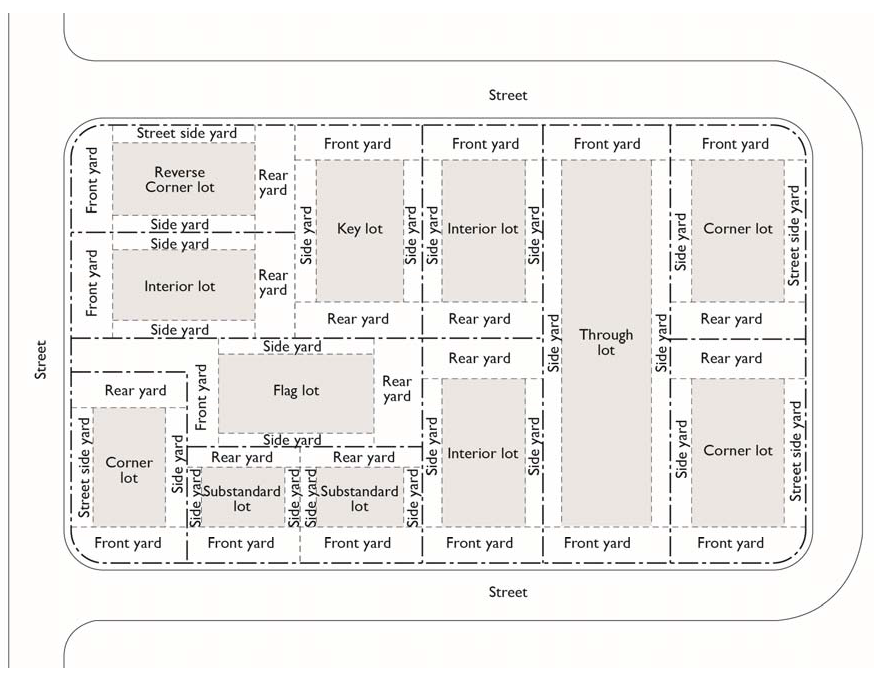
FIGURE 15-6802-1: LOT AND YARD TYPES
Lot Area. The total area within the property lines of a parcel, excluding any street or alley right-of-way.
Lot Depth. The average distance from the front lot line to the rear lot line measured in the general direction of the side lines. See also Section 15-306, Measuring Lot Width and Depth.
Lot Frontage. The width of the front parcel line measured at the street right-of-way.
Lot Line. A line of record bounding a parcel that divides one parcel from another parcel or from a public or private street or any other public space.
Front Lot Line. The parcel line separating a parcel from a street right-of-way. In the case of a corner parcel, the line separating the narrowest street frontage of the parcel from the street shall be considered the front.
Rear Lot Line. The parcel line opposite and most distant from the front parcel line; or in the case of triangular or otherwise irregularly shaped parcel, a line ten feet in length entirely within the parcel, parallel to, and at a maximum distance from the front parcel line.
Side Lot Line. Any parcel line other than a front or rear parcel line.
Street Side Lot Line. A side lot line of a comer lot that is adjacent to a street.
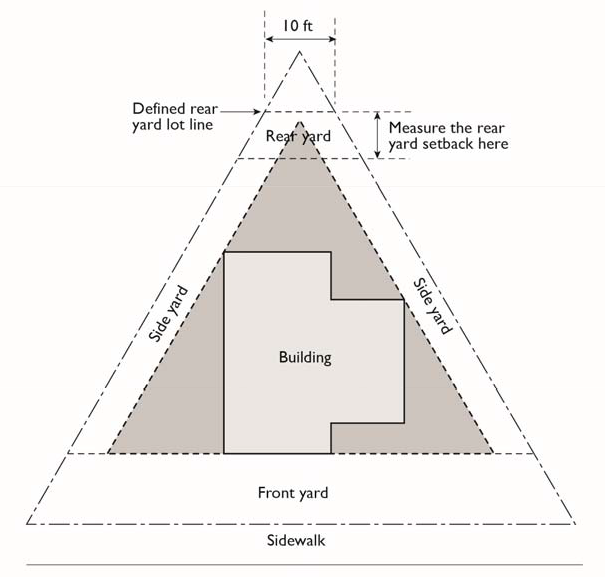
FIGURE 15-6802-2: REAR LOT LINE FOR PURPOSES OF DETERMINING SETBACKS
Lot Width. The horizontal distance between the side lines of a parcel measured at right angles to its depth along a straight line parallel to the front parcel line at the street or public right-of-way that is identified as the parcel's address.
Main Structure. See Structure, Main.
Maintenance and Repair. The repair or replacement of nonbearing walls, fixtures, wiring, roof, or plumbing that restores the character, scope, size, or design of a structure to its previously existing, authorized, and undamaged condition.
Mezzanine. An intermediate floor within a building interior without walls, partitions, closets, screens, or other complete enclosing interior walls or partitions that is open to the floor below and has a floor area that is no greater than one-third of the total floor area of the floor below. When the total floor area of a mezzanine exceeds one-third of the total floor area of the floor below it constitutes an additional story. In some instances, mezzanine may be defined differently by the Building Code.
Mixed-Use Development. The development of a parcel or building with two or more different land uses such as, but not limited to, a combination of residential, office, manufacturing, retail, public, or entertainment in a single or physically integrated group of structures.
Mobile Vendor. Any person that sells, or causes or allows another, whether as an employee or as an independent contractor leasing or renting equipment, to sell any food, drinks, or merchandise by means of a motorized or non-motorized vehicle, such as a wagon, pushcart, handcart, bicycle, motorized cart, or food truck.
Muntin. A bar or rigid supporting strip between adjacent panes of glass.
Noise-Related Definitions.
Community Noise Equivalent Level (CNEL). The average equivalent A-weighted sound level during a 24-hour day, obtained after addition of five decibels to sound levels in the evening from 7 p.m. to 10 p.m. and after addition of 10 decibels to sound levels in the night from 10 p.m. to 7 a.m.
Day-Night Average Sound Level (Ldn). The A-weighted average sound level for a given area (measured in decibels) during a 24-hour period with a 10 dB weighting applied to night-time sound levels (after 10 p.m. and before 7 a.m.). The Ldn is approximately numerically equal to the CNEL for most environmental settings.
Decibel (dB). A unit of measurement used to express the relative intensity of sound as heard by the human ear describing the amplitude of sound, equal to 20 times the logarithm to the base 10 of the ratio of the pressure of the sound measured to the reference pressure, which is 20 micropascals (20 micronewtons per square meter).
Decibel, A-weighted (dBA). The "A-weighted" scale for measuring sound in decibels; weights or reduces the effects of low and high frequencies in order to stimulate human hearing. Every increase of 10 dBA doubles the perceived loudness though the noise is actually ten times more intense.
Equivalent Sound Level (Leq). A single-number representation of the fluctuating sound level in decibels over a specified period of time. It is a sound-energy average of the fluctuating level.
Maximum Noise Level (Lmax). The highest value measured by the sound level meter over a given period of time, based on the time-weighted sound level in dB, using either the Fast or Slow time constant.
Non-Conforming Building. See Non-Conforming Structure.
Non-Conforming Lot. A legally-created lot of land having less area, frontage, or dimensions than the existing Code requires in the Zoning District in which it is located.
Non-Conforming Use, Structure, or Site Feature. See Legal Non-Conforming Use, Structure, or Site Feature.
Occupancy Group. The Building Code use category for determining requirements for building construction elements and life safety system requirements.
Office-To-Dwelling. The conversion of existing office building(s) from an office use to a multi-unit residential use which will provide housing to residents and facilitate compliance of said structures into safe and habitable condition as required by State and local law.
On-Site. Located on the lot that is the subject of discussion.
Open Space Types.
Open Space, Common. Any outdoor area, not dedicated for public use, which is designed and intended for the common use and enjoyment of the residents and guests of more than one dwelling unit.
Open Space, Private. Open areas for outdoor living and recreation that are adjacent and directly accessible to a single dwelling unit, reserved for the exclusive use of residents of the dwelling unit and their guests.
Open Space, Usable. Outdoor areas that provide for outdoor living and/or recreation for the use of residents.
Outdoor Sales, Temporary and Seasonal. The sale or offering for sale to the general public of merchandise outside of a permanent structure on property owned or leased by the person, firm, or corporation. These sales are of a limited duration and conducted on an occasional basis, and are secondary or incidental to the principal permitted use or structure existing on the property.
Outdoor Storage. The keeping, in an unroofed area, of any goods, junk, material, merchandise or vehicles in the same place for more than 72 hours except for the keeping of building materials reasonably required for construction work on the premises pursuant to a valid and current Building Permit issued by the City.
Overlay District. A zoning designation specifically delineated on the Zoning Map establishing land use requirements that govern in addition to the standards set forth in the underlying zoning district.
Parapet. A low wall or railing extending above the roof and along its perimeter.
Parcel. See Land Division-Related Definitions.
Parking Facility. An area of a parcel, structure, or any other area, including driveways, which is designed for and the primary purpose of which is to provide for the temporary storage of operable motor vehicles.
Accessory Parking. An area of a parcel, structure, or any other area, which is designed, reserved for, and the primary purpose of which is to provide off-street parking to serve a building or use that is the primary or main use of the parcel.
Long-Term Parking. An area designed for employee parking, when a vehicle is not normally moved during the period of an employee's work shift, as opposed to customer or visitor parking.
Parking, Bicycle. A covered or uncovered area equipped with a rack or other device designed and useable for the secure, temporary storage of bicycles.
Long-Term. Bicycle parking that is designed to serve employees, students, residents, commuters, and others who generally stay at a site for two hours or longer.
Short-Term. Bicycle parking that is designed to serve shoppers, customers, messengers, guests, and other visitors to a site who generally stay for a period of less than two hours.
Parking Space, Off-Street. An area, covered or uncovered, designed and usable for the temporary storage of a vehicle, which is paved and accessible by an automobile without permanent obstruction.
Parking Structure. A structure used for parking and storage of vehicles.
Patio. An outdoor area, often paved, adjoining a building that is used for outdoor open space. It is not enclosed by walls and typically is located at grade or supported by minimal footings.
Paving. A type of material used over areas of a parcel such as driveways, parking spaces and areas, pathways, patios, and front setbacks used for access by vehicles and pedestrians.
Permit. Any Conditional Use Permit, Temporary Use Permit, Building Permit, license, certificate, approval, or other entitlement for development and/or use of property as required by any public agency.
Permitted Use. Any use or structure that is allowed in a Zoning District without a requirement for approval of a Use Permit, but subject to any restrictions applicable to that Zoning District.
Person. Any individual, firm, association, organization, partnership, business trust, company, or corporation.
Person with Disabilities. Under the Americans With Disabilities Act, an individual with a disability is a person who: (1) has a physical or mental impairment that substantially limits one or more major life activities; or (2) has a record of such an impairment; or (3) is regarded as having such an impairment.
Pharmacies and Drug Retailers. Establishments generally known as pharmacies and drug retailers engaged in retailing prescription or nonprescription drugs and medicines.
Planning Commission. The Planning Commission of the City of Fresno.
Plaza. An outdoor space set aside for gathering or congregating and commercial activities, typically surrounded by building frontages.
Pocket Park. A park of one-half to two acres in size that intended to serve the needs of a smaller, specific neighborhood located within a half-mile radius of the pocket park.
Podium. A continuous raised platform supporting a building or a large block of two or three stories beneath a multi-story block of smaller area.
Porte Cochere. A roofed structure through which a vehicle can pass, extending from the entrance of a building over an adjacent driveway, the purpose of which is to shelter persons entering and exiting a building.
Pre-Existing. In existence prior to the effective date of this Code.
Primary Use. See Use, Primary.
Project. Any proposal for a new or changed use or for new construction, alteration, or enlargement of any structure, that is subject to the provisions of this ordinance. This term includes, but is not limited to, any action that qualifies as a "project" as defined by the California Environmental Quality Act.
Public Land. Any government-owned land, including, but not limited to, public parks, beaches, playgrounds, trails, paths, schools, public buildings, and other recreational areas or public open spaces.
Public Resources Code. The Public Resources Code of the State of California.
Qualified Applicant. The property owner, the owner's agent, or any person or other legal entity that has a legal or equitable title to land that is the subject of a development proposal or is the holder of an option or contract to purchase such land or otherwise has an enforceable proprietary interest in such land.
Ramp. An access driveway leading from one parking level to another, or an access driveway from an entrance leading to parking at a different level.
Recreational Vehicle (RV). A mobile, temporary lodging space, usually housed in a motor vehicle or trailer, generally for the purposes of travelling.
Residential Use. One or more rooms designed, occupied, or intended for occupancy as primary living quarters in a building or portion thereof.
Review Authority. Body responsible for making decisions on zoning and related applications.
Right-of-Way. A strip of land acquired by reservation, dedication, forced dedication, prescription, or condemnation and intended to be occupied or occupied by a road, railroad, electric transmission lines, oil or gas pipeline, water line, sanitary storm sewer, or other similar use.
Roof. That portion of a building or structure above walls or columns that shelters the floor area or the structure below.
Screening. Buffering of a building or activity from neighboring areas or from the street with a wall, fence, hedge, informal planting, or berm.
Security Grate or Grilles. A metal grate that rolls up over, or slides across, a window or door to provide protection against unwanted entry. It also can be a fixed metal fixture over window openings.
Service Areas. Portions of a building which are utilitarian in nature and are not typically frequented by the general public or occupants of the building, such as utility equipment rooms, freight loading areas, trash/recycling rooms, and emergency exit stairways/hallways.
Setback. The distance between the parcel line and a building, not including permitted projections, that must be kept clear or open. See also Section 15-304, Measuring Distances, and Section 15-313, Determining Setbacks (Yards).
Shielded Light Fixture. Outdoor light fixtures shielded or constructed so that light rays emitted by the lamp are projected below the horizontal plane passing through the lowest point on the fixture from which light is emitted.
Sidewalk. A paved, surfaced, or leveled area, paralleling and usually separated from the street, used as a pedestrian walkway.
Sidewalk Café. Any outdoor dining area located in or adjacent to any public sidewalk or right-of-way which is associated with a restaurant or other eating and drinking establishment on a contiguous adjacent parcel.
Sign-Related Definitions. The following terms are related to Article 26, Signs.
Animated Sign. A sign with messages that visually change, or images that move or appear to move, more frequently than once every 24 hours, regardless of the method by which the visual change is affected. This definition does not include traditional barber poles, hand-held signs, personally attended signs, commercial mascots, scoreboards, or signs which merely display time or temperature. Animated signs include electronic message signs, sometimes called electronic reader boards. A sign that displays a series of still images which change more frequently than once per 24 hours, whether by digital, LED, or functionally equivalent method, is within this definition.
Awning. Any structure made of flexible fabric or similar material covering a metal frame attached to a building, whether or not the same is so erected as to permit its being raised to a position flat against the building when not in use.
Awning or Canopy Sign. Sign copy placed on an awning or any other projecting structure made of flexible fabric or similar material covering a metal frame supported by the ground or sidewalk.
Banner. Any sign of lightweight fabric or similar material that is mounted to a pole or a building at one or more edges. Flags are not within this definition.
Billboard. See Outdoor Advertising Display.
Changeable Copy Sign. A sign constructed or designed to allow for periodic changes of copy, and for which the copy is changed not more than once each 24 hour period. Examples include signs for an auditorium, theater, church, meeting hall, or similar uses characterized by public assembly and changing programs or events, or gas station prices. This definition does not include animated signs or electronic reader board signs.
Commercial Message. A message on a sign, or portion of a sign, that promotes, informs, or proposes an economic transaction, primarily concerns the economic interests of the sign sponsor and/or audience, or is intended to further discussion in the marketplace of goods and services.
Construction Sign. A temporary sign displayed on the site of a construction, remodeling, or major landscaping project during the period of time of actual construction activity.
Copy. Any letters, numerals, or symbols displayed on a sign face conveying a message to the public.
Directional Sign. Any sign, other than a highway marker or any sign erected and maintained by public authority, or a public utility which is designed, erected, and maintained for the purpose of directing persons to a place, structure, or activity.
Exempt Sign. A sign which may be legally displayed, erected or maintained, but is not subject to a sign permit requirement. See Section 15-2604, Exempt Signs.
Face. That portion of a sign upon which the copy is mounted or displayed.
Flag. Any fabric or banner containing distinctive colors, patterns, or design that displays the symbol(s) of a nation, state, local government, company, organization, belief system, idea, or other meaning.
Freestanding Sign. A permanent sign that is self-supporting in a fixed location and not attached to a building. Freestanding signs are of two types: monument and pole. Monument signs are connected or attached to a sign structure, fence, or wall that is not an integral part of a building. Pole signs are mounted on a pole(s) or other support(s) that are placed on and anchored in the ground or on a base and that is independent from any building or other structure. Flag poles are not within this definition.
Graffiti. Marks, such as inscriptions, drawings, or designs, which are placed, scratched, etched, painted, or sprayed on public or private property without the owner's consent.
Illuminated Sign. A sign with an artificial light source incorporated internally or externally for the purpose of illuminating the sign. This includes signs made from neon or other gas tube(s) that are bent to form letters, symbols, or other shapes. Ambient lighting, by itself, does not make a sign "illuminated."
Master Sign Program. A coordinated sign plan which includes details of all signs (not including exempt or temporary signs) which are or will be placed on a site, including master identification, individual business, and directory signs.
Mobile Billboard. Any vehicle, or wheeled conveyance which carries, conveys, pulls, displays, or transports any sign or billboard for the primary purpose of advertising a commercial or noncommercial message, or other general advertising for hire.
Monument Sign. See Freestanding Sign.
Name Plate. A sign that identifies an occupant and/or address.
Non-Conforming Sign. A sign lawfully erected and legally existing prior to the effective date of this Code, or of amendments thereto, but which does not conform to the provisions of this Code.
Non-Commercial Message. A message or image on a sign, or portion of a sign, which displays noncommercial speech, e.g., commentary or advocacy on topics of public debate and concern. This definition shall be construed and interpreted in light of relevant court decisions. Noncommercial messages do not have a location factor, such as on-site or off-site.
Non-Communicative Aspects. Those aspects of a sign that are not directly communicative, such as physical structure, mounting device, size and height, setback, illumination, spacing, and scale relative to other structures.
Off-Site or Off-Premise Sign. A sign that identifies, advertises, or attracts attention to a business, product, service, event, or activity sold, existing, or offered at a different location. The off-site/on-site distinction applies only to commercial messages.
On-Site or On-Premise Sign. Any sign or portion thereof that identifies, advertises, or attracts attention to a business, product, service, event, or activity sold, existing, or offered upon the same property or land use as the sign. The off-site/on-site distinction applies only to commercial messages.
Outdoor Advertising Signs. Billboards and any other outdoor advertising signs which convey an off-site commercial message as their primary purpose.
Pennant. Any lightweight plastic, fabric, or other material, whether or not containing a message of any kind, attached to a rope, wire, or string, usually in a series, designed to move in the wind and attract attention. Flags and banners are not within this definition.
Pole Sign. See Freestanding Sign.
Projecting Sign. Any sign that is perpendicular to the face of a building and projects more than 18 inches from the face. This category includes awning and under canopy signs.
Primary Building Face. The wall of a building which contains the principal entrance(s) to the building. If there are principal entrances in more than one wall, the longest of the walls in which principal entrances are located shall be the primary building face. "Primary building face" shall include not only the wall itself but all doors, windows, or other openings therein and projections therefrom.
Real Estate Sign. Any sign, temporary in nature, with copy which concerns a proposed sale, rent, lease, or exchange of real property. This definition does not include occupancy signs at establishments offering transient occupancy, such as hotels, motels, and "bed and breakfast" facilities.
Roofline. The top edge of a roof or building parapet, whichever is higher, excluding any cupolas, pylons, chimneys, or minor projections.
Roof Sign. Any sign located on a roof of a building or having its major structural supports attached to a roof.
Sign. Any identification, description, illustration, or device illuminated or non-illuminated, which is visible to the general public from any exterior public right-of-way, and directs attention to a product, service, place, activity, person, institution, business, or solicitation, including any permanently installed or situated merchandise; or any emblem, painting, banner, pennant, or placard designed to advertise, identify, or convey information. A display, device, or thing need not contain lettering to be a sign. Notwithstanding the generality of the foregoing, the following are not within this definition:
Architectural features. Decorative or architectural features of buildings (not including lettering, trademarks, or moving parts), that do not perform a communicative function;
Fireworks, etc. The legal use of fireworks, candles, and artificial lighting not otherwise regulated by this Code;
Foundation stones, cornerstones;
Grave markers, grave stones, headstones, mausoleums, shrines, and other markers of the deceased;
Personal appearance. Items or devices of personal apparel, decoration, or appearance, including tattoos, makeup, wigs, costumes, and masks, but not including commercial mascots or hand-held signs; and
Symbols embedded in architecture. Symbols of non-commercial organizations or concepts including, but not limited to, religious or political symbols, when such are permanently integrated into the structure of a permanent building, including stained glass windows on churches, carved or bas relief doors or walls, bells, and religious statuary.
Sign Area. The area contained within a single continuous perimeter enclosing all parts of such sign copy, excluding any structural elements outside the limits of the sign required to support the sign.
Temporary Sign. A structure or device used for the public display of visual messages or images, which is typically made of lightweight or flimsy materials which is not intended for or suitable for long term or permanent display.
Wall Sign. Any sign attached to, erected against, or painted upon the wall of a building or structure, the face of which is in a single plane parallel to the plane of the wall. Wall signs also include signs on a false or mansard roof.
Window Sign. Any sign painted, etched, or otherwise affixed to an exterior window of a building, or in the interior of the building, within three feet of a window, intended to be viewed from the exterior of such building. On-site advisory signs are not considered window signs.
Site. A parcel, or group of contiguous parcels, that is proposed for development in accordance with the provisions of this Ordinance and is in a single ownership or under unified control.
Smoke and Vapor Products. Include, but may not be limited to, Tobacco Products and Smoking Paraphernalia.
Smoke Shop. Any business that primarily sells or offers for sale any Smoke and Vapor Products, but shall not include: Tobacco Retailers; establishments that sell Smoke and Vapor Products for onsite consumption (such as cigar lounges); or establishments operating under Article 33 of Chapter 9 (Cannabis Retail Business and Commercial Cannabis Business).
Smoke Shop Operator. Includes all Persons who own and/or operate the Smoke Shop. An owner is any Person who owns 5% or more of the Smoke Shop.
Smoking. Shall have the same meaning as Section 22950.5(c) of the Business and Professions Code, including any amendments or successor statutes thereto.
Smoking Paraphernalia. Any device, substance, or accessory intended for the smoking of tobacco, cannabis, vaping or electronic cigarette, illicit drug use, or any other substance.
Story. That portion of a building included between the upper surface of any floor and the upper surface of the floor next above, except that the topmost story shall be that portion of a building included between the upper surface of the topmost floor and the upper surface of the roof above. A mezzanine with a floor area that exceeds one third of the total floor area of the floor or level below constitutes a story. In some instances, story may be defined differently by the Building Code.
Street. A public or private thoroughfare which affords the access to a block and to abutting property. "Street" includes avenue, place, way, drive, boulevard, highway, road, and any other thoroughfare, except an alley as defined herein.
Street Tree. A tree fronting private property within the street right-of-way.
Streetwall. A wall or portion of a wall of a building facing a street.
Structural Alterations. Any physical change to or the removal of the supporting members of a structure or building, such as bearing walls, columns, beams, or girders including the creation, enlargement, or removal of doors or windows and changes to a roofline or roof shape.
Structure. Anything constructed or erected, which requires a fixed location on the ground, or is attached to a building or other structure having a fixed location on the ground.
Structure, Accessory. A detached subordinate structure, used only as incidental to the main structure on the same parcel.
Structure, Main. A structure housing the principal use of a site or functioning as the principal use.
Structure, Temporary. A structure without any foundation or footings and which is intended to be removed when the designated time period, activity, or use for which the temporary structure was erected has ceased.
Sub-Acute Care Facility. A facility providing a level of care needed by a patient who does not require hospital acute care but who requires more intensive licensed skilled nursing care than is typically provided to patients in a skilled nursing facility. Sub-acute care facilities are licensed by the California Department of Public Health, and are focused on in-patient care, including medical supervision, 24-hour skilled nursing and supportive care, pharmaceutical, dietary, social, and physical activities. Patients are referred by a medical doctor for medical procedures requiring rehabilitative and therapeutic care following a surgical procedure. This use is different from other similar uses which are classified as residential uses (e.g., Elderly and Long-Term Care, Residential Care Facilities) in that patient stays shall not exceed 30 days and facilities have a more institution-like environment. This use does not include treatment facilities for alcoholism, drug abuse, sexual or psychological disorders.
Swimming Pool. A pool, pond, or open tank capable of containing a large and deep enough body of water for people to use to swim.
Telecommunication-Related Definitions. The following terms are related to Section 15-2759, Telecommunication and Wireless Facilities.
Alternative Tower Structure. Artificial trees, clock towers, bell steeples, light poles, and similar alternative-design mounting structures that camouflage or conceal the presence of antennas or towers.
Antenna. Any system of poles, panels, rods, reflecting discs, wires, or similar devices used for the transmission or reception of electromagnetic signals, including, but not limited to, radio waves and microwaves. An antenna does not include the support structure the antenna(s) is mounted upon.
Antenna, Amateur Radio. A ground-, building-, or tower-mounted antenna operated by a federally licensed amateur radio operator that is used for the purpose of transmitting and receiving radio signals as part of the Amateur Radio Service as designated by the Federal Communications Commission (FCC).
Antenna, Building- or Structure-Mounted. An antenna mounted to a building, rooftop equipment screen, or structure that transmits or receives electromagnetic signals.
Antenna, Ground-Mounted. Any antenna that is not mounted on a pole, a structure, or the roof or wall of a building.
Antenna, Satellite Earth Station. An antenna designed and used to receive and/or transmit radio frequency signals directly to and/or from orbiting communications satellites.
Antenna, Whip. An antenna consisting of a single, slender, rod-like element, less than one wave length long, which is supported only at or near its base.
Antenna Structure. An antenna array and its associated support structure, such as a mast or tower (not including a suspended simple wire antenna), that is used for the purpose of transmitting and/or receiving electromagnetic signals, including, but not limited to, radio waves and microwaves.
Antenna Structure, Freestanding. An antenna structure or mast that is not attached to any part of a building, fence, or other such structure. Freestanding antenna structures include communications towers, wooden utility poles, and concrete and steel monopoles. If the total height of the structure, including the antenna, is at least 17 feet high, it shall be treated as a monopole.
Antenna Structure, Monopole. An antenna structure, often tubular in shape, usually made of metal, reinforced concrete, or wood, which is at least 17 feet in height. A monopole may also be an alternative antenna structure that is designed to replicate a tree or other natural feature.
Slim Line Monopole. A continuous, smooth, round cross section monopole with no cut-outs or exterior attachments such as climbing pegs.
Co-Location. The location of two or more wireless communications facilities owned or used by more than one public or private entity on a single support structure or otherwise sharing a common location. Co-location shall also include the location of wireless communications facilities with other facilities such as buildings, water tanks, light standards, and other utility facilities and structures.
Distributed Antenna System. A system of small antennas installed on existing infrastructure such as telephone poles and streetlights throughout an area, which are interconnected by fiber optic cable to a central hub location, and are generally designed to support multiple wireless carriers.
Equipment Cabinet or Enclosure. A cabinet or structure used to house equipment associated with a wireless communications facility.
Feasible. Feasible means in light of technical feasibility, radio signal transmitting and receiving requirements, aesthetics, electromagnetic fields, costs, landowner permission, facility owner permission, and all necessary approvals under this Code and the California Building Code, as well as the common meaning of the term.
Mast. A pole of wood or metal or a tower fabricated of metal that is used to support an antenna and maintain it at the proper elevation.
Microcell Facility. A wireless communication facility serving a single carrier and consisting of an antenna no larger than four feet in height or, if tubular, no more than six feet long and four inches in diameter comprised of a networked set of antennas that are connected with each other and to a wireless service source, such that a one or more high-power antennas that serve a given area are replaced by a group of lower-power antennas to serve the same geographic area.
Readily Visible. An object that can be identified as a wireless telecommunications facility when viewed with the naked eye.
Related Equipment. All equipment ancillary to the transmission and reception of voice and data via radio frequencies. Such equipment may include, but is not limited to, cable, conduit, and connectors.
Service Provider. Any authorized provider of wireless communications services.
Telestyles. Architecturally blended cell towers, the result of cooperation with designers and architects.
Tower. Any structure that is designed or constructed primarily for the purpose of supporting one or more antennas, including self-supporting lattice towers, guy towers, or monopole towers. The term includes, but is not limited to, radio and television transmission towers, microwave towers, common-carrier towers, cellular telephone towers, alternative tower structures and the like.
Wireless Communications Facility. Personal wireless service facilities as defined by the federal Telecommunications Act of 1996 including, but not limited to, facilities that transmit and/or receive electromagnetic signals for cellular radio telephone service, personal communications services, enhanced specialized mobile services, paging systems, and related technologies. Such facilities include antennas, microwave dishes, parabolic antennas, and all other types of equipment used in the transmission or reception of such signals; telecommunication towers or similar structures supporting said equipment; associated equipment cabinets and/or buildings; and all other accessory development used for the provision of personal wireless services. These facilities do not include radio towers, television towers, and government-operated public safety networks.
Temporary Structure. See Structure, Temporary.
Temporary Use. A use that is intended to be of a limited duration of time and that will not permanently alter the character or physical facilities of the property where it occurs.
Tenant. A person who rents, leases, or subleases, through either a written or oral agreement, real property from another.
Tiny House. A structure intended for separate, independent living quarters for one household that meets these six conditions:
1.
Is licensed and registered with the California Department of Motor Vehicles and meets ANSI 119.2 or 119.5 requirements;
2.
Is towable by a bumper hitch, frame-towing hitch, or fifth-wheel connection. Cannot (and is designed not to) move under its own power. When sited on a parcel per requirements of this Code, the wheels and undercarriage shall be skirted;
3.
Is no larger than allowed by California State Law for movement on public highways;
4.
Has at least 100 square feet of first floor interior living space;
5.
Is a detached self-contained unit which includes basic functional areas that support normal daily routines such as cooking, sleeping, and toiletry; and
6.
Is designed and built to look like a conventional building structure.
Tobacco Product. Shall have the same meaning as provided in 22950.5(d) of the Business and Professions Code, including any amendments or successor statutes thereto.
Tobacco Retailer. Any establishment whose business includes the incidental sale of Smoke and Vapor Products, such as supermarkets and convenience stores.
Trailer. A vehicle without motor power, designed to be drawn by a motor vehicle and to be used for human habitation or for carrying persons or property, including a mobile home, trailer coach or house trailer.
Trash Screen/Enclosure. A permanent, immobile structure, designed for the storage of a mobile resource recovery, recycling, or compost bin or container.
Unit. See Dwelling Unit.
Use. The purpose for which land or the premises of a building, structure, or facility thereon is designed, arranged, or intended, or for which it is or may be occupied or maintained.
Use, Accessory. A use that is customarily associated with, and is incidental and subordinate to, the primary use and located on the same parcel as the primary use.
Use, Primary. A primary, principal, or dominant use established, or proposed to be established, on a parcel.
Use Classification. A system of classifying uses into a limited number of use types on the basis of common functional, product, or compatibility characteristics. All use types are grouped into the following categories: residential; public and semi-public; commercial; industrial; transportation, communication, and utilities; and agricultural and extractive.
Use Permit. A discretionary permit, such as a Conditional Use Permit, which may be granted by the appropriate City authority to provide for the accommodation of land uses with special site or design requirements, operating characteristics, or potential adverse effects on surroundings, which are not permitted as of right, but which may be approved upon completion of a review process and, where necessary, the imposition of special conditions of approval by the permit granting authority.
Use Type. A category which classifies similar uses based on common functional, product, or compatibility characteristics.
Utilities. Equipment and associated features related to the mechanical functions of a building(s) and services such as water, electrical, telecommunications, and waste.
Variance. A discretionary grant of permission to depart from the specific requirements of this Code that is warranted when, due to special circumstances regarding the physical characteristics of the property, the strict application of standards would deprive the property of privileges available to other property in the same zoning district. See Article 55, Variances.
Vehicle. Any vehicle, as vehicle is defined by the California Vehicle Code, including any automobile, camper, camp trailer, trailer, trailer coach, motorcycle, house car, boat, or similar conveyance.
Vibration. A periodic motion of the particles of an elastic body or medium in alternately opposite directions from the position of equilibrium.
Visible. Capable of being seen (whether or not legible) by a person of normal height and visual acuity walking or driving on a public road.
Walk-Up Facility. A facility designed to provide service to pedestrian clients, where clients typically are queued on the outside of the main structure or room. Typical facility types include, but are not limited to, automatic teller machines (ATMs) and food-service windows.
Wall. Any exterior surface of building or any part thereof, including windows.
Warehouse Clubs and Supercenters. Establishments generally known as warehouse clubs, superstores, or supercenters, primarily engaged in retailing a general line of groceries, including a significant amount and variety of fresh fruits, vegetables, dairy products, meats, and other perishable groceries, in combination with a general line of new merchandise, such as apparel, furniture, and appliances.
Watercourse. A strip of land over which water flows, having a definite bed, bank, and channel, wherein the water need not flow continually, but usually flows in a particular direction.
Window. An opening in a wall of a building that is filled with glass in a frame. They typically allow light and air into the interior of a building, but also serve as mediums for viewing merchandise in commercial properties.
Yard. See Setback.
Yard Sales. See Garage Sales.
Zoning District. A specifically delineated area or district in the city within which regulations and requirements uniformly govern the use, placement, spacing, and size of land and buildings.
(Added Ord. 2015-39, § 1, eff. 1-9-16; Am. Ord. 2016-43, § 16, eff. 12-9-16; Am. Ord. 2017-33, § 32, eff. 7-30-17; Am. Ord. 2020-045, § 3, eff. 11-15-20; Am. Ord. 2024-015, § 1, eff. 7-11-24; Am. Ord. 2025-009, § 3, eff. 6-5-25; Am. Ord. 2025-011, § 1, eff. 6-5-25; Am. Ord. 2025-023, § 7, eff. 12-26-25).

