
Gahanna City Zoning Code
CHAPTER 1123
Glossary
Sections:
1123.01 - TERMS A—Z.
Words not particularly defined herein, shall be defined as found in the most recent edition of The Latest Illustrated Book of Development Definitions, by Harvey S. Moskowitz and Carl G. Lindbloom, published by Rutgers University. Words not particularly defined therein shall be defined as found in the most recent edition of the Dictionary of Architecture and Construction, published by McGraw Hill. Words not particularly defined therein shall be defined as found in Webster's New Universal Unabridged Dictionary.
A.
Abandoned sign means a sign which is discontinued for a period of 90 consecutive days. Determination that a sign is abandoned shall be self-evident of the intent of the owner to discontinue the use of the sign. Damage, deterioration or condition of disrepair to a sign or its structure, lack of visibility or obstruction of the sign, or advertisement of businesses, uses, or services that no longer exist or have ceased operating on the property shall be considered factors for establishing intent to discontinue a sign.
Access sign means a sign which indicates location and access of curb cuts, vehicular entrances, and parking facilities. An access sign may be a freestanding or building sign that is located within ten feet of the street right-of-way and within ten feet of a curb cut or other vehicular accessway to a lot.
Accessory dwelling unit (ADU) means a secondary dwelling unit that occupies the same lot as a larger, primary dwelling use and providing complete independent living facilities for one or more persons. An accessory unit may be attached or detached from the primary dwelling. Accessory dwelling units are known as granny flats, carriage houses, mother-in-law units, alley flats, backyard bungalows, basement apartments, coach houses, or guest houses.
Accessory structure means a subordinate structure, separate from the main building, which is incidental to that of the main building. An accessory structure shall not include a temporary structure, as defined in this ordinance.
Accessory use means a use that is subordinate to the main use of the lot. An accessory use shall not include a portable temporary storage unit, as defined in this ordinance.
Adult use means any business classified as sexually oriented under Section 771.03 of the City of Gahanna Codified Ordinances.
Aesthetics is a term dealing with form, design, and/or quality of construction of a particular sign, building, site or structure that presents a subjective statement concerning the level of beauty or artistic value.
Agriculture means farming, dairying, pasturage, apiculture, plant cultivation, viticulture, animal and poultry husbandry, sod farming, furbearing animal production, and other similar activities. Agriculture includes NAICS code 1114 (greenhouse, nursery, and floriculture production).
Air transport services means services involving the use of aircraft to transport goods or persons. Air transport services include airports. However, airport designers and administrators and logistics brokers are defined under professional services.
Alley means a public thoroughfare which affords only a secondary means of access to abutting property and is not intended for general circulation.
Alternative structure includes, but is not limited to existing structures that can include clock towers, bell steeples, light poles, street light/traffic poles, power poles, and similar alternative-design mounting structures or other buildings (e.g., church, library, municipal government, hospital, school, utility).
Alternative tower structure includes, but is not limited to man-made trees, clock towers, bell steeples, light poles, and other similar alternative design mounting structures that camouflage or conceal antennas or towers.
Animated sign means any attention-diverting apparatus, equipment or devices in a sign that uses movement or change of lighting to depict action or create a special effect or scene. Animated signs shall include: blinking, coursing, flashing, moving, racer-type, rotating, revolving, spinning, and other similar types of apparatus, equipment or devices. (See "electronic message" and "flashing" signs.)
Animal care means housing, training, exercising, and/or providing a medical service for large and small animals, including any outside runs, kennels, or training areas. This term includes doggy daycare and puppy camp services.
Antenna means any transmitting or receiving device used in communications that radiate or capture electromagnetic waves, digital signals, analog signals, radio frequencies, wireless communications signals, or other communication signals.
Antenna support structure means any building or structure other than a tower which can be used for the location of wireless communications facilities.
Applicant means any person that applies for administrative review, conditional use review, zoning certificate, or other permit or approval.
Area of special flood hazard means the land in the floodplain subject to a one percent or greater chance of flooding in any given year. "Areas of special flood hazard" are designated by the Federal Emergency Management Agency as Zone A, AE, AH, AO, A1-30 and A99.
Artisanal manufacturing means the preparation, display, and sale of individually crafted products, such as, but not limited to, artwork, jewelry, furniture, sculpture, pottery, leathercraft, hand-woven articles, and related items or handcrafted food products. Heavy truck shipments to the location of artisanal manufacturing uses are infrequent.
Arts, sciences, and cultural means the collection, display, preservation, or production of art, science, and cultural capital in a facility that is open to public visitation. Examples include, but are not limited to zoos, conservatories, galleries, libraries, museums, theaters, concert halls, ballets, and operas. These uses must have a central mission of promoting the advancement of art, science, and/or culture and the delivery of art, science, and/or culture to the general public. Arts, sciences, and cultural uses do not have central missions to sell products, produce products to sell, or provide direct for-profit services. Research and development activities, universities, galleries that display art for the primary mission of selling art, and private art studios are not considered arts, sciences, and cultural uses. Arts, sciences, and cultural uses may dedicate up to 25 percent of the principal structure to office uses in association with the management or development of the principal use. Arts, sciences, and cultural uses include NAICS codes 7111 (performing arts companies, when not commercial in nature) and 7121 (museums, historical sites, and similar institutions).
Automotive sales means the selling or leasing of personal vehicles, including cars, light trucks and SUVs, motorcycles, RVs, ATVs, and motorized watercraft, new and used.
Automotive services high intensity means the commercial care of automobiles, including repair, cleaning, maintenance, and parts wholesalers. This term includes NAICS codes 423110 (automobile and other motor vehicle wholesalers), 423120 (motor vehicle supplies and new parts wholesalers), 423130 (tire and tube wholesalers), 488410 (towing), 8111 (auto repair and maintenance).
Automotive services light intensity means uses that generally serve personal automobiles and light trucks. This term includes NAICS codes 4413 (automotive parts, accessories, and tire retailers), 4571 (gas stations), 5321 (car rental), 812930 (parking lots and garages).
Awning is a permanent roof-like cover, often of fabric, metal or glass which projects from a wall or roof of a structure over a window, walk, door or the like and is designed and intended for protection from the weather or as a decorative embellishment. Also called a canopy when the projection extends more than three feet from the face of the building.
Awning sign is a sign located on an awning.
B.
Backhaul network means the infrastructure that connects a provider's wireless communications facility sites to one or more cellular telephone switching offices, and/or long-distance providers, or the public switched telephone network via wire, microwave, mesh network or gigabit fiber optics.
Bar means a structure in which the principal use is the preparation and/or sale of alcoholic beverages. Bar includes taverns, micro-breweries, and tap rooms, but does not include liquor stores or grocery stores. Bar includes, but is not limited to, all uses categorized under the NAICS code 722410 (drinking places - alcoholic beverages).
Base flood means the flood having a one percent chance of being equaled or exceeded in any given year. The base flood may also be referred to as the 100-year flood.
Basement means any area of the building having its floor more than one-half of its height below grade on all sides.
Bed and breakfast means an owner-occupied, one-unit dwelling in which rooms are rented to paying transients or travelers on an overnight basis, with only breakfast being served. No room may be rented to any person for a period of more than 14 consecutive days or more than 24 days in any calendar year. Bed and breakfast shall include uses that are categorized within NAICS code 721191 (bed-and-breakfast inns).
Bench sign is a sign located on the seat or back of a bench placed on or adjacent to a public right-of-way.
Best Management Practice (BMP) means a range of management procedures, schedules of activities, prohibitions on practices and other management practices which have been demonstrated to effectively control the quality and/or quantity of water runoff and which are compatible with the planned land use.
Building means any structure having a roof supported by columns or walls and intended for the shelter, housing, or enclosure of any individual, animal, process, equipment, goods, or materials of any kind.
Building coverage means the total area occupied by buildings and structures, divided by the total area of the lot.
Building frontage means the horizontal linear dimension designed as the primary façade of that side of the building.
Building identification sign means a wall sign bearing only the address of the premises.
Building historical marker sign means any sign composed of letters, words, or insignia cut into a masonry surface or made of bronze or other permanent material permanently mounted to a building to convey a memorial, the name of a building, address, date of construction, or incidental information.
Building sign means any wall sign, awning sign, canopy sign, or projecting sign. Building signs do not include roof signs.
C.
Cable microcell network (CMN) means a wireless telecommunications facility characterized by small antennas and equipment cabinets, and typically located on a small diameter monopole; on an existing or replacement street light, power pole, sign, or other suitable structure; or on an existing building.
Canopy means a permanently roofed shelter projecting over a sidewalk, driveway, entry, window or similar area, which may be wholly supported by a building or partially supported by columns, poles, or braces extending from the ground. Any roof overhang extending more than three feet from the face of a building shall be considered a canopy. Also called an awning when the projection from the face of a building is three feet or less.
Canopy sign means any sign that is a part of or attached to a structural protective cover over a door, entrance, window or outdoor service area. A marquee is not a canopy sign.
Cellular-on-wheels (COW) means a temporary mobile wireless communications facility that consists of a wireless antenna tower and associated equipment on a truck, trailer, or other mobile structure designed to be part of a wireless network.
Chain link fence means a fence usually made of metal consisting of loops of wire interconnected in a series of jointed links. In no case shall a chain link fence be considered a decorative open face fence.
Changeable copy sign means any sign designed so that letters or numbers attached to the sign can be periodically changed to indicate a different message.
Channel means a natural stream that conveys water; a ditch or channel excavated for the flow of water.
Chief building official means the City of Gahanna, Ohio's representative as defined by Section 1307.03 of the City of Gahanna Codified Ordinances.
City means the government of the City of Gahanna, Ohio, or any civil servant of the City of Gahanna, Ohio.
City's designee means the department, division, staff member, or agent designated by the Mayor to represent the City of Gahanna, Ohio.
Clearing means the removal of trees, brush, and other unwanted material in order to develop land for other uses, or to provide access for site work.
Co-location means the use of, or ability to use, a wireless communications facility or support structure by more than one wireless communications provider or more than one wireless antenna array.
Commercial fence erector means an individual or a company qualified to erect, maintain and repair all types of fences covered by these Codified Ordinances and who erects a fence for hire, or as a part of a sales agreement involving home improvement or the sale of fencing material.
Commercial message means any sign wording, logo, or other representation that, directly or indirectly, names, advertises or calls attention to a business, product, service or other commercial activity. Signs which advertise that patrons are "welcome" or that display "help wanted", "for rent", "for sale" and similar messages shall be deemed commercial messages.
Commercial sales means the sale or leasing of goods to other businesses rather than directly to household consumers. Examples of commercial sales include, but are not limited to, the selling of raw materials, equipment, office furniture, and commercial vehicles.
Commercial services means a use that provides services to other companies rather than directly to household consumers. These services typically involve the arrival and departure of heavy trucks more than once per day. Examples of commercial services include, but are not limited to, farm equipment rental services, machinery repair services, and commercial linen laundering.
Commercial zone means any of the following zoning districts: Office (OF), Neighborhood Commercial (NC), General Commercial (GC), Restricted Institutional (RI), or Innovation & Manufacturing (IM).
Conditional use means a use allowed in a zoning district only when the Planning Commission grants a conditional use approval.
Conservation recreation means a use that preserves natural habitat or recreates natural communities in outdoor settings. Associated educational interpretation, trails, and shelters are included in conservation recreation uses. Examples of conservation recreation uses include, but are not limited to, arboreta, preserves, scenic river corridors, and hiking areas.
Council means the City Council as defined by Article Four of the Charter of the City of Gahanna, Ohio.
D.
Decorative open fence means a fence constructed for its beauty or decorative effect, and when viewed at right angles and enclosing the outline of all parts of the fence in its vertical plane, has an open face area of at least 30 percent. Decorative open fences shall include, but not be limited to:
Rail or split rail fence means a fence constructed of narrow, whole or split, wooden timbers or vinyl placed horizontally between upright supporting posts.
Picket fence means a fence made of upright poles or slats that alternate with an open face.
Iron or steel fence means a fence constructed of narrow poles that are placed vertically and horizontally to resemble a fence that would be considered to be an antique or historical.
Hardware cloth, see Hardware Cloth definition, shall be used only in conjunction with any of the above listed decorative open fences, and must be attached to the owner's side of the fence.
Deteriorated sign means a sign which has outlived the useful life span of its construction materials and which is likely to lead to production of litter or other aesthetic problems if continued to be posted, as determined by the City's Designee.
Development means any man-made change to improved or unimproved real estate, including but not limited to buildings or other structures, mining, dredging, filling, grading, paving, excavation or drilling operations or storage of equipment or materials.
Development area means any contiguous (abutting) area owned by one person or operated as one development unit and used or being developed for nonfarm commercial, industrial, residential or other nonfarm purposes upon which earth-disturbing activities are planned or underway.
Development identification sign means a permanent sign identifying an entrance to a residential subdivision, residential complex, institutional use, commercial shopping area, industrial park, business park or other similar use.
Distributed antenna system (DAS) means a network of spatially separated antenna nodes connected to a common source via a transport medium that provides wireless service within a geographic area or structure which also may or may not contain fiber optic transport and/or landline components.
Ditch means an excavation either dug or natural for the purpose of drainage or irrigation with intermittent flow.
Drainageway means an area of concentrated water flow other than a river, stream, ditch or grassed waterway.
Drive-thru means an amenity of an establishment that allows the establishment to dispense products or services to patrons who remain in their private vehicles. Drive-thrus do not include windows or building openings intended to allow an establishment to dispense products or services to pedestrians.
Driveway means any unenclosed motor vehicular pathway that (a) does not exceed 18 feet in width and (b) in the shortest distance practicable, provides a vehicular path from a street right-of-way to a private garage or to an area to the side or rear of the principal structure.
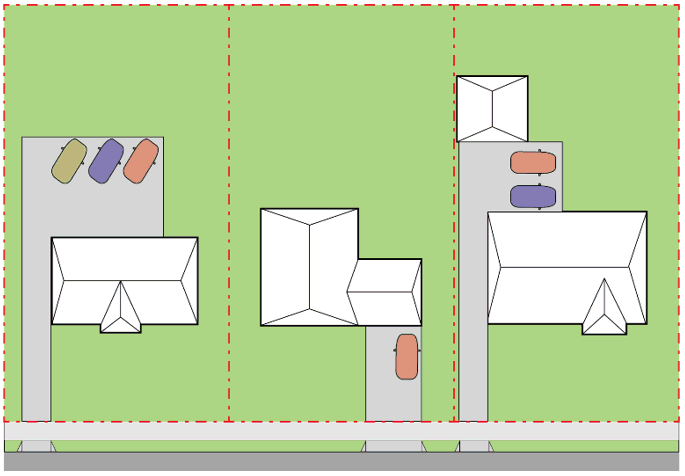
The above image shows driveways. Each path is no more than 18 feet in width and provide a vehicular path from the street to a private garage or to the area to the side or rear of the principal structure. The left and the right lots show driveways that, to the rear of the principal structure, are wider than 18 feet, at which point the vehicle use area is considered a parking area, not a driveway.
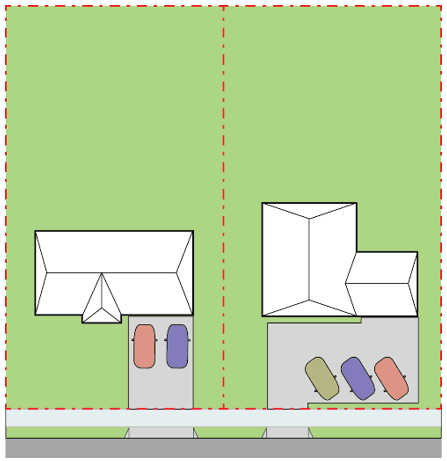
The above images show vehicles parked on areas that are not considered driveways. The lot on the left of the image includes vehicles parked on a paved area that does not lead to a private garage or to the side or rear of the principal structure. The other house shows a paved area that, while it leads to a private garage, does not follow the shortest distance path practicable.
Dumping means grading, pushing, piling, throwing, unloading or placing.
Dwelling means a structure or portion thereof which is used exclusively for human habitation.
Dwelling unit means one or more rooms, designed, occupied or intended for occupancy as separate living quarters, with cooking, sleeping and sanitary facilities provided within the dwelling unit, for the exclusive use of a single family maintaining a household.
E.
Earth-disturbing activity means actions taken to alter the existing vegetation and/or underlying soil of a site, such as clearing, grading, site preparation (e.g., excavating, cutting, and filling), soil compaction, and movement and stockpiling of top soils.
Earth material means soil, sediment, rock, sand, gravel and organic material or residue associated with or attached to the soil.
Electric vehicle (EV) means a vehicle that operates, either partially or exclusively, on electrical energy from the electrical grid, or an off-grid source, that is stored on board for motive purposes. This includes battery electric vehicles and plug-in hybrid electric vehicles.
Electric vehicle (EV) ready space means parking spaces that provide dedicated electrical panel capacity, conduit, and wiring installed with termination at an outlet to the EV Ready parking space. These spaces do not have all the electric vehicle supply equipment installed and cannot yet be used to charge electric vehicles.
Electric vehicle supply equipment (EVSE) installed means parking spaces that provide dedicated panel capacity, conduit, and have all EVSE installed. These spaces are fully usable and can charge electric vehicles.
Electronic sign means a sign feature with a fixed or changing display or message, wherein the sequence of message and the rate of change is electronically programmed and can be modified by electronic process.
Elevation (architectural) means an orthographic projection of the exterior faces of a building that is a two-dimensional drawing of the building's façades. The roof shall not be considered part of a vertical elevation (e.g., front elevation, rear elevation, side elevation) for the purposes of design guidelines.
Emergency means a reasonably unforeseen occurrence with a potential to endanger personal safety or health, or cause substantial damage to property, that calls for immediate action, mitigation, or abatement.
Emergency medical care means services provided by medical personnel that include emergency room care, trauma care, or overnight care. Emergency ambulance services may frequently visit emergency medical care uses.
Engineer means any engineer currently licensed by the State of Ohio.
Equipment shelter or equipment cabinet means the structure in which the electronic receiving and relay equipment or other necessary equipment for a wireless communications facility is located.
Erosion means:
(1)
The wearing away of the land surface by running water, wind, ice or other geological agents, including such processes as gravitational creep.
(2)
Detachment and movement of soil or rock fragments by wind, water, ice or gravity.
(3)
Erosion includes:
a.
Accelerated erosion means erosion much more rapid than normal, natural or geologic erosion, primarily as a result of the influence of the activities of man.
b.
Floodplain erosion means abrading and wearing away of the nearly level land situated on either side of a channel due to overflow flooding.
c.
Gully erosion means the erosion process whereby water accumulates in narrow channels during and immediately after rainfall or snow or ice melt and actively removes the soil from this narrow area to considerable depths such that the channel would not be obliterated by normal smoothing or tillage operations.
d.
Natural erosion (geologic erosion) means wearing away of the earth's surface by water, ice or other natural environmental conditions of climate, vegetation, etc., undisturbed by man.
e.
Normal erosion means the gradual erosion of land used by man which does not greatly exceed natural erosion.
f.
Rill erosion means an erosion process in which numerous small channels only several inches deep are formed; occurs mainly on recently disturbed soils.
g.
Sheet erosion means the removal of a fairly uniform layer of soil from the land surface by wind or runoff water.
Externally illuminated sign means a sign illuminated primarily by light directed toward or across it or by backlighting from a source not within it.
F.
FAA means the U.S. Federal Aviation Administration, and any legally appointed, designated, or elected agent or successor.
Family care home, family model home, group home, adult family facility or community residence means a dwelling unit that provides room and board, personal care and habilitation services and supervision for individuals, exclusive of staff, who are cognitively impaired, developmentally disabled, physically handicapped or aged (over 60 years of age) persons, who are able to be integrated into a family type setting and who do not require institutional care or treatment. This category shall be licensed by and/or has accountability to the State of Ohio or any other governmental agency that regulates the type of use involved. This category does not include nursing homes, hospitals, rest homes, boarding or lodging houses, homes with up to three foster children, half-way houses for individuals released from incarceration, or facilities for drug abuse rehabilitation programs.
Family care services means uses that provide commercial services such as child day care and adult day care, where customers are not overnight residents of the property. At home family care services that meet the State of Ohio requirements are considered home occupations.
FCC means the U.S. Federal Communications Commission and any legally appointed, designated, or elected agent or successor.
Federal Emergency Management Agency (FEMA) means the agency with the overall responsibility for administering the National Flood Insurance Program.
Fence means an artificially constructed barrier of any material or combination of materials erected to enclose, screen, or separate areas. For the purposes of this code, a fence not include a building or structure.
Flag means a fabric, banner, or bunting containing distinctive colors, patterns or symbols, used as a symbol of a recognized government or political subdivision, corporation, lodge, fraternity or sorority, political party, nonprofit organization, charity, club, association or other similar entity.
Flashing sign means a sign, the illumination of which is not constant in intensity when in use, and which exhibits sudden or marked changes in lighting effects.
Flood or flooding means a general and temporary condition of partial or complete inundation of normally dry land areas from:
(1)
The overflow of inland or tidal waters; and/or
(2)
The unusual and rapid accumulation or runoff of surface waters from any source.
Flood Insurance Rate Map (FIRM) means an official map on which the Federal Emergency Management Agency has delineated the areas of special flood hazards.
Flood Insurance Study (FIS) means the official report in which the Federal Emergency Management Agency has provided the flood profiles, floodway boundaries, and the water surface elevations of the base flood.
Flood protection elevation means elevation one foot above the base flood elevation plus any increase to flood heights caused by the proposed development.
Floodway means the channel of a river or other watercourse and the adjacent land areas that must be reserved in order to discharge the base flood without cumulatively increasing the water surface elevation more than one-half foot.
Floodway fringe means that portion of the regulatory floodplain outside of the floodway.
Food manufacturing means the preparation of food products or meals in a facility. Consumers of the food products may not purchase the food products at the small food products manufacturing facility, which differentiates small food manufacturing from carry-out restaurants. Catering kitchens, ghost kitchens, food processing centers, and commercial kitchens are examples of small food manufacturing. This term includes NAICS code 3121 (beverage manufacturing) and 311 (food manufacturing), but this term does not include 3116 (animal slaughtering and processing) nor 3117 (seafood product preparation and packaging).
Freestanding sign means a sign that is attached to, erected on, or supported by some structure, such as a post, mast, or frame that is not itself an integral part of or attached to a building or other structure whose principal function is something other than support.
Funeral homes/services means establishments primarily engaged in preparing the dead for burial or cremation and conducting funeral services. This term includes NAICS codes 812210 (funeral homes and funeral services) and 812220 (cemeteries and crematories).
G.
Garage means a building or a portion of a building used or designed to be used for the storage of one or more motor vehicles.
Garage, private means a building or portion of a building not more than the specified square footage allowed in each residential zoning district and used for the storage of motor driven vehicles in which no business or industry connected directly or indirectly with the repair or servicing of motor vehicles is carried on.
Garage, public means a building or a portion of a building, not a private garage, which is used or designed to be used for the storage, repair, rental, servicing or supplying of gasoline or oil to motor vehicles.
General personal services means a use that provides day-to-day services to the general public. These services include, but are not limited to, salons, spas, laundromats, dry cleaners, shoe repair, physical fitness centers, and dance studios, martial arts studios, art education centers, and electronics repair. For these services, customers may stop in and out throughout the day. Heavy truck shipments to the location of general personal services uses are infrequent.
GFA means gross floor area; the total number of square feet of floor area within the outside line of walls and including the total of all space on all floors of a building, including porches and garages, but not including space in a basement or cellar when the basement or cellar space is used only for storage or incidental uses, and not including floor space with less than 78 inches of vertical clearance.
Government administration means a use that provides office space, hearing chambers, waiting rooms, and other facilities for administering government responsibilities and categorized under NAICS code 92 (public administration), such as legal services, planning services, resource protection administration, education programming administration, and emergency services; but not including police and fire stations.
Grade means the average level of the finished surface of the ground adjacent to the exterior walls of the building.
Grassed waterway means a broad or shallow natural course or constructed channel covered with erosion-resistant grasses or similar vegetative cover and used to conduct surface water.
Ground sign means a freestanding detached sign whose support structure is imbedded in the ground.
Ground transport services means services involving the use of trains, trucks, or busses to transport goods or persons. Ground transport services include truck depots, train stations, and bus stations, but not taxi depots or car rental centers. Ground transport services do not include the storage of goods to be transported and, therefore, do not include warehouses.
H.
Half-story means a story under a gable, hip or gambrel roof, the wall plates of which on at least two opposite exterior walls are not more than two feet above the floor of such story.
Hardware cloth means plain weave square mesh cloth of relatively light wire galvanized after weaving or welding.
Hazardous sign means any sign or sign support structure that is structurally or electrically unsafe, as determined by the City's Designee.
Heavy industrial means an establishment engaged in manufacturing, assembly, fabrication, packaging or other industrial processing of products primarily from extracted or raw materials or the bulk storage and handling of such products and materials, or an industrial establishment having potential to produce noise, dust, glare, odors or vibration beyond its property line. This term includes but is not limited to: (a) processing and packaging of alcohol beverages; (b) chemical manufacturing; (c) stonework or concrete product manufacturing; (d) fabrication of metal products; (e) manufacturing of agricultural, construction, or mining machinery; (f) motor vehicle manufacturing; (g) lumber milling; (h) ship or boat construction; (i) permanent concrete/batch plant. Heavy industrial includes NAICS codes 313 (textile mills), 314 (textile product mills), 315, apparel manufacturing, 3162 (footwear manufacturing), 3212 (veneer, plywood, and engineered wood product manufacturing), 3219 (other wood product manufacturing), 3222 (converted paper product manufacturing), 3254 (pharmaceutical and medicine manufacturing), 3261 (plastics product manufacturing), 3271 (clay product and refractory manufacturing), 3272 (glass and glass product manufacturing), 3279 (other nonmetallic mineral product manufacturing), 332 (fabricated metal product manufacturing, but not NAICS codes 332992, 332993, and 332995), 333 (machinery manufacturing), 334 (computer and electronic product manufacturing), 335 (electrical equipment, appliance, and component manufacturing), 336 (transportation equipment manufacturing), 337 (furniture and related product manufacturing), and 339 (miscellaneous manufacturing).
Height or above ground level (AGL) means, when referring to a tower or other structure, the distance measured from the finished grade at the base of the tower or structure to the highest point on the tower or structure, including the base pad and any antenna, but not including lightning arrest devices.
Historic structure means any structure that is:
(1)
Listed individually in the National Register of Historic Places (a listing maintained by the U.S. Department of Interior) or preliminarily determined by the Secretary of the Interior as meeting the requirements for individual listings on the National Register;
(2)
Certified or preliminarily determined by the Secretary of the Interior as contributing to the historical significance of a registered historic district of a district preliminarily determined by the Secretary to qualify as a registered historic district;
(3)
Individually listed on a state inventory of historic places in states with historic preservation programs which have been approved by the Secretary of the Interior; or
(4)
Individually listed on a local inventory of historic places in communities with historic preservation programs that have been certified either:
By an approved state program as determined by the Secretary of the Interior; or Directly by the Secretary of the Interior in states without approved programs.
Home occupation means an accessory use of a dwelling unit for legitimate businesses, professions, trades or vocations conducted within an enclosed dwelling unit, which is clearly incidental and secondary to residential occupancy and does not change the residential character thereof.
Hospital means a building used for the diagnosis, treatment or other care of human ailments, unless otherwise specified.
Hospital, nursing home, rest home, convalescent home, home for substance abusers means a building or part of a building used for a hospital, the nursing and care of convalescents, aged people, and/or substance abusers, which must meet the provisions for the same found in the Ohio Revised Code and any proper and legal operations promulgated thereunder.
Hotel or motel means a building, or a part of a building, in which guest rooms are offered for public hire to any given individual for no more than 35 days in a calendar year, and where a general kitchen and dining room may be provided within the building or in any accessory building. Hotel or motel shall include uses categorized under NAICS code 721110 (hotels—except casino hotels—and motels).
I.
Illuminated sign means a sign lighted by, or exposed to, artificial lighting either by lights on or in the sign, or directed towards the sign.
Impervious coverage means the total area occupied by impervious, man-made materials, divided by the total area of the lot. Impervious materials include buildings, asphalt, concrete, swimming pools, barns, and carports, but exclude porous pavement, permeable pavers, decks with gaps between decking for drainage, lawn grasses, gardens, stormwater retention and detention basins, and other landscaping.
Indoor recreation means uses that include indoor leisure and recreation uses of more than 3,000 square feet but smaller than 50,000 square feet, such as skating rinks, gymnastics studios, dance studios, boxing clubs, bowling alleys, large physical fitness centers, and cinemas. Large scale indoor recreation uses also include organization and membership club centers that are meeting areas for the membership of fraternal organizations, political organizations, and business organizations. Up to 50 percent of the floor area of a large scale indoor recreation use may be used as the offices of administrators. Physical fitness centers smaller than 3,000 square feet are categorized as general personal services uses. Large scale indoor recreation uses include, but are not limited to, uses that are more than 3,000 square feet and smaller than 50,000 square feet and fall within NAICS codes 7111 (performing arts companies, when commercial), 7132 (gambling industries), and 7139 (other amusement and recreation industries, when indoors).
Institution means a building occupied by a nonprofit corporation or a nonprofit establishment for public use.
Interior lot means a lot other than a corner lot or a through lot. An interior lot has only one front lot line.
Internally illuminated sign means a sign whose light source is located either in the interior of the sign so that the rays go through the face of the sign, or which is attached to the face of the sign and is perceived as a design element of the sign.
J.
None.
K.
Kennel or other animal shelters means the keeping of more than five animals at least three months of age for pleasure, profit, breeding or exhibiting.
L.
Landscaping means bringing the soil surface to a smooth finished grade, installing plant material and other natural materials to produce a pleasing visual effect of the premises.
Landslide means the rapid downward and outward movement of large rock material and/or soil mass in which the movement of the soil mass occurs along an interior surface of sliding.
Large scale light industrial means an establishment engaged in the indoor warehousing, manufacturing, assembly, fabrication, packaging or other industrial processing of finished parts or products, primarily from previously prepared materials, or the indoor provision of industrial services, where there are few external effects across property lines. This term includes, but is not limited to, a business engaged in the processing, fabrication, assembly, treatment, or packaging of food, textile, leather, wood, paper, chemical, plastic, or metal products, but does not include basic industrial processing from raw materials. Large scale light industrial uses have principal structures of 25,000 square feet or more per lot. Large scale light industrial includes uses of 25,000 square feet or more for NAICS code 3231 (printing and related support activities), 22112 (electric power transmission, control, and distribution), 3121 (beverage manufacturing), and 311 (food manufacturing), 42 (wholesale trade), 44 and 45 (retail trade), and 48 and 49 (transportation and warehousing). Large light industry specifically does not allow NAICS codes 3116 (animal slaughtering and processing), 3117 (seafood product preparation and packaging), 42314 (motor vehicle parts merchant wholesalers), or 42452 (livestock merchant wholesalers).
Large scale outdoor recreation means a use that provides opportunities to play and relax on lots typically larger than two acres. Such uses may include disc golf courses, golf courses, non-professional and non-collegiate sports fields, regional beaches, large pools, sledding hills, and similar uses. Large scale outdoor recreation includes, but is not limited to, uses that fall within NAICS codes 712190 (nature parks and other similar institutions, which is also included in arts, sciences, and cultural uses), and 7139 (other amusement and recreation industries, when outdoors).
Large scale retail means the selling or leasing of goods directly to household consumers in retail spaces exceeding 25,000 square feet of GFA per lot. For the purposes of calculating GFA for this definition, retail units in attached structures that straddle lot lines shall be calculated as being located on the same lot. Retail includes, but is not limited to, the selling or leasing of clothing, unprepared food, home goods and furnishings, collectibles and antiques, electronics, non-motorized recreation equipment, art and décor, pets and pet care products, and appliances.
Live-work unit means a combination dwelling-commercial unit that allows a person or persons to both reside and operate a commercial enterprise from the same unit. The unit must be equipped with space for cooking, bathing, sleeping, and working.
Logo means the graphic or pictorial presentation of a message, including, but not limited to, the use of shapes, designs, decorations, emblems, trademarks, symbols or illustrations.
Lot means a portion of a subdivision or other parcel of land intended as a unit for transfer of ownership.
Lot, corner means a lot abutting upon two or more streets at their intersections, or upon two parts of the same street, and in either use forming an interior angle of 135 degrees or less as measured at the center line of the road or the interior right-of-way line as applicable.
Lot width or width of lot means the mean width measured at the building line and at right angles to its depth.
Lowest floor mean the lowest floor of the lowest enclosed area (including basement). An unfinished or flood resistant enclosure, usable solely for parking of vehicles, building access or storage, in an area other than a basement area, is not considered a building's lowest floor; provided that such enclosure is built in accordance with the applicable design requirements specified in this chapter for enclosures below the lowest floor.
M.
Marquee sign means a sign designed to have changeable copy which is attached to a roof-like structure that projects from the wall of a building or its supports and may overhang the public right-of-way.
Mayor means the Mayor as defined by Article Three of the Charter of the City of Gahanna, Ohio.
Menu board sign:
Temporary: A two (2)-sided, erasable-style, portable, freestanding sign displayed only during the hours of operation providing a bill of fare associated with indoor or outdoor dining.
Permanent: A ground-mounted sign displaying the bill of fare for a restaurant, drive-in or drive-thru restaurant or instructions or services for other drive-thru establishments.
Medical office services means services provided by medical personnel that do not include emergency room care or trauma center care or overnight care but do include psychological treatment and social work, urgent care, dental care and surgery, chiropractic care, and veterinary care. Emergency ambulance services do not frequently visit medical office services.
Mobile sign means a sign attached to, mounted to, pasted, painted or drawn on any vehicle, whether motorized or pulled, that is placed, parked or maintained at one particular location for the express purpose and intent of promotion or conveying an advertising message.
Monopole means a support structure constructed of a single, self-supporting hollow metal tube securely anchored to a foundation.
Monument sign means a ground sign with low overall height and the base of the sign structure on the ground. See Freestanding Sign.
Multi-unit dwelling means a use intended for the residence of three or more households in three or more dwelling units per lot.
Multi-use tower means a self-supporting, or monopole structure constructed from grade which supports more than one wireless communications facility.
Municipal separate storm sewer systems (MS4) refers to a storm sewer system owned and operated by the city in which it is located. These storm sewer systems may discharge into local rivers and streams and are regulated by the Environmental Protection Agency to reduce the amount of pollutants that reach these bodies of water from the storm sewer system.
N.
NAICS means the North American Industry Classification System, which is a United States governmental system for classifying business establishments. This classification system may be electronically accessed at http://www.census.gov/naics.
Neighborhood agriculture means the production of plants or their products, including but not limited to gardening and fruit production, that will not be made for sale. Neighborhood agriculture does not include poultry or other livestock husbandry.
Neon sign means a sign containing glass tube lighting in which gas and phosphorus are used in combination to create a colored light.
No Build Zone means a designated area platted by a developer, either residential or commercial, which generally prohibits the placement of residential or commercial buildings, structures, specific types of fences, and storage buildings. Plat notes must be referenced to obtain specific information regarding any subdivision containing a No Build Zone.
Nonconforming sign means a sign lawfully erected and maintained prior to the effective date of this section that does not conform with the requirements of this chapter.
Nonconforming tower means any tower or antenna lawfully existing at the effective date of or amendment to this chapter which does not currently conform to the requirements of this chapter.
Nonconforming use means a building, structure or use of land existing at the time of enactment of this Zoning Ordinance, which does not conform to the regulations of the zoning district in which it is situated.
Non-enclosing fence means a fence which allows at least 30 percent open perimeter around the area visually defined.
O.
Off-premises sign means a sign which directs attention to a business, commodity, service, or entertainment conducted, sold or offered at a location other than the lot or premises on which the sign is located.
On-premises sign means any sign which relates to or directs attention to a business, commodity, service or entertainment conducted, sold or offered on the premises where the sign is installed and maintained.
One-unit dwelling means a dwelling use consisting of no more than one dwelling unit per lot.
Open space means the percentage of the lot area that is unoccupied by manmade structures or surfaces. Such open space must be occupied by natural vegetation or other vegetated landscaping, such as turf grass, shrubs, trees, or gardens, or by stormwater detention or retention basins. Open space may include the area required to remain unoccupied when applying minimum setbacks.
Other school means a school, other than a primary school, a secondary school, and a post-secondary school, established to provide for the teaching of industrial, clerical, managerial, or artistic skills. This definition applies to schools that are owned and operated privately for profit and that do not offer a complete educational curriculum (e.g., beauty school, modeling school).
Outdoor entertainment venue means a use that entertains large volumes of visitors in an outdoor setting, and may induce high volumes of traffic, light, and/ or noise. Examples of outdoor entertainment venues include commercial water parks, regional amusement parks, professional or collegiate sports venues, and outdoor music venues. Outdoor entertainment venue includes, but is not limited to, outdoor uses within NAICS code 71 (arts, entertainment, and recreation), especially outdoor attractions under NAICS code 7111 (performing arts companies, when not defined as arts, sciences, and cultural uses) and 7112 (spectator sports).
Outdoor storage means an area that is subordinate to a principal use on a lot used for the display or storage of any goods, equipment, materials, or other items outside of a structure.
Owner means any person, corporation, limited liability company, business trust, or partnership who, alone or jointly or severally with others, shall have the legal or equitable title to a property, and shall include executors, administrators, trustees or guardians of the estate of any individual owner, and any purchaser or assignee under a certificate of sale pursuant to a mortgage foreclosure. Any individual owner, regardless of whether he or she shares ownership responsibility with any other person, any general partner of a partnership, and any officer of a corporation or unincorporated association, shall have direct and personal responsibility and liability for compliance with the provisions of this chapter.
P.
Parking area means any all-weather, dustless surface used or intended to be used for the temporary storage of a motor vehicle. A parking area may be appended to a driveway, but a driveway does not constitute a parking area.
Parking space means the area required for parking one automobile, not including passageways.
Patio house means a one-family dwelling on a separate lot with open space setbacks on three sides and with a court. Patio homes may be attached to similar houses on adjacent lots and still meet this definition. Also known as zero lot lines.
Penal institution means a publicly or privately operated facility housing persons awaiting trial or persons serving a sentence after being found guilty of a criminal offense.
Permanent sign means a sign affixed to a structure or embedded in the ground whose principal supporting structure is intended, by design and construction, to be used on a permanent basis.
Person means any individual, corporation, partnership, joint venture, agency, unincorporated association, municipal corporation, County or State agency, the Federal government, or any combination thereof.
Pick-up window means an opening in a building, including windows, doors, chutes, or mechanical devices, through which occupants of a motor vehicle or persons on foot are passed or otherwise receive or obtain a product or service.
Planning Commission means the Planning Commission as defined by Article Eleven of the Charter of the City of Gahanna, Ohio.
Plat means a map of a tract or parcel of land.
Pole sign means a permanent freestanding sign that is mounted on one or more poles or other support so that the bottom edge of the sign face is six feet or more above the grade.
Portable sign means a temporary sign not permanently attached to the ground or other permanent structure which is designed to be easily moved from one location to another. Portable signs include, but are not limited to, signs made as A-frames or T-frames, a sign designed to be transported on wheels, or balloons or umbrellas used as signs.
Post-secondary school means an educational institution authorized by the state to award associate, baccalaureate, or higher degrees.
Portable or modular structure means any structure, building, or enclosure, whether or not affixed to the ground, that is not designed or intended for permanent use. Portable or modular structures shall not include vehicles or portable temporary storage units. Portable or modular structures used as construction offices or similar may be permitted for the duration of the construction project and must be removed within 14 days of the completion of construction.
Portable temporary storage unit means a transportable unit designed and used primarily for temporary storage of building materials (before they are utilized for building purposes); household goods; construction refuse, and other such materials for use on a limited basis. A portable temporary storage unit includes Portable On-Demand Storage-type units. Such unit shall not be considered an accessory use structure and shall not be considered a temporary structure.
Pothole means a depression or void in a pavement surface caused by wear or subsidence.
Preservation Zone means a natural area that protects aesthetic appearance and/or environmental significance. These natural areas include, but are not limited to, woodlands, wetlands, ravines, floodplains, streams, lakes, ponds, and/or steep slopes, and can provide effective buffers between different or same land uses. No permanent or temporary structure, building, or fence shall ever be placed upon, in, or under an area designated as a "preservation zone." Plat notes must be referenced to obtain specific information regarding any subdivision containing a preservation zone.
Primary school means an institution providing full time instruction for children not more than 15 years of age and including accessory facilities traditionally associated with a program of study.
Principal structure means a building or other facility that is designed for or occupied by a principal use.
Principal use means a use that is the primary function of land or structures.
Privacy fence means a fence made to inhibit public view and provide seclusion and, when viewed at right angles and enclosing the outline of all parts of the fence in its vertical plane, has an open face of less than 30 percent. "Privacy fences" shall include, but not be limited to:
Basket weave or woven fence means a fence made of interwoven strips or slats of flexible or semi-flexible material in which the pattern has the appearance of a plaited basket.
Louver, ventilating, shadow box or stockade fence means a fence made of a series of slats placed at an angle or positioned so as to provide air but to deflect light perpendicular to its vertical plane.
Professional services means services involving office staff, where shipments from heavy trucks are rare. The majority of the persons on site are employees, and work schedules are typically day-time. Professional services do not include the storage, processing, testing, or production of materials that may pose a threat to nearby residential uses, such as materials that are carcinogenic, flammable, explosive, or unstable, other than those in quantities typically found in personal computing equipment and office settings. Professional services include financial services (such as insurance and banking firms), realtors, travel agents, engineers, pet trainers, and medical office services. Professional services include, but are not limited to, NAICS codes 51 (information), 52 (finance and insurance), 53 (real estate rental and leasing), 54 (professional, scientific, and technical services), 55 (management of companies and enterprises), 56 (administrative and support and waste management and remediation services), 61 (educational services, but not NAICS code 6111—elementary and secondary schools), 62 (health care and social assistance, but not NAICS codes 623—nursing and residential care facilities—or 62422—community housing services), 7113 (promotors of performing arts, sports, and similar events), 7114 (agents and managers for artists, athletes, entertainers, and other public figures), and 7115 (independent artists, writers, and performers).
Projecting sign means any permanent building sign attached perpendicular to a building wall and extending laterally more than 12 inches but not more than 48 inches from the face of such wall.
Public art mural means any mosaic, painting, or graphic art, or combination thereof, which is professionally applied to a building generally for the purposes of decoration or artistic expression and which does not contain any brand name, product name, letters of the alphabet spelling or abbreviating the name of any product, company, profession, or business, or any logo, trademark, trade name, or other commercial message, and which is designated as a public art mural by the City.
Public information sign means any sign erected and maintained by public officials or public agencies, or approved and authorized for use by state or local government authorities.
Public safety means police, fire, and emergency medical services and their associated garages, offices, grounds, boarding halls, and sleeping facilities.
Public service facility means buildings, substations, water treatment plants or pumping stations, sewage lift stations, power plants and other similar public service structures, including the furnishing of electrical, gas, public water and sewage services, whether publicly or privately owned.
Public waters means water within rivers, streams, ditches and lakes except private ponds and lakes wholly within single properties, or waters leaving property on which surface water originates.
Q.
None.
R.
Reach means longitudinal segments of a stream or river, which will be affected by the placement of an obstruction in a floodway or floodway fringe.
Reader board sign. See Changeable copy sign.
Reconstructed tower means a tower which is removed in whole or in part and replaced in whole or in part. For the purposes of this chapter, a reconstructed tower is a tower for which approvals have been granted in accordance with the provisions of this chapter. The term and its use shall not apply to nonconforming towers.
Record of determination means the official written record of action by the City's Designee.
Recreation with lodging means a use that allows for the lodging of guests in tents, cabins, or recreation vehicles, where each guest may not stay for not more than 180 consecutive days. Associated sales of camping-related sundries, laundry services, and equipment rental may be offered.
Recreational vehicle includes but is not limited to:
Camper trailer means a folding or collapsible vehicular structure, mounted on wheels but without its own power, designed as a temporary living quarters for travel, camping, recreation and vacation uses, which is not encompassed in the definition of travel trailer.
Motor bus means any motor vehicle having motor power designed and used for carrying more than nine passengers.
Motor home means a self-propelled recreational vehicle constructed with permanently installed facilities for cold storage, cooking and consuming of food and for sleeping.
Recreational trailer means any form of device, equipment, or machinery on wheels, or a single wheel, that is intended to be pulled by a motor vehicle, whether or not attached to a motor vehicle. This shall include every vehicle designed and utilized for the sole purpose of transporting any boat, auto, snowmobile, recreational habitation, and the like, which does not have motive power, but is designed to be drawn by another vehicle.
Travel trailer means a non-self-propelled recreational vehicle, including a tent type fold out camping trailer as defined in R.C. 4517.01(S).
Truck camper means a non-self-propelled recreational vehicle, without wheels for road use but with sufficient equipment to render it suitable for use as a temporary dwelling for travel, recreation and vacation use, and designed to be placed upon and attached to a motor vehicle. Truck camper does not include truck covers, which consist of walls and roof, but do not have floors and facilities for using same as a dwelling.
Watercraft includes, but is not limited to, any of the following when used or capable of being used for transportation on the water:
(1)
A boat operated by machinery either permanently or temporarily affixed.
(2)
A sailboat other than a sailboard.
(3)
An inflatable, manually propelled boat having a hull identification number meeting the requirements of the United States Coast Guard.
(4)
A canoe or row boat.
Religious place of worship means a building, together with its accessory buildings and use, where persons regularly assemble for religious purposes and related social events and which building, together with its accessory buildings and uses, is maintained and controlled by a religious body organized to sustain religious ceremonies and purposes.
Renewable energy generation means a solar panel array, wind turbine, or other electricity generation equipment that is roof-mounted or supported by ground-anchored structures.
Residential care services means uses that provide services such as nursing care, rehabilitation care, senior assisted living care, homeless day and/or night shelters, and "halfway home" care centers, where customers may remain overnight with on-site supervisory staff. This does not include uses that fall under NAICS codes 6232 (residential intellectual and development disability, mental health, and substance abuse facilities).
Residential zone means any of the following zoning districts: Estate Residential (ER), Large Lot Residential (R-1), Medium Lot Residential (R-2), Small Lot Residential (R-3), and Multi-Unit Residential (R-4).
Restaurant means a structure in which the principal use is the preparation and sale of food. Restaurant includes sit-down restaurants, fast food restaurants, carry-out only restaurants, cafes, and ice cream parlors. Restaurant includes, but is not limited to, all uses categorized under the NAICS code 722 (food services and drinking), but does not include NAICS code 722410 (drinking places - alcoholic beverages).
Retail filling station means a building or buildings, premises or a portion thereof arranged, intended or designed to be used in the supplying to individual vehicles for their own use only, oil, grease, gasoline or other liquid fuels, with other customary incidental services. A "retail filling station" is the same as a "gasoline service station".
Right-of-way (ROW) means a strip of land acquired by reservation, dedication, prescription or condemnation and intended to be occupied by a street, trail, waterline, sanitary sewer, and/or other public utilities or facilities.
Roof sign means a sign that is mounted on the roof of a building or that is wholly dependent upon a building for support and projects above the highest point of a building with a flat roof, the eave line of a building with gambrel, gable, or hip roof or the deck line of a building with a mansard roof.
S.
Secondary school means an institution providing full time instruction for children older than 12 years of age and including accessory facilities traditionally associated with a program of study.
Sediment means solid material both mineral and organic, that is in suspension, is being transported, or has been moved from its site of origin by wind, water, gravity or ice, and has come to rest on the earth's surface above or below sea level.
Sediment basin means a barrier, dam or other suitable detention facility built across an area of waterflow to settle and retain sediment carried by the runoff waters.
Sediment control plan means a compilation of maps and a written description, acceptable to the City's Designee, of methods for controlling sediment pollution from accelerated erosion on a development area of one or more contiguous acres or from erosion caused by accelerated runoff from a development area of one or more contiguous acres.
Sediment pollution means failure to use management or conservation practices to abate wind or water erosion of the soil or to abate the degradation of the waters of the State by soil sediment in conjunction with land grading, excavating, filling or other soil-disturbing activities on land used or being developed for nonfarm commercial, industrial, residential or other nonfarm purposes.
Self-storage means an establishment primarily engaged in renting or leasing space for the purposes of storing goods in a secure space such as a room, compartment, locker, or container.
Semi-detached means a one-family dwelling attached to another one-family dwelling by a common vertical wall, and each dwelling located on a separate lot. The semi-detached dwelling is part of a two-family structure with the dwelling units side-by-side as opposed to one on top of the other. The semi-detached dwelling also could be the end unit of a townhouse row, a patio house, and a duplex. (Also can be considered a "twin single". One unit could be owner-occupied and the other a rental, or both could be rental properties with separate owners).
Setback means distance or area specified as an offset from any front, side, or rear lot line. The area created by a setback is a yard.
Sight triangle means the horizontal and vertical areas at the intersections of streets and/or driveways which must remain unobstructed in order to ensure that drivers can see traffic and pedestrians around the corner of the intersection, entrance or driveway.
Sign means any device, fixture, placard, or structure that uses any color, form, graphic, illumination, symbol or writing to advertise, announce the purpose of, or identify the purpose of a person or entity, or to communicate information of any kind to persons beyond the boundary of the lot upon which the device, fixture, placard, or structure is located.
Sign copy means any word, letter, number or emblem affixed to the sign surface either permanently or in removable form.
Sign erector means any person or entity engaged in the business of erecting, constructing, altering, maintaining, repairing or removing signs.
Sign face means the area of a sign on which the copy is placed.
Sign height means the vertical distance measured from the lowest adjacent grade to the highest point of the sign or sign structure. The overall height of a freestanding sign shall be computed as the distance from the base of the sign at average grade to the top of the highest attached component of the sign. Average grade shall be construed to be the lower of:
Existing grade prior to construction; or,
The newly established grade after construction, exclusive of any filling, berming, mounding, or excavating solely for the purpose of locating or increasing the height of the sign.
In cases in which the grade cannot reasonably be determined, sign height shall be computed on the assumption that the elevation of the grade at the base of the sign is equal to the elevation of the nearest point of the crown of a public road or the grade of the land at the principal entrance to the principal structure on the zoned lot, whichever is lower.
Slip means landslide, as defined in this Zoning Ordinance.
Sloughing means a slip or downward movement of an extended layer of soil resulting from the undermining action of water or the earth-disturbing activity of man.
Small scale light industrial means an establishment engaged in the indoor warehousing, manufacturing, assembly, fabrication, packaging or other industrial processing of finished parts or products, primarily from previously prepared materials, or the indoor provision of industrial services, where there are few external effects across property lines. This term includes but is not limited to a business engaged in the processing, fabrication, assembly, treatment, or packaging of food, textile, leather, wood, paper, chemical, plastic, or metal products, but does not include basic industrial processing from raw materials. Small scale light industrial uses have principal structures of less than 25,000 square feet per lot. Small scale light industrial includes NAICS code 22112 (electric power transmission, control, and distribution), 3121 (beverage manufacturing), and 311 (food manufacturing), 3231 (printing and related support activities), 42 (wholesale trade), 44 and 45 (retail trade), and 48 and 49 (transportation and warehousing). Small scale light industry specifically does not allow NAICS codes 3116 (animal slaughtering and processing), 3117 (seafood product preparation and packaging), 42314 (motor vehicle parts merchant wholesalers), or 42452 (livestock merchant wholesalers).
Small scale outdoor recreation means uses that provide small outdoor parks for play and relaxation within walking distance of residential neighborhoods, on a lot typically under two acres in size, and with minimal off-street parking spaces. This use includes playgrounds, pocket parks, parklets, basketball courts, tennis courts, small pools, promenades, and similar uses. Small scale outdoor recreation includes, but is not limited to, uses that fall within NAICS codes 712190 (nature parks and other similar institutions, which is also included in arts, sciences, and cultural uses).
Small scale retail means the selling or leasing of goods directly to household consumers in retail spaces up to 25,000 square feet of GFA per lot. For the purposes of calculating GFA for this definition, retail units in attached structures that straddle lot lines shall be calculated as being located on the same lot. Retail includes, but is not limited to, the selling or leasing of clothing, unprepared food, home goods and furnishings, collectibles and antiques, electronics, non-motorized recreation equipment, art and décor, pets and pet care products, and appliances.
Snow fences are fences that consist of thin upright slats not to exceed 48 inches in height.
Soil loss means soil relocated on or removed from a given site by the forces of erosion and the redeposit of the soil at another site on land or in a body of water.
Standalone parking lot means a public or private off-street, ground-level area improved for the temporary storage of motor vehicles on an individual lot.
Stealth means a wireless communications facility designed to appear as another natural or artificial object that exists in the surrounding environment or which is architecturally integrated into a building or other structure, and designed to be minimally obtrusive and to camouflage or conceal the presence of antennas or towers, at the determination of the required reviewing body.
Storm frequency means the average period of time within which a storm of a given duration and intensity can be expected to be equaled or exceeded.
Storefront means the part of the building or tenant space on the ground story that faces the street or parking area. A storefront may serve as a public entrance for the building or tenant space.
Story means that part of a building between the surface of a floor (whether or not counted for purposes of computing floor area ratios) and the ceiling immediately above.
Stream means a body of water running or flowing on the earth's surface or channel in which such flow occurs. Flow may be seasonally intermittent.
Street means the entire width between the boundary lines of every way open to the use of the public as a thoroughfare for purposes of vehicular travel.
Street banner means any sign applied to cloth, paper, flexible plastic, or lightweight fabric or similar non-rigid material of any kind with only such material for backing that is mounted to a pole, staff, or a building by a string, rope, wire, or frame at one or more edges. This does not include flags as defined in this ordinance.
Street frontage means the distance along which a property line of a lot adjoins a public or private street.
Street right-of-way means a right-of-way that contains a street. This term differentiates between rights-of-way that contain either no street or contain an alley.
Structure means any building or other manmade feature of a lot which generally requires permanent location on the ground or attached to something having permanent location on the ground and which has some portion that exceeds two feet in height above grade and which exceeds 50 square feet in ground coverage, but not including temporary structures or vehicles.
Structure height means the distance between a horizontal line at the average grade along the structure's front elevation and the highest point of the structure.
Structural alteration means any change in the supporting members of a structure, such as bearing walls, columns, beams or girders.
Structural alteration of a sign means any action that changes the height, size or shape of a sign and any action that affects the structural supports of a sign.
Structured parking means a structure designed to accommodate vehicular parking spaces that are enclosed or located on the deck surface of a building and are partially or fully above or below grade. This definition includes parking garages, deck parking, and underground or under-building parking areas.
Substantial damage means damage of any origin sustained by a structure whereby the cost of restoring the structure to its before damaged condition would equal or exceed 50 percent of the market value of the structure before the damage occurred.
Substantial improvement means any reconstruction, rehabilitation, addition or other improvement of a structure, the cost of which equals or exceeds 50 percent of the market value of the structure before the "start of construction" of the improvement.
This term includes structures which have incurred "substantial damage", regardless of the actual repair work performed. The term does not, however, include:
(1)
Any project for improvement of a structure to correct existing violations of State or local health, sanitary or safety code specifications which have been identified by the local Code Enforcement Official and which are the minimum necessary to assure safe living conditions;
(2)
Any alteration of a "historic structure" provided that the alteration will not preclude the structures continued designation as a "historic structure"; or
(3)
Any improvement to a structure which is considered new construction.
Suspended sign means a sign that is suspended from the underside of a horizontal plane surface and supported by such surface.
Swimming pool means a structure, permanent or portable, filled or capable of being filled with water to a depth of 30 or more inches at any point therein and having a water surface area of 60 square feet or more and used, or designed to be used, for swimming or recreational bathing.
T.
Taxi and car rental services means a center for the hiring or leasing of a taxi or personal car or light truck for a period as brief as less than one day. A taxi and car rental services use may also conduct cleaning, refueling, and light maintenance on a vehicle fleet, and may provide space for offices, respite, and hiring of drivers and support staff. A taxi and car rental services use may not regularly perform collision or heavy repair. A taxi and car rental services use may not sell vehicles.
Temporary sign means a sign that is not permanently affixed to a structure, or permanently embedded in the ground, and is designed to be displayed for a short period of time, specifically, fewer than 180 days in a calendar year.
Temporary use means those land uses and structures that are needed or are in place for only short periods of time or which are associated with a holiday or special event. A temporary use shall not exceed 45 continuous days.
Temporary wireless communications facilities means a cellular-on-wheels unit; an antenna on a bucket truck, crane, crank-up tower, tower; or another wireless communications facility required to evaluate a site for a temporary placement of a wireless communications facility as permitted by this chapter or for providing communications during an emergency, special event, conference, or other situations for limited periods while the use of a permanent wireless communication facility is temporarily interrupted or overwhelmed.
Through lot means a lot, other than a corner lot, having frontage on two parallel, or approximately parallel, streets, where such streets do not intersect at a corner of the lot.
Topsoil means surface and upper surface soils which presumably are darker colored, fertile soil materials, ordinarily rich in organic matter or humus debris.
Tower means any structure designed and constructed primarily for the purpose of supporting one or more antennas for telephone, radio, and similar communication purposes, including self-supporting, or monopole towers. The term includes radio and television transmission towers, microwave towers, common-carrier towers, wireless communications towers, and the like. The term includes the structure and any necessary supports.
Townhouse means a one-family dwelling in a row of at least three such units in which each unit has its own front and rear access to the outside, no unit is located over another unit, and each unit is separated from any other unit by one or more common fire-resistant walls. Townhouses usually have separate utilities such as individual hot water and heating systems, separate electric meters, etc. However, in some condominium situations, the condominium association may arrange for bulk purchase of certain utilities and distribute it to individual dwelling units. Consequently, the definition normally would not contain a requirement for separate utility systems.
Trade contractor means a professional or business that specializes in the construction, repair, or remodeling of buildings. Trade contractors typically require the onsite storage of commercial vehicles, outdoor storage, and building materials. This definition does not include trade contractor uses that only operate in an office setting and do not require any onsite storage of building materials, equipment, or other associated goods.
Trailer means a vehicle used for living or sleeping purposes, which stands on wheels or rigid supports.
Two-unit dwelling means a use intended for the residence of two households within two dwelling units on one lot, each of which is totally separated from the other by an unpierced wall extending from ground to roof or an unpierced ceiling and floor extending from exterior wall to exterior wall, except for a common stairwell exterior to both dwelling units. This definition includes duplexes.
U.
Use means the specific purpose for which land or a building is designed, arranged, intended or for which it is or may be occupied or maintained. The term "permitted use" or its equivalent shall not be deemed to include any nonconforming use.
V.
Variance means a grant of relief from the standards of this chapter consistent with the variance conditions herein.
W.
Wall sign means any building sign painted on, attached flush against, or extending not more than 12 inches from an exterior wall in a parallel manner.
Watercourse means a channel in which a flow of water occurs either continuously or intermittently in a definite direction. The term applies to either natural or artificially constructed channels.
Window sign means a permanent sign that is painted or mounted onto a windowpane, or that is hung directly inside a window for the purpose or effect of identifying any premises from the sidewalk or street; or a temporary sign advertising special sales, events, or products.
Wireless communications facilities (WCF) includes, but shall not be limited to, towers, poles, cables, wires, lines, wave guides, antennas, microwave dishes, and/or any other equipment or facilities associated with the transmission or reception of communications as regulated by the FCC (or other unregulated wireless communication facility). The term shall not include:
(1)
Any satellite earth station antenna two meters or less in diameter or diagonal measurement located in a non-residential district.
(2)
Any satellite earth station antenna one meter or less in diameter or diagonal measurement that is designed to receive direct broadband satellite service, including direct-to-home satellite services, or to receive or transmit fixed wireless signals via satellite regardless of zoning category.
(3)
Any antenna that is one meter or less in diameter or diagonal measurement and is designed to receive video programming service via broadband video services (wireless cable) or to receive or transmit fixed wireless signals other than via satellite.
(4)
Any antenna that is designed to receive local television broadcast signals and does not use a mast higher than 12 feet above the tallest point of the roof of the tallest principal or accessory structure, excluding chimneys, cupolas, or other architectural elements.
(5)
Antennas used by amateur radio operators.
(6)
Towers, structures, antennas, or other equipment used for the purposes of operating a public safety voice or data radio network or an outdoor early warning system within the City limits. This includes directional and omnidirectional antenna equipment, as well as microwave and point-to-point equipment.
X.
None.
Y.
Yard means an the area between a building and any front, rear, or side lot line. The minimum depth of a yard is determined by the setback. A yard is intended to remain as unoccupied space, open to the sky, on the same lot with a building or structure.
Yard, front means a yard extending across the full width of the lot and lying between the right-of-way line of the lot and the nearest wall of the building. The depth of a front yard shall be measured at right angles to the right-of-way line of the lot.
Yard, rear means a yard extending across the full width of the lot and lying between the rear line of the lot and the nearest wall of the main building. The depth of a rear yard shall be measured at right angles to the rear line of the lot. On both corner lots and interior lots, the rear yard shall in all cases be the opposite end of the lot from the front yard.
Yard, side means an open, unoccupied space on the same lot with the building, situated between the building and the side line of the lot and extending from the front yard to the rear yard.
Z.
Zero lot line means the location of a building on a lot in such a manner that one or more of the building's sides rest directly on a lot line.
Zoning Ordinance means Part Eleven of the City of Gahanna, Ohio Codified Ordinances.
Numbers.
100-year floodplain means land susceptible to being inundated by water from a base flood that has a one percent or greater chance of being equaled or exceeded in any given year.
(Ord. No. 0007-2024, § 2(Exh. A), 4-1-24; Ord. No. 0084-2024, § 1(Exh. A), 12-2-24; Ord. No. 0018-2026, § 1(Exh. A), 5-18-26)

