
Gahanna City Zoning Code
CHAPTER 1109
Site Elements
Sections:
1109.01 - PARKING, ACCESS, AND CIRCULATION.
(a)
Location of Parking Areas.
(1)
Except for any parking area on a through-lot or on a lot without principal structures, a parking area may not be closer to the front lot line than any front-facing exterior wall of any principal structure(s) on the same lot; however, driveways may be located closer to the front lot line than any front-facing exterior wall of any principal residential use and may serve as parking areas.
(2)
No parking area may be set back from the front lot line less than the required front setback for principal structures in the zoning district in which it is located, except in the case of driveways, which may serve as parking areas.
(3)
For any parking area on a lot without a principal structure, the parking area may not be closer to the front lot line than any front-facing exterior wall of any principal structure on any side-adjacent lot(s). For this requirement, a side-adjacent lot is a lot that abuts the lot in question and fronts the same street or streets as the lot in question.
(4)
A parking area must be set back from the side and rear lot lines by at least ten feet, except at a location where vehicular access is provided to an adjacent lot.
(5)
In Residential Zones, driveways for residential uses must be setback one foot from side lot lines, except for shared driveways.
(b)
Parking Area Access.
(1)
Parking area access drives shall not exceed 35 feet in width.
(2)
Pedestrian walkways. A pedestrian walkway must be provided within the vehicle use space of all parking area facilities. Pedestrian walkways must connect adjacent sidewalks on each frontage with the entrance(s) of the establishment, and pedestrian walkways must connect parking areas for the establishment's employees and visitors with the entrance(s) of the establishment. The pedestrian walkways must be at least four feet wide.
(c)
Parking Space Requirements.
(1)
Where two or more uses are located on the same lot, the total number of spaces required shall equal or exceed the sum of their individual requirements. For parking space requirements, fractions shall be rounded up to the nearest whole number.
(2)
Required off-street parking facilities shall be located on the same lot as the structure or use served, except that a parking facility providing the sum of parking spaces required of several uses may be provided contiguous and in common to the several structures and uses served.
(3)
For residential uses, a driveway shall fulfill the requirement of off-street parking spaces at a rate of one off-street parking space per 300 square feet of driveway ground coverage.
(4)
Public on-street parking spaces adjacent to the lot may count toward the minimum required parking requirements for non-residential uses.
(5)
The required number of parking spaces may be reduced through a Development Plan application, Section 1117.07. To evaluate the parking reduction, the application shall provide an assessment of development factors. Factors to be considered include, but are not limited to, available public, permit or shared parking; transit service and pedestrian accessibility; elimination of arterial curb cuts; hours of operation, peak use comparisons, and existing/ proposed land use(s).
(6)
The following table summarizes the minimum parking spaces, based on use, required by this Zoning Ordinance.
(d)
Parking Space and Drive Aisle Dimensions. Off-street parking spaces and drive aisles shall have the minimum dimensions, as described in the table below. In the case that parking spaces open directly to and are accessed only by a public alley, the width of the alley shall contribute to meeting the minimum drive aisle widths.
(e)
Parking Area Screening.
(1)
Parking area screening may be met through buffering requirements identified in Section 1109.04(c). If no buffering requirements are identified, then parking area screening shall be provided per Section 1109.01(e)(2).
(2)
Parking areas shall be screened from public right-of-way by a continuous three-foot-high screen consisting of opaque evergreen hedges; an opaque fence; an opaque wall; or a combination of screening types.
(f)
Parking Area Landscaping.
(1)
For parking areas of 1,000 square feet or more or intended for five or more vehicles, interior landscaping is required.
(2)
Any parking area altered to an extent of 25 percent or more of the total square footage of the existing off-street parking area is required to comply with all regulations in 1109.01(f).
(3)
Five percent of the total parking area is required to be landscaped.
(4)
Interior landscaping in parking areas shall be dispersed throughout the parking area in landscaping peninsulas and islands.
(5)
The minimum landscaped peninsula size shall be 50 square feet and a minimum length or width dimension of five feet.
(6)
One tree per 100 square feet of required landscape area or portion thereof is required. The minimum caliper of such trees shall be three inches at planting as measured in accordance with ANSI requirements. When appropriate, the City's Designee may approve requests to plant trees less than three caliper inches.
(7)
Required landscaping shall be maintained within the minimum requirements of this section.
(g)
Parking Area Markings.
(1)
The surface of any parking area containing ten or more parking spaces shall be striped, and the striping maintained in good condition to be clearly visible with lines four inches wide to indicate parking space limits.
(2)
Any off-street parking area shall be marked or posted with such traffic control devices as may be determined necessary by the City's Designee for the protection of operators and pedestrians, including directional arrows, one-way signs, no parking signs and fire lane signs.
(h)
Parking Area Surfaces.
(1)
Parking areas including spaces, driveways, aisles and circulation drives must have surfaces that are improved with all-weather, dustless materials such as concrete, asphalt, or other material as approved by the City's Designee.
(2)
Stormwater retention requirements shall be provided as required by Sections 1113.02.
(i)
ADA Parking Requirements.
(1)
Nothing in this Zoning Ordinance shall be construed to conflict with the regulations set forth by the Americans with Disabilities Act.
(2)
Parking spaces designated and designed for people with disabilities shall be in compliance with the universal parking space design set forth in the Americans with Disabilities Act Accessibility Standards, Section 208 and Section 502, which can be reviewed at the following website: https://www.access-board.gov/ada/.
(3)
All such spaces shall be designated by free-standing signs pursuant to the Ohio Secretary of State guidelines.
(j)
Electric Vehicle Charging.
(1)
Lots that contain 50 parking spaces or more are required to install electric vehicle charging stations at a rate of one EV charging space per 25 parking spaces. For the purposes of calculating the number of required electric vehicle charging stations, if the number of parking spaces on a lot is not divisible by 25, then the number of parking spaces on the lot shall be rounded up to the nearest multiple of 25. A combination of EV ready and EVSE installed spaces can be utilized to meet the minimum requirement.
(2)
EV ready spaces count as one EV charging space for the purposes of this chapter.
(3)
Parking spaces with EV supply equipment installed count as two EV charging spaces for the purposes of this chapter.
(4)
Parking lots and garages that serve a multi-family use or a mixed-use development that contains residential units shall meet the minimum number of EV charging spaces with EVSE installed spaces. EVSE installed spaces count as one space and EV ready spaces cannot be utilized.
(k)
Parking Area Restrictions in Residential Zoning Districts.
(1)
Inoperable vehicles. Not more than one wrecked motor vehicle, disassembled motor vehicle, or motor vehicle with flat tires, missing plates or expired validation sticker, or with excessive body damage, or a broken or shattered windshield shall be allowed per one dwelling unit. Such vehicles may be parked only for a period not to exceed 72 hours. The vehicle shall be covered with a product specifically designed for vehicles so that the vehicle cannot be seen from an adjacent lot or public right-of-way.
(2)
Commercial vehicles. No commercial vehicle weighing 6,501 pounds or more shall be stored, parked, or allowed. However, one commercial vehicle, weighing 6,500 pounds or less, limited to a two-axle construction which has operating characteristics similar to those of a passenger car and/or does not infringe upon the residential character of the zoning district may be permitted. Infrequent short-term parking of a commercial or commercial-type vehicle for conveying tools and materials to premises where labor using such tools and materials is being performed, delivering goods to a residence, or moving furniture to or from a residence, all only during the time such parking is actually necessary, is hereby excepted from this section. For purposes of this section "commercial vehicle" means any vehicle used or designed to be used for business or commercial purposes which infringes on the residential character of a residential district and includes, but is not necessarily limited to: a bus, cement truck, commercial tree trimming equipment, construction equipment, dump truck, garbage truck, panel truck, box truck, semitractor, semitrailer, stage bed truck, step van, tank truck, tar truck, tow truck and/or commercial trailers.
(3)
Trailer parking. Only one trailer, utility trailer, camper trailer, recreational trailer, travel trailer, or similar trailer shall be parked on a residential lot. The trailer shall be parked on a sealed surface such as concrete, asphalt, or other material as approved by the City's Designee. Tires on such trailer shall be kept inflated as required by code. Such trailer shall be limited to a two-axle design.
(l)
Bicycle Parking.
(1)
Applicability. Bicycle parking facilities are required for any structure of more than 10,000 square feet of gross floor area (GFA) on a lot.
(2)
Bicycle Parking Count. Bicycle parking spaces shall be provided at a rate of one bicycle parking space per 5,000 square feet of GFA. Where the number of square feet of GFA is not evenly divisible by 5,000 square feet, round up to the nearest multiple of 5,000.
(3)
Bicycle Parking Location. Bicycle parking spaces shall be located not more than 200 feet from the main entryway into the principal structure. Alternatively, bicycle parking spaces may be located inside the principal structure if information about the structure's hours of public access are clearly posted at the location of the indoor bicycle parking spaces.
(m)
Off-street Loading.
(1)
The location of areas for loading and unloading of inventory, waste, and other products from all land uses must not require loading/unloading vehicles to back into or maneuver within a street right-of-way or overhang an adjacent property. Maneuvering within a public alleyway is permissible.
(2)
Loading or unloading may not interfere with, block access to, or encroach on fire and emergency vehicle lanes, parking areas, sidewalks, bike lanes, drive aisles or queuing areas.
(3)
Dedicated loading and unloading areas must be screened from view from the street right-of-way but may be visible from public alleyways, see Section 1109.04.
(4)
Loading areas must be located to the side or the rear of the building and may not be placed between the street and the building or any front façade of a building.
(n)
Drive-thrus. The following standards apply to all new or expanded drive-thru facilities, and the addition of drive-thru facilities on existing properties:
(1)
All establishments with drive-thrus must provide a ten-foot-wide by-pass lane whereby vehicles may exit the lot at any point without proceeding through the drive-through lane.
(2)
Menu boards. All menu boards must be oriented toward the drive-thru aisle that they are serving and must use hoods, shields, or directional lenses to ensure that the illuminated sign elements do not cause glare on adjacent properties.
(Ord. No. 0007-2024, § 2(Exh. A), 4-1-24; Ord. No. 0071-2024, § 1(Exh. A), 12-2-24; Ord. No. 0018-2026, § 1(Exh. A), 5-18-26)
1109.02 - SETBACKS AND STRUCTURE PLACEMENT.
(a)
No principal structure shall be located from a lot line less than the minimum setback as required for the zoning district in which the principal structure is located, as set forth in Chapter 1103.
(b)
Accessory structures shall be located on the same lot as the principal structure and meet setbacks for the zoning district in which the structure is located, as set forth in Chapter 1103.
(c)
Fences may be installed with a zero-foot setback from all lot lines but must comply with Section 1109.05.
(d)
Any pool must be set back from the side and rear lot lines the minimum distance as required for an accessory structure in that zoning district as set forth in Chapter 1103. A pool may not be located in the front yard.
(e)
All dumpsters and other refuse storage areas must be set back the minimum distance required for parking areas as set forth in Section 1109.01(a) and located to the rear of the principal structure.
(Ord. No. 0007-2024, § 2(Exh. A), 4-1-24; Ord. No. 0072-2024, § 1(Exh. A), 12-2-24)
1109.03 - LANDSCAPING.
Grass or other vegetative ground cover shall be planted on all portions of a lot not occupied by structures or other conventional landscaping materials as determined by the City's Designee.
(Ord. No. 0007-2024, § 2(Exh. A), 4-1-24)
1109.04 - BUFFERS AND SCREENING.
(a)
Buffers. Buffers are areas along the boundary of one property that insulate adjacent properties from the effects of the property's incompatible use, such as noise, dust, light, and unattractive aesthetics. The buffering requirements are set forth in the comprehensive buffer table. Standards are described below:
(1)
Grass or ground cover shall be planted on all portions of the buffer not occupied by other landscaping material.
(2)
Trees required by the comprehensive buffer table do not have to be equally spaced and may be grouped.
(b)
Screening. Standards for screening are established below:
(1)
Screening shall have an 80 percent opaqueness or more during all seasons. Opaqueness will be determined by comparing the amount of screening material opening with the total area.
(2)
Screening shall be at least six feet in height.
(3)
Screening should be accomplished using vegetation, such as evergreen plants, if practicable. If screening is to be accomplished by vegetation, the vegetative materials shall achieve the standards stated above within a period of five years or less. If vegetative screening is not practicable for the site, structural screening, such as an opaque fence or wall or mound, may be used, but such fence, wall, or mounding may not be more than eight feet in height, ten feet for Innovation & Manufacturing (IM).
(4)
Outdoor storage areas shall meet the screening requirements of this division up to a combined maximum height of ten feet. Screening can include a wall, fence, mounding, landscaping, or combination thereof.
(5)
All dumpsters and other refuse storage areas shall meet the screening requirements of this division up to a maximum height of eight feet. Screening can include a wall, fence, mounding, landscaping, or combination thereof.
(6)
All mechanical equipment shall be completely screened from view from the public right-of-way and from adjacent properties by using walls, fences, roof elements, penthouse type screening devices or landscaping. All roof-mounted mechanical equipment shall be screened from public view to two feet above the height of the equipment.
(c)
Comprehensive Buffer Table. The following table summarizes the buffer and screening types, based on use, required by this Zoning Ordinance.
Buffer A = ten ft. wide buffer along shared boundary which consists of one tree per 40 linear ft. of boundary and a continuous six ft. high screen.
Buffer B = 20 ft. wide buffer along shared boundary which consists of one tree per 40 linear ft. of boundary and a continuous six ft. high screen.
(Ord. No. 0007-2024, § 2(Exh. A), 4-1-24; Ord. No. 0018-2026, § 1(Exh. A), 5-18-26)
1109.05 - FENCES.
(a)
No fence shall be erected unless such fence conforms with all requirements of this Zoning Ordinance and has been granted a fence permit by the City, except when such fence is an exempt fence.
(b)
An exempt fence is:
(1)
A fence that is intended for erosion and sediment control at a construction site;
(2)
A fence that is intended for controlling access to a property during construction, grading, or other temporary use;
(3)
A fence that is intended to control snow drifts and is under four feet in height; is in use only between December 1 of any year and the following March 31; is not closer to the right-of-way than half of the minimum front setback; is not within the sight triangle; does not hinder access to a residence by vehicles and personnel responding to a fire, police or medical emergency; and does not cause snow to accumulate in a manner which would encroach upon or block any public right-of-way, hinder proper operation of Municipal snow removal equipment, or block access to or cause damage to adjacent properties;
(4)
A fence that is intended to control pets, livestock, or wildlife and is more than 90 percent transparent, such as an underground electric dog fence or a seasonal vegetable garden deer fence;
(5)
A fence that is under two feet in height and is not within the sight triangle; or
(6)
A fence that is a replacement of an existing fence and is of the same height, location, and material as the existing fence and conforms with this Zoning Ordinance.
(c)
A fence permit must be displayed during the erection of a fence, except when such fence is an exempt fence.
(d)
No fence shall exceed six feet in height except:
(1)
A fence which is an exempt fence;
(2)
A fence which encloses athletic fields and courts and does not exceed 12 feet in height;
(3)
A fence used for screening dumpsters and does not exceed eight feet in height;
(4)
A fence which defines secure areas for the storage of public property and does not exceed 12 feet in height;
(5)
A fence used for screening outdoor storage and does not exceed ten feet in height; or,
(6)
A fence which provides a secure area in the Innovation and Manufacturing zoning district and does not exceed ten feet in height.
(e)
Location.
(1)
In residential zoning districts, the following shall apply to all fences except exempt fences:
A.
No fence shall extend beyond the front elevation of the principal structure. This regulation does not apply to exempt fences.
B.
Privacy and/or chain link fences shall be prohibited in front yards, except for corner lots as outlined below;
C.
Corner lots are permitted a fence one-half the distance between the required building setback and the right-of-way only for the front yard which functions as a side yard. The height of the fence for the second front yard may be six feet. City staff shall determine which front yard functions as a side yard based on the layout of the lot, address, and design of the house.
D.
Single-unit and two-unit fence height shall be subject to the following:
(2)
A fence may be constructed along common property lines and across any utility easement.
A.
Fences placed on utility easements shall provide access to manholes, utility boxes, cleanouts or other apparatus that may be used from time to time for maintenance of the utility.
B.
Fences placed on drainage easements shall allow for the proper flow of water.
C.
A fence shall not be located within three feet of a utility box, manhole or other apparatus that may be used for maintenance of the utility. However, a gate and/or removable section of fencing may be placed within this three-foot restriction if such gate and/or removable section provides sufficient access to the utility box, manhole or other apparatus.
D.
When a fence obstructs access to a utility box, manhole or other public apparatus for maintaining utilities, the owner shall be required to remove and replace such fence at their expense without remuneration from the City. This section shall not prohibit the City from removing any fence located in a utility or drainage easement that obstructs a utility box, manhole or other apparatus or obstructs the proper flow of water.
E.
Fences that are being proposed to be placed on utility and/or drainage easements shall require prior approval from the City.
(3)
A decorative open fence, of a height no greater than 48 inches, may be erected in an area designated as a "No Build Zone." A fence may not be constructed within a Preservation Zone, Scenic Area, or any other similarly dedicated areas.
(f)
Material.
(1)
No fence shall have metal prongs or spikes, or barbed wire, except that barbed wire is permitted on the top of chain link fences in the Innovation and Manufacturing zoning district. No fence other than an invisible fence shall have as part of its design or construction an electrified portion.
(2)
Hardware cloth shall be used only in conjunction with a decorative open fence and must be attached to the owners' side of the fence. Privacy screens and similar materials that alter the opacity of a decorative open fence are not permissible.
(3)
All fencing, regardless of type, location on lot, or what zone district located in, shall have the finished side facing adjacent properties and/or the right-of-way.
(g)
Access. Any fence constructed between the required building setback line and street public right-of-way shall not prevent or hinder access to the residence by vehicles and personnel responding to a fire, police or medical emergency.
(h)
Swimming Pool Fences. A private swimming pool constructed on the premises of a detached one- or two-unit dwelling shall be enclosed by a fence erected wholly on said premises. On a case-by-case basis, the City's Designee may approve a fence permit application for a fence not wholly on the pool owner's property. However, if a neighbor's fence, which makes up any portion of the pool enclosure is removed for any reason, the owner of the property on which the pool is located shall be responsible for restoring the pool to an enclosed state. This restoration shall be performed within 30 days of the date that the City is made aware of the situation. All fences surrounding swimming pools shall conform to the following requirements:
(1)
In-ground pool fences. For in-ground pools, the top of the fencing shall be at least 48 inches above the grade measured on the side of the fence which faces away from the pool, but not to exceed 72 inches in height as measured from grade along the line of the fence as installed.
A.
The maximum vertical clearance between grade and the bottom of the fence shall be four inches measured on the side of the fence which faces away from the pool.
B.
Solid fences which do not have openings, such as masonry or stone wall, shall not contain indentations or protrusions except for normal construction tolerances and tooled masonry joints.
C.
Spacing between vertical members of a wood or vinyl fence shall not exceed one and three-quarter inches in width.
D.
Maximum mesh size for chain link fences shall not exceed one and three-quarter inch square unless the fence is provided with slats fastened at the top or bottom which reduce the openings to no more than one and three-quarter inches.
E.
In a lattice fence the maximum opening formed by the diagonal members shall be no more than one and three-quarter inches.
F.
Spacing between vertical members of a decorative metal fence shall be no more than four inches and any gate shall have no opening greater than one-half inch within 18 inches of the release mechanism.
G.
Access gates to the pool shall be equipped with a lock operated by a key, or combination lock, and shall be locked when not in use. Pedestrian access gates shall open outward, away from the pool, and shall be self-closing and have a self-latching device. Where the release mechanism of a self-latching device is located less than 54 inches from the bottom of the gate, (a) the release mechanism shall be located on the pool side of the gate at least three [inches] below the top and (b) the gate and fence shall have no opening greater than one-half inch within 18 inches of the release mechanism.
(2)
Aboveground pool fences. For aboveground pools, fencing shall be the same as required by this section for in-ground pools except that, if the sides of the pool are 42 inches or more above the minimum adjacent grade, and the pool is equipped with a removable ladder or a ladder that folds up and locks in an upright position when the pool is not in use, or the steps or ladder is surrounded by a fence as described in this section, then additional fencing will not be required. If an aboveground pool has a fence at the top of the pool, the maximum vertical clearance between the top of the pool and the bottom of the fence shall not exceed four inches. A 36-inch minimum guardrail conforming to the Residential Code of Ohio is required for any porch, balcony or raised floor surface located more than 30 inches above the floor or grade below.
(Ord. No. 0007-2024, § 2(Exh. A), 4-1-24; Ord. No. 0073-2024, § 1(Exh. A), 12-2-24)
1109.06 - OUTDOOR LIGHTING.
(a)
Holiday light displays are not subject to the standards herein.
(b)
Any nonresidential parking area with ten or more off-street parking spaces and any residential parking area with 20 or more off-street parking spaces shall be illuminated during poor visibility. All outdoor lighting shall be constant intensity, and shall be directed, reflected or shielded so as not to be of excessive brightness or cause glare hazardous to pedestrians or drivers, create a nuisance or unreasonably interfere with a neighboring property owner's right to enjoy their property.
(c)
The following standards shall apply to all development except one-unit dwellings and two-unit dwellings.
(1)
Exterior building illumination shall be from concealed sources. Strobe lights, flashing light, rope lighting, and metal halide lighting are prohibited.
(2)
Lighting fixtures shall not exceed 20 feet above grade.
(3)
In parking lots, lights shall be placed in landscaped parking lot islands or on a solid base to protect both lights and vehicles.
(4)
The maximum illumination shall be one foot-candle measured at the property line when not adjacent to residential zone districts or uses. When adjacent to residential zone districts or uses, the maximum illumination measured at the property line shall be one-half foot-candle.
(5)
Security lighting shall be from full cutoff type fixtures, shielded and aimed so that illumination is directed to the designated areas with the lowest possible illumination level to effectively allow surveillance.
(6)
In the interest of reducing potential conflict with the Port Columbus Regional Airport Authority, all new light fixtures shall be required to have cut off type shielding so that all light is reflected downwards. Visible light emanating from the top of the fixtures shall not be permitted.
(Ord. No. 0007-2024, § 2(Exh. A), 4-1-24; Ord. No. 0074-2024, § 1(Exh. A), 12-2-24; Ord. No. 0018-2026, § 1(Exh. A), 5-18-26)
1109.07 - SIGHT TRIANGLE.
(a)
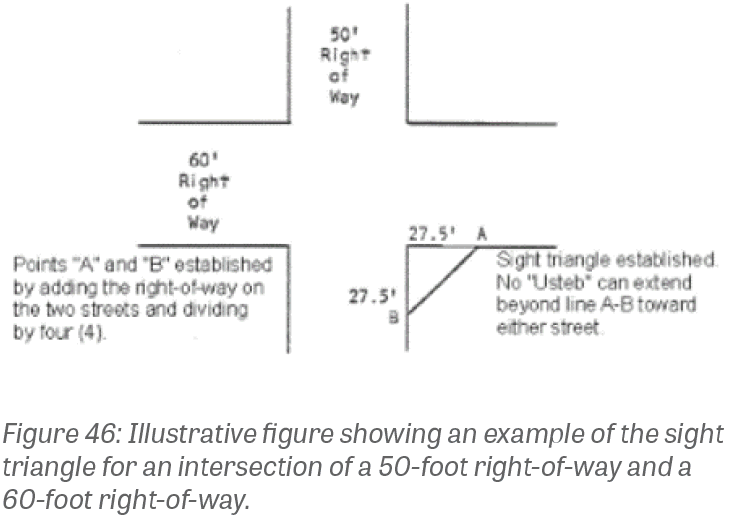
At every intersection of street rights-of-way, a sight triangle shall be established as described by the right-of-way lines of the intersecting streets as existing or as may be required by the Gahanna Major Thoroughfare Plan whichever is greater, and the third side. The third side is established by the line related by connecting points on each right-of-way line identified by measuring along each right-of-way line from the intersection a distance equal to the sum of the width of both rights-of-way divided by four.
(b)
Within the sight triangle there shall be maintained a clear visibility between the heights of two feet and ten feet above the average center line grade of the intersection streets within the sight triangle, except trunks of existing trees or light or sign supports. Such supports shall have a maximum dimension of six inches or less of its horizontal section. If there are two or more supports on a framework, they shall not be closer to each other than four feet. There shall be no vehicle parking or standing space provided within the sight triangle.
(Ord. No. 0007-2024, § 2(Exh. A), 4-1-24)

