
Grand Forks City Zoning Code
ARTICLE 3
- RULES AND REGULATIONS
18-0301.- Signs.
(1)
[Restrictions.] Except as otherwise provided herein, no off-premises advertising signs shall be allowed in R-1, R-2, R-3, R-4, R-5, R-M, A-D, B-1, B-2, B-3, B-4, I-1, I-2, PUD, U-D, A-1 and A-2 zoning districts.
(2)
[Conformance.] All signs and sign structures hereafter erected or maintained except official, traffic and street signs, shall conform with the provisions of this subsection and any other ordinances or regulations of the city.
(3)
General sign provisions. The following regulations shall apply to all signs and sign structures hereinafter permitted in all districts:
(A)
No sign or sign structure shall be permitted within any public right-of-way or public easement, except:
1.
Newspaper stands, bus benches, and litter baskets.
2.
Signs located within the B-4 district may be permitted to project within two (2) feet of the curb line, provided that such signs do not otherwise obstruct sidewalks or impair visibility.
(B)
No sign or sign structure shall be allowed to project or extend into or over any public right-of-way or public easement except:
1.
Signs may be allowed to project or extend into or over a public right-of-way or easement provided that it shall not extend into or over a street or alley and further only upon approval by the city engineer and upon written affirmation by the owner that the owner will, upon reasonable notice by the city, remove any such sign or sign structure at the owner's own expense to allow for any maintenance, repair, installation, or relocation of any pipe, main, line, cable, wire, or other fixture or appurtenance owned by the city or any public utility or other authorized user located within such public right-of-way or easement. The owner shall further hold harmless and indemnify the city for any and all claims of damages to such utilities and claims, damages, or injuries arising from the location of the sign or sign structure, including its projection or extension into or over any public right-of-way or public easement.
2.
No sign or sign structure shall be allowed to interfere with the operation, maintenance, repair, or installation of any street, alley, sidewalk, traffic control device, pipe, main, line, cable, wire, or other fixture or appurtenance owned by the city or any public utility or other authorized user.
(C)
All signs and sign structures shall be additionally governed by the requirements as specified in the appropriate zoning districts.
(D)
No sign visible from any street shall contain the words "Danger", "Stop", or otherwise simulate street, traffic, law enforcement, or any other official government sign.
(E)
No sign shall be permitted to obstruct any window, door, fire escape, stairway, or other opening intended to provide ingress or egress for any building or structure.
(F)
Any sign now or hereafter existing which advertises a business, product, activity, or campaign which no longer exists, or any sign which becomes irrelevant because of the movement of a business shall be removed by the owner, agent or person having the beneficial use of the building, structure, or lot upon which such sign may be found within thirty (30) days after written notification from the zoning administrator. If the sign is not removed within the time specified in such order, and after notice and hearing by the city council, the zoning administrator shall cause removal of said signs and any expense incidental thereto shall be specially assessed to the property.
(G)
Any sign or sign structure which may be or hereafter become dilapidated, rotted, unsafe, or unsightly shall be repaired or removed by the licensee, or owner of the property upon which the sign stands, within thirty (30) days after written notification by the zoning administrator. If the sign is not removed or repaired within the time specified in such order, and after notice and hearing by the city council, the zoning administrator shall cause the removal of said signs and any expense incidental thereto shall be specially assessed to the property.
(H)
Where a sign is illuminated, the source of light shall not shine into any public right-of-way, into any part of a residence or into any of the classes of residential districts; provided, however, that this does not apply to apartments located in a mixed use development in districts B-1, B-2, B-3, or in the B-4 central business district.
(I)
No sign or sign structure shall be erected or maintained in any location which obstructs vision of motorists of traffic-control signals at street intersections, driveway intersections, or street railroad crossings. No sign visible from the street shall contain the words "danger" or "stop" or otherwise simulate street, traffic, or other official signs. No semi-trailer or other vehicle on which there is an off-premises sign affixed or painted shall be parked in any district or on a street right-of-way more than forty-eight (48) hours.
(J)
No off-premises advertising sign or sign structure shall be permitted to be erected without approval of the property owner and without a permit following the review and approval of site plans by the city.
(K)
Roof signs are permitted only as regulated in districts B-1, B-2, B-3, B-4, I-1, and I-2. However, no off-premises advertising sign shall be placed on the roof or parapet of any building nor shall such a sign be attached to a building in any way.
(L)
Except as provided herein, no off-premises advertising sign or on-premises electronic changeable copy sign shall be permitted to be erected within one hundred (100) feet of a one or two family dwelling.
(M)
Murals are allowed on school and church buildings in residential districts and in business or industrial districts, subject to the following conditions:
1.
The mural does not contain any advertising or other commercial message, provided, however, the following shall be permitted:
a.
A defined area of the mural may be used to denote artist and/or sponsor credit for the mural provided such defined area shall comprise up to the lesser of four square feet or one percent of the mural's surface area and be located in one of the corners of the mural.
b.
Painted wall signs that are listed on a register of historically significant signs as maintained by the Historic Preservation Officer shall be classified as murals and may be permitted to be restored subject to the conditions contained in this section (M). The painted wall sign described in this section 18-0301(3)(M)(1)(b) shall be referred to as a "Historically Significant Wall Sign."
2.
The mural does not contain material that an average, reasonable person would consider to be obscene or otherwise offensive, as defined in N.D.C.C. Chapter 12.1-27.1.
3.
With the exception of restoring a Historically Significant Wall Sign under section 18-0301(3)(M)(1)(b), the mural is not installed on any original façade of a building listed as a contributing structure of a historic district or independently listed on the National Historic Register, unless:
a.
The mural is attached to a removable panel that can be removed without damage to the underlying historic facade and the manner of affixture is approved by the zoning administrator; or
b.
The application of paint is preceded by the application of a protective material to preserve the underlying facade. Such protective materials must be able to be safely applied and removed without damage to the underlying façade.
4.
The mural is not installed on any exterior wall of a building directly abutting a public right-of-way, excluding alleys.
5.
The mural proposer shall have received a letter of notice to proceed with mural installation or restoration of a Historically Significant Wall Sign from the Grand Forks City Inspection Department prior to commencing installation of the mural or the restoration of a Historically Significant Wall Sign.
a.
Prior to issuance of a letter of notice to proceed with mural installation or restoration of a Historically Significant Wall Sign, a mural proposal shall be submitted to the Grand Forks Community Development Department. Such proposals shall include a signed letter of consent from the owner of the building on which the mural is to be installed or restored, as well as drawings, pictures, or other visual representations of the mural, including information on size, location, materials to be used, manner of affixture to the building, and in the case of restoration of a Historically Significant Wall Sign, how the proposer intends on preserving the integrity of the historic façade.
b.
Review of proposals to restore Historically Significant Wall Signs must include presenting the proposal to the Historic Preservation Commission for an opportunity to provide comment.
6.
All murals must be maintained in good condition, free of dirt, debris, vandalism, and graffiti.
7.
Requests for murals on school and church buildings in residential districts must be approved by the city council after recommendation from the planning and zoning commission. The following specifications will be evaluated:
a.
Size;
b.
Location;
c.
Lighting plan;
d.
Maintenance plan; and
e.
Fines should maintenance not occur.
(N)
A sign may be placed at the rear entrance of a business establishment for the purpose of identification. The sign dimensions shall not exceed two (2) square feet for each linear foot of rear building facade.
(O)
An application for a sign permit shall be made at the Grand Forks City Inspection Department. Every permit issued shall expire upon the same terms applied to building permits. Prior to issuance of a sign permit, applicants shall file proof of ownership or a lease for no less than one (1) year from the date of application. Applications for sign permits for signs on leased property shall be accompanied by a copy of the lease or an affidavit signed by the property owner attesting to his approval of the sign.
(P)
No off-premise advertising signs or sign structures shall be permitted within one thousand one hundred (1,100) feet of either side of the centerline of Columbia Road, between Gateway Drive and the city extraterritorial zoning and subdivision jurisdiction boundary.
(Q)
All horizontal distances shall be measured by a straight line following the curb line parallel to the street or highway from which the off-premise advertising sign is intended to be viewed. If no curb exists, the distance shall be measured upon the shortest line which may be drawn between the two (2) subject signs.
(R)
Off-premise advertising sign structures shall not exceed fifty (50) feet in height. The height shall be measured from the immediately adjacent road surface elevation.
(S)
No portable sign board or temporary attraction sign shall be permitted to be maintained or displayed within the jurisdictional limits of the city.
(T)
Adopt-a-highway sign. Every person, firm, or corporation desiring to maintain or display an adopt-a-highway sign within the city zoning jurisdiction shall first obtain a permit therefor from the city inspection department. Said permit shall be granted upon the following conditions:
1.
Evidence of authorization by other government entities such as township, county, or state when the sign location is not on city-controlled right-of-way.
2.
The minimum spacing between signs shall be not less than one (1) mile with one (1) sign permitted in each direction.
3.
Signs shall be furnished, erected, maintained, and removed by the city and according to the manner prescribed in the Manual of Uniform Traffic Control Devices.
4.
Signs shall conform to the size and shape as indicated on the attached drawing. Said drawing is identified as appendix D of the land development code.
5.
Signs shall be permitted in those classifications of districts which have commercial and industrial arterial streets (and their extensions) as identified in the transportation element of the city's comprehensive plan.
6.
Fold-down traffic control signs installed in conjunction with the other signs shall be folded down during a cleanup and returned to the closed position after cleanup work has been completed.
(U)
Area enhancement signs. Any person, firm, or corporation desiring to maintain or display an area enhancement sign located as follows:
1.
The southwest corner of Stanford Road and Gateway Drive.
2.
The southwest corner of Columbia Road and Gateway Drive.
3.
All cloverleaf islands on the Columbia Road Overpass.
4.
The interchange area of 4th Avenue South and DeMers Avenue Skyway.
Signs shall conform to the size and shape as indicated on the attached drawing. Said drawing is identified as appendix E of the land development code. The signs shall meet the following criteria for area enhancement signs for sign types identified as follows:
Group identification signs.
(1)
Group identification signs shall be uniform throughout the program. Each group will receive no more than one (1) identification sign.
(2)
The sign will be made out of treated two-by-six-inch wood with the letters engraved and painted with a blue lettering paint. The sign shall be no longer than six (6) feet.
(3)
The letter size shall be of the standard "cutaletter" three-inch letter plate.
(4)
The signs will be inconspicuously placed at a height not to exceed twenty-four (24) inches as measured from the grade to the top of sign within the beds of plant life as determined by the zoning administrator.
(5)
No group identification signs shall be permitted to identify the name(s) of any political party, candidate, or other political messages.
Program identification signs.
(1)
A program identification sign shall be erected for a period of no longer than two (2) weeks. Each area will receive one (1) program identification sign.
(2)
The signs shall be a commercially painted forty-eight by ninety-six-inch sheet of plywood. The sign will identify the beautification program and city government utilizing an approved city logo.
(3)
No sign shall exceed six (6) feet in height. Any sign erected under this provision shall be located near the rear of the planting site and in such a manner as to not interfere with intersection clearance or other scenic vistas. The exact location of such a sign must be approved by the zoning administrator.
Special education signs.
(1)
Education signs that identify special aspects of the program shall be erected similar to the group identification signs. The signs shall identify wildflower plots and other messages that improve the public knowledge of the program.
(2)
The sign will be similar to the group identification sign, not to exceed three (3) feet in height and made of two-by-nine-inch treated wood and painted with blue lettering paint.
(3)
The signs will be infrequent, with no more than one (1) per location.
(V)
No off-premise advertising sign or sign structure shall be located within five hundred (500) feet of another such off-premise advertising sign or sign structure. The distance shall be measured radially in a straight line from the billboard edge to billboard edge.
(W)
Directional signs, as defined in section 18-0204, shall be permitted in all zoning districts as identified in section 18-0205.
(X)
Painted wall signs shall be prohibited in all zoning districts.
(Y)
Except as otherwise provided herein, the maximum number of off-premise advertising sign structures allowed within the City of Grand Forks and the city's extra-territorial jurisdiction shall be one hundred twelve (112). Upon the city's receipt of an official report and data from the U.S. Census Bureau, the maximum number of allowed sign structures shall be increased by one (1) sign structure for each additional five hundred sixty-six (566) residents above the 2020 census data. All signs permitted up to the maximum number shall be authorized on a first come basis.
(Z)
In the event that the city's extra-territorial zoning jurisdiction is extended or increased, the maximum number of off-premise advertising sign structures allowed shall be increased to accept and include all off-premise advertising sign structures existing within the newly acquired extra-territorial jurisdiction.
(AA)
Reserved.
(BB)
A "no net loss" policy shall be imposed when the maximum number of ninety (90) off-premise advertising sign structures within the city's extra-territorial jurisdiction is reached.
1.
It is the intent of the "no net loss" policy to allow the owner of an existing off-premise advertising sign structure no longer allowed under the provisions of this Code or otherwise displaced, to erect a compliant off-premise advertising sign structure within two (2) years of its removal or order for removal, whichever occurs first.
2.
Signs may be relocated under the "no net loss" policy to select areas within the city's zoning jurisdiction as follows:
(a)
The sign to be relocated is presently located on an undeveloped lot within the DeMers Avenue Corridor, Gateway Drive Corridor, or Highway 81 Corridor north of Gateway Drive.
(b)
The landowner of a currently undeveloped lot will not allow the off-premise advertising sign to remain on the lot when it is developed.
(c)
There is no other undeveloped lot available for the placement of an off-premise advertising sign within a five-hundred-foot radius of the off-premise advertising sign to be removed in any of the three (3) corridors (DeMers Avenue Corridor, Gateway Drive Corridor, and Highway 81 Corridor north of Gateway Drive).
(d)
The sign may be located within the Highway 81 Corridor (Washington Street) south of DeMers Avenue only upon the determination by the planning and zoning commission that the proposed location for a new off-premise advertising sign structure is "fitting and compatible." The request for consideration by the planning and zoning commission must include a map showing the location of the proposed sign structure, the location of existing residential and commercial structures within two hundred (200) feet of the proposed site, and the lighting plan for the sign.
(i)
The planning and zoning commission will notify all property owners within two hundred (200) feet of the placement of the proposed off-premise advertising sign structure and will hold a public hearing on the request.
(ii)
The planning and zoning commission shall consider, at a minimum, the following factors before approving or denying the off-premise advertising sign structure placement request:
a.
Creation of visual clutter;
b.
Reduced visual sight lines at roadway entrance(s) on the property where the off-premise advertising sign will be located and on abutting properties;
c.
Concentration of off-premise advertising signs.
(iii)
The applicant or any property owner within two hundred (200) feet of the proposed off-premise advertising sign structure location shall have the right to appeal the decision of the planning and zoning commission to the city council.
(CC)
Off-premise advertising signs shall be placed on single pedestal poles.
(DD)
Except as otherwise provided herein, all off-premise advertising sign structures are permitted only on platted lots.
(EE)
Off-premise advertising sign structures may be permitted on unplanted railroad property adjacent or contiguous to in-service railroad tracks.
(FF)
Ground monument signs (standard). Except as provided in subsections (GG) and (HH), the height of a ground monument sign shall not exceed eight (8) feet in height measured from the normal sidewalk grade. The width of the sign shall not exceed ten (10) percent of the lot width; however, in no case shall the sign exceed eighteen (18) feet in width. One (1) standard ground monument sign will be permitted on each frontage for corner lots with a maximum of three (3) signs for multiple-sided lots provided the width of the sign for the first frontage does not exceed ten (10) percent of the first front yard width; however, in no case shall the sign exceed eighteen (18) feet in width, and all subsequent frontage signs do not exceed seventy-five (75) percent of the first-frontage sign's maximum width and are separated from the first frontage sign by a minimum distance of fifty (50) percent of the second front yard frontage. All electronic changeable copy signs shall be consistent with the provisions of subsection (3)(II). Non-electronic changeable copy signs may be illuminated only by an indirect light source of ample power to provide visibility to the adjacent street. Construction requirements for said signs shall be in accordance with those required by the uniform sign code for "ground signs," and other city ordinances except insofar as may be inconsistent herewith. No off-premise advertising is permitted on ground monument signs or on reader boards attached to ground monument signs. Reader boards, including electronic message centers, shall not occupy any more than fifty (50) percent of the sign surface area; the remaining fifty (50) percent of the sign surface area shall identify the on-premise business or institution where the sign is located. See appendix F for examples.
(GG)
Commercial center ground monument signs. The maximum height, width, reader board area, and the allowable sign area of all commercial center ground monument signs shall not exceed the requirements established in table 1. Construction requirements for said signs shall be in accordance with those required by the uniform sign code for "ground signs," and other city ordinances except insofar as may be inconsistent herewith. Off-premise advertising shall be prohibited on commercial center ground monument signs and on reader boards attached to said signs. The sign surface and reader board sign surfaces shall not occupy any more area than listed in table 1; the remaining sign surface area used to identify the on-premise businesses or institutions where the sign is located. See appendix F for examples.
Table 1
Commercial Center Ground Monument Sign Standards
* Includes the first front yard of an individual complex, common area, or the combined first front yards of all individual properties. Lot frontage along a private roadway or access road included.
** Height measured from the normal sidewalk grade
(HH)
Development entrance ground monument signs. Such sign shall not exceed six (6) feet in height nor exceed sixteen (16) feet in width. Flashing illumination shall be prohibited except signs may be illuminated only by an indirect light source of ample power to provide visibility from the adjacent street. Construction requirements for said signs shall be in accordance with those required by the uniform sign code for "ground signs," and other city ordinances except insofar as may be inconsistent herewith. No off-premise advertising is permitted on project entrance ground monument signs. A maintenance agreement indicating the maintenance responsibilities for a development entrance sign shall be submitted prior to approval of the sign permit. See appendix F for examples.
Table 2
Development Entrance Ground Monument Sign Standards
* For subdivision or apartment identification signs a decorative entry identification sign may be placed at each entrance to a subdivision or apartment complex on either side of an entrance excluding either private or public rights-of-way.
(II)
Electronic changeable copy sign provisions.
1.
General operational standards.
A.
All electronic changeable copy signs must meet the following general operational standards:
(1)
Orientation. Except for provided herein, when located within one hundred fifty (150) feet of a residentially used lot in a residential zone, any part of the electronic sign must be oriented to avoid any glare on adjacent property.
(2)
Setback from other electronic changeable copy signs. Electronic changeable copy signs must be separated from other electronic changeable copy signs by at least thirty-five (35) feet.
(3)
Dimmer control. Electronic changeable copy signs must have an automatic dimmer control to automatically reduce the illumination at night and during times of reduced ambient light.
(4)
Streaming video. No streaming video shall be displayed, excluding type I and type II event center signs.
(5)
Location. No sign shall be maintained at any location where by reason of its position, size, shape, color or brightness it may obstruct, impair, obscure, interfere with the view of, or be confused with any traffic control sign, signal or device or where it may interfere with, mislead or confuse traffic.
(6)
Audio or pyrotechnics. Audio speakers and any form of pyrotechnics are prohibited.
(7)
Rotating signs. Except for multivision signs, no sign shall have rotating or moving parts.
2.
Specific provisions.
A.
Electronic changeable copy signs, on premises.
1.
Duration. All signs must have a minimum duration of one (1) second.
2.
Text. Text messages and background graphics may scroll in a consistent and predictable manner.
3.
A multivision sign.
(a)
Default mechanism. All signs must be equipped with a properly functioning default mechanism that will stop the sign in one (1) position should a malfunction occur.
(b)
Duration. The display area and each portion thereof must be static for at least six (6) seconds between static displays. Transition time must be no longer than two (2) seconds.
B.
Electronic changeable copy signs, off-premise.
1.
Replacement of static billboard facings. No off-premise electronic changeable copy sign will be allowed to be placed upon or replace an existing nonconforming static billboard.
2.
Duration. The display must have a minimum duration of six (6) seconds that is static during each individual message.
3.
Scrolling text. Scrolling text is prohibited.
(JJ)
Development notification sign provisions.
1.
Purpose. The purpose of the following sections is to set requirements that are unique to development notification signs; to coordinate outdoor signage while limiting the threats to public safety, vehicular and pedestrian traffic movements; and to aid in improving the overall notification of development throughout the City of Grand Forks.
2.
General standards.
(A)
Size. Sign(s) shall be a minimum of four (4) by eight (8) feet.
(B)
Location. A minimum of one (1) sign shall be posted on each side fronting a public or private street. The total number of signs, locations, and display durations, shall be determined by the city council following review by the planning and zoning commission.
(C)
Duration. Sign shall be placed on property within seven (7) days of application submittal. Sign to remain posted until development is complete or use for said property changes.
(D)
Required information.
1.
Land use (i.e., B-3, General Business District).
2.
Land use and/or property description, to include lot size, density and potential uses to be placed on the property.
3.
Map or picture of property showing development overview.
4.
Developer or property owners' names and contact information.
5.
Planning department contact information.
6.
Public hearing date, time and location if applicable.
7.
Zoning, including land use, lot size and density are subject to change or amendment as provided by the City of Grand Forks Land Development Code.
(E)
Construction specifications. The sign must be professionally manufactured of durable material(s). No lighting, speakers or other types of attachments are permitted. Any and all development notification signs shall be securely anchored so as to minimize danger of wind damage, theft or vandalism.
(F)
Maintenance and appearance. Signs must be maintained and kept in a clean and safe condition. Any sign or sign structure which may be or hereafter become dilapidated, unsafe, or unsightly shall be repaired and replaced by the licensee, developer, or owner of the property upon which the sign stands, within seven (7) days after notification by the zoning administrator. If the sign is not repaired or replaced within the time specified in such order, review of the application and/or date of the public hearing shall be postponed.
(KK)
Off-premise outdoor sporting facilities signs. Such signs are permitted subject to the following conditions:
(1)
The signs shall only be allowed on publically owned land utilized for sanctioned sporting events.
(2)
The signs shall be designed as to be oriented towards the recreation and spectator areas with minimal exposure to public rights-of-way.
(3)
Signs displayed on scoreboards shall not exceed forty (40) square feet.
(4)
Signs shall not incorporate digital elements such as flashing lights, video displays, or other electronic means of advertising.
(5)
Signs may be illuminated by an external light source.
(6)
Signs displayed on outfield fences shall not exceed sixty (60) square feet and shall only be permitted on the inside of the fence with no advertising facing outside the fence.
(LL)
High school ground monument signs. Such signs are permitted subject to the following conditions:
(1)
The signs shall only be allowed on the publicly owned high school land.
(2)
Each school is permitted one sign; the one sign may be either a ground monument or wall mounted sign.
a.
Ground monument signs to follow size limitations set forth in [section] 18-0301(3) (FF).
b.
Wall signs are to follow the requirements of the zoning district.
(3)
Signs are permitted to have up to thirty (30) percent of the sign face for static displays of sponsors of the school. Signs must include language that indicates off-premise advertising displayed are sponsors.
(4)
Digital displays must not exceed fifty (50) percent of the sign area, follow all other requirements of digital signs as set forth in [section] 18-0301 (3)(II), and are limited to school related announcements and activities only.
(4)
Signs permitted in R-1, R-2, R-3, R-4, R-5 and R-M. No on-premises business sign, nameplate sign, wall sign or home occupation sign shall be erected except the following:
(A)
A nameplate sign or professional nameplate sign or home occupation sign identifying the owner or occupant of a building or dwelling unit, provided the surface area does not exceed two (2) square feet. This sign may be placed in any front yard but in no case may it be placed in any side yard. Such sign shall be illuminated in compliance with this section.
(B)
A sign pertaining to the lease or sale of a building or property provided such sign shall not exceed twenty-four (24) square feet in surface area.
(C)
Temporary signs advertising a new subdivision development. Each subdivision or development shall be allowed the following signs:
1.
One (1) sign located in the subdivision development not to exceed ninety-six (96) square feet in surface area, not more than fifteen (15) feet in height.
2.
One (1) sign located in the subdivision development not to exceed twenty-four (24) square feet in surface area; not more than fifteen (15) feet in height.
3.
Temporary unilluminated signs identifying an engineer, architect, contractor, or product engaged in or used in the construction of a building; provided such signs shall not exceed twenty-four (24) square feet in surface area and are not more than fifteen (15) feet in height; and provided such signs are removed prior to occupancy of the building.
(D)
Free standing signs, as defined herein, are permitted for churches, schools, non-profit charitable organizations and other public institutions.
(1)
One (1) freestanding sign as defined herein is permitted per property.
(2)
No single sign surface area shall exceed fifty (50) square feet. The total sign surface area shall not exceed one hundred (100) square feet.
(3)
The sign shall not exceed eight (8) feet in height.
(4)
The sign may be an electronic changeable copy sign, subject to the following:
(a)
The electronic changeable copy portion of the sign is limited to fifty (50) percent of the sign surface area.
(b)
The display area and each portion thereof must be static for at least one (1) hour between static displays. The messages displayed on multi-sided signs must be the same.
(c)
The following display features and functions are prohibited: scrolling, traveling, flashing, spinning, rotating, fade, dissolve, any other moving effects, and all dynamic frame effects or patterns of illusionary movement or simulated movement.
(d)
Any part of the electronic changeable copy sign must be oriented to avoid any glare on adjacent property.
(e)
The brightness level shall not exceed 0.3 foot candles above ambient light as measured using a foot candle (Lux) meter at a preset distance depending on sign surface area, measured as follows:
(f)
Unless otherwise stated herein, electronic changeable copy signs are subject to subsection 18-0301(3)(II).
(5)
In addition to the standards set forth in section 18-0301.1 relating to appeals to the sign code, the planning director shall notify all property owners within two hundred fifty (250) feet of the subject sign prior to the planning and zoning commission taking action on the appeal.
(E)
For apartment complexes with apartment buildings collectively containing twenty-three (23) or less dwelling units, the total surface area of wall signs shall not exceed twelve (12) square feet in surface area. Signs are permitted to display the name and address of the apartment building(s).
(F)
For apartment complexes with apartment buildings having twenty-four (24) to forty-nine (49) dwelling units collectively, the total surface area of wall signs permitted shall not exceed sixty-four (64) feet to display the names and addresses of the buildings. Any apartment complex containing apartment buildings collectively with fifty (50) or more dwelling units shall be allowed an additional sixteen (16) feet of surface area for each additional fifty (50) dwelling unit increments to display the name and address of the apartment buildings.
(G)
Directional signs on private drives and parking areas as necessary for the orderly movement of traffic. However, no advertising shall be placed on such signs.
(H)
No off-premises advertising signs are permitted.
(I)
Development entrance ground monument signs as defined by section 18-0204, further regulated by subsection (3)(II).
(J)
High school ground monument sign.
(5)
[Signs in B-1, A-D districts.] Only the following signs are permitted in the B-1, limited business district and A-D, airport district:
(A)
A sign pertaining to the lease or sale of a building or property, provided such sign shall not exceed twenty-four (24) feet in surface area.
(B)
Temporary signs advertising a new subdivision development. Each subdivision or development shall be allowed the following signs:
1.
One (1) sign located in the subdivision development not to exceed ninety-six (96) square feet in surface area, not more than fifteen (15) feet in height.
2.
One (1) sign located in the subdivision development not to exceed twenty-four (24) square feet in surface area; not more than fifteen (15) feet in height.
3.
Temporary unilluminated signs identifying an engineer, architect, contractor, or product engaged in or used in the construction of a building; provided such signs shall not exceed twenty-four (24) square feet each in surface area and are not more than fifteen (15) feet in height; and provided such signs are removed prior to occupancy of the building.
(C)
One (1) identification sign, not to exceed fifty (50) square feet in area and not more than fifteen (15) feet in height for private, educational institutions, community centers, eleemosynary institutions, rest homes, nursing homes, and medical and dental offices.
(D)
An on-premises business sign for business and professional office buildings, motels, and hotels, shall not extend more than twenty-four (24) inches from the face of the building and shall not exceed in surface area fifty (50) square feet or four (4) percent of wall area upon which it is placed, whichever is greater. For corner lots, two (2) such signs, one (1) facing each street, shall be permitted. Such a sign shall not exceed the height of the building except in the case of a one-story structure; in that case the sign may extend three (3) feet above the height of the building.
(E)
Ground monument signs as defined by section 18-0204, further regulated by section 18-0301 (3)(GG).
(F)
No off-premises advertising signs are permitted.
(G)
Commercial center ground monument signs as defined by section 18-0204, further regulated by [sub]section (3)(HH).
(H)
Development entrance ground monument signs as defined by section 18-0204, further regulated by [sub]section (3)(II).
(6)
[Signs in B-2 district.] Only the following signs are permitted in the B-2 shopping center district:
(A)
Each shopping center shall be permitted ground monument signs as defined by section 18-0204, further regulated by [sub]section (3)(GG).
(B)
On-premises business signs are permitted, provided they shall be limited to flat wall signs which shall not extend more than twenty-four (24) inches from the face of the building and shall be limited in area to a maximum of ten (10) percent of the building facing area and they shall not extend more than three (3) feet above the roof or parapet line. In shopping centers established prior to May 6, 1968, the existing sign extension above the roof or parapet line may be used.
(C)
No on-premises business signs shall be placed nearer to an adjoining business than twenty (20) percent of the width of the occupants' frontage upon which the sign is placed. Two (2) or more businesses may unite to obtain a single balanced sign identifying the businesses, in which case the twenty (20) percent shall apply to the combined occupants' frontage.
(D)
Signs in the following designated geographical areas shall be subject to the following conditions:
(1)
Those properties abutting North and South Washington Street, between Gateway Drive and the city's southerly extraterritorial zoning and subdivision jurisdiction boundary and zoned as B-2 (shopping center shall be permitted to display one (1) commercial center ground monument sign as defined in section 18-0204, further regulated by [sub]section (3)(HH), and shall be prohibited from displaying additional ground monument signs).
(E)
No off-premises advertising signs are permitted.
(7)
Only the following signs are permitted in B-3 service business district:
(A)
On-premises business signs and off-premises advertising signs are permitted in this district as provided herein.
(B)
The total surface area of all business signs on a single lot shall not exceed three (3) square feet for each linear foot of frontage or ten (10) percent of the building facing area, whichever is greater. No sign attached to a building shall extend above the roof or parapet line more than four (4) feet or project within two (2) feet of the curb line. All signs shall not extend more than twenty-four (24) inches from the wall to which attached into any required yard. Signs on corner lots shall be computed on the side with the least width.
(C)
A single off-premises advertising sign shall not exceed three hundred (300) square feet in surface area, nor shall two (2) or more small signs be so arranged and integrated as to create a surface area in excess of three hundred (300) square feet, An increase in sign size of more than three hundred (300) square feet in surface area will be permitted on U.S. #2 west of the I-29/U.S. #2 (Gateway Drive) interchange, provided that the provisions of the Federal Highway Beautification Act and the North Dakota Century Code are met, and provided further that the sign size be limited to three (3) square feet for each linear foot of lot frontage up to a maximum sign size of six hundred seventy-two (672) square feet.
(D)
Ground monument signs as defined by section 18-0204, further regulated by [sub]section (3)(GG).
(E)
No freestanding on-premises business sign shall be erected to exceed a height of fifty (50) feet above the sidewalk line.
(F)
Signs in the following designated geographical areas shall be subject to the following conditions:
1.
Lots A and B, Block 1, Gransberg 2nd Resubdivision:
(a)
No off-premises advertising signs may be erected or displayed.
(b)
No off-premises advertising sign messages may be erected or displayed.
(c)
Any off-premises advertising signs which exist as of January 1, 1996, shall be removed prior to the issuance of any building permit for improvements within the geographical area.
(d)
On-premises business signs may be erected provided the sign structure does not exceed the height of the principal building or twenty-six (26) feet above the normal sidewalk grade whichever is less.
2.
That area located south of and within one thousand three hundred twenty (1,320) feet of the east-west section line which substantially follows the centerline of 32nd Avenue South and lying between the east boundary line of Peabody's First Addition and its southerly extension and the west boundary line of Gransberg 2nd Resubdivision and its southerly extension shall be subject to the following conditions:
(a)
No off-premises advertising signs may be erected or displayed.
(b)
No off-premises advertising signs or sign structures may be erected or displayed.
(c)
No pylon-type signs shall be erected or displayed.
(d)
Ground monument sign structures shall not exceed the height of twenty-four (24) feet according to the following slope line and ratio thereof: Said slope line progresses upward at a ratio of one (1) foot per one hundred eight (108) feet beginning on the east boundary line of Peabody's First Addition with a maximum sign height of eight (8) feet and proceeding upward at said ratio to a maximum sign height of twenty-four (24) feet on the west boundary line of Gransberg 2nd Resubdivision.
(G)
Commercial center ground monument signs as defined by section 18-0204, further regulated by [sub]section (3)(HH).
(8)
The following section applies to signage in the B-4 District:
(A)
Purpose. Signs are a distinguishing feature of a building and lots downtown. Standards allow design flexibility while ensuring signage applies to both existing and new structures appropriately and in a coordinated manner.
(B)
Standards application. The standards in this subsection apply to all buildings in the B-4 district unless standards explicitly list otherwise.
1.
Federal standards. Signage must comply with Americans with Disabilities Act (ADA) regulations.
2.
State standards. Streets regulated by the North Dakota Department of Transportation (DOT) require additional permits and approvals through the DOT for any signage in the right-of-way.
(C)
Only the following signs are permitted in the B-4 district:
1.
On-premises business signs.
2.
Ground monument signs as defined by section 18-0204, further regulated by [sub]section (3)(GG).
3.
Banner signs as defined in section 18-0204.
4.
Temporary and A-frame signs. One (1) approved A-frame sign is permitted per business.
5.
No off-premises advertising signs are permitted.
6.
High school ground monument sign (with DDRB approval).
(D)
General area measurement standards. The total of all business signs on a single lot shall not exceed four (4) square feet for each linear foot of lot frontage, or ten (10) percent of the building facing area, whichever is greater. Sign areas for corner lots shall be computed on the basis of the side with the least width.
(E)
Projecting measurement standards.
1.
Projecting signs bracketed to building façades beside or above doorways are permitted if:
a.
No projecting sign shall project within two (2) feet of the curb line.
b.
There is an eight-foot clearance zone from the sidewalk.
c.
The sign projects no more than six (6) feet from the wall.
d.
The sign is no larger than eighteen (18) square feet.
e.
The sign is compliant with other requirements of this section and the Municipal Code.
2.
Wall signs shall not extend more than twenty-four (24) inches from the wall to which attached into any required yard.
3.
Signage must not project above the cornice line or be mounted on the roof of any downtown building. In case of signs erected before May 6, 1968, the existing extension above the roof or parapet line may be used.
(F)
Architectural integration. Signage must be integrated with architectural façade elements and not cover architectural details.
(G)
Location. Primary signage must be located in the space above the first-floor windows and below second floor windows.
1.
Multi-story buildings. For multi-story buildings, one (1) primary sign per street frontage may be located on the third story or above. This sign must be no more than thirty-two (32) square feet in total sign area.
(H)
Awning signs. A sign on an awning can be located on the narrow vertical face or top with a maximum size of one (1) square foot per linear foot of awning/canopy width.
(I)
Street numbering. Street numbers must be prominently displayed at the main entrance to the building and visible from the street. Street numbers do not count toward the amount of sign area on a parcel or building.
(J)
Plaque signs. Plaque signs mounted directly to building facades beside secondary entrances, such as to second floor offices, are permitted if four (4) square feet or less in size, and if in compliance with the other requirements of this section.
(K)
Painted and vinyl signs. Signage painted or affixed directly on storefront glass is permitted on ground floors only but shall not cover more than twenty (20) percent of a single windowpane.
(L)
Illuminated signs. Individual letters and signs illuminated by wall-mounted fixtures, internally illuminated cabinets with routed faces for illuminated elements, and illuminated channel letters are permitted. Illuminated wall cabinets are prohibited.
(M)
Neon signs. Neon signs are permitted, but the gross sign area shall not exceed five (5) percent of the building face.
(N)
Temporary signs. Temporary signs may be hung on the inside of storefront windows or displayed outside, such as a "sandwich sign" or A-frame style, subject to the requirements of this section and applicable city ordinances. Temporary signs must not exceed more than thirty (30) days with the same message unless an A-frame sign obtains an approved city permit as required in city ordinances for obstructions in public right-of-way.
1.
Location. No sign shall be located as to pose a danger and violate the clear vision of a vehicle or pedestrian. Where a traffic vision is impaired or other hazards are created, the city may require a modification to the height or location of a sign to the degree necessary to eliminate the hazard. No sign shall be permitted to obstruct any door, fire escape, stairway, or opening intended to provide ingress or egress for any building or structure.
2.
Construction specifications and materials. The sign must be stable to not blow off the premises during what would be considered normal storm or wind events. No lighting, speakers or other types of attachments are permitted.
3.
Alteration of landscaping prohibited. No publicly owned landscaping may be damaged or modified to accommodate a temporary sign.
4.
Removal of signs. Signs that do not comply with the provisions of this section may be removed by the city without notice.
(O)
Sign graphics. Signage graphics are subject to the following standards and guidelines:
1.
Signs must contain minimum wording and be of minimum reasonably readable type size while meeting ADA requirements.
2.
Font styles shall be limited to one (1) or two (2) easily readable styles per business.
3.
Dark lettering on a light background is encouraged, and signs shall have sufficient visual contrast while meeting ADA requirements.
4.
Colors must complement the storefront. Excessively bright or neon colors shall not be used.
5.
Wood, metal, stone, and fabric are recommended materials.
(P)
Prohibited sign types. The following sign types are prohibited:
1.
Internally illuminated awnings.
2.
Internally illuminated wall cabinet signs.
3.
Flashing signs.
4.
Moving signs or signs with moving elements.
5.
Signage painted directly onto building facades, including side and rear facades.
6.
Digital, electronic, or fixed letter boards except that letter form theater marquees are permitted.
(9)
Only the following signs are permitted in I-1 and I-2 industrial districts:
(A)
On-premises business signs, off-premises advertising signs, and off-premises advertising sign structures are permitted in these districts.
(B)
The total surface area of all on-premises business signs on a single lot shall not exceed five (5) square feet for each linear foot of lot frontage or ten (10) percent of the building facing area, whichever is greater. No sign attached to a building shall extend above the roof or parapet line more than four (4) feet or project within two (2) feet of the curb line. Wall signs shall not extend more than twenty-four (24) inches from the wall to which attached into any required yard. Signs on corner lots shall be computed on the side with the least width.
(C)
Off-premises advertising signs located in I-1 and/or I-2 industrial districts shall not exceed six hundred seventy-two (672) square feet in sign area.
(D)
On-premises business sign structures may be erected to a maximum height not to exceed fifty (50) feet above the ground level.
(E)
Ground monument signs as defined by section 18-0204, further regulated by [sub]section 18-0301 (3)(GG).
(F)
Commercial center ground monument signs as defined by section 18-0204, further regulated by [sub]section (3)(HH).
(10)
Only the following signs are permitted in a PUD district; commercial and industrial uses:
(A)
On-premises business signs, limited to flat wall signs, are permitted in this district, provided the total surface area of signs on a single lot does not exceed three (3) square feet for each linear foot of lot frontage, or ten (10) percent of the building facing area, whichever is greater. No sign attached to a building shall extend above the roof or parapet line or extend more than twenty-four (24) inches from the wall to which attached into any required yard.
(B)
Ground monument signs as defined by section 18-0204, further regulated by subsection 18-0301(3)(GG).
(C)
A unified commercial center containing multitenant buildings and properties may have additional ground monument signs on a separate property other than the one [in which] the tenant building is located, provided the following conditions are met. The unified ground monument sign(s) must be located on the property owned by the unified commercial center or a multitenant building or property adjacent thereto, and with the advertising restricted to the tenants leasing, renting or owning building space. Each property is permitted one (1) ground monument sign, not to exceed fifty (50) square feet, in addition to the unified commercial center ground monument sign, unless located on a corner or double frontage lot and provided the total square footage of other signs does not exceed the maximum square footage of signs allowed for single frontage lots.
(D)
Business landmark signs as defined by section 18-0204.
(E)
One (1) type I and one (1) type II event center sign as defined by section 18-0204. These signs must reflect the architectural character of the event center. These signs must be located within the approved concept development plan area.
(F)
Drawings shall be submitted to and approved by the city planning department prior to the issuance of any sign permit by the inspection department. The drawing shall be drawn to scale and indicate the size and location of the wall sign, business landmark sign, ground monument sign, or event center sign on the building or lot.
(G)
No off-premises advertising signs are permitted except as follows:
(1)
Off-premises advertising signs may be permitted only in PUDs with designated commercial and/or industrial uses adjacent to I-29 and any non-residential PUD along South Washington Street and following the same approvals as provided for [section] 18-0301[(3)](BB)2.(d).
(2)
No off-premises advertising sign shall be placed further than one hundred (100) feet from the I-29 right-of-way.
(3)
Permitted off-premises advertising signs in a PUD shall be oriented to traffic traveling on I-29.
(4)
Off-premises advertising signs permitted in a PUD shall not exceed six hundred seventy-two (672) square feet.
(H)
Campus signage master plan.
(1)
Purpose. The provisions and standards of this section shall apply to future signage on all properties defined herein. Unless otherwise specified in this section the City of Grand Forks Land Development Code shall govern. Entities subject to this section are defined as commercial, medical, educational and other entities that include multiple buildings with centralized support, amenities and common internal functions and service. Other entities not specifically cited herein may be eligible to request a campus signage master plan provided they are deemed to meet the purpose and intent of this section by the planning and zoning commission.
(2)
Permitted signs. The following types of signs are permitted within a campus signage master plan:
(a)
Wall signs as provided for in Section 18-0301(10)(A).
(b)
Primary campus identification sign provided the sign meets the standards set forth for "Commercial center ground monument signs" as stated in Section 18-0301(3)(HH).
(c)
Wayfinding signs. Shall provide clear directional information to motorists and pedestrians in order to get them safely and efficiently to their destination.
1.
The total sign structure area shall not exceed twelve (12) feet in height and six (6) feet in width.
2.
The city planner shall determine the total number of wayfinding signs permitted, which will be based on parking lot design, building placement and other site elements deemed appropriate by the city planner.
3.
Signs shall not decrease the safety and efficiency of traffic flow due to height, location or design.
4.
Letters may be internally lit.
5.
A consistent font and color scheme shall be used for all signs.
6.
Signs shall only depict directional information. Advertising for commercial purposes is prohibited. Logos which identify the campus are permitted.
(3)
Submittal requirements.
(a)
Campus signage master plan applicants shall submit to the planning department colored elevation drawings and a map of the campus site, all drawn to scale, indicating all sign dimensions and locations.
(b)
The planning department shall approve, approve conditionally or disapprove such plan.
(4)
Appeals.
(a)
Any person aggrieved by any final decision of the planning department denying any application, permit or approval relating to a campus signage master plan may appeal such denial to the city council as provided for in section 18-0301.1.
(11)
University of North Dakota Sign Overlay District.
(A)
For purposes of this section the University of North Dakota Sign Overlay District shall mean that area encompassed by the boundaries as delineated on the map which is incorporated herein as "University of North Dakota Sign Overlay District."
(B)
Signs permitted.
(1)
Building identification signs used to identify educational, administrative, athletic, and other university facilities. Such signs may include an electronic messaging system (EMS) for the purpose of displaying directional information and information regarding events on campus. The EMS shall not exceed six (6) square feet in area. The maximum sign size shall be limited to the dimensions shown in appendix G.
(A)
Building monument.
(B)
Ground mounted building identifier.
(C)
Wall mounted building identifier.
(D)
Channel letters—wall mounted.
(2)
Parking identification signs used to identify campus parking structures and surface parking lots. The sign size and design shall be limited to the dimensions shown in appendix G.
(A)
Parking monument.
(B)
Parking identifier.
(C)
Parking aisle identifier.
(3)
Directional signs used to provide on and off-premise vehicular wayfinding directions. Off-premise directional signs shall be subject to the approval by the City of Grand Forks and all other appropriate governmental agencies. Such signs may include an electronic messaging system (EMS) for the purpose of displaying directional information and information regarding events on campus. The EMS shall not exceed four (4) square feet in area. The maximum sign size shall be limited to the dimensions shown in appendix G.
(4)
Informational signs used to provide directional assistance to pedestrians. The sign size and design shall be limited to the dimensions shown in appendix G.
(A)
Kiosk informational.
(B)
Handicap directional.
(C)
Bicycle facility identifier.
(D)
Transit facility identifier.
(5)
Wall signs are permitted in this district, provided the total surface area of signs does not exceed ten (10) percent of the building facing area. No sign attached to a building shall extend above the roof or parapet line or extend more than twenty-four (24) inches from the wall to which attached into any required yard.
(6)
Ground monument signs as defined by section 18-0204, further regulated by subsection 18-0301(3)(GG).
(7)
One (1) type I and one (1) type II event center sign as defined by section 18-0204. These signs must reflect the architectural character of the event center. These signs must be located within the approved concept development plan of the University Village Planned Unit Development (PUD).
(8)
Home occupation signs as defined in section 18-0204.
(9)
A sign pertaining to the lease or sale of a building or property provided such sign shall not exceed twenty-four (24) square feet in surface area.
(10)
Temporary signs advertising a new subdivision development. Each subdivision or development shall be allowed the following signs:
i.
One (1) sign located in the subdivision development not to exceed ninety-six (96) square feet in surface area, not more than fifteen (15) feet in height.
ii.
One (1) sign located in the subdivision development not to exceed twenty-four (24) square feet in surface area; not more than fifteen (15) feet in height.
iii.
Temporary unilluminated signs identifying an engineer, architect, contractor, or product engaged in or used in the construction of a building; provided such signs shall not exceed twenty-four (24) square feet in surface area and are not more than fifteen (15) feet in height; and provided such signs are removed prior to occupancy of the building.
(12)
Only the following signs are permitted in A-1 and A-2 agricultural zoning districts: No off-premises advertising sign, on-premises business sign, nameplate sign, or home occupation sign shall be permitted except as follows:
(A)
A nameplate sign or professional nameplate sign or home occupation sign identifying the owner or occupant of a building or dwelling unit, provided the surface area does not exceed two (2) square feet. This sign may be placed in any front yard but in no case may it be placed in any side yard. Such sign shall be illuminated in compliance with this section.
(B)
A sign pertaining to the lease or sale of a building or property provided such sign shall not exceed twenty-four (24) square feet in surface area.
(C)
Temporary signs advertising a new subdivision development. Each subdivision or development shall be allowed the following signs:
1.
One (1) sign located in the subdivision development not to exceed ninety-six (96) square feet in surface area, not more than fifteen (15) feet in height.
2.
One (1) sign located in the subdivision development not to exceed twenty-four (24) square feet in surface area; not more than fifteen (15) feet in height.
3.
Temporary unilluminated signs identifying an engineer, architect, contractor, or product engaged in or used in the construction of a building; provided such signs shall not exceed twenty-four (24) square feet in surface area and are not more than fifteen (15) feet in height; and provided such signs are removed prior to occupancy of the building.
(D)
One (1) identification sign, not to exceed fifty (50) square feet in area and not over fifteen (15) feet in height for the following uses: church, school, sanitarium, club, library, charitable institution, funeral homes, recreational vehicle park, and similar uses. Such signs shall be solely for the purpose of displaying the name of the institution and its activities or services.
(E)
One (1) nameplate sign for a dwelling group of four (4) or more dwelling units not exceeding twelve (12) square feet in surface area and not more than six (6) feet in height. Such signs may indicate the names and addresses of the buildings or it may be a directory of occupants.
(F)
Directional signs on private drives and parking areas as necessary for the orderly movement of traffic. However, no advertising shall be placed on such signs.
(G)
Off-premises advertising signs shall not exceed six hundred seventy-two (672) square feet in advertising display area.
(H)
Off-premises advertising signs are permitted on unplatted property in an A-1 or A-2 agricultural zoning district.
(I)
Signs allowed for permitted or conditionally permitted commercial uses shall conform to the sign provisions of Section 18-0301 (10) relating to signs allowed in a PUD district.
(Ord. No. 2900, § 1, 10-17-88; Ord. No. 2990, § 1, 11-6-89; Ord. No. 3017, § 1, 3-19-90; Ord. No. 3018, § 1, 3-19-90; Ord. No. 3073, § 1, 10-15-90; Ord. No. 3110, § 1, 6-17-91; Ord. No. 3111, § 1, 6-17-91; Ord. No. 3334, §§ 1—3, 10-18-93; Ord. No. 3482, §§ 1, 2, 12-19-94; Ord. No. 3537, § 1, 8-7-95; Ord. No. 3545.1, §§ 2—5, 10-16-95; Ord. No. 3558, § 1, 1-16-96; Ord. No. 3649, § I, 6-30-97; Ord. No. 3787, § III, 4-19-99; Ord. No. 3793, § I, 5-17-99; Ord. No. 3843, § II, 3-6-00; Ord. No. 3856, § 2, 9-18-00; Ord. No. 3856, § II, 11-7-00; Ord. No. 3887, § II, 5-21-01; Ord. No. 3934, § I, 7-22-02; Ord. No. 4006, § II, 1-20-04; Ord. No. 4040, § II, 3-21-05; Ord. No. 4105, § I, 12-19-05; Ord. No. 4155, § 2, 9-18-06; Ord. No. 4195, § XVIII, 7-2-07; Ord. No. 4254, §§ 2—5, 11-17-08; Ord. No. 4314, § I, 2-22-11; Ord. No. 4331, § I, 5-16-11; Ord. No. 4348, § I, 10-17-2011; Ord. No. 4397, § I, 2-19-13; Ord. No. 4523, § 2, 6-15-15; Ord. No. 4662, § 1, 4-16-18; Ord. No. 4665, § 2, 5-21-18; Ord. No. 4710, § 1, 4-15-19; Ord. No. 4722, §§ 1, 2, 6-17-19; Ord. No. 4791, § 1, 5-17-21; Ord. No. 4798, § IV, 6-21-21; Ord. No. 4824, § 1, 3-22-22; Ord. No. 4835, § 1, 6-6-22; Ord. No. 4839, § 1, 8-15-22; Ord. No. 4840, § 1, 8-15-22; Ord. No. 4858, § 1, 6-19-23)
18-0301.1. - Appeals.
(1)
Any person aggrieved by any final decision of the planning department and/or building inspection department denying any application, permit, or approval relating to a sign may appeal such denial to the city council. Prior to consideration of such an appeal by the city council, the appeal must first be submitted to the planning and zoning commission for its recommendations. Upon receipt of the recommendations of the planning and zoning commission, the city council may alter the decision upon a finding:
(A)
That there are special circumstances or conditions affecting the property which is the subject of the appeal such that the strict application of the provisions of section 18-0301 would deprive the appellant of the reasonable use of the land.
(B)
That the granting of the appeal is necessary for the preservation and enjoyment of a substantial property right of the appellant.
(C)
That the granting of the appeal will not be detrimental to the public health, safety, and welfare or injurious to other property or persons in the area in which the appeal relates.
(D)
That the granting of the appeal will not reduce site lines at any intersection, roadway, entrance, or exit; will not interfere with the use or operation of any city or public utility or infrastructure; or will not cause any other detriment to public health, safety, or welfare.
(E)
That the granting of the appeal will not create visual clutter or an unreasonable concentration of on and/or off-premise advertising signs in the area to which the appeal relates.
(2)
Application for any such appeal shall be submitted in writing to the office of the city planner by the owner of the property where any such sign or sign structure is proposed. The application shall fully and clearly state all facts relied upon by the petitioner and shall be supplemented with maps, plans, photographs, diagrams or other additional data which may aid in the analysis of the requested appeal. A fee shall be paid in accordance with section 18-1103.
(3)
Reasonable conditions may be established in the granting of an appeal under this section.
(4)
No appeal shall be granted to allow any sign to be erected or maintained in any zone or area in which such sign is not otherwise allowed.
(Ord. No. 3938, § I, 8-19-02; Ord. No. 4105, § III, 12-19-05)
18-0302. - Off-street parking and loading.
(1)
Permit required. No off-street parking or loading facility shall be constructed without a permit for such construction having first been obtained from the office of the zoning administrator, which permit shall require compliance with the provisions of this section. Fees for such permits shall be determined in the same manner by which fees for building permits are determined.
(2)
General provisions:
(A)
This section shall apply to all buildings and uses of land established after the effective date of this section.
(B)
Required site plan: Any application for a building permit or off-street parking or loading facility permit shall include a site plan or plot plan approved by the city planning director drawn to scale and dimensioned showing off-street parking and loading space, access and circulation pattern, and required landscaping to be provided in compliance with this chapter.
(C)
Reduction and use of parking and loading space: Off-street parking and loading facilities existing at the effective date of this chapter shall not subsequently be reduced to an amount less than that required under this chapter for a similar new building or use. Off-street parking facilities provided to comply with the provisions of this chapter shall not subsequently be reduced below the requirements of this chapter. Such required parking or loading space shall not be used for storage of goods or for storage of vehicles that are inoperable or for sale.
(3)
Design of parking and loading facilities. Each space shall contain approximately two hundred eighty-five (285) square feet per required space and any parking lots or spaces required shall comply with design standards in table 1 and in diagram.
TABLE 1
Parking Layout Required Minimum Dimensions (In Feet)
For 9-Foot Stalls at Various Angles
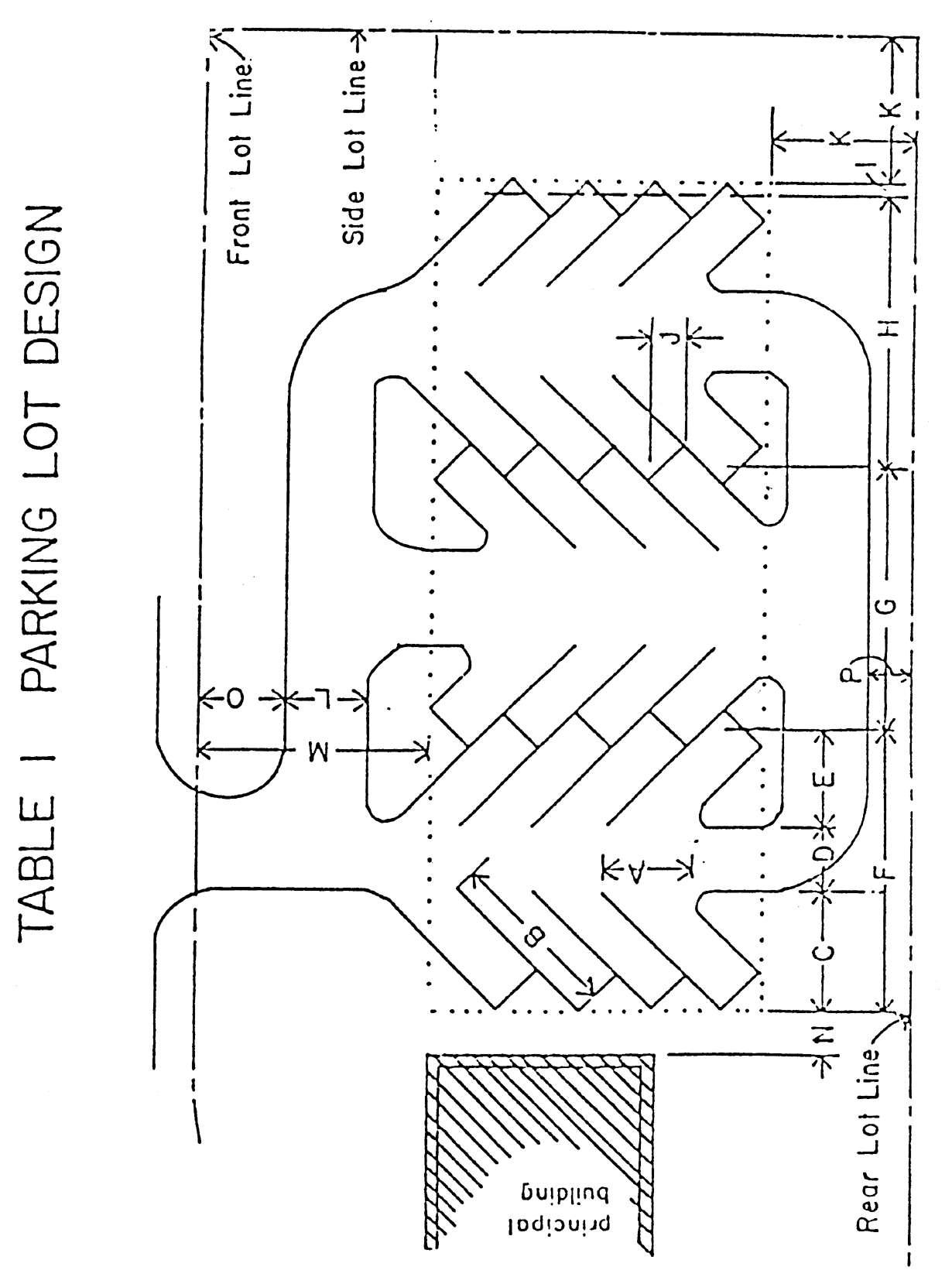
Table 1 Parking Lot Design
(4)
Accessible parking space requirements. All accessibility requirements under the Americans with Disability Act (ADA) that may be applicable must be complied with.
(A)
Design requirements. If parking spaces are provided for self-parking by employees or visitors, or both, then accessible spaces shall comply with the design requirements shown below:
1.
Location. Accessible parking spaces serving a particular building shall be located on the shortest route of travel from adjacent parking to an entrance. In parking facilities that do not serve a particular building, accessible parking shall be located on the shortest route of travel to a pedestrian entrance of the parking facilities. In buildings with multiple entrances with adjacent parking, accessible parking spaces shall be dispersed and located closest to the entrances.
2.
Parking spaces. Accessible parking spaces shall be a minimum of eight (8) feet by eighteen and one-half (18.5) feet exclusive of aisle width. Each accessible parking space shall also have an adjunct access aisle at least five (5) feet wide. Two (2) accessible parking spaces may share a common access aisle. See drawing:
Parked vehicle overhangs shall not reduce the clear width of a route. Accessible parking spaces and access aisles shall be level with surface slopes not exceeding one and fifty one-hundredths (1.50) (2%) in all directions. One (1) in every eight (8) accessible spaces but not less than one (1), shall be served by an access aisle ninety-six-inches wide minimum and shall be designated "van accessible."
3.
Signage. Accessible parking spaces shall be designated by signage as required by NDCC, 39-01-15 site specific code. Spaces for vans shall have an additional sign "van accessible" mounted below the symbol of accessibility. Such signs shall be located so they cannot be obscured by a vehicle parked in the space.
(B)
Accessible space requirements. Each parking area shall provide the accessible stalls as shown in the table below. Spaces required by the table need not be provided in the particular lot. They may be provided in a different location if equivalent or greater accessibility, in terms of distance from an entrance, cost and convenience can be insured.
(5)
Yards:
(A)
Except as otherwise provided herein, no off-street parking shall be allowed upon any front yard in an R-1, R-2, R-3, R-4, or UD zone.
(B)
Off-street parking is allowed in an R-1 and R-2 zone and on any lot located in a UD zone utilized for one- and/or two-family residences provided:
(1)
That no more than forty (40) percent of the front yard area is utilized for parking or loading purposes;
(2)
That all areas utilized for off-street parking or loading in the front yard must be hard surfaced with asphalt or concrete;
(3)
Off-street parking shall be constructed to be no closer than three (3) feet from a property line except upon the filing with the city of a written agreement between abutting property owners.
(C)
No off-street parking or loading facility shall be located within ten (10) feet of any property line that abuts a street right-of-way.
(D)
No off-street parking or loading facilities in a business or industrial district shall be located within ten (10) feet of any property line abutting a residential district.
(E)
Off-street parking or storage of vehicles, recreational vehicles, boats, trailers, personal watercrafts, and campers in the rear yard of one- and two-family residential properties shall be limited as follows:
(1)
On lots of seven thousand (7,000) square feet or less of lot area, no more than forty (40) percent of the rear yard shall be used for storage or parking.
(2)
On lots in excess of seven thousand (7,000) square feet of lot area, no more than forty (40) percent of the rear yard shall be for storage or parking.
(3)
No more than three (3) of the items listed above may be stored on a lot outside of a fully enclosed building for more than one (1) week, except, however, the foregoing shall not apply to the following:
(a)
Any vehicle parked or stored in conjunction with a temporary service benefiting the property.
(b)
Any vehicle or item used in connection with an authorized construction site.
(c)
Any vehicle or item used in connection with authorized public works construction or maintenance.
(6)
Computing requirements:
(A)
The number of parking spaces shall be determined by the use of the building area or portions of the building area. Any accessory uses such as bathrooms, hallways, kitchens and the like of which individually occupy ten (10) percent or less of the building area shall be computed on the same basis as the principal use; the amount exceeding ten (10) percent will not be used in computing parking requirements.
(B)
Floor space shall mean gross floor area of the specific use.
(C)
Where fractional spaces result, the parking spaces required shall be construed to be the nearest whole number.
(D)
The parking space requirement for a use not specifically mentioned herein shall be the same as required for a use of similar nature as determined by the zoning administrator.
(7)
Fences and planting screens. Off-street parking and loading areas adjoining residence districts shall provide a bufferyard as required by section 18-0309.
(8)
Access:
(A)
Parking and loading space shall have proper access from a public right-of-way.
(B)
The number and width of access drives shall be so located as to minimize traffic congestion and abnormal traffic hazard. No driveway in R-3, R-4, R-5, U-D residence districts and all business and industrial districts shall be closer than fifty (50) feet from any right-of-way line of a street intersection. In A-1, A-2, R-1, R-2, and R-M districts, the minimum shall be fifteen (15) feet.
(C)
Vehicular access to business uses across the street from property in R-1, R-2, R-M, U-D, and PUD—One-and two-family residences shall be prohibited.
(9)
Location of parking facilities. Required off-street parking spaces shall be provided on the same lot as the principal building or use, except where otherwise provided for in this section. Any area within twenty (20) feet of the front of the drive-in garage doors may not be used to satisfy any portion of the parking requirements.
(10)
Combined parking facilities:
(A)
Combined or joint parking facilities serving different districts shall not be permitted except:
1.
Limited combined or joint parking facilities may be located, constructed and used within and for buildings or uses in R-3, R-4, and U-D residence districts, provided that such parking facility is on an adjoining lot and the plan for such facility is approved by the planning and zoning commission.
2.
Limited combined or joint parking facilities may be located, constructed and used within and for buildings or uses in B-1, B-2, B-3 and B-4 business districts, provided that such facility is on an adjoining lot and the plan for such parking facilities is approved by the planning and zoning commission.
3.
Limited combined or joint parking facilities may be located, constructed and used within and for buildings or uses in I-1 and I-2 industrial districts, provided that such facility is on an adjoining lot and the plan for such parking facility is approved by the planning and zoning commission.
(B)
All limited combined or joint parking facilities authorized hereunder shall provide the total number of parking spaces as the sum of the requirements for each building or use being served thereby.
(C)
All limited, combined or joint parking facilities or adjoining parking facilities on separate lots as authorized and constructed adjacent to a common lot line separating two (2) or more parking areas are not required to observe the parking area setback from such common lot line.
(11)
Exemptions from parking regulations:
(A)
Establishments in any district which have paid an assessment for the provision of off-street city parking lots shall be exempt from the provisions of this subsection which refers to off-street parking.
(B)
If the current parking regulations cannot be met as a result of the replacement of an existing structure, a twenty (20) percent exception on the total parking requirement will be allowed up to a maximum of fifty (50) stalls. The applicant will be required to pay for each stall according to the following formula:
Upon payment of the parking exception cost (PEC) based upon the herein described formula to the city by the applicant in cash, such property shall be exempt from the strict provisions of this subsection which refer to off-street parking. The money paid by the applicant shall go into an account to be used for street maintenance.
(C)
The city planning and zoning commission may reduce the total parking spaces required by up to five (5) percent, if the developer provides the needed accommodations for transit facilities and vehicles; and a reduction of up to three (3) percent of the total parking spaces required may be permitted by the planning and zoning commission if the developer provides bicycle racks and bicycle access to his property.
(12)
Construction and maintenance:
(A)
In all districts, except as otherwise provided herein, required off-street parking areas and access drives leading from the public right-of-way shall be paved and provided with proper surface drainage.
1.
In I-2 districts that are not within a corridor overlay district as provided for in section 18-0224, heavy equipment and trailer circulation areas, storage areas, and laydown yards, not including required parking areas and access drives leading to it, may consist of crushed concrete or similar material approved by the city planner.
a.
Circulation areas, storage areas, laydown areas, shall not be within fifteen (15) feet of any property line. The area between the circulation areas, storage areas and laydown yards and the property line shall be landscaped as provided for in section 18-0309.
2.
For those areas where an access drive from a paved public right-of-way enters a loading or storage area that is not paved, a paved entrance of fifty (50) feet, or such other equivalent means to catch gravel or sediment prior to entering the public right-of-way, is required.
(B)
In all districts, except as otherwise provided herein, standard concrete curb and gutter is required for parking lot areas and access drives leading to parking areas from a public right-of-way.
(C)
In all districts except I-2 districts, landscaping shall be protected from vehicular traffic by standard concrete curb and gutter.
(D)
In I-2 districts, standard concrete curb and gutter is not required for parking areas or drives unless the property is located within the corridor overlay district as provided for in section 18-0224.
(E)
When located in an I-2 district and in the corridor overlay district as provided for in section 18-0224, standard concrete curb and gutter, and pavement is required for all parking lot elements, to also include heavy equipment and trailer circulation areas, storage areas, and laydown areas that are within four hundred (400) feet of the corridor overlay district.
(F)
Appeals to the parking lot construction requirements for I-2 properties in the corridor overlay district shall be as provided for in section 18-0224(5)(e).
(G)
The operator of the principal building or use shall maintain parking and loading areas, access drives, and yard areas in a neat and adequate manner so that they are accessible.
(13)
Lighting. All off-street parking facilities shall provide adequate lighting to ensure the safe operation of motor vehicles and the safety of pedestrians. Prior to installation of any such exterior lighting or substantial modification thereto, an exterior lighting plan shall be submitted to the traffic engineer for determination as to whether the requirements of this section have been met. Lighting shall be directed away from the public right-of-way and nearby or adjacent residential districts.
(14)
Off-street parking. Off-street parking areas of sufficient size for patrons, customers, suppliers, visitors, and employees shall be provided for residential and nonresidential uses on the premises as specified below. The minimum size of each parking stall shall be nine (9) feet by eighteen and one-half (18.5) feet, exclusive of aisle width for open area parking lots. The minimum size of each parking stall shall be eight and one-half (8½) feet by seventeen and one-half (17½) feet for enclosed parking such as parking garages and parking ramps.
Reference herein to "employee(s) on the largest shift" means the maximum number of employees employed at the facility, regardless of the time period during which this occurs and regardless of whether any such person is a full-time employee. The largest work shift may be a particular day of the week or a lunch or dinner period in the case of a restaurant.
The term "capacity" as used herein means the maximum number of persons which may be accommodated by the use as determined by its design or by fire code regulations, whichever is greater.
(A)
Agricultural:
Nursery or tree farms: One (1) space per employee on the largest shift, plus one (1) per company vehicle, plus one (1) space per five hundred (500) square feet of floor area of inside sales or display.
(B)
Residential:
1.
Bed and breakfast: One (1) parking space for each one (1) lodging room.
2.
Boarding and lodging houses: One (1) parking space for each one (1) person for whom sleeping accommodations are provided.
3.
Convalescent or nursing homes: One (1) space per six (6) patient beds, plus one (1) space per employee on the largest work shift, plus one (1) space per staff member and visiting doctor.
4.
Dormitory: One (1) parking space for each three (3) beds.
5.
Elderly housing: Seven-tenths (0.7) space per unit.
6.
Fraternity and sorority houses: One (1) parking space for each two (2) beds.
7.
Group homes: No less than four (4) parking spaces; provided, however, that in addition sufficient undeveloped spaces shall be provided for additional parking as necessary to comply with parking requirements in the zoning district in which the group home is located in the event the use of the property shall change after construction of the group home.
8.
Mobile home: Two (2) spaces per mobile home unit.
9.
Multifamily (including townhomes):
Efficiency one and one-quarter (1.25) off street spaces per unit.
One (1) bedroom: One (1) and one-half (1.5) off-street spaces per unit.
Two (2) bedrooms: Two (2) off-street spaces per unit.
Three (3) bedrooms or more: Two (2) and one-half (2.5) off-street spaces per unit.
Dens: One (1) additional off-street space per non-sleeping room/dens when part of a two (2) or more bedroom unit.
10.
Recreational vehicle (R.V.) park: One and one-half (1.5) spaces per site or dwelling unit.
11.
Single-family:
Three (3) bedrooms or less: Two (2) off-street spaces.
Four (4) bedrooms or more: Three (3) off-street spaces.
12.
Every single- or two-family dwelling being placed into use for rental purposes, in whole or in part, after the 17th day of January, 2006, shall provide one (1) off-street parking space for each bedroom in the dwelling.
(C)
Institutional: Institutional uses, except as specifically designated herein: One (1) space per three (3) patrons to the maximum capacity, plus one (1) space per employee on the largest work shift.
Other institutional uses:
1.
Churches: One (1) space per six (6) seats based on design capacity.
2.
Day care or nursery school: One (1) space per teacher/employee on the largest work shift, plus one (1) off-street loading space per six (6) students.
3.
Libraries and museums: One (1) space per two hundred fifty (250) square feet of gross floor area or one (1) space per four (4) seats to a maximum capacity, whichever is greater, plus one (1) space per employee on the largest work shift.
4.
Research, experimental, or testing: One (1) off-street parking space for each employee on the major shift or one (1) off-street space for each five hundred (500) square feet of gross floor area within the building, whichever is greater.
5.
Schools:
(a)
Elementary and junior high: One (1) space per teacher and staff member, plus one (1) space per two (2) classrooms.
(b)
Senior high: One (1) space per teacher and staff member on the largest work shift, plus one (1) space per five (5) nonbused students.
(c)
University/college: One (1) space per staff member on the largest work shift, plus one (1) space per two (2) students of the largest class attendance period.
(D)
Commercial:
Commercial uses, except as specifically designated herein: One (1) space per one hundred fifty (150) square feet of gross floor area of customer sales and service, plus one (1) space per two hundred (200) square feet of storage and/or office gross floor area, or, if the use has at least one hundred thousand (100,000) square feet of gross floor area, five and one-half (5.5) spaces per one thousand (1,000) square feet of gross floor area.
Other commercial uses:
1.
Athletic club: One (1) space per two-hundred (200) square feet of gross floor area, plus one (1) space per employee on the largest work shift.
2.
Auditoriums and theaters: One (1) parking space per four (4) seats.
3.
Banks: One (1) space per two hundred (200) square feet gross floor area, and one (1) space per employee on the largest work shift, plus four (4) off-street waiting (loading) spaces per drive-in lane.
4.
Bars, taverns, dance halls, night clubs, and lounges: One (1) space per fifty (50) square feet of gross floor area, plus one (1) space per employee on the largest shift.
5.
Bowling alley: Five (5) spaces per lane, plus one (1) space per employee on the largest work shift.
6.
Car wash (full-serve): Ten (10) stacking spaces per bay, plus one (1) space per employee on the largest work shift.
7.
Car wash (self-serve): Four (4) stacking spaces per bay.
8.
Convenience (7-11), grocery, and gas/service: One (1) space per one hundred fifty (150) square feet of retail floor area.
9.
Fast-food restaurants: One (1) space for fifty (50) square feet of gross floor area, plus five (5) off-street waiting spaces per drive-in lane, plus one (1) space per employee on the largest work shift.
10.
Funeral homes: One (1) space per four (4) patron seats or twenty-five (25) spaces per chapel unit, whichever is greater.
11.
Furniture and appliance stores: One (1) parking space for each three hundred thirty (330) square feet of gross floor area for first five thousand (5,000) square feet of gross floor area, and one (1) parking space for each five hundred (500) square feet of gross floor area over five thousand (5,000) square feet of gross floor area.
12.
Golf courses (nine- and eighteen-hole): Sixty (60) spaces per nine (9) holes, plus one (1) space per employee on the largest shift, plus fifty (50) percent of the spaces otherwise required for any accessory uses (e.g., bars, restaurants, etc.).
13.
Golf driving ranges: One (1) space per tee, plus (1) space per employee on the largest work shift.
14.
Grocery or supermarket: Seven (7) spaces for one thousand (1,000) square feet of gross floor area.
15.
Hospitals: One (1) space for each one (1) hospital bed, plus one (1) space for each two thousand (2,000) square feet of gross floor area, plus one (1) parking space for each employee on the largest shift.
16.
Hotel or motel: One (1) space per room or suite, plus one (1) space per every three (3) employees on largest work shift, plus one (1) space per three (3) persons to a maximum capacity of each public meeting and/or banquet room, plus fifty (50) percent of the spaces otherwise required for accessory uses (e.g., restaurants, bars, etc.).
17.
Laundromat: One (1) parking space for each two (2) washing machines.
18.
Liquor store (off-sale): One (1) parking space per four hundred (400) square feet of gross floor area.
19.
Miniature golf: One and one-half (1.5) spaces per hole, plus one (1) space per employee on the largest work shift.
20.
Private clubs or lodges: One (1) space per three (3) persons to the maximum capacity of the facility.
21.
Racquetball, handball courts: Three (3) spaces per court, plus one (1) space per employee on the longest largest work shift.
22.
Repair services (excluding vehicles): One (1) space per three hundred (300) square feet of gross floor area, plus one (1) space per employee on the largest work shift.
23.
Restaurants, cafes: One (1) off-street parking space for each seventy-five (75) square feet of gross floor area.
24.
Shopping center: Four and one-half (4.5) spaces for each one thousand (1,000) square feet of gross floor area, less mall or common area.
25.
Skating rink, ice or roller: One (1) space per three hundred (300) square feet of gross floor area, plus pick-up and drop-off zones at one (1) space per three thousand (3,000) square feet of gross land area.
26.
Swimming facility: One (1) space per seventy-five (75) square feet of gross water area, plus one (1) space per employee on the largest work shift.
27.
Tennis court: Three (3) spaces per court.
28.
Vehicle repair and maintenance services (including salvage yards): One (1) space per four hundred (400) square feet of gross floor area, plus one (1) space per employee on the largest work shift.
29.
Vehicle sales and service (boats, cars, trucks, trailers, R.V.s, implement, etc.): Six (6) parking spaces, plus one (1) parking space for each five hundred (500) square feet of gross floor area over one thousand (1,000) square feet.
(E)
Office:
Office uses except as specifically designated herein: Five (5) spaces, plus one (1) space for each three hundred (300) square feet of gross floor area.
Other office uses:
1.
Beauty and barber shops: Three (3) spaces per operator or one (1) space per one hundred (100) square feet of gross floor area, whichever is greater, plus one (1) space per employee on the largest work shift.
2.
Medical offices: Three (3) spaces per doctor, plus one (1) space per employee on the largest work shift.
(F)
Industrial:
1.
Light industrial uses except as specifically designated herein: One (1) space per employee on the largest work shift or one (1) space for each two thousand (2,000) square feet of gross floor area, whichever is greater, plus one (1) space per company vehicle regularly stored on the premises.
Other light industrial uses:
(a)
Mini-warehouse: One (1) space per ten (10) storage cubicles, plus two (2) spaces per manager's residence.
(b)
Small or large animal veterinary clinic: Three (3) spaces per doctor, plus one (1) space per employee on the largest work shift.
(c)
Warehouse: One (1) off-street space for each two (2) employees on the major shift or one (1) space for each two thousand (2,000) square feet of gross floor area, whichever is greater, plus one (1) space for each company vehicle regularly stored on the premises.
2.
Heavy industrial: One (1) space per employee on the largest shift, plus one (1) space per company vehicle normally left on the premises.
(15)
Required off-street loading Any use with a gross floor area of six thousand (6,000) square feet or more which requires deliveries or shipments must provide off-street loading facilities in accordance with the requirements specified below.
(A)
Every retail establishment, industrial or manufacturing use, warehouse, wholesale use, freight terminal, railroad yard, hospital, or sanitarium having an aggregate gross floor area of six thousand (6,000) square feet or more shall provide off-street loading facilities as follows:
For each additional seventy-two thousand (72,000) square feet (or fraction thereof) of gross floor area, one (1) additional berth shall be provided.
(B)
Every public assembly use, such as auditoriums, convention halls, exhibition halls, stadiums, or sports arenas, office buildings, welfare institutions, funeral homes, consisting of twenty (20) units or more, and restaurants and hotels with a gross floor area of greater than thirty thousand (30,000) square feet shall provide off-street berths as follows:
For each additional one hundred five thousand (105,000) square feet (or fraction thereof) of gross floor area, one (1) additional berth shall be provided.
(C)
The minimum area for each off-street loading space, excluding area for maneuvering, shall be two hundred fifty (250) square feet.
(D)
At no time shall any part of a truck or van be allowed to extend into the right-of-way of a public thoroughfare while the truck or van is being loaded or unloaded.
(Ord. No. 2881, §§ 1—3, 7-18-88; Ord. No. 2993, § 1, 11-6-89; Ord. No. 3009, § 2, 2-20-90; Ord. No. 3036, § 1, 6-4-90; Ord. No. 3180, § 1, 3-16-92; Ord. No. 3470, §§ 1—3, 11-7-94; Ord. No. 3559, § 1, 1-16-96; Ord. No. 3618, § I, 11-18-96; Ord. No. 3624, § I, 12-16-96; Ord. No. 3723, § I, 7-20-98; Ord. No. 3730, § II, 8-17-98; Ord. No. 3992, § I, 8-18-03; Ord. No. 4120, § I, 1-17-06; Ord. No. 4121, § I, 1-17-06; Ord. No. 4403, § I, 3-19-2013; Ord. No. 4751, § III, 12-16-19; Ord. No. 4926, § I, 9-15-25)
18-0303. - Height.
(1)
Where the average slope of a lot is greater than one (1) foot rise or fall in seven (7) feet of horizontal distance from the established street elevation at the property line, one (1) story in addition to the number permitted in the district in which the lot is situated shall be permitted on the downhill side of any building.
(2)
Height limitations set forth elsewhere in this article may be increased by one hundred (100) percent when applied to the following:
(A)
Monuments.
(B)
Cooling towers.
(C)
Elevator penthouses.
(3)
Height limitations set forth elsewhere in this article may be increased an unlimited amount when applied to the following:
(A)
Church domes, spires and belfries.
(B)
Schools, colleges and university buildings.
(C)
Flag poles.
(D)
Chimneys or smokestacks.
(E)
Commercial wireless communication towers.
Existing dwellings which exceed the height limitations of the district in which they are located on the date of effect of this article may be maintained at that height but may not be extended to a greater height, except by special consideration from the board of adjustment.
(Ord. No. 3891, § XIV, 6-4-01)
18-0304. - Yards.
Measurements shall be taken from the nearest point of the wall of a building to the lot line in question, subject to the following qualifications:
(1)
Cornices, canopies, or eaves may extend into the required front yard a distance not exceeding four (4) feet, six (6) inches.
(2)
Fire escapes or stairways may extend into the required front yard a distance not exceeding four (4) feet, six (6) inches.
(3)
A landing place or terrace or unenclosed porch may extend into the required front yard to a distance not exceeding six (6) feet, if the landing place, terrace or porch has its floor no higher than the entrance floor of the building.
(4)
The above enumerated architectural features may also extend into any side or rear yard to the same extent; except that they cannot project closer than to within four (4) feet of the side lot line. Terraces are not included in these restrictions as long as nothing of hindrance, in case of fire, is built upon them and there is sufficient clearance between buildings.
(5)
A wall, fence, or hedge not exceeding seven (7) feet in height may occupy the required side or rear yard. A wall, fence, or hedge not exceeding thirty (30) inches in height may occupy the first fifteen (15) feet of the required front yard. A wall, fence or hedge not exceeding seven (7) feet in height may be erected beyond the first fifteen (15) feet of the required front yard. The zoning administrator is hereby empowered to grant an exception to the height limitation if it is believed that the fence, wall or hedge will not cause a significant visual obstruction.
(6)
On double frontage lots, the required front yard shall be provided on both streets.
(7)
Enclosed porches; any two-story or any enclosed porch, or one having a solid foundation and capable of being enclosed, shall be considered a part of the building in the determination of the size of yard and lot coverage.
(8)
Bay windows; bay windows including their cornices and eaves may project into any required yard not more than two (2) feet; provided, however, that the sum of such projections on any wall does not exceed one-third (⅓) the length of said wall.
(9)
Front yard depth; in any district each building hereafter erected shall have a front yard equal in depth to the average depth of the front yards of the lot immediately adjacent thereto on either side, but no front yard shall be less than twenty-five (25) feet, except as hereafter provided and where such yards are not required, nor need any front yard have a greater depth than forty (40) feet. The front yard depth requirement may be reduced a maximum of five (5) feet for any single-family, two-family, semi-detached, or townhouse dwelling unit fronting a local street and utilizing a rear-loaded garage, or a front-loaded garage under the following condition: The front yard depth for a dwelling unit may be reduced at a rate of one (1) foot per each two (2) feet of additional setback for a front-loaded garage beyond the minimum setback requirements as heretofore stated. At the discretion of the zoning administrator, the front yard depth in residential districts may be in accordance with the prevailing yard pattern, when the depth is less than stated above. (See Appendix G)
(10)
Distance between buildings on building lot; no principal building shall be closer to any other principal building than the average of the height of said buildings.
(11)
Outside garbage storage which can be viewed from the front yard of adjoining residential uses shall be completely screened by an appropriate fence or planting.
(12)
On a corner lot nothing shall be erected, placed, planted, or allowed to grow in such a manner as materially to impede vision between a height of two and one-half (2½) and ten (10) feet above the centerline grade of the intersecting streets in the area bounded by the property lines of such corner lots and a line joining points along said street lines thirty (30) feet from the point of the intersection. (See diagram showing the right-of-way and intersection clearances.)
(13)
Where the yard requirements found in the schedule of district regulations and the bufferyard requirements conflict, the stricter requirements shall govern.
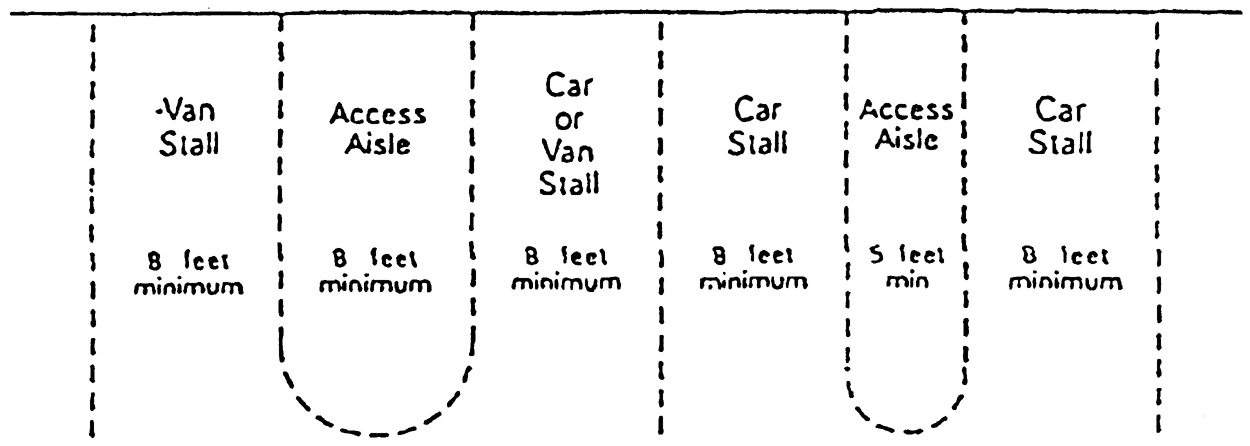
Accessible Parking Space Design
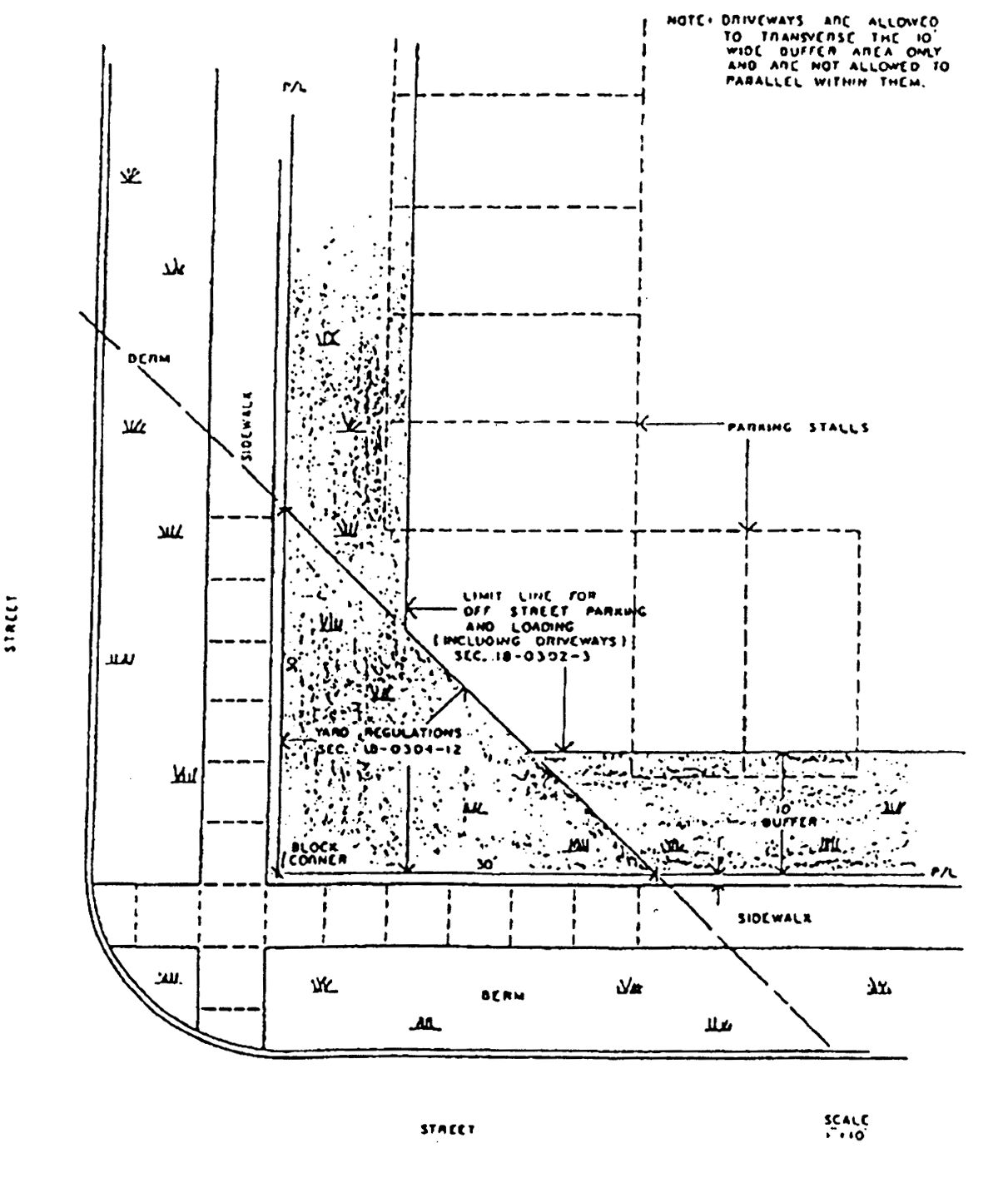
Right-of-Way and Intersection Clearances
(Ord. No. 3640, § I, 4-7-97; Ord. No. 3766, § VI, 1-19-99; Ord. No. 3767, § II, 1-19-99; Ord. No. 3794, § VI, 5-17-99)
18-0305. - Residential accessory buildings.
(1)
Any accessory buildings within twelve (12) feet of a residential buildings shall be at least five (5) feet from the lot line. Any accessory building more than twelve (12) feet from the principal building shall be at least three (3) feet from the side of the lot line and three (3) feet from the rear lot line, except that where there is a drive-in door which opens to the alley, or lot line which abuts a street, there shall be twenty (20) feet from the alley line or said street property line. The above-mentioned twenty (20) feet is a minimum requirement and will govern only when other setback requirements are less restrictive.
(2)
In case an accessory building is attached to the main building, it shall be made structurally a part of the main building and shall comply in all respects with the requirement of this article applicable to the main building.
(3)
A detached accessory building may not be located in any required front or side yard adjacent to a street.
(4)
Properties under ten thousand (10,000) square feet in area are allowed up to one thousand (1,000) square feet of accessory building area. Properties having lot areas of ten thousand (10,000) square feet or greater one thousand four hundred (1,400) square feet in accessory building area. The accessory building area includes all garages, sheds or other mentioned maximum allowable areas govern only when other more restrictive regulations are met.
(Ord. No. 3604, § 1, 8-19-96; Ord. No. 4899, § I, 12-16-24)
18-0306. - Wind energy conversion systems (WECS).
(1)
Plans: Each application for a building permit shall be accompanied by a dimensional representation of the tower, including the conversion system, base, and footings, and an accurate plan containing the following information:
(A)
Property lines.
(B)
Proposed location of tower on site.
(C)
Location of all existing structures on site.
(D)
All above ground utility lines.
(E)
Boundaries of all adjacent utility easements or reserved areas.
(2)
WECS height: The total height of the tower (including any portion of the rotor or axis extending above the tower) shall not exceed the horizontal distance between the base of the tower and the nearest lot line. The horizontal distance may extend beyond the nearest lot line or building line, provided there are no overhead utility lines or easement therefor or if the abutting area is a public alleyway. When the height exceeds these requirements, the following information shall be submitted:
(A)
Dimensional representation of the various structural components of the tower construction, including the base and footings.
(B)
Design data which shall indicate basis of design, including manufacturer's dimensional drawings, installation and operating instructions.
(C)
Certification by a registered professional engineer or independent testing agency that the tower design is sufficient to withstand wind load requirements for structures as established by the local building construction codes.
(3)
Tower access: Climbing access to the WECS tower shall be limited by means of a fence six (6) feet high around the tower base with a locking portal, or by limiting tower climbing apparatus to no lower than twelve (12) feet from the ground.
(4)
Wind access: Contiguous property owners and planned developments may construct a WECS for their use in common. If property held by more than one (1) single owner is used to meet the setback requirements, a site plan establishing easements or reserved areas must be submitted for approval.
(5)
Noise: A WECS operation shall not produce noise in excess of the limits established by the city noise ordinance.
(6)
Limited use: Wind energy conversion systems installed in accordance with the requirements of this section shall not generate power as a commercial enterprise as defined by the public utilities commission.
(7)
Electromagnetic interference: A WECS shall not be installed in any location along the major axis of an existing microwave communications link where the operation of the WECS is likely to produce an unacceptable level of electromagnetic interference, unless the applicant provides evidence indicating the degree of expected interference and the possible effect on the microwave communications link. The possible interference must be at a level satisfactory to the zoning administrator.
(8)
Airspace: A WECS shall be located or installed in compliance with the regulations of the airport approach zones and federal aviation regulations for clearance around VOR and DVOR stations.
(9)
Interconnect: A WECS, if interconnected to an electric utility distribution system, shall meet the interconnect requirements of the electric utility company. In any case, the interconnect shall include a manual disconnect which complies with the national electric code.
(10)
Codes: Construction, design, and installation of a WECS shall comply with all local, state, and national electrical codes in effect at the time of installation.
(11)
Liability No building permit shall be issued for the construction of a WECS until and unless the applicant for the building permit deposits with the zoning administrator a policy of liability insurance indemnifying applicant from liability for a personal injury or property damage in the sum of at least five hundred thousand dollars ($500,000.00). The policy of insurance so deposited shall contain a clause obligating the company issuing the same to give at least ten (10) days' written notice to the zoning administrator of proof of continuing insurance in the amount required herein. Failure to do so shall result in an automatic revocation of the permit, or, after period of construction, shall require removal of the structure within thirty (30) days of cancellation or termination of such policy.
18-0307. - Solar access.
(1)
When a solar energy collection system is installed on a lot, accessory structures or vegetation on any abutting lot shall not be located so as to block the solar collector's access to solar energy. The portion of the solar collector that is protected is that portion which:
(A)
Is located so as not to be shaded between the hours of 10:00 a.m. and 3:00 p.m. by a hypothetical twelve-foot obstruction located on the lot line; and
(B)
Has an area of not greater than one-half (½) of the heated floor area of the structure, or the largest of the structures, served.
(2)
This subsection does not apply to structures or vegetation existing in an abutting lot at the time of installation of the solar energy collection system, or on the effective date of this section, whichever is later. This subsection controls any structure erected on, or vegetation planted in, abutting lots after the installation of the solar energy collection system.
18-0308. - Sale of fireworks.
It shall be unlawful for any person to offer for sale, expose for sale, sell at retail, or wholesale, any fireworks within the City of Grand Forks or at any location within the territorial zoning jurisdiction of the City of Grand Forks.
18-0309. - Landscaping and screening.
The purpose and intent of these landscape standards is to preserve and promote the health, safety, and general welfare of the public; to facilitate the creation of an attractive and harmonious community; to contribute to the conservation of natural resources including air, water, soils, and existing significant vegetation and to decrease the extreme effects of weather on a site including from wind, rain, sun, and heat. Further, these standards are to minimize the impact of a more intensive use on nearby properties by requiring a visual screen and/or buffer between the uses in order to lessen the impact of noise, dust and other debris, motor vehicle headlight glare or other artificial light intrusion, and other objectionable activities or impacts conducted on or created by an adjoining or nearby use.
(1)
Requirements.
(A)
Bufferyards/landscaping required with construction of any commercial, industrial, institutional, or multi-family building(s) with three (3) or more units or an accessory building for any of the above uses
(B)
Bufferyards/landscaping required when the installation or expansion of parking areas by five (5) or more off-street parking spaces.
(C)
Bufferyards/landscaping required when a change in the use of the property that requires rezoning to a more intensive zoning classification or a conditional use permit.
(D)
Bufferyards/landscaping required when a change in use of existing property that involves existing or proposed outdoor storage shall comply with this section to provide screening for all outdoor storage areas.
(E)
Determination of required bufferyard is based on the principal use for which the lot is developed between, adjacent to, or across the street from differing or similar uses as specified in the matrix of Appendix A. Illustrations of each bufferyard including planting schedule, fencing, and required widths of the various bufferyards required are depicted within Appendix B.
(F)
Bufferyards shall be used solely for landscaping requirements. No proposed building, building addition, parking area, trash enclosure, or any other type of physical land improvement (other than landscape features, walls, fences, or pedestrian connections) may be located in a required buffer yard.
(2)
Landscaping plan requirements for permits. A landscaping plan shall be submitted and included with building permit application that meets the standards of this section. The installation of the landscaping shall be installed prior to the issuance of any final building permit (certificate of occupancy) of a building except where allowed herein.
(A)
General components that must be addressed on a landscaping plan include street landscaping, principal and accessory buildings, parking lots, loading and service areas, bufferyards, and plantings. Landscaping elements may be included as part of site or detailed development plans if appropriately noted and labeled.
(B)
Phased developments. Landscaping phasing plan must be provided if the required landscaping will be installed with future phasing of development.
(C)
Bond/cash escrow requirement (all landscape requirements):
1.
If landscaping is requested to be installed after issuance of any final building permit (certificate of occupancy or equivalent) the applicant may post a bond or cash escrow equal to one and one-half (1½) times the estimated cost of the required landscaping, estimate to be provided by landscaping contractor or equivalent as determined by the City Planner. Release of the bond or cash escrow is conditional upon satisfactory installation of the bufferyards, parking lot landscaping and general landscaping.
(3)
Bufferyard location.
(A)
Only one (1) bufferyard shall be required between uses.
1.
Where different uses are proposed, the full bufferyard shall be located on the lot of the higher intense use.
2.
Where similar uses are proposed, the required bufferyard shall be centered on the common lot line between properties.
(B)
Bufferyards/landscaping shall be required on the outer perimeter of all lots or parcels, extending to the lot or parcel boundary line.
(C)
Bufferyards/landscaping shall not be located on any portion of an existing or dedicated public or private street or right-of-way.
1.
Tree plantings within the berm as described in [section] 18-0309(7)(C) herein, may be approved as meeting planting requirements but full bufferyard depths are to be maintained fully within private property and not within existing or dedicated public right-of-way.
(4)
Minimum tree sizes shall consist of:
(A)
Deciduous shade trees: Two (2) caliper inches.
(B)
Single stem ornamental trees: One and one half (1 ½) caliper inches.
(C)
Evergreen and multi-stem tree: Five (5) foot height above grade.
(5)
Visibility clearance. Landscape materials and structural items placed within the sight triangle of a corner lot shall abide by height and sight clearance levels as specified in [section] 18-0304(5) and (12).
(6)
Trash containers screened. All trash containers for three (3) or more dwelling units, and all commercial, industrial, and institutional uses shall be behind a minimum 3-sided opaque fence or wall not less than five (5) feet high. Doors on trash enclosure areas are permitted but must be open at time of pickup.
(7)
Where plant material exists on a site prior to its development, such landscape material may be used if approved as meeting requirements of this section.
(A)
Berm trees, existing or planned, by the Park District may be used if approved as meeting requirements of this section. Planting within the berm is prohibited, however certain trees may be allowed through permits authorized and issued by Grand Forks Park District.
(8)
Existing vegetation shall be retained whenever such actions will contribute to the policy objectives of the comprehensive plan.
(9)
All landscaping shall be protected from vehicular traffic by standard concrete curbing and gutter, parking bumpers, tree guards or similar devices, in accordance with [section] 18-0302(12).
(10)
Maintenance. The owners and their agencies shall be responsible for providing, protecting, and maintaining all landscaping in healthy growing conditions, replacing it when necessary, and in conformance with original approvals. Yards shall be free of refuse and debris. All walls or fences shall be kept in good repair. All landscaping materials shall be placed so as not to grow out into the public right-of-way.
(11)
Administrative approval for practical landscaping improvements.
(A)
The planning director has authority to allow flexibility to the requirements of this section to enable:
1.
Flexibility concerning the location of the required landscaping to allow for landscaping to be focused adjacent to right-of-way, around main building entrances, garages, and other areas with increased visibility.
2.
Flexibility concerning the location of landscaping to allow for landscaping to be focused in buffer areas adjacent to conflicting land uses.
3.
Flexibility concerning irregular, narrow, or shallow lots.
4.
Flexibility to approve alternative planting plans that include:
(a)
Native plants (included grasses) along with naturalized landscape features such as stone, mounding, or swales and/or stormwater management features such as raingardens or bio-swales.
(b)
Aesthetic design elements and hardscapes that complement the plant material such as public art, fountains, plazas, courtyards, and front yard/entrance statements.
(12)
Suggested plant materials can be found in the city's "Suggested Plantings List" on file in the planning department.
(13)
Additional requirements in commercial districts (B-1, B-2, and B-3):
(A)
Exterior storage. All storage, service, or repairs shall be conducted wholly within an enclosed building or behind an opaque fence or wall not less than six (6) feet high, except outdoor storage of merchandise during business hours on an appropriate pedestrian walkway located contiguous to the principal building. This requirement shall not apply to the outdoor storage and display of new or used boats, cars, and building materials and equipment being used for construction on the premises.
(B)
Contractors' shops. All contractors' shops that have been permitted by conditional use permits whose materials are stored for later use to include electrical, plumbing, heating, etc., shall be conducted wholly within an enclosed building. Contractor yards are prohibited unless specifically permitted through conditional use permit.
(14)
Additional requirements in industrial districts (I-1 and I-2):
(A)
Contractors' yards. All contractors' yards whose materials are stored for later use to include electrical, plumbing, heating, sand, and gravel piles, shall be screened on all sides by bufferyards.
(B)
Exterior storage. In the industrial districts all production, servicing, or merchandising, except off-street parking and loading, shall be conducted within completely enclosed buildings. Storage of materials necessary for production of finished goods and materials that result from the manufacturing process shall be screened from public view. After considering the land-use intensity the City Planner shall determine the appropriate screening barrier from among those provided in Appendix B.
(C)
Refuse. All solid waste materials, debris, refuse or garbage not disposed of through the public sanitary sewage system shall be kept in a completely enclosed building or properly contained in a closed container designed for such purposes. Such containers shall be screened with a minimum five (5) foot opaque fence or wall.
(15)
Landscape and screening requirements for parking lots:
(A)
Purpose. In addition to minimizing the potential negative effects (including heat, noise, and the glare of motor vehicle lights) that a parking lot may have on nearby less intensive uses, the purpose of these requirements is to: provide pervious areas within parking lots that will permit the return of precipitation to ground water; contribute toward natural and efficient storm drainage; provide adequate planting areas for healthy development of shade trees; decrease the fuel evaporation from vehicles parked on non-shaded pavement;
(B)
Applicability. The provisions of this part shall apply to all non-covered parking lots designed for twenty (20) or more spaces or containing eight thousand (8,000) square feet or more of surfaced area.
(C)
Landscape plan requirement.
1.
No applicable parking lot shall be constructed, enlarged, or reconstructed until a parking pattern and a landscape plan for that parking lot has been approved by the planning department.
2.
Landscape plans shall, where appropriate, be submitted as part of the site plan.
(D)
Parking lot landscaping design criteria. The plan shall include landscaping elements which provide both adequate screening around the exterior and for an improved environment within and dispersed throughout the parking lot as described in this section as follows. Design elements utilizing natural surveillance of spaces open to the public is encouraged.
(E)
Street buffer yards and screening.
1.
Street frontage requirements. A buffer yard separation shall be required between parking lots and the roadway except where driveway or other openings may be required. Depending on width of such separation, this area shall be planted with vegetation and/or fencing structures shall be utilized for screening.
2.
Between two (2) feet and five (5) feet from the ground up, no foliage or structural features shall obstruct the visibility of the parking lot by the motoring public, except for tree trunks or fence posts at 2-feet wide or less. (Screening shall generally be less than fifty (50) percent visually impervious, e.g. metal bar fencing etc. in the two (2) to five (5) foot height range). An exception to this may be given where other security measures such as full perimeter control or twenty-four (24) hour staffed security is provided.
(F)
Interior coverage requirements. In parking lots of fifty (50) stalls or more, not less than five (5) percent of the interior of a parking lot shall be landscaped. This landscaping shall be distributed throughout the parking lot. Planting which is required for screening along the perimeter of any parking lot shall not be considered as part of the interior landscaping requirement. Moreover, where a parking lot abuts buildings on the subject property, border planting adjacent to those buildings shall not be considered as part of the interior landscape requirement.
(G)
Planting materials and design. The primary landscaping materials used in the parking lot interiors shall be trees which provide shade or are capable of providing shade at maturity. Shrubbery, hedges and other live planting material may be used to complement the tree landscaping, but shall not be the sole contribution of the landscaping. Alternative planting plans will also be considered when stormwater management features such as raingardens or bio-swales are employed for areas where it is deemed water quality improvements are needed (through a study or in an adopted plan or policy of the city).
(16)
An applicant has the ability to appeal a decision of the planning director. The appeal shall be filed with the planning director ten (10) days following the decision. The appeal process shall follow as in [section] 18-0224(5)(C) of Grand Forks City Code.
(Ord. No. 4751, § IV, 12-16-19; Ord. No. 4872, § II, 11-20-23)
18-0310. - Parabolic antennas.
(1)
Requirements for the installation of parabolic antennas. All parabolic antennas located outside of the building shall meet the following requirements and shall be administered as follows:
(A)
Maximum diameter: Twelve (12) feet.
(B)
Minimum setback from all property lines of lot:
1.
Ten (10) feet, if greater than one (1) meter in diameter.
2.
Three (3) feet, if equal to or less than one (1) meter in diameter.
(C)
No antenna with a diameter greater than one (1) meter may be located in a front or side yard, unless compliance with this section would impair or degrade reception.
(D)
All freestanding parabolic antennas greater than one (1) meter in diameter shall be constructed and mounted in such a manner that the antenna's structure, at its highest point, does not exceed the height of thirteen (13) feet.
(E)
No parabolic antenna in excess of one (1) meter in diameter shall be roof-mounted upon a one- or two-family residential dwelling.
(F)
No parabolic antenna shall be utilized for advertising or signing purposes, except for a six-inch square displaying the manufacturer's or distributor's name. This square may not be on the concave side, nor on the upper fifty (50) percent of the convex side.
(2)
Maximum size of rooftop antennas. The surface area of any antenna installed on a roof top shall not exceed fifteen (15) percent of the total building facing area of the lot front.
(3)
Permit required; fee. No parabolic antenna, except those being equal to or less than one (1) meter in diameter, shall be erected, constructed, altered or maintained on any lot or structure within the city's zoning jurisdiction without having first secured a permit for such antenna from the building and zoning administrator or his/her designee. Written permit application shall be made on forms provided by the zoning administrator. The fee shall be charged in accordance with section 18-1103.
(4)
Violation. Any violation of this section is hereby declared to be a nuisance and shall be abated in the manner as provided by law.
(5)
Severability. Severability is intended throughout and within the provisions of this ordinance. If any section, subsection, clause, phrase or portion of this ordinance is held to be invalid or unconstitutional by a court of competent jurisdiction, that decision will not affect the validity of the remaining potions of the ordinance.
(Ord. No. 3772, § I, 2-16-99)
18-0310.1. - Commercial wireless communication towers and antennas.
(1)
Purpose. To establish general guidelines regulating the siting, construction, and modification of wireless communication towers and antennas in order to protect the health, safety, and welfare of the public, while at the same time not unreasonably interfering with the development of the competitive wireless telecommunications marketplace in the City of Grand Forks.
(2)
Procedure:
(A)
Pre-application meeting. Any request for the placement of wireless communication equipment which may involve construction of a new tower or placement of an antenna upon an existing structure shall require a pre-application meeting with the city planning department. This meeting is intended to provide significant preliminary information on the project, discuss development alternatives, and determine the appropriate review procedure.
(B)
Application. An applicant requesting the placement of wireless communications equipment shall submit an application to the planning department.
1.
Wireless communication antennas and towers. An application for the placement of a wireless communication antenna or tower, excluding am accessory commercial antenna, shall include all of the following:
(a)
The name, address, and telephone number of the owner and lessee of the parcel of land upon which the proposed wireless communication equipment will be situated;
(b)
The legal description and address of the parcel of land upon which the proposed wireless communication equipment will be situated;
(c)
Proof of ownership of the proposed site or proof of authorization to utilize the proposed site;
(d)
Written documentation showing that the landowner of the property on which the tower is to be located has agreed to the requirements, regulations, and standards established by this section;
(e)
A complete set of plans and specifications, including a report outlining the applicant's proposal; and for towers a complete set of plans including a site plan showing tower, accessory building fencing, buffer yard, access road, and utility locations; and specifications, including a report containing a description of the tower and technical reasons for its design;
(f)
For towers, an affidavit from the applicant stating that any existing space, on a tower proposed for commercial purposes, will be made available for the co-location of wireless communication facilities when technically possible, and that all requests for co-location of wireless communication facilities will be responded to within thirty (30) days from the date of receipt of written request.
(g)
Additional information may also be required, such as site line diagrams and color samples, as needed to complete the review of the project.
(C)
Denial of application. Any decision to deny an application to place, construct or modify a wireless communication antenna and/or tower shall be in writing and shall be supported by substantial evidence contained in a written record from the planning department and from the proceedings of the city council, in accordance with the Federal Telecommunications Act of 1996.
(D)
Appeal. Any applicant whose application has been denied pursuant to this section may request an appeal to the Grand Forks City Council.
(3)
Co-location of commercial wireless communication facilities. In all cases, it shall be the intent of the city to encourage the co-location of wireless communication facilities and, accordingly, the applicant shall demonstrate compliance with the following standards:
(A)
Co-location requirement. The applicant shall demonstrate that there is no suitable location available on any existing structure within the geographic area to be served for the placement of a wireless communication antenna. The city may request any feasibility studies associated with the application which demonstrate that locations on existing structures have been explored as the preferred siting alternatives. If either the applicant or the city demonstrates that another tower is technically feasible, the applicant must show that the applicant has requested to co-locate on the tower, has been refused permission to co-locate on the tower, and must provide a letter from the owner/operator of the tower stating the reasons for denying permission.
(B)
Exemption from co-location requirement. Wireless communication towers serving as accessory use(s), and which do not exceed thirty (30) feet above the maximum building height as per zoning district regulation, shall be exempt from all co-location requirements.
(C)
Response to co-location request. In all circumstances, owners of existing towers being utilized for commercial purposes shall respond to a written request for co-location of wireless communication facilities within thirty (30) days from the date of receipt of the request. If the owner/operator of a tower has not responded to a request within thirty (30) days, the city council may defer action on the application until the co-location issue is resolved. The owner/operator of the tower must allow co-location until the tower reaches full antenna capacity, unless mechanical, structural, or regulatory factors prevent co-location.
(D)
An applicant requesting a permit to place a commercially-utilized antenna in a residential zoning district shall provide proof that no suitable location exists for a tower or an antenna facility within any other non-residential "permitted use" or "conditional use" areas as defined in the Grand Forks City Code.
(4)
Height and setback requirements. Wireless communication towers, antennas and associated equipment facilities shall meet all the following requirements:
(A)
Wireless communication towers being utilized for commercial purposes shall be set back a minimum distance of the tower height from any adjoining residential zoning district.
(B)
Wireless communication towers, with the exception of guyed towers, shall have front, side, and rear yard setbacks as required for other structures outlined in the appropriate zoning district.
(C)
Guyed wireless communication towers. The following ratios of distances shall apply to all guyed wireless communication towers:
When guyed wireless communication towers are used, all anchor points from the guys must be on the same property as the tower. For the purpose of protecting public safety and welfare, the planning and zoning commission may create additional standards and conditions to any permit issued.
(5)
General requirements. Wireless communication towers, antennas and associated equipment facilities shall meet all the following requirements;
(A)
A communication antenna utilized for commercial purposes within a residential zoning district shall only be situated on an existing high-tension lattice tower or situated as an architectural component upon a building or structure.
(B)
A commercial wireless communication tower shall be prohibited from locating in any front yard or in a front half of a side yard.
(C)
Except as provided by law, a wireless communication antenna/tower design shall utilize colors and materials that effectively reduce their visual impact.
(D)
A wireless communication tower utilized for commercial purposes shall be designed to have sufficient structural capacity to allow for three (3) providers to be located on the structure. The wireless communication facility shall also be designed to show that the applicant has sufficient space on its site plan for an equipment building large enough to accommodate three (3) users. If an equipment building is initially constructed to accommodate only one (1) user, then space shall be reserved on site for equipment building expansions to accommodate two (2) additional users.
(E)
A buffer yard as appropriate for the zoning district shall be constructed around the perimeter of a wireless communication facility being utilized for commercial purposes. A chain link or a solid wood fence at least six (6) feet in height shall be erected entirely around any communication tower and any related support facilities being utilized for commercial purposes. "No Trespassing" signs shall be posted around the wireless communication facility with a telephone number of a person to contact in the event of an emergency.
(F)
The owner and/or service provider of a wireless communication facility that is no longer in use shall immediately notify the planning department of the facility's discontinued status. Any antenna or tower that is not operated for a continuous period of twenty-four (24) months shall be considered abandoned, and the owner shall agree to remove the antenna or tower within ninety (90) days of receipt of notice. If the antenna or tower is not removed within ninety (90) days, the governing authority may remove such antenna or tower at the owner's expense.
(G)
Except as required by law, a wireless communication antenna/tower shall not be illuminated and lighting fixtures or signs shall not be attached to the antenna/tower. If lighting is required by FAA regulations, all lights shall be oriented inward so as not to project onto surrounding property. White strobe lights shall be prohibited at night, unless no other alternative is permitted by the FAA. Lighting for security purposes shall be permitted at the wireless communication facility with a prior approval of the planning and zoning department.
(H)
All wireless communication antennas/towers shall maintain compliance with the FCC at all times, including current radio frequency emission standards and maintenance of all equipment at the tower site.
(I)
Airspace. Wireless communication towers shall be located or installed in compliance with the regulation of the airport approach zones and federal aviation regulations for clearance around VOR and DVOR stations.
(J)
No advertising shall be permitted on any wireless communication facility.
(6)
Permits. No wireless communication antenna/tower shall be erected or constructed on any lot or structure within the city's zoning jurisdiction without having first secured a permit for such antenna/tower from the building inspections department.
(7)
Certification of registered engineer. The city may require a review of the construction of a wireless communication tower by an independent registered professional engineer engaged by the city and paid for by the applicant.
(8)
Violations. Any violation of this section is hereby declared to be a nuisance and shall be abated in the manner as provided by law.
(Ord. No. 3891, § XV, 6-4-01)
18-0310.2. - Noncommercial wireless communication towers [and] antennas.
(1)
Purpose. To establish general guidelines regulating the siting, construction and modification of noncommercial wireless communication towers and antennas in order to protect the health, safety and welfare of the public.
(2)
Height and setback requirements. Noncommercial wireless communication towers shall meet all the following requirements:
(A)
Noncommercial wireless communication towers supported primarily by attachment to a building must have a five-foot minimum setback from all property lines.
(B)
When guyed noncommercial wireless communication towers are used, all anchor points from the guys must be on the same property as the tower.
(C)
Noncommercial wireless communication towers shall not exceed seventy-five (75) feet in height.
(3)
General requirements. Noncommercial communication towers, antennas and associated equipment facilities shall meet the following requirements:
(A)
A wireless communication tower utilized for noncommercial purposes shall be prohibited from locating in a front yard.
(B)
All noncommercial wireless communication towers shall maintain compliance with the FCC at all times, including current radio frequency emissions, standards and maintenance of all equipment at the tower site.
(C)
No advertising shall be permitted on any wireless communications facility.
(4)
Permits. Prior to the erection or construction, on any lot or structure within the city's zoning jurisdiction, building permits from the city's building inspections department shall be required for the following wireless communication facilities:
(A)
All roof-mounted noncommercial wireless communication towers in excess of seventy-five (75) feet in height, and
(B)
All noncommercial wireless communication antenna and/or supporting structure, extending more than twenty (20) feet above the main building.
(5)
Noncommercial towers must be installed and/or constructed with manufacturer's specifications.
(6)
Violations. Any violation of this section is hereby declared to be a nuisance and shall be abated in the manner as provided by law.
(Ord. No. 3891, § XV, 6-4-01)
18-0311. - Downtown design review board.
(1)
Purposes. There is hereby created a downtown design review board for the following purposes:
(A)
Coordination of characteristics of structures in the downtown district.
(B)
Preserve and enhance historical character and scale of the downtown district.
(C)
To protect from adverse effects of poor design, appearance, and inferior quality and to encourage good professional design practices consistent with characteristics of the downtown district.
(D)
Facilitate new development within the district.
(E)
For purposes of this section "downtown district" and "district" shall mean the B-4 zoning district.
(2)
Membership. The downtown design review board shall be composed of seven (7) members consisting of representatives from the following professions, occupations, groups, or sectors:
(A)
One (1) member of the Grand Forks Historical Commission as appointed by that body.
(B)
Two (2) members of the public with professional background in history, architectural history, and/or architecture nominated by the mayor and confirmed by the city council.
(C)
Three (3) members of the public owning property or owning and operating businesses located within the central business district nominated by the mayor and confirmed by the city council.
(D)
One (1) member of the planning and zoning commission appointed by that body.
(E)
Reserved.
(3)
Terms. All members shall be appointed for a term of three (3) calendar years. However, each member shall continue to serve until its successor is duly appointed and confirmed.
(4)
Chair. There shall annually be elected a chairperson and vice chairperson from the board members.
(5)
Reimbursement of expenses. No salary shall be paid to the members but such members shall be entitled to reimbursement for actual, reasonable, and necessary expenses incurred in the performance of their official duties and as provided by city policy.
(6)
Review required. The board is responsible for reviewing and deciding on the items granted to it for the B-4 district in section 18-0217A(19), Application procedures.
(7)
Authority to adopt guidelines. In addition to the foregoing authority and responsibility, the board shall have the power to adopt such guidelines, standards, policies, procedures, rules, regulations, conditions, and/or requirements as it may determine to be reasonably necessary and/or convenient to the exercise of the board's authority and implementation of such guidelines, standards, policies, procedures, rules, regulations, conditions, and/or requirements to carry out the purposes of this section. Any design guidelines or standards promulgated by the board shall, at a minimum, comply with the Secretary of Interior's Standards for Rehabilitation and Guidelines for Rehabilitation of Historic Buildings to the extent reasonably applicable and appropriate as determined by the board. Any amendments to the guidelines adopted after the 16th day of April 2010 shall be subject to review by the planning and zoning commission and approval by the Grand Forks City Council.
(8)
Minimum vote required. Any action by the board must be approved by four (4) members of the board voting in favor of the action.
(9)
Appeal. Any owner or representative having submitted a request to the board may appeal a decision of the board to city council through process established in subsection 18-0217A(19)(M).
(Ord. No. 3809, § II, 8-16-99; Ord. No. 3885, § I, 5-7-01; Ord. No. 4292, § 1, 4-19-10; Ord. No. 4798, § III, 6-21-21)
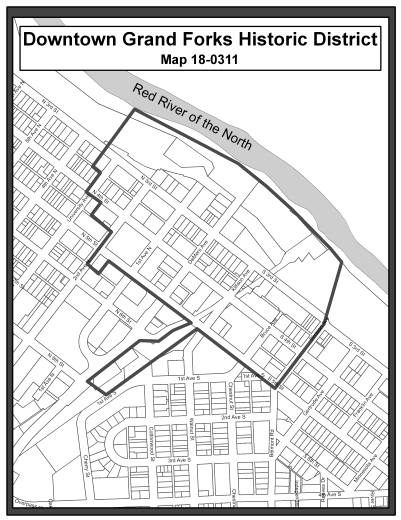
18-0312. - Use of public right-of-way in the B-4 central business district.
(1)
Purpose. The purpose of this section is to maintain aesthetically pleasing, accessible and vibrant sidewalks, and, through responsible encroachment practices, to balance the needs of citizens to use sidewalks with opportunities for businesses within the B-4 Central Business District. It is further intended to assist with the enhancement of economic vitality of the city and to encourage the safe and orderly use of public property within the city. This chapter pertains specifically to the use of sidewalks by adjacent businesses for outdoor seating, merchandising, beautification, and related purposes and does not remove from the city its authority to regulate other sorts of encroachments on the public right-of-way.
(2)
Definitions.
(A)
Clear straight pathway. An unobstructed straight walkway with a minimum width of forty-eight (48) inches that complies with Americans with Disability Act (ADA) regulations.
(B)
Encroachment. Any private or public temporary or long-term use of a sidewalk for purposes other than movement of pedestrians and other ambulatory citizens or other use by the City of Grand Forks in conducting its business.
(C)
Obstruction.
1.
Public obstruction/improvement. Any publicly owned utility or structure located on the sidewalk, to include fire hydrants, street lights and their bases, sign posts, trees, tree and garden plots, tree grates, bike racks, newspaper boxes and street furniture.
2.
Private obstruction—Amenities. Any privately owned amenities placed on the sidewalk to enhance the convenience, charm and character of a business, to include planters and/or other decorative items. Does not require a permit.
3.
Private obstruction—Outdoor seating. Seating, including chairs, benches and/or tables outside of an established place of business.
4.
Private obstruction—Outdoor merchandising. Businesses conducting retail sales on the sidewalk immediately adjacent to their business.
(D)
Permittee. The person or entity that receives a permit to encroach under the terms of this chapter.
(E)
Parklet. A parklet reimagines part of the street into a public space. Parklets are intended as aesthetic enhancements to the streetscape as extension of the sidewalk, providing an economical solution to the need for increased public open space. Parklets provide amenities like seating, planting, bike parking, and art.
(F)
Public right-of-way. A publicly controlled strip of land containing at least one (1) of the following: Streets, alleys, sidewalks, or public utilities.
(G)
Sidewalk. Any public walkway or pedestrian corridor within the central business district.
(3)
Standards for temporary encroachment. Temporary sidewalk encroachments must be in full compliance with the following standards:
(A)
Private obstructions within the encroachment area shall not be placed in such a way that obstructs American with Disabilities Act (ADA) pathway, access to utility meters, hydrants, doors, fire escapes, stairways, entrances, or exits.
(B)
Private obstructions for outdoor seating or merchandising within the encroachment area shall be removed from the sidewalk or physically secured at business closure, or in the event of inclement weather.
(C)
Property owners of private obstructions and amenities are responsible for adequately maintaining sidewalks and must always provide a clear straight pathway. Owners are responsible for securing all elements of their obstructions and amenities in the event of inclement weather.
(D)
All obstructions and parklets must comply with the Americans with Disabilities Act (ADA) and be accessible to all users, including people with physical disabilities, wheelchair users and those with impaired vision.
(E)
Outdoor seating and merchandising shall be allowed throughout the calendar year subject to permit approvals based on the terms set forth in this section and subject to annual renewals.
(F)
Parklets may be placed from May 1 to November 1. Approved Parklets shall be permitted for installation from May 1 to November 1 due to street maintenance needs and must be designed for easy deinstallation. All approved parklets are temporary installations and are subject to removal per the encroachment permit.
(4)
Applications for encroachments—Initial submittal.
(A)
Any person or entity must receive a permit allowing an outdoor seating or merchandising encroachment. Applications for the initial encroachment permit shall be submitted to the planning department using the prescribed form.
(B)
Any person or entity desiring to provide sidewalk amenities, as provided herein, is not required to obtain a permit so long as the provisions of this section are adhered to.
(5)
Outdoor seating and merchandising application requirements include:
(A)
Eligible sidewalks shall be all sidewalks where a minimum of forty-eight (48) inches of clear straight pathway can be maintained.
(B)
Businesses eligible for outdoor seating and merchandising encroachment permits shall be all businesses with storefront access directly to the sidewalk in which the seating will be placed.
(C)
All outdoor seating, merchandising, and amenities along DeMers Avenue/Business US-2 are subject to review and approval by the North Dakota Department of Transportation.
(D)
All initial applications for encroachment must contain the following information:
1.
Name, street address and phone number of applicant.
2.
Street address of the property where the encroachment is requested.
3.
Name and street address of property owner if property owner is not applicant.
(E)
Along with the initial application, the applicant is required to submit a scaled drawing to include, but not limited to, the following:
1.
The proposed use, materials, colors and design.
2.
The relationship of the outdoor seating to the adjacent existing building with identified uses and entrances.
3.
The spatial relationship of the proposed outdoor seating to the existing sidewalk and to any existing public and/or private obstructions, including, but not limited to, benches, lights, light poles, telephone/power poles, fire hydrants, planters, tree plots, tree grates, landscaping, sign posts, newspaper boxes, etc.
4.
The dimensions of the proposed outdoor seating area or merchandising area.
5.
The existing and proposed circulation pattern for pedestrians and other ambulatory citizens with exact dimensions of the clear straight pathway.
6.
Evidence that abutting property owners and/or lessees have been notified of the proposed encroachment.
7.
Plans for the operation of the outdoor seating, including, but not limited to, hours of operation, services to be provided, maintenance and cleaning.
8.
The planning department may require any other information as part of the application that it deems useful in evaluating the application.
(F)
The initial application fee shall be one hundred dollars ($100.00) payable to the city planning department upon submission of the initial application.
(6)
Parklet application requirements include:
(A)
Design professional. A licensed architect, licensed contractor or engineer must seal proposed plans and supervise the installation.
(B)
Completed City of Grand Forks temporary encroachment permit application must contain the following information:
1.
Name, street address, email and phone number of applicant.
2.
Street address of the property where the encroachment is requested.
3.
Name and street address of property owner if property owner is not applicant.
(C)
Required maintenance and construction bond. Applicants shall be required to present construction bond, surety, or letter of credit to be approved by the city for the purpose of ensuring the costs of maintaining and/or removing the parklet are covered. The amounts to be covered shall include five thousand dollars ($5,000.00) for construction and one thousand dollars ($1,000.00) for maintenance.
(D)
Parklet site plan. Illustrates the parklet in relation to the surrounding streetscape context and should include:
1.
Building and/or place of business, adjacent properties, and their building entrances.
2.
Existing sidewalk widths.
3.
Existing curb cuts and/or driveways with dimensions labeled.
4.
Adjacent bike lane or auto traffic lane.
5.
Existing parking spaces with dimensions labeled.
6.
Other existing sidewalk features near the proposed parklet area (fire hydrants, fire department connections, streetlights, utility access panels, bike racks, etc.).
7.
Existing street trees and tree pits with dimensions labeled.
8.
Proposed parklet footprint and dimensions including setback dimensions.
(E)
Detailed parklet design plan and elevations from all sides to include:
1.
Integrated amenities. Bike racks, landscaped areas and/or art.
2.
Moveable seating. If you choose to use moveable tables and chairs, they should be durable and comfortable for individuals and groups of all ages and abilities.
3.
Planting. Integrated and/or associated planting is strongly encouraged.
4.
Lighting. Elements are permitted but must be self-contained and low voltage. Parklets may not be powered by extension cords.
5.
Incorporate bicycle parking. Integrated bicycle parking is encouraged. Bike racks can be integrated into the parklet structure or installed adjacent to the parklet as a bike corral on the street.
6.
Advertising. Except for a small plaque (four (4) inches by six (6) inches) recognizing donors. Advertising is prohibited.
7.
Eligible materials. Materials used in the construction of the parklet:
a.
Materials that are easy to maintain and must be high quality, durable, and capable of withstanding heavy use and exposure to the elements.
b.
Have a strategy for removing graffiti and replacing or repairing damaged parklet features such as plants, railings, or other elements.
c.
Surface materials. Loose particles, such as sand or loose stone, are not permitted.
8.
Parklet buffer areas.
a.
Buffer from adjacent parking spaces. In the case where there are adjacent parking spaces, parklets shall be required to have soft hit posts, wheel stops, or some other buffer to prevent conflicts with parking cars.
b.
Buffers on the edge. All parklets shall have an edge to buffer the street. This can take the form of planters, railing, cabling, or some other appropriate buffer. The height and scale of the buffer required will vary depending on the context of the site.
c.
Maintain a visual connection to the street. Parklet designs must maintain a visual connection to the street and not obstruct sight lines existing businesses or roadway signage. They can include columns, overhangs, and other vertical elements with approval by the City of Grand Forks Planning and Community Development Department.
d.
Extend the sidewalk. Parklets should be designed as an extension of the sidewalk, with multiple points of entry along the curbside edge.
e.
Street side of the parklet. While not visible from the sidewalk, the parklet's back is highly visible from across the street. Large blank walls are not permitted.
9.
Must meet accessibility requirements as set forth in American Disabilities Act.
a.
Platform surface. The top of the parklet platform must be flush with the sidewalk with a maximum gap of one-half-inch.
b.
Platform cross slope. Parklet platform rest areas cannot exceed two (2) percent cross slope. The final construction drawings will need to show spot elevations for both the sidewalk and the platform areas.
10.
Construction and disassembly details. Submit drawings that indicate how the parklet will be assembled and constructed as well as disassembled. Additional elements to be shown include:
a.
Any hardware such as fasteners to be used in the construction or disassembly process.
b.
Detail how positive drainage flow will be maintained along the curb line and how a blockage will be corrected if necessary, to maintain proper drainage.
(F)
Site selection.
1.
Speed limit. The proposed location shall have a posted speed limit of twenty-five (25) mph or less. Streets with higher speed limits may be considered on a case-by-case basis.
2.
DOT controlled Streets. Due to DOT regulations business/property owners are not eligible to apply for parklets along DeMers Avenue and North 5th> Street.
3.
Corner locations. The proposed parklet site shall be located at least one parking space from an intersection (approximately twenty (20) feet).
4.
Parklet placement. Parklets can be sited along the curb line on streets where on-street parking spaces exist for on street parallel, angled, or perpendicular parking. Parklets must be located directly in front of the applicant's place of business. Other proposed locations will be considered on a case-by-case basis.
5.
Utilities. Parklets shall not be allowed in front of fire department connections and fire hydrants, over manhole covers, public utilities, or catch basins. Curb and roadside drainage shall not be impeded by the parklet.
6.
City projects. As part of its initial screening process, the city will review proposed parklet locations for potential conflicts with future programmed projects. Proposed locations may be rejected if there is pending streetscape improvement work planned.
7.
Transit. Parklets are not permitted in bus zones.
8.
Buffer from adjacent parking spaces. In the case where there are adjacent parking spaces, parklets shall be required to have soft hit posts, wheel stops, or some other buffer to prevent conflicts with parking cars.
(G)
Platform guidelines:
1.
Platform surface. The top of the parklet platform must be flush with the sidewalk with maximum gap of one-half-inch.
2.
Surface materials. Loose particles, such as sand or loose stone are not permitted on the parklet.
3.
Drainage. The parklet cannot impede the flow of curbside drainage. The platform must be designed in a manner to accommodate the drainage patterns on the street. Designers are required to cover openings at either end of the parklet with screens to prevent collection of debris under the parklet.
4.
Platform cross slope. Parklet platform rest areas cannot exceed two (2) percent cross slopes. Final construction drawings will need to show spot elevations for both the sidewalk and the platform areas.
(H)
Documentation of letters of support from adjacent property owners and businesses.
(I)
Building permit. A building permit is required for the deck, including built-in planters and/or railings and for any other structures, such as raised platform for roof.
(J)
Service and consumption of alcoholic beverages. The applicant must obtain approval by the city council if the service and consumption of alcohol is a part of the operation of a parklet.
(7)
Permit issuance and conditions. Once an application has been reviewed and approved by the planning department and payment of the application fee required has been confirmed, a permit shall be issued conditioned on the following:
(A)
In order to obtain an encroachment permit, applicants must provide the city with proof of general commercial liability insurance (certificate of liability insurance) and shall provide that the policy shall not terminate or be canceled prior to the expiration date without thirty (30) days advanced notice to the city. The insurance policy must name the City of Grand Forks as one (1) of the additional insured to the extent of at least one million dollars ($1,000,000.00) bodily injury and one hundred thousand dollars ($100,000.00) property damage, which shall be in effect during the term of this authorization. The permit application must also include a signed hold harmless agreement that specifies that the permittee will defend, indemnify, and hold the city harmless for any loss, injuries, damage, claims or lawsuit, including attorney's fees that arise from the encroachment.
(B)
Each permit shall be effective for the calendar year for which it is issued pursuant to this section, subject to annual renewal.
(C)
Permits are not transferable.
(D)
The city may require the removal, temporary or permanent, of the outdoor seating, parklet or merchandising encroachment when redevelopment of the street or sidewalk or utility repairs necessitates such action, or when the permittee fails to comply with any provisions of this section.
(E)
The permittee shall be responsible for expenses incurred in removing the outdoor seating, parklet, or merchandising encroachment.
(F)
The city's officers, employees or agents may immediately remove without notice all or parts of the outdoor seating, parklet or merchandising encroachments in an emergency situation. The city, its officers, employees, or agents shall not be responsible for outdoor seating, parklet or merchandising components relocated or damaged during emergencies.
(G)
The permit covers only the area specifically described in the application.
(H)
All signage must be in compliance with the Grand Forks City Code.
(I)
The outdoor seating, parklet, and merchandising area must be maintained and kept clean.
(J)
Any other conditions which the planning department deems appropriate for the safety and well-being of pedestrians, patrons and the general public.
(K)
Denial of an application by the planning department may be appealed to the downtown design review board, subject to the appeal process set forth in sections 18-0217A(19)(L) and (M).
(8)
Revocation of permit. The planning department may revoke a permit at any time for any outdoor seating, parklet, or merchandising encroachment if:
(A)
Changing conditions of pedestrian or vehicular traffic necessitate the removal of the encroachment.
(B)
Proposed public improvements necessitate the removal of the encroachment.
(C)
Encroachment no longer serves the public interest.
(D)
Such other reasonable cause as determined by the city to prevent or eliminate hazard to the public health, safety and welfare or for non-compliance with the terms of the permit.
(E)
Upon determining that cause exists for revocation of a permit, the planning department shall give written notice of such action to the permittee stating the action taken and the reason.
(F)
Upon official revocation by the planning department the permittee shall have fourteen (14) days to remove the outdoor seating, parklet or merchandising encroachment and make any repairs to the sidewalk, if necessary, unless otherwise granted by the planning department. Failure to remove the encroachment in the time allowed by the planning department will result in removal of the encroachment by the city.
(G)
Revocation approval by the planning department may be appealed to the downtown design review board, subject to the appeal process set forth in sections 18-0217A(19)(L) and (M).
(9)
Permit renewal—Application required.
(A)
Each renewal application fee shall be twenty-five dollars ($25.00) payable to the city planning department upon submission.
(B)
Any business requesting renewal of an outdoor seating, merchandising, or parklet permit shall complete the renewal application. Plans must be consistent with the original plan and shall be subject to administrative approval by the planning director. In any calendar year the encroachment renewal may begin January 1.
(C)
If it is determined by the planning director that a substantial change has been made to the original plan a new application shall be required. The new application and plan are subject to review by the downtown design review board and the initial application fee of one hundred dollars ($100.00).
(D)
Denial of an applicant's renewal request by the planning department may be appealed to the downtown design review board, subject to the appeal process set forth in sections 18-0217A(19)(L) and (M).
(10)
Duty to maintain. Permittee agrees to operate and maintain all encroachments in a safe, secure and sanitary manner, and in full compliance with the provisions of this section and any conditions of approval set by the planning department.
(11)
Application fees.
(A)
No fee shall be charged for processing applications for encroachments that will be limited to four (4) days or less in a calendar year.
(B)
No refund shall be made where a permit is revoked or suspended for any reason.
(12)
Enforcement procedures.
(A)
If the planning department finds that any provision of this section is being, or has been, violated or that any condition of approval of a permit issued pursuant to this section has not been met, the city code enforcement officer shall be notified. In such an event, the city code enforcement officer shall, upon a finding of probable cause, issue a notice of violation to the violating permittee, applicant, or owner.
(B)
If the city code enforcement officer determines that the condition of the site causes danger to the health, safety, or welfare of the public, the city code enforcement officer may enter upon the site to remedy the dangerous condition without notice to the responsible party or landowner, and the permittee shall be liable for all costs of removal and disposal of said encroachment and neither the city code enforcement officer nor the city shall incur any liability for damages associated with removal of the encroachment.
(13)
Authorized remedies and penalties for violations.
(A)
No fine shall be assessed for a violation of this section or a violation of a condition of approval that is remedied within twenty-four (24) hours after issuance of a notice of violation, provided that no notice of violation has been issued to the permittee within the prior twelve-month period. A fine of one hundred dollars ($100.00) per day until remediation shall be assessed for any violation that continues after the twenty-four-hour remediation period, or for any violation where a notice of violation has been issued to the permittee in the prior twelve-month period. Each enumerated item of noncompliance shall be considered to be separate violation, and each day the violation continues shall be considered to be a separate violation. In addition, the city may seek one or more of the following remedies:
1.
Removal of the encroachment at the expense of the permittee, with the permittee liable for all costs of removal and disposal of said encroachment and no liability on the part of the city for damages associated with removal of the encroachment.
2.
A temporary restraining order, preliminary injunction or permanent injunction to restrain a person from violating the provisions of this chapter or a condition of approval, requirement or commitment imposed or made thereunder.
3.
An injunction directing a person to perform a condition, requirement or condition imposed or made under this section or to remove a structure erected in violation of this section.
4.
Suspend and withhold other approvals, certificates and/or permits relevant to use of the site on which the violation has occurred.
(B)
The remedies provided for in these regulations shall be cumulative, and not exclusive, and shall be in addition to any other remedies provided by law.
(Ord. No. 3935, § I, 7-22-02; Ord. No. 4292, § 2, 4-19-10; Ord. No. 4798, § IV[V], 6-21-21)
Editor's note— Ord. No. 4798, § IV[V], adopted June 21, 2021, amended the title of § 18-0312 to read as herein set out. The former § 18-0312 title pertained to outdoor seating on public right-of-way.
18-0313. - Stormwater management.
All subdivisions and developments approved or permitted after the 15th day of April, 2010 shall comply with the provisions of chapter XV article 9 of the Grand Forks City Code relating to stormwater management.
(Ord. No. 4284, § III, 3-15-10)

