
Grand Lake City Zoning Code
ARTICLE 2
- ZONING REGULATIONS2
Note— Amending ordinances prior to 2018:
12-2-1 - Title.
Article shall be known as the "Zoning Code of the Town of Grand Lake, Colorado."
12-2-2 - Purpose and Intent.
The regulations and restrictions established have been made in accordance with a land use plan, which plan is designed to. Lessen congestion in the streets; Secure safety from fire, panic and other dangers; Promote health and the general welfare; Provide adequate light and air; Prevent the overcrowding of land; Avoid undue concentration of population; and Facilitate adequate provisions for transportation, water, sewage, schools, parks and other public requirements. And to provide comprehensive regulations restricting the erection, construction, reconstruction, alteration, repair and use of buildings, structures and land; providing specific regulations regarding minimum lot area and minimum usable open space per dwelling unit, minimum off-street parking, minimum yards, and maximum building height; dividing the Town of Grand Lake into districts for such purposes and adopting a map of said zoning districts; further, describing various uses and bulk requirements for the obtaining of variances and amendments to this Article and the zoning map; providing regulations for non-conforming uses and buildings; describing methods of enforcement and prescribing penalties for violations of its provisions; defining certain words; and setting forth details in relation thereto; and repealing all Articles in conflict herewith. And such regulations have further been made with reasonable consideration as to the character of each district and its peculiar suitability for particular uses with a view to conserving the value of buildings and encouraging the most appropriate use of land throughout the Town.
12-2-3 - Authorization.
This Article and the Zoning Map of Grand Lake, Colorado, are by authority conferred by C.R.S. § 31-23-2, 1973, as amended and C.R.S. § 31-23-3, 1973, as amended.
12-2-4 - Rules of Language Construction.
Words used in the present tense include the future; words in the singular number include the plural and words in the plural number include the singular; the word "building" includes the word "structure", except as may otherwise be specified. The term "used" shall mean "used or intended to be used", or "arranged or designed for use." The term "occupied" shall mean "occupied or intended to be occupied", or "arranged or designed for occupancy." The word "including" shall mean "including but not limited to." The word "shall" is mandatory and not directory.
12-2-5 - Interpretation.
Certain words and phrases are defined; and certain provisions shall be interpreted as herein set out, when not inconsistent with the context. The word "building" includes the word "structure"; the word "person" includes a "firm", "associates", "corporation", "partnership", and "natural person"; the word "used" includes the words "occupied", "designed", or "intended to be used"; the word "construct" includes the words "erect", "reconstruct", "alter", and "move upon."
12-2-6 - Definitions.
For the purpose of this Article certain terms and words are hereby defined and shall have the following meanings unless it shall be apparent from the context that a different meaning is intended:
Access. That location on a public road where a driveway or private road connects and is accessible for routine ingress and egress traffic circulation.
Accessory Dwelling Unit (ADU). One (1) additional dwelling unit within or in addition to, and not legally subdivided from, the principal structure. The Accessory Dwelling Unit must function as a Dwelling Unit and may be attached to or detached from the principal structure.
Accessory Uses and Structures. A use naturally and normally incidental to a use by a right, and complying with all of the following conditions:
(a)
Clearly incidental and customary to and commonly associated with the operation on the use by right;
(b)
Is operated and maintained under the same ownership as the use by right;
(c)
Includes only those structures or structural features consistent with the use by right;
(d)
The gross land area utilized by all accessory uses of all uses by right on the same property shall not exceed ten percent (10%) of the Building Area of the property and the gross land area utilized by all accessory uses of all uses by right shall not exceed the gross land area utilized by all uses by right;
(e)
May include home occupations, as defined by this Article or;
(f)
Overnight camping on private residential property, by the owner or guest, for a period not exceeding seven (7) consecutive days.
Adult Arcade. Any commercial establishment to which the public is permitted or invited where, for any form of consideration, one (1) or more still or motion picture projectors, slide projectors, or similar machines, or other image or virtual reality producing machines for viewing by persons are used regularly to show films, motion pictures, video cassettes, DVDs, slides, or other photographic, digital, or electronic reproductions describing, simulating, or depicting "specified sexual activities" or "specified anatomical areas."
Adult Cabaret means a nightclub, bar, restaurant, concert hall, auditorium or other commercial establishment that features:
(a)
Persons who appear nude or in a state of nudity or semi nudity; or
(b)
Live performances that are characterized by the exposure of "specified anatomical areas" or by the exhibition of "specified sexual activities."
Adult Motel means a hotel, motel or similar commercial establishment that offers accommodations to the public for any form of consideration and provides patrons with closed-circuit television transmission, films, motion pictures, video cassettes, slides, or other media productions, however produced, which are characterized by the depiction or description of "specified sexual activities" or "specified anatomical areas," and which commercial establishment has a sign visible from the public right-of-way which advertises the availability of this adult type of media production.
Adult Motion Picture Theatre means a commercial establishment that is distinguished or characterized by the showing, for any form of consideration, of films, motion pictures, video cassettes, slides, or similar photographic reproductions that have an "X" rating or that have an emphasis on depicting or describing "specified sexual activities" or "specified anatomical areas."
Adult Theatre means a theater, concert hall, auditorium, or similar commercial establishment that, for any form of consideration, regularly features persons who appear in a state of nudity or live performances which are characterized by an emphasis on exposure of "specified anatomical areas" or by "specified sexual activities."
Alley. A public, dedicated right-of-way used primarily as a service or secondary means of access and egress to the service side of abutting property.
Apartment. A room or suite of rooms in a multiple dwelling used or designed for occupancy by a single family.
Application Form. An approved form used when making an application.
Basement. A story having part, but not more than one-half (½) of its height below grade. A basement is counted as a story for the purposes of height regulations if subdivided and used for dwelling purposes.
Bed and Breakfast. An owner-occupied single family residence with no more than ten (10) guest rooms which provides overnight accommodations and breakfast, provided from a single kitchen on the premises, to registered Transient Guests. The use of a Bed and Breakfast in a single-family residence shall be considered an accessory use to the primary use.
Board. The Board of Adjustment of the Town of Grand Lake as duly created by this Article.
Boathouse. An accessory structure for sheltering boats and other aquatic equipment, with one (1) boathouse that meets applicable design standards allowed per existing single family residence with lake frontage; to be used primarily for storage of equipment and not for human habitation. Recreation facilities such as decks may be made a part of a boathouse structure, but no facilities such as lavatories, toilets, showers, sinks, cooking equipment (other than charcoal type cookers) and sleeping accommodations may be included.
Building. Any structure having a roof supported by columns or walls for the housing or enclosure of persons, animals, chattels, or property of any kind.
Building Area. That portion of the lot that can be occupied by the principal use, excluding the front, rear and side yards.
Building Inspector. The Building Code Administrator of the Town of Grand Lake, Colorado or designee thereof.
Building Official. The officer or other designated authority, or designee, charged with the administration and enforcement of Municipal Code Chapter 9: Building.
Building Set-Back. An imaginary line extending across the full width or side of a lot, parallel with the street right-of-way line or property line and outside of which no building or structures shall be constructed.
Carport. A structure built primarily for covering a motor vehicle which has a roof and is not fully enclosed by walls.
Central Reservation Facility. Any office and associated desks, counters, and space used for the business of renting and scheduling time-share condominium units, exchange transactions, storage of maintenance and cleaning supplies, and the like. No over-the-counter real estate sales or other business transactions not associated with the operation of the building or complex may take place in this facility.
City. See Town.
Cluster Developments. A development pattern in which uses or lots grouped together allowing a transfer of density which is normally spread out across a development site to a specific area on the site where the overall gross density remains the same but net density may increase.
Commercial Space. Uses permitted by right in the Commercial District and the Commercial Transitional District excluding single family, multi-family attached rental units, condominiums, townhouses, condo/hotels, and parking lots.
Conditional. Use Those uses allowed in a district in addition to the uses by right where so authorized when and if a conditional use permit is granted in accordance with special procedures and requirements.
Condo/Hotel. Condominium or townhouse units which are not intended for residency by the owners of said units for more than two (2) months per year. Restrictions of residency by the owners of said units shall be expressly stated in the Condominium Declarations, Articles of Incorporation, and/or restrictive covenants. Condo/Hotels shall have a Central Reservation Facility as defined by this Article, and shall in all other ways comply with the rules and regulations contained within this Article regarding condominiums and townhouses.
Construction Documents. Drawings, Plans Specifications, etc., associated with the construction of a project.
Craft Shop. A business establishment devoted solely to the arts and crafts which conforms to the following requirements:
(a)
Sells, produces or makes items that by their nature; are designed or made by an artist or craftsman by using hand skills;
(b)
Employs not more than five (5) persons; and
(c)
It is conducted in such a fashion that:
(i)
No more dust, fumes, gases, odors, smoke, or vapors escape from the premises than that which is usual in the neighborhood.
(ii)
All by-products, including waste, are effectively confined to the premises or disposed of off the premises so as to avoid air pollution other than that which is usual in the neighborhood; and
(iii)
No noise or disturbance of adjoining premises takes place other than that which is usual in the neighborhood.
Deck. An exterior floor supported on at least two (2) opposing sides by an adjacent structure, and/or posts, piers or other independent supports.
District. A section of the Town for which regulations governing the use of buildings and premises, the height of buildings, the size of yards, and the intensity of the use are uniform as outlined on the adopted Zoning Map of the Town of Grand Lake, Colorado.
Drainage. The action or a method of draining; something that is drained off.
Dwelling. Any building or portion thereof which is designed and used exclusively by one (1) family.
Dwelling, Multiple. A single building designed for and occupied exclusively by two (2) or more families.
Dwelling, Single Family. A building having accommodations for and occupied exclusively by one (1) family.
Dwelling, Two (2) Family. A building having accommodations for and occupied exclusively by two (2) families.
Dwelling Unit. Any room or group of rooms in a multi-family building designed for or used as a dwelling by one (1) family as an independent housekeeping unit including toilet and kitchen facilities, but not including hotels, motels, clubs, boarding houses, or any institution such as an asylum, hospital, or jail where human beings are housed by reason of illness or under legal restraint. The term dwelling unit shall also include a modular or manufactured home which has been attached to a permanent foundation; and which has been added to the ad valorem tax rolls to be considered as a taxable property. The arrangement of rooms in each dwelling unit shall be such as to prohibit the division of one (1) dwelling unit into two (2) or more dwelling units.
Emergency Access. That location on a public road where a driveway or private road connects and is only accessible for vehicles in time of an emergency. Such access shall be sized to adequately accommodate emergency response vehicles.
Enclosed. Surrounded, or partially surrounded, by walls whether windows, doors, screens, or any other openings exist.
Exterior Design Material Samples. Those material items (including lighting fixtures), or clear photographs or representations of materials, submitted to the Town of Grand Lake for the Design Standards Review portion of the building permit application review process. Items include, but are not limited to, paint color chips.
Exterior Wall Covering. A material or assembly of materials applied on the exterior side of exterior walls for the purpose of providing a weather resistant barrier, insulation, or aesthetics, including but not limited to, veneers, siding, exterior insulation and finish systems, architectural trim and embellishments such as cornices, soffits and facias.
Factory Built. Meets IBC (International Building Code).
Family. One (1) or more persons related by blood, marriage or adoption occupying a dwelling unit as members of a single housekeeping organization. A family may include not more than two (2) persons not related by blood, marriage or adoption.
First Story. Defined as the lowest story in a building that qualifies as a story, as defined herein, except that a floor level in a building having only one (1) floor level shall be classified as a first story, provided such floor level is not more than four (4) feet below grade, as defined herein, for more than fifty percent (50%) of the total perimeter, or not more than eight (8) feet below grade, as defined herein, at any point.
Frontage. All property on one side of a street between two (2) intersecting streets (crossing or terminating) measured along the property line of the street, or if the street is dead ended, then all of the property abutting on one side between the intersecting street and the dead end of the street. Corner lots shall have only one (1) frontage. Frontage for a single use which may extend for more than one (1) platted lot shall be the total linear distance of all lots of the use along one side of a street and shall be considered as a single frontage.
Garage, Private. An accessory building or portion of a main building on the same lot and used for the storage of private, passenger motor vehicles, not more than two (2)v of which are owned by others than the occupants of the main building.
Garage, Public. A building or portion of a building, except any herein defined as a private garage or as a repair garage, used for the storage of motor vehicles, or where any such vehicles are kept for renumeration or hire, in which any sale of gasoline, oil and accessories is only incidental to the principal use.
Garage, Repair. A building or space for the repair or maintenance of motor vehicles, but not including factory assembly of such vehicles, auto wrecking establishments or junk yards.
Grade (Adjacent Ground Elevation). Defined as the lowest point of elevation of the finished surface of the ground, paving or sidewalk within the area between the building and the property line or, when the property line is more than five (5) feet from the building, between the building and a line five (5) feet from the building.
Grade Level. The average of the ground levels of a lot, prior to construction thereon, measured at the center of all walls of a building.
Gross Density. The number of dwelling units per acre of total land area involved in a development project in a zone district.
Gross Leasable Area. The total non-residential floor area designated for the exclusive or primary use of the owner or occupant. Basements, mezzanines, balconies, lobbies, open or enclosed decks, platforms at grade, and upper floors shall be included in all gross leasable area calculations. Storage areas, hallways, stairways, and halls shall be excluded from all gross leasable area calculations. Gross leasable area shall be expressed in square feet and measured from the center line of joint partitions and from outside wall faces.
Guest Room. A room occupied by one (1) or more guests for compensation and in which no provision is made for cooking, but not including rooms in a dormitory for sleeping purposes primarily.
Height, Building means the vertical distance measured from the original grade or finish grade whichever is more restrictive to the highest point of the roof surface, exclusive of chimneys, ventilators, pipes, spires or similar items. If the footprint of the structure has an elevation difference of five (5) feet or greater an additional five (5) feet may be added to the lower elevation. The height of a stepped or terraced building is the maximum height of any segment of the building.
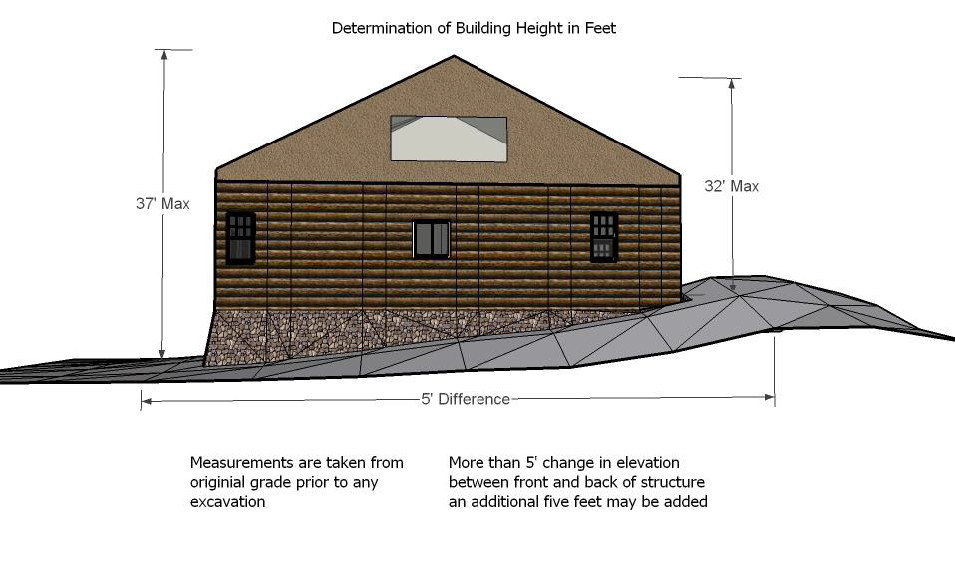
º
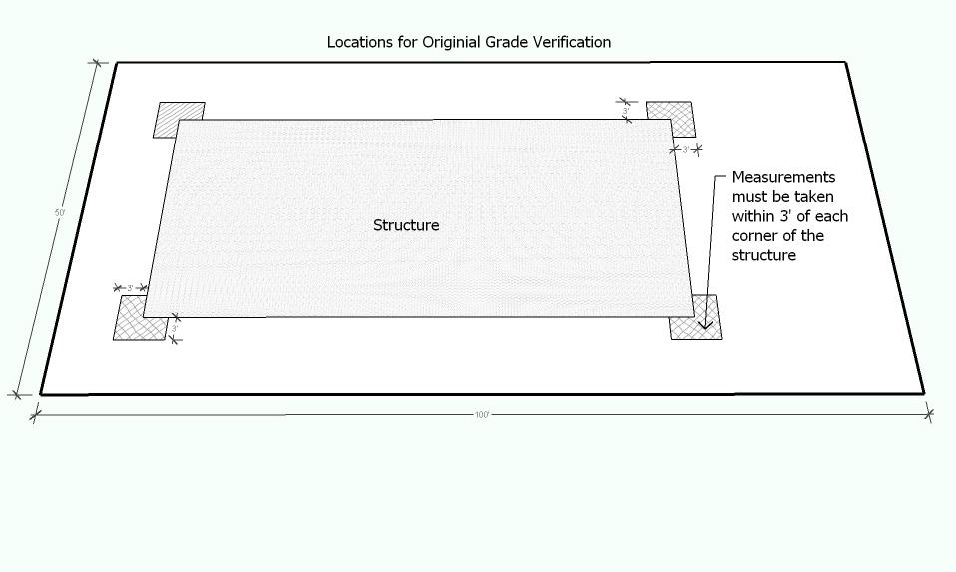
Original grade must be determined prior to any human disturbance. Measurements must be taken within three (3) feet of each corner of the proposed structure.
Home Occupation. Any non-residential use conducted entirely within a dwelling unit and carried on solely by the inhabitants thereof, which use is clearly incidental and secondary to the use of the dwelling unit for dwelling purposes and does not occupy more than twenty percent (20%) of the total floor space of the dwelling unit or accessory structure and which use does not require more than two (2) customers per twenty-four (24) hour day.
Hotel and Motel. Any unit intended for rental on a less than monthly basis. Each unit shall have a minimum two hundred seventy-five (275) square feet and shall contain a bathroom within the unit.
Junk Yard. An area two hundred (200) square feet or more, or any area not more than fifty (50) feet from any street, used for the storage, keeping or abandonment of junk, including scrap metals or other scrap materials or goods, or used for the dismantling, demolition or abandonment of automobiles or other vehicles or machinery, or parts thereof.
Kennel. A kennel is any establishment designed for the permanent or temporary boarding or keeping of pet animals.
Limit of Disturbance. That area that is proposed to be subject to any modification to a natural landform including contouring, excavation and removal of vegetative cover.
Lodge. Any unit intended for rental on at least a monthly basis. Each unit shall have kitchen facilities, a bathroom and shall have a minimum of four hundred (400) square feet unless otherwise specified.
Lot or Parcel. A piece, plat or area of land, of contiguous assemblage as established by survey, plat or deed, occupied or to be occupied by a building, or a unit group of buildings, and/or accessory buildings thereto or for other use, together with such open spaces as may be required under these regulations and having its frontage on a street or officially approved place.
Lot Line Agreement. An Agreement signed by a property owner indicating understanding that two (2) or more lots are to be considered one (1) building site and may never be sold separately or mortgaged separately unless all provisions of the Town of Grand Lake's zoning regulations then in effect are complied with. This Agreement shall be recorded with the Grand County Recorders Office.
Manufactured. Meets HUD (Housing and Urban Development) Code; Any non-portable, wood-sided, pitched-roof structure, on a permanent foundation and meeting snow load requirements, which is equal to or greater than twenty-four (24) feet wide by thirty-six (36) feet long. If less than twenty-four (24) feet wide by thirty-six (36) feet, only permitted in trailer parks.
Mean Identifiable High Water Mark. In the case of creek or stream, these terms shall mean the waterline at the point of bankful discharge, or the point of the high discharge with a recurrence interval of two years. In the case of a lake, the lowest level at which upland vegetation will grow and have historically sustained growth. In the case of fluctuating and manmade reservoirs, the highest level or maximum designed capacity level of said reservoir.
Mitigate. To neutralize or compensate for the physical impacts of a man-made development upon a particular land area or piece of land such that the undeveloped land will function as it did before the development took place.
Mixed-Use Developments. Developments that contain a variety (two (2) or more) of uses that are integrated and/or connected either horizontally or vertically or both.
Mobile Home. Any vehicle or similar portable structure originally constructed to have no foundation other than wheels, jacks or skirtings and so designed or constructed to permit occupancy as living or sleeping quarters and shall have been issued a manufacturer's statement of origin.
Mobile Home Park. Any lot or parcel of land on which a mobile home is parked.
Mobile Home Space. A parcel of land within a mobile home park designed for the accommodation of one (1) mobile home.
Neighborhood Business. Small commercial and business establishments operated and intended to serve the daily or frequent trade or service needs of the surrounding neighborhood. Such establishments include but are not limited to: food stores, pharmacies, barber shops, beauty shops, shoe repairs, craft shops, business offices, professional offices, florists, photo shops, and tailor shops. The determination of qualification of a 'neighborhood business' may, from time to time, be brought by Town Staff to the Planning Commission for review. Prior to making a decision, the Planning Commission will weigh the size of the business, hours of operation, potential traffic generation, and other items deemed necessary pertinent to the proposed use.
Net Density. The ratio of total floor area (excluding basements) to total buildable land area, excluding public streets and street rights-of-way, required open space areas or other public use areas, and open parking areas.
Net Residential Area. The land area devoted to residential uses, not including streets, parking areas, or required useable open space areas.
Nightly Rental. A structure, dwelling or dwelling unit that is rented for periods of time of less than thirty (30) consecutive days. The term "Nightly rental" shall not include hotel, motel, or bed and breakfast establishments.
Non-Conforming Building. A building or portion thereof, legally built prior to the effective date of this Section or any amendment thereto, which does not conform with the regulations of the district in which it is located.
Non-Conforming Use. Land or a building lawfully occupied prior to the effective date of this Article or any amendment thereto, by a use which does not conform with the regulations of the district in which it is located.
Nudity or State of Nudity.
(a)
The appearance of human bare buttock, anus, male genitals, female genitals, or the areola or nipple of the female breast; or
(b)
A state of dress which fails opaquely and fully to cover human buttocks, anus, male or female genitals, pubic region, or areola or nipple of the female breast.
Off-Street Parking Space. An off-street, hard-surfaced, dust-free space designed and intended to be occupied by a parked automobile which is up to two hundred (200) square feet in area exclusive of maneuvering and roadway space.
For purposes of this Section, off-street parking shall be of two (2) classifications, (1) Surface off-street parking; and (2) covered underground off-street parking. An off-street parking space shall consist of the following area requirements:
(a)
A surface off-street parking space shall consist of at least two-hundred (200) square feet (10 feet × 20 feet) of parking — for the vehicle. In addition, adequate space shall be provided to allow for proper ingress, egress and vehicle maneuvering.
(b)
A covered or underground off-street parking space shall consist of at least one hundred eighty (180) square feet (10 feet × 18 feet) of area for parking of the vehicle. In addition, adequate space shall be provided to allow for proper ingress, egress, and vehicle maneuvering.
(c)
Additional parking standards are found in Section 12-2-28 Parking Regulations.
Open. See Unenclosed.
Open Space (Public). Undisturbed, revegetated or improved land dedicated to the common use of the public to provide visual openness and recreational use. Changes in the open space utilization must be approved by the Commission and Board of Trustees of the Town of Grand Lake.
Open Space (Private). Undisturbed, revegetated or improved land dedicated to the common use of all residents of a subdivision, condominium, townhouse, or mixed-use development which is intended to provide visual openness and recreational use for that development. Open space, once created, can only be otherwise utilized by the concurrence of the owners, according to provisions in ownership declaration documents, which said open space was created to benefit. Changes in the open space utilization must be approved by the Commission and Board of Trustees of the Town of Grand Lake. Permitted and Non-Permitted Uses for Open Space (Private) land will be compliant with uses for Open Space (Public) land. Uses listed below include but are not limited to the following:
Original Grade (Preconstruction Elevation) means the ground level before any human disturbance in the last five (5) years. Soil tests may be required if the Town can not determine if human disturbance has occurred in the last five (5) years.
Patio. An at-grade, paved area adjoining a house, for outdoor lounging, dining, etc.
Permit. A document issued by the Town of Grand Lake, Colorado, or designee thereof, granting permission to perform an act or service which is regulated by the Town.
Planned Development. Development of land in a manner which allows, in conformance with the provisions of this Article, the following: A variety of uses and/or densities in addition to those ordinarily allowed by right or by condition in the designated zone district, for which land may be developed in order to allow for uniqueness and overall flexibility of development in special instances as may be approved by Town.
Planned Development Plan. The provision for the general development of a Planned Development which may include and need not be limited to easements, covenants and restrictions relating to use, location and bulk of buildings and other structures, intensity of use or density of development, utilities, private and public streets, ways, roads, pedestrian areas and parking facilities, common open space and other public and private facilities. "Provisions of the Plan" means the written and graphic materials referred to in this definition, also referred to as a "General Development Plan."
Planning Commission. The Grand Lake Town Planning Commission.
Portable shed/garage. Any portable facility which utilizes a canvas, vinyl, rubber or similar type cover over a framework which is not permanently secured to the ground by means of concrete, asphalt or similar type material.
Projection. Cornices, exterior balconies, chandeliers, including exterior wall coverings, and similar projections extending beyond the exterior wall.
Public Hearing. A legally advertised meeting held by the Planning Commission or Town Board of Trustees at which time citizens' opinions may be voiced concerning the subject of the hearing.
Recreational Unit. Unit designed as temporary dwelling for recreational purposes. The following shall be considered as a recreational unit:
(a)
Pickup Coach. A vehicle designed to be mounted on or loaded into a truck chassis for use as a temporary dwelling for travel and recreation.
(b)
Tent. Protective fabric erected and designed as a temporary dwelling to provide protection form elements.
Recreational Vehicle Lot or Recreational Vehicle Space. Any unit of land provided by an RV Park/Resort for the purpose of placing thereon a recreational vehicle or recreational unit which is used or intended to be used for living or sleeping purposes, for private use within an RV Park/Resort.
Recreational Vehicle. Vehicle eligible of being registered as a motor vehicle in the State of Colorado. The following shall be considered a recreational vehicle:
(a)
Camping Trailer. A canvas, or other type of material, folding vehicle of rigid construction, mounted on wheels and designed as a temporary dwelling for travel and recreation.
(b)
Motorized Home, Motor Home and/or Recreational Bus or Van. A recreational vehicle consisting of a portable, temporary dwelling to be used for travel, recreation and vacation uses, and constructed as an integral part of a self-propelled vehicle.
(c)
Travel Trailer. A towable vehicle designed as a temporary dwelling for travel and recreation.
(d)
Travel Trailer, Self-Contained. Trailer designed as a temporary dwelling which can operate independently of connections to sewer, water and electric systems. It contains a water-flushed toilet, lavatory, shower or bath and kitchen sink, all of which are connected to water storage and sewer holding tanks located within the trailer.
Recreational Vehicle Park. A tract or unit specifically developed for locating only recreational vehicles or recreational units on a short-term basis.
Resort. A commercial place designed and intended primarily to accommodate tourists and vacationers with recreational facilities and may or may not include a lodge or motel with food and drink.
Right-of-way. The entire dedicated tract or strip of land.
Road. See Street.
Seminude. A state of dress in which clothing covers no more than the genitals, pubic region, and areola of the female breasts, as well as portions of the body covered by supporting straps or devices, which supporting straps or devices are used to support or enable the wearing of such clothing.
Set-Back. The required distance, and the land resulting there from, between the closest edge of the public right-of-way, or some other designated line, and the nearest possible line, including projections, of a conforming structure, portable shed/garage or temporary facility.
Sexually Orientated Business (SOB).
(a)
A business that has as one of its principal business purposes a substantial or significant portion (20% or more) of its stock and trade, books, magazines, other periodicals, videos, or DVDs on matter depicting, describing or relating to "specified sexual activities," or "specified anatomical areas", or
(b)
An establishment with a substantial or significant portion (20% or more) segment or section devoted to the rental, sale or display of materials, instruments, devices, or paraphernalia which are designed for use in connection with "specified sexual activities", or
(c)
"Adult" arcades, cabarets, motels, motion picture theatres or theatres where:
(i)
Persons appear in a state of nudity, or
(ii)
There are live performances which are characterized by the exposure of "specified anatomical areas," by "specified sexual activities," or physical contact in the form of wrestling or tumbling between persons of the opposite sex or activities between male and female persons and/or persons of the same sex when one (1) or more of the persons is in a state of nudity or semi-nude.
Sign. Any device, whether free-standing or attached to a vehicle, building, or fence that is visible from the public right-of-way and whose purpose is for identification, information or advertising.
Snow Storage. That area required to be designated for the storage of snow.
Specified Anatomical Areas. As used herein means and includes any of the following:
(a)
Human genitals, pubic region, buttocks, anus or female breasts below a point immediately above the top of the areola, that are not completely and opaquely covered; or
(b)
Human male genitals in a discernibly turgid state even if completely and opaquely covered.
Specified Sexual Activities. Includes any of the following:
(a)
The fondling or other intentional touching of human genitals, pubic region, buttocks, anus or female breasts;
(b)
Any sex act, whether actual or simulated, including, but not limited to, intercourse, oral copulation, or sodomy;
(c)
Masturbation, whether actual or simulated;
(d)
Human genitals in a state of sexual stimulation, arousal, or tumescence; or
(e)
Excretory functions as part of or in connection with any of the activities set forth in subsections a through d of this definition.
Story. Defined as that portion of a building included between the upper surface of any floor and the upper surface of the floor next above, except that the topmost story shall be that portion of a building included between the upper surface of the topmost floor and the ceiling or roof above. If the finished floor level directly above a usable or unused under floor space is more than six (6) feet above grade, as defined herein, for more than fifty percent (50%) of the total perimeter or is more than twelve (12) feet above grade, as defined herein, at any point, such usable or unused under-floor space shall be considered as a story.
Street. The entire dedicated public right-of-way, providing for pedestrian and vehicular movement of people and goods that is to be used by the public for circulation and service.
Structure. See Building.
Temporary Facilities. Facilities (including construction trailers, uninhabitable storage facilities, approved food/beverage service units) that are placed onto a parcel, complaint with the Regulations set forth herein, for temporary use for no greater than six months, unless allotted a greater time period by Planning Commission Resolution.
Theatre Scenery Loft. A place for the storing, lowering, and raising of theatre scenery.
Time Share or Interval Ownership Unit. Condominium or townhouse units that have been further subdivided into a stated number of additional interests in the unit, defined by the period of time during which the owner of the share may occupy it. Shares may be of two types: first, "fee time shares" or "interval estates", wherein diverse owners each own a present estate for years terminating on a date certain coupled with a future remainder interest in the unit as a tenant in common with the other diverse owners; and second, "time-span estates" operating on a tenancy in common principle coupled with an exclusive right to use and occupy the unit during a fixed annual recurring period of time.
Total Floor Area. The total number of square feet of floor space within the exterior walls of a building, not including space in cellars, carports or garages.
Town. The Town of Grand Lake, Colorado.
Town Board of Trustees. The Town Board of Trustees of the Town of Grand Lake, Colorado.
Transient Guest. A person who stays for a period not to exceed two (2) weeks.
Unenclosed. Not enclosed.
Use by Right. A use which is listed as a use permitted by right in any given zone district in this Article. Uses permitted by right are not required to show need for their location.
Useable Open Space (Public or Quasi-Public). Open area designed and developed for uses including, but not limited to recreation, courts, gardens, parks and walkways. The term shall not include space devoted to streets and parking and loading areas.
Wall. A vertical element with a horizontal length used to enclose space.
Yard, Front. A yard extending across the front of a lot between the side lot lines and extending from the front lot line to the front of the main building or any projections thereof. The front yard shall be on the side of the lot which has been established as frontage by the house numbering system.
Yard, Rear. A yard extending across the rear of a lot, measured between the side lot lines and being the minimum horizontal distance between the rear lot line and the rear of the main building including any projections. On interior lots the rear yard shall in all cases be at the opposite end of the lot from the front yard. In the case of through lots and corner lots, there will be no rear yards, but only front and side yards.
Yard, Side. A yard extending from the front yard to the rear yard and being the space between the side lot line and the side of the main building including any projections.
Zoning Code Administrator. The officer or other designated authority charged with the administration and enforcement of this Code; the Town Manager or a duly authorized representative. The Zoning Code Administrator shall be responsible to the Planning Commission and the Town Board of Trustees and shall administer and enforce all zoning and design review laws of the Town of Grand Lake. He shall have all powers conferred upon the Building Official under this Article and all other Articles of the Town of Grand Lake, in order to perform his functions.
Zoning District. A zoned area in which the same zoning regulations apply throughout.
(Ord. No. 12-2020, § 1, 7-27-2020; Ord. No. 02-2023, § 1, 3-27-2023)
12-2-7 - Establishment of Zone Districts.
(A)
In conformity with the intent and purpose of this Article, the "Zoning Districts" as set forth below are hereby adopted, in order to classify, regulate, restrict and separate uses of land and structures, lot dimensions and areas, yard widths and depths, percentage of lot coverage and open spaces, lot area required for dwelling units and other structures, spacing of buildings, and the height and bulk of structures.
The boundaries of said districts are shown upon the official zoning map and made a part of this Article, being designated as the Zoning Map of the Town of Grand Lake, Colorado and said map and all notations, references and other information shown thereon, shall be as much a part of this Article as if the matters and information set forth by said map were all fully described herein.
(B)
Districts Boundaries. For determination of the boundaries of the districts shown on the Zoning Map, the following rules shall apply:
1.
Where such boundaries are indicated as following or approximately following the centerline of existing streets, alleys or other platted rights-of-way, or extensions of the same, such centerlines shall be construed to be such boundaries.
2.
Where such boundaries are indicated as following or approximately following lot lines or property lines, such lot lines or property lines shall be construed to be such boundaries.
3.
In unsubdivided property or where a district boundary divides a lot or parcel of property, the location of any such boundary, unless the same is indicated by dimensions shown on the district map, shall be determined by the use of the scale appearing on such map.
4.
The Board of Adjustment established hereby shall, upon application or upon its own motion, determine the location of boundaries in cases where uncertainty exists, after the application of the rules.
(C)
Applicability of District Regulations. Except as may be otherwise provided herein:
1.
No building shall hereafter be erected, reconstructed, altered, enlarged or moved, nor shall any building or land be used for any purpose other than for a use permitted herein, in the district in which located.
2.
No building shall hereafter be erected, reconstructed, structurally altered, enlarged or moved so as to exceed the building height limit established herein for the district in which located.
3.
No lot shall be so reduced or diminished, nor shall any structure be so enlarged or moved, as to reduce or diminish the yards, lot area or open space required herein in the district in which located.
4.
No yard or other open space required herein for any building shall be considered as providing a yard or open space for any other building, and no yard or open space on an adjoining lot or parcel of property shall be considered as providing a yard or open space on a lot whereon a building is to be erected.
5.
Every building hereafter erected shall be located on a lot, as defined herein, and in no case shall there be more than one (1) main building on one (1) lot except as may be otherwise provided herein.
6.
Every building containing one (1) or more dwelling units or guest rooms shall be erected on a lot at least one (1) line of which abuts for not less than twenty-five feet (25') along a public street or along a permanent, unobstructed easement of access to the lot from a public street, said access being approved by the Building Administrator as adequate for the purpose.
7.
Off-street parking spaces in all districts shall be provided in accordance with the requirements for specific uses set forth in Section 12-2-28 Parking Regulations of this Article.
8.
Signs for permitted uses in all districts shall be in accordance with requirements set forth in Chapter 6: Article 2: Sign Code.
(D)
Introduction to Specific District Regulations. Regulations for the districts established by this Article are set forth in Sections 12-2-8 through 12-2-25 hereof, provided, however, that such exceptions to any such regulations or such additional regulations as are set forth in other Sections hereof shall apply; provided, further that the Board of Adjustment as established hereby may, under certain conditions, vary these Regulations and approve the issuance of permits for the establishment of certain uses, all as set forth in Section 12-2-32 Non-Conforming Uses and Structures. The district regulations set forth in Sections 12-2-8 through 12-2-25 hereof are subject to exceptions, variances, additions and provisions as are set forth in other Sections hereof. Certain regulations applicable to pre-established uses that do not conform to the provisions herein are set forth in Section 12-2-31 Special and Conditional Use Regulations.
(E)
Annexation of Additional Territory. Whenever any territory is added to the city limits of the Town of Grand Lake, plans for said annexation shall be presented to the Planning Commission for land use and zoning recommendations and the Board of Trustees in the Article providing for its addition to the City shall designate the district or districts in which it is included and it shall be governed by the provisions of the section governing the district to which it is attached and in the absence of the adoption of such resolution, such territory when annexed shall automatically become a part of the O—Open District.
(F)
Vacations. Whenever any street, alley or other public way is vacated by official action of the Board of Trustees of the Town of Grand Lake, the zoning district adjoining each side of such street, alley or public way shall be automatically extended to the center of such vacation and all area included in the vacation shall then and henceforth be subject to all appropriate regulations of the extended district.
12-2-8 - Regulations of Open District—O.
The regulations set forth in this Section, or set elsewhere in this Article when referred to in this Section are the District Regulations in the O—Open District.
(A)
Uses Permitted by Right.
1.
Single Family dwelling unit and one (1) horse per parcel of land of not less than one (1) acre in area, subject to health and nuisance laws.
2.
Home occupations.
3.
Churches, school, libraries, community centers, public parks and other public buildings and public or quasi-public recreational facilities.
4.
Educational, religious and philanthropic institutions, but not including penal or mental institutions.
5.
Accessory buildings and uses customarily incident to the uses permitted in this district.
6.
Nightly Rentals.
(B)
Conditional Uses.
1.
Enterprises or uses of the same nature of class or similar uses as those listed above in paragraph (a), "Uses Permitted by Right", which in the opinion of the Planning Commission, as evidenced by a resolution of record, is not more obnoxious or detrimental to the welfare of the area than those listed in said paragraph (a).
2.
Hospitals.
3.
Public Utilities.
4.
Fire stations, police stations and telephone exchanges.
5.
Water reservoirs, water storage tanks, water pumping stations sewer lift stations and wireless towers.
6.
Commercial and public parking lots.
7.
Airports, provided:
(a)
They do not endanger the immediate area;
(b)
They meet all local, State and Federal regulations.
8.
The Commission may, in addition, prescribe any additional conditions regarding intensity or limitation of use, appearance, hours of operation, setbacks or required open space, or other such conditions which may be deemed necessary by the Planning Commission.
9.
Nightly Rentals will be treated as a conditional use when an objection has been raised as to the use by right. See Section 12-2-31(B)4 Nightly Rental Conditional Use Permits.
(C)
Zoning Standards. Except as provided in Section 12-2-27, the area regulations are as follows:
12-2-9 - Regulations for Residential Estate District—RE.
The regulations set forth in this Section, or set forth elsewhere in this Article, when referred to in this Section, are the District Regulations in the RE—Residential Estate District.
(A)
Uses Permitted by Right.
1.
Single Family and Accessory Dwelling Units (ADUs).
2.
Home occupations.
3.
Domestic animals, provided such animals are household pets and that kennels are not maintained.
4.
Two (2) horses per parcel of land, not less than one (1) acre in area, subject to health and nuisance laws.
5.
Fences, hedges, and walls, provided such uses are located where they will not obstruct motorists' vision at street intersections.
6.
Accessory buildings and uses customarily incident to the uses permitted in this district.
7.
Nightly Rentals in the Single Family Residence only. Nightly Rentals will not be permitted in Accessory Dwelling Units (ADUs).
8.
Historic structures.
(B)
Conditional Uses.
1.
Public Utilities.
2.
Fire stations, police stations and telephone exchanges.
3.
Water reservoirs, water storage tanks, water pumping stations, sewer lift stations and wireless towers.
4.
Churches, school, libraries, community centers, public parks and other public buildings and public or quasi-public recreational facilities.
5.
Educational, religious and philanthropic institutions, but not including penal or mental institutions.
6.
The Commission may in addition prescribe any additional conditions regarding intensity or limitation of use, appearance, hours of operation, setbacks or required open space, or other such conditions which may be deemed necessary by the Planning Commission.
7.
Nightly Rentals will be treated as a conditional use when an objection has been raised as to the use by right. See Section 12-2-31(B)4 Nightly Rental Conditional Use Permits.
8.
Bed and Breakfasts.
(C)
Zoning Standards. Except as provided in Section 12-2-27, the area regulations are as follows:
(Ord. No. 04-2025, § 1, 5-12-2025)
12-2-10 - Regulations for Single Family Residential—Low Density—RSL.
The regulations set forth in this Section, or set forth elsewhere in this Article, when referred to in this Section, are the District Regulations in the RSL—Single Family Residential, Low Density District.
(A)
Uses Permitted by Right.
1.
Single Family and Accessory Dwelling Units (ADUs).
2.
Home occupations.
3.
Domestic animals, provided such animals are household pets and that kennels are not maintained.
4.
Fences, hedges, and walls, provided such uses are located where they will not obstruct motorists' vision at street intersections.
5.
Accessory buildings and uses customarily incident to the uses permitted in this district.
6.
Nightly Rentals in the Single Family Residence only. Nightly Rentals will not be permitted in Accessory Dwelling Units (ADUs).
7.
Historic structures.
(B)
Conditional Uses.
1.
Public Utilities.
2.
Fire stations, police stations and telephone exchanges.
3.
Water reservoirs, water storage tanks, water pumping stations, sewer lift stations and wireless towers.
4.
The Commission may in addition prescribe any additional conditions regarding intensity or limitation of use, appearance, hours of operation, setbacks or required open space, or other such conditions which may be deemed necessary by the Planning Commission.
5.
Nightly Rentals will be treated as a conditional use when an objection has been raised as to the use by right. See Section 12-2-31(B)4 Nightly Rental Conditional Use Permits.
6.
Bed and Breakfasts.
(C)
Zoning Standards. Except as provided in Section 12-2-27, the area regulations are as follows:
12-2-11 - Regulations for Single Family Residential District—Medium Density—RSM.
The regulations set forth in this Section, or set forth elsewhere in this Article, when referred to in this Section, are the District Regulations in the RSM—Single Family Residential District—Medium Density.
(A)
Uses Permitted by Right.
1.
Single Family and Accessory Dwelling Units (ADUs).
2.
Home occupations.
3.
Domestic animals, provided such animals are household pets and that kennels are not maintained.
4.
Fences, hedges, and walls, provided such uses are located where they will not obstruct motorists' vision at street intersections.
5.
Accessory buildings and uses customarily incident to the uses permitted in this district.
6.
Nightly Rentals in the Single Family Residence only. Nightly Rentals will not be permitted in Accessory Dwelling Units (ADUs).
7.
Historic structures.
(B)
Conditional Uses.
1.
Public Utilities.
2.
Fire stations, police stations and telephone exchanges.
3.
Water reservoirs, water storage tanks, water pumping stations, sewer lift stations and wireless towers.
4.
The Commission may in addition prescribe any additional conditions regarding intensity or limitation of use, appearance, hours of operation, setbacks or required open space, or other such conditions which may be deemed necessary by the Planning Commission.
5.
Nightly Rentals will be treated as a conditional use when an objection has been raised as to the use by right. See Section 12-2-31(B)4 Nightly Rental Conditional Use Permits.
6.
Bed and Breakfasts.
(C)
Zoning Standards. Except as provided in Section 12-2-27, the area regulations are as follows:
12-2-12 - Regulations for Single Family Residential—High Density—RSH.
The regulations set forth in this Section, or set forth elsewhere in this Article, when referred to in this Section, are the District Regulations in the RSH—Single Family Residential District—High Density.
(A)
Uses Permitted by Right.
1.
Single Family and Accessory Dwelling Units (ADUs).
2.
Home occupations.
3.
Domestic animals, provided such animals are household pets and that kennels are not maintained.
4.
Fences, hedges, and walls, provided such uses are located where they will not obstruct motorists' vision at street intersections.
5.
Accessory buildings and uses customarily incident to the uses permitted in this district.
6.
Nightly Rentals in the Single Family Residence only. Nightly Rentals will not be permitted in Accessory Dwelling Units (ADUs).
7.
Historic structures.
(B)
Conditional Uses.
1.
Public Utilities.
2.
Fire stations, police stations and telephone exchanges.
3.
Water reservoirs, water storage tanks, water pumping stations, sewer lift stations and wireless towers.
4.
The Commission may in addition prescribe any additional conditions regarding intensity or limitation of use, appearance, hours of operation, setbacks or required open space, or other such conditions which may be deemed necessary by the Planning Commission.
5.
Nightly Rentals will be treated as a conditional use when an objection has been raised as to the use by right. See Section 12-2-31(B)4 Nightly Rental Conditional Use Permits.
6.
Bed and Breakfasts.
(C)
Zoning Standards. Except as provided in Section 12-2-27, the area regulations are as follows:
12-2-13 - Regulations for Multiple Family Residential District—Low Density—MLD.
The regulations set forth in this Section, or set forth elsewhere in this Article, when referred to in this Section, are the District Regulations in the RML—Multiple Family Residential District—Low Density.
(A)
Uses Permitted by Right.
1.
Single Family Dwelling Units. Multiple Family dwelling units. Time-shares or interval ownership estate units are not allowed.
2.
Home occupations.
3.
Domestic animals, provided such animals are household pets and that kennels are not maintained.
4.
Fences, hedges, and walls, provided such uses are located where they will not obstruct motorists' vision at street intersections.
5.
Accessory buildings and uses customarily incident to the uses permitted in this district.
6.
Nightly Rentals in Single Family Dwellings and Multiple Family Dwellings only. Nightly Rentals will not be permitted in Accessory Dwelling Units (ADUs).
7.
Historic structures.
(B)
Conditional Uses.
1.
Public Utilities.
2.
Fire stations, police stations and telephone exchanges.
3.
Water reservoirs, water storage tanks, water pumping stations, sewer lift stations and wireless towers.
4.
The Commission may in addition prescribe any additional conditions regarding intensity or limitation of use, appearance, hours of operation, setbacks or required open space, or other such conditions which may be deemed necessary by the Planning Commission.
5.
Nightly Rentals will be treated as a conditional use when an objection has been raised as to the use by right. See Section 12-2-31(B)4 Nightly Rental Conditional Use Permits.
(C)
Zoning Standards. Except as provided in Section 12-2-27, the area regulations are as follows:
(Ord. No. 12-2022, § 1, 9-26-2022)
12-2-14 - Regulations for Multiple Family Residential District—Medium Density—MMD.
The regulations set forth in this Section, or set forth elsewhere in this Article, when referred to in this Section, are the District Regulations in the RMM—Multiple Family Residential District—Medium Density.
(A)
Uses Permitted by Right.
1.
Single Family Dwelling Units. Multiple Family dwelling units. Time-shares or interval ownership estate units are not allowed.
2.
Home occupations.
3.
Domestic animals, provided such animals are household pets and that kennels are not maintained.
4.
Fences, hedges, and walls, provided such uses are located where they will not obstruct motorists' vision at street intersections.
5.
Accessory buildings and uses customarily incident to the uses permitted in this district.
6.
Nightly Rentals in Single Family Dwellings and Multiple Family Dwellings only. Nightly Rentals will not be permitted in Accessory Dwelling Units (ADUs).
7.
Historic structures.
(B)
Conditional Uses.
1.
Public Utilities.
2.
Fire stations, police stations and telephone exchanges.
3.
Water reservoirs, water storage tanks, water pumping stations, sewer lift stations and wireless towers.
4.
The Commission may in addition prescribe any additional conditions regarding intensity or limitation of open space, or other such conditions which may be deemed necessary by the Planning Commission.
5.
Nightly Rentals will be treated as a conditional use when an objection has been raised as to the use by right. See Section 12-2-31(B)4 Nightly Rental Conditional Use Permits.
(C)
Zoning Standards. Except as provided in Section 12-2-27, the area regulations are as follows:
(Ord. No. 12-2022, § 2, 9-26-2022)
12-2-15 - Regulations for Multiple Family Residential District—High Density—MHD.
The regulations set forth in this Section, or set forth elsewhere in this Article, when referred to in this Section, are the District Regulations in the RMH—Multiple Family Residential District—High Density.
(A)
Uses Permitted by Right.
1.
Single Family Dwelling Units, Multiple family dwelling units and timeshares and interval ownership estate units where no more than sixteen (16) shares per unit are allowed. A central reservation facility on site must be included in the project.
2.
Home occupations.
3.
Domestic animals, provided such animals are household pets and that kennels are not maintained.
4.
Fences, hedges, and walls, provided such uses are located where they will not obstruct motorists' vision at street intersections.
5.
Accessory buildings and uses customarily incident to the uses permitted in this district. A central reservation facility on the same site as timeshare multiple family development is an accessory use.
6.
Nightly Rentals in Single Family Dwellings and Multiple Family Dwellings only. Nightly Rentals will not be permitted in Accessory Dwelling Units (ADUs).
7.
Historic structures.
(B)
Conditional Uses.
1.
Public Utilities.
2.
Fire stations, police stations and telephone exchanges.
3.
Water reservoirs, water storage tanks, water pumping stations, sewer lift stations and wireless towers.
4.
The Commission may in addition prescribe any additional conditions regarding intensity or limitation of use, appearance, hours of operation, setbacks or required open space, or other such conditions which may be deemed necessary by the Planning Commission.
5.
Nightly Rentals will be treated as a conditional use when an objection has been raised as to the use by right. See Section 12-2-31(B)4 Nightly Rental Conditional Use Permits.
(C)
Zoning Standards. Except as provided in Section 12-2-27, the area regulations are as follows:
(Ord. No. 12-2022, § 3, 9-26-2022)
12-2-16 - Regulations for Mobile Home Residential District—HM.
The regulations set forth in this Section, or set forth elsewhere in this Article, when referred to in this Section, are the District Regulations in the HM—Mobile Home Residential District.
(A)
Uses Permitted by Right.
1.
Mobile homes designed for occupancy by one (1) family.
2.
Home occupations.
3.
Domestic animals, provided such animals are household pets and that kennels are not maintained.
4.
Fences, hedges, and walls, provided such uses are located where they will not obstruct motorists' vision at street intersections.
5.
Accessory buildings and uses customarily incident to the uses permitted in this district.
(B)
Conditional Uses.
1.
Public Utilities.
2.
Fire stations, police stations and telephone exchanges.
3.
Water reservoirs, water storage tanks, water pumping stations, sewer lift stations and wireless towers.
4.
The Commission may in addition prescribe any additional conditions regarding intensity or limitation of use, appearance, hours of operation, setbacks or required open space, or other such conditions which may be deemed necessary by the Planning Commission.
(C)
Zoning Standards. Except as provided in Section 12-2-27, the area regulations are as follows:
(D)
Design Requirements. The Mobile Home residential District may be created upon petition for an amendment to the Zoning Map. When petitioning for this zone change, there shall be provided a site design by a registered engineer, architect or qualified planner, complete in detail showing the following:
1.
Location and legal description.
2.
Entrance to and exits from the court.
3.
Vehicular roadways, driveways and pedestrian walks. All roads shall be designed and built to Town Specifications.
4.
Plans, showing size and arrangement of mobile home lots and stands, location of roadway, service and utility buildings.
5.
Topography map showing original and final contours at two feet (2') intervals.
6.
Provisions for drainage.
7.
Area set aside for recreation, clothes washing and drying, storage and off-street parking.
8.
Fencing and screen planting on the premises.
9.
Plans for water supply and distribution.
10.
Plans for sewage collection and disposal.
11.
Provisions for trash and garbage storage and removal.
12.
Plans for underground gas, electric, and phone service connections to each space.
13.
Typical lot plan.
14.
For each mobile home lot there shall be provided:
(a)
Recreational area in the amount of three hundred square feet (300 sq. ft.).
(b)
Space for mechanical washing and clothes drying facilities in the amount of twenty-five square feet (25 sq. ft.).
(c)
Two (2) off-street parking spaces for each lot.
15.
Service and utility buildings and appurtenances, garbage and trash containers, racks and rack locations, rodent and insect control, water and sewage provisions must meet with the approval of the Colorado Department of Public Health and the local health authority.
16.
The applicant shall consult with the school district officials and secure a written statement to be submitted with the application as to the impact on the school district caused by the increased number of school children from the increased residential density of the mobile home court.
17.
Statement of conformance with the Federal Housing Administration's Minimum Property Standards for Mobile Home Courts. The Zoning Regulations will govern where more restrictive.
18.
Density and Open Space. Mobile home townhome developments may have a density of up to ten (10) units per gross acre of land area. The minimum open space requirement for this district is fifty-five percent (55%) of the total land area. Improvements not included within the open space definition may occupy up to forty-five percent (45%) of the total land area.
12-2-17 - Regulations for Commercial Transitional District—CT.
The Regulations set forth in this Section, or set forth elsewhere in this Article, when referred to in this Section, are the District Regulations in the CT—Commercial Transitional District.
(A)
Uses Permitted by Right.
1.
Single Family Dwelling Units.
2.
Neighborhood Businesses.
3.
Day Nurseries or Child-Care Centers.
4.
Private and Publicly-owned Parking Lots.
5.
Not-for-Profit Clubs and Service Organizations.
6.
Hotels, Motels, Condo/Hotels and Lodges.
7.
Group homes for the elderly and indigent, limited to not more than eight (8) persons per home.
8.
Multi-family attached rental units.
9.
Bed and breakfast establishments.
10.
Condominiums and Townhouses—Timeshare and interval estate units of more than sixteen (16) shares per unit are required to have a central reservation facility on site.
11.
Mixed Residential with permitted Commercial Use within the same building or buildings on the lot.
12.
Rental, repair, wholesaling, and storage in conjunction with any of the above non-residential uses, provided all such activity is clearly incidental and accessory to said uses, and further provided all such activity is conducted within a building.
13.
Accessory buildings and uses normal and customary to the uses listed above.
14.
Nightly Rentals. See Section 12-2-31(B)4 Nightly Rental Conditional Use Permits.
15.
Residential units herein defined as: Multi-family attached rental units, condominiums, townhouse and condo/hotels are uses permitted by right with the following restrictions:
(a)
The first story area measured from the frontage to fifty feet (50') into the lot shall be dedicated to commercial space.
(b)
If any portion of the area described Section 12-2-17(A)15(a) is used for a hallway, elevator, stairwell access, or fire escape access, a minimum of thirty percent (30%) of the second story of the structure must be dedicated to commercial space. This area shall be located on the frontage side of the structure.
(c)
The commercial space aspect of any structure must be constructed prior to or in conjunction with the residential units. A Certificate of Occupancy must be issued to the commercial space prior to or in conjunction with the residential units.
16.
Historic structures.
17.
Licensed Natural Medicine Business pursuant to the Colorado Natural Medicine Code, C.R.S. § 44-50-101 et seq., subject to the limitations of Chapter 6, Article 6 of the Grand Lake Municipal Code. Such Licensed Medicine Businesses shall only be located on property within the Commercial Transitional Zoning District or a planned development district, but shall not be permitted on any parcel east of Broadway street. Licensed Natural Medicine Businesses shall not be permitted to operate as "home occupations."
(B)
Conditional Uses.
1.
Commercial establishments of the following and like nature: antiques; small appliances; furniture; gifts; hardware; sporting goods; stationery; and, variety shops;
2.
Service establishments of the following and like nature: catering services; laundromats; medical clinics; funeral parlors and mortuaries;
3.
Eating and drinking establishments;
4.
Public utilities;
5.
Water reservoirs, water storage tanks, water pumping stations, sewer lift stations and wireless towers.
(C)
Zoning Standards. Except as provided in Section 12-2-27, the area regulations are as follows:
(Ord. No. 01-2025, § 1, 1-13-2025)
12-2-18 - Regulations for Commercial District—C.
The Regulations set forth in this Section, or set forth elsewhere in this Article, when referred to in this Section are the District Regulations in the C—Commercial District.
(A)
Uses Permit by Right.
1.
All uses provided for in the CT—Commercial Transitional District, except Single Family Residential. Time-share restrictions for the CT District also apply to the C—Commercial District except Single-Family Residential.
2.
Amusement and/or recreational businesses other than those provided for in Section 12-2-18(A)8; automobile parking lot; bank; bus terminal; eating and drinking places; frozen food locker; offices; drugstore; laundromat; liquor store; gift store; jewelry store; bakery; clothing store; grocery; hardware store; sporting goods store; general store; said businesses being of a retail or service nature, and limited as set forth.
3.
Wholesaling of products, providing storage space does not exceed one thousand five hundred square feet (1,500 sq. ft.) of floor area.
4.
Fabrication or assembling incidental to retail sales from the premises provided that not more that twenty-five percent (25%) of the floor area occupied by such business is used for manufacturing, processing, assembling, treatment, installation and repair of products.
5.
Mortuary or embalming establishment or school.
6.
Accessory building or use (not involving open storage), when located on the same lot.
7.
The establishment of owner-occupied or nonprofit group homes for the exclusive use of not more than eight (8) persons, sixty (60) years of age or older per home.
8.
Limited Gaming, to the extent authorized by (Constitution of the State of Colorado, Section 9, Article XVIII), provided that no portion of any building used for or in connection with such purposes shall be within five hundred (500) feet of any church, or any public, parochial, or private school, or any public or historical property, for the purposes of this Ordinance, "Public or Historical Property" shall mean all property other than public streets and sidewalks that is owned or administered by or for a local, state or Federal government, including all agencies and subdivisions thereof, or historical society, which public or historical property shall include, without limitation, those properties commonly known as Triangle Park, Hilltop Park, Point Park, Town Square, Town Beach, Lake Front, Chamber of Commerce, Kauffman House, United States Post Office, Rocky Mountain National Park, and Arapaho National Forest; said five hundred (500) feet shall be computed consistent with measurements made pursuant to C.R.S. § 12-47-111(2).
9.
Nightly Rentals. See Section 12-2-31(B)4 Nightly Rental Conditional Use Permits.
10.
Residential units, herein defines as: Multi-family attached rental units, condominiums, townhouses, and condo/hotels with the following restrictions:
(a)
The first story area measured from the frontages to fifty (50) feet into the lot shall be dedicated to commercial space.
(b)
If any portion of the area described Section 12-2-18(A)10(a) is used for a hallway, elevator, stairwell access, or fire escape access, a minimum of thirty percent (30%) of the second story of the structure must be dedicated to commercial space. This area shall be located on the frontage side of the structure.
(c)
The commercial space aspect of any structure must be constructed prior to or in conjunction with the residential units. A Certificate of Occupancy must be issued to the commercial space prior to or in conjunction with the residential units.
11.
Historic structures.
12.
Licensed Natural Medicine Business pursuant to the Colorado Natural Medicine Code, C.R.S. § 44-50-101 et seq., subject to the limitations of Chapter 6, Article 6 of the Grand Lake Municipal Code. Such Licensed Medicine Businesses shall only be located on property within the Commercial Zoning District or a planned development district, but shall not be permitted on any parcel east of Broadway street. Licensed Natural Medicine Businesses shall not be permitted to operate as "home occupations."
(B)
Conditional Uses.
1.
All Conditional Uses listed in the CT-Commercial Transitional District shall constitute Conditional Uses within the Commercial District. Mixed Residential with permitted Commercial Use with greater than fifty percent (50%) of the total square footage of the building or buildings on the lot used for residential purposes. Other uses similar or of the same nature or class as those listed above in Paragraph (a), "Uses Permitted by Right", which in the opinion of the Planning Commission, as evidenced by a Resolution of Record, is not more obnoxious or detrimental to the welfare of the area than those listed in Section 12-2-18(A).
2.
Electric substations and gas regulator stations.
3.
Fire stations, police stations and telephone exchanges.
4.
Water reservoirs, water storage tanks, water pumping stations, sewer lift stations and wireless towers.
5.
Fixed-business kennels, boarding facilities, horseback riding facilities, and other businesses that generate income from the use and utilization of animals.
6.
The Commission may in addition prescribe any additional conditions regarding intensity or limitation of use, appearance, hours of operation, setbacks or required open space, or other such conditions which may be deemed necessary by the Planning Commission.
(C)
Zoning Standards. Except as provided in Section 12-2-27, the area regulations are as follows:
(Ord. No. 01-2025, § 2, 1-13-2025)
12-2-19 - Regulations for Light Industrial District—IL.
The Regulations set forth in this Section, or set forth elsewhere in this Article, when referred to in this Section, are the District Regulations in the IL—Light Industrial District.
(A)
Uses Permitted by Right.
1.
All uses permitted in the C—Commercial District, except residential.
2.
Any kind of scientific research or manufacture, compounding, assembling, processing, fabrication, packaging or treatment of products wholesaling, retailing, associated with wholesaling, jobbing, warehousing, manufacturing or processing industries provided the following limitations are placed on all such uses:
(a)
All permitted uses shall be operated entirely within a partially enclosed structure.
(b)
Dust, fumes, odors, refuse matter, smoke, vapor, noise, lights, and vibrations shall be confined to the limits within the IL District. Proof of noncompliance shall be determined by measurements based upon standardized criteria established by noise and pollution experts and recorded by standardized instruments. If found to be in violation, the cost of said work and measurements shall be borne by the occupant of the use in violation of these regulations.
(c)
Travel and parking portions of the lot shall be prepared and maintained in a dust-free condition.
3.
Builders supply yards, sale of cement and concrete products, and lumber yards.
4.
Storage of oil, gasoline and petroleum products limited to one hundred twenty-five gallons (125 gal.) above grade, one thousand gallon (1,000 gal.) LPG maximum.
5.
Accessory buildings and uses customarily incident to the uses permitted by this district.
6.
Historic structures.
(B)
Conditional Uses.
1.
Public Utilities.
2.
Fire stations, police stations and telephone exchanges.
3.
Water reservoirs, water storage tanks, water pumping stations, sewer lift stations and wireless towers.
4.
Fixed-business kennels, boarding facilities, horseback riding facilities, and other businesses that generate income from the use and utilization of animals.
5.
The Commission may in addition prescribe any additional conditions regarding intensity or limitation of use, appearance, hours of operation, setbacks or required open space, or other such conditions which may be deemed necessary by the Planning Commission.
(C)
Zoning Standards. Except as provided in Section 12-2-27, the area regulations are as follows:
(D)
Industrial Performance Standards. All industrial and commercial businesses whether established as a use by right or condition shall comply with the following standards to provide that these used do not create any danger to safety in surrounding areas, do not cause water pollution and do not create offensive noise, vibration, smoke, dust, odors, heat glare or other objectionable influences beyond the boundaries of the property in which such uses are located, nor shall be operated in any manner so as to constitute a public nuisance or hazard.
1.
Volume of Sound Generated. Every use shall be so operated that the volume of sound inherently and recurrently generated does not exceed sixty (60) decibels with a maximum of fifteen (15) minutes in any one (1) hour at any point of any boundary line of the property on which the use is located.
2.
Vibration Generated. Every use shall be so operated that the ground vibration inherently and recurrently generated is not perceptible, without instruments, at any point of any boundary line of the property on which the use is located.
3.
Smoke Emission. Every use shall be so operated that it does not emit smoke exceeding a density of No. 1 on the Ringleman Chart.
4.
Emission of Particulate Matter. Every use shall be so operated that it does not emit particulate matter exceeding 0.2 grains per cubic foot of flue gas at a stack temperature of five hundred (500) degrees F.
5.
Emission of Heat, Glare, Radiation and Fumes. Every use shall be so operated that it does not emit an obnoxious or dangerous degree of heat, glare, radiation or fumes beyond any boundary line of the property on which the use is located.
6.
Outdoor Storage and Water Disposal.
(a)
No highly flammable or explosive liquids, solids or gases shall be stored in bulk above ground. Tanks or drums of fuel directly connecting with heating devices or appliances located on the same property as the tanks or drums of fuel are excluded from this provision.
(b)
All outdoor storage facilities for fuel, raw materials and products shall be enclosed by a fence or wall adequate to conceal such facilities from adjacent property.
(c)
No materials or wastes shall be deposited upon a property in such form or manner that they may be transferred off the property by natural causes or forces.
(d)
All materials or wastes which might cause fumes or dust or which constitute a fire hazard or which may be edible by or otherwise be attractive to rodents or insects shall be stored outdoors only in closed containers.
(e)
In addition to these regulations all storage of flammable, explosive or dangerous materials shall be subject to all applicable State Laws concerning such.
7.
Water Pollution. No water pollution shall be emitted by the manufacturing or other processing. In a case in which potential hazards exist, it shall be necessary to install safeguards acceptable to the Building Inspector, the Colorado Department of Public Health and the local health authority and in compliance with the laws of the Environmental Protection Agency before operation of the facilities may begin. All percolation tests or ground water resource tests as may be required by the Colorado Department of Public Health and the local health authority must be met before operation of the facilities may begin.
8.
Other Regulations. Landscaping, buffer strips or setbacks as may be designated by the Planning Commission.
12-2-20 - Regulations for General Industrial District—IG.
The Regulations set forth in this Section, or set forth elsewhere in this Article, when referred to in this Section, are the District Regulations in the IG—General Industrial District.
(A)
Uses Permitted by Right.
1.
Any kind of scientific research or manufacture, compounding, assembling, processing, fabrication, packaging or treatment of products wholesaling, retailing, associated with wholesaling, jobbing, warehousing, manufacturing or processing industries.
2.
Any industrial or manufacturing operations within or without a building enclosure provided the following limitations are placed on all such uses:
(a)
Unusual amounts of dust, fumes, odors, smoke, vapor, noise, lights, and vibrations shall be confined to the limits within the IG District. Proof of noncompliance shall be determined by measurements based upon standardized criteria established by noise and pollution experts and recorded by standardized instruments. If found to be in violation, the cost of said work and measurements shall be borne by the occupant of the use in violation of these regulations.
(b)
Areas of outdoor storage and storage of equipment shall be concealed from view from abutting rights-of-way and adjoining residential districts.
3.
Accessory Buildings and uses customarily incident to the uses permitted by this district.
4.
Historic structures.
(B)
Conditional Uses.
1.
Public Utilities.
2.
Fire stations, police stations and telephone exchanges.
3.
Water reservoirs, water storage tanks, water pumping stations, sewer lift stations and wireless towers.
4.
Junk yards provided they are enclosed by a solid wall or fence, at least eight feet (8') high.
5.
Fixed-business kennels, boarding facilities, horseback riding facilities, and other businesses that generate income from the use and utilization of animals.
6.
The Commission may in addition prescribe any additional conditions regarding intensity or limitation of use, appearance, hours of operation, setbacks or required open space, or other such conditions which may be deemed necessary by the Planning Commission.
7.
Sexually Orientated Businesses.
(C)
Zoning Standards. Except as provided in Section 12-2-27, the area regulations are as follows:
(D)
Industrial Performance Standards. All industrial and commercial businesses whether established as a use by right or condition shall comply with the following standards to provide that these used do not create any danger to safety in surrounding areas, do not cause water pollution and do not create offensive noise, vibration, smoke, dust, odors, heat glare or other objectionable influences beyond the boundaries of the property in which such uses are located, nor shall be operated in any manner so as to constitute a public nuisance or hazard.
1.
Volume of Sound Generated. Every use shall be so operated that the volume of sound inherently and recurrently generated does not exceed seventy (70) decibels with a maximum of fifteen (15) minutes in any one (1) hour at any point of any boundary line of the property on which the use is located.
2.
Vibration Generated. Every use shall be so operated that the ground vibration inherently and recurrently generated is not perceptible, without instruments, at any point of any boundary line of the property on which the use is located.
3.
Smoke Emission. Every use shall be so operated that it does not emit smoke exceeding a density of No. 2 on the Ringleman Chart, except Shade No. 3 is permitted for two (2) minutes of each hour.
4.
Emission of Particulate Matter. Every use shall be so operated that it does not emit particulate matter exceeding 0.2 grains per cubic foot of flue gas at a stack temperature of five hundred (500) degrees F.
5.
Emission of Heat, Glare, Radiation and Fumes. Every use shall be so operated that it does not emit an obnoxious or dangerous degree of heat, glare, radiation or fumes beyond any boundary line of the property on which the use is located.
6.
Outdoor Storage and Waste Disposal.
(a)
No highly flammable or explosive liquids, solids or gases shall be stored in bulk above ground. Tanks or drums of fuel directly connecting with heating devices or appliances located on the same property as the tanks or drums of fuel are excluded from this provision.
(b)
All outdoor storage facilities for fuel, raw materials and products shall be enclosed by a fence or wall adequate to conceal such facilities from adjacent property.
(c)
No materials or wastes shall be deposited upon a property in such form or manner that they may be transferred off the property by natural causes or forces.
(d)
All materials or wastes which might cause fumes or dust or which constitute a fire hazard or which may be edible by or otherwise be attractive to rodents or insects shall be stored out doors only in closed containers.
(e)
In addition to these regulations all storage of flammable, explosive or dangerous materials shall be subject to all applicable State Laws concerning such.
7.
Water Pollution. No water pollution shall be emitted by the manufacturing or other processing. In a case in which potential hazards exist, it shall be necessary to install safeguards acceptable to the Building Inspector, the Colorado Department of Public Health and the local health authority and in compliance with the laws of the Environmental Protection Agency before operation of the facilities may begin. All percolation tests or ground water resource tests as may be required by the Colorado Department of Public Health and the local health authority must be met before operation of the facilities may begin.
8.
Other Regulations. Landscaping, buffer strips or setbacks as may be designated by the Planning Commission.
12-2-21 - Regulations for Resort District—RST.
The Regulations set forth in this Section, or set forth elsewhere in this Article, when referred to in this Section, are the District Regulations in the RST—Resort District.
(A)
Uses Permitted by Right.
1.
Lodging.
2.
Eating and drinking establishments.
3.
Multi-family dwelling. Timeshare restrictions for this district shall be the same as those provided for in the CT-Commercial Transitional District.
4.
Single Family Dwellings.
5.
Boat rentals, boat repair and maintenance facilities, lake tours, fishing equipment rentals and similar water-based recreational services.
6.
Accessory buildings and uses customarily incident to the uses permitted by this District.
7.
Nightly Rentals. See Section 12-2-31(B)4 Nightly Rental Conditional Use Permits.
8.
Historic structures.
(B)
Conditional Uses.
1.
Public, private and commercial marinas.
2.
Public Utilities.
3.
Fire stations, police stations and telephone exchanges.
4.
Water reservoirs, water storage tanks, water pumping stations, sewer lift stations and wireless towers.
5.
The Commission may in addition prescribe any additional conditions regarding intensity or limitation of use, appearance, hours of operation, setbacks or required open space, or other such conditions which may be deemed necessary by the Planning Commission.
6.
Enterprises or businesses of the same nature or class as those listed above in Section 12-2-21(A) Uses Permitted by Right, which in the opinion of the Planning Commission, as evidenced by a Resolution of Record, is not more obnoxious or detrimental to the welfare of the area than those listed in Section 12-2-21(A).
(C)
Zoning Standards.
12-2-22 - Regulations for Recreational Vehicle Park—RVP.
The Regulations set forth in this Section, or set forth elsewhere in this Article, when referred to in this Section are the District Regulations in the RVP—Recreational Vehicle Park.
(A)
Uses Permitted by Right in the Recreational Vehicle Park. (Recreational Vehicle Park is Primary Use.)
1.
Ten (10)or more spaces which may be rented, leased or otherwise conveyed or held out for rental or lease to persons for occupancy by recreational vehicles, for a period of time not to exceed six (6) months.
2.
Accessory uses for Recreational Vehicle Park with Recreational Vehicle Park being the Primary Use—Amusement and/or Recreational business intended for the sole usage of the guests of the recreational vehicle park; a general store not to exceed two thousand (2,000) square feet in size; convenience type retail sales and services, such as coin-operated laundry, food and drink dispensing machines, which are located within the recreational vehicle park. All such uses are clearly incidental to the primary use.
3.
Sale and storage of propane subject to meeting all prevailing state standards in connection with the sale and storage of said propane. Said storage facility shall not exceed a one thousand (1,000) gallon capacity. Storage tank color will be limited to earth tone shades, or buried.
4.
Storage of fuels (gasoline and diesel) for in-house use. No retail or commercial sales of gasoline or diesel will be permitted. Storage Tank Color will be limited to earth tone shades, or buried. Said fuel storage facility shall be restricted to one thousand (1,000) gallons for gasoline and five hundred (500) gallons for diesel fuel.
5.
Boarding area for the nightly accommodation of horses to include tethering and feeding, subject to health and nuisance laws. Public Stables are prohibited.
6.
Single family camping cabins not to exceed two hundred fifty (250) square feet in size. There shall be a limitation of one (1) camping cabin per acre permitted.
7.
Rental and repair of snowmobiles and recreational vehicles. Sales of RVs and snowmobiles owned by the Owner/Operator of the RV Park. Operation of a Commercial Dealership for the sale of RVs or snowmobiles is strictly prohibited.
8.
A single family residence to be used in connection with the other Uses Permitted by Right.
9.
Accessory buildings and uses normal and customary to the uses listed above, including office space for the administration of the Park.
(B)
Conditional Uses. Water reservoirs, water storage tanks, water pumping stations, sewer lift stations, wireless towers, and public utilities.
(C)
Zoning Standards. Except as provided in Section 12-2-27, the area regulations are as follows:
(D)
All interior two-way roads (streets) shall be sixteen feet (16') minimum unobstructed width with a twelve foot (12') hard pack driving surface and all interior one-way roads (streets) shall be sixteen feet (16') minimum unobstructed width with a twelve foot (12') hard pack driving surface.
(E)
Sanitary Conditions.
1.
Sewage Disposal: All RV parks shall provide toilets, urinals, lavatories, slop sinks, and laundries in service and other buildings within the RV Park. Waste from same shall be discharged into a public sewer system in compliance with all applicable codes. Each RV space providing sewer shall meet with the standards of the Three Lakes Water and Sanitation District, and prevailing Health Code Standards.
2.
Garbage Disposal and Collection: All RV Parks shall have tightly covered garbage containers which shall be provided in quantities adequate to permit disposal of all garbage and rubbish. The containers shall be kept in sanitary condition at all times. Garbage and rubbish shall be collected and disposed of as frequently as may be necessary (but not less than one (1) time per week) to insure that the garbage containers shall not overflow, create odors, attract insects or wildlife, or create a public nuisance. Dumpsters will be screened on at least three (3) sides.
(F)
Landscaping and Buffer Zones.
1.
All areas not covered by buildings, parking, or other facilities Shall be aesthetically treated with landscape materials, including trees, shrubs and groundcovers consistent with the site plan reviewed by the Planning Commission and approved by the Board of Trustees, and consistent with the Grand Lake Design Review Standards.
2.
The Owner/Operator is to protect the health, safety and welfare of the citizens of Grand Lake by preserving and maintaining indigenous vegetative cover which will reduce soil erosion, reduce damaging water runoff, and enhance the attractiveness of the community.
3.
Buffer yards shall be constructed to mitigate problems associated with noise, glare, dust, pollution, conflicting land uses, loss of privacy, unsightly views and other potentially negative effects. Buffering may be achieved by increasing setbacks, using landscaping, building fences or walls, berms, altering building location, or a combination of the above techniques.
(G)
Open Fires. All fires are to be contained in a fire pit, raised grill or designated fire ring. Any open fires must comply with Municipal Code Section 7-1-28 Open Fires Prohibited.
Editor's note— The former Section 12-2-22, Sign Code, has been moved and renumbered as Chapter 6, Article 2 as per the provisions of Ordinance No. 13-1985, adopted on June 10, 1985.
12-2-23 - Regulations for Open Space District—OS.
The regulations set forth in this Section, or set elsewhere in this Article when referred to in this Section are the District Regulations in the OS -Open Space District.
(A)
Purpose. The purpose of the Open Space zone district is to preserve, protect and enhance lesser developed or undeveloped areas with the Town containing unique naturally occurring or manmade features which provide visual relief and enjoyment while reflecting or presenting community artistic or architectural statements. Development in the Open Space zone district should emphasize and be consistent with the natural dynamic state of the land and minimize disruption of existing natural conditions.
(B)
Uses Permitted by Right.
1.
Paved and unpaved walkways for pedestrian, bicycle, equestrian and snowmobile use.
2.
Benches.
3.
Sculptures.
4.
Water features such as ponds, streams or fountains.
5.
Architectural lighting and downcast low-illumination lighting for walkways and trails.
6.
Sculptured or manicured landscape features.
7.
Fencing.
8.
Pedestrian bridges.
9.
Natural habitat preserves, wetland habitat.
10.
Parks.
(C)
Conditional Uses.
1.
Parking lots which cover less than ten percent (10%) of the property.
2.
Water storage tanks, water pumping stations and sewer lift stations.
3.
Public utilities.
4.
Public restrooms.
5.
Historic structures.
12-2-24 - Regulations for Public District—PUB.
The regulations set forth in this Section, or set elsewhere in this Article when referred to in this Section are the District Regulations in the PUB—Public District.
(A)
Purpose. The purpose of the Public zone district is to provide for the development of governmental, quasi-governmental and non-profit facilities cultural, educational, civic, religious and other non-profit purposes.
(B)
Uses Permitted by Right.
1.
Governmental uses, facilities, services and buildings.
2.
Library.
3.
Museum.
4.
Post office.
5.
Hospital/Medical Clinic.
6.
Public surface and underground parking areas.
7.
Fire Station/Police Station/Emergency Medical Services.
8.
Public and private school.
9.
Public park.
10.
Arts, cultural and recreational activities, buildings and uses.
11.
Conference Center/meeting space.
12.
Childcare Center.
13.
Public and Private Church.
14.
Terminal building, and transportation related facilities.
15.
Recreational facilities.
16.
Accessory buildings and uses customarily incident to the uses permitted in this district.
17.
Historic structures.
(C)
Conditional Uses.
1.
Accessory housing unit(s) for principal public building.
2.
Public and Private non-profit uses providing a community service.
3.
Public Utilities.
4.
Water reservoirs, water storage tanks, water pumping stations, sewer lift stations and wireless towers.
5.
The Commission may in addition prescribe any additional conditions regarding intensity or limitation of use, appearance, hours of operation, setbacks or required open space, or other such conditions which may be deemed necessary by the Planning Commission.
(D)
Zoning Standards. Except as provided in Section 12-2-27, the area regulations are as follows:
12-2-25 - Regulations for Planned Development—PD.
(A)
Purpose. It is the intent of this Section to promote the health, safety, and general welfare of the inhabitants of the Town of Grand Lake, Colorado, by providing for Planned Developments (PD) within the Town where such a development technique is in the best interest of the Town and will promote good design, enhancement of environmental amenities and increased efficiency of public and private services. Furthermore, the standards and procedures provided in this section are intended to ensure integrated planning goals and objectives with the master plan or comprehensive plan for the Town of Grand Lake, while allowing greater flexibility and innovations in development and site design than is typically possible under conventional land use regulations. The regulations herein are intended to provide the developer reasonable assurance of ultimate approval prior to the expenditure of complete design costs, while providing the Town with assurances that the project will retain the character envisioned at the time of concurrence.
In addition to the detailed standards and conditions for Planned Developments set forth in this Section, consideration shall also be given to the following general criteria for review and approval of all Planned Developments which shall:
1.
Provide for and improve existing necessary commercial, recreation and education facilities within the community.
2.
Ensure that the provisions of the zoning laws which direct the uniform treatment of dwelling type, bulk, density and open space within each zoning overlay will not be applied in a manner which would distort the general objectives of the Zoning laws;
3.
Encourage innovations in residential commercial and industrial development and renewal so that the growing demands of the population may be met by greater variety and types, design and layout of buildings and the conservation and more efficient use of open space ancillary to said buildings;
4.
Encourage a more efficient use of land and of public services, or private services in lieu thereof, and to reflect changes in the technology of land development so that resulting economies may inure to the benefit of those who need homes and related services;
5.
Be determined to be unique and of a character that will benefit the community in an overall manner. Smaller projects of less than ten (10) acres in size shall be compatible to the height, bulk, and density of the surrounding existing neighborhood;
6.
Reduce energy consumption and demand;
7.
Lessen the burden of traffic on streets and highways by encouraging land uses which decrease trip length;
8.
Conserve the value of the land and preserve environmental quality;
9.
Provide a technique of development which can relate the type, design and layout of residential, commercial and industrial development to the particular site, thereby encouraging preservation of the site's natural characteristics; and
10.
Encourage integrated planning in order to achieve the above purposes.
These regulations shall not abrogate, annul, modify or amend any permit, special use permit, license or approval, or any modification thereof or amendment thereto, issued or authorized by the Planning Commission, the Town Board of Trustees, or other governmental authority having appropriate jurisdiction prior to the effective date hereof. Further, these Regulations shall not abrogate, annul, modify or amend any permit, special use permit, license or approval, or any modification thereof or amendment thereto, issued or authorized by the Grand County Planning Commission, the Board of County Commissioners of the County of Grand, Colorado, the United States Forest service, or other governmental authority having appropriate jurisdiction prior to the effective date of annexation of any land or portion thereof.
(B)
Jurisdiction. These Regulations shall apply to and govern all Planned Development applications submitted after the effective date hereof which relate to and include lands located within the legal boundaries of the Town of Grand Lake. The provisions of these Regulations may also be applied to Planned Development applications for lands which are located outside of the Town of Grand Lake but which are proposed to be annexed to the Town, as permitted by C.R.S. § 31-12-115, 1973, as amended.
(C)
Coordination with Other Regulations, Plans and General Provisions.
1.
Zoning Regulations. Final approval of a Planned Development Plan by the Board of Trustees shall constitute an overlay to the Official Zoning Map of the Town. This overlay shall stand in perpetuity unless declared null and void by the Board of Trustees and in such case, the overlay shall again govern land use within the former boundaries of the Planned Development.
Land Use and development within any Planned Development approved pursuant to these Regulations shall be controlled by the provisions of the approved PD Plan. Such provisions shall serve as a substitute for and shall be in lieu of the provisions of these Grand Lake Zoning Regulations otherwise applicable to the land included within the approved Planned Development District. Those aspects of these Zoning Regulations not specified in the approve PD Plan shall be binding.
2.
Subdivision Regulations. The provisions of these Regulations concerning Planned Developments are not intended to eliminate or replace the requirements applicable to the subdivision of land, as defined in State Statutes and the ordinances and regulations of the Town. If the land included within a proposed Planned Development is to be subdivided, the landowner must comply with the Land Use Development Procedures and Standards of the Town before development may occur. Such compliance may include obtaining a waiver, exemption and/or variance under the Land Use Development Procedures and Standards be carried out either (1) simultaneously with the review of a Planned Development under this Section of the Zoning Regulations, or (2) according to the approved development schedule of the Final Development Plan. If preliminary or final subdivision plats are submitted simultaneously with the preliminary or final Planned Development Plans, they must be submitted in a form which will satisfy the requirements of the Land Use Development Procedures and Standards for preliminary and final plats. In this case the Development Plan and the Subdivision Plat may be the same document, as long as the Plat is labeled as a Final Planned Development Plan and Final Subdivision Plat. If they are submitted separately, the Planning Commission may authorize the use of the abbreviated subdivision process of the Minor Subdivision if this process is determined to be appropriate and more efficient for the particular development under consideration.
The Land Use Development Procedures and Standards for both this Section of the Zoning Regulations and those of the Subdivision Regulations shall apply to all Planned Developments, and all actions of the Board of Trustees pertaining to Planned Developments shall be made after considering a recommendation from the Planning Commission. Developers desiring to process PD applications involving subdivisions in an efficient manner are encouraged to use the simultaneous process.
3.
Conformity with the Comprehensive Plan. The Planned Development Plan shall be consistent with the intent of the Grand Lake Comprehensive Plan, and the policies therein.
4.
Reviewing Authority. The Planning Commission and the Board of Trustees of the Town of Grand Lake are hereby designated as the governmental bodies authorized to review Planned Development Applications pursuant to these Regulations. Final review of the PD General Development Plan is the responsibility of the Board of Trustees as required by their invested legislative authority.
5.
Consent of Landowner and Lienholders. No Planned Development application shall be approved without the written consent of each landowner whose properties are included within the Planned Development. The Planned Development application shall be made by a person or entity having an interest in the property to be included in the PD and shall include the consent of all owners of or corporate interests in such property who are party to the PD application. Lienholder consent shall be required and the Town will not approve a Final PD Plan without such consent. Joint applications are to be under single or corporate ownership at final development plan approval stage and proof of ownership and liens must be demonstrated.
(D)
Permitted Uses. All uses that are uses permitted by right according to the zone district applicable to the property prior to approval of the Planned Development application shall be permitted in the Planned Development. Additional uses may be negotiated between the applicant and the Planning Commission subject to review and approval by the Board of Trustees. In the course of such negotiations, the Planning Commission and the Board of Trustees shall consider all relevant factors, including but not limited to, the compatibility of the proposed Planned Development with the surrounding area, whether the proposed Planned Development is in harmony with the character of the neighborhood, the need for the proposed Planned Development, the effect of the proposed Planned Development upon the future development in the area, and with due consideration for the Town's comprehensive plan.
(E)
Processing Fees. While no processing fee is required, the Town of Grand Lake does require a deposit of funds to be utilized for staff time of development processing and review, municipal attorney fees associated with the Town's need for review of applicable legal documents and advice, as well as fees associated with copying, public noticing and recording.
1.
The Town of Grand Lake shall not review or continue to process a Planned Development Land Use Application unless the applicant (its constituents or members) are current with the Town and all Town enterprises for all fees, assessments, charges, taxes, or amount due of any type.
(F)
Development Standards, Submission Requirements and Review Procedures. Development Standards, submission requirements, and review procedures will follow the regulations and guidelines set forth in Chapter 12: Article 9: Land Development Regulations.
1.
Density. The allowable number of residential dwelling units per acre in a development may be negotiated by the Planning Commission. In no case shall the density exceed 1.25 times the density of the existing zone overlay.
2.
Area Size. No minimum size is required.
3.
The development may include other provisions deemed necessary or desirable by the landowner for the efficient development and preservation of the development subject to the approval of the Planning Commission and the Board of Trustees.
4.
The Commission and Board of Trustees may, in review of each development, require that additional provisions be incorporated into the development or that conditions be imposed in the public interest to ensure that the development will be developed in accordance with good design standards and practices and can exist compatibly with the neighboring land uses and the community as a whole.
(a)
Such requirements and conditions may include, but shall not necessarily be limited to any of the land use requirements or controls not mentioned in the previous sections which would otherwise be applicable by reason of the Zoning Code, or modifications thereof, including without limitation requirements relating to building design, location and construction, minimum yards, setbacks, lot widths, building spacing and floor areas, and requirements regarding the availability and provision of streets, roads, utilities and other public or quasi-public facilities.
(b)
Any such requirements and conditions imposed by the Planning Commission or Board of Trustees shall be specifically set forth in the development, as finally approved.
(G)
Design Standards.
1.
Density. The allowable number of residential dwelling units per acre in a Planned Development may be negotiated by the Planning Commission. In no case shall the density exceed 1.25 times the density of the existing zone overlay.
2.
PD Area Size. No minimum size is required.
3.
Open Space.
(a)
Residential Planned Developments. It is preferred that open space in residential Planned Developments be as provided by and consistent with the base overlay(s). Should the open space requirement be desired to be reduced, no more than five percent (5%) reduction from the base overlay will be allowed.
(b)
Commercial Planned Developments. Open space in a commercial Planned Development shall, at a minimum, be provided by and as consistent with these Zoning Regulations or a minimum of fifteen percent (15%) of the gross commercial PD land area. This amount of open space may be further negotiated with the Planning Commission for PDs located in the Town Core area, as defined by Comprehensive Plan Future Land Use Map. All development applications shall be accompanied by a landscape plan.
(c)
Mixed Use Planned Developments. Open space in a mixed use (must include residential in the mix) Planned Development shall, at a minimum, be provided and consistent with Section 12-2-26 Regulations for Mixed Use Developments.
(d)
Natural Environmental Characteristics.
1.
Streams, lakes, other bodies or water, slopes in excess of twenty percent (20%), and flood plains may be included as open space. This calculation may not exceed one-third (⅓) of the total Open Space required. Land areas containing identified geologic hazards may not be included in the open space requirement.
2.
Any amount of common or public open space may be left in its natural state except where landscaping plans are required as long as the recreational needs of the residents of the PD and the general public are being met in the opinion of the Planning Commission.
3.
The PD shall be designed in a manner such that wherever possible it protects the environmental assets of the area including considerations of elements such as plant and wildlife, streams and lakes, scenic vistas, and other natural features.
(e)
Administration and Maintenance. The following provisions shall govern the administration of the common improvements and open space in all Planned Developments approved pursuant to these Regulations:
1.
A Planned Development shall be approved subject to the submission of legal instruments setting forth a plan or manner of permanent care and maintenance of all common improvements, open space, and other facilities provided by the Final Development Plan. No such instrument shall be accepted until approved by the Town Attorney as to legal form and effect, and the Planning Commission as to suitability for the proposed use of the common facilities open space and subject recreation facilities.
2.
The common open space and other facilities provided may be conveyed to a public agency or private association. If the common improvements, open space or recreational facilities are conveyed to a private association, the developer shall file as a part of the aforementioned instruments, a declaration of covenants and restrictions that will govern the association. Developers unfamiliar with these legal instruments should consult the Subdivision Regulations or an attorney familiar with them.
4.
Streets and Ways.
(a)
Development of streets and ways in a Planned Development area shall be designed as per requirements of the Subdivision Regulations and Street Development Policies of the Town.
(b)
Where appropriate, the internal circulation system shall provide pedestrian and bicycle paths that are physically separated from vehicular traffic to serve residential, non-residential and recreational facilities provided in or adjacent to the Planned Development. Where designated bicycle paths or trails exist adjacent to the Planned Development, safe convenient access and appropriate signage shall be provided.
(c)
All public and private streets are to be paved and shall be dedicated to the Town as utility easements where said easements are necessary. All streets are to be completed and paved before a certificate of occupancy (C.O.) is issued on a structure(s). This requirement may be waived for nine (9) months should weather conditions necessitate it. All improvement bonds, escrow funds, etc., are to be held by the Town until paving is complete. A fugitive dust control plan is to be included in the PD documents and implemented during construction.
(d)
All private streets shall be conveyed to a private home or property owners association. If the private association or person(s) owning the private streets in the Planned Development should in the future request that any private streets be changed to public streets, the private association or owner(s) will bear the full costs of reconstruction or any other action necessary to make the streets conform to the applicable standards for public streets. The private association or owner(s) shall also agree that these streets shall be made to conform and be dedicated to public use without compensation to the private association or owner(s).
5.
Lot Requirements. There shall be no minimum lot width, setbacks, or lot area requirements in a PD. Setbacks and lot widths shall be as required by the Planning Commission to provide adequate access and fire protection and to ensure proper ventilation, light, and air. The stream and lake setback requirements of these Zoning Regulations shall be adhered to the greatest degree possible as a priority item. Deviations from these water setbacks will be judged according to Section 12-2-29 Shoreline and Surface Water Regulations.
6.
Parking and Loading.
(a)
Parking shall be provided as per the off-street parking requirements found in these Zoning Regulations. In addition, the Planning Commission may determine that storage areas for boats, trailers, campers and other recreational vehicles shall be required where the necessity for such facilities has been demonstrated and where such facilities will preserve the required off-street parking for the use of automobiles. Parking requirements in the Town Core area may be altered by the Planning Commission during its review of the Planned Development Application. Alternative parking measures need to be considered, such as:
1.
Availability of future public parking facilities in the Town and their location.
2.
Provision of private off-street parking available to Planned Development occupants and patrons within three hundred feet (300') of the PD boundaries for residential.
3.
Credit for available on-street parking along the PD boundaries or along streets within it that have eighty foot (80') or more right-of-way.
(b)
Landscaping is required on the perimeters of parking areas to help screen them from public view, and large parking areas are to be broken up with landscaped islands that provide a measure of aesthetics to the parking areas without seriously inhibiting snow plowing and storage; snow storage shall not reduce the required parking area.
7.
Bridges. If any bridges are to be constructed within the Planned Development on public or private ways (roads, streets, paths, etc.), these are to be built at the developer's expense to Town standards and in full compliance with the dredge and fill laws of local, state and federal jurisdictions.
8.
Buildings.
(a)
Height. The height of buildings shall be governed by the limit defined in the existing zoning overlay. Height in excess of any of these existing limits may be granted, by a Board of Adjustment variance.
(b)
Spacing.
1.
Each Planned Development shall provide reasonable visual and acoustical privacy for dwelling units. Fences, insulation, walks, barriers, landscaping, and sound reducing construction techniques shall be used as appropriate for the aesthetic enhancement of property and the privacy of its occupants, the screening of objectionable views or uses, and the reduction of noise. A minimum of twenty (20) feet must be maintained between buildings.
2.
All buildings will be located so as to take advantage of any passive or active solar gain as deemed appropriate by the developer in the interests of energy conservation.
(c)
Construction. The PD design and construction plans shall take into account characteristics of soils, slopes and potential geological hazards, in a manner intended to protect the health, safety, and welfare of potential users of the PD. These aspects of the plan must be accompanied by a detailed soil engineering report on the suitability of the area for the intended use and the necessary precautions needed to bring the area to a state of structural soundness before building permits may be issued.
(d)
Public Phones. All commercial and multifamily residential buildings between five thousand (5,000) and fifteen thousand (15,000) square feet of gross floor area are to be provided with a minimum of one (1) public phone; all other buildings are to provide public phones in adequate number to serve residents and/or customers and/or employees.
9.
Signs. All signs are to conform to the Sign Code with the following exception:
(a)
All signs are to be indirectly lighted.
10.
PD District Perimeters. Where a Planned Development is adjacent to the State Highway 34 right-of-way, a permanent open space at least twenty feet (20') in width shall be required along the property line(s). This area shall be kept free of buildings and structures and contain permanently maintained landscaping, unless screened or protected by natural features. Parking areas may encroach up to five feet (5') into this setback.
11.
Drainage. The Planned Development shall ensure that surface runoff will not be created as a result of the development.
(a)
The PD Plan is to include a drainage plan with contours drawn at two foot (2') intervals utilizing the requirements of the Subdivision Regulations.
(b)
The drainage plan is to avoid point source drains from the development without design of catchment basins or other suitable means to reduce pollution and sedimentation of streams and lakes in the Grand Lake area.
(c)
The drainage system shall be designed for the Planned Development by a registered professional engineer and shall be constructed in accordance with such design.
(d)
The drainage plan shall include techniques and measures to prevent erosion on the site as well as into any lakes and streams during construction.
(e)
The storm drainage and run-off system is to be designed for sufficient capacity to carry historical flow onto and from the PD Overlay plus the increased run-off from all areas of the overlay in its developed state; all drainage construction areas are to be re-landscaped. The Planned Development may not divert historical incoming flows to adjacent properties nor create drainage flows in addition to historical flows to adjacent properties.
(f)
The drainage plan shall utilize Best Management Practices (BMP's) wherever possible to avoid taxation to the Town's storm drainage system as well as neighboring property owners.
12.
Other Provisions and Standards. The PD Plan may include other provisions deemed necessary or desirable by the landowner for the efficient development and preservation of the Planned Development subject to the approval of the Planning Commission and the Board of Trustees. In addition, the Commission and Board of Trustees may, in review of each Planned Development, require that additional provisions be incorporated into the PD Plan or that conditions be imposed in the public interest to ensure that the Planned Development will be developed in accordance with good design standards and practices and can exist compatibly with the neighboring land uses and the community as a whole. Such requirements and conditions may include, but shall not necessarily be limited to any of the land use requirements or controls not mentioned in the previous sections which would otherwise be applicable by reason of the Zoning Ordinance, or modifications thereof, including without limitation requirements relating to building design, location and construction, minimum yards, setbacks, lot widths, building spacing and floor areas, and requirements regarding the availability and provision of streets, roads, utilities and other public or quasi-public facilities. Any such requirements and conditions imposed by the Planning Commission or Board of Trustees shall be specifically set forth in the PD Plan, as finally approved, and in the Planned Development Special Permit issued for the development.
12-2-26 - Regulations for Mixed Use Developments.
(A)
Mixed-Use Regulations for the CT, C and RST Districts.
1.
Mixed-use developments in the above listed districts will be subject to the following supplementary regulations. These regulations are minimum requirements and will also apply to Planned Developments within these districts.
2.
Multiple family dwellings may be constructed above commercial uses provided:
(a)
Access to dwelling units is not through commercial establishments.
(b)
Trash, service and loading areas shall be screened from view from the dwelling units and from street entrances to dwelling units.
(c)
Outdoor lighting associated with commercial uses within the structure, including lighting for parking, service and loading areas, shall be designed and located such that the direct source is not visible from any dwelling unit within nor shall there be any glare.
(d)
At least two (2) means of ingress and egress from each floor of dwelling units shall be provided and that all other regulations as may pertain to fire protection be met.
3.
Mixed-Use projects shall conform to the following schedule of (Private) Open Space Land Area Requirements:
4.
In all applicable districts, the developer shall submit a proposal for the Open Space Land Area Required for Mixed-Use projects. The Open Space Land Area Requirement is to be provided on-site, in accordance with the Section 12-2-6 Definitions.
5.
When a mixed-use development is located within the Central Business District, it must comply with all applicable design standards outlined in the Central Business District Design Standards guidebook.
(Ord. No. 06-2025, § 1, 12-8-2025; Ord. No. 01-2026, § 1, 1-12-2026)
12-2-27 - Supplemental Regulations for Setback, Height and Area.
(A)
The following are supplemental regulations for setbacks, height and area. These regulations will apply to all applicable projects and applications, in all applicable zoning districts no matter the land use action taken.
1.
Additional Setback Regulations.
(a)
R.O.W. Buffers: Where an improvement (structure, parking lot, etc.) borders of State Highway 34 right-of-way, the Planning Commission may require a buffer strip of such an extent and type as may be practical with a minimum width of twenty (20) feet or other adequate protection against hazards and undesirable effects of the highway, such as a fence or landscape earthen berm installed by the developer. Snow storage areas are allowed in this setback.
2.
Additional Area Regulations. The following additional area regulations shall apply to all zone districts as set forth in this Article.
(a)
Unless authorized by the Board of Trustees, no basement or cellar shall be occupied for residential purposes until the remainder of the building has been substantially completed.
(b)
Open-lattice enclosed fire escapes, fireproof outside stairways, and balconies opening upon fire towers, and the ordinary projections of chimneys and flues and eaves into the front, side or rear yard may be permitted by the Building Inspector for a distance of not more than three and one-half feet (3½') and where the same are so placed as not to obstruct light and ventilation of adjacent buildings.
i.
Subsection (b) does not apply to the following district standards.
a.
Section 12-2-17 Regulations for Commercial Transitional minimum front yard, minimum rear yard.
ii.
Subsection (b) does apply for the following district standards.
a.
Section 12-2-17 Regulations for Commercial Transitional minimum side yard (for a distance of two and one-half (2½) feet).
(c)
For the purpose of the side yard regulations, a Two-Family Dwelling, or a Multiple Dwelling shall be considered as one (1) building occupying one (1) lot unless developed as a Planned Development.
(d)
A structure presently encroaching into a setback shall not be allowed to make additions onto the structure within the boundary line measured from the lot line to the edge of the existing encroachment without seeking a variance from the Board of Trustees.
3.
Additional Height Regulations. The following additional height regulations shall apply to all zone districts as set forth in this Article.
(a)
Hospitals, institutions or schools, when permitted in a district, may exceed the maximum height regulations in the zone district in which they are located provided the maximum for the use under question is set by the procedures outlined in Section 12-2-27(B) Variance Request Procedure, but in no instance shall such use exceed forty-two feet (42') in height.
(b)
Chimneys, church steeples, cooling towers, elevator bulkheads, fire towers, monuments, stacks, stage towers or theatre scenery lofts, tanks, water towers, or necessary mechanical appurtenances may exceed the maximum height regulations of the zone district in which they are located provided the maximum height for the use under question is set by the procedures outlined in Section 12-2-27(B) Variance Request Procedure, but in no instance shall such use exceed sixty feet (60') in height.
(c)
Wireless telecommunications facilities may exceed the maximum height regulations of the zone district in which they are located provided the height is established by the Planning Commission during the Conditional Use review and they do not exceed a total height above the ground of one hundred (100) feet.
4.
Variances for these supplemental regulations to supplemental setback, area and height regulations may be granted by the Town Board of Trustees with recommendation from the Planning Commission unless otherwise stated.
(B)
Variance Request Procedure. Applicants must submit the Request for Variance from Zoning Regulations, with the required attachments and applicable fees, to Town Staff. The Planning Commission will hold a Public Hearing within forty-five (45) days from Town receipt of the application. Fifteen (15) days prior to the scheduled date, legal notice shall be placed in the local newspaper of general circulation advertising the time, date, location of the Public Hearing, as well as the variance request. In addition, certified letters are to be mailed at least fifteen (15) days prior to the Public Hearing to all property owners within two hundred (200') feet of any portion of the property. The Planning Commission shall forward a recommendation to the Town Board of Trustees.
1.
Town staff shall schedule the Public Hearing for the next available Planning Commission meeting, dependent on the availability on the Planning Commission's agenda.
2.
The Town Board of Trustees shall hear the variance application, with Planning Commission recommendation, at their next regularly scheduled meeting. The Board of Trustees may elect to hold a Public Hearing regarding the variance application. The Board of Trustees shall grant or deny the variance within forty-five (45) days of receipt from the Planning Commission.
3.
The following factors should be considered by the Planning Commission and Town Board of Trustees in determining whether to issue a variance:
(a)
The compatibility of the proposed action with the surrounding area; and
(b)
Whether the proposed action is in harmony with the character of the neighborhood; and
(c)
The need for the proposed action; and
(d)
The effect of the proposed action upon future development in the area; and
(e)
The shape, size, topography, slope, soils, vegetation, and other physical characteristics; and
(f)
Whether alternative designs are possible; and
(g)
With due consideration for the Town's Comprehensive Plan.
(Ord. No. 05-2024, § 1, 4-22-2024)
12-2-28 - Parking Regulations and Design Standards.
(A)
Administration. All uses and structures of the date of adoption of this Section shall be deemed in compliance with the regulations set forth in this Section.
(B)
Parking Regulations. No building shall be erected, enlarged to the extent of increasing the floor area by more than ten percent (10%), changed in Use as defined in this Article, or rezoned (excluding Town initiated rezoning) unless there is either an approved parking plan in place or a parking fee in lieu is paid to the Town if allowed, or there is provided on the lot, space for parking and space for the loading and unloading of automobiles or trucks in accordance with the following standards and requirements. Nothing in this part shall supersede the on-site utility requirement for structures built on property within the commercial district.
1.
The criteria to calculate the required number of parking spaces shall be as follows:
2.
Parking Spaces Required. The method used to calculate the required number of parking spaces shall be as follows:
(a)
The total number of required parking spaces shall be calculated based on the table from Part 1. Any fraction shall be rounded up to the next whole number. In cases of mixed uses on one property, the requirements of each group shall be calculated and applied independently of the requirements of other groups. In cases of an existing building being enlarged so as to increase the floor area by more than ten percent (10%), changed in use as defined in this Article 2, or rezoned (excluding Town initiated rezoning), the total floor area and/or number of bedrooms of the resultant building after enlargement, change in use, or rezoning (excluding Town initiated rezoning) shall be used to calculate the required number of parking spaces to be provided.
1.
Group I, Group II, and Group III structures shall be required to supply one hundred percent (100%) of the resulting number on the property where the structure is located.
2.
After allowing for the on-street parking credit, if eligible, Group IV, Group V, and Group VI structures shall be required to satisfy seventy-five (75%) percent of the resulting number of required-parking spaces off-street, unless a variance is obtained by the Town.
3.
On-Street Parking Credits. In determining the number of off-street parking spaces required, credit will be given for the available on-street parking adjacent and contiguous to any property subject to the provisions of this Section which adjoins a public right-of-way of eighty (80') feet or more in the Multiple-Family, Commercial, Commercial Transitional, Resort, Light Industrial, and General Industrial Districts.
(a)
The amount of parking spaces required as determined elsewhere in this Section shall be reduced by the number of available on-street parking spaces on a one-to-one basis.
(b)
For qualifying lots, as described in above, the amount of off-street parking will be calculated at 0.085 spaces per foot of frontage on a road that has available on-street credit.
4.
Parking Fee in Lieu. For each parking space unable to be provided by the applicant, owner, or developer; a fee payment shall be in-lieu of the parking space required and shall be non-refundable. This fee may be amended from time to time by resolution adopted by the Board of Trustees. The parking fee shall be assigned to a particular lot or parcel, and may not thereafter be conveyed, assigned or transferred to any other property. The parking fee-in-lieu shall be paid in full to the Town of Grand Lake before the issuance of a Certificate of Occupancy (CO) or the issuance of a Temporary Certificate of Occupancy (TCO).
5.
Off-Site Parking Regulations. Parking spaces will be required to be located with a designated distance. Off-site parking spaces will be required to be owned by the same owner as the onsite parking spaces.
(a)
Off-Site Street Parking Spaces is defined in Section 12-2-6 Definitions.
(b)
Single Family Residential and Multiple Family Residential zones must have the required parking spaces be provided on the same property or use as the principal building or use.
(c)
Commercial, industrial and mixed use developments may satisfy the commercial and industrial off-street parking requirement by providing an off-site parking area. The off-site parking area shall be within three (3) blocks of the principal use. Residential units in mixed used developments must have the required parking spaces on the same property or use as the principal building.
1.
The off site parking area shall have a deed restriction placed upon the property prohibiting sale, lease, transfer or conveyance without the prior approval of the Town and limiting its use to solely a parking lot servicing the off-street parking requirements of the property containing the principal use. The deed restriction shall be of a content and form approved by the Town and shall be recorded with the Grand County Clerk and Recorder.
2.
The zoning for off-site parking area shall be the same as the principal use or a more intensive classification, except that in the C zone, land in the CT zone may be used as the off-site parking area. Parking areas shall be owned by the owner of the principal use for which parking space are being provided.
3.
Off-Site parking areas must have positive pedestrian accesses and connectors to and from the principal use and/or structures which shall include mandatory or voluntary boardwalk, sidewalk and community greenways, if applicable.
4.
Upon Board of Trustees approval (based on recommendation by the Planning Commission) Commercial, industrial and mixed used developments may provide on-street parking in areas where parking is under developed so long as the requirements of distance and the design standards set forth herein are met. Applications of this nature shall follow the variance procedure outlined in this Section.
6.
Accessible Parking. One (1) designated accessible (handicapped) parking space shall be required as a part of the overall off-street parking requirements mandated under this Section for each twenty-five (25) off-street parking or fraction thereof. In all cases the accessible space shall be located in a manner close and convenient to the principal building main pedestrian ingress/egress.
7.
Loading/Unloading Areas.
(a)
Loading/Unloading Areas may be a shared loading zone, located in the alleyway, for multiple-unit complexes provided it will adequately handle the commodities anticipated.
1.
Changes in Structure (enlarged so as to increase the floor area by more than ten percent (10%) in any given two-year period) shall necessitate alley-access loading/unloading areas.
2.
Changes in Use shall necessitate alley-access loading/unloading areas.
(b)
Loading areas are to be designed to adequately accommodate both goods and people unloading at all residential and commercial buildings; the minimum loading area is fourteen feet (14') wide by twenty feet (20') long by sixteen feet (16') high.
(c)
Parking and loading areas are not to be used for the sale, repair, dismantling or storage of any vehicle or equipment. The sale of any materials, supplies, food or other goods is prohibited in parking and loading areas except by special permit from the Town.
(C)
Parking Design Standards. The following requirements will apply to all projects that necessitate parking requirements as outlined in the previous section.
1.
Minimum Right-of-Way Width. No parking is to be allowed on through public roads unless additional surface widths are provided for this purpose. The minimum Right-of-Way width for on-street parking is eighty feet (80').
2.
Snow Storage.
(a)
Convenient and accessible snow storage areas shall be provided for parking areas equivalent to one-third (⅓) of the total drive and parking areas.
(b)
Snow storage areas must not drain directly into any stream, creek, lake or ditchway (that drains to any stream, creek or lake) without first passing through some water quality control device such as grassed waterways, retention pond or the like.
(c)
Off-street parking areas created may be utilized to store snow.
1.
Snow storage on off-street parking areas shall not exceed one-third (⅓) of the total on street parking credits.
2.
If snow removal from the site is contemplated, a plan of action is to be drawn up and submitted to the Planning Commission for review.
3.
Proper Materials.
(a)
All parking areas shall have a minimum of two-inch (2") Class C gravel surface material.
(b)
All parking areas and stalls are to be defined with cribbing or similar material.
(c)
All parking areas are to be paved with concrete, which is highly encouraged, or asphalt, compacted to a minimum depth of four inches (4"), in the commercial, commercial transitional, and industrial districts. Concrete or asphalt may be required in the residential, open and resort districts if there is similar contiguous surfacing material.
1.
Gravel surfacing in the rear of structures may be permitted by the Planning Commission without obtaining a variance.
2.
Gravel surfacing for residential units in the Commercial and Commercial Transitional Zones may be permitted by the Planning Commission without a obtaining a variance.
3.
Residential, open and Resort zones where parking areas may be surfaced with compacted gravel (Class C) and treated to control fugitive dust.
(d)
Landscaping Required. Landscaping is required on the perimeters of parking areas to help screen them from public view.
1.
Large parking areas are to be broken up with landscaped islands that provide a measure of aesthetics to the parking areas without seriously inhibiting snow plowing and storage; snow storage shall not reduce the required parking area.
4.
Additional Design Standards for Parking Lot and Parking Structures.
(a)
Minimum Isle Widths. Parking lot aisle lanes may vary from twenty-four (24) feet to twelve (12) feet depending upon the angle of parking with perpendicular parking requiring an aisle width of twenty-four (24) feet.
(b)
Lighting. All parking areas are to be adequately lighted for security reasons.
(c)
Number of Access Points. All parking lots (greater than thirty (30) spaces) and structures are to be provided with a minimum of two (2) accesses for the purpose of proper traffic ingress and egress traffic circulation.
(d)
Measurements of Spaces. The surface off-street parking space width shall be measured at a perpendicular angle for all parking spaces. Angled parking will require individual parking blocks for each parking space.
(e)
Engineering Required. Parking lot plans shall be engineered and submitted to the Town for review and approval. Parking lots shall provide for an adequate drainage system that will connect to the municipal waste water system or provide for Best Management Practices that allow for onsite drainage.
(f)
Parking Structure Minimum Setbacks. Parking structures shall be a minimum of ten (10) feet from public or private road rights-of-way. In the case of State Highway 34, the setback shall be twenty (20) feet from the ROW. No setback is required for at-grade parking lots.
1.
Underground or structured parking is encouraged.
(g)
Boardwalks and Greenbelts Required. The creation of new parking lots will trigger the creation of mandatory boardwalks and greenbelts in those areas where they are required.
(D)
Variances to Parking Regulations and Design Standards. Variances to parking regulations and design standards may be granted by the Board of Trustees with recommendation from the Planning Commission.
1.
Criteria to Grant a Variance. In order to grant approval of a variance, the Board shall find the following findings:
(a)
That the proposed parking plan requesting the variance has a mitigation plan in place for the requested variance; and
(b)
That the proposed parking plan requesting the variance has mitigated by providing enhanced pedestrian linkages between uses and structures with developed parking areas; and
(c)
That the proposed parking plan requesting the variance has demonstrated that the enhanced pedestrian linkages and developed parking areas will be for the public good to link community uses, promote and increase pedestrian traffic as well as not to pose a detriment to existing parking conditions in the Town; and
(d)
That the cost of the of the pedestrian linkages and developed parking areas are thirty percent (30%) or greater of the total parking fee; and
(e)
That the parking spaces that are being proposed to be provided will be a minimum of sixty-five percent (65%) of the total parking space requirement.
2.
Variance Procedure. Application for a parking variance shall be at the time of submittal of an application for development which the requirements and standards are set forth in this Section.
(a)
Submittal of Application. The Applicant must submit a complete Variance Request Application at least twenty-one (21) days in advance of the next regularly scheduled Planning Commission meeting. The application must include the following:
1.
Completed application.
2.
A Parking Plan.
3.
Agreement for Services.
4.
Deposit.
5.
Any other pertinent materials required by Town Staff necessary for review.
6.
The Town shall not review requests of this nature unless the applicant (its constituents or members) are current with the Town and all Town enterprises for all fees, assessments, charges, taxes, or amount due of any type.
(b)
Review by the Planning Commission. The Planning Commission shall review variance applications at a Public Hearing as defined by Section 12-2-27(B). The Commission shall make a recommendation to the Board based on the criteria in Section 12-2-28(D)1.
(c)
Review by the Board of Trustees. The Board shall review the recommendation made by the Planning Commission at a regularly scheduled meeting. The Board may require review at a Public Hearing. The Board shall determine whether to grant or deny the variance request based on the criteria in Section 12-2-28(D)1.
(E)
Acceptance of Parking Areas.
1.
Before a Certificate of Occupancy (C.O.) is issued on any structure(s), all parking areas are, as a minimum, to be graveled. A temporary waiver may be granted for a set period of time, should weather conditions necessitate. All improvements bonds, escrow funds, etc., are to be held by the Town until paving is complete. See Chapter 9: Building Regulations, Section 9-1-7 Appeals.
The following ordinances have been adopted revising parking regulations and design standards: Ord. No. 06-1989; Ord. No. 01-2000; Ord. No. 23-2006; Ord. No. 33-2009; Ord. No. 05-2016; Ord. No. 06-2016; Ord. No. 15-2022, § 1, 2-28-2022)
12-2-29 - Shoreline and Surface Water Regulations.
(A)
Stream and Lake Setbacks.
1.
In order to help preserve the environmental quality of the water in the Grand Lake, a thirty (30) foot stream and lake setback from the mean identifiable high water mark shall be maintained for buildings, parking, snow storage areas and other improvements to a site. The setback applies to a stream, creek, river, irrigation ditch (dry or wet), lake, pond, wetland, or any other body of water.
2.
When activities are proposed within the thirty (30) foot setback, a variance may be requested by an Applicant. As scheduled by Town Staff and based on agenda availability, The Planning Commission shall review the request at a Public Hearing and make a recommendation to the Town Board of Trustees, who shall make the final determination. Fifteen (15) days prior to the scheduled Public Hearing date, legal notice shall be placed in the local newspaper of general circulation advertising the time, date, and location of the Public Hearing. In addition, certified letters are to be mailed at least fifteen (15) days prior to the Public Hearing to all property owners within two hundred (200') feet of any portion of the property.
The Town Board of Trustees may opt to hold a Public Hearing. The Town Board of Trustees will hold a Public Hearing within forty-five (45) days from receiving a recommendation from the Planning Commission. Fifteen (15) days prior to the scheduled date, legal notice shall be placed in the local newspaper of general circulation advertising the time, date, and location of the public hearing. In addition, certified letters are to be mailed at least fifteen (15) days prior to the Public Hearing to all property owners within two hundred (200') feet of any portion of the property.
During the public hearing the burden of the Applicant shall include but not be limited to, establishing that the activity conforms to one (1) or more of the exceptions set in Section 12-3-5(A)4(a) through (e).
(a)
At a minimum, a variance request shall include the following information:
1.
A site map that includes locations of all streams, wetlands, floodplain boundaries, slope, topography, and other natural features, as determined by field survey.
2.
A description of the size, shape, soils, vegetation and other physical characteristics of the property.
3.
A detailed site plan that shows the locations of all existing and proposed disturbances, both inside and outside the setback. The exact area of buffer to be affected shall be accurately and clearly indicated.
4.
Documentation of unusual hardship should the setback be maintained. (Refer to Section 12-3-5(A)4(a) through (e))
5.
At least one (1) alternative plan, which does not include a setback intrusion, or an explanation of why such a plan is not possible.
6.
A calculation of the total area and length of the proposed intrusion.
7.
An erosion and sedimentation control plan.
8.
A stormwater control plan, if applicable.
9.
Proposed mitigation, if any, for the intrusion.
(b)
The following factors will be considered in determining whether to issue a variance:
1.
The shape, size, topography, slope, soils, vegetation, and other physical characteristics of the property.
2.
The locations of all bodies of water on the property, including along property boundaries.
3.
The location and extent of the proposed setback intrusion.
4.
Whether alternative designs are possible which require less intrusion or no intrusion.
5.
Sensitivity of the body of water and affected critical habitats.
6.
Intensity of land use adjacent to the body of water proposed to intrusion.
7.
Impact on floodplains and stream functions (a variance shall not be approved when the reduction would result in the setback being narrower than the floodplain)
(c)
The Town of Grand Lake shall not review requests of this nature unless the applicant (its constituents or members) are current with the Town and all Town enterprises for all fees, assessments, charges, taxes, or amount due of any type.
3.
A setback of greater than thirty (30) feet may be required if one (1) of the following is present on the site:
(a)
Slope equals or exceeds thirty percent (30%);
(b)
Highly erodible soils are present;
(c)
The proposed use of the property presents a special hazard to water quality (e.g., storage or handling of hazardous or toxic materials);
(d)
Floodplains or floodways;
(e)
Riparian vegetation within a designated habitat;
(f)
Wetlands are present.
The increased setback to be required in such cases shall be determined by the Board of Trustees upon recommendation of the Planning Commission. In these cases, a setback of greater than thirty feet (30') may be required in order to protect the public health, safety and welfare.
Should this increased minimum setback, in combination with other setbacks outlined in the various zone districts, cause a previously platted lot or parcel to become unbuildable, the Planning Commission and Town Board of Trustees may allow encroachments into this or other setbacks in order to relieve the hardship without requiring a variance proceeding before the Board of Adjustment. The priority of encroachments allowed will be lot setbacks first and stream and lake setbacks second in order to relieve the hardship. Provisions for channeling runoff to retention areas will need to be provided in any drainage plans for the development.
4.
The first five (5) feet of this setback shall be a non-disturbance zone, except in the cases of bridges, irrigation structures, flood control devices, boathouses, commercial marinas, boat rentals, boat repair and maintenance facilities and walkways and stairways less than four (4) feet in width leading directly from the shoreline to the principal structure.
5.
In addition to these required stream and lake setbacks, properties contiguous to any stream, creek, river, irrigation ditch, lake, pond, or wetland area, shall be required to abide by the Erosion and Sediment Control Regulations as then in effect for Grand County, for construction projects involving ground disturbance. This requirement applies to single family, multiple family, commercial, and all other construction involving ground disturbance.
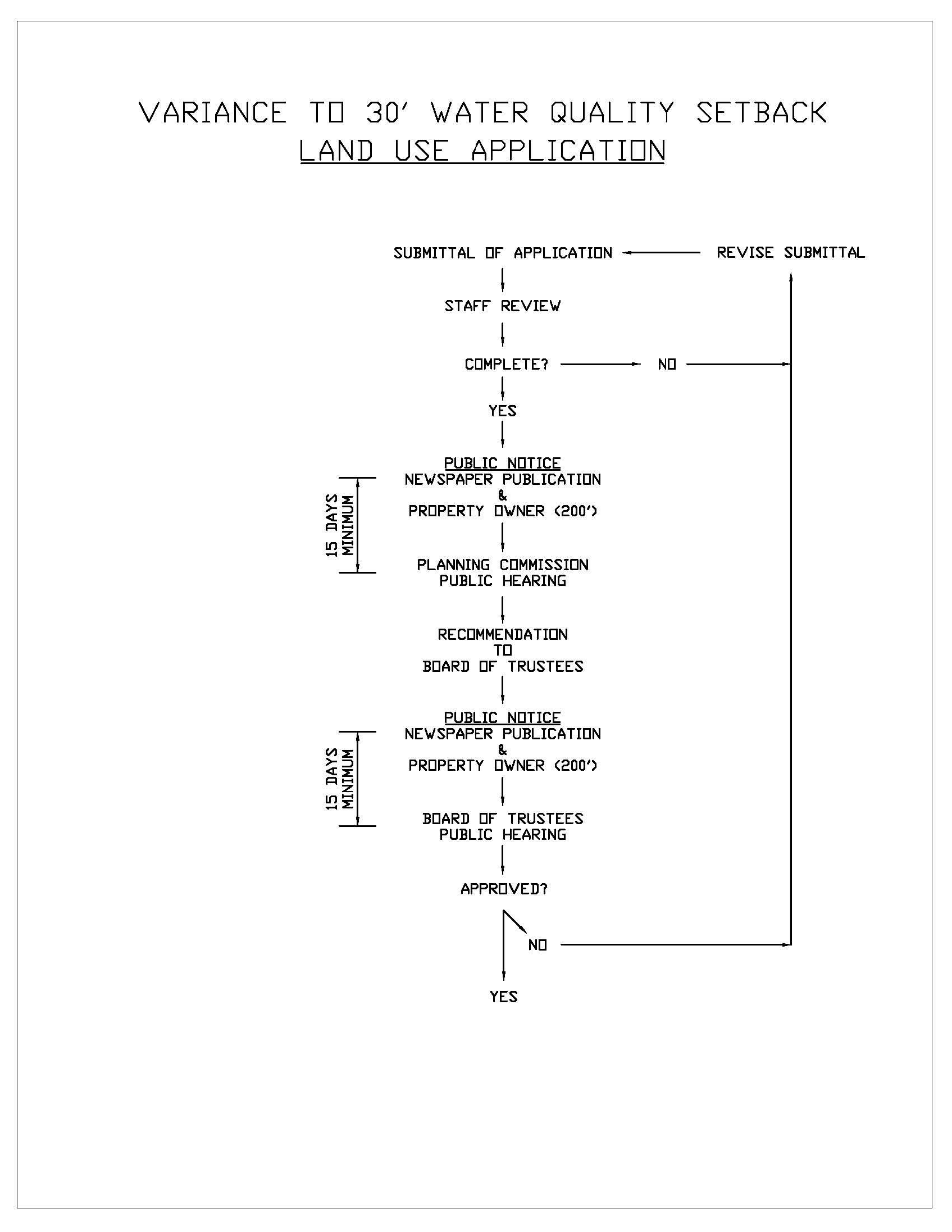
(B)
Boathouse and Covered Boat Docks Construction.
1.
General. In Grand Lake, construction of boathouses and covered boat docks is a unique case and requires a public hearing before the issuance of a Building Permit. Boathouse construction and covered boat dock construction does not require a special use or conditional use permit, but any conditions placed on the construction of said boathouses and covered boat docks will constitute conditions for a Building Permit.
Uncovered boat docks are not subject to the provisions of this Section so long as the placement of said uncovered dock meets the provisions of this Section and so long as said uncovered dock does not extend more than thirty-five (35') feet into the lake. Such docks shall be handled administratively through the issuance of a Building Permit.
2.
Boathouse and Boat Dock Design Standards. In addition to the Grand Lake Design Review Standards and any other applicable agency's regulations, all boathouses and covered boat docks shall comply with the following Design Standards unless a site-specific exception is allowed:
Height Limit: No structure shall exceed sixteen feet (16') from the mean water line to the highest point of the structure.
Width Limit: No structure shall exceed thirty feet (30') in width. This width excludes any uncovered dock or decking that is physically attached to the structure. Side setbacks must be satisfied.
Setbacks: All structures, including uncovered boat docks, shall meet the side setback requirements of the zoning district. Notwithstanding any other provision of this zoning code, freestanding uncovered docks, or docks attached to the sides of boathouses shall be allowed to encroach five (5') feet into the side setback requirements of the zoning district.
Extension Beyond Shoreline: No structure may extend more than thirty-five feet (35') beyond the natural shoreline, including any uncovered dock or decking that is physically attached to the structure. There may be site-specific cases where boathouses and covered boat docks may be dug into the shoreline, with approval of the applicable agency having jurisdiction, to preserve the natural character of the surrounding area.
Notwithstanding any other provisions contained in this section, property within the Town and which borders Shadow Mountain Lake is subject to the jurisdiction of the United States Government as regards the installation of boathouses, covered and uncovered boat docks into Shadow Mountain Lake.
3.
Commercial Marinas. In Grand Lake, construction of Commercial Marinas are a unique case and requires a Public Hearing before the issuance of a building permit. To the extent possible, Commercial Marinas shall conform to the Boathouse and Boat Dock Design Standards. The Planning Commission may grant greater height, as well as a greater extension beyond the shoreline, given the commercial considerations.
4.
Submission Requirements. Complete applications include a site plan and supplemental information. All proposals must adhere to Boathouse and Boat Dock Design Standards, as identified in the previous Section of this Article.
(a)
Site Plan. The minimum site plan data required includes:
1.
Name of property owner and applicant.
2.
Location of property: Legal Description and Street Address.
3.
Lots and blocks numbered consecutively.
4.
Date of preparation, map scale, and north sign.
5.
High water line.
6.
The existing topography of the site shall be shown.
7.
Abutting property lines.
8.
Existing structure(s) — with labels.
9.
Proposed structure(s) — with labels.
(i)
Dimensions of proposed structure(s) including height.
(ii)
Setbacks from property lines.
(iii)
Square footage of decks.
10.
Supplemental Information. The following information does not have to be addressed on the site plan but must be included with building permit application. The minimum supplemental information required includes:
(i)
Description of materials (including color samples) for siding, roof, window trim, decks, docks, railings, etc.
(ii)
Erosion and sediment control practices. Silt fencing or equivalent is required on any site adjacent to a body of water or on a steep hillside. Erosion control will be required to insure sedimentation does not leave the site. Town officials have the right to require erosion control on any site.
(iii)
Identify existing landscaping that will be disturbed. Identify landscaping material(s) to be placed on the site after construction.
(iv)
H.O.A. approval, if applicable.
(v)
U.S. Forest Service approval if the proposed development is located on Shadow Mountain Lake.
(vi)
Indemnification Agreement.
5.
Submission. One (1) complete building permit application, including a site plan, and supplemental information with the appropriate fee/or deposit, as set by resolution by the Town Board of Trustees, must be received twenty-one (21) days prior to the next regularly-scheduled Planning Commission meeting. Staff will have fourteen (14) days to determine completeness. Upon determination of completeness, the applicant must submit an additional ten (10) copies, a CD of all drawings in PDF format, of supplemental information to Town Staff.
(a)
The Town of Grand Lake shall not review requests of this nature unless the applicant (its constituents or members) are current with the Town and all Town enterprises for all fees, assessments, charges, taxes, or amount due of any type.
6.
Review Process. The public hearing will be held before the Planning Commission, and such factors as size, lake bed disturbance, surrounding property owners' concerns and other relevant factors will be considered. The date of the hearing will be set by Town Staff and notice of said hearing will be placed in the newspaper of public record for the Town at least fifteen (15) days prior to the hearing. The Town shall notify by certified mail all property owners within two hundred (200) feet of the property boundary on which the boathouse or covered boat dock will be placed of the date of the hearing, fifteen (15) days in advance of the hearing. After taking evidence in relation to said boathouse or covered boat dock, the Planning Commission shall recommend approval, approval with conditions or denial of the Building Permit application to the Board of Trustees. The Planning Commission may recommend, based on site-specific conditions, approval of a design that exceeds specified parameters of the Boathouse and Boat Dock Design Standards and of applications for multi-family residences with lake frontage, lakefront properties without a residence, and commercial marinas. No recommendation shall be considered grounds for the recommended approval of subsequent applications. The Board of Trustees shall act on the application at their next regularly scheduled meeting.
7.
Appeals. Appeals to the Board of Trustees decision may be considered by the Zoning Board of Adjustment.
(a)
Applicants appealing the Board of Trustees denial of the boathouse/covered boat dock building permit application shall file with Town Staff a request for hearing. The form of the appeal shall be in the manner as is prescribed by Town Staff. All appeals shall be accompanied by a non-refundable processing fee set, by resolution, by the Town Board of Trustees. The matter shall be scheduled for the Zoning Board of Adjustment. At that meeting the Board shall determine if the denial is to be sustained or whether a public hearing shall be required. The sustaining of the appeal is a final decision.
1.
The Town of Grand Lake shall not review or continue to process requests of this nature unless the applicant (its constituents or members) are current with the Town and all Town enterprises for all fees, assessments, charges, taxes, or amount due of any type.
(b)
If the Board determines a public hearing is appropriate, then at least fifteen (15) days prior to the scheduled date, Town Staff shall cause a legal notice to run in a local newspaper of general circulation advertising the time, date, and location of the public hearing. In addition, at least fifteen (15) days prior to the scheduled date, Town Staff shall cause certified letters to be mailed to all property owners within two hundred (200') feet of any portion of the property proposed indicating the time, date, and location of the public hearing.
8.
Permit Approval. The applicant shall comply with all conditions, as are imposed by the Board, as a condition of issuance. One such condition, applicable to all boathouse and/or covered boat dock building permit applications, is Army Corps of Engineers approval.
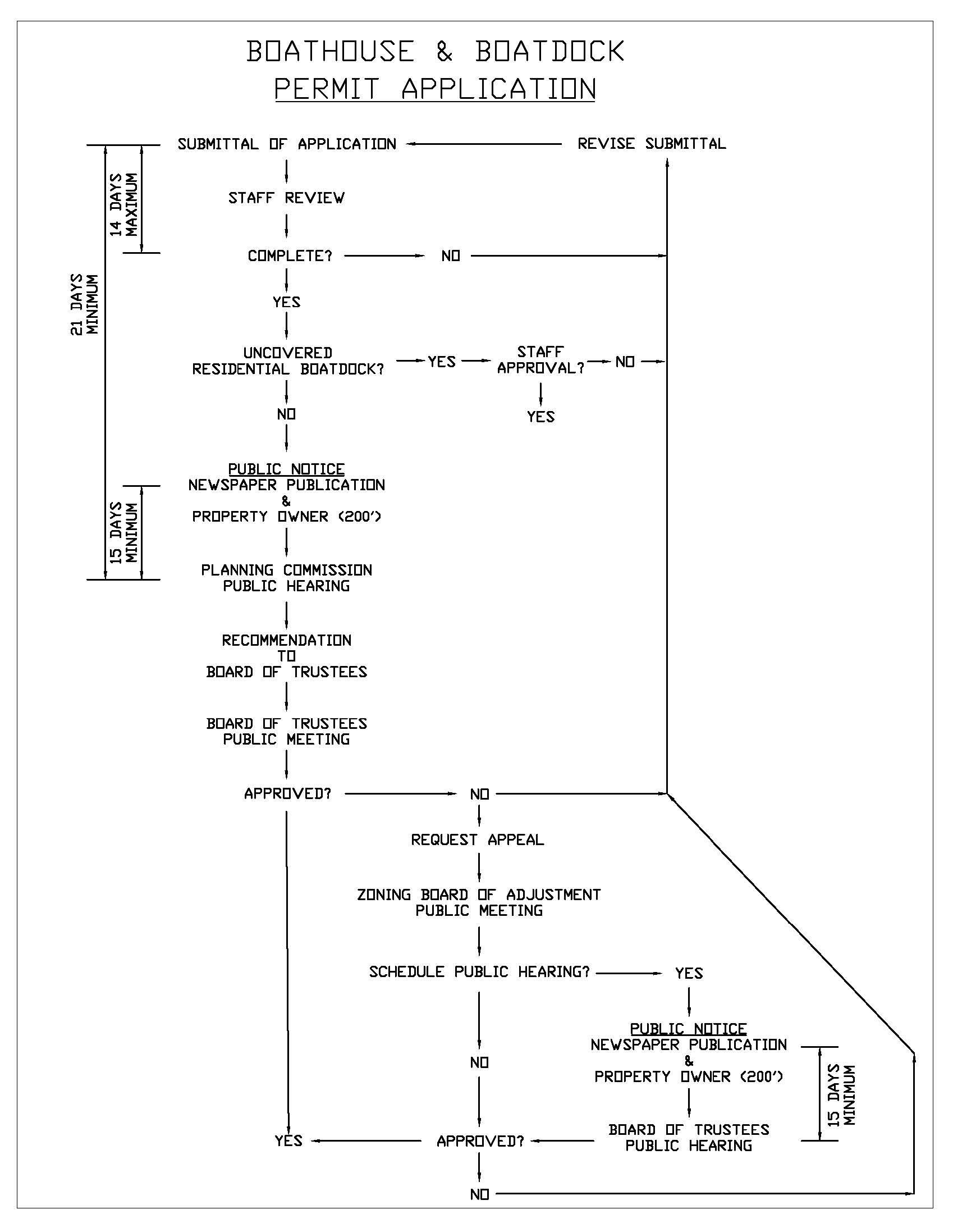
12-2-30 - Telecommunications.
(A)
Intent. It is the intent of the Town by establishing telecommunication standards to ensure the quality and appearance of such infrastructure including the placement and location of facilities; new construction of, and modification of existing, commercial and/or personal wireless service facilities that would ensure quality construction and compatible placement of facilities; and the appearance of new or improved developments coinciding with the Grand Lake Comprehensive Plan, and this Title of the Municipal Code.
(B)
Plan required. A site plan shall be submitted to the Planning Department and contain the following information:
1.
A site plan that shows the relative shape, size and location of all existing and proposed transmission structures, guy wires anchors, warning signs, fencing and access restrictions.
2.
A report by a licensed professional engineer demonstrating compliance with applicable structural standards and the general structural capacity of the proposed facility.
3.
The number, type and size of antenna that can be accommodated.
4.
A report that includes the following, if applicable:
(a)
A description of any proposed telecommunications facility including height above grade, materials, and color.
(b)
A landscaping and/or visual mitigation plan (to scale) acceptable to the Director of Planning, detailing how screening from the public view will be accomplished, including cross sectional views, as appropriate.
(c)
An erosion control and revegetation plan.
(d)
Each permit application shall be accompanied at the time of filing by a fee as established by Town Board of Trustees by resolution.
(C)
Any decision to deny an application requesting to place, construct or modify personal wireless service facilities shall be in writing and supported by substantial evidence contained in a written record.
(D)
Definitions.
Accessory equipment for low-power telecommunications facility means equipment including buildings and cabinets, used to protect and enable radio switching equipment, backup power and other devices, but not including antennas that is necessary for the operation of a low-power telecommunications facility.
Antenna means device used in communications which transmits or receives radio signals.
Antenna tower means a structure built for the sole or primary purpose of supporting any Federal Communications Commission-licensed or authorized antennas and their associated facilities, including structures that are constructed for wireless communications services including without limitation private, broadcast, and public safety services, as well as unlicensed wireless services and fixed wireless services such as microwave backhaul, and the associated site. This includes guyed mast, lattice towers, monopole antennas, alternative antenna tower structures and towers taller than ten (10) feet constructed on top of another building, along with any separate building on the lot used to house any supporting electronic equipment.
Base station means a structure or equipment, other than a tower, at a fixed location that enables Federal Communications Commission-licensed or authorized wireless communications between user equipment and a communications network. The term includes any equipment associated with wireless communications services, including radio transceivers, antennas, coaxial or fiber-optic cable, regular and backup power supplies, and comparable equipment, regardless of technological configuration (including Distributed Antenna Systems and small-cell networks). The term includes any structure, other than a tower, to which any of the equipment described above is attached.
Building roof or wall mounted telecommunications facility means a low-power telecommunication facility where antennae are mounted either on the roof or face of a legally existing building other than a building or structure accessory to a telecommunications facility. Facilities within this category may include micro-cell or repeater facilities.
Co-location means locating wireless communications equipment from more than one (1) provider on a single site.
Commercial Mobile Radio Service (CMRS) facility, also known as, low-power telecommunication facility, means an unstaffed facility consisting of antennae, equipment and equipment storage shelters used for the reception, switching and/or transmission of wireless telecommunications including, but not limited to, paging, enhanced specialized mobile radio, personal communications services, cellular telephone, and similar technologies. These facilities operate at one thousand (1,000) watts or less of effective radiated power and within frequencies authorized by the Federal Communications Commission for such purposes.
Eligible telecommunications facility request means any request for a land use approval for the modification of an existing tower or base station that involves the collocation of new transmission equipment, the removal of transmission equipment or the replacement of transmission equipment.
Equipment storage shelter means structure used for freestanding CMRS facilities or, where necessary, roof or building-mounted facilities to house CMRS equipment. These shelters are not intended for human habitation and typically range between four hundred (400) and nine hundred (900) square feet.
Federal Communications Commission (FCC) means the federal agency responsible for licensing and regulating communication providers. The FCC has primary regulatory control over communications providers through its powers to control interstate commerce and to provide a comprehensive national system in accordance with the Federal Communications Act.
Freestanding telecommunication facility means a CMRS facility that consists of a stand-alone support structure, antennae, and any associated equipment storage shelter.
Lattice tower means a guyed or self-supporting three- or four-sided, open, steel frame structure used to support telecommunications equipment.
Micro-cell facility means a low-power telecommunications facility used to provide increased capacity in areas of high service demand or to improve coverage in areas of weak coverage.
Monopole means a structure composed of a single spire used to support telecommunications equipment.
Panel antenna means an antenna or array of antennas designed to concentrate a radio signal in a particular area.
Radio tower means a structure for sending and/or receiving an analog or digital communication signal over the air, excepting the standard "satellite dish" under thirty-six-inch diameter.
Repeater telecommunications facility means a low-power facility (CMRS) that extends coverage to areas not covered by the originating primary facility.
Telecommunications infrastructure means the cables, switches, radio towers and other facilities and equipment that are required to make telecommunications work.
Tower means any structure built for the sole or primary purpose of supporting any Federal Communications Commission-licensed or authorized antennas and their associated facilities, including structures that are constructed for wireless communications services including without limitation private, broadcast, and public safety services, as well as unlicensed wireless services and fixed wireless services such as microwave backhaul, and the associated site.
Whip antenna means an antenna that transmits signals in three hundred sixty (360) degrees and are typically cylindrical in shape.
Wireless communications site means an installation containing the transmitters, receivers, and control equipment necessary to connect the mobile telephone system and the conventional wireline telephone network.
(E)
Standards for all telecommunications facilities.
1.
The standards in Section 12-2-30 apply to all applications of telecommunication facilities. The applicant shall demonstrate to the Town, in writing, it meets all applicable standards and provisions of the Code.
2.
The Town encourages co-location of telecommunication facilities to minimize the number of telecommunication sites, however, does not encourage the co-location of a large amount of co-located towers in the same area.
(a)
No telecommunications facility owner or operator shall unfairly exclude a telecommunication competitor from using the same facility or location. Upon request by the Town, the owner or operator shall provide evidence why co-location is not possible.
(b)
If a telecommunication competitor attempts to co-locate a facility on an existing or approved telecommunication facility or location, and the parties cannot reach agreement, the Town may require a third-party technical study at the expense of either or both parties to determine the feasibility of co-location.
3.
Telecommunication facility owners or operators shall verify that the low- power telecommunication facility complies at all times with the current Federal Communications Commission standards for cumulative field measurements of radio frequency power densities, electromagnetic fields and regulations prohibiting localized interference with reception of television and radio broadcasts.
4.
If the telecommunications facility ceases operating for six (6) consecutive months, the facility owner or operator shall remove it within ninety (90) days. If the facility is not removed in that time, the Town will notify the owner, by certified mail, to remove the facility or the Town will remove it at the owner's expense.
5.
Any modifications to approved facilities shall be submitted to the Planning Department at least thirty (30) days prior to any modification to increase the wind or weight loading capacity, height or footprint of a tower, and the Planning Department may request copies of plans depicting such modification and other evidence necessary to demonstrate that such modifications are in compliance.
6.
Telecommunication facilities, including small cell facilities, will comply with the following zone district use standards and land use application processes identified in the following zoning and land use table:
P Permitted (use by right with a Site Plan approval process).
NP Not permitted.
SU Special use review.
MLA Master License Agreement.
(F)
Standards for freestanding telecommunication facilities, excluding small cell facilities which are found in a subsequent subsection of this Chapter.
1.
Except as provided for Section I in this Chapter, A freestanding telecommunication facility shall meet the greater of the following minimum setbacks from all property lines:
(a)
The setback for a principal building within the applicable zoning district;
(b)
Twenty-five percent (25%) of the facility height, including antennas; or
(c)
The facility height, including antennas, if the facility is in or adjacent to any residentially zoned areas. The Town shall consider a facility separated by a street or public right-of-way from a zoning district as adjacent to that zoning district.
2.
Except as provided for Section I in this Chapter, a freestanding telecommunication facility shall meet the following standards to minimize impacts:
(a)
Use existing landforms, vegetation and structures to aid in screening the facility from view or blending in with the surrounding built and natural environment.
(b)
Comply with all applicable development standards inclusive of landscape regulations found in this Chapter.
(c)
Accommodate co-location of facilities unless the Town approves an alternative design.
(d)
Design materials, colors of antennas, and their support structures, shall be compatible with the surrounding environments, and monopole support structures shall be thirty (30) inches at the base and tapered to the top, except in the industrial zone districts. Maximum lattice tower width shall be thirty-six (36) inches except in the industrial zone districts. Maximum cross bar length shall be fifteen (15) feet, except in the industrial zone districts.
(e)
No freestanding telecommunication facility over forty (40) feet in height shall be permitted unless approved as a special use in accordance with Chapter 12 Article 2 of the Grand Lake Municipal Code.
(f)
Support infrastructure and equipment shall be located below grade, wherever possible.
3.
Except as provided for Section I in this Chapter, accessory equipment for a freestanding telecommunication facility shall meet the following requirements:
(a)
The buildings, shelters, cabinets, and other components shall be grouped as closely as technically possible and located below grade wherever possible.
(b)
The total footprint coverage area of the applicant's accessory equipment shall not exceed three hundred fifty (350) square feet.
(c)
No accessory structure shall exceed fifteen (15) feet in height.
(d)
Design, materials and colors of all structures shall be compatible with structures and vegetation on the same parcel and adjacent parcels and shall not reduce the parking requirement and landscaped area for other principal uses on the parcel.
(G)
Standards for Small Cell and Repeater Facilities. Small cell and repeater facilities must comply with all the standards for freestanding telecommunications facilities found above in addition to the following:
1.
A small cell facility or repeater facility in a Town street, right-of-way or electrical utility easement shall be exempt from the minimum setback requirements and shall follow standards outlined in the master license agreement.
2.
Each panel inclusive of antennas shall not exceed three (3) cubic feet in volume.
3.
The maximum diameter of a microwave dish antenna shall not exceed two (2) feet.
4.
Support infrastructure and equipment shall be located below grade, wherever possible.
5.
A residential zoned parcel may only have one (1) micro-cell telecommunications facility, small cell facility (SCF), or repeater telecommunication facility. A building with residential units on a nonresidential zoned parcel may have two (2) micro-cell telecommunication facilities, SCFs, or repeater telecommunication facilities.
6.
Heights.
(a)
A SCF must, 1) be mounted on a structure that is fifty (50) feet or less in height including any existing antennas; or 2) are mounted on structures that are no more than ten percent (10%) taller than other adjacent structures; or 3) do not extend the height of existing structures on which the SCF is to be located to a height of more than a total of fifty (50) feet, or to a height of no more than ten percent (10%) of the original structure height, whichever is greater.
(b)
Any transmission equipment placed on an existing tower shall not extend more than ten (10) feet above such pole. Any SCF attached to an electric distribution alternative tower structure may be located at the minimum height necessary to provide the safety clearance required by the electric utility if applicable.
7.
Noise. Noise generated on the site must not exceed the levels permitted by the Colorado Revised Statutes or the provisions of the Grand Lake Municipal Code. Any SCF owner or operator shall be permitted to exceed noise standards for a reasonable period of time during repairs subject to prior approval of the Planning Director.
8.
Design, spacing and location standards.
(a)
Priority of placement. SCF locations will be prioritized based upon technical and radio frequency needs and construction costs but, where feasible, attachments to poles shall be in the following order of placement priority:
i.
Third-party poles under the terms of a fully executed master license agreement with the owner of such poles;
ii.
Town-owned poles, including street lighting poles and utility poles, in the right-of-way;
iii.
New street lighting poles approved by the Town for street lighting purposes;
iv.
Proprietary poles of the licensee;
v.
The Town's traffic signal poles.
(b)
No stand-alone SCF shall block windows or any building entrances. To the extent feasible, poles shall be located at mid-blocks, away from intersections. All poles shall be located so as to ensure proper sight-distance lines.
(c)
The pole design, if any, in the Town right-of-way shall match the color, aesthetics, spacing, and architectural characteristics of existing streetlights installed adjacent to the pole.
(d)
Banner arms and luminaries are prohibited. A waiver of this prohibition may be granted upon a showing that an alternative design is technically infeasible.
(e)
SCFs and equipment shall not be installed within the dripline of any tree.
(f)
Pole caissons shall be circular in nature and designed to minimize impact of adjacent and future utilities. All designs must be stamped and signed by a registered Professional Engineer in the State of Colorado.
(g)
Spacing.
i.
No new freestanding SCF shall be within one thousand (1,000) feet of another freestanding SCF.
ii.
The Planning Director may exempt an applicant from these separation requirements under the following conditions: (1) the applicant demonstrates through technical network documentation that the minimum separation requirement cannot be satisfied for technical reasons, or (2) the Planning Director determines, when considering the surrounding topography; the nature of adjacent uses and nearby properties; and, the height of existing structures in the vicinity, that placement of a SCF at a distance less than six hundred (600) feet from another SCF will meet the intent of reducing visibility and visual clutter of any SCF to the extent possible.
iii.
These separation requirements do not apply to attachments made to existing alternative tower structures.
(h)
Non-interference.
i.
The alternative tower structure shall comply all applicable federal and state laws and regulations.
ii.
The alternative tower structure shall not alter vehicular circulation or parking within the right-of-way or impede vehicular, bicycle, or pedestrian access or visibility along the right-of-way.
iii.
No alternative tower structure may be located or maintained in a manner that causes unreasonable interference. Unreasonable interference means any use of the right-of-way that disrupts or interferes with its use by the Town, the general public, or other person authorized to use or be present upon the right-of-way, when there exists an alternative that would result in less disruption or interference. Unreasonable interference includes any use of the right-of-way that disrupts vehicular or pedestrian traffic, any interference with public utilities, and any other activity that will present a hazard to public health, safety, or welfare.
iv.
Concealment of all SCF equipment and appurtenances shall be required.
v.
Electric metering structures and/ or meters shall not be visible from the exterior of the pole or alternative tower structure which hosts the antennas where the pole or alternative tower structure is located. This requirement may be wholly or partially waived by the Planning Director where it is technically infeasible to place all, or part of a meter internally.
vi.
Ground mounted equipment must be designed such that any ground mounted equipment must be located in a manner necessary to address both public safety and aesthetic concerns in the reasonable discretion of the Planning Director. Ground mounted equipment shall be flush-to-grade and housed in an underground equipment vault, except where technically infeasible. Ground-based equipment may be located within the rights-of-way on a case-by-case basis, accounting for impacts of such equipment within the right-of-way on the public health, safety, and welfare.
(i)
Ground level equipment and buildings and the tower base shall be screened. The standards for equipment and buildings are as follows:
i.
The maximum floor area is three hundred fifty (350) square feet, and the maximum height is twelve (12) feet per carrier.
ii.
Equipment mounted on a roof shall have a finish similar to the exterior building walls. Equipment for roof mounted antenna may also be located within the building on which the antenna is mounted, subject to generally accepted engineering practices. Equipment, buildings, antennas, and related equipment shall occupy no more than twenty-five percent (25%) of the total roof area of a building.
(j)
Residential zones. Towers shall be set back from property lines a distance equal to three hundred percent (300%) of tower height; provided, however, that a lesser setback may be permitted if the Planning Director determines that:
i.
There are unusual geographical limitations that justify the reduced setback;
ii.
The setback is not less than a distance equal to one hundred percent (100%) of tower height; and
iii.
The tower is camouflaged or otherwise adapted to be compatible with the surrounding area.
(k)
All other zones. In all zones that are not residential zones, towers shall comply with the minimum setback requirements of the area in which they are located, except that if property in such non-residential zone is adjacent to property in the residential zone, a tower shall be setback a distance of no less than one hundred ten percent (110%) of the tower height from the property line abutting such residential property.
9.
Abandonment. If a licensee ceases use of a SCF in the public right-of-way for a period of six (6) or more consecutive months, the SCF is deemed abandoned and is subject to removal, at the licensee's expense, upon notification provided in the master license agreement.
(H)
Standards for Building Wall or Roof Mounted Telecommunication Facilities. Except as provided for Section I in this Chapter, building wall or roof mounted telecommunications facilities must comply with the following:
1.
A building wall mounted telecommunication facility may encroach into a setback a maximum of two and one-half (2½) feet but shall not extend over a property line.
2.
A building roof mounted telecommunication facility, including antennas, shall not exceed the maximum structure height within the applicable zoning district, with the following exceptions for facilities on existing buildings exceeding or within five (5) feet of the height limit.
(a)
Whip antennas shall extend no more than ten (10) feet above the parapet of any roof or the structure to which they are mounted.
(b)
Panel antennas shall extend no more than five (5) feet above the parapet of the roof to which they are mounted.
(c)
Accessory equipment structures shall extend no more than five (5) feet above any parapet of the roof to which they are mounted.
3.
A building wall mounted telecommunication facility shall adhere to the following design standards to minimize impacts:
(a)
Design materials, colors and location of the facility shall be compatible with the building and wall it is mounted on and minimize adverse visual impacts.
(b)
Mounting of antennas shall be as flush to the building wall as technically possible and shall not extend above the roof line of the building.
(c)
Maximum area of panel antennas per building face shall not exceed twenty (20) square feet per facility or an aggregate total of sixty (60) square feet for all facilities.
4.
A building roof mounted telecommunication facility shall adhere to the following design standards to minimize impacts:
(a)
Design, materials, colors and location of the facility shall be compatible with the building it is mounted on and minimize adverse visual impacts.
(b)
Antennas, support structures, accessory equipment and all other roof-mounted appurtenances shall not exceed an aggregate total of twenty-five percent (25%) of the building roof area.
(c)
Only one (1) roof-mounted telecommunication facility support structure may extend more than ten (10) feet above the existing building or structure.
5.
The low-power telecommunication facility shall be mounted on a building wall if feasible, otherwise it may be mounted on the roof.
6.
A residential zoned parcel or building with residential units may only have one (1) building wall or roof-mounted telecommunication facility.
7.
Accessory equipment for a building wall or roof-mounted telecommunication facility shall meet the following requirements:
(a)
The buildings, shelters, cabinets, and other components shall be grouped as closely as technically possible.
(b)
Total footprint coverage area of the applicant's accessory equipment shall not exceed three hundred fifty (350) square feet.
(c)
No structure shall exceed fifteen (15) feet in height.
(d)
Design, materials and colors shall be compatible with structures and vegetation on the same parcel and adjacent parcels and shall not reduce the parking requirements and landscaped area for other principal uses on the parcel.
(I)
Eligible telecommunications facility requests.
1.
Applicability. This Subsection applies to all eligible telecommunications facility requests for land use approvals.
2.
Expedited review.
(a)
An eligible telecommunications facility request shall be approved or denied within sixty (60) days of the date of the request. This time period may be tolled only by mutual agreement or where an application is incomplete.
(b)
If the Town fails to approve or deny an eligible telecommunications facility request within the time frame for review (accounting for any tolling), the request shall be deemed granted; provided that this automatic approval shall become effective only upon the Town's receipt of written notification from the applicant after the review period has expired (accounting for any tolling) indicating that the application has been deemed granted.
3.
Application materials.
(a)
An applicant for an eligible telecommunications facility request shall be required to submit only such documentation and information as is reasonably necessary to determine whether a proposed modification would substantially change the physical dimensions of an eligible tower or base station.
(b)
The Town shall prepare, and from time-to-time revise, and make available an application form which shall be limited to the information necessary for the Town to consider whether an application would substantially change the physical dimensions of an eligible telecommunications facility request. Such information may include, without limitation, whether the project: (1) would result in a substantial change; and (2) violates a generally applicable law, regulation, or other rule reasonably related to public health and safety. The application may not require the applicant to demonstrate a need or business case for the proposed modification or collocation.
(c)
SCF applications outside the public right-of-way must be processed and completed within a reasonable time. A reasonable time is presumed to be sixty (60) days for applications for collocation on pre-existing structures and ninety (90) days for an application to place a SCF not on a pre-existing structure.
(d)
SCF applications within the public right-of-way shall be processed through a master license agreement.
4.
Incomplete applications.
(a)
When an application is incomplete, the Town shall provide written notice to the applicant within thirty (30) days, clearly and specifically identifying all missing documents or information.
(b)
If an application remains incomplete after a supplemental submission, the Town has ten (10) days to notify the applicant once again. Second or subsequent notices of incompleteness may not require the production of documents or information that was not requested in the original notice of incompleteness.
5.
Review.
(a)
Denial. A decision to deny an eligible telecommunications facility request shall be in writing and shall provide a description of reasons for the denial.
(b)
Approval.
i.
Notwithstanding any other provision of this Code, the Town shall approve any eligible telecommunications facility request that does not substantially change the physical dimensions of a tower or base station.
ii.
The Town may approve an eligible telecommunications facility request that substantially changes the physical dimensions of such tower or base station if it complies with the remainder of this Section.
iii.
The Town may condition the approval of any eligible telecommunications facility request on compliance with generally applicable building, structural, electrical, and safety codes or with other laws codifying objective standards reasonably related to health and safety.
6.
Substantial Change.
(a)
A substantial change in the height of an existing tower or base station occurs as follows:
i.
For a tower outside of a public right-of-way, when the height of the tower is increased by more than ten percent (10%), or by the height of one (1) additional antenna array with separation from the nearest existing antenna not to exceed twenty (20) feet, whichever is greater.
ii.
For a tower located in a public right-of-way or for a base station, when the height of the structure increases by more than ten percent (10%) or by more than ten (10) feet, whichever is greater.
(b)
Changes in height are measured as follows:
i.
When deployments are separated horizontally, changes in height shall be measured from the original support structure, not from the height of any existing telecommunications equipment.
ii.
When deployments are separated vertically, changes in height shall be measured from the height of the tower or base station, including any appurtenances, as the tower or base station existed on February 22, 2012.
(c)
A substantial change in the width of an existing tower or base station occurs as follows:
i.
For a tower outside of public rights-of-way, when the addition of an appurtenance to the body of the tower protrudes from the edge of the tower more than twenty (20) feet, or more than the width of the tower structure at the level of the appurtenance, whichever is greater.
ii.
For a tower in public right-of-way or a base station when the addition of an appurtenance to the body of the structure would protrude from the edge of the structure by more than six (6) feet.
(d)
A substantial change also occurs for an existing tower in a public right-of-way, or an existing base station as follows:
i.
When the change involves the installation of any new equipment cabinets on the ground, if no ground cabinets presently exist; or
ii.
When the change involves the installation of ground cabinets that are more than ten percent (10%) larger in height or overall volume than any existing ground cabinets.
(e)
A substantial change also occurs for an existing tower or base station when any of the following exist:
i.
When the change involves installation of more than the standard number of new equipment cabinets for the technology involved, or more than four (4) new cabinets, whichever is less.
ii.
When the change entails any excavation or deployment outside the current site.
iii.
When the change would defeat the concealment elements of the eligible support structure.
iv.
When the change does not comply with conditions associated with the original siting approval of the construction or modification of the tower, base station, or base station equipment. This limitation does not apply if the non-compliance is due to an increase in height, increase in width, addition of cabinets, or new excavation that would not exceed the thresholds identified in this substantial change section.
(J)
Nonconforming uses and buildings.
1.
All property within existing developments on the effective date of this Chapter which is not in compliance with the provisions of this Chapter shall be considered legal nonconforming.
2.
Telecommunication facilities cannot be installed on nonconforming structures or buildings.
(Ord. No. 04-2021, § 1, 4-26-2021)
Editor's note— Ord. No. 04-2021, § 1, adopted April 26, 2021, amended the Code by the addition of § 12-2-36; however, said provisions have been redesignated as § 12-2-30, at the editor's discretion, to maintain content flow of the Code.
12-2-31 - Special and Conditional Use Regulations.
(A)
Special Use Permits.
1.
Special Use General Information. The Special Use Permit (SUP) review process prescribed herein is intended to assure compatibility and harmony between the proposed special use with both the surrounding properties and the town at large.
(a)
The Special Use Permit Process shall not be used for the purpose of granting the use of mobile homes for the purpose of temporary living quarters.
(b)
The Town of Grand Lake shall not review requests of this nature unless the applicant (its constituents or members) are current with the Town and all Town enterprises for all fees, assessments, charges, taxes, or amount due of any type.
2.
General SUP. A permit for the temporary use (six (6) months or less) of private property.
(a)
For Residential and Resort-Zoned parcels and neighborhoods, the permit shall be utilized for the approval of proposed uses not listed as a Use-by-Right or a Conditional Use.
(b)
For Commercial/Mixed Use, the permit shall be utilized for the approval of proposed accessory uses, not incidental to the primary use of the property, or when there are two (2) or more businesses present, with at least one (1) business that is proposed to be located in a non-fixed structure, or a temporary facility; or when the total square footage of the unit/structure does not meet the minimum floor area for the zoning district where it is located.
(c)
The permit may be utilized for the approval of uses proposed on Public and Open Space-Zoned lands not owned by the Town of Grand Lake.
(d)
Application and Required Information for a General SUP:
1.
Applications must be submitted at least ninety (90) days prior to the date(s) of the proposed use.
(i)
Any significant changes to the application must be made at least thirty (30) days prior to the proposed use unless caused by an emergency, as determined by Town Staff.
(e)
The SUP Application, supporting documentation, and a CD of all supporting documentation in PDF format, shall be submitted to Town Staff in accordance with the above listed schedule. Town staff will have fourteen (14) days to determine whether or not the application is complete. Once determined complete, the request will be placed on the next regularly-scheduled Planning Commission meeting. The application shall be supported by documents, maps, plans and other material containing the following information, if applicable:
1.
Name and permanent address of applicant.
2.
Name and address of property owner and the legal description, street address and other identifying data concerning the proposed Special Use site.
3.
Authorization by the property owner for the proposed use.
4.
A description of the precise nature of the Special Use and a site plan showing its operating characteristics, including but not limited to: dimensions and locations of specific activities, off-street parking, ingress and egress points, traffic circulation, utilities and drainage features, and measures proposed to make the use compatible with other properties in the vicinity.
5.
Copy of a current and valid:
(i)
Colorado Sales Tax License,
(ii)
Grand Lake Sales Tax License,
(iii)
Grand Lake Business License.
6.
Any other information deemed by Town Staff to be reasonably necessary to carry out the provisions and the fair administration of this Article.
7.
An affidavit signed by the applicant stating that the information contained on the application is true and correct to the applicant's knowledge and further stating that knowing submission of false information shall be cause for the SUP to be immediately revoked without notice or hearing.
(f)
Commission Processing and Review Criteria for a General SUP:
1.
The Planning Commission shall review the SUP application in a Public Hearing to receive testimony and comment of interested citizens, businesses, and adjoining property owners prior to making a recommendation to the Town Board of Trustees.
(i)
At least fifteen (15) days prior to the scheduled Public Hearing date, Town Staff shall cause a legal notice to run in a local newspaper of general circulation advertising the time, date, and location of the SUP Public Hearing, and Town Staff shall cause certified letters to be mailed to all property owners within two hundred (200') feet of any portion of the property proposed for the SUP indicating the time, date, and location of the SUP Public Hearing.
2.
In making determination of a recommendation of approval or denial of the SUP application, the Commission shall consider the following factors:
(i)
Relationship of the proposed Special Use to the economic development objectives of the Town and the anticipated impact of the SUP on existing businesses.
(ii)
Effect upon traffic, with particular reference to congestion, automotive and pedestrian safety and convenience, traffic flow and control, access, maneuverability, and (if applicable) snow removal from the streets and parking areas.
(iii)
Effect upon the character of the area in which the proposed Special Use is to be located, including the scale and bulk of the proposed Special Use in relation to surrounding uses and neighborhood.
(iv)
Such other factors and criteria as the Commission deems applicable to the proposed Special Use including but not limited to: proposed length of use; specific businesses, land owners or other interested parties to be notified; or proposed conditions of SUP issuance.
3.
At the Public Hearing, after receiving comment and testimony, the Commission shall make a recommendation to the Board of Trustees in the form of a Resolution. Nothing in this Section shall preclude the Commission from tabling or continuing the Public Hearing to another time and place. If the Resolution is to approve the request, it shall contain the following findings:
(i)
That the proposed location of the use is in accord with the purposes of this Chapter and the purposes of the district in which the SUP site is located.
(ii)
That the proposed location of the Special Use and the conditions under which it would be operated or maintained will not be detrimental to the public health, safety, or welfare, nor will the proposed use be materially injurious to nearby land uses, properties, or improvements.
(iii)
That the proposed use will comply with all of the applicable provisions of the Code of Ordinances.
(iv)
That the applicant shall comply with such terms and conditions as the Commission determines are necessary to carry out the letter and intent of the Special Use Permit process.
(v)
That the SUP shall be valid for a specific duration of time, citing specific dates.
1.
In the case of reoccurring applications, the Planning Commission may make recommendation to the Town Board of Trustees for the Board's approval of an annually-reoccurring Special Use Permit not to exceed three (3) years.
4.
The applicant may appeal the Commission's decision to deny the SUP request to the Board of Trustees, in accordance with the procedure outlined in part Section 12-2-31(A)2(g)1.
(g)
Board of Trustees Processing and Review Criteria for a General SUP:
1.
Appeal of Commission Denial:
(i)
Applicants appealing the Commission denial of the SUP application shall file with Town Staff a request for hearing. The form of the appeal shall be in the manner as is prescribed by Town Staff. All appeals shall be accompanied by a non-refundable processing fee, set by resolution by the Town Board of Trustees. The matter shall be scheduled for the next regular Board meeting. At that meeting the Board shall determine if the denial is to be sustained or whether a Public Hearing shall be required. The sustaining of the denial is a final decision.
(ii)
If the Board determines a Public Hearing is appropriate, then at least fifteen (15) days prior to the scheduled date, Town Staff shall cause a legal notice to run in a local newspaper of general circulation advertising the time, date, and location of the SUP Public Hearing, and certified letters to be mailed to all property owners within two hundred (200') feet of any portion of the property proposed for the SUP indicating the time, date, and location of the SUP Public Hearing.
2.
Recommendation of Commission Approval or Conditional Approval:
(i)
Upon adoption and transmittal of the Commission's Resolution, Town Staff shall set a date for a Public Hearing on the application before the Board of Trustees. At least fifteen (15) days prior to the scheduled date, Town Staff shall cause a legal notice to run in a local newspaper of general circulation advertising the time, date, and location of the SUP Public Hearing and certified letters to be mailed to all property owners within two hundred (200') feet of any portion of the property proposed for the SUP indicating the time, date, and location of the SUP Public Hearing.
(ii)
Final action on the Special Use Permit is to be taken by the Board of Trustees at the Public Hearing; except that the Board may continue the Public Hearing to another time before taking final action.
(h)
Permit Issuance of Approval or Conditional Approval.
1.
A Special Use Permit shall not grant variances. Variances shall be granted in accordance with the procedures prescribed in the Municipal Code.
2.
The SUP shall be valid for a maximum period of six (6) months unless a different time period is authorized by the Board.
(i)
Approved annually-reoccurring permits shall be deemed to be invalid if any provisions of the approval have changed from previous years.
3.
The SUP applicant shall also be subject to all other procedures, permits and requirements of this and other applicable Ordinances, regulations and agreements of the Town. In the event of any conflict between the provisions of a Special Use Permit and any other permit, requirement, or agreement, the more restrictive provision shall prevail.
4.
Authorization of a change or waiver in any condition previously imposed in the authorization of a special use shall be subject to the same procedures as a new special use.
5.
The SUP applicant shall comply with all such other conditions as are imposed by the Board as a condition of issuance.
6.
Failure to adhere to the General Conditions shall be cause for Town Staff to either suspend or revoke the SUP without notice or hearing.
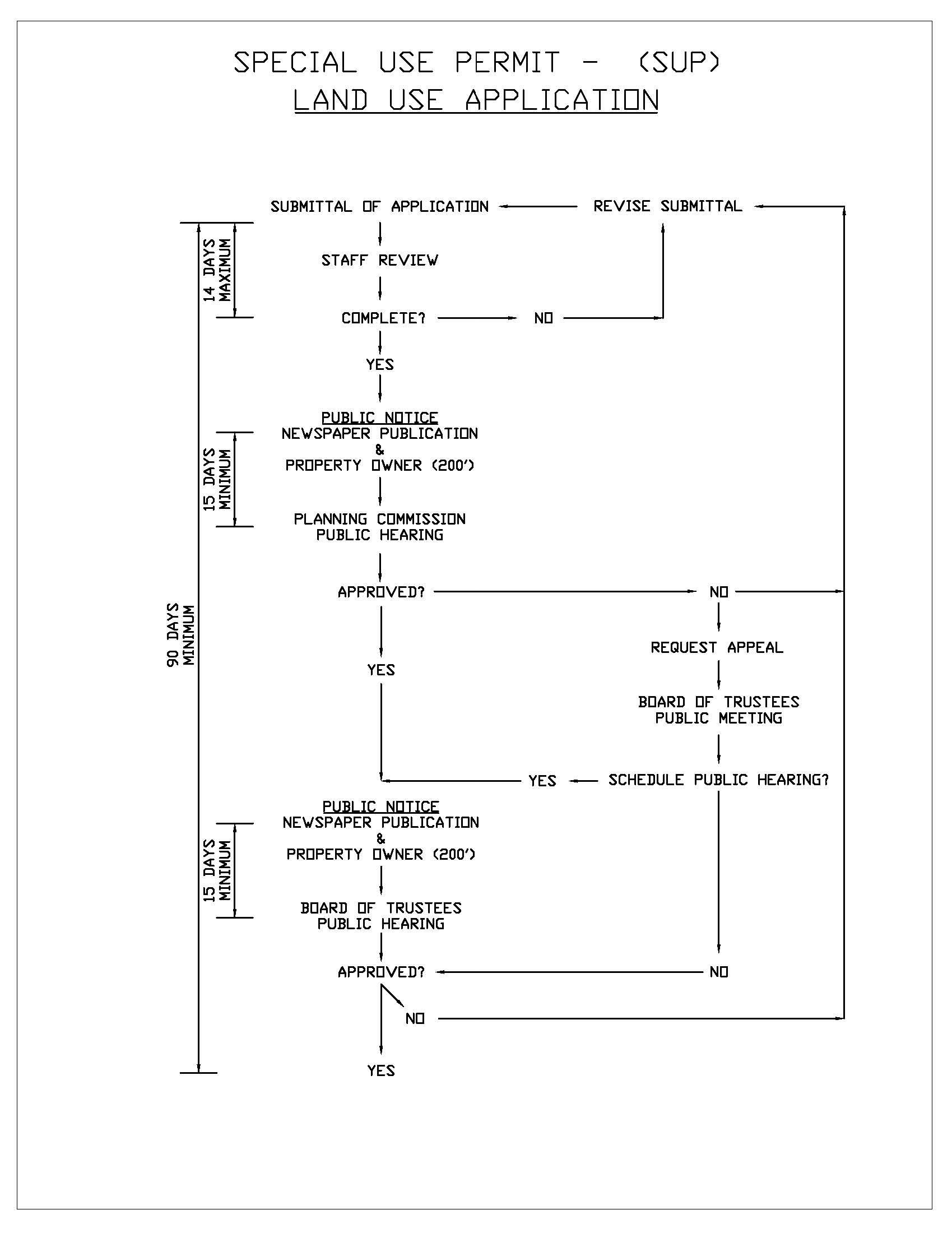
(B)
Conditional Use Permits (CUP).
1.
Types of Conditional Use Permits.
(a)
General Conditional Use Permits (CUPs). Permitted uses allowed in a district, in addition to the uses by right, where so authorized, are designated by individual zoning districts. Please refer to Sections 12-2-81 through 12-2-25 for individual zone listing.
(b)
Nightly Rental Conditional Use Permits.
2.
General CUP General Information. Conditional Uses are those uses allowed in a district, in addition to the uses by right, where so authorized, when and if a Conditional Use Permit (CUP) is granted, in accordance with special procedures and requirements. The CUP review process herein is intended to assure compatibility and harmony between the proposed conditional use with both the surrounding properties and the town at large.
(a)
The Town of Grand Lake shall not review requests of this nature unless the applicant (its constituents or members) are current with the Town and all Town enterprises for all fees, assessments, charges, taxes, or amount due of any type.
3.
Processing and Review Criteria. Unless identified in Section 12-2-31(B)4 Nightly Rental Conditional Use Permits, requests for Conditional Use Permits will be processed and reviewed according to the following criteria:
(a)
Procedure Before the Planning Commission. The applicant may propose a Conditional Use Permit request by submitting, to Town Staff, written material outlining the proposed use.
Included in this narrative should include (but not be limited to: operational hours and functions, management responsibilities, assessed neighborhood compatibility and impact). Written material must be accompanied by supporting documentation, including (if applicable) but not limited to:
1.
A site plan depicting the layout of the structure with the proposed use, ingress and egress point, parking and vehicular ingress and egress points, snow storage, trash receptacles, and any other item that may be pertinent to the site plan of the property and proposed use.
2.
Landowner or Homeowners Association approval.
(i)
Application and supporting materials, including a CD of all drawings in PDF format, must be submitted at least twenty-one (21) days prior to the next regular Planning Commission meeting. Within fourteen (14) days, staff will determine if the submitted application, and supplemental materials, are complete and schedule the Conditional Use Permit request for the next Planning Commission. The Planning Commission shall either:
1.
Formulate a recommendation concerning the Conditional Use including such terms and conditions as it may deem necessary and appropriate. The recommendation shall be placed on the next agenda of the Board of Trustees, or
2.
Schedule a Public Hearing for a later date but no sooner than twenty-eight (28) days from receipt of the application. At least fifteen (15) days prior to the scheduled date, Town Staff shall cause a legal notice to run in a local newspaper of general circulation advertising the time, date, and location of the CUP Public Hearing and certified letters to be mailed to all property owners within two hundred (200') feet of any portion of the property proposed for the SUP indicating the time, date, and location of the CUP Public Hearing.
3.
After taking evidence in relation to said Condition Use application, the Planning Commission shall formulate a recommendation, including such terms and conditions as it may deem necessary and appropriate. The recommendation shall be placed on the next agenda of the Board of Trustees.
(i)
The Planning Commission shall take the following factors into consideration prior to making recommendation to the Town Board of Trustees:
(ii)
Relationship of the proposed Conditional Use to the economic development objectives of the Town and the anticipated impact of the Conditional Use on existing businesses and neighborhood residences.
(iii)
Effect upon the character of the area in which the proposed Conditional Use is to be located, including the scale and bulk of the proposed Conditional Use in relation to surrounding uses and neighborhood.
(iv)
Such other factors and criteria as the Commission deems applicable to the proposed Conditional Use including but not limited to: hours of operation; signage; specific businesses, land owners or other interested parties to be notified; or proposed conditions of CUP issuance.
(b)
Procedure before the Board of Trustees.
1.
The Board of Trustees shall vote to approve, modify or disapprove the recommendation of the Planning Commission by Resolution. The Board of Trustees may also request a Public Hearing. Should the Board of Trustees choose so, at least fifteen (15) days prior to the scheduled date, Town Staff shall cause a legal notice to run in a local newspaper of general circulation advertising the time, date, and location of the CUP Public Hearing and certified letters to be mailed to all property owners within two hundred (200') feet of any portion of the property proposed for the SUP indicating the time, date, and location of the CUP Public Hearing.
2.
In the Public Hearing, the Town Board of Trustees may move to approve, modify or disapprove the recommendation of the Planning Commission by Resolution.
(c)
Submittal of New Materials.
1.
The applicant may not alter an application or submit additional materials to the Town Board of Trustees for review. Submittal of new materials shall constitute a new application and shall be reviewed by the Planning Commission prior to going before the Town Board of Trustees.
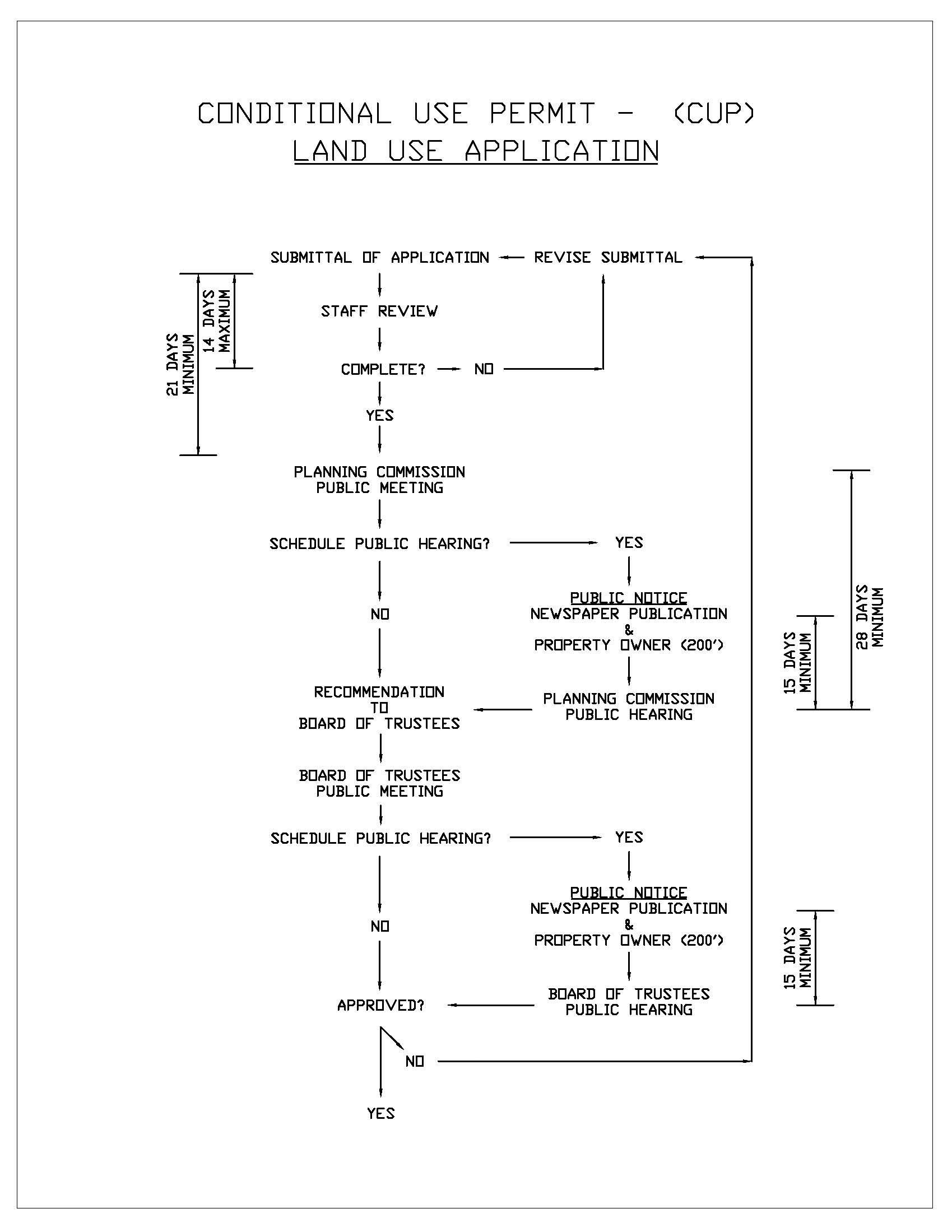
4.
Nightly Rental Conditional Use Permits. Nightly Rental Conditional Use Permits depend on the zoning district which the proposed rental is located. In addition to other Town requirements, no person shall rent or advertise to rent a Single Family structure, dwelling, dwelling unit, or lock-off unit for nightly rental purposes, except in accordance with the provisions of this Article. Nightly Rental CUP applications and renewals will be exempt from the Conditional Use Permitting deposit but may be assessed other fees, as defined within the provisions of this Article.
(a)
Nightly Rental Conditional Use Permits by Zone.
1.
The following shall apply only to the following districts: Open, Residential Estate, Single Family Residential High Density, Single Family Residential Medium Density, Single Family Residential Low Density, Multiple Family Residential Medium Density, and Multiple Family Residential High Density.
(i)
Town Action.
1.
If Town Staff determines that the application satisfies the requirements of Section 12-2-31(B)4., Town Staff shall issue the Nightly Rental License administratively.
2.
Once approved, the Town shall notify the county in writing that the subject property's use now includes nightly rentals
3.
Once approved, the Town will send notice to all adjoining property owners or all owners within one hundred (100) feet, whichever threshold is greater, with the name and 24-hour contact number(s) of the person in charge of the management of the subject property.
(ii)
Renewal.
1.
If zero complaints have been filed in the previous twelve (12) months, and the applicant is current on all taxes, fees and other charges owed the Town, the applicant must only repurchase their Nightly Rental License. For purposes of Section 12-2-31(B)4, a complaint must be either an official police citation or a letter signed by the complaining party.
2.
If one (1) or more complaints have been filed in the previous twelve (12) months, the applicant must pay the appropriate application fee, as set by Resolution by the Town Board of Trustee and Nightly Rental License fee. The Town shall provide notice to all adjoining property owners or all owners within one hundred (100) feet, whichever includes the largest number of properties, and the application shall be treated as a conditional use as outlined Section 12-2-31(B)4.
2.
The following shall apply only to the following districts: COMMERCIAL TRANSITIONAL, COMMERCIAL, and RESORT DISTRICTS.
(i)
Town Action.
1.
If Town Staff determines that the application satisfies the requirements of Section 12-2-31(B)4, the Nightly Rental License will be issued.
2.
Once approved, the Town shall notify the county in writing that the subject property's use now includes nightly rentals. Should the county elect to assess the property at a commercial rate, the owner has the option of purchasing a business license in lieu of the Nightly Rental License.
3.
Once approved, the Town will send notice to all adjoining property owners or all owners within one hundred (100) feet, whichever threshold is greater, with the name and 24-hour contact number(s) of the person in charge of the management of the subject property.
(ii)
Renewal.
1.
If the applicant is current on all taxes, fees and other charges owed the Town, the applicant must only repurchase their Nightly Rental License.
3.
The following shall apply only to the following districts: PD and PUD.
(i)
Planned Developments/Planned Unit Developments—Are considered one (1) in the same; PD's that have no underlying zoning or are zoned PD or PUD shall be governed under Section 12-2-31(B)4(a)1.
(b)
Nightly Rental Conditional Use Permit Regulations. Nightly rentals of such units shall only be authorized if all of the following conditions are met:
1.
Applicant must provide two (2) copies of a site plan that displays conformance with the following criteria, the appropriate application fee for all units listed in Section 12-2-31(B)4(a)1, and the appropriate Nightly Rental License fee. No person shall rent or advertise for rent their structure, dwelling or dwelling unit unless a Nightly Rental License has been granted by Town Staff. A nightly Rental License must be obtained for each structure, dwelling, or dwelling unit. If an application is subsequently denied, the applicant shall be refunded the Nightly Rental License fee.
2.
All fees, dues, debts to the Town of Grand Lake, and taxes must be current before a license will be issued.
3.
The fee for a Nightly Rental License is set by Resolution and shall be based upon occupancy categories. All Nightly Rentals shall be issued for twelve (12) months, from the date that the application is approved. The Nightly Rental License for a unit is transferable to a new owner of that unit upon completion of a complete and approved application.
4.
No person shall be granted a Nightly Rental License unless a state sales tax number has been received to provide for the collection of state, local sales and lodging taxes. If the structure, dwelling, or dwelling unit is operated by a third party as defined in Section 12-2-31(B)4(b)5, the third party may use a pre-existing sales tax number for purposes of this paragraph.
5.
At the time an application for a license is submitted, the licensee shall provide to Town Staff the name, address and telephone number of any current management company, rental agency or other person employed or engaged by the licensee to manage, rent or supervise the nightly rental. It shall be the duty of the licensee to update such information throughout the term of the license so that Town Staff always has the correct and current information.
6.
At the time of the application of the license the licensee shall provide to Town Staff the name, address and telephone number of a local contact person who is authorized by the licensee to receive communications from the Town concerning the nightly rental. The local contact person may be a management company, rental agent or other person employed or engaged by the licensee to manage, rent or supervise the nightly rental. The local contact person shall maintain a residence or permanent place of business within forty-five (45) minutes driving distance to the Town and must be available twenty-four (24) hours per day, seven (7) days per week, during periods in which the structure is being rented. The designated local contact person may be changed by the licensee from time to time throughout the term of the license. To effect such change, the licensee shall notify Town Staff of the change in writing in advance of the change and shall, at the same time, provide Town Staff with the name, address, and telephone number of the licensee's replacement contact person. Any replacement contact person shall meet the requirements of this subparagraph. Contact information for the local contact person shall be posted in a conspicuous location inside of the nightly rental unit.
7.
Site Plan Criteria.
(i)
Adequate parking shall be shown on the site plan, as outlined in Section 12-228. Parking requirements for nightly rentals shall be calculated from Group II. The motor vehicles of all occupants of the nightly rentals shall be parked only on the site of the nightly rental, or in a Town-designated parking area located off of the site of the nightly rental. No motor vehicles shall be parked on the lawn or landscaped areas of a nightly rental, or in the public street or right-of-way adjacent to the nightly rental. No person shall be permitted to stay overnight in any motor vehicle which is parked at a nightly rental. All advertisements for the nightly rental unit shall specify the number of parking spaces available on the property in the description of the unit.
(ii)
There is a clearly-defined trash storage area and an adequate number of trash containers provided and the trash company hired for regular pick-up must be identified. The owner or property manager may use the Pay As You Throw (PAYT) trash program in lieu of hiring a trash company for regular pick-up. All trash containers, regardless of size, that receive trash that is attractive to bears or other wildlife shall be either: (1) an approved wildlife-resistant refuse container; or (2) a refuse container that is stored within a building, house, garage or approved wildlife-resistant enclosure, both which shall be secured with a locking mechanism at all times except when empty or when refuse is being deposited.
(iii)
The Single Family Dwelling Unit to be used as a nightly rental shall provide on-site snow storage that is equivalent to one-third (⅓) of the designated parking area and shall be in addition to and not part of the required parking area.
(iv)
The location of the Single Family Dwelling unit, Accessory Dwelling Unit, and all other buildings must be depicted and labeled accordingly. The scale, building materials and colors of the building shall be consistent with the neighborhood and shall not be used to draw attention to the structure.
(v)
The applicant shall obtain HOA sign-off if the property resides within an HOA.
8.
Additional Criteria.
(i)
While occupying or visiting a nightly rental, no person shall make, cause or permit unreasonable noise to be emitted from the nightly rental that is in violation of Section 7-1-15, Disturbing the Peace or Section 7-1-16, Unnecessary Noise. The text of sections 7-1-15 and 7-1-16 of the Grand Lake Municipal Code shall be posted in a conspicuous location inside the nightly rental unit.
(ii)
At no time shall a nightly rental qualify for a sign permit. If more than one (1) property is accessed by a shared driveway, written permission to access the drive must be obtained from each affected property owner.
(iii)
Nightly Rental units must pass annual fire and life safety inspections. Such fire and life safety inspections shall include, but not be limited to: determining that each nightly rental unit has sufficient numbers of adequately maintained smoke, carbon monoxide, and other required detectors; that each nightly rental unit has sufficient numbers of adequately maintained and rated fire extinguishers; that each nightly rental unit has sufficient and adequately maintained means of egress; and, such inspection shall determine the allowable occupancies for each nightly rental unit.
(a)
The standards for sufficiency, adequacy, and occupancy as referenced in this requirement shall be determined using the applicable criteria from the most recently adopted versions of the Primary Codes as defined in Grand Lake Town Code Chapter 9: Building Regulations.
(b)
All nightly rental units shall complete a fire and life safety inspection within twelve (12) months of applying for the initial nightly rental license. No renewal of a nightly rental license shall be issued unless the nightly rental unit has passed the fire and life safety inspection within the previous twelve (12) months.
(c)
The cost of the fire and life safety inspection shall be set by the agency conducting such inspections.
(iv)
All advertisements for the nightly rental unit must list the allowable occupancy of the unit in the description of the unit. Any person advertising a nightly rental unit at a higher occupancy than that identified in the most recent fire and life safety inspection or knowingly renting at a higher occupancy than that identified in the most recent fire and life safety inspection shall be in violation of this Section 12-2-31(B)4.
(v)
Compliance with the conditions set forth in Section 12-2-31(B)4(b) shall be the non-delegable responsibility of the owner of the nightly rental; and each owner of a nightly rental shall be strictly liable for complying with the conditions set forth in this Section or imposed by the Board of Trustees.
(vi)
Licensee to Receive Conditions. At the time of the issuance of a license, Town Staff shall provide the licensee with a copy of the special conditions set forth in Section 12-2-31(B)4(b) or imposed by the Board of Trustees.
(vii)
Licensee to Post License and Conditions. The licensee shall post a copy of the license and the conditions set forth in Section 12-2-31(B)4.(b) or imposed by the Board of Trustees in a conspicuous location in the nightly rental. The license and the conditions shall remain continuously posted in the nightly rental throughout the term of the license. All advertisements for the nightly rental unit shall include the Grand Lake nightly rental license number in the description of the unit.
(viii)
Licensee to Provide Management Company with Conditions. The licensee shall provide any management company, rental agency or other person employed or engaged by the licensee to manage, rent or supervise the nightly rental with a copy of the conditions set forth in Section 12-2-31(B)4(b) or imposed by the Board of Trustees.
(c)
Nightly Rental Conditional Use Permit Penalties.
1.
Any person found to be advertising a Nightly Rental without a license to rent that property will be notified by certified mail to cease and desist all advertisements. Upon receipt of that notice, the offending party shall have ten (10) days to remove the offending advertisement. After this grace period has ended, or upon a second or further violation, the offending party shall be determined to be in violation of this Ordinance and shall be ticketed for each offense.
2.
A violation of any part of Section 12-2-31(B)4. is punishable by a fine not to exceed one thousand five hundred dollars ($1,500.00) for each occurrence. Each day such violation persists or continues shall constitute a separate and distinct offense.
3.
If over the annual term of the nightly rental license a licensee commits three (3) or more violations of Section 12-2-31(B)4., it shall result in a six-month suspension of the nightly rental permit. If over the annual term of the nightly rental license a licensee commits five (5) or more violations of Section 12-2-31(B)4., it shall result in the permanent revocation of the nightly rental permit
4.
The Town may also seek an injunction in addition to all other remedies and penalties provided for by local ordinance or available law.
5.
All these remedies shall be in addition to all other remedies and penalties provided for by local ordinance or available at law.
(Ord. No. 01-2020, §§ 1, 2, 1-27-2020; Ord. No. 07-2020, § 1, 6-8-2020; Ord. No. 16-2022, § 1(Att.), 12-12-2022)
12-2-32 - Nonconforming Uses and Structures.
The Regulations set forth in this Section, or set forth elsewhere in this Article, when referred to in this Section are the Regulations for Nonconforming Uses and Buildings.
(A)
Nonconformance. Certain uses of land and buildings may be found to be in existence at the time of the passage of this Article which does not meet the requirements as set forth herein. It is the intent of this Article to allow the continuance of such nonconforming use.
1.
A building or use that is in violation of the requirements of this Code and was constructed or established since the adoption of this Code without the necessary approvals, permits or authorizations from the Town is considered nonconforming. The owner and/or operator of a nonconforming building or use shall be subject to actions and penalties allowed by this Code and all other applicable Town Ordinances and shall be required to correct the nonconforming situation to come into conformance with all applicable standards and regulations of this Code.
(B)
Expansion or Enlargement. A nonconforming building or use to be extended or enlarged shall conform with the provisions of this Article.
1.
A nonconforming structure may only be expanded pursuant to Section 12-2-32(c), Repairs and Maintenance, and any such expansion shall be in full compliance with this code.
(a)
Special Exceptions to Provisions on Expansion of Nonconforming Structures and Uses.
1.
The Planning Commission may authorize, upon appeal in specific cases, an exception permitting an increase in either or both the land use area or the floor area on a nonconforming structure or buildings occupied by a nonconforming use, subject to terms and conditions fixed by the Commission. Every exception authorized hereunder shall be personal to the applicant therefore and shall not be transferable, shall run with the land only after the construction of any authorized building and only for the life of such building. No exception shall be authorized hereunder unless the Commission shall find that all the following conditions exist:
(i)
The structure or use is nonconforming as defined by this Article and is in full compliance with all requirements of this Article applicable to nonconforming structures or uses;
(ii)
That, owing to exceptional and extraordinary circumstances, literal enforcement of the provisions of this Article regarding nonconforming structures or uses will result in unnecessary hardship;
(iii)
That the exception will not substantially or permanently injure the appropriate use of adjacent conforming property in the same zone district or other zone districts;
(iv)
That the exception will not alter the essential character of the district in which is located the property for which the exception is sought;
(v)
That the exception will not weaken the general purposes of this Article or the regulations established herein for the specific district;
(vi)
That the exception will be in harmony with the spirit and purposes of this Article;
(vii)
That the exception will not adversely affect the public health, safety, or welfare.
2.
A nonconforming use may be extended throughout any part of a building which was arranged or designed for such use at the enactment of this Article.
3.
The Planning Commission may authorize, upon appeal in specific cases, an exception permitting an increase in a nonconforming use on a parcel when the parcel has similar nonconformances, subject to terms and conditions fixed by the Commission. No exception shall be authorized hereunder unless the Commission shall find that all the following conditions exist:
(a)
The use is a nonconforming use as defined by this Article and is in full compliance with all requirements of this Article applicable to nonconforming uses;
(b)
That, owing to exceptional and extraordinary circumstances, literal enforcement of the provisions of this Article regarding nonconforming uses will result in unnecessary hardship;
(c)
That the exception will not substantially or permanently injure the appropriate use of adjacent conforming property in the same zone district or other zone districts;
(d)
That the exception will not alter the essential character of the district in which is located the property for which the exception is sought;
(e)
That the exception will not weaken the general purposes of this Article or the regulations established herein for the specific district;
(f)
That the exception will be in harmony with the spirit and purposes of this Article.
(g)
That the exception will not adversely affect the public health, safety, or welfare.
(C)
Repairs and Maintenance. The following changes or alterations may be made to a nonconforming building or building containing a nonconforming use:
1.
Maintenance repairs that are needed to maintain the good condition of a building, except that if a building has been officially condemned, it may not be restored under this provision.
2.
Any structural alteration or change in use that more than insignificantly reduces the degree of nonconforming or changes the use to conforming use.
(D)
Restoration or Replacement.
1.
Nonpurposeful destruction. Any nonconforming building or building containing a nonconforming use which is demolished or destroyed by an act of nature, or through any manner not purposefully accomplished by the owner, may be restored as of right if a building permit for reconstruction is issued within twelve (12) months of the date of destruction.
2.
Purposeful destruction. Any nonconforming building or building containing a nonconforming use which is purposefully demolished or destroyed may be replaced with a different building only if the replacement building is in conformance with the current provisions of this Code.
3.
If a building has been officially condemned, it may not be restored under this provision.
(E)
Discontinuance.
1.
Whenever a nonconforming use has been discontinued for a period of twelve (12) months it shall not thereafter be re-established and any further use shall be in conformance with the provisions of this Article.
2.
Any nonconforming use in existence at the time of the effective date of this Article that has an assessed valuation of all improvements of three hundred fifty dollars ($350.00) or less shall be discontinued within two (2) years from the effective date of nonconformance.
(F)
Nonconforming Lots. Nonconforming lots on record at the time of passage of this Article may be built upon providing that all other relevant district requirements are met and the approval of the Board of Adjustment is obtained.
(G)
Change in Nonconforming Use. A nonconforming use of a building or lot may be changed to a conforming use.
(H)
Construction Prior to Ordinance Passage. Nothing herein contained shall require any change in plans, construction, or designated use of a building or buildings for which a building permit has been issued or Town approval obtained and construction of which shall have been diligently prosecuted within three (3) months of the date of such permit or approval.
(I)
Creation of a Nonconforming Use or Building from Rezoning of Property Initiated by the Town after January 2006.
1.
Uses and buildings that were conforming prior to the Town initiating rezoning of the property will be permitted to expand the building or building containing a nonconforming use to the Building Height Limit and Area Regulations of the previous zone as declared in the ordinance adopted by the Board of Trustees and recorded with the Grand County Clerk and Recorder's Office.
(Ord. No. 10-2022, § 1(Exh. A), 8-8-2022)
12-2-33 - Administration.
(A)
Administration. The administration of this Article shall be the responsibility of the Town Board of Trustees, the Town Manager, or his designee. The administration of the provisions of this Article shall authorize the Town to administer and enforce the requirements set forth herein.
(B)
Enforcement. The provisions of this Article shall be enforced by the Mayor, the Town Board of Trustees, the Town Attorney and the Zoning Code Administrator, or his designee, by use of the following methods:
1.
Inspection and Ordering Removal of Violations.
2.
Proceedings in Municipal Court.
3.
Injunctive Proceedings.
4.
Section 1-1-11 Administrative Enforcement.
(C)
Complaints. Any person aggrieved by a violation or apparent violation of the provisions of this Article may file a written complaint with Town Staff who shall investigate such complaint and take legal action within five (5) days to have the violation penalized or removed, if such violation is found to exist.
(D)
Liability for Damages. This Article shall not be construed to hold the Town of Grand Lake or its authorized representatives responsible for any damage to persons or property by reason of the inspection or re-inspection authorized herein or failure to inspect or re-inspect or by reason of issuing a building permit as herein provided.
(E)
Fees and Deposits. The Board of Trustees may establish such fees and/or deposits as deemed necessary to carry out the administration of this article. Such fees and/or deposits shall be established by resolution adopted by the Board.
(F)
Appeals. Unless otherwise indicated in this Article any person adversely affected by any interpretation, requirement, application or enforcement of these Regulations may file an application for a variance, to be considered by the Planning Commission. Such application for a variance shall be filed with Town Staff on a furnished form specifying the grounds of appeal.
12-2-34 - Amendments.
Amendments to this Article shall be in accordance with the Statutes of the State of Colorado, with report and recommendations from the Planning Commission to the Town Board of Trustees required prior to the adoption of any such Amendment.
(A)
Declaration of Policy and Standards for Rezoning. For the purpose of establishing and maintaining sound, stable and desirable development within the Town of Grand Lake, the rezoning of land is to be discouraged and allowed only under certain circumstances as provided hereafter. This policy is based on the opinion of the Town Board of Trustees that the Town's Zoning Map is the result of a detailed and comprehensive appraisal of the Town's present and future needs regarding land use allocation and as such, should not be amended unless to correct a manifest error or because of changed or changing conditions in a particular area of the Town in general. Rezonings shall only be allowed if the applicant demonstrates by clear and convincing evidence that rezoning is necessary because of one (1) or more of the following reasons:
1.
The land to be rezoned was zoned in error and as presently zoned is inconsistent with the policies and goals of the Town's Comprehensive Plan.
2.
The area for which rezoning is requested has changed or is changing to such a degree that it is in the public interest to encourage a redevelopment of the area or new approach to development.
3.
The proposed rezoning is necessary in order to provide land for a community-related use which was not anticipated at the time of the adoption of the Town's Comprehensive Plan and that such rezoning will be consistent with the policies and goals of the Comprehensive Plan. This Declaration of Standards for Rezoning shall not control a rezoning which occurs incidental to a comprehensive revision of the Town's Zoning Map.
(B)
Procedure for Amendments in General. The Town Board of Trustees may, from time to time, on its own Motion, on Petition of any person or persons of interest, or on initial recommendation of the Planning Commission, amend, supplement or repeal the regulations and provisions of this Article, provided that where territory is sought to be rezoned on proposal other than by the Town Board of Trustees or by the Planning Commission, the person proposing or petitioning for rezoning of territory shall have a property interest in the subject territory.
1.
Planning Commission Advisory Report. Any proposed amendment or change to this Article or to the Zoning Map when initiated by the Town Board of Trustees shall be referred to the Planning Commission for an advisory report thereon. When a proposed amendment or change is initiated by the Planning Commission said advisory report shall accompany the initial recommendation of the Planning Commission.
2.
Procedure Before Planning Commission. Before giving an advisory report or initial recommendation on any proposed amendment to this Article or to the Zoning Map, the Planning Commission shall first conduct a public meeting thereon. Notice of the time and date of such meeting and a brief summary or explanation of the subject matter of the Hearing shall be given by adequate notice.
3.
Procedure Before the Town Board of Trustees. After receiving the advisory report from the Planning Commission, the Town Board of Trustees shall hold a Public Hearing before acting on the proposed amendment to this Article or to the Zoning Map. Notice of the time and place of the Public Hearing before the Town Board of Trustees shall be given by Town Staff, by one publication of the same at least fifteen (15) days prior to the hearing, in a newspaper of general circulation in the Town of Grand Lake.
(C)
Amendments to the Official Zoning Map. Any person petitioning for amendment to the Official Zoning Map shall submit an application the Planning Commission through the Building Administrator.
1.
Planning Commission Advisory Report. Any proposed amendment on the Zoning Map, when initiated by individual petition, shall be referred to the Planning Commission for an advisory report thereon.
2.
Procedure Before Planning Commission. Before giving an advisory report or initial recommendation on any proposed amendment to the zoning map, the Planning Commission shall first conduct a public meeting thereon. Prior to the public meeting, the applicant requesting amendment to the Official Map shall post his property with a sign, notifying the general public of the time and place of Planning Commission meeting at which said Application for Amendment shall be reviewed. Said sign shall be posted on the property frontage at intervals of approximately five hundred feet (500') at least fifteen (15) days prior to the scheduled meeting date and shall recite the rezoning applied for.
3.
Procedure Before Town Board of Trustees. After receiving the advisory report from the Planning Commission, the Town Board of Trustees shall hold a Public Hearing Before acting on the proposed amendment. Notice of the time and place of the Public Hearing before the Town Board of Trustees shall be given by Town Staff, by one (1) Publication of the same at least fifteen (15) days prior to the hearing, in a newspaper of general circulation in the Town of Grand Lake.
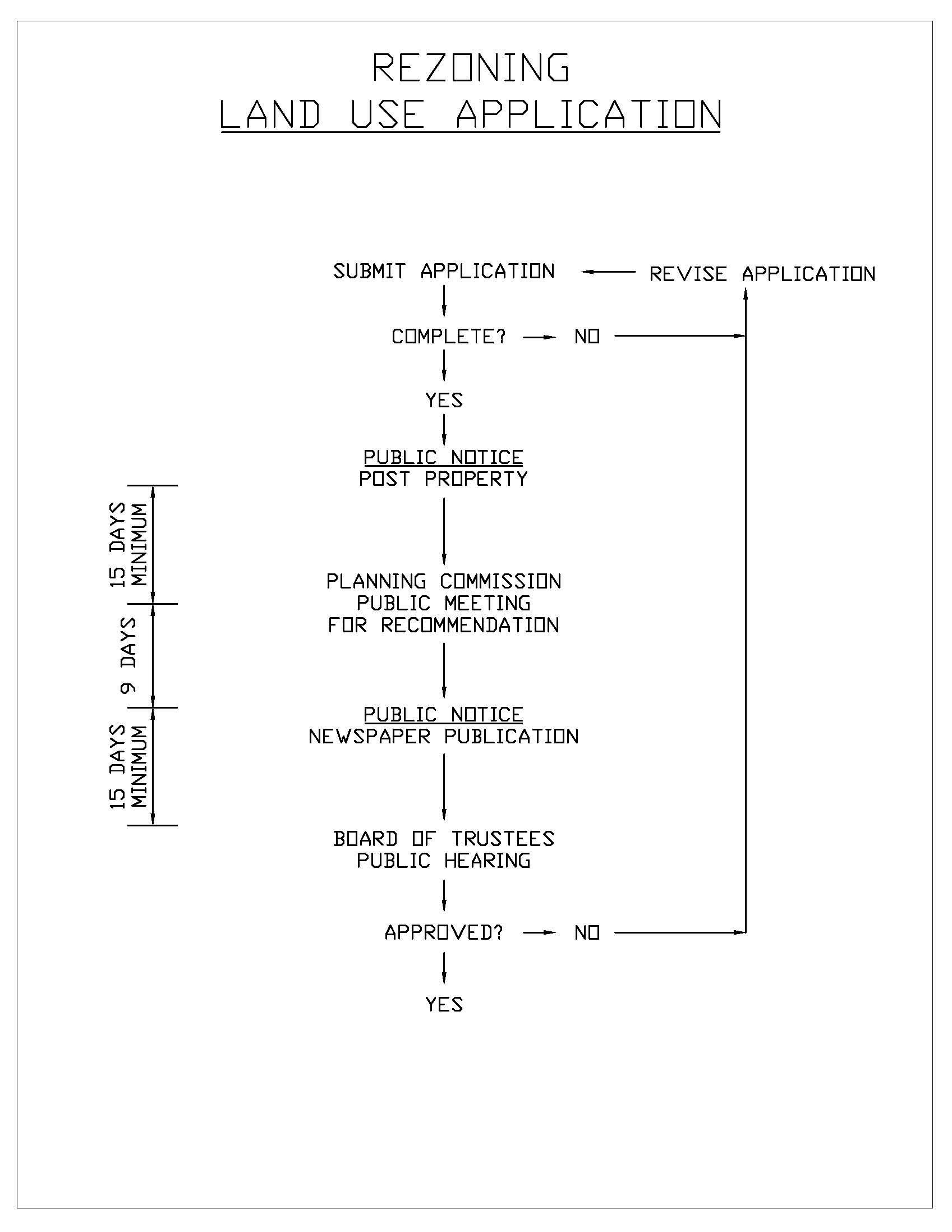
12-2-35 - Severability.
If any part, section, subsection, sentence, clause, or phrase of this Article adopted hereby is for any reason held to be invalid, such decisions shall not affect the validity of the remaining sections of this Article; the Board of Trustees hereby declares that it would have passed this Article and adopted each part, section, subsection, sentence, clause, or phrase thereof, irrespective of the fact that any one (1) or more parts, sections, subsections, sentences, clauses or phrases be declared invalid. Should any portion of this Article hereby be declared invalid then to the extent of such invalidity the amendment of Ordinances No. 20, Series 1974 and No. 3, Series 1978 in effect for any portions of this Article hereby which may be declared invalid or unenforceable.
Section 29, Ord. No. 10, Series 1980.
12-2-36 - Reserved.
Editor's note— Ord. No. 04-2021, § 1, adopted April 26, 2021, repealed the former § 12-2-36, and enacted a new section redesignated at the editor's discretion as § 12-2-30. The former § 12-2-36 pertained to the repeal of conflicting provisions in this Article and derived from Section 30, Ordinance No. 10, Series 1980.
12-2-37 - Interpretation.
In their interpretation and application, the provisions of this Article shall be held to be minimum requirements adopted for the promotion of the public health, safety and welfare.
(Section 31, Ordinance No. 10 Series 1980)
12-2-38 - Conflict.
Whenever the requirements of this Article are in conflict with the requirements of any other Article, Rule, Regulation, Private Covenant, or Deed Restriction, the more restrictive or that imposing the higher standards shall govern.
Section 32, Ordinance No. 10, Series 1980.

