
Grand Ledge City Zoning Code
ARTICLE III
TERMINOLOGY
Sec. 46-66.- Rules of construction.
The following rules of construction apply to the text of this chapter:
(1)
The particular shall control the general.
(2)
In the case of any difference of meaning or implication between text of this chapter and any caption or illustration, the text shall control.
(3)
The term "shall" is always mandatory and not discretionary. The term "may" is permissive.
(4)
Words used in the present tense shall include the future; and words used in the singular number shall include the plural, and the plural the singular, unless the context clearly indicates the contrary.
(5)
The term "building" includes the term "structure." A "building" or "structure" includes any part thereof.
(6)
The phrase "used for" includes "arranged for," "designed for," "intended for," "maintained for," or "occupied for."
(7)
The term "person" includes an individual, a corporation, a partnership, an incorporated association, or any other similar entity.
(8)
The term "dwelling" includes the term "residence" and the term "lot" includes the term "plat" or "parcel."
(9)
Unless the context clearly indicates the contrary, where a regulation involves two or more items, conditions, provisions, or events connected by the conjunction "and," "or," "either…or," the conjunction shall be interpreted as follows:
a.
"And" indicates that all the connected items, conditions, provisions, or events shall apply.
b.
"Or" indicates that the connected items, conditions, provisions, or events may apply singly or in any combination.
c.
"Either…or" indicates that the connected items, conditions, provisions, or events shall apply singly but not in combination.
(10)
Terms not herein defined shall have the meaning customarily assigned to them.
(Code 2002, § 220-3)
Sec. 46-67. - Definitions.
The following words, terms, and phrases, when used in this chapter all have the meanings ascribed to them in this section, except where the context clearly indicates a different meaning:
Accessory building means a building or structure located on the same lot with the principal or main building, or a portion thereof. An accessory building is detached from the main building. Where a structure is attached to a main building, it shall be considered a part of the main building.
Accessory use oraccessory means a use which is clearly incidental to, customarily found in connection with, and (except in the case of accessory off-street parking spaces or loading) located on the same zoning lot as the principal use to which it is related.
(1)
When the term "accessory" is used in this text, it shall have the same meaning as the term "accessory use."
(2)
An accessory use includes, but is not limited to, the following:
a.
Residential accommodations for servants and/or caretakers.
b.
Swimming pools, tennis courts, or similar recreation facilities for the use of the occupants of a residence, or their guests.
c.
Domestic or agricultural storage in a barn, shed, tool room, or similar accessory building or other structure.
d.
Storage of merchandise normally carried in stock in connection with a business or industrial use, unless such storage is excluded in the applicable district regulations.
e.
Storage on the premises of goods used in or produced by industrial uses or related activities, unless such storage is excluded in the applicable district regulations.
f.
Accessory off-street parking spaces, open or enclosed, subject to the accessory off-street parking regulations of the district in which the zoning lot is located.
g.
Uses clearly incidental to a main use such as, but not limited to, offices of an industrial or commercial complex located on the site of the commercial or industrial complex.
h.
Accessory off-street loading, subject to the off-street loading regulations for the district in which the zoning lot is located.
i.
Accessory signs, subject to the sign regulations for the district in which the zoning lot is located.
j.
A newsstand primarily for the convenience of the occupants of a building, which is located wholly within such and has no signs or displays on the exterior of the building.
Adult foster care facility means a residential structure that is licensed to provide room, board, and supervised care, but not continuous nursing care, for unrelated adults 18 years of age or older, in accordance with Public Act 218 of 1979, as amended (MCL 400.701 et seq.), and the Adult Foster Care Administrative Rules as administered by the state department of social services. The following four types of adult foster care homes are provided for by these definitions:
(1)
Adult foster care family home means a private residence with the approved capacity to receive six or fewer adults to be provided with foster care for five or more days a week and for two or more consecutive weeks. The adult foster care family home licensee shall be a member of the household and an occupant of the residence.
(2)
Adult foster care small group home means an adult foster care facility with the approved capacity to receive 12 or fewer adults to be provided with foster care. Small group homes for six or fewer adults are permitted by right in all districts where single-family homes are permitted. Licensee is not required to be a member of the household or an occupant of the residence.
(3)
Adult foster care large group home means an adult foster care facility with the approved capacity to receive at least 13 but not more than 20 adults to be provided with foster care.
(4)
Adult foster congregate facility means an adult foster care facility with the approved capacity to receive more than 20 adults to be provided with foster care.
Agriculture means raising of crops, animals and animal products, forestry, and commonly accepted agricultural operations for commercial purpose including the sale of products grown on the premises.
Airport means a tract of land that is maintained for the takeoff and landing of aircraft and that has facilities for the shelter, supply, and repair of such aircraft.
Alley means any dedicated public way other than a street affording a secondary means of access to abutting property, and is not intended for general traffic circulation.
Alterations means any change, addition, or modification in construction or type of occupancy, or in the structural parts of a building; any enlargement of a building whether by extending a side or by increasing its height; or the moving from one location to another.
Amusement device means any machine, device, or contrivance which, upon the insertion of a coin, token, or similar object, or which requires payment for its use, may be operated by the public for use as a game, entertainment, or amusement, whether operated by hand, electricity or any other power.
Amusement device arcade means any establishment open to the public wherein the principal uses consists of coin-operated amusement devices operated for profit.
Antenna means a device designed for the reception or transmission of communication.
Apartment means a suite of rooms or a room in a multiple-family building arranged and intended for a place of residence of a single-family or a group of individuals living together as a single housekeeping unit. The dwelling units in a multiple dwelling are defined as:
(1)
One-bedroom unit means a dwelling unit consisting of not more than two rooms, in addition to kitchen and necessary sanitary facilities, and for the purpose of computing density shall be considered as a two-room unit.
(2)
Two-bedroom unit means a dwelling unit consisting of not more than three rooms, in addition to kitchen and necessary sanitary facilities, and for the purpose of computing density shall be considered as a three-room unit.
(3)
Three-or-more-bedroom unit means a dwelling unit consisting of four or more rooms in addition to kitchen and necessary sanitary facilities. For the purpose of computing density, a three-bedroom unit shall be considered a four-room unit and each increase in a bedroom over three shall be an increase in the room count by one over four.
Automobile repair, general, includes engine rebuilding, rebuilding or reconditioning of motor vehicles; collision service, such as body, frame or fender straightening and repair; overall painting and undercoating of automobiles.
Automobile repair, light, includes repair or replacement of automotive components for maintenance purposes; such as tires, mufflers, glass, etc. This does not include any item described by the definition of the term "general automotive repair."
Automobile service station means a space, building, or structure designed or used for the retail sales or supply of fuels, lubricants, air, water, and other operating commodities for motor vehicles.
Banquet hall means a use which provides rental space for such functions as, but not limited to, wedding parties, conferences, service club meetings and other similar gatherings, along with the catering of food services off the premises. For the purpose of this chapter, the licensed sale of beer, wine and/or spirits shall only be permitted in connection with and incidental to those scheduled functions carried out on the premises during such period when a full food service is extended.
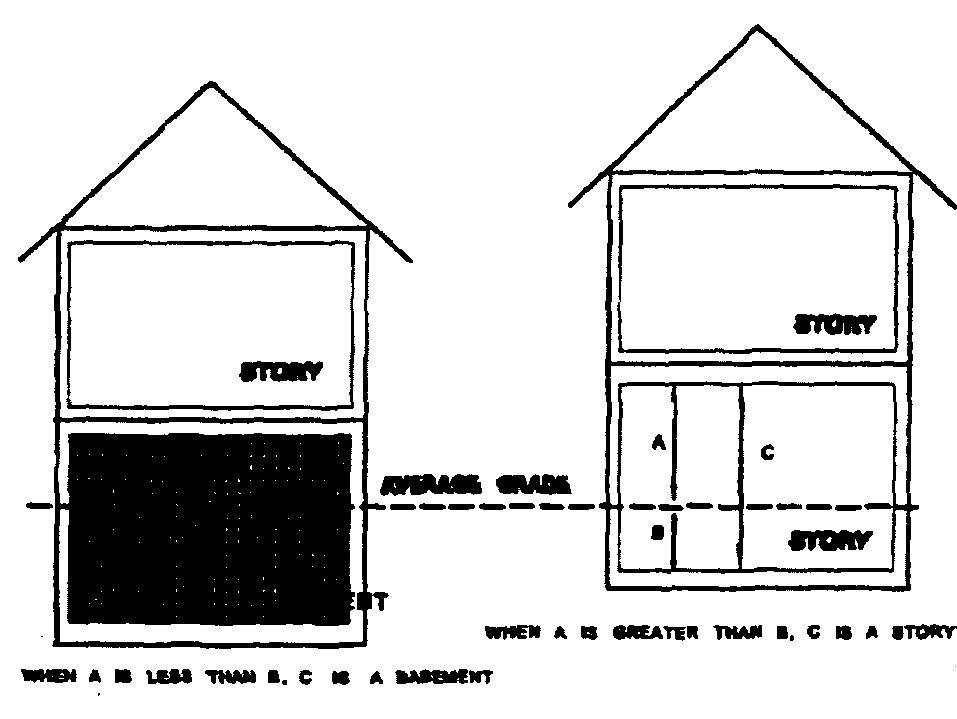
Basement means that portion of a building which is partly or wholly below grade but so located that the vertical distance from the average grade to the floor is greater than the vertical distance from the average grade to the ceiling. A basement shall not be counted as a story unless 50 percent of its height is above the level from which the height of the building is measured. (See Story)
Bed-and-breakfast facility means a secondary use which is subordinate to the principal use of a dwelling unit as a single-family dwelling unit and a use in which transient guests are provided a sleeping room and board in return for payment.
Board of appeals or board means the zoning board of appeals.
Buildable area means the buildable area of a lot is the space remaining after the minimum yard requirements of this chapter have been complied with.
Building means any structure, either temporary or permanent, having a roof supported by columns or walls, and intended for the shelter, or enclosure of persons, animals, chattels, or property of any kind. This shall include tents, awnings, or vehicles situated on private property and used for the purpose of a building.
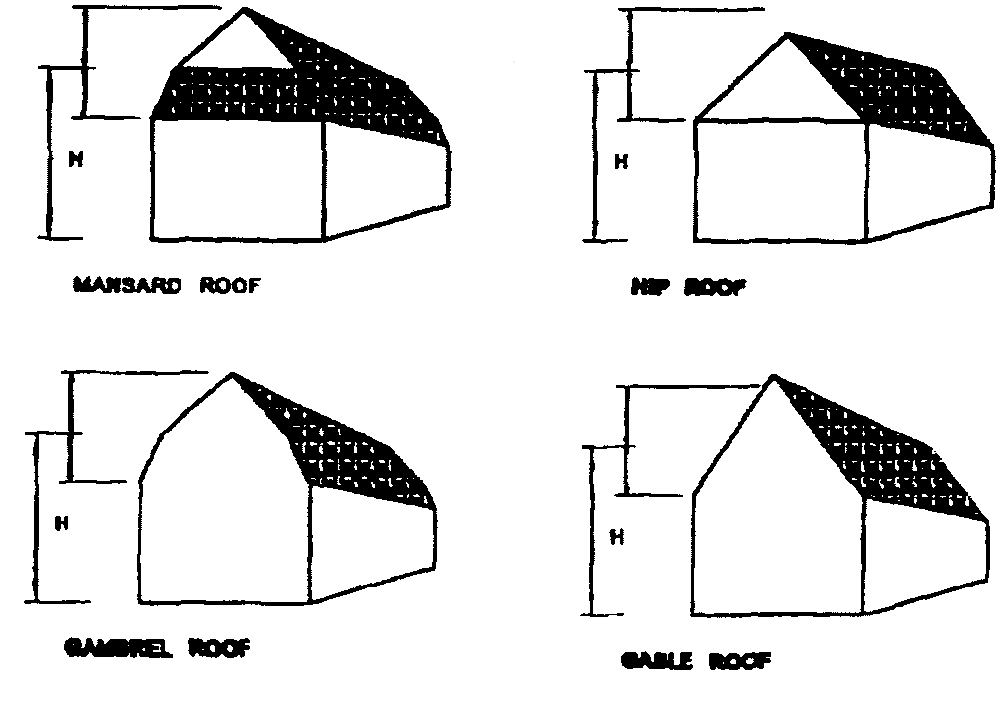
Building height means the vertical distance measured from the mean elevation of the finished grade line of the ground about the front of the building to the highest point of the roof surface for flat roofs; to the deck line of mansard roofs; and to the average height between eaves and ridge for gable, hip, or gambrel roofs. In a structure having a flat roof, the parapet, if provided, may exceed the maximum building height by three feet. Where a building is located on sloping terrain, the height may be measured from the average ground level of the grade at the building wall.
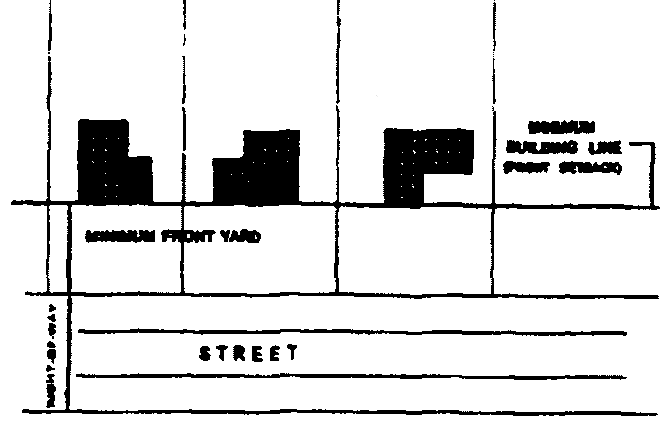
Building line means a line established, in general, parallel to the front lot line between which line and the front lot line no part of a building shall project, except as otherwise provided by this chapter.
Building, principal, means a building in which is conducted the principal use of the lot on which it is located.
Child care center means a facility other than a private residence receiving more than six preschool or school age children for group care for periods of less than 24 hours a day, and where the parents or guardians are not immediately available to the child.
Clinic means an establishment where human patients who are not lodged overnight are admitted for examination and treatment by a group of physicians, dentists, or similar professions.
Club means an organization catering exclusively to members and their guests, or premises and buildings for recreational, artistic, political, or social purposes, which are not conducted primarily for gain.
Collector thoroughfare means a collector street used primarily to carry traffic from minor streets to major thoroughfares or for relatively short distances between major thoroughfares and designated as such on the city's future land use plan.
Commercial wind energy conversion system means any wind energy conversion system designed and built to provide electricity to the electric utility power grid as an ongoing commercial enterprise or for commercial profit.
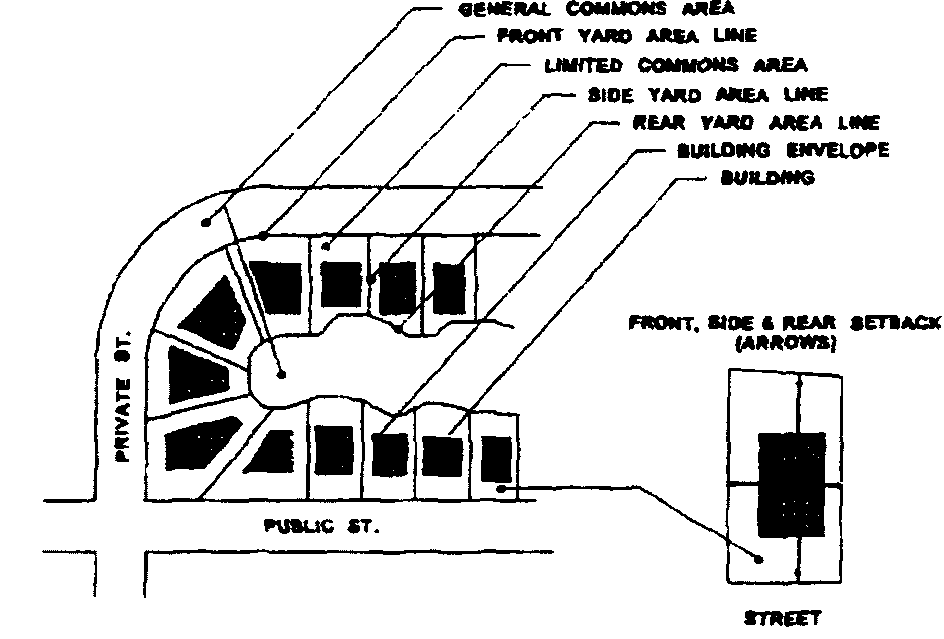
Condominium subdivision (site condominiums) means a method of dividing land where land ownership of sites is regulated by the Condominium Act (PA 59 of 1978 (MCL 559.101 et seq.), as amended,) as opposed to the Subdivision Control Act of 1967 (MCL 560.101). Condominium subdivision shall be equivalent to the term "subdivision" as used in this chapter and chapter 36. In a condominium subdivision, the following additional definitions shall apply:
(1)
Building envelope means the area defined by lines drawn parallel to the front, rear, and side area lines, at a distance designated by the setback requirements of the zoning district and within which the main building shall be located.
(2)
Condominium lot means all areas bounded by the front yard area line, the rear yard area line and the side yard area lines.
(3)
General commons area means all areas outside of the condominium lots including right-of-way.
(4)
Limited commons area means the areas within a condominium lot that are outside of the building envelope.
(5)
Master deed means the condominium document recording the condominium project to which are attached as exhibits and incorporated by reference the bylaws for the project and the plan for the project.
(6)
Setback.
a.
Front yard setback shall be equal to the distance between the front yard area line and the condominium building.
b.
Rear yard setback shall be equal to the distance between the rear yard area line and the condominium building.
c.
Side yard setback shall be equal to the distance between the side yard area line and the condominium building.
(7)
Yard area lines, in reference to site condominium developments, are considered equal to "lot lines" as defined in this chapter.
Convalescent or nursing home means a structure with sleeping rooms where persons are housed or lodged and are furnished with meals and nursing and medical care.
Decibel means the unit of measure used to express the magnitude of sound pressure and sound intensity.
Density refers to the number of families residing on, or dwelling units developed on an acre of land. As used in this chapter, all densities are stated in units per net acre, that is, per acre of land devoted to residential use, exclusive of land in streets.
District means a portion of the city within which, on a uniform basis, certain land and buildings are permitted and within which certain yards, open spaces, lot areas, and other requirements are established.
Drive-in restaurant means an establishment serving food and/or drink so developed that its retail or service character is dependent on providing spaces for motor vehicles so as to serve patrons while in the motor vehicle.
Drive-through establishment means a business establishment other than a drive-in restaurant, which by design, physical facilities, service, or by packaging procedures encourages or permits customers to receive services or obtain goods while remaining in their motor vehicles.
Dwelling, multiple-family, means a building, or a portion thereof, designed exclusively for occupancy by two or more families living independently of each other.
Dwelling, one-family, means a building designed exclusively for and occupied exclusively by one family.
Dwelling unit means a building, or portion thereof, designed for occupancy by one family for residential purposes and having cooking facilities.
Erected means includes built, constructed, altered, reconstructed, moved upon, or any physical operations on the premises which are required for a building or structure. Excavation, fill, drainage, and the like shall also be considered a part of the term "erected."
Essential services means the erection, construction, alteration, or maintenance of railroads, public utilities or municipal services including underground, surface, or overhead gas, electrical, steam, fuel or water transmission or distribution systems, collection, communication, supply or disposal systems, including poles, wires, mains, drains, sewers, pipes, conduits, cables, fire alarm and police call boxes, traffic signals, hydrants, and similar equipment in connection therewith, reasonably necessary for the furnishing of adequate service by such facilities or governmental departments for the general health, safety, or welfare but not including buildings other than such buildings as are primarily enclosures or shelters of the above essential service equipment. Radio broadcasting and receiving towers and equipment structures used in cellular telephone systems are specifically excluded from the definition of the term "essential services."
Family means a single individual or a number of individuals living together whose relationship is of a continuing nontransient, domestic character and who are cooking and living together as a single, nonprofit housekeeping unit. This shall not include any society, club, fraternity, sorority, association, lodge, coterie, organization, or group of students or other individuals whose relationship is of a transitory or seasonal nature or for anticipated limited duration of school terms or other similar determinable periods.
Family day care home or family childcare home means a private home in which one but fewer than eight minor children are received for care and supervision for compensation for periods of less than 24 hours per day, unattended by a parent or legal guardian, except children related to an adult member of the family by blood, marriage, or adoption. "Family childcare home" includes a home in which care is given to an unrelated minor child for more than four weeks during a calendar year. A family childcare home does not include an individual providing babysitting services for another individual. As used in this subsection, the phrase "providing babysitting services" means caring for a child on behalf of the child's parent or guardian when the annual compensation for providing those services does not equal or exceed $600.00 or an amount that would according to the internal revenue code of 1986 obligate the child's parent or guardian to provide a form 1099-MISC to the individual for compensation paid during the calendar year for those services.
Farm means all of the contiguous neighboring or associated land operated as a single unit on which bona fide farming is carried on directly by the owner-operator, manager, or tenant farmer, by such person's own labor or with assistance of members of the household or hired employees; provided, however, that land to be considered a farm hereunder shall include a continuous parcel of more than ten acres in area; provided further, farms may be considered as including establishments operated as bona fide greenhouses, nurseries, orchards, chicken hatcheries, poultry farms, and apiaries, but establishments keeping or operating fur-bearing animals, public riding or boarding stables, and/or commercial dog kennels, shall not be considered farms hereunder, unless combined with bona fide farm operations on the same continuous tract of land. No farms shall be operated as piggeries, or for the disposal of garbage, sewage, rubbish or offal or a rendering plant, or for the slaughtering of animals except such animals as have been raised on the premises or have been maintained on the premises prior thereto and for the use and consumption of persons residing on the premises.
Fence means a manmade, unroofed barrier which may act as an enclosure or which is decorative or ornamental.
Floor area means:
(1)
For the purpose of computing the minimum allowable floor area in a residential dwelling unit, the sum of the horizontal areas of each story of the building shall be measured from the exterior faces of the exterior walls. The floor area measurement is exclusive of areas of basements, unfinished attics, attached garages, or space used for off-street parking, breezeways, and enclosed and unenclosed porches, elevators, or stair bulkheads, common hall areas, and accessory structures.
(2)
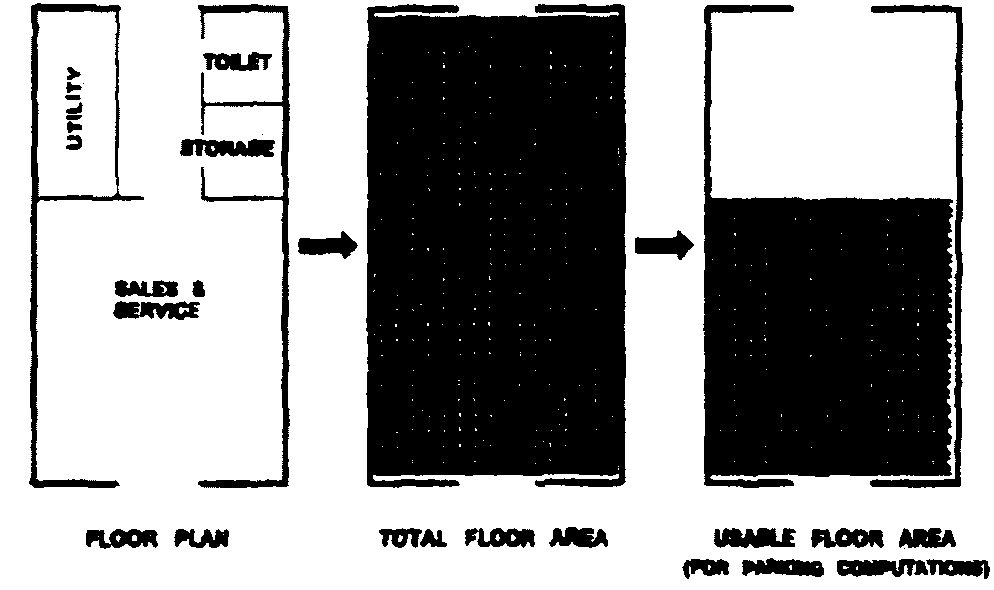
Usable floor area (for the purpose of computing parking) means that area used for or intended to be used for the sale of merchandise or services, or for use to serve patrons, clients, or customers, and all that area devoted to employee work space. Such floor area which is used or intended to be used principally for the storage of merchandise, hallways, elevator or stair bulkheads, or for utilities or sanitary facilities, shall be excluded from this computation of "usable floor area." Measurement of usable floor area shall be the sum of the horizontal areas of the several floors of the building, measured from the interior faces of the exterior walls.
(3)
Gross floor area means the sum of the horizontal areas of the floors of the building measured from the exterior faces of the exterior walls, including basements or mezzanines. Unfinished attics, attached garages, breezeways, and areas included in structures or buildings providing parking for motor vehicles shall not be included.
Floor area ratio (FAR) means an intensity measured as a ratio derived by dividing the gross floor area of a building by the area of the zoning lot.
Garage an accessory building or structure which is used primarily for the parking of motor vehicles. A private garage has a vehicle access door and has a driveway leading to the building or structure.
Golf course means the premises upon which the game of golf is played, including clubhouses, parking lots, swimming pools, tennis courts, or other structures or uses customarily incidental to a golf course or a country club; provided, however, that a golf course shall include a minimum of nine holes and shall not be less than 3,000 yards in length; and provided further, that the definition of the term "golf course" does not include a driving range or miniature golf course operated independently or in conjunction with a golf course.
Golf driving range means the premises on which golf balls are hit for practice purposes including any related sales/office structure.
Grade means a ground elevation established for the purpose of regulating the number of stories and the height of buildings. The building grade shall be the level of the ground adjacent to the walls of the building if the finished grade is level. If the ground is not entirely level, the grade shall be determined by averaging the elevation of the ground for each face of the building.
Greenbelt means a planting of trees, shrubs, and grass between abutting land uses.
Group day care home means a private home in which more than seven but not more than 13 minor children are given care and supervision for periods of less than 24 hours per day, unattended by a parent or legal guardian, except children related to an adult member of the family by blood, marriage, or adoption. "Group day care home" includes a home that gives care to an unrelated minor child for more than four weeks during a calendar year.
Hedges means a dense row of low-branching trees, shrubs, vines, or other plants which encloses land, divides land into distinct portions, separates contiguous properties, obstructs the passage of light and air onto adjacent land or obstructs the vision of motorists on or near public roads.
Home occupation means a business use which is clearly secondary or incidental to the use of a single-family dwelling for residential purposes. Such occupation may include the giving of instruction in a craft or fine art within the residence. All home occupation uses shall be subject to noise, advertising, hours of operation or other conditions which may accompany the use of a residence as a home occupation pursuant to the terms of this chapter.
Hospital means an installation providing health services primarily for inpatient medical or surgical care of the sick or injured and including related facilities such as laboratories, outpatient departments, training facilities, central service facilities, and staff offices which are an integral part of the facilities.
Junk means secondhand, scrap, worn, or discarded articles of any kind with little or no commercial value for the use it was originally intended or constructed.
Junkyard means an open area where waste, used, or secondhand materials are bought and sold, exchanged, stored, baled, packed, disassembled, or handled, including, but not limited to, scrap iron and other metals, paper, rags, rubber tires, and bottles. The term "junkyard" includes automobile wrecking yards and includes any area of more than 200 square feet for storage, keeping, or abandonment of junk but does not include uses established entirely within enclosed buildings.
Junk vehicle means a vehicle which is not operative or currently licensed.
Kennel means any lot or premises on which four or more animals, four months or more old, of the same species, are temporarily or permanently kept for sale, breeding, boarding, training, hobby, protection, or as pets.
Livestock means horses, cattle, sheep, goats, and other useful animals normally kept or raised on a farm.
Loading space means an off-street space on the same lot with a building, or group of buildings, for the temporary parking of a commercial vehicle while loading and unloading merchandise or materials.
Lodge hall means a place where people meet who are associated with a group, not operated for profit, that meets due to a common interest in sports, arts, sciences, literature, politics, or the like.
Lot means a parcel of land occupied, or intended to be occupied by a main building or a group of such buildings and accessory buildings, or utilized for the principal use and uses accessory thereto, together with such yards and open spaces as are required under the provisions of this chapter. A lot may or may not be specifically designated as such on public records. A lot is also a portion of a subdivision or other parcel of land intended to be a unit for transfer of ownership or development.
Lot area means the total horizontal ground area within the lot lines of the lot. For lots fronting or lying adjacent to private streets, lot area shall be interpreted to mean that area within lot lines separating the lot from the private street, and not the centerline of said street.
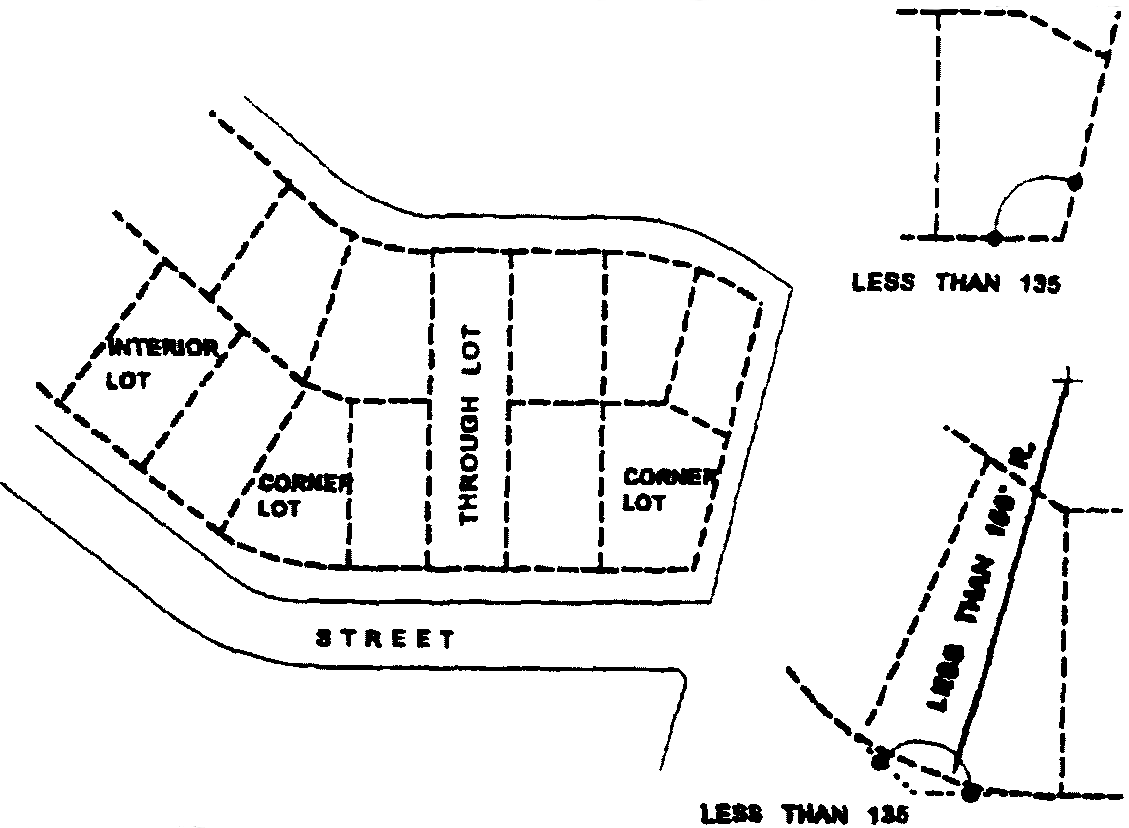
Lot, corner, means a lot where the interior angle of two adjacent sides at the intersection of two streets is less than 135 degrees. A lot abutting upon a curved street or streets shall be considered a corner lot for the purpose of this chapter if the arc is of less radius than 150 feet and the tangents to the curve, at the two points where the lot lines meet the curve or the straight street line extended, form an interior angle of less than 135 degrees.
Lot coverage means the part or percent of the lot occupied by buildings including accessory buildings and structures.
Lot depth means the horizontal distance between the front and rear lot lines, measured along the median between the side lot lines.
Lot, double frontage (through lot), means any interior lot having frontage on two more or less parallel streets as distinguished from a corner lot. In the case of a row of double frontage lots, all sides of said lots adjacent to streets shall be considered frontage, and front yards shall be provided as required.
Lot, interior, means any lot other than a corner lot.
Lot lines means the lines bounding a lot as defined herein:
(1)
Front lot line means in the case of an interior lot, means the line separating such lot from the street. In the case of a corner lot or double frontage lot, the line separating such lot from that street which is designated as the front street in the plat and the request for zoning compliance permit.
(2)
Rear lot line means that lot line opposite the front lot line. In the case of a lot pointed at the rear, the rear lot line shall be an imaginary line parallel to the front lot line, not less than ten feet long lying farthest from the front lot line and wholly within the lot.
(3)
Side lot line means any lot line other than the front lot line or rear lot line. A side lot line separating a lot from a street is an exterior lot line. A side lot line separating a lot from another lot or lots is an interior side lot line.
Lot of record means a parcel of land, the dimensions of which are shown on a document or map on file with the county register of deeds or in common use by municipal or county officials, and which actually exists as so shown, or any part of such parcel held in a record ownership separate from that of the remainder thereof.
Lot width means the horizontal, straight line distance between the side lot lines, measured between the two points where the required minimum front yard setback line, set forth in the schedule of regulations, intersects the side lot line.
Lot, zoning, means a single tract of land or any number of contiguous lots, located within a single block, which at the time of filing for a building permit is designated by its owner or developer as a tract to be used, developed or built upon as a unit, under single ownership or control. A zoning lot shall satisfy this chapter with respect to area, size, dimensions, and frontage as required in the district in which the zoning lot is located. A zoning lot, therefore, may not coincide with a lot of record as filed with the county register of deeds, but may include one or more lots of record.
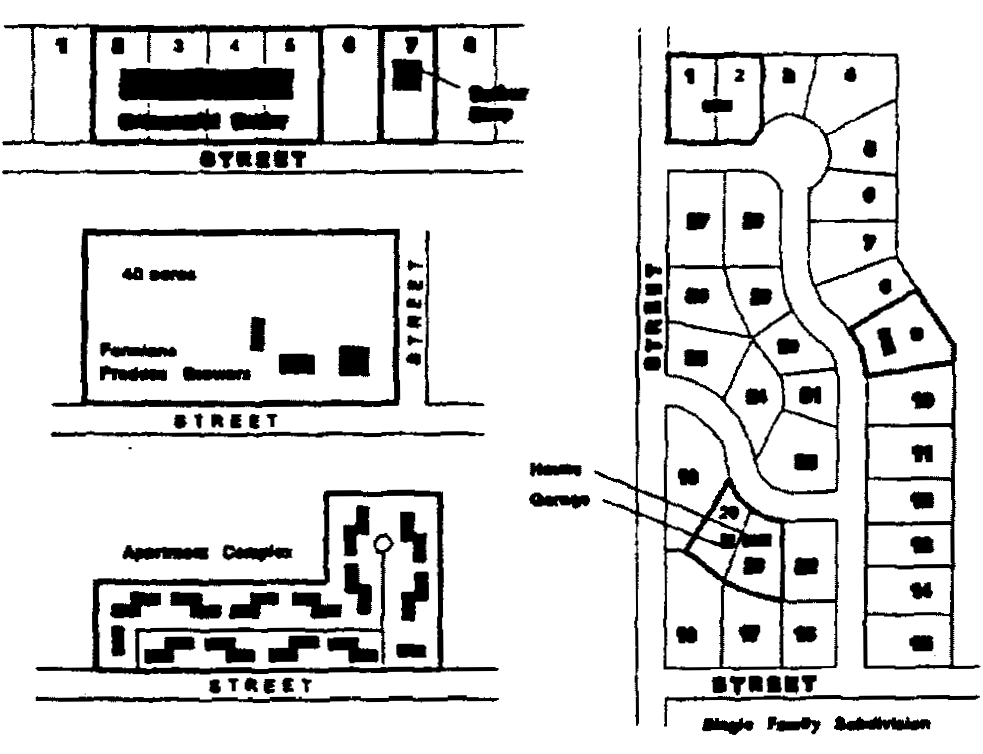
Major thoroughfare means an arterial street which is intended to serve as a large volume trafficway for both the immediate city area and the region beyond, and is designated as a major thoroughfare, on the city's future land use plan. Any street with a width, existing or proposed, of at least 120 feet shall be considered a major thoroughfare. A "proposed" width means a planned right-of-way in the city future land use plan.
Marginal access road means a service roadway parallel to a major or collector thoroughfare which provides access to abutting properties and protection from through traffic.
Mezzanine means an intermediate floor in any story occupying an area not to exceed 50 percent of the floor area of the story underneath said mezzanine.
Minor street means a public way, the principal use function of which is to give access to abutting property.
Mobile home means a manufactured dwelling unit, transportable in one or more sections, which is built on a chassis, and designed to be used as a dwelling with or without permanent foundation, when connected to the required utilities, and includes the plumbing, heating, air conditioning, and electrical systems contained in the structure. The term "mobile home" does not mean a recreational vehicle.
Mobile home park means a parcel or tract of land under the control of a person upon which three or more mobile homes are located on a continual, nonrecreational basis and which is offered to the public for that purpose, regardless of whether a charge is made therefor, together with any building, structure, enclosure, street, equipment, or facility used or intended for use, incident to the occupancy of a mobile home and which is not intended for use as a temporary trailer park.
Motel or hotel means a series of attached, semidetached, or detached rental units containing a bedroom, bathroom, and closet space. Units shall provide for overnight lodging and are offered to the public for compensation, and shall cater primarily to the public traveling by motor vehicles, and may contain a general kitchen and public dining room for the use of the occupants and other passersby.
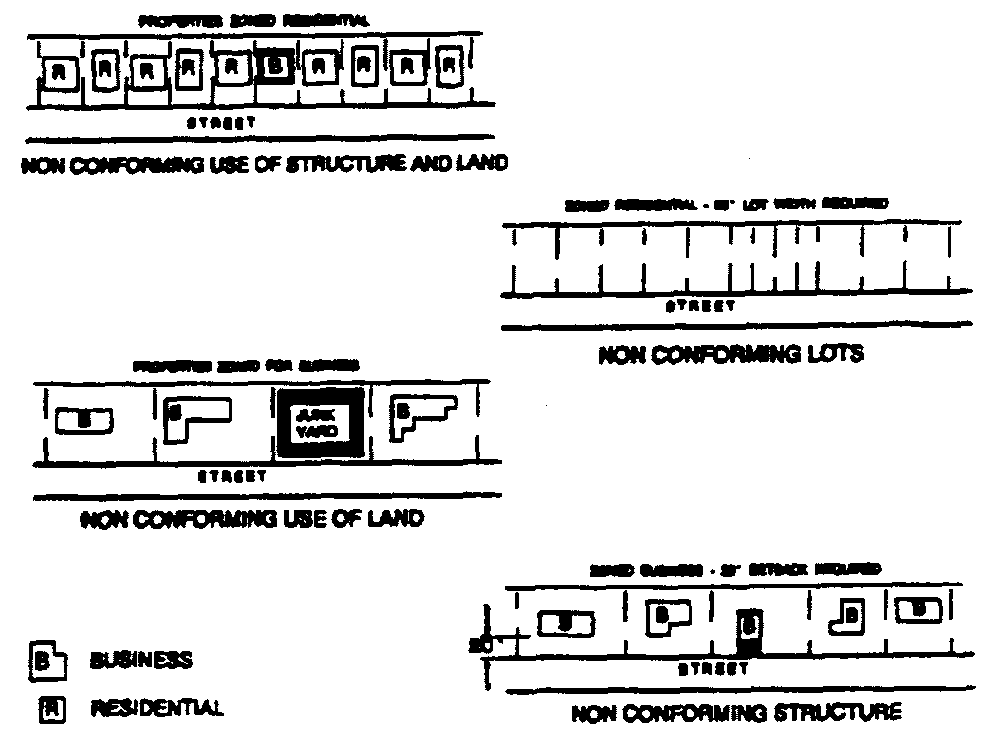
Nonconforming building means a building or portion thereof lawfully existing at the effective date of the ordinance from which this chapter is derived, or amendments thereto, and that does not conform to the provisions of this chapter in the district in which it is located.
Nonconforming use means a use which lawfully occupied a building or land at the effective date of the ordinance from which this chapter is derived, or amendments thereto, and that does not conform to the use regulations of the district in which it is located.
Nuisance factors means an offensive, annoying, unpleasant or obnoxious thing or practice, a cause or source of annoyance, especially a continuing or repeating invasion of any physical characteristics of activity or use across a property line which can be perceived by or affects a human being, or the generation of an excessive or concentrated movement of people or things, such as:
(1)
Noise;
(2)
Dust;
(3)
Smoke;
(4)
Odor;
(5)
Glare;
(6)
Fumes;
(7)
Flashes;
(8)
Vibration;
(9)
Shock waves;
(10)
Heat;
(11)
Electronic or atomic radiation;
(12)
Objectionable effluent;
(13)
Noise of congregation of people, particularly at night;
(14)
Passenger traffic;
(15)
Invasion of nonabutting street frontage by traffic.
Off-street parking lot means a facility providing vehicular parking spaces along with adequate drives and aisles for maneuvering, so as to provide access for entrance and exit for the parking of more than two vehicles.
Open storage means the keeping in the open of any material which is assembled, fabricated, treated, or processed in any manner and which is not anchored to the ground so as to meet city approval.
Parcel, for the purposes of this chapter, the term "parcel" is synonymous with the term "lot."
Parking space means an area of definite length and width intended for the temporary, short-term (no more than 48 continuous hours) parking of motor vehicles. Said space shall have access to a parking aisle, but shall be exclusive of drives, aisles, or entrances giving access thereto.
Principal building means a building or structure in which is conducted the principal use of the lot upon which it is situated.
Principal use means the main use to which the premises are devoted and the main purpose for which the premises exist.
Public utility means a person, firm, or corporation, municipal department, board, or commission duly authorized to furnish and furnishing under federal, state, or municipal regulations to the public: gas, steam, electricity, sewage disposal, communication, transportation, or water.
Recreational vehicle means a new or used vehicle that has its own motor power or is towed by a motor vehicle; is primarily designed to provide temporary living quarters for recreational, camping, travel, or seasonal use; complies with all applicable federal vehicle regulations; and does not require a special highway movement permit under MCL 257.719a to be operated or towed on a street or highway. The term includes, but is not limited to, a motor home, travel trailer, park model trailer that does not require a special highway movement permit under MCL 257.719a, or pickup camper. The term also includes watercraft, including jet skis, including trailers and equipment used for the transportation thereof, recreational trailers and campers, all-terrain vehicles, dune buggies, golf carts, mini-bikes, motor homes, motorcycles, recreational vehicle trailers, snowmobiles, trailbikes, off-road vehicles, antique and classic autos.
Roof-mounted wind energy conversion system means a single wind energy conversion system mounted to the roof of any structure.
Room, for the purpose of determining lot area requirements and density in a multiple-family district, means a living room, dining room, or bedroom, equal to at least 120 square feet in area. A room shall not include the area in kitchen, sanitary facilities, utility provisions, corridors, hallways, and storage. Plans presented showing one-, two-, or three-bedroom units and including a den, library, or other extra room shall count such extra room as a bedroom for the purpose of computing density.
Setback means the distance required to obtain front, side, or rear yard open space provisions of this chapter. Setbacks from a public street shall be measured from the existing or proposed right-of-way line, whichever is greater.
Shadow flicker means alternating changes in light intensity caused by the moving blade of a wind energy conversion system casting shadows on the ground and stationary objects, such as a window at a dwelling.
Stable, private, means a building for the keeping of livestock for the noncommercial use of the residents of the principal use and shall not include the keeping of livestock for others or for commercial boarding of livestock.
Stacking space means a designated space for vehicles to stand while waiting to receive a good or service. For the purposes of this chapter a stacking space shall be eight feet wide by 20 feet in length.
Storage means the keeping or warehousing of goods, materials, or vehicles. The parking of a vehicle in one location for more than 72 continuous hours shall constitute storage.
Story means that part of a building, other than a basement or mezzanine as defined herein, included between the surface of one floor and the surface of the next floor, or if there is no floor above, then the ceiling next above. A story thus defined shall not be counted as a story when more than 50 percent, by cubic content, is below the height level of the adjoining ground.
Story, half, means the part of a building between a pitched roof and the uppermost full story, said part having a finished floor area which does not exceed 50 percent of the floor area of the story immediately below it.
Street means a public dedicated right-of-way, other than an alley, which affords the principal means of access to abutting property.
Structure means anything constructed or erected, the use of which requires location on the ground or attachment to something having location on the ground.
Subdivision means as defined in chapter 36 of this Code.
Temporary meteorological tower (TMT) means a tower of monopole design which is designed and built to hold wind resource testing devices such as anemometers, wind vanes and accessory equipment, and which is to remain in place for no more than 18 months.
Tree means any woody plant having at least one well-defined stem at least six inches DBH.
Use means the principal purpose for which land or a building is arranged, designed or intended, or for which land or a building is or may be occupied.
Utility room means a utility room is a room or space, located other than in the basement, specifically designed and constructed to house any home utilities or laundry facilities.
Variance means a modification of the literal provisions of the zoning chapter granted when strict enforcement of the zoning chapter would cause undue hardship owing to circumstances unique to the individual property on which the variance is granted. The crucial points of variance are undue hardship, unique circumstances, and applying to property. A variance is not justified unless all three elements are present in the case.
Wall, obscuring, means a structure of definite height and location to serve as an obscuring screen in carrying out the requirements of this chapter.
Watercourses means rivers and streams, ponds, lakes, and all other subaqueous areas.
Wild animal means any animal not domesticated by humans or any animal which a person is prohibiting from possessing by law. Wild animals shall include, but shall not be limited to, the following: alligator (family), deer (family), opossum (family), badger, dog (wild family), primate excluding humans (family), bear, dog-wolf, raccoon, skunk, cat (wild family), lemur, spider (poisonous), coyote, lizard (poisonous), weasel (family), marten, snakes.
Wind energy conversion system (WECS) means any device, such as a turbine, windmill, or charger, that converts wind energy into a usable form of energy.
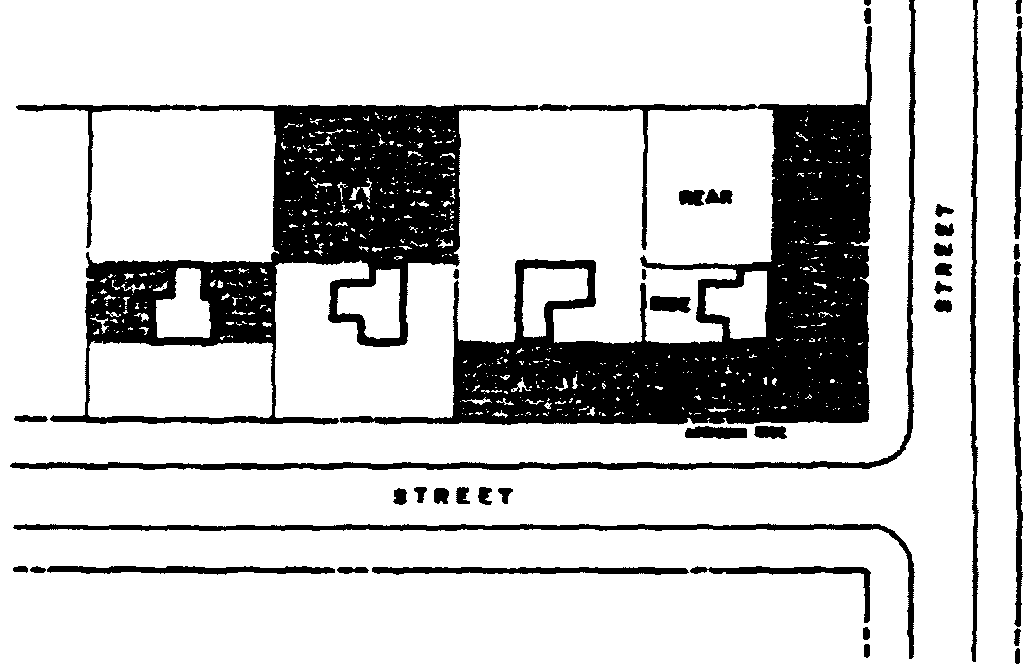
Yards means the open spaces on the same lot with a main building unoccupied and unobstructed from the ground upward except as otherwise provided in this chapter, and as defined herein:
(1)
Front yard means an open space extending the full width of the lot, the depth of which is the minimum horizontal distance between the front lot line and the nearest point of the main building. All yards abutting on a street shall be considered as front yards for setback purposes.
(2)
Rear yard means an open space extending the full width of the lot, the depth of which is the minimum horizontal distance between the rear lot line and the nearest point of the main building. In the case of a corner or a double frontage lot, the rear yard shall be opposite the building facade side of such lot.
(3)
Side yard means an open space between a main building and the side lot line, extending from the front yard to the rear yard, the width of which is the horizontal distance from the nearest point of the side lot line to the nearest point of the main building.
(Code 2002, § 220-4; Ord. No. 527, § 220-4, 5-10-2010; Ord. No. 535, § 1, 8-22-2011; Ord. No. 593, § 1, 11-22-2021; Ord. No. 602, § 1, 10-24-2022)

