
Greenfield Milwaukee County
City Zoning Code
City Zoning Code
PART 2
- DEFINITIONS
21.02.0101 - General definitions.
The language set forth in the text of this Code shall be interpreted according to the following rules of construction:
A.
Singular and plural. The singular number includes the plural, and the plural the singular;
B.
Tense. The present tense includes the past and future tenses, and the future the present;
C.
Shall and may. The word "shall" is mandatory; the word "may" is permissive;
D.
Gender. The masculine gender includes the feminine and neuter genders;
E.
Defined words and terms. Whenever a word or term defined hereinafter appears in the text of this Code, its meaning shall be construed as set forth in the definition thereof. Any word appearing in parentheses between a word and its definition herein, shall be construed in the same sense as that word;
F.
Words not defined herein. Any words not defined in this division shall be presumed to have their customary dictionary definitions;
G.
Words "this Code." Shall mean this Zoning Code of the City of Greenfield, Milwaukee County, Wisconsin.
21.02.0102 - Abbreviations and symbols.
The following abbreviations are used in this Code and are intended to have the following meanings:
21.02.0103 - Specific words and phrases. ()
A Zones. Areas of potential flooding shown on the City's "Flood Insurance Rate Maps" which would be inundated by the regional flood as defined herein. These numbers may be numbered as A0, A1 to A99, or be unnumbered A Zones. The A Zones may or may not reflect flood profiles, depending on the availability of data for a given area.
Abandonment. An action to give up one's rights or interests in use of property.
Abutting. Having a common border with, or being separated from such common border by an alley or easement, other than publicly dedicated and approved rights-of-way.
Access. A means of vehicular or nonvehicular approach or entry to or exit from property, a street, or highway.
Access, dryland. A vehicular access route that is above the regional flood elevation which connects land in the floodplain to land which is outside the floodplain, such as a road with its surface above the regional flood elevation and wide enough to accommodate wheeled vehicles.
Access, secondary. A means of vehicular or nonvehicular approach or entry to or exit from property from other than a public street or highway (such as an alley). This is not necessarily meant to include a second primary access that might be required for developments.
Accessory structure or use. An "accessory structure or use" is one which:
a.
Is subordinate to and serves a principal structure or principal use;
b.
Is subordinate in area, extent, or purpose to the principal structure or principal use served;
c.
Contributes to the comfort, convenience, or necessity of occupants of the principal structure or principal use served;
d.
Is on the same zoning lot as the principal structure or principal use served; and
e.
Is not established prior to the establishment of the principal structure or principal use served.
An "accessory structure or use" includes, but is not limited to, the following: (Am. #2920)
a.
A child's playhouse [greater than fifty (50) square feet in area and/or six (6) feet in height], garden house, or private greenhouse;
b.
A garage, shed, or building for domestic storage or gardening/greenhouse use;
c.
Incinerators incidental to residential use;
d.
Storage of merchandise normally carried in stock on the same lot or parcel with any retail service or business use, unless such storage is excluded by the district regulations;
e.
Storage of goods used in or produced by manufacturing activities on the same lot or parcel of ground with such activities, unless such storage is excluded by the district regulations;
f.
Off-street motor car parking areas, and loading and unloading facilities;
g.
Carports;
h.
Signs (other than advertising signs), in conformity with the provisions of an Ordinance known as the Sign Ordinance (Sign Code) heretofore adopted by the City of Greenfield and as amended from time to time;
i.
Public utility facilities—telephone, electric, gas, water, and sewer lines, their supports and incidental equipment;
j.
Gazebo. (Cr. #2430)
Acreage. In the case of plats, any tract or parcel of land having an area of one (1) acre or more, which has not heretofore been subdivided or platted.
Acreage, gross. Ground area including all portions for proposed and existing streets within a development, Subdivision, Certified Survey Map, or Condominium.
Acreage, net. The remaining ground area after deleting all portions for proposed and existing streets within a development, Subdivision, Certified Survey Map, or Condominium.
Adjacent. Nearby, but not necessarily touching or abutting.
ADT (Average daily traffic). The average total number of vehicles traversing a street on a typical day.
Agent, authorized. A person or firm duly authorized by the property owner to submit applications and agree to conditions on his, her, their, or its behalf.
Agriculture. All of the growing of crops and the raising and feeding of livestock and poultry; including farming, farm buildings, and farm dwellings; truck gardens; flower gardens; apiaries; aviaries; mushroom growing; nurseries; orchards; forestry; dairying; greenhouses; and commercial vegetables. Specific agricultural uses are further defined in Section 21.04.0603 of this Code.
Airport. Any area of land or water which is used, or intended for use, for the landing and takeoff of aircraft; and any appurtenant areas which are used or intended for use as airport buildings or other airport structures or right-of-way, with all airport buildings and structures located thereon.
Alley. A public way, not more than thirty (30) feet wide, which typically affords a secondary means of access to abutting property.
Alteration, structural (for nonconforming structures). Any change which would tend to prolong the life of the supporting members of a building or structure, such as bearing walls, columns, beams, or girders. (Also see Section 21.04.1002 of this Code.)
Amusement park. A facility which operates and maintains at either a permanent or temporary location carnival-type amusements such as rides, skill and chance games, and other paraphernalia.
Antenna. A device designed to receive or send broadcasts either as over the air signals from transmitters, including fixed television or radio signals, or microwave signals from earth orbiting communications satellites.
Antenna, satellite. Any antenna designed to receive broadcasts relayed by signals from earth orbiting communications satellites.
Apartment. A room or suite of rooms in a multiple-family structure, which is arranged, designed, used, or intended to be used, as a single housekeeping unit. Complete kitchen and bathroom facilities, permanently installed, must always be included for each apartment.
Apartment, commercial. An apartment located above the first floor or a commercial building. (See Section 21.04.0703(C) of this Code.)
Assembly. When used in describing an industrial operation, the fitting or joining of parts of a mechanism by means of fasteners, nuts and bolts, screws, glue, welding or other similar technique. Assembly shall not include the construction, stamping, or reshaping of any component parts.
Assisted care. (See definition of "Assisted Living.")
Assisted living. A combination of housing and maintenance services provided to residents on-site within the same building and in response to the individual needs of residents. Supportive services such as meals, housekeeping, transportation to shopping and medical appointments, social activities, educational activities, and security and response systems on-site within the same building to meet resident needs. These services can also include on-site medication management or intermittent health care services from qualified providers located within the same building. Services are furnished in a way that promotes self-direction and participation in decisions that emphasize independence, individuality, and privacy in a residential surrounding.
Attic. That part of a building that is immediately below and wholly or partly within the roof framing.
Auditorium. A room, hall, or building assigned to the gathering of people as an audience, to hear lectures, plays, or other presentations.
Auto court. (See definition of "Hotel-Inn.")
Automobile laundry. A building or portion thereof, where automobiles are washed with the use of a mechanical conveyor and blower or steam-cleaning device.
Automobile lot, new. A zoning lot on which new cars, trailers, or trucks are displayed in the open for sale or trade.
Automobile lot, used. A zoning lot on which used cars, trailers, or trucks are displayed in the open for sale or trade.
Automobile repair, major. Engine rebuilding or major reconditioning of worn or damaged motor vehicles or trailers; collision service, including body frame or fender straightening or repair; and painting of vehicles.
Automobile repair, minor. Incidental repairs, replacement of parts, and motor service to automobiles but not including any operations specified under "Automobile Repair, Major."
Automobile sales area. An open area, other than a street, used for the display or sale of new or used automobiles, and where no repair work is done except minor incidental repair of automobiles to be displayed and sold on the premises.
Automobile service station. A place where gasoline, stored only in underground tanks; kerosene; lubricating oil; or grease for operation of automobiles are offered for sale directly to the public, on the premises, and including minor accessories and servicing of automobiles; but not including major automobile repairs; and including washing of automobiles where no chain conveyor, blower, or steam-cleaning device is employed. When the dispensing, sale, or offering for sale of motor fuels or oil is incidental to the conduct of a public garage, the premises shall be classified as a public garage. Automobile service stations shall not include sales, rental, or storage of automobiles or trailers (new or used).
Automobile wrecking yard. Any place where two (2) or more motor vehicles, not in running condition, or parts thereof, are stored in the open and are not being restored to operation; or any land, building, or structure used for wrecking or storing of such motor vehicles or parts thereof, and including any used farm vehicles or farm machinery, or parts thereof, stored in the open and not being restored to operating condition; and including the commercial salvaging of any other goods, vehicles, or merchandise stored in the open. The open storage of any type of mechanical equipment from which parts can be salvaged shall be classified as salvaging.
Awning. A roof-like cover, temporary in nature, which projects from the wall of a building and overhangs the wall or building.
Basement. A story wholly underground; or a story of a building, the floor line of which is below surrounding grade.
Basement, half. That story of the building, the floor line of which is below surrounding grade and the ceiling of which is greater than one (1) foot above surrounding grade, with an exterior exposure to provide for living area with safe egress, as determined by the building code. The lot grade shall be the front center of the garage floor elevation set at time of building permit, or the street centerline, whichever is the highest elevation. If any story conforms to the definition of "Living Area, First Floor," or "Basement," that story shall never be considered a half basement. For the purposes of height measurement, a half basement shall be counted as a story where more than one-half (0.5) of the height is above the average level of the abutting ground elevation.
Basin, detention. A manmade or natural depression below the surrounding grade level designed to collect surface and subsurface water so that it might impede the water flow and to gradually release the same into natural or manmade outlets (i.e., the storm sewer system or stream).
Basin, retention. A manmade or natural body of water designed to contain water at all times, the level of which will be increased from the flow into it of surface and subsurface water, collected therein and released gradually into natural or manmade outlets.
Bedroom. Any room other than a living room, family room, dining room, kitchen, bathroom, closets, or utility room, for the purpose of this Code, shall be considered a bedroom. Dens, studies, etc. with or without closets and similar areas which may be used as bedrooms shall be counted as bedrooms for the purposes of this Code.
Berth, loading. (See definition of "Loading and Unloading Space, Off-Street.")
Boarding house. A building other than a hotel, motel, or restaurant where meals and/or lodging are regularly furnished by prearrangement for compensation for four (4) or more persons, but not more than twelve (12), who are not members of the keeper's family.
Boathouse. Any structure designed for protecting or storing of boats used with a residence for noncommercial purposes, and located on the same lot as the principal building and not for human habitation.
Breezeway. A roofed outdoor passage connecting two (2) buildings (such as a house and garage) or halves of a building.
Buffer. (See definition of "Bufferyard.")
Buffer, shore. All of that land area located within seventy-five (75) feet inland of the ordinary high water mark of all ponds, streams, lakes, wetlands, and navigable waters and parallel to that ordinary high water mark.
Bufferyard. An area of land within the boundaries of a lot or site, generally adjacent to and parallel with the property line, either consisting of natural existing vegetation or using trees, shrubs, fences, walls, and/or earthen berms, or other visual and/or sound barriers designed to limit continuously the view and/or sound from the lot, site, or land use to adjacent lots, sites, or land uses. Bufferyards are typically defined by a delineated easement graphically indicated on the face of the Site Plan, Landscape Plan, Certified Survey Map, Subdivision Plat, or Condominium Plat. Bufferyards may be required between zoning districts and/or land uses to eliminate or minimize conflicts between them as set forth in Division 21.06.0300 of this Code.
Bufferyard intensity factor. The relative sight screening value of a bufferyard as measured by levels of intensity of bufferyard plant foliage or other characteristics of the bufferyard including fencing, earthen berms, or walls.
Buildable area. The space remaining on a zoning lot after the minimum space requirements of this Code have been complied with. The buildable area excludes areas preserved natural resource features and/or required landscape surface area (LSR) portions of the lot or parcel.
Building area. (See definition of "Floor Area, Gross.")
Building Code. The City of Greenfield Building Code.
Building, completely enclosed. A building separated on all sides from the adjacent open space, or from other buildings or other structures, by a permanent roof and by exterior walls, pierced only by windows and normal entrance or exit doors.
Building, detached. A building surrounded by open space on the same zoning lot.
Building height. The vertical distance measured from established grade at the front of the building to the highest point of the roof for a flat or slant roof; to the deck line of a mansard roof; and to the mean height level between eaves and ridge of a gable, or hip, or gambrel roof; except accessory structures are measured from grade to highest point of building. (Am. #2430)
Building Inspector. The Building Inspector of the City of Greenfield, Milwaukee County, Wisconsin.
Building line. The line nearest the front of and across a zoning lot, establishing the minimum setback to be provided between the front line of a building or structure and the street right-of-way line.
Building, accessory. (See definition of "Accessory Structure or Use.")
Building, permanent. Any structure with substantial walls and roof securely affixed to the land and entirely separated on all sides from any other structure by space or by walls in which there are no connecting doors, windows, or openings; and which is designed or intended for the shelter, enclosure or protection of persons, animals, or chattels. Any structures with interior areas not normally accessible for human use, such as gas holders, oil tanks, water tanks, grain elevators, coal bunkers, oil cracking towers, and other similar structures, are not considered as permanent buildings.
Building, principal. A nonaccessory building in which the principal use of the zoning lot on which it is located is conducted.
Building, temporary. A structure designed, built, created, or occupied for short and/or intermittent periods of time not to exceed one (1) year, including tents, inflatable structures, lunch wagons, dining cars, trailers, and other roofed structures on wheels or other supports used for residential, business, mercantile, storage, commercial, industrial, institutional, assembly, educational, or recreational purposes; or for the enclosure or screening of goods or property; or for the display of signs and advertising. For the purpose of this definition, "roof" shall include an awning or other similar covering whether or not it is permanent in nature.
Bulk. Term used to indicate the size, height, area, density, intensity, and location of structures. (See Part 3 of this Code.)
Business. An occupation, employment, or enterprise which occupies time, attention, labor, and materials, or in which merchandise is exhibited or sold, or where services are offered other than home occupations.
Caliper. A measurement of the diameter of a tree taken six (6) inches from above the ground level for trees up to and including four (4) inch caliper sizes, and twelve (12) inches above the ground level for larger sizes.
Camp. Any land, including structures, used for assembly or temporary occupancy by individuals and providing outdoor recreational facilities.
Camp, recreational. An establishment consisting of a permanent building or group of permanent buildings used periodically by an association of persons where seasonal accommodations for recreational purposes are provided only to members of such association and not to anyone who may apply.
Carport. A roofed-over area attached to the principal building for vehicle storage, which may be open on a minimum of two (2) sides.
Car wash. (See definition of "Automobile Laundry.")
Certified survey map. A plat or map prepared for a minor land division as defined, prepared, and recorded as set forth in Section 236.34 of the Wisconsin Statutes. (Also see definition for "Minor Land Division.")
City Attorney. The City Attorney of the City of Greenfield, Milwaukee County, Wisconsin.
City Clerk. The City Clerk of the City of Greenfield, Milwaukee County, Wisconsin. For application purposes, the term "City Clerk" may include the City Clerk's designee.
City Engineer. The City Engineer of the City of Greenfield, Milwaukee County, Wisconsin.
City Planner. The City Planner of the City of Greenfield, Milwaukee County, Wisconsin.
Class 2 notice. Publication of a public hearing notice under the provisions of Chapter 985 of the Wisconsin Statutes in a newspaper of circulation in the affected areas. Publication is required on two (2) consecutive weeks, the last at least seven (7) days before the public hearing.
Clinic. (See definition of "Medical Health Center.")
Club, private. A nonprofit association of persons, who are bona fide members paying annual dues, which owns, hires, or leases a building or portion thereof, the use of such premises being restricted to members and their guests. It shall be permissible to serve food and meals on such premises if adequate dining room space and kitchen facilities are available. The sale of alcoholic beverages to members and their guests shall be allowed with the operation of a dining room for the purpose of serving food and meals, though such beverages may be served in a separate room or rooms, and if such sale of alcoholic beverages meets the applicable federal, state, and county laws.
Combustible materials. (See definition for "Materials, Inflammable.")
Common area. Land in a residential development held in common and/or single ownership and not reserved for the exclusive use or benefit of an individual tenant or owner but rather for the benefit of all occupants of the development.
Common Council. The Common Council of the City of Greenfield, Milwaukee County, Wisconsin.
Community. A town, municipality, or a group of adjacent towns and/or municipalities having common social, economic, or physical interests.
Community living arrangement. The following facilities licensed or operated, or permitted under the authority of Wisconsin State Statutes: child welfare agencies under Section 48.60, group foster homes for children under Section 48.02(7m), and community-based residential facilities under Section 50.01; but does not include day care centers, nursing homes, general hospitals, special hospitals, prisons, and jails. The establishment of a community living arrangement shall be in conformance with Sections 46.03(22), 59.97(15), 62.23(7)(I), and 62.23(7a) of the Wisconsin State Statutes and amendments thereto.
Comprehensive Plan. (See definition of "Master Plan.")
Comprehensive Master Plan. (See definition of "Master Plan.")
Condominium. A building, or group of buildings, in which dwelling units or other nonresidential floor area portions thereof are owned individually, and the structure, common areas, and facilities are owned by all the owners on a proportional, undivided basis. Property subject to a condominium declaration as defined, regulated, and established under Chapter 703 of the Wisconsin State Statutes.
Congregate residence. (See definition of "Community Living Arrangement.")
Construction. Any or all work or operations necessary or incidental to the erection, demolition, assembling, installing, or equipping of buildings, or any alterations and operations incidental thereto. The term "construction" shall include land clearing, grading, excavating, and filling and shall also mean the finished product of any such work or operations.
Construction, start of. The excavation of or installation of foundation footings or grading other than for the installation of materials for road construction.
Contiguous. In contact with one (1) or more sides.
Continuing care retirement community (for the elderly). A housing development that is planned, designed, and operated to provide a full-range of accommodations and services for older adults, including independent living, congregate housing and medical care. Residents may move from one (1) level to another as their needs change. Such facilities may offer a guarantee of lifetime care, including health care, which is secured by contracts that require a substantial entrance fee, as well as regular monthly maintenance fees. These types of facilities can also include a limited amount of health care as part of the standard fee or they may charge on a pay-for-service basis. Such facilities may offer rentals and ownership options. These facilities also include the life care community and campus concept.
Convenience store. Any retail establishment offering for sale food products, household items, sundry items, and other goods commonly associated with the same; operated primarily for the convenience of the motoring public, or walk-in shopper; and having a gross floor area of less than five thousand (5,000) square feet excluding the space occupied by other uses in a mixed use building.
Court, outer. An open, unoccupied space opening onto a street, alley, or yard.
Cul-de-sac. A local street with only one (1) outlet and having an appropriate turnaround for the safe and convenient reversal of traffic movement.
Curb. A vertical or sloping edge of a roadway, drive, or parking.
Cut-off. The point at which all light rays emitted by a lamp, light source, or luminaire are completely eliminated (cut-off) at a specific angle above the ground.
Cut-off angle. The angle formed by a line drawn from the direction of light rays at the light source and a line perpendicular to the ground from the light source above which no light is emitted.
Cut-off type luminaire. A luminaire with elements such as shields, reflectors, or refractor panels that direct and cut off the light at an angle that is less than ninety (90) degrees.
Day care center. A State licensed facility where a person, other than a relative or guardian, provides care and supervision for four (4) or more children under seven (7) years of age, for less than twenty-four (24) hours a day and for compensation.
Day-night average sound level (ldn). A basic measure for quantifying noise exposure, namely: The A-weighted sound level averaged over a 24-hour period, with a 10-decibel penalty applied to nighttime (10:00 p.m. to 7:00 a.m.) sound levels.
dBA. The A-weighting scale of sound measurement as expressed in decibels.
DBH. (See definition of "Diameter at Breast Height.")
Decibel. A unit of measurement of the intensity (loudness) of sound. Sound level meters employed to measure the intensity of sound are calibrated in "decibels."
Deck. A structure attached to any dwelling unit that is:
a.
Designed and intended for the support of persons;
b.
Made of wood or a composite wood material or vinyl-like material;
c.
Has no permanent roof; and,
d.
Is constructed on piers, with continuous foundation, or footings.
Dedication. The transfer of property interests from private to public ownership for a public purpose. The transfer may be of fee simple interest or of a less than fee simple interest, including an easement.
Density, gross (GD). The quotient of the total number of dwelling units on a site divided by the base site area of a site.
Density, net (ND). The quotient of the total number of dwelling units divided by the net buildable site area of a site. (Also see definition of "Site Area, Net Buildable.")
Detention basin. (See definition of "Basin, Detention.")
Developer. The legal or beneficial owner(s) of a lot or of any land included in a proposed development, including the holder of an option or contract to purchase or other person(s) having enforceable proprietary interests in such land.
Development. The carrying out of any building activity, the making of any material change in the use or appearance of any structure or land, or the dividing of land into parcels by any person. Any manmade change to improved or unimproved real estate including, but not limited to, construction of or additions or substantial improvements to buildings, other structures, or accessory uses, mining, dredging, filling, grading, paving, excavation or drilling operations, or disposition of materials. The following activities or uses shall be taken for the purposes of these regulations to involve "development":
a.
A reconstruction, alteration of, or material change in the external appearance of a structure on land or water; or
b.
A change in the intensity of use of land, such as an increase in the number of dwelling units in a structure or on land or an increase in the floor area or number of businesses, manufacturing establishments, or offices; or
c.
Alteration of a shore or bank of a pond, river, stream, lake, or other waterway; or
d.
Commencement of drilling (except to obtain soil samples), mining, or excavation on a parcel of land; or
e.
Demolition of a structure; or
f.
Clearing of land as an adjunct of construction, including clearing or removal of vegetation, any significant disturbance of vegetation, or any soil manipulation; or
g.
Deposit of refuse, solid or liquid waste, or fill on a parcel of land.
The following operations or uses shall not be taken for the purpose of these regulations to involve "development":
a.
Work by a highway or road agency or railroad company for the maintenance of a road or railroad track if the work is carried out on land within the boundaries of the right-of-way; or
b.
Work by any public or quasi-public utility, and other persons engaged in the distribution or transmission of gas or water, for the purposes of inspecting, repairing, renewing, or constructing on established rights-of-way sewers, mains, pipes, cables, utility tunnels, power lines, towers, poles, tracks, or the like. (Exclusive of the activities requiring a special use permit as per the requirements of this Code); or
c.
The maintenance, renewal, or alteration of any structure, where only the interior or the color of the structure or the temporary decoration of the exterior of the structure is affected; or
d.
The use of any structure or land devoted to dwelling uses for any purpose customarily incidental to enjoyment of the dwelling; or
e.
A change in the ownership or form of ownership of any parcel or structure; or
f.
Work involving the landscaping of a detached dwelling; or
g.
Work involving the maintenance of existing landscaped areas and existing rights-of-way such as setbacks and other nonnatural planting areas.
"Development" includes all other activity customarily associated with it unless otherwise specified. When appropriate to the context, "development" refers to the act of development or to the result of development within the City. Reference to any specific operation is not intended to mean that the operation or activity, when part of other operations or activities, is not development. Reference to particular operations is not intended to limit the generality of this definition.
Development, multiple-family dwelling. A residential building designed for occupancy by three (3) or more dwelling units.
Diameter at breast height (DBH). The diameter of the trunk of a tree measured in inches at a point four and one-half (4.5) feet above ground line. This point of measurement is used for established and mature trees.
District, basic. A part or parts of the City for which the regulations of this Code governing the use and location of land and buildings are uniform (such as the residential and nonresidential zoning district classifications).
District, overlay. Overlay districts provide for the possibility of superimposing certain additional requirements upon a basic zoning district without disturbing the requirements of the basic district. In the instance of conflicting requirements, the more strict of the conflicting requirements shall apply.
Disturbance, land. Any manmade change of the land surface including removing vegetative cover, excavating, filling, and grading but not agricultural land uses such as planting, growing, cultivating, and harvesting crops; growing and tending gardens; or harvesting trees.
Division of land. Where the title or part thereof of land is transferred by a Subdivision Plat, Condominium Plat, or a Certified Survey Map. And, where a part of a lot or parcel of land is transferred by the execution of a land contract, an option-to-purchase, an offer-to-purchase and acceptance, and a deed.
Drainageway. Any intermittent or perennial stream graphically shown on either the U.S. Geological Survey 7.5-minute quadrangle topographic map of the area or the large scale 1" = 100' City of Greenfield topographic maps except areas designated as wetlands, shoreland wetlands, floodlands, floodways, or 100-year recurrence interval floodplains.
Drip line. The farthest distance, measured as a radius, where the branches of a tree extend from its trunk indicating the extent of the canopy of a tree.
Drive-in and drive through (or "drive thru") establishment or facility. Any commercial retail, personal service, or service establishment designed or intended to enable a customer in a motor vehicle parked on or moving through the premises to transact business with a person located within the principal structure including an establishment or facility that by design of physical facilities or by service or packaging procedures encourages or permits customers to receive a service or obtain a product while staying within a motor vehicle. Such establishments include, but are not necessarily limited to, financial institutions, restaurants, and dry cleaning stores.
Driveway. A paved or unpaved area used for ingress or egress of vehicles allowing access from a street or alley to a lot or site, use, building, or other structure or facility.
Driveway approach. That portion of a driveway located within a public right-of-way that is widened to accommodate turning movements to access property and streets.
Dwelling. A building or portion thereof, but not including a house trailer or mobile home, designed or used exclusively for residential occupancy, including one-family dwelling units, two-family dwelling units, and multiple-family dwelling units, but not including hotels, motels, or boarding or lodging houses.
Dwelling, attached. A dwelling which is joined to another dwelling at one (1) or more sides, floors, roofs, by a party wall, walls, or ceiling.
Dwelling, detached. A dwelling which is entirely surrounded by open space on the same lot.
Dwelling, duplex. A two-family dwelling in which the separate living quarters are arranged side by side or one over the other.
Dwelling, efficiency. A dwelling unit consisting of one (1) principal room with no separate sleeping rooms.
Dwelling group. Two (2) or more one-family, two-family, or multiple-family dwellings, or boarding or lodging houses, located on one (1) zoning lot, but not including tourist courts or motels.
Dwelling, multiple-family. A building or portion thereof designed or altered for occupancy by three (3) or more families living independently of each other.
Dwelling, one-family. A dwelling unit designed exclusively for use and occupancy by one (1) family.
Dwelling, row (party-wall). A row of two (2) to six (6) attached one-family, party-wall dwellings, not more than two and one-half (2½) stories in height, nor more than two (2) rooms in depth, measured from the building line.
Dwelling, two-family. A building designed or altered to provide dwelling units for occupancy by two (2) families.
Dwelling unit. One (1) or more rooms in a residential structure, or other structure properly zoned for residential uses, which are arranged, designed, used, or intended for use by one (1) family, plus not more than four (4) lodgers, for living or sleeping purposes, and which includes complete kitchen facilities permanently installed.
Easement. The area of land set aside or over or through which a liberty, privilege, or advantage in land, distinct from ownership of the land, is granted to the public or some particular person, quasi-public entity (such as a homeowners' association), or part of the public.
Easement, conservation. A type of "Protective Covenant" the boundary lines of which are graphically depicted on the face of a Certified Survey Map, Preliminary Plat, Final Plat and/or Condominium Plat, or filed as a separate legal instrument used to conserve and preserve a natural resource feature protected under the provisions of this Code.
Elderly, residential housing for. (See definition of "Residential Housing for Older Persons.")
Electromagnetic fields. Fields that arise whenever electrons are moved through a conducting medium. They have two (2) components, one (1) electric, the other magnetic. These fields have regular periodicity, measured in hertz.
Erosion. The detachment and movement of soil, sediment, or rock fragments by water, wind, ice, or gravity.
Essential services. (See definition of "Services, Essential.")
Family. Two (2) or more persons related by blood, marriage, or adoption, or a group of not more than two (2) persons (excluding servants), who need not be related by blood, marriage, or adoption, living together and maintaining a common household, but not including sororities, fraternities, or other similar organizations. Where the family is related by blood, marriage, or adoption, said family may keep up to four (4) foster children in their household and still be considered a single family.
Fence. A structure that is a barrier or is used as a boundary or means of protection or confinement.
Fence, decorative. A fence, including gates, which is more than seventy-five (75) percent open and less than three (3) feet in height, such as split rail fences used for ornamental purposes. For purposes of this section, chain link and picket fences are not considered decorative fences.
Fence, solid. A fence, including gates, which conceals from view from adjoining properties, streets, or alleys activities conducted behind it.
Final plat. The final map, drawing or chart on which the Subdivider's or Condominium developer's (as applicable) plan of subdivision is presented for approval under the requirements of Chapter 236 of the Wisconsin State Statutes as amended and Chapter 20 titled "Subdivision and Platting" of the City of Greenfield Municipal Code as amended and which, if approved, will be submitted to the Milwaukee County Register of Deeds.
First floor. The first floor level above any ground floor or basement or, in the absence of a ground floor or basement, means the lowest floor level in the dwelling. The first floor is the primary floor used in determining the number of stories of a building. (Cr. #2351)
Flood. A temporary rise in stream flow or stage that results in water overtopping its banks and inundating areas adjacent to the channel.
Flood insurance study. An examination, evaluation, and determination of flood hazards, and if appropriate, corresponding water surface elevations; or an examination, evaluation, and determination of mudslide (i.e., mud flow) and/or flood-related erosion hazards. Such studies shall result in the publication of a Flood Insurance Rate Map showing the intensity of flood hazards in either numbered or unnumbered A Zones.
Floodlands. Those lands, including the channels, floodways, and floodplain fringe of any given reach, which are subject to inundation by the flood with a given recurrence frequency. The floodlands are all lands contained in the "regional flood" or 100-year recurrence interval flood. For zoning regulation, the floodlands are divided into the FW Regional Floodway District, the FPC Floodplain Conservancy District, and the FF Regional Flood Fringe Overlay District, and GFP General Floodplain District.
Floor area, gross (nonresidential). For determining the floor area ratio of nonresidential property, the gross floor area of a building or buildings shall be the sum of the gross horizontal areas of the several floors of such nonresidential building or buildings—measured from the exterior faces of exterior walls or from the centerline of party walls separating two (2) buildings. In particular, "gross floor area" shall include:
a.
Basement space excluding mechanical equipment and/or storage space;
b.
Elevator shafts and stairwells at each floor;
c.
Floor space used for mechanical equipment where the structural headroom exceeds seven and one-half (7.5) feet; except equipment, open or enclosed, located on the roof; i.e., bulkheads, water tanks, and cooling towers;
d.
Attic floor space where the structural headroom exceeds seven and one-half (7.5) feet;
e.
Interior balconies and mezzanines;
f.
Enclosed porches, but not terraces and breezeways;
g.
Accessory structures.
Floor area, gross (residential). For determining the floor area of residential property, the gross floor area of a residential building or buildings shall be the sum of the gross horizontal areas of the several floors of such building or buildings—measured from the exterior faces of exterior walls or from the centerline of party walls separating two (2) buildings. In particular, "gross floor area" shall include:
a.
Basement space if at least one-half (0.5) of the basement story height is above the established curb or ground level but excluding mechanical equipment space;
b.
Elevator shafts and stairwells at each floor;
c.
Floor space used for mechanical equipment where the structural headroom exceeds seven and one-half (7.5) feet; except equipment, open or enclosed, located on the roof; i.e., bulkheads, water tanks, and cooling towers;
d.
Attic floor space where the structural headroom exceeds seven and one-half (7.5) feet;
e.
Interior balconies and mezzanines;
f.
Enclosed porches, but not terraces and breezeways;
g.
Accessory structures;
h.
Gross floor area shall not include attached or detached garage space.
Floor area, gross (for determining requirements for off-street parking and off-street loading). The floor area shall mean the sum of the gross horizontal areas of the several floors of the buildings or portion thereof, devoted to such use, including accessory storage areas within principal structures located within selling or working space, such as counters, racks, or closets, and any basement floor area devoted to retailing activities, to the production or processing of goods, or to business or professional offices. However, floor area for purposes of measurement for off-street parking spaces shall not include: floor area devoted primarily to storage purposes (except as otherwise noted herein); floor area devoted to off-street parking or loading facilities, including aisles, ramps, and maneuvering space, or basement floor area other than area devoted to retailing activities, to the production or processing of goods, or to business or professional offices.
Floor area, ground. The lot area covered by a principal building, measured at grade from the exterior
faces of the exterior walls, but excluding open porches or terraces, garages, or carports.
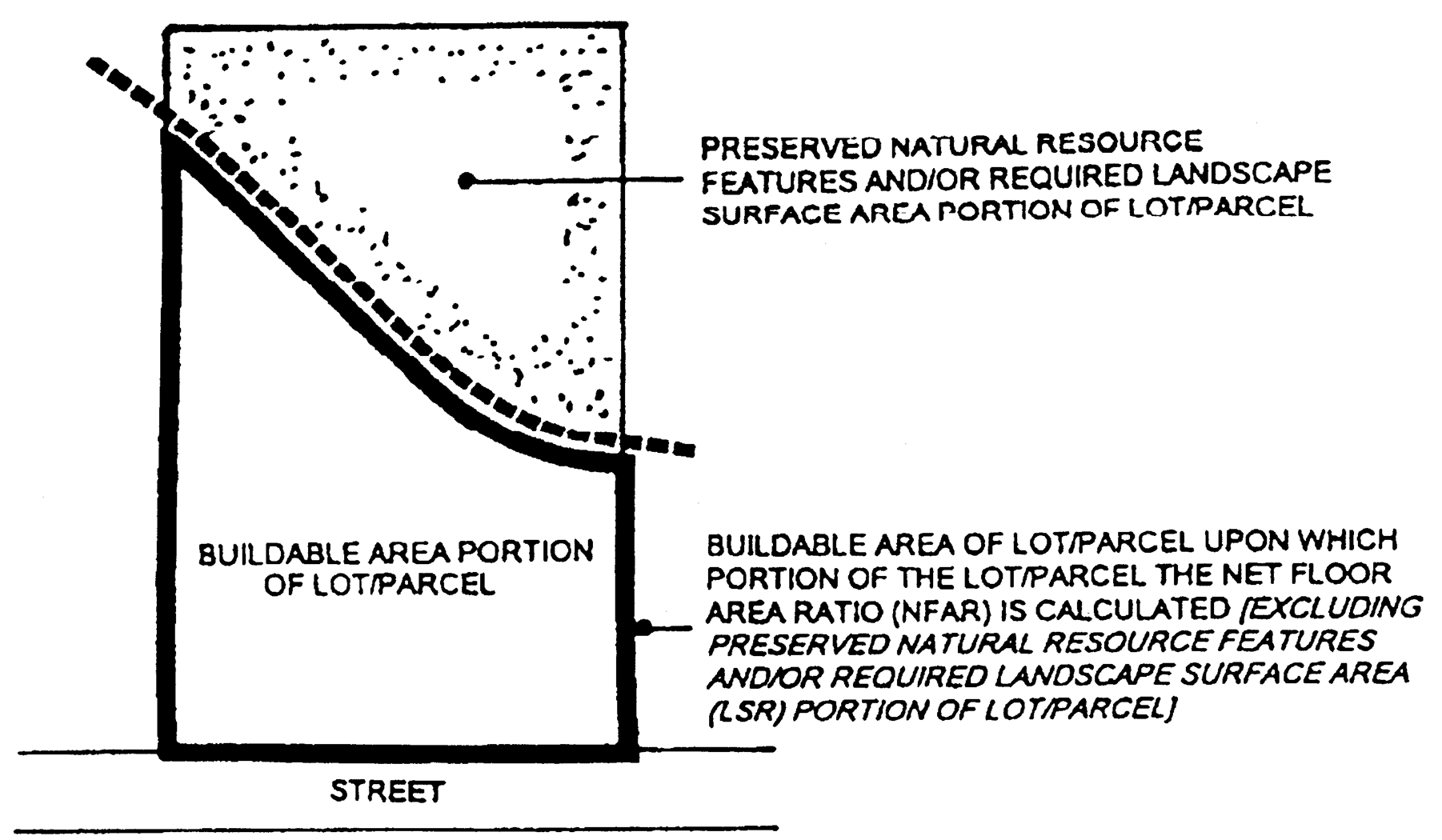
GROSS FLOOR AREA RATIO (GFAR)
Floor area ratio, gross (GFAR). An intensity measured as a ratio derived by dividing the total gross floor area of a building or structure by the base site area. Where the lot is part of a larger development and has no required bufferyard, that lot area may be used instead of the base site area to calculate the lot's development potential. (Also see Division 21.04.0500 of this Code and definition of "Site Area, Net Buildable.")
Floor area ratio, net (NFAR). An intensity measured as a ratio derived by dividing the total gross floor area of
a building or structure by the net buildable site area. (Also see Division 21.04.0500 of this Code.)
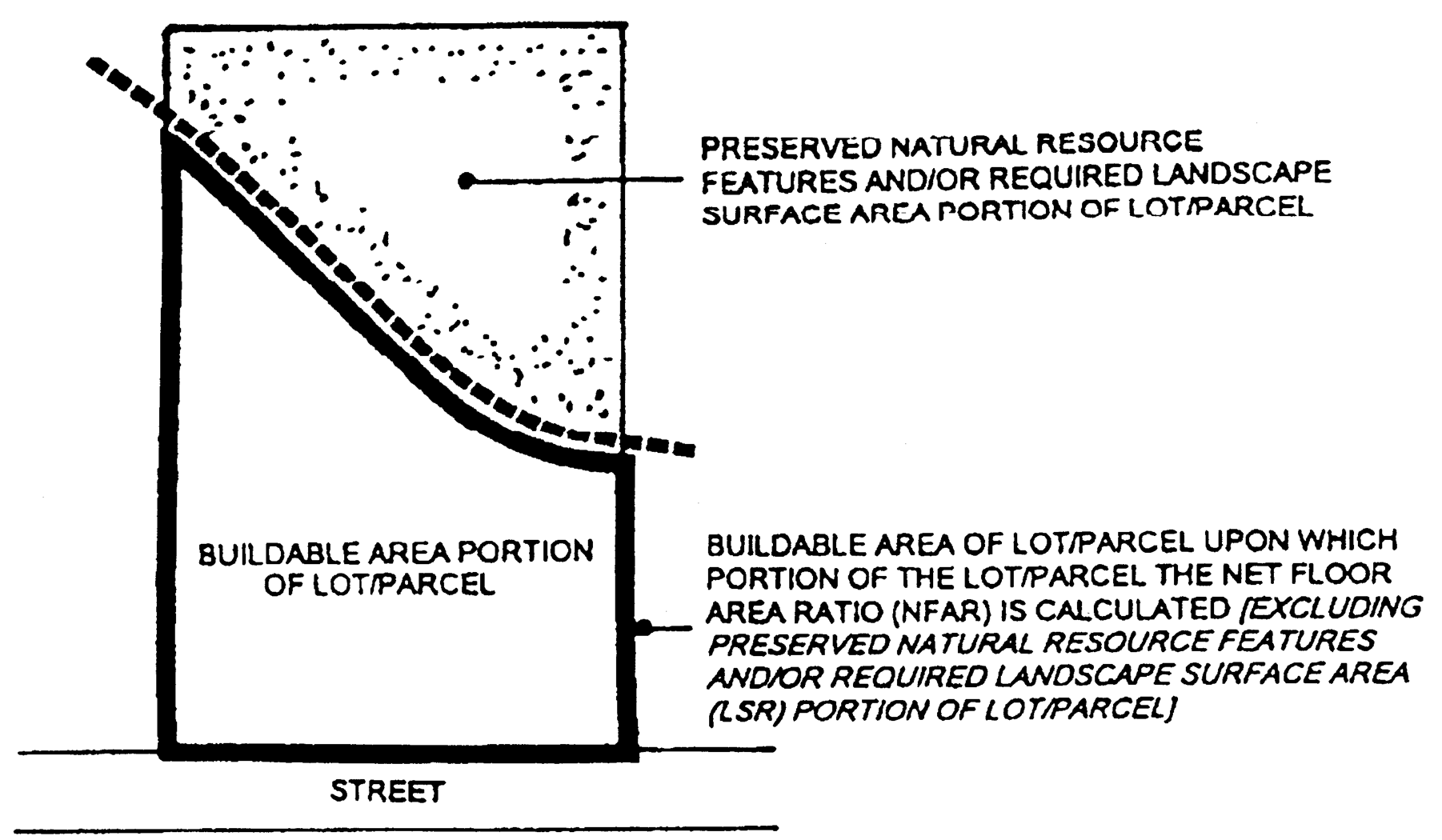
NET FLOOR AREA RATIO (NFAR)
Footcandle. A unit of illumination produced on a surface, all points of which are one (1) foot from a uniform point source of one (1) candle.
Forest. (See definitions for "Woodland, Mature" and "Woodland, Young.")
Foster family home. The primary domicile of a foster parent which is for four (4) or fewer foster children which is licensed under Section 48.62 of the Wisconsin State Statutes and amendments thereto.
Freeway. A major highway having no intersections at grade and having fully controlled access, hence, "free" from conflicts and interruptions.
Frequency. The number of oscillations per second in a sound wave, measuring the pitch of the resulting sound.
Frontage. All the property fronting on one (1) side of a street between the nearest intersecting streets or between a street right-of-way, waterway, or other similar barrier.
Front yard. (See definition for "Yard, Front.")
Garage, bus. Any building used or intended to be used for the storage of one (1) or more passenger motor buses, or motor coaches used in public transportation, including school buses.
Garage, truck. A building that is used or intended to be used for the storage of one (1) or more motor trucks, truck trailers, tractors, and commercial vehicles exceeding one and one-half (1.5) tons capacity.
Garage, private. An accessory building or an accessory portion of the principal building intended for and used to store the private passenger vehicles of family or families resident upon the premises, and in which no business, service, or industry connected directly or indirectly with automobile vehicles is carried on; provided that not more than one-half (0.5) of the space may be rented for the private vehicles of persons not resident on the premises, except that all the space in a garage of one (1) or two (2) car capacity may be so rented. Such a garage shall not be used for more than one (1) commercial vehicle and the load capacity of such vehicles shall not exceed one-half (0.5) ton.
Garage, public. A building other than a private garage, used for the care, incidental servicing, and sale of automobile supplies, or where motor vehicles are parked or stored for remuneration, hire, or sale within the structure, but not including trucks, tractors, truck-trailers, and commercial vehicles exceeding one and one-half (1.5) tons capacity.
Gas station. An establishment providing sales of motor vehicle fuel and such services as lubrication, oil, tire changes, and minor repairs.
Gauss. A measure of magnetic flux density. It is used to compare relative strengths of magnetic fields.
Gazebo. Open sided detached structure with roof. (Cr. #2430)
Glare. The sensation produced by luminance within the visual field that is sufficiently greater than that to which the eyes are adapted.
Golf course. Public, semi-public, or private grounds over which the game of golf is played, including accessory buildings and land uses incidental thereto, and consisting of at least sixty (60) acres for each standard nine (9) hole course, one hundred twenty (120) acres for each standard eighteen (18) hole course, and twenty-five (25) acres for each nine (9) hole, par three (3) course.
Grade, street. The elevation of the established street or future street in front of the building, as measured at the center of such building front or the middle of the driveway serving the attached garage. Where no street grade has been established or where a new street grade is planned, the City Engineer shall establish such street grade or its equivalent for the purpose of this Code.
Grade, yard. The elevation of garage shall be used to establish the yard grade except where grades are established by approved grading plans. (Cr. #2430)
Greenhouse. An enclosed structure, permanent or portable, which is used primarily for the growth of plants.
Group foster home. Any facility operated by a person required to be licensed by the State of Wisconsin under State Statute Section 48.62 for the care and maintenance of five (5) to eight (8) foster children.
Guest house. Living quarters within a detached accessory building on the same premises with the principal building for use by temporary guests of the occupants of the premises. Such quarters shall have no kitchen facilities nor be rented or otherwise used as a separate dwelling.
Gutter, street. A shallow channel usually set along a curb or the pavement edge of a road or parking lot for purposes of catching and carrying off runoff water.
Height, fence. The height of the fence shall be determined by measuring the vertical distance from the highest immediately adjoining grade to the top of each section of the fence.
Heliport. A helistop that also includes all necessary passenger and cargo facilities, helicopter maintenance and overhaul, fueling service, storage, tie-down areas, hangars, and other necessary buildings and open spaces. Heliports include any of the uses of helistops.
Helistop. An area designated for the landing and taking off of helicopters for picking up or discharging passengers or cargo, not including fueling or service facilities.
Hertz. A unit that measures frequency in all physical systems that have wave pattern. Abbreviated Hz.
Home occupation. Any gainful occupation or profession engaged in by an occupant of a dwelling unit as a use that is clearly incidental to the use of the dwelling unit for residential purposes. (Also see Section 21.04.0802 of this Code.)
Homeowners' association. A Wisconsin nonprofit membership corporation or entity which serves as an association of homeowners within a Subdivision, Certified Survey Map, or Condominium having shared common interest responsibilities with respect to the costs and upkeep of common private property of a Subdivision, Certified Survey Map, or Condominium. Such common property includes private recreation and open space areas within the Subdivision, Certified Survey Map, or Condominium. For the purposes of this Code, homeowners' associations include condominium associations.
Hospital. An institution devoted primarily to the maintenance and operation of facilities for the diagnosis, treatment, or care for not less than twenty-four (24) hours in any week of three (3) or more nonrelated individuals suffering from illness, disease, injury, deformity, or other abnormal physical conditions. The term "hospital" as used herein does not apply to institutions operating solely for the treatment of insane persons, drug addicts, liquor addicts, or other types of cases requiring restraint of patients, and the term "hospital" shall not be used for convalescent, nursing, shelter, or boarding homes.
Hospital, animal. A lot, building, structure, enclosure, or premises whereon or wherein three (3) or more dogs, cats, or other domestic animals are kept or maintained and is operated by, or the treatment therein is under direct supervision of, a veterinarian licensed to practice by the State of Wisconsin. A facility rendering surgical and medical treatments to animals, having no limitation to overnight accommodations for such animals. Crematory facilities shall not be allowed in an animal hospital. For these regulations, where an animal hospital is permitted, a veterinary clinic or veterinary hospital shall also be permitted.
Hotel. An establishment containing lodging accommodations designed for use by transients, travelers, or temporary guests. Facilities provided may include house cleaner service, laundering of linen used on the premises, restaurants (located within the same structure) including the sale of alcoholic beverages, telephone, and secretarial or desk service.
Hotel, apartment. A hotel in which at least ninety (90) percent of the hotel accommodations are for occupancy by the permanent guests. An apartment hotel having not less than fifty (50) guest rooms may have a dining room open to the public that is accessible only from an inner lobby or corridor.
Householder. The occupant of a dwelling unit who is either the owner or lessee thereof.
Housing, assisted living. (See definition of "Housing, Congregate (for the elderly).")
Housing, congregate (for the elderly). Specially planned, designed, and managed multi-unit rental housing for the elderly with self-contained apartments. These retirement communities are typically designed to provide supportive environments for the elderly and to accommodate a relatively independent lifestyle for the elderly. A limited number of support services, such as meals, laundry, housekeeping, transportation, and social and recreational activities, are usually provided. A full range of services to the elderly is normally not provided in this type of elderly housing.
Housing, enriched. (See definition of "Housing, Congregate (for the elderly).")
Housing, sheltered. (See definition of "Housing, Congregate (for the elderly).")
Illumination, maximum permitted. The maximum illumination measured in footcandles at the interior bufferyard line at ground level.
Impact noises. Noises whose peak values are more than six (6) dBA higher than the values indicated on a sound level meter meeting the requirements of the American National Standards Institute (ANSI S1.4-1961) "American Standard Specification for General Purpose Sound Level Meters," and are of a short duration. Impact noises are generated by sources that do no operate more than one (1) minute in any one-hour period.
Impervious surface. Impervious surfaces are those which do not absorb water. Impervious surfaces consist of all buildings, parking areas, driveways, roads, sidewalks, and any areas of concrete or asphalt. For lumberyards or similar uses, areas of stored lumber constitute impervious surfaces.
Impervious surface ratio (ISR). A measure of the intensity of land use which is determined by dividing the total area of all impervious surfaces on a site by the base site area (resulting in the gross ISR determination) or the net buildable area (resulting in the net ISR determination).
Improvement. Any manmade immovable item which becomes a part of, is placed upon, or is affixed to real estate.
Improvement, public. Any sanitary sewer, storm sewer, open channel, water main, roadway, park, parkway, public access, curb and gutter, sidewalk, pedestrianway, bicycle path, stormwater detention and retention basins, planting strip, or other utility and/or facility for which the City may ultimately assume the responsibility for maintenance and operation.
Improvement, substantial. Any repair, reconstruction, or improvement of a structure, the cost of which equals or exceeds fifty (50) percent of the present equalized assessed value of the structure either before the improvement or repair is started, or if the structure has been damaged, and is being restored, before the damage occurred. The term does not, however, include either:
1.
Any project for improvement of a structure to comply with existing state or local health, sanitary, or safety code specifications that are solely necessary to assure safe living conditions, or
2.
Any alteration of a structure or site documented as deserving preservation by the Wisconsin State Historical Society or listed on the National Register of Historic Places. Ordinary maintenance repairs are not considered structural repairs, modifications, or additions; such ordinary maintenance repairs include internal and external painting, decorating, paneling, and the replacement of doors, windows, and other nonstructural components.
Inspector. Inspector shall mean the Zoning Administrator, Building Inspector, and/or other code or ordinance enforcement officer of the City.
Institution, educational. Public, parochial, charitable, or nonprofit junior college, college, or university, other than trade or business schools, including instructional and recreational uses, with or without living quarters, dining rooms, restaurants, heating plants, and other incidental facilities for students, teachers, and employees.
Intermediate care facility. A facility designed for persons who do not require round-the-clock nursing, but who need "preventive care" with less than continuous licensed nursing care or observation. These facilities typically involve 24-hour service, but with physicians and nurses in supervisory roles. Such facilities typically emphasize personal and social care. Services typically include meals, laundry, therapies, and nursing care, including catheter and incontinence care.
Irrevocable letter of credit. An agreement guaranteeing payment for subdivision improvements or other improvements to land, entered into by a bank, savings and loan, or other financial institution which is authorized to do business in this State and which has a financial standing acceptable to the City, and which is approved, as to form, by the City Attorney.
Junk yard, including automobile wrecking and storage. Any lot, building, structure, enclosure, premises or parts thereof used for the storage, keeping, or abandonment of any worn-out, cast-off, or discarded or abandoned article, material, vehicle, automobile, or machinery or parts thereof, which is ready for destruction or sale or has been collected or stored for salvage or conversion to some use, including scrap metal, paper, wood, cordage, or other waste or discarded materials, articles, vehicles, automobiles, or machinery or parts thereof, or vehicles or automobiles without a valid current state registration and license plate issued to said vehicle or automobile, and to the occupant, owner, purchaser, lessor, lessee, or tenant of any lot, building, or structure therein or thereon situated.
Kennel, commercial. A lot, building, structure, enclosure, or premises whereon or wherein more than three (3) dogs or cats more than six (6) months of age are commercially maintained, boarded, bred, kept, or cared for in return for remuneration, or are kept for sale, or are groomed, trained, or handled, for others.
Laboratory, commercial. A place devoted to experimental study, and/or testing, and/or analyzing. Manufacturing, assembly, or packaging of products is not included within this definition.
Lake. Any natural body of water two (2) acres or larger as measured by the shoreline at its maximum condition rather than the permanent pool condition, if there is any difference.
Landmark. Any improvement which has a special character or special historic interest or value as part of the development, heritage or cultural characteristics of the City, state, or nation and which has been designated as a landmark pursuant to the provisions of the City of Greenfield Municipal Code.
Landowner. For the purposes of Division 21.09.0300, any person holding title to or having an interest in land.
Landscape bufferyard. (See definition for "Bufferyard.")
Landscape plan. (See Division 21.08.0301 of this Code.)
Landscape surface area. Surface area of land not covered by any building or impervious surface; pervious surface that is maintained as a natural area and left undisturbed or to support plant life.
Landscape surface ratio (LSR). The ratio derived by dividing the area of landscaped surface by the base site area.
Landscaping. Living material, such as grass, groundcover, flowers, shrubs, vines, hedges, and trees; and nonliving durable material such as rocks, pebbles, sand, mulch, wood chips or bark, walls, and fences, but not including paving.
Land use, commercial. For the purposes of Division 21.09.0300, the use of land for the retail or wholesale sale of goods or services. Also included will be manufacturing and industrial development.
Land user. Any person operating, leasing, renting, or having made other arrangements with the landowner by which the landowner authorizes use of his or her land.
Level, curb. When used to establish the height of a building, the level of the established curb in front of a building or structure, measured at the center of such front. Where no curb level has been established, it shall be deemed to be the established level of the centerline of the street surface in front of a building or structure, measured at the centerline of such front.
Life care campus. (See definition of "Continuing Care Retirement Community (for the elderly).")
Life care community. (See definition of "Continuing Care Retirement Community (for the elderly).")
Living area. That area of a dwelling unit measured from the outside of the exterior walls; including utility rooms, foyers, interior stairwells, hallways, closets, columns and walls and finished half-basements or finished portions of half-basements; but excluding basements and unfinished half-basements, or unfinished portions of half-basements, open porches, breezeways, garages, and other spaces not used frequently or during extended periods for living, eating, or sleeping purposes. The unit of measurement of living area shall be in square feet.
Living area, first floor. That space used for living purposes which are not above any other space used for living purposes. The first floor living area shall never conform to the definitions of "Half Basement" or "Basement."
Loading and unloading space, off-street. An open, hard-surfaced area of land other than a street or a public way, the principal use of which is for the standing, loading, or unloading of motor vehicles, tractors, and trailers, to avoid undue interference with public streets and alleys. Such space shall not be less than ten (10) feet in width, thirty five (35) feet in length, and fourteen (14) feet in height, exclusive of access aisles and maneuvering space.
Lodge, private. (See definition of "Club, Private.")
Lodging house. (See definition of "Rooming House.")
Lot. A parcel of land legally described as a distinct portion or piece of land of record.
Lot area. The area contained within the exterior, or peripheral, boundaries or lot lines of a lot excluding street or alley rights-of-way.
Lot, corner. A lot abutting two (2) or more streets at their intersection if the corner of such intersection shall have an angle of one hundred thirty-five (135) degrees or less, measured on the lot side.
Lot coverage. The area of a zoning lot occupied by the principal building or buildings and accessory buildings.
Lot depth. The mean horizontal distance between the front and rear lot lines of a lot measured within the lot boundaries.
Lot, double frontage. A lot, other than a corner lot, with frontage on more than one (1) street. Double frontage lots shall not generally be permitted unless the lot abuts an arterial highway. Double frontage lots abutting arterial highways should restrict direct access to the arterial highway by means of a planting buffer or another acceptable access buffering measure.
Lot, flag. A lot, typically not meeting minimum frontage requirements and where access to a public street is by a narrow strip of land or driveway.
Lot frontage. The front of a lot shall be that boundary of a lot along a street. For a corner lot, the frontage shall be the shortest side abutting a street.
Lot, interior. A lot other than a corner lot.
Lot line. A property boundary line of any lot held in single or separate ownership, except that where any portion of the lot extends to the abutting street or alley, the lot line shall be deemed to be the street or alley right-of-way line.
Lot line, front. The front property boundary line of a zoning lot.
Lot line, interior. A side lot line common with another lot.
Lot line, rear. The lot line or lot lines most nearly parallel to and most remote from the front lot line.
Lot line, side. A lot line other than a front or rear lot line.
Lot of record. An area of land designated as a lot on a plat of Subdivision or Certified Survey Map recorded or registered pursuant to statute existing at the time of the adoption of this Code.
Lot, through. (See definition of "Lot, Double Frontage.")
Lot width. The mean horizontal distance between the side lot lines as measured at the front yard setback (not necessarily as measured at the minimum front yard setback) within the lot boundaries.
Lot, zoning. (See definition of "Zoning Lot.")
Lounge. (See definition of "Tavern.")
Luminaire. A complete lighting unit consisting of a light source and all necessary mechanical, electrical, and decorative parts.
Manufacturing. The making of anything by any agency or process.
Manufactured home. A structure that is transportable in one (1) or more sections, built on a permanent chassis, and designed to be used with or without a permanent foundation when connected to the required utilities. The term includes, but is not limited to, the definition of "mobile home" as set forth in regulations governing the Mobile Home Safety and Construction Standards Program. [24 C.F.R. 3282.7(a)]. Factory-built homes on permanent foundations are considered buildings, and are governed by the Wisconsin Uniform Dwelling Code.
Manufactured home park. A parcel (or contiguous parcels) of land divided into two (2) or more manufactured home spaces for rent or lease.
Manufactured home subdivision. A parcel (or contiguous parcels) of land divided into two (2) or more manufactured home lots for sale.
Master plan. A document or series of documents prepared by the Plan Commission and duly adopted by said Commission setting forth policies for the future development or redevelopment of the City of Greenfield pursuant to Chapter 62.23 of the Wisconsin Statutes. The master plan shall also include neighborhood and subarea plans, proposals for future land use, open space, streets and transportation, parks, urban redevelopment, and public facilities. Devices for the implementation of these plans, such as zoning, official map, land division and building line provisions, design guidelines, and capital improvement programs shall also be considered a part of the master plan. The master plan can also be termed the "Comprehensive Plan" and/or "Comprehensive Master Plan."
Materials, inflammable. Inflammable and combustible materials shall mean and include oils and oil lights, sweepings from garage floors, barrels, boxes or other containers containing oil or other similar liquids, rags, clothes, paper, shavings, paper or cardboard boxes or cartons, grease, paints, varnish, or other similar substances, any of which are likely to be readily inflammable or combustible.
Materials, toxic. A substance (liquid, solid, or gaseous) which, due to a deleterious property, tends to destroy life or impair health.
Medical office. A facility used for offices of one (1) or more physicians, dentists, clinical psychologists, nurse practitioners, and similar medical professionals, for the examination and treatment of patients, in which one (1) or more medical professionals may be associated together or practicing independently of each other. Medical offices may include apothecaries, dental and medical laboratories, naprapathy, x-ray and/or other similar facilities and services, but do not include inpatient facilities devoted primarily to major surgical procedures or accommodations for the overnight stay of patients.
Mini-storage. A building or group of buildings in a secured controlled-access and fenced compound that contains varying sizes of individual, compartmentalized, and controlled-access stalls or lockers for the dead storage of a customer's goods or wares. At least one (1) toilet facility shall be available to customers. No sales, service, or repair activities other than the rental of dead storage units are permitted on the premises. Maximum leasable space per tenant shall be one thousand (1,000) square feet. Outdoor storage, or the storage of junk, explosives, or inflammable materials, and other noxious or dangerous materials are specifically prohibited.
Minor land division. Any division of land not defined as a 'Subdivision.' Minor land divisions include the division of land by the owner or Subdivider resulting in the creation of two (2), but not more than four (4), parcels of building sites, any one (1) of which is less than thirty-five (35) acres in size; or the division of a block, lot or outlot within a recorded Subdivision Plat into not more than four (4) parcels or building sites without changing the exterior boundaries of said block, lot, or outlot. Such minor land divisions shall be made by a Certified Survey Map. A minor land division does not include dedication without the creation of a lot.
Minor variance. (See definition of "Variance, Minor.")
Mixed use. A building or structure that contains two (2) or more of the following basic land use types: commercial, office, or residential which are vertically integrated, and that are located over each other in whole or in part. Mixed uses may be integrated horizontally if they are physically interrelated by pedestrian areas that are uninterrupted by vehicular traffic. In horizontal integration of mixed uses, the uses may not be separated by roads or parking areas.
Mobile home. Any trailer as defined herein used for residential purposes.
Mobile home park. Any premises occupied or designed to accommodate one (1) or more families living in a house trailer or mobile home, or the parking of one (1) or more trailers for business or storage purposes.
Mobile home camp. (See definition of "Mobile Home Park.")
Motel. A group of attached or detached buildings or facility containing individual sleeping or living units, designed for or used temporarily by automobile tourists or transients, with garage attached or parking space conveniently located to each unit, including auto courts, motels, motor lodges, or other similar type uses. Customary services such as house cleaner service, telephone, linen, and desk service, and the use and upkeep of furniture are provided.
Motor lodge. (See definition of "Motel.")
Municipal Code. The Municipal Code of the City of Greenfield, Milwaukee County, Wisconsin.
Municipality. An incorporated village or city or an unincorporated town.
Natural resource protection plan. (See Division 21.08.0100 of this Code.)
Natural resources. Areas of steep slopes, woodlands and forests (mature and young), lakes, ponds, streams, shore buffer, floodplains, floodlands, drainageways, wetlands, and shoreland wetlands as defined in this Code.
Natural resource protection standard. The proportion of the natural features of a site (excluding land occupied by public street rights-of-way), which shall remain undeveloped and protected and is specifically designated for natural resource protection by deed restriction, protective covenant, zoning, or a combination thereof. (See Division 21.04.0500 and Part 5 "Natural Resource Protection" of this Code.)
Nonconforming use. Any building, structure, or land lawfully occupied by a use or lawfully established at the time of the adoption of this Code or amendments hereto, which does not conform after the effective date of this Code, or amendments hereto, with the use regulations of this Code. Said use shall be an active and actual use of the land and/or buildings which existed prior to the effective date of this Code.
Nonconforming building. A building or structure, or portion thereof, lawfully existing at the time of the adoption of this Code, which was designed, erected, or structurally altered after the effective date of this Code for a use that does not conform to the use regulations of the district in which it is located.
Noxious matter. Material that is capable of causing injury to living organisms by chemical reaction or can cause detrimental effects upon the psychological, social, or economic well-being of human beings.
Nursery. A place where the primary activity is the growing of plants, flowers, trees, and shrubs for sale.
Nursery, day. A building or portion thereof used for the daytime care of preschool-age children.
Nursery school. An institution providing day care for children from four (4) to six (6) years of age.
Nursing home. An extended or intermediate care facility licensed or approved by the State to provide full-time convalescent or chronic care to individuals who due to age, chronic illness, or infirmity, are unable to care for themselves, including places of rest for those suffering bodily disorders, but not including facilities for the treatment of injuries or for surgical care.
Obstruction. An obstacle, impediment, or hindrance.
Occupancy permit. The permit required by this Code to occupy any building or structure where such occupancy complies with all provisions of this Code.
Octave band. A means of dividing the range of sound frequencies into octaves to classify sound according to pitch.
Octave band filter. An electrical frequency analyzer, designed according to standards formulated by the American Standards Association and used with a sound level meter to take measurements in specific octave intervals (American Standard for Sound Level Meters, A.S.A. No. 244.3-1944).
Odorous matter. Solid, liquid or gaseous material that produces an olfactory response in a human being.
Odor threshold concentration. The lowest concentration of odorous matter that will produce an olfactory response in a human being as detected by a panel of healthy observers. Odor thresholds shall be determined according to American Society for Testing and Materials Test Method D1391-57 "Standard Method for Measurement of Odor in Atmosphere (Dilution Method)" (Philadelphia: American Society of Testing and Material, 1957).
Office, home. (See definition of "Home Occupation" and Section 21.06.0802 of this Code.)
Office, medical. (See definition of "Medical Office.")
Official map. That document as described by Chapter 62.23(6) of the Wisconsin Statutes as amended which shows the location of: streets, highways, parkways, parks, playgrounds, railroad rights-of-way, waterways, and public transit facilities in the City of Greenfield.
Official zoning map. (See definition of "Zoning Map.")
Open sales lot. Any land used or occupied for buying and selling new or secondhand passenger cars or trucks, motor scooters, motorcycles, boats, trailers, aircraft, monuments, farm machinery and equipment, and for the storage of same before sale.
Open space. Any site, parcel, lot, area, or outlot of land or water essentially unimproved and set aside, dedicated, designated, or reserved for the public or private use or enjoyment or for the use and enjoyment of owners and occupants of land adjoining or neighboring such open space. Land that is to be used primarily for resource protection, agriculture, recreational purposes, or otherwise left undisturbed and specifically excluding road rights-of-way and lots. Open space land shall not be occupied by nonrecreational buildings, roads, drives, public rights-of-way, or off-street parking areas for nonrecreational uses. Land located within the yards or lots of residential and/or nonresidential properties is not considered open space unless it is deed restricted for open space protection or natural resource features protection. Where lots are above the minimum sizes required and the excess lot area is deed restricted to open space uses it may be counted as open space.
Open space, common. Open space within or related to a development, neither individually owned nor dedicated for public use but typically owned by a property owners' association, which is designed and intended for the common use and/or enjoyment of the residents of the development, and which is accessible and usable by all persons who occupy a principal use within the development.
Open space, deed restricted. Deed restricted open space on platted "Lots" is not occupied by any principal or accessory buildings or structures, roads, road rights-of-way, or parking areas. Deed restricted open space on platted "Outlots" is not occupied by nonrecreational principal or accessory buildings or structures, roads, road rights-of-way, or parking areas. The maintenance of deed restricted open space located on platted "Outlots" is by a property owners' or homeowners' association. The maintenance of deed restricted open space on platted "Lots" is by the individual lot owner.
Open space, public. An open space area conveyed or otherwise dedicated to a municipality, municipal agency, public school district, state or county agency, or other public body for recreational or conservational uses. Any publicly owned open area, including, but not limited to, the following: parks, playgrounds, forest preserves, beaches, waterways, parkways, and streets.
Open space ratio (OSR). The number derived by dividing the open space of the site by the base site area. When applied to natural resource protection, the open space ratio shall include the natural resource feature(s) to be protected. Minimum requirements for open space ratios are set forth for the various zoning districts under individual zoning district requirements Sections of this Code.
Option, development. Alternative development types within specific residential zoning districts as set forth in this Code.
Owner. Includes the plural as well as the singular and may mean either a natural person, individual, firm, association, syndicate, partnership, private corporation, public or quasi-public corporation, or combination of these having sufficient proprietary interest to seek development of land. For purposes of successive division of a parcel of land by Certified Survey Maps, "owner" shall be taken to include any related person, firm, partnership or corporation, to whom conveyance has been made within two (2) years of application for approval of a Certified Survey Map. "Related" shall mean any natural person related to a transferor by blood or marriage, any person acting in an agency or trust capacity, any partnership in which the transferor is a partner and any corporation in which the transferor is a stockholder, officer or director, or in which related persons are stockholders, officers or directors.
Ownership, one. For this Code, lots shall be considered as owned by the same person when they are owned by the same individual or corporation; an individual and another in joint tenancy, or as tenants in common, and either of said joint or common tenants owns other lots individually or as joint tenant or tenant in common with another; as individual and other lots by his spouse, parent, grandparents, children, grandchildren, or the spouse of any child or grandchild, or a brother or sister or when any of said lots are owned by an individual and other lots are owned by a corporation in which said individual is an officer or director or controlling stockholder.
Parking area, private. An open, hard-surfaced area, other than a street or public way, designed, arranged, and made available for the storage of private passenger automobiles only, of occupants of the building or buildings for which the parking area is developed and is accessory.
Parking area, public. An open, hard-surfaced area, other than a street or public way, intended to be used for the storage of passenger automobiles and commercial vehicles under one and one-half (1½) tons capacity, and available to the public, whether for compensation, free, or as an accommodation to clients or customers.
Parking lot. A structure or premises used for the parking of vehicles, excluding parking areas accessory to detached single-family dwellings and two-family attached dwellings. (Also see definitions of "Parking Area, Private" and Parking Area, Public.")
Parking space, automobile. Space within a public or private parking area of not less than one hundred eighty (180) square feet (9 ft. by 20 ft. or 9 ft. by 18 ft. with concrete curbing), exclusive of access aisles or drives, ramps, columns, or office and work areas, for the storage of one (1) passenger automobile or commercial vehicle less than one and one-half (1½) tons capacity. Parking for persons with disabilities shall meet all applicable requirements of the "Americans with Disabilities Act (ADA) Guidelines for Buildings and Facilities" as documented in the Federal Register, Vol. 56, No. 144, July 26, 1991, as amended.
Park, private. A privately owned outdoor recreational area.
Park, public. A publicly owned recreational area.
Particulate matter. For the purposes of determining air contaminations, particulate matter is any material other than water suspended in or discharged into the atmosphere in a finely divided form as a liquid or solid capable of being airborne or gasborne. Dust is solid particulate matter capable of being airborne or gas borne.
Party wall. (See definition of "Wall, Party.")
Patio. A paved or similar surface that is not a driveway which is attached or detached to a dwelling unit, constructed at or around ground level.
Pedestrianway. A public way intended for the convenience of pedestrians only; it may also provide public right-of-way for utilities.
Performance standard. A criterion to control noise, odor, smoke, toxic or noxious matter, vibration, fire and explosive hazards, or glare or heat generated by or inherent in uses of land or buildings.
Permitted use. A use by right that is specifically authorized in a particular zoning district.
Person. The word "person" shall mean and include any natural person, firm, corporation, or partnership.
Plan commission. The City of Greenfield Plan Commission created by the Common Council pursuant to Section 62.23 of the Wisconsin Statutes.
Plan, development. The Milwaukee County Development Plan (including components thereof including park, recreation, open space, and transportation plans) text and all accompanying maps, charts, explanatory material adopted by Milwaukee County pursuant to Section 59.97 of the Wisconsin Statutes, and all amendments thereto.
Plat. The map, drawing, or chart on which the Subdivider's land division or Condominium Developer's condominium is presented to the City of Greenfield for approval.
Pleasure craft, private. Canoes, motorboats, and sailboats for private use.
Pond. All bodies of water less than two (2) acres in area as measured by the shoreline at its maximum condition rather than the permanent pool condition, if there is any difference.
Pond, water quality. A manmade pond constructed to improve the water quality of an area.
Porch. A covered area adjoining an entrance to a building and usually having a separate roof.
Power generation facility. An energy generating facility and any appurtenant facilities.
Preliminary plat. A map showing the salient features of a proposed subdivision submitted to an approving authority for purposes of preliminary consideration pursuant to the requirements of both Chapter 236 of the Wisconsin Statutes as amended and also the City of Greenfield Land Division Code.
Principal use. The main use of land or buildings as distinguished from a subordinate or accessory use.
Processing. When used in describing an industrial operation, the series of continuous actions that changes one (1) or more raw materials into a finished product. The process may be chemical, special method, or mechanical.
Protective covenants. Contracts entered between private parties or between private parties and public bodies, which are a restriction on the use of all private property or platted property within a minor land division or subdivision for the benefit of the public or property owners, and to provide mutual protection against undesirable aspects of development that would tend to impair stability of values.
Public way. Any public road, street, highway, walkway, drainageway, or part thereof.
Quarters, temporary. A room or rooms on the property and intended for the temporary use of a watchman, servant, owner, etc. These quarters shall not be used as permanent living quarters.
Queuing space. For this Code, queuing space is that on-site area required, as to the number of cars that must be accommodated, while awaiting ingress or egress to specified business or service establishments.
Recreation, active. Recreational facilities oriented to competitive activities including, but not necessarily limited to, baseball, softball, soccer, football, tennis, basketball, playground or playfield, ice skating area, picnicking, and swimming.
Recreation, passive. Recreational uses, areas, or activities oriented to noncompetitive activities that require no special equipment. Passive recreation areas are generally maintained by mowing. Bicycle riding, hiking, and bird-watching are examples of passive recreation activities.
Recreational vehicle. Any motor vehicle, any travel trailer or trailer, camper, motor home, tent trailer or camping trailer, any motor home or camper box, any boat, hover craft, or other watercraft device, any motorcycle or off road vehicle, any snowmobile or snowmobile trailer or any other device designed for any similar purpose.
Rehabilitation services. A residential or nonresidential facility or unit which provides a full-range of physical therapy services.
Register of Deeds. Milwaukee County Register of Deeds.
Residential care facility (for the elderly). A facility designed primarily for elderly residents with no serious health problems but who nonetheless have chronic or debilitating conditions requiring assistance with daily activities. Services usually provided include staff-supervised meals, housekeeping and personal care, medication supervision, and social activities. These facilities may have private and/or shared sleeping rooms. Such facilities are generally licensed by the State and must meet design and operating standards, including minimum staff requirements. This also includes personal care and domiciliary care for the elderly.
Residential housing for older persons. Residential housing:
1.
Provided under any State or Federal program that the U.S. Secretary of Housing and Urban Development determines is specifically designed and operated to assist elderly persons (as defined in the State or Federal program); or
2.
Intended for, and solely occupied by, persons sixty-two (62) years of age or older; or
3.
Intended and operated for occupancy by at least one (1) person fifty-five (55) years of age or older per unit. In determining whether housing qualifies as housing for older persons under this definition, the following factors shall be applied:
a.
The existence of significant facilities and services specifically designed to meet the physical or social needs of older persons, or if the provision of such facilities and services is not practicable, that such housing is necessary to provide important housing opportunities for older persons; and
b.
That at least eighty (80) percent of the units are occupied by at least one (1) person fifty-five (55) years of age or older per unit; and
c.
The publication of, and adherence to, policies and procedures which demonstrate an intent by the owner or manager to provide housing for persons fifty-five (55) years of age or older.
4.
Residential housing for older persons includes traditional residential facilities for the elderly as well as assisted living. Such housing is a part of a facility within which residents, with or without minor physical disabilities, live, cook, dine, and recreate and may avail themselves of medical and other services.
Restaurant. Any land, building, or part thereof, other than a boarding house, where meals are provided for compensation, including a cafe, cafeteria, coffee shop, lunch room, tearoom, and dining room; and including the serving of alcoholic beverages when served with and incidental to the serving of meals.
Restaurant, fast food. An establishment whose principal business is the sale of food and/or beverages in a ready-to-consume state for consumption as follows:
1.
Within the restaurant building;
2.
Within a motor vehicle parked on the premises; or
3.
Off the premises as either carry-out orders or orders using a drive through facility.
The principal method of operation includes the serving of food and/or beverages in paper, plastic, or other disposable containers.
Rest home. (See definition of "Nursing Home.")
Retention basin. (See definition of "Basin, Retention.")
Ringelmann chart. A chart described in the U. S. Bureau of Mines Information Circular 7718, and on which are illustrated graduated shades of grey for use in estimating the light-obscuring capacity of smoke.
Ringelmann number. The number of the area on the Ringelmann Chart that coincides most nearly with the visual density of smoke emission.
Roofline. The top or bottom edge of a roof or building parapet, excluding any cupolas, pylons, chimneys, or other minor projections.
Rooming house. (See definition of "Boarding House.")
Runoff. The rainfall, snowmelt, discharge pumping, or irrigation water flowing over the ground surface.
Sanitarium. (See definition of "Hospital.")
Screening. A method of visually shielding or obscuring an abutting or nearby structure or use from another by fencing, walls, earthen berms, or densely planted vegetation.
Seat. Furniture upon which to sit, in the case of attached seating having a linear measurement not less than twenty-two (22) inches across the surface used for sitting; intended for use in determining off-street parking requirements.
Services, essential. Services provided by public and private utilities, necessary for the exercise of the principal use or service of the principal structure. These services include public street rights-of-way, underground, surface, or overhead gas, electrical, steam, water, sanitary sewerage, storm water drainage, and communication accessories thereto, such as poles, towers, wires, mains, drains, vaults, culverts, laterals, sewers, pipes, catch basins, water storage tanks, conduits, cables, fire alarm boxes, police call boxes, traffic signals, pumps, lift stations, and hydrants, but not including buildings over one thousand (1,000) square feet in area above the surrounding grade.
Setback. Those minimum street, front, rear, and/or side yards required by this Code.
Setback line, base. The ultimate street line as established by the Master Plan of the City, or component thereof, and/or a highway width Code of Milwaukee County or by an Official Map of the City. On all such streets the base setback line shall be located at a distance from the centerline equal to one-half of such established width. On all other streets, the base setback line shall be thirty (30) feet from the centerline of such street or sixty (60) feet from the center point of a cul-de-sac, unless specifically designated otherwise by the Common Council. The base setback line of frontage roads shall be located at a distance from the centerline equal to one-half of the right-of-way of said frontage road. All setback lines shall be parallel to and measured at right angles to the centerline of the street or highway. All front yard building setbacks shall be measured from the base setback lines.
Setback line, building. A line parallel to the lot or parcel boundary line or an abutting public street right-of-way line at a distance from it, regulated by the various yard requirements established under this Code.
Shelter, emergency. Public or private enclosures designed to protect people from aerial, radiological, biological, or chemical warfare, fire, flood, windstorm, riots, and invasions.
Shopping center. A group of two (2) or more commercial establishments or tenants that is planned, developed, constructed, owned, and managed as a unit with customer and employee parking provided on-site.
Shoreland. Those lands lying within the following distances from the ordinary high water mark of navigable waters: one thousand (1,000) feet from a lake, pond, or flowage; and three hundred (300) feet from a river or stream, or to the landward side of the floodplain as designated on the adopted City of Greenfield Zoning Map; whichever distance is greater. Shorelands shall not include those adjacent to farm drainage ditches where: (a) such lands are not adjacent to navigable stream or river; (b) those parts of such drainage ditches adjacent to such lands were not navigable before ditching or had no previous stream history; and (c) such lands are maintained in nonstructural agricultural use.
SIC. Standard Industrial Classification from the 1987 (or latest edition) manual published by the Executive Office of the President, Office of Management and Budget.
Sidewalk. A paved path provided for pedestrian use and usually at the side of a road within a public street right-of-way but preferably separated by distance from the road pavement.
Sight-proof. Having a minimum visual opacity of seventy-five (75) percent.
Site. For the purposes of Division 21.09.0300 of this Code, the entire area included in the legal description of the land on which the land disturbing or land development activity is proposed in the Construction Site Erosion Control Permit application.
Site area, base. (See Division 21.04.0500 of this Code.)
Site area, net buildable. The entire land area within the boundaries of a site, less the area of all land required or proposed for public use, open space, or natural resource preservation or protection.
Site capacity analysis. A calculation of buildable site area, taking into account its resource protection land, open space, and other lands. (Also see Division 21.04.0500 of this Code.)
Site, landmark. Any parcel of land of historic significance due to substantial value in tracing the history of aboriginal man, or upon which a historic event has occurred, and, which has been designated as a landmark site under the provisions of this Code, or a parcel of land, or part thereof, on which is situated a landmark and any abutting parcel, or part thereof, used as and constituting part of the premises on which the landmark is situated.
Site plan. (See Division 21.07.0100 of this Code.)
Skilled care nursing facility. For the purposes of this definition, "skilled care" is defined by a full-range of 24-hour direct medical, nursing, and other health services. Registered nurses, licensed practical nurses, and nurses' aides typically provide services prescribed by a resident's physician. Such facilities are for those older adults who may need health supervision but not hospitalization. The emphasis of such facilities is on nursing care, but restorative physical, occupational, speech, and respiratory therapies may also be provided. The care may also include specialized nursing services, such as intravenous feedings or medication, tube feeding, injected medication, daily wound care, rehabilitation services, and monitoring of unstable conditions.
Slope. The degree of deviation of a surface from the horizontal, usually expressed in percent or degrees.
Smoke. Small gas borne particles other than water that form a visible plume in air.
Smoke units. The number obtained by multiplying the smoke density in Ringelmann Numbers by the time of emission in minutes. For this chart, a Ringelmann Density reading is made at least once every minute during observation; each reading is then multiplied by the time in minutes during which it is observed; and the various products are added to give the total number of "smoke units" observed during the total period under observation.
Soil mapping unit lines. The boundaries of soils shown on the operational soil survey maps prepared by the United States Department of Agriculture, Soil Conservation Service for the Southeastern Wisconsin Regional Planning Commission published in the Soil Survey of Milwaukee and Waukesha Counties dated July 1971.
Sound level meter. An instrument standardized by the American Standards Association for measurement of intensity of sound.
Special use. A use permitted by a special zoning certificate, called a "special use permit," according to the provisions of this Code.
Story. That portion of a building included between the surface of any floor and the surface of the floor above it, or if there is no floor above, then the space between the floor and the ceiling above it. Any portion of a story exceeding fourteen (14) feet in height shall be considered as an additional story for each fourteen (14) feet or fraction thereof.
Story, half. A half story is that portion of a building under a gable, hip, or mansard roof, the wall plates of which on at least two (2) opposite exterior walls are not more than four and one-half (4.5) feet above the finished floor of each story. For one-family dwellings, two-family dwellings, and multiple-family dwellings less than three (3) stories in height, a half-story in a sloping room shall not be counted as a story.
Stream. A course of running water, either perennial or intermittent, flowing in a channel.
Street. A public way, other than an alley, which affords a primary means of access to abutting property.
Street, arterial. A federal-, state-, or county-marked route normally having four (4) lanes for traffic and some form of median marker or may also be a city-designated "arterial street" in the adopted City of Greenfield Comprehensive Master Plan or component thereof, or on the Official Map. Parking may be banned. A street used, or intended to be used, primarily for fast or heavy through traffic providing for the expeditious movement of through traffic into, out of, and within the community. Arterial streets shall include freeways and expressways and also standard arterial streets, highways, and parkways. Arterial streets shall be located to minimize the penetration of such streets through existing and proposed residential areas. Arterial streets shall be designed to convey an average daily traffic (ADT) of three thousand (3,000) and greater.
Street, collector. A street used, or intended to be used, to carry traffic from minor streets to the system of arterial streets including principal entrance streets to residential developments and/or activity/employment centers. Collector streets shall be designed to convey an average daily traffic (ADT) of between five hundred (500) and three thousand (3,000).
Street, frontage. A minor street auxiliary to and located on the side of an arterial street for control of access and for service to the abutting development.
Street line. A line separating a lot, piece, or parcel of land from a street.
Street, minor. A street used, or intended to be used, primarily for access to abutting properties. Residential minor streets designed as either looped or through streets shall be designed so that no section conveys an average daily traffic (ADT) greater than five hundred (500). Residential minor land access streets designed as permanent cul-de-sac streets shall be designed so that no section conveys an average daily traffic (ADT) greater than two hundred fifty (250).
Streetscape. Those features of either the manmade or natural environments that abut, face, or are a part of a public street right-of-way including landscaping (materials and plants), street furniture, building facades, and utilities and facilities that are visible to the public such as fire hydrants, storm sewer grates, sidewalk and street paving, etc.
Structural alterations. (See definition of "Structural Repairs.")
Structural repairs. Any change in the supporting members of a structure, such as foundations, bearing walls, columns, beams, and girders; any work that would convert an existing building or existing structure into a new or substantially different building or structure; work that would affect the structural quality of a building or structure; and improvements that would contribute to the longevity or permanence of a building or structure.
Structure. Anything constructed or erected which requires location on the ground, including buildings, towers, masts, poles, booms, signs, decorations, carports, machinery, retaining walls, equipment, fences, walls, etc. A sign, billboard, or other advertising medium, detached or projecting, shall be construed to be a structure.
Structure, nonconforming. Any structure that does not conform to the regulations of this Code prescribing the maximum floor area ratio, required yards, coverage, height and setbacks, minimum required spacing between structures on a single lot, or minimum required usable open space for the district in which such structure is located.
Subacute care facility. A facility that provides services that do not require acute hospitalization services for a short period of time but do require significant care for an extended period of time of from twenty (20) to thirty (30) days.
Subdivision. The division of a lot, parcel, or tract of land by the owners thereof, or their agents, meeting the requirements of Chapter 236 of the Wisconsin [Statutes] and the City of Greenfield Subdivision Ordinance for the purpose of transfer of ownership or building development where the act of division creates five (5) or more parcels or building sites or one and one-half (1.5) acres each or less in area; or where the act of division creates five (5) or more parcels or building sites or one and one-half (1.5) acres each or less in area by successive division within a period of five (5) years.
Subdivision, conventional. A residential subdivision that does not provide a designated amount of open space as set forth under the requirements of Division 21.04.0200 of this Code for an "Open Space Subdivision."
Subdivision, open space. A residential subdivision that provides a designated amount of open space as set forth under the requirements of Division 21.04.0200 and Section 21.04.0702(A) of this Code.
Subdivision ordinance. (See definition of "Land Division Ordinance.")
Subgrade. The natural ground lying beneath the structural portion of a road.
Surety bond. A bond guaranteeing performance of a contract or obligation through forfeiture of the bond if said contract or obligation is unfulfilled.
Surgery center, freestanding. A facility which provides surgical treatments for patients who do not require overnight hospitalization.
Tavern. A building where liquors are sold to be consumed on the premises, but not including restaurants, where the principal business is serving food.
Terminal, motor freight. A building in which freight, brought to said building by motor truck, is assembled and sorted for routing in intrastate and interstate shipment by motor truck.
Theater. (See definition of "Auditorium.")
Totlot. A park or recreational area less than five (5) acres in area equipped with children play equipment and play apparatus.
Tourist court. (See definition of "Motel.")
Tourist home. A dwelling in which accommodations are provided or offered for transient guests.
Toxic and noxious matter. Any solid, liquid, or gaseous matter, including but not limited to, gases, vapors, dusts, fumes, and mists, containing properties which by chemical means are inherently harmful and likely to destroy life or impair health, or capable of causing injury to the well-being of persons or damage to property.
Trailer park. (See definition of "Mobile Home Park.")
Trailer house. (See definition of "Mobile Home.")
Trailer. A vehicle without motor power used or adaptable for living, sleeping, hauling, business, or storage purposes, having no foundation other than wheels, blocks, skids, jacks, horses, or skirting, which does not meet building code requirements, and has been or reasonably may be equipped with wheels or other devices for transporting the structure from place to place. The term "trailer" shall include "camp car" and "house car." A permanent foundation shall not change its character unless the entire structure is erected according to prevailing City codes and ordinances.
Trailer sales area. An open area, other than a street, used for the display or sale of new or used trailers, and where no repair work is done except minor incidental repair of trailers to be displayed and sold on the premises.
Tree. Any self-supporting, woody plant with its root system, growing upon the earth usually with one (1) trunk, or a multi-stemmed trunk system, supporting a definitely formed crown.
Tree, canopy. A tree whose leaves would occupy the upper level of a forest in a natural ecological situation. This type of tree is often called a shade tree.
Tree, street. A tree in a public place, street, special easement, or right-of-way adjoining a street.
Tree, understory. A tree whose leaves would occupy the lower level of a forest in a natural ecological situation. This type of tree is often called an ornamental tree.
Trip. A single or one-way vehicle movement to or from a property.
Truck parking area. Any land used or intended to be used for the storage or parking of trucks, trailers, tractors, and including commercial vehicles, while not loading or unloading, which exceed one and one-half (1½) tons in capacity.
Truck parking yard. (See definition of "Truck Parking Area.")
Use. The purpose for which land or a building thereon is designed, arranged, or intended, or for which it is occupied or maintained, let, or leased.
Use, accessory. (See definition of "Accessory Structure or Use.")
Use, nonconforming. (See definition of "Nonconforming Use.")
Use, permitted. (See definition of "Permitted Use.")
Use, principal. The main use of land or buildings as distinguished from a subordinate or accessory use.
Utilities. Public and private facilities, such as water wells, sanitary sewers, storm sewers, water mains, water and sewage pumping stations, water storage tanks, water purification facilities, power and communication transmission lines, electrical power stations, and substations, static transformer stations, telephone and telegraph exchanges, microwave radio relays, gas regulation stations, wastewater treatment plants, and municipal incinerators
Utility, public. Any person, firm, corporation, or municipal department duly authorized to furnish under public regulation to the public, electricity, gas, steam, telephone, transportation, or water.
Variance, minor. A variance from the terms and provisions of the Building Code and Zoning Code that may be granted only as to accessory buildings and structures.
Vehicle means and includes any motor vehicle, trailer, semi-trailer, or mobile home as defined in Wis. Stats., § 340.01. Additionally, vehicle means any automobile, automobile part, all terrain vehicles, snowmobile, motorhome, bus, motorcycle, van or other device designed for travel. (Cr. #2505)
Vehicle, commercial. Any vehicle more than six thousand (6,000) pounds empty weight.
Vehicle weight, gross. The weight of a motor vehicle plus the maximum load it is permitted to carry.
Veterinary clinic. (See definition of "Hospital, Animal.")
Veterinary hospital. (See definition of "Hospital, Animal.")
Vibration. Ground transmitted oscillations. The periodic displacement or oscillation of the earth.
Vibrations, impact. Discrete impulses that do not exceed sixty (60) per minute.
Vibrations, steady-state. Vibrations that are continuous, or vibrations in discrete impulses more frequent than sixty (60) per minute.
Vision clearance. All unoccupied triangular space at the street corner of a corner lot, which is bounded by the street lines and a setback line, connecting points specified by measurement from the corner on each street line.
Wall, common. (See definition of "Wall, Party.")
Wall, party. A wall containing no opening that extends from the elevation of a building footing or footings to the elevation of the outer surface of the roof or above, which separates contiguous buildings but is in joint use for each building.
Watercourse. A permanent or intermittent stream channel.
Wetland. Pursuant to NR 117.03 of the Wisconsin Administrative Code, an area where water is at, near, or above the land surface long enough to be capable of supporting aquatic or hydrophytic vegetation and which has soils indicative of wet conditions.
Wetland, shoreland. A wetland, as defined by this Code, which is within a shoreland area as defined by Chapter NR 117 of the Wisconsin Administrative Code.
Wisconsin Administrative Code. The rules of administrative agencies having rule-making authority in Wisconsin, published in a loose-leaf, continual revision system as directed by Section 35.93 and Chapter 227 of the Wisconsin Statutes, including subsequent amendments to those rules.
Woodland, mature. An area or stand of trees whose total combined canopy covers an area of one (1) acre or more and at least fifty (50) percent of which is composed of canopies of trees having a diameter at breast height (DBH) of at least ten (10) inches; or any grove consisting of eight (8) or more individual trees having a DBH of at least twelve (12) inches whose combined canopies cover at least fifty (50) percent of the area encompassed by the grove. However, no trees grown for commercial purposes should be considered a mature woodland (SIC 17 and 18).
Woodland, young. An area or stand of trees whose total combined canopy covers an area of one-half (0.50) acre or more and at least fifty (50) percent of which is composed of canopies of trees having a diameter at breast height (DBH) of at least three (3) inches. However, no trees grown for commercial purposes shall be considered a young woodland (SIC 17 and 18).
Yard. An open space on the same zoning lot with a principal building or group of buildings, which is unoccupied and unobstructed from its lowest level upward, except as otherwise permitted in this Code, which extends along a lot line and at right angles thereto to a depth or width specified in the yard regulations for the district in which the zoning lot is located.
Yard, front. A yard extending along the full length of the front lot line between the side lot lines. That yard which is obviously the front due to the prevailing custom of the other buildings in the area or in the City. Where such front yard is not obviously evident to the Zoning Administrator, the Zoning Administrator shall determine the front yard.
Yard, rear. A yard extending along the full length of the rear lot line between the side lot lines. The depth of the rear yard shall be the minimum horizontal distance between the rear lot line and a line parallel thereto through the nearest roofed or enclosed portion of the principal structure, excluding uncovered stairs and patios. On a corner lot, the rear yard shall be that yard directly opposite the front yard.
Yard, shore. A yard extending across the full width or depth of a lot, the depth of which shall be the minimum horizontal distance between a line intersecting both side lot lines at the same angle and containing the point of the 100-year recurrence interval floodplain or ordinary high water mark of a pond, stream, lake, or wetland nearest the principal structure and a line parallel thereto containing the point of the principal structure nearest the 100-year recurrence interval floodplain or high water line.
Yard, side. A yard extending along a side lot line from the front yard to the rear yard of the lot or parcel. The width of the side yard shall be the minimum horizontal distance between the side lot or parcel line and a line parallel thereto through the nearest roofed or enclosed portion of the principal structure, excluding uncovered stairs and patios.
Yard, street. A yard extending the full width of a lot in that area of a lot located between a lot line abutting a street right-of-way and a building line. Corner lots shall have two (2) such yards.
Zoning Administrator. The Zoning Administrator of the City of Greenfield, Milwaukee County, Wisconsin. (See Section 21.08.0101 of this Code.)
Zoning Board of Appeals. The Zoning Board of Appeals of the City of Greenfield, Milwaukee County, Wisconsin.
Zoning district. As defined by the City of Greenfield Zoning Code and its accompanying maps as amended.
Zoning lot. A single tract of land located within a single block that (at the time of filing for a building permit) is designated by its owner or developer as a tract to be used, developed, or built upon as a unit, under single ownership or control. Therefore, a "zoning lot" may or may not coincide with a lot of record.
Zoning map. The map or maps incorporated into this Code as a part hereof, designating and delineating boundaries of zoning districts.
Zoning permit. The permit required by this Code before the erection, reconstruction, enlargement, or moving of any building or structure, or use of a structure, land, or water where such erection or use complies with all provisions of this Code.

