
Grosse Pointe Park City Zoning Code
ARTICLE 12
- PLANNED UNIT DEVELOPMENT PUD
Section 12.01 - Intent.
A)
Planned unit development (PUD) regulations provide a development option that allows for flexibility in normal zoning requirements. Through this option, more creative approaches to development can be used that take better advantage of the special characteristics of the land than would be possible through the strict enforcement of this appendix. The specific objectives of this article are to:
1)
Encourage innovation in land use and variety in design, layout and type of structures. For example, integrating transportation systems with park and open spaces and commercial/retail uses.
2)
Implement the master plan goals.
3)
Achieve efficiency in the use of land, natural resources, energy, public services and utilities.
4)
Permit flexibility in the zoning regulations while assuring the application of sound site planning standards.
5)
Provide opportunities for improvements to public infrastructure and facilities.
6)
Promote the development of compact, mixed-use developments that will support public transportation and result in sustainable and healthy neighborhoods.
7)
Encourage the reuse and improvement of existing sites.
8)
Encourage the use and improvement of land where site conditions make development under conventional zoning difficult and less desirable.
(Ord. No. 244, § 3(Exh. A), 12-9-2024)
Section 12.02 - Permitted uses.
Any uses may be developed together in a planned unit development provided that the uses are compatible, complementary, demonstrate good site design and planning principles, and generally conform to the master plan.
(Ord. No. 244, § 3(Exh. A), 12-9-2024)
Section 12.03 - Application and review process.
A)
Process overview. A PUD is a development process that takes the form of an amendment (rezoning) to the zoning map. A PUD may be applied for in any zoning district. A PUD application shall require a rezoning by way of an amendment to the zoning appendix upon the recommendation of the Planning Commission and approval by City Council. The request may be made by the owner of record or by any person acting on behalf of the owner of record of the subject parcel, as long as they have owner permission. There are three phases of the PUD process in the City: pre-application; PUD eligibility plan; and final PUD site plan. For a PUD process flowchart, see Subsection E below.
B)
Phase 1: Pre-application. The pre-Application phase features a preliminary meeting with City staff and the Planning Commission to undergo a conceptual review of the project. This phase is important because planned development projects are generally large or complex projects with higher intensity development that could have a larger impact on surrounding land uses and affect the health, safety and general welfare of city residents.
1)
Conceptual plan submission elements. A conceptual plan should contain the following: A layout of the entire planned area including all uses, building footprints, dwelling unit types, population densities, a traffic and pedestrian circulation plan, and areas reserved for recreational areas, parking areas, and other open spaces.
2)
Conceptual plan review procedure. The City Planner will schedule the conceptual review of a PUD at the upcoming Planning Commission meeting. No formal action will be taken on a plan submitted for conceptual review.
3)
Meeting expectations. The conceptual review shall not constitute any form of approval of the planned development or the site plan. The process is intended to give the applicant an indication of the issues and concerns prior to formal PUD eligibility and site plan submission.
C)
Phase 2: Eligibility plan. PUD projects must undergo an eligibility plan review and approval process involving both the Planning Commission and the City Council. Note, an additional site plan review is required, but this review happens in phase 3.
1)
Eligibility plan criteria, approval standards and submission elements (Section 12.04, Eligibility plan review criteria and approval).
2)
Eligibility plan review procedure.
a)
Applicant submits an application for rezoning to amend the zoning map along with detailed eligibility plan submission.
b)
City Planner and Engineer engage in a professional review and submit reviews to the Planning Commission.
c)
City Planner schedules a public hearing, abiding by all public notice requirements in scheduling it. Planner places the PUD request on an upcoming Planning Commission agenda.
d)
Planning Commission hosts public hearing to observe the PUD project request.
e)
Planning Commission reviews the eligibility plan and application for a PUD, along with public hearing findings, Planner and Engineer reviews, and any additional reports. Planning Commission makes a recommendation to City Council based on the requirements and standards of this appendix. The commission may recommend approval, approval with conditions, denial, or they may table the project.
f)
Planner or City staff schedule the project to be presented at an upcoming City Council meeting. Planner or staff transmit the Planning Commission findings to the City Council.
g)
City Council reviews the eligibility plan and application for a PUD, along with the findings of the Planning Commission, the City and Engineer reviews, and any other additional relevant reports. Following completion of its review, City Council shall approve, approve with conditions, or deny the PUD eligibility plan. If the City Council determines that there is additional information needed to make a decision, and the developer is willing to provide such information, then the council may table the case to a subsequent meeting.
(1)
Approval/conditional approval. An eligibility plan approval (or conditional approval) means that the planned development project and plan meet the eligibility plan requirements of this appendix.
(2)
Denial. A denial shall mean that the proposed project and plan does not meet the requirements of this appendix. Any denial shall specify the reasons for denial and those requirements of the appendix that are not met.
D)
Phase 3: Site plan review. The final review and approval phase of a PUD project, apart from any state or county approvals, is the site plan review. The Planning Commission has final authority over site plans.
1)
Site plan submission elements (Section 12.06, Site plan submittal requirements).
2)
Site plan review procedure (Article 9, Site Plan Review).
a)
Applicant receives eligibility plan approval. If there are conditions of approval, applicant may incorporate eligibility plan conditions within the site plan submission.
b)
Applicant prepares site plan with the necessary elements as listed in the appendix.
c)
Applicant and Planner work together to determine when site plan is ready.
d)
Planner schedules site plan at an upcoming Planning Commission meeting.
e)
Planning Commission reviews site plan and either approves, approves with conditions, denies, or tables the project. A project must be approved if it meets the zoning appendix standards.
E)
PUD process flowchart:
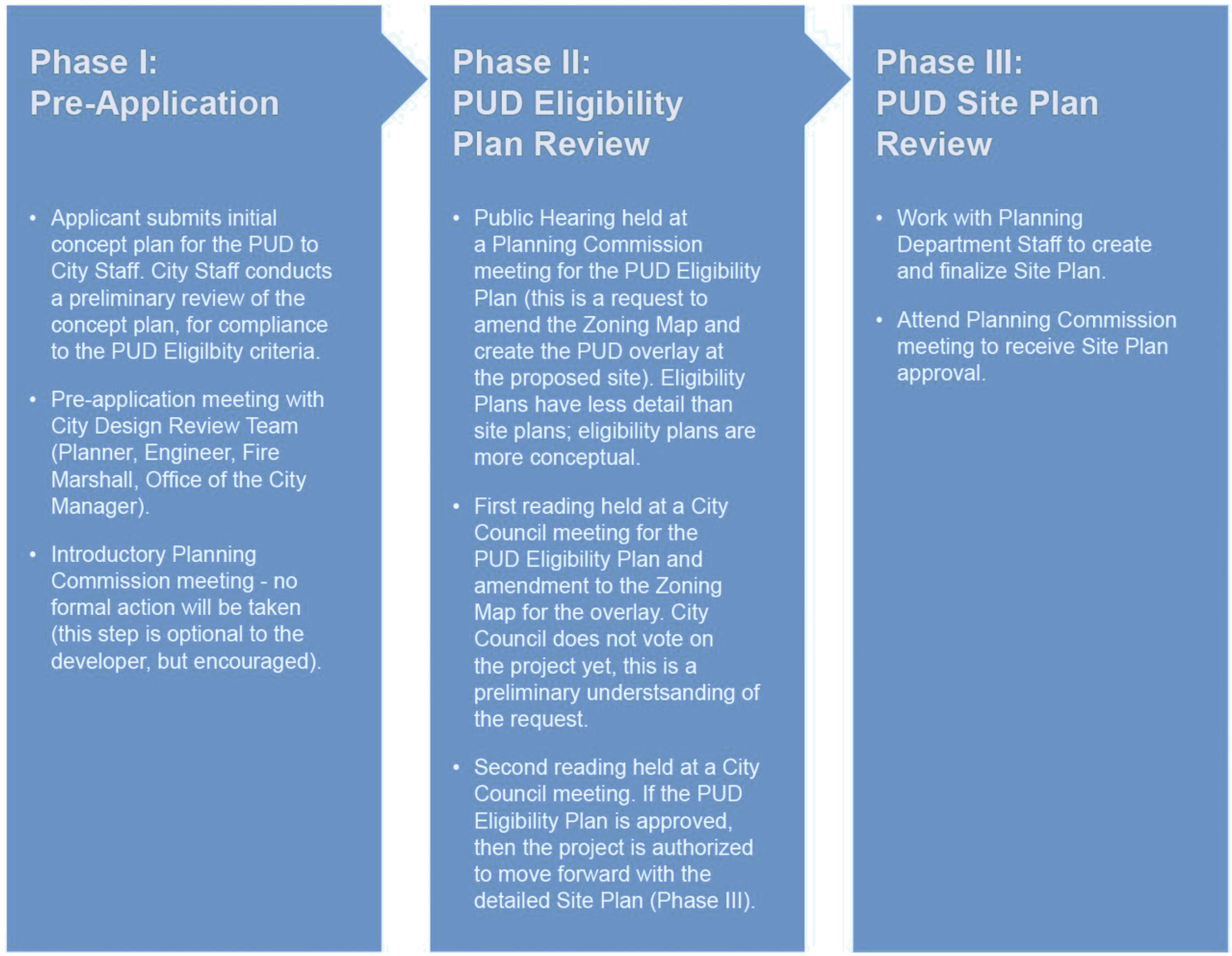
(Ord. No. 244, § 3(Exh. A), 12-9-2024)
Section 12.04 - Eligibility plan review criteria and approval.
The following criteria applies to all PUD eligibility plan review:
(Ord. No. 244, § 3(Exh. A), 12-9-2024)
Section 12.05 - Eligibility plan submittal requirements.
The following is a list of items to be incorporated within the eligibility plan submission. All items must address each requirement for the application to be considered complete.
(Ord. No. 244, § 3(Exh. A), 12-9-2024)
Section 12.06 - Site plan submittal requirements.
The following items must be incorporated within the site plan submission; all items must address each requirement for the application to be considered complete.
(Ord. No. 244, § 3(Exh. A), 12-9-2024)

