
Grosse Pointe Park City Zoning Code
ARTICLE 5
- PARKING, LOADING AND ACCESS
Section 5.01 - Intent.
To ensure the provision of off-street parking facilities that are sufficient in number, adequately sized and properly designed to meet the range of parking needs and demands that are associated with land uses now in place in the city or with land uses allowed by this article. Additionally, this article recognizes that parking requirements have been excessive and existing lots may be overparked. Overly large parking lots are a drain on economic vitality, present safety hazards to pedestrians and motorists, and create environmental hazards such as heat islands, stormwater runoff, loss of habitat, and flood hazard. For these reasons, this article establishes flexible parking requirements and eliminates parking requirements for some types of projects.
(Ord. No. 244, § 3(Exh. A), 12-9-2024)
Section 5.02 - General standards.
A)
Parking required. In all districts, off-street parking facilities for the storage and parking of self-propelled motor vehicles for the use of occupants, employees and patrons of the buildings erected, altered or extended after the effective date of this chapter shall be provided as prescribed herein.
B)
Flexibility in parking. Uses for which off-street parking is required may meet the number of required parking spaces by meeting the parking wavier criteria in Section 5.03H), Off-street parking requirements.
C)
Storage of vehicles prohibited. Parking must be for temporary housing of vehicles while in use by occupants, employees, visitors, and patrons of nearby land uses. The storage of merchandise or motor vehicles for sale or the repair of vehicles is prohibited.
D)
Parking structures. For parking structures, commercial space or other space oriented to pedestrian traffic must be provided on the ground floor of a parking structure for at least 60 percent of the street frontage. This liner use must be integrated into the parking structure.
E)
Outdoor display areas. Where permitted, any outdoor display areas for ancillary sales of products such as, vehicles or merchandise, must be provided in a specific area designated on the site plan and may not block parking spaces or interfere with site circulation of automobiles or pedestrians.
F)
Parking location for multi-family dwellings. Parking lots for multi-family dwellings cannot be located in the front yard. All parking lots must be setback at least three feet from any perimeter lot line, except for parking that abuts an alley in a commercial district. Parking may only be located at the rear of the building in the CBD and NMU Districts. Parking may be located in the rear or side yard in the CMU District but must be located in the rear along Mack Avenue.
G)
Residential parking standards.
1)
Parking may consist of a parking strip, parking bay, driveway, garage, or combination thereof that consists of asphalt, concrete, or permeable paving stones. Traditional cobblestone is permitted in the ER district.
2)
Driveway width.
a)
Driveways cannot be wider than three feet on either side of the opening of the garage door(s) or carport opening.
b)
The maximum allowable width for any driveway at the front lot line is ten feet.
c)
Where an attached garage or carport is setback from the front plane of the principal structure, a driveway may widen beyond the width allowed at the front lot line. The flare may not begin before the front yard setback and must be confined to the driveway's approach to the garage. The maximum allowable flare is ten feet.
d)
Lots with widths of 100 feet or greater may request review and a deviation from these standards by the Director of Public Services, provided the driveway design does not significantly impact stormwater management or the character of the neighborhood.
3)
Unless otherwise permitted, the land area improved for parking between the front lot line and the front setback cannot exceed 30 percent of the total land area between the front lot line and the front setback. For the purposes of this section, front setback means the line formed at the outer surface of a building where the building wall meets the surface ground level, not to be construed to be the minimum required front yard setback, and such line shall extend the width of such lot parallel to the front lot line. This provision does not include impervious surface area meant for pedestrian access between vehicles and structures.
4)
Parking is prohibited on lawn areas.
5)
The parking or storage of commercially licensed motor vehicles is not permitted in the following cases if such parking or storage exceeds a one-hour period (this subsection does not apply to the lawful and expeditious loading, unloading, delivery or pick-up of materials, goods, merchandise, or persons):
a)
The parking or storage of commercially licensed motor vehicles for which the Secretary of State requires either gross vehicle weight or International Registration Plan registration plates for operation, including, but not limited to, semi tractors, semi-trailers, semi-trucks, and tow trucks.
b)
The parking or storage of commercially licensed motor vehicles used to transport persons for hire, including, but not limited to, taxicabs, limousines, hearses, and buses.
c)
The parking or storage of commercially licensed motor vehicles which weigh over 10,000 pounds when empty but fully equipped for service.
H)
PEV charging stations and spaces.
1)
PEV charging stations, as well as all structures and equipment ancillary to PEV charging stations (protective bollards, signage, etc.) are considered an accessory use to any principal permitted use.
2)
The location of PEV charging stations and spaces shall be subject to the following:
a)
PEV charging stations and spaces shall be permitted anywhere off-street parking is permitted.
b)
PEV charging stations and spaces shall be permitted anywhere within an off-street parking area that a standard parking space is permitted, provided all standards pertaining to off-street parking spaces and to off-street parking areas are met.
3)
PEV charging stations and spaces shall meet the following design requirements:
a)
PEV charging stations shall meet all applicable electrical and building codes, including but not limited to the National Electrical Code (NEC) and the Michigan Building Code.
b)
PEV charging stations shall be level-1 and level-2 capable as defined by the National Electrical Code (NEC).
c)
PEV charging spaces shall meet all dimensional requirements of a standard parking space per Section 5.05, Parking lot layout, design, and landscaping, including length and width. PEV charging spaces shall meet the requirements of the City's design and construction standards, including those pertaining to parking lot curbing and pavement.
d)
Where a PEV charging station is installed adjacent to a sidewalk, the station and all structures ancillary to it shall maintain a 5-foot wide clearance for the sidewalk.
e)
PEV charging stations and spaces shall be identified with the State-standard "Reserved Parking Only—Charging Station" sign and corresponding plaque (R7-8c and R7-8cP, respectively) as detailed in the Michigan Standard Highway Signs Book, or its equivalent. PEV identification signs shall meet the same standards relative to location, height, and design as barrier-free parking signs.
f)
PEV charging spaces shall be identified with the MMUTCD-standard pavement marking D9-11b (ALT) or its equivalent.
g)
PEV charging stations shall be installed in a suitable location such that any cords connecting the charging station with the vehicle will not extend across a pedestrian walkway or will otherwise present a tripping hazard. Charging stations featuring self-retracting cords are encouraged.
h)
PEV charging stations available to the public shall be maintained in safe and operational repair and shall clearly display a toll-free telephone number to report any problems.
4)
PEV charging spaces are considered as standard parking spaces for the purpose of meeting the minimum off-street parking requirements of Section 5.02, Off-street parking requirements.
5)
A minimum of one PEV charging space serviced by a level 2 PEV charging station shall be provided for every 10 constructed parking spaces.
6)
PEV charging stations and spaces, as well as all structures ancillary to PEV charging stations and spaces, including but not limited to bollards, signs, canopies, shelters, solar collectors, etc., are subject to the following:
a)
PEV charging stations and spaces, as well as all ancillary structures installed as part of a PEV charging station, must meet the minimum parking setback requirements of the district.
b)
Solar collector-equipped panels and canopies, shelters, carports, and similar large structures installed as part of a PEV charging station or space shall meet the minimum building setback requirements of the district.
c)
All ancillary structures installed as part of a PEV charging station shall meet the maximum height requirements of the district.
d)
PEV charging stations shall be permitted no additional signage beyond the required City-standard sign identifying the PEV charging station space.
(Ord. No. 244, § 3(Exh. A), 12-9-2024)
Section 5.03 - Off-street parking requirements.
A)
Minimum off-street parking requirements. Unless otherwise specified in this article, the minimum number of off-street parking spaces is determined in accordance with the table in the subsection below. The following circumstances are exempt:
1)
All non-residential uses in the NMU District.
2)
All non-residential uses in the CBD District.
B)
Maximum off-street parking requirements. The maximum number of off-street parking spaces shall be 15 percent more than the minimum number of required spaces, in accordance with the table in the subsection below.
C)
Religious institutions. Parking spaces already provided to meet off-street parking requirements for auditoriums and other places of public assembly, stores, and office buildings lying within 500 feet of a religious institution as measured along lines of public access, and that are not normally used between the hours of 6:00 a.m. and 6:00 p.m. on Sundays, and are made available for other parking may be used to meet not more than 75 percent of the off-street parking requirements of a religious institution.
D)
Uses not specified. For uses not specifically listed in this section, the provisions for a similar listed use shall apply as determined by the Planning Commission. If no adequate similar use is listed, the Planning Commission shall determine either that no minimum parking is necessary, or the appropriate minimum parking using one or more of the following resources:
1)
A review of the parking demand ratios measured by the Institute of Traffic Engineers (ITE) in the most recent edition of the Parking Generation Manual.
2)
A review of the minimum parking requirements set forth by neighboring municipalities which are similar in land use character to the City of Grosse Pointe Park.
3)
Observations of parking occupancy for the use in question at nearby comparable locations.
E)
Measurement.
1)
Usable floor area. To compute the number of parking spaces required, the definition of usable floor area (UFA) governs: that area used for, or intended to be used for, the sale of merchandise or service or to serve patrons, clients, or customers. Such floor area which is used or intended to be used principally for the storage or processing of merchandise or for hallways, kitchens, storage rooms, utilities, or sanitary facilities, is excluded from this computation. Measurement of usable floor area is the sum of the horizontal areas of the several floors of the building, measured from the interior faces of the exterior walls. If not given by the applicant, a standard 80 percent UFA will be used in calculations.
2)
Rounding of required spaces. Any fraction up to and including one-half is rounded down; any fraction greater than one-half is rounded up.
F)
Number of required spaces. Required off-street parking spaces are as follows:
G)
Shared parking. Nothing in this section prevents collective provisions of off-street parking facilities for two or more buildings or uses. In all non-residential and mixed-use zones, private parking facilities may be shared by multiple uses whose activities are not normally conducted during the same hours, or when hours of peak use vary. The applicant shall have the burden of proof of a reduction in the total number of required off-street parking spaces. No reduction in the number of spaces reserved for persons with disabilities shall be permitted on site.
1)
Proof from applicant. Evidence must be submitted that demonstrates shared parking will not result in inadequate parking. Below is a list of required application information.
a)
An analysis of available and used parking spaces based on parking counts taken at certain time intervals and days to verify parking usage patterns.
b)
The type and hours of operation and parking demand for each land use.
c)
A sketch or site plan displaying shared use spaces in the lot and walking distance to the uses sharing the lot.
d)
A description of the character of land use and parking patterns of adjacent land uses.
e)
An estimate of anticipated turnover in parking space use over the course of 12 to 24 hours at the site.
2)
Design standards.
a)
Users sharing a parking facility shall provide for safe, convenient walking between land uses and parking, including safe, well-marked pedestrian crossings, signage, and adequate fighting. Pedestrian paths should be as direct and short as possible, without compromising safety. A pedestrian circulation plan that shows connections and walkways between the parking facilities and subject uses shall be provided.
b)
Details regarding the maintenance of the shared parking areas, including snow removal, must be provided within the shared parking agreement.
c)
Signage to direct drivers to the most convenient parking areas for each use shall be provided.
3)
Process. An applicant must submit an application for shared parking to the Planning Commission, along with the required fee as established by the City under the most recent fee schedule. The Planning Commission has final authority over granting shared parking agreements. If the Planning Commission approves the shared parking agreement, and prior to the issuance of a certificate of compliance, a written agreement shall be reviewed and approved by the City Attorney and executed by the property owner to assure the continued availability of the shared parking spaces for the life of the use. The agreement shall, at a minimum:
a)
List the names and ownership interest of all parties to the agreement and contain the signatures of those parties.
b)
Provide a legal description of the land upon which the parking area(s) and building(s) appurtenant to the parking areas are located.
c)
Include a sketch or site plan showing the area of the parking parcel, pedestrian and driver circulation, maintenance, etc.
d)
Provide details regarding the maintenance of the shared parking areas, including snow removal.
4)
Change in use. Should any of the shared parking uses be changed, or should the planning department find that any of the conditions described in the approved shared parking study or agreement no longer exist, or if insufficient parking is an issue due to complaints, the owner shall either submit a revised shared parking study and an amended shared parking agreement in accordance with the standards of this subsection, or provide the number of spaces required for each use as if computed separately. If the Department of Public Services determines that the revised shared parking study or agreement does not satisfy the off-street parking needs of the proposed uses, the shared parking request shall be denied, and no certificates of occupancy shall be issued until the full number of off-street parking spaces are provided.
H)
Parking waivers. The Director of Public Services and Planning Commission may grant waivers in off-street parking requirements, provided that there is no reduction in the number of spaces reserved for persons with disabilities, unless the applicant proves that they do not have sufficient space on their lot.
1)
Director of Public Services. The Director of Public Services may waive 5 off-street parking spaces or less, provided that the 5 parking spaces do not make up more than 10 percent of the total required parking.
2)
Planning Commission. The Planning Commission may waive up to 100 percent of the total required parking for an individual site. The Planning Commission may attach conditions of approval to a modification in the minimum required parking.
3)
Proof from applicant. In order for the Director of Public Services or Planning Commission to waive off-street parking requirements, the applicant must demonstrate that the required amount of parking spaces is excessive based on the needs of the proposed use or that the site cannot physically accommodate the required number of parking spaces.
4)
Process. An applicant must submit an application for shared parking to the Planning Commission, along with the required fee as established by the City under the most recent fee schedule. The Planning Commission has final authority over granting shared parking agreements.
(Ord. No. 244, § 3(Exh. A), 12-9-2024)
Section 5.04 - Barrier-free parking.
A)
Where off-street parking is required in association with a non-residential use, and at all government buildings, barrier-free parking spaces must be provided in the quantity specified herein.
B)
All barrier free parking shall comply with federal regulations governing disability access.
C)
Barrier-free spaces must be located as close as possible to the entrance of the building with which they are associated. barrier-free route of travel from accessible parking spaces to the nearest barrier-free building approach must be provided.
D)
A minimum number of barrier-free spaces is required, as described in the table below:
E)
The minimum dimensions for barrier-free spaces are:
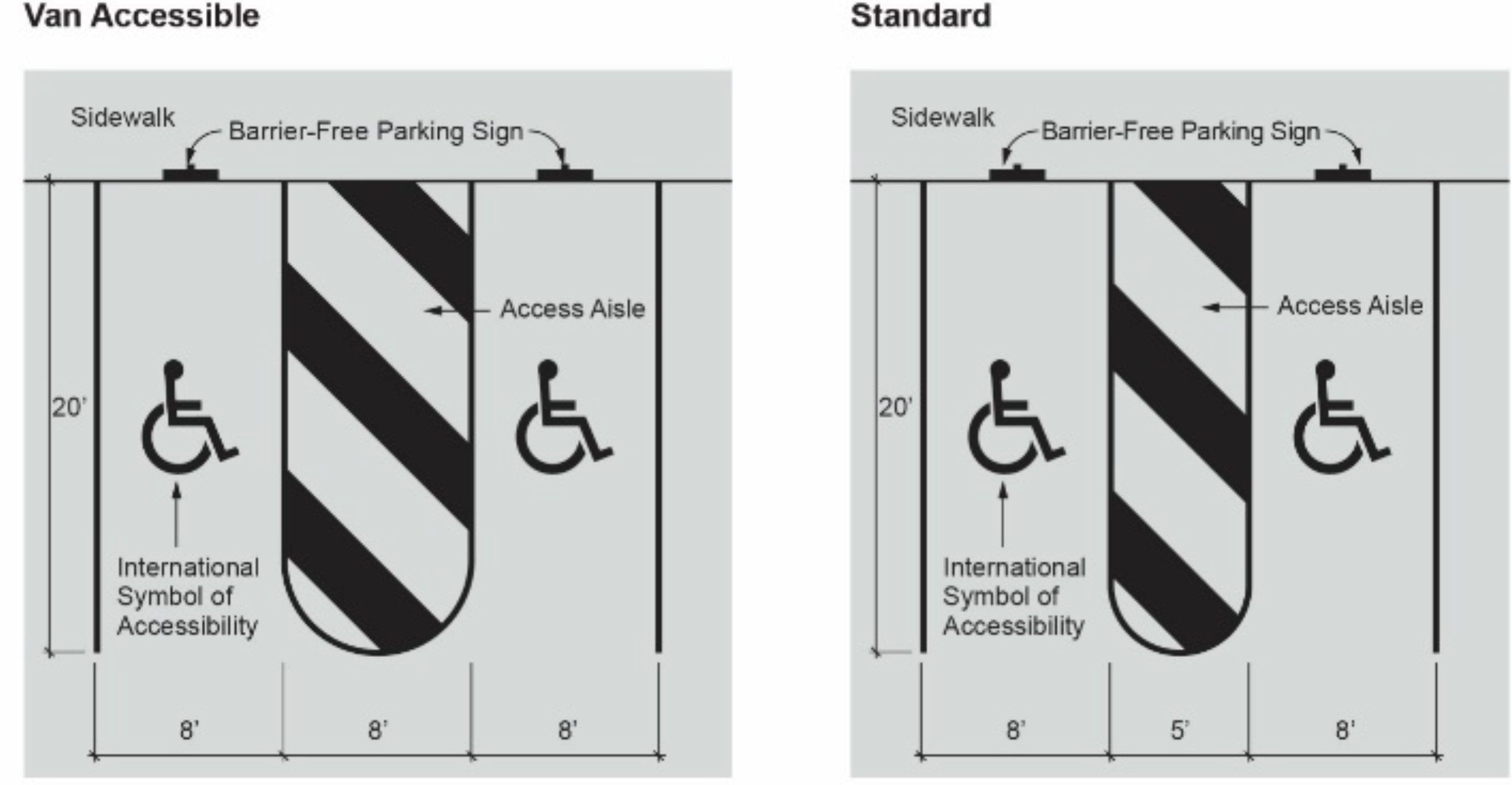
Barrier-Free Parking Space Layout
(Ord. No. 244, § 3(Exh. A), 12-9-2024)
Section 5.05 - Parking lot layout, design, and landscaping.
Off-street parking lots must be laid out, constructed, and maintained as follows:
A)
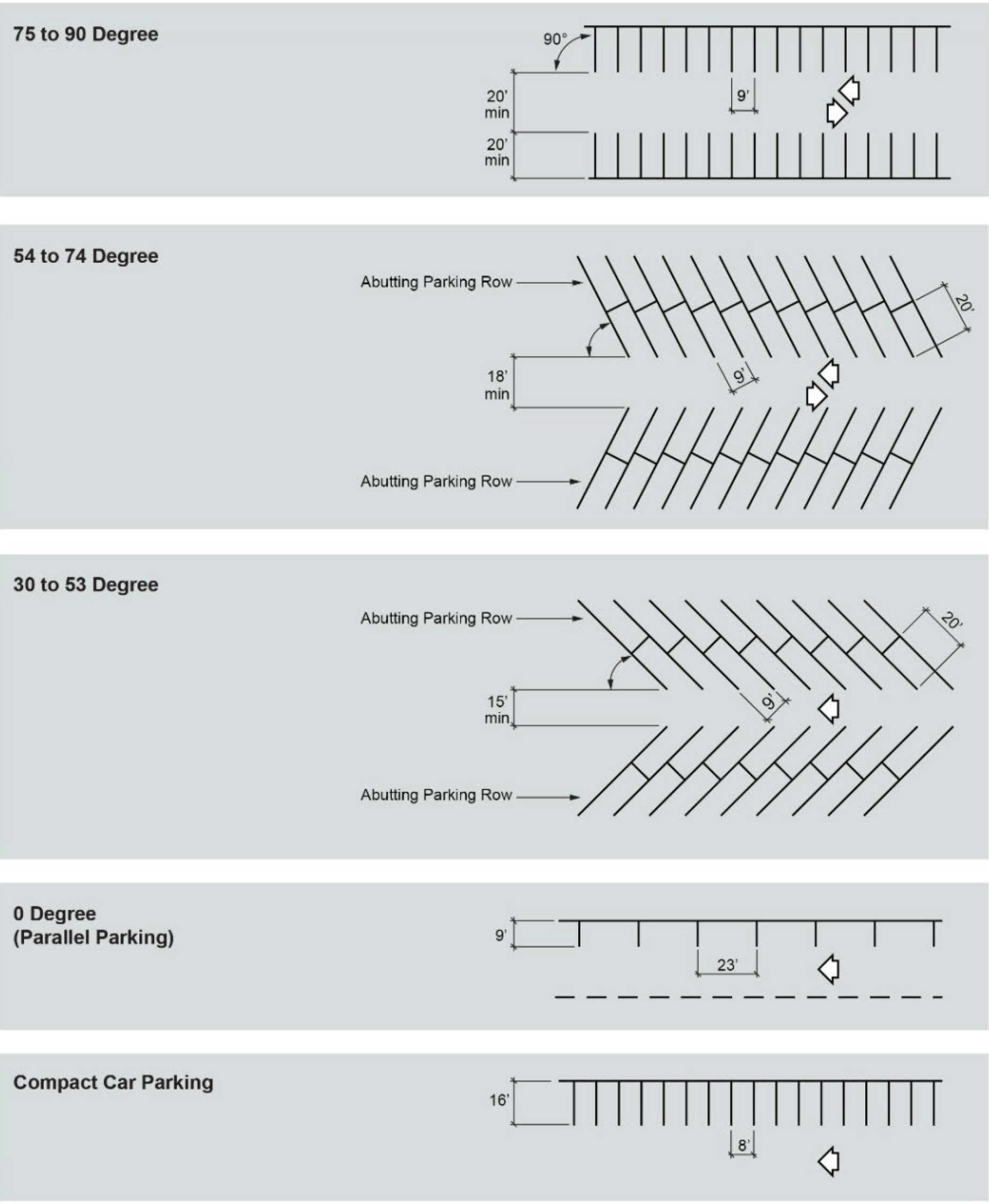
Dimensions. Parking facilities must be in accord with the following dimensions. See table below for more detail.
B)
Length reduction. Parking stall length may be reduced from 20 feet to 18 feet when the vehicle overhang is positioned over open green space or would not interfere with pedestrian access.
C)
Direction. All maneuvering lane widths shall only permit one-way traffic movement, except that the 90° pattern may permit two-way movement.
D)
Street backing. All spaces must be provided adequate access by means of maneuvering lanes; backing directly onto a street is prohibited apart from alleys.
E)
Signage and striping. Appropriate signage and striping must be included within all parking lots. Designating the traffic flow at all entrances and exits with directional arrows may be required by the Director of Public Services if traffic safety is a concern. Double striping is the minimum standard.
F)
Curbing. Wheel chocks are not permitted, parking areas must be curbed or incorporate bumper stops. All curbing and bumper stops shall be made of concrete and six inches in height to prevent vehicle overhang into landscaped or pedestrian areas. Bumper stops must be kept in alignment with the approved site plan for the subject site on which they are located.
G)
Grading. The parking lot must be graded and adequately drained so as to dispose of all surface water accumulated in the parking area in such a way as to preclude drainage of water onto adjacent properties or toward any buildings.
H)
Surfacing. The entire parking area, storage area and non-landscaped portion of the lot, including parking spaces and maneuvering lanes, must be provided with asphalt or concrete surfacing. Where appropriate based on infiltration and soil conditions, permeable paving stones and other forms of permeable parking surfaces shall also be permitted. All other forms of surfacing shall be prohibited.
I)
Landscaping. Refer to Article 6, Landscaping, Screening and Fences.
J)
Pedestrian access. Parking lots must have a minimum of one pedestrian access point on each street frontage. The Planning Commission has authority to waive this requirement as part of the site plan review process.
(Ord. No. 244, § 3(Exh. A), 12-9-2024)
Section 5.06 - Loading zones.
A)
Location. In connection with every building, structure, or use hereafter erected (except one- to four-family dwelling units) an off-street loading zone must be provided in the rear yard or if in the side yard, screened from the public right-of-way and any residentially zoned or used property. A dedicated alley or designated on-street loading zone within 100 feet of the subject site may be used to satisfy this requirement.
B)
Dimensions. Loading zones must be a minimum of ten feet by 40 feet, with a 14-foot height clearance.
C)
Access. Loading zones cannot back out directly onto a public road, excluding alleys.
D)
Quantity. In the case of a mix of uses or a mixed-use building on one developed lot, the total requirements for loading zones is the sum of the various uses computed separately. Loading zones must be provided as follows:
E)
Waiver. The Planning Commission may modify or waive the requirement for a loading zone, upon determination that adequate loading space is available to serve the building/use, or that provision of such a loading zone is unnecessary for the use.
(Ord. No. 244, § 3(Exh. A), 12-9-2024)
Section 5.07 - Access management.
A)
Number of non-residential driveways. Access must be provided for each site; where feasible, access must be provided via a shared access driveway. One additional driveway may be allowed for properties with a continuous frontage of over 500 feet and one additional driveway for each additional 250 feet of frontage. The Planning Commission may determine additional driveways are justified due to the amount of traffic generated by the use without compromising traffic operations along the street, based upon a traffic impact study submitted by the applicant.
B)
Intersection setback. The minimum spacing between a proposed non-residential driveway and the centerline of the nearest intersection must be 20 feet. Alleys shall not constitute intersections for the purposes of this requirement.
C)
Modification of standards. During the site plan review, the Planning Commission has the authority to modify the standards of this section upon consideration of the following:
1)
The standards would prevent reasonable access to the site.
2)
Access via a shared driveway or service/frontage road is not possible due to the presence of existing buildings or topographic conditions.
3)
Roadway improvements (such as the addition of a traffic signal, center turn lane, or bypass lane) will be made to improve overall traffic operations prior to project completion, or occupancy of the building.
4)
The use involves the redesign of an existing development or a new use which will generate less traffic than the previous use.
5)
The proposed location and design are supported by the Michigan Department of Transportation (MDOT) or Wayne County as an acceptable design under the existing site conditions. The Planning Commission may also request the applicant provide a traffic impact study to support the requested access design.
6)
Where there is a change in use or expansion at a site that does not comply with standards of this zoning appendix, the Planning Commission may determine the amount of upgrade needed in consideration of the existing and expected traffic pattern and the capability to meet the standards of this appendix to the extent practical.
D)
Traffic impact studies. The City may require a traffic impact study (TIS) for all development proposals that it reviews. The TIS must be submitted by the applicant to determine the potential future traffic conditions on adjacent roadways once a proposed development is finished. The TIS must include a prediction of the peak hour operational conditions at site driveways and road intersections affected by the development. The results of the TIS may be used in the final design of access points and internal circulation and may identify necessary off-site road improvements. At a minimum, the TIS must meet standards as published by the Southeast Michigan Council of Governments (SEMCOG) and MDOT in the handbook titled Evaluating Traffic Impact Studies and found acceptable by the city prior to being used.
E)
Commercial cross-access.
1)
Cross access drive(s) are an easement which will permit the use of the drive for traffic circulation to provide ingress and egress to the two or more properties. All non-one or two-family residential developments in the NMU, CBD and CMU Districts must permit pedestrian and vehicle cross access for adjacent non-one or two-family sites.
2)
A cross access agreement must be in a recordable form, approved by the City Attorney and will run with the land and benefit/burden the heirs, assigns and transferees of the properties to be served by the drives. In addition, the easement must specify the means and program by which the drives shall be maintained, including a specification of responsible parties for snow plowing, repair, and other maintenance practices.
3)
The applicant must have the easement(s) recorded with the Wayne County Register of Deeds office and submit a copy to the city for permanent records.
(Ord. No. 244, § 3(Exh. A), 12-9-2024)
Section 5.08 - Clear vision triangle.
No fence, wall, shrub or other forms of landscaping, signs, or any other obstruction to vision above a height of two feet, measured from the established centerline grades of the abutting street, shall be allowed within any of the following restricted clear corner vision areas:
A)
Within a triangular area formed at the intersection of two or more streets in any zoning district by a straight line intersecting the two rights-of-way lines at a point 25 feet along from their point of intersection.
B)
Within a triangular area formed at the intersection of a driveway serving a nonresidential or multiple family use with a street or alley right-of-way line, or interior property line, by a straight line extending between the right-of-way line or interior property line and the nearest edge of the driveway at a point 15 feet along the right-of-way line, or interior property line and the intersecting driveway line.
C)
Within a triangular area formed at the intersection of a driveway serving a single-family residential use with a street or alley right-of-way line, or an interior property line, by a straight line intersecting the right-of-way line or interior property line and the nearest edge of the driveway, six feet from the point of intersection.
(Ord. No. 244, § 3(Exh. A), 12-9-2024)
Section 5.09 - Maintenance.
All parking lots and loading zones must be maintained in accordance with this article, an approved site plan, and the following:
A)
Alterations to an approved parking lot or loading zone that are not in accordance with an approved site plan are a violation of this appendix.
B)
All parking lots, perimeter landscaped areas, and required screening must be kept clean and free from tall grass, weeds, trash, and debris. Surfacing, curbing, lighting fixtures, signage, and related improvements must be kept in good repair.
C)
Parking lots and loading zones must be diligently kept clear of snow; up to 10 percent of the parking lot may be used for snow deposit.
(Ord. No. 244, § 3(Exh. A), 12-9-2024)

