
Grosse Pointe Park City Zoning Code
ARTICLE 4
- SCHEDULE OF REGULATIONS, MATERIALS, BUILDING FORM AND DESIGN
Section 4.01 - Schedule of dimensional regulations.
No building may be erected, nor any existing building be altered, enlarged, or rebuilt, nor any open space surrounding any building be encroached upon or reduced in any manner, except in conformity with the regulations for the district in which the building or use is located, per this article.
(Ord. No. 244, § 3(Exh. A), 12-9-2024)
Section 4.02 - Footnotes to the schedule of regulations.
A)
Front yard setback. Front yard setback is the greater of the average setback of the residential structures adjacent to the property on both sides, or the minimum setback indicated in the schedule of dimensional regulations. When there is a vacant lot, refer to the closest adjacent property.
B)
Waterfront setback. The minimum required setback from the waterfront shall be the average setback from the water's edge or seawall of the residential structures adjacent to the property on both sides. When there is a vacant lot, take the average of 175 feet and the adjacent structure.
C)
Side yard setback, interior. The required combined side yard setback for each side of a zoning lot in a residential district shall be a total of 2.5 feet for each ten feet of the length of the front lot line. The minimum combined side yard setback must not exceed 15 feet.
D)
Side yard setback in ER Zoning District. The minimum required combined side yard setback is 20 percent of the lot width, with a minimum of ten feet on any one side.
E)
Side yard setback, street. The minimum required setback for a side yard that faces a street must be 25 percent of the lot width, and in no case less than ten feet. The Public Services Director may modify the minimum required setback for a side yard that faces a street based on the existing pattern of setbacks on adjacent lots within the same zoning district.
F)
Side yard setback, multiple-family building (for five-plus units). The minimum side yard setback for multiplefamily buildings adjacent to a residential zone is ten feet. The minimum side yard setback for multiple-family buildings may be reduced to 0 feet if abutting a non-residential district.
G)
Side yard setback, commercial. If the side yard is adjacent to a residential use or zoning district, unless the use is a multi-family building, a minimum side yard of 15 feet is required.
H)
Alley setback and lot coverage. One-half the width of an alley may be used to meet the rear yard setbacks in any zoning district. In calculating the area of a lot that adjoins an alley for the purpose of applying lot area requirements, one half the width of such alley abutting the lot is considered as part of such lot.
I)
Rear yard setback, nonresidential uses in residential district. For nonresidential uses in residential areas the rear yard shall be not less than 40 feet.
J)
Non-conforming residential lots. Non-conforming lots of record in a residential district may be permitted provided that any principal or accessory structures constructed on the lot comply with all other dimensional standards (excluding lot area).
K)
Through lots and corner lots. For through and corner lots, or lots that have two parallel or multiple street frontages, the front and rear yards are determined by the Public Services Director based on the pattern of development on adjacent lots.
L)
Minimum square footages. Minimum square footages apply to all multiple-family dwelling units:
1)
Studio/efficiency unit: 450 square feet;
2)
1-bedroom unit: 600 square feet;
3)
2-bedroom unit: 800 square feet;
4)
3+ bedroom unit: 1,000 square feet.
M)
Enhanced design guidelines. Refer to design guidelines within this appendix for more information.
N)
Parking lot setbacks. Refer to Article 5, Parking, Loading and Access.
O)
Accessory structure setbacks. See Section 3.07, Accessory structures.
P)
Imperviousness in front yards. No more than 30 percent of a front yard in a residential district can be covered by the following. For the purposes of this calculation, required front yard sidewalks to the principal dwelling do not count towards the impervious coverage.
1)
Any driveway or other area devoted to vehicular access; or
2)
Any material impervious to water.
Q)
Buildings in the CBD district may include an additional story, or 54 feet provided, the fourth story is enclosed in a mansard roof or setback ten feet from the building façade of the third story.
(Ord. No. 244, § 3(Exh. A), 12-9-2024)
Section 4.03 - Exceptions to the schedule of regulations.
A)
Height exceptions. Height limitations do not apply to chimneys, religious institution spires, cupolas, domes, water towers, smokestacks, ventilators, skylights, elevators, conveyors, cooling towers, public monuments, or power transmission towers, masts, and other similar mechanical appurtenances and screening. The Planning Commission may specify a height limit for any such structure when special land use approval is required, and such height limit is reasonably necessary for public safety or to otherwise to comply with the standards set forth in this appendix.
B)
Parapet wall extension. Height provisions do not prevent the erection, above the maximum building height limit, for a parapet wall or cornice for screening purposes (without windows), extending above such height limit not more than five feet.
C)
Porches. An open and unenclosed porch or paved terrace may project into a front yard for a distance not exceeding ten feet provided that the covered portion of the porch does not exceed 80 square feet in area.
D)
Projections into yards. Architectural features, such as chimneys, cornices, wing walls, may extend or project into a required side yard not more than two inches for each 1-foot of width of such side yard; and may extend or project into a required front yard or rear yard not more than three feet.
1)
Any walk, terrace, driveway, pad, path, or other pavement servicing a like function, and not in excess of nine inches above the grade upon which placed, is not considered to be a structure and is permitted in any required yard. Unless a required sidewalk, this surface counts towards the maximum impervious surface requirements.
E)
Canopies. Canopies that project over public rights-of-ways in mixed use districts may be permitted provided no supports are required in the public rights-of-way. In those instances where supports are required, such canopy must receive the review and approval of the Director of Public Services and are subject to conditions to assure public safety to pedestrians.
(Ord. No. 244, § 3(Exh. A), 12-9-2024)
Section 4.04 - Exterior building materials and colors for all buildings.
A)
Intent. Grosse Pointe Park's building form and design standards guide the establishment of harmonious building appearance on all exterior walls of a building to create, enhance and promote a uniform and quality visual environment throughout the city. Site lighting standards are also detailed that are decorative, while adequately illuminating a site for safety and convenience.
B)
Primary versus secondary exterior materials.
C)
Permitted exterior building materials. The table below details the permitted exterior building materials allowed on each façade in each district, whether it is a primary material "P" or a secondary material "S." "—" denotes that the material is not allowed.
D)
Engineered materials. Engineered equivalent materials are permitted as the original material is permitted in each district. Engineered materials must match the appearance of natural building materials.
E)
Painted or stained building materials. Building materials may not be painted or stained unless approved by the Director of Public Services. Preference will be given to existing building materials that are already painted or stained and when the applicant proposes to modify the façade.
F)
Building colors. Exterior finish materials and colors must be in natural tones and consistent, or compatible, with the character of the surrounding district to create a uniform and recognizable identity.
G)
Uniform design. The design must coordinate the materials and details of all sides of the building with the design of the front elevation. Exterior finishes must wrap around the structure to establish a consistent design. All elevations of the main building must have the same approximate proportions, and matching windows, trim, and architectural details, providing a 360-degree finish.
H)
Approval authority and appeals. The Director of Public Services is responsible for determining if a proposed design is in harmony with the existing neighborhood character and shall issue all design determinations in writing as a part of the established plan review process. The Director of Public Services is permitted to seek additional guidance if necessary to make a final determination. An applicant may appeal the decision of the Director of Public Services within 10 days of the decision by providing a written request to the Planning Commission. The appeal will stay all further proceedings and must be heard by the Planning Commission at its next available meeting.
(Ord. No. 244, § 3(Exh. A), 12-9-2024)
Section 4.05 - Residential building form and design standards.
A)
Intent. To retain and enhance the unique neighborhood character of Grosse Pointe Park, protect the visual character and economic stability of the city's residential areas, preserve and protect the public welfare, and promote complimentary design while maintaining a diversity of attractive residential styles.
B)
Established styles and expectations. Grosse Pointe Park's housing stock primarily consists of Colonial Revival and Tudor Revival, but also includes a mix of Contemporary, Craftsman, and Mid-Century Modern styles. Residential design for the circumstances enumerated in Section C shall not be limited to these styles but shall respect the qualities that make the neighborhood unique and shall take care in siting and design.
C)
Applicability. These standards apply to all residential uses in the residential districts:
1)
Construction of new residential structures, including accessory dwelling units;
2)
Additions to existing residential structures;
3)
Reconstruction or substantial renovations to existing residential structures where 50 percent or more of the exterior shell is substantially altered; and
4)
Accessory structure construction or re-location on residential properties when greater than 250 square feet in area with a horizontal dimension of 12 feet or greater.
D)
General regulations.
1)
Building design shall be in harmony with the existing neighborhood character. Neighborhood character is established through apparent patterns in building design and form, including but not limited to:
a)
Quality and type of exterior building materials;
b)
Exterior wall complexity and fenestration;
c)
Window types, size, and proportions;
d)
Entry treatment and scale, including porch design and location;
e)
Roof types, orientation, slopes, eave heights, gables, and over hangs;
f)
Building height and massing;
g)
Architectural style, including the styles established during the dominant decade of construction;
h)
Garage or accessory structure location, size and treatment; and
i)
Use of decorative fencing and landscaping.
2)
The "neighborhood" for a site is defined as the area within 500 feet in any direction, within the boundaries of the City. The Director of Public Services must notify the applicant in the event the definition of "neighborhood" must be changed for a given application and explain the reason behind the change in writing.
3)
Accessory buildings and structures must have a matching or similarly compatible style to the principal structure's style.
a)
All accessory structures are permitted only in conjunction with a principal use and principal structure on the same lot.
b)
Accessory structures may only be constructed at the same time as or after the construction of the principal structure on the same lot. Accessory buildings may only be maintained in conjunction with a principal structure on the same lot. If the principal structure is destroyed, demolished or removed, the accessory structure shall also be demolished or removed.
E)
Design standards.
1)
Windows and doors.
a)
Front façades and primary entrances of principal structures must face a street; alleys do not constitute a street for the purposes of this section.
b)
Relative proportions of doors and windows must be compatible with neighborhood character.
c)
Windows must be placed so that no elevation has a large expanse of blank wall. The Director of Public Services may approve elevations without a window if the applicant is able to demonstrate difficulty including a window on an elevation due to floorplan layout or intended use.
d)
Windows must incorporate casing and headers and shall incorporate relief elements which distinguish the windows form the plane of the façade. Shutters alone shall not constitute adequate relief.
e)
Doors on the same façade are not required to match but must be harmonious in design with one another.
2)
Porches.
a)
Whether enclosed or not, porches must be similar in design to existing porches in the neighborhood. If incorporating columns, such columns shall be similar in proportion to that of existing columns within the neighborhood, as dictated by the overall style of the structure.
b)
Enclosed porches may be allowed when the prevailing character of the neighborhood includes open front porches as long as the design is consistent with those porches that are open.
c)
Porches shall be painted or stained a consistent color throughout.
d)
Porches shall generally be covered, rather than uncovered or partially covered by a portico, unless otherwise established by the neighborhood character.
e)
Side-entry doors may be covered with a portico or covering provided it does not encroach into a required side yard by more than one and one-half feet.
f)
The front porch or entrance to the principal dwelling unit must be connected to the public sidewalk via a direct and improved pedestrian sidewalk. A sidewalk that only extends from the front porch or entrance to a driveway does not satisfy this requirement.
3)
Exterior finishes.
a)
Façade materials and details must be consistent with the neighborhood's discernible patterns of detail including, but not limited to, door and window trim, corner boards, cornice details, railings, and shutters.
b)
Façade materials must comply with the table in Section 4.05, Residential building form and design standards.
c)
Façade materials are limited to no more than three primary materials, excluding secondary materials. Secondary materials may be used for architectural detailing and trim such as wooden rake boards, limestone keystones, fieldstone corners, wooden columns, piers, foundation walls, chimneys, etc.
d)
Exposed wood must be stained (not painted) in a manner generally compatible with other buildings on the property and with the neighborhood character.
e)
The exterior building finish for additions must be the same predominant material as the existing building. Materials must be the same proportions, within 20 percent, as the original structure unless it can be reasonably demonstrated that those materials are unavailable.
4)
Scale, form, and massing.
a)
Finished floor elevations, height of exposed basement walls, and front yard grade elevations must be similar to those of the neighborhood.
b)
Form and massing must conform to the established horizontal or vertical character of the neighborhood and the neighborhood's established building form and massing characteristics.
c)
Building setbacks and front porch lines must generally align with the established setbacks of the immediately adjacent residences, block, and neighborhood.
d)
No portion of an upper story may be cantilevered beyond the first story by more than 18 inches. Cantilevers are only permitted when used for architectural feature appropriate for the architectural style. Cantilevers may not encroach within a required setback.
e)
For lots greater than 40 feet in width, the depth of the principal building cannot exceed twice the width of the building.
5)
Roofs.
a)
Roof style and pitch must be architecturally consistent with the prevailing neighborhood character.
b)
New roofs, including additions, porches, gables, and dorms, shall be similar or related to the pitch of the existing or main roof. These new roofs may have a different scale and/or style.
c)
Buildings shall be limited to two roofing materials: one for the main roof and another material as an accent for dorms, porches, or other smaller roofs. Accessory structures shall utilize the same roofing material.
6)
Garages.
a)
Front-loading garages in the ER and NR-C districts are allowed only when installed in a detached accessory structure that complies with the setback and placement requirements of Section 3.07, Accessory structures.
b)
Attached, front-loading garage doors in the NR-A and NR-B districts are only permitted if the garage is stepped back from the plane of the front door of the house by the greater of seven feet or 15 percent of the width of the house.
c)
Attached garages in any residential zoning district that are side-loading or rear-loading must comply with the front-yard setback for the attached principal building.
d)
When a garage has wall(s) facing a street other than the wall containing the garage opening, these wall(s) shall have more than one plane and shall include fenestration equal to at least 10 percent of the garage wall.
e)
Attached garages shall incorporate roof and accent elements to establish a visual variation from an established roof line of the principal building.
(Ord. No. 244, § 3(Exh. A), 12-9-2024)
Section 4.06 - Mixed use and commercial building form and design standards.
A)
Intent. To retain and enhance the unique character of Grosse Pointe Park, protect the visual character and economic stability of the city's commercial areas, preserve and protect the public welfare, and to facilitate commercial development which aligns with the adopted master plan and adopted corridor plans.
B)
General regulations. The following building form and design standards apply to all mixed-use and commercial buildings.
1)
Exterior finish materials and colors must be in natural tones and consistent, or compatible, with the character of the surrounding district to create a uniform and recognizable identity. Accent colors are permitted to activate the street front and exercise artistic placemaking; this standard is to not be interpreted as prohibiting the incorporation of public art, such as a mural, to buildings or sites. All architectural features, including awnings, overhangs, roof projections, window accents, and the like must be compatible with the style, materials, and colors of the building.
2)
Façade materials must comply with the table in Section 4.05, Residential building form and design standards.
3)
Building entrances must be clearly defined by utilizing elements such as overhangs, awnings, or lintels; change in plane (such as a recessed) entryway, differentiation in material and/or color; greater level of detail; or enhanced lighting. Any such element shall be architecturally compatible with the style, materials, colors, and details of the primary building.
4)
Façades must be internally or externally illuminated. Lights must be properly shielded or recessed behind architectural features so they do not produce glare or spillage of light onto adjacent properties. No light, except streetlights, shall shine directly onto public rights-of-way.
5)
All HVAC, utility boxes, and telecommunication systems must be screened or minimized from public view. Building roofs are to be uncluttered, with vertical projections integrated into the architecture and screened from view by parapet walls or other enclosure.
6)
Windows shall be un-tinted. Mirrored or reflective glass is not permitted. Windows cannot be visually obstructed by signs, advertisements, window screens, security grills, or other permanent window coverings, unless by permitted window signage.
7)
Storefronts shall be defined by architectural elements, such as a horizontal band, transom windows, and bulkheads. Incorporation of awnings, overhangs, or solar screens are encouraged.
8)
Security roll-down grilles shall be designed and recessed into the interior of the window system. Where an exterior grille already exists, the roll-down grille box should be as inconspicuous as possible.
9)
Buildings with multiple storefronts must be unified in design treatment, such as window design, door openings, materials, and color.
10)
Architectural features:
a)
Boundaries between stories must be articulated by a cornice, projecting profile/string course, expression line (horizontal molding or projections), or other horizontal element that differentiates one story from another. Elements must be consistent across the length of the building and shall cover a minimum of 75 percent of the building width.
b)
No blank or unarticulated facades are permitted unless façade is not visible from public rights-of-way.
c)
The top of a façade is required to include at least one of the following:
(1)
Parapet with a cap, coping, or railing if the roof will be occupied;
(2)
Pitched or mansard roof with projecting eave and/or rake; or
(3)
Cornice (allowed to be used in combination with a parapet or pitched roof).
C)
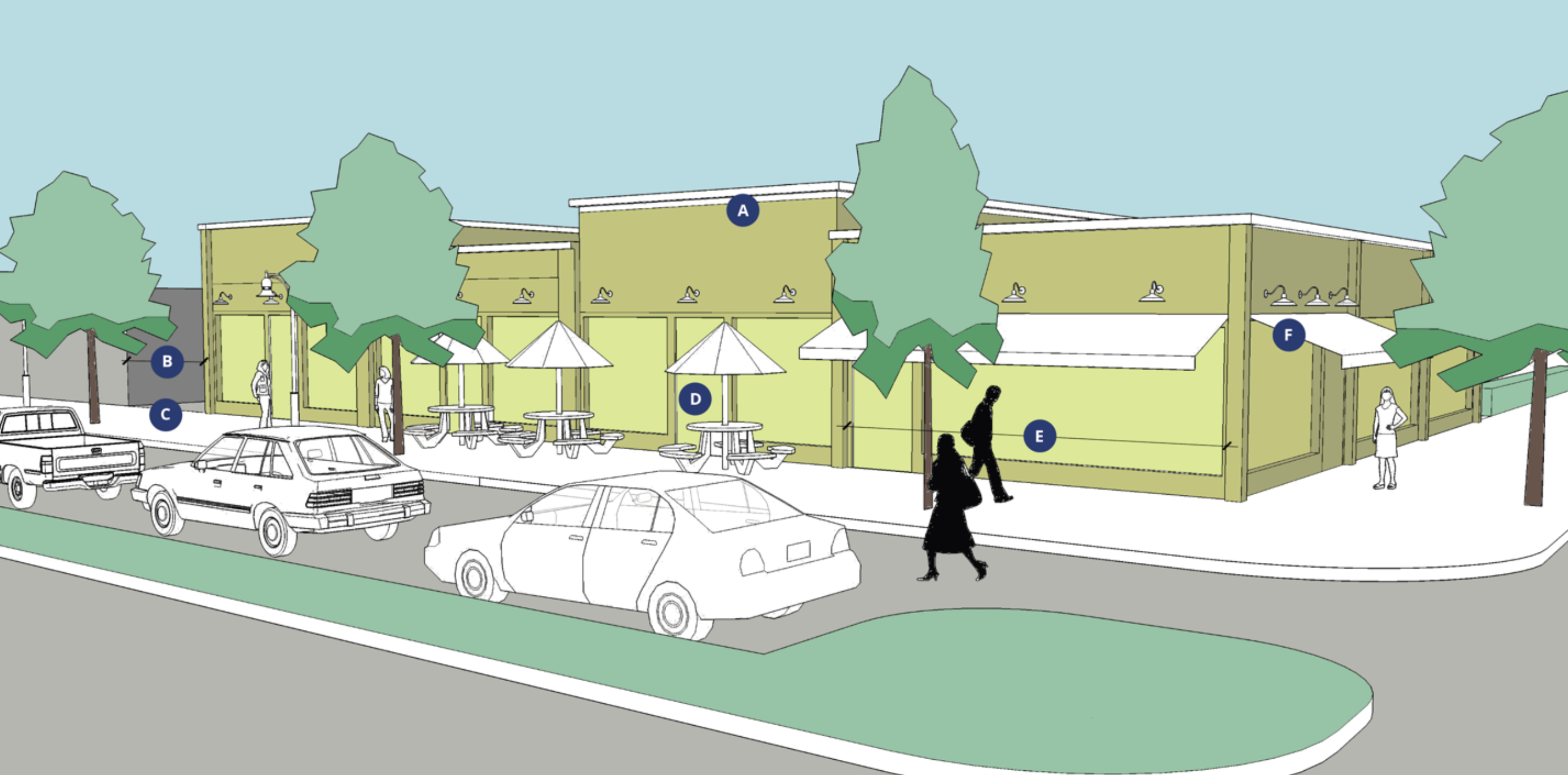
NMU, Neighborhood Mixed-Use District. The following additional design requirements apply in the NMU district:
D)
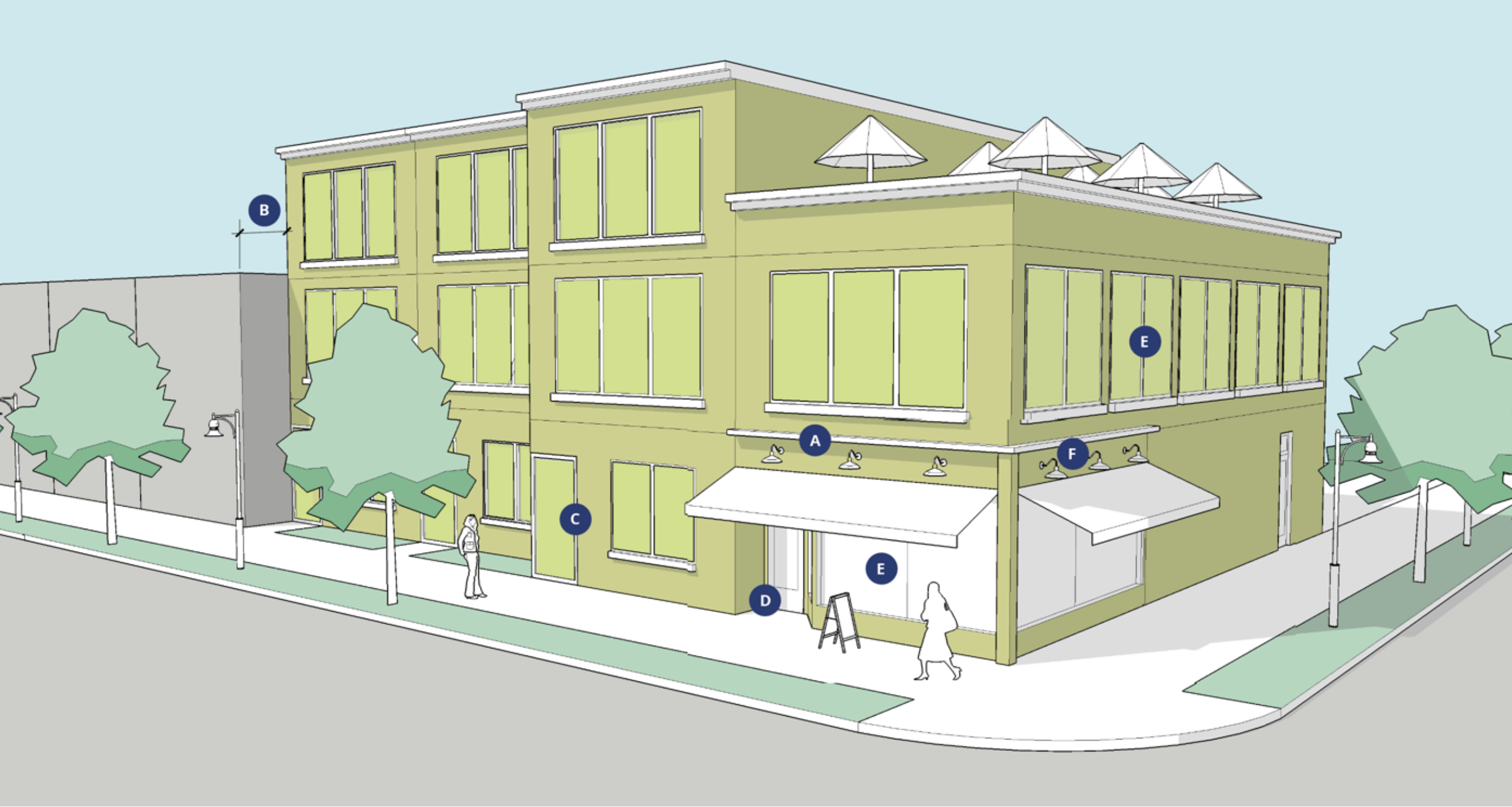
CBD, Central Business District. The following additional design requirements apply in the CBD district:
E)
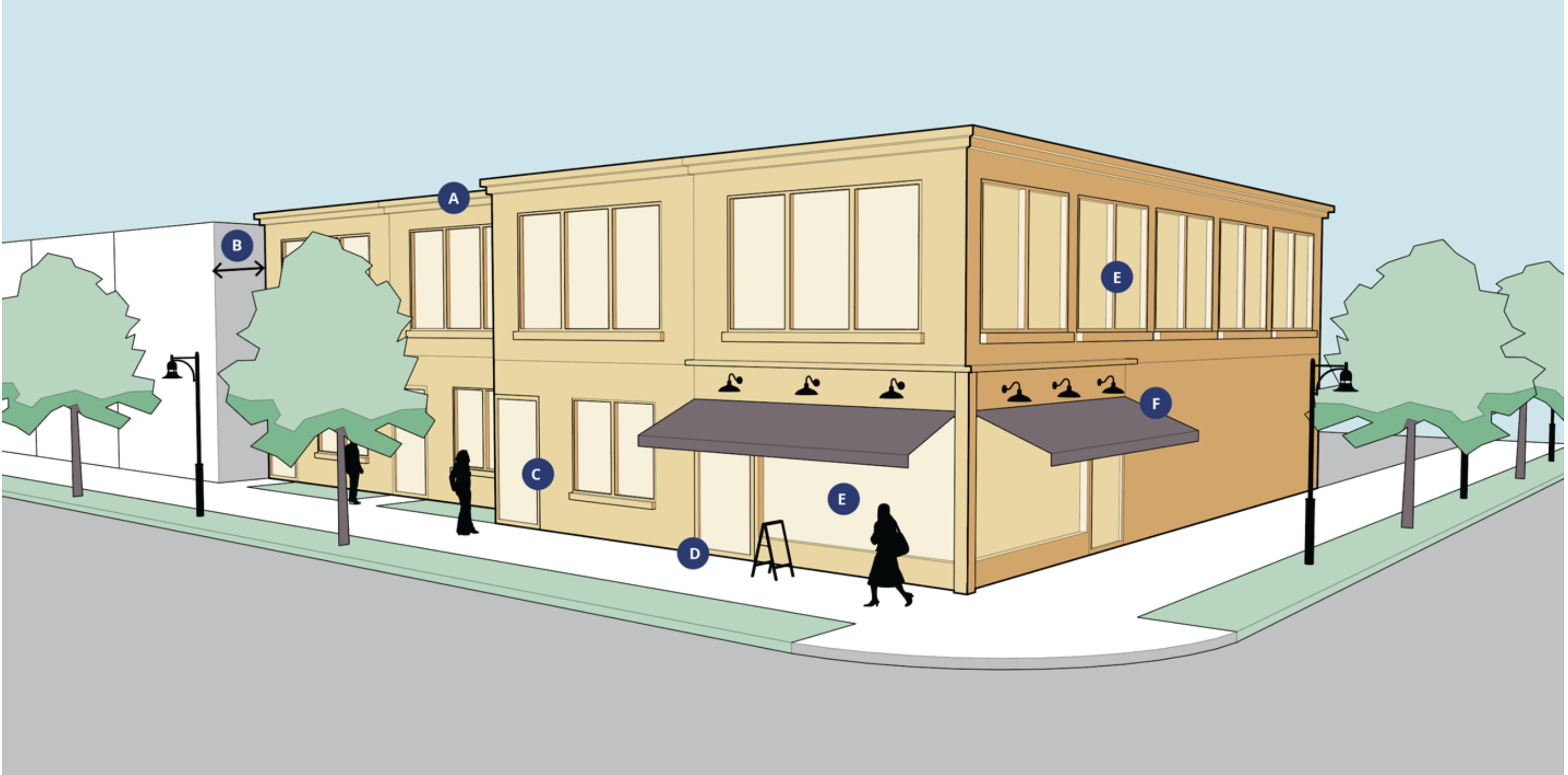
CMU, Corridor Mixed-Use District. The following additional design requirements apply in the CMU district for parcels with frontage on Mack Avenue:
(Ord. No. 244, § 3(Exh. A), 12-9-2024)
Section 4.07 - Lighting standards.
A)
Purpose. To ensure that sufficient lighting is provided in publicly accessible areas of buildings and properties that complements and enhances the environment and character of Grosse Pointe Park by aiming to:
1)
Permit reasonable uses of exterior lighting for night-time security, utility, productivity, enjoyment, and commerce.
2)
Minimize glare, obtrusive light, and artificial sky glow by limiting exterior lighting that is misdirected, excessive, or unnecessary.
3)
Conserve energy and resources.
4)
Protect the natural environment from the damaging effects of light pollution.
B)
General standards.
1)
Illumination levels. Existing and proposed lights may not exceed the following maximum intensity levels (measured at a height of five feet above grade).
2)
Mounting height. All pole lighting must not exceed 16 feet in mounting height. Building mounted lighting cannot project above the building roof line.
3)
Shielding. All exterior lighting, excluding accent lighting in residential districts, must be fully cut off and shielded so the surface of the source of the light is not visible, and is directed downward and shielded away from adjacent properties, with particular consideration to protecting residential uses.
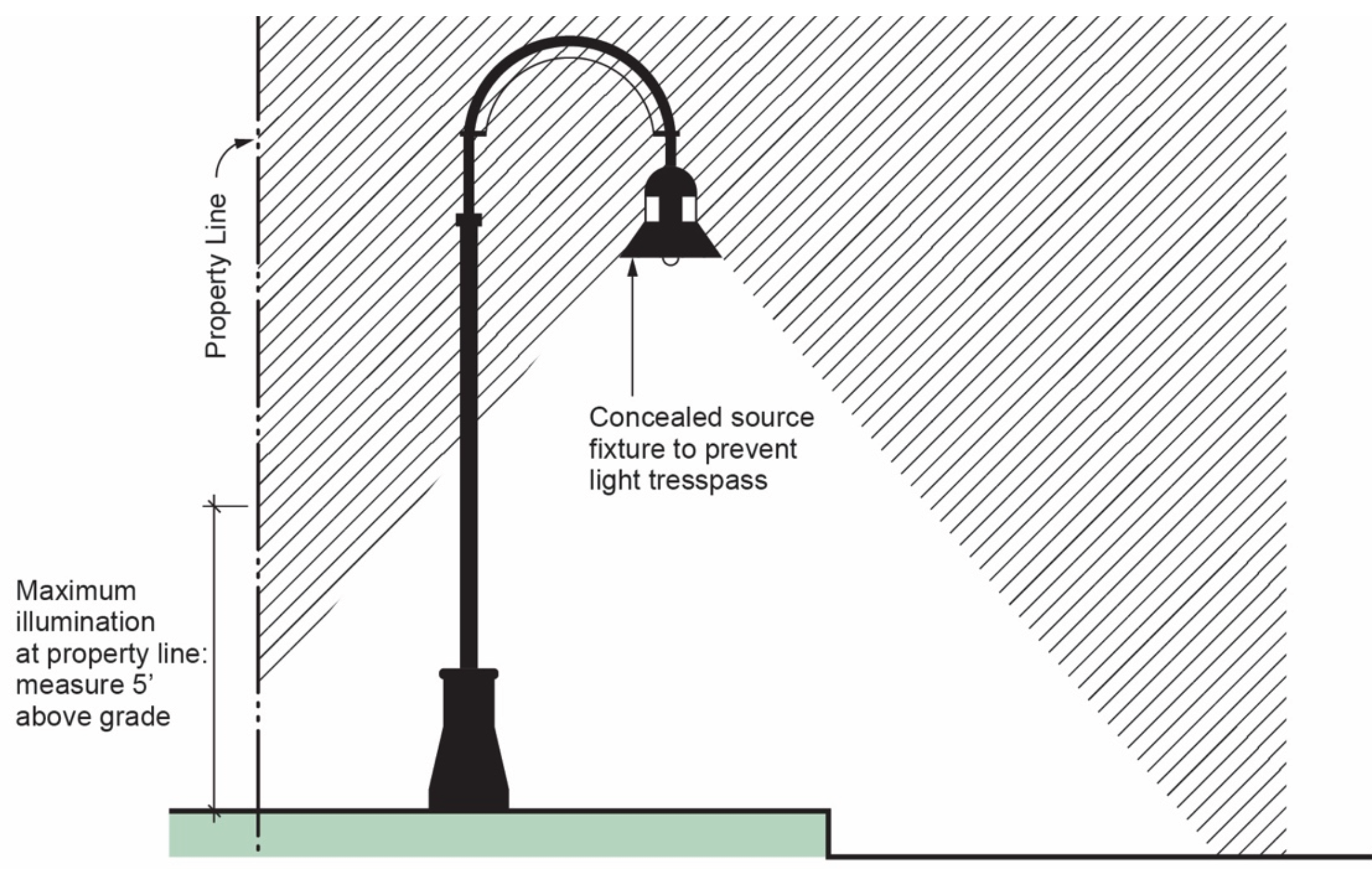
Lighting Fixture Orientation and Shielding
4)
Customer safety. Provide adequate illumination to provide customer safety at front and rear entries.
5)
Consistent fixtures. The type and design of lighting must be consistent throughout a site.
6)
Decorative lighting. Buildings within the NMU, CMU, CBD, and C districts must feature decorative lighting on all façades that face the public right-of-way or residentially zoned or used property. Consider lighted trees and café/bistro/market/string style lights.
7)
Warm hues. The use of warm temperature LED or incandescent lighting is encouraged.
8)
Accent lighting. Soft uplighting may be used to highlight unique architectural features.
9)
Window displays. Interior lighting in window displays must be spot lit at product or display.
10)
Gas station lighting. Lighting under gas station canopies is limited to fully recessed lighting fixtures.
C)
Exempt lighting.
1)
Required exit signs and safety lights for stairs and ramps.
2)
Temporary holiday lights (provided that such lighting is installed no more than 30 days prior to, and 15 days following, the holiday such decorations represent).
3)
Lights required by the Federal Aviation Administration, or other federal or state agency.
4)
Interior lights.
5)
Temporary lights necessary for construction or emergencies.
D)
Prohibited lighting.
1)
Rope lights (including neon, except when used in outlined tubing signs) around and within window and door openings, and around/on the building. Decorative, accent string lights are not considered as rope lights.
2)
Aerial lasers and/or "searchlight" style lights.
3)
Flashing, moving, or intermittent lights (including lighting that changes colors).
4)
Other intense lights, defined as having a light source exceeding 200,000 lumens or more.
E)
Special exception lighting.
1)
Lighting systems not complying with the requirements of this article, but consistent with its intent, may be considered by the City, subject to special exception. This includes instances of:
a)
Sport fields and stadiums.
b)
Areas where higher pole heights are necessary to avoid interference with vehicles/operations.
c)
Public monuments, public buildings, government facilities, and religious institutions.
d)
Any other lighting application determined to be appropriate by the Planning Commission.
2)
The Planning Commission must find that the proposed lighting will not create unwarranted glare, sky glow, or light trespass. The applicant must demonstrate that every reasonable effort has been made to mitigate obtrusive light and artificial sky glow, supported by a signed statement from a registered engineer or by a lighting certified professional describing the mitigation measures.
(Ord. No. 244, § 3(Exh. A), 12-9-2024)

