
Gulf Breeze City Zoning Code
ARTICLE II
- DISTRICT REGULATIONS
Sec. 21-26.- Districts enumerated.
For the purpose of this land development code, the city is divided into 11 land use districts designated as follows:
Sec. 21-27. - Rules for determining boundaries.
Where uncertainty exists with respect to the boundaries of any of the districts as shown on the zoning map, the following rules shall apply:
(1)
Unless otherwise indicated, the district boundary lines shall be construed to be the corporate limit line, block lines, subdivision lines for lot lines, or the centerlines of streets or highways, rights-of-way or stream beds.
(2)
Where a district boundary line as appearing on the zoning map divides a lot in single ownership at the time of the enactment of this land development code, the requirements for the district in which the greater portion of the lot lies may be extended to the balance of the lot, provided that such extension shall not include any part of such lot more than 50 feet beyond the district boundary line.
Sec. 21-28. - Official zoning map.
The city hereby adopts as the official zoning map of the city, together with the designated districts shown thereon, the maps attached to Ord. No. 05-15 as exhibit A. Said official zoning map shall be made a part of this land development code and may be amended from time to time by the city council. The official zoning map shall be available at the office of the city clerk.
Sec. 21-29. - Use requirements by district.
The allowable uses of land and requirements for structures within each of the land use districts are contained within divisions 2—12 of this article and include:
(1)
Residential: R-ES, R-1-AA, R-1-A, R-1, R-C, TH.
(2)
Commercial: C-1, C-2.
(3)
Medical: M.
(4)
Mixed use: MXD-1.
(5)
Public lands: P.
(6)
Conservation: CNS.
Sec. 21-30. - Scope.
Except as hereinafter provided, no building, structure or land shall hereafter be used or occupied and no building, structure or parts thereof shall be erected, reconstructed, moved or altered unless in conformity with the regulations herein specified for the district in which it is located.
Sec. 21-31. - Continuance of nonconforming uses.
(a)
Nonconforming uses allowed to continue. Subject to the limitations and provisions set forth in this section, a nonconforming use existing at the time of enactment or subsequent amendment to this land development code may be continued.
(b)
Limitations upon continuance of nonconforming uses. No nonconforming uses may be:
(1)
Changed to another nonconforming use;
(2)
Extended, expanded, enlarged or increased, except in conformity with this land development code;
(3)
Except as provided in subsection (c), below, reestablished or recommenced following its cessation or discontinuance for a period of six months or more; and
(4)
Except as provided in subsection (d), below, rebuilt, restored, repaired, replaced, or altered, following destruction or demolition of, or damage by fire, explosion, other casualty, and/or act of God to, or deterioration of more than 80 percent of the structural value of the building, structure or site improvement.
The preceding sentence notwithstanding, owners as of July 3, 1995, of piers, docks and boathouses shall be exempted from the limitations upon the continuation of nonconforming uses set forth in this subsection (4) to the extent such limitations pertain to piers, docks and boathouses and shall be entitled to rebuild, alter and repair their piers, docks and/or boathouses in the same location with the same dimensions and up to the same length as existed as of July 3, 1995, despite damages thereto exceeding 80 percent of its structural value; provided, however, this exemption shall (i) apply only to and for the benefit of the owners of the pier, dock and/or boathouse as of July 3, 1995, (ii) apply only with respect to piers, docks and boathouses, (iii) continue only so long as the said owners remain the sole owners of the property upon or to which the piers, docks and/or boathouses appertain, and (iv) cease with respect to such property and such piers, docks and boathouses upon any alienation or conveyance of title to the property or any hypothecation of ownership thereof which is tantamount to alienation or conveyance of ownership.
(c)
Extension of time period before cessation or discontinuance of nonconforming use occurs. Upon written request of an owner of property upon which a nonconforming use exists, the city council may extend the six month time period set forth in subsection (b)(3), above, if the written request demonstrates and upon public hearing the city council finds one or more of the following:
(1)
The cessation or discontinuance of use was involuntary, resulted from an act or acts of God or other circumstances beyond the owner's control, and the owner has exerted continuous good faith efforts to put the building, structure or site improvement to use during the prescribed period;
(2)
The cessation or discontinuance of use was the direct result of legal proceedings relating to change of ownership (e.g., foreclosures, bankruptcies, etc.); or
(3)
The owner has undertaken continuous good faith efforts to actively market the property for sale or lease during the prescribed period, the cessation or discontinuance of the nonconforming use is/was the direct result of the owner's inability to lease or sell the property, utility connections to the property have been continuously maintained, and with respect to those nonconforming uses for which an occupational license is necessary, a valid, unexpired occupational license has been continuously maintained for the premises.
(d)
Relief from or waiver of certain limitations upon continuance of nonconforming uses. Upon written request from an owner of property upon which a nonconforming use exists, the city council may grant relief from and/or waive the limitations upon the continuance of nonconforming uses set forth in subsection (b)(4), above, if the written request demonstrates and the city council upon public hearing finds the following:
(1)
The relief or waiver can be granted without any significant adverse impact on surrounding properties and is not detrimental to the public health, safety and welfare;
(2)
The continuation of the nonconforming use will be consistent with the public interest and in harmony with the general intent of the land development code;
(3)
The relief or waiver granted is the minimum necessary to accommodate the proposed use;
(4)
Granting the relief or waiver would cause substantial adverse impact upon surrounding properties, but such adverse impact may be mitigated and granting the relief or waiver is conditioned upon performance of such mitigation measures; and
(5)
Development of the property for permitted uses is not reasonably possible without the relief or waiver, understanding that economic hardship may be considered as a factor supporting granting the relief or waiver.
In granting relief from and/or a waiver of said limitations upon the continuance of nonconforming uses, the city council may impose such conditions and requirements thereupon that are in the public interest, consistent with the intent of the land development code, assure that the relief and/or waiver is the minimum necessary to accommodate the proposed use, and will aid in mitigating the adverse impact upon surrounding property that would otherwise be caused by the continuance of the nonconforming use.
(e)
Exceptions. Notwithstanding any other provision of this section, if a nonconforming use or a portion of a building, structure or site improvement containing a nonconforming use becomes physically unsafe or unlawful due to lack of repairs and/or maintenance, and is declared by any authorized official to be unsafe or unlawful by reason of physical condition, it shall not thereafter be restored, repaired or built except in conformity with the provisions of the land development code. The preceding sentence shall not be deemed to prevent the strengthening or restoring to a safe condition of any building, structure or site improvement, or part thereof, declared to be unsafe by any official charged with protecting the public safety, upon order of such official.
(Ord. No. 4-95, § 1, 7-5-95; Ord. No. 06-00, § 2, 8-21-00)
Sec. 21-32. - Discontinuance of nonconforming uses.
Nonconforming uses of land which are unimproved by buildings, or which are improved with buildings, structures or permanently located trailers valued at under $2,500.00 shall be discontinued within 18 months from the date of adoption of this land development code.
Sec. 21-46.- Permitted uses.
In the R-ES district, all lots shall be known, described and used as single-family residential lots only.
Sec. 21-47. - Height, area of buildings.
(a)
In the R-ES district, single-family residences shall not exceed 35 feet in height above the minimum base floor elevation as defined by the National Flood Insurance Program.
(b)
The minimum ground floor area of a one-story dwelling constructed in R-ES district shall be at least 1,400 square feet, exclusive of garages, carports and open porches. Two-story dwellings built in an R-ES district must have a ground floor area of at least 900 square feet, exclusive of carports, garages and open porches, and must have a total area of at least 1,500 square feet, including the lower and upper floors.
(Ord. No. 02-02, § 1, 2-4-02; Ord. No. 05-05, § 1, 10-3-05)
Sec. 21-48. - Lot requirements.
In the R-ES district no residential structure shall be erected or placed on any building lot which has a width of less than 80 feet at the setback line. The maximum density shall not exceed 1.75 units per acre.
Sec. 21-49. - Setbacks, yard requirements.
The minimum setback from the front lot line shall be 30 feet; minimum side yard setbacks shall be eight feet from the side lot line; minimum rear yard depth shall be 30 feet from any portion of the main house or porches, attached garages or carports to the rear lot line except in the case of corner lots for which the rear yard restrictions shall be 15 feet. On vacant corner lots, the owner or developer may designate which of the street sides shall be considered the front of the lot for setback purposes, and the minimum front setback shall be 30 feet, and the side street setback shall be 15 feet. For the purpose of determining the setbacks for additions to an existing primary structure located on a residential corner lot, the front setback shall be established by the orientation of the front door and the address of the primary structure. The remaining street shall be considered the side street and the minimum side street setback shall be 15 feet.
Sec. 21-50. - Accessory structures.
(a)
Setbacks.
(1)
No accessory structure shall be located in front of a primary structure, except in the case of a garage. In those instances where a garage is located forward of the primary structure, the garage shall be of the same architectural style, color and facing material as the primary structure and shall be located 30 feet or more from the front lot line.
(2)
In no event shall an accessory structure be nearer than five feet to any lot line or rear lot line, and no nearer to any side street property line than the side street setback line for that particular lot.
(3)
In no case shall any portion of an accessory structure be located within four feet of the primary structure.
(4)
In no event shall an accessory structure be located on any easement.
(5)
If an accessory structure is 800 square feet or greater in area, it shall meet the following setback requirements:
a.
The accessory structure shall not be located in front of the primary structure, except in the case of a garage. In those instances where a garage is located forward of the primary structure, the garage shall be of the same architectural style, color and facing material as the primary structure and shall be located 30 feet or more from the front lot line.
b.
The accessory structure shall be no nearer than eight feet to any side lot line and 30 feet from any rear lot line.
c.
In the case of a corner lot, no nearer to any side street property line than the side street setback line for that particular lot.
(b)
Number. The number of accessory structures shall not exceed two per lot.
(c)
Height.
(1)
No accessory structure shall exceed the height of the primary structure and in no event shall it exceed 35 feet in height.
(2)
The height of any point on an accessory structure shall not exceed the sum of the horizontal distance from the highest point of the accessory structure to the closest property line plus five feet and in no event shall the height exceed the height of the primary structure regardless of where the detached structure is placed on the lot.
(d)
Screening. When an accessory structure is readily visible from any public place or street, it shall be required to be screened by bushes, shrubs, trees, fencing or other suitable material or device. In those instances where a garage is to be placed forward of the primary structure and the garage is the same architectural style, color and facing material as the primary structure then screening shall not be required. The screening requirement is to provide visual relief to the residential landscape and is not intended completely obscure the accessory structure from view.
(e)
Other restrictions.
(1)
No accessory structure shall be used for overnight sleeping accommodations on a permanent basis.
(2)
No accessory structure shall be used as residence.
(3)
No accessory structure located in a residential zoning district shall be used for business or commercial purposes.
(Ord. No. 12-09, § 2, 8-3-09)
Sec. 21-51. - Fence requirements.
(a)
General requirements.
(1)
The erection of all new fences and walls and repair of 25 percent or greater of an existing fence or wall, shall require a permit. The fee for processing said fence permit application is $25.00. This amount may be adjusted from time to time by a resolution duly adopted by the city council.
(2)
No fence, wall or other obstruction shall be erected or maintained at a corner within 15 feet from the intersection of the right-of-way lines. Exceptions to this provision may be allowed by written approval from the city manager or their designee.
(3)
All fences and walls must be maintained in good repair and safe condition at all times. Damaged or missing elements shall be repaired, removed, or replaced. Fences in disrepair shall be deemed a public nuisance and abated pursuant to sections 8-28 and 8-29 of the Code of Ordinances.
(4)
Repairs to existing fences shall be made of the same or similar material and consist of the same design elements including color, material, and height as the remainder of the existing fence or wall.
(5)
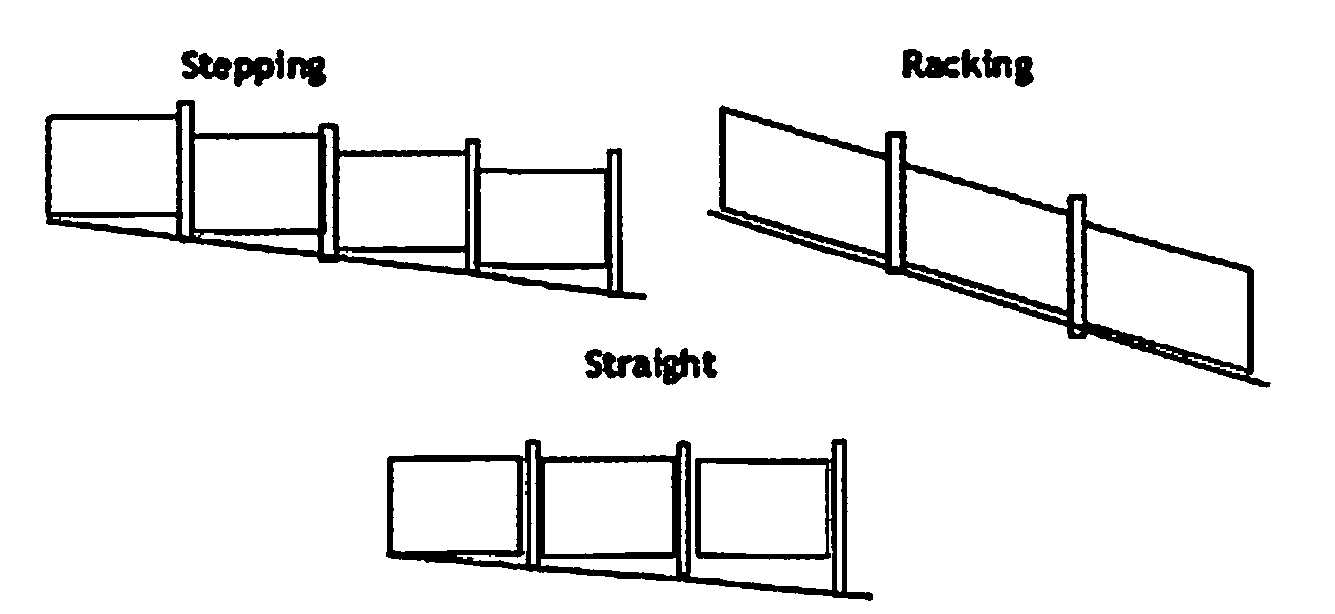
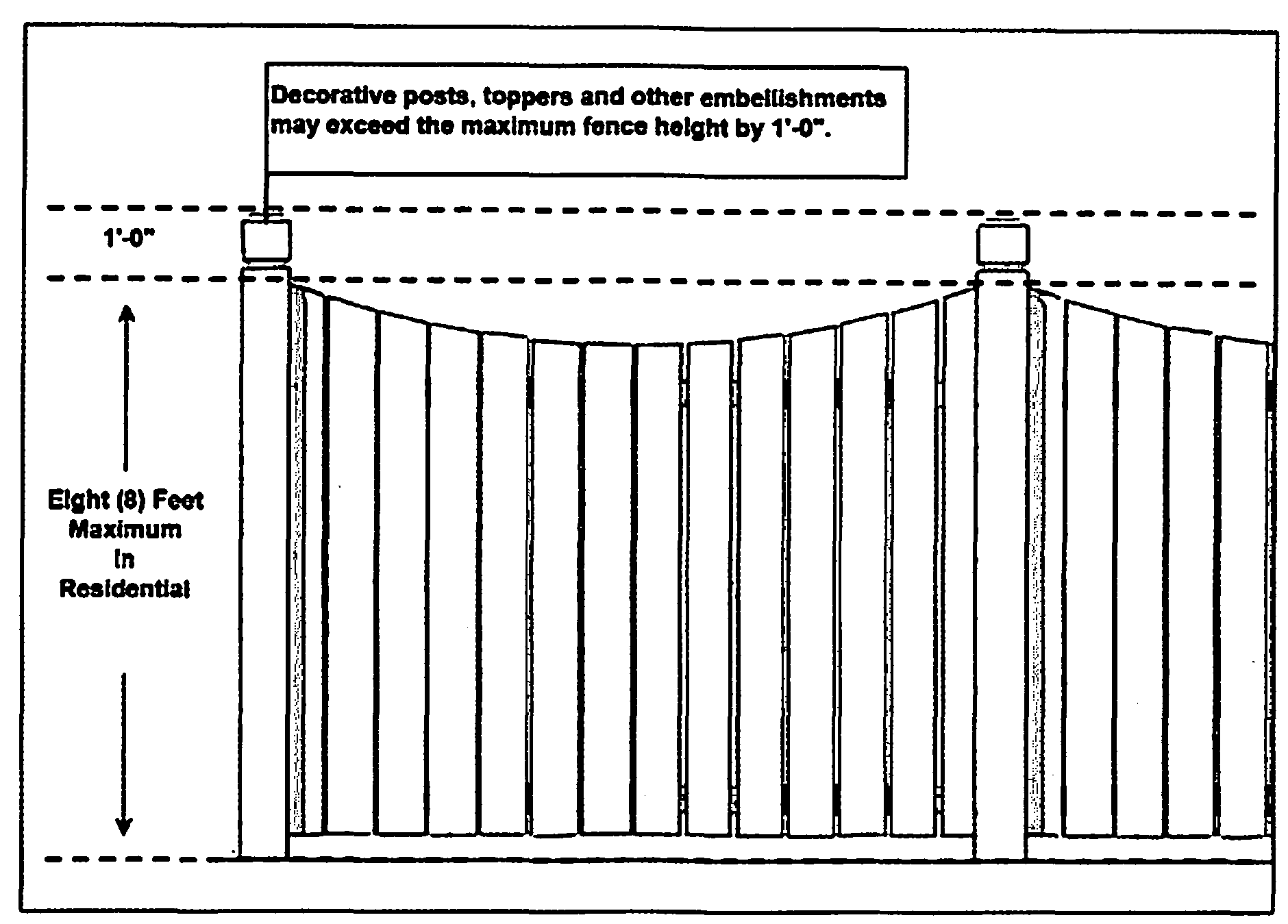
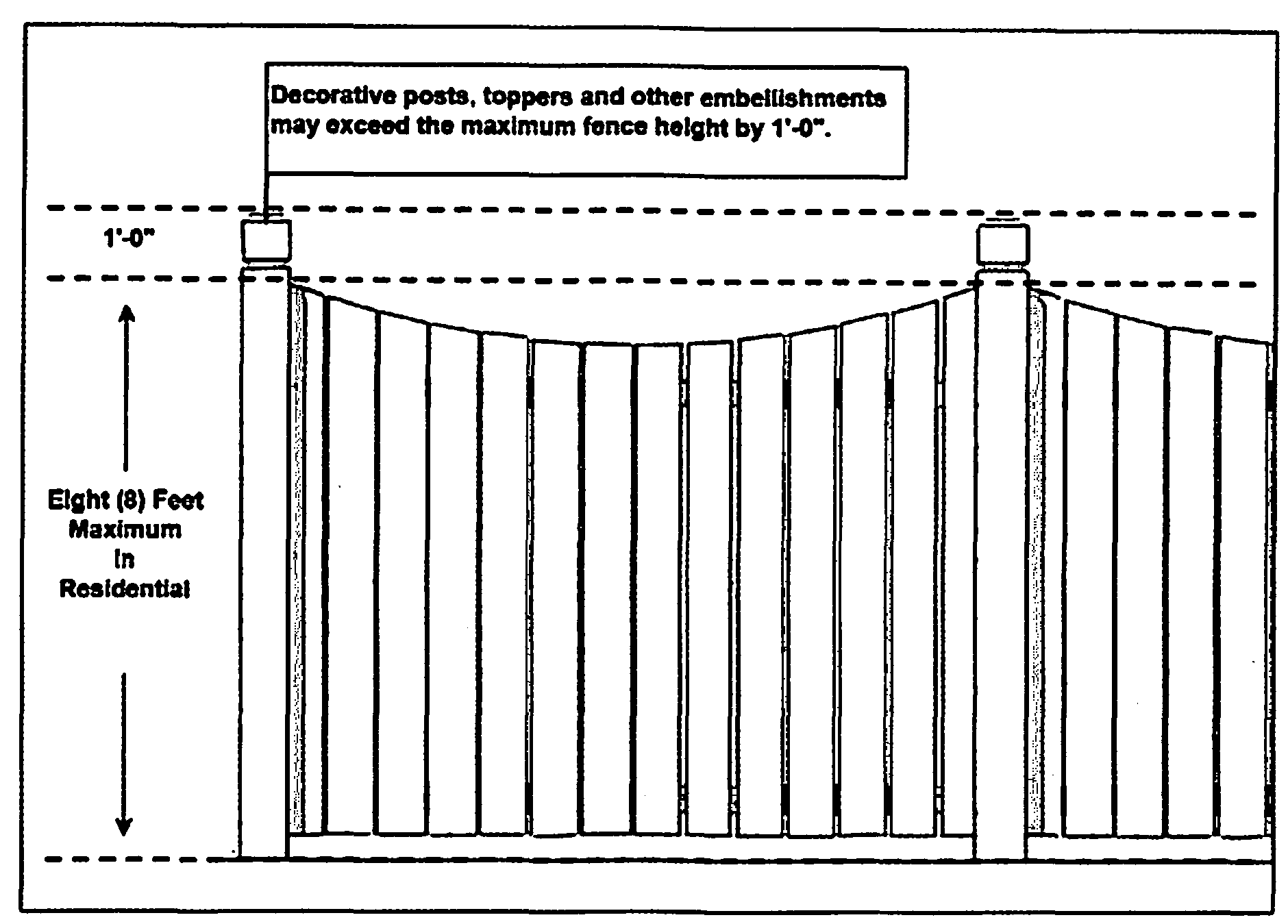
Height is measured from the natural grade of the adjacent ground without fill to the highest point, except that decorative posts of a fence or wall may exceed the maximum height by one foot. Walls and fences constructed on a slope shall be of the racking design so that they follow the contour of the ground. Stepping or straight fencing designs shall not be allowed.
(6)
Walls and fences shall be constructed with approved materials and workmanship as approved by the city. Horizontal and vertical support posts shall be placed facing the inside of the fenced area when the fence abuts a street, except where the fence is designed such that both sides are finished with alternating vertical fence supports and those vertical supports are covered by the alternating pattern.
(b)
Heights of fences and walls.
(1)
Fence height.
a.
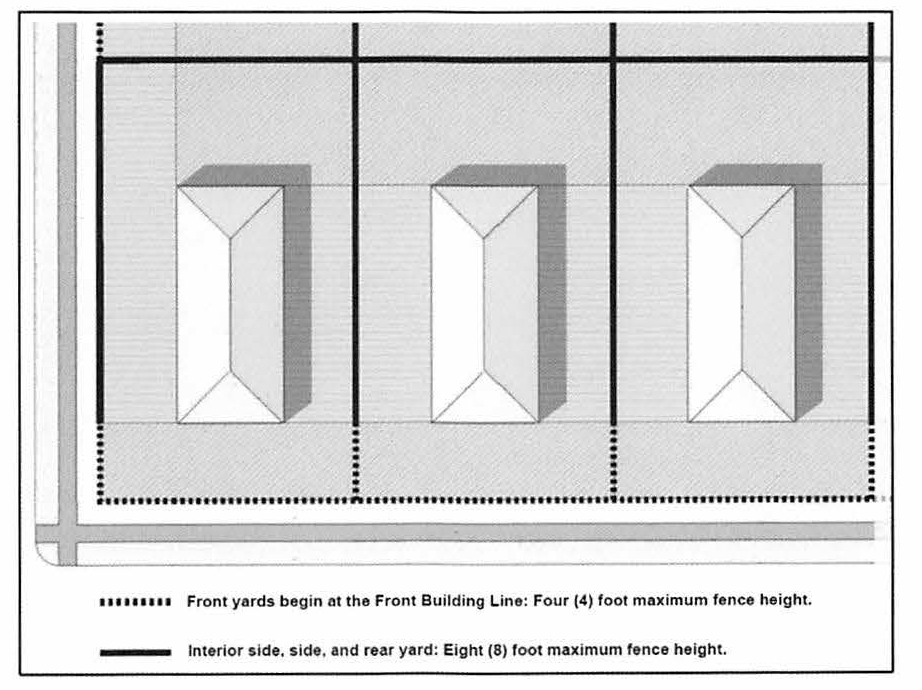
Fences, walls, and other obstructions erected along the side lot lines beyond the front building plain shall be limited to a maximum height of four feet, except where a residential structure is located adjacent to a nonresidential use. Where a residential structure is located adjacent to a nonresidential use or structure, an eight-foot fence shall be permitted along the common lot line; provided such fence does not create a traffic hazard.
b.
In the interior side, side, and rear yards, a fence wall is permitted up to a maximum height of eight feet.
c.
Decorative fence posts, post toppers and other similar embellishments shall be permitted to exceed the maximum height by one foot.
(c)
Fence and wall construction and design requirements.
(1)
[Reserved.]
(2)
A fence or wall, including all posts, bases, and other structural parts must be located completely within the boundaries of the lot on which it is located.
(3)
The following fence types shall not be allowed past the front plain of the building: chain link, wood privacy, wire farm fencing.
(4)
No fence may be electrified.
(5)
No barbed wire, razor wire, concertina wire or similar security wire fencing shall be allowed.
(d)
Special exceptions. Fences greater than four feet in height meeting the following criteria may be located forward of the front of the house but not forward of the front lot line. The development review board will determine in a quasi-judicial proceeding if the criteria listed below have been met.
(1)
The fence shall be decorative or ornamental in design and match the overall architectural style of the principal structure. No chain link, wire, wooden panel or picket fence shall qualify for a special exception. The design of the fence must be brick, stone or stucco columns joined by metal panels. The metal panels must be less than 33 percent opaque.
(2)
Landscaping must be installed on the street side of the fence in such a manner as to shield the metal panels from view within three years from the date of construction. Plant material must consist of ornamental shrubs which grow to a height of five to six feet under normal conditions (recommended species are included in table 1. Other species with similar attributes may be utilized).
(3)
The maximum height of the fence panels shall not exceed six feet in height: however, columns may be up to ten feet high. The height will be measured from the natural grade of the adjacent ground without fill to the highest point.
(4)
The minimum distance between columns shall be eight feet. The maximum distance between columns shall be 15 feet.
(5)
The property owner must demonstrate the existence of a public safety concern, such as trespassing that frequently occurs about his property which would be significantly mitigated by construction or erection of a fence contemplated in this subsection (b).
(6)
Any fence that utilizes a gate or similar device to restrict access to the driveway shall be equipped with a rapid entry system as specified in section 21-278.
(Ord. No. 01-00, § 1, 3-6-00; Ord. No. 11-00, § 1, 9-7-00; Ord. No. 02-09, § 1, 3-16-09; Ord. No. 02-21, § 2.B, 4-19-2021)
Sec. 21-52. - Screen enclosures.
A screen enclosure shall be considered to be a detached structure for setback purposes only, regardless of its actual placement on the lot and whether or not it is attached to the main building on the lot. The screen enclosure material must constitute at least 85 percent of the surface structure with the entire roof surface being constructed of screen enclosure and its supporting structure. The height of any point on a detached structure shall not exceed the sum of the horizontal distance from such point to the closest property line plus five feet and in no event shall the height exceed 35 feet regardless of where the detached structure is placed on the lot.
(Ord. No. 8-96, § 1, 10-21-96)
Sec. 21-53. - Environmental requirements.
Development within the R-ES district shall comply with the requirements for development in environmentally sensitive lands as contained in 22-26 et seq.
Sec. 21-66.- Permitted uses.
In the R-1-AA district, all lots shall be known, described and used as single-family residential lots only.
Sec. 21-67. - Height, area of buildings.
(a)
In the R-1-AA district, single-family residences shall not exceed 35 feet in height above the minimum base floor elevation as defined by the National Flood Insurance Program.
(b)
The minimum ground floor space area of a one-story dwelling hereinafter constructed in the R-1-AA district shall be at least 1,400 square feet, exclusive of garages, carports and open porches. Two-story dwellings hereinafter built in an R-1-AA district must have a ground floor space of at least 900 square feet, exclusive of carports, garages and open porches, and must have a total area of at least 1,500 square feet, including the lower and upper floors.
(Ord. No. 02-02, § 1, 2-4-02; Ord. No. 05-05, § 1, 10-3-05)
Sec. 21-68. - Lot requirements.
In the R-1-AA district no residential structure shall be erected or placed on any building lot which has a square foot area of less than 10,000 square feet. In addition, a minimal lot width of 80 feet is required at the front setback line. The minimum lot width at the street right-of-way line shall be 50 feet, as measured along the curve.
(Ord. No. 2-94, § 1, 2-21-94)
Sec. 21-69. - Setbacks, yard requirements.
The minimum setback from the front lot line shall be 30 feet; minimum side yard setback shall be eight feet from the side lot line; minimum rear yard depth is to be 30 feet from any portion of the main house or porches, attached garages or carports to the rear lot line except in the case of corner lots for which the rear yard restrictions shall be 15 feet. On vacant corner lots, the owner or developer may designate which of the street sides shall be considered the front of the lot for setback purposes, and the minimum front setback shall be 30 feet, and the side street setback shall be 15 feet. For the purpose of determining the setbacks for additions to an existing primary structure located on a residential corner lot, the front setback shall be established by the orientation of the front door and the address of the primary structure. The remaining street shall be considered the side street and the minimum side street setback shall be 15 feet.
Sec. 21-70. - Accessory structures.
(a)
Setbacks.
(1)
No accessory structure shall be located in front of a primary structure, except in the case of a garage. In those instances where a garage is located forward of the primary structure, the garage shall be of the same architectural style, color and facing material as the primary structure and shall be located 30 feet or more from the front lot line.
(2)
In no event shall an accessory structure be nearer than five feet to any lot line or rear lot line, and no nearer to any side street property line than the side street setback line for that particular lot.
(3)
In no case shall any portion of an accessory structure be located within four feet of the primary structure.
(4)
In no event shall an accessory structure be located on any easement.
(5)
If an accessory structure is 800 square feet or greater in area, it shall meet the following setback requirements:
a.
The accessory structure shall not be located in front of the primary structure, except in the case of a garage. In those instances where a garage is located forward of the primary structure, the garage shall be of the same architectural style, color and facing material as the primary structure and shall be located 30 feet or more from the front lot line.
b.
The accessory structure shall be no nearer than eight feet to any side lot line and 30 feet from any rear lot line.
c.
In the case of a corner lot, no nearer to any side street property line than the side street setback line for that particular lot.
(b)
Number. The number of accessory structures shall not exceed two per lot.
(c)
Height.
(1)
No accessory structure shall exceed the height of the primary structure and in no event shall it exceed 35 feet in height.
(2)
The height of any point on an accessory structure shall not exceed the sum of the horizontal distance from the highest point of the accessory structure to the closest property line plus five feet and in no event shall the height exceed the height of the primary structure regardless of where the detached structure is placed on the lot.
(d)
Screening. When an accessory structure is readily visible from any public place or street, it shall be required to be screened by bushes, shrubs, trees, fencing or other suitable material or device. In those instances where a garage is to be placed forward of the primary structure and the garage is the same architectural style, color and facing material as the primary structure then screening shall not be required. The screening requirement is to provide visual relief to the residential landscape and is not intended [to] completely obscure the accessory structure from view.
(e)
Other restrictions.
(1)
No accessory structure shall be used for overnight sleeping accommodations on a permanent basis.
(2)
No accessory structure shall be used as residence.
(3)
No accessory structure located in a residential zoning district shall be used for business or commercial purposes.
(Ord. No. 12-09, § 3, 8-3-09)
Sec. 21-71. - Swimming pool enclosures.
A swimming pool screen enclosure shall be considered to be a detached structure for setback purposes only regardless of its actual placement on the lot and whether or not it is attached to the main building on the lot. The screen enclosure material must constitute at least 85 percent of the surface structure with the entire roof surface being constructed of screen enclosure and its supporting structure. The height of any point on a detached structure shall not exceed the sum of the horizontal distance from such point to the closest property line plus five feet and in no event shall the height exceed 35 feet regardless of where the detached structure is placed on the lot.
Sec. 21-72. - Fence requirements.
(a)
General requirements.
(1)
The erection of all new fences and walls and repair of 25 percent or greater of an existing fence or wall, shall require a permit. The fee for processing said fence permit application is $25.00. This amount may be adjusted from time to time by a resolution duly adopted by the city council.
(2)
No fence, wall or other obstruction shall be erected or maintained at a corner within 15 feet from the intersection of the right-of-way lines. Exceptions to this provision may be allowed by written approval from the city manager or their designee.
(3)
All fences and walls must be maintained in good repair and safe condition at all times. Damaged or missing elements shall be repaired, removed, or replaced. Fences in disrepair shall be deemed a public nuisance and abated pursuant to sections 8-28 and 8-29 of the Code of Ordinances.
(4)
Repairs to existing fences shall be made of the same or similar material and consist of the same design elements including color, material, and height as the remainder of the existing fence or wall.
(5)
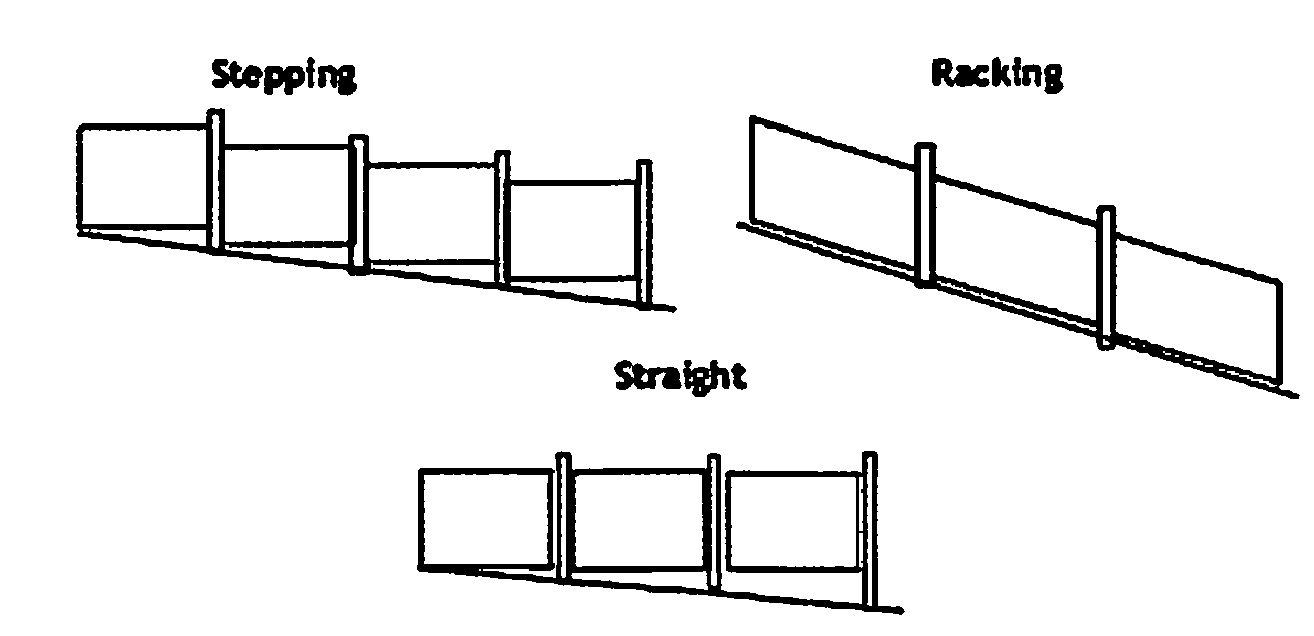
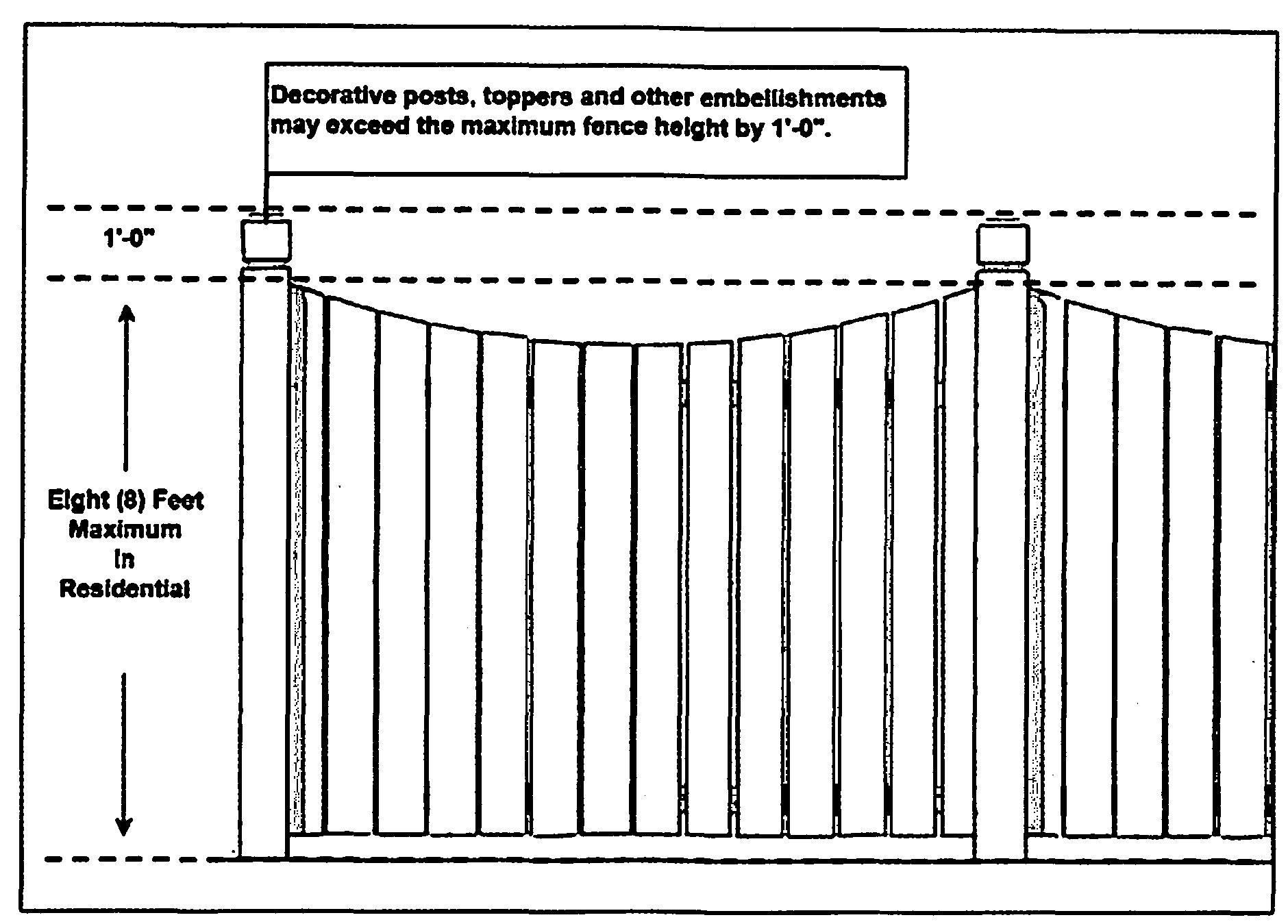
Height is measured from the natural grade of the adjacent ground without fill to the highest point, except that decorative posts of a fence or wall may exceed the maximum height by one foot. Walls and fences constructed on a slope shall be of the racking design so that they follow the contour of the ground. Stepping or straight fencing designs shall not be allowed.
(6)
Walls and fences shall be constructed with approved materials and workmanship as approved by the city. Horizontal and vertical support posts shall be placed facing the inside of the fenced area when the fence abuts a street, except where the fence is designed such that both sides are finished with alternating vertical fence supports and those vertical supports are covered by the alternating pattern.
(b)
Heights of fences and walls.
(1)
Fence height.
a.
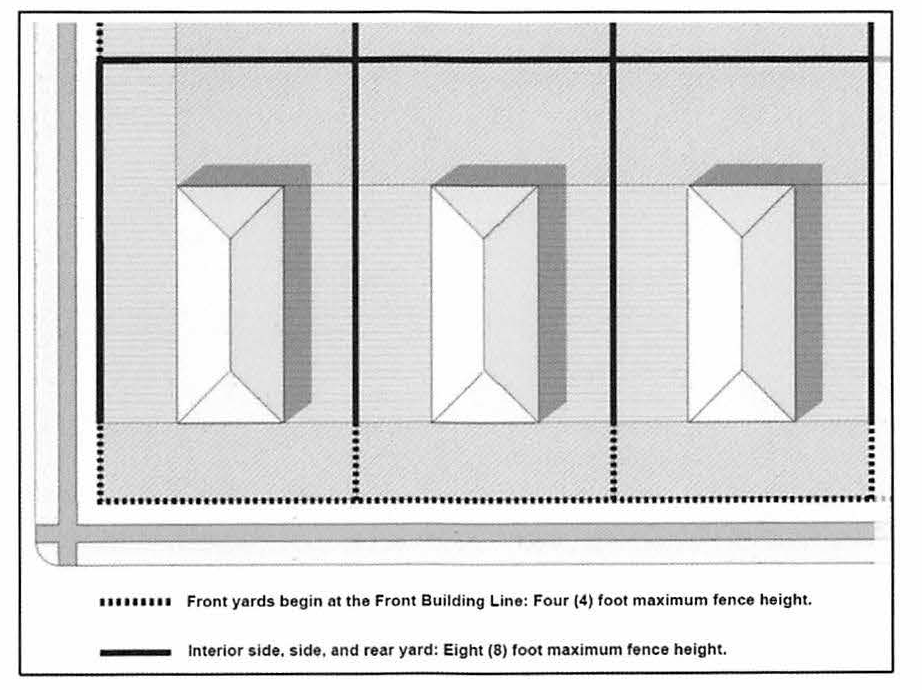
Fences, walls, and other obstructions erected along the side lot lines beyond the front building plain shall be limited to a maximum height of four feet, except where a residential structure is located adjacent to a nonresidential use. Where a residential structure is located adjacent to a nonresidential use or structure, an eight-foot fence shall be permitted along the common lot line: provided such fence does not create a traffic hazard.
b.
In the interior side, side, and rear yards, a fence wall is permitted up to a maximum height of eight feet.
c.
Decorative fence posts, post toppers and other similar embellishments shall be permitted to exceed the maximum height by one foot.
(c)
Fence and wall construction and design requirements.
(1)
A fence or wall, including all posts, bases, and other structural parts must be located completely within the boundaries of the lot on which it is located.
(2)
The following fence types shall not be allowed past the front plain of the building: chain link, wood privacy, wire farm fencing.
(3)
No fence may be electrified.
(4)
No barbed wire, razor wire, concertina wire or similar security wire fencing shall be allowed.
(d)
Special exceptions. Fences greater than four feet in height meeting the following criteria may be located forward of the front of the house but not forward of the front lot line. The development review board will determine in a quasi-judicial proceeding if the criteria listed below have been met.
(1)
The fence shall be decorative or ornamental in design and match the overall architectural style of the principal structure. No chain link, wire, wooden panel or picket fence shall qualify for a special exception. The design of the fence must be brick, stone or stucco columns joined by metal panels. The metal panels must be less than 33 percent opaque.
(2)
Landscaping must be installed on the street side of the fence in such a manner as to shield the metal panels from view within three years from the date of construction. Plant material must consist of ornamental shrubs which grow to a height of five to six feet under normal conditions (recommended species are included in table 1. Other species with similar attributes may be utilized).
(3)
The maximum height of the fence panels shall not exceed six feet in height; however, columns may be up to ten feet high. The height will be measured from the natural grade of the adjacent ground without fill to the highest point.
(4)
The minimum distance between columns shall be eight feet. The maximum distance between columns shall be 15 feet.
(5)
The property owner must demonstrate the existence of a public safety concern, such as trespassing that frequently occurs about his property which would be significantly mitigated by construction or erection of a fence contemplated in this subsection (b).
(6)
Any fence that utilizes a gate or similar device to restrict access to the driveway shall be equipped with a rapid entry system as specified in section 21-278.
(Ord. No. 01-00, § 1, 3-6-00; Ord. No. 11-00, § 1, 9-7-00; Ord. No. 02-09, § 1, 3-16-09; Ord. No. 02-10, § 1, 2-16-10; Ord. No. 04-10, § 1, 5-3-10; Ord. No. 04-14, § 1, 4-7-14; Ord. No. 03-15, § 4, 5-4-15; Ord. No. 02-2021, § 2.C, 4-19-21)
Sec. 21-81.- Permitted uses.
(a)
In the R-1-A district, all lots shall be known, described and used as residential lots only, except as provided for under subsection (b) below.
(b)
Churches and religious institutions are permitted, provided such buildings be placed not nearer than 25 feet from any property line and provided further that required off-street parking space be separated from any property line by planted buffer strip at least ten feet wide, unless adjoining district C1 or C2.
Sec. 21-82. - Height, area of buildings.
(a)
In the R-1-A district, single-family residences shall not exceed 35 feet in height above the minimum base floor elevation as defined by the National Flood Insurance Program.
(b)
The minimum ground floor space area of a one-story dwelling hereinafter constructed in an R-1-A district shall be at least 1,000 square feet, exclusive of garages, carports and open porches. Two-story dwellings hereinafter built in an R-1-A district must have a ground floor space of at least 800 square feet exclusive of carports, garages and open porches and must have a total area of at least 1,200 square feet, including the lower and upper floors.
(Ord. No. 06-02, § 1, 3-4-02; Ord. No. 05-05, § 1, 10-3-05)
Sec. 21-83. - Lot requirements.
In the R-1-A district no residential structure shall be erected or placed on any building lot which has a square foot area of less than 9,000 square feet. In addition, a minimal lot width of 80 feet is required at the front setback line. The minimum lot width at the street right-of-way line shall be 50 feet, as measured along the curve.
(Ord. No. 2-94, § 1, 2-21-94)
Sec. 21-84. - Setbacks, yard requirements.
The minimum setback from the front lot line shall be 30 feet; minimum side yard setback shall be eight feet from the side lot line; minimum rear yard depth is to be 30 feet from any portion of the main house or porches, attached garages or carports to the rear lot line except in the case of a corner lot for which the rear yard restrictions shall be 15 feet. On vacant corner lots, the owner or developer may designate which of the street sides shall be considered the front of the lot for setback purposes, and the minimum front setback shall be 30 feet, and the side street setback shall be 15 feet. For the purpose of determining the setbacks for additions to an existing primary structure located on a residential corner lot, the front setback shall be established by the orientation of the front door and the address of the primary structure. The remaining street shall be considered the side street and the minimum side street setback shall be 15 feet.
Sec. 21-85. - Accessory structures.
(a)
Setbacks.
(1)
No accessory structure shall be located in front of a primary structure, except in the case of a garage. In those instances where a garage is located forward of the primary structure, the garage shall be of the same architectural style, color and facing material as the primary structure and shall be located 30 feet or more from the front lot line.
(2)
In no event shall an accessory structure be nearer than five feet to any lot line or rear lot line, and no nearer to any side street property line than the side street setback line for that particular lot.
(3)
In no case shall any portion of an accessory structure be located within four feet of the primary structure.
(4)
In no event shall an accessory structure be located on any easement.
(5)
If an accessory structure is 800 square feet or greater in area, it shall meet the following setback requirements:
a.
The accessory structure shall not be located in front of the primary structure, except in the case of a garage. In those instances where a garage is located forward of the primary structure, the garage shall be of the same architectural style, color and facing material as the primary structure and shall be located 30 feet or more from the front lot line.
b.
The accessory structure shall be no nearer than eight feet to any side lot line and 30 feet from any rear lot line.
c.
In the case of a corner lot, no nearer to any side street property line than the side street setback line for that particular lot.
(b)
Number. The number of accessory structures shall not exceed two per lot.
(c)
Height.
(1)
No accessory structure shall exceed the height of the primary structure and in no event shall it exceed 35 feet in height.
(2)
The height of any point on an accessory structure shall not exceed the sum of the horizontal distance from the highest point of the accessory structure to the closest property line plus five feet and in no event shall the height exceed the height of the primary structure regardless of where the detached structure is placed on the lot.
(d)
Screening. When an accessory structure is readily visible from any public place or street, it shall be required to be screened by bushes, shrubs, trees, fencing or other suitable material or device. In those instances where a garage is to be placed forward of the primary structure and the garage is the same architectural style, color and facing material as the primary structure then screening shall not be required. The screening requirement is to provide visual relief to the residential landscape and is not intended [to] completely obscure the accessory structure from view.
(e)
Other restrictions.
(1)
No accessory structure shall be used for overnight sleeping accommodations on a permanent basis.
(2)
No accessory structure shall be used as residence.
(3)
No accessory structure located in a residential zoning district shall be used for business or commercial purposes.
(Ord. No. 12-09, § 4, 8-3-09)
Sec. 21-86. - Screen enclosures.
A screen enclosure shall be considered to be a detached structure for setback purposes only, regardless of its actual placement on the lot and whether or not it is attached to the main building on the lot. The screen enclosure material must constitute at least 85 percent of the surface structure with the entire roof surface being constructed of screen enclosure and its supporting structure. The height of any point on a detached structure shall not exceed the sum of the horizontal distance from such point to the closest property line plus five feet and in no event shall the height exceed 35 feet regardless of where the detached structure is placed on the lot.
(Ord. No. 8-96, § 1, 10-21-96)
Sec. 21-87. - Fence requirements.
(a)
General requirements.
(1)
The erection of all new fences and walls and repair of 25 percent or greater of an existing fence or wall, shall require a permit. The fee for processing said fence permit application is $25.00. This amount may be adjusted from time to time by a resolution duly adopted by the city council.
(2)
No fence, wall or other obstruction shall be erected or maintained at a corner within 15 feet from the intersection of the right-of-way lines. Exceptions to this provision may be allowed by written approval from the city manager or their designee.
(3)
All fences and walls must be maintained in good repair and safe condition at all times. Damaged or missing elements shall be repaired, removed, or replaced. Fences in disrepair shall be deemed a public nuisance and abated pursuant to sections 8-28 and 8-29 of the Code of Ordinances.
(4)
Repairs to existing fences shall be made of the same or similar material and consist of the same design elements including color, material, and height as the remainder of the existing fence or wall.
(5)
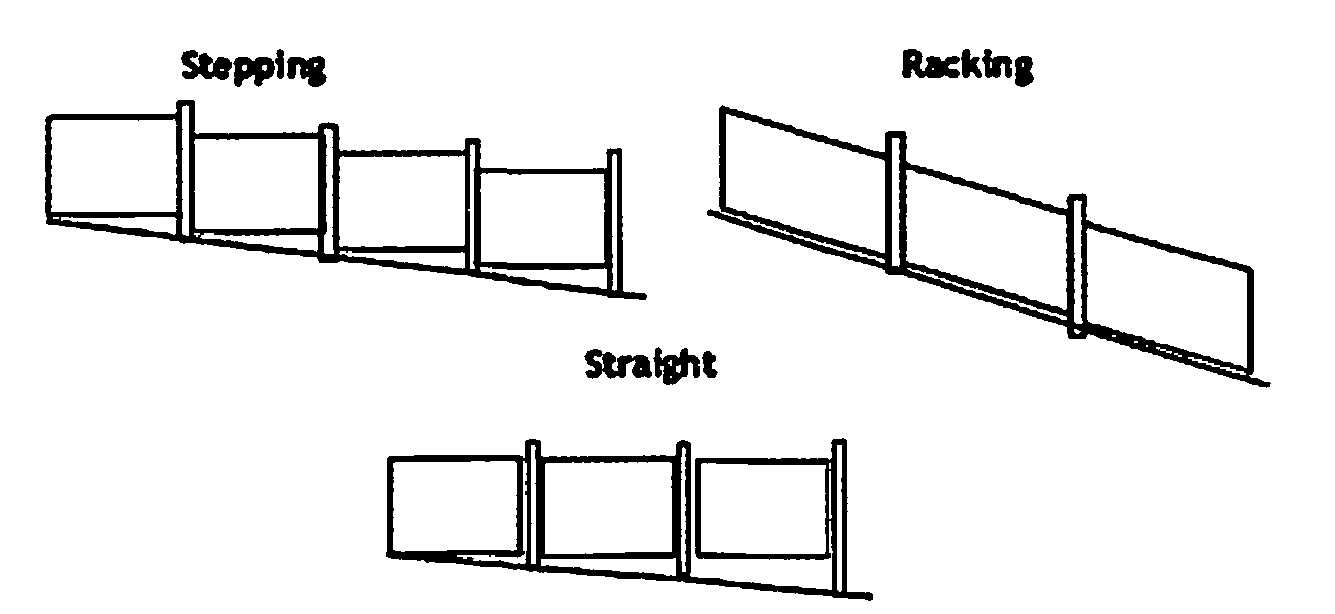
Height is measured from the natural grade of the adjacent ground without fill to the highest point, except that decorative posts of a fence or wall may exceed the maximum height by one foot. Walls and fences constructed on a slope shall be of the racking design so that they follow the contour of the ground. Stepping or straight fencing designs shall not be allowed.
(6)
Walls and fences shall be constructed with approved materials and workmanship as approved by the city. Horizontal and vertical support posts shall be placed facing the inside of the fenced area when the fence abuts a street, except where the fence is designed such that both sides are finished with alternating vertical fence supports and those vertical supports are covered by the alternating pattern.
(b)
Heights of fences and walls.
(1)
Fence height.
a.
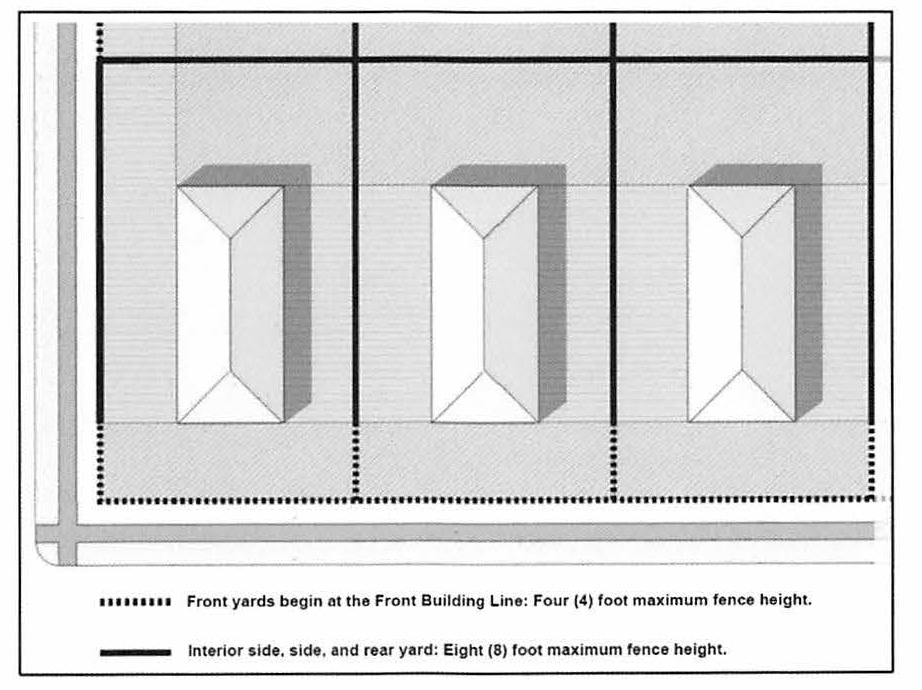
Fences, walls, and other obstructions erected along the side lot lines beyond the front building plain shall be limited to a maximum height of four feet, except where a residential structure is located adjacent to a nonresidential use. Where a residential structure is located adjacent to a nonresidential use or structure, an eight-foot fence shall be permitted along the common lot line; provided such fence does not create a traffic hazard.
b.
In the interior side, side, and rear yards, a fence wall is permitted up to a maximum height of eight feet.
c.
Decorative fence posts, post toppers and other similar embellishments shall be permitted to exceed the maximum height by one foot.
(c)
Fence and wall construction and design requirements.
(1)
[Reserved.]
(2)
A fence or wall, including all posts, bases, and other structural parts must be located completely within the boundaries of the lot on which it is located.
(3)
The following fence types shall not be allowed past the front plain of the building: chain link, wood privacy, wire farm fencing.
(4)
No fence may be electrified.
(5)
No barbed wire, razor wire, concertina wire or similar security wire fencing shall be allowed.
(d)
Special exceptions. Fences greater than four feet in height meeting the following criteria may be located forward of the front of the house but not forward of the front lot line. The development review board will determine in a quasi-judicial proceeding if the criteria listed below have been met.
(1)
The fence shall be decorative or ornamental in design and match the overall architectural style of the principal structure. No chain link, wire, wooden panel or picket fence shall qualify for a special exception. The design of the fence must be brick, stone or stucco columns joined by metal panels. The metal panels must be less than 33 percent opaque.
(2)
Landscaping must be installed on the street side of the fence in such a manner as to shield the metal panels from view within three years from the date of construction. Plant material must consist of ornamental shrubs which grow to a height of five to six feet under normal conditions (recommended species are included in table 1. Other species with similar attributes may be utilized).
(3)
The maximum height of the fence panels shall not exceed six feet in height: however, columns may be up to ten feet high. The height will be measured from the natural grade of the adjacent ground without fill to the highest point.
(4)
The minimum distance between columns shall be eight feet. The maximum distance between columns shall be 15 feet.
(5)
The property owner must demonstrate the existence of a public safety concern, such as trespassing that frequently occurs about his property which would be significantly mitigated by construction or erection of a fence contemplated in this subsection (b).
(6)
Any fence that utilizes a gate or similar device to restrict access to the driveway shall be equipped with a rapid entry system as specified in section 21-278.
(Ord. No. 01-00, § 1, 3-6-00; Ord. No. 11-00, § 1, 9-7-00; Ord. No. 02-09, § 1, 3-16-09; Ord. No. 02-2021, § 2.C, 4-19-21)
Sec. 21-96.- Permitted uses.
(a)
In R-1 districts all lots shall be known, described and used as residential lots only except as provided for in subsection (b) below.
(b)
Churches and religious institutions are permitted, provided such buildings are placed not nearer than 25 feet from any property line. Required offstreet parking space shall be separated from any property line by a planted buffer strip at least ten feet in width, unless adjoining district C-1 or C-2.
Sec. 21-97. - Height, area of buildings.
In R-1 districts, single-family and multiple-family residences shall have a minimum square foot area of not less than 800 square feet of floor space exclusive of stairways and public halls per family unit therein. Building height shall not exceed 35 feet in height above the minimum base floor elevation as defined by the National Flood Insurance Program.
(Ord. No. 05-05, § 1, 10-3-05)
_____
Sec. 21-98. - Lot requirements.
In R-1 districts, no residential structure shall be erected or placed on any building lot which has a square foot area of less than 8,000 square feet. In addition, a minimum lot width of 80 feet is required at the front setback line. The minimum lot width at the street right-of-way line shall be 50 feet as measured along the curve. For multifamily units other than duplexes, the following shall apply:
(Ord. No. 2-94, § 1, 2-21-94)
_____
Sec. 21-99. - Setbacks, yard requirements.
The minimum setback from the front lot line shall be 25 feet; minimum side yard setback shall be eight feet from the side lot line; minimum rear yard depth shall be 25 feet from any portion of the main house or porches, attached garages or carports to the rear lot line except in the case of corner lots for which the rear yard restrictions shall be 15 feet. On vacant corner lots, the owner or developer may designate which of the street sides shall be considered the front of the lot for setback purposes, and the minimum front setback shall be 30 feet, and the side street setback shall be 15 feet. For the purpose of determining the setbacks for additions to an existing primary structure located on a residential corner lot, the front setback shall be established by the orientation of the front door and the address of the primary structure. The remaining street shall be considered the side street and the minimum side street setback shall be 15 feet.
Sec. 21-100. - Accessory structures.
(a)
Setbacks.
(1)
No accessory structure shall be located in front of a primary structure, except in the case of a garage. In those instances where a garage is located forward of the primary structure, the garage shall be of the same architectural style, color and facing material as the primary structure and shall be located 30 feet or more from the front lot line.
(2)
In no event shall an accessory structure be nearer than five feet to any lot line or rear lot line, and no nearer to any side street property line than the side street setback line for that particular lot.
(3)
In no case shall any portion of an accessory structure be located within four feet of the primary structure.
(4)
In no event shall an accessory structure be located on any easement.
(5)
If an accessory structure is 800 square feet or greater in area, it shall meet the following setback requirements:
a.
The accessory structure shall not be located in front of the primary structure, except in the case of a garage. In those instances where a garage is located forward of the primary structure, the garage shall be of the same architectural style, color and facing material as the primary structure and shall be located 30 feet or more from the front lot line.
b.
The accessory structure shall be no nearer than eight feet to any side lot line and 30 feet from any rear lot line.
c.
In the case of a corner lot, no nearer to any side street property line than the side street setback line for that particular lot.
(b)
Number. The number of accessory structures shall not exceed two per lot.
(c)
Height.
(1)
No accessory structure shall exceed the height of the primary structure and in no event shall it exceed 35 feet in height.
(2)
The height of any point on an accessory structure shall not exceed the sum of the horizontal distance from the highest point of the accessory structure to the closest property line plus five feet and in no event shall the height exceed the height of the primary structure regardless of where the detached structure is placed on the lot.
(d)
Screening. When an accessory structure is readily visible from any public place or street, it shall be required to be screened by bushes, shrubs, trees, fencing or other suitable material or device. In those instances where a garage is to be placed forward of the primary structure and the garage is the same architectural style, color and facing material as the primary structure then screening shall not be required. The screening requirement is to provide visual relief to the residential landscape and is not intended [to] completely obscure the accessory structure from view.
(e)
Other restrictions.
(1)
No accessory structure shall be used for overnight sleeping accommodations on a permanent basis.
(2)
No accessory structure shall be used as residence.
(3)
No accessory structure located in a residential zoning district shall be used for business or commercial purposes.
(Ord. No. 12-09, § 5, 8-3-09)
Sec. 21-101. - Screen enclosures.
A screen enclosure shall be considered to be a detached structure for setback purposes only, regardless of its actual placement on the lot and whether or not it is attached to the main building on the lot. The screen enclosure material must constitute at least 85 percent of the surface structure with the entire roof surface being constructed of screen enclosure and its supporting structure. The height of any point on a detached structure shall not exceed the sum of the horizontal distance from such point to the closest property line plus five feet and in no event shall the height exceed 35 feet regardless of where the detached structure is placed on the lot.
(Ord. No. 8-96, § 1, 10-21-96)
Sec. 21-102. - Fence requirements.
No fence shall be built without first obtaining a permit from the city. The fee for processing said fence permit application is $25.00. This amount may be adjusted from time to time by a resolution duly adopted by the city council. No fence of any description shall be erected nearer to the front lot line than the front of the house on the lot or, in the case of a vacant lot, nearer to the front lot line than that point on the lot where a house could be located when and if built, or, in the case of a corner lot, nearer to the side street line that the side street setback line for that particular lot. Once a certificate of occupancy is issued for a residence on a vacant lot, all fences must comply with this section. The maximum height of such fence shall be eight feet, except that on a corner lot, the height of such fence that protrudes beyond the side of the house facing the side street where the fence joins the house, and that portion of the fence that runs parallel with the side street of the lot, shall not exceed 6½ feet in height. All other sections of a fence located on the lot shall not exceed the maximum height of eight feet. In those instances in which any property in a R-ES, R-1-A, R-1-AA, R-1, TH, or RC district has a common property line with a C-1, C-2, M or P district, then a fence will be allowed along the common property line regardless of setbacks; however, if said fence extends past the front of the house or the front setback line, then the maximum height of the fence shall not exceed 6½ [feet] in height and must be terminated at the front property line in such a manner as not to interfere with the line-of-sight of adjacent driveways and roads.
(Ord. No. 01-00, § 1, 3-6-00; Ord. No. 11-00, § 1, 9-7-00; Ord. No. 02-09, § 1, 3-16-09)
Sec. 21-111.- Intent.
The TH townhouse district is intended for residential structures having both single-family and multifamily characteristics. Its purpose is to encourage housing innovations in the grouping of separately owned one-family dwelling units associated with individually-owned lots and providing commonly owned park-like or recreational land. This district is intended to make efficient, economical and aesthetically pleasing use of land so restricted that the same will be continually well maintained in order to preserve the health, welfare, safety and convenience of the neighborhood and surrounding area.
Sec. 21-112. - Permitted uses.
In the TH townhouse district, the permitted principal uses and structures shall be townhouses provided that the area to be developed exceeds 1½ acres. Permitted secondary uses and structures shall be:
(1)
Recreation buildings or structures, playgrounds or parks, when accessory to and clearly subordinate in use to the townhouse complex.
(2)
Private boat pier and/or slips for use by residents of the townhouse complex.
(3)
One common television antenna per townhouse group.
(4)
Sewer lift stations and plants with suitable landscaping around perimeter.
Sec. 21-113. - Prohibited uses.
In the TH district the following uses and structures are prohibited:
(1)
Home occupations.
(2)
Commercial and industrial uses and structures.
(3)
Business, professional and personal service establishments.
(4)
Individual outside television antennas.
Sec. 21-114. - Lot requirements.
In the TH district the minimum lot requirements shall be as follows:
(1)
Area per townhouse lot: 2,000 square feet.
(2)
Lot width: 20 feet.
(3)
Depth of front yard: 25 feet.
(4)
Depth of rear yard: 25 feet.
(5)
Distance between townhouse groups: 20 feet; provided, however, that if any portion of the 20 feet is utilized as a driveway or dedicated street, the portion so used shall not be included in the spacing required hereunder. All side yard spacing required under this section shall remain unobstructed.
(6)
Setbacks from the boundaries of this district shall not be less than 25 feet. Where any R-1-A, R-1-AA or R-ES district abuts the TH district, a landscaped buffering zone not less than ten feet in width shall be established along the entire length of and contiguous to the property line. Such area shall be so designed and planted as to be 80 percent or more opaque when viewed horizontally between two and six feet above ground level.
Sec. 21-115. - Height, area of buildings.
(a)
The maximum height of a townhouse shall be 35 feet.
(b)
The minimum floor area of residential units in the TH district shall be 900 square feet exclusive of garages, carports and open porches.
Sec. 21-116. - Off-street parking.
In the TH district the minimum off-street parking requirements are as follows:
A minimum of two off-street parking spaces shall be provided for each townhouse. Such parking spaces may be provided on the lot of each townhouse or in a commonly owned and maintained off-street parking bay or facility within the TH district. No parking space shall be more than 200 feet by the most direct pedestrian route from the door of the townhouse it is intended to serve. Where parking spaces are provided in the front, setback must be increased to a minimum of 30 feet.
Sec. 21-117. - Density.
Ten townhouse units per gross acre shall be the maximum density in the TH district.
Sec. 21-118. - Patio areas.
A private patio area of at least 250 square feet shall be a part of each townhouse in the TH district. The patio shall be enclosed on both sides and may be either open or closed on the rear.
Sec. 21-119. - Firewalls; utility service; access.
(a)
The townhouse units shall each be separated at a minimum by adjoining contiguous two-hour firewalls or by a firewall that meets the requirements of the Standard Building Code at the time the permit is requested. Any separation between firewalls shall be sealed to provide a substantial, permanently watertight and vermin-proof closure.
(b)
Each townhouse shall be independently served by separate heating, air conditioning, sewer, water, electric power, gas and other utility services and shall be connected to public water and sewer lines.
(c)
Each townhouse shall be provided with separate front and rear entrance and exit to structure.
Sec. 21-120. - Common open space, common areas.
Common open space requirements for the TH district are as follows:
(1)
A minimum of 400 square feet of usable common open space per unit shall be provided. The location, shape, size and character of the common open space must be suitable for the townhouses to be served and must be used for amenity and recreational purposes. The uses authorized for the open spaces must be appropriate to the scale and character of the development, considering its size, density, expected population, topography and the number and type of dwellings to be provided. Open space must be permanently available and accessible to the residents of the townhouse development. When computing the amount of open space, areas included in setbacks, easements, utility and street rights-of-way, parking, canals and service areas shall not be included.
(2)
Provisions satisfactory to the city council shall be made to assure that nonpublic areas and common open space shall be perpetually maintained in a satisfactory manner, without expense to the city.
(3)
Each townhouse unit shall be located on its own individually platted lot. Areas for common use of occupants of a townhouse development shall be shown on the plat, and such plat shall not be approved until satisfactory arrangements are made for maintenance as provided by this land development code.
(4)
Provision for all common open space and the construction of cultural and recreational facilities which are shown on the site plan shall proceed at an equivalent or greater rate as the construction of dwelling units. A certificate of occupancy and final inspection shall not be issued until completion of at least one townhouse and the common open space to be used by residents of that townhouse and neighboring townhouses or townhouse group.
Sec. 21-136.- Intent.
The R-C condominium district is intended for residential structures having multifamily characteristics where each unit is individually owned without having title to the land on which the structure is located. A maximum of eight such units per building shall be allowed.
Sec. 21-137. - Permitted uses.
Permitted principal uses and structures in the R-C district shall be condominiums, provided that the area to be developed exceeds 1½ acres and has a minimum property width of 150 feet. Permitted secondary uses and structures shall be:
(1)
Common community use buildings when accessory to and clearly subordinate to the condominium complex.
(2)
Sewer lift stations and plants with suitable landscaping around the perimeter.
(3)
Recreation buildings or structures, playgrounds or parks, when accessory to and clearly subordinate in use to the condominium complex.
(4)
Private boat pier and/or slips for use by residents of the condominium complex.
Sec. 21-138. - Prohibited uses.
In the R-C district the following uses and structures are prohibited:
(1)
Commercial and industrial uses and structures.
(2)
Business, professional and personal service establishments.
Sec. 21-139. - Setback requirements.
Minimum setback requirements in the R-C district are as follows:
(1)
When R-C condominium land-use areas abut land zoned R-ES, R-1, R-1-A, R-1-AA, C-1, C-2, P, M or TH a landscaped buffering zone not less than ten feet in width shall be established along the entire length of and contiguous to the property line.
(2)
Where boundaries of the district border on another district then the building setbacks shall be 30 feet.
(3)
The space between adjacent side walls of buildings shall be not less than 25 feet. Fronts and rears of any buildings shall not be closer than 50 feet. No building shall be closer than 20 feet to any street.
Sec. 21-140. - Service roads.
All roads serving condominium developments in the R-C district shall have a minimum pavement width of 24 feet and a minimum right-of-way of 40 feet, and shall never be accepted by the city unless the streets and buildings meet the subdivision, zoning, and all applicable land development code requirements, and are constructed to standards approved by the city for public roads.
Sec. 21-141. - Parking.
In the R-C district there shall be two parking places per unit adjoining each unit served, or provided in a commonly owned offstreet parking area. No parking space shall be more than 200 feet by the most direct pedestrian route from the entrance to the unit it is intended to serve.
Sec. 21-142. - Height, area of buildings, units.
(a)
The minimum area per individual unit in the R-C district shall be 1,000 square feet and shall include one bedroom and one bath; each additional bedroom shall be a minimum of 100 square feet.
(b)
The maximum height of each building in an R-C district shall be thirty-five (35) feet.
Sec. 21-143. - Access to units; firewall separation.
(a)
In the R-C district each condominium unit shall be provided with separate front and rear entrance/exit.
(b)
Each contiguous unit shall be separated by a firewall that meets the requirements of the Standard Building Code at the time the permit is requested.
Sec. 21-144. - Density.
Ten condominium units per gross acre shall be the maximum density in the R-C district.
Sec. 21-145. - Common open space.
In the R-C district a minimum of 400 square feet of usable common open space per unit shall be provided. The location, shape, size and character of the common open space must be suitable for the condominium to be served and must be used for amenity and recreational purposes. The uses authorized for the open space must be appropriate to the scale and character of the development, considering its size, density, expected population, topography and the number and type of dwellings to be provided. Open space must be permanently available and accessible to the residents of the condominium development. When computing the amount of open space, areas included in setbacks, easements, utility and street right-of-ways, parking, and service areas shall not be included.
Sec. 21-146. - Fences.
Fences in the R-C district shall comply with the residential requirements.
Sec. 21-161.- Permitted uses.
Land and buildings within the C-1 commercial district shall be used only for the following purposes:
(1)
Nonindustrial mercantile business.
(2)
Business and professional offices, and any other uses allowed in the C-2 district.
(3)
Hotels, motels and tourist courts.
(4)
Medical clinics (including nursing homes as defined in section 21-191) and animal clinics, properly designed so as not to cause odor, sanitary and sound annoyances to adjacent properties and the public.
(5)
Mechanical repair shops, building materials and supplies and warehousing. The above uses are to be properly screened or fenced so as to prevent an unsightly appearance from adjacent properties or rights-of-way.
(6)
Churches, religious institutions, private or parochial schools and fraternal organizations.
(7)
Nursery schools and kindergartens.
(8)
Theater, bowling alleys.
(9)
Gasoline service stations with the following provisions:
a.
The minimum distance, as measured along the right-of-way, between the nearest motor fuel dispensing equipment of each service station on the same or common side of any street shall be 1,500 linear feet, this minimum distance to apply only to service stations erected from and after September 21, 1964 (original zoning ordinance adoption date).
b.
All motor fuel dispensing equipment, aboveground tanks, and any structure or canopy designed or used in whole or in part to cover, house, contain or provide any service to or for motor vehicles shall be placed not less than 25 feet from any side or rear property line, excepting one self-service equipment station per lot which supplies compressed air, radiator and battery water and vacuum services for motor vehicles. If a corner site is used, minimum setback lines for both streets shall be observed. Setback requirements of this paragraph shall not apply to detached structure on the premises used for other purposes allowed in the C-1 zoning district such as retail business.
c.
All buildings or structures including gas tanks and pumps shall at a minimum comply with the setback requirements of any abutting street.
d.
If on a corner lot, the means of ingress and egress shall be provided not less than 15 feet from the intersection of street right-of-way lines. Ingress and egress shall be arranged and designed so as to minimize the interference with the flow of traffic.
(10)
Self-service laundries and laundry pickup stations.
(11)
Municipal, county, state, federal and public buildings.
(12)
Marina and accessory facilities, subject to the approval of the city council.
(13)
Any retail business or retail service establishment providing conveniences or shopping that are required by neighboring residents.
(Ord. No. 8-99, § 1, 6-7-99)
Sec. 21-162. - Height of buildings.
In the C-1 district, building height shall not exceed a total height of 35 feet, unless provided for in section 21-273, target height zones.
(Ord. No. 03-12, § 1, 4-2-12; Ord. No. 03-15, § 5, 5-4-15)
Sec. 21-163. - Setback requirements.
In the C-1 zoning district, no building or any portion thereof shall be erected nearer than 15 feet from any street right-of-way.
(Ord. No. 13-02, § 1, 12-2-02)
Sec. 21-176.- Uses permitted.
Land and buildings within the C-2 limited commercial district shall be used for business offices and/or professional offices. The intent is to limit the use of buildings in a C-2 district to general types of occupancies as follows:
(1)
Real estate or mortgage loan offices.
(2)
Insurance agency.
(3)
Finance company.
(4)
Doctor's office and/or clinic.
(5)
Dentist's office and/or clinic.
(6)
Architectural planning or engineering office.
(7)
General business or professional offices.
(8)
Churches.
(9)
Banking facilities.
(Ord. No. 5-93, § 1, 5-3-93; Ord. No. 08-06, § 1, 6-19-06; Ord. No. 01-2024, § 2, 5-6-24)
Sec. 21-177. - Prohibited uses.
The following uses or substantially similar uses shall be specifically prohibited from the C-2 district:
(1)
Stand-alone "big box" retail or wholesale merchandising or warehousing.
(2)
Fast food or drive-through restaurants
(3)
Vehicle service stations.
(4)
Laundries or laundry pickup stations.
(5)
Hotels or motels.
(6)
Funeral homes.
(7)
Day nurseries or nursing homes.
(8)
Theaters.
(9)
Bowling alleys.
(10)
Repair shops.
(Ord. No. 01-2024, § 2, 5-6-24)
Sec. 21-178. - Uses allowed as a special exception.
Unless prohibited by other provisions of the land development code, the following uses and substantially similar uses shall be allowed as a special exception in addition to the primary permitted use on land and in buildings in the C-2 district:
Specialty retail shops, such as apparel stores, personal service shops, home décor and furnishings, limited-service eateries, flower shops, bakery shops and gift shops where such shops are determined to be compatible with and enhance the general character of the district.
(Ord. No. 01-2024, § 2, 5-6-24)
Sec. 21-179. - Building height; parking; screening.
Business and professional offices in a C-2 limited commercial district shall not exceed 35 feet in height and must provide for adequate off-street parking as provided in section 24-51(6). A C-2 district is to be screened by privacy fences or shrubbery from any surrounding residential property in an R-ES, R-1-AA, R-1-A or R-1 district. Maximum fence heights shall be eight feet unless otherwise approved by the city council.
(Ord. No. 06-02, § 1, 3-4-02)
Sec. 21-180. - Storage of materials, machinery, vehicles.
No construction materials, merchandise, trucks and commercial vehicles or machinery shall be stored overnight on the grounds of a site in a C-2 district, except temporarily while a building in the C-2 district is under construction, or being remodeled on the site.
Sec. 21-181. - Setback requirements.
The minimum setback from the front lot line to any building or structure in a C-2 district shall be 30 feet; the minimum side yard required shall be eight feet; the minimum rear yard requirements shall be 30 feet; the minimum setback from side streets shall be 20 feet, and the minimum from rear streets shall be 30 feet.
Sec. 21-191.- Definitions.
The following words, terms and phrases, when used in this division, shall have the meanings ascribed to them in this section, except where the context clearly indicates a different meaning:
Clinic means any facility used in connection with providing health care services to human beings and which is required to be licensed by the state department of health and rehabilitative services.
Hospital means any establishment that:
(1)
Offers services more intensive than those required for room, board, personal services and general nursing care, and offers facilities and beds for use beyond 24 hours by individuals requiring diagnosis, treatment or care for illness, injury, deformity, infirmity, abnormality, disease or pregnancy;
(2)
Regularly makes available at least clinical laboratory services, diagnostic X-ray services, and treatment facilities for surgery or obstetrical care or other definitive medical treatment of similar extent;
(3)
May include a gift shop operated or leased by the hospital for the benefit of the hospital visitors, staff and patients;
(4)
Is licensed by the state department of health and rehabilitative services; and
(5)
May offer facilities for emergency medical vehicles.
Medical office means any office owned, operated by or leased by a physician, surgeon, dentist, chiropractor, osteopath, ophthalmologist, optometrist, optician, physical therapist, psychologist, psychotherapist, radiologist, anesthetist, anesthesiologist, podiatrist, ultrasound technician or orthodontist and used for the purpose of providing health care services to human beings.
Nursing home means a facility which provides nursing services as defined in F.S. ch. 464 and which is licensed pursuant to F.S. ch. 400, pt. I.
Pharmacy means an institutional pharmacy, which means those areas of every hospital, clinic, nursing home, dispensary, sanitarium, extended care facility or other facility where medicinal and prescription drugs are dispensed or stored.
Sec. 21-192. - Intent.
The M medical district is intended to accommodate medically oriented businesses and facilities.
Sec. 21-193. - Permitted uses.
In the M district permitted principal uses and structures shall be only for the following:
(1)
Hospitals.
(2)
Pharmacies.
(3)
Medical offices and clinics (not animal).
(4)
Nursing homes.
(5)
Emergency centers.
Sec. 21-194. - Height of buildings.
In the M district, building height shall not exceed a total height of 35 feet, unless provided for in section 21-273, target height zones.
Sec. 21-195. - Setback requirements.
In the M district, where the exterior boundaries of the district border on any residential district, the building setback shall be 50 feet.
Sec. 21-196. - Parking.
In the M district there shall be adequate parking as provided in section 24-51(6).
Sec. 21-197. - Location of utility lines.
All utility lines in the M district shall be underground.
Sec. 21-211.- Permitted uses.
Permitted uses within the P public lands district include public parks, playgrounds, schools, municipal and civic buildings, and public utility facilities. Publicly owned lands not designated for conservation use are included in the P district. Public buildings located within the P district shall be subject to the zoning requirements for the C-1 district except in the case of a public gymnasium which may be up to 45 feet in height.
(Ord. No. 07-11, § 1, 7-5-11)
Sec. 21-226.- Permitted uses.
All land area within the C conservation district is publicly owned and is dedicated to the preservation and protection of natural resources and/or environmental quality. Development within a C district shall be restricted to the provision of public access and limited small scale improvements (such as picnicking facilities, boat ramps, etc.) which enhance the public's use of the conservation area. Use of pervious paving materials shall be encouraged.
Sec. 21-230.- Purpose, intent.
In order to promote community goals and objectives for character and aesthetics along specified commercial corridors and areas with the community redevelopment area, three "Gateway Overlay Districts" have been created. The gateway overlay districts are established for the purposes and intents outlined herein:
(a)
To preserve the aesthetic and architectural character of the entrances to the City of Gulf Breeze in order to promote economic development;
(b)
Enhance the building stock of the city's gateways through consistency and quality of site layout and design, consistent with the City of Gulf Breeze CRA and Central Business District Design Guidelines, adopted June 11, 2006, as amended;
(c)
Incentivize rehabilitation and new construction through regulatory bonuses and relief and financial assistance when it is deemed appropriate and feasible;
(d)
Increase property values and stability through quality of construction, property upgrades and redevelopment;
(e)
Attract new business opportunities through tax base expansion and employment growth; and
(f)
Enhance the quality of the entrances to the city through improved character and safety, pedestrian friendly design, local business stability and diversity and pride of property ownership.
(Ord. No. 02-11, § 1, 5-16-11)
Sec. 21-231. - Designation of gateway overlay districts' boundaries.
The limits and boundaries of the following gateway overlay districts shall be shown on the official zoning map contemplated in section 21-28:
(a)
GD-North: Philip D. Beall Sr. Bridge (Pensacola Bay Bridge) Entrance;
(b)
GD-South: Bob Sikes Bridge (Pensacola Beach Bridge) Entrance;
(c)
GD-East: West boundary of the Naval Live Oaks Reservation.
(Ord. No. 02-11, § 1, 5-16-11)
Sec. 21-232. - Applicability, conflict with other code sections.
(a)
Unless otherwise noted, the requirements of the gateway overlay districts apply to nonresidential Level II development activity and all Level III development activity. Furthermore, the requirements at the gateway overlay districts are in addition to the requirements of the underlying zoning districts. Where the requirements of the underlying districts and the overlay districts conflict, the more restrictive shall apply.
(b)
The regulations set forth in this division shall apply solely to the gateway overlay districts. Wherever there is a conflict or inconsistency between the gateway overlay districts' regulations and other regulations of the land development code, the regulations set forth in this section shall control and govern the development and redevelopment within the gateway overlay districts.
(Ord. No. 02-11, § 1, 5-16-11)
Sec. 21-233. - Permitted, prohibited uses.
(a)
Permitted uses. All uses generally permitted in the underlying zoning districts shall be permitted within the gateway overlay districts unless specifically prohibited in this section.
(b)
Prohibited uses. The following uses shall not be allowed in the gateway overlay districts:
(1)
Outdoor storage of any materials, supplies, and/or vehicles, either as a stand-alone business or associated with any business, and whether screened or not;
(2)
Donation drop-off sites (short-term donation drop-off sites related to a specific event or purpose may be allowed; however, they must be approved by the city manager or designee and shall be limited to 14 days or less in duration).
(3)
The following stand-alone uses:
a.
Dry cleaners;
b.
Drive-through facilities (including, but not limited to, bank teller machines, ice vending machines, drive-through coffee or food shops less than 500 square feet);
c.
Laundromats;
d.
Second-hand dealers, consignment shops, thrift stores or charity stores;
e.
Personal service shops (including, but not limited to, souvenir shops, beauty salons, tanning parlors, tattoo or piercing businesses);
f.
Internet cafe or cyber cafe;
(4)
Building materials and supplies, sales and storage;
(5)
Gambling or gaming establishments or facilities (including, but not limited to, online, interactive or internet gambling or gaming);
(6)
Car wash facilities;
(7)
Flea markets;
(8)
Funeral homes and crematoriums;
(9)
Gasoline service stations;
(10)
Itinerant merchants or vendors;
(11)
Machine shops;
(12)
Light or heavy industrial or manufacturing businesses;
(13)
New or used vehicle sales (including, but not limited to, automobiles, trucks, trailers, motorcycle, recreational vehicles, boats);
(14)
Nursery schools, kindergartens, day care nurseries or nursing homes;
(15)
Retail or wholesale plant nurseries;
(16)
Taxicab or limousine company; and
(17)
Warehouses.
(Ord. No. 02-11, § 1, 5-6-11; Ord. No. 09-11, § 1, 8-15-11)
Sec. 21-234. - Design review process.
The compatible relationship of proposed development in the gateway overlay districts is of critical public concern for any buildings or site improvements. The intent of design review is not to stifle innovative architecture but to assure respect for and reduce incompatible and adverse impacts on existing land use and promote quality development.
(a)
Development within the gateway overlay districts will be reviewed by the architectural review board, based on the requirements of this section and on the City of Gulf Breeze Community Redevelopment Agency (CRA) and Central Business District Design Guidelines, where appropriate. The architectural review board shall recommend approval, approval with conditions, or disapproval of the development site plan to the city council.
(b)
The city council shall review the development site plan with recommendations from the development review board and the architectural review board and vote to approve, approve with conditions, or disapprove the plan.
(c)
Conditions the city council may apply to a development order before granting approval include, but are not limited to, the following:
(1)
Increase or decrease in required front, side and rear setbacks;
(2)
Maximum building height and/or number of stories;
(3)
Addition of enhanced pedestrian or bicycle facilities;
(4)
Increase in buffer requirements (i.e., require larger buffer and/or more plants, larger plants, specific types of plants); and
(5)
Require specific stormwater management facilities.
(Ord. No. 02-11, § 1, 5-16-11)
Sec. 21-235. - Design guidelines.
This section describes the elements of design that shall be used in the review and approval of development plans within the gateway overlay districts. The guidelines for these elements are based on the "City of Gulf Breeze CRA and Central Business District Design Guidelines," adopted June 11, 2006, as amended, specifically as detailed in Chapter III (CRA General Standards), Chapter IV (Gulf Breeze Parkway/US 98 Standards), Appendix A (Architectural Styles), and Appendix B (Definitions).
The following guidelines from Chapter III, CRA General Standards, shall apply:
(a)
Block layout;
(b)
Building placement and orientation;
(c)
Building form and architecture:
(1)
Architectural style;
(2)
Building facade;
(3)
Building entrance;
(4)
Fenestration;
(5)
Roofs;
(6)
Building material;
(7)
Building color;
(8)
Civic and institutional buildings;
(d)
Access, circulation and parking;
(1)
Access;
(2)
Pedestrian circulation;
(3)
Vehicular circular and parking;
(e)
Pedestrian amenities;
(f)
Open space;
(g)
Landscaping and buffering;
(h)
Irrigation;
(i)
Service area/utilities;
(j)
Fences, walls;
(k)
Stormwater management facilities;
(l)
Lighting;
(m)
Signs.
The following guidelines from Chapter IV, Gulf Breeze Parkway/US 98 Standards, shall apply:
(a)
Parking;
(b)
Streetscape;
(c)
Fences and walls;
(d)
Lighting;
(e)
Signs.
For all buildings proposed at a height over 35 feet, this site plan review for consistency with design guidelines adopted in the City of Gulf Breeze Community Redevelopment Plan and Central Business District Design Guidelines shall include a specific review to mitigate any adverse compatibility impacts caused by the additional building height, including, but not limited to:
(a)
Enhanced landscape buffering.
(b)
Location of service drives and/or parking areas to mitigate noise and vehicular lights.
(c)
Location and type of lighting, signage, dumpsters, etc.
(d)
Variable buffers, combining land and landscaping to achieve adequate separation of uses, appropriate open space, reduction of potential noise, light and glare, and screening of physical features of a proposed development.
(e)
Variable setbacks, based upon degree of difference in proposed density, intensity, scale, mass or height.
(f)
Placement and effective screening or shielding of site features such as lights, signs, dumpsters, loading areas, parking areas, outdoor storage or other features with potential negative impacts.
(g)
Effective transitions of on-site densities, intensities, scale, mass or height.
(h)
Other innovative site design features that strive to achieve compatibility and mitigate potential negative impacts.
(i)
In addition to meeting the requirements of this section, within any portion of the GD-North, west of U.S. Highway 98 and north of the Chanteclaire Subdivision, no building shall exceed 60 feet in height and all buildings exceeding 35 feet in height (including all portions thereof) must be located at least 250 feet from adjacent residential districts. This buffer area cannot be used for another habitable structure or parking garage, except that ancillary uses such as surface parking, open space, swimming pools, landscaping and landscape features, stormwater areas, and ancillary structures (e.g., gazebos, decks, cabanas, lift stations, fire pits, refuse stations, etc.) shall be allowed within the 250-foot buffer; provided, this limitation shall not apply if there are no buildings in excess of 35 feet located on the site.
(Ord. No. 02-11, § 1, 5-16-11)
Sec. 21-240.- Purpose, intent.
In order to promote community goals and objectives for character and aesthetics along specified commercial corridors and areas with the community redevelopment area, a "central business overlay district" has been created. The central business overlay district is established for the purposes and intents outlined herein:
(a)
To preserve the aesthetic and architectural character of the commercial core the City of Gulf Breeze in order to promote economic development;
(b)
Enhance the building stock of the city's central business district through compatibility, consistency and quality of site layout and design, consistent with the City of Gulf Breeze CRA and Central Business District Design Guidelines, adopted June 11, 2006, as amended;
(c)
Incentivize rehabilitation and new construction through regulatory bonuses and relief and financial assistance when it is deemed appropriate and feasible;
(d)
Increase property values and stability through quality of construction, property upgrades and redevelopment;
(e)
Attract new business opportunities through tax base expansion and employment growth; and
(f)
Enhance the quality of the central business district in the city through improved character and safety, pedestrian friendly design, local business stability, compatibility and diversity and pride of property ownership.
(Ord. No. 04-11, § 1, 5-16-11)
Sec. 21-241. - Designation of the central business overlay district boundaries.
The limits and boundaries of the central business overlay district shall be shown on the official zoning map contemplated in section 21-28.
(Ord. No. 04-11, § 1, 5-16-11)
Sec. 21-242. - Applicability, conflict with other code sections.
(a)
Unless otherwise noted, the requirements of the central business overlay district apply to nonresidential Level II Development activity and all Level III Development activity. Furthermore, the requirements at the central business overlay district are in addition to the requirements of the underlying zoning districts. Where the requirements of the underlying districts and the overlay districts conflict, the more restrictive shall apply.
(b)
The regulations set forth in this division shall apply solely to the central business overlay district. Wherever there is a conflict or inconsistency between the central business overlay district regulations and other regulations of the land development code, the regulations set forth in this section shall control and govern the development and redevelopment within the central business overlay district.
(Ord. No. 04-11, § 1, 5-16-11)
Sec. 21-243. - Permitted, prohibited uses.
(a)
Permitted uses. All uses generally permitted in the underlying zoning districts shall be permitted within the central business overlay district unless specifically prohibited in this section.
(b)
Prohibited uses. The following uses shall not be allowed in the central business overlay district:
(1)
Outdoor storage of any materials, supplies, and/or vehicles, either as a stand-alone business or associated with any business, and whether screened or not;
(2)
Donation drop-off sites (short-term donation drop-off sites related to a specific event or purpose may be allowed; however, they must be approved by the city manager or designee and shall be limited to 14 days or less in duration).
(3)
The following stand-alone uses:
a.
Dry cleaners;
b.
Drive-through facilities (including, but not limited to, bank teller machines, ice vending machines, drive-through coffee or food shops less than 500 square feet);
c.
Laundromats;
d.
Second-hand dealers, consignment shops, thrift stores or charity stores;
e.
Personal service shops (including, but not limited to, souvenir shops, beauty salons, tanning parlors, tattoo or piercing businesses);
f.
Internet cafe or cyber cafe.
(4)
Building materials and supplies, sales and storage;
(5)
Gambling or gaming establishments or facilities (including, but not limited to, online, interactive or internet gambling or gaming);
(6)
Car wash facilities;
(7)
Flea markets;
(8)
Funeral homes and crematoriums;
(9)
Gasoline service stations;
(10)
Itinerant merchants or vendors;
(11)
Machine shops;
(12)
Light or heavy industrial or manufacturing businesses;
(13)
New or used vehicle sales (including, but not limited to, automobiles, trucks, trailers, motorcycle, recreational vehicles, boats);
(14)
Nursery schools, kindergartens, day care nurseries or nursing homes;
(15)
Retail or wholesale plant nurseries;
(16)
Taxicab or limousine company; and
(17)
Warehouses.
(Ord. No. 04-11, § 1, 5-16-11; Ord. No. 09-11, § 2, 8-15-11)
Sec. 21-244. - Design review process.
The compatible relationship of proposed development in the central business overlay district is of critical public concern for any buildings or site improvements. The intent of design review is not to stifle innovative architecture but to assure respect for and reduce incompatible and adverse impacts on existing land use and promote quality development.
(a)
Development within the central business overlay district will be reviewed by the architectural review board, based on the requirements of this section and on the City of Gulf Breeze Community Redevelopment Agency (CRA) and Central Business District Design Guidelines, where appropriate. The architectural review board shall recommend approval, approval with conditions, or disapproval of the development site plan to the city council.
(b)
The city council shall review the development site plan with recommendations from the development review board and the architectural review board and vote to approve, approve with conditions, or disapprove the plan.
(c)
Conditions the city council may apply to a development order before granting approval include, but are not limited to, the following:
(1)
Increase or decrease in required front, side and rear setbacks;
(2)
Maximum building height and/or number of stories;
(3)
Addition of enhanced pedestrian or bicycle facilities;
(4)
Increase in buffer requirements (i.e., require larger buffer and/or more plants, larger plants, specific types of plants); and
(5)
Require specific stormwater management facilities.
(Ord. No. 04-11, § 1, 5-16-11)
Sec. 21-245. - Design guidelines.
This section describes the elements of design that shall be used in the review and approval of development plans within the central business overlay district. The guidelines for these elements are based on the "City of Gulf Breeze CRA and Central Business District Design Guidelines," adopted June 11, 2006, as amended, specifically as detailed in Chapter III (CRA General Standards), Chapter IV (Gulf Breeze Parkway/US 98 Standards), Appendix A (Architectural Styles), and Appendix B (Definitions).
The following guidelines from Chapter III, CRA General Standards, shall apply:
(a)
Block layout;
(b)
Building placement and orientation;
(c)
Building form and architecture:
(1)
Architectural style;
(2)
Building facade;
(3)
Building entrance;
(4)
Fenestration;
(5)
Roofs;
(6)
Building material;
(7)
Building color;
(8)
Civic and institutional buildings;
(d)
Access, circulation and parking:
(1)
Access;
(2)
Pedestrian circulation;
(3)
Vehicular circular and parking;
(e)
Pedestrian amenities;
(f)
Open space;
(g)
Landscaping and buffering;
(h)
Irrigation;
(i)
Service area/utilities;
(j)
Fences, walls;
(k)
Stormwater management facilities;
(l)
Lighting;
(m)
Signs.
The following guidelines from Chapter IV, Gulf Breeze Parkway/U.S. 98 Standards, shall apply:
(a)
Parking;
(b)
Streetscape;
(c)
Fences and walls;
(d)
Lighting;
(e)
Signs.
For all buildings proposed at a height over 35 feet, this site plan review for consistency with design guidelines adopted in the City of Gulf Breeze Community Redevelopment Plan and Central Business District Design Guidelines shall include a specific review to mitigate any adverse compatibility impacts caused by the additional building height, including, but not limited to:
(a)
Enhanced landscape buffering.
(b)
Location of service drives and/or parking areas to mitigate noise and vehicular lights.
(c)
Location and type of lighting, signage, dumpsters, etc.
(d)
Variable buffers, combining land and landscaping to achieve adequate separation of uses, appropriate open space, reduction of potential noise, light and glare, and screening of physical features of a proposed development.
(e)
Variable setbacks, based upon degree of difference in proposed density, intensity, scale, mass or height.
(f)
Placement and effective screening or shielding of site features such as lights, signs, dumpsters, loading areas, parking areas, outdoor storage or other features with potential negative impacts.
(g)
Effective transitions of on-site densities, intensities, scale, mass or height.
(h)
Other innovative site design features that strive to achieve compatibility and mitigate potential negative impacts.
(Ord. No. 04-11, § 1, 5-16-11)
Sec. 21-246.- Intent.
The MXD-1 district is intended to implement the City's Most Livable City Plan and Comprehensive Plan 2035, by providing for medium to high-density development with a mix of uses within an appropriate area. These uses will be mixed throughout the district, as well as in individual developments. Residential, retail and office uses may be mixed either vertically or horizontally in a building within the MXD-1 district.
Sec. 21-247. - Permitted, prohibited uses.
(a)
Permitted uses. Land and buildings within the MXD-1 mixed use district shall be used only for the following purposes:
(1)
Restaurants, cafes, and other food and beverage providers.
(2)
Business and professional offices, and any other uses allowed in the C-2 district.
(3)
Hotels, motels and other lodging facilities.
(4)
Educational uses.
(5)
Medical clinics (including nursing homes as defined in section 21-191.
(6)
Churches, religious institutions, private or parochial schools and fraternal organizations.
(7)
Municipal, county, state, federal and public buildings.
(8)
Retail shops.
(9)
Multifamily residential, including townhouses, condominiums and apartments, and accessory uses.
(b)
Prohibited uses. Any use that is prohibited in the CDB overlay district, subsection 21-243(b), shall be prohibited in any MXD-1 district.
(c)
Uses allowed as a special exception. A single use development on a parcel of two and one-half or fewer acres shall require a special exception, as described in sections 20-41 through 20-146 of this Code.
Sec. 21-248. - Height of buildings.
In the MXD-1 district building height s hall not exceed a total height of 35 feet, unless provided for in section 21-273, target height zones.
Sec. 21-249. - Setback requirements.
(a)
Front setbacks shall be consistent with the applicable criteria of chapter 26, community redevelopment area design standards, as amended.
(b)
When abutting land is zoned R-ES, R-1, R-1-A, R-1-AA, P, M or TH, unless otherwise specified by special exception:
(1)
The building setbacks shall be not less than 30 feet.
(2)
No less than a landscaped buffer of not less than 15 feet in width shall be established and/or installed along the entire length of and contiguous to the property line. In addition, the council may also require a masonry wall of not less than eight feet in height.
Sec. 21-250. - Parking.
The total required parking for a mixed-use development shall be the total of the required parking for each separate use in such a development, according to the requirements in chapter 24, division 3 of this Code, unless the developer provides a shared parking study during the development review process that demonstrates that the adjacent land uses have significantly different peak parking characteristics that vary by time of day. The applicant must demonstrate that the parking occupancy for adjacent uses does not exceed 100 percent of the total spaces within the parking lot during the weekday daytime, weekday evening, weekend daytime and weekend evening time periods.
Sec. 21-251. - Density.
(a)
The minimum density for residential uses in the MXD-1 district shall be 11 dwelling units per acre. The maximum density for residential uses in the MXD-1 district shall be 40 dwelling units per acre. No more than 75 percent of the total floor area of development within the MXD-1 district may be used for residential use, unless the parcel is located within a subarea district as designated on the future land use map, consistent with Future Land Use Element Policy 1.10.4 of the Gulf Breeze Comprehensive Plan.
(b)
The minimum intensity for nonresidential uses in the MXD-1 district shall be 0.25 F.A.R. The maximum intensity for nonresidential uses in the MXD-1 district shall be 3.0 F.A.R. No more than 75 percent of the total floor area of development within the MXD-1 district may be used for residential use, unless the parcel is located with in a subarea district as designated on the future land use map, consistent with Future Land Use Element Policy 1.10.4 of the Gulf Breeze Comprehensive Plan.
(c)
The development yield for residential and nonresidential uses shall be determined by multiplying the maximum allowable density or F.A.R. by the acreage of land identified for either residential or nonresidential uses.
Sec. 21-252. - Areas of dwelling units.
The minimum floor area of any individual dwelling unit in the MXD-1 district shall be 800 square feet. The overall average floor area for a dwelling unit, for the entire development, shall not be less than 1,000 square feet, except for licensed assisted living facilities. All dwelling units located at a licensed assisted living facility are exempt from these minimum area requirements.
Sec. 21-253. - Design review process.
Developments in the MXD-1 district shall adhere to the review process specified in section 21-244 of this Code.
Sec. 21-254. - Design guidelines.
Developments in the MXD-1 district shall adhere to the design guidelines specified in section 21-245 of this Code.

