
Gulf Breeze City Zoning Code
ARTICLE V
- COMMUNICATIONS RIGHTS-OF-WAY4
Editor's note— Section 1 of Ord. No. 07-03, adopted Oct. 20, 2003 enacted provisions to be designated as §§ 21-191—21-316. In as much as there already exists §§ 21-191—21-284, said provisions have been redesignated as §§ 21-291—21-307. Original numbering has been maintained in the history notes following each section.
Subsequently, Section 9 of Ord. No. 03-15, adopted May 4, 2015, amended art. V by renumbering §§ 21-291—21-349 as §§ 21-305—21-349. For historical purposes, the prior section numbers have been included in the history notes for Ord. No. 03-15, following each section.
Sec. 21-305.- Intent and purpose.
It is the intent of the city to promote the public health, safety and general welfare by: providing for the placement or maintenance of communications facilities in the public rights-of-way within the city; adopting and administering reasonable rules and regulations not inconsistent with state and federal law, including F.S. (2000) § 337.401, as it may be amended, the city home-rule authority, and in accordance with the provisions of the Federal Telecommunications Act of 1996 and other federal and state law; establishing reasonable rules and regulations necessary to manage the placement or maintenance of communications facilities in the public rights-of-way by all communications services providers; and minimizing disruption to the public rights-of-way. In regulating its public rights-of-way, the city shall be governed by and shall comply with all applicable federal and state laws.
(Ord. No. 07-03, § 1(21-191), 10-20-03; Ord. No. 03-15, § 9(21-291), 5-4-15)
Sec. 21-306. - Definitions.
The following words, terms and phrases, when used in this article, shall have the meanings ascribed to them in this section, except when the context clearly indicates a different meaning:
Abandonment: The permanent cessation of all uses of a communications facility; provided that this term shall not include cessation of all use of a facility within a physical structure where the physical structure continues to be used. By way of example, and not limitation, cessation of all use of a cable within a conduit, where the conduit continues to be used, shall not be "abandonment" of a facility in public rights-of-way.
City: The City of Gulf Breeze, Florida.
Communications services: The transmission, conveyance or routing of voice, data, audio, video, or any other information or signals to a point, or between or among points, by or through any electronic, radio, satellite, cable, optical, microwave, or other medium or method now in existence or hereafter devised, regardless of the protocol used for such transmission or conveyance. Notwithstanding the foregoing, for purposes of this division "cable service", as defined in F.S. (2000) § 202.11(2), as it may be amended, is not included in the definition of "communications services", and cable service providers may be subject to other ordinances of the city.
Communications services provider: Any person including a municipality or county providing communications services through the placement or maintenance of a communications facility in public rights-of-way. "Communications services provider" shall also include any person including a municipality or county that places or maintains a communications facility in public rights-of-way but does not provide communications services.
Communications facility or facility or system: Any permanent or temporary plant, equipment and property, including but not limited to cables, wires, conduits, ducts, fiber optics, poles, antennae, converters, splice boxes, cabinets, hand holes, manholes, vaults, drains, surface location markers, appurtenances, and other equipment or pathway placed or maintained or to be placed or maintained in the public rights-of-way of the city and used or capable of being used to transmit, convey, route, receive, distribute, provide or offer communications services.
FCC: The Federal Communications Commission.
In public rights-of-way or in the public rights-of-way: In, on, over, under or across the public rights-of-way.
Micro wireless facility: Has the meaning set forth in section (7)(a)(10) of the Act [F.S. 337.401(7)(a)(10)]. A micro wireless facility shall be considered a communications facility for purposes of the ordinance.
Ordinance: This ordinance (Ord. No. 07-03).
Person: Shall include any individual, children, firm, association, joint venture, partnership, estate, trust, business trust, syndicate, fiduciary, corporation, organization or legal entity of any kind, successor, assignee, transferee, personal representative, and all other groups or combinations, and shall include the city to the extent the city acts as a communications services provider.
Place or maintain or placement or maintenance or placing or maintaining: To erect, construct, install, maintain, place, repair, extend, expand, remove, occupy, locate or relocate. A communications services provider that owns or exercises physical control over communications facilities in public rights-of-way, such as physical control to maintain and repair, is "placing or maintaining" the facilities. A person providing service only through resale or only through use of a third party's unbundled network elements is not "placing or maintaining" the communications facilities through which such service is provided. The transmission and receipt of radio frequency signals through the airspace of the public rights-of-way does not constitute "placing or maintaining" facilities in the public rights-of-way.
Public rights-of-way: A public right-of-way, public utility easement, highway, street, bridge, tunnel or alley for which the city is the authority that has jurisdiction and control and may lawfully grant access to pursuant to applicable law, and includes the surface, the air space over the surface and the area below the surface. "Public rights-of-way" shall not include private property. "Public rights-of-way" shall not include any real or personal city property except as described above and shall not include city buildings, fixtures, poles, conduits, facilities or other structures or improvements, regardless of whether they are situated in the public rights-of-way.
Registrant: A communications services provider that has registered with the city in accordance with the provisions of this division.
Registration or register: The process described in this division whereby a communications services provider provides certain information to the city.
Small wireless facility: Has the meaning set forth in section (7)(a)(10) of the Act [F.S. § 337.401(7)(a)(10)]. A small wireless facility shall be considered a communications facility for purposes of the ordinance.
Utility pole shall have the meaning set forth in section (7)(a)(11) of the Act [F.S. § 337.401(7)(a)(11)]. A utility pole shall be considered a communications facility for purposes of the ordinance.
Wireless facility shall have the meaning set forth in section (7)(a)(12) of the Act [F.S. § 337.401(7)(a)(12)]. A wireless facility shall be considered a communications facility for purposes of the ordinance.
Wireless provider shall have the meaning set forth in section (7)(a)(14) of the Act [F.S. § 337.401(7)(a)(14)]. A wireless provider shall be considered a communications services provider for purposes of the ordinance.
Wireless services shall have the meaning set forth in section (7)(a)(15) of the Act [F.S. § 337.401(7)(a)(15)]. Wireless services shall be considered a communications services for purposes of the ordinance.
Wireless services provider shall have the meaning set forth in section (7)(a)(16) of the Act [F.S. § 337.401(7)(a)(16)]. Wireless services provider shall be considered a communications services provider for purposes of the ordinance.
(Ord. No. 07-03, § 1, 10-20-03; Ord. No. 03-15, § 9(21-292), 5-4-15; Ord. No. 01-2021, § 2.A, 4-5-21)
Sec. 21-307. - Registration for placing or maintaining communications facilities in public rights-of-way.
(1)
A communications services provider that desires to place or maintain a communications facility in public rights-of-way in the city shall first register with the city in accordance with this division. Subject to the terms and conditions prescribed in this division, a registrant may place or maintain a communications facility in public rights-of-way.
(2)
A registration shall not convey any title, equitable or legal, to the registrant in the public rights-of-way. Registration under this division governs only the placement or maintenance of communications facilities in public rights-of-way. Other ordinances, codes or regulations may apply to the placement or maintenance in the public rights-of-way of facilities that are not communications facilities. Registration does not excuse a communications services provider from obtaining appropriate access or pole attachment agreements before locating its facilities on the city or another person's facilities. Registration does not excuse a communications services provider from complying with all applicable city ordinances, codes or regulations, including this division.
(3)
Each communications services provider that desires to place or maintain a communications facility in public rights-of-way in the city shall file a single registration with the city, which shall include the following information:
(a)
Name of the applicant;
(b)
Name, address and telephone number of the applicant's primary contact person in connection with the registration, and the person to contact in case of an emergency;
(c)
Evidence of the insurance coverage required under this division and acknowledgment that registrant has received and reviewed a copy of this division, which acknowledgment shall not be deemed an agreement;
(d)
The number of the applicant's certificate of authorization or license to provide communications services issued by the Florida Public Service Commission, the Federal Communications Commission, or other federal or state authority, if any; and
(e)
For an applicant that does not provide a Florida Public Service Commission certificate of authorization number, if the applicant is a corporation, proof of authority to do business in the State of Florida, such as the number of the certificate from or filing with the Florida Department of State.
(4)
No registration application fee will be charged by the city.
(5)
The city shall review the information submitted by the applicant. Such review shall be by the public services director or his or her designee. If the applicant submits information in accordance with subsection (3) above, the registration shall be effective as of the date of submission.
(6)
A registrant may cancel a registration upon written notice to the city stating that it will no longer place or maintain any communications facilities in public rights-of-way within the city and will no longer need to obtain permits to perform work in public rights-of-way. A registrant cannot cancel a registration if the registrant continues to place or maintain any communications facilities in public rights-of-way.
(7)
Registration does not in and of itself establish a right to place or maintain, or priority for the placement or maintenance of a communications facility in public rights-of-way within the city but shall establish for the registrant a right to apply for a permit, which is required by the city pursuant to the provisions of this division. Registrations are expressly subject to any future amendment to or replacement of this division and further subject to any additional city ordinances, as well as any state or federal laws that may be enacted.
(8)
A registrant shall renew its registration with the city within five years from the initial date of the registration, and every subsequent five years thereafter. Within 90 days of any change in the information required to be submitted pursuant to subsection (3), a registrant shall provide updated information to the city. If no information in the then-existing registration has changed, the renewal may state that no information has changed. Failure to renew a registration may result in the city restricting the issuance of additional permits until the communications services provider has complied with the registration requirements of this division.
(9)
In accordance with applicable city ordinances, codes or regulations, a permit shall be required of a communications services provider that desires to place or maintain a communications facility in public rights-of-way. An effective registration shall be a condition of obtaining a permit. Notwithstanding an effective registration, permitting requirements shall apply. A permit may be obtained by or on behalf of a registrant having an effective registration if all permitting requirements are met.
(Ord. No. 07-03, § 1(21-193), 10-20-03; Ord. No. 03-15, § 9(21-293), 5-4-15; Ord. No. 01-2021, § 2.B, 4-5-21)
Sec. 21-308. - Notice of transfer, sale or assignment in public rights-of-way.
If a registrant transfers, sells or assigns its assets located in public rights-of-way incident to a transfer, sale or assignment of the registrant's assets, the transferee, buyer or assignee shall be obligated to comply with the terms of this division. Written notice of any such transfer, sale or assignment shall be provided by such registrant to the city within 30 days after the effective date of the transfer, sale or assignment. If the transferee, buyer or assignee is a current registrant, then the transferee, buyer or assignee is not required to reregister. If the transferee, buyer or assignee is not a current registrant, then the transferee, buyer or assignee shall register as provided in section 21-307 within 60 days of the transfer, sale or assignment.
(Ord. No. 07-03, § 1(21-194), 10-20-03; Ord. No. 03-15, § 9(21-294), 5-4-15)
Sec. 21-309. - Placement or maintenance of a communications facility in public rights-of-way.
(1)
A registrant shall at all times comply with and abide by all applicable provisions of the state and federal law and city ordinances, codes and regulations in placing or maintaining a communications facility in public rights-of-way.
(2)
Except as otherwise set forth in this division, a registrant shall not commence to place, replace, or maintain a communications facility in public rights-of-way until a permit application is made in accordance with the provisions of this section and a final permit is approved and issued by the city, except that no permit shall be required:
(a)
In the case of an emergency,
(b)
For the maintenance, repair, replacement, extension, or upgrade of existing aerial wireline communications facilities on utility poles or for aerial wireline facilities between existing wireline communications facility attachments on utility poles by a communications services provider,
(c)
For the placement, replacement, or maintenance of a communications facility in rights-of-way controlled by the Florida Department of Transportation (FDOT) unless the city has received a delegation from FDOT;
(d)
Routine maintenance, the performance of routine maintenance, the performance of service restoration work on existing facilities, or repair work, including, but not limited to, emergency repairs of existing facilities or extensions of such facilities for providing communications services to customers;
(e)
Replacement of existing wireless facilities with wireless facilities that are substantially similar or of the same or smaller size; or
(f)
Installation, placement, maintenance, or replacement of micro wireless facilities that are suspended on cables strung between existing utility poles in compliance with applicable codes by or for a communications services provider authorized to occupy the rights-of-way and who is remitting taxes under F.S. ch. 202.
The city may require an initial letter from or on behalf of such wireless services provider, which is effective upon filing, attesting that the micro wireless facility dimensions comply with the limits of the Act. Notwithstanding this paragraph, the city may require a right-of-way permit for work that involves excavation, closure of a sidewalk, or closure of a vehicular lane or parking lane, unless the communications services provider is performing service restoration on an existing facility and the work is done in compliance with the 2017 edition of the Florida Department of Transportation Utility Accommodation Manual. The city may also require notice of such work within 30 days after restoration and may require an after-the-fact permit for work which would otherwise have required a permit. The term "emergency" shall mean a condition that affects the public's health, safety or welfare, which includes an unplanned out-of-service condition of a pre-existing service. Registrant shall provide prompt notice to the city of the placement or maintenance of a communications facility in public rights-of-way in the event of an emergency, and may be required to obtain an after-the-fact permit to perform the work undertaken in public rights-of-way in connection with the emergency. Registrant acknowledges that as a condition of granting such permits, the city may impose reasonable rules and regulations governing the placement or maintenance of a communications facility in public rights-of-way, consistent with and subject to the provisions of F.S. § 337.401, as amended from time to time. Permits shall apply only to the areas of a public rights-of-way specifically identified in the permit.
(3)
As part of any permit application to place a new or replace an existing communications facility in public rights-of-way, the registrant shall provide the following:
(a)
The location of the proposed facilities, including a description of the facilities to be installed, where the facilities are to be located, and the approximate size of facilities that will be located in public rights-of-way;
(b)
A description of the manner in which the facility will be installed (i.e. Anticipated construction methods or techniques);
(c)
A maintenance of traffic plan for any disruption of the public rights-of-way;
(d)
Information on the ability of the public rights-of-way to accommodate the proposed facility, if available (such information shall be provided without certification as to correctness, to the extent obtained from other persons);
(e)
If appropriate given the facility proposed, an estimate of the cost of restoration to the public rights-of-way;
(f)
The timetable for construction of the project or each phase thereof, and the areas of the city which will be affected; and
(g)
Such additional information as the city finds reasonably necessary with respect to the placement or maintenance of the communications facility that is the subject of the permit application to review such permit application.
(4)
To the extent not otherwise prohibited by state or federal law, the city shall have the power to prohibit or limit the placement of new or additional communications facilities within a particular area of public rights-of-way.
(5)
All communications facilities shall be placed or maintained so as not to unreasonably interfere with the use of the public rights-of-way by the public and with the rights and convenience of property owners who adjoin any of the public rights-of-way. The use of trenchless technology (i.e., directional bore method) for the installation of facilities in the public rights-of-way as well as joint trenching or the collocation of facilities in existing conduit is strongly encouraged, and should be employed wherever feasible. The public services director may promulgate reasonable rules and regulations concerning the placement or maintenance of a communications facility in public rights-of-way consistent with this division and other applicable law.
(6)
All safety practices required by applicable law or accepted industry practices and standards shall be used during the placement or maintenance of communications facilities.
(7)
After the completion of any placement or maintenance of communications facility in public rights-of-way or each phase thereof, a registrant shall, at its own expense, restore the public rights-of-way to its original condition before such work. If the registrant fails to make such restoration within 30 days, or such longer period of time as may be reasonably required under the circumstances, following the completion of such placement or maintenance, the city may perform restoration and charge the costs of the restoration against the registrant in accordance with F.S. (2000) § 337.402, as it may be amended. For 12 months following the original completion of the work, the registrant shall guarantee its restoration work and shall correct any restoration work that does not satisfy the requirements of this division at its own expense.
(8)
Removal or relocation at the direction of the city of a registrant's communications facility in public rights-of-way shall be governed by the provisions of F.S. (2000) §§ 337.403 and 337.404, as they may be amended.
(9)
A permit from the city constitutes authorization to undertake only certain activities in public rights-of-way in accordance with this division, and does not create a property right or grant authority to impinge upon the rights of others who may have an interest in the public rights-of-way.
(10)
A registrant shall maintain its communications facility in public rights-of-way in a manner consistent with accepted industry practice and applicable law.
(11)
In connection with excavation in the public rights-of-way, a registrant shall, where applicable, comply with the Underground Facility Damage Prevention and Safety Act set forth in F.S. (2000) Chapter 556, as it may be amended.
(12)
Registrant shall use and exercise due caution, care and skill in performing work in the public rights-of-way and shall take all reasonable steps to safeguard work site areas.
(13)
Upon request of the city, and as notified by the city of the other work construction, installation or repairs referenced below, a registrant may be required to coordinate placement or maintenance activities under a permit with any other work, construction, installation or repairs that may be occurring or scheduled to occur within a reasonable time frame in the subject public rights-of-way, and registrant may be required to reasonably alter its placement or maintenance schedule as necessary so as to minimize disruptions and disturbance in the public rights-of-way.
(14)
A registrant shall not place or maintain its communications facilities so as to interfere with, displace, damage or destroy any facilities, including, but not limited to, sewers, gas or water mains, storm drains, pipes, cables or conduits of the city or any other person's facilities lawfully occupying the public rights-of-way of the city.
(15)
City makes no warranties or representations regarding the fitness, suitability, or availability of city public rights-of-way for the registrant's communications facilities and any performance of work, costs incurred or services provided by registrant shall be at registrant's sole risk. Nothing in this division shall affect the city's authority to add, vacate or abandon public rights-of-way, and city makes no warranties or representations regarding the availability of any added, vacated or abandoned public rights-of-way for communications facilities.
(16)
The city shall have the right to make such inspections of communications facilities placed or maintained in public rights-of-way as it finds necessary to ensure compliance with this division.
(17)
A permit application to place a new or replace an existing communications facility in public rights-of-way shall include plans showing the location of the proposed installation of facilities in the public rights-of-way. If the plans so provided require revision based upon actual installation, the registrant shall promptly provide revised plans. The plans shall be in a hard copy format or an electronic format specified by the city, provided such electronic format is maintained by the registrant. Such plans in a format maintained by the registrant shall be provided at no cost to the city.
(18)
The city reserves the right to place and maintain, and permit to be placed or maintained, sewer, gas, water, electric, storm drainage, communications, and other types of facilities, cables or conduit, and to do, and to permit to be done, any underground and overhead installation or improvement that may be deemed necessary or proper by the city in public rights-of-way occupied by the registrant. The city further reserves without limitation the right to alter, change, or cause to be changed, the grading, installation, relocation, or width of the public rights-of-way within the limits of the city and within said limits as same may from time to time be altered.
(19)
A registrant shall, on the request of any person holding a permit issued by the city, temporarily raise or lower its communications facilities to permit the work authorized by the permit. The expense of such temporary raising or lowering of facilities shall be paid by the person requesting the same, and the registrant shall have the authority to require such payment in advance. The registrant shall be given not less than 30 days' advance written notice to arrange for such temporary relocation.
(20)
The city shall process permit applications in a nondiscriminatory and competitively neutral manner in accordance with F.S. § 337.401. The city shall notify the applicant by electronic mail within 14 days of receipt of the application as to whether the application is complete or incomplete, and if it is incomplete, the city shall specify the missing information. An application is deemed complete if the city fails to notify the applicant of any missing information within 14 days. A complete application is deemed approved if the city fails to approve or deny the application within 60 days after receipt of the application. The city may, however, within 14 days after the filing of a permit application request that the proposed location of a small wireless facility be moved to another location in the right-of-way and placed on an alternative city utility pole or support structure or placed on a new utility pole. Florida Statutes § 337.401(7)(d)(4), shall govern the negotiations between the city and the applicant on the proposed location of a small wireless facility.
(21)
The following additional requirements apply when a registrant seeks authority to locate a small wireless facility in the public rights-of-way:
(a)
Registrants seeking to locate small wireless facilities within the city are encouraged, but not required, to locate on private property or government-owned property outside of the rights-of-way.
(b)
Registrants seeking to place, construct, or modify a small wireless facility in a right-of-way may either:
1.
Collocate small wireless facilities with the wireless communications facilities of other wireless providers, as set out in F.S. § 365.172, as amended, or
2.
Install their small wireless facilities on new or existing structures within the right-of-way, including without limitation existing utility poles, or
3.
Repurpose an existing structure and install the small wireless facilities on such repurposed structure.
(c)
Whenever small wireless facilities are placed in a right-of-way with residential uses on one or both sides, all new utility poles must meet substantially similar location context of the predominant utility pole type at the proposed location of the new utility pole. To the extent that the predominant utility pole type located at the proposed location of the new utility pole is not placed directly in front of a residential structure, the city may impose similar restrictions on the placement of a new utility pole servicing a small wireless facility. If a right-of-way has residential structures on only one side, all new utility poles servicing small wireless facilities shall be located on the opposite side of the right-of-way, whenever reasonable, provided that the predominant utility pole type located at the proposed location of the new utility pole is similarly located on the side of the right-of-way opposite such residential structures.
(d)
An authority may deny an application to collocate a small wireless facility or place a utility pole used to support a small wireless facility in the public rights-of-way if the proposed small wireless facility or utility pole used to support a small wireless facility:
1.
Materially interferes with the safe operation of traffic control equipment.
2.
Materially interferes with sight lines or clear zones for transportation, pedestrians, or public safety purposes.
3.
Materially interferes with compliance with the Americans with Disabilities Act or similar federal or state standards regarding pedestrian access or movement.
4.
Materially fails to comply with the 2017 edition of the Florida Department of Transportation Utility Accommodation Manual.
5.
Fails to comply with applicable codes.
6.
Fails to comply with objective design standards authorized under this article.
(e)
To the extent required for all other users of the public right-of-way within the proposed location of the new small wireless facilities, a camouflage design for small wireless facilities shall be utilized wherever practicable in order to minimize the visual impact of wireless communications facilities. Notwithstanding the foregoing, the city may not require a camouflage design which limits the size or configuration of a small wireless facility or any of its components, if the small wireless facility complies with the size limits of the Act. Each application for a permit to place a small wireless facility in a right-of-way shall include:
1.
Photographs clearly showing the nature and location of the site where each small wireless facility is proposed to be located,
2.
Photographs showing the location and condition of properties adjacent to the site of each proposed small wireless facility, and
3.
If applicable, a description or depiction of the camouflage design techniques proposed to minimize the visual impact of the small wireless facility and shall include graphic depictions accurately representing the visual impact of the small wireless facilities when viewed from the street and from adjacent properties.
(f)
The following additional requirements shall apply to small wireless facilities located in the rights-of-way:
1.
The height of a small wireless facility shall be no more than ten feet above the utility pole or structure upon which the small wireless facility is to be collocated. The height of new utility poles servicing small wireless facilities and located in the right-of-way shall be no greater than the maximum height of the tallest existing utility or light poles located within 500 feet of the proposed new utility pole when measured from grade; provided however, that registrants proposing small wireless facilities to be located on existing utility poles or repurposed structures may increase the height of the existing utility pole or repurposed structure by up to six feet, if necessary, to avoid adversely affecting existing utility pole attachments: and provided further that the overall height above ground of any new utility pole servicing a small wireless facility shall not exceed 50 feet or exceed the existing height of an existing utility pole or light pole within 500 feet of the proposed new utility pole when measured from grade, which ever height is greater.
2.
Registrants shall not place advertising on wireless communications facilities installed in the rights-of-way; provided, however, that repurposed structures that lawfully supported advertising before being repurposed may continue to support advertising as otherwise permitted by law.
3.
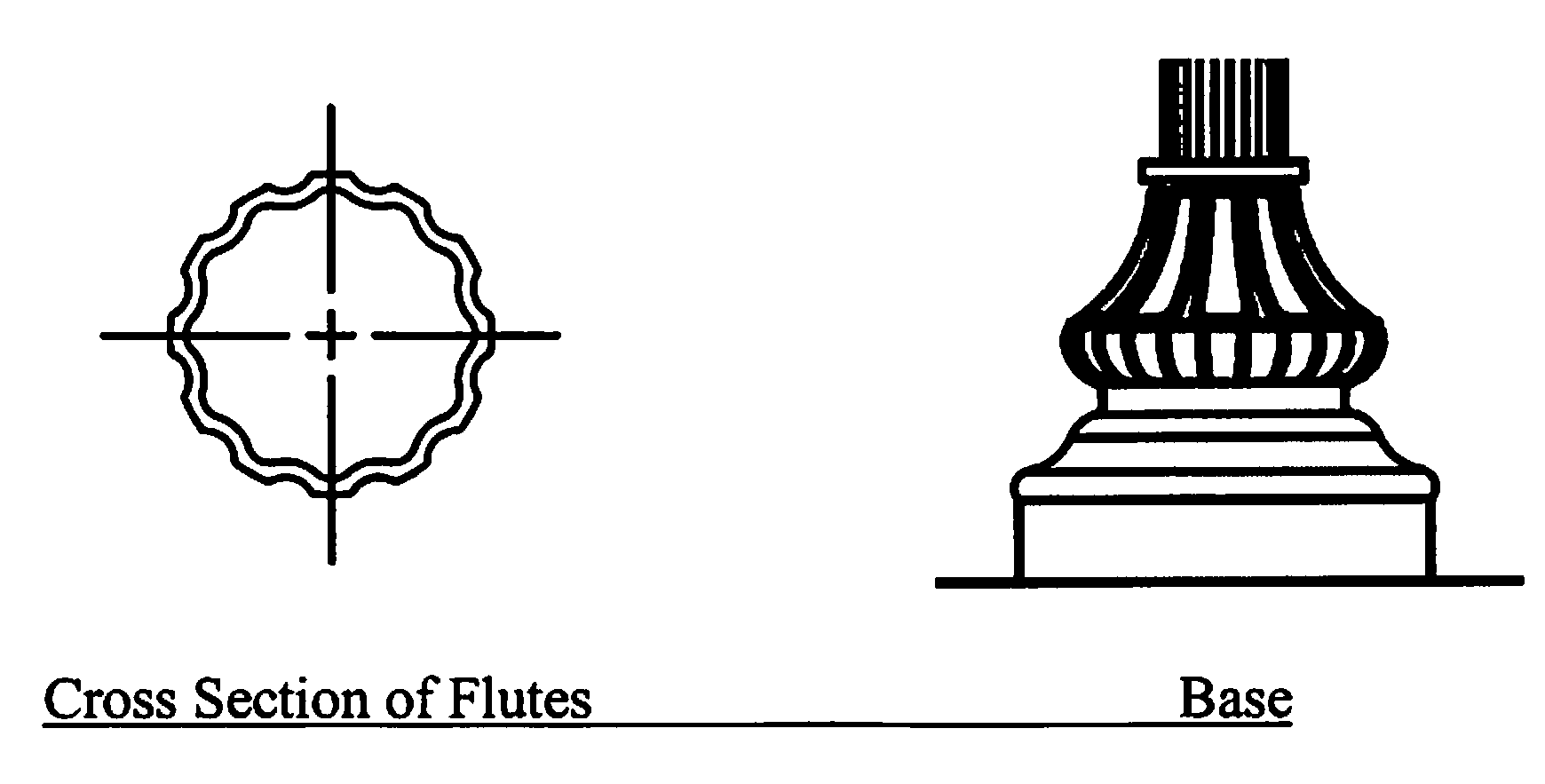
To the extent required for all other users of the public right-of-way within the proposed location of the new small wireless facilities, new utility poles servicing small wireless facilities installed within a public or private right-of-way should meet the city's community redevelopment area ("CRA") design standards, which provide that poles or towers be decorative in nature and consist of a fluted design with a decorative pedestal base as shown below; provided, however, this design requirement may be waived if the applicant provides sufficient information to support for another design that is more aesthetically compatible with the neighborhood or such design requirement would limit the size or configuration of small wireless facilities or any o its components. Accessories (i.e., luminaries, banner brackets, hanging baskets etc.) that provide a public purpose may be allowed upon the approval of the director of public services or designee.
(g)
The city's action on proposals to place, construct or modify wireless communications facilities shall be subject to the standards and time frames set out in F.S., §§ 337.401, 365.172, 47 USC § 1455(a), and orders issued by the FCC, as they may be amended.
(Ord. No. 07-03, § 1(21-195), 10-20-03; Ord. No. 03-15, § 9(21-295), 5-4-15; Ord. No. 01-2021, §§ 2.C, D, 4-5-21)
Sec. 21-310. - Suspension of permits.
The city may suspend a permit for work in the public rights-of-way for one or more of the following reasons, subject to section 21-311 of this division:
(1)
Violation of permit conditions, including conditions set forth in the permit, this division or other applicable city ordinances, codes or regulations governing placement or maintenance of communications facilities in public rights-of-way; or
(2)
Misrepresentation or fraud by registrant in a registration or permit application to the city; or
(3)
Failure to properly renew or ineffectiveness of registration; or
(4)
Failure to relocate or remove facilities as may be lawfully required by the city.
The public services department shall provide notice and an opportunity to cure any violation of subsections (1) through (3) above, each of which shall be reasonable under the circumstances.
(Ord. No. 07-03, § 1(21-196), 10-20-03; Ord. No. 03-15, § 9(21-296), 5-4-15)
Sec. 21-311. - Appeals.
Final, written decisions of the public services department or his or her designee suspending or denying a permit, denying an application for a registration or denying an application for renewal of a registration are subject to appeal. An appeal must be filed with the Gulf Breeze City Council within 30 days of the date of the final, written decision to be appealed. Any appeal not timely filed as set forth above shall be waived. The Gulf Breeze City Council shall hear the appeal. The hearing shall occur within 30 days of the receipt of the appeal, unless waived by the registrant, and a written decision shall be rendered within 20 days of the hearing. Upon correction of the grounds that gave rise to a suspension or denial, the suspension or denial shall be lifted.
(Ord. No. 07-03, § 1(21-197), 10-20-03; Ord. No. 03-15, § 9(21-297), 5-4-15)
Sec. 21-312. - Involuntary termination of registration.
(1)
The city may terminate a registration if:
(a)
A federal or state authority suspends, denies, or revokes a registrant's certification or license to provide communications services; or
(b)
The registrant's placement or maintenance of a communications facility in the public rights-of-way presents an extraordinary danger to the general public or other users of the public rights-of-way and the registrant fails to remedy the danger promptly after receipt of written notice; or
(c)
The registrant ceases to use all of its communications facilities in public rights-of-way and has not complied with section 21-305 of this division.
(2)
Prior to termination, the registrant shall be notified by the public services department with a written notice setting forth all matters pertinent to the proposed termination action, including which of (a) through (c) above is applicable as the reason therefore, and describing the proposed action of the city with respect thereto. The registrant shall have 60 days after receipt of such notice within which to address or eliminate the reason or within which to present a plan, satisfactory to the public services director, to accomplish the same. If the plan is rejected, the public services director shall provide written notice of such rejection to the registrant and shall make a recommendation to the Gulf Breeze City Council regarding a decision as to termination of registration. A decision by the city to terminate a registration may only be accomplished by an action of the Gulf Breeze City Council. A registrant shall be notified by written notice of any decision by the Gulf Breeze City Council to terminate its Registration. Such written notice shall be sent within seven days after the decision.
(3)
In the event of termination, the former registrant shall:
(a)
Notify the city of the assumption or anticipated assumption by another registrant of ownership of the registrant's communications facilities in public rights-of-way; or
(b)
Provide the city with an acceptable plan for disposition of its communications facilities in public rights-of-way. If a registrant fails to comply with this subsection (3), which determination of noncompliance is subject to appeal as provided in section 21-297, the city may exercise any remedies or rights it has at law or in equity, including, but not limited to, taking possession of the facilities where another person has not assumed the ownership or physical control of the facilities or requiring the registrant within 90 days of the termination, or such longer period as may be agreed to by the registrant, to remove some or all of the facilities from the public rights-of-way and restore the public rights-of-way to its original condition before the removal.
(4)
In any event, a terminated registrant shall take such steps as are necessary to render safe every portion of the communications facilities remaining in the public rights-of-way of the city.
(5)
In the event of termination of a registration, this section does not authorize the city to cause the removal of communications facilities used to provide another service for which the registrant or another person who owns or exercises physical control over the facilities holds a valid certification or license with the governing federal or state agency, if required for provision of such service, and is registered with the city, if required.
(Ord. No. 07-03, § 1(21-198), 10-20-03; Ord. No. 03-15, § 9(21-298), 5-4-15)
Sec. 21-313. - Existing communications facilities in public rights-of-way.
A communications services provider with an existing communications facility in the public rights-of-way of the city has 60 days from the effective date of the ordinance to comply with the terms of this division, including, but not limited to, registration, or be in violation thereof.
(Ord. No. 07-03, § 1(21-199), 10-20-03; Ord. No. 03-15, § 9(21-299), 5-4-15)
Sec. 21-314. - Insurance.
(1)
A registrant shall provide, pay for and maintain satisfactory to the city the types of insurance described herein. All insurance shall be from responsible companies duly authorized to do business in the State of Florida and having a rating reasonably acceptable to the city. All liability policies shall provide that the city is an additional insured as to the activities under this division. The required coverages must be evidenced by properly executed certificates of insurance forms. The certificates must be signed by the authorized representative of the insurance company and shall be filed and maintained with the city annually. Thirty days advance written notice by registered, certified or regular mail or facsimile as determined by the city must be given to the city of any cancellation, intent not to renew or reduction in the policy coverages. The insurance requirements may be satisfied by evidence of self-insurance or other types of insurance acceptable to the city.
(2)
The limits of coverage of insurance required shall be not less than the following:
(a)
Worker's Compensation and Employers' Liability Insurance
Worker's Compensation - Florida Statutory Requirements
Employer's Liability - $1,000,000.00 limit each accident
$1,000,000.00 limit per accident
$1,000,000.00 limit per each employee
(b)
Comprehensive General Liability
Bodily injury and property damage
$1,000,000.00 combined single limit each occurrence
(c)
Automobile Liability
Bodily injury and property damage
$500,000.00 combined single limit each accident
(Ord. No. 07-03, § 1(21-200), 10-20-03; Ord. No. 03-15, § 9(21-300), 5-4-15)
Sec. 21-315. - Indemnification.
(1)
A registrant shall, at its sole cost and expense, indemnify, hold harmless, and defend the city, its officials, boards, members, agents, and employees, against any and all claims, suits, causes of action, proceedings, judgments for damages or equitable relief, and costs and expenses incurred by the city arising out of the placement or maintenance of its communications system or facilities in public rights-of-way, regardless of whether the act or omission complained of is authorized, allowed or prohibited by this division, provided, however, that a registrant's obligation hereunder shall not extend to any claims caused by the negligence, gross negligence or wanton or willful acts of the city. This provision includes, but is not limited to, the city reasonable attorneys' fees incurred in defending against any such claim, suit proceedings. The city agrees to notify the registrant, in writing, within a reasonable time of the city receiving notice, of any issue it determines may require indemnification. Nothing in this section shall prohibit the city from participating in the defense of any litigation by its own counsel and at its own cost if in the city reasonable belief there exists or may exist a conflict, potential conflict or appearance of a conflict. Nothing contained in this section shall be construed or interpreted:
(a)
As denying to either party any remedy or defense available to such party under the laws of the State of Florida; or
(b)
As a waiver of sovereign immunity beyond the waiver provided in F.S. (2000) § 768.28, as it may be amended.
(2)
The indemnification requirements shall survive and be in effect after the termination or cancellation of a registration.
(Ord. No. 07-03, § 1(21-201), 10-20-03; Ord. No. 03-15, § 9(21-301), 5-4-15)
Sec. 21-316. - Construction bond.
(1)
Prior to issuing a permit where the work under the permit will require restoration of public rights-of-way, the city may require a construction bond to secure the restoration of the public rights-of-way. Notwithstanding the foregoing, a construction bond hereunder may only be required to the extent that the cost of the restoration exceeds the amount recoverable against the security fund as provided in section 21-317.
(2)
The construction bond shall be issued by a surety having a rating reasonably acceptable to the city; shall be subject to the approval of the public services department; and shall provide that: "For 12 months after issuance of this bond, this bond may not be cancelled, or allowed to lapse, until 60 days after receipt by the city, by certified mail, return receipt requested, of a written notice from the issuer of the bond of intent to cancel or not to renew."
(3)
The rights reserved by the city with respect to any construction bond established pursuant to this section are in addition to all other rights and remedies the city may have under this division, or at law or equity.
(4)
The rights reserved to the city under this section are in addition to all other rights of the city, whether reserved in this division, or authorized by other law, and no action, proceeding or exercise of a right with respect to the construction bond will affect any other right the city may have.
(Ord. No. 07-03, § 1(21-202), 10-20-03; Ord. No. 03-15, § 9(21-303), 5-4-15)
Sec. 21-317. - Reserved.
Editor's note— Sec. 3 of Ord. No. 01-2021, adopted April 5, 2021, repealed § 21-317, which pertained to the security fund, and derived from Ord. No. 07-03, adopted October 20, 2003; and Ord. No. 03-15, adopted May 4, 2015.
Sec. 21-318. - Enforcement remedies.
(1)
A registrant's failure to comply with provisions of this division shall constitute a violation of this division and shall subject the registrant to the code enforcement provisions and procedures as provided in F.S. § 162.0415, as amended. In addition, violation of this division may be punishable as provided in F.S. § 162.22, as it may be amended. Pursuant to this section, the director of community services shall give written notice of the violation and its intention to assess such penalties, which notice shall contain a description of the alleged violation. Following receipt of such notice, the registrant shall have 30 days to either:
(a)
Cure the violation to the city's satisfaction and the city shall make good faith reasonable efforts to assist in resolving the violation; or
(b)
File an appeal with the Santa Rosa County Court to contest the alleged violation. If no appeal is filed and if the violation is not cured within the 30-day period, the city may collect all fines owed, beginning with the first day of violation, through any means allowed by law.
(2)
In determining which remedy is appropriate, the city shall take into consideration the nature of the violation, the person bearing the impact of the violation, the nature of the remedy required in order to prevent further violations, and such other matters as the city determines are appropriate to the public interest.
(3)
In any proceeding before the city where there exists an issue with respect to a registrant's performance of its obligations pursuant to this division, the registrant shall be given the opportunity to provide such information as it may have concerning its compliance with the terms and conditions of this division. The city may find a registrant that does not demonstrate compliance with the terms and conditions of this division in default and apply a remedy as authorized by this division.
(4)
The public services director or a designee shall be responsible for administration and enforcement of this division, and is authorized to give any notice required by law.
(5)
Failure of the city to enforce any requirements of this division shall not constitute a waiver of the city right to enforce a violation or subsequent violations of the same type or to seek appropriate enforcement remedies.
(Ord. No. 07-03, § 1(21-204), 10-20-03; Ord. No. 03-15, § 9(21-304), 5-4-15)
Sec. 21-319. - Abandonment of a communications facility.
(1)
Upon abandonment of a communications facility owned by a registrant in public rights-of-way, the registrant shall notify the city within 90 days.
(2)
The city may direct the registrant by written notice to remove all or any portion of such abandoned facility at the registrant's sole expense if the city determines that the abandoned facility's presence interferes with the public health, safety or welfare, which shall include, but shall not be limited to, a determination that such facility:
(a)
Compromises safety at any time for any public rights-of-way user or during construction or maintenance in public rights-of-way;
(b)
Prevents another person from locating facilities in the area of public rights-of-way where the abandoned facility is located when other alternative locations are not reasonably available; or
(c)
Creates a maintenance condition that is disruptive to the public rights-of-way use. In the event of (b), the city may require the third person to coordinate with the registrant that owns the existing facility for joint removal and placement, where agreed to by the registrant.
(3)
In the event that the city does not direct the removal of the abandoned facility, the registrant, by its notice of abandonment to the city, shall be deemed to consent to the alteration or removal of all or any portion of the facility by the city or another person at such third party's cost.
(4)
If the registrant fails to remove all or any portion of an abandoned facility as directed by the city within a reasonable time period as may be required by the city under the circumstances, the city may perform such removal and charge the cost of the removal against the registrant.
(Ord. No. 07-03, § 1(21-205), 10-20-03; Ord. No. 03-15, § 9(21-305), 5-4-15)
Sec. 21-320. - Force majeure.
In the event a registrant's performance of or compliance with any of the provisions of this division is prevented by a cause or event not within the registrant's control, such inability to perform or comply shall be deemed excused and no penalties or sanctions shall be imposed as a result, provided, however, that such registrant uses all practicable means to expeditiously cure or correct any such inability to perform or comply. For purposes of this division, causes or events not within a Registrant's control shall include, without limitation, acts of God, floods, earthquakes, landslides, hurricanes, fires and other natural disasters, acts of public enemies, riots or civil disturbances, sabotage, strikes and restraints imposed by order of a governmental agency or court. Causes or events within registrant's control, and thus not falling within this section, shall include, without limitation, registrant's financial inability to perform or comply, economic hardship, and misfeasance, malfeasance or nonfeasance by any of registrant's directors, officers, employees, contractors or agents.
(Ord. No. 07-03, § 1(21-206), 10-20-03; Ord. No. 03-15, § 9(21-306), 5-4-15)
Sec. 21-321. - Reservation of rights and remedies.
(1)
The city reserves the right to amend this division as it shall find necessary in the lawful exercise of its police powers.
(2)
This division shall be applicable to all communications facilities placed in the public rights-of-way on or after the effective date of this division and shall apply to all existing communications facilities in the public rights-of-way prior to the effective date of this division, to the full extent permitted by state and federal law.
(3)
The adoption of this division is not intended to affect any rights or defenses of the city or a communications service provider under any existing franchise, license or other agreements with a communications services provider.
(4)
Nothing in this division shall affect the remedies the city or the registrant has available under applicable law.
(5)
Any person who uses the communications facilities of a registrant, other than the registrant that owns the facilities, shall not be entitled to any rights to place or maintain such facilities in excess of the rights of the registrant that places or maintains the facilities.
(Ord. No. 07-03, § 1(21-207), 10-20-03; Ord. No. 03-15, § 9(21-307), 5-4-15)

