
Gulf Breeze City Zoning Code
ARTICLE III
SUPPLEMENTARY DISTRICT REGULATIONS2
Editor's note—Sec. 9 of Ord. No. 03-15, adopted May 4, 2015, amended art. III by renumbering §§ 21-246—21-280 as §§ 21-260—21-294. For historical purposes, the prior section numbers have been included in the history notes for Ord. No. 03-15, following each section.
Cross reference— Livestock prohibited in the city, § 4-2; animals prohibited from running at large, § 4-116; keeping doves and pigeons restricted, § 4-175; keeping live poultry restricted, § 4-176; environment, ch. 8.
Sec. 21-260.- Manufactured homes, mobile homes and modular homes.
(a)
A manufactured or mobile home means a structure of any dimension transportable in one or more sections, and which is built on a permanent chassis and designed to be used with or without permanent foundation, when connected to the proper utilities, and includes plumbing, heating, air conditioning and electrical systems contained therein. A manufactured or mobile home must bear the U.S. Department of Housing and Urban Development (HUD) label and must be installed by an installer licensed by the Florida Department of Highway Safety and Motor Vehicles (DHSMV).
(b)
Mobile home subdivisions or parks of ten acres or more shall be allowed in all residential districts. All manufactured homes or mobile homes in mobile home subdivisions shall be required to have permanent foundations. Mobile home parks will be subject to landscape buffer requirements equivalent to commercial districts abutting residential uses as defined in section 21-179. No mobile home parks or subdivisions will be allowed in the coastal high hazard area.
(c)
Modular home means a structure of any dimension transportable in one or more section, and which must be designed, built, permitted and inspected to the Florida Building Code (FBC) and must be installed on a permanent foundation that is designed and built specifically for that home by a contractor licensed by the Department of Business and Professional Regulation (DBPR). A modular home must bear the insignia of the Florida Department of Community Affairs (DCA) on the inside of cover of the home's electrical panel.
(d)
Modular homes or modular home subdivisions shall be allowed in all residential districts and must comply with all of the provisions of the appropriate residential district in which they are to be located.
(Ord. No. 12-07, § 1, 10-15-07; Ord. No. 03-15, § 9(21-246), 5-4-15)
Cross reference— Buildings and building regulations, ch. 5.
Sec. 21-261. - Location of group homes and foster care facilities.
Group homes and foster care facilities, licensed by the Florida Department of Health and Rehabilitative Services, of six occupants or less shall be allowed in R-1-A, R-1, R-C, and TH districts, as required by F.S. ch. 419, provided the residential nature of the neighborhood is maintained or upgraded and that such use would not affect the safety of existing residents or place the residents of such facilities at risk. No such facilities shall be located in the coastal high hazard area.
Sec. 21-262. - Cumulative residential provisions.
(a)
Single-family uses as allowed in R-1-AA and R-1-A districts are permitted in TH and R-C districts. Such single-family uses will be considered as having been developed in an R-1-A district and, except as set forth in subsection (b), must meet the requirements for single-family uses as set forth in district R-1-A in division 4 of article II of this chapter.
(b)
Single-family detached structures in a TH or R-C district as allowed by subsection (a) must have lot widths of at least 40 feet at the front setback line and beyond and side yard setback of five and one-half feet from the side lot line. All other requirements and provisions for single-family detached structures set forth in division 4 of article II of this chapter, district R-1-A, with exception for lot widths and side yard setbacks, but including overall building lot square footage requirements, are applicable to such single-family detached structures in the TH or R-C districts.
Sec. 21-263. - Exceptions to height limits.
The specified height limitations of this land development code shall not apply to church spires, belfries, cupolas and domes not intended for human occupancy; water towers; chimneys; flag poles; publically owned radio and television aerials and similar structures.
Sec. 21-264. - Reduction of lot area.
No lot area or parcel, even though it may consist of one or more adjacent lots of record, shall be reduced in size so that lot width, yard requirements, lot area per dwelling unit, or other requirements of this land development code are not maintained. This requirement shall not apply when a portion of a lot is acquired for a public purpose, when the provisions for clustering development on upland portions of parcels containing environmentally sensitive lands are applied, as provided for in section 22-26 et seq., or when flexibility in lot sizes for planned unit developments are approved. Any modification to the size of a platted lot must be approved in accordance with the provisions of chapter 25.
(Ord. No. 2-93, § 1, 3-1-93; Ord. No. 03-15, § 9(21-250), 5-4-15)
Sec. 21-265. - Street frontage.
No building or structure shall be constructed on a lot which does not have immediate frontage on at least one street.
Sec. 21-266. - Front yard exceptions.
In districts R-ES, R-1-AA, R-1-A and R-1 where lots comprising 20 percent or more of the frontage on the same street between intersections are developed with buildings having a variation in front yard depths of not more than ten feet, no building hereafter erected or structurally altered shall project beyond the average front yard so established.
Sec. 21-267. - Minimum yards and open spaces.
The minimum yards and other open spaces, including the intensity of use provisions contained in this land development code for each and every building hereafter erected, reconstructed or structurally altered, shall not be encroached upon or considered as a compliance with yard or open space requirements or intensity of use requirements for any other building or adjoining building.
Sec. 21-268. - Yard, parking, open space to service one building.
No part of a yard or loading space or other open space about or in connection with any building required for the purpose of complying with the provisions of this land development code shall be included as part of a yard or loading space or other open space similarly required for another building.
(Ord. No. 03-15, § 9(21-254), 5-4-15; Ord. No. 03-18, § 1, 5-21-18)
Sec. 21-269. - Electrified and barbed wire fences prohibited.
(a)
There shall be prohibited within the city limits electrified fences of any construction whatsoever.
(b)
There shall also be prohibited within the city limits barbed wire fences unless the lowest strand of barbed wire fence is a minimum of six feet aboveground as measured from the ground directly below the fence.
(Ord. No. 03-15, § 9(21-255), 5-4-15)
Cross reference— Buildings and building regulations, ch. 5.
Sec. 21-270. - Setback, fencing requirements for swimming pools.
Swimming pools shall be located 30 feet or more from the front lot line, five feet or more from any side lot line or rear lot line and 15 feet or more from any side street property line or rear street property line, and shall be fenced. In those instances where single-family uses are permitted in the TH and RC districts, pools shall have a minimum setback of 30 feet or more from the front lot line and 15 feet or more from any rear lot line, side yard or side street property line.
(Ord. No. 09-07, § 1, 7-16-07; Ord. No. 03-15, § 9(21-256), 5-4-15)
Sec. 21-270.1. - Reserved.
Editor's note— Section 21-270.1 (prior § 21-257) has been repealed by section 8 of Ord. No. 03-15, adopted May 4, 2015.
Sec. 21-271. - Satellite dishes—Requirements and restrictions.
The following requirements and restrictions shall apply to satellite dishes constructed or installed in the city after October 1, 1984, and shall be considered accessory uses. Satellite dishes measuring one meter or less in diameter shall be exempted from the provisions of this article.
(1)
Residential areas:
a.
Maximum dish size—14 feet from extreme edge to extreme edge in any direction.
b.
Distance from grade—maximum of 15 feet to the highest point.
c.
Setback—minimum of five feet from closest property line.
d.
Location—rear yards only.
e.
Screening—a minimum of a four-foot fence surrounding the dish so it shall be less visible from outside the yard or a screening of foliage no less than four feet high placed not less than five feet from antenna, unless the rear yard is presently fenced by a four-foot-high fence, in which a separate fence is not required. All fences are to be solid or opaque as to limit visibility into the interior enclosed area.
(2)
Commercial, medical and public areas:
a.
Maximum dish size—14 feet from extreme edge to extreme edge in any direction.
b.
Distance from grade—maximum of 15 feet to the highest point for ground installation or 15 feet maximum above the existing roof line.
c.
Setback—minimum of five feet from the closest property line.
d.
Location—any area except front of building.
e.
Screening for ground installation—landscape buffer no less than six feet high placed not less than five feet from the antenna.
(Ord. No. 4-99, § 1, 4-5-99; Ord. No. 03-15, § 9(21-258), 5-4-15)
Cross reference— Buildings and building regulations, ch. 5.
Sec. 21-272. - Same—Permit, plans required.
(a)
All satellite dish antennae to be erected or constructed within the boundaries of the city shall require a permit from the city.
(b)
A site sketch shall accompany the drawings, and the drawings shall show the method of anchoring the antennae and a list of materials to be used, including the dimensions of the supporting reinforced concrete slabs or piers to be used as foundations for the antennae.
Sec. 21-273. - Target height zones.
Except as otherwise provided herein, the maximum height limit within the City of Gulf Breeze shall be 35 feet. Such height shall be measured from grade.
(a)
Purpose and intent. The purpose of target height zones is to allow increased height in designated areas of the City of Gulf Breeze in order to promote redevelopment and revitalization in the CRA.
This section is intended to provide design criteria and standards for the review and approval process to address impacts of increased building heights.
(b)
Applicability. The provisions of this section apply only where a building height of greater than 35 feet is proposed upon a parcel.
Target height zones are depicted on the city's overlay district map. The city's overlay district map indicates the maximum building height for each of the aforementioned target height zones. Target height zone standards establish a process by which additional building heights may be considered by special exception in established target height zones. The underlying zoning district standards shall continue to apply, unless provided for in this section.
Overlay District Map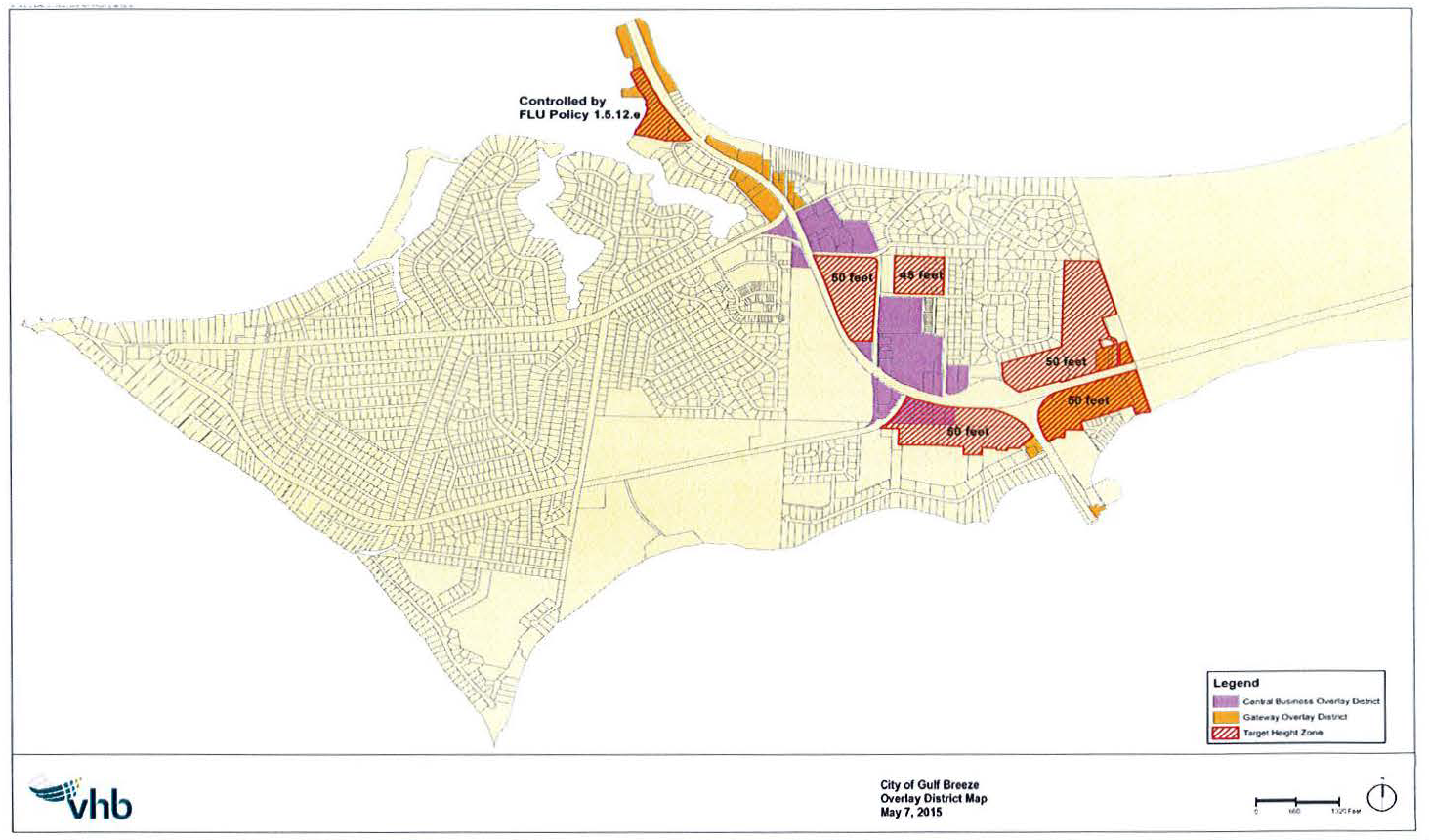
(c)
Application review and approval procedure. Any proposed development where a building height of greater than 35 feet is requested shall be considered a special exception, and a level three development, and shall adhere to the level three development process described in sections 20-41 through 20-80 of this Code, with the additional review and approval procedure described herein.
(1)
Pre-application meeting. No application for a special exception for buildings greater than 35 feet shall be determined to be complete by the city manager or designee, as indicated in section 20-43, until the applicant has attended a pre-application meeting, described in section 20-167 of this Code.
a.
The purpose of the pre-application meeting is for the applicant to meet with city staff to review the proposed special exception and discuss potential issues, concerns and questions to be addressed by the applicant.
b.
Upon request for a pre-application meeting, the city manager, or designee, shall schedule a pre-application meeting with the applicant and appropriate city staff.
(d)
Setback requirements. For any parcel in a target height zone upon which a building is proposed to exceed 35 feet in height and which parcel abuts or is within 50 feet of property zoned R-1, R-1 A or R-1 AA, the following setback standards shall apply:
(1)
Any portion of a building that is greater than 35 feet must provide additional setback from any residential property outside the target height zone, in the a mount of at least one and one-fourth feet of setback for every one foot of total building height.
a.
The additional setback required by subsection (d)(1) above, may contain landscaping, parking, stormwater retention areas or buildings or sections of buildings that do not exceed 35 feet in height.
(2)
Buildings in target height zones that do not abut residential property, are not required to provide the additional setback described in subsection (d)(1) above, and shall adhere to the underlying zoning district setback requirements.
(3)
Buildings, or portions of buildings, that are 35 feet in height or less, shall provide setbacks as required by the underlying zoning district.
(4)
Buildings in the Harbourtown target height zone shall not be required to adhere to the additional set backs for adjacent residential property.
(e)
Design criteria.
(1)
Proposed development located within a target height zone where a building height of greater than 35 feet is requested shall adhere to the city's adopted community redevelopment plan and urban design guidelines described in chapter 26 of this Code.
(2)
For all proposed development where a building of greater than 35 feet in height is requested, city staff, the architectural review board and city council shall require design criteria to mitigate the visual and other impacts. The special exception will not be granted unless it is demonstrated to the satisfaction of the city council that adverse visual and other impacts of the proposed development will be substantially mitigated through implementation of the required design criteria. These design criteria include, but are not limited to:
a.
Enhanced landscape buffering that exceed minimum standards described in subsection (g) below;
b.
Variable buffers, combining land and landscaping to achieve adequate separation of uses, appropriate open space, reduction of potential noise, light and glare, and screening of physical features of a proposed development;
c.
Variable setbacks, based upon degree of difference in proposed scale, mass or height, as described in subsection (d)(1) above;
d.
Transitions of building scale, massing or height to reduce monotonous design; and
e.
Other innovative site design features that strive to achieve compatibility and mitigate potential negative impacts.
(f)
[Providing of various studies.] City staff, the architectural review board, and/or city council may request that the applicant provide visual studies, elevations, renderings, other studies deemed appropriate, that demonstrate the proposed methods of mitigation described in this section and elsewhere in this Code. The city council must find that the proposed development will not adversely affect the public interest.
(g)
Buffering. For proposed development where a building height of greater than 35 feet is requested and which parcel abuts or is within 50 feet of property zoned R-1, R-1 A or R-1 AA, the following buffering standards shall apply in addition to the landscaping and buffering standards in the CRA district standards, section 26-13. Where there is a conflict between the two sections, the more restrictive standards shall apply.
(1)
Location of buffer. The buffer shall be located at the perimeter of the zoning lot where required. Buffer shall extend to the zoning lot line or the right-of-way line, except where easements, covenants, or natural features may require the buffer to be set back from the property line. Buffer areas shall be served by automatic irrigation systems to promote growth.
(2)
Required buffer. No less than a 15-foot vegetated buffer shall be provided for proposed mixed use multi-story development adjacent to existing single-family residential development. The required vegetation shall consist of a minimum 33 shrubs/100 linear feet planted within the first five feet of the required buffer, and four canopy trees/100 linear feet planted with in the second five feet of the required buffer. The city council may also require a masonry wall of not less than eight feet in height.
(3)
Plant sizes at installation.
a.
Canopy trees: No less than three and one-half inches DBH, 14 feet overall height with eight-foot spread, 65 gallon container that will create a continuous overlapping leafy canopy within five years of planting.
b.
Shrub/evergreen screen. 30 inches minimum at installation to create 42 inches—60 inches high by 36 inches wide hedge or continuous screen with 90 percent opacity at the height of the screen with in one year of planting, three gallon container.
c.
The applicant shall submit a landscape maintenance plan that establishes a program for ongoing landscape maintenance and irrigation to prevent the visual screen from degrading over time and thereby ensuring that the required 90 percent opacity and overlapping canopy is maintained for the life of the project. The plan will identify periodic inspection dates for code enforcement and compliance review.
Sec. 21-274. - Restricted uses in residential districts.
(a)
In the R-ES, R-1-AA, R-1-A, R-1, TH and R-C districts, no commercial activity shall be permitted except home occupations as previously defined and unless specifically prohibited in a district, and except for the sale of the individual units within a subdivision or development being constructed, so long as sales are made from a model of those units offered for sale or from a temporary structure located within the subdivision or development. The word "temporary" as used herein shall mean a period of time not to exceed 18 months from the date the original building permit is issued for that particular subdivision or development. If all units are not sold within 18 months, the owner and/or developer shall apply for a special exception granting an extension of time with the board of adjustment of the city pursuant to section 20-76 et seq.
(b)
As an exception to subsection (a) above, municipal public uses including public parks and playgrounds, auxiliary public utility stations and telephone exchanges are permitted provided that such stations are screened so as to prevent an unsightly appearance and fenced adequately to prevent unauthorized access. Storage of vehicles and equipment shall be prohibited.
(c)
No basement, garage or barn shall be used as a residence, temporarily or permanently; no structure of a temporary character is to be used as a residence.
Sec. 21-275. - Exterior lighting.
Exterior lighting facilities in all districts shall be directed so as to prevent direct glare on any adjoining property and to prevent safety hazards to adjoining streets.
Sec. 21-276. - Underground utility requirements.
(a)
[Generally.] All new development and redevelopment with a construction permit value exceeding 50 percent of the most recently assessed value of the property, shall be required to place utilities underground, including electrical and telephone lines.
(b)
Definitions. As used in this section, the words and phrases hereinafter defined shall have the following meanings:
(1)
Poles, overhead wires, and associated overhead structures shall mean and include, but not be limited to poles, towers, supports, wires, conductors, guys, stubs, platforms, cross-arms, braces, line transformers, insulators, cut-outs, switches, communication circuits, appliances, attachments and appurtenances located above ground upon, along, across or over the streets, alleys, and easements and used in supplying electric, communication or similar or related services.
(2)
CRAor the community redevelopment agency shall refer to the city council acting as board of directors for the community development agency as well the area defined as the district falling under the jurisdiction of the community development agency. The legal description of this area is maintained with the city clerk.
(c)
Underground installation required.
(1)
From and after the effective date of this section, it shall be unlawful, except as specifically provided herein, for any person or utility to erect or construct, poles, overhead wires and associated overhead structures to supply electric, communication or other similar or associated service to any new commercial or subdivision development within the CRA district of the City of Gulf Breeze.
(2)
Should any utility be required to relocate existing above ground utilities because of highway or street widening, aging infrastructure, or any other redevelopment activity, the utility will be required to replace/relocate the new facilities underground at no cost to the city in accordance with this section.
(3)
This requirement is not applicable to remodeling or reconstruction of single-family residential homes existing as of the effective date of this section.
(4)
All electric installations shall be in accordance with rules and regulations of the Florida Public Service Commission and the National Electric Safety Code.
(5)
The subdivider, developer, or owner of any such area or a portion thereof shall make the necessary arrangements and payment for the installation of underground facilities, including circuits for street lights. Such arrangements shall be made with each of the companies or persons supplying the electrical and communications service therein, in accordance with the established rules, policies and charges of such company or persons.
(6)
All applications for development through the department of community services will be required to acknowledge that underground utilities are required for the development or construction, where required by this section. The acknowledgement will include that all costs of the underground installation will be the responsibility of the applicant, developer or builder, as applicable.
(d)
Exceptions. The following exceptions will be allowed from the requirements to construct all electric and communication utilities underground with the CRA district:
(1)
Temporary exceptions: The city manager, or his designee, may grant special permission in cases where temporary electrical power or communication service is reasonably required for emergencies or for building construction purposes, or for other temporary purposes, to erect, construct, install or maintain poles, wires and other overhead structures. All application for temporary exceptions shall include an expiration period.
(2)
Permanent exceptions: The provisions of this section shall not apply to any of the following uses:
a.
All electric power lines rated at or above "feeder" line class of more than 23kV (23,000 volts).
b.
Poles, overhead wires, and associated overhead structures, when part of a continuous line, or services to individual properties from such existing overhead lines when such services and lines are within a subdivision approved and recorded prior to the adoption of this section.
c.
Radio and television antennae.
d.
Structures on corner lots, in streets and alleys, and on easements adjacent thereto, in cases where electrical and communication wires cross a street or other district boundary from an area where overhead wires are not prohibited, may be connected to said overhead wires, and hereby are excepted from the provisions of this section.
e.
Existing overhead lines attached to the exterior surface of a building by means of a bracket or other fixture and extending from one location on the building to another location on the same building, or to an adjacent building without crossing a property line.
f.
Poles used for street or area lighting, for traffic control facilities, or for water and sewer utility structures.
g.
Service terminals, risers, transformers, regulators, meters, or other on and above ground facilities normally used with and as a part of underground distribution system provided such facilities are not located in the required front or side yards.
h.
Electric substations, transmission poles, towers and lines, and the accompanying equipment and apparatus necessary to provide reliable electric service.
i.
The underground installation of electric facilities of public utilities regulated by the Florida Public Service Commission are governed by and subject to the rules and regulations of the commission and, to the extent any exclusions, conditions or requirements of the commission rules apply, they will govern, notwithstanding any provisions of this section. No installation is required to be made by any public utility until payment arrangements have been made in accordance with commission rules.
(3)
Special exception: Notwithstanding any other provisions of this section, the city council may grant special exceptions on a permanent or temporary basis to the provisions hereof on such terms as the council may deem appropriate in cases of emergency or unusual circumstances to any party to erect, construct, install, maintain use or operate poles and overhead wires and associated overhead structures.
(4)
Application required: All exceptions require that application be made to the city manager or city council prior to installation. Application should be made through the department of community services.
(e)
Hold harmless. The public utility, cable television, telecommunications company or other entity installing underground facilities pursuant to this section, its successors and assigns, shall save and hold harmless the City of Gulf Breeze, Florida, from all liability, costs, damages, and expenses of every kind, for the payment of which said city may become liable to any person, firm or corporation to the extent any such liability, costs damages or expenses are caused by the negligence by such entity in the construction, maintenance, and operation of this its underground facilities within said City of Gulf Breeze, Florida.
(f)
Underground wiring prohibited.
(1)
The installation, placement or maintenance of any and all underground electrical or communication wiring or associated structures or facilities, whether they be above or underground, shall be prohibited in all floodplains, floodprone areas, drainage easements, major drainage ways, or any other area where the possibility of standing water exists. Where electrical or communication service wiring must cross such areas, easements or ways, they must be elevated and so installed as to be reasonably free from flood or stormwater runoff damage.
(2)
The provisions of this section are severable. If any section, subsection or provision thereof be for any reason declared void or invalid, such invalidity shall not affect any other section, subsection or provision of this section. This section shall become effective upon its adoption and publication as required by law.
(Ord. No. 04-13, § 1, 5-20-13; Ord. No. 03-15, § 9(21-264), 5-4-15)
Cross reference— Sanitary sewer system determination of available capacity, § 20-197; stormwater management, § 24-71 et seq.; required improvements for subdivisions, § 25-131 et seq.
Sec. 21-277. - Use of temporary structures for nonresidential purposes.
No temporary structure may be utilized for any nonresidential purpose (including special events contemplated in section 16-71 et seq.) without prior written permission from the city approving such use of a temporary structure. The city will grant a permit for nonresidential use of a temporary structure only upon the applicant paying a fee of $30.00 and submitting a written application demonstrating and the city otherwise finding that the use of the temporary structure:
(a)
Will comply with all applicable requirements of this Code;
(b)
Will not cause or result in the lot or site upon which the temporary structure is to be used, or the person, entity or organization that will use the temporary structure, to be in violation of any applicable requirement of this Code, including without limiting the generality of the foregoing any off-street parking requirements or provisions of any fire and/or life safety code that have been adopted by and/or are in effect in the City of Gulf Breeze;
(c)
Will be for a period of no more than seven days;
(d)
Will not adversely effect or degrade adopted levels of service in the city; and
(e)
Will not cause any adverse effect or impact upon on-site or off-site public health, safety or welfare, including without limiting the generality of the foregoing cause or increase traffic congestion.
In the event that subsequent to issuance of a permit for use of a temporary structure for nonresidential purposes the city determines that said temporary structure or its use violates any of the conditions set forth in subparagraphs (a) through (e), above, or violates any provision of this Code, the city may immediately revoke the permit and/or take such further actions as reasonably necessary to protect public health, safety and welfare including requiring that the temporary structure be immediately removed.
(Ord. No. 08-00, § 4, 10-2-00; Ord. No. 03-15, § 9(21-264), 5-4-15)
Sec. 21-278. - Rapid entry system.
(a)
Whenever a property, including but not limited to a subdivision, apartment complex, and condominium development, is protected by fences, gates, or other barriers, the property owner shall equip such fences, gates, and barriers with a padlock or key switch that is compatible with the city's rapid entry system. The fire chief shall designate the type of rapid entry system to be implemented within the city. The system must be U.L. listed. The property owner shall thereafter maintain the padlock or key switch so as to assure that it will properly function at such times as the city's emergency personnel may need rapid access to the property in order to respond to an emergency situation.
(b)
The padlock or key switch of the rapid entry system shall be located at or near the front entrance. It shall be mounted at a height of four feet above finished grade. If it cannot be located near the front entrance or four feet above finished grade, the fire chief can designate an alternate location. The location shall be clearly visible and shall not be obstructed by vegetation or other materials.
(c)
All new construction, development, and subdivisions shall comply with the provisions of this section prior to and as a condition of the issuance of a certificate of occupancy.
(d)
All properties protected by fences, gates, or other barriers as of the effective date of this section (November 21, 2005) shall comply with the provisions of this section within 90 days from said effective date.
(e)
It is recognized that the primary purpose of this section is to facilitate, in circumstances when an immediate or emergency response is appropriate, the city's emergency personnel obtaining rapid entry to a property, including but not limited to a subdivision, apartment complex, or condominium development, whose entry is impeded by a fence, gate, or other barrier. Since such barriers are not mandated by the Code, rather they are voluntary measures undertaken by the owner of the property, it shall be the duty, responsibility, and obligation of the property owner to maintain the fence, gate, or barrier in such a manner so as to assure rapid entry to the property by the city's emergency personnel when immediate access or entry thereto is needed appropriate by such city emergency personnel in order to provide an immediate or emergency response.
(f)
In light of the requirements of the preceding subsection (e), in the event that a rapid entry system for a fence, gate, or barrier as contemplated in this section fails to allow the city's emergency personnel to obtain immediate access to the property and the city's emergency personnel reasonably determine to open such fence, gate, or barrier by forceful means in order to provide an immediate or emergency response and such efforts damage the fence, gate, or barrier, the city shall have no responsibility or liability with respect to such damage including any responsibility to repair the damage or any obligation to reimburse the property owner for costs or any damages associated therewith.
(g)
Each owner of a parcel or unit within or comprising any property that is protected by fences, gates, or other barriers, including all lots within a subdivision, all apartments within an apartment complex, and all condominiums within a condominium development, shall be jointly and severally obligated along with the property owner to comply or cause the property owner to comply with the requirements of this section.
(Ord. No. 07-05, § 1(21-264), 11-21-05; Ord. No. 03-15, § 9(21-265), 5-4-15)
Editor's note— Ordinance No. 07-05, adopted Nov. 21, 2005, enacted provisions to be designated as § 21-264. In as much as there already exists a § 21-264, said provisions have be redesignated as § 21-265, subsequently renumbered by Ord. No. 03-15, adopted May 4, 2015.
Sec. 21-279. - Portable storage units.
(1)
It shall be unlawful for any person to place, or permit the placement of a portable storage unit on property which he or she owns, rents, occupies or controls without first having obtained a permit. Application for a permit shall be made to the city manager or designee on a form provided by the city manager or designee. The applicant shall submit a rough sketch showing the proposed placement of the portable storage unit. The fee for the permit shall be $25.00 and time extensions shall be $10.00.
(2)
Portable storage units may be located in R-ES, R-1-AA, R-1-A and R-1 zoning districts. They shall preferably be placed in the driveway and be set back a minimum of ten feet from the front lot line, five feet from the rear lot line, five feet from the side lot line and in the case of a corner lot, no closer than the side street line. Final placement shall be to the satisfaction of the city manager or designee.
(3)
Portable storage units may be allowed in other zoning districts only upon the applicant demonstrating, to the satisfaction of the city manager or designee that the specific location/complex has sufficient space to place a portable storage unit, and continue to provide adequate parking, public safety access and comply with all health, safety and welfare concerns.
(4)
Portable storage units shall not interfere with any use of a sidewalk, bike path or be placed in a public or private right-of-way or easement.
(5)
No more than one portable storage unit per lot shall be allowed in a R-ES, R-1-AA, R-1-A and R-1 zoning district and shall be no larger than eight feet wide, 16 feet long, and eight feet high.
(6)
No portable storage unit shall remain on any site in excess of 90 days. Extensions may be granted by the city manager or designee.
(7)
The owner and operator of any site on which a portable storage unit is placed shall be responsible in ensuring that their portable storage unit is in good condition, free from evidence of deterioration, weathering, discoloration, rust, ripping, tearing or other holes or breaks. When not in use, the portable storage unit shall be kept locked with a combination-style lock, no key locks.
(8)
Portable storage units shall have the name, address and telephone number of the person or firm engaged in the business or renting or otherwise placing of the portable storage unit plainly listed on it.
(9)
Portable storage units shall not be used for the storage of waste, refuse or hazardous substances.
(10)
Portable storage unit(s) shall not be utilized as permanent accessory structures in any zoning district.
(11)
No portable storage unit located in a residential zoning district shall be used for business or commercial purposes.
(Ord. No. 12-09, § 6, 8-3-09; Ord. No. 03-15, § 9(21-265), 5-4-15)
Sec. 21-281. - Vacant lot and construction site maintenance.
(a)
Intent. The intent of this section is to minimize the detrimental health, safety, general welfare and impacts of vacant lots and construction activities on the residents of the City of Gulf Breeze; to ensure that each vacant lot and construction site is maintained, and each construction activity is conducted in such a manner so as to avoid unnecessary inconvenience and annoyance to the general public and the occupants of the neighboring properties; and to require maintenance practices that will reduce the amount of sediment and other pollutants leaving construction sites during land development or land disturbing construction activities.
(b)
Applicability.
(1)
The regulations contained in this section apply to all vacant lots and land disturbing construction and land development activities on properties within the C1, C2, M, and P zoning districts in the City of Gulf Breeze.
(2)
This section applies to all properties with an active or expired building permit or an active or expired demolition permit for any land disturbing construction and/or land development activities as defined in this section.
(3)
All landowners of vacant lots that are not in compliance with the provisions of this section shall be required to bring such property into conformance within 180 days of the effective date of the ordinance.
(4)
All Florida Department of Transportation (FDOT) funded construction is exempt from this section. All FDOT funded or conducted construction activities shall meet the requirements as required by Florida Department of Environmental Protection regulation.
(5)
All other land disturbing construction and land development activities exempt from local permitting authority are exempt from this section. Land disturbing construction and land development activities performed by the city within city right-of-way or on city property are exempt from this section.
(6)
Should this section and another ordinance conflict or overlap, whichever imposes the more stringent restrictions shall prevail.
(7)
This Ordinance No. 06-14 supersedes the provisions of sections 21-31 and 21-32 of this Code and the provisions thereof shall not apply to the circumstances contemplated hereby.
(c)
Definitions. The following words, terms and phrases when used in this section, shall have the meanings ascribed to them in this section, except where the context clearly indicates a different meaning:
Irrigation. The methods of supply and application of water other than natural rainfall to foster plant growth. Methods shall include an automated irrigation system or hand watering.
Land development activities. The construction of buildings, roads, parking lots, paved storage areas, demolition of structures, installation of utilities, or other similar facilities.
Land disturbing construction activities. Any manmade change of the land surface, including removing vegetative cover, excavating, filling and grading landscaping modifications, and demolition.
Landowner. Any person, firm, corporation or other legal entity who, individually or jointly or severally with others, holds the legal or beneficial title to any building, facilities, equipment or premises subject to the provisions of this section. The term shall include the landowner's duly authorized agent, a purchaser, devisee, fiduciary, property holder as any other person, firm, corporation or legal entity having a vested or contingent interest or, in the case of a leased premises, the legal holder of the lease or his legal representative. It is intended that this term shall be construed as applicable to the person, firm, corporation or legal entity responsible for the construction, maintenance and operation of the building, facilities or premises involved.
Seeding. The planting of vegetative cover, such as grasses or legumes, over disturbed areas.
Site. The entire area included in the legal description of the land on which the land disturbing construction or land development activities are proposed in the permit application.
Sodding. The placement of permanent vegetative cover over disturbed areas as a method of permanent stabilization.
Vacant lot. Any parcel of land not containing a primary structure excluding a fence.
(d)
Maintenance. Contractors, subcontractors and persons holding permits its to perform land disturbing construction or land development activities, and the landowners of construction sites shall cause the site to be maintained in a neat and orderly condition that is free from any debris, garbage, junk, used or discarded construction materials, trash or any other foreign substance produced as a result of the land disturbing construction or land development activities, other than debris, garbage, junk, trash or other foreign substance deposited into and contained within a trash receptacle or trash dumpster.
(1)
In all instances where a building permit has not been issued within 90 days of the completion or abandonment of land disturbing construction activities, the site shall, within 30 days after the expiration of such 90-day period, be brought to grade, tilled, planted and maintained with ground cover to include sodding or seeding which shall have irrigation. A landscape buffer shall be planted around the periphery of the site. Said landscaping shall include a landscaped yard at least five feet in width containing an opaque screen of landscaping at least three feet in height. Such screen shall not constitute any obstruction to visibility between two and one-half feet and ten feet in height if such obstruction constitutes a hazard to the vehicular and pedestrian traffic. One tree shall be planted for each 50 linear feet, or fraction thereof. Any temporary construction fence shall also be removed. The city manager or designee, may grant, in writing, an extension to the time frame for the issuance of a building permit, under this paragraph, when the landowner has demonstrated a good faith effort in pursuing the building permit but that circumstances beyond the control of the contractor and/or permittee have occurred.
(2)
All construction waste and debris from new construction or major alteration or repair shall be kept in an enclosed container on site to minimize debris from littering adjacent properties and public rights-of-way. The permittee, contractor or landowner shall cause such waste or debris to be removed at least weekly.
(3)
All mud or debris shall be continually removed from the public sidewalks and streets.
(4)
All weeds and grass on the site and adjoining right-of-way shall be maintained in accordance with section 8-36 of this Code.
(5)
Contractors, subcontractors and persons holding permits to perform land disturbing construction and land development activities and the landowners of construction sites shall, at the direction of the city manager or designee, either repair, or reimburse the city for its costs incurred to repair any damage to any public right-of-way that is caused by or during the land disturbing construction or land development activities.
(6)
In the event that the demolition permit or building permit expires, all materials and equipment related to the land disturbing construction or land development activities shall be removed from the job site within ten days of the permit expiration date. The job site shall, within 30 days thereafter, be brought to grade, tilled and planted with ground cover to include sodding or seeding which shall have irrigation.
(Ord. No. 06-14, § 1, 10-20-14; Ord. No. 03-15, § 9(21-268), 5-4-15)

