
Hall County Unincorporated
City Zoning Code
City Zoning Code
ARTICLE 2
- Rules Common to All Districts
Sec. 2.1. - Measurements and Exceptions
The following rules apply to all buildings, sites or districts in Articles 3 through 7 unless expressly stated otherwise.
2.1.1. Density
A.
Defined
The number of dwelling units per acre.
B.
Exceptions
1.
Accessory Dwelling Units do not count towards density calculations.
2.
Approval of a caretaker's residence or hardship special exception by the Planning Commission.
3.
Approval of a Planned Development District or multi-family development by the Board of Commissioners.
4.
Density, as defined, does not apply to nonresidential uses.
C.
Density Calculation
Density must be determined based on Table 2.1.1.
Table 2.1.1. Density for Residential Districts
2.1.2. Frontage
A.
Defined
The dimension of a lot as measured along the front lot line or, if the front lot line is curved, along the chord of the arc.
No principal building may be placed or erected on any lot which does not abut a street or road shown on the official county road map or otherwise maintained by a governmental unit, an existing public way not maintained by the county, or a newly created street which meets the standards of the county subdivision regulations.
B.
Exceptions
Exceptions to Sec. 2.1.2.A. include the following:
1.
A parcel recorded as a separate lot with the clerk of superior court prior to August 28, 1978.
2.
A parcel recorded as a result of a judicial decree.
2.1.3. Lot
A.
Defined
A parcel of land which is designated as a single unit of property.
1.
Corner Lot. A lot located at the junction of and abutting on two or more intersecting streets.
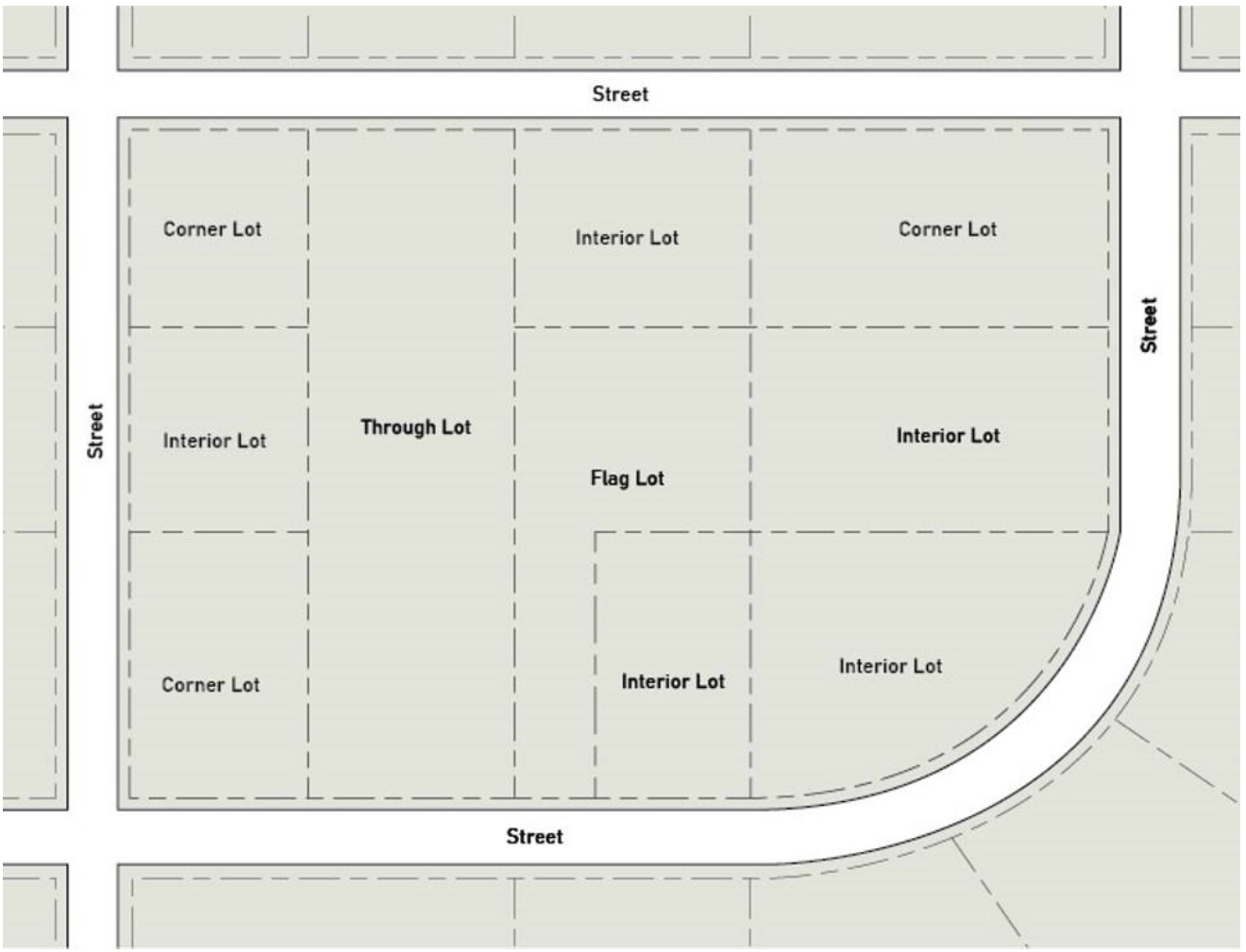
Figure 2-1. Lot Types
2.
Interior Lot. A lot other than a corner lot.
3.
Through Lot. A lot with frontage on two or more streets which does not meet the definition of a Corner Lot.
4.
Flag Lot. A lot where frontage to a public street is provided via a narrow strip of land forming a pole or stem to the buildable portion of the lot.
B.
Lot Depth
The distance between the front and rear lot lines measured in the general direction of the side lot lines.
C.
Front Lot Line
The front line of an interior lot separating the lot from the right-of-way. The front lot line of a corner lot is the lot line upon which the principal building entrance will front.
D.
Rear Lot Line
The lot line generally opposite and parallel to the front lot line.
E.
Lot Width
The distance between the side lot lines as measured at the front building line.
1.
Lot Width on a Non Cul-de-sac Street
a.
When the lot is served by an approved public or community water system as defined by the Hall County Health Department, lot width at the building line must be at least 75 feet in all districts.
b.
When the lot is served by an individual well, the lot width at the building line must be at least 150 feet in all districts
2.
Lot Width on a Cul-de-sac
Any lot that has at least 60 percent of its frontage on the turn-around portion of a cul-de-sac must have a frontage of at least 40 feet measured on the chord.
3.
Flag Lot Width
The minimum required lot frontage for each district must be maintained as the minimum lot width for that portion of the lot between the front property line and the building site on the lot, even if the building site is a greater distance from the front property line than the minimum required front yard.
F.
Exceptions to Lot Size Requirements
1.
Public Utility Systems
The minimum lot sizes do not apply to lots containing only structures that are part of public utilities systems and not designed to accommodate persons other than for periodic maintenance. Any such lot must be large enough to include the structure, parking and service areas, required buffers, and tree protection or landscaping requirements.
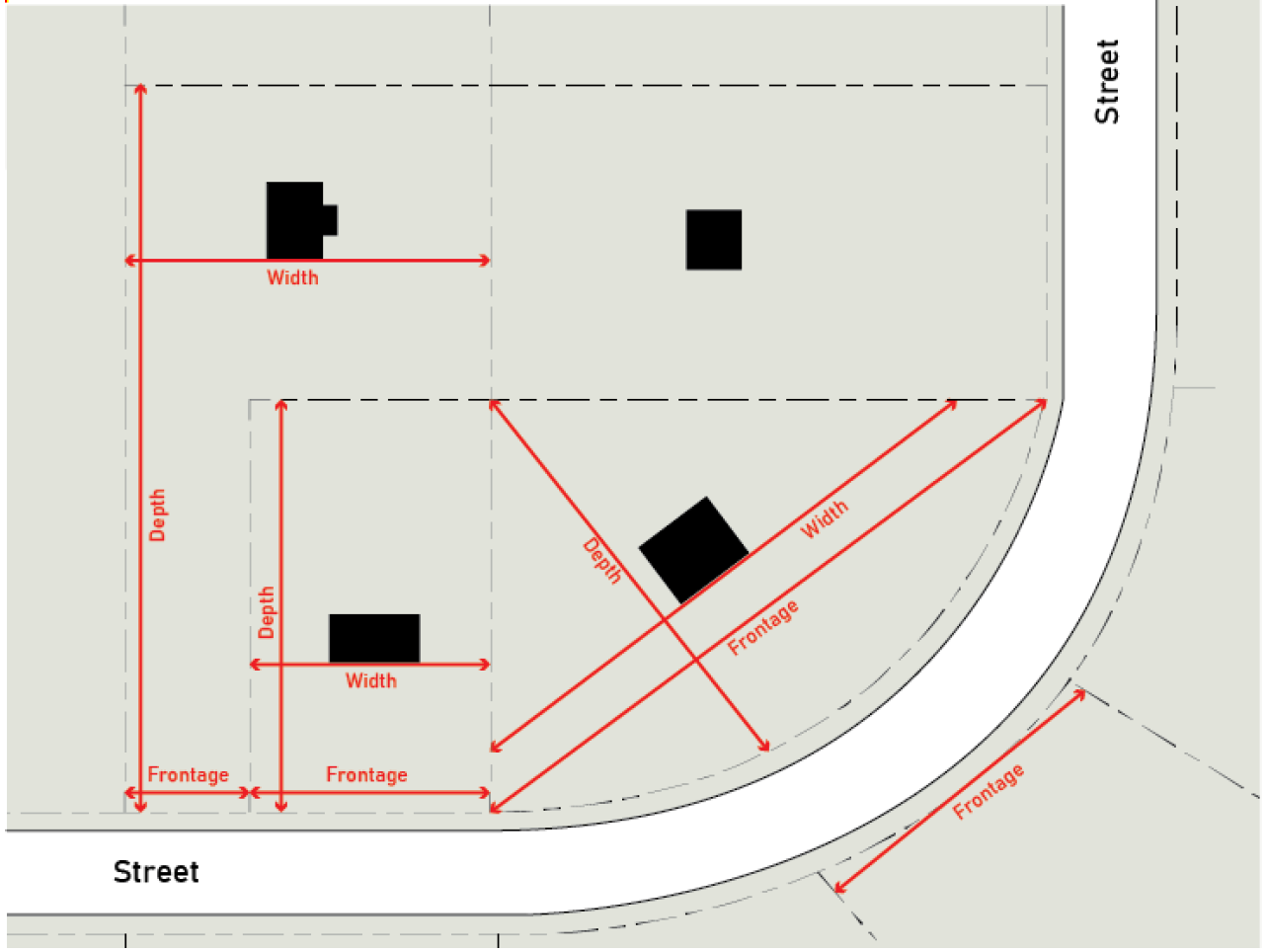
Figure 2-2. Lot Measurements
G.
Spite Strips and Access to Landlocked Property
1.
Spite strips are prohibited. A spite strip is a portion of a lot that runs for 60 feet or more along a public road with an average depth of the strip along the public road of less than 40 feet.
2.
Any landlocked lot of record which is served by an easement and which is within 100 feet of the public road where such easement originates or connects will be deemed to meet all road frontage requirements of this Code.
2.1.4. Yards
A.
Yard Related Definitions
1.
Yard. A required open space between a lot line and any principal or accessory building which is unoccupied and unobstructed from the ground upward except as authorized in Sec. 2.1.4.B. A yard requirement may also be referred to as a "setback."
2.
Yard, front. The yard between the front lot line and any principal or accessory structure extending the full width of the lot.
3.
Yard, rear. The yard between the rear lot line and any principal or accessory structure extending the full width of the lot.
4.
Yard, side. The yard between the side lot line and any principal or accessory structure extending from the front yard to the rear yard.
5.
Yard, corner lot. On corner lots in residential and agricultural districts, the side yard adjacent to the street must be at least 30 feet from the property line.
In all other districts the minimum side yard adjacent to the street must be the same as the front yard setback.
6.
Setback. A line beyond which no building or structure may be erected. Setbacks are determined under the provisions of this Unified Development Code establishing yard requirements.
B.
Encroachments into Yards
The following may encroach into required yards:
1.
Trees or plant material.
2.
Driveways or walkways.
3.
Fences or walls.
4.
Accessory structures less than 144 square feet in total floor area may be erected no less than 5 feet from side and rear property lines, except when constructed on a permanent foundation or serviced by electricity or plumbing.
5.
Swimming pools or spas, when constructed in-ground.
6.
Heating units, air conditioning units, and other HVAC equipment less than 42 inches in height.
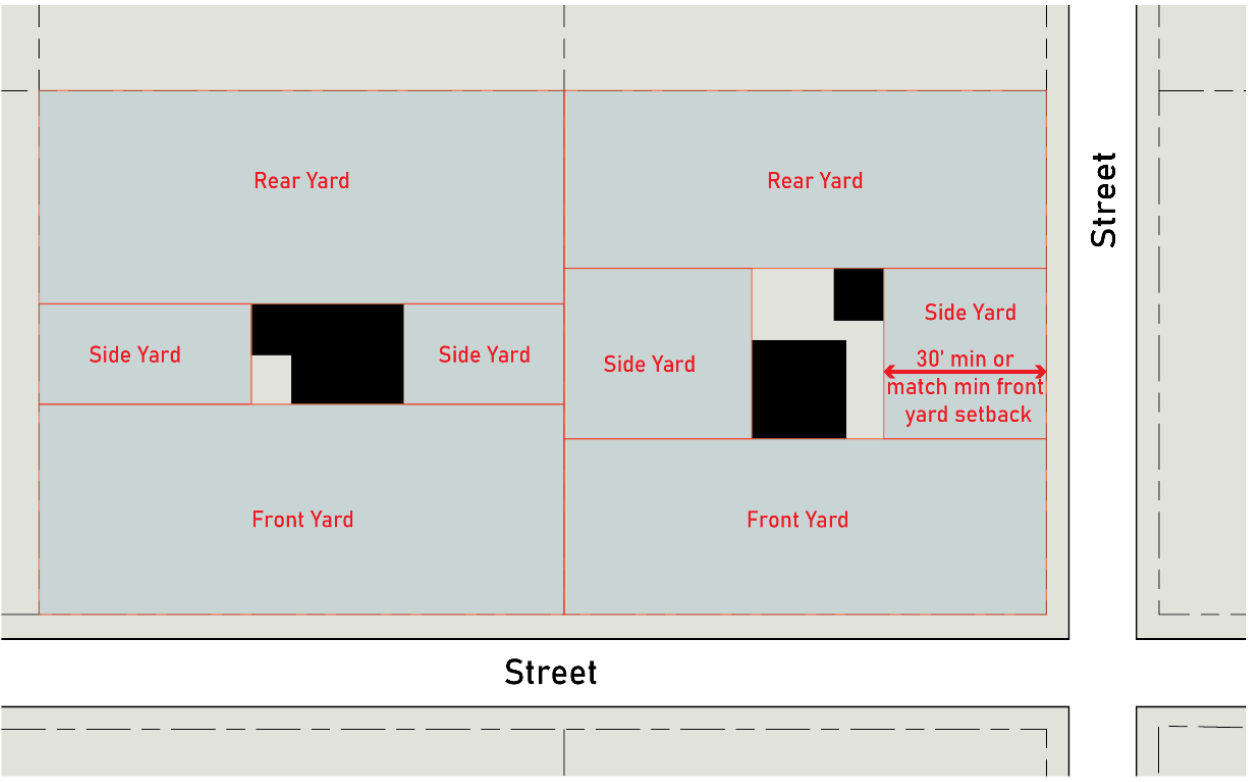
Figure 2-3. Yards
C.
Exceptions
1.
Average Front Yard for Residential Uses
a.
When the average front yard of nearby lots is developed with buildings that have front yards less than required by the zoning district, the minimum required front yard may be reduced to match the average existing front yard of such lots.
b.
The lots used to determine the average existing front yard above must meet each of the following conditions:
i.
Be within 100 feet of the subject lot (measured from the closest lot line to closest lot line); and
ii.
Be located on the same side of a street as the subject lot, between two intersecting streets; and
iii.
Be in the same zoning district as the subject lot; and
iv.
Not have been subject to an approved variance for a yard reduction as granted by the Planning Commission or Board of Commissioners.
2.
Lots Adjacent to Lake Lanier
The minimum yard requirements do not apply to side or rear yard property lines for residential lots which adjoin or abut the Corps of Engineers property line, provided that the sewage treatment system is located wholly on private property or is otherwise lawfully permitted by the county health department.
2.1.5. Floor Area
A.
Defined
The sum of finished and conditioned area on all floors within the exterior walls of a building. Floor area does not include unenclosed balconies, unenclosed porches, unenclosed stoops, unfinished attics (residential only), unfinished basements (residential only), garages, carports, or parking structures.
2.1.6. Building Height
A.
Defined
The vertical distance from the mean finished ground level at the front of the building to the highest point of a roof or parapet.
B.
Maximum Height
The maximum height is as established for the district in which the building is located.
C.
Exceptions
The maximum height limits of the applicable zoning district do not apply as follows:
1.
Telecommunication Uses. Telecommunication uses are subject to the height limits in Sec. 7.4.
2.
Other Building Elements. Elements common to buildings such as spires, belfries, cupolas, domes, monuments, water towers, observation towers, electrical transmission towers, chimneys, smokestacks, elevators, antennae, solar panels, flag poles, mast, and steeples may exceed the maximum district height.
3.
Agricultural Structures. Barns, silos, and similar structures customary for the bona fide agricultural use of a property, provided they do not exceed 50 feet in height.
Figure 2-4. Building Height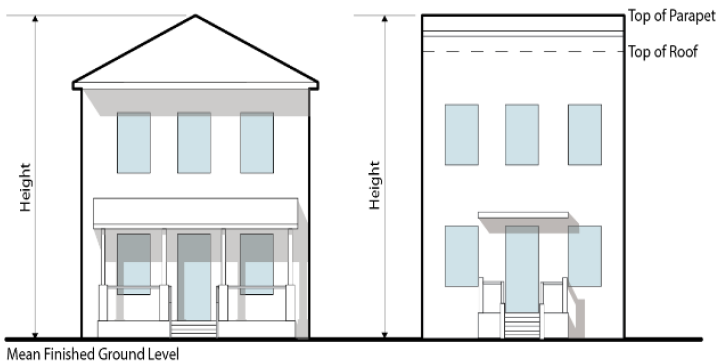
Sec. 2.2. - Design Standards
2.2.1. Standards for Single Family and Two-Family Dwellings
Unless specifically stated otherwise, all single-family and two-family dwellings, including site-built dwelling units, industrialized dwelling units, and manufactured homes, must meet the following standards in order to be constructed, assembled, moved into, or relocated within Hall County.
A.
Building Foundations
1.
The dwelling must be attached to a permanent foundation constructed in accordance with the Building Code or State regulations, as applicable.
2.
Upon placement all wheels, axles, and hitches must be removed.
3.
The area beneath the ground floor of the dwelling must be a slab foundation or be enclosed around the exterior of the dwelling with a foundation wall or curtain wall. Enclosures must be constructed of masonry at least 4 inches thick, penetrated by openings only for installed vents and access doors.
B.
Exterior Siding
Exterior siding materials may consist of any combination of wood, brick, stone, stucco, or similar materials, or lap siding of hardboard, cementitious siding, vinyl, vinyl-covered or painted metal, or similar materials.
C.
Roofs
1.
All roof surfaces must have a minimum pitch of 4:12 (four inches of rise for every 12 inches of run). Mansard and gambrel roofs must meet this requirement only for those surfaces that rise from the eaves.
2.
All roof surfaces exposed to view must be covered with asphalt or fiberglass shingles, wood shake or shingles, standing seam (noncorrugated) metal, corrugated metal that simulates standing seam or other architectural roof products, clay tiles, slate, or similar materials.
3.
The minimum roof overhang must be at least 6 inches, excluding gutters, along all sides of the dwelling.
D.
Minimum Dimensions and Floor Area
A dwelling unit must be at least 16 feet wide on all sides and must be at least 256 square feet in total floor area.
E.
Variances
The owner or other person interested in the property, may apply for a variance under the procedures provided by this UDC from the standards contained in this section for a single-family or two-family dwelling upon a finding that all of the following standards are met:
1.
The materials to be utilized or the architectural style proposed for the dwelling unit will be compatible and harmonious with existing dwellings in the vicinity; and
2.
Such variance will provide an adequate balance between the protection of the health, safety and welfare of the general public and the right to unfettered use of private property.
F.
Compliance with Codes
1.
All site-built dwelling units must be constructed in accordance with all applicable requirements of the Building Code as adopted by Hall County.
2.
All manufactured homes must meet the standards established by the National Manufactured Housing Construction and Safety Standards Act of 1974 (42 U.S.C. 5401, et. seq.).
3.
All industrialized dwelling units must comply with all applicable provisions of state law.
G.
Exemptions
Except as specifically excepted by this section, the standards of Sec. 2.2.1 will be applied to existing conditions as follows:
1.
Class B manufactured homes may be utilized in all existing manufactured home parks of 12 units or more that are designated as registered with the Department of Planning and Zoning, regardless of the underlying zoning of the existing manufactured home park.
2.
Existing legally permitted manufactured homes in zoning districts that allow Class A manufactured homes may be replaced with a Class B manufactured home that is no less conforming to the standards of Sec. 2.2.1 than the existing home to be replaced. Determination of conformity to said standards includes minimum dimension, roof pitch, roof overhang, foundation, and roof and siding material.
2.2.2. Standards for Property Along Divided Four-lane Highways
A.
All property abutting and proposing access from a divided four-lane highway, regardless of zoning classification, must be developed in conformance with the following minimum standards:
1.
Frontage
Lots created after January 11, 1982, which abut a divided four-lane highway must have at least 500 feet of frontage.
2.
Vehicular Access
a.
One vehicular access point per lot may be permitted provided that approval from the Georgia Department of Transportation must be obtained prior to the issuance of any permits for construction.
b.
Additional vehicular access points may be approved by the Planning Commission upon finding that:
i.
The additional access is essential to the use of the property; and
ii.
Alternative access from another road, joint access with adjoining property or the construction of a frontage road is not feasible; and
iii.
Additional access would not be detrimental to existing or proposed uses in the area; and
iv.
The Georgia Department of Transportation has approved or will approve the proposed access.
c.
The existence or approval of vehicular access for residential or agricultural purposes does not obligate or require the county or the Georgia Department of Transportation to approve access for a change in use to nonresidential or nonagricultural uses.
B.
If the property abutting the four-lane divided highway does not propose direct vehicular access to the highway, the property must meet the frontage requirements for the zoning district along another public right-of-way.

