
Hallandale Beach City Zoning Code
CHAPTER 25
STREETS, SIDEWALKS AND OTHER PUBLIC WAYS
ARTICLE II. - LAND IMPROVEMENT ON PUBLIC PROPERTY[2]
Cross reference— Minimum property maintenance and occupancy code, ch. 14.
ARTICLE IV. - COMMUNICATIONS RIGHTS-OF-WAY[4]
Editor's note— Ord. No. 2014-16, §§ 2, 3, adopted May 21, 2014, repealed the former Art. IV, §§ 25-115—25-131, and enacted a new Art. IV as set out herein. The former article pertained to similar subject matter and derived from Ord. No. 2001-23, §§ 1—17, 11-6-2001. See also the Code Comparative Table.
Sec. 25-1. - Building numbering.
(a)
System.
(1)
The centerline of Hallandale Beach Boulevard shall be taken as the basis of numbering from the north to the south and from the south to the north on a unit basis of 25 feet per number; and the buildings on the north and south avenues and highways which intersect that boulevard shall begin to be numbered at that boulevard and run north to the city limits and south to the city limits.
(2)
The centerline of Dixie Highway shall be taken as the basis of numbering from the east to the west and from the west to the east on a unit basis of 25 feet per number; and the buildings on the east and south streets, boulevards and courts which intersect that highway shall begin to be numbered at that highway and run east to the city limits and west to the city limits.
(3)
On the north avenues, highways and terraces, the odd numbers shall be placed on the west side; and on the east streets, courts and boulevards, the odd numbers shall be placed on the north side; and on the south avenues, highways and terraces, the odd numbers shall be on the east side; and on the west streets, courts and boulevards the odd numbers shall be on the south side, as they increase.
(b)
Adjusting and specifying numbers. Such numbers shall not be changed without the consent of the city manager; and it shall be the duty of the city manager to adjust such numbers, or to number such streets from time to time, if such numbering may be required.
(c)
Size and location of numbers. Each of the figures of each number shall be at least three inches in length, but so marked as to be easily and distinctly read. Numbers shall be placed on, above or immediately to the side of the door, or else at some other and more conspicuous place on the front of the building, to serve the purpose for which intended; and subject to the direction of the city manager.
(d)
Plats on file. For the purpose of facilitating a correct enumeration, plats of all streets, avenues, courts, terraces and highways within the city, showing the proper number of all lots or houses fronting upon all highways (except alleys) shall be prepared and kept on file in the office of the city clerk, which plats shall be open during regular office hours, for the inspection of any owner or occupant of any building desiring to know the proper number of his building.
(e)
Placement by owner or occupant. Any owner or occupant of any building now erected or that may hereafter be erected in the city who shall for 30 days after notice from the city manager of the proper number of such building neglect or refuse to number any building owned or occupied by him in conformity with the provisions of this chapter and with the plan for numbering buildings shall be subject to punishment as provided in section 1-8, for every 30 days that he shall neglect or refuse to number the building.
(f)
Objects in streets to be lighted.
(1)
Building materials, disabled machinery, disabled vehicles, excavations and objects in the streets and highways, between the period of sunset and sunrise, shall be properly identified by warning lights.
(2)
It shall be unlawful for any person to remove, change, extinguish or carry off any lantern, signal, sign, light, torch or other device placed on any street, highway or public place within the city to designate or mark obstructions or danger.
(Code 1980, §§ 25-1—25-6)
Sec. 25-2. - Vegetation, waste materials and objects in rights-of-way adjacent to private property.
(a)
Maintaining of vegetation by owner of abutting property; definitions.
(1)
All owners, lessees or other persons in charge of property within the city are required to maintain complete vegetative coverage of an approved grass species or other ground cover plantings approved by the city manager on the unpaved public right-of-way abutting their property. This maintenance responsibility includes the maintenance of grass, trees, shrubs, hedges, and/or any other approved landscape plantings; the replacement of dead plantings or grass; and the maintenance of the swale grading, including the filling of holes such as land-crab or snake holes. Grass must not exceed a height of six inches.
(2)
Landscaping located on private property shall not obstruct or hinder pedestrian or vehicular traffic by encroaching on or over public sidewalks, alleys, streets or other public ways.
(3)
For the purposes of this subsection and subsections (b)—(f) of this section, the term "property owner" means the persons shown on the county real estate tax records as the owner of the property, and the term "public right-of-way" means the paved and unpaved area of a highway, roadway, street or alley, or other such strip of land, reserved for public use, whether established by prescription, easement, dedication, gift, purchase, eminent domain or any other legal means.
(b)
Removal of waste material by owners of abutting property. All property owners within the city are required to remove all waste material, junk or other debris from the public right-of-way abutting their property. If after the passage of 24 hours following notification of a violation, waste material, junk or other debris has not been removed, the city may remove such materials and charge and collect from the property owner its costs incurred.
(c)
Placement of shrubbery, signs, tree trimmings by owner of abutting property. It is prohibited to have signs, tree trimmings, refuse and all other articles or materials within the public right-of-way.
(d)
Maintenance of driveway and other entrances by owner of abutting property. It shall be the responsibility of the owner of the property whose driveway or other entrance to his property intersects the public right-of-way to maintain the driveway or other entrance, including, without limitation, that portion which is on the public right-of-way.
(e)
Exclusions. The prohibitions contained in subsections 25-2(a)—(d) of this section shall not apply in the following situations:
(1)
Properly packaged trash, waste material, refuse and other articles may be placed on the unpaved public right-of-way no more than 24 hours before the next scheduled pickup.
(2)
Property owners are not required to maintain the paved surface of the public streets.
(3)
Property owners may place mailboxes in the unpaved public right-of-way provided that no such mailbox exceeds 23½ inches in length, 11½ inches in width, or 13½ inches in height, and no horizontal cross section of a pedestal supporting a mailbox exceeds one square foot in area.
(4)
Vehicular parking in the public right-of-way shall be governed by other applicable laws, ordinances or regulations; however, in those cases where parking in the right-of-way is permitted, wheel stops may be used.
(5)
The prohibitions against placing or maintaining any object or material in the public right-of-way shall not apply to the city or its authorized agents, nor shall they apply to franchised public utilities operating within the scope of their easements or franchises.
(6)
Subject to the issuance of a landscape permit prior to installation, the following may be placed in the public right-of-way:
a.
Shrubbery and hedges may be placed in the public right-of-way no closer than five feet from the roadway in all zoning districts. Vision clearance shall be maintained as required in article IV, division 8 of chapter 32.
b.
Trees may be placed in the public right-of-way, provided they are not on the list of prohibited species of trees that are injurious to the public and determined to create a possible nuisance, safety hazard or damage to public property as maintained by the city manager or designee. Vision clearance shall be maintained as required in article IV, division 8 of chapter 32.
(7)
Sprinkler systems may be placed in the public right-of-way no closer than ten feet from the roadway.
(8)
Dome-shaped decorative markers, also known as button markers, may be placed in the public right-of-way, provided that such markers have rounded surfaces and no straight edges and are separated by a minimum of two feet.
(9)
Columns, light posts or planters may be placed in the public right-of-way in single-family zoning districts, provided that such objects are no closer than ten feet from the roadway and provided that such items shall not be placed between a public sidewalk and roadway.
(10)
Items which are permitted to encroach by this section but do not do so in conformity with this section, and were in existence prior to April 15, 1986, may remain, provided they do not violate the vision clearance requirements of section 32-384(g) or the prohibition from placing items in the right-of-way between a public sidewalk and the roadway contained in subsection (e)(10) of this section. This subsection shall not be deemed to permit encroachment or installation subsequent to April 15, 1986, of prohibited items, which items shall be deemed illegal and subject to immediate removal.
(f)
Risk and responsibility of abutting property owner for shrubbery, hedges, trees, sprinkler systems, columns, light posts, planters, and button markers; performance by city; assessment of costs against property.
(1)
Shrubbery, hedges, trees, sprinkler systems, columns, light post, planters and button markers authorized in subsection (e) of this section are placed in the public right-of-way at the risk of the abutting property owner.
(2)
It shall be the responsibility of the abutting property owner to maintain all such shrubbery, hedges, trees, sprinkler systems, columns, light posts, planters, and button markers.
(3)
If the city or another governmental entity, or a public utility operating within the scope of its easement, determines that any encroaching item, including but not limited to shrubbery, hedge, tree, sprinkler system, column, light post, planter, or button marker that was placed in the public right-of-way must be removed or modified, it shall be the duty of the abutting property owner to remove or modify the item and to bear all associated costs, including the costs of replacement if desired. A tree removal permit in compliance with chapter 29 of this Code shall be obtained prior to the removal of any tree.
(4)
If the city directs the abutting property owner to remove or modify, within a prescribed period of time, any encroaching item, including but not limited to any shrubbery, hedge, tree, sprinkler system, column, light post, planter, or button marker placed in the public right-of-way, and the owner fails or refuses to comply with such directive, the city may cause the work to be done and assess the costs as a charge and lien against the property.
(Code 1980, §§ 25-7—25-12; Ord. No. 2024-012, § 1, 5-15-2024)
DIVISION 2. - SIDEWALKS[3]
Editor's note— Ord. No. 2016-24, §§ 2, 3, adopted Dec. 21, 2016, repealed the former Div. 2, §§ 25-61—25-73, and enacted a new Div. 2, §§ 25-61—25-68, as set out herein. The former division pertained to similar subject matter and derived from Code 1980, §§ 25-40—25-51.1.
Sec. 25-101. - Application of article.
The procedures set forth in this article shall apply to vacation of streets, alleyways, roads and rights-of-way located in the city, whether or not designated as part of the county road system or of the state or federal highway systems, and shall also apply to vacation or release of easements or similar interests.
(Code 1980, § 25-52)
Sec. 25-102. - Petition for vacation.
(a)
Persons owning property adjacent to or subject to a street or road right-of-way or easement may petition to vacate such street or road right-of-way or easement by submitting to the city a petition. The petition shall include the following:
(1)
Legal description of the street, right-of-way or easement to be vacated.
(2)
Certified survey prepared within a year of the petition and certified to the city by a registered surveyor or engineer licensed in the State of Florida showing the street, right-of-way, easement, or portion sought to be vacated, accompanied by a plat, map or drawing that also shows the general area involved and the location of the specific property interest.
(3)
The name and address of the petitioner, and a current certificate of a duly licensed title or abstract company or of a licensed attorney showing that the petitioner is the owner of property adjacent to or subject to a street, right-of-way or easement. Warranty deeds, title insurance documents, tax receipts or the like shall not be acceptable for the purposes of this subsection.
(4)
The reason for the requested vacation of street, right-of-way or easement, and explanation of why it is in the public good.
(5)
The names and addresses of the owners of record of real property bounding and abutting the street, right-of-way or easement the petitioner seeks to have vacated, and all owners of record of property located within 1,000 feet in all directions from any point of the street, right-of-way or easement proposed to be vacated. The property owners of record shall be deemed to be those shown on the current tax assessment roll of the city.
(6)
Letters of consent and/or releases from all affected utilities, including but not limited to city-owned water, sewer, and stormwater utilities, Florida Power and Light, AT&T, Comcast and other telecommunications companies, as may be applicable, stating that said utility company will release any interest in the vacated street, right-of-way or easement.
(7)
An application fee per street, right-of-way or easement to be vacated. Such fee is established and on file in the city clerk's office.
(8)
Existing utilities or improvements, if any, in the area involved. If utilities and improvements need to be relocated, all details regarding such relocation shall be identified, including dedication of new easements including legal descriptions and surveys.
(9)
Petitioner proposed mitigation plan designed to offset any potential impacts which may be caused by the requested vacation of street, right-of-way, or easement, including but not limited to proposed alternative rights-of-way or easements.
(10)
Such other relevant information as the city may require.
The petition shall be signed by the petitioner, who shall verify under oath that the information contained therein is true and correct.
(b)
City-initiated requests for vacation: The submission of a petition and fee are not required for city-initiated applications. City-initiated applications shall otherwise be reviewed and processed in accordance with the provisions of this article, and granted or denied by the city commission.
(Code 1980, § 25-53; Ord. No. 2019-003, § 2, 1-23-2019)
Sec. 25-103. - Review of request for vacation.
(a)
Upon submission of a properly completed petition for vacation, and review for completeness from city administration, including but not limited to the development services department and public works department, notice of a proposed city commission meeting to consider the vacation shall be given by certified mail by the city clerk to any property owner adjoining or abutting the street, right-of-way or easement sought to be vacated at the address, as reflected on the most recent tax rolls. Failure by any person to receive such notice shall not invalidate any action taken by the city commission in respect to a petition for vacation.
(b)
The city commission shall determine whether the requested vacation would be in the interest of the public good. The following criteria shall be considered in determining whether to grant or deny a vacation of right-of-way:
(1)
Whether the public benefits from the use of the subject street, right-of-way, or easement as part of the city street system;
(2)
Whether the proposed action is consistent with the city's comprehensive plan;
(3)
The availability of alternative action to alleviate the identified problems, if any, related to the vacation;
(4)
The effect of the proposed action upon traffic circulation;
(5)
The effect of the proposed action upon the safety of pedestrians and vehicular traffic;
(6)
The effect of the proposed action upon the provision of municipal services, including, but not limited to, emergency services and waste removal;
(7)
The mitigation plan proposed by the applicant to offset any potential impacts; and
(8)
The testimony, if any, of property owners within a 1,000-foot radius of the right-of-way that is the subject of the application.
(c)
At the conclusion of the hearing, the city commission shall by resolution accept, modify, or deny the petition in accordance with the standards set forth in this section and based on the best interests of the public welfare. The city commission shall deny the petition if the evidence does not support that it would be in the best interest of the public. The petition may also be denied if the primary reason for the vacation of the street, right-of-way, or easement is to provide a benefit for the applicant or adjacent property owners. The city commission may attach conditions to an approval including, but not limited to, access and utility easements, maintenance and landscaping requirements, and construction of any facilities or exchange of other property for the vacation. Upon adoption of a resolution approving the petition, a certified copy of same shall be filed in the public records of the county. If the approval of other governmental bodies is necessary for such vacation, such approval shall not be final until all other governmental bodies have approved such vacations. The costs of all notices and recording required pursuant to the provisions of this article shall be borne by the applicant.
(Code 1980, § 25-54; Ord. No. 2013-01, § 1, 1-14-2013; Ord. No. 2019-003, § 2, 1-23-2019)
Sec. 25-115. - Title.
This article shall be known and may be cited as the City of Hallandale Beach Communications Rights-of-Way Ordinance.
(Ord. No. 2014-16, § 3, 5-21-2014)
Sec. 25-116. - Intent and purpose.
It is the intent of the city to promote the public health, safety, aesthetics, and general welfare of the city by providing for the placement or maintenance of communications facilities and personal wireless service facilities in the public rights-of-way within the city; adopting and administering reasonable rules and regulations not inconsistent with state and federal law, including F.S. § 337.401, as it may be amended, city's home-rule authority, and in accordance with the provisions of the Federal Telecommunications Act of 1996 and other federal and state law; establishing reasonable rules and regulations necessary to manage the placement or maintenance of communications facilities and personal wireless service facilities in the public rights-of-way by all communications services providers; and minimizing disruption to the public rights-of-way.
(Ord. No. 2014-16, § 3, 5-21-2014)
Sec. 25-117. - Definitions.
For the purposes of this article, the following terms, phrases, words, and abbreviations shall have the meanings given herein, unless otherwise expressly stated. When not inconsistent with the context, words used in the present tense include the future tense; words in the plural number include the singular number; and words in the singular number include the plural number; and the masculine gender includes the feminine gender. "And" and "or" may be read conjunctively or disjunctively. The words "shall" and "will" are mandatory, and "may" is permissive. Unless otherwise expressly stated, words not defined in this chapter shall be given the meaning set forth in 47 USC, and, if not defined therein, their common and ordinary meaning. References to governmental entities (whether persons or entities) refer to those entities or their successors in authority. If specific provisions of law referred to herein are renumbered, then the reference shall be read to refer to the renumbered provision. References to laws, ordinances or regulations shall be interpreted broadly to cover government actions, however nominated, and include laws, ordinances and regulations now in force or hereinafter enacted or amended.
Abandonment. The permanent cessation of all uses of a communications facility; provided that this term shall not include cessation of all use of a facility within a physical structure where the physical structure continues to be used. For example, cessation of all use of a cable within a conduit, where the conduit continues to be used, shall not be "abandonment" of a facility in public rights-of-way.
City. The City of Hallandale Beach, Florida.
Communications facility orfacility orsystem. Any permanent or temporary plant, equipment or property, including but not limited to cables, wires, conduits, ducts, fiber optics, poles, antennae, converters, splice boxes, cabinets, hand holes, manholes, vaults, drains, surface location markers, appurtenances, and other equipment or pathway placed or maintained or to be placed or maintained in the public rights-of-way of the city and used or capable of being used to transmit, convey, route, receive, distribute, provide or offer communications services.
Communication services. The transmission, conveyance or routing of voice, data, audio, video, or any other information or signals to a point, or between or among points, by or through any electronic, radio, satellite, cable, optical, microwave, or other medium or method now in existence or hereafter devised, regardless of the protocol used for such transmission or conveyance, and as defined in F.S. § 202.11. Notwithstanding the foregoing, for purposes of this chapter, "video service", as defined in F.S. § 202.11, as it may be amended, is not included in the definition of communications services. Communications to remotely facilitate, monitor, or control the distribution or transmission of electricity by an electric utility are also not included in the definition of communications services.
Communications services provider. Any person providing communications services through the placement or maintenance of a communications facility in public rights-of-way. "Communications Services Provider" shall also include any person that places or maintains a communications facility in public rights-of-way but does not provide communications services.
FCC. The Federal Communications Commission.
In public rights-of-way or in the public rights-of-way. In, on, over, under or across the public rights-of-way.
Ordinance. This ordinance and the provisions of this article.
Person. Any individual, children, firm, association, joint venture, partnership, estate, trust, business trust, syndicate, fiduciary, corporation, organization or legal entity of any kind, successor, assignee, transferee, personal representative, and all other groups or combinations, and shall include the city to the extent the city acts as a communications services provider.
Personal wireless services means commercial mobile services, unlicensed wireless services and common carrier wireless exchange access services, and shall include "wireless service" as defined in F.S. § 365.172, as well as "personal wireless services" defined in 47 USC Section 332(c)(7)(C)(i), as they may be amended from time to time. Notwithstanding the foregoing, for purposes of this chapter, "video service", as defined in F.S. § 202.11, as it may be amended, is not included in the definition of personal wireless services. Personal wireless services shall not include any form of surveillance by photography, wireless communication, or other form of transmission.
Personal wireless services facilities means facilities for the provision of personal wireless services, and, for the purposes of this section shall include all of those "wireless communication facilities" as defined in F.S. § 365.172, as it may be amended, that are not also communication towers as defined by chapter 32 of the city's Code of Ordinances. Facilities used for communications to remotely facilitate, monitor, or control the distribution or transmission of electricity on electric infrastructure are not included in the definition of personal wireless services facilities. Personal wireless service facilities shall not be used to provide for any form of surveillance or photography through wireless communication or other form of transmission.
Place or maintain or placement or maintenance or placing or maintaining. To erect, construct, install, maintain, grade, excavate, place, repair, extend, replace, expand, remove, occupy, locate or relocate. A communications services provider that owns or exercises physical control over communications facilities in public rights-of-way, such as the physical control to maintain and repair, is "placing or maintaining" the facilities. A party providing service only through resale or only through use of a third party's unbundled network elements is not "placing or maintaining" the communications facilities through which such service is provided. The transmission and receipt of radio frequency signals through the airspace of the public rights-of-way does not constitute "placing or maintaining" facilities in the public rights-of-way.
Public rights-of-way. A public right-of-way, public utility easement, public highway, street, lane, bridge, sidewalk, road, waterway, tunnel, alley, or similar property for which the city is the authority that has jurisdiction and control and may lawfully grant access to such property pursuant to applicable law, and includes the surface, the air space over the surface and the area below the surface to the extent the city holds a property interest therein. "Public rights-of-way" shall not include private property. "Public rights-of-way" shall not include any real or personal city property except as described above and shall not include city buildings, fixtures, poles, conduits, facilities or other structures or improvements, regardless of whether they are situated in the public rights-of-way. No reference herein, or in any permit, to public rights-of-way shall be deemed to be a representation or guarantee by the city that its interest or other right to control the use of such property is sufficient to permit its use for such purposes, and a registrant shall be deemed to gain only those rights to use as are properly in the city and as the city may have the undisputed right and power to give.
Registrant. A communications services provider or other person that has registered with the city in accordance with the provisions of this article.
Registration orregister. The process described in this article whereby a communications services provider provides certain information to the city.
Stealth facility. Any communications facility which is designed to blend into the surrounding environment. Examples of stealth facilities include architecturally screened roof-mounted antennas, antennas integrated into architectural elements, poles in the rights-of-way that are designed to look like light poles, and telecommunications towers designed to look like light poles, power poles, or trees.
(Ord. No. 2014-16, § 3, 5-21-2014)
Sec. 25-118. - Registration for placing or maintaining communications facilities in public rights-of-way.
(a)
A communications services provider that desires to place or maintain a communications facility in public rights-of-way in the city shall first register with the city in accordance with this section. Subject to the terms and conditions prescribed in this section, a registrant may place or maintain a communications facility in public rights-of-way. A communications services provider with an existing communications facility in the public rights-of-way of the city as of the effective date of this article shall comply with this article within 60 days from the effective date of this article, including, but not limited to, registration, or be in violation hereof.
(b)
A registration shall not convey any title, equitable or legal, to the registrant in the public rights-of-way. Registration under this section governs only the placement or maintenance of communications facilities in public rights-of-way. Registration does not excuse a communications services provider from obtaining appropriate access or pole attachment agreements before locating its facilities on the city's or another person's facilities. Registration does not excuse a communications services provider from complying with all applicable city ordinances, codes or regulations, including this chapter.
(c)
Each communications services provider that desires to place or maintain a communications facility in public rights-of-way in the city shall file a single registration with the city which shall include the following information:
(1)
Name of the applicant;
(2)
Name, address and telephone number of the applicant's primary contact person in connection with the registration and the person to contact in case of an emergency;
(3)
Evidence of the insurance coverage required under section 25-126 of this chapter and acknowledgment that registrant has received and reviewed a copy of this article;
(4)
A copy of the applicant's certificate of authorization or local business tax receipt to provide communications services issued by the Florida Public Service Commission, the Federal Communications Commission, or other federal or state authority, if any;
(5)
For an applicant that does not provide a Florida Public Service Commission certificate of authorization number, if the applicant is a corporation, proof of authority to do business in the State of Florida, including the number of the certificate of incorporation; and
(6)
A security fund in accordance with section 25-129 of this chapter.
(d)
The city manager, or his or her designee shall review the information submitted by the applicant. If the applicant submits information in accordance with division (c) above, the registration shall be effective and the city shall notify the applicant of the effectiveness of registration in writing. If the city determines that the information has not been submitted in accordance with division (c) above, the city shall notify the applicant of the non-effectiveness of registration, and reasons for the non-effectiveness, in writing. The city shall so reply to an applicant within 30 days after receipt of registration information from the applicant.
(e)
A registrant may cancel a registration upon written notice to the city stating that it will no longer place or maintain any communications facilities in public rights-of-way within the city and will no longer need to obtain permits to perform work in public rights-of-way. A registrant cannot cancel a registration if the registrant continues to place or maintain any communications facilities in public rights-of-way.
(f)
Registration shall not in itself establish any right to place or maintain or priority for the placement or maintenance of a communications facility in public rights-of-way within the city, but shall establish for the registrant a right to apply for a permit, if permitting is required by the city. Registrations are expressly subject to any future amendment to or replacement of this chapter and further subject to any additional city's ordinances, as well as any state or federal laws that may be enacted.
(g)
A registrant shall renew its registration with the city by April 1 of even numbered years in accordance with the registration requirements in this chapter, except that a registrant that initially registers during the even numbered year when renewal would be due or the odd numbered year immediately preceding such even numbered year shall not be required to renew until the next even numbered year. Within 30 days of any change in the information required to be submitted pursuant to division (c), a registrant shall provide updated information to the city. If no information in the then-existing registration has changed, the renewal may state that no information has changed. Failure to renew a registration may result in the city restricting the issuance of additional permits until the communications services provider has complied with the registration requirements of this section.
(h)
In accordance with applicable city ordinances, codes or regulations and this chapter, a permit shall be required of a communications services provider that desires to place or maintain a communications facility in public rights-of-way. An effective registration shall be a condition precedent to obtaining a permit. Notwithstanding an effective registration, permitting requirements shall continue to apply. A permit may be obtained by or on behalf of a registrant having an effective registration if all permitting requirements are met.
(i)
A registrant that places or maintains communications facilities in the public rights-of-way shall be required to pay compensation to the city as required by applicable law and ordinances of the city.
(Ord. No. 2014-16, § 3, 5-21-2014)
Sec. 25-119. - Transfer, sale or assignment of assets in public rights-of-way.
(a)
If a registrant transfers, sells or assigns its assets located in public rights-of-way incident to a transfer, sale or assignment of the registrant's assets, the transferee, buyer or assignee shall be obligated to comply with the terms of this article. Written notice of any such transfer, sale or assignment shall be provided by such registrant to the city within 24 days after the effective date of the transfer, sale or assignment. If the transferee, buyer or assignee is a current registrant, then the transferee, buyer or assignee is not required to re-register. If the transferee, buyer or assignee is not a current registrant, then the transferee, buyer or assignee shall register as provided in section 25-118 of this chapter within 60 days of the transfer, sale or assignment. If permit applications are pending in the registrant's name, the transferee, buyer or assignee shall notify the engineering division that the transferee, buyer or assignee is the new applicant.
(b)
Any encumbrance on the communications facilities of the registrant in the public rights-of-way shall be subject and subordinate to the rights of the city under this article and applicable law.
(Ord. No. 2014-16, § 3, 5-21-2014)
Sec. 25-120. - Placement or maintenance of a communications facility or personal wireless service facility in public rights-of-way.
(a)
Registrant shall at all times comply with and abide by all applicable provisions of state, federal and local law and city ordinances, codes and regulations including but not limited to section 25-136 of this Code, as amended, in placing or maintaining a communications facility or a personal wireless service facility in public rights-of-way.
(b)
To the extent not otherwise prohibited by state or federal law, the city shall have the power to prohibit or limit the placement of new or additional communications facilities and personal wireless service facilities within a particular area of public rights-of-way. The city shall have the power to prohibit or limit the placement of new or additional communications facilities and personal wireless service facilities within the public rights-of-way if there is insufficient space to accommodate all of the requests to place and maintain facilities in that area of the public rights-of-way, for the protection of existing facilities in the public rights-of-way or to accommodate city plans for public improvements or projects that the city determines are in the public interest.
(c)
All safety practices required by applicable law or accepted industry practices and standards shall be used during the placement or maintenance of communications facilities and personal wireless service facilities.
(d)
Personal wireless service facilities located in the public rights-of-way must meet the following minimum standards:
(1)
Required approvals. No application for placement of personal wireless service facilities in the public rights-of-way shall be permitted without approval of the building division, the public works department, and the planning and zoning division.
(2)
a.
Because an antenna must be placed above-ground in order to transmit and receive signals, an applicant proposing placement of an antenna in the public rights-of-way, except in the case of a co-location, shall submit an application for approval through the planning and zoning division as a non-quasi-judicial action before the planning and zoning board. The application shall consist of the following:
1.
Application form provided by the city accompanied by the required application fee;
2.
Copy of current business tax receipt;
3.
A scaled site plan depicting an area within a 600-foot radius from the center of the proposed personal wireless service facility, and showing the proposed antennas, equipment, related infrastructure, sidewalks, all existing utilities, antennas, towers, stealth facilities, the right-of-way boundaries, wireless communications facility boundary, road improvements, all ingress and egress to nearby streets, major vegetation, required grading, existing and proposed elevations, easements, and other significant features of the site.
4.
Certification signed by applicant confirming the distance separation from other personal wireless service facilities.
b.
No building permit shall be issued by the building division and no engineering permit shall be issued by the public works department prior to the approval of a development plan where required pursuant to this division (d).
(3)
Completeness review; time limitation. The city shall grant or deny a properly completed application for personal wireless service facilities in the public rights-of-way within 90 days or, as required by federal and state law, after the date the application is determined to be properly completed. An application is deemed submitted or resubmitted on the date the application is received by the planning and zoning division. The planning and zoning division shall notify the applicant within 20 days after the date the application is initially submitted or additional information resubmitted, whether the application is properly completed in compliance with the city's requirements. If the application is not completed in compliance with the city's requirements, the planning and zoning division shall so notify the applicant in writing indicating with specificity any deficiencies which, if cured, make the application properly completed. Upon resubmission of information to cure the stated deficiencies, the planning and zoning division shall notify the applicant, in writing, no later than 20 days after the additional information is submitted, of any remaining deficiencies that must be cured. If a specified deficiency is not properly cured when the applicant resubmits its application to comply with the notice of deficiencies, the planning and zoning division may continue to request the information until such time as the specified deficiency is cured, or may establish a reasonable time frame within which the required information to cure the application deficiency is to be provided. If the curative information is not provided within such time frame, the application will be considered withdrawn or closed.
(4)
Co-location or use of stealth facilities. An antenna in the public right-of-way, shall to the extent possible, be co-located on an existing power, light or other utility pole. When co-location of an antenna is not possible, a free standing stealth facility is preferred. For co-locations, the applicant shall submit an application to the city's building division for approval.
(5)
Statement. A statement or statements shall be submitted certifying that the construction of personal wireless service facilities proposed to be located in the public rights-of-way will comply with applicable standards as set forth in the Florida Building Code, Broward County latest edition, the State of Florida Department of Transportation, Manual of Uniform Minimum Standards for Design, Construction and Maintenance for Streets and Highways, and applicable electrical codes; and describing the proposed personal wireless service facilities' capacity to permit multiple users, including an example of the number and type of antennas or other attachments that can be accommodated on support structures. No personal wireless service facility which exceeds its support structure's loading capacity, which causes any pole or structure to exceed its loading capacity or which does not conform to applicable electrical codes shall be permitted in the public rights-of-way.
(6)
Dimensional limits for cabinets, boxes and vaults. No permit or order shall be granted authorizing the placement, construction or modification in the public rights-of-way of a personal wireless service facility cabinet, box or vault having a total volume exceeding 24 cubic feet (24 ft 3 ), unless the applicant provides a statement explaining the need for the greater proposed dimensions and certifying that current technology provides no alternative consistent with the dimensional requirements of this division (d)(6).
a.
Height, setbacks and related location requirements.
1.
The height of a new personal wireless service facility in the public right-of-way to which an antenna is attached shall not exceed the height of existing poles or structures in the public rights-of-way within 100 feet of such proposed new personal wireless service facility, or if no such existing poles are present in the public rights-of-way within 100 feet of such proposed new personal wireless service facility, the new personal wireless service facility shall be a minimum of 20 feet in height, and not exceed a height of 50 feet. Height shall be measured from the crown of the road of the nearest public street.
2.
Except as otherwise provided herein, personal wireless service facilities in the public rights-of-way shall conform to the standards and requirements set forth in the Florida Building Code, Broward County latest edition and the State of Florida Department of Transportation Manual of Uniform Minimum Standards for Design, Construction and Maintenance for Streets and Highways.
3.
No antenna attached to a free-standing pole in the public rights-of-way, other than as a co-location with an existing power, light or other utility pole, or unless installed as a stealth facility, shall be permitted within 50 feet of any principal residential structure.
4.
A box or cabinet housing the equipment connected to an antenna attached to a free-standing pole in the public rights-of-way shall be placed on the ground instead of attached to the pole supporting the antenna, and shall be screened from view.
b.
Antennas.
1.
Each application for a personal wireless service facility, other than for co-location, shall contain a rendering or photograph of the proposed antenna which depicts its aesthetic features including, but not limited to, the use of colors and screening devices. The application shall be subject to administrative review regarding consistency with the requirements of this section. The city manager, or his/her designee, may require, to the extent possible, that aesthetic features including but not limited to, the use of colors and screening devices, be used so that antennas blend into the surrounding environment.
2.
No signals, lights, or illumination shall be permitted on an antenna or, except in the case of a light pole or a stealth facility designed to emulate a light pole, on a pole to which such antenna is attached, unless required by applicable state or federal laws or rules.
3.
Antennas shall be mounted at a height and location that will not interfere with use of the public rights-of-way.
4.
No exterior antenna in the public rights-of-way shall exceed the height of the pole to which it is attached unless it is attached as a co-location to an existing power, light or other utility pole or on a pole designed to emulate a light pole.
5.
No antenna shall be mounted more than four inches from the pole to which it is attached unless it is attached as a co-location to an existing power, light or other utility pole.
6.
Exterior looping of excess cable length installed on any personal wireless service facility located in the public right-of-way is prohibited.
7.
Distance between antenna locations/number of antenna locations within a specified area. To minimize the adverse visual impacts associated with the proliferation and clustering of antennas and associated above-ground personal wireless service facilities, no antenna site in the public rights-of-way shall be located within 600 feet of any other such antenna site or telecommunications tower. Further, no more than 13 antenna sites may be located within an area of one square mile (one mi 2 ). This division (d)(6)(b)(7) shall not apply to any antenna co-located on an existing power, light or other utility pole within the public rights-of-way.
c.
Co-locations. For the purposes of this section, "co-location" means the mounting or installation of an antenna on an existing power, light or other utility pole for the purpose of transmitting and/or receiving radio frequency signals for communications purposes. In any co-location, the existing power, light or other utility pole may be modified or replaced to accommodate the new attachment, provided however that the modified or replacement pole complies with the height, setback and related location requirements, unless such requirements are waived. For the purposes of this section, an existing power, light or other utility pole modified or replaced to accommodate a new attachment shall continue to be considered an existing pole after replacement or modification.
d.
Approval required from other governmental agencies and owners. Each application for the location of a personal wireless service facility in the public rights-of-way may be required to include written approval, or a statement of no objection, from state agencies that regulate siting, design, and construction of such facilities, or have jurisdiction over the public rights-of-way, if any such agencies require the applicant to seek their review or approval. An existing facility in the public rights-of-way shall only be utilized in a manner consistent with the City Code and with the written permission of the facility owner.
e.
FCC emissions standards. All personal wireless service facilities in the public rights-of-way shall comply with current radio frequency emissions standards of the Federal Communications Commission.
f.
Buffering.
1.
Except in the case of an application for a co-location, as a condition of approval the city manager, or his/her designee may require the use of a fence as a buffer that is consistent in design and function with existing fencing used in the public rights-of-way.
2.
Except in the case of an application for a co-location, as a condition of approval the city manager, or his/her designee, may require the use of landscaping as a buffer, which landscaping is consistent with the landscaping otherwise located in the public rights-of-way. Additional landscaping may be required if deemed necessary to buffer adjacent properties. The city manager, or his/her designee, may require landscaping in excess of the requirements of the City Code to enhance compatibility with adjacent residential and nonresidential land uses.
3.
All buffering required in connection with the use of personal wireless service facilities in the public rights-of-way shall be maintained by the owner of such facilities at its own cost.
g.
Equipment. The location in the public rights-of-way of any equipment or equipment cabinets associated with personal wireless service facilities shall be subject to the approval of the city engineer. Any such cabinets or equipment must be approved by the city engineer as to safety, and shall not interfere with the use of the public rights-of-way. The city engineer may require a statement certifying the need for the proposed equipment and location. No generators utilized in connection with personal wireless services facilities may be placed in the public rights-of-way, except temporarily in the case of emergency and if approved in advance by the city engineer.
h.
Signs and advertising. The use of any portion of a personal wireless service facility in the public rights-of-way for the posting of signs or for advertising purposes, including, but not limited to the display of lights, banners and streamers is strictly prohibited. For purposes of emergency contact, the owner of the personal wireless service facility shall place one identification label on the equipment advising of the name and contact telephone number of the owner of the personal wireless service facility.
i.
Inspections.
1.
Owners or operators of personal wireless service facilities in the public rights-of-way shall ensure that the city's public works department has current contact information for such owner or its authorized representative.
2.
The owner or operator of a personal wireless service facility in the public rights-of-way shall submit a report to the city's public works department, certifying the integrity of the personal wireless service facility and the safety of electrical components at least once every three years.
j.
Cooperative determination. In the event an applicant demonstrates, in writing, to the satisfaction of the city manager, or his/her designee that the operation of this section produces a result which is either (i) a burdensome hardship on the applicant, and is inconsistent with the general public welfare; or, (ii) inconsistent with the intent of the particular provisions of this section, and inconsistent with the general public welfare, the applicant and the city manager, or his/her designee, shall cooperate to determine an appropriate location and aesthetic design for the proposed facility. In any such cooperative determination there shall be a preference for co-location with existing personal wireless service facilities or other utility facilities, or for use of unused capacity on existing personal wireless service facilities. Where facilities cannot be co-located and no such unused capacity exists, there shall be a preference for the use of free standing stealth-type structures which are consistent, to the extent possible, with this section. The city manager, or his/her designee may require a written statement certifying that the proposed location is needed by a personal wireless services provider to close a significant gap in its service to the affected area.
k.
Modifications or replacements. Modification or replacement of any personal wireless service facilities in the public rights-of-way shall be subject to approval of the city's building division. If such modification or replacement of personal wireless service facilities or equipment would, as reasonably determined by the city, result in the facility or equipment being readily discernibly different in size, type, and appearance when viewed from ground level from surrounding properties, such modification shall require approval as a non-quasi-judicial item before the planning and zoning board. Any co-location of personal wireless service facilities, removal of personal wireless service facilities or replacement of personal wireless service facilities that substantially changes the physical dimensions of an antenna node site shall be subject to approval of the city's building division. Notwithstanding anything to the contrary in this section, for an eligible facilities request under Section 6409 of the Middle Class Tax Relief and Job Creation Act of 2012, the application shall be subject only to the building division's review and approval process.
l.
Statements and certifications. Any statement or certification submitted by or on behalf of an applicant pursuant to the provisions of this section shall be prepared applying rational analysis by one or more engineers registered and licensed in the state, or by such other person or persons designated by the applicant who are qualified to perform the required analysis. Any person or persons providing such a statement or statements shall also certify as to his or her competence in the discipline or disciplines necessary to perform the analysis and to provide the statement.
(e)
A registrant shall, at its own expense, restore the public rights-of-way to at least its original condition before such work after the completion of any placement or maintenance of a communications facility or personal wireless service facility in public rights-of-way or each phase thereof. If the registrant fails to make such restoration within 30 days following the completion of such placement or maintenance, the city will provide the registrant a seven-day notice to cure any failure to restore. In the event the registrant fails to restore the public rights-of-way upon the expiration of the seven-day notice, the city may perform such restoration as it deems necessary and charge all costs of the restoration against the registrant in accordance with F.S. § 337.402, as it may be amended. The registrant shall guarantee its restoration work and shall correct any improper restoration work at its own expense for 12 months following the original completion of the work.
(f)
Removal or relocation at the direction of the city of a registrant's communications facility or personal wireless service facility in public rights-of-way shall be governed by the provisions of F.S. §§ 337.403 and 337.404, as they may be amended.
(g)
A permit from the city constitutes authorization to undertake only certain activities on public rights-of-way in accordance with this chapter, and does not create a property right or grant authority to impinge upon the rights of others who may have an interest in the public rights-of-way.
(h)
A registrant shall maintain its communications facility or personal wireless service facility in public rights-of-way in a manner consistent with accepted industry practice and applicable law.
(i)
In the interest of the public's health, safety and welfare, upon request of the city, a registrant shall coordinate placement or maintenance activities under a permit with any other work, construction, installation or repairs that may be occurring or scheduled to occur within a reasonable time frame in the subject public rights-of-way. The city may require a registrant to alter its placement or maintenance schedule as the city determines to be reasonably necessary so as to minimize disruptions and disturbance in the public rights-of-way. The city may provide a more definite time frame based on individual city construction or maintenance schedules.
(j)
The city makes no warranties or representations regarding the fitness, suitability, or availability of city's public rights-of-way for the registrant's communications facilities or personal wireless service facilities and any performance of work or costs incurred by registrant or provision of services shall be at registrant's sole risk. Nothing in this chapter shall affect the city's authority to add, vacate or abandon public rights-of-way and city makes no warranties or representations regarding the availability of any added, vacated or abandoned public rights-of-way for communications facilities or personal wireless service facilities.
(k)
The city shall have the right to make such inspections of communications facilities and personal wireless service facilities placed or maintained in public rights-of-way as it finds necessary to ensure compliance with this chapter. In the event the city determines that a violation exists with respect to registrant's placement or maintenance of facilities in the public rights-of-way that is not considered to be an emergency or danger to the public health, safety or welfare, the city will provide the registrant at least three days' written notice setting forth the violation and requesting correction.
(l)
The city reserves the right to place and maintain, and permit to be placed or maintained, sewer, gas, water, electric, storm drainage, communications, and other facilities, cables or conduit, and to do, and to permit to be done, any underground and overhead installation or improvement that may be deemed necessary or proper by the city in public rights-of-way occupied by the registrant. Registrant shall, if the registrant so agrees, allow city facilities to be co-located within city's public rights-of-way through the use of a joint trench during registrant's construction project. Such joint trench projects shall be negotiated in good faith by separate agreement between the registrant and the city and may be subjected to other city rights-of-way requirements. The city further reserves without limitation the right to alter, change, or cause to be changed, the grading, installation, relocation, or width of the public rights-of-way within the limits of the city and within said limits as same may from time to time be altered.
(m)
A registrant shall, on the request of any person holding a permit issued by the city, temporarily raise or lower its communications facilities or personal wireless service facilities to permit the work authorized by the permit. The expense of such temporary raising or lowering of facilities shall be paid by the person requesting the same, and the registrant shall have the authority to require such payment in advance. The registrant shall be given not less than 30 days advance written notice to arrange for such temporary relocation. If the city requests a temporary raising or lowering of a facility for a public purpose, the city shall not be charged for the temporary raising or lowering of the facility.
(Ord. No. 2014-16, § 3, 5-21-2014)
Sec. 25-121. - Suspension of permits.
(a)
Subject to section 25-122, the city manager or his or her designee may suspend a permit for work in the public rights-of-way for one or more of the following reasons:
(1)
Failure to satisfy permit conditions, including conditions set forth in this chapter or other applicable city ordinances, codes or regulations governing placement or maintenance of communications facilities in public rights-of-way, including, without limitation, failure to take reasonable safety precautions to alert the public of work at the work site, or to restore any public rights-of-way;
(2)
Misrepresentation or fraud by registrant in a registration or permit application to the city;
(3)
Failure to properly renew or ineffectiveness of registration; or
(4)
Failure to relocate or remove facilities as may be lawfully required by the city.
(b)
After the suspension of a permit pursuant to this section, the city manager or his or her designee shall provide written notice of the reason for the suspension to the registrant.
(Ord. No. 2014-16, § 3, 5-21-2014)
Sec. 25-122. - Appeals.
(a)
Final, written decisions of the city manager, or his or her designee, suspending or denying a permit, denying an application for a registration or denying an application for renewal of a registration are subject to appeal. An appeal must be filed with the city clerk within 30 days of the date of the final, written decision to be appealed. Any appeal not timely filed as set forth above shall be waived. The city commission shall hear the appeal. The hearing shall occur within 30 days of the receipt of the appeal, unless waived by the registrant, and a written decision shall be rendered within 20 days of the hearing. Upon correction of any grounds that gave rise to a suspension or denial, the suspension or denial shall be lifted.
(b)
Nothing in this section shall effect the remedies the city has available under applicable law.
(Ord. No. 2014-16, § 3, 5-21-2014)
Sec. 25-123. - Conditional use of public rights-of-way.
(a)
In the event the registrant desires to use its existing facilities or to construct new facilities for the purpose of providing other utility or non-utility services to existing or potential consumers or resellers, by providing any other services other than the provision of communications service, or for providing any other use to existing or potential consumers, a registrant shall seek such additional and separate authorization from city for such activities as may be required by applicable law.
(b)
To the extent that a registrant leases or otherwise uses the facilities of a person that is duly registered or otherwise authorized to place or maintain facilities in the public rights-of-way of the city, the registrant shall make no claim, nor assert any right, which will impede the lawful exercise of the city's rights, including requiring the removal of such facilities from the public rights-of-way of the city, regardless of the effect on registrant's ability to place or maintain its own communications facilities in public rights-of-way of the city.
(Ord. No. 2014-16, § 3, 5-21-2014)
Sec. 25-124. - Involuntary termination of registration.
(a)
The city may terminate a registration if:
(1)
A federal or state authority suspends, denies, or revokes a registrant's certification or local business tax receipt to provide communications services;
(2)
The registrant's placement or maintenance of a communications facility in the public rights-of-way presents an extraordinary danger to the general public or other users of the public rights-of-way and the registrant fails to remedy the danger promptly after receipt of written notice; or
(3)
The registrant ceases to use all of its communications facilities in public rights-of-way and has not complied with section 25-130 of this chapter.
(b)
Prior to termination, the registrant shall be notified by the city manager, or his or her designee, with a written notice setting forth all matters pertinent to the proposed termination action, including which of divisions (1) through (3) above is applicable as the reason therefore, and describing the proposed action of the city with respect thereto. The registrant shall have 30 days after receipt of such notice within which to address or eliminate the reason or within which to present a plan, satisfactory to the city manager, or his or her designee, to accomplish the same. If the plan is rejected, the city manager, or his or her designee, shall provide written notice of such rejection to the registrant and shall make a recommendation to the city commission regarding a final decision as to termination of registration. A decision by the city to terminate a registration may only be accomplished by an action of the city commission. A registrant shall be notified by written notice of any decision by the city commission to terminate its registration. Such written notice shall be sent within seven days after the decision.
(c)
In the event of termination, the former registrant shall:
(1)
Notify the city of the assumption or anticipated assumption by another registrant of ownership of the registrant's communications facilities in public rights-of-way; or
(2)
Provide the city with an acceptable plan for disposition of its communications facilities in public rights-of-way. If a registrant fails to comply with this division, the city may exercise any remedies or rights it has at law or in equity, including but not limiting to taking possession of the facilities, requiring the registrant's bonding company within 90 days of the termination to remove some or all of the facilities from the public rights-of-way and restore the public rights-of-way to its original condition before the removal, or requiring that some or all of the facilities be removed and the public rights-of-way restored to its original condition before the removal at the registrant's expense.
(d)
In any event, a terminated registrant shall take such steps as are necessary to render every portion of the communications facilities remaining in the public rights-of-way of the city safe.
(e)
In the event of termination of a registration, this provision does not permit the city to cause the removal of any communications facilities that are used to provide another service for which the registrant holds a valid certification or local business tax receipt with the governing federal or state agency, where required, and is properly registered with the city for such certificated or licensed service, where required.
(Ord. No. 2014-16, § 3, 5-21-2014)
Sec. 25-125. - Existing communications facilities in public rights-of-way.
A communications services provider with an existing communications facility in the public rights-of-way of the city has 60 days from the effective date of this article to comply with the terms of this article, including, but not limited to, registration, or be in violation thereof.
(Ord. No. 2014-16, § 3, 5-21-2014)
Sec. 25-126. - Insurance.
(a)
A registrant shall not commence construction, operation or maintenance of the facility without obtaining all insurance required under this section and approval of such insurance by risk management of the city, nor shall a registrant allow any contractor or subcontractor to commence work on its contract or subcontract until all similar such insurance required of the same has been obtained and approved. The required insurance must be obtained and maintained for the entire period the registrant has facilities in the public rights-of-way, and for a period thereafter as specified in the minimum coverages described below. If the registrant, its contractors or subcontractors do not have the required insurance, the city may order such entities to stop operations until the insurance is obtained and approved.
(b)
Certificates of insurance, reflecting evidence of the required insurance, shall be filed with the risk management division. For entities that are entering the market, the certificates shall be filed prior to the commencement of construction and once a year thereafter, and as provided below in the event of a lapse in coverage. For entities that have facilities in the public rights-of-way as of the effective date of this article, the certificate shall be filed within 60 calendar days of the adoption of this chapter, annually thereafter, and as provided below in the event of a lapse in coverage.
(c)
These certificates of insurance shall contain a provision that coverages afforded under these policies will not be canceled until at least 45 calendar days prior written notice has been given to the city. Policies shall be issued by companies authorized to do business under the laws of the State of Florida. Financial ratings must be no less than "A-VI" in the latest edition of Best's Key Rating Guide, published by A.M. Best Guide. A registrant may self-insure. Self-insured status must be confirmed with certification of same by presentation of financial statements which are not more than one year old and signed by the registrant's chief financial officer or designee. Information contained therein is subject to review and approval by city's risk management division.
(d)
In the event that the insurance certificate provided indicates that the insurance shall terminate or lapse during the period of this contract, then in that event, the registrant shall furnish, at least 30 calendar days prior to the expiration of the date of such insurance, a renewed certificate of insurance of equal and like coverage.
(e)
A registrant and its contractors or subcontractors engaged in work on the operator's behalf in, on, under or over public rights-of-way, shall maintain the following minimum insurance:
(1)
Comprehensive general liability insurance. To cover liability bodily injury and property damage. Exposures to be covered are: premises, operations, products/completed operations, and certain contracts. Coverage must be written on an occurrence basis, with the following limits of liability:
a.
Bodily injury:
1.
Each occurrence $1,000,000.00.
2.
Annual aggregate
$3,000,000.00.
b.
Property damage:
1.
Each occurrence $1,000,000.00.
2.
Annual aggregate
$3,000,000.00.
c.
Personal injury:
1.
Annual aggregate
$3,000,000.00.
d.
Completed operations and products liability shall be maintained for two years after the abandonment of the facility by the registrant (in the case of the registrant) or completion of the work for the registrant (in the case of a contractor or subcontractor).
e.
Property damage liability insurance shall include coverage for the following hazards: X-Explosion, C-Collapse, U-Underground.
(2)
Worker's compensation insurance. Shall be maintained to comply with statutory limits for all employees, and in the case any work is sublet, each registrant shall require the subcontractors similarly to provide workers' compensation insurance for all the latter's employees unless such employees are covered by the protection afforded by each registrant. Each registrant and its contractors and subcontractors shall maintain employer's liability insurance. The following limits must be maintained:
a.
Workers' compensation - statutory.
b.
Employer's liability - $500,000.00 per occurrence.
(3)
Comprehensive auto liability.
a.
Bodily injury:
1.
Each occurrence $1,000,000.00.
2.
Annual aggregate
$3,000,000.00.
b.
Property damage:
1.
Each occurrence $1,000,000.00.
2.
Annual aggregate
$3,000,000.00.
Coverage shall include owned, hired and non-owned vehicles.
(f)
Each communications service provider shall hold the city, its agents, and employees, harmless on account of claims for damages to persons, property or premises arising out of its construction, operation or repair of its communications facility and name the city as an additional insured.
(g)
This section shall not be construed to affect in any way the city's rights, privileges and immunities as set forth in F.S. § 768.28. Insurance under this section shall run continuously with the presence of the registrant's facilities in the public rights-of-way and any termination or lapse of such insurance shall be a violation of this section and subject to the remedies as set forth herein. Notwithstanding the foregoing, the city may, in its sole discretion, require increased or decreased levels of insurance for any other object placed in the city's public rights-of-way by way of individual local business tax receipt agreements.
(Ord. No. 2014-16, § 3, 5-21-2014)
Sec. 25-127. - Indemnification.
(a)
A registrant shall, at its sole cost and expense, indemnify, hold harmless, and defend the city, its officials, boards, members, agents, and employees, against any and all claims, suits, causes of action, proceedings, judgments for damages or equitable relief, and costs and expenses incurred by the city arising out of the placement or maintenance of its communications system or facilities in public rights-of-way, regardless of whether the act or omission complained of is authorized, allowed or prohibited by this chapter, provided, however, that a registrant's obligation hereunder shall not extend to any claims caused by the gross negligence or wanton or willful acts of the city. This provision includes, but is not limited to, the city's reasonable attorneys' fees incurred in defending against any such claim, suit or proceedings. The city agrees to notify the registrant, in writing, within a reasonable time of city receiving notice, of any issue it determines may require indemnification. Nothing in this section shall prohibit the city from participating in the defense of any litigation by its own counsel and at its own cost if in the city's reasonable belief there exists or may exist a conflict, potential conflict or appearance of a conflict. Nothing contained in this section shall be construed or interpreted:
(1)
As denying to either party any remedy or defense available to such party under the laws of the State of Florida;
(2)
As consent by the city to be sued; or
(3)
As a waiver of sovereign immunity beyond the waiver provided in F.S. § 768.28, as may be amended.
(b)
The indemnification requirements shall survive and be in effect after the termination or cancellation of a registration.
(Ord. No. 2014-16, § 3, 5-21-2014)
Sec. 25-128. - Construction bond.
(a)
Prior to issuing a permit where the work under the permit will require restoration of public rights-of-way, the city may require a construction bond to secure the restoration of the public rights-of-way. Notwithstanding the foregoing, a construction bond hereunder shall only be required to the extent that the cost of the restoration exceeds the amount recoverable against the security fund as provided in section 25-129.
(b)
In the event a registrant subject to such a construction bond fails to complete the work in a safe, timely and competent manner in accordance with the provisions of the permit, there shall be recoverable, jointly and severally from the principal and surety of the bond, any damages or loss suffered by the city as a result, including the full amount of any compensation, indemnification or cost of removal or abandonment of any property of the registrant, or the cost of completing the work, plus a reasonable allowance for attorney's fees, up to the full amount of the bond.
(c)
No less than 12 months after completion of the construction and satisfaction of all obligations in accordance with the bond, the registrant may request the city engineer or his or her designee, to remove the requirement to continue the construction bond. Notwithstanding, the city may require a new bond for any subsequent work performed in the public rights-of-way.
(d)
The construction bond shall be issued by a surety having a minimum rating of A-1 in Best's Key Rating Guide, Property/Casualty Edition; shall be subject to the approval of the city attorney; and shall provide that:
"This bond may not be canceled, or allowed to lapse, until sixty (60) days after receipt by the city, by certified mail, return receipt requested, of a written notice from the issuer of the bond of intent to cancel or not to renew."
(e)
The rights reserved by the city with respect to any construction bond established pursuant to this section are in addition to all other rights and remedies the city may have under this section, or at law or equity, and no action, proceeding or exercise of a right with respect to the construction bond will affect any other right the city may have.
(Ord. No. 2014-16, § 3, 5-21-2014)
Sec. 25-129. - Security fund.
At or prior to the time a registrant receives its first permit to place or maintain a communications facility or personal wireless service facility in public rights-of-way after the effective date of this article, the registrant may be required to file with the city, for city approval, a bond, cash deposit or irrevocable letter of credit, renewable annually in the sum of $25,000.00 having as a surety a company qualified to do business in the State of Florida, and acceptable to the city manager or designee, which shall be referred to as the "security fund." The security fund shall be conditioned on the full and faithful performance by the registrant of all requirements, duties and obligations imposed upon registrant by the provisions of this article. The bond or guarantee shall be renewed annually or as frequently as necessary to provide a continuing guarantee of the registrant's full and faithful performance at all times. In the event a registrant fails to perform its duties and obligations imposed upon the registrant by the provisions of this article, subject to this section, there shall be recoverable, jointly and severally from the principal and surety of the bond, any damages or loss suffered by the city as a result, including the full amount of any compensation, indemnification or cost of removal or abandonment of any property of the registrant, plus a reasonable allowance for attorneys' fees, up to the full amount of the security fund. The city may in its reasonable discretion accept a corporate guarantee of the registrant or its parent company, if the registrant is a publicly traded company and maintains an insurance rating of no less than "A".
(Ord. No. 2014-16, § 3, 5-21-2014)
Sec. 25-130. - Enforcement remedies.
(a)
A registrant's failure to comply with provisions of this article shall constitute a violation of this chapter and shall subject the registrant to the code enforcement provisions and procedures as provided in F.S. ch. 162, F.S. § 166.0415 and chapter 9 of this Code of Ordinances, as they may be amended. In addition, violation of this chapter may be punishable by a fine not to exceed $500.00 or by imprisonment not to exceed 60 days or by both as provided.
(b)
In addition to any other remedies available at law, including but not limited to F.S. § 166.0415, and F.S. ch. 162, or equity or as provided in this chapter, the city may apply any one or combination of the following remedies in the event a registrant violates this article, or applicable local law or order related to the public rights-of-way:
(1)
Failure to comply with the provisions of this chapter or other law applicable to occupants of the public rights-of-way, may result in imposition of penalties to be paid by the registrant to the city in an amount of not less than $100.00 per day or part thereof that the violation continues.
(2)
In addition to or instead of any other remedy, the city may seek legal or equitable relief from any court of competent jurisdiction.
(c)
Before imposing a fine pursuant to division (b)(1) of this section, the city shall give written notice of the violation and its intention to assess such penalties, which notice shall contain a description of the alleged violation. Following receipt of such notice, the registrant shall have 30 days to either:
(1)
Cure the violation to the city's satisfaction and the city shall make good faith reasonable efforts to assist in resolving the violation; or
(2)
File an appeal with the city to contest the alleged violation; section 25-122 of this chapter shall govern such appeal. If no appeal is filed and if the violation is not cured within the 30-day period, the city may collect all fines owed, beginning with the first day of the violation, through any means allowed by law.
(d)
In determining which remedy or remedies are appropriate, the city shall take into consideration the nature of the violation, the person or persons bearing the impact of the violation, the nature of the remedy required in order to prevent further violations, and such other matters as the city determines are appropriate to the public interest.
(e)
Failure of the city to enforce any requirements of this chapter shall not constitute a waiver of the city's right to enforce that violation or subsequent violations of the same type or to seek appropriate enforcement remedies.
(f)
In any proceeding before the city where there exists an issue with respect to a registrant's performance of its obligations pursuant to this article, the registrant shall be given the opportunity to provide such information as it may have concerning its compliance with the terms and conditions of this article. The city may find a registrant that does not demonstrate compliance with the terms and conditions of this article in default and apply any one or combination of the remedies otherwise authorized by this article.
(g)
The city manager or designee shall be responsible for administration and enforcement of this article, and is authorized to give any notice required by law.
(Ord. No. 2014-16, § 3, 5-21-2014)
Sec. 25-131. - Abandonment of a communications or personal wireless service facility.
(a)
Upon abandonment of a communications facility or personal wireless service facility owned by a registrant in public rights-of-way, the registrant shall notify the city within 90 days.
(b)
The city may direct the registrant to remove all or any portion of such abandoned facility at the registrant's sole expense if the city determines that the abandoned facility's presence interferes with the public health, safety or welfare, which shall include, but is not limited to:
(1)
Compromises safety at any time for any public rights-of-way user or during construction or maintenance in public rights-of-way;
(2)
Prevents another person from locating facilities in the area of public rights-of-way where the abandoned facility is located when other alternative locations are not reasonably available; or
(3)
Creates a maintenance condition that is disruptive to the public rights-of-ways use. In the event of division (2), the city may require the third person to coordinate with the registrant that owns the existing facility for joint removal and placement, where agreed to by the registrant.
(c)
In the event that the city does not direct the removal of the abandoned facility, the registrant, by its notice of abandonment to the city, shall be deemed to consent to the alteration or removal of all or any portion of the facility by the city, another utility or person at such third party's cost.
(d)
If the registrant fails to remove all or any portion of an abandoned facility as directed by the city within a reasonable time period as may be required by the city under the circumstances, the city may perform such removal and charge the cost of the removal against the registrant.
(Ord. No. 2014-16, § 3, 5-21-2014)
Sec. 25-132. - Force majeure.
In the event a registrant's performance of or compliance with any of the provisions of this article is prevented by a cause or event not within the registrant's control, such inability to perform or comply shall be deemed excused and no penalties or sanctions shall be imposed as a result, provided, however, that such registrant uses all practicable means to expeditiously cure or correct any such inability to perform or comply. For purposes of this article, causes or events not within a registrant's control shall include, without limitation, acts of God, floods, earthquakes, landslides, hurricanes, fires and other natural disasters, acts of public enemies, riots or civil disturbances, sabotage, strikes and restraints imposed by order of a governmental agency or court. Causes or events within registrant's control, and thus not falling within this section, shall include, without limitation, registrant's financial inability to perform or comply, economic hardship, and misfeasance, malfeasance or nonfeasance by any of registrant's directors, officers, employees, contractors or agents.
(Ord. No. 2014-16, § 3, 5-21-2014)
Sec. 25-133. - Reports and records.
(a)
Each registrant shall, upon 30 calendar days written notice, if reasonably possible, but in no event less than five business days written notice, provide the city access to all books and records related to the construction, maintenance, or repair of the facility to the extent the city review of the books and records is necessary to manage its rights-of-way.
(b)
Any and all non-proprietary or non-confidential books and records may be copied by the city. To the maximum extent permitted by F.S. § 202.195, as amended, such books and records shall be kept confidential and exempt from the provisions of F.S. § 119.07(1). A registrant is responsible for obtaining or maintaining the necessary possession or control of all books and records related to the construction, maintenance or repair of the facility, so that it can produce the documents upon request. Books and records must be maintained for a period of five years, except that any record that is a public record must be maintained for the period required by state law.
(c)
For purposes of this section, the terms "books and records" shall be read expansively to include information in whatever format stored. Books and records requested shall be produced to the city at city hall, except by agreement.
(d)
If any books and records are too voluminous, or for security reasons cannot be copied and moved, then a registrant may request that the inspection take place at some other location mutually agreed to by the city and the registrant, provided that the registrant must make necessary arrangements for copying documents selected by the city after its review; and the registrant must pay all travel and additional copying expenses incurred by the city in inspecting those documents or having those documents inspected by its designee.
(e)
Without limiting the foregoing, a registrant shall provide the city the following within ten calendar days of their receipt or (in the case of documents created by the registrant or its affiliate) filing:
(1)
Notices of deficiency or forfeiture related to the operation of the facility; and
(2)
Copies of any request for protection under bankruptcy laws, or any judgment related to a declaration of bankruptcy by the operator or by any partnership or corporation that owns or controls the operator directly or indirectly.
(f)
In addition, the city may, at its option, and upon reasonable notice to the registrant, inspect the facilities in the public rights-of-way to ensure the safety of its residents.
(Ord. No. 2014-16, § 3, 5-21-2014)
Sec. 25-134. - Reservation of rights and remedies.
(a)
The city reserves the right to amend this article as it shall find necessary in the lawful exercise of its police powers.
(b)
This article shall be applicable to all communications facilities placed in the public rights-of-way on or after the effective date of this article and shall apply to all existing communications facilities in the public rights-of-way prior to the effective date of this article, to the full extent permitted by state and federal law.
(c)
The adoption of this article is not intended to waive any rights or defenses the city may have under existing franchise, local business tax receipt or other agreements with a communications services provider.
(d)
Nothing in this article shall affect the remedies the city has available under applicable law.
(Ord. No. 2014-16, § 3, 5-21-2014)
Sec. 25-31. - Short title.
This article shall be known and may be referred to as the "Basic Land Improvement Ordinance Regulating and Governing the Development of Public Property by Other Than City Forces" and may be generally referred to as the "Basic Land Improvement Ordinance."
(Code 1980, § 25-20)
Sec. 25-32. - Statement of purpose.
It is the purpose of this article that all work undertaken on public property be performed under the supervision of the city and in conformance with plans and specifications provided by the city or approved by the city.
(Code 1980, § 25-21)
Sec. 25-33. - Permits and procedures generally.
(a)
Permits.
(1)
The owner or his bona fide agent is required to take out an improvement permit with the city for all land improvement occurring on public property (excluding the placement of utility poles, overhead facilities and anchors).
(2)
No improvement, alteration or redesign of any existing public property or facility shall be permitted without a city improvement permit issued for such specific improvement.
(b)
Procedure.
(1)
An application for an improvement permit shall be filed with the city building department. There shall be an application fee commensurate with the type of improvement requested and at the rate as set by the building code.
(2)
Each application shall be accompanied with a proposed map and/or plan indicating the exact nature of the desired improvements.
(3)
The acceptance of the improvement permit by the applicant shall constitute his legal acceptance of all the pertinent obligations, and the applicant shall be held responsible for fulfilling all the requirements as recorded and such obligation shall terminate only upon the final inspection and approval of such improvement by an authorized city inspector.
(Code 1980, §§ 25-23, 25-24)
Sec. 25-34. - Abutments; bridges; culverts.
An application for securing a permit to build, alter or improve any abutments, bridges and culverts must be accompanied by a set of detailed plans and specifications drawn by or under direction of a state registered engineer. These plans and specifications, including any changes and additional requirements, must be approved by the city engineer.
(Code 1980, § 25-25)
Sec. 25-35. - Bulkheads and retaining walls.
An application for securing a permit to build, alter or improve any bulkhead or retaining wall must be accompanied by a set of detailed plans and specifications. These plans and specifications, including any changes or additional requirements, must be approved by the city engineer.
(Code 1980, § 25-26)
Sec. 25-36. - Cuts and excavations.
(a)
Permit required.
(1)
It shall be unlawful for any person to cut, excavate, destroy, deface or remove any portion of any public right-of-way in the city without first obtaining a permit from the building department.
(2)
For the purposes of this section, the term "person" shall be as defined in section 1-2, and shall include specifically but not be limited to any private or public corporation, government or franchised utility or its agents and employees, but shall not include any city work forces or private contractors performing work under a contract with the city.
(b)
Application for permit; conditions.
(1)
Any person desiring to do any of the acts listed in subsection (a) of this section shall make application for a permit upon forms provided by the building official at the building department permit desk. An application shall be filled out for each individual job and shall provide the date, location, time and nature of work to be performed as well as the expected time and date when the paved right-of-way will be fully restored. The permit shall set forth the standards of restoration for the particular section of the right-of-way affected, and the person obtaining the permit will be required to restore the right-of-way to the condition specified by the permit.
(2)
There will be no fee for the permit issued upon the application set forth in subsection (b)(1) of this section.
(3)
If emergency conditions require a person to perform the acts prohibited by subsection (a) of this section at a time when the building department permit desk is closed, that person shall obtain a permit for the emergency work on the next regular business day when the building department permit desk is in operation.
(4)
Franchised utilities may, in lieu of applying for individual job permits, apply for a blanket permit on a yearly basis. Any utility using a yearly permit shall furnish the city, through the director of public works, with a weekly work schedule showing the jobs to be performed in the coming week, and any emergency work commenced during the prior week without previous notice. This schedule shall show the equivalent of the information required of an individual job permit. This yearly permit may be rescinded upon 30 days' written notice to the utility if the city determines that the utility is not properly maintaining or restoring its excavations, or providing sufficient and adequate information to the city concerning the work it is performing.
(c)
Inspections; safeguards.
(1)
Upon receipt of the properly completed application and issuance of a permit, the building department shall transmit the information concerning such application and permit to the department of public works.
(2)
The department of public works through its director or his designated subordinate shall have the authority to inspect any job site where work described in subsection (a) of this section is being performed, both during the work and following the restoration of the paved right-of-way at the conclusion of the work.
(3)
The purpose of the inspection shall be to determine that proper safeguards are maintained while the right-of-way is torn up and that complete restoration of the right-of-way is made at the completion of the job.
(4)
Where practical, all excavations will be backfilled at the completion of the normal workday. All excavation, whether backfilled or not, shall be properly safeguarded with barricades and lights until complete restoration of the right-of-way is completed.
(Code 1980, §§ 25-27—25-27.2)
Sec. 25-37. - Driveways and parking aprons.
(a)
No private driveways or parking aprons shall be constructed on public right-of-way except in accordance with conditions of a permit.
(b)
All applications for permits to construct driveways or parking aprons must be accompanied by a map or plan showing such improvement. The city engineer shall check and approve such map or plan so as to provide proper drainage, and such approved map or plan shall become a part of the application.
(c)
All permits for parking aprons in the public right-of-way shall be issued on the basis that any such improvement may be altered and removed by the city at any time at no cost to the city. The city shall not be required to replace such altered or removed improvements.
(d)
In areas which have curb, gutter and sidewalk, all driveways shall be constructed in conformance with official design and construction standards of the city.
(e)
In areas where there is no curb or gutter, all driveways shall be constructed of concrete, asphaltic concrete or interlocking concrete paver stone in conformance with the official design and construction standards of the city.
(f)
No person shall be permitted to pave or build up the parkway with an impervious material without providing adequate drainage as required by the city engineer.
(Code 1980, § 25-28)
Sec. 25-38. - Design and construction standards.
The following exhibit shall be a part of this article and shall constitute the official design and construction standards of the city:
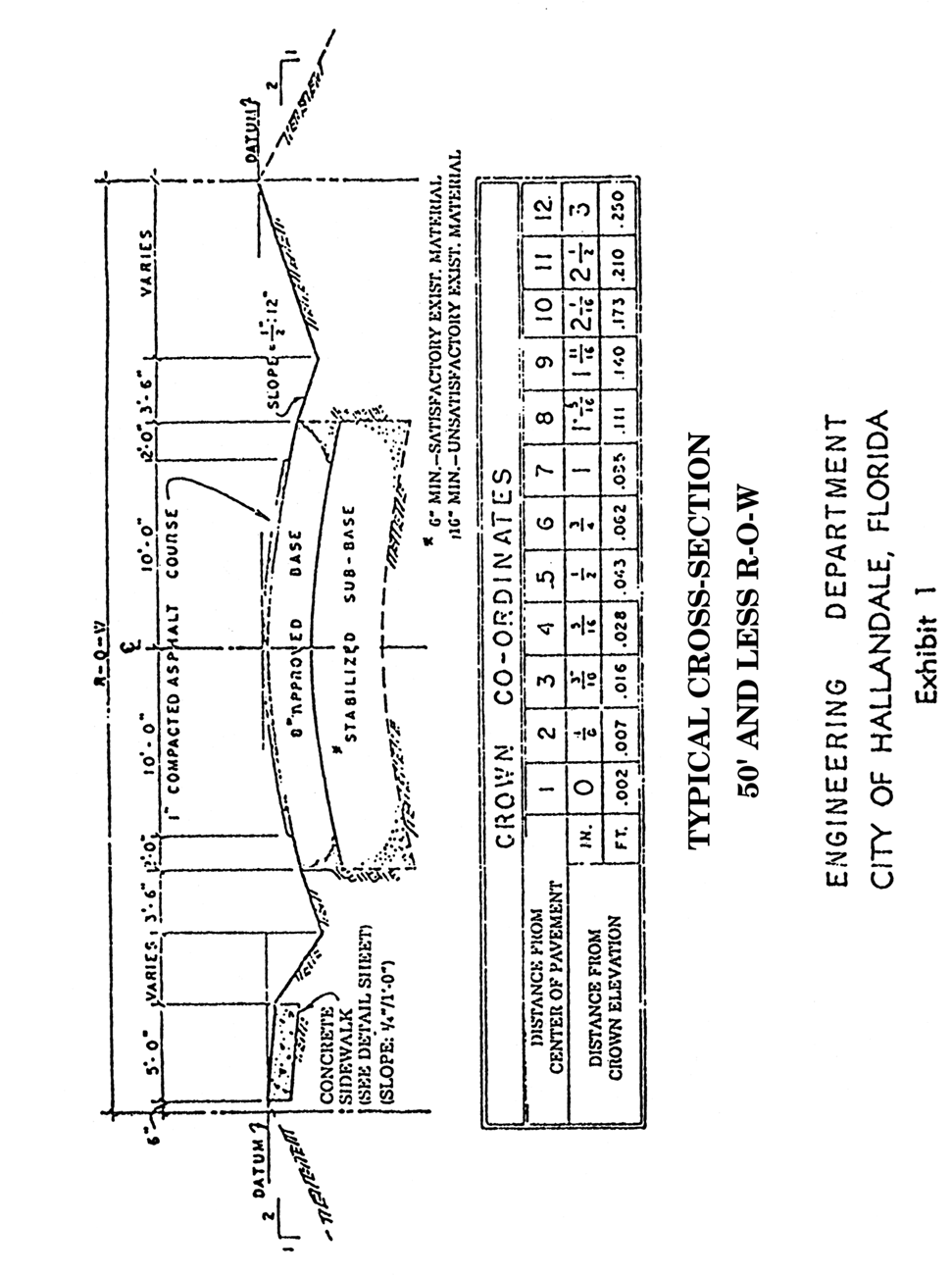
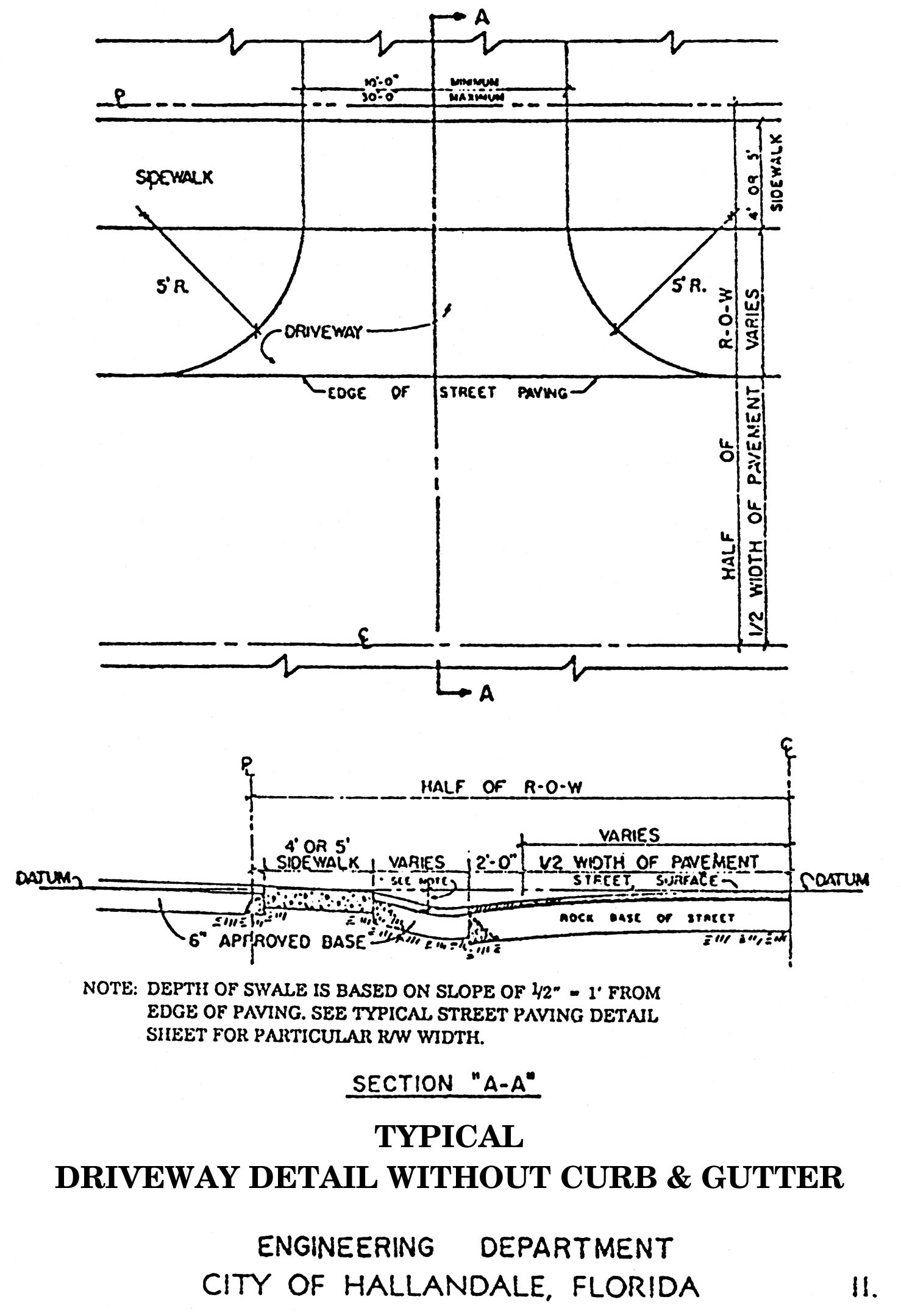
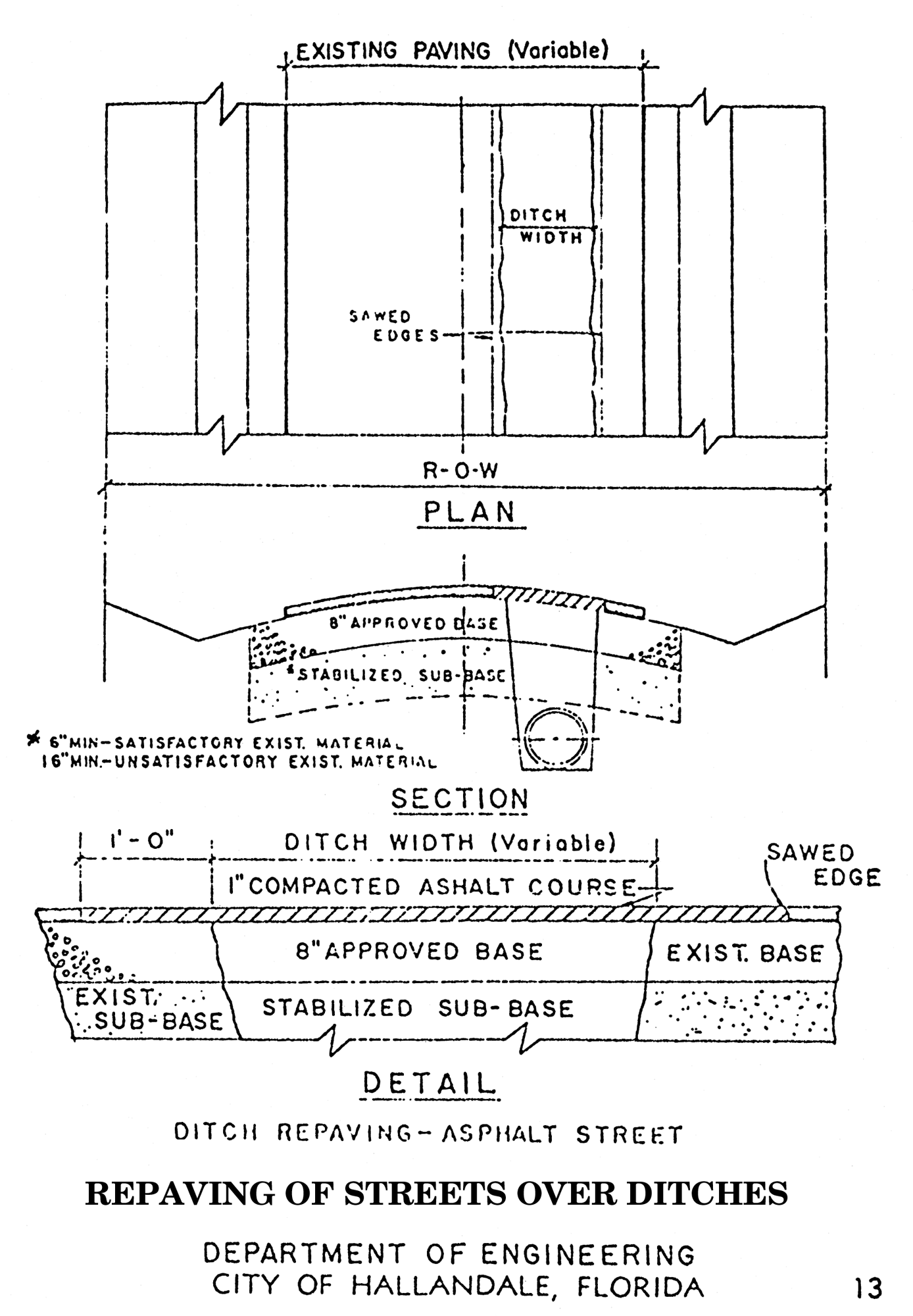
(Code 1980, § 25-29)
Sec. 25-39. - Swales.
(a)
It is the responsibility of the owner of property abutting a street public right-of-way to provide and maintain a graded pervious swale in the nonpaved portion of the public right-of-way. The swale shall be centered between the edge of the street pavement line and the edge of the sidewalk nearest to the street if a sidewalk is installed or at a location approved by the city manager if no sidewalk exists. The swale slopes shall fall a minimum one-half inch vertically to every one foot horizontally, measured from the edge of the street pavement and from the edge of the sidewalk closest to the street. The vertical slope dimensions of the swale shall be measured to the top of the sod when it is installed. The city manager has discretion to modify slope requirements based on consideration of specific drainage needs of a particular area.
(b)
Owners of existing, developed, single-family, residential property in compliance with article IV, division II of chapter 32, as of February 17, 1995, are exempt from the requirement of providing a swale.
(c)
If the city determines a nonconforming swale area is responsible for substantial flooding, the abutting property owner may be directed to construct a swale in compliance with this section. If within 30 days from written notification the owner fails to comply with such directive, the city may cause the work to be done and assess and collect its costs incurred.
(Code 1980, § 25-30; Ord. No. 2000-19, § 1, 9-5-2000)
Sec. 25-61. - Standards for sidewalks.
The width of each sidewalk constructed shall be five feet, and the thickness shall be four inches. The elevation of each sidewalk shall be at least two inches above the crown of the road on which the property faces or abuts, and the pitch shall be one-fourth-inch to a foot toward the road. At a curb cut where vehicles will be entering and exiting over a sidewalk, that portion shall be six inches thick and require a six-by-six gauge, ten-inch-by-ten-inch road mesh. The material to be used in the construction, the grade, and the method and manner of constructing, reconstructing and repairing sidewalks abutting public streets in the city shall be as prescribed and approved by the building official, based upon generally accepted public sidewalk construction and repair standards.
(Ord. No. 2016-24, § 3, 12-21-2016)
Sec. 25-62. - Report of needed sidewalks to city manager.
Any person may report to the city manager, or his or her designee, places and sites within the city where it is necessary or advisable, by reason of any unsafe, unsanitary or dangerous condition affecting the public health, safety or general welfare of the city or its inhabitants or for any other reason, for public sidewalks to be constructed or reconstructed.
(Ord. No. 2016-24, § 3, 12-21-2016)
Sec. 25-63. - Duty of owner of property abutting public streets when substantial improvements or buildings are to be constructed on such property.
It shall be the duty of each owner of property abutting the public streets of the city to construct uniform and substantial sidewalks abutting the public streets when substantial building improvements are constructed upon such property. For the purposes of this division, a substantial building improvement shall exist when there is new construction, reconstruction or a structural addition creating a net floor increase in excess of five percent. Single-family homes and duplexes located in RS-5, RS-6, RS-7 and RD-12 zoning use districts shall be required to construct sidewalks only in cases of new construction or reconstruction exceeding 50 percent of the value of the existing building where construction of a sidewalk will complete or lead to completion of an uninterrupted network of sidewalk in the neighborhood where such construction or reconstruction occurs.
(Ord. No. 2016-24, § 3, 12-21-2016)
Sec. 25-64. - Building plans required for construction of substantial building improvements on parcels abutting public streets showing location of sidewalks.
Plans submitted to the city in connection with the application for a building permit for the construction of substantial building improvements, as defined in section 25-63, upon any parcel of land abutting a public street within the city shall show the width, material, grade, and location of such required and proposed sidewalks. No permit may be issued until the location and manner of construction are approved by the building official.
(Ord. No. 2016-24, § 3, 12-21-2016)
Cross reference— Building, construction and condominiums, ch. 8.
Sec. 25-65. - New plats subdividing or re-subdividing lands must make adequate provisions for sidewalks.
All new plats subdividing or re-subdividing lands situated in the city must contain adequate provisions for the construction of sidewalks along public streets.
(Ord. No. 2016-24, § 3, 12-21-2016)
Sec. 25-66. - Bond of owner in new plats subdividing or re-subdividing lands situated in the city.
The city may require as a condition precedent to its giving approval to all new plats subdividing or re-subdividing lands situated in the city that the owner of the lands being subdivided must give a good and sufficient bond to the city conditioned that the owner shall cause sidewalks to be constructed along public streets on the lands being subdivided or re-subdivided.
(Ord. No. 2016-24, § 3, 12-21-2016)
Sec. 25-67. - Exceptions or variances to the provisions of sections 25-63 through 25-65.
If an owner of property abutting a public street in the city desires to obtain a permit for the construction of substantial building improvements on the property or if a person proposes to subdivide lands within the city, and if such person objects to the construction of sidewalks because of the location, size or use of the property involved, such class of persons shall have the right to apply for a variance permit to the city planning and zoning board, for its recommendation to the city commission, which commission shall make the final determination. Such variance shall be noticed, advertised and posted in conformity with the requirements of section 32-1003 as to variances. An administrative fee shall be due at the time an application for variance under this section is submitted. Such fee is established and on file in the city clerk's office.
(Ord. No. 2016-24, § 3, 12-21-2016)
Sec. 25-68. - Recovery of costs and attorney's fees.
If the city abates an ordinance violation under any section of this article and the property owner fails to pay any charges incurred by the city within 60 days from the date of abatement, the finance director shall file a claim of lien. If a lien for unpaid charges incurred pursuant to this article is not paid in full, the lien may be foreclosed by the city within the same time limitations, and in the same manner as provided by law for the foreclosure of mortgages upon real estate. The city shall in such case be entitled to recover reasonable attorney's fees.
(Ord. No. 2016-24, § 3, 12-21-2016)

