
Hamburg Township City Zoning Code
ARTICLE X
- NONCONFORMING LOTS, BUILDINGS, STRUCTURE, USES AND SITES
Sec. 36-362.- Intent.
(a)
Nonconforming buildings and uses are buildings and uses which do not conform to one or more of the provisions and/or requirements of this article or any subsequent amendments, but which were lawfully established prior to the time of adoption of this chapter (December 4, 1968) or subsequent amendment thereto (effective date of the ordinance from which this chapter is derived hereafter). Nonconforming uses are not considered to be compatible with the current or intended land use of the district in which they are located. Nonconforming uses are considered to present a greater public burden than nonconforming buildings; therefore, the intent of this article to gradually eliminate nonconforming uses or decrease their nonconforming status, but to permit certain nonconforming uses to continue under certain conditions, discouraging their expansion or enlargement. Nonconforming lots and buildings are typically those established prior to the current zoning standards.
(b)
However, some nonconforming uses do not pose a potential risk to the surrounding area and should be permitted to remain and improve over time. Accordingly, this article establishes two classes of nonconforming structures and uses of land. Class A nonconforming status may be granted by the Township, allowing the property or use to be perpetuated and improved subject to specific conditions designed to enhance the character of the neighborhood and protect adjacent properties. Class B nonconformities are not desirable, and the intent of this article is to eliminate Class B nonconformities as rapidly as possible.
(c)
The Township intends to allow continued use of these lots and buildings in certain cases. Accordingly, this section establishes regulations that govern the completion, restoration, reconstruction and expansion of nonconforming buildings which do not increase the footprint or otherwise increase the nonconforming situation.
(Zoning Ord. 2020, § 11.1, 1-5-2021)
Sec. 36-363. - Nonconforming uses.
(a)
Illegal nonconforming use. Those alleged nonconforming uses which cannot be proved conclusively to have been existing prior to the effective date of the ordinance from which this chapter is derived shall be declared illegal nonconforming uses and shall be discontinued following the effective date of the ordinance from which this chapter is derived.
(b)
Continuation of an existing legal nonconforming use. The lawful use of a building or land existing at the time of the effective date of the ordinance from which this chapter is derived may be continued although such use does not conform to the provisions of this chapter; however, no accessory use, building or structure shall be established.
(c)
Nonconforming existing uses of land. A nonconforming use of land or a conforming building may be continued within the area of land occupied by the use at the effective date of the ordinance from which this article is derived.
(d)
Modifying uses. In the event that a nonconforming use is modified or altered to eliminate, remove or lessen any or all of its nonconforming characteristics, then said nonconforming characteristics shall not be reestablished or increased. Any new use shall conform to the provisions of this chapter.
(e)
Changing uses. If no structural alternations are made, a nonconforming use of a building may be changed to another nonconforming use similar in nature to the original nonconforming use or a more conforming use upon receipt of a change of use permit as described in section 36-34(a)(1)c.
(f)
Discontinuance. In the event that a nonconforming use is discontinued for a period of one year, the use of the property shall thereafter conform to a use permitted in the zone in which it is located.
(Zoning Ord. 2020, § 11.2, 1-5-2021)
Sec. 36-364. - Nonconforming buildings and structures.
Where a lawful building or structure exists at the effective date of the ordinance from which this chapter is derived that could not be built under the present regulations by reason of restrictions on area, lot coverage, height, yards, landscape buffer, off-street parking, loading space, minimum setback, or other characteristics of the structure or its location on the lot, such building or structure may continue to be used, provided it remains otherwise lawful, subject to the following provisions:
(1)
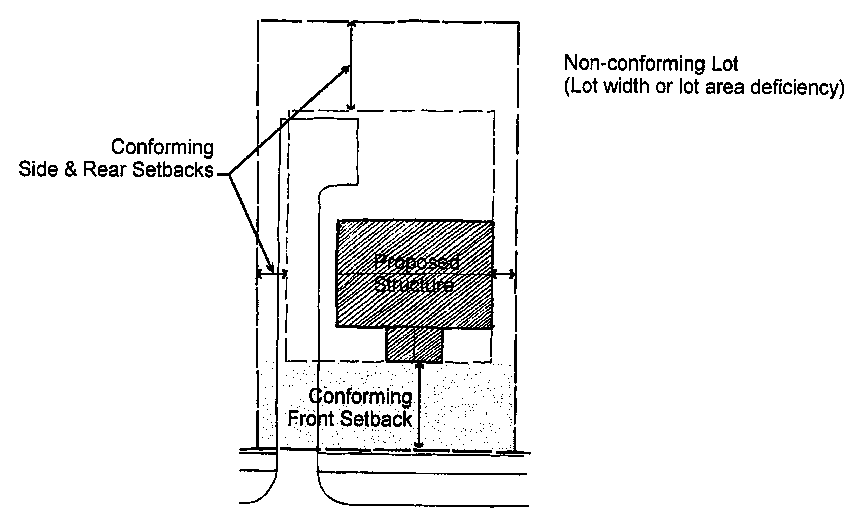
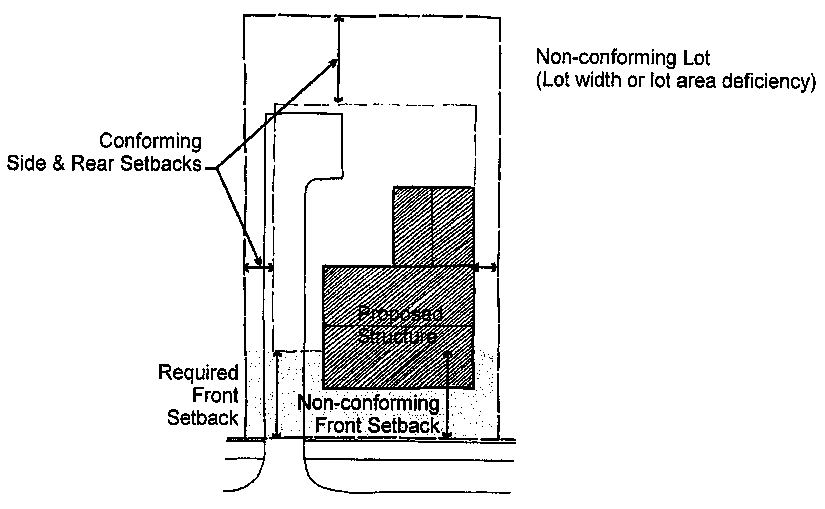
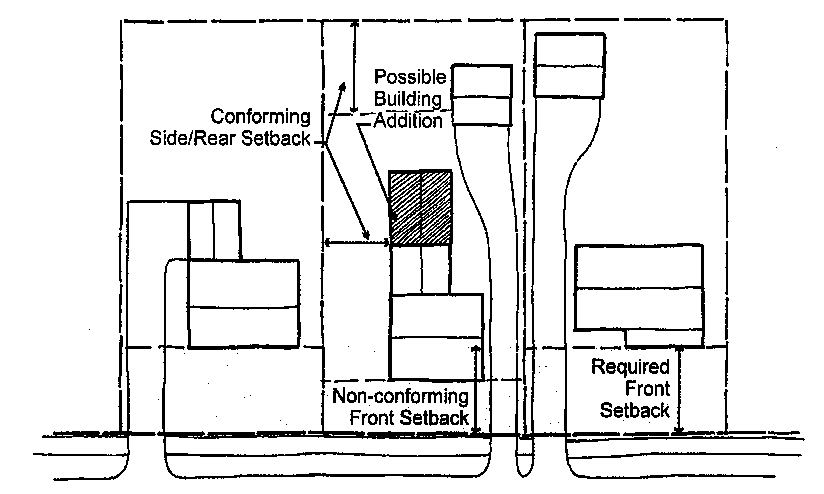
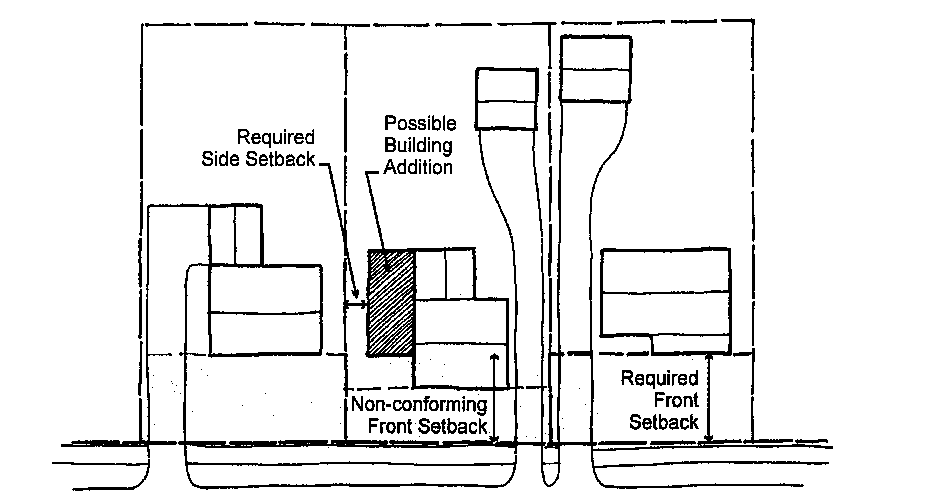
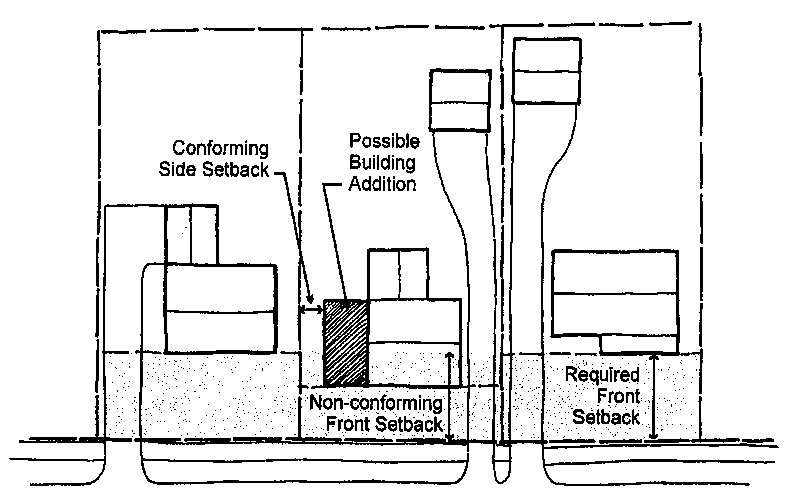
Permitted expansion of residential buildings. A residential nonconforming building may be allowed to expand provided the expansion is within a yard which retains compliance with the required setbacks and height, (e.g., a home with a nonconforming front yard setback may be expanded in the rear so long as the rear yard setback remains conforming, see diagrams B, C and D) this includes expansions to upper levels (e.g., a second level is added to an existing single story house with a nonconforming side yard setback the second story must not encroach into the required setback even if the existing main level already encroaches into the setback, see diagram F).
a.
Any other expansion shall be prohibited unless a variance is granted by the zoning board of appeals.
Diagram A: Conforming, nonconforming or lot of legal record with conforming proposed structure
b.
The development will not require a variance from the zoning board of appeals.
Diagram B: Conforming, nonconforming or lot of legal record with nonconforming proposed structure
c.
The development will require a variance from the zoning board of appeals.
Diagrams C and D: Expansion of a nonconforming structure with conforming addition.
d.
Neither require a variance from the zoning board of appeals.
Diagram E: Expansion of a nonconforming structure with an addition that does not comply with the zoning regulations
e.
The development will require a variance from the zoning board of appeals.
Diagram F: Addition of a second story to a nonconforming structure
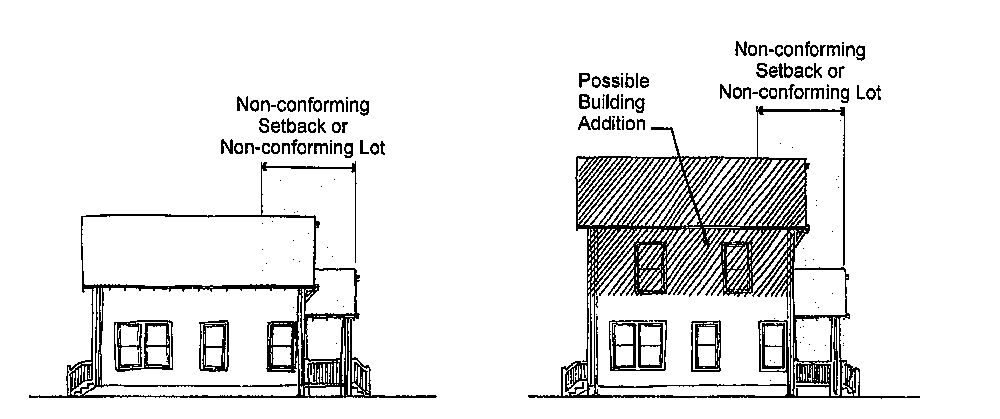
f.
This addition will require a variance from the zoning board of appeals.
(2)
Permitted expansion of nonresidential nonconforming buildings. Nonresidential nonconforming buildings shall not be expanded except to the extent permitted by the zoning board of appeals pursuant to the authority granted in article V of this chapter. A building necessary for an existing agricultural activity may be enlarged, altered, or rehabilitated if the purpose is to maintain or improve the agricultural activity.
(3)
Permitted repairs. Nothing in this chapter shall prevent the repair, reinforcement, reconstruction, building construction, or other such improvements of a nonconforming building, or part thereof, rendered necessary by wear and tear, deterioration, flood, fire or vandalism provided that a land use and building permit shall be obtained for such work, the work does not increase or alter the footprint and the work does not consist of the removal of more than 50 percent of the exterior perimeter walls of the nonconforming structure, except as provided in this section.
(4)
Permitted replacement. A nonconforming building and its accessory structures and uses damaged by natural disaster (i.e., tornado, flood, fire,) or by vandalism may be repaired or replaced subject to the following:
a.
A land use and building permit obtained for the replacement shall not increase or alter the footprint (as defined in this chapter) of the nonconforming structure, except as provided in this section.
b.
The replacement of a nonconforming building shall commence within one years of the date of damage and work shall be diligently pursued toward completion. Failure to complete replacement or diligently work toward completion shall result in the loss of legal, nonconforming status unless good cause for the delay is accepted at a hearing before the board of zoning appeals.
c.
Should a structure be replaced by any other means, it shall not be reconstructed, except in conformity with the zoning regulations. Any improvements that do not meet the zoning regulations shall obtain zoning board of appeals approval under the established variance procedures of this chapter.
d.
Replacement as used in this section of this chapter means removal of more than 50 percent of the exterior perimeter walls of the existing structure, based on the linear feet.
(Zoning Ord. 2020, § 11.3, 1-5-2021)
Sec. 36-365. - Buildings under construction.
If a building permit has been issued for a nonconforming building prior to the effective date of the ordinance from which this chapter is derived, such proposed building shall be permitted, provided:
(1)
Construction is begun within 60 days after the effective date of the ordinance from which this chapter is derived.
(2)
The construction is continuous until the building is complete.
(Zoning Ord. 2020, § 11.4, 1-5-2021)
Sec. 36-366. - Change of tenancy or ownership.
In the event there is a change in tenancy, ownership, or management, an existing nonconforming use, lot or structure shall be allowed to continue provided there is no change in the nature or character of such nonconformity.
(Zoning Ord. 2020, § 11.5, 1-5-2021)
Sec. 36-367. - District changed.
Whenever the boundaries of a district shall be changed so as to transfer an area from one district to another district or another classification, the foregoing provisions shall also apply to any existing uses, lots of record and/or structures that become nonconforming as a result of the boundary changed.
(Zoning Ord. 2020, § 11.6, 1-5-2021)
Sec. 36-368. - Nonconforming lots of record.
(a)
Permitted construction of residential buildings. In any district in which single-family dwellings are permitted, notwithstanding limitations imposed by other provisions of this chapter, a single-family dwelling and customary accessory buildings may be erected upon any parcel of land which was a single lot of record at the effective date of the ordinance from which this chapter is derived. This provision shall apply even though such lot fails to meet the requirements for area or width, or both, that are generally applicable in the district. Yard dimensions and other requirements not involving area or width, or both, of the lot shall conform to the regulations for the district in which the lot is located. Variances for yard requirements shall be obtained through approval of the zoning board of appeals.
(b)
Permitted expansion of residential buildings. Conforming single-family dwellings and customary accessory buildings located upon any parcel of land which was a single lot of record at the effective date of the ordinance from which this chapter is derived which fails to meet the requirements for area or width, or both, that are generally applicable in the district, may be allowed to expand provided that the expansion complies with all height, bulk and other requirements not involving area or width, or both, of the lot, for the district in which the lot is located. Variances for yard requirements shall be obtained through approval of the zoning board of appeals.
(c)
Contiguous nonconforming lots under the same ownership. Two or more contiguous, nonconforming lots under the same ownership shall be considered one parcel. The applicant shall not be permitted to make improvements to the parcel prior to combining such lots to create one conforming lot of record unless the nonconformity is only for area or width, or both.
(Zoning Ord. 2020, § 11.7, 1-5-2021)
Sec. 36-369. - Nonconforming sites.
The intent of this section is to permit improvements and minor modifications, as described in article III of this chapter, to a conforming use and building which does not meet all of the various site improvement related regulations of this zoning ordinance. The purpose is to allow gradual compliance with the site related requirements for sites which predate the various zoning ordinance standards for landscaping, paving and other non-safety site related items. Such improvements or expansions may be permitted without a complete upgrade of all site elements under the following conditions:
(1)
The applicant is proposing reasonable site improvements in relation to the scale and construction cost of the building improvements or expansion.
(2)
The applicant has addressed safety-related site issues.
(3)
For landscaping, the applicant shall bring the site toward conformity at twice the rate of building or parking lot expansions (for example, a five percent building expansion will provide at least ten percent of the required landscaping).
(4)
The improvements or minor expansion will not increase noncompliance with site requirements.
(5)
A plot plan shall be submitted in accordance with section 4.8.9.
(Zoning Ord. 2020, § 11.8, 1-5-2021)
Sec. 36-370. - Purchase or condemnation.
In order to accomplish the elimination of nonconforming uses and structures which constitute a nuisance or are detrimental to the public health, safety and welfare, the Township may acquire by purchase, condemnation or otherwise, private property for the purpose of removal or the nonconforming use.
(Zoning Ord. 2020, § 11.9, 1-5-2021)
Sec. 36-371. - Class a nonconforming designation.
It is the intent of this section to recognize that certain nonconforming structures and uses of land may not have a significant adverse impact upon nearby properties or the public health, safety and welfare, and to allow the planning commission to establish a Class A nonconforming status for these nonconforming structures or uses of land, subject to the following procedure and standards:
(1)
Procedure. The procedure for considering all Class A nonconforming designations shall be as follows:
a.
Application. Application for consideration of a Class A designation for a nonconforming structure or use of land may be initiated by the Township, owner, operator, or person having beneficial use of the lot occupied by the nonconforming structure or use of land. The application shall include the applicant's name, address, and telephone numbers, and the reason for the request.
b.
Public hearing. A public hearing shall be held for all requests for a Class A nonconforming designation in accordance with the procedures set forth in section 36-40.
(2)
Conditions for approval of a Class A designation. Subsequent to a public hearing, the planning commission may grant a Class A designation upon finding that all of the following conditions exist:
a.
The structure or use of land is nonconforming as defined in this chapter.
b.
The nonconformity does not significantly depress the value of nearby properties.
c.
The nonconformity is not contrary to public health, safety and welfare.
d.
No useful purpose would be served by strictly applying the requirements for a Class B nonconformity under this chapter.
(3)
Effect of approval of a Class A designation. Class A nonconformities shall be permitted to be perpetuated and expanded in accordance with an approved site plan, subject to the provisions of this section and any conditions of approval. Class A nonconforming structures shall be permitted to be perpetuated, expanded, improved or rebuilt if damaged or destroyed in accordance with an approved site plan, subject to the provisions of this section and any conditions of approval.
(4)
Cessation or removal of Class A nonconforming structures or uses of land. The procedure for considering all Class A nonconforming designations shall be as follows:
a.
When a Class A nonconforming structure is permanently removed, or when a Class A nonconforming use of land is replaced by a conforming use, the designation shall be deemed removed. Any subsequent structure or use of land shall conform to the provisions for the district where it is located.
b.
No Class A nonconforming structure or use of land shall be resumed if it has been discontinued for six consecutive months or 18 months in any three-year period.
(5)
Rescinding approval of a Class A designation. Failure of the owner, operator or person having beneficial use of a lot occupied by a Class A designated nonconforming structure or use of land to maintain or improve the site in accordance with the provisions of this section, an approved site plan or any conditions of approval shall be grounds for the planning commission to rescind the Class A designation. Such action shall be subject to the following:
a.
Public hearing. Such action may be taken only after a public hearing has been held in accordance with the procedures set forth in section 36-40, at which time the owner, operator, or person having beneficial use of land shall be given an opportunity to present evidence in opposition to rescission.
b.
Determination. Subsequent to the hearing, the decision of the commission with regard to the rescission shall be made and written notification provided to said owner, operator or person having beneficial use of land occupied by Class A designated nonconforming structure or use of land.
(6)
Conditions of Class A designation. The planning commission may attach reasonable conditions to Class A nonconforming designation, including the following:
a.
Signs. If the application was initiated by the by the owner or person having beneficial use of the lot occupied by the nonconforming structure or use of land. The planning commission may require that all signs on the structure or land in question be brought into compliance with the city's sign regulations.
b.
Plans for site improvements. If the application was initiated by the owner or person having beneficial use of the lot occupied by the nonconforming structure or use of land, the planning commission may require that a site plan for improvements be submitted for review that addresses the priorities for site improvements listed in section 36-369.
c.
Other conditions. The planning commission may attach conditions to the approval to ensure that the structure or use of land does not become contrary to the purpose of this article and chapter, or the public health, safety and welfare.
(Zoning Ord. 2020, § 11.10, 1-5-2021)

