
Harrison Charter Township
City Zoning Code
City Zoning Code
ARTICLE XI
GENERAL PROVISIONS
Section 11.01.- Approval of plats.
No proposed plat of a new or redesigned subdivision shall hereafter be approved by either the township board or the planning commission, unless the lots within such plat equal or exceed the minimum size and width requirements set forth in the various districts of this ordinance, except as provided in the township's subdivision regulations. Such plat shall fully conform with the statutes of the State of Michigan, as amended, and the subdivision regulations of the Charter Township of Harrison.
Section 11.02. - Building grades.
A.
The existing established grade shall be used to determine the grade around a new building when a new building is constructed. The yard around the new building shall be graded to meet existing grades and shall not permit run-off of surface water to flow onto adjacent property.
B.
If necessary, drain systems will be installed to provide water run-off solutions from new buildings or existing buildings onto existing areas at the new building owner's expense. The building official shall approve final grades.
C.
A registered engineer or land surveyor shall submit a signed and sealed "certificate of grading and location of building" before final grades are approved.
Section 11.03. - Buildings to be moved.
Any building or structure which has been wholly or partially erected on any premises, located either within or outside of this township, shall not be moved to and placed upon any other premises in this township until a permit for such removal shall have been secured under the administration and enforcement portion of this ordinance. Any such building or structure shall fully conform to all the provisions of this ordinance in the same manner as a new building or structure.
Section 11.04. - Essential services.
Essential services shall be permitted as authorized and regulated by law and other ordinances of the township, it being the intention hereof to exempt such essential services which primarily serve the Charter Township of Harrison from the application of this ordinance.
Section 11.05. - Excavation or holes.
The construction, maintenance or existence within the township of any unprotected, unbarricaded, open or dangerous excavations, holes, pits or wells, which constitute or are reasonably likely to constitute a danger or menace to the public health, safety or welfare, are hereby prohibited; provided, however, this section shall not prevent any excavation under a permit issued, pursuant to this ordinance, where such excavations are properly protected and warning signs posted in such manner as may be approved by the building official, pursuant to a valid building permit which is being diligently pursued. In no case shall such excavation or hole be allowed to exist beyond 90 days. This section shall not apply to drains created or existing by authority of the state, county, township or other governmental agency.
Section 11.06. - Garage sales.
A.
A person or group may conduct an individual or collective garage sale, rummage sale or similar activity within Harrison Township, provided the sale or similar activity shall not be conducted for a period of more than nine consecutive days.
B.
No person shall be allowed more than two such sales within any twelve-month period. In no instance shall more than two garage sales or similar activity be held in any one location within any twelve-month period.
C.
All such sales or similar activity shall not be conducted within ten feet from the street lot line of the premises.
D.
Overnight outside storage of goods or merchandise offered at said garage sale or similar activity is hereby prohibited.
E.
No signs advertising a garage sale or similar activity shall be placed upon public property except upon the consent of the land owner.
1.
In this case, two signs advertising a garage sale or similar activity are permitted to be placed upon private property and shall be removed within 24 hours of the conclusion of said garage sale or similar activity.
Section 11.07. - Height limitations.
A.
No building shall be erected, converted, enlarged, reconstructed or altered to exceed the height limit hereinafter established for the district in which the building is located, except penthouses or roof structures for the housing of elevators, stairways, tanks, ventilating fans, or similar equipment required to operate and maintain the building.
B.
Architectural features, such as fire or parapet walls, skylights, towers, steeples, stage lofts and screens, flagpoles, chimneys, smoke stacks, individual domestic radio and television aerials and wireless masts, water tanks, or similar structures, excluding light poles, may be erected above the limits provided for each zoning district, provided that the feature:
1.
Does not exceed 15 feet above the height limits of the zoning district.
2.
Is no greater than ten percent of the roof area of the building.
3.
Is not used for any residential purpose other than a use incidental to the main use of the building.
Section 11.08. - Outdoor storage and merchandising.
A.
Merchandising.
1.
Unless permitted as a temporary use, no person or business shall use the following areas for displaying goods for sale, nor leave any goods, boxes, vehicles or any other article for a longer period than transportation into or out of another vehicle or business/residence:
a.
Any sidewalk or that space between the sidewalk and curb or road, planted strips, park or sidewalk.
b.
Any parking area, or any area of a road right-of-way.
2.
Open air business and uses with permitted outdoor space for display and sales:
a.
Shall not be allowed until approved by the planning commission.
b.
Such uses shall be paved and constructed to the same standards of construction as a parking lot, or provided with a suitable surface acceptable to the planning commission.
B.
Outdoor storage/display lots.
1.
When permitted in a particular zoning district, an outdoor storage use shall be enclosed by an approved masonry wall or obscuring fence, as approved by the planning commission.
a.
Such wall or fence shall not be less than four feet six inches in height and may, depending upon land usage, be required to be up to ten feet in height, and shall be subject further to the requirements of article VI.
b.
A chain link fence or a landscaped earth mound (berm), both with intense evergreen shrub planting, may be permitted by the planning commission.
c.
The planning commission may require vertical decorative or redwood pickets be installed in the fence where, in its judgment, it will better serve to obscure the open storage.
d.
Open storage areas shall be hard-surfaced with suitable approved material and drained to meet township engineering requirements.
(Ord. No. 308.4, § 10, 8-13-2018)
Section 11.09. - Prohibited occupancy.
In no case shall a travel trailer, motor home, automobile chassis, tent or portable building be considered a dwelling. Mobile homes shall not be used as dwellings, excepting when located in and as part of a mobile home park or when located in zoning districts set forth in this ordinance. All travel trailers, motor homes and mobile homes parked or stored on lands not approved for such use as herein set forth shall not be connected to sanitary facilities and shall not be occupied.
In the case of mixed occupancy, where a building is occupied in part as a dwelling unit, the part so occupied shall be deemed a dwelling unit for the purpose of this ordinance and shall comply with the provisions thereof relative to dwellings in the residential district.
Section 11.10. - Residential open space developments.
A.
Residential open space developments, as defined by the regulations of this section, shall be considered a permitted use in the R1-A, R1-B and R1-C single-family zoning districts. In no circumstance shall multiple-family residential development (attached units) of any type be permitted in a residential open space development.
B.
Intent. The intent of this section of the zoning ordinance is to provide a preferable alternative to conventional single-family development regulations. All residential open space developments shall promote the following objectives:
1.
Maintain the township's remaining open space and rural setting.
2.
Preserve the township's natural resources, including woodlands, wetlands, topography, floodplains and similar natural assets.
3.
Preserve open space and productive agricultural land.
4.
Achieve a balance between open space and growth and agriculture.
5.
Encourage a creative approach to the development of parcels exhibiting unusual characteristics and/or land use relationships.
6.
Provide alternatives to conventional residential developments.
C.
Submission and preservation requirements.
1.
All natural assets and cultural/historic features on the site must be identified on the plan. Such assets shall include natural stands of trees, wetlands, floodplains, topography, bodies of water (i.e. streams, rivers), land which serves as a natural habitat for wildlife, or other natural assets which should be preserved. Regulated natural features such as, but not limited to, wetlands and floodplains must be identified through documentation from the appropriate federal, state and/or local authorities. Cultural and historic features may include farmhouses, stone fence lines and buildings of historic value. Residential open space developments shall preserve all of the above amenities to the extent feasible and desirable to the township.
2.
A detailed map of the parcel identifying soil conditions as represented in the soil conservation service's "Soil Survey Macomb County, Michigan" shall be provided.
3.
All open space developments shall include an improved trail way system throughout the residential open space development and common open space areas.
D.
Density.
1.
The maximum number of units allowed shall be determined by the submission of a "yield plan". The yield plan shall be provided by the developer and shall be a feasible development under the requirement standards of the specified zoning district with regard to lot width, lot area, width-to-depth ratios, setbacks, frontage, and other applicable provisions of such district. The yield plan shall meet all applicable requirements of the State Land Division Act and all applicable township ordinances. The yield plan shall also meet all requirements of the Charter Township of Harrison Subdivision Control Ordinance and Zoning Ordinance, as applicable to the type of development. In no case, regardless of the yield plan, shall the density of an open space residential development exceed three units per acre.
2.
The planning commission shall award the applicant a development bonus with regard to the number of residential units permitted within an open space development. Such bonus shall be a five percent increase in the number of residential units permitted in the development. Where a resultant fraction occurs with the five percent calculation, an additional lot shall be granted.
E.
Open space requirements. Common open space shall be defined as follows: All areas within the open space development, not individually owned or part of a limited common area, which are designed and intended to preserve open land resources for the common use and enjoyment of the residents of the entire development for any of the following uses: recreation, forest land and/or open space conservation, prairies, and meadows. The common open space requirements shall not be met by land uses such as rights-of-way or easements designated for road or utility purposes, areas within lots, detention/retention ponds, golf courses or other commercial recreational uses, or land area dedicated as limited commons.
1.
A minimum of fifty percent of the development shall be set aside for common open space, as defined below. The open space shall be irrevocably reserved for common open space as required in this section.
2.
The developer may, at his election, offer to deed such land to Harrison Township for public playgrounds, parks, recreation areas or open space subject to township acceptance of such property. The failure of the Township to accept such property shall not relieve the developer from the requirements of the open space requirements. The township shall not be exempt from providing an irrevocable agreement to maintain the property as park or open space in perpetuity.
3.
A minimum of 50 percent of all dwelling units within the development shall abut the dedicated common open space.
4.
Trail ways shall be located throughout the common open space and shall link the internal sidewalk/walking path system of the housing development with the open space areas. Such trail ways shall be a minimum of six feet in width and constructed of asphalt in upland areas and pressure treated wood plank decking (or similar durable material) in wetland areas. All materials and associated installation shall meet all applicable township engineering standards.
5.
A minimum of one access point to the common open space, being a minimum of 50 feet in width, shall be provided for each 12 households. These access points shall link the common open space to the trail ways and sidewalks, and the remainder of the development.
6.
All dwelling units shall have side, rear, or alley entry garages, or other configurations not opening directly to the street; except that the planning commission may approve dwelling units with garages that face the road if such garage is set back a minimum of five feet from the front plane of the living quarters of the dwelling.
7.
The development shall include a minimum of a 210-foot roadway setback-buffer measured from the road centerline along any regional, major, or secondary road with a right-of-way of 120-feet or less.
8.
A minimum buffer width of 30 feet shall be provided between any subdivision or condominium lot and streams, lakes, ponds or wetlands and similar man-made features such as detention/retention basins.
9.
Non-agricultural upland open fields shall be planted with native prairie grass or similar types of ground cover. In addition, ten deciduous trees shall be planted for each one acre of open field. No more than 50 percent of such trees shall be conifer trees. Deciduous trees shall be a minimum size of two-inch caliper, and conifer trees shall be a minimum of six feet in height. Such trees shall be planted and maintained within the open field area and be native to Michigan.
F.
Utilities. All utilities shall be placed underground when feasible. The applicant shall provide adequate sanitary sewage treatment, water supply and storm water drainage systems to serve the development. Evidence shall be submitted indicating that all such systems have received preliminary approval from appropriate county or state authorities. The township shall have sole authority for final approval of any utility system. In the absence of a township utility system, all utilities to serve the site shall be constructed and maintained by the applicant and any successors. A maintenance agreement, approved by the township, shall be required.
G.
Roads. Roadways shall conform to the Charter Township of Harrison and Road Commission of Macomb County standards.
H.
Street trees. The entrance and roadways shall be landscaped and planted with street trees, to create an attractive vista. Such trees shall be planted no more than thirty (30') foot on center and shall be located outside of the road right-of-way and utility easements. The trees shall meet the size and species requirements of this Ordinance.
I.
Pedestrian circulation. Sufficient right-of-way width shall be provided so that sidewalks may be installed on both sides of all streets. A five-foot wide concrete sidewalk shall be located one foot from the property line (within the street right-of-way). This requirement may be waived by the planning commission when an acceptable and more imaginative solution to pedestrian circulation is proposed by the applicant.
J.
Setbacks. The following building setbacks shall be required:
1.
All structures shall meet the setback requirements for the zoning district in which they are located. Side yard setbacks may be reduced to five feet on each side. In no case shall a building or structure be located closer than ten feet from another building or structure.
2.
Rear yard setbacks may be reduced to 20 feet for lots with rear yards which abut common open space or alleys. All other lots shall meet the rear yard setback of the zoning district for the site.
3.
No lot, property line or building site shall be located within an exterior roadway setback-buffer.
K.
Fencing. The use of perimeter fencing around building sites is prohibited except as permitted herein. Rear yards and side yards may be enclosed with picket-type, wrought iron, or other similar decorative fencing. Such fences shall not exceed 48 inches in height. In no case shall view obscuring fences, privacy fences, chain-link fences or other similar wire fences be permitted on a site. Fences are prohibited in the front yard or street-side (front) yard. Fence restrictions shall be included in the master deed or deed restrictions, as applicable.
L.
Dedication of common open space and/or development rights. The dedicated common open space shall be set aside in an irrevocable conveyance that is acceptable to the township attorney and approved by the township board, such as the following:
1.
A conservation easement as established by the State of Michigan Conservation and Historic Preservation Act, Public Act 197 of 1980, as amended (M.C.L. 399.251).
2.
Master deed as established by the State of Michigan Condominium Act, Act 59 Public Act of 1978, as amended.
The above conveyance shall indicate all proposed uses of the dedicated common open space, which shall also be shown on the approved open space community. The township attorney shall review the conveyance and assure the township that such lands shall remain as common open space for perpetuity. The conveyance shall also detail a maintenance schedule and funding for operation, maintenance and insurance for all common areas, facilities, projects and programs of the open space community, and shall include methods of payments and collection. The homeowner or condominium association shall be responsible for maintenance of all common open space areas. At the time the property is turned over to the association it shall be clean and free of debris.
Open space deeded to the township shall remain in use as open space/park land for perpetuity. The township attorney shall prepare an irrevocable conveyance to assure such.
M.
Unless otherwise provided for in this ordinance, all other applicable zoning ordinance provisions shall apply.
Section 11.11. - Sidewalks and pathways.
A.
An eight-foot-wide asphalt pathway shall be required across the frontage of all properties abutting regional and major roadways, as defined in the township master plan. Pathways shall be constructed in the proposed right-of-way, one foot from the outermost edge. Developments abutting any other roadway classification shall be required to install a five-foot wide concrete sidewalk. The planning commission may waive or modify this requirement where it is determined that the required pathway or sidewalk would not serve a public purpose, based on existing conditions and pedestrian circulation needs at the site or in the vicinity.
B.
For any development, an on-site sidewalk shall be required as a means of connecting the principal building with the road frontage sidewalk. The planning commission shall determine if a proposed sidewalk system has provided an adequate connection between the site and the road frontage.
(Ord. No. 308.5, § 30, 4-26-2021)
Section 11.12. - Storage, dumping and/or collection of waste, junk, refuse and other similar materials.
A.
No site shall be used for the storage, accumulation, dumping and/or collection of waste, junk, refuse and other similar materials, except upon approval by the planning commission in compliance with article XVII of this ordinance or as otherwise permitted under this ordinance in any district. The owner or occupant of all land, structures and/or every part thereof shall have the duty to maintain same in a clean and sanitary condition, free from any accumulation of dirt, filth, rubbish, garbage and vermin, and the duty not to act or omit to act so as to create or permit the existence of a nuisance as defined in this ordinance. This duty shall extend to any area of land between the site line and adjoining streets and curbs.
1.
The depositing of dirt, sand or earth materials that substantially change the finished grade may be permitted in any district in accordance with the following requirements:
a.
Any finish grade to be established shall be approved by the township engineer.
b.
The finish grade shall be graded not later than 60 days after depositing on the land, in a manner so as to prevent the collection of water and which will leave the ground surface in a condition suitable for other permitted uses within the district in which the site is located.
(Ord. No. 308.4, § 11, 8-13-2018)
Section 11.13. - Temporary dwellings.
Any and all basement dwellings, garage dwellings and/or other temporary residential dwellings which have been erected and occupied are hereby declared to be unlawful for residence purposes and shall be vacated or altered so as to immediately comply with the provisions of this ordinance; provided, however, the zoning board of appeals may extend such period for not more than one year upon written application therefor by the occupant and proof of undue hardship.
Section 11.14. - Temporary structures, tents and uses.
A.
Temporary structures and tents. The planning commission may permit, upon proper application, temporary structures or tents subject to the following:
1.
All tents, canopies and similar temporary accessory structures which will be erected for more than 21 days on an annual or seasonal basis shall require a special land use approval from the planning commission.
2.
A special land use approval by the planning commission may be granted for a specified period not to exceed five years. The Planning Commission may require compliance reviews on an annual basis, or such other times after due notice for good cause shown. As part of a compliance review, the Planning Commission may revoke the special land use approval based on evidence that the structure or use is not properly maintained, has caused safety issues, or has become a nuisance either on or off the site with regard to circulation, light, noise and other nuisance issues.
a.
After the expiration of the initial approval period established by the planning commission, the applicant shall be required to obtain a new special land use approval.
b.
Any substantial amendment, as deemed substantial by the township, to an original special land use approval shall require a new special land use approval. A change which impacts the use of the site by patrons or an expansion of the proposed use shall be considered a substantial change.
3.
Exemptions. All seasonal temporary structures, including tents and canopies, and which are regulated by the township's seasonal sales and solicitors ordinance or special events ordinance are exempt from this section. Also exempt are tents and canopies erected on residential lots for a period not to exceed seven days. These exempt structures are not required to appear before the planning commission for a temporary structure permit.
4.
General provisions. The planning commission, in granting permits for temporary structures, tents or uses, shall do so under the following conditions:
a.
The proposed temporary structure or use shall conform to all regulations and township ordinances relative to structures permitted in the particular zoning district wherein the proposed temporary structure would be located.
b.
The granting of a temporary structure permit shall be granted in writing, stipulating all conditions as to time for construction and removal and nature of the proposed structure.
c.
No temporary structure permit shall be granted without the applicant having filed with the township building department a bond in an amount to be determined by the approving body, which amount shall be set forth in the written grant of the temporary structure permit, which amount shall be sufficient to secure removal of said structure upon the expiration of the permit.
d.
Any temporary structure permit granted shall not be valid unless and until a building permit for the proposed structure is obtained by the applicant. Any erection or construction of the temporary building shall be started and proceed to completion in accordance with the terms of the building permit.
e.
Any temporary structure must be located upon private property and not encroach upon lands not owned or leased by applicant.
f.
If applicant is the lessee of the land upon which a temporary structure is desired, the applicant must provide a letter of understanding from the owner of the property providing the owner's concurrence for the temporary structure, and provide the owner's name address and phone number as well as a copy of the most recent rent or lease payment check signed by the applicant.
g.
Any temporary structure utilizing electrical power of any nature must be inspected and approved by the fire chief prior to final occupancy of the temporary structure.
h.
Applicant shall provide to the township a hold harmless agreement for the erection and maintenance of the temporary structure.
i.
The erection, construction, completion, use and maintenances of any temporary structure shall, at all times, be in full compliance with all state statutes, public health regulations and township ordinances.
5.
Emergency permits. The township supervisor with the concurrence of two township board members shall have the authority to issue an applicant an emergency temporary structure permit valid for a period of time not to exceed the number of days until the next available planning commission meeting in order for the applicant to appear before the planning commission for final temporary structure approval. Prior to the issuance of an emergency temporary structure permit, the supervisor shall require the building official, the fire chief, township planner and any other professional deemed necessary to inspect the property and application for approval in order to ensure that the proposed temporary structure conforms to all regulations and township ordinances relative to structures permitted in the particular zoning district wherein the proposed temporary structure(s) would be located.
6.
Temporary uses. The planning commission may also permit, upon proper application, temporary uses. Seasonal uses regulated by the township's seasonal use ordinance are exempt from this section. Such granting of a temporary use shall be regulated by the approval process under section 11.14(A). Any approvals shall be subject to the following conditions:
a.
The granting of the temporary use shall be in writing, stipulating all conditions as to time, nature of development permitted and arrangements for removing the use at the termination of said temporary permit.
b.
The granting of the temporary use shall in no way constitute a change in the basic uses permitted in the zoning district nor on the property wherein the temporary use is permitted.
c.
The use shall be in harmony with the general character of the zoning district.
d.
All setback, land coverage, lighting, off-street parking and other requirements are to be considered in order to protect the public health, safety, peace and general welfare of the inhabitants of the township. All such requirements shall be established and made at the discretion of the planning commission.
e.
No temporary use permit shall be granted without first giving notice to owners of the adjacent property of the time and place of a public hearing to be held on the application for a temporary use permit. All notices shall be in writing and shall be made by first class mail and by publication in a general newspaper at least 15 days prior to the hearing date.
7.
The planning commission may revoke a permit or approval for any temporary structure, or temporary use for any violation of the terms of the permit or grant of such temporary structure or temporary use.
(Ord. No. 308.4, §§ 12—14, 8-13-2018)
Section 11.15. - Trash receptacle standards.
A.
Trash receptacles are required for all uses other than single and two-family residential.
B.
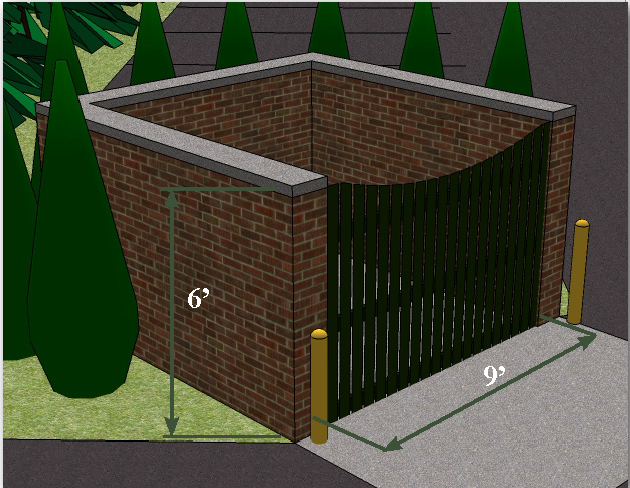
Enclosure. All outdoor waste receptacles, including grease barrels, are required to be enclosed on three sides and screened. The fourth side shall consist of a gate made of steel framing with wood facing. If the waste receptacle houses a dumpster, it shall have an enclosing lid or cover.
C.
Materials. The enclosing screening around the three sides shall be constructed of brick or decorative color integrated block wall, consistent with the building materials of the main building. In addition, steel or concrete bollards shall be installed to assist in the positioning of dumpster and to protect the enclosure.
D.
Size. The waste receptacle base shall be at least nine feet by six feet in area, constructed on six inches of reinforced concrete pavement.
1.
The base of reinforced concrete pavement shall extend six feet beyond the front of the waste receptacle pad or gate to support the front axle of a refuse vehicle.
2.
The enclosure wall shall have a minimum height of six feet or one foot above the height of the waste receptacle, whichever is greater.
3.
The enclosure shall have at least three feet of space on each side of the waste receptacle.
E.
Placement, All trash receptacles shall be placed at a minimum of 15 feet away from the main building for fire safety purposes.
1.
Front yard. Waste receptacles and enclosures shall not be placed in the front yard.
2.
Rear and side yards. Waste receptacles and enclosures shall be located in the rear or side yard but not closer than three feet from the rear or side lot line.
3.
Residential use adjacent. Waste receptacles and enclosures shall be placed a minimum of 20 feet from an adjacent residential use.
F.
Access. Waste receptacles shall be easily accessed by refuse vehicles without the potential damage to automobiles parked in a close vicinity. They should be positioned in such a way to not interfere with the normal movement of vehicle traffic on the site.
Section 11.16. - Uses with locational restrictions to avoid secondary effects.
A.
Purpose. In the development and execution of this ordinance, it is recognized that certain uses as a result of their nature have serious objectionable operational characteristics, particularly when several of them are concentrated under certain circumstances having a deleterious effect upon the use and enjoyment of adjacent areas. Special regulation of these uses is necessary to assure that these adverse effects will not contribute to the blighting or downgrading of the surrounding neighborhood. In connection with the adoption of this ordinance, council has received information, including information associating blight and increased crime with sexually-oriented businesses, including studies in the City of Detroit, Michigan, in the early 1970s, the City of St. Paul, Minnesota in 1978, the City of Phoenix, Arizona in 1979, the City of Minneapolis, Minnesota in 1980, the City of Austin, Texas in the early 1980s, the City of Indianapolis, Indiana in 1987, Oklahoma City, 1986, 1992, the City of Los Angeles, California in 1984, Adams County, Colorado in 1988, the report of the Minnesota Attorney General issued in 1989, Times Square, New York 1974, Dallas, Texas 1994, 1997, and Newport News, Virginia 1996. In connection with the adoption of this Ordinance, Council has received further information that certain types of skid-row businesses have through studies in the City of Detroit been found to have deleterious effect upon the use and enjoyment of adjacent areas, including information associating blight.
B.
Sexually-oriented business. It has been demonstrated that the establishment of sexually-oriented businesses in business districts which are immediately adjacent to and which serve residential neighborhoods have a deleterious effect on both businesses and residential segments of the neighborhood, causing blight, down-grading property values, and in some instances crime increasing in the vicinity. The orderly planning, development and preservation of neighborhoods residential uses should be encouraged and fostered by properties and persons which comprise the business and residential segments of each neighborhood.
1.
Sexually-oriented businesses defined herein shall only be permitted in the IND (industrial) zoning district, subject to the following requirements and conditions:
a.
Such uses shall be permitted only in the IND (industrial) zoning district provided no portion of the property upon which such business is situated is within 800 feet of any of the following:
(1)
A residentially-zoned district;
(2)
Property upon which a residential use exists;
(3)
A church;
(4)
A school;
(5)
Pool or billiard hall;
(6)
Coin-operated amusement centers;
(7)
Roller skating rinks or ice rinks;
(8)
Night clubs or dance halls permitting the congregation of persons under 21; or
(9)
Any public park.
The method of measurement shall utilize the two property edges closest to each other, measured with a direct line.
b.
This distance prohibition may be waived by the township board after recommendation from the Harrison Township Planning Commission upon presentation of a valid petition requesting waiver that is signed by 51 percent, or more, of each of the following categories:
(1)
Persons owning property within 300 feet of the proposed location;
(2)
Persons residing with or occupying any dwelling unit within 300 feet of the proposed location;
(3)
Persons or entities operating any of the uses described in subsection a.(1)—(9) within 300 feet of the proposed location.
C.
Pawnbroker. It has been demonstrated that the establishment of pawnbrokers in business districts which are immediately adjacent to and serve residential neighborhoods have a deleterious effect on both business and residential segments of the neighborhood causing blight. Such prohibition fails to avoid the deleterious effects of blight and devaluation to both business and residential property values resulting from the establishment of these businesses in a business district which is immediately adjacent to and serves residential neighborhoods. The orderly planning, development and preservation of neighborhoods should be encouraged and fostered by properties and persons which comprise the business and residential segments of each neighborhood.
1.
Pawnbrokers, as defined herein shall only be permitted in the IND (industrial) zoning district, subject to the following requirements and conditions:
a.
Such use shall be permitted only in the IND (industrial) district provided no portion of the property upon which such business is situated is within 800 feet of any of the following:
(1)
A residentially-zoned district;
(2)
Property upon which a residential use exists;
(3)
A church;
(4)
A school;
(5)
Pool or billiard hall;
(6)
Coin-operated amusement centers;
(7)
Roller skating rinks or ice rinks;
(8)
Night clubs or dance halls permitting the congregation of persons under 21; or
(9)
Any public park.
The method of measurement shall utilize the two property edges closest to each other, measured with a direct line.
b.
This distance prohibition may be waived by the township board after recommendation from the Harrison Township Planning Commission upon presentation of a valid petition requesting waiver that is signed by 51 percent, or more, of each of the following categories:
(1)
Persons owning property within 300 feet of the proposed location;
(2)
Persons residing with or occupying any dwelling unit within 300 feet of the proposed location; and
(3)
Persons or entities operating any of the uses described in subsection C.1.a.(1)—(9) within 300 feet of the proposed location.
D.
The provisions of this section shall not apply to hospitals, nursing homes, medical clinics or the offices of a medical professional who is licensed to practice massage therapy in the State of Michigan, or who is permitted to practice under the auspices of an associate or an establishment duly licensed in the State of Michigan, clergyman, certified member of the American Massage and Therapy Association or certified member of the International Myomassethics Federation.
Section 11.17. - Utility approval.
Except as provided elsewhere in this ordinance, the erection, construction, alteration, maintenance, addition, reconstruction or replacement by public utilities of underground, surface or overhead distribution of gas, electricity, communications (except transmitting or receiving towers), steam or water transmission or distributing systems, collection, supply or disposal system, including poles, mains, drains, sewers, pipes, conduits, wires, cables, high voltage transmission lines, towers in connection with such lines, and other similar equipment and accessories in connection therewith shall require township board approval pursuant to Article VII, Section 29, of the 1963 Michigan Constitution, after review and recommendation by the planning commission based on the special land use standards of this ordinance and other applicable ordinances of the township.
Section 11.18. - Wind energy conversion systems (WECS).
A.
Definitions.
1.
Wind energy conversion systems (hereinafter referred to as WECS): Any device that converts wind energy to mechanical or electrical energy.
2.
Wind rotor: The blades plus hub to which the blades are attached used to capture wind for purposes of energy conversion.
3.
Tower height: The height of the actual tower, plus one-half the rotor diameter on horizontal axis installations, and on vertical axis installations, the distance from the base of the tower to the top of the unit.
4.
Survival wind speed: The maximum wind speed a WECS in automatic, unattended operation (not necessarily producing power) can sustain without damage to structural components or loss of the ability to function normally.
B.
Applicable zones. WECS may be permitted in any zoning district subject to special land use approval requirements with the following exception:
1.
Building mounted WECS. One wind energy conversion system (WECS) shall be considered a permitted use and shall only require a permit from the Building Department, when the following requirements have been met:
a.
The WECS is mounted to the roof of a structure, and;
b.
The WECS shall be a vertical axis wind turbine. Horizontal axis WECS with a propeller blade shall be specifically prohibited on top of a structure, and;
c.
The vertical axis wind turbine shall not exceed a height of more than 15 feet above the maximum permitted height in the zoning district in which it is located.
d.
A building mounted WECS shall be setback from the property line a distance equal to one foot for every foot in height of the structure.
e.
A roof mounted WECS shall be setback a minimum distance of 30 feet from the front façade of the structure.
C.
Applicability of ordinance. The standards that follow shall apply to systems intended for the provision of the electrical or mechanical power needs of the owner/operator of the system; also, such a system shall be for one main building and its accessory buildings only. For systems intended for uses other than the above, planning commission approval shall be required. Said approval shall cover the location of the system (shown on a survey of the property) on the site, the noise generated by the system, assurances as to the safety features of the system, and compliance with all applicable state and federal statutes and regulations. Planning commission approval shall specifically be required for arrays of more than one wind energy conversion system and for systems wherein one wind energy conversion system is intended to provide the electric power for more than one main building.
D.
Standards for and regulation of WECS.
1.
Construction: Tower construction shall be in accordance with the latest edition of the Michigan Building Code, and any future amendments and/or revisions to it.
2.
Electric-magnetic interference (EMI): Wind energy conversion system generators and alternators shall be filtered and/or shielded so as to prevent the emission of radio frequency energy which would cause harmful interference with radio and/or television broadcasting or reception, and shall comply with the provisions of Title 47, Chapter 1, Part 15 of the Federal Code of Regulations and subsequent revisions governing said emissions.
3.
Setbacks: The structural design shall be signed and sealed by a professional engineer, registered in the State of Michigan, certifying that the structural design complies with all of the standards set forth for safety and stability in all applicable codes then in effect in the State of Michigan and all sections referred to herein above. The minimum setbacks for such towers from all abutting streets or adjacent property shall be a distance equal to one and one-half times the height of the tower, except that no tower shall be located within the front yard.
(a)
The WECS shall be located a sufficient distance from any overhead utility lines, excluding service drops, such that a structural failure of any portion of the WECS or its supporting structure will not cause any portion of it to fall within five feet of utility lines.
4.
Maximum height: The maximum height permitted as a special land use shall be 150 feet, unless otherwise prohibited by any state or federal statutes or regulations.
5.
Minimum blade height: The minimum distance between the ground and any protruding blades utilized on a WECS shall be 15 feet, as measured at the lowest point of the arc of the blades.
6.
Labeling requirements: A minimum of one sign shall be posted near ground level on the tower structure warning of high voltage. In addition, the following information shall be posted on a label or labels on the generator or alternator of the WECS.
(a)
The maximum power output of the system and the wind speed at which it is achieved.
(b)
Nominal voltage and maximum current.
(c)
Manufacturer's name and address, serial number and model number.
(d)
Maximum survival wind speed and the emergency and normal shut down procedures.
7.
Utility company notification: The Detroit Edison Company shall be notified in writing of any proposed interface with that company's grid prior to installing such interface and shall conform with any legislated requirements governing installations of WECS so as to comply with the utility tariff specifications.
8.
Safety: The WECS' manufacturers shall document that the WECS model has been tested and certified by Underwriter's Laboratory, or other such applicable independent accrediting agency, and that when installed in accordance with recommended specifications shall have a maximum survival wind speed of not less than 80 miles per hour.
9.
Noise: The maximum level of noise to be generated by a WECS shall be 50 decibels, as measured on the dBA scale, measured at each property line at any time.
E.
Submission requirements.
1.
For WECS that require building department review only, the following information shall be submitted with any application:
a.
Name of property owner, address and parcel number.
b.
A plot plan or mortgage survey showing the proposed location of the WECS.
c.
Detailed specifications of the WECS proposed, including the type, model number, dimensions of tower and rotor, and noise generated from the unit.
d.
Other relevant information as may be reasonably requested.
2.
For all other WECS applications, site plan approval and special land use approval shall be required from the planning commission. In addition to providing the information outlined above, all applicable submission requirements of the zoning ordinance shall be included.
F.
Miscellaneous.
1.
The temporary use of an anemometer for three months or less shall be exempt from the requirements of this ordinance. Any proposed anemometer that occupies a site for greater than three months shall not be considered exempt and shall be subject to all requirements of this ordinance.
2.
All electric line/utility wires shall be buried under ground except in agriculture zoning district.
3.
No tower shall be permitted to maintain lighting of any kind.
4.
Guy wires shall not be permitted as part of any proposed WECS.
5.
When a building is necessary for storage of cells or related mechanical equipment, the building may not exceed 140 square feet in area nor 12 feet in height, and must be located at least the number of feet equal to the height of the tower from any property line. When a building is necessary for storage of cells or related mechanical equipment, the building may not exceed 140 square feet in area nor eight feet in height, and must be located at least the number of feet equal to the height of the tower from any property line.
6.
The tower and generating unit shall be kept in good repair and sound condition. Upon abandonment of use, the tower and related structure shall be dismantled and removed from the property within 60 days.
7.
Shadow flicker. The WECS shall be designed in such a manner as to minimize shadow flicker on a roadway and any existing structure. The planning commission may require the applicant to conduct an analysis of potential shadow flicker at occupied structures if it deems such an analysis necessary. The analysis shall identify the locations of shadow flicker that may be caused by the project and the expected durations of the flicker at these locations from sunrise to sunset over the course of a year. The analysis shall identify problem areas where shadow flicker may affect the occupants of the structures and describe measures that shall be taken to eliminate or mitigate the problems.
a.
If necessary to prevent shadow flicker from crossing occupied structures, the wind turbine generator may be programmed to stop rotating during times when the wind turbine generator shadow crosses these structures. The wind turbine generator operator may obtain written agreements which allow shadow flicker to cross an occupied structure.
8.
Any mechanical equipment associated with and necessary for operation, including a building for batteries and storage cells shall be enclosed with a six-foot fence. The supporting tower shall also be enclosed with a six-foot fence unless the base of the tower is not climbable for a distance of 12 feet.
9.
Decommissioning. An operator shall remove any and all parts associated with a WECS within six months once the device has become inoperable. The applicant shall submit a plan describing the intended disposition of the WECS at the end of its useful life, and, if the property is not owned by the applicant, shall describe any agreement with the landowner regarding equipment removal upon termination of the lease.
Section 11.19. - Reserved.
Editor's note— Ord. No. 402, § 2, adopted Aug. 23, 2021, repealed § 11.19, which pertained to medical marijuana uses and derived from Ord. No. 308.3, § 1, adopted April 9, 2018.
Section 11.20. - Solar energy systems.
The purpose and intent of these regulations is to allow and promote the use of renewable energy as an alternative energy source, and to provide location, installation, construction, and operation regulations for small scale solar energy systems as an accessory use subject to reasonable conditions that will protect the public health, safety and welfare. Small scale solar energy systems, as defined in this ordinance, may be allowed as an accessory use in all districts, subject to the following provisions. Large-scale solar energy systems, as defined in this ordinance, are prohibited.
A.
In general.
1.
Building integrated, roof-mounted, or wall-mounted solar energy systems, as defined in this ordinance, shall require technical review and approval in accordance with section 3.03.B., subject to applicable building code requirements and the requirements of this section.
2.
The following solar energy systems shall require special land use approval from the planning commission in accordance with article XVII:
a.
Ground mounted solar energy systems, as defined in this ordinance.
b.
Any small-scale solar energy system with a power output exceeding 150 kilowatts.
A site plan shall be submitted concurrently with the special conditional use application which includes the required information per section 3.04 and any other supporting statements, evidence, data, information and exhibits necessary to demonstrate compliance with the requirements of this section.
B.
Roof-mounted systems.
1.
Roof-mounted systems shall be designed to be in harmony with the architectural style of the building to which it is attached, and not obviously appearing as a separate mechanical structure that appends or appears to interrupt the uniform surface of a roof.
2.
Roof-mounted systems on an angled roof shall appear to be flush mounted.
3.
The highest point of the roof-mounted system shall not exceed the highest point of the roof to which it is attached. For installations on a flat roof, the highest point of the system shall be permitted to extend up to six feet above the roof to which it is attached; however, it shall be so located or architecturally concealed by a parapet wall or screen so that the system is not visible from abutting rights-of-way or private road easements.
4.
For non-residential uses, no roof-mounted system shall be installed in a manner that would cause the shedding of ice or snow from the roof onto a stoop, porch, deck, stairwell, or pedestrian travel area.
C.
Wall-mounted systems.
1.
Wall-mounted systems are permitted to face any rear or side yard.
2.
Wall-mounted systems shall be designed to be in harmony with the architectural style of the building to which it is attached and not obviously appearing as a separate mechanical structure that appends or appears to interrupt the design character of the wall to which it is attached.
D.
Ground-mounted systems.
1.
Ground mounted systems may only be located on lots of at least 16,000 square feet in size.
2.
For residentially zoned parcels, ground mounted systems shall not exceed 1,000 square feet in area utilized for solar panels and electrical equipment. For all other zoning districts, ground mounted systems shall not exceed 5,000 square feet in area utilized for solar panels and electrical equipment.
3.
Ground-mounted systems cannot be constructed in any required setback area. Greenbelts, landscape screening and/or fencing shall be required to screen the ground-mounted system from adjoining properties and roadways.
4.
Ground-mounted systems shall be accessory to a principal use and located on the same lot as the principal use. Locating ground-mounted systems within a general common element or other similarly shared space held in common ownership is expressly prohibited.
5.
All exterior electrical lines shall be buried below the surface of the ground.
6.
Photovoltaic panels, devices and support structures shall be restricted to a maximum height of six feet when orientated at a maximum tilt as measured from the existing grade.
7.
The surface area beneath any solar panel or array of panels shall be continually maintained and the pervious surface condition of such land shall remain unbuilt.
(Ord. No. 308.5, § 34, 4-26-2021)
Section 11.21. - Outdoor dining.
A.
To ensure the protection of patrons within outdoor dining areas from vehicles, a physical barrier of durable construction shall be provided around the perimeter of the outdoor dining area in addition to curbing and/or parking blocks.
B.
The planning commission may vary the building setback if outdoor seating areas are provided.
C.
Temporary tents, canopies and similar temporary accessory structures associated with outdoor dining areas shall require special land use approval by the planning commission in accordance with Section 11.14.A.
D.
Any sales and/or consumption of food and/or alcoholic beverages shall be in compliance with the provisions of any federal, state, and/or local laws and regulations governing the same.
E.
Outdoor dining areas shall not encroach within any public rights-of-way without the express permission of the agency having jurisdiction.
F.
Outdoor dining areas shall not interfere with safe pedestrian and vehicular access and access required to be maintained under the Americans with Disabilities Act.
G.
Outdoor dining areas shall not encroach within or interfere with fire and other emergency access.
H.
New or expanded outdoor dining areas shall not result in the loss of off-street parking spaces required to be provided at the site in accordance with Section 9.03.
I.
The planning commission may impose conditions or limitations on a food and drink establishment to protect against adverse impacts from noise, traffic, parking, safety and compatibility with adjacent land uses.
J.
Review and approval by the technical committee may occur for new or expanded outdoor dining areas comprising 500 square feet or less of floor space. All other outdoor dining area requests shall require planning commission review and approval
(Ord. No. 308.6, § 11, 1-9-2023)

