
Harrison Charter Township
City Zoning Code
City Zoning Code
ARTICLE XIV
ZONING DISTRICTS
Section 14.01.- Zoning map.
The Zoning Map of Harrison Township, which together with all explanatory matters thereon, is hereby adopted by reference and declared to be a part of this ordinance.
Regardless of the existence of purported copies of the zoning map which may from time-to-time be made or published, the zoning map, which shall be located in the office of the township clerk, shall be the final authority as to the current status of zoning in Harrison Township.
In the event that the zoning map becomes damaged, destroyed, lost or difficult to interpret because of the nature or number of changes and additions, the township board may, by resolution, adopt a new zoning map. The new zoning map may correct drafting or other errors or omissions in the prior zoning map, but in no such corrections shall have the effect of amending the original zoning map or any subsequent amendment thereof.
Unless the prior zoning map has been lost or has been totally destroyed, the prior map or any significant parts thereof remaining shall be preserved, together with all available records pertaining to its adoption or amendment.
The V-1A zoning district as set forth in the V-1-A zoning district map is hereby incorporated as an amendment to the Charter Township of Harrison Official Zoning Map zoning adopted on [February 26, 2018].
(Ord. No. 308.2, § 1, 2-26-2018)
Section 14.02. - Zoning districts.
For the purpose of this ordinance, Harrison Township is hereby divided into the following districts:
(Ord. No. 308.2, § 8, 2-26-2018)
Section 14.03. - District boundaries.
Where uncertainty exists with respect to the boundaries of the various districts as shown on the zoning map, the following rules shall apply:
A.
Unless shown otherwise, the boundaries of the districts are lot lines; the centerlines of streets, alleys, roads or such lines extended; railroad right-of-way lines; and the Harrison Township limits. Dimensions shown are to the center of the adjacent road or street.
B.
Where, due to the scale, lack of detail or illegibility of the zoning map for this ordinance, there is any uncertainty or contradiction as to the location of any district boundaries shown thereon, interpretation concerning the exact location of district boundary lines shall be determined, upon written application or upon its own motion, by the zoning board of appeals. The zoning board of appeals, in arriving at a decision on these matters, shall apply the following standards:
1.
The district boundaries, as set forth in this section, shall first be considered with reference to section 14.03.A. above.
2.
Where a district boundary divides a site, the location of any such boundary, unless the same is indicated by dimensions shown on the said map, shall be determined by the use of the map scale shown thereon.
3.
If, after the application of the foregoing standards, uncertainty, contradiction or dispute remains as to the exact location of a district boundary, the zoning board of appeals shall determine and fix the location of said boundary line as all of the facts and circumstances shall reasonably require.
Section 14.04. - District regulations.
A.
No structure or land shall be used, occupied, erected, constructed, move or altered, except in conformity with the regulations specified for that zoning district. Unless a use is permitted in a particular zoning district, it shall be prohibited in that zoning district.
B.
Except as otherwise provided, regulations governing land and building use, minimum lot size, lot area per dwelling unit, building height, building placement, required yards and other pertinent factors are hereby established as stated in the detailed provisions for each of the zoning districts. In each zoning district, a "permitted use" shall be a use of land or buildings subject to the minimum requirements specified for such use in the zoning district in which such use is located, plus applicable requirements found elsewhere in this ordinance. A special land use or planned unit development shall be use(s) of land or buildings which may be permitted in that district only after following special procedures designed to ensure site and use compatibility with existing or proposed surrounding land uses. In evaluating and deciding each application for such permission, the planning commission shall apply the standards contained in article XV of this ordinance and any special conditions imposed for that use.
Section 14.05. - Zoning of vacated areas.
Whenever any street, alley or other public way within Harrison Township shall have been vacated by official government action, and when the lands within the boundaries thereof attach to and become a part of the land adjoining such street, alley or other public way, such lands formerly within such vacated street, alley or public way shall automatically and without further governmental action thenceforth acquire and be subject to the same zoning regulations as are applicable to the lands to which same shall attach, and the same shall be used for that same use as is permitted under this ordinance for such adjoining lands.
Section 14.06. - R1 single family residential.
| R1 Single Family Residential | |
|---|---|
| Lot | |
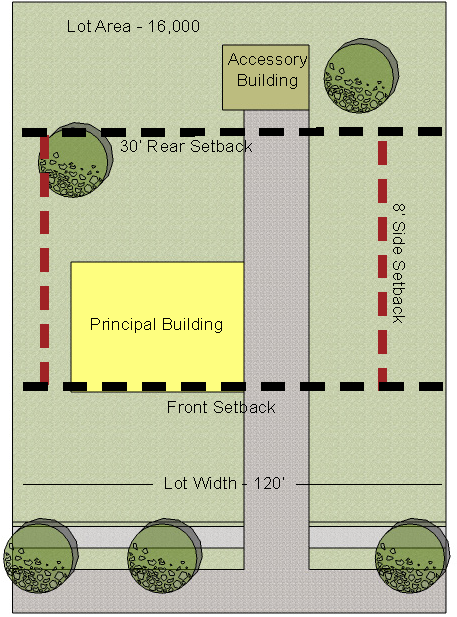
| Min. Lot Area | 16,000 square feet |
| Min. Lot Width | 120' (130' for corner lot) |
| Max. Lot Coverage | 30% |
| Max. Impervious Surface | 40% |
| Building | |
| Primary Structure | |
| Min. Front Setback | See table below * |
| Min. Side Setback (least side/total of two) | 6'/14' |
| Min. Rear Setback | 30' |
| Min. Living Area (sq. ft.) | 1,200/1,200 |
| 1½ Story | 940/1,340 |
| Two Story | 750/1,500 |
| Accessory Structure | |
| Location | Side or rear yard |
| Front Setback | Not permitted in front yard |
| Min. Side Setback | 4' |
| Min. Rear Setback | 4' |
| Structures | |
| Max. Number of Structures | |
| Primary | 1 |
| Accessory | 2 detached |
| Max. Structure Heights | |
| Primary | 3 stories/30' |
| Accessory | 16' |
| Parking | |
| Min. Spaces Required | 2 |
| Configuration | Shall be located in garage or on driveway |
 | |
| Front Yard Setback | |
| *Front and street-side setbacks shall be measured from the centerline of each road right-of-way in accordance with the township's master plan as follows: | |
| Road Type | Min. Front Yard Setback |
| Regional (204' ROW) | 137' |
| Major | 90' |
| Collector | 73' |
| Local | 60' |
A.
Intent. The single family districts are established to provide principally for single family dwellings at varying densities. The specific interest of these districts is to encourage the construction and continued use of single family dwellings and to prohibit the use of the land which would substantially interfere with the development of single family dwellings and to discourage any land use which, because of its character and size, would create requirements and costs for public services substantially in excess of those at the specified densities and to discourage any land use which would generate excessive traffic on local streets.
B.
Permitted uses.
C.
Special land uses. The following uses, and others similar to those cited in this article, may be permitted by the planning commission, subject to the special land use standards outlined in this ordinance.
(Ord. No. 308.3, §§ 2, 3, 4-9-2018; Ord. No. 308.4, §§ 16, 17, 8-13-2018; Ord. No. 308.5, § 11, 4-26-2021)
Section 14.07. - R1-A single family residential.
| R1-A Single Family Residential | |
|---|---|
| Lot | |
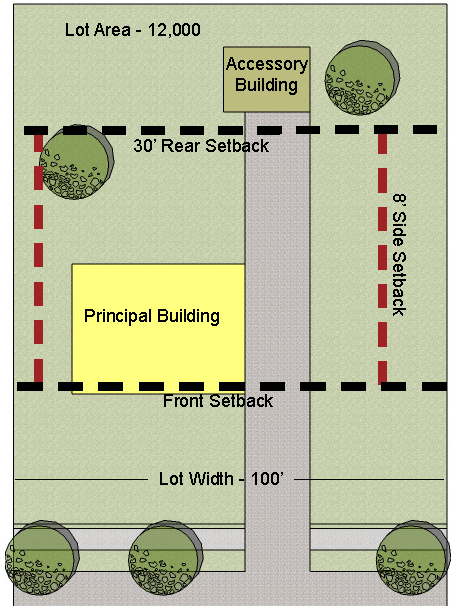
| Min. Lot Area | 12,000 square feet |
| Min. Lot Width | 100' (110' for corner lot) |
| Max. Lot Coverage | 30% |
| Max. Impervious Surface | 40% |
| Building | |
| Primary Structure | |
| Min. Front Setback | See table below * |
| Min. Side Setback (least side/total of two) | 6'/14' |
| Min. Rear Setback | 30' |
| Min. Living Area (sq. ft.) | 1,200/1,200 |
| 1½ Story | 940/1,340 |
| Two Story | 750/1,500 |
| Accessory Structure | |
| Location | Side or rear yard |
| Front Setback | Not permitted in front yard |
| Min. Side Setback | 4' |
| Min. Rear Setback | 4' |
| Structures | |
| Max. Number of Structures | |
| Primary | 1 |
| Accessory | 2 detached |
| Max. Structure Heights | |
| Primary | 2.5 stories/30' |
| Accessory | 16' |
| Parking | |
| Min. Spaces Required | 2 |
| Configuration | Shall be located in garage or on driveway |
 | |
| Front Yard Setback | |
|
*Front and street-side setbacks shall be measured from the centerline of each road
right-of-way in accordance with the township's master plan as follows:
However, in no case shall any building be located closer than 30 feet from the front property line. | |
| Road Type | Min. Front Yard Setback |
| Regional (204' ROW) | 137' |
| Major | 90' |
| Collector | 73' |
| Local | 60' |
A.
Intent. The single family districts are established to provide principally for single family dwellings at varying densities. The specific interest of these districts is to encourage the construction and continued use of single family dwellings and to prohibit the use of the land which would substantially interfere with the development of single family dwellings and to discourage any land use which, because of its character and size, would create requirements and costs for public services substantially in excess of those at the specified densities and to discourage any land use which would generate excessive traffic on local streets.
B.
Permitted uses.
C.
Special land uses. The following uses, and others similar to those cited in this article, may be permitted by the planning commission, subject to the special land use standards outlined in this ordinance.
(Ord. No. 308.3, §§ 4, 5, 4-9-2018; Ord. No. 308.4, §§ 18, 19, 8-13-2018; Ord. No. 308.5, § 12, 4-26-2021)
Section 14.08. - R1-B single family residential.
| R1-B Single Family Residential | |
|---|---|
| Lot | |
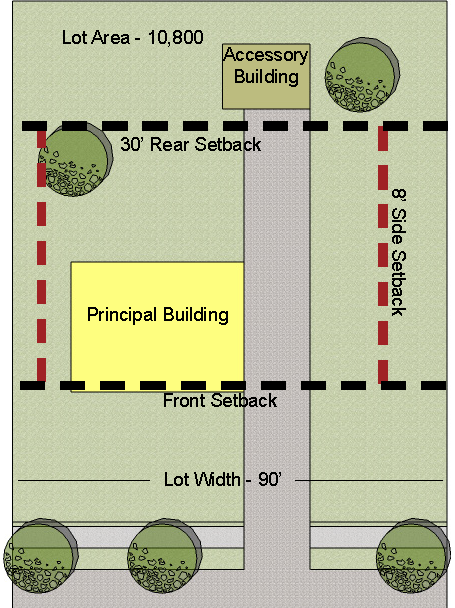
| Min. Lot Area | 10,800 square feet |
| Min. Lot Width | 90' (100' for corner lot) |
| Max. Lot Coverage | 30% |
| Max. Impervious Surface | 40% |
| Building | |
| Primary Structure | |
| Min. Front Setback | See table below * |
| Min. Side Setback (least side/total of two) | 6'/14' |
| Min. Rear Setback | 30' |
| Min. Living Area (sq. ft.) | 1,200/1,200 |
| 1½ Story | 940/1,340 |
| Two Story | 750/1,500 |
| Accessory Structure | |
| Location | Side or rear yard |
| Front Setback | Not permitted in front yard |
| Min. Side Setback | 4' |
| Min. Rear Setback | 4' |
| Structures | |
| Max. Number of Structures | |
| Primary | 1 |
| Accessory | 2 |
| Max. Structure Heights | |
| Primary | 2.5 stories/30 feet |
| Accessory | 16' |
| Parking | |
| Min. Spaces Required | 2 |
| Configuration | Shall be located in garage or on driveway |
 | |
| Front Yard Setback | |
|
*Front and street-side setbacks shall be measured from the centerline of each road
right-of-way in accordance with the township's master plan as follows:
However, in no case shall any building be located closer than 30 feet from the front property line. | |
| Road Type | Min. Front Yard Setback |
| Regional (204' ROW) | 137' |
| Major | 90' |
| Collector | 73' |
| Local | 60' |
A.
Intent. The single family districts are established to provide principally for single family dwellings at varying densities. The specific interest of these districts is to encourage the construction and continued use of single family dwellings and to prohibit the use of the land which would substantially interfere with the development of single family dwellings and to discourage any land use which, because of its character and size, would create requirements and costs for public services substantially in excess of those at the specified densities and to discourage any land use which would generate excessive traffic on local streets.
B.
Permitted use.
C.
Special land uses. The following uses, and others similar to those cited in this article, may be permitted by the planning commission, subject to the special land use standards outlined in this ordinance.
(Ord. No. 308.3, §§ 6, 7, 4-9-2018; Ord. No. 308.4, §§ 20, 21, 8-13-2018; Ord. No. 308.5, § 13, 4-26-2021)
Section 14.09. - R1-C single family residential.
| R1-C Single Family Residential | |
|---|---|
| Lot | |
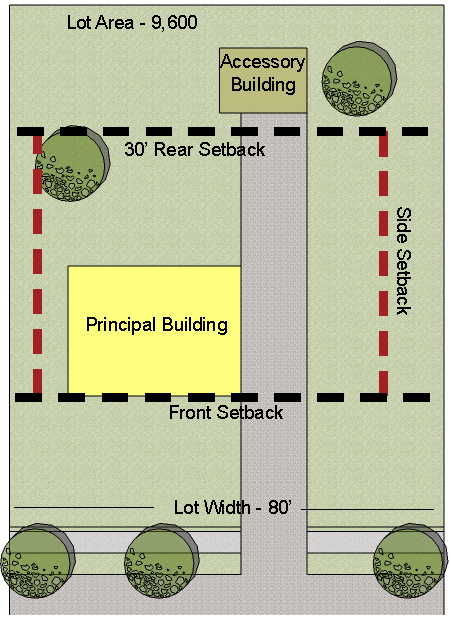
| Min. Lot Area | 9,600 square feet |
| Min. Lot Width | 80' (90' for corner lot) |
| Max. Lot Coverage | 30% |
| Max. Impervious Surface | 45% |
| Building | |
| Primary Structure | |
| Min. Front Setback | See table below * |
| Min. Side Setback (least side/total of two) | 6'/14' |
| Min. Rear Setback | 30' |
| Min. Living Area (sq. ft.) | 1,200/1,200 |
| 1½ Story | 900/1,350 |
| Two Story | 750/1,450 |
| Accessory Structure | |
| Location | Side or rear yard |
| Front Setback | Not permitted in front yard |
| Min. Side Setback | 4' |
| Min. Rear Setback | 4' |
| Structures | |
| Max. Number of Structures | |
| Primary | 1 |
| Accessory | 2 |
| Max. Structure Heights | |
| Primary | 2.5 stories/30 feet |
| Accessory | 16' |
| Parking | |
| Min. Spaces Required | 2 |
| Configuration | Shall be located in garage or on driveway |
 | |
| Front Yard Setback | |
|
*Front and street-side setbacks shall be measured from the centerline of each road
right-of-way in accordance with the township's master plan as follows:
However, in no case shall any building be located closer than 30 feet from the front property line. | |
| Road Type | Min. Front Yard Setback |
| Regional (204' ROW) | 132' |
| Major | 90' |
| Collector | 73' |
| Local | 60' |
A.
Intent. The single family districts are established to provide principally for single family dwellings at varying densities. The specific interest of these districts is to encourage the construction and continued use of single family dwellings and to prohibit the use of the land which would substantially interfere with the development of single family dwellings and to discourage any land use which, because of its character and size, would create requirements and costs for public services substantially in excess of those at the specified densities and to discourage any land use which would generate excessive traffic on local streets.
B.
Permitted use.
C.
Special land uses. The following uses, and others similar to those cited in this article, may be permitted by the planning commission, subject to the special land use standards outlined in this ordinance.
(Ord. No. 308.3, §§ 8, 9, 4-9-2018; Ord. No. 308.4, §§ 22, 23, 8-13-2018; Ord. No. 308.5, § 14, 4-26-2021)
Section 14.10. - R1-D single family residential.
| R1-D Single Family Residential | |
|---|---|
| Lot | |
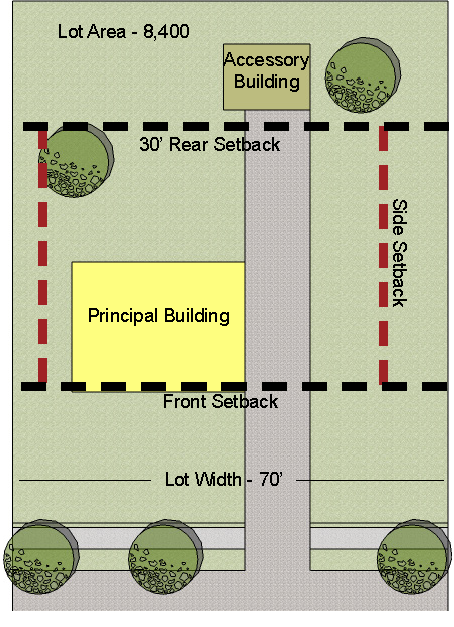
| Min. Lot Area | 8,400 square feet |
| Min. Lot Width | 70' (80' for corner lot) |
| Max. Lot Coverage | 35% |
| Max. Impervious Surface* | 50% |
| Building | |
| Primary Structure | |
| Min. Front Setback | See table below * |
| Min. Side Setback (least side/total of two) | 6'/14' |
| Min. Rear Setback | 30' |
| Min. Living Area (sq. ft.) | 1,000/1,000 |
| 1½ Story | 875/1,250 |
| Two Story | 750/1,400 |
| Accessory Structure | |
| Location | Side or rear yard |
| Front Setback | Not permitted in front yard |
| Min. Side Setback | 4' |
| Min. Rear Setback | 4' |
| Structures | |
| Max. Number of Structures | |
| Primary | 1 |
| Accessory | 2 |
| Max. Structure Heights | |
| Primary | 2.5 stories/35 feet |
| Accessory | 16' |
| Parking | |
| Min. Spaces Required | 2 |
| Configuration | Shall be located in garage or on driveway |
 | |
| Front Yard Setback | |
|
*Front and street-side setbacks shall be measured from the centerline of each road
right-of-way in accordance with the township's master plan as follows:
However, in no case shall any building be located closer than 30 feet from the front property line. | |
| Road Type | Min. Front Yard Setback |
| Regional (204' ROW) | 132' |
| Major | 90' |
| Collector | 73' |
| Local | 60' |
* The impervious surface ratio for nonconforming lots may be increased one percent for each one percent of reduced lot size. For example: A 7,500 square foot lot would require an impervious surface area of 8,400 (required lot size) - 7,500 s.f. = 900 square feet. 900 divided by 8,400 = 10.7% rounded = 11%. The impervious surface ratio required is 50% + 11% = 61%.
In no case shall the impervious surface ratio exceed 75 percent. Swimming pools shall not be considered impervious surface.
A.
Intent. The single family districts are established to provide principally for single family dwellings at varying densities. The specific interest of these districts is to encourage the construction and continued use of single family dwellings and to prohibit the use of the land which would substantially interfere with the development of single family dwellings and to discourage any land use which, because of its character and size, would create requirements and costs for public services substantially in excess of those at the specified densities and to discourage any land use which would generate excessive traffic on local streets.
B.
Permitted use.
C.
Special land uses. The following uses, and others similar to those cited in this article, may be permitted by the planning commission, subject to the special land use standards outlined in this ordinance.
(Ord. No. 308.3, §§ 10, 11, 4-9-2018; Ord. No. 308.4, §§ 24, 25, 8-13-2018; Ord. No. 308.5, § 15, 4-26-2021)
Section 14.11. - MHC manufactured housing community.
| MHC Manufactured Housing Community | |
|---|---|
| Lot | |
| Min. Lot Area | 10,000 sq. ft. |
| Min. Lot Width | 80' |
| Max. Lot Coverage | 40% |
| Max. Impervious Surface | 50% |
| Building | |
| Primary Structure | |
| Min. Front Setback | See table below * |
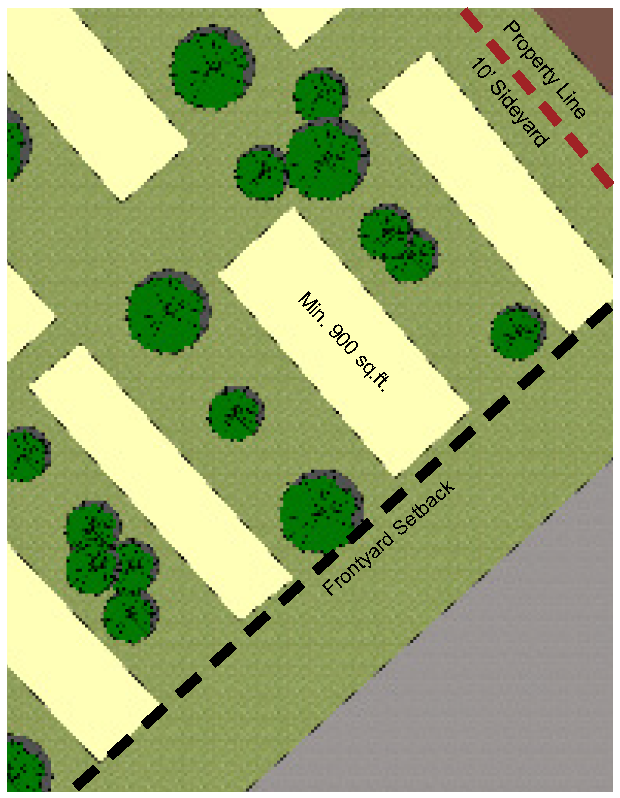
| Min. Side Setback (each side) | 10' |
| Min. Rear Setback | 35' |
| Min. Living Area (sq. ft.) | 900 sq. ft. |
| Accessory Structure | |
| Planning commission approval required for a community accessory structure in a manufactured housing community development. | |
| Other Requirements | |
| Fire hydrants of a size and a pressure to be used by the Harrison Township Fire Department shall be placed within a manufactured housing community so that no portion of the manufactured home shall be less than 300 feet from a fire hydrant measured along the roadway or parking area. | |
| Max. Structure Heights | |
| Primary | 2 stories/30' |
| Parking | |
| Min. Spaces Required |
2, plus 1 for every 3 manufactured housing sites for visitor
parking |
 | |
| Front Yard Setback | |
|
*Front and street-side setbacks shall be measured from the centerline of each road
right-of-way in accordance with the township's master plan as follows:
However, in no case shall any building be located closer than 30 feet from the front property line. | |
| Road Type | Min. Front Yard Setback |
| Regional (204' ROW) | 132' |
| Major | 90' |
| Collector | 73' |
| Local | 60' |
A.
Intent. The manufactured housing community district is a residential district. The rules are those set forth by the manufactured housing commission, except for the regulations herein designed to provide adequate space and land use separation in harmony with the township's other zoning districts.
B.
Permitted use.
C.
Special land use approval.
(Ord. No. 308, § 5, 2-13-2017; Ord. No. 308.3, § 12, 4-9-2018; Ord. No. 308.4, § 26, 8-13-2018; Ord. No. 308.5, § 16, 4-26-2021)
Section 14.12. - RM-1 multiple family residential.
| RM-1 Multiple Family Residential | ||
|---|---|---|
| Lot | ||
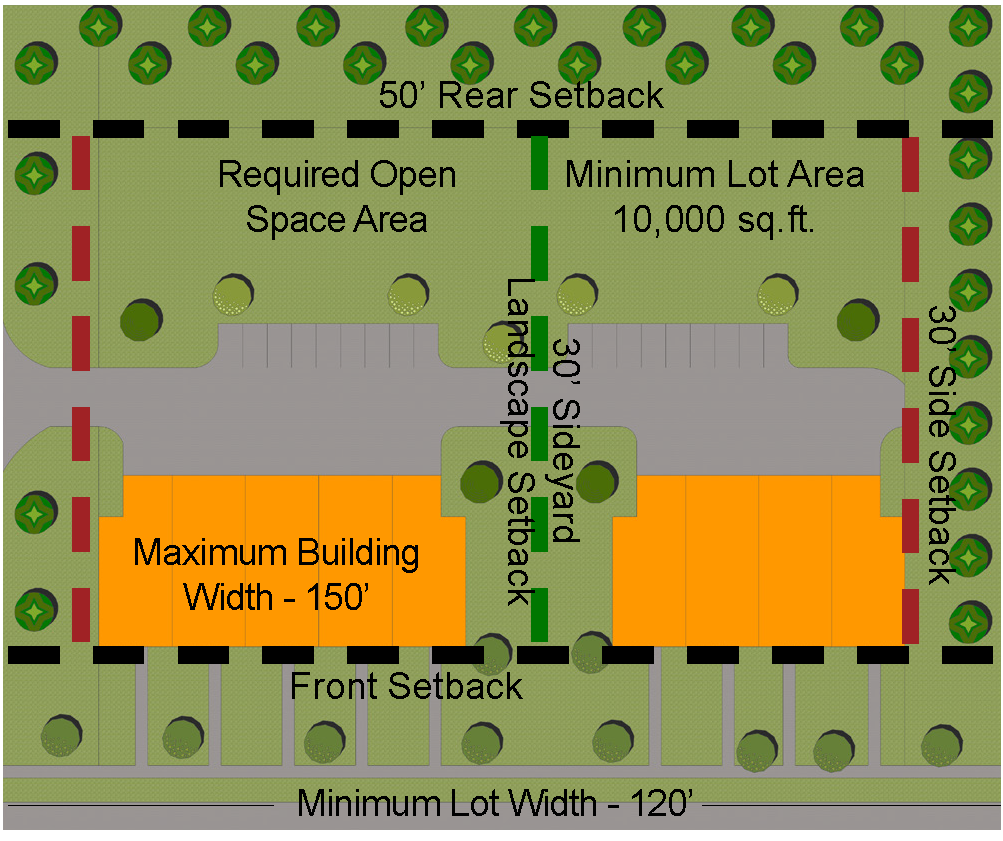
| Min. Lot Area | 10,000 square feet | |
| Min. Lot Width | 120' frontage | |
| Building | ||
| Perimeter Setbacks from Adjacent Property Lines | ||
| Min. Front Setback | See table below * | |
| Min. Side Setback | 40' | |
| Min. Rear Setback | 50' | |
| Min. Living Area | Minimum Square Footage | |
| Efficiency Unit | 500 square feet | |
| 1-Bedroom Unit | 600 square feet | |
| 2-Bedroom Unit | 750 square feet | |
| 3 or More Bedroom Unit | 850 sq. ft. plus 200 for every additional bedroom beyond 3 | |
| Building Length | ||
| No multiple family building shall exceed 150' in length | ||
| Max. Structure Height | ||
| Primary | 3 stories/32 feet | |
| Density (Minimum gross site area in square feet, per dwelling unit for each dwelling unit) | ||
| Number of Bedrooms | Site Area per Unit | |
| 1-Bedroom | 5,800 | |
| 2-Bedroom | 6,200 | |
| 3-Bedroom | 6,600 | |
| Units with more than 3 bedrooms shall provide an additional 1,000 square feet of site area for each additional bedroom. | ||
| Multiple family development plans which include a den, library or other similar type room shall be counted as a bedroom. | ||
| Each development shall be limited to 10% efficiency units. | ||
| Min. Required Open Space per Unit Well defined and improved recreation areas and facilities shall be provided. The minimum number of square feet of recreation area shall be provided in addition to all required setbacks and spacing between buildings. Open space shall be provided on a per unit basis according to the following table: | ||
| Bedrooms | Open Space Requirement | |
| 1 bedroom | 400 | |
| 2 bedrooms | 500 | |
| 3 bedrooms | 750 | |
| 4 bedrooms | 1,000 | |
 | ||
| Min. Front Yard Setback | ||
|
*Front and street-side setbacks shall be measured from the centerline of each road
right-of-way in accordance with the township's master plan as follows:
However, in no case shall any building be located closer than 40 feet from the front property line. | ||
| Road Type | Front Yard Setback | |
| Building | Parking | |
| Regional (204' ROW) | 142' | 122' |
| Major | 110' | 90' |
| Collector | 83' | 63' |
| Local | 70' | 55' |
| Min. Landscape Setbacks must be provided adjacent to, and surrounding each building on the following basis: | ||
| Side of Building | ||
| Front | 30-foot landscaped area | |
| Sides | 30-foot landscaped area | |
| Rear | 50-foot landscaped area | |
| Landscaped setbacks for one building shall not be utilized to satisfy the landscape setback requirement of another building. Such landscape setback shall be exclusive to the building it surrounds. | ||
| Buildings which include attached garages may utilize a portion of the required landscape setback to permit a parking apron and paved access to a garage. However, pavement shall not surround more than 40 percent of the overall perimeter of the building. | ||
| Parking | ||
| Min. Spaces Required | See section 9.03 | |
A.
Intent. The RM-1 district is intended to provide for the development of multiple-family dwelling units, including apartments, townhomes, and attached condominiums. The provisions that regulate this land use district should provide for the development of high density residential neighborhoods.
B.
Permitted use.
C.
Special land use approval. The following uses, and others similar to those cited in this article, may be permitted by the planning commission, subject to the special land use standards outlined in this ordinance.
(Ord. No. 308.3, §§ 13, 14, 4-9-2018; Ord. No. 308.4, §§ 27, 28, 8-13-2018; Ord. No. 308.5, §§ 2, 17, 4-26-2021)
Section 14.13. - RM-2 multiple family residential.
| RM-2 Multiple Family Residential | ||
|---|---|---|
| Lot | ||
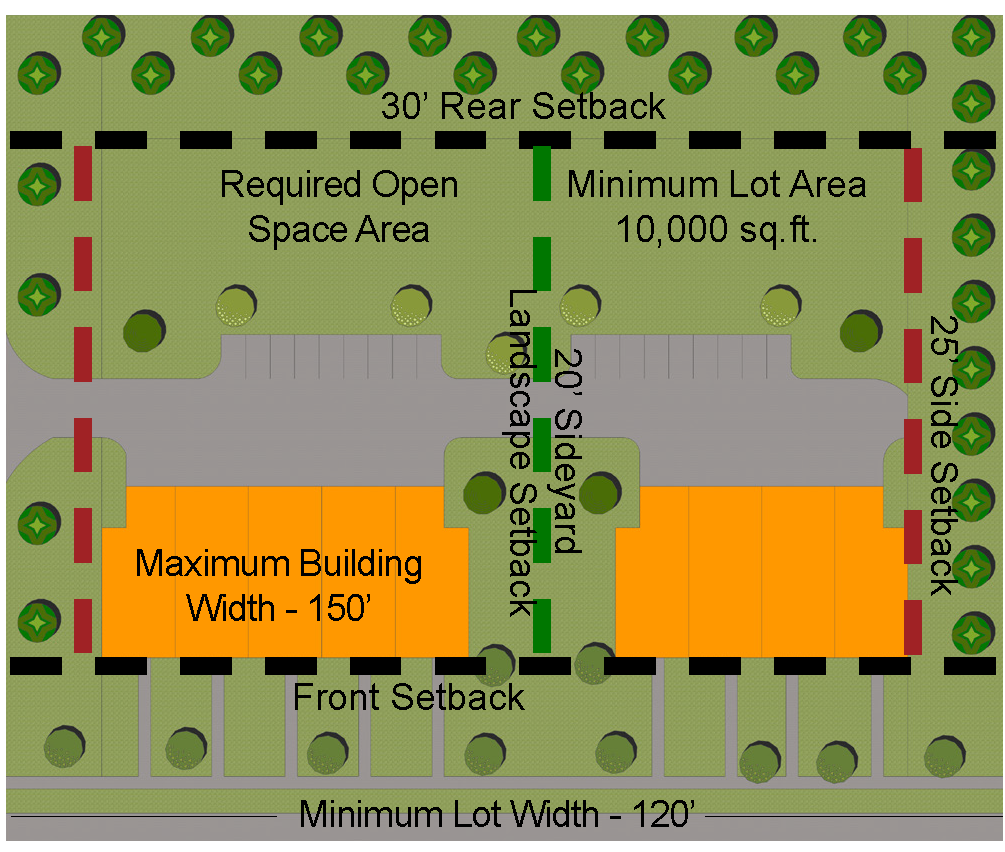
| Min. Lot Area | 10,000 square feet | |
| Min. Lot Width | 120' frontage | |
| Building | ||
| Perimeter Setbacks from Adjacent Property Lines | ||
| Min. Front Setback | See table below * | |
| Min. Side Setback | 30' | |
| Min. Rear Setback | 30' | |
| Min. Living Area | Minimum Square Footage | |
| Efficiency Unit | 450 square feet | |
| 1-Bedroom Unit | 550 square feet | |
| 2-Bedroom Unit | 700 square feet | |
| 3 or More Bedroom Unit | 800 sq. ft. plus 200 for every additional bedroom beyond 3 | |
| Building Length | ||
| No multiple family building shall exceed 150' in length | ||
| Max. Structure Height | ||
| Primary | 3 stories/32 feet | |
| Density (Minimum gross site area in square feet, per dwelling unit provided) | ||
| Number of Bedrooms | Site Area per Unit | |
| 1-Bedroom | 4,200 | |
| 2-Bedroom | 4,600 | |
| 3-Bedroom | 5,000 | |
| Units with more than 3 bedrooms shall provide an additional 800 square feet of site area for each additional bedroom. | ||
| Multiple family development plans which include a den, library or other similar type room shall be counted as a bedroom. | ||
| Each development shall be limited to 10% efficiency units. | ||
| Min. Required Open Space per Unit Well defined and improved recreation areas and facilities shall be provided. The minimum number of square feet of recreation area shall be provided in addition to all required setbacks and spacing between buildings. Open space shall be provided on a per unit basis according to the following table: | ||
| Bedrooms | Open Space Requirement | |
| 1 bedroom | 300 square feet | |
| 2 bedrooms | 400 square feet | |
| 3 bedrooms | 600 square feet | |
| 4 bedrooms | 800 square feet | |
 | ||
| Min. Front Yard Setback | ||
|
*Front and street-side setbacks shall be measured from the centerline of each road
right-of-way in accordance with the township's master plan as follows:
However, in no case shall any building be located closer than 30 feet from the front property line. | ||
| Road Type | Front Yard Setback | |
| Building | Parking | |
| Regional (204' ROW) | 122' | 102' |
| Major | 90' | 70' |
| Collector | 73' | 53' |
| Local | 60' | 45' |
| Min. Landscape Setbacks must be provided adjacent to, and surrounding each building on the following basis: | ||
| Side of Building | ||
| Front | 20-foot landscaped area | |
| Sides | 20-foot landscaped area | |
| Rear | 30-foot landscaped area | |
| Landscaped setbacks for one building shall not be utilized to satisfy the landscape setback requirement of another building. Such landscape setback shall be exclusive to the building it surrounds | ||
| Buildings which include attached garages may utilize a portion of the required landscape setback to permit a parking apron and paved access to a garage. However, pavement shall not surround more than 40% of the overall perimeter of the building. | ||
| Parking | ||
| Min. Spaces Required | See section 9.03 | |
A.
Intent. The RM-2 district is intended to provide for the development of multiple-family dwelling units, including apartments, townhomes, and attached condominiums. The provisions that regulate this land use district should provide for the development of high density residential neighborhoods.
B.
Permitted use.
C.
Special land use approval. The following uses, and others similar to those cited in this article, may be permitted by the planning commission, subject to the special land use standards outlined in this ordinance.
(Ord. No. 308.3, §§ 15, 16, 4-9-2018; Ord. No. 308.4, §§ 29—31, 8-13-2018; Ord. No. 308.5, §§ 3, 18, 4-26-2021)
Section 14.14. - HMR high and mid-rise residential district.
| HMR High and Mid-Rise Residential | ||
|---|---|---|
| Lot | ||
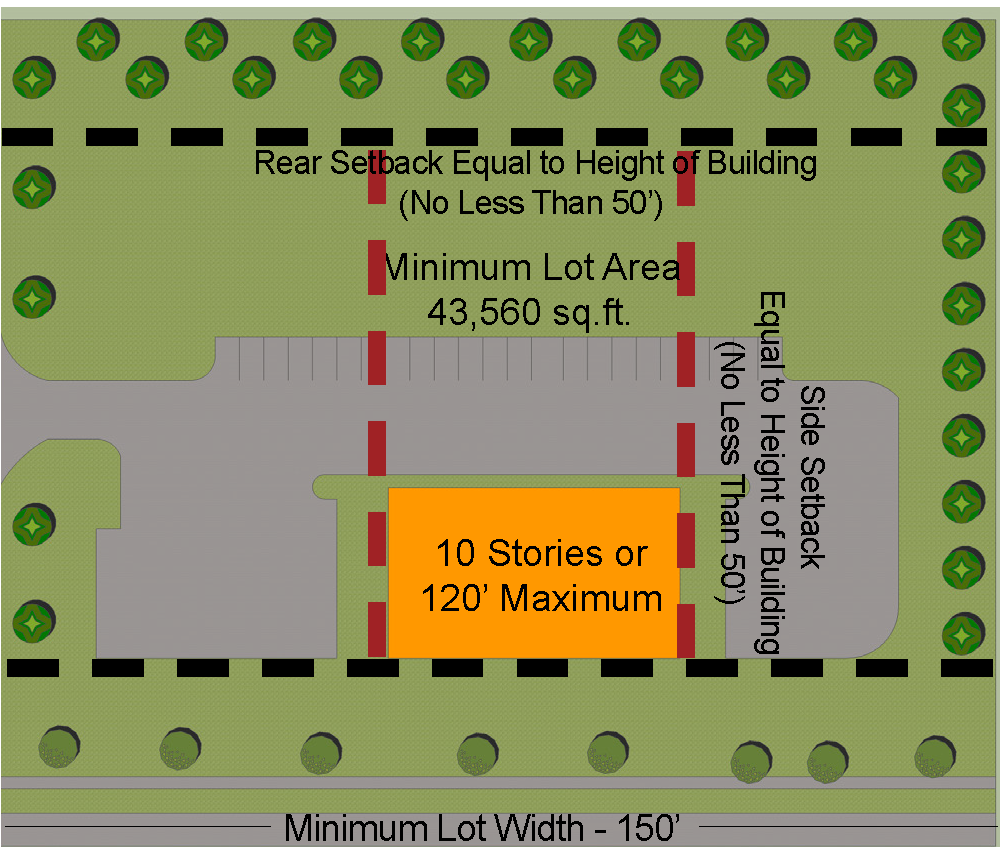
| Min. Lot Area | 43,560 square feet | |
| Min. Lot Width | 150' frontage | |
| Building | ||
| Perimeter Setbacks from Adjacent Property Lines | ||
| Min. Front Setback | See table below * | |
| Min. Side and Rear Yard Setbacks shall be equal to the total height of the proposed building, but in no circumstance shall they be less than 50 feet. | ||
| Floor-to-Area Ratio | ||
| The structures on any lot shall have a total floor area not exceeding 50% of the lot area. | ||
| Min. Living Area | Minimum Square Footage | |
| Efficiency Unit | 450 square feet | |
| 1-Bedroom Unit | 550 square feet | |
| 2-Bedroom Unit | 700 square feet | |
| 3- or More Bedroom Unit | 800 sq. ft. plus 200 for every additional bedroom beyond 3 | |
| Each development shall be limited to 10% efficiency units. | ||
| Building Length | ||
| No multiple family building shall exceed 150' in length | ||
| Maximum Structure Height | ||
| Primary | 10 stories/120 feet | |
| Any proposed development where the structures do not exceed three stories in height shall be regulated by all terms of the RM-2 zoning district | ||
| Min. Required Open Space per Unit Well defined and improved recreation areas and facilities shall be provided. The minimum number of square feet of recreation area shall be provided in addition to all required setbacks and spacing between buildings. Open space shall be provided on a per unit basis according to the following table: | ||
| Bedrooms | Open Space Requirement | |
| 1- and 2-Bedroom Units | 250 square feet | |
| 3- and 4-Bedroom Units | 500 square feet | |
 | ||
| Min. Front Yard Setback | ||
|
*Front and street-side setbacks shall be measured from the centerline of each road
right-of-way in accordance with the township's master plan as follows:
However, in no case shall any building be located closer than 40 feet from the front property line. | ||
| Road Type | Front Yard Setback | |
| Building | Parking | |
| Regional (204' ROW) | 142' | 122' |
| Major | 110' | 90' |
| Collector | 83' | 63' |
| Local | 80' | 65' |
| Min. Landscape Setbacks must be provided adjacent to, and surrounding each building on the following basis: | ||
| Side of Building | ||
| All Sides of Building | 40-foot landscaped area | |
| Landscaped setbacks for one building shall not be utilized to satisfy the landscape setback requirement of another building. Such landscape setback shall be exclusive to the building it surrounds. | ||
| Buildings which include attached garages may utilize a portion of the required landscape setback to permit a parking apron and paved access to a garage. However, pavement shall not surround more than 40% of the overall perimeter of the building. | ||
| Parking | ||
| Min. Spaces Required | See section 9.03 | |
A.
Intent. The HMR District is intended to provide for the development of multiple-family dwelling units, including apartments, townhomes, and attached condominiums. The provisions that regulate this land use district should provide for the development of high density residential neighborhoods.
B.
Permitted use.
C.
Special land use approval. The following uses, and others similar to those cited in this article, may be permitted by the planning commission, subject to the special land use standards outlined in this ordinance.
(Ord. No. 308.4, § 32, 8-13-2018; Ord. No. 308.5, § 19, 4-26-2021)
Section 14.15. - LC local commercial.
| LC Local Commercial | ||
|---|---|---|
| Lot | ||
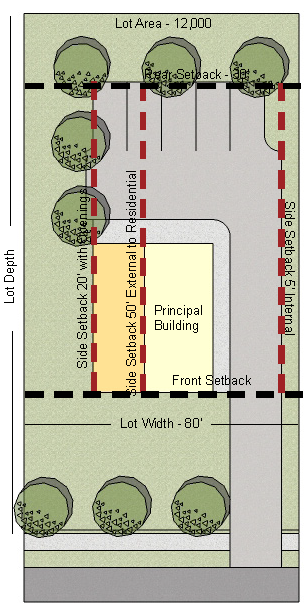
| Min. Lot Area | 12,000 | |
| Min. Lot Width | 80 ft. | |
| Max. Lot Coverage | 30% | |
| Building | ||
| Min. Front Setback | See table below * | |
| Min. Side Setback | 5' interior side | |
| 20' if openings | ||
| 50' exterior side if abutting residential | ||
| Min. Rear Setback | 30' | |
| Structures | ||
| Max. Number of Structures | ||
| Principal | N/A | |
| Accessory | N/A | |
| Max. Structure Height | ||
| Primary | 1 story/20' | |
| Parking | ||
| Min. Spaces Required | See section 9.03 | |
| Configuration | See section 9.03 | |
 | ||
| Min. Front Yard Setback | ||
|
*Front and street-side setbacks shall be measured from the centerline of each road
right-of-way in accordance with the township's master plan as follows:
However, in no case shall any building be located closer than 50 feet from the front property line. | ||
| Road Type | Front Yard Setback | |
| Building | Parking | |
| Regional (204' ROW) | 152' | 112' |
| Major | 110' | 70' |
| Collector | 93' | 53' |
| Local | 80' | 40' |
A.
Intent. The LC local commercial district is designated to meet the day-to-day convenience shopping and service needs of persons residing in adjacent residential areas. Protection of nearby residential districts is considered of importance; thus, businesses which tend to be a nuisance to immediately surrounding residential areas are excluded, even though the goods sold or services offered might fall within the convenience classification.
It is further the intent of this district to provide these goods and services in a physical setting that is compatible with surrounding residential neighborhoods and which are of a neighborhood size and character. Whenever possible, local business districts should be developed with consolidated site features to provide for a continuity of appearance and function and to minimize any negative impacts on nearby residential neighborhoods or the township's thoroughfare system.
B.
Permitted use.
C.
Special land use approval. The following uses, and others similar to those cited in this article, may be permitted by the planning commission, subject to the special land use standards outlined in this ordinance.
(Ord. No. 308.4, § 33, 8-13-2018; Ord. No. 308.5, § 20, 4-26-2021; Ord. No. 308.6, §§ 2, 3, 1-9-2023)
Section 14.16. - GC general commercial.
| GC General Commercial | ||
|---|---|---|
| Lot | ||
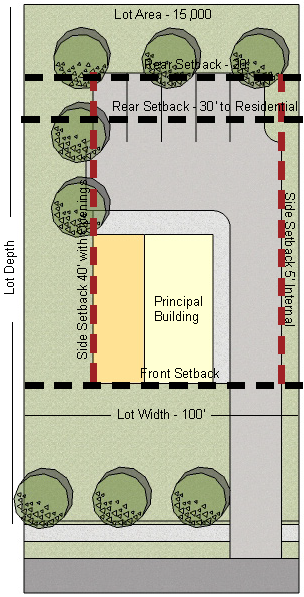
| Min. Lot Area | 15,000 | |
| Min. Lot Width | 100 ft. | |
| Max. Lot Coverage | 30% | |
| Building | ||
| Primary Structure | ||
| Min. Front Setback | See table below | |
| Min. Side Setback | 5' interior side | |
| 40' if openings | ||
| 40' exterior side to residential | ||
| Min. Rear Setback | 20' interior rear | |
| 30' exterior rear to residential | ||
| Structures | ||
| Min. Number of Structures | ||
| Primary | N/A | |
| Accessory | N/A | |
| Max. Structure Heights | ||
| Principal | 2 stories/30' | |
| Accessory | 2 stories/30' | |
| Parking | ||
| Min. Spaces Required | See section 9.03 | |
| Configuration | See section 9.05 | |
 | ||
| Min. Front Yard Setback | ||
|
*Front and street-side setbacks shall be measured from the centerline of each road
right-of-way in accordance with the township's master plan as follows:
However, in no case shall any building be located closer than 50 feet from the front property line. | ||
| Road Type | Front Yard Setback | |
| Building | Parking | |
| Regional (204' ROW) | 152' | 112' |
| Major | 110' | 70' |
| Collector | 93' | 53' |
| Local | 80' | 40' |
A.
Intent. The GC general commercial district is designed to provide for a wide diversity of business activities which are predominantly, but not necessarily, totally retail in character. In addition to retail uses, a number of other activities, usually requiring considerable land area and access to major thoroughfares, are permitted. Uses in this district normally must have good automobile accessibility, but should not cause congestion on adjacent thoroughfares.
B.
Permitted use.
C.
Special land use approval. The following uses, and others similar to those cited in this article, may be permitted by the planning commission, subject to the special land use standards outlined in this ordinance.
(Ord. No. 308.4, § 34, 8-13-2018; Ord. No. 308.5, § 21, 4-26-2021; Ord. No. 308.6, § 4, 1-9-2023)
Section 14.17. - V-1 village district.
| V-1 Village District | |
|---|---|
| Lot | |
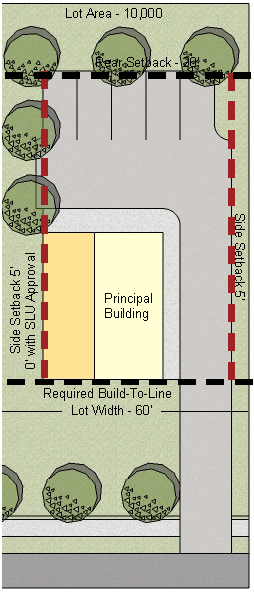
| Min. Lot Area | 10,000 |
| Min. Lot Width | 60 ft. |
| Building | |
| Primary Structure | |
| Front Setback (Build-To-Line) | See table below * |
| Min. Side Setback | 5' sideyard or zero lot line after special land use approval |
| Min. Rear Setback | 20' |
| Max. Structure Heights | |
| Principal | See section 14.17.D. |
| Parking | |
| Min. Spaces Required | See section 9.03 |
| Configuration | Not permitted in front yard—See section 9.04 for full list of requirements |
| Landscaping | |
| Screening | section 6.05 |
| Parking Lot and Frontage | section 7.03 |
| Front Yard Setback | |
| *Front and street-side setbacks shall be measured from the centerline of each road. The setbacks required are maximum permitted setbacks (build-to-line): | |
| Road | Front Yard Setback |
| Building | |
| Jefferson (south of MetroParkway), Shook and S. River Rd. | Build-to-line between 53' and 63' |
| Jefferson (north of MetroParkway) and Crocker Boulevard | Build-to-line between 65' and 75' |
| Local | Build-to-line 40' |
 | |
A.
Intent. The major function of the village district is that of a specialty center. It is the intent of the village district to permit a mixture of mutually supporting convenience, specialty, and service commercial uses, as well as complementary office, entertainment and residential uses, which provide for the needs of township residents. The standards contained herein are designed to promote compact infill development which creates a continuous office and retail frontage, convenient and unobstructed pedestrian access and shopping experience, and compatible building appearance and architectural style and character. Uses permitted in this district should complement each other, not adversely impacting vehicular or pedestrian circulation or the overall character and function of the district. Parking must be an integral part of development and coordinated with the village district as a whole.
B.
Permitted use.
C.
Special land use approval. The following uses, and others similar to those cited in this article, may be permitted by the planning commission, subject to the special land use standards outlined in this ordinance.
D.
Building.
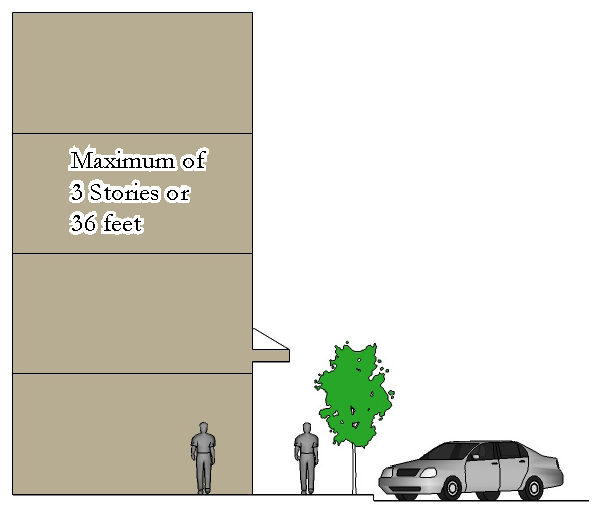
Maximum building height: The maximum building height permitted shall be three stories or 36 feet.
Minimum building height: The minimum building height of any building constructed along the required front yard build-to-line shall be 20 feet.
E.
Materials.
Building Materials: Buildings within the V-1 village district shall be subject to the design and material requirements of article IV, as well as the following requirements. Wherever, a conflict exists, the requirements of this section shall prevail:
Commercial and office: Cement fiber board is the required primary facade treatment. 75% of each building elevation shall consist of this material. Secondary and accent treatments may be permitted in accordance with the table provided.
The use of EIFS or other similar materials shall be limited to architectural accents and shall not be utilized less than eight feet above grade.
Multiple family: Cement fiber board is the required primary facade treatment. A secondary treatment of up to 25 percent is permitted on each elevation.
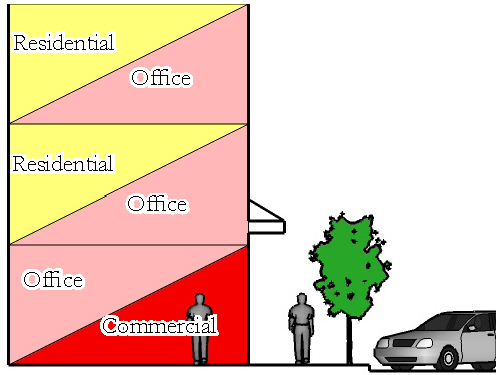
F.
Building usage. The following uses types may be permitted on each floor:
G.
Architecture.
1.
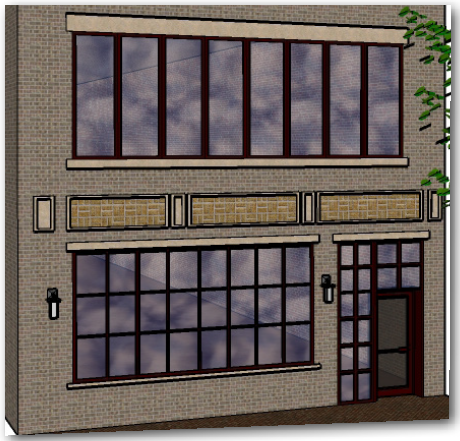
Architecture: Buildings are encouraged to be designed with a nautical themed architecture. Any roof mounted fixtures shall be properly screened from view by the use of parapets.
Long blank walls shall be avoided. Breaks in the facade shall be accomplished with "building steps", the use of windows and doors, and other architectural elements.
2.
Windows/transparency: The length of walls/facades facing streets and internal streets or pedestrian areas shall consist of windows for a minimum of 50 percent of that facade area.
The use of tinted or reflective glass within first floor windows is prohibited. First floor windows shall only be clear glass.
(Ord. No. 308.4, § 35, 8-13-2018; Ord. No. 308.5, §§ 22, 26, 4-26-2021; Ord. No. 308.6, §§ 5, 6, 1-9-2023)
Section 14.18. - RW residential waterfront mixed-use district.
| RW Residential Waterfront | ||
|---|---|---|
| Lot | ||
| Min. Lot Area | 15,000 square feet | |
| Min. Lot Width | 100' | |
| Building | ||
| Primary Structure | ||
| Min. Front Setback | See table below * | |
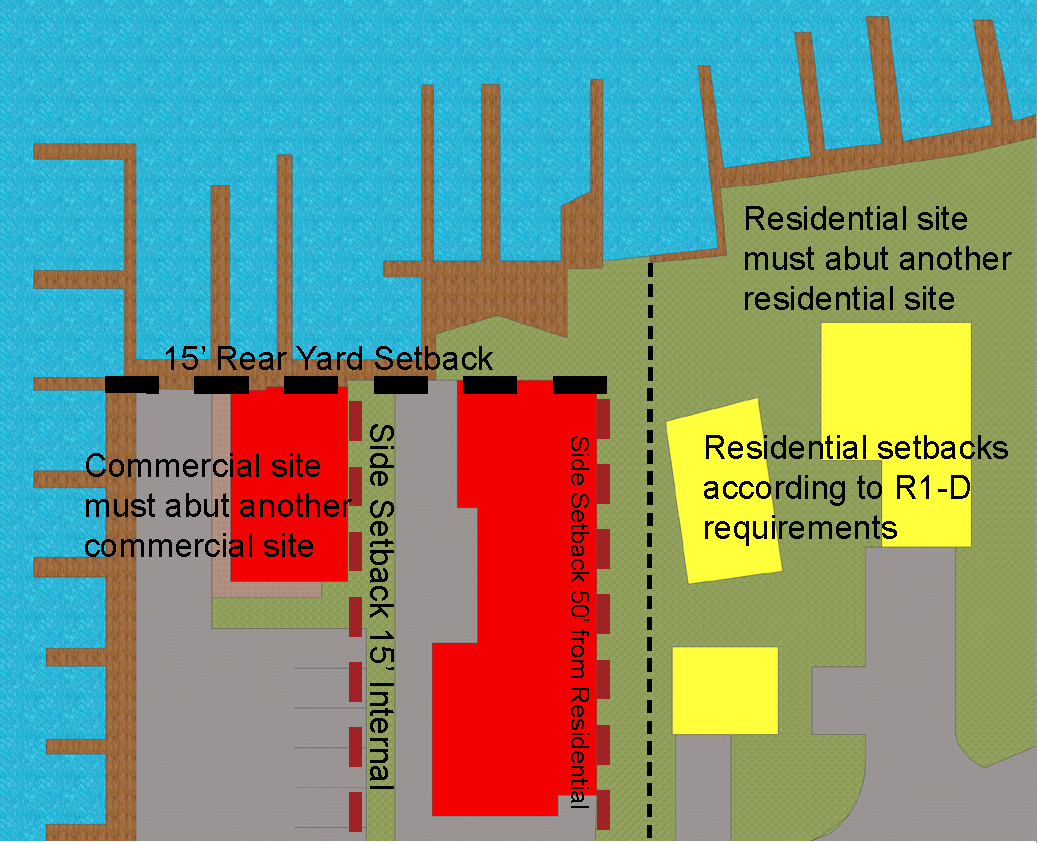
| Single family residential uses shall maintain setbacks consistent with the requirements of the R1-D zoning district. All other uses shall comply with the setback requirements herein. | ||
| Min. Side Setback | 15'/50' on side abutting a residential district | |
| Min. Yard Setback from the established fill or bulkhead line for buildings and other uses, except as provided in this paragraph, shall be 20 linear feet. No building or uses, including parking, shall be less than 15 feet from the water's edge. Launching ramps and docks may be constructed to the water's edge and into the water where appropriate. | ||
| Min. Living Area | ||
| Shall be consistent with the requirements of the R1-D zoning district. | ||
| Max. Structure Heights | ||
| Primary | 2 stories/35' | |
| Other Issues | ||
| The addition or alteration of slips, boathouses, moorings or the shoreline shall require site plan review the same as other construction or alteration on shore. | ||
| A proposed use shall abut a similar use along at least one of its side boundaries, i.e., residential shall be next to residential, waterfront uses shall be next to other permitted waterfront district uses. | ||
 | ||
| Min. Front Yard Setback | ||
|
*Front and street-side setbacks shall be measured from the centerline of each road
right-of-way in accordance with the township's master plan as follows:
However, in no case shall any building be located closer than 30 feet from the front property line. | ||
| Road Type | Front Yard Setback | |
| Building | Parking and Outdoor Storage | |
| Regional (204' ROW) | 132' | 112' |
| Major | 90' | 70' |
| Collector | 73' | 53' |
| Local | 60' | 40' |
A.
Intent. The RW, residential waterfront mixed-use district is established to encourage a diversity of compatible land uses, which may include a mixture of residential, waterfront, office, retail, recreational, and other similar uses within an aesthetically attractive environment conducive to the development and protection against nuisance-type uses and combinations.
B.
Permitted use.
C.
Special land use approval. The following uses, and others similar to those cited in this article, may be permitted by the planning commission, subject to the special land use standards outlined in this ordinance.
(Ord. No. 308.4, § 36, 8-13-2018; Ord. No. 308.5, § 23, 4-26-2021; Ord. No. 308.6, § 11, 1-9-2023)
Section 14.19. - WF waterfront district.
| WF Waterfront District | ||
|---|---|---|
| Lot | ||
| Min. Lot Area | 15,000 | |
| Min. Lot Width | 100' | |
| Building | ||
| Primary Structure | ||
| Min. Front Setback | See table below * | |
| Min. Side Setback | 20' | |
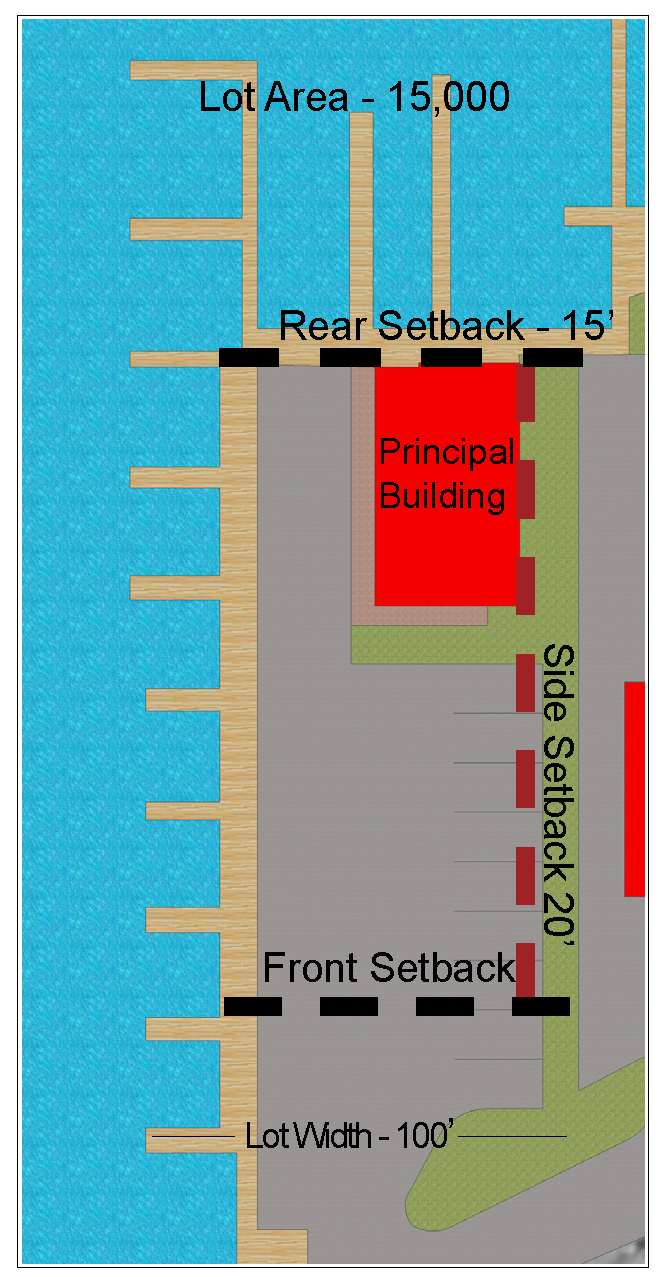
| Min. Yard Setback from the established fill or bulkhead line for buildings and other uses, except as provided in this paragraph, shall [be] 15 linear feet. No building or use (including off-street parking), except covered boat wells, slips or berths, shall be less than 15 feet from the water's edge. Launching ramps and docks may be constructed to the water's edge and into the water, where appropriate. | ||
| Max. Structure Heights | ||
| Primary | 2 stories/35' | |
| The addition or alteration (excluding maintenance) of slips, boathouses, moorings or the shoreline shall require site plan review the same as other construction or alteration on shore. | ||
|
Permitted outside storage of boats and equipment necessary and accessory to the principal
use shall comply with the following conditions:
All storage or parking shall meet the principal setback requirements. | ||
| Facilities shall be provided at the marina for disposal of refuse from boat holding tanks in a sanitary manner. Each marina shall provide suitable, safe and sanitary toilet refuse facilities within buildings designed for this purpose. | ||
 | ||
| Min. Front Yard Setback | ||
|
*Front and street-side setbacks shall be measured from the centerline of each road
right-of-way in accordance with the township's master plan as follows:
However, in no case shall any building be located closer than 30 feet from the front property line. | ||
| Road Type | Front Yard Setback | |
| Building | Parking and Outdoor Storage | |
| Regional (204' ROW) | 132' | 112' |
| Major | 90' | 70' |
| Collector | 73' | 53' |
| Local | 60' | 40' |
A.
Intent. The waterfront of Harrison Township is a limited community resource; therefore, it is the intent of the waterfront district to allow only those recreational, public and business uses which are related to the waterfront and which, therefore, cannot feasibly be located elsewhere. Residential uses shall only be permitted after careful review for compatibility with existing and potential surrounding uses. Such districts are intended to encourage safe and efficient development of waterfront areas and facilitate navigation.
B.
Permitted use.
C.
Special land use approval. The following uses, and others similar to those cited in this article, may be permitted by the planning commission, subject to the special land use standards outlined in this ordinance.
(Ord. No. 308.4, § 37, 8-13-2018; Ord. No. 308.5, § 24, 4-26-2021; Ord. No. 308.6, § 10, 1-9-2023)
Section 14.20. - Industrial district.
| IND Industrial District | ||
|---|---|---|
| Lot | ||
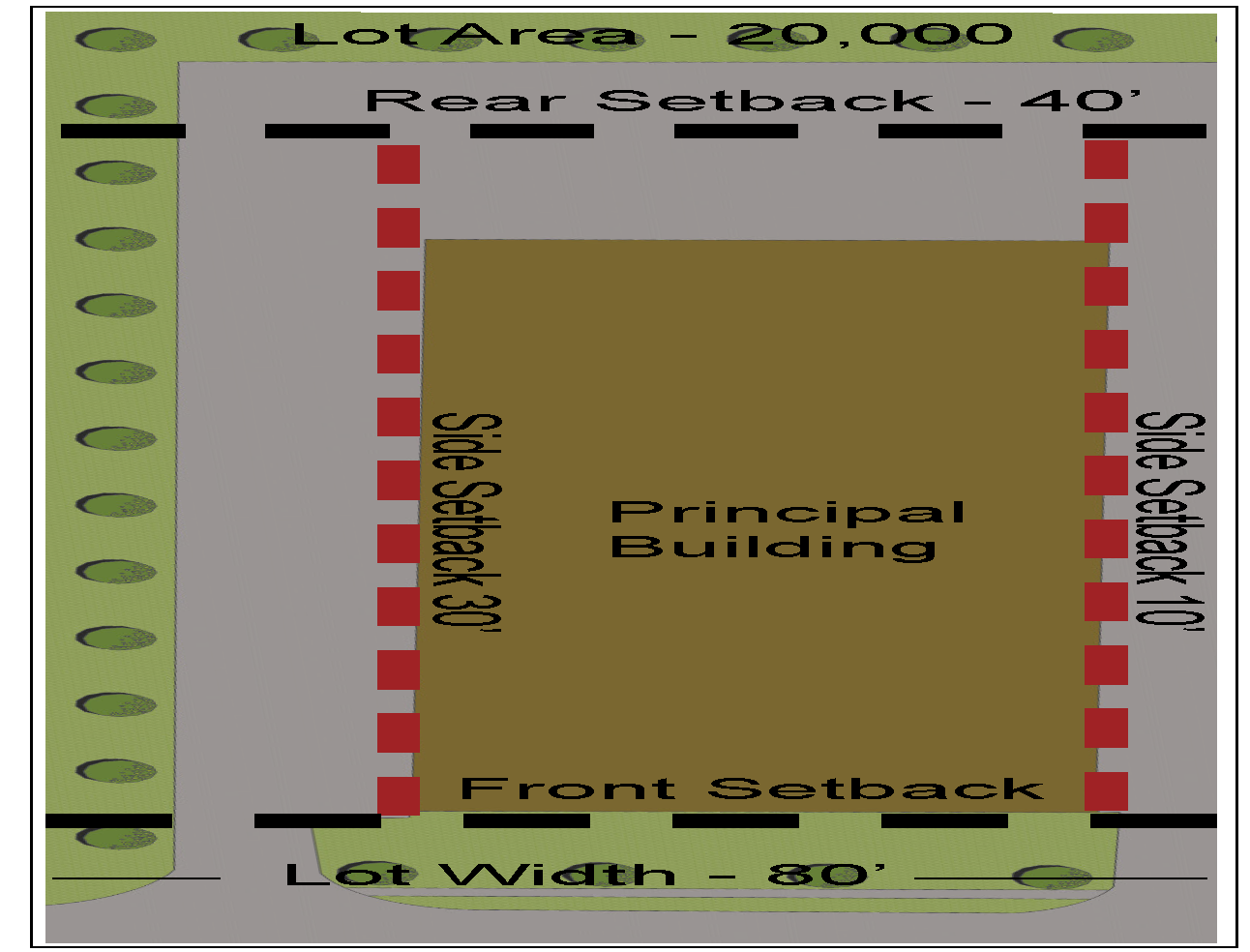
| Min. Lot Area | 20,000 | |
| Min. Lot Width | 80 ft. | |
| Max. Lot Coverage | 50% | |
| Max. Impervious Surface | 90% | |
| Building | ||
| Primary Structure | ||
| Min. Front Setback | ||
| Min. Side Setback Least Side/Combined Total | 10'/40' (zero lot line as a special land use) | |
| Min. Rear Setback | 40' | |
| Other Requirements | ||
| All uses shall meet the performance standards outlined in section 7.06. | ||
| Max. Structure Heights | ||
| Primary | 2 stories/40' | |
| Min. Front Yard Setback | ||
|
*Front and street-side setbacks shall be measured from the centerline of each road
right-of-way in accordance with the township's master plan as follows:
However, in no case shall any building be located closer than 50 feet from the front property line. | ||
| Road Type | Front Yard Setback | |
| Building | Parking and Outdoor Storage | |
| Regional (204' ROW) | 152' | 112' |
| Major | 110' | 70' |
| Collector | 93' | 53' |
| Local | 80' | 40' |
| Freeway | 100' | 60' |
 | ||
A.
Intent. The intent of the industrial district is to encourage and facilitate the development of industrial enterprise in a setting conducive to economic stability and growth, providing protection from blight, deterioration and nonindustrial encroachment, and efficient traffic movement for employee and truck traffic. Protection is provided to residential land uses by separating them from industrial activities and by prohibiting the use of industrial zones for new residential development.
B.
Permitted use.
C.
Special land use approval. The following uses, and others similar to those cited in this article, may be permitted by the planning commission, subject to the special land use standards outlined in this ordinance.
(Ord. No. 308.3, § 17, 4-9-2018; Ord. No. 308.4, § 38, 8-13-2018; Ord. No. 308.5, § 25, 4-26-2021)
Section 14.21. - V-1A village district: downtown waterfront.
A.
Intent. The major function of the V-1A village district: downtown waterfront is to support a mixed-use, pedestrian-oriented, integrated waterfront district with a unified nautical theme. It is the intent of the village district: downtown waterfront to permit a mixture of mutually supporting convenience, specialty, service and marine-related commercial uses, as well as complementary office, entertainment and residential uses, which complement nearby residential neighborhoods and provide for the needs of township residents and visitors. The standards contained herein are designed to promote compact infill development which creates a continuous office and retail frontage, convenient and unobstructed pedestrian access and shopping experience, and compatible building appearance and architectural style and character. Uses permitted in this district should complement each other, not adversely impacting vehicular or pedestrian circulation or the overall character and function of the district. Parking must be an integral part of development and coordinated with the village district: downtown waterfront as a whole.
B.
Permitted uses.
Residential uses:
1.
Residential uses located on the second floor or higher of a building occupied on the first floor by a non-residential use
Commercial and office uses:
2.
Art gallery, dealer or supply shops
3.
Banks, credit unions and financial service offices (excluding drive-thru)
4.
Bowling alley and similar commercial recreation (indoors only)
5.
Carry out restaurants
6.
Catering businesses
7.
Dance halls or studios
8.
Drug stores, pharmacies, health and personal care stores
9.
Dry cleaners (drop off only)
10.
Eating and drinking establishments
11.
Food and beverage stores
12.
General retail sales (indoors only)
13.
Hardware, home appliance and consumer electronic stores
14.
Home accessory and/or supply stores
15.
Laundromats
16.
Personal care services
17.
Physical fitness facilities
18.
Precious metal buy/sell
19.
Professional, medical and dental offices
20.
Theaters (indoors only)
Other uses:
21.
Museums
22.
Outdoor dining
23.
Places of worship
24.
Private/public beaches
25.
Public parks
26.
Township facilities
27.
Accessory structures and uses customarily incidental to the above permitted uses
C.
Special land use approval.
Residential uses:
1.
Single-family dwellings
2.
Two-family dwellings
3.
Multiple family development subject to RM-2 district requirements
4.
Senior and elderly housing (section 17.27)
5.
Nursing/convalescent home (section 17.18)
Commercial and office uses:
6.
Banks, credit unions and financial service offices (including drive-thru)
7.
Colleges and universities (section 17.16)
8.
Funeral homes (section 17.21)
9.
Private and trade schools (section 17.35)
Other uses:
10.
Child care centers (section 17.15)
11.
Permitted and special land uses of the WF district not otherwise listed as a permitted use in this V-1A district.
12.
Public utility structures
13.
Zero lot line development (section 17.43)
14.
Public or private off-street parking areas as a principal use
15.
Accessory structures and uses customarily incidental to the above special land uses
D.
Lot and setback requirements.
1.
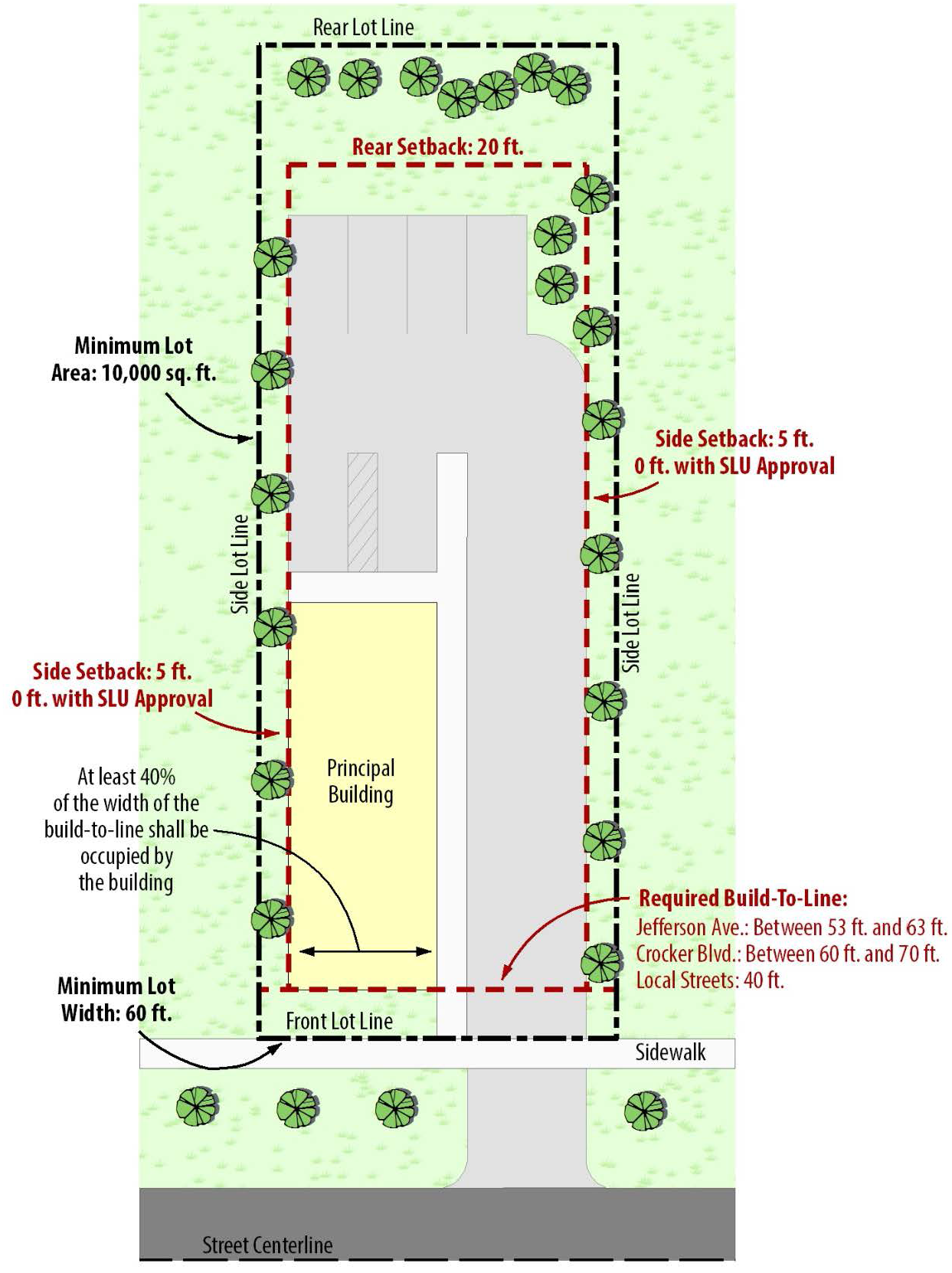
Minimum lot area: 10,000 square feet
2.
Minimum lot width: 60 feet
3.
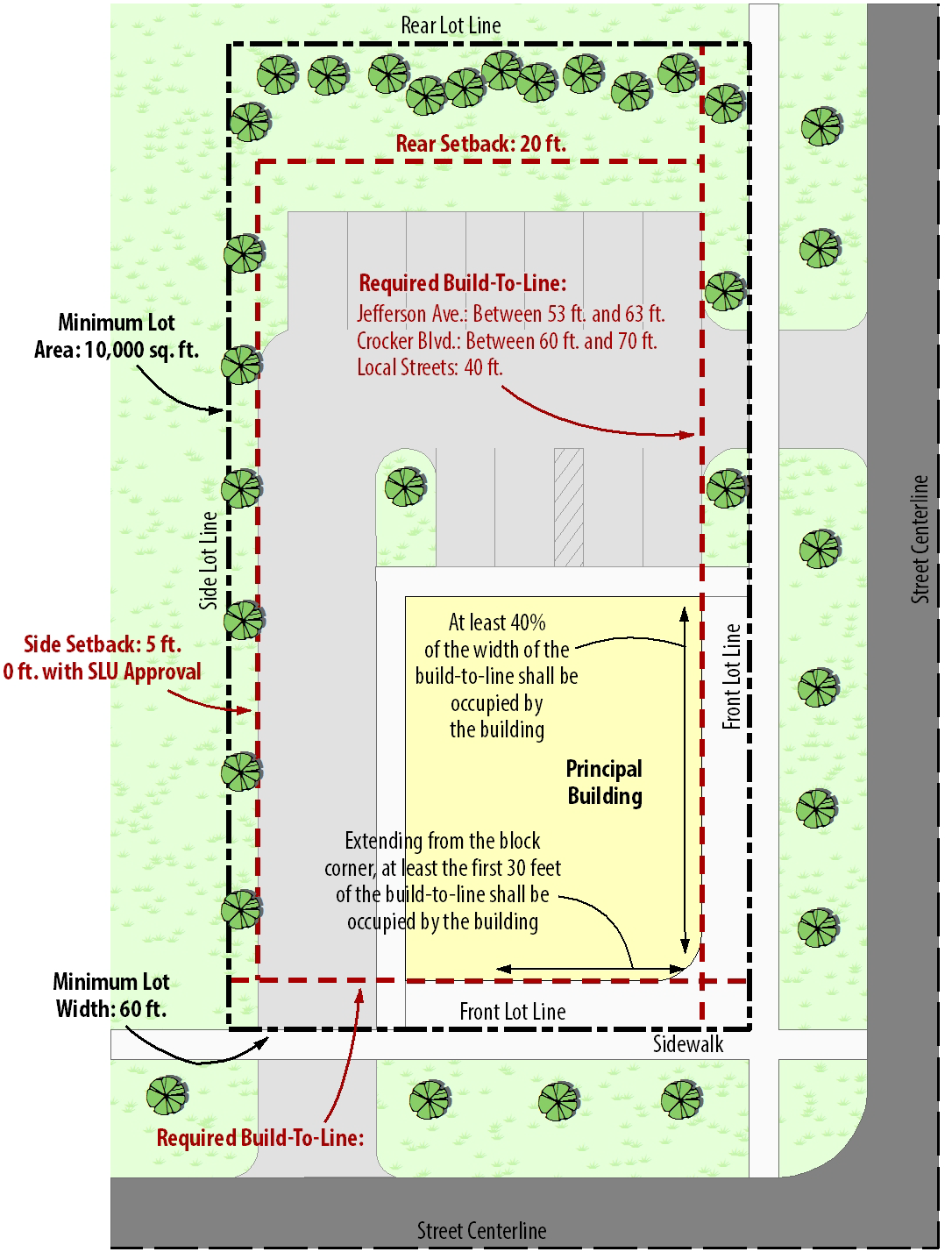
Maximum required front setback (build-to-line): Front and street-side setbacks shall be measured from the centerline of each street, as noted below. The setbacks required are maximum permitted setbacks (build-to-line).
4.
Minimum required side setback: Five-foot sideyard or zero lot line after special land use approval
5.
Minimum required rear setback: 20 feet
E.
Building height.
1.
Maximum building height: The maximum building height permitted shall be three stories or 36 feet. Up to one additional story, not to exceed four stories, may be permitted after approval as a special land use. Further, such additional story must be stepped back from the front building line by a minimum of ten feet.
2.
Minimum building height: The minimum building height of any building constructed along the required front yard build-to-line shall be 20 feet.
3.
Building height exceptions: The height requirements may be exceeded by parapet walls not over four feet in height, or as needed to conceal mechanical equipment, roof structures (attic stories), chimneys, television and radio antennas, cupolas, spires or other ornamental projections. Additional non-habitable height may be approved for ornamental projections that reflect the nautical character of the downtown waterfront village district, such as those that house clocks, nautical features, historic symbols, and other similar elements.
F.
Building placement.
1.
At least 40 percent of the width of the front/street-side build-to-line shall be occupied by the front/street-side building façade which shall have a height of at least the minimum required building height.
2.
Extending from any block corner, at least the first 30 feet of each front/street-side build-to-line shall generally be occupied by the front/street-side building façade, which shall have a height of at least the minimum required building height. Exceptions to this may be allowed to accommodate unique architectural design, outdoor activity areas, courtyards or similar spaces.
G.
Building usage: The following use types may be permitted on each floor:
H.
Architectural design and building materials. The architectural design of buildings within the V-1A village district: downtown waterfront shall be subject to the design and material requirements of article 4, as well as the following requirements. Wherever, a conflict exists, the requirements of this section shall prevail.
1.
Architecture: Buildings are encouraged to be designed with a nautical themed architecture. Any roof mounted fixtures shall be properly screened from view by the use of parapets. Long blank walls shall be avoided. Breaks in the facade shall be accomplished with "building steps", the use of windows and doors, and other architectural elements.
2.
Windows/transparency: The length of walls/facades facing streets and internal streets or pedestrian areas shall consist of windows for a minimum of 50 percent of that facade area. The use of tinted or reflective glass within first floor windows is prohibited. First floor windows shall only be clear glass.
3.
Commercial and office building materials: Seventy-five percent of each building elevation shall consist of one or a combination of the following primary façade treatment materials: brick, stone, cement fiber board siding, or similar decorative material as approved by the planning commission. Secondary and accent treatments may be permitted in accordance with the table provided. The use of EIFS or other similar materials shall be limited to architectural accents and shall not be utilized less than eight feet above grade.
4.
Multiple family building materials: Seventy-five percent of each building elevation shall consist of one or a combination of the following primary façade treatment materials: brick, cement fiber board siding, or similar decorative material as approved by the planning commission. Secondary and accent treatments may be permitted in accordance with the table provided.
I.
Outdoor storage and merchandising.
1.
Outdoor merchandising: Outdoor merchandising accessory to a principal use permitted in the V-1A district may be allowed subject to the requirements of section 11.08.A.
J.
Parking. The provisions and requirements as set forth in article 9 shall apply to all areas within the V-1A district except as modified by this section. The township recognizes that special provisions should be considered for the downtown waterfront area, including the reduction of required parking spaces, because of the district's many unique characteristics such as zero lot line, mixed-use, pedestrian oriented, traditional downtown development.
1.
Minimum number of off-street parking spaces: For non-residential uses located in the V-1A district, a reduction of 25 percent shall be applied against the amount of required parking as determined in section 9.03. Such reduction shall not apply to residential uses in the V-1A district.
2.
Payment in lieu of providing off-street parking: The owner or owners of a new or expanded use may make application to the township for the option of paying a dollar amount established by resolution of the township board per required parking space in lieu of providing such required spaces per the requirements set forth in subsection 1, above. These monies would be paid into a special parking district fund established by the township board specifically for the purpose of providing and improving on-street or off-street parking areas to serve uses located within the V-1A district. The timing of parking spaces provided and their location shall be at the sole discretion of the township board. The amount paid into the parking fund described above shall not apply against any present or future special assessments levied by the township for parking improvements.
a.
Exception criterion. The exception authorized by this section 14.21.J.2. may only be granted by the township board. Granting of such exception shall be based upon evidence presented by the property owner or owners showing that the reasonable ability to provide any or all of the parking spaces as required in subsection 1 above does not exist.
b.
Maximum exception. In no case shall the exception authorized by this section result in a payment being made for more than 25 percent of the total parking spaces as required in subsection 1 above.
c.
Payment required prior to occupancy. A property owner or owners granted the exception of contributing to the parking fund will not receive an occupancy permit until such monies have been paid into such fund in full.
d.
Application to change in use. The provisions of this section 14.21.J.2. shall also apply to any change in use of property located within the V-1A district that would require parking spaces in excess of those required by the previous use.
3.
Pervious surfacing: In lieu of asphaltic or concrete surfacing as required by section 9.05.C. off-street parking spaces and parking drive aisles within the V-1A district may be constructed of pervious materials, including pervious pavement or pervious pavers, but not including rock or gravel. The use of pervious materials shall be subject to review and approval by the township planning commission and the township engineer, in consideration of the underlying soil permeability, level of ground water, lot slope, and maintenance needs of the project (e.g. sweeping and washing).
4.
Off-street loading: The planning commission shall have the right to modify or waive the requirement for off-street loading areas as specified in section 9.07. Any such modification or waiver shall be based upon a review of a site plan and/or the surrounding area and a determination that there is satisfactory loading space serving the building or that the provision of such loading space is physically and/or functionally impractical to provide.
K.
Stormwater management. All developments and earth changes within the V-1A district subject to review under the requirements of this section shall be designed, constructed, and maintained to prevent flooding and protect water quality. The particular facilities and measures required on-site shall reflect the natural features, wetlands, and watercourses on or near the site; the potential for on-site and off-site flooding, water pollution, and erosion; and the size of the site. Stormwater management shall comply with the following standards:
1.
The design of storm sewers, detention facilities, and other stormwater management facilities shall comply with township design standards.
2.
Stormwater management conveyance, storage and infiltration measures and facilities shall be designed to prevent flood hazards and water pollution related to stormwater runoff and soil erosion from the proposed development.
3.
Alterations to natural drainage patterns shall not create flooding or water pollution for adjacent property owners.
4.
The use of drywells, infiltration trenches, swales, bio-retention or other best management practices for controlling urban runoff quality is strongly encouraged so as to decrease runoff velocity, allow for natural infiltration, allow suspended sediment particles to settle, and to remove pollutants. Such methods shall be designed in accordance with professionally accepted principles and shall be subject to review by the township engineer. Such stormwater control methods shall include, but are not necessarily limited to:
a.
Swales, both biofiltration and vegetated/rock swales.
b.
Rain gardens.
c.
Rain barrels or cisterns, both underground and above ground. Above ground rain barrel or cistern systems in excess of 250 gallons must conform to the setbacks for accessory buildings and structures and shall be fully enclosed to avoid attracting mosquitos or becoming a hazard.
d.
Vegetated roof systems.
Single-family and two-family dwellings are exempt from having to receive permitting and engineering approval for placement of rain gardens, bio-swales, rain barrels or other stormwater management practices, but all stormwater structures must meet applicable setbacks and other general standards.
5.
Maintenance of stormwater management facilities shall be the responsibility of the property owner.
|
V-1A Village District: Downtown Waterfront
Zoning Requirements Summary For summary purposes only. Refer to text for complete requirements. | |
|---|---|
| Lot RequirementsSection 14.21(D) | |
| Minimum Lot Area | 10,000 square feet |
| Minimum Lot Width | 60 feet |
| Required SetbacksSection 14.21(D) | |
| Maximum Front Setback (Build-To-Line) | |
| Jefferson Avenue: | Between 53 and 63 feet |
| Crocker Boulevard: | Between 60 feet and 70 feet |
| Local streets: | 40 feet |
| Minimum Side Setback | 5 feet. Zero lot line may be permitted upon approval as a Special Land Use. |
| Minimum Rear Setback | 20 feet |
| Building HeightSection 14.21(E) | |
| Maximum Height | 3 stories or 36 feet. Up to one additional story, not to exceed four (4) stories, may be permitted after approval as a Special Land Use, provided that the additional story is used for residential or lodging purposes. Further, such additional story must be stepped back from the front building line by a minimum of ten feet. |
| Minimum Height | The minimum building height of any building constructed along the required front yard build-to-line shall be 20 feet. |
| Building PlacementSection 14.21(F) | |
| Front/Street-Side Building Facade | At least 40 percent of the width of the front/street-side build-to-line shall be occupied by the front/street-side building façade which shall have a height of at least the minimum required building height. |
| Block Corners | Extending from any block corner, at least the first 30 feet of each front/street-side build-to-line shall generally be occupied by the front/street-side building façade, which shall have a height of at least the minimum required building height. Exceptions to this may be allowed to accommodate unique architectural design, outdoor activity areas, courtyards or similar spaces. |
| Building UseageSection 14.21(G) | |
| Allowable Uses by Floor | |
| 1 st Floor: | Commercial/Office/Lodging |
| 2 nd Floor: | Office/Residential/Lodging |
| 3 rd Floor: | Office/Residential/Lodging |
| 4 th Floor: | Residential/Lodging |
| Other Site Development Requirements: | |
| Architectural Design and Building Materials | See Article 4 and Section 14.21(H) |
| Accessory Structures and Uses | See Article 5 |
| Fencing and Screening | See Article 6 and Section 6.05 |
| Landscaping | See Article 7 |
| Site Lighting | See Article 8 |
| Parking | See Article 9 and Section 14.21(J) |
| Stormwater Management | See Section 14.21(K) |
| Trash Receptacle Standards | See Section 11.15 |
| Lot, Setback and Building Placement Requirements: | |
| Interior Lot | |
 | |
| Corner Lot | |
 | |
| Building Height and Usage Requirements | |
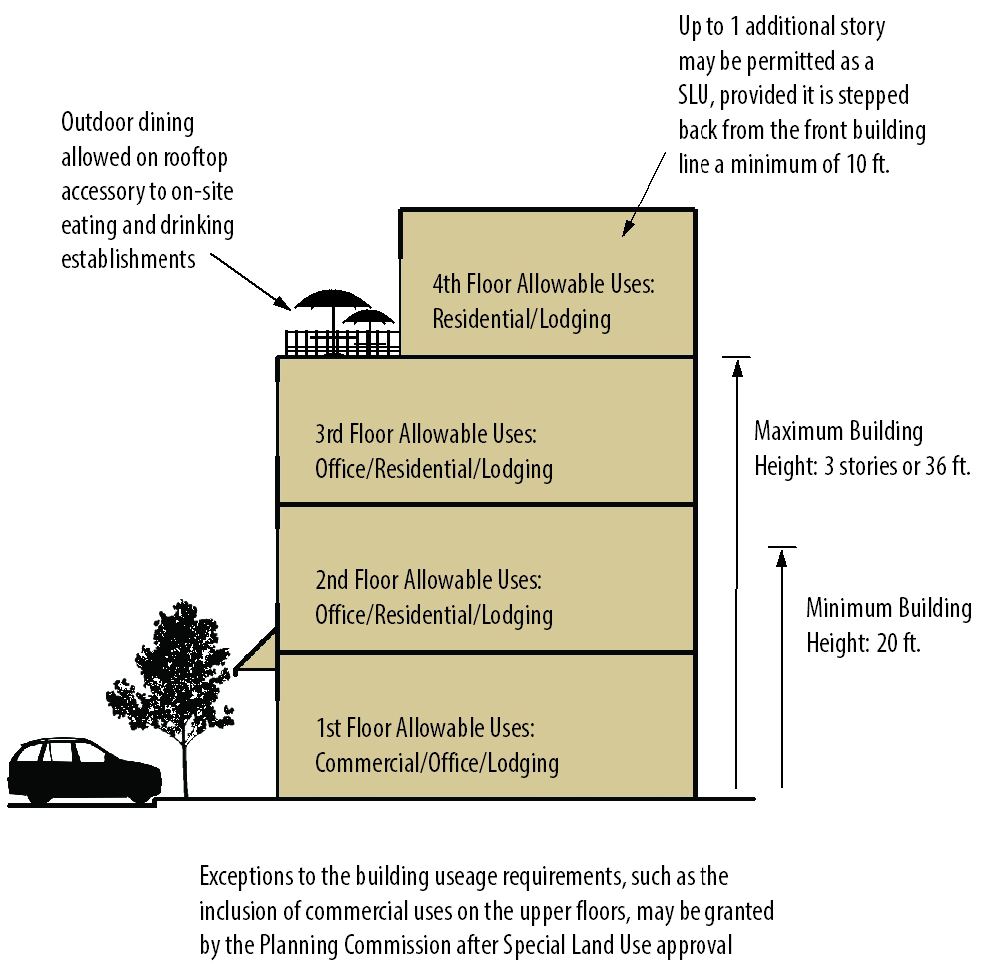 | |
(Ord. No. 308.2, § 2, 2-26-2018; Ord. No. 308.6, § 7, 1-9-2023)
Section 14.22. - Industrial medical marihuana district.
A.
Intent. The industrial medical marihuana district is intended to provide opportunities for the development of certain medical marihuana facilities that have been granted a permit by the township and have been granted a state license pursuant to the MMFLA. The township desires to allow approved medical marihuana facilities to operate exclusively within those properties zoned industrial (IND) that are north of Shook Road and that comply with the requirements of the buffer district, in order to limit any secondary effects of such operations.
B.
Buffer district. The buffer district is defined as the area within 500 feet of the following:
1.
Any private or public preschool, elementary, secondary, vocational or trade school, college or university;
2.
Any public park;
3.
Existing licensed child care center associated with a school;
4.
Any existing place of worship or religious assembly;
5.
Any residential zone R1;R1-A; R1-B; R1-C; R1-D; RM1; RM2; MHC; excluding the property owned by the Federal Government and commonly known as Selfridge Air National Guard Base.
A Licensee shall not operate a medical marihuana facility within the buffer district.
C.
General provisions.
1.
A Licensee shall not operate a marihuana facility at any place in the township other than the address provided in the application on file with the township clerk.
2.
A Licensee shall operate the medical marihuana facility in compliance with all applicable state and township regulations for that type of medical marihuana facility.
3.
The distance requirements described in the buffer district shall be computed by direct measurement in a straight line from the nearest property line of the land used for the purposes stated in section 14.21B to the nearest portion of the building, structure, or unit in which a medical marihuana facility is located.
(Ord. No. 308.3, § 18, 4-9-2018)
Section 14.23. - Regulations on patient caregiver activities.
A.
Intent and purpose.
On November 4, 2008, Michigan voters approved a ballot initiative that legalized medical marihuana and on December 4, 2008, Michigan's Medical Marihuana Act, M.C.L. 333.26421, et seq. ("MMMA"), took effect allowing both patients and/or their caregivers to cultivate medical marihuana within an enclosed, locked facility in order for those individuals to be entitled to the MMMA protections. As such, these enclosed locked facilities have been located on various locations of varying zoning classifications within the township.
The Stille-Derossett-Hale Single State Construction Code Act 230 of 1972 (M.C.L. 125.1501, et seq.) allows a local unit of government to legally adopt and enforce the state building code at the local level. The purpose of the building code is to ensure public health, safety, and welfare by protecting life and property from all hazards related to the design, erection, repair, removal, demolition, or use and occupancy of buildings, structures, or premises. This is in relation to structural strength, adequate egress facilities, sanitary equipment, light and ventilation, and fire safety. Building permits are required when construction or alteration of a structure is in order when a patient caregiver has made alterations to a structure to support the cultivation of marihuana.
Since the passage of the Act, a caregiver's cultivation of marihuana particularly, within residential districts within the township, has resulted in problems with insufficient or improper electrical supplies, problems with ventilation leading to mold, offensive odors, other health hazards and/or other hazards which are associated with the cultivation of marihuana in residential settings.
The Michigan Zoning Enabling Act, MCLA 125.3101 et. seq., ("MZEA") provides the township with statutory authority to regulate land use within the township through its zoning ordinance. The Michigan Supreme Court in the recent case of DeRuiter v Byron Township, 505 Mich 130 (2020), found that a township's zoning ordinance that geographically restricted such caregiver marihuana cultivation to a particular zoning district did not directly conflict with the MMMA and the township had the authority under the MZEA to require zoning permits and permit fees for the use of buildings and structures within its jurisdiction.
Therefore, this article as proposed, is intended to permit those persons in need of marihuana for medicinal purposes as allowed under the state acts as defined herein, to be afforded a reasonable opportunity to be treated and for those persons who are permitted to furnish medical marihuana, to furnish it within the limitations of the state acts and the geographical restriction imposed by the zoning ordinance in order to protect public health, safety, and welfare.
This article is also intended to protect and preserve the public health, safety and welfare of the community, the quality of life and the stability of property values including but not limited to the value of residential, commercial, and industrial districts.
This article is intended to prohibit a caregiver's cultivation of marihuana in residential zoning district and continues to prohibit same in commercial districts, in order to protect and preserve peace, order, property and safety of persons as a result of issues associated with the growth of marihuana in residential and commercial districts including problems with insufficient or improper electrical supply, problems with ventilation leading to mold, offensive odors, or other health hazards and other hazards which are associated with the cultivation of marihuana in residential and commercial settings and which is otherwise often difficult to detect and regulate. The MZEA provides the township with statutory authority to impose zoning limitations as set forth in this article. The township's zoning authority as it relates to patient care giver operations pursuant to the MMMA has also been upheld by the Michigan Supreme Court in the recent case of DeRuiter v. Byron Township, 505 Mich 130 (2020).
B.
Definitions. [The following words, terms and phrases, when used in this subsection, shall have the meanings ascribed to them in this section, except where the context clearly indicates a different meaning:]
Enclosed locked facility means a closet, room, or other comparable stationary and fully enclosed area equipped with secure locks or other functioning security devices that permit access only by a registered primary care giver, or registered qualifying patient. Marihuana plants grown outdoors, are considered to be in an enclosed, locked facility if: they are not visible to the unaided eye from an adjacent property when viewed by an individual at ground level, or from a permanent structure and are grown within a stationary structure that is enclosed on all sides, except for the base, by chain-link fencing, wooden slats, or a similar material that prevents access by the general public and that it is anchored, attached, or affixed to the ground; located on land that is owned, leased, or rented by either the registered qualifying patient, or a person designated through the department registration process, as the primary giver, for the registered qualifying patient, or patients for whom the marihuana plants are grown; and equipped with functioning locks or other security devices that restricts access to only the registered qualifying patient, or the registered primary caregiver, who owns, leases, or rents the property on which the structure is located. Enclosed, locked facility includes a motor vehicle if both of the following conditions are met:
1.
The vehicle is being used temporarily to transport living marihuana plants from one location to another with the intent to permanently retain those plants at the second location.
2.
An individual is not inside the vehicle unless he or she is either the registered qualifying patient to whom the living marihuana plants belong, or the individual designated through the department of registration process as the primary caregiver for the registered qualifying patient.
Marihuana means that term as defined in Section 7106 of the Public Health Code, 1978 PA 368, M.C.L. 333.7106.
Medical use means the acquisition, possession, cultivation, manufacture, use, internal possession, delivery, transportation of marihuana, or paraphernalia relating to the administration of marihuana to treat or alleviate a registered qualifying patient's debilitating medical condition, or symptoms associated with the debilitating medical condition, as further defined under the MMMA.
MMMA means to the Michigan Medical Marihuana Act, M.C.L. 333.26421 et seq. currently, or as amended. ("Act or "MMMA")
MRTMA means to the Michigan Regulation and Taxation of Marihuana Act Initiated Law 1 of 2018, M.C.L. 333.27952 et seq. currently, or as amended. ("MRTMA")
Registered primary care giver means to a person meeting the definition of caregiver under the MMMA and who has been issued and possesses a registry identification card and possesses the documentation that constitutes a valid registry under the MMMA.
Registered qualifying patient means a person meeting the definition under state law and who has been issued and possesses a registry identification card which is valid under the MMMA, as amended.
Transfer means to convey, sell, give, deliver, or allow the possession by another person or entity.
Zoning ordinance means the Zoning Ordinance of the Charter Township of Harrison.
Other provisions and terms. The other provisions and terms of the MMMA and MRTMA for purposes of deferential context are incorporated by reference as though more fully restated herein.
C.
Medical marihuana for registered qualifying patients or any individual over the age of 21.
Registered qualifying patients, or visiting qualified patients and individuals over the age of 21 years old, may use, possess, and store medical marihuana as provided in the MMMA, M.C.L. 333.26421 et seq. as amended, and marihuana as provided in the MRTMA, M.C.L. 333.27952 et seq. as amended, and as further regulated herein.
1.
A registered qualifying patient and individuals over the age of 21 years of age:
a.
May use, possess and store marihuana in their principal residence within the township for personal use only, and shall comply at all times and in all circumstances with the Act, MRTMA and the General Rules of the Michigan Community Health or the Michigan Department of Licensing and Regulatory Affairs, as they may be amended from time to time.
b.
May only cultivate marihuana for him or herself in compliance with the MMMA and the MRTMA, on a residentially zoned parcel or otherwise authorized for residential use and on a parcel zoned within the industrial medical marihuana district, in an enclosed locked facility, inaccessible on all sides and equipped with locks or other security devices that permit access only by the registered qualifying patient and individuals 21 years or older.
c.
All necessary building, electrical, plumbing, and mechanical permits shall be required and obtained prior to any alterations of any portion of the structure in support of or in association with the cultivation of marihuana, or for the erection of an accessory structure meeting the definition of an enclosed locked facility located on the residential premises.
d.
The storage of any chemicals such as herbicides, pesticides, and fertilizers, shall be subject to inspection and approval by the Harrison Township Building Department.
e.
The separation of plant resin from a marihuana plant by butane extraction or any other method that utilizes a substance with a flashpoint below 100 degrees Fahrenheit in any public place, a motor vehicle, inside a residential structure or the curtilage of a residential structure is prohibited.
f.
If a room with windows is utilized as a marihuana-cultivation location, any lighting methods that exceed usual residential use between the hours of 11:00 p.m. and 7:00 a.m. shall employ shielding methods, without alteration to the exterior of the residence or dwelling unit, to prevent ambient light spillage that causes or creates a distraction or nuisance to adjacent residential properties.
g.
If the registered patient, or individual 21 years or older, is not the owner of the premises, then written consent must be obtained from the property owner to ensure the owner's knowledge of the use of the premises as permitted by this section, and the registered patient and individual 21 years or older shall maintain written proof that the use of the property under this section is approved by the property owner.
h.
No person other than the registered patient or individual 21 years or older shall be engaged or involved in the growing, processing, handling of marihuana.
i.
Use of the registered patient's residential dwelling unit for medical marihuana or an individual 21 years or older for recreational marihuana related purposes, shall be clearly incidental and subordinate to its use for residential purposes. Not more than 150 square feet of any residential dwelling unit and/or accessory structure on a residential lot, shall be used for the growing, processing, and handling of medical or recreational marihuana. Any modifications to the dwelling unit made for the purpose of cultivating medical or recreational marihuana shall comply with all applicable building, electrical, mechanical, and fire safety code requirements, including all requisite permit applications and related inspections. No part of an accessory building, detached garage, pole barn, or similar building or structure shall be used for the growing, processing, or distribution of medical or recreational marihuana unless such building or structure has been inspected and approved for the building, electrical, mechanical, and fire safety requirements of such use and fits the definition of an enclosed, locked facility.
j.
No equipment or process shall be used in growing, processing, or handling medical or recreational marihuana which creates noise, vibration, glare, light, fumes, odors, or electrical interference detectable to the normal senses at or beyond the property line of the registered patient's or individual's, over the age of 21, residential property. In case of electrical interference, no equipment or process shall be used which creates visual or audible interference with any radio, television, or similar receiver off the premises or causes fluctuation of line voltage off the premises.
k.
Marihuana plants grown in an outdoor enclosed lock facility shall be further subject to the requirements of Section 5.02.C. and D. of the zoning ordinance.
l.
The registered qualifying patient, individuals over the age of 21 and the owners, agents, and employees of the parcel at which marihuana for personal or medical use is present are responsible jointly and severally for compliance with this section.
D.
Registered primary caregiver operations. Any registered primary caregiver may acquire, possess, cultivate, manufacture, transfer, or transport medical marihuana compliant with the MMMA, M.C.L. 333.26421 et seq. as amended. Cultivation of medical marihuana by a registered primary care giver as defined under the MMMA, is prohibited in any zoning district, except the Industrial Medical Marihuana District, section 14.22 of this article and further subject to the following:
1.
A registered primary caregiver may only grow, cultivate, manufacture, process, and store marihuana on a parcel in the IND-Industrial Medical Marihuana District; sections 14.22 of this article and in an enclosed locked facility.
2.
The registered primary caregiver is responsible for utilizing an enclosed locked facility upon the industrial zoned parcel, compliant with the MMMA for cultivating, growing, manufacturing, processing, and storing marihuana for medical use only. The enclosed locked facility utilized by the primary registered caregiver, shall provide separation by fully enclosed walls, or fences, for plants that are grown on behalf of each registered qualifying patient, on whose behalf the registered primary caregiver is furnishing marihuana for medical use, so it is accessible only to the primary caregiver and registered patient. The processing and storing of medical marihuana is permitted only by registered primary caregivers and registered qualifying patients.
3.
The registered primary caregiver may grow up to a maximum of 72 plants, but no more than 12 plants for each individual registered qualifying patient as set forth in the MMMA.
4.
The registered primary caregiver is responsible for providing the security necessary to assure that the growing marihuana and usable product are accessible for use only by the primary registered caregiver for transfer to, only to registered qualifying patients who are registered to the registered primary caregiver and must fully comply with the provisions of the MMMA.
5.
A certificate of occupancy is required and must be obtained from the township before the presence of marihuana is allowed on the parcel.
6.
Marihuana plants grown outdoors in an enclosed, locked facility shall be subject to the requirements of this article as well as section 5.01 of the zoning ordinance.
7.
The consumption, transfer, or use of marihuana, in public, or a place opened to the public is prohibited.
E.
Certificate required. The operations of a registered primary caregiver within the Industrial Medical Marihuana Zoning District shall only be permitted upon the issuance of a zoning certificate to cultivate medical marihuana. Such certificate is required to be renewed annually and is subject to inspections by the building and fire department and police department for compliance with the provisions of this article and for the issuance of the certificate and its renewals.
1.
A complete and accurate application shall be submitted on a form provided by the township along with submission of the application fee. The application fee and renewal fee shall be an amount determined by resolution of the township board.
2.
The certificate application shall include the name and address of the applicant; the address of the property; a copy of the current state registration card issued to the primary caregiver; a full description of the nature and types of equipment which will be used in marihuana cultivation and processing; and a description of the location at which the use will take place. The planning and zoning administrator may require additional information necessary to demonstrate compliance with all requirements. The planning zoning administrator shall review the application to determine compliance with this section, the MMMA and the MRTMA and any applicable Michigan regulatory agency general rules. A certificate shall be granted if the application demonstrates compliance with this section and the MMMA.
3.
The use shall be maintained in compliance with the requirements of this section and the MMMA. Any departure shall be grounds to revoke the certificate and take other lawful action. If a certificate is revoked, the applicant shall not engage in the activity unless and until a new zoning authorization to cultivate medical marihuana certificate is granted.
4.
Information treated as confidential under the MMMA, including the primary caregiver registry identification card and any information about qualifying patients associated with the primary caregiver, which is received by the township, shall be maintained separately from public information submitted in support of the application. It shall not be distributed or otherwise made available to the public and shall not be subject to disclosure under the Freedom of Information Act.
F.
Nonconforming status. Registered patient caregivers that have applied for and have obtained building, electrical, plumbing and/or mechanical permits for the cultivation of medical marihuana within any zoning district other than the IND-Industrial Medical Marihuana District, prior to the enactment of this section, shall enjoy nonconforming use status from the provisions of this ordinance and shall be permitted to continue subject to section 16.01 of this ordinance.
G.
Violations; penalty. Any person, persons, firm or corporation, or anyone acting on behalf of said person, persons, firm or corporation, convicted of a violation of any of the provisions of this article shall be a misdemeanor and, shall, upon conviction thereof, be subject to a fine of not more than $500.00 or 90 days in jail or both and the costs of prosecution at the discretion of the court. Each day such violation continues shall be deemed a separate offense. The imposition of any sentence shall not exempt the offender from compliance with the requirements of this article.
(Ord. No. 402, § 1, 8-23-2021)

