
Harrison Charter Township
City Zoning Code
City Zoning Code
ARTICLE V
- ACCESSORY STRUCTURES AND USES
Section 5.01.- Accessory buildings in non-residential and multi-family districts.
In multiple-family, commercial, industrial or marina districts, and any other such district, accessory buildings shall only occupy any of the ground area which the principal building is permitted to cover. Accessory buildings, such as buildings for parking attendants, guard shelters, gate houses and transformer buildings, may be located in the front or side yard in nonresidential districts, upon planning commission approval. All such buildings or structures shall be architecturally and aesthetically compatible with the principal building and be located and landscaped to reduce the visual impact from surrounding properties and from public streets.
When an accessory building is intended for other than the storage of accessory light motor vehicles and incidental maintenance equipment, the accessory use shall be subject to the approval of the planning commission.
Section 5.02. - Accessory buildings in single family residential districts.
A.
General requirements.
1.
Where an accessory building is structurally attached to a main building, it shall conform to all regulations of this ordinance applicable to the main building.
2.
A maximum of two detached accessory buildings shall be permitted per site.
3.
Covered boat wells shall count towards the number of detached accessory structures permitted. Exception: Covered boat wells shall not count towards the maximum allowable square footage permitted under this section. Portions of boat wells built over land shall be included in the maximum allowable square foot calculations.
4.
No accessory building shall be constructed prior to the enclosure of the main building.
5.
Except for buildings accessory to permitted non-residential uses, an accessory building, irrespective of location, shall be incidental to the principal permitted use and shall not involve any business, profession, trade or occupation
6.
Accessory buildings intended for other than the storage of privately owned household goods and covered boat wells shall be subject to zoning board of appeals review. This shall not apply to buildings accessory to permitted non-residential uses.
7.
Accessory buildings shall not be of a metal clad pole barn or similar type structure.
8.
Swimming pools and play structures shall not be subject to the requirements of this section and shall not be considered an accessory structure.
B.
Size and height requirements.
1.
The total floor area of all accessory buildings, including attached garages, shall not exceed two-thirds of the floor area of the principal dwelling.
2.
Detached accessory buildings shall not exceed 16 feet in height.
3.
The height of any garage door or access opening shall not exceed 12 feet in height.
C.
Setbacks and placement.
1.
A detached accessory building shall be located only in a rear yard. Lots or parcels abutting water may be permitted an accessory building in the front yard between the road right-of-way and the principal structure upon a finding by the building official that is in character with the area. The accessory building, however, may not be located within the required setback for the parcel or lot.
2.
When a detached accessory building or structure is located on a corner lot, the building or structure shall meet the front yard setback on all street frontages.
3.
No detached accessory structure shall be located closer than ten feet to any main building. Exception: Open type structures, such as pergolas, gazebos, in-ground swimming pools and similar non-storage type structures, having a total wall area at least 60 percent open and not structurally connected to the main building.
4.
No accessory building shall be located closer than four feet to any side or rear lot line. In no instance shall an accessory building be located within a dedicated easement. With respect to this section, those premises abutting a lake, river or canal shall maintain a yard setback of at least 30 feet from the ordinary high-water mark.
D.
Lot coverage.
1.
Prior to approval of detached accessory buildings, the applicant shall demonstrate compliance with maximum lot coverage and maximum impervious surface allowances of the applicable zoning district.
2.
Detached accessory buildings shall not occupy more than 40 percent of any non-required rear yard.
3.
Detached accessory buildings shall not occupy more than 25 percent of a required rear yard.
(Ord. No. 308, § 1, 2-13-2017; Ord. No. 308.5, § 9, 4-26-2021)
Section 5.03. - Boat mooring in residential districts.
A.
The mooring of boats at the water's edge by resident family members of single or two-family residential properties is an accessory use to that subject property.
B.
The total number of boats moored parallel to the water's edge at a property shall be determined by limiting the total length overall of the moored boats to the lot measured at the water's edge.
C.
The total number of boats moored at an angle to the water's edge shall be determined by limiting the total maximum width of the moored boat to the lot measured at the water's edge.
D.
Boats moored at the water's edge shall leave a minimum of 30 feet clearance and right-of-way for the free passage of watercraft. Such clearance or right-of-way shall measure 15 feet in a perpendicular direction from the middle of the stream where a plat is recorded and 15 feet from the thread of the stream in all other cases, except as hereinbefore set forth and provided.
E.
Boats moored at the water's edge shall be neatly arranged with adequate maneuvering space so as not to intrude beyond the side lot lines of the subject property projected into the waterway. Mooring of boats on a single or two-family residential property by other than resident family members may be permitted by the owners, provided:
1.
There is adequate room to meet the mooring standards of this subsection as described above.
2.
Two off-street, hard-surface vehicular parking spaces shall be provided, in addition to the required driveway spaces provided for the residential home, for every moored boat not utilized by the resident family members of the property. These spaces shall be in addition to those of the owner or resident on the subject property, and shall also be provided in an area in harmony with the yard landscaping of the adjacent and nearby residences.
(Ord. No. 308.4, § 9, 8-13-2018)
Section 5.04. - Decks and patios.
A.
At-grade patios. At-grade patios may be constructed within required side and rear yards, but not in a required yard facing upon a street.
B.
Unenclosed, uncovered access porches. Unenclosed and uncovered access porches (i.e., one which is not roofed over) or paved terraces may project into a required front or rear yard for a distance not exceeding eight feet. Patio and porches covered or partially covered by permanent construction (awnings excepted) shall not project into any required yard space, but this shall not be interpreted to include or permit fixed canopies or awnings.
C.
Unenclosed porch, step, stairs. An unenclosed porch, steps or stairs may project into a required street-facing front yard for a distance not exceeding eight feet.
D.
Decks. Decks may be allowed to project not more than 15 feet into the required rear yard provided that the following conditions are met:
1.
The deck does not encroach into any easement.
2.
The deck is not located facing any street.
3.
The deck conforms with applicable side yard setback requirements.
4.
The deck is located not less than ten feet from any detached accessory building. This separation shall not apply to any accessory structure.
5.
The deck elevation shall be no greater than eight inches over the first floor grade elevation of the main structure. However, a deck around a pool may match the height of the pool.
6.
Any additional structures attached to the deck, such as a gazebo or pool, shall be located at least ten feet from any structure.
(Ord. No. 308, § 2, 2-13-2017)
Section 5.05. - Mechanical equipment and central air conditioning.
A.
Residential fixtures.
1.
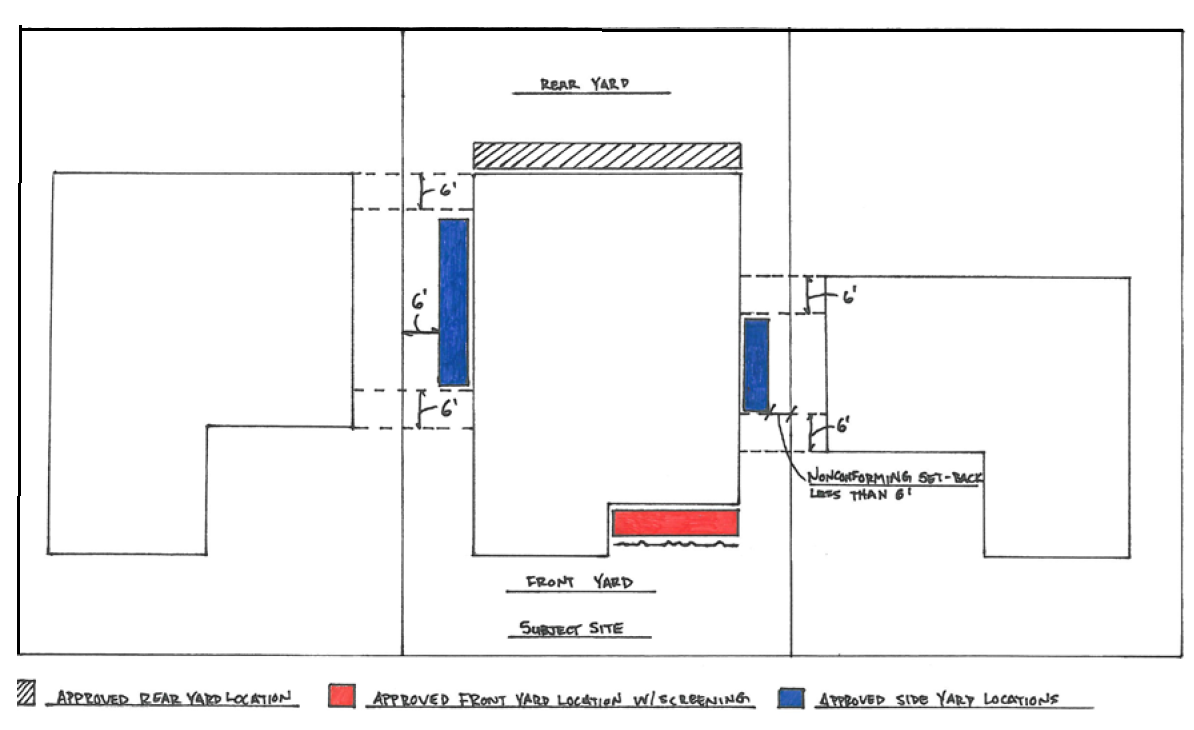
Central air conditioning units, generators or other similar mechanical equipment allowed in the following locations:
•
Similar, existing equipment may be replaced in the same location.
•
In the rear yard, within the extreme ends and proximate to the structure.
•
In the front yard, within the extreme ends and proximate to the structure, with screening.
•
In the side yard, if the equipment meets the required setback.
•
On non-conforming lots, mechanical equipment shall be allowed within the required yard side yard set-back.
•
In no instance shall mechanical equipment be placed in a side yard within six feet of the adjacent dwelling's extreme rear or front wall.
2.
In all multiple-family developments, all central air conditioning units shall be located behind the rear walls of the structures when such location is feasible and/or practical. When a rear yard location is determined not to be feasible and/or practical by the planning commission, central air conditioning units may be located within a required or non-required side yard setback or side to side/rear building spacing requirement, as long as the existing buildings (so or planned building(s) meet all of the minimum side yard setback and/or spacing requirements of this ordinance. Regardless of the location, air conditioning units shall be screened from view and screened to mitigate any potential negative noise impacts, the appropriate screening shall be determined by the planning commission.
3.
For purposes of this section, open patios and decks shall not be considered part of the structure.
B.
Commercial fixtures.
1.
Roof-mounted appliances, including, but not limited to, air conditioners, heating apparatus, dust collectors, filters, transformers, and any other such appliance or apparatus, shall be enclosed on all sides by view obscuring screening so as not to be visible from off the site. The design of the screening shall be approved by the planning commission as compatible with the architectural design of the building upon which it is located.
2.
Ground mounted appliances shall be screened using decorative landscaping, a decorative wall or wood screening fence, whichever the planning commission determines to be most appropriate.
C.
Installation of any such equipment shall also comply with all other applicable provisions of this ordinance, as amended, and all other applicable provisions of any federal, state and local laws, ordinances and codes.
(Ord. No. 308, § 3, 2-13-2017; Ord. No. 308.4, §§ 7, 8, 8-13-2018)
Section 5.06. - Shipping containers used as accessory buildings.
The placement and use of any shipping container as an accessory building is prohibited, except within the industrial district. Within the industrial district, shipping containers may be used as an accessory building, but shall be no greater than eight feet in height and comply with the requirements of Section 5.01. For the purposes of this section, a shipping container shall be defined as a reusable vessel that was originally designed for or used in the packing, shipping, movement or transportation of freight, articles, goods or commodities, which is capable of being mounted or moved by rail, truck or ship, including any other portable containers or pods used for storage with similar appearance and characteristics of shipping containers. This provision shall not apply to the temporary use of shipping containers for construction activities on properties with an active building permit.
(Ord. No. 308.6, § 13, 1-9-2023)

