Harwood Heights City Zoning Code
CHAPTER 17
12 - RESIDENTIAL DISTRICTS
Sections:
17.12.010 - Preamble.
A.
Intent of R1 Single-Family Residential District. The R1 single-family residential district is intended to provide regulations which will maintain the character and stability of single-family residential neighborhoods in the village
B.
Intent of R2 Single-Family Attached and Two-Family Residential District. The R2 residential district is intended to provide regulations which will tend to develop and maintain the character and style of the townhouse (single-family attached and semi-detached) and apartment type (low density two-family dwellings) parts of the village and which, generally, have apartment buildings or townhouses containing not more than two dwellings in a structure, and average a density of not more than twenty-two (22) units per net acre.
C.
Intent of R2-A Single-Family Attached, Two and Three-Family Residential District. The R2-A residential district is intended to provide regulations which will tend to develop and maintain the character and style of the village by providing for moderately dense and affordable residential options without altering the built environment that existed at the time of adoption.
D.
Intent of R3 Multiple-Family Residential District. The R3 multiple-family residential district is intended to provide for construction of a residential environment in an area subject to economic and population pressures which cannot be alleviated by existing single-family or two-family residential zoning.
E.
Intent of R4 Multiple-Family Residential District. The R4 multiple-family residential district is intended to provide for construction of a residential environment in an area under high economic pressure, requiring high intensity uses, which cannot be alleviated by R3 multiple-family residential zoning.
(Ord. No. 22-07, § 3, 6-9-22)
17.12.020 - General provisions.
Unless otherwise provided in the regulations of this title, the following provisions shall apply to all residential districts:
A.
Signs. Regulations shall be in accordance with the provisions of Chapter 17.36.
B.
Home Occupations. Home occupation" means any gainful business, occupation or profession conducted within a dwelling unit by a member of the family residing in the dwelling unit which is incidental and secondary to the use of the dwelling unit for dwelling purposes and which does not change the essential residential character of the building. The regulations of this section dealing with home occupations are designed to protect and maintain the residential character of a neighborhood while permitting certain limited commercial activities.
In all residential districts, any customary home occupation shall be permitted provided:
1.
It is conducted entirely within the dwelling and only by a member of the family residing in the dwelling unit and one additional employee and only when such home occupation is clearly incidental and secondary to the use of the dwelling for dwelling purposes.
2.
A home occupation shall not be established prior to the member(s) of the family conducting the home occupation taking possession of, and residing in, the dwelling.
3.
It is not conducted from a detached or attached accessory building, nor does it require internal or external alterations or involve construction features or use of equipment not customary in a dwelling, and the entrance to the space devoted to such occupation shall be from within the dwelling and not more than one-fourth of the floor area of a story including also a cellar of the dwelling is devoted to such home occupation.
4.
No mechanical equipment is used, except such as is customarily used for purely domestic or household purposes.
5.
All home occupations shall be conducted entirely within an enclosed building. No materials or equipment associated with the home occupation shall be stored outside the building.
6.
There is no display, activity or environmental manifestation that will indicate from the exterior of a dwelling that it is being used in whole or in part for any use other than a dwelling. The home occupation shall not create noise, dust, vibration, smell, smoke, glare, electrical interference, fire hazard, or any other hazard or nuisance to any greater or more frequent extent than usually experienced in an average residential occupancy within a residentially zoned district under normal circumstances where no home occupation exists.
7.
No sign except one nameplate not more than one square foot in area which contains only the name of the occupant of the dwelling and the home occupation conducted therein and is attached to the dwelling and not illuminated shall be permitted;
8.
Home occupations shall not generate refuse exceeding amounts typically produced by an average residential occupancy within a residentially zoned district under normal circumstances where no home occupation exists.
9.
Vehicular traffic and on-street parking shall not be increased by the home occupation.
10.
Off-street parking and off-street loading shall be in accordance with the provisions of Chapter 17.28 except that no truck or other type of commercial motor vehicle shall be parked or stored in the open on a lot in a residential district.
11.
Stock in trade, including that which is produced on the premises, shall not require receipt or delivery of merchandise, goods, or equipment other than by United States letter carrier mail, similar parcel delivery service that is characteristic of service to residential neighborhoods, or by private passenger automobile.
12.
No alteration of any kind shall be made to the residential dwelling where a home occupation is conducted that would change its residential character, including, but not limited to, the enlargement of public utility services, cooking facilities, or driveway or parkway areas beyond the capacities customarily required for residential use. No sign, other than a nameplate, shall advertise the presence or conduct of a home occupation that is visible from any public or private street.
13.
Academic or religious instruction may be given to not more than three persons at the same time, and other instruction may be given to not more than one person at the same time.
14.
The following businesses, occupations or activities are specifically prohibited home occupations:
a.
Motor vehicle and accessory sales or rental, repair and/or painting, including trailer rental or sales;
b.
Medical or dental clinics;
c.
Restaurants;
d.
Kennels and veterinary clinics;
e.
Funeral homes;
f.
Nursery schools, but not day care centers with six or fewer children;
g.
Repair shops or service establishments, except the repairs of electrical appliances, typewriters, cameras, lawnmowers, or other similar small items; and
h.
Beauty shops and barber shops, except when customer visits are by appointment only and are limited to no more than two customers in any one-hour period. Beauty and barber shops allowed under these provisions shall be registered with the appropriate licensing and inspection authorities.
C.
Basement Windows. No building in any R-l residential district shall have any type of basement window facing the common address street in front of the building.
17.12.030 - Residential districts permitted and special uses.
Table 17.12.030.1: Residential Districts Permitted and Special Uses lists permitted and special uses for the residential districts. A "P" indicates that a use is considered permitted within a given district. An "S" indicates that a use is considered a special use within a given district and a special use permit must be obtained as required in Section 17.56.210 (Special use permits). No letter (i.e., a blank space), or the absence of the use from the table, indicates that use is not permitted within a given district.
Footnotes:
1
The terms in this column ("Use") are defined in Section 17.04.050 (Rules—Definitions).
2
Subject to Section 17.52.120.
3
Permitted on a lot not less than five acres in area, and provided no building or structure shall be located less than one hundred (100) feet from a lot line.
4
Temporary buildings permitted not to exceed construction period.
5
Permitted on lots having areas, widths, yards, and other conditions as approved by the village board.
6
Residential dwelling units are prohibited from being used for the commercial purpose of providing short-term residential rentals. It shall be unlawful for any person or entity to operate, use, offer for rent or use, or advertise for rent or use, any property with the village as a short-term residential rental. Violations of this section are declared to be a public nuisance and are subject to fines as established in the fine schedule appended to this code as Appendix 2 and may be abated pursuant to all available remedies, including but not limited to injunctive relief.
(Ord. No. 22-07, § 4, 6-9-22; Ord. No. 23-01, § 3, 2-9-23; Ord. No. 24-09, § 3, 10-24-24)
17.12.040 - Residential districts bulk and yard requirements.
Table 17.12.040.1: Residential Districts Bulk and Yard Requirements establishes building bulk and yard setback requirements for the residential districts. These regulations apply to all uses within a given district unless otherwise stated.
Footnotes:
1
The requirements of yards, usable open space, and parking shall take precedence over total number of units allowed on any given parcel of land.
2
The sum of one bedroom and efficiency units cannot exceed fifty (50) percent of all the units built on one lot and the number of dwelling units contained in any one structure cannot exceed three.
3
The sum of one bedroom and efficiency units cannot exceed fifty (50) percent of all the units built on one lot.
4
Structures containing more than eighteen (18) units can exceed thirty-five (35) ft. in height, but must be approved through the planned development process as provided in Section 17.56.200.
5
For non-residential buildings of more than twenty-six (26) feet in height located within the R1 district, each required front, side and rear yard shall be increased in width or depth by one foot for each additional one foot of building height over twenty-six (26) feet.
6
Front yard need not exceed 6.5 feet in width, except on corner lots, where the side yard adjoining a street shall be not less than five feet in depth. For lots of record of less than forty (40) feet prior to annexation a side yard of ten (10) percent of the width of the lot is required on each side.
7
At least forty (40) percent in the R1 district of the total area of the required rear yard, and three hundred (300) sq. ft. in the R2 district of the required rear yard, must be open to the sky ("open space") and not covered with concrete or other nonporous materials. Up to one hundred fifty (150) square feet may be included in calculation of open space when covered with interlocking or abutting solid blocks constructed on a compacted soil sub grade and compacted aggregate base. The area will be considered as open space if and only if, the paver block area is constructed with landscaping fabric and without any plastic or any materials impervious to water.
8
At least sixty (60) percent of the total area of the required front yard in the R1 district and fifty (50) percent of the required front yard in the R2 district must be open to the sky ("open space") and not covered with concrete or other nonporous materials. A front yard porch shall be considered open to the sky for purposes herein, if the floor permits rain water to drop through the planking and drain to the earth below. Landscape fabric may be used to cover the earth beneath the deck so long as the fabric is porous. There shall be a minimum space of one-quarter (¼) inch between floor boards or planks which shall measure no more than six (6) inches in width.
(Ord. No. 22-07, § 5, 6-9-22; Ord. No. 22-09, § 2, 6-9-22)
17.12.050 - General standards of applicability.
A.
Temporary Uses. See Section 17.56.130 (Temporary use permits) for standards governing temporary uses.
B.
Garages and Other Accessory Buildings, Structures, and Uses. See Section 17.04.120 (Garages and other accessory buildings, structures, and uses) for standards covering accessory buildings, structures and uses.
C.
Allowable Encroachments. See Section 17.04.130 (Control of structural and use encroachments in yards) for standards governing encroachments.
D.
Off-Street Parking and Loading. See Chapter 17.28 (Off-street parking and loading) for standards governing off-street parking and loading.
E.
Signs. See Chapter 17.36 (Signs) for standards governing signs.
17.12.060 - Measurement of reverse corner side yard.
To clarify the distinction between a corner lot and a reverse corner lot, and to clarify how to measure a reverse corner side yard, the following illustrations (Figures 17.12.060.1 through .4) are provided:
A.
For reference, a typical corner lot is a lot situated at the junction of, and abutting, two or more intersecting street. See Figure 17.12.060.1: Corner Lot below.
FIGURE 17.12.060.1: CORNER LOT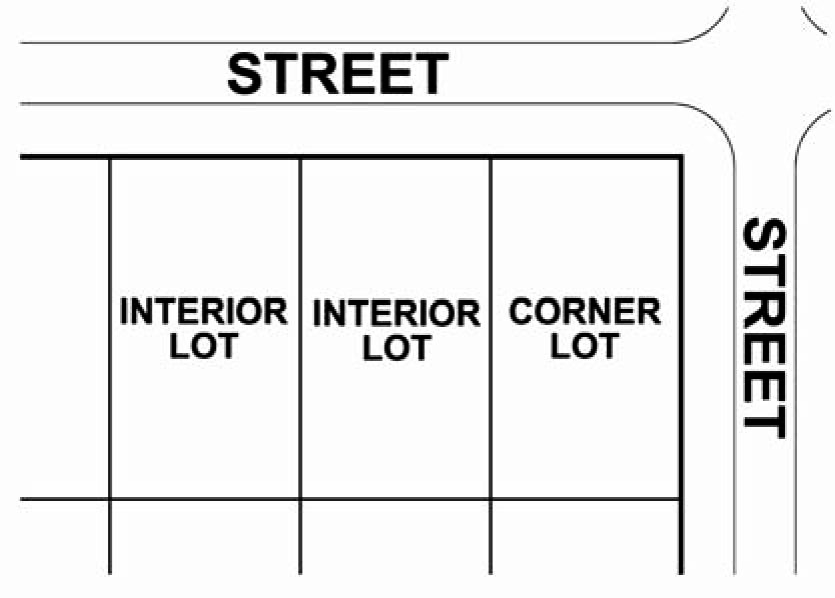
B.
A reverse corner lot is a corner lot where the side lot line adjoining a street is substantially a continuation of the front lot line of the first lot to its rear. See Figure 17.12.060.2: Reverse Corner Lot below.
FIGURE 17.12.060.2: REVERSE CORNER LOT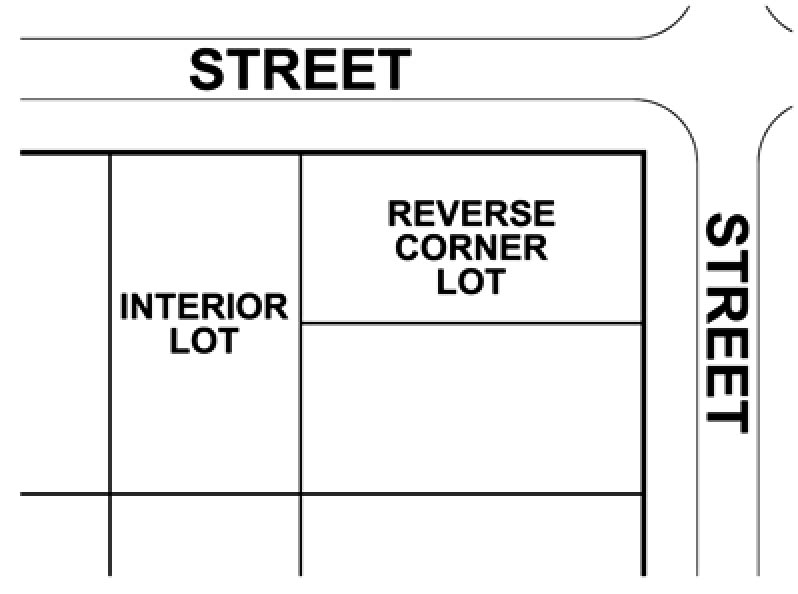
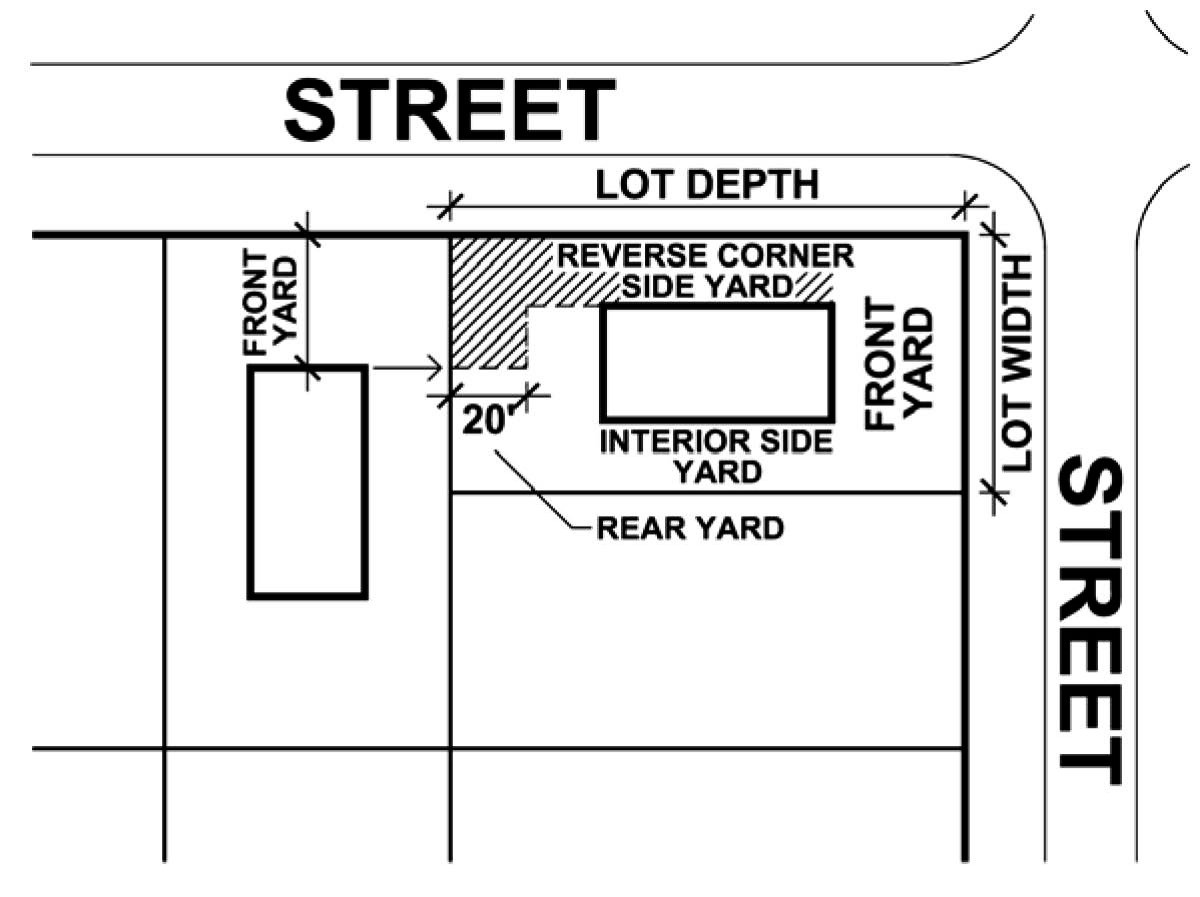
How to measure the reverse corner side yard of a reverse corner lot is illustrated in Figure 17.12.060.3: Measurement of Reverse Corner Side Yard below. The dimension of such yard is as required in Table 17.12.040.1: Residential Districts Bulk and Yard Requirements.
FIGURE 17.12.060.3: MEASUREMENT OF REVERSE CORNER SIDE YARD
FIGURE 17.12.060.3—STEP 1:
On a reverse corner lot, the lot line used to determine the location of the front yard and to measure lot width shall be the shorter street frontage.
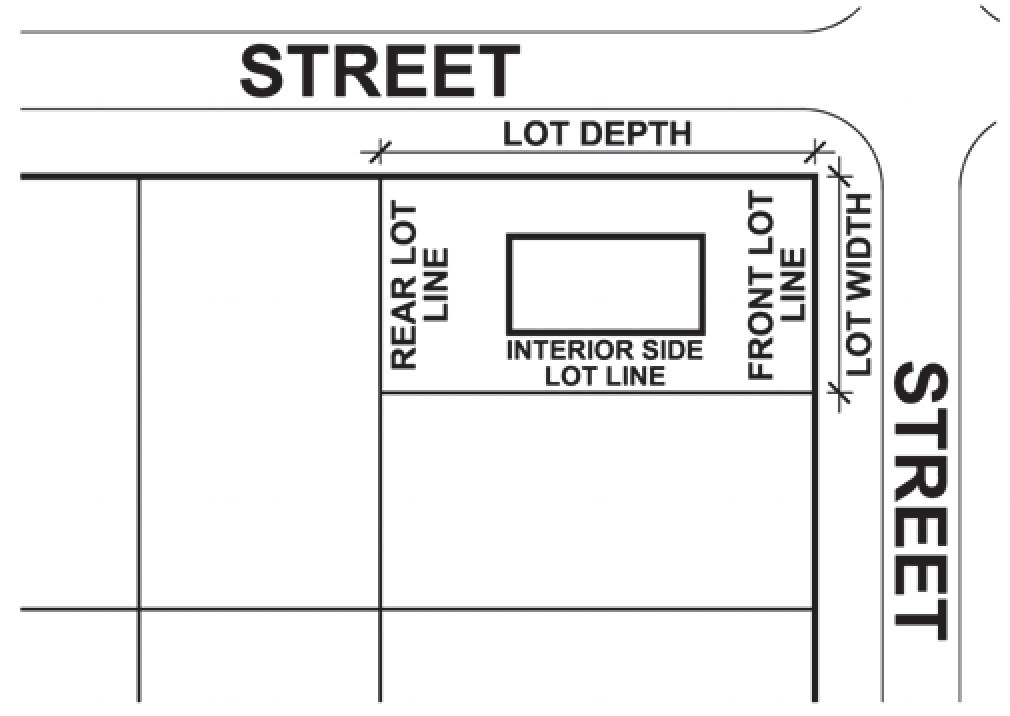
FIGURE 17.12.060.3—STEP 2:
As measured from the rear lot line of the reverse corner lot, the first twenty (20) feet of the reverse corner side yard shall equal the front yard of the lot to the rear. The remainder of the reverse corner side yard shall be fifty (50) percent of the front yard depth or a dimension established by district regulations.