
Hawkinsville City Zoning Code
ARTICLE III
SITE DESIGN STANDARDS
Sec. 3.1.1. - Purpose.
This article sets out the standards that control the placement of buildings and structures on a lot, the bulk and intensity of development on a lot, separation between incompatible uses, the provision of parking, signage control, and other requirements relating to development of an individual property or lot.
(Ord. of 5-10-96)
Sec. 3.1.2. - Definitions.
Access: A way or means of approach to provide physical entrance to a property.
Accessory structure setback line: A line delineating the minimum allowable distance between a property line or the right-of-way line of an abutting street and an accessory structure or building on a lot.
Berm: A mound of earth, or the act of pushing earth into a mound.
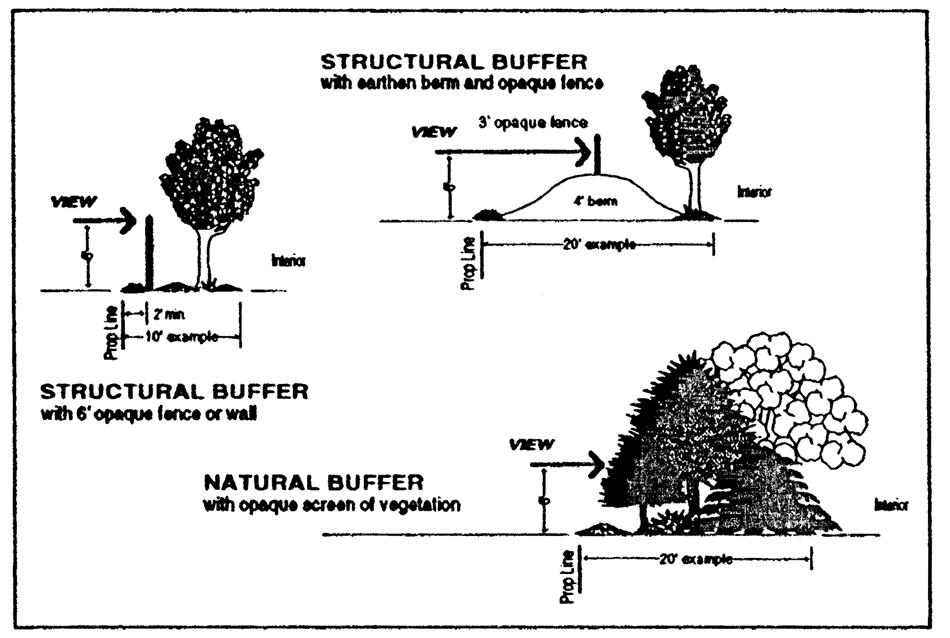
Buffer: An area of natural vegetation or man-made construction which is intended to provide a visual and dimensional separation between dissimilar land uses.
a.
Natural buffer: A visual screen created by vegetation of such density so as to present an opaque visual separation when viewed from one side to the other throughout the year.
b.
Structural buffer: A visual screen created through construction of a solid wooden fence, decorative masonry wall, earthen berm, or combination of fence or wall with an earthen berm, which may be supplemented with vegetation, so as to present an opaque visual separation when viewed from one side to the other throughout the year.
Buildable area of lot: That portion of a lot bounded by and interior to the required rear, side and front building setback lines.
Building area: The total floor area of all heated spaces within a building as measured within the outside of the exterior walls, exclusive of uncovered porches, terraces, and unheated stairwells, storage areas, garages and loading docks.
Building height: The vertical distance measured to the highest point of a building from the average finished grade across the building frontage.
Caliper: The diameter of a tree (usually nursery stock) measured at a point six (6) inches above the ground or top of root ball for up to and including 4-inch caliper trees, and at a point twelve (12) inches above the ground or top of root ball for larger sizes.
Canopy: A roof-like structure supported by columns or projecting from a building and open on at least three (3) sides.
Curb break or curb cut: Any interruption or break in the line of a street curb for the purpose of connecting a driveway to a street, or otherwise to provide vehicular access to abutting property.
Diameter breast height (DBH): The diameter of a tree trunk (usually a mature tree) measured at a height of four and one-half (4½) feet above the ground. If a tree splits into multiple trunks below four and one-half (4½) feet, the trunk is measured at its most narrow point beneath the split.
Frontage or street frontage: The width in linear feet of a lot where it abuts the right-of-way of any street from which access may be directly gained.
Gross floor area: The total area of all floors of a building, measured from the outside planes of the exterior walls.
Handicapped parking space: A space laid out and designated by signage in accordance with the requirements of the Federal Americans with Disabilities Act.
Heated living space: The total area of all floors in a dwelling unit used for residential activities and heated in accordance with the Building Code. Heated living space normally includes living, dining and recreation rooms; bedrooms, hallways and kitchens; bathrooms, closets and utility rooms.
Lot: A parcel or tract of land held in common ownership which may include one or more separately deeded or platted parcels.
a.
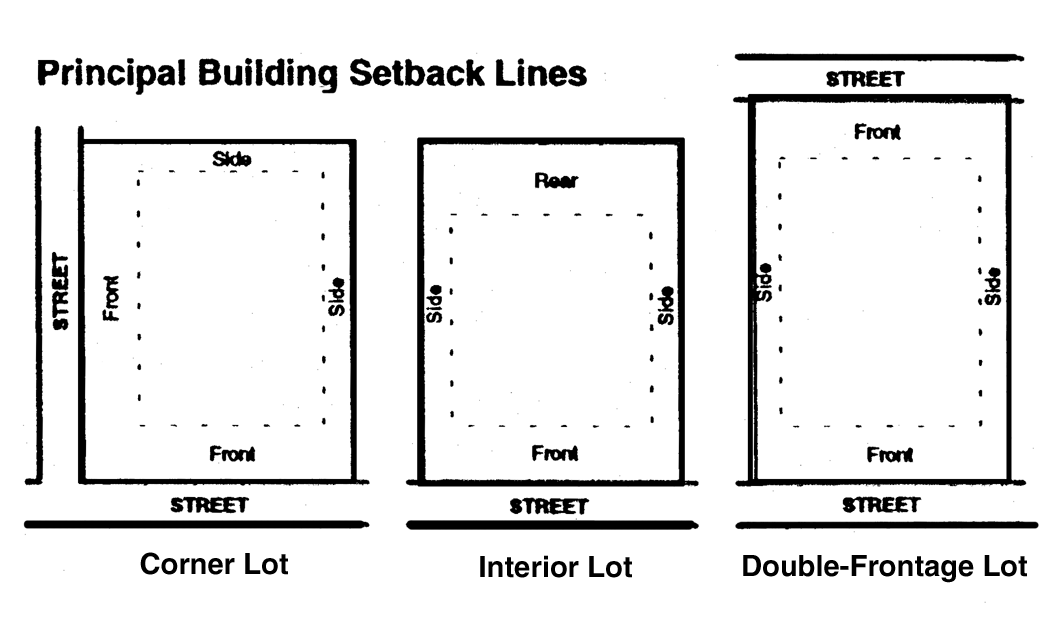
Corner lot: Any lot bounded by two (2) streets, at their intersection.
b.
Double frontage lot: A lot bounded on two (2) or more streets, but not at their intersection, so that it is not a corner lot.
c.
Interior lot: A lot having bounding on only one street.
Lot area: The total horizontal area included within lot lines.
Lot coverage: The portion of a lot covered by principal and accessory buildings.
Lot lines: The boundary dividing a given lot from the street, an alley, or adjacent lots.
a.
Front lot line: Any boundary line of a lot that abuts a public street right-of-way line. A lot adjacent to more than one street will have more than one front lot line.
b.
Rear lot line: Any boundary line of a lot that does not intersect with a public street right-of-way line and is not a front lot line.
c.
Side lot line: Any boundary line of a lot that intersects with a public street right-of-way line and is not a front lot line.
Lot of record: A lot which is part of a subdivision recorded in the office of the Clerk of Superior Court, or a lot described by metes and bounds, the description of which has been recorded in the office of the Clerk of Superior Court.
Lot width: The distance measured along the front building setback line between intersecting lot lines.
Opaque: Impenetrable to view, or so obscuring to view that features, buildings, structures, and uses become visually indistinguishable.
Parking aisle: The traveled way, which is not the public right-of-way, by which cars enter and depart parking spaces.
Parking bay: Three (3) or more parking spaces adjacent to one another and aligned side-by-side.
Parking space: A space identified and set aside for the temporary parking of an automobile or other motor vehicle.
Principal building setback line: A line delineating the minimum allowable distance between a property line or the right-of-way line of an abutting street and a principal building on a lot.
a.
Front building setback: The minimum allowable distance between the right-of-way line of any abutting street and any part of a principal building on a lot. The front setback distance is applied along the full length of the right-of-way line and is parallel to it.
b.
Rear building setback: The minimum allowable distance between a rear lot line and any part of a principal building on a lot. The rear building setback extends along the full length of the rear lot line.
c.
Side building setback: The minimum allowable distance between a side lot line and any part of a principal building on a lot. The side building setback extends along the side lot line between the front building setback and a rear building setback.
Property or parcel of land: See "Lot."
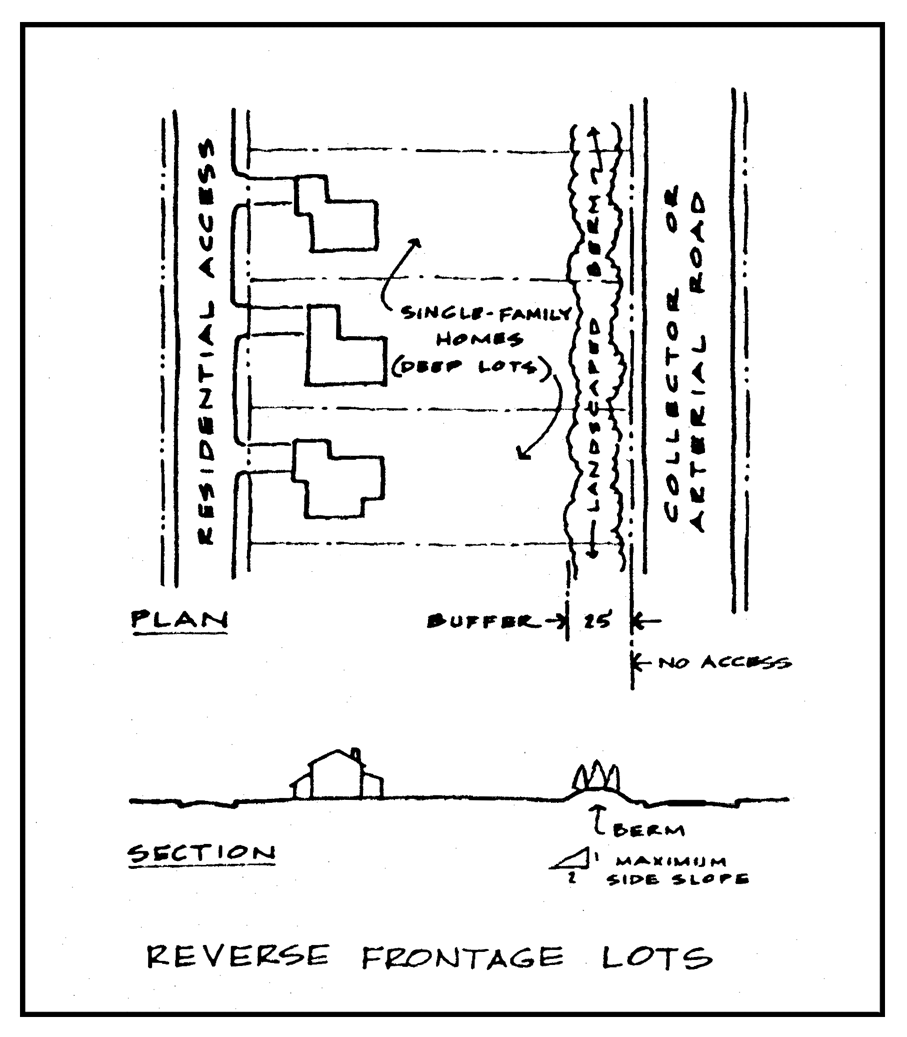
Reverse frontage lot: A double frontage lot that abuts two (2) public streets but is not allowed to have vehicular access to one of them.
Setback: The shortest straight line distance between a street right-of-way or lot line and the nearest point of a structure or building or projection therefrom (excluding roof overhangs of eighteen (18) inches or less).
Setback, minimum: The shortest distance allowed between a street right-of-way line or any other lot line and any principal or accessory building on a lot. Minimum setback requirements for buildings are associated with the type of lot line from which the setback is taken; for instance, a "side yard setback" is measured from a side lot line.
Structure height: The vertical distance to the highest point of a structure, as measured from the average grade at the base of the structure or directly below a projecting structure.
Yard: An area that lies between the principal building on a lot and the nearest lot line.
a.
Front yard: A yard situated along any public street right-of-way or private street easement.
b.
Rear yard: A yard situated along a rear lot line.
c.
Side yard: A yard situated along a side lot line.
(Ord. of 5-10-96)
Sec. 3.2.1. - Minimum lot size.
Every lot upon which a principal building or use may be located shall meet or exceed the following requirements for the zoning district in which the lot is located:
(Ord. of 5-10-96)
Sec. 3.2.2. - Minimum residential floor area.
All principal residential buildings shall have the following minimum heated living space within the dwelling unit:
Sec. 3.2.3. - Minimum principal building setbacks.
a.
All principal buildings on a lot shall be set back from the street rights-of-way lines and property lines bounding the lot no less than the distances shown as follows:
b.
Any lot zoned B-1 or B-2 that adjoins a lot zoned R-1, R-2, R-3, or R-4 along a street shall provide a minimum building setback of twenty-five (25) feet from the street on which the R-district is located.
(Ord. of 5-10-96)
Sec. 3.2.4. - Minimum accessory structure setbacks.
a.
Accessory structures other than swimming pools, night watchman residences, driveways, fences and free-standing walls shall be at least five (5) feet from any lot line or right-of-way line.
b.
On any lot containing a single-family or two-family dwelling, all accessory structures except driveways, fences and free-standing walls shall be located to the side or rear of the dwelling.
c.
Fences and Free-Standing Walls. There shall be no minimum setback for fences or free-standing walls, provided that any fence or free-standing wall shall not obstruct visibility at street intersections (see sight distance requirements under article 4 of this Ordinance).
d.
Swimming Pools.
(1)
Swimming pools shall conform to the minimum setback requirements for principal buildings in each zoning district.
(2)
Pool houses, cabanas, and other structures related to a swimming pool shall be set back at least five (5) feet from any lot line or street right-of-way line.
e.
Night watchman residences shall conform to the minimum setback requirements for principal buildings in each zoning district.
f.
Gasoline Pumps. Pumps that dispense gasoline and diesel fuels shall be set back at least twelve (12) feet from any street right-of-way line.
g.
Canopies shall conform to the minimum building setback requirements for principal buildings in each zoning district.
(Ord. of 5-10-96)
Sec. 3.2.5. - Maximum structure height.
a.
The maximum height of all structures in each zoning district (except as provided in the paragraph below) shall be as follows:
b.
Exceptions to Height Restrictions. The following structures are exempt from the height limitations:
(1)
Agricultural buildings such as but not limited to barns, silos, windmills, grain elevators, and other farm structures, but not including dwellings.
(2)
Cooling towers, gas holders, or other industrial structures where required as part of the manufacturing process.
(3)
Church spires, belfries, cupolas, domes, monuments, water towers, observation towers, commercial radio and television transmission towers, windmills, chimneys, smokestacks, derricks, conveyors, and TV reception antennae.
c.
Height Limitations for Fences and Free-Standing Walls.
(1)
In the Business and Industrial zoning districts, no fence or free-standing wall may exceed eight (8) feet in height, with no more than an additional two (2) feet of security wire.
(2)
In the Agricultural, Multi-Family Residential, and Professional zoning districts, no fence or free-standing wall may exceed eight (8) feet in height.
(3)
In the Single-Family Residential zoning districts, the following shall apply:
(a)
A fence or free-standing wall in any yard adjacent to a street may not exceed three (3) feet in height.
(b)
A fence or free-standing wall in any side or rear yard may not exceed eight (8) feet in height.
(Ord. of 5-10-96)
Sec. 3.3.1. - Buffers required.
A buffer shall be required in any multi-family or nonresidential development project along a side or rear lot line that abuts a residential zoning district, as follows:
□ = buffer required
(Ord. of 5-10-96)
Sec. 3.3.2. - Buffer design standards.
a.
General. Buffer areas shall contain no driveways, parking areas, patios, storm-water detention facilities, or any other structures or accessory uses except for a fence, wall, or earthen berm constructed to provide the visual screening required to meet the standards of this Ordinance. Underground utilities may be permitted to cross a buffer if the screening standards of this Ordinance will subsequently be achieved.
b.
Natural Buffers. Natural buffers may contain deciduous or perennial vegetation, but shall contain evergreen shrubs and trees suitable to local growing conditions that will provide an opaque visual screen during all seasons of the year.
c.
Structural Buffers. Structural buffers shall meet the following criteria:
(1)
Structural buffers shall be vegetated throughout the minimum area required for the buffer around any fences or walls and upon any earthen berms, which may include grass, ground covers, shrubs, and trees.
(2)
Trees shall be located or planted within any structural buffer at a density of no less than one tree for each twenty (20) feet of Buffer length or portion thereof. New trees shall have a caliper of no less than two (2) inches upon planting, and may be clustered for decorative effect following professional landscaping standards for spacing, location, and design.
(3)
Fences and free-standing walls shall present a finished and decorative appearance to the abutting property, and shall be located no closer to the property line than two (2) feet. Shrubs, ground covers, or other vegetation shall be provided between the fence or wall and the property line so as to provide a decorative effect, following professional landscaping standards for spacing, location and design.
d.
Examples of Buffers. The following illustration provides examples of natural and structural buffers. Other solutions meeting the minimum requirements of this section are also acceptable.
(Ord. of 5-10-96)
Sec. 3.3.3. - Minimum buffer requirements.
A buffer required by this article shall meet the following criteria:
a.
Width of Buffer.
(1)
Side Lot Line. Buffers required along any side lot line shall be no less than the minimum required width of the side principal building setback, or ten (10) feet, whichever is greater.
(2)
Rear Lot Line. Buffers required along any rear lot line shall be no less than the minimum required width of the rear principal building setback.
b.
Minimum Required Screening. Minimum required screening shall consist of a natural buffer utilizing existing vegetation or a structural buffer, whichever provides an opaque visual screen to a height of six (6) feet, or any combination of existing and replanted vegetation which can reasonably be expected to create an opaque visual screen six (6) feet high within two (2) growing seasons.
(Ord. of 5-10-96)
Sec. 3.3.4. - Buffer modifications.
a.
If a structural buffer is provided that creates an opaque screen to a height of no less than eight (8) feet, the buffer may be reduced to a width of no less than five (5) feet.
b.
Buffers may be relocated on the site to best achieve the screening required.
c.
The Board of Commissioners may waive a buffer requirement if the Comprehensive Plan anticipates future development on the adjoining property in a land use category equal to or more intensive than the subject site.
(Ord. of 5-10-96)
[Sec. 3.4.0. - Off-street parking.]
At the time of the establishment of any use, or erection of any building, or at the time any principal building is enlarged or increased in capacity by adding dwelling units, guest rooms, seats or floor area, there shall be provided permanent off-street parking spaces improved with an asphalt or concrete surface in accordance with the following requirements.
(Ord. of 5-10-96)
Sec. 3.4.1. - Combination of required parking spaces.
The required parking spaces for any number of separate uses may be combined in one lot but the required spaces assigned to each use may not be assigned to another use; except where the parking spaces required for churches or other assembly halls whose peak attendance will be at night, on Sunday, or otherwise does not coincide with an adjacent use, said required parking may be assigned to the adjacent use.
(Ord. of 5-10-96)
Sec. 3.4.2. - Proximity of off-street parking spaces to use.
All required parking for all uses shall be either on the same lot or within three hundred (300) feet of the building or use it is to serve, provided, however, that no required parking spaces may be located across any State or U.S. highway from the use it is intended to serve.
(Ord. of 5-10-96)
Sec. 3.4.3. - Requirements for design of parking lots.
a.
Except for parcels of land devoted to one-and two-family residential uses, all areas devoted to off-street parking shall be so designed and be of such size that no vehicle is required to back into a public street to obtain access.
b.
Off-street parking lots.
(1)
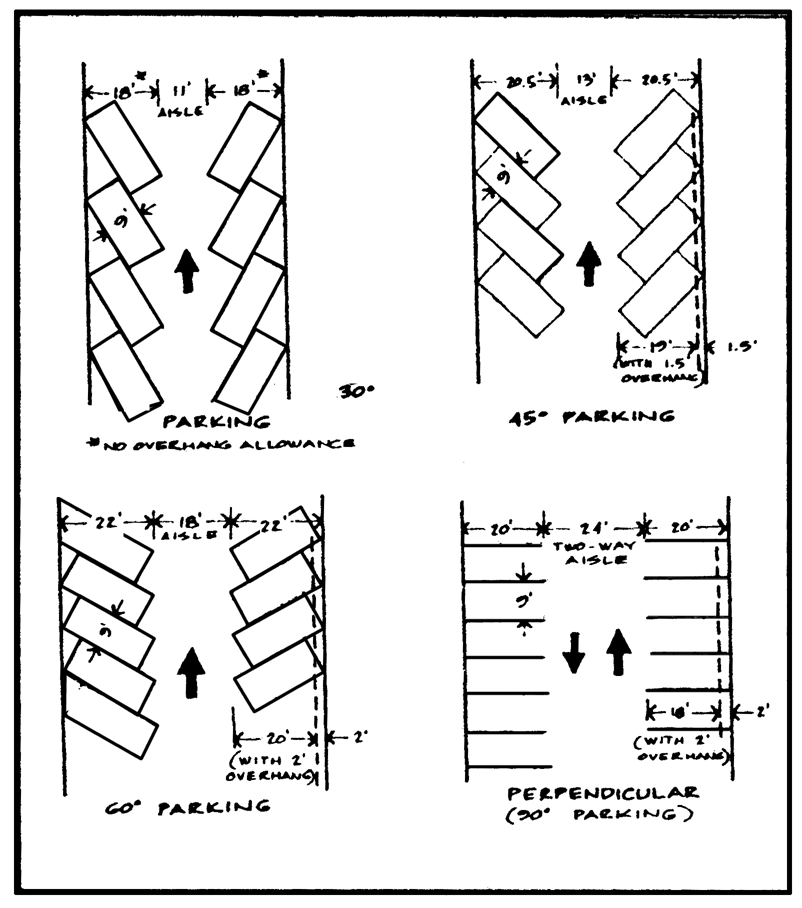
Each parking space shall be not less than nine (9) feet wide by twenty (20) feet long.
(2)
Adequate driving aisles shall be provided for ease of access to all parking spaces. Two-way aisles shall be no less than twenty-four (24) feet wide. The following diagrams provide guidance to the layout of parking lots using various design standards:
c.
Handicapped parking spaces.
(1)
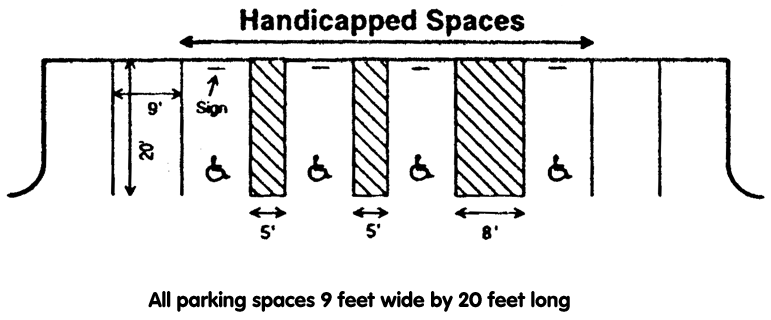
Handicapped parking spaces shall have an adjacent aisle five (5) feet wide, and one in every eight (8) handicapped spaces shall be adjacent to an aisle eight (8) feet wide and the space shall be signed "van accessible." Handicapped parking space aisles shall be clearly demarcated.
(2)
Handicapped spaces shall be provided in each parking lot in the following ratio to the total number of spaces required for the use:
Source: Americans with Disabilities Act Accessibility Guidelines.
(3)
All handicapped parking shall comply with the requirements of the Federal Americans with Disabilities Act whenever more restrictive than the requirements herein.
(Ord. of 5-10-96)
Sec. 3.4.4. - Off-street parking requirements by use.
The minimum number of off-street parking spaces required for each type of land use shall be determined by the following, in addition to the number of spaces required for handicapped parking:
a.
Single-family and two-family dwellings: Two (2) spaces per dwelling unit.
b.
Multifamily dwellings: The aggregate of:
(1)
One and one-half (1½) spaces for each studio or one-bedroom dwelling unit; plus,
(2)
One and three-quarters (1¾) spaces for each two-bedroom dwelling unit; plus,
(3)
Two (2) spaces for each dwelling unit having three (3) or more bedrooms.
c.
Group dwellings, rooming houses and boarding houses: One space for each two (2) rooms to be rented.
d.
Motels, hotels, and bed and breakfast facilities: One space for each room to be rented, plus one additional space for each four hundred (400) square feet of floor area devoted to meeting space, restaurants and administrative offices.
e.
Medical and dental clinics: One space for each two hundred (200) square feet of gross floor area.
f.
Hospital: One space for each two (2) beds licensed for patients' use, exclusive of bassinets, plus one space for each three (3) employees including doctors.
g.
Schools: Elementary and middle school —Two (2) spaces for each classroom. High School —Five (5) spaces for each classroom.
h.
Daycare center: One space for each four hundred (400) square feet of Gross Floor Area.
i.
Auditorium, theaters, places of worship, funeral homes, stadiums, and similar places of public assembly: One space for each four (4) seats, or twelve (12) feet of benches, or per thirty (30) square feet of usable floor area in the largest assembly room (whichever is greater), plus one space for each two hundred (200) square feet of floor area used for amusement, entertainment, or assembly exclusive of the major assembly room.
j.
General and professional offices, banks and other financial service establishments, insurance and real estate offices: One space for each two hundred fifty (250) square feet of gross floor area.
k.
Automobile service station, auto and truck repairs or maintenance: Five (5) spaces for each service bay, plus one space for each two hundred (200) square feet of gross floor area devoted to retail sales or showroom.
l.
Automobile, truck, manufactured home, recreational vehicle, and utility structure sales: One space for each six hundred (600) square feet of gross floor area of indoor sales and showroom space, plus one space for each two thousand five hundred (2,500) square feet of outdoor display area, plus five (5) spaces for each service bay devoted to vehicle repairs or maintenance.
m.
Restaurants: One space per one hundred fifty (150) square feet of gross floor area.
n.
Fast Food Restaurants: one space for each fifty (50) square feet of gross floor area.
o.
Retail sales and services businesses not listed above: One space for each two hundred (200) square feet of gross floor area and permanent outdoor sales area.
p.
Wholesale and office-warehouse uses: One space for each two hundred (200) square feet of gross floor area devoted to sales or office use, plus one space for each one thousand (1,000) square feet of gross floor area devoted to storage.
q.
Warehouse and storage uses: One space for each one thousand (1,000) square feet of gross floor area and outdoor storage area.
r.
Manufacturing uses: One space for each five hundred (500) square feet of gross floor area.
(Ord. of 5-10-96)
Sec. 3.4.5. - Restriction on use of required parking.
The required off-street parking shall be for employees, occupants, customers, clients, and visitors and shall be limited in use to temporary parking of motor vehicles with current license plates. The storage or parking of merchandise or motor vehicles for sale, the servicing or repairing of vehicles or equipment, and regular truck loading and unloading thereon is prohibited.
(Ord. of 5-10-96)
Sec. 3.4.6. - Administrative variation of parking requirements.
The number of parking spaces required by this division may be increased or decreased upon approval by the Zoning Administrator based on the actual use of a property.
(Ord. of 5-10-96)
Sec. 3.5.1. - Approval required.
No curbs or medians on public streets or rights-of-way shall be cut or altered for access without approval of the Building Inspector.
(Ord. of 5-10-96)
Sec. 3.5.2. - Driveway connections.
a.
Vehicular access from properties to streets shall comply with the following dimensional requirements, measured at the right-of-way line:
* Includes divided entrances with center islands.
b.
Along major streets other than State or U.S. highways, no more than two (2) points of vehicular access from a property to each abutting public street shall be permitted for each four hundred (400) feet of lot frontage, or fraction thereof; provided however, that lots with less than one hundred (100) feet of frontage shall have no more than one point of access to any one public street.
c.
Along State or U.S. highways, no more than one point of vehicular access from a property shall be permitted for each three hundred (300) feet of lot frontage, or fraction thereof.
d.
Driveway connections. Driveway connections shall be provided between the edge of pavement or back of curb to the right-of-way line. No property may be afforded access from a public street except as follows:
(1)
Curb and gutter streets shall be provided with a driveway apron constructed of 3000 psi concrete at least six (6) inches thick. Sidewalks, where provided, shall be warped to the driveway apron.
(2)
Swale ditch section streets shall be provided with a driveway apron constructed of 3000 psi concrete at least six (6) inches thick, or asphaltic concrete of the same thickness and type as the paving course(s) for the street.
(3)
All driveway aprons shall have a radius connecting the driveway to the curb line or pavement edge as follows:
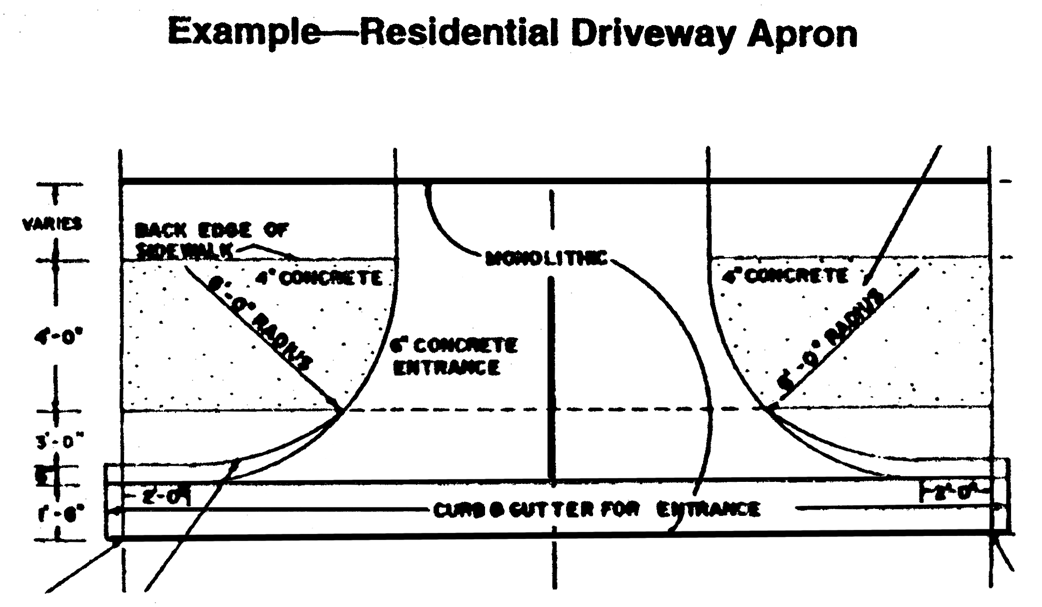
Example—Residential Driveway Apron
Sec. 3.5.3. - Limitations on access.
a.
Nonresidential developments that will result in two (2) or more lots shall limit direct access to State or U.S. highways through the use of shared driveways and internal access to the greatest extent practical. Residential subdivisions shall limit direct access to State or U.S. highways (arterial roads) through the use of reverse frontage lots or other techniques wherever possible. The following illustrates an example of reverse frontage lots.
b.
Requirements of the Georgia Department of Transportation shall apply whenever more restrictive than the standards in this Ordinance.
c.
No point of access shall be allowed within thirty-five (35) feet of the right-of-way line of any street intersections.
(Ord. of 5-10-96)
Sec. 3.6.1. - Purpose of the sign regulations.
In addition to the general purposes of these Unified Land Development Regulations, the purposes of these sign regulations are as follows:
a.
To maintain and enhance the aesthetic environment and support economic development of the city;
b.
To maintain and improve pedestrian and traffic safety;
c.
To minimize potential adverse effects of signs on nearby property; and,
d.
To encourage the proper use of signs as a means of effective communication.
(Ord. of 5-10-96)
Sec. 3.6.2. - Definitions; signs.
Awning or canopy sign: See "building sign."
Banner: A sign other than an official flag, made of paper, cloth, thin plastic, or similar lightweight material and containing a message or logo.
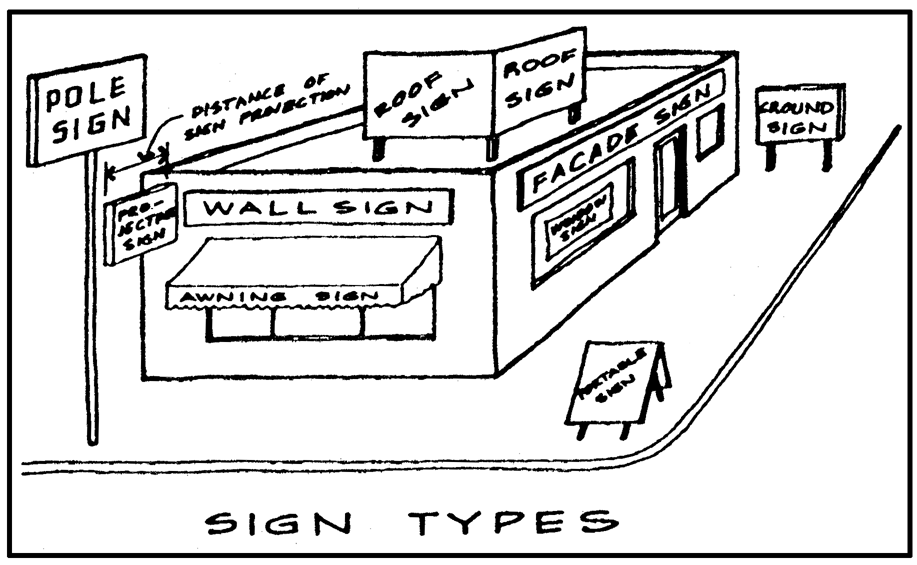
Building sign: A sign that in any manner is fastened to, projects from, or is placed or painted upon the exterior wall, window, door or roof of a building. The term "building sign" includes but is not limited to the following:
a.
Awning or canopy sign: A sign imposed or painted upon or suspended beneath any roof-like structure which provides either permanent or temporary shelter for adjacent walkways or entrances to a building or property.
b.
Facade or wall sign: A sign that is fastened directly to or is placed or painted directly upon the exterior wall of a building and extends from the surface of the wall no more than eighteen (18) inches.
c.
Incidental sign: An announcement or other display providing information about the occupancy or conduct of business permitted on a premises, such as logos of credit cards accepted on the premises, hours of operation, a "closed" or "open" sign, emergency contact person name and telephone number, street address, "help wanted," "no loitering or solicitations," "no trespassing," "no hunting," security system notices, notices required by law, and similar information.
d.
Projecting sign: A sign affixed to a wall and extending more than eighteen (18) inches from the surface of such wall, usually perpendicular to the wall surface.
e.
Roof sign: A sign that is mounted on, applied to, or otherwise structurally supported by the roof of a building.
f.
Window sign: Any sign that is placed on or behind a window pane and intended to be viewed from outside the building.
Electronic message board: A type of sign that presents its message through illumination of flashing, intermittent, or moving lights forming the letters, numbers, or symbols of the message, whether or not the message appears to move across the sign face.
Freestanding sign: A sign permanently attached to the ground which is wholly independent of any building or other structure. The term "freestanding sign" includes but is not limited to the following:
a.
Pole sign: A sign that is mounted on a freestanding pole or similar support such that the bottom of the sign face is at least six (6) feet above the ground.
b.
Ground sign: A freestanding sign, other than a pole sign, in which the bottom of the sign face is less than six (6) feet above the ground but not directly in contact with the ground.
c.
Monument sign: A freestanding sign in which the entire bottom of the sign face is in contact with the ground, providing a solid and continuous background for the sign face from the ground to the top of the sign.
Multi-faced sign: A sign structure that contains two (2) or more sign face surfaces that are located on different sides of the structure and are separated from each other at their nearest point by no more than three feet.
Occupant directory sign: A sign listing the occupants or tenants of a building or group of buildings, including their respective professions or business activities and location within the building or group of buildings.
Planned center: A building, or a group of buildings in close proximity to each other, operated under a common promotional plan, and occupied or intended for occupancy by six (6) or more retail stores, service establishments, offices, industries or other businesses.
Project entrance sign: A sign identifying the name of a residential subdivision, multi-family development, office park, or industrial park, located at a discernible entrance into the subdivision, development, or park.
Projecting sign: See "building sign.".
Roof sign: See "building sign."
Sign: The term "sign" shall mean any structure, display or device that is used to advertise,
identify, direct or attract attention to a business, institution, organization, person,
idea, service, event or location by any means, including words, letters, figures,
design characteristics, symbols, logos, fixtures, colors, movement, or illumination.
Sign face: That portion of the surface of a sign structure where words, letters, figures, symbols, logos, fixtures, colors, or other design elements are or may be located in order to convey the message, idea, or intent for which the sign has been erected or placed. The sign face may be composed of two (2) or more modules on the same surface that are separated or surrounded by portions of a sign structure not intended to contain any advertising message or idea and are purely structural or decorative in nature.
Sign face module: Each portion or unit of a sign face that is clearly separable from other such units by virtue of the expression of a complete thought, message, logo, or idea.
Sign height: The vertical distance to the highest point of a sign structure, as measured from the average grade at the base of the structure or directly below a projecting structure.
Tenant's wall frontage: The length in feet along the wall frontage of a building between the limits of a tenant's occupied space, measured to the outside of an exterior wall or the centerline of a party wall between two (2) tenants.
Window sign: See "building sign."
Wall frontage: The length in feet along the side of a building where the occupant's front or main door is located. See also "tenant's wall frontage."
(Ord. of 5-10-96)
Sec. 3.6.3. - General requirements.
a.
A sign may be erected, placed, established, painted, created, or maintained only in conformance with the standards and other requirements or exemptions contained in these sign regulations, or as otherwise provided for nonconforming signs under article 1 of these Unified Land Development Regulations.
b.
All signs for which a building permit is required shall be constructed and maintained in conformance with Building Code and Electrical Code requirements.
(1)
Plans for all freestanding signs shall be certified as to conformance with all structural and wind-load resistive standards of the Building Code by a structural engineer registered in the State of Georgia, or be prepared using standard drawings prepared by a structural engineer or other qualified professional meeting or exceeding all requirements of the Building Code.
(2)
All signs involving internal lights or other electrical devices or circuits shall display a label certifying it as meeting standards of the Underwriter's Laboratories.
(3)
All electrical service to a sign shall be in compliance with the Electrical Code.
c.
All signs, together with their supports, braces, guys and anchors, shall be kept in good repair and, unless constructed of plastic or galvanized or noncorroding metal, shall be given a protective coating as necessary to maintain a clean appearance and safe condition.
d.
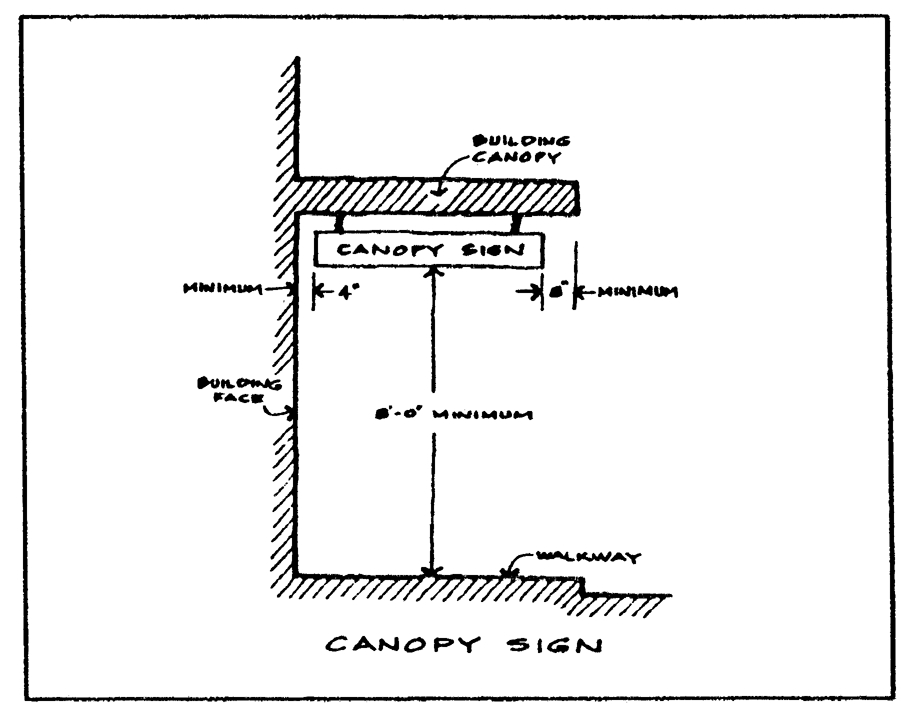
Awning and canopy signs shall provide at least eight (8) feet of clearance above the ground when erected over pedestrian walkways and seventeen (17) feet of clearance when erected over driveways or other areas used for vehicles. Suspended canopy signs shall be at least four (4) inches from the building face and at least eight (8) inches from the edge of the canopy.
e.
Banners shall be allowed only as wall or window signage and shall be placed flush upon the wall or window to which it is attached. Banners shall not be hung as canopy signs, flown as flags, or used as any other form of sign.
f.
Projecting signs shall be limited to no more than one per tenant on a property, and each tenant shall have no more than one projecting sign or canopy sign.
g.
Occupant directories are restricted to planned centers having two (2) or more principal buildings, and to individual principal buildings to which occupants gain access primarily through a central enclosed hallway or atrium.
(1)
A directory [sign] may be an additional freestanding sign or additional building signage.
(2)
An occupant directory sign shall provide no more than three (3) square feet of sign face area for the building address, and no more than nine (9) square feet of sign face area for the listing of occupants or tenants.
(3)
A freestanding occupant directory sign shall be no more than five (5) feet high and four (4) feet wide.
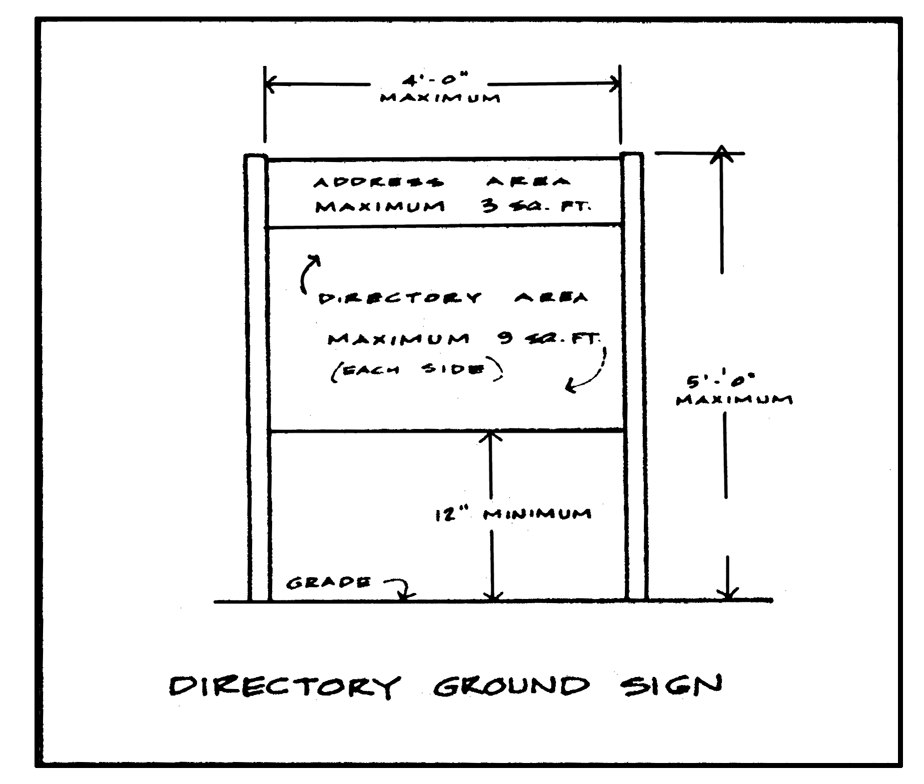
Directory ground sign
h.
Any sign within six hundred sixty (660) feet of a state or U.S. numbered highway that advertises or offers anything for sale or lease that is not located on the property where the sign is located must be zoned for commercial or industrial use.
(Ord. of 5-10-96)
Sec. 3.6.4. - Computation of sign area.
In order to determine compliance with the maximum allowable sign areas permitted under this division, the area of a sign shall be considered the area of the sign structure unless otherwise stated. The area of a sign structure and a sign face shall be computed as follows:
a.
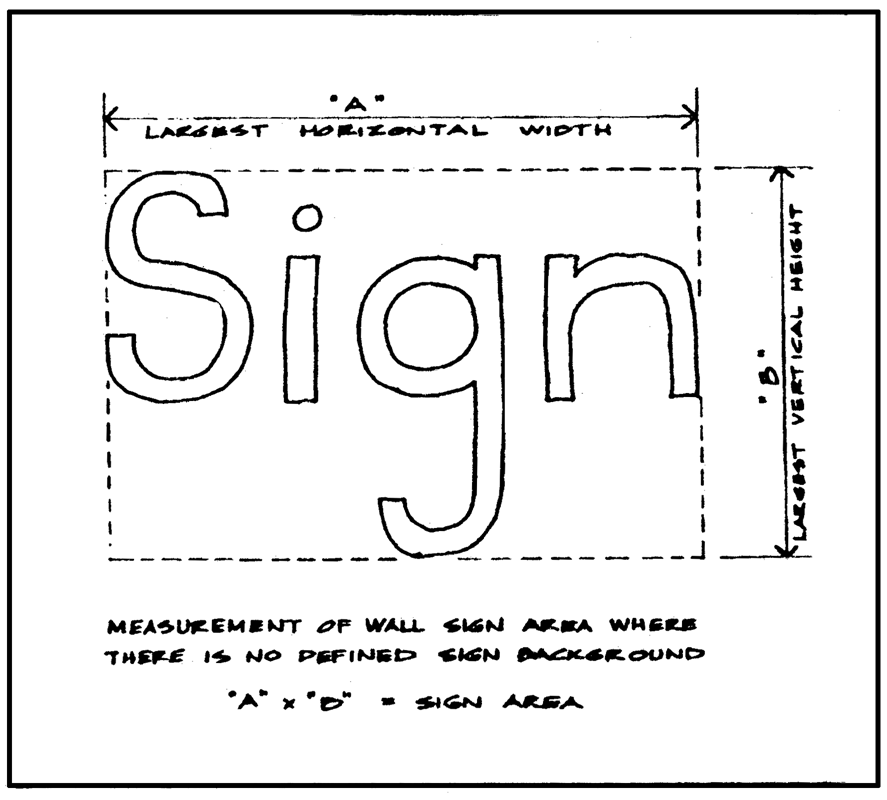
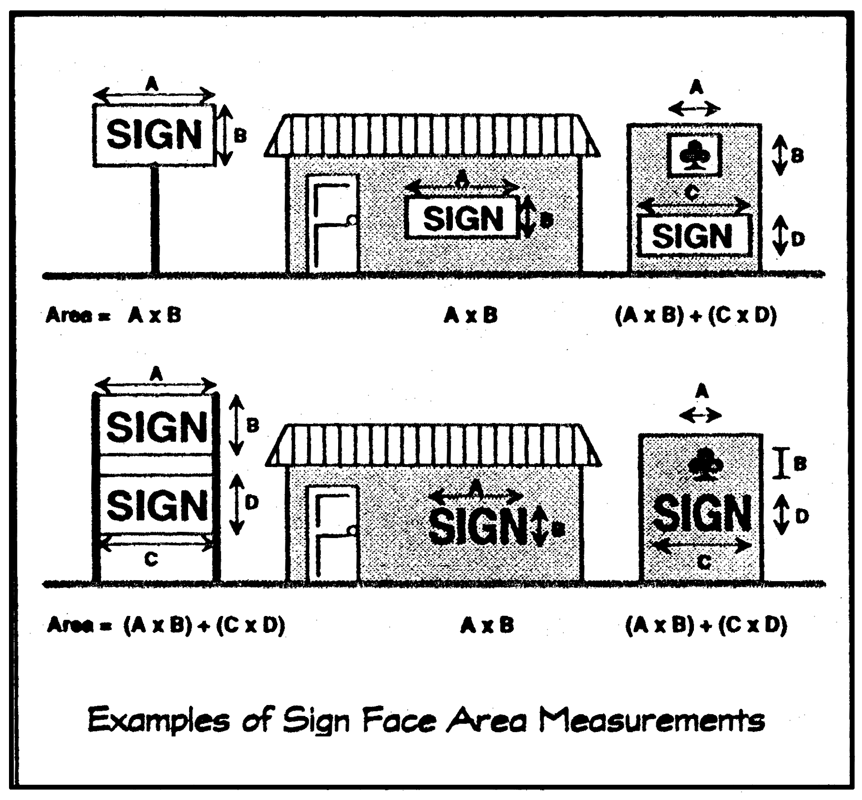
The area of a sign face shall be computed as the area within the smallest rectangle enclosing the limits of a sign face, or the combination of the areas of all such rectangles delimiting each sign face module, together with any frame or material, texture, or color forming an integral part of the sign face or used to differentiate the sign face from the structure upon which it is placed.
b.
The computation of the area of a sign face shall not include the structure, supports or uprights on which the sign face is placed or any portions of a sign structure that are not intended to contain any advertising message or idea and are purely structural or decorative in nature, other than those portions contained within the rectangle that delimits the sign face or a sign face module.
c.
For any sign on which the words, letters, figures, symbols, logos, fixtures, colors, or other design elements routinely change or are intended to be changed from time to time, the sign face area shall include the entire area within which any words, letters, figures, symbols, logos, fixtures, colors, or other design elements may be placed, together with any frame or material, texture, or color forming an integral part of the sign face or used to differentiate the sign face from the structure upon which it is placed.
d.
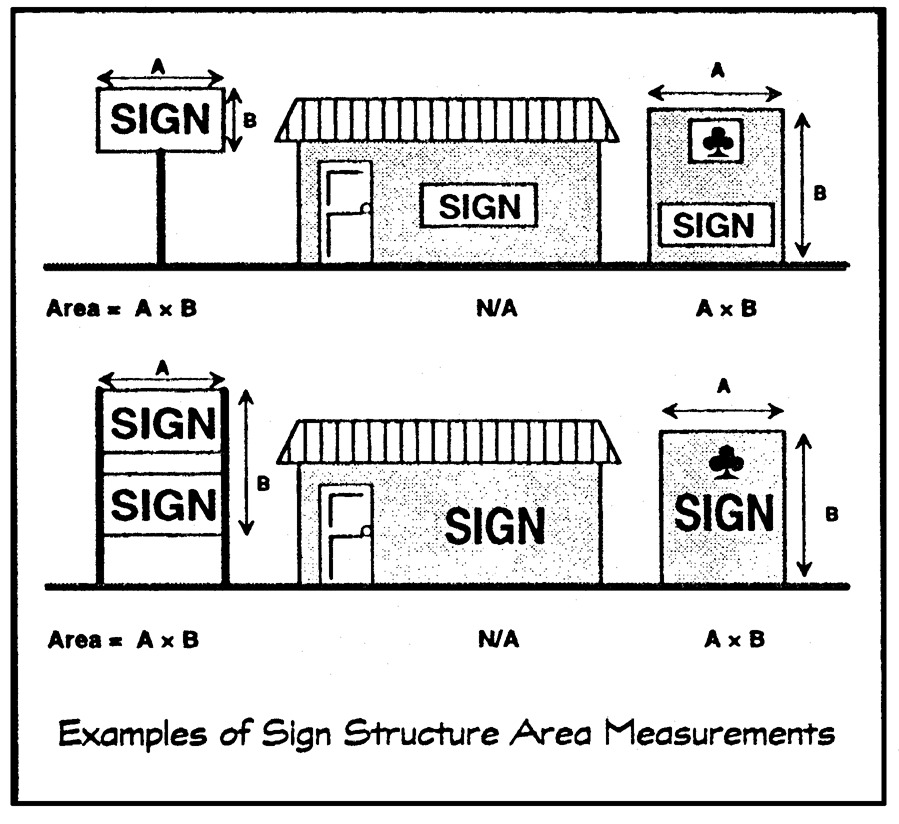
The area of a sign structure shall be computed as the area within the smallest rectangle enclosing the limits of the surface of a sign whereon the sign face or sign face modules may be placed, including all portions of a sign structure that provide a background for the sign face but are not intended to contain any advertising message or idea and are purely structural or decorative in nature.
e.
Any open space contained within the limits of the rectangle delimiting the sign face, sign face module, or sign structure shall be included in the computation of the area of such sign face, sign face module, or sign structure.
f.
For multi-faced signs, when the sign face surfaces are parallel (back-to-back), or where the interior angle formed by the faces is forty-five (45) degrees or less, the area of the sign shall be taken as the area on the largest side. For all other multi-faced signs, the area of the sign shall be the total area on all sides that can be viewed at one time from any angle.
(Ord. of 5-10-96)
Sec. 3.6.5. - Prohibitions.
a.
No sign shall be erected or maintained where, by reason of its position, wording, illumination, size, shape or color, it may obstruct the view of oncoming vehicles or impair, obscure, interfere with the view of, or be confused with any authorized traffic control sign, signal, or device.
b.
No sign shall contain or be an imitation of an official governmental traffic control sign, signal, or emergency vehicle device.
c.
No part of any sign shall be located in, over, or project into a public right-of-way except for awning signs, canopy signs, or projecting signs in the B-2 zoning district. In the B-2 zoning district, awning, canopy, and projecting signs shall not extend into or over the roadway.
d.
No sign shall be erected, located, or maintained in such a manner as to interfere with safe and free ingress and egress of any door, emergency exit, driveway, street, or roadway.
e.
No lighted signs shall be constructed or maintained within one hundred (100) feet of any single-family dwelling.
f.
No building sign shall extend above the top edge of the parapet or eave of a flat or shed roof; the ridge line of a gable, hip, or gambrel roof; or the deck line of a mansard roof.
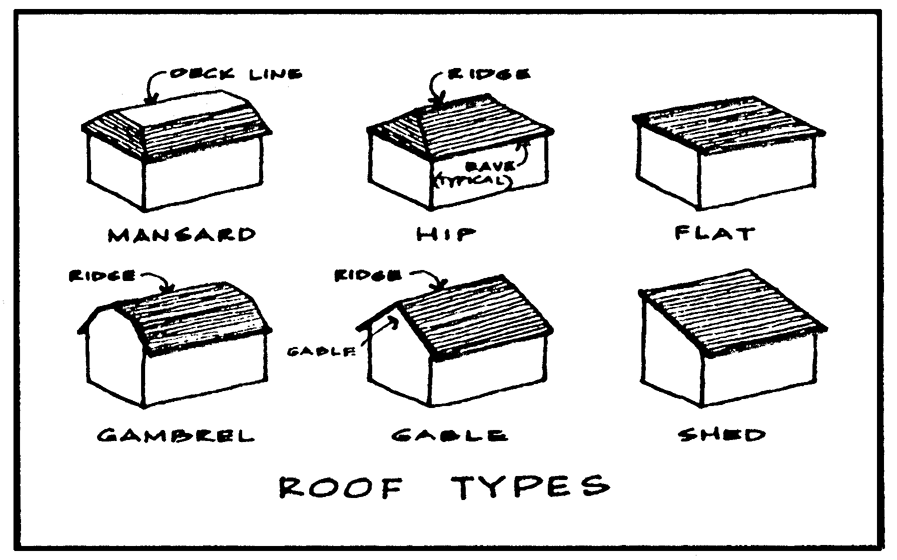
Roof types
g.
Prohibited signs. The following types of signs shall not be placed on or attached to any property, building, structure, or place:
(1)
Animated sign: A sign with action, motion, changing colors, flashing lights, or moving characters. Such signs may require electrical energy, but shall also include wind-activated devices including, but not limited to, spinners, aerial devices, and other attention-getting devices. This definition does not include rotating signs that revolve no faster than five (5) revolutions per minute or electronic message boards that include time and/or temperature messages for no less than twenty (20) seconds out of every minute and that change messages no more often than twelve (12) times per minute.
(2)
Derelict sign: A sign that is dilapidated or in such condition as to create a hazard or nuisance, or to be unsafe or fail to comply with the Building or Electrical Codes.
(3)
Inflatable sign: A sign that is intended to be expanded by air or other gas for its proper display or support.
(4)
Pennant: Any lightweight plastic, fabric, or similar material, not containing a message or logo of any kind, suspended from a rope, wire, or string, usually in series, designed to move in the wind. The term "pennant" shall not include a "banner" or an "official or personal flag" as regulated herein.
(5)
Portable sign: A sign designed to be transported or easily relocated and not permanently attached to the ground, a foundation or other permanent structure; including, but not limited to, the following:
(a)
A sign designed to be temporarily placed on the ground, whether or not affixed to the ground with stakes or other nonpermanent devices.
(b)
A sign mounted on a trailer, with or without wheels.
(c)
An A-frame or sandwich board sign.
(d)
An umbrella used for advertising.
(e)
A sign mounted or painted upon a parked vehicle that is positioned for the primary purpose of acting as a sign exposed to the public and is not in use in the ordinary course of carrying out its transportation function.
(f)
A sign mounted or painted upon a vehicle that is operated on public streets for the primary purpose of presenting a message or symbol offering or supporting the sale, rent, lease, loan, or other availability of any property, product, or service, and is not otherwise in use in the normal course of transporting people, merchandise, or freight.
A portable sign that is permanently anchored to the ground shall be considered a freestanding sign.
(6)
Sound or smoke emitting sign: A sign that emits or utilizes in any manner any sound capable of being detected on any traveled road or highway by a person with normal hearing; or a sign that emits smoke, vapor, particles, or odors.
(7)
Streamer: A long narrow banner, pennant, or strip of fabric or other material.
(Ord. of 5-10-96)
Sec. 3.6.6. - Exemptions.
a.
Window displays of goods available on a site are not considered to be signs and are exempt from these sign regulations.
b.
Exempt Signs. Each of the following types of signs are allowed in any zoning district and are exempt from the restrictions imposed by section 3.6.7:
(1)
Official sign: Signs placed by a governmental body, governmental agency, or public authority, including but not limited to traffic signs, signals, or regulatory devices or warnings; official emblems, public notices, or official instruments; signs of historical interest; or other similar signs or devices are authorized within all rights-of-way or other properties controlled by such governmental body, agency, or authority.
(2)
Property address sign: A sign limited in content to the street address number of the building or property to which it is affixed.
(Ord. of 5-10-96)
Sec. 3.6.7. - Permitted signage.
a.
By Zoning District. The following table presents the maximum number, size, height, and other restrictions relating to specific signage that is permitted in each zoning district.
(1)
The "freestanding sign—individual use" category shall apply to a lot where there is only one single or two-family dwelling, or one business occupant.
(2)
The "freestanding sign—multi-tenant" category shall apply to a single commercial office or retail property that is designed or intended for occupancy by two (2) or more businesses.
(3)
All signs attached directly or indirectly to a side of a building, whether the wall or a window, door, awning, canopy, or portion of the roof along that side of the building (and including signs that project from the wall), shall collectively not exceed the total square footage of sign face area allowed for the particular wall.
(a)
The total sign face area for such wall and roof signs on each side of a building shall be calculated on the basis of the length of the wall along that side of the building. Each side of the building shall be calculated separately.
(b)
For multi-tenant buildings (such as shopping centers), the total sign face area for such wall and roof signs for each tenant shall be calculated on the basis of the length of the wall along each tenant's occupied space. The maximum sign face area for each tenant shall be calculated separately.
Permitted Signs—By Zoning District
* All signs attached to a particular building wall and its windows, doors, awnings, canopies, or roof, including signs that project from the wall, shall collectively not exceed the total square footage of sign face area allowed for the particular wall.
** Occupant directories are restricted to planned centers having two or more principal buildings, and to individual principal buildings to which occupants gain access primarily through a central enclosed hallway or atrium. A directory may be an additional freestanding sign or additional wall signage.
b.
Additional signage. In addition to the specific signs permitted in each zoning district, the following signs shall be allowed in all zoning districts (or in the zoning districts as indicated) under the conditions noted for each type of sign.
(1)
Civic, religious, and school support sign: A sign erected by a civic, religious, or school organization for the purpose of providing notice of special events, meetings or occasions, or promoting the activities of the organization, is permitted if it complies with all of the following:
(a)
Civic, religious, and school support signs shall be related to only nonprofit activities.
(b)
Civic, religious, and school support signs shall be erected and maintained only with the permission of the owner of the property upon which the sign is erected.
(c)
Civic, religious, and school support signs shall not be larger than thirty-two (32) square feet in area.
(2)
Construction sign: Identification of the contractors, engineers, architects, or financial institutions involved in the construction on or development of a lot may be made as follows:
(a)
One construction sign shall be allowed of not more than sixteen (16) square feet in area for each single-family residence, or one sign per development not exceeding one hundred (100) square feet for each multi-family or nonresidential development.
(b)
Construction signs shall be removed upon completion of the construction or development project to which it refers.
(3)
Instructional sign: A sign used to give directions or specific instruction to the public such as, but not limited to "Enter", "Exit", "No Parking", "Handicapped Parking", "Drive Through", "Rest Room", and so forth. Instructional signs are permitted if they comply with all of the following:
(a)
Instructional signs shall contain only instruction information and shall not be used for the purpose of business name and/or advertisement, other than the occupant's logo on parking area entrance and exit signs.
(b)
Instructional signs shall not exceed twelve (12) square feet in area nor be more than four (4) feet in height.
(4)
Official or personal flag: Any cloth, paper, thin plastic, or similar material that is displayed by hanging or flying, representing in whole the officially adopted symbol or emblem of a government, political subdivision, institution, organization, or corporation; or, a flag adopted or flown by a person as a symbol or statement, is permitted if it complies with all of the following:
(a)
Official and personal flags may be displayed on a lot as follows: no more than one flag of the United States of America; no more than one flag of the State of Georgia or other governmental entity; and, no more than one personal flag or flag officially adopted by an institution, organization, or corporation occupying the property.
(b)
Official and personal flags shall not exceed thirty-two (32) square feet in area, nor be located on flagpoles that exceed the height limitation of the zoning district for the property where the flag is displayed.
(c)
The official flag of the United States of America shall be flown in accordance with protocol established by the Congress of the United States for the Stars and Stripes.
(d)
The official flags of the United States of America, the State of Georgia, or any other governmental entity shall not be displayed or used for any commercial purpose.
(5)
Real estate directional sign: A sign that conveys directions to a specific property for sale or lease, such as a real estate development, residential subdivision, apartment or condominium project, home for sale, apartment for rent, or any other real estate property for sale or lease, is permitted if it complies with all of the following:
(a)
Real estate directional signs may not contain any commercial message or advertisement, but may contain the name, trademark or trade symbol of the development or property to which directions are being provided and/or the real estate company offering the property.
(b)
Real estate directional signs are allowed in all zoning districts except within six hundred sixty (660) feet of the right-of-way of any state highway where, pursuant to state law, real estate directional signs are only allowed on properties zoned for commercial or industrial use.
(c)
Real estate directional signs shall be erected and maintained only with the permission of the owner of the property upon which the sign is erected.
(d)
Real estate directional signs shall not exceed a maximum size of four (4) square feet.
(e)
Real estate directional signs shall not be illuminated.
(f)
Real estate directional signs shall be removed within five (5) days of the consummation of the sale or lease of the property to which directions are provided.
(g)
There may be no more than four (4) real estate directional signs providing directions to any one residential, commercial, or industrial development; and no more than two (2) signs providing directions to any one lot.
(6)
Recreational support sign: A sign that is intended to support recreational or sports activities of the type normally sponsored by a city or county government, board of education, or nonprofit sports organization may be placed on the walls, fences, dugouts, ticket booths, and other portions of the athletic or recreational facility if it complies with all of the following:
(a)
Recreational support signs shall not exceed twelve (12) feet in height nor more than sixty-four (64) square feet in sign area.
(b)
Recreational support signs must face inward to the enclosed activity area.
(7)
Worship directional sign: A sign which coveys directions to a specific church or place of worship is permitted if it complies with all of the following:
(a)
Worship directional signs shall be erected and maintained only with the permission of the owner of the property upon which the sign is erected.
(b)
Worship directional signs shall not exceed a maximum size of six (6) square feet.
(c)
Worship directional signs shall not be lighted.
(d)
There shall be no more than four (4) worship directional signs providing directions to any church or other place of worship.
(e)
Worship directional signs shall be erected on supports provided specifically for that purpose and no more than one such support may be erected at any street corner.
(8)
Portable reader board sign: A sign designed to provide an easily changeable message through application of removable letters, commonly transported to a site as a portable sign, is permitted in the B-1 and B-2 zoning districts if it complies with the following requirements:
(a)
The sign shall be permanently affixed to the ground so as to qualify as a permanent freestanding sign.
(b)
The sign shall be no larger than thirty-two (32) square feet in area and shall comply with all requirements and prohibitions of this section.
(c)
A building permit shall be required for placement of the sign, in accordance with section 3.6.3.b of this ordinance.
(d)
Such signs shall be limited to one sign per business located on the site.
(9)
Exempt signs are permitted in all zoning districts under the provisions of section 3.6.6.
(Ord. of 5-10-96)

