
Hawkinsville City Zoning Code
ARTICLE VIII
GLOSSARY
The following is a glossary of all definitions included within the text of the Unified Land Development Regulations. While the glossary is provided for convenience, the definitions in the text shall control when uncertainty or differences may occur.
Access: A way or means of approach to provide physical entrance to a property.
Accessory use or structure: A use or structure that is permitted on a property in conjunction with a principal use.
Accessory structure setback line: A line delineating the minimum allowable distance between a property line or the right-of-way line of an abutting street and an accessory structure or building on a lot.
Addition (to an existing building): Any walled and roofed expansion to the perimeter of a building in which the addition is connected by a common load-bearing wall other than a firewall. Any walled and roofed addition which is connected by a firewall or is separated by independent perimeter, load-bearing walls is new construction.
Adult use: Any building or structure or portion of any building or structure used or intended to be used for an adult store, adult entertainment establishment, or adult theater.
a.
Adult store: A business establishment that contains or is used for the display or sale of books, magazines, videos, movie films, still pictures, and any and all other written materials, novelties, devices, and related sundry items, which are distinguished or characterized by their emphasis on matters depicting, describing, or related to specified sexual activities or specified anatomical areas, as defined below; or an establishment with a segment or section devoted to the sale or display of such material constituting a majority of its retail value of stock displayed for sale or a majority of the monthly gross receipts of the business.
b.
Adult entertainment establishment: A business where the patron is afforded a view of specified anatomical areas or specified sexual activities as defined below of or involving employees, or where the patron otherwise views the modeling undergarments, dance routines, strip performance or other gyrational choreography provided by establishment that appeals to the prurient interest the patron.
c.
Adult theater: A business that offers the viewing recorded performances or activities by other whether such performances are in the form of motion pictures, videos, slide shows, or other forms of photographic or visual display, which distinguished or characterized by an emphasis on matters depicting, describing, or relating to specified sexual activities or specified anatomical areas as defined below.
d.
Specified anatomical areas: Human genitals and pubic regions, buttocks, female breast below a point immediately above the top of the areola if less than completely and opaquely covered, and human male genitals in a discernibly turgid state, even if completely and opaquely covered.
e.
Specified sexual activities: Acts of human masturbation, sexual intercourse, sodomy or acts of bestiality, and fondling or other erotic touching of human genitals, pubic region, buttocks or breast of either male or female.
Agriculture: All agricultural pursuits including but not limited to field crop farming; forestry; dairying and pasturage; poultry husbandry; plant nursery; and livestock breeding, raising and care.
Amusement place: A business establishment providing leisure entertainment such as, but not limited to, video games or other coin-operated amusement devices billiard and pool halls, and miniature golf, but excluding adult uses.
Applicant: A property owner or their authorized representative who has petitioned the City for approved of a zoning change, conditional use, development permit, building permit, variance, interpretation or appeal, or any other authorization for the use or development of their property under the requirements of this ordinance.
Application: A petition for approval of a zoning change, conditional use, development permit, building permit, variance, interpretation or appeal, or any other authorization for the use or development of a property under the requirements of this ordinance.
Area of shallow flooding: A designated AO or VO zone on the city's flood insurance rate map (FIRM) with base flood depths from one to three (3) feet where a clearly deemed channel does not exist, where the path of flooding is unpredictable and indeterminate, and where velocity flow may be evident.
Area of special flood hazard: The land in the floodplain within a community subject to a one percent or greater chance of flooding in any given year.
Automobile service station: Buildings and premises where gasoline or diesel fuel is dispensed at retail, and where in addition at least one of the following services is rendered:
a.
Sale, installation, or servicing of spark plugs, batteries, distributors, tires, carburetors, brakes, fuel pumps, or other automotive parts or accessories;
b.
Replacement of water hoses, fan belts, brake fluid, light bulbs, fuses, floor mats, seat covers, windshield wipers and wiper blades, mirrors, and the like;
c.
Engine tune-up, radiator cleaning and flushing, or greasing and lubrication.
d.
Uses permissible at an automobile service station shall not include major mechanical and body work, straightening of body parts, painting, welding, or storage of automobiles not in operable condition. See "Automotive Service Establishment" where such activities are allowed.
Automobile wrecking yard: The dismantling, storage, sale or dumping of used, wrecked, damaged or inoperable motor vehicles, trailers or parts thereof.
Automotive sales. The use of any building, land area or other premises for the display and sale of new or used motorized vehicles such as automobiles, panel trucks or vans, motorcycles, busses, boats, or recreation vehicles, and which may include any warranty repair work and other repair service conducted as an accessory use.
Automotive service establishment. A business principal engaged in the repair of automobiles or other motorized vehicles, or the installation or repair of equipment or parts on motorized vehicles such as mufflers, brakes, tires, radios, transmissions, and engines or engine parts.
Awning or canopy sign: See "building sign."
Banner: A sign other than an official flag, made of paper cloth, thin plastic, or similar lightweight material and containing a message or logo.
Base flood: The flood having a one percent chance of being equaled or exceeded in any given year.
Basement: That portion of a building having its floor subgrade (below ground level) on all sides.
Bed and breakfast facility: A business establishment operated within a dwelling by the owner-occupant offering temporary lodging to the traveling public while away from their normal places of residence, and containing no more than seven (7) bedrooms available for temporary lodging. See also "Hotel" and "Motel."
Berm: A mound of earth, or the act of pushing earth into a mound.
Best management practices (BMP's): A collection of structural measures and vegetative practices which when properly designed, installed and maintained, will provide effective erosion and sediment control for all rainfall events up to and including a 25-year, 24-hour, rainfall event.
Board of Commissioners: The Board of Commissioners of Hawkinsville, Georgia.
Boarding house: A building where by pre-arrangement for periods exceeding one week, meals and lodging are provided for not more than ten (10) persons.
Breakaway wall: A wall that is not part of the structural support of the building and is intended through its design and construction to collapse under specific lateral loading forces without causing damage to the elevated portion of the building or the supporting foundation system.
Buffer: An area of natural vegetation or man-made construction which is intended to provide a visual and dimensional separation between dissimilar land uses.
a.
Natural buffer: A visual screen created by vegetation of such density so as to present an opaque visual separation when viewed from one side to the other throughout the year.
b.
Structural buffer: A visual screen created through construction of a solid wooden fence, decorative masonry wall, earthen berm, or combination of fence or wall with an earthen berm, which may be supplemented with vegetation, so as to present an opaque visual separation when viewed from one side to the other throughout the year.
Buildable area of lot: That portion of a lot bounded by and interior to the required rear, side and front building setback lines.
Building: Any structure having a roof supported by columns or walls and intended for the shelter, housing, or enclosure of any individual, animal, process, equipment, goods, or materials of any kind.
Building area: The total floor area of all heated spaces within a building as measured within the outside of the exterior walls, exclusive of uncovered porches, terraces, and unheated stairwells, storage areas, garages and loading docks.
Building code: The technical codes adopted or adopted as amended by the City under Section 5-2 of its Code of Ordinances.
Building height: The vertical distance measured to the highest point of a building from the average finished grade across the building frontage.
Building Inspector: The Hawkinsville building official as designated by the Board of Commissioners, or his designee.
Building materials sales: An establishment offering lumber or other construction materials used in buildings for sale to contractors or the general public.
Building sign: A sign that in any manner is fastened to, projects from, or is placed or painted upon the exterior wall, window, door or roof of a building. The term "building sign" includes but is not limited to the following:
a.
Awning or canopy sign: A sign imposed or painted upon or suspended beneath any roof-like structure which provides either permanent or temporary shelter for adjacent walkways or entrances to a building or property.
b.
Facade or wall sign: A sign that is fastened directly to or is placed or painted directly upon the exterior wall of a building and extends from the surface of the wall no more than eighteen (18) inches.
c.
Incidental sign: An announcement or other display providing information about the occupancy or conduct of business permitted on a premises, such as logos of credit cards accepted on the premises, hours of operation, a "closed" or "open" sign, emergency contact person name and telephone number, street address, "help wanted," "no loitering or solicitations," "no trespassing," "no hunting," security system notices, notices required by law, and similar information.
d.
Projecting sign: A sign affixed to a wall and extending more than eighteen (18) inches from the surface of such wall, usually perpendicular to the wall surface.
e.
Roof sign: A sign that is mounted on, applied to, or otherwise structurally supported by the roof of a building.
f.
Window sign: Any sign that is placed on or behind a window pane and intended to be viewed from outside the building.
Caliper: The diameter of a tree (usually nursery stock) measured at a point six (6) inches above the ground or top of root ball for up to and including 4-inch caliper trees, and at a point twelve (12) inches above the ground or top of root ball for larger sizes.
Canopy: A roof-like structure supported by columns or projecting from a building and open on at least three sides.
Car wash: Any building or premises or portions thereof dedicated to use for washing automobiles; whether by hand or mechanical means.
Center line: That line connecting the succession of mid-points between the identifiable limits of any improvements on the ground or of any easement.
Clerk of the Superior Court: The Clerk of the Superior Court of Pulaski County, Georgia.
Clinic: An establishment where medical or dental patients who are not lodged overnight, are admitted for examination or treatment.
Club or fraternal organization: Buildings and facilities owned or operated by an association or persons for a social or recreational purpose, but not operated primarily for profit.
Commercial parking lot: An area or structure dedicated to the temporary storage of automobiles or other vehicles for periods of less than twenty-four (24) hours for a fee, operated as the principal use of the property or structure.
Commercial recreation: A business offering leisure sports facilities such as a bowling alley, skating rink, commercial golf course or driving range, softball fields, batting cages, health clubs, and fitness centers.
Community recreation facility: A swimming pool, tennis court or other recreation facility owned by or provided for the use of the residents of a subdivision, apartment project, or other residential development.
Comprehensive Plan: The Comprehensive Plan for the City adopted by the Board of Commissioners, and as amended from time to time.
Condition of zoning approval: A requirement adopted by the Board of Commissioners at the time of approval of a zoning change, placing greater or additional requirements or restrictions on the property than provided in this ordinance in order to reduce an adverse impact of the zoning change and to further the protection of the public health, safety, or general welfare.
Conditional use: A use that may be compatible with other uses in a zoning district under certain circumstances or with special restrictions. Establishment of a conditional use on a property requires approval by the Board of Commissioners in accordance with the procedures in this Ordinance.
Convenience gas station: A building or premises where gasoline, diesel fuel and oil may be dispensed at retail with no automobile repair facilities. Uses permissible also include the sale of cold drinks, packaged foods, tobacco and similar household convenience goods for station customers.
County health officer: The Pulaski County Health Department officer responsible for approval of on-site sewage disposal systems.
Cul-de-sac: A dead-end street that terminates in a permanent turnaround and not intended for future extension.
Curb break or curb cut: Any interruption or break in the line of a street curb for the purpose of connecting driveway to a street, or otherwise to provide vehicular access to abutting property.
Cut: A portion of land surface or area from which earth has been removed or will be removed by excavation; the depth below original ground surface to excavated surface. Also know as excavation.
Daycare center: An establishment that is required to be licensed by the State of Georgia as a "group care home" or a "day care center," as defined by regulation of the State of Georgia, which enrolls for pay supervision and non-medical care, seven (7) or more children or adults.
Dead-end street: A street connected to another street at only one end.
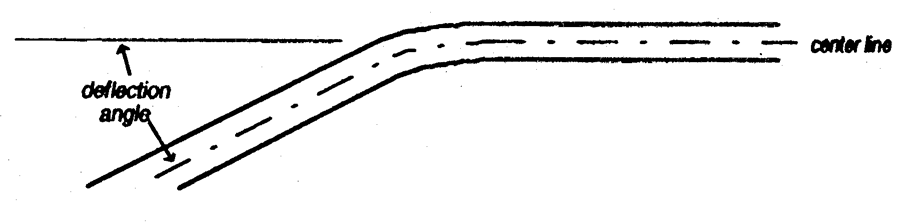
Deflection angle: The angle between a deviation in the direction of the center line of a street and
the extension of the center line along a straight course from the point from which
the center line changed direction. (See below).
deflection angle
Design variance: An alteration or relaxation of the terms of this Article where such alteration will not be contrary to the public interest, convenience and welfare, and where, owing to conditions peculiar to the property over which the applicant for a variance has no control, a literal enforcement of these regulations would create unnecessary and undue hardship on the applicant in the use of the property.
Developer: The person, corporation or other legal entity that undertakes the subdivision of property or the construction of streets, utilities, buildings or other improvements required for the habitation or use of the property.
Development: (1) A land development project involving the construction of streets, utilities, buildings, or other improvements required for the habitation or use of property, such as a residential neighborhood, an apartment complex, a store, or a shopping center; any manmade change to improved or unimproved real estate, including, but not limited to, buildings or other structures, mining, dredging, filling, grading, paving, excavating, drilling operations, or permanent storage of materials; (3) the act of constructing or carrying out a land development project.
Development permit: The authorization necessary to initiate and conduct a land disturbing activity and to carry out the planned development of land and structures.
Diameter breast height (DBH): The diameter of a tree trunk (usually a mature tree) measured at a height of four and one-half (4½) feet above the ground. If a tree splits into multiple trunks below four and one-half (4½) feet, the trunk is measured at its most narrow point beneath the split.
District: The Ocmulgee River Soil and Water Conservation District.
Drainage structure: A device composed of a virtually nonerodible material such as concrete, steel, plastic or other such material that conveys water from one place to another by intercepting the flow and carrying it to a release point for stormwater management, drainage control, or flood control purposes.
Drive-in theater: See "Theater, Drive-In."
Dwelling: A building or portion of a building arranged or designed to provide living quarters for one or more families.
a.
Single-family dwelling: A residential building, whether site-built or a manufactured home or an industrialized building, designed for or occupied exclusively by one family and meeting or exceeding the Standards for Single-Family and Two-Family Dwellings under Section 2.4.1 of this Ordinance.
b.
Two-family dwelling: A residential building designed for or occupied exclusively by two (2) families in separate dwelling units living independently of each other on a single lot, and meeting or exceeding the Standards for Single-Family and Two-Family Dwellings under Section 2.4.1 of this Ordinance.
c.
Multi-family dwelling: A residential building exclusively designed for or occupied by three (3) or more families in separate dwelling units living independently of each other.
d.
Group dwelling: A building or portion of a building occupied or intended for occupancy by several unrelated persons or families as their normal place of residence, but in which separate cooking facilities are not provided for such resident persons or families. The term "group dwelling" includes but is not limited to the terms "rooming house," "apartment hotel," "fraternity house" or "sorority house." A hotel, motel or bed and breakfast facility shall not be deemed to be a group dwelling as herein defined.
Dwelling unit: One or more rooms connected together and constituting a separate, independent housekeeping establishment for use on a basis involving owner occupancy or rental or lease on a weekly, monthly or longer basis, with provisions for cooking, eating and sleeping, and physically set apart from any other rooms or dwelling units in the same structure.
Easement: A strip of land on which the property owner has granted to the City the right to use such land for specific purposes.
Electronic message board: A type of sign that presents its message through illumination of flashing, intermittent, or moving lights forming the letters, numbers, or symbols of the message, whether or not the message appears to move across the sign face.
Elevated building: A nonbasement building built to have the lowest floor elevated above the ground level by means of fill; solid foundation perimeter walls; pilings, columns, posts and piers, shear walls; or breakaway walls.
EPD: The Environmental Protection Division of the Department of Natural Resources.
EPD Director: The Director of the Environmental Protection Division of the Department of Natural Resources.
Erosion: The process by which land surface is worn away by the action of wind, water, ice, or gravity.
Erosion and sediment control plan: A plan for the control of soil erosion and sedimentation resulting from a land disturbing activity.
Existing construction: Any structure for which the start of construction commenced before the effective date of the original ordinance from which this chapter derives.
Family: An individual or two (2) or more persons living together as a household.
Family day care home: An accessory use within a private residence, licensed by or registered with the State of Georgia as a family day care home, operated by the occupant of the dwelling who enrolls for pay, for supervision and care, three (3) but not more than six (6) children or adult.
Farm equipment sales: A business specializing in the sale of tractors and other machinery normally associated with agricultural operations in the production of crops or the raising of poultry or livestock.
Fast food restaurant: Any establishment, building or structure where food or drink are served for consumption, either on or off the premises, by order from or service to persons either over an interior counter, outside the structure or from an outdoor service window or automobile service window, or by delivery. This definition shall not include otherwise permitted restaurants where outdoor table service is provided to customers in established outdoor dining areas.
Fence: An artificially constructed barrier of wood, wire, wire mesh, or decorative metal erected to enclose, screen or separate portions of a lot.
Fill: A portion of land surface to which soil or other solid material has been added; the depth above the original ground.
Finished grade: The final elevation and contour of the ground after cutting or filling and conforming to the proposed design.
Flood or flooding: A general and temporary condition of partial or complete inundation of normally dry land areas from the:
a.
Overflow of inland or tidal waters;
b.
Unusual and rapid accumulation or runoff of surface waters from any source.
Flood hazard boundary map (FHBM): An official map of a community, issued by the Federal Emergency Management Agency, where the boundaries of the areas of special flood hazard have been defined as zone A.
Flood insurance rate map (FIRM): An official map of a community, on which the Federal Emergency Management Agency has delineated both the areas of special flood hazard and the risk premium zones applicable to the community.
Flood insurance study: The official report provided by the Federal Emergency Management Agency. The report contains flood profiles, as well as the flood boundary floodway map and the water surface elevation of the base flood.
Floodway: The channel of a river or other watercourse and the adjacent land areas that must be reserved in order to discharge the base flood without cumulatively increasing the water surface elevation more than one foot.
Floor: The top surface of an enclosed area in a building, including basement, i.e., top of slab in concrete slab construction or top of wood flooring in wood frame construction. The term does not include the floor of a garage used solely for parking vehicles.
Freestanding sign: A sign permanently attached to the ground which is wholly independent of any building or other structure. The term "freestanding sign" includes but is not limited to the following:
a.
Pole sign: A sign that is mounted on a freestanding pole or similar support such that the bottom of the sign face is at least six (6) feet above the ground.
b.
Ground sign: A freestanding sign, other than a pole sign, in which the bottom of the sign face is less than six (6) feet above the ground but not directly in contact with the ground.
c.
Monument sign: A freestanding sign in which the entire bottom of the sign face is in contact with the ground, providing a solid and continuous background for the sign face from the ground to the top of the sign.
Freestanding wall: An artificially constructed barrier of brick or stone, singly or in combination with decorative metal, erected to enclose, screen or separate portions of a lot.
Frontage or street frontage: The width in linear feet of a lot where it abuts the right-of-way of any street from which access may be directly gained.
Functionally dependent facility: A facility which cannot be used for its intended purpose unless it is located or carried out in close proximity to water, such as a docking or port facility necessary for the loading and unloading of cargo or passengers, shipbuilding, ship repair, or seafood processing facilities. The term "functionally dependent facility" does not include long-term storage, manufacture, sales, or service facilities.
Funeral home: A building used for the preparation of deceased human beings for services or burial, and ceremonies connected therewith before burial or cremation.
Grading: Altering the shape of ground surfaces to a predetermined condition; this includes stripping, cutting, filling, stockpiling and shaping, or any combination thereof, and shall include the land in its cut or filled condition.
Greenhouse: A building whose roof and sides are made largely of glass or other transparent or translucent material and in which the temperature and humidity can be regulated for the cultivation of plants for subsequent sale or for personal enjoyment.
Greenway: An area along the course of any state waters to be maintained in an undisturbed and natural condition.
Gross floor area: The total area of all floors of a building, measured from the outside planes of the exterior walls.
Ground elevation: The original elevation of the ground surface prior to cutting or filling.
Guest House: An accessory use to a dwelling designed and intended for the temporary housing of visitors to a property at the behest of the property residents for no fee or other consideration.
Handicapped parking space: A space laid out and designated by signage in accordance with the requirements of the federal Americans with Disabilities Act.
Heated living space: The total area of all floors in a dwelling unit used for residential activities and heated in accordance with the Building Code. Heated living space normally includes living, dining and recreation rooms; bedrooms, hallways and kitchens; bathrooms, closets and utility rooms.
Highest adjacent grade: The highest natural elevation of the ground surface, prior to construction, next to the proposed walls of a building.
Home occupation: Any activity carried out for profit by the resident and conducted as an accessory use in the resident's dwelling unit.
Hospital: An building providing primary or tertiary health services and medical or surgical care to persons including inpatients and out-patients, suffering from illness, disease, injury, deformity and other abnormal physical or mental conditions, and including as an integral part of the institution, related facilities such as laboratories, outpatient facilities or training facilities.
Hotel: A business establishment offering temporary lodging to the traveling public while away from their normal places of residence, and in which ingress and egress to and from the rooms are made primarily through an inside lobby. See also "Bed and Breakfast facility" and "Motel."
Improvements: The physical addition and changes to land that may be necessary to produce usable, desirable and acceptable lots or building sites.
Industrialized building: Any structure or component thereof which is wholly or in substantial part made, fabricated, formed, or assembled in manufacturing facilities for installation or assembly and installation on a building site and has been manufactured in such a manner that all parts or processes cannot be inspected at the installation site without disassembly, damage to, or destruction thereof. Industrialized buildings are constructed and regulated in accordance with O.C.G.A. Title 8, Chapter 2, Article 2, Part 1, §§ 8-2-110 through 8-2-121, as the same may be hereafter amended.
Intersection:
(1)
The place where two (2) streets cross;
(2)
The point at which the center line of a street intersects the center line of another street or railway.
Junkyard or salvage yard: A lot, land or structure or part thereof, used primarily for the collecting, storage or sale of waste paper, rags, scrap metal or other discarded material; and for the collecting, dismantling, storage, or salvage of machinery or vehicles not in running condition, or for the sale of parts thereof.
Kennel: A shelter where dogs or cats are bred, raised, trained or boarded as a business.
Land disturbing activity: Any activity which may result in soil erosion from water or wind and the movement of sediments into state waters or onto lands within the state, including, but not limited to, clearing, dredging, grading, excavating, transporting, and filling of land but not including agricultural practices as described in subsection 5.2.2.a(5).
Lot: A parcel or tract of land held in common ownership which may include one or more separately deeded or platted parcels.
a.
Corner lot: Any lot bounded by two (2) streets, at their intersection.
b.
Double frontage lot: A lot bounding on two (2) or more streets, but not at their intersection, so that it is not a corner lot.
c.
Interior lot: A lot having bounding on only one street.
Lot area: The total horizontal area included within lot lines.
Lot coverage: The portion of a lot covered by principal and accessory buildings.
Lot lines: The boundary dividing a given lot from the street, an alley, or adjacent lots.
a.
Front lot line: Any boundary line of a lot that abuts a public street right-of-way line. A lot adjacent to more than one street will have more than one front lot line.
b.
Rear lot line: Any boundary line of a lot that does not intersect with a public street right-of-way line and is not a front lot line.
c.
Side lot line: Any boundary line of a lot that intersects with a public street right-of-way line and is not a front lot line.
Lot of record: A lot which is part of a subdivision recorded in the office of the Clerk of Superior Court, or a lot described by metes and bounds, the description of which has been recorded in the office of the Clerk of Superior Court.
Lot of record: A lot that exists as shown or described in whole on a plat or deed recorded in the office of the Clerk to the Superior Court.
Lot width: The distance measured along the front building setback line between intersecting lot lines.
Manufactured home: A structure, transportable in one or more sections, which, in the traveling mode, is eight (8) body feet or more in width or forty (40) body feet or more in length, or, when erected on site, is three hundred twenty (320) or more square feet in floor area, and which is built on a permanent chassis and designed to be used as a dwelling with or without a permanent foundation when connected to the required utilities, and includes the plumbing, heating, air-conditioning, and electrical systems contained therein; or otherwise comes within the definition of a "manufactured home" under the National Manufactured Housing Construction and Safety Standards Act of 1974, as amended (42 U.S.C. 5401-5445).
a.
Class A manufactured home: A manufactured home that meets or exceeds the Standards for Single-Family and Two-Family Dwellings under Section 2.4.1 of this Ordinance. A Class A Manufactured Home shall be considered a Single-Family Dwelling.
b.
Class B manufactured home: A manufactured home that does not meet the Standards for Single-Family and Two-Family Dwellings under Section 2.4.1 of this Ordinance.
Manufactured home park: Any lot under single ownership on which two (2) or more manufactured homes are to be located or intended to be located for purposes of residential occupancy.
Manufactured home sales lot: A premises on which manufactured homes are displayed for sale.
Manufacturing: The creation of finished goods from raw materials or intermediate component parts.
a.
Heavy manufacturing: The extraction of natural resources or the transformation of raw materials through mechanical or chemical means into basic products for subsequent assembly, fabrication or use in the production of finished goods.
b.
Light manufacturing: The finishing, fabrication or assembly of previously manufactured parts into a final product or component products ready for retail sale.
Mean sea level: The average height of the sea for all stages of the tide. It is used as a reference for establishing various elevations within the floodplain. For purposes of this section, the term "mean sea level" is synonymous with National Geodetic Vertical Datum (NGVD).
Metropolitan River Protection Act (MRPA): A state law referenced as O.C.G.A. § 12-5-440 et seq., which addresses environmental and developmental matters in certain metropolitan river corridors and their drainage basins.
Mini-warehouse: A structure containing separate storage spaces of varying sizes leased or rented on an individual basis.
Mobile home: A manufactured home.
Motel: A business establishment offering temporary lodging to the traveling public while away from their normal places of residence, and in which ingress and egress to and from the rooms are made primarily direct from an exterior walkway rather than from an inside lobby. See also "Bed and Breakfast facility" and "Hotel."
Multi-faced sign: A sign structure that contains two (2) or more sign face surfaces that are located on different sides of the structure and are separated from each other at their nearest point by no more than three (3) feet.
National Geodetic Vertical Datum (NGVD): As corrected in 1929, is a vertical control used as a reference for establishing varying elevations within the floodplain.
Natural ground surface: The ground surface in its original state before any grading, excavation or filling.
Nephelometric turbidity units (NTU): Numerical units of measure based upon photometric analytical techniques for measuring the light scattered by finely divided particles of a substance in suspension. This technique is used to estimate the extend of turbidity in water in which colloidally dispersed particles are present.
New construction: Any structure for which the start of construction commenced after the effective date of the original ordinance from which this section derives.
Nonconforming lot: A lot of record whose area, frontage, dimensions, or location were lawful prior to the adoption, revision, or amendment of this ordinance, and which, by reason of such adoption, revision or amendment, no longer meets or exceeds one or more such requirements of the applicable zoning district.
Nonconforming sign: Any sign that was lawfully erected and maintained prior to the adoption, revision, or amendment of this ordinance, and which by reason of such adoption, revision or amendment fails to conform to all applicable regulations and restrictions of this ordinance.
Nonconforming structure: A structure or building whose size, dimensions, or location on a property were lawful prior to the adoption, revision, or amendment of a this ordinance, but which, by reason of such adoption, revision, or amendment, no longer meets or conforms to one or more such requirements of this ordinance.
Nonconforming use: A use or activity that was lawful established prior to the adoption, revision, or amendment of a this ordinance, but which, by reason of such adoption, revision, or amendment, is no longer a use or activity permitted by right or no longer meets or conforms to the requirements of this ordinance.
Nursery school: See "Daycare Center."
Nursing home: An extended or intermediate care facility required to be licensed or approved by the State Georgia to provide full-time convalescent or chronic care to individuals who, by reason of advanced age chronic illness or infirmity, are unable to care for themselves.
Occupant directory sign: A sign listing the occupants or tenants of a building or group of buildings, including their respective professions or business activities and location within the building or group of buildings.
Office: A room or group of rooms used for conducting the affairs of a business, profession, service, industry or government.
Office building: A building used primarily for conducting affairs of a business, profession, service, industry or government, or like activity, that may include ancillary services for office workers such as a restaurant, coffee shop, newspaper or candy stand.
Opaque: Impenetrable to view, or so obscuring to view that features, buildings, structures, and uses become visually indistinguishable.
Outdoor display area: A portion of a property outside of any building where merchandise, goods or other items are placed in public view for the purpose of advertising or for sale or lease.
Outdoor storage: The keeping within an unroofed area of any goods, material, merchandise or vehicles in the same place for more than twenty-four (24) hours.
Parking aisle: The traveled way, which is not the public right-of-way, by which cars enter and depart parking spaces.
Parking area or lot: Any public or private area at grade or within a structure used for the express purpose of temporarily parking automobiles and other vehicles otherwise in operation for personal or business use.
Parking bay: Three (3) or more parking spaces adjacent to one another and aligned side-by-side.
Parking garage: An accessory building or portion of a principal building used only for the private storage of motor vehicles as an accessory use. See also "Commercial Parking Lot."
Parking space: A space identified and set aside for the temporary parking of an automobile or other motor vehicle.
Person: Any individual, partnership, firm, association, joint venture, public or private corporation, trust, estate, commission, board, public or private institution, utility, cooperative, state agency, municipality or other political subdivision of this State, any interstate body or any other legal entity.
Planned center: A building, or a group of buildings in close proximity to each other, operated under a common promotional plan, and occupied or intended for occupancy by six (6) or more retail stores, service establishments, offices, industries or other businesses.
Plant nursery: Land or greenhouses used to raise flowers, shrubs, trees, and other plants for sale to distributors or for subsequent replanting by the owner, a landscape company or others.
Premises: An area of land with its appurtenances and buildings which, because of its unity of use, is one unit of real estate.
Presiding official: The person chairing a meeting of the Planning Commission or the Board of Commissioners in their official capacity.
Principal building: A building in which is conducted a principal use.
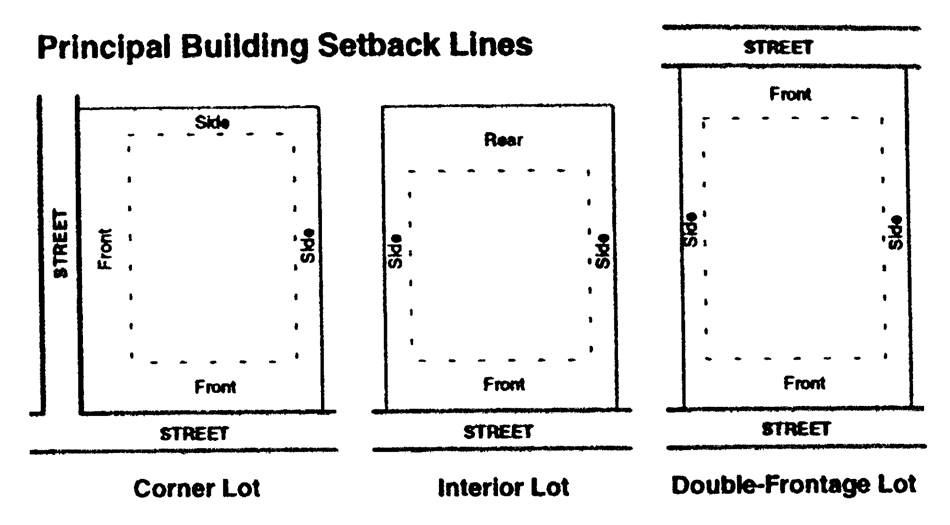
Principal building setback line: A line delineating the minimum allowable distance between a property line or the right-of-way line of an abutting street and a principal building on a lot.
a.
Front building setback: The minimum allowable distance between the right-of-way line of any abutting street and any part of a principal building on a lot. The front setback distance is applied along the full length of the right-of-way line and is parallel to it.
b.
Rear building setback: The minimum allowable distance between a rear lot line and any part of a principal building on a lot. The rear building setback extends along the full length of the rear lot line.
c.
Side building setback: The minimum allowable distance between a side lot line and any part of a principal building on a lot. The side building setback extends along the side lot line between the front building setback and a rear building setback.
setback lines
Principal use: The specific, primary purpose for which land or a building is used.
Professional engineer: An engineer licensed and registered to perform the duties of a professional engineer (P.E.) by the State of Georgia.
Prohibited use: A use that is not permitted in a zoning district by right, as an accessory use, or as a conditional use.
Project: The entire proposed development project regardless of the size of the area of land to be disturbed.
Project entrance sign: A sign identifying the name of a residential subdivision, multi-family development, office park, or industrial park, located at a discernible entrance into the subdivision, development, or park.
Projecting sign: See "building sign."
Property or parcel of land: See "Lot."
Public Works Director: The Director of the Department of Public Works of the City of Hawkinsville, or his designee, whose duties include the review and approval of construction plans for public streets and utilities for the City.
Public improvement: The construction, enlargement, extension or other construction of a facility intended for dedication to the public, including but not limited to a street, curb and gutter, sidewalk, cross drain, catch basin, traffic control and street name sign, or other roadway appurtenance other than a driveway apron connection; domestic water supply system main, fire hydrant, valve or other appurtenance other than a supply line to a building; or sanitary sewerage main or outfall, lift station, force main, manhole or other appurtenance other than a drain line from a building.
Publicly dedicated: Land or improvements that has or have been transferred by plat or deeded to and accepted by the City for public use and maintenance.
Recreation facility: An accessory use to a dwelling designed and equipped for the conduct of personal leisure time activities such as a swimming pool, tennis court, deck, or patio. See also "Commercial Recreation" and "Community Recreation Facility."
Recycling center: A use operated exclusively for the collection and temporary storage of used paper, glass, metal, and similar materials suitable for reprocessing, which are transported elsewhere for separating, processing, or storage.
Registered land surveyor: A land surveyor licensed and registered to perform the duties of a registered land surveyor (R.L.S.) by the State of Georgia.
Rental services establishment: Any business establishment which rents or leases items of personal property such as tools, appliances, and equipment to the general public.
Reserve strip: A strip or tract of land reserved for the purpose of controlling or limiting access from properties to abutting streets.
Restaurant: An establishment where food and drink are prepared to individual order, ordered and served at the table, and consumed primarily within the principal building, as contrasted to a fast food restaurant.
Retail sales business: An establishment principally engaged in offering a category of similar goods or products for sale to the general public, such as a grocery store, hardware store, pharmacy, clothing shop, home furnishings store, office supplies store, and the like.
Retail services business: An establishment principally engaged in providing a service, as opposed to products, to the general public, such as a banking or financial institution, real estate or insurance office, barber or beauty shop, travel agency, amusement or recreation center, health clinic, legal firm, professional service, and the like.
Retirement community: An age-restricted residential development in a multi-family dwelling that offers significant services and facilities for the elderly, including social and recreational activities, personal care services, or health facilities limited to use by the development's residents. At least eighty (80) percent of the units must be occupied by residents sixty-two (62) years old or older, and the remaining units must be occupied by at least one resident fifty-five (55) years old or older.
Reverse frontage lot: A double frontage lot that abuts two (2) public streets but is not allowed to have vehicular access to one of them.
Roadside stand: A structure for the shelter, display and sale of agricultural products produced on the premises, with no space for customers within the structure itself.
Roadway drainage structure: A device such as a bridge, culvert, or ditch, composed of a virtually nonerodible material such as concrete, steel, plastic, or other such material that conveys water under a roadway by intercepting the flow on one side of a traveled way consisting of one or more defined lanes, with or without shoulder areas, and carrying water to a release point on the other side.
Roof sign: See "building sign."
School: A facility used for education or instruction in any branch of knowledge.
a.
Academic school: Any building or part thereof which is designed, constructed or used for education or instruction following the same curriculum offered in a public elementary, secondary, trade or technical, or higher education facility, and accredited to award diplomas as such.
b.
Commercial school: Any building or part thereof which is designed, constructed or used for education or instruction in any branch of knowledge or vocational pursuit, other than an academic school.
Sediment: Solid material, both organic and inorganic, that is in suspension, is being transported, or has been moved from its site of origin by air, water, ice, or gravity as a product of erosion.
Sedimentation: The process by which eroded material is transported and deposited by the action of water, wind, ice, or gravity.
Semipublic use: A use owned or operated by a nonprofit, religious, or eleemosynary institution for the purpose of providing educational, cultural, recreational, religious, or social services to the general public.
Setback: The shortest straight line distance between a street right-of-way or lot line and the nearest point of a structure or building or projection therefrom (excluding roof overhangs of eighteen (18) inches or less).
Setback, minimum: The shortest distance allowed between a street right-of-way line or any other lot line and any principal or accessory building on a lot. Minimum setback requirements for buildings are associated with the type of lot line from which the setback is taken; for instance, a "side yard setback" is measured from a side lot line.
Sewerage, public: A sanitary sewerage system for the collection of water-borne wastes complete with a sewage treatment plant that is owned and operated by a public agency or authority.
Sign: The term "sign" shall mean any structure, display or device that is used to advertise, identify, direct or attract attention to a business, institution, organization, person, idea, service, event or location by any means, including words, letters, figures, design characteristics, symbols, logos, fixtures, colors, movement, or illumination.
Sign face: That portion of the surface of a sign structure where words, letters, figures, symbols, logos, fixtures, colors, or other design elements are or may be located in order to convey the message, idea, or intent for which the sign has been erected or placed. The sign face may be composed of two (2) or more modules on the same surface that are separated or surrounded by portions of a sign structure not intended to contain any advertising message or idea and are purely structural or decorative in nature.
Sign face module: Each portion or unit of a sign face that is clearly separable from other such units by virtue of the expression of a complete thought, message, logo, or idea.
Sign height: The vertical distance to the highest point of a sign structure, as measured from the average grade at the base of the structure or directly below a projecting structure.
Soil and Water Conservation District approved plan: An erosion and sediment control plan approved in writing by the Ocmulgee River Soil and Water Conservation District.
Stabilization: The process of establishing an enduring soil cover of vegetation by the installation of temporary or permanent structures for the purpose of reducing to a minimum the erosion process and the resultant transport of sediment by wind, water, ice, or gravity.
Start of construction: For other than new construction or substantial improvements under the Coastal Barrier Resources Act (P.L. 97-3-18), includes substantial improvements, and means the date the building permit was issued, provided the actual start of construction, repair, reconstruction, or improvement was within one hundred eighty (180) days of the permit date. The actual start of construction means the first placement of permanent construction of a building, including a manufactured home, on a site, such as the pouring of slabs or footings, installation of piles, construction of columns, or any work beyond the stage of excavation or the placement of a manufactured home on a foundation. Permanent construction does not include land preparation, such as clearing, grading and filling, nor does it include the installation of streets or walkways; the excavation for a basement, footings, piers or foundations or the erection of temporary forms; or the installation on the property of accessory buildings, such as garages or sheds not occupied as dwelling units or not part of the main building.
State waters: Any and all rivers, streams, creeks, branches, lakes, reservoirs, ponds, drainage systems, springs, wells, and other bodies of surface or subsurface water, natural or artificial, lying within or forming a part of the boundaries of the State which are not entirely confined and retained completely upon the property of a single individual, partnership, or corporation.
Storage: The placement, keeping, or retention of vehicles, equipment, materials, goods, or products on a temporary basis for intermittent use or subsequent distribution or transfer.
Street: An improved way for the conveyance of motor driven, rubber-tired vehicles, such as automobiles and trucks.
a.
Arterial street: A State or U.S. numbered highway. Arterial streets are used for traffic of moderate to fast speeds and high volumes between major local centers of employment, recreation and shopping.
b.
Collector street: A major street used for traffic of moderate speeds and high peak volumes between local streets and arterial streets or serving as a principal entrance street or primary circulation route within a neighborhood or other limited area. Collector streets serve nonresidential or multi-family areas, or one hundred (100) dwelling units or more in residential subdivisions, but are not State or U.S. numbered highways.
c.
Local Street: A minor street used for traffic of relatively low speeds and volumes and for primary access to abutting properties. Local streets serve fewer than one hundred (100) dwelling units.
Street jog: the incidence where two (2) streets or two (2) portions of a single street are separated
by a relatively short distance, usually at their intersection with another street.
(See below)

street jog
Structural erosion and sedimentation control measures: Measures for the stabilization of erodible or sediment-producing areas by utilizing the mechanical properties of matter for the purpose of either changing the surface of the land or storing, regulating, or disposing of runoff to prevent excessive sediment loss. Examples of structural erosion and sedimentation control practices are riprap, sediment basins, dikes, level spreaders, waterways or outlets, diversions, grade stabilization structures, sediment traps, and land grading, etc. Such measures can be found in the publication Manual for Erosion and Sediment Control in Georgia.
Structure: Anything constructed or erected with a fixed location on the ground or attached to something having a fixed location on the ground. Among other things, structures include but are not limited to buildings, driveways, parking lots, walls, fences, signs, and swimming pools.
Structure height: The vertical distance to the highest point of a structure, as measured from the average grade at the base of the structure or directly below a projecting structure.
Subdivision:
(1)
The division of a property or tract of land into two (2) or more tracts or lots;
(2)
A land development project in which two (2) or more lots are created, along with the streets and utilities needed to support construction of buildings on the lots.
Substantial improvement: Any combination of repairs, reconstruction, alteration, or improvements to a building, taking place during the life of a building, in which the cumulative cost equals or exceeds fifty (50) percent of the market value of the building. The market value of the building should be:
a.
The appraised value of the building prior to the start of the initial repair or improvement; or
b.
In the case of damage, the value of the building prior to the damage occurring.
For the purposes of this definition, the term "substantial improvement" is considered to occur when the first alteration of any wall, ceiling, floor or other structural part of the building commences whether or not that alteration affects the external dimensions of the building. The term does not however, include any project for improvement of a building required to comply with existing health, sanitary or safety code specifications which are solely necessary to assure safe living conditions.
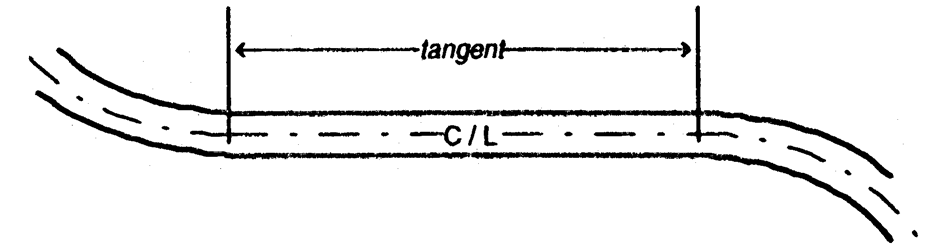
Tangent: the straight-line distance between the ending on one curve of a line (center line
of a street) and the beginning of another curve of the same line (centerline). (See
below)
tangent
Temporary use: A use established for a fixed period of time with the intent to discontinue such use upon the expiration of the time period.
Tenant's wall frontage: The length in feet along the wall frontage of a building between the limits of a tenant's occupied space, measured to the outside of an exterior wall or the centerline of a party wall between two (2) tenants.
Theater: A building or part of a building devoted to showing motion pictures, or for dramatic, musical or live performances.
Theater, drive-in: An open lot with its appurtenant facilities devoted primarily to the showing of motion pictures or theatrical productions to patrons seated in automobiles.
Travel trailer: A motorized camper, converted bus, tent trailer, motor home, or other similar vehicular or portable structure used or designed for temporary portable housing or occupancy while on vacation or other recreational trip and provided with sleeping accommodations.
Trout streams: All streams or portions of streams within the watershed as designated by the Game and Fish Division of the Georgia Department of Natural Resources under the provisions of the Georgia Water Quality Control Act, O.C.G.A. § 12-5-20, et seq. Streams designated as primary trout waters are defined as water supporting a self-sustaining population of rainbow, brown, or brook trout. Streams designated as secondary trout waters are those in which there is no evidence of natural trout reproduction, but are capable of supporting trout throughout the year. First order trout waters are streams into which no other streams flow except springs.
Truck loading docks: A portion of a building designed for the loading and unloading of trucks.
Truck terminal: A building or premises where trucks load and unload cargo and freight and where the cargo and freight may be broken down or aggregated into smaller or larger loads for transfer to other vehicles or modes of transportation.
Use: The purpose for which land or a building or other structure is designed, arranged or intended or for which it is or may be occupied or maintained. See also "Principal Use" and "Accessory Use or Structure."
Utility company: A private business providing electricity, natural gas, telephone, or other services under the regulation of the Georgia Public Services Commission.
Vegetative erosion and sedimentation control practices: Practices for the stabilization of erodible or sediment-producing areas by covering the soil with:
a.
Permanent seeding, sprigging or planting, producing long-term vegetative cover; or
b.
Temporary seeding, producing short-term vegetative cover; or
c.
Sodding, covering areas with turn of perennial sod-forming grass.
Such practices can be found in the publication Manual for Erosion and Sediment Control in Georgia.
Veterinarian: A veterinary hospital or clinic providing medical care and treatment for animals.
a.
Large animal veterinarian: A place where horses, cattle, sheep or other animals normally kept in agricultural settings are given medical or surgical treatment and the boarding of animals is limited to short-term care.
b.
Small animal veterinarian: A place where dogs, cats, birds or other animals normally kept as household pets are given medical or surgical treatment and the boarding of animals is limited to short-term care.
Wall frontage: The length in feet along the side of a building where the occupant's front or main door is located. See also "tenant's wall frontage."
Warehouse: A building used primarily for the storage of goods and materials. See also "Mini-Warehouse."
Watercourse: Any natural or artificial watercourse, stream, river, creek, channel, ditch, canal, conduit, culvert, drain, waterway, gully, ravine, or wash in which water flows either continuously or intermittently and which has a definite channel, bed and banks, and including any area adjacent thereto subject to inundation by reason of overflow or floodwater.
Wetlands: Those areas that are inundated or saturated by surface or ground water at a frequency and duration sufficient to support, and that under normal circumstances do support, a prevalence of vegetation typically adapted for life in saturated soil conditions. Wetlands generally include swamps, marshes, bogs, and similar areas.
Wholesale trade establishment: A place of business primarily engaged in selling merchandise to retailers; to industrial, commercial, institutional, or professional business users, or to other wholesalers; or acting as agents or brokers and buying merchandise for, or selling merchandise to, such individuals or companies.
Window sign: See "building sign."
Yard: An area that lies between the principal building on a lot and the nearest lot line.
a.
Front yard: A yard situated along any public street right-of-way or private street easement.
b.
Rear yard: A yard situated along a rear lot line.
c.
Side yard: A yard situated along a side lot line.
Zoning change: An amendment to the Zoning Map (rezoning), approval of a conditional use, or approval of a change in the conditions of approval associated with a rezoning or conditional use.

