
Haymarket City Zoning Code
ARTICLE XVII
SIGNS
Sec. 58-17.1.- Findings, purpose, and intent; interpretation.
(a)
Signs obstruct views, distract motorists, displace alternative uses for land, and pose other problems that legitimately call for regulation. The purpose of this article is to regulate the size, color, illumination, movement, materials, location, height and condition of all signs placed on private property for exterior observation, thus ensuring the protection of property values, the character of the various neighborhoods, the creation of a convenient, attractive and harmonious community, protection against destruction of or encroachment upon historic areas, and the safety and welfare of pedestrians and wheeled traffic, while providing convenience to citizens and encouraging economic development. This article allows adequate communication through signage while encouraging aesthetic quality in the design, location, size, and purpose of all signs. This article shall be interpreted in a manner consistent with the First Amendment guarantee of free speech and in a manner consistent with the town's comprehensive plan. If any provision of this article is found by a court of competent jurisdiction to be invalid, such finding shall not affect the validity of other provisions of this article, which can be given effect without the invalid provision.
(b)
Signs not expressly permitted as being allowed by right or by special use permit under this article, by specific requirements in another portion of this chapter, or otherwise expressly allowed by the town council are forbidden.
(c)
A sign placed on land or on a building for the purpose of identification, protection or directing persons to a use conducted therein shall be deemed to be an integral but accessory and subordinate part of the principal use of land or building. Therefore, the intent of this article is to establish limitations on signs in order to ensure they are appropriate to the land, building or use to which they are appurtenant and are adequate for their intended purpose while balancing the individual and community interests identified in subsection (a) of this section.
(d)
These regulations are intended to promote signs that are compatible with the use of the property to which they are appurtenant, landscape and architecture of surrounding buildings, are legible and appropriate to the activity to which they pertain, are not distracting to motorists, and are constructed and maintained in a structurally sound and attractive condition.
(e)
These regulations distinguish between portions of the town designed for primarily vehicular access and portions of the town designed for primarily pedestrian access.
(f)
These regulations do not regulate every form and instance of visual speech that may be displayed anywhere within the jurisdictional limits of the town. Rather, they are intended to regulate those forms and instances that are most likely to meaningfully affect one or more of the purposes set forth above.
(g)
These regulations do not entirely eliminate all of the harms that may be created by the installation and display of signs. Rather, they strike an appropriate balance that preserves ample channels of communication by means of visual display while still reducing and mitigating the extent of the harms caused by signs.
(Ord. No. 2021-002, 11-23-2021)
Sec. 58-17.2. - Definitions sign.
Any display of any letters, words, numerals, figures, devices, emblems, pictures, or any parts or combinations, by any means whereby they are made visible for the purpose of making anything known, where such display is made on, attached to, or as part of a structure, surface, or any other thing, including but not limited to the ground, any rock, tree or other natural object, which display is visible beyond the boundaries of the parcel of land on which it is made. A display of less than one square foot in area is excluded from this definition. (Illustrations below are for example only and do not show dimensional standards).
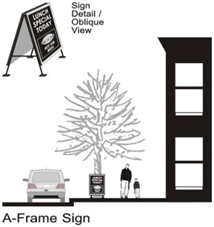
A-Frame sign. A temporary, portable sign used at a place of business to provide information. The sign may have one or two sides and may contain changeable letters. This type of sign is also commonly referred to as a 'sandwich board sign'.
Animated sign. A sign which changes physical position or involves the use of motion, rotation, or the appearance of motion. For the purpose of this chapter, flags are not deemed animated signs.
Awning sign. See canopy sign.
Banner sign. A temporary sign made of cloth, paper, vinyl, or like material attached to a wall so as to remain in a generally stationary position.
Bench sign. A sign painted, located on, or attached to any part of the surface of a bench, seat, or chair placed on or adjacent to a public place or roadway.
Billboard sign. See off-premises sign.
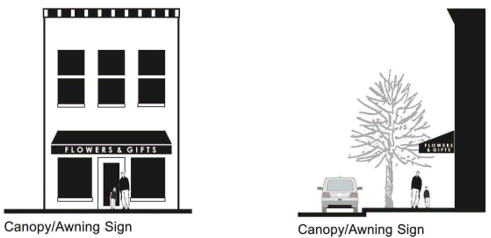
Canopy sign. A sign placed directly on, printed on, or attached to the surface of an awning or canopy.
Changeable copy sign. A sign or part of a sign that is designed so that characters, letters, or illustrations can be mechanically or physically changed or rearranged without altering the face or surface of the sign.
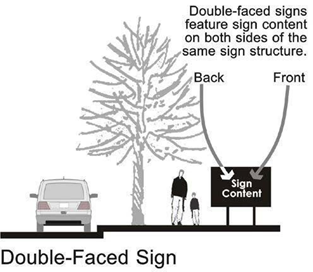
Double-faced sign. A sign with two parallel or nearly parallel faces, back-to-back, upon which advertising is displayed.
Directional signs. Any signage installed on the premises of a facility in order to facilitate the flow of customer traffic.
Electronic message board. Any sign that uses changing lights to form a sign message or messages wherein the sequence of messages and the rate of change is electronically programmed and can be modified by electronic processes.
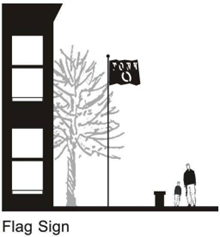
Flags. Cloth or similar flexible fabric attached to a pole at one end such that the material can bend or flutter from the point(s) of attachment.
Flashing sign. Any illuminated sign on which there is artificial light which is not stationary or constant in intensity or color at all times when such a sign is in use.
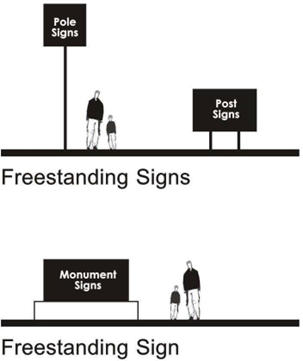
Freestanding sign. Sign supported by one or more upright poles, columns, or braces placed in or on the ground and not attached to any building or structure; non-portable.
Government sign. Government signs that are approved by the town council or installed for the public benefit by the Town of Haymarket.
Hanging sign. See projecting sign.
Illuminated sign. A sign illuminated in any manner by an artificial light source, whether internally or externally lit. Externally illuminated signs are those that have a light source projecting onto the face of the sign either by downlighting or indirectly with fluorescent, halogen, or a source that gives off natural white light. Internally illuminated signs are those that have a light source inside or behind the sign structure or sign face which projects lights through or from the sign face.
Channel letter sign. A sign made up of letters only, lit, or unlit, that are attached directly to the building. Also referred to as 'individual letter sign'.

Inflatable sign. Any display capable of being expanded by air, air pumps, or other gas to advertise a product or event. This includes 'inflatable air men' or 'wacky air dancers.
Minor sign. A small, adjunct sign for specific functional purposes. Examples include trespassing signs, security warning signs, on-site directional signs, and the like.
Monument sign. A sign affixed to a structure built on grade in which the sign and the structure are an integral part of one another; not a pole sign. For the purpose of this chapter, monument signs shall be deemed freestanding signs.
Moving or rotating sign. Assign or other display with mechanical motion powered by natural, manual, mechanical, electrical, or other means, including but not limited to pennant strings, streamers, spinners, propellers, and searchlights. Handheld signs are not included.
Neon sign. A sign that uses light-emitting gas to convey a message in a form such as letters, numbers, and figures.
Off-premises sign. A sign which directs attention to a business, commodity, service, or establishment that is conducted, sold, or offered at a location other than the premises on which the sign is erected
Painted sign. Any sign painted on the exterior surface of a building; includes a mural sign.
Feather sign. A lightweight, portable sign mounted along one edge on a single, vertical, flexible pole which may resemble a sail, bow, or teardrop.
Portable sign. shall mean a sign not permanently affixed to a building, a structure, a vehicle, or the ground. For the purpose of this chapter, A-frame signs shall be deemed portable signs. This includes but is not limited to balloons and person-held signs.
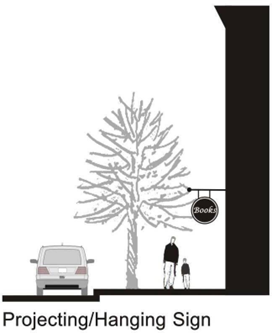
Projecting sign. A sign attached to a building, approximately perpendicular to the building wall.
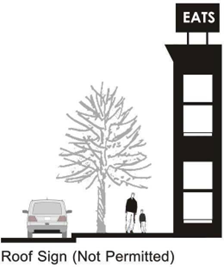
Roof sign. Any sign erected, constructed, and maintained wholly upon or over the roof of any building (not permitted by this ordinance).
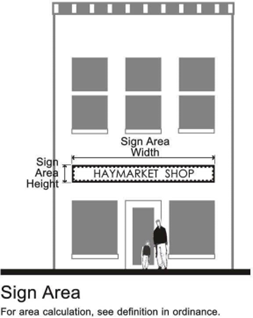
Sign area. The entire face of a sign, including the advertising surface and any framing, trim, or molding, but not including the supporting structure. Sign area is calculated by standard mathematical formulas such as height times width for rectilinear signs, πr2 for circular signs, and the applicable standard mathematical formula for other geometrical shapes.
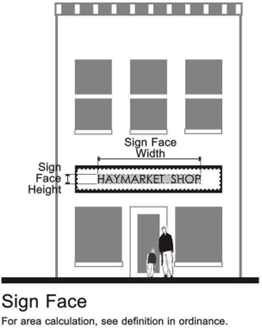
Sign face. The area or display surface used for the message, not including any framing, trim or molding, or the support structure. Face area is calculated using the same mathematical formulas as for sign areas.
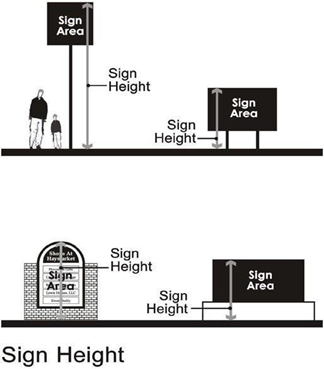
Sign height. Distance measured in feet and inches from the ground below the sign to the highest point of sign to include sign structure, or in the case of wall signs on upper floors, from the floor level immediately below the sign to the highest point of the sign. Artificially increasing the height of the sign by berming or mounding dirt or other material at the sign base is prohibited.
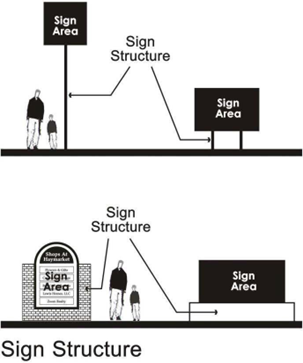
Sign structure. Sign structure includes the supports, uprights, bracing, and framework of any structure, be it single-faced, double-faced, V-type, or otherwise exhibiting sign.
Temporary sign. A sign designed or intended to be displayed for a specified or limited period of time not to exceed 45 days unless an extension is granted by the zoning administrator. Examples include real estate signs, contractor's signs, and one-time event signs.
Vehicle sign. A sign placed, affixed, painted, or digitally displayed on a motor vehicle parked or while in use in the normal course of business with the primary purpose of providing advertisement of a business, product, service, or activity.
Wall sign. Any signs or lettering, projecting not more than eight inches, which are placed against or attached to the front, rear, or side wall of a building, but shall not include painted or mural signs, or roof signs as defined herein.
Wayfinding signs. A sign on the premises of a development with multiple tenants that allows customers to find their way. For the purpose of this chapter, wayfinding signs may be deemed as freestanding signs.
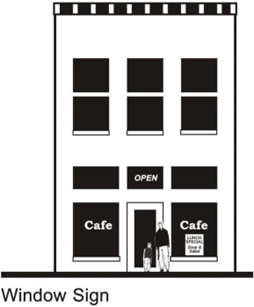
Window sign. A sign painted, stenciled, or affixed on a window.
(Ord. No. 2021-002, 11-23-2021)
Sec. 58-17.3. - Applicability.
The provisions of this article shall apply to all property within the corporate limits of the town.
(Ord. No. 2021-002, 11-23-2021)
Sec. 58-17.4. - Permit required.
Except when otherwise exempted by this article, no sign shall be erected, constructed, posted, painted, altered, or relocated, unless and until a zoning permit has been issued by the zoning administrator and were provided for in this article, subsequent to an approval of a certificate of appropriateness by the architectural review board (ARB).
(Ord. No. 2021-002, 11-23-2021)
Sec. 58-17.5. - Exemptions.
Sign permits shall not be required for the following signs in any sign district; however, all applicable regulations of this chapter shall apply.
(1)
Signs erected by a governmental body or required by law, including official traffic signs or sign structures, provisional warning signs or sign structures, and temporary signs indicating danger.
(2)
Minor signs not exceeding three total signs per separate road frontage per lot, and not less than 30 feet apart.
(3)
Change of message or content of an approved sign.
(4)
Notice must be given to the zoning administrator 30 days in advance of installation.
(5)
Flags, provided, however, that no single flag shall exceed 24 square feet in area and no single lot shall display more than three flags.
(Ord. No. 2021-002, 11-23-2021)
Sec. 58-17.6. - Prohibited signs.
The following signs are prohibited:
(1)
Flashing signs or signs lighted in a varying degree including strobe lights.
(2)
Moving or rotating signs.
(3)
Off-premises signs (except in the I-1 zoning district).
(4)
Inflatable signs.
(5)
Signs located anywhere on the roof.
(6)
Signs located on the wall of a building that extend above the roofline or wall, or extend into a front, side, or rear yard setback.
(7)
Signs illuminated with sodium halide lights; and any illuminated sign that emits lighting levels in excess of the limitation.
(8)
Electronic message boards.
(9)
Abandoned sign structures.
(10)
Signs, including posters and handbills affixed to any structures, trees or other natural vegetation, rocks, or poles.
(11)
Any sign that may be confused with or obstruct the view of any authorized traffic sign or signal or obstruct the sight-distance triangle at any road intersection or extend into the public right-of-way or otherwise create a distraction for drivers.
(12)
Signs that prevent free ingress or egress from any door, window, fire escape, or that prevent free access from one part of a roof to any other part or otherwise adversely affect safety or are in violation of any building code or other applicable law.
(13)
Signs that emit smoke, visible vapors, particles, normally detectable sound, or odor shall not be permitted, including open flames used to attract public attention.
(14)
Mirrors or mirror devices on, in, or as part of a sign.
(15)
Feather signs.
(Ord. No. 2021-002, 11-23-2021)
Sec. 58-17.7. - General requirements for all permitted and temporary signs.
(a)
Sign area computations.
(1)
The surface area of any sign permitted under this article is determined by measuring the entire face of the sign including any wall work incidental to its decoration, but excluding support elements whose sole purpose and function is to support the sign, except as noted below:
a.
The surface area of any sign only made up only of individual letters or figures shall include the space between such letters or figures.
b.
Whenever one sign contains information on both sides, only one side only shall be used in computing the surface area of the sign.
(b)
Placement of signs. Signs shall be placed so they do not obstruct vehicles, pedestrians, or the signs of adjacent businesses and so that they follow architectural review board placement guidelines. Unless otherwise provided for in this chapter, permanent signs shall be located:
a.
At least ten feet from any lot line within the gateway sign area, or no closer than the building façade is to the lot line, whichever is less.
b.
At least five feet to any lot line within the core sign area, or no closer than the building façade is to the lot line, whichever is less.
c.
At least ten feet to any lot line within the residential sign area, or no closer than the building façade is to the lot line, whichever is less.
(c)
Materials, colors, and styles. All materials, colors, and styles of permanent signs are subject to approval by the architectural review board in accordance with the Historic District Design Guidelines adopted by the town council, as amended.
(d)
Lighting. No sign, temporary or permanent, shall be permitted to have an illumination spread of more than a 0.05-foot candle at the lot line, shine into on-coming traffic, affect highway safety, or shine directly into a residential dwelling unit. Permanent internally illuminated signs are permitted for wall, freestanding, and channel letter signs in the gateway zone as marked on the sign zoning map. All internally illuminated signs shall comply with this item (58-15.9(d)).
(e)
Substitution. Wherever this article permits a sign with commercial content, non-commercial content is also permitted subject to the same requirements of size, color, illumination, movement, materials, location, height, and construction.
(Ord. No. 2021-002, 11-23-2021)
Sec. 58-17.8. - Temporary signs.
Temporary signs may be erected or constructed without a permit in all zoning districts; however, all applicable code requirements in this chapter shall apply.
(1)
Temporary signs—Gateway district. Notice shall be given to the zoning administrator not more than 48 hours after signs have been erected. These signs shall be either freestanding signs, wall signs, window signs, portable signs, banner signs, or A-frame signs, and may be displayed for up to 45 calendar days. The zoning administrator may extend the time limit by up to 45 calendar days upon application by the owner at the end of the initial 45-day period, if the applicant shows that the sign is maintained in sound condition and the purpose for it still pertains. Temporary signs shall not be internally illuminated.
a.
Temporary freestanding signs, wall signs, portable signs, and banner signs: Shall not exceed one sign per location, nor eight square feet in area and six feet in height.
b.
Temporary window signs: Shall not obstruct more than 20 percent of the area of the window on which the sign is located.
c.
A-frame signs: Must not be more than an aggregate of 12 square feet or less, and not exceed five feet in height in a sandwich board design as defined herein. The sign may only be displayed during business hours. The placement of the sign shall not impede pedestrian, wheelchair, or vehicular traffic flow. Only one such sign is permitted per business, or one sign per 30 linear feet of sidewalk, whichever is more restrictive.
(2)
Temporary signs—Residential district. These signs shall be either freestanding signs, wall signs, window signs or banner signs.
a.
Freestanding and wall signs: Shall not exceed 16 square feet in area per property. No sign shall exceed six feet in height. This includes signs on property for rent or for sale.
b.
Window signs: Shall not obstruct more than 20 percent of the total area of all windows on each building façade on the property.
(3)
Temporary signs—Core district. These signs shall be either freestanding signs, wall signs, window signs or banner signs, subject to the same standards and limitations as temporary signs for the gateway district (Sec. 58-15.6(a)).
(4)
Temporary signs required to be posted by law. Any such sign shall be removed the day after the last day for which it is required to be displayed. The administrator may require proof of legal requirement for the posting of the sign. These signs are permitted in all zoning districts.
(Ord. No. 2021-002, 11-23-2021)
Sec. 58-17.9. - Process for permitting.
(a)
Permit required. Except when otherwise exempted by this article, no sign shall be erected, constructed, posted, painted, altered, or relocated, unless and until a zoning permit has been issued by the zoning administrator and were provided for in this article, subsequent to an approval of a certificate of appropriateness by the architectural review board (ARB).
(b)
Permit process. Before any zoning permit is issued, the applicant shall submit to the administrator a sign permit application and an application for certificate of appropriateness when applicable provided by the administrator, together with drawings and/or specifications as may be necessary to fully advise and acquaint the administrator with the location, construction, materials, manner of illuminating and/or securing or fastening, and number of signs applied for, and the style of the wording of the sign or advertisement to be carried on the sign.
(c)
Approval of permit. For signs not requiring architectural review, the zoning administrator shall act on the permit application within 14 days of acceptance of the application. For signs requiring action by the architectural review board, the board shall act on the application within 60 days after acceptance of the application by the zoning administrator, in accordance with this chapter, and the Historic District Design Guidelines adopted by the town council, as amended, unless such timeline is extended by the applicant in writing. The zoning administrator shall issue a zoning permit within three business days following approval by the ARB.
(d)
Building codes; inspections. Structural and safety features and electrical systems shall be in accordance with the requirements of the Uniform Statewide Building Code and Town ordinances.
(e)
General permit application requirements. Submission requirements for architectural review board sign guidelines as set forth in the Historic District Design Guidelines adopted by the town council, as amended, shall be followed for selecting the type of sign, location, colors, lettering style, materials, and type of illumination (if applicable). Sign permit application(s) also require:
(1)
An application for a certificate of appropriateness, as applicable.
(2)
A plat showing location of existing and proposed sign(s) on building façade(s) or grounds and exterior dimensions of buildings subject to the sign permit.
(3)
Scaled drawings showing dimensions, scale, and elevation of proposed sign(s) to include specific materials, hardware, and methods of mounting and illumination.
(f)
All signs shall be erected within one year from the date of approval of the sign permit; otherwise, the permit shall become null, and void and a new permit shall be required. The zoning administrator may grant one extension of the permit for a period of six months, but in no case shall a permit be valid for more than a total of 18 months. Extensions may be granted only when the proposed sign is in compliance with all current applicable regulations.
(Ord. No. 2021-002, 11-23-2021)
Sec. 58-17.10. - Enforcement.
Violations of this article constitute violations of the zoning code and the town may obtain compliance through any of the methods available for other zoning violations. In addition, a nonconforming sign structure shall be removed if the use to which it is accessory has not been in operation for a period of two years or more. Such structure signs shall be removed by the owner or lessee of the property. If the owner or lessee fails to remove the sign structure, the zoning administrator or designee shall give the owner 15 days' written notice to remove it. Upon failure to comply with this notice, the zoning administrator or designee may enter the property upon which the sign is located and remove any such sign or may initiate such action as may be necessary to gain compliance with this provision. The cost of such removal shall be chargeable to the owner of the property.
(Ord. No. 2021-002, 11-23-2021)
Sec. 58-17.11. - Structural and maintenance requirements.
All signs shall be maintained in good condition and remain structurally safe. Any sign that has deteriorated to a state of peeling, cracking, splitting, fading, or rusting, is in violation of this ordinance and subject to enforcement.
(Ord. No. 2021-002, 11-23-2021)
Sec. 58-17.13. - Sign area map.
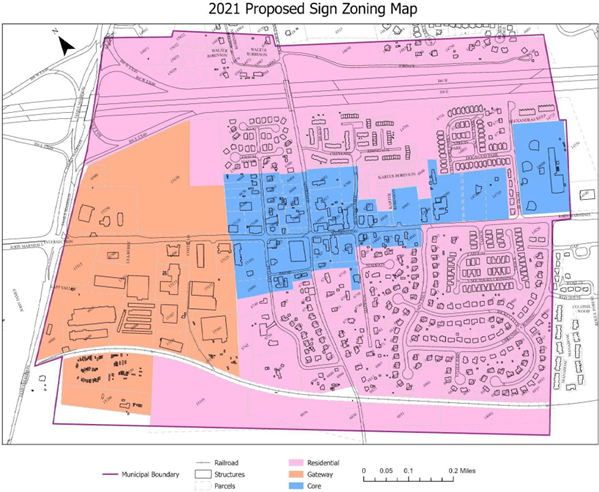
(Ord. No. 2021-002, 11-23-2021)
Sec. 58-17.14. - Permanent sign standards - type, number, area, and height of signs.
(a)
Gateway.
Wall signs: Shall be mounted flat on the building facade. Sign shall not extend more than six inches from the surface of the building.
Projecting: Shall be mounted perpendicular to principal building facade; shall project no greater than four (4) feet from building and no closer than one foot to the street curb.
Window: Includes neon signs subject to size limitations contained in this article.
Channel: Permanent channel letter signs in this district may be internally illuminated pursuant to section 58-15.9(d)).
(b)
Core.
Wall signs: Shall be mounted flat on the building facade. Sign shall not extend more than six inches from the surface of the building.
Projecting: Shall be mounted perpendicular to principal building facade; shall project no greater than four feet from building and no closer than one foot to the street curb.
Window: Includes neon signs subject to size limitations contained in this article.
Channel letter: Permanent channel letter signs in this district shall not be internally illuminated.
(c)
Residential.
This chart includes subdivisions and other types of residential projects built as a unified development.
Wall signs: Shall be mounted flat on the building facade. Sign shall not extend more than six inches from the surface of the building.
(Ord. No. 2021-002, 11-23-2021)

