
Haymarket City Zoning Code
ARTICLE XIX
LANDSCAPING
Sec. 58-19.1.- Landscaping; purpose and intent.
The regulations included in this article are intended to promote the planting and preservation of landscape materials which:
(1)
Provide screening and buffering between incompatible land uses;
(2)
Provide shade and enhance the appearance of urban areas;
(3)
Prevent soil erosion from the activities of wind and water through the protection of the ground;
(4)
Provide parking lot landscaping to reduce the harmful effects of heat, noise, and glare;
(5)
Provide the creation of safe and attractively landscaped areas in open spaces adjacent to public streets.
(Ord. No. 2021-002, 11-23-2021)
Sec. 58-19.2. - Applicability.
The provisions of this article shall apply to all preliminary and final site plan applications, including renovations and/or enlargement of existing structures, which alter the building footprint, and the enlargement of any parking lot but not to the resurfacing of any existing lot. Any improvements to existing single-family dwellings are exempt.
(Ord. No. 2021-002, 11-23-2021)
Sec. 58-19.3. - Landscape plan required.
A landscape plan meeting the requirement of this article is required for all preliminary and final site plan applications as described in article II of this chapter.
(Ord. No. 2021-002, 11-23-2021)
Sec. 58-19.4. - Contents of landscape plan.
All landscape plans shall be prepared by a landscape architect or contractor or individual proficient in landscape architecture. All landscape plans shall contain the following information:
(1)
Existing vegetation. Any and all existing mature landscape vegetation to be saved shall be identified by name, quantity, and size; and methods of protection shall be shown on the plans.
(2)
Open space. All plans shall identify all open space and number of trees and plants required by this chapter that are to be provided in that open space. All plans shall include a table calculating the amount of that open space.
(3)
Schedule. All plans shall have a schedule of proposed plants, including the botanical and common name, the quantity, their size, their height and spread, and any other significant notes.
(4)
Plan content. All plans shall show, with sufficient detail, the location and description of all existing hardscape features such as driveways, parking areas, curbs, sidewalks, utility lines, structures, and existing vegetation and also all proposed hardscape features, including all existing structures. All landscape areas shall be dimensioned, and all proposed plants shall be illustrated at maturity.
(5)
Scale. Plants shall be drawn at a scale not less than one-inch equals 30 feet on sheets not to be larger than 24 inches by 36 inches.
(6)
North arrow. All plans are to have a north arrow.
(7)
Title block, signature of owner. There shall be a title block with a date and a scale, the preparer's name with current address and phone number and a description of the project. Plans shall also show the current owner and have his signature of approval.
(Ord. No. 2021-002, 11-23-2021)
Sec. 58-19.5. - Responsibility.
The maintenance and replacement of all landscaping in commercial, industrial, and residential open space shall be the responsibility of the individual property owners. Planted material shall be maintained in a healthy state and replaced when diseased or dead. All landscaping structures shall also be kept in good condition.
(Ord. No. 2021-002, 11-23-2021)
Sec. 58-19.6. - Land use categories; applicability.
For purposes of this article, existing and proposed land uses are divided into three major land use categories: Residential, commercial, and industrial. Each category is subdivided based on the intensity of the proposed use.
(1)
Residential.
a.
R-1, single-family dwelling (SFD) (see article VIII - Use Chart for specific uses).
b.
R-2, single-family attached (SFA) (see article VIII - Use Chart for specific uses).
(2)
Commercial.
a.
B-1, retail shopping (see article VIII - Use Chart for specific uses).
b.
B-2, highway-oriented business (see article VIII - Use Chart for specific uses).
c.
TC, transitional commercial (see article VIII - Use Chart)
(3)
Industrial.
a.
I-1 limited industrial (see section article VIII - Use Chart for uses).
(Ord. No. 2021-002, 11-23-2021)
Sec. 58-19.7. - Landscape features.
(a)
There shall be no planting, structure, fence, retaining wall, shrubbery, or obstruction to vision in violation of AASHTO standards.
(b)
Trees, shrubs, flowers, or plants shall not be permitted or maintained on any required front, side, or rear yard if they interfere with the safe use of the public street or sidewalk. Such landscape features shall be permitted in any required front, side, or rear yard, provided they do not interfere with public safety and do not produce a hedge effect contrary to subsection (a) of this section.
(c)
The setback and yard requirements of this chapter shall not be deemed to prohibit any otherwise lawful fence or wall which is not more than four feet high; however, a fence or wall along the rear lot line and along the side lot line to the rear of the required setback line may be erected to a height not exceeding six feet when erected between residential uses and to a height not exceeding seven feet when erected either between non-residential uses or between non-residential and residential uses. This provision shall not be deemed to allow any wall more than three feet high. This provision shall be interpreted to prohibit any open-mesh-type fence enclosing any school or playground.
(Ord. No. 2021-002, 11-23-2021)
Sec. 58-19.8. - Screening.
(a)
Definition. This article defines three screens as identified in the matrix in section 58-19.11. Four separate types of plants are required: Large- or medium-scale canopy shade trees, evergreen trees, ornamental trees, evergreen, and ornamental shrubs. All plant varieties and alternatives shall be approved by the town as suitable screen plants.
(b)
Number of plants. Plant materials are shown as required per square foot of buffer area. For example, if the matrix in section 58-19.9 requires a 15-foot buffer along a 100-foot property boundary, a resulting 1,500 square feet of buffer space is required.
(c)
Alternative screens and modifications. Alternative planting programs achieving the objectives of the required screens shall be permitted to allow flexibility in landscape design. The planning commission and the architectural review board may approve any of the alternative screens or a combination of the alternatives if the applicant proves that the objective of the screen or screenings has been met. The planning commission or architectural review board may reduce or eliminate the requirements for a screen if a landscape plan proposes the use of hedges, shrubs, walls, berms, or combination that achieve the same objective of the required screen.
(Ord. No. 2021-002, 11-23-2021)
Sec. 58-19.9. - Screening requirements.
For all three types of screening requirements, there are three alternatives for plant requirements.
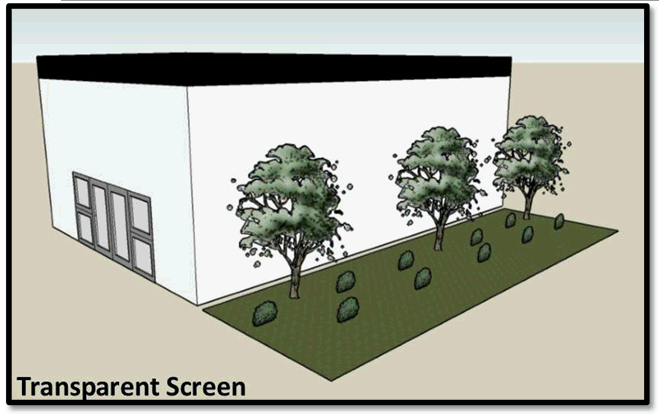
(1)
A transparent screen shall be an attractive transparent division between similar land uses. TRANSPARENT SCREEN (TS)
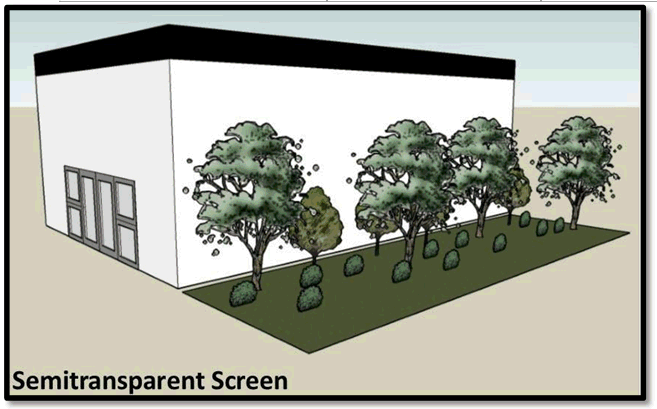
(2)
A semi-transparent screen shall partially block views and noise from the adjoining land uses which are not different in nature.
SEMI-TRANSPARENT SCREEN (SS)
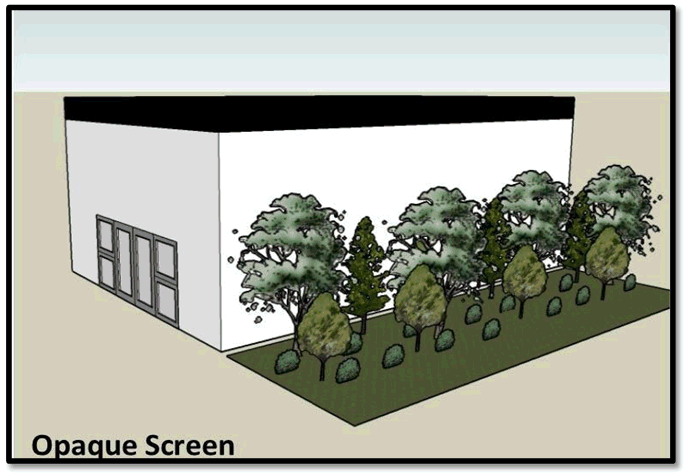
(3)
An opaque screen creates a definite separation to block views and noise from land uses which are totally incompatible.
OPAQUE SCREEN (OS)
Notes: Tables express the number of plants required per required square foot of buffer yard.
(Ord. No. 2021-002, 11-23-2021)
Sec. 58-19.10. - Buffer yards.
(a)
Definition. Buffer yards are land areas providing visual relief to adjoining land uses and shall be used for the planting of landscape materials. Driveways and entrances connecting adjacent parking lots or development may interrupt the required buffer yard. Buffer yards may be provided in the setback areas required by the zoning district regulations; but buffer yards shall not be used for stormwater management, the storage of materials, vehicles, buildings, equipment, and parking or loading areas.
(b)
Buffers in relation to setbacks and easements. Buffer yards in residential districts may be provided in any of the following ways:
(1)
As common open space;
(2)
In common use easements located outside the required lot area; or
(3)
By additional space in addition to the required minimum yard required listed in the residential zoning district regulations.
(c)
Buffer credit. Existing buffer yards that are proposed on any subdivision or site plan applications which follow the buffer yard requirements shall be deemed to meet the buffer yard requirements.
(d)
Buffer yards adjacent to a vacant parcel. All subdivision and site plan applications that are adjacent to vacant parcels of property shall be required to fulfill the buffer yard requirements.
(e)
Screening of outdoor storage and loading areas. All outdoor storage and loading areas shall be screened from public view and any adjacent or residential properties. This screen shall be opaque in nature, at least eight feet in height, and be comprised of plants, trees, walls, or other opaque materials. The screen must be presented to the architectural review board for an aesthetic approval, which will then be forwarded to the planning commission for its recommendation and then forwarded to the town council for final approval.
(f)
Screening and buffer yard matrix. The matrix included in section 58-19.11 describes the screening and buffer yard requirements between adjoining land uses.
(Ord. No. 2021-002, 11-23-2021)
Sec. 58-19.11. - Screening and buffer yard matrix.
Definitions. (Refer to section 58-19.9)
TS - Transparent Screen
SS - Semitransparent Screen
OS - Opaque Screen
Sec. 58-19.12. - Landscaping requirements.
Landscaping, screening, and open space regulations are as follows:
REQUIRED PLANT MATERIAL LIST
Canopy trees:
Evergreen trees:
Ornamental trees:
Evergreen shrubs:
Deciduous and flowering shrubs:
Ground cover:
(Ord. No. 2021-002, 11-23-2021)
Sec. 58-19.13. - Parking lot landscaping.
(a)
Generally. All parking areas, parking lots and service stations must be landscaped as described in this section unless otherwise explicitly exempted.
(b)
Perimeter parking lot landscaping. All areas outside the perimeter of the paved area of the parking lot shall be landscaped if they are adjacent to a public or a private street. The requirements of this section shall apply to the enlargement or construction of any parking lot with ten or more parking spaces.
(c)
Parking lots adjacent to public streets.
(1)
Landscape area requirements. A continuous landscape strip ten feet in width not inclusive of the sidewalk shall be located between the property line and the parking lot. If road improvements are necessary across the front of the property, a continuous landscape strip with an average width of ten feet may be provided to meet the requirements of this section. If a parking lot is built adjacent to an existing parking lot which has a landscape strip narrower than ten feet in width, the width of the existing landscape area may be continued provided that it is a minimum five feet wide.
(2)
Number of trees. There will be one tree for each 30 feet of frontage and shall be planted in the landscape strip.
(3)
Screening adjacent to the public street. A screen through the use of the planting of shrubs, hedges, or the creation of berms of a combination of such uses shall be used to screen the parking lots to any public street for the full length of the street frontage. No berm or plant material shall obstruct the sight distance of a motorist entering or leaving the site in accordance with 58- 19.7(a).
(4)
Species of vegetation. All trees and shrubs planted shall meet the requirements of sections 58-19.12.
(d)
Parking lots adjacent to other parking lots.
(1)
Landscape area requirements. A continuous landscape strip at least five feet in width shall be located between the property owner's parking lot and the property line.
(2)
Number of trees and shrubs. There will be two trees and six shrubs for every 30 linear feet of landscape parking strip.
(3)
Species of vegetation. All trees and shrubs planted to meet the requirements of this section shall be identified in sections 58-19.12.
(e)
Interior parking lot landscaping.
(1)
Application. Interior parking lot landscaping shall apply to the enlargement or construction of any parking area or lot with ten or more parking spaces. This will be in addition to the perimeter parking lot landscaping, street tree planting and screening.
(2)
Landscape area requirements. The minimum landscape for the interior parking lot shall be five percent of the gross area, which shall include all paved areas within the lot, including ingress and egress. For paved storage areas, a subtraction from the figure for land use such as lumber yards and warehouses may be applied.
(3)
Minimum landscape area. The total minimum landscape area for interior parking lots shall be 25 square feet. Each landscape area shall have at least one canopy tree.
(4)
Number of trees. There will be one tree for every ten parking spaces.
(5)
Number of shrubs. There will be three shrubs for every ten parking spaces.
(6)
Species of vegetation. All trees and shrubs planted shall meet the requirements of canopy shade trees as identified in sections 58-19.12.
(Ord. No. 2021-002, 11-23-2021)
Sec. 58-19.14. - Minimum specifications for plant materials.
(a)
Condition. All plants shall comply with the American Association of Nurserymen standards and shall be sound, healthy, and vigorous, well formed, free from disease.
(b)
Size. All plant material to be installed meeting the requirements of this article shall comply with the following minimum size requirements:
(1)
Street trees, a height of 12 to 15 feet and a caliper of three inches;
(2)
Canopy trees, a height of ten to 12 feet, a caliper of 2.5 inches;
(3)
Evergreen trees, a height of six to eight feet with full branching;
(4)
Ornamental trees, a height of five to six feet;
(5)
Shrubs, height of one to two feet.
(c)
Planting procedures. All ground covers, shrubs and trees shall be planted following accepted American Association of Nurserymen standards and procedures. All trees that require staking shall be staked according to the American Association of Nurserymen standards, and all vegetation shall be watered at the time of installation according to their size. The contractor shall be responsible for the adequate watering and maintenance of the plants.
(d)
Plant list. The plant list is divided into the following six categories: Large canopy trees, medium canopy trees, evergreen trees, ornamental trees, shrubs, and ground covers. The plant material may be used to satisfy the requirements of this article unless alternative varieties are approved by the architectural review board, planning commission, and the town council (see section 58-19.12).
(e)
Preservation of vegetation and tree cover. The existing vegetation and tree cover within any proposed subdivision or site plan shall be retained and preserved to the greatest extent possible with the design of the improvements and the grading of the property taken into full account. No tree which has a diameter at breast height of 20 inches or more shall be removed unless the subdivision or development of the subdivision requires the removal of the tree.
(f)
Plants should be native species of Virginia. Exceptions are allowed as specified elsewhere in the zoning code.
(g)
If additional plant selection is desired, please refer to page 64 of the Prince William County Design and Construction Standards Manual: Section 800 ("Buffer Areas Landscaping & Tree Coverage Requirements") for additional plant material.
(Ord. No. 2021-002, 11-23-2021)
Sec. 58-19.15. - Credit for existing vegetation.
(a)
Trees. All existing trees on site may be used to satisfy the requirements for the landscaping of parking lots and streets required by this article. Any such trees shall be in healthy condition and protected during construction activity with proper constraints. Such tree protection areas shall be illustrated on the landscape plans.
(b)
Exceptional trees. Trees of exceptional size, age or historic value that are preserved may be credited by the architectural review board for the street tree and parking lot landscaping requirements.
(Ord. No. 2021-002, 11-23-2021)
Sec. 58-19.16. - Monitoring and enforcement.
(a)
Enforcement responsibility. The enforcement of the provisions set forth in this article shall be the responsibility of the administrator or its designee. Any violation of this article is a criminal misdemeanor as described in article I of this chapter.
(b)
Occupancy permits. Until all of the landscaping and other screening materials required by this article have been installed to the satisfaction of the building official, no occupancy permit shall be issued. If installation of the required plant material is prohibited due to inclement weather and delays the time of occupancy, the developer or his agent shall post a bond for the installation of the remaining required plant material. Along with the cash bond shall be a letter explaining the contractor's intentions to install the required plants and an estimate of that cost. If the maximum time allowed for the landscaping to be deferred from planting shall be six months and at such time the bond shall be forfeited to the town for use in planting of the remaining required plant materials.
(c)
Condition. All landscape materials shall be kept free from all disease and infestation and in a healthy state or condition. All fences and screens shall be maintained in a safe and attractive condition and not allowed to deteriorate.
(d)
Repair and replacement. Upon written notice from the administrator, the owner or agent shall repair or replace any fencing, screens or landscape materials that are not meeting the requirements of proper condition in subsection (d) of this section within 30 days.
(Ord. No. 2021-002, 11-23-2021)

