
Henrico County Unincorporated
City Zoning Code
City Zoning Code
ARTICLE 2
- ADMINISTRATION
Sec. 24-2101. - Summary table of review responsibilities.
Table 2101. Summary of Review Responsibilities identifies the bodies and persons responsible for review, recommendations, and decisions on development applications under this Ordinance. For purposes of this Article, text amendments and map amendments (rezonings) will be considered development applications. The table also identifies development applications that require a public hearing. Specific requirements and procedures are set forth in Article 2, Division 2, Common Procedures, and Article 2, Division 3, Specific Standards and Requirements for Development Applications.
Table 2101: Summary of Review Responsibilities [1]
S = Staff Review; R = Recommendation; D = Decision; A = Appeal; = Public Hearing
NOTES:
[1]
The table only reflects the development review responsibilities authorized by this Ordinance. In some instances, other County departments are involved in review. .....
[2]
Where a building permit is also required, the Building Official makes a decision on the application; in all other cases, the Planning Director makes a decision on the application. .....
[3]
The Planning Commission may, at its discretion, send a recommendation to the BZA or appear at the public hearing on the application held by the BZA. .....
(Code 2010, § 24-2101; Ord. No. 1348, § 1, 8-12-2025)
Sec. 24-2102. - Board of supervisors.
The following powers and duties are granted to the Board of Supervisors by the Code of Virginia:
A.
To review and decide applications for the following: .....
1.
Text amendments (Sec. 24-2302); .....
2.
Map amendments (Rezonings) (Sec. 24-2303); .....
3.
Conditional zoning (Sec. 24-2304); .....
4.
Planned development (Sec. 24-2305); and .....
5.
Provisional use permits (Sec. 24-2306). .....
B.
To review and decide appeals from decisions on transfers of provisional use permits (Sec. 24-2307) and proffer interpretations (Sec. 24-2318). .....
C.
To approve a schedule of fees governing applications for permits and development approvals reviewed under this Ordinance, to be contained in the Administrative Manual. .....
D.
To take any other action not delegated to the Planning Commission, BZA, Planning Director, or other body, and within the Board of Supervisors' authority, as the Board may deem desirable and necessary to implement the provisions of this Ordinance. .....
(Code 2010, § 24-2102)
Sec. 24-2103. - Planning commission.
The Planning Commission is established by Chapter 2 of the County Code, which sets forth the Planning Commission's organization, including its membership, terms of members, officers, staff, rules of procedure, powers, and duties in addition to those identified in this section. The Planning Director serves as the secretary and supporting staff to the Planning Commission. The Planning Commission has the following powers and duties under this Ordinance:
A.
To determine, in accordance with the Code of Virginia § 15.2-2232, whether a proposed street, connection to an existing street, park or other public area, public building or public structure, public utility facility, or public service corporation facility would be substantially in accord with the comprehensive plan (procedures for such determinations are not part of this Ordinance). .....
B.
To review and make recommendations to the Board of Supervisors on the following: .....
1.
Text amendments (Sec. 24-2302); .....
2.
Map amendments (Rezonings) (Sec. 24-2303); .....
3.
Conditional zoning (Sec. 24-2304); .....
4.
Planned development (Sec. 24-2305); and .....
5.
Provisional use permits (Sec. 24-2306). .....
C.
Reserved .....
D.
To review and decide requests for exceptions from the requirements of Article 5, Division 8, Chesapeake Bay Preservation, in accordance with Sec. 24-5805, Chesapeake Bay Preservation: Exceptions. .....
E.
To carry out any other powers and duties delegated to it by the Board of Supervisors, consistent with or as required by the Code of Virginia. .....
(Code 2010, § 24-2103; Ord. No. 1348, § 2, 8-12-2025)
Sec. 24-2104. - Board of zoning appeals (BZA).
The Board of Zoning Appeals (BZA) is established in accordance with the Code of Virginia § 15.2-2308. The BZA consists of five residents of the County appointed by the Circuit Court. They must hold no other public office in the County, except that one member may be a member of the Planning Commission. Members are appointed for five-year, staggered terms, may succeed themselves, and continue to serve until their successor is appointed and qualified. Vacancies occurring for reasons other than expiration of terms will be filled for the period of the unexpired term only. The secretary of the BZA must notify the Circuit Court at least 30 days in advance of the expiration of any term of office and also notify the Court promptly if any vacancy occurs.
The BZA will elect one of its members as chair and one as vice-chair. The chair and vice-chair will serve annual terms and may succeed themselves. The BZA may make, alter, and rescind rules and forms for its procedures, consistent with this Ordinance and state law. The chair, or in the chair's absence the vice-chair, will preside at all meetings of the BZA. Three or more members of the BZA will constitute a quorum. No official business of the BZA will be conducted without a quorum present. All meetings of the BZA will be open to the public, except for closed meetings authorized by the Virginia Freedom of Information Act. The chair, or in the chair's absence the vice-chair, may administer oaths and compel the attendance of witnesses. An affirmative vote of a majority of members present, voting, and constituting a quorum is required for all decisions of the BZA, except for decisions on variances and appeals from interpretations and decisions of the Planning Director, who is the zoning administrator under this ordinance, and on Notices of Violations, which require an affirmative vote of a majority of the entire membership of the BZA. The BZA will keep minutes of its proceedings and other official actions, which will be filed in the office of the secretary and will be public records. The minutes must show the vote of each member upon each question and must indicate any members who were absent or did not vote.
In accordance with the Code of Virginia § 15.2-2309 et seq., the BZA has the following powers and duties under this ordinance:
A.
To review and decide applications for conditional use permits (Sec. 24-2308). .....
B.
To review and decide applications for variances (Sec. 24-2316) from the dimensional and development standards of this Ordinance in accordance with Code of Virginia § 15.2-2309. .....
C.
To review and decide appeals from decisions on the following in accordance with Sec. 24-2320, Appeal of Administrative Decisions: .....
1.
Sign permits (Sec. 24-2311); .....
2.
Temporary use permits (Sec. 24-2312); .....
3.
Tree removal permits (Sec. 24-2313); .....
4.
Zoning and other interpretations and determinations in accordance with Code of Virginia § 15.2-2309 (Sec. 24-2317); and .....
5.
Administrative modifications (Sec. 24-2319). .....
D.
To revoke conditional use permits in accordance with Sec. 24-2308.C.7(b). .....
(Code 2010, § 24-2104)
Sec. 24-2105. - Planning director.
The Planning Director is designated by the County Manager and serves as the zoning administrator. Any act authorized by this Ordinance to be carried out by the Planning Director may be delegated by the Planning Director to professional-level staff (including Community Maintenance) under the Planning Director's direction.
Except where otherwise stated in this Ordinance, the Planning Director is responsible for the administration, interpretation, and enforcement of this Ordinance in accordance with state law. More specifically, the Planning Director has the following powers and duties under this Ordinance:
A.
To review and decide applications for the following: .....
1.
Transfers of provisional use permits (Sec. 24-2307); .....
2.
Sign permits, if a building permit is not required (Sec. 24-2311); .....
3.
Temporary use permits (Sec. 24-2312); .....
4.
Tree removal permits (Sec. 24-2313); .....
5.
Plans of development (Sec. 24-2314); .....
6.
Site plans (Sec. 24-2315); .....
7.
Interpretations (Sec. 24-2317); .....
8.
Proffer interpretations (Sec. 24-2318); and .....
9.
Administrative modifications (Sec. 24-2319). .....
B.
To provide staff review and recommendations on the following: .....
1.
Text amendments (Sec. 24-2302); .....
2.
Map amendments (Rezonings) (Sec. 24-2303); .....
3.
Conditional zoning (Sec. 24-2304); .....
4.
Planned development (Sec. 24-2305); .....
5.
Provisional use permits (Sec. 24-2306); .....
6.
Conditional use permits (Sec. 24-2308); .....
7.
Building permits (Sec. 24-2309); .....
8.
Occupancy certificates (Sec. 24-2310); .....
9.
Variances (Sec. 24-2316). .....
C.
To establish administrative application submittal requirements and a submittal schedule for review of applications and appeals, in accordance with the standards provided by this Ordinance. .....
D.
To prepare and amend as necessary an Administrative Manual containing requirements for application contents and forms, submittal schedules, and fees established in accordance with this Ordinance and specifying any delegation of duties or authority by the Planning Director. The Administrative Manual may contain additional information relevant to the submittal and review of development applications consistent with this Ordinance and for the administrative convenience of applicants and staff. .....
E.
To determine whether a submitted application is complete and authorize its formal acceptance. .....
F.
To review applications and submit staff reports to advisory and decision-making bodies, as appropriate. .....
G.
To maintain the Zoning Districts Map and related materials. .....
H.
To provide expertise and technical assistance to the County's other review and decision-making bodies, upon request, and as appropriate. .....
I.
To issue notices of violations and enforce this Ordinance in accordance with Article 7, Enforcement. .....
(Code 2010, § 24-2105)
Sec. 24-2106. - Building official.
The Building Official, or designee of the Building Official, has the powers and duties under the Code of Virginia, the Virginia USBC, and this Ordinance to review and decide applications for:
A.
Building permits (Sec. 24-2309); .....
B.
Certificates of occupancy (Sec. 24-2310); and .....
C.
Sign permits, if a building permit is required (Sec. 24-2311). .....
(Code 2010, § 24-2106)
Sec. 24-2201. - Purpose and intent.
This division sets forth common procedures that are generally applicable to the process of amending this Ordinance and the submittal and review of development applications under this Ordinance. Not all procedures in this division are required for every type of application. For example, procedures related to public hearings (see Sec. 24-2205, Public Hearing) do not apply to applications for which no public hearing is required (see Sec. 24-2101, Summary Table of Review Responsibilities). Article 2, Division 3, Specific Standards and Requirements for Development Applications, identifies the applicability of each common procedure for each type of application, as well as any modifications of the common procedures that apply. Figure 2201 shows the common procedures in the format of a flowchart. A similar flowchart is provided for each type of application in Article 2, Division 3, Specific Standards and Requirements for Development Applications.
(Code 2010, § 24-2201)
Sec. 24-2202. - Pre-application conference.
A.
Purpose. The purpose of a pre-application conference is to provide an opportunity for the applicant to understand the submittal requirements and the procedures and standards applicable to an anticipated development application. A pre-application conference is also intended to provide an opportunity for Planning Department staff, and other County staff, to become familiar with, and offer the applicant preliminary comments about, the scope, features, and impacts of the proposed development. .....
B.
Applicability. A pre-application conference between the applicant and Planning Department staff must be held before submittal of applications for rezoning, conditional zoning, planned development, or provisional use permit. For all other development applications, a pre-application conference is recommended but not required. .....
Figure 2201: Common Procedures in Flowchart Format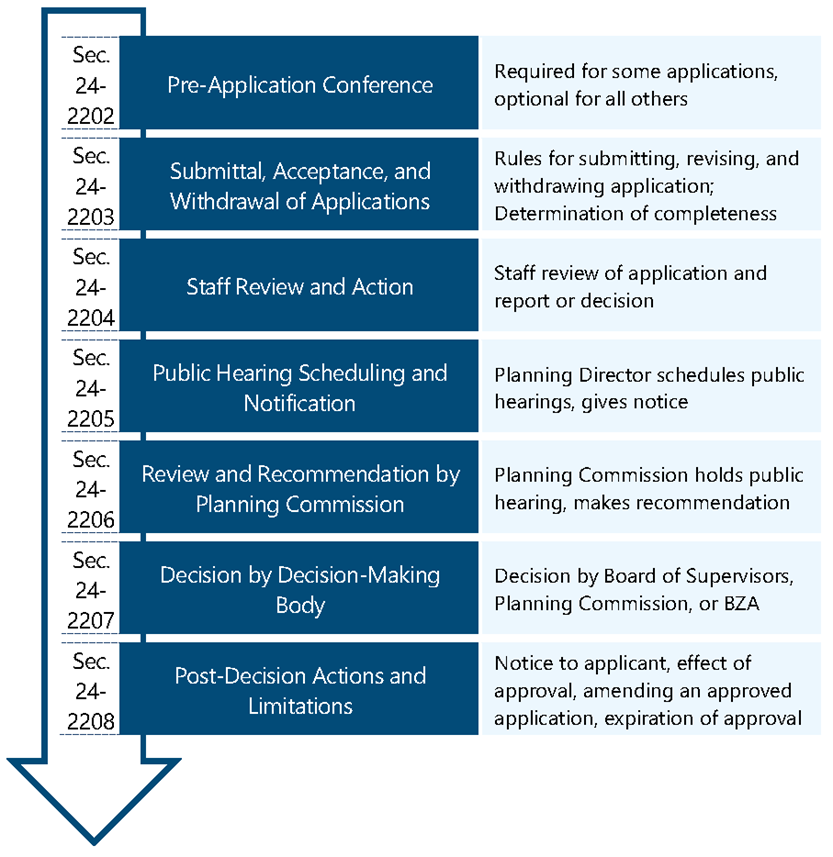
C.
Scheduling. Upon receipt of the request for a pre-application conference, Planning Department staff will schedule the conference and notify the applicant of the time and place. The conference may be held on a regular schedule, or may be scheduled individually, at the discretion of the Planning Director. .....
D.
Information to be Submitted Prior to Conference. At least three business days before the pre-application conference, the applicant is encouraged to submit a written description and a conceptual plan that shows the location and general layout of the proposed development to Planning Department staff. .....
E.
Conference Proceedings. Planning Department staff will review the materials submitted by the applicant prior to the conference. At the conference, staff will ask the applicant questions about the proposed application and identify any concerns, problems, or other factors the applicant should consider about the application. .....
F.
Effect. The pre-application conference is intended as a means of facilitating the review process. Discussions held in accordance with this section are not binding on the County. Processing times for review of development applications do not begin until a formal application is submitted and determined to be complete in accordance with Sec. 24-2203E, Determination of Application Completeness. .....
(Code 2010, § 24-2202)
Sec. 24-2203. - Submittal, acceptance, and withdrawal of applications.
A.
Authority to file applications. .....
1.
Unless expressly stated otherwise in this Ordinance, all development applications reviewed under this Ordinance must be submitted by the owner of the land on which the development is proposed, or a person authorized in writing to submit the application on behalf of the owner (an "authorized representative"). .....
2.
If there are multiple owners of the land on which a development is proposed, all such persons or their authorized representatives must sign the application or a power of attorney, letter, or other document consenting to the application. .....
B.
Required content and fees. .....
1.
Application content. Requirements for the content and form of each type of specific development application are set forth in the submission requirements checklist contained in the Administrative Manual. The applicant bears the burden of ensuring that an application contains sufficient information to demonstrate compliance with all applicable standards. .....
2.
Application fees. The Board of Supervisors is authorized to establish application fees, by ordinance after public hearing, and may amend and update those fees as necessary. A schedule of application fees will be included in the Administrative Manual. .....
C.
Schedule for submittal and review. The Planning Director will establish and update from time to time specific submittal instructions and a review schedule for the various types of development applications, as necessary to ensure the effective and efficient administration of this Ordinance and to carry out the purposes and intent of this Ordinance. The Planning Director may include timeframes for review consistent with this Ordinance and state law. The instructions and schedule will be included in the Administrative Manual. .....
D.
Application submittal. Applications must be submitted to the Planning Director in the form established by the Planning Director, along with the appropriate application fee. .....
E.
Determination of application completeness. .....
1.
Completeness review. Upon receipt of an application, the Planning Director will, within five business days, determine whether the application is complete or incomplete. A complete application is one that includes the completed application form, the submission requirements checklist, the applicable fee, and all information and materials required by this Ordinance in sufficient detail to evaluate whether it complies with the applicable review standards of this Ordinance. .....
2.
Application incomplete. On determining that an application is incomplete, the Planning Director will provide the applicant written notice of the submission deficiencies. If the applicant fails to resubmit an application within 45 calendar days after being first notified of submission deficiencies, the application will be returned to the applicant. The Planning Director will not process an application for review until it is determined to be complete. .....
3.
Application complete. On determining that an application is complete, the Planning Director will accept the application for review in accordance with the procedures and standards of this Ordinance. .....
F.
Withdrawal of accepted application. .....
1.
May be withdrawn at any time. An applicant may withdraw a development application at any time by submitting a letter of withdrawal to the Planning Director. .....
2.
Limit on subsequent applications after withdrawal. If a development application requiring a public hearing is withdrawn after required public notification of the public hearing is provided, no application proposing substantially the same development or change in zoning, including conditions, on all or part of the same land will be considered within 12 months after the date of withdrawal. .....
3.
Withdrawal through inaction. If an applicant requests or causes continuing postponement of submissions or actions required to complete the application review process, and such postponement causes inaction for six or more months in the review of the application, the application will be considered withdrawn, and the Planning Director will notify the applicant in writing. No application proposing substantially the same development on all or part of the same land will be considered by the County within six months after the date of withdrawal through inaction. .....
(Code 2010, § 24-2203; Ord. No. 1348, § 3, 8-12-2025)
Sec. 24-2204. - Staff review and action.
A.
Staff review and opportunity to revise application. .....
1.
When an application is determined complete, the Planning Director will distribute it to all appropriate County staff and review agencies for review and comment. .....
2.
In considering the application, the Planning Department staff, or other County staff and review agencies as deemed appropriate by the Planning Director, will review the application, relevant support material, and any comments or recommendations from staff and review agencies. .....
3.
If deficiencies in complying with applicable standards in this Ordinance are identified during staff review of the application, the Planning Director will notify the applicant of such deficiencies and provide the applicant a reasonable opportunity to revise the application to address the deficiencies. An applicant may revise an application after receiving notice of deficiencies from the Planning Director. Application revisions will be limited to changes that directly respond to specific deficiencies identified by staff and related design improvements; substantial design changes not related to staff comments may require submission of a new plan. The applicant must submit the revised application to the Planning Director. .....
B.
Application subject to decision by planning director or building official. If the application is subject to a final decision by the Planning Director or Building Official (indicated by "D" in Table 2101: Summary of Review Responsibilities), the following procedures apply: .....
1.
Decision. After review of the application, the Planning Director or Building Official, as applicable, must make one of the decisions authorized for the particular type of application based on the review standards for the application set forth in Article 2, Division 3, Specific Standards and Requirements for Development Applications, for the particular type of application. The decision must be in writing and must state reasons for disapproval if the application is disapproved, or the conditions of approval if the application is approved subject to conditions of approval. .....
2.
Submission of revised application. If the application is disapproved, the applicant may revise the application in response to the specific reasons identified for the disapproval, and resubmit it for reconsideration within 30 days. After review of the resubmitted application, the Planning Director must make a decision on the revised application in accordance with subsection B.1 above. .....
3.
Conditions of approval. If permitted by law and if applicable for the particular type of application, approval of an application may be subject to conditions of approval. Conditions of approval must be limited to those deemed necessary to ensure compliance with the standards of this Ordinance and must be related in both type and amount to the anticipated impacts of the proposed development on the public and surrounding lands. Conditions of approval may include requirements for performance guarantees. All conditions of approval must be expressly set forth in the permit or development approval. .....
C.
Application subject to decision by decision-making body. If staff review and recommendation is required for an application (indicated by "S/R" in Table 2101: Summary of Review Responsibilities), the following procedures apply: .....
1.
Preparation of staff report and recommendation. Upon completion of the staff review on an application, the Planning Director will prepare a written staff report on the application. The staff report will evaluate whether the application complies with the applicable review standards of this Ordinance and recommend one of the decisions authorized for the particular type of application, based on the review standards applicable to the application type, as set forth in Article 2, Division 3, Specific Standards and Requirements for Development Applications. When applicable, the staff report may identify and recommend conditions of approval allowed for the type of application in accordance with Article 2, Division 3, Specific Standards and Requirements for Development Applications. .....
2.
Distribution and availability of application and staff report. The Planning Director must take all the following actions before the meeting or public hearing at which the application is scheduled for review and as required by the Code of Virginia and this Ordinance: .....
(a)
Schedule and ensure notice (if applicable) of any required public hearing on the application in accordance with Sec. 24-2205, Public Hearing Scheduling and Notification; .....
(b)
Transmit the application, related materials, and the staff report to the appropriate advisory or decision-making body; .....
(c)
Transmit a copy of the staff report to the applicant; and .....
(d)
Make the application, related materials, and the staff report available for examination by the public in the Planning Department during normal business hours. Copies of such materials will be available at a reasonable cost. .....
(Code 2010, § 24-2204)
Sec. 24-2205. - Public hearing scheduling and notification.
A.
Public hearing scheduling. .....
1.
Responsibility for scheduling. The Planning Director will be responsible for scheduling public hearings required for applications as indicated in Sec. 24-2101, Summary Table of Review Responsibilities. .....
2.
Timing. The Planning Director must schedule a required public hearing on the application such that there is sufficient time for a staff report to be prepared and for the public notice requirements to be satisfied. .....
3.
Deferral request by applicant. An applicant may request that consideration of a development application at a public hearing be deferred by submitting a written request for deferral to the Planning Director or make such a request at the public hearing or meeting at which the application is considered. If public notification has not been provided, the applicant may request and will be granted approval to defer the application. If public notification has been provided, the request for deferral must be placed on the agenda on the date the application is to be considered and acted upon by the advisory or decision-making body, which may approve the request for deferral for good cause. All deferrals must be to a date certain and must not be deferred generally or indefinitely. If the matter is deferred at the request of the applicant, the applicant must pay any applicable fee as established in the schedule of fees approved by the Board of Supervisors prior to the application being placed on an upcoming agenda. .....
B.
Notification of public hearing. Notice of public hearings must be provided in accordance with the Code of Virginia. The Planning Director may also notify any other person the Director deems advisable. The Planning Director is responsible for preparing and effecting all public hearing notifications. When giving any required notice to the owners, their agents, or the occupants of abutting property and property immediately across the street or road from the property affected, the Planning Director may give such notice by first class mail rather than by registered or certified mail. .....
(Code 2010, § 24-2205)
Sec. 24-2206. - Review and recommendation by planning commission.
If an application is subject to a recommendation by the Planning Commission (see Sec. 24-2101, Summary Table of Review Responsibilities), the Planning Commission will review and act on the application in accordance with the following procedures:
A.
Public hearing or meeting. The Planning Commission will hold any required public hearing or meeting on the application and consider the application, relevant support materials, staff report, and any public comments. It will then make a recommendation based on the review standards applicable to the application type as set forth in Article 2, Division 3, Specific Standards and Requirements for Development Applications. .....
B.
Timing. The Planning Commission will take action promptly, consistent with any time limitations established by the Code of Virginia. .....
C.
Conditions of approval. If permitted by law and if applicable for the particular type of application, the Planning Commission may recommend conditions of approval in accordance with Article 2, Division 3, Specific Standards and Requirements for Development Applications. Except as otherwise provided for conditional zonings in Sec. 24-2304.B.6, Decision by Decision-Making Body, conditions of approval must be related in both type and amount to the anticipated impacts of the proposed development on the public and surrounding lands. Conditions of approval may include requirements for performance guarantees. Any recommended conditions of approval must be expressly set forth in the recommendations to the decision-making body. .....
(Code 2010, § 24-2206)
Sec. 24-2207. - Decision by decision-making body.
If an application is subject to a final decision by the Board of Supervisors, Planning Commission, or BZA (see Sec. 24-2101, Summary Table of Review Responsibilities), such decision-making body must review and decide the application in accordance with the following procedures:
A.
Public hearing or meeting. .....
1.
The decision-making body must hold any required public hearing or meeting and may consider the application, relevant support materials, staff report, any Planning Commission recommendations, and any public comments. It must then make one of the decisions authorized for the particular type of application, based on the review standards applicable to the application type, as set forth in Article 2, Division 3, Specific Standards and Requirements for Development Applications. .....
2.
The decision-making body may remand the application to the Planning Director or the Planning Commission, as applicable, for further consideration of new information or specified issues or concerns, if appropriate. .....
3.
The decision-making body must consider the interests of the applicant, affected parties, and the public, and within time limitations established by the Code of Virginia take the action it deems appropriate. .....
4.
The decision-making body may require from an applicant a complete disclosure of the equitable ownership or parties in interest of real estate affected, including, in the case of corporate ownership, the names of stockholders, officers and directors, and in any case the names and addresses of all real parties of interest. However, this disclosure requirement will not require the disclosure of the names of stockholders, officers, and directors of a corporation whose stock is traded on a national or local stock exchange having more than 500 shareholders. In the case of a condominium, this disclosure requirement will apply only to the title owner, contract purchaser, or lessee if they own ten percent or more of the units in the condominium. .....
B.
Conditions of approval. If permitted by law and if applicable for the particular type of application, the decision-making body may condition its approval to address the anticipated impacts of the proposed development, and to ensure compliance with the review standards. Except as otherwise provided for conditional zonings in Sec. 24-2304.B.6, Decision by Decision-Making Body, the conditions of approval must be related in both type and amount to the anticipated impacts of the proposed development on the public and surrounding lands. Conditions of approval may include requirements for performance guarantees. All conditions of approval must be expressly set forth in the decision of approval. .....
(Code 2010, § 24-2207)
Sec. 24-2208. - Post-decision actions and limitations.
A.
Notice of decision. Within ten calendar days after a final decision on an application, the Planning Director will provide the applicant written notice of the decision and make a copy of the decision available to the public in the Planning Department. .....
B.
Effect of approval of development application. Approval of a development application authorizes only the particular use, plan, or other specific activity approved, and not any other development requiring separate application and approval. Development must not begin until all required approvals are obtained. Approval of one development application does not guarantee approval of any subsequent development application. .....
C.
Amendment of development approval. Unless specified in the procedure for the particular type of development application in Article 2, Division 3, Specific Standards and Requirements for Development Applications, an amendment of a permit or development approval may only be reviewed in accordance with the procedures and standards established for its original approval. .....
D.
Expiration of development approval. .....
1.
Except for map amendments (rezonings), conditional zonings, and planned developments, permits and development approvals granted in accordance with this Ordinance will expire as provided in Article 2, Division 3, Specific Standards and Requirements for Development Applications, for the particular type of permits or development approvals. .....
2.
Unless specifically provided in the permit or development approval, a change in ownership of the land will not affect the established expiration time period. .....
3.
The filing of an appeal will stay the expiration period until final resolution of the appeal as provided by law. .....
4.
An extension of time for a permit or development approval will be subject to approval by the decision-making body that granted the permit or development approval, using the procedures and standards established for its original approval. .....
E.
Limitation on subsequent applications. If a development application requiring a public hearing is disapproved, no application of the same type proposing substantially the same development or change in zoning, including conditions, on all or part of the same land will be considered within one year after the date of disapproval. .....
(Code 2010, § 24-2208)
Sec. 24-2301. - Purpose.
This division sets forth, for each type of development application reviewed under this Ordinance, the purpose of the permit or development approval, when it is required or allowed, the specific procedure required for submitting and reviewing the application, and the criteria for making a decision on the application. The required procedure for each type of application identifies the applicability of each common procedure set forth in Article 2, Division 2, Common Procedures, and any modifications of the common procedure that apply. For purposes of this division, text amendments and map amendments (rezonings) are included in the term, "development applications."
(Code 2010, § 24-2301)
Sec. 24-2302. - Text amendment.
A.
Purpose. The purpose of this section is to provide a uniform mechanism for amending the text of this Ordinance (text amendment) whenever the public necessity, convenience, general welfare, or good zoning practice requires doing so. .....
B.
Text amendment procedure. This section sets forth the required procedure for a text amendment. Figure 2302 identifies the common procedures in Article 2, Division 2, Common Procedures, that apply to a text amendment. Additions or modifications to the common procedures are identified below: .....
Figure 2302: Text Amendment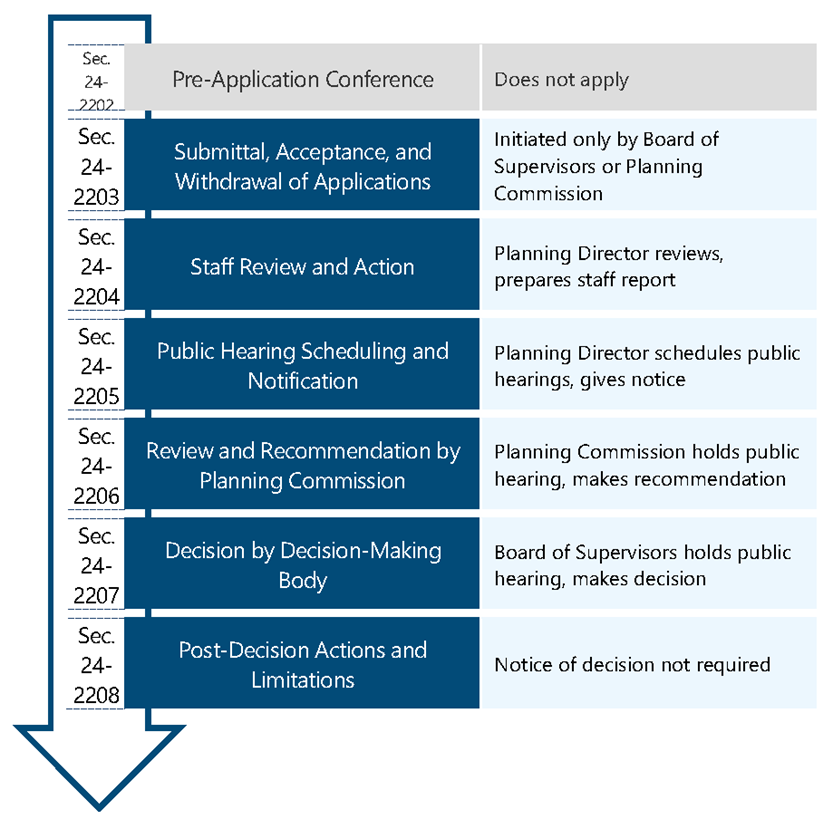
1.
Pre-application conference. A pre-application conference in accordance with Sec. 24-2202 does not apply. .....
2.
Initiation of text amendment. The common procedures in Sec. 24-2203, Submittal, Acceptance, and Withdrawal of Applications, do not apply. Instead, a text amendment may be initiated only by a resolution of either the Board of Supervisors or the Planning Commission. .....
3.
Staff review and action. The common procedures in Sec. 24-2204 apply. .....
4.
Public hearing scheduling and notification. The common procedures in Sec. 24-2205 apply. .....
5.
Review and recommendation by planning commission. The common procedures in Sec. 24-2206 apply, subject to the following additions or modifications: .....
(a)
The Planning Commission must hold a public hearing, following which the Planning Commission must make a recommendation on the proposed text amendment to the Board of Supervisors in accordance with Sec. 24-2302.C, Text Amendment Decision Standards. .....
(b)
If the Planning Commission does not make a recommendation on the proposed text amendment within 100 days after the first meeting of the Planning Commission after the proposed amendment has been referred to the Planning Commission, it will be deemed to have recommended approval of the amendment. .....
6.
Decision by decision-making body. The common procedures in Sec. 24-2207 apply, subject to the following additions or modifications: .....
(a)
After receipt of the Planning Commission's recommendation, the Board of Supervisors must hold a public hearing on the proposed amendment. After the public hearing on the proposed amendment is closed, the Board must make a decision on the application in accordance with Sec. 24-2302.C, Text Amendment Decision Standards. The decision must be one of the following: .....
(1)
Adoption of the amendment as proposed; .....
(2)
Adoption of a revised amendment (which may require a new public hearing); .....
(3)
Disapproval of the amendment; .....
(4)
Remand of the application back to the Planning Commission for further consideration; or .....
(5)
Other action consistent with the Code of Virginia. .....
(b)
A text amendment must be acted upon and a decision made within a reasonable time. .....
7.
Post-decision actions and limitations. The common procedures in Sec. 24-2208 do not apply. .....
C.
Text amendment decision standards. The advisability of amending the text of this Ordinance is a matter committed to the legislative discretion of the Board of Supervisors. In determining whether to adopt or disapprove the proposed text amendment, the Board of Supervisors may consider any factors consistent with the Code of Virginia, including whether, and the extent to which, the proposed amendment: .....
1.
Is consistent with the goals and policies of the comprehensive plan and other applicable County-adopted plans and planning documents; .....
2.
Fulfills any other appropriate land use or zoning purposes or any other relevant purpose permitted by law; .....
3.
Is not in conflict with any provisions of this Ordinance, the County Code, and the Code of Virginia; and .....
4.
Is required by the public necessity, convenience, general welfare, or good zoning practice. .....
(Code 2010, § 24-2302)
Sec. 24-2303. - Map amendment (rezoning).
A.
Purpose. The purpose of this section is to provide a uniform mechanism to review and decide proposed amendments to the Zoning Districts Map ("map amendment" or "rezoning"), other than conditional rezonings and planned developments, whenever the public necessity, convenience, general welfare, or good zoning practice requires doing so. .....
B.
Map amendment (rezoning) procedure. This section sets forth the required procedure for a map amendment. Figure 2303 identifies the common procedures in Article 2, Division 2, Common Procedures, that apply to a map amendment (rezoning). Additions or modifications to the common procedures are identified below: .....
Figure 2303: Map Amendment (Rezoning)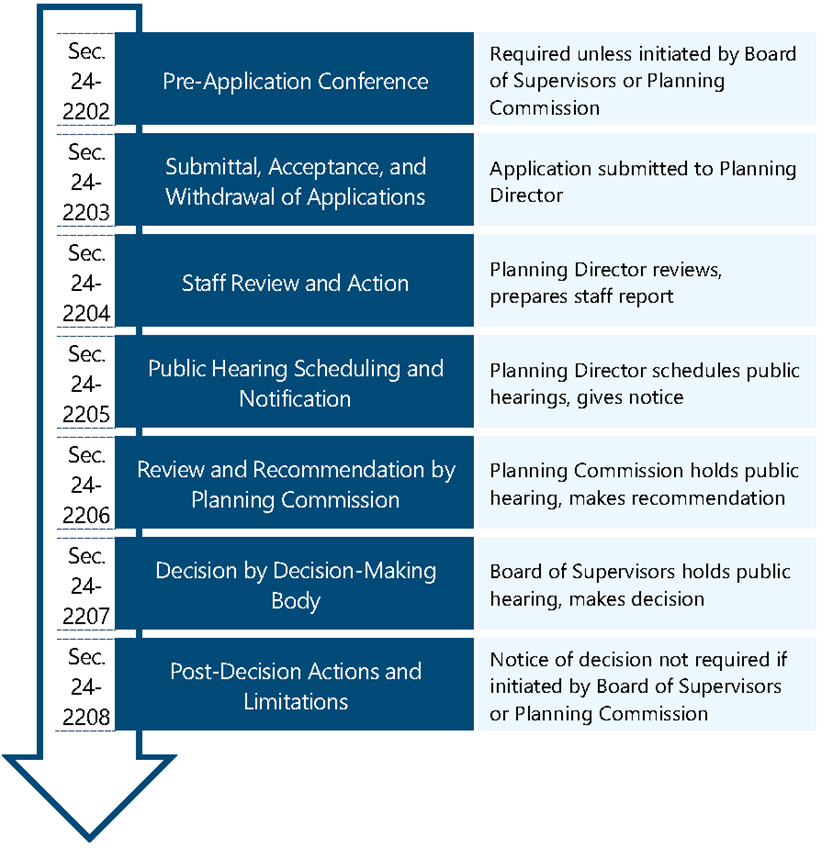
1.
Pre-application conference. A pre-application conference in accordance with Sec. 24-2202 is required if the amendment is not initiated by the Board of Supervisors or the Planning Commission and an increase of the density or intensity of the base zoning district is proposed. .....
2.
Submittal, acceptance, and withdrawal of applications. .....
(a)
A map amendment may be initiated by any of the following: .....
(1)
Resolution of the Board of Supervisors; .....
(2)
Resolution of the Planning Commission; or .....
(3)
Submittal of an application for a map amendment by anyone authorized to submit an application by Sec. 24-2203.A, Authority to File Applications. .....
(b)
The common procedures in Sec. 24-2203 apply only if the map amendment is initiated in accordance with paragraph (a)(3) above; otherwise, the common procedures in Sec. 24-2203 do not apply. .....
3.
Staff review and action. The common procedures in Sec. 24-2204 apply. .....
4.
Public hearing scheduling and notification. The common procedures in Sec. 24-2205 apply. .....
5.
Review and recommendation by planning commission. The common procedures in Sec. 24-2206 apply, subject to the following additions or modifications: .....
(a)
The Planning Commission must hold a public hearing, following which the Planning Commission must make a recommendation on the proposed map amendment to the Board of Supervisors in accordance with Sec. 24-2303.C, Map Amendment (Rezoning) Decision Standards. .....
(b)
If the Planning Commission does not make a recommendation on the proposed map amendment within 100 days after the first meeting of the Planning Commission after the proposed amendment has been referred to it, the application will be deemed to be recommended for approval, unless the application is withdrawn. .....
6.
Decision by decision-making body. The common procedures in Sec. 24-2207 apply, subject to the following additions or modifications: .....
(a)
After receipt of the Planning Commission's recommendation, the Board of Supervisors must hold a public hearing. After the public hearing on the proposed amendment is closed, the Board must make a decision on the application in accordance with Sec. 24-2303.C, Map Amendment (Rezoning) Decision Standards. The decision must be one of the following: .....
(1)
Approval of the application as submitted; .....
(2)
Approval of the application with a reduction in the area proposed to be rezoned; .....
(3)
Approval of a rezoning to a more restricted base zoning district; .....
(4)
Disapproval of the application; .....
(5)
Remand of the application back to the Planning Commission for further consideration; or .....
(6)
Other action consistent with the Code of Virginia. .....
(b)
A motion, resolution, or application for a map amendment must be acted upon and a decision made within a reasonable time, which must not exceed 12 months from the date of the resolution initiating the amendment, or from the acceptance of the completed application, as applicable, unless the application is withdrawn or the applicant requests or consents to action beyond such period. .....
7.
Post-decision actions and limitations. The common procedures in Sec. 24-2208 apply, subject to the following additions or modifications: .....
(a)
Sec. 24-2208.A, Notice of Decision, does not apply if the zoning map amendment was initiated by the Board of Supervisors or the Planning Commission. .....
(b)
If a map amendment is adopted by the Board of Supervisors, the Planning Director will place the amendment on the Zoning Districts Map within a reasonable period of time after its adoption. .....
C.
Map amendment (rezoning) decision standards. The advisability of an amendment to the Zoning Districts Map is a matter committed to the legislative discretion of the Board of Supervisors. In determining whether to adopt or disapprove a proposed map amendment, the Board of Supervisors may consider any factors consistent with the Code of Virginia, including whether, and to what extent, the proposed amendment: .....
1.
Is consistent with the goals and policies of the comprehensive plan and other applicable County-adopted plans and planning documents; .....
2.
Fulfills any other appropriate land use or zoning purposes or any other relevant purpose permitted by law; .....
3.
Is not in conflict with any provision of this Ordinance, the County Code, and the Code of Virginia; and .....
4.
Is required by the public necessity, convenience, general welfare, or good zoning practice. .....
(Code 2010, § 24-2303)
Sec. 24-2304. - Conditional zoning.
A.
Purpose. The purpose of this section is to provide a uniform mechanism as allowed under the Code of Virginia to accept reasonable conditions proffered by a landowner in conjunction with a proposed development that requires a map amendment, to ensure consistency with the comprehensive plan, address the impacts of the proposed development, and fulfill any other appropriate land use and zoning purposes. .....
B.
Conditional zoning procedure. This section sets forth the required procedure for conditional zoning. Figure 2304 identifies the common procedures in Article 2, Division 2, Common Procedures, that apply to conditional zoning. Additions or modifications to the common procedures are identified below: .....
Figure 2304: Conditional Zoning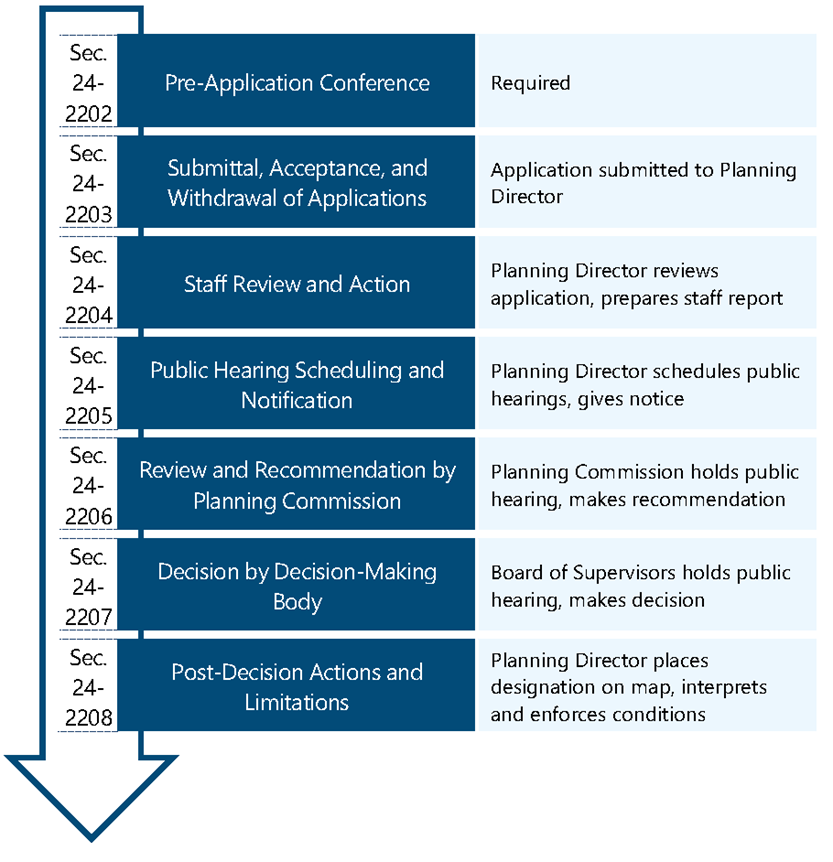
1.
Pre-application conference. The common procedures in Sec. 24-2202 apply. .....
2.
Submittal, acceptance, and withdrawal of applications. The common procedures in Sec. 24-2203 apply, subject to the following additions or modifications. In addition to the general application requirements, the application must include: .....
(a)
A plat and legal description of the land that is the subject of the application; .....
(b)
Satisfactory evidence that any delinquent real estate taxes owed to the County that have been assessed against the land subject to the application are paid; .....
(c)
The conditions proffered by the applicant, in writing, signed by all owners of the land, that obligate and bind the landowner to place some limitations on the development of the land, in order to mitigate impacts specifically attributable to the proposed new development or that address an impact to an off-site public facility in accordance with subsection 6(b) below, or that the landowner and applicant otherwise deem reasonable and appropriate; and .....
(d)
A conceptual plan that conforms to the application requirements for conditional zonings as set forth in the Administrative Manual. Unless the application includes all the land area with the recorded lots or parcels that are the subject of the request, the conceptual plan must show the division of the site into new parcels along the proposed zoning district boundaries in a manner that conforms to the subdivision ordinance. .....
3.
Staff review and action. The common procedures in Sec. 24-2204 apply. .....
4.
Public hearing scheduling and notification. The common procedures in Sec. 24-2205 apply. .....
5.
Review and recommendation by planning commission. The common procedures in Sec. 24-2206 apply, subject to the following additions or modifications: .....
(a)
The Planning Commission must hold a public hearing on the proposed conditional zoning and make a recommendation on the proposed conditional zoning to the Board of Supervisors in accordance with Sec. 24-2304.C, Conditional Zoning Decision Standards. .....
(b)
The Planning Commission may include in its recommendations additional or amended proffers from the applicant. Additional or amended proffers must be signed by all property owners or their authorized representatives and must be submitted to the Planning Director at least 48 hours before the hearing on the application. The Planning Commission may waive or modify the 48-hour minimum time period by a majority vote. .....
(c)
If the Planning Commission does not make a recommendation on the proposed conditional zoning within 100 days after the first meeting of the Planning Commission after the proposed amendment has been referred to the Planning Commission, the application will be deemed to be recommended for approval, unless the application is withdrawn. .....
6.
Decision by decision-making body. The common procedures in Sec. 24-2207 apply, subject to the following additions or modifications: .....
(a)
After receipt of the Planning Commission's recommendation, the Board of Supervisors must hold a public hearing. After the public hearing on the proposed conditional zoning is closed, the Board must make a decision on the application in accordance with Sec. 24-2304.C, Conditional Zoning Decision Standards. The decision on the conditional zoning application must be one of the following: .....
(1)
Approval of the application as submitted; .....
(2)
Approval of the application subject to additional or amended proffers from the applicant; .....
(3)
Disapproval of the application; .....
(4)
Remand of the application back to the Planning Commission for further consideration; or .....
(5)
Other action consistent with the Code of Virginia. .....
(b)
Conditions of approval must comply with the following requirements: .....
(1)
Only conditions proffered by the applicant and accepted by the Board of Supervisors upon approving the conditional zoning become part of a conditional zoning district. The Board may accept some or all of the proffered conditions. .....
(2)
Conditions may include text, plans, drawings, and maps. .....
(3)
The Board of Supervisors may include in its decision additional or amended conditions voluntarily proffered by the applicant in writing prior to the Board's hearing on the application. After the public hearing is opened, the Board will not accept proffer amendments that materially affect the overall proposal or increase the proposed development intensity on the site. .....
(4)
The conditions must address an impact that is specifically attributable to the proposed development or use. .....
(5)
If a condition includes improvements to an off-site public facility, the proposed development or use must create a need, or an identifiable portion of a need, for the public facility improvements in excess of the public facility's existing capacity, and the proposed development or use must receive a direct and material benefit from the proffered improvements. .....
(6)
The conditions must be in conformity with the County's comprehensive plan. .....
(7)
If proffered conditions include the dedication of real property or the payment of cash, the proffered conditions must provide for the disposition of such property or cash in the event the property or cash is not used for the purpose for which proffered. .....
(8)
The conditions must not be used for the purpose of discrimination in housing. .....
(9)
The conditions must not be less restrictive than the standards of the corresponding base zoning district, any applicable overlay zoning district standard, or other applicable requirements of this Ordinance. .....
(c)
An application for conditional zoning must be acted upon and a decision made within a reasonable time, which must not exceed 12 months from the date of acceptance of the completed application unless the application is withdrawn or the applicant requests or consents to action beyond such period. .....
7.
Post-decision actions and limitations. The common procedures in Sec. 24-2208 apply, subject to the following additions or modifications: .....
(a)
If a conditional zoning is adopted by the Board of Supervisors, the Planning Director will place the conditional zoning classification on the Zoning Districts Map within a reasonable period of time after adoption. .....
(b)
The Planning Director will keep in the Planning Department offices a Conditional Zoning Index, which must be available for public inspection during regular office hours. The Conditional Zoning Index must provide ready access to each ordinance creating a conditional zoning district and the conditions of approval. .....
(c)
Lands rezoned to a conditional zoning district are subject to the conditions proffered by the applicant and accepted by the Board of Supervisors. These standards and modifying conditions are binding on the land as an amendment to this Ordinance and the Zoning Districts Map. .....
(d)
The Planning Director is authorized to enforce conditions of approval in accordance with Sec. 24-2318, Proffer Interpretation. In so doing, the Planning Director may do any one or more of the following: .....
(1)
Order, in writing, compliance with the conditions; .....
(2)
Bring appropriate legal action to ensure compliance, including injunction, abatement, or other appropriate legal relief; .....
(3)
Require a guarantee, contract, or both for construction of physical improvements required by conditions of approval; or .....
(4)
Initiate other zoning enforcement actions as provided for in Article 7, Enforcement. .....
(e)
Appeals of a decision of the Planning Director interpreting or enforcing conditions of approval must be in accordance with Sec. 24-2318, Proffer Interpretation. .....
(f)
If the proffered conditions include the dedication of real property or the payment of cash, the property must not transfer and the payment of cash must not be made until the facilities for which the property is dedicated or cash is tendered are included in the County's capital improvement program. .....
C.
Conditional Zoning Decision Standards. The advisability of a conditional zoning is a matter committed to the legislative discretion of the Board of Supervisors. In determining whether to adopt or disapprove a conditional zoning, the Board of Supervisors may consider many factors consistent with the Code of Virginia, including whether, and to what extent, the proposed amendment: .....
1.
Is consistent with the goals and policies of the comprehensive plan and other applicable County-adopted plans and planning documents; .....
2.
Fulfills any other appropriate land use or zoning purposes or any other relevant purpose permitted by law; .....
3.
Is not in conflict with any provision of this Ordinance, the County Code, and the Code of Virginia; and .....
4.
Is required by the public necessity, convenience, general welfare, or good zoning practice. .....
(Code 2010, § 24-2304)
Sec. 24-2305. - Planned development.
A.
Purpose. A planned development is a development that is under unified control and provides more flexible standards that are conducive to creating more mixed-use, pedestrian-oriented, and otherwise higher quality development than could be achieved through base zoning district regulations. The purpose of this section is to provide a uniform mechanism for amending the Zoning Districts Map to establish any of the planned development (PD) Districts permitted by this Ordinance (see Article 3, Division 5, Planned Development Districts). It is the general intent of this section that PD Districts be used sparingly and only where the proposed development demonstrates innovative design and higher quality development. .....
B.
Scope. A planned development is established by an amendment to the Zoning Districts Map to rezone land to a PD District classification that is defined and regulated by this Ordinance and a PD Master Plan and a PD Terms and Conditions Document. .....
C.
Planned Development Procedure. This section sets forth the required procedure for establishment of a planned development. Figure 2305 identifies the common procedures in Article 2, Division 2, Common Procedures, that apply to planned development. Additions or modifications to the common procedures are identified below: .....
Figure 2305: Planned Development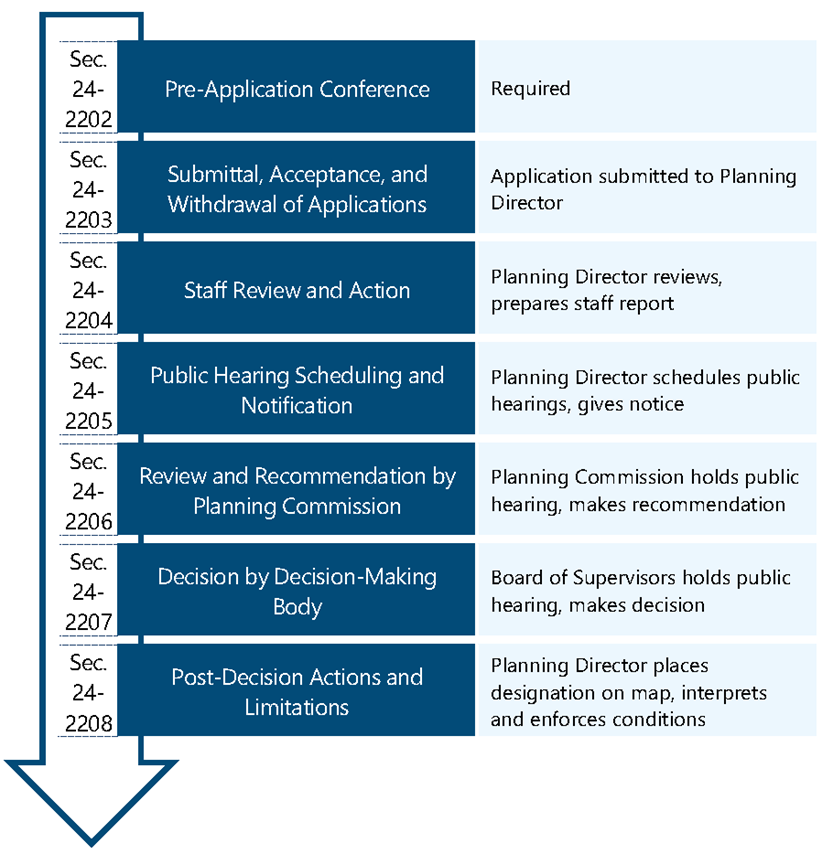
1.
Pre-Application Conference. The common procedures in Sec. 24-2202 apply. .....
2.
Submittal, Acceptance, and Withdrawal of Applications. The common procedures in Sec. 24-2203 apply, subject to the following additions or modifications. In addition to the general application requirements, the application must include: .....
(a)
If requested by the Planning Director, satisfactory evidence that any delinquent real estate taxes owed to the County that have been assessed against the land subject to the application are paid; and .....
(b)
A proposed PD Master Plan and PD Terms and Conditions Document for the planned development in accordance with Sec. 24-3503, PD Master Plan and Terms and Conditions. Once approved, the PD Master Plan and PD Terms and Conditions Document will have the same force and effect as other zoning regulations. .....
3.
Staff Review and Action. The common procedures in Sec. 24-2204 apply. .....
4.
Public Hearing Scheduling and Notification. The common procedures in Sec. 24-2205 apply. .....
5.
Review and Recommendation by Planning Commission. The common procedures in Sec. 24-2206 apply, subject to the following additions or modifications: .....
(a)
The Planning Commission must hold a public hearing on the proposed planned development, following which the Planning Commission must make a recommendation to the Board of Supervisors in accordance with Sec. 24-2305.D, Planned Development Decision Standards. .....
(b)
If the Planning Commission does not make a recommendation on the proposed planned development within 100 days after the first meeting of the Planning Commission after the proposed amendment has been referred to the Planning Commission, excluding any delay caused by a deferral granted upon the applicant's request, the application will be deemed to be recommended for approval, unless the application is withdrawn. .....
6.
Decision by Decision-Making Body. The common procedures in Sec. 24-2207 apply, subject to the following additions or modifications: .....
(a)
After receipt of the Planning Commission's recommendation, the Board of Supervisors must hold a public hearing on the proposed planned development. After the public hearing on the proposed planned development is closed, the Board must make a decision on the application in accordance with Sec. 24-2305.D, Planned Development Decision Standards. The decision on the planned development application must be one of the following: .....
(1)
Approval of the application subject to the PD Master Plan and PD Terms and Conditions Document in the application; .....
(2)
Approval of the application subject to modifications to the PD Master Plan or PD Terms and Conditions Document; .....
(3)
Disapproval of the application; .....
(4)
Remand of the application back to the Planning Commission for further consideration; or .....
(5)
Other action consistent with the Code of Virginia. .....
(b)
An application for planned development must be acted upon and a decision made within a reasonable time, which must not exceed 12 months from the date of acceptance of the completed application, unless the application is withdrawn or the applicant requests or consents to action beyond such period. .....
7.
Post-Decision Actions and Limitations. The common procedures in Sec. 24-2208 apply, subject to the following additions or modifications: .....
(a)
If a PD District is adopted by the Board of Supervisors, the Planning Director must place the PD District classification on the Zoning Districts Map within a reasonable period of time after adoption. .....
(b)
The landowner must record the approved covenants, conditions, and restrictions in the land records with the deed, within 90 days after approval. .....
(c)
Lands rezoned to a PD District will be subject to the approved PD Master Plan and PD Terms and Conditions Document. The PD Master Plan and PD Terms and Conditions Document are binding on the land as an amendment to the Zoning Districts Map. The applicant may apply for and obtain subsequent permits and development approvals necessary to implement the PD Master Plan in accordance with the applicable procedures and standards set forth in this Ordinance. All permits and development approvals must substantially comply with the PD Master Plan and PD Terms and Conditions Document. .....
(d)
Subsequent plans and permits for development within an approved PD District may include minor deviations from the PD Master Plan or PD Terms and Conditions Document, provided the Planning Director determines that such deviations are limited to changes addressing technical considerations that could not reasonably be anticipated during the approval process, or any other change that has no material effect on the character of the approved PD District or any of its approved terms or conditions. Changes that materially affect the basic concept of the PD Master Plan or basic parameters set by the PD Terms and Conditions Document are not considered minor deviations and will only be changed as amendments to the PD Master Plan or PD Terms and Conditions Document. Examples of minor deviations that may be approved by the Planning Director include driveway relocations, minor architectural revisions, minor changes in building size or location, and minor modifications to amenities and public facilities. .....
(e)
If an applicant determines it is necessary to alter the concept or intent of the PD Master Plan or the PD Terms and Conditions Document, the PD Master Plan or PD Terms and Conditions Document may be amended, extended, or modified only in accordance with the procedures and standards consistent with this Ordinance and the Code of Virginia. Examples of changes that would be considered an alteration of the concept or intent of the PD Master Plan or the PD Terms and Conditions Document and are treated as an amendment include increases in density or intensity, decreases in open space, changes to the street network, substantial relocation of public easements, changes in the ratio of residential to nonresidential uses of more than five percent, and changes in the ratio of different housing types of more than fifteen percent. .....
D.
Planned Development Decision Standards. The advisability of a planned development is a matter committed to the legislative discretion of the Board of Supervisors and is not controlled by any one factor. In determining whether to approve or disapprove a planned development, the Board will consider, among other things, whether the planned development complies with the standards for the proposed type of PD District in Article 3, Division 5, Planned Development Districts, and the purposes of zoning ordinances as set forth in the Code of Virginia. .....
(Code 2010, § 24-2305; Ord. No. 1335, § 2, 11-12-2024)
Sec. 24-2306. - Provisional use permit.
A.
Purpose. A use designated as a provisional use in a particular zoning district is a use that may be appropriate in the district, but because of its nature, extent, and external effects, requires special consideration of its location, design, and methods of operation before it can be deemed appropriate in the district and compatible with its surroundings. The purpose of this section is to establish a uniform mechanism for the Board of Supervisors to review provisional uses to ensure they are appropriate for a particular zoning district. .....
B.
Applicability. Approval of a provisional use permit in accordance with the procedure and standards in this section is required prior to the development of a use identified in Article 4, Use Regulations, or elsewhere in this Ordinance, as requiring a provisional use permit. .....
C.
Provisional Use Permit Procedure. This section sets forth the required procedure for provisional use permits. Figure 2306 identifies the common procedures in Article 2, Division 2, Common Procedures, that apply to provisional use permits. Additions or modifications to the common procedures are identified below: .....
Figure 2306: Provisional Use Permit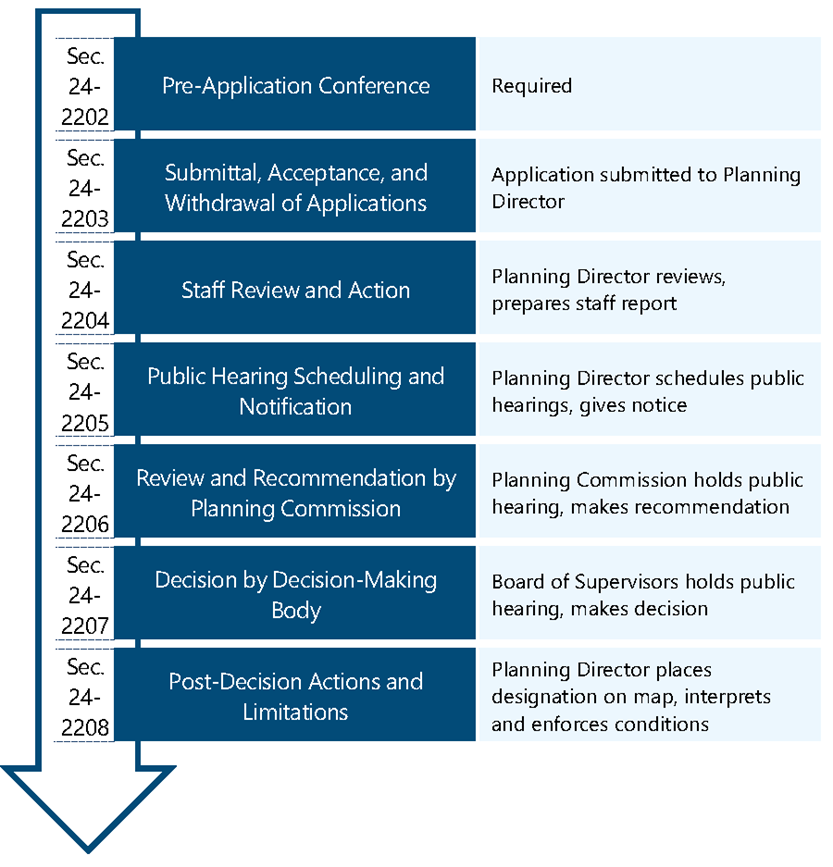
1.
Pre-Application Conference. The common procedures in Sec. 24-2202 apply. .....
2.
Submittal, Acceptance, and Withdrawal of Applications. The common procedures in Sec. 24-2203 apply. .....
3.
Staff Review and Action. The common procedures in Sec. 24-2204 apply. .....
4.
Public Hearing Scheduling and Notification. The common procedures in Sec. 24-2205 apply. .....
5.
Review and Recommendation by Planning Commission. The common procedures in Sec. 24-2206 apply, subject to the following additions or modifications: .....
(a)
The Planning Commission must hold a public hearing on the provisional use permit application, following which the Planning Commission must make a recommendation on the application to the Board of Supervisors in accordance with Sec. 24-2306.D, Provisional Use Permit Decision Standards. .....
(b)
If the Planning Commission does not make a recommendation on the application within 100 days after the first meeting of the Planning Commission after the application has been referred to the Planning Commission, excluding any delay caused by a deferral granted upon the applicant's request, the application will be deemed to be recommended for approval, unless the application is withdrawn. .....
6.
Decision by Decision-Making Body. The common procedures in Sec. 24-2207 apply, subject to the following additions or modifications: .....
(a)
After receipt of the Planning Commission's recommendation, the Board of Supervisors must hold a public hearing on the proposed provisional use permit. After the public hearing is closed, the Board must make a decision on the application in accordance with Sec. 24-2306.D, Provisional Use Permit Decision Standards. .....
(b)
In approving a provisional use permit, the Board of Supervisors may impose reasonable conditions to accomplish the objectives of this section with respect to use, screening, lighting, hours of operation, noise control, maintenance, operation, or other requirements and may limit the duration of a permit. In the case of a provisional use permit for a residential project, the duration of the permit must be at least three years. Initial approval of a provisional use permit for a solar array or energy storage project must provide a minimum of three years to commence the project. The following conditions apply to all provisional use permits approved by the Board of Supervisors, unless expressly waived or modified in the provisional use permit approval: .....
(1)
The owner and management of the use approved (and the new owner or new management entity) must notify the Planning Director, in writing, of any change in ownership or management. .....
(2)
The owner must authorize the Planning Director or a designee to enter the premises at reasonable times to inspect the property for compliance with the conditions of approval. .....
(3)
Where appropriate, the owner must post a financial guarantee in an amount to be determined by the Planning Director, and in a form satisfactory to the County Attorney, prior to the issuance of the provisional use permit, to ensure compliance with all conditions of approval. .....
(4)
If the use allowed by the provisional use permit is discontinued for a period greater than two years, the permit will become null and void, subject to the vesting provisions of the Code of Virginia. .....
(c)
Unless otherwise specified as a condition of approval, all other requirements not expressly modified by the provisional use permit will remain the same as for other uses in the district where the proposed provisional use is located. .....
7.
Post-Decision Actions and Limitations. The common procedures in Sec. 24-2208 apply, subject to the following additions or modifications: .....
(a)
A provisional use permit will terminate in accordance with any conditions established and included in the permit approval, subject to the vesting provisions of the Code of Virginia. .....
(b)
A provisional use permit will be subject to revocation at any time by the Board of Supervisors for failure of the permit holder to comply with the applicable conditions. Prior to revocation of the permit, the Board of Supervisors must hold a public hearing after written notice to the permit holder and notice in accordance with Code of Virginia § 15.2-2204. The Board may refer the matter to the Planning Commission for a recommendation before the Board makes its decision. .....
(c)
The Planning Director must review applications for transfer of a provisional use permit to a new owner or operator in accordance with Sec. 24-2307, Transfer of Provisional Use Permit. .....
D.
Provisional Use Permit Decision Standards. The Board of Supervisors will approve a provisional use permit only if it finds the proposed provisional use: .....
1.
Is consistent with the purposes, goals and policies of the comprehensive plan and other applicable County-adopted plans; .....
2.
Complies with all applicable zoning district-specific standards in Article 3, Zoning Districts, all applicable use-specific standards in Article 4, Use Regulations, all applicable development and design standards in Article 5, Development Standards, and all relevant subdivision and infrastructure standards in the County Code; .....
3.
Is appropriate for its location and is compatible with the general character of surrounding lands and the types, scale, and intensity of uses allowed in the zoning district where proposed; and .....
4.
Will not adversely affect the public health, safety, and general welfare. .....
(Code 2010, § 24-2306; Ord. No. 1335, § 3, 11-12-2024)
Sec. 24-2307. - Transfer of provisional use permit.
A.
Purpose. The purpose of this section is to provide a uniform mechanism for the transfer of a valid provisional use permit to a new owner or operator of a structure or lands subject to the provisional use permit. .....
B.
Applicability. The transfer of the rights and obligations of a valid provisional use permit to a new owner or operator may be approved by the Planning Director in accordance with the procedure and standards in this section. Whether or not a transfer occurs, no property subject to a provisional use permit may be used in any manner that violates the terms of the permit. .....
C.
Transfer of Provisional Use Permit Procedure. This section sets forth the required procedure for a transfer of provisional use permit. Figure 2307 identifies the common procedures in Article 2, Division 2, Common Procedures, that apply to a transfer of provisional use permit. Additions or modifications to the common procedures are identified below: .....
Figure 2307: Transfer of Provisional Use Permit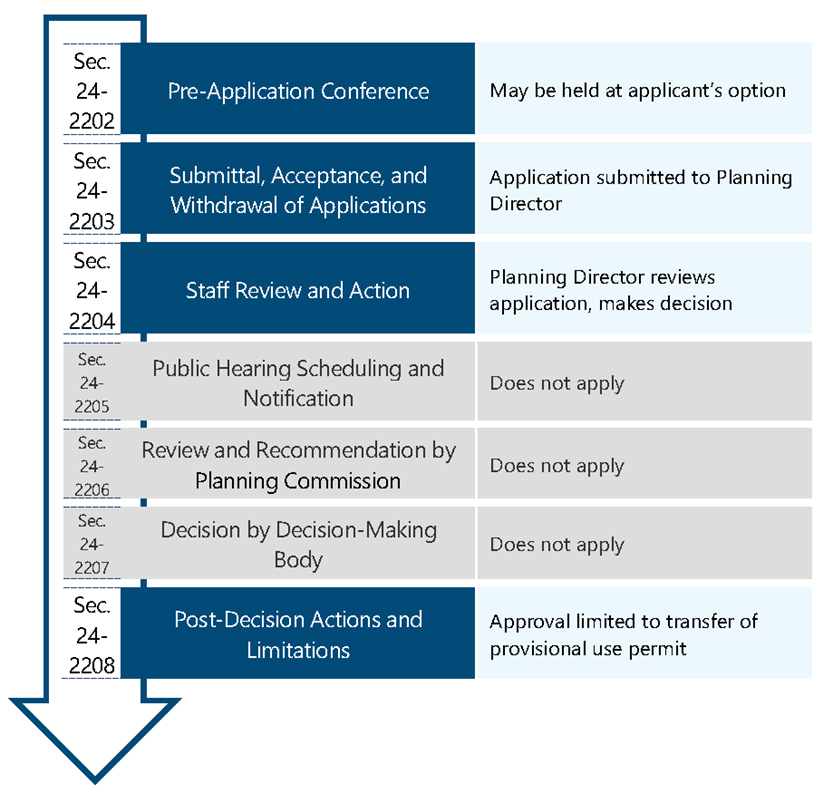
1.
Pre-Application Conference. A pre-application conference may be held at the applicant's option in accordance with Sec. 24-2202. .....
2.
Submittal, Acceptance, and Withdrawal of Applications. The common procedures in Sec. 24-2203 apply. .....
3.
Staff Review and Action. The common procedures in Sec. 24-2204 apply, subject to the following additions or modifications: .....
(a)
The Planning Director must review and make a decision to approve or deny the application in accordance with Sec. 24-2307.D, Transfer of Provisional Use Permit Decision Standards. .....
(b)
The new owner will be subject to the same conditions of approval imposed on the original permit. .....
4.
Post-Decision Actions and Limitations. .....
(a)
The common procedures in Sec. 24-2208 apply. Approval of a transfer of provisional use permit application by the Planning Director has the effect of transferring the rights and obligations associated with the corresponding provisional use permit to the current owner or operator of the structure or land. Such approval by the Planning Director will not be construed to modify the corresponding provisional use permit, including its conditions of approval. .....
(b)
Appeals of the Planning Director's decision will be to the Board of Supervisors in accordance with the following requirements. .....
(1)
Any person who is aggrieved by the Planning Director's decision may petition the Board of Supervisors for review of such decision. The petition must be filed with the Planning Director and the Clerk of the Board of Supervisors within 30 days from the date of decision for which review is sought. The petition must specify the grounds upon which the petitioner is aggrieved. .....
(2)
The Planning Director must forward the petition and the justification for the decision for which review is sought to the Board of Supervisors and to the aggrieved person no less than ten days prior to the next regularly scheduled meeting designated for hearing of zoning matters. Written notice of such meeting must be given to all parties as required by Code of Virginia § 15.2-2204. .....
(3)
The Board of Supervisors must review the petition and the Planning Director's justification for the decision and must affirm (in whole or in part), modify (in whole or in part), or reverse (in whole or in part) the Planning Director's decision. Any appeal of the Board of Supervisors' decision will be to the Circuit Court in accordance with the Code of Virginia. .....
5.
Common Procedures that do not Apply. The common procedures in Sec. 24-2205, Public Hearing Scheduling and Notification; Sec. 24-2206, Review and Recommendation by Planning Commission; and Sec. 24-2207, Decision by Decision-Making Body, do not apply to this type of application. .....
D.
Transfer of Provisional Use Permit Decision Standards. The Planning Director must approve a transfer of provisional use permit application if the Planning Director makes the following determinations; otherwise, the Planning Director must deny the application: .....
1.
The use or service is the same or substantially the same use or service authorized by the Board of Supervisors; .....
2.
The owner or operator has acknowledged the conditions of the original provisional use permit and has agreed in writing to comply with all conditions; .....
3.
There has been no change in circumstances substantially affecting the public health, safety, or welfare; and .....
4.
No additional adverse effects on the surrounding neighborhood are anticipated. .....
(Code 2010, § 24-2307)
Sec. 24-2308. - Conditional use permit.
A.
Purpose. A use designated as a conditional use in a particular zoning district may be appropriate in the district, but because of its nature, extent, and external effects, requires special consideration of its location, design, and methods of operation before it can be deemed appropriate in the district and compatible with its surroundings. The purpose of this section is to establish a uniform mechanism for the Board of Zoning Appeals (BZA) to review conditional uses to ensure they are appropriate for a particular zoning district. .....
B.
Applicability. Approval of a conditional use permit in accordance with the procedure and standards in this section is required prior to the development of any of the following uses: .....
1.
Any use identified in Article 4, Use Regulations, or elsewhere in this Ordinance, as requiring a conditional use permit; or .....
2.
A temporary use or structure not otherwise permitted in the district where it is proposed to be located that does not involve the construction or use of permanent structures. .....
C.
Conditional Use Permit Procedure. This section sets forth the required procedure for conditional use permits. Figure 2308 identifies the common procedures in Article 2, Division 2, Common Procedures, that apply to conditional use permits. Additions or modifications to the common procedures are identified below: .....
Figure 2308: Conditional Use Permit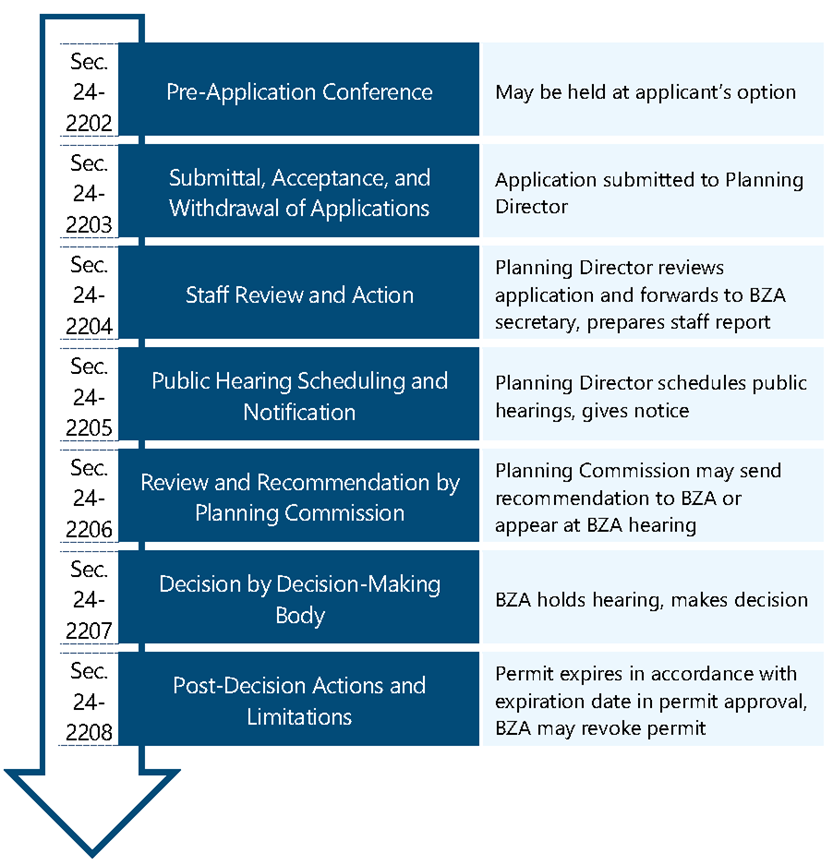
1.
Pre-Application Conference. A pre-application conference may be held at the applicant's option in accordance with Sec. 24-2202. .....
2.
Submittal, Acceptance, and Withdrawal of Applications. The common procedures in Sec. 24-2203 apply, except a conditional use permit application may be submitted by any property owner, tenant, or government official, department, board, or commission. .....
3.
Staff Review and Action. The common procedures in Sec. 24-2204 apply, subject to the following additions or modifications: .....
(a)
The Planning Director must transmit the application to the Planning Commission and BZA, and must place the matter on the BZA's agenda. .....
(b)
The Planning Director must review the application, prepare a written staff report on the application, and transmit the staff report to the secretary of the BZA. .....
4.
Public Hearing Scheduling and Notification. The common procedures in Sec. 24-2205 apply. .....
5.
Review and Recommendation by Planning Commission. The common procedures in Sec. 24-2206 apply. The Planning Commission may send a recommendation to the BZA or appear as a party at the public hearing held by the BZA on the proposed conditional use. .....
6.
Decision by Decision-Making Body. The common procedures in Sec. 24-2207 apply, subject to the following additions or modifications: .....
(a)
The BZA must hold a public hearing on the conditional use permit application. At the hearing, any party may appear in person or by agent or by attorney and speak or submit materials in support of or in opposition to the application. After the public hearing is closed, the BZA must make a decision to approve or deny the application in accordance with Sec. 24-2308.D, Conditional Use Permit Decision Standards. .....
(b)
The BZA may impose conditions relating to the use for which a conditional use permit is granted as it deems necessary in the public interest, including limiting the duration of a permit, and it may require a guarantee or bond to ensure compliance with the conditions imposed. However, in the case of a conditional use permit for a residential project, the duration of the permit must be at least three years. .....
(c)
The BZA must make a decision on the application within 90 days of the submittal of a complete application. .....
7.
Post-Decision Actions and Limitations. The common procedures in Sec. 24-2208 apply, subject to the following additions or modifications: .....
(a)
A conditional use permit will expire in accordance with any expiration date established and included in the permit approval, and subject to the provisions of the Code of Virginia. In the case of a temporary use not otherwise permitted in the district, the expiration date for the conditional use permit must not be extended or renewed beyond 24 months. .....
(b)
The BZA may revoke, in accordance with the requirements of the Code of Virginia, a conditional use permit that it previously granted if the BZA determines that there has not been compliance with the terms and conditions of the permit. .....
D.
Conditional Use Permit Decision Standards. The BZA must approve a conditional use permit only if it finds the proposed conditional use: .....
1.
Is consistent with the purposes, goals and policies of the comprehensive plan and other applicable County-adopted plans; .....
2.
Complies with all applicable zoning district-specific standards in Article 3, Zoning Districts, all applicable use-specific standards in Article 4, Use Regulations, all applicable development and design standards in Article 5, Development Standards, and all relevant subdivision and infrastructure standards in the County Code; .....
3.
Is appropriate for its location and is compatible with the general character of surrounding lands and the types, scale, and intensity of uses allowed in the zoning district where proposed; and .....
4.
Will not adversely affect the public health, safety, and general welfare. .....
(Code 2010, § 24-2308; Ord. No. 1335, § 4, 11-12-2024)
Sec. 24-2309. - Building permit.
A.
The submittal and review of applications for building permits will be in accordance with Chapter 6 of the County Code. .....
B.
A building permit subject to this Ordinance must not be issued by the Building Official unless the Planning Director determines that the proposed activity complies with this Ordinance. .....
(Code 2010, § 24-2309)
Sec. 24-2310. - Certificate of occupancy.
A.
The submittal and review of applications for certificates of occupancy will be in accordance with Chapter 6 of the County Code and subsection B below. .....
B.
A certificate of occupancy subject to this Ordinance must not be issued by the Building Official unless the Planning Director determines that the proposed activity complies with this Ordinance, including all conditions of approval of permits or development approvals to which the proposed activity is subject. .....
(Code 2010, § 24-2310)
Sec. 24-2311. - Sign permit.
A.
Purpose. The purpose of this section is to establish a uniform mechanism for ensuring that all signs comply with the standards in Article 5, Division 7, Signs, and with other applicable standards in this Ordinance. .....
B.
Applicability. Except where a sign permit is not required in accordance with Sec. 24-5703, Signs Not Requiring Permits, approval of a sign permit in accordance with the procedure and standards in this section is required prior to the display of any sign. .....
C.
Sign Permit Procedure. This section sets forth the required procedure for a sign permit. Figure 2311 identifies the common procedures in Article 2, Division 2, Common Procedures, that apply to a sign permit. Additions or modifications to the common procedures are identified below: .....
Figure 2311: Sign Permit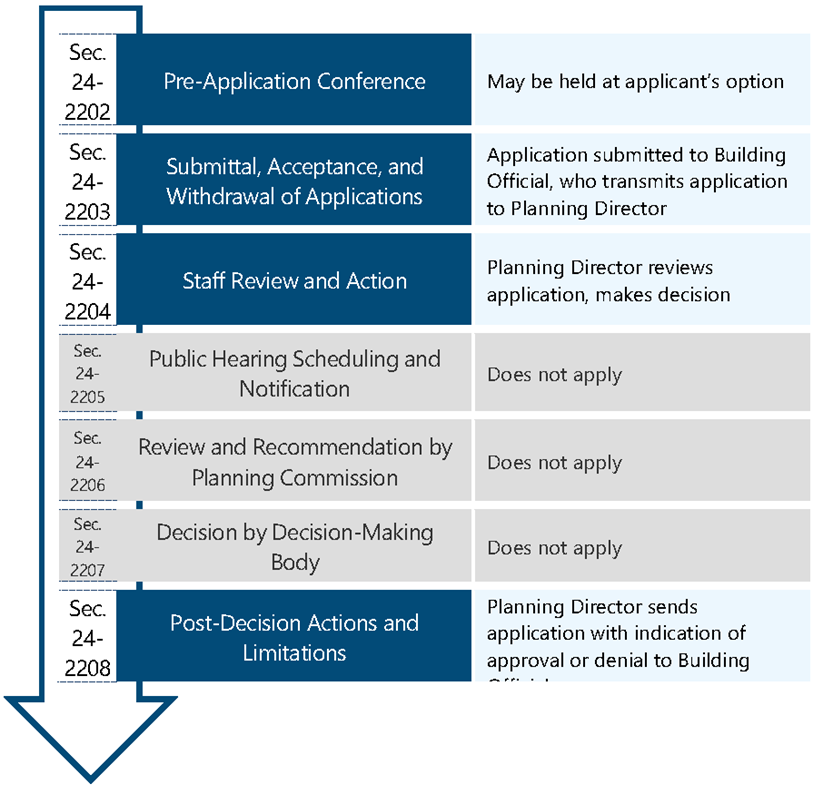
1.
Pre-Application Conference. A pre-application conference may be held at the applicant's option in accordance with Sec. 24-2202. .....
2.
Submittal, Acceptance, and Withdrawal of Applications. The common procedures in Sec. 24-2203 apply, subject to the following additions or modifications: .....
(a)
If the proposed sign requires approval of a building permit, including an electrical permit, the following requirements apply: .....
(1)
The applicant must submit the application to the Building Official. The applicant must provide sufficient information to allow for a determination of whether the proposed sign is permitted under the Virginia Uniform Statewide Building Code and under this Ordinance. Upon receipt of the application, the Building Official will submit a copy of the application to the Planning Director. .....
(2)
For any property subject to a plan of development, a comprehensive sign program may be submitted with one or more sign permit applications. The comprehensive sign program will establish the number, location, area, height, materials, and illumination of all signs to be placed on the site. The Planning Director may approve a comprehensive sign program that conforms to the total area and maximum height limitations for the property established by Article 5, Division 7, Signs. .....
3.
Staff Review and Action. The common procedures in Sec. 24-2204 apply, subject to the following additions or modifications: .....
(a)
If the application was not required to be submitted to the Building Official in accordance with subsection 2 above, the Planning Director must review the application and either approve or deny the application in accordance with Sec. 24-2311.D, Sign Permit Decision Standards. When approving a sign permit, the Planning Director may attach conditions of approval to ensure compliance with this Ordinance. .....
(b)
If the application was submitted to the Building Official in accordance with subsection 2 above, the following requirements apply: .....
(1)
The Planning Director must review the application and must indicate on the application that the proposed sign does or does not comply with this Ordinance and applicable conditions of approval, in accordance with Sec. 24-2311.D, Sign Permit Decision Standards. .....
(2)
The Planning Director must note on the application any conditions of approval or reasons for noncompliance and must return the application to the Building Official within 20 business days of the date the Planning Director received the application. .....
(3)
After receiving the application from the Planning Director, the Building Official must review the application and make a decision to approve or deny the application in accordance with Sec. 24-2311.D, Sign Permit Decision Standards. When approving a sign permit, the Planning Director may recommend conditions of approval to ensure compliance with this Ordinance. .....
4.
Post-Decision Actions and Limitations. The common procedures in Sec. 24-2208 apply. If a sign for which a sign permit is issued is not installed within six months after issuance of the sign permit, the permit will be void. .....
5.
Common Procedures that do not Apply. The common procedures in Sec. 24-2205, Public Hearing Scheduling and Notification; Sec. 24-2206, Review and Recommendation by Planning Commission; and Sec. 24-2207, Decision by Decision-Making Body, do not apply to sign permits. .....
D.
Sign Permit Decision Standards. .....
1.
The Planning Director must approve a sign permit application or indicate the proposed sign complies with this Ordinance, as applicable, only if the Planning Director determines the proposed sign complies with Article 5, Division 7, Signs, all other applicable requirements of this Ordinance, any comprehensive sign program approved for the property, and any other applicable conditions of approval; otherwise, the Planning Director must deny the application or indicate the proposed sign does not comply with this Ordinance, as applicable. .....
2.
The Building Official must not approve a sign permit application unless the Planning Director has approved the application. When approving a sign permit, the Building Official must attach any conditions of approval recommended by the Planning Director. .....
(Code 2010, § 24-2311)
Sec. 24-2312. - Temporary use permit.
A.
Purpose. The purpose of this section is to establish a uniform mechanism for ensuring that temporary uses comply with Article 4, Division 5, Temporary Uses and Structures, and with other applicable standards in this Ordinance. .....
B.
Applicability. Approval of a temporary use permit in accordance with the procedure and standards in this section is required prior to the establishment or commencement of any use identified as requiring a temporary use permit in Article 4, Division 5, Temporary Uses and Structures. .....
C.
Temporary Use Permit Procedure. This section sets forth the required procedure for a temporary use permit. Figure 2312 identifies the common procedures in Article 2, Division 2, Common Procedures, that apply to a temporary use permit. Additions or modifications to the common procedures are identified below: .....
Figure 2312: Temporary Use Permit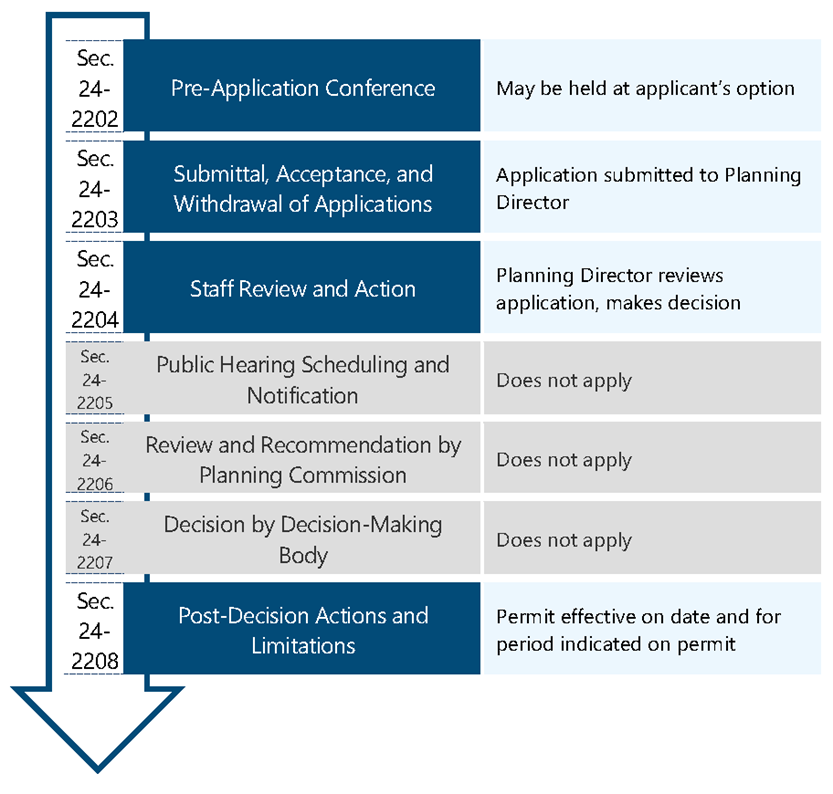
1.
Pre-Application Conference. A pre-application conference may be held at the applicant's option in accordance with Sec. 24-2202. .....
2.
Submittal, Acceptance, and Withdrawal of Applications. The common procedures in Sec. 24-2203 apply. .....
3.
Staff Review and Action. The common procedures in Sec. 24-2204 apply. The Planning Director must review and make a decision to approve or deny the application in accordance with Sec. 24-2312.D, Temporary Use Permit Decision Standards. When approving a temporary use permit, the Planning Director may attach conditions of approval to ensure compliance with this ordinance. .....
4.
Post-Decision Actions and Limitations. The common procedures in Sec. 24-2208 apply, subject to the following additions or modifications: .....
(a)
If the application is denied, the Planning Director must include written reasons for the denial with the written notice of the decision provided to the applicant. .....
(b)
A temporary use permit will be effective beginning on the date specified in the permit approval and will remain effective for the period indicated on the permit. .....
5.
Common Procedures that do not Apply. The common procedures in Sec. 24-2205, Public Hearing Scheduling and Notification; Sec. 24-2206, Review and Recommendation by Planning Commission; and Sec. 24-2207, Decision by Decision-Making Body, do not apply to temporary use permits. .....
D.
Temporary Use Permit Decision Standards. The Planning Director must approve a temporary use permit application if the proposed temporary use complies with Article 4, Division 5, Temporary Uses and Structures, and all other applicable requirements of this Ordinance. Otherwise, the Planning Director must deny the application. .....
(Code 2010, § 24-2312)
Sec. 24-2313. - Tree removal permit.
A.
Purpose. The purpose of this section is to provide a uniform mechanism to ensure that any removal of a protected tree complies with the requirements of Sec. 24-5313, Tree Protection. .....
B.
Applicability. Approval of a tree removal permit in accordance with the procedure and standards in this section is required prior to the removal of a protected tree (see Sec. 24-5313.A, Protected Tree Defined), unless the removal is exempted by Sec. 24-5302.B, Exemptions, or is shown on a tree protection plan approved as part of a construction plan, a clearing and grubbing plan, or an erosion control plan (see Sec. 24-2314, Plan of Development, and Sec. 24-5313.C, Tree Protection Plan Required). .....
C.
Tree Removal Permit Procedure. This section sets forth the required procedure for a tree removal permit. Figure 2313 identifies the common procedures in Article 2, Division 2, Common Procedures, that apply to a tree removal permit. Additions or modifications to the common procedures are identified below: .....
Figure 2313: Tree Removal Permit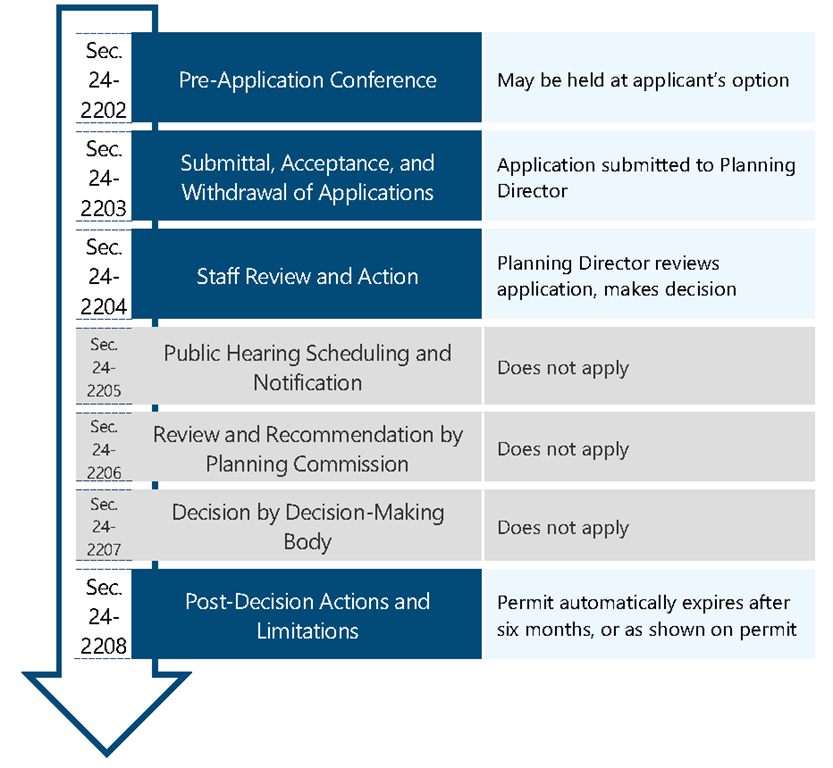
1.
Pre-Application Conference. A pre-application conference may be held at the applicant's option in accordance with Sec. 24-2202. .....
2.
Submittal, Acceptance, and Withdrawal of Applications. The common procedures in Sec. 24-2203 apply. .....
3.
Staff Review and Action. The common procedures in Sec. 24-2204 apply. The Planning Director must review and approve or deny the application in accordance with Sec. 24-2313.D, Tree Removal Permit Decision Standards. When approving a tree removal permit, the Planning Director may attach conditions of approval to ensure compliance with this ordinance. .....
4.
Post-Decision Actions and Limitations. The common procedures in Sec. 24-2208 apply, subject to the following additions or modifications: .....
(a)
If the application is denied, the Planning Director must include written reasons for the denial with the written notice of the decision provided to the applicant. .....
(b)
A tree removal permit will expire in accordance with any expiration date established and included in the permit approval. If no such date is included in the permit approval, the permit will automatically expire six months after the date it was issued. .....
5.
Common Procedures that do not Apply. The common procedures in Sec. 24-2205, Public Hearing Scheduling and Notification; Sec. 24-2206, Review and Recommendation by Planning Commission; and Sec. 24-2207, Decision by Decision-Making Body, do not apply to tree removal permits. .....
D.
Tree Removal Permit Decision Standards. The Planning Director must approve a tree removal permit application if the Planning Director determines the proposed activity complies with Sec. 24-5313, Tree Protection, and all other applicable requirements of this Ordinance; otherwise, the Planning Director must deny the application. .....
(Code 2010, § 24-2313)
Sec. 24-2314. - Plan of development.
A.
Purpose. The purpose of this section is to establish a uniform mechanism for the Planning Director to review the layout and general design of proposed development to ensure it complies with all applicable standards in this Ordinance and the County Code prior to the development or use of the property. The procedure in this section provides for such review of development above a certain number of dwelling units or a specified gross floor area; development below those thresholds is approved through site plan review (see Sec. 24-2315, Site Plan). This section includes provisions for the review of clearing and grubbing plans and final construction plans to ensure that development on the site complies with the requirements in this Ordinance. It also includes provisions to ensure that required on-site improvements are installed in accordance with this Ordinance, including Article 5, Development Standards. .....
B.
Applicability. .....
1.
The following development requires approval of a plan of development in accordance with the procedure and standards in this section prior to the issuance of a building permit or an occupancy certificate: .....
(a)
Residential development in the R-5A, R-5B, R-5, R-6, RTH, Mixed Use, and Planned Development districts consisting of 50 or more dwelling units; .....
(b)
Nonresidential development having a gross floor area or principal use area of 65,000 square feet or more; and .....
(c)
Development for which plan of development review is required by Article 4: Use Regulations. .....
2.
In determining the number of dwelling units or the gross floor area of a development in accordance with subsection 1 above, all phases or sections of a development having more than one phase or section will be counted. .....
3.
An application for a plan of development may be submitted and reviewed concurrently with an application for a minor subdivision in accordance with Chapter 19 of the County Code. .....
C.
Plan of Development Procedure. This section sets forth the required procedure for a plan of development. Figure 2314 identifies the common procedures in Article 2, Division 2, Common Procedures, that apply to a plan of development. Additions or modifications to the common procedures are identified below: .....
Figure 2314: Plan of Development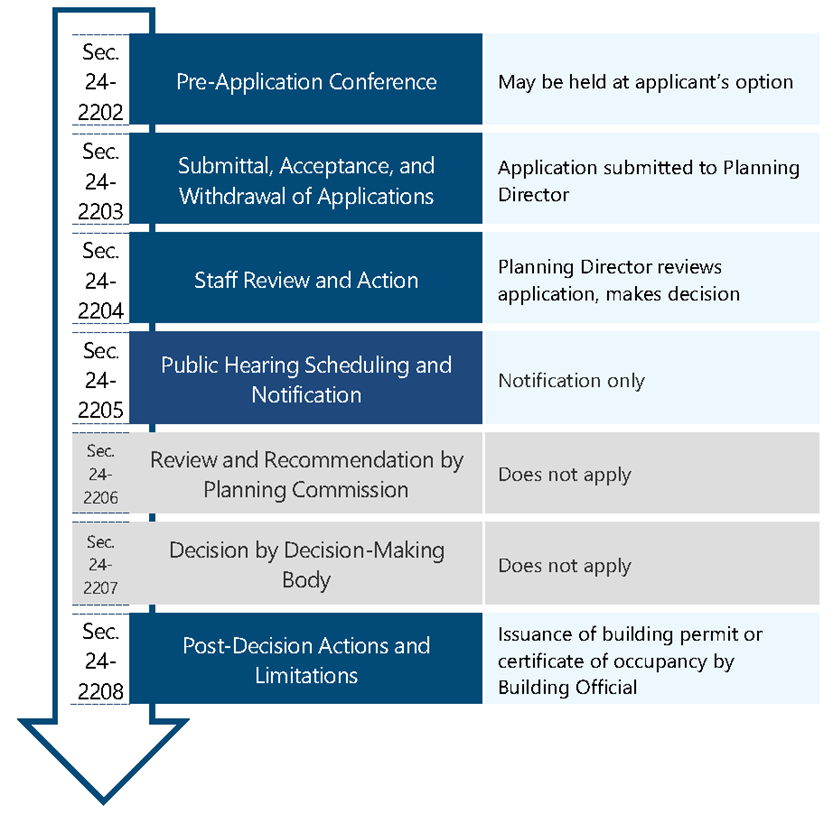
1.
Pre-Application Conference. A pre-application conference may be held at the applicant's option in accordance with Sec. 24-2202. .....
2.
Submittal, Acceptance, and Withdrawal of Applications. The common procedures in Sec. 24-2203 apply. .....
3.
Staff Review and Action. .....
(a)
General. .....
(1)
The common procedures in Sec. 24-2204 apply. .....
(2)
The Planning Director must send the application to each state agency required to review it under state law within five business days of submission. .....
(b)
Development in Dam Break Inundation Zone. .....
(1)
For any development containing three or more residential units or any Commercial or Industrial use other than agricultural production proposed within the boundaries of a mapped dam break inundation zone (see subsection (3) below), the County Engineer must review the dam break inundation zone map, notify the dam owner, and, within ten days, forward a request to the Virginia Department of Conservation and Recreation to make a determination of the potential impacts of the proposed development on the spillway design flood standards required of the dam. Upon receipt of the determination of the Virginia Department of Conservation and Recreation or if the County has not received comments within 45 days of the Department's receipt of the County's request, the County must complete the review of the development. .....
(2)
If the Virginia Department of Conservation and Recreation determines that the proposed development is wholly or partially within a dam break inundation zone and would change the spillway design flood standards of an impounding structure, the developer must submit an engineering study meeting state standards to the Virginia Department of Conservation and Recreation prior to final approval of the proposed development. Following the completion of the engineering study, and prior to any development within the dam break inundation zone, the developer must change the proposed development so that it does not alter the spillway design flood standards of the impounding structure or must pay 50 percent of the contract-ready costs for necessary upgrades to an impounding structure attributable to the development, together with administrative fees required by state law. The payment must be made to the Virginia Dam Safety, Flood Prevention and Protection Assistance Fund as provided by state law. .....
(3)
The owner of each impounding structure in the County must prepare a map of the dam break inundation zone for the impounding structure and submit the map to the County Engineer and the Virginia Department of Conservation and Recreation. Dam break inundation zone maps are only required for dams that meet the definition of an impounding structure. The requirements of this subsection do not apply to any development proposed downstream of a dam for which a dam break inundation zone map is not on file with the County at the time of the official submission of a development plan to the County. However, the County Engineer may map the dam break inundation zone and recover the costs of such mapping from the owner of an impounding structure for which a dam break inundation zone map is not on file with the County and a map has not been prepared by the impounding structure's owner. .....
(c)
Decision on the Application. .....
(1)
The Planning Director must review and approve or disapprove the application in accordance with Sec. 24-2314D, Plan of Development Decision Standards. When approving a plan of development, the Planning Director may attach conditions of approval to ensure compliance with this ordinance. .....
(2)
Unless the applicant requests an extension of time, the Planning Director must make a decision on the application within 40 days of submission or, if state agency review is required, within 20 days of receipt of approvals from all reviewing agencies. .....
(3)
The following conditions will apply to all plans of development approved by the Planning Director, unless expressly waived or modified in the plan of development approval: .....
A.
The owner must enter into all necessary contracts with the Department of Public Utilities for all connections to public water and sewer identified on the approved plan of development. If the proposed development is not served by public water or public sewer, connection must be made to public water and public sewer, as applicable, when available within 300 feet of the site. .....
B.
The site, including the parking areas, must be kept clean of litter and debris. Recycling and refuse collection areas must be maintained with regular scheduled pickups and must be screened from view from all directions at ground level. Gates must remain closed, except when the receptacles are being serviced, and must be repaired or replaced as necessary. .....
C.
Plan of development approval is limited to the owner and applicant to whom it is issued. Upon written notification to the Planning Director, the plan of development approval may be transferred to subsequent owner(s). After an inspection of the site, the Planning Director will notify the current and prospective owners of any deficiencies from the approved plans. Upon correction of any deficiencies, the Planning Director will approve the transfer of approval, and will provide the new owner with a copy of the conditions of approval. .....
D.
The construction plan must show, and the developer must provide, fire hydrants as required by the Statewide Fire Prevention Code and the Department of Public Utilities standards. .....
(4)
If the Planning Director disapproves the application, the reasons for disapproval must be given to the applicant in a separate document or written on the plan itself. The reasons for disapproval must identify all deficiencies that caused the disapproval by referencing specific, duly adopted ordinances, regulations, or policies and, to the greatest extent practicable, the modifications or corrections necessary for approval. .....
(5)
If the applicant and the Planning Director cannot agree on the review and approval of a plan of development, either party may request review by the Planning Commission. The Planning Commission will review the plan of development at a public meeting, and otherwise will be subject to the same standards as the Planning Director. .....
4.
Notification. The common procedures for Public Hearing Scheduling in Sec. 24-2205.A do not apply. However, the common procedures for notification of adjoining landowners in Sec. 24-2205.B apply. .....
5.
Post-Decision Actions and Limitations. The common procedures in Sec. 24-2208 apply, subject to the following additions or modifications: .....
(a)
Revision and Resubmittal of Application after Disapproval. .....
(1)
If the application is disapproved, the applicant may revise the application, responding to the specific reasons identified for the disapproval and the identified modifications or corrections necessary to obtain approval, and resubmit it to the Planning Director. After review of the resubmitted application, the Planning Director must review and either approve or disapprove the application. The Planning Director must approve the resubmitted application only on finding the following: .....
A.
All deficiencies identified in the previous review of the application have been corrected; and .....
B.
The application does not contain new deficiencies, based on the review standards in Article 2, Division 3, Specific Standards and Requirements for Development Applications. Only new deficiencies resulting from the following will be considered: .....
1.
Corrections made to address previously identified deficiencies; .....
2.
Errors or omissions occurring after the initial submission of the application; .....
3.
Material revisions of infrastructure or physical improvements from the earlier submission; or .....
4.
Material revisions that create a new required review by the State Department of Transportation or other state agency. .....
(2)
The Planning Director must approve or disapprove a resubmitted application within 30 days of the date it was resubmitted. If the Planning Director fails to approve or disapprove a resubmitted application within 30 days of the date it was resubmitted, the application will be deemed approved; however, any deficiency in the proposed plan of development that, if left uncorrected, would violate local, state, or federal law or regulations, mandatory state Department of Transportation engineering and safety requirements, or other mandatory engineering and safety requirements, will not be considered, treated, or deemed as having been approved. .....
(3)
If the Planning Director determines the deficiencies identified during a third or subsequent resubmission are minor, instead of disapproving the application, the Planning Director may either approve the application as submitted or permit the applicant to address such deficiencies and resubmit the application for administrative approval. If the Planning Director permits an applicant to resubmit for administrative approval, the Planning Director will complete the administrative approval within seven days of the date it was resubmitted. The applicant must not make any revisions other than those necessary to address the minor deficiencies. If the applicant makes any revisions other than those necessary to address the minor deficiencies, the resubmission will be disqualified from the seven-day administrative approval process. .....
(b)
Petition to Circuit Court if Decision Not Made within Required Time. If the Planning Director fails to approve or disapprove the application within the time specified in this Ordinance for approval, the applicant may, after giving ten days' written notice to the Planning Director, petition the Circuit Court to decide whether the plan should or should not be approved. .....
(c)
Period of Validity and Extension. Approved plans of development will be valid for the periods provided in Code of Virginia § 15.2-2261. Upon application of the subdivider or developer, the Planning Director may grant one or more extensions of approval for additional periods of one year, taking into consideration the size and phasing of the proposed development and the laws, ordinances, and regulations in effect at the time of the request for an extension. If the Planning Director denies an extension request, the applicant may appeal to the Circuit Court within 60 days of the written denial by the Planning Director. .....
(d)
Clearing and Grubbing Plans and Final Construction Plans. If the application is approved by the Planning Director, the applicant may proceed with the following plans: .....
(1)
Clearing and Grubbing Plan. The applicant may submit and receive approval of a clearing and grubbing plan prior to the approval of construction plans (see subsection (2) below), provided the following conditions are met: .....
A.
The Planning Director, County Engineer, and Director of Public Utilities have approved the project; .....
B.
All appropriate bonds, agreements, and authorizations from state and federal regulatory agencies for impacts to Waters of the United States have been submitted; .....
C.
Off-site drainage easements have been recorded; .....
D.
A Virginia Pollutant Discharge Elimination System (VPDES) permit has been issued by the Virginia Department of Environmental Quality, or, if no VPDES permit is required, a stormwater management (SWM) plan has been submitted to and approved by the County Engineer and Planning Director; and .....
E.
Prior to any land disturbance, a preconstruction meeting must be conducted with the Environmental Inspector, the Developer, and the Contractor in attendance. The Planning Inspector will attend if tree protection measures are required. .....
(2)
Construction Plans. .....
A.
The applicant must prepare the construction plans for the project and submit them to the Planning Director for final approval and signature. .....
B.
Any necessary off-site easements for drainage, water, and sewer must be obtained in a form acceptable to the County Attorney prior to final approval of the construction plans. .....
C.
Any deviations from County standards for pavement or curb and gutter design must be approved by the County Engineer prior to final approval of the construction plans. .....
D.
If the Planning Director determines that the construction plans are not substantially in accordance with the approved plan of development, the Planning Director must notify the applicant of the deficiencies and allow the applicant a reasonable time to revise and resubmit the construction plans to address the deficiencies. Additional fees may be required to offset costs associated with review of resubmitted construction plans. .....
E.
If the Planning Director determines that the construction plans are substantially in accordance with the approved plan of development, the Planning Director must provide the applicant a signed letter of approval, which will authorize the applicant to proceed with site grading and utility work following a mandatory on-site pre-construction meeting. .....
(e)
Subsequent Approval of Building Permits and Occupancy Certificates. .....
(1)
A building permit must not be issued by the Building Official for a structure in an area covered by an approved plan of development unless the building permit is substantially in accordance with the plan of development. The Planning Director may determine that proposed development that includes minor revisions, modifications, or additions to a previously approved plan of development complies with the previously approved plan of development if the proposed development is substantially in accordance with the previously approved plan of development. .....
(2)
Subject to subsection (3) below, a final occupancy permit may be issued by the Building Official for an appropriately completed building, or part of a building, in a part of the total area covered by an approved plan of development, if: .....
A.
The other on-site construction and improvements included in the approved plan of development for the section have been completed and have been inspected and accepted by the Planning Director, the County Engineer, the Director of Public Utilities, the County health officer or their agents; and .....
B.
The off-site improvements related to and necessary to service the section have been completed and inspected and accepted by the Planning Director, the County Engineer, and the Director of Public Utilities, or the developer has provided a financial guarantee acceptable to the County and has executed an agreement to construct any required physical improvements which are located within public rights-of-way or easements or are connected to any public facilities. .....
(3)
The easements for drainage and utilities as shown on approved plans must be granted to the County in a form acceptable to the County Attorney prior to any occupancy permits being issued. The easement plats and any other required information must be submitted to the County Real Property Agent at least 60 days prior to requesting occupancy permits. .....
(f)
Installation of Required Improvements. All on-site and off-site improvements pursuant to an approved plan must comply with the following requirements: .....
(1)
The improvements must conform to the County design and construction standards. .....
(2)
During installation, all improvements must be inspected by the department responsible for verifying their compliance with the approved plan of development and applicable County standards. The engineer, surveyor, or landscape architect of record must also inspect improvements during construction. .....
(3)
The owner must notify the County Engineer at least 24 hours prior to beginning any work on streets or storm sewers. The owner must notify the Department of Public Utilities at least 48 hours prior to beginning any work on County water or sewer construction. .....
(4)
The owner must have one set of approved plans, profiles, and specifications available at the site at all times when work is being performed. A designated responsible employee must be available for contact by County inspectors. .....
(5)
All improvements must be installed within 24 months of construction plan approval, unless the Planning Director approves a longer period due to the size or complexity of the project. The time for completion of improvements may be extended upon written application by the owner or developer, signed by all parties (including sureties) to the original agreement. .....
(6)
When all required improvements have been completed and prior to requesting a final certificate of occupancy, the engineer, surveyor, or landscape architect who supervised construction must certify that all improvements have been installed in substantial conformance with the approved plans, specifications, and County requirements. .....
(7)
When all required improvements have been completed and certified, the owner may request approval from the Planning Director, the County Engineer, and the Director of Public Utilities, authorizing the release of any financial guaranty which may have been furnished for the guarantee of satisfactory installation of the improvements. Within a reasonable time of the request, the Planning Director, the County Engineer, and the Director of Public Utilities will inspect the improvements. If the Planning Director, the County Engineer, and the Director of Public Utilities determine all improvements have been satisfactorily completed, they must authorize prompt release of the financial guaranty for the improvements. .....
(8)
The installation of improvements as required in this section will not bind the County to accept the improvements for the maintenance, repair, or operation thereof. The County's acceptance of installed improvements will be subject to all applicable regulations concerning the acceptance of each type of improvement. .....
6.
Dam Break Inundation Zone Map Update. Following completion of development in a dam break inundation zone in accordance with Sec. 24-2314.C.3(b), Development in Dam Break Inundation Zone, the developer must provide the dam owner and the County Engineer with information necessary for the dam owner to update the dam break inundation zone map to reflect the new development. .....
7.
Common Procedures that do not Apply. The common procedures in Sec. 24-2205, Public Hearing Scheduling and Notification, and Sec. 24-2206, Review and Recommendation by Planning Commission, do not apply to plans of development. .....
D.
Plan of Development Decision Standards. The Planning Director must approve a plan of development on finding all of the following: .....
1.
The proposed development complies with Article 3, Zoning Districts; .....
2.
The development and uses comply with Article 4, Use Regulations; .....
3.
The development proposed and its general layout and design comply with all applicable standards in Article 5: Development Standards; .....
4.
The development proposed and its general layout and design comply with all applicable standards in Chapter 19 of the County Code; and .....
5.
The development proposed is consistent with all other applicable standards of this Ordinance and the County Code. .....
(Code 2010, § 24-2314; Ord. No. 1335, § 5, 11-12-2024; Ord. No. 1338, § 1, 2-11-2025; Ord. No. 1348, § 4, 8-12-2025)
Sec. 24-2315. - Site plan.
A.
Purpose. The purpose of this section is to establish a uniform mechanism for the Planning Director to review the layout and general design of proposed development shown on a site plan to ensure it complies with all applicable standards in this Ordinance and all other applicable County regulations prior to the issuance of a building permit or an occupancy certificate. The procedure in this section provides for such review in situations where proposed development does not require plan of development review because it contains fewer than the specified number of dwelling units or less than the specified gross floor area of nonresidential development (see Sec. 24-2314, Plan of Development). .....
B.
Applicability. .....
1.
Unless exempted in accordance with paragraph 2 below, all development in the County requires approval of a site plan in accordance with the procedure and standards in this section prior to the issuance of a building permit or an occupancy certificate, or any land disturbance. .....
2.
The following development is exempted from the requirements of this section: .....
(a)
Development requiring approval of a plan of development (see Sec. 24-2314, Plan of Development); .....
(b)
Development limited to activities requiring approval of a sign permit (see Sec. 24-2311, Sign Permit); .....
(c)
Construction of or alterations to one single-family dwelling; .....
(d)
Alterations to the interior of a building with no increase in the gross floor area, off-street parking, landscaping, buffers, or other development standards. .....
C.
Site Plan Procedure. This section sets forth the required procedure for a site plan. Figure 2315 identifies the common procedures in Article 2, Division 2, Common Procedures, which apply to a site plan. Additions or modifications to the common procedures are identified below. Unless noted below, the site plan procedure follows the Plan of Development Procedure in Sec. 24-2314.C: .....
Figure 2315: Site Plan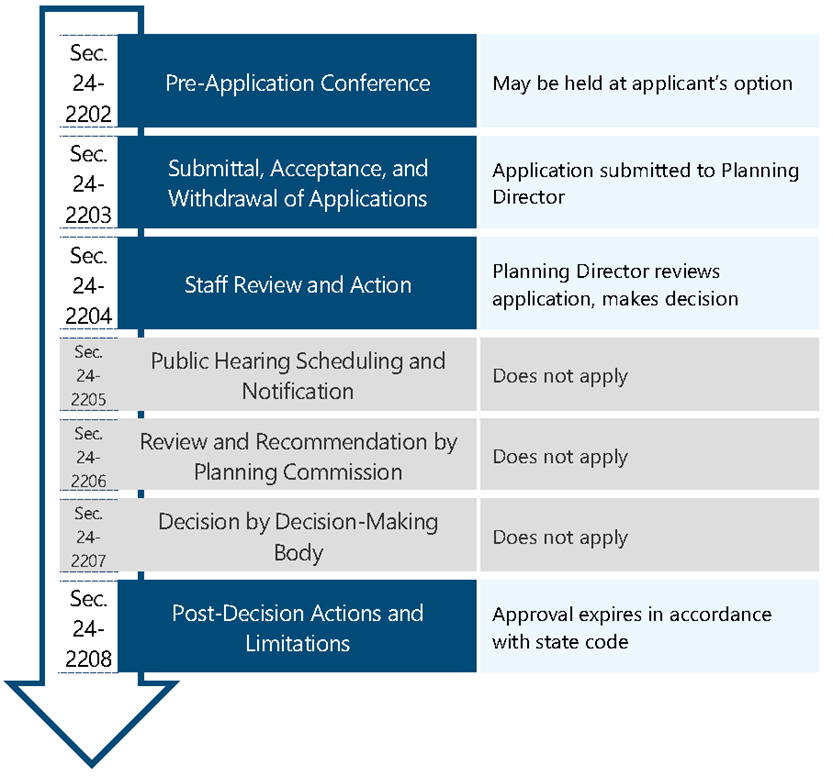
1.
Pre-Application Conference. A pre-application conference may be held at the applicant's option in accordance with Sec. 24-2202. .....
2.
Submittal, Acceptance, and Withdrawal of Applications. The common procedures in Sec. 24-2203 apply. .....
3.
Staff Review and Action. The common procedures in Sec. 24-2204 and the Plan of Development Process in Sec. 24-2314.C.3 apply. .....
4.
Notification. The common procedures in Sec. 24-2205 do not apply, except that the Planning Director may notify any person the Director deems advisable. .....
5.
Post-Decision Actions and Limitations. The common procedures in Sec. 24-2208 and the Plan of Development Process in Sec. 24-2314.C.5 apply. .....
6.
Dam Break Inundation Zone Map Update. The procedures in the Plan of Development Process in Sec. 24-2314.C.6 apply. .....
7.
Common Procedures that do not Apply. The common procedures in Sec. 24-2205, Public Hearing Scheduling and Notification; Sec. 24-2206, Review and Recommendation by Planning Commission; and Sec. 24-2207, Decision by Decision-Making Body, do not apply to site plans. .....
D.
Site Plan Decision Standards. The Planning Director must approve a site plan on finding all of the following: .....
1.
The proposed development complies with Article 3, Zoning Districts; .....
2.
The development and uses comply with Article 4, Use Regulations; .....
3.
The development proposed and its general layout and design comply with all applicable standards in Article 5, Development Standards; .....
4.
The development proposed and its general layout and design comply with all applicable standards in Chapter 19 of the County Code; and .....
5.
The development proposed is consistent with all other applicable standards of this Ordinance and the County Code. .....
(Code 2010, § 24-2315)
Sec. 24-2316. - Variance.
A.
Purpose. .....
1.
The purpose of a variance is to allow, in accordance with the Code of Virginia, reasonable deviation from those provisions of this Ordinance regulating the shape, size, or area of a lot or parcel of land, or the size, height, area, bulk, or location of a building or structure, when the strict application of this Ordinance would unreasonably restrict the utilization of the property, and such need for a variance would not be shared generally by other properties, and provided such variance is not contrary to the purposes of this Ordinance. .....
2.
The variance procedures are intended to provide a narrowly circumscribed means by which relief may be granted from unforeseen particular applications of this Ordinance that create unreasonable restrictions on the use of property. When such unreasonable restrictions may be more appropriately remedied by other provisions of this Ordinance, the variance procedure is inappropriate. .....
B.
Applicability. .....
1.
A variance may be requested when the strict application of this Ordinance would unreasonably restrict the use of the property and such need for a variance is not shared generally by other properties, and provided such variance is not contrary to the purposes of this Ordinance. It must not include a change in use, which change must be accomplished by a map amendment, a conditional zoning, or a planned development district. .....
2.
The BZA, in accordance with its authority under Code of Virginia § 15.2-2309, must grant variances from the provisions of this Ordinance only in compliance with the procedure set forth in Sec. 24-2316.C, Variance Procedure, and in accordance with Sec. 24-2316.D, Variance Decision Standards. .....
C.
Variance Procedure. This section sets forth the required procedure for variances. Figure 2316 identifies the common procedures in Article 2, Division 2, Common Procedures, that apply to variances. Additions or modifications to the common procedures are identified below: .....
Figure 2316: Variance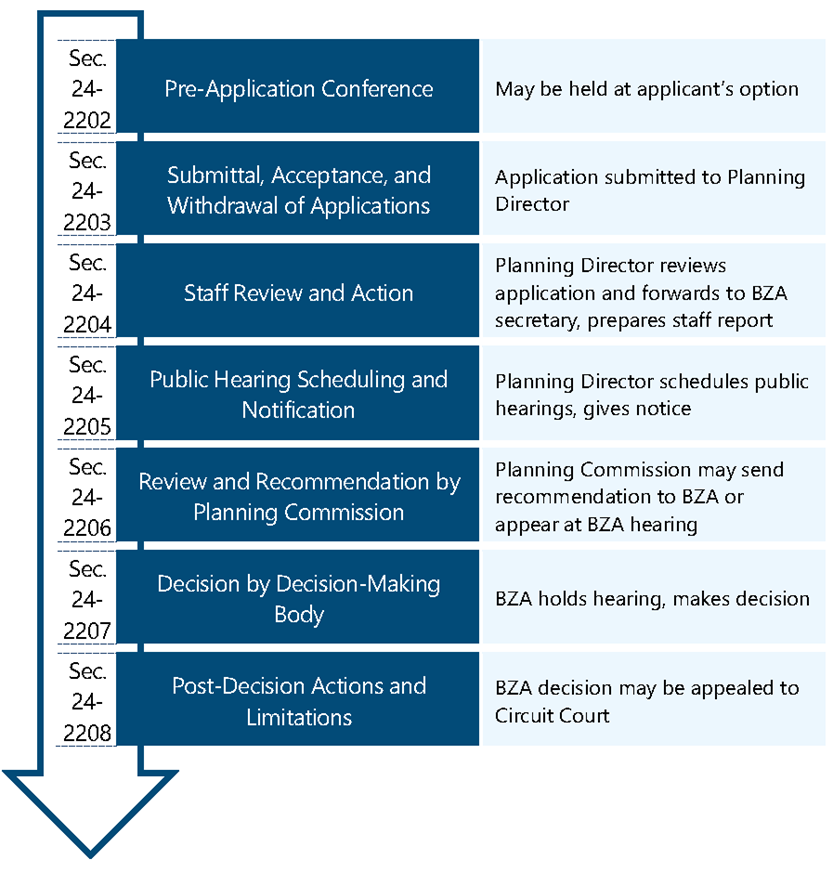
1.
Pre-Application Conference. A pre-application conference may be held at the applicant's option in accordance with Sec. 24-2202. .....
2.
Submittal, Acceptance, and Withdrawal of Applications. The common procedures in Sec. 24-2203 apply, subject to the following additions or modifications: .....
(a)
A variance application may be submitted by any property owner, tenant, or government official, department, board, or bureau. .....
(b)
The application must include satisfactory evidence that any delinquent real estate taxes owed to the County that have been assessed against the land subject to the application are paid. .....
3.
Staff Review and Action. The common procedures in Sec. 24-2204 apply, subject to the following additions or modifications: .....
(a)
The Planning Director must transmit the application to the Planning Commission and BZA, and must place the matter on the BZA's agenda. .....
(b)
The Planning Director must review the application, prepare a written staff report on the application, and transmit the staff report to the secretary of the BZA. .....
4.
Public Hearing Scheduling and Notification. The common procedures in Sec. 24-2205 apply. Any materials relating to a particular case, including a staff recommendation or report, furnished to a member of the BZA must be made available without cost to the applicant, appellant, or other person aggrieved as defined by the Code of Virginia as soon as practicable but in no event more than three business days after the materials were furnished to the BZA member. If the applicant, appellant, or other person aggrieved as defined by the Code of Virginia requests additional documents or materials be provided by the County other than those materials provided to the BZA, such request must be made in accordance with Code of Virginia § 2.2-3704. Any such materials furnished to a BZA member must also be made available for public inspection in accordance with Code of Virginia § 2.2-3707(F). .....
5.
Review and Recommendation by Planning Commission. The common procedures in Sec. 24-2206 apply. The Planning Commission may send a recommendation to the BZA or appear as a party at the public hearing held by the BZA on the proposed variance. .....
6.
Decision by Decision-Making Body. The common procedures in Sec. 24-2207 apply, subject to the following additions or modifications: .....
(a)
The BZA must review the application at a public hearing. The non-legal staff of the County may have ex parte communications with a member of the BZA prior to the hearing but may not discuss the facts or law relative to a particular case. The applicant, landowner, or the landowner's agent or attorney may have ex parte communications with a member of the BZA prior to the hearing but may not discuss the facts or law relative to the particular case. If any ex parte discussion of facts or law in fact occurs, the party engaging in such communication must inform the other party as soon as practicable and advise the other party of the substance of such communication. For purposes of this section, regardless of whether all parties participate, ex parte communications will not include: .....
(i)
Discussions as part of a public meeting; or .....
(ii)
Discussions prior to a public meeting to which County staff, the applicant, landowner or the landowner's agent or attorney are all invited. .....
(b)
At the hearing, any party may appear in person or by agent or by attorney. Following the public hearing, the BZA must make a decision on the application in accordance with Sec. 24-2316.D, Variance Decision Standards. .....
(c)
In granting a variance, the BZA may impose such conditions regarding the location, character, and other features of the proposed structure or use as it may deem necessary in the public interest and may require a financial guaranty to ensure that the conditions being imposed are being, and will continue to be, complied with. .....
(d)
The BZA may provide that any variance granted to provide a reasonable modification to a property or improvements thereon requested by, or on behalf of, a person with a disability will expire when the person benefited by it is no longer in need of the modification or improvements allowed by the variance, subject to the provisions of state and federal fair housing laws, or the Americans with Disabilities Act of 1990, as applicable. .....
(e)
The BZA must make a decision on the application within 90 days of the filing of the complete application with a quorum present and by a majority vote of the members present and voting. .....
7.
Post-Decision Actions and Limitations. The common procedures in Sec. 24-2208 apply, subject to the following additions or modifications: .....
(a)
Any person or persons jointly or severally aggrieved by a decision of the BZA, or any aggrieved taxpayer or any officer, department, board, or bureau of the County, within 30 days of the date of the final decision of the BZA, may appeal the decision of the BZA on a variance to the Circuit Court in accordance with the Code of Virginia. .....
(b)
Lands or structures for which a variance has been granted will not be considered nonconforming under this Ordinance solely because of the deviations from this Ordinance granted by the variance. However, if a structure that is permitted by a variance is expanded, the expansion must be within an area of the site or part of the structure for which no variance is required under this Ordinance, unless a variance is granted for the expansion in accordance with this section. .....
D.
Variance Decision Standards. .....
1.
General. The applicant for a variance must prove by a preponderance of the evidence that the application meets the standard for a variance set forth in Code of Virginia §§ 15.2-2201 and 15.2-2309(2): .....
(a)
In the application of the Ordinance, a reasonable deviation from those provisions regulating the shape, size, or area of a lot or parcel of land or the size, height, area, bulk, or location of a building or structure when the strict application of this Ordinance would unreasonably restrict the utilization of the property, and such need for a variance would not be shared generally by other properties, and provided such variance is not contrary to the purposes of this Ordinance; .....
(b)
It must not include a change in use, which change must be accomplished by a map amendment, a conditional zoning, or a planned development; and .....
(c)
It meets the other criteria set forth in subsection 2 below. .....
2.
Findings. A variance must be granted if a preponderance of the evidence shows that the strict application of the terms of this Ordinance would unreasonably restrict the utilization of the property, the granting of the variance would alleviate a hardship due to a physical condition relating to the property or improvements thereon at the time of the effective date of this Ordinance, or the granting of the variance would alleviate a hardship by granting a reasonable modification to a property or improvements thereon requested by, or on behalf of, a person with a disability, and the following standards are met: .....
(a)
The property interest for which the variance is requested was acquired in good faith and any hardship was not created by the applicant for the variance; .....
(b)
The granting of the variance will not be of substantial detriment to nearby property; .....
(c)
The condition or situation of the property concerned is not of so general or recurring a nature as to make reasonably practicable the formulation of a general regulation to be adopted as an amendment to this Ordinance; .....
(d)
The granting of the variance does not result in a use that is not otherwise permitted on such property or a change in the zoning district classification of the property; and .....
(e)
The relief or remedy sought by the variance application is not available through a conditional use permit procedure that is authorized in this Ordinance pursuant to Subdivision 6 of the Code of Virginia § 15.2-2309 or the process for modification of a zoning ordinance pursuant to Code of Virginia § 15.2-2286.A at the time of filing of the variance application. .....
(Code 2010, § 24-2316)
Sec. 24-2317. - Interpretation.
A.
Purpose. The purpose of this section is to establish a uniform mechanism for rendering formal written interpretations of this Ordinance. .....
B.
Applicability. The Planning Director is responsible for making, in accordance with the procedure and standards in this section, interpretations of all provisions of this Ordinance, including: .....
1.
Interpretations of the text, including standards; .....
2.
Interpretations of the zoning district boundaries; .....
3.
Interpretations of whether a proposed use meets the definition of a listed use or not, and should be allowed in a zoning district or prohibited in that district; .....
4.
Interpretations of compliance with a condition of approval, other than a condition proffered with a conditional zoning (see Sec. 24-2318, Proffer Interpretation); and .....
5.
Interpretations of whether rights have been vested, with the concurrence of the County Attorney. .....
C.
Interpretation Procedure. This section sets forth the required procedure for an interpretation. Figure 2317 identifies the common procedures in Article 2, Division 2, Common Procedures, that apply to an interpretation. References in Article 2, Division 2, Common Procedures, to "application" or "applicant" will be deemed to refer to "request for interpretation" or "person or body requesting the interpretation" respectively. Other additions or modifications to the common procedures are identified below: .....
Figure 2317: Interpretation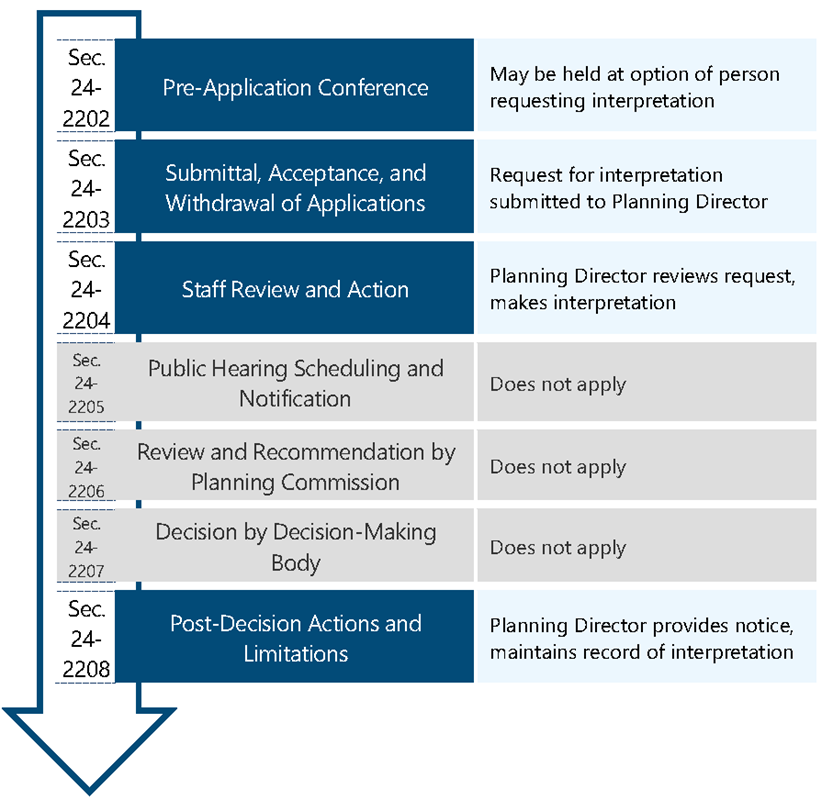
1.
Pre-Application Conference. A pre-application conference may be held at the option of the person requesting the interpretation in accordance with Sec. 24-2202. .....
2.
Submittal, Acceptance, and Withdrawal of Applications. The common procedures in Sec. 24-2203 apply. .....
3.
Staff Review and Action. The common procedures in Sec. 24-2204 apply. .....
4.
Post-Decision Actions and Limitations. The common procedures in Sec. 24-2208 apply, subject to the following additions or modifications: .....
(a)
If the request for an interpretation pertains to a specific parcel of land and the owner of that parcel of land is not the person requesting the interpretation, the Planning Director must provide notice of the interpretation to the owner of the specific parcel of land in addition to the person requesting the interpretation. .....
(b)
The Planning Director will maintain a record of written interpretations which will be available in the Planning Department for public inspection, on reasonable request, during normal business hours. .....
(c)
A use interpretation finding a particular use to be permitted as of right or as a provisional or conditional use will not authorize the establishment of such use nor the development, construction, reconstruction, alteration, or moving of any building or structure, but will merely authorize the processing of development applications for any permits or development approvals that may be required by this Ordinance, or other relevant regulations in the County Code. .....
5.
Common Procedures that do not Apply. The common procedures in Sec. 24-2205, Public Hearing Scheduling and Notification; Sec. 24-2206, Review and Recommendation by Planning Commission; and Sec. 24-2207, Decision by Decision-Making Body, do not apply to interpretations. .....
D.
Interpretation Standards. In rendering an interpretation, the Planning Director must consider the following: .....
1.
Text Provisions, General. Interpretation of the textual provisions of this Ordinance, and of their application, must be based on Article 8, Division 1, General Rules for Interpretation; Article 8, Division 3, Measurement, Calculation, and Exceptions; and on the following considerations: .....
(a)
The definitions of terms in Article 8, Definitions, and on the common and accepted usage of terms that are not defined in that Article; .....
(b)
The intended purpose of the provision indicated by relevant purpose statements, its context and consistency with surrounding and related provisions, and the comprehensive plan; and .....
(c)
The general purposes served by this Ordinance, as set forth in Sec. 24-1104, General Purpose and Intent. .....
2.
Uses not Expressly Listed. The Planning Director may interpret a particular principal use or accessory use or structure not expressly listed in the use tables in Article 4, Use Regulations, as an allowable permitted, conditional, or provisional use in a particular zoning district in accordance with Sec. 24-8407, Interpretation of Unlisted Uses. .....
3.
Zoning District Boundaries. Interpretation of zoning district boundaries on the Zoning Districts Map must be in accordance with the standards in Sec. 24-1303, Interpretation of Zoning District Boundaries, and must be consistent with the comprehensive plan. .....
4.
Conditions of Approval. Interpretation of conditions of approval of permits and development approvals approved in accordance with this Ordinance must consider the review standards for the particular permit or development approval, the record of the meeting(s) and hearing(s) where the approval was made, and other relevant parts of the record of the approval. .....
(Code 2010, § 24-2317)
Sec. 24-2318. - Proffer interpretation.
A.
Purpose. The purpose of this section is to establish a uniform mechanism for the Planning Director to interpret proffers accepted by the Board of Supervisors in approving a conditional zoning, and for appeals of such interpretations to be made to the Board of Supervisors. .....
B.
Applicability. The Planning Director is authorized to interpret, in accordance with the procedure and standards in this section, any proffer accepted by the Board of Supervisors in approving a conditional zoning. .....
C.
Proffer Interpretation Procedure. This section sets forth the required procedure for a proffer interpretation. Figure 2318 identifies the common procedures in Article 2, Division 2, Common Procedures, that apply to a proffer interpretation. References in Article 2, Division 2, Common Procedures, to "application" or "applicant" will be deemed to refer to "request for proffer interpretation" or "person or body requesting the proffer interpretation" respectively. Other additions or modifications to the common procedures are identified below: .....
Figure 2318: Proffer Interpretation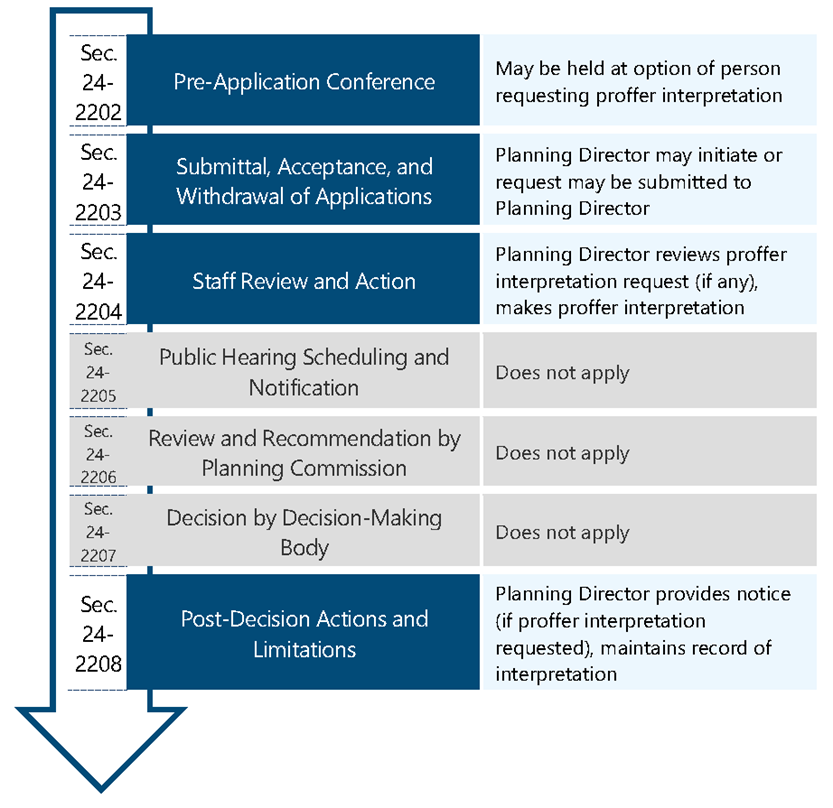
1.
Pre-Application Conference. A pre-application conference may be held at the option of a person requesting a proffer interpretation in accordance with Sec. 24-2202. .....
2.
Submittal, Acceptance, and Withdrawal of Applications. The Planning Director may initiate a proffer interpretation in connection with the enforcement of a condition of approval of a conditional zoning (see Sec. 24-2304.B.7, Post-Decision Actions and Limitations). If the Planning Director initiates a proffer interpretation, the common procedures in Sec. 24-2203 do not apply; in all other cases, the common procedures in Sec. 24-2203 apply, except a proffer interpretation request may be submitted by any of the following: .....
(a)
An owner of land in the County; .....
(b)
A person having a contractual interest in land in the County; .....
(c)
A resident of the County; or .....
(d)
An owner of a business located in the County; or .....
(e)
An authorized representative of an owner or other person identified in paragraphs (a) through (d) above. .....
3.
Staff Review and Action. The common procedures in Sec. 24-2204 apply. The Planning Director must review the condition(s) of approval and the request for a proffer interpretation, if any, and may consult with the County Attorney and any other agencies and officials the Planning Director deems appropriate. Following the Planning Director's review and any consultation, the Planning Director must make an interpretation of the proffer in accordance with Sec. 24-2318.D, Proffer Interpretation Standards. .....
4.
Post-Decision Actions and Limitations. The common procedures in Sec. 24-2208 apply, subject to the following additions or modifications: .....
(a)
The Planning Director must provide notice of the proffer interpretation to the owner of the specific parcel of land and to the person requesting the interpretation, if different from the owner. .....
(b)
Appeals of the Planning Director's proffer interpretation or enforcement of a condition of approval will be to the Board of Supervisors, in accordance with the following requirements: .....
(1)
Any person who is aggrieved by the Planning Director's proffer interpretation or act enforcing a proffer may petition the Board of Supervisors for review of such decision(s). The petition must be filed with the Planning Director and the Clerk of the Board of Supervisors within 30 days from the date of decision for which review is sought. The petition must specify the grounds upon which the petitioner is aggrieved. .....
(2)
The Planning Director must forward the petition and the justification for the decision(s) for which review is sought to the Board of Supervisors and to the aggrieved person no less than ten days prior to the next regularly scheduled meeting designated for hearing of zoning matters. Written notice of such meeting must be given to all parties as required by Code of Virginia § 15.2-2204. .....
(3)
The Board of Supervisors must review the petition and the Planning Director's justification for the decision(s) and must affirm (in whole or in part), modify (in whole or in part), or reverse (in whole or in part) the Planning Director's decision(s). Any appeal of the Board of Supervisors' decision will be to the Circuit Court in accordance with the Code of Virginia. .....
5.
Common Procedures that do not Apply. The common procedures in Sec. 24-2205, Public Hearing Scheduling and Notification; Sec. 24-2206, Review and Recommendation by Planning Commission; and Sec. 24-2207, Decision by Decision-Making Body, do not apply to this type of application. .....
D.
Proffer Interpretation Standards. In rendering a proffer interpretation, the Planning Director will consider the record of the meeting(s) and hearing(s) where the approval was made, other relevant parts of the record of the approval, any relevant considerations identified in Sec. 24-2317.D, Interpretation Standards, consistency with other standards of this Ordinance, and the Comprehensive Plan. .....
(Code 2010, § 24-2318)
Sec. 24-2319. - Administrative modification.
A.
Purpose. The purpose of this section is to establish an administrative process for the Planning Director to review and act on requests for minor deviations (modifications) from the building setback standards contained in this Ordinance, in accordance with the Code of Virginia. .....
B.
Applicability. The Planning Director is authorized to approve, approve with conditions, or disapprove administrative modifications to the standards in Table 2319: Allowed Administrative Modifications, up to the amounts specified in Table 2319 in accordance with the procedure and standards of this section. .....
Table 2319: Allowed Administrative Modifications
C.
Administrative Modification Procedure. This section sets forth the required procedure for an administrative modification. Figure 2319 identifies the common procedures in Article 2, Division 2, Common Procedures, that apply to an administrative modification. Additions or modifications to the common procedures are identified below: .....
Figure 2319: Administrative Modification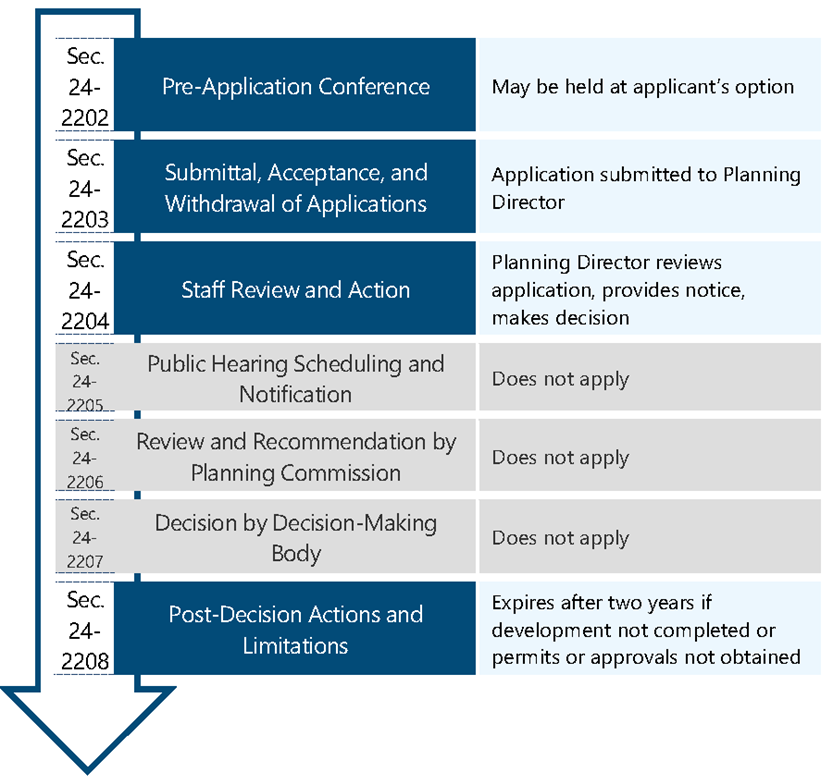
1.
Pre-Application Conference. A pre-application conference may be held at the applicant's option in accordance with Sec. 24-2202. .....
2.
Submittal, Acceptance, and Withdrawal of Applications. The common procedures in Sec. 24-2203 apply. .....
3.
Staff Review and Action. The common procedures in Sec. 24-2204 apply, subject to the following additions or modifications: .....
(a)
Prior to making a decision on the application, the Planning Director must give all owners of adjoining land written notice of the request for an administrative modification. The Planning Director must provide the owners an opportunity to respond to the request within 21 days of the date of the notice. Any such responses must be sent to the Planning Director. .....
(b)
Following the notice and response period required by paragraph (a) above, the Planning Director must review the application and any responses received and must make a decision on the application, in writing, to approve or deny the application, in accordance with Sec. 24-2319.D, Administrative Modification Decision Standards. When approving an administrative modification, the Planning Director may attach conditions of approval to ensure compliance with the purpose and intent of this ordinance. .....
4.
Post-Decision Actions and Limitations. The common procedures in Sec. 24-2208 apply, subject to the following additions or modifications: .....
(a)
The Planning Director must provide a copy of the decision to the owner of the land for which the administrative modification was requested and to any owner of adjoining land who responded in writing to the notice sent in accordance with paragraph 3(a) above. .....
(b)
Approval of an administrative modification will automatically expire if the subsequent permit or development approval (building permit or site plan, whichever is required first) required by this Ordinance is not obtained within two years from the date of approval of the administrative modification or, if no subsequent approval is required, if the development is not completed within two years, subject to the vesting provisions of the Code of Virginia. .....
5.
Common Procedures that do not Apply. The common procedures in Sec. 24-2205, Public Hearing Scheduling and Notification; Sec. 24-2206, Review and Recommendation by Planning Commission; and Sec. 24-2207, Decision by Decision-Making Body, do not apply to this type of application. .....
D.
Administrative Modification Decision Standards. The Planning Director must approve an administrative modification application if the Planning Director makes the following findings; otherwise, the Planning Director must deny the application: .....
1.
The strict application of this Ordinance would produce undue hardship; .....
2.
Such hardship is not shared generally by other properties in the same zoning district and in the same vicinity; .....
3.
The authorization of the administrative modification will not be of substantial detriment to adjacent property and the character of the zoning district will not be changed by the granting of the modification; and .....
4.
The administrative modification does not exceed the amount allowed by Table 2319. .....
(Code 2010, § 24-2319)
Sec. 24-2320. - Appeal of administrative decisions.
A.
Purpose. The purpose of this section is to establish a uniform mechanism for any person aggrieved by an interpretation or decision by the Planning Director or a decision by any other administrative officer in the County related to any part of this Ordinance, to appeal the decision or interpretation to the BZA in accordance with the Code of Virginia. .....
B.
Applicability. An appeal of a decision or interpretation under this Ordinance, other than a proffer interpretation or transfer of provisional use permit, may be made to the BZA in accordance with the procedures and standards of this section, by any person aggrieved, or any officer, department, board, or bureau of the County affected by a decision of the Planning Director or other County official in the administration or enforcement of this Ordinance. .....
C.
Appeal Procedure. This section sets forth the required procedure for an appeal of a decision or interpretation under this Ordinance, other than a proffer interpretation or transfer of provisional use permit. Figure 2320 identifies the common procedures in Article 2, Division 2, Common Procedures, that apply to appeals. Additions or modifications to the common procedures are identified below: .....
Figure 2320: Appeal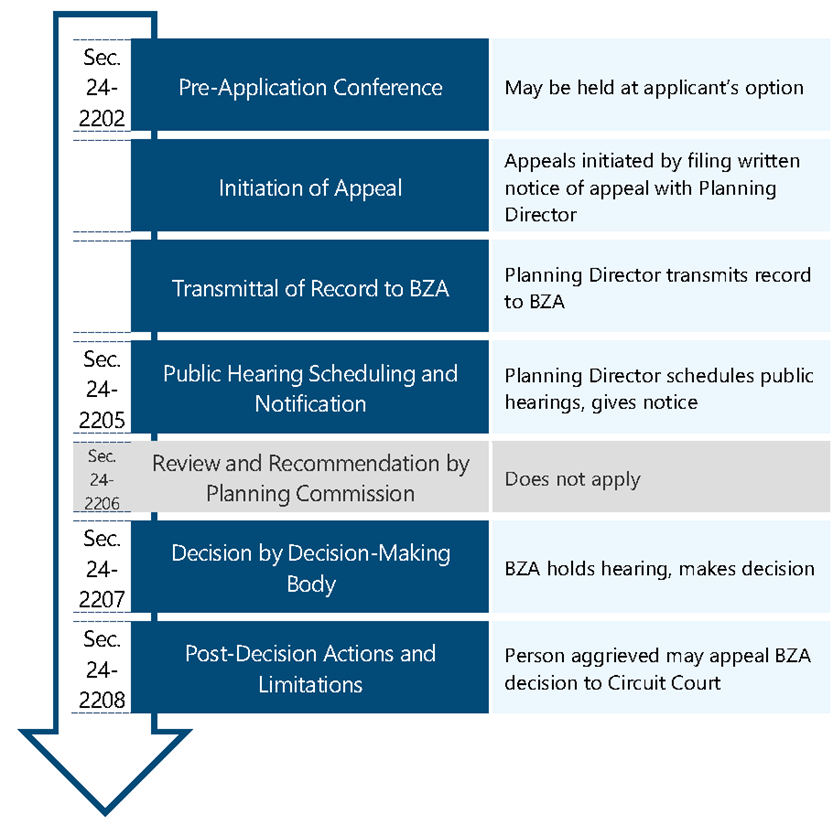
1.
Pre-Application Conference. A pre-application conference may be held at the applicant's option in accordance with Sec. 24-2202. .....
2.
Initiation of Appeal. The common procedures in Sec. 24-2203, Submittal, Acceptance, and Withdrawal of Applications, do not apply to appeals. Instead, appeals must be initiated in accordance with the following requirements: .....
(a)
An appeal of a decision or interpretation under this Ordinance, other than a proffer interpretation or transfer of a provisional use permit, may be initiated by any person aggrieved, or any officer, department, board, or bureau of the County affected, by a decision or interpretation of the Planning Director or other County official in the administration or enforcement of this Ordinance. .....
(b)
An appeal must be initiated by filing a written notice of appeal with the Planning Director and the BZA, within 30 days of the date of the decision or interpretation being appealed. The written notice of appeal must include a statement of the error or improper decision, the date of that decision, and the grounds for the appeal. .....
3.
Transmittal of Notice of Appeal and Record to BZA. The common procedures in Sec. 24-2204, Staff Review and Action, do not apply to appeals. Instead, the Planning Director must transmit to the BZA the record of material considered by the Planning Director or other County official in making the decision. .....
4.
Public Hearing Scheduling and Notification. The common procedures in Sec. 24-2205 apply, subject to the following additions or modifications: .....
(a)
Notice of the public hearing must also be provided to the applicant for the decision being appealed, if different from the appellant. If the decision being appealed pertains to a particular property, notice also must be provided to the owner of the property. .....
(b)
The non-legal staff of the County may have ex parte communications with a member of the BZA prior to the hearing but may not discuss the facts or law relative to a particular case. The applicant, landowner, or the landowner's agent or attorney may have ex parte communications with a member of the BZA prior to the hearing, but may not discuss the facts or law relative to the particular case. If any ex parte discussion of facts or law in fact occurs, the party engaging in such communication must inform the other party as soon as practicable and advise the other party of the substance of such communication. For purposes of this section, regardless of whether all parties participate, ex parte communications will not include: .....
(i)
Discussions as part of a public meeting; or .....
(ii)
Discussions prior to a public meeting to which County staff, the applicant, landowner or the landowner's agent or attorney are all invited. .....
5.
Decision by Decision-Making Body. The common procedures in Sec. 24-2207 apply, subject to the following additions or modifications: .....
(a)
The BZA must conduct a public hearing on the appeal. The public hearing must be on the record of the appeal, with presentations limited to testimony and arguments as they relate to the grounds for appeal specified in the appeal. The determination of the administrative officer will be presumed to be correct. At the hearing, the administrative officer or his representative must explain the basis for the determination after which the appellant has the burden of proof to rebut such presumption of correctness by a preponderance of the evidence. Any party may appear and speak at the hearing in person or by agent or by attorney. Following the public hearing, the BZA must affirm, modify, or reverse, in whole or in part, the decision or determination that is the subject of the appeal. The decision must be based on the BZA's judgment as to whether the administrative officer was correct. The BZA must consider any applicable ordinances, laws, and regulations in making its decision. .....
(b)
The BZA must make a decision on the appeal within 90 days of the filing of the notice of appeal with a quorum of the BZA present and by a majority vote of the BZA present and voting. .....
6.
Post-Decision Actions and Limitations. The common procedures in Sec. 24-2208.A apply. The common procedures in Sec. Sec. 24-2208.B through E do not apply. Within 30 days of the date of the final decision of the BZA, any person or persons jointly or severally aggrieved by any decision of the BZA or any aggrieved taxpayer or any officer, department, board, or bureau of the County may appeal the decision of the BZA to the Circuit Court in accordance with the Code of Virginia. .....
7.
Common Procedures that do not Apply. The common procedures in Sec. 24-2203, Submittal, Acceptance, and Withdrawal of Applications; Sec. 24-2204, Staff Review and Action; and Sec. 24-2206, Review and Recommendation by Planning Commission, do not apply to appeals. .....
D.
Appeal Decision Standards. The determination of the administrative officer will be presumed correct. The appellant has the burden of proof to rebut such presumption of correctness by a preponderance of the evidence. The BZA must consider the record on appeal and any applicable ordinances, laws, and regulations in making its decision. .....
(Code 2010, § 24-2320)

