
Henrico County Unincorporated
City Zoning Code
City Zoning Code
ARTICLE 8
- DEFINITIONS
[Sec. 24-8100. - Application.]
The rules in this division will apply for construing or interpreting the terms and provisions of this Ordinance.
[(Code 2010, ch. 24, art. 8, div. 1, intro. ¶)]
Sec. 24-8101. - Meanings and intent.
The rules in this division will apply for construing or interpreting the terms and provisions of this Ordinance. All provisions, terms, phrases, and expressions contained in this Ordinance will be interpreted in accordance with the general purposes set forth in Sec. 24-1104, General Purpose and Intent, and the specific purpose statements set forth throughout this Ordinance. When a specific section of these regulations gives a different meaning than the general definition provided in this article, the specific section's meaning and application of the term will govern.
(Code 2010, § 24-8101; Ord. No. 1335, § 78, 11-12-2024)
Sec. 24-8102. - Headings, illustrations, and text.
In the event of a conflict or inconsistency between the text of this Ordinance and any heading, caption, figure, illustration, table, or map, the text will govern. Graphics and other illustrations are provided for informational purposes only and should not be relied upon as a complete and accurate description of all applicable regulations or requirements.
(Code 2010, § 24-8102)
Sec. 24-8103. - Lists and examples.
Unless otherwise specifically indicated, lists of items or examples that use terms like "for example," "including," and "such as," or similar language are intended to provide examples and are not exhaustive lists of all possibilities.
(Code 2010, § 24-8103)
Sec. 24-8104. - Computation of time.
When a notice is required to be given, the day of such notice is given will not be counted against the time allowed, but the day on which such act is performed may be counted as part of the time. When the last day for any act to be done falls on a Saturday, Sunday or legal holiday, or any day on which county offices are closed, the act may be done on the next day that county offices are not closed. References to days are calendar days unless otherwise stated.
(Code 2010, § 24-8104)
Sec. 24-8105. - References to other regulations and publications.
Whenever reference is made to a resolution, ordinance, statute, regulation, or document, it will mean a reference to the most recent edition of such regulation, resolution, ordinance, statute, regulation, or document, unless otherwise specifically stated.
(Code 2010, § 24-8105)
Sec. 24-8106. - Delegation of authority.
Any act authorized by this Ordinance to be carried out by the Planning Director, County Engineer, or Chief of Police may be delegated by them to a professional-level County employee.
(Code 2010, § 24-8106)
Sec. 24-8107. - Public officials and agencies.
All public officials, bodies, and agencies to which references are made are those of the County of Henrico, Virginia, unless otherwise indicated.
(Code 2010, § 24-8107)
Sec. 24-8108. - Mandatory and discretionary terms.
The word "must" is mandatory, establishing an obligation or duty to comply with the particular provision. The word "may" is permissive.
(Code 2010, § 24-8108)
Sec. 24-8109. - Conjunctions.
Unless the context clearly suggests the contrary, conjunctions will be interpreted as follows:
"And" indicates that all connected items, conditions, provisions or events apply; and
"Or" indicates that one or more of the connected items, conditions, provisions, or events apply.
(Code 2010, § 24-8109)
Sec. 24-8110. - Tenses and plurals.
Unless the context clearly suggests the contrary, words used in the present tense include the future tense, the singular number includes the plural number and the plural number includes the singular number, and the masculine gender includes the feminine gender.
(Code 2010, § 24-8110)
Sec. 24-8111. - Term not defined.
If a term used in this Ordinance is not defined in this Ordinance, the Planning Director is authorized to interpret its meaning in accordance with Sec. 24-2317, Interpretation. Such interpreted meaning will be based upon the definitions used in accepted sources, including A Planners Dictionary; A Glossary of Zoning, Development, and Planning Terms; and A Survey of Zoning Definitions (all published by the American Planning Association), as well as general dictionaries such as Merriam-Webster, American Heritage, Webster's New World, and New Oxford American dictionaries.
(Code 2010, § 24-8111)
Sec. 24-8201. - Table of abbreviations.
Table 8201: Abbreviations, includes abbreviations and their corresponding terms.
Table 8201: Abbreviations
(Code 2010, § 24-8200; Ord. No. 1335, § 79, 11-12-2024)
Sec. 24-8301. - Measurement and calculation.
This division establishes the rules that generally apply for measuring and calculating to determine compliance with the standards in this Ordinance. The general rules in this division may be modified by more specific provisions elsewhere in this Ordinance.
(Code 2010, § 24-8301)
Sec. 24-8302. - Measurement of area, width, depth, and coverage of lots.
A.
Lot Area. Lot area means the total horizontal land area (in acres or square feet) within the lot lines of the lot. A lot to be used for a single-family, duplex, manufactured home, or townhouse dwelling must meet the required minimum lot area exclusive of bodies of water (lakes, ponds), submerged land (other than wetlands), and land within the special flood hazard area. For residential stem lots shown on an approved subdivision plat, the area of the access strip is not included in the calculation of lot area. .....
B.
Lot Width. .....
1.
In a One-Family Residence District, for a residential cul-de-sac lot shown on an approved subdivision plat and abutting a public street for at least 35 feet but less than 50 feet, lot width means the distance between the side lot lines along the actual front building line. Such lots must comply with the following requirements: .....
(a)
Any side lot line between two cul-de-sac lots must extend radially from the center of the circular turnaround to the point where it intersects the actual building line. .....
(b)
The actual front building line must be parallel to a chord connecting the points where the side lot lines intersect the right-of-way line. .....
(c)
The depth of the actual front building line must not vary by more than ten feet from the front building lines of the two adjoining lots. .....
(d)
The total number of cul-de-sac lots and stem lots on any street must not exceed five. .....
2.
In a One-Family Residence District, for a residential stem lot shown on an approved subdivision plat and abutting a public street for at least 20 feet but less than 50 feet, lot width means the shortest distance between the side lots lines at the actual front building line. Residential stem lots must comply with the following requirements: .....
(a)
The front of the proposed dwelling must not face the side or rear of any existing or proposed dwelling on the adjoining lots. .....
(b)
The total number of cul-de-sac lots and stem lots on any street must not exceed five. .....
3.
For any other lot, lot width means the shortest distance between the side lot lines measured at the minimum front yard setback, measured at any angle and at any point along the front setback line. .....
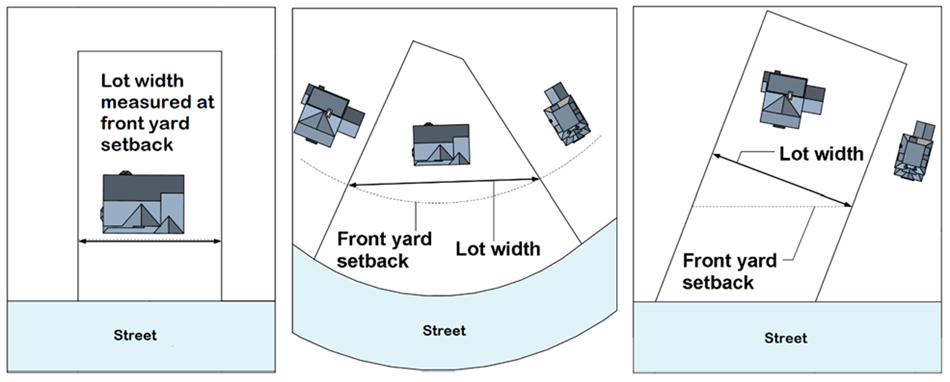
Figure 8302A: Lot width on three standard lots
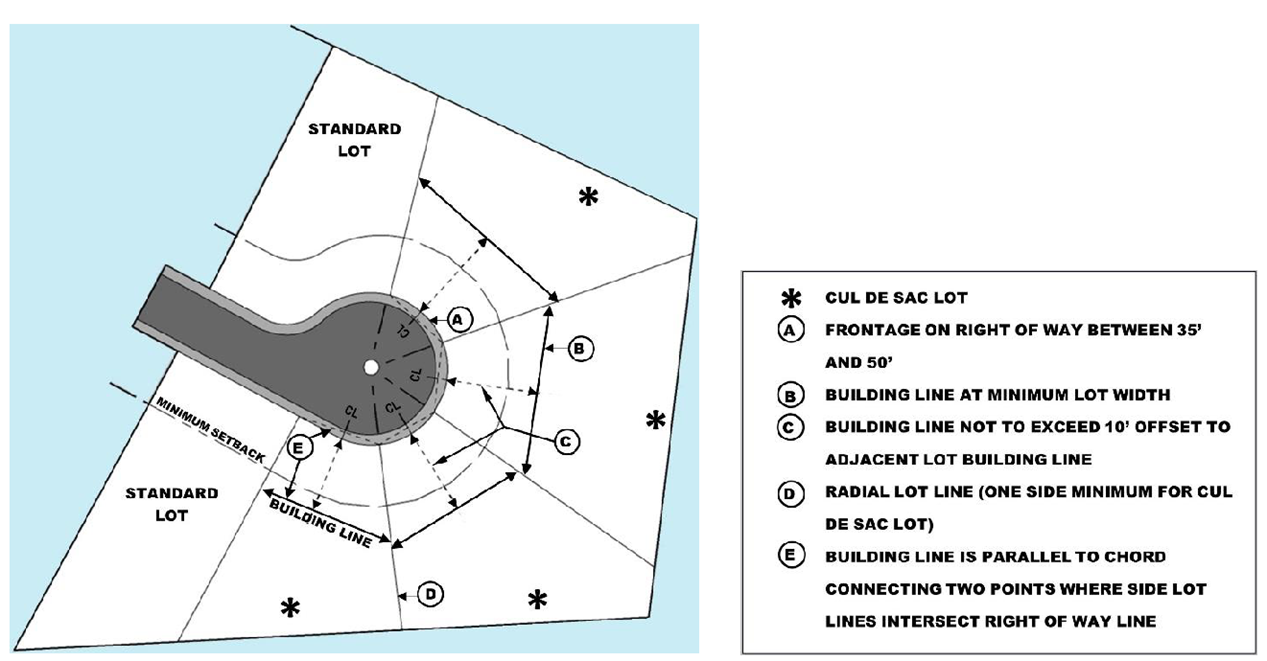
Figure 8302B: Lot width on cul-de-sac lots
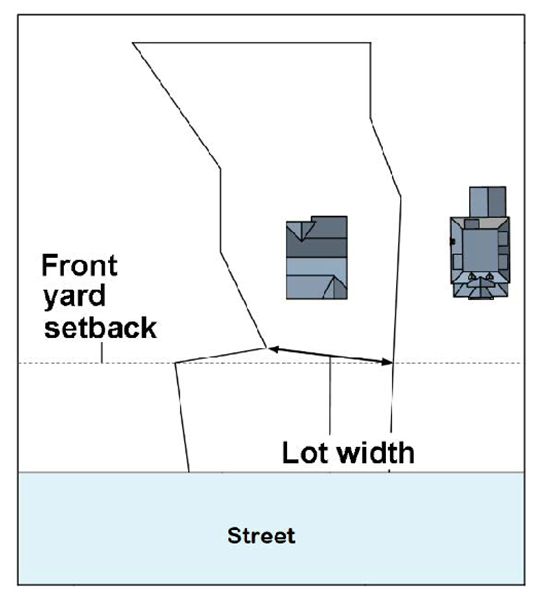
Figure 8302C: lot width on an irregular lot
C.
Lot Depth. Lot depth will be determined by calculating the mean horizontal distance between the front lot line and the rear lot line. .....
D.
Lot Coverage. Lot coverage (expressed as a percentage of lot area) is determined by measuring the total horizontal land area covered by all buildings, structures, and impervious surfaces, dividing that area by the lot area, and multiplying the result by 100. .....
(Code 2010, § 24-8302)
Sec. 24-8303. - Measurement of residential density.
Except in the interpretation of proffers, residential density means the number of dwelling units on a parcel divided by the total area of land within the boundaries of the parcel excluding public rights-of-way, bodies of water (lakes, ponds, and submerged land other than wetlands), and special flood hazard areas.
(Code 2010, § 24-8303)
Sec. 24-8304. - Measurement of floor area.
The floor area of a building will be determined by summing the gross horizontal areas of each floor of the building, measured from the exterior walls or from the centerline of party walls, but not including elevator shafts or any area used exclusively for the parking of motor vehicles.
(Code 2010, § 24-8304)
Sec. 24-8305. - Determination of front, side, and rear yards for dwellings.
Unless the Planning Director determines that specific conditions require otherwise, the following rules of measurement apply to any lot to be used for a single-family, duplex, townhouse, or manufactured home dwelling. For the purpose of this section, a controlled-access road will not be considered a public street.
A.
Front Lot Line. .....
1.
If a lot abuts one public street, the front lot line is the line separating the lot from the public street. .....
2.
If a lot abuts two public streets at their intersection, and the classification of the two streets is different (e.g., one local street and one collector road), the front lot line is the line abutting the street with the lower classification (e.g., the local street). .....
3.
If a lot abuts two public streets of the same classification at their intersection, and the subdivision plat shows a building restriction line on one street and not the other, the front lot line is the street frontage with the building restriction line; or if the subdivision plat shows a more restrictive building line on one street than the other, the front lot line is the street frontage with the more restrictive building line. .....
4.
If a lot abuts two public streets of the same classification at their intersection, and there is no building line on the subdivision plat, the front lot line is the shorter of the two. .....
5.
If a lot abuts two public streets but not at their intersection, or if a lot abuts more than two public streets, the front will be determined based on the predominant building pattern in the adjoining blocks. .....
6.
If a lot does not abut a public street, the front lot line is the line where access to the lot is provided (along or abutting a private drive or access easement). .....
B.
Side and Rear Lot Lines. .....
1.
The rear lot line is the lot line most directly opposite and farthest from the front lot line. If no lot line is clearly most directly opposite and farthest from the front lot line, two or more lot lines will be designated as rear lot lines for consistent application of rear yard setbacks abutting the rear yards of adjacent lots. However, a triangular lot may have a front lot line, two side lot lines, and no rear lot line (see Sec. 24-8307.C). .....
2.
Any public street right-of-way line other than the front lot line or rear lot line is a street side lot line. .....
3.
Any property line other than a front, street side, or rear lot line is an interior side lot line. .....
(Code 2010, § 24-8305)
Sec. 24-8306. - Determination of front, side, and rear yards for other uses.
Unless the Planning Director determines that specific conditions require otherwise, the following rules of measurement apply to any lot other than one used for a single-family, duplex, townhouse, or manufactured home dwelling:
A.
Front Lot Line. .....
1.
If a lot abuts one public street, the front lot line is the line separating the lot from the public street on which it fronts. .....
2.
If a lot abuts two or more public streets, the front lot line is the line separating the lot from the street which the primary building entrance faces, unless another front lot line is designated on an approved plan of development or site plan. .....
3.
If a lot does not abut a public street, the front lot line is the line that the primary building entrance faces, or as designated on an approved plan of development or site plan. .....
B.
Side and Rear Lot Lines. .....
1.
Any public street frontage other than the front lot line is a street side lot line. .....
2.
The rear lot line is the line most directly opposite and farthest from the front lot line, or as designated on an approved plan of development or site plan. .....
3.
Any property line other than a front, street side, or rear lot line is an interior side lot line. .....
(Code 2010, § 24-8306)
Sec. 24-8307. - General rule for measurement of front, side, and rear yards.
The depth or width of a front, street side, interior side, or rear yard means the shortest horizontal distance that extends from the reference line specified below to the nearest point of the building or use area on the lot, excluding allowable encroachments (see Sec. 24-8308, Allowable Encroachments into Required Yards). A required minimum front, street side, interior side, or rear yard consists of the area between the reference line and a line on the lot parallel to the reference line at the required minimum distance.
A.
Front Yard or Street Side Yard. The reference line for measuring a front yard or a street side yard is the existing street right-of-way line, except in the following cases: .....
1.
Where a street is designated for widening or extension on the Major Thoroughfare Plan, the reference line is the future right-of-way line as determined by the County Engineer. .....
2.
On a residential stem lot, the reference line for measuring a front yard is the lot line delineating the end of the "stem" portion of the lot (see Figure 8307A: Stem Lot Front Yard). .....
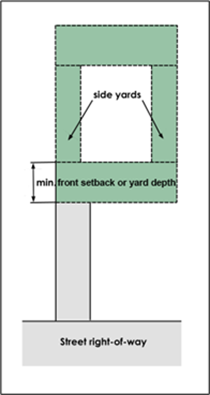
Figure 8307A: Stem lot Front Yard
3.
On a corner lot where the intersecting street right-of-way lines are defined by a radius, the reference lines for the front yard and the street side yard will not include the portion defined by the radius but will instead be extended in a straight line until they intersect. .....
B.
Interior Side Yard. The interior side lot lines of a lot are the reference lines for the interior side yards. .....
C.
Rear Yard. The rear lot line of a lot is the reference line for the rear yard on the lot, except as follows: .....
1.
On a triangular lot with a front lot line and two side lot lines but no rear lot line, the reference line is a line ten feet in length within the lot, parallel to and at the maximum distance from the front lot line (see Figure 8307B: Rear Yard on a Triangular Lot). .....
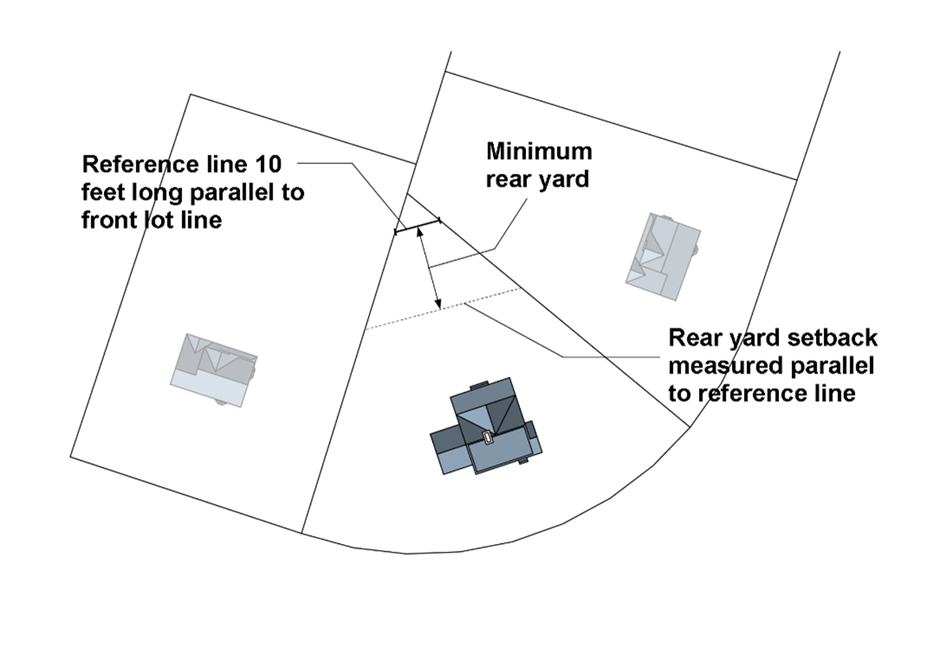
Figure 8307B: Rear Yard on Triangular Lot
2.
On a lot with five or more sides where no lot line is clearly the most directly opposite and farthest from the front lot line, each rear lot line is a reference line for the rear yard (see Figure 8307C: Rear Yard on a Five-Sided Lot). .....
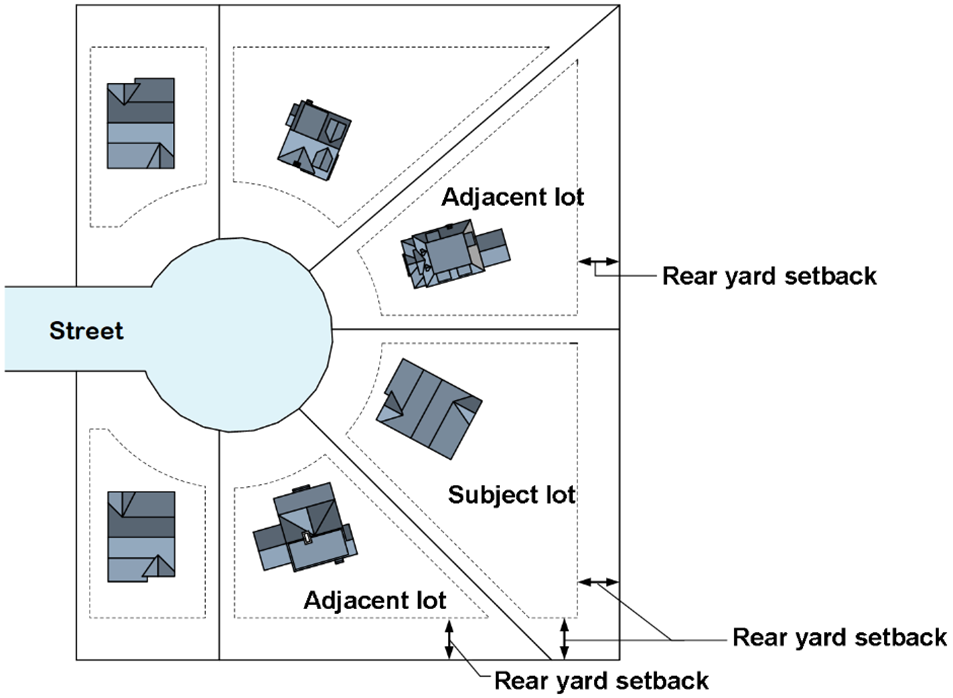
Figure 8307C: Rear Yard on a Five-Sided Lot
(Code 2010, § 24-8307)
Sec. 24-8308. - Allowable encroachments into required yards.
Every part of every required yard will remain unoccupied and unobstructed by a structure or portion of a structure from the ground to the sky, except as otherwise allowed in Table 8308: Allowable Encroachments into Required Yards, or as otherwise allowed or limited elsewhere in this Ordinance.
Table 8308: Allowable Encroachments into Required Yards
(Code 2010, § 24-8308)
Sec. 24-8309. - Measurement of height.
A.
Measurement of Building Height. The height of a building in feet generally means the vertical distance from the base reference height (see subsection C below) up to: .....
1.
The highest point of the deck of a flat roof; .....
2.
The deck line of a gambrel or mansard roof; or .....
3.
The midpoint between the eaves and the ridge for a gable, hip, cone, or shed roof (see Figure 8301B: General Building Height Measurement). Where dormers extend, in the aggregate, one-third of the length of the roof or less, they will not be considered in the measurement of building height. Where dormers extend, in the aggregate, more than one-third of the length of the roof, the height of the building will be measured up to the midpoint between the eaves of the dormers and the ridge of the roof. .....
B.
Measurement of Sign Height. The height of a sign is the vertical distance from the highest point of the sign to the greater elevation of: .....
(i)
The street grade; or .....
(ii)
The average lot grade at the front setback line. .....
C.
Measurement of the Height of Exterior Lighting. The height of exterior lighting means the vertical distance from the finished grade up to the light source. .....
D.
Measurement of the Height of Other Structures. The height of a structure other than a building, sign, or exterior lighting means the vertical distance from the average finished grade at the base of the structure up to the highest point of the structure. .....
E.
Base Reference Height. The base reference height for a building or structure is the higher of: .....
1.
The average finished grade at the front building line or the base of the structure; or .....
2.
The average established curb grade of the street directly in front of the building or structure, or from which a sign is intended to be viewed (see Figure 8309B: Base Reference Height). .....
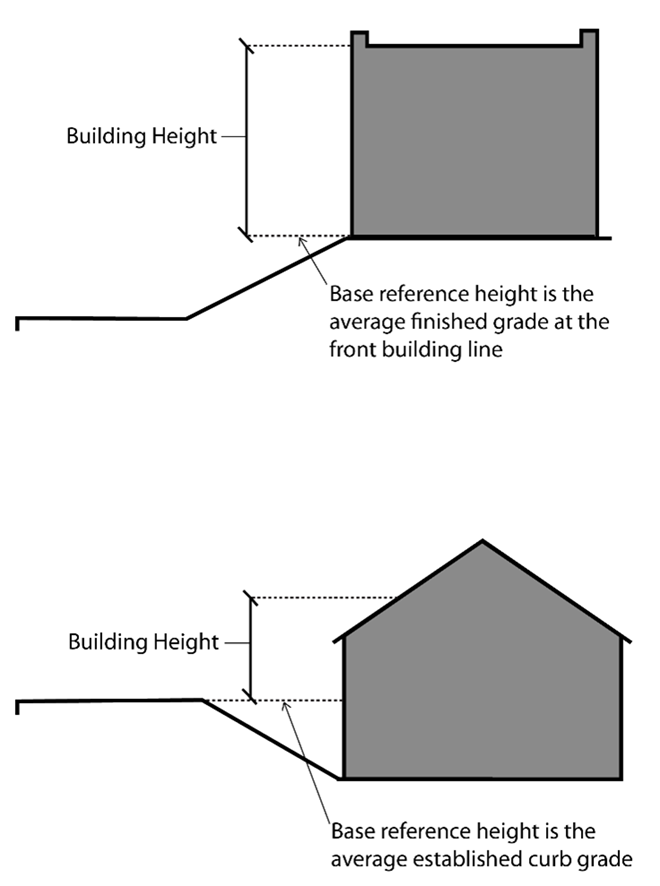
Figure 8309B: Base Reference Height
(Code 2010, § 24-8309; Ord. No. 1335, § 80, 11-12-2024)
Sec. 24-8310. - Height exceptions.
Notwithstanding the maximum height standards in Article 3: Zoning Districts, any of the following structures may have a height as listed below, or a greater height if a conditional use permit is issued for the greater height in accordance with Sec. 24-2308, Conditional Use Permit, provided the structure complies with Sec. 24-3705, AS-O Airport Safety Overlay District, and all other applicable standards in this Ordinance, including Article 4: Use Regulations, and Article 5: Development Standards:
A.
Detached and Attached Structures. The following structures may extend in height up to 50 feet in any Residential district or 100 feet in any other zoning district, unless a greater height is permitted by the base zoning district: .....
1.
Chimneys, flues, and smokestacks; .....
2.
Flagpoles; .....
3.
Belfries, towers, spires, minarets, domes, and cupolas; .....
4.
Public monuments; .....
5.
Silos and grain dryers; .....
6.
Tanks, water towers and standpipes; and .....
7.
Electric power structures and lines, derricks, or other necessary industrial, utility or public service structures, other than wireless communication towers. .....
B.
Fire, Bulkhead, and Parapet Walls. Fire, bulkhead, and parapet walls may extend up to four feet above the height limit applicable to the building. .....
C.
Mechanical Equipment. Roof-mounted mechanical equipment, such as heating, air conditioning, cooling towers, ventilating shafts, elevator penthouses, stair towers, solar collector panels, lighting, and similar equipment for the operation and maintenance of the building and any associated screening, when not exceeding 25 percent of the roof area, may exceed the height limit applicable to the building by 10 percent. .....
(Code 2010, § 24-8310)
Sec. 24-8311. - Measurement of sign area.
A.
Area Included in Measurement. .....
1.
For a detached sign, the sign area includes all of the sign, including the background of the display. The supports, uprights, or structure on which a detached sign is supported are not included in determining the sign area unless they form an integral part of the display. .....
2.
For an attached sign, the sign area includes all of the sign and that portion of the structure that forms the background of the display. .....
B.
Calculation of Sign Area. .....
1.
For a sign in the shape of a regular polygon or circle, the area will be calculated by the mathematical formula for area of that polygon or circle. For a sign not in the shape of a regular polygon or circle, the sign area will be calculated based on a maximum of six abutting or overlapping rectangles that enclose the sign. .....
2.
For a sign with two parallel faces not more than 24 inches apart, or two faces attached in a V-shape with an interior angle not exceeding 90 degrees, only one side will be included in the calculation of sign area. If one face is larger than the other, the larger face will be used. .....
3.
For a sign consisting of three vertical faces attached in the shape of a triangle, the largest two faces will be included in the calculation of sign area. .....
4.
For an attached sign that projects four inches or more from the wall to which it is attached, the sign area will also include the area of the visible sides of the sign, calculated as a rectangle enclosing each entire side view. .....
5.
For a cylindrical sign, the sign area will be calculated by multiplying one-half of its circumference by its height. .....
6.
Where the allowed sign area is based on the length of a building, the building length will be the longest dimension parallel to one wall. For a building divided into multiple tenant spaces, the length of the building will be the sum of the lengths of the longest exterior wall of each tenant space. .....
(Code 2010, § 24-8311)
Sec. 24-8401. - Principal use classification system.
A.
Purpose. This division is intended to provide a systematic framework for identifying, describing, categorizing, consolidating, and distinguishing land uses in a way that makes it easier to determine whether a particular use, activity, or combination of activities should be considered a form or example of a use listed as an allowable principal use in Article 4, Division 2, Principal Use Table, or is subject to other use-specific provisions in this Ordinance. This division is also intended to guide interpretations of how a particular unlisted use should be categorized and to address future additions to the use table. .....
B.
Structure of Principal Use Classification System. The three-tiered hierarchy of use classifications, use categories, and use types described in this subsection is used to organize allowable uses listed in Article 4, Division 2, Principal Use Table, and the use-specific standards set out in Article 4, Division 3, Standards for Specific Principal Uses. .....
1.
Use Classifications. Use Classifications are very broad and general (e.g., Agricultural, Residential, Institutional, Commercial, and Industrial). .....
2.
Use Categories. Use categories represent major subgroups of the use classifications that have common functional, product, or physical characteristics, such as the type and amount of activity; type of occupants, users, or customers; or operational characteristics. For example, the Commercial Use Classification is divided into multiple use categories, like "Eating Establishments" and "Offices." Each use category is described in terms of the common characteristics of included use types (including common or typical accessory uses), examples of common use types included in the category, and, for a number of use categories, exceptions, i.e., those uses that might appear to fall within the use category but are included in another use category. .....
3.
Use Types. Use types identify specific principal land uses whose characteristics are considered to fall within the various use categories. For example, "Hospital" and "Nursing home" are use types within the "Health Care Facilities" Use Category. Certain use types are defined in Sec. 24-8402 through Sec. 24-8406 below. .....
(Code 2010, § 24-8401)
Sec. 24-8402. - Agricultural use classification.
A.
Horticulture. The Horticulture use category is characterized by the cultivation and production of orchard, garden, nursery, or field grown crops, specialty crops, flowers, fruit, grapes, market gardening, nursery stock, nuts, ornamental plants, sod, vegetables, and similar plant-based products. The use category also includes agronomy, demonstration farms, honey production, vermiculture, and similar uses. Accessory uses may include offices, storage areas and repair facilities related to agriculture uses. .....
B.
Animal Husbandry. The Animal Husbandry use category encompasses the propagation, rearing, exercising, feeding, milking, housing, controlling, handling, or general care of living animals, including the raising and production of bison, cattle (beef and dairy), pigs, mules, emus, horses, goats, llama, poultry, sheep, aquaculture, fisheries, and similar animal husbandry uses. .....
C.
Agriculture Support and Services (Directly-Related). The Agriculture Support (Directly-Related) use category includes use types that provide support and services to agricultural, horticultural and animal husbandry activities, which are limited to and that operate in conjunction with and on the site of ongoing horticultural or animal husbandry uses. Examples of agricultural support and services (directly-related) use types include agri-education, agricultural processing, equestrian facility, farmer's market, production nursery, and produce market. .....
Agri-education. A facility for the investigation, testing, or demonstration of, or for training or educating persons in, products and processes related to agriculture, horticulture, or animal husbandry, including veterinary, soil, plant, and animal sciences.
Agricultural processing. Processing operations for agricultural products, including meat preparation; feed mills; dairy processing; timber processing; and fruit and vegetable packing, sorting, and grading.
Equestrian facility. A facility designed and intended for the keeping or boarding of horses; or teaching and display of equestrian skills, including show jumping and dressage; and the hosting of events, competitions, exhibitions, or other displays of equestrian skills. Accessory uses include the caring for, breeding, boarding, dealing, selling, renting, riding, or training of equines. It includes barns, stables, rings, paddocks, or other related accessory structures.
Farm or limited production of food and beverages. The manufacture of food and beverages, including a farm winery, limited brewery, or limited distillery.
Farm winery. A business licensed by the Commonwealth as a farm winery under title 4.1 of the Code of Virginia.
Limited brewery. A business licensed by the Commonwealth to manufacture no more than 15,000 barrels of beer per calendar year, provided:
(i)
The brewery is located on a farm in the Commonwealth on land zoned agricultural and owned or leased by such brewery or its owner; and .....
(ii)
Agricultural products, including barley, other grains, hops, or fruit, used by such brewery in the manufacture of its beer are grown on the farm. .....
Limited distillery. A business licensed by the Commonwealth to manufacture no more than 36,000 gallons of alcoholic beverages other than wine or beer per calendar year, provided:
(i)
The distillery is located on a farm in the Commonwealth on land zoned agricultural and owned or leased by such distillery or its owner; and .....
(ii)
Agricultural products used by such distillery in the manufacture of its alcoholic beverages are grown on the farm. .....
Nursery, production. The growing, storage, and sale of garden plants, shrubs, trees, vines, groundcovers, and other related landscaping materials for resale, typically occurring as wholesale or retail sales directly to landscaping professionals. Such uses may include limited incidental retail sales to members of the general public. Such uses may include greenhouses; outdoor storage of goods, materials, and equipment; irrigation systems; and caretaker's dwelling.
Produce market. An establishment engaged in the retail sales of horticultural or agricultural products, including nursery stock, perennials, annuals, bulbs, mulch, compost, dried flowers, Christmas trees and greens, fresh produce, honey, cider, and similar agricultural products, all or part of which are produced on site.
D.
Agriculture Support and Services (Not Directly Related). The Agriculture Support and Services (Not Directly Related) use category includes use types that provide support and services to off-site agricultural, horticultural, and animal husbandry activities and that are not directly related to ongoing agricultural, horticultural, or animal husbandry uses on the same property. .....
Agricultural research facility. A facility for the investigation, testing, and demonstration of agricultural products and processes, including veterinary, soil, plant, and animal sciences.
Distribution hub for agricultural products. A place where farmers can deliver agricultural products for pick-up by consumers or wholesalers. This definition does not include such industrial uses as trucking operation, stockyard, auction house, slaughterhouse, or cannery or other processing facility.
Farm machinery sales, rental, and service. An establishment for the sale, rental, or service of equipment normally or routinely used on farms and gardens, and related parts, tools and accessories, but not of non-farm equipment or materials.
Stockyard or Slaughterhouse. A facility where livestock is confined and butchered.
E.
Silviculture. The development and maintenance of a forest or woodland area under a forest management plan. Included are establishments engaged in the operation of timber tracts, tree farms, forest nurseries, the gathering of forest products or other silvicultural activities, including the harvesting of timber, the construction of roads and trails for forest management purposes, and the preparation of property for reforestation that are conducted in accordance with the silvicultural best management practices developed and enforced by the state forester under Code of Virginia § 10.1-1105, and are located on property defined as real estate devoted to forest use under Code of Virginia § 58.1-3230. .....
(Code 2010, § 24-8402)
Sec. 24-8403. - Residential use classification.
A.
Household Living. The Household Living use category includes use types providing for the residential occupancy of a dwelling unit by a single household. Tenancy is generally arranged on a month-to-month or longer basis. Use types include duplex dwelling, live/work dwelling, manufactured home dwelling, multifamily dwelling, single-family attached dwelling, single-family detached dwelling, townhouse dwelling, and upper story dwelling. Group homes meeting the definition in Article 8, Division 5, General Definitions, are considered residential occupancy by a single household under this Ordinance in accordance with § 15.2-2291 of the Code of Virginia. The Household Living use category does not include residential use types that generally involve some level of managed personal care for a larger number of residents (i.e., assisted living facilities), which are categorized as Group Living Use category. Accessory uses common to Household Living Uses include recreational activities, gardening, raising of domestic pets, hobbies, swimming pools, and parking of the occupants' vehicles. Some accessory uses (i.e., home occupations and accessory dwelling units) are subject to additional regulations. .....
Dwelling, duplex. A building or structure, other than an upper story dwelling, that contains exactly two dwelling units and is situated on and serves as the principal use for a lot or premises.
Dwelling, live/work. A structure or portion of a structure combining a residential dwelling unit with an integrated workspace principally used by one or more of the dwelling unit residents.
Dwelling, manufactured home. A dwelling unit fabricated in an off-site manufacturing facility for installation at the building site, bearing a seal certifying that it was built in compliance with the Federal Manufactured Home Construction and Safety Standards Act of 1974, as amended.
Dwelling, multifamily. A building or buildings, other than a townhouse or upper story dwelling, that contains three or more dwelling units. Units may be located side by side in a horizontal configuration, stacked one above the other in a vertical configuration and sharing common vertical walls or horizontal floors and ceilings, or constructed as separate structures on a single lot. Multifamily dwellings include what are commonly called apartments or condominium units.
Dwelling, single-family attached. One of two dwelling units, each having a separate entrance and situated on a separate lot, with each dwelling unit separated from the other by a party wall or exterior wall located on the common lot line.
Dwelling, single-family detached. A building, other than a manufactured home or upper story dwelling, that contains exactly one dwelling unit, is not physically attached to any other principal structure, and is situated on and serves as the principal use for a lot or premises. Manufactured home dwellings, travel trailers, housing mounted on self-propelled or drawn vehicles, tents, or other forms of temporary housing or portable housing do not constitute a single-family detached dwelling.
Dwelling, townhouse. A structure, other than an upper story dwelling, containing three or more dwelling units that are separated from one another by party walls extending at least from the lowest floor to roof and having no doors, windows, or other provisions for human passage or visibility between the party walls, with each dwelling unit located on an individual lot and having an individual entry.
Dwelling, upper story. A building containing one or more dwelling units and having only nonresidential uses, including Eating Establishments, Offices, and Retail Sales and Services uses, on its street level.
Group home. A residential facility in which no more than eight individuals with mental illness, intellectual disability, or developmental disabilities reside, with one or more resident or nonresident staff persons, for which the Virginia Department of Behavioral Health and Developmental Services is the licensing authority under the Code of Virginia; or a residential facility in which no more than eight aged, infirm, or disabled persons reside, with one or more resident counselors or other staff persons, for which the Virginia Department of Social Services is the licensing authority under the Code of Virginia.
B.
Group Living. The Group Living use category includes use types providing for the residential occupancy of a group of living units by persons who typically do not constitute a single household and who may receive some level of personal care. Individual living units often consist of a single room or group of rooms without cooking and eating facilities and are generally occupied on a monthly or longer basis. Use types include boardinghouse, children's residential facility, and dormitory. This use category does not include use types where persons generally occupy living units for periods of less than 30 days (i.e., hotels or motels), which are categorized as Visitor Accommodations use category. It also does not include use types where residents or inpatients are routinely provided health care services (i.e., nursing homes), which are categorized in the Health Care Facilities use category. Accessory uses common to group living use include recreational facilities, administrative offices, and food preparation and dining facilities. .....
Boardinghouse. A dwelling occupied by eight or fewer residents not meeting the limitations for a household in Section 24-4306, Residential Uses: Household Living. This does not include any use in the Visitor Accommodations use category.
Children's residential facility. Has the meaning provided in Code of Virginia § 63.2-100.
Dormitory. A building used for lodging by students and other individuals affiliated with an educational institution providing secondary or post-secondary education. It may include facilities for dining for the residents, employees, and guests of the residents, as well as indoor and outdoor athletic facilities.
Group home. A congregate service licensed by the Commonwealth of Virginia to provide 24-hour supervision in a community-based home having eight or fewer residents. Services include supervision, support, counseling, and training in activities of daily living based on an individualized services plan, in accordance with Title 12, Agency 35, Chapter 105 of the Virginia Administrative Code.
(Code 2010, § 24-8403; Ord. No. 1335, § 81, 11-12-2024)
Sec. 24-8404. - Public, civic, and institutional use classification.
A.
Community Services. The Community Service use category includes use types of a public, nonprofit, or charitable nature providing a local service directly to people of the community. Generally, such uses provide ongoing continued service on site or have employees at the site on a regular basis. The uses may provide special counseling, education, or training of a public, nonprofit, or charitable nature. Use types include auditorium, conference, or convention center; club or lodge; community center; cultural facility; public recreation facility; religious institution; and radio or television station. This use category does not include uses with a residential component, private health clubs (categorized in the Recreation and Entertainment Uses category), or counseling in an office setting (categorized in the Office Use category). Accessory uses may include offices, meeting areas, food preparation and dining areas, parking, health and therapy areas, and recreation and athletic facilities. .....
Auditorium, conference, and convention center. A facility principally used to host community, business, and professional conferences, seminars, training programs, exhibitions, presentations, and similar events and which may include indoor halls and seating areas, food preparation and dining areas, reception centers, and meeting areas. This use does not include religious institutions, theaters, or arenas, amphitheaters, or stadiums.
Club or lodge. A building and related facilities owned and operated by a corporation, association, or group of individuals established for fraternal, social, educational, recreational, or cultural enrichment of its members and primarily not for profit, and whose members meet certain prescribed qualifications for membership and pay dues.
Community center. A facility within a residential development that is designed and incorporated into the development to provide social and recreational opportunities for the residents of the development; or a facility operated by a nonprofit entity to provide social or recreational programs to members and their guests. Community centers may include clubhouses, swimming pools, tennis courts, boating clubs, country clubs, and similar facilities. This does not include golf courses, which are in the Outdoor Recreation and Entertainment use category.
Cultural facility. A facility for storing, using, loaning, and occasionally selling literary, historical, scientific, musical, artistic, or other reference materials (i.e., a private library), or for displaying or preserving objects of interest or providing facilities for one or more of the arts or sciences to the public (i.e., museum). Accessory uses include offices and storage facilities used by staff and meeting rooms.
Donation center. A building or designated area where donated goods are dropped off for resale or reuse by a charitable organization.
Public recreation facility. A building operated by a government entity to provide social or recreational programs to the public and which may be designed to accommodate and serve significant segments of the community. Examples include aquatic facilities, gymnasiums and fitness centers, and senior centers.
Radio or television station. A building or portion of a building used as a place to stage, record, and broadcast content for radio, television, or other broadcast media.
Religious institution. A building, or portion thereof, maintained and controlled by a religious organization and used for religious services, where individuals regularly assemble to conduct religious worship, ceremonies, rituals, and related education. Religious institutions include chapels, churches, mosques, shrines, synagogues, tabernacles, temples, and other similar religious places of assembly. Accessory uses may include administrative offices, classrooms, meeting rooms, schools, day care facilities, cooking and eating facilities, other accessory uses customary to the operation of a religious institution, or a dwelling for persons who regularly participate in the operation of the institution. Religious institutions may also include housing for the religious community, such as a convent or monastery, typically used by nuns, priests, monks, or other similar religious persons.
B.
Day Care. The Day Care use category includes use types providing nonmedical care during working hours. Use types include adult day care center, child care center, and similar use types. .....
Adult day care center. A facility that provides supplementary care and protection during only a part of the day to four or more aged, infirm, or disabled adults who reside elsewhere. This does not include services provided within the home of the provider.
Child care center. A facility for a regularly operating service arrangement for children where, for compensation and during the absence of a parent or guardian, a person or organization provides care to one or more children for less than a 24-hour period. This does not include a family day home or child care services provided by a school or religious institution, in the home of the provider, or in the home of any of the children in care.
C.
Educational Facilities. The Educational Facilities use category includes use types such as public schools and private schools (including charter schools) at the elementary, middle, and high school level that provide state-mandated basic education or a comparable equivalent. This use category also includes colleges, universities, and other institutions of higher learning, such as vocational or trade schools that offer courses of general or specialized study leading to a degree or certification. Accessory uses at schools may include offices, play areas, recreational and sport facilities, cafeterias, auditoriums, and before- or after-school day care. Accessory uses at colleges or universities may include offices, dormitories, food service, laboratories, health care facilities, recreational and sports facilities, theaters, meeting areas, maintenance facilities, and supporting commercial uses (i.e., eating establishments or bookstores). .....
College or university. An institution offering a program of post-secondary education and instruction leading to associate, baccalaureate, or higher degrees, that is accredited by a national association of colleges and universities.
School, elementary or secondary. An educational institution that offers a program of instruction for any grade level or combination of grade levels kindergarten through 12th grade meeting Commonwealth requirements for a school. Such uses include classrooms, laboratories, auditoriums, libraries, cafeterias, after-school care, athletic facilities, and other facilities that further the educational mission of the institution.
Vocational or trade school. A public or private school that offers vocational or trade instruction, such as teaching of trade or industrial skills, clerical or data processing, barbering or hair dressing, computer or electronic technology, or artistic skills, to students that operates in buildings or structures or on premises on land leased or owned by the educational institution, and that meets the State requirements for a vocational training facility.
D.
Funeral and Mortuary Services. The Funeral and Mortuary Services use category includes establishments that provide services related to the death of a human being or an animal. .....
Crematory. A facility primarily used for the reduction of dead bodies to ashes by fire.
Funeral home. An establishment used primarily for human funeral services, which may or may not include facilities on the premises for embalming, performance of autopsies or other surgical procedures, or cremation.
E.
Government Facilities. The Government Facilities use category includes use types that provide for the general operations and functions of local, state, or federal governments. Use types include government maintenance, storage, or distribution facility; government office; facilities providing public safety services to the general public; and similar use types. Accessory uses may include maintenance, storage (indoor and outdoor), fueling facilities, satellite offices, and parking areas. .....
Correctional facility. A federal or state facility for the detention and housing of persons awaiting trial or persons serving a sentence after being found guilty of a criminal offense. Such uses may include cafeterias, housing for facility staff, outdoor storage and maintenance areas, recreational areas, agricultural facilities, and facilities for the production of goods or materials produced for sale.
Government maintenance, storage, or distribution facility. A facility housing government shops, maintenance and repair centers, equipment, and outdoor storage yards. This use includes a bus depot.
Government office. An office of a governmental agency that provides administrative support or direct services to the public, such as county administration building, public library, post office, employment office, public assistance office, or motor vehicle licensing and registration services office.
Police, fire, or EMS facility. A facility for the provision of:
(1)
Local police services, including sheriff's department facilities and County courthouse and jail, or .....
(2)
Rapid response emergency services, such as firefighting and mobile emergency medical services, including areas for the storage and maintenance of emergency vehicles, and equipment and facilities for the housing and feeding of emergency personnel while on duty. .....
F.
Health Care Facilities. The Health Care Facilities use category includes use types providing a variety of health care services, including surgical or other intensive care and treatment, various types of medical treatment, nursing care, preventative care, diagnostic and laboratory services, and physical therapy. Health care services may be provided on an inpatient or outpatient basis, or routinely to residents of the facility. Use types include assisted living facility, continuing care retirement community, hospice facility, hospital, medical treatment facility, and nursing home. This use category does not include group homes which focus primarily on providing personal care rather than medical care to residents. Accessory uses may include food preparation and dining facilities, recreation areas, offices, meeting rooms, teaching facilities, memory care facilities, hospices, maintenance facilities, staff residences, and limited accommodations for members of patients' families. .....
Assisted living facility. Has the meaning provided in Code of Virginia § 63.2-100.
Continuing care retirement community. An integrated development that offers persons over 55 years of age a full continuum of housing options and assistance, ranging from fully independent dwelling units, to assistance with personal care in assisted living facilities, to long-term skilled nursing care in a nursing home. The residential opportunities may include dwelling units, living units, and lodging units, as well as nursing home beds. Services provided may range from food services, health and beauty services, recreational and social opportunities, to skilled nursing care and medical services.
Hospice facility. Has the meaning provided in Code of Virginia § 32.1-162.1.
Hospital. Has the meaning provided in Code of Virginia § 32.1-123. A facility other than a group home offering inpatient treatment for substance abuse disorders, eating disorders, or other similar conditions will be allowed in the same districts as a hospital and with the same parking requirement but are not subject to the use-specific standards of Sec. 24-4311C.
Medical treatment facility. A facility other than a hospital or medical or dental office where medical services are provided to individuals on an outpatient basis. Examples of medical treatment facilities include urgent care centers, dialysis centers, drug or alcohol treatment facilities, blood or tissue collection facilities, and diagnostic and laboratory services.
Nursing home. Has the meaning provided in Code of Virginia § 32.1-123.
G.
Parks and Open Areas. The Parks and Open Areas use category includes use types focusing on open space areas largely devoted to natural or curated landscaping and outdoor recreation and tending to have no or few structures. Use types include cemetery, community garden, public park, and similar uses. This use category does not include golf courses, golf driving ranges, or other primarily outdoor recreational uses (categorized in the Recreation and Entertainment (Outdoor) use category). Accessory uses may include caretaker's quarters, clubhouses, recreational structures, statuary, fountains, maintenance facilities, concessions, parking, and columbaria and mausoleums (as accessory to cemeteries). .....
Cemetery. A place where lots are sold for burial or internment of the dead and which may include columbaria and mausoleums but not crematories. This use does not include family graveyards where graves and entombment rights are not sold or offered for sale to the public.
Community garden. A private or public facility for cultivation of fruits, flowers, vegetables, or ornamental plants by more than one person, household, family, or organization for personal or group use, consumption, or donation. Community gardens may be divided into separate plots for cultivation by one or more individuals or may be farmed collectively by members of the group and may include common areas maintained and used by group members.
Public park. Land maintained and made available to the general public for recreation, exercise, sports, education, rehabilitation, or similar activities, or to enhance the enjoyment of natural features or natural beauty. Public parks may include athletic fields; open areas; playgrounds; dog parks; walking trails; outdoor marine recreation areas, such as beaches and fishing areas; and similar areas. This definition does not include community centers or amusement parks, commercial golf courses, or other uses in the Outdoor Recreation and Entertainment use category.
Parks and open areas not specified elsewhere. Land, other than public parks, maintained, not for profit, as a programmed open space area largely devoted to natural or curated landscaping and outdoor recreation. Examples include arboretums, botanical gardens, greenways, athletic fields, and similar uses. This definition does not include community centers or amusement parks, golf courses, or other uses in the Outdoor Recreation and Entertainment use category.
H.
Transportation. The Transportation use category includes use types providing for the landing and takeoff of airplanes and helicopters, including loading and unloading areas and associated aircraft sales, repair, fuel sales, and flight instruction uses. It also includes passenger terminals for surface transportation. Accessory uses may include freight handling areas, concessions, offices, maintenance, limited storage, and fueling facilities. Use types include airport, helicopter landing facility, passenger terminal, surface transportation, and similar uses. This use category does not include small transit-related infrastructure such as bus stops and bus shelters (deemed minor utilities under the Utilities Use category). .....
Airport. A place licensed or approved for aircraft to take off or land, discharge or receive cargo or passengers, be repaired or serviced, take on fuel, or be stored. The term includes landing areas, runways, and other facilities designed, used, or intended to be used for the landing or taking off of aircraft, including taxiways, aircraft storage and tie-down areas, hangars, and other necessary buildings and open spaces, as well as terminals, parking facilities, and passenger loading and unloading areas. Accessory uses include offices, eating establishments, convenience and gift shops, and similar uses.
Helicopter landing facility. An area, either at ground level or elevated on a structure, licensed or approved for the landing and takeoff of helicopters and which may include auxiliary facilities, such as parking, waiting rooms, and fueling and maintenance equipment.
Passenger terminal, surface transportation. Any structure or transit facility that is primarily used as part of a transit system for the purpose of loading, unloading, or transferring of passengers or accommodating the movement of passengers from one mode of transportation to another. This does not include bus stops and bus shelters, which are classified under the use type "Utility, minor."
I.
Utilities. The Utilities use category includes both major utilities, which are infrastructure services that provide regional or community-wide service, and minor utilities, which are infrastructure services that need to be located in or near where the service is provided. Large-scale solar arrays and large-scale wind energy facilities that constitute a principal use of a lot are included as a special type of major utility use. Services may be publicly or privately provided and may include on-site personnel. Accessory uses may include offices, monitoring, or storage areas. .....
Solar array. A facility consisting of solar panels, modules, and related equipment (e.g., heat exchanger, pipes, inverter, wiring, and storage) that collects solar energy and converts it into electricity or transfers it as heat to a carrier fluid for use in hot water heating or space heating and cooling. As a principal use, a solar array is designed to meet demands for a large area and is typically mounted on the ground.
Utility, major. A structure or facility that is a relatively important component central to the functioning of an infrastructure system that provides community- or region-wide utility services. Examples of major utility facilities include potable water treatment plants, water towers, wastewater treatment plants, solid waste facilities, gas compressor stations, energy storage facilities, and electrical substations serving a community- or region-wide area.
Utility, minor. A structure or facility that, by itself, is a relatively small component peripheral to the functioning of an infrastructure system that provides community- or region-wide utility services and that needs to be in or near the neighborhood or use type where the service is provided. Examples of minor utility facilities include water and sewage pump stations, stormwater retention and detention facilities, telephone local exchanges, electric transformers, bus stops and shelters, and electrical substations serving a specific use or project.
Wind energy facility, large. A facility consisting of one or more wind turbines and related equipment that converts the kinetic energy in wind into mechanical energy, with a rated capacity exceeding 100 kilowatts (kW).
Wireless communications short structure or co-location. Any installation or construction of a structure or co-location of a wireless facility that is an administrative review-eligible project, as defined in Article 7.2, Chapter 22, Title 15.2 of the Code of Virginia, or any installation of a small cell facility, as defined in Article 7.2, Chapter 22, Title 15.2 of the Code of Virginia, on an existing structure. This does not include:
(1)
Routine maintenance, or .....
(2)
The replacement of wireless facilities or wireless support structures within a six-foot perimeter with wireless facilities or wireless support structures that are substantially similar or the same size or smaller. .....
Wireless communications tower, freestanding. A tower that supports communication equipment and accessory equipment utilized by commercial, governmental, or other public and quasi-public users, not including home use of radio and television antennas, satellite dishes or antennas, but including satellite dishes or antennas and support structures of amateur radio operators licensed by the Federal Communications Commission (FCC). This does not include a wireless communications short structure or co-location.
(Code 2010, § 24-8404; Ord. No. 1335, § 82, 11-12-2024)
Sec. 24-8405. - Commercial use classification.
A.
Adult Uses. The Adult Uses use category includes any establishment that regularly exploits an interest in matter relating to specified sexual activities or specified anatomical areas or regularly features live entertainment intended for the sexual stimulation or titillation of patrons. Use types include adult model studio, adult motel, adult movie theater, adult nightclub, adult store (including bookstore or video store), and business providing adult entertainment. Definitions pertaining to adult uses other than definitions of use types are in Article 8, Division 5, General Definitions. .....
Adult model studio. A commercial establishment, including a lingerie store or novelty store, in which a person performs or simulates specified sexual activities, exposes specified anatomical areas, or engages in other performances intended for the sexual stimulation or titillation of patrons.
Adult motel. A motel, hotel, or similar commercial establishment that:
(i)
Provides patrons with closed-circuit television transmissions, films, motion pictures, videocassettes, slides, or other photographic reproductions that are characterized by the depiction or description of specified sexual activities or specified anatomical areas and advertises the availability of this sexually oriented type of material by means of a sign visible from the public right-of-way, or by means of any off-premises advertising, including newspapers, magazines, pamphlets or leaflets, radio or television; or .....
(ii)
Offers a sleeping room for rent for a time period less than ten hours; or .....
(iii)
Allows a tenant or occupant to subrent the sleeping room for a time period of less than ten hours. .....
Adult movie theater. An enclosed building regularly used for presenting material distinguished or characterized by an emphasis on matter depicting, describing, or relating to specified sexual activities or specified anatomical areas for observation by patrons, excluding movies that have been rated "G," "PG," "PG-13," or "R" by the Motion Picture Association of America.
Adult nightclub. A restaurant, bar, club, or similar establishment that regularly features adult entertainment.
Adult store. An establishment having adult merchandise as a substantial or significant portion of its stock-in-trade.
B.
Animal Care. The Animal Care Use category is characterized by use types related to the provision of medical services, general care, and boarding services for household pets and domestic animals. Use types include animal grooming, kennel or animal shelter, veterinary clinic, and similar uses. .....
Animal grooming. An establishment, other than a kennel or veterinary hospital, for the cleaning and grooming of dogs, cats, birds, and other small domestic animals.
Kennel or animal shelter. An establishment primarily engaged in the boarding of dogs, cats, birds, and other small domestic animals for compensation, or a facility used to house and care for stray, homeless, abandoned, or neglected household and domestic animals. A kennel or animal shelter may include the grooming, training, breeding, or selling of animals.
Veterinary hospital or clinic. A facility used for the care, diagnosis, and treatment of sick, ailing, infirm, or injured animals and preventive care for healthy animals. Accessory uses may include animal grooming services, short-term boarding that is incidental to medical care or treatment, cremation services, and limited retail sales of pet-related merchandise.
C.
Eating Establishments. The Eating Establishment use category consists of establishments primarily engaged in the preparation and serving of food or beverages for on- or off-premises consumption. Use types include microbreweries, restaurants with indoor or outdoor seating, specialty eating establishments, and similar uses. Accessory uses may include areas for outdoor seating, drive-through service facilities, facilities for live entertainment, and valet parking services. .....
Microbrewery. A business licensed by the Commonwealth to brew beer or distill spirits that brews no more than 3,000 barrels of beer or distills no more than 5,000 gallons of distilled spirits per calendar year for sale primarily at a restaurant or retail business on the same premises where the beer or spirits is brewed.
Restaurant other than drive-through. An establishment other than a drive-through restaurant where food, beverages, or both are prepared, served, and consumed.
Restaurant, drive-through. An establishment where food is prepared that has a drive-through facility or walk-up window or facilities for customers to order food from and consume food in their vehicles.
Specialty eating establishment. An establishment primarily engaged in the preparation and delivery of food and beverages for consumption off the premises, usually as part of an ongoing meal delivery service or pre-arranged to cater an event or gathering. This also includes the commissary for one or more mobile food units.
D.
Office. The Office uses category includes office buildings housing activities conducted in a professional setting, generally focusing on the provision of business services, professional services (e.g., lawyers, accountants, engineers, architects), financial services (e.g., lenders, brokerage houses, tax preparers), or medical and dental services. Use types include: business and sales; and professional services. This use category does not include offices that are a component of or accessory to a principal use in another use category, such as administrative government services (categorized in the Government Facilities use category), or banks or other financial institutions (categorized in the Retail Sales and Services use category). Accessory uses may include cafeterias, recreational or fitness facilities, incidental commercial uses, an accessory data center serving a principal use on the same or adjacent premises, or other amenities primarily for the use of employees of the office use. .....
Business and sales. A facility primarily used for conducting the affairs of various businesses and services in an office setting with limited contact with general public, including administration, record keeping, clerical work, and similar business functions, as well as sales departments other than those in a retail setting. Accessory uses may include uses intended to serve the daily needs of office employees, such as restaurants, coffee shops, and newsstands.
Business school. A for-profit school that offers business, computer software, data processing, clerical, or secretarial training courses and degrees to students during the day or in the evening. Such uses may include classrooms, laboratories, libraries, cafeterias, and similar facilities, but do not include dormitories, residence halls, or any living facilities.
Business training and conference facility. A for-profit establishment whose primary purpose is to offer business training courses and conference facilities for groups of 15 persons or more. Examples of the types of business training courses offered include the Commonwealth real estate exam for brokers, continuing education courses for accountants, lawyers, and other professionals, general business training courses offered by businesses, computer software courses, and the like. Such uses may include classrooms, areas to serve refreshments and meals prepared off the premises, and offices for the training staff.
Data center. A facility containing one or more large-scale computer systems used for data storage and processing for off-site users. Typical supporting equipment includes back-up batteries and power generators, cooling units, fire suppression systems, and enhanced security features. A data center typically has few on-site employees.
Professional services. A facility primarily used for conducting the affairs of various professional services in an office setting, including legal services, counseling services, real estate offices, financial services, insurance services, and medical and dental services. Accessory uses may include uses intended to serve the daily needs of office employees, such as restaurants, coffee shops, and newsstands.
E.
Parking, Commercial. The Commercial Parking use category includes parking lots and parking structures for the temporary parking or storage of passenger vehicles as the principal use of the property. The category does not include maintenance or sales facilities within the Vehicle Sales and Services use categories. .....
Parking lot. An off-street, hard-surfaced, ground level area that is used exclusively for the temporary storage of motor vehicles, including any appurtenant spaces, aisles, and driveways. This use does not include parking as an accessory use.
Parking structure. A structure or portion of a structure composed of one or more levels or floors that is used exclusively for the temporary storage of motor vehicles, including any appurtenant spaces, aisles, and driveways. A parking structure may be totally below grade or partially or totally above grade, with levels either being open to the sides (deck) or enclosed (garage).
F.
Recreation and Entertainment, Indoor. The Recreation and Entertainment, Indoor, use category includes use types providing indoor facilities for recreation or entertainment-oriented activities by patrons or members. Use types include fitness centers, indoor shooting ranges, theaters, and similar uses, such as arcades, indoor basketball courts, bowling alleys, event venues, indoor skating rinks, indoor swimming pools, indoor tennis courts, pool or billiard halls, public dancehalls, indoor volleyball courts, spa services, indoor archery or hatchet-throwing facilities, trampoline facilities, and rock climbing facilities. Accessory uses may include changing rooms and shower facilities, concessions, vending machines, and similar uses. .....
Arcade. An establishment offering to patrons the use of three or more machines or devices, such as video games or pinball machines, operated by means of the insertion of a coin, token or similar object, for the purpose of gaming, amusement, and skill. This does not include vending machines, gambling or lottery-type machines, historical horse racing terminals, or adult uses.
Bowling alley. A building containing facilities for the game of bowling.
Fitness center. An indoor facility, other than a community center, where patrons participate in exercise, weight reduction, physical therapy, or similar activities designed to improve and preserve physical fitness, including health clubs. Licensed massage therapy is allowed as an accessory use.
Historical Horse Racing. A form of horse racing that creates pari-mutuel pools from wagers placed on previously conducted horse races as authorized and regulated by the Virginia Racing Commission under Title 11, Agency 10, Chapter 47 of the Virginia Administrative Code.
Indoor skating rink. A building where a smooth surface is provided for ice skating or roller skating and related activities.
Indoor swimming pool. A building containing a confined body of water used for swimming.
Indoor tennis courts. A building containing facilities for the game of tennis.
Pool or billiard hall. A business establishment or club open to the public in which three or more tables are maintained for the play of billiards, pool, or bagatelle as the principal use of the building.
Public dance hall. Any building, room, or portion of a building that is used for dancing and to which an admission is charged or at which any fee or monetary contribution is received from persons in attendance, unless located in a school or community center. This use does not include a restaurant with a dance floor smaller than 250 square feet or 10 percent of the gross floor area, whichever is less.
Shooting range, indoor. A facility used by patrons for firearm target practice that is completely contained within a building.
Theater. A building or part of a building devoted to showing motion pictures, or for dramatic, musical or live performances. A theater typically has fixed seating.
G.
Recreation and Entertainment, Outdoor. The Recreation and Entertainment, Outdoor, use category includes use types providing outdoor facilities for recreation or entertainment-oriented activities by patrons or members. Use types include amusement parks, sports parks, or waterparks; arenas, amphitheaters, or stadiums; golf courses; marinas; outdoor racetracks; outdoor shooting ranges; outdoor skating areas; outdoor swimming pools; outdoor tennis courts; and outdoor bocce fields. .....
Amusement park, sports park, or waterpark. An establishment primarily engaged in providing outdoor recreation and entertainment which may include motorized and nonmotorized rides, live entertainment, booths for the conduct of games, water slides, go-cart tracks, and limited sports-related facilities, such as golf driving ranges, miniature golf courses, and batting cages. Accessory uses may include offices, concessions stands, retail sales, and restaurants.
Arena, amphitheater, or stadium. A building or structure, other than an outdoor racetrack, designed or intended for use for spectator sports, entertainment events, expositions, and other public gatherings. This use includes drive-in theaters.
Golf course. An area of land laid out for playing golf. Accessory facilities may include putting greens, driving ranges, a clubhouse, a country club, concessions for serving food and refreshments to members and guests, and similar facilities.
Marina. A waterfront facility which, for a fee, provides for the berthing, mooring, or water storage of boats. The use may include such facilities as major and minor boat repair; boat docks, piers, and slips; boat fueling; dry land boat maintenance and storage; pump-out stations; boat sales, including parts; boat rental; restaurants; ship's store; sale of ice; car and boat trailer parking; laundromats; locker rooms; outdoor playing courts; and picnic areas.
Racetrack, outdoor. An outdoor facility for sanctioned competition of racing, such as cars, trucks, motorcycles, and other vehicles designed for racing purposes. The facility may include spectator seating, concessions areas, related retail sales, facilities for the temporary storage and preparation of racing vehicles, and offices.
Shooting range, outdoor. An outdoor facility used by patrons for firearm target practice, including skeet and trap shooting.
Skating area, outdoor. An outdoor area designed for ice skating, roller blading, roller skating, skateboarding, and similar activities.
Swimming pool, outdoor. An outdoor, constructed, confined body of water used for swimming. An outdoor swimming pool may include more than one such body of water, such as a lap pool and a pool for children. This does not include waterparks, which are typically larger in scale and contain water slides, rides, wave pools, and similar attractions.
H.
Retail Sales and Services. The Retail Sales and Services use category includes use types involved in the sale, rental, and incidental servicing of goods and commodities that are generally delivered or provided on the premises to a consumer. Use types include artist studio, auction house, convenience store, drug store or pharmacy, financial institution, grocery store, laundromat, personal services establishment, repair establishment, retail sales establishment not elsewhere listed, and similar uses. This use category does not include sales or service establishments related to vehicles (the Vehicle Sales and Services use categories), establishments primarily selling supplies to contractors or retailers (categorized as the Wholesale Sales use category), the provision of financial, professional, or business services in an office setting (categorized in the Offices use category), uses providing recreational or entertainment opportunities (categorized in the Recreation and Entertainment use categories), or Adult Entertainment uses. Accessory uses may include offices, storage of goods, assembly or repackaging of goods for on-site sale, concessions, ATM machines, and outdoor displays of merchandise. .....
Aircraft and aircraft parts sales. The display and sale of aircraft or aircraft parts. This use does not include maintenance or repair of aircraft, which are included in the Industrial Services category.
Alternative lending institution. An establishment providing short-term loans to individuals, including bail bond brokers; payday lenders, as regulated by Chapter 18, Title 6.2, Code of Virginia; and motor vehicle title lenders, as regulated by Chapter 22, Title 6.2, Code of Virginia. This use does not include a pawn broker or a financial institution, including state or federally chartered banks, savings and loan institutions, and credit unions.
Artist studio. An enclosed space used by anyone engaged in artistic employment or instruction in painting, sculpture, photography, music, dancing, dramatics, literature, or similar activities.
Auction house. A place where the property of others, such as objects of art, furniture, and other goods (except livestock) are offered by a broker or auctioneer for sale to persons who bid on the items in competition with each other at scheduled sales.
Convenience store. A small retail establishment, typically having less than 5,000 square feet of floor area, that sells a limited range of merchandise oriented to daily convenience and travelers' shopping needs, such as groceries, toiletries, soft drinks, tobacco products, ready-to-eat food products (which may be prepared to order), and newspapers.
Drug store or pharmacy. A retail store engaged in the filling and sale of prescription drugs and the sale of medical supplies, nonprescription medicines, and related goods and services. It may also sell nonmedical goods, such as cosmetics, cards, drinks, candy, and the like. Accessory uses may include automated teller machines (ATMs), soda fountains, minute-clinics, and facilities providing drive-through service.
Farmer's market. A collection of vendors selling agricultural and horticultural products grown by the vendor; value-added items produced by the vendor from agricultural, horticultural, or forestry products; or foods prepared by the vendor. If the farmer's market occurs regularly for all or most of the year, it is considered a principal use. If the farmer's market occurs only occasionally or periodically for only a limited time during the year, it is considered a temporary use.
Financial institution. An establishment that provides retail banking services, mortgage lending, or similar financial services to individuals and businesses. This use type does not include check cashing services or bail bond brokers. Accessory uses may include automated teller machines (ATMs) and facilities providing drive-through service.
Grocery store. An establishment that offers a diverse variety of food and non-food commodities, such as dairy, dry goods, fresh produce and other perishable items, frozen foods, household products, paper goods, and beverages, including beer and wine, and markets the majority of its merchandise at retail. A grocery store may include accessory uses such as a pharmacy, delicatessen, bakery, or restaurant.
Laundromat. A retail-scale facility for self-service laundry or drop off and pick up of laundry or dry cleaning. This use does not include industrial facilities where laundry or dry cleaning is performed in bulk, which are categorized as an Industrial Services use.
Personal services establishment. An establishment primarily engaged in the provision of frequent or recurrent needed services of a personal nature. Examples include barbershops and beauty parlors, tattoo establishments, nail salons, aestheticians, licensed massage therapists, packaging stores, mailing services, printing, engraving, photocopying, picture framing, tailoring, drapery making, taxidermy, employment agencies, travel agents, and fortunetelling.
Recreational substances retail store. A retail establishment, including a portable or mobile establishment or display, that sells, offers, or gives out any combination of recreational substances as its primary business. The following are examples of recreational substances retail stores:
(i)
A retail establishment that sells, offers, or gives out recreational substances, unless it can affirmatively demonstrate that (1) less than five percent of its display space is dedicated to recreational substances and the establishment does not sell, offer, or give out any recreational substances that are not otherwise available from a display in the establishment (for example, the establishment does not offer recreational substances through a menu, list, or other mode of presentation that are retrieved from a non-display location upon request from a customer), (2) less than 25 percent of the establishment's average monthly transactions involve the sale, offering, or giving of recreational substances, and (3) less than 25 percent of the establishment's average monthly gross sales by dollar value derive from the sale, offering, or giving of recreational substances; or .....
(ii)
A retail establishment that sells recreational substances and allows on-premises smoking or vaping. .....
Repair establishment. An establishment primarily engaged in the repair of personal property, including repair of televisions and electronics, bicycles, clocks, watches, shoes, guns, canvas products, appliances, and office equipment, as well as locksmiths and upholsterer services. This does not include automotive repair services.
Retail sales establishment, not elsewhere listed. An establishment, not listed elsewhere, involved in the sale, rental, and incidental servicing of goods and commodities that are generally delivered or provided on the premises to a consumer. Examples include department stores; antique shops; florist or flower shops; furniture shops; pet and pet supply stores; art and art supply stores; book stores; clothing stores; shoe stores; coin shops; computer and software sales; fabric sales; furniture and appliance sales; garden supply stores; gift shops; souvenir shops; glass sales and service (excluding automobiles); handcrafts; hardware stores; hobby stores; jewelry stores; office supply and stationery stores; paint, wallpaper, or carpet stores; pawn shops; sporting goods stores; consumer electronics stores; newspaper and magazine stands; tobacco or valet shops; variety stores; and building materials stores.
Sign printing and painting. An establishment that offers the art of painting lettering on buildings, billboards, or signs by sign writers for profit, for the purposes of announcing or advertising products, services, and events.
I.
Vehicle Sales and Services. The Vehicle Sales and Services Uses category includes use types involving the direct sale, rental, and servicing of motor vehicles, including automobiles, trucks, motorcycles, and recreational vehicles, as well as trailers, whether for personal transport, commerce, or recreation. Use types include aircraft parts, sales, and maintenance; automobile rentals; automobile sales; automotive filling stations (fuel only); automotive painting and body shops; automotive parts and installation; automotive repair and servicing (major); automotive repair and servicing (minor); automotive wrecker services; boat and marine rentals, sales, and service; car washes or auto detailing; fleet terminals; and similar uses. Accessory uses may include offices, sales of parts, maintenance facilities, outdoor display, and vehicle storage. .....
Automobile rentals. An establishment that provides for the rental of automobiles, small trucks or vans, trailers, or recreational vehicles to retail customers, usually for periods of less than 30 days. Typical examples include car rental agencies and moving equipment rental establishments (i.e., U-Haul).
Automobile sales. An establishment that provides for the sale (including at auction) or lease of new or used automobiles, small trucks or vans, trailers, motorcycles, or recreational vehicles, and the storage of such vehicles. This use includes businesses licensed by the Department of Motor Vehicles as a "Salvage Dealer," but only to the extent of buying and selling automobiles that have salvage titles. It does not include stripping vehicles for parts, sale of used auto parts, or storage of inoperable vehicles.
Automotive filling station (fuel only). Any place of business with pumps and underground storage tanks having as its principal purpose the retail sale of vehicle fuels. Accessory uses may include convenience stores, drive-through restaurants, and automatic car washes.
Automotive painting and body shop. A facility that provides automobile customization or collision repair services, including body and frame repair, replacement of damaged parts, and painting.
Automotive parts and installation and minor servicing. The on-site sale and subsequent installation of various automobile parts and accessories or replacement or exchange of fluids, including tires, mufflers, brakes, batteries, audio systems, and lubricants, such as engine oil. Servicing of vehicles must be limited to lubrication, tune-ups, state inspections, and similar services. Such uses do not include the sale of gasoline or other fuels or the servicing or repair of vehicles having a gross vehicle weight over 10,000 pounds.
Automotive repair. General repair, rebuilding, or reconditioning of engines, motor vehicles, or trailers, not including bodywork, framework, and major painting service. This use includes businesses licensed by the Department of Motor Vehicles as a "Rebuilder," but only to the extent of repairing automobiles that have salvage titles. It does not include stripping vehicles for parts, sale of used auto parts, or storage of inoperable vehicles.
Boat and marine rental, sales, and service. An establishment for the display, sale, rental, repair, or maintenance of new or used boats, personal watercraft, marine engines, or marine equipment.
Car wash or auto detailing. An establishment primarily engaged in the washing, cleaning, and detailing of passenger vehicles, recreational vehicles, or other light-duty equipment.
Commercial fuel depot. A facility primarily used to dispense fuel to businesses, organizations, municipalities, and other entities that maintain a fleet of vehicles. This use does not include retail sale of gasoline to the general public or retail sales of goods, vehicle service, or vending operations.
Commercial vehicle repair and maintenance. An establishment, excluding automotive painting and body shops, that repairs, installs, or maintains the mechanical components or the bodies of large trucks (gross vehicle weight over 10,000 pounds), mass transit vehicles, or commercial boats. This use does not include repair and maintenance of large construction or agricultural equipment, aircraft, or railway vehicles, which are included in the Industrial Services use category.
Commercial vehicle sales, rentals and storage. Uses that provide for the sale, rental, or storage of large trucks (gross vehicle weight over 10,000 pounds), mass transit vehicles, or other similar vehicles. This use does not include sales of large construction or agricultural equipment or railway vehicles, which are included in the Industrial Services use category, or aircraft and aircraft parts sales, which is included in the Retail Sales and Services use category. It does not include stripping vehicles for parts, sale of used auto parts, or storage of inoperable vehicles.
Fleet terminal. A central facility for the distribution, storage, loading and repair of commercial fleets of automobiles, vans, and light trucks, with or without associated dispatch services and offices. This definition includes uses such as courier, delivery, and express services; key and lock services; security services; limousine services; armored car services; and taxi services. This use does not include the storage of semitrailers or tractor or trailer units.
Towing or wrecker service. An establishment providing the service of transporting individual motor vehicles and providing temporary storage of the vehicles, whether operable or temporarily inoperable, in an impound yard or storage area. This use may include a business licensed by the Virginia Department of Motor Vehicles as a salvage pool or vehicle removal operator that does not store nonrepairable vehicles. It does not include junk, salvage, scrap, or wrecking yards.
J.
Visitor Accommodations. The Visitor Accommodations use category includes use types providing lodging units or rooms for short-term stays of typically less than 30 days for rent, lease, or interval occupancy. Use types include bed and breakfast inn, campground, hotel or motel, and similar use types. This use category does not include boardinghouses, which are generally occupied for tenancies of a month or longer and are categorized in the Group Living use category. Accessory uses may include pools and other recreational facilities, restaurants, limited storage, laundry facilities, gift shops, supporting commercial activities, meeting facilities, and offices. .....
Bed and breakfast inn. An establishment offering lodging in a structure originally designed as a single-family detached dwelling to transient guests for a fee.
Campground. An outdoor facility designed for overnight accommodation in tents, rustic cabins, and shelters for recreation, education, naturalist, or vacation purposes. Accessory uses may include office, retail, and other commercial uses commonly established in such facilities and related parking facilities.
Hotel or motel. A building or group of attached or detached buildings containing, in combination, three or more guestrooms intended primarily for rental or lease to transients by the day or week, as distinguished from multifamily dwellings in which rentals or leases are for longer periods and occupancy is generally by residents rather than for transients. This does not include a bed and breakfast inn.
(Code 2010, § 24-8405; Ord. No. 1324, § 5, 6-25-2024; Ord. No. 1325, § 5, 7-9-2024; Ord. No. 1335, § 83, 11-12-2024; Ord. No. 1342, § 8, 6-10-2025; Ord. No. 1350, § 5, 12-16-2025)
Sec. 24-8406. - Industrial use classification.
A.
Extractive Industry. The Extractive Industry use category is characterized by activities related to the extraction of naturally occurring materials, such as sand and gravel. It includes the reclamation of such sites and depositing of imperishable materials, such as stone, sand, gravel, and soil, to fill land to facilitate its practical use or development. Accessory uses may include washing and grading plants, offices, storage areas, and vehicle washing facilities. .....
B.
Industrial Services. The Industrial Services use category includes use types involving the support, repair, or servicing of industrial or business machinery equipment, products, or by-products, and firms that service consumer goods for separate retail outlets. Contractors and building maintenance services and similar uses perform services off-site. Few customers, especially the general public, come to the site. The category also includes use types involving the storage or movement of goods. Use types include: contractor service; data center; fuel oil or bottled gas distributor; general industrial service and repair; heavy equipment sales, rental, and service; laundry, dry cleaning, and carpet cleaning plants; manufactured home and prefabricated building construction and sales; research and development; and similar use types. .....
Contractor services. Offices for landscaping, building, heating, plumbing, or electrical contractors, and related storage facilities.
Data center. A facility containing one or more large-scale computer systems used for data storage and processing for off-site users. Typical supporting equipment includes back-up batteries and power generators, cooling units, fire suppression systems, and enhanced security features. A data center typically has few on-site employees.
Fuel oil or bottled gas distributor. An establishment principally engaged in the sale, distribution, and delivery of fuel oil or bottled gases, such as propane or liquified petroleum.
General industrial service and repair. An establishment engaged in the repair or servicing of agricultural, industrial, business, or consumer machinery, equipment, products, or byproducts. Firms that provide these services provide centralized services for separate retail outlets. Few customers, especially the general public, come to the site. Accessory activities may include retail sales, offices, and storage.
Heavy equipment sales, rental, and service. An establishment engaged in the display, sale, rental, repair, servicing, or storage of heavy equipment of 10,000 or more pounds gross vehicular weight (GVW), such as bulldozers, backhoes, bucket trucks, and dump trucks. This use includes aircraft maintenance and repair, but not aircraft sales, which is a separate use in the Retail Sales and Services category. This use does not include sales, repair, or maintenance of large trucks (gross vehicle weight over 10,000 pounds), mass transit vehicles, or commercial boats, which are included in the Vehicle Sales and Services use category.
Industrial Training Facility. A public or private school that offers vocational or trade instruction of a heavy commercial or industrial character, such as apprenticeship programs, commercial driver training, or other vocational training that occurs outdoors or involves internal combustion engines, heavy-duty trucks, construction machinery, heavy-duty materials handling equipment or similar vehicles and equipment.
Laundry, dry cleaning, and carpet cleaning plants. An industrial facility where laundry or dry cleaning is performed in bulk. This use is distinguished from retail facilities where the public drops off or picks up dry cleaning or laundry that is cleaned off-site.
Manufactured home and prefabricated building sales. An establishment engaged in the construction and sale of manufactured homes or prefabricated buildings, which may be displayed on-site.
Research and development facility. A facility for research, synthesis, analysis, development, and testing in a laboratory setting, which may include incidental fabrication, assembly, mixing, and preparation of equipment and components.
C.
Manufacturing and Production. The Manufacturing and Production use category includes use types involved in the manufacturing, processing, production, fabrication, packaging, or assembly of goods. Products may be finished or semi-finished and are generally sold on the wholesale market, transferred to other plants, or made to order for firms or consumers. This use category includes artisan manufacturing, light manufacturing, and heavy manufacturing, based on the general extent of off-site impacts and the extent of outdoor storage. Goods are generally not displayed or sold on-site, but, if so, such sales are a subordinate part of total sales. Relatively few customers come to the site. Accessory uses may include wholesale sales, offices, cafeterias, employee recreational facilities, warehouses, storage yards, repair facilities, truck fleets, fueling facilities, and security and caretaker's quarters. .....
Manufacturing, artisan. Small-scale fabrication, preparation, or production of arts, crafts, foods, and beverages by an artist, artisan, craftsperson, or cook, on the premises, by hand or with minimal automation. Examples include small-scale welding and sculpting or arts and crafts, firing of pottery or sculpture in kilns, and local, small-batch bakeries, candy shops, and cheese shops. Accessory uses include retail teaching of these skills to others in the course of fabrication, preparation, or production, and outdoor seating areas. This use does not include farms or limited production of alcoholic beverages or a microbrewery or other eating establishment.
Manufacturing, heavy. An establishment engaged in manufacturing and production activities that may result in substantial off-site noise, odor, vibration, dust, or hazard. Examples include the manufacture or assembly of machinery, vehicles, and appliances; the smelting or reduction of ores; oil refining; stockyards, slaughterhouses, and rendering facilities; the manufacture of petroleum products, explosives, cement, lime, gypsum, plaster of Paris, fertilizer, corrosive acid, insecticides, radioactive materials, and plastic and synthetic resins; and distilleries when not classified as limited distilleries.
Manufacturing, light. An establishment primarily engaged in printing, production, processing, assembly, manufacturing, compounding, or preparation of goods or products for sale to the wholesale or retail markets or directly to consumers, that does not meet the definition of artisan manufacturing or heavy manufacturing. This use is wholly confined within an enclosed building, does not include processing of hazardous gases and chemicals, and does not generate off-site noise, odor, vibration, dust, or hazard. Examples include assembly of prefabricated parts, manufacture of electric, electronic, or optical instruments or devices; manufacture and assembly of artificial limbs, dentures, hearing aids, and surgical instruments; manufacture, processing, and packing of food products, cosmetics, and drugs; breweries and wineries when not classified as Agricultural; manufacturing and mixing of paints; and manufacturing of components, jewelry, clothing, trimming decorations, and similar items.
D.
Warehouse and Freight Movement. The Warehouse and Freight Movement use category includes use types involving the storage or movement of goods and their delivery to other firms or the final consumer. There is little on-site sales activity with the customer present. Use types include cold storage plant, outdoor storage (as a principal use), self-service storage, truck or freight terminal, warehouse (distribution), warehouse (storage), and similar use types. This use category does not include contractor services (categorized in the Industrial Services use category), or use types categorized in the Waste-Related Services use category. Accessory uses include offices, truck fleet parking, outdoor storage, and maintenance areas. .....
Cold storage plant. A facility primarily engaged in the cold processing and storage of chilled or frozen food products.
Mini-warehouse. A building or group of buildings, located in a controlled-access area, containing partitioned spaces designed to be leased to tenants for the storage of unused or seldom used personal property. Each space is accessible to the tenant directly from the exterior of the building, unlike a self-service storage facility.
Outdoor storage (as a principal use). Outdoor storage as a principal use is the keeping, in an open or roofed but unenclosed area, of any goods, materials, merchandise, or vehicles in the same place for more than 24 hours, where such storage is the principal use of a lot. This use does not include parking lots, parking structures, self-service storage facilities, warehouses, uses in the Vehicle Sales and Services use category, or uses in the Waste-Related Services use category.
Self-service storage facility. A facility primarily engaged in providing rented self-contained spaces for storing unused or seldom used personal property. Each space is accessible to the tenant only from the interior of a building, unlike a mini-warehouse.
Truck or freight terminal. A facility where buses, trucks, and cargo are stored, where loading and unloading is carried on regularly, and where minor maintenance of buses and trucks is performed.
Warehouse (distribution). An establishment primarily engaged in the distribution of manufactured products, supplies, and equipment.
Warehouse (storage). One or more buildings primarily used for the storage of products, supplies, and equipment. This does not include outdoor storage (as a principal use) or self-service storage facilities.
E.
Waste-Related Services. The Waste-Related Services use category includes use types receiving solid or liquid wastes from others for on-site disposal, storage, processing, or transfer to another location for processing or disposal, or uses that manufacture or produce goods or energy from the composting of organic material or reuse, recycling, or processing of scrap or waste material. This use category also includes use types that receive hazardous wastes from others. Use types include construction, demolition and debris landfill; sanitary landfill; recycling collection center; recycling processing center; salvage and junkyard; sewage disposal and sludge storage; solid waste transfer station; waste composting; and similar use types. Accessory uses may include offices, outdoor storage, recycling of materials, and repackaging and trans-shipment of byproducts. .....
Landfill, construction, demolition, and debris. A facility licensed by the Commonwealth for the disposal of construction waste, demolition waste, and debris.
Landfill, sanitary. An engineered land burial facility licensed by the Commonwealth for the disposal of household waste. A sanitary landfill also may receive other types of solid waste in accordance with state law.
Recycling collection center. A facility, other than a donation box or donation center, where recyclable materials are dropped off and stored until they are transported to a recycling processing center.
Recycling processing center. A facility for the sorting, processing, assembling, packaging, baling and storage of materials.
Salvage and junkyard. Any land or buildings used, in whole or in part, for the commercial collection, storage, and sale of waste paper, rags, scrap metal, bottles, salvage or non-repairable vehicles, or other abandoned, discarded, demolished, or worn-out materials. This use includes businesses licensed by the Virginia Department of Motor Vehicles as auto recyclers, demolishers, and scrap metal processors. It also includes any business licensed by the Virginia Department of Motor Vehicles as a salvage pool or vehicle removal operator that stores nonrepairable vehicles.
Solid waste transfer station. A facility where solid waste, including sealed containers of medical waste, is taken from a collection vehicle and placed in a larger truck or shipping container for transport to a facility that disposes of solid waste
Waste composting. A facility where organic matter derived primarily from off-site is processed by composting or is processed for commercial purposes. Activities of a composting facility may include management, collection, transportation, staging, composting, curing, storage, marketing, or use of compost.
F.
Wholesale Sales. The Wholesale Sales use category includes use types involved in the sale, lease, or rent of products primarily intended for industrial, institutional, or commercial businesses. The uses emphasize on-site sales or order-taking and often include display areas. Sales to the general public are limited. Products may be picked up on-site or delivered to the customer. Accessory uses may include offices, product repair, warehouses, minor fabrication services, outdoor storage, greenhouses (for plant nurseries), and repackaging of goods. .....
(Code 2010, § 24-8406; Ord. No. 1335, § 84, 11-12-2024; Ord. No. 1342, § 9, 6-10-2025)
Sec. 24-8407. - Interpretation of unlisted uses.
A.
Procedure for Interpreting Unlisted Uses. The Planning Director may interpret a proposed principal, accessory, or temporary use not expressly listed in the use tables in Article 4: Use Regulations, as allowable in a particular zoning district, as a permitted, conditional, or provisional use, based on the standards in subsection B, C, or D below, as appropriate, and in accordance with the procedures in Sec. 24-2317, Interpretation. .....
B.
Criteria for Allowing Unlisted Principal Uses. The Planning Director will interpret an unlisted principal use as a permitted use, a use requiring a conditional use permit, or a use requiring a provisional use permit in a particular zoning district only after finding that the nature, function, and duration of the use and the impact of allowing it in the zoning district are so similar to those of a use type or use category that is allowed in the zoning district that the unlisted use should be deemed allowed in the same manner (i.e., as a permitted use, conditional use, or provisional use) as the similar use type or use category and subject to the same use-specific standards. In making such interpretation, the Planning Director will compare the relevant characteristics of the unlisted use to the those of listed and defined use types and use categories described in this division, and will consider the purpose and intent statements in this Ordinance concerning the zoning district (see Article 3: Zoning Districts) and the character of use types allowable in the district. The relevant characteristics of the unlisted use that should be considered in making this interpretation include the following: .....
1.
The impact on adjacent lands created by the use, which should not be greater than that of other use types allowed in the zoning district in the same manner; .....
2.
Actual or projected characteristics of each activity likely to occur as part of the unlisted use; .....
3.
The type, size, orientation, and nature of buildings and structures devoted to each activity; .....
4.
The number and density of employees and customers on the site in relation to business hours and employment shifts; .....
5.
Vehicles used and their parking requirements, including the ratio of the number of spaces required; .....
6.
Transportation demands, including the volume and frequency of trips generated to and from the site, the size of vehicle commonly used, the split of traffic volume among various modes of transportation, and other characteristics of trips and traffic; .....
7.
Relative amounts of sales or revenue from each activity; .....
8.
The nature and location of storage and outdoor display of merchandise, whether enclosed, open, inside or outside the principal building, and the predominant types of items stored; .....
9.
Whether business activity is wholesale or retail; .....
10.
How the use is advertised, including signs; .....
11.
The amount and nature of any nuisances generated on the premises, including noise, smoke, odor, glare, vibration, radiation, and fumes; and .....
12.
Any special public utility requirements for serving the use, including water supply, wastewater output, pre-treatment of wastes and emissions required or recommended, and any significant power structures and communications towers or facilities. .....
C.
Criteria for Allowing Unlisted Accessory Uses and Structures. The Planning Director will interpret an unlisted use or structure as an allowable accessory use or structure to a principal use allowed in a particular zoning district if the Planning Director determines that: .....
1.
The use or structure is accessory to the principal use, in accordance with the definitions of "accessory use" and "accessory structure" in this article, and consistent with the example accessory uses listed in the definition of the principal use or the description of the relevant use category in Article 8, Division 4, Use Definitions and Interpretation; .....
2.
The nature, function, and potential impacts of the use or structure are so similar to those of uses or structures that are accessory to the principal use, or of accessory uses allowable in the zoning district, that the unlisted use or structure should be deemed allowable in the same manner as the similar accessory uses or structures; .....
3.
The use or structure is compatible with the character of principal and accessory uses allowable in the zoning district; and .....
4.
Allowing the use or structure as an accessory use or structure is consistent with the purpose and intent statements in this Ordinance concerning the zoning district (see Article 3: Zoning Districts). .....
D.
Criteria for Allowing Unlisted Temporary Uses and Structures. The Planning Director will interpret an unlisted temporary use or structure as an allowable temporary use or structure if the Planning Director determines that: .....
1.
The nature, function, and potential impacts of the use are so similar to those of a temporary use or structure listed in Table 4502 that the unlisted use should be deemed allowable in the same manner as the similar temporary use or structure; .....
2.
The use or structure is compatible with the character of principal and accessory uses and structures allowable in the zoning district; and .....
3.
Allowing the use or structure is consistent with the purpose and intent statements in this Ordinance concerning the zoning district (see Article 3: Zoning Districts). .....
Otherwise, the Planning Director will notify the applicant that the unlisted temporary use or structure requires a conditional use permit from the Board of Zoning Appeals pursuant to Sec. 24-2308B2.
(Code 2010, § 24-8407)
Sec. 24-8501. - Accessory uses, temporary uses, and other terms.
The following terms will have the meanings assigned below.
Abutting. Sharing a common boundary line.
Accessory dwelling unit. An ancillary or secondary living unit to a single-family detached dwelling that has a separate kitchen, bathroom, and sleeping area, existing either within the same structure, or in a detached structure on the same lot, as the primary dwelling unit. For purposes of determining maximum density, an accessory dwelling unit will not count as a dwelling unit.
Accessory use or structure. A use or structure subordinate to the principal use or structure on the same lot and serving a purpose customarily accessory and incidental thereto (i.e., established by common use as taking place on the same property as the principal use or structure, and having no impacts that would be noticeable in comparison with the impacts of the principal use or structure).
Adjacent. An arrangement where two properties either share a common boundary line or would share a common boundary line but for a street, alley, easement, narrow strip, drive aisle, rail line, or stream that divides the properties.
Administrative Manual. A document prepared by the Planning Director that contains requirements for application contents and forms, submittal schedules, and the fee schedule adopted by the Board of Supervisors, and which may contain additional information relevant to the submittal and review of development applications (see paragraph D of Sec. 24-2105, Planning Director).
Administrative modification. See Sec. 24-2319, Administrative Modification.
Adult entertainment. Dancing, modeling or other live entertainment if the entertainment is characterized by an emphasis on specified sexual activities or specified anatomical areas or is intended for the sexual stimulation or titillation of patrons; or the showing of films, motion pictures, videotapes, slides, photographs, CD-ROMs, DVD-ROMs, or other media that are characterized by their emphasis on matter depicting, describing or relating to specified sexual activities or specified anatomical areas.
Adult merchandise. Magazines, books, other periodicals, videotapes, films, motion pictures, photographs, slides, CD-ROMs, DVD-ROMs, virtual reality devices, or other similar media that are characterized by their emphasis on matter depicting, describing or relating to specified sexual activities or specified anatomical areas; instruments, devices or paraphernalia either designed as representations of human genital organs or female breasts, or designed or marketed primarily for use to stimulate human genital organs; or lingerie or leather goods marketed or presented in a context to suggest their use for sadomasochistic practices.
Age-restricted community. A residential community that limits residency to persons who are over a set age (i.e., 55 years old).
Agritourism activity. Events and activities conducted on a working farm offered to the public or to invited groups for the purpose of recreation, education, or active involvement in the farm operation, and that are directly associated with and incidental to ongoing agricultural activity on-site. Agritourism activities include farm tours (which may include overnight stays), hayrides, corn mazes, petting zoos, classes related to agricultural products or skills, farm-to-table dining, and picnic and party facilities offered in conjunction with such activities.
Agribusiness. A commercial enterprise in which agricultural products produced on a site are marketed and sold directly to consumers without an intermediate wholesaler or distributor, other than a farm co-op organization. Direct market business may include enterprises such as pick-your-own operations, and operations in which delivery of products is made directly to consumers, such as "farm share" arrangements under which periodic delivery of farm products is made for a subscription fee.
Alley. An accessway less than 30 feet in width, usually designed to provide secondary access to the side or rear of a building or property.
Antenna. Communications equipment that transmits or receives electromagnetic radio signals used in the provision of any type of wireless communications services.
Appeal. See Sec. 24-2320, Appeal of Administrative Decisions.
Attention-getting device. A device placed upon or attached to any land, structure or building which is designed to be inflated or moved by action of the air to attract attention, such as pennants, banners, streamers, balloons and inflatable devices when displayed outdoors.
Automated teller machine (ATM). A mechanized device operated by or on behalf of a bank or financial institution that allows customers to conduct automated banking or financial transactions. Where an ATM is provided at the site of a bank or other business for use by customers in motor vehicles, the ATM is considered a drive-through service accessory use. At other locations, an ATM may be considered an accessory use to the principal use of the location.
Automatic car wash (as an accessory use). A structure providing the exterior washing of vehicles by an automated system of rollers and brushes.
Base flood. A flood having a one percent chance of being equaled or exceeded in any given year.
Base flood elevation. The water surface elevation of the base flood as shown on either the most recent Federal Emergency Management Agency Flood Insurance Rate Map or Flood Insurance Study or on the County's most recent comprehensive drainage study map, whichever is higher. The County Engineer may amend the County's comprehensive drainage study map at any time upon review of additional engineering studies of floodplain areas. For areas without mapped base flood elevations, the developer must use the 100-year flood elevations and floodway information from federal and state sources, if available, or, when such information is not available, flood elevations derived from sufficiently detailed hydrologic and hydraulic computations by a professional engineer who certifies the correct use of currently accepted technical concepts.
Bicycle parking rack. A stationary fixture to which a bicycle can be supported upright, provide two points of contact, and be securely attached (typically using a bicycle lock) to prevent theft.
Bicycle share station. A service in which bicycles are made available for shared use to individuals on a short-term basis (less than one day) at a designated location.
Block. A unit of land bounded by streets or by a combination of streets and public lands, railroad rights-of-way, waterways, or other barriers to the continuity of development.
Block Face. Two sides of one street between intersecting streets.
Board of Supervisors. The Board of Supervisors of Henrico County, Virginia (see Sec. 24-2102, Board of Supervisors).
Board of Zoning Appeals. The Board of Zoning Appeals of Henrico County, Virginia (see Sec. 24-2104, Board of Zoning Appeals (BZA)). The Board of Zoning Appeals may be abbreviated as "BZA" in this Ordinance.
Brewery. A business licensed by the Commonwealth to brew beer without limitation as to number of barrels per year, which may include bottling and wholesale distribution.
Building. Any structure having a roof supported by columns or walls, used or intended to be used for the shelter, housing or enclosure of persons, animals, or property.
Building Official. The distance from the front lot line or reference line designated on an approved plan of development along which the principal vertical plane of the building's primary façades must be erected.
Building permit. See Sec. 24-2309, Building Permit.
Build-to line. The distance from the front lot line along which the principal vertical plane of the building's primary façades must be erected.
BZA. The Board of Zoning Appeals of Henrico County, Virginia (see Sec. 24-2104, Board of Zoning Appeals (BZA)).
Caliper. The standard for trunk diameter measurements of nursery stock. Caliper of the trunk is measured six inches above the ground for four-inch or smaller caliper trees and 12 inches above the ground for larger sizes. The caliper size of a multi-trunk tree will be deemed to be the average caliper size of the largest three leaders. For mature trees, see "diameter at breast height."
Caretaker dwelling. A dwelling unit, located within a building containing a Commercial use or an Industrial use, for occupancy by the proprietor or an employee of an establishment within the building, or by an employee of a business that is under contract to provide ongoing security, maintenance, or similar services for the building, and the proprietor's or employee's family.
Circuit Court. The Henrico Circuit Court of the 14th Judicial Circuit of Virginia.
Composting, small scale. An enclosed area not larger than 100 square feet in area that contains a compost tumbler or similar apparatus designed for the purpose of converting household kitchen and yard waste into fertilizer.
Comprehensive plan. The comprehensive plan of the County of Henrico, Virginia. The plan required by Code of Virginia § 15.2-2223 for the physical development of the territory within the County.
Conditional use permit. See Sec. 24-2308, Conditional Use Permit.
Conditional zoning. See Sec. 24-2304, Conditional Zoning.
Conservation and Agricultural districts. The C-1 and A-1 districts.
Construction waste. Solid waste that is produced or generated during construction, remodeling, or repair of pavements, houses, commercial buildings, and other structures. Construction wastes include lumber, wire, sheetrock, broken brick, shingles, glass, pipes, concrete, paving materials, and metal and plastics if the metal or plastics are a part of the materials of construction or empty containers for such materials. Paints, coatings, solvents, asbestos-containing material, any liquid, compressed gases, or semi-liquids and garbage are not construction wastes.
Construction-related building, structure, or use. A temporary structure, facility, or space associated with the staging, management, and security of new construction, including an office building, security building, storage buildings, construction waste and recycling receptacles, temporary sanitation facilities, outdoor storage, and employee parking areas, on or adjacent to a site subject to a valid building permit.
Controlled access road. Roads designated on the Major Thoroughfare Plan where vehicle access is allowed only at designated interchanges. Trip lengths on a controlled access road are longer. With the exception of certain rush hour periods, these roads primarily are for inter-city travel. The function of controlled access roads is to move large volumes of traffic through the metropolitan area, and to serve major population centers and civil defense activities with full control of access.
County. Henrico County, Virginia, unless the term is used in conjunction with another county.
County Code. The Code of Ordinances of the County of Henrico, Virginia.
County comprehensive drainage study map. The most recent map approved and maintained by the County Engineer designating the 100-year floodplain in the County.
County Engineer. The Director of the Department of Public Works of Henrico County, Virginia.
Cremation chamber. A furnace used to reduce human or animal remains to ashes by fire.
Damaged or destroyed building. A damaged or destroyed building or structure is one for which the cost of restoring the building or structure to its pre-damaged condition would equal or exceed 50 percent of the market value of the building or structure before the damage occurred.
Data center as an accessory use. A facility containing computer systems used for data storage and processing that is accessory to an office or industrial use on the same or adjacent premises.
Debris waste. Solid waste resulting from land clearing operations. Debris wastes include stumps, wood, brush, leaves, soil, and road spoils.
Demolition waste. Solid waste produced by the destruction of structures and their foundations. Demolition waste includes the same materials as construction waste.
Developer. Any person who is responsible for development as defined in this section.
Development. Any man-made change to improved or unimproved real estate, including buildings or structures, mining, dredging, filling, grading, paving, excavation or drilling operations or storage of equipment or materials.
Diameter at breast height (DBH). The diameter of a mature tree, in inches, measured 54 inches above the ground. If the tree splits into multiple trunks at a height below 54 inches, the diameter is measured at the narrowest point below the split. For nursery stock, see "caliper."
Distillery. A business licensed by the Commonwealth to manufacture alcoholic beverages other than wine and beer, which may include bottling and wholesale distribution.
Donation box. A container where donated goods are dropped off for resale or reuse by a charitable organization.
Drip line. A vertical line extending from the outermost edge of a tree canopy or shrub branch spread to the ground.
Drive-through facility. A facility used to provide products or services to customers who remain in their vehicles, whether through a window or door in a building, a machine in a building or detached structure (i.e., ATM), or via a mechanical device (i.e., a pneumatic tube system). In addition to the pick-up window or door, drive-through service facilities also may include remote menu boards and ordering stations. Use types that commonly have drive-through service as an accessory use include banks and drugstores. A drive-through restaurant is a principal use.
Driveway. An accessway that functions solely to provide direct and immediate vehicular access between an alley or street and the principal origin and destination points within an abutting development, or part of a large development.
Dwelling. Any building or portion of a building occupied or designed to be occupied exclusively for residential purposes, but not including a tent, recreational vehicle, cabin, hotel or motel, boardinghouse, hospital, or other accommodation used for transient occupancy.
Dwelling unit. Within a dwelling, one or more rooms connected together and constituting a single housekeeping unit, with independent cooking, bathroom, and sleeping facilities, designed or used for occupancy by a single household, for owner occupancy or rental for periods of 30 consecutive days or more, and separate from any other dwelling units or rooms in the same building.
Electric vehicle (EV) level 1, 2, or 3 charging station. A vehicle parking space served by an electrical component assembly or cluster of components assemblies (battery-charging station) designed and intended to transfer electric energy by conductive or inductive means from the electric grid or other electrical source to a battery or other energy storage device within a vehicle that operates, partially or exclusively, on electric energy.
A Level 1 charging station is a slow-charging station that typically operates on a 15- or 20-amp breaker on a 120-volt Alternating Current (AC) circuit.
A Level 2 charging station is a medium-speed-charging station that typically operates on a 40- to 100-amp breaker on a 208- or 240-volt Alternating Current circuit.
A level 3 charging station is a high-speed industrial grade charging station that operates on a high-voltage circuit.
Family. A person living alone or any number of persons living together as a single housekeeping unit, including domestic servants, caregivers, foster children and adults, and supervisory personnel in a group care facility. The term "family" will not include the members of a social club; the residents of a convalescent or nursing home, retirement home, assisted living, or memory care facility; the residents of a boardinghouse; the guests of a hotel, motel, or bed and breakfast home; or short-term renters.
Family day home. A private dwelling where care is provided as an accessory use for up to 12 children, exclusive of the provider's own children and any children who reside in the home. A small family day home provides care for five or fewer children, and a large family day home provides care for six to 12 children.
Family health care home, temporary. A transportable residential structure, providing an environment facilitating a caregiver's provision of care for a mentally or physically impaired person, that:
(i)
Is primarily assembled at a location other than its site of installation; .....
(ii)
Is limited to one occupant who must be the mentally or physically impaired person or, in the case of a married couple, two occupants, one of whom is a mentally or physically impaired person, and the other requires assistance with one or more activities of daily living as defined in Code of Virginia § 63.2-2200, as certified in writing by a physician licensed in the Commonwealth; .....
(iii)
Has no more than 300 gross square feet of floor area; and .....
(iv)
Complies with applicable provisions of the Virginia Industrialized Building Safety Law and the Uniform Statewide Building Code. .....
Farmer's market, temporary. A site used for the sale of agricultural and horticultural products grown by the vendor, or for the sale of baked, canned, or preserved foods prepared by the vendor. If the farmer's market occurs regularly for all or most of the year, it is considered a principal use. If the farmer's market occurs only occasionally or periodically for only a limited time period during the year, it is considered a temporary use.
Fence. A barrier of man-made construction preventing movement across a boundary, including walls that do not support a roof, but not retaining walls.
Flea market, temporary. A site used for the temporary and occasional sale, from one consumer to another, of previously owned merchandise, collectibles, crafts, antiques, and other items, excluding automobiles, automobile parts, and nonportable household appliances.
Floodway. The channel of a river or other watercourse and the adjacent land areas shown on the most recent Flood Insurance Study or Federal Emergency Management Agency Flood Insurance Rate Map that must be reserved from encroachment in order to discharge a base flood without cumulatively increasing the water surface elevation of the flood by more than one foot.
Floor area, finished. That portion of the floor area of a building, measured in square feet, which is so completed as to be in conformity with the conditions of the main occupied area, but not necessarily utilizing the same building materials.
Floor area, gross. See Sec. 24-8304, Measurement of Floor Area.
Frontage build-out. Where build-to zones apply, the percentage of the build-to zone along the respective frontage that is occupied by buildings.
Front building line. A line that is parallel to the street line and intersects the point of a building nearest the street.
Garage or yard sale. The temporary and occasional use of the premises of a dwelling for the sale, open to the public, of personal property.
Greenhouse. A structure, primarily of glass, in which temperature and humidity can be controlled for the cultivation or protection of plants.
Green roof. A vegetative layer grown on a rooftop.
Group home. A residential facility in which no more than eight individuals with mental illness, intellectual disability, or developmental disabilities reside, with one or more resident or nonresident staff persons for which the Virginia Department of Behavioral Health and Developmental Services is the licensing authority under the Code of Virginia; or a residential facility in which no more than eight aged, infirm, or disabled persons reside, with one or more resident counselors or other staff persons, for which the Virginia Department of Social Services is the licensing authority under the Code of Virginia. Group homes are considered residential occupancy by a single household under this Ordinance in accordance with Virginia Code § 15.2-2291.
Guesthouse. An accessory building without cooking facilities, intended for intermittent occupancy by one or more guests, and for which a certificate of occupancy has been issued.
Hard-surfaced. Having a surface made of asphalt, concrete, brick, stone pavers, or an equivalent hard, dustless, and bonded material.
Home garden. An on-site garden planted by an owner or occupant of a dwelling unit.
Home occupation. An occupation, profession or trade customarily and commonly carried out by an occupant in a dwelling unit as a secondary use which is clearly incidental and subordinate to the residential character of the dwelling unit.
Home occupation, office activities. A business activity conducted in a dwelling unit in which no customers come to the dwelling and no products are sold at the dwelling. It may include the sale of goods or provision of services where all transactions take place at other locations (i.e., web-based sales where goods are shipped directly from a distributor to the customer without ever passing through the dwelling; mobile car detailing where the service is only provided at the customer's location). This definition also includes an artist's studio.
Home occupation, provision of services. A business activity conducted in a dwelling unit in which customers come to the dwelling to receive services, but no stock-in-trade is kept at the dwelling and no products are sold at the dwelling.
Home occupation, sale of goods. A business activity conducted in a dwelling unit in which handicrafts made on site, clothes made on site, and home-cooked food items are kept at the dwelling and sold at the dwelling.
Hospice. A coordinated program of home and inpatient care provided directly or through an agreement under the direction of an identifiable hospice administration providing palliative and supportive medical and other health services to terminally ill patients and their families. A hospice utilizes a medically directed interdisciplinary team. A hospice program of care provides care to meet the physical, psychological, social, spiritual and other special needs which are experienced during the final stages of illness, and during dying and bereavement. Hospice care must be available twenty-four hours a day, seven days a week.
Interpretation. See Sec. 24-2317, Interpretation.
Land records. The land records of Henrico County, Virginia.
Limited fuel oil or bottled gas distribution. The distribution, for compensation, of fuel oil or bottled gases, such as propane or liquified petroleum, in containers no greater than five gallons in volume.
Liner building. A building specifically designed to mask a parking lot or a parking garage from a street.
Livestock. Animals commonly regarded as farm animals, including cattle, horses, goats, llamas, ostriches, pigs, hogs, and sheep, but excluding smaller animals, such as rabbits and poultry.
Local street. See "Street, local."
Lot, corner. A lot bordering on the intersection of two streets that intersect at an angle not greater than 135 degrees.
Lot, cul-de-sac. A lot that fronts along the terminus of a public cul-de-sac street for at least 35 feet but less than 50 feet with radial side lot lines extending from the center of the right-of-way of the cul-de-sac to the actual front building line.
Lot, double-frontage. A lot other than a corner lot that has a frontage on two streets.
Lot, stem. A lot that has access to a public cul-de-sac street through a part of the lot (access strip) that is at least 20 feet wide, but which is narrower than the required lot width at a distance from the street right-of-way line equal to the minimum front yard depth.
Lot line, front. For a lot used for a single-family, duplex, townhouse, or manufactured home dwelling, the line separating the lot from the street on which it fronts. For all other uses, any lot line separating the lot from a street. See also Sec. 24-8305, Determination of Front, Side, and Rear Yards.
Lot line, interior side. Any lot line other than a front, street side, or rear lot line. See also Sec. 24-8305, Determination of Front, Side, and Rear Yards.
Lot line, rear. The lot line opposite and most distant from the front lot line. See also Sec. 24-8305, Determination of Front, Side, and Rear Yards.
Lot line, street side. For a lot used for a single-family, duplex, townhouse, or manufactured home dwelling, any lot line other than a front lot line that abuts a public street. See also Sec. 24-8305, Determination of Front, Side, and Rear Yards.
Major access road. Roads designated on the Major Thoroughfare Plan that provide access for commercial and industrial concentration centers. Roads within business and industrial parks are prime examples. Because of the abutting land uses, major access roads generally require higher design standards than local residential streets to allow safe and efficient movement of goods and services.
Major arterial. Roads designated on the Major Thoroughfare Plan that connect major centers of activity within the metropolitan area. Next to controlled access roads, major arterials are the highest traffic volume corridors and are designed to accommodate the longest trips within the area. These roads should carry a large portion of the total area traffic on a minimum of road mileage. Service to abutting land should be secondary to the provision of mobility for major traffic movements. The function of major arterials is to provide high traffic volume and maximum travel service to and between regional centers of activity.
Major collector. Roads designated on the Major Thoroughfare Plan that provide both access and service for local traffic movements within residential neighborhoods, commercial areas, and industrial areas. The collector system may penetrate neighborhoods, collecting traffic from the local streets throughout the area and channeling it to higher-level roads. Major collectors provide a slightly higher level of mobility and a slightly lower level of access than minor collectors. The function of major collectors is to collect and distribute traffic between local streets and arterial roads.
Map amendment. See Sec. 24-2303, Map Amendment (Rezoning).
Memory care facility. A form of long-term skilled nursing that specifically caters to patients with Alzheimer's disease, varying levels of dementia, and other types of memory problems. It involves creating a structured environment that has set schedules and routines in place to create a stress-free lifestyle, safety features to ensure the health of a senior, programs designed to cultivate cognitive skills, and architectural designs to ensure the patient cannot leave the facility. A memory care facility may provide less than 24-hour care for a patient (care during the day and evening), or long-term care in which the patient lives at the facility. Long-term memory care facilities provide all necessary living accommodations to the memory care patient. A memory care facility may be located within a continuing care facility or an assisted living facility.
Minor arterial. Roads designated on the Major Thoroughfare Plan that augment the higher road classifications and that should not penetrate identifiable neighborhoods. Because of mobility and safety concerns for longer-distance trips, adequate access is provided through turning lanes and signalization. These roads place more emphasis on land access and offer a lower level of traffic mobility than major arterials. The function of minor arterials is to interconnect with and augment the major arterial system.
Minor collector. Roads designated on the Major Thoroughfare Plan that generally provide the same service as major collector roadways; however, minor collectors provide for a slightly lower level of mobility and a slightly higher level of access than major collectors. The function of minor collectors is to collect and distribute traffic between local streets and arterial roads.
Model sales home or unit. A dwelling, dwelling unit, or other marketable unit of a new development that is used for real estate sales or leasing activities associated with the development, pending construction of the development and the initial sales of homes or units in the development.
Nonpoint source pollution. Pollution from diffuse sources, such as runoff from agriculture, silvicultural and land development and uses.
Nonresidential and Mixed-Use districts. The O-1, O-2, O-3, O/S, B-1, B-2, B-3, CMU, M-1, M-2, and M-3 districts.
Noxious weeds. Weeds that are difficult to control effectively, such as Johnson grass, Cogon grass, Wavyleaf basketgrass, kudzu, multiflora rose.
Occupancy permit. See Sec. 24-2310, Certificate of Occupancy.
Outdoor display of merchandise (as accessory to a Retail Sales and Services use). The placement of products or materials for sale outside the building of a retail sales and services establishment.
Outdoor seating and food preparation (as accessory to an Eating Establishments use). The provision of on-site seating and food preparation areas other than in a building by an eating establishment where food or beverages are served for consumption. The accessory use also may include outdoor seating areas on public sidewalks in front of the establishment.
Parking facility (as an accessory use). An off-street, hard-surfaced, ground level area, or a structure composed of one or more levels or floors, that is used exclusively for the temporary storage of motor vehicles associated with the principal use of the lot (for residents, employees, customers, visitors, etc.).
Parking lot. An outdoor area designed and used for the temporary storage of motor vehicles, including any appurtenant spaces, aisles, and driveways.
Parking lot, public. A parking lot designed for and available to the public as an accommodation for patrons, customers, or employees, either with or without charge.
Parking space. A space that is designated for the temporary storage of one motor vehicle located outside of a dedicated street right-of-way, vehicular travel way, or parking lot aisle.
Plan of development. See Sec. 24-2314, Plan of Development.
Planned development. See Sec. 24-2305, Planned Development.
Planning Commission. The Planning Commission of Henrico County, Virginia (see Sec. 24-2103, Planning Commission).
Portable storage. A container that is designed for the storage of commercial, industrial, or residential household goods and that does not include a foundation or wheels for movement. This use includes shipping containers and "PODS" or "Smartbox" type boxes that can be transported on a flatbed or other truck. This use does not include prefabricated sheds that are not designed for transport after erection, or commercial trailers used by construction or other uses in the regular performance of their business.
Produce stand (as accessory to a Horticulture use or a community garden). An accessory structure for the retail sale of fruits and vegetables grown on site.
Proffer interpretation. See Sec. 24-2318, Proffer Interpretation.
Provisional use. A use or deviation from a standard that may be permitted under certain circumstances with suitable regulations and safeguards to be determined in each case by the Board of Supervisors through the authorization and issuance of a provisional use permit in accordance with Sec. 24-2306, Provisional Use Permit.
Provisional use permit. See Sec. 24-2306, Provisional Use Permit.
Public parking lot. See "Parking lot, public."
Rainwater cistern or barrel. A catchment device to capture rainwater from a roof or other surface before it reaches the ground, and store it either above or below ground level.
Recreational substance.
1.
Any product made of or containing tobacco, including cigarettes, cigars, loose tobacco, smokeless tobacco, and pipe tobacco; .....
2.
Any product containing nicotine or a vaping substance, including any noncombustible product containing nicotine or a vaping substance that employs a heating element, power source, or other electronic, chemical, or mechanical means, regardless of shape or size, that can be used to produce aerosol or vapor from a substance; .....
3.
Cannabis, and any product intended for inhalation, ingestion, or topical application that contains raw materials from cannabis or isomers or derivatives of chemicals extracted or synthesized from cannabis; .....
4.
Kratom, and any product intended for inhalation, ingestion, or topical application that contains raw materials from kratom or isomers or derivatives of chemicals extracted or synthesized from kratom; .....
5.
Any product intended for inhalation, ingestion, or topical application that contains hallucinogenic compounds or their isomers or derivatives, such as those derived from mushrooms or cacti; .....
6.
Any product intended for inhalation, ingestion, or topical application that contains tianeptine or phenibut; and .....
7.
Any pipe, vaporizer, and any other type of device, wrappings, or accessories associated with the consumption or inhalation of the above mentioned substances and materials. .....
Recreational vehicle. A vehicle built on a single chassis, 400 square feet or less when measured at the largest horizontal projection, designed to be self-propelled or permanently towable by a light-duty truck, and designed primarily as temporary living quarters for recreational, travel, camping or seasonal use.
Recyclables collection point, temporary. An outdoor area temporarily designated for the collection of reusable or recyclable materials.
Resident. Any person who lives in a dwelling unit or portion thereof on a long-term or permanent basis, as distinguished from a guest or short-term renter.
Residential districts. The R-0, R-0A, R-1, R-1A, R-2, R-2A, R-3, R-3A, R-4, R-4A, R-5, R-5A, R-5B, R-6, and RTH districts.
Resource management area (RMA). That component of the Chesapeake Bay Preservation Area that is not classified as the resource protection area (RPA). It will include land types that, if improperly used or developed, have a potential for causing significant water quality degradation or for diminishing the functional value of the RPA.
Resource protection area (RPA). That component of the Chesapeake Bay Preservation Area comprised of sensitive lands adjacent to water bodies with perennial flow that have an intrinsic water quality value due to the ecological and biological processes they perform or are sensitive to impacts which may result in significant degradation to the quality of state waters.
Retail sales (as accessory to an Industrial use). The offering of products associated with an Industrial use for retail sale to the general public on the premises of the Industrial use. An example is an outlet or seconds shop located at a manufacturing plant.
Retaining wall. A man-made barrier constructed for the purpose of stabilizing soil, retarding erosion, or terracing a slope.
Sawmill, temporary. A temporary operation or facility established for the purpose of sawing or planing of logs or trees cut from the property where the sawmill is located.
School. An elementary or secondary (kindergarten through 12th grade) school.
Seasonal decorations display and sales. A temporary business enterprise that is conducted primarily outdoors and offers, for retail sale, decorative items that are, by their nature, in particular demand during a relatively short peak season, including Christmas trees, pumpkins, and flowers.
Short-term rental. The provision of a room or space that is suitable or intended for occupancy for dwelling, sleeping, or lodging purposes, for a period of fewer than 30 consecutive days, in exchange for a charge for the occupancy.
Short-term rental, hosted stay. A short-term rental during which the homeowner is present in the dwelling.
Short-term rental, unhosted stay. A short-term rental during which the homeowner is not present in the dwelling.
Short-term renter. Any person permitted to occupy a short-term rental for a period of fewer than 30 consecutive days, in exchange for a charge for the occupancy, and any companions or guests of such person.
Sidewalk. A hard-surfaced walk or raised path and any curb ramps or blended transitions along and generally paralleling the side of the streets for pedestrians. Sidewalks do not include the curb or gutter structures.
Sight distance triangle. A triangular area that is included between the lines of an intersecting public street or private driveway, extended to the point where the lines intersect, and, at points on each line 20 feet distant from that point for a public street or 10 feet distant for a private driveway, a straight line connecting them.
Sign. Any device (writing, letters, numerals, illustrations, emblems, symbols, trademarks, devices, figures or characters) visible to and designed to communicate information to persons in a public area. The term "sign" does not include the display of merchandise for sale on the site of the display.
Sign, attached. A sign attached to or painted on the outside wall of a building or structure.
Sign, detached. A sign not attached to or painted on a building, but permanently affixed to the ground or to a post, pylon, fence, or wall that is not part of a building.
Sign, monument. A detached sign that is either:
(i)
A solid structure made of brick, stone, concrete or similar durable material; or .....
(ii)
Constructed on or connected directly to a solid supporting foundation made of brick, stone, concrete or similar durable material, with no separation between the sign and the base and where the width of the base is at least 90 percent of the width of the sign. .....
Sign, outdoor advertising. A detached or attached sign and supporting sign structure, including a billboard, which advertises or directs the attention of the general public to a profession or business conducted, or to a commodity, service, activity or entertainment sold or offered, which is located off the premises on which the sign is located.
Sign permit. See Sec. 24-2311, Sign Permit.
Sign, temporary. A sign not intended for permanent display and not permanently fixed to the ground or a structure, usually constructed of cloth, canvas, vinyl, paper, fabric, or other lightweight material.
Sign, window. A sign visible outside the window or door and attached to or within 18 inches in front of or behind the surface of a window or door.
Site plan. See Sec. 24-2315, Site Plan.
Solar energy equipment. Equipment for the collection of solar energy or its conversion to electrical energy for use on the same property, or for incidental sale to a public utility, when that equipment is accessory to a principal use of the property. Components are typically mounted on the roof of one or more buildings, but may be mounted on other structures, or on the ground.
Specified anatomical areas. Less than completely and opaquely covered human genitals, pubic regions, buttocks, or female breasts below a point immediately above the top of the areola; or human male genitals in a discernibly turgid state, even if completely and opaquely covered.
Specified sexual activities. Human genitals in a state of sexual stimulation or arousal; sexual intercourse or sodomy; or fondling or other erotic touching of human genitals, pubic regions, buttocks or female breasts, including masturbation.
State. Of or referring to the Commonwealth of Virginia.
Steep slopes. Any land area within a resource management area (RMA) which rises or falls at a rate of 20 feet or more per 100 feet as measured in the horizontal plane.
Story. That portion of a building included between the surface of any floor and either (1) the surface of the floor immediately above it or (2) or the ceiling immediately above it, if there is no floor immediately above it.
Street. A dedicated public thoroughfare which affords the principal means of access to abutting property, including road, highway, drive, lane, avenue, place, boulevard, or any other thoroughfare. This definition does not include an alley or any public right-of-way less than 30 feet in width.
Street, local. Streets having the function of providing direct access to abutting land and to the collector system.
Street, major arterial. See "Major arterial."
Street, major collector. See "Major collector."
Street, minor arterial. See "Minor arterial."
Street, minor collector. See "Minor collector."
Street right-of-way line. The boundary line of right-of-way containing, or intended to contain, a street.
Structure. Anything constructed by an assembly of materials, the use of which requires a fixed location on the ground or attachment to something having a fixed location on the ground.
Substantial improvement. Any reconstruction, rehabilitation, addition, or other improvement of a structure, the cost of which equals or exceeds 50 percent of the market value of the structure before the start of construction of the improvement. The term includes structures that have incurred damage of any origin for which the cost of restoring the structure to its pre-damage condition would equal or exceed 50 percent of the market value of the structure before the damage occurred. The term does not include work to correct existing violations of state or local requirements to ensure safe living conditions or alterations that do not change the official designation of historic structures.
Surface flow. The flow of water normally associated with wetlands hydrology. The term pertains to the saturation or inundation of the surface of the ground. Water must be visually observable at the top of the uppermost soil horizon, excluding organic litter or "duff," for a period of 35 consecutive days between the dates of March 3 and December 7. When saturation to the surface of the ground is in question, it will be considered present, when the water level in an open, unlined bore hole is at or on the top of the uppermost soil horizon. Mere runoff will not be deemed surface flow.
Swimming pool (as an accessory use). A man-made enclosure that is filled with water and used for swimming, and that is accessory to a principal use.
Temporary produce stand. A temporary structure used for the sale of agricultural products grown on site, which may include the incidental sale of other products not produced on the premises.
Temporary use permit. See Sec. 24-2312, Temporary Use Permit.
Text amendment. See Sec. 24-2302, Text Amendment.
Tidal shore. Land contiguous to a tidal body of water between the mean low-water level and the mean high-water level.
Transfer of provisional use permit. See Sec. 24-2307, Transfer of Provisional Use Permit.
Tree, Heritage. Any tree which has been designated by the Board of Supervisors as having notable historic or cultural significance.
Tree, Memorial. Any tree which has been designated by the Board of Supervisors to be a special commemorating memorial.
Tree, Protected. See Sec. 24-5313A.
Tree, Specimen. Any tree which has been designated by the Board of Supervisors to be notable by virtue of its outstanding size or quality for its particular species.
Tree protection zone. The area within the drip line of any protected tree extended one foot outward.
Tree removal permit.Sec. 24-2313, Tree Removal Permit.
Truck rental (as accessory to retail sales, mini-warehouse, or self-service storage). The rental of motor vehicles to customers for the transport of their personal property as a use accessory to a retail sales establishment, mini-warehouse, or self-service storage facility.
Underground storage tank. An underground enclosure for the storage of liquids.
Uniform Statewide Building Code. The Virginia Uniform Statewide Building Code adopted by the General Assembly, and any amendments thereto.
Variance. See Sec. 24-2316, Variance.
Wall. See definition of "Fence."
Water-dependent facilities. Any use that cannot exist outside of the resource protection area and must be located on the shoreline or within water because of the intrinsic nature of its operation. Such uses include ports; intake and outfall structures of power plants, water treatment plants, sewage treatments plants, and storm sewers; marinas and other boat docking structures; beaches and other water-dependent recreation areas; and fisheries or other marine resource facilities.
Vending machine. A machine that automatically dispenses food, drinks, videos, cigarettes, or other consumer items, when a coin, bill, credit card, token, or comparable form of payment is inserted.
Wetlands, nontidal. Those wetlands other than tidal wetlands that are inundated or saturated by surface water or groundwater at a frequency and duration sufficient to support, and that under normal circumstances do support, a prevalence of vegetation typically adapted for life in saturated soil conditions, as defined by current federal regulatory programs under section 404 of the Clean Water Act.
Wetlands, tidal. Vegetated and nonvegetated wetlands as defined in Virginia Code § 28.2-1300.
Wind energy system (small). A facility consisting of one or more wind turbines and related equipment that converts the kinetic energy in wind into mechanical energy with a rated capacity not exceeding 100 kW. A wind energy system with a rated capacity exceeding 100 kW is a principal use (see Sec. 24-8404I, Wind energy system, large).
Winery. A business licensed by the Commonwealth as a winery under title 4.1 of the Code of Virginia.
Yard. An open space on the same lot with a building, a group of buildings, or a use, which space is unoccupied and unobstructed from the ground upward, except as otherwise provided in this Ordinance.
Yard, front. A yard lying between the front lot line and the nearest part of the building or use and extending across the full width of the lot.
Yard, rear. A yard lying between the rear lot line and the nearest part of the building or use and extending across the full width of the lot, except on a corner lot, in which case extending from the interior side lot line to the street side yard setback.
Yard, interior side. A yard lying between an interior side lot line and the nearest part of the building or use and extending from the front yard to the rear yard.
Yard, street side. A yard lying between the street side lot line and the nearest part of the building or use and extending from the front yard to the rear lot line.
Zero-Lot-Line. The placement of dwellings touching an interior side lot lines such that there is zero interior side yard on one side of the building.
Zoning Districts Map. The maps derived from digital source files maintained by the County entitled "Zoning Districts Map of Henrico County, Virginia," effective January 1, 2002, establishing the location and boundaries of the various base zoning districts, overlay zoning districts, and planned development districts under this Ordinance (see Article 1, Division 3, Zoning Districts Map).
(Code 2010, § 24-8501; Ord. No. 1335, § 85, 11-12-2024; Ord. No. 1338, § 21, 2-11-2025; Ord. No. 1342, § 10, 6-10-2025; Ord. No. 1350, § 6, 12-16-2025)

