
Hilton Head Island City Zoning Code
CHAPTER 16
2: - Administration
Sec.16-2-101.- Summary Table of Review Procedures
Table 16-2-101, Summary Table of Development Review Procedures, identifies the Town boards and staff responsible for making recommendations or decisions on applications reviewed under this Ordinance, as well as the role each plays in the Town's review of applications. It also identifies those applications that require a hearing. A textual summary of the development review responsibilities of the Town's boards established in accordance with State law by this Ordinance (Planning Commission, Board of Zoning Appeals, and Design Review Board), as well as staff responsibilities (the Official), is set down in Appendix A: Advisory and Decision Making Bodies and Persons, which is incorporated herein by reference. The specific rules that govern the Town's boards with review responsibilities are also included in Appendix A.
(Revised 6-6-2017 - Ordinance 2017-08; revised 7-20-2021 - Ordinance 2021-15; revised 8-19-2025 - Ord. No. 2025-15)
Sec.16-2-102. - Standard Review Procedures
A. General
This section describes the procedural steps and other rules that are generally applicable to applications reviewed under this Ordinance. These standard procedures shall apply to all applications unless expressly exempted or alternative procedures are specified in Sec. 16-2-103, Application Specific Review Procedures. Flow charts in Sec. 16-2-103 depict those procedural steps that apply to the review of the particular type of application.
B. Pre-Application Conference
1. Purpose
The purpose of a pre-application conference is to provide an opportunity for the applicant to determine the submittal requirements and the procedures and standards applicable to an anticipated application. A pre-application conference is also intended to provide an opportunity for Town staff to become familiar with, and offer the applicant preliminary comments about, the scope, features, and impacts of the proposed development, as it relates to Ordinance standards.
2. Applicability
A pre-application conference is encouraged, but not required, before submittal of particular application types as identified in Sec. 16-2-101, Summary Table of Review Procedures.
3. Procedure
a. Request and Scheduling
Requests for a pre-application conference shall be submitted to the Official, who shall determine which Town staff members will conduct the conference, schedule the conference at the earliest reasonable time, and notify the applicant of the time and place of the conference.
b. Information Submitted For Conference
Before a pre-application conference is held, the applicant shall submit to the Official a narrative describing the scope of the proposed development, a conceptual site plan, and any other information reasonably requested by the Official.
c. Conference Actions
Town staff shall review the materials submitted by the applicant prior to the conference, and at the conference ask the applicant questions about the proposed application, as appropriate, and identify any concerns or other factors the applicant should consider about the application.
d. Written Summary
Within five days after completion of the pre-application conference, the Official shall provide the applicant a brief summary of any issues discussed at the conference that were not addressed by materials and information given to the applicant before or at the conference.
4. Effect
Discussions held during the pre-application conference constitute preliminary discussions about an applicationand are not binding on the Town. Processing times for review of applications do not begin until a formal application is submitted.
C. Application Submittal
1. Authority to Submit Applications
Unless expressly stated otherwise in the LMO, applications reviewed under this Ordinance shall be submitted by the landowner(s) of the land on which development is proposed or a person authorized in writing to submit the application on behalf of the landowner(s).
2. Application Fees
The Town Council shall establish application fees from time to time, to defray the cost of processing an application.
3. Application Submittal
Applications shall be submitted to the Official in the form established by Appendix D: Application Submittal Requirements, together with the applicable application fee.
4. Application Revision
An applicant may revise an application in response to staff review comments on the application, or in response to review comments from an advisory body or a decision-making body prior to any final action on the application. All revised applications shall be submitted to the Official. If the Official determines that the revisions include significant or substantial changes warranting re-review by staff for compliance with this LMO, the Official may refer the application for additional review as if it were a new application.
5. Application Withdrawal
a.
An applicant may withdraw an application at any time before it is decided by submitting a written request to withdraw the application to the Official.
b.
An applicant who has paid the appropriate fee in accordance with this subsection, but chooses to withdraw the application prior to any review or action taken on the application, is entitled to a refund of 50 percent of the fees paid, upon written request to the Official.
D. Staff Review and Action
1. Staff Review and Opportunity to Revise Application
Upon receipt of an application, the Official shall distribute it to all appropriate staff for review and comment. The Official shall review the application, relevant support material, and any comments or recommendations from other review agencies to which the application was referred. If deficiencies in complying with applicable standards of the LMO are identified, the Official shall notify the applicant of such deficiencies and provide the applicant a reasonable opportunity to discuss the deficiencies and revise the application to address them, in accordance with Sec. 16-2-102.C.4, Application Revision.
2. Applications Subject to Advisory or Decision-Making Body Review
a. Staff Report
If an application is subject to staff review and recommendation to an advisory or decision-making body (see Sec. 16-2-101, Summary Table of Review Procedures), the Official shall, following completion of staff review, prepare a written staff report that addresses the application's compliance with applicable review standards and recommends action on the application, including any recommended conditions of approval.
b. Distribution and Availability of Application and Staff Report
After completion of the staff report, the Official shall transmit the application and staff report to the appropriate advisory or decision-making body. The Official shall also provide the applicant a copy of the staff report and make the application and staff report available for examination by the public at the Town Hall during normal business hours.
3. Applications Subject to Official's Decision
a. Decision
If an application is subject to staff review and a final decision by the Official (see Sec. 16-2-101, Summary Table of Review Procedures), the Official shall, following completion of staff review, either approve the application, approve the application subject to conditions, or disapprove the application. The decision shall be based on the review standards set forth in Sec. 16-2-103, Application Specific Review Procedures.
b. Conditions of Approval
Any conditions of approval shall be limited to those deemed necessary to ensure compliance with the standards of the LMO. All conditions of approval shall be expressly described in the permit or development approval.
E. Hearing Scheduling and Notice
1. Hearing Scheduling
a.
When an application is subject to a hearing (see Sec. 16-2-101, Summary Table of Review Procedures), the Official shall ensure that the hearing on the application is scheduled for a regularly scheduled meeting of the body conducting the hearing or a meeting specially called for that purpose by such body.
b.
The hearing on the application shall be scheduled so there is sufficient time for a staff report to be prepared and for the hearing notice requirements to be satisfied under State law.
2. Hearing Notice
a. General Notice Requirements
i.
Notice of a hearing on an application shall be as required by the South Carolina Code of Laws and as shown in Table 16-2-102.E.2, Hearing Notice Requirements. In computing the required time periods, the day the notice is published or postmarked shall be excluded and the day of the hearing shall be included.
ii.
A copy of the hearing notice provided in accordance with this paragraph shall be maintained in the office of the Official.
(Revised 3-7-2023 - Ordinance 2023-04; revised 8-19-2025 - Ord. No. 2025-15)
b. Published Notice Requirements
The Official shall be responsible for preparing a required notice of the hearing and publishing it in a newspaper of general circulation in the Town.
c. Mailed Notice Requirements
The applicant shall be responsible for preparing a required notice of the hearing and mailing it by first-class mail to those persons listed as mailed notice recipients in Table 16-2-102.E.2, Hearing Notice Requirements.
d. Posted Notice Requirements
i.
The Official shall be responsible for preparing a required notice of the hearing and posting it on the land subject to the application.
ii.
The Official shall ensure that the posted notice is maintained on the land subject to the application until completion of the noticed hearing(s). It shall be a violation of this Ordinance for any person to remove, mar, scratch, obliterate, or in any manner deface, hide from view, or tamper with posted hearing notices.
e. Notice Content
i.
Published and Posted Notices
All required published and posted notices of a hearing shall, at a minimum:
01.
Identify the application by name or application number;
02.
State the type of application and the nature and scope of the proposed development or action;
03.
State the date, time, and place of the hearing; and
04.
State how additional information about the application may be obtained and how and where comments on the application may be submitted before the hearing.
ii.
Mailed Notices
All required mailed notices of a hearing shall, at a minimum:
01.
Identify the application by name or application number;
02.
State the type of application and the nature and scope of the proposed development or action;
03.
Identify the location of the land subject to the application by street address or legal description, and include a location map;
04.
State the date, time, and place of the hearing and state that interested persons may appear, speak, and submit evidence or comments at the hearing; and
05.
State how additional information about the application may be obtained and how and where comments on the applicationmay be submitted before the hearing.
3. Request to Defer Hearing
a. Before Hearing Notice
An applicant may submit to the Official a written request to defer the hearing on an application as long as required notice of the hearing on an applicationhas not yet been provided. The Official may approve such a request upon good cause shown and defer the hearing to a later date.
b. After Hearing Notice
Where required notice of the hearing on an application has already been provided, the applicant may request the body scheduled to hold the hearing to defer the hearing. The body may grant the request and concurrently set a new hearing date for the application for good cause shown. The applicant shall bear the cost of any additional notice required as a result of the request for deferral.
F. Advisory Body Review and Recommendation
If an application is subject to a recommendation by the Planning Commission (see Sec. 16-2-101, Summary Table of Review Procedures), the Planning Commission shall review and act on the application in accordance with the following procedures.
1. General
The Planning Commission shall hold any required public hearing (see Sec. 16-2-101, Summary Table of Review Procedures) and consider the application, relevant support materials, staff report, and any public comments. It shall then recommend one of the decisions authorized for the particular type of application, based on the review standards applicable to the application type, as set forth in Sec. 16-2-103, Application Specific Review Procedures.
2. Clearly State Factors for Decision
The Planning Commission's recommendation shall state the factors considered in making the recommendation and the basis or rationale for the recommended decision.
3. Timing
The Planning Commission shall take action within any time period specified in Sec. 16-2-103, Application Specific Review Procedures, for the type of application; otherwise, it shall take action as promptly as possible in consideration of the interests of the applicant, affected parties, and citizens of the Town.
4. Delivery of Recommendation to Town Council
The Official shall prepare a report of the Planning Commission's deliberations and recommendations, which shall be delivered to the Town Council within a reasonable period of time before its consideration of the application.
G. Decision-Making Body Review and Decision
If an application is subject to a final decision by the Town Council, the Planning Commission, the Board of Zoning Appeals, or the Design Review Board (see Sec. 16-2-101, Summary Table of Review Procedures), such decision-making body shall review and make a final decision on the application in accordance with the following procedures.
1. Review and Decision
a. General
The decision-making body shall hold any required hearing (see Sec. 16-2-101, Summary Table of Review Procedures) and consider the application, relevant support materials, staff report, any advisory body recommendations, and any public comments. It shall then make one of the decisions authorized for the particular type of application, based on the review standards applicable to the application type, as set forth in Sec. 16-2-103, Application Specific Review Procedures.
b. Remand
Before making its decision, the decision-making body may remand the application to the appropriate Town staff, or the Town Council may remand the application to the Planning Commission, for consideration of any issue.
c. Clearly State Factors for Decision
Unless stated otherwise in this Ordinance, decisions of the Planning Commission, Board of Zoning Appeals, and Design Review Board shall clearly state the factors considered in making the decision and the basis or rationale for the decision.
d. Timing
The decision-making body shall take action within any time limit specified in Sec. 16-2-103, Application Specific Review Procedures, for the type of application; otherwise, it shall take action as promptly as possible in consideration of the interests of the applicant, affected parties, and citizens of the Town.
2. Conditions of Approval
Conditions of approval may be recommended by an advisory body or included in the approval by the decision-making body, as appropriate. Conditions of approval shall be limited to those deemed necessary to ensure compliance with the review standards for the particular type of application. All conditions of approval shall be separately set forth in the statement of approval.
H. Post-Decision Actions and Limitations
1. Notice of Decision
Within five business days after a final decision on an application is made by the Official or a decision-making body other than the Town Council, the Official shall provide the applicant a written copy of the decision. A copy of the decision shall also be made available to the public at Town Hall during normal business hours.
2. Appeals
a.
Sec. 16-2-103.T, Appeal of Administrative Decisions and Written Interpretations to Board of Zoning Appeals, Sec. 16-2-103.U, Appeal of Official's Decision to Planning Commission, and Sec. 16-2-103.V, Appeal of Official's Decision to Design Review Board, authorize and set forth procedures for internal Town appeals of various decisions, determinations, and interpretations by the Official.
b.
The following decisions shall constitute final decisions of the Town, and a party aggrieved or adversely affected by such a decision may appeal the decision to the courts in accordance with applicable State law:
i.
A final decision by the Planning Commission on applications for Public Project Review or Street/Vehicular Access Easement Name Review.
ii.
A final decision of the Planning Commission on applications appealing decisions by the Official on applications for Major or Minor Subdivision Review, Major or Minor Development Plan Review, Small Residential Development Review, or Development Project Name Review.
iii.
A final decision by the Board of Zoning Appeals on applications for Special Exceptions and Variances.
iv.
A final decision by the Board of Zoning Appeals on applications appealing any order, requirement, decision, or determination made by the Official in the enforcement of this LMO (e.g., minor deviations of PUD Master Plans, Natural Resources Permits, Wetland Alteration Permits, and Written Interpretations).
v.
A final decision by the Design Review Board on applications for Major Corridor Review or a Sign Permit.
vi.
A final decision by the Design Review Board on applications appealing decisions by the Official on applications for Minor Corridor Review or a Sign Permit.
I. Effect of Permit or Development Approval
Approval of any application in accordance with this Ordinance authorizes only the particular use, plan, or other specific activity approved, and not any other use, plan, or other specific activity.
J. Vesting and Expiration of Development Approval or Permit
1. Vested Rights for Approvals of Site Specific Development Plans
a. General
Approval or conditional approval of an applicationfor a Special Exception, Major or Minor Subdivision Review, Major or Minor Development Plan Review, Small Residential Development Review, Variance, Family Compound and Family Subdivision shall constitute approval of a site specific development plan that establishes a vested right in accordance with the Vested Rights Act, S.C. Code Ann. § 6-29-1510 et seq. The vested right shall expire two years after the approval unless the vested right period is extended in accordance with subparagraph b below.
(Revised 7-20-2021 - Ordinance 2021-15)
b. Extensions of Vested Right Period
Within 60 days before the expiration of the original two-year vested right period or any extension thereof, a developer or landowner may submit to the Official a written request for an additional annual extension of the vested right period. The Official shall approve requests for up to five annual extensions of the vested right.
2. Expiration of Other Approvals
a. General
Except for approval of Text Amendments, Zoning Map Amendments, and Street/Vehicular Access Easement Names, and approvals subject to the vested right provisions in paragraph 1 above, development approvals granted in accordance with this Ordinance shall expire as stated in Sec. 16-2-103, Application Specific Review Procedures. If no expiration period is stated in Sec. 16-2-103, for a particular type of permit or development approval, the permit or development approval shall expire if a Building Permit authorizing the approved development is not obtained within two years after the date of the permit or development approval. A change in ownership of the land shall not affect the established expiration time period. The filing of an appeal shall extend the established expiration date of the permit or approval for a period of two years from the date of the final decision on the appeal.
b. Extension of Expiration Time Period
Except as otherwise provided in Sec. 16-2-102.J, Vesting and Expiration of Development Approval or Permit and Sec. 16-2-103, Application Specific Review Procedures, for the particular type of permit or development approval, the Official may, on a showing of good cause, grant written requests for one or more extensions of the expiration date for up to a cumulative total of one year. Any further extension requests may only be granted, on a showing of good cause, by the decision-making body or person that granted the permit or development approval.
K. Limitation on Subsequent Similar Applications
1.
In the event that an application is denied, an application requesting the same or a substantially similar plan for development shall not be re-submitted for one year from the date of the decision.
2.
The Official, upon request by the applicant, may allow re-submission of the applicationafter six months from the date of the decision upon a determination that:
a.
Significant physical, economic, or land use changes have taken place on the land that was the subject of the original application or on land within the immediate vicinity; or
b.
A significant LMO text amendment has been adopted that substantially changes conditions and the review standards relevant to the development of the land subject to the original application.
Sec.16-2-103. - Application Specific Review Procedures
A. Overview
1. General
This section sets forth supplemental procedures, review standards, and related information for applications reviewed under this Ordinance, as listed in Sec. 16-2-101, Summary Table of Review Procedures.
2. Structure of Procedures
For each type of application reviewed under this Ordinance, the following subsections state the purpose of the subsection and type of permit or development approval, and whether each of the steps in the standard procedure set forth in Sec. 16-2-102, Standard Review Procedures, is applicable, optional, or not applicable. They also include, for each step, any variations of, or additions to, the standard procedures. This is followed by the review standards for the application, and provisions addressing expiration and amendment.
B. Text Amendment
1. Purpose
The purpose of this section is to state the procedure for proposing Text Amendments to this Ordinance to Town Council for its consideration and decision.
2. Text Amendment Procedure
a. Application Submittal
An application to amend the text of this Ordinance may be filed by the Planning Commission or the Town Manager, and any application shall comply with the requirements of Section 16-2-102.C.
(Revised 5-17-2016 - Ordinance 2016-07)
b. Staff Review and Action
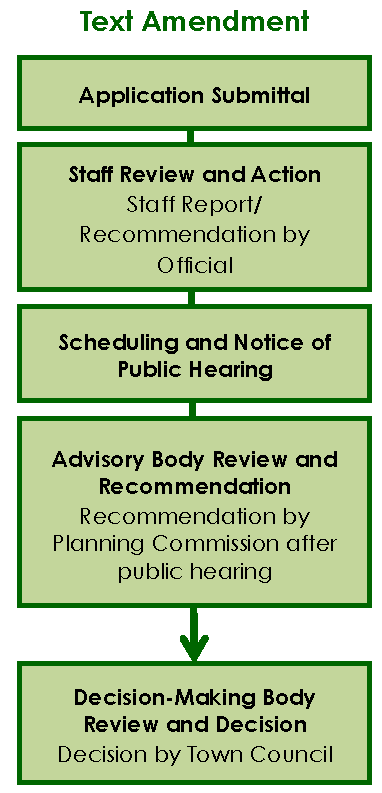
On receiving an application, the Official shall review the application, prepare a staff report with a recommendation for action on the application, and transmit the application and staff report to the Planning Commission in accordance with Sec. 16-2-102.D. The Official's recommendation shall be based on the standards in Sec. 16-2-103.B.3, Ordinance Text Amendment Review Standards.
c. Hearing Scheduling and Notice
A public hearing on the application shall be scheduled before the Planning Commission, and all required notices shall be provided in accordance with Sec. 16-2-102.E.
d. Advisory Body Review and Recommendation
The Planning Commission shall review the application and staff report, hold a public hearing on the application, and make a recommendation for action on the application in accordance with Sec. 16-2-102.F. The Planning Commission's recommendation shall be based on the standards in Sec. 16-2-103.B.3, Ordinance Text Amendment Review Standards.
e. Decision-Making Body Review and Decision
i.
The Town Council shall review the application, staff report, and Planning Commission recommendation, and make a final decision on the application. If the applicant proposes a change or departure from the text amendment that is different than what was reviewed by Planning Commission the change or departure shall first be submitted to the Planning Commission for review and recommendation in accordance with State law. The Town Council's decision shall be one of the following:
01.
Adopt an ordinance approving the Text Amendment; or
02.
Adopt a resolution denying the Text Amendment.
ii.
If the applicant proposes a change or departure from the text amendment that is different than what was reviewed by Planning Commission, the application shall be remanded to the Planning Commission for review of and a recommendation on the proposed changes and departures. The Planning Commission shall deliver its recommendation on the proposed changes and departures to the Town Council within 30 days after the remand; if the Planning Commission fails to do so, it is deemed to have recommended approval of the proposed changes and departures.
f. Post-Decision Actions and Limitations
The Official shall provide notice of the final decision on the application in accordance with Sec. 16-2-102.H.1.
3. Ordinance Text Amendment Review Standards
In determining whether to recommend that Town Council adopt or deny the proposed text amendment, the Planning Commission may weigh the relevance of and consider whether and the extent to which the proposed Text Amendment:
a.
Is in accordance with the Comprehensive Plan;
b.
Is required by changed conditions;
c.
Addresses a demonstrated community need;
d.
Is consistent with the purpose and intent of the zoning districts in this Ordinance, or would improve compatibility among uses and ensure efficient development within the Town;
e.
Would result in a logical and orderly development pattern; and
f.
Would not result in significantly adverse impacts on the natural environment, including but not limited to water, air, noise, stormwater management, wildlife, vegetation, wetlands, and the natural functioning of the environment.
4. Expiration
Any text amended in accordance with this subsection is subject to further amendment or repeal in accordance with the Text Amendment procedures set forth in this subsection.
C. Zoning Map Amendment (Rezoning)
1. Purpose
The purpose of this section is to state the procedure for proposing Zoning Map Amendments to this Ordinance to Town Council for its consideration and decision.
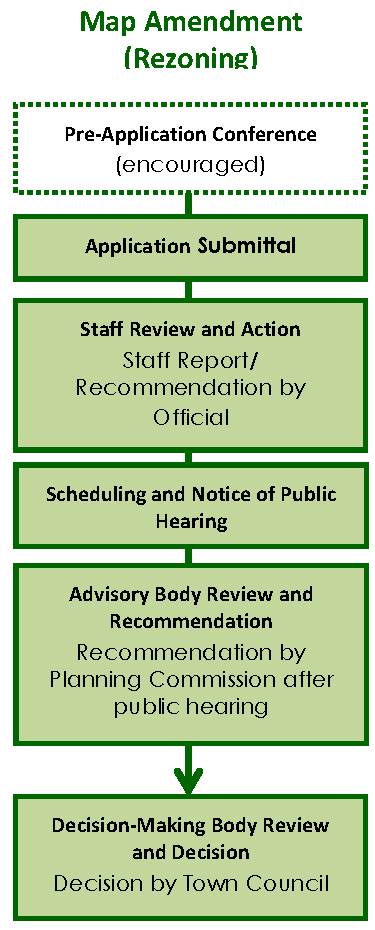
2. Zoning Map Amendment (Rezoning) Procedure
a. Pre-Application Conference
Prospective applicants for a Zoning Map Amendment (unless the Planning Commission, or Town Manager) are encouraged to request and hold a pre-application conference with Town staff in accordance with Sec. 16-2-102.B and the following.
i.
Applicants proposing rezoning to the Redevelopment Overlay (R-O) District shall provide the Official the following additional information prior to the conference:
01.
The application;
02.
A narrative addressing the reasons for the requested rezoning;
03.
A site plan of the proposed redevelopment that shows all physical improvements and natural features, including but not limited to structures, parking, setbacks, buffers, wetlands, significant trees, impervious cover, open space, height of structures, and density of site;
04.
An as-built survey; and
05.
A tree and topography plan showing all existing trees six inches in diameter and larger.
ii.
If a proposed rezoning to the R-O District involves land within the Corridor Overlay (COR) District, the applicant shall submit a conceptual landscape plan for review and approval by the Design Review Board prior to submittal of the rezoning application. The Design Review Board's review and decision on the conceptual landscape plan shall be based on the standards in Sec. 16-2-103.C.3, Zoning Map Amendment (Rezoning) Review Standards.
b. Application Submittal
An application for a Zoning Map Amendment may be filed by the persons identified in Sec. 16-2-102.C.1, the Planning Commission or the Town Manager, and any application shall comply with the requirements of Sec. 16-2-102.C.
c. Staff Review and Action
On receiving an application, the Official shall review the application and prepare a staff report with a recommendation for action on the application in accordance with Sec. 16-2-102.D. The Official's recommendation shall be based on the standards in Sec. 16-2-103.C.3, Zoning Map Amendment (Rezoning) Review Standards.
d. Hearing Scheduling and Notice
A public hearing on the application shall be scheduled before the Planning Commission, and all required notices shall be provided in accordance with Sec. 16-2-102.E.
e. Advisory Body Review and Recommendation
The Planning Commission shall review the application and staff report, hold a public hearing on the application, and make a recommendation for action on the application in accordance with Sec. 16-2-102.F. The Planning Commission's recommendation shall be based on the standards in Sec. 16-2-103.C.3, Zoning Map Amendment (Rezoning) Review Standards.
f. Decision-Making Body Review and Decision
i.
The Town Council shall review the application, staff report and Planning Commission recommendation, and make a final decision on the application. If the applicant proposes a change or departure from the Zoning Map Amendment that is different than what was reviewed by Planning Commission the change or departure shall first be submitted to the Planning Commission for review and recommendation in accordance with State law. The Town Council's decision shall be one of the following:
01.
Adopt an ordinance approving the Zoning Map Amendment; or
02.
Adopt a resolution denying the Zoning Map Amendment.
ii.
If the applicant proposes a change or departure from the Zoning Map Amendment that is different than what was reviewed by Planning Commission, the application shall be remanded to the Planning Commission for review of and a recommendation on the proposed changes and departures. The Planning Commission shall deliver its recommendation on the proposed changes and departures to the Town Council within 30 days after the remand; if the Planning Commission fails to do so, it is deemed to have recommended approval of the proposed changes and departures.
g. Post-Decision Actions and Limitations
The Official shall provide notice of the final decision on the application in accordance with Sec. 16-2-102.H.1.
3. Zoning Map Amendment (Rezoning) Review Standards
In determining whether to recommend that Town Council approve or deny a proposed Zoning Map Amendment (Rezoning), the Planning Commission may weigh the relevance of and consider the following:
a.
If the proposed Zoning Map Amendment is for reclassification of land to a district other than the Redevelopment Overlay (R-O) District, whether and the extent to which the proposed zoning:
i.
Is in accordance with the Comprehensive Plan;
ii.
Would allow a range of uses that are compatible with the uses allowed on other property in the immediate vicinity;
iii.
Is appropriate for the land;
iv.
Addresses a demonstrated community need;
v.
Is consistent with the overall zoning program as expressed in future plans for the Town;
vi.
Would avoid creating an inappropriately isolated zoning district unrelated to adjacent and surrounding zoning districts;
vii.
Would allow the subject property to be put to a reasonably viable economic use;
viii.
Would result in development that can be served by available, adequate, and suitable public facilities (e.g., streets, potable water, sewerage, stormwater management); and
ix.
Is appropriate due to any changed or changing conditions in the affected area.
b.
If the proposed Zoning Map Amendment is for reclassification of land to the Redevelopment Overlay (R-O) District, whether and the extent to which:
i.
The proposed plan for development constitutes redevelopment, as defined by this Ordinance;
ii.
The proposed plan for development is in accordance with the Comprehensive Plan;
iii.
The plan for development and general layout of the site are consistent with the general purpose of the R-O District, as expressed in Sec. 16-3-106.K, Redevelopment Overlay (R-O) District;
iv.
The lands surrounding the proposed R-O District can be planned and developed or redeveloped in substantial compatibility with the plan for development;
v.
The proposed plan for development clearly lessens the number or extent of nonconformities on the site;
vi.
If the site has nonconforming density or intensity, the proposed plan for development demonstrates that the nonconforming density or intensity creates the inability to meet other current standards in this Ordinance;
vii.
The proposed plan for development demonstrates that the design and layout of the site complies with the dimensional, development and design, and natural resource protection standards in Chapter 16-5: Development and Design Standards, and Chapter 16-6:, Natural Resource Protection, or modifications to such standards approved in accordance with Sec. 16-3-106.K, Redevelopment Overlay (R-O) District; and
viii.
The proposed R-O District is not detrimental to the public health, safety, and welfare.
4. Expiration
Any Zoning Map Amendment (Rezoning) shall not expire, but the amended Official Zoning Map is subject to further amendment or repeal, in accordance with the map amendment and PUD District Master Plan procedures set forth in this subsection.
D. Planned Unit Development (PUD) District
1. Purpose
The purpose of this section is to state the procedure for proposing Planned Unit Development zoning for property within the Town to Town Council for its consideration and decision.
2. Scope
A planned unit development is established by amendment of the Official Zoning Map to a planned unit development zoning district classification that is defined by a Master Plan.
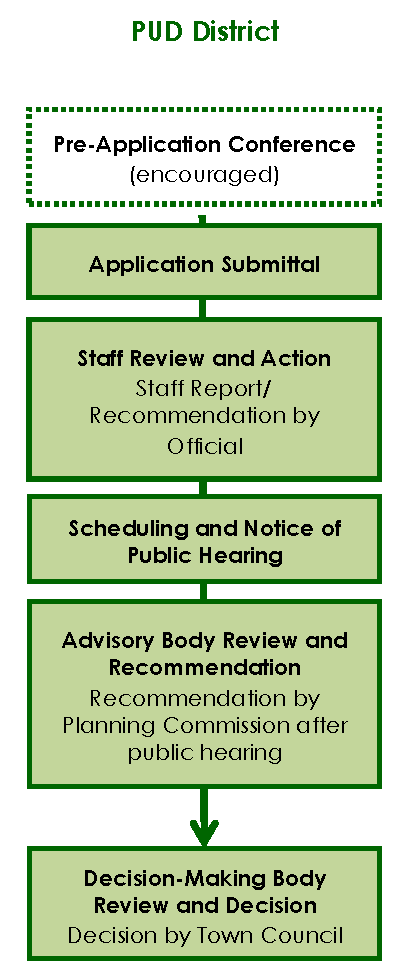
3. PUD District Review Procedure
a. Pre-Application Conference
Prospective applicants for rezoning to a PUD District are encouraged to request and hold a pre-application conference with Town staff in accordance with Sec. 16-2-102.B.
b. Application Submittal
An application for Planned Unit Development zoning may be filed by the persons identified in Sec. 16-2-102.C.1, the Town Manager or the Planning Commission and any application shall be in accordance with Sec. 16-2-102.C.
c. Staff Review and Action
On receiving an application, the Official shall review the application and prepare a staff report with a recommendation for action on the application in accordance with Sec. 16-2-102.D. The Official's recommendation shall be based on the standards in Sec. 16-2-103.D.4, PUD District Review Standards.
d. Hearing Scheduling and Notice
A public hearing on the application shall be scheduled before the Planning Commission and all required notices shall be provided in accordance with Sec. 16-2-102.E.
e. Advisory Body Review and Recommendation
The Planning Commission shall review the application and staff report, hold a public hearing on the application, and make a recommendation for action on the application in accordance with Sec. 16-2-102.F. The Planning Commission's recommendation shall be based on the standards in Sec. 16-2-103.D.4, PUD District Review Standards.
f. Decision-Making Body Review and Decision
i.
The Town Council shall review the application, staff report, and Planning Commission recommendation, and make a final decision on the application. If the applicant proposes a change or departure from the PUD zoning that is different than what was reviewed by Planning Commission the change or departure shall first be submitted to the Planning Commission for review and recommendation in accordance with State law. The Town Council's decision shall be one of the following:
01.
Adopt an ordinance approving the PUD District as submitted; or
02.
Adopt a resolution denying the PUD District.
ii.
If the applicant proposes a change or departure from the PUD zoning that is different than what was reviewed by Planning Commission the application shall be remanded to the Planning Commission for review of and a recommendation on the proposed changes and departures. The Planning Commission shall deliver its recommendation on the proposed changes and departures to the Town Council within 30 days after the remand; if the Planning Commission fails to do so, it is deemed to have recommended approval of the proposed changes and departures.
g. Post-Decision Actions and Limitations
The Official shall provide notice of the final decision on the application in accordance with Sec. 16-2-102.H.1.
4. PUD District Review Standards
In determining whether to recommend that Town Council adopt a proposed PUD zoning district classification, the Planning Commission may consider and weigh the standards of Sec. 16-2-103.C.3, Zoning Map Amendment (Rezoning) Review Standards, and the extent to which the proposed PUD District complies with the standards of Sec. 16-3-105.K, Planned Development Mixed-Use (PD-1) District or Sec. 16-3-106.G, Planned Development Overlay (PD-2) District.
(Revised 8-18-2020 - Ordinance 2020-19)
5. Designation on Official Zoning Map
Designation of a PUD District on the Official Zoning Map shall note the ordinance approving the PUD zoning district classification.
6. Effect of Approval
a.
For lands rezoned to a PUD District the approved Master Plan shall be the zoning text for the district.
b.
The applicant may apply for and obtain subsequent development approvals and permits necessary to implement the Master Plan in accordance with the appropriate procedural standards of this Ordinance.
c.
Any subsequent permit or development approval shall comply with the PUD Master Plan.
7. Expiration
Any approved PUD District shall not expire, but the amended Official Zoning Map or PUD District is subject to further amendment or repeal in accordance with map amendment and PUD District procedures set forth in this subsection.
8. Minor Deviations from Approved Master Plan
a. General
Subsequent applications for permits and development approvals within a PUD District may include minor deviations from the approved PUD Master Plan, without the need to amend the PUD District approval, provided, however, that such deviations are limited to the following:
i.
Changes that result in a decrease in the density approved for a specific parcel, either residential or nonresidential;
ii.
Change in a land use designation from multifamily to single-family or a change from any use to open space/passive recreation;
iii.
Change in major infrastructure features (e.g. streets/access, sewer, water, storm drainage) that are clearly beneficial to the occupants of the Master Plan area. The applicant requesting such change shall provide reasonable notice of the request to the property owners' association that would be affected by the change and ask that all comments be directed to the Official. Proof of such notification shall be provided to the Official. If after considering comments from affected property owners, the Official determines that the change would not be clearly beneficial to the occupants of the Master Plan area, the Official shall deny the deviation;
iv.
Change in land use designation from single-family to multifamily with no increase in permitted site-specific density;
v.
The addition of collocated or building mounted telecommunication antennas; and
vi.
The construction of a new monopole telecommunication tower and facilities on land not designated for single-family use.
b. Appeal
The Official's decision on a minor deviation request may be appealed by an aggrieved person to the Board of Zoning Appeals in accordance with Sec. 16-2-103.T, Appeal of Administrative Decisions and Written Interpretations to Board of Zoning Appeals.
9. Amendments
A PUD District approval shall be amended, extended, or modified only in accordance with the procedures and standards for its original approval.
E. Special Exception
1. Purpose
The purpose of this section is to state the procedure for seeking a special exception approval.
2. Applicability
Any use identified as a Special Exception in a zoning district in Chapter 16-3: Zoning Districts, must receive approval of a Special Exception in accordance with the procedure and standards of this subsection before it may be developed under this Ordinance.
3. Special Exception Procedure
a. Application Submittal
An application for a Special Exception may be submitted by persons identified in Sec. 16-2-102.C.1, and shall be submitted in accordance with Sec. 16-2-102.C.
b. Staff Review and Action
On receiving an application, the Official shall review the application and prepare a staff report with a recommendation for action on the application in accordance with Sec. 16-2-102.D. The Official's recommendation shall be based on the standards in Sec. 16-2-103.E.4, Special Exception Review Standards.
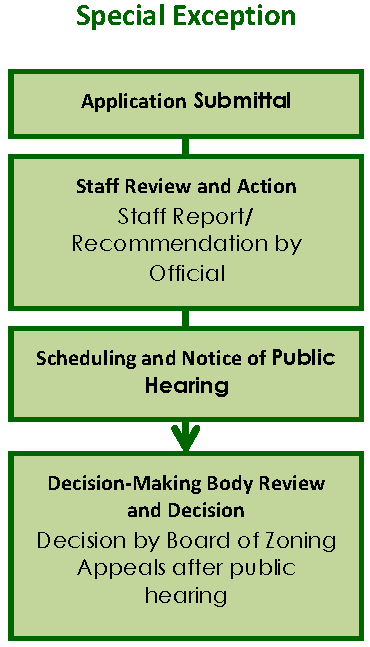
c. Hearing Scheduling and Notice
A public hearing on the application shall be scheduled before the Board of Zoning Appeals and all required notices shall be provided in accordance with Sec. 16-2-102.E.
d. Decision-Making Body Review and Decision
i.
The Board of Zoning Appeals shall review the application and staff report, hold a public hearing on the application, and make a final decision on the application in accordance with Sec. 16-2-102.G. The Board's decision shall be based on the standards in Sec. 16-2-103.E.4, Special Exception Review Standards, and shall be one of the following:
01.
Approve the application;
02.
Approve the application subject to conditions of approval; or
03.
Deny the application.
ii.
The Board's decision shall be in writing and include findings of fact and conclusions of law.
e. Post-Decision Actions and Limitations
i.
Notice of Decision
The Official shall provide notice of the final decision on the application in accordance with Sec. 16-2-102.H.1.
ii.
Appeal
Appeals from the final decision of the Board of Zoning Appeals on an application for a Special Exception are governed by S.C. Code Ann. § 6-29-820 through S.C. Code Ann. § 6-29-850.
4. Special Exception Review Standards
The Board of Zoning Appeals shall approve an application for a Special Exception if the applicant demonstrates the proposed Special Exception and associated development:
a.
Will be in accordance with the Comprehensive Plan;
b.
Will comply with all regulations and standards that are generally applicable within the zoning district and that are specifically applicable to the particular type of Special Exception;
c.
Will be compatible with the intensity, scale, and character of development existing or planned in the surrounding area;
d.
Will not cause undue traffic congestion or create a traffic hazard;
e.
Will incorporate preservation and protection of important natural features and not result in significant adverse impacts on the natural environment—including, but not limited to, water, air, noise, storm water management, wildlife, vegetation, wetlands, and the natural functioning of the environment;
f.
Will not generate needs for transportation, water supply, sewage disposal, stormwater management, solid waste collection, fire and police protection, and similar public services that cannot be adequately handled by available or provided infrastructure and facilities;
g.
Will not substantially injure the value of surrounding properties; and
h.
Will not materially endanger the public health or safety.
5. Effect of Approval
Approval of a Special Exception authorizes only the specific use approved, and not any other development or use. If a Special Exception is a prerequisite to another permit or development approval that is required to authorize the commencement of development (e.g.,Variance), then no development may take place until all required approvals are obtained. Approval of a Special Exception does not guarantee approval of any subsequent application.
6. Expiration
Approval of a Special Exception establishes a vested right in accordance with Sec. 16-2-102.J.1, Vested Rights for Approvals of Site Specific Development Plans.
7. Amendment
A Special Exception may be modified or amended only in accordance with the procedures and standards established for its original approval.
F. Subdivision Review (Minor or Major)
1. Purpose
The purpose of this section is to state the procedure for seeking a Major or Minor Subdivision Review Approval.
The purpose of this subsection is to provide a uniform method for the review and approval of subdivision of land and to ensure, in conjunction with Sec. 16-5-115, that subdivisions promote the health, safety, convenience, order, prosperity and welfare of the present and future residents of the Town by:
a.
Providing for the orderly growth and development of the Town;
b.
Coordinating with the existing street system, transportation plans, and public facilities;
c.
Providing right-of-way for street and vehicular easements;
d.
Avoiding congestion and overcrowding and encouraging proper arrangement of streets in relation to existing planned streets;
e.
Ensuring there is adequate open space and recreation facilities; and
f.
Ensuring there is proper recordation of land ownership.
2. Applicability
a. General
Approval of either a Minor Subdivision or a Major Subdivision in accordance with the procedures and standards of this subsection is required before any plat of a Major or Minor Subdivision may be recorded in the Office of the Register of Deeds for Beaufort County, South Carolina. No land in any proposed Major or Minor Subdivision may be sold, transferred, or offered for sale until a final plat for the Major or Minor Subdivision has been approved in accordance with this Ordinance and recorded in the Office of the Register of Deeds for Beaufort County, South Carolina.
b. Minor and Major Subdivision
i.
A Minor Subdivision is a division of land into five or fewer lots.
ii.
A Major Subdivision is a division of land into six or more lots.
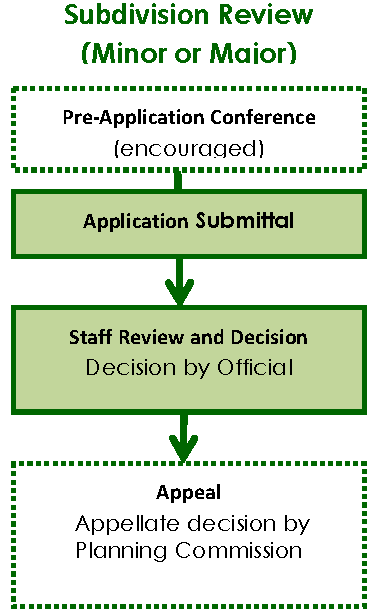
3. Subdivision Review (Minor or Major) Procedure
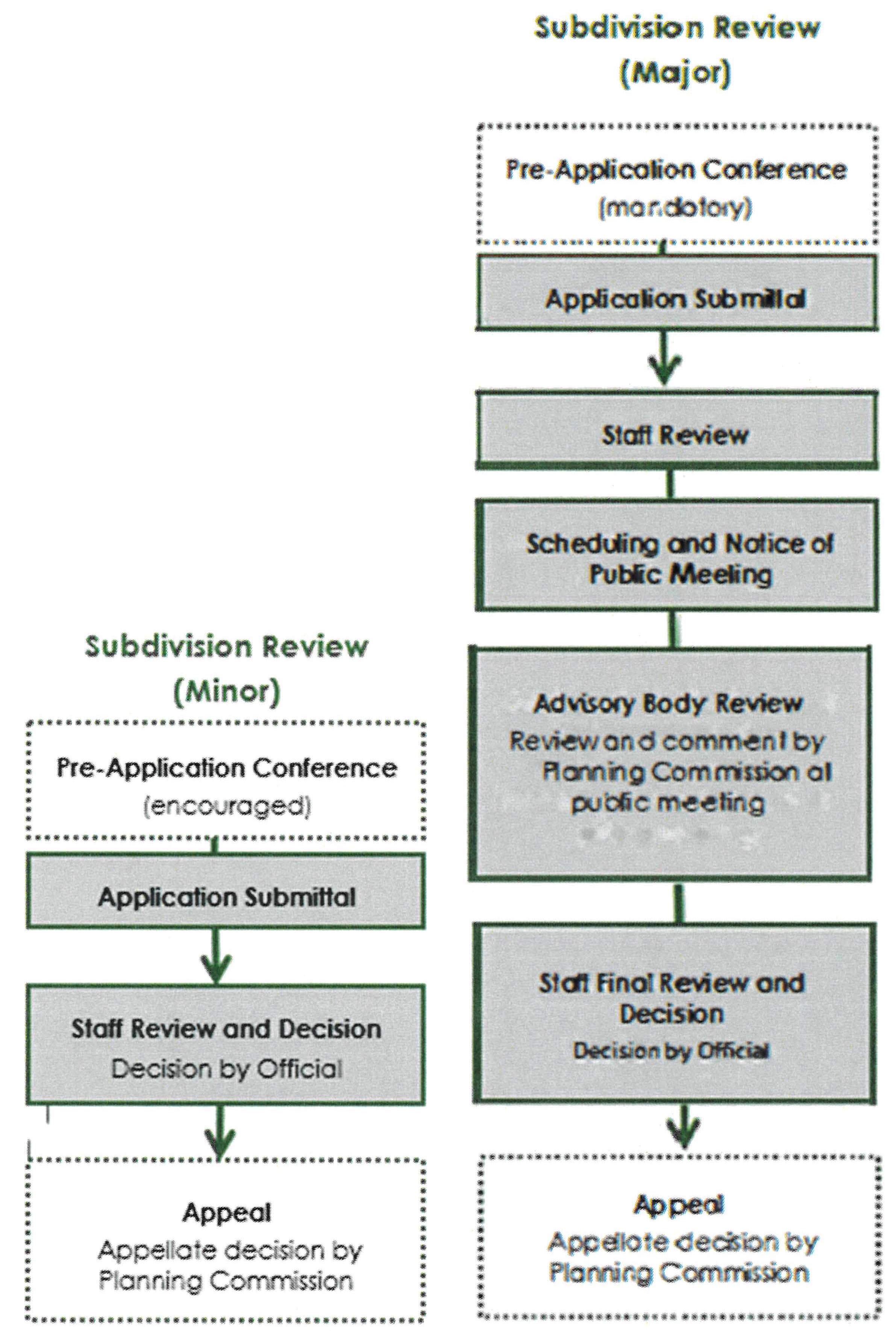
a. Pre-Application Conference
i.
Prospective applicants for Minor Subdivision Reviews are encouraged to request and hold a pre-application conference with Town staff in accordance with Sec. 16-2-102.B.
ii.
Prospective applicants for Major Subdivision Reviews are required to hold a pre-application conference with Town staff in accordance with Sec. 16-2-102.B.
b. Application Submittal
An application for Subdivision Review may be submitted by persons identified in Sec. 16-2-102.C.1, and shall be submitted in accordance with Sec. 16-2-102.C. and requirements established in Appendix D-4 or D-5.
c. Staff Review and Action — Subdivision
i.
On receiving an application, the Official shall review and make a final decision on the application in accordance with Sec. 16-2-102.D. The Official's decision shall be based on the standards in Sec. 16-2-103.F.4, Subdivision Review (Minor or Major) Standards, and shall be one of the following:
01.
Approve the application;
02.
Approve the application subject to conditions of approval; or
03.
Deny the application.
ii.
The Official shall act on an application, in accordance with Sec. 16-2-102.D,within 60 days after it is submitted, or such extended time agreed to by the applicant. If the Official fails to take action on the application within this time period, the application shall be deemed approved, and the Town shall issue the applicant a letter of approval and written notice to proceed based on the submitted application.
d. Staff Review and Action - Major Subdivision
i.
The Official shall forward the application to the Planning Commission for review, and the Planning Commission shall review the application, staff report, and any public comment at a hearing.
ii.
Following review by the Planning Commission, the Official shall make a final decision on the application in accordance with Sec. 16-2-102.D. The Official's decision shall be based on the standards in Sec. 16-2-103.F.4, Subdivision Review (Minor or Major) Standards, and shall be one of the following:
01.
Approve the application;
02.
Approve the application subject to conditions of approval; or
03.
Deny the application.
iii.
The Official shall act on an application, in accordance with Sec. 16-2-102.D, within 60 days after it is submitted, or such extended time agreed to by the applicant. If the Official fails to take action on the application within this time period, the application shall be deemed approved, and the Town shall issue the applicant a letter of approval and written notice to proceed based on the submitted application.
e. Post-Decision Actions and Limitations
(Revised 8-19-2025 - Ord. No. 2025-15)
i.
Notice of Decision
The Official shall provide notice of the final decision on the application in accordance with Sec. 16-2-102.H.1.
ii.
Appeal
Appeals from the final decision of the Official on an application for Subdivision Review (Minor or Major) are governed by Sec. 16-2-103.U, Appeal of Official's Decision to Planning Commission, and S.C. Code Ann. § 6-29-1150.
4. Subdivision Review (Minor or Major) Standards
An application for Subdivision Review (Minor or Major) shall be approved if the Official finds the applicant demonstrates the proposed Major or Minor Subdivision complies with:
a.
Applicable standards in Sec. 16-5-115;
b.
All other applicable standards and requirements in this Ordinance; and
c.
All other applicable requirements in the Municipal Code.
5. Effect of Approval
Approval of a Subdivision (Minor or Major) constitutes approval of a preliminary plat for the subdivision. The final plat will not be approved or stamped for recording until issuance of the Certificate of Compliance for the subdivision. Recording of the final plat in the Office of the Register of Deeds for Beaufort County, South Carolina creates developable lots that may be sold or otherwise conveyed and may be developed in accordance with development applications authorized by this Ordinance.
(Revised 8-18-2020 - Ordinance 2020-19)
6. Expiration
Approval of a Minor or Major Subdivision establishes a vested right in accordance with Sec. 16-2-102.J.1, Vested Rights for Approvals of Site Specific Development Plans.
7. Deviations from Previously Approved Major Subdivisions
The purpose and intent of these provisions is to require additional review and approval of proposed amendments to previously approved single-family residential Major Subdivisions.
For a previously platted single-family residential subdivision, any changes proposed to be made to property such as open space, rights-of-way, amenities and parking or any lot combinations or subdivisions that will result in either an increase in density or additional lots shall require approval by the Planning Commission following a public hearing of the Planning Commission.
A decision to approve a proposed change to a previously platted subdivision shall be based on a finding that the proposed change is not detrimental to the reasonable, investment backed expectations of owners of lots in the subdivision arising from:
i.
Increased burdens on utility of roadways caused by off-site parking;
ii.
Increased burdens on amenities in the subdivision caused by increased numbers of dwelling units;
iii.
Overcrowding in the subdivision;
iv.
Increased noise and traffic in the subdivision; and
v.
Decreased utility of amenities and other property such as open space, rights-of-way, amenities and parking or any lot combinations or subdivisions.
The provisions of this section shall not apply to Family Subdivisions approved pursuant to Sec. 16-2-103(Y).
An approved Minor Subdivision may be modified or amended only in accordance with the current procedures and standards established for the creation of a Minor Subdivision.
(Revised 3-21-2023 - Ordinance 2023-05)
G. Development Plan Review (Minor and Major)
1. Purpose
The purpose of this subsection is to establish the procedures and standards for review of a Development Plan.
2. Applicability
a. General
Unless exempted in accordance with paragraph 3 below, no development may occur without prior approval of a Development Plan in accordance with this section. Approval of a Development Plan is required before issuance of a Building Permit for development subject to Development Plan Review.
b. Minor and Major Development Plans
There are two types of Development Plans: Minor and Major.
i.
Approval of a Minor Development Plan is required for the following types of development, provided the development does not involve any wetland alteration:
01.
Accessory uses and structures;
02.
Temporary uses and structures, including temporary construction storage and staging; and
03.
Any other development that does not involve construction of a new building or addition, such as parking lot changes, new pools or decks, recreation fields or courts, or changes in general site design.
04.
Any nonresidential structure(s) that is converted to mixed-use or multifamily.
ii.
Approval of a Major Development Plan is required for all other development subject to Development Plan Review.
(Revised 6-6-2017 - Ordinance 2017-08; revised 11-4-2020 - Ordinance 2020-26)
3. Exemptions
The following activities or uses are exempt from Development Plan Review (although they may be reviewed under a separate administrative procedure, or may be governed or prohibited by private covenants and restrictions):
a.
The construction of any public street or minor utility.
b.
The maintenance of any structure.
c.
The use of land, with or without accessory structure, for purposes of agriculture, raising of crops or animals, forestry, mariculture, and the like.
d.
All structures (including factory-built housing) built or placed on an individual single-family residential lot with no other dwelling on it although such structures shall comply with the provisions set forth below:
i.
Section 16-3-106.H, Forest Beach Neighborhood Character Overlay (FB-NC-O) District;
ii.
Section 16-3-106.I, Folly Field Neighborhood Character Overlay (FF-NC-O) District;
iii.
Section 16-3-106.J, Holiday Homes Neighborhood Character Overlay (HH-NC-O) District;
iv.
Section 16-3-104, Residential Base Zoning Districts;
v.
Section 16-3-105, Mixed-Use and Business Districts;
vi.
Section 16-5-102, Setback Standards;
vii.
Section 16-5-105.I, Access to Streets;
viii.
Section 16-5-106, Parking and Loading Standards;
ix.
Section 16-5-111, Fire Protection Water Supply;
x.
Section 16-6-102.D, Wetland Buffer Standards; and
xi.
Title 15, Building and Building Codes, Chapter 9, Flood Damage Controls, of the Municipal Code of the Town of Hilton Head Island.
e.
Development of two to five dwelling units on a single lot (subject to Small Residential Development Review—see Sec. 16-2-103.H)
f.
Home occupations (see definition in Sec. 16-10-105, General Definitions).
4. Development Plan Review (Minor or Major) Procedure
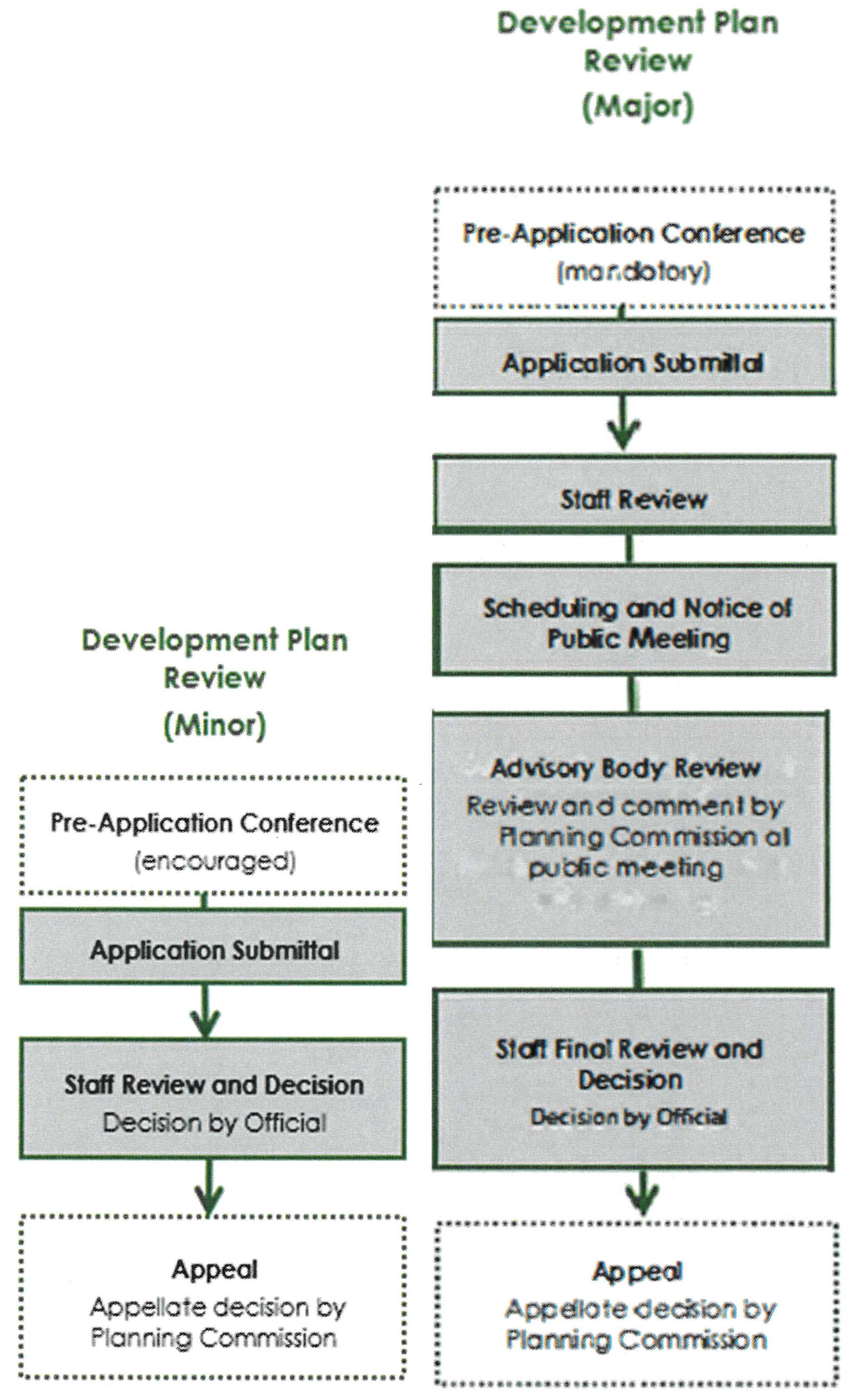
a. Pre-Application Conference
i.
Prospective applicants for Minor Development Plan Reviews are encouraged to request and hold a pre-application conference with Town staff in accordance with Sec. 16-2-102.B.
ii.
Prospective applicants for Major Development Plan Reviews are required to hold a pre-application conference with Town staff in accordance with Sec. 16-2-102.B.
b. Application Submittal
An application for Development Plan Review may be submitted by persons identified in Sec. 16-2-102.C.1, and shall be submitted in accordance with Sec. 16-2-102.C.
c. Staff Review and Action
i.
On receiving an application, the Official shall review and make a final decision on the application in accordance with Sec. 16-2-102.D. The Official's decision shall be based on the standards in Sec. 16-2-103.G.5, Development Plan Review Standards, and shall be one of the following:
01.
Approve the application;
02.
Approve the application subject to conditions of approval; or
03.
Deny the application.
ii.
The Official shall act on an application for Minor Development Plan Review, in accordance with Sec. 16-2-102.D, within ten business days after the application is submitted, or such extended time agreed to by the applicant.
iii.
The Official shall act on an application for Major Development Plan Review, in accordance with Sec. 16-2-102.D, within 60 days after the application is submitted, or such extended time agreed to by the applicant.
iv.
If the Official fails to act on an application for Development Plan Review, in accordance with Sec. 16-2-102.D, within the time period in provision ii or iii above, the application shall be deemed approved, and the Town shall issue the applicant a letter of approval and written notice to proceed based on the submitted application.
d. Staff Review and Action - Major Development Plan Review
i.
The Official shall forward the application to the Planning Commission for review, and the Planning Commission shall review the application, staff report, and any public comment at a hearing.
ii.
Following review by the Planning Commission, the Official shall make a final decision on the application in accordance with Sec. 16-2-102.D. The Official's decision shall be based on the standards in Sec. 16-2-103.G.5, Development Plan Review Standards, and shall be one of the following:
01.
Approve the application;
02.
Approve the application subject to conditions of approval; or
03.
Deny the application.
iii.
The Official shall act on an application for Major Development Plan Review, in accordance with Sec. 16-2-102.D, within 60 days after the application is submitted, or such extended time agreed to by the applicant.
iv.
If the Official fails to act on an application for Development Plan Review, in accordance with Sec. 16-2-102.D, within the time period in provision iv above, the application shall be deemed approved, and the Town shall issue the applicant a letter of approval and written notice to proceed based on the submitted application.
e. Post-Decision Actions and Limitations
i.
Notice of Decision
The Official shall provide notice of the final decision on the application in accordance with Sec. 16-2-102.H.1.
ii.
Appeal
Appeals from the final decision of the Official on an application for Development Plan Review (Minor or Major) are governed by Sec. 16-2-103.U, Appeal of Official's Decision to Planning Commission, and S.C. Code Ann. § 6-29-1150.
(Revised 8-19-2025 - Ordinance 2025-15)
5. Development Plan Review Standards
An application for Development Plan Review (Minor or Major) shall be approved on a finding the applicant has demonstrated the development proposed in the Development Plan complies with:
a.
The relevant standards and requirements in Chapter 16-3: Zoning Districts, Chapter 16-4: Use Standards, Chapter 16-5: Development and Design Standards, and Chapter 16-6: Natural Resource Protection;
b.
All other applicable standards of this Ordinance; and
c.
All other applicable requirements in the Municipal Code.
6. Effect of Approval
Approval of a Development Plan (Minor or Major) authorizes the submittal of any other subsequent development applications that may be required before construction or other development authorized by this Ordinance.
7. Expiration
Approval of a Development Plan (Minor or Major) establishes a vested right in accordance with Sec. 16-2-102.J.1, Vested Rights for Approvals of Site Specific Development Plans.
8. Amendment
An approved Development Plan (Minor or Major) may be modified or amended only in accordance with the procedures and standards established for its original approval.
H. Small Residential Development Review
1. Purpose
The purpose of this subsection is to establish the procedures and standards for review of a Small Residential Development.
2. Applicability
Approval of a Small Residential Development in accordance with this subsection is required for any development of two to five dwelling units on a single lot. Approval of a Small Residential Development is required before issuance of a Building Permit for development subject to Small Residential Development Review.
3. Small Residential Development Review Procedure
a. Application Submittal
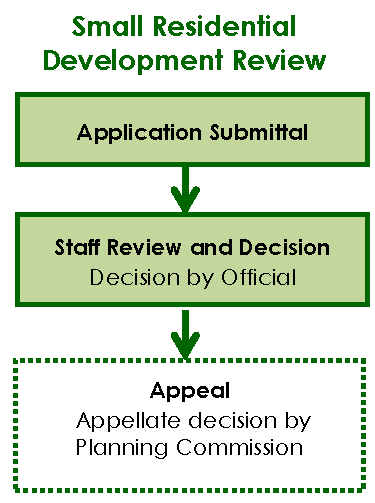
An application for Small Residential Development Review may be submitted by persons identified in Sec. 16-2-102.C.1, and shall be submitted in accordance with Sec. 16-2-102.C, except that the application shall include the following:
i.
A site plan prepared, signed, and sealed by a South Carolina registered land surveyor showing at least the property boundaries, streets, existing houses and any existing septic systems, locations of proposed house sites and any proposed septic systems, driveways from public streets to existing houses and proposed housing sites, and all applicable setbacks;
ii.
Proof of an approved sewage disposal system (either a copy of a septic system design approval by the S.C. DHEC or a copy of a letter from the Public Service District stating it will provide sewer service); and
iii.
A copy of any required encroachment permit from SCDOT (for a State street), Beaufort County (for a County street), or the Town (for a Town street)
b. Staff Review and Action
i.
On receiving an application, the Official shall review the applicationand make a final decision on the application in accordance with Sec. 16-2-102.D. The Official's decision shall be based on the standards in Sec. 16-2-103.H.4, Small Residential Development Review Standards, and shall be one of the following:
01.
Approve the application;
02.
Approve the application subject to conditions of approval; or
03.
Deny the application.
ii.
The Official shall act on an applicationfor Small Residential Development Review, in accordance with Sec. 16-2-102.D, within five business days after the application is submitted, or such extended time agreed to by the applicant.
iii.
If the Official fails to act on an applicationfor Small Residential Development Review, in accordance with Sec. 16-2-102.D, within the time period prescribed in provision ii above, the applicationshall be deemed approved, and the Town shall issue the applicant a letter of approval and written notice to proceed based on the submitted application.
c. Post-Decision Actions and Limitations
i.
Notice of Decision
The Official shall provide notice of the final decision on the application in accordance with Sec. 16-2-102.H.1.
ii.
Appeal
Appeals from the final decision of the Official on an application for Small Residential Development Review are governed by Sec. 16-2-103.U, Appeal of Official's Decision to Planning Commission, and S.C. Code Ann. § 6-29-1150.
4. Small Residential Development Review Standards
An application for Small Residential Development Review shall be approved on a finding the applicant has demonstrated the development proposed in the Small Residential Development application complies with:
a.
The relevant standards and requirements in Chapter 16-3: Zoning Districts, Chapter 16-4: Use Standards, Chapter 16-5: Development and Design Standards, and Chapter 16-6: Natural Resource Protection;
b.
All other applicable standards of this Ordinance; and
c.
All other applicable requirements in the Municipal Code.
5. Effect of Approval
Approval of a Small Residential Development authorizes the submittal of any other subsequent development applications that may be required before construction or other development authorized by this Ordinance.
6. Expiration
Approval of a Small Residential Development establishes a vested right in accordance with Sec. 16-2-102.J.1, Vested Rights for Approvals of Site Specific Development Plans.
7. Amendment
An approved Small Residential Development may be modified or amended only in accordance with the procedures and standards established for its original approval.
I. Corridor Review (Minor and Major)
1. Purpose
The purpose of this section is to establish the procedures and standards for the review and decision on an application for Corridor Review approval.
2. Applicability
a. General
Approval of Corridor Review (Minor or Major) in accordance with this subsection is required before any development within the Corridor Overlay District.
b. Minor and Major Corridor Review
There are two types of Corridor Review: Major and Minor.
i.
Minor Corridor Review is required for the following types of development within the Corridor Overlay District:
01.
Multifamily accessory structure;
02.
The addition of minor building or site elements (such as patios, decks, railings, awnings, and shutters, landscaping, exterior lighting, fences and walls, dumpster enclosures);
03.
The use of the same color(s) on the exterior of an accessory structure as authorized by a Major Corridor Review approved for the principal structure; and
04.
Outdoor merchandising.
05.
Any alteration/addition within the Corridor Overlay District that is not visible from an arterial street, the OCRM Beachfront Baseline, or the OCRM Critical Line.
ii.
Major Corridor Review is required for all other development within the Corridor Overlay District.
3. Minor Corridor Review Procedure
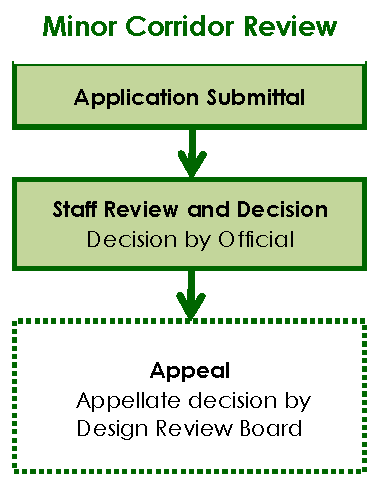
a. Application Submittal
An application for Minor Corridor Review may be submitted by persons identified in Sec. 16-2-102.C.1, and shall be submitted in accordance with Sec. 16-2-102.C.
b. Staff Review and Action
On receiving an application, the Official shall review and make a final decision on the application in accordance with Sec. 16-2-102.D. The Official's decision shall be based on the standards in Sec. 16-2-103.I.5, Corridor Review (Minor and Major) Standards, and shall be one of the following:
i.
Approve the application;
ii.
Approve the application subject to conditions of approval; or
iii.
Deny the application.
c. Post-Decision Actions and Limitations
i.
Notice of Decision
The Official shall provide notice of the final decision on the application in accordance with Sec. 16-2-102.H.1.
ii.
Appeal
Appeals from the final decision of the Official on an application for Minor Corridor Review are governed by Sec. 16-2-103.V, Appeal of Official's Decision to Design Review Board.
4. Major Corridor Review Procedure
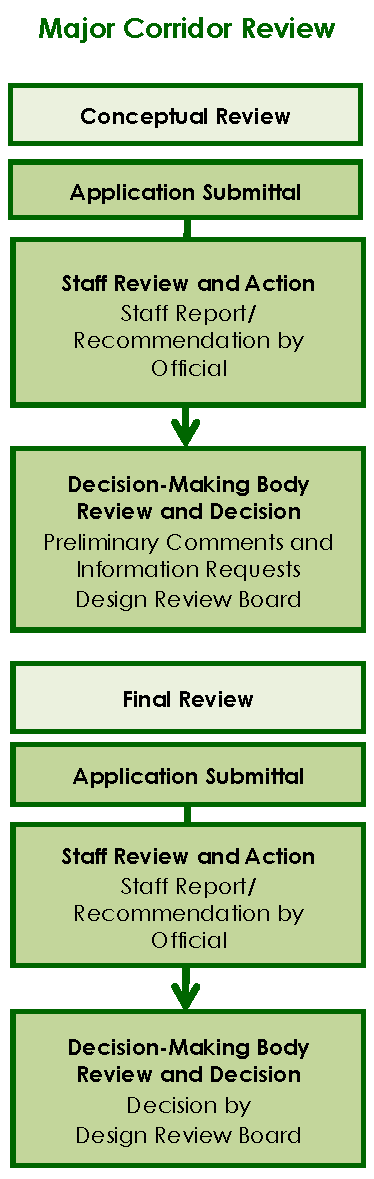
Applications for Major Corridor Review are subject to a two-step procedure: Conceptual Review and Final Review.
a. Conceptual Review
i.
Application Submittal
An application for Major Corridor Conceptual Review may be submitted by persons identified in Sec. 16-2-102.C.1, and shall be submitted in accordance with Sec. 16-2-102.C.
ii.
Staff Review and Action
On receiving an application, the Official shall review the applicationand prepare a staff report with a recommendation for action on the application in accordance with Sec. 16-2-102.D. The Official's recommendation shall be based on the standards in Sec. 16-2-103.I.5, Corridor Review (Minor and Major) Standards.
(Revised 5-17-2016 - Ordinance 2016-07)
iii.
Decision-Making Body Review and Decision
The Design Review Board shall review the application and staff report at a public meeting, make a decision on the application and request such additional information or materials as may be required for final review of the application. The Board's decision and requests shall be based on the application's compliance with the standards in Sec. 16-2-103.I.5, Corridor Review (Minor and Major) Standards, and shall be one of the following:
01.
Approve the application; or
02.
Approve the application subject to conditions.
The Board's decision shall be in writing.
(Revised 5-17-2016 - Ordinance 2016-07)
b. Final Review
i.
Application Submittal
An application for Major Corridor Final Review may be submitted by persons identified in Sec. 16-2-102.C.1, and shall be submitted in accordance with Sec. 16-2-102.C.
ii.
Staff Review and Action
On receiving an application, the Official shall review the application and prepare a staff report with a recommendation for action on the application in accordance with Sec. 16-2-102.D. The Official's recommendation shall be based on the standards in Sec. 16-2-103.I.5, Corridor Review (Minor and Major) Standards.
iii.
Decision-Making Body Review and Decision
01.
A private architectural review board whose jurisdiction includes the subject site shall submit written final notice of any action it takes on the proposed project. The applicant shall submit this final notice to the Official at least seven days before the meeting at which the Design Review Board conducts its final review of the Corridor Review application. The Board shall consider, but is not bound by, the action of such private architectural review board.
(Revised 12-5-2017 - Ordinance 2017-19)
02.
The Design Review Board shall review the application, staff report, and any notice of action submitted by a private architectural review board at a public meeting and make a final decision on the application in accordance with Sec. 16-2-102.G. The Board's decision shall be based on the standards in Sec. 16-2-103.I.5, Corridor Review (Minor and Major) Standards, and shall be one of the following:
(A)
Approve the application;
(B)
Approve the application subject to conditions of approval; or
(C)
Deny the application.
03.
The Board's decision shall be in writing.
c. Post-Decision Actions and Limitations
i.
Notice of Decision
The Official shall provide notice of the final decision on the application in accordance with Sec. 16-2-102.H.1.
ii.
Appeal
Appeals from the final decision of the Design Review Board on an application for Major Corridor Review are governed by S.C. Code Ann. § 6-29-900.
5. Corridor Review (Minor and Major) Standards
An application for Corridor Review (Minor and Major) shall be approved on a finding the applicant has demonstrated the proposed development is consistent with the Design Guide.
6. Effect of Approval
Approval of Corridor Review (Minor or Major) authorizes only the particular development approved, and not any other development. In the event that approval of Corridor Review (Minor or Major) is a prerequisite to another permit or approval that is required prior to commencement of development, then no development may take place until all required approvals are obtained. Approval of Corridor Review (Minor or Major) does not guarantee approval of any subsequent application for a permit or development approval required by this Ordinance.
7. Expiration
a.
Where Corridor Review (Major or Minor) is granted for development for which a Development Plan or Small Residential Development has been concurrently or recently approved, approval of the Corridor Review shall expire at the time of expiration of the associated Development Plan or Small Residential Development approval.
b.
Where Corridor Review (Major or Minor) is not associated with approval of a Development Plan or Small Residential Development Review, approval of Corridor Review shall expire one year after the date of approval.
8. Amendment
Approval of Corridor Review (Minor or Major) may be modified or amended only in accordance with the procedures and standards established for its original approval.
J. Transportation Impact Analysis Plan Review
1. Purpose
The purpose of this subsection is to establish procedures and standards for the review and decision on Transportation Impact Analysis Plans, to ensure new development does not create street congestion beyond an amount established as acceptable by the Town.
2. Applicability
a.
A Transportation Impact Analysis Plan, monitoring and mitigation requirements, and procedures set forth in this section are applicable to all development that would generate 50 or more peak hour trips, except as specifically exempted in paragraph 4 of this subsection.
b.
Development Plan approval, with or without conditions or modifications, nor a Building Permit, shall be granted until the applicant has received approval of a Transportation Impact Analysis Plan in accordance with this section, in addition to all other requirements, unless the development is specifically exempt as provided for in this Chapter.
c.
A Building Permit may not be issued for development undertaken in accordance with a previously issued final development permit until the applicant first obtains Transportation Impact Analysis Plan approval, unless the development is exempt.
3. Trip Generation Rates
Trip generation rates shall be taken from the most current edition of the ITE Trip Generation Manual, except; provided, however, that an applicant may elect to perform, at the applicant's expense, a trip generation study which shall be submitted to the Town Engineer. An applicant's trip generation study shall be undertaken by a qualified transportation engineering firm selected in accordance with Appendix D.11, and is subject to review and approval by the Town Engineer. For any proposed use not specifically listed in the ITE Manual, the Town Engineer shall determine the most appropriate trip generation rate. The Town Engineer may consider input from the applicant in making this decision.
Trip rates shall be generated for pass-by trips, internal trips and multi-modal trips that are generated by a mode other than a personal motor vehicle. Trip rate reductions must be supported by the ITE handbooks or, if local data is used, approved by the Town Engineer.
4. Exemptions
The following types of development shall be exempt from the Transportation Impact Analysis Plan and mitigation requirements of this section:
a.
Activities and uses not constituting development (see Sec. 16-1-104.B, Development Activities Constituting Development), or exempt from Development Plan approval (see Sec. 16-2-103.G.3, Exemptions).
b.
If the proposed development is located on a previously developed parcel, then the number of peak hour trips projected to be generated by the proposed development shall be reduced by the number of trips generated by the previous development during the peak hour for the preceding twenty four months. If the resulting number is less than 50 peak hour trips, a Transportation Impact Analysis Plan is not required for the proposed development.
c.
A residential development generating less than 200 peak hour trips in which at least 20 percent of the units will qualify and be maintained as affordable housing in accordance with this Ordinance.
5. Transportation Impact Analysis Plan Review Procedure
a. Application Submittal
An application for Transportation Impact Analysis Plan Review may be submitted by persons identified in Sec. 16-2-102.C.1, and shall be submitted in accordance with Sec. 16-2-102.C.
b. Staff Review and Action
i.
No or Minor Mitigation Required
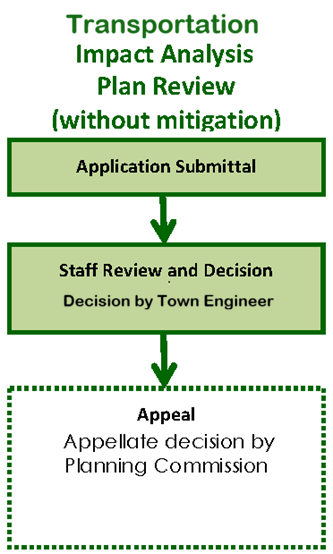
For any proposed development that does not require any mitigation or for which mitigation is limited to adjustments to signal timing, signal phasing, intersection restriping, or improvements serving non-motorized travel, the Town Engineer shall review and make a final decision on the application in accordance with Sec. 16-2-102.D. The Official's decision shall be based on the standards in Sec. 16-2-103.J.6, Transportation Impact Analysis Plan Standards, and shall be one of the following:
01.
Approve the application as submitted;
02.
Approve the application subject to conditions of approval or modifications; or
03.
Deny the application.
ii.
Major Mitigation Required
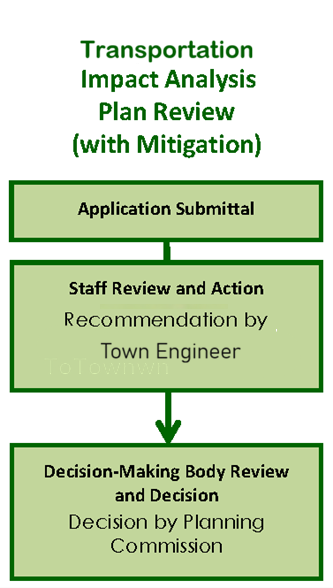
Where the proposed development requires mitigation beyond just adjustments to signal timing, signal phasing, intersection re-striping, or improvements serving non-motorized travel, the Town Engineer shall review the application in accordance with Sec. 16-2-102.D. The Town Engineer's recommendation shall be based on the standards in Sec. 16-2-103.J.6, Transportation Impact Analysis Plan Standards. Any mitigation improvements should comply with the latest edition of SCDOT's Access and Roadside Management Standards (ARMS) manual and SCDOT Roadway Design Manual.
c. Decision-Making Body Review and Decision
i.
For any proposed development that requires mitigation beyond just adjustments to signal timing, signal phasing, or intersection re-striping, the Planning Commission shall review the application at a public meeting and make a final decision on the application in accordance with Sec. 16-2-102.G. The Commission's decision shall be based on the standards in Sec. 16-2-103.J.6, Transportation Impact Analysis Plan Standards, and shall be one of the following:
01.
Approve the Transportation Impact Analysis Plan as submitted;
02.
Approve the Transportation Impact Analysis Plan subject to conditions of approval or modifications; or
03.
Deny the Transportation Impact Analysis Plan.
ii.
Transportation Impact Analysis Plans containing mitigation other than that allowed in Appendix D (specifically D-11.B.8) will not be accepted.
d. Post-Decision Actions and Limitations
i.
Notice of Decision
The Town Engineer shall provide notice of the final decision on the application in accordance with Sec. 16-2-102.H.1.
ii.
Appeal
01.
Appeals from the final decision of the Town Engineer on an application for Transportation Impact Analysis Plan Review are governed by Sec. 16-2-103.U, Appeal of Official's Decision to Planning Commission, and S.C. Code Ann. § 6-29-1150.
02.
Appeals from the decision of the Planning Commission on an application for Transportation Impact Analysis Plan Review are governed by S.C. Code Ann. § 6-29-1150.
6. Transportation Impact Analysis Plan Standards
The proposed Transportation Impact Analysis Plan shall not be approved unless it is demonstrated the Town's street system can operate and comply with the Town's adopted traffic service level standards, and the plan complies with Sec. 16-5-106, Transportation Analysis Standards.
7. Expiration of Approval
A Transportation Impact Analysis Plan approval shall expire one (1) year from the date of approval unless the applicant submits a complete Development Plan review application.
8. Amendment
A Transportation Impact Analysis Plan may be amended only in accordance with the procedures and standards applicable to its original approval.
9. Transportation Mitigation Program Implementation
a. Timing of Implementation
If a transportation mitigation program is part of an approved Transportation Impact Analysis Plan, all approved transportation mitigation improvements must be implemented prior to issuance of a Certificate of Compliance unless otherwise provided for as part of the approved Transportation Impact Analysis Plan.
b. Responsibility for Costs of Improvement; Reimbursement
i.
The costs of implementation of an approved mitigation program shall be the responsibility of the applicant, except as follows.
ii.
If an applicant is required to provide an improvement that would otherwise be funded by transportation impact fees, a transportation impact fee credit shall be available as provided in accordance with Sec. 16-5-116.K, Offsets to Impact Fees.
iii.
If an applicant is required to provide an improvement which is eligible for a transportation impact fee credit as provided for in accordance with Sec. 16-5-116.K, Offsets to Impact Fees, and the cost of the improvement exceeds the amount of the transportation impact fee otherwise calculated to be due in accordance with that section, the applicant may submit a plan for reimbursement to the Town Council for action. Such reimbursement plan shall be consistent with the Town's contractual obligations with respect to other planned street improvements and consistent with the Town's adopted Capital Improvements Program (CIP).
iv.
If an applicant is required to provide an improvement, other than a site-related transportation improvement that is eligible for funding with transportation impact fees, or if an applicant proposes a change in priorities in the adopted CIP, the applicant may submit a proposal to the Town Council requesting consideration for inclusion of such improvement in the CIP or for a shifting of priorities within the CIP, together with a proposed reimbursement plan which is consistent with the requirements of this section.
10. Transportation Monitoring and Evaluation Report
a. Report
Annually, following the preparation of the July intersection turning movement counts, the Town Engineer shall prepare a Transportation Monitoring and Evaluation Report, which shall include each of the following:
i.
Peak hour traffic turning movement counts for an average July weekday for all signalized intersections as measured by the Town Engineer;
ii.
Twenty-four hour traffic volumes on William Hilton Parkway, Palmetto Bay Road, Pope Avenue, and the Cross Island Parkway as measured by the Town Engineer;
iii.
Historical trends over the past five years if available for items in paragraph ii above;
iv.
Description of the operating conditions, relative to the adopted traffic service level standards, for each signalized intersection and how the operating conditions have changed since the last reporting period;
v.
Morning, midday, and afternoon peak hour volumes for Sea Pines Circle in reports for years evenly divisible by two; and
vi.
Recommendations for mitigation improvements to intersections that fail to meet the transportation standards outlined in Sec. 16-5-106, Transportation Analysis Standards.
b. Certification of Transportation Data
Based on the Transportation Monitoring and Evaluation Report, Transportation Impact Analysis Plans, and such other information as deemed appropriate, the Town Engineer shall certify the transportation data to be used by all applicants, transportation engineers, Town staff and consultants, in performing and reviewing Transportation Impact Analysis Plans. The Town Engineer will certify the traffic volume data on an annual basis or more frequently as deemed appropriate.
c. Planning Commission Action
i.
The Transportation Monitoring and Evaluation Report prepared by the Town Engineer as described above shall be forwarded to the Planning Commission. Upon receipt of the Report and recommendations from the Town Engineer, the Planning Commission shall give notice and hold a public meeting for the purpose of discussing the Report and recommendations and eliciting public comments.
ii.
Following its review, the Planning Commission shall forward the Transportation Monitoring and Evaluation Report and recommendations, and may forward its own supplemental report and recommendations, to the Town Council.
11. Multimodal Access Analysis
a.
All development shall have an access analysis undertaken by the Town Engineer. This analysis shall be undertaken to ensure that vehicular and multi-modal access to all proposed developments and subdivisions is accomplished in a safe manner.
b.
This analysis will identify any vehicular access improvements the applicant must install at the applicant's expense, such as deceleration lanes, and shall identify the location of any curb cuts based on, but not limited to sight distances, existing roadway infrastructure, opposing driveways locations, and shared vehicular access. This analysis will address requirements for adequate driveway design including, but not limited to turning radius and stacking distance. The standards in the South Carolina Department of Transportation's Access and Roadside Management Standards Manual shall serve as a guide for this review.
c.
This analysis will identify any improvements required to serve non-vehicular site access, including any modifications to or improvements of pathway crossings being impacted by the site development.
d.
The vehicular and multimodal access requirements approved by the Town Engineer shall be incorporated on development or subdivision plans prior to their approval. If an applicant is required to provide site-related traffic improvements, the cost of implementing such improvements shall be borne by the applicant and no such costs shall be eligible for a credit or offset from any transportation impact fees required in accordance with Sec. 16-5-116.K, Offsets to Impact Fees.
(Revised 10-7-2025 - Ordinance 2025-18)
K. Natural Resources Permit
1. Purpose
The purpose of this subsection is to establish the procedures and standards for the review and decision on an application for a Natural Resources Permit.
2. Applicability
Except as exempted in Sec. 16-6-104.B.2, Exemptions, no person shall cut, destroy, cause to be destroyed, move or remove, transplant, prune, or limb any tree, or trim or remove dune vegetation, or undertake any work authorized through Municipal Code Section 8-1-413 or undertake any work in a wetland or wetland buffer without first receiving approval of a Natural Resources Permit in accordance with the procedures and standards of this subsection—provided that no separate Natural Resources Permit shall be required where the proposed work is reviewed and authorized in accordance with an approved Subdivision Review (Minor or Major) (see Sec. 16-2-103.F), Development Plan Review (Minor or Major) (see Sec. 16-2-103.G), Small Residential Development Review (see Sec. 16-2-103.H) or Public Project Review (see Sec. 16-2-103.Q).
(Revised 5-17-2016 - Ordinance 2016-07)
3. Natural Resources Permit Review Procedure
a. Application Submittal
An application for a Natural Resources Permit may be submitted by persons identified in Sec. 16-2-102.C.1, and shall be submitted in accordance with Sec. 16-2-102.C. On receiving an application, the Official shall conduct an inspection of the site to assess the accuracy of the tree survey or other related materials. Following the inspection, the Official shall advise the applicant of any recommended changes that should be made to the application to ensure compliance with the standards of this subsection.
(Revised 5-17-2016 - Ordinance 2016-07)
b. Staff Review and Action
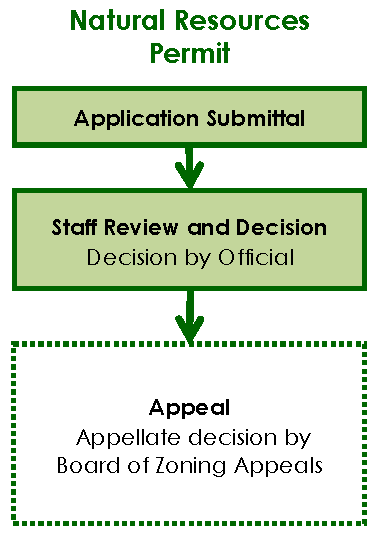
On receiving a final application, the Official shall review and make a final decision on the application in accordance with Sec. 16-2-102.D. The Official's decision shall be based on the standards in Sec. 16-2-103.K.4, Natural Resources Permit Review Standards, and shall be one of the following:
i.
Approve the application;
ii.
Approve the application subject to conditions of approval; or
iii.
Deny the application.
c. Post-Decision Actions and Limitations
i.
Notice of Decision
The Official shall provide notice of the final decision on the application in accordance with Sec. 16-2-102.H.1.
ii.
Appeal
Appeals from the final decision of the Official on an application for a Natural Resources Permit are governed by Sec. 16-2-103.T, Appeal of Administrative Decisions and Written Interpretations to Board of Zoning Appeals, and S.C. Code Ann. § 6-29-800.
4. Natural Resources Permit Review Standards
A Natural Resources Permit shall be approved on a finding the applicant demonstrates the proposed work complies with the standards in Sec. 16-6-102, Wetland Protection, Sec. 16-2-103, Beach and Dune Protection and Sec. 16-6-104, Tree Protection.
(Revised 5-17-2016 - Ordinance 2016-07)
5. Effect of Approval
Approval of a Natural Resources Permit authorizes only the particular tree removal or other activity approved, and not any other tree removal. In the event that a Natural Resources Permit is a prerequisite to another permit or approval that is required prior to commencement of development, then no development may take place until all required approvals are obtained. Approval of a Natural Resources Permit does not necessarily guarantee approval of any subsequent application.
6. Expiration
A Natural Resources Permit is valid for a period of one year, unless the Official approves an extension for good cause in accordance with Sec. 16-2-102.J.2.b, Extension of Expiration Time Period.
7. Amendment
A Natural Resources Permit may be amended only in accordance with the procedures and standards for its original approval.
L. Wetlands Alteration Permit
1. Purpose
The purpose of this subsection is to establish procedures and standards for the review and decision on an application for a Wetland Alteration Permit.
2. Applicability
a. Generally
Unless exempted in accordance with paragraph 3 below, no person shall undertake any development constituting a wetland alteration without first receiving a Wetlands Alteration Permit in accordance with the procedures and standards of this subsection.
b. Nationwide Permits
The issuance of Nationwide Permits Nos. 7, 14, 18, 19, 26, and 40 by the U.S. Army Corps of Engineers does not exempt an activity from full compliance with this subsection.
3. Exemptions
The following are exempt from the standards and requirements of this subsection:
a.
Wetland alteration in accordance with an approved Subdivision Review (Minor or Major) (see Sec. 16-2-103.F), Development Plan Review (Minor or Major) (see Sec. 16-2-103.G), Small Residential Development Review (see Sec. 16-2-103.H)or Public Project Review (see Sec. 16-2-103.Q);
b.
Development on a parcel of land that does not contain a wetland;
c.
The construction of any public street or minor utility;
d.
The maintenance of any structure;
e.
The use of land, with or without accessory structure, for purposes of agriculture, raising of crops or animals, forestry, mariculture, and the like;
f.
Building or placing any structure (including factory-built housing) on an individual single-family residential lot with no other dwellings on it;
g.
Home occupations (see definition in Sec. 16-10-105, General Definitions);
h.
Maintenance of golf course fairways through wetlands and required wetland buffers that involve only the cutting or removing of vegetation above the ground (e.g., mowing, rotary cutting), where the maintenance activity neither substantially disturbs the root system nor involves mechanized pushing, dragging, or other similar activities that re-deposit soil material; and
i.
Maintenance and repair operations necessary for maintaining previously established flow rates and storage volumes of existing manmade stormwater conveyance systems. (The maintenance and repair exemption is not an exemption from stormwater management regulations.)
4. Wetlands Alteration Permit Procedure
a. Application Submittal
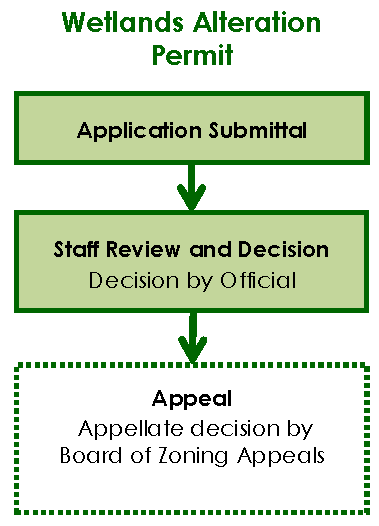
An application for a Wetlands Alteration Permit may be submitted by persons identified in Sec. 16-2-102.C.1, and shall be submitted in accordance with Sec. 16-2-102.C.
b. Staff Review and Action
On receiving an application, the Official shall review and make a final decision on the application in accordance with Sec. 16-2-102.D. The Official's decision shall be based on the standards in Sec. 16-2-103.L.5, Wetlands Alteration Permit Review Standards, and shall be one of the following:
i.
Approve the application;
ii.
Approve the application subject to conditions of approval; or
iii.
Deny the application.
c. Post-Decision Actions and Limitations
i.
Notice of Decision
The Official shall provide notice of the final decision on the application in accordance with Sec. 16-2-102.H.1.
ii.
Appeal
Appeals from the final decision of the Official on an application for a Wetlands Alteration Permit are governed by Sec. 16-2-103.T, Appeal of Administrative Decisions and Written Interpretations to Board of Zoning Appeals, and S.C. Code Ann. § 6-29-800.
5. Wetlands Alteration Permit Review Standards
A Wetlands Alteration Permit shall be approved on a finding that the applicant demonstrates the proposed wetland alteration complies with the standards in Sec. 16-6-102, Wetland Protection.
6. Effect of Approval
Approval of a Wetlands Alteration Permit authorizes only the wetland alteration approved by the permit, and not any other activity. In the event that a Wetlands Alteration Permit is a prerequisite to another permit or approval that is required prior to commencement of development, then no development may take place until all required approvals are obtained. Approval of a Wetlands Alteration Permit does not necessarily guarantee approval of any subsequent application.
7. Expiration
A Wetlands Alteration Permit is valid for a period of one year, unless the Official approves an extension for good cause in accordance with Sec. 16-2-102.J.2.b, Extension of Expiration Time Period.
M. Sign Permit
See Sec. 16-5-114.E, Sign Permits.
N. Development Project Name Review
1. Purpose
The purpose of this subsection is to establish the procedures and standards for the review and decision on an application for Development Project Name Review.
2. Applicability
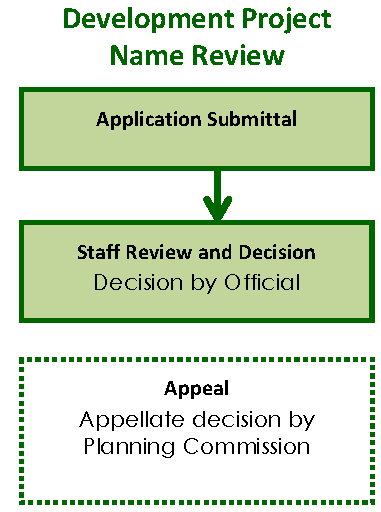
Development Project Name Approval is required before the approval of a Subdivision Plan, Development Plan, or Small Residential Development for the site where the development is to be located, and is included as a part of the applicationfor a Subdivision Review, Development Plan Review or Small Residential Development Review.
3. Development Project Name Approval Procedure
a. Application Submittal
An application for Development Project Name Review may be submitted by persons identified in Sec. 16-2-102.C.1, and shall be submitted in accordance with Sec. 16-2-102.C. An applicationfor Development Project Name Approval shall be submitted in conjunction with any application for a Subdivision Review, Development Plan Review, or Small Residential Development Review.
b. Staff Review and Action
On receiving an application, the Official shall review and make a final decision on the application in accordance with Sec. 16-2-102.D. i. Before making a decision, the Official shall consult with the emergency dispatch offices. The Official's decision shall be based on the standards in Sec. 16-2-103.N.4, Development Project Name Approval Review Standards, and shall be one of the following:
i.
Approve the application;
ii.
Approve the application subject to conditions of approval; or
iii.
Deny the application.
c. Post-Decision Actions and Limitations
i.
Notice of Decision
The Official shall provide notice of the final decision on the application in accordance with Sec. 16-2-102.H.1.
ii.
Appeal
Appeals from the final decision of the Official on an application for Development Project Name Review are governed by Sec. 16-2-103.U, Appeal of Official's Decision to Planning Commission, and S.C. Code Ann. § 6-29-1150.
4. Development Project Name Approval Review Standards
A proposed new or modified development project name shall be approved on a finding that the name complies with the following standards:
a.
No new development project name, or proposed modified name of a development, except phases of the same development project, shall duplicate, be phonetically similar to, or in any way be likely to be confused with an existing development project name, despite the use of prefixes or suffixes.
b.
Names shall be simple, logical, easy to read and pronounce, and clear and brief. Use of frivolous or complicated words or unconventional spellings in names shall not be approved.
c.
It is desirable to use names that have some association with Hilton Head Island and specifically with the immediate location of the street or place, such as reference to local history or physiographic features.
d.
The proposed name of the development project shall in all respects emphasize the project's distinctive name rather than the name of the company or corporation that owns the development. This will reduce confusion on the location of separate developments owned by the same company or corporation.
5. Notice of Action
On approving a new or modified development project name, the Official shall provide notice of the approved name to emergency dispatch offices, the post office, and Office of the Register of Deeds for Beaufort County, South Carolina, as well as the applicant.
6. Expiration
Approval of a new or modified development project name shall not expire, but the name is subject to further modification in accordance with procedures set forth in this subsection.
7. Amendment
A development project name may be amended only in accordance with the procedures and standards for its original approval.
O. Street/Vehicular Access Easement Name Review
1. Purpose
The purpose of this subsection is to establish procedures and standards for the review and decision on applications for Street/Vehicular Access Easement Name Review.
2. Applicability
All new or modified official street names and vehicular access easements in the Town shall be approved in accordance with this subsection, concurrently with or prior to approval of a Subdivision Plan, Development Plan, Small Residential Development, or Public Project for the site where the street(s) or vehicular access easements will be located.
3. Street/Vehicular Access Easement Name Procedure
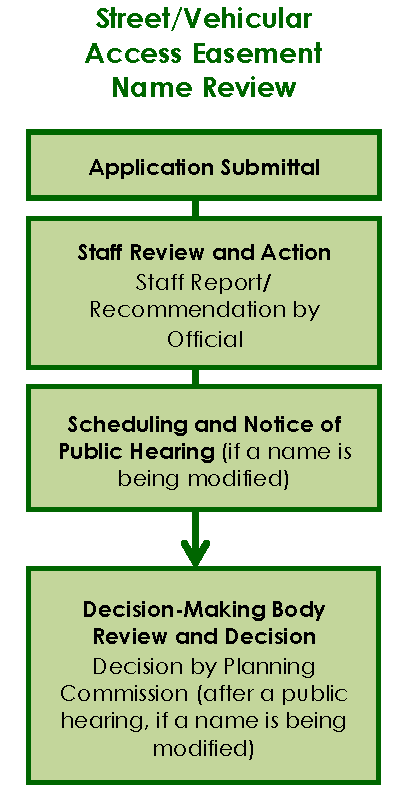
a. Application Submittal
An application for Street/Vehicular Access Easement Name Review may be submitted by persons identified in Sec. 16-2-102.C.1, and shall be submitted in accordance with Sec. 16-2-102.C. Such an application shall be submitted in conjunction with any application for Subdivision Review, Development Plan Review, Small Residential Development Review, or Public Project Review that proposes a street or vehicular access easement.
b. Staff Review and Action
On receiving an application, the Official shall review the applicationand prepare a staff report with a recommendation for action on the applicationin accordance with Sec. 16-2-102.D.
c. Hearing Scheduling and Notice
A public hearing on an application that proposes to modify a street or vehicular access easement name shall be scheduled, and required notice provided, for the Planning Commission hearing on the applicationin accordance with Sec. 16-2-102.E.
d. Decision-Making Body Review and Decision
The Planning Commission shall review the applicationand staff report, hold a public hearing (if the street or vehicular access easement name is being modified), and make a final decision on the application in accordance with Sec. 16-2-102.G. The Commission's decision shall be based on the standards in Sec. 16-2-103.O.4, Street/Vehicular Access Easement Review Standards, and shall be one of the following:
i.
Approve the application;
ii.
Approve the application subject to conditions of approval; or
iii.
Deny the application.
e. Post-Decision Actions and Limitations
i.
Notice of Decision
The Official shall provide notice of the final decision on the application in accordance with Sec. 16-2-102.H.1.
ii.
Appeal
Appeals from the final decision of the Planning Commission on an application for Street/Vehicular Access Easement Name Review are governed by S.C. Code Ann. § 6-29-1150.
4. Street/Vehicular Access Easement Review Standards
A proposed new or modified street or vehicular access easement name shall be approved on a finding that the name complies with the following standards:
a.
No new street or vehicular access easement, or proposed modification of the name of an existing street or vehicular access easement, shall duplicate, be phonetically similar to, or in any way be likely to be confused with an existing street or vehicular access easement, despite the use of prefixes or suffixes.
b.
Names shall be simple, logical, easy to read and pronounce, and clear and brief. Use of frivolous or complicated words or unconventional spellings in names shall not be approved.
c.
It is desirable to use names that have some association with Hilton Head Island and specifically with the immediate location of the street or place, such as reference to local history or physiographic features.
d.
Use of a common theme is recommended for names of streets that are associated with one another, such as those within a residential development.
e.
Streets or vehicular access easements that continue through an intersection should generally bear the same name, except where the street crosses a major arterial or where existing address points on a street require that the street be given a different name.
f.
A street or vehicular access easement making an approximate right-angle turn where there is no possibility of extending the street or vehicular access easement in either direction shall be considered to be continuous and continue the same name. Where there is a choice of direction or a possibility of extending either section in the future, such configuration shall be considered an intersection and the street/easement segments extending from the intersection shall bear different names.
g.
New or modified street names should generally use Drive, Lane, Place, Road, Street, or Way as suffixes. The following street designations should only be used if the street design meets one of the following descriptions. This list is not intended to limit the use of other appropriate suffixes.
i.
Alley—A street providing vehicular access to the rear of lots or buildings, usually as a secondary means of vehicular access to a property.
ii.
Avenue—A street that is continuous.
iii.
Boulevard—A street with a landscaped median dividing the roadway.
iv.
Circle—A street with a complete loop on the end or a side street that intersects another street at two adjacent intersections.
v.
Court—A street terminating in a cul-de-sac, not longer than 1,000 feet in length.
vi.
Extension—A section of street forming an additional length.
vii.
Parkway—A street designated as a collector or arterial street, with a landscaped median reflecting the parkway character implied in the name.
h.
The suffixes Manor, Trace, and Common shall typically be used to name vehicular accesseasements.
i.
Where natural barriers, intervening landuses, or developments break an existing street into two separate streets that are not likely to be reconnected in the future, the streets shall be named in a manner that considers the potential economic impact of the number of address points and type of addresses impacted.
5. Notice of Action
a.
If the Planning Commission approves the name, the Official shall certify the name in writing and forward the certification to the emergency dispatch office, post office, and the Office of the Register of Deeds for Beaufort County, South Carolina, as well as the applicant.
b.
The Official shall provide notice of an approved modification of a street or vehicular access easement name by certified mail to all owners of record of properties on the affected street or vehicular access easement.
6. Expiration
Approval of a new or modified street or vehicular access easement name shall not expire, but the name is subject to further modification in accordance with procedures set forth in this subsection.
7. Amendment
A street/vehicular access easement name approval may be amended only in accordance with the procedures and standards for its original approval.
P. Certificate of Compliance
1. Purpose
The purpose of this subsection is to establish procedures and standards for the review and decision on applications for a Certificate of Compliance.
2. Applicability
All development, or an approved phase thereof, that has received approval of a Subdivision Plan, Development Plan, or Small Residential Development—or any other development that has received a permit or development approval under this Ordinance— shall obtain approval of a Certificate of Compliance prior to a receipt of a Certificate of Occupancy and occupancy of a building or structure or actual occupancy or use of the site or structure or portion thereof if no Certificate of Occupancy is required.
(Revised 5-17-2016 - Ordinance 2016-07)
3. Certificate of Compliance Procedure
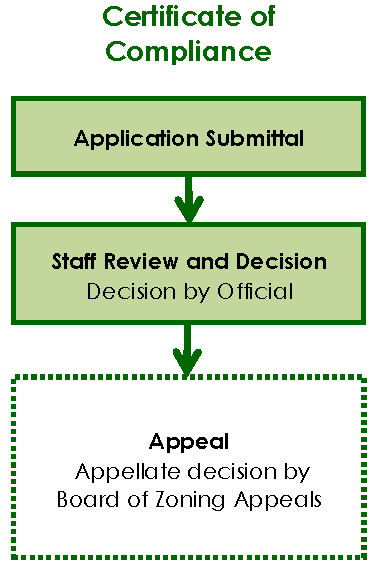
a. Application Submittal
An application for a Certificate of Compliance may be submitted by persons identified in Sec. 16-2-102.C.1, and shall be submitted in accordance with Sec. 16-2-102.C.
b. Staff Review and Action
On receiving an application, the Official shall review and make a final decision on the application in accordance with Sec. 16-2-102.D, subject to the following procedures:
i.
Following review of the application, the Official shall schedule and conduct a final inspection for the purpose of verifying compliance with all applicable provisions of this Ordinance—including, but not limited to, the requirements of the approved Subdivision Plan, Development Plan, Small Residential Development, or other applicable permits and development approvals.
ii.
After the final site inspection, the Official shall either approve or deny the application, based on compliance with Sec. 16-2-103.P.4, Certificate of Compliance Review Standards.
iii.
The Official may issue a Temporary Certificate of Compliance subject to a performance guarantee of improvements for a period up to a maximum of 18 months where the only uncompleted development consists of landscaping/tree planting that is deferred due to inappropriate weather conditions for planting (e.g., deferring plantings from hot summer months to cooler autumn months) or the likelihood that landscaping or trees will be damaged during additional construction activities related to a residential subdivision.
iv.
Performance Guarantee of Improvements. If landscaping installations are not completed and accepted by the Town prior to issuance of a Certificate of Compliance, a Temporary Certificate of Compliance may be issued and shall be subject to the posting of a performance guarantee with conditions satisfactory to the Town, providing for and securing to the Town the actual construction and installation of improvements.
01.
Form of Guarantee. Where required, the applicant shall furnish a performance guarantee in any of the following acceptable forms:
(A)
Cash deposit with the Town;
(B)
Certified check from a Federal or South Carolina banking institution based upon a cash deposit, in a form acceptable to the Town Attorney;
(C)
Irrevocable letter of credit from a Federal or South Carolina banking institution in a form acceptable to the Town Attorney; or
(D)
Any other financial security found acceptable by the Town Attorney.
02.
Length of Time of Guarantee. The term of the performance guarantee shall reflect any time limit for completing installation of required landscaping not to exceed 18 months.
03.
Amount of Guarantee. Performance guarantees for the completion of landscaping shall be a minimum of 125 percent of the cost of materials and labor required for completion.
04.
Final Plat. Where a performance guarantee is accepted by the Town in-lieu of the completion of landscaping installation in a subdivision, the final plat shall include the following statement:
"THIS FINAL PLAT IS SUBJECT TO A PERFORMANCE GUARANTEE, WHICH MEANS THAT ALL REQUIRED LANDSCAPING IS NOT COMPLETED. ISSUANCE OF BUILDING PERMITS PRIOR TO COMPLETION OF LANDSCAPING SUBJECT TO THE PERFORMANCE GUARANTEE SHALL OCCUR AT THE SOLE DISCRETION OF THE TOWN OF HILTON HEAD ISLAND. IN THE EVENT THE DEVELOPER DEFAULTS AND THE TOWN MUST COMPLETE THE LANDSCAPING, THE DEVELOPER WILL BE ASSESSED ANY DIFFERENCE BETWEEN THE AMOUNT OF THE PERFORMANCE GUARANTEE AND ACTUAL CONSTRUCTION COST."
05.
Release of Guarantee.
(A)
Release. Release of a performance guarantee shall occur after the Town Project Manager determines that the landscaping in-lieu of which the guarantee was accepted is complete.
(B)
Partial Release. A partial release of a performance guarantee is prohibited.
(C)
Release to be Recorded. The Town shall record all releases of performance guarantees, or the Town's final acceptance of landscaping installation, in the Beaufort County Register of Deeds.
06.
Forfeiture of Security.
(A)
Notice of Failure to Install or Complete Landscaping. If an applicant fails to properly install all required landscaping within the term of the performance guarantee, the Town shall give 30 days' written notice to the applicant by certified mail, after which time the Town may draw on the security and use the funds to complete the required installation.
(B)
Town Completion of Landscaping. After completing the required landscaping installation, the Town shall provide a complete accounting of the expenditures (to include administrative fees) to the applicant and, as applicable, refund all unused security deposited, without interest.
(Revised 3-7-2023 - Ordinance 2023-04)
c. Post-Decision Actions and Limitations
i.
Notice of Decision
The Official shall provide notice of the final decision on the application in accordance with Sec. 16-2-102.H.1.
ii.
Appeal
Appeals from the final decision of the Official on an application for Certificate of Compliance are governed by Sec. 16-2-103.T, Appeal of Administrative Decisions and Written Interpretations to Board of Zoning Appeals and SC Code Ann. 6-29-800.
4. Certificate of Compliance Review Standards
a.
A Certificate of Compliance shall be approved upon a finding that the applicant demonstrates the proposed development complies with all applicable standards in this Ordinance, the Municipal Code, and all conditions of permits or development approvals approved under this Ordinance.
b.
If the application is for an approved phase of development in accordance with an approved Subdivision Plan, Development Plan, or Small Residential Development, a Certificate of Compliance shall be approved only on a finding that the phase will be able to function alone with all required infrastructure, including, but not limited to, access drives, parking, drainage facilities, utilities, and required landscaping/tree planting.
5. Issuance of Certificate of Occupancy
The Town's Building Official shall not issue a Certificate of Occupancy for any building until the Official has first issued a Certificate of Compliance for the development, or approved phase thereof, that contains the building.
Q. Public Project Review
1. Purpose
The purpose of this subsection is to establish procedures and standards for the review and decision on applications for Public Project Review.
2. Applicability
a.
Except as exempted in subparagraph b below, any proposal to develop a public project within the Town involving a new street, structure, utility, square, park, or other public way, grounds, or open space, or public buildings for any use, whether publicly or privately owned, shall be reviewed in accordance with this subsection prior to its development.
b.
These review procedures shall not apply to telephone, sewer, and gas utilities, or electric suppliers, utilities, and providers, whether publicly or privately owned, whose plans have been approved by the Town Council or a State or federal regulatory agency, or to electric suppliers, utilities, and providers who are acting in accordance with a legislatively delegated right pursuant to South Carolina Code of Laws, Chapter 27 or 31 of Title 58 or Chapter 49 of Title 33—provided these utilities submit construction information to the Official.
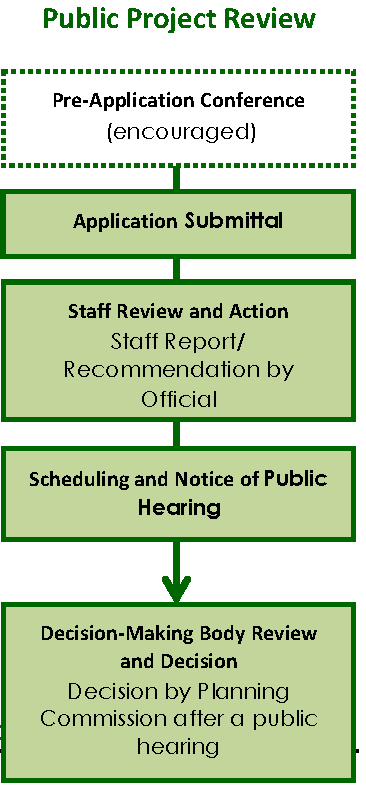
3. Public Project Review Procedure
a. Pre-Application Conference
Prospective applicants for Public Project Review are encouraged to request and hold a pre-application conference with Town staff in accordance with Sec. 16-2-102.B.
b. Application Submittal
An application for Public Project Review may be submitted by the entity proposing to develop or construct the public project.
c. Staff Review and Action
On receiving an application, the Official shall review the application and prepare a staff report with a recommendation for action on the applicationin accordance with Sec. 16-2-102.D. The Official's recommendation shall be based on the standards in Sec. 16-2-103.Q.4, Public Project Review Standards.
d. Hearing Scheduling and Notice
A public hearing on the application shall be scheduled, and required notice provided, for the Planning Commission hearing in accordance with Sec. 16-2-102.E.
e. Decision-Making Body Review and Decision
i.
The Planning Commission shall review the application and staff report, hold a public hearing on the application, and make a final decision on the application in accordance with Sec. 16-2-102.G. The Planning Commission's decision shall be whether or not the proposed development is compatible with the Comprehensive Plan, and shall be based on the standards in Sec. 16-2-103.Q.4, Public Project Review Standards.
ii.
The Commission's decision shall be in writing and include findings of fact and conclusions of law.
f. Post-Decision Actions and Limitations
The Official shall provide notice of the final decision on the application in accordance with Sec. 16-2-102.H.1.
4. Public Project Review Standards
In determining whether or not a proposed public project is compatible with the Comprehensive Plan, the Planning Commission shall consider whether the location, character, and extent of the proposed development is consistent with, or conflicts with, the plan's goals and implementation strategies.
5. Effect of Decision
a.
If the Planning Commission finds the public project is compatible with the Comprehensive Plan, the Official shall issue a notice of the finding to the public entity proposing the project.
b.
If the Planning Commission finds the public project conflicts with the Comprehensive Plan, it shall forward its written findings and an explanation of its reasoning to the public entity proposing the project.
c.
If the entity proposing the public project elects to proceed with its project that is in conflict with the Comprehensive Plan, then the governing or policy-making body of the entity shall publicly state its intention to proceed and its reasons for proceeding and send a copy of its intention and reasons to the Town Council and Planning Commission. It shall also publish a public notice of the Planning Commission findings and its intention and reasons for proceeding in a newspaper of general circulation in the Town at least 30 days in advance of award of a contract or the beginning of construction of the proposed public project.
R. Written Interpretation
1. Purpose
The purpose of this subsection is to establish procedures and standards for rendering formal written interpretations of this Ordinance.
2. Applicability
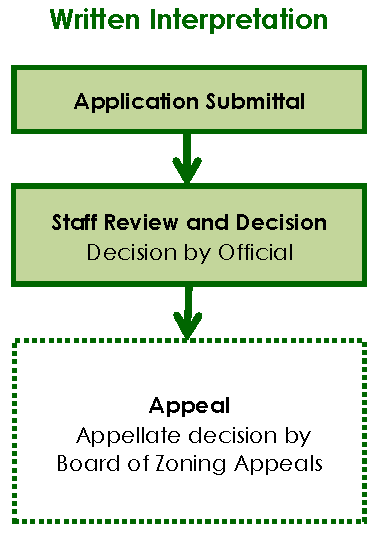
The Official is authorized to and shall be responsible for making interpretations of this Ordinance—including, but not limited to, interpretations of:
a.
The text of this Ordinance;
b.
Zoning district boundaries; and
c.
Whether an unspecified use is comparable to a listed use or not, and whether any unspecified use should be allowed in a zoning district or prohibited in that district.
3. Written Interpretation Procedure
a. Application Submittal
An application for a Written Interpretation shall be submitted in accordance with Sec. 16-2-102.C, except that applications may be submitted only by persons with a direct interest in the matter requested for interpretation (e.g., landowner or contract purchaser of a relevant property, applicant for or holder of an affected permit). The application shall include a statement of the applicant's direct interest.
b. Staff Review and Action
On receiving an application, the Official shall review and render an interpretation in accordance with Sec. 16-2-102.D. The Official's written interpretation shall be limited to the matters for which an interpretation is requested and shall be based on the standards in Sec. 16-2-103.R.4, Written Interpretation Standards.
c. Post-Decision Actions and Limitations
i.
Notice of Decision
The Official shall provide notice of the interpretation in accordance with Sec. 16-2-102.H.1.
ii.
Appeal
Appeals from the Official's interpretation are governed by Sec. 16-2-103.T, Appeal of Administrative Decisions and Written Interpretations to Board of Zoning Appeals and SC Code Ann. 6-29-800.
4. Written Interpretation Standards
a. Zoning Map Boundaries
Interpretation of zoning district boundaries on the Official Zoning Map shall be in accordance with the criteria in Sec. 16-1-107.C, Zoning District Boundaries.
b. Unspecified Uses
Interpretation of whether an unspecified use is similar to a use or is prohibited in a zoning district shall be based on Sec. 16-4-102.A.5, Interpretation of Unlisted Uses, and whether the interpretation is in accordance with the Comprehensive Plan.
c. Text Provisions
Interpretation of text provisions and their application shall be based on the standards in Sec. 16-10-101, General Rules for Interpretation, and the following considerations:
i.
The plain language used in the text, considering (a) any defined term set out in Sec. 16-10-105, General Definitions, and (b) the common and accepted usage of other words in the text;
ii.
The general purposes served by the provision and this Ordinance; and
iii.
The Comprehensive Plan.
5. Official Record of Interpretations
The Official shall maintain a record of written interpretations that shall be available in the Town Hall for public inspection, on reasonable request, during normal business hours.
6. Effect of Interpretation
A written interpretation shall be binding on subsequent decisions by the Official in applying the same provision of this Ordinance in the same circumstance.
S. Variance
1. Purpose
The purpose of this subsection is to establish procedures and standards for the review and decision on applications for a Variance.
2. Applicability
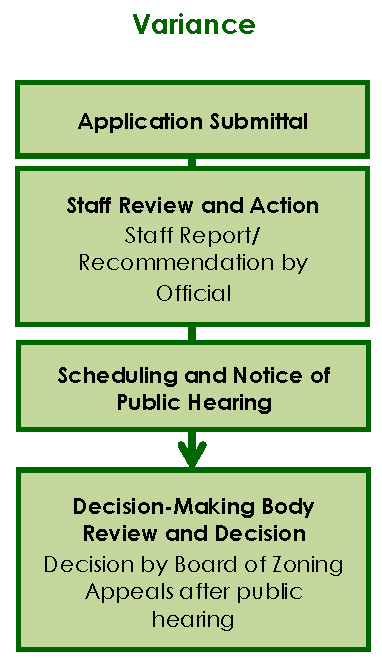
The Variance procedure may be used to seek and obtain relief from the standards of this LMO except for uses outlined in LMO Section 16-4-102.A.6, Principal Use Table, height and density standards.
(Revised 3-7-2023 - Ordinance 2023-04)
3. Variance Procedure
a. Application Submittal
An application for a Variance may be submitted by persons identified in Sec. 16-2-102.C.1, and shall be submitted in accordance with Sec. 16-2-102.C.
b. Staff Review and Action
On receiving an application, the Official shall review the application and prepare a staff report with a recommendation for action on the application in accordance with Sec. 16-2-102.D. The Official's recommendation shall be based on the standards in Sec. 16-2-103.S.4, Variance Review Standards.
c. Hearing Scheduling and Notice
A public hearing on the application shall be scheduled, and required notice provided, for the Board of Zoning Appeals hearing in accordance with Sec. 16-2-102.E.
d. Decision-Making Body Review and Decision
i.
The Board of Zoning Appeals shall review the applicationand staff report, hold a public hearing on the application, and make a final decision on the application in accordance with Sec. 16-2-102.G. The Board's decision shall be based on the standards in Sec. 16-2-103.S.4, Variance Review Standards, and shall be one of the following:
01.
Approve the application;
02.
Approve the application subject to conditions of approval; or
03.
Deny the application.
ii.
The Board's final decision shall be in writing and include findings of fact and conclusions of law separately stated.
e. Post-Decision Actions and Limitations
i.
Notice of Decision
The Official shall provide notice of the interpretation in accordance with Sec. 16-2-102.H.1. Notice to interested parties shall be provided via certified mail.
ii.
Appeal
Appeals from the final decision of the Board of Zoning Appeals on an application for a Variance are governed by S.C. Code Ann. § 6-29-820.
4. Variance Review Standards
a. Required Findings
i.
A Variance may be granted by the Board of Zoning Appeals if it concludes that the strict enforcement of any appropriate dimensional, development, design, or performance standard set forth in this Ordinance would result in unnecessary hardship. A Variance may be granted in an individual case of unnecessary hardship if the Board of Zoning Appeals determines and expresses in writing all of the following findings:
01.
There are extraordinary and exceptional conditions pertaining to the particular piece of property;
02.
These conditions do not generally apply to other properties in the vicinity;
03.
Because of these conditions, the application of this Ordinance to the particular piece of property would effectively prohibit or unreasonably restrict the utilization of the property; and
04.
The authorization of the Variance will not be of substantial detriment to adjacent property or the public good, and the character of the zoning district where the property is located will not be harmed by the granting of the Variance.
ii.
In its consideration of an application for a Variance, the decision-making body shall be guided by this Ordinance, the relevant provisions of the South Carolina Local Government Comprehensive Planning Enabling Act of 1994, and the decisions of the appellate courts of South Carolina interpreting such provisions.
b. Limitations
The decision-making body may not grant a Variance, the effect of which would do any of the following:
i.
Permit a use of land or a structure that is not allowed in the applicable zoning district;
ii.
Allow the physical extension of a nonconforming use;
iii.
Increase the density of a use above that permitted by the applicable zoning district; or
iv.
Vary the sign regulations.
c. Factor Not to be Considered
The fact that the property may be utilized more profitably, should a Variance be granted, may not be considered as grounds for a Variance.
d. Hardship Due to Eminent Domain
Where the alleged hardship results from the taking of part of the property of the applicant by eminent domain, thus reducing the land area available for parking, buffers and other purposes, the applicant shall have the burden of proving that, after good faith efforts by the applicant or the applicant's predecessor, the condemning authority failed or refused to provide the applicant compensation adequate to cover the value of both the land actually taken and the economic impacts of the reduction in the size of the remaining property. Only if the applicant meets such burden of proof will a hardship under these conditions be considered adequate to justify the granting of a Variance.
5. Effect of Approval
Approval of a Variance authorizes only the particular relief approved. It does not exempt the applicant from the responsibility to obtain all other approvals required by this Ordinance and any other applicable laws, and does not indicate that the development for which the Variance is granted should receive other permits or development approvals under this Ordinance unless the relevant and applicable portions of this Ordinance or any other applicable laws are met. Unless it expires in accordance with Sec. 16-2-103.S.6, Expiration, a Variance, including any conditions of approval, shall run with the land, shall be binding on the landowners and their successors and assigns, and shall not be affected by a change in ownership.
6. Expiration
Granting of a Variance establishes a vested right in accordance with Sec. 16-2-102.J.1, Vested Rights for Approvals of Site Specific Development Plans.
7. Amendment
A Variance may be amended only in accordance with the procedures and standards for its original approval.
T. Appeal of Administrative Decisions and Written Interpretations to Board of Zoning Appeals
1. Purpose
The purpose of this subsection is to establish procedures and standards for the review of and decision on applications for an appeal to the Board of Zoning Appeals from an administrative decision or written interpretation of the Official.
2. Who May File Appeal
a.
A decision or written interpretation made by the Official or other administrative official pursuant to this Ordinance may be appealed to the Board of Zoning Appeals by any person aggrieved by the decision or interpretation—or any officer, department, board, or bureau of the Town—who alleges that the Official or other administrative official erred in making the decision or interpretation.
b.
For the purposes of this subsection, a person is aggrieved if there is some special or particularized injury to that person or that person's property resulting from the decision or written interpretation.
3. Types of Appeal
Appeals of the following decisions or interpretations made by the Official shall be heard and decided by the Board of Zoning Appeals in accordance with the procedures and standards in this subsection.
a.
Minor Deviations to a PUD (see Sec. 16-2-103.D.8, Minor Deviations from Approved Master Plan);
b.
Natural Resources Permits (see Sec. 16-2-103.K, Natural Resources Permit);
c.
Wetlands Alteration Permits (see Sec. 16-2-103.L, Wetlands Alteration Permit);
d.
Certificates of Compliance (see Sec. 16-2-103.P, Certificate of Compliance);
e.
Written Interpretations (see Sec. 16-2-103.R, Written Interpretation); and
f.
Any action to enforce the provisions of this Ordinance.
4. Appeal Procedure
a. Application Submittal
An application for an Appeal to the Board of Zoning Appeals may be submitted by persons identified in paragraph 2 above, and shall be submitted in accordance with Sec. 16-2-102.C. The application shall specify the grounds for the appeal and shall be delivered to the Official within 14 calendar days after delivery of notice of the decision being appealed (see Sec. 16-2-102.H.1, Notice of Decision).
b. Staff Review and Action
On receiving the application, the Official shall transmit to the Board of Zoning Appeals the application and the record of materials considered in making the decision being appealed (including but not limited to, the application and support materials, staff report, other plans, documents, reports, and studies considered in making the decision, and any minutes, transcripts, or record of the meetings held to consider and make the decision). These materials constitute the record of the appeal.
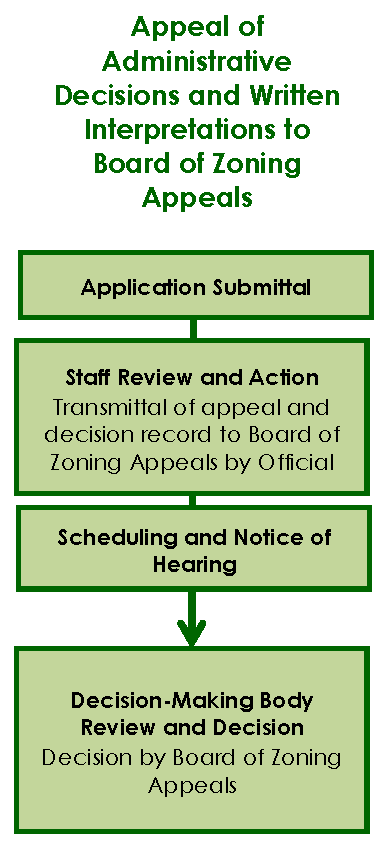
c. Hearing Scheduling and Notice
A hearing on the application shall be scheduled, and required notice provided, for the Board of Zoning Appeals hearing in accordance with Sec. 16-2-102.E. The Official shall also provide notice of the hearing to the applicant for the decision being appealed (if different from the appellant), as well as the appellant.
d. Decision-Making Body Review and Decision
i.
The Board of Zoning Appeals shall review the application, hold a hearing on the application, and make a final decision on the application in accordance with Sec. 16-2-102.G. The decision of the Board of Zoning Appeals shall be based solely on the record of the appeal, as supplemented by arguments presented at the hearing, and the standards in Sec. 16-2-103.T.5, Board of Zoning Appeals Appeal Review Standards , and shall be one of the following:
01.
Affirmation of the decision or interpretation, in whole or in part;
02.
Modification of the decision or interpretation, in whole or in part (in modifying the decision, the Board of Zoning Appeals shall have all the powers of the Official, and may issue a permit or development approval or direct that a permit or development approval be issued); or
03.
Reversal of the decision or interpretation, in whole or in part (in reversing the decision the Board of Zoning Appeals shall have all the powers of the Official, and may issue a permit or development approval or direct that a permit or development approval be issued, provided that with respect to the Board of Zoning Appeals a majority vote of the Board shall be required to reverse the decision).
ii.
The Board's final decision shall be in writing and include findings of fact and conclusions of law separately stated.
e. Post-Decision Actions and Limitations
i.
Notice of Decision
The Official shall provide notice of the decision of the Board of Zoning Appeals in accordance with Sec. 16-2-102.H.1. Notice to interested parties shall be provided via certified mail.
ii.
Appeal
Appeals from the final decision of the Board of Zoning Appeals on an application for an Appeal are governed by S.C. Code Ann. § 6-29-820.
5. Board of Zoning Appeals Appeal Review Standards
a.
The Board of Zoning Appeals may modify or reverse a decision or interpretation only on determining that the applicant is an aggrieved person under subparagraph 2.b above, and making one of the following determinations, which shall be based on evidence in the record:
i.
The Official made an error in determining whether a requirement of this Ordinance was met. The record must indicate that an error in judgment occurred or facts, plans, or regulations were misread in determining whether the particular requirement was or was not met; or
ii.
The Official made the decision based on a requirement not contained in this Ordinance or other appropriate Town ordinances, regulations, or State law; or
iii.
The Official made an error in applying a requirement of this Ordinance.
b.
Unless the Board of Zoning Appeals makes the determinations in subparagraph a above, it shall affirm the Official's decision or interpretation.
6. Effect of Pending Appeal
A pending appeal stays all Town actions in furtherance of the decision being appealed unless the Official certifies to the Board of Zoning Appeals that because of facts stated in the certificate, a stay would cause imminent peril to life or land. In that case, proceedings may not be stayed other than by a restraining order that may be granted by the Board of Zoning Appeals or by the Circuit Court on application, upon notice to the officer from whom the appeal is taken, and on due cause shown.
U. Appeal of Official's Decision to Planning Commission
1. Purpose
The purpose of this subsection is to establish procedures and standards for the review and decision on appeals to the Planning Commission from decisions of the Official to approve, approve with conditions, or deny applications for Family Compound, Family Subdivision, Subdivision Review, Development Plan Review, Small Residential Development Review, or Development Project Name Review.
2. Who May File Appeal
The Official's decision on an application for Family Compound, Family Subdivision, Subdivision Review, Development Plan Review, Small Residential Development Review or Development Project Name Review may be appealed to the Planning Commission by the applicant for the decided application, the owner of land to which the decision specifically applies, or any other party in interest, who alleges that the Official erred in making the decision:
3. Types of Appeal
The following decisions made by the Official may be appealed to the Planning Commission in accordance with the procedures and standards in this subsection.
a.
Family Compound;
b.
Family Subdivision;
c.
Subdivision Review;
d.
Development Plan Review;
e.
Small Residential Development Review; and
f.
Development Project Name Review.
(Revised 7-20-2021 - Ordinance 2021-15)
4. Appeal Procedure
a. Application Submittal
An application for an Appeal to the Planning Commission may be submitted by persons identified in paragraph 2 above, and shall be submitted in accordance with Sec. 16-2-102.C. The application shall specify the grounds for the appeal and shall be delivered to the Official within 14 calendar days after delivery of notice of the decision being appealed (see Sec. 16-2-102.H.1, Notice of Decision).
b. Staff Review and Action
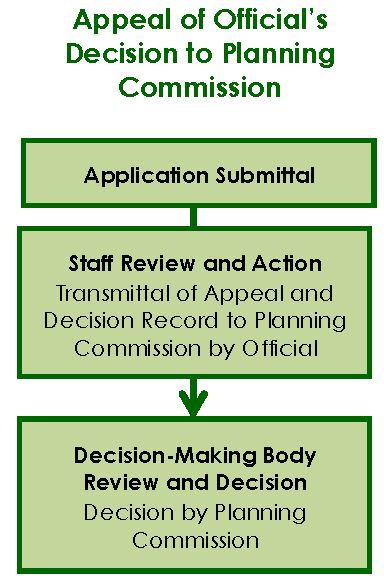
On receiving an application, the Official shall transmit to the Planning Commission the application and the record of materials considered in making the decision being appealed (including, but not limited to, the application and support materials, other plans, documents, reports, and studies considered in making the decision, and any record of the meetings held to consider and make the decision). These materials shall constitute the record of the appeal.
c. Hearing Scheduling and Notice
A hearing on the application shall be scheduled, and required notice provided, for the Planning Commission hearing in accordance with Sec. 16-2-102.E. The Official shall also provide notice of the hearing to the applicant (if the applicant is not the appellant) for the decision, as well as the appellant.
d. Decision-Making Body Review and Decision
i.
The Planning Commission shall review the application, hold a hearing on the application, and make a final decision on the application in accordance with Sec. 16-2-102.G. The Planning Commission's decision shall be based solely on the record of the appeal, as supplemented by presented arguments, and the standards in Sec. 16-2-103.U.5, Planning Commission Appeal Review Standards, and shall be one of the following:
01.
Affirmation of the decision, in whole or in part;
02.
Modification of the decision, in whole or in part; or
03.
Reversal of the decision, in whole or in part.
ii.
The Commission's final decision shall be in writing and include findings of fact and conclusions of law separately stated.
iii.
The Planning Commission shall act on the appeal within 60 days of receipt of the application.
e. Post-Decision Actions and Limitations
i.
Notice of Decision
The Official shall provide notice of the Planning Commission's decision in accordance with Sec. 16-2-102.H.1. Notice to interested parties shall be provided via certified mail.
ii.
Appeal
Appeals from the final decision of the Planning Commission on an application for an Appeal are governed by S.C. Code Ann. § 6-29-1150.
5. Planning Commission Appeal Review Standards
a.
The Planning Commission may modify or reverse a decision only on making one of the following determinations, which shall be based on evidence in the record:
i.
The Official made an error in determining whether a requirement of this Ordinance was met. The record must indicate that an error occurred or facts, plans, or regulations were misread in determining whether the particular requirement was or was not met; or
ii.
The Official made the decision based on a requirement not contained in this Ordinance or other appropriate Town ordinances, regulations, or State law; or
iii.
The Official made an error in applying a requirement of this Ordinance.
b.
Unless the Planning Commission makes one of the determinations in subparagraph a above, it shall affirm the Official's decision.
6. Effect of Pending Appeal
A pending appeal stays all Town actions in furtherance of the decision being appealed unless the Official certifies to the Planning Commission that because of facts stated in the certificate, a stay would cause imminent peril to life or land. In that case, proceedings may not be stayed other than by a restraining order that may be granted by the Planning Commission or by the Circuit Court, on application, upon notice to the officer from whom the appeal is taken, and on due cause shown.
V. Appeal of Official's Decision to Design Review Board
1. Purpose
The purpose of this subsection is to establish the procedures and standards for the review and decision on an appeal to the Design Review Board by persons aggrieved by a decision made by the Official related to matters under their purview.
2. Who May File Appeal
a.
The Official's decision on an application for Minor Corridor Review or a Sign Permit may be appealed to the Design Review Board by any person aggrieved by the decision—or any officer, department, board, or bureau of the Town—who alleges that the Official erred in making the decision.
b.
For purposes of this subsection, a person is aggrieved if there is some special or particularized injury to that person or the person's property resulting from the decision.
3. Types of Appeal
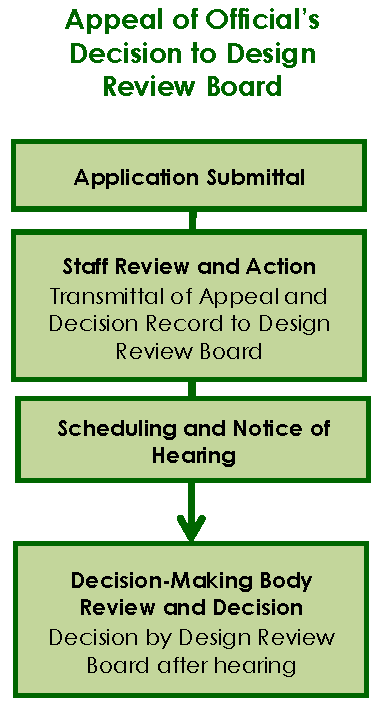
The following decisions made by the Official may be appealed to the Design Review Board in accordance with the procedures and standards in this subsection.
a.
Minor Corridor Review (see Sec. 16-2-103.I); or
b.
Minor Sign Permit (see Sec. 16-2-103.M).
4. Appeal Procedure
a. Application Submittal
An application for an Appeal to the Design Review Board may be submitted by persons identified in paragraph 2 above, and shall be submitted in accordance with Sec. 16-2-102.C. The application shall specify the grounds for the appeal and shall be delivered to the Official within 14 calendar days after delivery of notice of the decision being appealed (see Sec. 16-2-102.H.1, Notice of Decision).
b. Staff Review and Action
On receiving the application, the Official shall transmit to the Design Review Board the application and the record of materials considered in making the decision being appealed (including, but not limited to, the application and support materials, other plans, documents, reports, and studies considered in making the decision, and any record of the meetings held to consider and make the decision). These materials shall constitute the record of the appeal.
c. Hearing Scheduling and Notice
A hearing on the application shall be scheduled, and required notice provided, for the Design Review Board hearing in accordance with Sec. 16-2-102.E. The Official shall also provide notice of the hearing to the applicant (if the applicant is not the appellant) for the decision, as well as the appellant.
d. Decision-Making Body Review and Decision
i.
The Design Review Board shall review the application, hold a hearing on the application, and make a final decision on the application in accordance with Sec. 16-2-102.G. The Design Review Board's decision shall be based solely on the record of the appeal, as supplemented by arguments presented at the hearing, and the standards in Sec. 16-2-103.V.5, Design Review Board Appeal Review Standards, and shall be one of the following:
01.
Affirmation of the decision, in whole or in part;
02.
Modification of the decision, in whole or in part; or
03.
Reversal of the decision or interpretation, in whole or in part.
ii.
The Board's final decision shall be in writing and include findings of fact and conclusions of law separately stated.
iii.
The Design Review Board shall make a decision on the appeal within a reasonable time.
e. Post-Decision Actions and Limitations
i.
Notice of Decision
The Official shall provide notice of the Design Review Board's decision in accordance with Sec. 16-2-102.H.1. Notice to interested parties shall be provided via certified mail.
ii.
Appeal
Appeals from the final decision of the Design Review Board on an application for an Appeal are governed by S.C. Code Ann. § 6-29-900.
5. Design Review Board Appeal Review Standards
a.
The Design Review Board may modify or reverse a decision or interpretation only on determining that the applicant is an aggrieved person under subparagraph 2.b above, and making one of the following determinations, which shall be based on evidence in the record:
i.
The Official made an error in determining whether a requirement of this Ordinance was met. The record must indicate that an error in judgment occurred or facts, plans, or regulations were misread in determining whether the particular requirement was or was not met; or
ii.
The Official made the decision based on a requirement not contained in this Ordinance or other Town ordinances, regulations, or State law; or
iii.
The Official made an error in applying a requirement of this Ordinance.
b.
Unless the Design Review Board makes one of the determinations in subparagraph a above, it shall affirm the Official's decision.
6. Effect of Pending Appeal
A pending appeal stays all Town actions in furtherance of the decision being appealed unless the Official certifies to the Design Review Board that because of facts stated in the certificate, a stay would cause imminent peril to life or land. In that case, proceedings may not be stayed other than by a restraining order that may be granted by the Design Review Board or by the Circuit Court, on application, upon notice to the officer from whom the appeal is taken, and on due cause shown.
(Ord. No. 2015-23, 11-3-2015)
W. Utility Project Permit
1. Purpose
The purpose of this subsection is to establish the procedures and standards for the review and decision on an application for a Utility Project Permit.
2. Applicability
All utility projects in the Town shall be approved in accordance with this subsection.
3. Utility Project Permit Review Procedure
a.
Application Submittal
An application for a Utility Project Permit may be submitted by persons identified in Sec. 16-2-102.C.1, and shall be submitted in accordance with Sec. 16-2-102.C.
b.
Staff Review and Action
On receiving an application the Official shall review and make a final decision on the application in accordance with Sec. 16-2-102.D. The Official's decision shall be based on the standards in Sec. 16-2-103.W.4. Utility Project Permit Review Standards, and shall be one of the following:
i.
Approve the application;
ii.
Approve the application subject to conditions of approval: or
iii.
Deny the application.
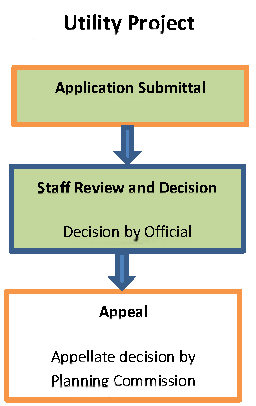
c.
Post-Decision Actions and Limitations
i.
Notice of Decision
The Official shall provide notice of the final decision on the application in accordance with Sec. 16-2-102.H.1.
ii.
Appeal
Appeals from the final decision of the Official on an application for a Utility Project Permit are governed by Sec. 16-2-103.U, Appeal of Official's Decision to Planning Commission, and S.C. Code Ann. § 6-29-1150.
4. Utility Project Permit Review Standards
An application for a Utility Project Permit shall be approved on a finding the applicant has demonstrated the proposed work complies with:
a.
The relevant standards and requirements in Chapter 16-3: Zoning Districts, Chapter 16-4: Use Standards, Chapter 16-5: Development and Design Standards and Chapter 16-6: Natural Resource Protection; and
b.
All other applicable standards of this Ordinance; and
c.
All other applicable requirements in the Municipal Code.
5. Effect of Approval
Approval of a Utility Project Permit authorizes only the particular utility work approved, and not any other utility work.
6. Expiration
Approval of a Utility Project Permit establishes a vested right in accordance with Sec. 16-2-102.J.1, Vested Rights for Approvals of Site Specific Development Plans.
7. Amendment
A Utility Project Permit may be amended only in accordance with the procedures and standards for its original approval.
8. Final Inspection
Utility projects are exempt from the Certificate of Compliance process as listed in Section 16-2-103.P. At the completion of the Utility Project, the applicant shall do the following:
a.
Provide the Town with one complete set of as-built drawings as accepted by the utility provider, indicating accurate site conditions to include utilities, structures and drainage; and
b.
Request a final inspection from the Town. The Official shall schedule and conduct a final inspection for the purpose of verifying compliance with all applicable provisions of this Ordinance. After the final site inspection, the Official shall either approve or deny the final inspection, based on the Utility Project Permit. In instances where the project is within a right-of-way not owned by the Town, the requirement for a final inspection may be waived by the Official if the owner of the road conducts a final inspection.
(Revised 6-6-2017 - Ordinance 2017-08)
X. Family Compound
1. Purpose
The purpose in this section is to establish the procedures and standards for the review and decision on an application for Family Compound approval.
2. Applicability
a.
General
i.
Applications for Family Compound Review are only permitted on property that meets these qualifications:
1.
located on a property within a historic neighborhood as shown in Appendix B-5. Historic Neighborhoods Map; and
2.
where a single member of the family, multiple members of the family, or an unbroken succession of family members have owned the property since 1956 or earlier; or
3.
where the property has been sold to a family who has owned property on Hilton Head Island since 1956 or earlier.
ii.
The owner of record of the property shall request the family compound.
iii.
For the purposes of this section family shall be defined as spouse, parent(s), biological or legally adopted child(ren), group of persons related by blood, and descended from common ancestor (as in extended family).
iv.
Family Compounds will be considered a single-family use.
3. Family Compound Review Procedure
a.
Pre-Application Conference
Prospective applicants for Family Compound Review are encouraged to request and hold a pre-application conference with Town staff in accordance with Sec. 16-2-102.B.
b.
Application Submittal
An application for Family Compound Review may be submitted by persons identified in Sec. 16-2-102.C.1 and shall be submitted in accordance with Sec. 16-2-102.C.
c.
Accelerated Application Review
i.
All applications for Family Compounds will be expedited.
a.
New submittals for Family Compounds will be reviewed prior to other submittals.
b.
New building permit submittals related to Family Compounds will be reviewed prior to other submittals.
c.
Resubmittals for Family Compounds will be reviewed prior to other submittals.
d.
Staff Review and Action
i.
On receiving an application, the Official shall review and make a final decision on the application in accordance with Sec. 16-2-102.D. The Official's decision shall be based on the standards in Sec. 16-2-103.X.4, Family Compound Review Standards, and shall be one of the following:
1.
Approve the application;
2.
Approve the application subject to conditions of approval; or
3.
Deny the application.
ii.
The Official shall act on an application for Family Compound Review, in accordance with Sec. 16-2-102.D, within 7 business days after it is submitted or such extended time agreed to by the applicant. If the Official fails to take action on the application within this time period, the application shall be deemed approved, and the Town shall issue the applicant a letter of approval and written notice to proceed based on the submitted application.
e.
Post-Decision Actions and Limitations
i.
Notice of Decision
The Official shall provide notice of the final decision on the application in accordance with Sec. 16-2-102.H.1.
ii.
Appeal
Appeals from the final decision of the Official on an application for Family Compound Review are governed by Sec. 16-2-103.U, Appeal of Official's Decision to Planning Commission, and S.C. Code § 6-29-1150.
4. Family Compound Review Standards
An application for Family Compound Review shall be approved if the Official finds the applicant demonstrates the proposed Family Compound complies with the following:
a.
All other applicable standards of this Ordinance.
b.
All other applicable requirements in the Municipal Code.
5. Effect of Approval
Approval of a Family Compound authorizes the submittal of any other subsequent development applications that may be required before construction or other development authorized by this Ordinance. Prior to the issuance of the approval, a restriction on the sale of the property to non-family members shall be recorded in the deed. The restriction shall state that the property cannot be sold to non-family members for three years after being established as a Family Compound.
6. Expiration
Approval of a Family Compound establishes a vested right in accordance with Sec. 16-2-102.J.1, Vested Rights for Approvals of Site Specific Development Plans.
7. Amendment
An approved Family Compound may be modified or amended only in accordance with procedures and standards established for its original approval.
(Revised 7-20-2021 - Ordinance 2021-15)
Y. Family Subdivision
1. Purpose
The purpose in this section is to establish the procedures and standards for the review and decision on an application for Family Subdivision approval. This section will allow the subdivision and transfer of familial owned property to future generations.
2. Applicability
a.
General
i.
Approval of a Family Subdivision in accordance with the procedures and standards of this subsection is required before any plat of a Family Subdivision may be recorded in the Office of the Register of Deeds for Beaufort County, South Carolina. No land in any proposed Family Subdivision may be sold, transferred, or offered for sale until a final plat for the Family Subdivision has been approved in accordance with this Ordinance and recorded in the Office of the Register of Deeds for Beaufort County, South Carolina.
ii.
Approval of a Family Subdivision requires that a person(s) living in a Family Subdivision must be related to the property owner by blood, marriage, or legal adoption. For the purposes of this section family shall be defined as spouse, parent(s), biological or legally adopted child(ren), group of persons related by blood, and descended from common ancestor (as in extended family).
iii.
Applications for Family Subdivision Review are only permitted on property that meets these qualifications:
a.
located on a property within a historic neighborhood as shown in Appendix B-5. Historic Neighborhoods Map; and
b.
where a single member of the family, multiple members of the family, or an unbroken succession of family members have owned the property since 1956 or earlier; or
c.
where the property has been sold to a family who has owned property on Hilton Head Island since 1956 or earlier.
3. Family Subdivision Review Procedure
a.
Pre-Application Conference
Prospective applicants for Family Subdivision Review are encouraged to request and hold a pre-application conference with Town staff in accordance with Sec. 16-2-102.B.
b.
Application Submittal
An application for Family Subdivision Review may be submitted by persons identified in Sec. 16-2-102.C.1 and shall be submitted in accordance with Sec. 16-2-102.C.
c.
Accelerated Application Review
i.
All applications for Family Subdivisions will be expedited.
a.
New submittals for Family Subdivisions will be reviewed prior to other submittals.
b.
New building permit submittals related to Family Subdivisions will be reviewed prior to other submittals.
c.
Resubmittals for Family Subdivisions will be reviewed prior to other submittals.
d.
Staff Review and Action
i.
On receiving an application, the Official shall review and make a final decision on the application in accordance with Sec. 16-2-102.D. The Official's decision shall be based on the standards in Sec. 16-2-103.Y.4, Family Subdivision Review Standards, and shall be one of the following:
1.
Approve the application;
2.
Approve the application subject to conditions of approval; or
3.
Deny the application.
ii.
The Official shall act on an application for Family Subdivision Review, in accordance with Sec. 16-2-102.D, within 60 business days after it is submitted, or such extended time agreed to by the applicant. If the Official fails to take action on the application within this time period, the application shall be deemed approved, and the Town shall issue the applicant a letter of approval and written notice to proceed based on the submitted application.
e.
Post-Decision Action and Limitations
i.
Notice of Decision
The Official shall provide notice of the final decision on the application in accordance with Sec. 16-2-102.H.1.
ii.
Appeal
Appeals from the final decision of the Official on an application for Family Subdivision Review are governed by Sec. 162-103.U, Appeal of Official's Decision to Planning Commission, and S.C. Code § 6-29-1150.
4. Family Subdivision Review Standards
An application for Family Subdivision Review shall be approved if the Official finds the applicant demonstrates the proposed Family Subdivision complies with the following:
a.
A notarized affidavit shall be submitted that shows a familial relationship (a person(s) living in a Family Subdivision must be related to the property owner by blood, marriage, or legal adoption, see 16-2-103.Y.2.a.ii) to those purchasing/deeding properties within the subdivision.
b.
A notarized affidavit shall be submitted stating that all infrastructure including the access must be installed and inspected prior to the sale of property within the subdivision to non-family members.
c.
All other applicable requirements in the Municipal Code.
5. Effect of Approval
1.
Approval of a Family Subdivision constitutes approval of a final plat for the subdivision. Recording of the final plat in the Office of the Register of Deeds for Beaufort County, South Carolina creates developable lots that may be conveyed and may be developed in accordance with development applications authorized by this Ordinance. No further subdivision of a Family Subdivision shall be permitted. Prior to the issuance of the approval, a restriction on the sale of the property to non-family members shall be recorded in the deed. The restriction shall state that prior to the sale of the property within the Family Subdivision to non-family members, a subdivision application shall be submitted in accordance with 16-2-103.F, Subdivision Review.
6. Expiration
Approval of a Family Subdivision establishes a vested right in accordance with Sec. 16-2-102.J.1, Vested Rights for Approvals of Site Specific Development Plans.
7. Amendment
An approved Family Subdivision may be modified or amended only in accordance with procedures and standards established for its original approval.
(Revised 7-20-2021 - Ordinance 2021-15)

