Zoneomics Logo
search icon

Hilton Head Island City Zoning Code

CHAPTER 16

3: - Zoning Districts

Sec.16-3-101.- General Provisions

A.   Compliance with District Standards

No land within the Town shall be developed except in accordance with the zoning district regulations of this chapter and all other regulations of this Ordinance.

B.   Types of Zoning Districts

Land within the Town is classified by this Ordinance to be within one of several base zoning districts. Land within any base zoning district may also be classified into one or more overlay zoning districts, in which case regulations governing development in the overlay district shall apply in addition to the regulations governing development in the underlying base zoning district.

Sec.16-3-102. - Base Zoning Districts Established

A.   General

Table 16-3-102.A, Base Zoning Districts Established, sets out the base zoning districts established by this Ordinance. Base zoning districts are grouped into Conservation and Recreation Districts, Residential Districts, and Mixed-Use and Business Districts.

TABLE 16-3-102.A: BASE ZONING DISTRICTS ESTABLISHED
DISTRICT NAMEABBREVIATION
CONSERVATION AND RECREATION DISTRICTS
Conservation District CON
Parks and Recreation District PR
RESIDENTIAL DISTRICTS
Residential Single-Family-3 District RSF-3
Residential Single-Family-5 District RSF-5
Residential Single-Family-6 District RSF-6
Low to Moderate Density Residential District RM-4
Moderate Density Residential District RM-8
Moderate to High Density Residential District RM-12
MIXED-USE AND BUSINESS DISTRICTS
Coligny Resort District CR
Community Commercial District CC
Light Commercial District LC
Light Industrial District IL
Main Street District MS
Marshfront District MF
Medical District MED
Mitchelville District MV
Neighborhood Commercial District NC
Planned Development Mixed Use District PD-1
Resort Development District RD
Sea Pines Circle District SPC
Stoney District S
Waterfront Mixed-Use District WMU


B.   Classification of Base Zoning Districts

Land shall be classified or reclassified into a base zoning district only in accordance with the procedures and requirements set forth in Sec. 16-2-103.C, Zoning Map Amendment (Rezoning), or Sec. 16-2-103.D, PD-1, Planned Unit Development (PUD) District, as appropriate.

C.   Relationship Between Base and Overlay Zoning Districts

Regulations governing development in an overlay zoning district shall apply in addition to the regulations governing development in the underlying base zoning district. The standards governing the overlay zoning district shall control, whether they are more restrictive or less restrictive than a base zoning district. If land is classified into multiple overlay zoning districts and the standards governing one overlay district are not consistent with the standards in another overlay district, the more restrictive standard shall apply unless the standards applicable in either of the overlay districts expressly provide that the district's standards shall prevail over those in other overlay districts.

Sec.16-3-103. - Conservation and Recreation Districts

A.   General Purposes

The conservation and recreation districts established in this section are intended to accommodate lands where typical growth and development does not occur, either because the lands contain or are nearby important natural resources (Conservation District) or the lands are used as publicly held park and recreation resources (Parks and Recreation District).

CONSERVATION AND RECREATION ZONING DISTRICTS
DISTRICT NAMEABBREVIATION
Conservation District CON
Parks and Recreation District PR


B.   Conservation (CON) District

CON
Conservation District
1. Purpose
The purpose of the Conservation (CON) District is to preserve and protect environmentally sensitive tidal wetland and beachfront lands subject to natural hazards by ensuring these areas only accommodate very low intensity development that minimally disrupts natural features or systems (either temporarily or permanently). The upland boundary of this district corresponds to the OCRM Critical Line and therefore is approximately coterminous with all tidal wetlands and the upland boundary of the beach, as defined in Section 8-1-112 of the Municipal Code, and extends outward to the Town jurisdictional boundary, as identified in Section 2-1-20 of the Municipal Code.
2. Allowable Principal Uses
USE CLASSIFICATION/TYPEUSE-SPECIFIC
CONDITIONS
MINIMUM NUMBER OF OFF-STREET
PARKING SPACES

Other Uses
Boat Ramps, Docking Facilities, and Marinas PC Sec. 16-4-102.B.10.a 1 per 200 GFA of enclosed floor space not used for storage + 1 per 3 wet slips + 1 per 5 dry storage slips
3. Development Form Standards
Max. Density (pernet acre)Lot Coverage
All Development n/a Max. Impervious Cover n/a
Max. Building Height
All Development n/a
USE AND OTHER DEVELOPMENT STANDARDS
See Chapter 16-4: Use Standards, Chapter 16-5: Development and Design Standards, and Chapter 16-6: Natural Resource Protection.
TABLE NOTES:
P = Permitted by Right; PC = Permitted Subject to Use-Specific Conditions; SE = Allowed as a Special Exception; du = dwelling units; sf = square feet; ft = feet; n/a = not applicable


C.   Parks and Recreation (PR) District

PR
Parks and Recreation District
1. Purpose
The purpose of the Parks and Recreation (PR) District is to accommodate and manage the land uses allowed on publicly held land used for active or passive recreation purposes, or publicly owned land preserved in its natural state for public enjoyment. Development in this district shall be allowed and designed to minimize, as much as possible, its impact on both the natural environment and the community.
2. Allowable Principal Uses
USE CLASSIFICATION/TYPEUSE-SPECIFIC
CONDITIONS
MINIMUM NUMBER OF OFF-STREET PARKING SPACES
Public, Civic, Institutional, and Educational Uses
Cemeteries P 1 per 225 GFA of office area + 1 per 500 GFA of maintenance facilities
Community Service Uses P 1 per 400 GFA
Government Uses PC Sec. 16-4-102.B.2.d Fire Stations 4 per bay + 1 per 200 GFA of office area
Other 1 per 200 GFA of office area
Major Utilities SE 1 per 1,500 GFA
Minor Utilities P n/a
Public Parks P Sec. 16-5-107.D.2
Religious Institutions P 1 per 3 seats in main assembly area
Telecommunication Antenna, Collocated or Building Mounted PC Sec. 16-4-102.B.2.e n/a
Telecommunication Towers, Monopole PC Sec. 16-4-102.B.2.e 1
Commercial Services
Open Air Sales PC Sec. 16-4-102.B.7.i 1 per 200 sf of sales/display area
Other Uses
Agriculture Uses P Stables or Riding
Academies
1 per 5 stalls
Other n/a
Boat Ramps, Docking Facilities, and Marinas P 1 per 200 GFA of enclosed floor space not used for storage + 1 per 3 wet slips + 1 per 5 dry storage slips
3. Development Form Standards
MAX. DENSITY (PERNET ACRE)LOT COVERAGE
All Development 6,000 GFA Max. Impervious Cover 45%
MAX. BUILDING HEIGHT
All Development 35 ft
USE AND OTHER DEVELOPMENT STANDARDS
See Chapter 16-4: Use Standards, Chapter 16-5: Development and Design Standards, and Chapter 16-6: Natural Resource Protection.
TABLE NOTES:
P = Permitted by Right; PC = Permitted Subject to Use-Specific Conditions; SE = Allowed as a Special Exception; du = dwelling units; sf = square feet; GFA = gross floor area in square feet; ft = feet; n/a = not applicable


(Revised 3-7-2023 - Ordinance 2023-04)

Sec.16-3-104. - Residential Base Zoning Districts

A.   General Purposes

The residential districts established in this section are intended to provide lands to accommodate a comfortable, healthy, safe, and pleasant environment in which to live and recreate. More specifically, they are intended to:

1.

Provide appropriately located lands for residential development that are consistent with the goals and policies of the Comprehensive Plan;

2.

Ensure adequate light, air, privacy, and recreational and open space lands for each dwelling, and protect residents from the negative effects of noise, excessive population density, traffic congestion, flooding, and other significant adverse environmental impacts;

3.

Protect residential lands from fires, explosions, toxic fumes and substances, and other public safety hazards;

4.

Provide for residential housing choice, and diversity with varying housing densities, types, and designs;

5.

Provide for safe and efficient vehicular access and circulation and promote pedestrian-friendly neighborhoods;

6.

Provide for public services and facilities needed to serve residential development;

7.

Accommodate public, civic, institutional, and educational land uses that complement residential development; and

8.

Protect residential development from incompatible nonresidential development.

RESIDENTIAL ZONING DISTRICTS
DISTRICT NAMEABBREVIATION
Residential Single-Family District-3 RSF-3
Residential Single-Family District-5 RSF-5
Residential Single-Family District-6 RSF-6
Low to Moderate Density Residential District RM-4
Moderate Density Residential District RM-8
Moderate to High Density Residential District RM-12


B.   Residential Single-Family-3 (RSF-3) District

RSF-3
Residential Single-Family-3 District
1. Purpose
The purpose of the Residential Single-Family-3 (RSF-3) District is to primarily accommodate neighborhoods of single-family dwellings at densities ranging up to three units per acre. It is intended to discourage any use that would substantially interfere with the development of single-family dwellings or would be detrimental to the quiet residential nature of single-family neighborhoods. The district also accommodates agricultural uses and parks as permitted uses.
2. Allowable Principal Uses
USE CLASSIFICATION/TYPEUSE-SPECIFIC
CONDITIONS
MINIMUM NUMBER OF OFF-STREET PARKING SPACES
Residential Uses
Single-Family P 2 per du + 1 per 1,250 GFA over 4,000 GFA
Public, Civic, Institutional, and Educational Uses
Government Uses PC Sec. 16-4-102.B.2.d Fire Stations 4 per bay + 1 per 200 GFA of office area
Other 1 per 200 GFA of office area
Major Utilities SE 1 per 1,500 GFA
Minor Utilities P n/a
Public Parks P See Sec. 16-5-107.D.2
Religious Institutions P 1 per 3 seats in main assembly area
Telecommunication Antenna, Collocated or Building Mounted PC Sec. 16-4-102.B.2.e n/a
Telecommunication Towers, Monopole PC Sec. 16-4-102.B.2.e 1
Other Uses
Agriculture Uses P Stables or Riding Academies 1 per 5 stalls
Other n/a
Boat Ramps, Docking Facilities, and Marinas PC Sec. 16-4-102.B.10.a 1 per 200 GFA of enclosed floor space not used for storage + 1 per 3 wet slips + 1 per 5 dry storage slips
3. Development Form Standards
MAX. DENSITY (PERNET ACRE)LOT COVERAGE
Residential 3 du Max. Impervious Cover for All Development
Except Single-Family
35%
Nonresidential 6,000 GFA
MAX. BUILDING HEIGHT Min. Open Space for Major Residential
Subdivisions
16%
All Development 35 ft
USE AND OTHER DEVELOPMENT STANDARDS
See Chapter 16-4: Use Standards, Chapter 16-5: Development and Design Standards, and Chapter 16-6: Natural Resource Protection.
TABLE NOTES:
P = Permitted by Right; PC = Permitted Subject to Use-Specific Conditions; SE = Allowed as a Special Exception; du = dwelling units; sf = square feet; GFA = gross floor area in square feet; ft = feet; n/a = not applicable


(Revised 3-7-2023 - Ordinance 2023-04)

C.   Residential Single-Family-5 (RSF-5) District

RSF-5
Residential Single-Family-5 District
1. Purpose
The purpose of the Residential Single-Family-5 (RSF-5) District is to primarily accommodate neighborhoods of single-family dwellings at densities ranging up to five units per acre. It is intended to discourage any use that would substantially interfere with the development of single-family dwellings or would be detrimental to the quiet residential nature of single-family neighborhoods. The district also accommodates agricultural uses and parks as permitted uses.
2. Allowable Principal Uses
USE CLASSIFICATION/TYPEUSE-SPECIFIC
CONDITIONS
MINIMUM NUMBER OF OFF-STREET PARKING SPACES
Residential Uses
Single-Family P 2 per du + 1 per 1,250 GFA over 4,000 GFA
Public, Civic, Institutional, and Educational Uses
Government Uses PC Sec. 16-4-102.B.2.d Fire Stations 4 per bay + 1 per 200 GFA of office area
Other 1 per 200 GFA of office area
Major Utilities SE 1 per 1,500 GFA
Minor Utilities P n/a
Public Parks P See Sec. 16-5-107.D.2
Religious Institutions P 1 per 3 seats in main assembly area
Telecommunication Antenna, Collocated or Building Mounted PC Sec. 16-4-102.B.2.e n/a
Telecommunication Towers, Monopole PC Sec. 16-4-102.B.2.e 1
Other Uses
Agriculture Uses P Stables or Riding Academies 1 per 5 stalls
Other n/a
Boat Ramps, Docking Facilities, and Marinas PC Sec. 16-4-102.B.10.a 1 per 200 GFA of enclosed floor space not used for storage + 1 per 3 wet slips + 1 per 5 dry storage slips
3. Development Form Standards
MAX. DENSITY (pernet Acre)LOT COVERAGE
Residential 5 du Max. Impervious Cover for All Development
Except Single-Family
35%
Nonresidential 6,000 GFA
MAX. BUILDING HEIGHT Min. Open Space for Major Residential
Subdivisions
16%
All Development 35 ft
USE AND OTHER DEVELOPMENT STANDARDS
See Chapter 16-4: Use Standards, Chapter 16-5: Development and Design Standards, and Chapter 16-6: Natural Resource Protection.
TABLE NOTES:
P = Permitted by Right; PC = Permitted Subject to Use-Specific Conditions; SE = Allowed as a Special Exception; du = dwelling units; sf = square feet; GFA = gross floor area in square feet; ft = feet; n/a = not applicable


(Revised 3-7-2023 - Ordinance 2023-04)

D.   Residential Single-Family-6 (RSF-6) District

RSF-6
Residential Single-Family-6 District
1. Purpose
The purpose of the Residential Single-Family-6 (RSF-6) District is to primarily accommodate single-family dwellings at densities ranging up to six units per acre. It is intended to discourage any use that would substantially interfere with the development of single-family dwellings or would be detrimental to the quiet residential nature of single-family neighborhoods. The district also accommodates agricultural uses and parks as permitted uses.
2. Allowable Principal Uses
USE CLASSIFICATION/TYPEUSE-SPECIFIC
CONDITIONS
MINIMUM NUMBER OF OFF-STREET PARKING SPACES
Residential Uses
Single-Family P 2 per du + 1 per 1,250 GFA over 4,000 GFA
Public, Civic, Institutional, and Educational Uses
Government Uses PC Sec. 16-4-102.B.2.d Fire Stations 4 per bay + 1 per 200 GFA of office area
Other 1 per 200 GFA of office area
Major Utilities SE 1 per 1,500 GFA
Minor Utilities P n/a
Public Parks P See Sec. 16-5-107.D.2
Religious Institutions P 1 per 3 seats in main assembly area
Telecommunication Antenna, Collocated or Building Mounted PC Sec. 16-4-102.B.2.e n/a
Telecommunication Towers, Monopole PC Sec. 16-4-102.B.2.e 1
Other Uses
Agriculture Uses P Stables or Riding Academies 1 per 5 stalls
Other n/a
3. Development Form Standards
MAX. DENSITY (per NET ACRE)LOT COVERAGE
Residential 6 du Max. Impervious Cover for All Development Except Single-Family 35%
Nonresidential 6,000 GFA Min. Open Space for Major Residential
Subdivisions
16%
MAX. BUILDING HEIGHT
All Development 35 ft
USE AND OTHER DEVELOPMENT STANDARDS
See Chapter 16-4: Use Standards, Chapter 16-5: Development and Design Standards, and Chapter 16-6: Natural Resource Protection.
TABLE NOTES:
P = Permitted by Right; PC = Permitted Subject to Use-Specific Conditions; SE = Allowed as a Special Exception; du = dwelling units; sf = square feet; GFA = gross floor area in square feet; ft = feet; n/a = not applicable


(Revised 3-7-2023 - Ordinance 2023-04)

E.   Low to Moderate Density Residential (RM-4) District

RM-4
Low to Moderate Density Residential District
1. Purpose
The purpose of the Low to Moderate Density Residential (RM-4) District is to protect and preserve the character of these areas and neighborhoods at densities up to four dwelling units per net acre. This district is used to encourage a variety of residential opportunities, including multifamily residential units, single-family residences, and group living. The regulations of the district are intended to discourage development that would substantially interfere with, or be detrimental to, residential character.
2. Allowable Principal Uses
USE CLASSIFICATION/TYPEUSE-SPECIFIC
CONDITIONS
MINIMUM NUMBER OF OFF-STREET PARKING SPACES
Residential Uses
Family Compound PC Sec. 16-4-102.B.1.e 2 per du
Family Subdivision PC Sec. 16-4-102.B.1.f 2 per du
Group Living P 1 per 3 rooms
Multifamily P 1 bedroom 1.4 per du
2 bedroom 1.7 per du
3 or more bedrooms 2 per du
Recreational Vehicle PC 16-4-102.B.1.c 1 per Recreational Vehicle
Single-Family P 2 per du + 1 per 1,250 GFA over 4,000 GFA
Workforce Housing PC Sec. 16-4-102.B.1.d See Sec. 16-5-107.D.2
Public, Civic, Institutional, and Educational Uses
Cemeteries P 1 per 225 GFA of office area + 1 per 500 GFA of maintenance facilities
Community Service Uses P 1 per 400 GFA
Education Uses P Colleges and High Schools 10 per classroom
Elementary and Junior High/Middle Schools 4 per classroom
Other Education Uses See Sec. 16-5-107.D.2
Government Uses PC Sec. 16-4-102.B.2.d Fire Stations 4 per bay + 1 per 200 GFA of office area
Other 1 per 200 GFA of office area
Major Utilities SE 1 per 1,500 GFA
Minor Utilities P n/a
Public Parks P See Sec. 16-5-107.D.2
Religious Institutions P 1 per 3 seats in main assembly area
Telecommunication Antenna, Collocated or Building Mounted PC Sec. 16-4-102.B.2.e n/a
Telecommunication Towers, Monopole PC Sec. 16-4-102.B.2.e 1
Resort Accommodations
Bed and Breakfasts PC Sec. 16-4-102.B.4.a 1 per guest room
Commercial Services
Convenience Stores PC Sec. 16-4-102.B.7.d 1 per 200 GFA
Open Air Sales PC Sec. 16-4-102.B.7.i 1 per 200 GFA of sales/display area
Other Commercial Services PC Sec. 16-4-102.B.7.l See Sec. 16-5-107.D.2
Other Uses
Agriculture Uses P Stables or Riding Academies 1 per 5 stalls
Other n/a
Boat Ramps, Docking Facilities, and Marinas PC Sec. 16-4-102.B.10.a 1 per 200 GFA of enclosed floor space not used for storage + 1 per 3 wet slips + 1 per 5 dry storage slips
3. Development Form Standards
MAX. DENSITY (PERNET ACRE) 2 LOT COVERAGE
Residential 2 4 du (6 du if lot area is at least 3 acres; 8 du if lot area is at least 5 acres) Max. Impervious Cover for All Development
Except Single-Family 1
35%
Bed and Breakfast 10 rooms
Nonresidential 6,000 GFA Min. Open Space for Major Residential Subdivisions       16%
MAX. BUILDING HEIGHT
All Development 35 ft
USE AND OTHER DEVELOPMENT STANDARDS
See Chapter 16-4: Use Standards, Chapter 16-5: Development and Design Standards, and Chapter 16-6: Natural Resource Protection.
TABLE NOTES:
P = Permitted by Right; PC = Permitted Subject to Use-Specific Conditions; SE = Allowed as a Special Exception; du = dwelling units; sf = square feet; GFA = gross floor area in square feet; ft = feet; n/a = not applicable
1. Each adjacent parcel abutting the Town right-of-way acquired under the Town's Dirt Road Paving Program shall be permitted to develop to its full density potential based on the size of the parcel prior to the establishment of the Town right-of-way. See Section 16-5-105.D for additional details.
2. Density for development that includes the Workforce Housing shall be determined based on Sec. 16-4-105.A.


(Revised 4-18-2017 - Ordinance 2017-05; revised 9-17-2019 - Ordinance 2019-20; revised 11-18-2020 - Ordinance 2020-27; revised 2-16-2021 - Ordinance 2021-02; revised 7-20-2021 - Ordinance 2021-15; revised 3-7-2023 - Ordinance 2023-04)

F.   Moderate Density Residential District (RM-8) District

RM-8
Moderate Density Residential District
1. Purpose
The purpose of the Moderate Density Residential (RM-8) District is to allow the development of residential uses at densities up to eight dwelling units per net acre. The district allows a variety of residential uses, along with uses that support neighborhoods. The district is intended to discourage development that would substantially interfere with, or be detrimental to, moderate residential character.
2. Allowable Principal Uses
USE CLASSIFICATION/TYPEUSE-SPECIFIC
CONDITIONS
MINIMUM NUMBER OF OFF-STREET PARKING SPACES
Residential Uses
Family Compound PC Sec. 16-4-102.B.1.e 2 per du
Family Subdivision PC Sec. 16-4-102.B.1.f 2 per du
Group Living P 1 per 3 rooms
Multifamily P 1 bedroom 1.4 per du
2 bedroom 1.7 per du
3 or more bedrooms 2 per du
Recreational Vehicle PC 16-4-102.B.1.c 1 per Recreational Vehicle
Single-Family P 2 per du + 1 per 1,250 GFA over 4,000 GFA
Public, Civic, Institutional, and Educational Uses
Community Service Uses P 1 per 400 GFA
Government Uses PC Sec. 16-4-102.B.2.d Fire Stations 4 per bay + 1 per 200 GFA of office area
Other 1 per 200 GFA of office area
Major Utilities SE 1 per 1,500 GFA
Minor Utilities P n/a
Public Parks P See Sec. 16-5-107.D.2
Religious Institutions P 1 per 3 seats in main assembly area
Telecommunication Antenna, Collocated or Building Mounted PC Sec. 16-4-102.B.2.e n/a
Telecommunication Towers, Monopole PC Sec. 16-4-102.B.2.e 1
Commercial Services
Other Commercial Services PC Sec. 16-4-102.B.7.l See Sec. 16-5-107.D.2
Other Uses
Agriculture Uses P Stables or Riding
Academies
1 per 5 stalls
Other n/a
Boat Ramps, Docking Facilities, and Marinas PC Sec. 16-4-102.B.10.a 1 per 200 GFA of enclosed floor space not used for storage + 1 per 3 wet slips + 1 per 5 dry storage slips
3. Development Form Standards
MAX. DENSITY (PERNET ACRE) 2 LOT COVERAGE
Residential 8 du Max. Impervious Cover for All Development
Except Single-Family 1
35%
Nonresidential 6,000 GFA
MAX. BUILDING HEIGHT Min. Open Space for Major Residential
Subdivisions
16%
All Development 45 ft
USE AND OTHER DEVELOPMENT STANDARDS
See Chapter 16-4: Use Standards, Chapter 16-5: Development and Design Standards, and Chapter 16-6: Natural Resource Protection.
TABLE NOTES:
P = Permitted by Right; PC = Permitted Subject to Use-Specific Conditions; SE = Allowed as a Special Exception; du = dwelling units; sf = square feet; GFA = gross floor area in square feet; ft = feet; n/a = not applicable
1. Each adjacent parcel abutting the Town right-of-way acquired under the Town's Dirt Road Paving Program shall be permitted to develop to its full density potential based on the size of the parcel prior to the establishment of the Town right-of-way. See Section 16-5-105.D for additional details.


(Revised 9-17-2019 - Ordinance 2019-20; revised 11-18-2020 - Ordinance 2020-27; revised 7-20-2021 - Ordinance 2021-15; revised 3-7-2023 - Ordinance 2023-04)

G.   Moderate to High Density Residential District (RM-12) District

RM-12
Moderate to High Density Residential District
1. Purpose
The purpose of the Moderate to High Density Residential (RM-12) District is to allow higher density residential uses in locations which are served by adequate infrastructure, while maintaining the character of these areas and neighborhoods at densities up to twelve units per net acre. This district is used to encourage a variety of residential opportunities, including multifamily residential units, single-family residences, and group living. The regulations of this district are intended to discourage development that would substantially interfere with, or be detrimental to, moderate to high density residential character.
2. Allowable Principal Uses
USE CLASSIFICATION/TYPEUSE-SPECIFIC
CONDITIONS
MINIMUM NUMBER OF OFF-STREET PARKING SPACES
Residential Uses
Family Compound PC Sec. 16-4-102.B.1.e 2 per du
Family Subdivision PC Sec. 16-4-102.B.1.f 2 per du
Group Living P 1 per 3 rooms
Multifamily P 1 bedroom 1.4 per du
2 bedroom 1.7 per du
3 or more bedrooms 2 per du
Recreational Vehicle PC 16-4-102.B.1.c 1 per Recreational Vehicle
Single-Family P 2 per du + 1 per 1,250 GFA over 4,000 GFA
Public, Civic, Institutional, and Educational Uses
Community Service Uses P 1 per 400 GFA
Government Uses PC Sec. 16-4-102.B.2.d Fire Stations 4 per bay + 1 per 200 GFA of office area
Other 1 per 200 GFA of office area
Major Utilities SE 1 per 1,500 GFA
Minor Utilities P n/a
Public Parks P See Sec. 16-5-107.D.2
Religious Institutions P 1 per 3 seats in main assembly area
Telecommunication Antenna, Collocated or Building Mounted PC Sec. 16-4-102.B.2.e n/a
Telecommunication Towers, Monopole PC Sec. 16-4-102.B.2.e 1
Other Uses
Agriculture Uses P Stables or Riding Academies 1 per 5 stalls
Other n/a
3. Development Form Standards
MAX. DENSITY (PERNET ACRE) 1 LOT COVERAGE
Residential 12 du Max. Impervious Cover for All Development
Except Single-Family
35%
Nonresidential 6,000 GFA
MAX. BUILDING HEIGHT Min. Open Space for Major Residential
Subdivisions
16%
All Development 45 ft
USE AND OTHER DEVELOPMENT STANDARDS
See Chapter 16-4: Use Standards, Chapter 16-5: Development and Design Standards, and Chapter 16-6: Natural Resource Protection.
TABLE NOTES:
P = Permitted by Right; PC = Permitted Subject to Use-Specific Conditions; SE = Allowed as a Special Exception; du = dwelling units; sf = square feet; GFA = gross floor area in square feet; ft = feet; n/a = not applicable
1. Each adjacent parcel abutting the Town right-of-way acquired under the Town's Dirt Road Paving Program shall be permitted to develop to its full density potential based on the size of the parcel prior to the establishment of the Town right-of-way. See Section 16-5-105.D for additional details.


(Revised 9-17-2019 - Ordinance 2019-20; revised 11-18-2020 - Ordinance 2020-27; revised 7-20-2021 - Ordinance 2021-15; revised 3-7-2023 - Ordinance 2023-04)

Sec.16-3-105. - Mixed-Use and Business Districts

A.   General Purposes

The mixed-use and business base zoning districts established in this section are intended to provide a range of business and mixed-use development opportunities in appropriate locations. More specifically, they are intended to:

1.

Provide appropriately located lands for the full range of business uses needed by the Town's residents, businesses, and workers, consistent with the goals, objectives, and policies of the Comprehensive Plan;

2.

Strengthen the Town's economic base, and provide employment opportunities close to home for residents of the Town and surrounding communities;

3.

Create suitable environments for various types of business uses, and protect them from the adverse effects of incompatible uses;

4.

Create suitable environments for various types of mixed-use development, where business, office, retail, and residential uses are designed and integrated in compatible ways; and

5.

Minimize the impact of business development on residential districts and uses, and sensitive natural environments.

MIXED-USE AND BUSINESS DISTRICTS
DISTRICT NAMEABBREVIATION
Coligny Resort District CR
Community Commercial District CC
Light Commercial District LC
Light Industrial District IL
Main Street District MS
Marshfront District MF
Medical District MED
Mitchelville District MV
Neighborhood Commercial District NC
Planned Development Mixed-Use District PD-1
Resort Development District RD
Sea Pines Circle District SPC
Stoney District S
Waterfront Mixed-Use District WMU


B.   Coligny Resort (CR) District

CR
Coligny Resort District
1. Purpose
The purpose of the Coligny Resort (CR) District is to recognize and promote further investment in the area near Coligny Circle as an activity center and a core high-energy and visitor-oriented resort destination that encourages people to live, work, and recreate within the district. The district is intended to accommodate relatively high-intensity commercial, office, residential, and mixed-use development that is pedestrian-oriented and human-scale. It is also intended to promote development that integrates civic and public gathering spaces and connects to such places in nearby developments and public places.
2. Allowable Principal Uses
USE CLASSIFICATION/TYPEUSE-SPECIFIC
CONDITIONS
MINIMUM NUMBER OF OFF-STREET PARKING SPACES1
Residential Uses
Mixed-Use PC Sec. 16-4-102.B.1.a Residential 1.125 per du
Nonresidential 1 per 650 GFA
Multifamily PC Sec. 16-4-102.B.1.b 1 bedroom 1 per du
2 bedroom 1.25 per du
3 or more bedrooms 1.5 per du
Nonresidential 1 per 650 GFA
Public, Civic, Institutional, and Educational Uses
Community Service Uses P 1 per 525 GFA
Education Uses P Colleges and High Schools 7.5 per classroom
Elementary and Junior High/Middle Schools 3 per classroom
Other Education Uses See Sec. 16-5-107.D.2
Government Uses P Fire
Stations
3 per bay + 1 per 300 GFA of office space
Other 1 per 300 GFA of office area
Major Utilities SE 1 per 2,000 GFA
Minor Utilities P n/a
Public Parks P See Sec. 16-5-107.D.2
Religious Institutions P 1 per 4 seats in main assembly area
Telecommunication Antenna, Collocated or Building Mounted PC Sec. 16-4-102.B.2.e n/a
Telecommunication Towers, Monopole PC Sec. 16-4-102.B.2.e 1
Resort Accommodations
Bed and Breakfasts PC Sec. 16-4-102.B.4.a 1 per 1.5 guest rooms
Hotels PC Sec. 16-4-102.B.4.b 1 per 1.5 guest rooms
Interval Occupancy P 1 bedroom 1 per du
2 bedrooms 1.25 per du
3 or more bedrooms 1.5 per du
Commercial Recreation
Indoor Commercial Recreation Uses P 1 per 7 persons + 1 per 300 GFA of office or similarly used area
Outdoor Commercial Recreation Uses Other than Water Parks PC Sec. 16-4-102.B.5.b Miniature Golf Courses 1 per 2.5 tees
Stadiums 1 per 5 spectator seats
Other 1 per 4 persons + 1 per 300 GFA of office or similarly used area
Water Parks P See Sec. 16-5-107.D.21
Office Uses
Contractor's Offices PC Sec. 16-4-102.B.6.a 1 per 450 GFA of office/administrative area
Other Office Uses P 1 per 500 GFA
Commercial Services
Bicycle Shops PC Sec. 16-4-102.B.7.c 1 per 250 GFA
Convenience Stores PC Sec. 16-4-102.B.7.d 1 per 250 GFA
Eating Establishments PC Sec. 16-4-102.B.7.e 1 per 150 sf of gross floor area and outdoor eating area
Grocery Stores P 1 per 250 GFA
Liquor Stores SE Sec. 16-4-102.B.7.g 1 per 250 GFA
Nightclubs or Bars PC Sec. 16-4-102.B.7.h 1 per 100 GFA
Open Air Sales PC Sec. 16-4-102.B.7.i 1 per 250 GFA of sales/display area
Shopping Centers PC Sec. 16-4-102.B.7.j 1 per 500 GFA
Other Commercial Services P See Sec. 16-5-107.D.2
Vehicle Sales and Services
Auto Rentals PC Sec. 16-4-102.B.8.a See Sec. 16-5-107.D.2
Commercial Parking Lot PC Sec. 16-4-102.B.8.d See Sec. 16-5-107.D.2
Gas Sales PC Sec. 16-4-102.B.8.e


3. Development Form Standards
MODIFIED ADJACENT STREET AND USE SETBACK STANDARDS
Adjacent Street
Setbacks
Along major and minor arterials, the minimum adjacent street setback distance shall be 30′ as
follows:
The first 15′ of the setback (measured parallel to the required street setback starting from the property line along the street and moving inward) shall include a minimum 5′ landscaped area. This landscaped area shall have one street tree planted every 25′ along the street frontage. The remaining area may contain a pathway and shall not contain tables, chairs and fountains.
The second 15′ of the setback (measured parallel to the required setback starting from the required setback line and moving towards the street) may include plazas, courtyards, tables and chairs, pervious pavers, landscaping and fountains.
The setback angle shall be 60°.
Along other streets, the minimum adjacent street setback distance shall be 20′ as follows:
The first 15′ of the setback (measured parallel to the required street setback starting from the property line along the street and moving inward) shall include a minimum 5′ landscaped area. This landscaped area shall have one street tree planted every 25′ along the street frontage. The remaining area may contain a pathway.
The remaining 5′ of the setback (measured parallel to the required setback starting from the required setback line and moving towards the street) may pervious pavers, fountains and benches.
The setback angle shall be 60°.
Awnings, balconies and overhangs may occupy these setback areas.
Adjacent Use
Setbacks
The adjacent use setback standards set forth in Sec. 16-5-102.D, Adjacent Use Setback Requirements, shall apply only along the perimeter of the CR district.
MODIFIED ADJACENT STREET BUFFER STANDARDS
There are no adjacent street buffers in the CR zoning district.


MAX. DENSITY (PERNET ACRE)LOT COVERAGE
All development Undefined, but limited by applicable design and performance standards such as height and parking Max. Impervious Cover n/a
Min. Open Space for Major Residential
Subdivisions
n/a
Residential 2
MAX. BUILDING HEIGHT
All development 36 ft along the adjacent street setback line; 60 ft once the setback angle is attained
USE AND OTHER DEVELOPMENT STANDARDS
See Chapter 16-4: Use Standards, Chapter 16-5: Development and Design Standards, and Chapter 16-6: Natural Resource Protection.
TABLE NOTES:
P = Permitted by Right; PC = Permitted Subject to Use-Specific Conditions; SE = Allowed as a Special Exception; du = dwelling units; sf = square feet; GFA = gross floor area in square feet; ft = feet; n/a = not applicable
1. Where all required parking spaces are located within a parking structure (e.g., parking deck or parking garage), the standards for the minimum number of parking spaces shall be reduced by 20 percent.
2. For development that converts nonresidential square footage to residential use refer to Sec. 16-10-102.B.1.


(Revised 4-18-2017 - Ordinance 2017-05; revised 12-5-2017 - Ordinance 2017-19; revised 11-4-2020 - Ordinance 2020-26)

C.   Community Commercial (CC) District

CC
Community Commercial District
1. Purpose
The purpose of the Community Commercial (CC) District is to provide lands for community-scale commercial activity centers that attract people from the island and the mainland. The district is more auto-oriented than some business districts, and provides land for moderate-sized retail stores. The district also provides opportunities for limited vehicle sales and service uses.
2. Allowable Principal Uses
USE CLASSIFICATION/TYPEUSE-SPECIFIC
CONDITIONS
MINIMUM NUMBER OF OFF-STREET PARKING SPACES
Residential Uses
Mixed-Use 2 PC Sec. 16-4-102.B.1.a Residential 1.125 per du
Nonresidential 1 per 650 GFA
Multifamily 2 PC Sec. 16-4-102.B.1.b 1 bedroom 1.4 per du
2 bedrooms 1.7 per du
3 or more bedrooms 2.0 per du
Workforce Housing PC Sec. 16-4-102.B.1.d See Sec. 16-5-107.D.2
Public, Civic, Institutional, and Educational Uses
Community Service Uses P 1 per 400 GFA
Education Uses P Colleges and High Schools 10 per classroom
Elementary and Junior High/Middle Schools 4 per classroom
Other Education Uses See Sec. 16-5-107.D.2
Government Uses P Fire Stations 4 per bay + 1 per 200 GFA of office area
Other 1 per 200 GFA of office area
Major Utilities SE 1 per 1,500 GFA
Minor Utilities P n/a
Public Parks P See Sec. 16-5-107.D.2
Religious Institutions P 1 per 3 seats in main assembly area
Telecommunication Antenna, Collocated or Building Mounted PC Sec. 16-4-102.B.2.e n/a
Telecommunication Towers, Monopole PC Sec. 16-4-102.B.2.e 1
Health Services
Other Health Services P 1 per 225 GFA
Office Uses
Contractor's Offices PC Sec. 16-4-102.B.6.a 1 per 350 GFA of office/administrative area
Other Office Uses P 1 per 350 GFA
Commercial Services
Animal Services PC Sec. 16-4-102.B.7.b 1 per 225 GFA
Bicycle Shops PC Sec. 16-4-102.B.7.c 1 per 200 GFA
Convenience Stores PC Sec. 16-4-102.B.7.d 1 per 200 GFA
Eating Establishments P 1 per 100 sf of gross floor area and outdoor eating area
Grocery Stores P 1 per 200 GFA
Indoor Commercial Recreation P 1 per 3 persons + 1 per 200 GFA of office or similarly used area
Liquor Stores SE Sec. 16-4-102.B.7.g 1 per 200 GFA
Nightclubs or Bars PC Sec. 16-4-102.B.7.h 1 per 70 GFA
Shopping Centers PC Sec. 16-4-102.B.7.j 1 per 335 GFA
Other Commercial Services P See Sec. 16-5-107.D.2
Vehicle Sales and Services
Auto Rentals P See Sec. 16-5-107.D.2
Auto Repairs PC Sec. 16-4-102.B.8.b 2 per service bay + 1 per 200 GFA of office or waiting area
Auto Sales P See Sec. 16-5-107.D.2
Car Washes P 10 per wash unit for automatic wash + 5 per bay for manual wash
Commercial Parking Lot PC Sec. 16-4-102.B.8.d See Sec. 16-5-107.D.2
Gas Sales PC Sec. 16-4-102.B.8.e
Taxicab Services P 1 per 200 GFA of office or waiting area
3. Development Form Standards
MAX. DENSITY (PERNET ACRE)LOT COVERAGE
Residential 1
Nonresidential 10,000 GFA Max. Impervious Cover      60%
MAX. BUILDING HEIGHT
All Development 45 ft
USE AND OTHER DEVELOPMENT STANDARDS
See Chapter 16-4: Use Standards, Chapter 16-5: Development and Design Standards, and Chapter 16-6: Natural Resource Protection.
TABLE NOTES:
P = Permitted by Right; PC = Permitted Subject to Use-Specific Conditions; SE = Allowed as a Special Exception; du = dwelling units; sf = square feet; GFA = gross floor area in square feet; ft = feet; n/a = not applicable
1. For development that converts nonresidential square footage to residential use refer to Sec. 16-10-102.B.1.
2. The minimum number of off-street parking spaces for mixed-use or multifamily development that contains workforce housing shall be calculated based on Section 16-5-107.D.2.


(Revised 4-18-2017 - Ordinance 2017-05; revised 8-18-2020 - Ordinance 2020-19; revised 11-4-2020 - Ordinance 2020-26; revised 3-7-2023 - Ordinance 2023-04)

D.   Light Commercial (LC) District

LC
Light Commercial District
1. Purpose
The purpose of the Light Commercial (LC) District is to provide lands for light commercial uses such as offices, banks, restaurants, and lower intensity retail sales and services uses. Permitted uses are generally auto-oriented and easily accessed.
2. Allowable Principal Uses
USE CLASSIFICATION/TYPEUSE-SPECIFIC
CONDITIONS
MINIMUM NUMBER OF OFF-STREET PARKING SPACES
Residential Uses
Family Compound PC Sec. 16-4-102.B.1.e 2 per du
Family Subdivision PC Sec. 16-4-102.B.1.f 2 per du
Group Living P 1 per 3 rooms
Mixed-Use 3 PC Sec. 16-4-102.B.1.a Residential 1.125 per du
Nonresidential 1 per 650 GFA
Multifamily P 1 bedroom 1.4 per du
2 bedroom 1.7 per du
3 or more bedrooms 2 per du
Recreational Vehicle PC 16-4-102.B.1.c 1 per Recreational Vehicle
Recreational Vehicle (RV) Park P 1 per 300 GFA of office and clubhouse
Single-Family P 2 per du + 1 per 1,250 GFA over 4,000 GFA
Workforce Housing PC Sec. 16-4-102.B.1.D See Sec. 16-5-107.D.2
Public, Civic, Institutional, and Educational Uses
Community Service Uses P 1 per 400 GFA
Education Uses P Colleges and High Schools 10 per classroom
Elementary and Junior High/Middle Schools 4 per classroom
Other Education Uses See Sec. 16-5-107.D.2
Government Uses P Fire Stations 4 per bay + 1 per 200 GFA of office area
Other 1 per 200 GFA of office area
Major Utilities SE 1 per 1,500 GFA
Minor Utilities P n/a
Public Parks P See Sec. 16-5-107.D.2
Religious Institutions P 1 per 3 seats in main assembly area
Telecommunication Antenna, Collocated or Building Mounted PC Sec. 16-4-102.B.2.e n/a
Telecommunication Towers, Monopole PC Sec. 16-4-102.B.2.e 1
Health Services
Other Health Services P 1 per 225 GFA
Resort Accommodations
Hotels P 1 per guest room
Commercial Recreation
Indoor Commercial Recreation Uses P 1 per 3 persons + 1 per 200 GFA of office or similarly used area
Outdoor Commercial Recreation Uses Other than Water Parks PC Sec. 16-4-102.B.5.b Golf Courses, Miniature Golf Courses, or Driving Ranges 1 per tee
Stadiums 1 per 4 spectator seats
Other 1 per 3 persons max. occupancy + 1 per 200 GFA of office or similarly used area
Office Uses
Contractor's Office PC Sec. 16-4-102.B.6.a 1 per 350 GFA of office/administrative area
Other Office Uses P 1 per 350 GFA
Commercial Services
Animal Services PC Sec. 16-4-102.B.7.b 1 per 225 GFA
Bicycle Shops PC Sec. 16-4-102.B.7.c 1 per 200 GFA
Convenience Stores PC Sec. 16-4-102.B.7.d 1 per 200 GFA
Eating Establishments P 1 per 100 sf of gross floor area and outdoor eating area
Grocery Stores P 1 per 200 GFA
Landscape Businesses PC Sec. 16-4-102.B.7.f 1 per 200 GFA
Liquor Stores SE Sec. 16-4-102.B.7.g 1 per 200 GFA
Nightclubs or Bars PC Sec. 16-4-102.B.7.h 1 per 70 GFA
Open Air Sales PC Sec. 16-4-102.B.7.i 1 per 200 sf of sales/display area
Shopping Centers PC Sec. 16-4-102.B.7.j 1 per 335 GFA
Tattoo Facilities PC Sec. 16-4-102.B.7.k 1 per 200 GFA
Other Commercial Services P See Sec. 16-5-107.D.2
Vehicle Sales and Services
Auto Rentals P See Sec. 16-5-107.D.2
Auto Repairs PC Sec. 16-4-102.B.8.b 2 per service bay + 1 per 200 GFA of office and waiting area
Auto Sales P See Sec. 16-5-107.D.2
Car Washes P 10 per wash unit for automatic wash + 5 per bay for manual wash
Gas Sales PC Sec. 16-4-102.B.8.d
Taxicab Services P 1 per 200 GFA of office or waiting area
Watercraft Sales, Rentals, or Services PC Sec. 16-4-102.B.8.e 1 per 200 GFA
Industrial Uses
Light Industrial, Manufacturing, and Warehouse Uses PC Sec. 16-4-102.B.9.a 1 per 1,300 GFA of indoor storage or manufacturing area + 1 per 350 GFA of office and administrative area
Self-Service Storage PC Sec. 16-4-102.B.9.c 1 per 15,000 GFA of storage and office area
Waste Treatment Plants SE See Sec. 16-5-107.D.2
Wholesale Sales P 1 per 1,000 GFA
Other Uses
Agriculture Uses P Stables or Riding
Academies
1 per 5 stalls
Other n/a
3. Development Form Standards
MAX. DENSITY (PERNET ACRE)LOT COVERAGE
Residential 4 4 du Max. Impervious Cover 60%
Hotel 35 rooms Min. Open Space for Major Residential
Subdivisions
16%
Nonresidential 1,2 10,000 GFA
MAX. BUILDING HEIGHT
All Development 45 ft
USE AND OTHER DEVELOPMENT STANDARDS
See Chapter 16-4: Use Standards, Chapter 16-5: Development and Design Standards, and Chapter 16-6: Natural Resource Protection.
TABLE NOTES:
P = Permitted by Right; PC = Permitted Subject to Use-Specific Conditions; SE = Allowed as a Special Exception; du = dwelling units; sf = square feet; GFA = gross floor area in square feet; ft = feet; n/a = not applicable
1. The gross floor area per building shall be 20,000 square feet for buildings devoted to Commercial Services or Industrial Uses.
2. Each building shall be separated by a minimum of 15 feet.
3. The minimum number of off-street parking spaces for mixed-use development that contains workforce housing shall be calculated based on Section 16-5-107.D.2.
4. For development that converts nonresidential square footage to residential use refer to Sec. 16-10-102.B.1.


(Revised 5-17-2016 - Ordinance 2016-07; revised 9-17-2019 - Ordinance 2019-20; revised 11-4-2020 - Ordinance 2020-26; revised 7-20-2021 - Ordinance 2021-15; revised 3-7-2023 - Ordinance 2023-04)

E.   Light Industrial (IL) District

IL
Light Industrial District
1. Purpose
The purpose of the Light Industrial (IL) District is to provide for light industrial and service-related land uses with large buildings or outdoor storage requirements.
2. Allowable Principal Uses
USE CLASSIFICATION/TYPEUSE-SPECIFIC
CONDITIONS
MINIMUM NUMBER OF OFF-STREET PARKING SPACES
Public, Civic, Institutional, and Educational Uses
Aviation and Surface Transportation Uses PC Sec. 16-4-102.B.2.a See Sec. 16-5-107.D.2
Aviation Services Uses PC Sec. 16-4-102.B.2.b See Sec. 16-5-107.D.2
Community Service Uses PC Sec. 16-4-102.B.2.c 1 per 400 GFA
Government Uses P Fire
Stations
4 per bay + 1 per 200 GFA of office area
Other 1 per 200 GFA of office area
Major Utilities P 1 per 1,500 GFA
Minor Utilities P n/a
Religious Institutions P 1 per 3 seats in main assembly area
Telecommunication Antenna, Collocated or Building Mounted PC Sec. 16-4-102.B.2.e n/a
Telecommunication Towers, Monopole PC Sec. 16-4-102.B.2.e 1
Office Uses
Contractor's Office P 1 per 350 GFA of office/administrative area
Other Office Uses P 1 per 350 GFA
Commercial Services
Animal Services PC Sec. 16-4-102.B.7.b 1 per 225 GFA
Convenience Stores PC Sec. 16-4-102.B.7.d 1 per 200 GFA
Eating Establishments PC Sec. 16-4-102.B.7.e 1 per 100 sf of gross floor area and outdoor eating area
Landscape Businesses P 1 per 200 GFA
Other Commercial Services P See Sec. 16-5-107.D.2
Vehicle Sales and Services
Auto Rentals P See Sec. 16-5-107.D.2
Auto Repairs PC Sec. 16-4-102.B.8.b 2 per service bay + 1 per 200 GFA of office or waiting area
Auto Sales P See Sec. 16-5-107.D.2
Car Washes P 10 per wash unit for automatic wash + 5 per bay for manual wash
Gas Sales PC Sec. 16-4-102.B.8.d
Taxicab Services P 1 per 200 GFA of office or waiting area
Towing Services or Truck and Trailer Rentals P 1 per 200 GFA of office or waiting area
Watercraft Sales, Rentals, or Services P 1 per 200 GFA
Industrial Uses
Grinding SE Sec. 16-4-102.B.9.a 1 per 1,300 GFA of indoor storage or manufacturing area + 1 per 350 GFA of office or administrative area
Light Industrial, Manufacturing, and Warehouse Uses P 1 per 1,300 GFA of indoor storage or manufacturing area + 1 per 350 GFA of office or administrative area
Self-Service Storage PC Sec. 16-4-102.B.9.c 1 per 15,000 GFA of storage and office area
Waste-Related Uses Other than Waste Treatment Plants P 1 per 2,500 GFA
Wholesale Sales P 1 per 1,000 GFA
3. Development Form and Parameters
MODIFIED ADJACENT STREET SETBACK STANDARDS
Adjacent Street Setback Except along major or minor arterials, the adjacent street setback distance established in Sec. 16-5-102.C, Adjacent Street Setback Requirements, may be reduced by up to 20 percent, provided the applicant demonstrates there is no other feasible or practical alternative that will accommodate a permitted use on the site in compliance with all other requirements of the LMO and the required adjacent street buffer can be provided.
MAX. DENSITY (PERNET ACRE)LOT COVERAGE
Nonresidential Development 1 10,000 GFA Max. Impervious Cover 2 65%
MAX. BUILDING HEIGHT
All Development 35 ft
USE AND OTHER DEVELOPMENT STANDARDS
See Chapter 16-4: Use Standards, Chapter 16-5: Development and Design Standards, and Chapter 16-6: Natural Resource Protection.
TABLE NOTES:
P = Permitted by Right; PC = Permitted Subject to Use-Specific Conditions; SE = Allowed as a Special Exception; du = dwelling units; sf = square feet; GFA = gross floor area in square feet; ft = feet; n/a = not applicable
1. The maximum density for self-service storage shall be 18,000 GFA.
2. The maximum impervious coverage for self-service storage shall be 55%.


(Revised 5-17-2016 - Ordinance 2016-07; revised 6-6-2017 - Ordinance 2017-08; revised 8-18-2020 - Ordinance 2020-19; revised 3-7-2023 - Ordinance 2023-04)

F.   Main Street (MS) District

MS
Main Street District
1. Purpose
The purpose of the Main Street (MS) District is to provide lands for shopping center, other commercial, and mixed-use development at moderate to relatively high intensities in the Main Street area and the portion of Indigo Run between U.S. Highway 278 and Pembroke Drive. Generally, the district places an emphasis on moderate-scale buildings, quality design, and pedestrian orientation (balanced with some accommodation of auto-oriented development).
2. Allowable Principal Uses
USE CLASSIFICATION/TYPEUSE-SPECIFIC
CONDITIONS
MINIMUM NUMBER OF OFF-STREET PARKING SPACES
Residential Uses
Family Compound PC Sec. 16-4-102.B.1.e 2 per du
Family Subdivision PC Sec. 16-4-102.B.1.f 2 per du
Group Living P 1 per 3 rooms
Mixed-Use PC Sec. 16-4-102.B.1.a Residential 1.5 per du
Nonresidential 1 per 500 GFA
Multifamily P 1 bedroom 1.4 per du
2 bedroom 1.7 per du
3 or more bedrooms 2 per du
Public, Civic, Institutional, and Educational Uses
Community Service Uses P 1 per 400 GFA
Education Uses P Colleges and High Schools 10 per classroom
Elementary and Junior High Schools 4 per classroom
Other Education Uses See Sec. 16-5-107.D.2
Government Uses P Fire
Stations
4 per bay + 1 per 200 GFA of office area
Other 1 per 200 GFA of office area
Major Utilities SE 1 per 1,500 GFA
Minor Utilities P n/a
Public Parks P See Sec. 16-5-107.D.2
Religious Institutions P 1 per 3 seats in main assembly area
Telecommunication Antenna, Collocated or Building Mounted PC Sec. 16-4-102.B.2.e n/a
Telecommunication Towers, Monopole PC Sec. 16-4-102.B.2.e 1
Health Services
Other Health Services P 1 per 225 GFA
Resort Accommodations
Bed and Breakfasts PC Sec. 16-4-102.B.4.a 1 per guest room
Hotels P 1 per guest room
Commercial Recreation
Indoor Commercial Recreation Uses P 1 per 3 persons + 1 per 200 GFA of office or similarly used area
Office Uses
Contractor's Offices PC Sec. 16-4-102.B.6.a 1 per 350 GFA of office/administrative area
Other Office Uses P 1 per 350 GFA
Commercial Services
Bicycle Shops PC Sec. 16-4-102.B.7.c 1 per 200 GFA
Eating Establishments PC Sec. 16-4-102.B.7.e 1 per 100 sf of gross floor area and outdoor eating area
Grocery Stores P 1 per 200 GFA
Liquor Stores SE Sec. 16-4-102.B.7.g 1 per 200 GFA
Open Air Sales PC Sec. 16-4-102.B.7.i 1 per 200 sf of sales/display area
Shopping Centers PC Sec. 16-4-102.B.7.j 1 per 335 GFA
Other Commercial Services P See Sec. 16-5-107.D.2
3. Development Form Standards
MAX. DENSITY (PERNET ACRE)LOT COVERAGE
Residential 12 du Max. Impervious Cover 60%
Bed and Breakfasts 10 rooms
Hotel 35 rooms Min. Open Space for Major Residential
Subdivisions
16%
Nonresidential 9,000 GFA
MAX. BUILDING HEIGHT
All Development 45 ft
USE AND OTHER DEVELOPMENT STANDARDS
See Chapter 16-4: Use Standards, Chapter 16-5: Development and Design Standards, and Chapter 16-6: Natural Resource Protection.
TABLE NOTES:
P = Permitted by Right; PC = Permitted Subject to Use-Specific Conditions; SE = Allowed as a Special Exception; du = dwelling units; sf = square feet; GFA = gross floor area in square feet; ft = feet; n/a = not applicable


(Revised 4-18-2017 - Ordinance 2017-05; revised 7-20-2021 - Ordinance 2021-15; revised 3-7-2023 - Ordinance 2023-04)

G.   Marshfront (MF) District

MF
Marshfront District
1. Purpose
The purpose of the Marshfront (MF) District is to provide for a mix of uses such a residential, institutional, and commercial uses at a scale suitable for the district. The district is intended to be a service area for the occupants of the Resort Development (RD) District located in the vicinity of Folly field Road. Development should take advantage of the views of Broad Creek. Permitted uses in the district are intended to complement this area and its relationship to the headwaters of Broad Creek, where environmental, aesthetic, or traffic concerns are significant.
2. Allowable Principal Uses
USE CLASSIFICATION/TYPEUSE-SPECIFIC
CONDITIONS
MINIMUM NUMBER OF OFF-STREET PARKING SPACES
Residential Uses
Family Compound PC Sec. 16-4-102.B.1.e 2 per du
Family Subdivision PC Sec. 16-4-102.B.1.f 2 per du
Mixed-Use PC Sec. 16-4-102.B.1.a Residential 1.125 per du
Nonresidential 1 per 650 GFA
Multifamily P 1 bedroom 1.4 per du
2 bedroom 1.7 per du
3 or more bedrooms 2 per du
Recreational Vehicle PC 16-4-102.B.1.c 1 per Recreational Vehicle
Single-Family P 2 per du + 1 per 1,250 GFA over 4,000 GFA
Public, Civic, Institutional, and Educational Uses
Community Service Uses P 1 per 400 GFA
Government Uses P Fire
Stations
4 per bay + 1 per 200 GFA of office area
Other 1 per 200 GFA of office area
Major Utilities SE 1 per 1,500 GFA
Minor Utilities P n/a
Public Parks P See Sec. 16-5-107.D.2
Religious Institutions P 1 per 3 seats in main assembly area
Telecommunication Antenna, Collocated or Building Mounted PC Sec. 16-4-102.B.2.e n/a
Telecommunication Towers, Monopole PC Sec. 16-4-102.B.2.e 1
Resort Accommodations
Bed and Breakfasts PC Sec. 16-4-102.B.4.a 1 per guest room
Commercial Recreation
Indoor Commercial Recreation Uses P 1 per 3 persons + 1 per 200 GFA of office or similarly used area
Office Uses
Contractor's Offices PC Sec. 16-4-102.B.6.a 1 per 350 GFA of office/administrative area
Other Office Uses P 1 per 350 GFA
Commercial Services
Bicycle Shops PC Sec. 16-4-102.B.7.c 1 per 200 GFA
Convenience Stores PC Sec. 16-4-102.B.7.d 1 per 200 GFA
Eating Establishments PC Sec. 16-4-102.B.7.e 1 per 100 sf of gross floor area and outdoor eating area
Liquor Stores SE Sec. 16-4-102.B.7.g 1 per 200 GFA
Nightclubs or Bars PC Sec. 16-4-102.B.7.h 1 per 70 GFA
Open Air Sales PC Sec. 16-4-102.B.7.i 1 per 200 sf of sales/display area
Shopping Centers PC Sec. 16-4-102.B.7.j 1 per 335 GFA
Other Commercial Services P See Sec. 16-5-107.D.2
Vehicle Sales and Services
Auto Rentals P See Sec. 16-5-107.D.2
Car Washes P 10 per wash unit for automatic wash + 5 per bay for manual wash
Gas Sales PC Sec. 16-4-102.B.8.d
Other Uses
Agriculture Uses P Stables or Riding Academies 1 per 5 stalls
Other n/a
3. Development Form Standards
MAX. DENSITY (PERNET ACRE) 2 LOT COVERAGE
Residential 1 Along major
arterials
4 du (8 du if lot area is at least 3 acres) Max. Impervious Cover 60%
Along other streets 6 du (10 du if lot area is at least 3 acres) Min. Open Space for Major Residential
Subdivisions
16%
Bed and Breakfasts 10 rooms
Nonresidential 7,000 GFA
MAX. BUILDING HEIGHT
All Development 45 ft
USE AND OTHER DEVELOPMENT STANDARDS
See Chapter 16-4: Use Standards, Chapter 16-5: Development and Design Standards, and Chapter 16-6: Natural Resource Protection.
TABLE NOTES:
P = Permitted by Right; PC = Permitted Subject to Use-Specific Conditions; SE = Allowed as a Special Exception; du = dwelling units; sf = square feet; GFA = gross floor area in square feet; ft = feet; n/a = not applicable
1. For development that converts nonresidential square footage to residential use refer to Sec. 16-10-102.B.1.
2. Each adjacent parcel abutting the Town right-of-way acquired under the Town's Dirt Road Paving Program shall be permitted to develop to its full density potential based on the size of the parcel prior to the establishment of the Town right-of-way. See Section 16-5-105.D for additional details.


(Revised 4-18-2017 - Ordinance 2017-05; revised 9-17-2019 - Ordinance 2019-20; revised 11-4-2020 - Ordinance 2020-26; revised 11-18-2020 - Ordinance 2020-27; revised 7-20-2021 - Ordinance 2021-15; revised 3-7-2023 - Ordinance 2023-04)

H.   Medical (MED) District

MED
Medical District
1. Purpose
The purpose of the Medical (MED) District is to provide lands for development directly related to the provision of medical services—including hospitals, medical clinics and doctors' offices, nursing homes, and other health services.
2. Allowable Principal Uses
USE CLASSIFICATION/TYPEUSE-SPECIFIC
CONDITIONS
MINIMUM NUMBER OF OFF-STREET PARKING SPACES
Residential Uses
Group Living P 1 per 3 rooms
Mixed-Use 32 PC Sec. 16-4-102.B.1.a Residential 1.125 per du
Nonresidential 1 per 650 GFA
Multifamily 2 PC Sec. 16-4-102.B.1.b 1 bedroom 1.4 per du
2 bedrooms 1.7 per du
3 or more bedrooms 2.0 per du
Workforce Housing PC Sec. 16-4-102.B.1.d See Sec. 16-5-107.D.2
Public, Civic, Institutional, and Educational Uses
Community Service Uses P 1 per 400 GFA
Education Uses P Colleges and High Schools 10 per classroom
Elementary and Junior High Schools 4 per classroom
Other Education Uses See Sec. 16-5-107.D.2
Government Uses P Fire
Stations
4 per bay + 1 per 200 GFA of office area
Other 1 per 200 GFA of office area
Major Utilities SE 1 per 1,500 GFA
Minor Utilities P n/a
Public Parks P See Sec. 16-5-107.D.2
Religious Institutions P 1 per 3 seats in main assembly area
Telecommunication Antenna, Collocated or Building Mounted PC Sec. 16-4-102.B.2.e n/a
Telecommunication Towers, Monopole PC Sec. 16-4-102.B.2.e 1
Health Services
Hospitals P 2 per bed + 1 per 200 GFA of office area
Nursing Homes P 1 per 3 beds
Other Health Services P 1 per 225 GFA
Office Uses
Other Office Uses P 1 per 350 GFA
Commercial Services
Other Commercial Services P See Sec. 16-5-107.D.2
3. Development Form Standards
MAX. DENSITY (PERNET ACRE)LOT COVERAGE
Residential 1
Nonresidential 10,000 GFA Max. Impervious Cover 60%
MAX. BUILDING HEIGHT
All Development 45 ft
USE AND OTHER DEVELOPMENT STANDARDS
See Chapter 16-4: Use Standards, Chapter 16-5: Development and Design Standards, and Chapter 16-6: Natural Resource Protection.
TABLE NOTES:
P = Permitted by Right; PC = Permitted Subject to Use-Specific Conditions; SE = Allowed as a Special Exception; du = dwelling units; sf = square feet; GFA = gross floor area in square feet; ft = feet; n/a = not applicable
1. For development that converts nonresidential square footage to residential use refer to Sec. 16-10-102.B.1.
2. The minimum number of off-street parking spaces for mixed-use or multifamily development that contains workforce housing shall be calculated based on Section 16-5-107.D.2.


(Revised 4-18-2017 - Ordinance 2017-05; revised 11-4-2020 - Ordinance 2020-26; revised 3-7-2023 - Ordinance 2023-04)

I.   Mitchelville (MV) District

MV
Mitchelville District
1. Purpose
The purpose of the Mitchelville (MV) District is to recognize the historical and cultural significance of this area of the Island. A variety of uses are permitted in an effort to facilitate development in this area. These sites have a unique ability to provide an environment conducive to water-oriented commercial and residential development.
2. Allowable Principal Uses
USE CLASSIFICATION/TYPEUSE-SPECIFIC
CONDITIONS
MINIMUM NUMBER OF OFF-STREET PARKING SPACES
Residential Uses
Family Compound PC Sec. 16-4-102.B.1.e 2 per du
Family Subdivision PC Sec. 16-4-102.B.1.f 2 per du
Mixed-Use2 PC Sec. 16-4-102.B.1.a Residential 1.125 per du
Nonresidential 1 per 650 GFA
Multifamily P 1 bedroom 1.4 per du
2 bedroom 1.7 per du
3 or more bedrooms 2 per du
Recreational Vehicle PC 16-4-102.B.1.c 1 per Recreational Vehicle
Single-Family P 2 per du + 1 per 1,250 GFA over 4,000 GFA
Workforce Housing PC Sec. 16-4-102.B.1.d See Sec. 16-5-107.D.2
Public, Civic, Institutional, and Educational Uses
Cemeteries P 1 per 225 GFA of office area + 1 per 500 GFA of maintenance facilities
Community Service Uses P 1 per 400 GFA
Major Utilities SE 1 per 1,500 GFA
Minor Utilities P n/a
Public Parks P See Sec. 16-5-107.D.2
Religious Institutions P 1 per 3 seats in main assembly area
Telecommunication Antenna, Collocated or Building Mounted PC Sec. 16-4-102.B.2.e n/a
Telecommunication Towers, Monopole PC Sec. 16-4-102.B.2.e 1
Resort Accommodations
Bed and Breakfasts PC Sec. 16-4-102.B.4.a 1 per guest room
Hotels P 1 per guest room
Interval Occupancy P 1 bedroom 1 per du
2 bedrooms 1.25 per du
3 or more bedrooms 1.5 per du
Commercial Recreation
Indoor Commercial Recreation Uses P 1 per 3 persons + 1 per 200 GFA of office or similarly used area
Outdoor Commercial Recreation Uses Other than Water Parks PC Sec. 16-4-102.B.5.b Golf Courses,
Miniature Golf
Courses, or
Driving Ranges
1 per tee
Stadiums 1 per 4 spectator seats
Other 1 per 3 persons + 1 per 200 GFA of office or similarly used area
Water Parks P See Sec. 16-5-107.D.2
Office Uses
Contractor's Office PC Sec. 16-4-102.B.6.a 1 per 350 GFA of office/administrative area
Other Office Uses P 1 per 350 GFA
Commercial Services
Bicycle Shops PC Sec. 16-4-102.B.7.c 1 per 200 GFA
Convenience Stores PC Sec. 16-4-102.B.7.d 1 per 200 GFA
Eating Establishments PC Sec. 16-4-102.B.7.e 1 per 100 sf of gross floor area and outdoor eating area
Liquor Stores SE Sec. 16-4-102.B.7.g 1 per 200 GFA
Nightclubs or Bars PC Sec. 16-4-102.B.7.h 1 per 70 GFA
Open Air Sales PC Sec. 16-4-102.B.7.i 1 per 200 sf of sales/display area
Other Commercial Services P See Sec. 16-5-107.D.2
Vehicle Sales and Services
Auto Rentals PC Sec. 16-4-102.B.8.a See Sec. 16-5-107.D.2
Watercraft Sales, Rentals, or Services PC Sec. 16-4-102.B.8.f 1 per 200 GFA
Industrial Uses
Seafood Processing PC Sec, 16-4-102.B.9.b 1 per 1,300 GFA of indoor storage or manufacturing area + 1 per 350 GFA of office or administrative area
Other Uses
Agriculture Uses P Stables or Riding Academies 1 per 5 stalls
Other n/a
Boat Ramps, Docking Facilities, and Marinas P 1 per 200 GFA of enclosed floor space not used for storage + 1 per 3 wet slips + 1 per 5 dry storage slips
3. Development Form Standards
MAX. DENSITY (PERNET ACRE) 3 LOT COVERAGE
Residential 1 12 du Max. Impervious Cover 50%
Bed and Breakfasts 10 rooms
Hotel 35 rooms Min. Open Space for Major Residential
Subdivisions
16%
Interval Occupancy 12 du
Nonresidential 8,000 GFA
MAX. BUILDING HEIGHT
All Development 75 ft
USE AND OTHER DEVELOPMENT STANDARDS
See Chapter 16-4: Use Standards, Chapter 16-5: Development and Design Standards, and Chapter 16-6: Natural Resource Protection.
TABLE NOTES:
P = Permitted by Right; PC = Permitted Subject to Use-Specific Conditions; SE = Allowed as a Special Exception; du = dwelling units; sf = square feet; GFA = gross floor area in square feet; ft = feet; n/a = not applicable
1. For development that converts nonresidential square footage to residential use refer to Sec. 16-10-102.B.1.
2. The minimum number of off-street parking spaces for mixed-use or multifamily development that contains workforce housing shall be calculated based on Section 16-5-107.D.2.
3. Each adjacent parcel abutting the Town right-of-way acquired under the Town's Dirt Road Paving Program shall be permitted to develop to its full density potential based on the size of the parcel prior to the establishment of the Town right-of-way. See Section 16-5-105.D for additional details.


(Revised 4-18-2017 - Ordinance 2017-05; revised 12-5-2017 - Ordinance 2017-19; revised 9-17-2019 - Ordinance 2019-20; revised 8-18-2020 - Ordinance 2020-19; revised 11-4-2020 - Ordinance 2020-26; revised 11-18-2020 - Ordinance 2020-27; revised 7-20-2021 - Ordinance 2021-15)

J.   Neighborhood Commercial (NC)

NC
Neighborhood Commercial District
1. Purpose
The purpose of the Neighborhood Commercial (NC) District is to allow clusters of retail businesses and services that serve the daily needs of nearby residential areas.
2. Allowable Principal Uses
USE CLASSIFICATION/TYPEUSE-SPECIFIC
CONDITIONS
MINIMUM NUMBER OF OFF-STREET PARKING SPACES
Residential Uses
Family Compound PC Sec. 16-4-102.B.1.e 2 per du
Family Subdivision PC Sec. 16-4-102.B.1.f 2 per du
Mixed-Use PC Sec. 16-4-102.B.1.a Residential 1.125 per du
Nonresidential 1 per 650 GFA
Multifamily P 1 bedroom 1.4 per du
2 bedroom 1.7 per du
3 or more bedrooms 2 per du
Recreational Vehicle PC 16-4-102.B.1.c 1 per Recreational Vehicle
Single-Family P 2 per du + 1 per 1,250 GFA over 4,000 GFA
Public, Civic, Institutional, and Educational Uses
Cemeteries P 1 per 225 GFA of office area + 1 per 500 GFA of maintenance facilities
Community Service Uses P 1 per 400 GFA
Government Uses P Fire Stations 4 per bay + 1 per 200 GFA of office area
Other 1 per 200 GFA of office area
Major Utilities SE 1 per 1,500 GFA
Minor Utilities P n/a
Public Parks P See Sec. 16-5-107.D.2
Religious Institutions P 1 per 3 seats in main assembly area
Telecommunication Antenna, Collocated or Building Mounted PC Sec. 16-4-102.B.2.e n/a
Telecommunication Towers, Monopole PC Sec. 16-4-102.B.2.e 1
Health Services
Other Health Services P 1 per 225 GFA
Office Uses
Contractor's Office PC Sec. 16-4-102.B.6.a 1 per 350 GFA of office/administrative area
Other Office Uses P 1 per 350 GFA
Commercial Services
Convenience Stores PC Sec. 16-4-102.B.7.d 1 per 200 GFA
Eating Establishments PC Sec. 16-4-102.B.7.e 1 per 100 sf of gross floor area and outdoor eating area
Liquor Stores SE Sec. 16-4-102.B.7.g 1 per 200 GFA
Open Air Sales PC Sec. 16-4-102.B.7.i 1 per 200 sf of sales/display area
Other Commercial Services P See Sec. 16-5-107.D.2
Vehicle Sales and Services
Gas Sales PC Sec. 16-4-102.B.8.d
Other Uses
Agriculture Uses P Stables or Riding
Academies
1 per 5 stalls
Other n/a
3. Development Form Standards
MAX. DENSITY (PERNET ACRE) 2 LOT COVERAGE
Residential 1 4 du Max. Impervious Cover 45%
Nonresidential 3,000 GFA Min. Open Space for Major Residential
Subdivisions
16%
MAX. BUILDING HEIGHT
All Development 35 ft 2
USE AND OTHER DEVELOPMENT STANDARDS
See Chapter 16-4: Use Standards, Chapter 16-5: Development and Design Standards, and Chapter 16-6: Natural Resource Protection.
TABLE NOTES:
P = Permitted by Right; PC = Permitted Subject to Use-Specific Conditions; SE = Allowed as a Special Exception; du = dwelling units; sf = square feet; GFA = gross floor area in square feet; ft = feet; n/a = not applicable
1. For development that converts nonresidential square footage to residential use refer to Sec. 16-10-102.B.1.
2. Each adjacent parcel abutting the Town right-of-way acquired under the Town's Dirt Road Paving Program shall be permitted to develop to its full density potential based on the size of the parcel prior to the establishment of the Town right-of-way. See Section 16-5-105.D for additional details.


(Revised 9-17-2019 - Ordinance 2019-20; revised 11-4-2020 - Ordinance 2020-26; revised 11-18-2020 - Ordinance 2020-27; revised 7-20-2021 - Ordinance 2021-15; revised 3-7-2023 - Ordinance 2023-04)

K.   Planned Development Mixed-Use (PD-1) District

PD-1
Planned Development Mixed-Use District
1. Purpose
The purpose of the Planned Development Mixed-Use (PD-1) District is to recognize the existence within the Town of certain unique Planned Unit Developments (PUDs) that are greater than 250 acres in size. Generally, these PUDs have served to establish the special character of Hilton Head Island as a high quality resort and residential community. It is the intent in establishing this district to allow the continuation of well-planned development within these areas. In limited situations, some commercially planned portions of PUDs are placed within other base districts to more specifically define the types of commercial uses allowed.
2. Included PUDs and Master Plans
The following PUDs are included in the PD-1 District and their Town-approved Master Plans—including associated text and any subsequent amendments—are incorporated by reference as part of the Official Zoning Map and the text of this LMO. Amendments to these Master Plans and associated text shall be in accordance with Sec. 16-2-103.D, Planned Unit Development (PUD) District.
1 Hilton Head Plantation 6 Port Royal Plantation (and surrounds)
2 Indigo Run 7 Sea Pines Plantation
3 Long Cove Club 8 Shipyard Plantation
4 Palmetto Dunes Resort 9 Spanish Wells Plantation
5 Palmetto Hall Plantation 10 Wexford Plantation
3. Principal Uses Restricted by Master Plan
The Master Plans and associated text, as approved and amended by the Town, establish general permitted uses for the respective PUDs, except as may be modified by an overlay zoning district. Undesignated areas on these Master Plans shall be considered as open space.
The following uses are restricted to locations where a Town-approved Master Plan or associated text specifically states such uses are permitted. In addition, the use-specific conditions referenced below shall apply to any new such use or change to the site for any existing such use.


USE CLASSIFICATION/TYPEUSE-SPECIFIC
CONDITIONS
MINIMUM NUMBER OF OFF-STREET PARKING SPACES
Residential Uses
Mixed-Use PC Sec. 16-4-102.B.1.a See Sec. 16-5-107.D.2
Workforce Housing PC Sec. 16-4-102.B.1.d See Sec. 16-5-107.D.2
Public, Civic, Institutional, and Educational Uses
Telecommunication Towers, Monopole PC Sec. 16-4-102.B.2.e 1
Resort Accommodations
Interval Occupancy P 1 bedroom 1.4 per du
2 bedrooms 1.7 per du
3 or more bedrooms 2 per du
Commercial Recreation Uses
Outdoor Commercial Recreation Uses Other than Water Parks PC Sec. 16-4-102.B.5.b See Sec. 16-5-107.D.2
Commercial Services
Adult Entertainment Uses SE Sec. 16-4-102.B.7.a 1 per 100 GFA
Animal Services PC Sec. 16-4-102.B.7.b 1 per 225 GFA
Convenience Stores PC Sec. 16-4-102.B.7.d 1 per 200 GFA
Liquor Stores PC Sec. 16-4-102.B.7.g 1 per 200 GFA
Nightclubs or Bars PC Sec. 16-4-102.B.7.h 1 per 70 GFA
Tattoo Facilities PC Sec. 16-4-102.B.7.k 1 per 200 GFA
Vehicle Sales and Services
Auto Rentals PC Sec. 16-4-102.B.8.a See Sec. 16-5-107.D.2
Auto Sales P See Sec. 16-5-107.D.2
Gas Sales PC Sec. 16-4-102.B.8.e
Towing Services or Truck and Trailer Rentals P 1 per 200 GFA of office or waiting area
Watercraft Sales, Rentals, or Services PC Sec. 16-4-102.B.8.f 1 per 200 GFA
Other Uses
Boat Ramps, Docking Facilities, and Marinas PC Sec. 16-4-102.B.10.a 1 per 200 GFA of enclosed floor space not used for storage + 1 per 3 wet slips + 1 per 5 dry storage slips
4. Development Area Densities
MAX. DENSITY (PERNET ACRE)LOT COVERAGE
Residential 1
Site specific densities shall not exceed the density limits established in approved Master Plans and associated text, except as may be modified by an overlay zoning district. Where the approved Master Plans and associated text do not establish a density limit, site specific densities shall not exceed 10,000 GFA per net acre. Max. Impervious Cover in Areas without Restricted Access and Open to the Public 40% - Residential
65% - Nonresidential
Max. Impervious Cover in Areas with Restricted Access Shall not cause overall impervious cover for the PUD in that PD-1 District to exceed 45%
Min. Open Space in Areas without Restricted Access and Open to the Public 50% - Residential
25% - Nonresidential
Min. Open Space in Areas with Restricted Access Shall not cause overall open space for the PUD in that PD-1 District to be less than 55%
MAX. BUILDING HEIGHT Min. Open Space for Major Residential Subdivisions 16%
All Development 75 ft
USE AND OTHER DEVELOPMENT STANDARDS
See Chapter 16-4: Use Standards, Chapter 16-5: Development and Design Standards, and Chapter 16-6: Natural Resource Protection.
TABLE NOTES:
P = Permitted by Right; PC = Permitted Subject to Use-Specific Conditions; SE = Allowed as a Special Exception; du = dwelling units; sf = square feet; GFA = gross floor area in square feet; ft = feet; n/a = not applicable
1. For development that converts nonresidential square footage to residential use refer to Sec. 16-10-102.B.1.


(Revised 8-18-2020 - Ordinance 2020-19; revised 11-4-2020 - Ordinance 2020-26)

L.   Resort Development (RD) District

RD
Resort Development District
1. Purpose
It is the purpose of the Resort Development (RD) District to provide for resort development in the form of multifamily development, bed and breakfasts, and resort hotels. It is also the purpose of this district to provide for commercial development aimed at serving the island visitor.
2. Allowable Principal Uses
USE CLASSIFICATION/TYPEUSE-SPECIFIC
CONDITIONS
MINIMUM NUMBER OF OFF-STREET PARKING SPACES
Residential Uses
Family Compound PC Sec. 16-4-102.B.1.e 2 per du
Family Subdivision PC Sec. 16-4-102.B.1.f 2 per du
Mixed-Use PC Sec. 16-4-102.B.1.a Residential 1.125 per du
Nonresidential 1 per 650 GFA
Multifamily P 1 bedroom 1.4 per du
2 bedroom 1.7 per du
3 or more bedrooms 2 per du
Single-Family P 2 per du + 1 per 1,250 GFA over 4,000 GFA
Public, Civic, Institutional, and Educational Uses
Community Service Uses P 1 per 400 GFA
Government Uses P Fire Stations 4 per bay + 1 per 200 GFA of office area
Other 1 per 200 GFA of office area
Major Utilities SE 1 per 1,500 GFA
Minor Utilities P n/a
Public Parks P See Sec. 16-5-107.D.2
Religious Institutions P 1 per 3 seats in main assembly area
Telecommunication Antenna, Collocated or Building Mounted PC Sec. 16-4-102.B.2.e n/a
Telecommunication Towers, Monopole PC Sec. 16-4-102.B.2.e 1
Resort Accommodations
Bed and Breakfasts PC Sec. 16-4-102.B.4.a 1 per guest room
Hotels P 1 per guest room
Interval Occupancy P 1 bedroom 1 per du
2 bedrooms 1.25 per du
3 or more bedrooms 1.5 per du
Commercial Recreation
Indoor Commercial Recreation Uses P 1 per 3 persons + 1 per 200 GFA of office or similarly used area
Outdoor Commercial Recreation Uses Other than Water Parks PC Sec. 16-4-102.B.5.b Golf Courses, Miniature Golf Courses, or Driving Ranges 1 per tee
Stadiums 1 per 4 spectator seats
Other 1 per 3 persons + 1 per 200 GFA of office or similarly used area
Water Parks P See Sec. 16-5-107.D.2
Office Uses
Contractor's Office PC Sec. 16-4-102.B.6.a 1 per 350 GFA of office/administrative area
Other Office Uses P 1 per 350 GFA
Commercial Services
Bicycle Shops PC Sec. 16-4-102.B.7.c 1 per 200 GFA
Eating Establishments PC Sec. 16-4-102.B.7.e 1 per 100 sf of gross floor area and outdoor eating area
Liquor Stores SE Sec. 16-4-102.B.7.g 1 per 200 GFA
Nightclubs or Bars PC Sec. 16-4-102.B.7.h 1 per 70 GFA
Open Air Sales P 1 per 200 GFA of sales/display area
Other Commercial Services P See Sec. 16-5-107.D.2
Vehicle Sales and Services
Auto Rentals PC Sec. 16-4-102.B.8.a See Sec. 16-5-107.D.2
Commercial Parking Lot PC Sec. 16-4-102.B.8.d See Sec. 16-5-107.D.2
3. Development Form and Parameters
MAX. DENSITY (PERNET ACRE)LOT COVERAGE
Residential 1, 2 16 du Max. Impervious Cover 50%
Bed and Breakfasts 10 rooms
Interval Occupancy 16 du
Hotel1 35 rooms Min. Open Space for Major Residential
Subdivisions
16%
Nonresidential 8,000 GFA
MAX. BUILDING HEIGHT
Non Single-Family Development on property landward of South Forest Beach Drive 60 ft
All Other Non Single-Family Development 75 ft
Single-Family Development 45 ft
USE AND OTHER DEVELOPMENT STANDARDS
See Chapter 16-4: Use Standards, Chapter 16-5: Development and Design Standards, and Chapter 16-6: Natural Resource Protection.
TABLE NOTES:
P = Permitted by Right; PC = Permitted Subject to Use-Specific Conditions; SE = Allowed as a Special Exception; du = dwelling units; sf = square feet; GFA = gross floor area in square feet; ft = feet; n/a = not applicable
[1] In order to promote flexibility, an office, eating establishment or commercial services use that is accessory to and within an existing residential or hotel structure may be converted to a residential unit or units upon the Official's determination that the development can support the required amount of parking. The alteration shall not expand beyond the footprint of the existing residential or hotel structure.
2. For development that converts nonresidential square footage to residential use refer to Sec. 16-10-102.B.1.


(Revised 5-17-2016 - Ordinance 2016-07; revised 4-18-2017 - Ordinance 2017-05; revised 4-18-2017 - Ordinance 2017-06; revised 11-4-2020 - Ordinance 2020-26; revised 7-20-2021 - Ordinance 2021-15)

M.   Sea Pines Circle (SPC) District

SPC
Sea Pines Circle District
1. Purpose
The purpose of the Sea Pines Circle (SPC) District is to provide lands for commercial and mixed-use development at moderate to relatively high intensities in the area around Sea Pines Circle. District regulations emphasize moderate-scale buildings and shopping centers that balance the needs of the driving public and pedestrian activity and circulation among the district's retail, dining, and entertainment activities. The district is also intended to accommodate nighttime activities.
2. Allowable Principal Uses
USE CLASSIFICATION/TYPEUSE-SPECIFIC
CONDITIONS
MINIMUM NUMBER OF OFF-STREET PARKING SPACES
Residential Uses
Mixed-Use PC Sec. 16-4-102.B.1.a Residential 1.5 per du
Nonresidential 1 per 500 GFA
Multifamily P 1 bedroom 1.4 per du
2 bedroom 1.7 per du
3 or more bedrooms 2 per du
Islander Mixed-Use 1 PC Sec. 16-4-102 B.1.g Residential 1.5 per du
Nonresidential 1 per 500 GFA
Public, Civic, Institutional, and Educational Uses
Community Service Uses P 1 per 400 GFA
Education Uses P Colleges and High Schools 10 per classroom
Elementary and Junior High/Middle Schools 4 per classroom
Other Education Uses See Sec. 16-5-107.D.2
Government Uses P Fire Stations 4 per bay + 1 per 200 GFA of office area
Other 1 per 200 GFA of office area
Major Utilities SE 1 per 1,500 GFA
Minor Utilities P n/a
Public Parks P See Sec. 16-5-107.D.2
Religious Institutions P 1 per 3 seats in main assembly area
Telecommunication Antenna, Collocated or Building Mounted PC Sec. 16-4-102.B.2.e n/a
Telecommunication Towers, Monopole PC Sec. 16-4-102.B.2.e 1
Health Services
Other Health Services P 1 per 225 GFA
Commercial Recreation
Indoor Commercial Recreation Uses P 1 per 3 persons + 1 per 200 GFA of office or similarly used area
Office Uses
Contactor's Offices PC Sec. 16-4-102.B.6.a 1 per 350 GFA of office/administrative area
Other Office Uses P 1 per 350 GFA
Commercial Services
Adult entertainment use SE Sec. 16-4-102.B.7.a 1 per 100 GFA
Animal Services PC Sec. 16-4-102.B.7.b 1 per 225 GFA
Bicycle Shops PC Sec. 16-4-102.B.7.c 1 per 200 GFA
Convenience Stores PC Sec. 16-4-102.B.7.d 1 per 200 GFA
Eating Establishments P 1 per 100 sf of gross floor area and outdoor eating area
Grocery Stores P 1 per 200 GFA
Liquor Stores SE Sec. 16-4-102.B.7.g 1 per 200 GFA
Nightclubs or Bars PC Sec. 16-4-102.B.7.h 1 per 70 GFA
Open Air Sales PC Sec. 16-4-102.B.7.i 1 per 200 sf of sales/display area
Shopping Centers PC Sec. 16-4-102.B.7.j 1 per 335 GFA
Other Commercial Services P See Sec. 16-5-107.D.2
Vehicle Sales and Services
Auto Rentals PC Sec. 16-4-102.B.8.a See Sec. 16-5-107.D.2
Car Washes P 10 per wash unit for automatic wash + 5 per bay for manual wash
Commercial Parking Lot PC Sec. 16-4-102.B.8.d See Sec. 16-5-107.D.2
Gas Sales PC Sec. 16-4-102.B.8.e
Industrial Uses
Self-Service Storage PC Sec. 16-4-102.B.9.c 1 per 15,000 GFA of storage and office area
3. Development Form Standards
MAX. DENSITY (PERNET ACRE)LOT COVERAGE
Residential 12 du Max. Impervious Cover 60%
Nonresidential 10,000 GFA Min. Open Space for Major Residential
Subdivisions
16%
MAX. BUILDING HEIGHT
All Development 45 ft
USE AND OTHER DEVELOPMENT STANDARDS
See Chapter 16-4: Use Standards, Chapter 16-5: Development and Design Standards, and Chapter 16-6: Natural Resource Protection.
TABLE NOTES:
P = Permitted by Right; PC = Permitted Subject to Use-Specific Conditions; SE = Allowed as a Special Exception; du = dwelling units; sf = square feet; GFA = gross floor area in square feet; ft = feet; n/a = not applicable
1. Islander Mixed-Use has undefined density but limited by applicable design and performance standards such as height and parking.


(Revised 4-18-2017 - Ordinance 2017-05; revised 3-7-2023 - Ordinance 2023-04; revised 10-3-2023 - Ordinance 2023-12)

N.   Stoney (S) District

S
Stoney District
1. Purpose
It is the purpose of the Stoney (S) District to encourage cooperation between property owners in the development of their properties, to provide for connectivity between their properties, and to create an atmosphere that is more pedestrian friendly than traditional commercial development. Uses permitted in this district allow for a mix of multifamily residential, commercial, and office uses. Development should utilize vehicular access other than U.S. Highway 278 whenever possible, and should take advantage of the views across the tidal creeks in the area.
2. Allowable Principal Uses
USE CLASSIFICATION/TYPEUSE-SPECIFIC
CONDITIONS
MINIMUM NUMBER OF OFF-STREET PARKING SPACES
Residential Uses
Family Compound PC Sec. 16-4-102.B.1.e 2 per du
Family Subdivision PC Sec. 16-4-102.B.1.f 2 per du
Mixed-Use2 PC Sec. 16-4-102.B.1.a Residential 1.125 per du
Nonresidential 1 per 650 GFA
Multifamily P 1 bedroom 1.4 per du
2 bedroom 1.7 per du
3 or more bedrooms 2 per du
Recreational Vehicle PC 16-4-102.B.1.c 1 per Recreational Vehicle
Single-Family P 2 per du + 1 per 1,250 GFA over 4,000 GFA
Workforce Housing PC Sec. 16-4-102.B.1.d See Sec. 16-5-107.D.2
Public, Civic, Institutional, and Educational Uses
Community Service Uses P 1 per 400 GFA
Government Uses P Fire Stations 4 per bay + 1 per 200 GFA of office area
Other 1 per 200 GFA of office area
Major Utilities SE 1 per 1,500 GFA
Minor Utilities P n/a
Public Parks P See Sec. 16-5-107.D.2
Religious Institutions P 1 per 3 seats in main assembly area
Telecommunication Antenna, Collocated or Building Mounted PC Sec. 16-4-102.B.2.e n/a
Telecommunication Towers, Monopole PC Sec. 16-4-102.B.2.e 1
Resort Accommodations
Bed and Breakfasts PC Sec. 16-4-102.B.4.a 1 per guest room
Hotels PC Sec. 16-4-102.B.4.b 1 per guest room
Commercial Recreation
Indoor Commercial Recreation Uses PC Sec. 16-4-102.B.5.a 1 per 3 persons + 1 per 200 GFA of office or similarly used areas
Office Uses
Contractor's Offices PC Sec. 16-4-102.B.6.a 1 per 350 GFA of office/administrative area
Other Office Uses P 1 per 350 GFA
Commercial Services
Animal Services PC Sec. 16-4-102.B.7.b 1 per 225 GFA
Bicycle Shops PC Sec. 16-4-102.B.7.c 1 per 200 GFA
Convenience Stores PC Sec. 16-4-102.B.7.d 1 per 200 GFA
Eating Establishments PC Sec. 16-4-102.B.7.e 1 per 100 sf of gross floor area and outdoor eating area
Grocery Stores P 1 per 200 GFA
Landscape Businesses PC Sec. 16-4-102.B.7.f 1 per 200 GFA
Liquor Stores SE Sec. 16-4-102.B.7.g 1 per 200 GFA
Nightclubs or Bars PC Sec. 16-4-102.B.7.h 1 per 70 GFA
Open Air Sales PC Sec. 16-4-102.B.7.i 1 per 200 sf of sales/display area
Shopping Centers PC Sec. 16-4-102.B.7.j 1 per 335 GFA
Other Commercial Services P See Sec. 16-5-107.D.2
Vehicle Sales and Services
Car Washes PC Sec. 16-4-102.B.8.c 10 per wash unit for automatic wash + 5 per bay for manual wash
Gas Sales PC Sec. 16-4-102.B.8.d
Taxicab Services P 1 per 200 GFA of office or waiting area
Watercraft Sales, Rentals, or Services P 1 per 200 GFA
Industrial Uses
Seafood Processing PC Sec. 16-4-102.B.9.b 1 per 1,300 GFA of indoor storage or manufacturing area + 1 per 350 GFA of office or administrative area
Other Uses
Agriculture Uses P Stables or Riding Academies 1 per 5 stalls
Other n/a
3. Development Form and Parameters
MODIFIED ADJACENT STREET AND USE SETBACK STANDARDS
Adjacent Street Setback Except along major or minor arterials, the adjacent street setback distance established in Sec. 16-5-102.C, Adjacent Street Setback Requirements, may be reduced by up to 30 percent, provided the applicant demonstrates there is no other feasible or practicable alternative that will accommodate a permitted use on the site in compliance with all other requirements of the LMO and the required adjacent street buffer can be provided.
Adjacent Use Setback The adjacent use setback distance established in Sec. 16-5-102.D, Adjacent Use Setback Requirements, may be reduced to ten feet where a public park adjoins another public park, or where a nonresidential use other than an industrial use adjoins another nonresidential use other than an industrial use
.
MAX. DENSITY (PERNET ACRE) 3 LOT COVERAGE
Residential 1 10 du Max. Impervious Cover 50%
Bed and Breakfasts 10 rooms
Hotel 35 rooms Min. Open Space for Major Residential
Subdivisions
16%
Nonresidential 7,000 GFA
MAX. BUILDING HEIGHT
All Development 45 ft
USE AND OTHER DEVELOPMENT STANDARDS
See Chapter 16-4: Use Standards, Chapter 16-5: Development and Design Standards, and Chapter 16-6: Natural Resource Protection.
TABLE NOTES:
P = Permitted by Right; PC = Permitted Subject to Use-Specific Conditions; SE = Allowed as a Special Exception; du = dwelling units; sf = square feet; GFA = gross floor area in square feet; ft = feet; n/a = not applicable
1. For development that converts nonresidential square footage to residential use refer to Sec. 16-10-102.B.1.
2. The minimum number of off-street parking spaces for mixed-use development that contains workforce housing shall be calculated based on Section 16-5-107.D.2.
3. Each adjacent parcel abutting the Town right-of-way acquired under the Town's Dirt Road Paving Program shall be permitted to develop to its full density potential based on the size of the parcel prior to the establishment of the Town right-of-way. See Section 16-5-105.D for additional details.


(Revised 4-18-2017 - Ordinance 2017-05; revised 9-17-2019 - Ordinance 2019-20; revised 11-4-2020 - Ordinance 2020-26; revised 11-18-2020 - Ordinance 2020-27; revised 7-20-2021 - Ordinance 2021-15; revised 3-7-2023 - Ordinance 2023-04)

O.   Waterfront Mixed-Use (WMU) District

WMU
Waterfront Mixed-Use District
1. Purpose
It is the purpose of the Waterfront Mixed-Use (WMU) District to recognize certain lands that are special water-oriented sites, and as such have a unique ability to provide an environment conducive to water-oriented commercial and residential development. In order to service the residents of these lands, and to serve the transient boat and minor tourist use component of the district, water-oriented commercial uses are permitted.
2. Allowable Principal Uses
USE CLASSIFICATION/TYPEUSE-SPECIFIC
CONDITIONS
MINIMUM NUMBER OF OFF-STREET PARKING SPACES
Residential Uses
Family Compound PC Sec. 16-4-102.B.1.e 2 per du
Family Subdivision PC Sec. 16-4-102.B.1.f 2 per du
Mixed-Use 4 PC Sec. 16-4-102.B.1.a Residential 1.125 per du
Nonresidential 1 per 650 sf
Multifamily P 1 bedroom 1.4 per du
2 bedroom 1.7 per du
3 or more bedrooms 2 per du
Recreational Vehicle PC 16-4-102.B.1.c 1 per Recreational Vehicle
Single-Family P 2 per du + 1 per 1,250 GFA over 4,000 GFA
Workforce Housing PC 16-4-102.B.1.d See Sec. 16-5-107.D.2
Public, Civic, Institutional, and Educational Uses
Cemeteries P 1 per 225 GFA of office area + 1 per 500 GFA of maintenance facilities
Community Service Uses P 1 per 400 GFA
Major Utilities SE 1 per 1,500 GFA
Minor Utilities P n/a
Public Parks P See Sec. 16-5-107.D.2
Religious Institutions P 1 per 3 seats in main assembly area
Telecommunication Antenna, Collocated or Building Mounted PC Sec. 16-4-102.B.2.e n/a
Telecommunication Towers, Monopole PC Sec. 16-4-102.B.2.e 1
Resort Accommodations
Bed and Breakfasts PC Sec. 16-4-102.B.4.a 1 per guest room
Hotels P 1 per guest room
Interval Occupancy P 1 bedroom 1 per du
2 bedrooms 1.25 per du
3 or more bedrooms 1.5 per du
Commercial Recreation
Indoor Commercial Recreation Uses P 1 per 3 persons + 1 per 200 GFA of office or similarly used area
Outdoor Commercial Recreation Uses Other than Water Parks PC Sec. 16-4-102.B.5.b Golf Courses, Miniature Golf Courses, or Driving Ranges 1 per tee
Stadiums 1 per 4 spectator seats
Other 1 per 3 persons + 1 per 200 GFA of office or similarly used area
Water Parks P See Sec. 16-5-107.D.2
Office Uses
Contractor's Offices PC Sec. 16-4-102.B.6.a 1 per 350 GFA of office/administrative area
Other Office Uses P 1 per 350 GFA
Commercial Services
Bicycle Shops PC Sec. 16-4-102.B.7.c 1 per 200 GFA
Convenience Stores PC Sec. 16-4-102.B.7.d 1 per 200 GFA
Eating Establishments PC Sec. 16-4-102.B.7.e 1 per 100 sf of gross floor area and outdoor eating area
Liquor Stores SE Sec. 16-4-102.B.7.g 1 per 200 GFA
Nightclubs or Bars PC Sec. 16-4-102.B.7.h 1 per 70 GFA
Open Air Sales PC Sec. 16-4-102.B.7.i 1 per 200 sf of sales/display area
Other Commercial Services P See Sec. 16-5-107.D.2
Vehicle Sales and Services
Auto Rentals PC Sec. 16-4-102.B.8.a See Sec. 16-5-107.D.2
Commercial Parking Lot PC Sec. 16-4-102.B.8.d See Sec. 16-5-107.D.2
Watercraft Sales, Rentals, or Services PC Sec. 16-4-102.B.8.f 1 per 200 GFA
Industrial Uses
Seafood Processing PC Sec. 16-4-102.B.9.b 1 per 1,300 GFA of indoor storage or manufacturing area + 1 per 350 GFA of office or administrative area
Other Uses
Agriculture Uses P Stables or Riding Academies 1 per 5 stalls
Other n/a
Boat Ramps, Docking Facilities, and Marinas P 1 per 200 GFA of enclosed floor space not used for storage + 1 per 3 wet slips + 1 per 5 dry storage slips
3. Development Form Standards
MAX. DENSITY (PERNET ACRE) 1, 5 LOT COVERAGE
Residential 3 16 du Max. Impervious Cover 50%
Bed and Breakfasts 10 rooms
Hotel 35 rooms Min. Open Space for Major Residential
Subdivisions
16%
Interval Occupancy 16 du
Nonresidential 8,000 GFA
MAX. BUILDING HEIGHT2, 3
All Development 75 ft
USE AND OTHER DEVELOPMENT STANDARDS
See Chapter 16-4: Use Standards, Chapter 16-5: Development and Design Standards, and Chapter 16-6: Natural Resource Protection.
TABLE NOTES:
P = Permitted by Right; PC = Permitted Subject to Use-Specific Conditions; SE = Allowed as a Special Exception; du = dwelling units; sf = square feet; GFA = gross floor area in square feet; ft = feet; n/a = not applicable
1. For purposes of calculating new density, only 25% of total square footage devoted to boat dry storage facilities shall be counted.
2. Where a parcel in the WMU District adjoins a zoning district with a height limit lower than that in the WMU District, no part of a building on the WMU-zoned parcel shall exceed a height equal to the height limit in the adjoining district plus 1 foot, or major fraction thereof, for each foot of horizontal distance from the adjoining district.
3. For development that converts nonresidential square footage to residential use refer to Sec. 16-10-102.B.1.
4. The minimum number of off-street parking spaces for mixed-use development that contains workforce housing shall be calculated based on Section 16-5-107.D.2.
5. Each adjacent parcel abutting the Town right-of-way acquired under the Town's Dirt Road Paving Program shall be permitted to develop to its full density potential based on the size of the parcel prior to the establishment of the Town right-of-way. See Section 16-5-105.D for additional details.


(Revised 11-3-2015 - Ordinance 2015-23; revised 4-18-2017 - Ordinance 2017-05; revised 9-17-2019 - Ordinance 2019-20; revised 11-4-2020 - Ordinance 2020-26; revised 11-18-2020 - Ordinance 2020-27; revised 7-20-2021 - Ordinance 2021-15)

Sec.16-3-106. - Overlay Zoning Districts

A.   Purpose

Overlay zoning districts are superimposed over portions of one or more underlying base zoning districts or planned development districts with the intent of supplementing generally applicable development regulations with additional development regulations that address special area-specific conditions, features, or plans while maintaining the character and purposes of the underlying zoning district.

B.   Establishment of Overlay Zoning Districts

Table 16-3-106.B, Overlay Zoning Districts Established, sets out the overlay zoning districts established by this Ordinance. Except where specifically provided in this Ordinance, variances from the overlay zoning district standards shall not be granted.

TABLE 16-3-106.B: OVERLAY ZONING DISTRICTS ESTABLISHED
DISTRICT NAME
ABBREVIATION
Airport Overlay District A-O
Corridor Overlay District COR
Planned Development Overlay District PD-2
Forest Beach Neighborhood Character Overlay District FB-NC-O
Folly Field Neighborhood Character Overlay District FF-NC-O
Holiday Homes Neighborhood Character Overlay District HH-NC-O
Redevelopment Overlay District R-O
Coastal Protection Area Overlay District CPA -O
Transition Area Overlay District TA-O


C.   Classification of Overlay Zoning Districts

Land shall be classified or reclassified into an overlay zoning district only in accordance with the procedures and requirements set forth in Sec. 16-2-103.C, Zoning Map Amendment (Rezoning).

D.   Relationship Between Overlay and Base Zoning Districts

Regulations governing development in an overlay zoning district shall apply in addition to the regulations governing development in the underlying base zoning district. The standards governing the overlay zoning district shall control, whether they are more restrictive or less restrictive than a base zoning district. If land is classified into multiple overlay zoning districts and the standards governing one overlay district are not consistent with the standards in another overlay district, the more restrictive standard shall apply unless the standards applicable in either of the overlay districts expressly provide that the district's standards shall prevail over those in other overlay districts.

E.   Airport Overlay (A-O) District

1.   Purpose

The Airport Overlay (A-O) District is hereby established to ensure against safety hazards, noise, and obstruction problems associated with aircraft utilizing the Hilton Head Island Airport. All development proposed within the A-O District shall be subject to the standards specified in this section in addition to the standards and regulations contained in the particular base district in which the development occurs.

2.   Applicability

Development in the A-O District is subject to regulation primarily to mitigate safety and noise problems. However, uses within the district also shall be regulated to ensure they are compatible with airport operations. The regulations governing use and height within the A-O District shall conform to the standards recommended by the Federal Aviation Administration's (FAA) Advisory Circular, 150/5190-4A, "Model Zoning Ordinance to Limit Height of Objects Around Airports" (12-14-87).

3.   Delineation of the District

a.   Mapping

The A-O District boundaries correspond with the Ldn 60 noise curve in accordance with planning standards of the FAA. The following five subdistricts of regulation are delineated within the A-O District. The A-O District and subdistricts are mapped as part of the Official Zoning Map.

i.

Discretionary Noise Level

This level of regulation corresponds to the Ldn 60 noise curve. It is considered discretionary because it is the transitional impact level between significant and insignificant noise levels in the vicinity of the airport. The areas to be regulated are subsections of the Discretionary Noise Level.

ii.

Significant Noise Level

The Ldn 65 noise curve is concentrically placed inside the Ldn 60 noise curve. Due to its proximity to the airport's primary surface, greater noise and safety concerns exist and more restrictive regulation is required.

iii.

Approach Path Subdistrict

This Approach Path subdistrict is established to ensure that development near the airstrip will not pose safety problems due to vertical protrusions. It is the area that extends 525 feet on both sides of the airport's primary surface, and extends to the Ldn 60 noise curve at each end of the airport's primary surface. The airport runway primary surface area consists of a rectangle that is 5,000 feet long and 500 feet wide. The area encompassed by these special height limitations at the ends of the runway is in the shape of a trapezoid, in which the smaller and larger bases are established by the FAA. The height of the trapezoid would be the linear distance from the end of the runway.

iv.

Inner Hazard Zone

This Inner Hazard Zone is defined to include the runway protection zone, object free area, and obstacle free zone as determined by the FAA. All of the land within the Inner Hazard Zone lies on the Hilton Head Island Airport property.

v.

Outer Hazard Zone

Land within the Outer Hazard Zone is identified as the area that demonstrates a higher statistical probability of aircraft accidents occurring as determined by methods developed by the Institute of Transportation Studies at the University of California at Berkeley.

b.   Plat Notice

i.

A notice shall be placed on all plats for properties located within the A-O District that states as follows: "This property lies either partially or wholly within the Hilton Head Island Airport Overlay District and is subject to noise that may be objectionable."

ii.

A notice shall be placed on all plats for properties located within the Outer Hazard Zone of the A-O District that states as follows: "This property lies either partially or wholly within the Outer Hazard Zone of the Hilton Head Island Airport Overlay District."

4.   Airport Overlay District Regulations

Geographically, the subdistricts of the A-O District overlap; however, development shall comply with all applicable regulations. Occupant loads referenced shall be based upon Table 1003.2.2.2, Maximum Floor Area Allowances Per Occupant, of the latest adopted edition of the IBC. For uses with fixed seating, minimum occupant load shall be calculated by dividing the net square footage by the number of seats.

a.   Discretionary Noise Level District—Ldn 60

Notwithstanding any other provisions of this Ordinance, no use may be made of land or water within the Ldn 60 noise level district in such a manner as to create electrical interference with navigational signals or radio communication between the airport and aircraft, make it difficult for pilots to distinguish between airport lights and other lights (i.e., colors and patterns), result in glare in the eyes of pilots using the airport, impair visibility in the vicinity of the airport, create bird strike hazards or otherwise in any way endanger or interfere with the landing, takeoff, or maneuvering of aircraft intending to use the airport. Noise mitigation measures are encouraged for all proposed residential development.

b.   Significant Noise Level—Ldn 65

Residential development is prohibited inside the Ldn 65 noise curve due to the severe nature of public health, safety, and welfare concerns.

c.   Approach Path

Within the Approach Path subdistrict, no building, structure, utility pole or protrusion of any kind shall be permitted to extend to a height measured from the mean elevation of the airport runway that exceeds the limits established by the methodology described in this section.

i.

The maximum height limits permitted under this Ordinance of 75 feet shall be lowered as necessary to correspond with the limits established as follows:

01.

Along both sides and ends of the airport primary surface area, at the extremity of the primary surface, the height restriction shall be zero feet. Moving outward from both sides of the runway, 250 feet from the runway center line, the height limit shall increase at the rate of 1 foot upward per 7 linear feet, or a ratio of 1:7.

02.

Moving outward from both ends of the runway primary surface area, the height limit shall increase at the rate of one foot upward per 34 linear feet, or a ratio of 1:34. From both ends of the primary surface area, the area subject to these special height limitations shall fan outward beyond the area that would be covered if the height limitation from the sides of the primary surface area extended beyond the ends of the runway.

ii.

The following process has been established for tree pruning, topping, and removal on and off airport property to address the height limits in provision i above. For purposes of this section, "on airport property" shall be defined as any property in the approach path owned by Beaufort County and used for the operations of the Hilton Head Island Airport; "off airport property" shall be defined as that property affected by the height limits in the approach path. The requirements listed below are the only requirements in this Ordinance that the Hilton Head Island Airport must follow for tree pruning, topping and removal in the approach path.

01.

On Airport Property

(A)

Applicants for a Natural Resources Permit (see Sec. 16-2-103.K, Natural Resources Permit) need only submit an application form, a brief narrative of proposed plans for tree protection and replacement, a site plan, and copies of all required permits from other agencies. The applicant may phase the tree pruning, topping, and removal by parcel. The site plan shall identify the parcels where trees will be pruned or removed and delineate any wetlands and wetland buffers within the subject parcels. Additionally, the Town and Beaufort County will jointly fund and employ an arborist to document the size and species of each removed tree by parcel. This data will be used to prepare a mitigation plan and to calculate any required fee for the tree replacement fund.

(B)

Prior to any tree pruning or removal, the applicant shall flag all buffers and wetlands.

(C)

In meeting the height requirements of provision i above, all adjacent use buffers and adjacent street buffers shall be a minimum of 75 feet in width. Additional buffers will also be required in the following areas:

(1)

Between the 75-foot buffer and the wetland buffer related to the wetland on airport property in closest proximity to St. James Baptist Church and between this wetland buffer and the 75-foot buffer near Beach City Road; and

(2)

Between the wetland buffer related to the wetland on airport property in closest proximity to St. James Baptist Church and the 1:34 approach slope line.

(D)

All trees within the 1:34 slope, unless located within wetlands, wetland buffers or any buffers listed in provision (C) above may be removed.

(E)

The Arborist will determine which trees within the 1:7 slope, wetlands or any buffers have exceeded or have the potential to exceed the height requirements in provision i above within five years [hardwoods] of the approval date or ten years [conifers] of the approval date based on the species and maturity of each tree; the Arborist will then identify which of these trees can be pruned to be out of the approach path and to the five or ten year growth potential, respectively. For the purposes of this section, conifers are defined as cone-bearing trees with needle-like leaves, to include the cypresses as well as cone-bearing evergreens. Those trees that the Arborist determines require such severe pruning that they can no longer support themselves may be removed. Those specimen trees and trees in any wetland buffer that cannot be pruned may be removed without a Variance. Those trees in any wetland that cannot be pruned may be removed without a Wetland Alteration Permit. Reasonable care shall be taken to protect the understory vegetation. Mechanized vehicles shall not be used in wetlands or any buffers.

02.

Off Airport Property

(A)

Applicants for a Natural Resources Permit (see Sec. 16-2-103.K, Natural Resources Permit) need only submit an application form, a brief narrative of proposed plans for tree protection and replacement, a site plan, copies of all signed avigation easements or a copy of paperwork indicating that condemnation notices have been filed, and copies of all required permits from other agencies. The applicant may phase the tree pruning and removal by parcel. The site plan must identify the parcels where trees will be pruned or removed and delineate any wetlands and wetland buffers within the subject parcels. Additionally, the Town and Beaufort County will jointly fund and employ an Arborist to document the size and species of each removed tree by parcel. This data will be used to prepare a mitigation plan for each parcel.

(B)

Prior to any tree pruning or removal the applicant shall flag all wetlands and wetland buffers.

(C)

The Arborist shall determine which trees have exceeded or have the potential to exceed the height requirements in provision i above within five years [hardwoods] of the approval date or within ten years [conifers] of the approval date based on the species and maturity of each tree; the Arborist will then identify which of these trees can be pruned to be out of the approach path and to the five or ten year growth potential, respectively. Those trees that the arborist determines require such severe pruning that they can no longer support themselves may be removed. Reasonable care shall be taken to protect understory vegetation.

(D)

Specimen trees and trees within wetland buffers, if required to be removed based on the above subparagraph, may be removed without a Variance. Trees within wetlands, if required to be removed based on the above subparagraph, may be removed without a Wetland Alteration Permit. Mechanized vehicles shall not be used in wetlands or any buffers.

03.

Other Requirements

(A)

Due to its significance to the Town, the 64-inch DBH Live Oak tree located adjacent to St. James Baptist Church in the Beach City Road right-of-way shall not be pruned or removed; instead, a light will be installed in the canopy of the tree to indicate the presence of this tree to the operators of aircraft in the vicinity of the airport. Should the FAA reject lighting this tree, the provisions of Sec. 16-3-106.E.4.c.ii shall apply.

(B)

Due to their significance to the Town, the specimen Live Oak trees in the 1:34 and 1:7 slopes for the Hilton Head Island Airport shall only be pruned one foot out of the slope.

(C)

The County and Town shall work together to jointly develop a plan to protect water quality consistent with storm water utility objectives. This plan shall include the planting of low growing native plants on the non-wetland, non-buffer portions of on airport property in the 1:34 slope. These plants help to maintain this area's ability to filter stormwater and biodegrade pollutants by maintaining the forest soils and their beneficial decomposers, keeping pore space in the soil to allow oxygen flow and providing suitable root systems as additional habitat for decomposers and to uptake pollutants. Examples of plants that can be used for these purposes are seaside juniper, native grasses, dwarf wax myrtle, saw palms, needle palms and some species of native blueberries. This plan shall be implemented by the County.

(D)

All previous Hilton Head Island Airport projects related to non-developmenttree removal and mitigation on and off airport property must be completed prior to a permit being issued for additional tree removal.

(E)

For both on airport and off airport property, the County and Town will work together to develop a landscape plan to meet mitigation requirements based on tree removal documented by the Arborist. The mitigation plan shall indicate dense plantings in all buffer areas; however, mitigation will be required throughout the affected parcels off airport property. The County shall present this landscape plan to the Town's Design Review Board for approval. Once the landscape plan is approved, the County shall implement the plan and pay into the tree replacement fund for tree mitigation not accomplished by replanting.

d.   Inner Hazard Zone

All uses other than those that are airport runway related are prohibited from this area.

e.   Outer Hazard Zone

i.

Special Construction Standards

01.

For uses with minimum occupant loads of 100 square feet or more per occupant or structures designated as historical by the Town Council, no special construction standards shall apply.

02.

For uses with minimum occupant loads of more than 20 square feet but less than 100 square feet per occupant, the following special construction standards shall apply:

(A)

Noncombustible construction (IBC Type I, II, III or IV) is required.

(B)

Fire protection sprinkler system is required.

(C)

Minimum of two exits are required for each occupancy.

(D)

Emergency lighting system is required.

ii.

Prohibited Uses

01.

Uses with a minimum occupant load of 20 square feet per occupant or less.

02.

Uses designed to serve children or those with low effective mobility. Examples include, but are not limited to, day care centers, hospitals, assisted living facilities, and nursing homes.

03.

Uses categorized as hazardous under the IBC.

5.   Nonconforming Uses or Structures

a.   Regulations Not Retroactive

The regulations prescribed in this section shall not be construed to require the removal, lowering, or other change or alteration of any existing structure not conforming to the regulations as of July 21, 1998, or otherwise interfere with the continuance of a nonconforming use. Nothing contained herein shall require any change in the construction, alteration, or intended use of any structure, the lawful construction or alteration of which was begun prior to July 21, 1998, and is diligently pursued.

b.   Marking and Lighting

The owner of any existing nonconforming structure is required to permit the installation, operation, and maintenance thereon of such markers and lights as shall be deemed necessary by the Airport Manager to indicate to the operators of aircraft in the vicinity of the Airport the presence of such airport obstruction. Such markers and lights shall be installed, operated, and maintained at the expense of Beaufort County.

F.   Corridor Overlay (COR) District

1.   Purpose

a.

The purpose of establishing this overlay district is to protect the aesthetic and visual character of lands on Hilton Head Island adjacent to the major streets, the waterfront, and the marshfront, as defined in this section. All development proposed within this Corridor Overlay (COR) District shall be subject to the procedures, standards and guidelines specified in the following paragraphs, in addition to those standards pertaining to the particular base district in which the development occurs. In particular, the purpose of the COR District is to:

i.

Encourage and better articulate positive visual experiences along the Island's major streets, the beachfront, and the marshfront;

ii.

Provide for the continued safe and efficient utilization of these streets; and

iii.

Provide for the continued preservation and conservation of the beachfront and marshfront.

b.

This is accomplished through evaluation of development within the COR District by the Design Review Board (DRB), which is authorized to review the location, character, and appearance of new development and redevelopment. It is the purpose of such review to determine whether the proposed plan for development complies with the guidelines and other standards of this district.

2.   Delineation of District

a.

The COR District shall include:

i.

The rights-of-way and all parcels lying in whole or in part within 450 feet of each side of the rights-of-way of any street designated as a major or minor arterial in Sec. 16-5-105.B, Street Hierarchy;

ii.

All parcels lying in whole or in part within 500 feet landward of the OCRM Base Line within the Town;

iii.

All parcels lying in whole or in part within 500 feet of the OCRM Critical Line; and

iv.

All parcels in the RD District, SPC District, and CR District.

b.

The approximate boundary of this COR District shall be shown on the Official Zoning Map.

c.

There shall be no alteration of the existing condition of land, uses, structures, landscaping, or lighting within the COR District, except in accordance with the requirements of this section and all other relevant provisions of this Ordinance.

d.

All proposed new development and changes to existing development located in the COR District shall be reviewed by the DRB in accordance with Sec. 16-2-103.I, Corridor Review (Minor and Major), and receive DRB approval before proceeding with development, unless exempted in accordance with subparagraph e below.

e.

All public projects, with the exception of pathways, streets, and underground utilities, are subject to review by the Design Review Board.

f.

If a proposed development will not be visible from the right-of-way of the associated arterial, the OCRM Base Line within the Town or the OCRM Critical Line once the project is completed, the Official will review it through the Minor Corridor Review Procedure (Sec. 16-2-103.I.3).

(Revised 8-18-2020 - Ordinance 2020-19)

3.   Design Review Guidelines

The intent of the design review is not to stifle innovative architecture but to assure respect for and reduce incompatible and adverse impacts on the visual experience. To accomplish this, the DRB shall utilize the Design Guide, in reviewing and making decisions on development.

4.   Streetscape Improvement Guidelines

Streetscape improvements include those architectural or functional facilities or structures that occur on site but are not part of the building, and that encourage and facilitate human interaction with the environment. Examples include, but are not limited to, decorative light fixtures, fountains, sculpture, benches and tables, planters, retaining walls, pedestrian and bicycle paths, bicycle parking structures, trash receptacles and enclosures, vendor areas, bollards and fences. These improvements shall be designed to be consistent with all guidelines of this section, and shall be reviewed for aesthetic functionality and compatibility with the Island character, as defined in the Hilton Head Island Design Guide.

a.   Lighting

i.

Decorative, low-level intensity, non-concealed source lighting that defines vehicular or pedestrian ways may be acceptable if not used as general lighting for a development.

ii.

All interior lighting shall be designed to prevent the light source or high levels of light from being visible from the corridor.

iii.

Exterior architectural, display and decorative lighting visible from the corridor shall be generated from a concealed light source or low level light fixtures. With the exception of LED lighting, color lamps shall not be used.

iv.

Site lighting shall conform to the provisions of Sec. 16-5-108, Site Lighting Standards.

b.   Landscape Plans

Landscape plans for the proposed development shall provide visually harmonious and compatible settings for structures on the same lot and on adjoining or nearby lots and shall blend with the surrounding natural landscape. Natural appearing landscape forms are strongly encouraged; formal plans and the appearance of uninterrupted lines are discouraged. Landscaping may be required between buildings and sidewalks, parking lots and driveways. The scale of the proposed landscaping shall be in proportion to the building.

c.   Signs

i.

New signs, replacement signs, or alterations to existing signs shall receive approval from the DRB (major signs) or the Official (minor signs), as provided in Sec. 16-5-114, Sign Standards, prior to installation.

ii.

Signs will be reviewed for compliance with the guidelines of this section and for compatibility with the Island character.

iii.

All signs shall meet all requirements of Sec. 16-5-114, Sign Standards.

5.   Requirements Following Project Completion

a.

All appearance features, lighting, and landscaping shown on the application approved by the DRB shall be maintained by the landowner and all subsequent landowners.

b.

Changes or damage to any appearance features, lighting, and landscaping shown on the application approved by the DRB that occur as a result of events or occurrences beyond the landowner's control shall be restored by the landowner to the condition that existed prior to the changes or damage.

c.

Any changes to any appearance features, lighting, and landscaping shown on the application approved by the DRB that are proposed by the landowner shall require review and approval by the DRB in accordance with Sec. 16-2-103.I, Corridor Review (Minor and Major).

G.   Planned Development Overlay (PD-2) District

1.   Purpose

This Planned Development Overlay (PD-2) District is intended to encourage creativity in design and planning in the development of parcels between five and 249 acres by allowing greater design flexibility than the underlying base zoning district so that natural features may be protected and development concentrated in more suitable or less environmentally sensitive areas.

2.   Designation of District

A PD-2 Overlay District may be established in any base district other than the CON District using the provisions set forth in Sec. 16-2-103.D, Planned Unit Development (PUD) District.

3.   Permitted Uses

Any use permitted by right, subject to use-specific conditions, or as a Special Exception in the underlying base district is permitted. Where multiple base zoning districts are incorporated in the PD-2, the uses shall remain proportional to the area of the underlying base zoning district(s).

4.   Density and Development Standards

a.

A section or phase of the planned development may be built at a density which is greater than the site-specific density allowed by the underlying base zoning district, provided that any such concentration of density is offset by an area of lower density in another section or phase of the planned development or by an appropriate reservation of common open space elsewhere in the planned development. The average density for the PD-2 Overlay District shall not exceed the maximum density permitted in the base zoning district.

b.

The standards for impervious cover and open space within a PD-2 Overlay District shall be fully satisfied for the district as a whole, but do not have to be satisfied on a site-specific basis within individual phases of the planned development.

c.

When a PD-2 Overlay District overlays more than one base zoning district, the area standards shall be pro-rated based on the district acreage and the average resulting standard shall rule.

d.

Where a specific site in a PD-2 Overlay District has been developed for a use that can reasonably be considered to be long-term in nature (e.g., residential structures) and the resulting density of the use is less than the maximum density allowed for the specific site by the approved Master Plan, the Master Plan shall be deemed to be automatically amended for both the site and, when applicable, the Master Plan cap, to reflect the lesser density actually developed on the specific site. This provision shall not apply if a plan, survey, or other similar relevant document approved by the Town indicates that additional development is still contemplated for the specific site after completion of development of the long-term use. This provision shall not necessarily preclude the transfer of specified density from one undeveloped site to another undeveloped site through the approval of minor deviations from the approved Master Plan in accordance with Sec. 16-2-103.D.8, Minor Deviations from Approved Master Plan.

5.   PD-2 Listed Master Plans

The following PUDs are included in PD-2 Overlay Districts and their Town-approved Master Plans including associated text and any subsequent amendments are hereby incorporated by reference as a part of the Official Zoning Map and LMO text.

TABLE 16-3-106.G.5: PD-2 LISTED MASTER PLAN
FILE NAMENUMBERPARCELTAX MAP #
Palmetto Headlands and H.H.
Hospital
CUR-3-88 27/103/103A/337 4,8
Centre Court on Mathews Drive CUR-1-89 88B 8
Presbyterian Conference Center CUR-2-89 2 18
Marriott-South Forest Beach CUR-1-90 67/69/71/73/252 15-A,18
Park Plaza Self Storage CUR-2-90 336 15
Tidepointe Retirement CUR-1-92 342/342A 14
Exec/Air Hilton Head CUR-1-94 271A 5
Spanish Grove CUR-1-95 34A/34B 10
First Baptist Church CUR-1-96 138A/138C 18
Bermuda Point CUR-1-97 1B 7
Waterside (Town Center) N/A-JPC 202/202D 18
Palmetto Bay Marina N/A-JPC 47/66A/273/273A/273C/314E 10
Tabby Village ZA-000954-2017 223, 49, 14D, 16, 14I, 14, 58, 58A 3


(Revised 12-5-2017 - Ordinance 2017-19; revised 8-18-2020 - Ordinance 2020-19)

6.   Planned Development Master Plan Design

Planned development Master Plans shall include the following elements:

a.

An arrangement of developed uses on the site that properly considers significant natural features and natural drainage patterns, views, roadway access, and surrounding land uses.

b.

Clustering of development sites, especially buildings, so as to preserve natural or historic features and provide usable common open space.

c.

An integrated, coordinated circulation system with complete interconnection.

d.

Maximum integration of other infrastructure—such as sewer, water, and drainage systems—in consideration of environmental factors.

e.

Design and sizing of street, drainage, and utility systems to accommodate the overall service demand of the planned development.

f.

Provision for the ownership and maintenance of common open space through a property owners' association or other mechanisms permitted under Section Sec. 16-5-104.E, Ownership, Management and Maintenance of Common Open Space.

g.

Architectural guidelines and standards throughout the planned development.

h.

Acreage sufficient to accomplish the basic purposes and features as outlined above.

7.   Noncontiguous Planned Developments

a.   General

As a means of enabling greater flexibility in the use of planned developments and promoting the Comprehensive Plan'sland management goals, planned developments may be allowed on noncontiguous lands in several areas, as identified by the Comprehensive Plan. A noncontiguous planned development consists of two or more separate tracts of land that are not contiguous but are or upon approval, will be owned by the same legal entity. For purposes of this paragraph, tracts are not deemed noncontiguous solely because they are separated by a street, street right-of-way, or utility easement.

b.   Additional Criteria for Noncontiguous Planned Development Master Plans

In addition to meeting the requirements of paragraph 6 above, the Master Plan for a noncontiguous planned development shall be designed expressly to provide creative utilization of separate lands to accomplish one or more of the following purposes:

i.

To make better use of existing infrastructure;

ii.

To establish and link amenities—including, but not limited to, open space, pedestrian and bike paths, and parking;

iii.

To provide solutions to drainage, parking, redevelopment, or shoreline erosion problems;

iv.

To allow protection in the Airport Overlay (A-O) District; and

v.

To enable protection of significant historic, cultural, or natural resources.

c.   Calculation and Transfer of Density and Area Requirements

i.

The overall density permitted within a noncontiguous PD-2 Overlay District shall be calculated by adding the densities allowed by right for the total acreage of all sites in the district and then averaging.

ii.

Densities on the tract where development will occur cannot exceed 125 percent of the density allowed by the underlyingbase zoning district.

iii.

Any tracts from which density is transferred to another tract within the PD-2 Overlay District shall not contain less than ½ acre of contiguous area, and the base zoning district containing land from which density is transferred shall be rezoned simultaneously to the Conservation District and subject to the Conservation District's development limitations.

iv.

Applications for a noncontiguous PD-2 Overlay District shall include documents in a form suitable for recording that identify tracts proposed to be rezoned to the Conservation District and the tracts to which density is proposed to be transferred. The documents shall also summarize the restrictions of future development under Town regulations. The document shall be recorded as a condition of development plan approval and be in effect until the property is subsequently rezoned.

H.   Forest Beach Neighborhood Character Overlay (FB-NC-O) District

1.   Applicability and Purpose

The purpose of the Forest Beach Neighborhood Character Overlay (FB-NC-O) District is to protect the single-family residential character of the district and in particular the development and redevelopment of lots within the district. All new development and changes to existing development in the district are subject to the overlay district regulations in addition to those listed in Sec. 16-3-104.C, Residential Single-Family-5 (RSF-5) District.

2.   Approval

Compliance with the requirements of this section shall be determined by the Official at the time the building permit is reviewed and shall be based upon the standards of Sec. 16-3-104.C, Residential Single-Family-5 (RSF-5) District.

3.   Delineation of District

The Forest Beach Neighborhood Character Overlay (FB-NC-O) District includes all parcels shown as hatched in Figure 16-3-106.H.3 below.

(Revised 5-17-2016 - Ordinance 2016-07)
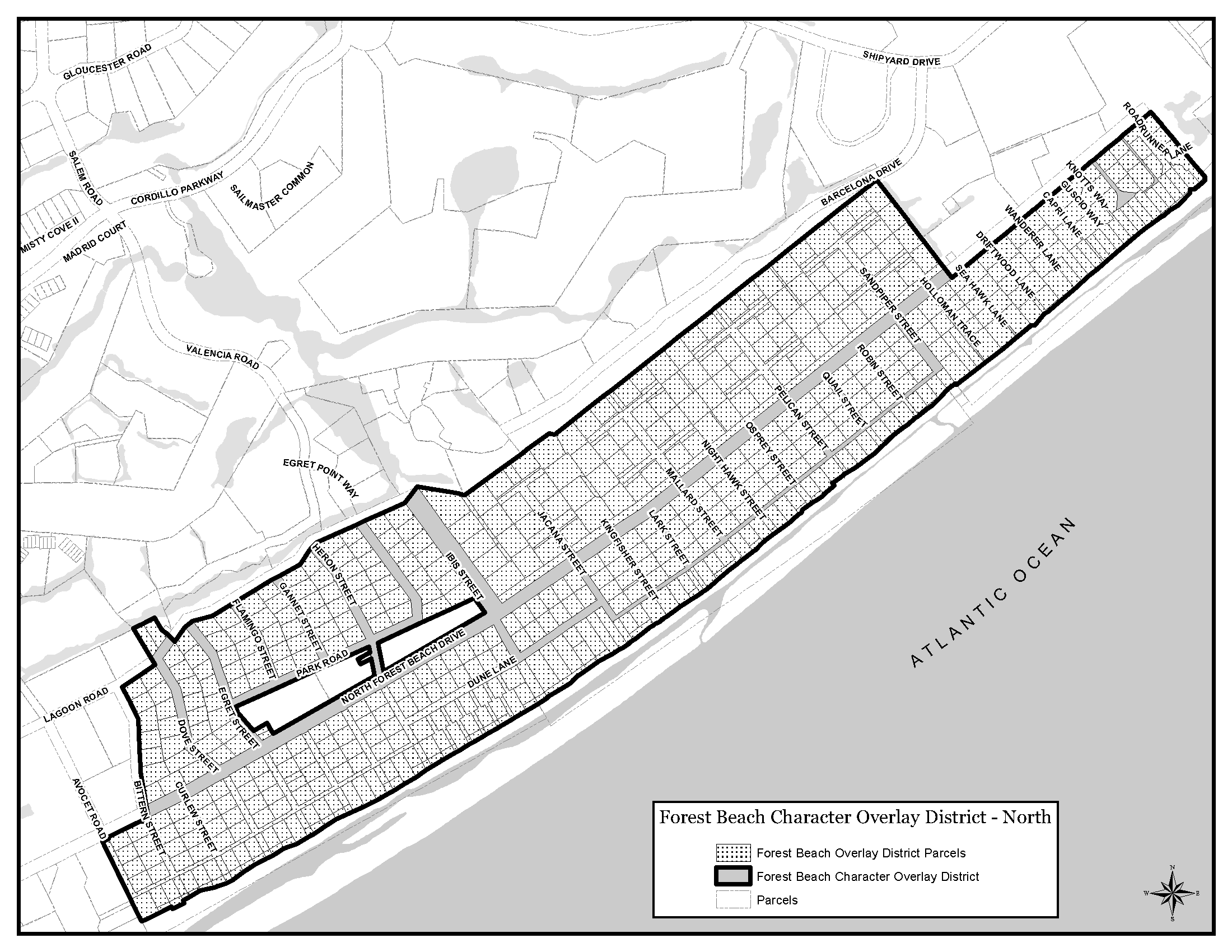
H3a

H3b

4.   District Regulations

(Revised 5-17-2016 - Ordinance 2016-07)
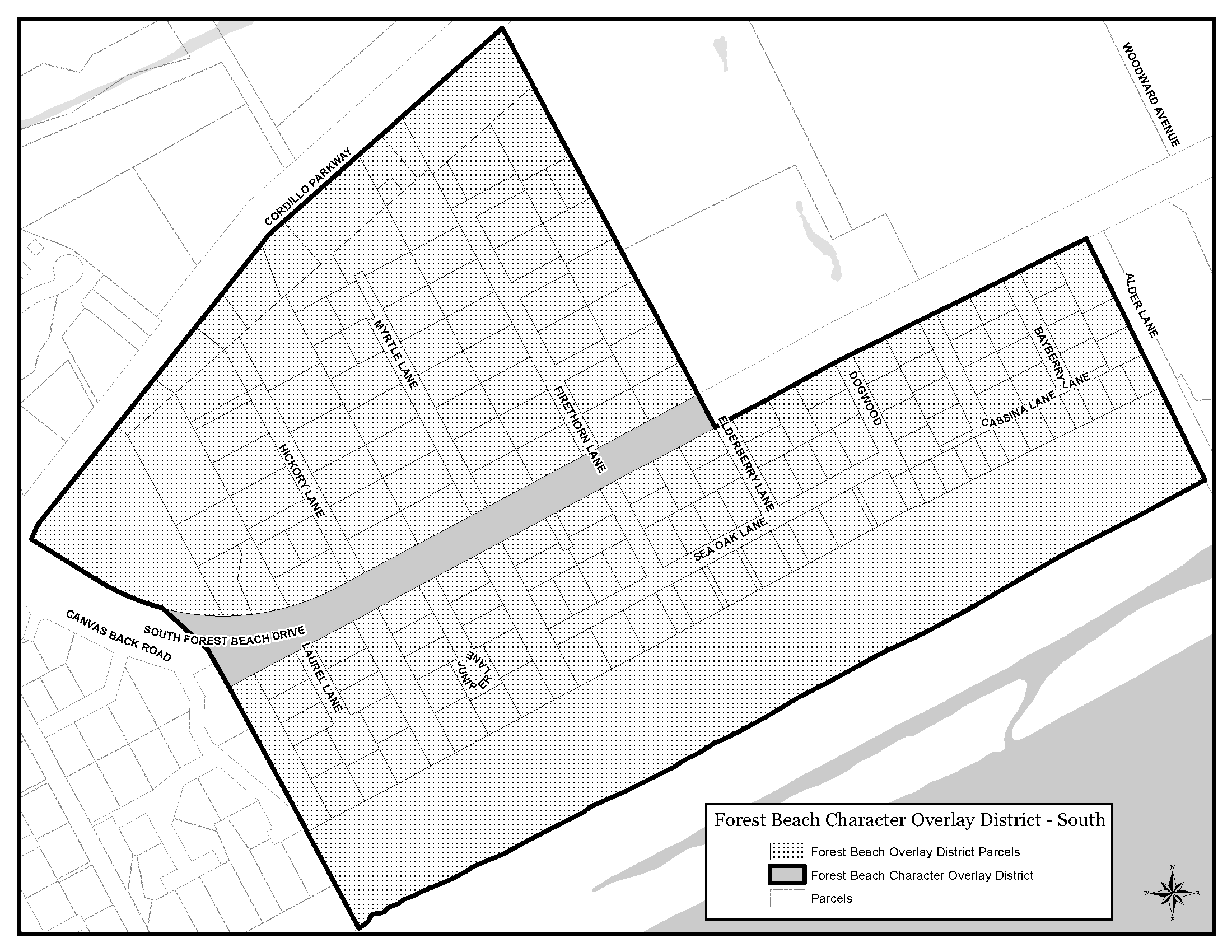
a.   Setbacks

i.

In addition to the single-family setback requirements of Sec. 16-5-102, Setback Standards, a side, and rear adjacent use setback shall be required.

ii.

Setbacks shall comply with the standards of Sec. 16-5-102, Setback Standards, except that the 65 degree setback angle shall be measured from 20 feet above thirteen feet (13') above mean sea level using the NAVD 88 vertical datum or pre-development grade, whichever is higher.

iii.

Side adjacent use setbacks shall be 10 feet for lots with a width of 70 feet and above. For lot widths less than 70 feet, the side adjacent use setback shall be equal to 12 percent of the lot width rounded to the closest whole number. However, to preserve significant trees or stands of trees any one side setback may be reduced to five feet, provided the sum of the required side setbacks is not reduced.

iv.

Rear adjacent use setbacks shall equal 10 percent of the lot depth or 10 feet, whichever is greater. However, to preserve significant trees or stands of trees, the rear setback may be reduced to five feet provided the sum of the required street and rear setbacks is not reduced.

v.

To preserve significant trees or stands of trees in the rear of the lot, the street setback may be reduced to 15 feet provided the sum of the required street and rear setback is not reduced.

(Revised 3-7-2023 - Ordinance 2023-04)

b.   Buffers

i.

A 20-foot street buffer and side and rear buffers equal to the setbacks above shall be required.

ii.

Buffers shall comply with the standards of Sec. 16-5-103, Buffer Standards,except that driveways for street access as permitted in Sec. 16-5-103.J, Development Within Required Buffers, shall be limited to a total of 24 feet wide within the buffer.

(Revised 12-5-2017 - Ordinance 2017-19)

iii.

If the cumulative size of existing trees in a buffer is less than two inches DBH per 100 square feet, supplemental tree planting shall be required. Supplemental trees shall be sized to achieve the two inches DBH per 100 square foot minimum in each buffer. 50 percent of the caliper inches of any supplemental trees shall be broad-leaved evergreen overstory hardwoods and endangered species as identified in Sec. 16-6-104.H.

iv.

In the case of a corner lot, the required 20-foot adjacent street buffer may be reduced to 10 feet for the street with the lower ADT unless the street with the higher ADT is approved for the reduction in order to preserve significant trees or stands of trees. In the case where both streets have the same ADT, the 20-foot buffer shall apply to the street that will better preserve significant trees or stands of trees.

v.

In order to preserve significant trees or stands of trees in the rear of the lot, the street buffer may be reduced to 15 feet, provided the sum of the required street and rear buffer is not reduced.

c.   Impervious Cover

All site paving shall be pervious with the exception of a swimming pool and deck not to exceed 500 square feet unless the site complies with the maximum impervious cover requirements for the RSF-5 District. Spaced wood decking over a pervious surface is considered pervious.

d.   Floor Area Ratio

The maximum gross floor area is limited to 0.55 times the area of the lot containing the single-family residence up to a maximum of 5,000 square feet. The gross floor area shall include covered porches and all enclosed space with a ceiling height of seven feet or greater except as follows:

i.

Areas beneath the structure utilized solely for parking and storage. All such areas must be hydrostatically vented if required by the Building Official.

ii.

The first 600 square feet of covered porches.

iii.

Attic space as defined by the latest adopted edition of the IBC.

e.   Minimum Lot Size and Width

The subdivision or recombination of lots platted and recorded on or after April 3, 2001, shall not result in any lot less than 7,000 square feet in size or 70 feet in width.

f.   Parking

Two parking spaces are required for up to 2,000 square feet of gross floor area. Above 2,000 square feet, one additional space is required for each 1,000 square feet or less of gross floor area. Driveway paving not located in the required buffer may be counted for parking.

I.   Folly Field Neighborhood Character Overlay (FF-NC-O) District

1.   Applicability and Purpose

The purpose of the Folly Field Neighborhood Character Overlay (FF-NC-O) District is to protect the single-family residential character of the district and in particular the development and redevelopment of lots within the district. All new development and changes to existing development in the district are subject to the overlay district regulations in addition to those listed in Sec. 16-3-104.C, Residential Single-Family-5 (RSF-5) District.

2.   Approval

Compliance with these regulations shall be determined by the Official at the time the Building Permit is reviewed and shall be based upon the standards of Sec. 16-3-104.C, Residential Single-Family-5 (RSF-5) District.

3.   Delineation of District

The Folly Field Neighborhood Character Overlay (FF-NC-O) District includes all parcels depicted as the Strand or as part of Sections A, B, C, or D in Figure 16-3-106.I.3 below.
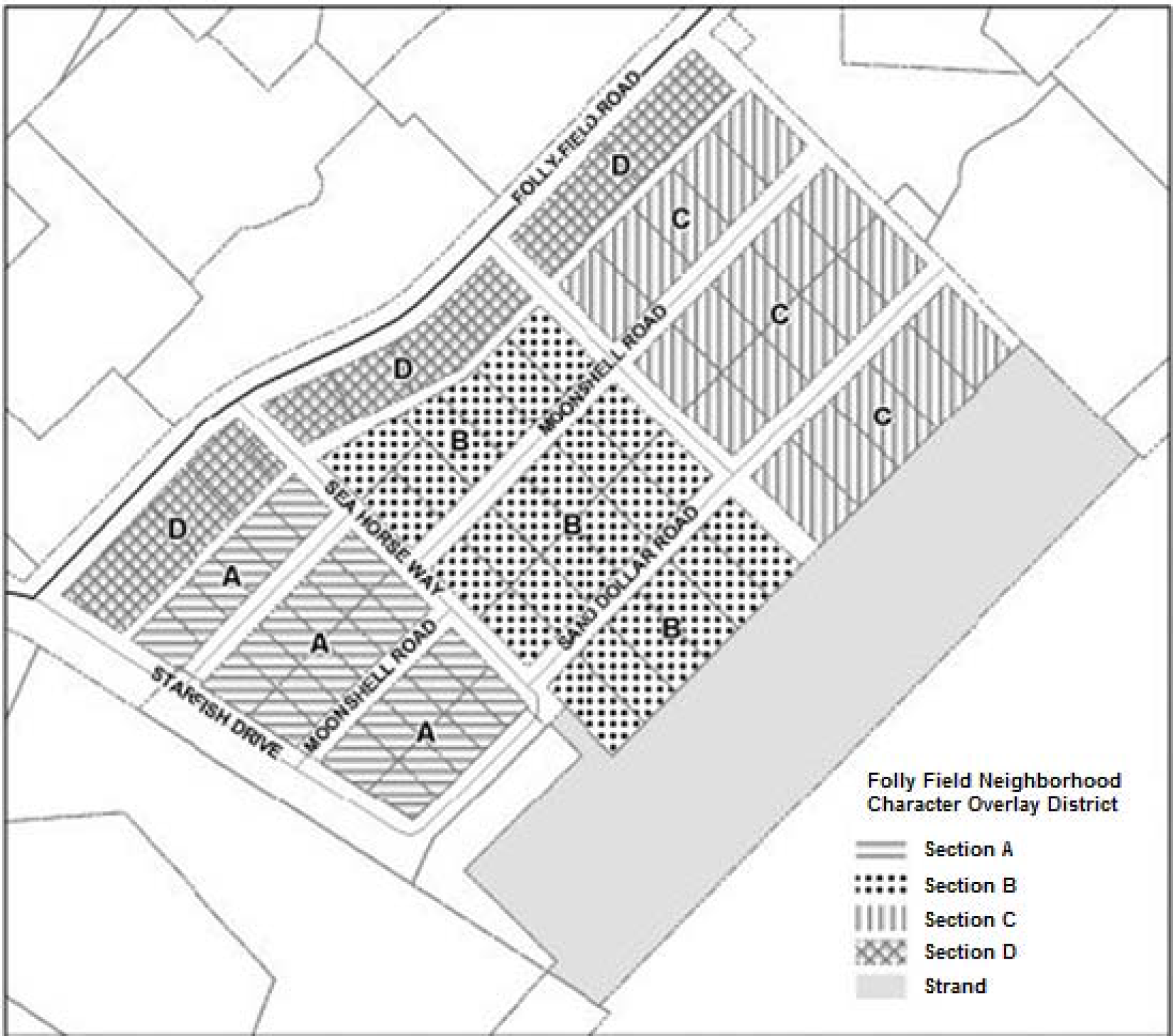
Figure 16-3-106.I.3: Folly Field Neighborhood Character Overlay (FF-NC-O) District and Sections.

Figure 16-3-106.I.3: Folly Field Neighborhood Character Overlay (FF-NC-O) District and Sections.

4.   District Regulations

a.   Setbacks

In addition to the single-family setback requirements of Sec. 16-5-102, Setback Standards, with the exception that structures greater than 24 inches in height along minor arterials are required to have a minimum adjacent street setback of 20 feet, the following setbacks shall be required.

i.

Rear yard setbacks shall be a minimum of ten percent of lot depth or ten feet, whichever is greater.

ii.

Side yard setbacks shall each contain a minimum of ten percent of the total lot width.

iii.

Maximum setback angle of 65 degrees shall be measured from 20 feet above thirteen feet (13') above mean sea level using the NAVD 88 vertical datum or pre-development grade, whichever is higher.

(Revised 3-7-2023 - Ordinance 2023-04)

b.   Buffers

In addition to the buffer requirements of Sec. 16-5-103, Buffer Standards, the following buffers shall be required.

i.

A 20-foot adjacent street buffer shall be required.

ii.

Driveways for street access as permitted in Sec. 16-5-103.J, Development Within Required Buffers, shall be limited to a total width of 24 feet within the buffer.

iii.

In the case of a corner lot, the required 20-foot adjacent street buffer may be reduced to ten feet for the street with the lower ADT unless the street with the higher ADT is approved for the reduction in order to preserve significant trees. In the case where both streets have the same ADT, the 20-foot buffer shall apply to the street that will better preserve significant trees.

c.   Impervious Cover

Impervious cover of the lot shall not exceed 55 percent.

d.   Open Space

The open space or strand area that lies between the existing most current seaward lots and the beach shall not be counted towards the density calculation for any development activities for any lot or other land. In addition, vertical construction in this area is prohibited.

e.   Floor Area Ratio

The maximum gross floor area is limited to 0.45 times the area of the lot containing a single-family dwelling up to a maximum of 4,500 square feet. The gross floor area shall include covered porches and all enclosed space with a ceiling height of seven feet or greater, with the following exclusions:

i.

Areas beneath the structure utilized solely for parking or storage.

ii.

The first 600 square feet of covered porches.

iii.

Attic space as defined by the latest adopted edition of the IBC.

f.   Minimum Lot Frontage and Depth

The subdivision or recombination of any lot shown on a plat recorded prior to November 5, 2003, shall not result in any lot with frontage and depth less than that shown on the following table for the applicable Section of the district (see Figure 16-3-106.I.3 above).

MINIMUM LOT FRONTAGE (FEET)MINIMUM LOT DEPTH (FEET)
Section A 50 100
Section B 75 100
Section C 90 100
Section D 95 100


g.   Parking

Two parking spaces are required for up to 2,000 square feet of gross floor area. Thereafter, one additional space is required for each 1,000 square feet or less of gross floor area. Driveway paving not located in the required buffer may be counted for parking.

J.   Holiday Homes Neighborhood Character Overlay (HH-NC-O) District

1.   Applicability and Purpose

The purpose of the Holiday Homes Neighborhood Character Overlay (HH-NC-O) District is to protect the single-family residential character of the district and in particular the development and redevelopment of lots within the district. All new development and changes to existing development are subject to the overlay district regulations, in addition to those listed in Sec. 16-3-104.D, Residential Single-Family-6 (RSF-6) District. Existing nonconforming structures and site features may be expanded as long as the site complies with the required floor area ratio (FAR) and maximum impervious cover listed in paragraph 3 below.

2.   Approval

Compliance with these regulations shall be determined by the Official at the time the Building Permit is reviewed and shall be based upon the standards of Sec. 16-3-104.D, Residential Single-Family-6 (RSF-6) District.

3.   Delineation of District

The Holiday Homes Neighborhood Character Overlay (HH-NC-O) District includes all parcels shown as hatched in Figure 16-3-106.J.3 below.
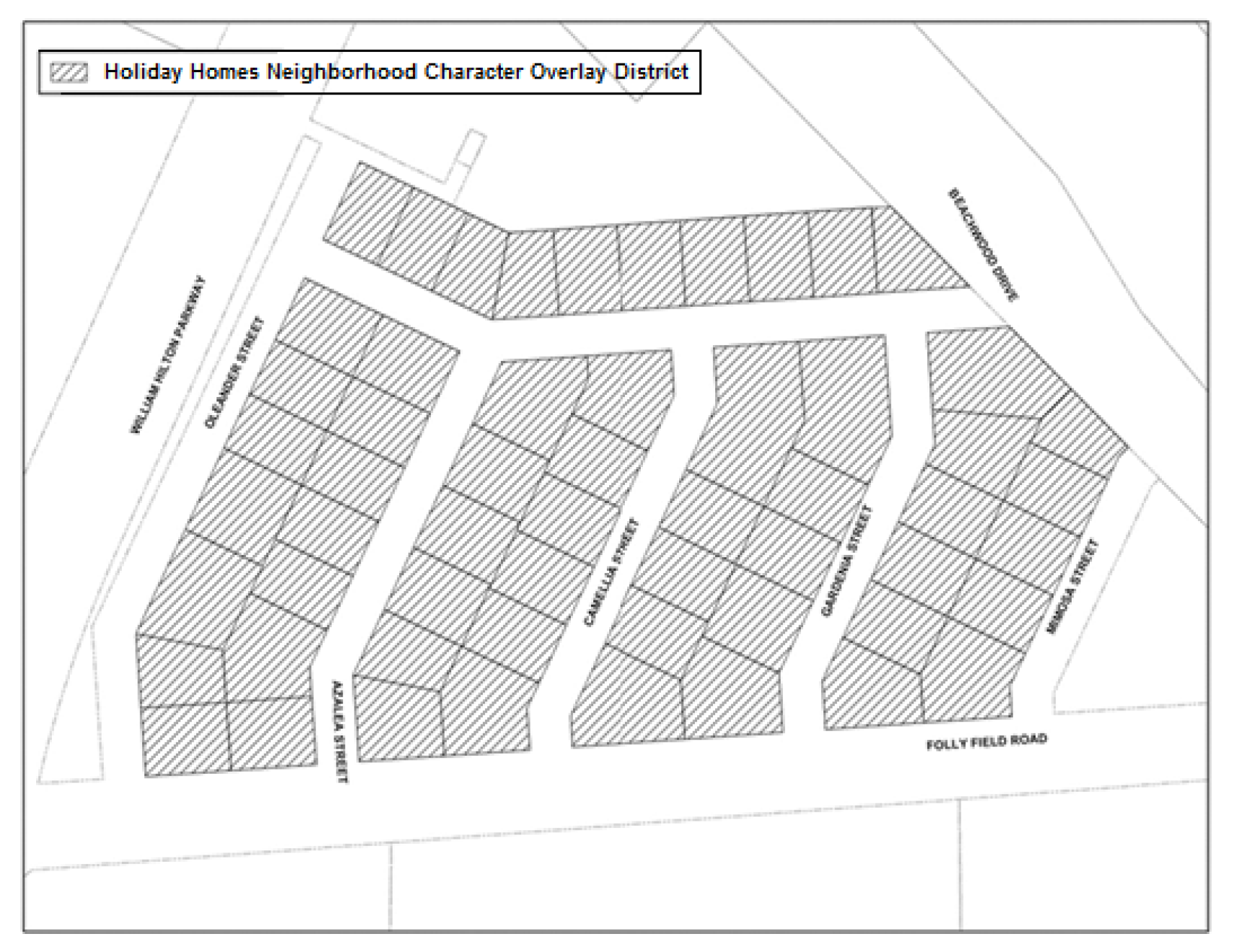
Figure 16-3-106.J.3: Holiday Homes Neighborhood Character Overlay (HH-NC-O) District.

Figure 16-3-106.J.3: Holiday Homes Neighborhood Character Overlay (HH-NC-O) District.

4.   District Regulations

a.   Setbacks

In addition to the single-family setback requirements of Sec. 16-5-102, Setback Standards, the following setbacks shall be required:

i.

Rear yard setbacks shall be a minimum of ten feet.

ii.

Side yard setbacks shall be a minimum of ten feet; however, to preserve existing trees, any one side yard setback may be reduced to five feet provided the sum of the required side yard setbacks equals at least 20 feet.

01.

A lot with less than 50 feet of street frontage or less than 0.15 acres in area shall be permitted to reduce side yard setbacks to a minimum of five feet.

02.

Dwelling units that are nonconforming as to the side yard setbacks identified above are permitted to be expanded along the subject boundary line; however, expansions shall be constructed no closer than five feet from the side property line.

03.

Side yard setback angles shall be a minimum of 65 degrees measured from 20 feet above thirteen feet (13') above mean sea level using the NAVD 88 vertical datum or pre-development grade, whichever is higher, at the setback line. The illustration in Sec. 16-5-102.D, Adjacent Use Setback Requirements, can be referenced for an example of a setback angle.

iii.

In the case of a corner lot, the required 20-foot adjacent street setback may be reduced to ten feet for the street with the lower average daily trips (ADT).

iv.

Lots directly adjacent to Folly Field Road shall have a minimum adjacent street setback of 20 feet.

(Revised 3-7-2023 - Ordinance 2023-04)

b.   Buffers

In addition to the buffer requirements of Sec. 16-5-103, Buffer Standards,the following buffers shall be required:

i.

A 20-foot street buffer and side and rear buffers equal to the setbacks above.

ii.

Driveways for street access, as permitted in Sec. 16-5-103.J, Development Within Required Buffers,shall be limited to a total width of 24 feet per lot.

iii.

In the case of a corner lot, the required 20-foot adjacent street buffer may be reduced to ten feet for the street with the lower average daily trips (ADT).

iv.

Lots directly adjacent to Folly Field Road shall have a minimum adjacent street buffer of 20 feet.

c.   Impervious Coverage

Impervious cover of the lot shall not exceed 50 percent.

d.   Floor Area Ratio

The maximum gross floor area is limited to 0.45 times the area of the lot containing the single-family dwelling, up to a maximum of 4,000 square feet. The gross floor area shall be calculated as all enclosed space with a ceiling height of seven feet or greater with the following exclusions:

i.

Enclosed areas, where the floor level is located below the required base flood elevation (BFE), which are used solely for parking or storage.

ii.

Attic space as defined by the latest adopted edition of the IBC.

e.   Parking

Two parking spaces are required for up to 2,000 square feet of gross floor area. Thereafter, one additional space shall be required for each 1,000 square feet or less of gross floor area.

f.   Minimum Lot Size

The subdivision or recombination of any lot shown on a plat recorded prior to July 21, 1998, shall not result in any lot having a gross area of less than 7,260 square feet.

K.   Redevelopment Overlay (R-O) District

1.   Purpose

The purpose of the Redevelopment Overlay (R-O) District is to create and establish a zoning overlay district to provide flexibility in the design standards of Chapter 16-5: Development and Design Standards, and to utilize zoning and planning techniques specifically designed to promote and encourage the redevelopment of existing nonconforming structures and existing nonconforming site features.

2.   Zoning District Type

The Redevelopment Overlay (R-O) District is a hybrid floating zone and overlay zone that is unmapped on the Official Zoning Map and that can be applied to discrete, noncontiguous parcels for the purpose of promoting the redevelopment of existing nonconforming structures and existing nonconforming site features.

3.   Specific Techniques Authorized

On parcels approved for the Redevelopment Overlay (R-O) District, the following techniques are authorized to accomplish the purpose of the R-O District:

a.

A relaxation of specific design standards set out in Chapter 16-5: Development and Design Standards; or

b.

Authorization of the Official to make minor amendments to any R-O District.

4.   Applicability

a.

A landowner of a parcel of land who proposes to redevelop may apply to have the parcel of land rezoned R-O District in accordance with Sec. 16-2-103.C, Zoning Map Amendment (Rezoning), and this section. For the purposes of this section, redevelopment is defined as the renovation of a previously developed site to the density allowed under this Ordinance, or the existing density, whichever is greater. Cosmetic changes to the exterior of the structure and interior renovations do not qualify as redevelopment.

b.

The following parcels of land may apply to have the land rezoned R-O District:

i.

A parcel of land that contains a nonconforming structure or site feature; or

ii.

A conforming parcel that redevelops in conjunction with a parcel that contains a nonconforming structure or site feature.

c.

A parcel of land that is located in a RSF district does not qualify and is not eligible to have the land rezoned R-O District.

5.   Procedure

An R-O District classification shall only be approved in accordance with the procedures in Sec. 16-2-103.C.2, Zoning Map Amendment (Rezoning) Procedure, and the standards in Sec. 16-2-103.C.3, Zoning Map Amendment (Rezoning) Review Standards, and the requirements of this section.

6.   Additional R-O District Review Standards

In addition to the review standards in Sec. 16-2-103.C.3, Zoning Map Amendment (Rezoning) Review Standards, redevelopment proposed to be classified to a R-O District may modify the dimensional, development and design, and natural resources protection standards of this Ordinance in accordance with Table 16-3-106.K.4, Additional R-O District Review Standards.

TABLE 16-3-106.K.4: ADDITIONAL R-O DISTRICT REVIEW STANDARDS
STANDARD
ALLOWABLE MODIFICATION
Uses (see base district standards in this chapter) Only uses allowed in the base district are allowed, except for legal nonconforming uses. Legal nonconforming uses are allowed to continue in accordance with the requirements of this section.
Maximum density (see base district standards in this chapter) May not exceed maximum density of base district, or if a legal nonconforming use or structure, the existing density. A nonconforming use that exceeds maximum density of the base district may be permitted to change the use if there are no additional impacts of the proposed use on infrastructure and surrounding properties will result, and if the adequacy of the site improvements (such as parking and stormwater infrastructure) are evaluated, and determined to be sufficient to support the proposed redeveloped use.
Nonconforming square footage may be converted to another use if the density of the proposed use is based on square footage and the proposed use is permitted within the base zoning district where the property is located.
Maximum building height (see base district standards in this chapter) A structure that is nonconforming because of height may be rebuilt to legally nonconforming height. Such decision shall be based on ability to recapture density of development and height of surrounding buildings.
Maximum impervious cover (see base district standards in this chapter) Shall not exceed maximum requirements of the base district, except for impervious cover that exists as a legal nonconforming site feature, which may be maintained. In no case shall an application for rezoning to the R-O district be appropriate for a site where impervious cover exceeds 80% of the site.
Minimum adjacent street setback requirements (see Sec. 16-5-102.C) and adjacent street buffer requirements (see Sec. 16-5-103) Up to 20% reduction in setback distance, buffer width, and planting rate for buffer screening.
Minimum adjacent use setback requirements (see Sec. 16-5-102.D) and adjacent use buffer requirements (see Sec. 16-5-103.E) Up to 50% reduction in setback distance, buffer width, and planting rate for buffer screening.
Maximum adjacent street setback angles (see Sec. 16-5-102.C) and adjacent use setback angles (see Sec. 16-5-102.D) May be increased based on the height of the structure and setback distance, but may not exceed a 75 degree angle.
Minimum open space requirement (see Sec. 16-5-104) Shall not exceed minimum requirements of the base district, except for open space that exists as a legal nonconforming site feature, which may be maintained. In no case shall an application for rezoning to the R-O district be approved for a site where open space is less than 20% of the site.
Minimum number of parking spaces (see Sec. 16-5-107.D.1) Up to 50% reduction, if it is demonstrated off-street parking can be adequately addressed.
Parallel parking spaces (see Sec. 16-5-107.D.7) The number of parallel parking spaces may be increased.
Compact parking spaces (see Sec. 16-5-107.D.8) Compact parking spaces may be maintained up to the number that existed on the site as a nonconforming site feature prior to redevelopment.
Parking space dimensions (see Sec. 16-5-107.E.1) Regular parking spaces that are no less than 8.5 feet by 18 feet, or compact spaces that are no less than 8.5 feet by 15 feet may be reconstructed to the same size that existed as a legal nonconforming site feature prior to the proposed redevelopment.
Width of parking spaces adjoining a median at the end of a row of parking may be reduced to nine feet, or what existed on the site before redevelopment if the parking space dimensions at the time were a legal nonconforming site feature.
Maximum number of parking spaces between landscaped medians along a row of parking (see Sec. 16-5-107.G.3.a.iv) May be increased by up to three spaces if it is demonstrated that the parking lot contains sufficient landscaping to mitigate its environmental and visual impacts to an equivalent degree.
Minimum width of landscaped medians in parking lots (see Sec. 16-5-107.G.3.b) May be reduced by up to 20% if it is demonstrated that the parking lot contains sufficient landscaping to mitigate its environmental and visual impacts to an equivalent degree.
Maximum off-site parking spaces (see Sec. 16-5-107.H.4.a) Up to 20% of required parking spaces may be provided off-site, if it is demonstrated that safe and convenient vehicular access is provided to the development served by the off-site parking.
Pedestrian access to shared parking (see Sec. 16-5-107.H.3.b) and off-site parking (see Sec. 16-5-107.H.4.c) Access to shared or off-site parking may cross an arterial street if it is determined there is adequate and safe pedestrian ingress and egress to the development served by the off-premise parking.
On-street parking (see Sec. 16-5-107.H.6) May be used to satisfy up to 100% of the number of parking spaces required.
Minimum tree coverage (see Sec. 16-6-104.G) A legal nonconforming site that does not comply with the minimum tree coverage requirement may be allowed to redevelop without the minimum amount of tree coverage if it is determined all feasible and practical alternative steps have been taken to meet the required amount of tree coverage on the site, and the landowner deposits a tree mitigation fee in a Town-administered tree replacement fund in-lieu of providing additional tree canopy. (see Sec. 16-6-104.L).


7.   Minor Amendment

Because unanticipated circumstances may arise in the redevelopment of existing nonconforming structures and existing nonconforming site features that make it impractical or impossible to execute an approved redevelopment plan set out in an approved R-O District, the Official is authorized to approve minor amendments to an approved R-O District as follows:

a.

A minor amendment shall be an amendment that does not make the site nonconforming to the adopted development and design standards approved as part of the R-O District. A minor amendment shall not further relax a development or design standard or other design criteria that has been modified by the approved R-O District.

b.

Disapproval or denial of a request for a proposed minor amendment to an R-O District by the Official may be appealed within 14 calendar days of the decision to the Board of Zoning Appeals.

8.   Expiration

An R-O District Map Amendment (Rezoning) shall not expire, but the amended Official Zoning Map is subject to further amendment or repeal, in accordance with the map amendment procedures set forth in Sec. 16-2-103.C, Zoning Map Amendment (Rezoning).

L.   Coastal Protection Area (CPA-O) District

1.   Applicability and Purpose

a.

The purpose of the Coastal Protection Area Overlay (CPA-O) District, in conjunction with the Transition Area Overlay (TA-O) District, is to eliminate the potential for seaward migration of the built environment along the Island's beachfront to the greatest extent possible. This environmentally sensitive area:

i.

Protects life and property by serving as a storm barrier;

ii.

Provides an important basis for a tourism industry that generates annual tourism industry revenue;

iii.

Provides habitat for numerous species of plants and animals that are important to the natural functioning of the beach and dune system, or that are threatened or endangered; and

iv.

Provides beach and dune system vegetation that is unique and extremely important to the vitality and preservation of the barrier island environment.

b.

All new development and changes to existing development in the district are subject to the regulations of this section.

c.

The Town's standards and regulations pertaining to development activity within the CPA-O district are intended to complement those of the State of South Carolina.

d.

Where State law and Town provisions regulate development under this subsection, the more restrictive standard shall govern, to the extent allowed by State law. In the event of a conflict between the provisions of this section and applicable State law, State law governs.

2.   Delineation of the CPA-O District

a.   General

Except as otherwise provided in subparagraph b below, the Coastal Protection Area Overlay (CPA-O) District includes the following areas within and adjacent to parcels fronting the Hilton Head Island beach, as defined in Section 8-1-112 of the Municipal Code:

i.

Parcels Containing Single-Family, Golf Course, and Open Space Uses

For parcels containing single-family residential and golf course uses, and open space uses without structures, the CPA-O District includes the area between:

01.

The Beachfront Line or the seaward property line of the parcel, whichever is further landward, and

02.

The mean high water line, the Beachfront Line, or the seaward property line of the parcel, whichever is further seaward.

ii.

Parcels Containing Other Uses

For parcels containing any land use other than single-family residential and golf course uses, and open space uses without structures, the CPA-O District includes the area between:

01.

The seaward boundary of the Transition Area Overlay (TA-O) District (see Sec. 16-3-106.M.2, Delineation of the TA-O District) and

02.

The mean high water line, the Beachfront Line, or the seaward property line of the parcel, whichever is further seaward.

iii.

Basis for Parcel Lines

The single-family parcels (with the exception of North Forest Beach Subdivisions 1, 2, and 3) and non-single-family parcel lines used to establish the CPA-O District boundaries in accordance with this subparagraph are as platted and recorded in the Beaufort County Register of Deeds Office as of the date of Ordinance 2009-22.

b.   Hilton Head Beach Subdivisions 1, 2, and 3 subdistricts

i.

The three single-family subdivisions identified as Hilton Head Beach Subdivisions 1, 2, and 3, are subdistricts within the CPA-O District. The Hilton Head Beach Subdivisions 1, 2, and 3 subdistricts are contiguous with parcels of property described as "Beach Lot," "Strand Parcel" lots on recorded plats as follows:

01.

For Hilton Head Beach Subdivision 1, the plat is recorded in the Beaufort County Register of Deeds Office, in Plat Book 81 at Page 153, and the property in question is described thereon as the "Beach Lot";

02.

For Hilton Head Beach Subdivision 2, the plat is recorded in the Beaufort County Register of Deeds Office, in Plat Book 84 at Page 112, and the property in question is described thereon as the "Strand Parcel"; and

03.

For Hilton Head Beach Subdivision 3, the plat is recorded in the Beaufort County Register of Deeds Office, in Plat Book 81 at Page 154, and the property in question is described thereon as the "Beach Lot."

ii.

The uses allowed in the CPA-O District in Hilton Head Beach Subdivision 2 are those uses allowed on the "Strand Parcel" property in the declarations of covenants and restrictions that are recorded in the Beaufort County Register of Deeds Office in Official Record Book 1532 at Page 1312.

iii.

For all other property in the CPA-O District, this Ordinance applies.

iv.

With respect to the CPA-O District in Hilton Head Beach Subdivision 2, where the text of this Ordinance conflicts with the declarations of covenants described above, the text of the declarations of covenants and restrictions shall control.

3.   Activities and Uses Permitted and Prohibited in the CPA-O District

a.

All development is prohibited in the CPA-O District except the following permitted uses and activities:

i.

Boarded pathways as perpendicular to the beach as practical and not larger than six feet in width and their associated wooden deck not larger than 144 square feet (must comply with Sec. 16-6-103, Beach and Dune Protection);

ii.

Beach renourishment;

iii.

Emergency vehicular beach access; and

iv.

Permitted beach maintenance activities such as sand fencing, re-vegetation with native plant material and erosion control.

b.

All activities and uses in the CPA-O District must also comply with all current local, State and federal laws.

4.   Nonconforming Structures within the CPA-O District

a.

Any structure or site feature that is nonconforming to the activities and uses permitted within the CPA-O District may be rebuilt to its current size (or smaller) and location provided that:

i.

The structure conforms to current local, State, and federal laws;

ii.

The same use that previously existed is reestablished within the structure; and

iii.

Neither the structure nor the use has been discontinued for a period of 12 consecutive months or greater.

b.

Normal maintenance activities of nonconforming structures are allowed.

M.   Transition Area Overlay (TA-O) District

1.   Applicability and Purpose

a.

The purpose of the Transition Area Overlay (TA-O) District, in conjunction with the Coastal Protection Area Overlay (CPA-O) District, is to eliminate the potential for seaward migration of the built environment along the Island's beachfront as well as protect the area between existing construction and the mean high water mark, to the greatest extent possible. This environmentally sensitive area:

i.

Protects life and property by serving as a storm barrier;

ii.

Provides an important basis for a tourism industry that generates annual tourism industry revenue;

iii.

Provides habitat for numerous species of plants and animals that are important to the natural functioning of the beach and dune system, or that are threatened or endangered; and

iv.

Provides beach and dune system vegetation that is unique and extremely important to the vitality and preservation of the barrier island environment.

b.

All new development and changes to existing development in the district are subject to the regulations of this section.

c.

The Town's standards and regulations pertaining to development activity within the TA-O district are intended to complement those of the State of South Carolina.

d.

Where State law and Town provisions regulate development under this subsection, the more restrictive standard shall govern, to the extent allowed by State law. In the event of a conflict between the provisions of this section and applicable State law, State law governs.

2.   Delineation of the TA-O District

a.   General

Except as otherwise provided in subparagraph b below, the Transition Area Overlay (TA-O) District applies only to non-single-family areas, where it includes the area between:

i.

The existing line of construction (as bound by the South Carolina State Plane Coordinate System), and

ii.

The most immediate seaward property line of parcels fronting the beach (as defined in Section 8-1-112 of the Municipal Code) or the Beachfront Line, whichever is further landward.

b.   Hilton Head Beach Subdivisions 1, 2, and 3 subdistricts

i.

The three single-family subdivisions identified as Hilton Head Beach Subdivisions 1, 2, and 3, are subdistricts within the TA-O District. The Hilton Head Beach Subdivisions 1, 2 and 3 subdistricts are contiguous with parcels of property described as 'A' lots, 'E' and 'S' lots and 'X' lots on recorded plats as follows:

01.

For Hilton Head Beach Subdivision 1, the plat is recorded in the Beaufort County Register of Deeds Office, in Plat Book 81 at Page 153, and the lots in question are described thereon as the "A" lots;

02.

For Hilton Head Beach Subdivision 2, the plat is recorded in the Beaufort County Register of Deeds Office, in Plat Book 84 at Page 112, and the lots in question are described thereon as the "E" and "S" lots; and

03.

For Hilton Head Beach Subdivision 3, the plat is recorded in the Beaufort County Register of Deeds Office, in Plat Book 81 at Page 154, and the lots in question are described thereon as the "X" lots.

ii.

The uses allowed in the TA-O District in Hilton Head Beach Subdivisions 1, 2, and 3 are those uses allowed on the "A," "E," "S," and "X" lots in the declarations of covenants and restrictions that are recorded in the Beaufort County Register of Deeds Office as follows:

01.

For Hilton Head Beach Subdivision Number 1, in Official Record Book 1450 at Page 835;

02.

For Hilton Head Beach Subdivision Number 2, in Official Record Book 1532 at Page 1317; and

03.

For Hilton Head Beach Subdivision Number 3, in Official Record Book 1450 at Page 828

iii.

Where the text of this Ordinance conflicts with the declarations of covenants described above, the text of the declarations of covenants and restrictions shall control.

3.   Activities and Uses Permitted in the TA-O District

a.

In addition to the activities and uses permitted in the CPA-O District (see Sec. 16-3-106.L.3), the TA-O District may include any uses that do not require enclosed space to operate. These activities and uses include, but are not limited to, swimming pools, boardwalks, fire pits, decks, required drainage improvements, and necessary utilities.

b.

The activities and uses in the TA-O District shall be located as far landward as possible. Activities or uses in the TA-O District shall be accessory activities or uses to the development to which they are directly seaward.

c.

Development in the TA-O District shall conform to the standards for impervious cover and open space for the underlying base zoning district.

d.

Activities or uses in the TA-O District shall not be on or in any part of a dune or dune system.

4.   Nonconforming Structures within the TA-O District

a.

Any structure or site feature that is nonconforming as to the activities and uses permitted within the TA-O District may be rebuilt to its current size (or smaller) and location provided that:

i.

The structure conforms to current local, State, and federal laws;

ii.

The same use that previously existed is reestablished within the structure; and

iii.

Use of the structure has not ceased for a period of 12 consecutive months or greater.

b.

Normal maintenance activities of nonconforming structures are allowed.
