
Huron City Zoning Code
CHAPTER 17
51 - DESIGN DISTRICTS
Sections:
17.51.010 - Purpose and application.
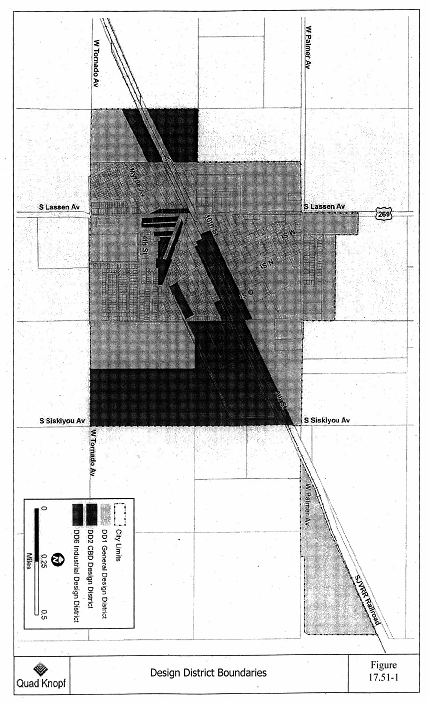
Although zoning primarily regulates the type and location of various uses, it also regulates the physical design standards for many uses. While it is the intent of the zoning ordinance to locate various uses to conform to the general plan, the physical design needs of various areas do not necessarily conform to the locations needs. In order to apply design standards, design districts have been established (see Design District Boundaries, Figure 17.51-1).
The use of design districts will allow the uniform application of design standards within an area regardless of zoning designation. The main purpose of the design districts is to obtain harmonious relationship of various uses, buildings, structures, lot sizes and open spaces, regardless of zone district, while still maintaining the economic viability of a parcel of property. The development standards that follow in Sections 17.51.020 through 17.51.060 shall be all properties where new development will occur or when there is a substantial increase in development as defined herein, and shall be incorporated into the plans which are submitted to the planning department for approval as outlined in Chapter 17.75. The planning commission may grant variances to these rules in accordance with the procedures and required findings in Chapter 17.71, and the planning department may permit modification in accordance with Chapter 17.72. Where there is a conflict between the design district standards and basic zone standards, the design district in which the property is located pursuant to Figure 17.51-1 shall apply and/or the more restrictive application as determined by the planning department.
(Ord. 348 § 1 (part), 2007)
Figure 17.51-1
Design District Boundaries
17.51.020 - (DD1) General design district.
The following standards are applicable to all properties in the City of Huron unless specifically in another design district (Sections 17.51.030 through 17.51.060).
A.
Site Area. The minimum parcel size for each design district varies according to the base zone or design district standards. However, this section shall not preclude parcels of less than the required minimum which exist at the time of the adoption of the ordinance codified in this title, from securing planned development and building permits. Parcels of less than the required minimum size may be created upon approval of an acceptable cluster district or specific plan by the planning commission.
B.
Setback. The minimum building setbacks shall conform to the requirements set forth in the base zoning district. However, the planning commission may grant an exception to the required standards based on the uniqueness of the property or the specific design needs of the project.
C.
Landscaping. If landscaping is required, landscape and irrigation plans shall be submitted as a part of the building plans. The following design standards shall apply, unless superseded by a design district listed in Sections 17.51.030 through 17.51.050, or by the requirements of Section 17.19.010(N).
1.
General Landscaping Requirements.
a.
All areas within a required setback shall contain living groundcover or a combination of living and nonliving ground coverings (nonliving to be a maximum of twenty (20) percent). Parking shall not be allowed within the front or street side setback in any zone including mobilehome space setbacks, and shall be fully landscaped as set forth herein. All plants within required setbacks to be of species suited to Sunset Western Garden Book Climate Zones 8 and 9. The use of low water varieties, grouped by similar water usage is required.
i.
Definition. "Living groundcover" means low-growing plants or shrubs that after being planted will grow together to form a solid cover in one year or less. To achieve desired coverage, low growing groundcover plants taken from flats shall be planted a maximum of twelve (12) inches on center. Low growing, shrub type groundcovers in one-gallon cans shall be planted a maximum of two feet on center. Spacing may be increased to three feet on center for fast growing plants as approved by the planning division.
In areas susceptible to foot traffic, the use of long-lived low growing shrubs and groundcovers such as Dwarf Coyote Bush, Lantana and Junipers are preferred. Other groundcovers that do not last as long, such as Baby Tears, Gazania, African Daisy, and annual or perennial flowers must be limited to fifteen (15) percent of the total living groundcover area.
ii.
Definition. "Nonliving groundcover" means forest humus or walk-on bark, rock and other similar materials. Use shall require permission of the planning department.
iii.
All soil surfaces are to be covered by plant materials or nonliving groundcovers as defined in subsection (C)(5)(b) of this section. At least two inches of nonliving materials shall be applied to all planting areas except turf.
b.
Islands of a minimum area of eighty (80) square feet shall be established at a maximum separation of ten continuous parking stalls. The islands shall be landscaped with groundcovers and with a minimum of one fifteen (15) gallon tree planted in each island. Actual numbers of trees will be based on the size of the project as determined by the planning department.
c.
All landscaping as required in this chapter shall be reviewed by the planning department as to the type, density of planting and size of plants intended for use. All landscaped areas shall be permanently maintained by the property owner.
d.
All landscaped areas in commercial, industrial, and multifamily projects shall be surrounded with six-inch high concrete curbing, unless waived by the planning department.
e.
All landscaping on public property and parks shall conform to standards adopted by the Huron Park and Recreation District.
f.
Buffer planting shall occur along major arterials in order to visually screen uses and provide noise reduction. The landscaping shall be in addition to screening requirements set forth in this chapter.
2.
Trees.
a.
Spacing of trees to be variable depending on type and eventual size, but that there be a general minimum standard of one fifteen (15) gallon tree for each twenty (20) feet of frontage of a required landscaped setback, exclusive of vehicular site lines.
b.
Trees to be used in parking lots to be of a type that will form a full head on a single trunk, i.e., Chinese Elm, Chinese Pistache, Golden Rain, Valley Oak or other approved species. All trees planted within public right-of-way shall be consistent with the City Street Tree Master Plan.
c.
Where trees are planted in paved areas which are unprotected by curbs they shall have a protective tree grate or equivalent device. Tree grates shall be cast iron with a natural finish. A deep root-directing device shall also be used.
d.
Landscape setback areas, (excluding driveway approaches, maneuvering areas, and public sidewalks) shall be landscaped. Within this area, trees shall not be planted more than twenty (20) feet apart, and shall not be planted within five feet of any curb, sidewalk or driveway unless a root directing device is used. No plant that will grow to a height of more than eighteen (18) inches shall be planted in the street right-of-way or with sight triangles unless approved as a street tree consistent with the City Street Tree Master Plan.
e.
Tree planters located in parking areas shall be sufficiently large and protected so that a parked car does not extend into the minimum four-foot by four-foot tree planting area which shall be landscaped with groundcover, shrubs and/or climbing plants.
3.
Shrubs.
a.
At least seventy-five (75) percent of shrubs planted shall be of five-gallon minimum size. One-gallon plants may be used if planted with approved low water-using varieties.
b.
Shrubs within a required setback shall be spaced in such a way so that at maturity the plants will provide eighty (80) percent ground coverage.
4.
Mounding.
a.
Mounding or low growing shrub areas along street frontages may be used to screen parking areas and shall not exceed a 1:7 slope and shrubs shall be low-growing varieties with a mature height of four feet or less. Steeper slopes may be allowed if irrigated by drip systems.
b.
Mounding shall not be required for landscape areas which are ten feet, or less, in width.
c.
Mounds shall be compacted prior to planting to prevent excessive settlement.
d.
Black plastic shall not be used under wood chips on mounds, or slopes in general.
e.
Turf on mounds requires slope rates of 1:10 or less. Mounds with groundcovers require slope rates of 1:5 or less.
f.
Mounds may not be used within site triangles, or in areas that will create hazards to pedestrians or motorists.
5.
Parking Lots.
a.
Trees shall be planted in all parking lots at a 1:3 ratio of trees, to parking stalls.
b.
Such tree planters shall contain approved trees on twenty (20) foot centers or in such a manner as to have fifty (50) percent shade coverage of the parking lot in ten years.
c.
Shrubs and trees to be arranged in such a way as to avoid damage from the front of parked cars extending into the planter areas.
d.
All landscaped areas shall be irrigated.
6.
Turf.
a.
Turf shall be limited to forty (40) percent of the total landscape area and use low water-using varieties. Public parks, golf courses, cemeteries, schools, properties within a historic district, and residential office conversions are to be reviewed for exemptions on a project by project basis.
b.
No turf will be allowed:
i.
In traffic medians on arterials,
ii.
Parkways or planting areas narrower than five feet,
iii.
Storm drainage ponds with slopes in excess of 1:6,
iv.
On mounds or slopes exceeding 1:10,
v.
Exceptions to turf in parkways may be granted by the planning division in cases where pedestrian access is necessary across parkways.
7.
Irrigation Plans.
a.
Irrigation plans shall be required to be submitted along with landscape plans. Irrigation plans must show an irrigation conformance calculation with a ten percent safety margin. If the landscape is required as the result of a request for building permit, the landscape and irrigation plans shall be submitted as a part of the building plans.
b.
Water efficient systems (drip, mini-spray, bubbler type, etc., shall be used whenever feasible.
c.
All irrigation systems shall be equipped with an automatic controller capable of dual or multiple programming. Controllers must have multiple cycle capabilities and a flexible calendar program.
d.
Separate valves shall be installed based on water use of planting and exposures on irrigation systems with seven or more valves. Turf areas should be on separate valve from nonturf areas on all irrigation systems regardless of size.
e.
Sprinkler heads must have matched precipitation rates within each control valve.
f.
Sprinkler head spacing shall be designed for head-to-head coverage and placed at a maximum of fifty (50) percent of the diameter of throw.
g.
Overhead sprays shall not throw water onto hardscaped or other nonplanted, or bare ground areas, including sidewalks between landscaped areas.
h.
All sprinklers must be designed and installed to clear all plant material at maturity and obstacles in its throw zone.
i.
Serviceable check valves or separate valves according to water zones are required where elevation differential may cause low head drainage.
j.
Drip or bubbler irrigation systems are required on all trees and shrubs regardless if planted alone, in groundcover or turf areas.
k.
Automatic rain shut-off devices shall be required on all irrigation systems with seven or more valves.
D.
Parking and Loading. Parking requirements shall conform to Chapter 17.60 "Off-Street Parking Standards."
E.
Screening and Storage. The following shall apply to all developments.
1.
All roof-mounted air conditioners, roof vents, etc. should be screened from view from ground level whenever possible. Such screening must be of a style and material such that it is an integral part of the building architecture.
2.
Where commercial or industrial property adjoins a residential zone, a concrete block or masonry wall to a height recommended by the planning department shall be located on the property line except in a required front yard, or the street side setback of a corner lot. This requirement may be waived if an alternative landscaped buffer is provided and approved by the planning commission as an exception.
3.
Approved uses that are not conducted entirely within a completely enclosed structure, on a site across a street or alley from a residential district shall be screened by a concrete block or masonry wall and be landscaped along the frontage of the wall to a height to be determined by the planning department. No materials or equipment shall be stored to a height greater than that of the wall or fence.
4.
In a C-O, CBD, C-H and C-S district all businesses, services and processes shall be conducted entirely within a completely enclosed structure, except for off-street parking and loading areas, gasoline service stations, outdoor dining areas, nurseries, garden shops, bus depots and transit stations and electric distribution substations where permitted.
5.
Where commercial or office uses are so situated abutting property zoned for single-family residential use, the second story of the structure to be occupied as a commercial or office use shall be designed to limit visibility onto the adjacent residential property.
F.
Curb Cuts. Curb cuts for proposed developments shall be limited to the extent that access is provided to the site with minimum of ingress and egress points so as to protect the safe traffic flow of Huron's arterial and collector streets. Unless an exception is granted by the planning commission, drive access points in commercial and industrial zones shall be shared access easements unless it is not feasible to do so.
G.
Lighting. No on-site lighting shall directly or indirectly illuminate adjacent properties or the public street which provides access. The lights and standards to be used shall be approved by the planning department.
H.
Auto Traffic Easements. When deemed necessary for the traffic safety of the community, the director shall have the right to require as a condition of granting approval of a planning entitlement, that a parcel provide an easement for purposes of vehicular traffic.
I.
Residential Architectural Design Criteria. All subdivisions shall comply with Section 17.19.010(N) of this title.
J.
Residential Landscaping Requirements. All new residential developments shall comply with Section 17.19.010(N) of this title.
K.
General Standards. All development shall comply with the following standards.
1.
Street and road dedications shall be made to the City, in a manner prescribed by the City of Huron public works department, for all existing or proposed local, collector, and arterial streets. The required dedication shall be consistent with the requirements of the circulation element of the City of Huron.
2.
All developments within the City of Huron shall provide road or street improvements pursuant to the Huron subdivision ordinance. Street improvements shall include base and pavement ties to existing pavement.
3.
Obstructions within street rights-of-way shall be removed.
4.
Curb, gutter, and sidewalk shall be constructed as required by the City of Huron subdivision ordinance when required as part of street improvements.
5.
All access drives, parking areas, and vehicle maneuvering areas shall be surfaced with a minimum of two inches of asphaltic concrete paving or material of higher quality.
6.
All new on-site utility services shall be placed underground.
7.
Prior to the issuance of any building permits, a plan for the disposal of drainage waters originating on-site and from adjacent road rights-of-way shall be approved by the City of Huron public works department, if required. Easements or grant deeds shall be given to the City of Huron for drainage purposes or access thereto, as necessary.
8.
The method of water supply and sewage disposal shall be as required and approved by the City of Huron and Kern County health department.
9.
Fire flows and fire protection facilities shall be as required and approved by the Kern County fire department.
10.
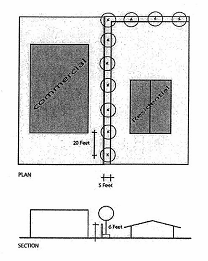
When commercial or industrial property is adjacent to property zoned for single-family residential purposes, a six-foot high solid masonry wall set in a planter of minimum five-foot width with trees spaced at twenty (20) foot intervals shall be constructed between the proposed development and the adjacent property along the rear and side property lines. The design and materials proposed shall be approved by the planning department prior to construction of said wall.
11.
When multifamily residential, commercial or industrial construction in excess of one story is proposed adjacent to property zoned for residential uses, structures shall be situated so that windows above the first story do not have direct views of other residential areas, collectors and arterials, or noise producing equipment or activities.
12.
All exterior lighting shall be directed away from adjacent properties.
13.
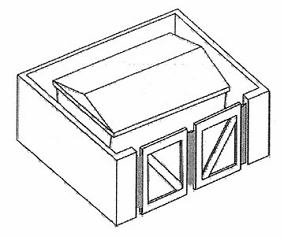
All trash receptacles shall be screened so that they are not visually obtrusive from any off-site location. The location and method of screening for all trash receptacles shall be approved by the planning department.
14.
Architectural design and materials of all proposed buildings shall be compatible with the surrounding neighborhood.
15.
Off-street parking shall be provided in accordance with the requirements of Chapter 17.60 of this title.
16.
Landscaping shall be provided in accordance with the requirements of this section.
17.
Signs may be provided as specified by the applicable zoning district regulation and Chapter 17.61 of this title.
18.
During all on-site grading and construction activities, adequate measures shall be implemented to control fugitive dust.
19.
For industrial developments utilizing outside storage, the areas devoted to outside storage shall be treated with a dust binder or other dust control measure, as approved by the planning department. Screening, if required by the base district regulations, shall also be provided.
20.
Street improvements and construction of curb, gutter, and sidewalks shall be required for additions to development existing on the effective date of the ordinance codified in this title, unless waived in accordance with Chapter 17.75.
L.
The planning department may waive any of the above-listed requirements where a documented hardship, not involving economics, exists or where there are unusual circumstances that prevent compliance with any of the required development standards.
(Ord. 348 § 1 (part), 2007)
17.51.030 - (DD2) CBD design district.
A.
The purpose of DD2 is to preserve and promote the public health, safety and welfare of the citizens of Huron, and to express the commitment of the City toward the continued vitality and stabilization of regional retail commercial activity within the area traditionally known as Downtown Huron. This district seeks to:
1.
Protect and enhance existing buildings and improvements in the downtown area;
2.
Enhance the character and physical environment of the downtown area by establishing specific design compatibility criteria for new and remodeled buildings within the district;
3.
Ensure that new development is compatible with existing and future plans for the area;
4.
Involve both design professionals and area residents, property owners and merchants, in the implementation of the Huron plan and the continued viability of the downtown retail economy.
B.
Ordinary Maintenance and Repair. Nothing in this chapter shall be construed to prevent ordinary maintenance or repair of any structure within DD2. Nothing in this chapter shall be construed to prevent the construction, reconstruction, alteration or demolition of any feature which in the view of the proper authority acting lawfully is required for the public safety because of an unsafe or dangerous condition.
C.
Severability. The provisions of this chapter shall be deemed to be severable, and if any of its provision shall be held unconstitutional by any court of competent jurisdiction, the decision of the court shall not impair any of the remaining provisions.
D.
The following design and development standards apply to property located within DD2:
1.
Building height: as prescribed in Table 17-2 and Table 17-4;
2.
Required yards: as prescribed in Table 17-2 and Table 17-4;
3.
Parking: as prescribed in Chapter 17.60 with the exception of CBD zone where on-site parking requirements are waived. Any expansion of existing structures or intensity of use in the CBD zone shall require the project applicant, as a condition of approval, to deposit a fee in lieu equal to the cost of providing the required additional number of spaces as approved by the city engineer;
4.
Minimum site area: as prescribed in Table 17-2 and Table 17-4;
5.
Landscaping: as prescribed in Section 17.51.020(C) and Table 17-4, Section 17.51.030(B) and Section 17.51.020 of this title.
(Ord. 348 § 1 (part), 2007)
17.51.040 - (DD6) Industrial design district.
The following development standards apply to property located within DD6:
A.
The purpose of DD6 is to promote public health, safety and welfare of the citizens of Huron and to promote the aesthetics and land use compatibility of industrial land uses with other design districts. This design district seeks to:
1.
Protect and enhance future viability of industrial land uses and ensure compatibility of industrial growth with adjacent more sensitive land uses;
2.
Enhance the character of the industrial district through street trees, requiring buffers between industrial and less sensitive land uses;
3.
Ensure that new development is compatible with future plans for the area;
B.
The following development standards shall apply to property located in DD6:
1.
Building height: as prescribed in Table 17-2;
2.
Required yards:
a.
Front: twenty-five (25) feet minimum,
b.
Side (interior): none required,
c.
Side (street/corner): ten feet minimum,
d.
Side yards abutting residential zoning districts: fifteen (15) feet minimum,
e.
Rear: ten feet minimum when adjacent to residential districts, otherwise five feet minimum;
3.
Parking: in addition to the parking as prescribed in Chapter 17.60, one on-site truck parking space shall be provided for each one-fourth acre or fraction thereof. Each truck parking space shall accommodate a tractor trailer, or a motorhome, and shall be designed so that vehicles can easily and safely enter and exit the property;
4.
Minimum site area: as prescribed in Table 17-2;
5.
Landscaping:
a.
Front: twenty-five (25) feet minimum,
b.
Side (interior): none required,
c.
Side (street/corner): ten feet minimum landscaping required,
d.
Rear: ten feet landscaping when adjacent to residential districts, otherwise five feet minimum landscaped setback required,
e.
Where industrial zoning abuts any residential land designation, a ten-foot wide landscape easement shall be maintained on the portion of the lot nearest the residential designation. The ten-foot landscape easement shall be privately maintained and include the following:
i.
One fifteen (15) gallon evergreen tree spaced at twenty (20) feet intervals,
ii.
Decorative fencing shall be used and shall include vines and other shrubbery to screen the wall,
iii.
No outdoor storage of materials shall be visible from any residential zone,
iv.
All outdoor storage shall be screened from public view in a manner approved by the planning department.
(Ord. 348 § 1 (part), 2007)
17.51.050 - Development in conformance with officially adopted master plans and specific plans.
Where the city council has adopted an official master plan, as specified by general plan policies, or adopts a specific plan pursuant to the Huron Municipal Code, the specific development requirement of the master plan or specific plan shall be applied as a condition to the granting of a planned development permit for subdivision approval for a project or a project area which is encumbered by the master plan or a specific plan.
(Ord. 348 § 1 (part), 2007)

