
Huron City Zoning Code
CHAPTER 17
60 - OFF-STREET PARKING STANDARDS
Sections:
17.60.010 - Purpose and application.
The purpose of this chapter is to reduce street congestion and promote parking for the safety and convenience of the residents of the City of Huron by requiring adequate requirements and well-designed parking areas. Parking required by this chapter shall be provided prior to the occupancy of a new building or structure is erected, the enlargement or intensification of a structure, or when use is established, changed or expanded. Projects which involve an increase or intensive of use shall comply with these standards for the expansion or intensification. The standards of this chapter are minimum standards. These regulations and standards of this chapter are intended to achieve the following:
A.
To provide accessible, attractive, secure, properly lighted, and well-maintained and screened off-street parking facilities;
B.
To reduce traffic congestion and hazards;
C.
To protect neighborhoods from the effects of vehicular noise and traffic generated by adjacent nonresidential land use districts;
D.
To assure the maneuverability of emergency vehicles;
E.
To provide appropriately designated parking facilities in proportion to the needs generated by varying types of land use.
(Ord. 348 § 1 (part), 2007)
17.60.020 - Required parking spaces.
Uses permitted by this title shall provide off-street parking spaces according to Table 17-5.
(Ord. 348 § 1 (part), 2007)
17.60.030 - Parking space dimensions.
A.
All parking spaces shall comply with City adopted improvement standards in Chapter 16 of the municipal code.
B.
Up to thirty (30) percent of the spaces in a parking facility with ten or more spaces may be designed and designated for compact cars.
C.
Parking structures may be subject to dimensional adjustments based on utilization (i.e.: public or private garage with or without an attendant), but in no case shall the stall width be less than eight feet. Reductions in design standards shall be subject to approval by the city engineer.
D.
All parking spaces shall be clearly marked.
E.
Parking spaces which require backing onto a street or road right-of-way are prohibited except in the case of driveways for single-family and duplex residential dwellings which are adjacent to a street which permits ditch access.
(Ord. 348 § 1 (part), 2007)
17.60.040 - Handicapped parking.
Handicapped parking spaces shall comply with the requirements of Chapter 2.71 of Title 24 of the California Administrative Code. Handicapped parking requirements herein shall be established by the State of California. Any change in the State's handicapped parking requirements shall preempt the affected requirements of this section.
A.
Handicapped parking for residential uses shall be provided at the rate of one space for each dwelling unit that is designed for occupancy by the handicapped.
B.
Handicapped parking spaces shall be provided for all uses other than residential at the following rate:
C.
Handicapped parking spaces shall be designed in a manner consistent with the City standard drawings approved by the city engineer.
D.
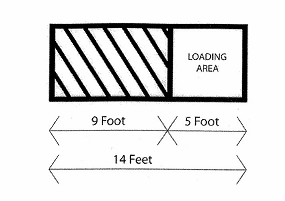
When less than five parking spaces are provided, at structures and uses subject to these regulations, one space shall be fourteen (14) feet wide and striped to provide a nine-foot parking area and a five-foot loading and unloading area. However, there is no requirement that the space be reserved exclusively or identified for handicapped use only.
E.
Handicapped parking spaces required by this section shall count toward fulfilling off-street parking requirements.
(Ord. 348 § 1 (part), 2007)
17.60.050 - Off-street loading spaces.
Except in the DD2 and DD3 districts, for every building or facility which requires the receipt or distribution of vehicles or merchandise and which are engaged in the following: manufacturing, storage, warehouse, wholesale or retail store, market, passenger terminal, theater, hotel, motel, restaurant, hospital, laundry, dry cleaning plant, or other similar use, adequate space for standing, loading, and unloading shall be provided and maintained on the same lot in addition to the automobile parking required by Section 17.60.020.
These provisions establish comprehensive standards to regulate the number, design and location of off-street loading areas, in a manner which ensures the following:
A.
Accessible, attractive, secure and well-maintained loading and delivery facilities;
B.
Reduced potential for traffic congestion and hazards;
C.
Protection for adjacent parcels and surrounding neighborhoods from the effects of vehicular noise and traffic generated from the anticipated land use and long dock activities;
D.
Loading and delivery services in proportion to the needs generated by the proposed land use which are clearly compatible with adjacent parcels and the surrounding neighborhood;
E.
Every nonresidential land use shall have permanently maintained off-street loading areas pursuant to the following provisions.
1.
Number of Spaces Required. Off-street freight and equipment loading spaces shall be provided for all offices, hospitals, institutions, hotels, seniors group housing, schools, day care centers, and other commercial and industrial land uses.
The following minimum number of loading spaces shall be provided for each use:
Commercial, industrial, office, institutional, hospital, hotels and schools:
Requirements for uses not specifically listed shall be determined by the director based upon the requirements for compatible uses and upon the particular characteristics of the proposed use, pursuant to Section 17.73.030 (Determination of similar use).
2.
Design Standards. Off-street loading spaces shall be provided in the following manner (See Figure 2):
a.
Access. When the lot upon which the loading space is located abuts an alley, the loading space shall have access from the alley.
b.
Dimensions. Required freight and equipment loading spaces shall not be less than fifteen (15) feet in width and twenty (20) feet in length or as determined by the planning department, with fourteen (14) feet of vertical clearance.
c.
Lighting. Loading areas shall have lighting capable of providing adequate illumination for security and safety. Lighting standards shall be energy efficient and in scale with the height and use of the structure. Any illumination, including security lighting, shall be directed away from adjoining properties and public rights-of-way.
d.
Location. Loading spaces shall be located and designed as follows: (i) adjacent to, or as close as possible to the main structure; (ii) situated to ensure that all loading and unloading takes place on-site and in no case within adjacent public rights-of-way, or other traffic areas on-site; (iii) situated to ensure that all vehicular maneuvers occur on-site.
e.
Passenger Loading. Passenger loading spaces shall be provided in addition to any required freight and equipment loading spaces whenever required by a development permit. Passenger loading spaces shall not be less than ten feet wide and twenty (20) feet long, shall be located in close proximity to the structure entrance, and shall not require pedestrians to cross a driveway, parking aisle, alley or street in order to reach the structure entrance. Required spaces shall not count as required parking spaces.
f.
Screening. All loading areas abutting residentially designated property shall have architectural screening similar to the primary structure and of a height that is adequate to screen noise and parking areas. In addition, along the outer sound wall of the loading area, adequate area shall be provided to accommodate a permanently maintained and irrigated landscaped area. The required landscaping shall include trees.
g.
Security. All loading facilities shall be designed, constructed, and maintained with security as a priority to protect safety of users.
h.
Striping. Loading and unloading areas shall be striped indicating the loading spaces and identifying the spaces for loading only. The striping shall be permanently maintained in a clear and visible manner.
(Ord. 348 § 1 (part), 2007)
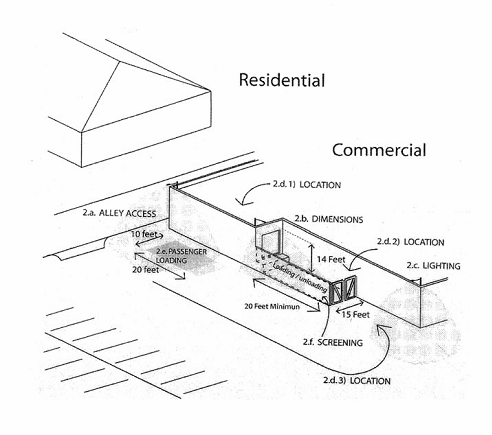
Figure 2 Off-Street Spaces—Design Standards
(Ord. 348 § 1 (part), 2007)
17.60.060 - Location of parking.
A.
Required residential off-street parking facilities shall be located on the premises they are intended to serve.
1.
Temporary Accessory Parking Structure.
a.
Definition. A temporary accessory parking structure shall mean a non-porous covering fastened to vertical and/or horizontal poles fastened to vertical poles integral to the covering material. Vertical poles shall be firmly fastened to the paved surface of the driveway by fixtures easily removed and are not permanently affixed in or to the ground by footings or other means. The occupant of the property shall only use the temporary accessory parking structure for providing shade to only one private operational vehicle. The temporary accessory parking structure shall not substitute for the covered parking required in a residential district.
b.
Ministerial Permit for a Temporary Accessory Parking Structure Required. Prior to assembling, installing, erecting or configuring a temporary accessory parking structure, a property owner or occupant with the written permission of the property owner shall make an application and obtain a ministerial permit from the City of Huron Planning Department for the installation of a temporary accessory parking structure in accordance with Section 17.75.02. The applicant shall provide a set of plans clearly showing the structural dimensions of the temporary accessory parking structure and the anchoring requirements with the application. The plans for the temporary accessory parking structure shall fully describe the covering material and method of attachment to the basic structure.
c.
Annual Inspection of Temporary Accessory Parking Structure. As a condition of issuing a permit, at least once per year the City of Huron Planning Department shall conduct an inspection of the condition and use of the temporary accessory parking structure. The inspection shall determine if the conditions for the temporary accessory parking structure are in compliance. Failure to maintain the temporary accessory parking structure will lead to the requirement to repair or remove the temporary accessory parking structure within fourteen (14) days from the date such notice is served on the occupant and/or owner of the property. Failure of the property owner to repair or remove the temporary parking structure will result in Property Maintenance Code enforcement and abatement procedures as defined in Chapter 17.79 of the Municipal Code.
The City may make additional inspections based on complaints from the surrounding neighborhood regarding the condition, use, or appearance of the temporary accessory parking structure.
d.
Fees for Application and Inspection. The city council shall establish a fee by resolution for the taking, processing an application and issuing approval to construct a temporary accessory parking structure. The applicant must pay the application fee at the time of the application. The property owner must pay the inspection fee annually and the City will be collect the City as a charge on the monthly utility bill for the property on which the temporary accessory parking structure is located. The City will discontinue the annual inspection fee upon notice from the City's Code Enforcement Officer that the property owner has repaired or removed the temporary accessory parking structure.
e.
Number. There shall be no more than one temporary accessory parking/structure per parcel of residential property.
f.
Location. The City may allow a temporary accessory parking structure within yards and setback areas in the following manner:
1.
Interior side yard - A temporary accessory parking structure may be placed in an interior side yard if the temporary accessory parking structure and/or supporting structure(s) is no closer than five feet from the side property line. The occupant shall maintain a five-foot ingress/egress into the backyard if located adjacent to private gate for fire access.
2.
Rear yard - A temporary accessory parking structure may be placed in a rear yard provided the temporary accessory parking structure and/or supporting structure(s) is no closer than five feet from the rear property line and the rear yard access is accessible by an alley.
3.
Front yard - A temporary accessory parking structure may be placed in a front yard provided the lot is not a corner lot, subject to the following conditions:
a.
The temporary accessory parking structure and/or supporting structure(s) shall be no closer than five feet from the back edge of sidewalk or back of curb, whichever is greater.
b.
In no event shall a temporary accessory parking structure encroach into a public right-of-way or interfere with the purposes of a public utility easement.
c.
A five-foot ingress/egress to and/or in front of rear yard, garage and/or dwelling structure shall be maintained if located adjacent to private gate, garage and/or dwelling access.
d.
The temporary accessory parking structures shall comply with City standards pertaining to driveway and street line of sight requirements. Variances to driveway or street line of sight standards are not permitted.
e.
The temporary accessory parking structure shall not block or restrict access to the covered parking (garage) access to the main structure.
g.
Footprint. In no event shall a temporary accessory parking structure provide more than one hundred twenty (120) square feet of temporary accessory parking structure area.
h.
Coverage. In no event shall the erection, configuration and/or use of a temporary accessory parking structure result in exceeding the maximum lot coverage restrictions for the zone district in which it is located.
i.
Height. Height of a temporary accessory parking structure, in general, may not exceed twelve (12) feet in height or exceed the height of the primary structure, whichever is less. Height of a temporary accessory parking structure may increase by one foot for every one foot increase in setback the nearest part of the temporary accessory parking structure from the back edge of sidewalk or back of curb, whichever is greater.
j.
Enclosure. In no event shall a temporary accessory parking structure be enclosed in any manner nor have appended to the structure any fabric material blocking the interior visibility of the structure.
In no event shall vines or plant material be allowed to climb the structure or otherwise obscure the interior visibility of the structure.
k.
Advertisement. Temporary accessory parking structure shall not contain any advertising signage, writing or lettering of any type.
l.
Use of Structure. The property occupant shall only use the temporary accessory parking structure for the temporary parking of one operational vehicle. Not allowed within the temporary accessory parking structure:
1.
Inoperable vehicles;
2.
Maintenance or repair of vehicles;
3.
Storage of trailers or recreational vehicles;
4.
Storage of waste, debris, lumber, containers of any kind;
5.
Storage of household appliances, furniture, play apparatus, tools or implements;
6.
Conduct of yard sales or household goods for sale;
7.
Storage of any other materials not commonly allowed in front yards.
m.
Maintenance of Structure. The temporary accessory parking structure shall be free of all tears and rips, and shall not be torn or tattered in any way. Supporting poles or elements shall not be bent or fractured in any manner and remain securely anchored to the paved surface.
n.
Construction and Anchorage Requirements. The temporary accessory parking structure shall be assembled to comply with the manufacturer's instructions and specifications and shall not be fastened to the primary structure and shall be anchored to the earth in compliance with the one of the following methods:
1.
One continuous eight-inch wide by twelve-inch deep concrete footing along on each longitudinal side of the canopy with threaded anchor bolts embedded to match the canopy manufacturer's recommended anchorage spacing.
2.
A twelve-inch round or square by eighteen-inch deep concrete anchorage footing with threaded anchor bolts embedded in the anchorage to match the canopy manufacturer's recommend anchorage spacing.
3.
A four-inch thick concrete slab that extends twelve (12) inches beyond the perimeter of the canopy in each direction with threaded anchor bolts embedded in the slab to match the canopy manufacturer's recommended anchorage spacing.
4.
Guy wires are not acceptable in any instance.
5. Vertical and/or horizontal support structure(s) shall not incorporate PVC piping, plastic poles, unfinished aluminum or tin parts, or temporary concrete holding buckets or other materials deemed inappropriate by the City of Huron Planning Department.
6.
Surface under temporary accessory parking structure shall be of concrete or similar noncombustible and nonabsorbent materials, or asphalt, and be sloped to facilitate movement of liquids to drain towards the street or alley vehicle entryway.
o.
Maintenance of Residential Covered Parking Requirement. The temporary accessory parking structure shall not replace the covered parking requirement for the residential district. The covered parking requirement shall be available for use and be unobstructed during the time that the temporary accessory parking structure is place.
p.
Removal. The temporary accessory parking structure shall be removed upon the sale or transfer of property title to a new owner. A new owner may apply for a ministerial permit for an existing temporary accessory parking structure prior to its removal.
q.
Existing Temporary Accessory Parking Structures - Time of Compliance. Existing parking structures whether known as car covers, parking canopies, cool covers, parking tents, or similar descriptions that are located in the front yard of single-family residential units, whether erected with or without a permit from the City shall make application for a temporary accessory parking structure and be granted a ministerial permit no later than six months after the effective date of this ordinance amendment.
Failure to comply with the requirement to obtain a ministerial permit for a temporary accessory parking structure shall be a violation of Section 17.19.03 of the Huron Municipal Code.
Fees for a temporary accessory parking structure ministerial permit application shall be reduced by fifty percent (50%) of the fee for all new applications. Annual inspection fees shall remain the same as all other temporary accessory parking structures with a ministerial permit.
B.
Off-street parking for other than residential uses shall be located on the premises they are intended to serve within the DD2 and DD6 these facilities may be located onsite or within five hundred (500) feet thereof. Where required parking is provided on a site other than that of the principal use, the property owner shall file on a form provided by the City of Huron planning department with the Fresno County recorder's office a covenant approved by the planning department that provides for the maintenance of the parking facility as long as the associated principal use is maintained.
C.
All parking areas shall provide suitable maneuvering room so that all vehicles may enter an abutting street in a forward direction. The planning department may approve exceptions for single-family homes and other residential projects.
D.
No parking space shall be located so that a vehicle will maneuver within twenty (20) feet of a vehicular entrance measured from the face of the curb.
(Ord. 348 § 1 (part), 2007)
(Ord. No. 362, § 2, 11-16-11)
17.60.070 - Joint use of parking areas.
If more than one user required to provide parking spaces in accordance with this chapter occupies the same or adjacent buildings, off-street parking shall be provided in an amount equal to the total number of spaces required for the separate uses, provided, however, that upon written request the planning department may reduce the number of spaces required in such cases by up to fifty (50) percent if it can be determined based on substantial evidence that the combination of uses in the same or adjacent buildings or premises will, at periods of peak weekly hour use, necessitate provision of a lower number of parking spaces than if the uses were developed independently.
Parking facilities may be shared if multiple uses cooperatively establish and operate the facilities and if these uses generate parking demands primarily during hours when the remaining uses are not in operation. The applicant shall have the burden of proof for a reduction in the total number of required off-street parking spaces, and documentation shall be submitted substantiating their reasons for the requested parking reduction. Public rights-of-way and/or on street parking shall not be used or counted to reduce the number of shared on-site parking spaces. Shared parking may only be approved if:
A.
A sufficient number of spaces are provided to meet the greater parking demand of the participating uses;
B.
Satisfactory evidence, as deemed so by the director, has been submitted by the parties operating the shared parking facility, describing the nature of the uses and the times when the uses operate as to demonstrate the lack of potential conflict between them; and
C.
Additional documents, covenants, deed restrictions, or other agreements as may be deemed necessary by the director are executed to assure that the required parking spaces provided are maintained and uses with similar hours and parking requirements as those uses sharing the parking facilities remain for the life of the commercial/industrial development.
(Ord. 348 § 1 (part), 2007)
17.60.080 - Parking area design and development standards.
Off-street parking areas required to be provided by this chapter shall be designed and developed in accordance with Table 17-5 and the following standards:
A.
All off-street parking areas and ingress and egress to parking areas, including areas occupied by automobile sales lots, service stations, drive-in establishments, residential, recreation, entertainment and tourist facilities, commercial, industrial, institutional, and other high intensity uses, parking areas shall be surfaced in a manner to achieve a Traffic Index of 4, unless a higher index is determined to be necessary by the city engineer.
B.
Parking aisles shall comply with the following minimum standards:
C.
All spaces shall be clearly marked.
D.
Off-street parking facilities shall be designed so that each space can function independently of any other space. Tandem space shall not be permitted.
E.
Driveways for residential developments shall be a minimum of twelve (12) feet in width with fifteen (15) feet of unobstructed vertical clearance. Driveways for commercial and industrial developments shall be a minimum of twenty (20) feet in width with a minimum of fifteen (15) feet of vertical clearance.
F.
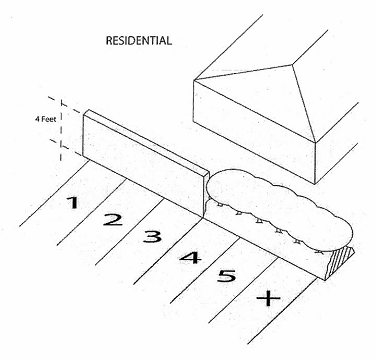
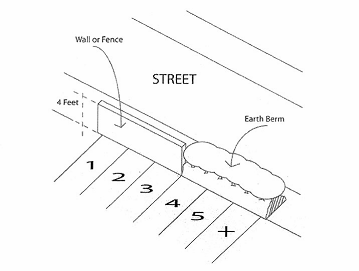
Where a parking facility containing five or more spaces abuts property zoned for residential, the parking facility shall be separated from the abutting property by a solid masonry wall four feet in height, except that portion of the wall which utilizes a four feet high conformation of vegetation and earthen berms.
G.
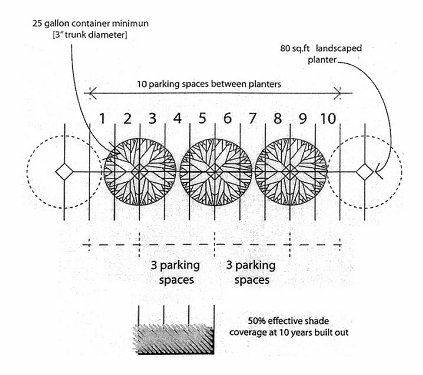
For all parking lots containing six or more spaces, at least five percent of the total parking area shall be landscaped. This landscaping shall be in addition to any other landscaping required pursuant to Chapter 17.51. Trees shall be planted and maintained throughout the parking area at a minimum ratio of one tree per three parking spaces to achieve a fifty (50) percent shade coverage of the parking area within ten years of installation. A landscaped planter of at least eighty (80) square feet shall be provided at least every ten parking spaces. Minimum tree size shall be twenty-five (25) gallon container (or three inches trunk diameter). Landscaping materials and trees shall be selected from a list of approved trees as may be established by the planning department.
H.
Where a parking facility containing five or more spaces includes diagonal and/or perpendicular parking spaces that abut public street or road, an ornamental fence, wall, vegetation and/or earth berm of not more than four feet in height shall be erected between the parking facility and the street so as to eliminate headlight glare.
I.
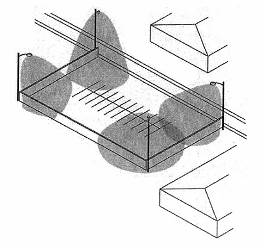
Lights used to illuminate parking areas shall be directed away from any adjacent properties and/or streets.
J.
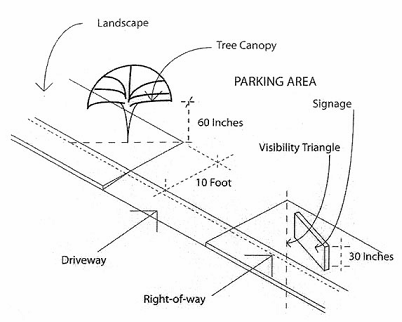
Where parking areas adjoin a public right-of-way, a ten-foot landscaped planting strip shall be established and continuously maintained between the public right-of-way and parking area. Any planting, sign, or other structure within safety sight-distance of a driveway shall not be higher than thirty (30) inches in height or lower than sixty (60) inches (in the case of tree canopies) similar to defined site triangles.
K.
All areas in parking lot not used for driveways, maneuvering areas, parking spaces or walks shall be permanently landscaped with suitable materials and permanently maintained.
L.
A permanent automatic irrigation system shall be installed and permanently maintained in all landscaped areas. The system shall employ state of the art water conservation technology, and recognize differing irrigation needs of various plant materials.
M.
The landscaping plan shall be provided consistent with Chapter 17.51 and shall include a variety of plant materials, with an emphasis on drought-tolerant species, for the appropriate climate zone. This plan shall be subject to approval by the planning department.
N.
To increase parking lot landscaped area, a maximum of three feet of the parking stall depth may be landscaped in lieu of asphalt while maintaining the required parking dimensions.
O.
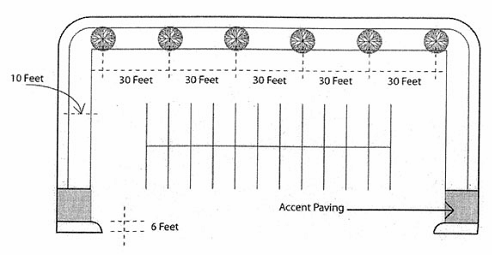
All parking structures shall be subject to approval by the planning department, and shall have a continuous ten-foot perimeter landscaping with trees every thirty (30) lineal feet; points of ingress/egress shall include a minimum six-foot wide landscaped island with accent paving in driveway; landscaping shall be permanently irrigated and maintained; and, lighting for the above ground deck shall not exceed four feet in height.
P.
A recreational vehicle may only be parked on a lot behind the front line of the house or in the case of a corner lot, behind the front line facing each street right-of-way, and shall be screened to a height of six feet from view of any public or private right-of-way. A recreational vehicle used as daily transportation may be parked overnight in driveways if it does not extend into the public right-of-way.
Q.
Recreational vehicles may be temporarily parked on private or public rights-of-way in front of residences for not more than forty-eight (48) continuous hours for the purposes of loading and unloading.
R.
Customer or employee parking spaces for a automobile service or repair facility shall not be used to store inoperable vehicles at any time. Vehicles in the process of service or repair can be parked in these spaces during normal business hours as long as a required number of parking spots for customers and/or employees (as per Table 17-5) remain available and no repairs or servicing activities are implemented in the parking area. Inoperable vehicles or vehicles in the process of service or repair shall not be parked or stored in alleys. Vehicles in the process of service or repair can be parked in areas within the subject parcel temporarily for vehicle staging (for purposes of vehicle arrangement in the shop) and/or loading or unloading of vehicles from a vehicle carrier or tow truck as long as on-site traffic patterns are not significantly disturbed or ingress/egress blocked (e.g. customers and employees can not enter or exit the property safely). No repair or maintenance services shall be preformed outside of the enclosed shop area. This includes but not limited to, engine and/or any portion of the vehicles drive or running gear installation or removal, body and fender work including but not limited to paint prep, sanding and painting, tire changing or any other major or minor repair or maintenance service.
S.
Tow trucks can be parked on-site as long as they do not interfere with ingress/egress and on-site traffic patterns in a way that affects the safety of customers, employees and the general public.
T.
Security. All parking facilities shall be designed, constructed maintained with security as a priority to protect the safety of the users.
(Ord. 348 § 1 (part), 2007)
(Ord. No. 369 , § 1, 4-6-2016)
17.60.090 - Bicycle parking requirements.
Bicycle parking shall be required for certain land and structural uses in order to eliminate bicycles from becoming obstacles in designated pedestrian areas. Bicycle parking spaces in the form of bicycle racks shall be provided in the following manner:
A.
Bicycle Parking Requirements.
1.
Bicycle parking area shall be clearly marked.
2.
Bicycle parking areas shall be located away from vehicular maneuvering areas and away from blind curves and driveway entrances.
3.
Bicycle parking may not be located in public rights-of-way unless approved by the appropriate review authority. Under no circumstance shall bicycle parking be located in pedestrian or vehicular travel paths.
4.
All bicycle parking spaces shall be located on the same parcel as the structure or use, unless approved otherwise by the review authority.
5.
Bicycle parking spaces shall be located within one hundred (100) feet from the primary entrance for which the parking space is provided.
6.
Bicycle parking shall be provided by approved, industrial quality bicycle parking racks, shall not be obtrusive, and shall be compatible in architectural character (color, materials, etc.) with the primary structures on the parcel.
7.
All bicycle parking facilities shall be designed, constructed, and maintained with security as a priority to protect safety of users.
8.
Bicycle parking areas shall be clearly visible and permanently maintained.
9.
Bicycle parking shall be located so that it reduces the potential for traffic interference and hazards.
10.
Bicycle parking areas shall have lighting capable of providing adequate illumination for security and safety. Lighting standards shall be energy efficient and in scale with the height and use of the structure. Any illumination, including security lighting, shall be directed away from adjoining properties and public rights-of-way.
11.
All required parking facilities shall be permanently maintained, free of litter, debris and graffiti.
B.
Shared Bicycle Parking. Bicycle parking facilities may be shared if multiple uses cooperatively establish and operate the facilities and if these uses generate parking demands primarily during hours when the remaining uses are not in operation. (For example, if one use operates during evenings or weekdays only). The applicant shall have the burden of proof for a reduction in the total number of required bicycle parking spaces, and documentation shall be submitted substantiating their reasons for the requested parking reduction.
1.
A sufficient number of spaces are provided to meet the greater parking demand of the participating uses.
2.
Satisfactory evidence, as deemed so by the planning department, has been submitted by the parties operating the shared parking facility, describing the nature of the uses and the times when the uses operate as to demonstrate the lack of potential conflict between them.
(Ord. 348 § 1 (part), 2007)
17.60.100 - Off-street parking plot plan review and approval.
No use shall be established or changed, no development shall occur or be expanded, and no building or grading permit or business license for any use or development shall be issued until an application for off-street parking plot plan review has been submitted to and approved by the planning department.
A.
Application Contents.
1.
Name and address of applicant;
2.
Name and address of property owner;
3.
Assessor's parcel number(s);
4.
Legal description of the property;
5.
A plot plan drawn (at the scale specified by the planning department) including the following:
a.
Topography and proposed grading specifications,
b.
Location of existing buildings and structures which are to remain,
c.
Location of proposed buildings and structures,
d.
Proposed uses of all buildings and structures,
e.
Dimensions of the existing and proposed structures and other information (e.g., seating capacity) which will allow planning department to determine the parking needs in accordance with Section 17.51.020,
f.
Layout proposed parking lot, including location of parking spaces, internal circulation pattern, and ingress and egress points,
g.
Dimensions of parking stalls and aisles,
h.
Location of landscaping and irrigation system, including identification of plant materials to be used,
i.
Location of lighting,
j.
North arrow.
B.
Review and Approval.
1.
Where a discretionary or ministerial approval is required for the use or uses for which the parking is being provided, the off-street parking plot plan application shall be reviewed and approved in conjunction with that discretionary or ministerial approval process.
2.
Off-street parking plot plan application shall be reviewed and approved in accordance with the standards and procedures set out in Chapter 17.75 of this title.
3.
No use shall be established or changed, no development shall occur or be expanded, and no building or grading permit or business license for any use or development shall be issued until an application for off-street parking plot plan review has been submitted to and approved by the appropriate review authority.
4.
No structures shall be permitted or constructed unless off-street parking spaces are provided in accordance with the provisions of this chapter.
5.
The word "use" shall mean both type and intensity of use, and that a change in use shall be subject to all the requirements of this chapter.
6.
When a structure is enlarged or increased in parking intensity, additional parking spaces shall be provided in accordance with the provisions of this chapter. Adequate spaces shall be provided for the expanded area, and the intensification of use. In the C-D land use district an in lieu fee may be collected in an amount as specified in the downtown overlay zone.
C.
Permit Revocation and Modification.
1.
Any permit issued pursuant to this chapter may be revoked or modified pursuant to Section 17.75.050 of this title.
(Ord. 348 § 1 (part), 2007)

