
Irmo City Zoning Code
ARTICLE III
- ZONING REGULATIONS FOR USE OF LOTS
Sec. 3-1. - Schedule of lot area, yard, setback, height, density, and impervious surface requirements.
Refer to article X for land development regulations on the creation of lots and the subdivision of land.
Table 2
Schedule of Lot Area, Yard, Setback, Height, Density, Floor Area,
and Impervious Surface Requirements, by District
Table notes:
1.
Refer to yard and setback modifications of this article.
2.
Due to the unique design features of townhouses, the dimensional requirements of Table 2 are modified under conditional uses for townhouses.
3.
Abbreviations:
a.
NA = not applicable
Table references:
A.
Measurement from front property line abutting the street right-of-way.
B.
Building height measured from the average elevation of the finished grade at the building line to the highest point on the roof.
C.
Maximum non-residential floor area ratio is measured as gross floor area percentage of total lot area.
D.
Minimum lot sizes in the general residential (RG) district are as follows:
•
Single family detached: 6,000 s.f.
•
Duplexes: 8,000 s.f. per two-unit structure
•
Townhomes: 2,000 s.f. per unit; capped at 16 units per gross acre
•
Apartments: minimum lot size of one acre; capped at 16 units per gross acre
E.
Minimum side yard setbacks in CN, CG, and LM districts are a minimum of three feet on one side and a total of ten feet for both sides.
F.
Building heights of more than 40 feet shall observe an additional setback from side and rear property lines of one foot for each one foot in height over 40 feet; buildings in excess of five stories shall be approved by the town fire department.
3-1.1. Major streets.
Major streets are all state primary and federal aid highways and streets that serve to circulate traffic on to, out, or around the town, having signals at important intersections and stop signs on side streets and/or having controlled access and channelized intersections.
3-1.2. Minor streets.
Minor streets are designated principally to collect traffic from subdivisions and provide access to abutting property.
(Ord. No. 21-05, 6-15-2021; Ord. No. 23-10, 6-27-2023; Ord. No. 23-25, 12-5-2023; Ord. No. 24-05, 3-19-2024)
Sec. 3-2. - Street access.
Each principal building shall be located on a lot or parcel having direct vehicular and pedestrian access to a publicly dedicated or publicly maintained street or approved private street. Except as otherwise provided below, a minimum street frontage of 50 feet shall be required for all lots created after the effective date of the ordinance from which this appendix derived. The frontage of the lot shall be determined by the frontage that abuts a public or approved private street.
3-2.1. Exemptions.
(a)
Flag lots as approved by this appendix.
(b)
Lots abutting an approved cul-de-sac or lots abutting sharp curbs with a radius of less than 90 degrees. However, the required street frontage on such lots shall not be less than the county or state encroachment permit requirements to install driveways.
Sec. 3-3. - Determining minimum lot size.
Whenever a plat, tax map, or deed shows that the minimum lot size per Table 2 is met and a new survey shows that the minimum lot size is not met, the following rules apply:
(1)
If a linear measurement of the new survey is within 0.5 feet of the existing recorded measurement, the planning official shall deem the lot meets the minimum lot size required per Table 2.
(2)
If all other plat requirements per this appendix are met, the survey shall be recorded with the Lexington County or Richland County register of deeds with the accurate survey dimensions.
(3)
The planning official shall note on any subsequent permits issued by the town that the lot of record has been deemed to meet the minimum lot size requirements of this appendix.
(4)
Refer to the article VIII for nonconforming lots.
Illustration of Setbacks, Yards, and Buildable Area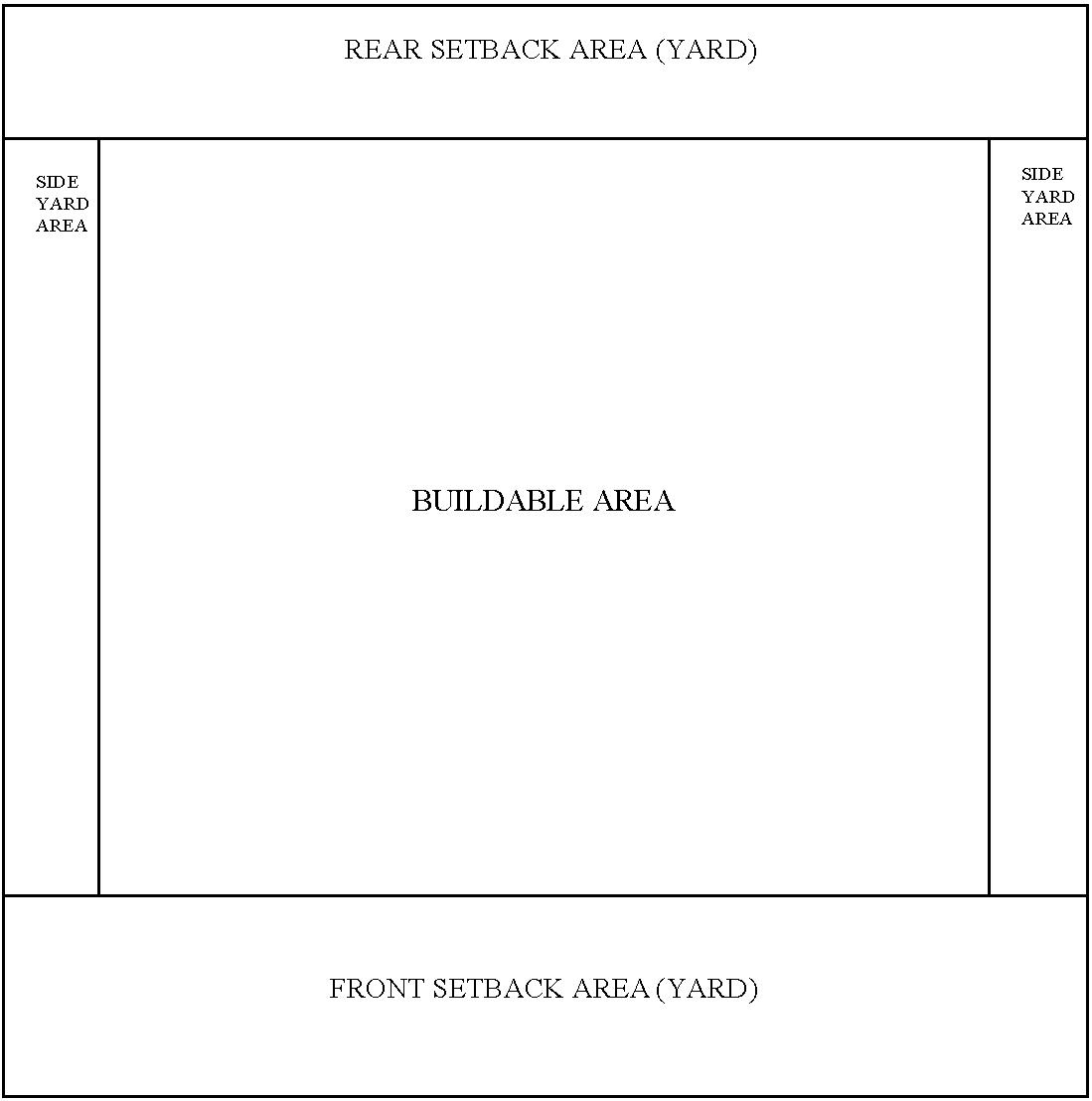
Sec. 3-4. - Yard and set-back modifications.
3-4.1. Setbacks on corner lots.
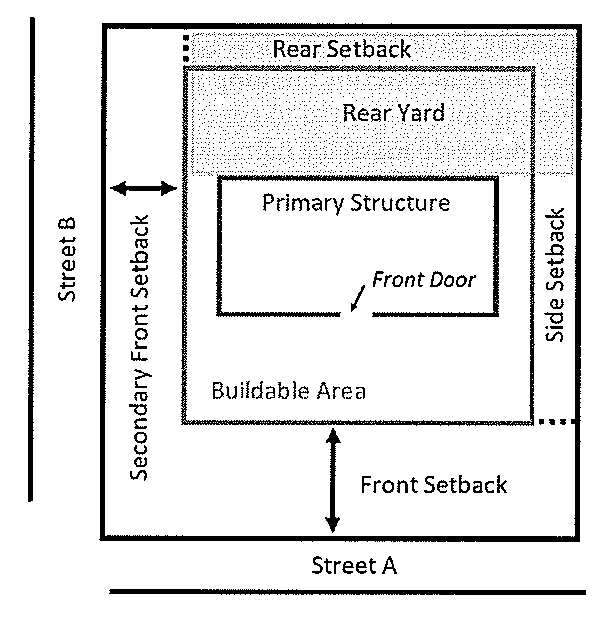
For lots located on a street corner, all property lines abutting a street shall be considered a front yard. The side and rear yard shall be determined by the zoning administrator in consultation with the property owner.
Accessory structures permitted only in the rear yard must be placed behind the rear building line and outside of the front setback. Automobiles, boats, trailers, campers, and other vehicles not parked in an approved space in the front or side yard must be parked in the rear yard outside of the front setback.
Fences taller than four feet are permitted in the rear yard and side yard. Any fence in the front setback may be no taller than four feet.
On residential lots, the yard in front of the front door is considered the primary front yard and has a front setback as shown in table 2. The front yard not in front of the front door is considered the secondary front yard and has a setback equal to one-half the front yard setback as shown in table 2. Where the primary structure sits diagonally on the lot, both front yards will be considered primary and will have the front setback described in table 2.
On non-residential lots, all front yard setbacks are equal to the setback laid out in table 2.
3-4.2. Exceptions to front yard setbacks from street.
The front yard setback requirements for dwellings shall not apply on any lot where the average setback of existing buildings located on the same block, or wholly or in part, within 200 feet on each side of said lot and fronting on the same side of the street is less than the minimum required setback. In such cases, the setback on such lot may be less than the required setback, but not less than the average of the setbacks of the aforementioned existing buildings.
(Ord. No. 25-03, 4-15-2025)
Sec. 3-5. - Buildable area and exceptions.
Every building or structure hereafter erected or established shall be located within the buildable area as defined by this appendix, and in no case shall such buildings extend beyond the buildable area into the respective front, side, rear yards or other setbacks required for the district in which the lot is located, except for the following:
(1)
Ornaments, eves, chimneys, cornices, windowsills, awnings, canopies, and steps which may project into any required yard a distance not to exceed three feet.
(2)
Accessory uses, as specified by this article.
(3)
Fences, walls, and hedges, not to exceed eight feet in height; provided that no such structure or hedge shall impede visibility as required by this article; further provided that no such fence, wall, or hedge shall exceed four feet in height when located in a front yard setback area.
(4)
Driveways, walkways, access and utility easements, parking areas, pavements, buffer areas, and other non-structural improvements.
Sec. 3-6. - Exceptions to height limitations.
The height limitations of this appendix shall not apply to church spires, belfries, cupolas, domes, etc., not intended for human occupancy; monuments; water towers; utility poles; chimneys; conveyors; flag poles; masts; communication towers and antennas; or roof-mounted mechanical equipment. Provided, however, water towers, communication towers, and antennas shall be separated from any adjoining property line in the RS and RG residential zoning districts a distance equal to one foot for each one foot in height, measured from the nearest property line.
Sec. 3-7. - Outdoor displays.
Outdoor displays of merchandise customarily used outdoors such as motor vehicles, boats, shrubbery, lawn mowers, lawn furniture, etc., may be permitted where allowed by Table 1. Note that under conditional uses for CN and FA districts, no uncovered, open storage or keeping of materials not associated with the principal use shall be permitted in public view.
Outdoor displays of merchandise not customarily used outdoors may be permitted from time to time as a temporary use for a period not to exceed 14 days duration at intervals of not less than 90 days. As a temporary use, such outdoor displays shall be subject to the permit and removal requirements.
3-7.1. Location of outdoor displays.
Outdoor displays, unless elsewhere authorized by this appendix, shall not be placed or located within 35 feet of the edge of a street or within a buffer area.
Sec. 3-8. - Accessory buildings, swimming pools, and spa uses.
3-8.1. Generally.
(a)
(1)
The number of accessory buildings shall not exceed two on any residentially zoned lot or parcel.
(2)
Accessory buildings in residential districts shall not be used for storage in connection with a trade.
(3)
Accessory buildings in residential districts shall not exceed 50 percent of the gross floor area (GFA) of the principal building.
(4)
The use of mobile homes as accessory buildings shall not be permitted in any zoning district.
(5)
Accessory buildings 1,000 square feet or less may be permitted within three feet of side and rear property lines.
(6)
Accessory buildings greater than 1,000 square feet shall not be permitted in any required yard or setback area.
(7)
Accessory buildings are not permitted within any required buffer or landscaped area.
(b)
Location of accessory buildings and uses.
(1)
Accessory buildings shall not be located in front of the principal building.
(2)
Carports and detached garages may be located on either side of the principal building and may project up to six feet beyond the front of the principal building. All other accessory buildings shall not project beyond the front of the principal building.
(3)
Satellite dishes not exceeding one meter in diameter shall be allowed in the front buildable and setback areas on either side of the principal building.
(4)
Pump houses shall be allowed in all buildable and setback areas but shall not be located closer than three feet to the nearest property line.
(5)
Swimming pools, tennis courts, and other recreational uses are permitted in all required setback (yard) areas, provided said uses shall be no closer than ten feet to the nearest property line and shall have all lighting shielded or directed away from adjoining residences.
3-8.2. Open storage.
Open storage as an accessory use may be permitted where indicated by Table 1, provided such storage area does not occupy over 20 percent of the buildable area, is not located in the required setback area, and is relatively obscured from public view by screening or placement on the lot.
3-8.3. Shipping containers.
The use of shipping containers as an accessory use is governed by these additional regulations:
(1)
Shipping containers shall not be used as a principal use or structure.
(2)
Shipping containers shall not be located in front of any principal building or structure.
(3)
Shipping containers shall be permanently screened from public view.
(4)
Shipping containers shall not be stacked.
(5)
Shipping containers shall not be located in any required side or rear yard setback area.
(6)
Shipping containers shall not be placed or stored on any lot or parcel for sale or distribution.
(7)
Shipping or cargo containers, tractor trailers, and like items shall be rust and damage free, and properly maintained at all times.
(8)
Shipping containers shall not exceed in size 15 percent of the gross floor area of the principal structure(s) to which they are accessory.
3-8.4. Accessory apartments.
Refer to conditional uses for accessory apartments in article II.
3-8.5. Accessory structures without a principal building.
Accessory structures, where allowed as an accessory to residential and non-residential uses, can be erected on lots of record without the principal structure. Such accessory structures shall conform to all the requirements of this section. If a principal structure is subsequently erected on the lot, both the accessory and principal structures must comply with all applicable requirements of this appendix. The location, size, or any other factor of the pre-existing accessory structure may not be considered as grounds for a variance from any requirement imposed on the accessory and/or principal structure.
3-8.6 Swimming pools and spas.
Swimming pools and spas shall be enclosed in accordance with the applicable standards of the International Building Code, such as by a self-latching gate of 48 inches minimum height or, if accessible only through a dwelling or structure, an alarm that produces an audible warning shall sound when windows, doors or screens less than 48 inches above the indoor finished floor are opened. Pools must be maintained with clean water (stagnation and/or fungus must be removed) or the pool must be drained.
(Ord. No. 21-08, 8-17-2021; Ord. No. 23-25, 12-5-2023)
Sec. 3-9. - Number of principal buildings per lot.
Where permitted or conditionally permitted by Table 1 no more than one single-family dwelling, manufactured home or duplex is allowed per lot. Refer to conditional uses for accessory apartments.
Where more than one principal building for all other uses is located on a lot, the required setbacks for the district shall be maintained along all property lines, and distances between principal buildings shall be approved by the fire chief prior to permitting.
(Ord. No. 24-05, 3-19-2024)
Sec. 3-10. - Visibility at intersections.
Railroad, street, and driveway intersections shall be unobstructed from the vision of motorists, pedestrians, and other possible users. No plantings or vegetation shall be placed or maintained, and no sign, fence, building, wall, or other structure shall be located, in a visual clearance area within an intersection. Sight distance standards, as determined by the South Carolina Department of Transportation (SCDOT), are described herein.
3-10.1. Visual clearance area.
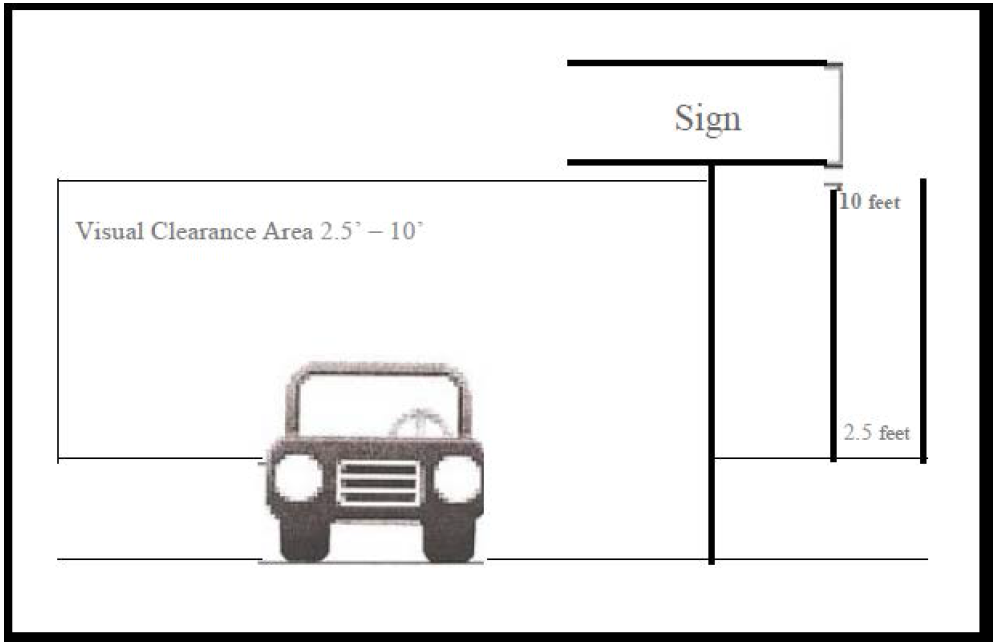
Visual clearance area means an area with a height of between two and one-half feet and ten feet, measured from the upper edge of the curb or pavement, and located within an intersection or driveway sight triangle, where no sign, planting, fence, building, wall, or other structure shall be located. Exception: Poles and support structures less than 12 inches in diameter may be permitted in such areas.
Visual Clearance Area
3-10.2. Intersection sight distance.
(a)
Intersection sight distance shall be as determined by the most recent edition of the SCDOT Access and Roadside Management Standards (ARMS). The following is from chapter 7 of the current (2008) ARMS edition:
Intersection Sight Distance (ISD)—The sight distance required within the corners of intersections to safely allow a variety of vehicular access or crossing maneuvers based on the type of traffic control at the intersection.
(b)
For an at-grade intersection to operate properly, adequate sight distance should be available. The designer should provide sufficient sight distance for a driver to perceive potential conflicts and to perform the actions needed to negotiate the intersection safely. The additional costs and impacts of removing sight obstructions are often justified. In general, intersection sight distance (ISD) refers to the corner sight distance available in intersection quadrants that allows a driver approaching an intersection to observe the actions of vehicles on the crossing leg(s). ISD evaluations involve establishing the needed sight triangle in each quadrant by determining the legs of the triangle on the two intersecting roadways. The necessary clear sight triangle is based on the type of traffic control at the intersection and on the design speeds of the two roadways. The types of traffic control and maneuvers are as follows:
(1)
Case A—Intersections with no control (not used by SCDOT);
(2)
Case B—Intersections with stop control on the minor road:
a.
Case B1—Left-turn from the minor road.
b.
Case B2—Right-turn from the minor road.
c.
Case B3—Crossing maneuver from the minor road.
(3)
Case C—Intersections with yield control on the minor road:
a.
Case C1—Crossing maneuver from the minor road (not used by SCDOT).
b.
Case C2—Left or right turn from the minor road.
(4)
Case D—Intersections with traffic signal control;
(5)
Case E—Intersections with all-way stop control; and
(6)
Case F—Left turns from the major road.
Sec. 3-11. - Traffic analysis.
All applicable developments shall have a traffic impact analysis, as outlined in this section, performed by an on-call consultant hired by the town at the expense of the applicant. This analysis shall be undertaken to ensure that access to all proposed developments and subdivisions is accomplished in a safe manner.
A.
Analysis. The standards in the South Carolina Department of Transportation's Access and Roadside Management Standards Manual shall serve as a guide for this analysis, which shall include identification of the following:
1.
Access improvements that the applicant must install at his or her expense, such as deceleration lanes.
2.
The location of any curb cuts based on, but not limited to sight distances, existing roadway infrastructure, opposing driveways locations and shared access.
3.
Requirements for adequate driveway design, including but not limited to, turning radius and throat length.
B.
Access requirements. The access requirements approved by the town administrator or designee shall be incorporated on development or subdivision plans prior to their approval.
C.
Improvement cost. If an applicant is required to provide site-related traffic improvements, the cost of implementing such improvements shall be borne by the applicant and no such costs shall be eligible for a credit or offset from any transportation impact fees.
D.
Applicability. A traffic impact analysis (TIA) shall be required for any development that would generate more than 50 trips during the peak hour on the adjacent street in accordance with the Institute of Transportation Engineers (ITE) Trip Generation Manual, latest edition.
1.
A second phase, second subdivision, or addition that generates traffic beyond this threshold when taken as a whole shall also require a TIA, even though that development does not qualify on its own.
2.
Change of use. A new TIA will be required if the new use would generate traffic beyond the 50 trips during peak hour threshold.
3.
A TIA can be required at any time as determined by the town administrator or designee in his/her discretion and judgment when there is a belief that the development may have an adverse impact to the surrounding area.
E.
Responsibility. Thorough and complete TIA's are the responsibility of the applicant. Failure by the applicant to provide a complete TIA may result in review delays for their plat or plan.
F.
Traffic impact analysis plan preparation.
1.
The TIA shall be conducted by an engineer registered in South Carolina that is experienced in the conduct of traffic analysis, who is one of the consultants the Town has previously selected for on-call traffic study services (hereinafter referred to as "the town's engineer").
2.
Prior to beginning the traffic impact analysis plan, the applicant shall supply the town with the following:
a.
A written narrative describing the proposed land use(s), size and projected opening date of the project and all subsequent phases;
b.
A site location map showing surrounding development within a one-half mile of the property under development consideration; and
c.
A proposed site plan or preliminary subdivision plat illustrating access to public or private roads and connectivity to other contiguous developments.
3.
The town will rely upon the most current edition ITE Trip Generation Manual or any alternative acceptable to the town's engineer, and available information on land use, travel patterns and traffic conditions. After consulting with the SCDOT, the town's engineer will supply in writing to the applicant and/or his engineer the parameters to be followed in the study including the directional split of driveway traffic, trip distribution, background traffic growth rate, previously approved but not completed projects and the intersections to be analyzed along with any associated turning movement counts which are available or discussed and approved by the town.
4.
After determination of the TIA's scope of services, the applicant shall provide a cost estimate of such services to the town for review and concurrence. The applicant shall provide an amount equal to the estimate to the town, who will deposit the amount in an escrow or special account set up for this purpose before the consultant's services are obtained. Any funds not used shall be returned to the applicant in a timely manner without interest.
5.
Additional fees for the TIA may be required if: the applicant substantially amends the application; additional meetings involving the consultant are requested by the applicant; the consultant's appearance is requested at planning commission or town council meetings beyond what was initially anticipated; or the consultant's attendance is required at meetings with regional, state, or federal agencies or boards which were not anticipated in the earlier scope of services. The applicant must reimburse the town these costs prior to the development plan or plat approval.
G.
Plan contents.
1.
All phases of a development are subject to review, and all traffic plans for the entire development shall be integrated with the overall traffic analysis. A traffic impact analysis plan for a specific phase of development shall be applicable to the phase of development under immediate review. However, each phase of development shall expand and provide detailed analysis at the development plan stage beyond the estimates provided for at the concept plan or master plan stage.
2.
Efficient traffic operations, safety and pedestrian accessibility are to be considered in the development plan. The adequacy of the roads to which the development takes access shall be assessed in the TIA. Recommendations for improvements shall be made where operational or safety concerns exist and installation of these improvements shall be required as a condition of any approval from the town. The relative share of the capacity improvements needed shall be broken down as follows: development share, other developments share, any existing over capacity, and capacity available for future growth.
3.
The following elements shall be included in a traffic impact analysis plan:
a.
Study area. Description of the study area including surrounding land uses and expected development in the vicinity that would influence future traffic conditions. The study area shall include the intersections immediately adjacent to the development and those identified by the town's engineer. These intersections may include those not immediately adjacent to the development if significant site traffic could be expected to impact the intersection. If intersections impacted by the development are within a coordinated traffic signal system, then the entire system shall be analyzed.
If the signal system is very large, a portion of the system may be analyzed if approved by the town's engineer and SCDOT. A study area site map showing the site location is required.
b.
Proposed land use. Description of the current and proposed land use including characteristics such as the number and type of dwelling units, gross and leasable floor area, number of employees, accompanied with a complete project site plan (with buildings identified as to proposed use). A schedule for construction of the development and proposed development stages should also be included.
c.
Existing conditions. Description of existing traffic conditions including existing peak-hour traffic volumes adjacent to the site and levels of service for intersections in the vicinity, which are expected to be impacted.
Existing traffic signal timings should be used. In general, AM and PM peak hour counts should be used, but on occasion other peak periods may need to be counted as determined by the town's engineer. In some cases, pedestrian counts will be required. Data should be adjusted for daily and seasonal variations. Existing counts may be used if taken within 12 months of the submittal of the TIS. In most cases, counts should be taken when school is in session unless otherwise determined by the town's engineer. Other information that may be required may include, but not limited to, crash data, stopping sight distances, and 50th and 85th percentile speeds.
d.
Future background growth. Estimate of future background traffic growth. If the planned completion date for the project or the last phase of the project is beyond one year of the study an estimate of background traffic growth for the adjacent street network shall be made and included in the analysis. In general, the growth factor will be determined from local or statewide data. Also included, is the state, local, or private transportation improvement projects in the project study area that will be underway in the build-out year and traffic that is generated by other proposed developments in the study area.
e.
Estimate of trip generation. The site forecasted trips should be based on the most recent edition of the ITE Trip Generation Manual. A table should be provided in the report outlining the categories and quantities of land uses, with the corresponding trip generation rates or equations, and the resulting number of trips. The reason for using the rate or equation should be documented. For large developments that will have multiple phases, the table should be divided based on the trip generation for each phase. Any reductions due to internal trip capture and pass-by trips, transit use, and transportation demand management should be justified and documented. All trip generation and trip reduction calculations and supporting documentation shall be included in the report appendix.
f.
Trip distribution and traffic assignment. The distribution (inbound versus outbound, left turn versus right turn) of the estimated trip generation to the adjacent street network and nearby intersections shall be included in the report and the basis should be explained. The distribution percentages with the corresponding volumes should be provided in a graphical format.
g.
Analysis and estimate of impact. A capacity analysis should be performed at each of the study intersections and access intersection locations (signalized and unsignalized) in the vicinity of the development.
Intersection analysis shall include level of service (LOS) determination for all approaches and movements. The levels of service will be based on the procedures in the latest edition of Transportation Research Board's Highway Capacity Manual. Coordination analysis will be required for the signal systems or portion of the signal systems analyzed.
h.
Access management standards. The report shall include a map and description of the proposed access including any sight distance limitations, adjacent driveways and intersections, and a demonstration that the number of driveways proposed is the fewest necessary and that they provide safe and efficient traffic operations.
i.
Traffic signalization. Ifa traffic signal is being proposed, a signal warrant analysis shall be included in the study. The approval of a traffic signal on projected volumes may be deferred until volumes meet warrants given in the Manual on Uniform Traffic Control Devices (MUTCD), in which the developer shall provide funds for the future signal(s) to the town to deposit in an escrow or special account set up for this purpose. The developer should make any laneage improvements during construction so that if in the horizon year a signal is warranted, one may be installed with little impact to the intersection.
j.
Mitigation and alternatives. The traffic impact study should include proposed improvements or access management techniques that will mitigate any significant changes in the levels of service. The town administrator or designee, in conjunction with the town's engineer, will be responsible for final determination of mitigation improvements required to be constructed by the applicant.
H.
Traffic impact analysis plan review. The town's engineer shall review all traffic impact analysis plans as part of the initial approval for the concept plan or master plan. Final traffic impact analysis plans shall be approved at the development plan phase.
I.
Action on traffic impact analysis plan. The town's engineer must first approve the TIA in regard to completeness and accuracy. Following review of the required impact analysis plan, the town administrator or designee, in conjunction with the town's engineer, shall recommend action as follows:
1.
Approval of the traffic impact analysis as submitted;
2.
Approval of the traffic impact analysis plan with conditions or modifications as part of the development review and approval process. An acceptable traffic impact analysis plan with traffic mitigation measures may include the reduction of the density or intensity of the proposed development; phasing of the proposed development to coincide with state and/or county programmed transportation improvements; applicant provided transportation improvements; fees in lieu of construction, or any other reasonable measures to ensure that the adopted traffic service level goals are met. If mitigation is required, it shall be required as a condition of any approval from the town.
J.
Timing of implementation. If a traffic mitigation program is part of an approved traffic impact analysis plan, the developer may be required to place a performance bond on all traffic mitigation improvements required as a result of his project. This requirement may arise if the timing of the improvements needs to be synchronized with other scheduled improvements anticipated for the area. The amount of the performance bond shall be equal to 150% of the estimated construction cost for the required traffic mitigation improvements.
K.
Responsibility for costs of improvements. The costs of implementation of an approved mitigation program shall be the responsibility of the applicant. No certificates of zoning compliance or building permits shall be issued unless provisions of the transportation impact analysis are met.
L.
Traffic goals. The average stop time delay in seconds per vehicle for each intersection determined to be critical to the traffic impact analysis for the proposed development shall be compared to the town's adopted traffic service level goal of "D" for the average delay for all vehicles at any intersection and all movements and approaches to the intersection during the a.m. and p.m. peak hours.
M.
Function and safety improvements. The town administrator or designee, in conjunction with the town's engineer, may require improvements to mitigate and improve the safety and function of multiple transportation modes the site traffic may impact. These improvements may not be identified in the TIA, but improvements to benefit the function and safety of the transportation system of the development site. These improvements may include but are not limited to center medians, sidewalks and/or bicycle accommodations, modifications to ingress and egress points, roadside shoulders, pavement markings, traffic calming and other traffic control devices.
(Ord. No. 24-11, 8-20-2024)
Sec. 3-12. - Architectural standards.
(a)
Purpose. The town seeks to promote architectural design which is harmonious with adjacent structures and sensitive to the natural environment. No single architectural style will be mandated within Irmo. However, the reliance on or use of a standardized "corporate or franchise" style is strongly discouraged, unless it can be shown to the town administrations' satisfaction that such style meets the objectives noted below. Strongly thematic architectural styles associated with some chain restaurants, gas stations, big box, and service stores are discouraged and, if utilized, will be recommended to be modified to be compatible with the town's design objectives.
The primary purpose of this policy statement is to achieve the following goals: enhance and protect the Irmo quality of life and community image through agreed upon architectural design objectives and protect and promote long-term economic vitality through architectural design objectives which encourage high quality development, while discouraging less attractive and less enduring alternatives.
(b)
Design objectives. The following architectural design objectives are intended to apply to all nonresidential, attached and multi-family residential development within the town. New building construction shall provide a sense of permanence and timelessness. High quality construction and materials should be used to ensure that buildings will not look dated or worn down over time, nor require excessive maintenance.
Exterior building materials should be aesthetically pleasing and compatible with materials and colors of nearby structures. Predominant exterior building facade materials shall consist of high quality, durable products, including but not limited to cementitious siding (i.e. HardiePlank), brick, sandstone, fieldstone, decorative concrete masonry units, wood, and glass. Metal exteriors are not permitted unless used as an architectural style, such as modern steel and glass architecture, and approved by the zoning administrator. Metal warehouse-type architecture shall not be permitted except in the light manufacturing zone. External insulation finished systems (E.I.F.S.) material shall be utilized only on the building trim and accent areas.
Building colors should accent, blend with, or complement surroundings. Facade colors are recommended to be earth tone colors which are low reflectance, subtle, and neutral (e.g. grays, greens, burgundies, browns, and tans). The coloring of all materials should be integral to the product and not painted on the surface of said product. The use of high intensity colors, metallic colors, black or fluorescent colors is discouraged. Primary colors are requested to be reserved for trim and accent areas.
Exposed neon tubing, LEDs, marquee lights or other bright lighting used for the purpose of attracting attention is not an acceptable feature on buildings or windows facing the exterior. This does not prevent the use of lighting as an accent (such as goose neck lamps with white lights lighting the roofline) or the use of interior-lit signage. Pitched roof designs are highly recommended for low-rise retail, office, and multi-family residential buildings utilizing architectural asphalt shingles or standing-seam metal panels. Flat roofs are not encouraged.
In the case of strip malls, big box stores, and shopping centers; such buildings shall provide elevations which reflect this objective through variations in facade setback and parapet wall presentations. Roof colors are requested to be muted and compatible with the dominant building color; long blank walls on retail buildings are to be avoided through the use of foundation landscaping, architectural details and features, or murals.
Large scale retail buildings are encouraged to have height variations to reduce scale and give the appearance of distinct elements; and lastly, roof top mechanical installations shall be appropriately screened so as to block the view from adjacent public and private streets and properties. Such screening shall match or compliment the overall theme of the building.
Signs provide important functions of both advertising and navigation by motorists and pedestrians. However, signs often dominate a site and can be counterproductive to the primary function of directing patrons. Through careful and well-planned site design, signs should be designed with the following elements in mind:
(1)
Compatible with their surroundings in terms of size, shape, color, texture, and lighting and not promote visual competition with other signs along the corridor.
(2)
Architecturally integrated with the site's primary building(s).
(3)
Located such that they do not restrict sight distances of pedestrians or motorists, especially at driveways and intersections.
(4)
Limit the number necessary to direct patrons throughout the site. Discourage the use of pole, pylon, and temporary signs.
(5)
Limited to necessary information, regardless of the size permitted by the sign ordinance. Repetitive information shall not be permitted, such as dual signs on corner building when one sign is highly visible from the intersection.
It shall be the duty of zoning administrator, building official, and town administrator to determine whether any specific request shall be considered in accordance with the architectural standards.
Any party who disagrees with the decision regarding the architectural standards may appeal the decision to the board of zoning appeals.
(Ord. No. 25-03, 4-15-2025)

