
Irmo City Zoning Code
ARTICLE V
- SIGN REGULATIONS3
Editor's note— Ord. No. 23-23, adopted December 5, 2023, repealed art. V, §§ 5-1—5-11, and enacted a new art. V as set out herein and as may later be amended. Former art. V pertained to similar subject matter and derived from the original zoning ordinance.
Sec. 5-1. - Purpose and general provisions.
[1.]
[Purpose.] The purpose of this article is to protect the dual interest of the public and the advertiser. The regulations herein are designed to protect public safety and welfare and to ensure the maintenance of an attractive community environment while satisfying the needs of sign users for adequate identification, communication, and advertising.
[2.]
General provisions.
a.
The regulations set forth in this article shall apply and govern in all zoning districts. No sign shall be erected, altered or maintained unless it is in compliance with the regulations of this article.
b.
A permit shall be required for the erection, alteration or reconstruction of any sign unless otherwise noted and shall be issued by the town or its agent.
c.
All signs must be constructed of durable materials, maintained in good condition and shall not be permitted to become dilapidated or a hazard to the health, safety or general welfare of the community.
d.
The zoning administrator or designated agent shall require the property owner or tenant to remove, replace or repair the sign as is deemed appropriate by the zoning administrator.
e.
All signs attached to buildings must meet all applicable wind standards as defined by the International Building Code. All freestanding signs greater than six feet in height must meet all applicable wind and seismic standards as defined by the International Building Code.
f.
The purpose of this section is to provide comprehensive regulations for signs within the town that will eliminate confusing, distracting and unsafe signs, ensure the efficient transfer of information; and, enhance the visual environment of the town. It is declared that the regulation of signs within the town is necessary and in the public interest and also is related to the following goals:
i.
To protect property values within the town;
ii.
To protect the general public from damage or injury caused by, or partially attributable to the distractions and obstructions which result from improperly designed or situated signs;
iii.
To provide a pleasing overall environmental setting and community appearance which is deemed vital to tourism and to the continued economic attractiveness of the town;
iv.
To improve the legibility and effectiveness of commercial and governmental signs;
v.
To allow signs appropriate to the planned character of each zoning district; and
vi.
To promote the public safety, welfare, convenience and enjoyment of the unique historic character of the town.
g.
Any signs, displays or devices allowed under this article may contain, in lieu of any other copy, an otherwise lawful noncommercial message that does not direct attention to a business operated for profit, or to a commodity of service for sale, and that complies with size, lighting and spacing requirements of this article.
h.
All signs shall comply with existing state and federal laws.
(Ord. No. 23-23, 12-5-2023)
Sec. 5-2. - Signs permitted by zone.
X—Allowed with permit
R—Allowed by right, no permit required
(Blank)—Not allowed
1 This column does not represent a zoning district. It applies to institutional and other non-residential uses permitted in residential zoning districts, such as schools, churches, parks, etc.
(Ord. No. 23-23, 12-5-2023)
Sec. 5-3. - Sign regulations by type.
A.
General regulations.
1.
All sign dimensions listed are maximums.
2.
All signs are to be externally lit unless otherwise noted
B.
Awning and canopy signs.
1.
Definitions.
a.
Awning. An architectural projection or shelter projecting from and supported by the exterior wall of a building and composed of rigid or non-rigid materials and/or fabric on a supporting framework that may be either permanent or retractable. Example: A canvas-covered frame extending from a building wall to an area over the sidewalk in front of a shop.
b.
Canopy. A freestanding, open-sided structure constructed of rigid materials or non-rigid materials, including, but not limited to, metal, wood, concrete, plastic, canvas, or glass. The structure covering the fueling area at a gas station is considered to be a canopy. Other examples include picnic shelters, gazebos, and cabanas.
c.
Marquee. A fixed hood of permanent construction which is supported solely from a building wall and extends beyond the building. Example: The structure over the front sidewalk area at a movie theatre.
2.
Permitted zones. CG, CN, CO, LM, FA, IN.
3.
Requirements.
a.
Awnings and marquees are considered wall signs for purpose of area allowances, with only one sign permitted per building side. Awnings may only be externally lit, while marquees may be internally or externally lit.
b.
Canopy signs may be no more than eight percent of the area of the canopy façade, with one sign permitted per street frontage. This is in addition to any signage on the primary structure. Canopy signs may be externally or internally lit.
c.
Any signage on an awning, canopy or marquee must be flush or integral with the awning, canopy, or marquee, and may not project beyond, below, or above the structure.
d.
A minimum eight-foot clearance shall be maintained between the bottom edge of an awning, canopy, or marquee and the sidewalk, pavement, or ground surface.
e.
Awnings or marquees shall project no closer than eight feet from the street curb.
C.
Construction signs.
1.
Definition. Any temporary sign located at a construction site, generally to inform the public of the construction company, finance source, etc.
2.
Permitted zones. All zones.
3.
Requirements.
a.
Height. Eight feet.
b.
Area. In the RS, RG, CO, CN districts: 20 square feet per exposed side; 40 square feet aggregate. In the CN and LM Districts: 40 square feet per exposed side, 80 square feet aggregate.
c.
Location. At least ten feet from any street right-of-way.
d.
One sign per street frontage.
e.
At least 50 percent of the surface area shall directly reference the specific project under construction, including the name of the development, any specific business(es), and a picture or rendering of the project. An expected completion date is encouraged.
D.
Freestanding signs.
1.
Definition: Any sign supported by structures or supports that are placed on, or anchored in, the ground and that are independent from any building or other structure.
2.
Permitted zones: CG, CN, CO, LM, FA, IN.
3.
Requirements:
a.
In CN, CO, FA, and IN districts:
1.
Height: 12 feet, except six feet for IN uses in a residential district.
2.
Area: 20 square feet per exposed side; 40 square feet aggregate.
3.
Location: At least ten feet from any street right-of-way.
4.
Changeable copy signs shall constitute no more than 50 percent of the total sign area and must be placed on the same sign structure as the fixed sign.
5.
Externally lit only.
6.
One sign per street frontage is permitted.
7.
In developments where existing signage is non-conforming, newly proposed signage may meet the standards of the existing signage with permission of the zoning administrator.
b.
In CG and LM districts:
1.
Height: 25 feet, except along I-26 where signs may be 50 feet.
2.
Area: 50 square feet per exposed side; 100 square feet aggregate.
3.
Location: At least ten feet from any street right-of-way.
4.
Electronic message centers or changeable copy signs shall constitute no more than 50 percent of the total sign area. Such signs must be placed on the same sign structure as the fixed sign. Gasoline pricing signs are considered changeable copy signs. Electronic message centers must be dimmed from sundown to sunup in such manner as to not negatively affect drivers and any nearby residential lots.
5.
Such signs may be externally or internally lit.
6.
One sign per street frontage is permitted.
E.
Governmental flags.
1.
Definition. Any fabric, banner or bunting containing distinctive colors, patterns or symbols, used as a symbol of government, political subdivision or other entity.
2.
Permitted zones. All.
3.
Requirements.
a.
Height of flagpole. Fifteen feet maximum residential; 25 feet maximum commercial.
b.
Area of flag. Per the guidelines of the U.S. General Services Administration, a flag pole should be approximately three to four times the length of the flag. As such, a 15-foot tall pole should utilize three-by-five-foot flags, a 20-foot pole should use three-by five-foot or four-by-six-foot flags, and a 25-foot pole should use four-by-six-foot or five-by-eight-foot flags. The maximum flag sizes allowed per this ordinance are 15 square feet per flag, no more than 30 square feet total (residential); 40 square feet per flag, no more than 120 square feet total (commercial).
c.
Number of flagpoles allowed. One residential; three commercial.
d.
Setback. Pole must be setback from all property lines an amount equal to or greater than the height of the pole.
e.
Lighting. Governmental flags must be externally lit or removed at dusk.
f.
Third flags. If the flags of the United States and the State of South Carolina are flown, a third, commercial flag may be flown on the third pole. The flag will not be included in the overall sign area total on the lot.
F.
Holiday decorations.
1.
Definition. Signs or other material temporarily displayed on traditionally accepted civic, patriotic or religious holidays containing no commercial message.
2.
Permitted zones. All limitations on holiday displays apply only to non-residential uses. Residential uses may display holiday decorations at any time.
3.
Requirements. Materials may be displayed for no more than 30 days with the exception of Christmas decorations, which may be displayed from November 15—January 15. While holiday displays and decorations are only permitted during limited periods, non-residential uses may use non-blinking lights as accents and decoration throughout the year. If, in the opinion of the zoning administrator, lights or displays are distracting to motorists or beyond that which is deemed allowable by this ordinance, he or she may direct the business to the board of zoning appeals for a ruling as to appropriateness.
4.
Lighting. Such signs may be internally or externally lit.
G.
Home occupation.
1.
Definition. A sign advertising a home-based business.
2.
Permitted zones. RS, RG, or residential uses in other zones.
3.
Requirements. One square foot, unlit, mounted against the wall of the principal building. Only permitted on residential structures.
H.
Incidental sign.
1.
Definition. A sign which provides information that is secondary to the use of the lot on which it is located, such as "no parking," "entrance," "loading zone," or "drive through," and other similar directives. No sign with a commercial message legible from a position off the lot on which the sign is located shall be considered incidental.
2.
Permitted zones. CG, CN, CO, LM, FA, IN.
3.
Requirements. Maximum height is four feet.
4.
Lighting. Such signs may be internally lit in the CG zone, or externally lit in any allowable zone.
I.
Informational sign.
1.
Definition. Signs which direct the reader to the location of a public facility, to a facility operated by a nonprofit entity, to a facility relating to the public health, safety or welfare, to scenic or historical districts, or general business or industrial districts or a subdivision.
2.
Permitted zones. All.
3.
Requirements.
a.
The zoning administrator is authorized to develop written and publicly posted guidelines for these types of signs.
b.
The signs are erected by the town or other governmental entity.
c.
The entire cost of the signs is borne by the entity requesting the sign.
d.
The signs are installed at locations where they would not constitute a traffic hazard.
e.
Such signs are allowed in the right-of-way and may not be lit.
J.
Multi-face sign.
1.
Definition. Free standing sign advertising more than four businesses located within the same development.
2.
Permitted zones. CG, CO, CN, LM.
3.
Requirements.
a.
In the CO and CN districts:
i.
Height: 15 feet.
ii.
Area: 45 square feet per side, 90 square feet in aggregate.
iii.
Number and location: one sign per street frontage. Developments with more than 800 feet of frontage on one road may have two signs on that same road if the signs are at least 600 feet apart, in addition to any allowable signage on the other frontage(s). Signs shall be placed at least ten feet from any street right-of-way.
iv.
Changeable copy signs shall constitute no more than 50 percent of the total sign area.
v.
Such signs may be externally or internally lit.
b.
In the CG and LM districts:
i.
Height: 25 feet.
ii.
Area: 65 square feet per side, 130 square feet in aggregate.
iii.
Number and location: one sign per street frontage. Developments with more than 800 feet of frontage may have two signs on the same road if the signs are at least 600 feet apart, in addition to any allowable signage on the other frontage(s). Signs shall be placed at least ten feet from any street right-of-way.
iv.
Electronic message centers or changeable copy signs shall constitute no more than 50 percent of the total sign area.
v.
Such signs may be externally or internally lit.
K.
Multi-family dwelling.
1.
Definition. Permanent signs announcing the entrance to a multi-family dwelling, such as an apartment complex.
2.
Permitted zones. RG.
3.
Requirements.
a.
Number. One permanent sign shall be permitted per principal entrance to the subdivision.
b.
Sign area. Fifty square feet per exposed side; 100 square feet aggregate.
c.
Location. Such signs shall be located on the premises of the dwelling, set back at least ten feet from any street right-of-way.
d.
Height. Multiple family group dwelling signs shall not exceed six feet in height as measured from average grade of lot.
e.
Lighting. Such signs may be externally lit.
L.
Outdoor display.
1.
Definition. Temporary or permanent outdoor placement of inventory intended for immediate sale and used to advertise or promote the interests of any persons when placed in view of the general public, traveling along a public street right-of-way. Outdoor vehicle sale lots are considered outdoor displays.
2.
Permitted zones. CG, LM.
3.
Requirements.
a.
In addition to a freestanding sign, a business may use a display with a valid sign permit. The display must be set ten feet back from the right-of-way and be no more than ten feet in height. Multiple displays may be used provided that they conform to the required setbacks and height limitations subject to approval of the zoning administrator.
b.
Displays that are not intended for immediate sale and/or do not meet the guidelines of this ordinance will be considered outdoor storage of inventory.
c.
Temporary displays are displays that are only used during business operating hours. After business operating hours, temporary displays must be placed indoors or behind a solid six-foot stockade fence.
d.
Permanent displays are defined as a display that is used during business hours as well as after business hours. Permanent displays may be accompanied, in lieu of the required fencing, by a ten feet wide vegetative strip placed along the right-of-way. The vegetative strip must meet the type A buffer requirements detailed in this Code. Shrubs at a ratio of three to one may replace required trees with zoning administrator approval.
e.
No off-premise displays are allowed.
f.
Permanent and temporary outdoor displays shall meet all other requirements of free-standing signs.
g.
Displays may be externally lit.
M.
Projecting sign.
1.
Definition. Any sign affixed to a building or wall in such a manner that its leading edge extends more than six inches beyond the surface of such building or wall.
2.
Permitted zones. CG, CN, CO.
3.
Requirements. Such signs may extend outward from the wall of a building not more than four feet and no part of any projecting sign shall extend above the roof line of a building or into a public road, although such signs may project over a sidewalk. A minimum eight-foot clearance shall be maintained. Maximum allowable size is calculated along with any other wall signs.
4.
Such signs may be externally lit.
N.
Public/official notice.
1.
Definition. Public agency signs are those erected by any public agency, such as the state, county, or local government. Such signs include traffic signals and signs, informational signs, and the like. Official notices are postings placed by any court, officer, or other public agency.
2.
Permitted zones: All.
3.
Permitted in the right-of-way.
O.
Real estate.
1.
Definition. A temporary sign erected by the owner, or his agent, advertising the real property upon which the sign is located for rent, for lease, or for sale.
2.
Permitted zones. All.
3.
Requirements.
a.
Residential. Unlit, maximum size four square feet, four feet in height.
b.
Commercial. Unlit, maximum size 32 square feet, ten feet in height.
P.
Sandwich board/pedestal.
1.
Definition. A freestanding movable sign, not secured or attached to the ground or any building or structure, composed of a sign panel and supporting structure or one or more panels which form both the structure and sign face, and which is intended to be placed in a sidewalk or pedestrian way. (Also known as "A" and "T" stands).
2.
Permitted zones. CG, CO, CN, IN.
3.
Requirements.
a.
Only one sandwich board or pedestal sign shall be allowed for any single building; provided, however, that where more than one business occupies a building, each business may have a sandwich board or pedestal sign.
b.
A minimum separation of 20 feet shall be maintained between sandwich boards or pedestal signs.
c.
Sandwich boards or pedestal signs shall not exceed 24 inches in width and 36 inches in height; provided, however, that a minimum unobstructed sidewalk width of 42 inches shall be maintained.
d.
No sign shall be placed in a manner which obstructs the clearance vision at a street intersection.
e.
Sandwich boards or pedestal signs located within a public right-of-way shall be placed within that portion of the public right-of-way which abuts the building containing the business or use. Signs must always be placed as close as practical to the business being advertised; for example, such signs may not be placed along the road on the far side of a parking lot from the business.
f.
Sandwich boards or pedestal signs placed in the internal area of a shopping center walkway are permitted without a permit, provided that permission is given by the property owner. Such signs shall not be placed in a manner in which they may be construed to be a freestanding sign advertising to vehicle traffic.
g.
Such signs must be brought indoors when the business being advertised is closed.
Q.
Subdivision, permanent.
1.
Definition. Permanent signs located at the entrance of a subdivision.
2.
Permitted zones. RS, RG.
3.
Dimensional requirements.
a.
Number. Two permanent subdivision signs shall be permitted per principal entrance to the subdivision if single sided signs are placed on either side of the entrance, as on a wall. Otherwise, one permanent subdivision sign is permitted per principal entrance.
b.
Sign area. Fifty square feet per exposed side; 100 square feet aggregate.
c.
Location. Such signs shall be located on the premises of the land subdivision, at least ten feet from any street right-of-way.
d.
Height. Subdivision signs shall not exceed eight feet in height as measured from average grade of lot.
e.
Lighting. Such signs may be externally lit and shall be accompanied by appropriate landscaping, as approved by the zoning administrator.
R.
Subdivision, temporary.
1.
Definition. Temporary signs announcing a new subdivision development.
a.
Permitted zones. RS, RG.
2.
Requirements.
a.
Number. One temporary subdivision sign shall be permitted per principal entrance to the subdivision.
b.
Sign area. The sign area shall not exceed 32 square feet in gross surface area for each exposed face nor exceed an aggregate gross surface area of 64 square feet.
c.
Location. Temporary subdivision signs shall be located on the premises of the land subdivision, at least ten feet from any street right-of-way.
d.
Height. Temporary subdivision signs shall not exceed ten feet in height as measured from average grade of lot.
e.
Special conditions. Temporary subdivision signs shall be removed from the premises once 50 percent of the lots are conveyed or when a permanent subdivision sign is permitted and constructed.
f.
Lighting. Such signs may be externally lit.
S.
Temporary sign.
A.
Definition. Any sign conveying a message which is made of impermanent materials designed to be used temporarily and is not permanently mounted. Temporary signs may include, but are not limited to:
a.
Freestanding banners.
b.
Banners attached to permanent structures.
c.
Feather banners.
d.
Any advertising and informational materials stuck into the ground using temporary wooden stakes or wire frames, including political signs; temporary directional signs; work under construction signs, garage sale signs; real estate open houses; and signs advertising civic, philanthropic, religious, or educational organizations or events.
e.
Changeable copy portable signs, while made of permanent materials, are considered temporary signs and are not permitted within the town.
B.
Permitted zones. All.
C.
Requirements.
a.
Single-family residential lots: One sign with a maximum size of four square feet is allowed to remain on a permanent basis without permit.
b.
All other lots:
i.
One sign per 50 feet of road frontage with a maximum of four signs.
ii.
Maximum size of 32 square feet per sign (banners) or four square feet (other temporary signs).
iii.
Height: Temporary signs shall not exceed ten feet in height as measured from average grade of lot.
iv.
Maximum of 60 days per year. Days may be non-consecutive.
v.
On lots featuring more than one business, each business may display one sign per 50 feet of the development's road frontage, up to two signs, and signs may only be displayed for 30 days per year. Temporary internal signage, such as wire frame signage in a multi-business parking lot, are permitted but count towards the signage and time limits.
vi.
Such signs must be permitted by the zoning administrator and the permit must show the beginning and ending dates of the sign placement. Signs found to be placed without a permit will have their original placement date estimated by the zoning administrator.
c.
During the period 45 days prior to a political primary or election until seven days following such an event the maximum number of temporary signs allowed and the need for any permits shall be waived. Signs shall be placed on private property and not in the right-of-way. During this period signs other than banners may be 16 square feet in size on parcels of non-residential use, while signs are limited to four square feet on residential lots. Banners may still be up to 32 square feet during this period. Such signs shall not be permitted in the right-of-way.
d.
Such signs shall not be illuminated.
T.
Wall sign.
1.
Definition. Any sign attached parallel to, but within 12 inches of, a wall, painted on the wall surface of, or erected and confined within the limits of an outside wall of any building or structure, which is supported by such wall or building, and which displays only one sign surface.
2.
Permitted zones. CG, CN, CO, LM, FA, IN.
3.
Requirements.
a.
Awning, canopy, and projecting signs are included in the total square footage allowed on a wall sign.
b.
No part of any sign shall extend above the roof line of a building.
c.
In the CN, CO, LM, FA, and IN zones:
i.
The total area of signs on the exterior front surface of a building shall not exceed ten square feet or eight percent of the front surface of the building, whichever is greater.
ii.
No signs shall be permitted on the side or rear of a building except in the case of buildings with multiple street frontages, which may place signs on all street frontages using the above size calculation.
iii.
Such signs may be externally lit.
d.
In the CG district:
i.
The total area of signs on the exterior front surface of a building shall not exceed eight percent of the front surface of the building.
ii.
The total area of signs on the exterior side or rear surface of a building shall not exceed three percent of that surface of the building.
iii.
Such signs may be internally or externally lit.
e.
For multi-tenant buildings in all districts, wall area shall be calculated by multiplying the building height by the width of that particular business's façade. Businesses without an external façade, such as in an office building, are not permitted a separate wall sign.
f.
On large retail facades with more than one distinct entrance, such as a Walmart Supercenter or Lowe's, multiple signs may be permitted with the approval of the zoning administrator. Only one sign may feature a commercial message, such as the main sign stating the name of the business. Other, smaller signs distinguishing the entrances or services offered inside the structure (such as grocery and pharmacy, lawn and garden, or pickup), may be permitted. The area of each individual sign will be calculated, and the total size of all signage placed on the façade shall not exceed eight percent of the total façade area.
U.
Window signage.
1.
Definition. A sign that is applied or attached to the exterior or interior of a window or located in such manner within a building that it can be seen from the exterior of the structure through a window. Signs on glass doors are considered window signs for the purposes of this ordinance, subject to the requirements below.
2.
Permitted zones. CG.
3.
Requirements.
a.
Window signs are permitted by right in the CG zone. No more than 50 percent of all windows may feature window signs, and no more than 50 percent of any given window may be covered by such signage.
b.
Signs consisting of simple verbiage, such as the name of the store (including logos), address, and hours of operation, are permitted on glass doors by right on all commercial uses. The size of the sign shall not exceed 50 percent of the size of the door.
(Ord. No. 23-23, 12-5-2023; Ord. No. 25-03, 4-15-2025)
Sec. 5-4. - Prohibited signs.
A.
Prohibited signs shall be defined by example as follows:
1.
No sign displaying intermittent lights resembling the flashing lights customarily used in traffic signals or on police, fire or rescue vehicles is permitted nor shall any sign use the words "stop," "danger" or any other word, phrase, symbol or character in a manner that might mislead or confuse an automobile or other vehicular driver.
2.
Permanent moving signs, windblown signs or devices to attract attention, all or part of which move by any means, including fluttering, rotating or otherwise moving devices, set in motion by movement of the atmosphere or by mechanical, electrical or other means, including but not limited to, flags, pennants, posters, propellers, discs, ribbons, streamers, strings of light bulbs, spinners, moving, fluttering or revolving devices, regardless of whether they contain written messages, except as permitted in this article.
3.
Except as provided in this article, no signs, whether temporary or permanent, except traffic signs, signals and information signs erected by a public agency, are permitted within any street or highway right-of-way.
4.
Any sign and/or sign structure which obstructs the view of, may be confused with or purports to be a governmental or traffic direction/safety sign.
5.
Signs copying or imitating official government signs or which purport to have official government status.
6.
Roof signs. Any sign or sign structure, other than freestanding, any portion of which extends above the parapet, building roofline or canopy against which the sign is located.
7.
Signs which display intermittent or flashing lights or lights of varying degrees of intensity, color, or moving parts, except barber's poles, time/temperature signs and signs erected by a public agency. Such prohibited signs include those placed in and on windows and glass doors for the purpose of attracting attention. Permitted freestanding digital changeable copy signs are not prohibited by this section.
8.
Portable or mobile signs utilizing any type of illumination or electrical connections.
9.
Changeable copy signs unless they meet the requirements of subsection 5-3(C) above. Portable changeable copy signs are prohibited.
10.
Signs that identify or advertise a product or business not located at the premises. Off-premises signs are defined as any sign, including digital and changeable copy signs, that identifies or communicates a message related to an activity conducted, a service rendered, or a commodity sold that is not the primary activity, service, or commodity provided on the site where the sign is located. Except as allowed under temporary signs, any sign which relates in its subject matter to products, accommodations, services, or activities that are sold or offered elsewhere than upon the premises on which such sign is located is not allowed. Off-premises advertising signs include, but are not limited to, those signs commonly referred to as outdoor advertising signs, billboards, or poster boards.
11.
Signs that create a safety hazard by obstructing clear view of pedestrian and vehicular traffic.
12.
Signs that display a message or graphic representation that is lewd, indecent or otherwise offensive to public morals.
13.
Abandoned signs, defined as a sign which no longer correctly directs or exhorts any person or advertises a bona fide business, lessor, owner, activity conducted, or product available.
14.
Dilapidated signs, defined as any sign which is insecure or otherwise structurally unsound, has defective parts in the support, guys and/or anchors, or which is unable to withstand the wind pressure as determined by the zoning administrator or building inspector using applicable codes. Dilapidated signs also include the entire area of a sign on which advertising copy could be placed and the permanent form or removable letter form wording on a sign surface that is not properly maintained as provided in the standard building code.
15.
Searchlights and beacons.
16.
Signs placed on vehicles or trailers which are parked or located for the primary purpose of displaying such sign. The parking of any vehicle which is not in operating condition or lacking current registration bearing a commercial message in the public view. (This does not apply to allowed portable signs, lettering on buses, taxis or vehicles operating during the normal course of business).
17.
Inflatable signs and tethered balloons.
18.
Signs on street furniture (benches, trash cans, etc.) except for one sign of less than 64 square inches showing the donor of the item, provided that the item is accepted by the town.
19.
Portable signs, except those permitted by this ordinance.
20.
Signs referencing businesses which have been out of business for more than 30 days.
21.
Sign structures no longer containing signs.
22.
Signs which emit audible sound, odor or visible matter.
23.
Signs violating any provision of any law of the state relative to outdoor advertising.
24.
Signs made structurally sound by unsightly bracing.
25.
Snipe signs; any form of leaflets, handbills, posters, flyers, announcements, or any other advertising and informational materials that are tacked, nailed, posted, pasted, glued, or otherwise attached to trees, poles, fences, buildings, the ground or other objects.
26.
Any sign which obstructs free ingress to or egress from a required door, window, fire escape or other required exit way.
B.
Nonconforming signs.
1.
Any sign that does not meet the regulations herein in terms of size, height, construction, quantity, or type; as of the date of passage of this ordinance shall hereby be declared nonconforming. To avoid undue hardship, any nonconforming signs associated with single tenant uses, and wall signs in multiple-tenant developments may remain in use until such time as they are voluntarily removed by the owner; damaged in excess of 50 percent of their current replacement cost by fire, storm, or other act of God; or if the business being advertised by the sign ceases operation. Any of the above conditions shall cause the sign to lose its grandfathered status, and the sign owner shall be required to remove the sign within 30 days. Failure to do so shall constitute authorization for the town to remove it and assess the full cost to the sign owner; in addition to any other penalties prescribed for violation of this ordinance. Such signs shall not be expanded, even if the tenant does not change. For multiple-tenant developments, existing, nonconforming directory signs (regardless of construction) may remain in use until such time as 50 percent of the original tenants at the time of passage of this ordinance change. At such time, the nonconforming directory signs shall be removed by the landowner, and may be replaced with a conforming directory sign. Failure to do so shall constitute authorization for the town to remove it and assess the full cost to the sign owner; in addition to any other penalties prescribed for violation of this ordinance. Such signs shall not be expanded, even if the tenant(s) does (do) not change.
2.
Large format outdoor advertising, commonly known as billboards, may be repaired or upgraded from standard, poster-style billboards, to digital billboards even if such repair or upgrade is worth more than 50 percent of the existing billboard. A billboard may be fully removed during the repair/upgrade process. Construction of the replacement billboard must commence within six months of removal. If construction of the replacement billboard does not commence within six months of removal, the replacement will be prohibited. Repaired, replaced, or upgraded billboards shall not be taller or larger in area than the existing billboard.
Should the owner of the billboard seek a larger or taller billboard, town administration may enter into a negotiation to remove existing billboards from town in exchange for larger and taller billboards elsewhere in town. The primary goal of this ordinance is to move billboards to the I-26 corridor and out of the lower density portions of town, although that need not be the only consideration of town administration.
C.
Enforcement.
1.
Signs which are found to be in violation of the provision of this article shall be subject to the following provisions. Where notice is required, such notice shall be by certified mail and may be reasonable under the circumstances surrounding the violation. Notices shall be addressed to the last known address of the sign owner.
a.
Notice of violation. The zoning administrator shall send notice, by certified mail to the sign owner, stating the nature of the violation and granting an appropriate period of time to correct the violation.
b.
In the event the certified mail is not accepted, notification of the violation shall be posted on the sign with a description of the violation and timeline to remedy the violation.
c.
Continued violation. In the case where the zoning administrator has sent notice to the sign owner, or posted the sign when notice is not accepted and granted an appropriate period of time to correct the violation and the violation has not been remedied a citation may be issued to the sign owner. Each day such violation continues shall constitute a separate offense.
d.
Nothing herein contained shall prevent the town from taking such other lawful action as is necessary to prevent or remedy any violation.
2.
Any sign installed or placed on public property, except in conformance with the requirements, shall be forfeited to the public and subject to confiscation. In addition to other remedies under this article, the town shall have the right to recover from the owner or person placing a sign the full costs of removal and disposal of such signs.
3.
Violation of this article or failure to comply with any of the requirements hereof unless remedied by actions and within the time frame prescribed by the administrator shall be classified as a misdemeanor punishable by a maximum $200.00 fine, and/or a maximum of 30 days imprisonment. In addition, each sign displayed or erected in violation of this article represents a separate offense. Any person, firm, organization, society, association or corporation, or any agent or representative thereof who commits, participates, or assists in such violations may each be found guilty of a separate offense and suffer the penalties herein provided.
(Ord. No. 23-23, 12-5-2023; Ord. No. 25-03, 4-15-2025)
Sec. 5-5. - Other sign regulations.
5-5.1 Sign surface area.
A.
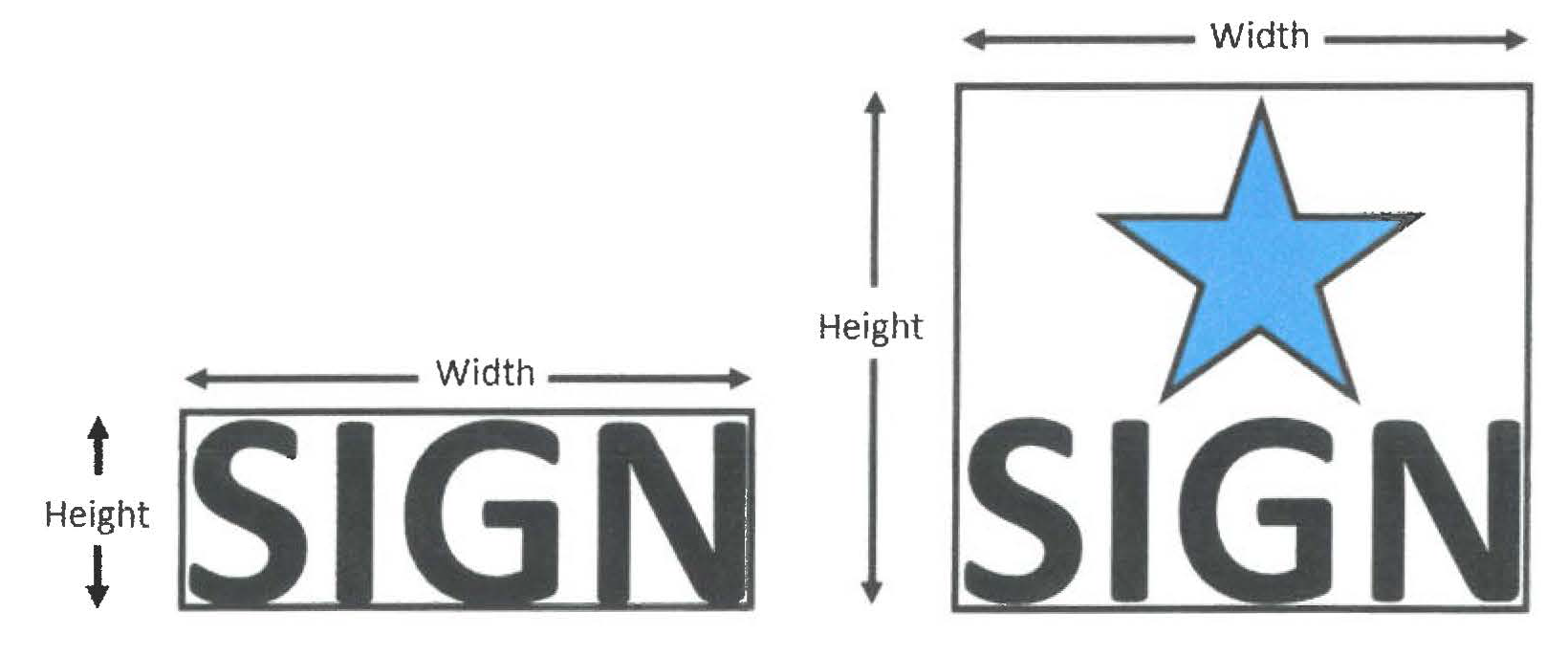
Definition. Sign area means the area of a sign shall be that area which is contained within a single continuous perimeter enclosing the extreme limits of such sign, and in no case passing through or between elements of such sign. It shall include any material or color forming an integral part of the display or used to differentiate such signs from its background, but shall not include supports.
B.
Double sided signs. Where two sides of a double-faced sign are separated by an angle of 45 degrees or less, each sign face shall be calculated separately. At greater than 45 degrees the sign area shall be calculated as one face.
C.
Round, cube, and other 3-D signs. In the case of cylindrical signs, signs in the shape of cubes, or other signs that are substantially three-dimensional with respect to their display surfaces, the entire display surface or surfaces are included in computations of the area.
5-5.2 Sign height.
1.
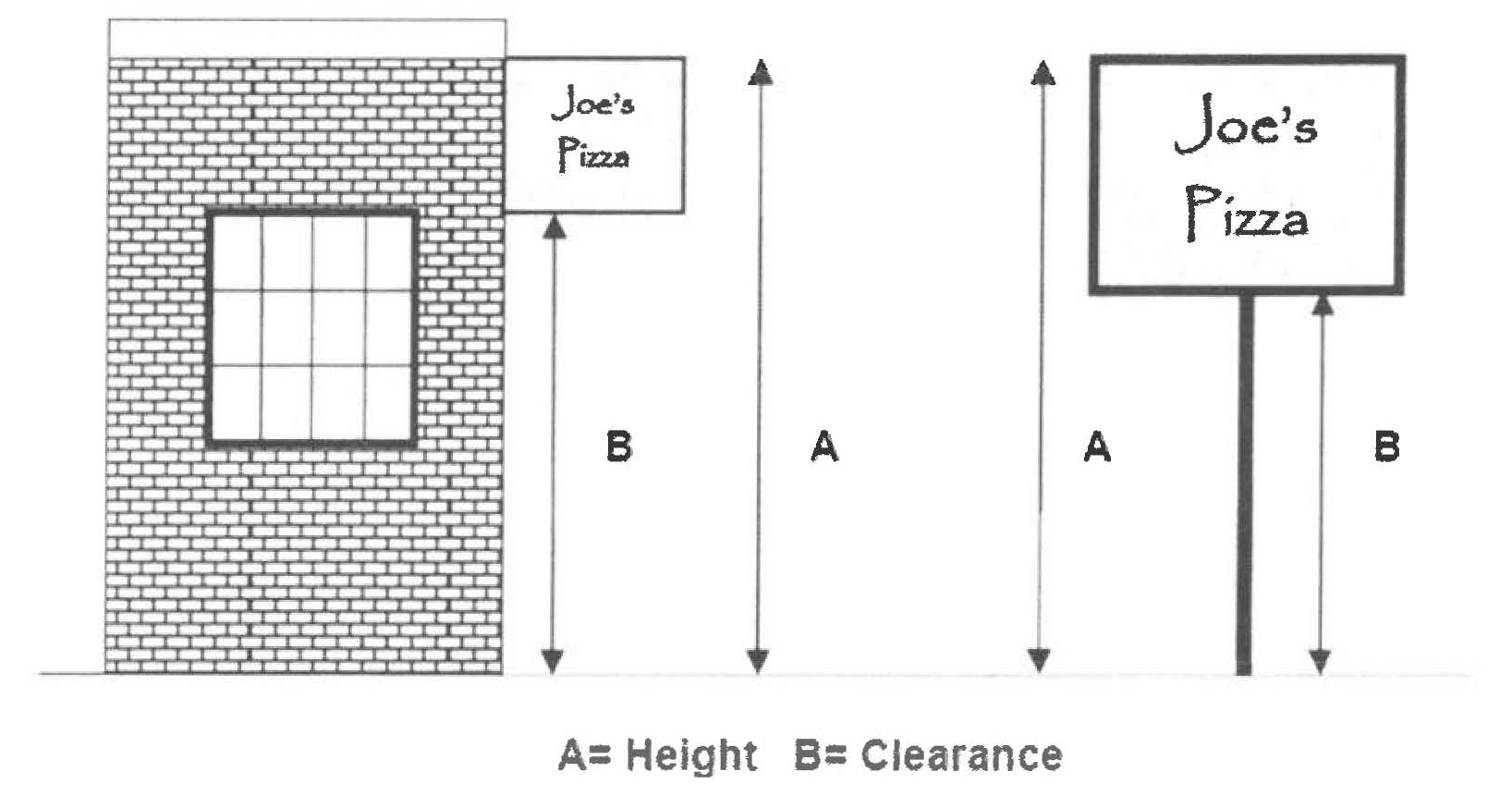
Sign height is measured from the natural grade below the sign to the highest point of the sign frame area. The height shall not be measured from the top of an earth berm, support foundation, or planting box.
2.
Sign clearances are measured from the grade directly below the sign to the bottom of the sign frame. When a sign extends over sidewalks, walkways or other spaces accessible to the public, the bottom of the sign structure shall be at least eight feet above the ground.
3.
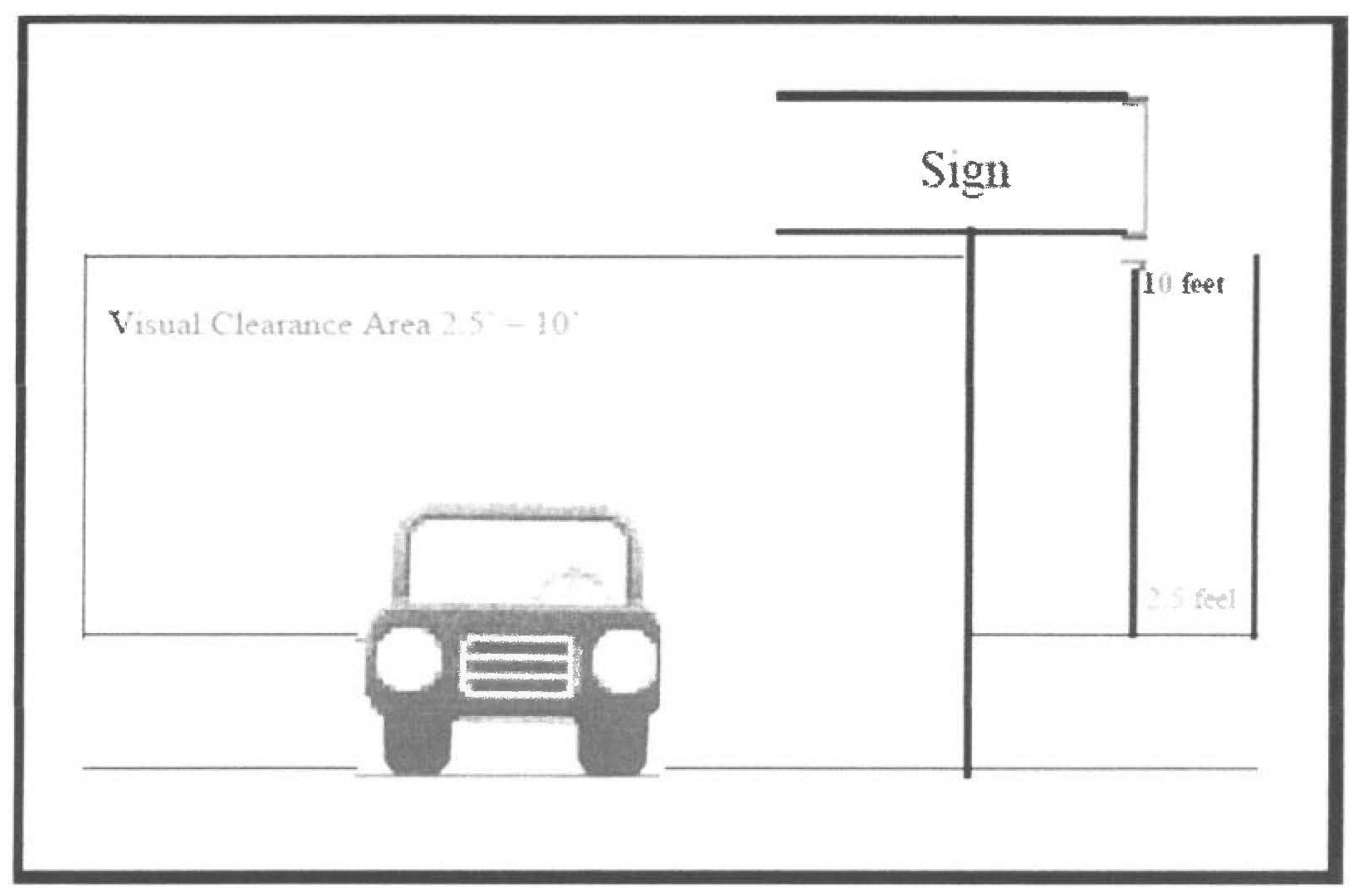
No sign shall be located in the visual clearance zone as defined in article 3, zoning regulations for use of lots, of this ordinance.
5-5.3 Signs in the public right-of-way.
No sign shall be allowed in the public right-of-way, including the railway right-of-way, except for the following:
A.
Public signs erected by or on behalf of a governmental body to post legal notices, identify public property, convey public information, and direct or regulate pedestrian or vehicular traffic;
B.
Church signs, in accordance with state law;
C.
Informational signs of a public agency or utility regarding its facilities;
D.
Emergency signs;
E.
Directional signs; and
F.
Signs of a temporary nature not to exceed 24 hours duration for such events as yard sales, auctions, public gatherings, etc., provided such signs shall not be attached to a tree, utility pole, traffic sign, or other public structure.
For the purposes of this ordinance, all areas on or adjacent to a private road interior to adjacent property lines are considered right-of-way. Put simply, neither permanent nor temporary signs shall be placed in the area immediately adjacent to a private road simply because said private road is not a public right-of-way. In the interior of a commercial development, signs may be permitted in this area with permission of the zoning administrator. Sign applicants may seek appeal from the zoning administrator or the board of zoning appeals.
5-5.4 Signs forfeited.
Any sign installed or placed on public property, except in conformance with the requirements of this section, shall be forfeited to the public and subject to confiscation. In addition to other remedies hereunder, the town shall have the right to recover from the owner or person placing such sign the full costs of removal and disposal.
5-5.5 Removal of signs.
A.
The lawful use of any permanently mounted sign existing at the time of the enactment of this ordinance may be continued although such use does not conform with the provisions of this ordinance, except those declared abandoned or dilapidated, which shall be removed or have remedial action taken upon them by notification of the zoning administrator.
B.
Any existing sign that is subsequently abandoned shall be removed, and any existing sign exceeding the allowable face area, and that is subsequently destroyed or damaged to the extent of 50 percent or more of its replacement cost, shall be removed or brought into conformity with these regulations.
C.
Any existing nonconforming temporary sign shall be removed within 90 days of enactment of this ordinance.
D.
Temporary signs shall be removed within three days of the termination period.
E.
An order under this section shall be issued in writing to the owner or responsible party of any such sign, or of the building or premises on which such sign is located, to comply within five days' time. Upon failure to comply with such notice, the zoning administrator may cause the sign to be removed and any costs of removal incurred in the process may be collected in a manner prescribed by law.
[5-5.6] Sign materials and code compliance.
Signs must be constructed in accordance with all applicable provisions of the building code and national electrical code, consist of durable all-weather materials, be maintained in good condition (including paint}, and shall not be permitted to fall into disrepair.
[5-5.7] Sign illumination.
All illuminated signs shall conform to the following requirements:
A.
All signs when illuminated shall have such lighting shielded so as not to directly shine on abutting properties or in the line of vision of the public using the streets or sidewalks.
B.
No sign shall be illuminated in such a way that it causes intense illumination onto any residential premises located in any zoning district, in a manner which by intensity, duration, location, or other characteristic is incompatible with the residential character of the property in which such illumination is cast.
C.
Internally illuminated signs may not project light beyond the face of the sign or otherwise cause a glare.
D.
Externally lighted signs shall have their lighting directed in such a manner as to illuminate only the face of the sign.
E.
All lighted signs shall meet all applicable electrical codes and shall bear a nationally recognized electrical testing laboratory label (such as a UL label).
F.
No illumination simulating traffic control devices or emergency vehicles shall be used, nor shall lights which are intermittently switched on or off, changed in intensity or color, or otherwise displayed to create the illusion of flashing or movement be permitted.
G.
Signs containing changeable copy produced by light emitting diodes (LEDs), incandescent or low voltage lamps or bulbs, or cathode ray tubes (CRTs) shall include automatic brightness compensation features to adjust brightness to compensate for sun angle and ambient light conditions and to ensure that the sign is visible but not necessarily radiant.
[5-5.8] Changeable copy signs.
Changeable copy signs are signs or portions thereof with characters, letters, or illustrations that can be changed or rearranged by any means (manual, electronic [digital], atmospheric, mechanical, remote, etc.) without altering the face or surface of the sign. For the purposes of this article, a sign on which the message or image changes more often than once every 15 seconds shall be considered a sign employing a confusion of motion and is not allowable. Digital changeable copy signs are permitted as follows:
A.
Digital changeable copy is permitted only on permanent principal freestanding signs and shall comply with all the regulations of freestanding and marquee signs as applicable.
B.
Sign copy or image shall maintain a static message or image for at least 15 seconds.
C.
The actual change between sign message and/or image shall be instantaneous.
D.
Changeable copy signs shall not employ motion or the illusion of motion by any means to depict action or create a special effect or scene.
E.
Such signs are not permitted to create the illusion of blinking, alternating, chasing, contracting or expanding, flashing, fading, repeating, oscillating, pulsating, rotating, rolling, running, scrolling, strobing, twinkling, or simulate moving video images, etc.
F.
Signs shall not employ flashing lights or lights of changing degree or intensity of color.
G.
Digital changeable copy signs, including digital message board signs, shall not be operated between the hours of 9:00 p.m. and 7:00 a.m. if located 300 feet of a residential dwelling unless the sign face is visually obscured from the residence. All such signs must be dimmed to minimum levels during this time.
H.
Digital changeable copy signs shall be a minimum of 100 feet from any intersection with a traffic light.
I.
Only one electronic digital sign per street frontage shall be allowed.
J.
A sign on which the only copy that changes is an electronic or mechanical indication of time or temperature shall be considered a "time and temperature" portion of a sign and not a changeable copy sign for purposes of this ordinance.
(Ord. No. 23-23, 12-5-2023)
Sec. 5-6. - Administrative variances.
The zoning administrator is authorized to grant administrative variances upon written application by the landowner for the number, height, setback, square footage or placement of signs in cases where unusual circumstances or a particular hardship which would make a strict interpretation of the ordinance go beyond the intent of the town council. Examples of cases where a variance might be granted would be as follows:
1.
In areas of the town where rights-of-way are unusually large, the setback requirement may be granted a variance as the sign would be a sufficient distance from the pavement without any setback.
2.
On lots where there is more than one business in separate and distinct buildings and each building could meet the subdivision requirements to be a separate lot, a variance may be granted to treat each building as a separate lot.
3.
The zoning administrator, at his discretion, may refer any request for a variance to the board of zoning appeals; likewise, the applicant may appeal any decision of the zoning administrator to the BZA.
(Ord. No. 23-23, 12-5-2023)

