
Irmo City Zoning Code
ARTICLE VII
- SPECIAL PURPOSE DISTRICTS4
Editor's note— Ord. No. 24-05, adopted March 19, 2024, repealed art. VII, §§ 7-1, 7-2, and enacted a new art. VII as set out herein and as may later be amended. Former art. VII pertained to similar subject matter and derived from the original zoning ordinance.
Sec. 7-1. - Negotiated developments.
7-1.1 Types of negotiated development districts.
This section describes the two types of negotiated zoning districts: negotiated residential (RN) and mixed-use development (MD). The types are better described as follows:
A.
Negotiated residential. Residential developments with lot sizes, setbacks, or other features different than those permitted in the RS or RG districts. These districts may feature one or more residential types.
B.
Mixed-use development. Mixed-use projects featuring residential and commercial uses. Such developments require a development agreement if the property features over 25 highland acres and is thus legally permissible to have such an agreement under the South Carolina Local Government Development Act.
7-1.2 Purpose.
The purpose of this section is to encourage the development of various types of flexible, negotiated developments under master plans, where the traditional density, bulk, spacing and use regulations of other zoning designations, which may be useful in protecting the character of substantially developed areas, may impose inappropriate and unduly rigid restrictions upon the development of parcels or areas which lend themselves to a unified, planned approach. Negotiated developments are intended to promote flexibility in site planning and structure location, to facilitate the provision of utilities and circulation systems, the mixture of uses, as well as to preserve the natural and scenic features of the parcel.
A.
The proposed development should be of such design that it will promote achievement of the stated purposes of the adopted comprehensive plan and is consistent with the plan as well as other adopted plans and policies of the town.
B.
The development will efficiently use available land and will protect and preserve, to the greatest extent possible, and utilize, where appropriate natural features of the land such as trees, streams, wetlands, and topographical features.
C.
The development will be located in an area where transportation, police and fire protection, schools and other community facilities and public utilities, including public water and sewer service, are or will be available and adequate for the uses and densities proposed. The applicant may, where appropriate, make provisions for such facilities or utilities, which are not presently available.
7-1.3 Intent.
The intent of negotiated development is to achieve the following:
A.
To encourage the development of communities which provide a range of harmonious land uses (residential, commercial, cultural, educational, etc.) and/or housing types (single family detached, townhomes, etc.).
B.
To promote flexibility in site planning and structure location that facilitates the provision and use of efficient circulation and utility systems and preservation of natural and scenic features that will result in a diversity of scale, style and details that foster a strong sense of community within the development as well as enhancing the immediate area surrounding the development.
C.
To permit the development of such communities where there is demand for housing, a relationship with existing and/or planned employment opportunities, as well as supporting businesses and other services, and adequate community facilities and infrastructure existing or planned within the area.
D.
To provide a mechanism for evaluating alternative zoning regulations as well as other town ordinance elements of the proposed application on its own merit, emphasizing that these provisions are not to be used to circumvent the intent or use of conventional zoning classifications set forth in this chapter or other applicable variance, waiver or amendment to other ordinances, contrary to state or federal law but to permit innovative and creative design of communities in the town.
7-1.4 Establishment.
Any request pertaining to the establishment of a negotiated residential or mixed-use development zoning district shall be considered an amendment request to the zoning ordinance and shall be administered and processed in accordance with article XII. The application for zoning amendment must include a concept plan, a descriptive statement and, if applicable, a bonus density calculation and/or a development agreement.
The planning commission may recommend to the town council to approve the plan and application to establish a negotiated district, including specific modifications to the plan, or to deny the application to re-zone to establish a said district. The town council shall approve the plan and application to establish the district, include specific modifications to the plan as conditions for approval, or deny the application to re-zone to establish an RN or MD.
If the request for re-zoning to a negotiated district is approved through an ordinance amendment of the official zoning map by town council, site development plans and the final plat approval process may proceed. Improvement guarantees may be granted for substantially completed projects per improvement guarantee provisions as may be established by the town.
After the final plat for the district has been recorded, building and sign permits shall be issued in accordance with the approved plan as a whole, or in phases or portions thereof, per an approved phased development plan as defined in this ordinance. Said permits shall be issued in the same manner as for building and sign permits generally.
7-1.5 Public notice.
Fifteen days prior to the meeting before the planning commission, signs must be erected on site alerting the public to the proposed development. These signs must be at least four-by-six feet and placed along all adjacent roads in a conspicuous location. The signs must feature the following information:
A.
A description of the development.
B.
Number of units by type.
C.
Minimum lot size.
D.
Any amenities.
E.
A concept sketch of the development and/or the structures.
F.
Dates of all public meetings.
G.
Contact information for the developer and a link to more information. Additional contact information for the zoning administrator is encouraged.
Additionally, the zoning administrator reserves the right to require a public meeting prior to the planning commission meeting for the purposes of receiving public input prior to application submittal.
7-1.6 Amendment.
Any changes to the approved characteristics or agreements of a negotiated development shall be classified as either major or minor amendments. Major amendments are considered a rezoning and require the procedures outlined in article XII. Minor amendments may be made by the zoning administrator.
A.
Major amendments. Changes which materially affect the characteristics of the negotiated development shall follow the same procedural requirements as for the amendment originally establishing the negotiated district, including planning commission review, public hearing, and town council determination. Such changes include, but are not limited to, boundary changes, changes of greater than ten percent to the minimum/maximum number of allowable residential units or commercial square footage, or changes to the uses allowed within the development.
B.
Minor amendments. Changes such as but not limited to the location of certain uses within the overall development, signage and landscaping modifications, etc.
C.
Determination. It shall be the duty of zoning administrator to determine whether any specific request shall be considered a major amendment or minor amendment; provided however, that the applicant shall have the right to have any request for change processed as a major amendment.
D.
Prohibited amendments. No town ordinance shall be eligible for amendment in conjunction with the approval if the proposed amendment would apply to: a standardized code or law adopted by the town in a form specified by state or federal law; or would adversely impact any officially recognized police, fire, flood, pollution, runoff, seismic, or other rating given to the town or its citizens; or would amend, purport to amend, alter or purport to alter any state or federal law or regulations otherwise applicable.
7-1.7 Minimum area requirements.
The minimum size for a negotiated district shall be three acres unless it is a continuation of an existing, adjacent negotiated district.
7-1.8 Requirements.
All negotiated developments require the following to be maintained by a home or property owner's association:
A.
Sidewalks.
B.
Streetlights.
C.
Street trees.
D.
Stormwater facilities outside of the right-of-way.
E.
Customized street signs.
F.
Crosswalks.
G.
Amenities.
Note: Private streets are prohibited in any developments unless by county law they cannot be brought into the county maintenance program, which may include road types such as rear access alleys or in a townhome development. A failure to seek county approval in a timely fashion does not preclude this requirement. Any streets which must be private by county law are required to meet all town ordinances concerning private streets, including but not limited to manner of construction, bonding, maintenance, and long-term financial support. At the time of this ordinance, the town has no streets department or method for funding street repairs and maintenance.
No private roads will be taken in by the town for maintenance.
7-1.9 Failure to begin, failure to complete, or failure to make progress.
The descriptive statement as approved by town council and duly recorded shall set forth the development for the project including phasing of development of non-residential uses in relationship to residential use. The town council may require the posting of a bond with a corporate surety to guarantee that the schedule as set forth in the descriptive statement will be materially adhered to in order to guarantee construction of streets, utilities, and other facilities and amenities or to allow for rectification of improper development characteristics such as failure to develop areas designated as common open spaces. If there is failure to begin, or failure to complete, or failure to make adequate progress as agreed in the descriptive statement, the town council may enforce and collect upon such bonds or sureties as described above, or may rezone the district and thus terminate the right of the applicant to continue development, or may initiate action to charge developers with specific violation of the zoning ordinance subject to the penalties set forth or any appropriate combination of the above remedies may be taken. If the development is not initiated within two years of its establishment, the planning commission shall initiate the rezoning of the property to an appropriate zoning district classification.
7-1.10 Vested rights.
A vested right is the right to undertake and complete the development of a negotiated district under the terms and conditions provided in this section. A vested right is established for two years upon the approval of the rezoning, including phased development plans as provided herein. The period of the vested right may be longer depending upon the terms of any development agreement. A vested right may be extended at the end of the vesting period for an additional 12 months, or 36 months for a phased development plan, upon request by the applicant and a determination by the planning commission that there is just cause for extension and that the public interest is not adversely affected. A validly issued building permit does not expire or is not revoked upon expiration of a vested right, except for public safety reasons.
Any vested right is subject to revocation by the town council upon determination, after notice and public hearing, that there was a material misrepresentation by the landowner or substantial noncompliance with the terms and conditions of the original or amended approval.
A vested right is subject to later enacted federal, state, or local laws adopted to protect public health, safety, and welfare, including but not limited to: building, fire, plumbing, electrical, and mechanical codes; street design, stormwater management, buffers, and other development standards; and nonconforming structure and use regulations which do not provide for the grandfathering of the vested right. The issuance of a building permit vests the specific construction project authorized by the building permit to the building, fire, plumbing, electrical, and mechanical codes in force at the time of the issuance of the building permit.
A change in the zoning district designation or land use regulations made after vesting that affects real property does not operate to affect, prevent, or delay development of the real property under a vested site-specific development plan or vested phased development plan without consent of the landowner. The town council must not require a landowner to waive his vested right as a condition of approval of a site-specific negotiated residential or mixed-use development plan including a phased development plan.
A vested right pursuant to this section is not a personal right but attaches to and runs with the applicable real property. The landowner and all successors to the landowner who secure a vested right pursuant to this section may rely upon and exercise the vested right for its duration. The vested right is subject to applicable federal, state, and local laws adopted to protect public health, safety, and welfare, including but not limited to: building, fire, plumbing, electrical, and mechanical codes; street design, stormwater management, buffers, and other development standards; and certain nonconforming structure and use regulations that do not provide for the grandfathering of the vested right.
7-1.11 Single-family residential density.
In an effort to achieve a higher level of quality and architectural interest in the town's residential stock, the town council and planning commission have created a density bonus system by which single-family residential units may achieve higher densities in exchange for a variety of desirable design elements. In this system, single-family detached homes begin at a base minimum lot size of 12,500 square feet. Developers then have the opportunity to apply a number of density bonuses to the project, resulting in lots that may reach a minimum of 6,000 square feet in size. While single-family detached lot sizes below 6,000 s.f. may be considered, town council strongly encourages minimums of 6,000 s.f., 50-foot lot widths and setbacks of 25 feet (front), 15 feet (rear) and 7½ (side) with a maximum density of six detached residential units per gross acre. Town council reserves the right to allow smaller residential lots when the developer is proposing projects such as conservation subdivisions, tiny homes, affordable housing, senior housing, or other concepts that meet the approval of town council.
Items eligible for a density bonus may include, but are not limited to the following:
•
Neighborhood revitalization program.
•
Commercial development.
•
Improved exterior façade textures and materials.
•
Rear access alleys/rear entry garages.
•
Minimal repetition of floor plan.
•
Wider side setbacks.
Density bonus information may be obtained from the town website or the zoning administrator. Standard bonuses may be applied to single-family detached houses, while modified bonuses may be applied to duplex and townhouse units. All bonuses will be negotiated between the developer and the town, with final approval coming from town council as part of the acceptance of the development plan.
7-1.12 Architectural and design requirements.
Residential structures in the negotiated districts are required to meet the following design requirements:
A.
The front façade and sides of the building must be covered in a cementitious material, such as Hardiplank, brick, or stone. If the rear of the building faces a road, it too must be covered in similar material. Trim may still be made of vinyl. Single-family detached, duplexes, and townhomes must all meet this standard.
B.
Houses placed along, but which do not front onto, the streets exterior to the development are required to be buffered from those streets with a type B buffer or a type A buffer and an opaque screen. This buffer and screen is to be maintained by the HOA.
C.
Houses on corner lots or which otherwise have a side wall facing towards the public must have architectural details on that side, such as, but not limited to, a porch, bay windows, shutters (if they appear on the front of the house), or more windows than otherwise on that house plan. As an alternative, at least one canopy tree, one understory tree, and multiple shrubbery plantings may be placed along that side of the house. The additions are to be approved by the zoning administrator.
D.
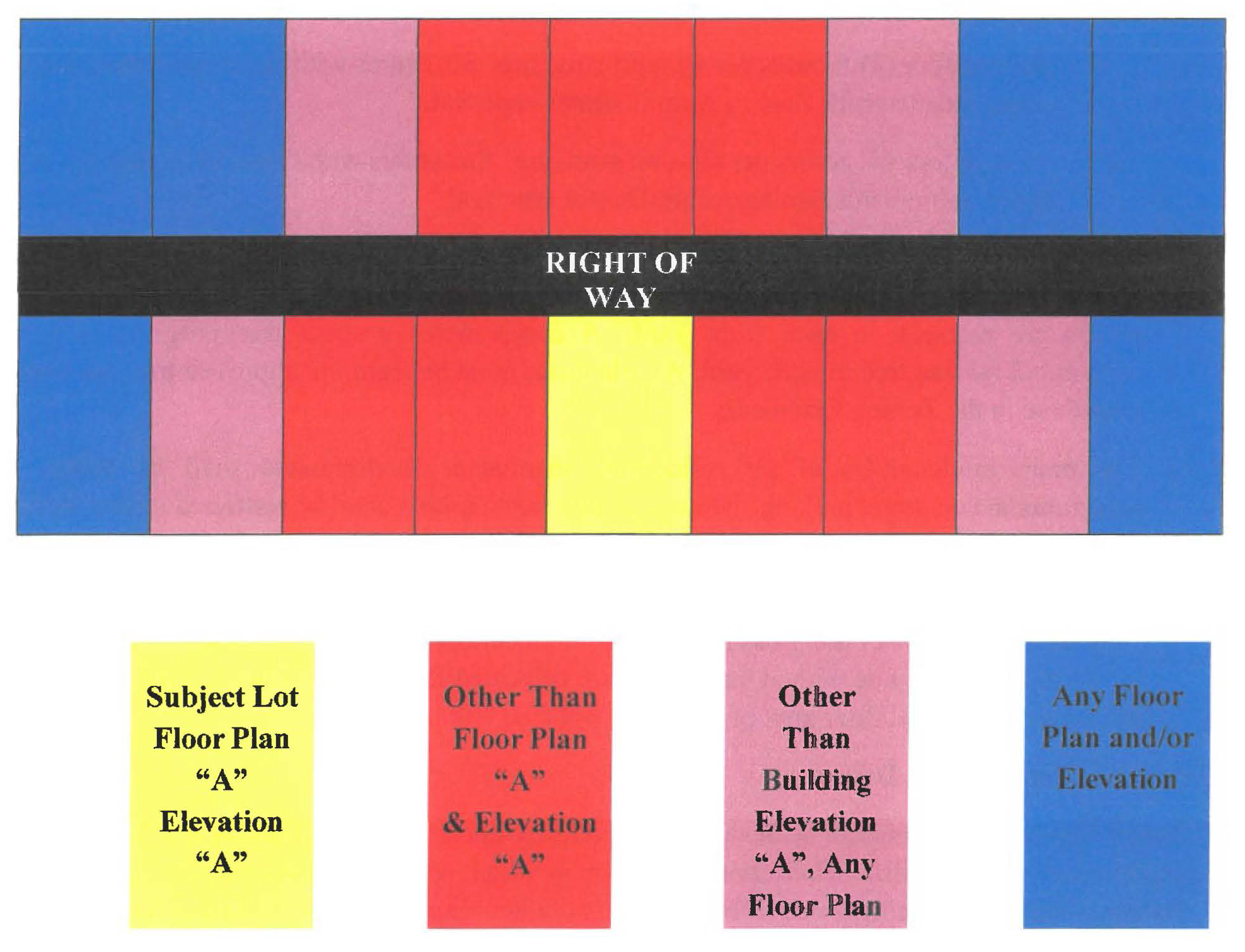
In developments with 50 or more single-family detached homes, house placement must meet the "Rule of Seven," such that houses are not adjacent to houses with the same plan, façade, and similar color. All facades and colors are to be approved by the zoning administrator to determine variety.
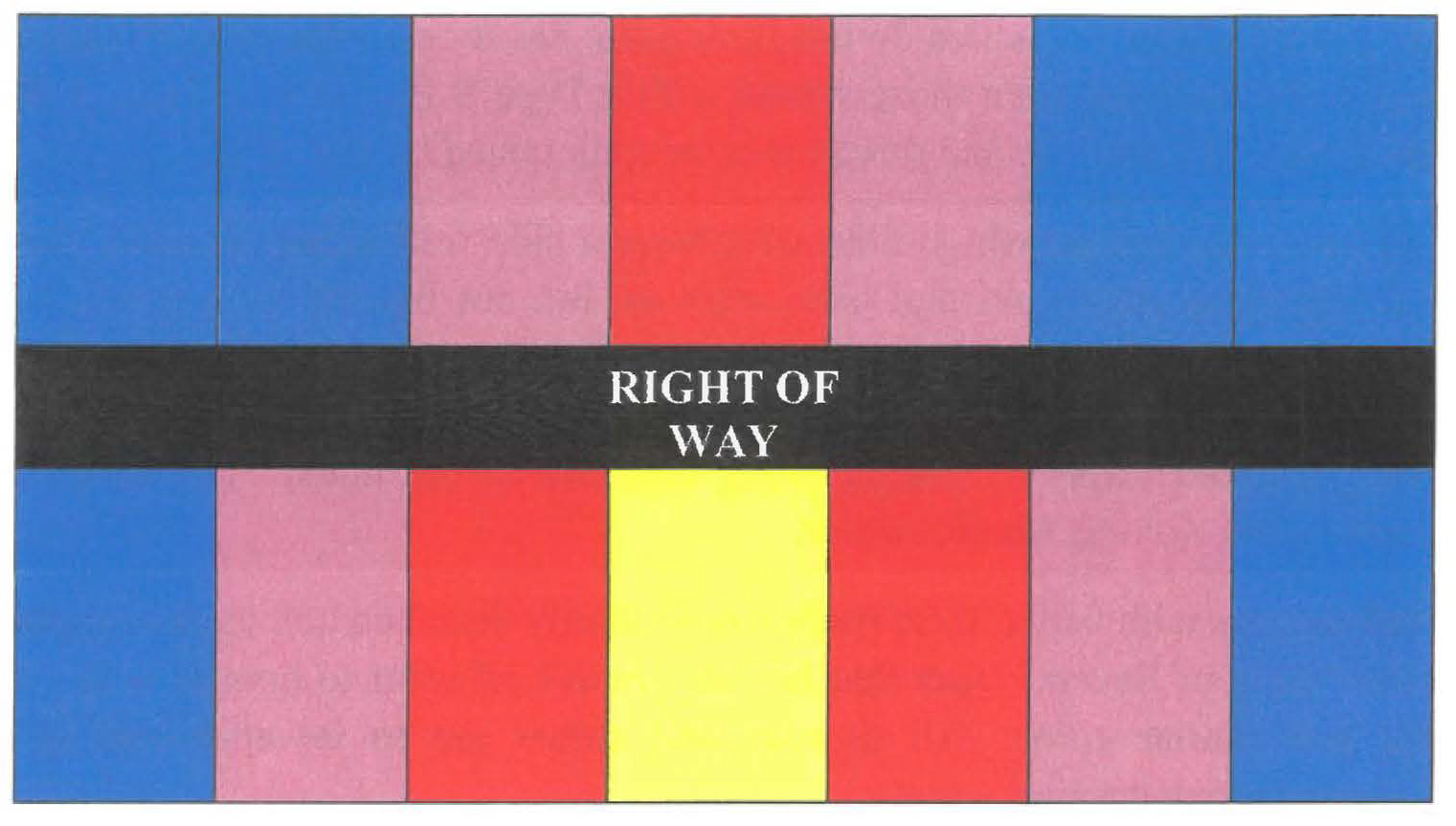
In developments with 49 or fewer single-family detached homes, house placement must meet the "Rule of Five." All facades are to be approved by the zoning administrator to determine variety.
E.
Townhomes must meet the conditional requirements outlined in article II. Additional requirements include:
i.
At least four facades per six-unit structure. Structures with fewer units may have fewer facades with zoning administrator approval.
ii.
At least four colors per six-unit structure. Structures with fewer units may have fewer colors with zoning administrator approval.
F.
All single family detached homes and duplexes must feature at least two two-and-one-half-inch trees in the front yard of each residence, at least one of which must be a canopy tree. Additionally, five 24-inch shrubs are required in each front yard. A comprehensive street tree program may be substituted for one tree in each yard. All plantings must be from the approved tree list found elsewhere in the zoning ordinance.
G.
The main boulevard(s) of all residential negotiated developments shall be wider to accommodate on-street parking. Moreover, on-street parking shall be restricted to one side of the street throughout the development, to be enforced by the homeowner's association.
H.
The floor area of the heated air space of detached single family homes in the development shall be at least 25 percent of the gross lot size for all lots under 8,000 s.f. For example, a 6,000 s.f. lot must feature a home with at least 1,500 s.f. of heated floor space. For lots over 8,000 s.f., the minimum heated floor area of the house must be 2,000 s.f.
(Ord. No. 24-05, 3-19-2024)
Sec. 7-2. - Conservation design.
Negotiated developments can be designed to maximize open space and green space. This zoning can be used to accomplish a conservation design in which residential and/or commercial development can be incorporated into predominantly undivided permanent open space, thereby permanently protecting agriculturally, environmentally, or ecologically significant areas within the parcel. The remaining developable land is subdivided into buildable lots or utilized as a group development, typically with more density in the developed portion of the project than would be found in a traditional development within a general zoning district. Conservation design standards are found in the land development design standards article of this ordinance.
(Ord. No. 24-05, 3-19-2024)
Sec. 7-3. - Mixed-use development districts.
7-3.1 Permitted uses.
Mixed-use negotiated districts may permit a mixture of different types of housing with compatible commercial uses, shopping centers, office parks, and other mixed-used developments. Flexibility in design, character, and quality of development and preservation of natural and scenic features are made possible through the approval of a plan which describes the specific uses, densities, setbacks, and other requirements for a planned development. The approved plan constitutes the district regulations for a specific planned mixed-use development. Any use or combination of uses meeting the objectives of this section may be established in a district through a zoning map amendment ordinance as provided for in this ordinance. Once approved, the proposed use(s) and no others shall be permitted. Said uses shall be identified and listed based on classification; i.e. retail, office, wholesale, residential multi-family, residential single-family detached, manufacturing, etc. The list of approved uses shall be binding on the applicant and any successor in title so long as the zoning applies to the land, unless otherwise amended by ordinance. The applicant may specify that standard zoning district regulations shall apply to specific use areas within the project. For example, in an area designated for retail commercial, the applicant may specify that all general commercial (GC) zoning district regulations shall apply.
7-3.2 Development standards for mixed-use developments.
The applicant may propose alternate regulations specific for the proposed negotiated district regarding signage, parking, buffers, screening, open spaces, and landscaping, etc.; which, if approved, shall become the regulations for the district. If no alternate regulations are proposed, the regulations for the primary zoning districts per this ordinance shall apply. The following principles shall be considered in creating negotiated development standards:
A.
Residential dimension requirements. Residential density, building setbacks, and building heights shall be determined by the scale of the project in relation to its surroundings and its impact on existing and proposed support facilities such as transportation, water and sewer systems, recreational facilities, etc.
B.
Overall site design. Overall site design shall be harmonious in terms of landscaping, enclosure of principal and accessory uses, size of structures, street patterns, and compatibility of uses.
C.
Parking and loading. Unless alternate standards are specified in an approved development plan, off-street parking and loading spaces for the various uses proposed for the district shall comply with the standards for off-street parking and interior landscaping of this ordinance.
D.
Buffer areas. Buffer areas shall be required for peripheral uses and shall be provided in accordance with the requirements for adjacent uses prescribed in this ordinance, unless alternate standards are specified in an approved development plan. There are no specific buffer area requirements for internal use, but buffers should mitigate impacts of intensity of uses and/or to serve as transitions between uses.
E.
Landscaping and common open space. Landscaping and open space requirements for each development shall comply with the provisions of this ordinance, unless alternate standards are specified in an approved development plan.
F.
Signage. Signage shall be in harmony, in scale with, and reflective of the proposed development. Unless alternate standards are specified in an approved development plan, signage shall comply with the standard signage regulations of this ordinance.
(Ord. No. 24-05, 3-19-2024)
Sec. 7-4. - Concept plan requirements.
A site plan showing the proposed development of the area (zone) shall be a prerequisite to approval of a negotiated district. The site plan shall adhere to the minimum area and development standards requirements of this section and shall address or show the following:
A.
The proposed title of the project, project designer, and the developer.
B.
The boundaries of the property involved; the general location of all existing easements, property lines, existing streets, and buildings; and other existing physical features on the project site.
C.
The general location and dimensions of proposed streets.
D.
Area by land use (i.e. retail, single-family detached residential, multi-family, townhouses, office, park, green space, etc.).
E.
Specific allowable uses for each area.
F.
A tabulation of the number of acres in each use area.
G.
Maximum densities expressed in dwelling units per net acre for residential uses, and floor/area ratio for non-residential uses.
H.
Building setbacks.
I.
Maximum building heights.
J.
The position of the proposed development in relation to its surroundings. Current land use (commercial, residential, vacant, etc.) and zoning of the subject site and adjacent property and a site location (vicinity) map shall be provided.
K.
Proposed plan for development in phases, as applicable.
L.
Alternate design standard plans to include, as applicable:
1.
Parking and loading.
2.
Buffers, landscaping, and common open space.
3.
Street design.
4.
Signage plan.
The planning commission may establish additional requirements for site plan approval, and in special cases, may waive a particular requirement if, in the opinion of the commission, the inclusion of that requirement is not essential to a proper assessment of the project.
(Ord. No. 24-05, 3-19-2024)
Sec. 7-5. - Descriptive statement requirements.
The descriptive statement accompanies the concept plan and any required development agreement or bonus density calculations. This document will outline the nature of the development, to include the following:
•
General description of the project.
•
Maximum number of residential units by type.
•
Maximum square footage of commercial or other non-residential use.
•
Setbacks and dimensional requirements for each use.
•
Listing of allowable commercial uses.
•
Description of any amenities.
•
Any concept drawings of the development or the commercial and/or residential structures located therein.
(Ord. No. 24-05, 3-19-2024)
Sec. 7-6. - Development agreement.
Development agreements are required for any negotiated development for which such an agreement is allowable by state law.
Development agreements and their requirements are described in full in the South Carolina Local Government Development Agreement Act, S.C. Code 1976, tit. 6, ch. 31.
(Ord. No. 24-05, 3-19-2024)

