


Irvine City Zoning Code
Division 3
GENERAL DEVELOPMENT STANDARDS AND LAND USE REGULATIONS
CHAPTER 3-8.- WIRELESS COMMUNICATION FACILITY, SATELLITE DISH AND ANTENNA STANDARDS[1]
Editor's note— Ord. No. 05-13, § 4, adopted July 12, 2005, amended the Code by repealing former ch. 3-8, § 3-8-1, in its entirety, and adding a new ch. 3-8. Former ch. 3-8 pertained to antenna, microcell and satellite dish standards, and derived from the Code of 1976, § V.E-303; Ord. No. 92-3, adopted April 14, 1992; Ord. No. 94-7, adopted June 14, 1994; Ord. No. 97-05, adopted May 13, 1997; and Ord. No. 97-06, adopted May 13, 1997.
CHAPTER 3-21.- RESERVED[2]
Editor's note— Ord. No. 98-11, § 4, adopted October 13, 1998, amended the Code by repealing former ch. 3-21, § 3-21-1, in its entirety. Former ch. 3-21 pertained to private neighborhood park standards, and derived from the Code of 1976, § V.E-314; Ord. No. 92-3, adopted April 14, 1992; and Ord. No. 94-7, adopted June 14, 1994.
CHAPTER 3-26.- ACCESSORY DWELLING STANDARDS[3]
Editor's note— Ord. No. 25-22, Exh. A, adopted September 9, 2025, repealed the former Ch. 3-26, §§ 3-26-1—3-26-7, and enacted a new Ch. 3-26 as set out herein. The former Ch. 3-26 pertained to similar subject matter and derived from Ord. No. 18-05, Exh. A, 4-24-18.
Sec. 3-1-1.- General.
This division establishes land use regulations and development standards for each of the land use categories identified herein. The land use categories listed in Chapter 3-37 are numbered for reference and identification. If any variations occur in a land use category, they are identified by a letter following the category, or area number. The letter may refer to land use or development standard variations or may allow identification of a specific site for application of special development requirements in the planning area zoning (Division 9). Refer to Division 9 for a complete listing of all planning areas and their corresponding names.
(Code 1976, § V.E-300; Ord. No. 92-3, 4-14-92; Ord. No. 94-7, § 3, 6-14-94)
Sec. 3-2-1.- Land use regulations.
The land use categories established in this division are for purposes of zoning. The analysis of traffic impacts related to the development of any project shall be evaluated in accordance with the adopted Irvine Transportation Analysis Model (ITAM) land use categories and trip rates. Under each land use category in the matrix contained in Section 3-3-1 is a list of permitted and conditionally permitted uses. When exceptions have been established, they are indicated by an endnote. If a proposed use is not listed, a use determination is required in accordance with Chapter 2-35 to determine if the proposed use is similar to a listed use. Unless the proposed use is determined to be similar to a listed use, it shall be considered a prohibited use. Conditionally permitted uses in this section require applications in accordance with Chapter 2-9. Hearing responsibility for conditional use permits is designated in Chapter 2-23. Home occupation permit regulations are contained in Chapter 2-14. Land use development standards are listed under each zoning category in Chapter 3-37. Special land use development requirements for each planning area are included in Division 9.
(Code 1976, § V.E-300.1; Ord. No. 92-3, 4-14-92; Ord. No. 94-7, § 3, 6-14-94)
Sec. 3-3-1.- Land use matrix.
The following land use matrix shows the uses which are permitted, conditionally permitted, and prohibited in specific zoning districts in the City of Irvine. The land use matrix is intended to serve as a mere guide for the convenience of the user of this zoning ordinance. Where the text of this zoning ordinance differs from the land use matrix, the text shall prevail. This section 3-3-1 does not cover Planning Areas 4, 5, 33, 34, and 38. Readers should refer to See chapters 9-4, 9-5, 9-33, 9-34 and 9-38 for land use matrixes specific to each of these planning areas.
ZONING ORDINANCE LAND USE
MATRIX-ENDNOTES
1 All agricultural uses are prohibited on the frontal slopes of Quail Hill within Planning Area 16, except cattle grazing.
2 Prior to open space dedication to a public agency.
3 Interim use.
4 4.2A: Prohibited (Walnut Village).
5 Uses in 4.2C ("Old Town Irvine"), subject to provisions of the Historic Overlay District. See Chapter 5-5.
6 Permitted only in Planning Areas 12, 13, 17, 31, 32, 34, 35, 40.
7 Permitted only in 5.5B Jamboree Business Center, East; 5.5C Planning Area 17; 5.5D Irvine Spectrum 8, if located 225 feet or more from the Jeffrey Open Space Trail; and 5.5A Irvine Spectrum 6.
8 This land use generates traffic trips the same as office, administrative in the Irvine Business Complex and in the remainder of the City.
9 Reserved.
10 Only in 1.3A (Planning Area 12), otherwise prohibited.
11 4.2B: Conditional.
12 4.1C: Prohibited (Rancho San Joaquin).
13 Only in public parks.
14 Only in conjunction with a health club and/or hotel/motel.
15 Only in conjunction with a health club.
16 3.1A: Prohibited (University Town Center).
17 3.1B: 31.0—51.0 dwelling units per acre (Westpark).
18 4.1A: Freestanding restaurants: Conditional (Northwood).
19 4.1B: Conditional (Northwood).
20 Only in 1.2B (Planning Area 27), otherwise prohibited.
21 4.2B: Prohibited.
22 4.1B: Prohibited (Northwood).
23 4.2A: Only with auto parts sales, otherwise prohibited (Walnut Village).
24 Agricultural products, only.
25 Permitted only in Planning Areas 12, 13, 32, 34, 35.
26 5.4A: Prohibited.
27 Only in Planning Areas 23 and 51.
28 Only in 4.3B (Planning Area 13), 4.3D (Planning Area 34), and 4.3 (Planning Area 35), otherwise prohibited.
29 Office trip generation rates apply to this use. Consult Section 9-36-8.B.3 (IBC General Land Uses) for more information.
30 Industrial trip generation rates apply to this use. Consult Section 9-36-8.B.3 (IBC General Land Uses) for more information.
31 Retail trip generation rates apply to this use. Consult Section 9-36-8.B.3 (IBC General Land Uses) for more information.
32 Lodging trip generation rates apply to this use. Consult Section 9-36-8.B.3 (IBC General Land Uses) for more information.
33 Residential trip generation rates apply to this use. Consult Section 9-36-8.B.3 (IBC General Land Uses) for more information.
34 Zoning Potential trip generation rates apply to this use. Consult Section 9-36-8.B.3 (IBC General Land Uses) for more information.
35 This use is designated "Undefined" for trip budgeting purposes. Consult Section 9-36-8.B.3 (IBC General Land Uses) for more information.
36 This use is assumed to have no traffic generation for trip budgeting purposes. Consult Section 9-36-8.B.3 (IBC General Land Uses) for more information.
37 Incidental offices in conjunction with permitted or conditionally permitted uses may occupy up to 50% of a parcel or site; except in 5.4B where 100 percent office is allowed.
38 A church, commercial school, or private school for adults (18 years and older) that proposes to locate in an existing permanent building and meets all the general development standards may be excluded from the requirement to obtain a conditional use permit in some zones, and may instead be required to obtain an administrative use Permit (AUP). Refr to Chapter 3-37 for zone-specific requirements. Without limiting the foregoing, churches with permanent child care or private school activities to be located in zoning districts 5.1, 5.2 and 5.4 shall require a conditional use permit.
39 A restaurant that proposes to locate in an existing building previously approved for restaurant use, and meets all the general development standards, including parking, will not require a conditional use permit (CUP).
40 A conditional use permit is not required for this land use.
41 All proposed non-classroom related activities on school sites (as defined by California State law) shall require a conditional use permit (CUP) subject to the review of the appropriate approval body as cited in Chapter 2-9.
42 Conditionally permitted in Planning Areas 12 only.
43 Reserved.
44 Reserved.
45 Domestic animal care facilities shall require a veterinary certificate of health and proof of current vaccinations for distemper, rabies and parvovirus. Animals may be groomed, trained, exercised socialized and kept or boarded overnight, but not bred, sold or let for hire.
46 Prohibited in Planning Area 51.
47 Conditionally permitted in Planning Area 51.
48 Permitted in Planning Area 51.
49 May be permanent in Planning Area 51 only.
50 Not use Permitted in Planning Area 51.
51 A medical office located in an existing retail development which meets all the general development standards, including parking, will not require a conditional use permit and no traffic study will be required.
52 Conditionally permitted within Planning Area 51 Development Districts 1, 2, 3, and 6 only.
53 Permitted in PA 51 Development Districts 2 and 3 only.
54 Reserved.
55 Manufacturing, storage, handling, and distribution of munitions, explosives, petrochemicals, or gasoline and related petroleum products, are prohibited within the Browning and G.C.A. Corridors except that nothing herein shall prohibit underground storage of petrochemicals or gasoline and related petroleum products incidental to a permitted use. See special development requirement #14 in Section 9-10-7 for further clarification and exhibits.
56 Any auditorium, amphitheater, and assembly halls with seating capacity for more than 1,500 persons shall be prohibited within the Browning and G.C.A. Corridors. See special development requirement #14 in Section 9-10-7 for further clarification and exhibits.
57 Conditionally permitted in zoning district 5.5A only (Planning Area).
58 4.2L: Permitted in Planning Area 17.
59 4.2M: Conditionally Permitted in Planning Area 17.
60 4.2M: Prohibited in Planning Area 17.
61 Only in 5.5B Jamboree Business Center East, 5.5C Planning Area 17, and 5.5A Spectrum 6.
62 5.5C: Permitted in Planning Area 17; 5.5D Irvine Spectrum 8; 5.5E Planning Area 9; and 5.5F Planning Area 6.
63 Only in 5.5B Jamboree Center East, and 5.5C Planning Area 17.
64 A conditional use permit for a self-storage facility in the 3.1D (Woodbridge) Multi-Use district and 3.1G (Northwood) Multi-Use district shall require review and approval by the Planning Commission.
65 All certified sober living facilities shall be subject to County certification guidelines.
66 1.4A: Conditionally permitted in Planning Area 16 only.
67 5.5E and 5.5F if located on a parcel more than 200 feet from a street intervening between residential and Medical and Science uses. If less than 200 feet, conditionally permitted.
68 Permitted only in 5.5B Jamboree Business Center, East; 5.5C Planning Area 17; and 5.5D Irvine Spectrum 8, if located 225 feet or more from the Jeffrey Open Space Spine.
69 Prohibited in 5.5E and 5.5F.
70 Prohibited in 5.5B Jamboree Business Center, East.
71 Prohibited in 5.5B Jamboree Business Center, East; 5.5E and 5.5F.
72 Prohibited in 5.5B Jamboree Business Center, East; conditionally permitted in 5.5D Irvine Spectrum 8, if located 225 feet or more from the Jeffrey Open Space Spine.
73 Any "Bar, Tavern Cocktail Lounge" proposing to locate within the same building as a residential use shall be subject to the conditional use permit procedures contained in Zoning Code Chapter 2-9.
74 A wireless communication facility, depending on the proposed type of antenna, may be permitted in any zoning district through wireless communication facility permit, a minor conditional use permit or a major conditional use permit as indicated in the table provided in Section 2-37.5-3.
75 Only in 4.2C: Planning Area 13; 4.2E: Planning Area 34; 4.2E: Planning Area 35; and 4.2E: Planning Area 10, otherwise, prohibited.
76 4.2N: Drive-thru permitted subject to Master Plan.
77 4.2N: Permitted subject to Master Plan.
78 4.2L: Drive-thru permitted; 4.2N and 4.2O: Permitted subject to Master Plan.
79 Permitted in 4.2L, 4.2M, 4.2N and 4.2O only.
80 Self-storage facility trip generation rates apply to this use. Consult Section 9-36-8.B.3 (IBC General Land Uses) for more information.
81 A financial institution located in an existing building which meets all the general development standards, including parking, will not require a conditional use permit and no traffic study will be required.
82 Reserved.
83 In conjunction with demolition, removal and recovery of existing buildings, structures and landscaping associated with the former military use of the property.
84 Only within agriculture area.
85 3.1E only.
86 Prohibited in 3.1F.
87 3.1H only.
88 Permitted in 3.1H.
89 Prohibited in 3.1H.
90 Conditionally permitted in 3.1H.
91 4.2O: Subject to Master Plan.
92 4.2O: Prohibited use.
93 Permitted only in Planning Areas 17, 32, 24, and 35.
94 4.2C Prohibited.
95 Prohibited in 5.5B Jamboree Business Center, East; Prohibited in 5.5F.
96 2.1A only.
97 "Residential Not For Profit" in 5.5G PA 17 only.
98 Cannabis testing laboratories are not allowed in the coastal zone or within the IBC Residential Overlay Area.
99 Cannabis testing laboratories are not allowed within 600 feet of schools or residences.
100 If within restaurant.
101 Only allowed in 2.4B University Town Center.
102 4.2E Jamboree Business Center only; see special development requirements.
103 Permitted only in 5.4B.
104 Prohibited in 5.5F.
105 5.5G Planning Area 17 only.
106 Conditional Permitted; Prohibited in 2.1A.
107 Traffic Study may be required.
108 4.2E: Jamboree Business Center only; see special development requirements.
109 4.2D.
110 In conjunction with construction and operation of a veterans memorial park and cemetery only.
111 Use is permitted by right if less than 175,000 square feet in building area. As determined by the City of Irvine, a traffic analysis shall be submitted to determine if on-site and off-site improvements must be implemented in conjunction with project construction.
112 Use requires an administrative use permit when 175,001 square feet to 225,000 square feet in building area. Use requires a conditional use permit when equal to or more than 225,001 square feet in building area.
113 As determined by the City of Irvine, a traffic analysis shall be submitted to determine if on-site and off-site improvements must be made conditions of the project's discretionary approval.
114 Only if ancillary to an on-site retail business.
115 Except in Planning Area 40 where the use is prohibited.
116 Except in Planning Areas 10, where use of any size requires a Conditional Use Permit, and Planning Areas 25, and 40 where the use is prohibited.
117 Includes Logistics Uses.
118 For 5.1 IBC Multi-Use, 5.4 General Industrial, and 5.5 Medical Science located in Focus Area 1 (Greater Irvine Business Complex) and Focus Area 2 (Greater Spectrum Area) as designated by the 2045 General Plan and within the Residential and Residential Mixed-Use (RRMU) Overlay, warehouses 175,000 square feet or less require an administrative use permit. The exception in the 5.1 IBC Multi-Use is the area within the designated flight hazard zone for John Wayne Airport located west of MacArthur Boulevard and west of Red Hill, which will follow the approvals required procedure as stated.
119 For 5.1 IBC Multi-Use, 5.4 General Industrial, and 5.5 Medical Science located in Focus Area 1 (Greater Irvine Business Complex) and Focus Area 2 (Greater Spectrum Area) as designated by the 2045 General Plan and within the Residential and Residential Mixed-Use (RRMU) Overlay, warehouses greater than 175,000 square feet require a conditional use permit. The exception in the 5.1 IBC Multi-Use is the area within the designated flight hazard zone for John Wayne Airport located west of MacArthur Boulevard and west of Red Hill, which will follow the approvals required procedure as stated.
123 Use prohibited in 5.5F.
124 Permitted use in 8.1 and 8.1B, conditionally permitted in 8.1A with an administrative use permit (AUP).
125 An alternative school that proposes to locate in an existing permanent building and meets all the general development standards may be excluded from the requirement to obtain a conditional use permit in some zones and may instead be required to obtain an administrative use permit (AUP). Refer to Chapter 3-37 for zone-specific requirements.
T A traffic study is required for this use, see Section 9-36-11 for additional information. Traffic study requirement may be waived if project does not meet minimum traffic generation threshold specified in traffic study guidelines.
(Code 1976, § V.E-3002; Ord. No. 92-3, 4-14-92; Ord. No. 92-20, § 6, 11-10-92; Ord. No. 93-14, § 3, 10-12-93; Ord. No. 94-10, § 2, 7-12-94; Ord. No. 94-7, § 3, 6-14-94; Ord. No. 95-3, § 3A, 4-25-95; Ord. No. 95-4, § 1, 5-9-95; Ord. No. 95-8, § 3, 7-11-95; Ord. No. 96-2, § 2, 1-23-96; Ord. No. 96-18, § 4, 12-10-96; Ord. No. 97-05, 5-13-97; Ord. No. 99-10, § 3, 5-11-99; Ord. No. 99-14, § 2, 6-8-99; Ord. No. 99-21, § 4, 11-30-99; Ord. No. 00-03, § 4, 2-22-00; Ord. No. 00-11, § 3.A, 10-10-00; Ord. No. 00-14, § 4.A, 11-14-00; Ord. No. 01-15, § 4, 9-25-01; Ord. No. 03-02, § 4, 1-14-03; Ord. No. 03-07, § 5, 3-11-03; Ord. No. 03-13, § 9, 5-13-03; Ord. No. 03-18, § 4, 6-10-03; Ord. No. 03-29, § 3, 9-23-03; Ord. No. 03-34, § 5, 1-22-04; Ord. No. 04-04, § 5, 2-24-04; Ord. No. 05-05, § 4, 2-8-05; Ord. No. 05-12, § 6, 6-28-05; Ord. No. 05-13, § 4, 7-12-05; Ord. No. 05-16, § 2, 7-12-05; Ord. No. 05-19, § 4, 9-27-05; Ord. No. 06-18, § 4, 10-24-06; Ord. No. 07-16, § 6, 8-14-07; Ord. No. 08-06, § 5, 7-8-08; Ord. No. 08-08, § 5, 8-12-08; Ord. No. 08-12, § 3, 9-9-08; Ord. No. 09-02, § 3, 3-24-09; Ord. No. 10-03, § 3, 4-13-10; Ord. No. 10-04, § 3, 4-13-10; Ord. No. 10-07, § 9 (Exh. G), 7-27-10; Ord. No. 11-08, § 3(Exh. A), 8-23-11; Ord. No. 11-12, § 4(Exh. A), 9-13-11; Ord. No. 12-01, § 5(Exh. A), 1-24-12; Ord. No. 12-09, § 3(Exh. A), 5-22-12; Ord. No. 13-07, § 4(Exh. A), 12-10-13; Res. No. 15-86, § 3(Exh. A), 8-11-15; Ord. No. 18-01, 8(Exh. A), 2-27-18; Ord. No. 18-05, Exh. A, 4-24-18; Ord. No. 19-20, § 4(Exh. A), 12-10-19; Ord. No. 20-05, § 6, 5-12-20; Ord. No. 22-12, § 3(Exh. A), 8-9-22; Ord. No. 23-13, § 3(Exh. A), 7-11-23; Ord. No. 24-07, § 3(Exh. A), 5-28-24; Ord. No. 24-13, § 2(Exh. A), 9-10-24; Ord. No. 24-19, § 2(Exh. A), 11-26-24; Ord. No. 25-04, Exh. A, 4-8-25; Ord. No. 25-18, § 2(Exh. A), 6-24-25; Ord. No. 25-22, 9-9-25)

Sec. 3-4-1.- Comprehensive zoning map.
A.
Located in an envelope in the back of this zoning ordinance is a single comprehensive zoning map of the entire City of Irvine and the City's sphere of influence. The map is entitled "The City of Irvine Zoning Map."
B.
For property within the City's sphere of influence, a "Geocode" (a four-digit number within parentheses (2413)) has been assigned along with the zoning district. The first two digits of the Geocode designate the current land use category of the General Plan and the second two digits identify the current zoning district. The purpose of the Geocode is to reflect the General Plan land use for certain zoning districts, such as 1.2 Development Reserve, 1.3 Conservation and Open Space Reserve, and 1.4 Conservation and Open Space Preservation.
C.
The comprehensive zoning map is too large to include in the ordinance. To purchase a copy of the zoning map, please contact Community Development (724-6308) or City Clerk/Records Department (724-6281).
(Code 1976, § V.E-300.3; Ord. No. 95-22, 11-28-95)
Sec. 3-5-1.- Accessory structures, minor.
A.
Residential uses. Minor accessory structures are permitted on any site containing a residential use. The minor accessory structure shall meet the following requirements:
1.
Minor accessory structures are permitted only within the rear yard area.
2.
Minor accessory structures shall have a total maximum area of 250 gross square feet.
3.
A maximum of 50 percent of a required setback area may be covered by minor accessory structures.
4.
Minor accessory structures shall have a maximum height of 12 feet or one story, whichever is less.
5.
Minor accessory structures shall comply with all building codes and this zoning ordinance.
6.
Site coverage, including all structures on a site, shall not exceed the maximum allowed in Chapter 3-29.
Note accessory dwelling units are a separate land use and subject to Chapter 3-26, Accessory Dwelling Unit Standards.
B.
Commercial, industrial, office and institutional uses. Minor accessory structures are permitted on any site with an established commercial, industrial, office or institutional use and shall comply with the following requirements:
1.
Be clearly incidental and subordinate to the principal use of the land or building;
2.
Be located on the same lot with the principal use;
3.
Not be a generator of additional auto trips, parking needs, or adverse environmental impacts;
4.
Can occupy a maximum of 10 percent of the area of the principal use. Where more than one accessory use occurs on a site, the total aggregate of all accessory uses must be equal to or less than 10 percent (see also "Principal use" and "Building, principal"); and
5.
Be in conformance with all building codes and this Zoning Ordinance.
If a conditional use permit was required for the principal use, a minor accessory structure may require modification of the conditional use permit in accordance with the procedures of Chapter 2-9 and/or Chapter 2-19 (Major/Minor Modification Procedure).
(Code 1976, § V.E-301; Ord. No. 92-3, 4-14-92; Ord. No. 94-7, § 3, 6-14-94; Ord. No. 97-06, § 3, 5-13-97; Ord. No. 13-08, § 2(Exh. A), 1-14-14; Ord. No. 18-05, Exh. A, 4-24-18; Ord. No. 23-13, § 3(Exh. A), 7-11-23)
Sec. 3-5-2. - Accessory retail.
A.
Residential uses. Accessory retail uses are permitted on any site containing attached residential uses (for-sale or rental) exceeding the density of 20 dwelling units per net acre. The accessory retail uses shall meet the following requirements:
1.
Local-serving retail equal to a maximum of two percent of the total aggregate square footage of residential unit living space on the project site. Multiple residential project sites may be included in this calculation when projects have been developed with shared components such as internal roadways, driveways, pedestrian connections, recreation amenities, architectural theme, etc.
2.
The use shall be located within internal local street systems or front pedestrian-oriented gathering spaces (sidewalk, parks, schools, etc.).
3.
The use shall be incorporated into the overall building, design, and architecture of the project site.
4.
The use may offer a limited selection of convenience goods and services for the daily needs of the residents. Examples may include, but are not limited to, the following:
•
Mini-market, no larger than 5,000 square feet.
•
Eating establishments (e.g., café, coffee, sandwich shops) no larger than 3,000 square feet. Eating establishments shall exclude drive thru.
•
Retail shops, walk-up bank and/or automated teller machine, drug stores, no larger than 2,000 square feet.
•
Personal services (e.g., barber, shoe repair, hair salon, dry cleaners), no larger than 2,000 square feet. Dry cleaners shall exclude operations involving storage of hazardous solvents and chemical use.
5.
The use shall comply with all applicable land use regulations, development standards, and codes; however, additional regulatory vehicle trip limitations and parking requirements shall not apply to accessory retail businesses.
B.
Office and industrial/R&D uses. Accessory retail uses are permitted on any site containing office and/or industrial/R&D development. The accessory retail uses shall meet the following requirements:
1.
Total accessory retail can occupy a maximum of two percent of the total gross square footage of office and/or industrial/R&D uses on the project site. Multiple sites may be included in this calculation when projects have been developed with shared components such as internal roadways, driveways, parking lots and/or structures, architectural theme, etc.
2.
Exterior or external evidence of the accessory retail shall be minor, so that the appearance of the site remains defined by the primary use.
3.
The use shall be incorporated into the overall building, design, and architecture of the project site.
4.
The use may offer a limited selection of convenience goods and services for the daily needs of employees. Examples may include, but are not limited to, the following:
•
Mini-market, no larger than 5,000 square feet.
•
Eating establishments (e.g., café, coffee shop, sandwich shops) no larger than 3,000 square feet. Eating establishments shall exclude excluding drive-thru.
•
Retail shops, walk-up bank and/or automated teller machine, drug stores, no larger than 2,000 square feet.
•
Personal services (e.g., barber, shoe repair, hair salon, dry cleaners), no larger than 2,000 square feet. Dry cleaners exclude operations involving storage of hazardous solvents and chemical use.
5.
The use shall comply with all applicable land use regulations, development standards, and codes; however, regulatory vehicle trip limitations and parking requirements shall not apply to accessory retail businesses.
C.
Additions of accessory retail for existing buildings: Additions to existing buildings for accessory retail shall be subject to the modification procedures outlined in Chapter 2-19 of the zoning ordinance.
(Ord. No. 09-02, § 3, 3-24-09; Res. No. 15-86, § 3(Exh. A), 8-11-15)
Sec. 3-6-1.- Batting cage(s).
A.
Residential—Batting cage(s) are prohibited on any residential lot. Notwithstanding the foregoing, "batting cage(s), temporary" are permitted.
B.
Nonresidential—Batting cage(s) may be permitted within or outside a building, subject to any underlying discretionary approval for the primary land use on-site, except as identified in "C" and "D" below and subject to all building codes. Also, see definition of "commercial recreation."
C.
Park site—Batting cage(s) may be permitted within an established park site, subject to discretionary approval of a park plan and a park design.
D.
Private school site—Batting cage(s) may be permitted within the recreational area of a private school site, subject to approval of the underlying discretionary approval for the primary land use on-site. Also, see definition of "private school."
(Ord. No. 13-08, § 2(Exh. A), 1-14-14)
Sec. 3-7-1.- Animals—Restrictions for maintenance.
No person may maintain a private or commercial kennel, domestic animal care facility, or aviary on any residentially zoned property or within 300 feet of any residentially zoned property; nor, unless expressly permitted elsewhere in this zoning ordinance, may any person maintain a stable on any residentially zoned property or within 300 feet of any residentially zoned property.
(Code 1976, § V.E-302; Ord. No. 92-3, 4-14-92; Ord. No. 94-7, § 3, 6-14-94; Ord. No. 09-02, § 3, 3-24-09)
Sec. 3-8-1.- Intent.
Antennae and accessory wireless equipment are an essential component of wireless communications technology applications. As such, their location, number, size, and design have a significant influence on the welfare of the residents of the City, including the City's visual environment and resultant effect upon a viewer's perception of the community. Since many types of antennae present a vertical profile, their visual impacts are often more pronounced in residential neighborhoods. In communities where antenna structures have not been properly regulated, visual eyesores, safety hazards and unpleasant impressions have resulted.
This ordinance establishes development standards for wireless communication facilities, satellite dish antennae, and all other forms of antennae and accessory wireless equipment designed to take into account the general welfare of City residents and to be visually compatible with their surroundings while effectively serving the communication needs of the community. All wireless communication facilities, satellite dish antennae, and other forms of antennae shall comply with the following development standards.
(Ord. No. 05-13, § 4, 7-12-05)
Sec. 3-8-2. - Wireless communication facility standards.
The following development and design standards shall be used to review any wireless communication facility permit application pursuant to Chapter 2-37.5. Unless otherwise specified, all wireless communication facilities shall be planned, designed, located, erected, operated, and maintained in accordance with the following standards:
A.
General wireless communication facilities standards:
1.
Wireless communication facilities shall comply with all development standards within the applicable zoning district of the subject site, except minimum site size, maximum site coverage, building setbacks, parking and landscape coverage.
2.
Height limits for all wireless communication facilities shall be in accordance with Section 3-9-1.B, unless otherwise specified in this ordinance. Where no maximum building height limitation is identified for the subject zoning district, pursuant to Chapter 3-37, or if there is no underlying zoning designation, the lowest defined building height limitation of an abutting zoning district, as determined by the Direcctor of Community Development, shall apply.
3.
All wireless communication facilities and accessory wireless equipment shall comply with the applicable provisions of the City's noise ordinance. Note that such facilities located in parks or playgrounds where the noise ordinance does not normally apply will be subject to the limitations of the noise ordinance.
B.
Visual impact and screening standards: All wireless communication facilities shall employ camouflage design techniques to minimize visual impacts and provide appropriate screening. Such techniques shall be employed to make the installation, operation and appearance of the facility as visually inconspicuous as possible. Depending on the proposed site and surroundings, certain camouflage design techniques may be deemed by the City as ineffective or inappropriate and alternative techniques may be required. The following is a menu of potential camouflage design techniques that should be considered based on different installation situations:
1.
For Building Mounted Installations (Class 1 and Class 8 antennae):
a.
Screening materials matched in color, size, proportion, style, and quality with the exterior design and architectural character of the structure and the surrounding visual environment.
b.
Facility components, including all antenna panels, shall be mounted either inside the structure or behind the proposed screening elements and not on the exterior face of the structure.
c.
The camouflage design techniques applied shall result in an installation that is camouflaged and prevents the facility from visually dominating the surrounding area. Camouflage design techniques should be used to hide the installation from predominant views from surrounding properties.
2.
For structure mounted installations excluding monopole installations (Class 6 and 7 antennae):
a.
All antenna panels and accessory components mounted on the exterior of the structure shall be painted or otherwise coated to match the predominant color of the mounting structure.
b.
When required by the City, antenna panels shall be located and arranged on the structure so as to replicate the installation and appearance of the equipment already mounted to the structure.
c.
Antenna installations located in the public right-of-way or on streetlights or traffic signal standards shall be limited to equipment components that are compatible in scale and proportion to streetlights and traffic signals and the poles they are mounted on. Equipment shall be painted or otherwise coated to be visually compatible with lighting and signal equipment and shall be subject to the issuance of a license or other special form or written authorization by the City.
d.
The camouflage design techniques applied shall result in an installation that is camouflaged and prevents the facility from visually dominating the surrounding area. Camouflage design techniques should be used to hide the installation from direct view from surrounding properties.
e.
For above ground water storage tank mounted installations, the antennas may be installed on the outside, provided that they are designed, located, and treated to blend with the structure.
3.
For monopole installations (Class 9, 10 and 11 antennae):
a.
Monopole installations shall be situated so as to utilize existing natural or man-made features including topography, vegetation, buildings, or other structures to provide the greatest amount of visual screening.
b.
All antenna components and support equipment shall be treated with exterior coatings of a color and texture to match the predominant visual background and/or adjacent architecture so as to visually blend in with the surrounding development. Subdued colors and non-reflective materials that blend with surrounding materials and colors shall be used.
c.
In certain conditions, such as locations that are readily visible from residential or open space areas where there is heightened sensitivity for visual impacts and compatibility, the measures described above may not be sufficient to create an effective camouflaged installation. In these cases, additional measures may be required, including, but not limited to, enclosing the monopole entirely within a vertical screening structure (suitable architectural feature such as a clock tower, bell tower, icon sign, lighthouse, windmill, etc.) may be required through the permit process. All facility components, including the antennae, shall be mounted inside the structure.
d.
The camouflage design techniques employed shall result in an installation that either will blend in with the predominant visual backdrop or will disguise the facility so it appears to be a decorative or attractive architectural feature. If camouflage design techniques for monopoles do not adequately hide or prevent direct viewing of the facility, then the permit may be denied.
4.
For miscellaneous installations (Class 2, 4 and 5 antennae):
a.
A Class 2 antenna (monorock and or monoshrub) installation will be considered properly screened provided that it is located in a setting that is compatible with the proposed screening method. For a monoshrub, other vegetation comparable to that replicated in the proposed screen shall be prevalent in the immediate vicinity of the antenna site and the addition of new comparable living vegetation may be necessary to enhance the monoshrub screen. For a monorock, the proposed screen shall match in scale and color other rock outcroppings in the general vicinity of the proposed site. A monorock screen may not be considered appropriate in areas that do not have natural rock outcroppings.
b.
A Class 4 antenna (co-location) installation shall use screening methods similar to those used on the existing Wireless Communication Facility. Use of other appropriate screening methods may be considered through administrative relief.
c.
A Class 5 antenna ("cell on wheels") installation may or may not require screening to reduce visual impacts depending on the duration of the permit and the setting of the proposed site. If screening methods are determined to be necessary, the appropriate screening methods will be determined though the wireless communication facility permit or conditional use permit process.
5.
For Accessory Wireless Equipment: All accessory wireless equipment associated with the operation of any wireless communication facility shall be screened. The following is menu of potential screening techniques that should be utilized based on the type of installation:
a.
Accessory wireless equipment for building mounted facilities may be located underground, inside the building, or on the roof of the building that the facility is mounted on, provided that both the equipment and screening materials are painted the color of the building, roof, and/or surroundings. All screening materials for roof-mounted facilities shall be of a quality and design that is architecturally compatible and consistent with the design of the building or structure.
b.
Accessory wireless equipment for freestanding facilities, not mounted on a building, may be visually screened by locating the equipment within a fully enclosed building or in an underground vault. For above ground installations not within an enclosed building, screening shall consist of walls, landscaping, or walls combined with landscaping to effectively screen the facility at the time of installation. All wall and landscaping materials shall be selected so that the resulting screening will be visually integrated with the architecture and landscape architecture of the surroundings.
c.
All accessory wireless equipment shall be placed and mounted in the least visually obtrusive location possible.
C.
Location and siting standards:
1.
Wireless communication facilities are permitted in any zoning district except as indicated below:
1.1 Exclusive Agriculture;
1.8 Golf Course Overlay;
2.1 Estate Density Residential;
2.2 Low Density Residential;
2.3 Medium Density Residential;
2.4 Medium High Density Residential;
2.5 High Density Residential; and
5.3 IBC Residential, except as may be allowed pursuant to Subsection 2 below.
2.
Wireless communication facilities may be located in the zoning districts listed in Subsection 1 above provided they meet the following criteria:
a.
A Class 1 or Class 6 antenna may be located within the residential zoning districts listed in Subsection 1., above, provided it is located on a nonresidential structure such as a church, school or recreational facility, including those mounted on light standards within a public or private park. A Class 1 or Class 6 antenna located within a residential zoning district shall employ camouflage design techniques and shall be subject to the review procedures specified in Section 2-37.5-3. If a Class 6 antenna is proposed within any public park or easement for a public trail, subject to this provision, the application for a permit shall be subject to review and approval by the Community and Library Services Commission. Class 6 on a streetlight standard or traffic signal standard shall only be located within the public right-of-way of a primary highway or major highway as designated in the General Plan.
b.
A Class 2, Class 4 or Class 5 antenna may be located in any of the zoning districts listed in Subsection 1., above, subject to the approval of the appropriate permits pursuant to Section 2-37.5-3.
c.
A Class 7, Class 8, Class 9 or Class 10 antenna may be located in any of the residential zoning districts listed in Subsection 1., above, subject to the approval of a major conditional use permit pursuant to Section 2-37.5-3. A Class 7 antenna shall only be permitted in a residential zoning district when the presence of a flagpole is compatible with the surrounding residential uses. The design of screening materials and the placement of Class 9 and Class 10 antennae in residential zoning districts shall be compatible with the aesthetics and prevalent architectural style of residential buildings or vegetation in the immediate vicinity of the proposed antenna site. Class 9 antennae proposing vertical architectural features that are incongruous with the residential setting are not encouraged. Class 10 antennae may not be located within any public right-of-way and must be located a minimum of 100 feet from any public street as measured between the curb face and the pole for the Class 10 antenna.
d.
Class 11 antennae are not permitted in any of the zoning districts listed in Subsection 1., above.
3.
Outside of the zoning districts listing in Subsection 1., above, Class 1, Class 2, Class 5, Class 7, Class 8, Class 9, Class 10 and Class 11 antennae may be located on private or public property, excluding public right-of-way, subject to the review procedures specified in Section 2-37.5-3. Class 4 and Class 6 antennae may be located within the public right-of-way subject to the review procedures specified in Section 2-37.5-3.
4.
Siting separation requirements: Wireless communication facilities shall comply with the following separation requirements:
a.
At a minimum, wireless communication facilities shall be located a minimum of 50 feet from any residential use, including those in adjacent jurisdictions, as measured along a horizontal line between the closest points of the subject facility and the property line of the residential use.
b.
Class 9 and Class 10 antennae shall be located a minimum of 200 feet from any residential use or structure, including those in adjacent jurisdictions, as measured along a horizontal line between the closest points of the subject facility and the property line of the residential use. Class 11 antennae shall be located a minimum of 300 feet from any residential use, including those in adjacent jurisdictions, as measured along a horizontal line between the closest points of the subject facility and the property line of the residential use. Said residential setbacks shall be for any antenna facility that is within the height limit of the applicable zoning district of the antenna site. For antenna facilities exceeding the height limit, the residential setback shall be increased by three feet for every two feet over the district height limit. Where the antenna site and any adjoining residential property have an elevation difference of more than 10 feet, increased residential setbacks may be required through the applicable permit process.
c.
No Class 9, Class 10, or Class 11 antennae shall be permitted within 2,000 feet of any other Class 9, Class 10, or Class 11 antenna as measured along a horizontal line between the closest points of each facility. This minimum horizontal separation distance shall not apply to Class 9 or Class 10 antennae mounted within public parks and shall not preclude the co-location of more than one antenna array on any Class 9, Class 10, or Class 11 antenna located outside a public park since the separation requirement is a horizontal measurement and not a vertical measurement and is not intended to prevent co-location of facilities. Administrative relief may be granted to allow a separation of less than 2,000 feet between any Class 9, Class 10, or Class 11 antennae pursuant to the procedures and findings contained in Chapter 2-2. Any such request for administrative relief must be based on technical constraints and shall be accompanied by a radio frequency emissions report documenting the need for a lesser separation and specifying the minimum separation required to alleviate the technical constraints. The report shall be subject to review and technical analysis by the City or at its sole discretion, a qualified consultant selected by and under contract to the City. All costs associated with this review shall be borne by the applicant.
5.
A wireless communication facility located within the public right-of-way and/or within public parks shall require issuance of an encroachment permit, license, or other agreement as determined appropriate by the City.
6.
A wireless communication facility shall not be located in a required parking stall, vehicle maneuvering area or vehicle/pedestrian circulation area if such location would interfere with, or in any way impair, the utility, intended function of, or circulation through such area or reduce the number of parking stalls to less than that required by Zoning Code for the subject site.
7.
Whenever feasible, as determined pursuant to the analysis required by Section 2-37.5-4.C.10, wireless communication facilities should be co-located with an existing site.
D.
Safety and monitoring standards:
1.
At all times, wireless communication facilities shall comply with the most current regulatory and operational standards, including, but not limited to, radio frequency (RF) radiation exposure standards adopted by the FCC and antenna height standards adopted by the Federal Aviation Administration (FAA). The applicant shall receive and maintain the most current information from the FCC regarding allowable RF emissions and all other applicable regulations and standards. The applicant shall file an annual report to the permit file advising the City of any regulatory changes that require modifications to the wireless communication facility and of the measures taken by the applicant to comply with such regulatory changes.
2.
Upon or prior to installation, and prior to activation, of any wireless communication facility, the applicant shall submit to the City certification in a form acceptable to the City that the facility will operate in compliance with all applicable FCC regulations, including, but not limited to, radio frequency (RF) emissions limitations. Thereafter, upon any proposed increase of at least 10 percent in the effective radiated power or any proposed change in frequency use, the applicant shall submit updated certifications for review by the City. Both the initial and update certifications shall be subject to review and approval by the Director of Community Development. At the City's sole discretion, a qualified independent radio frequency engineer, selected by and under contract to the City, may be retained to review said certifications for compliance with FCC regulations. All costs associated with the City's review of these certifications shall be the responsibility of the applicant. Absent any modifications to a wireless communication facility that would cause a change to the effective radiated power or frequency use, the applicant shall submit an annual letter to the Community Development Department certifying that no such changes have been made to the site and that the facility continues to operate within the range allowed by FCC regulations.
3.
A wireless communication facility is to be installed and maintained in compliance with the requirements of noise standards and other applicable codes, as well as other restrictions specified in this ordinance. The facility operator and the property owner shall be responsible for maintaining the facility in good condition, which shall include, but not be limited to, regular cleaning, painting, and general upkeep and maintenance of the site.
4.
Public access to a wireless communication facility shall be restricted. Security measures shall include fencing in compliance with Chapter 3-35, screening, and security signage, as deemed appropriate by the City.
5.
Safety lighting or colors, if prescribed by the City or other approving agency (i.e., FAA), may be required for antenna support structures.
(Ord. No. 05-13, § 4, 7-12-05; Ord. No. 19-06, § 6(Exh. A), 5-14-19; Ord. No. 24-19, § 2(Exh. A), 11-26-24; Ord. No. 25-22, § 4, 9-9-25)
Sec. 3-8-3. - Satellite dish antennae standards.
A.
The following satellite dish antennae are exempt from the standards in this section:
1.
Satellite dish antennae which are one meter (39.37 inches) or less in diameter in any land use zone.
2.
Satellite dish antennae which are two meters (78.74 inches) or less in diameter in all commercial or industrial zones, including 3.1 Multi-Use and 5.5 Medical and Science, and all other zones in which residential development is not allowed.
3.
Satellite dish antennae that are exempt by federal law.
B.
All non-exempt satellite dish antennae shall comply with the following standards:
1.
Residential zones:
a.
All transmitting satellite dish antennae shall be prohibited from residential zones; however, transmitting satellite dish antennae operated by federally licensed amateur radio operators shall be exempt from this provision.
b.
A satellite dish antenna, when allowed, and its supporting structures shall be located in either the rear yard or side yard areas and shall comply with the applicable setback requirements; however, satellite dish antennae shall not be placed in side yard areas adjacent to a street. No satellite dish antenna or its supporting structure shall be placed in the area between the front property line and any portion of the dwelling.
c.
The maximum diameter of a satellite dish antenna shall not exceed eight feet.
d.
Any satellite dish antenna over 42 inches in diameter shall require a conditional use permit.
e.
The maximum height of a ground-mounted satellite dish antenna shall not exceed six feet.
f.
A ground-mounted satellite dish antenna shall be screened from all public and private streets and adjacent properties to the maximum extent permitted by the provisions of the Irvine City Zoning Code, including, without limitation, Chapter 3-35, pertaining to Walls and Fences.
g.
A satellite dish antenna shall have no type of signage except as may be required by law for warnings, certification seals, or stamps.
h.
No satellite dish antenna shall be mounted on the wall, roof, or roof eave of any residential development or any accessory structure, unless it can be camouflaged from all adjacent land uses, public and private street frontages, and is located on the rear half of any roof or structure. The screening shall be compatible with the materials, color, and design of the roof or structure and shall not be visible from the streets in the front of any residence or development.
i.
A satellite dish antenna shall comply with all applicable provisions of the California Building Standards Code and the City's Municipal Code, and shall require a building permit.
2.
Commercial/industrial/institutional/multi-use zones:
a.
A roof-mounted satellite dish antenna shall be screened from all adjacent streets and properties and comply with applicable provisions of the Title 5, Division 9, Chapter 5 of the Irvine Municipal Code.
b.
A ground-mounted satellite dish antenna shall be screened from all adjacent streets and properties to the maximum extent permitted by the provisions of the Irvine Zoning Code, including, without limitation, the (wall and fence) provisions as identified in Chapter 3-35, but subject to the limitations imposed elsewhere in this ordinance. The screening material utilized shall be architecturally compatible in color, texture, and quality with the development prevailing in the installation location.
c.
Any satellite dish antenna over five feet in diameter or located in a visually sensitive area, as determined by the City, shall require approval of a conditional use permit.
d.
A satellite dish antenna may not encroach into any required landscape or building setback.
e.
A roof-mounted satellite dish antenna shall comply with all established building height limits.
f.
A satellite dish antenna shall have no type of signage except as may be required by law for warnings, or certification seals or stamps.
g.
A satellite dish antenna shall comply with all applicable provisions of the Uniform Building Code, the National Electrical Code, the City's Municipal Code, and shall require a building permit.
(Ord. No. 05-13, § 4, 7-12-05; Ord. No. 13-08, § 2(Exh. A), 1-14-14)
Sec. 3-8-4. - All other antennae.
All other types of antennae not previously mentioned are permitted in any zoning district.
(Ord. No. 05-13, § 4, 7-12-05)
Sec. 3-8.5-1.- Intent.
This chapter establishes objective standards and objective concealment standards applicable to all applications that qualify as "eligible facilities requests" within the meaning of 47 U.S.C. Section 1455(a) and qualify for processing pursuant to Chapter 2-37.6. These standards are meant to ensure the protection of the public health and safety while also ensuring that such facilities remain visually compatible with their surroundings and serve the communication needs of the community
(Ord. No. 16-05, § 3(Att. 1), 7-26-16)
Sec. 3-8.5-2. - Objective standards.
All submittals for repairs, replacements, or modifications to existing wireless communications facilities that constitute an "eligible facilities request" under 47 U.S.C. section 1455(a) shall comply with the following objective standards:
1.
Each such repaired, replaced, or modified facility shall comply with the all conditions of approval applicable to the facility as it existed immediately prior to the proposed repair, replacement, or modification.
2.
Each such repaired, replaced, or modified facility shall demonstrate compliance with all applicable development standards specified in the zoning district (Chapter 3-37) in which the project is located.
3.
An eligible facilities permit request processed pursuant to Chapter 2-37.6 shall not result in a reclassification of an existing facility to a higher antenna class level (i.e., Class 3 to a Class 6 or Class 6 to a Class 11).
4.
Each such repaired, replaced, or modified facility shall demonstrate compliance with the City's applicable building, structural, electrical, and safety codes.
5.
Each such repaired, replaced, or modified facility shall demonstrate compliance with the City's noise ordinance pursuant to Section 3-8-2.
6.
Each such repaired, replaced, or modified facility shall comply with the Federal Communication Commission regulations regarding radio frequency emissions, as they may be amended from time to time.
7.
Each such repaired, replaced, or modified facility shall not prevent the City of Irvine from having adequate spectrum capacity on the 800 MHz radio frequencies used by the City. If notified by the City's Police Department that operation of such repaired, replaced, or modified facility is impeding the City's use of the 800 MHz radio frequencies used by the City, the applicant shall modify the operation of such repaired, replaced, or modified facility to eliminate any material interference.
8.
The approval body may place a condition on any eligible facilities permit that calls for the expiration of the permit or, in the City's discretion, reconsideration of the permit by the original approval authority at the end of a specified time period (to be no less than ten years) from the date of the original permit approval. Items to be reviewed may include, but are not limited to, conformance with all conditions of approval, availability of new technologies, conformance with the concealment elements imposed on the repaired, replaced, or modified facility, operation of the repaired, replaced, or modified facility in its intended manner, conformance with all applicable radio frequency standards and regulations (as they may be amended from time to time), and compliance with the City's noise ordinance.
9.
The applicant shall pay all charges related to the processing of the eligible facilities permit within 30 days of the issuance of the final invoice for this project. Failure to pay all charges shall result in delays in the issuance of required permits or may result in the revocation of the approval of this application.
10.
Each facility for which an application is submitted and obtained pursuant to Chapter 2-37.6 shall comply with the following requirements, where applicable:
a.
Building permits. Requests for building permits must meet the following requirements:
1.
The applicant shall provide to the Orange County Sheriff Communication bureau a letter identifying the location of the proposed facility, the wireless carrier, the frequency band, a single point of contact in the carrier's engineering and maintenance departments (name, phone number, fax number, and e-mail address), and a 24-hour phone number to which interference problems may be reported. A copy of this letter shall be provided to the Community Development and Police Departments.
2.
The applicant shall submit to the City (1) a letter stating that the lessee or other user(s) will comply with the terms and conditions of this permit and that failure of any lessee or other users to comply with the terms of this approval shall be the responsibility of the applicant; and (2) an agreement in a form reasonably acceptable to the City which provides that the applicant will defend, indemnify, and hold the City harmless from any and all claims arising from or relating to the issuance of a permit to the applicant pursuant to Chapter 2-37.6.
3.
For all facilities that are located within the public right-of-way and approved pursuant to Chapter 2-37.6, the applicant shall submit a bond in an amount to be determined by the City Engineer to cover the removal of the wireless facility in the event the site becomes abandoned or is otherwise vacated by the wireless carrier.
b.
Certificate of occupancy. Requests that require issuance of a certificate of occupancy must meet the following requirements:
1.
Permanent power shall not be connected to a facility, nor shall signal transmission or reception occur by way of temporary power, nor shall the electrical meter be released or permanent power be otherwise provided for unattended site operation until final inspection has been approved.
2.
Any camouflaging and aesthetic conditions imposed on a facility shall be inspected and verified to have been satisfied.
11.
Compliance with Eligible Support Structures Concealment/Camouflage Elements: Pursuant to 47 C.F.R. § 1.40001(b)(7)(v), applicants requesting an eligible facilities permit pursuant to Chapter 2-37.6 must demonstrate that their proposed modification does not defeat the concealment elements that have been imposed on the underlying eligible support structure. In order to comply with this requirement, the proposed modification must meet the standards laid out below in Section 3-8-5.3.
(Ord. No. 16-05, § 3(Att. 1), 7-26-16)
Sec. 3-8.5-3. - Objective concealment standards.
By definition, eligible facilities requests impact a pre-existing eligible support structure that falls under one of the classifications found in Section 2-37.5-3 of this Code. Objective Concealment Standards have been developed in order to ensure that a proposed modification does not defeat the concealment elements of the eligible support structure, and thus qualifies for an eligible facilities permit. These standards are meant to ensure that a modified facility includes camouflage elements/techniques that match the conditions of the existing facility in a manner consistent with the underlying approval. These standards shall not be construed to suggest that a modified facility is to be enhanced beyond the existing concealment elements already in place for a facility, so long as the existing concealment elements comply with the underlying approval.
The following Objective Concealment Standards shall apply to any modification requiring an eligible facilities permit issued pursuant to Chapter 2-37.6:
1.
Class 1 (Building Mount). For an eligible facilities permit that impacts Class 1 facilities, the following objective concealment standards shall apply:
• Facility components shall be mounted either inside the structure or entirely behind the proposed screening elements, including all antenna panels.
• Screening materials shall be integrated with the building and match in color, size, proportion, style, texture and quality with the exterior design and architectural character of the structure and the surrounding visual environment.
• A design which results in an installation that is camouflaged and minimizes the visual impact to the surrounding area.
• All accessory equipment shall be located inside the existing equipment enclosure, building, or roof of the building provided it is fully concealed. If mounted inside the equipment enclosure or roof, all appurtenances shall be located below the top of wall or roofline/parapet.
• All new utility lines shall be flush mounted on the roof surface and/or located underground and within the existing lease area.
• All new roof mounted equipment shall be located below the roof or parapet and behind RF screening that is architecturally compatible and consistent with the design of the building or structure.
2.
Class 2 (Monorock/Monoshrub). For an eligible facilities permit that impacts Class 2 facilities, the following objective concealment standards shall apply:
• Wireless components mounted inside the concealment element.
• All new utility lines located underground and within the existing lease area.
• For a monoshrub, screening materials that match other vegetation in the immediate vicinity of site. New comparable living vegetation may be necessary to enhance the monoshrub screen. For monorocks, screening that shall match in color as other rock outcroppings in the general vicinity of the proposed site.
• All accessory equipment shall be located inside the existing equipment enclosure.
3.
Class 3 (Streetlights/Traffic Signals/Utility Poles). For an Eligible Facilities Permit that impacts Class 3 facilities, the objective concealment measures and submittal requirements outlined in Chapters 2-36 and 3-40 for Small Utility Facilities shall apply.
4.
Class 4 (Co-Location). For an eligible facilities permit that impacts Class 4 facilities, the applicable objective concealment standards are determined by the type of installation and classification being used for the co-location. For example, a co-locatable mono-euc shall apply the Class 10 concealment elements.
5.
Class 6 (Visible Field Lights/Utility Towers/Streetlights/Traffic Signals). For an eligible facilities permit that impacts Class 6 facilities, the following objective concealment standards will apply:
• The radome shall be painted or otherwise coated to be visually compatible with lighting and signal equipment (right-of-way facilities only).
• Antenna panels and accessory equipment shall be located and arranged on the structure so as to replicate the existing appearance of the installation and any equipment already mounted to the structure.
• Antenna panels or other equipment shall be wired in a manner minimizing exposed cables. The use of 90-degree connectors may be used to prevent dangling cables.
• All antennas, mounting hardware, cabling, nuts and bolts, and other equipment (including remote radio units and tower mounted amplifiers) shall be painted to match the tower.
• All cabling shall be installed flat against the tower to the extent possible. The concealment measures applied to the facility shall result in an installation consistent with existing concealment elements.
• All accessory equipment shall be located inside the existing equipment enclosure. All appurtenances shall be located below the top of wall of the enclosure.
• All new utility lines located underground and within the existing lease area.
• A design that screens the installation from direct view from surrounding properties.
6.
Class 7 (Flagpole Mount). For an eligible facilities permit that impact Class 7 facilities, the following objective concealment standards shall apply:
• All antenna panels and accessory equipment shall be mounted inside the tower.
• Screening materials shall match the size, color, texture and design of the existing tower.
• All accessory equipment shall be located inside the existing equipment enclosure. All appurtenances shall be located below the top of wall.
• All new utility lines located underground and within the existing lease area.
7.
Class 8 (Building Mount, Visible). For an eligible facilities permit that impacts Class 8 facilities, the following objective concealment standards shall apply:
• Antenna panels and cabling shall be installed flat against the building to the extent possible.
• Antenna panels shall match the color of the existing antenna panels on the building.
• Antenna panels mounted below the top of the roof and arranged on the building so as to replicate the existing appearance of the installation and any equipment already mounted.
• Antenna panels or other equipment shall be wired in a manner minimizing exposed cables.
• All antennas, mounting hardware, cabling, nuts and bolts, and other equipment (including remote radio units and tower mounted amplifiers) shall be painted to match the color of the building.
• A design which results in an installation consistent with existing concealment elements. All accessory equipment shall be located inside the existing equipment enclosure, building, or roof of the building provided it is fully concealed. If mounted inside the equipment enclosure or roof, all appurtenances shall be located below the top of wall of the enclosure or below the roofline of the building.
• All new utility lines flush mounted to the roof surface.
8.
Class 9 (Enclosed Camouflaged Tower). For an eligible facilities permit that impacts Class 9 facilities, the following objective concealment standards shall apply:
• All antenna panels and accessory equipment shall be mounted inside the tower.
• Screening materials shall match in color, size, proportion, style, texture and quality with the exterior design and architectural character of the structure and the surrounding visual environment.
• All accessory equipment shall be located inside the existing equipment enclosure. All appurtenances shall be located below the top of wall of the enclosure.
• All new utility lines located underground and within the existing lease area.
9.
Class 10 (Monopole, Exterior Mount). For an eligible facilities permit that impacts Class 10 facilities, the following objective concealment standards shall apply:
• All antenna components and support equipment shall be treated with exterior coatings of a color and texture that matches the existing wireless facility.
• Antenna panels and accessory equipment shall be located and arranged on the structure so as to replicate the existing appearance of the installation and any equipment already mounted to the structure.
• A branch density to match the existing tree.
• Antenna covers of a durable material shall be applied to match the color of the tree and embedded with leaves matching the leaf density of the tree.
• Tree branches shall be used that extend a minimum three feet beyond antenna panels and support equipment.
• All antennas, mounting hardware, cabling, nuts and bolts, and other equipment (including tower mounted amplifiers) used on the faux trees shall be painted in greens or browns to match the tree design.
• All cabling shall be installed internal to the tree structure to the extent possible.
• Antenna panels or other equipment shall be wired in a manner minimizing exposed cables.
• All new and accessory equipment shall be located inside the existing equipment enclosure. All appurtenances shall be located below the top of wall of the enclosure.
• All new utility lines located underground and within the existing lease area.
10.
Class 11 (Non-Camouflage Monopole). For an eligible facilities permit that impacts Class 11 facilities, the following objective concealment standards shall apply:
• All antennas, mounting hardware, cabling, nuts and bolts, and other equipment (including remote radio units and tower mounted amplifiers) shall be painted to match the tower.
• Antenna panels or other equipment shall be wired in a manner minimizing exposed cables. The project may use 90-degree angle connectors to accomplish this.
• Antenna panels and accessory equipment shall be located and arranged on the structure so as to replicate the existing appearance of the installation and any equipment already mounted to the structure.
• All new accessory equipment shall be located inside the existing equipment enclosure and below the top of wall of the enclosure.
• All new utility lines located underground and within the existing lease area.
(Ord. No. 16-05, § 3(Att. 1), 7-26-16; Ord. No. 19-06, § 6(Exh. A), 5-14-19)
Sec. 3-9-1.- Building height.
A.
Applicability. Building height restrictions apply to all buildings and structures (including antennas and flagpoles). Any project for which a notice of construction or alteration is required by the Federal Aviation Agency (FAA) under Federal Aviation Regulation (FAR) Part 77 shall be required to submit for FAA approval prior to the issuance of building permits.
B.
Maximum building height. See Section 1-2-1 "Building Height" to determine how to measure building height. See Chapter 3-37 for the specific requirements of each zoning district. Architectural features, antennae, wireless communication facilities and flagpoles shall be permitted to exceed the maximum building height by 10 feet, or by up to 15 feet for Class 4 antennae. Architectural features, antennae, wireless communication facilities and flagpoles greater than 10 feet (or greater than 15 feet for Class 4 antennae) above the height limit may be permitted subject to the approval of a conditional use permit by the Planning Commission.
(Code 1976, § V.E-304; Ord. No. 92-3, 4-14-92; Ord. No. 94-7, § 3, 6-14-94; Ord. No. 97-05, 5-13-97; Ord. No. 05-13, § 4, 7-12-05; Ord. No. 09-02, § 3, 3-24-09; Ord. No. 11-08, § 3(Exh. A), 8-23-11)
Sec. 3-10-1.- Child care center standards.
The following are specific indoor and outdoor standards and regulations for child care centers. The City's Building Official shall be responsible for ensuring that a child care center is in compliance with the City's regulations. Sections 3-10-1.B.3, 3-10-1.C.4, 3-10-1.C.5, and 3-10-1.C.6 do not apply within Planning Area 4 (Lower Peters Canyon). See State standards for child care centers within Planning Area 4.
A.
Approvals required. The applicant shall obtain the following: (1) a child day care center license from the State Department of Social Services, (2) a conditional use permit, and (3) a business license from the City of Irvine, prior to operating a child care center in the City of Irvine.
B.
Outdoor area development standards.
1.
Area requirements per child. The application shall demonstrate that the facility shall meet minimum State requirements for outdoor play areas.
2.
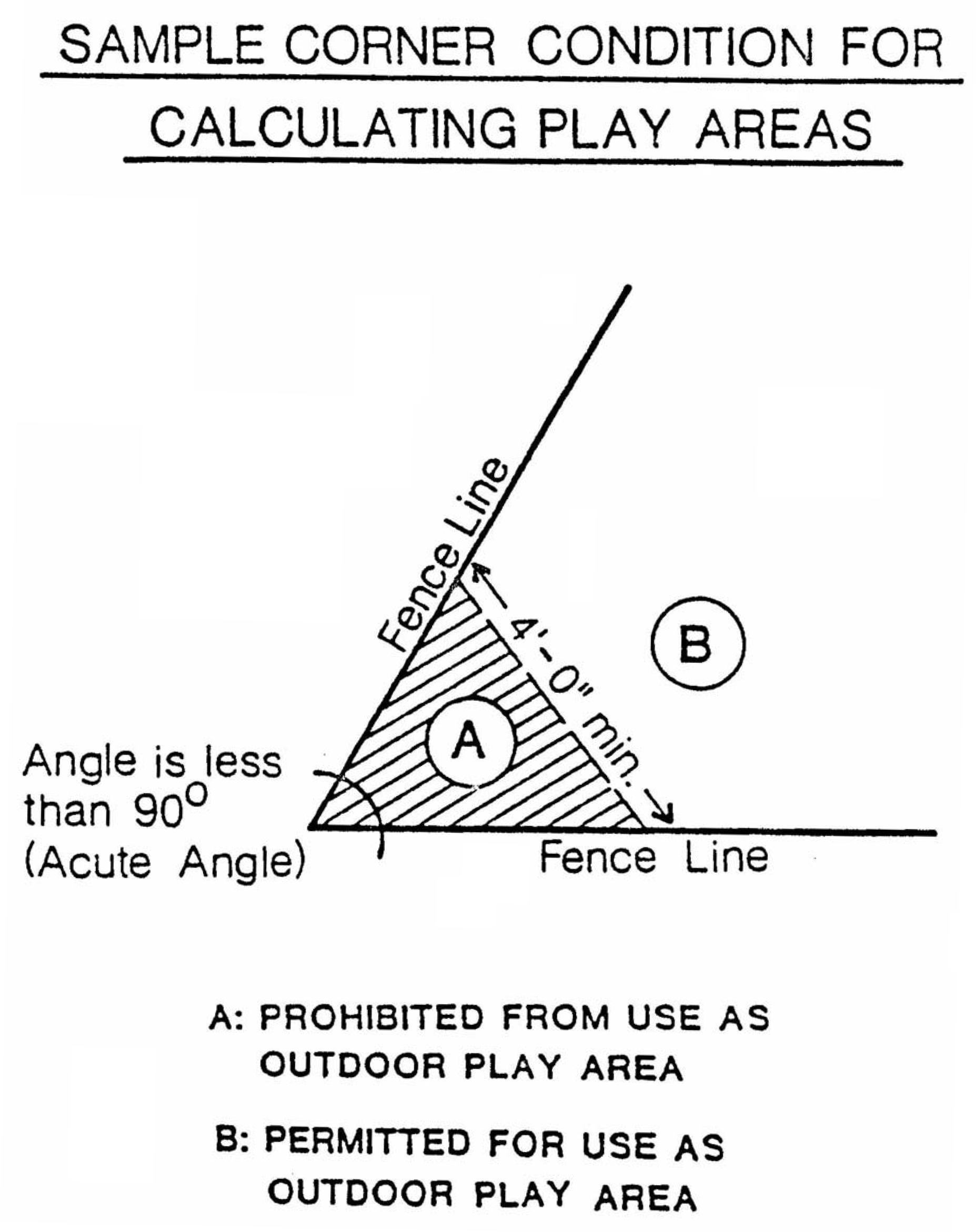
Calculating outdoor play areas. The calculation of outdoor play area shall:
a.
Exclude any area whose corners are less than a 90-degree angle. This area shall be calculated by measuring the side opposite the acute angle at four feet. (See Exhibit 1 following this section.)
b.
Exclude the site's front setback area, as defined in Section 1-2-1.
c.
Exclude the site's landscaped streetside setbacks, as defined in Chapter 3-15.
d.
Exclude areas covered by buildings or required for minimum off-street parking for all on-site uses.
e.
Each age group (infant-toddlers, preschoolers, and school-age children) shall have separate outdoor play space.
3.
Surface. The play area shall contain the surfaces and improvements listed below:
a.
Approved surfaces for those play areas required to meet the minimum State requirements shall consist of an approximately equal mix of:
(1)
Pavement.
(2)
Wood chips, sand or equivalent approved fall surfaces.
(3)
Grass (infant areas shall be predominantly grass).
b.
The pavement area shall include a 10-foot-wide roofed patio for yearround use.
c.
The pavement area shall include a minimum four-foot-wide walk or roadway for wheel toys.
d.
Wood chips, sand or equivalent shall be provided along paths and play equipment.
e.
A minimum 100-square-foot fully or partially shaded sandbox shall be provided for preschool outdoor play areas.
f.
Wood chips or sand shall be a minimum of eight inches in depth under moving and climbing equipment.
4.
Play equipment.
a.
Play equipment shall be varied, sturdy, safe, and age appropriate.
b.
A minimum six-foot "impact area" (fall zone) shall be provided around each piece of moving or climbing equipment, and an additional area beyond the fall zone needed for recovery from a fall shall be kept clear of all equipment and structures (no-encroachment zone). The Director of Community Development may require a greater fall zone for equipment such as, but not limited to, slides, swings, and climbing apparatus.
c.
Play equipment, and no-encroachment and fall zone areas, shall be subject to review and approval by the Director of Community Development.
d.
Outdoor covered storage space for play equipment which is visible off-site shall be compatible in color and materials with the existing buildings on-site.
e.
Noise. The outdoor play area shall conform to City of Irvine noise standards contained in Section 6-8-201 et seq., of the Irvine Code of Ordinances.
5.
Walls and fences. The maximum allowed wall height shall comply with Chapter 3-35 of the City's zoning ordinance governing wall and fence height in institutional districts.
6.
Water requirements. Each self-contained play area shall contain a drinking fountain or alternative water source and water faucet.
C.
Indoor area development standards.
1.
Area requirements per child. The application shall demonstrate that the facility shall meet minimum State requirements for indoor play areas.
2.
Indoor activity space. Separate and defined play and activity areas shall be provided for each age group: infant, toddler, preschool and school-age children.
3.
Napping equipment. Infants shall be provided with a napping area of no more than 12 cribs per room which is separated from the indoor activity space. If two or more adjacent infant napping rooms are to be observed by one attendant, the common wall shall have upper glazing. There shall be a minimum of three feet of space between cribs that are arranged side by side. The use of "stacking cribs" (placing cribs on top of one another) is prohibited.
4.
Drinking water. A sink with hot and cold running water and drinking fountain or alternative water source shall be provided in each classroom.
5.
Toilet facilities.
a.
Adult restrooms shall meet the standards set forth in the California Building Code.
b.
Infant facilities.
(1)
A minimum of one changing table per eight infants; minimum three-inch-high guardrails.
(2)
A sink shall be in the diaper-changing area and in a location easily accessible to staff.
(3)
A minimum of one training seat and/or toilet for every four toddlers being toilet trained shall be provided.
c.
Preschool and school-age facilities.
(1)
Two separate restrooms with minimum five-foot-high privacy walls, measured from the floor, for school-age boys and girls.
(2)
Toilet facilities for preschool and school-age children shall be easily accessible from the classrooms and the outdoor play area.
6.
Isolation. A room separate from the indoor activity space equipment shall be provided to care for children who become ill. The isolation area shall be a separate room with a one-fourth to one-half windowed observation wall. The isolation room shall be within reasonable proximity to toilet facilities.
D.
Administrative relief. Day care centers which are not consistent with the child care center development standards established per this Chapter 3-10 may apply for administrative relief per Chapter 2-2.
(Code 1976, § V.E-305; Ord. No. 92-3, 4-14-92; Ord. No. 92-21, 11-24-92; Ord. No. 94-7, § 3, 6-14-94; Ord. No. 97-06, § 3, 5-13-97; Ord. No. 03-02, § 4, 1-14-03; Ord. No. 05-16, § 2, 7-12-05; Ord. No. 24-19, § 2(Exh. A), 11-26-24)
Sec. 3-11-1.- Development standards.
Each land use category listed in Chapter 3-37 identifies appropriate development standards that regulate the intensity, site size, site coverage, building height, landscaping, and setback requirements for each category. Exceptions to these requirements are noted as described in Chapter 3-1 above. Master Plans and park plans are required in accordance with Chapter 2-17 and Chapter 2-22. Chapter 2-2 includes procedures for administrative relief when specifically allowed in this division. Special development requirements which apply to a particular planning area are included in Division 9.
(Code 1976, § V.E-306; Ord. No. 92-3, 4-14-92; Ord. No. 94-7, § 3, 6-14-94)
Sec. 3-13-1.- Flagpoles.
A.
Commercial, industrial or office. Flagpoles for the display of official flags are permitted on any site. The maximum height shall be consistent with Section 3-9-1.B.
B.
Residential and institutional. Flagpoles for the display of official flags are permitted on any site. The maximum height shall be consistent with Section 3-9-1.B.
(Code 1976, § V.E-307; Ord. No. 92-3, 4-14-92; Ord. No. 94-7, § 3, 6-14-94)
Sec. 3-14-1.- Intensity.
A.
Applicability. Intensity requirements apply to all residential and nonresidential developments. Residential intensity in the zoning ordinance is based on net acreage.
B.
Intensity range. See Chapter 3-37 and the General Plan land use element, statistical tables Figures 1 through 6.
C.
Exception. Caretaker's quarters, as defined in the zoning ordinance, will not be designated as a residential dwelling unit for purposes of calculating development intensity.
(Code 1976, § V.E-308; Ord. No. 92-3, 4-14-92; Ord. No. 94-7, § 3, 6-14-94; Ord. No. 95-4, § 1, 5-9-95)
Sec. 3-15-1.- Applicability.
Landscape requirements apply to all developments except single-family detached residential developments. These regulations establish a minimum percentage of a site which must be landscaped. If any areas used to meet this requirement are located in private yards, the applicant shall ensure that the yards remain as open, landscaped areas. All required landscaping shall be at grade, except that up to 50 percent may be provided at the entry level to the units if the entry level is no more than five feet above grade.
(Code 1976, § V.E-309.1; Ord. No. 92-3, 4-14-92; Ord. No. 94-7, § 3, 6-14-94; Ord. No. 96-18, § 4, 12-10-96)
Sec. 3-15-2. - Minimum site landscaping requirements.
See Chapter 3-37. Additional requirements are as follows:
A.
All setbacks and nonwork areas shall be landscaped except areas proposed for development in another phase.
B.
All landscaped areas shall be provided with an approved irrigation system consisting of water lines and sprinklers designed to provide head-to-head coverage and to minimize overspray onto structures, walks and windows.
C.
Site landscaping includes any required boundary or parking area landscaping.
D.
Hardscape may not be used to meet minimum site landscaping requirements. To distinguish landscape from hardscape see Chapter 1-2, Definitions.
(Code 1976, § V.E-309.2; Ord. No. 92-3, 4-14-92; Ord. No. 94-7, § 3, 6-14-94; Ord. No. 96-18, § 4, 12-10-96; Ord. No. 00-09, § 3, 6-13-00)
Sec. 3-15-3. - Maintenance requirements.
A.
All landscaped areas shall be maintained in a healthy and growing condition and shall receive regular pruning, fertilizing, mowing and trimming. All landscape areas utilizing synthetic turf shall be cleaned and maintained based on manufactures' guidelines for maintenance. Tree pruning standards are addressed in the urban forestry ordinance.
B.
All irrigation systems shall be kept operable, including adjustments, replacements, repairs and cleaning as part of regular maintenance.
C.
All landscaped areas shall be kept free of weeds and debris.
D.
If a parcel is proposed for industrial, commercial or institutional use, maintenance of any landscaping between the curb of any street abutting the parcel and the property line shall be the responsibility of the owner of that parcel, unless a recognized association or district has assumed responsibility for maintenance.
(Code 1976, § V.E-309.3; Ord. No. 92-3, 4-14-92; Ord. No. 94-7, § 3, 6-14-94; Ord. No. 96-18, § 4, 12-10-96; Ord. No. 00-09, § 3, 6-13-00; Ord. No. 12-09, § 3(Exh. A), 5-22-12)
Sec. 3-15-4. - Boundary landscaping requirements.
As part of the required landscaping, the following boundary landscaping shall be provided:
A.
Residential, attached. A minimum of one 15-gallon tree shall be provided for every 30 feet of interior boundary on all building sites. The trees shall be located in a minimum five-foot-wide planting area. Trees may be clustered.
B.
Commercial and institutional uses. A minimum of one 15-gallon tree shall be provided for every 30 feet of interior boundary on all building sites. The trees shall be located in a minimum five-foot-wide planting area. Trees may be clustered.
C.
Industrial uses. A minimum of one 15-gallon tree shall be provided for every 30 feet of interior boundary on all side property lines and on rear property lines if abutting a street. The trees shall be located in minimum five-foot-wide planting area. Trees may be clustered.
D.
Commercial, institutional and industrial uses. For boundary landscaping located adjacent to parking areas see Section 3-15-5.B.
E.
Agricultural uses. No boundary landscaping is required for agricultural uses.
(Code 1976, § V.E-309.4; Ord. No. 92-3, 4-14-92; Ord. No. 94-7, § 3, 6-14-94; Ord. No. 96-18, § 4, 12-10-96; Ord. No. 00-09, § 3, 6-13-00)
Sec. 3-15-5. - Parking area landscape and screening requirements.
A.
Intent. The purpose of parking lot landscaping is as follows:
•
To provide shade throughout a parking area to reduce the amount of heat absorbed by the pavement;
•
To screen cars from surrounding streets and properties;
•
To avoid the negative aesthetic impacts of large expanses of parking areas;
•
To orient planters and other landscape features to direct pedestrians to building entrances;
•
To encourage creative design of parking areas.
B.
Minimum landscape requirements.
1.
Tree distribution. Trees may be located in the parking area to meet one of the following:
a.
One 15-gallon canopy tree, for every four uncovered parking spaces; or
b.
Thirty percent canopy coverage over the entire parking area (including parking stalls and drive aisles) shall be achieved 15 years after landscape installation or maturity, whichever is first (for further information see "canopy coverage" and "canopy tree" in Chapter 1-2, definitions). The City of Irvine Landscape Manual Tree List and the Street Tree Seminar, Inc. "Street Trees Recommended for Southern California" contain candidate trees that will comply with the definition of "canopy coverage" (Street Tree Seminar, Inc., refers to "spread" instead of canopy).
c.
Vehicle display areas for vehicle sales must provide one tree for every 16 vehicle display stalls.
2.
Boundary trees. Required boundary trees which shade parking areas may count towards the fulfillment of parking lot trees. When calculating the total number of parking lot trees, two boundary trees shall equal one parking lot tree. Trees in the public right-of-way are not included in this calculation.
3.
Approved parking lot landscape planter designs.
a.
Planters shall have minimum internal area of 25 square feet, excluding a curb or border area; curb widths shall be consistent with the City's standards and design manual.
b.
All landscape planters with trees shall have a minimum internal dimension of 4½ feet.
c.
Parking area infield planters or tree wells shall be placed at the intersection of parking stalls and be designed to reduce damage to trees from vehicles overhanging the planter. Single trees within these planters shall be installed at the center of the parking stall intersections.
d.
Row end planters shall not exceed the length of a standard parking stall or two parking stalls depending on row width.
e.
Including curb or border, vehicles shall not overhang planters or tree wells by more than two feet. However, projects located within Planning Area 34 are subject to Planning Area 34 design guidelines and are permitted to have an overhang of 2½ feet; however, only two feet of the overhang can count toward the minimum parking dimension of the parking stall. Area of vehicle intrusion into landscape planter will not count towards meeting minimum site landscape requirements. For related Code requirements refer to Section 3-27-9, open parking area setback requirements.
4.
Design flexibility. Alternatives to the requirements listed in Sections 3-15-5 and 3-15-8 may be approved by the Director of Community Development for ministerial projects or by the approval body for discretionary projects when the applicant demonstrates that the minimum landscape requirements of this chapter are being met.
5.
Planning Area 4 (Lower Peters Canyon). Parking area landscaping shall be required as approved in the Master Plan for the project site. Landscaping shall be provided with the objective to reduce heat gain and provide adequate shade.
6.
Screening. Open parking areas shall be screened from view from adjacent properties and streets using walls, berms and/or evergreen landscaping. This screening shall have an eventual height of 3½ feet.
7.
Pedestrian access. Parking lot landscaping shall be located so as to discourage pedestrians from having to cross any landscaped areas to reach building entrances from parked cars. This can be achieved through proper orientation of the landscape planters.
(Code 1976, § V.E-309.5; Ord. No. 92-3, 4-14-92; Ord. No. 94-7, § 3, 6-14-94; Ord. No. 96-18, § 4, 12-10-96; Ord. No. 00-09, § 3, 6-13-00; Ord. No. 05-16, § 2, 7-12-05)
Sec. 3-15-6. - Single-family detached residential development landscaping and maintenance requirements.
For all single family-detached residential developments, the property owner shall be responsible for landscaping in the front and street side yards. The landscaping shall consist predominantly of plant materials except for necessary walks, drives and fences. All required landscaping shall be permanently maintained in a neat and orderly condition.
(Ord. No. 05-16, § 2, 7-12-05)
Sec. 3-15-7. - Parking structure landscaping requirements.
The following requirements apply only to parking areas located within aboveground parking structures:
A.
The exterior elevations of parking structures shall be designed to minimize the use of blank concrete facades. This can be accomplished through the use of textured concrete, planters or trellises, or other architectural treatments. The approval body for the proposed use shall determine if a proposed development meets the intent of this requirement.
B.
The perimeter of the parking structure shall be landscaped at ground level with a minimum of one tree (15-gallon) for every 20 feet in addition to any required streetscape or boundary landscaping.
C.
No parking lot landscaping shall be required for parking spaces located in parking structures.
(Code 1976, § V.E-309.6; Ord. No. 92-3, 4-14-92; Ord. No. 94-7, § 3, 6-14-94; Ord. No. 96-18, § 4, 12-10-96)
Sec. 3-15-8. - Landscape materials.
A.
All required trees shall be a minimum size of 15 gallons.
B.
When used as a screen, the landscaping shall be of compact evergreens which will obtain a minimum height of two feet within 18 months of installation and an eventual minimum height of 3½ feet.
C.
All landscaping shall consist of a combination of ground cover, shrubs, trees, grass, fountains, and water features consistent with Title 5, Division 7 of the Irvine Municipal Code (Sustainability in Landscaping). Ground covers other than plants (for example, mulch, gravel or decomposed granite) may be used on a limited basis with the approval of the Director of Community Development.
D.
Section 3-15-9 should be consulted to avoid physical conflicts between existing and proposed trees and/or landscape.
(Code 1976, § V.E-309.7; Ord. No. 92-3, 4-14-92; Ord. No. 94-7, § 3, 6-14-94; Ord. No. 96-18, § 4, 12-10-96; Ord. No. 97-05, 5-13-97; Ord. No. 00-09, § 3, 6-13-00; Ord. No. 24-07, § 3(Exh. A), 5-28-24)
Sec. 3-15-9. - Special landscaped streets requirements and Master Streetscape Plan.
Properties abutting any of the streets or freeways listed below must provide a 30-foot-wide landscaped setback area from the right-of-way line. The only improvements permitted in this area are driveway entrances, sidewalks, planters and walls. Variations to the width of the landscaped area may be made in the Irvine Business Complex as provided for in Sections 3-37-29, 3-37-31 and 3-37-32. If the building setback results in a dimension of less than 30 feet from the right-of-way line to the face of the building, the landscape setback may equal the dimension from the right-of-way line to face of building without the need for administrative relief.
A.
Irvine Spectrum 2 (PA 35).
1.
Interstate 5.
2.
Alton Parkway.*
3.
Bake Parkway.
4.
Barranca Parkway.*
5.
Irvine Boulevard.*
6.
Jeronimo Road.
7.
Muirlands Boulevard.
8.
Rockfield Boulevard.
9.
Toledo Way (east of Alton).
B.
Irvine Business Complex (PA 36).
1.
San Diego Freeway (I-405).
2.
Campus Drive.*
3.
Costa Mesa Freeway (I-55).
4.
DuPont Drive.
5.
Jamboree Boulevard.*
6.
MacArthur Boulevard.*
7.
Main Street.*
8.
Michelson Drive.*
9.
Red Hill Avenue.*
10.
Von Karman Avenue.*
C.
Irvine Spectrum 4 (PA 13).
1.
San Diego Freeway (I-405).
2.
Laguna Freeway.
3.
Alton Parkway.*
4.
Barranca Parkway.*
5.
Laguna Canyon Road.
6.
Sand Canyon Avenue.*
D.
Irvine Spectrum 5 (PA 34).
1.
Interstate 5.
2.
San Diego Freeway (I-405).
3.
Bake Parkway.
4.
Irvine Center Drive.*
E.
Planning Area 51.
1.
Interstate 5.
* Also included in the Master Streetscape Plan.
In addition to a 30-foot-wide landscaped setback area from the right-of-way line, the following roadways are also included in the City of Irvine Master Streetscape Plan and the roadway listed below are subject to the standards contained in the plan. The following roadways and districts are included in the plan:
F.
Streetscapes by street:
1.
Alton Parkway.
2.
Barranca Parkway.
3.
Bryan Avenue.
4.
Campus Drive.
5.
Culver Drive.
6.
Harvard Avenue.
7.
Irvine Boulevard.
8.
Irvine Center Drive.
9.
Jamboree Road.
10.
Jeffrey Road.
11.
MacArthur Boulevard.
12.
Main Street.
13.
McGaw Avenue.
14.
Michelson Avenue.
15.
Red Hill Avenue.
16.
Sand Canyon.
17.
Von Karman Avenue.
18.
Walnut Avenue.
19.
Yale Avenue.
G.
Streetscapes by district:
1.
Northwood (PA 8).
2.
University of California, Irvine.
(Code 1976, § V.E-309.8; Ord. No. 92-3, 4-14-92; Ord. No. 94-7, § 3, 6-14-94; Ord. No. 96-18, § 4, 12-10-96; Ord. No. 99-03, § 3, 2-9-99; Ord. No. 00-09, § 3, 6-13-00; Ord. No. 09-02, § 3, 3-24-09; Ord. No. 12-09, § 3(Exh. A), 5-22-12)
Sec. 3-15-10. - Administrative relief: Landscaping.
Exceptions may be requested through the administrative relief procedure in Chapter 2-2.
(Code 1976, § V.E-309.9; Ord. No. 92-3, 4-14-92; Ord. No. 94-7, § 3, 6-14-94; Ord. No. 96-18, § 4, 12-10-96)
Sec. 3-16-1.- Lighting.
Outdoor lighting shall be designed and installed so that all direct rays are confined to the site and adjacent properties are protected from glare. The level of lighting on the site shall comply with the requirements of the City's Security Code.
(Code 1976, § V.E-310; Ord. No. 92-3, 4-14-92; Ord. No. 94-7, § 3, 6-14-94)
Sec. 3-17-1.- Loading dock areas.
If a loading dock area faces a street, the loading dock area shall be set back a minimum of 70 feet measured from the curb face to the loading dock area and shall be screened from view from adjacent streets.
(Code 1976, § V.E-311; Ord. No. 92-3, 4-14-92; Ord. No. 94-7, § 3, 6-14-94)
Sec. 3-18-1.- Purpose and intent.
The purpose of this chapter is to provide the public, building and design professionals, and decision-makers with objective design criteria for new multi-family residential and residential mixed-use developments in the City.
(Ord. No. 24-18, Exh. A, 11-26-24)
Sec. 3-18-2. - Applicability.
A.
The Objective Design Standards apply to all new construction projects that meet the following criteria:
1.
Multi-family Residential Projects: A project consisting of multi-family residential uses with two or more dwelling units at a density equal to or greater than 30 units per acre, including detached and attached condominiums.
2.
Residential Mixed-Use Projects: A project featuring a combination of residential and other uses where at least two-thirds of the square footage of the development is designated for residential uses at a density equal to or greater than 30 units per acre.
B.
Interior renovations impacting more than 30 percent of the floor area for commercial and residential projects, that also meet the criteria set forth in Section 3-18-2(A), would be subject to the Objective Design Standards.
C.
All other project types, including detached single-family residential projects located on a single-ownership parcel, commercial-only projects, and interior renovations less than 30 percent of the floor area for commercial and residential projects are not subject to the Objective Design Standards, but must satisfy existing development standards set forth in the Irvine Zoning Ordinance.
(Ord. No. 24-18, Exh. A, 11-26-24)
Sec. 3-18-3. - Incorporation of the Multi-family Housing and Residential Mixed-Use Development Objective Design Standards Manual by reference.
The City of Irvine's Multi-family Residential and Residential Mixed-Use Development Objective Design Standards Manual ("Manual") is incorporated by reference into this chapter. The Multi-family Residential and Residential Mixed-Use Development Objective Design Standards Manual shall be treated as if contained within the City's Zoning Ordinance.
(Ord. No. 24-18, Exh. A, 11-26-24)
Sec. 3-18-4. - Additional provisions.
A.
Eligible projects must comply with all other objective standards in the Zoning Ordinance for topics on which this chapter is silent.
B.
The City of Irvine maintains multiple regulatory documents that contain design direction for multi-family residential and residential mixed-use development projects, including the General Plan, Irvine Municipal Code, Zoning Ordinance, and site-specific master plans. In the case of a conflict between an Objective Design Standard in the Manual and an objective standard in another regulatory document, except for an applicable master plan, the standard in the Manual shall prevail.
(Ord. No. 24-18, Exh. A, 11-26-24)
Sec. 3-18-5. - Exceptions and exemptions.
All projects described in Section 3-18-2 are required to comply with the Objective Design Standards outlined in the Manual. However, an applicant may request up to three (3) minor exceptions/exemptions if they are unable to meet certain Objective Design Standards or may request to enter into an Alternative Standards Agreement to apply substitute standards in lieu of the Objective Design Standards outlined in the Manual.
A.
This provision allows for limited discretionary review and flexibility for projects that may have a physical site constraint or propose an alternative architectural solution to a specific standard(s).
B.
Requests shall be made by the applicant in writing to the Director of Community Development ("Director") as part of the entitlement application (conditional use permit, master plan, or other application).
C.
The Director has decision-making authority over exception/exemption and Alternative Standards Agreement requests. The decision of the Director may be appealed to the Planning Commission in accordance with the procedures established in Chapter 2-5.
D.
Exception/exemption or Alternative Standards Agreement request. The written justification for each exception/exemption or Alternative Standards Agreement request must identify the design standard(s) requested to be waived and how the request meets the applicable findings listed below:
1.
Exception/exemption findings. The Director shall consider the request and information provided and make findings to approve or deny the request. An exception/exemption(s) shall be granted only if both of the following findings are made:
a.
The project meets the intent of the design standard(s) under consideration to be waived, or a similar design standard is implemented in substitution.
b.
The project meets the minimum density required (30 dwelling units/acre) with the inclusion of the proposed exception/exemption(s).
2.
Alternative Standards Agreement findings. The Director shall consider the request for an Alternative Standards Agreement upon finding that:
a.
The strict compliance with the Objective Design Standards in the Manual is not necessary to achieve the purpose and intent of this section;
b.
The project meets the minimum density required (30 dwelling units/acre) with the application of the Alternative Design Standards Agreement;
c.
The Alternative Design Standards Agreement is in a form approved by the Director and City Attorney, in each of their sole discretion; and
d.
The project possesses compensating design and development features that offset impacts associated with the modification, waiver, or substitution of the Objective Design Standards in the Manual.
3.
Density bonus. Density Bonus Law allows for increased density and reductions in required development standards (i.e., concessions/incentives and waivers) for residential projects that meet certain affordability requirements. The exception/exemption and Alternative Standards Agreement processes set forth in this section are in conjunction with the concessions/incentives and waiver process permitted under Density Bonus Law (Government Code Section 65915) and/or other applicable state laws. If an applicant requests a concession/incentive and/or waiver under Density Bonus Law for an Objective Design Standard in this Manual, it would also be counted as one (1) of the three (3) allowed waivers for the purposes of exceptions/exemptions under this section.
(Ord. No. 24-18, Exh. A, 11-26-24)
Sec. 3-18-6. - Modification of the Objective Design Standards Manual.
A.
General requirement. Each modification shall be listed at the end of the Objective Design Standards Manual. The list shall include the approval body, the approval date, and any approval record number (i.e., resolution number). Each modification shall also be reflected on the bottom of the subject page that was modified. For example, a minor modification to Page 1 of the document shall indicate 'Modified by Director of Community Development January X, XXXX' at the bottom of Page 1.
B.
Minor modification. Minor modifications include modifications to: 1) comply with changes in state law; 2) ensure consistency with policies, goals, and objectives of the City as declared by the City Council; and 3) revise existing standards established in the Manual. Examples of minor modifications include adjustment of a numeral requirement or addition of language to clarify existing standards. Minor modifications shall not result in a significant change to any design standard. Minor modifications shall be reviewed by the Director and any approved minor modifications to the Manual be issued via an Approval Memorandum.
C.
Major modification. Major modifications include modifications that result in the addition or removal of standards within the Manual. Any modification that results in a significant change to a design standard shall also be considered a major modification. Major modifications shall be reviewed by the Planning Commission and any approved major modifications to the Manual be issued via Resolution at a noticed public hearing.
(Ord. No. 24-18, Exh. A, 11-26-24)
Sec. 3-18-7. - Coordination with records.
The Manual shall be kept on file with the Records Division of the City Clerk's Office and posted on the City's website. Each time the Manual is revised, an electronic copy, with the revision date on the bottom of the page, shall be sent by the Community Development Department to the Records Division and the updated version posted on the City's website.
(Ord. No. 24-18, Exh. A, 11-26-24)
Sec. 3-18-8. - Severability.
Should any section, subsection, sentence, clause, or phrase of the ordinance codified in this chapter be held for any reason to be invalid or unconditional by the decision of any court of competent jurisdiction, such decision shall not affect the validity of the remaining portions of the ordinance codified in this chapter. The City Council declares that it would have passed the ordinance codified in this chapter and each section, subsection, sentence, clause, and phrase thereof irrespective of the fact that any part thereof be declared invalid or unconditional.
(Ord. No. 24-18, Exh. A, 11-26-24)
Sec. 3-19-1.- Applicability.
Any lawful use of land, buildings or structures existing or under construction at the time this zoning ordinance or any revision is adopted may be continued except as provided herein. This applies even if the use does not conform with the land use regulations and/or development standards of the land use category in which it is located.
(Code 1976, § V.E-312.1; Ord. No. 94-7, § 3, 6-14-94)
Sec. 3-19-2. - Abandonment.
Any nonconforming use of land and/or a building or structure which becomes vacant and remains unoccupied for a continuous period of one year shall be termed abandoned, and all future uses shall comply with the regulations of the area in which it is located.
(Code 1976, § V.E-312.2; Ord. No. 94-7, § 3, 6-14-94)
Sec. 3-19-3. - Alterations, expansions or additions.
A.
An existing building or structure conforming as to use, but which does not conform to the general development standards in this zoning ordinance may be altered, added to or enlarged, provided that any alterations, additions or enlargements comply with all current regulations of this zoning ordinance.
B.
A lawfully established land use which does not conform to the current land use regulations of the zoning district in which it is located may not be altered and/or expanded unless the proposed project complies with the current land use regulations of the zoning ordinance.
C.
If a conditional use permit application is filed to change the use of the building or structure, the application must demonstrate that the portion of the site or building affected by the use permit application can be brought into conformance with all development standards except those for which administrative relief or a variance may be granted. This provision shall not apply to sites that are nonconforming with respect to development standards as a result of public acquisition of a portion of the site for right-of-way purposes.
(Code 1976, § V.E-312.3; Ord. No. 94-7, § 3, 6-14-94; Ord. No. 05-16, § 2, 7-12-05; Ord. No. 21-06, Exh. A, 6-8-21)
Sec. 3-19-4. - Maintenance.
A nonconforming building and/or site shall be maintained in sound condition.
(Code 1976, § V.E-312.4; Ord. No. 94-7, § 3, 6-14-94)
Sec. 3-19-5. - Restoration of damaged structures.
A nonconforming building and/or structure which is damaged or partially destroyed by fire, explosion or man-induced or natural disaster to the extent of more than 75 percent of the gross square footage of the building and/or structure shall be subject to all the applicable regulations specified by this zoning ordinance.
(Code 1976, § V.E-312.5; Ord. No. 94-7, § 3, 6-14-94)
Sec. 3-20-1.- Outdoor storage and equipment areas.
A.
Storage areas and equipment shall not be located in any required setback area or side yard except for electrical or telephone equipment installed by the utilities.
B.
Screening shall be provided so that materials and/or equipment stored in the area at grade or on the roof are screened from view from all adjacent streets, no matter the street grade, and all properties at the same grade. Solar energy systems are exempt from this regulation (see Chapter 3-31, "Solar energy system standards").
1.
Screening methods: roof top equipment and appurtenances shall be equal to or less than the height of the parapet of a flat roofed structure or shall not be visible from any point at or below the eave line of a non-flat roofed structure. If this is not possible then a solid and permanent roof-mounted screen shall be installed to hide the roof top equipment and appurtenances. The roof screen materials and details shall be compatible with the architectural style, materials and color of the building upon which the equipment is located.
(Code 1976, § V.E-313; Ord. No. 92-3, 4-14-92; Ord. No. 94-7, § 3, 6-14-94; Ord. No. 97-06, § 3, 5-13-97; Ord. No. 09-02, § 3, 3-24-09; Ord. No. 13-08, § 2(Exh. A), 1-14-14)
Sec. 3-22-1.- Applicability.
These regulations shall apply to all private schools developed in the City of Irvine serving kindergarten and grades 1 through 12.
(Code 1976, § V.E-315.1; Ord. No. 94-7, § 3, 6-14-94)
Sec. 3-22-2. - Approvals required.
Conformance with these requirements shall be determined during the conditional use permit review process, as described in Chapter 2-9 of the City of Irvine zoning ordinance.
(Code 1976, § V.E-315.2; Ord. No. 94-7, § 3, 6-14-94)
Sec. 3-22-3. - Site requirements.
A.
Minimum site size. Private schools will be assessed in compliance with the following standards:
1.
Interior development standards.
a.
Minimum interior space for a private school must be provided per student as follows:
(1)
Elementary (K—6): 58 square feet.
(2)
Junior high school (7, 8): 80 square feet.
(3)
High school (9—12): 91 square feet.
b.
Areas which may be included in this calculation include any area or classroom where education or related activities will be conducted, including, but not limited to, cafeterias and libraries. Rooms which may not be included in this calculation include administrative offices, restrooms, closets, halls, storage areas, and garage or parking areas.
2.
Exterior development standards.
a.
Minimum exterior space for a private school must be provided per student as follows:
(1)
Elementary (K—6): 116 square feet.
(2)
Junior high school (7, 8): 160 square feet.
(3)
High school (9—12): 182 square feet.
b.
Areas which may be included in this calculation include outdoor facilities and play areas, turf areas, open play fields, paved play areas, apparatus areas, areas utilized for physical education or active outdoor recreational use, and any other landscaped areas. Any outdoor space used in the exterior space calculation shall be appropriate in size for the activities of the children using the space. Areas which may not be included in this calculation include areas for parking, services areas, and any streetside, side or rear setback requirements.
B.
Outdoor facilities/play areas. Outdoor play areas should be located in such a manner so that any impacts to adjacent land uses are minimized. When located adjacent to any residential uses, landscape treatments (trees, shrubs, and berms) and/or hardscape treatment shall be utilized as appropriate visual and noise screening and buffering mechanisms. Active play areas, such as ballfields, shall be sited away from residential land uses.
C.
Location. All private schools shall be located in conformance with the public school site selection standards as set forth in the public facilities element of the General Plan.
D.
Other. When locating a private school, each proposed site shall be evaluated with regard to surrounding land uses. Factors that are subject to evaluation include, but are not limited to, proximity of the private school to traffic volumes on roadways, automotive exhaust fumes (i.e., heavily used intersections, gas stations), hazardous materials, major utility or electrical lines, areas subject to the 100-year flood, major industrial pollutants, and other factors that might be detrimental to the public health, safety or welfare.
(Code 1976, § V.E-315.3; Ord. No. 94-7, § 3, 6-14-94; Ord. No. 00-02, § 4, 2-8-00)
Sec. 3-23-1.- Applicability.
Solid waste collection standards apply to all attached residential and nonresidential developments except for uses within Planning Area 4. For solid waste collection standards within Planning Area 4, see the special development standards outlined for each district in Section 9-4-7. This chapter includes standards for collecting and loading recyclable materials in development projects as specified below pursuant to the California Solid Waste Refuse and Recycling Access Act of 1991 (Assembly Bill 1327). As used throughout this chapter, solid waste shall have the same definition as provided in Section 6-7-101 of the Irvine Municipal Code.
(Code 1976, § V.E-316.1; Ord. No. 92-3, 4-14-92; Ord. No. 94-7, § 3, 6-14-94; Ord. No. 95-4, § 1, 5-9-95; Ord. No. 97-06, § 3, 5-13-97; Ord. No. 00-13, § 3, 10-24-00)
Sec. 3-23-2. - Minimum and capacity requirements.
A.
Residential.
1.
Residential, attached. A minimum of one outdoor solid waste collection bin per 12 dwelling units shall be provided for attached residential units as defined in Section 1-2-1, of which 50 percent of such bins shall be dedicated exclusively to the collection of recyclable materials. Each solid waste bin enclosure or designated waste collection area shall contain at least one recycling collection bin located adjacent or in close proximity to refuse collection bins.
2.
Residential, attached, exceptions. Alternatives to the standards set forth herein may be proposed and will be considered by the City provided such alternative plans provide a total weekly bin capacity consistent with the standards provided in Section 3-23-2.A.1. In determining total weekly bin capacity, the City may take into account the frequency of solid waste collection planned for or provided to a particular multifamily complex. Any deviation from the standards provided herein shall require the expressed written approval of the Director of Community Development. To be approved, such plans must be consistent with all municipal codes pertaining to solid waste collection. Provisions herein are not applicable for those attached residential units as defined in Section 1-2-1 which have been designed to participate in the City's curbside solid waste collection program.
3.
Residential, single-family detached. Provisions herein are not applicable for those single-family detached residential units as defined in Section 1-2-1 which have been designed to participate in the City's curbside solid waste collection program.
B.
Nonresidential. At least two outdoor solid waste collection bins shall be provided for the site developed with a nonresidential use. At least one such bin shall be dedicated exclusively to the collection of recyclable material. The developer/applicant shall clearly identify the location of solid waste collection bins and provide signage directing building occupants of the location of the bins. Clustering of bins is permitted on a multi-tenant site.
C.
The capacity of each solid waste collection bin shall be at least three cubic yards.
D.
The recycling collection provisions of this chapter apply to all attached residential and nonresidential developments constructed after June 10, 1995.
E.
Existing development which adds 30 percent or more to the existing floor area of a development project shall provide areas for collecting and loading solid waste materials in compliance with the provisions set forth herein.
F.
Modification to existing development for the sole purpose of retrofitting outside areas for the collecting and loading of recyclable materials shall comply with the provisions set forth herein. Such modification to the site shall comply with the minor/major modification procedure set forth in Chapter 2-19.
G.
Recycling collection bins shall be at least three cubic yards in size and in sufficient quantity to collect at least 50 percent of the total recyclable wastes generated on-site.
(Code 1976, § V.E-316.2; Ord. No. 92-3, 4-14-92; Ord. No. 94-7, § 3, 6-14-94; Ord. No. 95-4, § 1, 5-9-95; Ord. No. 98-09, § 3, 7-28-98; Ord. No. 00-13, § 3, 10-24-00; Ord. No. 11-08, § 3(Exh. A), 8-23-11)
Sec. 3-23-3. - Location requirements.
A.
Solid waste collection areas shall not be located within any required setback areas and shall be conveniently accessible to the units/buildings they are designed to serve and collection vehicles/personnel. Areas for collecting recyclable materials shall be adjacent to refuse collection areas as required in Chapter 3-23.
B.
Solid waste collection areas shall be screened from off-site views.
C.
Recycling areas retrofitted into existing development shall be located as close as practicable to existing refuse collection areas.
(Code 1976, § V.E-316.3; Ord. No. 92-3, 4-14-92; Ord. No. 94-7, § 3, 6-14-94; Ord. No. 95-4, § 1, 5-9-95; Ord. No. 00-13, § 3, 10-24-00)
Sec. 3-23-4. - Design requirements.
A.
Solid waste collection areas shall be contained within an enclosed area.
B.
Dimensions of the solid waste collection area shall accommodate containers consistent with collection methods prescribed for the types of materials generated for collection.
C.
A concrete loading pad area shall be provided in front of the solid waste collection area(s) to ensure that collection vehicles do not damage pavement surface. The concrete pad area shall be designed and constructed consistent with City of Irvine standards and design manual.
D.
Solid waste enclosures shall comply with the wall and fence standards set forth in Chapter 3-35 and all applicable building codes, and be consistent with the City of Irvine standards and design manual.
E.
Landscaped materials used to screen solid waste collection areas shall comply with the landscape standards set forth in Chapter 3-15.
F.
Recycling areas shall be secured to prevent the theft of recyclable materials by unauthorized persons, while allowing authorized persons access for disposal and pickup of materials.
G.
Recycling areas or the bins or containers placed therein shall provide protection against adverse environmental conditions, such as rain, which might render the collected materials unmarketable.
H.
A sign clearly identifying all recycling and refuse collection and loading areas and the materials accepted therein shall be posted adjacent to all points of direct access to the recycling areas.
(Code 1976, § V.E-316.4; Ord. No. 92-3, 4-14-92; Ord. No. 94-7, § 3, 6-14-94; Ord. No. 95-4, § 1, 5-9-95; Ord. No. 97-05, 5-13-97; Ord. No. 00-13, § 3, 10-24-00)
Sec. 3-23-5. - Maintenance requirements.
Property owners of solid waste collection areas shall be responsible for the cleanliness and sanitary conditions of the surrounding area, except when solid waste collection workers are servicing the solid waste collection bins. At his or her discretion, the Director of Community Development shall have authority to require more frequent waste collections at premises where overflowing solid waste bins become a frequent public nuisance, with the cost of such additional collections to be borne solely by the property owner.
(Code 1976, § V.E-316.5; Ord. No. 92-3, 4-14-92; Ord. No. 94-7, § 3, 6-14-94; Ord. No. 95-4, § 1, 5-9-95; Ord. No. 98-09, § 3, 7-28-98; Ord. No. 00-13, § 3, 10-24-00)
Sec. 3-24-1.- Applicability.
These regulations apply to single room occupancy (SRO) residential units.
(Res. No. 15-86, § 3(Exh. A), 8-11-15)
Sec. 3-24-2. - Approvals required.
Conformance with these requirements shall be determined during the conditional use permit review process, as described in Chapter 2-9 of the City of Irvine zoning ordinance.
(Res. No. 15-86, § 3(Exh. A), 8-11-15)
Sec. 3-24-3. - Site requirements.
A.
Each SRO development shall comply with the following criteria:
1.
Each SRO project shall submit a management plan to the Community Development Department Housing Manager for review and approval. This plan shall contain information regarding the development's projected staffing needs, facility management and operations, emergency procedures, security, rental procedures, and proposed rental rates.
2.
Each SRO development shall have a resident manager available on a 24-hour basis.
3.
Individual rooms are limited to single or double occupancy.
4.
Single occupancy rooms shall be no less than 175 square feet and no greater than 400 square feet.
5.
Double-occupancy rooms shall be no less than 275 square feet and no greater than 450 square feet.
6.
Each SRO unit shall contain a kitchen. Kitchens shall be required to contain a sink with garbage disposal, a countertop (16 inches by 24 inches minimum), refrigerator, and stove or microwave oven. If stoves are not provided in each unit, then stoves shall be provided in a common kitchen area accessible to the entire SRO project.
7.
Each SRO unit shall contain a bathroom. Bathroom shall be required to contain a sink, toilet, and shower or bathtub.
8.
Each SRO unit shall contain closet/storage space no less than 48 cubic feet in size.
9.
Rental units shall be established for monthly tenancies or longer.
10.
For SRO developments containing 30 or fewer units, a minimum of 400 square feet of common open space shall be provided.
11.
For SRO developments containing 31 or more units, 400 square feet of common open space shall be provided, with an additional 15 square feet required per each additional unit over 30.
12.
Each SRO project shall provide laundry facilities in a separate room or rooms located in close proximity to the units served. A minimum of one washer and one dryer shall be provided for each 10 units or fraction thereof.
13.
An SRO is considered a residential dwelling unit for development intensity purposes.
(Res. No. 15-86, § 3(Exh. A), 8-11-15)
Sec. 3-25-1.- Purpose and intent.
The purpose of this chapter is to establish that short-term rentals are prohibited uses on any property within the City's residential zones, and within any other zoning district in the city, including all underlying or base zones, overlay zones and adopted specific plans, in which residential uses are a permitted or conditionally permitted use.
The amendments to Chapter 3 are express restatements of the existing prohibition on short-term rentals in the City.
(Ord. No. 18-05, Exh. A, 4-24-18)
Sec. 3-25-2. - Definitions.
The definitions contained in this section shall govern the construction, meaning and application of words and phrases used in this chapter.
A.
"Advertisement" means any announcement, whether in a magazine, newspaper, handbill, notice, display, billboard, poster, email, internet website, platform or application, any form of television or radio broadcast or any other form of communication, whose primary purpose is to propose a transaction. The provisions of Irvine Code of Ordinances Section 4-6-234, Evidence of doing business, shall also apply.
B.
"Code Enforcement Official" shall mean the Manager of Neighborhood Services, Code Enforcement Supervisor, or their designee.
C.
"Residential Zoning District" shall mean all zones within the City of Irvine that support or include residential uses, whether as a permitted use or conditionally permitted use.
D.
"Responsible Party" means any person(s) or entity(ies) that hold(s) legal and/or equitable title to the real property and/or dwelling unit, including any property owner, lessee or tenant, or any agent or representative thereof, who causes or permits any violation of this Code. To cause or permit includes failure to correct or cause correction after receiving notice from the City of the violation.
E.
"Short-Term Rental" means a rental or other occupancy of a dwelling unit or part of a dwelling unit to visitors where lodging is furnished for a period of thirty (30) consecutive calendar days or less.
F.
Reserved.
G.
"Hosting platform" means any person, corporation or entity of any kind who participates in the short-term rental business by advertising or collecting or receiving a fee, directly or indirectly through an agent or intermediary, for conducting short-term rental activity in the City of any nature.
(Ord. No. 18-05, Exh. A, 4-24-18; Ord. No. 21-01, § 3, 1-26-21)
Sec. 3-25-3. - Short-term rentals and advertisement of short-term rentals prohibited.
A.
No responsible party shall operate or allow the operation of a short-term rental in any residential zoning district within the City.
B.
No responsible party shall post, publish, circulate, broadcast or maintain any advertisement of a short-term rental prohibited in any residential zoning district within the City for a period of less than 31 consecutive days including any advertisement for a daily or weekly rate.
(Ord. No. 18-05, Exh. A, 4-24-18; Ord. No. 19-11, Exh. A, 8-13-19)
Sec. 3-25-4. - Public nuisance.
Any use or condition caused, or permitted or allowed to exist, continue or remain in violation of any provision of this chapter shall be, and is hereby declared to be, a public nuisance and may be summarily abated by the City pursuant to California Code of Civil Procedure § 731 or through any other remedy provided for by law.
(Ord. No. 18-05, Exh. A, 4-24-18)
Sec. 3-25-5. - Violations; misdemeanors and infractions.
It shall be unlawful for any responsible party to violate any provision or to fail to comply with any of the requirements of this chapter. Such a violation may be prosecuted in the name of the people of the State, redressed by civil action, or resolved by administrative remedies. Any responsible party who violates or fails to comply with any provision of this Code or any City ordinance is guilty of an infraction or a misdemeanor if the circumstances so warrant.
(Ord. No. 18-05, Exh. A, 4-24-18; Ord. No. 22-12, § 3(Exh. A), 8-9-22)
Sec. 3-25-6. - Penalties for violation.
The provisions of Title 4, Division 13, Chapter 1 will apply.
(Ord. No. 18-05, Exh. A, 4-24-18)
Sec. 3-25-7. - Hosting platforms shall not complete booking transactions.
A.
Hosting platforms shall not complete any booking transaction for short-term rentals in the City.
B.
No later than 30 days after any person seeks to use a hosting platform to complete a short-term rental in the City, the hosting platform shall provide the Neighborhood Services Administrator in writing the names of and contact information for any person responsible for each such listing, the address of each such listing, the length of stay for each such listing, and the price quoted for each such stay.
C.
Hosting platforms shall not collect or receive any compensation, whether monetary or non-monetary, either directly or indirectly through an agent or intermediary, for facilitating or providing any short-term rental in the City, including, but not limited to, any ancillary service related thereto such as insurance, concierge services, catering, restaurant bookings, tours, guide services, entertainment, cleaning, property management, or maintenance of the property or unit.
D.
A hosting platform which operates in compliance with this section shall be presumed to be in compliance with the City's short-term rental regulations except that the hosting platform remains responsible for complying with an administrative subpoena issued by the City for the purpose of obtaining any information regarding short-term rental advertising or activity in the City.
E.
The provisions of this section shall be interpreted in accordance with otherwise applicable state and federal law(s) and will not apply if determined by the City to be in violation of, or preempted by, any such law(s).
(Ord. No. 21-01, § 4, 1-26-21)
Sec. 3-26-1.- Applicability.
Accessory dwellings shall be permitted and regulated in compliance with Chapter 13 of Division 1 of Title 7 of the California Government Code (Section 66310 et seq.), as may be amended from time to time.
(Ord. No. 25-22, 9-9-25)
Sec. 3-27-1.- Applicability.
Setback standards apply to all residential and nonresidential developments. In addition to the general requirements, this chapter identifies specific standards as well as the exceptions to the setback standards.
(Code 1976, § V.E-318.1; Ord. No. 92-3, 4-14-92; Ord. No. 92-20, § 6, 11-10-92; Ord. No. 92-21, 11-24-92; Ord. No. 94-7, § 3, 6-14-94; Ord. No. 95-1, § 5, 1-10-95; Ord. No. 95-4, § 1, 5-9-95; Ord. No. 10-07, § 9 (Exh. D), 7-27-10)
Sec. 3-27-2. - General setback requirements.
A.
Streets. The setback is measured from the curb face corresponding to the ultimate right-of-way. Refer to Chapter 3-37 for specific setback distances for each land use category and arterial roadway designation. Exceptions to setback distances for specific roadways are shown in the setback exceptions matrix (at the end of this section). Please refer to the footnotes found in each Irvine Business Complex (IBC) zoning category regarding exceptions to the measurement of streetside (building) setbacks.
1.
When a planning area edge exists between a residential use and a street, the interior setbacks shall apply.
2.
When a planning area edge exists between a commercial use and a street, the planning area edge boundary or the streetside setback shall apply, whichever is greater.
3.
When a residential lot has two street frontages (e.g., corner lot), the streetside setback or the side yard property line setback requirement shall apply, whichever is more restrictive.
4.
When residential buildings are located where the side yard is dedicated by easement in perpetuity to the adjacent property, the walls directly adjacent to the easement are permitted to have eaves as described below:
a.
In situations where the easement is less than three feet in width, eaves are prohibited.
b.
In situations where the easement is three feet in width, the entire width of the eave, including any rain gutter, shall be no greater than one foot, measured from the face of the exterior wall.
c.
In situations where the easement is at least five feet in width, the entire width of the eave, including any rain gutter, shall be no greater than three feet, measured from the face of the exterior wall.
d.
In situations where eaves are permitted and the slope of the roofline causes water to drain toward the easement, rain gutters are required to ensure water does not flow onto the easement.
e.
In all instances the face of the eave, including any rain gutter, shall be set back a minimum of two feet from any property line, consistent with Section 503.2.1 and table 5-A of the Uniform Building Code.
B.
Interior boundaries. The setbacks are measured from the side or rear property line of the site (see definition of "Site").
1.
Rear and side setbacks may be zero. See development standards in Chapter 3-37.
C.
Planning Area 4. For setbacks along arterials and the planning area edge within Planning Area 4 (Lower Peters Canyon), see Section 9-4-7.C.1.
SETBACK EXCEPTIONS MATRIX
If a project is adjacent to any of the following roadway segments, use the setback distance (in feet) listed under the appropriate land use category below. If the project is not adjacent to any of the following roadway segments, refer to the setback distance requirements found in Sections 3-37-2 through 3-37-38.
Footnotes:
1 In 5.3B, 20 feet.
2 For the property located on the northeast corner of Jamboree and Main Street located in the 5.0 IBC Mixed Use district, the setbacks for residential land uses from Jamboree and Main Street frontage shall be no less than 20 feet as measured from the ultimate right-of-way/property line of this parcel. For the nonresidential portions of this same project site, the setbacks from Main Street shall be no less than 12 feet as measured from the ultimate right-of-way/property line of this parcel.
3 For the property located at the northwest corner of Jamboree Road and Michelson Drive and designated in 5.0A IBC Mixed-Use district, the minimum setback from Michelson Drive, between Teller and Obsidian, shall be no less than 23 feet as measured from the ultimate curb face of Michelson Drive. This reduced setback shall override the applicable requirements for special landscaped street in Section 3-15-9.
(Code 1976, § V.E-318.2; Ord. No. 92-3, 4-14-92; Ord. No. 92-20, § 6, 11-10-92; Ord. No. 92-21, 11-24-92; Ord. No. 94-7, § 3, 6-14-94; Ord. No. 95-1, § 5, 1-10-95; Ord. No. 95-4, § 1, 5-9-95; Ord. No. 97-05, 5-13-97; Ord. No. 97-06, § 3, 5-13-97; Ord. No. 03-15, § 5, 5-13-03; Ord. No. 03-34, § 5, 1-27-04; Ord. No. 04-09, § 6, 9-14-04; Ord. No. 05-16, § 2, 7-12-05; Ord. 05-29, § 3, 1-10-06; Ord. No. 09-02, § 3, 3-24-09; Ord. No. 10-07, § 9 (Exh. D), 7-27-10; Ord. No. 24-19, § 2(Exh. A), 11-26-24)
Sec. 3-27-3. - Exceptions to setback requirements.
The following are allowed in any required setback area but shall not obstruct sight distance for access (this shall be determined by performing a sight distance measurement pursuant to Engineering Standard Plan 403):
A.
Driveway entrances.
B.
Flagpoles (see Chapter 3-9 and Chapter 3-13).
C.
Fountains.
D.
Landscaping.
E.
Lattice/trellis patio cover (see Section 3-27-7).
F.
Mechanical equipment (see Section 3-27-8).
G.
Patios (uncovered).
H.
Detached fireplace/chimney (see Section 3-27-8).
I.
Walks.
J.
Walls and fences (see Chapter 3-35).
See Chapter 5-8 and IBC Residential/Mixed Use Design Criteria for exceptions to setback requirements for residential or residential mixed use projects within the Irvine Business Complex.
(Code 1976, § V.E-318.3; Ord. No. 92-3, 4-14-92; Ord. No. 92-20, § 6, 11-10-92; Ord. No. 92-21, 11-24-92; Ord. No. 94-7, § 3, 6-14-94; Ord. No. 95-1, § 5, 1-10-95; Ord. No. 95-4, § 1, 5-9-95; Ord. No. 03-02, § 4, 1-14-03; Ord. No. 10-07, § 9 (Exh. D), 7-27-10)
Sec. 3-27-4. - Intrusions into required setbacks.
The following are allowed to intrude a maximum of three feet into a required setback:
A.
Architectural features.
B.
Eaves (see Section 3-27-2).
C.
Fireplaces.
D.
Steps and staircases (open).
E.
Balconies on all floors of only mid-rise and high-rise residential developments of four stories and above (applies only to zoning categories 5.0, 5.1 and 5.3 in the IBC).
See Chapter 5-8 and IBC Residential/Mixed Use Design Criteria for exceptions to setback requirements for residential or residential mixed use projects within the Irvine Business Complex.
(Code 1976, § V.E-318.4; Ord. No. 92-3, 4-14-92; Ord. No. 92-20, § 6, 11-10-92; Ord. No. 92-21, 11-24-92; Ord. No. 94-7, § 3, 6-14-94; Ord. No. 95-1, § 5, 1-10-95; Ord. No. 95-4, § 1, 5-9-95; Ord. No. 05-16, § 2, 7-12-05; Ord. No. 10-07, § 9 (Exh. D), 7-27-10)
Sec. 3-27-5. - Setback requirements for non-residential legal nonconforming structures.
Additions to non-residential legal nonconforming structures which are not consistent with the building setback regulations established per this Chapter 3-27 may be allowed at the discretion of the Director of Community Development if the addition does not intrude any further into the required setback area than the existing building footprint.
(Code 1976, § V.E-318.5; Ord. No. 92-3, 4-14-92; Ord. No. 92-20, § 6, 11-10-92; Ord. No. 92-21, 11-24-92; Ord. No. 94-7, § 3, 6-14-94; Ord. No. 95-1, § 5, 1-10-95; Ord. No. 95-4, § 1, 5-9-95; Ord. No. 24-07, § 3(Exh. A), 5-28-24)
Sec. 3-27-7. - Lattice/trellis patio cover, cabana, accessory structure, major and gazebo setback requirements.
A.
The support posts shall be set back a minimum of three feet from any property line. The patio roof or beams may extend one foot past the support posts toward the adjacent property line. Lattice/trellis patio cover or beam construction is allowed to attach a garage or carport to the main building.
B.
Cabanas, major accessory structures, and patios/gazebos with solid roofs are not allowed in the required setback area and are subject to the development standards set forth in Chapter 3-37.
(Code 1976, § V.E-318.6; Ord. No. 92-3, 4-14-92; Ord. No. 92-20, § 6, 11-10-92; Ord. No. 92-21, 11-24-92; Ord. No. 94-7, § 3, 6-14-94; Ord. No. 95-1, § 5, 1-10-95; Ord. No. 95-4, § 1, 5-9-95; Ord. No. 97-05, 5-13-97; Ord. No. 05-16, § 2, 7-12-05; Ord. No. 23-13, § 3(Exh. A), 7-11-23)
Sec. 3-27-8. - Pools and spas and mechanical equipment setback requirements.
A.
Pools and spas do not have a setback requirement. Where a "zero lot line" condition exists, the pool or spa may be built up to the property line. However, in no instance may the pool or spa be located within the "zero lot line" easement area.
B.
Mechanical equipment (including BBQ grill) must be a minimum of two feet from the property line.
C.
Ground-mounted mechanical equipment, in residential districts, may not exceed four feet in height.
D.
Residential detached fireplace/chimney.
a.
Residential detached fireplace/chimneys are permitted within the rear yard area and within side yard areas greater than five feet in width.
b.
Residential detached fireplace/chimneys shall maintain a minimum setback of three feet from any property line. However, an exception applies to "zero lot line" properties. Where a "zero lot line" condition exists, the residential detached fireplace/chimney may be built up to the property line provided the easement is three feet or greater in width. However, in no instance may the residential detached fireplace/chimney be located within the "zero lot line" easement area.
c.
Residential detached fireplace/chimneys shall have a maximum height of 12 feet.
d.
Residential detached fireplace/chimneys shall comply with all building codes and this Zoning Code.
(Code 1976, § V.E-318.7; Ord. No. 92-3, 4-14-92; Ord. No. 92-20, § 6, 11-10-92; Ord. No. 92-21, 11-24-92; Ord. No. 94-7, § 3, 6-14-94; Ord. No. 95-1, § 5, 1-10-95; Ord. No. 95-4, § 1, 5-9-95; Ord. No. 03-02, § 4, 1-14-03)
Sec. 3-27-9. - Open parking area setback requirements.
Open parking areas are allowed within the required setback areas as provided below. When a reduction is permitted in the required length of the parking stall, per Section 4-4-1, the setback shall be increased by an equal amount.
A.
Front and streetside: Minimum of 10 feet from the property line except that no parking areas are allowed in setbacks on special landscaped streets listed in Section 3-15-9 and in designated planning area edges.
B.
Interior side and rear (except in Irvine Spectrum PA 33): Minimum of five feet from the property line.
C.
Irvine Spectrum Center (PA 33), side and rear: Minimum of 10 feet from the property line.
(Code 1976, § V.E-318.8; Ord. No. 92-3, 4-14-92; Ord. No. 92-20, § 6, 11-10-92; Ord. No. 92-21, 11-24-92; Ord. No. 94-7, § 3, 6-14-94; Ord. No. 95-1, § 5, 1-10-95; Ord. No. 95-4, § 1, 5-9-95; Ord. No. 97-05, 5-13-97; Ord. No. 99-03, § 3, 2-9-99)
Sec. 3-27-10. - Garage and carport setback requirements.
A.
Private drives. Garages and carports shall be set back a minimum of three feet from the travelway. This driveway setback area shall be distinguished from the travelway, with the exception of mountable curbs which will be measured from back of curb to prevent cars from blocking garage doors (see Figure 3-27A). This setback may be reduced by 50 percent if roll-up type garage doors are used or if the posts for the carport are at least three feet from the end of the carport. If living areas are provided above a garage, garage setbacks shall apply to the living area.
B.
Public or private streets. Garages and carports shall maintain a setback from the face of curb of either, 10 to 13 feet, or a minimum of 24 feet to ensure that cars parking in the driveway do not overhang the sidewalk (see Figure 3-27B). The 24-foot requirement may be reduced by one foot to 23 feet if roll-up type garage doors are provided. If the project developer is providing a garage setback of 23 feet in accordance with the above provision or is providing a minimum of 24 feet to the curb face, is proposing four-bedroom units, and is counting a required on-site residential parking space in the driveway, the driveway space shall be considered an uncovered space, full-sized, and is permitted to be 18 feet in length. If no sidewalk or parkway is provided, the setback may be reduced to the extent that an 18-foot long driveway (measured from the garage door to the property line) can be provided, which may count as a full-sized residential parking space. If living areas are provided above a garage, garage setbacks shall apply.
(Code 1976, § V.E-318.9; Ord. No. 92-3, 4-14-92; Ord. No. 92-20, § 6, 11-10-92; Ord. No. 92-21, 11-24-92; Ord. No. 94-7, § 3, 6-14-94; Ord. No. 95-1, § 5, 1-10-95; Ord. No. 95-4, § 1, 5-9-95; Ord. No. 23-13, § 3(Exh. A), 7-11-23)
Sec. 3-27-11. - Mobile home park building setback requirements.
The building setback requirements of the zoning district (see Chapter 3-37) in which the mobile home park is located shall apply. However, only the building setback requirement for side and rear yards shall apply. The side and rear setbacks shall be measured from the property line (exterior) of the mobile home park itself. No interior setback requirements shall apply, except for the City of Irvine Building Code requirements.
(Code 1976, § V.E-318.10; Ord. No. 92-3, 4-14-92; Ord. No. 92-20, § 6, 11-10-92; Ord. No. 92-21, 11-24-92; Ord. No. 94-7, § 3, 6-14-94; Ord. No. 95-1, § 5, 1-10-95; Ord. No. 95-4, § 1, 5-9-95)
Sec. 3-27-13. - Residential building additions.
Residential building additions which are not consistent with building setback regulations established pursuant to this Chapter 3-27 may be permitted to meet the building setback requirements in effect at the time the unit was originally constructed through the residential setback deviation procedure established in Chapter 2-40.
(Code 1976, § V.E-318.11; Ord. No. 92-3, 4-14-92; Ord. No. 92-20, § 6, 11-10-92; Ord. No. 92-21, 11-24-92; Ord. No. 94-7, § 3, 6-14-94; Ord. No. 95-1, § 5, 1-10-95; Ord. No. 95-4, § 1, 5-9-95; Ord. No. 24-19, § 2(Exh. A), 11-26-24)
Figure 3-27A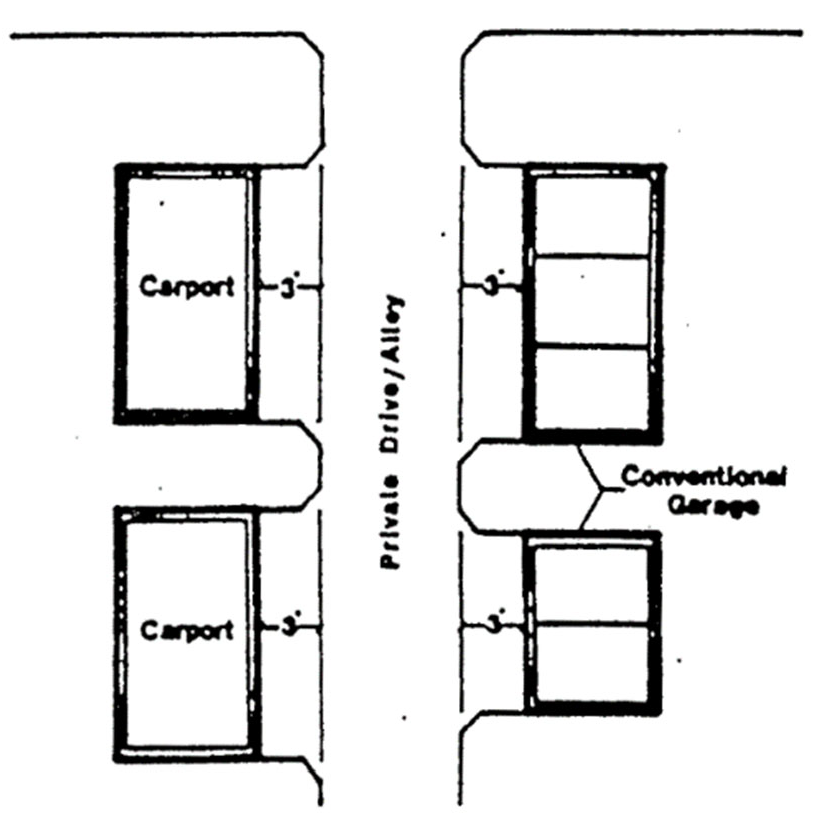
Figure 3-27B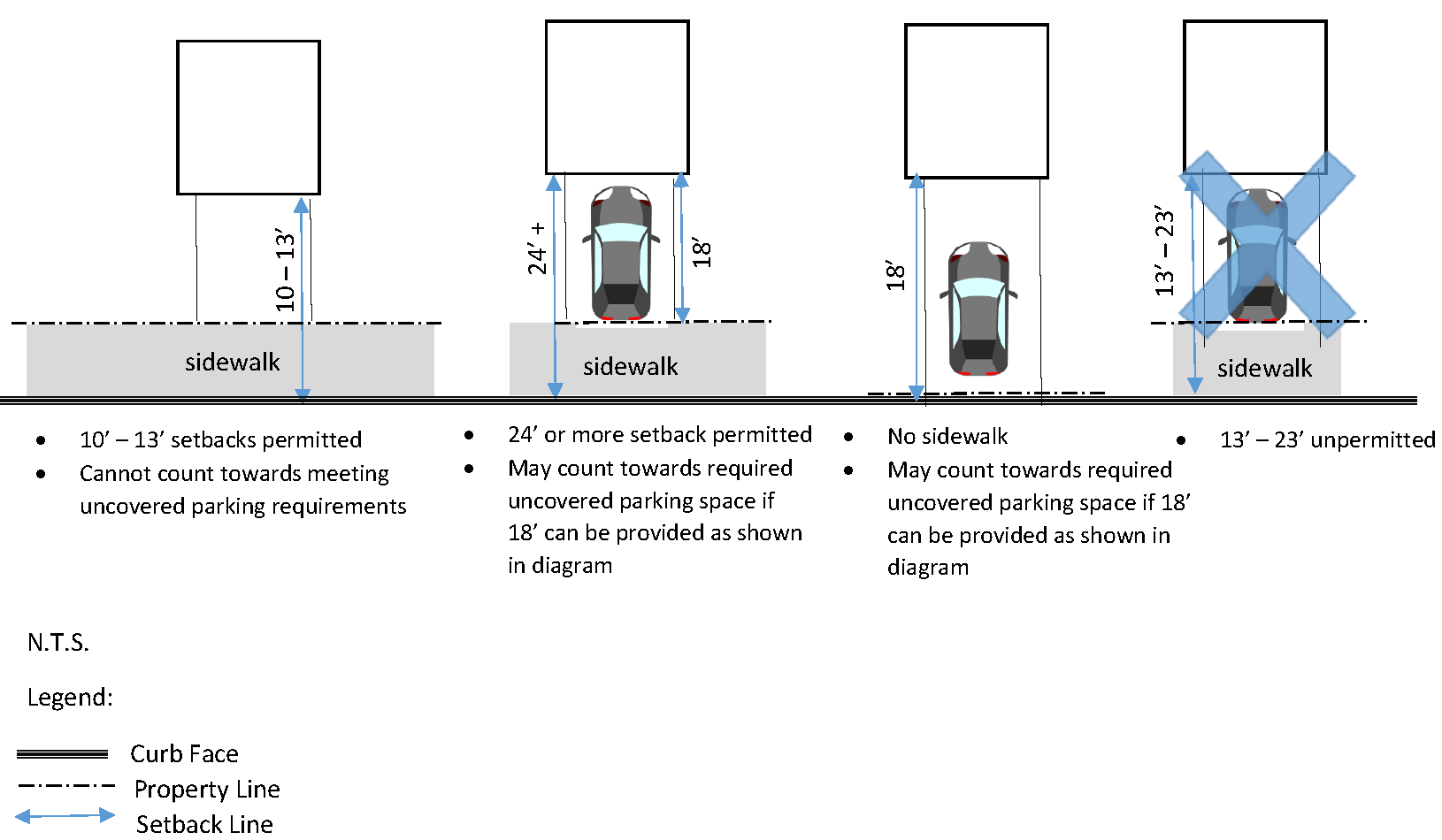
Sec. 3-28-1.- Site size.
A.
Applicability. Site size requirements apply to all conventional detached residential, medium-high and high density residential developments and to all nonresidential developments.
B.
Minimum site size. See Chapter 3-37.
(Code 1976, § V.E-319; Ord. No. 92-3, 4-14-92; Ord. No. 94-7, § 3, 6-14-94)
Sec. 3-29-1.- Site coverage.
A.
Applicability. Site coverage requirements apply to all detached residential on a single, privately-owned lot, and to all nonresidential developments.
B.
Maximum site coverage. See chapter 3-37 (land use regulations and development standards by zoning district).
(Code 1976, § V.E-320; Ord. No. 92-3, 4-14-92; Ord. No. 94-7, § 3, 6-14-94; Ord. No. 97-09, § 3, 5-27-97; Ord. No. 18-05, Exh. A, 4-24-18)
Sec. 3-31-1.- Applicability.
The purpose of the solar energy system standards is to encourage investment in solar energy systems on all parcels in the City, both residential and nonresidential, while providing guidelines for the installation of those systems that are consistent with the architectural and building standards of the City. All solar energy systems shall comply with all applicable provisions of the City of Irvine Codes and the standards of this chapter.
(Code 1976, § V.E-321.1; Ord. No. 92-3, 4-14-92; Ord. No. 94-7, § 3, 6-14-94; Ord. No. 09-02, § 3, 3-24-09)
Sec. 3-31-2. - Approvals required.
The applicant shall submit for and receive approval of a building permit prior to installation of any solar energy system.
(Code 1976, § V.E-321.2; Ord. No. 92-3, 4-14-92; Ord. No. 94-7, § 3, 6-14-94; Ord. No. 09-02, § 3, 3-24-09)
Sec. 3-31-3. - Residential standards.
A.
Ground-mounted solar energy systems.
1.
All ground-mounted solar energy systems shall not be located within the front, side, or rear building setbacks, or front yard area, and shall comply with all applicable height restrictions.
2.
To the extent possible, without compromising the solar energy system's access to the sun, ground-mounted solar energy systems shall be screened from view at-grade from all adjacent streets and adjacent properties.
B.
Roof-mounted solar energy systems.
1.
All solar energy system appurtenances such as, but not limited to, electrical conduit, junction boxes, water tanks, supports, and plumbing shall be screened to the maximum extent possible without compromising the effectiveness of the solar collectors, and shall be painted a color similar to the color of the surface upon which they are mounted. Solar collectors (modules, inverters and rails) are exempt from the screening and color provisions of this subsection.
2.
All roof-mounted solar collectors can be mounted at an optimum angle to the sun for maximum energy production. The maximum height of a solar collector shall be two feet, measured perpendicular to the roof surface, and may not exceed the maximum overall building height. The remainder of the solar energy system shall be below the level of the solar collector(s).
C.
Covered parking solar energy systems.
1.
Covered parking solar energy systems shall not be located within any required building setback (except for where granted under the exception in Section 3-27-10).
2.
Covered parking solar energy systems shall not result in a net loss of any required parking.
(Code 1976, § V.E-321.3; Ord. No. 92-3, 4-14-92; Ord. No. 94-7, § 3, 6-14-94; Ord. No. 09-02, § 3, 3-24-09; Res. No. 15-86, § 3(Exh.A), 8-11-15; Ord. No. 23-13, § 3(Exh. A), 7-11-23)
Sec. 3-31-4. - Commercial/industrial/institutional/multi-use/office standards.
A.
Covered parking solar energy systems.
1.
Covered parking solar energy systems shall not be located within any required building setback but may encroach into a landscaping setback a maximum of three feet.
2.
Covered parking solar energy systems shall not result in a net loss of any required parking.
B.
Roof-mounted solar energy systems.
1.
All solar energy system appurtenances such as, but not limited to, plumbing, water tanks, and support equipment shall be screened to the maximum extent possible without compromising the effectiveness of the solar collectors and shall be painted a color similar to the color of the surface upon which they are mounted. If panels are used as screening, they shall contain a finish and color consistent with the building's exterior walls. Solar collectors are exempt from the screening and color provisions of this subsection; solar inverter boxes and A/C disconnect boxes are exempt from the color provision of this subsection.
(Code 1976, § V.E-321.4; Ord. No. 92-3, 4-14-92; Ord. No. 94-7, § 3, 6-14-94; Ord. No. 09-02, § 3, 3-24-09; Res. No. 15-86, § 3(Exh.A), 8-11-15)
Sec. 3-31-5. - Exception.
Notwithstanding anything set forth herein, the regulations set forth in this Chapter shall not preclude the establishment of solar energy systems proposed in accordance with state law.
(Ord. No. 23-13, § 3(Exh. A), 7-11-23)
Sec. 3-32-1.- Streetscapes and public right-of-way standards.
A.
Applicability. These regulations apply to all streetscapes, including public or private planning area edges and parkways. Conformance with these requirements will be determined in accordance with the procedures for Master Plans in Chapter 2-17 and any other required permits and reviews.
B.
Streetscape requirements.
1.
Required planning area edge. A planning area edge with an average width of 30 feet and a minimum width of 20 feet as measured from the right-of-way line shall be provided adjacent to the boundaries of a planning area, except within Planning Area 4 (Lower Peters Canyon) and Planning Areas 30 and 51 (Orange County Great Park). Averaging does not apply to special landscaped streets as specified in Section 3-15-9. The planning area edge shall be entirely landscaped; no parking areas or buildings are permitted in the planning area edge. Access drives, walks and signs are permitted subject to approval.
a.
Planning Area 4. For setback requirements within Planning Area 4 (Lower Peters Canyon), see Section 9-4-7.C.1 and Exhibits 3a, 3b, and 8b.
b.
Planning Areas 30 and 51. For setback requirements within Planning Areas 30 and 51, see the Orange County Great Park Streetscape Plan.
2.
Required landscaping. All publicly owned areas shall be landscaped in accordance with the landscape design manual and any other policies.
C.
Street maintenance (during construction). Prior to the commencement of any grading activity or the construction of new structures within the City, a surety bond may be required by the Director of Community Development to guarantee the sweeping and cleanup of streets affected by construction activities. The amount of the deposit shall be determined by the Director of Community Development. If it becomes necessary for the City to use any portion of this bond, the property owner/applicant shall restore the bond to the original amount within 10 days of receipt of written request from the City. The bond will be returned to the property owner/applicant at the time of exoneration of security.
D.
Improvements within public right-of-way.
1.
Landscaping improvements (including trees, shrubs, grass, etc.) may be permitted in the right-of-way subject to the approval by the City Engineer of a construction permit.
2.
Improvements requiring encroachment permits. The following items may be located in the public right-of-way subject to the approval of an encroachment permit:
a.
Utility lines, vaults, etc. This includes facilities and equipment owned by the following companies/agencies providing the following service: electric, gas, water, sewer, telephone, and cable television. Above ground utility equipment shall be screened to the extent feasible using any combination of shrubs, trees, decorative walls, or slopes.
b.
Sidewalks, driveways, and walkways.
c.
Bus shelters and benches.
(Code 1976, § V.E-322; Ord. No. 92-3, 4-14-92; Ord. No. 94-7, § 3, 6-14-94; Ord. No. 97-05, 5-13-97; Ord. No. 97-06, § 3, 5-13-97; Ord. No. 03-18, § 4, 6-10-03; Ord. No. 05-13, § 4, 7-12-05; Ord. No. 12-09, § 3(Exh. A), 5-22-12)
Sec. 3-33-1.- Applicability.
A.
This chapter establishes standards for providing collection facilities which accept used motor oil from the public pursuant to the goals and objectives of the City's household hazardous waste element.
B.
These standards shall apply to land uses as specified below and as defined in Section 1-2-1.
1.
Gas station/fuel dispenser with or without vehicle service bays.
2.
Vehicle repair which may or may not provide motor oil change service.
(Code 1976, § V.E-322-1.1; Ord. No. 95-4, § 1, 5-9-95)
Sec. 3-33-2. - Used motor oil collection requirements.
A.
Prior to issuance of building permits, any new gas station/fuel dispenser and vehicle repair use which provide motor oil change service shall submit to the Director of Community Development for review and approval a plan which implements an on-site used motor oil collection program. The applicant shall obtain approvals of the Orange County Health Care Agency and the California Environmental Protection Agency, Department of Toxic Substances Control, for the program prior to submitting the program to the City.
B.
Gas station/fuel dispenser uses without vehicle service bays shall post on the premises information regarding the recycling of used motor oil. The design and placement of the information shall be submitted to the Director of Community Development for review and approval. This information shall:
1.
Advise the public that used motor oil is a household hazardous waste which should be disposed of properly;
2.
Specify the locations and schedule of the County's household hazardous materials regional collection facilities; and
3.
Specify the closest location and schedule of a used motor oil collection facility to the proposed use.
(Code 1976, § V.E-322-1.2; Ord. No. 95-4, § 1, 5-9-95)
Sec. 3-34-1.- Vehicle storage.
A.
Residential. No vehicle shall be parked/stored in any setback area of a residential lot/site except in approved drives, parking areas, garages and/or carports. No commercial vehicle having a manufacturers gross vehicle weight rating of 6,000 pounds or more, including special equipment and truck-tractors but excluding recreational vehicles such as campers and motor homes, may be parked/stored in or on any part of a residential zoned property except as is reasonably necessary to pick up or deliver goods, wares, or merchandise from or to any structure located in such zone, or for such time as is reasonably necessary for the purpose of delivering materials to be used in the actual repair, alteration, remodeling, or construction of any building or structure in such zone for which a building permit has previously been obtained from the City.
B.
Commercial/industrial. No vehicle shall be parked/stored in any required setback area, and all vehicle storage shall be screened from view from adjacent streets and properties at the same grade.
C.
Vehicle Coverings. No temporary coverings such as tarps or cloth screens are permitted to cover any vehicle, including but not limited to any truck, recreational vehicle, boat, motorcycle, ATV, motor home, travel trailer, and camper. Fitted covers are permitted and may be used as long as they are specifically designed for the vehicle. All fitted covers and permanent canopies shall be maintained in good condition, with no excessive fading, and with no tears, holes, or rips. Permanent canopies or similar structures which are permanently fixed to the ground shall comply with all applicable codes. No vehicle coverings shall protrude into any required setback or the right-of-way.
(Code 1976, § V.E-323; Ord. No. 92-3, 4-14-92; Ord. No. 94-7, § 3, 6-14-94; Ord. No. 95-4, § 1, 5-9-95; Ord. No. 05-16, § 2, 7-12-05; Ord. No. 19-11, Exh. A, 8-13-19)
Sec. 3-35-1.- Applicability.
These regulations apply to all walls and fences. Conformance with these requirements will be determined in accordance with the procedures for review of Master Plans in Chapter 2-17 and/or any other required permits and reviews. Exceptions to wall and fence standards may be requested through the administrative relief procedure in Chapter 2-2.
(Code 1976, § V.E-324.1; Ord. No. 92-3, 4-14-92; Ord. No. 92-21, 11-24-92; Ord. No. 94-7, § 3, 6-14-94; Ord. No. 97-06, § 3, 5-13-97; Ord. No. 13-08, § 2(Exh. A), 1-14-14)
Sec. 3-35-2. - Wall and fence requirements.
A.
Wall and fence heights. The maximum heights for fences or walls are listed below. No wall or fence shall obstruct visibility for access, as determined by Standard Plan 403.
1.
Residential and institutional uses
a.
Front. Fences and walls in the front setback area shall be no higher than two and one-half feet above grade at the property line. The fence or wall may be one foot higher for every three feet the fence or wall is set back from the property line, up to a maximum of seven feet above grade.
b.
Streetside. Fences and walls in the streetside setback area shall meet the requirements in Section 3-35-2.A.1.a. above unless there is no vehicular access (driveway) from the street side. In this case, the height of the fence or wall may be seven feet above grade.
2.
Industrial uses.
a.
Front and streetside. Fences and walls in the front setback and streetside setback areas shall be no higher than three and one-half feet above grade. However, security fencing may be approved by the Director of Community Development if there is a demonstrated need for security purposes. The request for security fencing approval shall be submitted in a form as prescribed by the Director of Community Development. The maximum height of front and streetside fencing shall be seven feet above grade. The fence shall be constructed of wrought iron or similar materials and shall transmit a minimum of 75—85 percent light. If the fence cannot transmit a minimum of 75—85 percent light, the proposal shall be subject to approval by the Director of Community Development or designee. The fence shall not obstruct views of landscaping nor create a visibility problem for motorists.
b.
Other. Fences and walls in rear or side setback areas shall be no higher than 12 feet above grade.
3.
All other uses.
a.
Front. Fences and walls shall be no higher than three and one-half feet above grade in the front setback area.
b.
Streetside. Fences and walls shall be no higher than three and one-half feet above grade in the streetside setback area. If there is no vehicular access from the streetside setback area, the fence or wall may be seven feet above grade at the property line.
c.
Other. Fences and walls in rear or side setback areas shall be no higher than seven feet above grade.
B.
Exceptions to wall and fence heights.
1.
If a retaining wall is combined with a fence or wall, the total combined height may reach a maximum of 10 feet above grade along the streetside and 12 feet along the rear property lines.
2.
The maximum height of a fence or wall shall be two and one-half feet above grade within the sight triangle of any street intersection.
3.
All walls and fences greater than seven feet in height, or community pool security fences of any height, shall require a building permit.
4.
Fences and walls intended to restrict unauthorized entry into private community association pools, spas, equipment lease areas for wireless facilities, and recreational facilities may reach a maximum height of eight feet.
C.
Wall and fence design.
1.
Materials, colors, texture and alignment of walls shall be varied to relieve visual monotony.
2.
Prohibited materials. Barbed wire, wire, electronically charged fences, plain exposed concrete block, plastic materials, chain link and grape stakes are prohibited.
3.
Permitted materials. Vinyl-coated chain link and plain wire fences with posts may only be used in agricultural uses. In industrial and institutional zones, chain link fences with battens made of metal, redwood, plastic or equivalent material, electro-galvanized steel mesh fence coated in polyester plastic, and plain exposed concrete block may be used if the fence or wall will not be visible from any street.
4.
Chain link may be used on a temporary basis at construction sites and agricultural sales uses. The location of the chain link fence shall be subject to approval of the Director of Community Development as a part of the agricultural sales permit. The fencing surrounding the crops/fields for annual agricultural sales uses shall be consistent with Section 3-35-2.C.3. Fencing shall be removed upon completion of construction for construction sites and upon expiration of an agricultural sales permit.
5.
Agricultural uses may have fencing up to seven feet in height.
6.
Chain link with battens may be used as a fencing material for industrial uses located in the IBC Industrial zoning district.
7.
Chain link may be used as a fencing material for outdoor private park facilities such as, but not limited to, perimeter fencing, baseball backstops, or tennis courts.
(Code 1976, § V.E-324.2; Ord. No. 92-3, 4-14-92; Ord. No. 92-21, 11-24-92; Ord. No. 94-7, § 3, 6-14-94; Ord. No. 97-05, 5-13-97; Ord. No. 97-19, § 3, 11-11-97; Ord. No. 03-02, § 4, 1-14-03; Ord. No. 10-04, § 3, 4-13-10; Ord. No. 21-06, Exh. A, 6-8-21; Ord. No. 22-12, § 3(Exh. A), 8-9-22; Ord. No. 23-13, § 3(Exh. A), 7-11-23; Ord. No. 24-19, § 2(Exh. A), 11-26-24)
Sec. 3-35-3. - Administrative relief: Wall and fence standards.
Exceptions to wall and fence standards may be requested through the administrative relief procedure in Chapter 2-2.
(Code 1976, § V.E-324.3; Ord. No. 92-3, 4-14-92; Ord. No. 92-21, 11-24-92; Ord. No. 94-7, § 3, 6-14-94)
Sec. 3-37-1.- Establishment of zoning districts; list of zoning districts.
A.
Establishment of zoning districts.
1.
The following tables list land use categories established by this zoning ordinance. The zoning land use districts are identified by a number and a descriptive name (e.g., 2.3 Medium Density Residential). Zoning land use districts that are denoted by a letter following the zoning number (e.g., 2.3A) are sub-zoning districts that are within a specific Planning Area within the City and are subject to separate and/or additional requirements.
2.
The zoning maps as illustrated in Division 9 depict the zoning districts for each planning area. The land use districts are denoted by the numerical description (e.g., 2.2 for Low Density Residential) with the full description listed in the index on each map. An exception to this rule has been reserved for the (1.2) Development Reserve and (1.3) Conservation and Open Space Reserve zoning districts. These two districts function as land reserve zones and are denoted on the maps in Division 9 by their Geobase Code. Because the ultimate zoning category intended for these areas is included in the Geobase Code, the Geobase Code on the zoning map also highlights the requirement that a rezoning must occur before development of the land can occur. Exception to this requirement is development in accordance with the uses listed for each district as noted in this Chapter 3-37.
B.
List of zoning districts.
1.1 Exclusive Agriculture.
1.2 Development Reserve.
1.3 Conservation/Open Space Reserve.
1.4 Preservation.
1.5 Recreation.
1.6 Water Bodies.
1.7 Landfill Overlay.
1.8 Golf Course Overlay.
1.9 Orange County Great Park.
2.1 Estate Density Residential.
2.2 Low Density Residential.
2.3 Medium Density Residential.
2.4 Medium-High Density Residential.
2.5 High Density Residential.
3.1 Multi-Use.
4.1 Neighborhood Commercial.
4.2 Community Commercial.
4.3 Vehicle-Related Commercial.
4.4 Commercial Recreation.
4.5 Regional Commercial.
4.6 Retail Office.
4.7 Urban Commercial.
4.8 Irvine Center Garden Commercial.
4.9 LPC Regional Commercial.
5.1 IBC Multi-Use.
5.2 IBC Industrial.
5.3 IBC Residential.
5.4 General Industrial.
5.5 Medical and Science.
5.6 Business Park.
6.1 Institutional.
8.1 Trails and Transit Oriented Development.
9.1 Veterans Memorial Park and Cemetery.
(Code 1976, § V.E-325; Ord. No. 92-3, 4-14-92; Ord. No. 92-21, § 6, 11-24-92; Ord. No. 93-7, 6-22-93; Ord. No. 93-14, § 3, 10-12-93; Ord. No. 94-2, § 3, 2-8-94; Ord. No. 94-7, § 3, 6-14-94; Ord. No. 94-15, § 3, 12-13-94; Ord. No. 94-16, 12-13-94; Ord. No. 95-3, § 3B, 4-25-95; Ord. No. 95-4, § 1, 5-9-95; Ord. No. 95-7, § 4, 7-11-95; Ord. No. 95-8, § 3, 7-11-95; Ord. No. 95-12, § 3, 9-12-95; Ord. No. 95-16, § 2, 10-10-95; Ord. No. 96-2, § 2, 1-23-96; Ord. No. 96-18, § 4, 12-10-96; Ord. No. 97-06, § 3, 5-13-97; Ord. No. 06-18, § 4, 10-24-06; Ord. No. 10-03, § 3, 4-13-10; Ord. No. 11-12, § 4(Exh. A), 9-13-11; Ord. No. 13-08, § 2(Exh. A), 1-14-14; Ord. No. 19-20, § 4(Exh. A), 12-10-19; Ord. No. 20-05, § 6, 5-12-20; Ord. No. 24-19, § 2(Exh. A), 11-26-24)
Sec. 3-37-2. - 1.1 Exclusive Agriculture.
A.
Intent. This category applies to land designated as agriculture in the City's General Plan. Only agriculture and accessory uses are permitted in this category.
B.
Permitted uses.1
1.
Accessory use.
2.
Agriculture.
3.
Apiary.
4.
Caretaker's quarters.
5.
Greenhouse.
6.
Manufactured structure permit (up to two years).
7.
Packing plant for agricultural products.
8.
Stable, private.
9.
Wireless communication facility (may require a wireless communication facility permit, a minor conditional use permit, a major conditional use permit or may be prohibited, depending on the type of installation and the location of the installation site, pursuant to the review procedures matrix in Section 2-37.5-3).
C.
Conditional uses.2
1.
Dairy, commercial—Prohibited in Planning Area 51.
2.
Kennel.
3.
Manufactured structure (over two years).
4.
Stable, public.
5.
Any other use which the Planning Commission finds consistent with the purpose and intent of this District and which is found to be compatible with adjacent planned and/or existing land uses.
1 Some permitted uses may have to conform to or fulfill conditions of approval imposed in conjunction with previous discretionary approvals. Additionally, a Master Plan application may need to be processed (see Chapter 2-17).
2 A Master Plan application may be required in addition to a conditional use permit (see Chapter 2-17).
3 Exceptions to these building setback requirements appear on the setback exceptions matrix in Section 3-27-2.
(Code 1976, § V.E-325.1.1; Ord. No. 92-3, 4-14-92; Ord. No. 92-21, § 6, 11-24-92; Ord. No. 93-7, 6-22-93; Ord. No. 93-14, § 3, 10-12-93; Ord. No. 94-2, § 3, 2-8-94; Ord. No. 94-7, § 3, 6-14-94; Ord. No. 94-15, § 3, 12-13-94; Ord. No. 94-16, 12-13-94; Ord. No. 95-3, § 3B, 4-25-95; Ord. No. 95-4, § 1, 5-9-95; Ord. No. 95-7, § 4, 7-11-95; Ord. No. 95-8, § 3, 7-11-95; Ord. No. 95-12, § 3, 9-12-95; Ord. No. 95-16, § 2, 10-10-95; Ord. No. 96-2, § 2, 1-23-96; Ord. No. 96-18, § 4, 12-10-96; Ord. No. 03-18, § 4, 6-10-03; Ord. No. 05-13, § 4, 7-12-05; Ord. No. 25-06, § 2(Exh. A), 4-8-25)
Sec. 3-37-3. - 1.2 Development Reserve.
A.
Intent.
1.
This category applies to land shown for future development in the City of Irvine General Plan and is generally established for agriculture and other low-intensity uses. It is designed to allow very limited development to occur prior to establishing a planning-area-wide concept and specific zoning, provided that the development is consistent with the agricultural or open space character. This development must:
a.
Require minimal infrastructure improvements such as minor extensions of existing utilities.
b.
Be limited to temporary uses accessory to agriculture, or other uses determined compatible with existing surrounding development within the boundary of the particular planning area.
2.
Permitted and conditionally permitted uses are listed below. The process used to implement specific land uses not listed below requires a concept plan and/or zone change (Chapters 2-3 and 2-5) to a nonreserve development designation prior to consideration of such uses.
B.
Permitted uses.1
1.
Accessory use.
2.
Agriculture.
3.
Caretaker's quarters.
4.
Home finding information center.
5.
Manufactured structure permit (up to two years).
6.
Packing plant for agricultural products.
7.
School, public.
8.
Stable, private.
9.
Warehouse (agricultural products only). 6, 7, 8
10.
Wireless communication facility (may require a wireless communication facility permit, a minor conditional use permit, a major conditional use permit or may be prohibited, depending on the type of installation and the location of the installation site, pursuant to the review procedures matrix in Section 2-37.5-3).
C.
Conditional uses.2
1.
Cemetery, mausoleum, and crematory.
2.
Church.
3.
Dairy, commercial.
4.
Domestic animal care facility. 5
5.
Golf course/driving range.
6.
Government facility.
7.
Greenhouse.
8.
Information center.
9.
Kennel.
10.
Manufactured structure (over two years).
11.
Mining and processing.
12.
Recreational vehicle storage, private.
13.
Recreational vehicle storage, public.
14.
Retail and/or service business, general (except drive-thru) only in 1.2B (Planning Area 27); otherwise prohibited.
15.
School, alternative. 9
16.
School, private. 3
17.
Self-storage facility.
18.
Stable, public.
19.
Utility building and facility.
20.
Veterinary service, livestock.
21.
Any other use which the Planning Commission finds consistent with the purpose and intent of this District and which is found to be compatible with adjacent planned and/or existing land uses.
1 Some permitted uses may have to conform to or fulfill conditions of approval imposed in conjunction with previous discretionary approvals. Additionally, a Master Plan application may need to be processed (see Chapter 2-17).
2 A Master Plan application may be required in addition to a conditional use permit (see Chapter 2-17).
3 A private school for adults (18 years and older) that proposes to locate in an existing permanent building and meets all the general development standards will require an administrative use permit (AUP).
4 Exceptions to these building setback requirements appear on the setback exceptions matrix in Section 3-27-2.
5 Domestic animal care facilities shall require a veterinary certificate of health and proof of current vaccinations for distemper, rabies and parvovirus. Animals may be groomed, trained, exercised socialized and kept or boarded overnight, but not bred, sold or let for hire.
6 Use is permitted by right when less than 175,000 square feet of the building's gross square footage is used for warehouse purposes. A traffic study shall be required for this use, and it shall be required for this use, and it shall identify specific on-site and off-site circulation improvements necessary to mitigate the impacts of the projected future development, which shall be implemented prior to and concurrent with the project's construction. In the event identified circulation improvements are not timely constructed, permits required for the project may be withheld and/or a project may be subject to code enforcement or other legal action.
7 Use requires an administrative use permit when 175,001 to 225,000 square feet of the building's gross square footage is used for warehouse purposes and a conditional use permit when equal to or more than 225,001 square feet of the building's gross square footage is used for warehouse purposes.
8 As determined by the City of Irvine, a traffic analysis shall be submitted to determine if on-site and off-site improvements must be made conditions of the project's discretionary approval.
9 An alternative school that proposes to locate in an existing permanent building and meets all the general development standards will require an administrative use permit (AUP).
(Code 1976, § V.E-325.1.2; Ord. No. 92-3, 4-14-92; Ord. No. 92-21, § 6, 11-24-92; Ord. No. 93-7, 6-22-93; Ord. No. 93-14, § 3, 10-12-93; Ord. No. 94-2, § 3, 2-8-94; Ord. No. 94-7, § 3, 6-14-94; Ord. No. 94-15, § 3, 12-13-94; Ord. No. 94-16, 12-13-94; Ord. No. 95-3, § 3B, 4-25-95; Ord. No. 95-4, § 1, 5-9-95; Ord. No. 95-7, § 4, 7-11-95; Ord. No. 95-8, § 3, 7-11-95; Ord. No. 95-12, § 3, 9-12-95; Ord. No. 95-16, § 2, 10-10-95; Ord. No. 96-2, § 2, 1-23-96; Ord. No. 96-18, § 4, 12-10-96; Ord. No. 97-05, § 3, 5-13-97; Ord. No. 05-13, § 4, 7-12-05; Ord. No. 10-04, § 3, 4-13-10; Ord. No. 25-06, § 2(Exh. A), 4-8-25; Ord. No. 25-18, § 2(Exh. A), 6-24-25; Ord. No. 25-22, 9-9-25)
Sec. 3-37-4. - 1.3 Conservation and Open Space Reserve.
A.
Intent.
1.
This category applies to land shown as future conservation and open space areas in the General Plan. Uses compatible within the Preservation category are permitted.
2.
Most of the undeveloped land in the City has been designated either as development reserve, which is used as a "holding zone" for land shown for future development in the land use element of the General Plan, or conservation and open space reserve, which is used as a "holding zone" for land designated under the conservation and open space land use category of the General Plan. The process used to implement appropriate and specific land uses and corresponding General Plan building intensity standards for areas designated as development reserve or conservation and open space reserve involves two steps: a concept plan and a zone change.
B.
Permitted uses.1
1.
Accessory use.
2.
Agriculture. (1.3.B: All agricultural uses are prohibited, except cattle grazing, on the frontal slopes of Quail Hill within Planning Area 16.)
3.
Caretaker's quarters.
4.
Manufactured structure permit (up to two years).
5.
Wireless communication facility (may require a wireless communication facility permit, a minor conditional use permit, a major conditional use permit or may be prohibited, depending on the type of installation and the location of the installation site, pursuant to the review procedures matrix in Section 2-37.5-3).
C.
Conditional uses.2
1.
Environmental learning center (only in Planning Area 23).
2.
Golf course/driving range (only in 1.3.A (Planning Area 12); otherwise prohibited).
3.
Manufactured structure (over two years).
4.
Utility building and facility.
5.
Any other use which the Planning Commission finds consistent with the purpose and intent of this District and which is found to be compatible with adjacent planned and/or existing land uses.
1 Some permitted uses may have to conform to or fulfill conditions of approval imposed in conjunction with previous discretionary approvals. Additionally, a Master Plan application may need to be processed (see Chapter 2-17).
2 A Master Plan application may be required in addition to a conditional use permit (see Chapter 2-17).
3 Exceptions to these building setback requirements appear on the setback exceptions matrix in Section 3-27-2.
(Code 1976, § V.E-325.1.3; Ord. No. 92-3, 4-14-92; Ord. No. 92-21, § 6, 11-24-92; Ord. No. 93-7, 6-22-93; Ord. No. 93-14, § 3, 10-12-93; Ord. No. 94-2, § 3, 2-8-94; Ord. No. 94-7, § 3, 6-14-94; Ord. No. 94-15, § 3, 12-13-94; Ord. No. 94-16, 12-13-94; Ord. No. 95-3, § 3B, 4-25-95; Ord. No. 95-4, § 1, 5-9-95; Ord. No. 95-7, § 4, 7-11-95; Ord. No. 95-8, § 3, 7-11-95; Ord. No. 95-12, § 3, 9-12-95; Ord. No. 95-16, § 2, 10-10-95; Ord. No. 96-2, § 2, 1-23-96; Ord. No. 96-18, § 4, 12-10-96; Ord. No. 05-13, § 4, 7-12-05; Ord. No. 25-06, § 2(Exh. A), 4-8-25)
Sec. 3-37-5. - 1.4 Preservation.
A.
Intent.
1.
This category provides for the protection and maintenance of natural resources. These lands have been judged viable for permanent preservation in a natural state with little or no modification. Visually significant ridgelines, biotic communities of high significance, geological constraints and cultural resources are typical of lands in this category.
2.
Preservation areas are so designated primarily for their biotic and cultural resources and open space values, with recreation uses such as community parks, are not allowed. Biking, equestrian uses and hiking shall be subordinate and secondary uses within the preservation areas, and where deemed appropriate shall be constantly monitored for their impact and compatibility.
3.
Passive public recreation (such as tent camping, hiking, biking, and equestrian trails), botanical gardens, cattle grazing, scientific research and other public uses compatible with the natural amenities of these zones, fuel modification zones, habitat enhancement, drainage and flood control facilities, and other infrastructure designed to minimize any adverse environmental impacts are allowable uses subject to City approval. All residential, commercial, and industrial uses are prohibited (preservation areas in Planning Area 12 are exempted from this commercial prohibition). Passive recreation activities such as riding, hiking, picnicking and camping may be operated as a regional park concession by a limited commercial venture under contract to the City. In addition, consistent with the City's zoning ordinance, agricultural uses are permitted uses prior to transfer through the phased dedication program.
B.
Permitted uses.1
1.
Accessory use.
2.
Agriculture (prior to open space dedication to a public agency)—Permitted in Planning Area 51.
3.
Caretaker's quarters.
4.
Manufactured structure permit (up to two years).
5.
Wireless communication facility (may require a wireless communication facility permit, a minor conditional use permit, a major conditional use permit or may be prohibited, depending on the type of installation and the location of the installation site, pursuant to the review procedures matrix in Section 2-37.5-3).
C.
Conditional uses.2
1.
Manufactured structure (over two years).
2.
Utility building and facility.
3.
Government facility (1.4 A only).
4.
Any other use which the Planning Commission finds consistent with the purpose and intent of this District and which is found to be compatible with adjacent planned and/or existing land uses.
1 Some permitted uses may have to conform to or fulfill conditions of approval imposed in conjunction with previous discretionary approvals. Additionally, a Master Plan application may need to be processed (see Chapter 2-17).
2 A Master Plan application may be required in addition to a conditional use permit (see Chapter 2-17).
3 Exceptions to these building setback requirements appear on the setback exceptions matrix in Section 3-27-2.
(Code 1976, § V.E-325.1.4; Ord. No. 92-3, 4-14-92; Ord. No. 92-21, § 6, 11-24-92; Ord. No. 93-7, 6-22-93; Ord. No. 93-14, § 3, 10-12-93; Ord. No. 94-2, § 3, 2-8-94; Ord. No. 94-7, § 3, 6-14-94; Ord. No. 94-15, § 3, 12-13-94; Ord. No. 94-16, 12-13-94; Ord. No. 95-3, § 3B, 4-25-95; Ord. No. 95-4, § 1, 5-9-95; Ord. No. 95-7, § 4, 7-11-95; Ord. No. 95-8, § 3, 7-11-95; Ord. No. 95-12, § 3, 9-12-95; Ord. No. 95-16, § 2, 10-10-95; Ord. No. 96-2, § 2, 1-23-96; Ord. No. 96-18, § 4, 12-10-96; Ord. No. 03-07, § 5, 3-11-03; Ord. No. 03-18, § 4, 6-10-03; Ord. No. 05-13, § 4, 7-12-05; Ord. No. 25-06, § 2(Exh. A), 4-8-25)
Sec. 3-37-7. - 1.5 Recreation.
A.
Intent.
1.
This category identifies lands suitable for active recreational opportunities and activities for public use and enjoyment. Recreation (Area 1.5) is distinguished from Preservation (Area 1.4) by more intense recreational uses and by their manicured appearance and improved facilities. Additionally, recreation areas do not necessarily require maintenance of natural resources.
2.
Recreation (Area 1.5) will not be limited to low-intensity recreational activities as is Preservation (Area 1.4), but will be designed to accommodate the development of picnicking and fishing areas, nature centers, stables, golf courses, regional and community-level parks, swimming pools, botanical gardens, wholesale nurseries (within limited areas), and open space spines.
B.
Permitted uses.1
1.
Accessory use.
2.
Agriculture.
3.
Caretaker's quarters.
4.
Golf course/driving range.
5.
Manufactured structure permit (up to two years).
6.
Park.
7.
Public park facility (only in public parks).
8.
Wireless communication facility (may require a wireless communication facility permit, a minor conditional use permit, a major conditional use permit or may be prohibited, depending on the type of installation and the location of the installation site, pursuant to the review procedures matrix in Section 2-37.5-3).
C.
Conditional uses.3
1.
Commercial recreation (equal to or under 1,500 square feet). 5
2.
Commercial recreation (over 1,500 square feet). 2, 5
3.
Community facility.
4.
Stable, private.
5.
Stable, public.
6.
Manufactured structure (over two years).
7.
Utility building and facility.
8.
Cemetery—Conditionally permitted in Planning Area 51.
9.
Funeral home/mortuary—Conditionally permitted in Planning Area 51.
10.
Materials recovery facility—Conditionally permitted in Planning Area 51.
11.
Composting facility—Conditionally permitted in Planning Area 51.
12.
Concrete recycling facility—Conditionally permitted in Planning Area 51.
13.
Recreational vehicle storage, public—Conditionally permitted in Planning Area 51.
14.
Any other use which the Planning Commission finds consistent with the purpose and intent of this District and which is found to be compatible with adjacent planned and/or existing land uses.
1 Some permitted uses may have to conform to or fulfill conditions of approval imposed in conjunction with previous discretionary approvals. Additionally, a Master Plan application may need to be processed (see Chapter 2-17).
2 A traffic study is required for this use and the traffic study guidelines shall be utilized. The traffic study requirement may be waived if the project does not meet the minimum traffic generation threshold specified in the traffic study guidelines.
3 A Master Plan application may be required in addition to a conditional use permit (see Chapter 2-17).
4 Exceptions to these building setback requirements appear on the setback exceptions matrix in Section 3-27-2.
5 An administrative use permit (AUP) is required.
(Code 1976, § V.E-325.1.5; Ord. No. 92-3, 4-14-92; Ord. No. 92-21, § 6, 11-24-92; Ord. No. 93-7, 6-22-93; Ord. No. 93-14, § 3, 10-12-93; Ord. No. 94-2, § 3, 2-8-94; Ord. No. 94-7, § 3, 6-14-94; Ord. No. 94-15, § 3, 12-13-94; Ord. No. 94-16, 12-13-94; Ord. No. 95-3, § 3B, 4-25-95; Ord. No. 95-4, § 1, 5-9-95; Ord. No. 95-7, § 4, 7-11-95; Ord. No. 95-8, § 3, 7-11-95; Ord. No. 95-12, § 3, 9-12-95; Ord. No. 95-16, § 2, 10-10-95; Ord. No. 96-2, § 2, 1-23-96; Ord. No. 96-18, § 4, 12-10-96; Ord. No. 03-18, § 4, 6-10-03; Ord. No. 05-13, § 4, 7-12-05; Ord. No. 25-06, § 2(Exh. A), 4-8-25)
Sec. 3-37-8. - 1.6 Water Bodies.
A.
Intent.
1.
This category identifies lands for the establishment of public and privately owned water sources for consumptive and recreational use.
2.
Public and privately owned reservoirs and lakes will provide the City with water resources and opportunities to develop water-related recreation activities (i.e., boating and fishing), and will supply water resources for agriculture and domestic use, and passive and active recreation facilities (i.e., ballfields and picnic areas).
B.
Permitted uses.1
1.
Accessory use.
2.
Caretaker's quarters.
3.
Manufactured structure permit (up to two years).
4.
Park.
5.
Public park facility (only in public parks).
6.
Wireless communication facility (may require a wireless communication facility permit, a minor conditional use permit, a major conditional use permit or may be prohibited, depending on the type of installation and the location of the installation site, pursuant to the review procedures matrix in Section 2-37.5-3).
C.
Conditional uses.2
1.
Commercial recreation (equal to or under 1,500 square feet).
2.
Commercial recreation (over 1,500 square feet).
3.
Community facility.
4.
Manufactured structure (over two years).
5.
Utility building and facility.
6.
Any other use which the Planning Commission finds consistent with the purpose and intent of this District and which is found to be compatible with adjacent planned and/or existing land uses.
1 Some permitted uses may have to conform to or fulfill conditions of approval imposed in conjunction with previous discretionary approvals. Additionally, a Master Plan application may need to be processed (see Chapter 2-17).
2 A Master Plan application may be required in addition to a conditional use permit (see Chapter 2-17).
3 Exceptions to these building setback requirements appear on the setback exceptions matrix in Section 3-27-2.
(Code 1976, § V.E-325.1.6; Ord. No. 92-3, 4-14-92; Ord. No. 92-21, § 6, 11-24-92; Ord. No. 93-7, 6-22-93; Ord. No. 93-14, § 3, 10-12-93; Ord. No. 94-2, § 3, 2-8-94; Ord. No. 94-7, § 3, 6-14-94; Ord. No. 94-15, § 3, 12-13-94; Ord. No. 94-16, 12-13-94; Ord. No. 95-3, § 3B, 4-25-95; Ord. No. 95-4, § 1, 5-9-95; Ord. No. 95-7, § 4, 7-11-95; Ord. No. 95-8, § 3, 7-11-95; Ord. No. 95-12, § 3, 9-12-95; Ord. No. 95-16, § 2, 10-10-95; Ord. No. 96-2, § 2, 1-23-96; Ord. No. 96-18, § 4, 12-10-96; Ord. No. 05-13, § 4, 7-12-05; Ord. No. 25-06, § 2(Exh. A), 4-8-25)
Sec. 3-37-9. - 1.7 Landfill Overlay.
A.
Intent. This category provides adequate Class III solid waste sites within the specific areas underlying the Recreation (Area 1.5) designation. The landfill will provide the City with an appropriate area for disposal of solid waste materials. The land must be capable of receiving solid waste materials without risking environmental degradation. Upon the eventual closure of the landfill, the land must be in suitable condition to support the underlying primary land use.
B.
Permitted uses.1
1.
Manufactured structure permit (up to two years).
2.
Wireless communication facility (may require a wireless communication facility permit, a minor conditional use permit, a major conditional use permit or may be prohibited, depending on the type of installation and the location of the installation site, pursuant to the review procedures matrix in Section 2-37.5-3).
C.
Conditional uses.2
1.
Accessory use.
2.
Caretaker's quarters.
3.
Golf course/driving range.
4.
Manufactured structure (over two years).
5.
Manufactured structure (up to two years).
6.
Utility building and facility.
7.
Any other use which the Planning Commission finds consistent with the purpose and intent of this District and which is found to be compatible with adjacent planned and/or existing land uses.
1 Some permitted uses may have to conform to or fulfill conditions of approval imposed in conjunction with previous discretionary approvals. Additionally, a Master Plan application may need to be processed (see Chapter 2-17).
2 A Master Plan application may be required in addition to a conditional use permit (see Chapter 2-17).
3 Exceptions to these building setback requirements appear on the setback exceptions matrix in Section 3-27-2.
(Code 1976, § V.E-325.1.7; Ord. No. 92-3, 4-14-92; Ord. No. 92-21, § 6, 11-24-92; Ord. No. 93-7, 6-22-93; Ord. No. 93-14, § 3, 10-12-93; Ord. No. 94-2, § 3, 2-8-94; Ord. No. 94-7, § 3, 6-14-94; Ord. No. 94-15, § 3, 12-13-94; Ord. No. 94-16, 12-13-94; Ord. No. 95-3, § 3B, 4-25-95; Ord. No. 95-4, § 1, 5-9-95; Ord. No. 95-7, § 4, 7-11-95; Ord. No. 95-8, § 3, 7-11-95; Ord. No. 95-12, § 3, 9-12-95; Ord. No. 95-16, § 2, 10-10-95; Ord. No. 96-2, § 2, 1-23-96; Ord. No. 96-18, § 4, 12-10-96; Ord. No. 05-13, § 4, 7-12-05; Ord. No. 25-06, § 2(Exh. A), 4-8-25)
Sec. 3-37-10. - 1.8 Golf Course Overlay.
A.
Intent. This category provides the opportunity for golf courses within any residential land use category underlying the Golf Course Overlay. All uses in the overlay zoning category and the underlying zoning category are permitted subject to applicable development standards for that category.
B.
Permitted uses.1
1.
Accessory use.
2.
Caretaker's quarters.
3.
Golf course/driving range.
4.
Manufactured structure permit (up to two years).
5.
Wireless communication facility (may require a wireless communication facility permit, a minor conditional use permit, a major conditional use permit or may be prohibited, depending on the type of installation and the location of the installation site, pursuant to the review procedures matrix in Section 2-37.5-3).
C.
Conditional uses.2
1.
Manufactured structure (over two years).
2.
Any other use which the Planning Commission finds consistent with the purpose and intent of this District and which is found to be compatible with adjacent planned and/or existing land uses.
1 Some permitted uses may have to conform to or fulfill conditions of approval imposed in conjunction with previous discretionary approvals. Additionally, a Master Plan application may need to be processed (see Chapter 2-17).
2 A Master Plan application may be required in addition to a conditional use permit (see Chapter 2-17).
3 Exceptions to these building setback requirements appear on the setback exceptions matrix in Section 3-27-2.
(Code 1976, § V.E-325.1.8; Ord. No. 92-3, 4-14-92; Ord. No. 92-21, § 6, 11-24-92; Ord. No. 93-7, 6-22-93; Ord. No. 93-14, § 3, 10-12-93; Ord. No. 94-2, § 3, 2-8-94; Ord. No. 94-7, § 3, 6-14-94; Ord. No. 94-15, § 3, 12-13-94; Ord. No. 94-16, 12-13-94; Ord. No. 95-3, § 3B, 4-25-95; Ord. No. 95-4, § 1, 5-9-95; Ord. No. 95-7, § 4, 7-11-95; Ord. No. 95-8, § 3, 7-11-95; Ord. No. 95-12, § 3, 9-12-95; Ord. No. 95-16, § 2, 10-10-95; Ord. No. 96-2, § 2, 1-23-96; Ord. No. 96-18, § 4, 12-10-96; Ord. No. 05-13, § 4, 7-12-05; Ord. No. 25-06, § 2(Exh. A), 4-8-25)
Sec. 3-37-11. - 1.9 Great Park.
A.
Intent. This category identifies lands suitable for active and passive recreational opportunities and activities for public use and enjoyment. The Great Park is a multi-destination facility that will include a variety of educational and recreational activities, including sports fields, museums, gardens, trails, wildlife habitat and many other public-oriented land uses.
B.
Permitted uses. 1
1.
Accessory use.
2.
Agriculture.
3.
Caretaker's quarters.
4.
Cultural institutions. 6
5.
Golf course/driving range.
6.
Government facility.
7.
Greenhouse.
8.
Manufactured structure permit (up to two years).
9.
Maintenance facilities and structures (public facilities only).
10.
Park.
11.
Public park facility (only in public parks).
12.
Pushcart.
13.
School, public.
14.
Theater (in conjunction with museum use).
15.
Wireless communication facility (may require a wireless communication facility permit, a minor conditional use permit, a major conditional use permit or may be prohibited, depending on the type of installation and the location of the installation site, pursuant to the review procedures matrix in Section 2-37.5-3).
C.
Conditional uses. 3
1.
Reserved.
2.
Child care center.
3.
Commercial recreation (equal to or under 1,500 square feet). 7
4.
Commercial recreation (over 1,500 square feet). 7
5.
Composting facility.
6.
Community facility.
7.
Concrete recycling facility.
8.
Reserved.
9.
Manufactured structure (over two years).
10.
Outdoor sales.
11.
Outdoor vendor.
12.
Parking structure.
13.
Restaurant.
14.
Retail and/or service business, general (except drive through).
15.
Stable, private.
16.
Stable, public.
17.
Utility building and facility.
18.
Any other use which the Planning Commission finds consistent with the purpose and intent of this District and which is found to be compatible with adjacent planned and/or existing land uses.
1 Some permitted uses may have to conform to or fulfill conditions of approval imposed in conjunction with previous discretionary approvals. Additionally, a Master Plan application may need to be processed (see Chapter 2-17).
2 Reserved.
3 A Master Plan application may be required in addition to a conditional use permit (see Chapter 2-17).
4 Maximum height may be exceeded subject to review and approval through a Master Plan review or equivalent.
5 Exceptions to these building setback requirements appear on the setback exceptions matrix in Section 3-27-2.
6 Cultural institutions are permitted in accordance with the Great Park Framework Plan.
7 An administrative use permit (AUP) is required.
(Ord. No. 10-03, § 3, 4-13-10; Ord. No. 13-07, 4(Exh. A), 12-10-13; Ord. No. 20-05, § 6, 5-12-20; Ord. No. 21-12, § 4(Exh. A), 11-9-21; Ord. No. 24-19, § 2(Exh. A), 11-26-24; Ord. No. 25-06, § 2(Exh. A), 4-8-25)
Sec. 3-37-12. - 2.1 Estate Density Residential.
A.
Intent. This category allows zero to 1 0 dwelling units per net acre, which is equivalent to the General Plan designation of Estate Density, of zero to 1.0 dwelling units per gross acre. Both attached and conventional housing are allowed in the category as long as the density averaged over the entire planning area does not exceed 1.0 dwelling unit per net acre.
B.
Intensity standard.
0—1.0 dwelling units per net acre.
0.1—12.5 dwelling units per net acre (2.1A).
C.
Permitted uses. 1
1.
Accessory use.
2.
Agriculture (interim use).
3.
Cottage food operations.
4.
Home care.
5.
Home occupation permit.
6.
Information center.
7.
Manufactured structure permit (up to two years).
8.
Model home sales complex.
9.
Park.
10.
Public park facility (only in public parks).
11.
Residential beekeeping as an accessory use. (Only in single-family detached homes and single-family attached homes with single property ownership of the lot.)
12.
Residential, accessory dwelling unit.
13.
Residential, attached (2.1A only).
14.
Residential, single-family detached.
15.
School, public.
16.
Stable, private (except 2.1A).
17.
Transitional housing — Small.
18.
Wireless communication facility (may require a wireless communication facility permit, a minor conditional use permit, a major conditional use permit or may be prohibited, depending on the type of installation and the location of the installation site, pursuant to the review procedures matrix in Section 2-37.5-3).
D.
Conditional uses.2
1.
Boardinghouse.
2.
Cemetery, mausoleum, and crematory (prohibited in 2.1A).
3.
Child care center.
4.
Church. 3
5.
Community facility.
6.
Manufactured structure (over two years).
7.
Recreational vehicle storage, private.
8.
School, alternative 8 (footnote #8 does not apply to 2.1A).
9.
School, private 4 (footnote #4 does not apply to 2.1A).
10.
Stable, public (2.1A only).
11.
Stable, private (conditionally permitted in 2.1A).
12.
Transitional housing — Large.
13.
Utility building and facility.
14.
Any other use which the Planning Commission finds consistent with the purpose and intent of this District and which is found to be compatible with adjacent planned and/or existing land uses.
1 Some permitted uses may have to conform to or fulfill conditions of approval imposed in conjunction with previous discretionary approvals. Additionally, a Master Plan application may need to be processed (see Chapter 2-17).
2 A Master Plan application may be required in addition to a conditional use permit (see Chapter 2-17).
3 A church that proposes to locate in an existing permanent building and meets all the general development standards will require an administrative use permit (AUP).
4 A private school for adults (18 years and older) that proposes to locate in an existing permanent building and meets all the general development standards will require an administrative use permit (AUP).
5 Exceptions to these building setback requirements appear on the setback exceptions matrix in Section 3-27-2.
6 The height for homes located in the special height limitation zone in the Planning Area 22 zoning (Chapter 9-22) is subject to a maximum elevation.
7 Cabanas, patio/gazebos, solid covered, and accessory structures, major shall be a minimum of 15 feet from any property line, measured to the face of the support post. The maximum height is 12 feet.
8 An alternative school that proposes to locate in an existing permanent building and meets all the general development standards will require an administrative use permit (AUP).
(Code 1976, § V.E-325.2.1; Ord. No. 92-3, 4-14-92; Ord. No. 92-21, § 6, 11-24-92; Ord. No. 93-7, 6-22-93; Ord. No. 93-14, § 3, 10-12-93; Ord. No. 94-2, § 3, 2-8-94; Ord. No. 94-7, § 3, 6-14-94; Ord. No. 94-15, § 3, 12-13-94; Ord. No. 94-16, 12-13-94; Ord. No. 95-3, § 3B, 4-25-95; Ord. No. 95-4, § 1, 5-9-95; Ord. No. 95-7, § 4, 7-11-95; Ord. No. 95-8, § 3, 7-11-95; Ord. No. 95-12, § 3, 9-12-95; Ord. No. 95-16, § 2, 10-10-95; Ord. No. 96-2, § 2, 1-23-96; Ord. No. 96-18, § 4, 12-10-96; Ord. No. 05-13, § 4, 7-12-05; Ord. No. 05-16, § 2, 7-12-05; Ord. No. 09-02, § 3, 3-24-09; Ord. No. 10-03, § 3, 4-13-10; Res. No. 15-86, § 3(Exh. A), 8-11-15; Ord. No. 18-05, Exh. A, 4-24-18; Ord. No. 22-07, § 3(Exh. A), 5-10-22; Ord. No. 22-12, § 4(Exh. A), 8-9-22; Ord. No. 23-13, § 3(Exh. A), 7-11-23; Ord. No. 25-06, § 2(Exh. A), 4-8-25; Ord. No. 25-22, 9-9-25)
Sec. 3-37-13. - 2.2 Low Density Residential.
A.
Intent. This category allows zero to 6.5 dwelling units per net acre, which is approximately equivalent to the General Plan Low Density category of zero to five dwelling units per gross acre. Attached and conventional housing, as well as other appropriate uses such as churches and child care centers, are allowed.
(2.2A and 2.2B) University Park (Planning Area 20).
(2.2C) Westpark (Planning Area 14).
(2.2D) Orchard Hills (Planning Area 1).
B.
Intensity standard.
0—6.5 dwelling units per net acre.
2.2C: 0—6.9 dwelling units per net acre (Westpark).
2.2D: 0—31.0 dwelling units per net acre (Planning Area 1). Individual project densities in 2.2D may exceed 6.5 dwelling units/net acre. However, no individual project may exceed 31.0 dwelling units/net acre and the overall density within all of 2.2D cannot exceed 6.5 dwelling units/net acre. For individual residential projects within 2.2D, the development standards to be applied shall depend on the actual net density of the individual residential product as follows:
1.
For projects from 0 to 6.5 dwelling units per net acre, Section 3-37-13 development standards shall apply.
2.
For projects from 6.6 to 12.5 dwelling units per net acre, Section 2-37-14 development standards shall apply.
3.
For projects from 12.6 to 31.0 dwelling units per net acre, Section 3-37-15 development standards shall apply.
C.
Permitted uses. 1, 6
1.
Accessory use.
2.
Agriculture (interim use).
3.
Cottage food operations.
4.
Home care.
5.
Home occupation permit.
6.
Information center.
7.
Manufactured structure (up to two years).
8.
Model home sales complex.
9.
Park.
10.
Public park facility (only in public parks).
11.
Residential beekeeping as an accessory use. (Only in single-family detached homes and single-family attached homes with single property ownership of the lot.)
12.
Residential shelter.
13.
Residential, accessory dwelling unit.
14.
Residential, attached.
15.
Residential, single-family detached.
16.
School, public.
17.
Supportive housing — Small.
18.
Transitional housing — Small.
19.
Wireless communication facility (may require a wireless communication facility permit, a minor conditional use permit, a major conditional use permit or may be prohibited, depending on the type of installation and the location of the installation site, pursuant to the review procedures matrix in Section 2-37.5-3).
D.
Conditional uses. 2, 6
1.
Boarding house.
2.
Child care center.
3.
Church. 3
4.
Community facility.
5.
Convalescent home.
6.
Manufactured structure (over two years).
7.
Recreational vehicle storage, private.
8.
Residential care facility.
9.
School, alternative. 6
10.
School, private. 4
11.
Senior housing.
12.
Supportive housing — Large.
13.
Transitional housing — Large.
14.
Utility building and facility.
15.
Any other use which the Planning Commission finds consistent with the purpose and intent of this District and which is found to be compatible with adjacent planned and/or existing land uses.
1 Some permitted uses may have to conform to or fulfill conditions of approval imposed in conjunction with previous discretionary approvals. Additionally, a Master Plan application may need to be processed (see Chapter 2-17).
2 A Master Plan application may be required in addition to a conditional use permit (see Chapter 2-17).
3 A church that proposes to locate in an existing permanent building and meets all the general development standards will require an administrative use permit (AUP).
4 A private school for adults (18 years and older) that proposes to locate in an existing permanent building and meets all the general development standards will require an administrative use permit (AUP).
5 Exceptions to these building setback requirements appear on the setback exceptions matrix in Section 3-27-2.
6 An alternative school that proposes to locate in an existing permanent building and meets all the general development standards will require an administrative use permit (AUP).
(Code 1976, § V.E-325.2.2; Ord. No. 92-3, 4-14-92; Ord. No. 92-21, § 6, 11-24-92; Ord. No. 93-7, 6-22-93; Ord. No. 93-14, § 3, 10-12-93; Ord. No. 94-2, § 3, 2-8-94; Ord. No. 94-7, § 3, 6-14-94; Ord. No. 94-15, § 3, 12-13-94; Ord. No. 94-16, 12-13-94; Ord. No. 95-3, § 3B, 4-25-95; Ord. No. 95-4, § 1, 5-9-95; Ord. No. 95-7, § 4, 7-11-95; Ord. No. 95-8, § 3, 7-11-95; Ord. No. 95-12, § 3, 9-12-95; Ord. No. 95-16, § 2, 10-10-95; Ord. No. 96-2, § 2, 1-23-96; Ord. No. 96-18, § 4, 12-10-96; Ord. No. 05-12, § 6, 6-28-05; Ord. No. 05-13, § 4, 7-12-05; Ord. No. 05-16, § 2, 7-12-05; Ord. No. 09-02, § 3, 3-24-09; Ord. No. 12-04, § 5(Exh. A), 3-13-12; Ord. No. 12-12, § 5(Exh. A), 9-25-12; Res. No. 15-86, § 3(Exh. A), 8-11-15; Ord. No. 18-05, Exh. A, 4-24-18; Ord. No. 22-07, § 3(Exh. A), 5-10-22; Ord. No. 22-12, § 4(Exh. A), 8-9-22; Ord. No. 25-06, § 2(Exh. A), 4-8-25; Ord. No. 25-22, 9-9-25)
Sec. 3-37-14. - 2.3 Medium Density Residential.
A.
Intent. This category allows zero to 12.5 dwelling units per net acre as either single-family detached or attached dwelling units. This corresponds to the Medium Density category of zero to 10 dwelling units per gross acre.
(2.3A) University Town Center (Planning Area 24).
(2.3B) University Park (Planning Area 20).
(2.3C) Westpark (Planning Area 14).
(2.3D) Harvard Square (Planning Area 10).
(2.3E) Reserved.
(2.3F) Lower Peters Canyon 1 (Planning Area 4) and Turtle Ridge (Planning Area 27).
(2.3G) Quail Hill (Planning Area 17).
(2.3H) Northwood (Planning Area 8).
(2.3I) Northwood Point (Planning Area 5).
(2.3J) Woodbury, Stonegate, Woodbury East (Planning Area 9A, 9B and C2, and 9C1).
(2.3K) Portola Springs (Planning Area 6).
(2.3L) Westpark II (Planning Area 38 west of Harvard Avenue).
(2.3M) Lambert Ranch Tract 16868 (Planning Area 6).
(2.3N) Cypress Village (Planning Area 40).
(2.3O) Tract 17359 (Planning Area 15). 14
(2.3P) Tract 17358 and Tract 17497 (Planning Area 20).
B.
Intensity standard.
0—12.5 dwelling units per net acre.
2.3C: 0—13.0 dwelling units per net acre (Westpark).
2.3D: Individual project densities may exceed 12.5 dwelling units per acre provided that the total number of dwelling units does not exceed 8,000 within Planning Area 4 (Lower Peters Canyon).
2.3F: Individual project densities may exceed 12.5 dwelling units per acre provided that the total number of dwelling units does not exceed 8,000 within Planning Area 4 (Lower Peters Canyon).
2.3G: Individual project densities may exceed 12.5 dwelling units per acre provided that the total number of dwelling units does not exceed 2,673 within Planning Area 17.
2.3H: Individual project densities may exceed 12.5 dwelling units per acre provided that the provisions of Section 9-6-7.B are met.
2.3I: Individual project densities may exceed 12.5 dwelling units per acre provided that the provisions of Section 9-5-7.B are met.
2.3J: Individual project densities may exceed 12.5 dwelling units per acre provided that the provisions of Section 9-9-7.B are met. 2
2.3K: Individual project densities may exceed 12.5 dwelling units per acre provided that the provisions of Section 9-6-7.B are met.
2.3L: Individual project densities may exceed 12.5 dwelling units per acre provided that the total number of dwelling units west of Harvard Avenue in Planning Area 38 does not exceed 552 units, and the total number of dwelling units west of Harvard Avenue south of Warner Avenue does not exceed 409 units.
2.3N: See Sections 9-40-5 and 9-40-7.B.
C.
Permitted uses. 3
1.
Accessory use.
2.
Agriculture (interim use).
3.
Cottage food operations.
4.
Home care.
5.
Home occupation permit.
6.
Information center.
7.
Manufactured structure (up to two years).
8.
Model home sales complex.
9.
Park.
10.
Public park facility (only in public parks).
11.
Residential beekeeping as an accessory use. (Only in single-family detached homes and single-family attached homes with single property ownership of the lot.)
12.
Residential shelter.
13.
Residential, accessory dwelling unit.
14.
Residential, attached.
15.
Residential, single-family detached.
16.
School, public.
17.
Supportive housing — Small.
18.
Transitional housing — Small.
19.
Wireless communication facility (may require a wireless communication facility permit, a minor conditional use permit, a major conditional use permit or may be prohibited, depending on the type of installation and the location of the installation site, pursuant to the review procedures matrix in Section 2-37.5-3).
D.
Conditional uses. 4
1.
Boarding house.
2.
Child care center.
3.
Church. 5
4.
Community facility.
5.
Congregate care facility.
6.
Convalescent home.
7.
Manufactured structure (over two years).
8.
Recreational vehicle storage, private.
9.
Residential care facility.
10.
School, alternative. 17
11.
School, private. 6
12.
Senior housing.
13.
Supportive housing — Large.
14.
Transitional housing — Large.
15.
Utility building and facility.
16.
Any other use which the Planning Commission finds consistent with the purpose and intent of this District and which is found to be compatible with adjacent planned and/or existing land uses.
1 Permitted and conditional uses within Planning Area 4 (Lower Peters Canyon) are outlined in Section 9-4-4, as provided through the Lower Peters Canyon development agreement.
2 For 2.3J, residential structures within 325 feet of the curb face at the ultimate width of Jeffrey Road, shall be limited to two stories.
3 Some permitted uses may have to conform to or fulfill conditions of approval imposed in conjunction with previous discretionary approvals. Additionally, a Master Plan application may need to be processed (see Chapter 2-17).
4 A Master Plan application may be required in addition to a conditional use permit (see Chapter 2-17).
5 A church that proposes to locate in an existing permanent building and meets all the general development standards will require an administrative use permit (AUP).
6 A private school for adults (18 years and older) that proposes to locate in an existing permanent building and meets all the general development standards will require an administrative use permit (AUP).
7 In 2.3F: (Lower Peters Canyon), screened mechanical units and chimneys that do not exceed 10 percent of the roof area may extend up to 43 feet.
8 Multifamily residential buildings within 2.3F: (Lower Peters Canyon) shall allow screened mechanical units and chimneys that do not exceed 10 percent of the roof area to extend up to 48 feet.
9 The following elements shall not be included as open space: streets, common driveways, slopes greater than 4:1 incline, and any property not reserved for the sole use and enjoyment of the occupants of the project and their guests.
10 Exceptions to these building setback requirements (except 2.3F: Lower Peters Canyon) appear on the setback exceptions matrix in Section 3-27-2.
11 Measured from back of curb. See Exhibits 3a and 3b in Chapter 9-4.
12 Eaves, cornices, chimneys, outside staircases, balconies and similar architectural features may project a maximum of four feet into any required setback or one foot from the property line, whichever is less.
13 The point of vehicular entry to a garage or carport shall be a distance of eight feet or less from back of curb, or 18 feet or more from the back of the sidewalk, or if there is no sidewalk, from the back of the curb.
14 Refer to Section 9-15-8 for additional special development requirements.
15 See special development requirements contained in Section 9-20-7 for permitted and conditionally permitted uses located within the 2.3P zoning district located on either Tract 17358 and/or Tract 17497 in Planning Area 20.
16 See special development requirements contained in Section 9-20-7 for improvements to properties visible to either Michelson Drive and/or Rosa Drew Lane within the 2.3P zoning district located on either Tract 17358 and/or Tract 17497 in Planning Area 20.
17 An alternative school that proposes to locate in an existing permanent building and meets all the general development standards will require an administrative use permit (AUP).;hn0; (Code 1976, § V.E-325.2.3; Ord. No. 92-3, 4-14-92; Ord. No. 92-21, § 6, 11-24-92; Ord. No. 93-7, 6-22-93; Ord. No. 93-14, § 3, 10-12-93; Ord. No. 94-2, § 3, 2-8-94; Ord. No. 94-7, § 3, 6-14-94; Ord. No. 94-15, § 3, 12-13-94; Ord. No. 94-16, 12-13-94; Ord. No. 95-3, § 3B, 4-25-95; Ord. No. 95-4, § 1, 5-9-95; Ord. No. 95-7, § 4, 7-11-95; Ord. No. 95-8, § 3, 7-11-95; Ord. No. 95-12, § 3, 9-12-95; Ord. No. 95-16, § 2, 10-10-95; Ord. No. 96-2, § 2, 1-23-96; Ord. No. 96-18, § 4, 12-10-96; Ord. No. 97-06, § 3, 5-13-97; Ord. No. 00-11, § 3.B, 10-10-00; Ord. No. 02-09, §§ 1—7, 6-11-02; Ord. No. 03-02, § 4, 1-14-03; Ord. No. 05-02, § 5, 1-11-05; Ord. No. 05-13, § 4, 7-12-05; Ord. No. 05-16, § 2, 7-12-05; Ord. No. 06-17, § 4, 9-26-06; Ord. No. 08-12, § 3, 9-9-08; Ord. No. 09-02, § 3, 3-24-09; Ord. No. 11-13, § 5(Exh. A), 10-11-11; Ord. No. 12-12, § 5(Exh. A), 9-25-12; Res. No. 15-86, § 3(Exh. A), 8-11-15; Ord. No. 18-05, Exh. A, 4-24-18; Ord. No. 22-07, § 3(Exh. A), 5-10-22; Ord. No. 22-12, § 4(Exh. A), 8-9-22; Ord. No. 25-06, § 2(Exh. A), 4-8-25; Ord. No. 25-22, 9-9-25)
Sec. 3-37-15. - 2.4 Medium-High Density Residential.
A.
Intent. This category allows zero to 50.0 dwelling units per net acre and corresponds to the General Plan Medium-High Density category of zero to 25 units per gross acre. This category is intended for attached and detached single-family residential units and compatible uses.
(2.4A) University Town Center (Planning Area 24).
(2.4B) University Town Center (Planning Area 24).
(2.4C) Woodbridge (Planning Area 15).
(2.4D) Woodbridge (Planning Area 15).
(2.4E) Westpark (Planning Area 14).
(2.4F) Lower Peters Canyon (Planning Area 4).
(2.4G) Woodbury, Stonegate, Woodbury East (Planning Area 9A, 9B and 9C2, and 9C1).
(2.4H) Los Olivos (Planning Area 39).
B.
Intensity standard.
C.
Permitted uses.2
1.
Accessory use.
2.
Agriculture (interim use).
3.
Cottage food operations.
4.
Home care.
5.
Home occupation permit.
6.
Information center.
7.
Manufactured structure permit (up to two years).
8.
Model home sales complex.
9.
Park.
10.
Public park facility (only in public parks).
11.
Residential beekeeping as an accessory use. (Only in single-family detached homes and single-family attached homes with single property ownership of the lot.)
12.
Residential shelter.
13.
Residential, accessory dwelling unit.
14.
Residential, attached.
15.
Residential, single-family detached.
16.
School, public.
17.
Supportive housing—Small.
18.
Transitional housing—Small.
19.
Wireless communication facility (may require a wireless communication facility permit, a minor conditional use permit, a major conditional use permit or may be prohibited, depending on the type of installation and the location of the installation site, pursuant to the review procedures matrix in Section 2-37.5-3).
D.
Conditional uses.3
1.
Boardinghouse.
2.
Child care center.
3.
Church. 4
4.
Commercial recreation (equal to or under 1,500 square feet) (only in 2.4B University Town Center).
5.
Commercial recreation (over 1,500 square feet) (only in 2.48 University Town Center).
6.
Community facility.
7.
Congregate care facility.
8.
Convalescent home.
9.
Manufactured structure (over two years).
10.
Recreational vehicle storage, private.
11.
Residential care facility.
12.
School, alternative. 13
13.
School, private. 5
14.
Senior housing.
15.
Supportive housing—Large.
16.
Transitional housing—Large.
17.
Utility building and facility.
18.
Any other use which the Planning Commission finds consistent with the purpose and intent of this District and which is found to be compatible with adjacent planned and/or existing land uses.
1 Permitted and conditional uses within Planning Area 4 (Lower Peters Canyon) are outlined in Section 9-4-4, as provided through the Lower Peters Canyon development agreement.
2 Some permitted uses may have to conform to or fulfill conditions of approval imposed in conjunction with previous discretionary approvals. Additionally, a Master Plan application may need to be processed (see Chapter 217).
3 A Master Plan application may be required in addition to a conditional use permit (see Chapter 2-17).
4 A church that proposes to locate in an existing permanent building and meets all the general development standards will require an administrative use permit (AUP).
5 A private school for adults (18 years and older) that proposes to locate in an existing permanent building and meets all the general development standards will require an administrative use permit (AUP).
6 The gross land area per dwelling unit for single-family attached and multifamily residential sites within 2.4F (Lower Peters Canyon) shall be 1,000 square feet, regardless of the slope of the land.
7 In 2.4F (Lower Peters Canyon), screened mechanical units and chimneys that do not exceed ten percent of the roof area may extend up to 43 feet.
8 Multifamily residential buildings within 2.3D (Lower Peters Canyon) shall allow screened mechanical units and chimneys that do not exceed 10 percent of the roof area to extend up to 48 feet.
9 Architectural projections (including light standards in parking areas) comprising less than ten percent of the total building footprint may exceed the maximum height by up to 15 feet.
10 The following elements shall not be included as open space: Streets, common driveways, slopes greater than 4:1 incline, and any property not reserved for the sole use and enjoyment of the occupants of the project and their guests.
11 Exceptions to these building setback requirements (except 2.4F: Lower Peters Canyon) appear on the setback exceptions matrix in Section 3-27-2.
12 Measured from back of curb. See Exhibits 3a and 3b in Chapter 9-4.
13 An alternative school that proposes to locate in an existing permanent building and meets all the general development standards will require an administrative use permit (AUP).
(Code 1976, § V.E-325.2.4; Ord. No. 92-3, 4-14-92; Ord. No. 92-21, § 6, 11-24-92; Ord. No. 93-7, 6-22-93; Ord. No. 93-14, § 3, 10-12-93; Ord. No. 94-2, § 3, 2-8-94; Ord. No. 94-7, § 3, 6-14-94; Ord. No. 94-15, § 3, 12-13-94; Ord. No. 94-16, 12-13-94; Ord. No. 95-3, § 3B, 4-25-95; Ord. No. 95-4, § 1, 5-9-95; Ord. No. 95-7, § 4, 7-11-95; Ord. No. 95-8, § 3, 7-11-95; Ord. No. 95-12, § 3, 9-12-95; Ord. No. 95-16, § 2, 10-10-95; Ord. No. 96-2, § 2, 1-23-96; Ord. No. 96-18, § 4, 12-10-96; Ord. No. 97-06, § 3, 5-13-97; Ord. No. 97-09, § 3, 5-27-97; Ord. No. 04-11, § 3, 9-14-04; Ord. No. 05-13, § 4, 7-12-05; Ord. No. 05-16, § 2, 7-12-05; Ord. No. 06-05, § 6, 6-27-06; Ord. No. 08-12, § 3, 9-9-08; Ord. No. 09-02, § 3, 3-24-09; Ord. No. 12-09, § 3(Exh. A), 5-22-12; Res. No. 15-86, § 3(Exh. A), 8-11-15; Ord. No. 18-05, Exh. A, 4-24-18; Ord. No. 22-07, § 3(Exh. A), 5-10-22; Ord. No. 22-12, § 4(Exh. A), 8-9-22; Ord. No. 24-08, Exh. A, 5-28-24; Ord. No. 25-06, § 2(Exh. A), 4-8-25; Ord. No. 25-22, 9-9-25)
Sec. 3-37-16. - 2.5 High Density Residential.
A.
Intent. This category allows development at zero to 50.0 dwelling units per net acre. This corresponds to the General Plan High Density category of zero to 40 units per gross acre. Attached, detached residential and compatible uses are allowed.
(2.5A) Oak Tree (Planning Area 12).
B.
Intensity standard.
0—50.0 dwelling units per net acre.
C.
Permitted uses. 1
1.
Accessory use.
2.
Agriculture (interim use).
3.
Cottage food operations.
4.
Home care.
5.
Home occupation permit.
6.
Information center.
7.
Manufactured structure permit (up to two years).
8.
Model home sales complex.
9.
Park.
10.
Public park facility (only in public parks).
11.
Residential beekeeping as an accessory use. (Only in single-family detached homes and single-family attached homes with single property ownership of the lot.)
12.
Residential, accessory dwelling unit.
13.
Residential, attached.
14.
Residential, shelter.
15.
Residential, single-family detached.
16.
School, public.
17.
Supportive housing — Small.
18.
Transitional housing — Small.
19.
Wireless communication facility (may require a wireless communication facility permit, a minor conditional use permit, a major conditional use permit or may be prohibited, depending on the type of installation and the location of the installation site, pursuant to the review procedures matrix in Section 2-37.5-3).
D.
Conditional uses. 2
1.
Boarding house.
2.
Child care center.
3.
Church. 3
4.
Community facility.
5.
Congregate care facility.
6.
Convalescent home.
7.
Manufactured structure (over two years).
8.
Recreational vehicle storage, private.
9.
Residential care facility.
10.
School, alternative. 6
11.
School, private. 4
12.
Senior housing.
13.
Supportive housing — Large.
14.
Transitional housing — Large.
15.
Utility building and facility.
16.
Any other use which the Planning Commission finds consistent with the purpose and intent of this District and which is found to be compatible with adjacent planned and/or existing land uses.
1 Some permitted uses may have to conform to or fulfill conditions of approval imposed in conjunction with previous discretionary approvals. Additionally, a Master Plan application may need to be processed (see Chapter 2-17).
2 A Master Plan application may be required in addition to a conditional use permit (see Chapter 2-17).
3 A church that proposes to locate in an existing permanent building and meets all the general development standards will require an administrative use permit (AUP).
4 A private school for adults (18 years and older) that proposes to locate in an existing permanent building and meets all the general development standards will require an administrative use permit (AUP).
5 Exceptions to these building setback requirements appear on the setback exceptions matrix in Section 3-27-2.
6 An alternative school that proposes to locate in an existing permanent building and meets all the general development standards will require an administrative use permit (AUP).
(Code 1976, § V.E-325.2.5; Ord. No. 92-3, 4-14-92; Ord. No. 92-21, § 6, 11-24-92; Ord. No. 93-7, 6-22-93; Ord. No. 93-14, § 3, 10-12-93; Ord. No. 94-2, § 3, 2-8-94; Ord. No. 94-7, § 3, 6-14-94; Ord. No. 94-15, § 3, 12-13-94; Ord. No. 94-16, 12-13-94; Ord. No. 95-3, § 3B, 4-25-95; Ord. No. 95-4, § 1, 5-9-95; Ord. No. 95-7, § 4, 7-11-95; Ord. No. 95-8, § 3, 7-11-95; Ord. No. 95-12, § 3, 9-12-95; Ord. No. 95-16, § 2, 10-10-95; Ord. No. 96-2, § 2, 1-23-96; Ord. No. 96-18, § 4, 12-10-96; Ord. No. 97-09, § 3, 5-27-97; Ord. No. 05-13, § 4, 7-12-05; Ord. No. 05-16, § 2, 7-12-05; Ord. No. 09-02, § 3, 3-24-09; Res. No. 15-86, § 3(Exh. A), 8-11-15; Ord. No. 18-05, Exh. A, 4-24-18; Ord. No. 22-07, § 3(Exh. A), 5-10-22; Ord. No. 22-12, § 4(Exh. A), 8-9-22; Ord. No. 25-06, § 2(Exh. A), 4-8-25; Ord. No. 25-22, 9-9-25)
Sec. 3-37-17. - 3.1 Multi-Use.
A.
Intent. This category corresponds to the Multi-Use land use category as defined in the General Plan. This category allows for a combination of commercial, office, residential, and institutional uses within the same project site. Information on minimum requirements for commercial floor area, office floor area, and residential dwelling units shall be provided with the concept plan, zone change, or Master Plan to ensure a mix of uses is provided.
B.
Intensity standard.
0—50.0 dwelling units per net acre.
3.1B: 0—50.0 dwelling units per net acre (Westpark).
3.1C: 12,250 ADT and 6.5—12.5 dwelling units per net acre (Lower Peters Canyon). 2
3.1H: 0—50.0 dwelling units per net acre (Planning Area 40). 12
C.
Permitted uses. 3
1.
Accessory use.
2.
Agriculture (interim use).
3.
Alternative health care provider.
4.
Cottage food operations.
5.
Department store (3.1F: Prohibited).
6.
Financial institution (except drive-thru) (3.1F: Prohibited).
7.
Home care.
8.
Home occupation permit.
9.
Industry, service (3.1E only).
10.
Information center (3.1F: Prohibited).
11.
Manufactured structure permit (up to two years).
12.
Market (3.1F: Prohibited).
13.
Model home sales complex (3.1F: Prohibited).
14.
Office, administrative, business professional. 17
15.
Office, design professional (3.1E only).
16.
Office, headquarters (3.1E only).
17.
Office, medical.
18.
Outdoor vendor.
19.
Park.
20.
Public park facility (only in public parks).
21.
Pushcart.
22.
Residential, accessory dwelling unit.
23.
Residential beekeeping as an accessory use. (Only in single-family detached homes and single-family attached homes with single property ownership of the lot.)
24.
Residential shelter.
25.
Restaurant (3.1F: Prohibited).
26.
Restaurant, fast food (except drive-thru) (3.1F: Prohibited).
27.
Retail and/or service business, general (except drive-thru) (3.1F: Prohibited).
28.
Retail business, home improvement related (3.1F: Prohibited).
29.
Reverse vending machine.
30.
School, public.
31.
Supermarket (3.1F: Prohibited).
32.
Supportive housing—Small. 14
33.
Transitional housing—Small. 15
34.
Veterinary service domestic (3.1F: Prohibited).
35.
Warehouse and sales outlet (3.1E only).
36.
Wireless communication facility (may require a wireless communication facility permit, a minor conditional use permit, a major conditional use permit or may be prohibited, depending on the type of installation and the location of the installation site, pursuant to the review procedures matrix in Section 2-37.5-3).
D.
Conditional uses. 4
1.
Ambulance service (3.IF: Prohibited).
2.
Arcade, game (3.IF: Prohibited).
3.
Bar, tavern, cocktail lounge (3.IF: Prohibited).
4.
Carwash (3.IF: Prohibited).
5.
Child care center.
6.
Church (and other Places of Worship). 5
7.
Commercial recreation (equal to or under 1,500 square feet) (3.IF: Prohibited). 16
8.
Commercial recreation (over 1,500 square feet) (3.IF: Prohibited).
9.
Community facility.
10.
Conference/convention facility (3.1H and 3.11 only).
11.
Congregate care facility.
12.
Convalescent home.
13.
Convenience or liquor store (3.IF: Prohibited). .
14.
Domestic animal care facility 13 (3.1A and 3.11: Prohibited).
15.
Drive-thru (3.IF: Prohibited).
16.
Equipment rental (3.IE and 3.11 only).
17.
Financial institution, drive-thru (3.IF: Prohibited).
18.
Fraternal and service club (3.IF: Prohibited).
19.
Funeral home/mortuary (3.IF: Prohibited).
20.
Gas station/fuel dispenser (3.IF: Prohibited).
21.
Government facility.
22.
Health club (3.IF: Prohibited).
23.
Heliport (3.11 only).
24.
Hospital (3.11 only).
25.
Hotel/motel (3.11 only).
26.
Manufactured structure (over two years).
27.
Massage establishment and related businesses.
28.
Outdoorsales(3.IF: Prohibited).
29.
Outdoor storage (3.IF and 3.11: Prohibited).
30.
Recreational vehicle storage, private (3.IF, 3.1H, and 3.11: Prohibited).
31.
Recreational vehicle storage, public (3.IF, 3.1H, and 3.11: Prohibited).
32.
Residential, attached (3.1A and 3.1F: Prohibited) (3.11: See permitted uses).
33.
Residential care facility.
34.
Residential, single-family detached (3.IF and 3.11: Prohibited).
35.
Restaurant, "Type 47" ABC License operating after 12:00 a.m. (3.1F: Prohibited).
36.
Restaurant, fast food (drive-thru) (3.IF: Prohibited).
37.
Self-storage facility (3.ID (Woodbridge Parcel A) only).
38.
School, alternative. 19
39.
School, commercial (3.1H only).
40.
School, commercial 16
41.
School, private. 6
42.
Senior housing (3.11: Prohibited).
43.
Small collection facility (3.IF and 3.11: Prohibited).
44.
Supportive housing — Large (3.11: Prohibited).
45.
Transitional housing — Large (3.11: Prohibited).
46.
Utility building and facility.
47.
Vehicle repair (3.IF and 3.11: Prohibited).
48.
Any other use which the Planning Commission finds consistent with the purpose and intent of this District and which is found to be compatible with adjacent planned and/or existing land uses.
1 Permitted and conditional uses within Planning Area 4 (Lower Peters Canyon) are outlined in Section 9-4-4, as provided by the Lower Peters Canyon development agreement.
2 All uses in 3.1C (Lower Peters Canyon) shall not generate more than 12,250 ADT unless additional environmental documentation ensures traffic mitigation.
3 Some permitted uses may have to conform to or fulfill conditions of approval imposed in conjunction with previous discretionary approvals. Additionally, a Master Plan application may need to be processed (see Chapter 2-17).
4 A Master Plan application may be required in addition to a conditional use permit (see Chapter 2-17).
5 A church that proposes to locate in an existing permanent building and meets all the general development standards will require an administrative use permit (AUP).
6 A private school for adults (18 years and older) that proposes to locate in an existing permanent building and meets all the general development standards will require an administrative use permit (AUP).
7 Exceptions to these building setback requirements (except 3.1C: Lower Peters Canyon) appear on the setback exceptions matrix in Section 3-27-2.
8 Unsupported roofs, sunscreens, or architectural elements serving energy or aesthetic needs may project six feet into the required setback area.
9 Structures of less than 20 feet in height may encroach into the required setback area no more than 20 feet and may cover no more than 50 percent of the required setback area.
10 Unsupported roofs or sunscreens may project six feet into the required setback area.
11 A conditional use permit for a self-storage facility in the 3.1D (Woodbridge Parcel A) Multi-Use district shall require review and approval by the Planning Commission.
12 Up to 1,309 dwelling units may be substituted for square footage in 3.1H on the basis of equivalent traffic generation as set forth in Section 9-40-7.D.
13 Domestic animal care facilities shall require a veterinary certificate of health and proof of current vaccinations for distemper, rabies and parvovirus. Animals may be groomed, trained, exercised socialized and kept or boarded overnight, but not bred, sold or let for hire.
14 A conditional use permit and/or Master Plan are not required for supportive housing — small when occupying an existing, approved residential unit.
15 A conditional use permit and/or Master Plan are not required for transitional housing — small when occupying an existing, approved residential unit.
16 An administrative use permit (AUP) is required.
17 An administrative use permit (AUP) is required for online vehicle sales offices.
18 Maximum building heights shall be subject to review and determination by the Federal Aviation Administration (FAA), under FAA Part 77. No structure shall be permitted to penetrate FAR Part 77, Obstruction - Imaginary Surfaces, or any other applicable FAA standards, including Terminal Instrument Procedures (TERPS) for John Wayne Airport, unless approved by the Airport Land Use Commission (ALUC). Development projects that include structures higher than two hundred (200) feet above existing grade shall be submitted to ALUC for review. Additionally, in compliance with Part 77, applicants proposing buildings or structures that penetrate the 100:1 Notification Surface or projects that include structures higher than 200 feet shall file a Form 7460-1, Notice of Proposed Construction or Alteration with the FAA. A copy of the FAA application shall be submitted to ALUC and the applicant shall provide the City with FAA and ALUC responses. For purposes of FAA Part 77 and ALUC, the maximum building height includes any roof mounted equipment and/or architectural details.
19 An alternative school that proposes to locate in an existing permanent building and meets all the general development standards will require an administrative use permit (AUP).
(Code 1976, § V.E-325.3.1; Ord. No. 92-3, 4-14-92; Ord. No. 92-21, § 6, 11-24-92; Ord. No. 93-7, 6-22-93; Ord. No. 93-14, § 3, 10-12-93; Ord. No. 94-2, § 3, 2-8-94; Ord. No. 94-7, § 3, 6-14-94; Ord. No. 94-15, § 3, 12-13-94; Ord. No. 94-16, 12-13-94; Ord. No. 95-3, § 3B, 4-25-95; Ord. No. 95-4, § 1, 5-9-95; Ord. No. 95-7, § 4, 7-11-95; Ord. No. 95-8, § 3, 7-11-95; Ord. No. 95-12, § 3, 9-12-95; Ord. No. 95-16, § 2, 10-10-95; Ord. No. 96-2, § 2, 1-23-96; Ord. No. 96-18, § 4, 12-10-96; Ord. No. 97-06, § 3, 5-13-97; Ord. No. 01-04, § 5, 4-10-01; Ord. No. 01-15, § 4, 9-25-01; Ord. No. 02-09, §§ 1—7, 6-11-02; Ord. No. 05-13, § 4, 7-12-05; Ord. No. 05-16, § 2, 7-12-05; Ord. No. 07-16, § 6, 8-14-07; Ord. No. 08-06, § 5, 7-8-08; Ord. No. 08-12, § 3, 9-9-08; Ord. No. 09-02, § 3, 3-24-09; Ord. No. 10-04, § 3, 4-13-10; Res. No. 15-86, § 3(Exh. A), 8-11-15; Ord. No. 22-07, § 3(Exh. A), 5-10-22; Ord. No. 22-12, § 4(Exh. A), 8-9-22; Ord. No. 23-13, § 3(Exh. A), 7-11-23; Ord. No. 25-06, § 2(Exh. A), 4-8-25; Ord. No. 25-18, § 2(Exh. A), 6-24-25; Ord. No. 25-22, 9-9-25)
Sec. 3-37-18. - Reserved.
Editor's note— Ord. No. 13-07, repealed the former Sec. 3-37-18 was replaced with the 8.1 Trails and Transit Oriented Development. See Code Comparative Table for complete derivation.
Sec. 3-37-19. - 4.1 Neighborhood Commercial.
A.
Intent. This category provides areas for commercial centers located within residential neighborhoods which provide everyday goods and services. The neighborhood commercial area should be convenient to the population it serves.
B.
Permitted uses. 1
1.
Accessory use.
2.
Agriculture (interim use).
3.
Alternative health care provider.
4.
Financial institution (except drive-thru).
5.
Information center.
6.
Manufactured structure permit (up to two years).
7.
Market (4.1B: Prohibited (Northwood); 4.1C: Prohibited (Rancho San Joaquin)).
8.
Office, administrative, business professional (4.1C: Prohibited (Rancho San Joaquin)). 8
9.
Office, medical (4.1C: Prohibited (Rancho San Joaquin)).
10.
Outdoor vendor.
11.
Park.
12.
Public park facility (only in public parks).
13.
Pushcart.
14.
Restaurant (4.1A: Freestanding restaurants. CUP Northwood; 4.1B: CUP Northwood).
15.
Restaurant, fast food (except drive-thru) (4.1C: Prohibited (Rancho San Joaquin)).
16.
Retail and/or service business, general (except drive-thru) (4.1C: Prohibited (Rancho San Joaquin)).
17.
Reverse vending machine.
18.
School, public.
19.
Supermarket (4.1B: Prohibited (Northwood); 4.1C: Prohibited (Rancho San Joaquin)).
20.
Veterinary service, domestic (4.1C: Prohibited (Rancho San Joaquin)).
21.
Wireless communication facility (may require a wireless communication facility permit, a minor conditional use permit, a major conditional use permit or may be prohibited, depending on the type of installation and the location of the installation site, pursuant to the review procedures matrix in Section 2-37.5-3).
C.
Conditional uses. 2
1.
Ambulance service.
2.
Arcade, game.
3.
Bar, tavern, cocktail lounge.
4.
Child care center.
5.
Reserved.
6.
Church. 3
7.
Commercial recreation (equal to or under 1,500 square feet). 7
8.
Commercial recreation (over 1,500 square feet).
9.
Community facility.
10.
Convalescent home (4.1C: Prohibited (Rancho San Joaquin)).
11.
Convenience or liquor store (4.1C: Prohibited (Rancho San Joaquin)).
12.
Domestic animal care facility 6 (3.1A: Prohibited).
13.
Drive-thru.
14.
Financial institution, drive-thru (4.1C: Prohibited (Rancho San Joaquin)).
15.
Fraternal and service club (4.1C: Prohibited (Rancho San Joaquin)).
16.
Gas station/fuel dispenser.
17.
Government facility.
18.
Health club.
19.
Manufactured structure (over two years).
20.
Massage establishment.
21.
Outdoor sales (4.1C: Prohibited (Rancho San Joaquin)).
22.
Outdoor storage (4.1C: Prohibited (Rancho San Joaquin)).
23.
Restaurant, "Type 47" ABC License operating after 12:00 a.m.
24.
Restaurant, fast food (drive-thru).
25.
School, alternative. 9
26.
School, commercial. 7
27.
School, private. 4
28.
Small collection facility.
29.
Utility building and facility.
30.
Vehicle repair.
31.
Any other use which the Planning Commission finds consistent with the purpose and intent of this District and which is found to be compatible with adjacent planned and/or existing land uses.
1 Some permitted uses may have to conform to or fulfill conditions of approval imposed in conjunction with previous discretionary approvals. Additionally, a Master Plan application may need to be processed (see Chapter 2-17).
2 A Master Plan application may be required in addition to a conditional use permit (see Chapter 2-17).
3 A church that proposes to locate in an existing permanent building and meets all the general development standards will require an administrative use permit (AUP).
4 A private school for adults (18 years and older) that proposes to locate in an existing permanent building and meets all the general development standards will require an administrative use permit (AUP).
5 Exceptions to these building setback requirements appear on the setback exceptions matrix in Section 3-27-2.
6 Domestic animal care facilities shall require a veterinary certificate of health and proof of current vaccinations for distemper, rabies and parvovirus. Animals may be groomed, trained, exercised socialized and kept or boarded overnight, but not bred, sold or let for hire.
7 An administrative use permit (AUP) is required.
8 An administrative use permit (AUP) is required for online vehicle sales offices.
9 An alternative school that proposes to locate in an existing permanent building and meets all the general development standards will require an administrative use permit (AUP).
(Code 1976, § V.E-325.4.1; Ord. No. 92-3, 4-14-92; Ord. No. 92-21, § 6, 11-24-92; Ord. No. 93-7, 6-22-93; Ord. No. 93-14, § 3, 10-12-93; Ord. No. 94-2, § 3, 2-8-94; Ord. No. 94-7, § 3, 6-14-94; Ord. No. 94-15, § 3, 12-13-94; Ord. No. 94-16, 12-13-94; Ord. No. 95-3, § 3B, 4-25-95; Ord. No. 95-4, § 1, 5-9-95; Ord. No. 95-7, § 4, 7-11-95; Ord. No. 95-8, § 3, 7-11-95; Ord. No. 95-12, § 3, 9-12-95; Ord. No. 95-16, § 2, 10-10-95; Ord. No. 96-2, § 2, 1-23-96; Ord. No. 96-18, § 4, 12-10-96; Ord. No. 05-13, § 4, 7-12-05; Ord. No. 05-16, § 2, 7-12-05; Ord. No. 09-02, § 3, 3-24-09; Ord. No. 10-04, § 3, 4-13-10; Res. No. 15-86, § 3(Exh. A), 8-11-15; Ord. No. 23-13, § 3(Exh. A), 7-11-23; Ord. No. 25-06, § 2(Exh. A), 4-8-25; Ord. No. 25-22, 9-9-25)
Sec. 3-37-20. - 4.2 Community Commercial.
A.
Intent. This category applies to commercial areas which provide goods and services to the community. Community Commercial is designed to serve the needs of one or more planning areas. This category also consists of commercial and office uses designed to serve industrial or business areas as freestanding uses or centers. These commercial areas should be oriented toward major thoroughfares and away from local streets or planning area interiors.
B.
Permitted uses. 2, 7, 8, 9
1.
Accessory use.
2.
Agriculture (interim use).
3.
Alternative health care provider.
4.
Department store (conditional use in 4.2M).
5.
Financial institution (except drive-thru; 4.2L: drive-thru permitted; 4.2N and 4.2O drive-thru permitted subject to a Master Plan).
6.
Gas station/fuel dispenser (only in 4.2L; only in 4.2N subject to a Master Plan; otherwise conditional/prohibited).
7.
Health club (only in 4.2N and 4.2O subject to a Master Plan; otherwise conditional/prohibited).
8.
Industry, service (4.2B and 4.2M: conditional uses; 4.2O: Prohibited use).
9.
Information center.
10.
Manufactured structure permit (up to 2 years).
11.
Manufacturing, Light (4.2E: Jamboree Business Center only; see special development requirements).
12.
Market.
13.
Office, administrative, business professional. 11
14.
Office, design professionals.
15.
Office, headquarters.
16.
Office, medical.
17.
Outdoor vendor.
18.
Park.
19.
Parking structures and parking facilities (only in 4.2L, M, N and O).
20.
Public park facility (only in public parks).
21.
Pushcart.
22.
Research and development (permitted only in Planning Areas 12, 17, 32, 34, 35).
23.
Restaurant.
24.
Restaurant, fast-food (except drive-thru; 4.2L: drive-thru permitted; 4.2N and 4.2O: drive-thru permitted subject to a Master Plan).
25.
Retail and/or service business, general (except drive-thru).
26.
Retail business, home improvement related.
27.
Reverse vending machine.
28.
School, public.
29.
Supermarket.
30.
Veterinary service, domestic.
31.
Warehouse (4.2E Jamboree Business Center only; see special development requirements). 10, 11, 12
32.
Warehouse and sales outlet (4.2M; conditional use in PA 17).
33.
Wireless communication facility (may require a wireless communication facility permit, a minor conditional use permit, a major conditional use permit or may be prohibited, depending on the type of installation and the location of the installation site, pursuant to the review procedures matrix in Section 2-37.5-3).
C.
Conditional uses. 4, 7, 8, 9
1.
Ambulance service.
2.
Arcade, game (4.2A: Prohibited (Walnut Village).
3.
Bar, tavern, cocktail lounge (4.2M: Prohibited in PA 17).
4.
Car wash.
5.
Child care center.
6.
Church. 5 4.2C: East Irvine; subject to Historical Overlay District).
7.
Commercial recreation (equal to or under 1,500 square feet) (4.2A: Prohibited in Walnut Village; 4.2C: East Irvine: subject to Historical Overlay District). 10
8.
Commercial recreation (over 1,500 square feet; 4.2A: Prohibited in Walnut Village).
9.
Community facility.
10.
Conference/convention facility (prohibited in 4.2M).
11.
Convalescent home.
12.
Convenience or liquor store (prohibited in 4.2M).
13.
Domestic animal care facility. 6
14.
Drive-thru.
15.
Equipment rental.
16.
Escort bureau/introductory service (only in 4.2C: Planning Area 13); 4.2E (Planning Area 34); 4.2E (Planning Area 35); and 4.2E: (Planning Area 10), otherwise, prohibited).
17.
Financial Institution, drive-thru (permitted in 4.2L; permitted in 4.2N and 4.2O subject to Master Plan).
18.
Fraternal and service club.
19.
Gas station/fuel dispenser (permitted in 4.2L; permitted in 4.2N subject to Master Plan).
20.
Government facility.
21.
Health club (4.2A, and 4.2M: Prohibited; permitted in 4.2N and 4.2O subject to Master Plan).
22.
Heliport.
23.
Hotel/motel.
24.
Hospital.
25.
Logistics use (4.2E Jamboree Business Center only; see special development requirements). 12
26.
Manufactured structure (over 2 years).
27.
Massage establishment; prohibited in 4.2M).
28.
Outdoor sales.
29.
Outdoor storage.
30.
Research and development (4.2C: East Irvine, prohibited).
31.
Restaurant, "Type 47" ABC License operating after 12:00 a.m.
32.
Restaurant, fast-food (drive-thru) (permitted use in 4.2L; permitted in 4.2N and 4.2O subject to Master Plan).
33.
School, alternative.
34.
School, commercial. 10
35.
School, private.
36.
Single room occupancy (SRO).
37.
Small collection facility.
38.
Stable, private (4.2M in Planning Area 17; otherwise prohibited).
39.
Utility building and facility.
40.
Vehicle leasing and rental.
41.
Vehicle repair (4.2A: Only with auto parts sales; otherwise prohibited).
42.
Vehicle sales (4.2D).
43.
Warehouse (4.2E Jamboree Business Center only; see special development requirements) 11, 12
44.
Warehouse and sales outlet (4.2M conditional use).
45.
Any other use which the Planning Commission finds consistent with the purpose and intent of this District and which is found to be compatible with adjacent planned and/or existing land uses.
1 Permitted and conditional uses within Planning Area 4 (Lower Peters Canyon) are outlined in Section 9-4-4, as provided in the Lower Peters Canyon Development Agreement.
2 Some permitted uses may have to conform to or fulfill conditions of approval imposed in conjunction with previous discretionary approvals. Additionally, a Master Plan application may need to be processed (see Chapter 2-17).
3 Reserved.
4 A Master Plan application may be required in addition to a conditional use permit (see Chapter 2-17).
5 A church that proposes to locate in an existing permanent building and meets all the general development standards will require an administrative use permit (AUP).
6 Domestic animal care facilities shall require a veterinary certificate of health and proof of current vaccinations for distemper, rabies and parvovirus. Animals may be groomed, trained, exercised socialized and kept or boarded overnight, but not bred, sold or let for hire.
7 In Planning Area 12, even though a land use may be listed as permitted or conditionally permitted, the use may be limited or prohibited on certain properties, based on how the property was analyzed in the Spectrum 7 Traffic Study, dated July 31, 2020 (refer to Section 9-12-7(F)).
8 In Planning Area 34, permitted and conditionally permitted land uses shall be categorized by Staff into one of the five trip rate categories (commercial, office, research/development, health club, or government facility) identified in the traffic study approved as part of the 2006 EIR for GPA/ZC for Planning Areas 18, 33, 34 and 39. If a conditional use permit is required, additional traffic analyses may be required.
9 Permitted and conditionally permitted land uses within Planning Area 34 (Irvine Spectrum 5) are outlined in Section 9-34-4.
10 An administrative use permit (AUP) is required.
11 An administrative use permit (AUP) is required for online vehicle sales offices.
12 Use is permitted by right when less than 175,000 square feet of the building's gross square footage is used for warehouse purposes. A traffic study shall be required for this use, and it shall be required for this use, and it shall identify specific on-site and off-site circulation improvements necessary to mitigate the impacts of the projected future development, which shall be implemented prior to and concurrent with the project's construction. In the event identified circulation improvements are not timely constructed, permits required for the project may be withheld and/or a project may be subject to code enforcement or other legal action.
13 Use requires an administrative use permit when 175,001 to 225,000 square feet of the buildin'g gross square footage is used for warehouse purposes and a conditional use permit when equal to or more than 100,000 225,000 square feet of the building's gross square footage is used for warehouse purposes.
14 As determined by the City of Irvine, a traffic analysis shall be submitted to determine if on-site and off-site improvements must be made conditions of the project's discretionary approval.
(Code 1976, § V.E-325.4.2; Ord. No. 92-3, 4-14-92; Ord. No. 92-21, § 6, 11-24-92; Ord. No. 93-7, 6-22-93; Ord. No. 93-14, § 3, 10-12-93; Ord. No. 94-2, § 3, 2-8-94; Ord. No. 94-7, § 3, 6-14-94; Ord. No. 94-15, § 3, 12-13-94; Ord. No. 94-16, 12-13-94; Ord. No. 95-3, § 3B, 4-25-95; Ord. No. 95-4, § 1, 5-9-95; Ord. No. 95-7, § 4, 7-11-95; Ord. No. 95-8, § 3, 7-11-95; Ord. No. 95-12, § 3, 9-12-95; Ord. No. 95-16, § 2, 10-10-95; Ord. No. 96-2, § 2, 1-23-96; Ord. No. 96-18, § 4, 12-10-96; Ord. No. 97-06, § 3, 5-13-97; Ord. No. 98-07, § 3, 7-14-98; Ord. No. 99-03, § 3, 2-9-99; Ord. No. 00-02, § 4, 2-8-00; Ord. No. 00-11, § 3.C, 10-10-00; Ord. No. 01-13, § 4, 7-24-01; Ord. No. 03-02, § 4, 1-14-03; Ord. No. 03-18, § 4, 6-10-03; Ord. No. 04-04, § 5, 2-24-04; Ord. No. 05-12, § 6, 6-28-05; Ord. No. 05-13, § 4, 7-12-05; Ord. No. 05-16, § 2, 7-12-05; Ord. No. 08-12, § 3, 9-9-08; Ord. No. 09-02, § 3, 3-24-09; Ord. No. 10-04, § 3, 4-13-10; Ord. No. 12-09, § 3(Exh. A), 5-22-12; Res. No. 15-86, § 3(Exh. A), 8-11-15; Ord. No. 20-08, Exh. A, 11-24-20; Ord. No. 21-08, Exh. A, 9-28-21; Ord. No. 23-13, § 3(Exh. A), 7-11-23; Ord. No. 25-06, § 2(Exh. A), 4-8-25; Ord. No. 25-18, § 2(Exh. A), 6-24-25; Ord. No. 25-22, 9-9-25)
Sec. 3-37-21. - 4.3 Vehicle-Related Commercial.
A.
Intent. This land use category applies to commercial areas which are designed primarily to provide for the sale and servicing of, and parts for, automobiles and recreational vehicles.
B.
Permitted uses. 1
1.
Accessory use.
2.
Agriculture (interim use).
3.
Financial institution (except drive-thru).
4.
Industry, service.
5.
Manufactured structure permit (up to two years).
6.
Outdoor sales.
7.
Outdoor storage.
8.
Outdoor vendor.
9.
Park.
10.
Public park facility (only in public parks).
11.
Pushcart.
12.
Restaurant, fast food (except drive-thru).
13.
Reverse vending machine.
14.
Vehicle leasing and rental.
15.
Vehicle repair.
16.
Vehicle sales.
17.
Vehicle storage.
18.
Wireless communication facility (may require a wireless communication facility permit, a minor conditional use permit, a major conditional use permit or may be prohibited, depending on the type of installation and the location of the installation site, pursuant to the review procedures matrix in Section 2-37.5-3).
C.
Conditional uses. 2
1.
Bar, tavern, cocktail lounge.
2.
Carwash.
3.
Child care center.
4.
Church. 3
5.
Community facility.
6.
Drive-thru.
7.
Equipment rental.
8.
Financial institution, drive-thru.
9.
Gas station/fuel dispenser.
10.
Government facility.
11.
Manufactured structure (over two years).
12.
Recreational vehicle storage, public.
13.
Restaurant. 4
14.
Restaurant, "Type 47" ABC License operating after 12:00 a.m.
15.
Restaurant, fast food (drive-thru).
16.
Small collection facility.
17.
Utility building and facility.
18.
Vehicle assembly.
19.
Vehicle body repair, paint or restoration.
20.
Any other use which the Planning Commission finds consistent with the purpose and intent of this District and which is found to be compatible with adjacent planned and/or existing land uses.
1 Some permitted uses may have to conform to or fulfill conditions of approval imposed in conjunction with previous discretionary approvals. Additionally, a Master Plan application may need to be processed (see Chapter 2-17).
2 A Master Plan application may be required in addition to a conditional use permit (see Chapter 2-17).
3 A church that proposes to locate in an existing permanent building and meets all the general development standards will require an administrative use permit (AUP).
4 A restaurant that proposes to locate in an existing building previously approved for restaurant use, and meets all the general development standards, including parking, will not require a conditional use permit.
5 Exceptions to these building setback requirements appear on the setback exceptions matrix in Section 3-27-2.
(Code 1976, § V.E-325.4.3; Ord. No. 92-3, 4-14-92; Ord. No. 92-21, § 6, 11-24-92; Ord. No. 93-7, 6-22-93; Ord. No. 93-14, § 3, 10-12-93; Ord. No. 94-2, § 3, 2-8-94; Ord. No. 94-7, § 3, 6-14-94; Ord. No. 94-15, § 3, 12-13-94; Ord. No. 94-16, 12-13-94; Ord. No. 95-3, § 3B, 4-25-95; Ord. No. 95-4, § 1, 5-9-95; Ord. No. 95-7, § 4, 7-11-95; Ord. No. 95-8, § 3, 7-11-95; Ord. No. 95-12, § 3, 9-12-95; Ord. No. 95-16, § 2, 10-10-95; Ord. No. 96-2, § 2, 1-23-96; Ord. No. 96-18, § 4, 12-10-96; Ord. No. 99-03, § 3, 2-9-99; Ord. No. 03-18, § 4, 6-10-03; Ord. No. 05-13, § 4, 7-12-05; Ord. No. 05-16, § 2, 7-12-05; Ord. No. 09-02, § 3, 3-24-09; Res. No. 15-86, § 3(Exh. A), 8-11-15; Ord. No. 25-06, § 2(Exh. A), 4-8-25)
Sec. 3-37-22. - 4.4 Commercial Recreation.
A.
Intent. This category provides areas which are specifically used to provide private, profit-making recreation uses such as theme parks, bowling alleys, skating rinks, theaters and health clubs.
B.
Permitted uses. 1
1.
Accessory use.
2.
Agriculture (interim use).
3.
Arcade, game.
4.
Fortunetelling.
5.
Manufactured structure permit (up to two years).
6.
Outdoor vendor.
7.
Park.
8.
Public park facility (only in public parks).
9.
Pushcart.
10.
Restaurant.
11.
Restaurant, fast food (except drive-thru).
12.
Retail and/or service business, general (except drive-thru).
13.
Reverse vending machine.
14.
Wireless communication facility (may require a wireless communication facility permit, a minor conditional use permit, a major conditional use permit or may be prohibited, depending on the type of installation and the location of the installation site, pursuant to the review procedures matrix in Section 2-37.5-3).
C.
Conditional uses. 2
1.
Bar, tavern, cocktail lounge.
2.
Reserved.
3.
Child care center.
4.
Church. 4
5.
Commercial recreation (equal to or under 1,500 square feet). 5
6.
Commercial recreation (over 1,500 square feet). 2, 5
7.
Community facility.
8.
Golf course/driving range.
9.
Government facility.
10.
Financial institution, drive-thru.
11.
Gas station/fuel dispenser.
12.
Government facility.
13.
Health club.
14.
Manufactured structure (over two years).
15.
Massage establishment (only in conjunction with a health club).
16.
Small collection facility.
17.
Utility building and facility.
18.
Vehicle assembly.
19.
Vehicle body repair, paint or restoration.
20.
Any other use which the Planning Commission finds consistent with the purpose and intent of this District and which is found to be compatible with adjacent planned and/or existing land uses.
1 Some permitted uses may have to conform to or fulfill conditions of approval imposed in conjunction with previous discretionary approvals. Additionally, a Master Plan application may need to be processed (see Chapter 2-17).
2 A traffic study is required for this use and the traffic study guidelines shall be utilized. The traffic study requirement may be waived if the project does not meet minimum traffic generation thresholds as specified in the traffic study guidelines.
3 A Master Plan application may be required in addition to a conditional use permit (see Chapter 2-17).
4 A church that proposes to locate in an existing permanent building and meets all the general development standards will require an administrative use permit (AUP).
5 An administrative use permit (AUP) is required.
(Code 1976, § V.E-325.4.4; Ord. No. 92-3, 4-14-92; Ord. No. 92-21, § 6, 11-24-92; Ord. No. 93-7, 6-22-93; Ord. No. 93-14, § 3, 10-12-93; Ord. No. 94-2, § 3, 2-8-94; Ord. No. 94-7, § 3, 6-14-94; Ord. No. 94-15, § 3, 12-13-94; Ord. No. 94-16, 12-13-94; Ord. No. 95-3, § 3B, 4-25-95; Ord. No. 95-4, § 1, 5-9-95; Ord. No. 95-7, § 4, 7-11-95; Ord. No. 95-8, § 3, 7-11-95; Ord. No. 95-12, § 3, 9-12-95; Ord. No. 95-16, § 2, 10-10-95; Ord. No. 96-2, § 2, 1-23-96; Ord. No. 96-18, § 4, 12-10-96; Ord. No. 03-18, § 4, 6-10-03; Ord. No. 05-13, § 4, 7-12-05; Ord. No. 09-02, § 3, 3-24-09; Res. No. 15-86, § 3(Exh. A), 8-11-15; Ord. No. 25-06, § 2(Exh. A), 4-8-25)
Sec. 3-37-23. - 4.5 Regional Commercial.
A.
Intent. This category is designed for development of a regional shopping mall and other similar commercial uses.
B.
Intensity standard. See figure in Chapter 9-30 for standards in 4.5A, B and C, and see Chapter 9-33 for 4.5D.
C.
Permitted uses 2, 3
1.
Retail commercial uses, such as, but not limited to:
a.
Department stores.
b.
Retail shops.
c.
Restaurants.
d.
Barber and beauty shops.
e.
Auto accessories and service.
f.
Gasoline sales.
g.
Facilities ancillary to the above uses.
2.
Specialty commercial:
a.
Entertainment, civic and cultural uses, such as, but not limited to:
(1)
Movie theaters.
(2)
Discotheques.
(3)
Ice skating.
(4)
Concert facilities.
(5)
Libraries.
(6)
Cocktail lounges (4.5D: Conditional use).
(7)
Museum.
(8)
Exhibits.
(9)
Live performance facilities.
(10)
Theaters.
(11)
Facilities ancillary to the above uses.
3.
Institutional and office uses, such as, but not limited to:
a.
Banks.
b.
Savings and loan associations.
c.
General offices.
d.
Professional offices. 6
e.
Travel agencies.
f.
Photography.
g.
Post office.
h.
Brokerage houses.
i.
Computer centers.
j.
Park-n-ride.
k.
Temporary uses. Such uses shall be permitted prior to submittal of Master Plans for the subarea in which they are located.
l.
Alternative health care provider.
4.
Wireless communication facility (may require a wireless communication facility permit, a minor conditional use permit, a major conditional use permit or may be prohibited, depending on the type of installation and the location of the installation site, pursuant to the review procedures matrix in Section 2-37.5-3).
D.
Conditional uses.
1.
Domestic animal care facility. 5
2.
Massage establishment.
3—4.
Reserved.
5.
Any other uses which the Planning Commission finds consistent with the purpose and intent of this district and which is found to be compatible with adjacent planned and/or existing land uses.
1 Development within the Irvine Spectrum Center portion of this zoning district is subject to the provisions of Ordinance No. 83-10, approving a development agreement between the City and The Irvine Company. The development standards in this agreement were codified in the zoning ordinance, and differ from other areas of the City. The development agreement expired in 2008.
2 Temporary uses shall be subject to a conditional use permit approved by the Zoning Administrator.
3 Fortunetelling uses shall be subject to a conditional use permit approved by the Zoning Administrator.
4 Exceptions to these building setback requirements appear on the setback exceptions matrix in Section 3-27-2.
5 Domestic animal care facilities shall require a veterinary certificate of health and proof of current vaccinations for distemper, rabies and parvovirus. Animals may be groomed, trained, exercised socialized and kept or boarded overnight, but not bred, sold or let for hire.
6 An administrative use permit (AUP) is required for online vehicle sales offices.
(Code 1976, § V.E-325.4.5; Ord. No. 92-3, 4-14-92; Ord. No. 92-21, § 6, 11-24-92; Ord. No. 93-7, 6-22-93; Ord. No. 93-14, § 3, 10-12-93; Ord. No. 94-2, § 3, 2-8-94; Ord. No. 94-7, § 3, 6-14-94; Ord. No. 94-15, § 3, 12-13-94; Ord. No. 94-16, 12-13-94; Ord. No. 95-3, § 3B, 4-25-95; Ord. No. 95-4, § 1, 5-9-95; Ord. No. 95-7, § 4, 7-11-95; Ord. No. 95-8, § 3, 7-11-95; Ord. No. 95-12, § 3, 9-12-95; Ord. No. 95-16, § 2, 10-10-95; Ord. No. 96-2, § 2, 1-23-96; Ord. No. 96-18, § 4, 12-10-96; Ord. No. 99-03, § 3, 2-9-99; Ord. No. 03-18, § 4, 6-10-03; Ord. No. 05-13, § 4, 7-12-05; Ord. No. 06-04, § 3, 3-14-06; Ord. No. 09-02, § 3, 3-24-09; Ord. No. 10-04, § 3, 4-13-10; Res. No. 15-86, § 3(Exh. A), 8-11-15; Ord. No. 25-06, § 2(Exh. A), 4-8-25)
Sec. 3-37-25. - 4.6 Retail Office.
A.
Purpose and intent. This category is primarily an extension of the regional commercial uses in the Regional Commercial category and similar commercial uses.
B.
Intensity standard. See Section 9-33-3 for 4.6A.
C.
Permitted uses.
1.
Professional and business offices, such as, but not limited to: 2
a.
Insurance companies.
b.
Medical, dental, etc.
c.
Banks, savings, and loan and other financial offices.
d.
Attorneys.
e.
Accountants.
f.
Engineers, architects, planners, etc.
g.
Travel agencies.
h.
Corporate headquarters; general office space.
i.
Alternative health care provider.
2.
Retail commercial, such as, but not limited to:
a.
Furniture stores.
b.
Restaurants and food facilities.
c.
Household accessories.
d.
Specialty stores.
e.
Carwash and gasoline sales.
3.
Wireless communication facility (may require a wireless communication facility permit, a minor conditional use permit, a major conditional use permit or may be prohibited, depending on the type of installation and the location of the installation site, pursuant to the review procedures matrix in Section 2-37.5-3).
D.
Conditional uses.
1.
Temporary uses shall be subject to a conditional use permit approved by the Zoning Administrator. Such uses shall be permitted prior to submittal of Master Plans for the planning area in which they are located.
2.
Outdoor vendors shall be subject to a conditional use permit approved by the Zoning Administrator. Such uses shall be permitted on private property only and not in the public right-of-way and furnish a letter from the property owner granting them permission to operate.
3.
Massage establishment.
4.
Any other use which the Planning Commission finds consistent with the purpose and intent of this District and which is found to be compatible with adjacent planned and/or existing land uses.
E.
Maximum building height. The building height shall be determined at Master Plan or conditional use permit review.
F.
Landscaping.
1.
Streetside landscaping. The entire area between the curb to 20 feet back of the street right-of-way lines shall be landscaped. In the case where parking lots are adjacent to the street right-of-way, the paved surface of these parking areas shall be separated from the street right-of-way by a landscaped area having a dimension of not less than 10 feet. Landscaping in these areas shall consist of an effective combination of trees, ground cover and shrubbery, and may include such items as sidewalks, access driveways, allowed signs, flagpoles, fountains, lights and other similar appurtenances.
2.
Parking area landscaping. A minimum of 10 percent of the total off-street parking area shall be landscaped with a mixture of trees, shrubs, ground cover and other plant material as determined at the time of Master Plan review.
G.
Setbacks.
1.
Interior setbacks: None required.
2.
Building setbacks from public streets shall be 20 feet measured from the right-of-way line.
3.
Building setbacks adjacent to freeways shall be a minimum of 50 feet as measured from the ultimate freeway right-of-way line.
1 Development within the Irvine Spectrum Center portion of this zoning district is subject to the provisions of Ordinance No. 83-10, approving a development agreement between the City and The Irvine Company. The development standards in this agreement were codified in the zoning ordinance, and differ from other areas of the City. The development agreement expired in 2008.
2 An administrative use permit (AUP) is required for online vehicle sales offices.
(Code 1976, § V.E-325.4.6; Ord. No. 92-3, 4-14-92; Ord. No. 92-21, § 6, 11-24-92; Ord. No. 93-7, 6-22-93; Ord. No. 93-14, § 3, 10-12-93; Ord. No. 94-2, § 3, 2-8-94; Ord. No. 94-7, § 3, 6-14-94; Ord. No. 94-15, § 3, 12-13-94; Ord. No. 94-16, 12-13-94; Ord. No. 95-3, § 3B, 4-25-95; Ord. No. 95-4, § 1, 5-9-95; Ord. No. 95-7, § 4, 7-11-95; Ord. No. 95-8, § 3, 7-11-95; Ord. No. 95-12, § 3, 9-12-95; Ord. No. 95-16, § 2, 10-10-95; Ord. No. 96-2, § 2, 1-23-96; Ord. No. 96-18, § 4, 12-10-96; Ord. No. 99-03, § 3, 2-9-99; Ord. No. 99-03, § 3, 2-9-99; Ord. No. 03-18, § 4, 6-10-03; Ord. No. 05-13, § 4, 7-12-05; Ord. No. 06-04, § 3, 3-14-06; Ord. No. 09-02, § 3, 3-24-09; Res. No. 15-86, § 3(Exh. A), 8-11-15; Ord. No. 25-06, § 2(Exh. A), 4-8-25)
Sec. 3-37-26. - 4.7 Urban Commercial.
A.
Purpose and intent. This category applies to areas allowing retail and office commercial uses and allowing residential use in an urban, high-intensity setting.
4.7A Irvine Spectrum Center (Planning Area 33). 1
4.7B Reserved.
4.7C Irvine Spectrum Center (Planning Area 33). 1
B.
Intensity standard. See Section 9-33-3 for 4.7A and 4.7C.
C.
Permitted uses.
1.
Retail and service businesses.
2.
Specialty commercial.
3.
Business, professional, financial and medical offices. 3
4.
Office and commercial condominiums.
5.
Civic, cultural, institutional and government facilities.
6.
Restaurants, fast food facilities, bars and nightclubs (conditional use in 4.7C* 4 ).
7.
Theaters (conditional use in 4.7C* 4 ).
8.
Parking lots, structures and facilities.
9.
Automobile services, service stations and related uses (conditional use in 4.7C* 4 ).
10.
Hotels, motels, and motor inns (conditional use in 4.7C* 4 ).
11.
Conference and convention facilities (conditional use in 4.7C* 4 ).
12.
Medical clinic and hospital facilities (conditional use in 4.7C* 4 ).
13.
Accessory structures, minor and uses necessary and customarily incidental to permitted uses.
14.
Wireless communication facility (may require a wireless communication facility permit, a minor conditional use permit, a major conditional use permit or may be prohibited, depending on the type of installation and the location of the installation site, pursuant to the review procedures matrix in Section 2-37.5-3).
15.
Alternative health care provider (conditional use in 4.7C* 4 ).
16.
Home occupation permit.
17.
Residential, attached (4.7C only). 2
D.
Conditional uses.
1.
Temporary uses shall be subject to a conditional use permit approved by the Zoning Administrator. Such uses shall be permitted prior to submittal of Master Plans for the planning area in which they are located.
2.
Commercial recreation and recreation facilities. 2
3.
Commercial recreation and recreation facilities in 4.7C. *4
4.
Outdoor vendors shall be subject to a conditional use permit approved by the Zoning Administrator. Such uses shall be permitted on private property only and not in the public right-of-way and furnish a letter from the property owner granting them permission to operate.
5.
Any other use which the Planning Commission finds consistent with the purpose and intent of this district and which is found to be compatible with adjacent planned and/or existing land uses.
6.
Single room occupancy (SRO). (4.7C only)
E.
Minimum site size. Minimum site size shall be 10,000 square feet. Sites of 20,000 square feet or greater may contain parcels smaller than 10,000 square feet for the purposes of condominium ownership, ground leases or financing.
F.
Maximum site coverage.
1.
Maximum site coverage shall be determined as follows:
2.
Parking structures shall be subject to the same extent of site coverage.
G.
Maximum building height. The building height shall be determined at Master Plan or conditional use permit review.
H.
Landscaping.
1.
Streetside landscaping. Landscaping in the parkways and setback areas shall consist of an effective combination of trees, ground cover, and shrubbery and may include such items as sidewalks, bike trails, access driveways, allowed signs, flagpoles, fountains, lights, bus shelters, transit stations and other similar appurtenances.
2.
Parking area landscaping. A minimum of 15 percent of the total off-street parking area shall be landscaped with a mixture of shrubs, ground cover and other plant material as determined at the time of Master Plan review. Not applicable to spaces within a parking structure per Section 3-15-7.C.
I.
Parking requirements.
1.
The minimum number of parking spaces required shall be as required in Division 4 (Parking) of this zoning ordinance; except that in buildings with four or more stories, the square footage used to determine parking requirements shall not include the areas used for elevator shafts, elevator lobbies, mechanical equipment and stairwells (this exception does not apply to residential structures).
2.
All other requirements shall be as per Division 4 (Parking) of this zoning ordinance.
J.
Setbacks.
1.
Building setbacks from street.
a.
Minimum building setbacks from streets shall be measured from the curb face and shall comply with the following standards:
Nonresidential uses:
(1)
Alton Parkway, Barranca Parkway, and Irvine Center Drive: Minimum of 18 feet except at designated entry points to communities, neighborhoods and environmental areas.
(2)
Alton Parkway, Barranca Parkway, and Irvine Center Drive at entry points: Minimum of 24 feet or as otherwise approved in design review process, for purposes of safety, visual impact and identification of community and environmental areas.
(3)
Loop road with no median strip: Minimum of 18 feet.
(4)
Loop road with 14-foot-wide median strip: Minimum of 12 feet.
(5)
Service grid: Minimum of 12 feet where abutting side or rear property lines and minimum of 10 feet where abutting front property lines.
(6)
Service grid (public or private): Minimum of eight feet.
Residential uses (4.7C only):
(7)
Alton Parkway, Barranca Parkway, and Irvine Center Drive: Minimum of 30 feet except at designated entry points to communities, neighborhoods and environmental areas.
(8)
Alton Parkway, Barranca Parkway, and Irvine Center Drive at entry points: Minimum of 30 feet or as otherwise approved in design review process, for purposes of safety, visual impact and identification of community and environmental areas.
(9)
Loop road with no median strip: Minimum of 20 feet.
(10)
Loop road with 14-foot-wide median strip: Minimum of 20 feet.
(11)
Service grid: Minimum of 18 feet where abutting side or rear property lines and minimum of 15 feet where abutting front property lines.
(12)
On- and off-ramps to SR-133: Minimum of 20 feet.
b.
Parking structures shall have an additional 10 feet beyond the required setback for those portions of the structures which have parking areas along the exterior wall on the ground floor. The streetside setback may be the same as is noted for buildings in Subsection 1.a for those portions of the structure which have retail or office uses along the exterior wall on the ground floor.
c.
These regulations require that the alignment of the transit corridor shall be determined prior to the approval of the first tentative map. It is intended that this alignment will parallel one or more of the streets through Irvine Spectrum Center. After this alignment is determined, the building setback along this alignment shall be a minimum of 40 feet from the curb face.
2.
Interior lot line setback.
a.
Zero setback shall be permitted (for nonresidential uses only).
b.
For residential uses (in 4.7C only):
Five feet minimum if adjacent use is residential;
Ten feet minimum if adjacent use is nonresidential;
Fifty feet minimum from ultimate freeway mainline right-of-way line.
3.
Freeway setback (Residential uses in 4.7C only).
50 feet minimum from ultimate freeway right-of-way line.
1 Development within the Irvine Spectrum Center portion of this zoning district is subject to the provisions of Ordinance No. 83-10, approving a development agreement between the City and The Irvine Company. The development standards in this agreement were codified in the zoning ordinance, and differ from other areas of the City. The development agreement expired in 2008.
2 An administrative use permit (AUP) is required.
3 An administrative use permit (AUP) is required for online vehicle sales offices.
4 A conditional use permit is required for this use in the 4.7C district only if residential development has been approved in the 4.7C district.
(Code 1976, § V.E-325.4.7; Ord. No. 92-3, 4-14-92; Ord. No. 92-21, § 6, 11-24-92; Ord. No. 93-7, 6-22-93; Ord. No. 93-14, § 3, 10-12-93; Ord. No. 94-2, § 3, 2-8-94; Ord. No. 94-7, § 3, 6-14-94; Ord. No. 94-15, § 3, 12-13-94; Ord. No. 94-16, 12-13-94; Ord. No. 95-3, § 3B, 4-25-95; Ord. No. 95-4, § 1, 5-9-95; Ord. No. 95-7, § 4, 7-11-95; Ord. No. 95-8, § 3, 7-11-95; Ord. No. 95-12, § 3, 9-12-95; Ord. No. 95-16, § 2, 10-10-95; Ord. No. 96-2, § 2, 1-23-96; Ord. No. 96-18, § 4, 12-10-96; Ord. No. 99-03, § 3, 2-9-99; Ord. No. 03-18, § 4, 6-10-03; Ord. 03-27, § 7, 9-9-03; Ord. No. 05-13, § 4, 7-12-05; Ord. No. 06-04, § 3, 3-14-06; Ord. No. 09-02, § 3, 3-24-09; Ord. No. 12-11, § 5(Exh. A), 7-24-12; Res. No. 15-86, § 3(Exh. A), 8-11-15; Ord. No. 23-13, § 3(Exh. A), 7-11-23; Ord. No. 23-21, Exh. A, 10-24-23; Ord. No. 25-06, § 2(Exh. A), 4-8-25)
Sec. 3-37-27. - 4.8 Irvine Center Garden Commercial.
A.
Purpose and intent. This category allows the same uses as the Urban Commercial category, but the design of the commercial areas will be much less intense. Setbacks will be greater and allowable height will be less than in the Urban Commercial category.
B.
Intensity standard. See figure in Chapter 9-33.
C.
Permitted uses.
1.
Retail and service businesses.
2.
Specialty commercial.
3.
Business, professional, financial and medical offices. 3
4.
Office and commercial condominiums.
5.
Civic, cultural, institutional and government facilities.
6.
Research and development.
7.
Restaurants, fast food facilities, bars and nightclubs.
8.
Theaters.
9.
Parking lots, structures and facilities.
10.
Automobile services, service stations and related uses.
11.
Hotels, motels, and motor inns.
12.
Conference and convention facilities.
13.
Medical clinic and hospital facilities.
14.
Accessory structures, minor and uses necessary and customarily incidental to permitted uses.
15.
Wireless communication facility (may require a wireless communication facility permit, a minor conditional use permit, a major conditional use permit or may be prohibited, depending on the type of installation and the location of the installation site, pursuant to the review procedures matrix in Section 2-37.5-3).
16.
Alternative health care provider.
D.
Conditional uses.
1.
Commercial recreation and recreation facilities. 2
2.
Temporary uses shall be subject to a conditional use permit approved by the Zoning Administrator. Such uses shall be permitted prior to submittal of Master Plans for the planning area in which they are located.
3.
Outdoor vendors shall be subject to a conditional use permit approved by the Zoning Administrator. Such uses shall be permitted on private property only and not in the public right-of-way. These users shall obtain a business license and furnish a letter from the property owner granting them permission to operate.
4.
Any other use which the Planning Commission finds consistent with the purpose and intent of this District and which is found to be compatible with adjacent planned and/or existing land uses.
E.
Minimum site size. Minimum site size shall be 10,000 square feet. Sites of 20,000 square feet or greater may contain parcels smaller than 10,000 square feet for the purposes of condominium ownership, ground leases or financing.
F.
Maximum site coverage. Up to 100 percent of the area within the required setbacks may be used for building site coverage. Parking structures shall be included in determining the extent of site coverage.
G.
Maximum building height. Building height shall be determined at Master Plan or conditional use permit review.
H.
Landscaping.
1.
Streetside landscaping. The area between the curb face and the building setback line shall be landscaped except in cases where parking lots are adjacent to the street right-of-way. In these cases, the paved surface of the parking area shall be separated from the street right-of-way by a landscaped area having a dimension of not less than 10 feet. Landscaping in these areas shall consist of an effective combination of trees, ground cover, and allowed signs, flagpoles, fountains, lights, bus shelters, transit stations and other similar appurtenances.
I.
Parking requirements.
1.
The minimum number of parking spaces required shall be as identified in Division 4 (Parking); except that in buildings with four or more stories, the square footage used to determine parking requirements shall not include the area used for elevator shafts, elevator lobbies, mechanical equipment and stairwells.
2.
All other requirements shall be as per Division 4 (Parking) of this zoning ordinance.
J.
Setbacks.
1.
Building setbacks from streets.
a.
Minimum building setbacks from streets shall be measured from the curb face and shall comply with the following standards:
(1)
Alton Parkway, Barranca Parkway, and Irvine Center Drive: Minimum of 38 feet except at designated entry points to communities, neighborhoods and environmental areas.
(2)
Alton Parkway, Barranca Parkway, and Irvine Center Drive: Minimum of 44 feet or as otherwise approved in design review process, for purposes of safety, visual impact and identification of community and environmental areas.
(3)
Loop road: Minimum of 38 feet.
(4)
Loop road with 14-foot-wide median strip: Minimum of 32 feet.
(5)
Service grid: Minimum of 32 feet where abutting side or rear property lines and minimum of 30 feet where abutting front property lines.
(6)
Service grid (public or private): Minimum of 28 feet.
b.
Building setbacks adjacent to freeways shall be a minimum of 50 feet as measured from the ultimate freeway right-of-way line.
c.
These regulations require that the alignment of the transit corridor shall be determined prior to the approval of the first tentative map. It is intended that this alignment will parallel one or more of the streets through Irvine Spectrum Center. After this alignment is determined, the building setback along this alignment shall be a minimum of 40 feet from the curb face.
2.
Interior lot line setback. Minimum of 20-foot setback from interior lot lines.
1 Development within the Irvine Spectrum Center portion of this zoning district is subject to the provisions of Ordinance No. 83-10, approving a development agreement between the City and The Irvine Company. The development standards in this agreement were codified in the Zoning Ordinance, and differ from other areas of the City. The development agreement expired in 2008.
2 An administrative use permit (AUP) is required.
3 An administrative use permit (AUP) is required for online vehicle sales.
(Code 1976, § V.E-325.4.8; Ord. No. 92-3, 4-14-92; Ord. No. 92-21, § 6, 11-24-92; Ord. No. 93-7, 6-22-93; Ord. No. 93-14, § 3, 10-12-93; Ord. No. 94-2, § 3, 2-8-94; Ord. No. 94-7, § 3, 6-14-94; Ord. No. 94-15, § 3, 12-13-94; Ord. No. 94-16, 12-13-94; Ord. No. 95-3, § 3B, 4-25-95; Ord. No. 95-4, § 1, 5-9-95; Ord. No. 95-7, § 4, 7-11-95; Ord. No. 95-8, § 3, 7-11-95; Ord. No. 95-12, § 3, 9-12-95; Ord. No. 95-16, § 2, 10-10-95; Ord. No. 96-2, § 2, 1-23-96; Ord. No. 96-18, § 4, 12-10-96; Ord. No. 99-03, § 3, 2-9-99; Ord. No. 05-13, § 4, 7-12-05; Ord. No. 06-04, § 3, 3-14-06; Res. No. 15-86, § 3(Exh. A), 8-11-15; Ord. No. 23-13, § 3(Exh. A), 7-11-23; Ord. No. 25-05, Exh. A, 4-8-25; Ord. No. 25-06, § 2(Exh. A), 4-8-25)
Sec. 3-37-28. - 4.9 Lower Peters Canyon Regional Commercial.
A.
Intent. This category is designed to facilitate the development of regional commercial uses within Sectors 6 and 10 of Lower Peters Canyon. In addition, it is the intent of this category to allow a wide enough range of ancillary uses to encourage full community utilization and to provide for a synergism of compatible commercial activities.
B.
Permitted uses. 2
1.
Accessory use. 3
2.
Agriculture.
3.
Arcades, game.
4.
Bar, tavern, cocktail lounge.
5.
Caretaker's quarters.
6.
Child care centers.
7.
Community facility.
8.
Convenience liquor store.
9.
Department stores.
10.
Equipment rental.
11.
Financial institution (except drive-thru).
12.
Fortune telling.
13.
Fraternal and service clubs.
14.
Government facility.
15.
Greenhouses.
16.
Home occupation permit.
17.
Hospital.
18.
Hotel/motel (after July 1, 2005).
19.
Industries, service.
20.
Information center.
21.
Market.
22.
Office, administrative, business, professional. 15
23.
Office, design professionals.
24.
Office, headquarters.
25.
Office, medical.
26.
Outdoor sales.
27.
Outdoor vendor.
28.
Parks.
29.
Residential, nonprofit/institutional.
30.
Restaurants.
31.
Restaurant, fast food (except drive-thru).
32.
Retail and/or service business, general (except drive-thru).
33.
Retail business, home improvement related.
34.
Schools, private.
35.
Schools, public.
36.
Single room occupancy (SRO).
37.
Supermarkets.
38.
Utility building and facility.
39.
Vehicle assembly.
40.
Vehicle body repair, paint or restoration.
41.
Vehicle leasing and rentals.
42.
Vehicle repair.
43.
Vehicle sales.
44.
Veterinary services, domestic.
45.
Veterinary services, livestock.
46.
Warehouse. 16
47.
Warehouse and sales outlet.
48.
Wireless communication facility (may require a wireless communication facility permit, a minor conditional use permit, a major conditional use permit or may be prohibited, depending on the type of installation and the location of the installation site, pursuant to the review procedures matrix in Section 2-37.5-3).
C.
Conditional uses.6
1.
Car wash.
2.
Church. 14
3.
Commercial recreation (over 1,500 square feet). 14
4.
Commercial recreation (equal to or under 1,500 square feet). 14
5.
Conference/convention facility.
6.
Congregate care facility.
7.
Convalescent home.
8.
Domestic animal care facility. 10
9.
Financial institution, drive-thru.
10.
Golf course.
11.
Health club.
12.
Manufactured structure (nonresidential).
13.
Massage establishment.
14.
Restaurant, "Type 47" ABC License operating after 12:00 a.m.
15.
Restaurant, fast food (drive-thru).
16.
Gas station/fuel dispenser. 5
17.
School, commercial. 14
18.
Schools, alternative. 17
19.
Any other use which the Planning Commission finds consistent with the purpose and intent of this District and which is found to be compatible with adjacent planned and/or existing land uses.
1 Development within this zoning district is subject to the requirements outlined in Section 9-4-7.A.3.
2 Some permitted uses may have to conform to or fulfill conditions of approval imposed in conjunction with previous discretionary approvals. Additionally, a Master Plan application may need to be processed (see Chapter 217).
3 Development standards for Planning Area 4 have been established through a development agreement between the City and the property owner approved November 26,1996. These standards are based on a specific plan approved by the County prior to the City's annexation of Lower Peters Canyon or as modified by development agreement. The development standards in this agreement were codified in the zoning ordinance, and differ from other areas of the City. The development agreement expired in 2017.
4 A Master Plan application may be required in addition to a conditional use permit (see Chapter 2-17).
5 See Section 9-4-7.A.8 for service station regulations within Planning Area 4.
6 Architectural projections (including light towers in the parking areas) comprising less than 10 percent of the total building footprint may exceed the maximum height by up to 15 feet.
7 Eaves, cornices, chimneys, outside staircases, balconies and similar architectural features may project six feet into any required setback. Where the setback is less than six feet, the projection shall not exceed 60 percent of the required setback area.
8 Measured from the ultimate street right-of-way.
9 Measured from the side property line.
10 Domestic animal care facilities shall require a veterinary certificate of health and proof of current vaccinations for distemper, rabies and parvovirus. Animals may be groomed, trained, exercised socialized and kept or boarded overnight, but not bred, sold or let for hire.
11 Subject to approval of a Master Plan pursuant to Chapter 2-17.
12 Residential development within this zoning district is subject to the requirements outlined in Section 9-4-7.A.2.h.
13 Where residential uses abut potentially incompatible features (e.g. trash enclosures, retail back of house, compressors or similar uses as determined by the Director of Community Development), determination of interior setbacks shall be determined through master plan or conditional use permit.
14 An administrative use permit (AUP) is required.
15 An administrative use permit (AUP) is required for online vehicle sales offices.
16 Only if ancillary to an on-site retail business.
17 An alternative school that proposes to locate in an existing permanent building and meets all the general development standards will require an administrative use permit (AUP).
(Ord. No. 97-06, § 3(V.E-325.4.9), 5-13-97; Ord. No. 05-13, § 4, 7-12-05; Ord. No. 05-16, § 2, 7-12-05; Ord. No. 09-02, § 3, 3-24-09; Ord. No. 10-04, § 3, 4-13-10; Ord. No. 13-08, § 2(Exh. A), 1-14-14; Res. No. 15-86, § 3(Exh. A), 8-11-15; Ord. No. 18-05, Exh. A, 4-24-18; Ord. No. 23-11, § 6(Exh. A), 6-13-23; Ord. No. 23-13, § 3(Exh. A), 7-11-23; Ord. No. 25-06, § 2(Exh. A), 4-8-25; Ord. No. 25-18, § 2(Exh. A), 6-24-25; Ord. No. 25-22, 9-9-25)
Sec. 3-37-28.1. - 5.0 IBC Mixed Use.
A.
Intent. The Mixed-Use land use district is intended as a zoning designation in which a wide variety of uses are allowed on the same site. This district allows a mix of commercial, retail and residential uses and also restricts the amount of traditional industrial/warehouse uses that can be found in other IBC districts. This category encourages mixed-use projects by allowing a combination of commercial, office, residential, and institutional uses within the same project site. Specific uses, particularly those proposed to serve the needs of the residential and employee populations of this district, such as residential, retail, office, schools, parks, libraries and theatres, are especially encouraged in this area. Special provisions apply to several of the conditional commercial uses in this area that generate high levels of traffic.
B.
Permitted uses.
C.
Conditional uses.
D.
Maximum building intensity.
1.
The IBC land use database specifies maximum development allocations in a.m. and p.m. peak hour and average daily automobile development intensity values for each legal parcel or site. It also identifies the existing gross square feet, number of dwelling units and hotel rooms for each legal parcel in the IBC. In addition, the database estimates the build-out potential based on the 0.25 FAR in office equivalency for each site. Developments shall not exceed the allocated a.m. and p.m. development intensity values specified in the database for a particular site.
2.
A traffic study shall be required for development proposals that exceed the maximum ADT limitation. A conditional use permit may also be required. Refer to Section 9-36-10 for special regulations that pertain to applications proposing to exceed the maximum ADT limit.
3.
The minimum allowable density shall be 30 units per acre. For calculation of residential intensity, density averaging shall be allowed, whereby the total number of dwelling units proposed is divided by the net acreage of the residential and open space/park portions of the project site.
E.
Minimum site size. 3
1.
General commercial/retail uses: 10,000 square feet.
2.
All other nonresidential uses: 30,000 square feet.
3.
Residential uses: One-half (0.5) acre.
F.
Maximum site coverage. 4
1.
Nonresidential uses: 65 percent.
2.
Residential and mixed-use developments: 75 percent.
G.
Maximum building height. FAA height limits as determined in accordance with Part 77 of the FAA regulations.
H.
Landscaping.
1.
Site landscaping. A minimum of 15 percent landscaping is required for each improved nonresidential building site.
I.
Setbacks. See Chapter 5-8 and IBC Residential/Mixed Use Design Criteria for setbacks for residential and residential mixed use developments).
1.
Freeways, transportation corridors:
Residential uses: 40 feet (30 feet from I-405 right-of-way (5.0A)).
Nonresidential uses: 25 feet.
2.
Major highways:
Nonresidential uses: 25 feet.
3.
Primary highways:
Nonresidential uses: 20 feet.
4.
Secondary highways:
Nonresidential uses: 20 feet.
5.
Commuter highways and local streets:
Nonresidential uses: 15 feet.
6.
Private drives: 10 feet.
7.
Building to building setbacks: 10 feet.
8.
Side setbacks: 10 feet.
9.
Rear setbacks:
Nonresidential uses: 5 feet.
10.
Improvements permitted within the setback area:
a.
Steps, and open and enclosed stairways, except that they may not be located within 10 feet of the face of curb.
b.
Architectural projections such as eaves, column and buttresses may extend six feet into a 30-foot setback, and three feet into a setback of less than 30 feet.
c.
On-site recreational amenities as required by Zoning Code Chapter 2-22, and further outlined in the park plan and park design for the site.
d.
Balconies on all floors of only mid-rise and high-rise residential developments of four stories and above.
e.
See Chapter 5-8 and IBC Residential/Mixed Use Design Criteria for improvements allowed in setback areas for residential and residential mixed use developments.
J.
Sidewalks. Sidewalks shall be installed along all frontages in the planning area in accordance with the sidewalk plan for the Irvine Business Complex adopted by the City of Irvine. Additional sidewalks and other pedestrian access facilities shall be required as needed to facilitate pedestrian circulation between places of employment, restaurants, parks, and institutional, retail and residential uses. The width of sidewalks adjacent to and around retail areas and/or park and open space areas shall be determined during the Master Plan process or established through grading plan reviews.
K.
Lighting.
1.
Exterior lighting is required for all employee and visitor parking areas, walkways, and building entrances and exits.
2.
No light standard shall exceed 10 feet in height unless the light standard has a light cutoff of 90 degrees or less, in which case the maximum height shall be 30 feet.
3.
No light source shall be affixed to any building so that rays are perpendicular to the building face.
4.
All direct rays shall be confined to the site.
L.
Screening.
1.
All building operating mechanical equipment shall be screened from off-site view.
M.
Parking. Parking shall be provided in accordance with Division 4 of the zoning ordinance except for the following:
1.
For mixed-use buildings and/or parcels, each use shall have parking as per the requirements of Division 4 of the zoning ordinance. If an applicant desires a reduction in these standards when applying for City approval, the applicant must submit a parking study stating the request and the reasons why the reduced ratio is appropriate for the proposed use. This study shall be reviewed and approved by the approval body prior to, or concurrent with, the approval of the project.
2.
Vehicle parking shall not be permitted within the streetside setback where the property abuts a street designated as a special landscaped street, or within 10 feet of the ultimate right-of-way line for property along other public streets. On street parking on interior private courts, street and/or drives shall be allowed based on the City-adopted Standard Plans.
3.
Parking requirements for all residential units shall be based on the parking standards as set forth in Division 4 of the zoning ordinance. If an applicant desires a reduction in these standards when applying for a conditional use permit approval, the applicant must submit a parking study stating the request and the reasons why the reduced ratio is appropriate for the proposed rental residential units. This study shall be reviewed and approved by the Planning Commission prior to, or concurrent with, the approval of the Master Plan.
4.
See Chapter 5-8 and IBC Residential/Mixed Use Design Criteria for parking requirements for residential and residential mixed use developments.
N.
Private drives. For residential projects that propose to include private drives, all private drives shall meet the standards stated in the City's private drive policy in effect at the time of conditional use permit approval.
O.
Affordable housing requirement. Any residential units built must comply with Chapters 2-3 and 9-36 of this zoning ordinance.
Footnotes:
T A traffic study is required for this use; see Section 9-36-11. No traffic study will be required for any use with this footnote if the use was considered as part of a traffic study prepared for any mixed-use development provided the traffic study was prepared and approved within the past 12 months. For "31T Restaurant" and "31T Restaurant, fast food," the Director of Public Works shall determine whether a traffic study approved more than 12 months ago is adequate.
1 General land use (GLU) categories identify the development intensity value generation rates used for analyzing a corresponding permitted or conditional use in the IBC. See Section 9-36-8 for additional information regarding development intensity value rates for each general land use category.
2 Any "Bar, tavern, cocktail lounge" proposing to locate in the same building as a residential use shall be subject to the conditional use permit procedures contained in Zoning Code Chapter 2-9.
3 This requirement shall not be construed to prevent condominium-type developments that have smaller lot sizes as long as they have a mandatory owners' association, and the land area under the jurisdiction of the owners' association meets the minimum lot size requirements.
4 If useable open space, landscape or hardscape is placed over the parking structure, then that portion of the parking structure covered by these areas shall not count towards building site coverage, provided that the parking structure is designed in keeping with the architectural theme of the residential units, and is screened from off-site views either completely or with a berm having a minimum height of five feet. In any nonresidential projects which propose the use of parking structure(s), those portions of the structure which meet the following criteria shall not be counted in determining compliance with the limits on building site coverage:
a.
The roof of the structure is within five feet of the surface grade existing on the site prior to the development of the project; and
b.
The roof of the structure is, in effect, replacing the ground surface in the functions that it performs (i.e., it will be covered by such improvements as surface parking, access drives, landscaping, walkways, and plazas in a manner similar to the design that would be used if the roof were land surface); and
c.
Any portion of the parking structure that is above the existing grade is screened from off-site views.
5 On-site parking shall not be permitted within 25 feet of exterior boundaries of the site.
6 If the use of the adjoining parcel is residential, then the building setback may be a minimum of five feet, but in no instance shall any structure be located closer than 10 feet to another structure. Additionally, for buildings within the 5.0A IBC Mixed-Use district, and located on lots immediately adjacent to any private park, the setback may be five feet, but in no instance shall any structure be located closer than 10 feet to another structure.
7 Other than the improvements noted, streetside setbacks shall be landscaped.
8 For the property located at the northwest corner of Jamboree Road and Michelson Drive and designated in 5.0A IBC Mixed-Use district, the minimum setback from Michelson Drive, between Teller and Obsidian, shall be no less than 23 feet as measured from the ultimate curb face of Michelson Drive. This reduced setback shall override the applicable requirements for special landscaped street in Section 3-15-9.
9 Domestic animal care facilities shall require a veterinary certificate of health and proof of current vaccinations for distemper, rabies and parvovirus. Animals may be groomed, trained, exercised, socialized and kept or boarded overnight, but not bred, sold or let for hire.
10 A conditional use permit and/or Master Plan are not required for supportive housing — small proposed to occupy and existing, approved residential unit.
11 A conditional use permit and/or Master Plan are not required for transitional housing — small proposed to occupy and existing, approved residential unit.
12 An alternative health care provider land use locating within an existing suite(s) or building with a valid conditional use permit (CUP) for medical office which can meet all conditions of approval under the original CUP will be a permitted use and not require a CUP.
13 A conditional use permit and/or Master Plan are required for senior housing.
14 An administrative use permit (AUP) is required.
15 An administrative use permit (AUP) is required for online vehicle sales offices.
16 An alternative school that proposes to locate in an existing permanent building and meets all the general development standards will require an administrative use permit (AUP).
(Ord. No. 03-34, § 5, 1-22-04; Ord. No. 04-08, § 5, 8-24-04; Ord. No. 04-09, § 6, 9-14-04; Ord. No. 05-13, § 4, 7-12-05; Ord. No. 05-16, § 2, 7-12-05; Ord. No. 10-04, § 3, 4-13-10; Ord. No. 10-07, § 9 (Exh. E), 7-27-10; Res. No. 15-86, § 3(Exh. A), 8-11-15; Ord. No. 23-13, § 3(Exh. A), 7-11-23; Ord. No. 24-13, § 2(Exh. A), 9-10-24; Ord. No. 25-06, § 2(Exh. A), 4-8-25; Ord. No. 25-22, 9-9-25)
Sec. 3-37-29. - 5.1 IBC Multi-Use.
A.
Intent. The Multi-Use land use district is intended as an area in which a wide variety of uses are allowed. Specific institutional uses, particularly those proposed to serve the needs of the residential and employee populations of this district, such as schools, parks, libraries and theaters, are especially encouraged in this area. Special provisions apply to several of the conditional commercial uses in this area which generate high levels of traffic.
B.
Permitted uses.
C.
Conditional uses.
D.
Maximum building intensity.
1.
The IBC land use database specifies maximum development allocations in a.m. and p.m. peak hour and average daily automobile development intensity values for each legal parcel or site. It also identifies the existing gross square feet, number of dwelling units and hotel rooms for each legal parcel in the IBC. In addition, the database estimates the build-out potential based on the 0.25 FAR in office equivalency for each site. Developments shall not exceed the allocated a.m. and p.m. development intensity values specified in the database for a particular site.
2.
A traffic study shall be required for development proposals that exceed the maximum ADT limitation. A conditional use permit may also be required. Refer to Section 9-36-10 for special regulations that pertain to applications proposing to exceed the maximum ADT limit.
E.
Minimum site size.
1.
General commercial/retail uses: 10,000 square feet. 6
2.
All other uses: 30,000 square feet. 6
F.
Maximum site coverage. 7
1.
Structures with at least 75 percent of gross floor area in manufacturing or warehouse uses: 65 percent.
2.
All other uses: 50 percent. 8
G.
Maximum building height. FAA height limits as determined in accordance with part 77 of the FAA regulations.
H.
Landscaping.
1.
Site landscaping. A minimum of 15 percent landscaping is required for each improved building site.
I.
Setbacks. See Chapter 5-8 and IBC Residential/Mixed Use Design Criteria for setbacks for residential and residential mixed use developments.
1.
Street setbacks: 40 feet. 9, 10
a.
Jamboree Road Building Setback = 30 feet (5.1A only).
b.
Michelson Drive Building Setback = 30 feet (5.1A only).
c.
Teller Avenue Building Setback = 20 feet (5.1A only).
2.
Side setbacks: 10 feet. 11
3.
Rear setbacks: 0 feet. 12
4.
Improvements permitted within the setback area:
a.
Steps, and open and unenclosed stairways, except that they may not be located within 10 feet of the streetside property line.
b.
Architectural projections such as eaves, columns and buttresses may extend six feet into a 30-foot or 40-foot street setback, and three feet into a setback less than 30 feet (for streets widened since 6/30/82; see footnote 10). However, for those parcels along Main Street, MacArthur Boulevard, and Jamboree Road, the architectural projections indicated above may encroach six feet into the 12-foot, eight-foot, and 15-foot streetside setbacks, respectively.
c.
Balconies on all floors of only mid-rise and high-rise residential developments of four stories and above.
d.
See Chapter 5-8 and IBC Residential/Mixed Use Design Criteria for improvements allowed in setback areas for residential and residential mixed use developments.
5.
Setbacks for structures built over public streets:
a.
Intent: Structures spanning public street rights-of-way require special design considerations. This section is intended to serve several purposes. The first of these is to ensure that a tunnel-like effect is avoided along public street rights-of-way, even if such structures are developed on a series of properties. In addition, such developments are intended to observe setback requirements consistent with those applied to all other structures in the area. Finally, these regulations are intended to ensure that adequate vertical clearance for vehicular traffic across the impacted street rights-of-way is maintained.
b.
Buildings which are located on either side of a public street must maintain the following setbacks and clearances:
(1)
The vertical plane of the building which faces the street must be at or outside the required building setback from that street.
(2)
A clearance of at least 20 feet from the surface of the roadway to the underside of the bridge or useable floor area must be maintained. Signs shall be provided on bridges indicating the vertical clearance from the street.
(3)
If more than one bridge is proposed over the same street, the bridges can be no closer together than the width of the two bridges added together.
(4)
This section does not apply to pedestrian and/or bicycle overcrossings.
J.
Sidewalks. Sidewalks shall be installed along all street frontages in the planning area in accordance with the sidewalk plan for the Irvine Business Complex adopted by the City of Irvine. Additional sidewalks and other pedestrian access facilities shall be required as needed to facilitate pedestrian circulation between places of employment, restaurants, parks, and institutional, retail and residential uses.
K.
Lighting.
1.
Exterior lighting is required for all employee and visitor parking areas, walkways, and building entrances and exits.
2.
No light standard shall exceed 10 feet in height unless the light standard has a light cutoff of 90 degrees or less, in which case the maximum height shall be 30 feet.
3.
No light source shall be affixed to any building so that rays are perpendicular to the building face.
4.
All direct rays shall be confined to the site.
L.
Screening.
1.
All building operating mechanical equipment shall be screened from off-site view.
2.
All outside storage areas shall be screened with an opaque wall or fence.
M.
Parking. Parking shall be provided in accordance with Division 4 of the zoning ordinance, except for the following:
1.
In no instance shall parking exceed one space per 500 square feet for an industrial, storage, or warehouse use.
2.
For mixed use buildings, each use shall have parking as per the requirements of the City's zoning ordinance. Those portions devoted to an industrial, storage or warehousing use shall not exceed one space per 500 square feet of gross floor area.
3.
Vehicle parking shall not be permitted within the streetside setback where the property abuts a street designated as a special landscaped street, or within 10 feet of the ultimate right-of-way line for property along other streets.
4.
See Chapter 5-8 and IBC Residential/Mixed Use Design Criteria for parking requirements for residential and residential mixed use developments.
Footnotes:
T A traffic study is required for this use; see Section 9-36-11.
1 General land use (GLU) categories identify the development intensity value rates used for analyzing a corresponding permitted or conditional use in the IBC. See Section 9-36-8 for additional information regarding development intensity value rates for each general land use category.
2 A church that proposes to locate in an existing permanent building and meets all the general development standards will require an administrative use permit (AUP). However, churches which do not meet all the general development standards, or are proposed with permanent child care or private school activities shall be subject to a conditional use permit.
3 A restaurant that proposes to locate in an existing building previously approved for restaurant use, and meets all the general development standards, including parking, will not require a conditional use permit.
4 A private school for adults (18 years and older) that proposes to locate in an existing permanent building and meets all the general development standards will require an administrative use permit (AUP). However, private school activities that are to be a part of a church located in this zoning district shall be subject to a conditional use permit.
5 A medical office located in an existing retail development which meets all the general development standards, including parking, will not require a conditional use permit and no traffic study will be required.
6 This requirement shall not be construed to prevent condominium-type developments which have smaller lot sizes as long as they have a mandatory owners' association, and the land area under the jurisdiction of the owners' association meets the minimum lot size requirements.
7 In projects which include a parking structure, those portions of the structure which meet the following criteria shall not be counted in determining compliance with the limits on building site coverage:
a.
The roof of the structure is within five feet of the surface grade existing on the site prior to the development of the project; and
b.
The roof of the structure is, in effect, replacing the ground surface in the functions that it performs, i.e., it will be covered by such improvements as surface parking, access drives, landscaping, walkways, and plazas in a manner similar to the design that would be used if the roof were land surface; and
c.
Any portion of the parking structure which is above the existing grade is screened from off-site views.
8 In projects which include an aboveground parking structure, the limit on building site coverage shall be determined as follows:
a.
Coverage attributable to the buildings containing the primary use of the parcel shall not exceed 50 percent; and
b.
Total coverage, which includes the primary buildings(s) and the parking structure(s), shall not exceed 65 percent.
9 Building streetside setbacks have been reduced for portions of Main Street, MacArthur Boulevard and Jamboree Road due to road widening projects located along these streets within the IBC. The setback for the portions of each street affected by these setback reductions are set forth and described as follows:
a.
Main Street: 12 feet.
1.
Those parcels located along the north side of Main Street beginning at the Costa Mesa (I-55) Freeway extending east to the San Diego Creek Channel;
2.
Those parcels along the south side of Main Street beginning at the Costa Mesa (I-55) Freeway extending east to MacArthur Boulevard; and
3.
One parcel (Lot 5 of Tract 65/46-47) located on the southwest corner of Main Street and Jamboree Road.
b.
MacArthur Boulevard: 8 feet.
1.
Those parcels located on the east side of MacArthur Boulevard beginning at Douglas and extending to the San Diego (I-405) Freeway.
c.
Jamboree Road: 15 feet.
1.
Those parcels located on the east and west side of Jamboree Road beginning at Main Street and north to Alton Parkway; and
2.
Those parcels located on the west side of Jamboree Road beginning at Alton Parkway extending to the first parcel (Lot 5 of Tract 7815) on the northwest corner of Beckman and Jamboree Road.
These building streetside setbacks shall be measured from the ultimate right-of-way/property line of each parcel. Refer to appendix A and Chapter 9-36, for properties affected by the IBC roadway widening project.
The minimum special landscaped street setback may be equal to or greater than the building setback associated with those streets affected by roadway widenings.
10 If the ultimate right-of-way for any street, with the exception of those portions of Main Street, MacArthur Boulevard, or Jamboree Road, as specified in footnote 9 above, is widened subsequent to June 30, 1982, then the minimum setback may be 30 feet from the right-of-way/property line. This provision shall not be construed to allow existing structures to expand by virtue of the reduced setback, except for those structures that are located on a parcel that is adjacent to those portions of Main Street, MacArthur Boulevard, or Jamboree Road and as specified in footnote 9 above.
11 May be zero feet provided that the main building on the abutting lot is at zero feet, and both parcels are developed at the same time.
12 Any parcel with two or more street frontages may have one interior property line with a setback of zero feet.
13 Domestic animal care facilities shall require a veterinary certificate of health and proof of current vaccinations for distemper, rabies and parvovirus. Animals may be groomed, trained, exercised, socialized and kept or boarded overnight, but not bred, sold or let for hire.
14 An alternative health care provider land use locating within an existing suite(s) or building with a valid conditional use permit (CUP) for medical office which can meet all conditions of approval under the original CUP will be a permitted use and not require a CUP.
15 A conditional use permit and/or master plan are required for senior housing.
16 An administrative use permit (AUP) is required.
17 Use is permitted by right when equal to or less than 175,000 square feet of the building's gross square footage is used for warehouse purposes and located within the designated flight hazard zone for John Wayne Airport located west of Mac Arthur Boulevard and west of Red Hill. A traffic study shall be required for this use, and it shall be required for this use, and it shall identify specific on-site and off-site circulation improvements necessary to mitigate the impacts of the projected future development, which shall be implemented prior to and concurrent with the project's construction. In the event identified circulation improvements are not timely constructed, permits required for the project may be withheld and/or a project may be subject to code enforcement or other legal action.
18 Use requires an administrative use permit when equal to or less than 175,000 square feet of the building's square footage is used for warehouse purposes and located in Focus Area 1 (Greater Irvine Business Complex) as designated by the 2045 General Plan and within the Residential and Residential Mixed-Use (RRMU) Overlay.
19 Use requires an administrative use permit when 175,001 to 225,000 square feet of the building's gross square footage is used for warehouse purposes and a conditional use permit when equal to or more than 225,001 square feet of the building's gross square footage is used for warehouse purposes and located within the designated flight hazard zone for John Wayne Airport located west of Mac Arthur Boulevard and west of Red Hill.
20 Use requires a conditional use permit when more than 175,000 square feet of the building's square footage is used for warehouse purposes and located in Focus Area 1 (Greater Irvine Business Complex) as designated by the 2045 General Plan and within the Residential and Residential Mixed-Use (RRMU) Overlay.
21 As determined by the City of Irvine, a traffic analysis shall be submitted to determine if on-site and off-site improvements must be made conditions of the project's discretionary approval.
22>An administrative use permit (AUP) is required for online vehicle sales offices.
22 An alternative school that proposes to locate in an existing permanent building and meets all the general development standards will require an administrative use permit (AUP).
(Code 1976, § V.E-325.5.1; Ord. No. 92-3, 4-14-92; Ord. No. 93-14, § 3, 10-12-93; Ord. No. 94-2, § 3, 2-8-94; Ord. No. 94-7, § 3, 6-14-94; Ord. No. 94-15, § 3, 12-13-94; Ord. No. 94-16, 12-13-94; Ord. No. 95-3, § 3B, 4-25-95; Ord. No. 95-4, § 1, 5-9-95; Ord. No. 95-7, § 4, 7-11-95; Ord. No. 95-8, § 3, 7-11-95; Ord. No. 95-12, § 3, 9-12-95; Ord. No. 95-16, § 2, 10-10-95; Ord. No. 96-2, § 2, 1-23-96; Ord. No. 96-18, § 4, 12-10-96; Ord. No. 97-05, 5-13-97; Ord. No. 98-20, § 2, 12-8-98; Ord. No. 99-10, § 3, 5-11-99; Ord. No. 03-29, § 3, 9-23-03; Ord. No. 05-13, § 4, 7-12-05; Ord. No. 05-16, § 2, 7-12-05; Ord. No. 08-14, § 5, 11-25-08; Ord. No. 09-02, § 3, 3-24-09; Ord. No. 10-04, § 3, 4-13-10; Ord. No. 10-07, § 9 (Exh. E), 7-27-10; Res. No. 15-86, § 3(Exh. A), 8-11-15; Ord. No. 18-01, § 8(Exh. A), 2-27-18; Ord. No. 23-13, § 3(Exh. A), 7-11-23; Ord. No. 24-13, § 2(Exh. A), 9-10-24; Ord. No. 24-19, § 2(Exh. A), 11-26-24; Ord. No. 25-06, § 2(Exh. A), 4-8-25; Ord. No. 25-18, § 2(Exh. A), 6-24-25; Ord. No. 25-22, 9-9-2)
Sec. 3-37-31. - 5.2 IBC Industrial.
A.
Intent. It is the intent of this section to preserve a viable industrial base in the IBC and to protect nonindustrial land uses from the nuisances and hazards often associated with industrial activities, by establishing an exclusively industrial district. The area designated for this district has historically been exclusively industrial, and is currently unsuitable for most nonindustrial uses (e.g., residential, retail).
B.
Permitted uses.
C.
Conditional uses.
D.
Maximum building intensity.
1.
The IBC land use database specifies maximum development allocations in a.m. and p.m. peak hour and average daily development intensity values for each legal parcel or site. It also identifies the existing gross square feet, number of dwelling units and hotel rooms for each legal parcel in the IBC. In addition, the database estimates the build-out potential based on the 0.25 FAR in office equivalency for each site. Developments shall not exceed the allocated a.m. and p.m. development intensity values specified in the database for a particular site.
2.
No tenant shall have more than 15 percent of the gross square footage of their use devoted to accessory offices use in support of the primary industrial use.
3.
A traffic study shall be required for development proposals which exceed the maximum ADT limitation. A conditional use permit may also be required. Refer to Section 9-36-10 for special regulations that pertain to applications proposing to exceed the maximum ADT limit.
E.
Minimum site size. One acre. 4
F.
Maximum site coverage:5 65 percent.
G.
Maximum building height. 35 feet. 6
H.
Landscaping.
1.
Site landscaping. A minimum of 15 percent landscaping is required for each improved building site.
I.
Setbacks.
1.
Streetside setbacks: 40 feet. 7, 8
2.
Side setbacks: 10 feet. 8, 9
3.
Rear setbacks: 0 feet. 10
4.
Improvements permitted within the setback area:
a.
Steps, and open and unenclosed stairways, except that they may not be located within 10 feet of the streetside property line.
b.
Architectural projections such as eaves, columns and buttresses may extend six feet into a 30-foot setback, and three feet into a setback less than 30 feet.
5.
Setbacks for structures built over public streets:
a.
Intent: Structures spanning public street rights-of-way require special design considerations. This section is intended to serve several purposes. The first of these is to ensure that a tunnel-like effect is avoided along public street rights-of-way, even if structures such as bridges are developed on a series of properties. In addition, such developments are intended to observe setback requirements consistent with those applied to all other structures in the area. Finally, these regulations are intended to ensure that adequate vertical clearance for vehicular traffic across the impacted street rights-of-way is maintained.
b.
Buildings which are located on either side of a public street must maintain the following setbacks and clearances:
(1)
The vertical plane of the building which faces the street must be at or outside the required building setback from that street.
(2)
A clearance of at least 20 feet from the surface of the roadway to the underside of the bridge or usable floor area must be maintained. Signs shall be provided on bridges indicating the vertical clearance from the street.
(3)
If more than one bridge is proposed over the same street, the bridges can be no closer together than the width of the two bridges added together.
(4)
This section does not apply to pedestrian and/or bicycle overcrossings.
J.
Sidewalks. Sidewalks shall be installed along all street frontages in the planning area in accordance with the sidewalk plan for the Irvine Business Complex adopted by the City of Irvine. Additional sidewalks and other pedestrian access facilities shall be required as needed to facilitate pedestrian circulation between places of employment, restaurants, parks, and institutional, retail and residential uses.
K.
Lighting.
1.
Exterior lighting is required for all employee and visitor parking areas, walkways, and building entrances and exits.
2.
No light standard shall exceed ten feet in height unless the light standard has a light cutoff of 90 degrees or less, in which case the maximum height shall be 30 feet.
3.
No light source shall be affixed to any building so that rays are perpendicular to the building face.
4.
All direct rays shall be confined to the site.
L.
Screening.
1.
All building operating mechanical equipment shall be screened from offsite view.
All outside storage areas shall be screened with an opaque wall or fence.
M.
Parking. Parking shall be provided in accordance with Division 4 of the zoning ordinance except for the following:
1.
In no instance shall the City require parking to exceed one space per 500 square feet for an industrial, storage, or warehouse use.
2.
For mixed use buildings, each use shall have parking as per the requirements of the City's zoning ordinance. Those portions devoted to an industrial, storage or warehousing use shall not exceed one space per 500 square feet of gross floor area.
3.
Vehicle parking shall not be permitted within the streetside setback where the property abuts a street designated as a special landscaped street, or within ten feet of the ultimate right-of-way line for property along other streets.
Footnotes:
T A traffic study is required for this use; see Section 9-36-11.
1 General land use (GLU) categories identify the development intensity values used for analyzing a corresponding permitted or conditional use in the IBC. See Section 9-36-8 for additional information regarding development intensity values for each general land use category.
2 A church that proposes to locate in an existing permanent building and meets all the general development standards will require an administrative use permit (AUP). However, churches which do not meet all the general development standards, or are proposed with permanent child care or private school activities, shall be subject to a conditional use permit.
3 A restaurant that proposes to locate in an existing building previously approved for restaurant use, and meets all the general development standards, including parking, will not require a conditional use permit.
4 This requirement shall not be construed to prevent condominium-type developments which have smaller lot sizes as long as they have a mandatory owners' association, and the land area under the jurisdiction of the owners' association meets the minimum lot size requirements.
5 In projects which include a parking structure, those portions of the structure which meet the following criteria shall not be counted in determining compliance with the limits on building site coverage:
a.
The roof of the structure is within five feet of the surface grade existing on the site prior to the development of the project; and
b.
The roof of the structure is, in effect, replacing the ground surface in the functions that it performs, i.e., it will be covered by such improvements as surface parking, access drives, landscaping, walkways, and plazas in a manner similar to the design that would be used if the roof were land surface; and
c.
Any portion of the parking structure which is above the existing grade is screened from off-site views.
6 The height of equipment or machinery which is necessary to the operation of a permitted use may exceed 35 feet but may not exceed FAA height limits.
7 If the ultimate right-of-way for a street is widened subsequent to June 30, 1982, then the minimum setback may be 30 feet from the right-of-way/property line. This provision shall not be construed to allow existing structures to expand by virtue of the reduced setback.
8 Transfer station and material recovery facility enclosure setbacks to be determined by the Planning Commission at time of CUP review.
9 May be zero feet provided that the main building on the abutting lot is at zero feet, and both parcels are developed at the same time.
10 Any parcel with two or more street frontages may have one interior property line with a setback of zero feet.
11 Domestic animal care facilities shall require a veterinary certificate of health and proof of current vaccinations for distemper, rabies and parvovirus. Animals may be groomed, trained, exercised, socialized and kept or boarded overnight, but not bred, sold or let for hire.
12 A conditional use permit and/or master plan are required for senior housing.
13 An administrative use permit (AUP) is required for online vehicle sales offices.
14 Use is permitted by right when equal to or less than 175,000 square feet of the building's gross square footage is used for warehouse purposes and located within the designated flight hazard zone for John Wayne Airport located west of Mac Arthur Boulevard and west of Red Hill. A traffic study shall be required for this use, and it shall be required for this use, and it shall identify specific on-site and off-site circulation improvements necessary to mitigate the impacts of the projected future development, which shall be implemented prior to and concurrent with the project's construction. In the event identified circulation improvements are not timely constructed, permits required for the project may be withheld and/or a project may be subject to code enforcement or other legal action.
15 Use requires an administrative use permit when 175,001 to 225,000 square feet of the building's gross square footage is used for warehouse purposes and a conditional use permit when equal to or more than 225,001 square feet of the building's gross square footage is used for warehouse purposes and located within the designated flight hazard zone for John Wayne Airport located west of Mac Arthur Boulevard and west of Red Hill.
16 As determined by the City of Irvine, a traffic analysis shall be submitted to determine if on-site and off-site improvements must be made conditions of the project's discretionary approval.
(Code 1976, § V.E-325.5.2; Ord. No. 92-3, 4-14-92; Ord. No. 92-21, § 6, 11-24-92; Ord. No. 93-7, 6-22-93; Ord. No. 93-14, § 3, 10-12-93; Ord. No. 94-2, § 3, 2-8-94; Ord. No. 94-7, § 3, 6-14-94; Ord. No. 94-15, § 3, 12-13-94; Ord. No. 94-16, 12-13-94; Ord. No. 95-3, § 3B, 4-25-95; Ord. No. 95-4, § 1, 5-9-95; Ord. No. 95-7, § 4, 7-11-95; Ord. No. 95-8, § 3, 7-11-95; Ord. No. 95-12, § 3, 9-12-95; Ord. No. 95-16, § 2, 10-10-95; Ord. No. 96-2, § 2, 1-23-96; Ord. No. 96-18, § 4, 12-10-96; Ord. No. 98-20, § 2, 12-8-98; Ord. No. 99-10, § 3, 5-11-99; Ord. No. 99-14, § 2, 6-8-99; Ord. No. 05-13, § 4, 7-12-05; Ord. No. 05-16, § 2, 7-12-05; Ord. No. 10-04, § 3, 4-13-10; Ord. No. 10-07, § 9 (Exh. E), 7-27-10; Res. No. 15-86, § 3(Exh. A), 8-11-15; Ord. No. 24-07, § 3(Exh. A), 5-28-24; Ord. No. 24-13, § 2(Exh. A), 9-10-24; Ord. No. 25-06, § 2(Exh. A), 4-8-25; Ord. No. 25-18, § 2(Exh. A), 6-24-25)
Sec. 3-37-32. - 5.3 IBC Residential.
A.
Intent. It is the intent of this section to ensure that previously approved but unbuilt residential projects are not threatened by the development of non-compatible land uses (e.g., hazardous materials). The regulation is intended, however, to permit the development of nonresidential uses, provided they are compatible with residential development. Special provisions are also included to allow for other uses under certain circumstances.
B.
Intensity standard.
30—45 dwelling units per net acre (5.3).
30—50 dwelling units per net acre (5.3A, 5.3B).
30—52 dwelling units per net acre (5.3C).
30—58 dwelling units per net acre (5.3D).
Sites with approved applications for residential development shall be limited to the quantity of dwelling units approved.
C.
Permitted uses.
D.
Conditional uses.
E.
Minimum site size. One-half (0.5) acre. 4
F.
Maximum site coverage. 65 percent. 5
G.
Maximum building height. FAA height limits as determined in accordance with Part 77 of the FAA regulations.
H.
Setbacks. 7, 8
See Chapter 5-8 and IBC Residential/Mixed Use Design Criteria for setbacks for residential and residential mixed use developments.
1.
From:
2.
Improvements permitted in the setback area: 9
a.
Steps, and open and unenclosed staircases, except that they shall not be permitted within 10 feet of the face of curb.
b.
Architectural projections such as eaves, columns, buttresses, bay windows and fireplaces may extend six feet into a 30-foot setback, and three feet into any setback less than 30 feet. However, for those parcels along Jamboree Road, the architectural projections indicated above may encroach six feet into the 15-foot streetside setback only.
c.
Balconies on all floors of only mid-rise and high-rise residential developments of four stones and above.
d.
See Chapter 5-8 and IBC Residential/Mixed Use Design Criteria for improvements allowed in setback areas for residential and residential mixed use developments.
I.
Sidewalks. Sidewalks shall be installed along all street frontages in the planning area in accordance with the sidewalk plan for the Irvine Business Complex adopted by the City of Irvine. Additional sidewalks and other pedestrian access facilities shall be required as needed to facilitate pedestrian circulation between places of employment, restaurants, parks, and institutional, retail and residential uses.
J.
Parking. Parking requirements for all residential units shall be based on the parking standards as set forth in Division 4 of the zoning ordinance. If an applicant desires a reduction in these standards when applying for a conditional use permit approval, the applicant must submit a parking study stating the request and the reasons why the reduced ratio is appropriate for the proposed rental and/or for-sale residential units. This study shall be reviewed and approved by the Planning Commission prior to, or concurrent with, the approval of the conditional use permit. See Chapter 5-8 and IBC Residential/Mixed Use Design Criteria for parking requirements for residential and residential mixed use developments.
K.
Private drives. All private drives shall meet the standards stated in the City's private drive policy in effect at the time of conditional use permit approval.
L.
Fences. The height and materials of all fences, berms and walls constructed as acoustical barriers shall be reviewed and approved as part of conditional use permit approval. All other fences shall be limited to a maximum of six feet.
M.
Affordable housing requirement. Any residential units built must comply with Chapter 9-36 of this zoning ordinance.
N.
Special note. If due to environmental considerations (i.e., hazardous materials) the City denies a development application for a residential project, the total allocated development intensity values to the parcel can be used for uses permitted or conditionally permitted within the multiple-use district. Conversions shall be subject to all regulations and policies in effect at time of approval.
Footnotes:
1 General land use (GLU) categories identify the development intensity value rates used for analyzing a corresponding permitted or conditional use in the IBC. See Section 9-36-8 for additional information regarding development intensity value rates for each general land use category.
2 A church that proposes to locate in an existing permanent building and meets all the general development standards will require an administrative use permit (AUP).
3 A private school for adults (18 years and older) that proposes to locate in an existing permanent building and meets all the general development standards will require an administrative use permit (AUP). However, private school activities that are to be a part of a church located in this zoning district shall be subject to a conditional use permit
4 This requirement shall not be construed to prevent condominium-type developments which have smaller lot sizes as long as they have a mandatory owners' association, and the land area under the jurisdiction of the owners' association meets the minimum lot size requirements.
5 If usable open space, landscape or hardscape is placed over the parking structure, then that portion of the parking structure covered by these areas shall not count towards building site coverage, provided that the parking structure is designed in keeping with the architectural theme of the residential units, and is screened with a berm having a minimum height of five feet.
6 If the use of the adjoining parcel is residential, then the building setback shall be a minimum of five feet, but in no instance shall any structure be located closer than 10 feet to another structure.
7 On-site parking shall not be permitted within 30 feet of exterior boundaries of the site, except for the parcel (Lot 1 of Tract 13037) located on the southwest corner of Jamboree Road and Kelvin which is impacted by the IBC road widening. However, on-site parking is permitted to cross parcel lines within a site as long as a legal document is executed ensuring that the parking area will continue to function as a single entity.
8 For those parcels that are located along Jamboree Road, and are impacted by the IBC roadway widening project, the building streetside setback will be reduced to 15 feet. This building streetside setback shall be measured from the new ultimate right-of-way/property line of each parcel.
9 Other than the improvements noted, streetside setbacks shall be landscaped.
10 A conditional use permit and/or Master Plan are not required for supportive housing — small proposed to occupy and existing, approved residential unit.
11 A conditional use permit and/or Master Plan are not required for transitional housing — small proposed to occupy and existing, approved residential unit.
12 A conditional use permit and/or master plan are required for senior housing.
13 An alternative school that proposes to locate in an existing permanent building and meets all the general development standards will require an administrative use permit (AUP).
(Code 1976, § V.E-325.5.3; Ord. No. 92-3, 4-14-92; Ord. No. 92-21, § 6, 11-24-92; Ord. No. 93-7, 6-22-93; Ord. No. 93-14, § 3, 10-12-93; Ord. No. 94-2, § 3, 2-8-94; Ord. No. 94-7, § 3, 6-14-94; Ord. No. 94-15, § 3, 12-13-94; Ord. No. 94-16, 12-13-94; Ord. No. 95-3, § 3B, 4-25-95; Ord. No. 95-4, § 1, 5-9-95; Ord. No. 95-7, § 4, 7-11-95; Ord. No. 95-8, § 3, 7-11-95; Ord. No. 95-12, § 3, 9-12-95; Ord. No. 95-16, § 2, 10-10-95; Ord. No. 96-2, § 2, 1-23-96; Ord. No. 96-18, § 4, 12-10-96; Ord. No. 0-1-03, § 4, 3-13-01; Ord. No. 03-15, § 5, 5-13-03; Ord. No. 03-26, § 6, 9-9-03; Ord. No. 05-13, § 4, 7-12-05; Ord. No. 05-15, § 6, 7-12-05; Ord. No. 05-16, § 2, 7-12-05; Ord. No. 05-23, § 6, 10-11-05; Ord. No. 06-08, § 6, 7-11-06; Ord. No. 07-07, § 5, 4-10-07; Ord. No. 09-02, § 3, 3-24-09; Ord. No. 10-07, § 9 (Exh. E), 7-27-10; Res. No. 15-86, § 3(Exh. A), 8-11-15; Ord. No. 18-05, Exh. A, 4-24-18; Ord. No. 24-13, § 2(Exh. A), 9-10-24; Ord. No. 25-06, § 2(Exh. A), 4-8-25; Ord. No. 25-22, 9-9-25)
Sec. 3-37-33. - 5.4 General Industrial.
A.
Intent. This category reserves an area for uses such as manufacturing, warehousing and service industries.
B.
Permitted uses. 1, 9, 10, 11
1.
Accessory use.
2.
Agriculture (interim use).
3.
Alternative health care provider (permitted only in 5.4B).
4.
Cannabis testing laboratory (not allowed within 600 feet of schools or residences).
5.
Caretaker's quarters.
6.
Domestic animal care facility. 8
7.
Emergency shelter.
8.
Industry, service.
9.
Manufactured structure permit (up to two years).
10.
Manufacturing, light. 2
11.
Office, administrative, business, professional (permitted only in 5.4B). 2, 12
12.
Office, design professionals (permitted only in Planning Areas 12, 13, 32, 34, 35).
13.
Office, headquarters. (permitted only in 5.4B). 2
14.
Outdoor vendor.
15.
Packing plant for agricultural products.
16.
Park.
17.
Public park facilities (only in public parks).
18.
Pushcart.
19.
Research and development. 2
20.
Restaurant, fast food (except drive-thru). 7
21.
Reverse vending machine.
22.
Sexually oriented business.
23.
Warehouse 2, 14, 15, 18
24.
Warehouse and sales outlet 7 (conditional use in 5.4A - Irvine Spectrum 5 (Planning Area 34)).
25.
Wireless communication facility (may require a wireless communication facility permit, a minor conditional use permit, a major conditional use permit or may be prohibited, depending on the type of installation and the location of the installation site, pursuant to the review procedures matrix in Section 2-37.5-3).
C.
Conditional uses. 3, 9, 10,11
1.
Ambulance service.
2.
Carwash.
3.
Child care center.
4.
Churches (and other Places of Worship). 4
5.
Commercial recreation facility (equal to or under 1,500 square feet). 13
6.
Commercial recreation facility (over 1,500 square feet).
7.
Community facility.
8.
Composting facility.
9.
Drive-thru.
10.
Equipment rental.
11.
Funeral home/mortuary.
12.
Gas station/fuel dispenser.
13.
Government facility.
14.
Hazardous waste facility.
15.
Health club.
16.
Heliport.
17.
Large collection facility.
18.
Logistics use (except in Planning Area 40 where the use is prohibited). 2, 18
19.
Manufactured structure (over two years).
20.
Manufacturing, heavy.
21.
Massage establishment (only in conjunction with a health club).
22.
Materials recovery facility.
23.
Outdoor storage.
24.
Recreational vehicle storage, public.
25.
Restaurant, fast food (drive-thru).
26.
School, alternative. 19
27.
School, commercial. 13
28.
School, private. 5
29.
Small collection facility.
30.
Solid waste transfer station.
31.
Utility building and facility.
32.
Vehicle assembly.
33.
Vehicle body repair, paint or restoration.
34.
Vehicle impound yard.
35.
Vehicle leasing and rental.
36.
Vehicle repair.
37.
Vehicle sales.
38.
Vehicle storage.
39.
Vehicle wrecking yard (5.4A: Prohibited).
40.
Warehouse (except in Planning Area 40 where the use is prohibited) 2, 15, 16, 17, 18
41.
Warehouse and sales outlet 7 (only in 5.4A - Irvine Spectrum 5 (Planning Area (34)).
42.
Any other use which the Planning Commission finds consistent with the purpose and intent of this District and which is found to be compatible with adjacent planned and/or existing land uses.
1 Some permitted uses may have to conform to or fulfill conditions of approval imposed in conjunction with previous discretionary approvals. Additionally, a Master Plan application may need to be processed (Consult Chapter 2-17).
2 Incidental offices in conjunction with "permitted" or "conditionally permitted" uses may occupy up to 50 percent of a parcel or site, in 5.4 and 5.4A. In 5.4B, 100 percent office is generally allowed. However, in Planning Area 12, specific "permitted" or "conditionally permitted" land uses in 5.4B may be limited to 50 percent incidental office based on how the site was analyzed in the Spectrum 7 Traffic Study, dated July 31, 2020 (refer to Section 9-12-7(F)).
3 A Master Plan application may be required in addition to a conditional use permit (Consult Chapter 2-17).
4 A church that proposes to locate in an existing permanent building and meets all the general development standards will require an administrative use permit (AUP). However, churches which do not meet all the general development standards, or are proposed with permanent child care or private school activities shall be subject to a conditional use permit.
5 A private school for adults (18 years and older) that proposes to locate in an existing permanent building and meets all the general development standards, including trip limitations, will require an administrative use permit (AUP).
6 Exceptions to these building setback requirements appear on the setback exceptions matrix in Section 3-27-2.
7 This land use is an exception to the use of a single trip rate for permitted uses within the 5.4B General Industrial Zone in Irvine Spectrum 3 (Planning Area 32). Refer to Section 9-32-7-A.1.d, calculation of site trips.
8 Domestic animal care facilities shall require a veterinary certificate of health and proof of current vaccinations for distemper, rabies and parvovirus. Animals may be groomed, trained, exercised socialized and kept or boarded overnight, but not bred, sold or let for hire.
9 In Planning Area 12, even though a land use may be listed as "permitted" or "conditionally permitted," the use may be limited or prohibited on certain properties, based upon how the property was analyzed in the Spectrum 7 Traffic Study, dated July 31, 2020 (referred to in Section 9-12-7(F)).
10 In Planning Area 34, permitted and conditionally permitted land uses shall be categorized by Staff into one of the five trip rate categories (commercial, office, research/development, health club, or government facility) identified in the traffic study approved as part of the 2006 EIR for GPA/ZC for Planning Areas 18, 33, 34 and 39. If a conditional use permit is required, additional traffic analyses may be required.
11 Permitted and conditionally permitted land uses within Planning Area 34 (Irvine Spectrum 5) are outlined in Section 9-34-4.
12 An administrative use permit (AUP) is required for online vehicle sales offices (5.4B General Industrial zone only).
13 An administrative use permit (AUP) is required.
14 Use is permitted by right when equal to or less than 175,000 square feet of the building's square footage is used for warehouse purposes. A traffic study shall be required for this use, and it shall be required for this use, and it shall identify specific on-site and off-site circulation improvements necessary to mitigate the impacts of the projected future development, which shall be implemented prior to and concurrent with the project's construction. In the event identified circulation improvements are not timely constructed, permits required for the project may be withheld and/or a project may be subject to code enforcement or other legal action.
15 Use requires an administrative use permit when equal to or less than 175,000 square feet of the building's square footage is used for warehouse purposes and located in Focus Area 2 (Greater Spectrum Area) as designated by the 2045 General Plan and within the Residential and Residential Mixed-Use (RRMU) Overlay.
16 Use requires an administrative use permit when 175,001 to 225,000 square feet of the building's gross square footage is used for warehouse purposes and a conditional use permit when equal to or more than 225,001 square feet of the building's gross square footage is used for warehouse purposes.
17 Use requires a conditional use permit when more than 175,000 square feet of the building's square footage is used for warehouse purposes and located in Focus Area 1 (Greater Irvine Business Complex) as designated by the 2045 General Plan and within the Residential and Residential Mixed-Use (RRMU) Overlay.
18 As determined by the City of Irvine, a traffic analysis shall be submitted to determine if on-site and off-site improvements must be made conditions of the project's discretionary approval.
19 An alternative school that proposes to locate in an existing permanent building and meets all the general development standards will require an administrative use permit (AUP).
(Code 1976, § V.E-325.5.4; Ord. No. 92-3, 4-14-92; Ord. No. 92-21, § 6, 11-24-92; Ord. No. 93-7, 6-22-93; Ord. No. 93-14, § 3, 10-12-93; Ord. No. 94-2, § 3, 2-8-94; Ord. No. 94-7, § 3, 6-14-94; Ord. No. 94-15, § 3, 12-13-94; Ord. No. 94-16, 12-13-94; Ord. No. 95-3, § 3B, 4-25-95; Ord. No. 95-4, § 1, 5-9-95; Ord. No. 95-7, § 4, 7-11-95; Ord. No. 95-8, § 3, 7-11-95; Ord. No. 95-12, § 3, 9-12-95; Ord. No. 95-16, § 2, 10-10-95; Ord. No. 96-2, § 2, 1-23-96; Ord. No. 96-18, § 4, 12-10-96; Ord. No. 97-17, 9-23-97; Ord. No. 99-03, § 3, 2-9-99; Ord. No. 00-02, § 4, 2-8-00; Ord. No. 02-15, § 5, 10-22-02; Ord. No. 04-04, § 5, 2-24-04; Ord. No. 05-13, § 4, 7-12-05; Ord. No. 06-18, § 4, 10-24-06; Ord. No. 09-02, § 3, 3-24-09; Ord. No. 10-04, § 3, 4-13-10; Ord. No. 11-08, § 3(Exh. A), 8-23-11; Ord. No. 12-09, § 3(Exh. A), 5-22-12; Res. No. 15-86, § 3(Exh. A), 8-11-15; Ord. No. 18-01, § 8(Exh. A), 2-27-18; Ord. No. 20-08, Exh. A, 11-24-20; Ord. No. 21-08, Exh. A, 9-28-21; Ord. No. 25-06, § 2(Exh. A), 4-8-25; Ord. No. 25-18, § 2(Exh. A), 6-24-25; Ord. No. 25-22, 9-9-25)
Sec. 3-37-34. - 5.5 Medical and Science.
A.
Intent. This category allows the development of a biomedical/high technology complex combining health care facilities and related businesses, medical research and education, general research and development, and light manufacturing and assembly in one master planned area.
B.
Permitted uses. 1
1.
Accessory use.
2.
Agriculture (interim use).
3.
Alternative health care provider.
4.
Cannabis testing laboratory (not allowed within 600 feet of schools or residences).
5.
Caretaker's quarters.
6.
Emergency shelters.
7.
Financial institution (except drive-thru).
8.
Home occupation permit.
9.
Industry, service. (5.5F if located on a parcel more than 200 feet from a street intervening between residential and Medical and Science uses. If less than 200 feet, conditionally permitted.)
10.
Information center.
11.
Manufactured structure (up to two years).
12.
Manufacturing, light. (5.5F if located on a parcel more than 200 feet from a street intervening between residential and Medical and Science uses. If less than 200 feet, conditionally permitted.)
13.
Office, administrative, business professional. 8
14.
Office, design professionals (permitted only in Planning Areas 10, 12, 13, 17, 31,32, 34, 35, 40).
15.
Office, headquarters.
16.
Office, medical.
17.
Outdoor vendor.
18.
Park.
19.
Public park facility (only in public parks).
20.
Pushcart.
21.
Recreational vehicle storage, public (permitted only in 5.5B Jamboree Business Center, East; 5.5C Planning Area 17; 5.5D Irvine Spectrum 8, if located 225 feet or more from the Jeffrey Open Space Trail, 5.5A Irvine Spectrum 6).
22.
Research and development.
23.
Restaurant (prohibited in 5.5B Jamboree Business Center, East).
24.
Restaurant, fast food (except drive-thru) (prohibited in 5.5B Jamboree Business Center, East).
25.
Restaurant, fast food (drive-thru) (permitted in 5.5C Planning Area 17; 5.5D Irvine Spectrum 8; 5.5 E Planning Area 9; and 5.5F Planning Area 6).
26.
Retail and/or service business, general (except drive-thru) (prohibited in 5.5B Jamboree Business Center, East).
27.
Retail and/or service business, general (drive-thru) (permitted in 5.5D Irvine Spectrum 8).
28.
Reverse vending machine.
29.
School, public (prohibited in 5.5B Jamboree Business Center, East).
30.
Self-storage facility (permitted only in 5.5B Jamboree Business Center, East; 5.5C Planning Area 17, and 5.5A Spectrum 6).
31.
Vehicle leasing and rental (5.5B Jamboree Business Center, East; 5.5C Planning Area 17; 5.5D Irvine Spectrum 8, if located 225 feet or more from the Jeffrey Open Space Trail).
32.
Veterinary service, domestic (prohibited in 5.5B Jamboree Business Center, East).
33.
Warehouse (except in Planning Area 10, where use requires approval of conditional use permit (see Section 3-37-34.C), and Planning Areas 25 and 40 where the use is prohibited). 9
34.
Warehouse and sales outlet. (5.5F if located on a parcel more than 200 feet from a street intervening between residential and Medical and Science uses. If less than 200 feet, conditionally permitted.)
35.
Wireless communication facility (may require a wireless communication facility permit, a minor conditional use permit, a major conditional use permit or may be prohibited, depending on the type of installation and the location of the installation site, pursuant to the review procedures matrix in Section 2-37.5-3).
C.
Conditional uses. 1, 2, 7
1.
Ambulance service.
2.
Bar, tavern, cocktail lounge (prohibited in 5.5B Jamboree Business Center, East).
3.
Car wash (prohibited in 5.5B Jamboree Business Center, East).
4.
Child care center (prohibited in 5.5E and 5.5F).
5.
Churches (and other Places of Worship) 3 (prohibited in 5.5F).
6.
Community facility (prohibited in 5.5B Jamboree Business Center, East; prohibited in 5.5F).
7.
Commercial recreation facility (prohibited in 5.5B Jamboree Business Center, East).
8.
Conference/convention facility (prohibited in 5.5B Jamboree Business Center, East).
9.
Congregate care facility (prohibited in 5.5B Jamboree Business Center, East; prohibited in 5.5F).
10.
Convalescent home (prohibited in 5.5B Jamboree Business Center, East; prohibited in 5.5F).
11.
Convenience or liquor store (prohibited in 5.5B Jamboree Business Center, East).
12.
Equipment rental.
13.
Financial institution, drive-thru.
14.
Fraternal and service club (prohibited in 5.5B Jamboree Business Center, East).
15.
Funeral home/mortuary (prohibited in 5.5B Jamboree Business Center, East).
16.
Gas station/fuel dispenser (prohibited in 5.5B Jamboree Business Center, East).
17.
Government facility (prohibited in 5.5B Jamboree Business Center, East).
18.
Health club.
19.
Heliport (prohibited in 5.5B Jamboree Business Center, East; 5.5D Irvine Spectrum 8, if located 225 feet or more from the Jeffrey Open Space Trail).
20.
Hospital (prohibited in 5.5B Jamboree Business Center, East; prohibited in 5.5E and 5.5F).
21.
Hotel/motel.
22.
Logistics use (except in Planning Areas 25 and 40, where use is prohibited) 11
23.
Manufactured structure (over two years).
24.
Massage establishment and related businesses.
25.
Residential care facility (prohibited in 5.5B Jamboree Business Center, East; prohibited in 5.5F).
26.
Residential, not-for-profit 6 (5.5G Planning Area 17 only).
27.
Restaurant, fast-food (drive-thru) in 5.5A, Spectrum 6, Planning Area 31 only (permitted use in 5.5C).
28.
School, alternative 14 (prohibited in 5.5F).
29.
School, private 4 (prohibited in 5.5F).
30.
Single room occupancy (SRO).
31.
Supportive housing — Small (5.5G Planning Area 17 only).
32.
Supportive housing — Large (5.5G Planning Area 17 only).
33.
Transitional housing — Small (5.5G Planning Area 17 only).
34.
Transitional housing — Large (5.5G Planning Area 17 only).
35.
Utility building and facility.
36.
Warehouse (except in Planning Area 10, where a warehouse of any size requires approval of a conditional use permit, and Planning Areas 25 and 37, where use is prohibited). 10, 11, 12, 13
37.
Any other use which the Planning Commission finds consistent with the purpose and intent of this District and which is found to be compatible with adjacent planned and/or existing land uses.
1 Some permitted uses may have to conform to or fulfill conditions of approval imposed in conjunction with previous discretionary approvals. Additionally, a Master Plan application may need to be processed (see Chapter 2-17).
2 A Master Plan application may be required in addition to a conditional use permit (see Chapter 2-17).
3 A church that proposes to locate in an existing permanent building and meets all the general development standards will require an administrative use permit (AUP).
4 A private school for adults (18 years and older) that proposes to locate in an existing permanent building and meets all the general development standards will require an administrative use permit (AUP).
5 Exceptions to these building setback requirements appear on the setback exceptions matrix in Section 3-27-2.
6 The Planning Commission shall have the discretion to approve requests for reduced setbacks for not- for-profit housing projects to allow for a reduction of up to 10 feet less then the Code-required setback in the 5.5G Zone. Such requests for setback reductions shall be considered at time of conditional use permit review.
7 In Planning Area 12, even though a land use may be listed as "permitted" or "conditionally permitted," the use may be limited or prohibited on certain properties, based on how the property was analyzed in the Spectrum 7 Traffic Study, dated July 31,2020 (refer to Section 9-12-7(F)).
8 An administrative use permit (AUP) is required for online vehicle sales offices.
9 Use is permitted by right when equal to or less than 175,000 square feet of the building's gross square footage is used for warehouse purposes. A traffic study shall be required for this use, and it shall be required for this use, and it shall identify specific on-site and off-site circulation improvements necessary to mitigate the impacts of the projected future development, which shall be implemented prior to and concurrent with the project's construction. In the event identified circulation improvements are not timely constructed, permits required for the project may be withheld and/or a project may be subject to code enforcement or other legal action.
10 Use requires an administrative use permit when equal to or less than 175,000 square feet of the building's square footage is used for warehouse purposes and located in Focus Area 2 (Greater Spectrum Area) as designated by the 2045 General Plan and within the Residential and Residential Mixed-Use (RRMU) Overlay.
11 Use requires an administrative use permit when 175,001 to 225,000 square feet of the building's gross square footage is used for warehouse purposes and a conditional use permit when equal to or more than 225,001 square feet of the building's gross square footage is used for warehouse purposes.
12 Use requires a conditional use permit when more than 175,000 square feet of the building's square footage is used for warehouse purposes and located in Focus Area 1 (Greater Irvine Business Complex) as designated by the 2045 General Plan and within the Residential and Residential Mixed-Use (RRMU) Overlay.
13 As determined by the City of Irvine, a traffic analysis shall be submitted to determine if on-site and off-site improvements must be made conditions of the project's discretionary approval.
14 An alternative school that proposes to locate in an existing permanent building and meets all the general development standards will require an administrative use permit (AUP).
(Code 1976, § V.E-325.5.5; Ord. No. 92-3, 4-14-92; Ord. No. 92-21, § 6, 11-24-92; Ord. No. 93-7, 6-22-93; Ord. No. 93-14, § 3, 10-12-93; Ord. No. 94-2, § 3, 2-8-94; Ord. No. 94-7, § 3, 6-14-94; Ord. No. 94-15, § 3, 12-13-94; Ord. No. 94-16, 12-13-94; Ord. No. 95-3, § 3B, 4-25-95; Ord. No. 95-4, § 1, 5-9-95; Ord. No. 95-7, § 4, 7-11-95; Ord. No. 95-8, § 3, 7-11-95; Ord. No. 95-12, § 3, 9-12-95; Ord. No. 95-16, § 2, 10-10-95; Ord. No. 96-2, § 2, 1-23-96; Ord. No. 96-18, § 4, 12-10-96; Ord. No. 98-07, § 3, 7-14-98; Ord. No. 99-03, § 3, 2-9-99; Ord. No. 99-21, § 4, 11-30-99; Ord. No. 00-02, § 4, 2-8-00; Ord. No. 00-11, § 3.D, 10-10-00; Ord. No. 00-14, § 4.B, 11-14-00; Ord. No. 01-10, § 3, 5-8-01; Ord. No. 02-06, § 1, 3-26-02; Ord. No. 02-09, §§ 1—7, 6-11-02; Ord. No. 02-11, § 7, 7-9-02; Ord. No. 03-02, § 4, 1-14-03; Ord. No. 03-13, § 9, 5-13-03; Ord. No. 05-13, § 4, 7-12-05; Ord. No. 05-16, § 2, 7-12-05; Ord. No. 05-19, § 4, 9-27-05; Ord. No. 08-08, § 5, 8-12-08; Ord. No. 09-02, § 3, 3-24-09; Ord. No. 10-04, § 3, 4-13-10; Ord. No. 12-09, § 3(Exh. A), 5-22-12; Res. No. 15-86, § 3(Exh. A), 8-11-15; Ord. No. 18-01, § 8(Exh. A), 2-27-18; Ord. No. 20-08, Exh. A, 11-24-20; Ord. No. 23-15, § 6(Exh. A), 7-25-23; Ord. No. 24-19, § 2(Exh. A), 11-26-24; Ord. No. 25-06, § 2(Exh. A), 4-8-25; Ord. No. 25-18, § 2(Exh. A), 6-24-25; Ord. No. 25-22, 9-9-25)
Sec. 3-37-35. - 5.6 Business Park.
A.
Intent. This category reserves an area for business park uses within Planning Area 4 (Lower Peters Canyon).
B.
Permitted uses.1,2
1.
Accessory use.
2.
Agriculture.
3.
Alternative health care provider.
4.
Conference/convention facilities.
5.
Emergency shelters.
6.
Government facilities.
7.
Home occupation permit.
8.
Hospital.
9.
Industry, service.
10.
Information center.
11.
Office, administrative, business, professional. 9
12.
Office, design professionals.
13.
Parks.
14.
Research and development.
15.
Residential, nonprofit/institutional.
16.
School, private.
17.
School, public.
18.
Transitional housing — Small.
19.
Veterinary services, domestics.
20.
Wireless communication facility (may require a wireless communication facility permit, a minor conditional use permit, a major conditional use permit or may be prohibited, depending on the type of installation and the location of the installation site, pursuant to the review procedures matrix in Section 2-37.5-3).
C.
Conditional uses.4,2
1.
Bar, tavern, cocktail lounge (if within restaurants).
2.
Carwash.
3.
Child care centers.
4.
Churches.
5.
Commercial recreation (equal to or under 1,500 square feet). 8
6.
Commercial recreation (over 1,500 square feet). 8
7.
Community facility.
8.
Congregate care facility.
9.
Convenience or liquor store.
10.
Equipment rental.
11.
Financial institutions.
12.
Financial institutions, drive-thru.
13.
Golf courses.
14.
Greenhouse.
15.
Health club.
16.
Logistics use. 10
17.
Manufactured structure, nonresidential.
18.
Manufacturing, heavy (components only).
19.
Manufacturing, light.
20.
Office, headquarters.
21.
Outdoor storage.
22.
Outdoor vendors.
23.
Recreational vehicle storage, private.
24.
Recreational vehicle storage, public.
25.
Restaurant.
26.
Restaurant, fast food (drive-thru).
27.
School, alternative. 11
28.
Self-storage facility.
29.
Transitional housing — Large.
30.
Utility building and facilities.
31.
Vehicle assembly.
32.
Vehicle storage.
33.
Warehouse. 10
34.
Warehouse and sales outlets.
35.
Any other use which the Planning Commission finds consistent with the purpose and intent of this District and which is found to be compatible with adjacent planned and/or existing land uses.
1 Some permitted uses may have to conform to or fulfill conditions of approval imposed in conjunction with previous discretionary approvals. Additionally, a Master Plan application may need to be processed (see Chapter 2-17).
2 Additional permitted and conditional uses within Planning Area 4 (Lower Peters Canyon) are outlined in Section 9-4-4.
3 Reserved.
4 A Master Plan application may be required in addition to a conditional use permit (see Chapter 2-17).
5 All setbacks shall be measured from the ultimate right-of-way line and interior property lines.
6 Structures of less than 20 feet in height may encroach into the required setback area no more than 20 feet and may cover no more than 50 percent of the required setback area.
7 Unsupported roofs, sunscreens, or architectural elements serving energy or aesthetic needs may project six feet into the required setback area.
8 An administrative use permit (AUP) is required.
9 An administrative use permit (AUP) is required for online vehicle sales offices.
10 As determined by the City of Irvine, a traffic analysis shall be submitted to determine if on-site and off-site improvements must be made conditions of the project's discretionary approval.
11 An alternative school that proposes to locate in an existing permanent building and meets all the general development standards will require an administrative use permit (AUP).
(Ord. No. 97-06, § 3, 5-13-97; Ord. No. 05-13, § 4, 7-12-05; Ord. No. 10-04, § 3, 4-13-10; Ord. No. 13-08, § 2(Exh. A), 1-14-14; Res. No. 15-86, § 3(Exh. A), 8-11-15; Ord. No. 25-04, Exh. A, 4-8-25; Ord. No. 25-06, § 2(Exh. A), 4-8-25; Ord. No. 25-18, § 2(Exh. A), 6-24-25; Ord. No. 25-22, 9-9-25)
Sec. 3-37-37. - 6.1 Institutional.
A.
Intent. This category applies to land for public and quasipublic facilities such as churches, schools or utilities.
(6.1) Westpark (Planning Area 14).
El Camino Real (Planning Area 11).
(6.1A) Westpark (Planning Area 14).
El Camino Real (Planning Area 11).
(6.1B) Westpark (Planning Area 14).
B.
Permitted uses.1
1.
Accessory use.
2.
Agriculture (interim use)—may be permanent in Planning Area 51.
3.
Emergency shelters.
4.
Information center.
5.
Manufactured structure permit (up to two years).
6.
Outdoor vendor.
7.
Park.
8.
Public park facility (only in public parks).
9.
Pushcart.
10.
Residential shelter.
11.
School, public. 2
12.
Wireless communication facility (may require a wireless communication facility permit, a minor conditional use permit, a major conditional use permit or may be prohibited, depending on the type of installation and the location of the installation site, pursuant to the review procedures matrix in Section 2-37.5-3).
C.
Conditional uses.3
1.
Ambulance service.
2.
Child care center.
3.
Church. 4
4.
Community facility.
5.
Congregate care facility.
6.
Convalescent home.
7.
Funeral home/mortuary—Prohibited in Planning Area 51.
8.
Government facility.
9.
Hospital.
10.
Manufactured structure (over two years).
11.
Residential care facility.
12.
Senior housing—Prohibited in Planning Area 51.
13.
School, alternative. 7
14.
School, private. 5
15.
Supportive housing -Small
16.
Supportive housing - Large
17.
Transitional housing - Small
18.
Transitional housing - Large
19.
Utility building and facility.
20.
Any other use which the Planning Commission finds consistent with the purpose and intent of this District and which is found to be compatible with adjacent planned and/or existing land uses.
1 Some permitted uses may have to conform to or fulfill conditions of approval imposed in conjunction with previous discretionary approvals. Additionally, a Master Plan application may need to be processed (see Chapter 2-17).
2 All proposed non-classroom-related activities on school sites (as defined by California State law) shall require a conditional use permit (CUP) and are subject to the approval of the Zoning Administrator.
3 A Master Plan application may be required in addition to a conditional use permit (see Chapter 2-17).
4 A church that proposes to locate in an existing permanent building and meets all the general development standards will require an administrative use permit (AUP).
5 A private school for adults (18 years and older) that proposes to locate in an existing permanent building and meets all the general development standards will require an administrative use permit (AUP).
6 Exceptions to these building setback requirements appear on the setback exceptions matrix in Section 3-27-2.
7 An alternative school that proposes to locate in an existing permanent building and meets all the general development standards will require an administrative use permit (AUP).
(Code 1976, § V.E-325.6.1; Ord. No. 92-3, 4-14-92; Ord. No. 92-21, § 6, 11-24-92; Ord. No. 93-7, 6-22-93; Ord. No. 93-14, § 3, 10-12-93; Ord. No. 94-2, § 3, 2-8-94; Ord. No. 94-7, § 3, 6-14-94; Ord. No. 94-15, § 3, 12-13-94; Ord. No. 94-16, 12-13-94; Ord. No. 95-3, § 3B, 4-25-95; Ord. No. 95-4, § 1, 5-9-95; Ord. No. 95-7, § 4, 7-11-95; Ord. No. 95-8, § 3, 7-11-95; Ord. No. 95-12, § 3, 9-12-95; Ord. No. 95-16, § 2, 10-10-95; Ord. No. 96-2, § 2, 1-23-96; Ord. No. 96-18, § 4, 12-10-96; Ord. No. 97-05, 5-13-97; Ord. No. 03-18, § 4, 6-10-03; Ord. No. 05-05, § 4, 2-8-05; Ord. No. 05-13, § 4, 7-12-05; Ord. No. 10-04, § 3, 4-13-10; Res. No. 15-86, § 3(Exh. A), 8-11-15; Ord. No. 25-06, § 2(Exh. A), 4-8-25; Ord. No. 25-22, 9-9-25)
Sec. 3-37-38. - Reserved.
Editor's note— Ord. No. 24-19, § 2(Exh. A), adopted November 26, 2024, repealed § 3-37-38, which pertained to 7.1 Military and derived from Code 1976, § V.E-325.7.1; Ord. No. 92-3, 4-14-92; Ord. No. 92-21, § 6, 11-24-92; Ord. No. 93-7, 6-22-93; Ord. No. 93-14, § 3, 10-12-93; Ord. No. 94-2, § 3, 2-8-94; Ord. No. 94-7, § 3, 6-14-94; Ord. No. 94-15, § 3, 12-13-94; Ord. No. 94-16, 12-13-94; Ord. No. 95-3, § 3B, 4-25-95; Ord. No. 95-4, § 1, 5-9-95; Ord. No. 95-7, § 4, 7-11-95; Ord. No. 95-8, § 3, 7-11-95; Ord. No. 95-12, § 3, 9-12-95; Ord. No. 95-16, § 2, 10-10-95; Ord. No. 96-2, § 2, 1-23-96; Ord. No. 96-18, § 4, 12-10-96; Ord. No. 00-02, § 4, 2-8-00; Ord. No. 03-18, § 4, 6-10-03; Ord. No. 05-13, § 4, 7-12-05.
Sec. 3-37-39. - 8.1 Trails and Transit Oriented Development.
A.
Intent. The Trails and Transit Oriented Development zoning district allows a variety of uses on the same site consistent with the Great Park land use category as defined in the General Plan. The Trails and Transit Oriented Development zoning district allows for a mix of residential, commercial, recreational and education uses that support a multi-use environment, and which are complementary to the Irvine Station and to the Orange County Great Park. Pedestrian paths and trails, including, but not limited to, bike paths, sidewalks, and recreational trails, shall be encouraged in the Trails and Transit Oriented Development zoning district. The variety of trail types and transit choices are intended to provide connectivity to the Orange County Great Park, to the Irvine Station, to public open space outside the Orange County Great Park, and to other nearby areas.
8.1 TTOD Great Park Neighborhoods Development (Planning Area 51).
8.1A A TTOD Portola Springs (Planning Area 6).
8.1B TTOD Great Park Neighborhoods Development (Planning Area 51).
B.
Intensity standard.
1.
5.0 to 50.0 dwelling units per net acre.
2.
Total maximum development intensity shall not exceed the building intensities described in Section 9-51-6.C and shall not cause the total maximum average daily trips (ADT) in PA 51 to exceed 148,910 ADT, based on the socioeconomic-based trip generation (ADT) rates used to analyze the Orange County Great Park traffic impacts, not including the ADT associated with the 1,269 density bonus units granted pursuant to State law, Section 2-3, and Planning Commission Resolution No. 08-2926, and 1,194 density bonus units subsequently granted pursuant to State law.
3.
Total maximum development intensity for 8.1A shall not exceed the building intensities described in Section 9-6-9. The development intensity allocated to 8.1A equates to 175,000 square feet of office use and 325,000 square feet of research and development use with a post-2030 trip limit of 5,115 average daily trips, 506 am peak hour trips and 509 pm peak hour trips based on NITM land use rates. Up to 790 dwelling units (in excess of 4,670 maximum number of dwelling units for PA 6) may be substituted for nonresidential square footage In terms of equivalent traffic generation as set forth In Section 9-6-9.B.
C.
Permitted uses.
1.
Accessory use (including clubhouses and recreational amenities for the residential community - Prohibited in the Amended and Restated Development Agreement (ARDA) Transfer Site).
2.
Agriculture (interim use).
3.
Alternative health care provider.
4.
Caretaker's quarters (Prohibited in the ARDA Transfer Site).
5.
Commercial recreation (equal to or under 1,500 square feet) (only within 8.1 and 8.1B).
6.
Department store.
7.
Domestic animal care facility. 1
8.
Financial institution (except drive-thru).
9.
Home care (Prohibited in the ARDA Transfer Site).
10.
Home occupation permit (Prohibited in the ARDA Transfer Site).
11.
Information center.
12.
Manufactured structure permit (up to two years).
13.
Market
14.
Model home sales complex (Prohibited in the ARDA transfer site).
15.
Office, administrative, business professional. 6
16.
Office, design professional.
17.
Office, headquarters.
18.
Office, medical.
19.
Outdoor vendor.
20.
Park.
21.
Public park facility (only in public parks).
22.
Pushcart.
23.
Residential, accessory dwelling unit (Prohibited in the ARDA Transfer Site).
24.
Residential, attached (Prohibited in the ARDA Transfer Site).
25.
Residential beekeeping as an accessory use. (Only in single-family detached homes and single-family attached homes with single property ownership of the lot.)
26.
Residential, single-family detached (Prohibited in the ARDA Transfer Site).
27.
Residential shelter (Prohibited in the ARDA Transfer Site).
28.
Research and development.
29.
Restaurant.
30.
Restaurant, fast food (except drive-thru).
31.
Retail business, accessory (subject to requirements in Chapter 3-5-2).
32.
Retail and/or service business, general (except drive-thru).
33.
Reverse vending machine.
34.
School, public.
35.
Stable, private (only within agriculture area).
36.
Supermarket.
37.
Vehicle repair and detailing, mobile.
38.
Warehousing, storage and distribution. 2, 7
39.
Wireless communication facility (may require a wireless communication facility permit, a minor conditional use, a major conditional use, or may be prohibited, depending on the type of installation and the location of the installation site, pursuant to the review procedures matrix in Section 2-37.5-3).
See Section 9-51-6(U) for special development requirements.
D.
Conditional uses.
1.
Ambulance service.
2.
Arcade, game.
3.
Bar, tavern, cocktail lounge.
4.
Boarding house - (Prohibited in the ARDA Transfer Site).
5.
Car wash.
6.
Reserved.
7.
Child care center.
8.
Church.
9.
Commercial recreation (equal to or under 1,500 square feet) (only within 8.1A). 5
10.
Commercial recreation (over 1,500 square feet).
11.
Community facility.
12.
Composting facility. (In conjunction with demolition, removal and recovery of existing buildings, structures and landscaping associated with the former military use of the property.)
13.
Concrete recycling facility. (In conjunction with demolition, removal and recovery of existing buildings, structures and landscaping associated with the former military use of the property.)
14.
Conference/convention facility.
15.
Congregate care facility - (Prohibited in the ARDA Transfer Site).
16.
Convalescent home - (Prohibited in the ARDA Transfer Site).
17.
Convenience or liquor store.
18.
Drive-thru.
19.
Financial institutions (drive-thru).
20.
Equipment rental.
21.
Fraternal and service club.
22.
Reserved.
23.
Gas station/fuel dispenser.
24.
Golf course/driving range.
25.
Government facility.
26.
Health club.
27.
Heliport.
28.
Hospital.
29.
Hotel, extended stay - (Prohibited in the ARDA Transfer Site).
30.
Hotel/motel - (Prohibited in the ARDA Transfer Site).
31.
Industry, service.
32.
Manufacturing, light.
33.
Manufactured structure (over two years).
34.
Massage establishment and related business.
35.
Materials recovery facility. (In conjunction with demolition, removal and recovery of existing buildings, structures and landscaping associated with the former military use of the property.)
36.
Reserved.
37.
Outdoor sales.
38.
Outdoor storage.
39.
Recreational vehicle storage, private.
40.
Recreational vehicle storage, public.
41.
Residential care facility - (Prohibited in the ARDA Transfer Site).
42.
Residential shelter - (Prohibited in the ARDA Transfer Site).
43.
Restaurant, "Type 47" ABC License operating after 12:00 a.m.
44.
Restaurant, fast food (drive-thru).
45.
Retail business, home improvement related.
46.
School, alternative.
47.
School, commercial. 5
48.
School, private.
49.
Self-storage facility.
50.
Senior housing - (Prohibited in the ARDA Transfer Site).
51.
Small collection facility.
52.
Sober living facilities - (Prohibited in the ARDA Transfer Site).
53.
Stable, public (only within agriculture area).
54.
Utility building and facility.
55.
Vehicle assembly. 3
56.
Vehicle body repair, paint or restoration. 3
57.
Vehicle leasing and rental.
58.
Vehicle repair.
59.
Vehicle sales.
60.
Veterinary service, domestic.
61.
Warehouse and sales outlet.
62.
Any other use which the Planning Commission finds consistent with the purpose and intent of this District and which is found to be compatible with adjacent planned and/or existing land uses.
See Section 9-51-6(U) for special development requirements.
E.
Introduction of unique land uses that are not specified in the permitted and conditionally permitted uses but fit within the intent of the Trails and Transit Oriented Development zoning district (Section 3-37-39) shall be encouraged subject to an initial determination by the Director of Community Development and subsequently subject to a conditional use permit for consideration by the Planning Commission.
1 Domestic animal care facilities shall require a veterinary certificate of health and proof of current vaccinations for distemper, rabies and parvovirus. Animals may be groomed, trained, exercised socialized and kept or boarded overnight, but not bred, sold or let for hire.
2 Permitted within Planning Area 51 Development Districts 2 and 3 only.
3 Conditionally permitted within Planning Area 51 Development Districts 1, 2, 3, and 6 only.
4 Unless a lesser amount is approved at the time of Master Plan approval.
5 An administrative use permit (AUP) is required.
6 An administrative use permit (AUP) is required for online vehicle sales offices.
7 Includes logistics use in 8.1 only.
(Ord. No. 06-18, § 4, 10-24-06; Ord. No. 09-08, § 4, 9-8-09; Ord. No. 10-04, § 3, 4-13-10; Ord. No. 11-12, § 4(Exh. A), 9-13-11; Ord. No. 12-01, § 5(Exh. A), 1-24-12; Ord. No. 13-07, § 4(Exh. A), 12-10-13; Res. No. 15-86, § 3(Exh. A), 8-11-15; Ord. No. 18-05, Exh. A, 4-24-18; Ord. No. 19-20, § 4(Exh. A), 12-10-19; Ord. No. 20-05, § 6, 5-12-20; Ord. No. 22-07, § 3(Exh. A), 5-10-22; Ord. No. 22-12, § 3(Exh. A), 8-9-22; Ord. No. 23-13, § 3(Exh. A), 7-11-23; Ord. No. 25-06, § 2(Exh. A), 4-8-25; Ord. No. 25-18, § 2(Exh. A), 6-24-25; Ord. No. 25-22, 9-9-25)
Sec. 3-37-40. - 9.1 Veterans Memorial Park and Cemetery.
A.
Intent. The Veterans Memorial Park and Cemetery zoning district allows limited uses for purposes of construction of a cemetery for veterans along with possible complementary features to such a facility, all of which are consistent with the Great Park land use category as defined in the General Plan. The Veterans Memorial Park and Cemetery zoning district allows for development of a cemetery along with possible education uses which are complementary to the Orange County Great Park. Pedestrian paths and trails to provide access to sites within the zoning district and to provide access to the zoning district from the adjacent Orange County Great Park, are encouraged, as consistent with the overall purpose of providing a suitable cemetery and memorial for veterans. Preservation of extant historic structures in the zone is to be considered as appropriate consistent with cemetery and memorial purposes permitted in this zone. The veterans cemetery shall be a location for the interment and memorialization of eligible veterans and their families pursuant to state law.
9.1 VMPC Great Park Neighborhoods Development (Planning Area 51).
B.
Intensity standard.
1.
No residential intensity is allocated to this district. Institutional uses are permitted only as ancillary to a veterans cemetery.
C.
Permitted uses.
1.
Cemetery/mausoleum.
2.
Funeral home/mortuary.
3.
Caretaker's quarters.
4.
Information center.
5.
Park.
6.
Public park facility (only in public parks).
D.
Conditional uses.
1.
Community facility.
2.
Composting facility. (In conjunction with demolition, removal and recovery of existing buildings, structures and landscaping associated with the former military use of the property.)
3.
Concrete recycling facility. (In conjunction with demolition, removal and recovery of existing buildings, structures and landscaping associated with the former military use of the property.)
4.
Government facility. (In conjunction with construction and operation of a veterans memorial park and cemetery only.)
5.
Maintenance facility. (In conjunction with construction and operation of a veterans memorial park and cemetery only.)
6.
Manufactured structure (up to two years). (In conjunction with demolition, removal and recovery of existing buildings, structures and landscaping associated with the former military use of the property; or in conjunction with construction and operation of a veterans memorial park and cemetery only.)
7.
Any other use which the Planning Commission finds consistent with the purpose and intent of this District and which is found to be compatible with adjacent planned and/or existing land uses.
(Ord. No. 20-05, § 6, 5-12-20; Ord. No. 25-06, § 2(Exh. A), 4-8-25)
Note— Section 3-37-40 was adopted by initiative Ordinance No. 20-05, and superseded the prior text of Section 3-37-40, which was adopted by Ordinance No. 19-20.
Sec. 3-38-1.- Additional use regulations.
A.
Escort bureaus and introductory services. (See Section 2-10-701 et seq., of the Irvine Municipal Code.)
B.
Fortunetelling and related arts. (See Section 2-10-501 et seq., of the Irvine Municipal Code.)
C.
Ice cream vendors. (See Section 2-10-1101 et seq., of the Irvine Municipal Code.)
D.
Itinerant restaurants. (See Section 2-10-1001 et seq., of the Irvine Municipal Code.)
E.
Massage establishments. (See Section 2-10-301 et seq., of the Irvine Municipal Code.)
F.
Secondhand dealers.
G.
Solicitations. (See Section 2-10-901 et seq., of the Irvine Municipal Code.)
H.
Special events. (See Section 2-10-801 et seq., of the Irvine Municipal Code.)
I.
Taxicab stands. (See Section 2-10-601 et seq., of the Irvine Municipal Code.)
(Code 1976, § V.E-326; Ord. No. 94-7, § 3, 6-14-94)
Sec. 3-39-1.- Definitions.
"Cannabis" shall mean all parts of the plant Cannabis sativa Linnaeus, Cannabis indica, or Cannabis ruderalis, whether growing or not; the seeds thereof; the resin, whether crude or purified, extracted from any part of the plant; and every compound, manufacture, salt, derivative, mixture, or preparation of the plant, its seeds, or resin. "Cannabis" also means the separated resin, whether crude or purified, obtained from marijuana. "Cannabis" also means "marijuana" as defined by Section 11018 of the Health and Safety Code as enacted by Chapter 1407 of the Statutes of 1972. The term "Cannabis" shall also have the same meaning as set forth in Business & Professions Code § 26001(f), as may be amended from time to time. "Cannabis" does not include the mature stalks of the plant, fiber produced from the stalks, oil or cake made from the seeds of the plant, any other compound, manufacture, salt, derivative, mixture, or preparation of the mature stalks (except the resin extracted therefrom), fiber, oil, or cake, or the sterilized seed of the plant which is incapable of germination. For the purpose of this chapter, "cannabis" does not mean "industrial hemp" as defined by Section 81000 of the Food and Agricultural Code or Section 11018.5 of the Health and Safety Code.
"Caregiver" or "primary caregiver" shall have the same meaning as set forth in Health & Safety Code § 11362.7, as may be amended from time to time.
"Commercial cannabis activity" shall have the same meaning as set forth in Business & Professions Code § 26001(i), as may be amended from time to time. Commercial Cannabis Activity includes the cultivation, possession, manufacture, distribution, processing, storing, laboratory testing, packaging, labeling, delivery or sale of cannabis and cannabis products.
"Cooperative" shall mean two or more persons collectively or cooperatively cultivating, using, transporting, possessing, administering, delivering, or making available marijuana, with or without cultivation.
"Cultivation" or "Cultivate" shall have the same meaning as set forth in Business & Professions Code § 26001(I), as may be amended from time to time.
"Delivery" shall have the same meaning as set forth in Business & Professions Code § 26001(p), as may be amended from time to time.
"Dispensary" shall mean and refer to any premises where Cannabis or Medicinal Cannabis or Cannabis Products are offered, either individually or in any combination, for retail sale or Delivery to consumers, customers, patients, or primary caregivers. For purposes of this Chapter, Dispensary shall also include a Cooperative. Dispensary shall not include the following uses: (1) a clinic licensed pursuant to Chapter 1 of Division 2 of the California Health & Safety Code; (2) a health care facility licensed pursuant to Chapter 2 of Division 2 of the California Health and Safety Code; (3) a residential care facility for persons with chronic life threatening illnesses licensed pursuant to Chapter 3.01 of Division 2 of the California Health and Safety Code; (4) a residential care facility for the elderly licensed pursuant to Chapter 3.2 of Division 2 of the California Health and Safety Code; (5) a residential hospice or home health agency licensed pursuant to Chapter 8 of Division 2 of the California Health and Safety Code.
"Medicinal cannabis" shall have the same meaning as set forth in Business & Professions Code § 26001(ai), as may be amended from time to time.
"Medicinal cannabis business" shall have the same meaning as set forth in Business & Professions Code § 26321(a)(2), as may be amended from time to time.
"Medicinal cannabis patient" shall have the same meaning as set forth in Business & Professions Code § 26321(a)(3), as may be amended from time to time.
"Medicinal and Adult Use Cannabis Regulation and Safety Act" or "MAUCRSA" shall mean and refer to Senate Bill 94, signed into law on June 27, 2017, as the same may be amended from time to time.
"Medicinal Cannabis Patients' Right of Access" or "MCPRA" shall mean and refer to Senate Bill 1186, signed into law on September 18, 2022, as the same may be amended from time to time.
"Qualifying Patient" or "Qualified Patient" shall have the same meaning as set forth in Health and Safety Code section 11362.7 as may be amended from time to time.
"Testing Laboratory" shall have the same meaning as set forth in Business & Professions Code section 26001(as), as may be amended from time to time.
(Ord. No. 16-01, § 3, 1-26-16; Ord. No. 18-01, § 8(Exh. A), 2-27-18; Ord. No. 23-26, § 3(Exh. A), 1-9-24)
Sec. 3-39-2. - Prohibition.
Except as set forth in subsections (D) and (F) of this chapter, all cannabis related uses, including but not limited to the manufacture, sale, delivery, distribution, processing, and cultivation of cannabis, and all other commercial cannabis activities for which a State license is required under the MAUCRSA are prohibited in all zones throughout the City, regardless of whether the commercial cannabis activity relates to medicinal or adult use marijuana. Accordingly, the City shall not issue any permit, or process any license or other entitlement for any cannabis related use or any other activity for which a State license is required under the MAUCRSA.
A.
Adult use cannabis related uses. Except as set forth in subsection (F) of this chapter, all adult use cannabis related uses, including but not limited to the manufacture, sale, delivery, distribution, processing, and cultivation of cannabis, are expressly prohibited in all zones and all specific plan areas in the City, regardless of whether the cannabis related use related to medicinal or adult use marijuana. No person shall establish, operate, conduct, permit or allow any cannabis related use anywhere within the City.
B.
Medicinal cannabis uses. Except as set forth in subsections (D) and (F) of this chapter, all medicinal cannabis related uses, including but not limited to the manufacture, sale, delivery, distribution, processing, and cultivation of cannabis, are expressly prohibited in all zones and all specific plan areas in the City, regardless of whether such uses qualify as commercial cannabis activities under the MAUCRSA. No person shall establish, operate, conduct, permit or allow any medicinal cannabis related land use anywhere within the City.
C.
Commercial cannabis activities. Except as set forth in subsections (D) and (F) of this chapter, all commercial cannabis activities, including but not limited to the manufacture, sale, delivery, distribution, processing, and cultivation of cannabis, are expressly prohibited in all zones and all specific plan areas in the City, regardless of whether such uses relate to medicinal or adult use marijuana. No person shall establish, operate, conduct, permit or allow a commercial cannabis activity anywhere within the City.
D.
Cannabis deliveries.
(1)
Except as set forth in subdivision (2) below, all deliveries of cannabis and medicinal cannabis are expressly prohibited in the City. No person shall conduct any deliveries of cannabis or medicinal cannabis that either originate or terminate at any location within the City.
(2)
Notwithstanding the foregoing, the delivery of medicinal cannabis and medicinal cannabis products to medicinal cannabis patients or their primary caregivers from a medicinal cannabis business is permitted within the city to the extent such activity complies with California Business and Professional Code section 26320 et seq., as those provisions may be amended from time to time.
E.
Cannabis cultivation. The commercial cultivation of cannabis is expressly prohibited in all zones and all specific plan areas in the City, regardless of whether the cultivation is related to medicinal or adult use marijuana.
F.
Cannabis testing laboratories. Cannabis testing laboratories shall only be permitted in the following zoning districts in the City: 5.1 IBC Multi-Use, 5.5 Medicinal and Science, and 5.4 General Industrial and upon the issuance of both: (1) a valid permit issued by the City pursuant to Title 4 - Public Safety of the City's Municipal Code; and (2) a valid state license. Cannabis Testing Laboratories shall not be permitted in any other zoning district in the City.
(Ord. No. 16-01, § 3, 1-26-16; Ord. No. 18-01, § 8(Exh. A), 2-27-18; Ord. No. 23-26, § 3(Exh. A), 1-9-24)
Sec. 3-39-3. - Public nuisance.
Any use or condition cause, or permitted to exist, in violation of any provision of this Chapter 3-39 shall be, and is hereby declared to be, a public nuisance and may be summarily abated by the City pursuant to California Code of Civil Procedure Section 731 or any other remedy available at law.
(Ord. No. 16-01, § 3, 1-26-16; Ord. No. 18-01, § 8(Exh. A), 2-27-18; Ord. No. 23-26, § 3(Exh. A), 1-9-24)
Sec. 3-39-4. - Civil penalties.
In addition to any other enforcement permitted by the City's Zoning and/or Municipal Codes, the City Attorney may bring a civil action for injunctive relief and civil penalties against any person who violates any provision of this Chapter. In any civil action that is brought pursuant to this Chapter, a court of competent jurisdiction may award civil penalties and costs to the prevailing party.
(Ord. No. 16-01, § 3, 1-26-16; Ord. No. 18-01, § 8(Exh. A), 2-27-18; Ord. No. 23-26, § 3(Exh. A), 1-9-24)
Sec. 3-40-1.- Intent.
This chapter establishes objective standards for small utility facilities. These standards are meant to protect public health and safety while maintaining visual compatibility with the community, while also allowing for the orderly deployment of small utility facilities for the benefit of the community.
(Ord. No. 19-06, § 6(Exh. A), 5-14-19)
Sec. 3-40-2. - Objective standards and conditions.
All submittals for small utility facilities shall comply with the following objective standards and conditions:
1.
Each facility shall comply with the City's applicable building, structural, electrical, and safety codes and with all applicable Americans with Disabilities Act requirements.
2.
Each facility shall comply with the City's noise ordinance pursuant to Section 6-8-2 of the Code of Ordinances. In the event of a noise complaint, the applicant shall submit a noise study for review and approval by the Director of Community Development which demonstrates that the equipment complies with the Noise Ordinance. The study shall include cut-sheets detailing the following information:
a.
The ambient noise levels in the immediate area;
b.
The maximum dB level emitted from the equipment cabinet without sound attenuation measures installed;
c.
If the equipment cabinet noise levels can be heard above ambient or are in excess of the City's Noise Ordinance standard, the noise study shall recommend attenuation measures that are in keeping with the wireless facility's surroundings and overall design context;
d.
The maximum dB level emitted from the equipment cabinet with the recommended attenuation measure(s).
3.
Ongoing maintenance, upkeep and operation of the small utility facility and surrounding landscaping is required and is the responsibility of the applicant. This includes but is not limited to maintaining and re-finishing the facility's paint, finish, color, and textured surfaces due to sun damage or wear and tear; re-finishing any surfaces on the sidewalk or public right-of-way due to maintenance of the wireless facility and associated areas; and re-planting any vegetation damaged due to maintenance of the wireless facility and associated areas.
4.
Applicant agrees to remunerate to the City, and to otherwise repair or rehabilitate any and all landscaping and/or hardscaping that is damaged, removed, or otherwise harmed during the installation, maintenance, or removal of the wireless facility and/or structure upon which the facility is mounted. Applicant shall ensure that when a pole is replaced or removed, any landscaping and/or hardscaping affected by the replacement or removal shall be restored to the condition existing prior to the initiation of construction. Such restoration shall be consistent with standards as determined by the City of Irvine. In the event the City repairs any landscaping and/or hardscaping damaged, removed, or otherwise harmed during the Applicant's installation or removal of the wireless facility and/or structure, the Applicant shall be liable for all charges imposed by the City for the cost associated with such repair. Alternatively, the City shall have the authority to terminate this permit for Applicant's failure to repair or replace any damage caused by Permittee.
5.
Each facility shall comply with the applicable state and federal laws, including (where applicable) Federal Communication Commission regulations, regarding radio frequency emissions, as they may be amended from time to time.
6.
All Radio Frequency (RF) warning and notice signage shall at all times be maintained in good condition by the Applicant, and contain on the face of each sign a local or toll-free telephone number to the network operations center where calls are answered 24 hours a day, seven days a week, as well as the Applicant's site number for this location, or other identifier used by the Applicant for the site.
7.
Each facility shall not prevent the City of Irvine from having adequate spectrum capacity on the 800 MHz radio frequencies used by the City. If notified by the City's Police Department that operation of a facility is impeding the City's use of the 800 MHz radio frequencies used by the City, the applicant shall modify the operation of the facility to eliminate any material interference.
8.
Applicant shall take all necessary actions to remedy interference in the event the facility materially interferes with pre-existing transmitting devices, as determined based on evidence produced to and reviewed by the Community Development Director or his/her designee,
9.
The applicant shall pay all charges related to the processing of the facility within 30 days of issuance of the final invoice for this project. Failure to pay all charges shall result in delays in the issuance of required permits or may result in the revocation of the approval of the application.
10.
The facility owner shall be required to modify, remove, or relocate its facility, or portion thereof, without cost or expense to the City, if and when made necessary (in the City's discretion) by:
a.
Any public improvement project, including, but not limited to, the construction, maintenance, or operation of any underground or aboveground facilities including but not limited to sewers, storm drains, conduits, gas, water, electric, or other utility systems or pipes owned by the City or any other public agency;
b.
Any abandonment of any street, sidewalk, or other public facility;
c.
Any change of grade, alignment or width of any street, sidewalk, or other public facility; or
d.
A determination by the Community Development Director that the small utility facility has become a risk to public health, safety, welfare, or the public's use of the public right-of-way.
e.
Any modification, removal, or relocation of the facility shall be completed within 90 days of written notification from the City unless exigencies dictate a shorter period for removal or relocation. Modification or relocation of the facility shall require submittal, review, and approval of a building permit pursuant to Chapter 2-36. The facility owner shall be entitled, on its election, to either a pro-rata refund of fees paid for the original permit or to a new permit, without additional fee, at a location as close to the original location as Chapters 2-36 and 3-40 allow. In the event the facility is not modified, removed, or relocated within said period of time, the City may cause the same to be done at the sole cost and expense of the carrier. Further, due to exigent circumstances, the City may modify, remove, or relocate small utility facilities without prior notice to the carrier provided the carrier is notified with 30 days thereafter.
11.
Each facility for which an application is submitted and obtained pursuant to Chapter 2-36 shall comply with the following requirements, where applicable:
a.
Building permits.
1.
Where the facility will generate a wireless signature, the applicant shall provide to the Orange County Sherriff Communication bureau a letter identifying the location of the proposed facility, the wireless carrier (where necessary), the frequency band, a single point of contact in the applicant's engineering and maintenance departments (name, phone number, fax number, and email address), and a 24-hour phone number to which interference problems may be reported. A copy of this letter shall be provided to the Community Development Department and Police Department of the City.
2.
The applicant shall submit to the City (1) a letter stating that the facility owner will comply with the terms and conditions of the permit and that failure of the facility owner to comply with the terms of this approval shall be the responsibility of the facility owner; and (2) an acknowledgement that the applicant will defend, indemnify, and hold the City harmless from any and all claims arising from or relating to the issuance of a permit to the applicant, and/or the operation of a facility covered that was issued a permit pursuant to Chapter 2-36.
3.
The Applicant may not commence construction of the facility until after a pre-construction meeting with the city. Prior to issuance of permits, plans submitted for permits shall be verified to contain a note in a prominent location stating:
"Prior to construction, a pre-construction meeting shall be held to review all construction related planning conditions. Said meeting shall be arranged after permits are issued and before construction commences. Contact the Non-residential Inspection Supervisor at 949-724-6331 to schedule a time."
b.
Encroachment Permits. For all facilities that are located within the public right-of-way, the applicant shall obtain an encroachment permit consistent with the provisions of Sections 5-10-201—5-10-246 of the Code of Ordinances. Maintenance vehicles shall not park within public right-of-ways without approval of an encroachment permit.
c.
Prior to authorization to use, occupy, and/or operate a facility:
1.
Permanent power shall not be connected to the facility, nor shall signal transmission or reception occur by way of temporary power, nor shall permanent power be released or provided for unattended site operation until final inspection has been approved.
2.
Applicant shall submit a post-installation test to confirm that "advanced planning and frequency coordination" of the facility was successful in not interfering with the City of Irvine Public Safety radio equipment. The Communications Division of the Orange County Sheriff-Coroner Department or a Division-approved contractor shall conduct the test at the expense of the applicant. The post-installation testing process shall be repeated for every proposed frequency addition and/or change to confirm the intent of the "frequency planning" process has been met.
3.
All conditions imposed on a facility under Section 3-40-2 Objective Standards and Section 3-40-3 Objective Concealment Standards of this Chapter shall be inspected, reviewed, and verified to have been satisfied.
(Ord. No. 19-06, § 6(Exh. A), 5-14-19)
Sec. 3-40-3. - Objective concealment standards.
The following objective concealment standards have been developed in order to ensure that proposed small utility facilities avoid or remedy unsightly or out-of-character deployments. These requirements will be considered concealment elements or standards for the purposes of Chapter 2-36 and Chapter 2-37.6. Unless otherwise noted, these standards will apply whether the small utility facility will be attached to a preexisting support structure, or the small utility facility includes a new support structure (including replacement support structure). All small utility facilities must comply with the following requirements in order to receive approval/issuance of permits:
1.
Every part of the small utility facility shall be painted and coated to match the predominant color and texture of the support structure and existing surrounding poles.
2.
The diameter of the small utility facility and support structure, including any concealment elements, shall be a maximum of 12 inches.
3.
The height of the small utility facility may extend a maximum of six feet beyond the height of the existing structure where the facility will be installed on an existing support structure, structure it is intended to replace where the facility will be installed on a replacement support structure, or nearest existing piece of vertical infrastructure exceeding 25 feet in height where the facility will be installed on a new support structure (excepting a replacement support structure).
4.
All antennas shall be mounted in a cylinder form and concealed within a shroud at the top of the support structure. There shall be no exposed equipment (conductors, wires, conduit, etc.) or backpack type installations.
5.
Where the small utility facility includes a new support structure (including replacement support structure), all other equipment associated with the antennas shall either be mounted in the same shroud that houses the antennas, within the support structure, or underground and shall be considered part of the "equipment associated with the facility".
6.
Where the small utility facility includes a new support structure (including replacement support structure), the support structure shall replicate the color, size, texture, design, function, and shape of the closest piece of vertical infrastructure located in the public right-of-way that exceeds 25 feet in height.
7.
Where the small utility facility will be installed on an existing support structure, all equipment associated with the facility shall be located and arranged on the existing support structure so as to replicate the color, size, texture, and shape of the existing support structure. There shall be no exposed wiring, backpacks, or other equipment.
8.
All undergrounded equipment, including any pull boxes or other cabinetry, shall be located entirely underground and flush with existing sidewalk or ground surface. All undergrounded equipment shall be considered a part of the "equipment associated with the facility."
9.
Except as otherwise required by law, all signage colors must be consistent with the color of the structure and shall be located a maximum of two feet below the proposed antenna shroud.
10.
Small utility facilities shall meet a minimum distance along the following roadways as designated by the Master Plan of Arterial Highways (Figure B-1) contained in the City's General Plan. Distances shall be measured along a horizontal line between the closest points of the subject pole and a residential structure.
a.
Major or Primary Highways: Minimum 50 feet.
b.
All Other Lower Category/Speed Roadways: Minimum 75 feet.
*Note: This distance requirement does not apply to facilities to be located in the Irvine Business Complex (Planning Area 36).
11.
Small utility facilities shall not be installed on any new support structures (excepting replacement support structures) that would be located within 150 feet (on center) of any preexisting vertical infrastructure exceeding 25 feet in height or any preexisting small utility facility, as measured along a horizontal line between the subject piece of infrastructure or small utility facility and proposed small utility facility. Notwithstanding the above, at no point may a new support structure (excepting a replacement support structure) be located within 20 feet of an existing tree.
12.
Small utility facilities shall only be located within the public right-of-way or commercial properties. Any small utility facility must still comply with all other requirements of this Chapter.
13.
Small utility facilities shall not be located within 50 feet of a school or park as measured along a horizontal line between the closest points of the subject pole and the school or park property line.
14.
Replacement support structures shall be located a maximum of 5 feet from the structure they replace, unless it is clearly demonstrated that this limit would cause the facility to unreasonably physically interfere with existing underground utilities.
15.
New structures, including replacement support structures, shall provide the same setbacks as adjacent structures of a similar style, unless it is clearly demonstrated that this limit would cause the facility to unreasonably physically interfere with existing utilities.
16.
Small utility facilities shall not include above-ground equipment of any kind that is not fully enclosed within the support structure or shroud. Further, any part of the facility located on the ground must be located below ground-level.
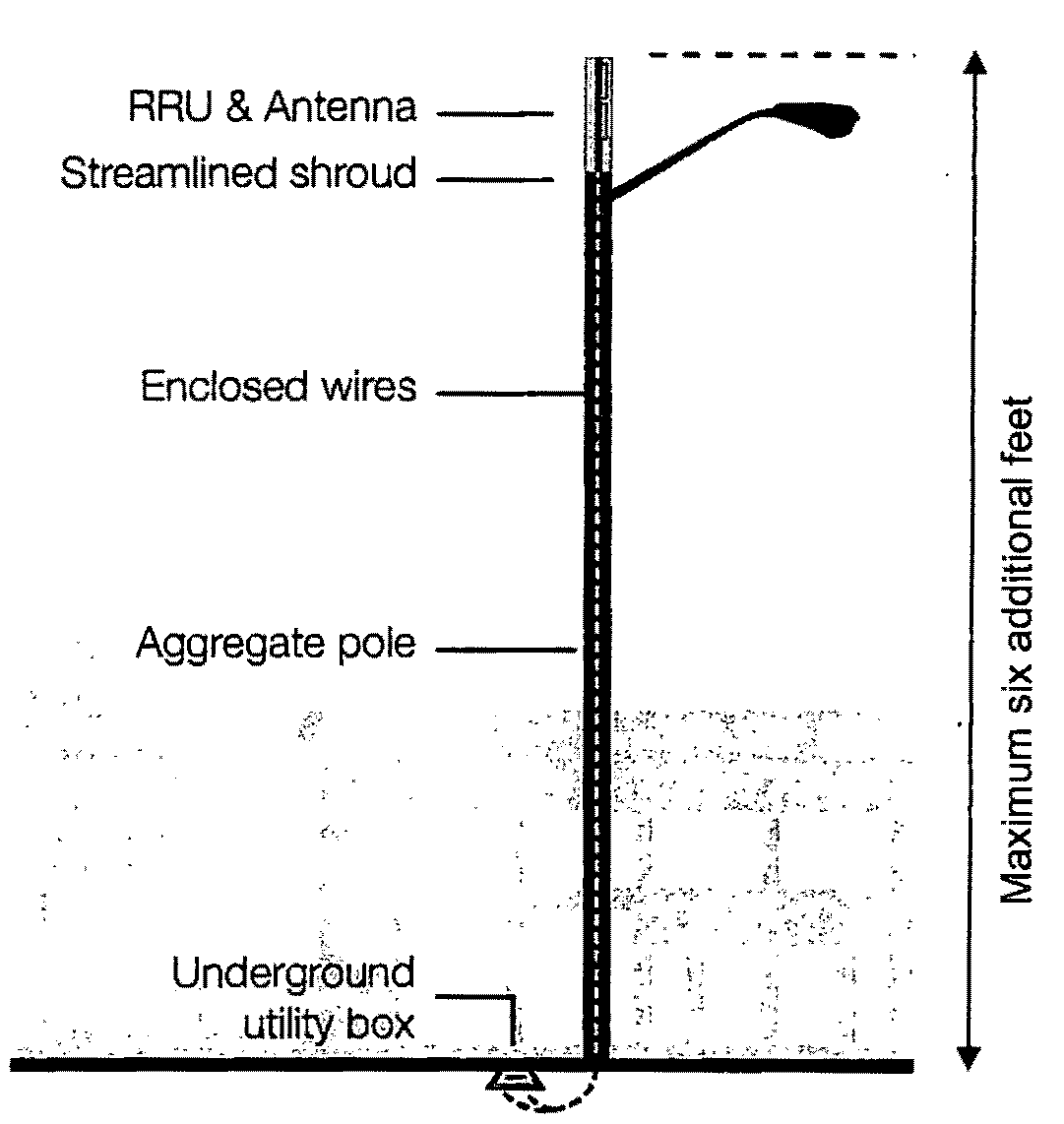
*The above image is an example of a facility that complies with the Objective Concealment Standards listed in this chapter. It is not intended to be interpreted as an all-inclusive standard in and of itself. A small utility facility must meet all standards listed in this chapter in order to be approved as a small utility facility.
(Ord. No. 19-06, § 6(Exh. A), 5-14-19)
Sec. 3-41-1.- Intent.
This chapter establishes development standards for residential beekeeping. These standards are intended to protect the public health and safety of the residential home and surrounding neighborhood.
All residential beekeeping activities shall both follow the City's Best Management Practices (BMP) Manual and be ancillary to the primary residential use of the property.
(Ord. No. 22-07, § 3(Exh. A), 5-10-22)
Sec. 3-41-2. - Definitions.
Apiary: Single location where one or more beehives are kept.
Bee: Any stage of the common domestic honey bee (apis mellifera species).
Beekeeping (residential): The raising, breeding, and maintenance of domestic honey bees (apis mellifera species) as an accessory use in residential zones.
Bee box, brood box or honey supers: Boxes used in a Langstroth hive with removable frames that have no top or bottom which allow the beekeeper to expand or condense the hive depending on the strength of the hive.
Bee hive: Structure for the housing of a bee colony.
Beekeeper: A person who keeps honey bees and manages bee hives.
Brood: The eggs, larvae and pupa of the honey bee prior to emerging as an adult bee.
Brood manipulation: Frames of brood that are taken from a healthy colony and donated to a weaker colony to strengthen its health and success for survival.
Colony: A collection of bees with one queen. This can be anywhere from a few hundred bees to many thousand bees.
Colony collapse disorder (CCD): The phenomenon that occurs when the majority of worker bees in a colony disappear and leave behind a queen, plenty of food and a few nurse bees to care for the remaining immature bees and the queen.
Frame: A hive component where bees build their honeycomb.
Hive: An artificial/man-made structure to house a honey bee nest.
Honeycomb: Beeswax cells where honey nectar and brood are stored.
Langstroth hive: A type of hive that is designed to be expandable or contractible with frames that can be removed for inspection.
No kill policy: The preservation, salvation and relocation of honey bees as humanely as possible.
Pollination: The process of collecting pollen from one flower and depositing it on another flower.
Queenright: A hive with a queen is called "queenright", a hive without a queen is called "queenless". Queen bees are vital to a colony because they are the only bees capable of laying fertilized eggs, called workers (female honey bees).
Removable frame: A frame designed to be removed from a hive for inspection purposes.
Requeen: To replace the queen bee in a colony with a new, younger and mated queen, a common practice in beekeeping to prevent bee swarming, increase brood and honey production or reduce hive defensiveness.
Robbing: Bees trying to steal honey from a hive that is not their own and depleting it of its resources.
Smoker: A tool used by a beekeeper to produce smoke to calm the bees.
Swarm: Group of bees in a transitional state leaving their original hive, clustering nearby, and then leaving again to establish a new hive in a new cavity.
Top bar hive: A trapezoidal box with slats of wood which the bees will make comb along. These slats can be pulled out with the comb for inspection.
(Ord. No. 22-07, § 3(Exh. A), 5-10-22)
Sec. 3-41-3. - Allowable zoning districts.
Residential beekeeping shall be allowed as an accessory use to single-family detached and single-family attached homes with single property ownership (homes on a condominium lot with multiple property ownership are prohibited) only in the following zoning districts:
2.1 Estate Density Residential
2.2 Low Density Residential
2.3 Medium Density Residential
2.4 Medium High Density Residential
2.5 High Density Residential
3.1 Multi-Use
8.1 Trails and Transit Oriented Development
(Ord. No. 22-07, § 3(Exh. A), 5-10-22)
Sec. 3-41-4. - Residential beekeeping standards.
All submittals for a residential beekeeping permit shall comply with all of the following requirements and development standards:
1.
Allowable bee species: Apis mellifera (Western honey bee).
2.
Minimum Lot Size: 2,400 square feet total.
3.
Maximum Number of Beehives: Two Langstroth beehives.
4.
Location:
a.
Beehive shall be located in the rear yard and behind side yard fencing;
b.
Beehive location shall be secured from unauthorized access; and
c.
Beehive location shall be screened and not visible from an adjacent street.
5.
Beehive setback: Refer to the building setback standards of the subject property's zoning designation.
6.
Beehive signage: The permittee shall comply with the following sign requirements:
a.
Location: Front yard gate/fence.
b.
Sign copy: Text conveying an active beehive (e.g. "Warning: Active Beehive").
c.
Size: 12"x24" (two square feet) max. Signs shall be exempt from Division 7 of the Zoning Ordinance.
7.
Residential Beekeeping Best Management Practices Manual: The City's BMPs Manual has been established to provide guidance for beekeepers and to provide information that will safeguard neighbors and the public in close proximity to where beehive(s) are kept.
(Ord. No. 22-07, § 3(Exh. A), 5-10-22)
Sec. 3-42-1.- Purpose.
The purpose of this chapter is to allow and regulate housing developments containing no more than two residential units within a single-family residential zone ("single-family residential duplexes"), as provided by Government Code Section 65852.21.
(Ord. No. 22-10, § 2, 6-14-22)
Sec. 3-42-2. - Definitions.
The following terms used in this chapter shall have the meanings indicated below:
"City" means the City of Irvine, a municipal corporation of the State of California, in its present incorporated form or in any later reorganized, consolidated, enlarged or reincorporated form.
"Single-family residential duplex" means a proposed housing development containing no more than two residential units on a single lot within a single-family residential zone. A housing development contains two residential units if the development proposes no more than two new units or if it proposes to add one new unit to one existing unit.
"Total floor area" means the total floor area of the single-family residential duplex, inclusive of all habitable areas and non-habitable areas of the structure, including but not limited to stairways, hallways, basements, attics, garages, storage areas, restrooms, and any other accessory spaces, consistent with the calculation of gross square footage in Irvine Zoning Ordinance Section 1-2-1.
(Ord. No. 22-10, § 2, 6-14-22)
Sec. 3-42-3. - Permit procedures.
A.
Permits. All single-family residential duplexes require a single-family residential duplex permit, which shall also serve as the building permit for such single-family residential duplex as set forth in Title 5 of the Irvine Municipal Code. If a proposed Single-family Residential Duplex requires any additional permit under the City of Irvine Municipal Code or Zoning Ordinance, all such permits shall be separately acquired by the applicant.
B.
Application processing. An application for a single-family residential duplex permit shall be made on forms provided by the city's community development department and be submitted with any applicable fees, including, but not limited to the appropriate development impact fees, charges, and in-lieu fees. The application shall include all information needed to determine compliance with this chapter in addition to all information required for a building permit pursuant to Title 5 of the Irvine Municipal Code. The application fee shall be established by resolution of the City Council.
C.
Notice to adjacent property owners.
1.
Applicants for a single-family residential duplex permit shall provide written notice to all the owners of record of each adjacent residential parcel to the property on which a single-family residential duplex is proposed prior to or concurrently with submission of an application for a single-family residential duplex permit to the City.
2.
For purposes of this paragraph, "adjacent residential parcel" shall mean parcels that share at least one common boundary. Parcels which are separated only by a public or private road or right-of-way shall be considered to be adjacent.
3.
Such written notice shall indicate that the applicant is applying for a single-family residential duplex permit, and shall include (a) the anticipated start and end dates, and hours for any planned construction, (b) contact information for the project manager for any such construction, and (c) contact information for the City's Community Development Department.
4.
This notice requirement does not confer a right on the noticed persons or on anyone else to comment on the project before permits are issued. Approval is ministerial. Under state law, the City has no discretion in approving or denying a particular project under this section. This notice requirement is purely to promote neighborhood awareness and expectation.
D.
Application review.
1.
The Community Development Director or his/her designee will review and approve complete applications for single-family residential duplex permits for compliance with the requirements of this chapter, the applicable underlying development standards in the zoning district in which it is located, as well as any applicable overlay district. The single-family residential duplex permit application shall be considered ministerially without any discretionary review or a public hearing.
2.
The City may deny a single-family residential duplex permit application if it fails to comply with the requirements of this chapter, the underlying development standards in the zoning district in which it is located, as well as any applicable overlay district. In addition to the foregoing, the Community Development Director or his/her designee may deny a single-family residential duplex permit application if he/she makes a written finding, based upon a preponderance of the evidence, that the proposed single-family residential duplex would have a specific, adverse impact, as defined and determined in subdivision (d) of Section 65589.5 of the Government Code, upon public health and safety or the physical environment and for which there is no feasible method to satisfactorily mitigate or avoid the specific, adverse impact. Notwithstanding the foregoing, an application shall not be rejected solely because it proposes adjacent or connected structures provided that the structures meet building code safety standards and are sufficient to allow separate conveyance.
3.
Except as otherwise provided in this chapter, the construction of a single-family residential duplex shall be subject to any applicable fees adopted pursuant to the requirements of Government Code, Title 7, Division 1, Chapter 5 (commencing with Section 66000) and Chapter 7 (commencing with Section 66012). This includes, but is not limited to, fees for the impact on schools, parks, and/or City services.
(Ord. No. 22-10, § 2, 6-14-22)
Sec. 3-42-4. - Objective development standards.
The development standards set forth below shall apply to all single-family residential duplexes. For any development standard not explicitly identified below, the objective requirements of the underlying zoning district shall apply, unless superseded by state law.
A.
Location and zoning requirements. Single-family residential duplexes shall only be allowed in the City's 2.1 Estate Density Residential, and 2.2 Low-Density Residential zones, in accordance with the permit and development standards described in this section, subject to the exceptions set forth below:
1.
Subdivision Map Act. Single-family residential duplexes must conform to all applicable objective requirements of the Subdivision Map Act (Division 2 (commencing with Section 66410)).
2.
Farmland. Pursuant to Government Code Sections 65852.2(a)(2) and 65913.4(a)(6), single-family residential duplexes shall not be located upon either prime farmland or farmland of statewide importance, as defined pursuant to United States Department of Agriculture land inventory and monitoring criteria, as modified for California, and designated on the maps prepared by the Farmland Mapping and Monitoring Program of the Department of Conservation, or land zoned or designated for agricultural protection or preservation by a local ballot measure that was approved by the voters of that jurisdiction.
3.
Wetlands. Pursuant to Government Code Sections 65852.2(a)(2) and 65913.4(a)(6), a single-family residential duplex shall not be located upon wetlands, as defined in the United States Fish and Wildlife Service Manual, Part 660 FW 2 (June 21, 1993).
4.
Fire zones. Pursuant to Government Code Sections 65852.2(a)(2) and 65913.4(a)(6), a single-family residential duplex shall not be located within a very high fire hazard severity zone, as determined by the Department of Forestry and Fire Protection pursuant to Section 51178, or within a high or very high fire hazard severity zone as indicated on maps adopted by the Department of Forestry and Fire Protection pursuant to Section 4202 of the Public Resources Code. This subparagraph does not apply to sites excluded from the specified hazard zones by the City, pursuant to subdivision (b) of Section 51179, or sites that have adopted fire hazard mitigation measures pursuant to existing building standards or state fire mitigation measures applicable to the development.
5.
Hazardous waste site. Pursuant to Government Code Sections 65852.2(a)(2) and 65913.4(a)(6), a single-family residential duplex shall not be located upon a hazardous waste site that is listed pursuant to Section 65962.5 or a hazardous waste site designated by the Department of Toxic Substances Control pursuant to Section 25356 of the Health and Safety Code, unless the State Department of Public Health, State Water Resources Control Board, or Department of Toxic Substances Control has cleared the site for residential use or residential mixed uses.
6.
Earthquake zone. Pursuant to Government Code Sections 65852.2(a)(2) and 65913.4(a)(6), a single-family residential duplex shall not be located within a delineated earthquake fault zone as determined by the State Geologist in any official maps published by the State Geologist, unless the development complies with applicable seismic protection building code standards adopted by the California Building Standards Commission under the California Building Standards Law (Part 2.5 (commencing with Section 18901) of Division 13 of the Health and Safety Code), and by any local building department under Chapter 12.2 (commencing with Section 8875) of Division 1 of Title 2.
7.
Floodplain areas. Pursuant to Government Code Sections 65852.2(a)(2) and 65913.4(a)(6), a single-family residential duplex shall not be located within a special flood hazard area subject to inundation by the one percent annual chance flood (100-year flood) as determined by the Federal Emergency Management Agency in any official maps published by the Federal Emergency Management Agency. Notwithstanding the foregoing, a single-family residential duplex may be located on a site described in this subparagraph if either of the following are met: (i) The site has been subject to a letter of map revision prepared by the Federal Emergency Management Agency and issued to the local jurisdiction; or (ii) the site meets Federal Emergency Management Agency requirements necessary to meet minimum floodplain management criteria of the National Flood Insurance Program pursuant to Part 59 (commencing with Section 59.1) and Part 60 (commencing with Section 60.1) of Subchapter B of Chapter I of Title 44 of the Code of Federal Regulations, and complies with the City's regulations related to its City's floodplain overlay districts.
8.
Regulatory floodways. Pursuant to Government Code Sections 65852.2(a)(2) and 65913.4(a)(6), a single-family residential duplex shall not be located within a regulatory floodway as determined by the Federal Emergency Management Agency in any official maps published by the Federal Emergency Management Agency, unless the applicant has received a no-rise certification in accordance with Section 60.3(d)(3) of Title 44 of the Code of Federal Regulations, and complies with the City's regulations related to its City's floodplain overlay districts.
9.
Conservation lands. Pursuant to Government Code Sections 65852.2(a)(2) and 65913.4(a)(6), a single-family residential duplex shall not be located upon lands identified for conservation in an adopted natural community conservation plan pursuant to the Natural Community Conservation Planning Act (Chapter 10 (commencing with Section 2800) of Division 3 of the Fish and Game Code), habitat conservation plan pursuant to the federal Endangered Species Act of 1973 (16 U.S.C. Sec. 1531 et seq.), other adopted natural resource protection plan, or that is otherwise subject to a conservation easement.
10.
Protected habitat. Pursuant to Government Code Sections 65852.2(a)(2) and 65913.4(a)(6), a single-family residential duplex shall not be located upon habitat for protected species identified as candidate, sensitive, or species of special status by state or federal agencies, fully protected species, or species protected by the federal Endangered Species Act of 1973 (16 U.S.C. Sec. 1531 et seq.), the California Endangered Species Act (Chapter 1.5 (commencing with Section 2050) of Division 3 of the Fish and Game Code), or the Native Plant Protection Act (Chapter 10 (commencing with Section 1900) of Division 2 of the Fish and Game Code).
11.
Existing non-conforming structure or use. Pursuant to Section 3-19-3 of this Zoning Ordinance, a single-family residential duplex shall not be constructed on any lot which has an existing development constructed upon it, which is non-conforming with respect to the City's current use or development standards unless the proposed single-family residential duplex complies with the current applicable land use regulations of this zoning ordinance.
12.
Historic district or property. A single-family residential duplex shall not be located within a historic district or upon property included on the State Historic Resources Inventory, as defined in Section 5020.1 of the Public Resources Code, or within a site that is designated or listed as a city or county landmark or historic property or district pursuant to a city or county ordinance.
B.
Restrictions related to existing affordable housing and rentals. Except as provided herein, single-family residential duplexes shall not require demolition or any alteration of any of the following types of housing:
1.
Existing housing upon the lot which the single-family residential duplex is proposed that is subject to a recorded covenant, ordinance, or law that restricts rents to levels affordable to persons and families of moderate, low, or very low income.
2.
Existing housing upon the lot which the single-family residential duplex is proposed that is subject to any form of rent or price control through the City's valid exercise of its police power.
3.
Existing housing upon the lot which the single-family residential duplex is proposed that has been occupied by a tenant in the last three years. In the event that a proposed single-family residential duplex was occupied by a tenant in the last three years, the proposed construction must not allow for the demolition of more than 25 percent of the existing housing's exterior structural walls.
4.
A single-family residential duplex shall not be located upon a parcel on which an owner of residential real property has exercised the owner's rights under Chapter 12.75 (commencing with Section 7060) of Division 7 of Title 1 of the Government Code to withdraw accommodations from rent or lease within 15 years before the date that the applicant submits an application.
C.
No more than two dwelling units per lot split parcel. Notwithstanding any provision of Government Code Sections 65852.2, 65852.21, 65852.22, 65915, or this section, the City shall not be required to permit more than two units on a parcel created through the exercise of the authority contained in Chapter 3-43 Urban Lot Splits. For the purposes of this section, "unit" means any dwelling unit, including, but not limited to, a unit or units created pursuant to this section, a primary dwelling, an accessory dwelling unit as defined in Government Code Section 65852.2, or a junior accessory dwelling unit as defined in Government Code Section 65852.22.
D.
Sale, rental, and occupancy of units. No single-family residential duplex unit shall be rented for less than 30 days. One of the units in the single-family residential duplex located on a parcel shall be occupied by the owner of the parcel as the owner's primary residence. Notwithstanding the foregoing, if an owner processes an urban lot split pursuant to Chapter 3-43 and constructs a single-family residential duplex on both lots, then only one of the single-family residential duplex units on the two parcels needs to be occupied by the owner of the parcel as the owner's primary residence.
E.
Deed restriction. A deed restriction prepared by the City shall be recorded on the subject property prior to issuance of the single-family residential duplex permit stating that (a) no single-family residential duplex unit shall be rented for less than 30 days, (b) one of the single-family residential duplex units shall be occupied by the owner of the parcel, (c) the single-family residential duplex unit not occupied by the owner of the parcel shall be rented as affordable housing to people of very low, low, or median income as those terms are defined in Chapter 2-3 of the Irvine Zoning Ordinance, and (d) the deed restriction runs with the land and each provision therein may be enforced against future owners of the property.
F.
Required setbacks.
1.
All single-family residential duplexes shall strictly comply with at least a four-foot side setback and at least a four-foot rear yard setback.
2.
All single-family residential duplexes must also strictly comply with the front yard setback requirement of the underlying zoning district in which it is located. For the purposes of this chapter, the front yard property line is defined as the narrowest property line of a lot abutting public or private street. If two or more equal property lines are the narrowest, the front shall be that property line across from which the development takes its primary access (if the primary access is determined to be equal, there shall be two front property lines).
3.
No portion of a single-family residential duplex, including but not limited to HVAC equipment, staircases, and patio covers, shall project into the required rear, side, or front yard setback.
4.
No setback requirement shall be required for an existing structure or a structure constructed in the same location and to the same dimensions as an existing structure. However, the new or converted structure must comply with all of the other requirements of this section, including the size, height, building separation, parking and permitting requirements set forth herein.
5.
In no event shall a single-family residential duplex encroach into the "limited use area" as that term is defined in City of Irvine Standard Plan 403, contained within Section 100 of the City of Irvine design manual.
6.
To the extent that another permit, approval, or easement, including a public utilities easement, applicable to the parcel requires a setback greater than those provided in this section, a single-family residential duplex shall comply with those setback requirements.
G.
Maximum height/stories. All single-family residential duplexes shall be subject to a height limitation of 16 feet, and shall be limited to one story.
H.
Building separation requirements. All single-family residential duplexes shall comply with City's applicable building separation requirements consistent with the underlying residential zoning district.
I.
Single-family residential duplex size requirements. For all single-family residential duplex units, the total floor area shall not exceed 800 square feet and one bedroom.
J.
Addresses. Each unit shall have a separate address and shall have approved address identification and wayfinding signage that is visible from the street fronting the lot in accordance with Section R319 of the California Residential Code and the City of Irvine Security Code. Where the unit address on the building cannot be viewed from the street fronting the lot, a monument, pole, or other means consistent with applicable objective City standards shall be used to identify the unit. Where required by the fire code official, address identification shall be provided in additional approved locations to facilitate emergency response.
K.
Services and utilities.
1.
Each unit in a single-family residential duplex shall maintain separate, direct, and independent public services and utilities, including separate connections and meters. All electric utility connections shall be underground.
2.
The owner of the parcel containing a proposed single-family residential duplex must enter into an easement agreement with each public-service and utility provider to establish easements that are sufficient for the provision of public services, utilities, and facilities to each of the units in a single-family duplex ("easement agreement"). Each existing or proposed easement shall be shown on the documentation submitted to the City as part of a single-family residential duplex application.
3.
An applicant shall submit copies of the unrecorded easement agreements or an easement deed showing the easements required by this section as part of the application for a single-family residential duplex permit. The easement agreements must be recorded before any construction on a single-family residential duplex may occur, and before any single-family residential duplex unit may be rented.
4.
If an easement is recorded and the single-family residential duplex is not approved or otherwise completed, making the easement moot, the property owner may request, and the City will provide, a notice of termination of the easement, which the owner of the parcel containing the proposed single-family residential duplex may record.
5.
For any public service or utility for which the public service or utility provider does not require an easement to provide such service or utility, the applicant shall submit as part of an application for a single-family residential duplex permit a written attestation from each public service and utility serving each single-family residential duplex unit. The attestation shall be signed by a representative of such public service or utility and shall certify that (1) the public service or utility agrees to serve the unit and (2) the public service or utility's network can adequately serve the unit.
L.
Existing public utilities easements. The application for the proposed single-family residential duplex shall include an attestation from the holders of any public utilities easements affecting the underlying parcel. The attestation shall authorize the proposed single-family residential duplex under the terms of the public utilities easement. The attestation required by this subsection is not required if there are no public utilities easements on the underlying parcel subject to a single-family residential duplex application.
M.
Landscaping. All landscaping for single-family residential duplexes shall comply with the landscaping standards in Chapter 3-15 of this zoning ordinance.
N.
Solid waste, storage. Each unit in a single-family residential duplex shall maintain separate and independent solid waste collection bins in compliance with the City's requirements for detached single-family residential units contained in the Irvine Municipal Code and Zoning Ordinance, including but not limited to Irvine Municipal Code Title 6, Division 7. Solid waste collection bins must be stored in a manner screened from view from all adjacent streets. A service attestation for solid waste collection, as set forth in Subsection K above must be submitted with a single-family residential duplex permit application.
O.
Frontage, driveway, access. Each unit in a single-family residential duplex must have vehicle access to the public right-of-way. All lots shall have a minimum street frontage of ten feet to provide for vehicular access, or 16-foot frontage if the driveway serves two units. To avoid encroachment onto the public right-of-way, no vehicles shall be parked on the ten- or 16-foot frontage required herein. For a lot without physical street frontage, access to street frontage shall be provided by the granting of a duly recorded permanent easement for ingress and egress purposes in favor of the lot without physical street frontage. In order to preserve the City's inventory of on-street parking, existing and proposed development pursuant to Government Code Section 65852.21 shall be limited to one driveway ingress/egress.
P.
Additional requirements.
1.
All single-family residential duplexes shall be constructed upon a permanent foundation.
2.
Single-family residential duplex units shall include permanent provisions for living, sleeping, eating, cooking, and sanitation, including but not limited to washer dryer hookups and kitchen facilities.
3.
If an applicant is required, as a result of a proposed single-family residential duplex, to make any modifications a parcel, including but not limited to utility connections, driveway additions or modifications, or accessibility upgrades, such cost shall be borne solely by the applicant.
4.
Each single-family residential duplex unit shall be connected to the public sewer, and that connection shall be subject to a connection fee, or capacity charge, or both.
5.
All single-family residential duplexes must meet the requirements of all applicable Codes, including but not limited to the California Building Code and the California Fire Code, as such codes have been adopted and amended by Title 5 of the City of Irvine Municipal Code.
6.
Each single-family residential duplex unit which is attached to or detached from an existing or proposed dwelling, shall have the same design, materials, finishes, dominant roof pitch, and colors as the attached dwelling and shall be in accordance with applicable code standards and design guidelines for the zoning district in which the single-family residential duplex sits. The "dominant roof pitch" is the roof slope shared by the largest portion of the roof.
7.
All exterior lighting on single-family residential duplexes shall be limited to down-lights. "Down-lights" are light fittings which light in a downward direction to light an area below.
8.
A residential rooftop solar energy system shall be required for all single-family residential duplex units and shall comply with applicable requirements of adopted building codes.
9.
No roof decks or balconies shall be constructed above or upon a single-family residential duplex.
10.
In the event that the property upon which the single-family residential duplex is proposed is located within a Homeowners Association ("HOA"), the applicant shall submit to the City written evidence of the HOA's approval of the single-family residential duplex prior to submitting a single-family residential duplex permit application.
11.
No window or door of a unit that is constructed as part of a single-family residential duplex shall have a direct line of sight to a window or door of a structure on an adjoining residential property. Fencing, landscaping, or privacy glass may be used to provide screening and prevent a direct line of sight.
12.
All single-family residential duplex units which are not inhabited as the primary residence of the owner of a single-family residential duplex shall be rented as affordable housing to people of very low, low, or median income, as those terms are defined in Chapter 2-3 of this Zoning Ordinance.
13.
All single-family residential duplex units shall comply with Section 11B-233.3 of the California Building Code.
Q.
Parking requirements. Except as provided in paragraph 3. below, single-family residential duplexes shall meet the following parking standards:
1.
At least one garage parking space shall be provided per single-family residential duplex unit and shall be equipped with an electric vehicle charging station complying with applicable requirements of adopted building codes.
2.
Parking spaces shall comply with Zoning Ordinance Division 4, except as may be permitted in this section, and be provided on the same lot as the dwelling.
3.
The foregoing parking standards shall not be imposed on a single-family residential duplex in any of the following circumstances:
a.
The single-family residential duplex is located within one-half mile walking distance of either a high-quality transit corridor, as defined in subdivision (b) of Section 21155 of the Public Resources Code, or a major transit stop, as defined in Section 21064.3 of the Public Resources Code; or
b.
The single-family residential duplex is located within one block of a car share vehicle.
R.
Associated permits. If an application for a single-family residential duplex permit triggers the requirement for a discretionary or ministerial permit other than a single-family residential duplex permit and/or a building permit (including but not limited to a conditional use permit), those associated permits must be applied for and obtained prior to application for a single-family residential duplex permit. The process for obtaining the associated permit(s) shall be as set forth in the Irvine Zoning Ordinance.
S.
Standards precluding development. If an applicant submits plans showing that any of the objective standards which otherwise apply to single-family residential duplex applications would have the effect of physically precluding the construction of up to two units or would physically preclude either of the two units from being at least 800 square feet in floor area, the Community Development Director or his/her designee shall ministerially permit the minimum deviation of the objective standards shown to physically preclude the construction of up to two units or physically preclude either of the two units from being at least 800 square feet in floor area necessary to physically allow the single-family residential duplex project. In no event shall the minimum rear and side setback requirements contained in this chapter be waived or modified pursuant to this paragraph.
(Ord. No. 22-10, § 2, 6-14-22)
Sec. 3-42-5. - Accessory dwelling unit ineligibility.
Parcels containing a single-family residential duplex and subject to an urban lot split as that term is defined in Chapter 3-43 shall be ineligible for an accessory dwelling unit or junior accessory dwelling unit permit under Chapter 3-26. Operation of an accessory dwelling unit or junior accessory dwelling unit in violation of this section shall be a violation of this chapter and grounds for enforcement pursuant to Section 3-42-7 (Enforcement and Remedies). The City shall not permit a single-family residential duplex proposed to be constructed on a lot created through an urban lot split which already contains an accessory dwelling unit or junior accessory dwelling unit. This section shall not prohibit an applicant from converting an existing single-family residence, accessory dwelling unit, or junior accessory dwelling unit into a single-family residential duplex in compliance with this chapter.
(Ord. No. 22-10, § 2, 6-14-22)
Sec. 3-42-6. - Covenants, conditions, and restrictions, homeowners' associations.
A.
Application. If a proposed single-family residential duplex is located on a lot subject to recorded covenants, conditions, and restrictions ("CC&Rs"), such CC&Rs may prohibit the construction of single-family residential duplexes on applicable lots, and may impose restrictions in addition to those contained in this chapter which shall apply to the affected lot. As used herein, the term "CC&Rs" refers to both the CC&Rs of a homeowners' association to which the lot is subject, and to private CC&Rs recorded against a lot. Nothing in this chapter shall be construed to prevent CC&Rs or a homeowners' association from prohibiting, restricting, or otherwise imposing rules on single-family residential duplexes.
B.
Permit requirements. An applicant for a single-family residential duplex on a lot subject to CC&Rs shall submit with his or her single-family residential duplex application a certified copy of said CC&Rs. In addition, an applicant for a single-family residential duplex on a lot subject to a homeowners' association shall submit a confirmation in writing, signed by the president or equivalent on behalf of the homeowners' association, that the homeowners' association has permitted the applicant to apply for a single-family residential duplex.
C.
Denial. In addition to the reasons for denial articulated in this chapter, the City may deny a single-family residential duplex permit application if the CC&Rs recorded against the lot prohibit the construction of the proposed single-family residential duplex. In addition, the City may deny a single-family residential duplex permit application if the homeowners' association with authority over the subject lot prohibits the proposed construction or the applicant fails to submit the writing required by subsection B. immediately above.
(Ord. No. 22-10, § 2, 6-14-22)
Sec. 3-42-7. - Enforcement and remedies.
A.
Criminal fines and penalties. Any person responsible for violating any provision of this chapter is guilty of a misdemeanor at the discretion of the City Attorney and/or district attorney. Upon conviction, the person shall be punished as prescribed in Division 13 of Title 4 of the Irvine Municipal Code.
B.
Administrative fines and penalties. Whenever an officer charged with the enforcement of any provision of this Zoning Ordinance determines that a violation of this chapter has occurred, the officer shall have the authority to issue an administrative citation to any person responsible for the violation in accordance with Division 13 of Title 4 of the Irvine Municipal Code.
C.
Public nuisance and lien on property. Any use or condition caused, or permitted to exist, in violation of any provision of this chapter shall be, and is hereby declared to be, a public nuisance and may be summarily abated by the City pursuant to Code of Civil Procedure Section 731 or any other remedy available at law. In accordance with Division 11 of Title 4 of the Irvine Municipal Code, the City may also collect any fee, cost, or charge incurred in the abatement of such nuisance by making the amount of any unpaid fee, cost or charge a lien against the property that is the subject of the enforcement activity.
D.
Civil action. In addition to any other enforcement permitted by the City's Zoning and/or Municipal Codes, the City Attorney may bring a civil action for injunctive relief and civil penalties against any person who violates any provision of this chapter. In any civil action that is brought pursuant to this chapter, a court of competent jurisdiction may award civil penalties and costs to the prevailing party.
E.
Single-family residential duplex permit revocation. Any violation of this chapter may result in revocation of a single-family residential duplex permit as prescribed in Chapter 2-10 of this Zoning Ordinance.
Use of any one or more of these remedies shall be at the sole discretion of the City and nothing in this section shall prevent the City from initiating civil, criminal, or other legal or equitable proceedings as an alternative to any of the proceedings set forth above.
(Ord. No. 22-10, § 2, 6-14-22)
Sec. 3-43-1.- Purpose.
The purpose of this chapter is to allow and regulate urban lot splits as provided by Government Code Section 66411.7.
(Ord. No. 22-10, § 3, 6-14-22)
Sec. 3-43-2. - Definitions.
The following terms used in this chapter shall have the meanings indicated below:
"City" means the City of Irvine, a municipal corporation of the State of California, in its present incorporated form or in any later reorganized, consolidated, enlarged or reincorporated form.
"Urban lot split" means a subdivision of an existing legal parcel in a single-family residential zone to create no more than two new parcels of approximately equal lot area, subject to the requirements of this section.
For the purposes of this chapter, "unit" means any dwelling unit, including, but not limited to, a unit or units created pursuant to Government Code Section 65852.21, a primary dwelling, an accessory dwelling unit as defined in Government Code Section 65852.2, or a junior accessory dwelling unit as defined in Government Code Section 65852.22.
(Ord. No. 22-10, § 3, 6-14-22)
Sec. 3-43-3. - Permit procedures.
A.
Permits. All urban lot splits require an urban lot split permit. Where applicable, the applicant shall also obtain a building permit as set forth in Title 5 of the Irvine Municipal Code, in addition to any and all other permits required by the Irvine Municipal Code and Zoning Ordinance.
B.
Application processing. An application for an urban lot split permit shall be made on forms provided by the City's Community Development Department, and be submitted with any applicable fees, including, but not limited to the appropriate development impact fees, charges, and in-lieu fees, such as a park in-lieu fee pursuant to Irvine Municipal Code Section 5-5-1004. The application shall include all information needed to determine compliance with this chapter, including but not limited to a parcel map for an urban lot split prepared by a registered civil engineer or licensed land surveyor in accordance with Government Code Sections 66444—66450 and this chapter. The application fee shall be established by resolution of the City Council.
C.
Notice to adjacent property owners.
1.
Applicants for an urban lot split permit shall provide written notice to all the owners of record of each adjacent residential parcel prior to or concurrently with submission of an application for an urban lot split permit to the City.
2.
For purposes of this paragraph, "adjacent residential parcel" shall mean means parcels that share at least one common boundary. Parcels which are separated only by a public or private road or right-of-way shall be considered to be adjacent.
3.
Such written notice shall indicate that the applicant is applying for an urban lot split permit, and the contact information for the City's Community Development Department.
4.
This notice requirement does not confer a right on the noticed persons or on anyone else to comment on the project before permits are issued. Approval is ministerial. Under state law, the City has no discretion in approving or denying a particular project under this section. This notice requirement is purely to promote neighborhood awareness and expectation.
D.
Application review.
1.
The Community Development Director or his/her designee and the City Engineer or his/her designee will review and approve complete applications for urban lot split permits for compliance with the requirements of this chapter, the underlying applicable development standards in the zoning district in which it is located, as well as any applicable overlay district. The urban lot split permit application shall be considered ministerially without any discretionary review or a public hearing.
2.
The City may deny an urban lot split permit application if it fails to comply with the requirements of this chapter, the underlying applicable development standards in the zoning district in which it is located, as well as any applicable overlay district. In addition to the foregoing, the Community Development Director or his/her designee may deny a urban lot split permit application if he/she makes a written finding, based upon a preponderance of the evidence, that the proposed urban lot split would have a specific, adverse impact, as defined and determined in Subdivision (d) of Section 65411.7 of the Government Code, upon public health and safety or the physical environment and for which there is no feasible method to satisfactorily mitigate or avoid the specific, adverse impact. Notwithstanding the foregoing, an application shall not be rejected solely because it proposes adjacent or connected structures provided that the structures meet building code safety standards and are sufficient to allow separate conveyance.
3.
Except as otherwise provided in this chapter, the construction of an urban lot split shall be subject to any applicable fees adopted pursuant to Government Code, Title 7, Division 1, Chapter 5 (commencing with Section 66000) and Chapter 7 (commencing with Section 66012). This includes, but is not limited to, fees for the impact on schools, parks, and/or City services.
(Ord. No. 22-10, § 3, 6-14-22)
Sec. 3-43-4. - Objective development standards.
The development standards set forth below shall apply to all urban lot splits, or any development standard not explicitly identified below, the objective requirements of the underlying zoning district shall apply, unless superseded by state law.
A.
Location and zoning requirements. Urban lot split shall only be allowed in the City's 2.1 Estate Density Residential and 2.2 Low-Density Residential zones, in accordance with the permit and development standards described in this section, subject to the exceptions set forth below:
1.
Subdivision Map Act. Urban lot splits must conform to all applicable objective requirements of the Subdivision Map Act (Division 2 (commencing with Section 66410)).
2.
Farmland. Pursuant to Government Code Sections 66411.7(a)(2)(C) and 65913.4(a)(6), urban lot splits shall not be allowed upon either prime farmland or farmland of statewide importance, as defined pursuant to United States Department of Agriculture land inventory and monitoring criteria, as modified for California, and designated on the maps prepared by the Farmland Mapping and Monitoring Program of the Department of Conservation, or land zoned or designated for agricultural protection or preservation by a local ballot measure that was approved by the voters of that jurisdiction.
3.
Wetlands. Pursuant to Government Code Sections 66411.7(a)(2)(c) and 65913.4(a)(6), urban lot splits shall not be allowed upon lands that are considered wetlands, as defined in the United States Fish and Wildlife Service Manual, Part 660 FW 2 (June 21, 1993).
4.
Fire zones. Pursuant to Government Code Sections 66411.7(a)(2)(C) and 65913.4(a)(6), urban lot splits shall not be allowed upon lands located within a very high fire hazard severity zone, as determined by the Department of Forestry and Fire Protection pursuant to Section 51178, or within a high or very high fire hazard severity zone as indicated on maps adopted by the Department of Forestry and Fire Protection pursuant to Section 4202 of the Public Resources Code. This subparagraph does not apply to sites excluded from the specified hazard zones by the City, pursuant to subdivision (b) of Section 51179, or sites that have adopted fire hazard mitigation measures pursuant to existing building standards or state fire mitigation measures applicable to the development.
5.
Hazardous waste site. Pursuant to Government Code Sections 66411.7(a)(2)(C) and 65913.4(a)(6), urban lot splits shall not be located upon a hazardous waste site that is listed pursuant to Section 65962.5 or a hazardous waste site designated by the Department of Toxic Substances Control pursuant to Section 25356 of the Health and Safety Code, unless the State Department of Public Health, State Water Resources Control Board, or Department of Toxic Substances Control has cleared the site for residential use or residential mixed uses.
6.
Earthquake zone. Pursuant to Government Code Sections 66411.7(a)(2)(C) and 65913.4(a)(6), urban lot splits shall not be located on lands within a delineated earthquake fault zone as determined by the State Geologist in any official maps published by the State Geologist, unless the development complies with applicable seismic protection building code standards adopted by the California Building Standards Commission under the California Building Standards Law (Part 2.5 (commencing with Section 18901) of Division 13 of the Health and Safety Code), and by any local building department under Chapter 12.2 (commencing with Section 8875) of Division 1 of Title 2.
7.
Floodplain areas. Pursuant to Government Code Sections 66411.7(a)(2)(c) and 65913.4(a)(6), urban lot splits shall not be located within a special flood hazard area subject to inundation by the one percent annual chance flood (100-year flood) as determined by the Federal Emergency Management Agency in any official maps published by the Federal Emergency Management Agency. Notwithstanding the foregoing, a urban lot split may be permitted on a site described in this subparagraph if either of the following are met: (i) The site has been subject to a letter of map revision prepared by the Federal Emergency Management Agency and issued to the local jurisdiction; or (ii) the site meets Federal Emergency Management Agency requirements necessary to meet minimum flood plain management criteria of the National Flood Insurance Program pursuant to Part 59 (commencing with Section 59.1) and Part 60 (commencing with Section 60.1) of Subchapter B of Chapter I of Title 44 of the Code of Federal Regulations, and complies with the City's regulations related to its City's Flood Plain Overlay Districts.
8.
Regulatory Floodways. Pursuant to Government Code Sections 66411.7(a)(2)(C) and 65913.4(a)(6), urban lot splits shall not be located within a regulatory floodway as determined by the Federal Emergency Management Agency in any official maps published by the Federal Emergency Management Agency, unless the applicant has received a no-rise certification in accordance with Section 60.3(d)(3) of Title 44 of the Code of Federal Regulations, and complies with the City's regulations related to its City's Flood Plain Overlay Districts.
9.
Conservation lands. Pursuant to Government Code Sections 66411.7(a)(2)(C) and 65913.4(a)(6), urban lot splits shall not be located upon lands identified for conservation in an adopted natural community conservation plan pursuant to the Natural Community Conservation Planning Act (Chapter 10 (commencing with Section 2800) of Division 3 of the Fish and Game Code), habitat conservation plan pursuant to the Federal Endangered Species Act of 1973 (16 U.S.C. Sec. 1531 et seq.), other adopted natural resource protection plan, or that is otherwise subject to a conservation easement.
10.
Protected habitat. Pursuant to Government Code Sections 66411.7(a)(2)(C) and 65913.4(a)(6), urban lot splits shall not be located upon habitat for protected species identified as candidate, sensitive, or species of special status by state or federal agencies, fully protected species, or species protected by the Federal Endangered Species Act of 1973 (16 U.S.C. Sec. 1531 et seq.), the California Endangered Species Act (Chapter 1.5 (commencing with Section 2050) of Division 3 of the Fish and Game Code), or the Native Plant Protection Act (Chapter 10 (commencing with Section 1900) of Division 2 of the Fish and Game Code).
11.
Existing non-conforming structure or use. Pursuant to Section 3-19-3 of this zoning ordinance, no unit shall be constructed on any lot which has an existing development constructed upon it, which is non-conforming with respect to the City's current use or development standards unless the proposed unit complies with the current applicable land use regulations of this zoning ordinance. The City will not require correction of nonconforming zoning conditions as a condition for ministerial approval.
12.
Historic district or property. No urban lot split shall be located within a historic district or upon property included on the State Historic Resources Inventory, as defined in Section 5020.1 of the Public Resources Code, or within a site that is designated or listed as a city or county landmark or historic property or district pursuant to a city or county ordinance.
B.
Restrictions related to existing affordable housing and rentals. Except as provided herein, an urban lot split shall not require demolition or any alteration of any of the following types of housing:
1.
Existing housing upon the lot which the urban lot split is proposed that is subject to a recorded covenant, ordinance, or law that restricts rents to levels affordable to persons and families of moderate, low, or very low income.
2.
Existing housing upon the lot which the urban lot split is proposed that is subject to any form of rent or price control through the City's valid exercise of its police power.
3.
Existing housing upon the lot which the urban lot split is proposed that has been occupied by a tenant in the last three years.
4.
An urban lot split shall not be located upon a parcel on which an owner of residential real property has exercised the owner's rights under Chapter 12.75 (commencing with Section 7060) of Division 7 of Title 1 of the Government Code to withdraw accommodations from rent or lease within 15 years before the date that the applicant applies for the urban lot split.
C.
Rental and occupancy of units. All dwelling units constructed upon parcel(s) subject to or created by an urban lot split shall not be rented for less than 30 days. In addition, the applicant shall occupy one of the dwelling units created by the urban lot split for a period of three years from the date of approval of an urban lot split permit as their primary residence.
D.
Owner occupancy affidavit. As required by Government Code Section 66411.7(g), an applicant for an urban lot split shall sign an affidavit stating that the applicant intends to occupy one of the housing units as their principal residence for a minimum of three years from the date of the approval of the urban lot split.
E.
Deed restriction. A deed restriction prepared by the City shall be recorded on the subject propert(ies) prior to issuance of the urban lot split permit stating that (1) any dwelling constructed upon property subject to the urban lot split shall not be rented for less than 30 days, (2) the applicant shall occupy one of the dwelling units constructed upon a parcel created by an urban lot split for a period of three years from the date of recording of the parcel map for the urban lot split as his or her primary residence; (3) the parcel was created by an urban lot split pursuant to SB 9 and is not subject to further subdivision; (4) all units on the parcel not occupied by the owner of the parcel shall be rented as affordable housing to people of very low, low, or median income as those terms are defined in Chapter 2-3 of the Irvine Zoning Ordinance, and (5) the deed restriction runs with the land and each provision therein may be enforced against future owners of the property.
F.
Parcel size. The parcel map submitted as part of an urban lot split application shall subdivide an existing parcel to create no more than two new parcels of approximately equal lot area. In addition to the foregoing, each of the newly created parcels shall be no smaller than 1,200 square feet. Neither of the parcels created through an Urban Lot Split shall be smaller than 40 percent of the lot area of the original parcel proposed for subdivision.
G.
Lot lines. Lot lines shall be depicted on the parcel map submitted as part of an urban lot split application and prepared by a registered civil engineer or licensed land surveyor in accordance with Government Code Sections 66444—66450. Lot lines shall include a reference basis, distance measurement, and bearings. The location and orientation of new lot lines shall meet all of the following standards:
1.
Front lot lines shall conform to the minimum public street frontage requirements of this zoning ordinance.
2.
Each parcel shall have approximately equal lot width and lot depth, consistent with the minimum parcel sizes described in paragraph F. of this section. Lot depth shall be measured at the midpoint of the front lot line. Lot width shall be measured by a line connecting two points on opposite interior lot lines that will result in a line parallel to the front lot line.
3.
New lot lines must be straight lines, unless there is a conflict with existing improvements or the natural environment in which case the line may be not straight but shall follow the appropriate course.
4.
Lot lines facing a street or right-of-way shall be parallel to the street or right-of-way.
5.
Interior lot lines not facing the street shall be at right angles perpendicular to the street or right-of-way on straight streets or rights-of-way, or radial to the street or right-of-way on curved streets or rights-of-way.
6.
Lot lines shall be contiguous with existing zoning boundaries.
7.
The placement of lot lines shall not result in an accessory building or accessory use on a lot without a main building or primary use on the same lot, as defined in this zoning ordinance.
8.
Lot lines shall not render an existing structure as nonconforming in any respect (e.g., setbacks, open yard, site coverage, parking), nor increase, expand, enlarge, or intensify the nonconformity of an existing nonconforming structure.
9.
Except as otherwise provided in this chapter, zero lot lines shall not be permitted. For the purposes of this section, a "zero lot line" exists when a structure abuts the edge of the property line on any side of the parcel.
H.
No prior urban lot splits for parcel or applicant. To be eligible for an urban lot split, the parcel that is the subject of the application shall not have been established through prior exercise of an urban lot split as provided for in Government Code Section 66411.7, which this section implements. In addition to the foregoing, neither the owner of the parcel being subdivided nor any person acting in concert with the owner may have previously subdivided an adjacent parcel using an urban lot split as provided for in this section.
I.
Required setbacks.
1.
All dwelling units constructed upon parcel(s) subject to or created by an urban lot split shall strictly comply with at least a four-foot side setback and at least a four-foot rear yard setback.
2.
All dwelling units constructed upon parcel(s) subject to or created by an urban lot split must also strictly comply with the front yard setback requirement of the underlying zoning district in which it is located. For the purposes of this chapter, the front yard property line is defined as the narrowest property line of a lot abutting public or private street. If two or more equal property lines are the narrowest, the front shall be that property line across from which the development takes its primary access (if the primary access is determined to be equal, there shall be two front property lines).
3.
No portion of a dwelling constructed upon property that is subject to an urban lot split, including but not limited to HVAC equipment, staircases, and patio covers, shall project into the required rear, side, or front yard setback.
4.
No setback requirement shall be required for a legally existing structure located upon a parcel subject to or created by an urban lot split. However, the existing structure must comply with all of the other requirements of this section, including the size, height, building separation, parking, and permitting requirements set forth herein.
5.
In no event shall a unit on a parcel subject to an urban lot split encroach into the "limited use area" as that term is defined in City of Irvine Standard Plan 403, contained within Section 100 of the City of Irvine design manual.
6.
To the extent that another permit, approval, or easement, including a public utilities easement, applicable to the parcel requires a setback greater than those provided in this section, units on the affected urban lot split parcel shall comply with those setback requirements.
J.
Maximum height/stories. All dwelling units constructed upon parcel(s) subject to or created by an urban lot split shall be subject to a height limitation of 16 feet and shall be limited to one story.
K.
Building separation requirements. All dwelling units constructed upon parcel(s) subject to or created by an urban lot split shall comply with the City's applicable building separation requirements consistent with the underlying residential zoning district.
L.
Size requirements. For all dwelling units constructed upon parcel(s) subject to or created by an urban lot split, the total floor area shall not exceed 800 square feet and one bedroom.
M.
Addresses. Each unit shall have a separate address and shall be provided with approved address identification and wayfinding signage that is visible from the street fronting the lot in accordance with Section R319 of the California Residential Code and the City of Irvine Security Code. Where the unit address on the building cannot be viewed from the street fronting the lot, a monument, pole, or other means consistent with applicable objective City standards shall be used to identify the unit. Where required by the fire code official, address identification shall be provided in additional approved locations to facilitate emergency response.
N.
Services and utilities.
1.
Each unit shall maintain separate and independent public services and utilities, including separate utility connections and meters. All electric utility connections shall be underground.
2.
The owner of a parcel subject to a proposed urban lot split must enter into an easement agreement ("easement agreement") with each public service and utility provider to establish easements that are sufficient for the provision of public services, utilities, and facilities to each of the units on each of the resulting lots.
3.
Each easement must be shown on the tentative parcel map submitted to the City as part of the urban lot split permit application.
4.
Copies of the unrecorded easement agreements, or an easement deed showing the easements required by this section must be submitted with the urban lot split permit application. The easement agreements must be recorded before the final map for a proposed urban lot split may be approved.
5.
If an easement is recorded and the proposed urban lot split is not approved or otherwise completed, making the easement moot, the parcel owner may request, and the city will provide, a notice of termination of the easement, which the parcel owner may record.
6.
For any public service or utility for which the provider does not require an easement to provide such service or utility, the applicant shall submit as part of an application for an urban lot split permit a written attestation from each public service and utility serving each unit on each parcel proposed to result from such urban lot split. The attestation shall be signed by a representative of such public service or utility and shall certify that (1) the public service or utility agrees to serve the unit and (2) the public service or utility's network can adequately serve the unit.
O.
Existing public utilities easements. The application for the proposed urban lot split shall include an attestation from the holders of any public utilities easements affecting the underlying parcel. The attestation shall authorize the proposed urban lot split under the terms of the public utilities easement. The attestation required by this subsection is not required if there are no public utilities easements on the underlying parcel subject to a proposed urban lot split.
P.
Landscaping. All landscaping for urban lot split parcels shall comply with the applicable landscaping Standards in Chapter 3-15 of this zoning ordinance.
Q.
Solid waste, storage. Each unit shall maintain separate and independent solid waste collection bins in compliance with the City's requirements for detached single-family residential units contained in the Irvine Municipal Code and Zoning Ordinance, including but not limited to Irvine Municipal Code Title 6, Division 7. Solid waste collection bins must be stored in a manner screened from view from all adjacent streets. A service attestation for solid waste collection, as that term is defined in Subsection N above must be submitted with an urban lot split permit application.
R.
Frontage, driveway, access. Each urban lot split parcel must have vehicle access to the public right-of-way. All lots shall have a minimum street frontage of ten feet to provide for vehicular access, or 16-foot frontage if the driveway serves two units. To avoid encroachment onto the public right-of-way, no vehicles shall be parked on the ten- or 16-foot frontage required herein. For a lot without physical street frontage, access to street frontage shall be provided by the granting of a duly recorded permanent easement for ingress and egress purposes in favor of the lot without physical street frontage.
S.
Additional Requirements.
1.
All dwelling units constructed upon parcel(s) subject to or created by an urban lot split shall be constructed upon a permanent foundation.
2.
The proposed urban lot split shall conform to all applicable objective requirements of the Irvine Zoning Ordinance, the City of Irvine Subdivision Manual, and the Subdivision Map Act (Division 2 of the Government Code (commencing with Section 66410)), except as otherwise expressly provided in this section.
3.
If an applicant is required, as a result of a proposed urban lot split, to make any modifications a parcel, including but not limited to utility connections, driveway additions or modifications, or accessibility upgrades, such cost shall be borne solely by the applicant. However, notwithstanding Government Code Section 66411.1, the City shall not require dedications of rights-of-way or the construction of off-site improvements for the parcels being created as a condition of issuing a parcel map for an urban lot split.
4.
All dwelling units constructed upon parcel(s) subject to or created by an urban lot split shall include permanent provisions for living, sleeping, eating, cooking, and sanitation, including but not limited to washer dryer hookups and kitchen facilities.
5.
All dwelling units constructed upon parcel(s) subject to or created by an urban lot split unit shall be connected to the public sewer, and that connection shall be subject to a connection fee, or capacity charge, or both.
6.
No building permit for development on an urban lot split lot shall be issued until the parcel map for the urban lot split is recorded.
7.
Notwithstanding any provision of Government Code Sections 65852.2, 65852.21, 65852.22, 65915, or 66411.7, no more than two dwelling units can occupy a parcel created through an urban lot split. In addition, parcels containing both a single-family residential duplex as that term is defined in Chapter 3-42 and subject to or created by an urban lot split shall be ineligible for an accessory dwelling unit or junior accessory dwelling unit permit under Chapter 3-26. Operation of an accessory dwelling unit or junior accessory dwelling unit in violation of this section shall be a violation of this chapter and grounds for enforcement pursuant to Section 3-43-6 (Enforcement and Remedies). The City will not permit a proposed urban lot split which would result in a single-family residential duplex, and an accessory dwelling unit or junior accessory dwelling unit on the same urban lot split parcel, or which would result in more than two units on the same urban lot split parcel. This section shall not prohibit an applicant from converting an existing single-family residence, accessory dwelling unit, or junior accessory dwelling unit into a single-family residential duplex in compliance with Chapter 42 of this zoning ordinance.
8.
All dwelling units constructed upon parcel(s) subject to or created by an urban lot split must meet the applicable requirements of all applicable Codes, including but not limited to the California Building Code and the California Fire Code, as such codes have been adopted and amended by Title 5 of the City of Irvine Municipal Code.
9.
Each unit which is attached to or detached from an existing or proposed dwelling shall have the same design, materials, finishes, dominant roof pitch, and colors as the attached dwelling and shall be in accordance with code standards and design guidelines for the zoning district in which the lot sits, he "dominant roof pitch" is the roof slope shared by the largest portion of the roof.
10.
Any proposed detached units on the same lot shall be compatible in exterior appearance with an existing unit in terms of design, materials, finishes, dominant roof pitch, and colors within the same property on which it is proposed to be constructed, in accordance with applicable code standards and design guidelines for the zoning district in which the lot sits. The "dominant roof pitch" is the roof slope shared by the largest portion of the roof.
11.
All exterior lighting on units shall be limited to down-lights. "Down-lights" are light fittings which light in a downward direction to light an area below.
12.
No window or door of a unit that is constructed on an urban lot split parcel shall have a direct line of sight to a window or door of a structure on an adjoining residential property. Fencing, landscaping, or privacy glass may be used to provide screening and prevent a direct line of sight.
13.
A residential rooftop solar energy system shall be required for all units upon parcel(s) subject to or created by an urban lot split and shall comply with applicable requirements of adopted building codes.
14.
No roof decks or balconies shall be constructed above or upon any dwelling units constructed upon parcel(s) subject to or created by an urban lot split.
15.
In the event that the property upon which the urban lot split is proposed is located within a homeowners' association ("HOA"), the applicant shall submit to the City written evidence of the HOA's approval of the urban lot split prior to submitting an urban lot split permit application.
16.
All units on urban lot split lots which are not inhabited as the primary residence of the owner of said parcel shall be rented as affordable housing to people of very low, low, or median income, as those terms are defined in Chapter 2-3 of this zoning ordinance. All units on urban lot split lots shall comply with Section 11B-233.3 of the California Building Code.
T.
Parking requirements. Except as provided in this section, all dwelling units constructed upon parcel(s) subject to or created by an urban lot split shall meet the following parking standards:
1.
At least one off-street garage parking space shall be provided per unit. The off-street garage parking space shall be equipped with an electric vehicle charging station complying with applicable requirements of adopted building codes.
2.
Parking spaces shall comply with Zoning Ordinance Division 4, except as may be permitted in this section, and be provided on the same lot as the dwelling.
3.
The foregoing parking standards shall not be imposed on a dwelling constructed upon property subject to an urban lot split in the following circumstances:
a.
The dwelling is located within one-half mile walking distance of either a high-quality transit corridor, as defined in subdivision (b) of Section 21155 of the Public Resources Code, or a major transit stop, as defined in Section 21064.3 of the Public Resources Code.
b.
There is a car share vehicle located within one block of the parcel.
U.
Associated permits. If an application for a urban lot split triggers the requirement for a discretionary or ministerial permit other than a urban lot split and/or a building permit (including but not limited to a conditional use permit), those associated permits must be applied for and obtained prior to application for an urban lot split permit. The process for obtaining the associated permit(s) shall be as set forth in the Irvine Zoning Ordinance.
V.
Standards precluding development. If an applicant submits plans showing that any of the objective standards which otherwise apply to urban lot split applications would have the effect of physically precluding the construction of up to two units on each parcel or would physically preclude either of the two units from being at least 800 square feet in floor area, the City Engineer or his/her designee shall ministerially permit the minimum deviation of the objective standards shown to physically preclude the construction of up to two units on each parcel or physically preclude either of the two units from being at least 800 square feet in floor area necessary to physically allow the Urban Lot Split project. In no event shall the minimum rear and side setback requirements contained in this chapter be waived or modified pursuant to this paragraph.
(Ord. No. 22-10, § 3, 6-14-22)
Sec. 3-43-5. - Covenants, conditions, and restrictions, homeowners' associations.
A.
Application. If a proposed urban lot split is located on a lot subject to recorded covenants, conditions, and restrictions ("CC&Rs"), such CC&Rs may prohibit the urban lot split on applicable lots and may impose restrictions in addition to those contained in this chapter which shall apply to the affected lot. The term "CC&Rs" refers to both the CC&Rs of a homeowners' association to which the lot is subject, and to private CC&Rs recorded against a lot. Nothing in this chapter shall be construed to prevent CC&Rs or a homeowners' association from prohibiting, restricting, or otherwise imposing rules on urban lot splits.
B.
Permit requirements. An applicant for an urban lot split on a lot subject to CC&Rs shall submit with his or her urban lot split application a certified copy of said CC&Rs. In addition, an applicant for an urban lot split on a lot subject to a homeowners' association shall submit a confirmation in writing, signed by the president or equivalent on behalf of the homeowners' association, that the homeowners' association has permitted the applicant to apply for an urban lot split.
C.
Denial. In addition to the reasons for denial articulated in this chapter, the City may deny an urban lot split application if the CC&Rs recorded against the lot prohibit the construction of the proposed urban lot split. In addition, the City may deny an urban lot split application if the homeowners' association with authority over the subject lot prohibits the proposed urban lot split, or the applicant fails to submit the writing required by subsection B. immediately above.
(Ord. No. 22-10, § 3, 6-14-22)
Sec. 3-43-6. - Enforcement and remedies.
A.
Criminal fines and penalties. Any person responsible for violating any provision of this chapter is guilty of a misdemeanor at the discretion of the City Attorney and/or district attorney. Upon conviction, the person shall be punished as prescribed in Division 13 of Title 4 of the Irvine Municipal Code.
B.
Administrative fines and penalties. Whenever an officer charged with the enforcement of any provision of this zoning ordinance determines that a violation of this chapter has occurred, the officer shall have the authority to issue an administrative citation to any person responsible for the violation in accordance with Division 13 of Title 4 of the Irvine Municipal Code.
C.
Public nuisance and lien on property. Any use or condition caused, or permitted to exist, in violation of any provision of this chapter shall be, and is hereby declared to be, a public nuisance and may be summarily abated by the City pursuant to Code of Civil Procedure Section 731 or any other remedy available at law. In accordance with Division 11 of Title 4 of the Irvine Municipal Code, the City may also collect any fee, cost, or charge incurred in the abatement of such nuisance by making the amount of any unpaid fee, cost or charge a lien against the property that is the subject of the enforcement activity.
D.
Civil action. In addition to any other enforcement permitted by the City's Zoning and/or Municipal Codes, the City Attorney may bring a civil action for injunctive relief and civil penalties against any person who violates any provision of this chapter. In any civil action that is brought pursuant to this chapter, a court of competent jurisdiction may award civil penalties and costs to the prevailing party.
E.
Urban lot split permit revocation. Any violation of this chapter may result in revocation of an urban lot split permit as prescribed in Chapter 2-10 of this zoning ordinance.
Use of any one or more of these remedies shall be at the sole discretion of the City and nothing in this section shall prevent the City from initiating civil, criminal, or other legal or equitable proceedings as an alternative to any of the proceedings set forth above.
(Ord. No. 22-10, § 3, 6-14-22)
Sec. 3-44-1.- Purpose.
The purpose of this Chapter is to incorporate state-mandated standards for logistics use developments, including warehouses, as provided in Chapter 2.8 of Division 1 of Title 7 of the Government Code, beginning with Section 65098. In the event of inconsistency between this Chapter and the Government Code, the applicable provisions of State law shall apply.
(Ord. No. 25-18, § 2(Exh. B), 6-24-25)
Sec. 3-44-2. - Definitions.
The terms used in this Chapter shall have the meanings in Government Code Section 65098. Summarized definitions have been provided below:
21stcentury warehouse: A logistics use that meets the requirements of subdivision (a) of Government Code Section 65098, and:
1.
Complies with or exceeds all requirements of the most current building energy efficiency standards specified in Part 6 (commencing with Section 100) of Title 24 of the California Code of Regulations and the California Green Building Standards Code (Part 11 of Title 24 of the California Code of Regulations), including, but not limited to, the following requirements related to photovoltaic system installation and associated battery storage, cool roofing, medium- and heavy-duty vehicle charging readiness, and light-duty electric vehicle charging readiness and installed charging stations.
2.
Has skylights in at least one percent of the roof area, or equivalent LED efficient lighting.
3.
Provides conduits and electrical hookups at all loading bays serving cold storage. Idling or use of auxiliary truck engine power to power climate control equipment shall be prohibited if the truck is capable of plugging in at the loading bay.
4.
Ensures that any heating, ventilation, and air conditioning system(s) is high-efficiency.
5.
Ensures that all classes of forklifts used on site, pursuant to State Air Resources Board's Zero-Emission Forklifts regulations, as drafted, shall be zero-emission by January 1, 2030, to the extent operationally feasible, commercially off-the-shelf available, and adequate power available on site. If not operationally feasible, commercially off-the-shelf available, or if there is inadequate power available on site, the cleanest technology commercially available shall be used. Cost shall not be a factor in determining operational feasibility.
6.
Ensures that equipment used on site utilizing small off-road engines shall be zero-emission, to the extent operationally feasible, commercially off-the-shelf available, and adequate power available on site. If not operationally feasible, commercially off-the-shelf available, or if there is inadequate power available on site, the cleanest technology commercially available shall be used. Cost shall not be a factor in determining operational feasibility. Should any equipment used on site utilizing small off-road engines be contracted out, the logistics use facility shall preferentially contract for services utilizing zero-emission small off-road engines.
Expansion of an existing logistics use: The expansion of an existing logistics use by 20 percent or more of the existing square footage. Office space shall not be included as part of the existing square footage or in the square footage for the 20 percent expansion threshold.
Heavy duty truck: A Class 7 (gross vehicle weight rating of 26,001 to 33,000 pounds) or Class 8 truck (gross vehicle weight rating of greater than 33,000 pounds).
Logistics use: A building in which cargo, goods, or products are moved or stored for later distribution to business or retail customers, or both, that does not predominantly serve retail customers for onsite purchases, and heavy-duty trucks are primarily involved in the movement of cargo, goods, or products. Logistics use does not include: (1) facilities where food or household goods are sold directly to consumers and are accessible to the public, (2) a building primarily served by rail to move cargo, goods, or products, or (3) a Strategic Intermodal Facility as that term is defined by paragraph (3) of subdivision (d) of Government Code Section 65098.
Sensitive receptor: Sensitive uses listed in subdivision (e) of Government Code Section 65098, including: (1) a residence, including, but not limited to, a private home, apartment, condominium unit, group home, dormitory unit, or retirement home; (2) a school, including, but not limited to, a preschool, a prekindergarten, or school maintaining kindergarten or any of grades one to 12, inclusive; (3) a daycare facility, including, but not limited to, in-home daycare; (4) publicly owned parks, playgrounds, and recreational areas or facilities primarily used by children, unless the development of the park and recreation areas are included as a condition of approval for the development of a logistics use; (5) nursing homes, long-term care facilities, hospices, convalescent facilities, or similar live-in housing; and (6) hospitals, as defined in Section 128700 of the Health and Safety Code.
Small off-road engines: Spark-ignition engines rated at or below 19 kilowatts.
Tier 1 21stcentury warehouse: A logistics use that meets the requirements of subdivision (g) of Government Code Section 65098, and:
1.
Complies with or exceeds all requirements of the most current building energy efficiency standards specified in Part 6 (commencing with Section 100) of Title 24 of the California Code of Regulations and the California Green Building Standards Code (Part 11 of Title 24 of the California Code of Regulations), including, but not limited to, the following requirements related to photovoltaic system installation and associated battery storage, cool roofing, medium- and heavy-duty vehicle charging readiness, and light-duty electric vehicle charging readiness and installed charging stations.
2.
Has skylights in at least one percent of the roof area, or equivalent LED efficient lighting.
3.
Has a micro grid-ready switchgear system capable of supporting distributed energy resources.
4.
Is advanced smart metering ready.
5.
Has a minimum of 50 percent of all passenger vehicle parking spaces preinstalled with conduit and all necessary physical infrastructure to support future charging of electric vehicles.
6.
Has a minimum of ten percent of all passenger vehicle parking spaces installed with electric vehicle charging stations.
7.
Provides conduits and electrical hookups at all loading bays serving cold storage. Idling or use of auxiliary truck engine power to power climate control equipment shall be prohibited if the truck is capable of plugging in at the loading bay.
8.
Ensures that any heating, ventilation, and air-conditioning is high-efficiency.
9.
Ensures that all classes of forklifts used on site, pursuant to State Air Resources Board's Zero-Emission Forklifts regulation, as drafted, shall be zero-emission by January 1, 2028, to the extent operationally feasible, commercially off-the-shelf available, and adequate power available on site. If not operationally feasible, commercially off-the-shelf available, or if there is inadequate power available on site, the cleanest technology commercially available shall be used. Cost shall not be a factor in determining operational feasibility.
10.
Ensures that equipment used on site utilizing small off-road engines shall be zero-emission, to the extent operationally feasible, commercially off-the-shelf available, and adequate power available on site. If not operationally feasible, commercially off-the-shelf available, or if there is inadequate power available on site, the cleanest technology commercially available shall be used. Cost shall not be a factor in determining operational feasibility. Should any equipment used on a site utilizing small off-road engines be contracted out, the logistics use facility shall preferentially contract for services utilizing zero-emission small off-road engines.
Warehouse: That portion of a building ancillary to the conduct of a business where either materials used or goods produced by the business are stored prior to their use or distribution to a wholesale user or retail purchaser and which is not otherwise a "Logistics use" or "Storage."
(Ord. No. 25-18, § 2(Exh. B), 6-24-25)
Sec. 3-44-3. - Development standards.
A.
Approvals required. Logistics use and warehouse developments shall require the following approvals:
1.
A warehouse, as defined by Section 1-2-1, that is 175,000 square feet or less shall be ministerially reviewed by the Community Development Director or designee in all zones permitting such use by right (if any). [4]
2.
A warehouse, as defined by Section 1-2-1, that is: (1) more than 175,000 square feet and equal to or less than 225,000 square feet, or (2) 175,000 square feet or less in zones providing that warehouses are a conditionally permitted use, shall require an administrative use permit. 2
3.
All logistics uses, as defined by Section 3-44-2, and any warehouse use, as defined by Section 1-2-1, more than 225,000 square feet, shall require a conditional use permit.
B.
Large logistics use developments in 5.4 General Industrial zoning district only.
1.
Effective date. January 1, 2026.
2.
Applicability. Any proposed new or expanded logistics use development 250,000 square feet or larger located in the 5.4 General Industrial zoning district.
a.
Where the loading bay is within 900 feet of a sensitive receptor and the development is utilizing:
i.
A site zoned for industrial use, or
ii.
Any site where an application was submitted by September 30, 2024, to rezone as industrial and the rezone to industrial was ultimately approved.
3.
Compliance requirements. The logistics use must comply with all of the following:
a.
Incorporate Tier 1 21 st century warehouse design elements, as set forth in Section 3-44-2.G.
b.
Orient truck loading bays on the opposite side of the logistics use development from sensitive receptors, to the extent feasible.
c.
Locate truck loading bays a minimum of 300 feet from the property line of the nearest sensitive receptor, as measured from the nearest truck loading bay opening to the property line using a straight-line method.
d.
Provide a separate entrance to the project site for heavy-duty trucks that is accessible via truck route, arterial road, major thoroughfare, or a local road that predominantly serves commercially oriented uses.
e.
Locate truck entry, exit, and internal circulation away from sensitive receptors. Heavy-duty diesel truck drive aisles shall not be used on the sides of the development adjacent to a sensitive receptor property line.
f.
Include buffers and screening to mitigate light and noise per Subsection E.
C.
Other logistics use developments.
1.
Effective date. January 1, 2026.
2.
Applicability. Where a loading bay is within 900 feet of a sensitive receptor and the development is utilizing:
a.
A site zoned for industrial use;
b.
Any site where an application was submitted by September 30, 2024, to rezone as industrial and the rezone to industrial was ultimately approved; or
c.
The development is utilizing a site not zoned for industrial use, whether developed or undeveloped, or land that needs to be rezoned.
3.
Compliance requirements. The logistics use must comply with all of the following:
a.
Logistics use developments of 250,000 square feet or greater must comply with Tier 1 21st century warehouse design elements in Section 3-44-2.G. Developments of less than 250,000 square feet must comply with the 21st century warehouse design elements in Section 3-44-2.A.
b.
Truck loading bays shall:
i.
Be oriented on the opposite side of the logistics use development from sensitive receptors, to the extent feasible.
ii.
Be located a minimum of 500 feet from the property line of the nearest sensitive receptor to the nearest truck loading bay opening using a direct straight-line method.
iii.
Have a separate entrance for heavy-duty trucks accessible via truck route, arterial road, major thoroughfare, or a local road that predominantly services commercially oriented uses.
c.
Truck entry, exit, and internal circulation shall be located away from sensitive receptors.
d.
Heavy-duty diesel truck drive aisles shall not be used on sides of the development adjacent to a property line shared with a sensitive receptor.
e.
Include buffers and screening to mitigate light and noise per Section 3-44-3.E.
f.
Have a separate entrance for heavy-duty trucks accessible via a truck route, arterial road, major thoroughfare, or a local road that predominantly serves commercial-oriented uses.
D.
Exclusions.
1.
Exclusions from truck loading bay siting requirements. The following shall be exempt from Sections 3-44-3.B. and 3-44-3.C., as applicable:
a.
Any existing logistics use development in existence as of September 30, 2024, if a new sensitive receptor is constructed, established, or permitted after January 1, 2025;
b.
Any proposed new logistics use or expansion of an existing logistics use in a local entitlement process as of September 30, 2024, if a new sensitive receptor is constructed, established, or permitted after January 1, 2025;
c.
Any new logistics use development that requires the rezoning of land and must undergo a municipal entitlement process, if the development's entitlement process began before any sensitive receptor started its own entitlement or permitting process, unless the proposed sensitive receptor was an existing allowable use in the underlying zone.
d.
Logistics use developments or expansions thereof during the entitlement process where a new sensitive receptor is proposed or established within the distances required by Section 3-44-3.B.3 and Section 3-44.3.C.3 during the logistics use development's entitlement process, if the logistics use development was not already subject to those requirements prior to the new sensitive receptor being proposed or established.
2.
Expiration of exclusions. The exclusions in this Subsection shall remain in effect from the time of the initial application submission through the completion of the entitlement process, including any necessary rezoning actions and through the construction period. If no construction occurs within five years of entitlement approvals, the exclusion is automatically waived.
E.
Buffer required.
1.
A new logistics use development located within 900 feet of a sensitive receptor which is zoned or rezoned as industrial must provide a 50-foot-wide buffer (as measured from the property line of the subject property to the property line of the closest sensitive receptor) to all adjacent sensitive receptors. The project must be fully screened from the sensitive receptor.
2.
A logistics use development within 900 feet of a sensitive receptor not zoned for industrial use or in need of rezoning must provide a 100-foot-wide buffer (as measured from the property line of the subject property to the property line of the closest sensitive receptor) to all adjacent sensitive receptors. The project must be fully screen from the sensitive receptor.
3.
Standards.
a.
Buffer areas shall include any combination of the following, that provides adequate screening: a solid decorative wall, landscaped berm and wall, or landscaped berm 10 feet or more in height, drought tolerant natural ground landscaping with proper irrigation, and solid-screen buffering trees as described in Section 3-44-3.E.3.b.
b.
Trees shall be used as part of a solid-screen buffering treatment and planted in two rows along the length of the property line adjacent to the property line of the sensitive receptor. Trees used for this purpose shall be evergreen, drought tolerant, to the extent feasible, composed of species with low biogenic emissions, of a minimum 36-inch box size at planting, and spaced at no greater distance than 40 feet on center. Palm trees shall not be used for screening purposes.
F.
Entry gates. Refer to Section 4-4-8 for specific requirements for non-residential uses. Specifically, the entry gates into a loading truck court for a new or expanded logistics use development shall be positioned after a minimum of 50 feet of total available stacking depth inside the property line. The stacking depth shall be increased by 70 feet for every 20 loading bays beyond 50 loading bays, to the extent feasible.
G.
Siting requirements.
1.
Beginning January 1, 2026, any new logistics use development shall be sited on roadways that are either arterial roads, collector roads, major thoroughfares, or local roads that predominately serve commercial uses (i.e. more than 50 percent of the properties fronting the road within 1,000 feet are designed for commercial or industrial use according to this Zoning Ordinance).
2.
A waiver of the foregoing siting requirements is available for applicants who demonstrate that siting on the designated roadways is impractical due to unique geographic, economic, or infrastructure-related reasons subject to the applicant establishing that:
a.
There is no feasible alternative site that exists within the designated roadways,
b.
A traffic analysis has been completed and submitted to the City,
c.
The site is in an existing industrial zone, and
d.
The proposed site will incorporate mitigations to minimize traffic and environmental impacts on residential areas to the greatest extent feasible.
3.
Consideration shall be given to appropriate separation between warehouse uses located within the Residential and Residential Mixed-Use (RRMU) Overlay.
H.
Aesthetic Design Consideration. Logistics use developments shall:
1.
Avoid the use of long, blank facades. The same or compatible design features should be continued or repeated on all building elevations that are visible from public view.
2.
Feature large areas of glazing along street facing elevations and/or building corners. These areas should be utilized to incorporate natural light into the building. Where feasible, incorporate additional areas of natural light and ventilation through the use of strategically placed windows, skylights, and clerestories.
3.
Incorporate appropriate color palette of either earth tones or metallic hues with bold accents to create striking contrasts and add visual interest to the design. Consider the use of exposed raw materials, such as steel beams and wooden accents, as architectural relief features.
I.
Signage. Anti-idling signs indicating a three-minute heavy-duty truck engine idling restriction shall be posted at logistics use developments along entrances to the site and at the truck loading bays. Signs shall be installed at all heavy-duty truck exit driveways directing truck drivers to the truck route as indicated in the truck routing plan, as described in Section 65098.4, and in the State highway system.
J.
Truck Routing Plan required.
1.
Prior to the issuance of a certificate of occupancy, a facility operator shall establish and submit for approval to the Director of Community Development or designee a Truck Routing Plan to and from the State highway system based on the latest truck route map of the City.
2.
The Truck Routing Plan shall describe the operational characteristics of the use of the facility operator, including, but not limited to, hours of operation, types of items to be stored within the building, and proposed truck routing to and from the facility to designated truck routes that, to the greatest extent possible, avoid passing sensitive receptors.
3.
The Truck Routing Plan shall include measures, such as signage and pavement markings, queuing analysis, and enforcement for preventing truck queuing, circling, stopping, and parking on public streets.
4.
The facility operator shall be responsible for enforcement of the Truck Routing Plan.
5.
A revised Truck Routing Plan shall be submitted to the Director of Community Development or designee prior to a business license being issued by the City for any new tenant of the property. The Director of Community Development or designee shall have discretion to determine if changes to the Truck Routing Plan are necessary, including, but not limited to, any additional measures to alleviate truck routing and parking issues that may arise during the life of the facility.
K.
Demolition of housing; displacement of tenants.
1.
Developers of logistics use developments must provide two-to-one replacement of any demolished housing unit that was occupied within the last ten years, unless the housing unit was declared substandard by a building official, pursuant to Section 17920.3 of the Health and Safety Code, prior to purchase by the developer (or predecessor in interest). For each housing unit demolished, regardless of market value of the unit, two units of affordable housing for persons and families of low or moderate income, as defined in Section 50093 of the Health and Safety Code, that are deed-restricted shall be built within the City. Funds from any fee imposed for the replacement of demolished housing units shall be placed in a housing-specific set-aside account and shall be used for housing within three years of collection.
2.
If any residential dwelling is affected through purchase, the developer must provide any displaced tenant with an amount equivalent to 12 months' rent at the current rate.
(Ord. No. 25-18, § 2(Exh. B), 6-24-25)
For 5.1 IBC Multi-Use, 5.4 General Industrial, and 5.5 Medical Science located in Focus Area 1 (Greater Irvine Business Complex) and Focus Area 2 (Greater Spectrum Area) as designated by the 2045 General Plan and within the Residential and Residential Mixed-Use (RRMU) Overlay, warehouses 175,000 square feet or less require an administrative use permit. The exception in the 5.1 IBC Multi-Use is the area within the designated flight hazard zone for John Wayne Airport located west of MacArthur Boulevard and west of Red Hill, which will follow the approvals required procedure as written.
For 5.1 IBC Multi-Use, 5.4 General Industrial, and 5.5 Medical Science located in Focus Area 1 (Greater Irvine Business Complex) and Focus Area 2 (Greater Spectrum Area) as designated by the 2045 General Plan and within the Residential and Residential Mixed-Use (RRMU) Overlay, warehouses greater than 175,000 square feet require a conditional use permit. The exception in the 5.1 IBC Multi-Use is the area within the designated flight hazard zone for John Wayne Airport located west of MacArthur Boulevard and west of Red Hill, which will follow the approvals required procedure as written.
Sec. 3-44-4. - Standards non-exclusive.
The standards set forth in this Chapter shall apply in addition to all other requirements of applicable law, including the Irvine Municipal Code and Zoning Ordinance, including the City's right to prohibit and further restrict logistics uses. In the event of a conflict between this Chapter and the zoning requirements in the underlying zone, the standards set forth in this Chapter shall apply.
(Ord. No. 25-18, § 2(Exh. B), 6-24-25)
Sec. 3-44-5. - Exemptions.
This Chapter shall not apply to:
A.
Any logistics use development that was subject to a commenced local entitlement process prior to September 30, 2024.
B.
A logistics use development that received an approval for the use, as defined by subdivision (a) of Section 15352 of Chapter 3 of Division 6 of Title 14 of the California Code of Regulations, prior to January 1, 2025.
C.
A mixed-use development that may include sensitive receptors on the same site as the new logistics use development, provided that there are no existing sensitive receptors within 900 feet of the truck loading bay.
(Ord. No. 25-18, § 2(Exh. B), 6-24-25)