Irvine City Zoning Code
Division 8
CONSERVATION AND OPEN SPACE PHASED DEDICATION DISTRICTS
Sec. 8-1-1. - Intent.
This division establishes a phased dedication and compensating development opportunities program (hereafter referred to as "phased dedication program") consistent with the land use element and conservation and open space elements of the City's General Plan. The purpose of this program is to provide regulations that further the following objectives:
A.
To establish a network of open space spines linking consolidated conservation and open space areas.
B.
Link the dedication of conservation and open space areas to the development entitlement process.
C.
Secure the permanent protection of open space by means of public ownership.
(Code 1976, § V.E-700; Ord. No. 92-3, 4-14-92)
Sec. 8-2-1. - General provisions.
The portions of the City directly involved in this phased dedication program have been divided into separately lettered "districts" containing both open space lands for ultimate conveyance to the City and corresponding development areas, as shown on Figure 8-2A. The open space lands and development areas of a district are, in some cases, not contiguous. The landowner shall convey the open space lands consisting of preservation areas (including minor preservation areas) and spines as depicted on Figure 8-2A by the letter references "P" and "S" respectively (collectively referred to in this division as "conveyance areas") within a district to the City or other appropriate public agency as reasonably approved by the City so that they may be preserved as open space in return for the completion of development on other land in the same district (referred to in this division as "development areas"), as more particularly as shown on Figures 8-2A and 8-2B, consistent with the procedures set forth in this division. The City shall undertake such actions as are necessary to secure for the landowner the right to develop development areas in the manner set forth herein, and pursuant to a mutually agreeable development schedule. Upon request of the landowner the City shall enter into development agreements, or approve vesting maps, for these purposes.
(Code 1976, § V.E-701; Ord. No. 92-3, 4-14-92)
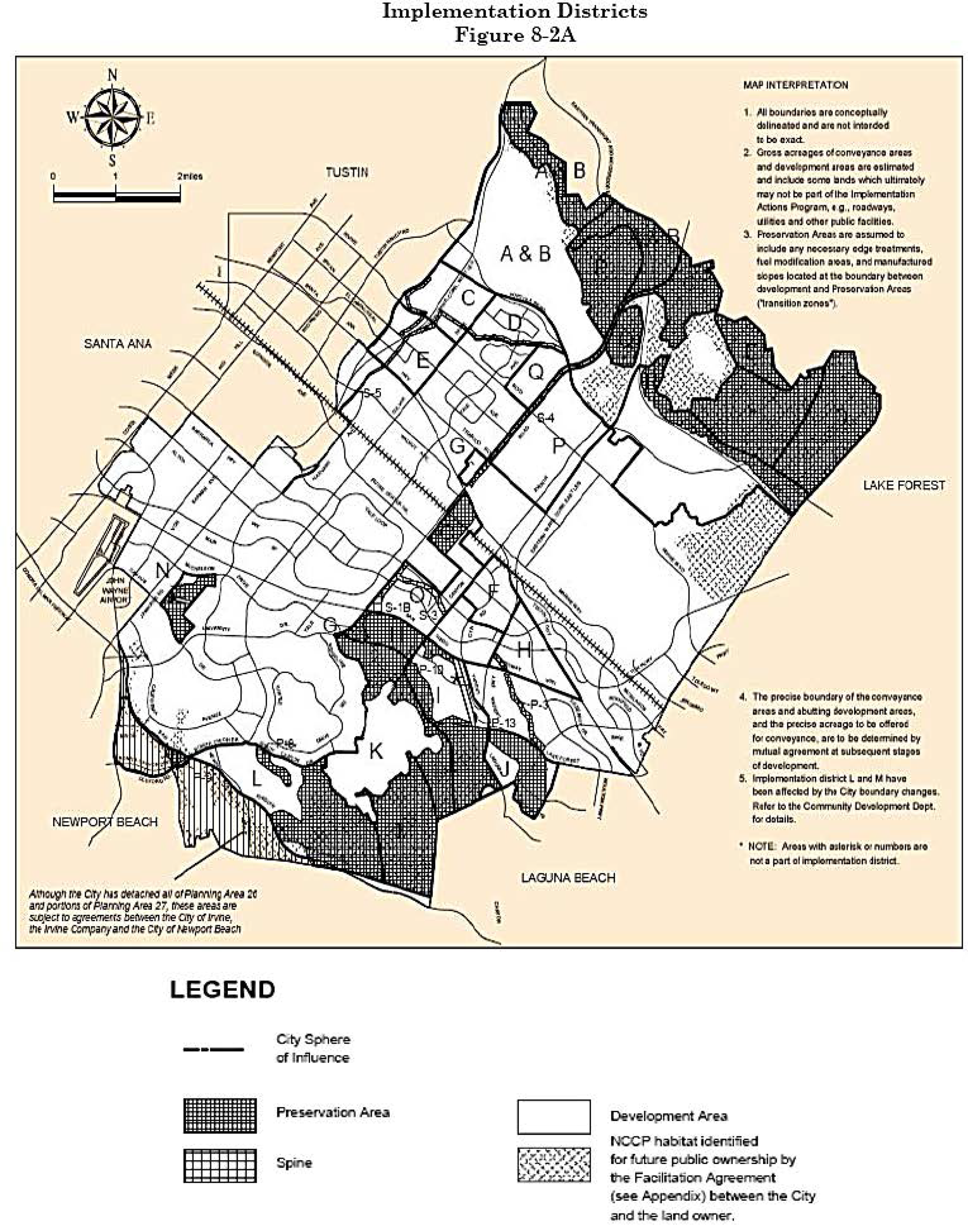
FIGURE 8-2B. BUILDING INTENSITY STANDARD AND DEDICATION AREA BY
DISTRICT
* All acres are estimates of gross acres and are subject to change. Preservation areas on this exhibit do not include spines and minor preservation areas as described in Section 8-17-1.
(Ord. No. 92-3, 4-14-92; Ord. No. 94-7, § 3, 6-14-94; Ord. No. 95-3, § 3C, 4-25-95; Ord. No. 95-4, 5-9-95; Ord. No. 95-8, § 3, 7-11-95; Ord. No. 96-10, § 4, 6-11-96; Ord. No. 00-11, § 3.E, 10-10-00; Ord. No. 02-09, §§ 1—7, 6-11-02; Ord. No. 05-12, § 6, 6-28-05; Ord. No. 06-05, § 6, 6-27-06)
Sec. 8-3-1. - Additional open space requirements.
A.
No additional open space dedication exactions may be imposed on a landowner for any land within the City or its sphere of influence (excluding unincorporated lands presently designated as agriculture in the Irvine General Plan in Planning Areas 5, 6, 8 and 9, which are not a part of this program) except as ordinarily required on a project basis for compliance with provisions of the City's subdivision ordinance (for example, Subdivision Map Act requirements, planning area (village) edges and building setbacks).
B.
However, if, for reasons other than those governed by the paragraph above, the landowner may request intensification of the land uses beyond the land use intensities set forth in Figure 8-2B, the City reserves the right to require additional open space dedication exactions.
(Code 1976, § V.E-702; Ord. No. 92-3, 4-14-92; Ord. No. 94-7, § 3, 6-14-94)
Sec. 8-4-1. - Circulation conditions to allow incremental increase of development in Planning Area 33.
A.
The "incremental increase," as defined below, of 1,800,000 square feet (gross floor area) of development shall be permitted in Planning Area 33 (Irvine Spectrum 1) contingent upon the following:
1.
Adoption of an extension of the facility currently known as State Route 133 (the Laguna Freeway) northerly of the I-5 Freeway in the City of Irvine's circulation element of the General Plan.
2.
Creation and adoption of a traffic management program with the following components:
a.
Consolidation of traffic management programs under a single management body for the nonresidential/non-retail development in Planning Areas 12, 13, 17, 32 (Irvine Spectrum 3), 33 (Irvine Spectrum 1), and 34 (Irvine Spectrum 5). Development in Planning Area 35 (Irvine Spectrum 2) is not required to participate in this transportation management program, although it is intended that the management body actively pursue participation of employment sites in Planning Area 35.
b.
The goal for the consolidated traffic management program shall be to reduce by 20 percent vehicle trips generated by the above-referenced development during the p.m. peak hour.
c.
There shall be a program to monitor and report on the achievement of the vehicle trip reduction through use of the annual report published by the management body.
B.
The incremental increase shall include general commercial development above the development authorized under the Irvine Spectrum 1 development agreement executed in August 1983 (including development, above the maximum point total referenced in that agreement, that may be authorized by Note 3 of Exhibit CI to that agreement). Of the incremental increase, 600,000 square feet (GFA) may be for retail uses. With the exception of the foregoing limitation, the exact mix of uses and their physical distribution within the planning area shall be directed by the principles embodied in the Irvine Spectrum 1 development agreement.
C.
Concurrent with subsequent zoning ordinance changes that are necessary to implement this Section 8-4-1, the zoning for Planning Area 33 (Irvine Spectrum 1) shall be changed to include the incremental increase. The contingency requiring creation and adoption of a transportation management program shall be met when the single management body has been formed and established and is in operation. The 20 percent reduction referred to in Section 8-4-1.A.2.b above is only a goal for the transportation management program, and its achievement is not a contingency to development of the incremental increase.
D.
The traffic reduction goal set forth in Section 8-4-1.A.2.b above does not supersede existing requirements included in the existing zoning for the Irvine Spectrum 4 (Planning Area 13) or the Irvine Spectrum 3 (Planning Area 32).
E.
The Irvine Spectrum Transportation Management Association, Spectrumotion, may serve as the management body which is eligible to fulfill the requirement cited above in Section 8-4-1.A.2.a.
F.
The owner of land within Planning Area 33 shall not be exempted from submitting additional traffic analyses to determine if modification will be necessary to approved traffic lane configurations for roadways within Planning Area 33. Part of this assessment can include whether additional right-of-way reservation will be necessary to accommodate the revised intensity standard for Planning Area 33.
G.
Notes:
1.
The additional allowed increment of 1,800,000 square feet (GFA) is equivalent to 1,565,000 gross leasable square feet.
2.
The 20 percent reduction is intended to be measured as a reduction of 20 percent of the p.m. peak hour vehicle traffic that is generated by all development within the subject planning areas, excluding residential development, hotels and sites that include 50 percent or greater of retail development. The benchmark for the traffic reduction goal shall be based upon the generation rates listed on Figure 8-4.
3.
The additional allowed increment of 600,000 square feet (GFA) is equivalent to 522,000 gross leasable square feet.
FIGURE 8-4. CITY OF IRVINE RECOMMENDED TRIP GENERATION
* As of 4-6-89.
(Code 1976, § V.E-703; Ord. No. 92-3, 4-14-92; Ord. No. 94-7, § 3, 6-14-94; Ord. No. 99-03, § 3, 2-9-99)
Sec. 8-5-1. - Map requirements for contiguous phased dedication districts.
A.
The master tentative tract map for any planning area containing a contiguous phased dedication district included in this phased dedication program and identified in Section 8-23-1 shall include numbered builder lot(s) to reflect the development areas identified on Figure 8-2A and lettered open space lot(s) to reflect the preservation areas to be dedicated to the City identified on Figure 8-2A.
B.
Said master tentative tract map shall include a condition that, prior to or concurrent with the recordation of the first final tract map within any of the numbered development lot(s) on the master tentative tract map, the landowner shall irrevocably offer by grant deed the open space lettered lots on the master tentative tract map for dedication to the City of Irvine or its designee.
C.
Said offer shall be an instrument of record meeting the approval of the Director of Community Development and the City Attorney prior to recordation with the County of Orange.
D.
Said offer shall be subject to Sections 8-14-1 and 8-23-1.
(Code 1976, § V.E-704.1; Ord. No. 92-3, 4-14-92; Ord. No. 94-7, § 3, 6-14-94; Ord. No. 95-3, § 3C, 4-25-95; Ord. No. 95-4, 5-9-95; Ord. No. 95-8, § 3, 7-11-95; Ord. No. 96-10, § 4, 6-11-96)
Sec. 8-5-2. - Map requirements for noncontiguous phased dedication districts.
A.
If the development areas and corresponding preservation areas of the same district are not contiguous, and the preservation areas to be conveyed are located outside the boundary of the planning area for which the master tentative tract map has been submitted, then the corresponding preservation areas to be dedicated to the City of Irvine shall be identified by a metes and bounds description meeting the approval of the Director of Community Development and the City Attorney.
B.
Said metes and bounds description shall be submitted concurrently with the master tentative tract map submitted for the development area.
C.
The master tentative tract map submitted for the development area shall then include a condition that, concurrent with the recordation of the first final tract map within the master tentative tract map submitted for the development area, the landowner of the preservation area shall irrevocably offer by grant deed the preservation area identified by the metes and bounds description for dedication to the City of Irvine or its designee.
D.
Said offer shall be a recordable instrument meeting the approval of the Director of Community Development and the City Attorney prior to recordation with the County of Orange.
E.
Said offer shall be subject to Sections 8-14-1 and 8-23-1.
(Code 1976, § V.E-704.2; Ord. No. 92-3, 4-14-92; Ord. No. 94-7, § 3, 6-14-94; Ord. No. 95-3, § 3C, 4-25-95; Ord. No. 95-4, 5-9-95; Ord. No. 95-8, § 3, 7-11-95; Ord. No. 96-10, § 4, 6-11-96)
Sec. 8-7-1. - Definition of preservation areas.
A.
Intent. The protection and maintenance of existing natural resources.
B.
Purpose. Preservation areas are lands that contain visually significant ridgelines, biotic communities of high significance, geologic constraints and cultural resources. These lands have been judged viable for permanent preservation in a natural state with little or no modification; they have also been amassed in a manner which, overall, has been judged to be more protective of natural resources than could be achieved on an incremental basis with individual development projects.
C.
Permitted uses. Passive public recreation (such as tent camping, hiking, biking, and equestrian trails), biotic gardens, cattle grazing, scientific research and the public uses compatible with the natural amenities of these lands; transportation corridors, arterial highways, utilities, transition zones, fuel modification, habitat enhancement, drainage and flood control facilities and other infrastructure designed so as to minimize any adverse environmental impacts. All residential, commercial, and industrial uses are strictly prohibited (preservation areas in Planning Area 12 are exempted from this commercial prohibition). Passive recreation activities such as riding, hiking, picnicking and camping may be operated as a regional park concession by a limited commercial venture under contract to the City.
(Code 1976, § V.E-705; Ord. No. 92-3, 4-14-92; Ord. No. 94-7, § 3, 6-14-94)
Sec. 8-8-1. - District H conveyance.
Concurrent with the issuance of the first building permit for development exceeding the equivalent of 6,200 points as computed under the Irvine Spectrum 1 development agreement executed in August 1983, an offer of conveyance for all of the conveyance areas within District H shall be recorded. The offer will provide that it may be accepted no sooner than 90 days following issuance of building permit for 1,350,000 (i.e., 75 percent of 1,800,000) square feet of gross floor area of additional development over and above the equivalent of 6,200 points. The establishment of this measurable point in the development of the development areas of District H when the conveyance of the open space lands may be accepted shall in no way be interpreted to modify the rights of the landowner under the Irvine Spectrum 1 development agreement executed in August 1983 (including development above the maximum point total referenced in that agreement that may be authorized by note 3 of Exhibit CI to that agreement).
(Code 1976, § V.E-706; Ord. No. 92-3, 4-14-92; Ord. No. 94-7, § 3, 6-14-94; Ord. No. 99-03, § 3, 2-9-99)
Sec. 8-9-1. - Incomplete development.
A.
The development areas shown on Figure 8-2A are believed to be free of environmental constraints which would require development in such areas to be limited or which otherwise would render development infeasible. If, however, governmental or developmental standards or requirements constrain development within the development areas of a district due to extraordinary biotic, geologic or other hazard, or archaeologic or paleontologic constraints or limitations, the City shall transfer the development opportunities eliminated by such standards or conditions to other mutually acceptable locations.
B.
If the total allowable development in any district is not constructed because the landowner and/or developer elects not to build to the allowable development intensity, except as provided in Section 8-22-1, the City shall not be required to transfer that balance/difference elsewhere.
(Code 1976, § V.E-707; Ord. No. 92-3, 4-14-92; Ord. No. 94-7, § 3, 6-14-94; Ord. No. 00-02, § 4, 2-8-00)
Sec. 8-10-1. - Interim preservation area management.
A.
Prior to transfer to public ownership, permitted uses in preservation areas shall be those uses permitted in the Exclusive Agriculture category (1.1) and those uses listed in Section 8-7-1. Agricultural uses on the frontal slopes of Quail Hill (P-11 and P-12 as shown on Figure 8-2A) will be limited to cattle grazing. Landform, vegetation, and drainage modifications pursuant to all allowable uses will be permitted except in riparian vegetation areas. Significant modification to riparian vegetation is not permitted, except for the following:
1.
Modification necessary to provide:
a.
Fire protection.
b.
Access roads.
c.
Flood and drainage control facilities.
d.
Water, sewer and utility facilities.
2.
Habitat enhancement as part of a mitigation program approved by the California Department of Fish and Game.
B.
The City will facilitate the interim preservation of the land by entering into Williamson Act contracts if requested by the landowner, and may convey land or easements in preservation areas to public agencies and utilities for road, transportation, transit, drainage, flood control, water, sewer and utility purposes.
(Code 1976, § V.E-708; Ord. No. 92-3, 4-14-92; Ord. No. 94-7, § 3, 6-14-94)
Sec. 8-11-1. - Limestone Regional Park.
In recognition that the preservation areas within Districts D, E and F are also within or adjacent to the County of Orange's proposed Limestone Regional Park, the preservation areas within Districts D, E and F shall be conveyed to a public agency acceptable to the City and the County of Orange in order that the land shall eventually be integrated into and become a functional part of Limestone Regional Park, including integrated operations and maintenance which meets the open space objectives of the City.
(Code 1976, § V.E-709; Ord. No. 92-3, 4-14-92; Ord. No. 94-7, § 3, 6-14-94)
Sec. 8-13-1. - Map interpretation.
All boundaries on Figure 8-2A are conceptually delineated and are not intended to be exact. Gross acreages of conveyance areas and development areas stated in Figure 8-2B are estimated and include some lands which ultimately may not be part of this phased dedication and compensating development opportunities program, e.g., roadways, utilities and other public facilities. Preservation areas are assumed to include any necessary edge treatments, fuel modification areas, and manufactured slopes located at the boundary between development and preservation areas ("transition zone"). The precise boundary of the conveyance areas and abutting development areas, and the precise acreage to be offered for conveyance, are to be determined by mutual agreement at subsequent stages of development.
(Code 1976, § V.E-710; Ord. No. 92-3, 4-14-92; Ord. No. 94-7, § 3, 6-14-94)
Sec. 8-14-1. - Offer of conveyance.
A.
Concurrent with the recordation of the first final tract map within a development area of each district shown on Figure 8-2A (except District H), an offer of conveyance for all the conveyance areas within the district shall be recorded. Each offer will provide that it may be accepted no sooner than 90 days following issuance of building permits for 75 percent of the development in the district as indicated on Figure 8-2B or completion of development in the district, whichever first occurs.
B.
Each offer will be subject to nonmonetary encumbrances, easements, liens, restrictions and title exceptions of record or apparent which do not prevent use of the conveyance areas consistent with the uses set forth in Sections 8-19-1, 8-20-1 and 8-7-1 as may be applicable to the conveyance area as identified in Figure 8-2A and consistent with the intent of this division and with the following:
1.
The offer shall provide for conveyance of title by grant deed subject to land use restrictions and/or open space easements assuring that the conveyed land shall be used in perpetuity consistent with the intent of the dedication and the purposes to be served by open space spines and preservation areas, with corresponding means of enforcement. Lands reserved for road, transportation, transit, drainage, flood control, water, sewer and utility purposes by public agencies may be excluded from the offer at the landowner's discretion.
2.
Mineral rights and water rights (excluding the right of surface entry) will be reserved by the landowners on conveyed lands. The landowner shall make full written disclosure with respect to toxic or hazardous substances which in its knowledge were stored on or deposited in the land to be dedicated. Road, transportation, transit, flood control, drainage, water, sewer, and utility easements necessary to accomplish development in adjoining areas and/or to accomplish planned facilities by public agencies and utilities will be reserved by the landowner on conveyed lands. Easements will be reserved on conveyed lands if necessary to preserve or facilitate agricultural uses on adjoining lands if necessary to preserve or facilitate agricultural uses on adjoining preservation areas not yet conveyed.
3.
The enhancement of habitat areas by the landowner, particularly riparian habitat, shall be allowed in conveyed preservation areas consistent with applicable standards and procedures for purposes of environmental impact mitigation in development areas.
4.
The City or other appropriate public agency shall accept the offer within two years after all other conditions to acceptance have been satisfied. However, acceptance may be delayed beyond two years by mutual agreement of the City and the landowner.
(Code 1976, § V.E-711; Ord. No. 92-3, 4-14-92; Ord. No. 94-7, § 3, 6-14-94)
Sec. 8-15-1. - Open space improvements.
A.
No conditions will be attached to any landowner for property requiring improvements to or maintenance of preservation areas conveyed under this program except for habitat enhancement as provided in Section 8-14-1.B.3, for "transition zone" improvements as provided in Section 8-23-1, and for utilities and infrastructure necessary to serve development.
B.
No conditions will be attached to any landowner for property requiring improvements to or maintenance of the Jeffrey open space trail as defined in Section 8-19-1, except for utilities and infrastructure necessary to serve development and also the permanent trail construction in accordance with the City's 1985 Guidelines for Bicycle Facilities in Irvine (excluding grade separations solely used for trail systems) in the trail adjacent to the development. Improvements will be made to the Jeffrey open space trail by the City which are compatible with and complementary to adjoining development. The Jeffrey open space trail will serve as the planning area (village) edge for the adjoining development areas, and no further planning area (village) edge dedications or improvements will be required for adjoining development areas.
(Code 1976, § V.E-712; Ord. No. 94-7, § 3, 6-14-94; Ord. No. 09-02, § 3, 3-24-09)
Sec. 8-16-1. - Open space management and conservation plan (OSMCP).
The open space management and conservation plan (OSMCP) shall be utilized as the primary biotic implementation document for establishing compliance with biotic policies identified in biotic resources objective L-2(a) and L-2(b) of the conservation and open space element of the General Plan, the timing and phasing of mitigation measures, and the responsibilities for implementing mitigation measures. This plan shall be prepared in conjunction with a concept plan and/or zone change application and in accordance with the City's guidelines for open space management and conservation plan reports. In addition, the plan will address "transition zones" as described below.
A.
At the boundary between development and preservation areas, transition zones of variable width will be defined in the open space management and conservation plan (OSMCP) where landscaping, fuel modification, and/or grading are proposed in conjunction with development. Where appropriate, the OSMCP will also establish landscaping, grading and/or maintenance guidelines to mitigate any adverse development impacts on preservation area lands to be conveyed. The OSMCP may also contain procedures for the conveyance of land and/or easements at subsequent levels of development approval pursuant to the implementation action program.
B.
Compatibility techniques. These techniques are methods of landscaping transition zones and/or development areas which allows development to interface with conservation and open space areas in a manner which mitigates adverse impacts on preservation areas to be conveyed. Typically these techniques are employed in transition zone areas and allow for the potential and continued use of habitat and wildlife areas.
C.
Fuel modification zones. These zones are defined as areas adjacent to development that utilize a graduated clearing of vegetation and selected plant palettes to reduce fuel loads.
D.
Plant palettes. The plant palettes utilized in the transition and fuel modification zones should be selected for the following characteristics: drought tolerance, wildlife food value, fuel loading and slope stabilization.
E.
Public trails. Public access shall be provided, where appropriate, adjacent to development areas abutting the trail and in accordance with adopted biking, hiking and equestrian trail Master Plans.
F.
Maintenance responsibility. The transition and fuel modification zones will be maintained by the appropriate property and/or homeowners' associations and/or maintenance district.
(Code 1976, § V.E-713; Ord. No. 92-3, 4-14-92; Ord. No. 94-7, § 3, 6-14-94)
Sec. 8-17-1. - Open space spine conveyance.
A.
Conveyance of designated open space spines shown as S-1B and S-3 on Figure 8-2A, and the minor preservation areas P-3, P-8, P-9, P-10, and P-13 as shown on Figure 8-2A, shall be made consistent with Section 8-14-1 in conjunction with the recordation of final tract maps for adjoining development.
B.
Conveyance of open space spine S-IA as shown in Figure 8-2A shall be made consistent with Section 8-14-1 in conjunction with the recordation of the final tract map for District O.
C.
The Peters Canyon and Hicks Canyon open space spines as defined by mutual agreement between the landowner and the City (generally shown as S-5 and S-6 on Figure 8-2A) shall be conveyed consistent with Section 8-14-1 in conjunction with the recordation of final tract maps for adjoining development.
(Code 1976, § V.E-714; Ord. No. 92-3, 4-14-92; Ord. No. 94-7, § 3, 6-14-94)
Sec. 8-19-1. - Open space spines.
A.
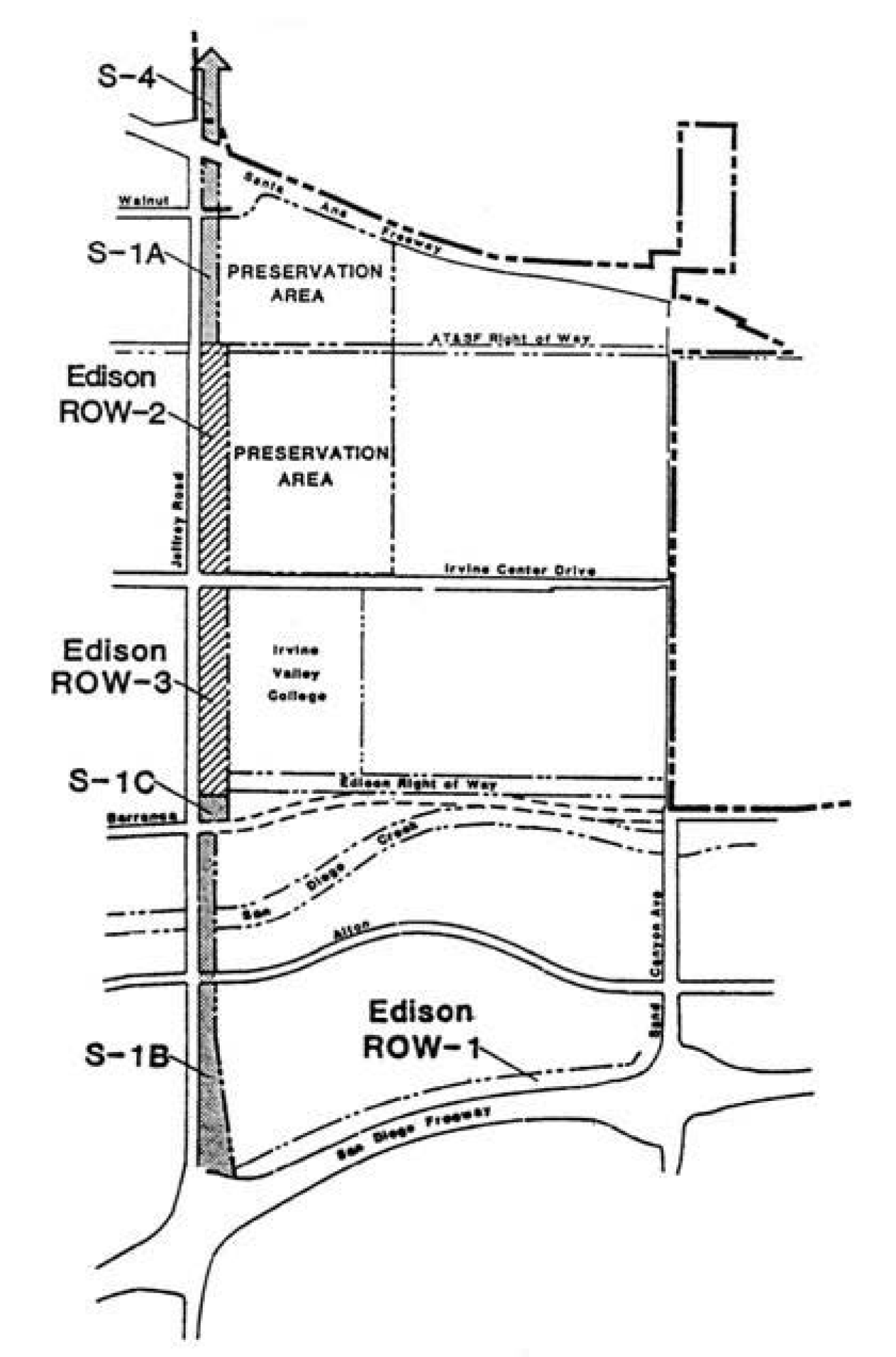
Jeffrey open space trail. The Jeffrey open space trail will provide a continuous open space edge of variable width along the eastern side of the ultimate alignment of Jeffrey Road. Except for utilities and General Plan roadway improvements, surface uses will be limited to trails and associated passive public recreation and park-and-ride facilities. It will be composed of the following gross areas generally depicted on Figure 8-19:
1.
Parcel S-1B. Between I-405 and the Barranca Parkway, the JOST shall total 14 gross acres. The width of the JOST at the southern end, abutting the Edison ROW-1, shall be greater than the average width of Parcel S-1B.
2.
Edison ROW-2 and 3. The JOST for the portion of Jeffrey Road adjacent to the existing Edison right-of-way shall lie within that right-of-way.
3.
Parcels S-1A and S-1C. Between I-5 and Barranca Parkway, the JOST shall be 16 gross acres. A park-and-ride facility may be located in the JOST. Should a park-and-ride facility be located in the JOST, the landowners may convey that portion of the JOST needed for the facility to Caltrans or other appropriate public agency.
4.
Parcel S-4. Between I-5 and the preservation area in the Lomas de Santiago Ridge, the JOST will average 300 feet in width. The landowner acknowledges the importance of completing the link of the JOST between the I-5 Freeway and the Lomas de Santiago Hills. The landowner agrees to include plans for the JOST with future development programs (either in the County or the City) for the land easterly of this JOST in Planning Areas 6 and 9 and, pursuant to acceptable dedication agreements with the appropriate jurisdiction, provide offers of dedication for the JOST. The City acknowledges and affirms its intention to cooperate in and coordinate planning efforts to arrive at mutual agreement on appropriate land use designations for this area pursuant to the annexation policy agreement between The Irvine Company and the City dated February 8, 1984.
B.
Northwood railroad right-of-way. The Northwood railroad right-of-way open space trail is an east/west spine that is primarily within the Northwood Planning Area (8).
1.
The open space spine shall follow the abandoned Northwood railroad right-of-way and be developed as bike and hiking greenbelt trail system.
2.
Encourage the extension of the open space spine through Planning Area 4 (at the time of zoning/concept plan) in order to connect with the Peters Canyon Wash Corridor open space spine.
3.
Encourage the connection of the open space trail to the Jeffrey Road open space trail in Planning Area 9.
C.
Hicks Canyon Wash. The Hicks Canyon Wash open space spine is an east/west spine that is located in the City's northern sphere of influence. The Hicks Canyon open space spine is defined as the Hicks Canyon Wash and the areas immediately adjacent to the channel.
1.
At the time of zoning and/or concept plan for Planning Areas 1, a conceptual site plan for the treatment of the Hicks Canyon Wash open space spine shall be submitted to the City by the developer for review and approval. The plan will establish the general relationship of the open space spine to the adjacent development. The plan shall address the following items: (1) the overall setback through the length of the open space spine, (2) connections with the Peters Canyon Wash Corridor and Jeffrey Road open space trails, (3) type of trails, (4) landscape elements, and (5) other special design features. Preliminary plans shall be submitted for approval by the Planning Commission at the time of residential tentative subdivision approvals. A final plan must be submitted for City approval prior to building permit issuance.
2.
The Hicks Canyon Wash open space spine should be designed in coordination with the Orange County Flood Control District, the Army Corps of Engineers and the City of Irvine.
3.
The Hicks Canyon Wash open space spine shall be designated to accommodate and provide for the trail systems adopted in the General Plan circulation element.
D.
Edison easement. The Edison easement open space spine is an east/west spine that is located generally in the City's center (Planning Areas 15 and 38).
1.
The open space spine shall follow the Edison easement and be developed to accommodate the trail systems provided for in the adopted General Plan circulation element.
2.
At the time of zoning and/or concept plan for Planning Area 38, a conceptual site plan for the treatment of the Edison easement open space spine within Planning Area 38 shall be submitted to the City by the developer for review and approval. The plan will establish the general relationship of the open space spine to the adjacent development. The plan shall address the following items: (1) the overall setback treatment within Planning Area 38, (2) connection with the Peters Canyon Wash Corridor, (3) type of trails, (4) landscape elements, and (5) other design features.
E.
I-405/Edison easement. The I-405/Edison easement open space spine is an east/west spine that is located in the City's center (Planning Areas 12, 14, and 15).
1.
The open space spine shall follow the I-405/Edison easement and be designed to accommodate and provide for the trail systems adopted in the General Plan circulation element.
2.
At the time of entitlement for Planning Area 12, a conceptual site plan for the treatment of the open space spine within Planning Area 12 shall be submitted to the City by the developer for review and approval. The plan will establish the general relationship of the open space spine to the adjacent development. The plan shall address the following items: (1) the overall setback treatment within Planning Area 12, (2) connection with the Jeffrey Road open space trail, (3) type of trails, (4) landscape elements, and (5) other design features.
F.
Mason Regional Park. The Mason Regional Park open space spine is an east/west spine that is located in the southern portion of the City (Planning Areas 21 and 24).
1.
The open space spine shall follow Mason Regional Park and be designed to accommodate the trail systems adopted in the General Plan circulation element.
2.
Coordinate with the appropriate County agencies to ensure that the trail systems are developed.
3.
Encourage the connection and extension of the trail system to Planning Areas 16, 21 and 22 open space systems.
(Code 1976, § V.E-715; Ord. No. 92-3, 4-14-92; Ord. No. 94-7, § 3, 6-14-94; Ord. No. 09-02, § 3, 3-24-09)
Sec. 8-20-1. - Preservation area in Planning Area 12.
A.
The specified preservation area in Planning Area 12 shall be dedicated to the City for public open space purposes in accordance with this division (see Figure 8-19). A park-and-ride facility may be located in the preservation area. Should a park-and-ride facility be located in the preservation area, the landowner may convey that portion of the preservation area needed for the facility to Caltrans or other appropriate public agency.
B.
Prior to conveyance, agriculture may continue on this site at the discretion of the landowner. An agricultural preserve contract will be made available if requested by the landowner.
C.
A golf course is a permitted use in the preservation area in Planning Area 12 subject to the City's approval of such use and provided the landowner conveys an open space easement, limiting its use to a golf course and customary and appurtenant facilities, to the City. Conveyance of such an easement satisfies any dedication requirement of the implementation action program.
D.
Should the City elect to apply a golf course designation to this area subsequent to the receipt of such land in accordance with the implementation action program, the prior landowner will be offered an exclusive right at no cost for such right to operate the golf course as a for-profit facility open to the public.
(Code 1976, § V.E-716; Ord. No. 94-7, § 3, 6-14-94)
Sec. 8-21-1. - Special policies for Planning Area 26.
A.
Within the mixed use and/or district commercial area, in addition to the 10,600 dwelling units reserved in Section 8-22-1, up to 800 dwelling units will be allowed in lieu of commercial development. For each dwelling unit provided, the total allowable commercial development will be reduced by an amount equivalent to the traffic generated by the dwelling unit (in average daily vehicle trips).
B.
Office uses will be allowed in the district commercial area, provided that district commercial uses are located in the mixed use area.
(Code 1976, § V.E-717; Ord. No. 92-3, 4-14-92; Ord. No. 94-7, § 3, 6-14-94)
Sec. 8-22-1. - Transferability of dwelling units.
Subject to Section 8-21-1, the total number of residential dwelling units in Planning Areas 17, 18, 22, 26 and 27 may not exceed 10,600. These dwelling units may be freely transferred by the landowner among the aforementioned planning areas. Any transfer which increases the number of dwelling units allowed in a planning area by more than 15 percent above the amounts designated in Figure A-10 of the General Plan, or greater percentage, may be subject to review as part of the subdivision process. It is the intent of this provision to allow a total of 10,600 dwelling units (except as modified in Section 8-21-1) to be constructed in these planning areas, to be measured cumulatively by actual permits issued.
(Code 1976, § V.E-718; Ord. No. 92-3, 4-14-92; Ord. No. 94-7, § 3, 6-14-94)
Sec. 8-23-1. - Two-part conveyance.
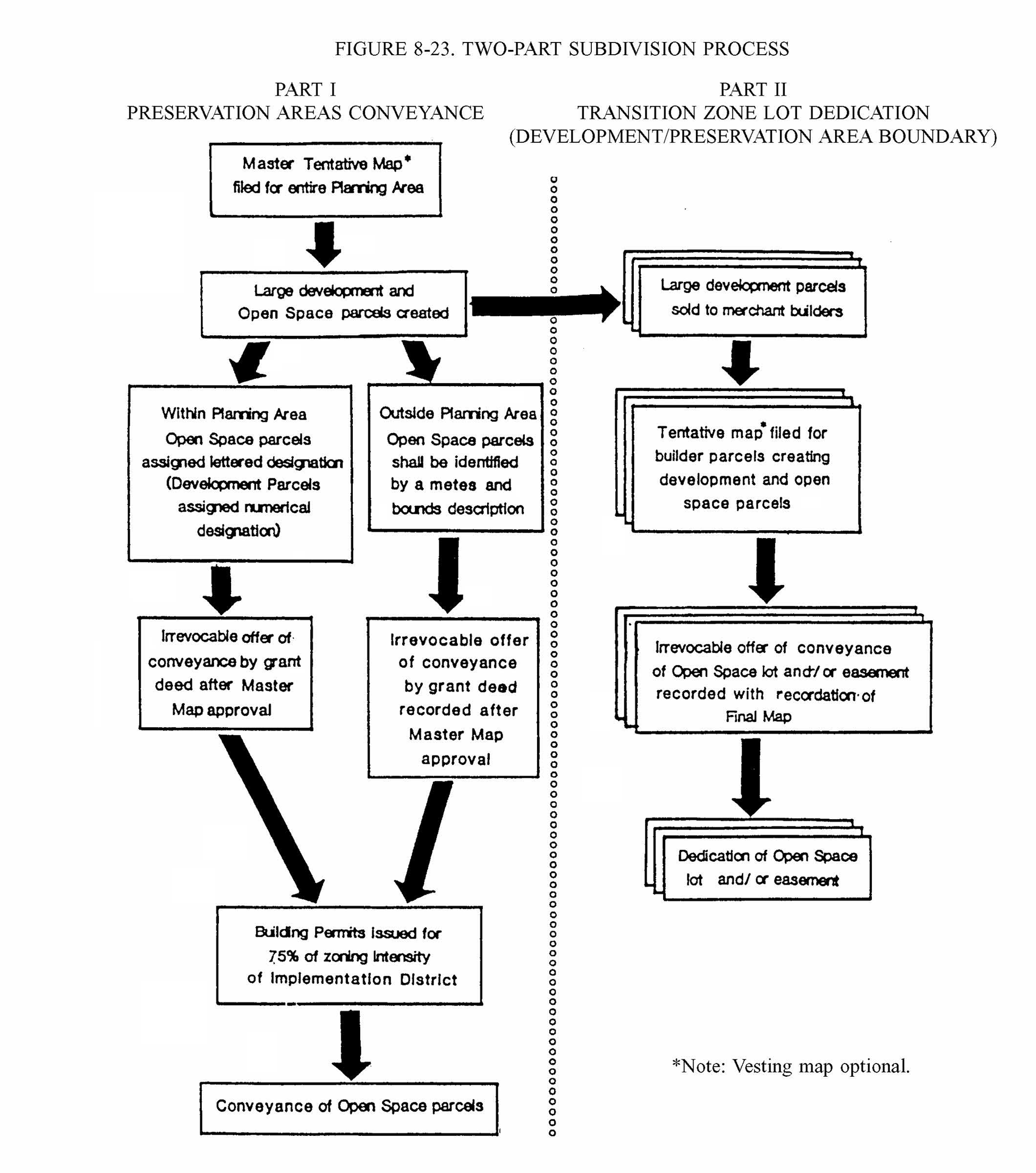
As illustrated on Figure 8-23, offers of conveyance may be made in two parts. The first part shall contain, to the greatest extent possible, substantially all of the preservation area and shall be offered for conveyance at the time specified in Section 8-14-1, but preservation area lands abutting potential development areas may be excluded from the initial offer. The boundaries of the second part shall be defined and offered for conveyance upon the recordation of final maps for development abutting the area to be dedicated. Where appropriate, the transition zone may be offered for conveyance as open space easements.
(Code 1976, § V.E-719; Ord. No. 92-3, 4-14-92; Ord. No. 94-7, § 3, 6-14-94)