
Jasper County Unincorporated
City Zoning Code
City Zoning Code
ARTICLE 12
- DEVELOPMENT STANDARDS
12:1.- Off-street parking.
12:1.1. General requirements.
1.
There shall be provided at the time of the erection of any building, or at the time any principal building is enlarged or increased in capacity by adding dwelling units, guest rooms, seats, or floor area; or before conversion from one type of use of occupancy to another, permanent off-street parking space in the amount specified by this section. Such parking space may be provided in a parking garage or properly graded and improved open space. All portions of the required space, which are paved, shall be marked in accordance with the standards contained herein. Lines shall be visibly marked with paint.
2.
Where application of the requirements of Table 12.1 result in a fractional space requirement, the next larger requirement shall apply.
3.
Wherever a building or use, constructed or established after the effective date of these regulations is changed or enlarged in floor area, number of dwelling units, seating capacity or other wise to create a need for an increase of ten percent or more in the number of existing parking spaces, such spaces shall be provided on the basis of the enlargement or change.
4.
Off-street parking areas provided to comply with the provisions of this ordinance shall not be reduced below the requirements of this ordinance.
5.
Off-street parking areas shall be designed, developed and maintained in accordance with the requirements of this article. Where parking decks or garages are proposed to meet off-street parking requirements, such structures shall meet the minimum zoning requirements for the district in which it is located.
6.
Required off-street parking must be provided on the same lot or parcel as the principal use for which it is required, unless it meets the requirements for subsections 12:1.3, 12:1.4.
7.
For shell buildings with no identified tenant, parking requirements should be determined by the building's projected use, applying the highest parking ratio permitted for a given zoning district to ensure there is adequate parking for all possible future tenants and to comply with the provisions of this ordinance.
8.
In the event that the number of parking spaces required in Table 12.1, Minimum parking requirements, cannot be placed on the site in accordance with these regulations without the demolition of an existing structure or damage of significant trees on the site or in the public right-of-way to accommodate a parking area, or if written documentation that demonstrates that fewer spaces than required are needed because of the nature of the business, hours of operation, or availability of adjacent parking the BZA may authorize up to a 25 percent reduction in the total number of parking spaces required on the site.
Table 12:1 IPOD Minimum Parking Requirements
12:1.2. Site plan. Each application for a building permit or certificate of use submitted to the DSR, shall include a plan showing the required space reserved for off-street parking and loading space and the means of ingress and egress to such space. This information shall be the responsibility of the owner/developer and shall be sufficient to enable the DSR to determine whether or not the requirements of this section are met.
12:1.3. Shared parking. Shared use of required nonresidential parking spaces may occur where two or more uses on the same or separate sites are able to share the same parking spaces because their parking demands occur at different times. Shared use of required nonresidential parking spaces is allowed if the following documentation is submitted in writing with the building and zoning permit application:
1.
The names and addresses of the uses and of the owners or tenants that are sharing the parking;
2.
The location and number of parking spaces that are being shared;
3.
A legal instrument such as an easement or deed restriction that guarantees access to the parking for both uses.
12:1.4. Remote parking space. If the off-street parking space required by this ordinance cannot be reasonably provided on the same lot on which the principal use is located, such space may be provided on any land within 400 feet of the principal use. Such space shall be deemed required space associated with the permitted use and shall not hereafter be reduced or encroached upon in any manner. It is further provided that the DSR may require a plat, deed, or other documentation necessary to show that remote parking space is controlled by and available to the applicant prior to the granting of a zoning certificate.
12:1.5. Design of parking area.
1.
All off-street parking except off-street parking for single-family detached dwelling units, single-family attached dwelling units on adjoining individual lots, or two-family dwellings located on a residential service street, shall be designed so that all traffic related activities are confined to the site and vehicles can turn around within the area and enter the street, road, or highway in such a manner as to completely eliminate the necessity of backing into the street, road, or highway. Off-street parking for single-family detached dwelling units, single-family attached dwelling units on adjoining individual lots, or two-family dwelling units, which requires backing into a residential service street, shall be permitted provided that such movement can be made with reasonable safety and without interfering with other traffic.
2.
Reserved.
3.
Parking lots shall be designed so as not to drain into or across public sidewalks or on to adjacent property, except into a natural watercourse or a drainage easement. In developed areas where this condition may be impossible to meet, and there are no adverse impacts to surrounding areas, the DSR may exempt the developer from this requirement, provided that adequate provision is made for drainage.
4.
When necessary off-street parking spaces shall be separated from walkways, sidewalks, streets, or alleys, and required yards and buffer areas by a wall, fence, curbing, or other protective device approved by the DSR.
5.
Landscaping, curbing, or other approved barriers shall be provided along boundaries to control entrance and exit of vehicles or pedestrians. All off-street parking areas shall be designed so that all movement onto a public street is in a forward motion. Entrance and exit driveways to public streets in the vicinity of street intersections must be located at least 75 feet, measured along the curb line, from the intersection of the nearest curb line.
6.
Parking lots shall be marked by painted lines, curbs, or other means to indicate individual spaces. Signs or markers may be used as necessary to ensure efficient traffic operation of the lot. All pavement markings and traffic control signage shall be constructed and installed in accordance with the latest edition of the "Manual on Uniform Traffic Control Devices" (MUTCD).
7.
Lighting and landscaping shall be provided in parking lots in accordance with the appropriate sections of this ordinance.
8.
All off-street parking areas shall be maintained in a clean, orderly, dust-free, and weed-free condition at the expense of the owner or lessee and not used for the sale, repair, or dismantling or servicing of any vehicles or equipment, except for service and auto repair stations/garages.
12:1.6. Mixed uses. Where more than one principal use, whether with the same or different parking requirements occupy the same building or premises or in the case of joint use of a building or premises by more than one use having the same parking requirements, the parking spaces required shall equal the sum of the requirements of the various uses computed separately.
However, up to 50 percent of the parking spaces required for (1) theaters, public auditoriums, bowling alleys, dance halls, clubs, churches and religious institutions may be provided and used jointly by (2) financial institutions, offices, retail stores, repair shops, service establishments, and similar uses not normally open, used, or operated during the same hours as those listed in (1); provided however, that a signed, written agreement thereto is properly executed and filed with the county.
12:1.7. Off-street parking space design standard.
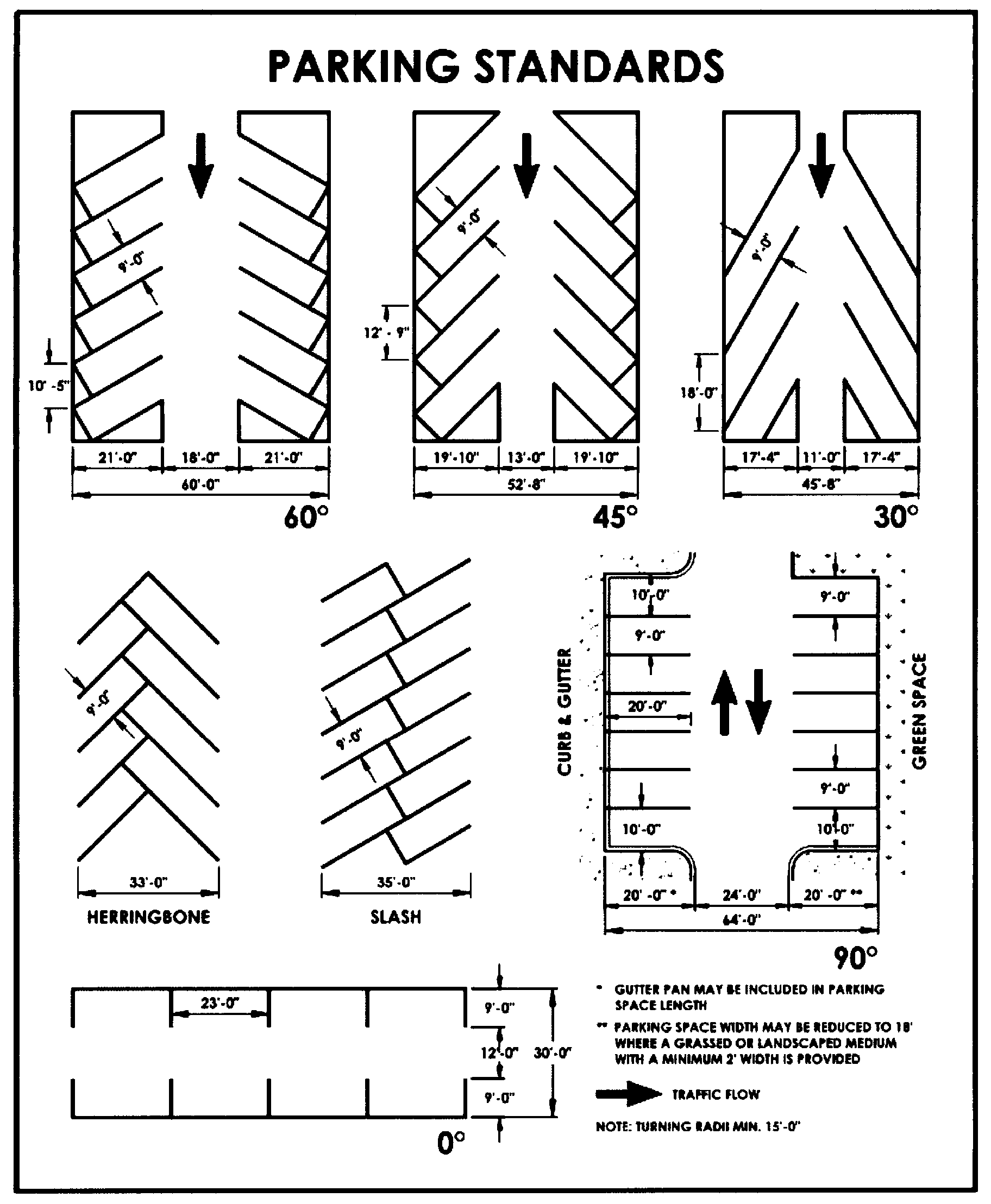
Table 12.2 Minimum Parking Requirements
*Minimum isle widths shall be maintained to the point of intersection with the adjoining public or private right-of-way.
** In 90-degree parking stalls, the depth of the stall may be reduced to 18 feet where a grassed or landscaped median, with a minimum two feet width per row of parking stalls, has been provided for automobile overhang. Wheel-stops or curbing shall be provided to protect and delineate the median from the parking stalls.
At least one fire access lane must be provided and approved by the county emergency services department.
12:1.8. Requirements for the physically disabled and/or handicapped. When off-street parking is required for any building or use, except for single family, residential dwellings, parking for the physically disabled shall be provided in accordance with the latest ADA requirements.
12:1.9. Storage and use of campers or recreational. See section 9:5.1 of this ordinance.
12:1.10. Parking, storage, and use of non-residential vehicles and equipment. See subsection 9:5.2 of this ordinance.
(Ord. No. 08-11, §§ 9, 10, 5-5-08; Ord. No. 09-06, § 2, 2-2-09; Ord. No. 09-12, §§ 13, 14, 5-4-09; Ord. No. 11-22, § 21, 10-3-11; Ord. No. 11-24, § 9, 9-6-11; Ord. No. 2018-02, § 1, 2-20-18; Ord. No. 2025-35, §§ 1—4, 12-1-2025)
12:2. - Off-street loading.
12:2.1. Requirements for industrial and wholesale buildings. Every industrial and wholesale building hereafter erected shall provide space as indicated herein for loading and unloading of vehicles. The number of off-street loading berths required by this section shall be considered as the absolute minimum, and the developer shall evaluate his own needs to determine if they are greater than the minimum specified by this section. For purposes of this section, an off-street loading berth shall have minimum plan dimensions of 12 feet by 60 feet and 14 feet overhead clearance with adequate means for ingress and egress.
Table 12.3 Minimum Loading Requirements
12:2.2. Design of loading spaces. Off-street loading spaces shall be designed so that vehicles can maneuver for loading and unloading entirely within the property lines of the premises of the structures they are intended to serve.
All uses shall provide off-street loading space sufficient for their requirements. Such space shall be arranged so that no vehicle being loaded or unloaded in connection with normal operations shall stand in or project into a public street or sidewalk.
12:2.3. Requirements for commercial uses. All retail uses and office buildings with a total floor area of 10,000 square feet shall have one off-street loading berth for each 10,000 square feet.
12:3. - Parking lot landscaping.
All new off-street parking lots with ten or more spaces located adjacent to existing public right(s)-of-way shall establish roadside buffers. Roadside buffers shall be located outside of the rights-of-way of existing roads.
12:3.1. Roadside buffers.
1.
The minimum roadside buffer width shall have an average planting width of eight feet with the minimum width for any buffer yard being five feet. Buffers shall contain the following plant materials:
a.
An average of one tree for every 50 feet of linear road frontage.
b.
Shrubs spaced to provide a continuous evergreen screen within three years of installation.
2.
Within the buffer yard, fences, walls, earthen berms or any combination thereof may be used to meet the requirements of this section so long as they are a minimum of 30 inches in height and provide a continuous opaque visual screen. Berms shall have a side slope no greater than 3:1.
3.
Where existing overhead power utility lines preclude sufficient space for a shade tree to grow then two small trees shall be substituted for each required shade tree.
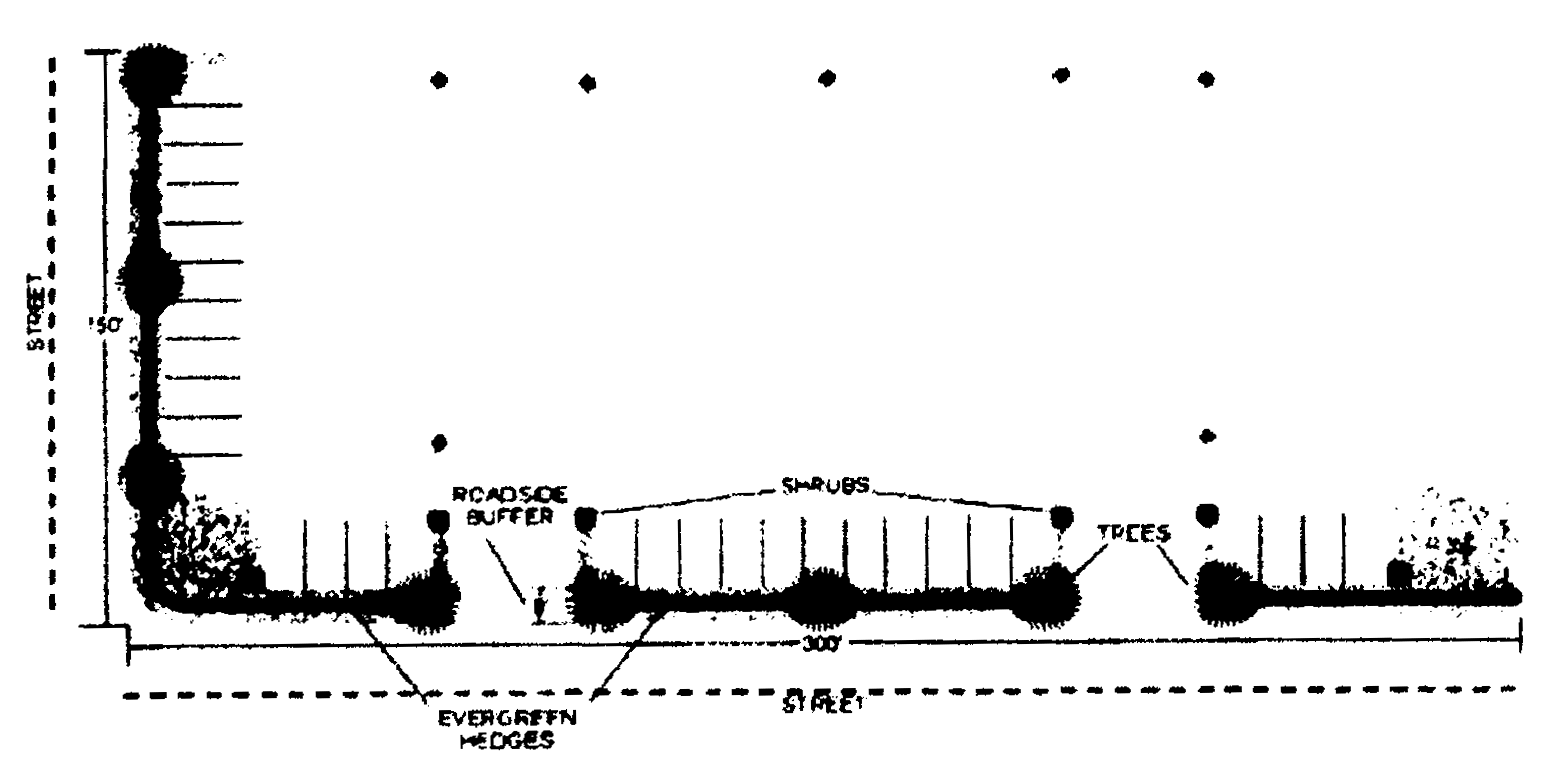
12:3.2. Interior plantings. In addition to all other landscaping requirements, all new off-street parking lots with 50 or more spaces shall provide and maintain landscaped planting areas within the interior of, and adjacent to, the parking lot.
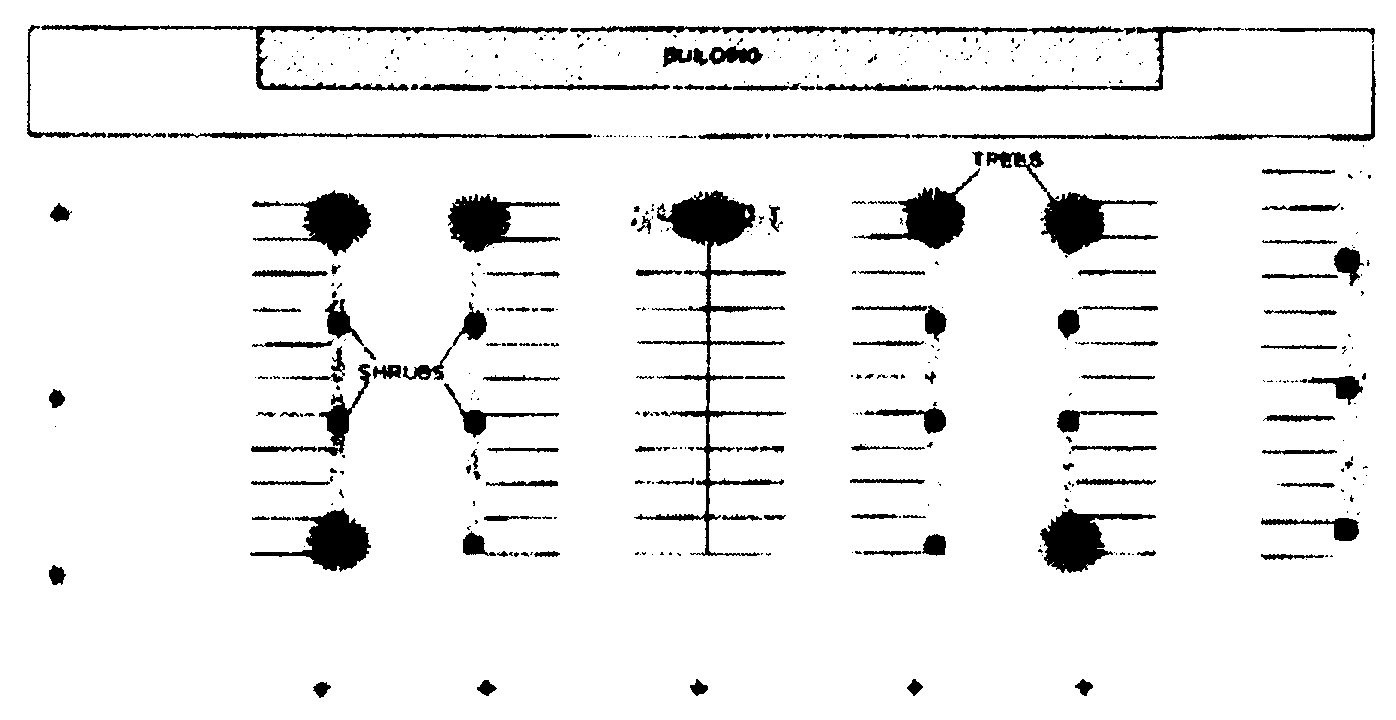
Within the interior, peninsula or island type landscaped areas shall be provided for any open vehicular use area containing ten or more parking spaces. Landscaped areas shall be located in such a manner as to divide and break up the expanse of paving and strategic points to guide travel flow and direction. Elsewhere, landscaped areas shall be designed to soften and complement the building site and separate the building from the vehicular surface area.
1.
Interior planting islands shall have a minimum planting area of five feet wide by 36 feet long.
2.
In addition to the required trees and shrubs, planting areas shall be grassed, covered with mulch or decorative stone.
3.
All planting areas shall be protected from vehicular intrusion by the installation of curbing or wheel stops.
4.
Each landscaped planting area shall contain trees and shrubs at the rates listed below rounded upward to the next whole number:
a.
One tree for every 15 parking spaces.
b.
One shrub for every five parking spaces.
5.
Interior planting areas shall be designed within or adjacent to the parking area(s) as:
a.
Islands, located at the end of parking bays;
b.
Islands, located between parallel rows of cars;
c.
Driveway medians, a minimum of five feet in width;
d.
Intermediate islands; or
e.
A combination of the above.
6.
Trees and shrubs must be planted within 20 feet of the parking area to satisfy the interior planting requirements.
7.
The design size and shape of the interior planting areas shall be at the discretion of the owner; however, no parking space shall be:
a.
Located farther than 90 feet from the trunk of a shade tree;
b.
Separated from a shade tree by a building or other structure.
8.
Parking structures are excluded from interior landscape areas.
12:3.3. Planting material specifications.
1.
A minimum of 75 percent of trees planted to meet this requirement shall be shade trees. (unless precluded by utilities)
2.
Shade trees shall have a minimum planting size of two inches measured 18 inches above grade.
3.
Small trees and multi-stem trees shall have a minimum planting height of six feet tall.
4.
Evergreen shrubs shall have a minimum installed height of 12 inches and a minimum height of 30 inches within three years of installation. All shrubs inside the sight triangle at points of ingress and egress shall not exceed 30 inches in height.
12:3.4. Existing trees. It is encouraged to use existing trees to meet the requirements of this section. If existing trees are preserved to meet the roadside buffer or interior planting requirements then a reduction in the new planting requirements will be given. Existing trees will be credited towards meeting the requirements of this section as follows:
One tree (2 - 6 inches diameter at breast height) = 1 planted trees
One tree (6 - 10 inches diameter at breast height) = 2 planted trees
One tree (10 - 15 inches diameter at breast height) = 3 planted trees
One tree (15> inches diameter at breast height) = 4 planted trees
12:3.5. Protection of existing trees. Any trees preserved on a development tract to receive credit shall meet the following protection standards. A root protection zone shall be established around all trees to be preserved. The root protection zone shall be clearly shown on all grading and site plans.
1.
Root protection zone. The land area around the base of a tree in which disturbances are prohibited in order to protect the roots of the tree and aid the tree's survival. The root protection zone shall be equal to one-foot radius for every inch of tree diameter measured at a point four and one-quarter feet above ground. Root protection zone measurements shall be rounded off to the nearest foot.
2.
Protective barrier. A protective barrier shall be installed at the start of grading, and be located at the outer edge of the root protection zone. Protective barriers shall be posted as a "Tree Save Area." This procedure shall be incorporated as a note on the grading and erosion control plans. Protective barriers shall be constructed of a material resistant to degradation by sun, wind, and moisture and shall remain in place until all construction is complete.
3.
No storage of materials, dumping of waste materials, fill, or parking of equipment shall be allowed within the root protection zone, and no trespassing shall be allowed within the boundary of the root protection zone. Utility easements and borings are permitted.
12:3.6. Exceptions.
1.
Any lot used for the express purpose of sales and storage is exempt.
2.
Parking Structures (multi-level).
12:3.7. Owner responsibilities and maintenance. The owner, his successors, or assigns, are responsible for maintaining all required plant material in good health. Any planted trees which die or become unhealthy and used to meet the provisions of this section must be replaced within one year with vegetation which conforms to the initial planting standards of this section.
12:3.8. Plan submittal requirements. Landscaping plan. Prior to the issuance of any occupancy permit, for any development with ten or more parking spaces, a specific landscape plan, at a scale of not less than one inch equals 50 feet, shall be submitted to the building and zoning division for approval and shall contain existing and proposed landscaping, including:
1.
The location, botanical name and common name, size in diameter four and one-half feet above grade and height of new trees to be planted, which must comply with this code. A suggested tree planting list can be found in Article 13.
2.
The location, botanical name and common name, size in diameter four and one-half feet above grade and estimated height of existing trees which are to be maintained or preserved for credit as per the requirements of this code.
3.
The location and dimensions of parking lots, buffer areas and other planting areas.
4.
The size, botanical name and common name and spacing of plant materials.
5.
The location and design of any fence, wall or earthen berm indicating size, dimensions and materials.
6.
The location and description of any barriers required to be erected to protect any existing vegetation from damage as required in this section.
7.
Provisions for watering and other long-term maintenance to assure serviceability, soil stabilization and plant protection.
8.
The use of existing natural buffers is strongly encouraged.
12:3.9. Variances. A variance may be granted by the board of zoning appeals pursuant to site hardships. Adequate engineering, landscaping, and arborist plans and specifications are required.
12:4. - Relationship of buildings to lots.
There shall be not more than one principal building and its accessory buildings on one lot except as allowed in group residential and group commercial/office developments as provided in subsection 10:1, Provisions for Group Developments, of this ordinance.
12:5. - Projections into public streets and street rights-of-way.
No commercial signs or other structures shall project beyond any right-of-way line of any street except in the case of a properly executed air rights agreement that meets the provisions of all applicable legislation regarding the use of air rights. No shrubbery shall project into any public street right-of-way.
12:6. - Visibility at intersections.
On any corner lot on which a front and side yard is required, nothing shall be erected, placed, planted, or allowed to grow which obstructs vision between a height of 30 inches above the crown of the adjacent roadway and ten feet in a triangular area formed by measuring from the point of intersection of the front and exterior side lot lines a distance of 25 feet along the front and side lot lines and connecting the points so established to form a triangle on the area of the lot adjacent to the street intersection.
12:7. - Height.
Federal Aviation Agency height regulations in the vicinity of an airport or the area governed by the Federal Aviation Agency regarding approach zones and protected areas shall take precedence over all other types of regulations.
12:8. - Screening and buffering requirements.
12:8.1. General requirements.
1.
Screening must be provided along side and rear exterior lot lines, where any non-residential use is adjacent to a residential use and/or district, for the purpose of screening non-residential activities from view. Unless otherwise required, the following landscaping and screening provisions will apply.
2.
Where any non-residential use is adjacent to a residential district, a buffer shall be required. Screening requirements as set forth in this section can be provided within the buffer, and shall be the only permitted activity within the buffer area established by this section.
12:8.2. Bufferyards.
12:8.2-1. Definition. The bufferyard is a portion of the yard together with the planting, fences, walls, and other screening devices required thereon.
12:8.2-2. Purpose. The purpose of a bufferyard is to ameliorate any potential adverse impact between adjacent land uses and streets, and promote land use compatibility.
12:8.2-3. Requirements. Bufferyards shall be required for proposed new uses or substantially expanded uses (over 50 percent gross floor area) in accord with Table 4 below. Buffer requirements shall not apply to PDD's.
Table 12.4: Bufferyard Requirements
* In the IPOD, bufferyards between manufacturing use and hospitality and accommodations shall be consistent with bufferyards required for single-family residential existing land use to best protect the tourism industry.
12:8.2-4. Specifications and options. From Table 4, match the abutting use with the proposed new or expanded use to determine the type of bufferyard required. Should a question arise as to the land use classification of a proposed or abutting use the DSR shall determine the classification. Refer to the Bufferyard Illustrations to determine the amount of bufferyard required. Several options of landscaping are available under each bufferyard. The requirements are given in 100-foot units as measured along the property line. Whenever a wall or fence is required, the location of the structure may be on either side of the required bufferyard.
The length of a bufferyard shall extend the length of the property line separating two uses, except for property lines in excess of 200 feet, where the bufferyard need only extend 100 feet beyond either end of the existing use to be buffered.
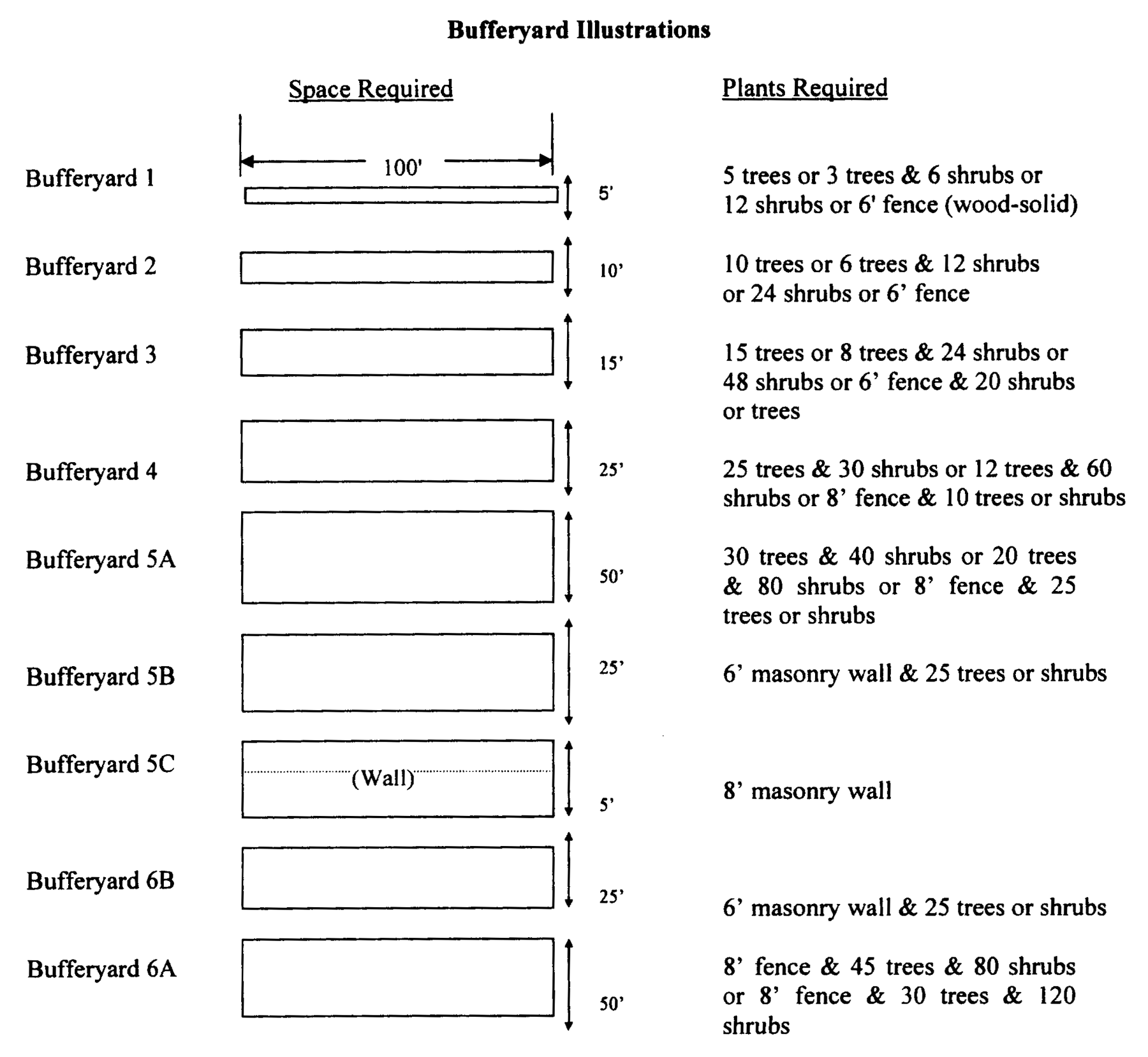
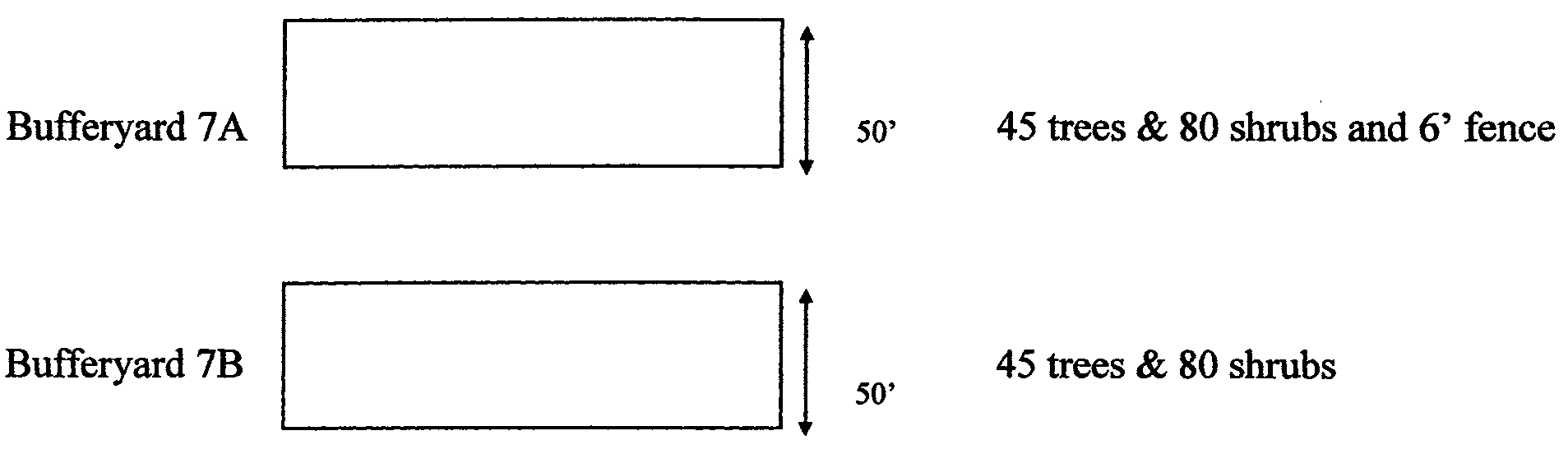
12:8.2-5. Use of existing vegetation. In no event shall a developer clear-cut the site of a required bufferyard. The developer shall conduct an existing tree inventory, identifying the location, species, and diameter (breast high) of all trees in the bufferyard, and complement the presence of such trees with appropriate shrubs and other vegetation to meet all requirements of this section.
12:8.2-6. Materials. To achieve the desired results, only coniferous (evergreen) plants, suitable for local conditions, shall be used. When structures are used, the materials shall be durable and suitable for screening.
12:8.2-7. Plant size and caliper. The minimum tree at planting shall be six feet in height and two and one-half inches in diameter at a height of four and one-half feet above the ground. The minimum shrub shall be three to five gallons in size. Both trees and shrubs shall be nursery stock with well-developed root systems unless plants found in place can be used. If the existing vegetation provides a screen equal to or greater than that which would be planted, no other plant material shall be required. In case of open woods, an additional planting of eye shrubs such as hemlock or pines may be needed to improve screening. Fencing requirements are not changed by a wooded site.
12:8.3. Substitutions. The following substitutions for opaque walls, fences, and plant materials may be made:
1.
Berms (3H:1V Maximum slope) may be used to compensate for fences. An eight-foot high opaque structure can be a combination of berm and fence to total eight feet.
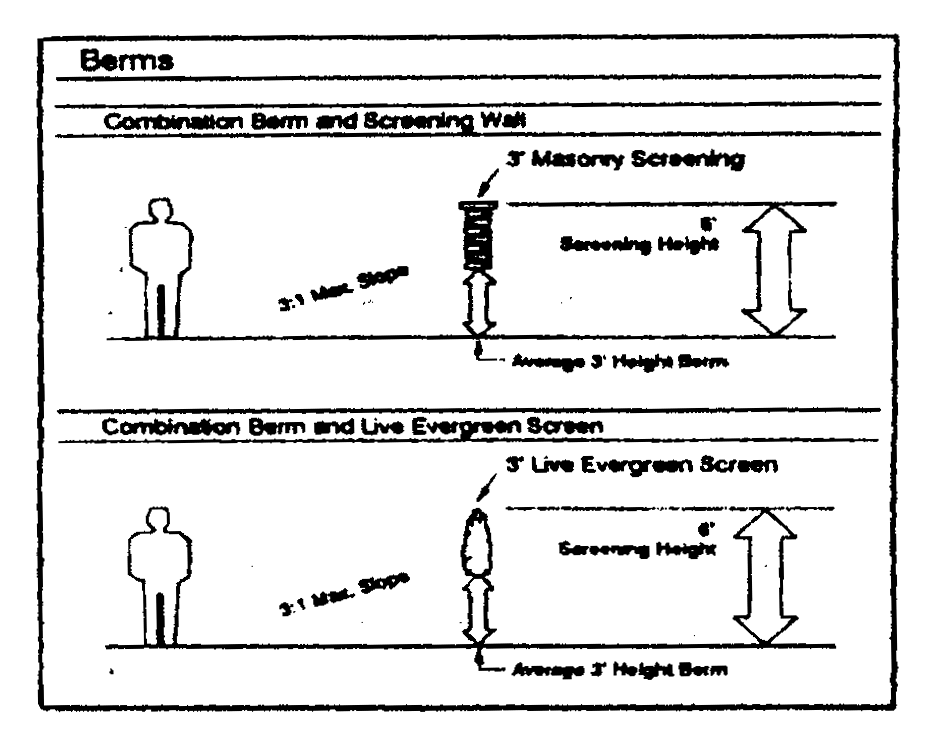
2.
Chain link fences with evergreen hedge on the outbound side may be substituted for wooden fences of the same height. All plants must be sized and spaced to obscure the chain link fence within five years of planting.
3.
Any existing plant material that otherwise satisfies the requirements of this section may be substituted and counted toward satisfying the requirements of this section.
12:8.4. Fence and wall specifications. All fences and walls used as part of the bufferyard requirement must have the finished side facing outward. Fences shall be wooden or other durable or opaque material approved by the DSR. Wooden fences shall be made of rot resistant material such as locust, cedar or redwood. If made of pine, the post shall be rated for soil contact and the boards rated for outside use. Chain link fences with wood, plastic, or metal strips are expressly prohibited. However, a chain link fence with evergreen hedge is acceptable. Walls must be made of masonry materials including poured concrete, concrete block covered with stucco, and brick.
12:8.5. Responsibility. It shall be the responsibility of the proposed new use to provide the bufferyard where required by this ordinance, except that no new detached single-family dwelling or duplex shall be required to provide such bufferyard.
12:8.6. Required maintenance. The maintenance of required bufferyards shall be the responsibility of the property owner. All such areas shall be properly maintained so as to ensure continued buffering. All planted areas shall be provided with an irrigation system or a readily available water supply to ensure continuous healthy growth and development. Dead trees shall be removed; debris and litter shall be cleaned; and berms, fences, and walls shall be maintained at all times. Failure to do so is a violation of this Ordinance, and may be remedied in the manner prescribed for other violations.
12:8.7. Use of bufferyards. A bufferyard may be used for underground utilities or passive recreation and may be interrupted by access driveways not exceeding 16 feet in width (exceptions for uses requiring wide curb cuts may be approved by the DSR. All other uses, including off-street parking, are prohibited, including off-street parking.
12:8.8. Sight clearance. Bufferyards may not obscure a clear line of sight for vehicular traffic. Therefore, bufferyards should be placed a minimum distance of 20 feet from street/road right-of-way lines.
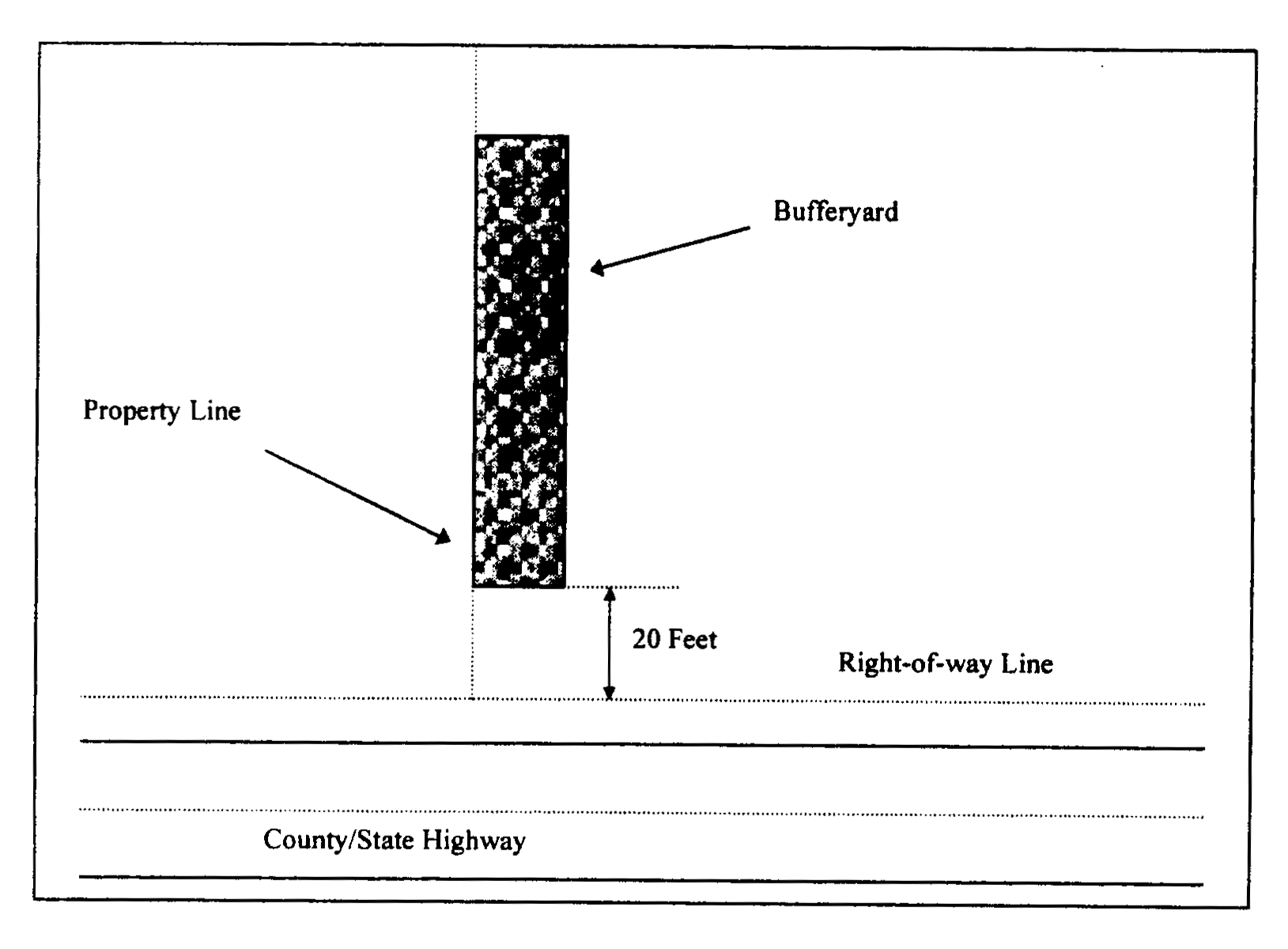
12:8.9. Screening.
12:8.9-1. Definition. Screening is a type of buffer that is designed to block or obscure a particular element or use from view.
12:8.9-2. Purpose. The purpose of screening is to minimize if not eliminate entirely the visual impact of potentially unsightly open storage areas and refuse disposal facilities.
12:8.9-3. Requirements.
1.
Screening specified by this section shall be required of all open storage areas not devoted to retail sales visible from any public street, including open storage areas for shipping containers, building materials, appliances, trash containers of four or more cubic yards, salvage materials and similar unenclosed uses.
2.
Screening shall be accomplished by an opaque divide not less than six feet in high or the height of the object to be screened, whichever is greater. Screening may be accomplished by the use of sight obscuring plant materials (generally evergreens), earth berms, walls, fences, proper siting of disruptive elements, building placement or other design techniques approved by the DSR.
12:8.10. Landscaping.
12:8.10-1. Definition. Landscaping is a type of open space permanently devoted and maintained for the growing of shrubbery, grass, other plants and decorative features to the land.
12:8.10-2. Purpose. The purpose of landscaping is to improve the appearance of vehicular use areas and development abutting public rights-of-way; to enhance environmental and visual characteristics, to promote the greening of development, and the reduction of noise pollution, storm water run off, air pollution, and artificial light glare, and to safeguard property values, protect public and private investments, and promote high-quality development.
12:8.10-3. Requirements.
1.
No proposed commercial, institutional, industrial or other non-residential use, or multi-family project, shall hereafter be established or reestablished in an existing building or structure, and subsequently used unless landscaping is provided in accord with the provisions of this section. No existing building, structure, or vehicular use area shall be enlarged by 30 percent of more unless the minimum landscaping required by the provisions of this section is provided throughout the building site.
2.
Required landscaping shall be provided along the outer perimeter of a lot or parcel, where required by the buffer area provisions of this article, to buffer and separate incompatible land uses. The amount specified shall be as prescribed by section 12:8.2
At a minimum, interior lot landscaping shall be provided in the following amounts:
Landscaping along exterior building walls and structures is suggested to separate with greenery the building from the vehicular surface area.
12:8.10-4. Landscaping plan. A landscaping plan shall be submitted as part of the application for a zoning certificate. The plan shall:
(1)
Designate areas to be reserved for landscaping. The specific design of landscaping shall be sensitive to the physical and design characteristics of the site.
(2)
Indicate the location and dimensions of landscaped areas, plant materials, decorative features, etc.
12:8.10-5. Landscaped areas.
(1)
All landscaped areas in or adjacent to parking areas shall be protected form vehicular damage by a raised concrete curb or an equivalent barrier of six inches in height. The barrier need not be continuous.
(2)
Landscaped areas must be at least 25 square feet in size.
12:8.10-6. Required maintenance. The maintenance of required landscaped areas shall be the responsibility of the property owner. All such areas shall be properly maintained so as to assure their survival and aesthetic value, and shall be provided with an irrigation system or a readily available water supply. Failure to monitor such areas is a violation of this ordinance, and may be remedied in the manner prescribed for other violations.
12:8.11. Common open space.
12:8.11-1. Description. Common open space is land and/or approved water bodies used for recreation and amenities (to include parks, greenways, and pathway systems). It shall be freely accessible to all residents and property owners of a development, where required by this ordinance. No wetlands, right-of-ways, easements or other lands already subject to use restrictions shall be used to generate the percentage of open space reservation required for proposed uses/projects.
12:8.11-2. Purpose. The purpose of this section is to ensure adequate open space for high density residential development; to integrate recreation, landscaping, greenery, and/or natural areas into such projects; to promote the health and safety of residents of such projects; and to compensate for the loss of open space inherent in single-family residential projects.
12:8.11-3. Requirements. The following uses/projects consisting of seven or more units shall provide common open space in the amounts prescribed:
(1)
New sites: No proposed development, building or structure in connection with the above shall hereafter be erected or used unless common open space is provided in accord with the provisions of this section.
(2)
Existing sites: No existing development, building or structure in connection with the above shall be expanded or enlarged unless the minimum common open space required by the provisions of this section are provided to the extent of the alteration or expansion.
12:8.11-4. Common open space plan. Proposed uses/projects set forth in 12:8.11-3 shall submit an open space or landscaping plan as part of the application for a building permit. The plan shall:
(1)
Designate areas to be reserved as open space. The specific design of open space shall be sensitive to the physical and design characteristics of the site.
(2)
Designate the type of open space which will be provided, and indicate the location of plant materials, decorative features, recreational facilities, etc.
(3)
Specify the manner in which common open space shall be perpetuated, maintained and administered.
12:8.11-5. Types of common open space and required maintenance. The types of common open space, which may be provided to satisfy the requirements of this ordinance together with the maintenance required for each, are as follows:
(1)
Natural areas are areas of undisturbed vegetation or areas replanted with vegetation after construction. Woodlands and wetlands are specific types of natural areas. Maintenance is limited to removal of litter, dead trees, plant materials, and brush. Natural watercourses are to be maintained as free flowing and devoid of debris. Stream channels shall be maintained so as not to alter floodplain levels.
(2)
Recreational areas are designed for specific active recreational uses such as tot lots, tennis courts, swimming pools, shall fields, and similar uses. Recreational areas shall be accessible to all residents of the development. Maintenance is limited to ensuring that there exist no hazards, nuisances, or unhealthy conditions.
(3)
Greenways are linear green belts linking residential areas with other open space areas. These greenways may contain bicycle paths, footpaths, and bridle paths. Connecting greenways between residences and recreational areas are encouraged. Maintenance is limited to a minimum or removal and avoidance of hazards, nuisances, or unhealthy conditions.
(4)
Landscaped areas, parks and required buffer areas, including creative landscaped areas with gravel and tile, so long as the tile does not occupy more than two percent of the required open space. Grassed areas, with or without trees and shrubs shall be watered regularly to ensure survival, and mowed regularly to ensure neatness. Landscaped areas shall be trimmed, cleaned, and weeded regularly.
12:8.11-6. Preservation of open space. Land designated as common open space may not be separately sold, subdivided or developed. Open space areas shall be maintained so that their use and enjoyment as open space are not diminished or destroyed. Open space areas may be owned, preserved and maintained as required by this section by any of the following mechanisms or combinations thereof:
(1)
Common ownership of the open space by a homeowner's association which assumes full responsibility for its maintenance.
(2)
Deed restricted, private ownership, which shall prevent development and/or subsequent subdivision of the open space land and provide the maintenance.
(3)
Dedication of and acceptance by the county.
In the event that any private owner of open space fails to maintain same, the county may in accordance with the open space plan and following reasonable notice, demand that deficiency of maintenance be corrected, and enter the open space to maintain same. The cost of such maintenance shall be charged to those persons having the primary responsibility for maintenance of the open space.
(Ord. No. 08-11, § 11, 5-5-08; Ord. No. 09-12, §§ 15, 16, 5-4-09; Ord. No. 12-10, § 4, 6-18-12)
12:9. - Manufactured housing.
12:9.1 General provisions. For the purpose of this subchapter, the following definitions shall apply unless the context clearly indicates or requires a different meaning.
Current owner. The person or persons who either already own record title to the manufactured home, or who are applying for the permit in connection with their purchase of the manufactured home.
Decal or manufactured home decal. The manufactured home decal is issued by the Jasper County assessor's office.
Permitting agent. The Jasper County planning and building department.
Manufactured home. A home that is built in a factory according to the Federal Manufactured Home Construction and Safety Standards, known as the HUD Code, and is then transported and installed at its final destination.
Age of manufactured homes allowed in county. For permitting purposes, a manufactured home that was manufactured more than 30 years from the date of permit application shall not be moved into the county. A manufactured home that is already established in the county and that was manufactured more than 30 years from the date of permit application may not be relocated within the County unless the manufactured home owner provides an inspection report by a SC Licensed Engineer, certifying that the manufactured home meets the Habitability Standards of Section 12:9.5 and is structurally sound to be moved and set-up at another location, which must meet the Set-Up Requirements of Section 12:9.4.
No more than one manufactured home may be placed on a parcel of record, except where allowed conditionally pursuant to Article 6:1 - Table 1. However, manufactured homes currently located and legally established within the county as of the date of the adoption of this subchapter, can continue to be occupied and used in the county in the location where they are currently located pursuant to Article 9:3, Non-Conforming Uses and Structures.
12:9.2 Permitting and registration of manufactured home. Prior to bringing a manufactured home into the county, or the purchase of a manufactured home in this county for dwelling purposes, or prior to the movement of an existing manufactured home from one site to another within the county, the owner, rental agent, or person in possession of such manufactured home shall obtain proper zoning and building permits, and the manufactured home decal from the Jasper County Assessor's Office.
1.
If the manufactured home is to be relocated in the county from another county, the manufactured home owner or agent must submit the moving permit from such county.
2.
In addition to the moving permit from the other county, proof may be required that all taxes due have been paid.
3.
The manufactured home owner, rental agent, person in possession or current owner must first obtain a zoning permit from the development services representative (DSR), certifying that the site where the manufactured home will be located in the county meets the requirements of the Jasper County Zoning Ordinance and the Jasper County Official Zoning Map.
4.
An E-911 address for the site is required in order to get a zoning permit.
5.
Copy of septic tank approval from the South Carolina Department of Health and Environmental Control (SCDHEC) for the site where the manufactured home will be located, as well as access to a public water supply or properly permitted private well. In the event the septic tank is existing and the original permit can not be obtained from SCDHEC, an as built survey certified by a licensed septic installer may be accepted.
6.
Proof of Wind Zone II Compliance.
7.
Proof that all taxes have been paid on any manufactured home traded for the subject manufactured home or on the subject manufactured home if no trade is involved.
8.
Title, bill of sale, or finance papers for the subject manufactured home in the current owner's name, showing the year, make, model and serial number of the subject manufactured home.
9.
All title documents must be properly filled out and executed, and a clear chain of title from the last titled owner to the current owner must be produced.
10.
Name, address, contact telephone number and driver's license number of person moving the manufactured home onto the proposed site.
11.
Name, address, contact telephone number and state license number of the person who is installing or setting up the manufactured home.
12.
The applicant must provide proof that the owner, occupant or new purchaser of the manufactured home is legally authorized to place the manufactured home at the location specified in the application for the manufactured home decal. This proof may consist of a copy of the deed to the property showing ownership in the applicant's name, a lease of the property showing the applicant's name as lessee, a copy of the recorded bond for title showing the purchase of the property by the applicant, or a letter of permission to the applicant from the landowner, or other financing papers or evidence of right of occupancy which are deemed to be legally sufficient by the County Attorney.
13.
Prior to permitting of a used manufactured home, the DSR may require pictures of all exterior sides of the home and every room inside the home which illustrates that the manufactured home meets the Habitability Standards outlined in Section 12:9.5 of this Article.
12:9.3 Violations. It is a violation for any mover, hauler, person or entity to move, or to have moved, a manufactured or mobile home to any location in Jasper County without first obtaining a moving and building permit. Citations issued for the illegal moving of a manufactured or mobile home shall be sent directly to the magistrate and will be subject to the maximum penalty allowed by SC law, including the imposition of restitution pursuant to §22-3-550 in the event the manufactured home must be removed.
12:9.4 Setup. Manufactured housing, where permitted by this Ordinance, shall:
1.
Be built according to the Federal Manufactured Housing Construction and Safety Standards Code (245 CFR 3280), enacted June 15, 1976.
2.
Be installed in accordance with the Manufacturer's Installation Manual. In the absence of such a Manual, the home must be installed in accord with the requirements of Section 19-425.39 of the South Carolina Manufactured Housing Board Regulations.
3.
Where the Installation Manual or Housing Board Regulations allow, the structure shall be underpinned (skirted) with brick, masonry, vinyl or similar materials designed and manufactured for permanent outdoor installation.
4.
Have installed or constructed and attached firmly to the home and anchored securely to the ground, permanent landing steps at each exterior doorway, in accord with applicable Building Codes.
5.
When equipped with removable towing apparatus, the towing apparatus will be removed; otherwise all wheels, towing apparatus, and axles will be screened per Paragraph 3 above.
6.
Be served by a separate electric meter. It shall be unlawful for any such home to receive electricity except by use of this separate meter. It shall be unlawful for any public utility or electrical supplier to connect power to any manufactured home in the absence of all approved permits.
7.
Structures placed on lots shall meet all setbacks required by this Ordinance and all other applicable agencies. Lots shall be designed so that the front doors of structures are oriented towards the street frontage.
12:9.5 Habitability. Manufactured housing, where proposed for permitting, shall meet the minimum habitable standards of this section, and shall be maintained in habitable condition.
The term "habitable" means that there is no defect, damage, or deterioration to the home that created a dangerous or unsafe situation or condition; that the plumbing, heating and electrical systems are in safe working order; that the walls, floor, and roof are free from any holds, breaks, loose or rotting boards and are structurally sound; and that all exterior doors and windows are in place. Further, the term habitable includes the provision of the following facilities:
1.
Sanitary facilities. Every manufactured home shall contain not less than a kitchen sink, lavatory, tub or shower, and a water closet all in good working condition and properly connected to an approved water and sewer system. Every plumbing fixture and water and waste pipe shall be properly installed and free from defects, leaks, and obstructions.
2.
Hot and cold water supply. Every manufactured home shall have connected to the kitchen sink, lavatory, and tub or shower cold and hot running water. All water shall be supplied through an approved distribution system connected to a potable water supply.
3.
Heating facilities. Every manufactured home shall have heating facilities, which are properly installed and maintained in safe and good working conditions, and are capable of safely and adequately heating all habitable rooms and bathrooms. Where a central heating system is not provided, each home shall be provided with an alternative system, approved by the DSR.
4.
Cooking and heating equipment. All cooking and heating equipment and facilities which are properly installed and maintained in safe and good working condition, and are capable of safely and adequately heating all habitable rooms and bathrooms. Where a central heating system is not provided, each home shall be provided with an alternative system, approved by the DSR.
5.
Smoke detector. Every manufactured home shall be equipped with an approved smoke detector, installed in accordance with full manufacturer's recommendations and listing.
6.
The DSR may cause to be inspected periodically, existing manufactured homes for compliance with the provisions of this Section.
(Ord. No. 2020-24, § 6, 1-21-20)

